EMPLOYMENT EQUITY FOR  BLACK ECONOMIC EMPOWERMENT
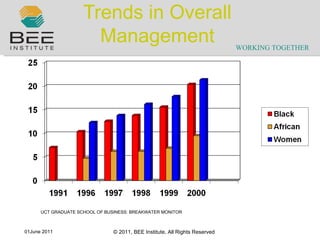
Trends in Overall Management UCT GRADUATE SCHOOL OF BUSINESS: BREAKWATER MONITOR
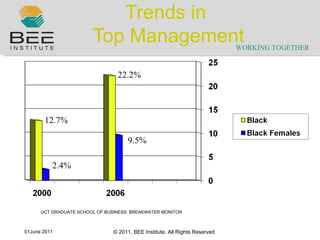
Trends in  Top Management UCT GRADUATE SCHOOL OF BUSINESS: BREAKWATER MONITOR 12.7% 22.2% 2.4% 9.5%
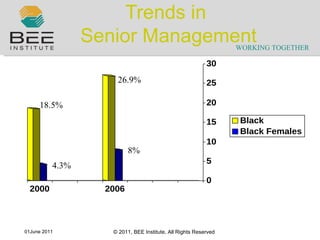
Trends in  Senior Management 18.5% 26.9% 4.3% 8%
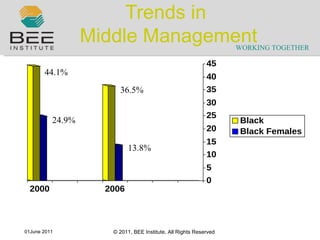
Trends in  Middle Management 44.1% 36.5% 24.9% 13.8%
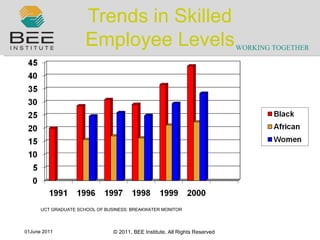
Trends in Skilled Employee Levels UCT GRADUATE SCHOOL OF BUSINESS: BREAKWATER MONITOR
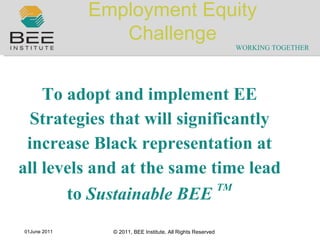
To adopt and implement EE Strategies that will significantly increase Black representation at all levels and at the same time lead to  Sustainable BEE  TM Employment Equity Challenge
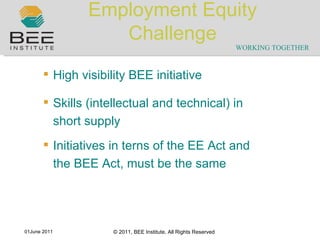
Employment Equity Challenge  High visibility BEE initiative Skills (intellectual and technical) in short supply Initiatives in terns of the EE Act and the BEE Act, must be the same
Employment Equity and Skills Development  = 22% of Scorecard
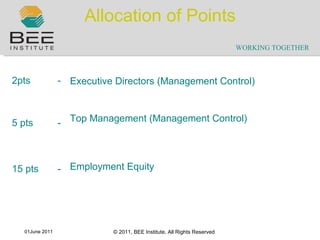
Allocation of Points 2pts   - 5 pts  -  15 pts  - Executive Directors (Management Control) Top Management (Management Control) Employment Equity
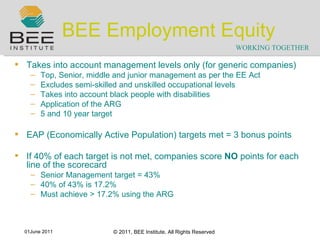
BEE Employment Equity  Takes into account management levels only (for generic companies) Top, Senior, middle and junior management as per the EE Act Excludes semi-skilled and unskilled occupational levels Takes into account black people with disabilities Application of the ARG 5 and 10 year target EAP (Economically Active Population) targets met = 3 bonus points  If 40% of each target is not met, companies score  NO  points for each line of the scorecard Senior Management target = 43% 40% of 43% is 17.2% Must achieve > 17.2% using the ARG
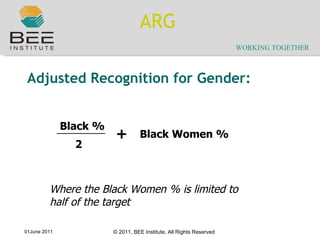
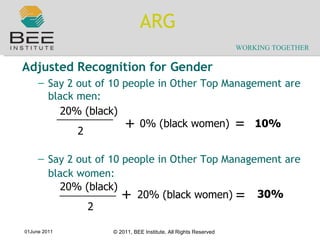
ARG Adjusted Recognition for Gender: Where the Black Women % is limited to half of the target  Black % Black Women % 2 +
ARG Adjusted Recognition for Gender Say 2 out of 10 people in Other Top Management are black men: Say 2 out of 10 people in Other Top Management are black women: 20% (black) 0% (black women) 2 + 10% = 20% (black) 20% (black women) 2 + 30% =
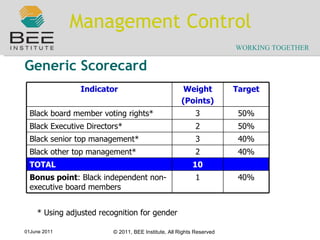
Management Control Generic Scorecard * Using adjusted recognition for gender Indicator Weight (Points) Target Black board member voting rights* 3 50% Black Executive Directors* 2 50% Black senior top management* 3 40% Black other top management* 2 40% TOTAL 10 Bonus point : Black independent non-executive board members 1 40%
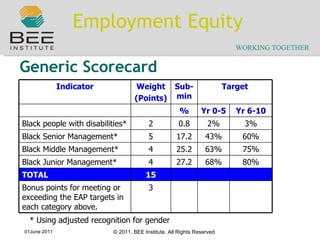
Employment Equity Generic Scorecard * Using adjusted recognition for gender Indicator Weight (Points) Sub-min Target % Yr 0-5 Yr 6-10 Black people with disabilities* 2 0.8 2% 3% Black Senior Management* 5 17.2 43% 60% Black Middle Management* 4 25.2 63% 75% Black Junior Management* 4 27.2 68% 80% TOTAL 15 Bonus points for meeting or exceeding the EAP targets in each category above. 3
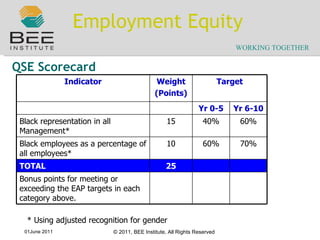
Employment Equity QSE Scorecard * Using adjusted recognition for gender Indicator Weight (Points) Target Yr 0-5 Yr 6-10 Black representation in all Management* 15 40% 60% Black employees as a percentage of all employees* 10 60% 70% TOTAL 25 Bonus points for meeting or exceeding the EAP targets in each category above.
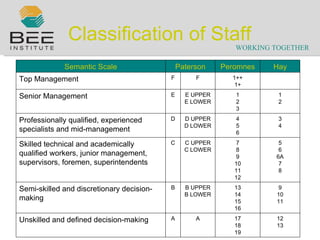
Classification of Staff Semantic Scale Paterson Peromnes Hay Top Management F F 1++ 1+ Senior Management E E UPPER E LOWER 1 2 3 1 2 Professionally qualified, experienced specialists and mid-management D D UPPER D LOWER 4 5 6 3 4 Skilled technical and academically qualified workers, junior management, supervisors, foremen, superintendents C C UPPER C LOWER 7 8 9 10 11 12 5 6 6A 7 8 Semi-skilled and discretionary decision - making B B UPPER B LOWER 13 14 15 16 9 10 11 Unskilled and defined decision - making A A 17 18 19 12 13
Classification of Disability People with disabilities are persons who have a long-term or recurring physical or mental impairment which substantially limits their employability or advancement in the workplace.  Mental impairment is defined as a clinically recognised condition or illness that affects a person ’ s thought process.
Classification of Disability Physical Impairment  means total or partial loss of a bodily function or part of the body. It includes sensory impairments   Mental Impairment  means a clinically recognised condition that affects a persons thought process, judgement or emotions.
Classification of Disability Long-term  means the impairment must be for greater than 12 months Recurring impairment  is one that is likely to happen again and to be substantially limiting    Substantially limiting  occurs when the impairment substantially limits the person ’ s ability to perform the essential functions of the job. An assessment to determine whether the impairment is substantially limiting , must consider if medical treatment or devices would control or correct the impairment.
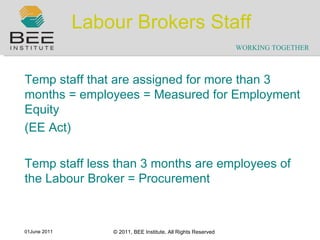
Labour Brokers Staff Temp staff that are assigned for more than 3 months = employees = Measured for Employment Equity (EE Act) Temp staff less than 3 months are employees of the Labour Broker = Procurement
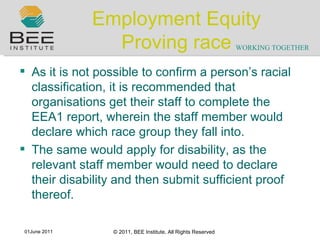
Employment Equity Proving race As it is not possible to confirm a person ’ s racial classification, it is recommended that organisations get their staff to complete the EEA1 report, wherein the staff member would declare which race group they fall into. The same would apply for disability, as the relevant staff member would need to declare their disability and then submit sufficient proof thereof.
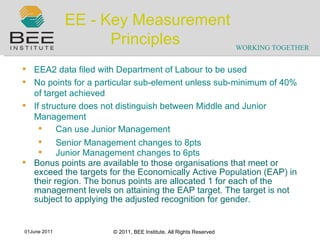
EE - Key Measurement Principles  EEA2 data filed with Department of Labour to be used  No points for a particular sub-element unless sub-minimum of 40% of target achieved If structure does not distinguish between Middle and Junior Management Can use Junior Management Senior Management changes to 8pts Junior Management changes to 6pts   Bonus points are available to those organisations that meet or exceed the targets for the Economically Active Population (EAP) in their region. The bonus points are allocated 1 for each of the management levels on attaining the EAP target. The target is not subject to applying the adjusted recognition for gender.
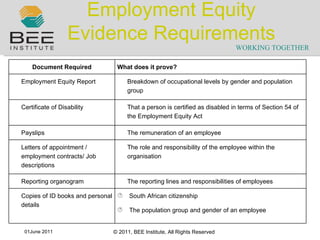
Employment Equity Evidence Requirements Document Required What does it prove? Employment Equity Report Breakdown of occupational levels by gender and population group Certificate of Disability That a person is certified as disabled in terms of Section 54 of the Employment Equity Act Payslips The remuneration of an employee Letters of appointment / employment contracts/ Job descriptions The role and responsibility of the employee within the organisation Reporting organogram The reporting lines and responsibilities of employees Copies of ID books and personal details South African citizenship The population group and gender of an employee

Employment equity forum

  • 1.
    EMPLOYMENT EQUITY FOR BLACK ECONOMIC EMPOWERMENT
  • 2.
    Trends in OverallManagement UCT GRADUATE SCHOOL OF BUSINESS: BREAKWATER MONITOR
  • 3.
    Trends in Top Management UCT GRADUATE SCHOOL OF BUSINESS: BREAKWATER MONITOR 12.7% 22.2% 2.4% 9.5%
  • 4.
    Trends in Senior Management 18.5% 26.9% 4.3% 8%
  • 5.
    Trends in Middle Management 44.1% 36.5% 24.9% 13.8%
  • 6.
    Trends in SkilledEmployee Levels UCT GRADUATE SCHOOL OF BUSINESS: BREAKWATER MONITOR
  • 7.
    To adopt andimplement EE Strategies that will significantly increase Black representation at all levels and at the same time lead to Sustainable BEE TM Employment Equity Challenge
  • 8.
    Employment Equity Challenge High visibility BEE initiative Skills (intellectual and technical) in short supply Initiatives in terns of the EE Act and the BEE Act, must be the same
  • 9.
    Employment Equity andSkills Development = 22% of Scorecard
  • 10.
    Allocation of Points2pts - 5 pts - 15 pts - Executive Directors (Management Control) Top Management (Management Control) Employment Equity
  • 11.
    BEE Employment Equity Takes into account management levels only (for generic companies) Top, Senior, middle and junior management as per the EE Act Excludes semi-skilled and unskilled occupational levels Takes into account black people with disabilities Application of the ARG 5 and 10 year target EAP (Economically Active Population) targets met = 3 bonus points If 40% of each target is not met, companies score NO points for each line of the scorecard Senior Management target = 43% 40% of 43% is 17.2% Must achieve > 17.2% using the ARG
  • 12.
    ARG Adjusted Recognitionfor Gender: Where the Black Women % is limited to half of the target Black % Black Women % 2 +
  • 13.
    ARG Adjusted Recognitionfor Gender Say 2 out of 10 people in Other Top Management are black men: Say 2 out of 10 people in Other Top Management are black women: 20% (black) 0% (black women) 2 + 10% = 20% (black) 20% (black women) 2 + 30% =
  • 14.
    Management Control GenericScorecard * Using adjusted recognition for gender Indicator Weight (Points) Target Black board member voting rights* 3 50% Black Executive Directors* 2 50% Black senior top management* 3 40% Black other top management* 2 40% TOTAL 10 Bonus point : Black independent non-executive board members 1 40%
  • 15.
    Employment Equity GenericScorecard * Using adjusted recognition for gender Indicator Weight (Points) Sub-min Target % Yr 0-5 Yr 6-10 Black people with disabilities* 2 0.8 2% 3% Black Senior Management* 5 17.2 43% 60% Black Middle Management* 4 25.2 63% 75% Black Junior Management* 4 27.2 68% 80% TOTAL 15 Bonus points for meeting or exceeding the EAP targets in each category above. 3
  • 16.
    Employment Equity QSEScorecard * Using adjusted recognition for gender Indicator Weight (Points) Target Yr 0-5 Yr 6-10 Black representation in all Management* 15 40% 60% Black employees as a percentage of all employees* 10 60% 70% TOTAL 25 Bonus points for meeting or exceeding the EAP targets in each category above.
  • 17.
    Classification of StaffSemantic Scale Paterson Peromnes Hay Top Management F F 1++ 1+ Senior Management E E UPPER E LOWER 1 2 3 1 2 Professionally qualified, experienced specialists and mid-management D D UPPER D LOWER 4 5 6 3 4 Skilled technical and academically qualified workers, junior management, supervisors, foremen, superintendents C C UPPER C LOWER 7 8 9 10 11 12 5 6 6A 7 8 Semi-skilled and discretionary decision - making B B UPPER B LOWER 13 14 15 16 9 10 11 Unskilled and defined decision - making A A 17 18 19 12 13
  • 18.
    Classification of DisabilityPeople with disabilities are persons who have a long-term or recurring physical or mental impairment which substantially limits their employability or advancement in the workplace. Mental impairment is defined as a clinically recognised condition or illness that affects a person ’ s thought process.
  • 19.
    Classification of DisabilityPhysical Impairment means total or partial loss of a bodily function or part of the body. It includes sensory impairments   Mental Impairment means a clinically recognised condition that affects a persons thought process, judgement or emotions.
  • 20.
    Classification of DisabilityLong-term means the impairment must be for greater than 12 months Recurring impairment is one that is likely to happen again and to be substantially limiting   Substantially limiting occurs when the impairment substantially limits the person ’ s ability to perform the essential functions of the job. An assessment to determine whether the impairment is substantially limiting , must consider if medical treatment or devices would control or correct the impairment.
  • 21.
    Labour Brokers StaffTemp staff that are assigned for more than 3 months = employees = Measured for Employment Equity (EE Act) Temp staff less than 3 months are employees of the Labour Broker = Procurement
  • 22.
    Employment Equity Provingrace As it is not possible to confirm a person ’ s racial classification, it is recommended that organisations get their staff to complete the EEA1 report, wherein the staff member would declare which race group they fall into. The same would apply for disability, as the relevant staff member would need to declare their disability and then submit sufficient proof thereof.
  • 23.
    EE - KeyMeasurement Principles EEA2 data filed with Department of Labour to be used No points for a particular sub-element unless sub-minimum of 40% of target achieved If structure does not distinguish between Middle and Junior Management Can use Junior Management Senior Management changes to 8pts Junior Management changes to 6pts Bonus points are available to those organisations that meet or exceed the targets for the Economically Active Population (EAP) in their region. The bonus points are allocated 1 for each of the management levels on attaining the EAP target. The target is not subject to applying the adjusted recognition for gender.
  • 24.
    Employment Equity EvidenceRequirements Document Required What does it prove? Employment Equity Report Breakdown of occupational levels by gender and population group Certificate of Disability That a person is certified as disabled in terms of Section 54 of the Employment Equity Act Payslips The remuneration of an employee Letters of appointment / employment contracts/ Job descriptions The role and responsibility of the employee within the organisation Reporting organogram The reporting lines and responsibilities of employees Copies of ID books and personal details South African citizenship The population group and gender of an employee

Editor's Notes

  • #3 1991 1996 1997 1998 1999 2000 Black 7 10.36 12.57 13.79 15.57 20.36 African 4.72 6.18 6.21 6.85 9.52 Women 12.29 13.78 16.16 17.8 21.34
  • #4 Top Management 2000 2006 Black 12.7 22.2 Black Females 2.4 9.6
  • #5 Senior Management 2000 2006 Black 18.5 26.9 Black Females 4.3 8
  • #6 Middle Management 2000 2006 Black 44.1 36.5 Black Females 24.9 13.8
  • #7 1991 1996 1997 1998 1999 2000 Black 20 28.51 30.89 29.06 36.58 43.71 African 15.64 17.06 16.29 21.18 22.35 Women 24.61 25.89 24.8 29.41 33.28
  • #10 The comments on the previous slide also apply to this slide.