Objectives
By the endof this session you will
• Understand the concepts and ideas about personal development
• The process of personal development
• Emotional intelligence: concept and enhancement practices
• Recognise emotional intelligence (EI) and its benefits for managers/leaders
• Identify your own level of EI
• Developing self awareness
• Professional development
• Professional skills set
3.
Module introduction
Enhance yourprofessional skills through critical reflection
Prepare you for lifelong learning and a focus on continuous
professional development
4.
Learning outcomes
1. Demonstratean understanding of how to develop professional skills
in order to operate successfully within a contemporary organisation,
including professional ethics, management, team-working, human
resource issues and recruitment and selection processes. (Knowledge
and understanding , application).
2. Critically reflect on and evaluate personal development and career
needs through the use of a personal development plan.
(Analysis and reflection).
5.
Employability Skills andPersonal Development
We all have a set of transferable skills or employability skills. These are skills that are not specific to
one particular career path but are useful across all employment sectors.
Education + Experience + Skills (Soft Skills) = Employability
Employers often look for skills that go beyond qualifications and experience and which are
transferrable. Creating a strong CV or résumé, writing a good covering letter, and
interviewing well, are how you will show off your employability skills to potential
employers.
Most of us start to develop these skills early on in life, but we may not be aware
that we are doing so.
6.
Personal Development
What ispersonal development?
“Personal development is a life-long process that will enhance your confidence and sense of self-
worth, allowing you to pass experience and knowledge on to others. Discovering your own
motivations and creating a self-reliant, nonjudgmental persona will enable you to encourage positive
feelings and attitudes in others… (Gadd, 2014).”
Self-knowledge is the first step in personal development. It is crucial that you understand yourself; in
order to be aware of your own capabilities and the inner resources that you have available to deal in
a positive and confident way with a busy work environment, your colleagues and the clients
7.
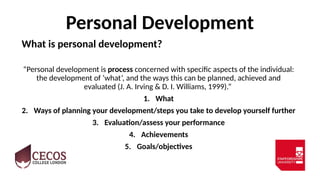
Personal Development
What ispersonal development?
“Personal development is process concerned with specific aspects of the individual:
the development of ‘what’, and the ways this can be planned, achieved and
evaluated (J. A. Irving & D. I. Williams, 1999).”
1. What
2. Ways of planning your development/steps you take to develop yourself further
3. Evaluation/assess your performance
4. Achievements
5. Goals/objectives
8.
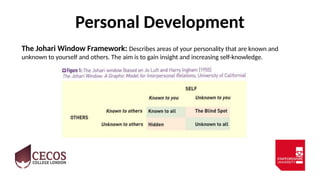
Personal Development
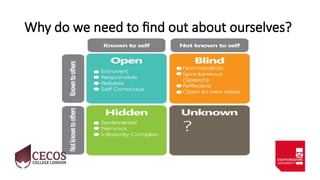
The JohariWindow Framework: Describes areas of your personality that are known and
unknown to yourself and others. The aim is to gain insight and increasing self-knowledge.
9.
Personal Development
Personal DevelopmentPlan (PDP):
To give you a better sense of who you are and what you
want, allowing you more control over your future.
Minimum, optimum, maximum efforts to achieve your goals and
objectives.
10.
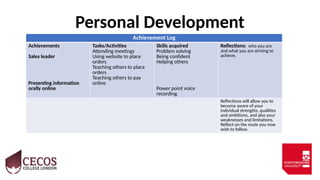
Personal Development
Achievement Log
Achievements
Salesleader
Presenting information
orally online
Tasks/Activities
Attending meetings
Using website to place
orders
Teaching others to place
orders
Teaching others to pay
online
Skills acquired
Problem solving
Being confident
Helping others
Power point voice
recording
Reflections: who you are
and what you are striving to
achieve.
Reflections will allow you to
become aware of your
individual strengths, qualities
and ambitions, and also your
weaknesses and limitations.
Reflect on the route you now
wish to follow.
11.
Personal Development
Personal DevelopmentPlan (PDP):
Personal Development Plans (PDPs) draw on good practice in careers guidance and
on many of the educational initiatives, particularly, Records of Achievement (RoAs)...
The focus of PDPs is a dialogue between student and tutor which clarifies choices,
identifies goals and plans appropriate actions. This process aims to raise personal
understanding and motivation and, ultimately, effectiveness.
12.
Personal Development
Feedback fromothers: To give you a better sense of who you are and what you want, allowing
you more control over your future.
• How you view yourself?
• How others see you?
• Ask your colleagues for some thoughtful feedback.
• Keep an open mind.
• Reflect on the reasons for the comments.
• Ask for examples and use your own judgement as to the validity of the feedback you receive.
13.
Personal Development
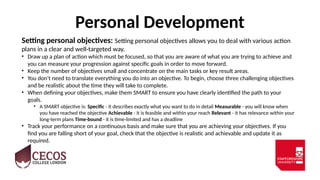
Setting personalobjectives: Setting personal objectives allows you to deal with various action
plans in a clear and well-targeted way.
• Draw up a plan of action which must be focused, so that you are aware of what you are trying to achieve and
you can measure your progression against specific goals in order to move forward.
• Keep the number of objectives small and concentrate on the main tasks or key result areas.
• You don't need to translate everything you do into an objective. To begin, choose three challenging objectives
and be realistic about the time they will take to complete.
• When defining your objectives, make them SMART to ensure you have clearly identified the path to your
goals.
• A SMART objective is: Specific - it describes exactly what you want to do in detail Measurable - you will know when
you have reached the objective Achievable - it is feasible and within your reach Relevant - it has relevance within your
long-term plans Time-bound - it is time-limited and has a deadline
• Track your performance on a continuous basis and make sure that you are achieving your objectives. If you
find you are falling short of your goal, check that the objective is realistic and achievable and update it as
required.
14.
Personal Development
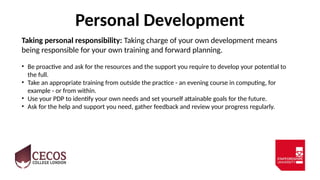
Taking personalresponsibility: Taking charge of your own development means
being responsible for your own training and forward planning.
• Be proactive and ask for the resources and the support you require to develop your potential to
the full.
• Take an appropriate training from outside the practice - an evening course in computing, for
example - or from within.
• Use your PDP to identify your own needs and set yourself attainable goals for the future.
• Ask for the help and support you need, gather feedback and review your progress regularly.
15.
Personal Development
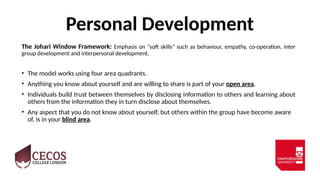
The JohariWindow Framework: Emphasis on “soft skills” such as behaviour, empathy, co-operation, inter
group development and interpersonal development.
• The model works using four area quadrants.
• Anything you know about yourself and are willing to share is part of your open area.
• Individuals build trust between themselves by disclosing information to others and learning about
others from the information they in turn disclose about themselves.
• Any aspect that you do not know about yourself, but others within the group have become aware
of, is in your blind area.
16.
Personal Development
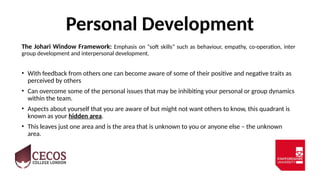
The JohariWindow Framework: Emphasis on “soft skills” such as behaviour, empathy, co-operation, inter
group development and interpersonal development.
• With feedback from others one can become aware of some of their positive and negative traits as
perceived by others
• Can overcome some of the personal issues that may be inhibiting your personal or group dynamics
within the team.
• Aspects about yourself that you are aware of but might not want others to know, this quadrant is
known as your hidden area.
• This leaves just one area and is the area that is unknown to you or anyone else – the unknown
area.
17.
Personal Development
The JohariWindow Framework: Emphasis on “soft skills” such as behaviour, empathy, co-operation, inter
group development and interpersonal development.
• It is possible to increase your open area by asking for feedback from people.
• Honest feedback can reduce the size of your blind area.
• Maybe you interrupt people before they have finished making their point which can cause
frustration.
• Alternatively people may always want to talk to you because you are a good listener.
• Sometimes you don’t realise these aspects of your character until it is pointed out
Personal Development
The Process!
•no end to the self-development process
• build a framework for ongoing development that will enable you to review and update the
information that you collect about yourself constantly, and to monitor your progression.
• identify your own specific development needs - not only the courses you choose to attend, but
also the experiences and activities you need to expand your skills and knowledge in order to meet
your objectives.
• Uncover hidden aspects of your character and highlighting your limitations may hold the key to
better relationships and realisation of untapped potential.
20.
Personal Development Skills
Personaldevelopment skills:
• ongoing act of assessing your life goals and values and building your skills and qualities to reach
your potential and goals.
• Developing soft, transferrable or technical skills by performing a self-analysis on your areas for
improvement and necessary skills to advance in your career or industry while making you a
competitive candidate in any job.
• Contributing to your maturity, success and satisfaction.
• Developing through education, advice from a mentor, self-help and more
• Making you competent and confident
21.
Personal Development Skills
Whyare personal development skills important?
Personal development skills are important because they allow you to create strategic and tactical
plans for personal and professional growth towards your goals. It can be helpful to hone personal
development skills so that you can naturally work them into your daily routines and use them to:
• Achieve personal and career goals
• Advance in your career
• Improve your strengths and talents
• Better yourself
• Find fulfillment and satisfaction
Reflection!
Personal development plansand equal opportunities
1. Explores the impact of gender and ability on a personal development planning (PDP)
2. Discuss the information about the motivation, personal understanding, communication skills and
responsibility of students with regard to their own learning and differences between the ability and gender
groups ...
3. Why is it important to work on each of the areas discussed? Open, Blind, Hidden and Unknown.
25.
Activities
• How studentsperceive the idea of personal development?
• Peer to peer exercise: Reflective writing exercise to enlist personal strengths of each other.
• Audit of your own study, emotional intelligence, communication skills and the results from this will
form the basis of a personal development plan
• 360 Degree feedback
• Self Assessment Tests
• Important skills to have – include on CV
• Identify skills you need to develop – Development plan
• Writing reflective journal of personal experiences, skills, strengths and needs with evidence
26.
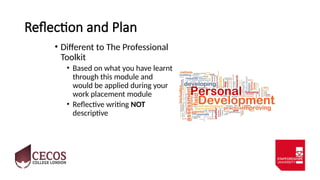
Reflection and Plan
•Different to The Professional
Toolkit
• Based on what you have learnt
through this module and
would be applied during your
work placement module
• Reflective writing NOT
descriptive
27.
Emotional Intelligence (EI)
Whatis emotional intelligence (EI)?
“Emotional Intelligence (EQ) is defined as the ability to identify, assess, and
control one’s own emotions, the emotions of others, and that of groups”.
(Goleman)
28.
Emotional Intelligence (EI)
Whatis emotional intelligence (EI)?
“Emotional intelligence (otherwise known as emotional quotient or EQ) is the ability to understand,
use, and manage your own emotions in positive ways to relieve stress, communicate effectively,
empathize with others, overcome challenges and defuse conflict. Emotional intelligence helps you
build stronger relationships, succeed at school and work, and achieve your career and personal
goals. It can also help you to connect with your feelings, turn intention into action, and make
informed decisions about what matters most to you.”
29.
Emotional Intelligence (EI)
Emotionalintelligence is commonly defined by four attributes:
1. Self-management – controlling impulsive feelings and behaviors, managing your emotions in healthy ways,
taking initiative, follow through on commitments, and adapting to changing circumstances.
2. Self-awareness – recognizing your own emotions and how they affect your thoughts and behavior. Knowing
your strengths and weaknesses, and have self-confidence.
3. Social awareness – Having empathy. Understanding the emotions, needs, and concerns of other people,
picking up on emotional cues, feeling comfortable socially, and recognizing the power dynamics in a group or
organization.
4. Relationship management – Knowing how to develop and maintaining good relationships, communicating
clearly, inspiring and influencing others, working well in a team, and managing conflict.
30.
Components of EmotionalIntelligence (EI)
1. Self Awareness
• Recognising and understanding our moods, our emotions and our drivers.
• How do they affect others
2. Self Regulation
• The ability to control or redirect impulses and moods.
• Thinking before acting.
3. Empathy
• The ability to understand the emotional make up of others.
• Skilful in treating people according to their emotional reactions.
31.
Components of EmotionalIntelligence (EI)
4. Social Skills
• Managing and building relationships and networks.
• Find the common ground and build rapport
5. Motivation
• A passion for work that goes beyond money or status.
• Pursuit of goals with energy and persistence
• This final component was only recently added by Daniel Goleman
Characteristics of EmotionalIntelligence (EI)
• Self awareness
• Self confidence
• Realistic self assessment
• Self regulation
• Trustworthy
• Integrity
• Open to change
• Empathy
• Build talent/trust/rapport
• Cross cultural sensitivity/diversity
34.
Characteristics of EmotionalIntelligence (EI)
• Social skills
• Lead change
• Very persuasive
• Effective at building teams
• Motivation
• Strong drive to achieve
• Optimistic
35.
Effects of EmotionalIntelligence (EI)
• At work
• At school or university
• For mental health
• For physical health
• For relationships and rapports
• For social intelligence
36.
Leaders and EQ
•Create an environment of trust and fairness
• Handle change
• Lead developments
• Drive their team
• Encourage innovation and new ideas
• Generates optimism
• Transform team performance
37.
Emotional Intelligence
• Traditionallythe IQ test, which measures an individual’s mental ability in relation
to people of a similar age, was used to measure intelligence and subsequently the
success or otherwise of leaders and managers
• Recent research has identified the need for leaders to have a degree of Emotional
Intelligence and so help them to understand their team and what it is that
motivates them
38.
How can youimprove emotional intelligence?
• Know yourself
• Feedback from personality tests (Myers Briggs)
• Feedback from friends/work colleagues
• Develop empathy
• Improve listening skills
• Admit mistakes
• Think before you act/say
• Stop judging
• Analyse friendships – spend time with people with high EQ
• Set goals
39.
Career Assessment
Complete careerassessments given below and save the results for the
reflection assessment.
a)Careers, Communication, Learning Styles (
http://www.humanmetrics.com/cgi-win/jtypes2.asp)
b)Risk Attitude (http://www.humanmetrics.com/risk-taking/quiz)
c)Potential Career Match (https://www.41q.com/)
40.
References
• Skillsyouneed. EmployabilitySkills: The Skills You Need to Get a Job. [online]. Available from:
https://www.skillsyouneed.com/general/employability-skills.html. [Accessed 18 June 2021].
• Indeed Editorial Team. 24 May 2021. 9 Ways To Improve Your Personal Development Skills. [online]. Available from:
https://www.indeed.com/career-advice/career-development/improve-your-personal-development-skills. [Accessed 18 June 2021].
• Gadd, Gill. 21 November 2014. Career enhancement through personal development. Taylor and Francis Journal. [online].
Available from: https://www.tandfonline.com/doi/pdf/10.1111/j.2045-0648.2012.00183.x?needAccess=true [Accessed 18
June 2021].
• J. A. Irving & D. I. Williams (1999) Personal growth and personal development: Concepts clarified, British Journal of
Guidance and Counselling. Taylor and Francis Journal. [online]. Available from:
https://www.tandfonline.com/doi/pdf/10.1080/03069889908256287?needAccess=true [Accessed 18 June 2021].
• Kate Bullock , Alma Harris & Ian Jamieson. 1996. Personal development plans and equal opportunities, Educational
Research, 38:1, 21-35. Taylor and Francis Journal. [online]. Available from:
https://www.tandfonline.com/doi/pdf/10.1080/0013188960380102?needAccess=true [Accessed 18 June 2021].

![References
• Skillsyouneed. Employability Skills: The Skills You Need to Get a Job. [online]. Available from:
https://www.skillsyouneed.com/general/employability-skills.html. [Accessed 18 June 2021].
• Indeed Editorial Team. 24 May 2021. 9 Ways To Improve Your Personal Development Skills. [online]. Available from:
https://www.indeed.com/career-advice/career-development/improve-your-personal-development-skills. [Accessed 18 June 2021].
• Gadd, Gill. 21 November 2014. Career enhancement through personal development. Taylor and Francis Journal. [online].
Available from: https://www.tandfonline.com/doi/pdf/10.1111/j.2045-0648.2012.00183.x?needAccess=true [Accessed 18
June 2021].
• J. A. Irving & D. I. Williams (1999) Personal growth and personal development: Concepts clarified, British Journal of
Guidance and Counselling. Taylor and Francis Journal. [online]. Available from:
https://www.tandfonline.com/doi/pdf/10.1080/03069889908256287?needAccess=true [Accessed 18 June 2021].
• Kate Bullock , Alma Harris & Ian Jamieson. 1996. Personal development plans and equal opportunities, Educational
Research, 38:1, 21-35. Taylor and Francis Journal. [online]. Available from:
https://www.tandfonline.com/doi/pdf/10.1080/0013188960380102?needAccess=true [Accessed 18 June 2021].](https://image.slidesharecdn.com/employabilityskillsweek2lectures-260206105651-e5486957/85/Employability-Skills_Week-2_Lectures-pptx-40-320.jpg)


