Emotional Intelligence (EI)Defined
Ability to recognize
and understand
emotions
Using this
awareness to
manage yourself
and relationships
with others
4.
Johnny Mac –Emotionally Intelligent?
http://youtu.be/C8Nyc9jzSDg
5.
Aristotle says,
Anybody canbecome angry
– that is easy, but to be angry
with the right person and to the
right degree and at the right time
and for the right purpose, and in
the right way – that is not within
everybody’s power and is not
easy.
6.
Science Behind EI– Brain Pathways
Spinal Chord
(enters brain here)
Limbic System
(I feel here)
I think rationally
(way over here)
EQ affected by our ability
to form & keep well-
traveled
connections here
7.
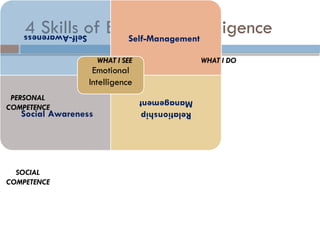
4 Skills ofEmotional Intelligence
Self-Awareness
Self-Management
Social Awareness Relationship
Management
Emotional
Intelligence
WHAT I SEE WHAT I DO
PERSONAL
COMPETENCE
SOCIAL
COMPETENCE
8.
EQ Quiz Scoring
Add up your score to determine where you stand on
Emotional Intelligence
119 or higher = Above Average EI
98 – 118 = Moderate EI
97 or lower = Low EI
9.
EI Starts withSelf-Awareness
Self-Awareness
•Ability to accurately perceive
your own emotions
•Stay aware of your emotions
as they happen
•Keep on top of how you tend
to respond to specific
situations and people
The greatest of faults is
to be conscious of none
Thomas Carlyle
10.
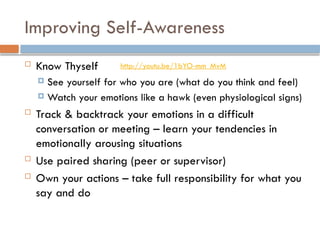
Improving Self-Awareness
KnowThyself
See yourself for who you are (what do you think and feel)
Watch your emotions like a hawk (even physiological signs)
Track & backtrack your emotions in a difficult
conversation or meeting – learn your tendencies in
emotionally arousing situations
Use paired sharing (peer or supervisor)
Own your actions – take full responsibility for what you
say and do
http://youtu.be/1bYO-mm_MvM
11.
Use Awareness toSelf-Manage
Self-Management
•Ability to use awareness of
your emotions to stay
flexible and positively direct
your behavior
•Managing your emotional
reactions to all situations
and people
The first and best
victory is to conquer
self
Plato
12.
Emotional Triggers
What arethe triggers that
make you want to blow
an emotional gasket?
http://youtu.be/mC_97F2Zn9k
13.
Emotional Red Flags& Breakdowns
Angry tirades Door Slamming Email letter bomb
Use of sarcasm and inappropriate humor
Withdrawal & Isolation
Holding grudges and getting even
Passive Aggressive behavior
14.
Becoming Socially Aware
SocialAwareness
•Ability to accurately pick
up on emotions in other
people
•Understand what is really
going on
•Understanding what other
people are thinking and
feeling even if you don’t
feel the same way
Resolve to be tender with the
young, compassionate with the aged,
sympathetic with the striving and
tolerant with the weak and wrong.
Sometime in your life, you will have
been all of these.
Gautama Buddha
http://youtu.be/S2XvxDaIwCw
15.
Social Awareness RequiresEmpathy
Empathy is the ability to see the world from
another’s point of view and to identify
and understand another’s situation,
feelings and motives
16.
Improving Social Awareness
Spend extra time observing,
asking & listening
Maintain eye contact
Give the speaker your full
attention
Playback and summarize
Try on their shoes
Suspend your judgment
Read body language
Decipher emotions in speech
tone
17.
Use Awareness toManage Relationships
Relationship
Management
•Ability to use awareness of
your emotions and emotions
of others to manage
interactions successfully
•Ensure clear
communication and
effective handling of conflict
http://youtu.be/5SnSzo4AbRI
People aren’t either wicked or
noble. They’re like chef salads
with good things and bad things
chopped up and mixed together
in a vinaigrette of confusion and
conflict.
Lemony Snicket
18.
Improving Relationship Management
Seek to build high quality, high trust relationships
Try to discover what role emotions are playing in
your interactions with others
If you sense tension or other emotional reactions in
a person’s body language or speech, ask questions
to seek to understand
Be quick to settle disputes, differences of opinion
and misunderstandings
19.
What does EIhave to do with ECP?
Self-Management
•Ability to use awareness of your
emotions to stay flexible and
positively direct your behavior
•Managing your emotional reactions
to all situations and people
Social Awareness
•Ability to accurately pick up on
emotions in other people
•Understand what is really going on
•Understanding what other people
are thinking and feeling even if you
don’t feel the same way
Self-Awareness
•Ability to accurately perceive your
own emotions
•Stay aware of your emotions as they
happen
•Keep on top of how you tend to
respond to specific situations and
people
Relationship Management
•Ability to use awareness of your
emotions and emotions of others to
manage interactions successfully
•Ensure clear communication and
effective handling of conflict
PERSONAL
COMPETENCE
SOCIAL
COMPETENCE
WHAT I SEE WHAT I DO
20.
What does EIhave to do with ECP?
Individual & Organizational Performance
21.
Final Thoughts
If youremotional abilities aren’t in hand, if
you don’t have self-awareness, if you are
not able to manage your distressing
emotions, if you can’t have empathy and
have effective relationships, than no
matter how smart you are, you are not
going to get very far.
22.
EI Resources
Websites
Talentsmart.com
Eiconsortium.org
Eisource.com
6seconds.org
Books / Articles
Goleman
Emotional Intelligence (1995)
Working with emotional intelligence (1998)
Bradberry & Greaves: Emotional Intelligence Quick Book
Emily Sterrett: Managers’ Pocket Guide to Emotional Intelligence
Editor's Notes
#2 -October 1995 issue – Daniel Goleman based on his book Emotional Intelligence
-Was initially studied in 1920’s during the IQ movement and called social intelligence. Researchers testing intelligence realized that IQ did not capture all of a person’s potential for success. However, the behavioral psychology movement stifled the study of emotional intelligence as it was considered taboo to explore this side of the human psyche.
-Intellect accounts for 20% of success in life (emotional intelligence, social class, and luck make up rest)
-Research at Yale in the early 1990s was conclusive that the EQ is a major indicator of achievement, which helped explain why two people with the same intelligence could attain vastly different levels of success in their work and personal lives.
#6 Our brains are wired to make us emotional creatures. We experience the emotional response to an event before it reaches the part of the brain that thinks rationally and reacts to the emotion.
The more we think about what we are feeling – and do something productive with that feeling – the more developed this pathway becomes. The more traffic in both directions the better.
This means if I typically yell when I’m feeling angry, I have to learn to choose an alternative reaction. I must practice this new reaction many times before it will replace my urge to yell.
#10 Physiological Signs: thoughts speed up, mind goes blank, feeling hot, feeling numb, heart beats increase, muscle tension, tunnel vision, tightness in throat, tingling, trembling or shaking
#12 What are your emotional triggers?
What are some of the emotional triggers of CI’s?
Do you know the emotional triggers of your stakeholders?
#16 Anthropologists make their living watching others in their natural state without letting their own thoughts and feelings disturb the observation. This is social awareness in its purest form.
Reading body language – emotional wheel
#19 Go box by box
Importance of empathy
Relationship management
What is fundamental to any relationship, which low EI could compromise: Trust
Do you think low EI in supervisors, managers or others could be correlated to employee concerns? (many of the issues we receive are because of what someone said or did and how it was perceived)