EU4Environment:
A new regional programme in the
Eastern Partnership framework
Krzysztof Michalak
Senior Programme Manager, Environment Directorate, OECD
Objective
Help the Partner countries preserve natural capital and
increase people's well-being, as well as stimulate
economic development
Key facts
 Legal basis: EC Implementing Decision C(2017)7963 of 27 Nov. 2017
 Duration: 2019-2022
 Budget: EUR 20 million (EU contribution: EUR 19.5 million)
 Implementing Partners: OECD, UN Environment, UNECE, UNIDO, World Bank
 Overall direction: European Commission (DG NEAR & DG Environment)
 EU4… family links: EU4Business, EU4Energy, EU4Climate
Five Results
 RESULT 1. Greener decision-making (UN Environment and UNECE)
 RESULT 2. Circular economy and new growth opportunities (UNIDO and UN Environment)
 RESULT 3. An environmental level playing field (OECD)
 RESULT 4. Ecosystem services and livelihoods (the World Bank)
 RESULT 5. Knowledge sharing and coordination (OECD)
Inception phase – key facts
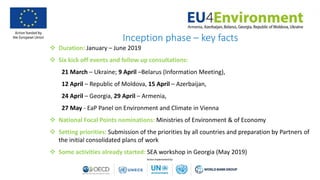
 Duration: January – June 2019
 Six kick off events and follow up consultations:
21 March – Ukraine; 9 April –Belarus (Information Meeting),
12 April – Republic of Moldova, 15 April – Azerbaijan,
24 April – Georgia, 29 April – Armenia,
27 May - EaP Panel on Environment and Climate in Vienna
 National Focal Points nominations: Ministries of Environment & of Economy
 Setting priorities: Submission of the priorities by all countries and preparation by Partners of
the initial consolidated plans of work
 Some activities already started: SEA workshop in Georgia (May 2019)
Inception phase – conclusions (1)
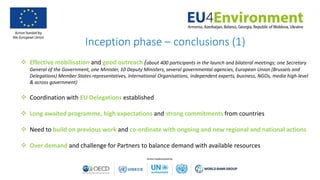
 Effective mobilisation and good outreach (about 400 participants in the launch and bilateral meetings; one Secretary
General of the Government, one Minister, 10 Deputy Ministers, several governmental agencies, European Union (Brussels and
Delegations) Member States representatives, International Organisations, independent experts, business, NGOs, media high-level
& across government)
 Coordination with EU Delegations established
 Long awaited programme, high expectations and strong commitments from countries
 Need to build on previous work and co-ordinate with ongoing and new regional and national actions
 Over demand and challenge for Partners to balance demand with available resources
Inception phase – conclusions (2)
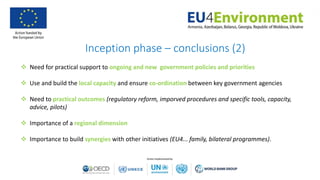
 Need for practical support to ongoing and new government policies and priorities
 Use and build the local capacity and ensure co-ordination between key government agencies
 Need to practical outcomes (regulatory reform, imporved procedures and specific tools, capacity,
advice, pilots)
 Importance of a regional dimension
 Importance to build synergies with other initiatives (EU4... family, bilateral programmes).
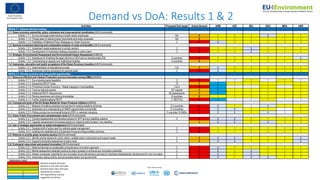
Demand vs DoA: Results 1 & 2
Explanatory notes:
demand exceeds DoA plan
demand in line with DoA plan
demand lower than DoA plan
1 requested by country
X not requested by country
V suggested by Partner
Activities Proposed DoA target Actual demand ARM AZE BEL GEO MDA UKR
RESULT 1. Greener decision-making
1.1: Green economy ownership, policy coherence and cross-sectorial coordination (UN Environment)
‒ Activity 1.1.1: Survey and large-scale training of public sector employees NA 5 1 1 1 X 1 1
‒ Activity 1.1.2: Fitness tests of relevant policy documents and policy proposals NA 6 1 1 1 1 1 1
‒ Activity 1.1.3: Facilitation of National Policy Dialogues on Green Economy 3 5 X 1 1 1 1 1
1.2: Sectoral investment planning and comparative analysis of costs and benefits (UN Environment)
‒ Activity 1.2.1: Investment needs assessment in priority sectors 3 5 1 1 X 1 1 1
‒ Activity 1.2.2: Development of investment strategy proposals or action plans 3 5 1 1 X 1 1 1
1.3: Strategic Environmental Assessment and Environmental Impact Assessment (UNECE)
‒ Activity 1.3.1: Assistance for finalizing the legal reforms on SEA and on transboundary EIA 4 countries 5 1 1 1 1 1 X
‒ Activity 1.3.2: Comprehensive capacity and institutional building 6 countries 6 1 1 1 1 1 1
1.4: Awareness, education and public acceptance of the Green Economy transition (UN Environment)
‒ Activity 1.4.1: Implementation of educational courses 3-6 5 X 1 1 1 1 1
‒ Activity 1.4.2: Awareness raising campaigns for general public 3 5 X 1 1 1 1 1
RESULT 2. Circular economy and new growth opportunities
2.1: Resource Efficient and Cleaner Production and eco-innovation among SMEs (UNIDO)
‒ Activity 2.1.1: Eco-industrial parks feasibility 2 6 1 1 1 1 1 1
‒ Activity 2.1.2: Supporting RECP Clubs 12 5 V 1 1 1 1 1
‒ Activity 2.1.3: Promoting Circular Economy – Waste mapping in municipalities 3 to 5 5 V 1 1 1 1 1
‒ Activity 2.1.4: Training national experts 50* experts 5 V 1 1 1 1 1
‒ Activity 2.1.5: Additional RECP Assessments 60 assessments 5 V 1 1 1 1 1
‒ Activity 2.1.6: Raising awareness and sharing knowledge 6 countries 6 1 1 1 1 1 1
‒ Activity 2.1.7: Further institutionalising RECP 2 RECPCs 5 V 1 1 1 1 1
2.2: Concept and tools of the EU Single Market for Green Products initiative (UNIDO)
‒ Activity 2.2.1: Mapping of existing practices and barriers for existing labelling schemes 2-3 countries 4 X 1 1 X 1 1
‒ Activity 2.2.2: Awareness and understanding of SMPG opportunities and benefits 2-3 countries 4 X X 1 1 1 1
‒ Activity 2.2.3: Piloting product environmental footprint (PEF) in selected industries 2 countries 10 SMEs 3 X X 1 X 1 1
2.3: Green Public Procurement and complementary tools (UN Environment)
‒ Activity 2.3.1: Conduct assessments and develop policies for SPP and eco-labelling systems 2 4 X X 1 1 1 1
‒ Activity 2.3.2: Capacity development of business sectors to respond public tenders / eco-labelling 3 X X 1 X 1 1
2.4: Use of strategic approaches on waste management (UN Environment)
‒ Activity 2.4.1: Develop draft of action plan for national waste management 2 6 1 1 1 1 1 1
‒ Activity 2.4.2: Initiating the establishment of Extended Producers Responsibility schemes 3 6 1 1 1 1 1 1
2.5: Reforms in priority green economy sectors (UN Environment)
‒ Activity 2.5.1: Identify priority sectors for policy reform, suitable policy instruments and support needs 3 3 X X 1 1 1 X
‒ Activity 2.5.2: Support introduction/adjustment of policy tools 3 3 X X 1 1 1 X
2.6: Ecological value-chain and product innovation (UN Environment)
‒ Activity 2.6.1: National trainings on sustainable production/eco-innovation approach 2 5 X 1 1 1 1 1
‒ Activity 2.6.2: Market assessment (selected sectors) & policy analysis to enhance eco-innovation potentials 2 4 X 1 X 1 1 1
‒ Activity 2.6.3: Assess companies’ potential for eco-innovation & provide advisory services for business strategies/plan development for eco-innovation 2 4 X 1 X 1 1 1
‒ Activity 2.6.4: Awareness raising activity among business sector and government 2 4 X 1 X X 1 1
Demand vs DoA: Results 3 & 5
Explanatory notes:
demand exceeds DoA plan
demand in line with DoA plan
demand lower than DoA plan
1 requested by country
X not requested by country
V suggested by Partner
RESULT 3. An environmental level playing field DoA target Actual demand ARM AZE BEL GEO MDA UKR
3.1: “Smart” regulation of environmental impacts (OECD)
‒ Activity 3.1.1: Reforming regulatory regimes for large emission sources, including State Owned Enterprises 4 countries 6 1 1 1 1 1 1
‒ Activity 3.1.2: Greening Small and Medium Sized Enterprises (SMEs) 3 countries 5 X 1 1 1 1 1
3.2: Environmental compliance assurance and environmental liability regimes (OECD)
‒ Activity 3.2.1: Strengthening of Compliance Assurance Systems, Instruments, and Tools 3 countries 5 1 1 1 X 1 1
‒ Activity 3.2.2: Reform of high impact enforcement and compliance promotion instruments 3 countries 5 X 1 1 1 1 1
‒ Activity 3.2.3: Networking and capacity building 2-3 countries 3 X X X 1 1 1
3.3: Domestic public finance, subsidy reforms, public-private partnerships & private finance for green investment (OECD)
‒ Activity 3.3.1: Greening public expenditure 2 countries 5 1 1 1 X 1 1
‒ Activity 3.3.2: Review of selected national funding entities 2-3 countries 4 X 1 1 X 1 1
‒ Activity 3.3.3: Reforming energy subsidies 2 countries 3 X 1 1 X 1 V
‒ Activity 3.3.4: National and regional policy dialogues on green finance and investment (green bonds) 3 countries 5 1 1 1 V 1 1
3.4: Administrative capacity for environmental management (OECD)
‒ Activity 3.4.1: Assessment of existing and required administrative capacity in the environmental sector 5 countries 5 1 1 1 V 1 1
‒ Activity 3.4.2: Provision of Expert Support to the Ministries f Environment and or Economy 4-5 countries 4 1 1 X X 1 1
RESULT 5. Knowledge sharing and coordination
5.1: Ensuring action visibility and strategic communication (OECD) all countries 5 1 1 1 V 1 1
5.2: Regional coordination and oversight (OECD) all countries 5 1 1 1 V 1 1
5.3: Monitoring of progress at the economy-environment nexus (OECD)
6 countries:
2 pilot + 4
3 V V 1 V 1 1
Round table discussion
• Raise important points on the priorities, and
• Ask questions regarding the work plans or
implementation

EU4Environment RA - Introduction

  • 1.
    EU4Environment: A new regionalprogramme in the Eastern Partnership framework Krzysztof Michalak Senior Programme Manager, Environment Directorate, OECD
  • 2.
    Objective Help the Partnercountries preserve natural capital and increase people's well-being, as well as stimulate economic development
  • 3.
    Key facts  Legalbasis: EC Implementing Decision C(2017)7963 of 27 Nov. 2017  Duration: 2019-2022  Budget: EUR 20 million (EU contribution: EUR 19.5 million)  Implementing Partners: OECD, UN Environment, UNECE, UNIDO, World Bank  Overall direction: European Commission (DG NEAR & DG Environment)  EU4… family links: EU4Business, EU4Energy, EU4Climate
  • 4.
    Five Results  RESULT1. Greener decision-making (UN Environment and UNECE)  RESULT 2. Circular economy and new growth opportunities (UNIDO and UN Environment)  RESULT 3. An environmental level playing field (OECD)  RESULT 4. Ecosystem services and livelihoods (the World Bank)  RESULT 5. Knowledge sharing and coordination (OECD)
  • 5.
    Inception phase –key facts  Duration: January – June 2019  Six kick off events and follow up consultations: 21 March – Ukraine; 9 April –Belarus (Information Meeting), 12 April – Republic of Moldova, 15 April – Azerbaijan, 24 April – Georgia, 29 April – Armenia, 27 May - EaP Panel on Environment and Climate in Vienna  National Focal Points nominations: Ministries of Environment & of Economy  Setting priorities: Submission of the priorities by all countries and preparation by Partners of the initial consolidated plans of work  Some activities already started: SEA workshop in Georgia (May 2019)
  • 6.
    Inception phase –conclusions (1)  Effective mobilisation and good outreach (about 400 participants in the launch and bilateral meetings; one Secretary General of the Government, one Minister, 10 Deputy Ministers, several governmental agencies, European Union (Brussels and Delegations) Member States representatives, International Organisations, independent experts, business, NGOs, media high-level & across government)  Coordination with EU Delegations established  Long awaited programme, high expectations and strong commitments from countries  Need to build on previous work and co-ordinate with ongoing and new regional and national actions  Over demand and challenge for Partners to balance demand with available resources
  • 7.
    Inception phase –conclusions (2)  Need for practical support to ongoing and new government policies and priorities  Use and build the local capacity and ensure co-ordination between key government agencies  Need to practical outcomes (regulatory reform, imporved procedures and specific tools, capacity, advice, pilots)  Importance of a regional dimension  Importance to build synergies with other initiatives (EU4... family, bilateral programmes).
  • 8.
    Demand vs DoA:Results 1 & 2 Explanatory notes: demand exceeds DoA plan demand in line with DoA plan demand lower than DoA plan 1 requested by country X not requested by country V suggested by Partner Activities Proposed DoA target Actual demand ARM AZE BEL GEO MDA UKR RESULT 1. Greener decision-making 1.1: Green economy ownership, policy coherence and cross-sectorial coordination (UN Environment) ‒ Activity 1.1.1: Survey and large-scale training of public sector employees NA 5 1 1 1 X 1 1 ‒ Activity 1.1.2: Fitness tests of relevant policy documents and policy proposals NA 6 1 1 1 1 1 1 ‒ Activity 1.1.3: Facilitation of National Policy Dialogues on Green Economy 3 5 X 1 1 1 1 1 1.2: Sectoral investment planning and comparative analysis of costs and benefits (UN Environment) ‒ Activity 1.2.1: Investment needs assessment in priority sectors 3 5 1 1 X 1 1 1 ‒ Activity 1.2.2: Development of investment strategy proposals or action plans 3 5 1 1 X 1 1 1 1.3: Strategic Environmental Assessment and Environmental Impact Assessment (UNECE) ‒ Activity 1.3.1: Assistance for finalizing the legal reforms on SEA and on transboundary EIA 4 countries 5 1 1 1 1 1 X ‒ Activity 1.3.2: Comprehensive capacity and institutional building 6 countries 6 1 1 1 1 1 1 1.4: Awareness, education and public acceptance of the Green Economy transition (UN Environment) ‒ Activity 1.4.1: Implementation of educational courses 3-6 5 X 1 1 1 1 1 ‒ Activity 1.4.2: Awareness raising campaigns for general public 3 5 X 1 1 1 1 1 RESULT 2. Circular economy and new growth opportunities 2.1: Resource Efficient and Cleaner Production and eco-innovation among SMEs (UNIDO) ‒ Activity 2.1.1: Eco-industrial parks feasibility 2 6 1 1 1 1 1 1 ‒ Activity 2.1.2: Supporting RECP Clubs 12 5 V 1 1 1 1 1 ‒ Activity 2.1.3: Promoting Circular Economy – Waste mapping in municipalities 3 to 5 5 V 1 1 1 1 1 ‒ Activity 2.1.4: Training national experts 50* experts 5 V 1 1 1 1 1 ‒ Activity 2.1.5: Additional RECP Assessments 60 assessments 5 V 1 1 1 1 1 ‒ Activity 2.1.6: Raising awareness and sharing knowledge 6 countries 6 1 1 1 1 1 1 ‒ Activity 2.1.7: Further institutionalising RECP 2 RECPCs 5 V 1 1 1 1 1 2.2: Concept and tools of the EU Single Market for Green Products initiative (UNIDO) ‒ Activity 2.2.1: Mapping of existing practices and barriers for existing labelling schemes 2-3 countries 4 X 1 1 X 1 1 ‒ Activity 2.2.2: Awareness and understanding of SMPG opportunities and benefits 2-3 countries 4 X X 1 1 1 1 ‒ Activity 2.2.3: Piloting product environmental footprint (PEF) in selected industries 2 countries 10 SMEs 3 X X 1 X 1 1 2.3: Green Public Procurement and complementary tools (UN Environment) ‒ Activity 2.3.1: Conduct assessments and develop policies for SPP and eco-labelling systems 2 4 X X 1 1 1 1 ‒ Activity 2.3.2: Capacity development of business sectors to respond public tenders / eco-labelling 3 X X 1 X 1 1 2.4: Use of strategic approaches on waste management (UN Environment) ‒ Activity 2.4.1: Develop draft of action plan for national waste management 2 6 1 1 1 1 1 1 ‒ Activity 2.4.2: Initiating the establishment of Extended Producers Responsibility schemes 3 6 1 1 1 1 1 1 2.5: Reforms in priority green economy sectors (UN Environment) ‒ Activity 2.5.1: Identify priority sectors for policy reform, suitable policy instruments and support needs 3 3 X X 1 1 1 X ‒ Activity 2.5.2: Support introduction/adjustment of policy tools 3 3 X X 1 1 1 X 2.6: Ecological value-chain and product innovation (UN Environment) ‒ Activity 2.6.1: National trainings on sustainable production/eco-innovation approach 2 5 X 1 1 1 1 1 ‒ Activity 2.6.2: Market assessment (selected sectors) & policy analysis to enhance eco-innovation potentials 2 4 X 1 X 1 1 1 ‒ Activity 2.6.3: Assess companies’ potential for eco-innovation & provide advisory services for business strategies/plan development for eco-innovation 2 4 X 1 X 1 1 1 ‒ Activity 2.6.4: Awareness raising activity among business sector and government 2 4 X 1 X X 1 1
  • 9.
    Demand vs DoA:Results 3 & 5 Explanatory notes: demand exceeds DoA plan demand in line with DoA plan demand lower than DoA plan 1 requested by country X not requested by country V suggested by Partner RESULT 3. An environmental level playing field DoA target Actual demand ARM AZE BEL GEO MDA UKR 3.1: “Smart” regulation of environmental impacts (OECD) ‒ Activity 3.1.1: Reforming regulatory regimes for large emission sources, including State Owned Enterprises 4 countries 6 1 1 1 1 1 1 ‒ Activity 3.1.2: Greening Small and Medium Sized Enterprises (SMEs) 3 countries 5 X 1 1 1 1 1 3.2: Environmental compliance assurance and environmental liability regimes (OECD) ‒ Activity 3.2.1: Strengthening of Compliance Assurance Systems, Instruments, and Tools 3 countries 5 1 1 1 X 1 1 ‒ Activity 3.2.2: Reform of high impact enforcement and compliance promotion instruments 3 countries 5 X 1 1 1 1 1 ‒ Activity 3.2.3: Networking and capacity building 2-3 countries 3 X X X 1 1 1 3.3: Domestic public finance, subsidy reforms, public-private partnerships & private finance for green investment (OECD) ‒ Activity 3.3.1: Greening public expenditure 2 countries 5 1 1 1 X 1 1 ‒ Activity 3.3.2: Review of selected national funding entities 2-3 countries 4 X 1 1 X 1 1 ‒ Activity 3.3.3: Reforming energy subsidies 2 countries 3 X 1 1 X 1 V ‒ Activity 3.3.4: National and regional policy dialogues on green finance and investment (green bonds) 3 countries 5 1 1 1 V 1 1 3.4: Administrative capacity for environmental management (OECD) ‒ Activity 3.4.1: Assessment of existing and required administrative capacity in the environmental sector 5 countries 5 1 1 1 V 1 1 ‒ Activity 3.4.2: Provision of Expert Support to the Ministries f Environment and or Economy 4-5 countries 4 1 1 X X 1 1 RESULT 5. Knowledge sharing and coordination 5.1: Ensuring action visibility and strategic communication (OECD) all countries 5 1 1 1 V 1 1 5.2: Regional coordination and oversight (OECD) all countries 5 1 1 1 V 1 1 5.3: Monitoring of progress at the economy-environment nexus (OECD) 6 countries: 2 pilot + 4 3 V V 1 V 1 1
  • 10.
    Round table discussion •Raise important points on the priorities, and • Ask questions regarding the work plans or implementation