Emergent Philanthropists America’s Evolving Ethnic Donor Groups Monday, April 12, 2010 Katherine Swank, J.D. Consultant, Target Analytics, a Blackbaud Company
Your Presenter Law degree, Drake University School of Law 20+ years as Development Professional, including Nat. Dir. Planned Gifts &  Lead Manager, $20M Capital Campaign Internal fundraising consultant to 60+ national/chapter offices  Over $215 million raised during career 10 years as Adjunct Faculty, Regis University, Masters in Nonprofit Management Program Courses:  Wealth & Philanthropy; Financial Resource Development
Our Agenda Philanthropy in the United States Defining the “Affluent” in America  Giving Patterns of the Affluent Emergent Philanthropists: Donor Groups to Watch How to Find and Talk with Affluent Emergent Donor Prospects in Your Database
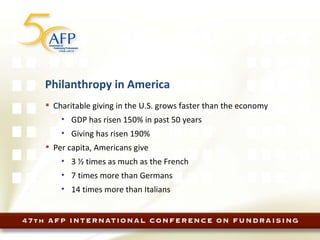
Philanthropy in America Charitable giving in the U.S. grows faster than the economy GDP has risen 150% in past 50 years Giving has risen 190% Per capita, Americans give 3 ½ times as much as the French 7 times more than Germans 14 times more than Italians
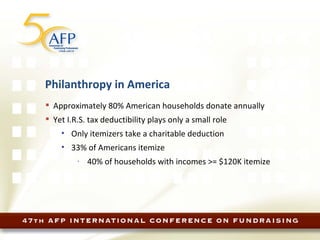
Philanthropy in America Approximately 80% American households donate annually Yet I.R.S. tax deductibility plays only a small role Only itemizers take a charitable deduction 33% of Americans itemize 40% of households with incomes >= $120K itemize
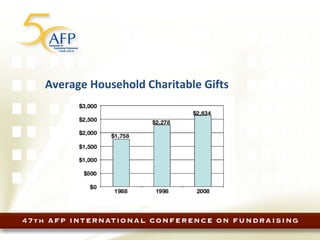
Average Household Charitable Gifts
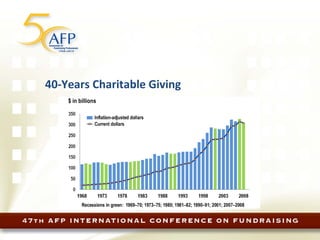
40-Years Charitable Giving
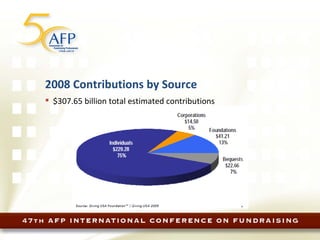
2008 Contributions by Source $307.65 billion total estimated contributions
Facts about 2008 Contributions Contributions declined from $314.07B raised in 2007 Exceeded $300B for the second year in a row Decrease of 2% (-5.7% when adjusted for inflation) Decline was much less than feared Only two other declining years since 1956 1974 and 1987 38% of organizations said they had an increase; 35% reported a decrease
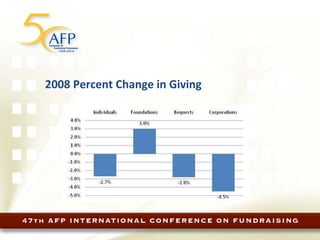
2008 Percent Change in Giving
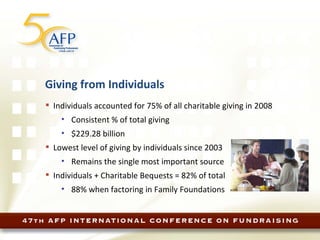
Giving from Individuals Individuals accounted for 75% of all charitable giving in 2008 Consistent % of total giving $229.28 billion Lowest level of giving by individuals since 2003 Remains the single most important source Individuals + Charitable Bequests = 82% of total 88% when factoring in Family Foundations
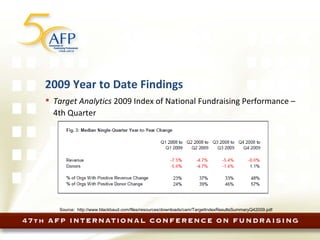
2009 Year to Date Findings Target Analytics  2009 Index of National Fundraising Performance – 4th Quarter  Source:  http://www.blackbaud.com/files/resources/downloads/cam/TargetIndexResultsSummaryQ42009.pdf
2009 Preliminary Results Declines in both 2008 and 2009 for many key measures i.e., Donor retention, new donor acquisition, revenue Largest declines in 2008 to 2009 Q1 & Q2 comparisons Small upswing in Q4 2008 saw revenue per donor growth 2009 saw revenue per donor  decline First time since Index began in 2002
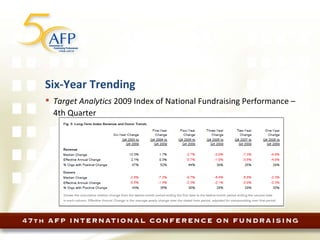
Six-Year Trending Target Analytics  2009 Index of National Fundraising Performance – 4th Quarter
Successful Fundraising Trends Organizations putting more focus on Development activities especially individual donor relations including Major Donor Development appear to be faring well More engaged board members actively participating in fundraising, cultivating relationships, and being ambassadors for the organization Nonprofit leaders more visible and more involved with individual donor fundraising
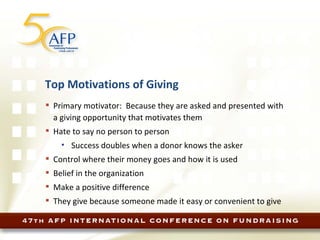
Top Motivations of Giving Primary motivator:  Because they are asked and presented with a giving opportunity that motivates them Hate to say no person to person Success doubles when a donor knows the asker Control where their money goes and how it is used Belief in the organization Make a positive difference  They give because someone made it easy or convenient to give
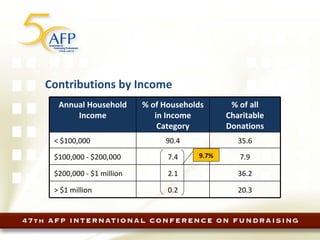
Contributions by Income Annual Household Income % of Households in Income Category % of all Charitable Donations < $100,000 90.4 35.6 $100,000 - $200,000 7.4 7.9 $200,000 - $1 million 2.1 36.2 > $1 million 0.2 20.3 9.7%
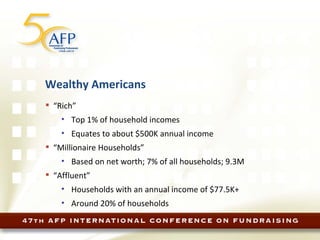
Wealthy Americans “ Rich” Top 1% of household incomes  Equates to about $500K annual income “ Millionaire Households” Based on net worth; 7% of all households; 9.3M “ Affluent” Households with an annual income of $77.5K+ Around 20% of households
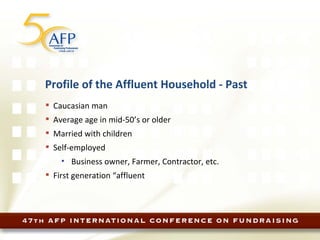
Profile of the Affluent Household - Past Caucasian man Average age in mid-50’s or older Married with children Self-employed Business owner, Farmer, Contractor, etc. First generation “affluent
Profile of the Affluent Household - Present Younger Entrepreneur Technology, Real estate, Athletics, Entertainment, Corporate leader, etc. Just as likely to be Female Just as likely to be Minority
Emergent Philanthropists African Americans Hispanic/Latin Heritage Americans Asian Americans
Common Characteristics of Emergent Groups Giving is linked to family and kinship Religion very important Majority of giving is personal and informal Obligation to help others
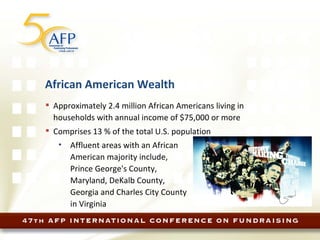
African American Wealth Approximately 2.4 million African Americans living in households with annual income of $75,000 or more  Comprises 13 % of the total U.S. population Affluent areas with an African American majority include, Prince George's County, Maryland, DeKalb County, Georgia and Charles City County in Virginia
African American Wealth Traditional wealth comes from family businesses Recent wealth: Entrepreneurial businesses or self-employment Real estate Certified professions Sports, media and entertainment
Facts about Giving Most generous philanthropic ethnic group in the U.S.  53% black households donate to charity Giving is more predominate in the South Donate 25% more of their discretionary income than whites Gifts of time are often more highly valued than gifts of money Women tend to control giving decisions
Philanthropic Motivations The Black church is the uniting force behind African American philanthropic efforts Giving to and serving family, neighbors and needy strangers are seen as general obligations Traditional recipient organizations include Religious, Educational, Social and Political In recent years, increasing donations to AIDS causes and genocide in Africa
Philanthropic Attitudes Few African Americans define their traditions of giving as &quot;philanthropy&quot;  Believe that &quot;philanthropy&quot; is a term reserved for multimillionaires Would not describe their behavior as philanthropic and are uncomfortable with the term Many see their donations of time and money as unremarkable
Giving Patterns of African Americans Patterns of giving and attitudes toward philanthropy are similar to those of the general population Except African Americans tend to be more private and confidential Similar levels of giving at similar income levels Donor advised funds and endowment opportunities are popular As a greater number of African Americans become affluent, use of more sophisticated giving methods will increase
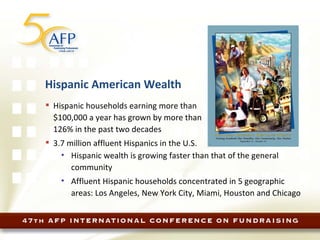
Hispanic American Wealth Hispanic households earning more than $100,000 a year has grown by more than 126% in the past two decades 3.7 million affluent Hispanics in the U.S. Hispanic wealth is growing faster than that of the general community Affluent Hispanic households concentrated in 5 geographic areas: Los Angeles, New York City, Miami, Houston and Chicago
Hispanic American Wealth Traditional and Emerging Wealth: Family-owned businesses Small businesses Inherited wealth Largest % of minority owned businesses Ahead of Asian and African American 75% of Hispanics under the age of 40
Facts about Giving Hispanic givers are consistent and loyal over time 63% of Hispanics donate to charity Hispanic donors were more likely to say that they gave to help the poor help themselves
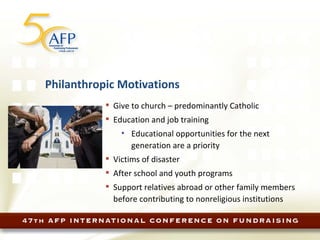
Philanthropic Motivations Give to church – predominantly Catholic Education and job training Educational opportunities for the next generation are a priority Victims of disaster After school and youth programs Support relatives abroad or other family members before contributing to nonreligious institutions
Philanthropic Attitudes Giving is confidential and haphazard Personal connection to the organization is essential Recognition is not always wanted
Giving Patterns of Hispanic Americans Follow American mainstream investment strategies, but have not yet established organized giving mechanisms Highly conservative when it comes to business and finance Strong propensity towards saving Giving priorities diversify as income increases Charitable gifts are part of any leadership role Give to organizations where they either hold a leadership position or know the leaders
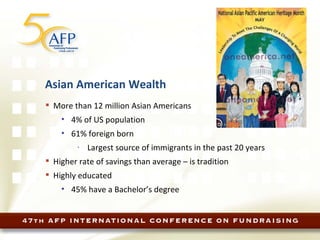
Asian American Wealth More than 12 million Asian Americans 4% of US population 61% foreign born Largest source of immigrants in the past 20 years Higher rate of savings than average – is tradition Highly educated 45% have a Bachelor’s degree
Asian American Wealth Asian American household income is higher than that of all major racial groups including Non-Hispanic Whites 2 nd  highest % of minority owned businesses Asian Indians richest immigrants in U.S. Recent wealth: Food and lodging High-tech Personal services firms and store-fronts
Facts about Giving Asian Americans give a larger % of income than whites Many send money “home” to help family members Participate in informal loan associations to help others start-up businesses High % of political donations
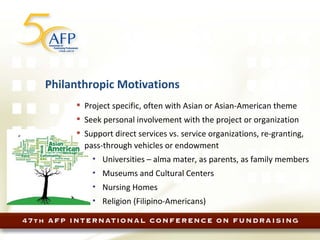
Philanthropic Motivations Project specific, often with Asian or Asian-American theme Seek personal involvement with the project or organization Support direct services vs. service organizations, re-granting, pass-through vehicles or endowment Universities – alma mater, as parents, as family members Museums and Cultural Centers Nursing Homes Religion (Filipino-Americans)
Philanthropic Attitudes Philanthropy is part of this culture “ We help because we are asked.” Celebration and recognition are not common nor expected Give money, skill and time to build organizations that benefit the community Expect high accountability, effective use of funds, greater impact
Giving Patterns of Asian Americans Successive generations adopt American giving patterns 3rd generation shows wider range of philanthropy Donations are made as part of big life events Giving is person to person - informal Strong sense of reciprocity in giving Prefer recognition of gifts Gives them “face” in community and promotes others to give
Planned Gifts Studies indicate that fewer than 10% of bequests and 15% of CRTs come from these emerging philanthropists  Bequests: 2% Black; 1% Hispanic; 6% Other (including Asian) CRTs:  4% Black; 3% Hispanic; 6% Other (including Asian) Evidence that retirement planning mimics legacy giving Work with financial leaders in your community to promote options ; “Leave a Legacy” program Consider promoting vehicles that  build a legacy over time
Find Affluent Donor Groups in Your Database Use the profiles presented here as a guide to find affluent prospects Data appends: age, gender, ethnicity, income, specific geographic areas, business connections, evidence of gifts to other charitable organizations Consider prospect modeling available through various vendors that append this information for you and indentify your best prospects
Talk with Affluent Donor Groups Seek out advice and suggestions from loyal donors from these emergent groups Focus groups Surveys One-on-one interviews Create formal or information advisory committees
Talk with Affluent Donor Groups In both good and bad times, be transparent and ask for support Cultivation and stewardship should clearly relate to the prospect’s point of view Recognition is not desired the same way by everyone
Talk with Affluent Donor Groups Review your current communications and refresh them where appropriate People respond to people who look and think as they do Gather giving stories and quotes from representative donors Encourage giving techniques that relate to the donor’s objectives i.e., Donor advised funds, cumulative giving options, pooled giving vehicles
Summary and Questions People want to make a difference in their community Among other things, we all give because we are asked Understand which emergent groups are amongst your organization's prospects These emergent philanthropic groups are generous Charitable priorities may change as income increases We give to people who are often like ourselves Make giving easy and comfortable
Target Analytics, a Blackbaud Company Katherine Swank, J.D. 2000 Daniel Island Drive Charleston, SC 29492 800.443.9441 extension 3926 [email_address]  | Twitter: @KatherineSwank http://www.blackbaud.com/targetanalytics

Emergent Philanthropists - America’s Evolving Ethnic Donor Groups

  • 1.
    Emergent Philanthropists America’sEvolving Ethnic Donor Groups Monday, April 12, 2010 Katherine Swank, J.D. Consultant, Target Analytics, a Blackbaud Company
  • 2.
    Your Presenter Lawdegree, Drake University School of Law 20+ years as Development Professional, including Nat. Dir. Planned Gifts & Lead Manager, $20M Capital Campaign Internal fundraising consultant to 60+ national/chapter offices Over $215 million raised during career 10 years as Adjunct Faculty, Regis University, Masters in Nonprofit Management Program Courses: Wealth & Philanthropy; Financial Resource Development
  • 3.
    Our Agenda Philanthropyin the United States Defining the “Affluent” in America Giving Patterns of the Affluent Emergent Philanthropists: Donor Groups to Watch How to Find and Talk with Affluent Emergent Donor Prospects in Your Database
  • 4.
    Philanthropy in AmericaCharitable giving in the U.S. grows faster than the economy GDP has risen 150% in past 50 years Giving has risen 190% Per capita, Americans give 3 ½ times as much as the French 7 times more than Germans 14 times more than Italians
  • 5.
    Philanthropy in AmericaApproximately 80% American households donate annually Yet I.R.S. tax deductibility plays only a small role Only itemizers take a charitable deduction 33% of Americans itemize 40% of households with incomes >= $120K itemize
  • 6.
  • 7.
  • 8.
    2008 Contributions bySource $307.65 billion total estimated contributions
  • 9.
    Facts about 2008Contributions Contributions declined from $314.07B raised in 2007 Exceeded $300B for the second year in a row Decrease of 2% (-5.7% when adjusted for inflation) Decline was much less than feared Only two other declining years since 1956 1974 and 1987 38% of organizations said they had an increase; 35% reported a decrease
  • 10.
  • 11.
    Giving from IndividualsIndividuals accounted for 75% of all charitable giving in 2008 Consistent % of total giving $229.28 billion Lowest level of giving by individuals since 2003 Remains the single most important source Individuals + Charitable Bequests = 82% of total 88% when factoring in Family Foundations
  • 12.
    2009 Year toDate Findings Target Analytics 2009 Index of National Fundraising Performance – 4th Quarter Source: http://www.blackbaud.com/files/resources/downloads/cam/TargetIndexResultsSummaryQ42009.pdf
  • 13.
    2009 Preliminary ResultsDeclines in both 2008 and 2009 for many key measures i.e., Donor retention, new donor acquisition, revenue Largest declines in 2008 to 2009 Q1 & Q2 comparisons Small upswing in Q4 2008 saw revenue per donor growth 2009 saw revenue per donor decline First time since Index began in 2002
  • 14.
    Six-Year Trending TargetAnalytics 2009 Index of National Fundraising Performance – 4th Quarter
  • 15.
    Successful Fundraising TrendsOrganizations putting more focus on Development activities especially individual donor relations including Major Donor Development appear to be faring well More engaged board members actively participating in fundraising, cultivating relationships, and being ambassadors for the organization Nonprofit leaders more visible and more involved with individual donor fundraising
  • 16.
    Top Motivations ofGiving Primary motivator: Because they are asked and presented with a giving opportunity that motivates them Hate to say no person to person Success doubles when a donor knows the asker Control where their money goes and how it is used Belief in the organization Make a positive difference They give because someone made it easy or convenient to give
  • 17.
    Contributions by IncomeAnnual Household Income % of Households in Income Category % of all Charitable Donations < $100,000 90.4 35.6 $100,000 - $200,000 7.4 7.9 $200,000 - $1 million 2.1 36.2 > $1 million 0.2 20.3 9.7%
  • 18.
    Wealthy Americans “Rich” Top 1% of household incomes Equates to about $500K annual income “ Millionaire Households” Based on net worth; 7% of all households; 9.3M “ Affluent” Households with an annual income of $77.5K+ Around 20% of households
  • 19.
    Profile of theAffluent Household - Past Caucasian man Average age in mid-50’s or older Married with children Self-employed Business owner, Farmer, Contractor, etc. First generation “affluent
  • 20.
    Profile of theAffluent Household - Present Younger Entrepreneur Technology, Real estate, Athletics, Entertainment, Corporate leader, etc. Just as likely to be Female Just as likely to be Minority
  • 21.
    Emergent Philanthropists AfricanAmericans Hispanic/Latin Heritage Americans Asian Americans
  • 22.
    Common Characteristics ofEmergent Groups Giving is linked to family and kinship Religion very important Majority of giving is personal and informal Obligation to help others
  • 23.
    African American WealthApproximately 2.4 million African Americans living in households with annual income of $75,000 or more Comprises 13 % of the total U.S. population Affluent areas with an African American majority include, Prince George's County, Maryland, DeKalb County, Georgia and Charles City County in Virginia
  • 24.
    African American WealthTraditional wealth comes from family businesses Recent wealth: Entrepreneurial businesses or self-employment Real estate Certified professions Sports, media and entertainment
  • 25.
    Facts about GivingMost generous philanthropic ethnic group in the U.S. 53% black households donate to charity Giving is more predominate in the South Donate 25% more of their discretionary income than whites Gifts of time are often more highly valued than gifts of money Women tend to control giving decisions
  • 26.
    Philanthropic Motivations TheBlack church is the uniting force behind African American philanthropic efforts Giving to and serving family, neighbors and needy strangers are seen as general obligations Traditional recipient organizations include Religious, Educational, Social and Political In recent years, increasing donations to AIDS causes and genocide in Africa
  • 27.
    Philanthropic Attitudes FewAfrican Americans define their traditions of giving as &quot;philanthropy&quot; Believe that &quot;philanthropy&quot; is a term reserved for multimillionaires Would not describe their behavior as philanthropic and are uncomfortable with the term Many see their donations of time and money as unremarkable
  • 28.
    Giving Patterns ofAfrican Americans Patterns of giving and attitudes toward philanthropy are similar to those of the general population Except African Americans tend to be more private and confidential Similar levels of giving at similar income levels Donor advised funds and endowment opportunities are popular As a greater number of African Americans become affluent, use of more sophisticated giving methods will increase
  • 29.
    Hispanic American WealthHispanic households earning more than $100,000 a year has grown by more than 126% in the past two decades 3.7 million affluent Hispanics in the U.S. Hispanic wealth is growing faster than that of the general community Affluent Hispanic households concentrated in 5 geographic areas: Los Angeles, New York City, Miami, Houston and Chicago
  • 30.
    Hispanic American WealthTraditional and Emerging Wealth: Family-owned businesses Small businesses Inherited wealth Largest % of minority owned businesses Ahead of Asian and African American 75% of Hispanics under the age of 40
  • 31.
    Facts about GivingHispanic givers are consistent and loyal over time 63% of Hispanics donate to charity Hispanic donors were more likely to say that they gave to help the poor help themselves
  • 32.
    Philanthropic Motivations Giveto church – predominantly Catholic Education and job training Educational opportunities for the next generation are a priority Victims of disaster After school and youth programs Support relatives abroad or other family members before contributing to nonreligious institutions
  • 33.
    Philanthropic Attitudes Givingis confidential and haphazard Personal connection to the organization is essential Recognition is not always wanted
  • 34.
    Giving Patterns ofHispanic Americans Follow American mainstream investment strategies, but have not yet established organized giving mechanisms Highly conservative when it comes to business and finance Strong propensity towards saving Giving priorities diversify as income increases Charitable gifts are part of any leadership role Give to organizations where they either hold a leadership position or know the leaders
  • 35.
    Asian American WealthMore than 12 million Asian Americans 4% of US population 61% foreign born Largest source of immigrants in the past 20 years Higher rate of savings than average – is tradition Highly educated 45% have a Bachelor’s degree
  • 36.
    Asian American WealthAsian American household income is higher than that of all major racial groups including Non-Hispanic Whites 2 nd highest % of minority owned businesses Asian Indians richest immigrants in U.S. Recent wealth: Food and lodging High-tech Personal services firms and store-fronts
  • 37.
    Facts about GivingAsian Americans give a larger % of income than whites Many send money “home” to help family members Participate in informal loan associations to help others start-up businesses High % of political donations
  • 38.
    Philanthropic Motivations Projectspecific, often with Asian or Asian-American theme Seek personal involvement with the project or organization Support direct services vs. service organizations, re-granting, pass-through vehicles or endowment Universities – alma mater, as parents, as family members Museums and Cultural Centers Nursing Homes Religion (Filipino-Americans)
  • 39.
    Philanthropic Attitudes Philanthropyis part of this culture “ We help because we are asked.” Celebration and recognition are not common nor expected Give money, skill and time to build organizations that benefit the community Expect high accountability, effective use of funds, greater impact
  • 40.
    Giving Patterns ofAsian Americans Successive generations adopt American giving patterns 3rd generation shows wider range of philanthropy Donations are made as part of big life events Giving is person to person - informal Strong sense of reciprocity in giving Prefer recognition of gifts Gives them “face” in community and promotes others to give
  • 41.
    Planned Gifts Studiesindicate that fewer than 10% of bequests and 15% of CRTs come from these emerging philanthropists Bequests: 2% Black; 1% Hispanic; 6% Other (including Asian) CRTs: 4% Black; 3% Hispanic; 6% Other (including Asian) Evidence that retirement planning mimics legacy giving Work with financial leaders in your community to promote options ; “Leave a Legacy” program Consider promoting vehicles that build a legacy over time
  • 42.
    Find Affluent DonorGroups in Your Database Use the profiles presented here as a guide to find affluent prospects Data appends: age, gender, ethnicity, income, specific geographic areas, business connections, evidence of gifts to other charitable organizations Consider prospect modeling available through various vendors that append this information for you and indentify your best prospects
  • 43.
    Talk with AffluentDonor Groups Seek out advice and suggestions from loyal donors from these emergent groups Focus groups Surveys One-on-one interviews Create formal or information advisory committees
  • 44.
    Talk with AffluentDonor Groups In both good and bad times, be transparent and ask for support Cultivation and stewardship should clearly relate to the prospect’s point of view Recognition is not desired the same way by everyone
  • 45.
    Talk with AffluentDonor Groups Review your current communications and refresh them where appropriate People respond to people who look and think as they do Gather giving stories and quotes from representative donors Encourage giving techniques that relate to the donor’s objectives i.e., Donor advised funds, cumulative giving options, pooled giving vehicles
  • 46.
    Summary and QuestionsPeople want to make a difference in their community Among other things, we all give because we are asked Understand which emergent groups are amongst your organization's prospects These emergent philanthropic groups are generous Charitable priorities may change as income increases We give to people who are often like ourselves Make giving easy and comfortable
  • 47.
    Target Analytics, aBlackbaud Company Katherine Swank, J.D. 2000 Daniel Island Drive Charleston, SC 29492 800.443.9441 extension 3926 [email_address] | Twitter: @KatherineSwank http://www.blackbaud.com/targetanalytics

Editor's Notes

  • #2 (c) Blackbaud, Katherine Swank, 2010 04/12/2010 AFP International Conference - Handout