Welcome my Professional Colleagues!
L. Kris Munk DDS, MS
All students, faculty, and
staff endeavor to make
each and every
interaction reflect a
sincere desire to develop
each other as lifelong
colleagues through
authentic connections
 Expanding locations to provide health care
 We treat people, not just teeth
 Aging population
 Emergencies do happen
 Responsibility for patients
 We are in a position of trust
 Legal accountability
 Malpractice claims
 Reputation
Prepare to Respond Prepare to Respond
By show of hands,
how many here
have witnessed an
office medical
emergency of
some kind?
 Syncope
 Seizures
 Allergic reactions
 Emesis or aspiration
 Ingestion or aspiration
 Airway obstruction
 Hypoglycemia
 Angina, Myocardial Infarction, Cardiopulmonary
Arrest
 Stroke
In The Stands - Cognitive On The Court - Experiential
 Prevention / Mitigation
 Preparation
 Team Response
 Recovery / Debriefing
 To prepare Health Care Professionals to
prepare for and respond appropriately to
medical emergencies that occur in health care
facilities
 To identify the role of Team Leaders and Team
Members
 To encourage regular training schedule to
prepare for medical emergencies
 Accurate and
complete medical
history
 Current vital signs
 Stress and anxiety
reduction protocols
 Profound local
anesthesia at correct
doses
 Organize an Emergency
Response Team
 Have the proper Emergency
Response armamentarium
 Review – practice – review –
practice – review – practice
– review – practice!
 External Response Team
◦ Community Emergency
Response Team - 911
 Internal Response Teams
◦ Fixed Emergency Response Teams (FERT)
◦ Mobile Emergency Response Team (MERT)
 Members of the team will be composed of the
entire staff of the health care facility.
 A designated Team Leader should be identified,
but by default, whoever recognizes the medical
emergency first is the Team Leader until replaced
by the designated Team Leader.
 Team members and specific team responsibilities
will be assigned by the FERT Team Leader or by
previously assigned responsibilities.
 Organization and training of the Fixed Emergency
Response Team (FERT)
 Providing leadership and instruction in an emergency
 Monitoring individual performance of team members
 Backing up team members
 Modeling excellent behavior (i.e., poise under pressure)
 Training and coaching
 Facilitating communication and understanding
 Focusing on comprehensive patient care (seeing the
big picture)
 Willing to accept individual role assignments
 Clear about their individual role assignments
 Prepared to fulfill their role assignments
 Well practiced in emergency response skills
 Committed to the success of the Fixed
Emergency Response Team (FERT)
 Delegation of responsibility in responding to a
medical emergency often results in more
favorable outcomes.
 It is the FERT Leader’s responsibility to oversee
and assign tasks to team members of the FERT.
 Members of the FERT should accept assignments
willingly and should follow the directions of the
FERT Leader.
• Assess patient and check for responsiveness
• Check for a pulse (Carotid or Radial)
• Call for an AED (Automated External Defibrillator)
• Chest Compressions
• Airway management
• Obtain vital signs (i.e., Blood pressure, pulse oximetry)
• Administer oxygen or other medications
• Communication
• Assist in situating or moving the patient
• Assist in watching for the arrival of additional responders
such CERT - 911 personnel
• Act as a recorder (record actions taken, medication given,
and times of actions taken)
• Other tasks as directed by the FERT Leader
THE FIXED EMERGENCY RESPONSE TEAM (FERT)
SHOULD IMMEDIATELY BEGIN TO PROVIDE
INDICATED MEDICAL CARE AND SHOULD NOT
DELAY CARE WHILE WAITING FOR THE
COMMUNITY EMERGENCY RESPONSE TEAM
(CERT - 911) TO ARRIVE AT THE SCENE OF THE
MEDICAL EMERGENCY.
 Clear messages consist of concise
communication spoken with distinctive
speech in a controlled tone of voice. All
healthcare providers should deliver messages
in a calm and direct manner without yelling or
shouting.
 When communicating with each other in a
FERT, the FERT Leader and FERT Members
should use the Closed-loop or Feedback
Method
1. The FERT Leader gives a message, instruction,
or assignment to a FERT Member.
2. The FERT Leader listens for verbal confirmation
from the FERT Member that he/she understood
the message, instruction, or assignment. By
receiving a clear verbal response and eye
contact from the FERT Member, the FERT Leader
confirms that the FERT Member heard and
understood the message. [Example: (FERT
Leader) - “Leslie please go and get the AED.”
3. The FERT Member verbalizes and echoes the
message, instruction, or assignment back to the
FERT Leader, “I’m going to get the AED”.
4. When the task has been completed the FERT
Member confirms that the task has been completed.
(Example: “I have returned with the AED as
instructed.”)
5. Before assigning another task, the FERT Leader
confirms that the previous task has been
completed. (Example: “Now that the AED has
arrived, let’s place the pads and analyze the
rhythm.”
1. Know your own limitations - During the
stress of a medical emergency response, do
not practice or explore a new skill. If you
need help, request it early. It is not a sign
of weakness or incompetence to ask for
help; it is better to have more help than
needed rather than not enough help. Call
for assistance early rather than waiting unto
the patient deteriorates and don’t hesitate
to seek advice from more experienced
personnel.
2. Knowledge Sharing – Sharing information is
a critical component of effective team
performance. Team Leaders may become
trapped in a specific treatment approach
and forget to look at alternative approaches.
This is called a “fixation error”. If
emergency response efforts seem
ineffective, talk as a team … “Have we
missed something?”
3. Constructive Intervention – During a
response to a medical emergency, the Team
Leader or another team member may need
to intervene if an action is not effective or is
inappropriate. Although constructive
intervention may be necessary, it should be
done tactfully. Team Leaders should avoid
confrontation with team members.
4. Re-evaluation and Summarizing – A good
practice is for the Team Leader to
periodically summarize out loud the
patient’s status and review interventions
that have been performed. This provides a
mental review and ensures that everyone on
the FERT is on the same page.
5. Mutual Respect – The best Fixed Emergency
Response Teams (FERT’s) are composed of
members who share a mutual respect for
each other and work together in a collegial,
supportive manner. To have a high
performing team, everyone must abandon
ego and must respect each other during the
emergency response effort. Acknowledge
correctly completed assignments by
expressing gratitude and saying, “Thanks -
good job!”
 The BLS Survey is a systematic approach to
basic life support that any trained healthcare
provider can perform. This approach stresses
early CPR and early defibrillation.
 Performing the actions in the BLS Survey
substantially improves the patient’s chance of
survival and a good neurologic outcome.
1. First Check for
Responsiveness: Tap and
shout “Are you all right?”
Check for absent or abnormal
breathing (no breathing or
only gasping) by looking at or
scanning the chest for
movement (about 5 – 10
seconds).
2. Activate the
Emergency Response
System and get an
AED:
 FERT
 CERT: 911
3. Circulation: Check the carotid
pulse for 5 to 10 seconds. If no
pulse within 10 seconds, start
CPR (30:2) beginning with chest
compressions at a rate of 100
compressions per minute. If
there is a pulse, start rescue
breathing at 1 breath every 5 to
6 seconds (10 to 12 breaths per
minute). Check pulse about
every 2 minutes.
4. Defibrillation: If no pulse,
check for a shockable
rhythm with an AED as soon
as it arrives. Provide a
shock as indicted and follow
each shock immediately
with CPR, beginning with
compressions.
1. Assess patient responsiveness and breathing
• If responsive and breathing, reassurance and support
• If not responsive, proceed to (2).
2. Activate Emergency Response System (FERT, 911 or
both) and call for AED
3. Check circulation – pulse and breathing = 
- pulse only = rescue breathing
- no pulse = CPR (30:2)
4. When the AED arrives, attach pads and apply shock if
instructed to do so. Continue CPR for 2minutes. Re-
evaluate. Shock if instructed to do so. Continue CPR.
 Medications
 Albuterol Inhaler
 Ammonia Inhalants
 Aspirin 325 mg
 Diphenhydramine
 Epinephrine 1:1000
 Epi Penx1 adult
 Epi-Penx1 Child
 Glucose
 Nitroglycerin Tablets
 Oxygen
 Steroid i.e. Decadron
 Dextrose 50%
 Supplies

 AED
 Ambu Bag and face mask
 Ambu bag and pedo face
mask
 Batteries AA x2
 Blood Pressure cuff and
stethoscope
 Cricothyrotomy kit
 Flash light
 Gauze-4x4 x1 sleeve
 Gauze 2x2 x1 sleeve
 Head Lamp
 McGill forceps
 McGill forceps pediatric
 Mouth-to-mask breathing
apparatus
 Nasal Airway 28 and 30
 Nasal O2 cannulas
 Needles -18 gauge x 5
 Oral airway 8 and 10
 Laryngeal mask (LMA)3
and 4
 Paper bag
 Syringes-1cc;3cc;5cc;10cc
 Thermometer
 Tongue Depressors
 Yankauer Suction tip
 Surgilupe
 Tourniquets
 Glucose monitors
(Lancets, Test strips)
 Gloves S,M,L, XL
 Scissors
 Alcohol swab
 Surgical tape
 Sterile Towel drape
1. Syncope (50.5%)
2. Airway Obstruction – Ingestion – Aspiration (11%)
3. Allergic Reactions (9.5%)
4. Emesis (9%)
5. Angina Pectoris (chest pain) (8%)
6. Seizures (5%)
7. Hypoglycemia (3.5%)
8. Myocardial Infarction (Heart attack) (1.5%)
9. Cardiopulmonary Arrest (1%)
10. Stroke (1%)
1. Each section will review an Emergency Response
Scenario and prepare a Role Play to demonstrate
the appropriate response to the emergency.
2. Be creative with assignments and apply BLS
concepts, Team Response protocols (Team Leader
and Team Members), Closed-Loop feedback, and
the General Concepts presented, i.e., Know your
Limitations, Knowledge Sharing, Constructive
Intervention, Summarizing, and Mutual Respect.
3. Have fun but remember the serious implications of
responding to office emergencies
1. Prevention – orthostatic hypotension (sitting
up too fast)
2. Basic Life Support (BLS) Protocol
3. Protect patient from injury
4. Diagnose etiology (cause) – fear, anxiety,
sitting up too fast
5. 100% oxygen
6. Consider ammonia inhalant
1. Recognize the obstruction – determine
consciousness or unconsciousness
2. Position patient for Heimlich Maneuver,
abdominal thrusts or CPR
3. If unconscious, head tilt / chin lift
4. Attempt to ventilate with an O2 mask,
Ambu bag or IPPBD – watch for chest rise
5. Reposition head as needed – head tilt/chin
lift; consider tonsil suction (Yankauer)
6. Repeat these steps as needed
7. Consider cricothyrotomy (as last resort)
 Palpate for thyroid cartilage and cricoid cartilage
 Make horizontal stab with scalpel blade into
membrane
 Use blade handle to open airway
 Place hollow device to maintain such as an
Endotracheal Tube, Emergency pen tube, etc.
 The crown of a tooth, an entire tooth, or a
piece of dental instrumentation could be lost
into the pharynx.
 If this occurs, the patient should be turned
toward the provider and placed into a
position with the mouth facing the floor as
much as possible.
 The patient should be encouraged to cough
and spit the object out onto the floor.
 If the patient has no coughing or respiratory
distress, it is most likely that the object was
swallowed and has traveled down the
esophagus into the stomach.
 If the patient has a violent episode of
coughing or shortness of breath, the object
may have been aspirated through the vocal
cords into the trachea and from there on to a
main stem bronchus.
 In either case, auscultate (listen to) the lungs,
then transport the patient to an emergency
room.
 Chest and abdominal radiographs should be
taken to determine the specific location of
the object.
 If the object has been aspirated, consultation
with regard to the possibility of removing the
object with a bronchoscope should be
requested. The urgent management of
aspiration is to maintain the patient's airway
and breathing.
1. Mild reaction (Mild rash, mild itch)
 Benadryl (Diphenhydramine 25 – 50 mg)
2. Severe reaction (significant rash, blotching,
wheezing)
 Subcutaneous epinephrine .3 - .5 mg
 Benadryl (Diphenhydramine 25 – 50 mg)
 Repeat epinephrine in 5 – 10 minutes as needed
 Decadron 20 mg IV
1. Call for tonsil suction (Yankauer)
2. Turn patient to the right side and in the
Trendelenburg position (Head below Heart)
3. Check for vomitus and clear throat as needed
4. 100% oxygen (O2 canula or hood)
5. Auscultate (listen to) lungs with stethoscope
6. Watch for signs of respiratory distress
[cyanosis (blue color); dyspnea (difficulty
breathing)]
7. Consider pulse oximeter and CERT
1. Try to keep patient comfortable and give
reassurance
2. Nitroglycerin tabs or spray under tongue
3. 100 % oxygen
4. Monitor patient vital signs (EKG, blood pressure,
respirations, pulse oximetry)
5. If pain persists for 5 minutes, administer 2nd
dose of nitroglycerin
6. If pain persists for another 5 minutes, administer
a 3rd dose of nitroglycerin, assume myocardial
infarction (MI), activate CERT (911)
7. Keep patient as calm and comfortable as possible
1. Position patient in a comfortable position
2. 100% oxygen (if not already administered)
3. “MONA”
 Morphine (1 – 4 mg doses every 5 – 10 minutes)
 Oxygen (4 – 6 L/minute)
 Nitroglycerin (if not already given per previous Angina
Pectoris Protocol)
 Aspirin (160 – 325 mg chew)
4. Monitor patient vital signs (EKG, blood
pressure, respirations, pulse oximetry)
5. Keep patient as calm and comfortable as
possible and prepare to transport
6. Have record available for CERT personnel
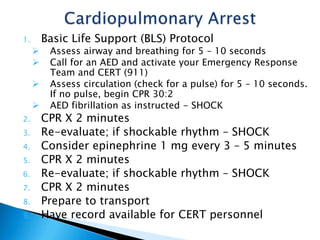
1. Basic Life Support (BLS) Protocol
 Assess airway and breathing for 5 – 10 seconds
 Call for an AED and activate your Emergency Response
Team and CERT (911)
 Assess circulation (check for a pulse) for 5 – 10 seconds.
If no pulse, begin CPR 30:2
 AED fibrillation as instructed - SHOCK
2. CPR X 2 minutes
3. Re-evaluate; if shockable rhythm – SHOCK
4. Consider epinephrine 1 mg every 3 – 5 minutes
5. CPR X 2 minutes
6. Re-evaluate; if shockable rhythm – SHOCK
7. CPR X 2 minutes
8. Prepare to transport
9. Have record available for CERT personnel
1. Basic Life Support (BLS) Protocol
2. Protect patient from injury – gently restrain
if needed
3. Consider a Benzodiazepine (Valium 2 – 5
mg or Versed 1 – 2 mg)
4. Provide post-seizure reassurance
5. If seizure persists or patient doesn’t seem
to be doing well, CERT (911)
1. Basic Life Support (BLS) Protocol
2. Check patient’s glucose level with
glucometer (< 60 is not good)
 Normal fasting 70 – 99
 Two hours after a meal <180
3. If glucose level is low and patient is awake,
administer carbohydrates, i.e., orange juice,
maple syrup, Insta-glucose gel)
4. If glucose level is low and patient is not
awake, administer carbohydrates, i.e.,
Insta-glucose gel, or 50% Dextrose IV
1. Basic Life Support (BLS) Protocol
 Assess airway and breathing for 5 – 10 seconds
 Call for an AED and activate your Emergency Response
Team and CERT (911)
 Assess circulation (check for a pulse) for 5 – 10
seconds. If no pulse, begin CPR 30:2
 AED fibrillation as instructed - SHOCK
2. Identify signs of a stroke
 Sudden weakness of numbness to face or arms
 Sudden confusion
 Trouble speaking or understanding
 Sudden trouble seeing in one or both eyes
 Sudden trouble walking
 Dizziness or loss of balance or coordination
 Sudden severe headache with no apparent cause
3. Stroke Assessment - FAST
 F – facial droop: have patient show their teeth or
smile. Abnormal is one side of the face not moving
as well as the other side.
 A – arm drift: have the patient close their eyes and
extend both arms straight out with palms up for 10
seconds. Abnormal is when one arm does not move
or one are drifts downward compared with the other
arm.
 S – speech: have the patient say “you can’t teach old
dogs new tricks”. Abnormal is when the patient's
words are slurred, the patient uses the wrong words,
or is unable to speak
 T – time to activate CERT (911); if any one of the
signs is abnormal the probability of stroke is 72%. If
all three are present, probability is >85%.
 Time to decompress
 Time to vent
 Time to evaluate
what did we do right
and what could we
improve on
 Time to suggest
changes to protocol
 Time to build team
Emergency response training

Emergency response training

  • 1.
    Welcome my ProfessionalColleagues! L. Kris Munk DDS, MS
  • 3.
    All students, faculty,and staff endeavor to make each and every interaction reflect a sincere desire to develop each other as lifelong colleagues through authentic connections
  • 6.
     Expanding locationsto provide health care  We treat people, not just teeth  Aging population  Emergencies do happen  Responsibility for patients  We are in a position of trust  Legal accountability  Malpractice claims  Reputation
  • 7.
    Prepare to RespondPrepare to Respond
  • 8.
    By show ofhands, how many here have witnessed an office medical emergency of some kind?
  • 9.
     Syncope  Seizures Allergic reactions  Emesis or aspiration  Ingestion or aspiration  Airway obstruction  Hypoglycemia  Angina, Myocardial Infarction, Cardiopulmonary Arrest  Stroke
  • 10.
    In The Stands- Cognitive On The Court - Experiential
  • 11.
     Prevention /Mitigation  Preparation  Team Response  Recovery / Debriefing
  • 13.
     To prepareHealth Care Professionals to prepare for and respond appropriately to medical emergencies that occur in health care facilities  To identify the role of Team Leaders and Team Members  To encourage regular training schedule to prepare for medical emergencies
  • 14.
     Accurate and completemedical history  Current vital signs  Stress and anxiety reduction protocols  Profound local anesthesia at correct doses
  • 15.
     Organize anEmergency Response Team  Have the proper Emergency Response armamentarium  Review – practice – review – practice – review – practice – review – practice!
  • 16.
     External ResponseTeam ◦ Community Emergency Response Team - 911  Internal Response Teams ◦ Fixed Emergency Response Teams (FERT) ◦ Mobile Emergency Response Team (MERT)
  • 17.
     Members ofthe team will be composed of the entire staff of the health care facility.  A designated Team Leader should be identified, but by default, whoever recognizes the medical emergency first is the Team Leader until replaced by the designated Team Leader.  Team members and specific team responsibilities will be assigned by the FERT Team Leader or by previously assigned responsibilities.
  • 18.
     Organization andtraining of the Fixed Emergency Response Team (FERT)  Providing leadership and instruction in an emergency  Monitoring individual performance of team members  Backing up team members  Modeling excellent behavior (i.e., poise under pressure)  Training and coaching  Facilitating communication and understanding  Focusing on comprehensive patient care (seeing the big picture)
  • 19.
     Willing toaccept individual role assignments  Clear about their individual role assignments  Prepared to fulfill their role assignments  Well practiced in emergency response skills  Committed to the success of the Fixed Emergency Response Team (FERT)
  • 20.
     Delegation ofresponsibility in responding to a medical emergency often results in more favorable outcomes.  It is the FERT Leader’s responsibility to oversee and assign tasks to team members of the FERT.  Members of the FERT should accept assignments willingly and should follow the directions of the FERT Leader.
  • 21.
    • Assess patientand check for responsiveness • Check for a pulse (Carotid or Radial) • Call for an AED (Automated External Defibrillator) • Chest Compressions • Airway management • Obtain vital signs (i.e., Blood pressure, pulse oximetry) • Administer oxygen or other medications • Communication • Assist in situating or moving the patient • Assist in watching for the arrival of additional responders such CERT - 911 personnel • Act as a recorder (record actions taken, medication given, and times of actions taken) • Other tasks as directed by the FERT Leader
  • 23.
    THE FIXED EMERGENCYRESPONSE TEAM (FERT) SHOULD IMMEDIATELY BEGIN TO PROVIDE INDICATED MEDICAL CARE AND SHOULD NOT DELAY CARE WHILE WAITING FOR THE COMMUNITY EMERGENCY RESPONSE TEAM (CERT - 911) TO ARRIVE AT THE SCENE OF THE MEDICAL EMERGENCY.
  • 24.
     Clear messagesconsist of concise communication spoken with distinctive speech in a controlled tone of voice. All healthcare providers should deliver messages in a calm and direct manner without yelling or shouting.  When communicating with each other in a FERT, the FERT Leader and FERT Members should use the Closed-loop or Feedback Method
  • 25.
    1. The FERTLeader gives a message, instruction, or assignment to a FERT Member. 2. The FERT Leader listens for verbal confirmation from the FERT Member that he/she understood the message, instruction, or assignment. By receiving a clear verbal response and eye contact from the FERT Member, the FERT Leader confirms that the FERT Member heard and understood the message. [Example: (FERT Leader) - “Leslie please go and get the AED.”
  • 26.
    3. The FERTMember verbalizes and echoes the message, instruction, or assignment back to the FERT Leader, “I’m going to get the AED”. 4. When the task has been completed the FERT Member confirms that the task has been completed. (Example: “I have returned with the AED as instructed.”) 5. Before assigning another task, the FERT Leader confirms that the previous task has been completed. (Example: “Now that the AED has arrived, let’s place the pads and analyze the rhythm.”
  • 28.
    1. Know yourown limitations - During the stress of a medical emergency response, do not practice or explore a new skill. If you need help, request it early. It is not a sign of weakness or incompetence to ask for help; it is better to have more help than needed rather than not enough help. Call for assistance early rather than waiting unto the patient deteriorates and don’t hesitate to seek advice from more experienced personnel.
  • 29.
    2. Knowledge Sharing– Sharing information is a critical component of effective team performance. Team Leaders may become trapped in a specific treatment approach and forget to look at alternative approaches. This is called a “fixation error”. If emergency response efforts seem ineffective, talk as a team … “Have we missed something?”
  • 30.
    3. Constructive Intervention– During a response to a medical emergency, the Team Leader or another team member may need to intervene if an action is not effective or is inappropriate. Although constructive intervention may be necessary, it should be done tactfully. Team Leaders should avoid confrontation with team members.
  • 31.
    4. Re-evaluation andSummarizing – A good practice is for the Team Leader to periodically summarize out loud the patient’s status and review interventions that have been performed. This provides a mental review and ensures that everyone on the FERT is on the same page.
  • 32.
    5. Mutual Respect– The best Fixed Emergency Response Teams (FERT’s) are composed of members who share a mutual respect for each other and work together in a collegial, supportive manner. To have a high performing team, everyone must abandon ego and must respect each other during the emergency response effort. Acknowledge correctly completed assignments by expressing gratitude and saying, “Thanks - good job!”
  • 33.
     The BLSSurvey is a systematic approach to basic life support that any trained healthcare provider can perform. This approach stresses early CPR and early defibrillation.  Performing the actions in the BLS Survey substantially improves the patient’s chance of survival and a good neurologic outcome.
  • 34.
    1. First Checkfor Responsiveness: Tap and shout “Are you all right?” Check for absent or abnormal breathing (no breathing or only gasping) by looking at or scanning the chest for movement (about 5 – 10 seconds).
  • 35.
    2. Activate the EmergencyResponse System and get an AED:  FERT  CERT: 911
  • 36.
    3. Circulation: Checkthe carotid pulse for 5 to 10 seconds. If no pulse within 10 seconds, start CPR (30:2) beginning with chest compressions at a rate of 100 compressions per minute. If there is a pulse, start rescue breathing at 1 breath every 5 to 6 seconds (10 to 12 breaths per minute). Check pulse about every 2 minutes.
  • 37.
    4. Defibrillation: Ifno pulse, check for a shockable rhythm with an AED as soon as it arrives. Provide a shock as indicted and follow each shock immediately with CPR, beginning with compressions.
  • 38.
    1. Assess patientresponsiveness and breathing • If responsive and breathing, reassurance and support • If not responsive, proceed to (2). 2. Activate Emergency Response System (FERT, 911 or both) and call for AED 3. Check circulation – pulse and breathing =  - pulse only = rescue breathing - no pulse = CPR (30:2) 4. When the AED arrives, attach pads and apply shock if instructed to do so. Continue CPR for 2minutes. Re- evaluate. Shock if instructed to do so. Continue CPR.
  • 40.
     Medications  AlbuterolInhaler  Ammonia Inhalants  Aspirin 325 mg  Diphenhydramine  Epinephrine 1:1000  Epi Penx1 adult  Epi-Penx1 Child  Glucose  Nitroglycerin Tablets  Oxygen  Steroid i.e. Decadron  Dextrose 50%  Supplies   AED  Ambu Bag and face mask  Ambu bag and pedo face mask  Batteries AA x2  Blood Pressure cuff and stethoscope  Cricothyrotomy kit  Flash light  Gauze-4x4 x1 sleeve  Gauze 2x2 x1 sleeve  Head Lamp
  • 41.
     McGill forceps McGill forceps pediatric  Mouth-to-mask breathing apparatus  Nasal Airway 28 and 30  Nasal O2 cannulas  Needles -18 gauge x 5  Oral airway 8 and 10  Laryngeal mask (LMA)3 and 4  Paper bag  Syringes-1cc;3cc;5cc;10cc  Thermometer  Tongue Depressors  Yankauer Suction tip  Surgilupe  Tourniquets  Glucose monitors (Lancets, Test strips)  Gloves S,M,L, XL  Scissors  Alcohol swab  Surgical tape  Sterile Towel drape
  • 42.
    1. Syncope (50.5%) 2.Airway Obstruction – Ingestion – Aspiration (11%) 3. Allergic Reactions (9.5%) 4. Emesis (9%) 5. Angina Pectoris (chest pain) (8%) 6. Seizures (5%) 7. Hypoglycemia (3.5%) 8. Myocardial Infarction (Heart attack) (1.5%) 9. Cardiopulmonary Arrest (1%) 10. Stroke (1%)
  • 44.
    1. Each sectionwill review an Emergency Response Scenario and prepare a Role Play to demonstrate the appropriate response to the emergency. 2. Be creative with assignments and apply BLS concepts, Team Response protocols (Team Leader and Team Members), Closed-Loop feedback, and the General Concepts presented, i.e., Know your Limitations, Knowledge Sharing, Constructive Intervention, Summarizing, and Mutual Respect. 3. Have fun but remember the serious implications of responding to office emergencies
  • 46.
    1. Prevention –orthostatic hypotension (sitting up too fast) 2. Basic Life Support (BLS) Protocol 3. Protect patient from injury 4. Diagnose etiology (cause) – fear, anxiety, sitting up too fast 5. 100% oxygen 6. Consider ammonia inhalant
  • 47.
    1. Recognize theobstruction – determine consciousness or unconsciousness 2. Position patient for Heimlich Maneuver, abdominal thrusts or CPR 3. If unconscious, head tilt / chin lift 4. Attempt to ventilate with an O2 mask, Ambu bag or IPPBD – watch for chest rise 5. Reposition head as needed – head tilt/chin lift; consider tonsil suction (Yankauer) 6. Repeat these steps as needed 7. Consider cricothyrotomy (as last resort)
  • 51.
     Palpate forthyroid cartilage and cricoid cartilage  Make horizontal stab with scalpel blade into membrane  Use blade handle to open airway  Place hollow device to maintain such as an Endotracheal Tube, Emergency pen tube, etc.
  • 53.
     The crownof a tooth, an entire tooth, or a piece of dental instrumentation could be lost into the pharynx.  If this occurs, the patient should be turned toward the provider and placed into a position with the mouth facing the floor as much as possible.  The patient should be encouraged to cough and spit the object out onto the floor.
  • 54.
     If thepatient has no coughing or respiratory distress, it is most likely that the object was swallowed and has traveled down the esophagus into the stomach.  If the patient has a violent episode of coughing or shortness of breath, the object may have been aspirated through the vocal cords into the trachea and from there on to a main stem bronchus.
  • 55.
     In eithercase, auscultate (listen to) the lungs, then transport the patient to an emergency room.  Chest and abdominal radiographs should be taken to determine the specific location of the object.  If the object has been aspirated, consultation with regard to the possibility of removing the object with a bronchoscope should be requested. The urgent management of aspiration is to maintain the patient's airway and breathing.
  • 56.
    1. Mild reaction(Mild rash, mild itch)  Benadryl (Diphenhydramine 25 – 50 mg) 2. Severe reaction (significant rash, blotching, wheezing)  Subcutaneous epinephrine .3 - .5 mg  Benadryl (Diphenhydramine 25 – 50 mg)  Repeat epinephrine in 5 – 10 minutes as needed  Decadron 20 mg IV
  • 57.
    1. Call fortonsil suction (Yankauer) 2. Turn patient to the right side and in the Trendelenburg position (Head below Heart) 3. Check for vomitus and clear throat as needed 4. 100% oxygen (O2 canula or hood) 5. Auscultate (listen to) lungs with stethoscope 6. Watch for signs of respiratory distress [cyanosis (blue color); dyspnea (difficulty breathing)] 7. Consider pulse oximeter and CERT
  • 58.
    1. Try tokeep patient comfortable and give reassurance 2. Nitroglycerin tabs or spray under tongue 3. 100 % oxygen 4. Monitor patient vital signs (EKG, blood pressure, respirations, pulse oximetry) 5. If pain persists for 5 minutes, administer 2nd dose of nitroglycerin 6. If pain persists for another 5 minutes, administer a 3rd dose of nitroglycerin, assume myocardial infarction (MI), activate CERT (911) 7. Keep patient as calm and comfortable as possible
  • 59.
    1. Position patientin a comfortable position 2. 100% oxygen (if not already administered) 3. “MONA”  Morphine (1 – 4 mg doses every 5 – 10 minutes)  Oxygen (4 – 6 L/minute)  Nitroglycerin (if not already given per previous Angina Pectoris Protocol)  Aspirin (160 – 325 mg chew) 4. Monitor patient vital signs (EKG, blood pressure, respirations, pulse oximetry) 5. Keep patient as calm and comfortable as possible and prepare to transport 6. Have record available for CERT personnel
  • 60.
    1. Basic LifeSupport (BLS) Protocol  Assess airway and breathing for 5 – 10 seconds  Call for an AED and activate your Emergency Response Team and CERT (911)  Assess circulation (check for a pulse) for 5 – 10 seconds. If no pulse, begin CPR 30:2  AED fibrillation as instructed - SHOCK 2. CPR X 2 minutes 3. Re-evaluate; if shockable rhythm – SHOCK 4. Consider epinephrine 1 mg every 3 – 5 minutes 5. CPR X 2 minutes 6. Re-evaluate; if shockable rhythm – SHOCK 7. CPR X 2 minutes 8. Prepare to transport 9. Have record available for CERT personnel
  • 61.
    1. Basic LifeSupport (BLS) Protocol 2. Protect patient from injury – gently restrain if needed 3. Consider a Benzodiazepine (Valium 2 – 5 mg or Versed 1 – 2 mg) 4. Provide post-seizure reassurance 5. If seizure persists or patient doesn’t seem to be doing well, CERT (911)
  • 62.
    1. Basic LifeSupport (BLS) Protocol 2. Check patient’s glucose level with glucometer (< 60 is not good)  Normal fasting 70 – 99  Two hours after a meal <180 3. If glucose level is low and patient is awake, administer carbohydrates, i.e., orange juice, maple syrup, Insta-glucose gel) 4. If glucose level is low and patient is not awake, administer carbohydrates, i.e., Insta-glucose gel, or 50% Dextrose IV
  • 63.
    1. Basic LifeSupport (BLS) Protocol  Assess airway and breathing for 5 – 10 seconds  Call for an AED and activate your Emergency Response Team and CERT (911)  Assess circulation (check for a pulse) for 5 – 10 seconds. If no pulse, begin CPR 30:2  AED fibrillation as instructed - SHOCK 2. Identify signs of a stroke  Sudden weakness of numbness to face or arms  Sudden confusion  Trouble speaking or understanding  Sudden trouble seeing in one or both eyes  Sudden trouble walking  Dizziness or loss of balance or coordination  Sudden severe headache with no apparent cause
  • 64.
    3. Stroke Assessment- FAST  F – facial droop: have patient show their teeth or smile. Abnormal is one side of the face not moving as well as the other side.  A – arm drift: have the patient close their eyes and extend both arms straight out with palms up for 10 seconds. Abnormal is when one arm does not move or one are drifts downward compared with the other arm.  S – speech: have the patient say “you can’t teach old dogs new tricks”. Abnormal is when the patient's words are slurred, the patient uses the wrong words, or is unable to speak  T – time to activate CERT (911); if any one of the signs is abnormal the probability of stroke is 72%. If all three are present, probability is >85%.
  • 65.
     Time todecompress  Time to vent  Time to evaluate what did we do right and what could we improve on  Time to suggest changes to protocol  Time to build team