U . S . D E PA R T M E N T O F C O M M E R C E

                                                      BUREAU OF INDUSTRY AND SECURITY
                                                          OFFICE OF EXPORTER SERVICES
                                                  EXPORT MANAGEMENT AND COMPLIANCE DIVISION


                                                      Compliance Guidelines:
                                                    How to Develop an Effective
                                                     Export Management and
                                                     Compliance Program and
                                                             Manual


                                                                      jUNE 2011
 U . S . D E PA R T M E N T O F C O M M E R C E
BUREAU OF INDUSTRY AND SECURITY
Table of Contents
How these Guidelines can Help ..............................................................................1

Introduction: Mapping Out Your Compliance Strategy......................................2
                       Obtaining Assistance....................................................................8

Key Element 1: Management Commitment ........................................................13

Key Element 2: Risk Assessment .........................................................................27

Key Element 3: A Written EMCP ...........................................................................50

Key Element 4: Compliance Training ...................................................................59

Key Element 5: Cradle to Grave Export Compliance Security and
               Screening .....................................................................................67
                        Procedures for Implementing Checks and
                        Screenings and Addressing Vulnerabilities ..........................86
                        Freight Forwarder Guidance...................................................131

Key Element 6: Recordkeeping ...........................................................................138

Key Element 7: Export Compliance Monitoring and
               Auditing/Assessing ...................................................................152

Key Elements 8 & 9: Handling and Reporting Export Compliance
               Problems and Violations, and Taking Corrective
               Actions ........................................................................................157

Compliance Guidelines Summary .......................................................................161
COMPLIANCE GUIDELINES


              COMPLIANCE GUIDELINES:
                  How to Develop an
          Export Management and Compliance
                 Program and Manual

HOw THESE GUIDELINES CAN HELP

These Guidelines were developed to assist companies in establishing, or
enhancing, an Export Management and Compliance Program (EMCP). This
document promotes good export compliance practices. It recommends
principal components of a comprehensive and effective EMCP and
provides information, tools, and templates to help companies develop an
EMCP.

Using these Guidelines, a company will be able to accomplish two things:

   n	 Develop an operational program that will manage a company’s export
      decisions and export transactions in compliance with the Export
      Administration Regulations (EAR); and

   n	 Develop a written EMCP guidelines document to ensure consistent
      instruction and operational application of a company’s export
      policies, procedures, decisions, and transactions.


                                                                           1
COMPLIANCE GUIDELINES


                         INTRODUCTION
         Mapping Out Your Compliance Strategy

PUbLIC-PRIvATE PARTNERSHIP

The U.S. Government relies on the due diligence of exporters to help
ensure national security. Concerns regarding security, homeland and
international, as well as the proliferation of weapons of mass destruction
and terrorism have heightened. It is through a strong public-sector/
private-sector partnership that the diversion of dual-use items for harmful
and destructive purposes can most effectively be prevented. Dual-use
items are items that have a commercial application and also can be of
military, weapons-of-mass-destruction, or terrorist use. Given the breadth
of commodities that may be so categorized, as well as the potential for
issues with regard to parties to a transaction, it behooves companies in
all industries to adopt an export compliance program, and the prescription
herein may be applied to all industries that export or plan to export.

Nuclear, missile, biological, and chemical dual-use items that can, in the
hands of hostile states and terrorists, be used for destructive purposes,
represent one of the greatest security challenges facing the United
States today. Today’s threats are far more diverse and less predictable
than in the past. Those hostile to the United States have demonstrated
their willingness to take high risks to achieve their goals. Controlling and
preventing the proliferation of such deadly weapons and their delivery
systems, and reducing the number of those already in existence, is a
national security priority.

Today’s global marketplace is a very competitive and complex arena for
businesses to navigate, and the threat of dual-use items being used for
wrongful purposes is real. Companies, like yours, are the first line of our
common national-security defense and are in the most strategic position
to evaluate customers and export transactions. U.S. export controls help
protect our country by keeping goods and technologies out of the hands
of countries of concern, terrorists, and other persons who would use
them against us. Violations of export control law can adversely affect U.S.
national security, foreign policy interests, and U.S. business, and result in
both criminal and administrative penalties.

2
COMPLIANCE GUIDELINES
Developing an effective EMCP is an invaluable way a company can
contribute to U.S. national security and nonproliferation priorities while
protecting vital company interests. Establishing an EMCP is not a
guarantee that an export violation will not occur, but it minimizes the risk
of noncompliance and is a map to consistent export compliance. These
Guidelines promote good export compliance practices and have been
developed to help companies like yours create an effective EMCP that will
minimize the risk of noncompliance with export control laws.

ExPORT MANAGEMENT AND COMPLIANCE PROGRAM DEfINED

An EMCP includes both the operational export compliance policies and
procedures an organization implements and a written set of guidelines
that captures those policies and procedures. The purpose of an EMCP
is to ensure: that the right export decisions are consistently being made;
that employees know their export control responsibilities; that the right
procedures are being followed; and that the right questions are being
asked to ensure that exports are being made in compliance with U.S. Export
Administration Regulations and, therefore, consistent with a company’s
best interests.

Every organization needs an EMCP that uniquely addresses their
organization-specific requirements. An organization’s EMCP should be
appropriate to the scope of its export and reexport activities and to its
business circumstances. There is no generic, off-the-shelf, one-size-
fits-all EMCP that could completely cover the great variety of different
industries and business characteristics. By developing an organization-
specific compliance program that is appropriately tailored to the nature
of an organization’s export and reexport activities, an organization can
implement an effective compliance program that works well. Factors such
as the size of an organization, the end-use and sensitivity of products, the
geographic location of business and customers, the relationships with
business partners, volume of exports, product restrictions, and complexity
of internal export processes will influence how an organization structures
its operational EMCP.

Companies and other organizations decide what compliance measures
are appropriate. As part of that decision analysis, it is recommended that
they build a compliance program that addresses current requirements but
can also grow and support future needs. A small company, for instance,
because of its size may not see the value of including in their EMCP
                                                                               3
COMPLIANCE GUIDELINES
compliance manual certain EMCP items mentioned herein; however, there
are certain key elements that are recommended for all organizations,
because those key elements serve as a foundation for accountability for
any organization. By establishing good compliance practices from the
beginning, you will have an EMCP program that evolves and grows along
with the business, and is flexible to adapt to regulatory changes. Likewise,
a small company may not necessarily believe that it needs to develop
its own formalized training program. However, if the training program is
developed as part of the foundation of the compliance program, it will be
available when new personnel are added.

All compliance programs are different. As an example, some companies
choose to designate a single employee responsible for the administration,
performance, and coordination of export and compliance responsibilities.
Other companies decentralize these responsibilities throughout the
organization, but with corporate oversight to ensure essential compliance
standards are maintained. The size, organizational structure, and
production/distribution network of an organization are key determinants of
where compliance functions and personnel should reside. Many centralize
the administration of training, recordkeeping, dissemination of regulatory
material, notification of non-compliance, and audits. However, the actual
screening activities against various government lists (of foreign entities that
should be avoided, certain end-use and end-user activities, and diversion
risk) may be performed by personnel throughout the company (e.g., in sales
and marketing, order entry, or shipping) where firsthand knowledge and
information of customers is available.

How you decide to structure your compliance program will depend on
your organization’s operations. Your exports must, however, be made
in compliance with the EAR. The following are the nine key elements
identified by the Bureau of Industry and Security for any effective
compliance program for an exporter of U.S.-origin dual-use items. These
elements provide a foundation for the basic structure of your EMCP
program, but they do not constitute an exhaustive list; your own list may be
longer, reflecting the unique export operations of your organization.
    n	 Management Commitment: Senior management must establish
       written export compliance standards for the organization, commit
       sufficient resources for the export compliance program, and ensure
       appropriate senior organizational officials are designated with overall
       responsibility for the export compliance program, in order to ensure

4
COMPLIANCE GUIDELINES
       adherence to export control laws and regulations, and develop and
       nurture a pervasive corporate culture of compliance.
   n	 Continuous Risk Assessment of the Export Program.
   n	 Formal Written EMCP: A manual of policies and procedures
      with a sufficient level of operational detail to ensure effective
      implementation and day-to-day compliance.
   n	 Ongoing Compliance Training and Awareness.
   n	 Cradle-to-Grave Export Compliance Security and Screening:
      Screening of employees, contractors, customers, products, and
      transactions, and implementation of compliance safeguards
      throughout the export life-cycle, including for product development,
      jurisdiction, classification, sales, license decisions, supply-chain
      management, servicing channels, and post-shipment activity.
   n	 Adherence to Recordkeeping Regulatory Requirements.
   n	 Compliance Monitoring and Periodic Audits/Assessments.
   n	 Internal Program for Handling Compliance Problems, including
      Reporting and Escalating Export Violations.
   n	 Completing Appropriate Corrective Actions in Response to Export
      Violations.

Implementing an EMCP is a voluntary decision left to the discretion of
every organization. The major benefit of implementing an effective EMCP
is that it can minimize the risk of noncompliance with export regulations
and can be considered a mitigating factor, with great weight, in determining
administrative penalties in case of an export violation.

CHARACTERISTICS Of AN EMCP

An Export Management and Compliance Program answers …..
   n	 why?
   n	 what?
   n	 when?
   n	 where?
   n	 How?
   n	 by whom?
   …your export control policies and procedures are to be implemented.

                                                                             5
COMPLIANCE GUIDELINES
An EMCP is a program that connects people and processes through
a written set of operating guidelines and specific institutionalized
procedures and safeguards that ensure employees know their export
control responsibilities, that the right procedures are being followed, and
that the right questions are being asked to safeguard against potential
export control regulatory violations. Policies and specific step-by-step
procedures should be well integrated, since the 9 core elements are
interrelated and complement and feed into each other. Maintaining
fluid communication between stakeholders in the export process is also
essential in ensuring the effectiveness of an EMCP.

bENEfITS Of AN EMCP

Having an EMCP is a sound business investment. An EMCP takes individual
decisions and pieces of information and builds them into an organized,
integrated program to manage export-related decisions and transactions in
order to ensure compliance with the EAR and license conditions.

An EMCP can:
    n	 Reinforce senior management commitment to compliance with U.S.
       export laws and regulations to all parties within the organization.
    n	 Provide management structure and organization for the processing
       of export transactions.
    n	 Enhance accountability for export control tasks by identifying who
       is responsible for performing each part of the process and who is
       responsible for overall effectiveness of the EMCP.
    n	 Provide compliance safeguards throughout a company’s supply chain
       to ensure order processing due diligence checks and screenings
       produce consistent export decisions.
    n	 Provide written instructions for employees to blend into their daily
       responsibilities to “screen” export transactions against general
       prohibitions of exports, re-exports, and selected transfers to certain
       end-uses and end-users.
    n	 Serve as a vehicle to communicate red flag indicators that raise
       questions about the legitimacy of a customer or transaction.
    n	 Provide personnel with tools to help them ensure they are performing
       their export control functions accurately and consistently in all nine
       of the key elements.

6
COMPLIANCE GUIDELINES
   n	 Identify transactions that could normally be exported without a
      license, but because of the end-use or end-user, require a license.
   n	 Streamline the process and reduce time spent on compliance
      activities when employees have written instructions, tools and on-
      going training.
   n	 Protect employees through training and awareness programs from
      inadvertently violating the EAR.

HOw TO USE THESE GUIDELINES

These Guidelines are divided into sections as outlined in the Table of
Contents. You can start at the beginning of the document and work your
way sequentially through the information to the end. Alternatively, you
can start with any EMCP section that requires the most work in your
current compliance program, or start with the section that you feel poses
the highest potential risk of vulnerability in your company. Wherever you
decide to start, remember that your EMCP should be an integrated program
– each component of your compliance program is just one piece of the
larger whole and should build upon, and interconnect, with all other parts
of your program.

If your organization is new to exporting, these Guidelines include
information on how to develop an EMCP and provide recommendations
on what you might want to include in your EMCP. These Guidelines can
also help organizations that have an existing export program assess their
compliance efforts and make enhancements to strengthen their overall
program. In addition, the Guidelines provide a recommended structure for
a compliance plan and include template language that, if applicable, can be
cut and pasted and into your compliance manual and tailored and edited to
meet your specific needs.

You may find as you go through the assessment of your compliance
operations that there are policies, procedures, checks, and safeguards that
are not part of your current compliance practices. We strongly recommend
that you take time to evaluate these areas. The EMCP recommendations
outlined in these Guidelines are based on many years of “best practice”
experience of effective company EMCPs. The only regulatory requirement
that your company is required to adhere to is to not violate the EAR. Unless
specific guidance is provided in the Regulations, or as a condition on
a license, how you accomplish compliance with the Regulations is left

                                                                            7
COMPLIANCE GUIDELINES
to your discretion. When deciding whether or not to include any of the
recommendations provided in these Guidelines, your decision should be
based on whether or not it makes sense for your organization and what the
possible risk associated with not including the recommendation is.

Given the diversity among organizations there is no single “best”
compliance program. The Bureau of Industry and Security (BIS)
acknowledges the variances and complexities within industry and is
sensitive to the differences between large and small organizations. In
addition, BIS understands resources available for compliance programs
vary greatly and that the degree to which compliance measures are
adopted will vary. These Guidelines have been developed to assist with
the process of developing an effective EMCP and can be used by all,
regardless of size, location, or corporate structure. These Guidelines
represent “best practice” recommendations. By no means should the
contents of these Guidelines be viewed as an exclusive or static recipe.
BIS strongly encourages all organizations to use the information as a
starting point to develop and implement compliance programs that uniquely
and flexibly address individual organization needs and areas of risk.

ObTAINING ASSISTANCE

Export Management and Compliance Program Assistance
If you have questions regarding information provided in these Guidelines
or would like assistance with the development of your Export Management
and Compliance Program (EMCP) and/or written compliance manual,
contact the Export Management and Compliance Division (EMCD) at:
    Phone:    (202) 482-0062
    Fax:      (202) 501-6750
    Address: Export Management and Compliance Division
             Office of Exporter Services
             Bureau of Industry and Security
             U.S. Department of Commerce
             1401 Constitution Avenue, N.W., Room 2705
             Washington, D.C. 20230


8
COMPLIANCE GUIDELINES
General Export Control Assistance
For general export questions and assistance, you may contact the Bureau
of Industry and Security’s Outreach and Educational Services Division at:
    Phone: (202) 482-4811 in Washington, D.C.
    Phone: (949) 660-0144 in California

You can submit export questions to the following address:
    https://www.bis.doc.gov/Forms/AskaCounselor.html       in Washington, D.C.
    https://www.bis.doc.gov/Forms/BISWestinquiry.html      in California

The Bureau of Industry and Security website has information and guidance
on export control policies and procedures. The website can be accessed
at the following address: http://www.bis.doc.gov

web-based Assistance
Export privileges are denied by written order and each order affecting
export privileges is published in the Federal Register. The Department
of Commerce’s Denied Persons List is posted on the BIS website. Other
agency lists are also posted on the Internet and can be accessed via
the BIS website. Companies should consider registering for BIS’s e-mail
notification program for regulatory and export related updates. Offered as
a free service to exporters, the program provides exporters with a menu of
information items to choose from. Items include:
   n	 Changes to the Denied Persons List, Unverified List, or Entity List;
   n	 Regulatory Updates
   n	 New BIS Initiatives
   n	 Press Releases
   n	 Antiboycott Information
   n	 Export Enforcement Information
   n	 Export Licensing Information
   n	 Defense Industrial Base Program Information
   n	 Other Major Website Changes
Exporters receive automatic e-mail notifications from BIS when changes
are made in these areas helping them to stay current on export control
issues. Exporters can sign up for this service at the following BIS website
address: http://www.bis.doc.gov/Forms/EmailNotification.htm
                                                                              9
COMPLIANCE GUIDELINES
GETTING STARTED

form a Task force
Regardless of the size and complexity of your organization, we recommend
that you form a task force of employees who have knowledge of your
operations to help you define your new internal export-related processes
for each of the nine key EMCP elements identified above under “Export
Management and Compliance Program Defined.”

The best way to identify key people in your organization who you would
like to participate in the development of your export program is to start
with your company’s organization chart. At a macro level, identify all of the
offices and divisions that you think could possibly participate in your export
processes. This could include:
Accounting                           Legal Counsel
Contracts                            Licensing
Customer Service                     Order Processing
Engineering/R&D                      Physical Security
Field Services                       Purchasing
Finance                              Sales/Marketing - Export and Reexport
Human Resources                      Shipping/Logistics
In-house Travel Agency               Systems Management
Information Technology               Website Maintenance Group

Members of your task force will be responsible for:
     	 Helping you define the parameters of your export program;
     n


     	 Helping you to assess your current resources to determine what can
     n

       appropriately be utilized in your export program;
     	 Helping you to develop all of your export and compliance processes;
     n


     	 Helping you determine what your IT requirements are and what will
     n

       be needed to support your new export program;
     	 Helping you flow chart your new export and compliance processes;
     n


     	 Helping you draft step-by-step narrative procedures for your
     n

       processes;
     	 Assisting you in training your employees on new processes;
     n


10
COMPLIANCE GUIDELINES
   n 	 Serving as your future “maintenance engineers” when you conduct
       compliance audits; and
   n	   Keeping you updated on changes over time.

Delineate Your Current Export Processes
Regarding your current export processes, ensure that you capture them in
a comprehensive, detailed manner. At each step of the process you should
ask “What happens next?” By posing this question, your Task Force can
define step-by-step procedures for daily operational implementation for
employees that will be involved in your export program. This process may
also identify related “subset” or “interim” processes not captured. This
initial phase of defining all your export-related processes is like drafting the
plans for building a house. Once you have all of your processes defined
in narrative and flow-chart form, you have your blueprint and can begin to
build your compliance components, based on your ongoing risk analyses,
into your export program brick-by-brick.

Define one process at a time with the help of the process knowledge
expert(s) on your Task Force. When capturing the process, start where
it begins, i.e., customer service, sales, research, administration office,
etc., and follow it through to completion. Go through the entire process
and identify each action and decision point. If you have a process that
integrates both manual and electronic procedures, you will need to capture
both. If your processes are very long, you may need to break them up into
smaller flow charts.

At a minimum, you should go through each process at least two times
to confirm that what you have captured is accurate. Once you have the
process fully defined, you may then use a flow chart software package to
formally document the process for inclusion in you EMCP Manual.

Define and Address Your Organization’s vulnerabilities
After documenting your processes, analyze them to assess the
effectiveness of your existing overall compliance program. Determine if
you have any vulnerable areas. Assess your internal controls. Internal
controls may be in the form of second levels of approvals, comparisons of
customers against the prohibited persons and entities lists, requirements
for collection of specific end-use information, completion of check lists of
actions to be taken prior to next steps, etc.

                                                                             11
COMPLIANCE GUIDELINES
For example, in your order process flow, some of the key steps where
internal controls should be implemented include, but are not limited
to, a Denied Persons and Entity List check by your sales force before
accepting a sales order; proliferation screen checks (nuclear, missile
or chemical and biological weapons activity) prior to input of the order;
boycott language and screening for financial bona fides by your Finance
Department; “Red Flags,” product/country license determination, Specially
Designated Nationals or other sanctions list, and Entity List, screening
by your Export Compliance Department; technical assessment for proper
Export Commodity Classification Number and appropriate use of product
by your Engineering Department; Deemed Export screening by your Human
Resources/Personnel Department and Security Department; Denied
Persons screening by your Shipping Department or Logistics prior to
shipment, etc.

If you find that there are key areas in your processes where you have no
internal controls, you need to assess the risk associated with the absence
of a control at that step. For example, absent a check against the Denied
Persons List in your Shipping/Logistics Department, are you at risk for
shipping to a Denied Person who may not have been on the list at the order
entry time, but has subsequently been put on the list? Only you can answer
this question appropriately for your company. You have to determine – How
lucky (risky) do you feel?

Once you’ve identified all of your areas of vulnerability, focus your
resources on addressing the ‘high risk’ areas. High risk means an area
that could result in a possible export violation resulting in penalties and/or
prosecution.

Establish checks, safeguards, procedures, and oversight to eliminate all
areas of vulnerability and risk.

Evaluating, auditing, and assessing are next in the cycle, whereby you
decide how effective your safeguards are and how you might fine-tune
them. Thus, the dynamic cycle of compliance brings you back where you
began: assessing what you’ve got in place with a view toward identifying
vulnerabilities, improving processes, and keeping up-to-date.

If you have any questions or concerns, contact us; we’re waiting to assist
you!

12
COMPLIANCE GUIDELINES


                        KEY ELEMENT 1:
                  Management Commitment

Objectives:
   n	 To ensure active management involvement;
   n	 To provide sufficient time, money and personnel to create and
      maintain an effective compliance program;
   n	 To communicate clear commitment toward compliance with the EAR
      and U.S. export controls by senior management to all employees
   n	 To build and nurture the concomitant corporate culture of compliance
      throughout the organization; and
   n	 To evaluate and ensure the integrity of the export compliance
      program.

Procedure
Management commitment to export compliance is the single, most
important aspect of an effective export compliance program. A serious
commitment from management is necessary for a company to develop and
implement an effective “best practice” export compliance program.

be Actively Involved in Export Compliance
Communicate broadly and frequently that the policy of your company is that
sales will not be pursued at the expense of compliance, and that export
compliance is a better investment than export violation penalties. Each
member of the management team should “walk the talk” and become
actively involved in export compliance functions and assume responsibility
for export compliance. Each member of the management team should
understand when and how export laws and regulations affect the company
and endorse the corporate internal controls that have been implemented to
ensure compliance with these laws and regulations.

Provide Required Resources to Develop, Implement and Maintain
the Program
To ensure that sufficient resources -- time, money, and personnel -- are
provided to the EMCP, each member of the Export Control Management
                                                                           13
COMPLIANCE GUIDELINES
Team (ECM Team) should participate in monthly EMCP resource and
planning meetings. The objective of the meetings would be to discuss
changes that are needed, deficiencies identified, enhancements, etc., of
the EMCP. Through this method, your company may continuously revisit
resource allocation to ensure that the company’s export compliance
obligations are being met. Export compliance positions should have
sufficient authority and discretion vested in them to garner the necessary
respect to ensure compliance. Standards and positions might be identified
in this section of your EMCP.

Senior management must provide these individuals with the compliance
tools necessary to perform their jobs, including the appropriate training,
budgets, and high-profile support. Management’s commitment must be
embedded in every aspect of the EMCP, and management must maintain
active and transparent involvement in that regard, realizing that export-
compliance is a process driven from the top, since it does not realize quick
profits and is, instead, an investment in the company’s sustainability and
longevity.

Communicate Management Policy of Commitment to Export
Compliance
Another way your company can demonstrate strong management
commitment to compliance with export control regulations is by having
your Chairman, Chief Executive Officer, or President personally establish
and communicate your company’s export control policy frequently and
broadly. A written, formal statement of policy should be disseminated,
at least annually, to all employees and should be included in the EMCP
Manual. The message should communicate that export compliance
requires a proactive, company-wide commitment that includes all levels of
the company and that each employee plays a role in securing the integrity
of the system. Employees should understand “the big picture” and also
realize their own personal role and responsibility in guaranteeing export
compliance. If not, they risk being the weak link that can bring the whole
program down.

In general, the export compliance policy statement should be
communicated to all employees, but must be sent to all employees who are
directly or indirectly involved in export transaction-related functions.

Additionally, the statement should be communicated to contractors, during
the contract process, who are acting on the company’s behalf. This
14
COMPLIANCE GUIDELINES
would include consultants, interns, freight forwarders, distributors, sales
representatives, joint venture partners, and any other contractor. It should
be a condition of doing business with the company.

The dissemination of the Statement should be accomplished in a manner
consistent with other priority management policy messages. The ECM
Team should take every reasonable available opportunity to reiterate the
importance of compliance. The ECM Team should communicate these
messages to all employees, but should focus on those working under them
who are involved in export functions and export compliance. Opportunities
where senior management can reiterate its commitment to compliance,
and thereby also build an essential corporate culture of compliance,
include:
Annual Reports                                     Business Meetings
Company Communications                             Compliance Posters
Ethics and Business Conduct Documents              In-house Publications
Company Intranet with Intermittent Postings        Company Web site
Mission Statements                                 New Employee Orientation
Press Releases                                     Procedures Manuals
Staff Meetings                                     Teleconferences
Training Sessions                                  Other CEO Addresses

The management policy commitment statement should include the
following:
   n 	 Affirmation of the company’s commitment to export compliance and
       commitment of appropriate resources to compliance;
   n 	 Explanation of the basic purpose of export controls. Export
       compliance is vital to protect the national security and foreign policy
       interests of the United States;
   n 	 Under no circumstances will sales be made contrary to U.S. export
       regulations and laws. Export compliance is good for business and
       compliance with export laws and regulations and the company’s
       export policy will not be compromised for commercial gain;
   n 	 It is the responsibility of the company and its employees to be familiar
       and compliant with export controls. As a preventive measure to
       help employees understand possible noncompliance scenarios,
       specific risks as they relate to the company’s products, technology,
       destinations and activities, should be listed;
                                                                            15
COMPLIANCE GUIDELINES
     n	 Unauthorized transfers of even low-level technology can potentially
        jeopardize national security or further the development of weapons
        of mass destruction;
     n	 Description of penalties for non-compliance to include business

        fines and penalties, possible loss of export control privileges, and/or
        employee termination and imprisonment. Export compliance avoids
        fines and possible loss of export privileges and compliance avoids
        irreparable damage to the individual and company’s reputation. So
        that the seriousness of export violations is understood, an example
        of penalties for a company that “willfully” or “knowingly” violates
        the Export Administration Act is potentially a $1,000,000 fine or five
        times the value of the export, whichever is greater, per violation. An
        employee committing the same violation is potentially subject to a
        $1,000,000 fine and up to twenty years imprisonment, per violation.
        Civil penalties of up to $250,000 and a denial of export privileges may
        be imposed in addition to or in place of any criminal penalties. In
        addition, note that employees can be terminated or disciplined further
        by your company, if they are involved in export non-compliance; and
     n	 Any question concerning the legitimacy of a transaction or potential

        violation should be referred to the appropriate responsible official.
        You may note who specifically, or reference the appropriate section
        in your EMCP Manual regarding reporting and escalation.

Building management commitment and a pervasive compliance-oriented
corporate culture go hand-in-hand, since compliance is essentially a top-
down process. In order to build such an environment wherein employees
feel that they are helping the company by voicing concerns regarding
possible problems with export transactions, put in place appropriate
incentives and rewards, including having an item in both performance
plans and performance appraisals bestowing merit upon individuals who
voice such concerns. The voicing of such concerns should also positively
influence promotion decisions. A compliance-oriented culture can also be
built and maintained through the implementation and exercise of all nine
key EMCP elements.

Note who the responsible personnel are for this section of your EMCP;
e.g.: The individual(s) responsible for updating the Policy Statement and
for the annual dissemination of the Statement is: (name of person, title,
phone number, e-mail). If the names of any individuals identified in the
management policy statement change prior to the annual redistribution,
the statement should be reissued. The individual responsible for posting
this information on the company intranet is: (named of person, title, phone
number, e-mail).
16
COMPLIANCE GUIDELINES
      ExAMPLE Of A POSSIbLE MANAGEMENT POLICY STATEMENT
                                COMPANY LETTERHEAD
DATE:
TO:            All Employees & Contractors
FROM:          Name, President/CEO/Chairman
SUBJECT:       Export Policy Statement
(Company) is committed to compliance with all export controls in the Export Administration
Act and the Export Administration Regulations. This commitment extends to promoting strict
compliance on an on-going basis with terms and conditions.
It is (Company) policy that all employees, comply with the United States export policies
and regulations. Under no circumstances will exports be made contrary to U.S. export
regulations by any individual operating on behalf of (Company).
Employees outside the United States may not re-export any commodity, technology, or
software unless appropriate authorization has been obtained, and this includes foreign-
produced items that are the direct product of U.S. technology and software and are subject
to national security controls under the Export Administration Act.
No activities will be undertaken that are in violation of the United States policies which seek
to control nuclear proliferation, missile technology, and chemical and biological weapons.
Failure to comply with these regulations may result in the imposition of criminal and/or
civil fines and penalties, including jail time and monetary penalties, and employees will be
subject to disciplinary action and/or termination.
I ask each of you to take this matter very seriously and to support me in this effort. If you
have any questions concerning the legitimacy of a transaction or potential violations, please
contact:
(Name, Title, Phone, E-Mail)
Note: This Statement of Corporate Commitment to Export Compliance will be issued on
an annual basis or if necessitated by personnel changes, changes in management, or
regulatory changes.
[RESPONSIBLE OFFICIAL] is responsible for disseminating this Statement throughout the
organization through [COMPANY’S] Export Management and Compliance Program Manual
updates, incorporation into training and presentations, and posting on the [COMPANY]
Intranet and Web site.
____________________________ (SIGNATURE) _________________(DATE) __________
President/CEO/Chairman
All employees are required to read and sign the following verification statement on an
annual basis and submit to the Human Resources Office to be filed in their personnel file.
I, ________________________ , hereby acknowledge that I received, on (DD/MM/YY)
(COMPANY) policy statement dated (DD/MM/YY) and signed by (SIGNING OFFICIAL),
regarding (COMPANY) commitment to export control compliance. I have read such policy
statement and will comply with (COMPANY) export compliance policies and procedures in
support of (COMPANY) compliance efforts.
____________________________________
Employee Signature, Title, Date
                                                                                               17
COMPLIANCE GUIDELINES


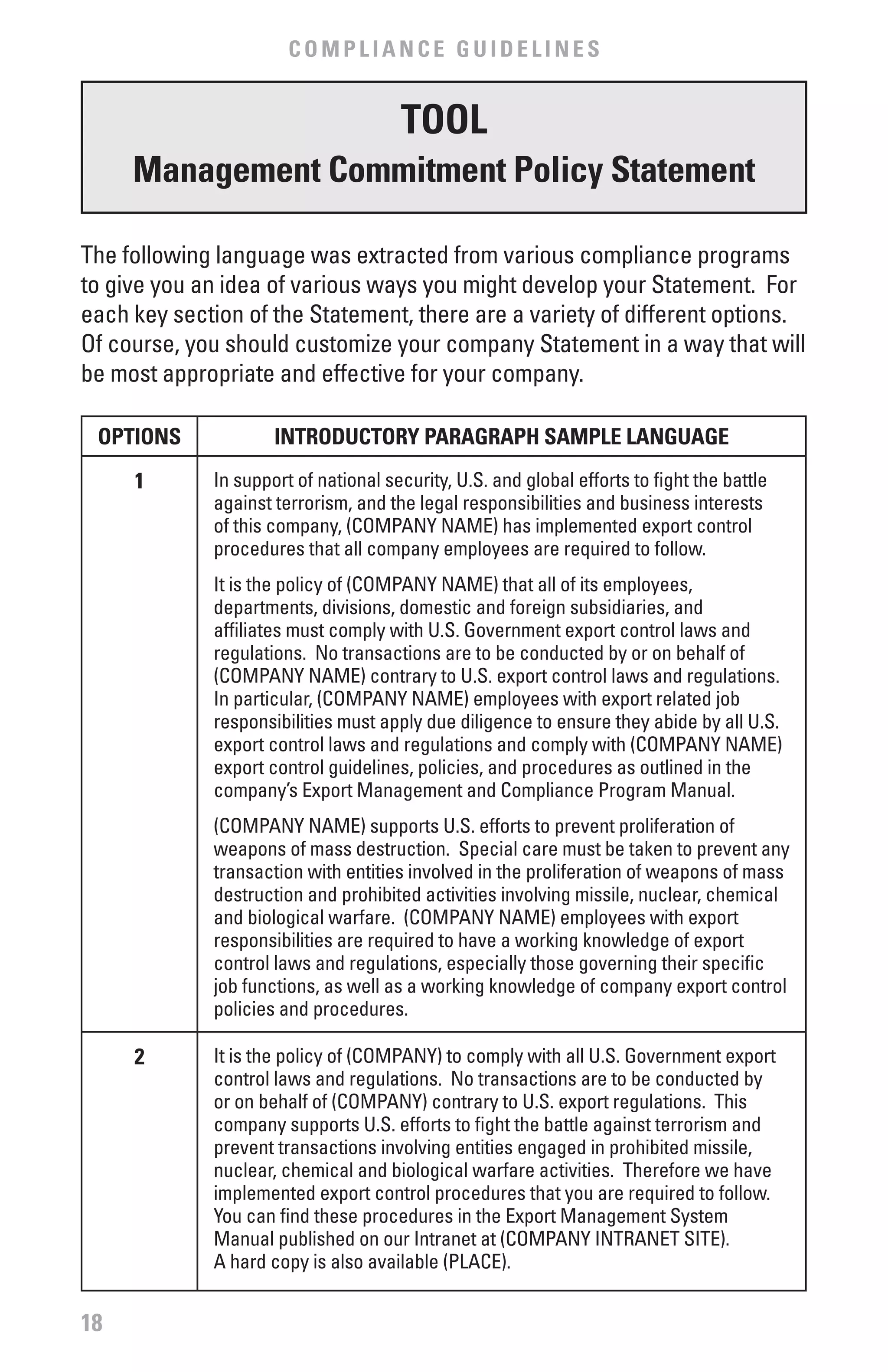
                                      TOOL
     Management Commitment Policy Statement

The following language was extracted from various compliance programs
to give you an idea of various ways you might develop your Statement. For
each key section of the Statement, there are a variety of different options.
Of course, you should customize your company Statement in a way that will
be most appropriate and effective for your company.

 OPTIONS             INTRODUCTORY PARAGRAPH SAMPLE LANGUAGE
     1       In support of national security, U.S. and global efforts to fight the battle
             against terrorism, and the legal responsibilities and business interests
             of this company, (COMPANY NAME) has implemented export control
             procedures that all company employees are required to follow.
             It is the policy of (COMPANY NAME) that all of its employees,
             departments, divisions, domestic and foreign subsidiaries, and
             affiliates must comply with U.S. Government export control laws and
             regulations. No transactions are to be conducted by or on behalf of
             (COMPANY NAME) contrary to U.S. export control laws and regulations.
             In particular, (COMPANY NAME) employees with export related job
             responsibilities must apply due diligence to ensure they abide by all U.S.
             export control laws and regulations and comply with (COMPANY NAME)
             export control guidelines, policies, and procedures as outlined in the
             company’s Export Management and Compliance Program Manual.
             (COMPANY NAME) supports U.S. efforts to prevent proliferation of
             weapons of mass destruction. Special care must be taken to prevent any
             transaction with entities involved in the proliferation of weapons of mass
             destruction and prohibited activities involving missile, nuclear, chemical
             and biological warfare. (COMPANY NAME) employees with export
             responsibilities are required to have a working knowledge of export
             control laws and regulations, especially those governing their specific
             job functions, as well as a working knowledge of company export control
             policies and procedures.

     2       It is the policy of (COMPANY) to comply with all U.S. Government export
             control laws and regulations. No transactions are to be conducted by
             or on behalf of (COMPANY) contrary to U.S. export regulations. This
             company supports U.S. efforts to fight the battle against terrorism and
             prevent transactions involving entities engaged in prohibited missile,
             nuclear, chemical and biological warfare activities. Therefore we have
             implemented export control procedures that you are required to follow.
             You can find these procedures in the Export Management System
             Manual published on our Intranet at (COMPANY INTRANET SITE).
             A hard copy is also available (PLACE).


18
COMPLIANCE GUIDELINES

OPTIONS           INTRODUCTORY PARAGRAPH SAMPLE LANGUAGE
   3      All [COMPANY] personnel involved in exports and reexports, traffic,
          and related functions are required to comply with the policies and
          procedures outlined in [COMPANY’S] Export Management and
          Compliance Program Manual. Under no circumstances will exports be
          made contrary to U.S. Export Administration Regulations.
          No transactions are to be initiated with individuals on the Denied
          Persons List or with any firms owned by or associated with those parties.
          The Denied Persons List identifies parties who have been denied export
          privileges.
          No exports will be made to parties on the Entity List or any other person
          or organization that is suspected to be involved in activities covered
          under the Enhanced Proliferation Control Initiative. This initiative is
          designed to prevent the proliferation of missile technology and nuclear,
          chemical, and biological weapons.
          Employees outside the United States may not reexport any commodity,
          technology, or software unless appropriate authorization has been
          obtained. This includes foreign produced items that are the direct
          product of U.S. technology and software or foreign made items that are
          subject to national security controls of the United States as designated
          by the Commerce Control List.
          No exports or reexports will be shipped without authorization to any
          country that is subject to an embargo or other controls by the United
          States. No exports or reexports will take place with any person or
          organization on the Special Designated Nationals or Terrorists List issued
          by the Office of Foreign Assets Control.
          No in-transit shipments may be made through a prohibited country
          without proper authorization.
          All employees involved in exports and reexports, traffic and related
          functions are required to report requests for products or services that
          are in support of unsanctioned foreign boycotts in accordance with the
          United States regulations.

   4      A critical success factor for (COMPANY) is our ability to establish an
          infrastructure capable of serving our customers. A key element in
          this infrastructure is the (COMPANY’S) ability to export products while
          complying with U.S. export control laws and regulations. To achieve
          compliance with U.S. export control laws and regulations, (COMPANY)
          has developed an export management and compliance program, which
          is formulated to assure that (COMPANY) exports and reexports are not
          made contrary to company policies and procedures and the Export
          Administration Regulations.
          Export compliance is the responsibility of all (COMPANY) personnel.
          (COMPANY) is committed to export compliance by ensuring that compliance
          is an important aspect of our corporate culture and that the requirements
          and disciplines to comply are integrated into every employee’s job and our
          business processes. It is expected that (COMPANY) employees and con-
          tract personnel will be trained in the requirements, policies, and procedures
          to ensure (COMPANY) compliance to prevent even inadvertent violations.

                                                                                      19
COMPLIANCE GUIDELINES

 OPTIONS          INTRODUCTORY PARAGRAPH SAMPLE LANGUAGE

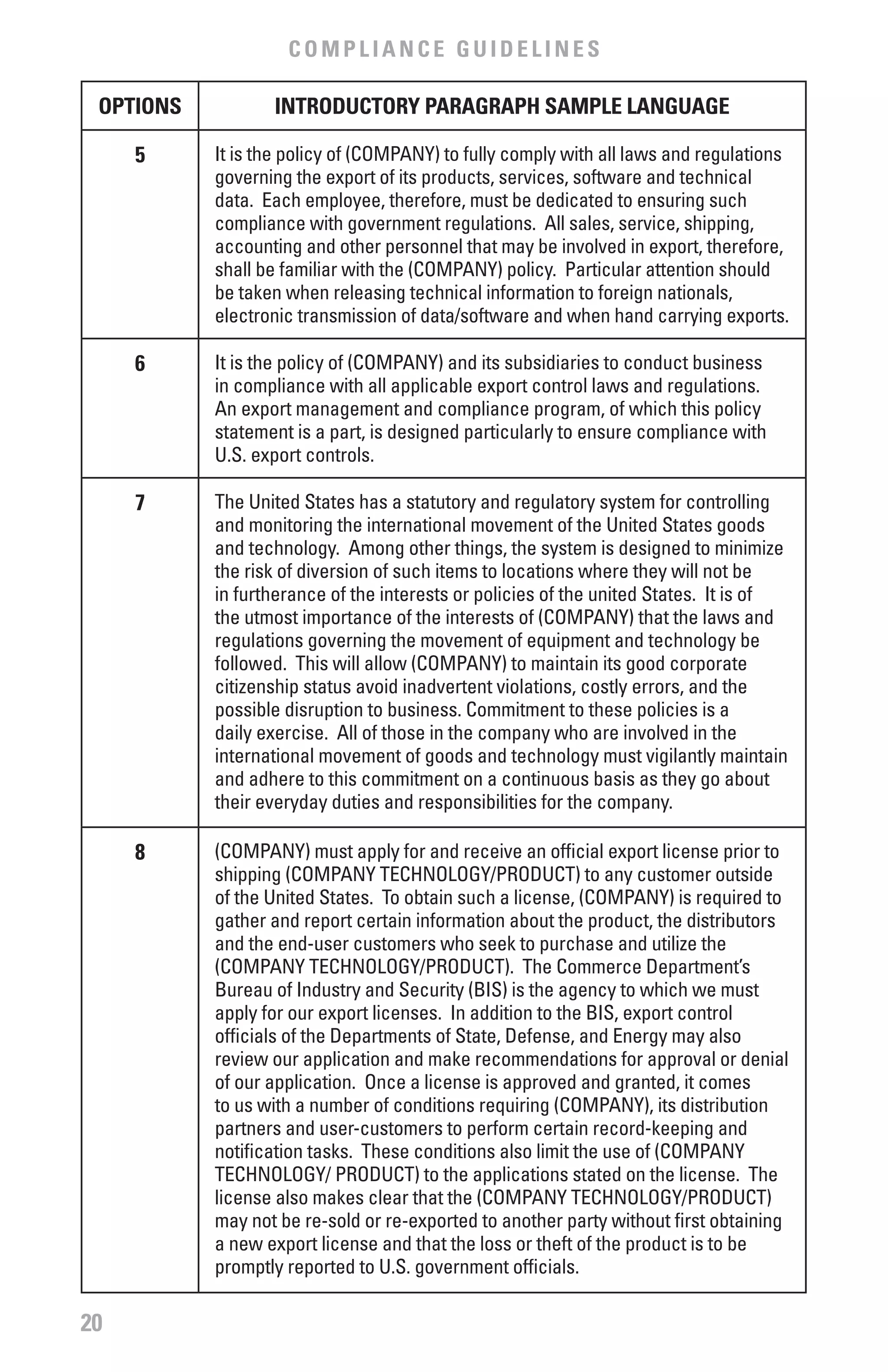
     5     It is the policy of (COMPANY) to fully comply with all laws and regulations
           governing the export of its products, services, software and technical
           data. Each employee, therefore, must be dedicated to ensuring such
           compliance with government regulations. All sales, service, shipping,
           accounting and other personnel that may be involved in export, therefore,
           shall be familiar with the (COMPANY) policy. Particular attention should
           be taken when releasing technical information to foreign nationals,
           electronic transmission of data/software and when hand carrying exports.

     6     It is the policy of (COMPANY) and its subsidiaries to conduct business
           in compliance with all applicable export control laws and regulations.
           An export management and compliance program, of which this policy
           statement is a part, is designed particularly to ensure compliance with
           U.S. export controls.

     7     The United States has a statutory and regulatory system for controlling
           and monitoring the international movement of the United States goods
           and technology. Among other things, the system is designed to minimize
           the risk of diversion of such items to locations where they will not be
           in furtherance of the interests or policies of the united States. It is of
           the utmost importance of the interests of (COMPANY) that the laws and
           regulations governing the movement of equipment and technology be
           followed. This will allow (COMPANY) to maintain its good corporate
           citizenship status avoid inadvertent violations, costly errors, and the
           possible disruption to business. Commitment to these policies is a
           daily exercise. All of those in the company who are involved in the
           international movement of goods and technology must vigilantly maintain
           and adhere to this commitment on a continuous basis as they go about
           their everyday duties and responsibilities for the company.

     8     (COMPANY) must apply for and receive an official export license prior to
           shipping (COMPANY TECHNOLOGY/PRODUCT) to any customer outside
           of the United States. To obtain such a license, (COMPANY) is required to
           gather and report certain information about the product, the distributors
           and the end-user customers who seek to purchase and utilize the
           (COMPANY TECHNOLOGY/PRODUCT). The Commerce Department’s
           Bureau of Industry and Security (BIS) is the agency to which we must
           apply for our export licenses. In addition to the BIS, export control
           officials of the Departments of State, Defense, and Energy may also
           review our application and make recommendations for approval or denial
           of our application. Once a license is approved and granted, it comes
           to us with a number of conditions requiring (COMPANY), its distribution
           partners and user-customers to perform certain record-keeping and
           notification tasks. These conditions also limit the use of (COMPANY
           TECHNOLOGY/ PRODUCT) to the applications stated on the license. The
           license also makes clear that the (COMPANY TECHNOLOGY/PRODUCT)
           may not be re-sold or re-exported to another party without first obtaining
           a new export license and that the loss or theft of the product is to be
           promptly reported to U.S. government officials.

20
COMPLIANCE GUIDELINES

OPTIONS           INTRODUCTORY PARAGRAPH SAMPLE LANGUAGE

   9      As a global company which operates in the United States, (COMPANY)
          is governed by U.S. export control rules and regulations regarding the
          export and/or reexport of products, spare parts, accessories, software,
          training materials, and technical data. It is the policy of (COMPANY)
          that under no circumstances will sales be made contrary to U.S.
          export control laws and regulations or the policies and procedures of
          (COMPANY’S) Export Management and Compliance Program.
          We must remember that exporting our products is a privilege, not a right,
          granted by the U.S. government. This is critical for (COMPANY) because,
          typically, more than (X) % of our sales is international. Although most of
          our products do not require licenses prior to shipment to most countries,
          many of the (PRODUCTS) are now more tightly controlled because
          of concerns regarding the proliferation of chemical and biological
          weapons, missile technology and nuclear weapons. Accordingly,
          (COMPANY), as an exporter, must assume even greater responsibility
          for screening its customers and transactions. Careful review of both the
          end-use and the end-users involved with our international transactions is
          required to ensure export control compliance.

  10      It is the policy of (COMPANY) to fully comply with all laws and regulations
          governing the export of its products, services, software and technical data.
          Each employee, therefore, must be dedicated to ensuring such compliance.
          All sales, service, shipping, accounting and other personnel that may be
          involved in export, therefore, are required to be familiar with and review
          regularly the (COMPANY) Export Management and Compliance Program
          to ensure compliance with government regulations. Particular attention
          should also be taken when releasing technical information to foreign na-
          tionals, electronic transmission of data/software and when hand carrying
          exports. Failure to comply with these regulations may result in the imposi-
          tion of criminal and/or civil fines and penalties, including incarceration for
          individuals and suspension of export privileges for (COMPANY).
          Under no circumstances shall (COMPANY) personnel sell or ship any
          product contrary to United States export laws or shall these laws be
          compromised for commercial gain. Neither sales nor shipments are to be
          made to any individual or firm appearing on the Denied Persons List or to
          any firms owned by or associated with the individuals for firms therein listed.
          In addition, regulations are in effect pursuant to the President’s Enhanced
          Proliferation Control Initiative which places emphasis on the end-use
          and or end-user of exported items. As a result, we need to be vigilant in
          screening our customers and transactions. It is, therefore, more important
          than ever that the “Know Your Customer” guidelines (available from
          ___________) are understood and implemented in order that [COMPANY]
          can meet the required “know” standard.
          In particular, no transactions will be held when dealing with companies
          and countries which may be concerned with the proliferation of nuclear,
          missile, and chemical/biological related processes and/or weapons.
          [COMPANY’S] Export Management and Compliance Program Manual
          summarizes and refers to the applicable laws and regulations and
          company policies and procedures. A copy of the Manual is posted on the
          company Intranet at (WEBSITE).

                                                                                        21
COMPLIANCE GUIDELINES

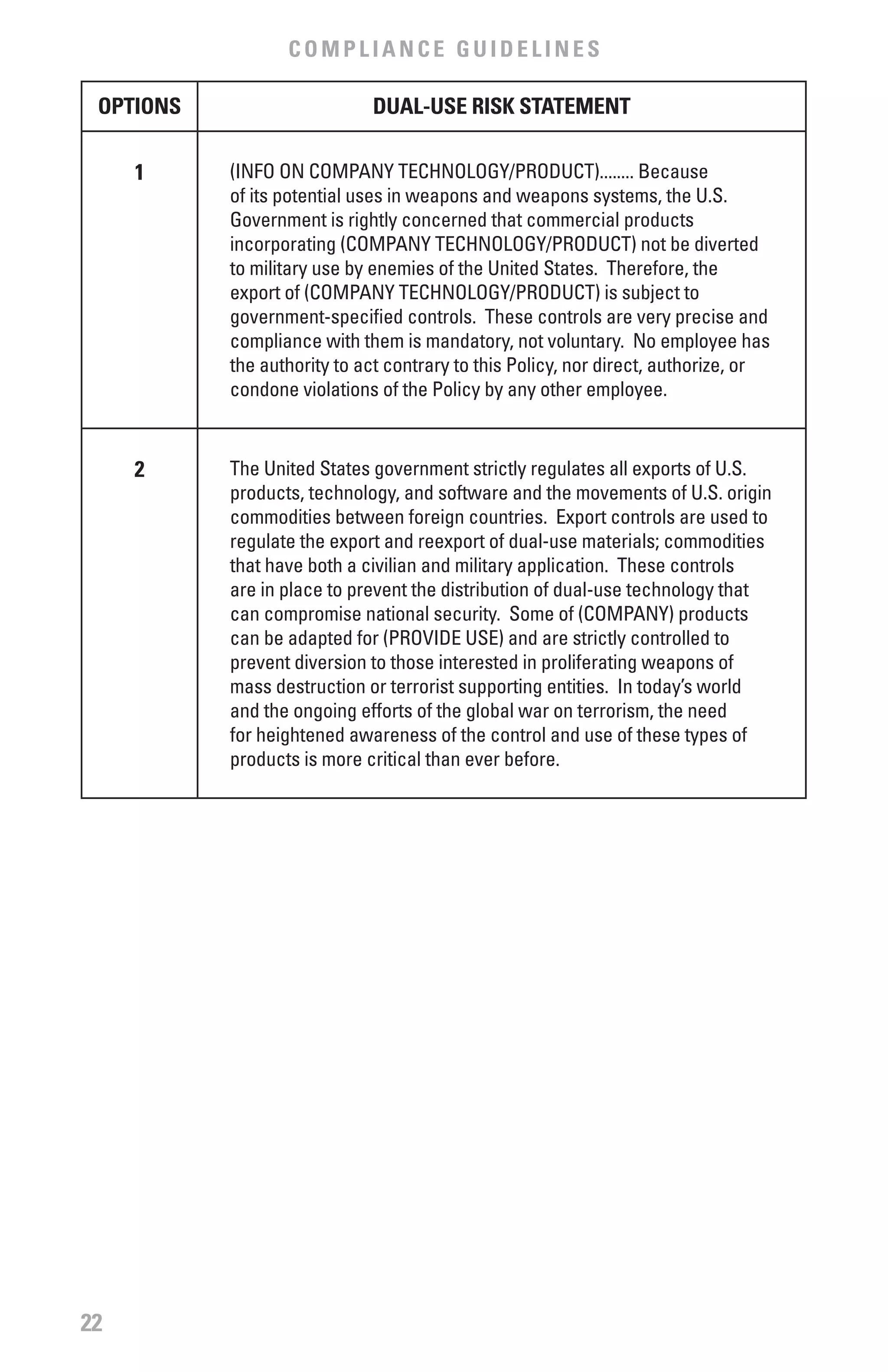
 OPTIONS                     DUAL-USE RISK STATEMENT

     1     (INFO ON COMPANY TECHNOLOGY/PRODUCT)........ Because
           of its potential uses in weapons and weapons systems, the U.S.
           Government is rightly concerned that commercial products
           incorporating (COMPANY TECHNOLOGY/PRODUCT) not be diverted
           to military use by enemies of the United States. Therefore, the
           export of (COMPANY TECHNOLOGY/PRODUCT) is subject to
           government-specified controls. These controls are very precise and
           compliance with them is mandatory, not voluntary. No employee has
           the authority to act contrary to this Policy, nor direct, authorize, or
           condone violations of the Policy by any other employee.


     2     The United States government strictly regulates all exports of U.S.
           products, technology, and software and the movements of U.S. origin
           commodities between foreign countries. Export controls are used to
           regulate the export and reexport of dual-use materials; commodities
           that have both a civilian and military application. These controls
           are in place to prevent the distribution of dual-use technology that
           can compromise national security. Some of (COMPANY) products
           can be adapted for (PROVIDE USE) and are strictly controlled to
           prevent diversion to those interested in proliferating weapons of
           mass destruction or terrorist supporting entities. In today’s world
           and the ongoing efforts of the global war on terrorism, the need
           for heightened awareness of the control and use of these types of
           products is more critical than ever before.


22
COMPLIANCE GUIDELINES

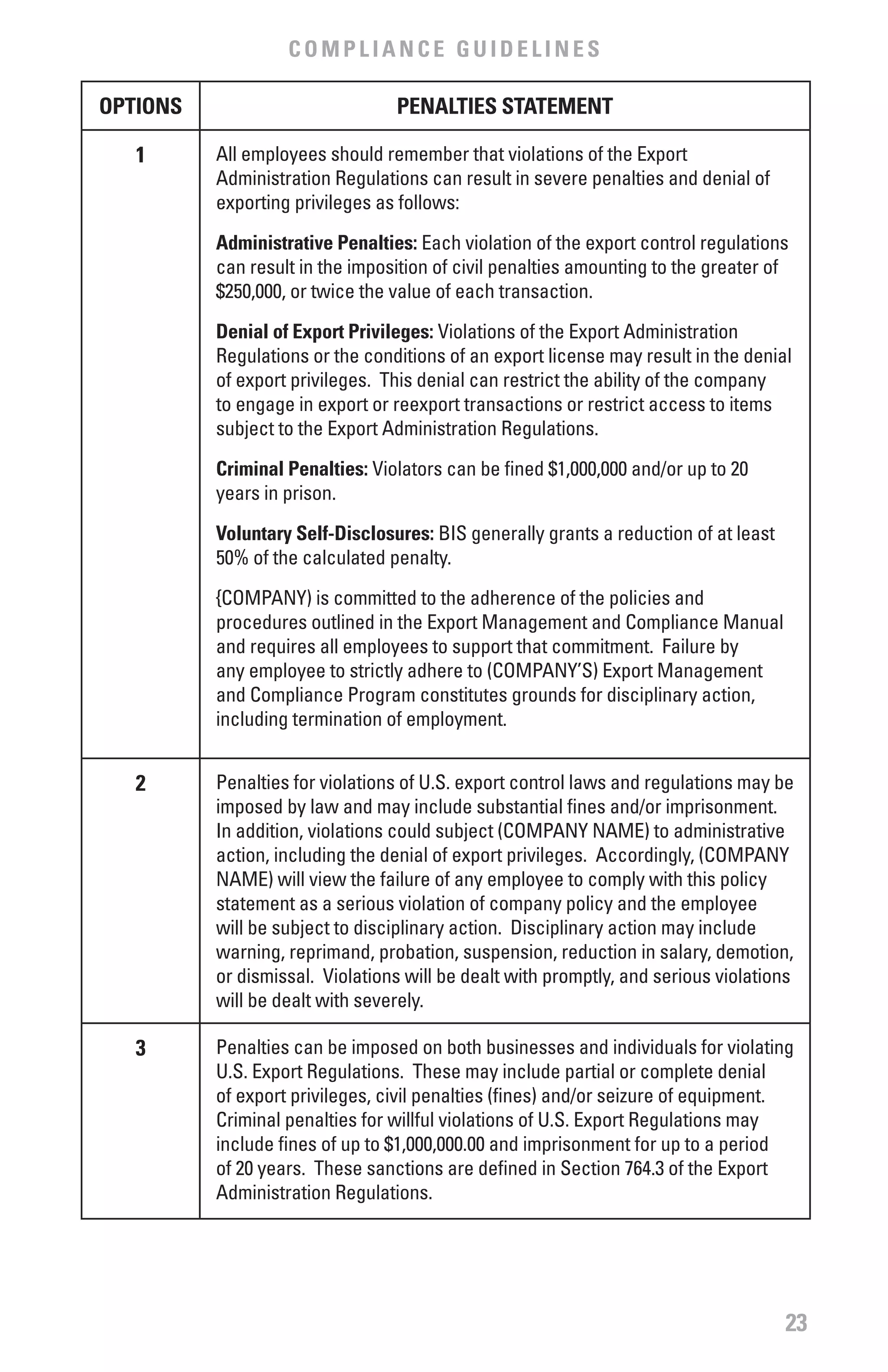
OPTIONS                          PENALTIES STATEMENT

   1      All employees should remember that violations of the Export
          Administration Regulations can result in severe penalties and denial of
          exporting privileges as follows:

          Administrative Penalties: Each violation of the export control regulations
          can result in the imposition of civil penalties amounting to the greater of
          $250,000, or twice the value of each transaction.

          Denial of Export Privileges: Violations of the Export Administration
          Regulations or the conditions of an export license may result in the denial
          of export privileges. This denial can restrict the ability of the company
          to engage in export or reexport transactions or restrict access to items
          subject to the Export Administration Regulations.

          Criminal Penalties: Violators can be fined $1,000,000 and/or up to 20
          years in prison.

          voluntary Self-Disclosures: BIS generally grants a reduction of at least
          50% of the calculated penalty.
          {COMPANY) is committed to the adherence of the policies and
          procedures outlined in the Export Management and Compliance Manual
          and requires all employees to support that commitment. Failure by
          any employee to strictly adhere to (COMPANY’S) Export Management
          and Compliance Program constitutes grounds for disciplinary action,
          including termination of employment.


   2      Penalties for violations of U.S. export control laws and regulations may be
          imposed by law and may include substantial fines and/or imprisonment.
          In addition, violations could subject (COMPANY NAME) to administrative
          action, including the denial of export privileges. Accordingly, (COMPANY
          NAME) will view the failure of any employee to comply with this policy
          statement as a serious violation of company policy and the employee
          will be subject to disciplinary action. Disciplinary action may include
          warning, reprimand, probation, suspension, reduction in salary, demotion,
          or dismissal. Violations will be dealt with promptly, and serious violations
          will be dealt with severely.

   3      Penalties can be imposed on both businesses and individuals for violating
          U.S. Export Regulations. These may include partial or complete denial
          of export privileges, civil penalties (fines) and/or seizure of equipment.
          Criminal penalties for willful violations of U.S. Export Regulations may
          include fines of up to $1,000,000.00 and imprisonment for up to a period
          of 20 years. These sanctions are defined in Section 764.3 of the Export
          Administration Regulations.


                                                                                     23
COMPLIANCE GUIDELINES

 OPTIONS                          PENALTIES STATEMENT

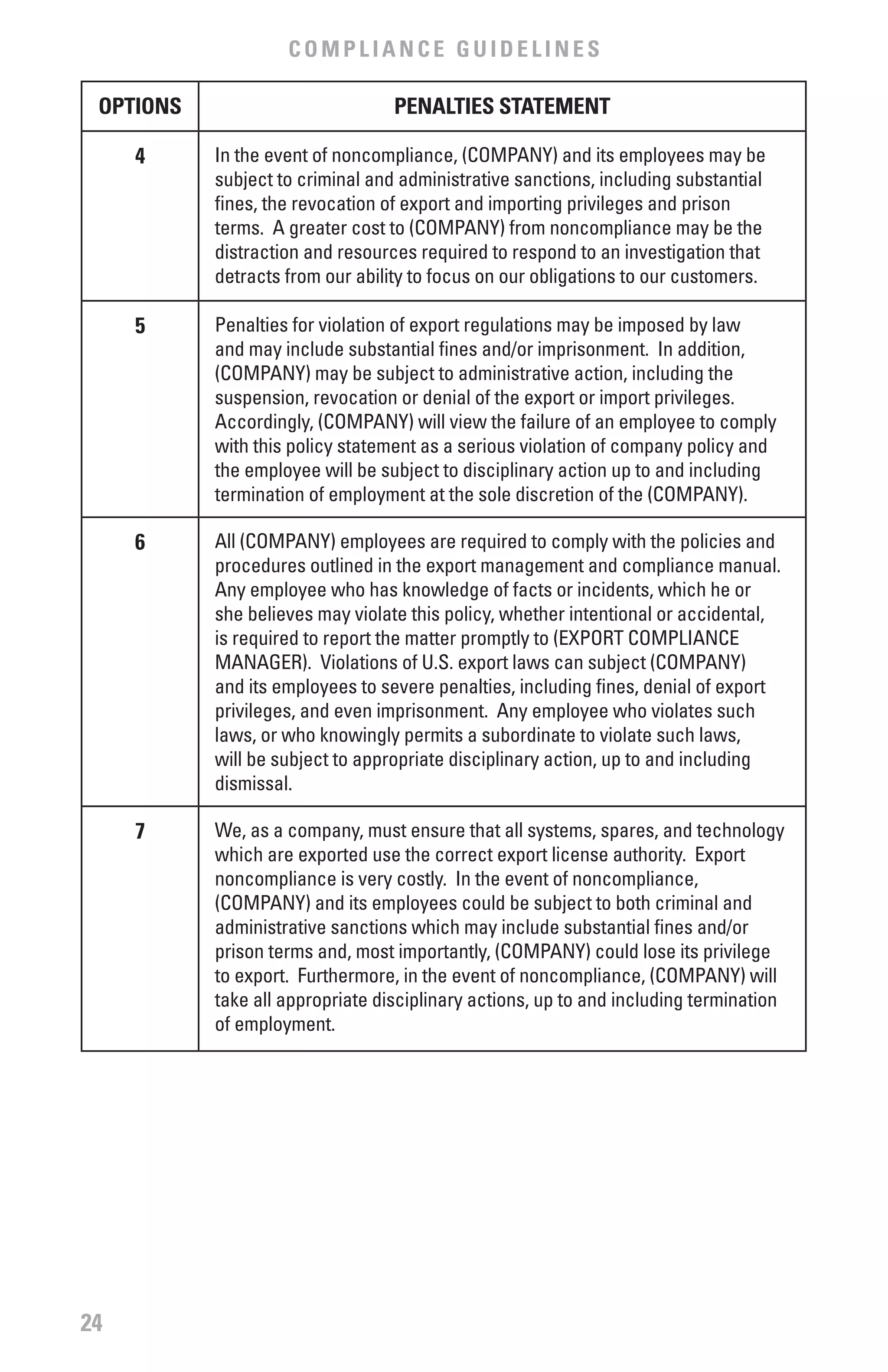
     4     In the event of noncompliance, (COMPANY) and its employees may be
           subject to criminal and administrative sanctions, including substantial
           fines, the revocation of export and importing privileges and prison
           terms. A greater cost to (COMPANY) from noncompliance may be the
           distraction and resources required to respond to an investigation that
           detracts from our ability to focus on our obligations to our customers.

     5     Penalties for violation of export regulations may be imposed by law
           and may include substantial fines and/or imprisonment. In addition,
           (COMPANY) may be subject to administrative action, including the
           suspension, revocation or denial of the export or import privileges.
           Accordingly, (COMPANY) will view the failure of an employee to comply
           with this policy statement as a serious violation of company policy and
           the employee will be subject to disciplinary action up to and including
           termination of employment at the sole discretion of the (COMPANY).

     6     All (COMPANY) employees are required to comply with the policies and
           procedures outlined in the export management and compliance manual.
           Any employee who has knowledge of facts or incidents, which he or
           she believes may violate this policy, whether intentional or accidental,
           is required to report the matter promptly to (EXPORT COMPLIANCE
           MANAGER). Violations of U.S. export laws can subject (COMPANY)
           and its employees to severe penalties, including fines, denial of export
           privileges, and even imprisonment. Any employee who violates such
           laws, or who knowingly permits a subordinate to violate such laws,
           will be subject to appropriate disciplinary action, up to and including
           dismissal.

     7     We, as a company, must ensure that all systems, spares, and technology
           which are exported use the correct export license authority. Export
           noncompliance is very costly. In the event of noncompliance,
           (COMPANY) and its employees could be subject to both criminal and
           administrative sanctions which may include substantial fines and/or
           prison terms and, most importantly, (COMPANY) could lose its privilege
           to export. Furthermore, in the event of noncompliance, (COMPANY) will
           take all appropriate disciplinary actions, up to and including termination
           of employment.


24
COMPLIANCE GUIDELINES

OPTIONS                      wHERE TO DIRECT QUESTIONS

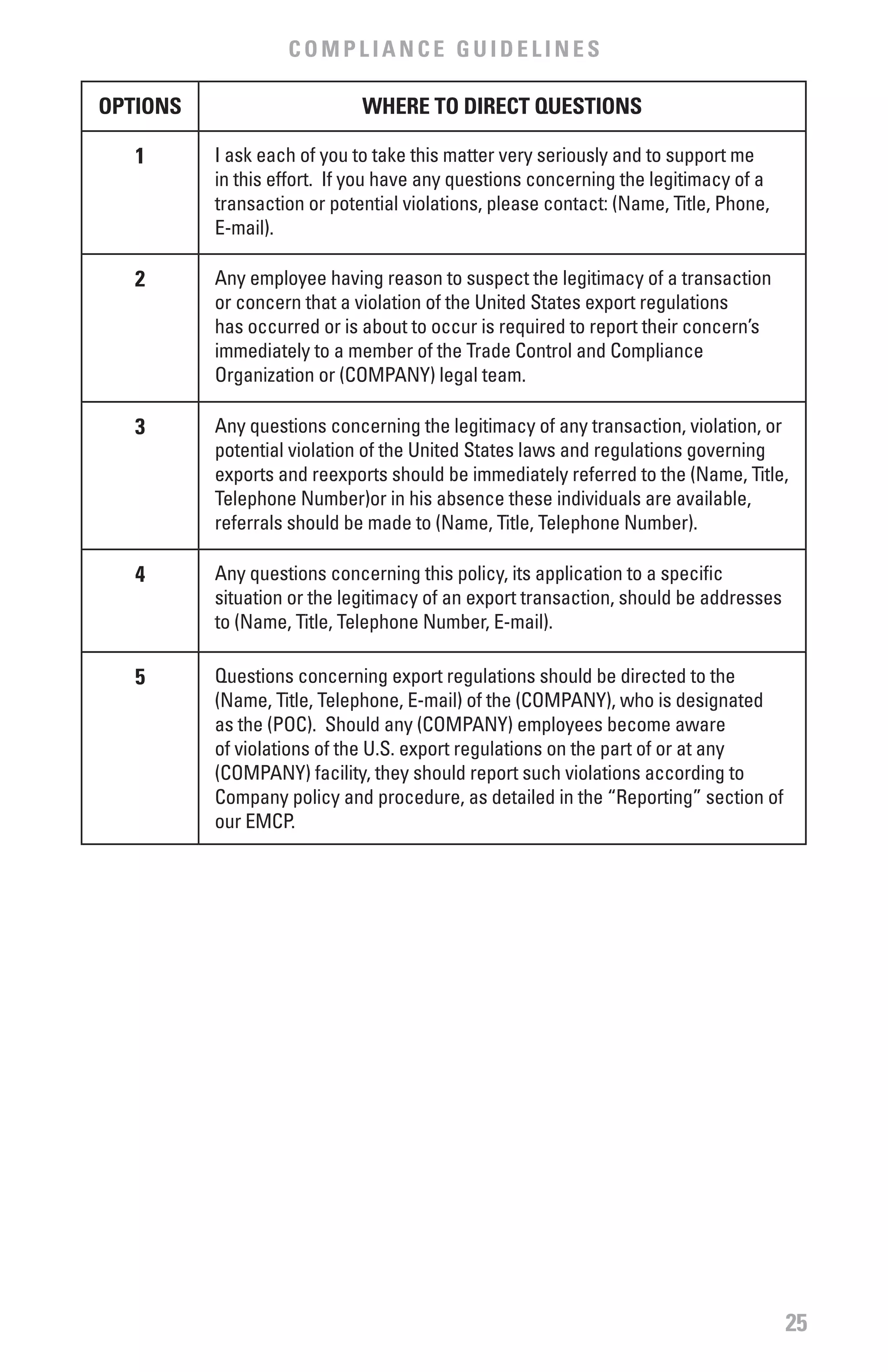
   1      I ask each of you to take this matter very seriously and to support me
          in this effort. If you have any questions concerning the legitimacy of a
          transaction or potential violations, please contact: (Name, Title, Phone,
          E-mail).

   2      Any employee having reason to suspect the legitimacy of a transaction
          or concern that a violation of the United States export regulations
          has occurred or is about to occur is required to report their concern’s
          immediately to a member of the Trade Control and Compliance
          Organization or (COMPANY) legal team.

   3      Any questions concerning the legitimacy of any transaction, violation, or
          potential violation of the United States laws and regulations governing
          exports and reexports should be immediately referred to the (Name, Title,
          Telephone Number)or in his absence these individuals are available,
          referrals should be made to (Name, Title, Telephone Number).

   4      Any questions concerning this policy, its application to a specific
          situation or the legitimacy of an export transaction, should be addresses
          to (Name, Title, Telephone Number, E-mail).

   5      Questions concerning export regulations should be directed to the
          (Name, Title, Telephone, E-mail) of the (COMPANY), who is designated
          as the (POC). Should any (COMPANY) employees become aware
          of violations of the U.S. export regulations on the part of or at any
          (COMPANY) facility, they should report such violations according to
          Company policy and procedure, as detailed in the “Reporting” section of
          our EMCP.


                                                                                      25
COMPLIANCE GUIDELINES

 OPTIONS                      wHERE TO DIRECT QUESTIONS

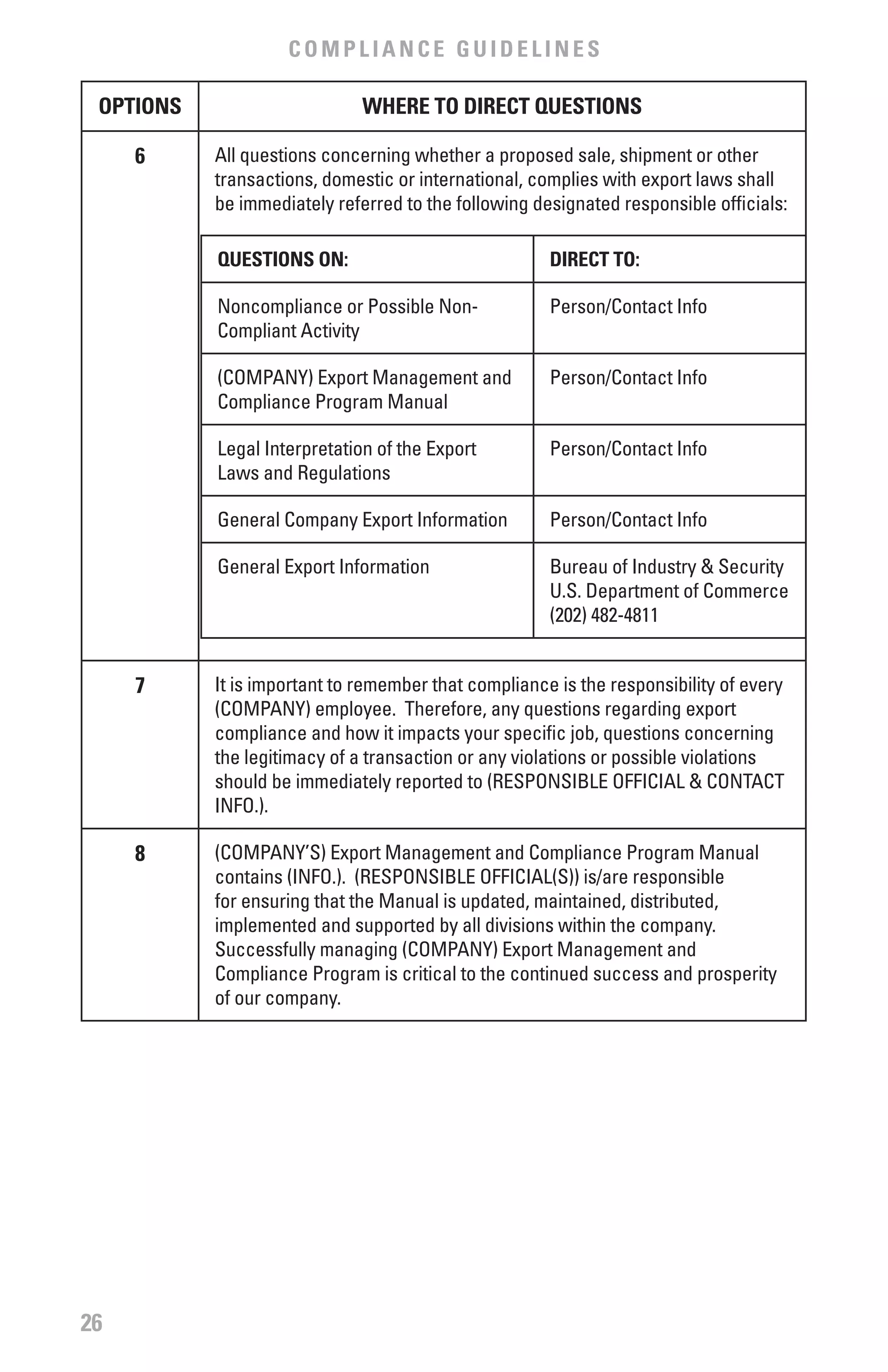
     6     All questions concerning whether a proposed sale, shipment or other
           transactions, domestic or international, complies with export laws shall
           be immediately referred to the following designated responsible officials:

           QUESTIONS ON:                              DIRECT TO:

           Noncompliance or Possible Non-             Person/Contact Info
           Compliant Activity

           (COMPANY) Export Management and            Person/Contact Info
           Compliance Program Manual

           Legal Interpretation of the Export         Person/Contact Info
           Laws and Regulations

           General Company Export Information         Person/Contact Info

           General Export Information                 Bureau of Industry & Security
                                                      U.S. Department of Commerce
                                                      (202) 482-4811


     7     It is important to remember that compliance is the responsibility of every
           (COMPANY) employee. Therefore, any questions regarding export
           compliance and how it impacts your specific job, questions concerning
           the legitimacy of a transaction or any violations or possible violations
           should be immediately reported to (RESPONSIBLE OFFICIAL & CONTACT
           INFO.).

     8     (COMPANY’S) Export Management and Compliance Program Manual
           contains (INFO.). (RESPONSIBLE OFFICIAL(S)) is/are responsible
           for ensuring that the Manual is updated, maintained, distributed,
           implemented and supported by all divisions within the company.
           Successfully managing (COMPANY) Export Management and
           Compliance Program is critical to the continued success and prosperity
           of our company.


26
COMPLIANCE GUIDELINES


                         KEY ELEMENT 2:
                          Risk Assessment

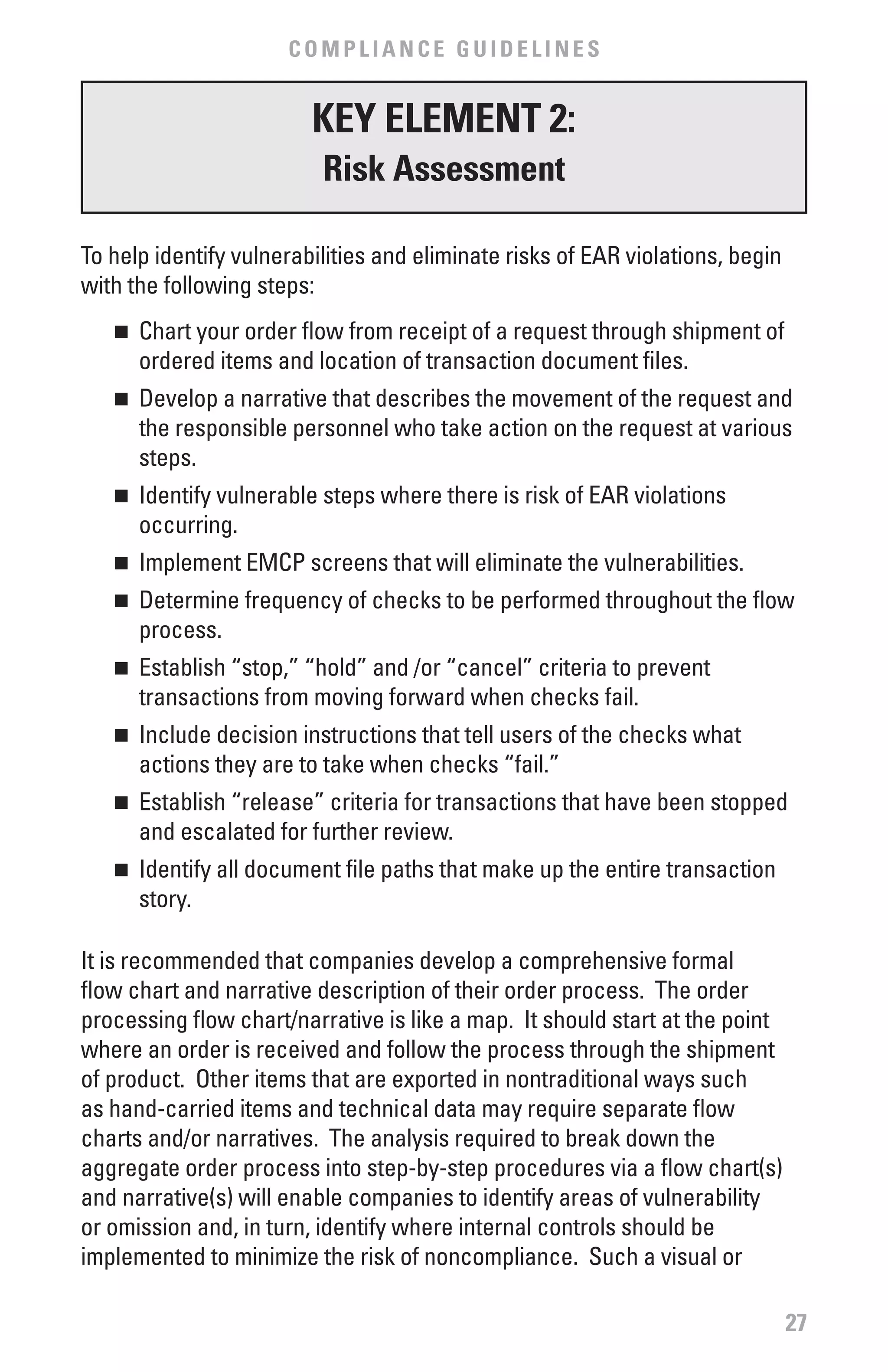
To help identify vulnerabilities and eliminate risks of EAR violations, begin
with the following steps:
   n 	 Chart your order flow from receipt of a request through shipment of
       ordered items and location of transaction document files.
   n 	 Develop a narrative that describes the movement of the request and
       the responsible personnel who take action on the request at various
       steps.
   n 	 Identify vulnerable steps where there is risk of EAR violations
       occurring.
   n 	 Implement EMCP screens that will eliminate the vulnerabilities.
   n 	 Determine frequency of checks to be performed throughout the flow
       process.
   n 	 Establish “stop,” “hold” and /or “cancel” criteria to prevent
       transactions from moving forward when checks fail.
   n 	 Include decision instructions that tell users of the checks what
       actions they are to take when checks “fail.”
   n 	 Establish “release” criteria for transactions that have been stopped
       and escalated for further review.
   n 	 Identify all document file paths that make up the entire transaction
       story.

It is recommended that companies develop a comprehensive formal
flow chart and narrative description of their order process. The order
processing flow chart/narrative is like a map. It should start at the point
where an order is received and follow the process through the shipment
of product. Other items that are exported in nontraditional ways such
as hand-carried items and technical data may require separate flow
charts and/or narratives. The analysis required to break down the
aggregate order process into step-by-step procedures via a flow chart(s)
and narrative(s) will enable companies to identify areas of vulnerability
or omission and, in turn, identify where internal controls should be
implemented to minimize the risk of noncompliance. Such a visual or

                                                                                27
COMPLIANCE GUIDELINES
descriptive tool can be used to educate employees about the overall order
process, the compliance measures in place, and, most important, help
employees understand their individual role and responsibility in the process
as well as what should happen before and after their contribution.

The order processing system, whether it is manual or automated, should
have “hold” functions, sign-off procedures, and accountability built into it to
assure all orders receive the appropriate control checks prior to shipping.
Within the system, order processing checks should be conducted for each
of the screening elements (see section on Screening). An order processing
system should have redundancies built in. For example, a check of the
Denied Persons List should be conducted by sales personnel at the initial
stage of contact with the customer, as well as by compliance personnel
prior to entering the order, and then prior to shipment, due to possible
regulatory changes. In addition, screening should be performed on all
intermediate parties involved in a transaction. This is particularly true for
Denied Persons Screening. This is to ensure that shipments to bonded
warehouses and free trade zones are disposed of as authorized, thereby
reducing the possibility of diversion.

It is important to clearly define: 1) preventative controls to minimize
vulnerabilities prior to order entry; 2) in-process controls that will place a
“hold” on a transaction necessitating a secondary review; and 3) after-
process controls that would alert you to system failures. See screening
procedures in Key Element 5, below.

Each individual with responsibility for performing a control check(s) should
be held accountable for orders processed. Some method of verifying the
performance of the checks should be implemented, whether by requiring
documentation of completion of the checks for reviewing purposes,
preventing the flow from moving to the next level, or some other means
used to ensure compliance. Also, see screening procedures in Key
Element 5, below.


28
COMPLIANCE GUIDELINES


                                    TOOL
  Defining the Parameters of Your Export Program
      with a view Toward Assessing Risk and
             Identifying vulnerabilities

The questions in the following tool are designed to help your Task Force
think through how best to structure your EMCP based on your company’s
unique characteristics. This information will help you build an EMCP that
addresses your export compliance risks. All of the questions highlight
factors that are important to consider as potential points of vulnerability as
you develop an EMCP. By defining your export operations, you can assess
potential areas of risk where you will need to build in specific policy and
procedural compliance safeguards. Significant risk factors include volume
of exports, end-uses, end-users, other intermediary parties to transactions,
location of customers, product sensitivity or restrictions, and the order
processing system. Working through the questions should also help
you identify other company-specific vulnerabilities. Information that this
exercise generates can be included in the relevant sections of your written
compliance manual.

A. COMPANY PROfILE: Define Your Proposed Export Structure
   n 	 Describe the structure of your company. Include a narrative and
       organization chart indicating location of corporate headquarters,
       operating divisions, including manufacturing facilities, and domestic
       and foreign subsidiaries and affiliates.
   n 	 Identify all domestic and foreign divisions/offices/facilities that will
       have a role in your export transactions.
   n 	 Identify location(s) of where you would like to have export
       compliance manager(s). Highlight the proposed management line of
       authority for export control related activities. Clearly indicate how
       divisions/positions will be interrelated.

 NOTE: Examine reporting structure for possible conflict of interest in
 lines of authority. This information will be used to develop your manage-
 ment and oversight structure and procedures, and define accountable
 personnel responsible for export control functions.

                                                                                  29
COMPLIANCE GUIDELINES
     	 List the total number of employees you anticipate will be directly
     n

       involved in export related functions.
 NOTE: Does the number of proposed export employees reflect a suffi-
 cient level of compliance resources allocated to handle the volume of ex-
 port/reexport transactions and issues anticipated in your export program?

     	 How many orders do you anticipate to process monthly?
     n


     	 What do you anticipate will be the average time frame from
     n

       acceptance of order to time of shipment?
     	 Identify offices and personnel who are in the order processing chain.
     n


 NOTE: There are various risk factors associated with different order entry
 processes. You should make sure that you take these into consideration
 as you document your procedures in your EMCP program.

b. bUSINESS ACTIvITY PROfILE: Define Your Proposed Export Activity
     	 Describe your industry sector.
     n

     	 Describe your business type.
     n

       n	 Manufacturer


       n	 Retailer


       n	 Distributor


       n	 Trading Company


       n	 Purchasing Agent


       n	 Original Equipment Manufacturer (OEM)


       n	 System Integrator


       n	 Servicing Agent


       n	 Freight Forwarder


       n	 Other


 NOTE: You will need to consider the unique compliance issues associ-
 ated with your specific industry sector and business activity. There are
 varying risk factors associated with industries that produce sensitive
 dual-use products.
 Also, there are compliance considerations associated with different
 business types. For example, if you are a freight forwarder, it is critical
 that you have written communication between you and your customer
 defining the export transaction roles and responsibilities. A distributor
 will need to ensure the accuracy of the commodity classification of the
 products to be exported.

30
COMPLIANCE GUIDELINES
  n	 Do you plan to perform field services? If so, answer the questions
     listed below.
      	 What types of services will be performed by your company?
      n


      	 Will you provide installation services?
      n


      	 Will you service your equipment under a maintenance contract?
      n


      	 Will proposed field service activities be subject to export controls?
      n


      	 How will services subject to export controls be handled under your
      n

        compliance program?

NOTE: You will need to include compliance measures in your EMCP to
address service activities. If you are servicing products that you did not
export, you need a process to ensure the equipment was exported legiti-
mately. Remember to be alert for prohibited activities and persons.

  n	 How many orders do you anticipate to process monthly?
  n	 What do you anticipate will be the average time-frame from
     acceptance of order to time of shipment?

NOTE: When defining your export activity, you need to consider various
risk factors associated with specific industry sectors, unique business
activity, and resource allocation.

  n	 Do you expect to invite overseas entities to send representatives to
     your U.S. facilities for periodic training, including for product updates/
     enhancements you hope to market?

NOTE: When considering inviting foreign nationals to your U.S. facili-
ties, please also consider EAR regulations in the EAR Part 734.2(b)(2)(ii)
and 734.2(b)(3).


                                                                             31
COMPLIANCE GUIDELINES

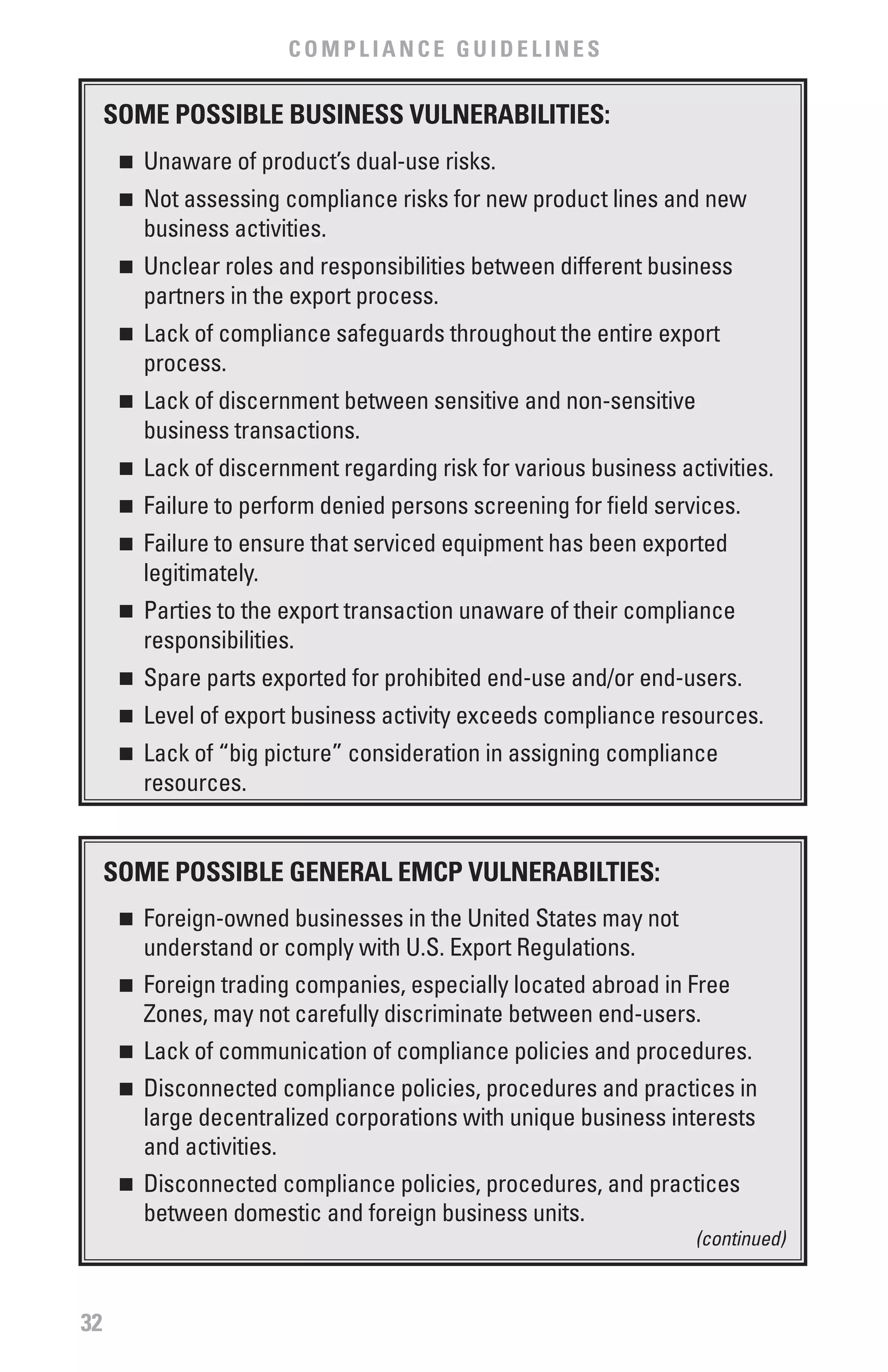
     SOME POSSIbLE bUSINESS vULNERAbILITIES:
      n	 Unaware of product’s dual-use risks.
      n	 Not assessing compliance risks for new product lines and new
         business activities.
      n	 Unclear roles and responsibilities between different business
         partners in the export process.
      n	 Lack of compliance safeguards throughout the entire export
         process.
      n	 Lack of discernment between sensitive and non-sensitive
         business transactions.
      n	 Lack of discernment regarding risk for various business activities.
      n	 Failure to perform denied persons screening for field services.
      n	 Failure to ensure that serviced equipment has been exported
         legitimately.
      n	 Parties to the export transaction unaware of their compliance
         responsibilities.
      n	 Spare parts exported for prohibited end-use and/or end-users.
      n	 Level of export business activity exceeds compliance resources.
      n	 Lack of “big picture” consideration in assigning compliance
         resources.


     SOME POSSIbLE GENERAL EMCP vULNERAbILTIES:
      n	 Foreign-owned businesses in the United States may not
         understand or comply with U.S. Export Regulations.
      n	 Foreign trading companies, especially located abroad in Free
         Zones, may not carefully discriminate between end-users.
      n	 Lack of communication of compliance policies and procedures.
      n	 Disconnected compliance policies, procedures and practices in
         large decentralized corporations with unique business interests
         and activities.
      n	 Disconnected compliance policies, procedures, and practices
         between domestic and foreign business units.
                                                                   (continued)


32
COMPLIANCE GUIDELINES


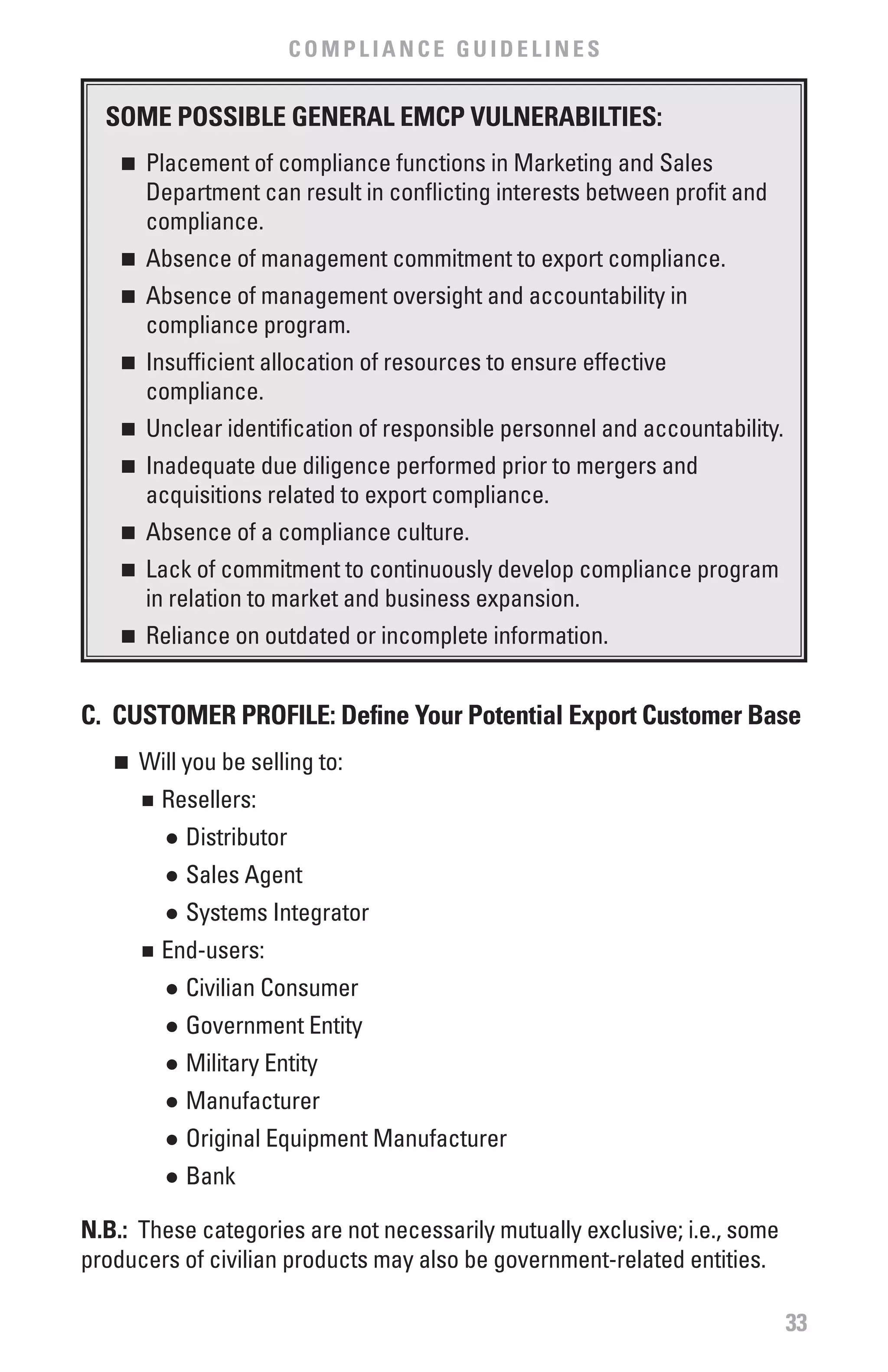
  SOME POSSIbLE GENERAL EMCP vULNERAbILTIES:
    n  	 Placement of compliance functions in Marketing and Sales
         Department can result in conflicting interests between profit and
         compliance.
    n  	 Absence of management commitment to export compliance.
    n  	 Absence of management oversight and accountability in
         compliance program.
    n  	 Insufficient allocation of resources to ensure effective
         compliance.
    n  	 Unclear identification of responsible personnel and accountability.
    n  	 Inadequate due diligence performed prior to mergers and
         acquisitions related to export compliance.
    n  	 Absence of a compliance culture.
    n  	 Lack of commitment to continuously develop compliance program
         in relation to market and business expansion.
    n  	 Reliance on outdated or incomplete information.


C. CUSTOMER PROfILE: Define Your Potential Export Customer base
   n	 Will you be selling to:
        	 Resellers:
        n


            	 Distributor
            l


            	 Sales Agent
            l


            	 Systems Integrator
            l


        	 End-users:
        n


            	 Civilian Consumer
            l


            	 Government Entity
            l


            	 Military Entity
            l


            	 Manufacturer
            l


            	 Original Equipment Manufacturer
            l


            	 Bank
            l


N.b.: These categories are not necessarily mutually exclusive; i.e., some
producers of civilian products may also be government-related entities.

                                                                               33
COMPLIANCE GUIDELINES
     n	 Exporter/Customer Relationship(s):
        n	 Wholly-owned Subsidiary


          n	 Independent Entity
          n	 Established Customer
          n	 New Customer
          n	 Customer is Unknown (i.e., internet customer)

Do you anticipate that your customer base will be repetitive sales to the
same customer(s) or single transactions to customers that you do not have
an established business relationship?

 NOTE: As an exporter, you are responsible for knowing your customers
 and for ensuring that your exports do not go to prohibited end-users.
 As a good compliance practice, you should include mechanisms in
 your procedures that verify the legitimacy of your customers and their
 transactions. You will need to incorporate different types of compliance
 measures within your EMCP to address risk factors commensurate with
 different types of customer relationships.


     SOME POSSIbLE CUSTOMER vULNERAbILITIES:
      n  	 Not establishing the bona fides of customers.
      n  	 Inadequate up-front customer questionnaire and screening
           resulting in incomplete customer profile.
      n  	 Not assessing the legitimacy of export transaction.
      n  	 Self blinding to pertinent customer information.
      n  	 Communication regarding compliance responsibilities not
           cascading down to all stakeholders in the export transaction.
      n  	 Lack of procedures to ensure that customers receive and
           understand license conditions and commensurate obligations.
      n  	 Distributors unaware of commodity classifications of various
           products as well as restrictions related to the products.
      n  	 Unaware of military versus civilian end-use and end-user
           restrictions.
      n  	 Customer requests that violate U.S. Antiboycott Laws.
                                                                      (continued)

34
COMPLIANCE GUIDELINES

  SOME POSSIbLE CUSTOMER vULNERAbILITIES:
   n   	 Unaware whether or not the customer’s integration of product into
         larger system is controlled by U.S. Export Regulations.
   n   	 Misperception that well-known companies do not require
         compliance consideration.
   n   	 Not employing higher levels of compliance screening for unknown
         customers.


D. COUNTRY PROfILE: Define the Potential Location of Your
   Customers
  Reference: http://www.access.gpo.gov/bis/ear/pdf/740spir.pdf	

   n	 Do you plan to market to customers in:
      n	 Country Group A


       n	 Country Group B
       n	 Country Group D
       n	 Country Group E

   n	 Do you know whether your customers will reexport? If so, will
      the new destination have different EAR licensing policies and
      requirements?

 NOTE: There are different license requirements for different countries.
 As your international marketing plan evolves, you should make sure
 you are aware of the various licensing policies for different countries.
 Reference: http://www.access.gpo.gov/bis/ear/pdf/738.pdf
 This information should be used in developing your item and country
 compliance check section in your EMCP.


                                                                             35
COMPLIANCE GUIDELINES


 SOME POSSIbLE COUNTRY vULNERAbILITIES:
     n	 Exporting any goods or technologies to a terrorist-supporting
        country and/or embargoed country without a license.
     n	 Not aware that there are different license requirements for

        different countries.
     n	 Re-export restrictions not communicated to customers.

     n	 Company compliance policies and procedures do not address

        country policy.
     n	 Not keeping up-to-date with changes in the Export Administration

        Regulations.
     n	 Not keeping compliance programs up-to-date with country policy

        regulatory changes.
     n	 No procedures for complying with license exception parameters.

     n	 Language barriers can compromise export compliance integrity.

     n	 Inconsistencies between U.S. and foreign country policy.

     n	 False sense of comfort fostered by doing business in a friendly

        allied country.
     n	 Unaware of those countries that are transshipment countries of

        concern.
     n	 U.S. country policies are not reflected in internal export

        compliance transaction procedures.

E. COMMODITY PROfILE: Define Your Potential Products for Export
     n	 Proposed export(s):
        n	 Commodity


         	 Software with Encryption
         n


         	 Software without Encryption
         n


         	 Technical Data with Encryption
         n


         	 Technical Data without Encryption
         n


         	 Service (i.e., repair, financing, freight forwarding, legal, technical,
         n


           engineering, architectural assistance, etc.)
     n	 What are the export commodity classification numbers (ECCNs) for
        each of your exports?
        Reference: http://www.bis.doc.gov/licensing/Do_I_NeedAnECCN.html
36
COMPLIANCE GUIDELINES

NOTE: Your commodity classification is a critical decision process.
Export decisions and requirements are based on your ECCN and Gen-
eral Prohibitions. As part of your EMCP, you will want to document the
process for determining your ECCN(s). In addition, you need to include
a decision process for determining the appropriate export authorization
(license, license exception, or no license required).
As part of this process, you should maintain decision support docu-
ments. In addition, you need to include maintenance procedures
that will capture future product and EAR changes that will affect your
ECCN(s).
This information should be used in developing your item and country
compliance section in your EMCP.


 n 	 Are there any dual-use risks or export restrictions related to your
     products?
     Reference: http://www.access.gpo.gov/bis/ear/pdf/738.pdf
     n	 AT – Anti Terrorism


     	 CB – Chemical & Biological Weapons
     n


     	 CC – Crime Control
     n


     	 CW – Chemical Weapons Convention
     n


     	 EI – Encryption Items
     n


     	 FC – Firearms Convention
     n


     	 MT – Missile Technology
     n


     	 NS – National Security
     n


     	 NP – Nuclear Nonproliferation
     n


     	 RS – Regional Stability
     n


     	 SS – Short Supply
     n


     	 UN – United Nations Embargo
     n


     	 SI – Significant Items
     n


     	 SL – Surreptitious Listening
     n


NOTE: You should develop internal control procedures to ensure com-
pliance with any unique requirements associated with the applicable
reasons for control.

                                                                           37
COMPLIANCE GUIDELINES
     	 Based on your ECCN(s) and the country chart included in Part
     n

       738, Supplement 1 of the EAR, what are the appropriate export
       authorizations for your products?
       Reference: http://www.access.gpo.gov/bis/ear/pdf/738spir.pdf
       n	 License Required


         	 Eligible for License Exception(s)
         n


         	 No License Required
         n


 NOTE: This information should be used in developing your item and
 country compliance check section in your EMCP.


     	 Will you hire foreign nationals at your U.S. facilities?
     n


 NOTE: If the foreign nationals that you hire have access to technology,
 you may be subject to the “deemed export” rule. Reference:
 http://www.bis.doc.gov/DeemedExports/DeemedExportsFAQs.html#1


     	 Do you plan to export anything subject to other agencies’ jurisdiction,
     n

       e.g., U.S. Department of State, Department of the Treasury’s Office of
       Foreign Assets Control, U.S. Department of Justice, Department of
       Interior, Food and Drug Administration, U.S. Maritime Commission,
       or Nuclear Regulatory Commission. Reference: http://www.access.
       gpo.gov/bis/ear/pdf/730.pdf

 NOTE: If your exports are subject to other agency regulations, you
 should include guidance in your EMCP compliance manual on how to
 comply with the respective regulations.


38
COMPLIANCE GUIDELINES


  SOME POSSIbLE COMMODITY vULNERAbILITIES:
   n   	 Unaware that product classification is needed to legitimately
         export.
   n   	 Failure to determine appropriate export authorization of your
         products.
   n   	 No company policy or procedures for accurately classifying
         products.
   n   	 Lack of technical expertise to properly determine the export
         commodity classification number.
   n   	 Inaccurate classification of EAR99.
   n   	 Inaccurate classification.
   n   	 Not understanding products dual-use risk.
   n   	 Unaware that technology released to foreign nationals in the
         United States may require a license.
   n   	 Not maintaining up-to-date classification decisions on products.
   n   	 Unaware of which U.S. Government Agency has jurisdiction over
         products.
   n   	 License conditions tied to specific commodity requirements not
         conveyed to responsible parties.
   n   	 Not incorporating measures within your compliance program to
         detect inconsistencies between product characteristics and the
         customer stated end-use.


f. END-USE PROfILE: Define Potential End-Uses of Your Products
   n	 How will your customers use your products:
      n	 As capital equipment?


        n	 For resale to retail customers?
        n	 For resale to manufacturers or OEMs for own use?
        n	 For incorporation into the manufacture of new products for resale?
        n	 For Servicing?
        n	 For system integration activities?
        n	 Other?


                                                                            39
COMPLIANCE GUIDELINES
     n	 If misused, could your products be used for the following proliferation
        activities?
        n	 Chemical Weapons


          	 Biological Weapons
          n


          	 Nuclear Weapons
          n


          	 Delivery systems of such weapons
          n


          	 Technology to develop destructive systems
          n


 NOTE: As an exporter, you are responsible for knowing your customers
 and for ensuring that your exports are not used for prohibited end-uses.
 As a good compliance practice, you should include mechanisms in
 your EMCP procedures that verify the legitimacy of the stated end-
 use and that the end-use makes good business sense. The variables
 outlined above are important factors in assessing your export program’s
 potential areas of vulnerability and risk.


     SOME POSSIbLE END-USE vULNERAbILITIES:
      n	 Typical product end-use is inconsistent with customer’s stated end-
         use objectives.
      n	 Typical product end-use is inconsistent with nature of customer business.

      n	 Is the quantity of product requested from customer consistent with a

         typical customer’s projected needs.
      n	 Lack of end-use information.

      n	 No safeguards incorporated in compliance program to detect

         prohibited proliferation end-uses.
      n	 Failure to communicate end-use license conditions to responsible parties.

      n	 Not having an on-going mechanism to ensure compliance with end-

         use license conditions.
      n	 Not conducting an end-use risk assessment.

      n	 Failure to include compliance measures to ensure deemed export

         parameters outlined in a company’s Technology Control Plan are followed.
      n	 Not keeping up with end-use restrictions as outlined in the Export

         Administration Regulations.
      n	 Lack of policies and procedures to address what should happen

         when company becomes aware that the customer’s authorized end-
         use of the product has changed.
      n	 Compliance measures are not commensurate with end-use risks.


40
COMPLIANCE GUIDELINES
G. ORDER PROCESSING PROfILE: Describe Your Potential Process
   for Receiving Orders
  n 	 Describe in detail the steps of your proposed export order process.
  n 	 Specifically, how will your export orders be received?
      n	 In Person


       n	 Electronic Processing System
       n	 Phone
       n	 Fax
       n	 Regular Mail
       n	 Electronic Mail
       n	 Internet
  n 	 Will the orders follow separate processing routes (i.e., by geography,
      product line, or complete unit vs. spare part?)
  n 	 Identify the location(s) where orders will be received.
  n 	 Identify the location(s) where your order records will be maintained.
  n 	 How many orders do you anticipate to process monthly?
  n 	 What do you anticipate will be the average time-frame from
      acceptance of order to time of shipment?
  n 	 Identify offices and personnel who are in the order processing chain.

 NOTE: There are various risk factors associated with different order
 entry processes. You should make sure that you take these into
 consideration as you document your procedures in your EMCP program.


 SOME POSSIbLE ORDER PROCESSING vULNERAbILITIES:
   n  	 Lack of any defined procedures.
   n  	 Lack of sufficient compliance safeguards throughout the process,
        i.e. screening at key points.
   n	 Procedures inconsistently followed.
   n	 Inconsistent compliance controls.

   n	 Insufficient information for transaction analysis.

   n	 Processes lack discernment between treatment of non sensitive

      and sensitive items and countries.                    (continued)

                                                                            41
COMPLIANCE GUIDELINES


     SOME POSSIbLE ORDER PROCESSING vULNERAbILITIES:
      n	 Communication breakdown resulting in compliance errors.
      n	 Lack of accountability and oversight throughout processes.
      n	 Inadequate resources for volume of order activity.

      n	 Lack of integration between manual and electronic order

         processing systems.
      n	 No consideration given to length of processing time related to

         frequency of screening.
      n	 Exclusion of experts in all key departments in the order process

         evaluation.


H. SHIPPING PROfILE: Describe Your Potential Export Shipping
   Patterns
     n	 Describe how you intend to deliver your product?
        n	 From U.S. location (s) directly to customer.


          n	 From U.S. location (s) via intermediate party to customer.
          n	 From U.S. location to warehouse for further distribution to
             customers.
          n	 Utilizing freight forwarder(s).


          n	 Via mail, e-mail, fax, phone, internet.
     n	 Who, in your company, will be responsible for (and has the expertise)
        for completing export documentation?
     n	 What approval process will you implement to ensure that all
        compliance measures have been performed prior to shipment?
     n	 How will you track the receipt of shipment?

 NOTE: You need to include procedures in your EMCP compliance
 manual on how you will communicate export control requirements and
 special instructions to the shipping department or third party shipper.


42
COMPLIANCE GUIDELINES


  SOME POSSIbLE SHIPPING vULNERAbILITIES:
   n	 Lack of shipping procedures.
   n	 Inaccurate shipping information communicated, i.e., license
      authorization used, ECCN, etc.
   n	 Insufficient export documentation.

   n	 Unclear definition of roles and responsibilities between parties to

      the transaction.
   n	 Insufficient compliance safeguards throughout the shipping

      process.
   n	 Inadequate physical security measures implemented during the

      shipping process.
   n	 Parameters of license and license conditions not conveyed to

      parties involved in the transaction.
   n	 Preprinted shipping documents with NLR stated.

   n	 Lack of tracking system.

   n	 Omission of destination control statements.

   n	 Unverified end destination address.

   n	 Lack of accountability and oversight throughout processes.


I. U.S. PERSONS ACTIvITIES PROfILE: Identify U.S. persons
   overseas who are involved in the activities described in Part 744
   of the EAR.
   Reference: http://www.access.gpo.gov/bis/ear/pdf/744.pdf


                                                                            43
COMPLIANCE GUIDELINES
In assessing the risk of various activities, develop a risk matrix, such
as the following:

        LOw RISK                 MODERATE RISK                  HIGH RISK
 Stable, well-known          Customer base changing A large, fluctuating client
 customer base in a          due to branching, merger base in an international
 localized environment.      or acquisition in the    environment.
                             domestic market.
 Few high-risk customers.    A moderate number of        A large number of high-
                             high-risk customers.        risk customers.
 No Internet sales.          Internet sales predicated   Wide array of Internet
                             on verification of          sales and services.
                             customer bona fides and
                             customer screening.
 No history of voluntary     A small number of           Multiple voluntary
 disclosures or              voluntary disclosures       disclosures and/
 enforcement action.         resulting in warning        or enforcement
 No evidence of              letters or civil monetary   actions resulting in
 apparent violation or       penalties. Evidence that    administrative and/or
 circumstances that might    corrective action taken     criminal penalties. No
 lead to a violation.        to implement safeguards     evidence that measures
                             that will minimize future   in place minimize future
                             noncompliant activity.      noncompliant activity.
 Management has fully        Management                  Management does
 assessed company’s          exhibits a reasonable       not understand,
 level of risk based on      understanding of            or has chosen to
 customer base, product      the key aspects of          ignore, key aspects
 lines, and supply chain     export compliance           of export compliance
 management and              and its commitment is       risk. The importance
 implemented a formal        generally clear and has     of compliance is
 export management and       been communicated           not emphasized
 compliance program.         throughout the              or communicated
 Understanding of risk       organization, but it        throughout the
 and strong commitment       may lack a compliance       organization.
 to export compliance        program to address that
 is communicated             risk on a continuous
 throughout the              basis.
 organization on a regular
 basis.


44
COMPLIANCE GUIDELINES

       LOw RISK                 MODERATE RISK                    HIGH RISK
Management has imple-       Management has                Management has not
mented a compliance         implemented a                 implemented an export
program that includes       compliance program that       management and
policies, procedures,       addresses some but not        compliance program.
controls, and information   all aspects of an effective
systems; documented         compliance program;
the compliance program;     the program is not
and train employees on      documented; employees
a regular basis regarding   are generally aware of
their compliance respon-    their export compliance
sibilities.                 responsibilities.
Staffing levels are         Staffing levels appear        Management has failed
adequate to effectively     generally adequate, but       to provide appropriate
implement a compliance      some deficiencies are         staffing levels to handle
program.                    noted and there is no         compliance workload.
                            back-up capacity.
Authority and               Authority and account-        Authority and
accountability for          ability are defined, but      accountability for
compliance functions are    some refinements are          compliance have not
clearly defined.            needed.                       been clearly established.

Training is appropriate     Training is conducted and Training is sporadic and
and effective based         management provides       does not cover important
on the company’s            adequate resources        regulatory and risk areas.
risk profile, covers        given the risk profile of
applicable personnel,       the organization but some
and provides necessary      areas are not covered
up-to-date information      within the training pro-
and resources to ensure     gram and some personnel
compliance.                 are not included in the
                            communication chain for
                            up-to-date information.
Export control regulatory   Export control regula-        Company unaware of
requirements are fully      tory requirements are         export control regulatory
understood by all key       fully understood only by      requirements.
stakeholders in the         certain key stakeholders
company’s export            in the company’s export
program.                    program.


                                                                                      45
COMPLIANCE GUIDELINES

        LOw RISK                 MODERATE RISK                    HIGH RISK
Strong quality control       Limited quality control       No quality control
methods are employed         methods are employed          methods are employed
within the supply chain.     within the supply chain.      within the supply chain.
Compliance                   Compliance consider-          Compliance consider-
considerations are           ations are often over-        ations are not incorporat-
incorporated into all        looked but not in high-risk   ed into numerous areas
export policies and          areas.                        of the organization, or
procedures.                                                do not adequately cover
                                                           high-risk areas.
Effective policies for       Policies for screening        Policies for screening
screening transactions       transactions exist but        transactions and new
are in place.                are not properly aligned      accounts do not exist.
                             with the company’s level
                             of risk.
Compliance systems           Compliance systems and        Compliance systems and
and controls effectively     controls generally iden-      controls are ineffective in
identify and appropriately   tify potential problems       identifying and reporting
report potential problems    and violations, but the       problems and violations.
and violations.              systems are not compre-
                             hensive or have some
                             weaknesses that allow
                             for inconsistent reporting.
On a periodic basis,         Export and compliance         Export and compliance
determined by the            processes are audited         processes are not
company’s level of risk,     but not often enough          audited.
all export and compliance    based on the company’s
processes are audited.       level of risk.
Compliance systems and       Compliance systems and        Compliance systems and
controls quickly adapt       controls are generally        controls are not current
to changes regardless        adequate and adapt to         and are inadequate to
of how frequently or         changes.                      comply with and adapt to
infrequently those                                         changes.
changes occur.
Independent testing          Independent testing           Company has never had
of the company’s             occurs on an infrequent       systems and procedures
compliance program           basis.                        independently tested.
effectiveness is in
place. An independent
audit function tests
compliance with
regard to systems and
procedures.

46
COMPLIANCE GUIDELINES

       LOw RISK               MODERATE RISK                   HIGH RISK
Problems and potential    Problems are generally       Errors and weaknesses
problems are quickly      corrected in the normal      are not self-identified.
identified, and           course of business.          Management is
management promptly       Management is                dependent on regulatory
implements meaningful     reasonably responsive        findings or responds only
corrective action.        when deficiencies are        when violations are cited
                          identified.                  or penalties assessed.
Overall, appropriate      In general, no significant   Significant problems
compliance controls       shortcomings are evident     are evident. The
and systems have been     in compliance controls or    likelihood of continued
implemented to identify   systems.                     compliance violations or
compliance problems                                    noncompliance is high
and assess performance.                                because a corrective
                                                       program does not exist,
                                                       or extended time it
                                                       needed to implement
                                                       such a program.


                                                                                  47
COMPLIANCE GUIDELINES
IN ASSESSING AND MITIGATING RISKS AND vULNERAbILITIES,
ESTAbLISH AND SUPPORT ExPORT-COMPLIANCE POSITIONS
IN YOUR COMPANY. THESE POSITIONS MAY INCLUDE THE
fOLLOwING:
Senior Export Manager: A senior company official to act as an export
officer and be ultimately responsible for the final approval of all export
transactions. This official must ensure that strong oversight is maintained
over all the departments involved in exporting an item. It is imperative
that the sales decision be in accordance with the company’s export
management and compliance program requirements and as such the
responsibility of a senior official of the company. Individuals who have
performance missions which include sales or sales quotas may have a
different objective than an officer who bears the responsibility of protecting
the reputation and ensuring the “good name” of the company.

EMCP Administrator: Employee responsible for assessing and ensuring
that all exports are in full compliance with U.S. export control laws and
regulations. This manager can also serve as the policy and licensing
liaison with the U.S. Government.

ECM Team: (refer back to Management Element and tie all positions
throughout workbook to here....list them.)

Product Division Classification Engineers: Employees responsible for
classifying company commodities. These persons work with the EMCP
Administrator to determine the appropriate export authorization. These
employees are the Technical Experts who can be called upon to provide
technical expertise, on an as-needed basis, on specific products and their
dual-use capabilities.

Product Division Approving Manager: Employee is a member of the
ECM Team and attends monthly Management Meetings. This employee
oversees the classification decisions and records retention requirements
of the EMCP for their specific Product Division.

Technology Export Manager: Employee responsible for classifying
company technology and software and assessing whether or not a
proposed technology (or software) export requires a license. This person
can also serve as the company’s policy and licensing liaison with the U.S.
Government on technology export matters.
48
COMPLIANCE GUIDELINES
Sensitive Commodities and Countries Export Tracking Manager: Employee
responsible for classifying sensitive company products, overseeing, and
tracking all company exports of sensitive, high-risk commodities and/or
to high risk destinations. This would include tracking compliance of all
license parameters and conditions.

foreign visit/Travel and foreign National Employee Coordinator: Employee
responsible for coordinating and managing foreign visits and foreign travel.
Coordinator would also be responsible for internal oversight of foreign
national employees.

Export Counsel: Lawyer responsible for providing legal export guidance.

Location of Personnel
In order to avoid potential conflicts of interest, export compliance
personnel should generally be positioned in the company so their sources
of salary and evaluations are separate from the businesses that they
monitor. Similarly, export compliance personnel must be positioned at
the appropriate levels in the organizational structure to enforce export
compliance in the face of other potentially conflicting business pressures.
For example, without the appropriate level of management commitment to
compliance, tension can exist between sales and marketing personnel and
export compliance personnel. Sales personnel pursue a specific mission
to generate revenue for the company – a mission that could conflict with
compliance efforts. All efforts should be made, therefore, to assign export
responsibility outside of the sales function, or in addition to it.

Decide whether and how to centralize or decentralize compliance
functions, and develop strategies to support your stakeholders, enhance
communication, and heighten coordination of export compliance activities
to minimize the risk of export non-compliance.


                                                                          49
COMPLIANCE GUIDELINES


                         KEY ELEMENT 3:
                          A written EMCP

To ensure export, re-export, and transfer decisions are consistent with
the export controls, it is strongly suggested that companies develop a
set of formal written policies and procedures -- an Export	Management	
and	Compliance	Program Manual -- that provides sufficient safeguards
at each key step in the supply chain management to guard against
sales of sensitive or dual-use technology to unauthorized parties or for
unauthorized activities. The policies and procedures should be applied
throughout the entire organization of the company, including any separate
divisions and subsidiaries, and cover in step-by-step detail, each of the
nine key EMCP elements. By documenting in writing the company’s export
policies and procedures in a Manual and providing training on its export
management and compliance program, a company can have a comfortable
level of assurance that employees know what is expected of them and
understand how their actions contribute to ensuring that the company’s
compliance program works.

The Manual should serve as the standard operating procedure guidelines
for all company employees. A written Manual is also critical to ensuring
consistent training and education for employees throughout a company.
There are three key areas companies want to consider when developing a
Manual:
     	 Appropriate content;
     n


     	 Wide distribution; and
     n


     	 A mechanism for keeping the information up-to-date.
     n


Large companies may consider developing a corporate-level Manual
with the company policies and procedures that apply to all units of the
organization. However, each individual business unit would need to
build upon the corporate-level Manual by describing the policies and
procedures that are tailored to the specific business operations and
compliance requirements of the individual business unit. All individual
compliance Manuals should be reviewed and cleared by the highest level
export compliance authority in the company to ensure that the Manual is
consistent with overall company policy and procedures.

50
COMPLIANCE GUIDELINES
Build and maintain your EMCP Manual by eliciting the input and expertise
of the members of your EMCP Task Force (see Introduction, above). Since
your Task Force members represent the corporate stakeholding entities
involved in the export process, they’ll provide essential process-specific
perspectives which will make and keep the EMCP Manual relevant
and useful. Ensure fluid backward and forward links of communication
between members of the Task Force through developing strategies with
them, keeping each other updated, supporting them in all ways possible,
and involving them in all nine key elements of the EMCP. In so doing, it
will also clarify to all in the company that compliance is a collaborative
endeavor, and the corporate culture of compliance will be commensurately
enhanced.

written Policies and Procedures: Content
Effective export management and compliance program Manuals document
export control and compliance policies and procedures including policies
and procedures for:
   n	 Interactive day-to-day management and oversight, including the
      statement of management commitment to export compliance from
      the President or CEO;
   n	 Contact list of export compliance managers and employees including
      their individual areas of responsibility;
   n	 Organizational chart showing the export management and
      compliance structure;
   n	 Standards of conduct and ethics;
   n	 Assessing levels of risk associated with export transactions;
   n	 Maintaining the written EMCP Manual;
   n	 Training for all employees engaged, either directly or indirectly, with
      exports;
   n	 Order processing;
   n	 Licensing of exports and reexports;
   n	 Staying informed of updates on export control laws and regulations;
   n	 Product classification, including all current product classification and
      product/license matrices;
   n	 Technical data retention and security;
   n	 Adherence to product/country conditions;

                                                                            51
COMPLIANCE GUIDELINES
     	 Shipping procedures;
     n


     	 Tracking all orders;
     n


     	 Offshore procurement;
     n


     	 Sample forms and instructions for filling them out and how to
     n

       process;
     	 Screening all inquires, orders, parties to transactions, and activities
     n

       to ensure compliance;
     	 Evaluating interactions with foreign national customers and
     n

       employees;
     	 Foreign travel requirements;
     n


     	 Generating and maintaining complete documentation for all export
     n

       transactions;
     	 Auditing/assessing program operations;
     n


     	 Detecting and reporting noncompliant activity, and taking corrective
     n

       action; and
     	 Summaries of applicable export laws and regulations.
     n


Distribution and Updates
It is recommended that a company distribute its Manual widely, especially
to those employees who have export management and compliance
functions and responsibilities. This can easily be achieved by posting the
Manual on a company intranet or on a shared company network drive.
Additionally, it may be distributed in hard copy, and, bearing in mind that the
effectiveness and usability of a Manual is predicated on how up-to-date the
Manual is, you may decide to notify folks regarding updates to the Manual
as soon as they become available.

The crux of a company’s compliance program is the integrity of the
individual decisions that are made along the order process. Information is
the basis for these decisions. The ability of an employee to have access
to current and accurate export compliance information is critical to the
integrity of all export decisions. A Manual that contains the most current
company policy and procedures and provides employees with the required
information, tools, and resources to do their jobs is an integral component
of a company’s quality control assurance for consistent and accurate
export transactions.


52
COMPLIANCE GUIDELINES
As you and your team draft the chapters of your EMCP Manual, remember
to address the six essential questions regarding implementation: who,
what, where, when, why, and how, because only by providing all the
detailed step-by-step processes can the written Manual be effectively
implemented and made operational. Think through and address the kinds
of questions your staffs are likely to ask: How exactly should this task
be done? What’s next? What if this or that happens? Think through and
address as many contingencies as possible in the Manual, so folks don’t
find themselves scrambling for instructions when there’s little time to plan
properly. Mitigation of administrative fines by BIS only occurs when the
EMCP is well implemented.

Write the Manual so that someone unfamiliar with your company’s EMCP
processes would be able to understand what you do and how you do it,
and even be able to pick up where you might leave off. It’s easy to take
processes for granted when you deal with them on a day-to-day basis, but
if you painstakingly document your processes, you’ll also be well prepared
for an audit or assessment, whether by an inside or an outside entity.

Include guidance that is specific to specific tasks and specific business
units, but also tie it all together, in order that your staffs understand the big
picture, too, i.e., how they fit into the whole process, and how all depend
on all. Remind your staffs that through export compliance, in addition to
ensuring the sustainability and longevity of your company, you’re also
ensuring that our U.S.-origin dual-use goods and technologies are not
used against us, and in so ensuring, all who deal with export transactions,
public-sector and private-sector, have a national-security component to
their jobs.


CREATE YOUR EMCP STRUCTURE
Certain elements have been developed to assist exporters with the
establishment of an Export Management and Compliance Program.
Without operational implementation and maintenance of these nine key
elements identified in the Introduction of these Guidelines and included
in the Manual content description, above, an EMCP cannot remain useful
and reliable. Each of these elements is considered a vital link in the chain.
One weak link can create a vulnerability that could negatively impact the
entire system. These principles must be threaded together throughout
the program. Each section and each check interconnects with the others

                                                                                53
COMPLIANCE GUIDELINES
creating a system of double checks. None of the sections can be viewed
as separate, stand-alone elements if the program is to be successfully
implemented. Although other checks and safeguards may be added, the
foundational principles of Export Management and Compliance Programs
are the nine elements identified.

Many of these elements/principles may already exist within your company.
Where possible, incorporate the export controls into your company’s
existing office procedures that company employees are already used to
following. Be sure to include any branches or subsidiaries that you may
have overseas.

Throughout each section of the Manual, stress the importance of
documentation. The purpose of documentation is to provide a method
of assurance that the system and procedures are being maintained
according to established company policy and consistent with the EAR. If
your company is moving toward a paperless environment, documentation
may have evolved into electronic compliance checks or other paperless
methods of assurance. In thinking about what those other methods might
be, keep in mind Section 762.5 of the EAR, which describes acceptable
records, and see Recordkeeping, Key Element 6, below.

Be sure to designate primary leads for the various tasks, assign back-
ups, and include top management as designated personnel for certain
key tasks. By so designating top management, you’ll keep them involved,
cover yourselves, and enhance that all-important corporate culture of
compliance.

To further that corporate culture of compliance and encourage as much
buy-in as possible from staff, write the chapters with a view toward
empowering people as much as possible. Encourage input from all, make
people feel both responsible and accountable for their part in the process
through clarifying how all dealing with export transactions have the ability
to “hold” a questionable transaction.

Allocate specific compliance tasks to specific responsible personnel,
include contact information for personnel, disclose the information to
customers and consignees, encourage your customers and consignees to
contact you or other designated personnel with any questions or concerns
they may have, and thereby further enhance your corporate culture of
compliance.

54
COMPLIANCE GUIDELINES
Be sure to address any potential conflicts of interest. For example, there
is a natural tension in corporations between sales and marketing on one
side and export compliance on the other side. Committed management will
break that tension, but will also look to the compliance officer for advice
in that regard. Make sure that oversight and lines of authority are likewise
clearly delineated for each of the processes in your Manual.


CREATE AN INTRODUCTION
Create an introduction that describes:
   n	 The purpose of the EMCP;
   n	 Why your company has decided to implement such a program;
   n	 Key management officials who have oversight responsibilities of the
      EMCP;
   n	 Who is to receive copies of the EMCP;
   n	 Who is responsible for maintaining the program and responding to
      questions related to the EMCP;
   n	 Where the EMCP will be maintained; and
   n	 How often the program is to be updated.


TEMPLATE
This template language is an example of how a Manual Introduction might
read.

EMCP introduction language might read as follows:
The objective of this Export Management and Compliance Program (EMCP)
is to ensure that our company’s exports, deemed exports, reexports,
transfers, and activities are transacted consistent with the Export
Administration Regulations (EAR). Various departments have a role in the
management of our export transactions and compliance with U.S. export
laws and regulations. It is this company’s expectation that each employee
understands the standards described and the importance of creating a
synergistic system to manage the overall export responsibilities. A vital
part of an EMCP is the establishment of mechanisms within the company’s
daily operational procedures that provide checks and safeguards at
vulnerable points of the system. Such checks and safeguards help to
                                                                          55
COMPLIANCE GUIDELINES
ensure that the right questions are being asked to preclude making
shipments that are contrary to U.S. export controls, and therefore
inconsistent with this company’s best interests.

An EMCP soundly implemented, coupled with good judgment, can greatly
reduce the risk of inadvertently exporting to a restricted end-user, or
exporting for a prohibited end-use or activity.

To ensure the integrity of this system, individual feedback and suggestions
for strengthening the procedures are encouraged. For questions and to
send feedback and suggestions related to the EMCP procedures, please
contact: (Named Person, Title, E-Mail, Phone Number, (maybe address, too).

The official, hard copy of this EMCP Manual will be maintained in the
(Named Department) by (Named Person) and will be updated and
distributed annually every (September). Also, the EMCP may be found
posted on our company intranet site at: (named URL). Updates made prior
to (September) will be distributed and posted as they become available.


IDENTIfYING PERSONNEL AND TASKS
Where possible, the organizational structure of the company has
centralized the key export functions and coordinated export activities with
other departments that may become involved in export-related issues (e.g.,
legal counsel, credit, shipping or contracts).

All efforts were made, where practicable, to assign export responsibility
separately from the sales function to prevent a conflict of objectives.

Each export control task has a specific person assigned to perform the task
and a specific person who is responsible for assuring that it is performed.
Personnel assigned export control functions have been given authority
commensurate with their responsibilities. Formal lines of communication
between the key personnel and others with export-related functions have
been established. Generally, typical responsibilities that our company
wants to assign to compliance personnel include, but are not limited to, the
following:
     	 Day-to-day management of the Export Management and Compliance
     n

       Program;

56
COMPLIANCE GUIDELINES
   n	 Assessing the risk associated with export transactions;
   n	 Maintaining and distributing the EMCP Manual, including any
      compliance-personnel changes;
   n	 Developing and implementing export-control and compliance training
      to ensure all employees are knowledgeable about export law and our
      company’s compliance policies and procedures;
   n	 The license process and procedures -- handling all export related
      transactions from before sale to after shipment, including jurisdiction
      and classification of all company products, screening parties and
      activities regarding transactions, and monitoring compliance of
      license conditions;
   n	 All foreign national employees related to deemed export issues;
   n	 Maintenance of all export records, including shipping documents,
      and correspondence related to exports.
   n	 Internal and/or external audits/assessments of a company’s export
      management and compliance program; and
   n	 Handling, reporting, escalating, and taking corrective action
      regarding compliance problems and violations.

A compliance program is only as good as the personnel responsible
for implementing that program. It is our Management policy to foster a
culture where export compliance positions are valued, professional career
positions in the company. Our Management provides incentives to hire,
train, and motivate quality export compliance personnel and structures
pay scales, evaluations, and promotions accordingly. Our Management
emphasizes the importance of compliance positions within the organization
in order to increase the desirability of such positions to attract highly
qualified personnel. Hiring standards are high and pre-employment
screening stringent.

Compliance personnel must have a working knowledge of export control
laws and regulations and be able to competently ensure a company’s
compliance through the effective management of its export management
and compliance program. Export compliance positions should have
sufficient authority and discretion vested in them to garner the necessary
respect to ensure compliance. Personnel given export control functions
should have authority commensurate with their responsibilities, including
the authority to stop export transactions when export control questions
arise. Compliance personnel must be able to see beyond the immediate
                                                                             57
COMPLIANCE GUIDELINES
economic bottom line, to the long-range legal implications that a company
risks by not instituting an effective export management and compliance
program. Compliance personnel must not only posses the ability to discern
the right thing to do but, most importantly, have the internal fortitude to do
the right thing, on a daily basis.

While the actual number of designated export-specific personnel will
vary based upon available resources and expertise, our company must
establish a system of checks and balances. This is particularly important
within separate company divisions to ensure that all divisions work
together to examine the sale or use of products, services, or technology.
No commodity should be allowed to leave the company or the country
for export unless all internal compliance procedures have been met, the
proper signatures have been obtained, and the transaction is officially
approved in accordance with the company’s Export Management and
Compliance Program requirements.

n 	 Appendix x is a list of the responsible personnel, identified by name
    and title. In order to ensure ongoing compliance in cases of absence,
    alternate (backup) personnel are formally assigned for all key export
    control related functions. Telephone numbers, e-mail addresses and
    mailing addresses are provided for these individuals. General export
    control responsibilities are summarized in the Appendix and explained
    in more detail within the appropriate procedures.

n 	 Appendix Y is a list our company’s key overseas contacts described in
    the same manner.


58
COMPLIANCE GUIDELINES


                        KEY ELEMENT 4:
                       Compliance Training

Training is one of the critical elements of a company’s export management
and compliance program. Because export control regulations change
and products and their end-uses are continually evolving, it is essential for
companies to include a training component in their Export Management
and Compliance Programs. Informed employees minimize the likelihood
that inadvertent violations of export laws and regulations will occur.
Ambiguities can lead to confusion which could contribute to an inadvertent
export violation. A company, therefore, should be dedicated to updating
their export control and compliance knowledge-base on a regular basis
through training.

As important as it is to have export compliance policy and procedures, it is
equally important that they be communicated effectively to all employees.
All employees who are involved in export-related functions, including
top management, contractors, consultants, and even interns, should
fully understand export compliance responsibilities. Companies should
provide these employees with sufficient training in order to ensure they
possess a working knowledge of current export control regulations as
well as the specific requirements of the company’s Export Management
and Compliance Program. By tailoring training to be job-specific, while
also providing the big picture regarding the whole process, including
some proliferation awareness, your staffs will more clearly understand the
importance of their export-compliance roles to the company and the nation.

Including training in performance plans and performance appraisals would
institutionalize the training program. Training should cover processes,
responsibilities, obligations, and consequences (positive and negative).
Companies should consider emphasizing training on high-risk areas of
noncompliance. Employees should be required to complete training
to learn not only about specific export regulations, but also about the
particular products the company exports, ways in which such products
can be misused, how to identify illegalities, how to detect suspicious and
inconsistent behavior, and what to do in those circumstances. Providing
exercises, problems to solve, and “What if…?” scenarios to work through
in training might help in this regard.

                                                                           59
COMPLIANCE GUIDELINES
Through an effective, compulsory, periodic training program for all
associated with export transactions an esprit	de	corps can be built to
ensure that your staffs become your compliance partners as you make
it easy for them to help you. As you invest in your greatest asset, your
people, you go a long way in creating the corporate-culture of compliance,
so essential in an EMCP. Provide trainees with awards, prizes, and
other recognition during and after training. You may even create some
healthy competition by announcing, perhaps in your monthly Compliance
Newsletter, which business units scored highest on quizzes given at the
end of, or during the course of, annual training programs.

When developing a training program to support an export compliance
program, a company should consider the following:
     n	 Who will be responsible for overseeing export compliance training?
     n	 Who will be responsible for conducting the export compliance
        training?
     n	 Who should be trained and what types of training will be provided?

     n	 How often will training be provided and/or required?

     n	 How will training be documented and training records maintained?

     n	 Are the concerns of all stakeholding units being addressed in the

        training program?
     n	 How will training materials be kept relevant and up to date?


(1) Export Compliance Oversight
Depending on the size of a company and available resources, a company
may want to consider designating a senior export compliance official,
an export compliance working group, or an export compliance council
to oversee export compliance training. This person (or persons) would
be ideally situated to analyze, on a continuing basis, the training needs
of the company, to determine the appropriate venue through which that
training should be acquired, and to ensure that the necessary training is
accomplished. If training is conducted by qualified internal compliance
personnel, they would oversee the development of training materials in
a collaborative effort between functional export compliance personnel,
export licensing personnel, technical personnel, and export counsel. If
external training services are procured, company personnel would provide
oversight on the contract to ensure that the services provided met the
requirements of the contract. They would also be able to ensure that the
most efficient use is made of cross-functional training areas such as ethics,
security, audits, and operations.
60
COMPLIANCE GUIDELINES
(2) Export Compliance Trainers
The size of a company, the extent of export operations, and the amount
of available resources will determine whether a company decides to
conduct training using internal compliance personnel to teach employees,
whether the company will reach for a trainer from outside of the company
to conduct internal training, and/or whether the company will send their
employees to outside training seminars. Regardless of the venue, the
trainer(s) must be qualified – they must possess an expert knowledge of
the current Export Administration Regulations, be well educated in export
management and compliance functions and processes, and be able to
convey the specific requirements of a company’s export management and
compliance program.

For internal training, to decrease the training burden on senior export
compliance personnel, some companies have successfully implemented
a “train the trainer” system. Export counsel or senior export compliance
personnel train employees who have export-specific jobs. Those
employees, in turn, train other employees who are less involved in
export issues. This type of internal training can be formal in a classroom
type setting or informal through on-the-job training. In addition, export
compliance information can continuously be conveyed through staff
meetings, all hands meetings, employee Intranet training modules, written
memoranda, newsletters, CDs, videos, and e-mails.

Companies have a wide range of vendors to select from when considering
external compliance training. When selecting a training vendor, a company
should confirm the bona fides of the trainer to ensure they possess an
expert knowledge of the current Export Administration Regulations, are
well educated in export management and compliance functions and
processes, and will be able to incorporate the specific requirements of a
company’s export management system into the training.

In addition, the Bureau of Industry and Security conducts export seminars
throughout the United States and also, on occasion, conducts seminars
overseas. A list of scheduled seminars can be accessed at the following
website address: http://www.bis.doc.gov/seminarsandtraining/index.htm.
The BIS website also offers a plethora of materials that companies may
download to include in their training programs, or direct their staffs to access
and view, including BIS webinars, modules, and numerous guidelines,
instructions, and informational pamphlets, that are kept up to date.

                                                                             61
COMPLIANCE GUIDELINES
(3) Training to be Provided
The person(s) delegated responsibility for oversight of the company’s
overall export compliance training program should develop a schedule
for training all employees of the company with direct or adjunct export-
related functions. The frequency of the training will depend on a number
of variables, including the size of the company, the complexity of the
company’s export operations, the amount of personnel turnover, and the
frequency of changes in a company’s products, and the regulations and
policies that control them.

It is recommended that a timetable be developed for training new
employees and also for providing continuing education training for existing
employees to reinforce export compliance knowledge, communicate
changes in the export control regulations, company policies and
procedures, and to educate on the application of the regulations to new
product lines for export. Formal export control and compliance training
should generally be conducted on an annual basis. The frequency and
format of refresher training, however, will vary depending on employee’s
responsibilities and the nature of the export issues involved. Memoranda,
newsletters, or e-mail can be effective on-going venues for reminding
employees of the company’s export compliance commitment and advising
employees of changes to export regulations or the company’s policies and
procedures.

Once the overall schedule for training has been determined, the person
(or persons) responsible for oversight of the company’s overall export
compliance training program should decide on the target groups of
employees to receive training and then customize the content of the
training for each group. Group training may include the following broad
categories, with, perhaps, sub-groups that you determine for more
specialized training.
     	 Senior Management Training
     n


     	 Introductory Training for New Employees
     n


     	 Intermediate Training for Employees with Export-related Jobs and
     n

       Functions
     	 Advanced Training for Export Compliance Personnel
     n


62
COMPLIANCE GUIDELINES
Training to be Provided – Senior Management Training
Training should be provided to senior management to ensure they are
aware and invested in their role and responsibilities for the company’s
export compliance. Training should include company-specific export
issues, provide an overview of the company’s export management and
compliance program, and explain potential liabilities for noncompliance.
Costs and benefits should be discussed, as well as strategies for
communicating management commitment, allocating the appropriate
resources, and enhancing and nurturing a corporate culture of compliance
throughout the organization. Companies with a Board of Directors or a
Board of Trustees should conduct the same basic type of top-level briefing
for them, too.

Training to be Provided – Introductory Training for All New
Employees
For all new employees, companies should consider providing introductory
export management and compliance training. As part of this on-board
awareness training process for new employees, companies may want to
include a security briefing that covers company-specific threat-diversion
awareness and defensive security measures.

Introductory training can be accomplished in a variety of ways. New
employees can attend an internal company export workshop or an
external export seminar. They can also watch a company video on export
management and compliance, read the company’s Export Management
and Compliance Program Manual, and do a shadow assignment with an
experienced export management and compliance employee.

Introductory awareness training should generally explain:
   n	 What an export is;
   n	 How exports are approved;
   n	 When exports are denied;
   n	 License conditions;
   n	 License exception parameters;
   n	 How a violation occurs (including potential releases of technology);
   n	 The company-specific “red flags” for potential export violations;
   n	 The national security concerns underlying export compliance;

                                                                             63
COMPLIANCE GUIDELINES
     	 The company-specific concerns underlying export compliance;
     n


     	 How the company’s products relate to those underlying concerns;
     n


     	 Identification of high-risk areas;
     n


     	 Awareness for technical exchanges through telephone, facsimile,
     n

       e-mail or in person;
     	 The employee’s specific duties and the importance of each employee
     n

       in the overall compliance program;
     	 The consequences for both the company and the individual employee
     n

       if an export violation occurs;
     	 The organizational structure of the company’s export-related
     n

       departments and functions;
     	 The identities and contact information of responsible export officials
     n

       who should be contacted if export issues arise;
     	 Recordkeeping procedures;
     n


     	 Employee’s reporting obligations and requirements; and
     n


     	 Expectations regarding audits/assessments.
     n


Training to be Provided: Intermediate Training for Employees with
Export-Related Jobs and functions
Intermediate training for those employees with export-related jobs or those
who regularly deal with export issues should be tailored to the specific
job functions of the employees but should also include, at a minimum, the
following:
     	 Overview of the purpose and scope of export controls and general
     n

       prohibitions;
     	 Applicable export control regulations including a break-down, in
     n

       layman’s terms, of the connection between the regulations, the
       license, and the company’s compliance efforts;
     	 Company-specific written operational procedures for export
     n

       management and compliance;
     	 The company’s licenses including license conditions and license
     n

       exceptions;
     	 Company-specific product diversion risks;
     n


     	 The company-specific “red flags” for potential export violations;
     n


     	 Screening procedures;
     n


64
COMPLIANCE GUIDELINES
   n 	 The roles and responsibilities of all company export personnel;
   n 	 Employees reporting obligations and requirements;
   n 	 Expectations regarding audits/assessments;
   n 	 The implications of export violations -- administrative, civil, and
       criminal penalties, personal liability, firing, etc.
   n 	 Compliance checks and safeguards to be conducted prior to entering
       into contractual relationships;
   n 	 Security awareness for marketing abroad;
   n 	 Requirements for international travel with products or technical data;
   n 	 Deemed export and technology transfer issues, if applicable;
   n 	 Export document preparation;
   n 	 Recordkeeping requirements; and
   n	   Antiboycott requirements, if applicable.

Training to be Provided: Advanced Training for Export Compliance
Personnel
For those employees who are directly responsible for ensuring the
company’s export compliance, it is recommended that they be required to
attend advanced formal training on at least a yearly basis. This training
may be in the form of on-line classes, in-house seminars, or external
seminars. By participating in formal compliance training, these employees
can remain current on regulatory requirements, industry practices, and
compliance issues.

(4) Training Documentation and Records Retention
Maintaining records of training helps a company to track and verify which
employees have received training. Training records are the hard-copy
proof of assurance that the company’s expectations have been conveyed
and that employees have been advised of their role in supporting the
company’s compliance efforts. It is recommended that a training record
for each training event be maintained and that record include the date and
place of training, the instructor(s) name, the subjects covered, and the
identification of the employees who attended the training. Each employee’s
personnel file should include a record of all export training received. It is
recommended that training records be maintained along with other export
controls documents for a period of 5 years.

                                                                             65
COMPLIANCE GUIDELINES
ExPORT-COMPLIANCE AwARENESS

The company’s commitment to compliance may additionally be enhanced
through less formal means such as through, perhaps, a monthly company
Export Compliance Newsletter, a “Brown-Bag” lunch series, and a
Compliance Awareness Day/Week.

The Newsletter may discuss new products, new regulations, new
international threats, new compliance ideas, and significant contributions
and suggestions from staff. Use of export-compliance posters throughout
the organization and occasional distribution of export-compliance DVDs,
perhaps highlighting cases in the news of good/bad practices, or a brief
training segment, might also be good ideas to keep staff aware and
enhance your corporate culture of compliance.

COMMUNITY Of PRACTICE

Lastly, bearing in mind that export compliance is a collaborative, not
a competitive, endeavor, reach out to your compliance peers in other
companies, even across industry lines, and, of course, also reach out to
your partners in the public sector. Discussing and learning best practices,
effective approaches, noteworthy experiences, what works and what
doesn’t, is invaluable in building a strong EMCP to safeguard your company.


66
COMPLIANCE GUIDELINES


                         KEY ELEMENT 5:
     Cradle to Grave Export Compliance Security
                   and Screening

Regarding license management and compliance safeguards through
your entire export process, the company EMCP Administrator may be
responsible for the design and use of a system of Decision Tables that
captures item jurisdiction and classification decisions, determines
whether a license is required, determines whether license exceptions are
applicable, and provides for the screening of parties and uses of items.
This chapter of the EMCP should detail compliance procedures from the
sales pitch all the way through to post-shipment activities.

Compliance concerns exist regarding marketing, trade shows, and sales
pitches, due to the types of items for sale and the parties being dealt with.
Likewise, to the extent you are able, monitor post-shipment activities,
including license-condition compliance, re-exports, in-country transfers,
and temporary exports. Have compliance processes in place, and part of
your EMCP, to cover all these contingencies. Central to this chapter of your
EMCP, are your business processes specifying who does what and how,
regarding product jurisdiction, classification, and license determination.
While all parties to a transaction subject to the EAR must comply with
the EAR, the greatest burden regarding these issues for non-routed
transactions rests with the U.S. Principal Party in Interest.

For some interlinked templates of tasks and associated personnel for
product classification and license determination, see below, and begin
with the chart entitled Element Summary of Responsible Personnel and
Tasks. Notice that, for example, the task in the second box from the bottom
on the first page, will likely involve your engineers/technical experts in the
design and use of that system of tools that captures item classification
and licensing decisions. Those engineers/technical experts may use
Appendixes C and D, below, as worksheets to do so. Additionally, Appendix
E, below, may be used to prepare Appendixes C and D.

Jurisdiction and whether Items are Subject to the EAR
The principal U.S. government entities with jurisdiction over items for
export are the U.S. Department of Commerce (DOC) for dual-use items,

                                                                           67
COMPLIANCE GUIDELINES
the U.S. Department of State (DOS) for military items, and the U.S.
Department of the Treasury for economic and trade sanctions. There are,
however, other government agencies with export-control responsibilities,
as specified in Part 730, Supplement No. 3. As noted in Section 734.6,
there are also rare occasions when an item may be subject to both
DOS’s International Traffic in Arms Regulations (ITAR) and DOC’s Export
Administration Regulations (EAR). Part 732, Supplement No. 2 provides a
good decision tree to determine applicability of the EAR.

When preparing your submission for commodity jurisdiction, provide
specific technical information, as well as information regarding product
use, bearing in mind that your submission will be reviewed by both
government engineers and policy analysts. It may additionally be helpful if
you can describe how your item compares to similar foreign items.

How to Classify an Item
Every item controlled by DOC has an Export Control Classification Number
(ECCN) or is designated EAR99. Determine the appropriate Commodity
Classifications for your items based on the Commerce Control List (CCL) in
Supplement No. 1 to Part 774 of the EAR. Even EAR99 items, however, can
be controlled by General Prohibitions 4-10, and a license may therefore
be required. Also see the EAR’s export control decision tree, Part 732,
Supplement No. 1.

Determine whether your company policy will be to first rely upon
your specific product engineers to classify items. Often, these are
the individuals most qualified within a company who have technical
backgrounds and are familiar with each item’s parameters. If you choose
this approach, it is recommended that you identify the product divisions and
the engineers who are responsible for item classifications and include a list
as an Appendix to this section (see template Appendix b). To ensure that
consistent procedures are practiced, it is recommended that you develop
a standard report format for the product engineers to use to track and
record their decisions, such as an Item Classification Sheet (see template
Appendix C). As they compare the item specifications against the CCL,
it is important to document why the items fall in a particular category. It
is critical to the export authorization decision that the product engineers
note the specific parameters and subparagraphs of the ECCNs. If this
decision is not accurate, every decision that follows could be wrong. Also,
document the names of DOC personnel who have provided assistance in
making the decision.
68
COMPLIANCE GUIDELINES
In cases where the items are not your company-manufactured items, the
product engineers may request classification information from the original
manufacturer.

In cases where the product engineers are uncertain of a classification,
implement an escalation step, such as the engineer is to notify the EMCP
Administrator, who is responsible for submitting a classification request
using Form BIS-748P or its electronic equivalent (See Section 748.3 of the
EAR) to BIS.

Each of these three methods of obtaining a classification (self-
classification, manufacturer-classification, and request to BIS) involve
different procedures, all of which should be detailed step-by-step in this
chapter of your EMCP, including the circumstances when one or another
approach may be used.

License Determination
Determine whether a license is required based on the ECCN on the CCL, the
Country Chart provided in Supplement No. 1 to Part 738 of the EAR, and the
General Orders and General Prohibitions in Part 736. Review the end-use
of the item, the end-user, and the destination against the EAR requirements
and determine the appropriate export authorization. (Evaluate whether
any red flags arose related to whether the end-use described makes
sense compared to the product.) It is recommended that the decision be
recorded formally on a standard report, such as the Export Authorization
Decision Record (see template Appendix D). Capture the logic of the
decision because this record serves as the basis of one of the critical
factors on an Item and Country Decision Table (see below). Note relevant
criteria such as country or end-use/user restrictions, and item parameters
and limitations. As part of the licensing process, bear in mind that even if
your item is EAR99, a license may still be required if General Prohibitions
4 - 10 apply.

Because items and the EAR change over time, somebody, most often the
EMCP Administrator, is responsible for reviewing Federal Register Notices
of changes to Part 774, the CCL. When the changes include your items
listed on the Item and Country Decision Table (see below), the EMCP
Administrator could submit a request to the appropriate product division
for a re-evaluation of the classification of the item against the CCL as they
were modified in the EAR change. The decision should be noted on the

                                                                             69
COMPLIANCE GUIDELINES
original Item Classification Sheet. The EMCP Administrator and product
engineer should determine whether a change is needed to the Export
Authorization Decision Record and Item and Country Decision Table.

Item and Country Decision Table
The decisions made on the Item Classification Sheets and Export
Authorization Decision Records are then transferred to the Item and
Country Decision Table. Ensure that the Table is used at the vulnerable
steps on your internal process flow chart (see below). Further, it is the
tool used by all personnel delegated with this responsibility, as described
in your Manual, to ensure that they consistently and accurately use the
appropriate export authorization. Additionally, this Table serves as a tool to
ensure your company remains in compliance with all applicable item and
country-related restrictions, conditions, and specific parameters that may
be described in License Exceptions.

The EMCP Administrator, along with relevant product engineers, is most
often responsible for ensuring that the Table remains current and accurate.
The format is structured so that personnel may easily understand and use
the Table properly. Accordingly, the Table is transmitted to responsible
employees with instructions indicating when, where, and how to perform
the item and country check against the Table. Although the Table
format may change over time and decisions are added, the Table should
communicate the following information:

The item to be exported to (this country) may be exported by our company
using (what authorization)? Are there specific restrictions related to the
item, country, and end-use that must be complied with? See template
Appendix E.

Several factors can influence the format of the Item and Country Decision
Table. These factors include: the size of a firm, variety and types of items,
countries/destinations, international marketing areas, end-users, end-uses,
number of customers, etc. A small company with only a few employees
exporting to three western European customers would probably use a fairly
simple Table. However, a multinational corporation with several item lines,
some requiring a license, and some eligible for license exceptions, with
customers located worldwide, would most likely require a more elaborate
and complex Table.


70
COMPLIANCE GUIDELINES
Completion of this screen constitutes only a preliminary license
determination because it does not take into account the activities of the
end-user, which may require a license (See Part 744 of the EAR).

Placement on the Internal Process flow Chart
In your company transaction flow, the first place this Item and Country
Decision Table might be used is by your sales representatives in the field.
They could use the Table to determine immediately whether a license
will be needed or if the item the customer is requesting may normally be
exported under a License Exception. Knowing that obtaining licenses takes
longer gives them an idea of what the delivery time might be. They can
see on the Table that if they receive order requests from some countries
(Country Group E, Supplement No. 1 to Part 740) they should not accept
the request. This could save your company time by not allowing additional
resources to be directed toward processing a request that is against your
company policy.

A second evaluation which might be done is when the Sales
Representative submits the order request to the EMCP Administrator to
evaluate the transaction against the Export Administration Regulations
requirements and the Table for the appropriate export authorization. The
results of this Check should be recorded formally, on a Transaction Check
List or some other standard format and filed with the transaction file. The
record should include the authorization decision, the date the check was
performed, and the signature/initials of the individual who performed it.
The documented check should be in sufficient detail to allow auditors to
review the records and verify that the check was completed accurately
and consistently in compliance with our EMCP procedures.

A third evaluation which might be performed is in your Logistics Division
prior to shipping the item, to confirm that the shipment is in compliance
with our company procedures. The results of this Check are to be recorded
on the Transaction Check List (or other standard format) and filed with the
transaction file. The record is to include the authorization decision, the
date the check was performed, and the signature/initials of the individual
who performed it. The documented check should be in sufficient detail
to allow auditors to review the records and verify that the check was
completed accurately and consistently in compliance with our EMCP
procedures.


                                                                            71
COMPLIANCE GUIDELINES
If at any time the transaction is not consistent with your established
written procedures, you should implement an escalation step where the
transaction is escalated to the EMCP Administrator (or another designee)
for resolution.

If you are converting to an electronic format, for a short period, both the
manual and the electronic checks could be performed. The IT Manager
might be responsible for maintaining the accuracy of the automated Table
within the electronic program, as informed by the EMCP Administrator. The
logic flow of the computer program should be included in the EMCP Manual
to clearly identify where internal controls are performed within the system.
Note on the flow chart that specific Checks must be completed prior to
the order being released to the next processing step in the transaction
flow. Records of these checks, along with electronic signatures, may be
reproduced at each point if necessary. These electronic checks are the
same ones required manually; however, this allows performance of this
check quicker and with less possibility of error.

When submitting a license application in SNAP-R, proofread it first,
as it is time-consuming for BIS to effect corrections to what exporters
submit. Also, avoid using only P.O. Boxes and acronyms in the names and
addresses of parties to transactions, as these may delay processing of
applications.


72
COMPLIANCE GUIDELINES


           TEMPLATE fOR KEY ELEMENT 5:
                Item and Country Compliance

Objective: To create checks within the program to classify items by
Export Control Classification Number (ECCN), to determine what export
authorization may potentially be used for the intended destination, and to
create a tool to communicate these decisions.

This section of our EMCP includes procedures to:
   n 	 Determine appropriate Commodity Classifications of your items as
       ECCNs on the Commerce Control List (CCL) in Supplement No. 1 to
       Part 774 of the EAR and retain a copy of the logic and decision;
   n 	 Determine whether a license is required based on the ECCN on the
       CCL and the Country Chart provided in Supplement No. 1 to Part 738
       of the EAR;
   n 	 Determine whether a License Exception may be available, subject to
       end-use and end-user restrictions;
   n 	 Provide instructions for the development and use of an Item and
       Country Decision Table; and
   n 	 Distribute the Item and Country Decision Table to all designated
       responsible personnel.

Procedures:
[Name, Title], the EMCP Administrator, is responsible for the design and use
of a system of tools that capture item classification decisions, determine
whether a license is required, determine whether license exceptions are
available and for the capture of those decisions in a decision table format
for consistent application. The decision table will be used to communicate
to and be used by all of the applicable, designated responsible employees
at critical vulnerable points in the process flow [as indicated on the internal
process flow charts and as described further in this procedure). The
distribution list of responsible employees who are to receive and use the
item and country decision table are listed on Appendix A, Product and
Country Decision Table Distribution.]


                                                                             73
COMPLIANCE GUIDELINES
[Name, Title], the EMCP Administrator and the EMCP Unit make the
decisions that all export-related personnel are expected to follow. There is
less chance of making the wrong licensing decisions and less time is spent
making the decisions if such a tool is communicated and used.

How to Classify an Item
     	 Items controlled by the Department of Commerce (DOC) either have
     n

       an Export Classification Control Number (ECCN) or are designated as
       EAR99. Our company policy is to first rely upon our specific product
       engineers to make our classification of items decisions. These
       are the individuals most qualified within our company who have
       technical backgrounds and are familiar with each item’s parameters.
       The attached table, Appendix b, identifies the product divisions and
       the engineers who are responsible for item classifications. The
       product engineers will track and record their decisions using the
       Item Classification Sheet, Appendix C as they compare the item
       specifications against the Commerce Control List. It is important to
       document why the items fall within a particular category. It is critical
       to the Export Authorization Decision step that the product engineers
       note the specific parameters and subparagraphs of the ECCNs. If
       this decision is not accurate, every decision that follows could be
       wrong. Also, document the names of DOC personnel who have
       provided assistance in making the decision.
     	 In cases where the items are not our company-manufactured items,
     n

       the product engineers may request classification information from
       the original manufacturer.
     	 In cases where the product engineers are uncertain of a
     n

       classification, the engineer will notify the EMCP Administrator, who
       is responsible for submitting a classification request using Form BIS-
       748P or its electronic equivalent (See Section 748.3 of the EAR) to the
       Department of Commerce, Bureau of Industry and Security.

The EMCP Administrator, with the product engineer, will review the
End-Use of the item, the End-User, and the destination against the EAR
requirements and will determine the appropriate export authorization. This
decision is to be recorded on the Export Authorization Decision Record,
Appendix D. It is important to capture the logic and decision notes for
future reference and verification of the process. This record serves as
the basis of one of the critical factors on a Decision Table. On the Export

74
COMPLIANCE GUIDELINES
Authorization Decision Record, note relevant criteria such as country or
end-use/user restrictions, and item parameters and limitations.

Because both items and the EAR change over time, the EMCP
Administrator and the EMCP Unit are responsible for reviewing Federal
Register Notices of changes to Part 774, the Commodity Control List. When
the changes include our items listed on the attached Decision Table, the
EMCP Administrator will submit a request to the appropriate product
division for a re-evaluation of the classification of the item against the
CCL as they were modified in the EAR change. The decision will be noted
on the original Item Classification Sheet. The EMCP Administrator and
product engineer will determine whether a change is needed to the Export
Authorization Decision Record and Decision Table.

Item and Country Decision Table
The decisions made on the Item Classification Sheets and Export
Authorization Decision Records are then transferred by the EMCP
Administrator to the Item and Country Decision Table, Appendix E. The
purpose of this Table is to ensure that the Table is used at the high-risk
steps of our internal process flow [as indicated by the Item and Country
Check Box on the flow chart.] Further, it is the tool used by all personnel
delegated with this responsibility, [as listed in Appendix A] to ensure that
they consistently and accurately use the appropriate export authorization.
Those same designated responsible personnel are listed on Appendix A
to ensure that they receive the tools and information needed to effectively
perform their responsibilities. Additionally, this Table serves as a tool to
ensure our company remains in compliance with all applicable item and
country-related restrictions, conditions, and specific parameters that may
be described in License Exceptions.

The EMCP Administrator, along with relevant product engineers, is
responsible for ensuring that the Table remains current and accurate.
The format is structured so that personnel may easily understand and use
the Table properly. Accordingly, the Table is transmitted to responsible
employees (See Appendix A) with instructions indicating when, where,
and how they are to perform the Item and Country Check against the Table.
The Table format may change over time and decisions may be added
as products and export destinations are added. [Our Item and Country
Decision Table is described in Appendix E.]


                                                                           75
COMPLIANCE GUIDELINES
Completion of this screen constitutes only a preliminary license
determination because it does not take into account the activities of the
end-user, which may require a license (See Part 744 of the EAR). [See
pages xx of this Manual for End-User Checks.]

Placement on the Internal Process flow Chart
We must evaluate all decision points in our various transaction flows
where item and country data are used and determine whether there is a
risk of making a wrong decision that can lead to a violation of the EAR or of
our company policy.

In our company transaction flow, [the first place this Table is used is by our
sales representatives in the field.] They are to use the Table to determine
immediately whether a license will be needed or if the item the customer is
requesting may normally be exported under a License Exception. Knowing
that obtaining licenses takes longer gives them an idea of what the delivery
time might be. Please note that it is our company policy not to export to
some countries. You can see on the Table that you should not receive order
requests from some countries. (Country Group E, Supplement No. 1 to Part
740). This saves our company time by not allowing additional resources
to be directed toward processing a request that is against our company
policy. The results of this Check are recorded on the Transaction Check
List (see Appendix in this manual) and filed with the transaction file. The
record is to include the authorization decision, the date the check was
performed, and the signature/initials of the individual who performed it.
The documented check should be in sufficient detail to allow auditors to
review the records and verify that the check was completed accurately
and consistently in compliance with our EMCP procedures.

[A second evaluation is done when the Sales Representative submits
the order request to the EMCP Administrator to evaluate the transaction
against the Export Administration Regulations requirements and the Table
for the appropriate export authorization.] The results of this Check are
recorded on the Transaction Check List (see Appendix in this manual) and
filed with the transaction file. The record is to include the authorization
decision, the date the check was performed, and the signature/initials
of the individual who performed it. The documented check should be in
sufficient detail to allow auditors to review the records and verify that the
check was completed accurately and consistently in compliance with our
EMCP procedures.

76
COMPLIANCE GUIDELINES
[A third evaluation is done by our Logistics Division prior to shipping the
item, to confirm that the shipment is in compliance with our company
procedures.] The results of this Check are to be recorded on the
Transaction Check List (see Appendix in this manual) and filed with the
transaction file. The record is to include the authorization decision, the
date the check was performed, and the signature/initials of the individual
who performed it. The documented check should be in sufficient detail
to allow auditors to review the records and verify that the check was
completed accurately and consistently in compliance with our EMCP
procedures.

If at any time the transaction is not consistent with our established written
procedures, the transaction is to be escalated to the EMCP Administrator
for resolution.

As we are converting to an electronic format, for a short period, both the
manual and the electronic checks will be performed. The IT Manager,
[Name], is responsible for maintaining the accuracy of the automated Table
within the electronic program, as informed by the EMCP Administrator.
The logic flow of the computer program is included in the EMCP Manual
and indicates where compliance checks are performed within the system.
Note on the flow chart that specific Checks must be completed prior to
the order being released to the next processing step in the transaction
flow. Records of these checks, along with electronic signatures, may be
reproduced at each point if necessary. These electronic checks are the
same ones we have required manually; however, this allows us to perform
this check quicker and with less possibility of error.


                                                                              77
COMPLIANCE GUIDELINES
ELEMENT SUMMARY Of RESPONSIbLE PERSONNEL AND TASKS:

Name, Title                     EMCP Task
[Name, Title], the EMCP         Responsible for the design and use
Administrator                   of a system of tools that capture
Backup: Employee 1, EMCP Unit   item classification decisions,
                                determine whether a license
                                is required, determine whether
                                license exceptions are available
                                and for the capture of those
                                decisions in a decision table format
                                for consistent application.
                                With the product engineer, will
                                review the End-Use of the item,
                                the End-User, and the destination
                                against the EAR requirements and
                                will determine the appropriate
                                export authorization. This decision
                                is to be recorded on the Export
                                Authorization Decision Record,
                                Appendix D.
                                Responsible for reviewing Federal
                                Register Notices of changes to
                                Part 774, the Commodity Control
                                List. Initiates requests to the
                                appropriate product division for a
                                re-evaluation of the classification
                                of the item against the CCL as they
                                were modified in the EAR change.
                                The decision will be noted on the
                                original Item Classification Sheet.
                                The EMCP Administrator and
                                product engineer will determine
                                whether a change is needed to
                                the Export Authorization Decision
                                Record and Decision Table.
                                Responsible for ensuring that
                                the Table remains current and
                                accurate.
                                Resolution of escalated exceptions
                                to processing.

78
COMPLIANCE GUIDELINES

Name, Title                        EMCP Task
EMCP Unit:                         Under the authority of the EMCP
[Name, Title of Employee 1]        Administrator, are responsible for the
[Name, Title of Employee 2]        design and use of a system of tools
[Name, Title of Employee 3]        that captures item classification
[Name, Title of Employee 4]        decisions, determine whether
                                   a license is required, determine
                                   whether license exceptions are
                                   available and for the capture of
                                   those decisions in a decision table
                                   format for consistent application.
Persons who use the Decision       The decision table will be used to
Table, Appendix A:                 communicate to and be used by
                                   all of the applicable, designated
                                   responsible employees at critical
                                   vulnerable points in the process flow.

Sales Representatives in the Field They are to use the Table to
                                   determine immediately whether
                                   a license will be needed or if the
                                   item the customer is requesting
                                   may normally be exported under a
                                   License Exception.
EMCP Unit                          Evaluate transactions against the
                                   Export Administration Regulations
                                   requirements and the Table for the
                                   appropriate export authorization.

Logistics Division                 Prior to shipping the item, to confirm
                                   that the shipment is in compliance
                                   with our company procedures.
Product Divisions and Engineers    Classify products by DOC ECCNs.
See Appendix B.
                                   The product engineers will track and
                                   record their decisions using the Item
                                   Classification Sheet, Appendix C.


                                                                        79
COMPLIANCE GUIDELINES

Name, Title              EMCP Task
                         The EMCP Administrator and
                         product engineer will determine
                         whether a change is needed to
                         the Export Authorization Decision
                         Record and Decision Table, when
                         there are changes to the EAR.
                         Responsible for ensuring that
                         the Table remains current and
                         accurate.

IT Manager               Responsible for maintaining the
                         accuracy of the automated Table
                         within the electronic program,
                         as informed by the EMCP
                         Administrator.


80
COMPLIANCE GUIDELINES


                      APPENDIx A
             Item and Country Decision Table
                     Distribution List
Date:

DISTRIbUTE TO:
    Sales Representative 1, Germany
    Sales Representative 2, Hong Kong
    Sales Representative 3, Singapore
    Sales Representative 4, United Kingdom

    EMCP Unit Employee 1
    EMCP Unit Employee 2
    EMCP Unit Employee 3
    EMCP Unit Employee 4

    Logistics Division Employee 1
    Logistics Division Employee 2

fROM: EMCP Administrator

Subject: Item and Country Decision Table Revisions

Attached is the revised Table, which reflects changes published in the
federal Register (provide specific citation) on ___________ . Specifically,
please note that items previously classified under ECCN xxxxx are now
classified under_______and require an immediate records change.

Please acknowledge receipt of this communication via email within five
working days.


                                                                        81
COMPLIANCE GUIDELINES


                     APPENDIx b
     Product Divisions and Engineers who Classify
                     Our Products

PRODUCT DIvISIONS          NAMES Of ENGINEERS
                           ADDRESSES AND TELEPHONE
                           NUMbERS


82
COMPLIANCE GUIDELINES


                         APPENDIx C
                   Item Classification Sheet

Item Description
Technical Specifications
Agency Jurisdiction
ECCN Classification Decision
Contacts Made to Determine Item
Classification
Name/Title of Technical Decision
Maker (Engineer)/Date
Name/Title of Approving Manager/
Date
End-Use of the Item (Civilian or
Military?)


Request for Evaluation Due to EAR
Change Made
Evaluation Decision
Date
Name/Title of Product Engineer


                                               83
COMPLIANCE GUIDELINES


                    APPENDIx D
        Export Authorization Decision Record

Item Description
Technical Specifications                    See Attached Specifications
Agency Jurisdiction
ECCN Classification Decision
Country of Destination & Intermediate
Countries                                         (Country Groups:    )
End-Use of the Item (Civilian or Military?) Detailed End-Use?
Prohibited End-Use?
End-User & Intermediate Parties License
Requirements:
Appropriate Export Authorization:
No License Required?
License Required?
License Exceptions Available to this
Country with These Restrictions (Specific
Parameters set forth in Part 740)? (Part
754 for Short Supply)?
General Prohibitions Considered (with
EAR References):
Export Authorization Decision Made by
Date:


Request for Re-evaluation Due to EAR        what date effective?
Change Made
Re-evaluation Decision                      what was the decision?
Date                                        Change Needed?
Name/Title of Product Engineer
Date

84
COMPLIANCE GUIDELINES


                       APPENDIx E
             Item and Country Decision Table
[The item I want to export to (this country) may be exported by our company
using (what authorization)? Are there specific restrictions related to the
item, country, and end-use that I must comply with?]

 ECCN (774, Supp. 1)       when exported to           when exported to
 Our product model #       Country 1                  Country 2
 3A001.c.1                 LVS (Section 740.3):       Requires a license
 Signal Processing         $1500*
 Devices:
 Model #000000
 4A003 computers           NLR                        License Exception
 Model FPD1830                                        APP
                           {Provided no General
                           Prohibition 4-10 issues}

* NOTE: N/A for MT or NP (The restriction in the CCL states that you
cannot use License Exception Limited Value Shipment (LVS) for items that
are MT or NP controlled.)
NOTE: It is the policy of our company to cancel orders destined to Country
Group E, Part 740, Supplement No. 1.


                                                                           85
COMPLIANCE GUIDELINES


         Procedures for Implementing Checks
           and Screenings and Addressing
                   vulnerabilities
The EMCP Administrator describes who is responsible for each stage of
the flow and identifies at what points an export violation could potentially
happen. Then, the EMCP Administrator integrates various checks into
the process at those points of vulnerability. Screening of all parties to a
transaction should be based on the government lists of entities (see “Lists
to Check” in the left margin of the BIS website http://www.bis.doc.gov),
potential uses of exported products, red flags associated with transactions,
antiboycott compliance, the General Prohibitions and General Orders, and
any foreign lists that may be applicable to your transactions.

The EMCP Administrator determines the frequency of export checks.
For example, a Sanctioned Persons and Entities Check conducted by
sales personnel at the initial stages of a transaction could minimize the
time and expense a company might incur to win business that it cannot
fulfill. A Sanctioned Persons and Entities Check at the end of the process,
immediately prior to shipping, can identify any last-minute Federal	Register
Notices of changes that could be relevant to the transaction.

Whether Checks are manually or electronically performed, or both,
it is important to clearly define the preventative controls to minimize
vulnerabilities prior to order entry, in-process controls that will place a
“hold” on a transaction necessitating a secondary review, and after-
process controls that would alert you to system failures.
     	 An example of a preventative control would be requiring the sales
     n

       personnel to perform a check of customers against the BIS website’s
       Denied Persons List. If there were a match of a customer name, such
       a procedure could prevent the request from being entered into an
       order processing system.
     	 An example of an in-process control is when the logic of an
     n

       automated system is established to read items requested and country
       of destination and then apply the appropriate licensing authorization
       decision. Entries against the logic would create a “hold” on a
       transaction necessitating further review.
86
COMPLIANCE GUIDELINES
   n 	 An example of an after-process control is when an export checklist is
       automatically generated at the end of the process (could be manually
       attached to the order) that is used as one last review before shipment
       to confirm export transaction requirements were fulfilled and
       accurate.

The order processing system, whether it is manual or automated, has
“hold” functions that ensure adherence to sign-off procedures and prevent
the preparation of commercial invoices and shipping documents prior to
review and sign-off. In cases where transactions are placed “on hold,”
those special transactions receive supervisory sign-off to release them.
[The criteria for release are .....] At each vulnerable point, implement
different supervisory levels of signature to strengthen the system (in both
the manual and electronic processes).

As part of company policy and procedure, Checks should be performed at
all vulnerable stages on all parties involved in transactions. For example,
ensure that items exported under in-transit shipments, shipments to bonded
warehouses, and free trade zones are disposed of as authorized, thereby
reducing the possibility of diversion. The party with control over the items
should be assigned responsibility for monitoring the items. For instance,
control over items that are in-transit remains the responsibility of the firm,
until the title is transferred to the customer.

However, control over shipments to bonded warehouses or free trade
zones may not rest with the exporter. The question of control, therefore,
depends on the point at which title passes from the firm to the ultimate
customer. The export clearance and retention of records requirements
for these types of shipments are no different from any ordinary export
transaction.

Cross Reference to the Auditing Plan Section of the EMCP: Each individual
with responsibility for performing a control check(s) should be held
accountable. The methods of verifying the performance of the checks
implemented are described within the written procedure for each Check,
whether by requiring documentation of the completion of the checks for
reviewing purposes or some other means used to ensure compliance.

Cross Reference to the Recordkeeping Plan Section of the EMCP: To
ensure compliance with the recordkeeping requirements, the flow chart
and narrative description should also include the EMCP requirements for
the processing and maintenance of the shipping documents (especially if
they are kept in different locations).
                                                                            87
COMPLIANCE GUIDELINES
Screening against Parties and Activities
To help companies assess proposed customers and transactions against
restrictions, prohibitions and red flag indicators as order requests are
received, processed, approved and completed, this Section focuses on
compliance with Part 744 end-use, end-user and activity restrictions and
Part 764 prohibitions on persons and entities. The objective is to create
and implement systematic, streamlined internal controls that will ensure
evaluation and compliance with each of the restrictions and to create
double checks within that system.

Systematic check procedures ensure that if a check or screen is missed
by one delegated person, team or unit, it will be detected by another. It
is important to create tools that can be effectively used by employees
within the performance of their standard operating procedures and who
typically may not have (or need) exposure to the EAR. These tools can be
instrumental in fulfilling their respective role of evaluating customers and/
or transactions while ensuring successful compliance with the EAR. The
information in this Section includes: Sanctioned Persons and Entities,
Diversion Risk Red Flags, End-Use Checks, and other Checks. These
Checks, or portions of the Checks, can be delegated to various responsible
persons throughout the program for use in evaluating both transactions
and customers.
     	 The Sanctioned Persons and Entities Check is list-oriented (names
     n

       and addresses) in nature and includes evaluation of the following:
       n	 Denied Persons List


         	 Entity List
         n


         	 Specially Designated Nationals List
         n


         	 Department of State – Debarments & Sanctioned Persons
         n


     	 The Diversion Risk Check is red-flag oriented in nature and ensures
     n

       that the transaction does not involve abnormal circumstances that
       indicate that the export may be destined for an inappropriate end
       use, end user, or destination.
        n	 Red Flag Indicators [Part 732.6 of the EAR]


         	 Unverified List
         n


88
COMPLIANCE GUIDELINES
  n 	 The End-Use Checks (EUCs) are activity-oriented in nature and
      include:
       n	 Restricted Nuclear Activities


      	 Restricted Rocket Systems and Unmanned Air Vehicles Activities
      n


      	 Restricted Chemical and Biological Weapons Activities
      n


      	 Other reasons for EUCs include concerns involving: national
      n


        security, regional stability, anti-terrorism, Fire-arms Convention,
        crime control, and United Nations sanctions.

  n 	 Other:
      n	 Antiboycott Compliance: Antiboycott laws were adopted to


         encourage, and in specified cases, require U.S. firms to refuse
         to participate in foreign boycotts that the United States does not
         sanction.
      n	 General Prohibitions and General Orders: EAR Part 736.


Developing Screening Procedures
  n 	 Determine who will be held accountable for maintaining the
      procedures and updating the information in the written EMCP as
      changes in the Federal	Register are published related to the relevant
      sections of the EAR.
  n 	 Determine specifically who should perform these checks
      based upon what their current role is and based upon whether
      vulnerabilities could be eliminated through evaluation of this
      information at each person’s role and step in the customer and
      transaction evaluation process. Your written procedures should also
      clearly define which management position has oversight for ensuring
      the performance of the checks, and who is responsible for verifying
      the completion of the documentation.
  n 	 Determine when the checks will be performed within your entire
      system flow chart to eliminate the risk points of vulnerability. Carry
      this information over to other sections of your EMCP. Create double
      checks throughout the system. Consider whether there are areas of
      particular risk to your company that management should emphasize
      from the corporate perspective. How will management be informed
      of effectiveness or ineffectiveness of internal controls implemented?
      How will management actively participate in various due diligence
      strategies?

                                                                              89
COMPLIANCE GUIDELINES
     	 Determine how you will ensure all designated responsible employees
     n

       will consistently comply with the EAR restrictions. Create step-by-
       step procedures for each process.
     	 Determine what will be used (as a tool) to ensure consistent
     n

       completion of checks during the approval process of customers
       and transactions. Various formats are provided as examples.
       You should build in different decision paths specific to your
       company’s management procedures. As designated personnel
       complete the checklist, your instructions should direct them to the
       EMCP Administrator to determine the next course of action. For
       accountability and review purposes, the check should include the
       name or initials of the person performing the screen, the date, and
       the date of the information used.
         Your written procedures should include verification that checklists
         and other screening tools are completed when they are supposed
         to be performed and retained for the specified period of time. In
         addition, your procedures should describe how often these checks
         will be verified and by whom. Develop procedures for when
         screening fails to reveal what it should; think through as many
         contingencies as possible ahead of time, and incorporate procedures
         for them in your EMCP.
     	 Create a compliance audit tool for each element to verify that
     n

       employees designated as accountable for the completion of screen
       checks actually performed the checks according to established
       procedures and that records are maintained according to written
       procedures. Carry this information over to the Recordkeeping section.
     	 Designate the person responsible for training on screenings.
     n

       Consider including in your training agenda, proliferation awareness
       for all employees. Sales representatives, traffic departments and
       personnel involved with credit checks, order receipts, requests for
       quotes, invoicing and servicing of products should be fully trained
       to recognize a questionable transaction and/or a transaction to a
       “potential” restricted activity or person.
     n   	Your License Determination Decision tool should communicate
          the treatment of any proliferation controlled items that you plan to
          export/reexport. The End-Use Compliance Checks address end-use
          concerns, not the Commerce Control List-driven concerns.
     n   	Your written procedures should include instructions regarding the
          treatment of questionable transactions or activities that arise as red

90
COMPLIANCE GUIDELINES
        flags (End-Use Screens). You should describe the specific internal
        escalation procedures employees are to follow.
    n  	Identify a method for capturing daily issues involving questionable
        transactions and customers and escalating them for resolution and
        for communicating feed back to all employees and to management.
        Determine how the issues and methods of resolution might be used
        to strengthen the overall system, i.e., the development of company-
        specific “red flags” that arise in the daily course of business. How
        can “red flags” be incorporated into compliance procedures to raise
        company awareness of vulnerabilities?
   n	 Determine where the completed Checks will be filed and who will
      be designated as the recordkeeper. Checklists may be included as
      part of the individual transaction order files or part of a company’s
      customer profile. Carry this information over to Recordkeeping and
      Auditing.

Consider the Unique Nature of the Check
Although all of the steps above apply to the development of detailed
procedures for each Element, the differing natures and the methods of
application may be unique in each Element. For example, the Sanctioned
Persons and Entities Check consists of a comparison of names and
addresses of sanctioned names to your customer names. How to apply this
list-matching Check will be different from how to have various persons be
aware of the “red flags” that may arise.

SCREENING APPLICATIONS TO CONSIDER

There are two basic techniques for screening export transactions (for
goods and technology):

The customer-based method
This method is most often used when companies transact business with
an established, stable customer base. To use a customer-based method,
a company maintains an up-to-date “clean” database of all pre-approved
customers – customers that have been checked against all the various
control lists. If an export transaction involves a party that is not in the
company database, the order may not be accepted until the new customer
is screened. This method is advantageous for those companies receiving
orders from a fairly stable customer base.

                                                                              91
COMPLIANCE GUIDELINES
The decisions displayed in the check may be completed as part of a new
customer approval procedure. If the decisions are made as part of the
customer approval process, the screen check should be maintained in
the customer profile. A well-documented customer file includes each
customer’s nature of business, history, usual order activity, and orders. If
this information changes, then new screening should be documented.
These customer profiles make up an approved customer list, with each
customer designated by a unique code or number. Prior to the placement
of an order, the sales representative or perhaps an engineer would verify
that the request is in conformance with the customer profile. Orders could
then be placed using the approved customer code or number, meaning
that the order requested is consistent with the approved customer profile
information. To ensure the success of this method, procedures should
be implemented to fully screen all new customers; re-screen with any
changes to the established customer information; and rescreened annually
as part of customer base maintenance. New information on a customer
may come from many sources, including government, industry, the media
or from the actual customer. A customer may change activities, indicate a
new end-use or end-user, request a change in an existing order or furnish
replies to the company’s inquiries. Training of the sales representatives/
engineers that are closest to the customers in maintenance of the
customer profiles and diversion risk red flags would also be essential to
the successful implementation of this method. Also note that the various
governmental lists undergo revision periodically.

The customer and end-user must be screened against the various control
lists. Companies receiving export orders from a wide variety of new
customers, thereby making the maintenance of a “clean” up-to-date
database difficult, may find the transaction-based method most efficient.

For accountability and review purposes, checks should include the name
or initials of the person performing the screen, as well as the date of the
screening, and the date of the list or material used for the screening. Using
the “yes/no” format is easily implemented within electronic processing
systems. In an electronic format, the completion of the checklist can be
mandatory prior to moving to the next order-fulfillment stage.

Include your company’s specific instructions on the check and in your
EMCP written procedures for how to handle matches of names with
names on the “Sanctioned Persons and Entity Lists.” Clearly state what
action your company employees are to take and who they should call with
questions.
92
COMPLIANCE GUIDELINES
Determine where the completed check will be filed. Completed checks
may be included as part of the individual transaction order file, on the
company’s customer file, or for contracted parties, in their contract files.

As you develop your check, include decision paths specific to your
company management procedures that instruct employees to the EMCP
Administrator (or another designated person) to determine the next course
of action.

The transaction-based method
To use the transaction-based method, a company must screen each
order as received. This method is often used when transactions are with
customers who are one-time customers or where a customer relationship
has not yet been developed and consistent customer base may find this
screening method the most efficient.

The check could be applied as part of each transaction as an order request
is considered and at various stages in the order approval process. If the
decisions are made as part of the transaction process, the screen check
should be maintained along with the transaction documents. Vulnerable
stages where the check might be applied include:
   n 	 upon receipt of an order request (by sales representative/engineer);
   n 	 during the process, as part of the order approval (by EMCP
       Administrator); and
   n 	 prior to shipment (by shipping manager).

Regardless of the screening method used, all companies need to develop
and document screening procedures, especially procedures for stopping
an order if a customer is found to be on one of the export control denied
persons lists. All export personnel should be trained on these procedures,
especially those specifically assigned responsibility for performing the
screening activities throughout the order process. Screening should not
only occur at the beginning of the process when the order is received but
also at the end of the process prior to shipping the product in the event
there has been a change to the control lists during the processing time
frame. In addition, all screening should be documented. Documentation
should consist of the name of the individual that performed the check, the
date the check is performed, the date of the list used to perform the check,
and the result of the check.

                                                                               93
COMPLIANCE GUIDELINES
For the transaction-based method, the check could be applied as part of
each transaction as an order request is considered and at various stages
in the order approval process. If the decisions are made as part of the
transaction process, the screen check should be maintained along with the
transaction documents.
     	 For each order received, check the names of the ordering party’s firm
     n

       and principals as well as the name of the end user (and any other
       parties to the transaction), if available, against the latest DPL, and
       other lists.
     	 Screen backlog orders, orders in process, and orders ready to ship
     n

       when a new list or update is published.
     	 Export transactions should be screened before accepting an
     n

       order and again immediately prior to shipping, particularly when
       turnaround time on an order is more than one week.

Vulnerable stages where the check might be applied include:
     	 Upon receipt of an order request (by sales representative/engineer);
     n


     	 During the process, as part of the order approval (by EMCP
     n

       Administrator); and
     	 Prior to shipment (by shipping manager).
     n


Customer Profile Documentation. A well-documented customer file noting
each customer’s usual activities and orders would be helpful in screening
new orders. Such a file would be updated whenever new information on a
customer became available. Any information indicating a risk of diversion
and all correspondence with the BIS would be noted in the customer file.
New customers would be screened, and a file created, before placing
the new customer on the firm’s approved customer list. This might occur
during the credit check stage of the order process.

SANCTIONED PERSONS AND ENTITIES CHECK

ObJECTIvE: To implement internal controls that will detect sanctioned
persons and entities prior to engaging in exports, reexports, selected
transfers, or certain activities that are prohibited or restricted with license
requirements, unless authorized by the USG.


94
COMPLIANCE GUIDELINES
Determine which method, customer or transaction based, will be used to
perform the check:
   n 	 Identify the person(s) responsible for performing the check;
   n 	 Obtain/Access the latest export control lists and information;
   n 	 Conduct the Checks;
   n 	 Document the Checks;
   n 	 Establish a procedure for holding, canceling and releasing orders
       when there are matches of customer names with the named
       Sanctioned Persons and Entities.

bACKGROUND:

This screen is designed based upon end-user (persons and entities)
restrictions described in Part 744 and persons prohibitions described in
Part 764 of the EAR. Restrictions and prohibitions considered in this Guide
include:
   n 	 Section 744.10 prohibits exports and reexports of any items subject to
       the EAR to Russian entities, included in Supplement 4 of Part 744, the
       Entity List (and see Section 744.1(c));
   n 	 Section 744.11 provides license requirements that apply to entities
       acting contrary to the national security or foreign policy interests of
       the United States.
   n 	 Sections 744.12, 744.13, 744.14 prohibit exports and reexports of
       any items subject to the EAR to persons designated as Specially
       Designated Global Terrorists, Specially Designated Terrorists, or
       Foreign Terrorist Organizations, respectively.
   n 	 Section 764.3(a) Sanctions, Denial of export privileges describes
       how an order may be issued that restricts the ability of the named
       persons to engage in export and reexport transactions involving
       items subject to the EAR, or that restricts access by named persons
       to items subject to the EAR. An order denying export privileges may
       be imposed either as a sanction for a violation specified in this part
       or as a protective administrative measure. An order denying export
       privileges may suspend or revoke any or all outstanding licenses
       issued under the EAR to a person named in the denial order or in
       which such person has an interest, may deny or restrict exports
       and reexports by or to such person of any item subject to the EAR,
       and may restrict dealings in which that person may benefit from

                                                                             95
COMPLIANCE GUIDELINES
         any export or reexport of such items. The terms of a denial order
         describe the scope of the sanctions. Additionally, any person acting
         as an attorney, accountant, consultant, freight forwarder, or in any
         other representative capacity for any license application or other
         matter before BIS may be excluded by order from any or all such
         activities before BIS.
     	 Section 744.18, Restrictions on exports, reexports and transfers to
     n

       persons designated in or pursuant to Executive Order 13315 (Blocking
       Property of the Former Iraqi Regime, Its Senior Officials and Their
       Family Members, and Taking Certain Other Actions. (OFAC includes
       these on the SDN list by the bracketed initials (IRAQ2);
     	 Section 744.20, State Department Sanctioned Entities, requires
     n

       a license, to the extent specified in Supplement 4 to Part 744, for
       exports and reexports of items subject to the EAR destined to
       certain sanctioned entities listed in Supplement 4 to Part 744 and is
       an unacceptable risk of use in or diversion to such activities; (See
       Supplement No. 4 to Part 744.)

Developing Your Procedure:
The purpose of this check is to systematically consider the persons and
entities restrictions and prohibitions of Part 744 and Part 764 to prevent
violations of these regulations.

In developing your EMCP manual procedures for each of these checks,
the first seven points below are the same for each different principle.
However, the eighth step addresses the unique operating procedure
you must develop that will address the unique nature of each check and
possibly the unique application of the check within your system.

Unique Persons and Entities Check Procedures
The unique screening focus for the Sanctioned Persons and Entities Check
is on performing comparisons of names and addresses for orders, support
persons (freight forwarders, vendors), etc., against lists of restricted and
prohibited persons and entities. The nature of the information, names
and addresses, is conducive to compliance review in a checklist format.
(See the Template, Sanctioned Persons and Entities Check at the end of
this Section.) Note that transliterations of some names using non-Latin
alphabets can vary in spelling; the U.S. Treasury’s SDNL provides various
transliterations.
96
COMPLIANCE GUIDELINES
The publication of revisions to the “lists” varies according to when
sanctions are issued by different U.S. government agencies. Therefore,
rather than using hard copy “lists” as a source for performing a compliance
check, compilations of restricted persons and entities are maintained on
the responsible U.S. government agency websites. Note that each section
on the template includes the relevant web addresses.

Determine who should perform these checks. These decisions should
be made as you think through how transactions move through the order
processing flow or as part of the process to establish approved customer
profiles. Decide who are the designated responsible employees who
are involved in receiving requests for orders, export, reexport or in-
country transfer transactions. It could be the EMCP Administrator, sales
representatives, traffic departments and personnel involved with credit
checks, order receipts, requests for quotes, invoicing and servicing of
products.

When developing screening procedures, consider persons and entities
beyond just those involved in order transactions. Identify who is
responsible for contracting vendors, freight forwarders and other parties
involved in services and transactions. Develop a procedure to describe
the steps this responsible person is to take for screening service providers
and parties to the transaction prior to contracting them. Describe in
the procedure the steps that will be taken to ensure ongoing checks of
these persons when new names and entities are published in the Federal	
Register.

Denied Persons
You may not take any action that is prohibited by a denial order issued
under Part 766 of the EAR. These orders prohibit many actions in addition
to direct exports by the person denied export privileges, including some
transfers within a single country, either in the U.S. or abroad, by other
persons. You are responsible for ensuring that any of your transactions in
which a person who is denied export privileges is involved do not violate
the terms of the order. Orders denying export privileges are published in
the Federal	Register when they are issued and are the legally controlling
documents in accordance with their terms.

Denial orders are designed to cut off the access of denied parties to U.S.-
origin items not only by denying such parties the right to export, but also by

                                                                            97
COMPLIANCE GUIDELINES
prohibiting third parties from dealing with a denied party in a transaction
involving U.S. items. General Prohibition Four, found in Part 736 of the EAR,
prohibits engaging in actions prohibited by a denial order. Denial orders
generally apply to all items subject to the EAR, “No License Required” or
License Exception eligible items as well as to items that require a license.

Note that it is necessary to screen not only against exporting or reexporting
to a denied party, but also against (1) in-country transfers abroad of U.S.-
origin items to a denied party, and, (2) the servicing of a denied party’s U.S.-
origin items. All such dealings are prohibited unless the facts are made
known to and written permission is received from the Office of Exporter
Services to engage in a particular transaction.

In developing your Check, you must state your company decision path,
whether it is to escalate matches of customers with the Denied Persons for
higher level review to determine whether to proceed or whether the course
of action is to terminate the orders.

If you suspect that questionable, unauthorized, or illegal activities may have
taken place, or that someone is asking you to participate in such activities,
you should contact BIS’s local Export Enforcement field offices, call its
headquarters in Washington, DC at (202) 482-1208, call its 24 hour Hot Line
(800) 424-2980. Your procedures should clarify who is responsible for taking
this action and when they are to take it.

Entity List
The EAR provides that BIS may inform exporters individually or through
amendment to the EAR, that a license is required for exports and reexports
to certain end-users when there exists an unacceptable risk of use in or
diversion to certain nuclear, missile, or chemical or biological weapons
end-uses, or where the U.S. Government has determined that there is
reasonable cause to believe that the entity has been involved, is involved,
or poses a significant risk of involvement in activities contrary to the
national security or foreign policy of the United States.

The Department of Commerce maintains export controls to limit the prolif-
eration of chemical or biological weapons, nuclear weapons or explosive
devices, and missile systems. General Prohibition Five (§736.2(b)(5) of the
EAR) prohibits exports and reexport to certain end-users or end-uses with-
out a license. In the form of Supplement No. 4 to Part 744, BIS maintains an
98
COMPLIANCE GUIDELINES
“Entity List” to provide notice informing the public of certain entities subject
to such licensing requirements. These licensing requirements were
implemented in 1991 as part of the Enhanced Proliferation Control Initiative
(EPCI). In addition, BIS has expanded the Entity List to include those enti-
ties where the U.S. Government has determined that there is reasonable
cause to believe that the entity has been involved, is involved, or poses a
significant risk of involvement in activities contrary to the national security
or foreign policy of the United States.

Section 744.1 of the EAR provides that a license is required for exports and
reexports to parties on the Entity List for specified items. For example, if the
specified items are “all items subject to the EAR” then a license is required
for all exports and reexports to the named party. However, if the Entity List
specifies a narrower item category such as computers, then each export
or reexport of a computer to that party requires a license. The license
requirement for specified items exists regardless of the actual end-use. For
items not specified in the list, you need to determine whether the end-use
is a proliferation activity as described in Part 744 of the EAR, which would
require a license.

Because the list of entities is revised and updated on a periodic basis by
adding new or amended notifications and deleting notifications no longer
in effect, the EMCP Administrator may wish to establish a procedure for
monitoring daily Federal	Register Notices, or the BIS website.

If matches occur between your customers and the Entity List, you will
want to ensure that the orders to those customers are thrown off-line
from the normal order flow and given closer attention. It is suggested
that a “hold” function be implemented within the first stage of the order
processing flow that prompts a referral of all of those orders destined to
these customers (exports and reexports) to the EMCP Administrator. The
EMCP Administrator can then verify that the customer is actually on the
Entity List and determine the scope of the requirement, i.e. all items subject
to the EAR, or specific items only, and whether a license application must
be submitted for the transaction based upon General Prohibition Five, Part
736 of the EAR.

Decision path options for the Entity List matches might include:
   n 	 Has my end-user been identified as presenting an unacceptable risk
       of use in or diversion to restricted activities by being named on the
       Entity List or have I been individually informed by BIS?
                                                                             99
COMPLIANCE GUIDELINES
      	 Is the prohibition for all items or is the prohibition narrowed to
      n

        specific items? Your company may choose to have a match of a
        customer with an Entity named escalated to make this determination
        of whether the transaction should be processed by submitting a
        license application or whether the order should be cancelled.
      	 Even if the Entity List prohibition does not capture your specific items
      n

        that you want to export, do you know that the items will be used in
        the design, development, production or use of rocket systems or
        unmanned air vehicles for the delivery of chemical, biological, or
        nuclear weapons?

Specially Designated Nationals
The Department of the Treasury, Office of Foreign Assets Control (OFAC),
maintains each of the following on a list of Specially Designated Nationals.
Each type of designation is identified on the list by bracketed initials as
follows:
      	 Specially Designated Global Terrorist (SDGT)
      n


      	 Specially Designated Terrorists (SDT)
      n


      	 Foreign Terrorist Organizations (FTOs)
      n


      	 Blocking Property of the Former Iraqi Regime, Its Senior Officials and
      n

        Their Family Members (IRAQ2)

The list may be viewed at: http://www.treas.gov/offices/enforcement/ofac/sdn

OFAC Compliance offers advice on what to do when you have matches at:
http://www.treas.gov/offices/enforcement/ofac/faq#sdn

List of Parties Debarred for Arms Export Control Act Convictions
The Department of State, Directorate of Defense Trade Controls (DDTC)
publishes parties (including entities and individuals) who have been
convicted of violating or conspiracy to violate the Arms Export Control Act
(AECA). As a consequence, they are subject to “statutory debarment”
pursuant to section 38(g) (4) of the AECA and section 127.7 of the
International Traffic in Arms Regulations (ITAR). Thus, these persons are
prohibited from participating directly or indirectly in the export of defense
articles (including technical data) and defense services. The names of
these parties and their ineligibility for defense trade have been previously
published by DDTC in the Federal Register. Statutory debarment remains in
100
COMPLIANCE GUIDELINES
effect unless the debarred person’s application for reinstatement of export
privileges is granted by DDTC; Notice of reinstatement will be published in
the Federal Register and the person’s name will be removed from the list.
This list may be viewed at http://pmdtc.org/debar059.

The Statutory Debarment List is a small subset of persons who may be
“debarred” or ineligible to participate in the export of defense articles and
defense services. In other words, the list does not include persons that
may be ineligible under other AECA and ITAR prohibitions or restrictions
(e.g., for violations of, or indictments under, other statutes specified in
the AECA; ineligibility to receive export or import licenses from other U.S.
Government Agencies; ineligibility for U.S. Government contracts).

In addition, persons may be “administratively debarred” on a case-by-case
basis resulting from the resolution of individual enforcement proceedings
for violations of the AECA and ITAR. This list may be viewed at http://pmdtc.
org/debar_admin.htm.

Proliferation Sanctions
Several lists compiled by the State Department of parties that have been
sanctioned under various statutes. The Federal Register notice imposing
sanctions on a party states the sanctions that apply to that party. Some
of these sanctioned parties are subject to BIS’s license application denial
policy described in §744.19 of the EAR (15 CFR §744.19).

As mentioned above, exporters may receive free automatic e-mail
notifications from BIS when changes are made in the lists and regulations
when they sign-up for this service at the following BIS Web site address:
http://www.bis.doc.gov/Forms/EmailNotification.htm

In addition, there are various commercial vendors who, for a fee, provide
automated tools for export control screening.

DOCUMENTATION Of SCREEN

To ensure a method of verification of performance of the Sanctioned
Persons and Entities Check consistent with the written EMCP procedures,
the screen should be documented. Documentation could consist of noting
the name or initials of the individual performing the check, the date the
check is performed, and the date of the most current denied persons
                                                                           101
COMPLIANCE GUIDELINES
information used to perform the check. The documentation may be made
on the individual order (e.g., in the case of screening on a transaction base)
or on the customer list (e.g., in the case of screening on a customer base).

KNOw YOUR CUSTOMER AND RED-fLAG INDICATORS (Part 732,
Supplement 3 of the EAR)
ObJECTIvE: To establish procedures to assess proposed transactions
against diversion risk red flag indicators and to instruct personnel on what
actions to take to resolve red flags.
      	 Communicate the red flag indicators and Know Your Customer
      n

        Guidance to personnel.
      	 Maintain customer profiles to establish the norm in order to be alert
      n

        to the atypical.
      	 Provide instructions on what actions personnel must take on red
      n

        flags that come across their desk in the normal course of the day.
      	 Include an auditable tool or procedure that ensures all responsible
      n

        personnel are considering red flags and are documenting resolution
        of red flags.

bACKGROUND:
Section 736.2(b) (4-10) of the EAR states that firms may not export or reexport
an item under NLR or a License Exception if they have “knowledge” that
the customer will reexport or transfer that item without the appropriate
authorization from the U.S. Government. This check is designed to help
exporters avoid a violation of this and other sections of the EAR.
      	 General Prohibition Six prohibits the export or reexport of items to
      n

        embargoed destinations (Part 746 of the EAR) without the proper
        license authorization (license or license exception).
      	 General Prohibition Ten prohibits proceeding with transactions with
      n

        knowledge that a violation has occurred or is about to occur. A
        person/firm may not sell, transfer, export, reexport, finance, order,
        buy, remove, conceal, store, use, loan, dispose of, transport, forward,
        or otherwise service, any item subject to the EAR exported or to be
        exported with knowledge that a violation of the Export Administration
        Regulations, the Export Administration Act, or any order, license,
        license exception, or other authorization issued has occurred, is
        about to occur or is intended to occur in connection with the item.


102
COMPLIANCE GUIDELINES
When any of the following factors have been identified and follow-up
inquiries have not satisfactorily resolved doubts, the company may not
proceed with the export in question before contacting BIS. The firm should
set forth the basis for the concern regarding the proposed customer and
inquire if there is information available on the reliability of the customer.

PROCEDURE

Red flag Indicators
BIS has developed a set of indicators, or “red flags,” that can indicate
that the customer is attempting to engage in illegal or potentially illegal
transactions. These indicators are designed to alert company officials to
the need for increased suspicions and scrutiny. Assess which employees
have the specific type of information come across their desk in the normal
course of business that might raise red flags. See template for diversion
risk and red-flag check, below.

Screening the End-Use or End-User
Companies should develop and routinely apply a specific set of questions
to carefully screen the end-use or end-user such as, but not limited to, the
following:
   n 	 Is the buyer evasive and unclear about whether the product
       is intended for domestic use, for export, or for reexport when
       questioned?
   n 	 Are orders for items inconsistent with the needs of the purchaser?
   n 	 Is equipment requested of a configuration incompatible with stated
       destination (e.g., 120 volts in a country with 220 volts)?
   n 	 Have the nonproliferation credentials of the recipient country been
       thoroughly screened?
   n 	 Has particular attention been paid to whether or not the product or
       service is intended for military use or subject to licensing?

Screening the final Destination
Companies should screen the final destination:
   n 	 Is the requested order suitable to improve existing equipment or
       plants for military use?


                                                                          103
COMPLIANCE GUIDELINES
      	 Are there excessive safety or security measures in light of the nature
      n

        of the equipment?
      	 Is equipment to be installed in an area under strict security control or
      n

        adjacent to military-related facilities?

Screening the Shipping Procedures
Careful screening should be conducted on the shipping procedures:
      	 Are delivery dates vague or are deliveries planned for out of the way
      n

        destinations or is a freight-forwarding firm listed as the product’s final
        destination?
      	 Is the shipping route abnormal for the product and destination?
      n


      	 Is the packaging inconsistent with the shipping mode or destination?
      n


      	 Are there unusual requests concerning labeling or shipment of
      n

        goods?

Screening the Terms of Sale
Screening should be performed on the terms of sale:
      	 Are there any requests for normally unnecessary devices or no
      n

        request for usually necessary devices and lack of a convincing
        explanation for the request or non-request?
      	 Was there no request for performance guarantee, warranty or
      n

        normal service?
      	 Are routine installation, training, or maintenance services declined by
      n

        the customer?
      	 Does the customer request completion of a partly finished product?
      n


      	 The company should also evaluate whether the recipient country is
      n

        a member of an international nonproliferation agreement or regime.
        In addition, it should determine the degree to which the importing
        government cooperates with nonproliferation policies, and whether
        or not the buyer or end-user has been previously denied by another
        supplier for an item they are requesting.

It could be the EMCP Administrator or a sales representative, field
engineer or all of them who complete this check. The responsibility
should be delegated out to all who might have this information come
across their desks in the normal course of their day. Since orders may

104
COMPLIANCE GUIDELINES
be revised while in process, it is important that all employees involved in
international sales and order processing activities be trained to recognize
red flags that might signal diversions to these restricted end-uses. Sales
representatives, traffic departments and personnel involved with credit
checks, order receipts, requests for quotes, invoicing and servicing of
products should be fully trained to recognize a potential transaction or
activity of concern. (Identify specifically who they are and list them in
Responsible Personnel for accountability and training purposes.) Training
of the sales representatives/engineers that are closest to the customers
in maintenance of the customer profiles and diversion risk red flags would
also be essential to the successful implementation of this method.

Ideally, this check should be considered at all phases of the order
processing system. However, it is most beneficial that the screen be
performed immediately upon receipt of an order. It is also advantageous
that it be performed any time the customer requests a change to an existing
order or when new information about an order is available. written
procedures should make it clear specifically who is responsible for
performing this screen and when.

It is recommended that this check be performed on a transaction basis
since a portion of the check relates to the appropriateness of the items
being requested as well as the customer’s shipping instructions. The
check should be performed using the “red flag” indicators and any relevant
information contained in the firm’s customer file. Since orders may be
revised while in process, it is important that all employees involved in
international sales and order processing activities be trained to recognize
the “red flag” indicators.

The check may be documented on each order or in the firm’s customer
file whenever new information on the customer becomes available. New
information on a customer may come from many sources, including
government, industry, media, or from the customer itself, as when the
customer changes activities, indicates a new end-use or end-user,
requests a change in an existing order or furnishes replies to the firm’s
inquiries.

Documentation of Screen
The comprehensiveness of the documentation will depend upon the extent
of the relationship between the firm and the customer and the sensitivity of

                                                                         105
COMPLIANCE GUIDELINES
the item(s) ordered. For example, a new customer should conceivably be
examined with greater scrutiny than an existing well-known customer.

“Check” Documentation. Generally, it is adequate for the firm to create
a standard document for the “red flag” indicators. The documentation
should include the name and address of the firm being checked, notations
of the presence or absence of “red flag” indicators, the name or initials of
the person performing the check, the date the check is performed, and the
date of the data used for the screening. (See the Template checklist at the
end of this Section.)

The “red flags” noted in this screen can be helpful in highlighting potential
diversions to entities of proliferation concern.

The duty to check out “red flags” is not confined to the use of License
Exceptions affected by the “know” or “reason to know” language in the
EAR. Applicants for licenses are required by part 748 of the EAR to obtain
documentary evidence concerning the transaction, and misrepresentation
or concealment of material facts is prohibited, both in the licensing process
and in all export control documents. You can rely upon representations
from your customer and repeat them in the documents you file unless red
flags oblige you to take verification steps.

Do not self-blind. Do not cut off the flow of information that comes to your
firm in the normal course of business. For example, do not instruct the
sales force to tell potential customers to refrain from discussing the actual
end-use, end-user, and ultimate country of destination for the item your
firm is seeking to sell. Do not put on blinders that prevent the learning
of relevant information. An affirmative policy of steps to avoid “bad”
information would not insulate a company from liability, and it would usually
be considered an aggravating factor in an enforcement proceeding.

Employees need to know how to handle “red flags”. Knowledge possessed
by an employee of a company can be imputed to a firm so as to make
it liable for a violation. This makes it important for firms to establish
clear policies and effective compliance procedures to ensure that such
knowledge about transactions can be evaluated by responsible senior
officials. Failure to do so could be regarded as a form of self-blinding.


106
COMPLIANCE GUIDELINES
Reevaluate all the information after the inquiry. The purpose of this inquiry
and reevaluation is to determine whether the “red flags” can be explained
or justified. If they can, you may proceed with the transaction. If the “red
flags” cannot be explained or justified and you proceed, you run the risk
of having had “knowledge” that would make your action a violation of the
EAR.

Notification
In instances where company personnel suspect that unauthorized or illegal
activities may have taken place, or that the customer is asking them to
participate in such activities, the EMCP Administrator should contact the
Department of Commerce’s local Export Enforcement Offices or call the
Export Enforcement office in Washington, D.C. at (202) 482-1208 or 1-800-
424-2980.

Unverified List
Although the requirement is not described in Part 744 or 764, you should
include a list check against the “Unverified List” as you are checking
names and addresses.

The Unverified List includes names and countries of foreign persons who
in the past were parties to a transaction with respect to which BIS could
not conduct a pre-license check (PLC) or a post-shipment verification (PSV)
for reasons outside of the U.S. Government’s control. Any transaction to
which a listed person is a party will be deemed by BIS to raise a “red flag”
with respect to such transaction within the meaning of the guidance set
forth in Supplement No. 3 to 15 C.F.R. Part 732. The “red flag” applies to the
person on the Unverified List regardless of where the person is located in
the country included on the list.

END-USE CHECKS

ObJECTIvE: To create a system that will identify and stop export, reexport,
and selected in-country transfer transactions that involve certain end-uses
and activities to determine what appropriate authorization is to be used.
   n 	 Ensure compliance with Part 744 Proliferation End-Use Restrictions.
   n 	 Create Checks to ensure that appropriate personnel are consistently
       and continuously considering whether YOUR items may be headed
       for prohibited activities.
                                                                           107
COMPLIANCE GUIDELINES
bACKGROUND:

This screen is designed based upon the end-use and activity restrictions
described in Part 744 of the EAR. This guide includes consideration of the
following end-use restrictions:
      	 Section 744.2, restrictions on certain nuclear end-uses;
      n


      	 Section 744.3, restrictions on certain rocket systems and unmanned
      n

        air vehicles end-uses;
      	 Section 744.4, restrictions on certain chemical and biological
      n

        weapons end-uses;
      	 Section 744.5, restrictions on certain maritime nuclear propulsion
      n

        end-uses.

PROCEDURE:

The purpose of implementing internal controls within your EMCP for the
sections noted above is to prevent U.S. items or persons from contributing
to proliferation of weapons of mass destruction or to other weapons
activities.

The unique screening focus is whether you know that your items might be
destined for the restricted activities described in the EAR sections above.
Creating and implementing Checks that will effectively detect prohibited
activities becomes more complex than the matching of information
described in the Template, Sanctioned Persons and Entities Check, found at
the end of this Section.

Step 1:
Determine the Countries of Concern or Countries Excluded from the
prohibition;

Step 2:
Evaluate Potential Risk Activities and Organizations

The value of this section is that it sensitizes employees to processes and
activities that may seem legitimate on the surface, but where red flags
may arise related to patterns of orders by customers. Consider certain
key words and activities that are typically associated with the design,

108
COMPLIANCE GUIDELINES
development, production or use of the restricted activities as part of your
customer or transaction approval process. On the attached Checklist, the
key words and phrases are taken from Part 742. There may be other key
words that are of specific risk to your particular product line or activities
that you should add in this section. The idea is to flag potential risks and
then decide whether “hits” should be directed to your EMCP Administrator
or another designee, and should place the orders on hold until the potential
risk is closely reviewed and cleared for further processing.

Step 3:
Determine whether you know if items are destined for restricted activities,
as described in Part 744; and

Step 4:
Determine what action is needed based upon the Checklist responses.
   n 	 The Nuclear End-Use Check is a check list designed to determine
       whether you know or are informed that an item subject to the EAR
       is destined to a restricted nuclear end-use (744.2); and a nuclear-
       related question was added to this Check to determine whether
       you know the item is for use in connection with a foreign maritime
       nuclear propulsion project to a nuclear maritime end-use (744.5);
   n 	 The Rocket Systems and Unmanned Air vehicles End-Use Check is a
       check list designed to determine whether you know or are informed
       that an item subject to the EAR is destined to a restricted end-use
       involving certain rocket systems (including ballistic missile systems
       and space launch vehicles and sounding rockets) and unmanned
       air vehicles (including cruise missile systems, target drones and
       reconnaissance drones) (744.3);
    n  	The Chemical and biological weapons End-Use Check is a check
        list designed to determine whether you know or are informed that
        an item subject to the EAR is destined to a restricted chemical and
        biological weapons end-use (744.4);
   n 	 The Military End-Uses and to Military End-Users Check is a check
       list drafted to comply with 744.17, Restrictions on certain exports and
       reexports of general purpose microprocessors for military end-uses
       and to military end-users.
   n 	 Other reasons for control by BIS include concerns involving: national
       security, regional stability, anti-terrorism, Fire-arms Convention,
       crime control, and United Nations sanctions (738.2).
                                                                             109
COMPLIANCE GUIDELINES


                                TEMPLATE
          Sanctioned Persons and Entities Check
The purpose of this screen is to systematically consider the persons and
entities restrictions and prohibitions of Part 744 and Part 764 of the Export
Administration Regulations to detect such persons and entities and to
determine the appropriate course of action.

Step 1: Denied Persons Check

 Denial Orders
 Is a Denied Person involved in my transaction?                        Yes_____
 Export Privileges are denied by written order of the Department       No_____
 of Commerce. Each order affecting export privileges is published
 in the Federal Register. These orders are the official source of
 information about denied persons and are controlling if there is
 an inconsistency with anything on the web site list.
 http://www.bis.doc.gov/dpl/thedeniallist.asp

 If the answer is “YES,” hold the transaction and escalate it to the
 EMCP Administrator to determine whether the party is denied
 export/reexport/in-country transfer privileges by the terms of a
 Denial Order (OR cancel the transaction?) Export Administration
 Regulation violation charging letters, settlement agreements and
 orders are available online at:
 http://efoia.bis.doc.gov/ExportControlViolations/
 TOCExportViolations.htm
 If the answer is “NO,” then proceed to the next question


Step 2: The Entity List Check (Supplement No. 4 to Part 744)

 Have you been individually informed by the Bureau of Industry           Yes_____
 and Security (BIS) as described in Sections 744.2(b), 744.3(b),         No_____
 744.4(b), 744.10, and 744.20 that a license is required or is a license
 required by the terms of the Entity List for the items destined to
 the Entity?
 http://www.access.gpo.gov/bis/ear/pdf/744spir.pdf

 If the answer is “YES,” a license is required.
 If the answer is “NO,” then proceed to the next question

110
COMPLIANCE GUIDELINES
Step 3: Specially Designated Nationals List Check

Is a person listed on the Treasury Department’s Office of Foreign    Yes_____
Assets Control Listing of Specially Designated Nationals and         No_____
blocked Persons a party to my transaction? (Supplement No. 3 to
Part 764) http://www.treas.gov
Specially Designated Global Terrorists (744.12)
Specially Designated Terrorists (Section 744.13)
Designated foreign Terrorist Organizations (Section 744.14)
former Iraqi Regime, Its Senior Officials and Their family
Members (Section 744.18)
http://www.treas.gov/offices/enforcement/ofac/sdn/t11sdn.pdf
If the answer is “YES,” a license is required. If you have checked
a name manually or by using software and find a match, you
should do a little more research. Is it an exact name match, or
very close? Is your customer located in the same general area
as the SDN? If not, it may be a “false hit.” If there are many
similarities, contact OFAC’s “hotline” at 1-800-540-6322 for
verification. If your “hit” concerns an in-process wire transfer,
you may prefer to email your question to OFAC. Unless a
transaction involves an exact match, it is recommended that you
contact OFAC Compliance before actually blocking assets.
http://www.treas.gov/offices/enforcement/ofac/faq/#sdn
If the answer is “NO,” then proceed to the next question


                                                                                111
COMPLIANCE GUIDELINES
Although the next Check is not based upon Part 744 or Part 764, as the
objective statement of this Check describes, the nature of the information
is list-oriented and can most efficiently be performed as part of this Check.
As another option, because the Unverified List of persons are considered
as red flags, this Check could be moved to the Diversion Risk Red Flag
Check (or included on both as a double Check in the system).

 Unverified List Check
 The Unverified List includes names and countries of foreign per-        Yes_____
 sons who in the past were parties to a transaction with respect         No_____
 to which BIS could not conduct a pre-license check (“PLC”) or a
 post-shipment verification (“PSV”) for reasons outside of the U.S.
 Government’s control. Any transaction to which a listed person is a
 party will be deemed by BIS to raise a “red flag” with respect to such
 transaction within the meaning of the guidance set forth in Supple-
 ment No. 3 to 15 C.F.R. Part 732. The “red flag” applies to the person
 on the Unverified List regardless of where the person is located in the
 country included on the list. Is my customer on the Unverified List?
 http://www.bis.doc.gov/Enforcement/UnverifiedList/unverified_
 parties.html

NOTE: You could “fast lane” this check by narrowing the action down
to the countries where Unverified companies are located: If your item is
destined to Hong Kong, Malaysia, Singapore, or the United Arab Emirates,
is the company on the Unverified List? Caution would be needed to ensure
someone is held accountable for changing these countries if new country
locations are added.

Step 4: Nonproliferation Sanctions List
 The United States imposes sanctions under various legal authorities Yes_____
 against foreign individuals, private entities, and governments that No_____
 engage in proliferation activities. Announcements of such sanc-
 tions determinations are printed in the Federal Register and can be
 accessed through the Government Printing Office web page.
 Is it known or are there indications that the customer is a party
 sanctioned by the Department of State?
 http://www.state.gov/t/isn/c15231.htm

 If the answer is “YES,” contact the EMCP Administrator.
 If the answer is “NO,” then proceed to the next question.


112
COMPLIANCE GUIDELINES


                                TEMPLATE
              Diversion Risk & Red-flag Check
When any of the following Red Flag Indicators have been identified and
follow-up inquiries have not satisfactorily resolved doubts, you should not
proceed with the export in question. See BIS’s “Know Your Customer”
Guidance at:

http://www.bis.doc.gov/complianceandenforcement/RedFlagIndicators.htm

Contact the U.S. Department of Commerce’s local Export Enforcement
Office or call the Export Enforcement office in Washington, D.C., at (202)
482-1208 or 1-800-424-2980.

                            KNOW YOUR CUSTOMER
 The customer or purchasing agent is reluctant to offer information     Yes_____
 about the end use (or end-user) of a product.                          No_____
 The customer has little or no business background. For example,        Yes_____
 financial information unavailable from normal commercial sources       No_____
 and corporate principals unknown by trade sources.

 The customer is willing to pay cash for a very expensive item when     Yes_____
 the terms of the sale call for financing.                              No_____
 The customer is unfamiliar with the product’s performance              Yes_____
 characteristics but still wants the product.                           No_____
 The customer declines routine installation, training, or maintenance   Yes_____
 services.                                                              No_____
 When questioned, the buyer is evasive or unclear about whether the Yes_____
 purchased product is for domestic use, export, or reexport.        No_____

 Customer uses only “P.O. Box” address or has facilities that appear    Yes_____
 inappropriate for the items ordered.                                   No_____
 Customer is known to have, or is suspected of having, unauthorized     Yes_____
 dealings with embargoed countries.                                     No_____


                                                                              113
COMPLIANCE GUIDELINES

                              KNOW YOUR PRODUCT
The product’s capabilities do not fit the buyer’s line of business: for   Yes_____
example, a small bakery places an order for several sophisticated         No_____
lasers.
The product ordered is incompatible with the technical level of           Yes_____
the country to which the product is being shipped. For example,           No_____
semiconductor manufacturing equipment would be of little use in a
country without an electronics industry.

Customer’s order is for parts known to be inappropriate, for which    Yes_____
the customer appears to have no legitimate need (e.g., there is no    No_____
indication of prior authorized shipment of system for which the parts
are sought).

                                     DELIVERY
Delivery dates are vague, or deliveries are planned for out-of-the        Yes_____
way destinations.                                                         No_____
A freight forwarding firm is listed as the product’s final destination.   Yes_____
                                                                          No_____
The shipping route is abnormal for the product and destination.           Yes_____
                                                                          No_____
Packaging is inconsistent with the stated method of shipment or           Yes_____
destination.                                                              No_____
Add company-specific indicators here.
Add the new red flag indicators that are pending.


114
COMPLIANCE GUIDELINES
                         NUCLEAR END-USE CHECK

The Export Administration Regulations (EAR) requires a license when one
would not otherwise be necessary when the exporter knows the items will
be used in certain restricted end-uses. The purpose of this screen is to
provide a step-by-step process to determine whether a license is required
based on the nuclear end-use prohibitions of Sections 744.2 and 744.5 of
the EAR.

Step 1: focus on Countries

 Is the end-user/customer located in Australia, Austria, Belgium, Yes_____
 Canada, Denmark, Finland, France, Germany, Greece, Iceland,      No_____
 Ireland, Italy, Japan, Luxembourg, Netherlands, New Zealand,
 Norway, Portugal, Spain, Sweden, Turkey, or the United Kingdom?
 (See Supplement No. 3 to Part 744.)
 If “YES,” the nuclear end-use restrictions do not apply and you
 may end this check here. A license is not required based on
 Section 744.2.


If “NO,” for ALL other countries, proceed to Step 2.

Step 2: Related Industries/Activities Applicability Check
The purpose of this step is to offer key words and phrases that help you
detect whether you are entering into activities where processes may be of
greater risk.

 Power plants                                                Yes_____ No_____
 Energy plants                                               Yes_____ No_____
 Nuclear facilities                                          Yes_____ No_____
 Nuclear explosives or weapons activities                    Yes_____ No_____
 Manufacturing of parts used in atomic facilities            Yes_____ No_____
 Nuclear or atomic reprocessing plants                       Yes_____ No_____
 Nuclear or atomic waste activities                          Yes_____ No_____
 Nuclear or atomic “source” material                         Yes_____ No_____


                                                                             115
COMPLIANCE GUIDELINES

 Separation of isotopes of any source or special nuclear   Yes_____ No_____
 material
 Production of heavy water                                 Yes_____ No_____
 Nuclear fuel fabrication                                  Yes_____ No_____
 Plants of any kind supported by fast breeder reactor      Yes_____ No_____
 Institute of science and technology                       Yes_____ No_____
 Radiological facilities                                   Yes_____ No_____
 Conventional weapons and armaments research and           Yes_____ No_____
 development establishments
 Military entities                                         Yes_____ No_____


Whether you answered “YES” or “NO,” proceed to Step 3 to determine
whether a license is required based upon the specific end-uses described
below.

Step 3: Restricted End-Uses
Do you know that your items will be used directly or indirectly in any of the
following activities:

Nuclear explosive activities

 Research on or development, design, manufacture,          Yes_____ No_____
 construction, testing or maintenance of any nuclear
 explosive device or components or subsystems of such a
 device?
 (744.2(a)(1))


Unsafeguarded* nuclear activities
 Research on, or development, design, manufacture,
 construction, operation, or maintenance of:
 A nuclear reactor                                         Yes_____ No_____
 A critical facility                                       Yes_____ No_____
 A facility for the fabrication of nuclear fuel            Yes_____ No_____


116
COMPLIANCE GUIDELINES

 A facility for the conversion of nuclear material from one    Yes_____ No_____
 chemical form to another
 A separate storage installation, where there is no            Yes_____ No_____
 obligation to accept International Atomic Energy Agency
 (IAEA) Safeguards at the relevant facility
 A separate storage installation when it contains any          Yes_____ No_____
 source or special fissionable material (regardless of
 whether or not it contains such material at the time of
 export)
 A facility where IAEA Safeguards are not met                  Yes_____ No_____


*Unsafeguarded means that there is no obligation on the part of the
country, to accept International Atomic Energy Agency (IAEA) safeguards
at the relevant facility or installation.

Safeguarded and unsafeguarded nuclear activities
 Nuclear fuel cycle activities, including research on
 or development, design, manufacture, construction,
 operation or maintenance of any of the following facilities
 or components for such facilities:
 Facilities for the chemical processing of irradiated          Yes_____ No_____
 special nuclear or source material
 Facilities for the production of heavy water                  Yes_____ No_____
 Facilities for the separation of isotopes of source and       Yes_____ No_____
 special nuclear material
 Facilities for the fabrication of nuclear reactor fuel        Yes_____ No_____
 containing plutonium

If you answered “YES” to any of the questions in Step 3, contact your
EMCP Administrator; a license is required and a License Exception may not
be used.

If you answered “NO” to all of the questions in Step 3, a license is not
required under Section 744.2.

Proceed to the final question.


                                                                             117
COMPLIANCE GUIDELINES
Step 4: Restrictions on Certain Maritime Nuclear Propulsion
End-Uses (744.5)

 Do I know that the items are for use in connection with a foreign       Yes_____
 maritime nuclear propulsion project? This prohibition applies to        No_____
 any technology relating to maritime nuclear propulsion plants,
 their land prototypes, and special facilities for their construction,
 support, or maintenance, including any machinery devices,
 components, or equipment specifically developed or designed for
 use in such plants or facilities


If you answered “YES” to Step 4, contact your EMCP Administrator; a
license is required based upon Section 744.5.

If you answered “NO” to Step 4, a license is not required under
Section 744.5.


118
COMPLIANCE GUIDELINES
    CERTAIN ROCKET SYSTEMS AND UNMANNED AIR vEHICLES
                      END-USE CHECK
(Including cruise missile systems, target drones and reconnaissance drones)

The Export Administration Regulations (EAR) requires a license when one
would not otherwise be necessary when the exporter knows the items will
be used in certain restricted end-uses. The purpose of this screen is to
determine whether a license is required based on end-use prohibitions of
Section 744.3 of the EAR.

STEP 1: focus on Countries

 Does the transaction involve a governmental program for nuclear      Yes_____
 weapons delivery of NPT Nuclear weapons State that is also a         No_____
 member of NATO (United States, United Kingdom, and France)?


If “YES,” you do not need to proceed with this End-Use Check.
If “NO,” proceed to Step 2.

STEP 2: Restricted End-Uses

 Whether the transaction involves an export, reexport or transfer        Yes_____
 (in country), do I know the items will be used in the design,           No_____
 development, production or use of rocket systems or unmanned
 air vehicles capable of a range of at least 300 kilometers in or by a
 country listed: Bahrain, China (PRC), Egypt, India, Iran, Iraq, Israel,
 Jordan, North Korea, Kuwait, Lebanon, Libya, Macau, Oman,
 Pakistan, Qatar, Saudi Arabia, Syria, United Arab Emirates, or
 Yemen? (See Country Group D:4 of Supplement No.1 to Part 740
 of the EAR.)
 Whether the transaction involves an export, reexport or              Yes_____
 transfer (in country), do I know the items will be used,             No_____
 anywhere in the world, except by governmental programs
 for nuclear weapons delivery of NPT Nuclear Weapons
 States that are also members of NATO (the United
 States, the United Kingdom and France), in the design,
 development, production or use of rocket systems or
 unmanned air vehicles; or
                                                                          (continued)


                                                                                    119
COMPLIANCE GUIDELINES
      CERTAIN ROCKET SYSTEMS AND UNMANNED AIR vEHICLES
                        END-USE CHECK
(Including cruise missile systems, target drones and reconnaissance drones)

 Whether the transaction involves an export, reexport or transfer
 (in country), do I know the items will be used in the design,
 development, production or use of any rocket systems or
 unmanned air vehicles in or by a country listed in number (1)
 above, and I am unable to determine:
      n	 The characteristics (i.e., range capabilities) of the      Yes_____
         rocket systems or unmanned air vehicles, or                No_____
      n	 Whether the rocket systems or unmanned air            Yes_____
         vehicles, regardless of range capabilities, will be   No_____
         used in a manner prohibited under paragraph (a)(2) of
         this section.

NOTE: “Rocket Systems” include, but are not limited to, ballistic missile
systems, space launch vehicles, and sounding rockets. “Unmanned air
vehicles” include, but are not limited to, cruise missile systems, target
drones and reconnaissance drones.

If you answered “YES” to any question above, contact your EMCP
Administrator, a license is required and a License Exception may not be
used.

If you answered “NO” to all questions above, you have completed the
Check. A license is not required under Section 744.3.


120
COMPLIANCE GUIDELINES
      CHEMICAL AND bIOLOGICAL wEAPONS END-USE CHECK
The Export Administration Regulations (EAR) require a license when one
would not otherwise be necessary when the exporter knows the items will
be used in certain restricted end-uses. The purpose of this screen is to
provide a step-by-step process to determine whether a license is required
based on the end-use prohibitions of Section 744.4 of the EAR.
STEP 1: Related Industries/Activities Applicability Check
The purpose of this check is to detect whether you are entering into
activities where processes may be of greater risk and to decide whether
there are “Red Flags” that prompt you to proceed cautiously and inquire
further.
Do you know that the end-user is involved in any of the following chemical
or biological activities or industries:
 Chemical plants                                       Yes_____ No_____
 Petrochemical plant                                   Yes_____ No_____
 Petroleum                                             Yes_____ No_____
 Cosmetics production                                  Yes_____ No_____
 Food processing                                       Yes_____ No_____
 Glass, ceramic or porcelain production                Yes_____ No_____
 Mining operations                                     Yes_____ No_____
 Metal manufacturing                                   Yes_____ No_____
 Organic synthesis                                     Yes_____ No_____
 Paper manufacturing                                   Yes_____ No_____
 Plastic or rubber manufacturing                       Yes_____ No_____
 Pharmaceuticals                                       Yes_____ No_____
 Insecticides or pesticides                            Yes_____ No_____
 Semiconductor manufacturing                           Yes_____ No_____
 Paint production                                      Yes_____ No_____
 Institutes of science and technology                  Yes_____ No_____
 Conventional weapons and armaments research &         Yes_____ No_____
 development establishments
 Military entities                                     Yes_____ No_____
 Biological/Chemical Research                          Yes_____ No_____

Continue with the Red Flags part of this step.
                                                                        121
COMPLIANCE GUIDELINES
STEP 2: Red flags Specific to Cbw Controls

Has the customer/end-user:
Provided evasive responses or is reluctant to provide an
adequate explanation concerning:

      	 The chemicals or biological agents to be produced with
      n                                                                 Yes_____
          the equipment?                                                No_____
      	 End-use of the chemicals or biological agents produced
      n                                                                 Yes_____
          with the equipment?                                           No_____
Been reluctant to explain sufficiently the chemical raw materials       Yes_____
or biological agents to be used with the equipment being                No_____
purchased?
Ordered quantities excessive for the production capability of the       Yes_____
end user?                                                               No_____
Made requests for excessive safety/security devices/measures            Yes_____
in light of the stated end-use, or the customer’s lack of familiarity   No_____
with appropriate safety/security measures?
Made requests to complete a partly finished project and/or will         Yes_____
not provide license authorizations obtained for the part of the         No_____
project already completed?
Requested modification of a plant or equipment in an existing or        Yes_____
planned facility that changes production capability significantly       No_____
and could make the facility more suitable for the manufacture of
chemical weapons, chemical weapon precursors or biological
agents and weapons?
Requested models of equipment or containers made or lined with          Yes_____
nickel, hastelloy, monel and other high nickel content or which         No_____
are airtight beyond the normal requirements for the stated end-
use, especially when less expensive models are appropriate for
the end use?
Requested excessive confidentiality concerning final destination        Yes_____
or details on equipment, materials or technical data to be              No_____
delivered?
                                                                           (continued)


122
COMPLIANCE GUIDELINES
STEP 2: Red flags Specific to Cbw Controls

 Requested that the items be installed in:
    n 	 An area with unusually strict security control (such           Yes_____
        areas may include but are not limited to an area close         No_____
        to a military-related facility, to which access is severely
        restricted; science and technology parks, or the facility is
        isolated from major population centers)?
    n 	 An atypical location in light of the character of the          Yes_____
        equipment (e.g. milk pasteurization equipment that is not      No_____
        being installed near a dairy or baby food distribution/
        packaging center)?
 Refused personnel contractor or subcontractor access to parts of Yes_____
 the plant other than those involved in the contract?             No_____
 Divided the contract for the construction or renovation of a plant    Yes_____
 without furnishing adequate information about the complete            No_____
 scope of the project, the final destination or proposed use of the
 plant?


STEP 3: Restricted End-Uses

 Do you know that your item will be used in the design,                Yes_____
 development, production, stockpiling, or use of chemical or           No_____
 biological weapons? (744.4(a))

If you answered “YES” to the questions in Step 2 and were unable to
resolve the red flags, or answered “YES” to Step 3, a license is required
and a License Exception may not be used.

If you answered “NO” to all of the questions, you have completed the
Check. A license is not required under Section 744.4.


                                                                                  123
COMPLIANCE GUIDELINES
ANTIbOYCOTT QUESTIONS

Antiboycott laws require U.S. persons to refuse to participate in foreign
boycotts that the U.S. does not sanction (Part 760 of the EAR).

Some indicators of antiboycott concern can also be viewed as “Red Flags”:
      	 Agreements to refuse, or actual refusals, to do business with Israel
      n

        or with entities blacklisted by boycotting countries.
      	 Agreements to discriminate or actual discrimination against other
      n

        persons based on race, religion, sex, national origin or nationality.
      	 Furnishing information about business relationships with Israel or
      n

        with entities blacklisted by boycotting countries.
      	 Furnishing information about the race, religion, sex, or national origin
      n

        of another person.
      	 Paying, or otherwise implementing letters of credit that include
      n

        requirements to take boycott related actions prohibited by the
        antiboycott regulations.

Create a HOLD function until resolved.

You are required to report each boycott-related request you receive to the
Office of Antiboycott Compliance at (202) 482-2381.

ExAMPLES
ANTIBOYCOTT LANGUAGE
      	 You might come across these “Red Flags” in written documents
      n

        such as questionnaires, letters of credit, customer correspondence,
        and contract provisions, purchase orders or it could come up in
        conversations with potential customers.
      	 A fax reads: “Good day. Thanks for your fax regarding … , but
      n

        unfortunately this company is blacklisted in … . However, you may
        supply the same from another company and brand name.”
      	 A copy of a legal offer includes this language: “Please confirm that
      n

        … is the manufacturer, and that the material is of [country] origin,
        and ensure that [company] is not listed in the Israeli Boycott List.”
      	 A tender for supplies includes this language: “Please ensure that
      n

        [name of your company] and [manufacturer of your supplies] are not
        listed in the Israel Boycott List.”
124
COMPLIANCE GUIDELINES
   n 	 A certification reports: “We hereby certify that the product/goods
       shipped are not of Israeli origin, that they do not contain any Israeli
       material, and that they are not being exported from Israel.”

ANTIbOYCOTT COMPLIANCE CHECK

The antiboycott laws were adopted to encourage, and in specified cases,
require U.S. firms to refuse to participate in foreign boycotts that the United
States does not sanction. They have the effect of preventing U.S. firms
from being used to implement foreign policies of other nations which run
counter to U.S. policy.

The Arab League boycott of Israel is the principal foreign economic boycott
that U.S. companies must be concerned with today. The antiboycott laws,
however, apply to all boycotts imposed by foreign countries that are
unsanctioned by the United States.

who Is Covered by the Laws?
The antiboycott provisions of the Export Administration Regulations (EAR)
apply to all “U.S. persons,” defined to include individuals (U.S. taxpayers)
and their related companies located in the United States and their foreign
affiliates. These persons are subject to the law when their activities
relate to the sale, purchase, or transfer of goods or services (including
information) within the United States or between the U.S. and a foreign
country. This covers U.S. exports and imports, financing, forwarding
and shipping, and certain other transactions that may take place wholly
offshore related to boycotting countries or their nationals.

The following are illustrative examples of how you might create a check
in your system using questions at key steps in your process. Companies
should call the advice line (202) 482-2381 with questions concerning these
or any request to comply with restrictive trade practices or boycotts.

 Do I know of agreements to refuse or actual refusals to do business Yes_____
 with Israel or with blacklisted companies?                          No_____
 Do I know of agreements to discriminate or actual discrimination      Yes_____
 against other persons based on race, religion, sex, national origin   No_____
 or nationality?
                                                                        (continued)


                                                                               125
COMPLIANCE GUIDELINES

 Am I aware of requests for furnishing information about business      Yes_____
 relationships with Israel or with blacklisted companies?              No_____
 Am I aware of requests for furnishing information about the race,     Yes_____
 religion, sex, or national origin of another person?                  No_____
 Do I know of requests for paying, or otherwise implementing letters   Yes_____
 of credit that include requirements to take boycott related actions   No_____
 prohibited by the antiboycott regulations?
 Other recent examples of boycott requests that have been reported
 to the Office of Antiboycott Compliance can be reviewed at:
 http://www.bis.doc.gov/AntiboycottCompliance/
 oacantiboycottrequestexamples.html


If you answered “YES” to any of the questions above, the EAR requires
reports of receipts of boycott requests to be filed quarterly on form BIS 621-
P for single transactions or BIS 6051P for multiple transactions received in
the same calendar quarter. The forms are available on-line in a fillable pdf
format at:

http://www.bis.doc.gov/antiboycottcompliance/
BoycottRequestReportingForm.html

To obtain paper copies by U.S. mail, call the Office of Antiboycott
Compliance in Washington, DC at (202) 482-2448.

TRA reports are filed with tax returns on IRS form 5713. This form is
available from local IRS offices.


126
COMPLIANCE GUIDELINES
                               DRAfT LANGUAGE
GENERAL PURPOSE MICROPROCESSORS fOR MILITARY END-USES
           AND TO MILITARY END-USERS CHECK
The purpose of this Check is to determine whether a license is required
based upon certain restrictions described in Part 744.17. This license
requirement does not apply to exports or reexports of items for the official
use by personnel and agencies of the USG or agencies of a cooperating
government.
 Is the commodity you may export or reexport described in                 Yes_____
 ECCN 3A991.a.1 on the CCL (microprocessor microcircuits”,                No_____
 “microcomputer microcircuits”, and microcontroller microcircuits
 having a “composite theoretical performance” (“APP”) of 6,500
 million theoretical operations per second (MTOPS) or more and an
 arithmetic logic unit with an access width of 32 bit or more)?
 If yes, continue.
 If no, this Check does not apply to you.
 Do you know that the items will be used in Albania, Armenia, Azer-       Yes_____
 baijan, Belarus, Bulgaria, Cambodia, China (PRC), Estonia, Georgia,      No_____
 Iraq, Kazakhstan, North Korea, Kyrgyzstan, Laos, Latvia, Lithuania,
 Macau, Moldova, Mongolia, Romania, Russia, Tajikistan, Turkmeni-
 stan, Ukraine, Uzbekistan, Vietnam? (Country Group D:1, Part 740)
 If yes, continue.
 If no, this Check does not apply to you.
 Do you know that the item of export or reexport, or have reason to       Yes_____
 know, or are informed by BIS that the item will be or is intended to     No_____
 be used for a “military end-use”?
    For these purposes, the phrase ‘military end-use’ means
    incorporation into: a military item described on the U.S. Muni-
    tions List (USML) (22 CFR part 121, International Traffic in Arms
    Regulations) or the International Munitions List (IML) (as set
    out on the Wassenaar Arrangement website at http:www.
    wassenaar.org); commodities listed under ECCN’s ending in
    “A018” on the Commerce Control List (CCL) in Supplement No. 1
    to part 774 of the EAR; or any item that is designed for the “use”,
    “development”, “production”, or deployment of military items
    described on the USML, the IML, or commodities listed under
    ECCN’s ending in “A018” on the CCL.
 If yes, continue.
 If no, this Check does not apply to you.
                                                                           (continued)
                                                                                  127
COMPLIANCE GUIDELINES
                               DRAfT LANGUAGE
GENERAL PURPOSE MICROPROCESSORS fOR MILITARY END-USES
           AND TO MILITARY END-USERS CHECK

 Supplement No. 1 of Part 744 lists examples of ‘military end-use”.
 Is the general-purpose microprocessor to be employed in the
 “use,” “development,” or deployment of:
 Cruise missiles?                                                     Yes_____
                                                                      No_____

 Electronic suites of military aircraft and helicopters?              Yes_____
                                                                      No_____

 Radar for searching, targeting, or tracking systems?                 Yes_____
                                                                      No_____

 Command/control/communications or navigation systems?                Yes_____
                                                                      No_____

 Unmanned aerial vehicles capable of performing military              Yes_____
 reconnaissance, surveillance, or combat support?                     No_____

 Rocket or missile systems?                                           Yes_____
                                                                      No_____

 Electronic or information warfare systems; or                        Yes_____
                                                                      No_____

 Intelligence, reconnaissance, or surveillance systems suitable for   Yes_____
 supporting military operations?                                      No_____

 If yes to any of the above applications, continue.
 If no, this Check does not apply to you.
 Do you know that the items will be used by a “military end-user”?    Yes_____
    For these purposes, “military end-user” means the national        No_____
    armed services (army, navy, marine, air force, or coast guard),
    as well as the national guard and national police, government
    intelligence or reconnaissance organizations, or any person
    or entity whose actions or functions are intended to support
    ‘military end-uses’ as defined above.

If yes, a license is required based upon certain restrictions described in
Part 744.17.


128
COMPLIANCE GUIDELINES
                                 CUSTOMER PROfILE
Customer Number                   _________________________Order No._____________
Customer Company Name:            ______________________________________________
Company Principal(s)              ______________________________________________
Company Representative Name:      ______________________________________________
Address:                          ______________________________________________

New Customer:                               YES ____NO ____
Has the customer received an on-site visit? YES ____NO ____
Established Customer:                       YES ____NO ____      How many years? _____

Customer’s Business is:       ______ privately owned;     ______ a public utility;
                              ______ a government entity; ______ a military entity.

The customer has been in business ___ less than a year; ___ 1 to 5 years; ___over 5 years.

Products Ordered:       ________________________________________________________
Nature of Business: ________________________________________________________

End-Use is                        ___ Civilian Use   ___ Military Use
Specific End-Use is:              ______________________________________________

Profile check performed by:       Printed Name: __________________________________
                                  Initial: _______ Date: ____________
Annual profile check:             Printed Name: __________________________________
                                  Initial: _______ Date: ____________


 SANCTIONED PERSONS AND ENTITIES CHECK                                       Yes_____
 Are sanctioned persons or entities parties to the transaction or            No_____
 other activities as described in Denial Orders, The Entity List,
 Specially Designated Nationals List, or on the Unverified List?
 DIvERSION RISK RED fLAG CHECK                                               Yes_____
 Is it known or are there indications that the customer is at risk for       No_____
 diversion?
 NUCLEAR END-USE CHECK                                                       Yes_____
 Is it known or are there indications that the customer is involved          No_____
 directly or indirectly in any nuclear activities?
 ROCKET SYSTEMS AND UNMANNED AIR vEHICLES END-USE                            Yes_____
 CHECK                                                                       No_____
 Is it known or are there indications that the customer is involved
 directly or indirectly in the design, development, production or use
 of missiles?
                                                                               (continued)


                                                                                      129
COMPLIANCE GUIDELINES

CHEMICAL & bIOLOGICAL wEAPONS END-USE CHECK                          Yes_____
Is it known or are there indications that the customer is directly   No_____
or indirectly involved in the design, development, production,
stockpiling or use of chemical or biological weapons?
NONPROLIfERATION SANCTIONS                                           Yes_____
Is it known or are there indications that the customer is a party    No_____
sanctioned by the Department of State?
ANTIbOYCOTT COMPLIANCE CHECK                                           Yes_____
Are there indications that the customer is involved in boycott activi- No_____
ties in conflict with U.S. law and regulations?
MILITARY END-USES AND TO MILITARY END-USERS CHECK                    Yes_____
Complete this Check only if you exporting a general purpose          No_____
microprocessor, described in 3A991.a.1.

IMPORTANT: If the answer to any of the above questions is “yes,” contact
your EMCP Administrator. Attached are the Checks.


130
COMPLIANCE GUIDELINES


               freight forwarder Guidance
fREIGHT fORwARDER GUIDANCE
Members of the international forwarding community play a key role in
ensuring the security of the global supply chain, stemming the flow of
illegal exports, and helping to prevent Weapons of Mass Destruction
(WMD) and other sensitive goods and technologies from falling into the
hands of proliferators and terrorists.

Responsibilities of the forwarding Community
Forwarding agents have compliance responsibilities under the Export
Administration Regulations (EAR) even when their actions are dependent
upon information or instructions given by those who use their services.
However, hiring an agent, whether a freight forwarder or some other
agent, to perform various tasks, does not relieve a party of its compliance
responsibilities.

Agents are responsible for the representations they make in filing export
data. Moreover, no person, including an agent, may proceed with
any transaction knowing that a violation of the EAR has, is about to, or
is intended to occur. It is the agent’s responsibility to understand its
obligations.

Agents, especially those acting as the “exporter” in routed export
transactions (see below), should understand the “Know Your Customer”
guidance and “Red Flags” found in supplement no. 1 to part 732 of the
EAR. Agents and exporters should determine if Red Flags are present,
exercise due diligence in inquiring about them, and ensure that suspicious
circumstances are not ignored. Failure to do so could constitute a violation
of the EAR.

Agents should be thoroughly familiar with the ten General Prohibitions
set forth in part 736 of the EAR, and with the violations outlined in part 764
of the EAR. Engaging in prohibited conduct or committing the violations
set out in the EAR may subject violators to significant penalties -- up to 20
years imprisonment and fines of up to $1,000,000 upon criminal conviction,
and penalties of up to $250,000 per violation and/or a denial of export
privileges for administrative offenses.
                                                                            131
COMPLIANCE GUIDELINES
Routed and Non-Routed Export Transactions
Primary responsibility for compliance with the EAR falls on the “principal
parties in interest” (PPI) in a transaction. Generally, the PPIs in an export
transaction are the U.S. seller and foreign buyer. See the following parts
and sections of the EAR for additional information: section 748.5, regarding
parties to a transaction; part 758 on export clearance; and relevant
definitions in part 772.

In a “routed export transaction,” in which the foreign PPI authorizes a U.S.
agent to facilitate the export of items from the United States, the U.S. PPI
obtains from the foreign PPI a writing in which the foreign PPI expressly
assumes responsibility for determining licensing requirements and
obtaining authorization for the export. In this case, the U.S. agent acting
for the foreign PPI is the “exporter” under the EAR, and is responsible for
determining licensing authority and obtaining the appropriate license or
other authorization for the export.

An agent representing the foreign PPI in this type of routed export
transaction must obtain a power of attorney or other written authorization
in order to act on behalf of the foreign PPI.

In this type of routed export transaction, if the U.S. PPI does not obtain
from the foreign PPI the writing described above, then the U.S. PPI
is the “exporter” and must determine licensing authority and obtain
the appropriate license or other authorization. This is true even if the
transaction is considered a routed export transaction for purposes of filing
electronic export information pursuant to the Foreign Trade Regulations (15
C.F.R. part 30).

In a routed export transaction in which the foreign PPI assumes
responsibility for determining the appropriate authorization for the
export, the U.S. PPI obtains from the foreign PPI a writing wherein the
foreign PPI expressly assumes responsibility for determining licensing
requirements and obtaining licensing authority. The EAR requires the
U.S. PPI to furnish the foreign PPI and its agent, upon request, with the
correct Export Control Classification Number (ECCN) or sufficient technical
information to determine the ECCN. In addition, the U.S. PPI must provide
the foreign PPI and its agent with any information that it knows will affect
the determination of license authority. The U.S. PPI also has responsibility
under the Foreign Trade Regulations (15 C.F.R. part 30) to provide certain
data to the agent for the purposes of filing electronic export information.
132
COMPLIANCE GUIDELINES
In a transaction that is not a routed export transaction, if the U.S. PPI
authorizes an agent to prepare and file the export declaration on its behalf,
the U.S. PPI is the “exporter” under the EAR and is required to:
   n 	 Provide	the	agent	with	the	information	necessary	to	complete	the	
       AES	submission;	
   n 	 Authorize	the	agent	to	complete	the	AES	submission	by	power	of	
       attorney	or	other	written	authorization;	and	
   n 	 Maintain	documentation	to	support	the	information	provided	to	the	
       agent	for	completing	the	AES	submission.	

If authorized by either the U.S. or foreign PPI, the agent is responsible for:
   n 	 Preparing	the	AES	submission	based	on	information	received	from	
       the	U.S.	PPI;	
   n 	 Maintaining	documentation	to	support	the	information	reported	on	
       the	AES	submission;	and	
   n 	 Upon	request,	providing	the	U.S.	PPI	with	a	copy	of	the	AES	filed	by	
       the	agent.

Both the agent and the PPI who has authorized the agent are responsible
for the correctness of each entry made on an AES submission. Good faith
reliance on information obtained from the PPI can help protect an agent,
but the careless use of “No License Required,” or unsupported entries,
can get an agent into trouble. Agents without the appropriate technical
expertise should avoid making commodity classifications and should obtain
support documentation for ECCNs.

Additionally, upon written request, Census will provide companies with
twelve months of AES data free of charge every 365 days. The Census
Bureau’s Foreign Trade Division currently provides U.S. PPIs, and other
filers requesting their AES data, with all ten data elements required in
routed export transactions.

Mitigating the Risk and building a Private-Sector/Public-Sector
Partnership
As noted above, forwarders may be subject to criminal prosecution and/
or administrative penalties for violations of the EAR. BIS has not hesitated
to hold forwarders liable for participating in illegal transactions. Bad
publicity alone can cost companies incalculable sums, in terms of future
                                                                            133
COMPLIANCE GUIDELINES
business, not to mention costs associated with lengthy and costly litigation,
or administrative or criminal penalties. For example, in August 2009, after
a government investigation lasting for more than five years, DHL reached
a $9,444,744 Settlement Agreement with BIS and Treasury’s OFAC in a case
involving hundreds of shipments to Iran, Sudan, and Syria, and a failure to
adhere to government recordkeeping requirements.

This case, and many others involving forwarders, demonstrate the need
for forwarders to know their customers and be aware of suspicious
circumstances and Red Flags that may be present in an export transaction.
When presented with Red Flags, forwarders have an obligation to inquire
about the facts of the transaction, evaluate all of the information after
inquiry and refrain from engaging in the transaction if the Red Flags cannot
be resolved. These steps help protect not only the forwarder but also
the forwarder’s client, who may be unknowingly engaging in a prohibited
transaction.

Forwarders can take steps to mitigate their own and their clients’ risks
of liability by establishing a compliance program that scrutinizes export
transactions and checks the parties to transactions against BIS’s and
other U.S. Government agencies’ various Lists to Check (see http://www.
bis.doc.gov/complianceandenforcement/liststocheck.htm). Forwarders
should also familiarize themselves with the types of activities to avoid in
suspicious transactions as described in the BIS publication, Don’t Let This
Happen to You, also on the BIS website. See http://www.bis.doc.gov/
complianceandenforcement/dontletthishappentoyou-2008.pdf

Although in a non-routed transaction the primary burden of compliance
rests with the U.S. PPI, section 758.3 of the EAR states that “[a]ll parties
that participate in transactions subject to the EAR must comply with the
EAR.” Therefore, some compliance responsibility also rests with the
freight forwarder. Parts 744, 760, 736, 732 supplement no. 3, and 764, among
others, discuss how export transactions may not be conducted with certain
parties, that dealing with certain parties may have additional licensing
requirements, that dealing with certain parties should raise Red Flags for
exporters, and that certain countries, activities, and items have certain
restrictions under the EAR.


134
COMPLIANCE GUIDELINES
While the EAR allows flexibility in the manner in which U.S. companies
meet these compliance requirements in a number of different methods,
BIS strongly recommends that all parties dealing with export transactions
maintain a vigorous and effective Export Management and Compliance
Program (EMCP), incorporating the nine key elements (check the EMCP
weblink at http://www.bis.doc.gov/complianceandenforcement/emcp.htm),
and especially the screening of all parties to transactions, as part of their
overall due diligence.

BIS, however, also recommends striking the right balance. Compliance
activities would differ depending on the nature of the items being exported
and the destinations to which they are exported, but err on the side of
caution to ensure that our U.S.-origin dual-use goods and technologies are
exported in compliance with the EAR.

Freight forwarders and exporters are symbiotically situated to work
together to develop compliance procedures for their mutual benefit and
sustainability. Building compliance partnerships and sharing compliance
strategies with each other and other parties to transactions as part of
Standard Operating Procedures will give all involved a competitive edge.
Once the investment is undertaken and the procedures are in place and
continually maintained, export transactions will proceed predictably, safely,
and with consistent application of the appropriate research and analysis
of parties and uses/applications. The more compliance processes are
integrated into existing business processes, the more seamless your entire
export process will be. As you share and learn compliance techniques with
your business partners and build synergies while also building business
relationships, you will ensure your mutual longevity and bottom lines.

Even if forms like the BIS-711, the Destination Control Statement, and the
Letter of Acceptance of License Conditions are not required by the EAR
from your overseas business partners, as part of your own compliance
processes, you may wish to draft a document including language similar to
these and require their use in certain situations to enhance compliance.

Concerning documentation requirements, refer to the EAR’s part 762
(applicable to all transactions subject to the EAR) regarding records
that have to be maintained, records that don’t have to be maintained,
requirements for producing records, retention period, etc. There are also
recordkeeping requirements from, inter	alia, Customs (19 CFR part 163), the

                                                                          135
COMPLIANCE GUIDELINES
Department of State (ITAR and 22 CFR part 122.5), the Census Bureau (15
CFR 30.66(c)), and Treasury’s OFAC (31 CFR part 501).

BIS’s Export Management and Compliance Division (EMCD, at 202-482-
0062 and through the BIS website) is available to assist with compliance
questions; our Outreach and Educational Services Division (OESD, at 202-
482-4811, 949-660-0144, and through the BIS website) is available to assist
with general questions involving exporting, and, for licensing issues, it may
be helpful to speak with one of BIS’s expert Licensing Officers who deals
with your particular line of products. Your local Export Enforcement Field
Office would also be able to give you guidance; to find your local office call
(202) 482-1208, or check the BIS Program Offices website at http://www.bis.
doc.gov/about/programoffices.htm#ee, and for a regulatory perspective,
you may also contact BIS’s Regulatory Policy Division (RPD) at (202) 482-
2440 and through the BIS website.

Notably for freight forwarders, in the EAR, see, inter alia, sections 758.1
through 758.6, 748.4, and 750.7(d). Section 758.3(b) notes the difference
in definitions between Census and BIS for the term “exporter.” Section
758.8 discusses the return or unloading by forwarders, or other entities,
of shipments at the direction of U.S. government officials, and part 730,
supplement no. 3, notes that export control responsibilities for Ocean
Freight Forwarders are with the Federal Maritime Commission’s Office of
Freight Forwarders.

You may additionally set up information briefings, whereby you invite
EMCD, Customs and Border Protection (CBP), BIS’s Export Enforcement,
and/or representatives from other government entities to make
presentations to your company and your business partners, in order to
support you in educating all regarding compliance. Make use of the
BIS website and the other government websites, and send staff to BIS
seminars and seminars offered by other government agencies.

Parties who believe they may have committed a violation of the EAR are
encouraged to submit a Voluntary Self Disclosure (VSD) to BIS. VSDs are
an important indicator of a party’s desire to bring their export activities into
compliance, and also may provide important information to BIS helping to
identify foreign proliferation networks. Parties submitting VSDs may be
eligible for significant reductions in administrative penalties, and those
with well-implemented EMCPs may expect further significant reductions of

136
COMPLIANCE GUIDELINES
administrative penalties. Procedures for submitting VSDs may be found in
section 764.5 of the EAR. The procedures detailed in section 764.5 do not
apply to VSDs involving violations of the antiboycott provisions of the EAR.
Procedures for submitting VSDs for boycott violations are found in section
764.8 of the EAR.

The Office of Export Enforcement (OEE) and the Office of Exporter
Services (OExS, which includes EMCD, OESD, and RPD) welcome the
opportunity to work with the international forwarding community to help
ensure compliance with U.S. export requirements. While it is important
to protect yourselves and your clients from engaging in transactions
that might constitute violations, it is equally important that BIS be able
to fulfill its mission of keeping the most sensitive goods out of the most
dangerous hands. Development of effective, well-integrated and
well-implemented EMCPs, prompt notification by forwarders to OEE of
suspicious transactions, and assistance to OEE Special Agents in gathering
the evidence necessary to disrupt illicit proliferation networks and bringing
export violators to justice, are important steps in helping to achieve these
private-sector and public-sector goals.

If you have reason to believe a violation is taking place or has occurred,
you may report it to the Department of Commerce by calling its 24-hour hot-
line number: 1 (800) 424-2980. Or, if you prefer, use our web form (at https://
www.bis.doc.gov/forms/eeleadsntips.html) to submit a confidential tip.

Please note that use of the form will not generate any return e-mail to you,
so that the information you submit will remain confidential.


                                                                           137
COMPLIANCE GUIDELINES


                          KEY ELEMENT 6:
                            Recordkeeping

Objectives:
      	 Identify who will keep the records;
      n


      	 Specifically list the records that are to be maintained and in what
      n

        format;
      	 Detail the filing and retrieval systems and procedures;
      n


      	 Clarify the records retention period; and
      n


      	 Determine methods to verify compliance with the recordkeeping
      n

        requirements.

Procedure:
Recordkeeping requirements outlined in Part 762 apply to all transactions
subject to the Export Administration Regulations. Section 772.1 defines the
term “export control document.” As defined in Section 762.6 of the EAR,
the U.S. Government requires that companies keep export records for five
years from the date (the latest date) of export from the U.S.; the date of
any known reexport, transshipment, or diversion of such export; the date
of any termination of the transaction, whether formally in writing or by
other means; or in the case of records pertaining to transactions involving
restrictive trade practices or boycotts, the date the regulated person
receives the boycott-related request or requirement. Certain USG agencies
may inspect these records whenever they deem necessary and have
the option to cite an exporter that fails to have or to produce requested
records. If a company has a policy to retain records for longer than the
government-required time for document retention, and the government
requests those older records, the company may not destroy them. The
collection of documents in an audit request can be daunting, particularly if
a company does not have a systematic method of filing records or in cross-
referencing its record system.

The effective management of records requires integrating records
management into company business processes as a critical function
supporting the company’s mission. Companies need a coordinated
strategy, implemented company-wide, that will promote the effective
138
COMPLIANCE GUIDELINES
management of company records to ensure that they can be located and
are available for as long as required. Therefore, management should
issue a policy that would not only define the responsibilities and standards
for recordkeeping, but also emphasize that records should be treated as
a company asset. Recordkeeping must be an integral part of the way
the company does business rather than something extra at the end of a
process. Companies must establish written procedures to identify the
individuals who are responsible for the operation, use, and maintenance
of the recordkeeping system. Procedures for the inspection and quality
assurance of records should be documented. In addition, a record of
where, when, by whom, and into what system, required records are
maintained, should also be kept. Including record-retention requirements
in contracts with freight forwarders, brokers, and distributors, could also be
useful.

Export-related records can be kept in a variety of ways -- in manual filing
systems, in electronic network or web-based systems, in stand-alone
computers, or in any combination of the three. Regardless of the filing
system used, a company must be able to retrieve required documents.
When feasible, the exporter should maintain the original records in the form
in which they were created or received. Reproductions of original records
may be maintained (if the nine conditions in Section 762.5 are met), but the
reproductions must be complete, accurate, and legible. Whether stored
in a paper, microfilm, or through electronic digital storage techniques
systems, the record must be capable of being produced on paper. The
system used must record and reproduce all marks, information, and other
characteristics of the original record and be both legible and readable.

With the rapid advances in information and communications technology,
particularly in the area of electronic transactions and business processes,
automated recordkeeping systems, the growth of e-mail traffic, and the
implementation of electronic business practices, both new opportunities
and challenges have been created for company recordkeeping and
knowledge management. Companies are facing a changing business
environment where the management of overwhelming volumes of
information and records is critical and traditional hard-copy methods for
managing records has become outmoded as computers have become the
primary method for storing information. In a computer based environment it
is important to note that every employee involved in the export business of
the company becomes a records manager responsible for ensuring records
can be located, easily shared, and are not at risk of being lost.
                                                                          139
COMPLIANCE GUIDELINES
In order to develop and support a good recordkeeping system, a company
should, at a minimum, consider the following actions:
      	 Companies should understand their current business environment and
      n

        the barriers to managing company record assets. By first recognizing
        the barriers, companies can take the necessary first steps toward
        creating a strategy to ensure that the company is creating and
        maintaining record assets effectively. Companies may find:
          	 Records are not managed as a company asset or seen as critical
          n

            to supporting the mission of the company;
          	 Marginal support of records management has led to a lack of
          n

            training, tools, and guidance for employees;
          	 A lack of processes supporting the retention of records;
          n


          	 Ineffective implementation of records management processes and
          n

            procedures;
          	 Records management is not incorporated into business processes
          n

            or not incorporated early enough, particularly for automated
            processes;
          	 An overwhelming volume of records;
          n


          	 Difficulty assuring authenticity, reliability, and integrity of records;
          n


          	 Technological obsolescence of the hardware and software used to
          n

            store electronic records; or
          	 Lack of physical safeguards to secure records from being lost,
          n

            destroyed, or otherwise compromised.

      	 A company should conduct an analysis of its business activities
      n

        to identify all transactions subject to export control law that must
        be captured in a recordkeeping system. Types of records to be
        maintained will depend on the nature of the company’s activities
        and how items are controlled for export under the EAR. A list of all
        records to be maintained should be developed and distributed to all
        employees (see template, below).
      	 A company should develop and implement a company-wide
      n

        recordkeeping policy to define responsibilities and apply standards
        that encompass all record formats including but not limited to hard
        copy and electronic media, records from websites, management
        information systems, e-mail correspondence, and documents in
        individual and shared workspaces.


140
COMPLIANCE GUIDELINES
	 A company should develop the necessary procedures and controls
n

  to carry out the recordkeeping policy. Provide employees with
  written guidance on these recordkeeping procedures, including a
  description of the record maintenance procedures, records location,
  responsible personnel, and simple aids outlining approved practices
  for capturing essential export records.
	 A company should clearly allocate responsibilities for recordkeeping
n

  among personnel in line-business units, records management,
  system administration, and elsewhere. Publicly identify those
  designated with recordkeeping responsibility, and ensure oversight
  and chain-of-command exist.
	 A company should develop ongoing training and awareness
n

  programs to ensure and promote the effective capture, retrieval, and
  management of records.
	 A company should ensure that all required records are captured
n

  and correctly filed to allow for efficient search and retrieval by
  conducting periodic audits of the recordkeeping system. Documents
  should be kept in easily retrievable form and location. The filing
  system, whether hard copy or electronic, should allow easy
  matching, for any particular transaction, of invoices, Shippers Export
  Declarations/AES records, delivery notes, air waybills, bills of lading,
  packing slips, and records such as technical data logs. Regular
  internal reviews of recordkeeping will ensure proper practices and
  procedures are followed.
	 For companies with electronic records management systems,
n

  they should ensure that records management and information
  technology are integrated as the cornerstones of an integrated
  information management strategy. In today’s business environment,
  information technology has moved beyond data management to
  document management and even data warehousing. In order to
  effectively capture records, companies must realize the convergence
  of responsibilities between records management and information
  technology, and that a multi-disciplinary approach to integrating
  these two areas and the users who create the records is essential.
	 For electronic systems, implement information systems that have
n

  sufficient capacity to support effective records management. For
  electronic information systems, records management requirements
  often are not considered early enough in the design or capital
  planning stages of information technology development. More often,
  records management is considered after implementation and too
                                                                       141
COMPLIANCE GUIDELINES
          late to incorporate specific recordkeeping requirements into systems
          design. If records exist in electronic form, a company should take
          records management into consideration when building new or
          enhancing existing electronic information systems to ensure that all
          appropriate records are captured and changes in technology do not
          make records obsolete. Companies should take into consideration
          hardware and software dependency, indexing requirements for
          retrieval, migration of software formats, and requirements for
          refreshing storage media. Indexing and other expedient search
          techniques should be used for documents whether they are stored
          electronically or in paper form.
      	 Manage the risk of losing records by evaluating the physical
      n

        storage site and control procedures for disposal of records. Involve
        information technology specialists -- they design the safeguards of
        a company’s electronic records and systems and know how data is
        stored and purged. Maintain a back-up system for electronic storage
        and implement measures that will assist recovery of information
        and other electronic communications on the company’s computer
        systems and electronic mail facilities, should there be a failure in the
        main system. Also, remember that disposal of hard-drives should
        be part of your compliance considerations; hard-drives should be
        sanitized first (see DOC/NIST “Guidelines for Media Sanitation”)
        before being sold or disposed of.

Specifically, companies should include in their recordkeeping systems:
      	 General export-related records;
      n


      	 Records of certain communications with foreign nationals; and
      n


      	 Records of certain communications with the U.S. government.
      n


General Export-Related Records
U.S. export laws specifically require exporters and those involved in
exporting to maintain records of the following documents, as applicable:
      	 The export license including any and all documents submitted in
      n

        accordance with the requirements of the EAR in support of, or in
        relation to, an export license application. This includes:
          n	 All support documentation for license applications;
          n	 Memoranda, notes, correspondence;

142
COMPLIANCE GUIDELINES
	 Contracts;
n


	 Invitations to bid;
n


	 Proforma invoices;
n


	 Books of account;
n


	 Financial records;
n


	 Restrictive trade practice or boycott documents and reports;
n


	 Application for International Import Certificate;
n


	 Import or end-user certificate;
n


	 Statement by ultimate consignee and purchaser;
n


	 Delivery verification certificate or similar evidence of delivery;
n


	 Shipper’s Export Declaration and/or Automated Export System
n

  documentation;
	 Air waybill, bill of lading, dock receipt or a short form bill of lading
n

  issued by any carrier and any other export clearance documents;
	 Customer’s purchase order;
n


	 Packing list;
n


	 Commercial invoice (with the destination control statement);
n


	 Credit letters;
n


	 Certificates of origin;
n


	 Written acceptance of conditions by end-user, if a license is
n

  required.
	 Key management infrastructure (KMI) classification requests and
n

  reports.
	 Encryption commodities and software (ENC) review and
n

  classification requests and reports;
	 Wassenaar reports of certain commodities, software, and
n

  technology controlled under the Wassenaar Arrangement as
  outlined in Part 743 of the Export Administration Regulations;
	 Deemed Export Technology Control Plans;
n


	 Special Comprehensive License Internal Control Programs;
n


	 Advance notifications and annual reports of all exports of
n

  Schedule 1 Chemicals;
	 Records pertaining to transactions involving restrictive trade
n

  practices or boycotts described in Part 760 of the Export
  Administration Regulations.
                                                                        143
COMPLIANCE GUIDELINES
          	 Power of attorney or other written authorization for an agent to
          n

            perform certain specified acts on behalf of the exporter, principal
            party, or foreign principal party;
          	 Voluntary self-disclosure statements;
          n


          	 Records of transactions involving exports under any of the License
          n

            Exceptions outlined in Part 740 of the Export Administration
            Regulations;
          	 Additional records for any items exported or reexported pursuant
          n

            to License Exception RPL (Section 740.10) to repair or service
            previously legally exported or reexported items controlled under
            ECCNs 2A983 and 2D983. For such export or reexport, the following
            information must be maintained:
              	 A description of the equipment replaced, repaired, or serviced;
              l


              	 The type of repair or service;
              l


              	 Certification of the destruction or return of equipment replaced;
              l


              	 Location of the equipment replaced, repaired, or serviced;
              l


              	 The name and address of who received the items for
              l

                replacement, repair, or service;
              	 Quantity of items shipped; and
              l


              	 Country of ultimate destination.
              l


When exporting operation software or technology controlled under ECCNs
2D983 and 2E983 under license exception TSU (Section 740.13), additional
records must be maintained including the following information:
      	 A description of the software or technology exported or reexported,
      n

        including the ECCN, as identified on the Commerce Control List;
      	 A description of the equipment for which the software or technology
      n

        is intended to be used, including the ECCN, as identified on the
        Commerce Control List;
      	 The intended end-use of the software or technology;
      n


      	 The name and address of the end-user;
      n


      	 The quantity of software shipped; and
      n


      	 The location of the equipment for which the software or technology is
      n

        intended to be used, including the country of destination.


144
COMPLIANCE GUIDELINES
For humanitarian donations exported by U.S. charitable organizations under
license exception GFT (Section 740.12), the donors must keep additional
records including:
   n 	 The donor organization’s identity and past experience as an exporter
       of goods to meet basic human needs;
   n 	 Past and current countries to which the donor program has been
       and is being directed, with particular reference to donor programs in
       embargoed destinations;
   n 	 Types of projects and commodities involved in the donor program;
   n 	 Specific class(es) of beneficiaries of the donated goods; and
   n 	 Information concerning the source of funding for the donor programs
       and the projected annual value of exports of humanitarian donations.

For exports to Iraq (Section 746.3) subject to a license requirement under
the Export Administration Regulations as of July 30, 2004, and for exports to
Libya (Section 762.2) subject to a license requirement under the EAR as of
April 29, 2004, records must be kept on:
   n 	 The date of export or reexport and related details (including means of
       transport);
   n 	 Description of items, including ECCN, and value of items;
   n 	 Description of proposed end-use and locations in Iraq and Libya
       where items are intended to be used;
   n 	 Parties other than specific licensee who may be given temporary
       access to the items; and
   n 	 Date of consumption or destruction, if the items are consumed or
       destroyed in the normal course of their use in Iraq and Libya, or
       the date of reexport to a third country not requiring further export
       authorization from the United States, or return to the U.S.

For exports of crude oil under license exception TAPS (Section 754.2)
authorized under the TransAlaska Pipeline Authorization Act, the master of
each vessel carrying TAPS oil must maintain records on:
   n 	 The vessel’s name, port of registry, and official number or call sign;
   n 	 The name of the vessel’s owner(s);
   n 	 Whether ballast water is being carried;


                                                                              145
COMPLIANCE GUIDELINES
      	 The original location and salinity, if known, of ballast water taken on,
      n

        before an exchange;
      	 The location, date, and time of any ballast water exchange; and
      n


      	 The signature of the master attesting to the accuracy of the
      n

        information provided and certifying compliance.

Exporters must file post-shipment reports and keep records in accordance
with recordkeeping requirements in Part 762 of the EAR for high
performance computer exports to destinations in Computer Tier 3, as well
as exports of commodities used to enhance computers previously exported
or reexported to Computer Tier 3 destinations, where the “Adjusted Peak
Performance” (“APP”) is greater than 0.75 Weighted TeraFLOPS (WT). See
Section 743.2 of the EAR.

Exporters must also file post-shipment reports for certain exports of
thermal imaging cameras controlled by ECCN 6A003.b.4.b to certain
countries; see Section 743.3 for the specific requirements and the
information to be included in those reports to BIS.

For exports of unprocessed western red cedar, the exporter must maintain
a signed statement by the harvester or producer, and each subsequent
party having held title to the cedar that the cedar in question was harvested
under a contract to harvest unprocessed western red cedar from State or
Federal lands, entered into before October 1, 1979. Also, see Section 754.4
of the EAR.

In addition, companies should consider maintaining:
      	 Export control checklist documentation, including screening records.
      n


      	 Red flag checklist documentation, including screening records.
      n


      	 A company-specific product classification list outlining all formal
      n

        commodity classifications and advisory opinions.
      	 Training log documenting all formal employee export training.
      n


      	 Audit reports of a company’s EMCP including recommendations and
      n

        follow-up actions.
      	 Log to track temporary imports, exports and reexports (TMP; Section
      n

        740.9) to ensure all destinations are authorized and all items are
        either returned within one year or transferred according to the
        provisions of the Export Administration Regulations.

146
COMPLIANCE GUIDELINES
   n 	 Log to track shipments of limited value (LVS; Section 740.3) to
       ensure shipments do not exceed more than 12 times for a particular
       commodity in a calendar year to the same ultimate or intermediate
       consignee.
   n 	 License exception Technology and Software Under Restriction (TSR;
       Section 740.6) written assurance.

Documenting Certain Communications with foreign Nationals
One of the greatest risks of inadvertent violations of export laws and
regulations occurs during informal technical exchanges with foreign
national employees, subcontractors, visitors or customers through
telephone, facsimile, electronic mail, or in person. Putting a system in
place to prevent the release of controlled technology and software is a
good business practice. A company that has controlled technology and
software and either employs foreign nationals or has frequent meetings
with foreign nationals should consider developing a Technology Control
Plan (TCP). A TCP should be incorporated into a company’s export
management and compliance program and include the additional features
of a physical security plan, an information security plan, and personnel-
screening procedures.

A company that does not have controlled technology or software may
want to consider implementing a policy requiring a brief memorandum
be submitted to export-compliance personnel documenting all
communications with foreign-national customers and visitors or a policy
that the export compliance manager be notified prior to a meeting with a
foreign national.

Recordkeeping of foreign-national visitors at a company’s facility, for
example, would document all foreign-national visits and any special
conditions attached to the visits. The record would indicate:
   n 	 The visitor’s name and nationality;
   n 	 The name and affiliation of the organization represented;
   n 	 The date of the visit;
   n 	 Persons visited;
   n 	 Purpose of the visit with specific emphasis on products or services
       discussed; and
   n 	 A summary of the visit, including any issues or circumstances of note.
                                                                          147
COMPLIANCE GUIDELINES
Instituting this type of recordkeeping would serve to heighten employees’
awareness that such communications are risk areas for potential export
violations, thereby minimizing the risk of an inadvertent violation.

Documenting Certain Communications with the U.S. Government
Companies should also consider developing and implementing a system
to document all conversations with government officials involving
potentially relevant interpretations or other guidance on export control
issues. These records can provide continuity in performing future export
compliance functions, and may assist the company in defending its
actions if necessary. Copies of all such records should be provided to and
maintained by export-compliance personnel.

It is recommended that companies require employees to direct all
questions on interpretation or other guidance to the company’s export-
compliance manager and that conversations on behalf of the company
with the U.S. Government on these issues be conducted by the company’s
export-compliance manager.

Exporters should note that under Section 762.3 of the EAR, a list of records
has been provided that are determined to be exempt from recordkeeping
requirements. The list includes records such as:
Export information page               Commission payment back-up
Special export file list              Commissions payable control
Vessel log from freight forwarder     Check request forms
Inspection certificate                Accounts receivable correction form
Guarantee certificate                 Check request register
Warranty certificate                  Commission payment printout
Packing material certificate          Commissions payable worksheet
Goods quality certificate             Engineering fees invoice
Customer notification of advance
meeting                               Foreign tax receipt
Letter of indemnity                   Individual customer credit status
Financial release form                Exp. customers code forms request
Financial hold form                   Receipt of funds acknowledgment
Export parts shipping problem form Escalation development form

148
COMPLIANCE GUIDELINES
Draft number log                    Summary quote
Expense invoice mailing log         Purchase order review form
Financial status report             Proposal extensions
Bank release of guarantees          Financial proposal to customers
Cash sheet                          Sales summaries

Remember that various governmental agencies have recordkeeping
requirements that may apply to your transactions, including the DOC BIS
requirements in the EAR, Part 762, the DOC Census requirements in 15 CFR
30.66(c), the Department of State requirements in the ITAR, 22 CFR Part
122.5, the U.S. Treasury requirements in 31 CFR Part 501, and the Customs
requirements in 19 CFR Part 163. Also, bear in mind that a transaction
may be subject to the recordkeeping requirements of more than one
governmental agency.


                                                                       149
COMPLIANCE GUIDELINES
           ExAMPLE Of A RECORDKEEPING CHECK LIST

 3    Records List                                       EAR Reference
      Export Administration Regulations (EAR)            762, & as specified
                                                         below
      Federal	Register notices affecting EAR
      Export Management System (EMCP) Manual &
      Operating Procedures
      Item Classification Sheet                          Item & Country
      Export Authorization Decision Record               Item & Country
      Consolidated Check List                            Compliance
      BIS 748P, Multipurpose Application                 748, Suppl. 1
      BIS 748P-A, Item Appendix                          748, Suppl. 1
      BIS 748P-B, End-User Appendix                      748, Suppl. 1
      BIS issued license & accompanying attachments
      riders or conditions
      Written acknowledgment of receipt of conditions    750.7(d)
      BIS-711, Statement by Ultimate Consignee and       748, Suppl. 3 &
      Purchaser                                          748.11
      International Import Certificates or End User      748.10
      Certificates
      People’s Republic of China End-User Certificate
      License Exception TSR Written Assurance            740.6
      License Exception LVS Logs                         740.3
      License Exception TMP Logs                         740.9
      Classifications & Advisory Opinions                748.3
      Electronic License Submissions Log of Electronic   748.7
      Submissions
      Delivery Verification Certificates                 748.13
      Commercial Invoices with the destination control   758.6
      statement
      Automated Export System Records                    758.1; 758.2
      Air Waybills and/or Bills of Lading
      High Performance Computer Records & Reports        742, Suppl. 3
      Safeguard Plans & Logs
      Humanitarian Donations GFT records                 740.12
                                                                    (continued)
150
COMPLIANCE GUIDELINES
         ExAMPLE Of A RECORDKEEPING CHECK LIST

3   Records List                                         EAR Reference
    Key Management Infrastructure (KMI) Classification   740.8
    Requests & Reports
    Encryption Commodities & Software (ENC) Review & 740.17
    Classification Requests & Reports
    Copies of Wassenaar Reports                          743.1
    Restrictive Trade Practices and Boycott Documents    760.6
    and Reports
    License Conditions Records Required Reports of       750.7
    Theft or Loss
    End-User Acceptance of Terms and Conditions          750.7(d)
    Distributor Agreements
    Records of transactions
    Need to Add “Tools/Checklists” as described in the
    EMCP


                                                                     151
COMPLIANCE GUIDELINES


                         KEY ELEMENT 7:
             Export Compliance Monitoring and
                     Auditing/Assessing

Objective:
To protect the integrity of your EMCP by verifying that operational
compliance procedures within all of the company’s export-related divisions
and locations reflect the company’s written compliance procedures,
and that company procedures are consistent with government export
regulations.

To identify and resolve inconsistencies between written and operational
procedures, draft an audit/assessment module which answers:
      	 Who should conduct reviews?
      n


      	 What procedures should reviews follow?
      n


      	 What should be audited/assessed?
      n


      	 How often will reviews take place?
      n


Procedure:
The best way for a company to assess the effectiveness of its compliance
efforts is to formally audit/assess all elements of its compliance program,
including the audit process itself. An effective audit program evaluates
whether what should happen, does, and that what should not happen,
does not, on a daily basis. Audits determine if the right questions are being
asked throughout the process to ensure exports are consistent with U.S.
national security and foreign policy interests and, thus, consistent with the
best interest of the company. A company’s audit program may consist of
the following:
      	 Use of experienced audit personnel;
      n


      	 Verification of checks and safeguards employed by individual
      n

        business units for each of the key elements of an EMCP;
      	 Internal corporate audits/assessments;
      n


      	 Use of external auditors/assessors; and
      n


      	 Reporting, corrective action, and follow-up procedures for audits.
      n


152
COMPLIANCE GUIDELINES
Experienced Audit Personnel
The experience level of audit personnel and the structure of the audit team
are often an indicator of the effectiveness of a company audit program.
To mitigate any potential conflict of interest, auditor(s), or staff acting in
an auditing capacity, should have a chain-of-command that would allow
them the freedom and flexibility to identify compliance deficiencies and
potential areas of risk, and then make recommendations to address them.
Companies should consider pooling resources to create an auditing team
consisting of auditors, legal counsel, and experienced export-compliance
personnel. Using such a team approach ensures the leveraging of
multifaceted expertise to critically evaluate processes in detail.

Annual training of audit personnel should be a priority in a company’s
EMCP. Training should be tailored to a company’s business operations
and export compliance issues and should include training on auditing
principles, practices, and procedures; explanations of U.S. export laws
and regulations; an overview of the entire license application process
from customer inquiry to product delivery; policy and procedures for
implementing license authorizations and conditions; and an overview of
potential areas of risk.

Internal Checks and Safeguards
Each program office or business unit should have its own ongoing internal
assessment system to ensure that the policies and procedures of the
company’s export management and compliance program are being
followed. These internal checks should be tailored to the operations of the
program or business unit. Companies may want to consider using a simple
checklist format of compliance factors to conduct assessments. A sample
comprehensive compliance checklist is provided in the Audit Module: Self-
assesment Tool on the BIS compliance website.

Internal checks should generally involve a transaction-level and process-
level review of compliance efforts with a special emphasis placed on areas
of high risk. These assessments can be conducted on a more frequent
basis than a corporate-level audit or audit conducted by an external
company. Most importantly, internal assessments can successfully focus
attention at the business unit level on risk areas at an early stage, affording
the opportunity to correct deficiencies before they result in major problems.


                                                                           153
COMPLIANCE GUIDELINES
Internal Corporate Audits
At the corporate-level, companies should schedule internal audits to be
conducted at least on an annual basis on the overall export management
and compliance program. These audits should focus on the company’s
overall export compliance process and the export transactions of specific
business units. An export compliance audit should include, but is not
limited to, the following:
      	 Interviews with export-related personnel and management;
      n


      	 Analysis of export control checks especially screening practices and
      n

        internal controls for compliance;
      	 Comparison of operational practices to written procedures;
      n


      	 Review of management commitment;
      n


      	 Review of current policies and procedures including all written
      n

        guidelines;
      	 Review of training and education programs;
      n


      	 Review of the order processing system;
      n


      	 Analysis of the export authorization process;
      n


      	 Analysis of the implementation of export licenses including
      n

        adherence to and tracking of license conditions;
      	 Review of internal assessments;
      n


      	 Review of notifications of noncompliance;
      n


      	 Review of procedures for corrective action and follow-up;
      n


      	 Review of procedures related to visits or employment of foreign
      n

        nationals;
      	 Review of technology controls and technology transfers, including
      n

        via e-mails;
      	 Review of procedural checklists for travel abroad, including for hand-
      n

        carried items like laptop computers;
      	 Review of recordkeeping practices;
      n


      	 Sample review of export-related documents; and
      n


      	 Analysis of sample transactions.
      n


See separate Audit Module: Self-assessment Tool, on the BIS compliance
website for much more detail regarding audits/assessments for all nine key
elements of an EMCP.

154
COMPLIANCE GUIDELINES
External Audits
It is a good business practice to periodically utilize an outside auditor.
External audits can provide an unbiased, third-party evaluation, and
validation, of a company’s overall export management and compliance
program and practices.

Reporting, Corrective Action, and follow-Up Procedures for Audits
Companies should include in their export management and compliance
programs the appropriate procedures and practices for audit reporting.
Audit reports should be provided to the program office or business unit
reviewed and to the appropriate management officials. If an audit’s
findings raise questions concerning export compliance risks, procedures
should also be in place for these issues to be raised to management
attention. Procedures should define the requirements for implementing
audit recommendations, following-up on corrective actions taken, and
reporting on audit recommendations.

SUMMARY

Pre-audit Checklist
   n 	 Identify business units and personnel to be audited.
   n 	 Send e-mail notification to affected parties.
   n 	 Develop a tracking log for document requests.
   n 	 Prepare audit templates such as interview questions, transactional
       review checklist, audit report format, etc.
   n 	 Each business unit should provide their written procedures related to
       export compliance before the audit.
   n 	 Personnel at all levels of the organization, management and staff,
       should be interviewed to compare written procedures with actual
       business practices.
   n 	 Identify gaps and inconsistencies.

Post-audit Checklist
   n 	 Write draft audit report.
       	 Executive Summary [Purpose, Methodology, Key Findings]
       n


       	 Findings and Recommendations [Organize in Priority Order]
       n


       	 Appendices [Interview List, Document List, Process Charts]
       n


                                                                             155
COMPLIANCE GUIDELINES
      	 Conduct post-audit briefing for affected business units to discuss
      n

        audit findings and recommendations. Provide draft report. This is an
        opportunity for business units to address inaccuracies in report.
      	 Obtain commitment from business units for corrective action.
      n

        Include, with time-frames, in audit report.
      	 Brief executive management on audit findings and recommendations.
      n


      	 Track corrective actions. Within the year, audit corrective actions.
      n


156
COMPLIANCE GUIDELINES


                     KEY ELEMENT 8 & 9:
       Handling and Reporting Export Compliance
          Problems and violations, & Taking
                  Corrective Actions
Objective:
To provide clear guidance to company employees regarding notification,
escalation, and corrective action for times when there are problems or
suspected problems with export transactions.

Procedure:
An essential part of a company’s export management and compliance
program are procedures which provide clear guidance to all employees,
including contract employees, concerning what actions to take in the event
of suspected incidents of export-related noncompliance.
An effective notification program for reporting suspected incidents of
export-related noncompliance includes:
   n	 Management that is fully committed to conducting business in
      compliance with the letter and spirit of the law and committed to
      fostering a safe environment for employees who raise questions or
      concerns about compliance;
   n	 Internal and external reporting procedures for suspected violations
      of noncompliance; and
   n	 Corrective and disciplinary actions for noncompliance with company
      compliance policies and procedures and incidents contrary to U.S.
      export law.

Management Commitment
For any notification program to work, employees, including contract
employees, must feel that management at all levels of the organization
is truly committed to export compliance. This commitment must be
effectively communicated, often and broadly. Employees should not only
be encouraged to report suspected export violations but also know that
management views reporting suspected violations as an integral part of the

                                                                         157
COMPLIANCE GUIDELINES
company’s compliance program and an important part of the responsibility
and duty of each employee’s job. Management must convey to employees
that in addition to knowing the legal and ethical responsibilities that
apply to their jobs, it is an employee’s duty to speak up if they are unsure
about the proper course of action or need advice, if they believe another
employee is doing, or may be about to do, something that violates the
company’s compliance program, or if they believe that they have personally
been involved in noncompliant activity. Management must instill within all
employees the personal commitment to do the right thing.

The most important thing Management can do to foster a culture of
compliance within their employees is to lead by example. Employees must
have a high level of assurance that export compliance is management’s
overriding concern in all export decisions and will never be sacrificed for
profit or personal gain. It is critical that employees know that they will be
free from retribution or retaliation from other employees or management if
in good faith they raise questions or concerns about compliance. In fact,
employees who have both the conscience and confidence to step forward
when actions are suspect are one of the best defenses a company has to
ensure that it does not break any export compliance laws. Management
should also ensure that employees they supervise have adequate training,
knowledge, and resources to comply with the company’s compliance
program. They are responsible for monitoring compliance of the
employees they supervise, enforcing compliance standards consistently,
and reporting incidents of noncompliance to the proper management level.

It should be made part of performance plans, performance evaluations, and
the promotion process, that employees voice concerns when they see a
possible problem. Additionally, employees who speak up should be lauded,
perhaps in a monthly company compliance newsletter, even if the problem
reported resulted in no violation, but only in a change in procedures to
expedite compliance and business.

Internal and External Reporting Procedures
As part of a company’s export management and compliance program,
all employees should be given clear instructions on where suspected
incidents of export-related noncompliance should be reported. Suspected
incidents can be reported in a variety of places in a company including an
export compliance office, legal department, or ethics hotline. The office
or individual(s) assigned the responsibility for taking reports should be

158
COMPLIANCE GUIDELINES
publicly identified. The name, room number, telephone number, and e-mail
address of the notification office or person(s) should be made available
to all employees, especially those involved in export-related activities.
In addition, companies may consider providing a mechanism or venue
through which employees can make reports anonymously and can be
assured that those reports will be confidential and shared on a ‘need-to-
know’ basis.

Written procedures should be developed explaining the internal
procedures to be followed by the appropriate company personnel when
a suspected incident of export related noncompliance has been reported.
Think through as many contingencies as possible ahead of time, and
delineate appropriate and detailed procedures. At a minimum, this should
include:
   n	 Criteria for when to conduct an investigation on a potential
      noncompliant activity;
   n	 How to determine and revise the scope of the investigation;
   n	 The investigation procedures (who, what, where, when, how);
   n	 Investigative report documentation requirements, making it clear
      to employees that it is in their and the company’s best interests to
      strictly adhere to documentation requirements;
   n	 Management notification procedures if noncompliance is discovered;
   n	 Documentation requirements of remedial action taken;
   n	 Follow-up reporting procedures to management regarding corrective
      actions taken; and
   n	 Notification procedures to the reporting employee regarding the
      outcome of the investigation.

Written procedures should also be developed establishing procedures for
reporting violations to the U.S. government. The Commerce Department
has a Voluntary Self-Disclosure program under which the disclosure will be
considered as a mitigating factor in an export enforcement investigation.
However, in order to be considered “voluntary,” disclosures must be made
prior to the time the U.S. Government obtains knowledge of either the same
or substantially similar information from another source and initiates an
investigation or inquiry. In addition, the voluntary disclosure must be made
with the full knowledge and authorization of senior company management.
To make a voluntary disclosure, contact the Director of BIS’s Office of

                                                                             159
COMPLIANCE GUIDELINES
Export Enforcement, as per Section 764.5(c)(7). To maximize mitigation,
also disclose what corrective action is being taken and any other mitigating
factors, including how you have implemented all nine key EMCP elements
included herein.

Corrective and Disciplinary Actions
Every problem is also a learning opportunity to enhance your company’s
EMCP and its business and compliance processes; therefore, be sure to
incorporate lessons learned into your training and awareness programs.

Since your EMCP should make it clear in every section that employees
are both responsible and accountable, companies should also consider
developing a graduated scale of disciplinary action for employees who do
not comply with the company’s export policies and procedures, and should
also define disciplinary actions to be taken in the event of export violations
or negligence. Disciplinary actions should be considered on a case-by-
case basis depending upon the seriousness of the incident, and can range
from oral/written reprimands to termination. When warranted, the use of
administrative or financial penalties is probably one of the most effective
tools a company has to warn other employees that noncompliance will not
be tolerated.


160
COMPLIANCE GUIDELINES


          Compliance Guidances Summary
Having an Export Management and Compliance Program will help prevent
our U.S.-origin dual-use goods and technologies from being used against
us, and in that regard, the jobs of all involved with exporting have a national
security component to them.

A well-implemented EMCP that include all nine elements described here,
will help companies to thrive and will serve as a mitigating factor in an
enforcement proceeding.

Use the following checklist to evaluate your EMCP:

EMCP Self-evaluation Checklist
   n 	 Are management commitment and managerial involvement clearly
       apparent?
   n 	 Are sufficient resources, including qualified and dedicated
       employees, committed to support the compliance program?
   n 	 Are there established mechanisms through which employees feel
       safe and comfortable reporting concerns regarding noncompliance
       activity?
   n 	 Do you have established compliance policies, procedures, and
       standards of conduct for export operations and personnel?
   n 	 Is there a sufficient level of written operational guidance to ensure
       day-to-day compliance?
   n 	 Are there effective lines of communication throughout export
       operations?
   n 	 Has your organization built compliance partnerships and applied
       programs globally?
   n 	 Does your organization provide training to all employees on export-
       compliance policies and specialized training on policies and
       procedures for those directly involved in exports and the export-
       compliance program?
   n 	 Have you implemented checks and safeguards, including screening
       of parties and activities, throughout all export processes?


                                                                           161
COMPLIANCE GUIDELINES
      	 Does your program ensure compliance and detect violations through
      n

        continuous monitoring and audit systems, and does it also ensure
        appropriate recordkeeping?
      	 Does your EMCP ensure consistent and quick response to detected
      n

        violations? Does it have an established procedure for escalating
        problems and taking corrective action when needed?
      	 Do you continuously evaluate and modify your program to enhance
      n

        prevention and detection of noncompliance risks?

Investing in an EMCP that is well integrated into your current business
processes can lend predictability, consistency, and security to your export
transactions, as you ask the right questions and undertake the right
analyses regarding parties to your transactions and uses of your items.
A well-implemented EMCP, including detailed step-by-step procedures
tailored to the specifics of your business, can also lend sustainability and
longevity to your business, as well as the business partners you’ve included
in the process, especially given the recent heightened penalties for export
violations. Your partners at the Office of Exporter Services in BIS are
waiting to assist you in developing your EMCP; contact us today at (202)
482-0062, or through our “Compliance Program Assistance” link on our BIS
website (www.bis.doc.gov).

To have your draft EMCP reviewed by bIS, please send it
(electronically and/or hard copy) to:
Tom Andrukonis, Director
Export Management and Compliance Division
Office of Exporter Services
Bureau of Industry and Security
U.S. Department of Commerce
1401 Constitution Ave, N.W., Room 2705
Washington, D.C. 20230
Telephone: (202) 482-6393
E-mail: Thomas.Andrukonis@bis.doc.gov	


162

Emcp guidelines

  • 1.
    U . S. D E PA R T M E N T O F C O M M E R C E BUREAU OF INDUSTRY AND SECURITY OFFICE OF EXPORTER SERVICES EXPORT MANAGEMENT AND COMPLIANCE DIVISION Compliance Guidelines: How to Develop an Effective Export Management and Compliance Program and Manual jUNE 2011 U . S . D E PA R T M E N T O F C O M M E R C E BUREAU OF INDUSTRY AND SECURITY
  • 3.
    Table of Contents Howthese Guidelines can Help ..............................................................................1 Introduction: Mapping Out Your Compliance Strategy......................................2 Obtaining Assistance....................................................................8 Key Element 1: Management Commitment ........................................................13 Key Element 2: Risk Assessment .........................................................................27 Key Element 3: A Written EMCP ...........................................................................50 Key Element 4: Compliance Training ...................................................................59 Key Element 5: Cradle to Grave Export Compliance Security and Screening .....................................................................................67 Procedures for Implementing Checks and Screenings and Addressing Vulnerabilities ..........................86 Freight Forwarder Guidance...................................................131 Key Element 6: Recordkeeping ...........................................................................138 Key Element 7: Export Compliance Monitoring and Auditing/Assessing ...................................................................152 Key Elements 8 & 9: Handling and Reporting Export Compliance Problems and Violations, and Taking Corrective Actions ........................................................................................157 Compliance Guidelines Summary .......................................................................161
  • 5.
    COMPLIANCE GUIDELINES COMPLIANCE GUIDELINES: How to Develop an Export Management and Compliance Program and Manual HOw THESE GUIDELINES CAN HELP These Guidelines were developed to assist companies in establishing, or enhancing, an Export Management and Compliance Program (EMCP). This document promotes good export compliance practices. It recommends principal components of a comprehensive and effective EMCP and provides information, tools, and templates to help companies develop an EMCP. Using these Guidelines, a company will be able to accomplish two things: n Develop an operational program that will manage a company’s export decisions and export transactions in compliance with the Export Administration Regulations (EAR); and n Develop a written EMCP guidelines document to ensure consistent instruction and operational application of a company’s export policies, procedures, decisions, and transactions. 1
  • 6.
    COMPLIANCE GUIDELINES INTRODUCTION Mapping Out Your Compliance Strategy PUbLIC-PRIvATE PARTNERSHIP The U.S. Government relies on the due diligence of exporters to help ensure national security. Concerns regarding security, homeland and international, as well as the proliferation of weapons of mass destruction and terrorism have heightened. It is through a strong public-sector/ private-sector partnership that the diversion of dual-use items for harmful and destructive purposes can most effectively be prevented. Dual-use items are items that have a commercial application and also can be of military, weapons-of-mass-destruction, or terrorist use. Given the breadth of commodities that may be so categorized, as well as the potential for issues with regard to parties to a transaction, it behooves companies in all industries to adopt an export compliance program, and the prescription herein may be applied to all industries that export or plan to export. Nuclear, missile, biological, and chemical dual-use items that can, in the hands of hostile states and terrorists, be used for destructive purposes, represent one of the greatest security challenges facing the United States today. Today’s threats are far more diverse and less predictable than in the past. Those hostile to the United States have demonstrated their willingness to take high risks to achieve their goals. Controlling and preventing the proliferation of such deadly weapons and their delivery systems, and reducing the number of those already in existence, is a national security priority. Today’s global marketplace is a very competitive and complex arena for businesses to navigate, and the threat of dual-use items being used for wrongful purposes is real. Companies, like yours, are the first line of our common national-security defense and are in the most strategic position to evaluate customers and export transactions. U.S. export controls help protect our country by keeping goods and technologies out of the hands of countries of concern, terrorists, and other persons who would use them against us. Violations of export control law can adversely affect U.S. national security, foreign policy interests, and U.S. business, and result in both criminal and administrative penalties. 2
  • 7.
    COMPLIANCE GUIDELINES Developing aneffective EMCP is an invaluable way a company can contribute to U.S. national security and nonproliferation priorities while protecting vital company interests. Establishing an EMCP is not a guarantee that an export violation will not occur, but it minimizes the risk of noncompliance and is a map to consistent export compliance. These Guidelines promote good export compliance practices and have been developed to help companies like yours create an effective EMCP that will minimize the risk of noncompliance with export control laws. ExPORT MANAGEMENT AND COMPLIANCE PROGRAM DEfINED An EMCP includes both the operational export compliance policies and procedures an organization implements and a written set of guidelines that captures those policies and procedures. The purpose of an EMCP is to ensure: that the right export decisions are consistently being made; that employees know their export control responsibilities; that the right procedures are being followed; and that the right questions are being asked to ensure that exports are being made in compliance with U.S. Export Administration Regulations and, therefore, consistent with a company’s best interests. Every organization needs an EMCP that uniquely addresses their organization-specific requirements. An organization’s EMCP should be appropriate to the scope of its export and reexport activities and to its business circumstances. There is no generic, off-the-shelf, one-size- fits-all EMCP that could completely cover the great variety of different industries and business characteristics. By developing an organization- specific compliance program that is appropriately tailored to the nature of an organization’s export and reexport activities, an organization can implement an effective compliance program that works well. Factors such as the size of an organization, the end-use and sensitivity of products, the geographic location of business and customers, the relationships with business partners, volume of exports, product restrictions, and complexity of internal export processes will influence how an organization structures its operational EMCP. Companies and other organizations decide what compliance measures are appropriate. As part of that decision analysis, it is recommended that they build a compliance program that addresses current requirements but can also grow and support future needs. A small company, for instance, because of its size may not see the value of including in their EMCP 3
  • 8.
    COMPLIANCE GUIDELINES compliance manualcertain EMCP items mentioned herein; however, there are certain key elements that are recommended for all organizations, because those key elements serve as a foundation for accountability for any organization. By establishing good compliance practices from the beginning, you will have an EMCP program that evolves and grows along with the business, and is flexible to adapt to regulatory changes. Likewise, a small company may not necessarily believe that it needs to develop its own formalized training program. However, if the training program is developed as part of the foundation of the compliance program, it will be available when new personnel are added. All compliance programs are different. As an example, some companies choose to designate a single employee responsible for the administration, performance, and coordination of export and compliance responsibilities. Other companies decentralize these responsibilities throughout the organization, but with corporate oversight to ensure essential compliance standards are maintained. The size, organizational structure, and production/distribution network of an organization are key determinants of where compliance functions and personnel should reside. Many centralize the administration of training, recordkeeping, dissemination of regulatory material, notification of non-compliance, and audits. However, the actual screening activities against various government lists (of foreign entities that should be avoided, certain end-use and end-user activities, and diversion risk) may be performed by personnel throughout the company (e.g., in sales and marketing, order entry, or shipping) where firsthand knowledge and information of customers is available. How you decide to structure your compliance program will depend on your organization’s operations. Your exports must, however, be made in compliance with the EAR. The following are the nine key elements identified by the Bureau of Industry and Security for any effective compliance program for an exporter of U.S.-origin dual-use items. These elements provide a foundation for the basic structure of your EMCP program, but they do not constitute an exhaustive list; your own list may be longer, reflecting the unique export operations of your organization. n Management Commitment: Senior management must establish written export compliance standards for the organization, commit sufficient resources for the export compliance program, and ensure appropriate senior organizational officials are designated with overall responsibility for the export compliance program, in order to ensure 4
  • 9.
    COMPLIANCE GUIDELINES adherence to export control laws and regulations, and develop and nurture a pervasive corporate culture of compliance. n Continuous Risk Assessment of the Export Program. n Formal Written EMCP: A manual of policies and procedures with a sufficient level of operational detail to ensure effective implementation and day-to-day compliance. n Ongoing Compliance Training and Awareness. n Cradle-to-Grave Export Compliance Security and Screening: Screening of employees, contractors, customers, products, and transactions, and implementation of compliance safeguards throughout the export life-cycle, including for product development, jurisdiction, classification, sales, license decisions, supply-chain management, servicing channels, and post-shipment activity. n Adherence to Recordkeeping Regulatory Requirements. n Compliance Monitoring and Periodic Audits/Assessments. n Internal Program for Handling Compliance Problems, including Reporting and Escalating Export Violations. n Completing Appropriate Corrective Actions in Response to Export Violations. Implementing an EMCP is a voluntary decision left to the discretion of every organization. The major benefit of implementing an effective EMCP is that it can minimize the risk of noncompliance with export regulations and can be considered a mitigating factor, with great weight, in determining administrative penalties in case of an export violation. CHARACTERISTICS Of AN EMCP An Export Management and Compliance Program answers ….. n why? n what? n when? n where? n How? n by whom? …your export control policies and procedures are to be implemented. 5
  • 10.
    COMPLIANCE GUIDELINES An EMCPis a program that connects people and processes through a written set of operating guidelines and specific institutionalized procedures and safeguards that ensure employees know their export control responsibilities, that the right procedures are being followed, and that the right questions are being asked to safeguard against potential export control regulatory violations. Policies and specific step-by-step procedures should be well integrated, since the 9 core elements are interrelated and complement and feed into each other. Maintaining fluid communication between stakeholders in the export process is also essential in ensuring the effectiveness of an EMCP. bENEfITS Of AN EMCP Having an EMCP is a sound business investment. An EMCP takes individual decisions and pieces of information and builds them into an organized, integrated program to manage export-related decisions and transactions in order to ensure compliance with the EAR and license conditions. An EMCP can: n Reinforce senior management commitment to compliance with U.S. export laws and regulations to all parties within the organization. n Provide management structure and organization for the processing of export transactions. n Enhance accountability for export control tasks by identifying who is responsible for performing each part of the process and who is responsible for overall effectiveness of the EMCP. n Provide compliance safeguards throughout a company’s supply chain to ensure order processing due diligence checks and screenings produce consistent export decisions. n Provide written instructions for employees to blend into their daily responsibilities to “screen” export transactions against general prohibitions of exports, re-exports, and selected transfers to certain end-uses and end-users. n Serve as a vehicle to communicate red flag indicators that raise questions about the legitimacy of a customer or transaction. n Provide personnel with tools to help them ensure they are performing their export control functions accurately and consistently in all nine of the key elements. 6
  • 11.
    COMPLIANCE GUIDELINES n Identify transactions that could normally be exported without a license, but because of the end-use or end-user, require a license. n Streamline the process and reduce time spent on compliance activities when employees have written instructions, tools and on- going training. n Protect employees through training and awareness programs from inadvertently violating the EAR. HOw TO USE THESE GUIDELINES These Guidelines are divided into sections as outlined in the Table of Contents. You can start at the beginning of the document and work your way sequentially through the information to the end. Alternatively, you can start with any EMCP section that requires the most work in your current compliance program, or start with the section that you feel poses the highest potential risk of vulnerability in your company. Wherever you decide to start, remember that your EMCP should be an integrated program – each component of your compliance program is just one piece of the larger whole and should build upon, and interconnect, with all other parts of your program. If your organization is new to exporting, these Guidelines include information on how to develop an EMCP and provide recommendations on what you might want to include in your EMCP. These Guidelines can also help organizations that have an existing export program assess their compliance efforts and make enhancements to strengthen their overall program. In addition, the Guidelines provide a recommended structure for a compliance plan and include template language that, if applicable, can be cut and pasted and into your compliance manual and tailored and edited to meet your specific needs. You may find as you go through the assessment of your compliance operations that there are policies, procedures, checks, and safeguards that are not part of your current compliance practices. We strongly recommend that you take time to evaluate these areas. The EMCP recommendations outlined in these Guidelines are based on many years of “best practice” experience of effective company EMCPs. The only regulatory requirement that your company is required to adhere to is to not violate the EAR. Unless specific guidance is provided in the Regulations, or as a condition on a license, how you accomplish compliance with the Regulations is left 7
  • 12.
    COMPLIANCE GUIDELINES to yourdiscretion. When deciding whether or not to include any of the recommendations provided in these Guidelines, your decision should be based on whether or not it makes sense for your organization and what the possible risk associated with not including the recommendation is. Given the diversity among organizations there is no single “best” compliance program. The Bureau of Industry and Security (BIS) acknowledges the variances and complexities within industry and is sensitive to the differences between large and small organizations. In addition, BIS understands resources available for compliance programs vary greatly and that the degree to which compliance measures are adopted will vary. These Guidelines have been developed to assist with the process of developing an effective EMCP and can be used by all, regardless of size, location, or corporate structure. These Guidelines represent “best practice” recommendations. By no means should the contents of these Guidelines be viewed as an exclusive or static recipe. BIS strongly encourages all organizations to use the information as a starting point to develop and implement compliance programs that uniquely and flexibly address individual organization needs and areas of risk. ObTAINING ASSISTANCE Export Management and Compliance Program Assistance If you have questions regarding information provided in these Guidelines or would like assistance with the development of your Export Management and Compliance Program (EMCP) and/or written compliance manual, contact the Export Management and Compliance Division (EMCD) at: Phone: (202) 482-0062 Fax: (202) 501-6750 Address: Export Management and Compliance Division Office of Exporter Services Bureau of Industry and Security U.S. Department of Commerce 1401 Constitution Avenue, N.W., Room 2705 Washington, D.C. 20230 8
  • 13.
    COMPLIANCE GUIDELINES General ExportControl Assistance For general export questions and assistance, you may contact the Bureau of Industry and Security’s Outreach and Educational Services Division at: Phone: (202) 482-4811 in Washington, D.C. Phone: (949) 660-0144 in California You can submit export questions to the following address: https://www.bis.doc.gov/Forms/AskaCounselor.html in Washington, D.C. https://www.bis.doc.gov/Forms/BISWestinquiry.html in California The Bureau of Industry and Security website has information and guidance on export control policies and procedures. The website can be accessed at the following address: http://www.bis.doc.gov web-based Assistance Export privileges are denied by written order and each order affecting export privileges is published in the Federal Register. The Department of Commerce’s Denied Persons List is posted on the BIS website. Other agency lists are also posted on the Internet and can be accessed via the BIS website. Companies should consider registering for BIS’s e-mail notification program for regulatory and export related updates. Offered as a free service to exporters, the program provides exporters with a menu of information items to choose from. Items include: n Changes to the Denied Persons List, Unverified List, or Entity List; n Regulatory Updates n New BIS Initiatives n Press Releases n Antiboycott Information n Export Enforcement Information n Export Licensing Information n Defense Industrial Base Program Information n Other Major Website Changes Exporters receive automatic e-mail notifications from BIS when changes are made in these areas helping them to stay current on export control issues. Exporters can sign up for this service at the following BIS website address: http://www.bis.doc.gov/Forms/EmailNotification.htm 9
  • 14.
    COMPLIANCE GUIDELINES GETTING STARTED forma Task force Regardless of the size and complexity of your organization, we recommend that you form a task force of employees who have knowledge of your operations to help you define your new internal export-related processes for each of the nine key EMCP elements identified above under “Export Management and Compliance Program Defined.” The best way to identify key people in your organization who you would like to participate in the development of your export program is to start with your company’s organization chart. At a macro level, identify all of the offices and divisions that you think could possibly participate in your export processes. This could include: Accounting Legal Counsel Contracts Licensing Customer Service Order Processing Engineering/R&D Physical Security Field Services Purchasing Finance Sales/Marketing - Export and Reexport Human Resources Shipping/Logistics In-house Travel Agency Systems Management Information Technology Website Maintenance Group Members of your task force will be responsible for: Helping you define the parameters of your export program; n Helping you to assess your current resources to determine what can n appropriately be utilized in your export program; Helping you to develop all of your export and compliance processes; n Helping you determine what your IT requirements are and what will n be needed to support your new export program; Helping you flow chart your new export and compliance processes; n Helping you draft step-by-step narrative procedures for your n processes; Assisting you in training your employees on new processes; n 10
  • 15.
    COMPLIANCE GUIDELINES n Serving as your future “maintenance engineers” when you conduct compliance audits; and n Keeping you updated on changes over time. Delineate Your Current Export Processes Regarding your current export processes, ensure that you capture them in a comprehensive, detailed manner. At each step of the process you should ask “What happens next?” By posing this question, your Task Force can define step-by-step procedures for daily operational implementation for employees that will be involved in your export program. This process may also identify related “subset” or “interim” processes not captured. This initial phase of defining all your export-related processes is like drafting the plans for building a house. Once you have all of your processes defined in narrative and flow-chart form, you have your blueprint and can begin to build your compliance components, based on your ongoing risk analyses, into your export program brick-by-brick. Define one process at a time with the help of the process knowledge expert(s) on your Task Force. When capturing the process, start where it begins, i.e., customer service, sales, research, administration office, etc., and follow it through to completion. Go through the entire process and identify each action and decision point. If you have a process that integrates both manual and electronic procedures, you will need to capture both. If your processes are very long, you may need to break them up into smaller flow charts. At a minimum, you should go through each process at least two times to confirm that what you have captured is accurate. Once you have the process fully defined, you may then use a flow chart software package to formally document the process for inclusion in you EMCP Manual. Define and Address Your Organization’s vulnerabilities After documenting your processes, analyze them to assess the effectiveness of your existing overall compliance program. Determine if you have any vulnerable areas. Assess your internal controls. Internal controls may be in the form of second levels of approvals, comparisons of customers against the prohibited persons and entities lists, requirements for collection of specific end-use information, completion of check lists of actions to be taken prior to next steps, etc. 11
  • 16.
    COMPLIANCE GUIDELINES For example,in your order process flow, some of the key steps where internal controls should be implemented include, but are not limited to, a Denied Persons and Entity List check by your sales force before accepting a sales order; proliferation screen checks (nuclear, missile or chemical and biological weapons activity) prior to input of the order; boycott language and screening for financial bona fides by your Finance Department; “Red Flags,” product/country license determination, Specially Designated Nationals or other sanctions list, and Entity List, screening by your Export Compliance Department; technical assessment for proper Export Commodity Classification Number and appropriate use of product by your Engineering Department; Deemed Export screening by your Human Resources/Personnel Department and Security Department; Denied Persons screening by your Shipping Department or Logistics prior to shipment, etc. If you find that there are key areas in your processes where you have no internal controls, you need to assess the risk associated with the absence of a control at that step. For example, absent a check against the Denied Persons List in your Shipping/Logistics Department, are you at risk for shipping to a Denied Person who may not have been on the list at the order entry time, but has subsequently been put on the list? Only you can answer this question appropriately for your company. You have to determine – How lucky (risky) do you feel? Once you’ve identified all of your areas of vulnerability, focus your resources on addressing the ‘high risk’ areas. High risk means an area that could result in a possible export violation resulting in penalties and/or prosecution. Establish checks, safeguards, procedures, and oversight to eliminate all areas of vulnerability and risk. Evaluating, auditing, and assessing are next in the cycle, whereby you decide how effective your safeguards are and how you might fine-tune them. Thus, the dynamic cycle of compliance brings you back where you began: assessing what you’ve got in place with a view toward identifying vulnerabilities, improving processes, and keeping up-to-date. If you have any questions or concerns, contact us; we’re waiting to assist you! 12
  • 17.
    COMPLIANCE GUIDELINES KEY ELEMENT 1: Management Commitment Objectives: n To ensure active management involvement; n To provide sufficient time, money and personnel to create and maintain an effective compliance program; n To communicate clear commitment toward compliance with the EAR and U.S. export controls by senior management to all employees n To build and nurture the concomitant corporate culture of compliance throughout the organization; and n To evaluate and ensure the integrity of the export compliance program. Procedure Management commitment to export compliance is the single, most important aspect of an effective export compliance program. A serious commitment from management is necessary for a company to develop and implement an effective “best practice” export compliance program. be Actively Involved in Export Compliance Communicate broadly and frequently that the policy of your company is that sales will not be pursued at the expense of compliance, and that export compliance is a better investment than export violation penalties. Each member of the management team should “walk the talk” and become actively involved in export compliance functions and assume responsibility for export compliance. Each member of the management team should understand when and how export laws and regulations affect the company and endorse the corporate internal controls that have been implemented to ensure compliance with these laws and regulations. Provide Required Resources to Develop, Implement and Maintain the Program To ensure that sufficient resources -- time, money, and personnel -- are provided to the EMCP, each member of the Export Control Management 13
  • 18.
    COMPLIANCE GUIDELINES Team (ECMTeam) should participate in monthly EMCP resource and planning meetings. The objective of the meetings would be to discuss changes that are needed, deficiencies identified, enhancements, etc., of the EMCP. Through this method, your company may continuously revisit resource allocation to ensure that the company’s export compliance obligations are being met. Export compliance positions should have sufficient authority and discretion vested in them to garner the necessary respect to ensure compliance. Standards and positions might be identified in this section of your EMCP. Senior management must provide these individuals with the compliance tools necessary to perform their jobs, including the appropriate training, budgets, and high-profile support. Management’s commitment must be embedded in every aspect of the EMCP, and management must maintain active and transparent involvement in that regard, realizing that export- compliance is a process driven from the top, since it does not realize quick profits and is, instead, an investment in the company’s sustainability and longevity. Communicate Management Policy of Commitment to Export Compliance Another way your company can demonstrate strong management commitment to compliance with export control regulations is by having your Chairman, Chief Executive Officer, or President personally establish and communicate your company’s export control policy frequently and broadly. A written, formal statement of policy should be disseminated, at least annually, to all employees and should be included in the EMCP Manual. The message should communicate that export compliance requires a proactive, company-wide commitment that includes all levels of the company and that each employee plays a role in securing the integrity of the system. Employees should understand “the big picture” and also realize their own personal role and responsibility in guaranteeing export compliance. If not, they risk being the weak link that can bring the whole program down. In general, the export compliance policy statement should be communicated to all employees, but must be sent to all employees who are directly or indirectly involved in export transaction-related functions. Additionally, the statement should be communicated to contractors, during the contract process, who are acting on the company’s behalf. This 14
  • 19.
    COMPLIANCE GUIDELINES would includeconsultants, interns, freight forwarders, distributors, sales representatives, joint venture partners, and any other contractor. It should be a condition of doing business with the company. The dissemination of the Statement should be accomplished in a manner consistent with other priority management policy messages. The ECM Team should take every reasonable available opportunity to reiterate the importance of compliance. The ECM Team should communicate these messages to all employees, but should focus on those working under them who are involved in export functions and export compliance. Opportunities where senior management can reiterate its commitment to compliance, and thereby also build an essential corporate culture of compliance, include: Annual Reports Business Meetings Company Communications Compliance Posters Ethics and Business Conduct Documents In-house Publications Company Intranet with Intermittent Postings Company Web site Mission Statements New Employee Orientation Press Releases Procedures Manuals Staff Meetings Teleconferences Training Sessions Other CEO Addresses The management policy commitment statement should include the following: n Affirmation of the company’s commitment to export compliance and commitment of appropriate resources to compliance; n Explanation of the basic purpose of export controls. Export compliance is vital to protect the national security and foreign policy interests of the United States; n Under no circumstances will sales be made contrary to U.S. export regulations and laws. Export compliance is good for business and compliance with export laws and regulations and the company’s export policy will not be compromised for commercial gain; n It is the responsibility of the company and its employees to be familiar and compliant with export controls. As a preventive measure to help employees understand possible noncompliance scenarios, specific risks as they relate to the company’s products, technology, destinations and activities, should be listed; 15
  • 20.
    COMPLIANCE GUIDELINES n Unauthorized transfers of even low-level technology can potentially jeopardize national security or further the development of weapons of mass destruction; n Description of penalties for non-compliance to include business fines and penalties, possible loss of export control privileges, and/or employee termination and imprisonment. Export compliance avoids fines and possible loss of export privileges and compliance avoids irreparable damage to the individual and company’s reputation. So that the seriousness of export violations is understood, an example of penalties for a company that “willfully” or “knowingly” violates the Export Administration Act is potentially a $1,000,000 fine or five times the value of the export, whichever is greater, per violation. An employee committing the same violation is potentially subject to a $1,000,000 fine and up to twenty years imprisonment, per violation. Civil penalties of up to $250,000 and a denial of export privileges may be imposed in addition to or in place of any criminal penalties. In addition, note that employees can be terminated or disciplined further by your company, if they are involved in export non-compliance; and n Any question concerning the legitimacy of a transaction or potential violation should be referred to the appropriate responsible official. You may note who specifically, or reference the appropriate section in your EMCP Manual regarding reporting and escalation. Building management commitment and a pervasive compliance-oriented corporate culture go hand-in-hand, since compliance is essentially a top- down process. In order to build such an environment wherein employees feel that they are helping the company by voicing concerns regarding possible problems with export transactions, put in place appropriate incentives and rewards, including having an item in both performance plans and performance appraisals bestowing merit upon individuals who voice such concerns. The voicing of such concerns should also positively influence promotion decisions. A compliance-oriented culture can also be built and maintained through the implementation and exercise of all nine key EMCP elements. Note who the responsible personnel are for this section of your EMCP; e.g.: The individual(s) responsible for updating the Policy Statement and for the annual dissemination of the Statement is: (name of person, title, phone number, e-mail). If the names of any individuals identified in the management policy statement change prior to the annual redistribution, the statement should be reissued. The individual responsible for posting this information on the company intranet is: (named of person, title, phone number, e-mail). 16
  • 21.
    COMPLIANCE GUIDELINES ExAMPLE Of A POSSIbLE MANAGEMENT POLICY STATEMENT COMPANY LETTERHEAD DATE: TO: All Employees & Contractors FROM: Name, President/CEO/Chairman SUBJECT: Export Policy Statement (Company) is committed to compliance with all export controls in the Export Administration Act and the Export Administration Regulations. This commitment extends to promoting strict compliance on an on-going basis with terms and conditions. It is (Company) policy that all employees, comply with the United States export policies and regulations. Under no circumstances will exports be made contrary to U.S. export regulations by any individual operating on behalf of (Company). Employees outside the United States may not re-export any commodity, technology, or software unless appropriate authorization has been obtained, and this includes foreign- produced items that are the direct product of U.S. technology and software and are subject to national security controls under the Export Administration Act. No activities will be undertaken that are in violation of the United States policies which seek to control nuclear proliferation, missile technology, and chemical and biological weapons. Failure to comply with these regulations may result in the imposition of criminal and/or civil fines and penalties, including jail time and monetary penalties, and employees will be subject to disciplinary action and/or termination. I ask each of you to take this matter very seriously and to support me in this effort. If you have any questions concerning the legitimacy of a transaction or potential violations, please contact: (Name, Title, Phone, E-Mail) Note: This Statement of Corporate Commitment to Export Compliance will be issued on an annual basis or if necessitated by personnel changes, changes in management, or regulatory changes. [RESPONSIBLE OFFICIAL] is responsible for disseminating this Statement throughout the organization through [COMPANY’S] Export Management and Compliance Program Manual updates, incorporation into training and presentations, and posting on the [COMPANY] Intranet and Web site. ____________________________ (SIGNATURE) _________________(DATE) __________ President/CEO/Chairman All employees are required to read and sign the following verification statement on an annual basis and submit to the Human Resources Office to be filed in their personnel file. I, ________________________ , hereby acknowledge that I received, on (DD/MM/YY) (COMPANY) policy statement dated (DD/MM/YY) and signed by (SIGNING OFFICIAL), regarding (COMPANY) commitment to export control compliance. I have read such policy statement and will comply with (COMPANY) export compliance policies and procedures in support of (COMPANY) compliance efforts. ____________________________________ Employee Signature, Title, Date 17
  • 22.
    COMPLIANCE GUIDELINES TOOL Management Commitment Policy Statement The following language was extracted from various compliance programs to give you an idea of various ways you might develop your Statement. For each key section of the Statement, there are a variety of different options. Of course, you should customize your company Statement in a way that will be most appropriate and effective for your company. OPTIONS INTRODUCTORY PARAGRAPH SAMPLE LANGUAGE 1 In support of national security, U.S. and global efforts to fight the battle against terrorism, and the legal responsibilities and business interests of this company, (COMPANY NAME) has implemented export control procedures that all company employees are required to follow. It is the policy of (COMPANY NAME) that all of its employees, departments, divisions, domestic and foreign subsidiaries, and affiliates must comply with U.S. Government export control laws and regulations. No transactions are to be conducted by or on behalf of (COMPANY NAME) contrary to U.S. export control laws and regulations. In particular, (COMPANY NAME) employees with export related job responsibilities must apply due diligence to ensure they abide by all U.S. export control laws and regulations and comply with (COMPANY NAME) export control guidelines, policies, and procedures as outlined in the company’s Export Management and Compliance Program Manual. (COMPANY NAME) supports U.S. efforts to prevent proliferation of weapons of mass destruction. Special care must be taken to prevent any transaction with entities involved in the proliferation of weapons of mass destruction and prohibited activities involving missile, nuclear, chemical and biological warfare. (COMPANY NAME) employees with export responsibilities are required to have a working knowledge of export control laws and regulations, especially those governing their specific job functions, as well as a working knowledge of company export control policies and procedures. 2 It is the policy of (COMPANY) to comply with all U.S. Government export control laws and regulations. No transactions are to be conducted by or on behalf of (COMPANY) contrary to U.S. export regulations. This company supports U.S. efforts to fight the battle against terrorism and prevent transactions involving entities engaged in prohibited missile, nuclear, chemical and biological warfare activities. Therefore we have implemented export control procedures that you are required to follow. You can find these procedures in the Export Management System Manual published on our Intranet at (COMPANY INTRANET SITE). A hard copy is also available (PLACE). 18
  • 23.
    COMPLIANCE GUIDELINES OPTIONS INTRODUCTORY PARAGRAPH SAMPLE LANGUAGE 3 All [COMPANY] personnel involved in exports and reexports, traffic, and related functions are required to comply with the policies and procedures outlined in [COMPANY’S] Export Management and Compliance Program Manual. Under no circumstances will exports be made contrary to U.S. Export Administration Regulations. No transactions are to be initiated with individuals on the Denied Persons List or with any firms owned by or associated with those parties. The Denied Persons List identifies parties who have been denied export privileges. No exports will be made to parties on the Entity List or any other person or organization that is suspected to be involved in activities covered under the Enhanced Proliferation Control Initiative. This initiative is designed to prevent the proliferation of missile technology and nuclear, chemical, and biological weapons. Employees outside the United States may not reexport any commodity, technology, or software unless appropriate authorization has been obtained. This includes foreign produced items that are the direct product of U.S. technology and software or foreign made items that are subject to national security controls of the United States as designated by the Commerce Control List. No exports or reexports will be shipped without authorization to any country that is subject to an embargo or other controls by the United States. No exports or reexports will take place with any person or organization on the Special Designated Nationals or Terrorists List issued by the Office of Foreign Assets Control. No in-transit shipments may be made through a prohibited country without proper authorization. All employees involved in exports and reexports, traffic and related functions are required to report requests for products or services that are in support of unsanctioned foreign boycotts in accordance with the United States regulations. 4 A critical success factor for (COMPANY) is our ability to establish an infrastructure capable of serving our customers. A key element in this infrastructure is the (COMPANY’S) ability to export products while complying with U.S. export control laws and regulations. To achieve compliance with U.S. export control laws and regulations, (COMPANY) has developed an export management and compliance program, which is formulated to assure that (COMPANY) exports and reexports are not made contrary to company policies and procedures and the Export Administration Regulations. Export compliance is the responsibility of all (COMPANY) personnel. (COMPANY) is committed to export compliance by ensuring that compliance is an important aspect of our corporate culture and that the requirements and disciplines to comply are integrated into every employee’s job and our business processes. It is expected that (COMPANY) employees and con- tract personnel will be trained in the requirements, policies, and procedures to ensure (COMPANY) compliance to prevent even inadvertent violations. 19
  • 24.
    COMPLIANCE GUIDELINES OPTIONS INTRODUCTORY PARAGRAPH SAMPLE LANGUAGE 5 It is the policy of (COMPANY) to fully comply with all laws and regulations governing the export of its products, services, software and technical data. Each employee, therefore, must be dedicated to ensuring such compliance with government regulations. All sales, service, shipping, accounting and other personnel that may be involved in export, therefore, shall be familiar with the (COMPANY) policy. Particular attention should be taken when releasing technical information to foreign nationals, electronic transmission of data/software and when hand carrying exports. 6 It is the policy of (COMPANY) and its subsidiaries to conduct business in compliance with all applicable export control laws and regulations. An export management and compliance program, of which this policy statement is a part, is designed particularly to ensure compliance with U.S. export controls. 7 The United States has a statutory and regulatory system for controlling and monitoring the international movement of the United States goods and technology. Among other things, the system is designed to minimize the risk of diversion of such items to locations where they will not be in furtherance of the interests or policies of the united States. It is of the utmost importance of the interests of (COMPANY) that the laws and regulations governing the movement of equipment and technology be followed. This will allow (COMPANY) to maintain its good corporate citizenship status avoid inadvertent violations, costly errors, and the possible disruption to business. Commitment to these policies is a daily exercise. All of those in the company who are involved in the international movement of goods and technology must vigilantly maintain and adhere to this commitment on a continuous basis as they go about their everyday duties and responsibilities for the company. 8 (COMPANY) must apply for and receive an official export license prior to shipping (COMPANY TECHNOLOGY/PRODUCT) to any customer outside of the United States. To obtain such a license, (COMPANY) is required to gather and report certain information about the product, the distributors and the end-user customers who seek to purchase and utilize the (COMPANY TECHNOLOGY/PRODUCT). The Commerce Department’s Bureau of Industry and Security (BIS) is the agency to which we must apply for our export licenses. In addition to the BIS, export control officials of the Departments of State, Defense, and Energy may also review our application and make recommendations for approval or denial of our application. Once a license is approved and granted, it comes to us with a number of conditions requiring (COMPANY), its distribution partners and user-customers to perform certain record-keeping and notification tasks. These conditions also limit the use of (COMPANY TECHNOLOGY/ PRODUCT) to the applications stated on the license. The license also makes clear that the (COMPANY TECHNOLOGY/PRODUCT) may not be re-sold or re-exported to another party without first obtaining a new export license and that the loss or theft of the product is to be promptly reported to U.S. government officials. 20
  • 25.
    COMPLIANCE GUIDELINES OPTIONS INTRODUCTORY PARAGRAPH SAMPLE LANGUAGE 9 As a global company which operates in the United States, (COMPANY) is governed by U.S. export control rules and regulations regarding the export and/or reexport of products, spare parts, accessories, software, training materials, and technical data. It is the policy of (COMPANY) that under no circumstances will sales be made contrary to U.S. export control laws and regulations or the policies and procedures of (COMPANY’S) Export Management and Compliance Program. We must remember that exporting our products is a privilege, not a right, granted by the U.S. government. This is critical for (COMPANY) because, typically, more than (X) % of our sales is international. Although most of our products do not require licenses prior to shipment to most countries, many of the (PRODUCTS) are now more tightly controlled because of concerns regarding the proliferation of chemical and biological weapons, missile technology and nuclear weapons. Accordingly, (COMPANY), as an exporter, must assume even greater responsibility for screening its customers and transactions. Careful review of both the end-use and the end-users involved with our international transactions is required to ensure export control compliance. 10 It is the policy of (COMPANY) to fully comply with all laws and regulations governing the export of its products, services, software and technical data. Each employee, therefore, must be dedicated to ensuring such compliance. All sales, service, shipping, accounting and other personnel that may be involved in export, therefore, are required to be familiar with and review regularly the (COMPANY) Export Management and Compliance Program to ensure compliance with government regulations. Particular attention should also be taken when releasing technical information to foreign na- tionals, electronic transmission of data/software and when hand carrying exports. Failure to comply with these regulations may result in the imposi- tion of criminal and/or civil fines and penalties, including incarceration for individuals and suspension of export privileges for (COMPANY). Under no circumstances shall (COMPANY) personnel sell or ship any product contrary to United States export laws or shall these laws be compromised for commercial gain. Neither sales nor shipments are to be made to any individual or firm appearing on the Denied Persons List or to any firms owned by or associated with the individuals for firms therein listed. In addition, regulations are in effect pursuant to the President’s Enhanced Proliferation Control Initiative which places emphasis on the end-use and or end-user of exported items. As a result, we need to be vigilant in screening our customers and transactions. It is, therefore, more important than ever that the “Know Your Customer” guidelines (available from ___________) are understood and implemented in order that [COMPANY] can meet the required “know” standard. In particular, no transactions will be held when dealing with companies and countries which may be concerned with the proliferation of nuclear, missile, and chemical/biological related processes and/or weapons. [COMPANY’S] Export Management and Compliance Program Manual summarizes and refers to the applicable laws and regulations and company policies and procedures. A copy of the Manual is posted on the company Intranet at (WEBSITE). 21
  • 26.
    COMPLIANCE GUIDELINES OPTIONS DUAL-USE RISK STATEMENT 1 (INFO ON COMPANY TECHNOLOGY/PRODUCT)........ Because of its potential uses in weapons and weapons systems, the U.S. Government is rightly concerned that commercial products incorporating (COMPANY TECHNOLOGY/PRODUCT) not be diverted to military use by enemies of the United States. Therefore, the export of (COMPANY TECHNOLOGY/PRODUCT) is subject to government-specified controls. These controls are very precise and compliance with them is mandatory, not voluntary. No employee has the authority to act contrary to this Policy, nor direct, authorize, or condone violations of the Policy by any other employee. 2 The United States government strictly regulates all exports of U.S. products, technology, and software and the movements of U.S. origin commodities between foreign countries. Export controls are used to regulate the export and reexport of dual-use materials; commodities that have both a civilian and military application. These controls are in place to prevent the distribution of dual-use technology that can compromise national security. Some of (COMPANY) products can be adapted for (PROVIDE USE) and are strictly controlled to prevent diversion to those interested in proliferating weapons of mass destruction or terrorist supporting entities. In today’s world and the ongoing efforts of the global war on terrorism, the need for heightened awareness of the control and use of these types of products is more critical than ever before. 22
  • 27.
    COMPLIANCE GUIDELINES OPTIONS PENALTIES STATEMENT 1 All employees should remember that violations of the Export Administration Regulations can result in severe penalties and denial of exporting privileges as follows: Administrative Penalties: Each violation of the export control regulations can result in the imposition of civil penalties amounting to the greater of $250,000, or twice the value of each transaction. Denial of Export Privileges: Violations of the Export Administration Regulations or the conditions of an export license may result in the denial of export privileges. This denial can restrict the ability of the company to engage in export or reexport transactions or restrict access to items subject to the Export Administration Regulations. Criminal Penalties: Violators can be fined $1,000,000 and/or up to 20 years in prison. voluntary Self-Disclosures: BIS generally grants a reduction of at least 50% of the calculated penalty. {COMPANY) is committed to the adherence of the policies and procedures outlined in the Export Management and Compliance Manual and requires all employees to support that commitment. Failure by any employee to strictly adhere to (COMPANY’S) Export Management and Compliance Program constitutes grounds for disciplinary action, including termination of employment. 2 Penalties for violations of U.S. export control laws and regulations may be imposed by law and may include substantial fines and/or imprisonment. In addition, violations could subject (COMPANY NAME) to administrative action, including the denial of export privileges. Accordingly, (COMPANY NAME) will view the failure of any employee to comply with this policy statement as a serious violation of company policy and the employee will be subject to disciplinary action. Disciplinary action may include warning, reprimand, probation, suspension, reduction in salary, demotion, or dismissal. Violations will be dealt with promptly, and serious violations will be dealt with severely. 3 Penalties can be imposed on both businesses and individuals for violating U.S. Export Regulations. These may include partial or complete denial of export privileges, civil penalties (fines) and/or seizure of equipment. Criminal penalties for willful violations of U.S. Export Regulations may include fines of up to $1,000,000.00 and imprisonment for up to a period of 20 years. These sanctions are defined in Section 764.3 of the Export Administration Regulations. 23
  • 28.
    COMPLIANCE GUIDELINES OPTIONS PENALTIES STATEMENT 4 In the event of noncompliance, (COMPANY) and its employees may be subject to criminal and administrative sanctions, including substantial fines, the revocation of export and importing privileges and prison terms. A greater cost to (COMPANY) from noncompliance may be the distraction and resources required to respond to an investigation that detracts from our ability to focus on our obligations to our customers. 5 Penalties for violation of export regulations may be imposed by law and may include substantial fines and/or imprisonment. In addition, (COMPANY) may be subject to administrative action, including the suspension, revocation or denial of the export or import privileges. Accordingly, (COMPANY) will view the failure of an employee to comply with this policy statement as a serious violation of company policy and the employee will be subject to disciplinary action up to and including termination of employment at the sole discretion of the (COMPANY). 6 All (COMPANY) employees are required to comply with the policies and procedures outlined in the export management and compliance manual. Any employee who has knowledge of facts or incidents, which he or she believes may violate this policy, whether intentional or accidental, is required to report the matter promptly to (EXPORT COMPLIANCE MANAGER). Violations of U.S. export laws can subject (COMPANY) and its employees to severe penalties, including fines, denial of export privileges, and even imprisonment. Any employee who violates such laws, or who knowingly permits a subordinate to violate such laws, will be subject to appropriate disciplinary action, up to and including dismissal. 7 We, as a company, must ensure that all systems, spares, and technology which are exported use the correct export license authority. Export noncompliance is very costly. In the event of noncompliance, (COMPANY) and its employees could be subject to both criminal and administrative sanctions which may include substantial fines and/or prison terms and, most importantly, (COMPANY) could lose its privilege to export. Furthermore, in the event of noncompliance, (COMPANY) will take all appropriate disciplinary actions, up to and including termination of employment. 24
  • 29.
    COMPLIANCE GUIDELINES OPTIONS wHERE TO DIRECT QUESTIONS 1 I ask each of you to take this matter very seriously and to support me in this effort. If you have any questions concerning the legitimacy of a transaction or potential violations, please contact: (Name, Title, Phone, E-mail). 2 Any employee having reason to suspect the legitimacy of a transaction or concern that a violation of the United States export regulations has occurred or is about to occur is required to report their concern’s immediately to a member of the Trade Control and Compliance Organization or (COMPANY) legal team. 3 Any questions concerning the legitimacy of any transaction, violation, or potential violation of the United States laws and regulations governing exports and reexports should be immediately referred to the (Name, Title, Telephone Number)or in his absence these individuals are available, referrals should be made to (Name, Title, Telephone Number). 4 Any questions concerning this policy, its application to a specific situation or the legitimacy of an export transaction, should be addresses to (Name, Title, Telephone Number, E-mail). 5 Questions concerning export regulations should be directed to the (Name, Title, Telephone, E-mail) of the (COMPANY), who is designated as the (POC). Should any (COMPANY) employees become aware of violations of the U.S. export regulations on the part of or at any (COMPANY) facility, they should report such violations according to Company policy and procedure, as detailed in the “Reporting” section of our EMCP. 25
  • 30.
    COMPLIANCE GUIDELINES OPTIONS wHERE TO DIRECT QUESTIONS 6 All questions concerning whether a proposed sale, shipment or other transactions, domestic or international, complies with export laws shall be immediately referred to the following designated responsible officials: QUESTIONS ON: DIRECT TO: Noncompliance or Possible Non- Person/Contact Info Compliant Activity (COMPANY) Export Management and Person/Contact Info Compliance Program Manual Legal Interpretation of the Export Person/Contact Info Laws and Regulations General Company Export Information Person/Contact Info General Export Information Bureau of Industry & Security U.S. Department of Commerce (202) 482-4811 7 It is important to remember that compliance is the responsibility of every (COMPANY) employee. Therefore, any questions regarding export compliance and how it impacts your specific job, questions concerning the legitimacy of a transaction or any violations or possible violations should be immediately reported to (RESPONSIBLE OFFICIAL & CONTACT INFO.). 8 (COMPANY’S) Export Management and Compliance Program Manual contains (INFO.). (RESPONSIBLE OFFICIAL(S)) is/are responsible for ensuring that the Manual is updated, maintained, distributed, implemented and supported by all divisions within the company. Successfully managing (COMPANY) Export Management and Compliance Program is critical to the continued success and prosperity of our company. 26
  • 31.
    COMPLIANCE GUIDELINES KEY ELEMENT 2: Risk Assessment To help identify vulnerabilities and eliminate risks of EAR violations, begin with the following steps: n Chart your order flow from receipt of a request through shipment of ordered items and location of transaction document files. n Develop a narrative that describes the movement of the request and the responsible personnel who take action on the request at various steps. n Identify vulnerable steps where there is risk of EAR violations occurring. n Implement EMCP screens that will eliminate the vulnerabilities. n Determine frequency of checks to be performed throughout the flow process. n Establish “stop,” “hold” and /or “cancel” criteria to prevent transactions from moving forward when checks fail. n Include decision instructions that tell users of the checks what actions they are to take when checks “fail.” n Establish “release” criteria for transactions that have been stopped and escalated for further review. n Identify all document file paths that make up the entire transaction story. It is recommended that companies develop a comprehensive formal flow chart and narrative description of their order process. The order processing flow chart/narrative is like a map. It should start at the point where an order is received and follow the process through the shipment of product. Other items that are exported in nontraditional ways such as hand-carried items and technical data may require separate flow charts and/or narratives. The analysis required to break down the aggregate order process into step-by-step procedures via a flow chart(s) and narrative(s) will enable companies to identify areas of vulnerability or omission and, in turn, identify where internal controls should be implemented to minimize the risk of noncompliance. Such a visual or 27
  • 32.
    COMPLIANCE GUIDELINES descriptive toolcan be used to educate employees about the overall order process, the compliance measures in place, and, most important, help employees understand their individual role and responsibility in the process as well as what should happen before and after their contribution. The order processing system, whether it is manual or automated, should have “hold” functions, sign-off procedures, and accountability built into it to assure all orders receive the appropriate control checks prior to shipping. Within the system, order processing checks should be conducted for each of the screening elements (see section on Screening). An order processing system should have redundancies built in. For example, a check of the Denied Persons List should be conducted by sales personnel at the initial stage of contact with the customer, as well as by compliance personnel prior to entering the order, and then prior to shipment, due to possible regulatory changes. In addition, screening should be performed on all intermediate parties involved in a transaction. This is particularly true for Denied Persons Screening. This is to ensure that shipments to bonded warehouses and free trade zones are disposed of as authorized, thereby reducing the possibility of diversion. It is important to clearly define: 1) preventative controls to minimize vulnerabilities prior to order entry; 2) in-process controls that will place a “hold” on a transaction necessitating a secondary review; and 3) after- process controls that would alert you to system failures. See screening procedures in Key Element 5, below. Each individual with responsibility for performing a control check(s) should be held accountable for orders processed. Some method of verifying the performance of the checks should be implemented, whether by requiring documentation of completion of the checks for reviewing purposes, preventing the flow from moving to the next level, or some other means used to ensure compliance. Also, see screening procedures in Key Element 5, below. 28
  • 33.
    COMPLIANCE GUIDELINES TOOL Defining the Parameters of Your Export Program with a view Toward Assessing Risk and Identifying vulnerabilities The questions in the following tool are designed to help your Task Force think through how best to structure your EMCP based on your company’s unique characteristics. This information will help you build an EMCP that addresses your export compliance risks. All of the questions highlight factors that are important to consider as potential points of vulnerability as you develop an EMCP. By defining your export operations, you can assess potential areas of risk where you will need to build in specific policy and procedural compliance safeguards. Significant risk factors include volume of exports, end-uses, end-users, other intermediary parties to transactions, location of customers, product sensitivity or restrictions, and the order processing system. Working through the questions should also help you identify other company-specific vulnerabilities. Information that this exercise generates can be included in the relevant sections of your written compliance manual. A. COMPANY PROfILE: Define Your Proposed Export Structure n Describe the structure of your company. Include a narrative and organization chart indicating location of corporate headquarters, operating divisions, including manufacturing facilities, and domestic and foreign subsidiaries and affiliates. n Identify all domestic and foreign divisions/offices/facilities that will have a role in your export transactions. n Identify location(s) of where you would like to have export compliance manager(s). Highlight the proposed management line of authority for export control related activities. Clearly indicate how divisions/positions will be interrelated. NOTE: Examine reporting structure for possible conflict of interest in lines of authority. This information will be used to develop your manage- ment and oversight structure and procedures, and define accountable personnel responsible for export control functions. 29
  • 34.
    COMPLIANCE GUIDELINES List the total number of employees you anticipate will be directly n involved in export related functions. NOTE: Does the number of proposed export employees reflect a suffi- cient level of compliance resources allocated to handle the volume of ex- port/reexport transactions and issues anticipated in your export program? How many orders do you anticipate to process monthly? n What do you anticipate will be the average time frame from n acceptance of order to time of shipment? Identify offices and personnel who are in the order processing chain. n NOTE: There are various risk factors associated with different order entry processes. You should make sure that you take these into consideration as you document your procedures in your EMCP program. b. bUSINESS ACTIvITY PROfILE: Define Your Proposed Export Activity Describe your industry sector. n Describe your business type. n n Manufacturer n Retailer n Distributor n Trading Company n Purchasing Agent n Original Equipment Manufacturer (OEM) n System Integrator n Servicing Agent n Freight Forwarder n Other NOTE: You will need to consider the unique compliance issues associ- ated with your specific industry sector and business activity. There are varying risk factors associated with industries that produce sensitive dual-use products. Also, there are compliance considerations associated with different business types. For example, if you are a freight forwarder, it is critical that you have written communication between you and your customer defining the export transaction roles and responsibilities. A distributor will need to ensure the accuracy of the commodity classification of the products to be exported. 30
  • 35.
    COMPLIANCE GUIDELINES n Do you plan to perform field services? If so, answer the questions listed below. What types of services will be performed by your company? n Will you provide installation services? n Will you service your equipment under a maintenance contract? n Will proposed field service activities be subject to export controls? n How will services subject to export controls be handled under your n compliance program? NOTE: You will need to include compliance measures in your EMCP to address service activities. If you are servicing products that you did not export, you need a process to ensure the equipment was exported legiti- mately. Remember to be alert for prohibited activities and persons. n How many orders do you anticipate to process monthly? n What do you anticipate will be the average time-frame from acceptance of order to time of shipment? NOTE: When defining your export activity, you need to consider various risk factors associated with specific industry sectors, unique business activity, and resource allocation. n Do you expect to invite overseas entities to send representatives to your U.S. facilities for periodic training, including for product updates/ enhancements you hope to market? NOTE: When considering inviting foreign nationals to your U.S. facili- ties, please also consider EAR regulations in the EAR Part 734.2(b)(2)(ii) and 734.2(b)(3). 31
  • 36.
    COMPLIANCE GUIDELINES SOME POSSIbLE bUSINESS vULNERAbILITIES: n Unaware of product’s dual-use risks. n Not assessing compliance risks for new product lines and new business activities. n Unclear roles and responsibilities between different business partners in the export process. n Lack of compliance safeguards throughout the entire export process. n Lack of discernment between sensitive and non-sensitive business transactions. n Lack of discernment regarding risk for various business activities. n Failure to perform denied persons screening for field services. n Failure to ensure that serviced equipment has been exported legitimately. n Parties to the export transaction unaware of their compliance responsibilities. n Spare parts exported for prohibited end-use and/or end-users. n Level of export business activity exceeds compliance resources. n Lack of “big picture” consideration in assigning compliance resources. SOME POSSIbLE GENERAL EMCP vULNERAbILTIES: n Foreign-owned businesses in the United States may not understand or comply with U.S. Export Regulations. n Foreign trading companies, especially located abroad in Free Zones, may not carefully discriminate between end-users. n Lack of communication of compliance policies and procedures. n Disconnected compliance policies, procedures and practices in large decentralized corporations with unique business interests and activities. n Disconnected compliance policies, procedures, and practices between domestic and foreign business units. (continued) 32
  • 37.
    COMPLIANCE GUIDELINES SOME POSSIbLE GENERAL EMCP vULNERAbILTIES: n Placement of compliance functions in Marketing and Sales Department can result in conflicting interests between profit and compliance. n Absence of management commitment to export compliance. n Absence of management oversight and accountability in compliance program. n Insufficient allocation of resources to ensure effective compliance. n Unclear identification of responsible personnel and accountability. n Inadequate due diligence performed prior to mergers and acquisitions related to export compliance. n Absence of a compliance culture. n Lack of commitment to continuously develop compliance program in relation to market and business expansion. n Reliance on outdated or incomplete information. C. CUSTOMER PROfILE: Define Your Potential Export Customer base n Will you be selling to: Resellers: n Distributor l Sales Agent l Systems Integrator l End-users: n Civilian Consumer l Government Entity l Military Entity l Manufacturer l Original Equipment Manufacturer l Bank l N.b.: These categories are not necessarily mutually exclusive; i.e., some producers of civilian products may also be government-related entities. 33
  • 38.
    COMPLIANCE GUIDELINES n Exporter/Customer Relationship(s): n Wholly-owned Subsidiary n Independent Entity n Established Customer n New Customer n Customer is Unknown (i.e., internet customer) Do you anticipate that your customer base will be repetitive sales to the same customer(s) or single transactions to customers that you do not have an established business relationship? NOTE: As an exporter, you are responsible for knowing your customers and for ensuring that your exports do not go to prohibited end-users. As a good compliance practice, you should include mechanisms in your procedures that verify the legitimacy of your customers and their transactions. You will need to incorporate different types of compliance measures within your EMCP to address risk factors commensurate with different types of customer relationships. SOME POSSIbLE CUSTOMER vULNERAbILITIES: n Not establishing the bona fides of customers. n Inadequate up-front customer questionnaire and screening resulting in incomplete customer profile. n Not assessing the legitimacy of export transaction. n Self blinding to pertinent customer information. n Communication regarding compliance responsibilities not cascading down to all stakeholders in the export transaction. n Lack of procedures to ensure that customers receive and understand license conditions and commensurate obligations. n Distributors unaware of commodity classifications of various products as well as restrictions related to the products. n Unaware of military versus civilian end-use and end-user restrictions. n Customer requests that violate U.S. Antiboycott Laws. (continued) 34
  • 39.
    COMPLIANCE GUIDELINES SOME POSSIbLE CUSTOMER vULNERAbILITIES: n Unaware whether or not the customer’s integration of product into larger system is controlled by U.S. Export Regulations. n Misperception that well-known companies do not require compliance consideration. n Not employing higher levels of compliance screening for unknown customers. D. COUNTRY PROfILE: Define the Potential Location of Your Customers Reference: http://www.access.gpo.gov/bis/ear/pdf/740spir.pdf n Do you plan to market to customers in: n Country Group A n Country Group B n Country Group D n Country Group E n Do you know whether your customers will reexport? If so, will the new destination have different EAR licensing policies and requirements? NOTE: There are different license requirements for different countries. As your international marketing plan evolves, you should make sure you are aware of the various licensing policies for different countries. Reference: http://www.access.gpo.gov/bis/ear/pdf/738.pdf This information should be used in developing your item and country compliance check section in your EMCP. 35
  • 40.
    COMPLIANCE GUIDELINES SOMEPOSSIbLE COUNTRY vULNERAbILITIES: n Exporting any goods or technologies to a terrorist-supporting country and/or embargoed country without a license. n Not aware that there are different license requirements for different countries. n Re-export restrictions not communicated to customers. n Company compliance policies and procedures do not address country policy. n Not keeping up-to-date with changes in the Export Administration Regulations. n Not keeping compliance programs up-to-date with country policy regulatory changes. n No procedures for complying with license exception parameters. n Language barriers can compromise export compliance integrity. n Inconsistencies between U.S. and foreign country policy. n False sense of comfort fostered by doing business in a friendly allied country. n Unaware of those countries that are transshipment countries of concern. n U.S. country policies are not reflected in internal export compliance transaction procedures. E. COMMODITY PROfILE: Define Your Potential Products for Export n Proposed export(s): n Commodity Software with Encryption n Software without Encryption n Technical Data with Encryption n Technical Data without Encryption n Service (i.e., repair, financing, freight forwarding, legal, technical, n engineering, architectural assistance, etc.) n What are the export commodity classification numbers (ECCNs) for each of your exports? Reference: http://www.bis.doc.gov/licensing/Do_I_NeedAnECCN.html 36
  • 41.
    COMPLIANCE GUIDELINES NOTE: Yourcommodity classification is a critical decision process. Export decisions and requirements are based on your ECCN and Gen- eral Prohibitions. As part of your EMCP, you will want to document the process for determining your ECCN(s). In addition, you need to include a decision process for determining the appropriate export authorization (license, license exception, or no license required). As part of this process, you should maintain decision support docu- ments. In addition, you need to include maintenance procedures that will capture future product and EAR changes that will affect your ECCN(s). This information should be used in developing your item and country compliance section in your EMCP. n Are there any dual-use risks or export restrictions related to your products? Reference: http://www.access.gpo.gov/bis/ear/pdf/738.pdf n AT – Anti Terrorism CB – Chemical & Biological Weapons n CC – Crime Control n CW – Chemical Weapons Convention n EI – Encryption Items n FC – Firearms Convention n MT – Missile Technology n NS – National Security n NP – Nuclear Nonproliferation n RS – Regional Stability n SS – Short Supply n UN – United Nations Embargo n SI – Significant Items n SL – Surreptitious Listening n NOTE: You should develop internal control procedures to ensure com- pliance with any unique requirements associated with the applicable reasons for control. 37
  • 42.
    COMPLIANCE GUIDELINES Based on your ECCN(s) and the country chart included in Part n 738, Supplement 1 of the EAR, what are the appropriate export authorizations for your products? Reference: http://www.access.gpo.gov/bis/ear/pdf/738spir.pdf n License Required Eligible for License Exception(s) n No License Required n NOTE: This information should be used in developing your item and country compliance check section in your EMCP. Will you hire foreign nationals at your U.S. facilities? n NOTE: If the foreign nationals that you hire have access to technology, you may be subject to the “deemed export” rule. Reference: http://www.bis.doc.gov/DeemedExports/DeemedExportsFAQs.html#1 Do you plan to export anything subject to other agencies’ jurisdiction, n e.g., U.S. Department of State, Department of the Treasury’s Office of Foreign Assets Control, U.S. Department of Justice, Department of Interior, Food and Drug Administration, U.S. Maritime Commission, or Nuclear Regulatory Commission. Reference: http://www.access. gpo.gov/bis/ear/pdf/730.pdf NOTE: If your exports are subject to other agency regulations, you should include guidance in your EMCP compliance manual on how to comply with the respective regulations. 38
  • 43.
    COMPLIANCE GUIDELINES SOME POSSIbLE COMMODITY vULNERAbILITIES: n Unaware that product classification is needed to legitimately export. n Failure to determine appropriate export authorization of your products. n No company policy or procedures for accurately classifying products. n Lack of technical expertise to properly determine the export commodity classification number. n Inaccurate classification of EAR99. n Inaccurate classification. n Not understanding products dual-use risk. n Unaware that technology released to foreign nationals in the United States may require a license. n Not maintaining up-to-date classification decisions on products. n Unaware of which U.S. Government Agency has jurisdiction over products. n License conditions tied to specific commodity requirements not conveyed to responsible parties. n Not incorporating measures within your compliance program to detect inconsistencies between product characteristics and the customer stated end-use. f. END-USE PROfILE: Define Potential End-Uses of Your Products n How will your customers use your products: n As capital equipment? n For resale to retail customers? n For resale to manufacturers or OEMs for own use? n For incorporation into the manufacture of new products for resale? n For Servicing? n For system integration activities? n Other? 39
  • 44.
    COMPLIANCE GUIDELINES n If misused, could your products be used for the following proliferation activities? n Chemical Weapons Biological Weapons n Nuclear Weapons n Delivery systems of such weapons n Technology to develop destructive systems n NOTE: As an exporter, you are responsible for knowing your customers and for ensuring that your exports are not used for prohibited end-uses. As a good compliance practice, you should include mechanisms in your EMCP procedures that verify the legitimacy of the stated end- use and that the end-use makes good business sense. The variables outlined above are important factors in assessing your export program’s potential areas of vulnerability and risk. SOME POSSIbLE END-USE vULNERAbILITIES: n Typical product end-use is inconsistent with customer’s stated end- use objectives. n Typical product end-use is inconsistent with nature of customer business. n Is the quantity of product requested from customer consistent with a typical customer’s projected needs. n Lack of end-use information. n No safeguards incorporated in compliance program to detect prohibited proliferation end-uses. n Failure to communicate end-use license conditions to responsible parties. n Not having an on-going mechanism to ensure compliance with end- use license conditions. n Not conducting an end-use risk assessment. n Failure to include compliance measures to ensure deemed export parameters outlined in a company’s Technology Control Plan are followed. n Not keeping up with end-use restrictions as outlined in the Export Administration Regulations. n Lack of policies and procedures to address what should happen when company becomes aware that the customer’s authorized end- use of the product has changed. n Compliance measures are not commensurate with end-use risks. 40
  • 45.
    COMPLIANCE GUIDELINES G. ORDERPROCESSING PROfILE: Describe Your Potential Process for Receiving Orders n Describe in detail the steps of your proposed export order process. n Specifically, how will your export orders be received? n In Person n Electronic Processing System n Phone n Fax n Regular Mail n Electronic Mail n Internet n Will the orders follow separate processing routes (i.e., by geography, product line, or complete unit vs. spare part?) n Identify the location(s) where orders will be received. n Identify the location(s) where your order records will be maintained. n How many orders do you anticipate to process monthly? n What do you anticipate will be the average time-frame from acceptance of order to time of shipment? n Identify offices and personnel who are in the order processing chain. NOTE: There are various risk factors associated with different order entry processes. You should make sure that you take these into consideration as you document your procedures in your EMCP program. SOME POSSIbLE ORDER PROCESSING vULNERAbILITIES: n Lack of any defined procedures. n Lack of sufficient compliance safeguards throughout the process, i.e. screening at key points. n Procedures inconsistently followed. n Inconsistent compliance controls. n Insufficient information for transaction analysis. n Processes lack discernment between treatment of non sensitive and sensitive items and countries. (continued) 41
  • 46.
    COMPLIANCE GUIDELINES SOME POSSIbLE ORDER PROCESSING vULNERAbILITIES: n Communication breakdown resulting in compliance errors. n Lack of accountability and oversight throughout processes. n Inadequate resources for volume of order activity. n Lack of integration between manual and electronic order processing systems. n No consideration given to length of processing time related to frequency of screening. n Exclusion of experts in all key departments in the order process evaluation. H. SHIPPING PROfILE: Describe Your Potential Export Shipping Patterns n Describe how you intend to deliver your product? n From U.S. location (s) directly to customer. n From U.S. location (s) via intermediate party to customer. n From U.S. location to warehouse for further distribution to customers. n Utilizing freight forwarder(s). n Via mail, e-mail, fax, phone, internet. n Who, in your company, will be responsible for (and has the expertise) for completing export documentation? n What approval process will you implement to ensure that all compliance measures have been performed prior to shipment? n How will you track the receipt of shipment? NOTE: You need to include procedures in your EMCP compliance manual on how you will communicate export control requirements and special instructions to the shipping department or third party shipper. 42
  • 47.
    COMPLIANCE GUIDELINES SOME POSSIbLE SHIPPING vULNERAbILITIES: n Lack of shipping procedures. n Inaccurate shipping information communicated, i.e., license authorization used, ECCN, etc. n Insufficient export documentation. n Unclear definition of roles and responsibilities between parties to the transaction. n Insufficient compliance safeguards throughout the shipping process. n Inadequate physical security measures implemented during the shipping process. n Parameters of license and license conditions not conveyed to parties involved in the transaction. n Preprinted shipping documents with NLR stated. n Lack of tracking system. n Omission of destination control statements. n Unverified end destination address. n Lack of accountability and oversight throughout processes. I. U.S. PERSONS ACTIvITIES PROfILE: Identify U.S. persons overseas who are involved in the activities described in Part 744 of the EAR. Reference: http://www.access.gpo.gov/bis/ear/pdf/744.pdf 43
  • 48.
    COMPLIANCE GUIDELINES In assessingthe risk of various activities, develop a risk matrix, such as the following: LOw RISK MODERATE RISK HIGH RISK Stable, well-known Customer base changing A large, fluctuating client customer base in a due to branching, merger base in an international localized environment. or acquisition in the environment. domestic market. Few high-risk customers. A moderate number of A large number of high- high-risk customers. risk customers. No Internet sales. Internet sales predicated Wide array of Internet on verification of sales and services. customer bona fides and customer screening. No history of voluntary A small number of Multiple voluntary disclosures or voluntary disclosures disclosures and/ enforcement action. resulting in warning or enforcement No evidence of letters or civil monetary actions resulting in apparent violation or penalties. Evidence that administrative and/or circumstances that might corrective action taken criminal penalties. No lead to a violation. to implement safeguards evidence that measures that will minimize future in place minimize future noncompliant activity. noncompliant activity. Management has fully Management Management does assessed company’s exhibits a reasonable not understand, level of risk based on understanding of or has chosen to customer base, product the key aspects of ignore, key aspects lines, and supply chain export compliance of export compliance management and and its commitment is risk. The importance implemented a formal generally clear and has of compliance is export management and been communicated not emphasized compliance program. throughout the or communicated Understanding of risk organization, but it throughout the and strong commitment may lack a compliance organization. to export compliance program to address that is communicated risk on a continuous throughout the basis. organization on a regular basis. 44
  • 49.
    COMPLIANCE GUIDELINES LOw RISK MODERATE RISK HIGH RISK Management has imple- Management has Management has not mented a compliance implemented a implemented an export program that includes compliance program that management and policies, procedures, addresses some but not compliance program. controls, and information all aspects of an effective systems; documented compliance program; the compliance program; the program is not and train employees on documented; employees a regular basis regarding are generally aware of their compliance respon- their export compliance sibilities. responsibilities. Staffing levels are Staffing levels appear Management has failed adequate to effectively generally adequate, but to provide appropriate implement a compliance some deficiencies are staffing levels to handle program. noted and there is no compliance workload. back-up capacity. Authority and Authority and account- Authority and accountability for ability are defined, but accountability for compliance functions are some refinements are compliance have not clearly defined. needed. been clearly established. Training is appropriate Training is conducted and Training is sporadic and and effective based management provides does not cover important on the company’s adequate resources regulatory and risk areas. risk profile, covers given the risk profile of applicable personnel, the organization but some and provides necessary areas are not covered up-to-date information within the training pro- and resources to ensure gram and some personnel compliance. are not included in the communication chain for up-to-date information. Export control regulatory Export control regula- Company unaware of requirements are fully tory requirements are export control regulatory understood by all key fully understood only by requirements. stakeholders in the certain key stakeholders company’s export in the company’s export program. program. 45
  • 50.
    COMPLIANCE GUIDELINES LOw RISK MODERATE RISK HIGH RISK Strong quality control Limited quality control No quality control methods are employed methods are employed methods are employed within the supply chain. within the supply chain. within the supply chain. Compliance Compliance consider- Compliance consider- considerations are ations are often over- ations are not incorporat- incorporated into all looked but not in high-risk ed into numerous areas export policies and areas. of the organization, or procedures. do not adequately cover high-risk areas. Effective policies for Policies for screening Policies for screening screening transactions transactions exist but transactions and new are in place. are not properly aligned accounts do not exist. with the company’s level of risk. Compliance systems Compliance systems and Compliance systems and and controls effectively controls generally iden- controls are ineffective in identify and appropriately tify potential problems identifying and reporting report potential problems and violations, but the problems and violations. and violations. systems are not compre- hensive or have some weaknesses that allow for inconsistent reporting. On a periodic basis, Export and compliance Export and compliance determined by the processes are audited processes are not company’s level of risk, but not often enough audited. all export and compliance based on the company’s processes are audited. level of risk. Compliance systems and Compliance systems and Compliance systems and controls quickly adapt controls are generally controls are not current to changes regardless adequate and adapt to and are inadequate to of how frequently or changes. comply with and adapt to infrequently those changes. changes occur. Independent testing Independent testing Company has never had of the company’s occurs on an infrequent systems and procedures compliance program basis. independently tested. effectiveness is in place. An independent audit function tests compliance with regard to systems and procedures. 46
  • 51.
    COMPLIANCE GUIDELINES LOw RISK MODERATE RISK HIGH RISK Problems and potential Problems are generally Errors and weaknesses problems are quickly corrected in the normal are not self-identified. identified, and course of business. Management is management promptly Management is dependent on regulatory implements meaningful reasonably responsive findings or responds only corrective action. when deficiencies are when violations are cited identified. or penalties assessed. Overall, appropriate In general, no significant Significant problems compliance controls shortcomings are evident are evident. The and systems have been in compliance controls or likelihood of continued implemented to identify systems. compliance violations or compliance problems noncompliance is high and assess performance. because a corrective program does not exist, or extended time it needed to implement such a program. 47
  • 52.
    COMPLIANCE GUIDELINES IN ASSESSINGAND MITIGATING RISKS AND vULNERAbILITIES, ESTAbLISH AND SUPPORT ExPORT-COMPLIANCE POSITIONS IN YOUR COMPANY. THESE POSITIONS MAY INCLUDE THE fOLLOwING: Senior Export Manager: A senior company official to act as an export officer and be ultimately responsible for the final approval of all export transactions. This official must ensure that strong oversight is maintained over all the departments involved in exporting an item. It is imperative that the sales decision be in accordance with the company’s export management and compliance program requirements and as such the responsibility of a senior official of the company. Individuals who have performance missions which include sales or sales quotas may have a different objective than an officer who bears the responsibility of protecting the reputation and ensuring the “good name” of the company. EMCP Administrator: Employee responsible for assessing and ensuring that all exports are in full compliance with U.S. export control laws and regulations. This manager can also serve as the policy and licensing liaison with the U.S. Government. ECM Team: (refer back to Management Element and tie all positions throughout workbook to here....list them.) Product Division Classification Engineers: Employees responsible for classifying company commodities. These persons work with the EMCP Administrator to determine the appropriate export authorization. These employees are the Technical Experts who can be called upon to provide technical expertise, on an as-needed basis, on specific products and their dual-use capabilities. Product Division Approving Manager: Employee is a member of the ECM Team and attends monthly Management Meetings. This employee oversees the classification decisions and records retention requirements of the EMCP for their specific Product Division. Technology Export Manager: Employee responsible for classifying company technology and software and assessing whether or not a proposed technology (or software) export requires a license. This person can also serve as the company’s policy and licensing liaison with the U.S. Government on technology export matters. 48
  • 53.
    COMPLIANCE GUIDELINES Sensitive Commoditiesand Countries Export Tracking Manager: Employee responsible for classifying sensitive company products, overseeing, and tracking all company exports of sensitive, high-risk commodities and/or to high risk destinations. This would include tracking compliance of all license parameters and conditions. foreign visit/Travel and foreign National Employee Coordinator: Employee responsible for coordinating and managing foreign visits and foreign travel. Coordinator would also be responsible for internal oversight of foreign national employees. Export Counsel: Lawyer responsible for providing legal export guidance. Location of Personnel In order to avoid potential conflicts of interest, export compliance personnel should generally be positioned in the company so their sources of salary and evaluations are separate from the businesses that they monitor. Similarly, export compliance personnel must be positioned at the appropriate levels in the organizational structure to enforce export compliance in the face of other potentially conflicting business pressures. For example, without the appropriate level of management commitment to compliance, tension can exist between sales and marketing personnel and export compliance personnel. Sales personnel pursue a specific mission to generate revenue for the company – a mission that could conflict with compliance efforts. All efforts should be made, therefore, to assign export responsibility outside of the sales function, or in addition to it. Decide whether and how to centralize or decentralize compliance functions, and develop strategies to support your stakeholders, enhance communication, and heighten coordination of export compliance activities to minimize the risk of export non-compliance. 49
  • 54.
    COMPLIANCE GUIDELINES KEY ELEMENT 3: A written EMCP To ensure export, re-export, and transfer decisions are consistent with the export controls, it is strongly suggested that companies develop a set of formal written policies and procedures -- an Export Management and Compliance Program Manual -- that provides sufficient safeguards at each key step in the supply chain management to guard against sales of sensitive or dual-use technology to unauthorized parties or for unauthorized activities. The policies and procedures should be applied throughout the entire organization of the company, including any separate divisions and subsidiaries, and cover in step-by-step detail, each of the nine key EMCP elements. By documenting in writing the company’s export policies and procedures in a Manual and providing training on its export management and compliance program, a company can have a comfortable level of assurance that employees know what is expected of them and understand how their actions contribute to ensuring that the company’s compliance program works. The Manual should serve as the standard operating procedure guidelines for all company employees. A written Manual is also critical to ensuring consistent training and education for employees throughout a company. There are three key areas companies want to consider when developing a Manual: Appropriate content; n Wide distribution; and n A mechanism for keeping the information up-to-date. n Large companies may consider developing a corporate-level Manual with the company policies and procedures that apply to all units of the organization. However, each individual business unit would need to build upon the corporate-level Manual by describing the policies and procedures that are tailored to the specific business operations and compliance requirements of the individual business unit. All individual compliance Manuals should be reviewed and cleared by the highest level export compliance authority in the company to ensure that the Manual is consistent with overall company policy and procedures. 50
  • 55.
    COMPLIANCE GUIDELINES Build andmaintain your EMCP Manual by eliciting the input and expertise of the members of your EMCP Task Force (see Introduction, above). Since your Task Force members represent the corporate stakeholding entities involved in the export process, they’ll provide essential process-specific perspectives which will make and keep the EMCP Manual relevant and useful. Ensure fluid backward and forward links of communication between members of the Task Force through developing strategies with them, keeping each other updated, supporting them in all ways possible, and involving them in all nine key elements of the EMCP. In so doing, it will also clarify to all in the company that compliance is a collaborative endeavor, and the corporate culture of compliance will be commensurately enhanced. written Policies and Procedures: Content Effective export management and compliance program Manuals document export control and compliance policies and procedures including policies and procedures for: n Interactive day-to-day management and oversight, including the statement of management commitment to export compliance from the President or CEO; n Contact list of export compliance managers and employees including their individual areas of responsibility; n Organizational chart showing the export management and compliance structure; n Standards of conduct and ethics; n Assessing levels of risk associated with export transactions; n Maintaining the written EMCP Manual; n Training for all employees engaged, either directly or indirectly, with exports; n Order processing; n Licensing of exports and reexports; n Staying informed of updates on export control laws and regulations; n Product classification, including all current product classification and product/license matrices; n Technical data retention and security; n Adherence to product/country conditions; 51
  • 56.
    COMPLIANCE GUIDELINES Shipping procedures; n Tracking all orders; n Offshore procurement; n Sample forms and instructions for filling them out and how to n process; Screening all inquires, orders, parties to transactions, and activities n to ensure compliance; Evaluating interactions with foreign national customers and n employees; Foreign travel requirements; n Generating and maintaining complete documentation for all export n transactions; Auditing/assessing program operations; n Detecting and reporting noncompliant activity, and taking corrective n action; and Summaries of applicable export laws and regulations. n Distribution and Updates It is recommended that a company distribute its Manual widely, especially to those employees who have export management and compliance functions and responsibilities. This can easily be achieved by posting the Manual on a company intranet or on a shared company network drive. Additionally, it may be distributed in hard copy, and, bearing in mind that the effectiveness and usability of a Manual is predicated on how up-to-date the Manual is, you may decide to notify folks regarding updates to the Manual as soon as they become available. The crux of a company’s compliance program is the integrity of the individual decisions that are made along the order process. Information is the basis for these decisions. The ability of an employee to have access to current and accurate export compliance information is critical to the integrity of all export decisions. A Manual that contains the most current company policy and procedures and provides employees with the required information, tools, and resources to do their jobs is an integral component of a company’s quality control assurance for consistent and accurate export transactions. 52
  • 57.
    COMPLIANCE GUIDELINES As youand your team draft the chapters of your EMCP Manual, remember to address the six essential questions regarding implementation: who, what, where, when, why, and how, because only by providing all the detailed step-by-step processes can the written Manual be effectively implemented and made operational. Think through and address the kinds of questions your staffs are likely to ask: How exactly should this task be done? What’s next? What if this or that happens? Think through and address as many contingencies as possible in the Manual, so folks don’t find themselves scrambling for instructions when there’s little time to plan properly. Mitigation of administrative fines by BIS only occurs when the EMCP is well implemented. Write the Manual so that someone unfamiliar with your company’s EMCP processes would be able to understand what you do and how you do it, and even be able to pick up where you might leave off. It’s easy to take processes for granted when you deal with them on a day-to-day basis, but if you painstakingly document your processes, you’ll also be well prepared for an audit or assessment, whether by an inside or an outside entity. Include guidance that is specific to specific tasks and specific business units, but also tie it all together, in order that your staffs understand the big picture, too, i.e., how they fit into the whole process, and how all depend on all. Remind your staffs that through export compliance, in addition to ensuring the sustainability and longevity of your company, you’re also ensuring that our U.S.-origin dual-use goods and technologies are not used against us, and in so ensuring, all who deal with export transactions, public-sector and private-sector, have a national-security component to their jobs. CREATE YOUR EMCP STRUCTURE Certain elements have been developed to assist exporters with the establishment of an Export Management and Compliance Program. Without operational implementation and maintenance of these nine key elements identified in the Introduction of these Guidelines and included in the Manual content description, above, an EMCP cannot remain useful and reliable. Each of these elements is considered a vital link in the chain. One weak link can create a vulnerability that could negatively impact the entire system. These principles must be threaded together throughout the program. Each section and each check interconnects with the others 53
  • 58.
    COMPLIANCE GUIDELINES creating asystem of double checks. None of the sections can be viewed as separate, stand-alone elements if the program is to be successfully implemented. Although other checks and safeguards may be added, the foundational principles of Export Management and Compliance Programs are the nine elements identified. Many of these elements/principles may already exist within your company. Where possible, incorporate the export controls into your company’s existing office procedures that company employees are already used to following. Be sure to include any branches or subsidiaries that you may have overseas. Throughout each section of the Manual, stress the importance of documentation. The purpose of documentation is to provide a method of assurance that the system and procedures are being maintained according to established company policy and consistent with the EAR. If your company is moving toward a paperless environment, documentation may have evolved into electronic compliance checks or other paperless methods of assurance. In thinking about what those other methods might be, keep in mind Section 762.5 of the EAR, which describes acceptable records, and see Recordkeeping, Key Element 6, below. Be sure to designate primary leads for the various tasks, assign back- ups, and include top management as designated personnel for certain key tasks. By so designating top management, you’ll keep them involved, cover yourselves, and enhance that all-important corporate culture of compliance. To further that corporate culture of compliance and encourage as much buy-in as possible from staff, write the chapters with a view toward empowering people as much as possible. Encourage input from all, make people feel both responsible and accountable for their part in the process through clarifying how all dealing with export transactions have the ability to “hold” a questionable transaction. Allocate specific compliance tasks to specific responsible personnel, include contact information for personnel, disclose the information to customers and consignees, encourage your customers and consignees to contact you or other designated personnel with any questions or concerns they may have, and thereby further enhance your corporate culture of compliance. 54
  • 59.
    COMPLIANCE GUIDELINES Be sureto address any potential conflicts of interest. For example, there is a natural tension in corporations between sales and marketing on one side and export compliance on the other side. Committed management will break that tension, but will also look to the compliance officer for advice in that regard. Make sure that oversight and lines of authority are likewise clearly delineated for each of the processes in your Manual. CREATE AN INTRODUCTION Create an introduction that describes: n The purpose of the EMCP; n Why your company has decided to implement such a program; n Key management officials who have oversight responsibilities of the EMCP; n Who is to receive copies of the EMCP; n Who is responsible for maintaining the program and responding to questions related to the EMCP; n Where the EMCP will be maintained; and n How often the program is to be updated. TEMPLATE This template language is an example of how a Manual Introduction might read. EMCP introduction language might read as follows: The objective of this Export Management and Compliance Program (EMCP) is to ensure that our company’s exports, deemed exports, reexports, transfers, and activities are transacted consistent with the Export Administration Regulations (EAR). Various departments have a role in the management of our export transactions and compliance with U.S. export laws and regulations. It is this company’s expectation that each employee understands the standards described and the importance of creating a synergistic system to manage the overall export responsibilities. A vital part of an EMCP is the establishment of mechanisms within the company’s daily operational procedures that provide checks and safeguards at vulnerable points of the system. Such checks and safeguards help to 55
  • 60.
    COMPLIANCE GUIDELINES ensure thatthe right questions are being asked to preclude making shipments that are contrary to U.S. export controls, and therefore inconsistent with this company’s best interests. An EMCP soundly implemented, coupled with good judgment, can greatly reduce the risk of inadvertently exporting to a restricted end-user, or exporting for a prohibited end-use or activity. To ensure the integrity of this system, individual feedback and suggestions for strengthening the procedures are encouraged. For questions and to send feedback and suggestions related to the EMCP procedures, please contact: (Named Person, Title, E-Mail, Phone Number, (maybe address, too). The official, hard copy of this EMCP Manual will be maintained in the (Named Department) by (Named Person) and will be updated and distributed annually every (September). Also, the EMCP may be found posted on our company intranet site at: (named URL). Updates made prior to (September) will be distributed and posted as they become available. IDENTIfYING PERSONNEL AND TASKS Where possible, the organizational structure of the company has centralized the key export functions and coordinated export activities with other departments that may become involved in export-related issues (e.g., legal counsel, credit, shipping or contracts). All efforts were made, where practicable, to assign export responsibility separately from the sales function to prevent a conflict of objectives. Each export control task has a specific person assigned to perform the task and a specific person who is responsible for assuring that it is performed. Personnel assigned export control functions have been given authority commensurate with their responsibilities. Formal lines of communication between the key personnel and others with export-related functions have been established. Generally, typical responsibilities that our company wants to assign to compliance personnel include, but are not limited to, the following: Day-to-day management of the Export Management and Compliance n Program; 56
  • 61.
    COMPLIANCE GUIDELINES n Assessing the risk associated with export transactions; n Maintaining and distributing the EMCP Manual, including any compliance-personnel changes; n Developing and implementing export-control and compliance training to ensure all employees are knowledgeable about export law and our company’s compliance policies and procedures; n The license process and procedures -- handling all export related transactions from before sale to after shipment, including jurisdiction and classification of all company products, screening parties and activities regarding transactions, and monitoring compliance of license conditions; n All foreign national employees related to deemed export issues; n Maintenance of all export records, including shipping documents, and correspondence related to exports. n Internal and/or external audits/assessments of a company’s export management and compliance program; and n Handling, reporting, escalating, and taking corrective action regarding compliance problems and violations. A compliance program is only as good as the personnel responsible for implementing that program. It is our Management policy to foster a culture where export compliance positions are valued, professional career positions in the company. Our Management provides incentives to hire, train, and motivate quality export compliance personnel and structures pay scales, evaluations, and promotions accordingly. Our Management emphasizes the importance of compliance positions within the organization in order to increase the desirability of such positions to attract highly qualified personnel. Hiring standards are high and pre-employment screening stringent. Compliance personnel must have a working knowledge of export control laws and regulations and be able to competently ensure a company’s compliance through the effective management of its export management and compliance program. Export compliance positions should have sufficient authority and discretion vested in them to garner the necessary respect to ensure compliance. Personnel given export control functions should have authority commensurate with their responsibilities, including the authority to stop export transactions when export control questions arise. Compliance personnel must be able to see beyond the immediate 57
  • 62.
    COMPLIANCE GUIDELINES economic bottomline, to the long-range legal implications that a company risks by not instituting an effective export management and compliance program. Compliance personnel must not only posses the ability to discern the right thing to do but, most importantly, have the internal fortitude to do the right thing, on a daily basis. While the actual number of designated export-specific personnel will vary based upon available resources and expertise, our company must establish a system of checks and balances. This is particularly important within separate company divisions to ensure that all divisions work together to examine the sale or use of products, services, or technology. No commodity should be allowed to leave the company or the country for export unless all internal compliance procedures have been met, the proper signatures have been obtained, and the transaction is officially approved in accordance with the company’s Export Management and Compliance Program requirements. n Appendix x is a list of the responsible personnel, identified by name and title. In order to ensure ongoing compliance in cases of absence, alternate (backup) personnel are formally assigned for all key export control related functions. Telephone numbers, e-mail addresses and mailing addresses are provided for these individuals. General export control responsibilities are summarized in the Appendix and explained in more detail within the appropriate procedures. n Appendix Y is a list our company’s key overseas contacts described in the same manner. 58
  • 63.
    COMPLIANCE GUIDELINES KEY ELEMENT 4: Compliance Training Training is one of the critical elements of a company’s export management and compliance program. Because export control regulations change and products and their end-uses are continually evolving, it is essential for companies to include a training component in their Export Management and Compliance Programs. Informed employees minimize the likelihood that inadvertent violations of export laws and regulations will occur. Ambiguities can lead to confusion which could contribute to an inadvertent export violation. A company, therefore, should be dedicated to updating their export control and compliance knowledge-base on a regular basis through training. As important as it is to have export compliance policy and procedures, it is equally important that they be communicated effectively to all employees. All employees who are involved in export-related functions, including top management, contractors, consultants, and even interns, should fully understand export compliance responsibilities. Companies should provide these employees with sufficient training in order to ensure they possess a working knowledge of current export control regulations as well as the specific requirements of the company’s Export Management and Compliance Program. By tailoring training to be job-specific, while also providing the big picture regarding the whole process, including some proliferation awareness, your staffs will more clearly understand the importance of their export-compliance roles to the company and the nation. Including training in performance plans and performance appraisals would institutionalize the training program. Training should cover processes, responsibilities, obligations, and consequences (positive and negative). Companies should consider emphasizing training on high-risk areas of noncompliance. Employees should be required to complete training to learn not only about specific export regulations, but also about the particular products the company exports, ways in which such products can be misused, how to identify illegalities, how to detect suspicious and inconsistent behavior, and what to do in those circumstances. Providing exercises, problems to solve, and “What if…?” scenarios to work through in training might help in this regard. 59
  • 64.
    COMPLIANCE GUIDELINES Through aneffective, compulsory, periodic training program for all associated with export transactions an esprit de corps can be built to ensure that your staffs become your compliance partners as you make it easy for them to help you. As you invest in your greatest asset, your people, you go a long way in creating the corporate-culture of compliance, so essential in an EMCP. Provide trainees with awards, prizes, and other recognition during and after training. You may even create some healthy competition by announcing, perhaps in your monthly Compliance Newsletter, which business units scored highest on quizzes given at the end of, or during the course of, annual training programs. When developing a training program to support an export compliance program, a company should consider the following: n Who will be responsible for overseeing export compliance training? n Who will be responsible for conducting the export compliance training? n Who should be trained and what types of training will be provided? n How often will training be provided and/or required? n How will training be documented and training records maintained? n Are the concerns of all stakeholding units being addressed in the training program? n How will training materials be kept relevant and up to date? (1) Export Compliance Oversight Depending on the size of a company and available resources, a company may want to consider designating a senior export compliance official, an export compliance working group, or an export compliance council to oversee export compliance training. This person (or persons) would be ideally situated to analyze, on a continuing basis, the training needs of the company, to determine the appropriate venue through which that training should be acquired, and to ensure that the necessary training is accomplished. If training is conducted by qualified internal compliance personnel, they would oversee the development of training materials in a collaborative effort between functional export compliance personnel, export licensing personnel, technical personnel, and export counsel. If external training services are procured, company personnel would provide oversight on the contract to ensure that the services provided met the requirements of the contract. They would also be able to ensure that the most efficient use is made of cross-functional training areas such as ethics, security, audits, and operations. 60
  • 65.
    COMPLIANCE GUIDELINES (2) ExportCompliance Trainers The size of a company, the extent of export operations, and the amount of available resources will determine whether a company decides to conduct training using internal compliance personnel to teach employees, whether the company will reach for a trainer from outside of the company to conduct internal training, and/or whether the company will send their employees to outside training seminars. Regardless of the venue, the trainer(s) must be qualified – they must possess an expert knowledge of the current Export Administration Regulations, be well educated in export management and compliance functions and processes, and be able to convey the specific requirements of a company’s export management and compliance program. For internal training, to decrease the training burden on senior export compliance personnel, some companies have successfully implemented a “train the trainer” system. Export counsel or senior export compliance personnel train employees who have export-specific jobs. Those employees, in turn, train other employees who are less involved in export issues. This type of internal training can be formal in a classroom type setting or informal through on-the-job training. In addition, export compliance information can continuously be conveyed through staff meetings, all hands meetings, employee Intranet training modules, written memoranda, newsletters, CDs, videos, and e-mails. Companies have a wide range of vendors to select from when considering external compliance training. When selecting a training vendor, a company should confirm the bona fides of the trainer to ensure they possess an expert knowledge of the current Export Administration Regulations, are well educated in export management and compliance functions and processes, and will be able to incorporate the specific requirements of a company’s export management system into the training. In addition, the Bureau of Industry and Security conducts export seminars throughout the United States and also, on occasion, conducts seminars overseas. A list of scheduled seminars can be accessed at the following website address: http://www.bis.doc.gov/seminarsandtraining/index.htm. The BIS website also offers a plethora of materials that companies may download to include in their training programs, or direct their staffs to access and view, including BIS webinars, modules, and numerous guidelines, instructions, and informational pamphlets, that are kept up to date. 61
  • 66.
    COMPLIANCE GUIDELINES (3) Trainingto be Provided The person(s) delegated responsibility for oversight of the company’s overall export compliance training program should develop a schedule for training all employees of the company with direct or adjunct export- related functions. The frequency of the training will depend on a number of variables, including the size of the company, the complexity of the company’s export operations, the amount of personnel turnover, and the frequency of changes in a company’s products, and the regulations and policies that control them. It is recommended that a timetable be developed for training new employees and also for providing continuing education training for existing employees to reinforce export compliance knowledge, communicate changes in the export control regulations, company policies and procedures, and to educate on the application of the regulations to new product lines for export. Formal export control and compliance training should generally be conducted on an annual basis. The frequency and format of refresher training, however, will vary depending on employee’s responsibilities and the nature of the export issues involved. Memoranda, newsletters, or e-mail can be effective on-going venues for reminding employees of the company’s export compliance commitment and advising employees of changes to export regulations or the company’s policies and procedures. Once the overall schedule for training has been determined, the person (or persons) responsible for oversight of the company’s overall export compliance training program should decide on the target groups of employees to receive training and then customize the content of the training for each group. Group training may include the following broad categories, with, perhaps, sub-groups that you determine for more specialized training. Senior Management Training n Introductory Training for New Employees n Intermediate Training for Employees with Export-related Jobs and n Functions Advanced Training for Export Compliance Personnel n 62
  • 67.
    COMPLIANCE GUIDELINES Training tobe Provided – Senior Management Training Training should be provided to senior management to ensure they are aware and invested in their role and responsibilities for the company’s export compliance. Training should include company-specific export issues, provide an overview of the company’s export management and compliance program, and explain potential liabilities for noncompliance. Costs and benefits should be discussed, as well as strategies for communicating management commitment, allocating the appropriate resources, and enhancing and nurturing a corporate culture of compliance throughout the organization. Companies with a Board of Directors or a Board of Trustees should conduct the same basic type of top-level briefing for them, too. Training to be Provided – Introductory Training for All New Employees For all new employees, companies should consider providing introductory export management and compliance training. As part of this on-board awareness training process for new employees, companies may want to include a security briefing that covers company-specific threat-diversion awareness and defensive security measures. Introductory training can be accomplished in a variety of ways. New employees can attend an internal company export workshop or an external export seminar. They can also watch a company video on export management and compliance, read the company’s Export Management and Compliance Program Manual, and do a shadow assignment with an experienced export management and compliance employee. Introductory awareness training should generally explain: n What an export is; n How exports are approved; n When exports are denied; n License conditions; n License exception parameters; n How a violation occurs (including potential releases of technology); n The company-specific “red flags” for potential export violations; n The national security concerns underlying export compliance; 63
  • 68.
    COMPLIANCE GUIDELINES The company-specific concerns underlying export compliance; n How the company’s products relate to those underlying concerns; n Identification of high-risk areas; n Awareness for technical exchanges through telephone, facsimile, n e-mail or in person; The employee’s specific duties and the importance of each employee n in the overall compliance program; The consequences for both the company and the individual employee n if an export violation occurs; The organizational structure of the company’s export-related n departments and functions; The identities and contact information of responsible export officials n who should be contacted if export issues arise; Recordkeeping procedures; n Employee’s reporting obligations and requirements; and n Expectations regarding audits/assessments. n Training to be Provided: Intermediate Training for Employees with Export-Related Jobs and functions Intermediate training for those employees with export-related jobs or those who regularly deal with export issues should be tailored to the specific job functions of the employees but should also include, at a minimum, the following: Overview of the purpose and scope of export controls and general n prohibitions; Applicable export control regulations including a break-down, in n layman’s terms, of the connection between the regulations, the license, and the company’s compliance efforts; Company-specific written operational procedures for export n management and compliance; The company’s licenses including license conditions and license n exceptions; Company-specific product diversion risks; n The company-specific “red flags” for potential export violations; n Screening procedures; n 64
  • 69.
    COMPLIANCE GUIDELINES n The roles and responsibilities of all company export personnel; n Employees reporting obligations and requirements; n Expectations regarding audits/assessments; n The implications of export violations -- administrative, civil, and criminal penalties, personal liability, firing, etc. n Compliance checks and safeguards to be conducted prior to entering into contractual relationships; n Security awareness for marketing abroad; n Requirements for international travel with products or technical data; n Deemed export and technology transfer issues, if applicable; n Export document preparation; n Recordkeeping requirements; and n Antiboycott requirements, if applicable. Training to be Provided: Advanced Training for Export Compliance Personnel For those employees who are directly responsible for ensuring the company’s export compliance, it is recommended that they be required to attend advanced formal training on at least a yearly basis. This training may be in the form of on-line classes, in-house seminars, or external seminars. By participating in formal compliance training, these employees can remain current on regulatory requirements, industry practices, and compliance issues. (4) Training Documentation and Records Retention Maintaining records of training helps a company to track and verify which employees have received training. Training records are the hard-copy proof of assurance that the company’s expectations have been conveyed and that employees have been advised of their role in supporting the company’s compliance efforts. It is recommended that a training record for each training event be maintained and that record include the date and place of training, the instructor(s) name, the subjects covered, and the identification of the employees who attended the training. Each employee’s personnel file should include a record of all export training received. It is recommended that training records be maintained along with other export controls documents for a period of 5 years. 65
  • 70.
    COMPLIANCE GUIDELINES ExPORT-COMPLIANCE AwARENESS Thecompany’s commitment to compliance may additionally be enhanced through less formal means such as through, perhaps, a monthly company Export Compliance Newsletter, a “Brown-Bag” lunch series, and a Compliance Awareness Day/Week. The Newsletter may discuss new products, new regulations, new international threats, new compliance ideas, and significant contributions and suggestions from staff. Use of export-compliance posters throughout the organization and occasional distribution of export-compliance DVDs, perhaps highlighting cases in the news of good/bad practices, or a brief training segment, might also be good ideas to keep staff aware and enhance your corporate culture of compliance. COMMUNITY Of PRACTICE Lastly, bearing in mind that export compliance is a collaborative, not a competitive, endeavor, reach out to your compliance peers in other companies, even across industry lines, and, of course, also reach out to your partners in the public sector. Discussing and learning best practices, effective approaches, noteworthy experiences, what works and what doesn’t, is invaluable in building a strong EMCP to safeguard your company. 66
  • 71.
    COMPLIANCE GUIDELINES KEY ELEMENT 5: Cradle to Grave Export Compliance Security and Screening Regarding license management and compliance safeguards through your entire export process, the company EMCP Administrator may be responsible for the design and use of a system of Decision Tables that captures item jurisdiction and classification decisions, determines whether a license is required, determines whether license exceptions are applicable, and provides for the screening of parties and uses of items. This chapter of the EMCP should detail compliance procedures from the sales pitch all the way through to post-shipment activities. Compliance concerns exist regarding marketing, trade shows, and sales pitches, due to the types of items for sale and the parties being dealt with. Likewise, to the extent you are able, monitor post-shipment activities, including license-condition compliance, re-exports, in-country transfers, and temporary exports. Have compliance processes in place, and part of your EMCP, to cover all these contingencies. Central to this chapter of your EMCP, are your business processes specifying who does what and how, regarding product jurisdiction, classification, and license determination. While all parties to a transaction subject to the EAR must comply with the EAR, the greatest burden regarding these issues for non-routed transactions rests with the U.S. Principal Party in Interest. For some interlinked templates of tasks and associated personnel for product classification and license determination, see below, and begin with the chart entitled Element Summary of Responsible Personnel and Tasks. Notice that, for example, the task in the second box from the bottom on the first page, will likely involve your engineers/technical experts in the design and use of that system of tools that captures item classification and licensing decisions. Those engineers/technical experts may use Appendixes C and D, below, as worksheets to do so. Additionally, Appendix E, below, may be used to prepare Appendixes C and D. Jurisdiction and whether Items are Subject to the EAR The principal U.S. government entities with jurisdiction over items for export are the U.S. Department of Commerce (DOC) for dual-use items, 67
  • 72.
    COMPLIANCE GUIDELINES the U.S.Department of State (DOS) for military items, and the U.S. Department of the Treasury for economic and trade sanctions. There are, however, other government agencies with export-control responsibilities, as specified in Part 730, Supplement No. 3. As noted in Section 734.6, there are also rare occasions when an item may be subject to both DOS’s International Traffic in Arms Regulations (ITAR) and DOC’s Export Administration Regulations (EAR). Part 732, Supplement No. 2 provides a good decision tree to determine applicability of the EAR. When preparing your submission for commodity jurisdiction, provide specific technical information, as well as information regarding product use, bearing in mind that your submission will be reviewed by both government engineers and policy analysts. It may additionally be helpful if you can describe how your item compares to similar foreign items. How to Classify an Item Every item controlled by DOC has an Export Control Classification Number (ECCN) or is designated EAR99. Determine the appropriate Commodity Classifications for your items based on the Commerce Control List (CCL) in Supplement No. 1 to Part 774 of the EAR. Even EAR99 items, however, can be controlled by General Prohibitions 4-10, and a license may therefore be required. Also see the EAR’s export control decision tree, Part 732, Supplement No. 1. Determine whether your company policy will be to first rely upon your specific product engineers to classify items. Often, these are the individuals most qualified within a company who have technical backgrounds and are familiar with each item’s parameters. If you choose this approach, it is recommended that you identify the product divisions and the engineers who are responsible for item classifications and include a list as an Appendix to this section (see template Appendix b). To ensure that consistent procedures are practiced, it is recommended that you develop a standard report format for the product engineers to use to track and record their decisions, such as an Item Classification Sheet (see template Appendix C). As they compare the item specifications against the CCL, it is important to document why the items fall in a particular category. It is critical to the export authorization decision that the product engineers note the specific parameters and subparagraphs of the ECCNs. If this decision is not accurate, every decision that follows could be wrong. Also, document the names of DOC personnel who have provided assistance in making the decision. 68
  • 73.
    COMPLIANCE GUIDELINES In caseswhere the items are not your company-manufactured items, the product engineers may request classification information from the original manufacturer. In cases where the product engineers are uncertain of a classification, implement an escalation step, such as the engineer is to notify the EMCP Administrator, who is responsible for submitting a classification request using Form BIS-748P or its electronic equivalent (See Section 748.3 of the EAR) to BIS. Each of these three methods of obtaining a classification (self- classification, manufacturer-classification, and request to BIS) involve different procedures, all of which should be detailed step-by-step in this chapter of your EMCP, including the circumstances when one or another approach may be used. License Determination Determine whether a license is required based on the ECCN on the CCL, the Country Chart provided in Supplement No. 1 to Part 738 of the EAR, and the General Orders and General Prohibitions in Part 736. Review the end-use of the item, the end-user, and the destination against the EAR requirements and determine the appropriate export authorization. (Evaluate whether any red flags arose related to whether the end-use described makes sense compared to the product.) It is recommended that the decision be recorded formally on a standard report, such as the Export Authorization Decision Record (see template Appendix D). Capture the logic of the decision because this record serves as the basis of one of the critical factors on an Item and Country Decision Table (see below). Note relevant criteria such as country or end-use/user restrictions, and item parameters and limitations. As part of the licensing process, bear in mind that even if your item is EAR99, a license may still be required if General Prohibitions 4 - 10 apply. Because items and the EAR change over time, somebody, most often the EMCP Administrator, is responsible for reviewing Federal Register Notices of changes to Part 774, the CCL. When the changes include your items listed on the Item and Country Decision Table (see below), the EMCP Administrator could submit a request to the appropriate product division for a re-evaluation of the classification of the item against the CCL as they were modified in the EAR change. The decision should be noted on the 69
  • 74.
    COMPLIANCE GUIDELINES original ItemClassification Sheet. The EMCP Administrator and product engineer should determine whether a change is needed to the Export Authorization Decision Record and Item and Country Decision Table. Item and Country Decision Table The decisions made on the Item Classification Sheets and Export Authorization Decision Records are then transferred to the Item and Country Decision Table. Ensure that the Table is used at the vulnerable steps on your internal process flow chart (see below). Further, it is the tool used by all personnel delegated with this responsibility, as described in your Manual, to ensure that they consistently and accurately use the appropriate export authorization. Additionally, this Table serves as a tool to ensure your company remains in compliance with all applicable item and country-related restrictions, conditions, and specific parameters that may be described in License Exceptions. The EMCP Administrator, along with relevant product engineers, is most often responsible for ensuring that the Table remains current and accurate. The format is structured so that personnel may easily understand and use the Table properly. Accordingly, the Table is transmitted to responsible employees with instructions indicating when, where, and how to perform the item and country check against the Table. Although the Table format may change over time and decisions are added, the Table should communicate the following information: The item to be exported to (this country) may be exported by our company using (what authorization)? Are there specific restrictions related to the item, country, and end-use that must be complied with? See template Appendix E. Several factors can influence the format of the Item and Country Decision Table. These factors include: the size of a firm, variety and types of items, countries/destinations, international marketing areas, end-users, end-uses, number of customers, etc. A small company with only a few employees exporting to three western European customers would probably use a fairly simple Table. However, a multinational corporation with several item lines, some requiring a license, and some eligible for license exceptions, with customers located worldwide, would most likely require a more elaborate and complex Table. 70
  • 75.
    COMPLIANCE GUIDELINES Completion ofthis screen constitutes only a preliminary license determination because it does not take into account the activities of the end-user, which may require a license (See Part 744 of the EAR). Placement on the Internal Process flow Chart In your company transaction flow, the first place this Item and Country Decision Table might be used is by your sales representatives in the field. They could use the Table to determine immediately whether a license will be needed or if the item the customer is requesting may normally be exported under a License Exception. Knowing that obtaining licenses takes longer gives them an idea of what the delivery time might be. They can see on the Table that if they receive order requests from some countries (Country Group E, Supplement No. 1 to Part 740) they should not accept the request. This could save your company time by not allowing additional resources to be directed toward processing a request that is against your company policy. A second evaluation which might be done is when the Sales Representative submits the order request to the EMCP Administrator to evaluate the transaction against the Export Administration Regulations requirements and the Table for the appropriate export authorization. The results of this Check should be recorded formally, on a Transaction Check List or some other standard format and filed with the transaction file. The record should include the authorization decision, the date the check was performed, and the signature/initials of the individual who performed it. The documented check should be in sufficient detail to allow auditors to review the records and verify that the check was completed accurately and consistently in compliance with our EMCP procedures. A third evaluation which might be performed is in your Logistics Division prior to shipping the item, to confirm that the shipment is in compliance with our company procedures. The results of this Check are to be recorded on the Transaction Check List (or other standard format) and filed with the transaction file. The record is to include the authorization decision, the date the check was performed, and the signature/initials of the individual who performed it. The documented check should be in sufficient detail to allow auditors to review the records and verify that the check was completed accurately and consistently in compliance with our EMCP procedures. 71
  • 76.
    COMPLIANCE GUIDELINES If atany time the transaction is not consistent with your established written procedures, you should implement an escalation step where the transaction is escalated to the EMCP Administrator (or another designee) for resolution. If you are converting to an electronic format, for a short period, both the manual and the electronic checks could be performed. The IT Manager might be responsible for maintaining the accuracy of the automated Table within the electronic program, as informed by the EMCP Administrator. The logic flow of the computer program should be included in the EMCP Manual to clearly identify where internal controls are performed within the system. Note on the flow chart that specific Checks must be completed prior to the order being released to the next processing step in the transaction flow. Records of these checks, along with electronic signatures, may be reproduced at each point if necessary. These electronic checks are the same ones required manually; however, this allows performance of this check quicker and with less possibility of error. When submitting a license application in SNAP-R, proofread it first, as it is time-consuming for BIS to effect corrections to what exporters submit. Also, avoid using only P.O. Boxes and acronyms in the names and addresses of parties to transactions, as these may delay processing of applications. 72
  • 77.
    COMPLIANCE GUIDELINES TEMPLATE fOR KEY ELEMENT 5: Item and Country Compliance Objective: To create checks within the program to classify items by Export Control Classification Number (ECCN), to determine what export authorization may potentially be used for the intended destination, and to create a tool to communicate these decisions. This section of our EMCP includes procedures to: n Determine appropriate Commodity Classifications of your items as ECCNs on the Commerce Control List (CCL) in Supplement No. 1 to Part 774 of the EAR and retain a copy of the logic and decision; n Determine whether a license is required based on the ECCN on the CCL and the Country Chart provided in Supplement No. 1 to Part 738 of the EAR; n Determine whether a License Exception may be available, subject to end-use and end-user restrictions; n Provide instructions for the development and use of an Item and Country Decision Table; and n Distribute the Item and Country Decision Table to all designated responsible personnel. Procedures: [Name, Title], the EMCP Administrator, is responsible for the design and use of a system of tools that capture item classification decisions, determine whether a license is required, determine whether license exceptions are available and for the capture of those decisions in a decision table format for consistent application. The decision table will be used to communicate to and be used by all of the applicable, designated responsible employees at critical vulnerable points in the process flow [as indicated on the internal process flow charts and as described further in this procedure). The distribution list of responsible employees who are to receive and use the item and country decision table are listed on Appendix A, Product and Country Decision Table Distribution.] 73
  • 78.
    COMPLIANCE GUIDELINES [Name, Title],the EMCP Administrator and the EMCP Unit make the decisions that all export-related personnel are expected to follow. There is less chance of making the wrong licensing decisions and less time is spent making the decisions if such a tool is communicated and used. How to Classify an Item Items controlled by the Department of Commerce (DOC) either have n an Export Classification Control Number (ECCN) or are designated as EAR99. Our company policy is to first rely upon our specific product engineers to make our classification of items decisions. These are the individuals most qualified within our company who have technical backgrounds and are familiar with each item’s parameters. The attached table, Appendix b, identifies the product divisions and the engineers who are responsible for item classifications. The product engineers will track and record their decisions using the Item Classification Sheet, Appendix C as they compare the item specifications against the Commerce Control List. It is important to document why the items fall within a particular category. It is critical to the Export Authorization Decision step that the product engineers note the specific parameters and subparagraphs of the ECCNs. If this decision is not accurate, every decision that follows could be wrong. Also, document the names of DOC personnel who have provided assistance in making the decision. In cases where the items are not our company-manufactured items, n the product engineers may request classification information from the original manufacturer. In cases where the product engineers are uncertain of a n classification, the engineer will notify the EMCP Administrator, who is responsible for submitting a classification request using Form BIS- 748P or its electronic equivalent (See Section 748.3 of the EAR) to the Department of Commerce, Bureau of Industry and Security. The EMCP Administrator, with the product engineer, will review the End-Use of the item, the End-User, and the destination against the EAR requirements and will determine the appropriate export authorization. This decision is to be recorded on the Export Authorization Decision Record, Appendix D. It is important to capture the logic and decision notes for future reference and verification of the process. This record serves as the basis of one of the critical factors on a Decision Table. On the Export 74
  • 79.
    COMPLIANCE GUIDELINES Authorization DecisionRecord, note relevant criteria such as country or end-use/user restrictions, and item parameters and limitations. Because both items and the EAR change over time, the EMCP Administrator and the EMCP Unit are responsible for reviewing Federal Register Notices of changes to Part 774, the Commodity Control List. When the changes include our items listed on the attached Decision Table, the EMCP Administrator will submit a request to the appropriate product division for a re-evaluation of the classification of the item against the CCL as they were modified in the EAR change. The decision will be noted on the original Item Classification Sheet. The EMCP Administrator and product engineer will determine whether a change is needed to the Export Authorization Decision Record and Decision Table. Item and Country Decision Table The decisions made on the Item Classification Sheets and Export Authorization Decision Records are then transferred by the EMCP Administrator to the Item and Country Decision Table, Appendix E. The purpose of this Table is to ensure that the Table is used at the high-risk steps of our internal process flow [as indicated by the Item and Country Check Box on the flow chart.] Further, it is the tool used by all personnel delegated with this responsibility, [as listed in Appendix A] to ensure that they consistently and accurately use the appropriate export authorization. Those same designated responsible personnel are listed on Appendix A to ensure that they receive the tools and information needed to effectively perform their responsibilities. Additionally, this Table serves as a tool to ensure our company remains in compliance with all applicable item and country-related restrictions, conditions, and specific parameters that may be described in License Exceptions. The EMCP Administrator, along with relevant product engineers, is responsible for ensuring that the Table remains current and accurate. The format is structured so that personnel may easily understand and use the Table properly. Accordingly, the Table is transmitted to responsible employees (See Appendix A) with instructions indicating when, where, and how they are to perform the Item and Country Check against the Table. The Table format may change over time and decisions may be added as products and export destinations are added. [Our Item and Country Decision Table is described in Appendix E.] 75
  • 80.
    COMPLIANCE GUIDELINES Completion ofthis screen constitutes only a preliminary license determination because it does not take into account the activities of the end-user, which may require a license (See Part 744 of the EAR). [See pages xx of this Manual for End-User Checks.] Placement on the Internal Process flow Chart We must evaluate all decision points in our various transaction flows where item and country data are used and determine whether there is a risk of making a wrong decision that can lead to a violation of the EAR or of our company policy. In our company transaction flow, [the first place this Table is used is by our sales representatives in the field.] They are to use the Table to determine immediately whether a license will be needed or if the item the customer is requesting may normally be exported under a License Exception. Knowing that obtaining licenses takes longer gives them an idea of what the delivery time might be. Please note that it is our company policy not to export to some countries. You can see on the Table that you should not receive order requests from some countries. (Country Group E, Supplement No. 1 to Part 740). This saves our company time by not allowing additional resources to be directed toward processing a request that is against our company policy. The results of this Check are recorded on the Transaction Check List (see Appendix in this manual) and filed with the transaction file. The record is to include the authorization decision, the date the check was performed, and the signature/initials of the individual who performed it. The documented check should be in sufficient detail to allow auditors to review the records and verify that the check was completed accurately and consistently in compliance with our EMCP procedures. [A second evaluation is done when the Sales Representative submits the order request to the EMCP Administrator to evaluate the transaction against the Export Administration Regulations requirements and the Table for the appropriate export authorization.] The results of this Check are recorded on the Transaction Check List (see Appendix in this manual) and filed with the transaction file. The record is to include the authorization decision, the date the check was performed, and the signature/initials of the individual who performed it. The documented check should be in sufficient detail to allow auditors to review the records and verify that the check was completed accurately and consistently in compliance with our EMCP procedures. 76
  • 81.
    COMPLIANCE GUIDELINES [A thirdevaluation is done by our Logistics Division prior to shipping the item, to confirm that the shipment is in compliance with our company procedures.] The results of this Check are to be recorded on the Transaction Check List (see Appendix in this manual) and filed with the transaction file. The record is to include the authorization decision, the date the check was performed, and the signature/initials of the individual who performed it. The documented check should be in sufficient detail to allow auditors to review the records and verify that the check was completed accurately and consistently in compliance with our EMCP procedures. If at any time the transaction is not consistent with our established written procedures, the transaction is to be escalated to the EMCP Administrator for resolution. As we are converting to an electronic format, for a short period, both the manual and the electronic checks will be performed. The IT Manager, [Name], is responsible for maintaining the accuracy of the automated Table within the electronic program, as informed by the EMCP Administrator. The logic flow of the computer program is included in the EMCP Manual and indicates where compliance checks are performed within the system. Note on the flow chart that specific Checks must be completed prior to the order being released to the next processing step in the transaction flow. Records of these checks, along with electronic signatures, may be reproduced at each point if necessary. These electronic checks are the same ones we have required manually; however, this allows us to perform this check quicker and with less possibility of error. 77
  • 82.
    COMPLIANCE GUIDELINES ELEMENT SUMMARYOf RESPONSIbLE PERSONNEL AND TASKS: Name, Title EMCP Task [Name, Title], the EMCP Responsible for the design and use Administrator of a system of tools that capture Backup: Employee 1, EMCP Unit item classification decisions, determine whether a license is required, determine whether license exceptions are available and for the capture of those decisions in a decision table format for consistent application. With the product engineer, will review the End-Use of the item, the End-User, and the destination against the EAR requirements and will determine the appropriate export authorization. This decision is to be recorded on the Export Authorization Decision Record, Appendix D. Responsible for reviewing Federal Register Notices of changes to Part 774, the Commodity Control List. Initiates requests to the appropriate product division for a re-evaluation of the classification of the item against the CCL as they were modified in the EAR change. The decision will be noted on the original Item Classification Sheet. The EMCP Administrator and product engineer will determine whether a change is needed to the Export Authorization Decision Record and Decision Table. Responsible for ensuring that the Table remains current and accurate. Resolution of escalated exceptions to processing. 78
  • 83.
    COMPLIANCE GUIDELINES Name, Title EMCP Task EMCP Unit: Under the authority of the EMCP [Name, Title of Employee 1] Administrator, are responsible for the [Name, Title of Employee 2] design and use of a system of tools [Name, Title of Employee 3] that captures item classification [Name, Title of Employee 4] decisions, determine whether a license is required, determine whether license exceptions are available and for the capture of those decisions in a decision table format for consistent application. Persons who use the Decision The decision table will be used to Table, Appendix A: communicate to and be used by all of the applicable, designated responsible employees at critical vulnerable points in the process flow. Sales Representatives in the Field They are to use the Table to determine immediately whether a license will be needed or if the item the customer is requesting may normally be exported under a License Exception. EMCP Unit Evaluate transactions against the Export Administration Regulations requirements and the Table for the appropriate export authorization. Logistics Division Prior to shipping the item, to confirm that the shipment is in compliance with our company procedures. Product Divisions and Engineers Classify products by DOC ECCNs. See Appendix B. The product engineers will track and record their decisions using the Item Classification Sheet, Appendix C. 79
  • 84.
    COMPLIANCE GUIDELINES Name, Title EMCP Task The EMCP Administrator and product engineer will determine whether a change is needed to the Export Authorization Decision Record and Decision Table, when there are changes to the EAR. Responsible for ensuring that the Table remains current and accurate. IT Manager Responsible for maintaining the accuracy of the automated Table within the electronic program, as informed by the EMCP Administrator. 80
  • 85.
    COMPLIANCE GUIDELINES APPENDIx A Item and Country Decision Table Distribution List Date: DISTRIbUTE TO: Sales Representative 1, Germany Sales Representative 2, Hong Kong Sales Representative 3, Singapore Sales Representative 4, United Kingdom EMCP Unit Employee 1 EMCP Unit Employee 2 EMCP Unit Employee 3 EMCP Unit Employee 4 Logistics Division Employee 1 Logistics Division Employee 2 fROM: EMCP Administrator Subject: Item and Country Decision Table Revisions Attached is the revised Table, which reflects changes published in the federal Register (provide specific citation) on ___________ . Specifically, please note that items previously classified under ECCN xxxxx are now classified under_______and require an immediate records change. Please acknowledge receipt of this communication via email within five working days. 81
  • 86.
    COMPLIANCE GUIDELINES APPENDIx b Product Divisions and Engineers who Classify Our Products PRODUCT DIvISIONS NAMES Of ENGINEERS ADDRESSES AND TELEPHONE NUMbERS 82
  • 87.
    COMPLIANCE GUIDELINES APPENDIx C Item Classification Sheet Item Description Technical Specifications Agency Jurisdiction ECCN Classification Decision Contacts Made to Determine Item Classification Name/Title of Technical Decision Maker (Engineer)/Date Name/Title of Approving Manager/ Date End-Use of the Item (Civilian or Military?) Request for Evaluation Due to EAR Change Made Evaluation Decision Date Name/Title of Product Engineer 83
  • 88.
    COMPLIANCE GUIDELINES APPENDIx D Export Authorization Decision Record Item Description Technical Specifications See Attached Specifications Agency Jurisdiction ECCN Classification Decision Country of Destination & Intermediate Countries (Country Groups: ) End-Use of the Item (Civilian or Military?) Detailed End-Use? Prohibited End-Use? End-User & Intermediate Parties License Requirements: Appropriate Export Authorization: No License Required? License Required? License Exceptions Available to this Country with These Restrictions (Specific Parameters set forth in Part 740)? (Part 754 for Short Supply)? General Prohibitions Considered (with EAR References): Export Authorization Decision Made by Date: Request for Re-evaluation Due to EAR what date effective? Change Made Re-evaluation Decision what was the decision? Date Change Needed? Name/Title of Product Engineer Date 84
  • 89.
    COMPLIANCE GUIDELINES APPENDIx E Item and Country Decision Table [The item I want to export to (this country) may be exported by our company using (what authorization)? Are there specific restrictions related to the item, country, and end-use that I must comply with?] ECCN (774, Supp. 1) when exported to when exported to Our product model # Country 1 Country 2 3A001.c.1 LVS (Section 740.3): Requires a license Signal Processing $1500* Devices: Model #000000 4A003 computers NLR License Exception Model FPD1830 APP {Provided no General Prohibition 4-10 issues} * NOTE: N/A for MT or NP (The restriction in the CCL states that you cannot use License Exception Limited Value Shipment (LVS) for items that are MT or NP controlled.) NOTE: It is the policy of our company to cancel orders destined to Country Group E, Part 740, Supplement No. 1. 85
  • 90.
    COMPLIANCE GUIDELINES Procedures for Implementing Checks and Screenings and Addressing vulnerabilities The EMCP Administrator describes who is responsible for each stage of the flow and identifies at what points an export violation could potentially happen. Then, the EMCP Administrator integrates various checks into the process at those points of vulnerability. Screening of all parties to a transaction should be based on the government lists of entities (see “Lists to Check” in the left margin of the BIS website http://www.bis.doc.gov), potential uses of exported products, red flags associated with transactions, antiboycott compliance, the General Prohibitions and General Orders, and any foreign lists that may be applicable to your transactions. The EMCP Administrator determines the frequency of export checks. For example, a Sanctioned Persons and Entities Check conducted by sales personnel at the initial stages of a transaction could minimize the time and expense a company might incur to win business that it cannot fulfill. A Sanctioned Persons and Entities Check at the end of the process, immediately prior to shipping, can identify any last-minute Federal Register Notices of changes that could be relevant to the transaction. Whether Checks are manually or electronically performed, or both, it is important to clearly define the preventative controls to minimize vulnerabilities prior to order entry, in-process controls that will place a “hold” on a transaction necessitating a secondary review, and after- process controls that would alert you to system failures. An example of a preventative control would be requiring the sales n personnel to perform a check of customers against the BIS website’s Denied Persons List. If there were a match of a customer name, such a procedure could prevent the request from being entered into an order processing system. An example of an in-process control is when the logic of an n automated system is established to read items requested and country of destination and then apply the appropriate licensing authorization decision. Entries against the logic would create a “hold” on a transaction necessitating further review. 86
  • 91.
    COMPLIANCE GUIDELINES n An example of an after-process control is when an export checklist is automatically generated at the end of the process (could be manually attached to the order) that is used as one last review before shipment to confirm export transaction requirements were fulfilled and accurate. The order processing system, whether it is manual or automated, has “hold” functions that ensure adherence to sign-off procedures and prevent the preparation of commercial invoices and shipping documents prior to review and sign-off. In cases where transactions are placed “on hold,” those special transactions receive supervisory sign-off to release them. [The criteria for release are .....] At each vulnerable point, implement different supervisory levels of signature to strengthen the system (in both the manual and electronic processes). As part of company policy and procedure, Checks should be performed at all vulnerable stages on all parties involved in transactions. For example, ensure that items exported under in-transit shipments, shipments to bonded warehouses, and free trade zones are disposed of as authorized, thereby reducing the possibility of diversion. The party with control over the items should be assigned responsibility for monitoring the items. For instance, control over items that are in-transit remains the responsibility of the firm, until the title is transferred to the customer. However, control over shipments to bonded warehouses or free trade zones may not rest with the exporter. The question of control, therefore, depends on the point at which title passes from the firm to the ultimate customer. The export clearance and retention of records requirements for these types of shipments are no different from any ordinary export transaction. Cross Reference to the Auditing Plan Section of the EMCP: Each individual with responsibility for performing a control check(s) should be held accountable. The methods of verifying the performance of the checks implemented are described within the written procedure for each Check, whether by requiring documentation of the completion of the checks for reviewing purposes or some other means used to ensure compliance. Cross Reference to the Recordkeeping Plan Section of the EMCP: To ensure compliance with the recordkeeping requirements, the flow chart and narrative description should also include the EMCP requirements for the processing and maintenance of the shipping documents (especially if they are kept in different locations). 87
  • 92.
    COMPLIANCE GUIDELINES Screening againstParties and Activities To help companies assess proposed customers and transactions against restrictions, prohibitions and red flag indicators as order requests are received, processed, approved and completed, this Section focuses on compliance with Part 744 end-use, end-user and activity restrictions and Part 764 prohibitions on persons and entities. The objective is to create and implement systematic, streamlined internal controls that will ensure evaluation and compliance with each of the restrictions and to create double checks within that system. Systematic check procedures ensure that if a check or screen is missed by one delegated person, team or unit, it will be detected by another. It is important to create tools that can be effectively used by employees within the performance of their standard operating procedures and who typically may not have (or need) exposure to the EAR. These tools can be instrumental in fulfilling their respective role of evaluating customers and/ or transactions while ensuring successful compliance with the EAR. The information in this Section includes: Sanctioned Persons and Entities, Diversion Risk Red Flags, End-Use Checks, and other Checks. These Checks, or portions of the Checks, can be delegated to various responsible persons throughout the program for use in evaluating both transactions and customers. The Sanctioned Persons and Entities Check is list-oriented (names n and addresses) in nature and includes evaluation of the following: n Denied Persons List Entity List n Specially Designated Nationals List n Department of State – Debarments & Sanctioned Persons n The Diversion Risk Check is red-flag oriented in nature and ensures n that the transaction does not involve abnormal circumstances that indicate that the export may be destined for an inappropriate end use, end user, or destination. n Red Flag Indicators [Part 732.6 of the EAR] Unverified List n 88
  • 93.
    COMPLIANCE GUIDELINES n The End-Use Checks (EUCs) are activity-oriented in nature and include: n Restricted Nuclear Activities Restricted Rocket Systems and Unmanned Air Vehicles Activities n Restricted Chemical and Biological Weapons Activities n Other reasons for EUCs include concerns involving: national n security, regional stability, anti-terrorism, Fire-arms Convention, crime control, and United Nations sanctions. n Other: n Antiboycott Compliance: Antiboycott laws were adopted to encourage, and in specified cases, require U.S. firms to refuse to participate in foreign boycotts that the United States does not sanction. n General Prohibitions and General Orders: EAR Part 736. Developing Screening Procedures n Determine who will be held accountable for maintaining the procedures and updating the information in the written EMCP as changes in the Federal Register are published related to the relevant sections of the EAR. n Determine specifically who should perform these checks based upon what their current role is and based upon whether vulnerabilities could be eliminated through evaluation of this information at each person’s role and step in the customer and transaction evaluation process. Your written procedures should also clearly define which management position has oversight for ensuring the performance of the checks, and who is responsible for verifying the completion of the documentation. n Determine when the checks will be performed within your entire system flow chart to eliminate the risk points of vulnerability. Carry this information over to other sections of your EMCP. Create double checks throughout the system. Consider whether there are areas of particular risk to your company that management should emphasize from the corporate perspective. How will management be informed of effectiveness or ineffectiveness of internal controls implemented? How will management actively participate in various due diligence strategies? 89
  • 94.
    COMPLIANCE GUIDELINES Determine how you will ensure all designated responsible employees n will consistently comply with the EAR restrictions. Create step-by- step procedures for each process. Determine what will be used (as a tool) to ensure consistent n completion of checks during the approval process of customers and transactions. Various formats are provided as examples. You should build in different decision paths specific to your company’s management procedures. As designated personnel complete the checklist, your instructions should direct them to the EMCP Administrator to determine the next course of action. For accountability and review purposes, the check should include the name or initials of the person performing the screen, the date, and the date of the information used. Your written procedures should include verification that checklists and other screening tools are completed when they are supposed to be performed and retained for the specified period of time. In addition, your procedures should describe how often these checks will be verified and by whom. Develop procedures for when screening fails to reveal what it should; think through as many contingencies as possible ahead of time, and incorporate procedures for them in your EMCP. Create a compliance audit tool for each element to verify that n employees designated as accountable for the completion of screen checks actually performed the checks according to established procedures and that records are maintained according to written procedures. Carry this information over to the Recordkeeping section. Designate the person responsible for training on screenings. n Consider including in your training agenda, proliferation awareness for all employees. Sales representatives, traffic departments and personnel involved with credit checks, order receipts, requests for quotes, invoicing and servicing of products should be fully trained to recognize a questionable transaction and/or a transaction to a “potential” restricted activity or person. n Your License Determination Decision tool should communicate the treatment of any proliferation controlled items that you plan to export/reexport. The End-Use Compliance Checks address end-use concerns, not the Commerce Control List-driven concerns. n Your written procedures should include instructions regarding the treatment of questionable transactions or activities that arise as red 90
  • 95.
    COMPLIANCE GUIDELINES flags (End-Use Screens). You should describe the specific internal escalation procedures employees are to follow. n Identify a method for capturing daily issues involving questionable transactions and customers and escalating them for resolution and for communicating feed back to all employees and to management. Determine how the issues and methods of resolution might be used to strengthen the overall system, i.e., the development of company- specific “red flags” that arise in the daily course of business. How can “red flags” be incorporated into compliance procedures to raise company awareness of vulnerabilities? n Determine where the completed Checks will be filed and who will be designated as the recordkeeper. Checklists may be included as part of the individual transaction order files or part of a company’s customer profile. Carry this information over to Recordkeeping and Auditing. Consider the Unique Nature of the Check Although all of the steps above apply to the development of detailed procedures for each Element, the differing natures and the methods of application may be unique in each Element. For example, the Sanctioned Persons and Entities Check consists of a comparison of names and addresses of sanctioned names to your customer names. How to apply this list-matching Check will be different from how to have various persons be aware of the “red flags” that may arise. SCREENING APPLICATIONS TO CONSIDER There are two basic techniques for screening export transactions (for goods and technology): The customer-based method This method is most often used when companies transact business with an established, stable customer base. To use a customer-based method, a company maintains an up-to-date “clean” database of all pre-approved customers – customers that have been checked against all the various control lists. If an export transaction involves a party that is not in the company database, the order may not be accepted until the new customer is screened. This method is advantageous for those companies receiving orders from a fairly stable customer base. 91
  • 96.
    COMPLIANCE GUIDELINES The decisionsdisplayed in the check may be completed as part of a new customer approval procedure. If the decisions are made as part of the customer approval process, the screen check should be maintained in the customer profile. A well-documented customer file includes each customer’s nature of business, history, usual order activity, and orders. If this information changes, then new screening should be documented. These customer profiles make up an approved customer list, with each customer designated by a unique code or number. Prior to the placement of an order, the sales representative or perhaps an engineer would verify that the request is in conformance with the customer profile. Orders could then be placed using the approved customer code or number, meaning that the order requested is consistent with the approved customer profile information. To ensure the success of this method, procedures should be implemented to fully screen all new customers; re-screen with any changes to the established customer information; and rescreened annually as part of customer base maintenance. New information on a customer may come from many sources, including government, industry, the media or from the actual customer. A customer may change activities, indicate a new end-use or end-user, request a change in an existing order or furnish replies to the company’s inquiries. Training of the sales representatives/ engineers that are closest to the customers in maintenance of the customer profiles and diversion risk red flags would also be essential to the successful implementation of this method. Also note that the various governmental lists undergo revision periodically. The customer and end-user must be screened against the various control lists. Companies receiving export orders from a wide variety of new customers, thereby making the maintenance of a “clean” up-to-date database difficult, may find the transaction-based method most efficient. For accountability and review purposes, checks should include the name or initials of the person performing the screen, as well as the date of the screening, and the date of the list or material used for the screening. Using the “yes/no” format is easily implemented within electronic processing systems. In an electronic format, the completion of the checklist can be mandatory prior to moving to the next order-fulfillment stage. Include your company’s specific instructions on the check and in your EMCP written procedures for how to handle matches of names with names on the “Sanctioned Persons and Entity Lists.” Clearly state what action your company employees are to take and who they should call with questions. 92
  • 97.
    COMPLIANCE GUIDELINES Determine wherethe completed check will be filed. Completed checks may be included as part of the individual transaction order file, on the company’s customer file, or for contracted parties, in their contract files. As you develop your check, include decision paths specific to your company management procedures that instruct employees to the EMCP Administrator (or another designated person) to determine the next course of action. The transaction-based method To use the transaction-based method, a company must screen each order as received. This method is often used when transactions are with customers who are one-time customers or where a customer relationship has not yet been developed and consistent customer base may find this screening method the most efficient. The check could be applied as part of each transaction as an order request is considered and at various stages in the order approval process. If the decisions are made as part of the transaction process, the screen check should be maintained along with the transaction documents. Vulnerable stages where the check might be applied include: n upon receipt of an order request (by sales representative/engineer); n during the process, as part of the order approval (by EMCP Administrator); and n prior to shipment (by shipping manager). Regardless of the screening method used, all companies need to develop and document screening procedures, especially procedures for stopping an order if a customer is found to be on one of the export control denied persons lists. All export personnel should be trained on these procedures, especially those specifically assigned responsibility for performing the screening activities throughout the order process. Screening should not only occur at the beginning of the process when the order is received but also at the end of the process prior to shipping the product in the event there has been a change to the control lists during the processing time frame. In addition, all screening should be documented. Documentation should consist of the name of the individual that performed the check, the date the check is performed, the date of the list used to perform the check, and the result of the check. 93
  • 98.
    COMPLIANCE GUIDELINES For thetransaction-based method, the check could be applied as part of each transaction as an order request is considered and at various stages in the order approval process. If the decisions are made as part of the transaction process, the screen check should be maintained along with the transaction documents. For each order received, check the names of the ordering party’s firm n and principals as well as the name of the end user (and any other parties to the transaction), if available, against the latest DPL, and other lists. Screen backlog orders, orders in process, and orders ready to ship n when a new list or update is published. Export transactions should be screened before accepting an n order and again immediately prior to shipping, particularly when turnaround time on an order is more than one week. Vulnerable stages where the check might be applied include: Upon receipt of an order request (by sales representative/engineer); n During the process, as part of the order approval (by EMCP n Administrator); and Prior to shipment (by shipping manager). n Customer Profile Documentation. A well-documented customer file noting each customer’s usual activities and orders would be helpful in screening new orders. Such a file would be updated whenever new information on a customer became available. Any information indicating a risk of diversion and all correspondence with the BIS would be noted in the customer file. New customers would be screened, and a file created, before placing the new customer on the firm’s approved customer list. This might occur during the credit check stage of the order process. SANCTIONED PERSONS AND ENTITIES CHECK ObJECTIvE: To implement internal controls that will detect sanctioned persons and entities prior to engaging in exports, reexports, selected transfers, or certain activities that are prohibited or restricted with license requirements, unless authorized by the USG. 94
  • 99.
    COMPLIANCE GUIDELINES Determine whichmethod, customer or transaction based, will be used to perform the check: n Identify the person(s) responsible for performing the check; n Obtain/Access the latest export control lists and information; n Conduct the Checks; n Document the Checks; n Establish a procedure for holding, canceling and releasing orders when there are matches of customer names with the named Sanctioned Persons and Entities. bACKGROUND: This screen is designed based upon end-user (persons and entities) restrictions described in Part 744 and persons prohibitions described in Part 764 of the EAR. Restrictions and prohibitions considered in this Guide include: n Section 744.10 prohibits exports and reexports of any items subject to the EAR to Russian entities, included in Supplement 4 of Part 744, the Entity List (and see Section 744.1(c)); n Section 744.11 provides license requirements that apply to entities acting contrary to the national security or foreign policy interests of the United States. n Sections 744.12, 744.13, 744.14 prohibit exports and reexports of any items subject to the EAR to persons designated as Specially Designated Global Terrorists, Specially Designated Terrorists, or Foreign Terrorist Organizations, respectively. n Section 764.3(a) Sanctions, Denial of export privileges describes how an order may be issued that restricts the ability of the named persons to engage in export and reexport transactions involving items subject to the EAR, or that restricts access by named persons to items subject to the EAR. An order denying export privileges may be imposed either as a sanction for a violation specified in this part or as a protective administrative measure. An order denying export privileges may suspend or revoke any or all outstanding licenses issued under the EAR to a person named in the denial order or in which such person has an interest, may deny or restrict exports and reexports by or to such person of any item subject to the EAR, and may restrict dealings in which that person may benefit from 95
  • 100.
    COMPLIANCE GUIDELINES any export or reexport of such items. The terms of a denial order describe the scope of the sanctions. Additionally, any person acting as an attorney, accountant, consultant, freight forwarder, or in any other representative capacity for any license application or other matter before BIS may be excluded by order from any or all such activities before BIS. Section 744.18, Restrictions on exports, reexports and transfers to n persons designated in or pursuant to Executive Order 13315 (Blocking Property of the Former Iraqi Regime, Its Senior Officials and Their Family Members, and Taking Certain Other Actions. (OFAC includes these on the SDN list by the bracketed initials (IRAQ2); Section 744.20, State Department Sanctioned Entities, requires n a license, to the extent specified in Supplement 4 to Part 744, for exports and reexports of items subject to the EAR destined to certain sanctioned entities listed in Supplement 4 to Part 744 and is an unacceptable risk of use in or diversion to such activities; (See Supplement No. 4 to Part 744.) Developing Your Procedure: The purpose of this check is to systematically consider the persons and entities restrictions and prohibitions of Part 744 and Part 764 to prevent violations of these regulations. In developing your EMCP manual procedures for each of these checks, the first seven points below are the same for each different principle. However, the eighth step addresses the unique operating procedure you must develop that will address the unique nature of each check and possibly the unique application of the check within your system. Unique Persons and Entities Check Procedures The unique screening focus for the Sanctioned Persons and Entities Check is on performing comparisons of names and addresses for orders, support persons (freight forwarders, vendors), etc., against lists of restricted and prohibited persons and entities. The nature of the information, names and addresses, is conducive to compliance review in a checklist format. (See the Template, Sanctioned Persons and Entities Check at the end of this Section.) Note that transliterations of some names using non-Latin alphabets can vary in spelling; the U.S. Treasury’s SDNL provides various transliterations. 96
  • 101.
    COMPLIANCE GUIDELINES The publicationof revisions to the “lists” varies according to when sanctions are issued by different U.S. government agencies. Therefore, rather than using hard copy “lists” as a source for performing a compliance check, compilations of restricted persons and entities are maintained on the responsible U.S. government agency websites. Note that each section on the template includes the relevant web addresses. Determine who should perform these checks. These decisions should be made as you think through how transactions move through the order processing flow or as part of the process to establish approved customer profiles. Decide who are the designated responsible employees who are involved in receiving requests for orders, export, reexport or in- country transfer transactions. It could be the EMCP Administrator, sales representatives, traffic departments and personnel involved with credit checks, order receipts, requests for quotes, invoicing and servicing of products. When developing screening procedures, consider persons and entities beyond just those involved in order transactions. Identify who is responsible for contracting vendors, freight forwarders and other parties involved in services and transactions. Develop a procedure to describe the steps this responsible person is to take for screening service providers and parties to the transaction prior to contracting them. Describe in the procedure the steps that will be taken to ensure ongoing checks of these persons when new names and entities are published in the Federal Register. Denied Persons You may not take any action that is prohibited by a denial order issued under Part 766 of the EAR. These orders prohibit many actions in addition to direct exports by the person denied export privileges, including some transfers within a single country, either in the U.S. or abroad, by other persons. You are responsible for ensuring that any of your transactions in which a person who is denied export privileges is involved do not violate the terms of the order. Orders denying export privileges are published in the Federal Register when they are issued and are the legally controlling documents in accordance with their terms. Denial orders are designed to cut off the access of denied parties to U.S.- origin items not only by denying such parties the right to export, but also by 97
  • 102.
    COMPLIANCE GUIDELINES prohibiting thirdparties from dealing with a denied party in a transaction involving U.S. items. General Prohibition Four, found in Part 736 of the EAR, prohibits engaging in actions prohibited by a denial order. Denial orders generally apply to all items subject to the EAR, “No License Required” or License Exception eligible items as well as to items that require a license. Note that it is necessary to screen not only against exporting or reexporting to a denied party, but also against (1) in-country transfers abroad of U.S.- origin items to a denied party, and, (2) the servicing of a denied party’s U.S.- origin items. All such dealings are prohibited unless the facts are made known to and written permission is received from the Office of Exporter Services to engage in a particular transaction. In developing your Check, you must state your company decision path, whether it is to escalate matches of customers with the Denied Persons for higher level review to determine whether to proceed or whether the course of action is to terminate the orders. If you suspect that questionable, unauthorized, or illegal activities may have taken place, or that someone is asking you to participate in such activities, you should contact BIS’s local Export Enforcement field offices, call its headquarters in Washington, DC at (202) 482-1208, call its 24 hour Hot Line (800) 424-2980. Your procedures should clarify who is responsible for taking this action and when they are to take it. Entity List The EAR provides that BIS may inform exporters individually or through amendment to the EAR, that a license is required for exports and reexports to certain end-users when there exists an unacceptable risk of use in or diversion to certain nuclear, missile, or chemical or biological weapons end-uses, or where the U.S. Government has determined that there is reasonable cause to believe that the entity has been involved, is involved, or poses a significant risk of involvement in activities contrary to the national security or foreign policy of the United States. The Department of Commerce maintains export controls to limit the prolif- eration of chemical or biological weapons, nuclear weapons or explosive devices, and missile systems. General Prohibition Five (§736.2(b)(5) of the EAR) prohibits exports and reexport to certain end-users or end-uses with- out a license. In the form of Supplement No. 4 to Part 744, BIS maintains an 98
  • 103.
    COMPLIANCE GUIDELINES “Entity List”to provide notice informing the public of certain entities subject to such licensing requirements. These licensing requirements were implemented in 1991 as part of the Enhanced Proliferation Control Initiative (EPCI). In addition, BIS has expanded the Entity List to include those enti- ties where the U.S. Government has determined that there is reasonable cause to believe that the entity has been involved, is involved, or poses a significant risk of involvement in activities contrary to the national security or foreign policy of the United States. Section 744.1 of the EAR provides that a license is required for exports and reexports to parties on the Entity List for specified items. For example, if the specified items are “all items subject to the EAR” then a license is required for all exports and reexports to the named party. However, if the Entity List specifies a narrower item category such as computers, then each export or reexport of a computer to that party requires a license. The license requirement for specified items exists regardless of the actual end-use. For items not specified in the list, you need to determine whether the end-use is a proliferation activity as described in Part 744 of the EAR, which would require a license. Because the list of entities is revised and updated on a periodic basis by adding new or amended notifications and deleting notifications no longer in effect, the EMCP Administrator may wish to establish a procedure for monitoring daily Federal Register Notices, or the BIS website. If matches occur between your customers and the Entity List, you will want to ensure that the orders to those customers are thrown off-line from the normal order flow and given closer attention. It is suggested that a “hold” function be implemented within the first stage of the order processing flow that prompts a referral of all of those orders destined to these customers (exports and reexports) to the EMCP Administrator. The EMCP Administrator can then verify that the customer is actually on the Entity List and determine the scope of the requirement, i.e. all items subject to the EAR, or specific items only, and whether a license application must be submitted for the transaction based upon General Prohibition Five, Part 736 of the EAR. Decision path options for the Entity List matches might include: n Has my end-user been identified as presenting an unacceptable risk of use in or diversion to restricted activities by being named on the Entity List or have I been individually informed by BIS? 99
  • 104.
    COMPLIANCE GUIDELINES Is the prohibition for all items or is the prohibition narrowed to n specific items? Your company may choose to have a match of a customer with an Entity named escalated to make this determination of whether the transaction should be processed by submitting a license application or whether the order should be cancelled. Even if the Entity List prohibition does not capture your specific items n that you want to export, do you know that the items will be used in the design, development, production or use of rocket systems or unmanned air vehicles for the delivery of chemical, biological, or nuclear weapons? Specially Designated Nationals The Department of the Treasury, Office of Foreign Assets Control (OFAC), maintains each of the following on a list of Specially Designated Nationals. Each type of designation is identified on the list by bracketed initials as follows: Specially Designated Global Terrorist (SDGT) n Specially Designated Terrorists (SDT) n Foreign Terrorist Organizations (FTOs) n Blocking Property of the Former Iraqi Regime, Its Senior Officials and n Their Family Members (IRAQ2) The list may be viewed at: http://www.treas.gov/offices/enforcement/ofac/sdn OFAC Compliance offers advice on what to do when you have matches at: http://www.treas.gov/offices/enforcement/ofac/faq#sdn List of Parties Debarred for Arms Export Control Act Convictions The Department of State, Directorate of Defense Trade Controls (DDTC) publishes parties (including entities and individuals) who have been convicted of violating or conspiracy to violate the Arms Export Control Act (AECA). As a consequence, they are subject to “statutory debarment” pursuant to section 38(g) (4) of the AECA and section 127.7 of the International Traffic in Arms Regulations (ITAR). Thus, these persons are prohibited from participating directly or indirectly in the export of defense articles (including technical data) and defense services. The names of these parties and their ineligibility for defense trade have been previously published by DDTC in the Federal Register. Statutory debarment remains in 100
  • 105.
    COMPLIANCE GUIDELINES effect unlessthe debarred person’s application for reinstatement of export privileges is granted by DDTC; Notice of reinstatement will be published in the Federal Register and the person’s name will be removed from the list. This list may be viewed at http://pmdtc.org/debar059. The Statutory Debarment List is a small subset of persons who may be “debarred” or ineligible to participate in the export of defense articles and defense services. In other words, the list does not include persons that may be ineligible under other AECA and ITAR prohibitions or restrictions (e.g., for violations of, or indictments under, other statutes specified in the AECA; ineligibility to receive export or import licenses from other U.S. Government Agencies; ineligibility for U.S. Government contracts). In addition, persons may be “administratively debarred” on a case-by-case basis resulting from the resolution of individual enforcement proceedings for violations of the AECA and ITAR. This list may be viewed at http://pmdtc. org/debar_admin.htm. Proliferation Sanctions Several lists compiled by the State Department of parties that have been sanctioned under various statutes. The Federal Register notice imposing sanctions on a party states the sanctions that apply to that party. Some of these sanctioned parties are subject to BIS’s license application denial policy described in §744.19 of the EAR (15 CFR §744.19). As mentioned above, exporters may receive free automatic e-mail notifications from BIS when changes are made in the lists and regulations when they sign-up for this service at the following BIS Web site address: http://www.bis.doc.gov/Forms/EmailNotification.htm In addition, there are various commercial vendors who, for a fee, provide automated tools for export control screening. DOCUMENTATION Of SCREEN To ensure a method of verification of performance of the Sanctioned Persons and Entities Check consistent with the written EMCP procedures, the screen should be documented. Documentation could consist of noting the name or initials of the individual performing the check, the date the check is performed, and the date of the most current denied persons 101
  • 106.
    COMPLIANCE GUIDELINES information usedto perform the check. The documentation may be made on the individual order (e.g., in the case of screening on a transaction base) or on the customer list (e.g., in the case of screening on a customer base). KNOw YOUR CUSTOMER AND RED-fLAG INDICATORS (Part 732, Supplement 3 of the EAR) ObJECTIvE: To establish procedures to assess proposed transactions against diversion risk red flag indicators and to instruct personnel on what actions to take to resolve red flags. Communicate the red flag indicators and Know Your Customer n Guidance to personnel. Maintain customer profiles to establish the norm in order to be alert n to the atypical. Provide instructions on what actions personnel must take on red n flags that come across their desk in the normal course of the day. Include an auditable tool or procedure that ensures all responsible n personnel are considering red flags and are documenting resolution of red flags. bACKGROUND: Section 736.2(b) (4-10) of the EAR states that firms may not export or reexport an item under NLR or a License Exception if they have “knowledge” that the customer will reexport or transfer that item without the appropriate authorization from the U.S. Government. This check is designed to help exporters avoid a violation of this and other sections of the EAR. General Prohibition Six prohibits the export or reexport of items to n embargoed destinations (Part 746 of the EAR) without the proper license authorization (license or license exception). General Prohibition Ten prohibits proceeding with transactions with n knowledge that a violation has occurred or is about to occur. A person/firm may not sell, transfer, export, reexport, finance, order, buy, remove, conceal, store, use, loan, dispose of, transport, forward, or otherwise service, any item subject to the EAR exported or to be exported with knowledge that a violation of the Export Administration Regulations, the Export Administration Act, or any order, license, license exception, or other authorization issued has occurred, is about to occur or is intended to occur in connection with the item. 102
  • 107.
    COMPLIANCE GUIDELINES When anyof the following factors have been identified and follow-up inquiries have not satisfactorily resolved doubts, the company may not proceed with the export in question before contacting BIS. The firm should set forth the basis for the concern regarding the proposed customer and inquire if there is information available on the reliability of the customer. PROCEDURE Red flag Indicators BIS has developed a set of indicators, or “red flags,” that can indicate that the customer is attempting to engage in illegal or potentially illegal transactions. These indicators are designed to alert company officials to the need for increased suspicions and scrutiny. Assess which employees have the specific type of information come across their desk in the normal course of business that might raise red flags. See template for diversion risk and red-flag check, below. Screening the End-Use or End-User Companies should develop and routinely apply a specific set of questions to carefully screen the end-use or end-user such as, but not limited to, the following: n Is the buyer evasive and unclear about whether the product is intended for domestic use, for export, or for reexport when questioned? n Are orders for items inconsistent with the needs of the purchaser? n Is equipment requested of a configuration incompatible with stated destination (e.g., 120 volts in a country with 220 volts)? n Have the nonproliferation credentials of the recipient country been thoroughly screened? n Has particular attention been paid to whether or not the product or service is intended for military use or subject to licensing? Screening the final Destination Companies should screen the final destination: n Is the requested order suitable to improve existing equipment or plants for military use? 103
  • 108.
    COMPLIANCE GUIDELINES Are there excessive safety or security measures in light of the nature n of the equipment? Is equipment to be installed in an area under strict security control or n adjacent to military-related facilities? Screening the Shipping Procedures Careful screening should be conducted on the shipping procedures: Are delivery dates vague or are deliveries planned for out of the way n destinations or is a freight-forwarding firm listed as the product’s final destination? Is the shipping route abnormal for the product and destination? n Is the packaging inconsistent with the shipping mode or destination? n Are there unusual requests concerning labeling or shipment of n goods? Screening the Terms of Sale Screening should be performed on the terms of sale: Are there any requests for normally unnecessary devices or no n request for usually necessary devices and lack of a convincing explanation for the request or non-request? Was there no request for performance guarantee, warranty or n normal service? Are routine installation, training, or maintenance services declined by n the customer? Does the customer request completion of a partly finished product? n The company should also evaluate whether the recipient country is n a member of an international nonproliferation agreement or regime. In addition, it should determine the degree to which the importing government cooperates with nonproliferation policies, and whether or not the buyer or end-user has been previously denied by another supplier for an item they are requesting. It could be the EMCP Administrator or a sales representative, field engineer or all of them who complete this check. The responsibility should be delegated out to all who might have this information come across their desks in the normal course of their day. Since orders may 104
  • 109.
    COMPLIANCE GUIDELINES be revisedwhile in process, it is important that all employees involved in international sales and order processing activities be trained to recognize red flags that might signal diversions to these restricted end-uses. Sales representatives, traffic departments and personnel involved with credit checks, order receipts, requests for quotes, invoicing and servicing of products should be fully trained to recognize a potential transaction or activity of concern. (Identify specifically who they are and list them in Responsible Personnel for accountability and training purposes.) Training of the sales representatives/engineers that are closest to the customers in maintenance of the customer profiles and diversion risk red flags would also be essential to the successful implementation of this method. Ideally, this check should be considered at all phases of the order processing system. However, it is most beneficial that the screen be performed immediately upon receipt of an order. It is also advantageous that it be performed any time the customer requests a change to an existing order or when new information about an order is available. written procedures should make it clear specifically who is responsible for performing this screen and when. It is recommended that this check be performed on a transaction basis since a portion of the check relates to the appropriateness of the items being requested as well as the customer’s shipping instructions. The check should be performed using the “red flag” indicators and any relevant information contained in the firm’s customer file. Since orders may be revised while in process, it is important that all employees involved in international sales and order processing activities be trained to recognize the “red flag” indicators. The check may be documented on each order or in the firm’s customer file whenever new information on the customer becomes available. New information on a customer may come from many sources, including government, industry, media, or from the customer itself, as when the customer changes activities, indicates a new end-use or end-user, requests a change in an existing order or furnishes replies to the firm’s inquiries. Documentation of Screen The comprehensiveness of the documentation will depend upon the extent of the relationship between the firm and the customer and the sensitivity of 105
  • 110.
    COMPLIANCE GUIDELINES the item(s)ordered. For example, a new customer should conceivably be examined with greater scrutiny than an existing well-known customer. “Check” Documentation. Generally, it is adequate for the firm to create a standard document for the “red flag” indicators. The documentation should include the name and address of the firm being checked, notations of the presence or absence of “red flag” indicators, the name or initials of the person performing the check, the date the check is performed, and the date of the data used for the screening. (See the Template checklist at the end of this Section.) The “red flags” noted in this screen can be helpful in highlighting potential diversions to entities of proliferation concern. The duty to check out “red flags” is not confined to the use of License Exceptions affected by the “know” or “reason to know” language in the EAR. Applicants for licenses are required by part 748 of the EAR to obtain documentary evidence concerning the transaction, and misrepresentation or concealment of material facts is prohibited, both in the licensing process and in all export control documents. You can rely upon representations from your customer and repeat them in the documents you file unless red flags oblige you to take verification steps. Do not self-blind. Do not cut off the flow of information that comes to your firm in the normal course of business. For example, do not instruct the sales force to tell potential customers to refrain from discussing the actual end-use, end-user, and ultimate country of destination for the item your firm is seeking to sell. Do not put on blinders that prevent the learning of relevant information. An affirmative policy of steps to avoid “bad” information would not insulate a company from liability, and it would usually be considered an aggravating factor in an enforcement proceeding. Employees need to know how to handle “red flags”. Knowledge possessed by an employee of a company can be imputed to a firm so as to make it liable for a violation. This makes it important for firms to establish clear policies and effective compliance procedures to ensure that such knowledge about transactions can be evaluated by responsible senior officials. Failure to do so could be regarded as a form of self-blinding. 106
  • 111.
    COMPLIANCE GUIDELINES Reevaluate allthe information after the inquiry. The purpose of this inquiry and reevaluation is to determine whether the “red flags” can be explained or justified. If they can, you may proceed with the transaction. If the “red flags” cannot be explained or justified and you proceed, you run the risk of having had “knowledge” that would make your action a violation of the EAR. Notification In instances where company personnel suspect that unauthorized or illegal activities may have taken place, or that the customer is asking them to participate in such activities, the EMCP Administrator should contact the Department of Commerce’s local Export Enforcement Offices or call the Export Enforcement office in Washington, D.C. at (202) 482-1208 or 1-800- 424-2980. Unverified List Although the requirement is not described in Part 744 or 764, you should include a list check against the “Unverified List” as you are checking names and addresses. The Unverified List includes names and countries of foreign persons who in the past were parties to a transaction with respect to which BIS could not conduct a pre-license check (PLC) or a post-shipment verification (PSV) for reasons outside of the U.S. Government’s control. Any transaction to which a listed person is a party will be deemed by BIS to raise a “red flag” with respect to such transaction within the meaning of the guidance set forth in Supplement No. 3 to 15 C.F.R. Part 732. The “red flag” applies to the person on the Unverified List regardless of where the person is located in the country included on the list. END-USE CHECKS ObJECTIvE: To create a system that will identify and stop export, reexport, and selected in-country transfer transactions that involve certain end-uses and activities to determine what appropriate authorization is to be used. n Ensure compliance with Part 744 Proliferation End-Use Restrictions. n Create Checks to ensure that appropriate personnel are consistently and continuously considering whether YOUR items may be headed for prohibited activities. 107
  • 112.
    COMPLIANCE GUIDELINES bACKGROUND: This screenis designed based upon the end-use and activity restrictions described in Part 744 of the EAR. This guide includes consideration of the following end-use restrictions: Section 744.2, restrictions on certain nuclear end-uses; n Section 744.3, restrictions on certain rocket systems and unmanned n air vehicles end-uses; Section 744.4, restrictions on certain chemical and biological n weapons end-uses; Section 744.5, restrictions on certain maritime nuclear propulsion n end-uses. PROCEDURE: The purpose of implementing internal controls within your EMCP for the sections noted above is to prevent U.S. items or persons from contributing to proliferation of weapons of mass destruction or to other weapons activities. The unique screening focus is whether you know that your items might be destined for the restricted activities described in the EAR sections above. Creating and implementing Checks that will effectively detect prohibited activities becomes more complex than the matching of information described in the Template, Sanctioned Persons and Entities Check, found at the end of this Section. Step 1: Determine the Countries of Concern or Countries Excluded from the prohibition; Step 2: Evaluate Potential Risk Activities and Organizations The value of this section is that it sensitizes employees to processes and activities that may seem legitimate on the surface, but where red flags may arise related to patterns of orders by customers. Consider certain key words and activities that are typically associated with the design, 108
  • 113.
    COMPLIANCE GUIDELINES development, productionor use of the restricted activities as part of your customer or transaction approval process. On the attached Checklist, the key words and phrases are taken from Part 742. There may be other key words that are of specific risk to your particular product line or activities that you should add in this section. The idea is to flag potential risks and then decide whether “hits” should be directed to your EMCP Administrator or another designee, and should place the orders on hold until the potential risk is closely reviewed and cleared for further processing. Step 3: Determine whether you know if items are destined for restricted activities, as described in Part 744; and Step 4: Determine what action is needed based upon the Checklist responses. n The Nuclear End-Use Check is a check list designed to determine whether you know or are informed that an item subject to the EAR is destined to a restricted nuclear end-use (744.2); and a nuclear- related question was added to this Check to determine whether you know the item is for use in connection with a foreign maritime nuclear propulsion project to a nuclear maritime end-use (744.5); n The Rocket Systems and Unmanned Air vehicles End-Use Check is a check list designed to determine whether you know or are informed that an item subject to the EAR is destined to a restricted end-use involving certain rocket systems (including ballistic missile systems and space launch vehicles and sounding rockets) and unmanned air vehicles (including cruise missile systems, target drones and reconnaissance drones) (744.3); n The Chemical and biological weapons End-Use Check is a check list designed to determine whether you know or are informed that an item subject to the EAR is destined to a restricted chemical and biological weapons end-use (744.4); n The Military End-Uses and to Military End-Users Check is a check list drafted to comply with 744.17, Restrictions on certain exports and reexports of general purpose microprocessors for military end-uses and to military end-users. n Other reasons for control by BIS include concerns involving: national security, regional stability, anti-terrorism, Fire-arms Convention, crime control, and United Nations sanctions (738.2). 109
  • 114.
    COMPLIANCE GUIDELINES TEMPLATE Sanctioned Persons and Entities Check The purpose of this screen is to systematically consider the persons and entities restrictions and prohibitions of Part 744 and Part 764 of the Export Administration Regulations to detect such persons and entities and to determine the appropriate course of action. Step 1: Denied Persons Check Denial Orders Is a Denied Person involved in my transaction? Yes_____ Export Privileges are denied by written order of the Department No_____ of Commerce. Each order affecting export privileges is published in the Federal Register. These orders are the official source of information about denied persons and are controlling if there is an inconsistency with anything on the web site list. http://www.bis.doc.gov/dpl/thedeniallist.asp If the answer is “YES,” hold the transaction and escalate it to the EMCP Administrator to determine whether the party is denied export/reexport/in-country transfer privileges by the terms of a Denial Order (OR cancel the transaction?) Export Administration Regulation violation charging letters, settlement agreements and orders are available online at: http://efoia.bis.doc.gov/ExportControlViolations/ TOCExportViolations.htm If the answer is “NO,” then proceed to the next question Step 2: The Entity List Check (Supplement No. 4 to Part 744) Have you been individually informed by the Bureau of Industry Yes_____ and Security (BIS) as described in Sections 744.2(b), 744.3(b), No_____ 744.4(b), 744.10, and 744.20 that a license is required or is a license required by the terms of the Entity List for the items destined to the Entity? http://www.access.gpo.gov/bis/ear/pdf/744spir.pdf If the answer is “YES,” a license is required. If the answer is “NO,” then proceed to the next question 110
  • 115.
    COMPLIANCE GUIDELINES Step 3:Specially Designated Nationals List Check Is a person listed on the Treasury Department’s Office of Foreign Yes_____ Assets Control Listing of Specially Designated Nationals and No_____ blocked Persons a party to my transaction? (Supplement No. 3 to Part 764) http://www.treas.gov Specially Designated Global Terrorists (744.12) Specially Designated Terrorists (Section 744.13) Designated foreign Terrorist Organizations (Section 744.14) former Iraqi Regime, Its Senior Officials and Their family Members (Section 744.18) http://www.treas.gov/offices/enforcement/ofac/sdn/t11sdn.pdf If the answer is “YES,” a license is required. If you have checked a name manually or by using software and find a match, you should do a little more research. Is it an exact name match, or very close? Is your customer located in the same general area as the SDN? If not, it may be a “false hit.” If there are many similarities, contact OFAC’s “hotline” at 1-800-540-6322 for verification. If your “hit” concerns an in-process wire transfer, you may prefer to email your question to OFAC. Unless a transaction involves an exact match, it is recommended that you contact OFAC Compliance before actually blocking assets. http://www.treas.gov/offices/enforcement/ofac/faq/#sdn If the answer is “NO,” then proceed to the next question 111
  • 116.
    COMPLIANCE GUIDELINES Although thenext Check is not based upon Part 744 or Part 764, as the objective statement of this Check describes, the nature of the information is list-oriented and can most efficiently be performed as part of this Check. As another option, because the Unverified List of persons are considered as red flags, this Check could be moved to the Diversion Risk Red Flag Check (or included on both as a double Check in the system). Unverified List Check The Unverified List includes names and countries of foreign per- Yes_____ sons who in the past were parties to a transaction with respect No_____ to which BIS could not conduct a pre-license check (“PLC”) or a post-shipment verification (“PSV”) for reasons outside of the U.S. Government’s control. Any transaction to which a listed person is a party will be deemed by BIS to raise a “red flag” with respect to such transaction within the meaning of the guidance set forth in Supple- ment No. 3 to 15 C.F.R. Part 732. The “red flag” applies to the person on the Unverified List regardless of where the person is located in the country included on the list. Is my customer on the Unverified List? http://www.bis.doc.gov/Enforcement/UnverifiedList/unverified_ parties.html NOTE: You could “fast lane” this check by narrowing the action down to the countries where Unverified companies are located: If your item is destined to Hong Kong, Malaysia, Singapore, or the United Arab Emirates, is the company on the Unverified List? Caution would be needed to ensure someone is held accountable for changing these countries if new country locations are added. Step 4: Nonproliferation Sanctions List The United States imposes sanctions under various legal authorities Yes_____ against foreign individuals, private entities, and governments that No_____ engage in proliferation activities. Announcements of such sanc- tions determinations are printed in the Federal Register and can be accessed through the Government Printing Office web page. Is it known or are there indications that the customer is a party sanctioned by the Department of State? http://www.state.gov/t/isn/c15231.htm If the answer is “YES,” contact the EMCP Administrator. If the answer is “NO,” then proceed to the next question. 112
  • 117.
    COMPLIANCE GUIDELINES TEMPLATE Diversion Risk & Red-flag Check When any of the following Red Flag Indicators have been identified and follow-up inquiries have not satisfactorily resolved doubts, you should not proceed with the export in question. See BIS’s “Know Your Customer” Guidance at: http://www.bis.doc.gov/complianceandenforcement/RedFlagIndicators.htm Contact the U.S. Department of Commerce’s local Export Enforcement Office or call the Export Enforcement office in Washington, D.C., at (202) 482-1208 or 1-800-424-2980. KNOW YOUR CUSTOMER The customer or purchasing agent is reluctant to offer information Yes_____ about the end use (or end-user) of a product. No_____ The customer has little or no business background. For example, Yes_____ financial information unavailable from normal commercial sources No_____ and corporate principals unknown by trade sources. The customer is willing to pay cash for a very expensive item when Yes_____ the terms of the sale call for financing. No_____ The customer is unfamiliar with the product’s performance Yes_____ characteristics but still wants the product. No_____ The customer declines routine installation, training, or maintenance Yes_____ services. No_____ When questioned, the buyer is evasive or unclear about whether the Yes_____ purchased product is for domestic use, export, or reexport. No_____ Customer uses only “P.O. Box” address or has facilities that appear Yes_____ inappropriate for the items ordered. No_____ Customer is known to have, or is suspected of having, unauthorized Yes_____ dealings with embargoed countries. No_____ 113
  • 118.
    COMPLIANCE GUIDELINES KNOW YOUR PRODUCT The product’s capabilities do not fit the buyer’s line of business: for Yes_____ example, a small bakery places an order for several sophisticated No_____ lasers. The product ordered is incompatible with the technical level of Yes_____ the country to which the product is being shipped. For example, No_____ semiconductor manufacturing equipment would be of little use in a country without an electronics industry. Customer’s order is for parts known to be inappropriate, for which Yes_____ the customer appears to have no legitimate need (e.g., there is no No_____ indication of prior authorized shipment of system for which the parts are sought). DELIVERY Delivery dates are vague, or deliveries are planned for out-of-the Yes_____ way destinations. No_____ A freight forwarding firm is listed as the product’s final destination. Yes_____ No_____ The shipping route is abnormal for the product and destination. Yes_____ No_____ Packaging is inconsistent with the stated method of shipment or Yes_____ destination. No_____ Add company-specific indicators here. Add the new red flag indicators that are pending. 114
  • 119.
    COMPLIANCE GUIDELINES NUCLEAR END-USE CHECK The Export Administration Regulations (EAR) requires a license when one would not otherwise be necessary when the exporter knows the items will be used in certain restricted end-uses. The purpose of this screen is to provide a step-by-step process to determine whether a license is required based on the nuclear end-use prohibitions of Sections 744.2 and 744.5 of the EAR. Step 1: focus on Countries Is the end-user/customer located in Australia, Austria, Belgium, Yes_____ Canada, Denmark, Finland, France, Germany, Greece, Iceland, No_____ Ireland, Italy, Japan, Luxembourg, Netherlands, New Zealand, Norway, Portugal, Spain, Sweden, Turkey, or the United Kingdom? (See Supplement No. 3 to Part 744.) If “YES,” the nuclear end-use restrictions do not apply and you may end this check here. A license is not required based on Section 744.2. If “NO,” for ALL other countries, proceed to Step 2. Step 2: Related Industries/Activities Applicability Check The purpose of this step is to offer key words and phrases that help you detect whether you are entering into activities where processes may be of greater risk. Power plants Yes_____ No_____ Energy plants Yes_____ No_____ Nuclear facilities Yes_____ No_____ Nuclear explosives or weapons activities Yes_____ No_____ Manufacturing of parts used in atomic facilities Yes_____ No_____ Nuclear or atomic reprocessing plants Yes_____ No_____ Nuclear or atomic waste activities Yes_____ No_____ Nuclear or atomic “source” material Yes_____ No_____ 115
  • 120.
    COMPLIANCE GUIDELINES Separationof isotopes of any source or special nuclear Yes_____ No_____ material Production of heavy water Yes_____ No_____ Nuclear fuel fabrication Yes_____ No_____ Plants of any kind supported by fast breeder reactor Yes_____ No_____ Institute of science and technology Yes_____ No_____ Radiological facilities Yes_____ No_____ Conventional weapons and armaments research and Yes_____ No_____ development establishments Military entities Yes_____ No_____ Whether you answered “YES” or “NO,” proceed to Step 3 to determine whether a license is required based upon the specific end-uses described below. Step 3: Restricted End-Uses Do you know that your items will be used directly or indirectly in any of the following activities: Nuclear explosive activities Research on or development, design, manufacture, Yes_____ No_____ construction, testing or maintenance of any nuclear explosive device or components or subsystems of such a device? (744.2(a)(1)) Unsafeguarded* nuclear activities Research on, or development, design, manufacture, construction, operation, or maintenance of: A nuclear reactor Yes_____ No_____ A critical facility Yes_____ No_____ A facility for the fabrication of nuclear fuel Yes_____ No_____ 116
  • 121.
    COMPLIANCE GUIDELINES Afacility for the conversion of nuclear material from one Yes_____ No_____ chemical form to another A separate storage installation, where there is no Yes_____ No_____ obligation to accept International Atomic Energy Agency (IAEA) Safeguards at the relevant facility A separate storage installation when it contains any Yes_____ No_____ source or special fissionable material (regardless of whether or not it contains such material at the time of export) A facility where IAEA Safeguards are not met Yes_____ No_____ *Unsafeguarded means that there is no obligation on the part of the country, to accept International Atomic Energy Agency (IAEA) safeguards at the relevant facility or installation. Safeguarded and unsafeguarded nuclear activities Nuclear fuel cycle activities, including research on or development, design, manufacture, construction, operation or maintenance of any of the following facilities or components for such facilities: Facilities for the chemical processing of irradiated Yes_____ No_____ special nuclear or source material Facilities for the production of heavy water Yes_____ No_____ Facilities for the separation of isotopes of source and Yes_____ No_____ special nuclear material Facilities for the fabrication of nuclear reactor fuel Yes_____ No_____ containing plutonium If you answered “YES” to any of the questions in Step 3, contact your EMCP Administrator; a license is required and a License Exception may not be used. If you answered “NO” to all of the questions in Step 3, a license is not required under Section 744.2. Proceed to the final question. 117
  • 122.
    COMPLIANCE GUIDELINES Step 4:Restrictions on Certain Maritime Nuclear Propulsion End-Uses (744.5) Do I know that the items are for use in connection with a foreign Yes_____ maritime nuclear propulsion project? This prohibition applies to No_____ any technology relating to maritime nuclear propulsion plants, their land prototypes, and special facilities for their construction, support, or maintenance, including any machinery devices, components, or equipment specifically developed or designed for use in such plants or facilities If you answered “YES” to Step 4, contact your EMCP Administrator; a license is required based upon Section 744.5. If you answered “NO” to Step 4, a license is not required under Section 744.5. 118
  • 123.
    COMPLIANCE GUIDELINES CERTAIN ROCKET SYSTEMS AND UNMANNED AIR vEHICLES END-USE CHECK (Including cruise missile systems, target drones and reconnaissance drones) The Export Administration Regulations (EAR) requires a license when one would not otherwise be necessary when the exporter knows the items will be used in certain restricted end-uses. The purpose of this screen is to determine whether a license is required based on end-use prohibitions of Section 744.3 of the EAR. STEP 1: focus on Countries Does the transaction involve a governmental program for nuclear Yes_____ weapons delivery of NPT Nuclear weapons State that is also a No_____ member of NATO (United States, United Kingdom, and France)? If “YES,” you do not need to proceed with this End-Use Check. If “NO,” proceed to Step 2. STEP 2: Restricted End-Uses Whether the transaction involves an export, reexport or transfer Yes_____ (in country), do I know the items will be used in the design, No_____ development, production or use of rocket systems or unmanned air vehicles capable of a range of at least 300 kilometers in or by a country listed: Bahrain, China (PRC), Egypt, India, Iran, Iraq, Israel, Jordan, North Korea, Kuwait, Lebanon, Libya, Macau, Oman, Pakistan, Qatar, Saudi Arabia, Syria, United Arab Emirates, or Yemen? (See Country Group D:4 of Supplement No.1 to Part 740 of the EAR.) Whether the transaction involves an export, reexport or Yes_____ transfer (in country), do I know the items will be used, No_____ anywhere in the world, except by governmental programs for nuclear weapons delivery of NPT Nuclear Weapons States that are also members of NATO (the United States, the United Kingdom and France), in the design, development, production or use of rocket systems or unmanned air vehicles; or (continued) 119
  • 124.
    COMPLIANCE GUIDELINES CERTAIN ROCKET SYSTEMS AND UNMANNED AIR vEHICLES END-USE CHECK (Including cruise missile systems, target drones and reconnaissance drones) Whether the transaction involves an export, reexport or transfer (in country), do I know the items will be used in the design, development, production or use of any rocket systems or unmanned air vehicles in or by a country listed in number (1) above, and I am unable to determine: n The characteristics (i.e., range capabilities) of the Yes_____ rocket systems or unmanned air vehicles, or No_____ n Whether the rocket systems or unmanned air Yes_____ vehicles, regardless of range capabilities, will be No_____ used in a manner prohibited under paragraph (a)(2) of this section. NOTE: “Rocket Systems” include, but are not limited to, ballistic missile systems, space launch vehicles, and sounding rockets. “Unmanned air vehicles” include, but are not limited to, cruise missile systems, target drones and reconnaissance drones. If you answered “YES” to any question above, contact your EMCP Administrator, a license is required and a License Exception may not be used. If you answered “NO” to all questions above, you have completed the Check. A license is not required under Section 744.3. 120
  • 125.
    COMPLIANCE GUIDELINES CHEMICAL AND bIOLOGICAL wEAPONS END-USE CHECK The Export Administration Regulations (EAR) require a license when one would not otherwise be necessary when the exporter knows the items will be used in certain restricted end-uses. The purpose of this screen is to provide a step-by-step process to determine whether a license is required based on the end-use prohibitions of Section 744.4 of the EAR. STEP 1: Related Industries/Activities Applicability Check The purpose of this check is to detect whether you are entering into activities where processes may be of greater risk and to decide whether there are “Red Flags” that prompt you to proceed cautiously and inquire further. Do you know that the end-user is involved in any of the following chemical or biological activities or industries: Chemical plants Yes_____ No_____ Petrochemical plant Yes_____ No_____ Petroleum Yes_____ No_____ Cosmetics production Yes_____ No_____ Food processing Yes_____ No_____ Glass, ceramic or porcelain production Yes_____ No_____ Mining operations Yes_____ No_____ Metal manufacturing Yes_____ No_____ Organic synthesis Yes_____ No_____ Paper manufacturing Yes_____ No_____ Plastic or rubber manufacturing Yes_____ No_____ Pharmaceuticals Yes_____ No_____ Insecticides or pesticides Yes_____ No_____ Semiconductor manufacturing Yes_____ No_____ Paint production Yes_____ No_____ Institutes of science and technology Yes_____ No_____ Conventional weapons and armaments research & Yes_____ No_____ development establishments Military entities Yes_____ No_____ Biological/Chemical Research Yes_____ No_____ Continue with the Red Flags part of this step. 121
  • 126.
    COMPLIANCE GUIDELINES STEP 2:Red flags Specific to Cbw Controls Has the customer/end-user: Provided evasive responses or is reluctant to provide an adequate explanation concerning: The chemicals or biological agents to be produced with n Yes_____ the equipment? No_____ End-use of the chemicals or biological agents produced n Yes_____ with the equipment? No_____ Been reluctant to explain sufficiently the chemical raw materials Yes_____ or biological agents to be used with the equipment being No_____ purchased? Ordered quantities excessive for the production capability of the Yes_____ end user? No_____ Made requests for excessive safety/security devices/measures Yes_____ in light of the stated end-use, or the customer’s lack of familiarity No_____ with appropriate safety/security measures? Made requests to complete a partly finished project and/or will Yes_____ not provide license authorizations obtained for the part of the No_____ project already completed? Requested modification of a plant or equipment in an existing or Yes_____ planned facility that changes production capability significantly No_____ and could make the facility more suitable for the manufacture of chemical weapons, chemical weapon precursors or biological agents and weapons? Requested models of equipment or containers made or lined with Yes_____ nickel, hastelloy, monel and other high nickel content or which No_____ are airtight beyond the normal requirements for the stated end- use, especially when less expensive models are appropriate for the end use? Requested excessive confidentiality concerning final destination Yes_____ or details on equipment, materials or technical data to be No_____ delivered? (continued) 122
  • 127.
    COMPLIANCE GUIDELINES STEP 2:Red flags Specific to Cbw Controls Requested that the items be installed in: n An area with unusually strict security control (such Yes_____ areas may include but are not limited to an area close No_____ to a military-related facility, to which access is severely restricted; science and technology parks, or the facility is isolated from major population centers)? n An atypical location in light of the character of the Yes_____ equipment (e.g. milk pasteurization equipment that is not No_____ being installed near a dairy or baby food distribution/ packaging center)? Refused personnel contractor or subcontractor access to parts of Yes_____ the plant other than those involved in the contract? No_____ Divided the contract for the construction or renovation of a plant Yes_____ without furnishing adequate information about the complete No_____ scope of the project, the final destination or proposed use of the plant? STEP 3: Restricted End-Uses Do you know that your item will be used in the design, Yes_____ development, production, stockpiling, or use of chemical or No_____ biological weapons? (744.4(a)) If you answered “YES” to the questions in Step 2 and were unable to resolve the red flags, or answered “YES” to Step 3, a license is required and a License Exception may not be used. If you answered “NO” to all of the questions, you have completed the Check. A license is not required under Section 744.4. 123
  • 128.
    COMPLIANCE GUIDELINES ANTIbOYCOTT QUESTIONS Antiboycottlaws require U.S. persons to refuse to participate in foreign boycotts that the U.S. does not sanction (Part 760 of the EAR). Some indicators of antiboycott concern can also be viewed as “Red Flags”: Agreements to refuse, or actual refusals, to do business with Israel n or with entities blacklisted by boycotting countries. Agreements to discriminate or actual discrimination against other n persons based on race, religion, sex, national origin or nationality. Furnishing information about business relationships with Israel or n with entities blacklisted by boycotting countries. Furnishing information about the race, religion, sex, or national origin n of another person. Paying, or otherwise implementing letters of credit that include n requirements to take boycott related actions prohibited by the antiboycott regulations. Create a HOLD function until resolved. You are required to report each boycott-related request you receive to the Office of Antiboycott Compliance at (202) 482-2381. ExAMPLES ANTIBOYCOTT LANGUAGE You might come across these “Red Flags” in written documents n such as questionnaires, letters of credit, customer correspondence, and contract provisions, purchase orders or it could come up in conversations with potential customers. A fax reads: “Good day. Thanks for your fax regarding … , but n unfortunately this company is blacklisted in … . However, you may supply the same from another company and brand name.” A copy of a legal offer includes this language: “Please confirm that n … is the manufacturer, and that the material is of [country] origin, and ensure that [company] is not listed in the Israeli Boycott List.” A tender for supplies includes this language: “Please ensure that n [name of your company] and [manufacturer of your supplies] are not listed in the Israel Boycott List.” 124
  • 129.
    COMPLIANCE GUIDELINES n A certification reports: “We hereby certify that the product/goods shipped are not of Israeli origin, that they do not contain any Israeli material, and that they are not being exported from Israel.” ANTIbOYCOTT COMPLIANCE CHECK The antiboycott laws were adopted to encourage, and in specified cases, require U.S. firms to refuse to participate in foreign boycotts that the United States does not sanction. They have the effect of preventing U.S. firms from being used to implement foreign policies of other nations which run counter to U.S. policy. The Arab League boycott of Israel is the principal foreign economic boycott that U.S. companies must be concerned with today. The antiboycott laws, however, apply to all boycotts imposed by foreign countries that are unsanctioned by the United States. who Is Covered by the Laws? The antiboycott provisions of the Export Administration Regulations (EAR) apply to all “U.S. persons,” defined to include individuals (U.S. taxpayers) and their related companies located in the United States and their foreign affiliates. These persons are subject to the law when their activities relate to the sale, purchase, or transfer of goods or services (including information) within the United States or between the U.S. and a foreign country. This covers U.S. exports and imports, financing, forwarding and shipping, and certain other transactions that may take place wholly offshore related to boycotting countries or their nationals. The following are illustrative examples of how you might create a check in your system using questions at key steps in your process. Companies should call the advice line (202) 482-2381 with questions concerning these or any request to comply with restrictive trade practices or boycotts. Do I know of agreements to refuse or actual refusals to do business Yes_____ with Israel or with blacklisted companies? No_____ Do I know of agreements to discriminate or actual discrimination Yes_____ against other persons based on race, religion, sex, national origin No_____ or nationality? (continued) 125
  • 130.
    COMPLIANCE GUIDELINES AmI aware of requests for furnishing information about business Yes_____ relationships with Israel or with blacklisted companies? No_____ Am I aware of requests for furnishing information about the race, Yes_____ religion, sex, or national origin of another person? No_____ Do I know of requests for paying, or otherwise implementing letters Yes_____ of credit that include requirements to take boycott related actions No_____ prohibited by the antiboycott regulations? Other recent examples of boycott requests that have been reported to the Office of Antiboycott Compliance can be reviewed at: http://www.bis.doc.gov/AntiboycottCompliance/ oacantiboycottrequestexamples.html If you answered “YES” to any of the questions above, the EAR requires reports of receipts of boycott requests to be filed quarterly on form BIS 621- P for single transactions or BIS 6051P for multiple transactions received in the same calendar quarter. The forms are available on-line in a fillable pdf format at: http://www.bis.doc.gov/antiboycottcompliance/ BoycottRequestReportingForm.html To obtain paper copies by U.S. mail, call the Office of Antiboycott Compliance in Washington, DC at (202) 482-2448. TRA reports are filed with tax returns on IRS form 5713. This form is available from local IRS offices. 126
  • 131.
    COMPLIANCE GUIDELINES DRAfT LANGUAGE GENERAL PURPOSE MICROPROCESSORS fOR MILITARY END-USES AND TO MILITARY END-USERS CHECK The purpose of this Check is to determine whether a license is required based upon certain restrictions described in Part 744.17. This license requirement does not apply to exports or reexports of items for the official use by personnel and agencies of the USG or agencies of a cooperating government. Is the commodity you may export or reexport described in Yes_____ ECCN 3A991.a.1 on the CCL (microprocessor microcircuits”, No_____ “microcomputer microcircuits”, and microcontroller microcircuits having a “composite theoretical performance” (“APP”) of 6,500 million theoretical operations per second (MTOPS) or more and an arithmetic logic unit with an access width of 32 bit or more)? If yes, continue. If no, this Check does not apply to you. Do you know that the items will be used in Albania, Armenia, Azer- Yes_____ baijan, Belarus, Bulgaria, Cambodia, China (PRC), Estonia, Georgia, No_____ Iraq, Kazakhstan, North Korea, Kyrgyzstan, Laos, Latvia, Lithuania, Macau, Moldova, Mongolia, Romania, Russia, Tajikistan, Turkmeni- stan, Ukraine, Uzbekistan, Vietnam? (Country Group D:1, Part 740) If yes, continue. If no, this Check does not apply to you. Do you know that the item of export or reexport, or have reason to Yes_____ know, or are informed by BIS that the item will be or is intended to No_____ be used for a “military end-use”? For these purposes, the phrase ‘military end-use’ means incorporation into: a military item described on the U.S. Muni- tions List (USML) (22 CFR part 121, International Traffic in Arms Regulations) or the International Munitions List (IML) (as set out on the Wassenaar Arrangement website at http:www. wassenaar.org); commodities listed under ECCN’s ending in “A018” on the Commerce Control List (CCL) in Supplement No. 1 to part 774 of the EAR; or any item that is designed for the “use”, “development”, “production”, or deployment of military items described on the USML, the IML, or commodities listed under ECCN’s ending in “A018” on the CCL. If yes, continue. If no, this Check does not apply to you. (continued) 127
  • 132.
    COMPLIANCE GUIDELINES DRAfT LANGUAGE GENERAL PURPOSE MICROPROCESSORS fOR MILITARY END-USES AND TO MILITARY END-USERS CHECK Supplement No. 1 of Part 744 lists examples of ‘military end-use”. Is the general-purpose microprocessor to be employed in the “use,” “development,” or deployment of: Cruise missiles? Yes_____ No_____ Electronic suites of military aircraft and helicopters? Yes_____ No_____ Radar for searching, targeting, or tracking systems? Yes_____ No_____ Command/control/communications or navigation systems? Yes_____ No_____ Unmanned aerial vehicles capable of performing military Yes_____ reconnaissance, surveillance, or combat support? No_____ Rocket or missile systems? Yes_____ No_____ Electronic or information warfare systems; or Yes_____ No_____ Intelligence, reconnaissance, or surveillance systems suitable for Yes_____ supporting military operations? No_____ If yes to any of the above applications, continue. If no, this Check does not apply to you. Do you know that the items will be used by a “military end-user”? Yes_____ For these purposes, “military end-user” means the national No_____ armed services (army, navy, marine, air force, or coast guard), as well as the national guard and national police, government intelligence or reconnaissance organizations, or any person or entity whose actions or functions are intended to support ‘military end-uses’ as defined above. If yes, a license is required based upon certain restrictions described in Part 744.17. 128
  • 133.
    COMPLIANCE GUIDELINES CUSTOMER PROfILE Customer Number _________________________Order No._____________ Customer Company Name: ______________________________________________ Company Principal(s) ______________________________________________ Company Representative Name: ______________________________________________ Address: ______________________________________________ New Customer: YES ____NO ____ Has the customer received an on-site visit? YES ____NO ____ Established Customer: YES ____NO ____ How many years? _____ Customer’s Business is: ______ privately owned; ______ a public utility; ______ a government entity; ______ a military entity. The customer has been in business ___ less than a year; ___ 1 to 5 years; ___over 5 years. Products Ordered: ________________________________________________________ Nature of Business: ________________________________________________________ End-Use is ___ Civilian Use ___ Military Use Specific End-Use is: ______________________________________________ Profile check performed by: Printed Name: __________________________________ Initial: _______ Date: ____________ Annual profile check: Printed Name: __________________________________ Initial: _______ Date: ____________ SANCTIONED PERSONS AND ENTITIES CHECK Yes_____ Are sanctioned persons or entities parties to the transaction or No_____ other activities as described in Denial Orders, The Entity List, Specially Designated Nationals List, or on the Unverified List? DIvERSION RISK RED fLAG CHECK Yes_____ Is it known or are there indications that the customer is at risk for No_____ diversion? NUCLEAR END-USE CHECK Yes_____ Is it known or are there indications that the customer is involved No_____ directly or indirectly in any nuclear activities? ROCKET SYSTEMS AND UNMANNED AIR vEHICLES END-USE Yes_____ CHECK No_____ Is it known or are there indications that the customer is involved directly or indirectly in the design, development, production or use of missiles? (continued) 129
  • 134.
    COMPLIANCE GUIDELINES CHEMICAL &bIOLOGICAL wEAPONS END-USE CHECK Yes_____ Is it known or are there indications that the customer is directly No_____ or indirectly involved in the design, development, production, stockpiling or use of chemical or biological weapons? NONPROLIfERATION SANCTIONS Yes_____ Is it known or are there indications that the customer is a party No_____ sanctioned by the Department of State? ANTIbOYCOTT COMPLIANCE CHECK Yes_____ Are there indications that the customer is involved in boycott activi- No_____ ties in conflict with U.S. law and regulations? MILITARY END-USES AND TO MILITARY END-USERS CHECK Yes_____ Complete this Check only if you exporting a general purpose No_____ microprocessor, described in 3A991.a.1. IMPORTANT: If the answer to any of the above questions is “yes,” contact your EMCP Administrator. Attached are the Checks. 130
  • 135.
    COMPLIANCE GUIDELINES freight forwarder Guidance fREIGHT fORwARDER GUIDANCE Members of the international forwarding community play a key role in ensuring the security of the global supply chain, stemming the flow of illegal exports, and helping to prevent Weapons of Mass Destruction (WMD) and other sensitive goods and technologies from falling into the hands of proliferators and terrorists. Responsibilities of the forwarding Community Forwarding agents have compliance responsibilities under the Export Administration Regulations (EAR) even when their actions are dependent upon information or instructions given by those who use their services. However, hiring an agent, whether a freight forwarder or some other agent, to perform various tasks, does not relieve a party of its compliance responsibilities. Agents are responsible for the representations they make in filing export data. Moreover, no person, including an agent, may proceed with any transaction knowing that a violation of the EAR has, is about to, or is intended to occur. It is the agent’s responsibility to understand its obligations. Agents, especially those acting as the “exporter” in routed export transactions (see below), should understand the “Know Your Customer” guidance and “Red Flags” found in supplement no. 1 to part 732 of the EAR. Agents and exporters should determine if Red Flags are present, exercise due diligence in inquiring about them, and ensure that suspicious circumstances are not ignored. Failure to do so could constitute a violation of the EAR. Agents should be thoroughly familiar with the ten General Prohibitions set forth in part 736 of the EAR, and with the violations outlined in part 764 of the EAR. Engaging in prohibited conduct or committing the violations set out in the EAR may subject violators to significant penalties -- up to 20 years imprisonment and fines of up to $1,000,000 upon criminal conviction, and penalties of up to $250,000 per violation and/or a denial of export privileges for administrative offenses. 131
  • 136.
    COMPLIANCE GUIDELINES Routed andNon-Routed Export Transactions Primary responsibility for compliance with the EAR falls on the “principal parties in interest” (PPI) in a transaction. Generally, the PPIs in an export transaction are the U.S. seller and foreign buyer. See the following parts and sections of the EAR for additional information: section 748.5, regarding parties to a transaction; part 758 on export clearance; and relevant definitions in part 772. In a “routed export transaction,” in which the foreign PPI authorizes a U.S. agent to facilitate the export of items from the United States, the U.S. PPI obtains from the foreign PPI a writing in which the foreign PPI expressly assumes responsibility for determining licensing requirements and obtaining authorization for the export. In this case, the U.S. agent acting for the foreign PPI is the “exporter” under the EAR, and is responsible for determining licensing authority and obtaining the appropriate license or other authorization for the export. An agent representing the foreign PPI in this type of routed export transaction must obtain a power of attorney or other written authorization in order to act on behalf of the foreign PPI. In this type of routed export transaction, if the U.S. PPI does not obtain from the foreign PPI the writing described above, then the U.S. PPI is the “exporter” and must determine licensing authority and obtain the appropriate license or other authorization. This is true even if the transaction is considered a routed export transaction for purposes of filing electronic export information pursuant to the Foreign Trade Regulations (15 C.F.R. part 30). In a routed export transaction in which the foreign PPI assumes responsibility for determining the appropriate authorization for the export, the U.S. PPI obtains from the foreign PPI a writing wherein the foreign PPI expressly assumes responsibility for determining licensing requirements and obtaining licensing authority. The EAR requires the U.S. PPI to furnish the foreign PPI and its agent, upon request, with the correct Export Control Classification Number (ECCN) or sufficient technical information to determine the ECCN. In addition, the U.S. PPI must provide the foreign PPI and its agent with any information that it knows will affect the determination of license authority. The U.S. PPI also has responsibility under the Foreign Trade Regulations (15 C.F.R. part 30) to provide certain data to the agent for the purposes of filing electronic export information. 132
  • 137.
    COMPLIANCE GUIDELINES In atransaction that is not a routed export transaction, if the U.S. PPI authorizes an agent to prepare and file the export declaration on its behalf, the U.S. PPI is the “exporter” under the EAR and is required to: n Provide the agent with the information necessary to complete the AES submission; n Authorize the agent to complete the AES submission by power of attorney or other written authorization; and n Maintain documentation to support the information provided to the agent for completing the AES submission. If authorized by either the U.S. or foreign PPI, the agent is responsible for: n Preparing the AES submission based on information received from the U.S. PPI; n Maintaining documentation to support the information reported on the AES submission; and n Upon request, providing the U.S. PPI with a copy of the AES filed by the agent. Both the agent and the PPI who has authorized the agent are responsible for the correctness of each entry made on an AES submission. Good faith reliance on information obtained from the PPI can help protect an agent, but the careless use of “No License Required,” or unsupported entries, can get an agent into trouble. Agents without the appropriate technical expertise should avoid making commodity classifications and should obtain support documentation for ECCNs. Additionally, upon written request, Census will provide companies with twelve months of AES data free of charge every 365 days. The Census Bureau’s Foreign Trade Division currently provides U.S. PPIs, and other filers requesting their AES data, with all ten data elements required in routed export transactions. Mitigating the Risk and building a Private-Sector/Public-Sector Partnership As noted above, forwarders may be subject to criminal prosecution and/ or administrative penalties for violations of the EAR. BIS has not hesitated to hold forwarders liable for participating in illegal transactions. Bad publicity alone can cost companies incalculable sums, in terms of future 133
  • 138.
    COMPLIANCE GUIDELINES business, notto mention costs associated with lengthy and costly litigation, or administrative or criminal penalties. For example, in August 2009, after a government investigation lasting for more than five years, DHL reached a $9,444,744 Settlement Agreement with BIS and Treasury’s OFAC in a case involving hundreds of shipments to Iran, Sudan, and Syria, and a failure to adhere to government recordkeeping requirements. This case, and many others involving forwarders, demonstrate the need for forwarders to know their customers and be aware of suspicious circumstances and Red Flags that may be present in an export transaction. When presented with Red Flags, forwarders have an obligation to inquire about the facts of the transaction, evaluate all of the information after inquiry and refrain from engaging in the transaction if the Red Flags cannot be resolved. These steps help protect not only the forwarder but also the forwarder’s client, who may be unknowingly engaging in a prohibited transaction. Forwarders can take steps to mitigate their own and their clients’ risks of liability by establishing a compliance program that scrutinizes export transactions and checks the parties to transactions against BIS’s and other U.S. Government agencies’ various Lists to Check (see http://www. bis.doc.gov/complianceandenforcement/liststocheck.htm). Forwarders should also familiarize themselves with the types of activities to avoid in suspicious transactions as described in the BIS publication, Don’t Let This Happen to You, also on the BIS website. See http://www.bis.doc.gov/ complianceandenforcement/dontletthishappentoyou-2008.pdf Although in a non-routed transaction the primary burden of compliance rests with the U.S. PPI, section 758.3 of the EAR states that “[a]ll parties that participate in transactions subject to the EAR must comply with the EAR.” Therefore, some compliance responsibility also rests with the freight forwarder. Parts 744, 760, 736, 732 supplement no. 3, and 764, among others, discuss how export transactions may not be conducted with certain parties, that dealing with certain parties may have additional licensing requirements, that dealing with certain parties should raise Red Flags for exporters, and that certain countries, activities, and items have certain restrictions under the EAR. 134
  • 139.
    COMPLIANCE GUIDELINES While theEAR allows flexibility in the manner in which U.S. companies meet these compliance requirements in a number of different methods, BIS strongly recommends that all parties dealing with export transactions maintain a vigorous and effective Export Management and Compliance Program (EMCP), incorporating the nine key elements (check the EMCP weblink at http://www.bis.doc.gov/complianceandenforcement/emcp.htm), and especially the screening of all parties to transactions, as part of their overall due diligence. BIS, however, also recommends striking the right balance. Compliance activities would differ depending on the nature of the items being exported and the destinations to which they are exported, but err on the side of caution to ensure that our U.S.-origin dual-use goods and technologies are exported in compliance with the EAR. Freight forwarders and exporters are symbiotically situated to work together to develop compliance procedures for their mutual benefit and sustainability. Building compliance partnerships and sharing compliance strategies with each other and other parties to transactions as part of Standard Operating Procedures will give all involved a competitive edge. Once the investment is undertaken and the procedures are in place and continually maintained, export transactions will proceed predictably, safely, and with consistent application of the appropriate research and analysis of parties and uses/applications. The more compliance processes are integrated into existing business processes, the more seamless your entire export process will be. As you share and learn compliance techniques with your business partners and build synergies while also building business relationships, you will ensure your mutual longevity and bottom lines. Even if forms like the BIS-711, the Destination Control Statement, and the Letter of Acceptance of License Conditions are not required by the EAR from your overseas business partners, as part of your own compliance processes, you may wish to draft a document including language similar to these and require their use in certain situations to enhance compliance. Concerning documentation requirements, refer to the EAR’s part 762 (applicable to all transactions subject to the EAR) regarding records that have to be maintained, records that don’t have to be maintained, requirements for producing records, retention period, etc. There are also recordkeeping requirements from, inter alia, Customs (19 CFR part 163), the 135
  • 140.
    COMPLIANCE GUIDELINES Department ofState (ITAR and 22 CFR part 122.5), the Census Bureau (15 CFR 30.66(c)), and Treasury’s OFAC (31 CFR part 501). BIS’s Export Management and Compliance Division (EMCD, at 202-482- 0062 and through the BIS website) is available to assist with compliance questions; our Outreach and Educational Services Division (OESD, at 202- 482-4811, 949-660-0144, and through the BIS website) is available to assist with general questions involving exporting, and, for licensing issues, it may be helpful to speak with one of BIS’s expert Licensing Officers who deals with your particular line of products. Your local Export Enforcement Field Office would also be able to give you guidance; to find your local office call (202) 482-1208, or check the BIS Program Offices website at http://www.bis. doc.gov/about/programoffices.htm#ee, and for a regulatory perspective, you may also contact BIS’s Regulatory Policy Division (RPD) at (202) 482- 2440 and through the BIS website. Notably for freight forwarders, in the EAR, see, inter alia, sections 758.1 through 758.6, 748.4, and 750.7(d). Section 758.3(b) notes the difference in definitions between Census and BIS for the term “exporter.” Section 758.8 discusses the return or unloading by forwarders, or other entities, of shipments at the direction of U.S. government officials, and part 730, supplement no. 3, notes that export control responsibilities for Ocean Freight Forwarders are with the Federal Maritime Commission’s Office of Freight Forwarders. You may additionally set up information briefings, whereby you invite EMCD, Customs and Border Protection (CBP), BIS’s Export Enforcement, and/or representatives from other government entities to make presentations to your company and your business partners, in order to support you in educating all regarding compliance. Make use of the BIS website and the other government websites, and send staff to BIS seminars and seminars offered by other government agencies. Parties who believe they may have committed a violation of the EAR are encouraged to submit a Voluntary Self Disclosure (VSD) to BIS. VSDs are an important indicator of a party’s desire to bring their export activities into compliance, and also may provide important information to BIS helping to identify foreign proliferation networks. Parties submitting VSDs may be eligible for significant reductions in administrative penalties, and those with well-implemented EMCPs may expect further significant reductions of 136
  • 141.
    COMPLIANCE GUIDELINES administrative penalties.Procedures for submitting VSDs may be found in section 764.5 of the EAR. The procedures detailed in section 764.5 do not apply to VSDs involving violations of the antiboycott provisions of the EAR. Procedures for submitting VSDs for boycott violations are found in section 764.8 of the EAR. The Office of Export Enforcement (OEE) and the Office of Exporter Services (OExS, which includes EMCD, OESD, and RPD) welcome the opportunity to work with the international forwarding community to help ensure compliance with U.S. export requirements. While it is important to protect yourselves and your clients from engaging in transactions that might constitute violations, it is equally important that BIS be able to fulfill its mission of keeping the most sensitive goods out of the most dangerous hands. Development of effective, well-integrated and well-implemented EMCPs, prompt notification by forwarders to OEE of suspicious transactions, and assistance to OEE Special Agents in gathering the evidence necessary to disrupt illicit proliferation networks and bringing export violators to justice, are important steps in helping to achieve these private-sector and public-sector goals. If you have reason to believe a violation is taking place or has occurred, you may report it to the Department of Commerce by calling its 24-hour hot- line number: 1 (800) 424-2980. Or, if you prefer, use our web form (at https:// www.bis.doc.gov/forms/eeleadsntips.html) to submit a confidential tip. Please note that use of the form will not generate any return e-mail to you, so that the information you submit will remain confidential. 137
  • 142.
    COMPLIANCE GUIDELINES KEY ELEMENT 6: Recordkeeping Objectives: Identify who will keep the records; n Specifically list the records that are to be maintained and in what n format; Detail the filing and retrieval systems and procedures; n Clarify the records retention period; and n Determine methods to verify compliance with the recordkeeping n requirements. Procedure: Recordkeeping requirements outlined in Part 762 apply to all transactions subject to the Export Administration Regulations. Section 772.1 defines the term “export control document.” As defined in Section 762.6 of the EAR, the U.S. Government requires that companies keep export records for five years from the date (the latest date) of export from the U.S.; the date of any known reexport, transshipment, or diversion of such export; the date of any termination of the transaction, whether formally in writing or by other means; or in the case of records pertaining to transactions involving restrictive trade practices or boycotts, the date the regulated person receives the boycott-related request or requirement. Certain USG agencies may inspect these records whenever they deem necessary and have the option to cite an exporter that fails to have or to produce requested records. If a company has a policy to retain records for longer than the government-required time for document retention, and the government requests those older records, the company may not destroy them. The collection of documents in an audit request can be daunting, particularly if a company does not have a systematic method of filing records or in cross- referencing its record system. The effective management of records requires integrating records management into company business processes as a critical function supporting the company’s mission. Companies need a coordinated strategy, implemented company-wide, that will promote the effective 138
  • 143.
    COMPLIANCE GUIDELINES management ofcompany records to ensure that they can be located and are available for as long as required. Therefore, management should issue a policy that would not only define the responsibilities and standards for recordkeeping, but also emphasize that records should be treated as a company asset. Recordkeeping must be an integral part of the way the company does business rather than something extra at the end of a process. Companies must establish written procedures to identify the individuals who are responsible for the operation, use, and maintenance of the recordkeeping system. Procedures for the inspection and quality assurance of records should be documented. In addition, a record of where, when, by whom, and into what system, required records are maintained, should also be kept. Including record-retention requirements in contracts with freight forwarders, brokers, and distributors, could also be useful. Export-related records can be kept in a variety of ways -- in manual filing systems, in electronic network or web-based systems, in stand-alone computers, or in any combination of the three. Regardless of the filing system used, a company must be able to retrieve required documents. When feasible, the exporter should maintain the original records in the form in which they were created or received. Reproductions of original records may be maintained (if the nine conditions in Section 762.5 are met), but the reproductions must be complete, accurate, and legible. Whether stored in a paper, microfilm, or through electronic digital storage techniques systems, the record must be capable of being produced on paper. The system used must record and reproduce all marks, information, and other characteristics of the original record and be both legible and readable. With the rapid advances in information and communications technology, particularly in the area of electronic transactions and business processes, automated recordkeeping systems, the growth of e-mail traffic, and the implementation of electronic business practices, both new opportunities and challenges have been created for company recordkeeping and knowledge management. Companies are facing a changing business environment where the management of overwhelming volumes of information and records is critical and traditional hard-copy methods for managing records has become outmoded as computers have become the primary method for storing information. In a computer based environment it is important to note that every employee involved in the export business of the company becomes a records manager responsible for ensuring records can be located, easily shared, and are not at risk of being lost. 139
  • 144.
    COMPLIANCE GUIDELINES In orderto develop and support a good recordkeeping system, a company should, at a minimum, consider the following actions: Companies should understand their current business environment and n the barriers to managing company record assets. By first recognizing the barriers, companies can take the necessary first steps toward creating a strategy to ensure that the company is creating and maintaining record assets effectively. Companies may find: Records are not managed as a company asset or seen as critical n to supporting the mission of the company; Marginal support of records management has led to a lack of n training, tools, and guidance for employees; A lack of processes supporting the retention of records; n Ineffective implementation of records management processes and n procedures; Records management is not incorporated into business processes n or not incorporated early enough, particularly for automated processes; An overwhelming volume of records; n Difficulty assuring authenticity, reliability, and integrity of records; n Technological obsolescence of the hardware and software used to n store electronic records; or Lack of physical safeguards to secure records from being lost, n destroyed, or otherwise compromised. A company should conduct an analysis of its business activities n to identify all transactions subject to export control law that must be captured in a recordkeeping system. Types of records to be maintained will depend on the nature of the company’s activities and how items are controlled for export under the EAR. A list of all records to be maintained should be developed and distributed to all employees (see template, below). A company should develop and implement a company-wide n recordkeeping policy to define responsibilities and apply standards that encompass all record formats including but not limited to hard copy and electronic media, records from websites, management information systems, e-mail correspondence, and documents in individual and shared workspaces. 140
  • 145.
    COMPLIANCE GUIDELINES Acompany should develop the necessary procedures and controls n to carry out the recordkeeping policy. Provide employees with written guidance on these recordkeeping procedures, including a description of the record maintenance procedures, records location, responsible personnel, and simple aids outlining approved practices for capturing essential export records. A company should clearly allocate responsibilities for recordkeeping n among personnel in line-business units, records management, system administration, and elsewhere. Publicly identify those designated with recordkeeping responsibility, and ensure oversight and chain-of-command exist. A company should develop ongoing training and awareness n programs to ensure and promote the effective capture, retrieval, and management of records. A company should ensure that all required records are captured n and correctly filed to allow for efficient search and retrieval by conducting periodic audits of the recordkeeping system. Documents should be kept in easily retrievable form and location. The filing system, whether hard copy or electronic, should allow easy matching, for any particular transaction, of invoices, Shippers Export Declarations/AES records, delivery notes, air waybills, bills of lading, packing slips, and records such as technical data logs. Regular internal reviews of recordkeeping will ensure proper practices and procedures are followed. For companies with electronic records management systems, n they should ensure that records management and information technology are integrated as the cornerstones of an integrated information management strategy. In today’s business environment, information technology has moved beyond data management to document management and even data warehousing. In order to effectively capture records, companies must realize the convergence of responsibilities between records management and information technology, and that a multi-disciplinary approach to integrating these two areas and the users who create the records is essential. For electronic systems, implement information systems that have n sufficient capacity to support effective records management. For electronic information systems, records management requirements often are not considered early enough in the design or capital planning stages of information technology development. More often, records management is considered after implementation and too 141
  • 146.
    COMPLIANCE GUIDELINES late to incorporate specific recordkeeping requirements into systems design. If records exist in electronic form, a company should take records management into consideration when building new or enhancing existing electronic information systems to ensure that all appropriate records are captured and changes in technology do not make records obsolete. Companies should take into consideration hardware and software dependency, indexing requirements for retrieval, migration of software formats, and requirements for refreshing storage media. Indexing and other expedient search techniques should be used for documents whether they are stored electronically or in paper form. Manage the risk of losing records by evaluating the physical n storage site and control procedures for disposal of records. Involve information technology specialists -- they design the safeguards of a company’s electronic records and systems and know how data is stored and purged. Maintain a back-up system for electronic storage and implement measures that will assist recovery of information and other electronic communications on the company’s computer systems and electronic mail facilities, should there be a failure in the main system. Also, remember that disposal of hard-drives should be part of your compliance considerations; hard-drives should be sanitized first (see DOC/NIST “Guidelines for Media Sanitation”) before being sold or disposed of. Specifically, companies should include in their recordkeeping systems: General export-related records; n Records of certain communications with foreign nationals; and n Records of certain communications with the U.S. government. n General Export-Related Records U.S. export laws specifically require exporters and those involved in exporting to maintain records of the following documents, as applicable: The export license including any and all documents submitted in n accordance with the requirements of the EAR in support of, or in relation to, an export license application. This includes: n All support documentation for license applications; n Memoranda, notes, correspondence; 142
  • 147.
    COMPLIANCE GUIDELINES Contracts; n Invitations to bid; n Proforma invoices; n Books of account; n Financial records; n Restrictive trade practice or boycott documents and reports; n Application for International Import Certificate; n Import or end-user certificate; n Statement by ultimate consignee and purchaser; n Delivery verification certificate or similar evidence of delivery; n Shipper’s Export Declaration and/or Automated Export System n documentation; Air waybill, bill of lading, dock receipt or a short form bill of lading n issued by any carrier and any other export clearance documents; Customer’s purchase order; n Packing list; n Commercial invoice (with the destination control statement); n Credit letters; n Certificates of origin; n Written acceptance of conditions by end-user, if a license is n required. Key management infrastructure (KMI) classification requests and n reports. Encryption commodities and software (ENC) review and n classification requests and reports; Wassenaar reports of certain commodities, software, and n technology controlled under the Wassenaar Arrangement as outlined in Part 743 of the Export Administration Regulations; Deemed Export Technology Control Plans; n Special Comprehensive License Internal Control Programs; n Advance notifications and annual reports of all exports of n Schedule 1 Chemicals; Records pertaining to transactions involving restrictive trade n practices or boycotts described in Part 760 of the Export Administration Regulations. 143
  • 148.
    COMPLIANCE GUIDELINES Power of attorney or other written authorization for an agent to n perform certain specified acts on behalf of the exporter, principal party, or foreign principal party; Voluntary self-disclosure statements; n Records of transactions involving exports under any of the License n Exceptions outlined in Part 740 of the Export Administration Regulations; Additional records for any items exported or reexported pursuant n to License Exception RPL (Section 740.10) to repair or service previously legally exported or reexported items controlled under ECCNs 2A983 and 2D983. For such export or reexport, the following information must be maintained: A description of the equipment replaced, repaired, or serviced; l The type of repair or service; l Certification of the destruction or return of equipment replaced; l Location of the equipment replaced, repaired, or serviced; l The name and address of who received the items for l replacement, repair, or service; Quantity of items shipped; and l Country of ultimate destination. l When exporting operation software or technology controlled under ECCNs 2D983 and 2E983 under license exception TSU (Section 740.13), additional records must be maintained including the following information: A description of the software or technology exported or reexported, n including the ECCN, as identified on the Commerce Control List; A description of the equipment for which the software or technology n is intended to be used, including the ECCN, as identified on the Commerce Control List; The intended end-use of the software or technology; n The name and address of the end-user; n The quantity of software shipped; and n The location of the equipment for which the software or technology is n intended to be used, including the country of destination. 144
  • 149.
    COMPLIANCE GUIDELINES For humanitariandonations exported by U.S. charitable organizations under license exception GFT (Section 740.12), the donors must keep additional records including: n The donor organization’s identity and past experience as an exporter of goods to meet basic human needs; n Past and current countries to which the donor program has been and is being directed, with particular reference to donor programs in embargoed destinations; n Types of projects and commodities involved in the donor program; n Specific class(es) of beneficiaries of the donated goods; and n Information concerning the source of funding for the donor programs and the projected annual value of exports of humanitarian donations. For exports to Iraq (Section 746.3) subject to a license requirement under the Export Administration Regulations as of July 30, 2004, and for exports to Libya (Section 762.2) subject to a license requirement under the EAR as of April 29, 2004, records must be kept on: n The date of export or reexport and related details (including means of transport); n Description of items, including ECCN, and value of items; n Description of proposed end-use and locations in Iraq and Libya where items are intended to be used; n Parties other than specific licensee who may be given temporary access to the items; and n Date of consumption or destruction, if the items are consumed or destroyed in the normal course of their use in Iraq and Libya, or the date of reexport to a third country not requiring further export authorization from the United States, or return to the U.S. For exports of crude oil under license exception TAPS (Section 754.2) authorized under the TransAlaska Pipeline Authorization Act, the master of each vessel carrying TAPS oil must maintain records on: n The vessel’s name, port of registry, and official number or call sign; n The name of the vessel’s owner(s); n Whether ballast water is being carried; 145
  • 150.
    COMPLIANCE GUIDELINES The original location and salinity, if known, of ballast water taken on, n before an exchange; The location, date, and time of any ballast water exchange; and n The signature of the master attesting to the accuracy of the n information provided and certifying compliance. Exporters must file post-shipment reports and keep records in accordance with recordkeeping requirements in Part 762 of the EAR for high performance computer exports to destinations in Computer Tier 3, as well as exports of commodities used to enhance computers previously exported or reexported to Computer Tier 3 destinations, where the “Adjusted Peak Performance” (“APP”) is greater than 0.75 Weighted TeraFLOPS (WT). See Section 743.2 of the EAR. Exporters must also file post-shipment reports for certain exports of thermal imaging cameras controlled by ECCN 6A003.b.4.b to certain countries; see Section 743.3 for the specific requirements and the information to be included in those reports to BIS. For exports of unprocessed western red cedar, the exporter must maintain a signed statement by the harvester or producer, and each subsequent party having held title to the cedar that the cedar in question was harvested under a contract to harvest unprocessed western red cedar from State or Federal lands, entered into before October 1, 1979. Also, see Section 754.4 of the EAR. In addition, companies should consider maintaining: Export control checklist documentation, including screening records. n Red flag checklist documentation, including screening records. n A company-specific product classification list outlining all formal n commodity classifications and advisory opinions. Training log documenting all formal employee export training. n Audit reports of a company’s EMCP including recommendations and n follow-up actions. Log to track temporary imports, exports and reexports (TMP; Section n 740.9) to ensure all destinations are authorized and all items are either returned within one year or transferred according to the provisions of the Export Administration Regulations. 146
  • 151.
    COMPLIANCE GUIDELINES n Log to track shipments of limited value (LVS; Section 740.3) to ensure shipments do not exceed more than 12 times for a particular commodity in a calendar year to the same ultimate or intermediate consignee. n License exception Technology and Software Under Restriction (TSR; Section 740.6) written assurance. Documenting Certain Communications with foreign Nationals One of the greatest risks of inadvertent violations of export laws and regulations occurs during informal technical exchanges with foreign national employees, subcontractors, visitors or customers through telephone, facsimile, electronic mail, or in person. Putting a system in place to prevent the release of controlled technology and software is a good business practice. A company that has controlled technology and software and either employs foreign nationals or has frequent meetings with foreign nationals should consider developing a Technology Control Plan (TCP). A TCP should be incorporated into a company’s export management and compliance program and include the additional features of a physical security plan, an information security plan, and personnel- screening procedures. A company that does not have controlled technology or software may want to consider implementing a policy requiring a brief memorandum be submitted to export-compliance personnel documenting all communications with foreign-national customers and visitors or a policy that the export compliance manager be notified prior to a meeting with a foreign national. Recordkeeping of foreign-national visitors at a company’s facility, for example, would document all foreign-national visits and any special conditions attached to the visits. The record would indicate: n The visitor’s name and nationality; n The name and affiliation of the organization represented; n The date of the visit; n Persons visited; n Purpose of the visit with specific emphasis on products or services discussed; and n A summary of the visit, including any issues or circumstances of note. 147
  • 152.
    COMPLIANCE GUIDELINES Instituting thistype of recordkeeping would serve to heighten employees’ awareness that such communications are risk areas for potential export violations, thereby minimizing the risk of an inadvertent violation. Documenting Certain Communications with the U.S. Government Companies should also consider developing and implementing a system to document all conversations with government officials involving potentially relevant interpretations or other guidance on export control issues. These records can provide continuity in performing future export compliance functions, and may assist the company in defending its actions if necessary. Copies of all such records should be provided to and maintained by export-compliance personnel. It is recommended that companies require employees to direct all questions on interpretation or other guidance to the company’s export- compliance manager and that conversations on behalf of the company with the U.S. Government on these issues be conducted by the company’s export-compliance manager. Exporters should note that under Section 762.3 of the EAR, a list of records has been provided that are determined to be exempt from recordkeeping requirements. The list includes records such as: Export information page Commission payment back-up Special export file list Commissions payable control Vessel log from freight forwarder Check request forms Inspection certificate Accounts receivable correction form Guarantee certificate Check request register Warranty certificate Commission payment printout Packing material certificate Commissions payable worksheet Goods quality certificate Engineering fees invoice Customer notification of advance meeting Foreign tax receipt Letter of indemnity Individual customer credit status Financial release form Exp. customers code forms request Financial hold form Receipt of funds acknowledgment Export parts shipping problem form Escalation development form 148
  • 153.
    COMPLIANCE GUIDELINES Draft numberlog Summary quote Expense invoice mailing log Purchase order review form Financial status report Proposal extensions Bank release of guarantees Financial proposal to customers Cash sheet Sales summaries Remember that various governmental agencies have recordkeeping requirements that may apply to your transactions, including the DOC BIS requirements in the EAR, Part 762, the DOC Census requirements in 15 CFR 30.66(c), the Department of State requirements in the ITAR, 22 CFR Part 122.5, the U.S. Treasury requirements in 31 CFR Part 501, and the Customs requirements in 19 CFR Part 163. Also, bear in mind that a transaction may be subject to the recordkeeping requirements of more than one governmental agency. 149
  • 154.
    COMPLIANCE GUIDELINES ExAMPLE Of A RECORDKEEPING CHECK LIST 3 Records List EAR Reference Export Administration Regulations (EAR) 762, & as specified below Federal Register notices affecting EAR Export Management System (EMCP) Manual & Operating Procedures Item Classification Sheet Item & Country Export Authorization Decision Record Item & Country Consolidated Check List Compliance BIS 748P, Multipurpose Application 748, Suppl. 1 BIS 748P-A, Item Appendix 748, Suppl. 1 BIS 748P-B, End-User Appendix 748, Suppl. 1 BIS issued license & accompanying attachments riders or conditions Written acknowledgment of receipt of conditions 750.7(d) BIS-711, Statement by Ultimate Consignee and 748, Suppl. 3 & Purchaser 748.11 International Import Certificates or End User 748.10 Certificates People’s Republic of China End-User Certificate License Exception TSR Written Assurance 740.6 License Exception LVS Logs 740.3 License Exception TMP Logs 740.9 Classifications & Advisory Opinions 748.3 Electronic License Submissions Log of Electronic 748.7 Submissions Delivery Verification Certificates 748.13 Commercial Invoices with the destination control 758.6 statement Automated Export System Records 758.1; 758.2 Air Waybills and/or Bills of Lading High Performance Computer Records & Reports 742, Suppl. 3 Safeguard Plans & Logs Humanitarian Donations GFT records 740.12 (continued) 150
  • 155.
    COMPLIANCE GUIDELINES ExAMPLE Of A RECORDKEEPING CHECK LIST 3 Records List EAR Reference Key Management Infrastructure (KMI) Classification 740.8 Requests & Reports Encryption Commodities & Software (ENC) Review & 740.17 Classification Requests & Reports Copies of Wassenaar Reports 743.1 Restrictive Trade Practices and Boycott Documents 760.6 and Reports License Conditions Records Required Reports of 750.7 Theft or Loss End-User Acceptance of Terms and Conditions 750.7(d) Distributor Agreements Records of transactions Need to Add “Tools/Checklists” as described in the EMCP 151
  • 156.
    COMPLIANCE GUIDELINES KEY ELEMENT 7: Export Compliance Monitoring and Auditing/Assessing Objective: To protect the integrity of your EMCP by verifying that operational compliance procedures within all of the company’s export-related divisions and locations reflect the company’s written compliance procedures, and that company procedures are consistent with government export regulations. To identify and resolve inconsistencies between written and operational procedures, draft an audit/assessment module which answers: Who should conduct reviews? n What procedures should reviews follow? n What should be audited/assessed? n How often will reviews take place? n Procedure: The best way for a company to assess the effectiveness of its compliance efforts is to formally audit/assess all elements of its compliance program, including the audit process itself. An effective audit program evaluates whether what should happen, does, and that what should not happen, does not, on a daily basis. Audits determine if the right questions are being asked throughout the process to ensure exports are consistent with U.S. national security and foreign policy interests and, thus, consistent with the best interest of the company. A company’s audit program may consist of the following: Use of experienced audit personnel; n Verification of checks and safeguards employed by individual n business units for each of the key elements of an EMCP; Internal corporate audits/assessments; n Use of external auditors/assessors; and n Reporting, corrective action, and follow-up procedures for audits. n 152
  • 157.
    COMPLIANCE GUIDELINES Experienced AuditPersonnel The experience level of audit personnel and the structure of the audit team are often an indicator of the effectiveness of a company audit program. To mitigate any potential conflict of interest, auditor(s), or staff acting in an auditing capacity, should have a chain-of-command that would allow them the freedom and flexibility to identify compliance deficiencies and potential areas of risk, and then make recommendations to address them. Companies should consider pooling resources to create an auditing team consisting of auditors, legal counsel, and experienced export-compliance personnel. Using such a team approach ensures the leveraging of multifaceted expertise to critically evaluate processes in detail. Annual training of audit personnel should be a priority in a company’s EMCP. Training should be tailored to a company’s business operations and export compliance issues and should include training on auditing principles, practices, and procedures; explanations of U.S. export laws and regulations; an overview of the entire license application process from customer inquiry to product delivery; policy and procedures for implementing license authorizations and conditions; and an overview of potential areas of risk. Internal Checks and Safeguards Each program office or business unit should have its own ongoing internal assessment system to ensure that the policies and procedures of the company’s export management and compliance program are being followed. These internal checks should be tailored to the operations of the program or business unit. Companies may want to consider using a simple checklist format of compliance factors to conduct assessments. A sample comprehensive compliance checklist is provided in the Audit Module: Self- assesment Tool on the BIS compliance website. Internal checks should generally involve a transaction-level and process- level review of compliance efforts with a special emphasis placed on areas of high risk. These assessments can be conducted on a more frequent basis than a corporate-level audit or audit conducted by an external company. Most importantly, internal assessments can successfully focus attention at the business unit level on risk areas at an early stage, affording the opportunity to correct deficiencies before they result in major problems. 153
  • 158.
    COMPLIANCE GUIDELINES Internal CorporateAudits At the corporate-level, companies should schedule internal audits to be conducted at least on an annual basis on the overall export management and compliance program. These audits should focus on the company’s overall export compliance process and the export transactions of specific business units. An export compliance audit should include, but is not limited to, the following: Interviews with export-related personnel and management; n Analysis of export control checks especially screening practices and n internal controls for compliance; Comparison of operational practices to written procedures; n Review of management commitment; n Review of current policies and procedures including all written n guidelines; Review of training and education programs; n Review of the order processing system; n Analysis of the export authorization process; n Analysis of the implementation of export licenses including n adherence to and tracking of license conditions; Review of internal assessments; n Review of notifications of noncompliance; n Review of procedures for corrective action and follow-up; n Review of procedures related to visits or employment of foreign n nationals; Review of technology controls and technology transfers, including n via e-mails; Review of procedural checklists for travel abroad, including for hand- n carried items like laptop computers; Review of recordkeeping practices; n Sample review of export-related documents; and n Analysis of sample transactions. n See separate Audit Module: Self-assessment Tool, on the BIS compliance website for much more detail regarding audits/assessments for all nine key elements of an EMCP. 154
  • 159.
    COMPLIANCE GUIDELINES External Audits Itis a good business practice to periodically utilize an outside auditor. External audits can provide an unbiased, third-party evaluation, and validation, of a company’s overall export management and compliance program and practices. Reporting, Corrective Action, and follow-Up Procedures for Audits Companies should include in their export management and compliance programs the appropriate procedures and practices for audit reporting. Audit reports should be provided to the program office or business unit reviewed and to the appropriate management officials. If an audit’s findings raise questions concerning export compliance risks, procedures should also be in place for these issues to be raised to management attention. Procedures should define the requirements for implementing audit recommendations, following-up on corrective actions taken, and reporting on audit recommendations. SUMMARY Pre-audit Checklist n Identify business units and personnel to be audited. n Send e-mail notification to affected parties. n Develop a tracking log for document requests. n Prepare audit templates such as interview questions, transactional review checklist, audit report format, etc. n Each business unit should provide their written procedures related to export compliance before the audit. n Personnel at all levels of the organization, management and staff, should be interviewed to compare written procedures with actual business practices. n Identify gaps and inconsistencies. Post-audit Checklist n Write draft audit report. Executive Summary [Purpose, Methodology, Key Findings] n Findings and Recommendations [Organize in Priority Order] n Appendices [Interview List, Document List, Process Charts] n 155
  • 160.
    COMPLIANCE GUIDELINES Conduct post-audit briefing for affected business units to discuss n audit findings and recommendations. Provide draft report. This is an opportunity for business units to address inaccuracies in report. Obtain commitment from business units for corrective action. n Include, with time-frames, in audit report. Brief executive management on audit findings and recommendations. n Track corrective actions. Within the year, audit corrective actions. n 156
  • 161.
    COMPLIANCE GUIDELINES KEY ELEMENT 8 & 9: Handling and Reporting Export Compliance Problems and violations, & Taking Corrective Actions Objective: To provide clear guidance to company employees regarding notification, escalation, and corrective action for times when there are problems or suspected problems with export transactions. Procedure: An essential part of a company’s export management and compliance program are procedures which provide clear guidance to all employees, including contract employees, concerning what actions to take in the event of suspected incidents of export-related noncompliance. An effective notification program for reporting suspected incidents of export-related noncompliance includes: n Management that is fully committed to conducting business in compliance with the letter and spirit of the law and committed to fostering a safe environment for employees who raise questions or concerns about compliance; n Internal and external reporting procedures for suspected violations of noncompliance; and n Corrective and disciplinary actions for noncompliance with company compliance policies and procedures and incidents contrary to U.S. export law. Management Commitment For any notification program to work, employees, including contract employees, must feel that management at all levels of the organization is truly committed to export compliance. This commitment must be effectively communicated, often and broadly. Employees should not only be encouraged to report suspected export violations but also know that management views reporting suspected violations as an integral part of the 157
  • 162.
    COMPLIANCE GUIDELINES company’s complianceprogram and an important part of the responsibility and duty of each employee’s job. Management must convey to employees that in addition to knowing the legal and ethical responsibilities that apply to their jobs, it is an employee’s duty to speak up if they are unsure about the proper course of action or need advice, if they believe another employee is doing, or may be about to do, something that violates the company’s compliance program, or if they believe that they have personally been involved in noncompliant activity. Management must instill within all employees the personal commitment to do the right thing. The most important thing Management can do to foster a culture of compliance within their employees is to lead by example. Employees must have a high level of assurance that export compliance is management’s overriding concern in all export decisions and will never be sacrificed for profit or personal gain. It is critical that employees know that they will be free from retribution or retaliation from other employees or management if in good faith they raise questions or concerns about compliance. In fact, employees who have both the conscience and confidence to step forward when actions are suspect are one of the best defenses a company has to ensure that it does not break any export compliance laws. Management should also ensure that employees they supervise have adequate training, knowledge, and resources to comply with the company’s compliance program. They are responsible for monitoring compliance of the employees they supervise, enforcing compliance standards consistently, and reporting incidents of noncompliance to the proper management level. It should be made part of performance plans, performance evaluations, and the promotion process, that employees voice concerns when they see a possible problem. Additionally, employees who speak up should be lauded, perhaps in a monthly company compliance newsletter, even if the problem reported resulted in no violation, but only in a change in procedures to expedite compliance and business. Internal and External Reporting Procedures As part of a company’s export management and compliance program, all employees should be given clear instructions on where suspected incidents of export-related noncompliance should be reported. Suspected incidents can be reported in a variety of places in a company including an export compliance office, legal department, or ethics hotline. The office or individual(s) assigned the responsibility for taking reports should be 158
  • 163.
    COMPLIANCE GUIDELINES publicly identified.The name, room number, telephone number, and e-mail address of the notification office or person(s) should be made available to all employees, especially those involved in export-related activities. In addition, companies may consider providing a mechanism or venue through which employees can make reports anonymously and can be assured that those reports will be confidential and shared on a ‘need-to- know’ basis. Written procedures should be developed explaining the internal procedures to be followed by the appropriate company personnel when a suspected incident of export related noncompliance has been reported. Think through as many contingencies as possible ahead of time, and delineate appropriate and detailed procedures. At a minimum, this should include: n Criteria for when to conduct an investigation on a potential noncompliant activity; n How to determine and revise the scope of the investigation; n The investigation procedures (who, what, where, when, how); n Investigative report documentation requirements, making it clear to employees that it is in their and the company’s best interests to strictly adhere to documentation requirements; n Management notification procedures if noncompliance is discovered; n Documentation requirements of remedial action taken; n Follow-up reporting procedures to management regarding corrective actions taken; and n Notification procedures to the reporting employee regarding the outcome of the investigation. Written procedures should also be developed establishing procedures for reporting violations to the U.S. government. The Commerce Department has a Voluntary Self-Disclosure program under which the disclosure will be considered as a mitigating factor in an export enforcement investigation. However, in order to be considered “voluntary,” disclosures must be made prior to the time the U.S. Government obtains knowledge of either the same or substantially similar information from another source and initiates an investigation or inquiry. In addition, the voluntary disclosure must be made with the full knowledge and authorization of senior company management. To make a voluntary disclosure, contact the Director of BIS’s Office of 159
  • 164.
    COMPLIANCE GUIDELINES Export Enforcement,as per Section 764.5(c)(7). To maximize mitigation, also disclose what corrective action is being taken and any other mitigating factors, including how you have implemented all nine key EMCP elements included herein. Corrective and Disciplinary Actions Every problem is also a learning opportunity to enhance your company’s EMCP and its business and compliance processes; therefore, be sure to incorporate lessons learned into your training and awareness programs. Since your EMCP should make it clear in every section that employees are both responsible and accountable, companies should also consider developing a graduated scale of disciplinary action for employees who do not comply with the company’s export policies and procedures, and should also define disciplinary actions to be taken in the event of export violations or negligence. Disciplinary actions should be considered on a case-by- case basis depending upon the seriousness of the incident, and can range from oral/written reprimands to termination. When warranted, the use of administrative or financial penalties is probably one of the most effective tools a company has to warn other employees that noncompliance will not be tolerated. 160
  • 165.
    COMPLIANCE GUIDELINES Compliance Guidances Summary Having an Export Management and Compliance Program will help prevent our U.S.-origin dual-use goods and technologies from being used against us, and in that regard, the jobs of all involved with exporting have a national security component to them. A well-implemented EMCP that include all nine elements described here, will help companies to thrive and will serve as a mitigating factor in an enforcement proceeding. Use the following checklist to evaluate your EMCP: EMCP Self-evaluation Checklist n Are management commitment and managerial involvement clearly apparent? n Are sufficient resources, including qualified and dedicated employees, committed to support the compliance program? n Are there established mechanisms through which employees feel safe and comfortable reporting concerns regarding noncompliance activity? n Do you have established compliance policies, procedures, and standards of conduct for export operations and personnel? n Is there a sufficient level of written operational guidance to ensure day-to-day compliance? n Are there effective lines of communication throughout export operations? n Has your organization built compliance partnerships and applied programs globally? n Does your organization provide training to all employees on export- compliance policies and specialized training on policies and procedures for those directly involved in exports and the export- compliance program? n Have you implemented checks and safeguards, including screening of parties and activities, throughout all export processes? 161
  • 166.
    COMPLIANCE GUIDELINES Does your program ensure compliance and detect violations through n continuous monitoring and audit systems, and does it also ensure appropriate recordkeeping? Does your EMCP ensure consistent and quick response to detected n violations? Does it have an established procedure for escalating problems and taking corrective action when needed? Do you continuously evaluate and modify your program to enhance n prevention and detection of noncompliance risks? Investing in an EMCP that is well integrated into your current business processes can lend predictability, consistency, and security to your export transactions, as you ask the right questions and undertake the right analyses regarding parties to your transactions and uses of your items. A well-implemented EMCP, including detailed step-by-step procedures tailored to the specifics of your business, can also lend sustainability and longevity to your business, as well as the business partners you’ve included in the process, especially given the recent heightened penalties for export violations. Your partners at the Office of Exporter Services in BIS are waiting to assist you in developing your EMCP; contact us today at (202) 482-0062, or through our “Compliance Program Assistance” link on our BIS website (www.bis.doc.gov). To have your draft EMCP reviewed by bIS, please send it (electronically and/or hard copy) to: Tom Andrukonis, Director Export Management and Compliance Division Office of Exporter Services Bureau of Industry and Security U.S. Department of Commerce 1401 Constitution Ave, N.W., Room 2705 Washington, D.C. 20230 Telephone: (202) 482-6393 E-mail: Thomas.Andrukonis@bis.doc.gov 162