© 2014 IBM Corporation
Client Approaches to
Successfully Navigate through
the Big Data Storm
June 2014
© 2014 IBM Corporation2
Does Your Big Data Project Look Like This?
IBM Presentation Template Full Version
You need cost predictability,
together with a solution that
can quickly take you places!
 Hadoop is a fascinating, exciting engine. However, it is:
 Ungoverned
 All custom, all the time
 Requires expensive, constantly changing skills
 Includes no concept of quality, governance or lineage
And, MapReduce was originally designed for finely grained fault
tolerance, which makes it slow for big data integration processing
Hadoop is just not a solution for big data integration
© 2014 IBM Corporation3
If so, that’s because 80% of the development work for a big data
project is to address Big Data Integration challenges
IBM Presentation Template Full Version
“By most accounts, 80 percent of the development effort in a big data project goes
into data integration and only 20 percent goes towards data analysis.”
Intel Corporation: Extract, Transform, and Load Big Data With
Apache Hadoop (White Paper)
Most Hadoop initiatives end up achieving garbage in,
garbage out faster, against larger data volumes and:
 MapReduce was not designed to accommodate the
processing all the logic necessary for big data
integration
 Teams forget that Hadoop initiatives require:
collecting, moving, transforming, cleansing,
integrating, exploring & analyzing volumes of
disparate data (of various types, from various
sources) --- AKA Data Integration
To succeed, you need Data Integration
capabilities that create consumable data by:
 Collecting, moving, transforming, cleansing,
governing, integrating, exploring & analyzing
volumes of disparate data
 Providing simplicity, speed, scalability and
reduced risk
© 2014 IBM Corporation4
A large US Bank needed to reduce total cost of ownership …
IBM Presentation Template Full Version
Business Problem Challenges
 Primary: Reduce Teradata total
cost of ownership
 Secondary: Allow for
new analytic exploration
& asset optimization
 Create a Data Distribution Hub / Big
Data platform to cut costs
 Move front-end processing from
Teradata to the Data Distrubion Hub
 Needed to offload ELT workload in a
cost-effective, efficient way
© 2014 IBM Corporation5
… and successfully offloaded ELT workloads to reduce costs
IBM Presentation Template Full Version
Approach Outcome
 Reduce costs by offloading ELT
workloads from Teradata to a Big
Data platform
 Leverage existing InfoSphere
Information Server data
integration skills and assets (jobs)
 Hand coding: Client would not
consider hand coding for data
integration capabilities
 Client decides to deploy IBM
PureData for Hadoop
 Client uses InfoSphere Information
Server as their single scalable &
flexible Big Data Integration solution
 Client successfully migrated their
Teradata ELT and now uses
InfoSphere Information Server to
exploit the lower cost of running
data integration on Hadoop
© 2014 IBM Corporation6
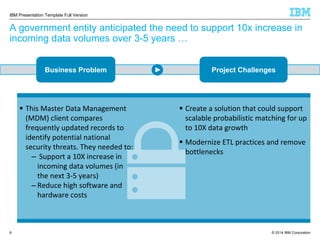
A government entity anticipated the need to support 10x increase in
incoming data volumes over 3-5 years …
IBM Presentation Template Full Version
Business Problem Project Challenges
 This Master Data Management
(MDM) client compares
frequently updated records to
identify potential national
security threats. They needed to:
– Support a 10X increase in
incoming data volumes (in
the next 3-5 years)
– Reduce high software and
hardware costs
 Create a solution that could support
scalable probabilistic matching for up
to 10X data growth
 Modernize ETL practices and remove
bottlenecks
© 2014 IBM Corporation7
… and replaced an expensive and failing hand-coding approach with
a massively scalable Big Data Integration solution
IBM Presentation Template Full Version
Approach Outcome
 Eliminate hand coding for data
integration to significantly reduce
software costs
 Deploy a data integration solution
that can scale fast enough to feed
the MDM system
 Reduce high costs of ELT running
in their database
 Removed hand coding & replaced it
with InfoSphere InfoSphere
Information Server for massively
scalable data integration processing
 Stopped running ELT in the
database, leveraging Hadoop instead
 Client purchased an end-to-end Big
Data solution from IBM – across
MDM, Hadoop, and Information
Integration areas
© 2014 IBM Corporation8
A large European telco wants to leverage big data to increase
revenue and customer satisfaction …
IBM Presentation Template Full Version
Business Problem Project Challenges
 Increase revenue & customer
satisfaction by analyzing usage
patterns of mobile devices to
match user demand
 Needed a comprehensive Big
Data platform that could keep up
with analytics requirements
 Reduce costs by reducing
inventory
 Client used Informatica for ETL,
generally, and planned to extend use
to the Big Data effort. They asked
Informatica to improve (existing)
Netezza loading performance in
support of their goals and:
– The ETL process broke with a
small sample of jobs
– They switched to an ELT
approach and encountered
technical problems
© 2014 IBM Corporation9
… and learned that ELT only was not sufficient to support Big Data
Integration
IBM Presentation Template Full Version
Approach Outcome
 Leverage a worldwide predictive
solution to anticipate customer
requirements
 Add a Hadoop layer to enrich
predictive models with
unstructured social media data
 Expand existing IBM Netezza
footprint to keep pace with new
data volumes
 Client requested a full-workload
data integration POC with IBM
 Client realized ELT only was not
sufficient for Big Data Integration
(all data integration logic cannot be
pushed into IBM Neteeza or Hadoop)
 Client found InfoSphere Information
Server can often run data integration
faster than either Neteeza or Hadoop
 Client selected InfoSphere
Information Server over Informatica
for Big Data Integration and
InfoSphere BigInsights over Cloudera
© 2014 IBM Corporation10
Plan for Success!
Successfully navigate the big data maze
IBM Presentation Template Full Version
Hadoop is not a Data
Integration platform,
80% of the work is
around Big Data
Integration, and
MapReduce is slow
To move into production
successfully, you need to
plan ahead and make
sure you have accounted
for your Big Data
Integration needs: Hand
coding does not meet
Big Data Integration
scalability, flexibility,
or performance
requirements
Get more information
about Big Data Integration requirements and key
success factors
ELT only is NOT
sufficient to meet
most Big Data
Integration
requirements,
because you cannot
push ALL the data
integration logic into
the data warehouse or
into Hadoop

Client approaches to successfully navigate through the big data storm

  • 1.
    © 2014 IBMCorporation Client Approaches to Successfully Navigate through the Big Data Storm June 2014
  • 2.
    © 2014 IBMCorporation2 Does Your Big Data Project Look Like This? IBM Presentation Template Full Version You need cost predictability, together with a solution that can quickly take you places!  Hadoop is a fascinating, exciting engine. However, it is:  Ungoverned  All custom, all the time  Requires expensive, constantly changing skills  Includes no concept of quality, governance or lineage And, MapReduce was originally designed for finely grained fault tolerance, which makes it slow for big data integration processing Hadoop is just not a solution for big data integration
  • 3.
    © 2014 IBMCorporation3 If so, that’s because 80% of the development work for a big data project is to address Big Data Integration challenges IBM Presentation Template Full Version “By most accounts, 80 percent of the development effort in a big data project goes into data integration and only 20 percent goes towards data analysis.” Intel Corporation: Extract, Transform, and Load Big Data With Apache Hadoop (White Paper) Most Hadoop initiatives end up achieving garbage in, garbage out faster, against larger data volumes and:  MapReduce was not designed to accommodate the processing all the logic necessary for big data integration  Teams forget that Hadoop initiatives require: collecting, moving, transforming, cleansing, integrating, exploring & analyzing volumes of disparate data (of various types, from various sources) --- AKA Data Integration To succeed, you need Data Integration capabilities that create consumable data by:  Collecting, moving, transforming, cleansing, governing, integrating, exploring & analyzing volumes of disparate data  Providing simplicity, speed, scalability and reduced risk
  • 4.
    © 2014 IBMCorporation4 A large US Bank needed to reduce total cost of ownership … IBM Presentation Template Full Version Business Problem Challenges  Primary: Reduce Teradata total cost of ownership  Secondary: Allow for new analytic exploration & asset optimization  Create a Data Distribution Hub / Big Data platform to cut costs  Move front-end processing from Teradata to the Data Distrubion Hub  Needed to offload ELT workload in a cost-effective, efficient way
  • 5.
    © 2014 IBMCorporation5 … and successfully offloaded ELT workloads to reduce costs IBM Presentation Template Full Version Approach Outcome  Reduce costs by offloading ELT workloads from Teradata to a Big Data platform  Leverage existing InfoSphere Information Server data integration skills and assets (jobs)  Hand coding: Client would not consider hand coding for data integration capabilities  Client decides to deploy IBM PureData for Hadoop  Client uses InfoSphere Information Server as their single scalable & flexible Big Data Integration solution  Client successfully migrated their Teradata ELT and now uses InfoSphere Information Server to exploit the lower cost of running data integration on Hadoop
  • 6.
    © 2014 IBMCorporation6 A government entity anticipated the need to support 10x increase in incoming data volumes over 3-5 years … IBM Presentation Template Full Version Business Problem Project Challenges  This Master Data Management (MDM) client compares frequently updated records to identify potential national security threats. They needed to: – Support a 10X increase in incoming data volumes (in the next 3-5 years) – Reduce high software and hardware costs  Create a solution that could support scalable probabilistic matching for up to 10X data growth  Modernize ETL practices and remove bottlenecks
  • 7.
    © 2014 IBMCorporation7 … and replaced an expensive and failing hand-coding approach with a massively scalable Big Data Integration solution IBM Presentation Template Full Version Approach Outcome  Eliminate hand coding for data integration to significantly reduce software costs  Deploy a data integration solution that can scale fast enough to feed the MDM system  Reduce high costs of ELT running in their database  Removed hand coding & replaced it with InfoSphere InfoSphere Information Server for massively scalable data integration processing  Stopped running ELT in the database, leveraging Hadoop instead  Client purchased an end-to-end Big Data solution from IBM – across MDM, Hadoop, and Information Integration areas
  • 8.
    © 2014 IBMCorporation8 A large European telco wants to leverage big data to increase revenue and customer satisfaction … IBM Presentation Template Full Version Business Problem Project Challenges  Increase revenue & customer satisfaction by analyzing usage patterns of mobile devices to match user demand  Needed a comprehensive Big Data platform that could keep up with analytics requirements  Reduce costs by reducing inventory  Client used Informatica for ETL, generally, and planned to extend use to the Big Data effort. They asked Informatica to improve (existing) Netezza loading performance in support of their goals and: – The ETL process broke with a small sample of jobs – They switched to an ELT approach and encountered technical problems
  • 9.
    © 2014 IBMCorporation9 … and learned that ELT only was not sufficient to support Big Data Integration IBM Presentation Template Full Version Approach Outcome  Leverage a worldwide predictive solution to anticipate customer requirements  Add a Hadoop layer to enrich predictive models with unstructured social media data  Expand existing IBM Netezza footprint to keep pace with new data volumes  Client requested a full-workload data integration POC with IBM  Client realized ELT only was not sufficient for Big Data Integration (all data integration logic cannot be pushed into IBM Neteeza or Hadoop)  Client found InfoSphere Information Server can often run data integration faster than either Neteeza or Hadoop  Client selected InfoSphere Information Server over Informatica for Big Data Integration and InfoSphere BigInsights over Cloudera
  • 10.
    © 2014 IBMCorporation10 Plan for Success! Successfully navigate the big data maze IBM Presentation Template Full Version Hadoop is not a Data Integration platform, 80% of the work is around Big Data Integration, and MapReduce is slow To move into production successfully, you need to plan ahead and make sure you have accounted for your Big Data Integration needs: Hand coding does not meet Big Data Integration scalability, flexibility, or performance requirements Get more information about Big Data Integration requirements and key success factors ELT only is NOT sufficient to meet most Big Data Integration requirements, because you cannot push ALL the data integration logic into the data warehouse or into Hadoop