Development of mandible
and maxilla
By : Dr/ Hanaa Salem Moubarak
Lecuturer of Oral Biology
Minia University
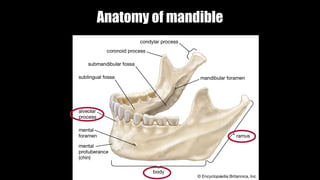
Anatomy of mandible
Development of mandible
• Develops in mandibular process of the
1st arch by intramembranous
ossification
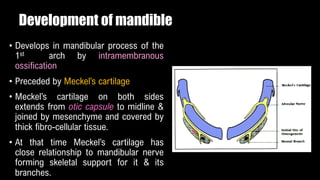
• Preceded by Meckel’s cartilage
• Meckel’s cartilage on both sides
extends from otic capsule to midline &
joined by mesenchyme and covered by
thick fibro-cellular tissue.
• At that time Meckel’s cartilage has
close relationship to mandibular nerve
forming skeletal support for it & its
branches.
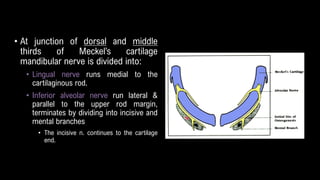
• At junction of dorsal and middle
thirds of Meckel’s cartilage
mandibular nerve is divided into:
• Lingual nerve runs medial to the
cartilaginous rod.
• Inferior alveolar nerve run lateral &
parallel to the upper rod margin,
terminates by dividing into incisive and
mental branches
• The incisive n. continues to the cartilage
end.
Development of mandible
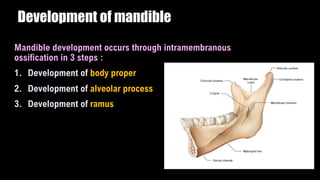
Mandible development occurs through intramembranous
ossification in 3 steps :
1. Development of body proper
2. Development of alveolar process
3. Development of ramus
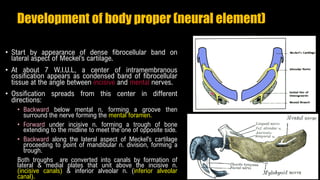
Development of body proper (neural element)
• Start by appearance of dense fibrocellular band on
lateral aspect of Meckel’s cartilage.
• At about 7 W.I.U.L, a center of intramembranous
ossification appears as condensed band of fibrocellular
tissue at the angle between incisive and mental nerves.
• Ossification spreads from this center in different
directions:
• Backward below mental n. forming a groove then
surround the nerve forming the mental foramen.
• Forward under incisive n. forming a trough of bone
extending to the midline to meet the one of opposite side.
• Backward along the lateral aspect of Meckel’s cartilage
proceeding to point of mandibular n. division, forming a
trough.
Both troughs are converted into canals by formation of
lateral & medial plates that unit above the incisive n.
(incisive canals) & inferior alveolar n. (inferior alveolar
canal).
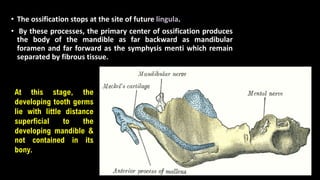
• The ossification stops at the site of future lingula.
• By these processes, the primary center of ossification produces
the body of the mandible as far backward as mandibular
foramen and far forward as the symphysis menti which remain
separated by fibrous tissue.
At this stage, the
developing tooth germs
lie with little distance
superficial to the
developing mandible &
not contained in its
bony.
2- Development of alveolar process
• Median and lateral plates of alveolar bone grow upward to
include developing tooth germs.
• So, the germs become contained inside a trough of alveolar
bone.
• Bony septa are formed to divide the trough into compartments
each contain single tooth germ (bony crypt formation).
3- Development of ramus
• The ramus & its process are mapped out by extension of
mesenchymal condensation in which intarmembranous
ossification occurs
• Spread of ossification rapidly occurs behind and above the
mandibular foramen.
• Coronoid and condyloid processes are ossified at 10 W.I.U.L
N.B mandible is formed by intramembranous ossification with no
direct involvement of Meckel's cartilage TILL 10 W.I.U
Further growth of mandible is modified by appearance of
3 cartilagenous centers called ( secondary or accessory
cartilage)
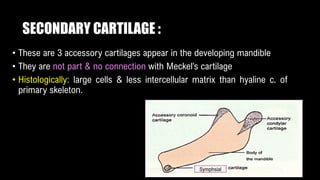
SECONDARY CARTILAGE :
• These are 3 accessory cartilages appear in the developing mandible
• They are not part & no connection with Meckel’s cartilage
• Histologically: large cells & less intercellular matrix than hyaline c. of
primary skeleton.
Symphsial
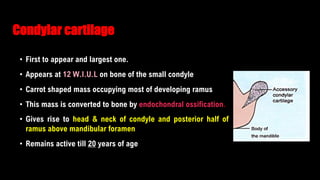
Condylar cartilage
• First to appear and largest one.
• Appears at 12 W.I.U.L on bone of the small condyle
• Carrot shaped mass occupying most of developing ramus
• This mass is converted to bone by endochondral ossification.
• Gives rise to head & neck of condyle and posterior half of
ramus above mandibular foramen
• Remains active till 20 years of age
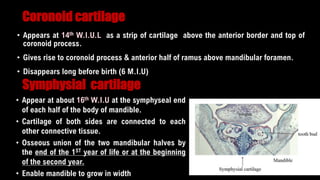
Coronoid cartilage
• Appears at 14th W.I.U.L as a strip of cartilage above the anterior border and top of
coronoid process.
• Gives rise to coronoid process & anterior half of ramus above mandibular foramen.
• Disappears long before birth (6 M.I.U)
Symphysial cartilage
• Appear at about 16th W.I.U at the symphyseal end
of each half of the body of mandible.
• Cartilage of both sides are connected to each
other connective tissue.
• Osseous union of the two mandibular halves by
the end of the 1ST year of life or at the beginning
of the second year.
• Enable mandible to grow in width
Mental ossicles
• They are 2 or 4 nodules of cartilage
• Appear in the c.t of symphysis at 7 M.I.U
• Remenant of Meckel’s cartilage
• Ossify & enlarge and fuse with each other & with mandible to
form mental protubrance
Fate of Meckel’s cartilage
• Anterior part : mental ossicles
• Posterior part:incus& mallus bone
• Middle part: lingula of mandible
• Fibrous capsule: sphenomandibular ligament
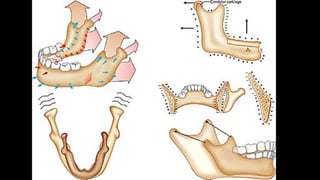
Growth of the mandible
1. Secondary cartilages
2. Subperiosteal bone deposition
3. Development and growth of alveolar
process
Mandibular growth occur through :
Secondary cartilages
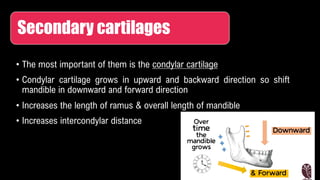
• The most important of them is the condylar cartilage
• Condylar cartilage grows in upward and backward direction so shift
mandible in downward and forward direction
• Increases the length of ramus & overall length of mandible
• Increases intercondylar distance
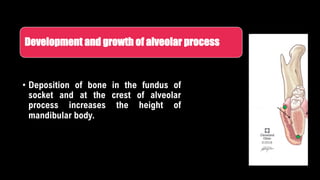
Development and growth of alveolar process
• Deposition of bone in the fundus of
socket and at the crest of alveolar
process increases the height of
mandibular body.
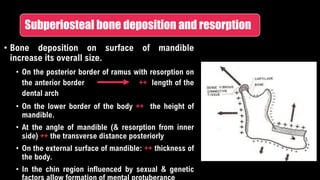
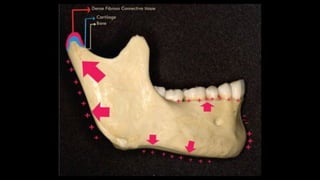
Subperiosteal bone deposition and resorption
• Bone deposition on surface of mandible
increase its overall size.
• On the posterior border of ramus with resorption on
the anterior border ++ length of the
dental arch
• On the lower border of the body ++ the height of
mandible.
• At the angle of mandible (& resorption from inner
side) ++ the transverse distance posteriorly
• On the external surface of mandible: ++ thickness of
the body.
• In the chin region influenced by sexual & genetic
Development
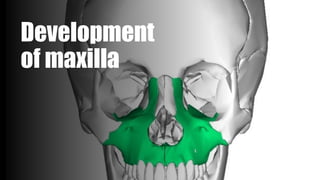
of maxilla
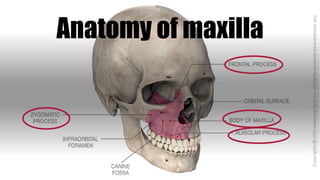
Anatomy of maxilla
Maxilla is formed or 2 bones, maxilla proper and premaxilla
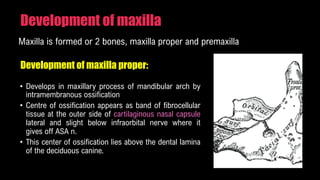
Development of maxilla
Development of maxilla proper:
• Develops in maxillary process of mandibular arch by
intramembranous ossification
• Centre of ossification appears as band of fibrocellular
tissue at the outer side of cartilaginous nasal capsule
lateral and slight below infraorbital nerve where it
gives off ASA n.
• This center of ossification lies above the dental lamina
of the deciduous canine.
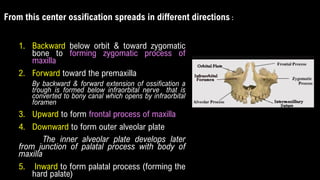
1. Backward below orbit & toward zygomatic
bone to forming zygomatic process of
maxilla
2. Forward toward the premaxilla
By backward & forward extension of ossification a
trough is formed below infraorbital nerve that is
converted to bony canal which opens by infraorbital
foramen
3. Upward to form frontal process of maxilla
4. Downward to form outer alveolar plate
The inner alveolar plate develops later
from junction of palatal process with body of
maxilla
5. Inward to form palatal process (forming the
hard palate)
From this center ossification spreads in different directions :
GROWTH OF MAXILLA
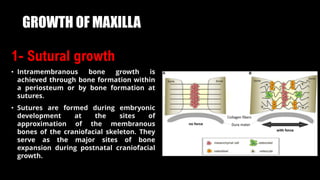
1- Sutural growth
• Intramembranous bone growth is
achieved through bone formation within
a periosteum or by bone formation at
sutures.
• Sutures are formed during embryonic
development at the sites of
approximation of the membranous
bones of the craniofacial skeleton. They
serve as the major sites of bone
expansion during postnatal craniofacial
growth.
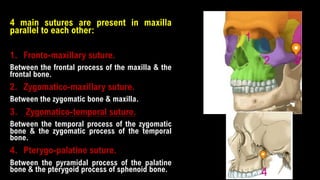
4 main sutures are present in maxilla
parallel to each other:
1. Fronto-maxillary suture.
Between the frontal process of the maxilla & the
frontal bone.
2. Zygomatico-maxillary suture.
Between the zygomatic bone & maxilla.
3. Zygomatico-temporal suture.
Between the temporal process of the zygomatic
bone & the zygomatic process of the temporal
bone.
4. Pterygo-palatine suture.
Between the pyramidal process of the palatine
bone & the pterygoid process of sphenoid bone.
1
2 3
4
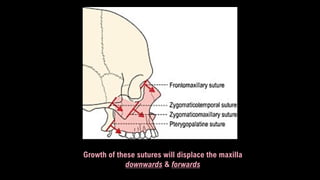
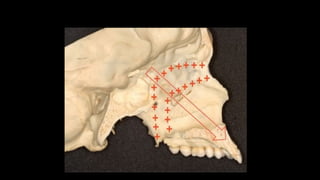
Growth of these sutures will displace the maxilla
downwards & forwards
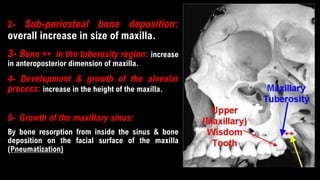
2- Sub-periosteal bone deposition:
overall increase in size of maxilla.
3- Bone ++ in the tuberosity region: increase
in anteroposterior dimension of maxilla.
4- Development & growth of the alveolar
process: increase in the height of the maxilla.
5- Growth of the maxillary sinus:
By bone resorption from inside the sinus & bone
deposition on the facial surface of the maxilla
(Pneumatization)
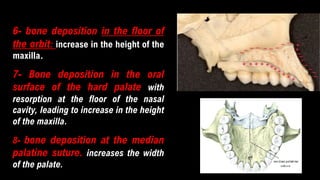
6- bone deposition in the floor of
the orbit: increase in the height of the
maxilla.
7- Bone deposition in the oral
surface of the hard palate with
resorption at the floor of the nasal
cavity, leading to increase in the height
of the maxilla.
8- bone deposition at the median
palatine suture. increases the width
of the palate.
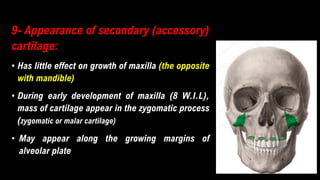
9- Appearance of secondary (accessory)
cartilage:
• Has little effect on growth of maxilla (the opposite
with mandible)
• During early development of maxilla (8 W.I.L),
mass of cartilage appear in the zygomatic process
(zygomatic or malar cartilage)
• May appear along the growing margins of
alveolar plate
embryology (maxilla and mandibule development) .pdf

embryology (maxilla and mandibule development) .pdf

  • 1.
    Development of mandible andmaxilla By : Dr/ Hanaa Salem Moubarak Lecuturer of Oral Biology Minia University
  • 2.
  • 3.
    Development of mandible •Develops in mandibular process of the 1st arch by intramembranous ossification • Preceded by Meckel’s cartilage • Meckel’s cartilage on both sides extends from otic capsule to midline & joined by mesenchyme and covered by thick fibro-cellular tissue. • At that time Meckel’s cartilage has close relationship to mandibular nerve forming skeletal support for it & its branches.
  • 4.
    • At junctionof dorsal and middle thirds of Meckel’s cartilage mandibular nerve is divided into: • Lingual nerve runs medial to the cartilaginous rod. • Inferior alveolar nerve run lateral & parallel to the upper rod margin, terminates by dividing into incisive and mental branches • The incisive n. continues to the cartilage end.
  • 5.
    Development of mandible Mandibledevelopment occurs through intramembranous ossification in 3 steps : 1. Development of body proper 2. Development of alveolar process 3. Development of ramus
  • 6.
    Development of bodyproper (neural element) • Start by appearance of dense fibrocellular band on lateral aspect of Meckel’s cartilage. • At about 7 W.I.U.L, a center of intramembranous ossification appears as condensed band of fibrocellular tissue at the angle between incisive and mental nerves. • Ossification spreads from this center in different directions: • Backward below mental n. forming a groove then surround the nerve forming the mental foramen. • Forward under incisive n. forming a trough of bone extending to the midline to meet the one of opposite side. • Backward along the lateral aspect of Meckel’s cartilage proceeding to point of mandibular n. division, forming a trough. Both troughs are converted into canals by formation of lateral & medial plates that unit above the incisive n. (incisive canals) & inferior alveolar n. (inferior alveolar canal).
  • 7.
    • The ossificationstops at the site of future lingula. • By these processes, the primary center of ossification produces the body of the mandible as far backward as mandibular foramen and far forward as the symphysis menti which remain separated by fibrous tissue. At this stage, the developing tooth germs lie with little distance superficial to the developing mandible & not contained in its bony.
  • 8.
    2- Development ofalveolar process • Median and lateral plates of alveolar bone grow upward to include developing tooth germs. • So, the germs become contained inside a trough of alveolar bone. • Bony septa are formed to divide the trough into compartments each contain single tooth germ (bony crypt formation).
  • 9.
    3- Development oframus • The ramus & its process are mapped out by extension of mesenchymal condensation in which intarmembranous ossification occurs • Spread of ossification rapidly occurs behind and above the mandibular foramen. • Coronoid and condyloid processes are ossified at 10 W.I.U.L N.B mandible is formed by intramembranous ossification with no direct involvement of Meckel's cartilage TILL 10 W.I.U
  • 10.
    Further growth ofmandible is modified by appearance of 3 cartilagenous centers called ( secondary or accessory cartilage)
  • 11.
    SECONDARY CARTILAGE : •These are 3 accessory cartilages appear in the developing mandible • They are not part & no connection with Meckel’s cartilage • Histologically: large cells & less intercellular matrix than hyaline c. of primary skeleton. Symphsial
  • 12.
    Condylar cartilage • Firstto appear and largest one. • Appears at 12 W.I.U.L on bone of the small condyle • Carrot shaped mass occupying most of developing ramus • This mass is converted to bone by endochondral ossification. • Gives rise to head & neck of condyle and posterior half of ramus above mandibular foramen • Remains active till 20 years of age
  • 13.
    Coronoid cartilage • Appearsat 14th W.I.U.L as a strip of cartilage above the anterior border and top of coronoid process. • Gives rise to coronoid process & anterior half of ramus above mandibular foramen. • Disappears long before birth (6 M.I.U) Symphysial cartilage • Appear at about 16th W.I.U at the symphyseal end of each half of the body of mandible. • Cartilage of both sides are connected to each other connective tissue. • Osseous union of the two mandibular halves by the end of the 1ST year of life or at the beginning of the second year. • Enable mandible to grow in width
  • 14.
    Mental ossicles • Theyare 2 or 4 nodules of cartilage • Appear in the c.t of symphysis at 7 M.I.U • Remenant of Meckel’s cartilage • Ossify & enlarge and fuse with each other & with mandible to form mental protubrance
  • 15.
    Fate of Meckel’scartilage • Anterior part : mental ossicles • Posterior part:incus& mallus bone • Middle part: lingula of mandible • Fibrous capsule: sphenomandibular ligament
  • 16.
    Growth of themandible
  • 17.
    1. Secondary cartilages 2.Subperiosteal bone deposition 3. Development and growth of alveolar process Mandibular growth occur through :
  • 18.
    Secondary cartilages • Themost important of them is the condylar cartilage • Condylar cartilage grows in upward and backward direction so shift mandible in downward and forward direction • Increases the length of ramus & overall length of mandible • Increases intercondylar distance
  • 19.
    Development and growthof alveolar process • Deposition of bone in the fundus of socket and at the crest of alveolar process increases the height of mandibular body.
  • 20.
    Subperiosteal bone depositionand resorption • Bone deposition on surface of mandible increase its overall size. • On the posterior border of ramus with resorption on the anterior border ++ length of the dental arch • On the lower border of the body ++ the height of mandible. • At the angle of mandible (& resorption from inner side) ++ the transverse distance posteriorly • On the external surface of mandible: ++ thickness of the body. • In the chin region influenced by sexual & genetic
  • 23.
  • 24.
  • 25.
    Maxilla is formedor 2 bones, maxilla proper and premaxilla Development of maxilla Development of maxilla proper: • Develops in maxillary process of mandibular arch by intramembranous ossification • Centre of ossification appears as band of fibrocellular tissue at the outer side of cartilaginous nasal capsule lateral and slight below infraorbital nerve where it gives off ASA n. • This center of ossification lies above the dental lamina of the deciduous canine.
  • 26.
    1. Backward beloworbit & toward zygomatic bone to forming zygomatic process of maxilla 2. Forward toward the premaxilla By backward & forward extension of ossification a trough is formed below infraorbital nerve that is converted to bony canal which opens by infraorbital foramen 3. Upward to form frontal process of maxilla 4. Downward to form outer alveolar plate The inner alveolar plate develops later from junction of palatal process with body of maxilla 5. Inward to form palatal process (forming the hard palate) From this center ossification spreads in different directions :
  • 27.
    GROWTH OF MAXILLA 1-Sutural growth • Intramembranous bone growth is achieved through bone formation within a periosteum or by bone formation at sutures. • Sutures are formed during embryonic development at the sites of approximation of the membranous bones of the craniofacial skeleton. They serve as the major sites of bone expansion during postnatal craniofacial growth.
  • 28.
    4 main suturesare present in maxilla parallel to each other: 1. Fronto-maxillary suture. Between the frontal process of the maxilla & the frontal bone. 2. Zygomatico-maxillary suture. Between the zygomatic bone & maxilla. 3. Zygomatico-temporal suture. Between the temporal process of the zygomatic bone & the zygomatic process of the temporal bone. 4. Pterygo-palatine suture. Between the pyramidal process of the palatine bone & the pterygoid process of sphenoid bone. 1 2 3 4
  • 29.
    Growth of thesesutures will displace the maxilla downwards & forwards
  • 30.
    2- Sub-periosteal bonedeposition: overall increase in size of maxilla. 3- Bone ++ in the tuberosity region: increase in anteroposterior dimension of maxilla. 4- Development & growth of the alveolar process: increase in the height of the maxilla. 5- Growth of the maxillary sinus: By bone resorption from inside the sinus & bone deposition on the facial surface of the maxilla (Pneumatization)
  • 31.
    6- bone depositionin the floor of the orbit: increase in the height of the maxilla. 7- Bone deposition in the oral surface of the hard palate with resorption at the floor of the nasal cavity, leading to increase in the height of the maxilla. 8- bone deposition at the median palatine suture. increases the width of the palate.
  • 32.
    9- Appearance ofsecondary (accessory) cartilage: • Has little effect on growth of maxilla (the opposite with mandible) • During early development of maxilla (8 W.I.L), mass of cartilage appear in the zygomatic process (zygomatic or malar cartilage) • May appear along the growing margins of alveolar plate