2017
Total Talent Acquisition &
The State of Sourcing & Recruiting
Johnny Campbell
CEO & Co-Founder
SocialTalent
“Improve and Measure your
Recruiter ROI”
@socialtalent @johnnycampbell
linkedin.com/in/johnnycampbell
10
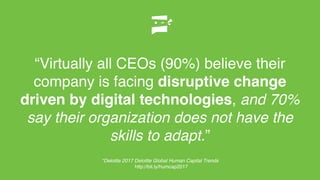
“Virtually all CEOs (90%) believe their
company is facing disruptive change
driven by digital technologies, and 70%
say their organization does not have the
skills to adapt.”
*Deloitte 2017 Deloitte Global Human Capital Trends
http://bit.ly/humcap2017
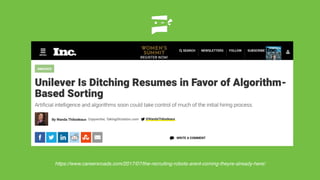
https://www.careerxroads.com/2017/07/the-recruiting-robots-arent-coming-theyre-already-here/
V
2017
Global Recruiting Survey
2,000 responses, 81 countries, in-house & third party, third year running.
*yet to be published
The Average Recruiter Funnel
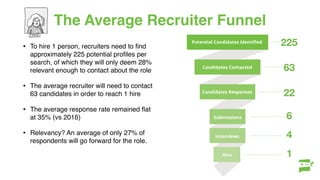
• To hire 1 person, recruiters need to find
approximately 225 potential profiles per
search, of which they will only deem 28%
relevant enough to contact about the role
• The average recruiter will need to contact
63 candidates in order to reach 1 hire
• The average response rate remained flat
at 35% (vs 2016)
• Relevancy? An average of only 27% of
respondents will go forward for the role.
225
63
22
6
4
1
Candidates Contacted
Candidates Responses
Submissions
Interviews
Hire
225
63
22
6
4
1
225
63
22
6
4
1
Candidates Contacted
Candidates Responses
Submissions
Interviews
Hire
Candidates Contacted
Candidates Responses
Submissions
Interviews
Hire
91
33
12
6
4
1
Super Recruiter Sourcing Funnel
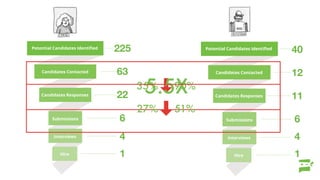
35% 90%5.5X
40
12
11
66
4
1
225
63
22
6
4
1
27% 51%
225
63
22
6
4
1
Candidates Contacted
Candidates Responses
Submissions
Interviews
Hire
Candidates Contacted
Candidates Responses
Submissions
Interviews
Hire
91
33
12
6
4
1
Super Recruiter Sourcing Funnel
255
66
22
67
4
1
225
63
22
6
4
1
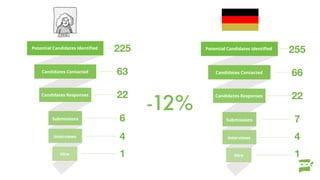
-12%
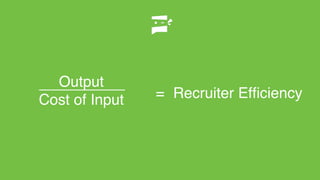
Output
Cost of Input Recruiter Efficiency=
Previously, we have focused on
“Cost of Input”
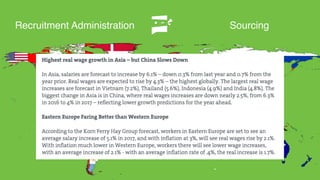
Recruitment Administration Sourcing
The opportunity for output
improvement is huge!
The cost of labour is rising whilst the
cost of automation is plummeting
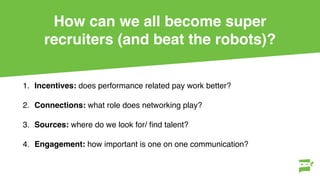
How can we all become super
recruiters (and beat the robots)?
1. Incentives: does performance related pay work better?
2. Connections: what role does networking play?
3. Sources: where do we look for/ find talent?
4. Engagement: how important is one on one communication?
Answer: YES!
Performance related pay is put in place by employers who wish to reward individual o
But the real question is: do performance related pay systems work?
62% of our respondents receive performance related pay accord
year’s report. This is more or less the same as last year (63%). Wh
that if it ain’t broke- don’t fix it!
And those recruiters who receive high performance based pay (
remuneration) are more likely to:
Fill jobs faster (within 39 days) vs 50 days
Phone a candidate vs using e-mail and InMail alone
Have higher quality shortlists and typically deliver with 5
1-3 candidates submitted to the hiring manager vs 83% o
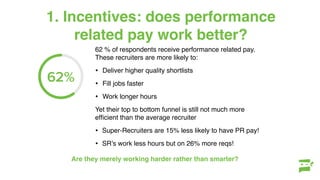
62%
1. Incentives: does performance
related pay work better?
62 % of respondents receive performance related pay.
These recruiters are more likely to:
• Deliver higher quality shortlists
• Fill jobs faster
• Work longer hours
Yet their top to bottom funnel is still not much more
efficient than the average recruiter
• Super-Recruiters are 15% less likely to have PR pay!
• SR’s work less hours but on 26% more reqs!
Are they merely working harder rather than smarter?
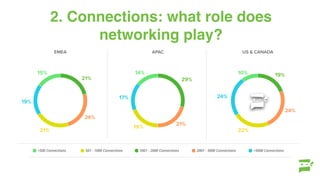
2. Connections: what role does
networking play?
US & CANADAEMEA APAC
21% 29%
19%
24%
21%
24%
21%
19%
22%
19%
17% 24%
15% 14% 10%
1001 - 2000 Connections 2001 - 5000 Connections 501 - 1000 Connections >5000 Connections <500 Connections
EMEA APAC
21% 29%
24%
21%
21%
19%
19%
17% 2
15% 14%
1001 - 2000 Connections 2001 - 5000 Connections 501 - 1000 Connections >5000 Con
US & CANADA
19%
24%
22%
24%
10%
00 Connections <500 Connections
US & CANADAA APAC
21% 29%
19%
24%
21%
24%
19%
22%
17% 24%
14% 10%
nections 2001 - 5000 Connections 501 - 1000 Connections >5000 Connections <500 Connections
US & CANADEMEA APAC
21% 29%
24%
21%
21%
19%
22%
19%
17% 24%
15% 14% 10%
1001 - 2000 Connections 2001 - 5000 Connections 501 - 1000 Connections >5000 Connections <500 Connecti
EMEA APAC
21% 29%
24%
21%
21%
19%
19%
17% 2
15% 14%
1001 - 2000 Connections 2001 - 5000 Connections 501 - 1000 Connections >5000 Con
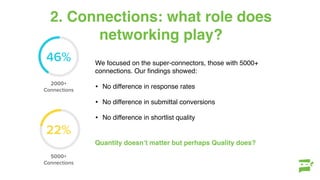
2. Connections: what role does
networking play?
We focused on the super-connectors, those with 5000+
connections. Our findings showed:
• No difference in response rates
• No difference in submittal conversions
• No difference in shortlist quality
Quantity doesn’t matter but perhaps Quality does?
How Large is the Average Recruiter’s Network?
46% have more than 2000 connections
40% of those surveyed in 2016 had more than 2000 connections so it’s grea
recruiters are reaching out and pushing that connect button!
22% have more than 5000 connections
This is also up from last year’s 15%. Recruiters are getting more exposure, sh
trade and practicing what they preach.
2000+
Connections
46%
5000+
Connections
22%
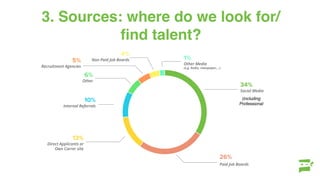
3. Sources: where do we look for/
find talent?
34%
26%
4%
5%
6%
10%
13%
1%
Social Media
Paid Job Boards
Non Paid Job Boards
Recruitment Agencies
Other
Internal Referrals
Direct Applicants or
Own Carrer site
Other Media
(e.g. Radio, newspaper,...)
(including
Professional
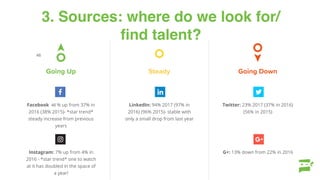
3. Sources: where do we look for/
find talent?
Going Up Steady Going Down
Facebook: 41% up from 37% in
2016 (38% 2015)- *star trend*
steady increase from previous
years
LinkedIn: 94% 2017 (97% in
2016) (96% 2015)- stable with
only a small drop from last year
Twitter: 23% 2017 (37% in 2016)
(56% in 2015)
G+: 13% down from 22% in 2016Instagram: 7% up from 4% in
2016 - *star trend* one to watch
at it has doubled in the space of
46
Going Up Steady Going Down
Facebook: 41% up from 37% in
2016 (38% 2015)- *star trend*
steady increase from previous
years
LinkedIn: 94% 2017 (97% in
2016) (96% 2015)- stable with
only a small drop from last year
Twitter: 23% 2017 (37% in 2016)
(56% in 2015)
G+: 13% down from 22% in 2016Instagram: 7% up from 4% in
2016 - *star trend* one to watch
at it has doubled in the space of
a year!
46
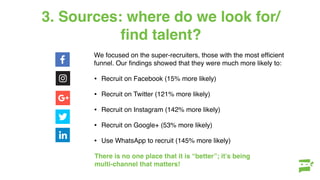
We focused on the super-recruiters, those with the most efficient
funnel. Our findings showed that they were much more likely to:
• Recruit on Facebook (15% more likely)
• Recruit on Twitter (121% more likely)
• Recruit on Instagram (142% more likely)
• Recruit on Google+ (53% more likely)
• Use WhatsApp to recruit (145% more likely)
There is no one place that it is “better”; it’s being
multi-channel that matters!
3. Sources: where do we look for/
find talent?Going Up Steady Go
Facebook: 41% up from 37% in
2016 (38% 2015)- *star trend*
steady increase from previous
years
LinkedIn: 94% 2017 (97% in
2016) (96% 2015)- stable with
only a small drop from last year
Twitter: 2
(
G+: 13% dInstagram: 7% up from 4% in
2016 - *star trend* one to watch
at it has doubled in the space of
Facebook: 41% up from 37% in
2016 (38% 2015)- *star trend*
steady increase from previous
years
LinkedIn: 94% 2017 (97% in
2016) (96% 2015)- stable with
only a small drop from last year
Twitter: 2
(
G+: 13% dInstagram: 7% up from 4% in
2016 - *star trend* one to watch
at it has doubled in the space of
a year!
Twitter: 23% 2017 (37% in 2016)
(56% in 2015)
G+: 13% down from 22% in 2016
Going Down
Twitter: 23% 2017 (37% in 2016)
(56% in 2015)
Steady Going Down
LinkedIn: 94% 2017 (97% in
2016) (96% 2015)- stable with
only a small drop from last year
Twitter: 23% 2017 (37% in 2016)
(56% in 2015)
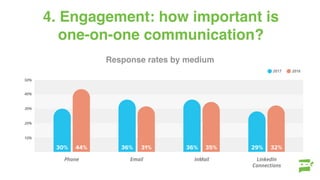
4. Engagement: how important is
one-on-one communication?
Maximising Response Rates
Phone Email InMail LinkedIn
Connections
2017 2016
10%
20%
30%
40%
50%
30% 44% 36% 36% 29%31% 35% 32%
Response rates by medium
4. Engagement: how important is
one-on-one communication?
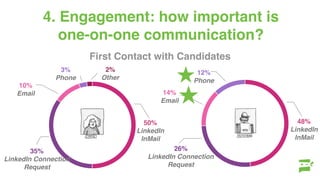
First Contact with Candidates
50%
LinkedIn
InMail
10%
Email
3%
Phone
2%
Other
35%
LinkedIn Connection
Request
48%
LinkedIn
InMail
26%
LinkedIn Connection
Request
14%
Email
12%
Phone
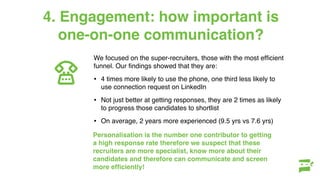
We focused on the super-recruiters, those with the most efficient
funnel. Our findings showed that they are:
• 4 times more likely to use the phone, one third less likely to
use connection request on LinkedIn
• Not just better at getting responses, they are 2 times as likely
to progress those candidates to shortlist
• On average, 2 years more experienced (9.5 yrs vs 7.6 yrs)
Personalisation is the number one contributor to getting
a high response rate therefore we suspect that these
recruiters are more specialist, know more about their
candidates and therefore can communicate and screen
more efficiently!
4. Engagement: how important is
one-on-one communication?
th a candidate.
o gauge candidate
of the phone
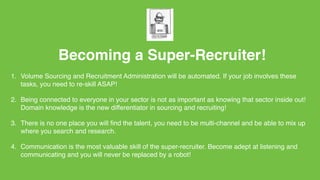
Becoming a Super-Recruiter!
1. Volume Sourcing and Recruitment Administration will be automated. If your job involves these
tasks, you need to re-skill ASAP!
2. Being connected to everyone in your sector is not as important as knowing that sector inside out!
Domain knowledge is the new differentiator in sourcing and recruiting!
3. There is no one place you will find the talent, you need to be multi-channel and be able to mix up
where you search and research.
4. Communication is the most valuable skill of the super-recruiter. Become adept at listening and
communicating and you will never be replaced by a robot!
“Reinventing careers and learning is
now the #2 issue in business” Deloitte
Digital disruption requires you to adapt
your skills or may replace you!
Thank you!
www.socialtalent.com
These slides: slideshare.net/socialtalent
Changing the way recruiters work and measuring the return on learning

Embracing AI & Becoming a Super Recruiter!

  • 1.
    2017 Total Talent Acquisition& The State of Sourcing & Recruiting
  • 2.
    Johnny Campbell CEO &Co-Founder SocialTalent “Improve and Measure your Recruiter ROI” @socialtalent @johnnycampbell linkedin.com/in/johnnycampbell
  • 8.
  • 9.
    “Virtually all CEOs(90%) believe their company is facing disruptive change driven by digital technologies, and 70% say their organization does not have the skills to adapt.” *Deloitte 2017 Deloitte Global Human Capital Trends http://bit.ly/humcap2017
  • 10.
  • 12.
  • 13.
    2017 Global Recruiting Survey 2,000responses, 81 countries, in-house & third party, third year running. *yet to be published
  • 14.
    The Average RecruiterFunnel • To hire 1 person, recruiters need to find approximately 225 potential profiles per search, of which they will only deem 28% relevant enough to contact about the role • The average recruiter will need to contact 63 candidates in order to reach 1 hire • The average response rate remained flat at 35% (vs 2016) • Relevancy? An average of only 27% of respondents will go forward for the role. 225 63 22 6 4 1 Candidates Contacted Candidates Responses Submissions Interviews Hire 225 63 22 6 4 1
  • 15.
    225 63 22 6 4 1 Candidates Contacted Candidates Responses Submissions Interviews Hire CandidatesContacted Candidates Responses Submissions Interviews Hire 91 33 12 6 4 1 Super Recruiter Sourcing Funnel 35% 90%5.5X 40 12 11 66 4 1 225 63 22 6 4 1 27% 51%
  • 16.
    225 63 22 6 4 1 Candidates Contacted Candidates Responses Submissions Interviews Hire CandidatesContacted Candidates Responses Submissions Interviews Hire 91 33 12 6 4 1 Super Recruiter Sourcing Funnel 255 66 22 67 4 1 225 63 22 6 4 1 -12%
  • 17.
    Output Cost of InputRecruiter Efficiency=
  • 18.
    Previously, we havefocused on “Cost of Input”
  • 19.
  • 20.
    The opportunity foroutput improvement is huge! The cost of labour is rising whilst the cost of automation is plummeting
  • 21.
    How can weall become super recruiters (and beat the robots)? 1. Incentives: does performance related pay work better? 2. Connections: what role does networking play? 3. Sources: where do we look for/ find talent? 4. Engagement: how important is one on one communication?
  • 22.
    Answer: YES! Performance relatedpay is put in place by employers who wish to reward individual o But the real question is: do performance related pay systems work? 62% of our respondents receive performance related pay accord year’s report. This is more or less the same as last year (63%). Wh that if it ain’t broke- don’t fix it! And those recruiters who receive high performance based pay ( remuneration) are more likely to: Fill jobs faster (within 39 days) vs 50 days Phone a candidate vs using e-mail and InMail alone Have higher quality shortlists and typically deliver with 5 1-3 candidates submitted to the hiring manager vs 83% o 62% 1. Incentives: does performance related pay work better? 62 % of respondents receive performance related pay. These recruiters are more likely to: • Deliver higher quality shortlists • Fill jobs faster • Work longer hours Yet their top to bottom funnel is still not much more efficient than the average recruiter • Super-Recruiters are 15% less likely to have PR pay! • SR’s work less hours but on 26% more reqs! Are they merely working harder rather than smarter?
  • 23.
    2. Connections: whatrole does networking play? US & CANADAEMEA APAC 21% 29% 19% 24% 21% 24% 21% 19% 22% 19% 17% 24% 15% 14% 10% 1001 - 2000 Connections 2001 - 5000 Connections 501 - 1000 Connections >5000 Connections <500 Connections EMEA APAC 21% 29% 24% 21% 21% 19% 19% 17% 2 15% 14% 1001 - 2000 Connections 2001 - 5000 Connections 501 - 1000 Connections >5000 Con US & CANADA 19% 24% 22% 24% 10% 00 Connections <500 Connections US & CANADAA APAC 21% 29% 19% 24% 21% 24% 19% 22% 17% 24% 14% 10% nections 2001 - 5000 Connections 501 - 1000 Connections >5000 Connections <500 Connections US & CANADEMEA APAC 21% 29% 24% 21% 21% 19% 22% 19% 17% 24% 15% 14% 10% 1001 - 2000 Connections 2001 - 5000 Connections 501 - 1000 Connections >5000 Connections <500 Connecti EMEA APAC 21% 29% 24% 21% 21% 19% 19% 17% 2 15% 14% 1001 - 2000 Connections 2001 - 5000 Connections 501 - 1000 Connections >5000 Con
  • 24.
    2. Connections: whatrole does networking play? We focused on the super-connectors, those with 5000+ connections. Our findings showed: • No difference in response rates • No difference in submittal conversions • No difference in shortlist quality Quantity doesn’t matter but perhaps Quality does? How Large is the Average Recruiter’s Network? 46% have more than 2000 connections 40% of those surveyed in 2016 had more than 2000 connections so it’s grea recruiters are reaching out and pushing that connect button! 22% have more than 5000 connections This is also up from last year’s 15%. Recruiters are getting more exposure, sh trade and practicing what they preach. 2000+ Connections 46% 5000+ Connections 22%
  • 25.
    3. Sources: wheredo we look for/ find talent? 34% 26% 4% 5% 6% 10% 13% 1% Social Media Paid Job Boards Non Paid Job Boards Recruitment Agencies Other Internal Referrals Direct Applicants or Own Carrer site Other Media (e.g. Radio, newspaper,...) (including Professional
  • 26.
    3. Sources: wheredo we look for/ find talent? Going Up Steady Going Down Facebook: 41% up from 37% in 2016 (38% 2015)- *star trend* steady increase from previous years LinkedIn: 94% 2017 (97% in 2016) (96% 2015)- stable with only a small drop from last year Twitter: 23% 2017 (37% in 2016) (56% in 2015) G+: 13% down from 22% in 2016Instagram: 7% up from 4% in 2016 - *star trend* one to watch at it has doubled in the space of 46 Going Up Steady Going Down Facebook: 41% up from 37% in 2016 (38% 2015)- *star trend* steady increase from previous years LinkedIn: 94% 2017 (97% in 2016) (96% 2015)- stable with only a small drop from last year Twitter: 23% 2017 (37% in 2016) (56% in 2015) G+: 13% down from 22% in 2016Instagram: 7% up from 4% in 2016 - *star trend* one to watch at it has doubled in the space of a year! 46
  • 27.
    We focused onthe super-recruiters, those with the most efficient funnel. Our findings showed that they were much more likely to: • Recruit on Facebook (15% more likely) • Recruit on Twitter (121% more likely) • Recruit on Instagram (142% more likely) • Recruit on Google+ (53% more likely) • Use WhatsApp to recruit (145% more likely) There is no one place that it is “better”; it’s being multi-channel that matters! 3. Sources: where do we look for/ find talent?Going Up Steady Go Facebook: 41% up from 37% in 2016 (38% 2015)- *star trend* steady increase from previous years LinkedIn: 94% 2017 (97% in 2016) (96% 2015)- stable with only a small drop from last year Twitter: 2 ( G+: 13% dInstagram: 7% up from 4% in 2016 - *star trend* one to watch at it has doubled in the space of Facebook: 41% up from 37% in 2016 (38% 2015)- *star trend* steady increase from previous years LinkedIn: 94% 2017 (97% in 2016) (96% 2015)- stable with only a small drop from last year Twitter: 2 ( G+: 13% dInstagram: 7% up from 4% in 2016 - *star trend* one to watch at it has doubled in the space of a year! Twitter: 23% 2017 (37% in 2016) (56% in 2015) G+: 13% down from 22% in 2016 Going Down Twitter: 23% 2017 (37% in 2016) (56% in 2015) Steady Going Down LinkedIn: 94% 2017 (97% in 2016) (96% 2015)- stable with only a small drop from last year Twitter: 23% 2017 (37% in 2016) (56% in 2015)
  • 28.
    4. Engagement: howimportant is one-on-one communication? Maximising Response Rates Phone Email InMail LinkedIn Connections 2017 2016 10% 20% 30% 40% 50% 30% 44% 36% 36% 29%31% 35% 32% Response rates by medium
  • 29.
    4. Engagement: howimportant is one-on-one communication? First Contact with Candidates 50% LinkedIn InMail 10% Email 3% Phone 2% Other 35% LinkedIn Connection Request 48% LinkedIn InMail 26% LinkedIn Connection Request 14% Email 12% Phone
  • 30.
    We focused onthe super-recruiters, those with the most efficient funnel. Our findings showed that they are: • 4 times more likely to use the phone, one third less likely to use connection request on LinkedIn • Not just better at getting responses, they are 2 times as likely to progress those candidates to shortlist • On average, 2 years more experienced (9.5 yrs vs 7.6 yrs) Personalisation is the number one contributor to getting a high response rate therefore we suspect that these recruiters are more specialist, know more about their candidates and therefore can communicate and screen more efficiently! 4. Engagement: how important is one-on-one communication? th a candidate. o gauge candidate of the phone
  • 31.
    Becoming a Super-Recruiter! 1.Volume Sourcing and Recruitment Administration will be automated. If your job involves these tasks, you need to re-skill ASAP! 2. Being connected to everyone in your sector is not as important as knowing that sector inside out! Domain knowledge is the new differentiator in sourcing and recruiting! 3. There is no one place you will find the talent, you need to be multi-channel and be able to mix up where you search and research. 4. Communication is the most valuable skill of the super-recruiter. Become adept at listening and communicating and you will never be replaced by a robot!
  • 32.
    “Reinventing careers andlearning is now the #2 issue in business” Deloitte Digital disruption requires you to adapt your skills or may replace you!
  • 35.
    Thank you! www.socialtalent.com These slides:slideshare.net/socialtalent Changing the way recruiters work and measuring the return on learning