Embedded Android Market
Development
• Selecting an Embedded OS
• Why Choose Android as your Embedded OS
• Future Development of Embedded Android
• Embedded Android Challenges
Overview
SELECTION AN EMBEDDED OS
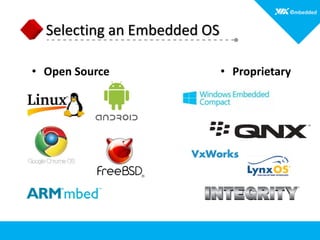
Selecting an Embedded OS
• Open Source • Proprietary
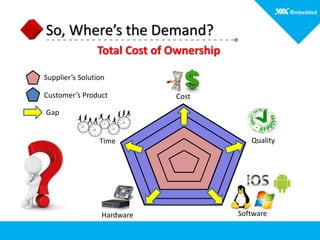
So, Where’s the Demand?
Hardware Software
Cost
Time Quality
Total Cost of Ownership
Supplier’s Solution
Customer’s Product
Gap
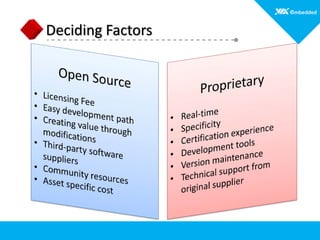
Deciding Factors
With a reliable partner you can enjoy the
advantages of a proprietary system when using
an Open Source OS.
WHY CHOOSE ANDROID AS
YOUR EMBEDDED OS
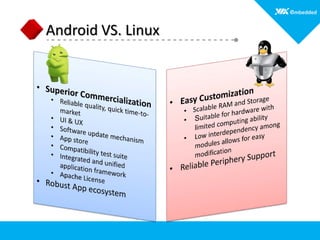
Android VS. Linux
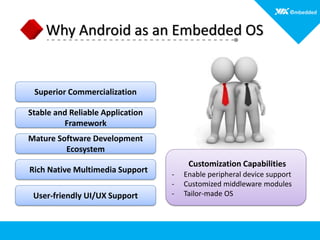
Why Android as an Embedded OS
Stable and Reliable Application
Framework
Superior Commercialization
Mature Software Development
Ecosystem
Rich Native Multimedia Support
User-friendly UI/UX Support
Customization Capabilities
- Enable peripheral device support
- Customized middleware modules
- Tailor-made OS
FUTURE DEVELOPMENT OF
EMBEDDED ANDROID
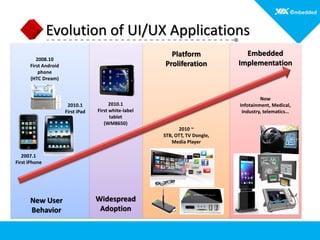
Evolution of UI/UX Applications
2007.1
First iPhone
2008.10
First Android
phone
(HTC Dream)
2010.1
First iPad
2010.1
First white-label
tablet
(WM8650)
2010 ~
STB, OTT, TV Dongle,
Media Player
New User
Behavior
Widespread
Adoption
Platform
Proliferation
Embedded
Implementation
Now
Infotainment, Medical,
Industry, telematics…
EMBEDDED ANDROID
CHALLENGES
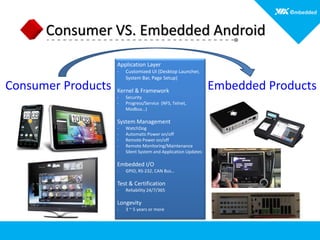
Consumer VS. Embedded Android
Application Layer
- Customized UI (Desktop Launcher,
System Bar, Page Setup)
Kernel & Framework
- Security
- Progress/Service (NFS, Telnet,
Modbus…)
System Management
- WatchDog
- Automatic Power on/off
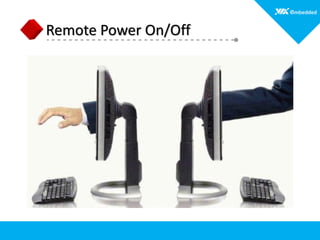
- Remote Power on/off
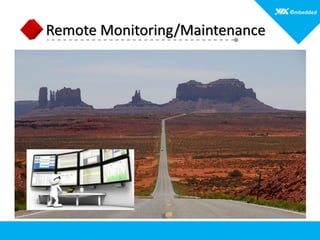
- Remote Monitoring/Maintenance
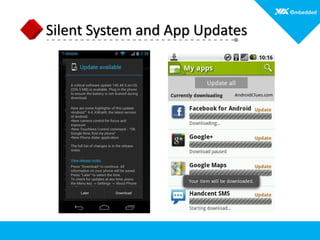
- Silent System and Application Updates
Embedded I/O
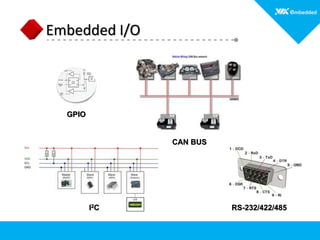
- GPIO, RS-232, CAN Bus…
Test & Certification
- Reliability 24/7/365
Longevity
- 3 ~ 5 years or more
Consumer Products Embedded Products
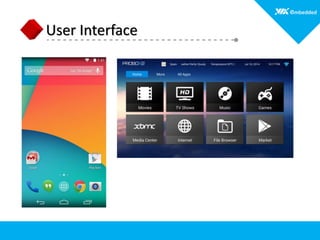
User Interface
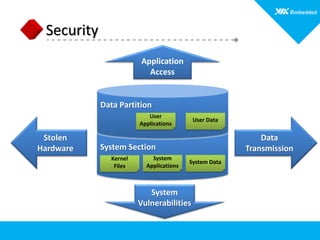
Security
System Section
Data Partition
User
Applications
User Data
System
Applications
Kernel
Files
System Data
Data
Transmission
Application
Access
Stolen
Hardware
System
Vulnerabilities
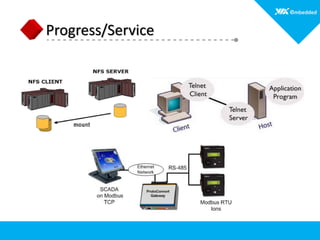
Progress/Service
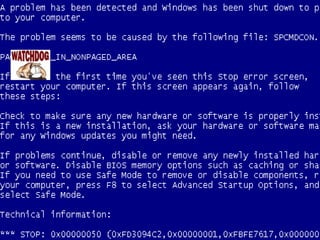
看门狗
6/10/2015
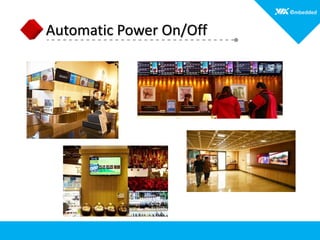
Automatic Power On/Off
Remote Power On/Off
Remote Monitoring/Maintenance
Silent System and App Updates
Embedded I/O
GPIO
RS-232/422/485
CAN BUS
I2C
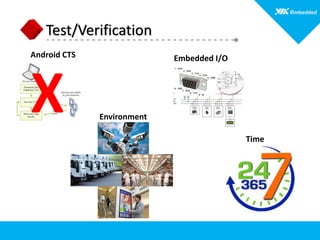
Test/Verification
Time
Environment
Android CTS
X
Embedded I/O
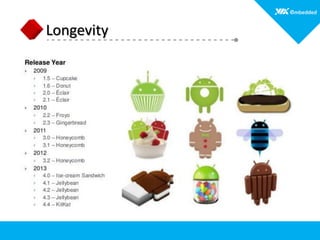
Longevity
© 2015 VIA Technologies, Inc All Rights Reserved.
• VIA reserves the right to make changes in its products without notice in order to improve design or performance characteristics.
• This publication neither states nor implies any representations or warranties of any kind, including but not limited to any implied warranty of merchantability or fitness for a particular
purpose. No license, express or implied, to any intellectual property rights is granted by this document.
• VIA makes no representations or warranties with respect to the accuracy or completeness of the contents of this publication or the information contained herein, and reserves the right
to make changes at any time, without notice. VIA disclaims responsibility for any consequences resulting from the use of the information included herein.
• VIA C7®, VIA C7®-D, VIA C7®-M, and VIA Eden® are trademarks of VIA Technologies, Inc.

Embedded Android Market Development

  • 1.
  • 2.
    • Selecting anEmbedded OS • Why Choose Android as your Embedded OS • Future Development of Embedded Android • Embedded Android Challenges Overview
  • 3.
  • 4.
    Selecting an EmbeddedOS • Open Source • Proprietary
  • 5.
    So, Where’s theDemand? Hardware Software Cost Time Quality Total Cost of Ownership Supplier’s Solution Customer’s Product Gap
  • 6.
  • 7.
    With a reliablepartner you can enjoy the advantages of a proprietary system when using an Open Source OS.
  • 8.
    WHY CHOOSE ANDROIDAS YOUR EMBEDDED OS
  • 9.
  • 10.
    Why Android asan Embedded OS Stable and Reliable Application Framework Superior Commercialization Mature Software Development Ecosystem Rich Native Multimedia Support User-friendly UI/UX Support Customization Capabilities - Enable peripheral device support - Customized middleware modules - Tailor-made OS
  • 11.
  • 12.
    Evolution of UI/UXApplications 2007.1 First iPhone 2008.10 First Android phone (HTC Dream) 2010.1 First iPad 2010.1 First white-label tablet (WM8650) 2010 ~ STB, OTT, TV Dongle, Media Player New User Behavior Widespread Adoption Platform Proliferation Embedded Implementation Now Infotainment, Medical, Industry, telematics…
  • 13.
  • 14.
    Consumer VS. EmbeddedAndroid Application Layer - Customized UI (Desktop Launcher, System Bar, Page Setup) Kernel & Framework - Security - Progress/Service (NFS, Telnet, Modbus…) System Management - WatchDog - Automatic Power on/off - Remote Power on/off - Remote Monitoring/Maintenance - Silent System and Application Updates Embedded I/O - GPIO, RS-232, CAN Bus… Test & Certification - Reliability 24/7/365 Longevity - 3 ~ 5 years or more Consumer Products Embedded Products
  • 15.
  • 16.
    Security System Section Data Partition User Applications UserData System Applications Kernel Files System Data Data Transmission Application Access Stolen Hardware System Vulnerabilities
  • 17.
  • 18.
  • 19.
  • 20.
  • 21.
  • 22.
    Silent System andApp Updates
  • 23.
  • 24.
  • 25.
  • 26.
    © 2015 VIATechnologies, Inc All Rights Reserved. • VIA reserves the right to make changes in its products without notice in order to improve design or performance characteristics. • This publication neither states nor implies any representations or warranties of any kind, including but not limited to any implied warranty of merchantability or fitness for a particular purpose. No license, express or implied, to any intellectual property rights is granted by this document. • VIA makes no representations or warranties with respect to the accuracy or completeness of the contents of this publication or the information contained herein, and reserves the right to make changes at any time, without notice. VIA disclaims responsibility for any consequences resulting from the use of the information included herein. • VIA C7®, VIA C7®-D, VIA C7®-M, and VIA Eden® are trademarks of VIA Technologies, Inc.