1
Android's HIDL:
Treble in the HAL
YouTubeTM
Livestream
March 28th
2018
Karim Yaghmour
@karimyaghmour
karim.yaghmour@opersys.com
2
These slides are made available to you under a Creative Commons Share-
Alike 3.0 license. The full terms of this license are here:
https://creativecommons.org/licenses/by-sa/3.0/
Attribution requirements and misc., PLEASE READ:
● This slide must remain as-is in this specific location (slide #2), everything
else you are free to change; including the logo :-)
● Use of figures in other documents must feature the below “Originals at”
URL immediately under that figure and the below copyright notice where
appropriate.
● You are free to fill in the “Delivered and/or customized by” space on the
right as you see fit.
● You are FORBIDEN from using the default “About” slide as-is or any of its
contents.
● You are FORBIDEN from using any content provided by 3rd parties without
the EXPLICIT consent from those parties.
(C) Copyright 2018, Opersys inc.
These slides created by: Karim Yaghmour
Originals at: www.opersys.com/community/docs
Delivered and/or customized by
3
About
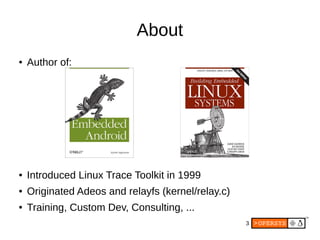
● Author of:
● Introduced Linux Trace Toolkit in 1999
● Originated Adeos and relayfs (kernel/relay.c)
● Training, Custom Dev, Consulting, ...
4
Agenda
1. Introduction
2. Basics
3. HAL Architecture Rework
4. Walkthrough
5. Adding a New HIDL
6. Support Infrastructure
5
1. Introduction
● Goals
● Origins
● Architecture recap
6
1.1. Goals
● Recap HIDL's origins
● Describe what HIDL does
● Outline how it fits into Android architecture
● Detail how to use it and how it works
7
1.2. Origins
● Part of Android's Project Treble
● Extends existing HAL concepts
● Similar to AIDL
8
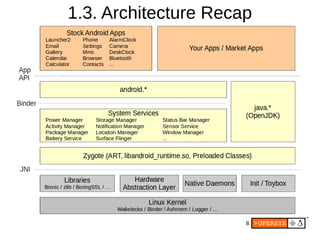
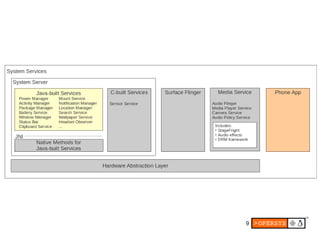
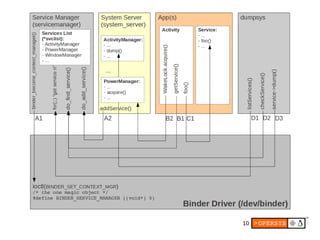
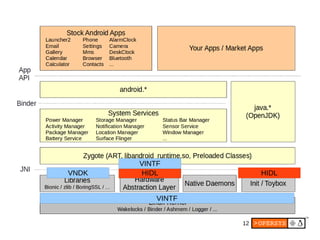
1.3. Architecture Recap
9
10
11
/frameworks/base/services/core/java/...
/frameworks/base/services/core/jni/
/hardware/libhardware/
/device/[MANUF.]/[DEVICE]
Kernel or module
/frameworks/base/core/...
AOSP-provided
ASL
Manuf.-provided
Manuf. license
Manuf.-provided
GPL-license
12
HIDLVNDK
VINTF
HIDL
VINTF
13
2. Basics
● HAL's role
● Traditional HAL before 8.x
● HIDL
● Links
14
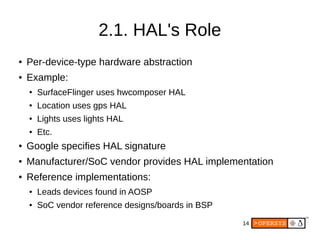
2.1. HAL's Role
● Per-device-type hardware abstraction
● Example:
● SurfaceFlinger uses hwcomposer HAL
● Location uses gps HAL
● Lights uses lights HAL
● Etc.
● Google specifies HAL signature
● Manufacturer/SoC vendor provides HAL implementation
● Reference implementations:
● Leads devices found in AOSP
● SoC vendor reference designs/boards in BSP
15
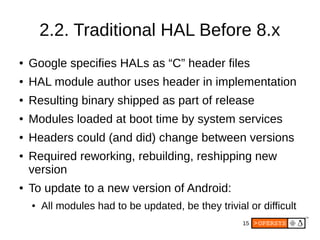
2.2. Traditional HAL Before 8.x
● Google specifies HALs as “C” header files
● HAL module author uses header in implementation
● Resulting binary shipped as part of release
● Modules loaded at boot time by system services
● Headers could (and did) change between versions
● Required reworking, rebuilding, reshipping new
version
● To update to a new version of Android:
● All modules had to be updated, be they trivial or difficult
16
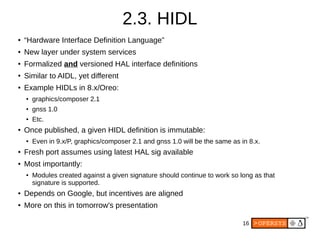
2.3. HIDL
● “Hardware Interface Definition Language”
● New layer under system services
● Formalized and versioned HAL interface definitions
●
Similar to AIDL, yet different
●
Example HIDLs in 8.x/Oreo:
● graphics/composer 2.1
● gnss 1.0
● Etc.
●
Once published, a given HIDL definition is immutable:
● Even in 9.x/P, graphics/composer 2.1 and gnss 1.0 will be the same as in 8.x.
● Fresh port assumes using latest HAL sig available
● Most importantly:
● Modules created against a given signature should continue to work so long as that
signature is supported.
● Depends on Google, but incentives are aligned
● More on this in tomorrow's presentation
17
2.4. Links
● General doc:
● https://source.android.com/devices/architecture/hidl/
● C++
● https://source.android.com/devices/architecture/hidl-
cpp/
● Java
● https://source.android.com/devices/architecture/hidl-
java/
18
3. HAL Architecture Rework
● Overall architecture
● Detailed architecture / Java
● Detailed architecture / C++
19
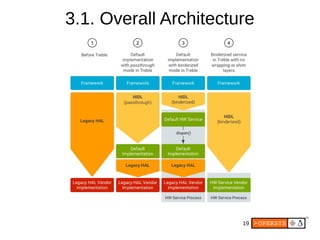
3.1. Overall Architecture
20
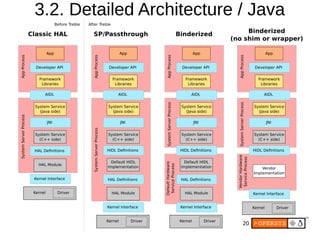
3.2. Detailed Architecture / Java
21
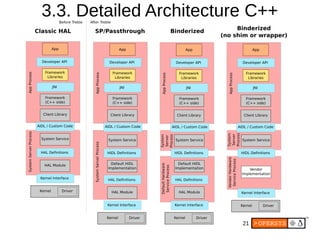
3.3. Detailed Architecture C++
22
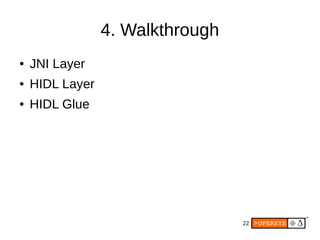
4. Walkthrough
● JNI Layer
● HIDL Layer
● HIDL Glue
23
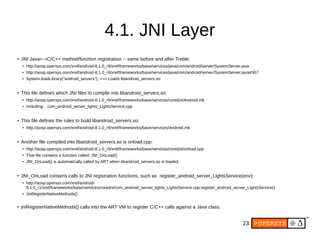
4.1. JNI Layer
●
JNI Java<->C/C++ method/function registration -- same before and after Treble:
● http://aosp.opersys.com/xref/android-8.1.0_r9/xref/frameworks/base/services/java/com/android/server/SystemServer.java
● http://aosp.opersys.com/xref/android-8.1.0_r9/xref/frameworks/base/services/java/com/android/server/SystemServer.java#367
● System.loadLibrary("android_servers"); ==> Loads libandroid_servers.so
●
This file defines which JNI files to compile into libandroid_servers.so:
●
http://aosp.opersys.com/xref/android-8.1.0_r9/xref/frameworks/base/services/core/jni/Android.mk
●
Including: com_android_server_lights_LightsService.cpp
●
This file defines the rules to build libandroid_servers.so:
● http://aosp.opersys.com/xref/android-8.1.0_r9/xref/frameworks/base/services/Android.mk
●
Another file compiled into libandroid_servers.so is onload.cpp:
● http://aosp.opersys.com/xref/android-8.1.0_r9/xref/frameworks/base/services/core/jni/onload.cpp
● That file contains a function called: JNI_OnLoad()
● JNI_OnLoad() is automatically called by ART when libandroid_servers.so is loaded.
●
JNI_OnLoad contains calls to JNI registration functions, such as register_android_server_LightsService(env);
●
http://aosp.opersys.com/xref/android-
8.1.0_r1/xref/frameworks/base/services/core/jni/com_android_server_lights_LightsService.cpp:register_android_server_LightsService()
● JniRegisterNativeMethods()
●
jniRegisterNativeMethods() calls into the ART VM to register C/C++ calls against a Java class.
24
4.2. HIDL Layer
● http://aosp.opersys.com/xref/android-
8.1.0_r9/xref/frameworks/base/services/core/java/com/android/server/lights/LightsServic
e.java:
● LightsService constructor
●
setLightLocked calls on setLight_native
● http://aosp.opersys.com/xref/android-
8.1.0_r9/xref/frameworks/base/services/core/jni/com_android_server_lights_LightsServic
e.cpp:setLight_native()
●
LightHal::associate();
●
Ilight::getService();
● http://aosp.opersys.com/xref/android-
8.1.0_r9/xref/hardware/interfaces/light/2.0/default/Light.cpp:HIDL_FETCH_ILight()
● GetLightDevice()
●
hw_get_module ()
●
dlopen() ==> results in lights.[hw-board].so to be loaded
25
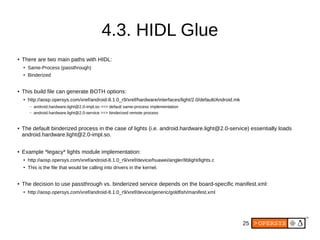
4.3. HIDL Glue
● There are two main paths with HIDL:
●
Same-Process (passthrough)
●
Binderized
● This build file can generate BOTH options:
● http://aosp.opersys.com/xref/android-8.1.0_r9/xref/hardware/interfaces/light/2.0/default/Android.mk
– android.hardware.light@2.0-impl.so ==> default same-process implementation
– android.hardware.light@2.0-service ==> binderized remote process
● The default binderized process in the case of lights (i.e. android.hardware.light@2.0-service) essentially loads
android.hardware.light@2.0-impl.so.
● Example *legacy* lights module implementation:
● http://aosp.opersys.com/xref/android-8.1.0_r9/xref/device/huawei/angler/liblight/lights.c
●
This is the file that would be calling into drivers in the kernel.
● The decision to use passthrough vs. binderized service depends on the board-specific manifest.xml:
●
http://aosp.opersys.com/xref/android-8.1.0_r9/xref/device/generic/goldfish/manifest.xml
26
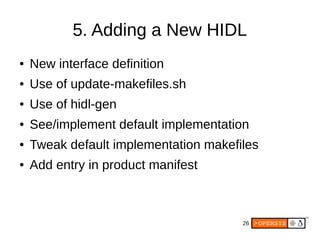
5. Adding a New HIDL
● New interface definition
● Use of update-makefiles.sh
● Use of hidl-gen
● See/implement default implementation
● Tweak default implementation makefiles
● Add entry in product manifest
27
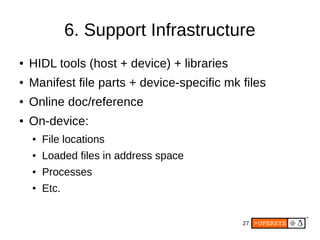
6. Support Infrastructure
● HIDL tools (host + device) + libraries
● Manifest file parts + device-specific mk files
● Online doc/reference
● On-device:
● File locations
● Loaded files in address space
● Processes
● Etc.
28
Thank you ...
karim.yaghmour@opersys.com
29
Acknowledgements:
● Several diagrams distributed by Google under
CC-BY-SA license or ASL 2.0.

Android's HIDL: Treble in the HAL

  • 1.
    1 Android's HIDL: Treble inthe HAL YouTubeTM Livestream March 28th 2018 Karim Yaghmour @karimyaghmour karim.yaghmour@opersys.com
  • 2.
    2 These slides aremade available to you under a Creative Commons Share- Alike 3.0 license. The full terms of this license are here: https://creativecommons.org/licenses/by-sa/3.0/ Attribution requirements and misc., PLEASE READ: ● This slide must remain as-is in this specific location (slide #2), everything else you are free to change; including the logo :-) ● Use of figures in other documents must feature the below “Originals at” URL immediately under that figure and the below copyright notice where appropriate. ● You are free to fill in the “Delivered and/or customized by” space on the right as you see fit. ● You are FORBIDEN from using the default “About” slide as-is or any of its contents. ● You are FORBIDEN from using any content provided by 3rd parties without the EXPLICIT consent from those parties. (C) Copyright 2018, Opersys inc. These slides created by: Karim Yaghmour Originals at: www.opersys.com/community/docs Delivered and/or customized by
  • 3.
    3 About ● Author of: ●Introduced Linux Trace Toolkit in 1999 ● Originated Adeos and relayfs (kernel/relay.c) ● Training, Custom Dev, Consulting, ...
  • 4.
    4 Agenda 1. Introduction 2. Basics 3.HAL Architecture Rework 4. Walkthrough 5. Adding a New HIDL 6. Support Infrastructure
  • 5.
    5 1. Introduction ● Goals ●Origins ● Architecture recap
  • 6.
    6 1.1. Goals ● RecapHIDL's origins ● Describe what HIDL does ● Outline how it fits into Android architecture ● Detail how to use it and how it works
  • 7.
    7 1.2. Origins ● Partof Android's Project Treble ● Extends existing HAL concepts ● Similar to AIDL
  • 8.
  • 9.
  • 10.
  • 11.
  • 12.
  • 13.
    13 2. Basics ● HAL'srole ● Traditional HAL before 8.x ● HIDL ● Links
  • 14.
    14 2.1. HAL's Role ●Per-device-type hardware abstraction ● Example: ● SurfaceFlinger uses hwcomposer HAL ● Location uses gps HAL ● Lights uses lights HAL ● Etc. ● Google specifies HAL signature ● Manufacturer/SoC vendor provides HAL implementation ● Reference implementations: ● Leads devices found in AOSP ● SoC vendor reference designs/boards in BSP
  • 15.
    15 2.2. Traditional HALBefore 8.x ● Google specifies HALs as “C” header files ● HAL module author uses header in implementation ● Resulting binary shipped as part of release ● Modules loaded at boot time by system services ● Headers could (and did) change between versions ● Required reworking, rebuilding, reshipping new version ● To update to a new version of Android: ● All modules had to be updated, be they trivial or difficult
  • 16.
    16 2.3. HIDL ● “HardwareInterface Definition Language” ● New layer under system services ● Formalized and versioned HAL interface definitions ● Similar to AIDL, yet different ● Example HIDLs in 8.x/Oreo: ● graphics/composer 2.1 ● gnss 1.0 ● Etc. ● Once published, a given HIDL definition is immutable: ● Even in 9.x/P, graphics/composer 2.1 and gnss 1.0 will be the same as in 8.x. ● Fresh port assumes using latest HAL sig available ● Most importantly: ● Modules created against a given signature should continue to work so long as that signature is supported. ● Depends on Google, but incentives are aligned ● More on this in tomorrow's presentation
  • 17.
    17 2.4. Links ● Generaldoc: ● https://source.android.com/devices/architecture/hidl/ ● C++ ● https://source.android.com/devices/architecture/hidl- cpp/ ● Java ● https://source.android.com/devices/architecture/hidl- java/
  • 18.
    18 3. HAL ArchitectureRework ● Overall architecture ● Detailed architecture / Java ● Detailed architecture / C++
  • 19.
  • 20.
  • 21.
  • 22.
    22 4. Walkthrough ● JNILayer ● HIDL Layer ● HIDL Glue
  • 23.
    23 4.1. JNI Layer ● JNIJava<->C/C++ method/function registration -- same before and after Treble: ● http://aosp.opersys.com/xref/android-8.1.0_r9/xref/frameworks/base/services/java/com/android/server/SystemServer.java ● http://aosp.opersys.com/xref/android-8.1.0_r9/xref/frameworks/base/services/java/com/android/server/SystemServer.java#367 ● System.loadLibrary("android_servers"); ==> Loads libandroid_servers.so ● This file defines which JNI files to compile into libandroid_servers.so: ● http://aosp.opersys.com/xref/android-8.1.0_r9/xref/frameworks/base/services/core/jni/Android.mk ● Including: com_android_server_lights_LightsService.cpp ● This file defines the rules to build libandroid_servers.so: ● http://aosp.opersys.com/xref/android-8.1.0_r9/xref/frameworks/base/services/Android.mk ● Another file compiled into libandroid_servers.so is onload.cpp: ● http://aosp.opersys.com/xref/android-8.1.0_r9/xref/frameworks/base/services/core/jni/onload.cpp ● That file contains a function called: JNI_OnLoad() ● JNI_OnLoad() is automatically called by ART when libandroid_servers.so is loaded. ● JNI_OnLoad contains calls to JNI registration functions, such as register_android_server_LightsService(env); ● http://aosp.opersys.com/xref/android- 8.1.0_r1/xref/frameworks/base/services/core/jni/com_android_server_lights_LightsService.cpp:register_android_server_LightsService() ● JniRegisterNativeMethods() ● jniRegisterNativeMethods() calls into the ART VM to register C/C++ calls against a Java class.
  • 24.
    24 4.2. HIDL Layer ●http://aosp.opersys.com/xref/android- 8.1.0_r9/xref/frameworks/base/services/core/java/com/android/server/lights/LightsServic e.java: ● LightsService constructor ● setLightLocked calls on setLight_native ● http://aosp.opersys.com/xref/android- 8.1.0_r9/xref/frameworks/base/services/core/jni/com_android_server_lights_LightsServic e.cpp:setLight_native() ● LightHal::associate(); ● Ilight::getService(); ● http://aosp.opersys.com/xref/android- 8.1.0_r9/xref/hardware/interfaces/light/2.0/default/Light.cpp:HIDL_FETCH_ILight() ● GetLightDevice() ● hw_get_module () ● dlopen() ==> results in lights.[hw-board].so to be loaded
  • 25.
    25 4.3. HIDL Glue ●There are two main paths with HIDL: ● Same-Process (passthrough) ● Binderized ● This build file can generate BOTH options: ● http://aosp.opersys.com/xref/android-8.1.0_r9/xref/hardware/interfaces/light/2.0/default/Android.mk – android.hardware.light@2.0-impl.so ==> default same-process implementation – android.hardware.light@2.0-service ==> binderized remote process ● The default binderized process in the case of lights (i.e. android.hardware.light@2.0-service) essentially loads android.hardware.light@2.0-impl.so. ● Example *legacy* lights module implementation: ● http://aosp.opersys.com/xref/android-8.1.0_r9/xref/device/huawei/angler/liblight/lights.c ● This is the file that would be calling into drivers in the kernel. ● The decision to use passthrough vs. binderized service depends on the board-specific manifest.xml: ● http://aosp.opersys.com/xref/android-8.1.0_r9/xref/device/generic/goldfish/manifest.xml
  • 26.
    26 5. Adding aNew HIDL ● New interface definition ● Use of update-makefiles.sh ● Use of hidl-gen ● See/implement default implementation ● Tweak default implementation makefiles ● Add entry in product manifest
  • 27.
    27 6. Support Infrastructure ●HIDL tools (host + device) + libraries ● Manifest file parts + device-specific mk files ● Online doc/reference ● On-device: ● File locations ● Loaded files in address space ● Processes ● Etc.
  • 28.
  • 29.
    29 Acknowledgements: ● Several diagramsdistributed by Google under CC-BY-SA license or ASL 2.0.