E-Publishing 2.0:
Re imagining the Publication and
    Preservation of Electronic
           Literature
The Situation
• Electronic literature
  – “first generation electronic objects”
  – “born-digital”
• Created in specific computational conditions.
  – Hardware
  – Platform
  – Software
• Received in multiple computational
  conditions.
The Problem
• Computational conditions are always
  changing
• Backwards compatibility is maintained to
  different levels
• Proprietary software is “closed” and restricts
  tampering
• Companies and software come and go
• Even open source code changes and becomes
  deprecated
• Backwards compatibility: 5-10 years
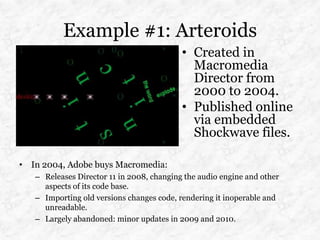
Example #1: Arteroids
                                           • Created in
                                             Macromedia
                                             Director from
                                             2000 to 2004.
                                           • Published online
                                             via embedded
                                             Shockwave files.

• In 2004, Adobe buys Macromedia:
   – Releases Director 11 in 2008, changing the audio engine and other
     aspects of its code base.
   – Importing old versions changes code, rendering it inoperable and
     unreadable.
   – Largely abandoned: minor updates in 2009 and 2010.
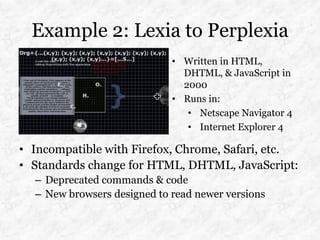
Example 2: Lexia to Perplexia
                             • Written in HTML,
                               DHTML, & JavaScript in
                               2000
                             • Runs in:
                                • Netscape Navigator 4
                                • Internet Explorer 4

• Incompatible with Firefox, Chrome, Safari, etc.
• Standards change for HTML, DHTML, JavaScript:
  – Deprecated commands & code
  – New browsers designed to read newer versions
Example 3: Works in Flash
         • Flash became an industry & e-literature
           standard in the past decade.
         • Many works of e-literature are
           developed with this authoring software.
• 2010: Steve Jobs decides not to allow Flash
  in iOS devices.
• 2012: Adobe discontinues Flash for Android
  tablets. Only developed for personal
  computers.
• As tablets become ubiquitous, the audience
  for e-lit in Flash will die out.
Digital Preservation Methods
      for Electronic Literature
• Bit-by-bit preservation of source materials.
• Documentation – through image, audio, and
  video capture of a performance of the work.
• Emulation – emulating the original
  computational environment in another OS.
• Porting - translating software from one
  programming language to another with the
  goal of producing the same effect in different
  hardware and software configurations.
Digital Publication Methods
      for Electronic Literature
• Online publication.
• Bit-by-bit preservation: provide access to
  faithful copy of the original. Reader may not
  be able to use copy.
• Documentation – disables interface &
  interactivity.
• Emulation – reader needs to install
  emulators in their own computers to run
  files.
• Porting – Produces new editions of the work.
  Changes work in subtle ways.
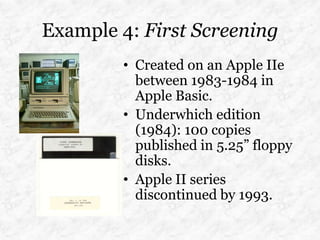
Example 4: First Screening
        • Created on an Apple IIe
          between 1983-1984 in
          Apple Basic.
        • Underwhich edition
          (1984): 100 copies
          published in 5.25” floppy
          disks.
        • Apple II series
          discontinued by 1993.
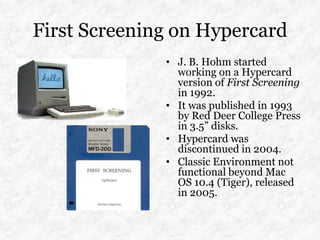
First Screening on Hypercard
              • J. B. Hohm started
                working on a Hypercard
                version of First Screening
                in 1992.
              • It was published in 1993
                by Red Deer College Press
                in 3.5” disks.
              • Hypercard was
                discontinued in 2004.
              • Classic Environment not
                functional beyond Mac
                OS 10.4 (Tiger), released
                in 2005.
Digital Preservation of First
              Screening
• 3-year preservation project (2004-2007) by Jim
  Andrews, Lionel Kearns, Dan Waber, Geof
  Huth, and Marko Niemi produced and published:
  1. The original DSK file of the 1984 edition, which can be
     opened with an Apple IIe emulator, along with the Apple
     BASIC source code as a text file, and scanned images of
     the original printed matter.
  2. A video documenting the emulated version in Quicktime
     format.
  3. The 1993 HyperCard version, along with the printed
     matter of that edition.
  4. A JavaScript version that runs in browsers.
First Screening (video version)
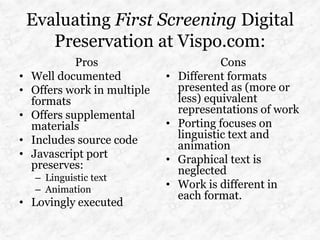
Evaluating First Screening Digital
       Preservation at Vispo.com:
             Pros                          Cons
•   Well documented           •   Different formats
•   Offers work in multiple       presented as (more or
    formats                       less) equivalent
•   Offers supplemental           representations of work
    materials                 •   Porting focuses on
•   Includes source code          linguistic text and
                                  animation
•   Javascript port           •   Graphical text is
    preserves:                    neglected
     – Linguistic text
     – Animation              •   Work is different in
                                  each format.
• Lovingly executed
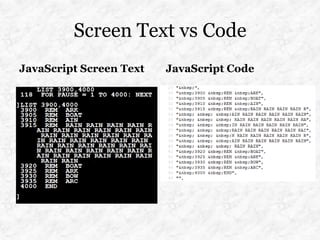
Screen Text vs Code
JavaScript Screen Text   JavaScript Code
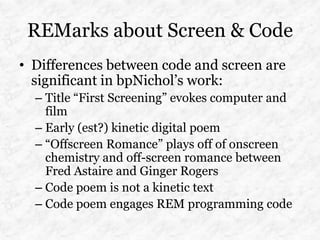
REMarks about Screen & Code
• Differences between code and screen are
  significant in bpNichol’s work:
  – Title “First Screening” evokes computer and
    film
  – Early (est?) kinetic digital poem
  – “Offscreen Romance” plays off of onscreen
    chemistry and off-screen romance between
    Fred Astaire and Ginger Rogers
  – Code poem is not a kinetic text
  – Code poem engages REM programming code
Problems with Current Electronic
      Publication Paradigm
• Publish works in Web deliverable format
• Assumptions:
  – The material can survive changes in
    computational environment.
  – Readers are willing to:
    • Switch browsers or compare how they render
      work.
    • Install plugins
    • Install emulators
    • Watch documentation videos
New Paradigm
• Publish works inside of computational
  environments customized to run work
  optimally.
• Technologies:
  – Emulation
  – Virtualization
     • Apache VCL
     • VMware
     • Gaikai & Onlive
  – Cloud-based services
Virtualization
• Run operating systems inside of other OS.
• Publish access to online virtual machines.
• The reader only receives a “screen” into
  other machine.
• Reader’s input is mapped onto virtual
  environment’s input.
• Requires good bandwidth
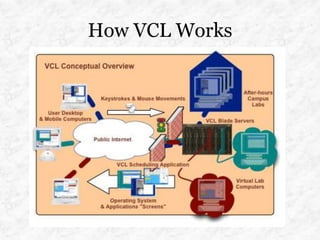
VCL (Virtual Computer Lab)
• NC State University & Apache Software
  Foundation are the leaders in VCL
  development.
• Concept:
  – Terminal 2.0
  – Centralizes computational infrastructure
  – Users can request a variety of OS & software
  – Minimal requirements for readers’ machines.
How VCL Works
Onlive & Gaikai
• Designed to deliver computer games on
  the Cloud.
• Minimizes system requirements for users.
• Deliverable on iPads, tablets, browsers.
• Successful?
  – Gaikai was purchased by Sony
  – Onlive went bankrupt
What’s next?
• Research and development of virtualization &
  emulation.
• Identification and preparation of key
  computational environments to be replicated.
• Develop input mapping on different devices.
• Explore legal issues with software licences.
• Curate environments and works so readers
  can understand older computational
  contexts.
Final Considerations
• Can be used to produce critical editions:
• Example: Arteroids
  – Prepare virtual machine with old version of
    Macromedia Director.
  – Provide source files for scholars to perform
    Critical Code readings and study code.
  – Have multiple running versions in machine.
• Added value = monetizable publication.
Thank you!
Leonardo Flores, Ph.D.

Associate Professor of English
University of Puerto Rico: Mayagüez

Fulbright Scholar in Digital Culture
University of Bergen

         Featured project: I ♥ E-Poetry
           http://leonardoflores.net

Electronic Publishing 2.0: Reimagining the Publication and Preservation of E Literature

  • 1.
    E-Publishing 2.0: Re imaginingthe Publication and Preservation of Electronic Literature
  • 2.
    The Situation • Electronicliterature – “first generation electronic objects” – “born-digital” • Created in specific computational conditions. – Hardware – Platform – Software • Received in multiple computational conditions.
  • 3.
    The Problem • Computationalconditions are always changing • Backwards compatibility is maintained to different levels • Proprietary software is “closed” and restricts tampering • Companies and software come and go • Even open source code changes and becomes deprecated • Backwards compatibility: 5-10 years
  • 4.
    Example #1: Arteroids • Created in Macromedia Director from 2000 to 2004. • Published online via embedded Shockwave files. • In 2004, Adobe buys Macromedia: – Releases Director 11 in 2008, changing the audio engine and other aspects of its code base. – Importing old versions changes code, rendering it inoperable and unreadable. – Largely abandoned: minor updates in 2009 and 2010.
  • 5.
    Example 2: Lexiato Perplexia • Written in HTML, DHTML, & JavaScript in 2000 • Runs in: • Netscape Navigator 4 • Internet Explorer 4 • Incompatible with Firefox, Chrome, Safari, etc. • Standards change for HTML, DHTML, JavaScript: – Deprecated commands & code – New browsers designed to read newer versions
  • 6.
    Example 3: Worksin Flash • Flash became an industry & e-literature standard in the past decade. • Many works of e-literature are developed with this authoring software. • 2010: Steve Jobs decides not to allow Flash in iOS devices. • 2012: Adobe discontinues Flash for Android tablets. Only developed for personal computers. • As tablets become ubiquitous, the audience for e-lit in Flash will die out.
  • 7.
    Digital Preservation Methods for Electronic Literature • Bit-by-bit preservation of source materials. • Documentation – through image, audio, and video capture of a performance of the work. • Emulation – emulating the original computational environment in another OS. • Porting - translating software from one programming language to another with the goal of producing the same effect in different hardware and software configurations.
  • 8.
    Digital Publication Methods for Electronic Literature • Online publication. • Bit-by-bit preservation: provide access to faithful copy of the original. Reader may not be able to use copy. • Documentation – disables interface & interactivity. • Emulation – reader needs to install emulators in their own computers to run files. • Porting – Produces new editions of the work. Changes work in subtle ways.
  • 9.
    Example 4: FirstScreening • Created on an Apple IIe between 1983-1984 in Apple Basic. • Underwhich edition (1984): 100 copies published in 5.25” floppy disks. • Apple II series discontinued by 1993.
  • 10.
    First Screening onHypercard • J. B. Hohm started working on a Hypercard version of First Screening in 1992. • It was published in 1993 by Red Deer College Press in 3.5” disks. • Hypercard was discontinued in 2004. • Classic Environment not functional beyond Mac OS 10.4 (Tiger), released in 2005.
  • 11.
    Digital Preservation ofFirst Screening • 3-year preservation project (2004-2007) by Jim Andrews, Lionel Kearns, Dan Waber, Geof Huth, and Marko Niemi produced and published: 1. The original DSK file of the 1984 edition, which can be opened with an Apple IIe emulator, along with the Apple BASIC source code as a text file, and scanned images of the original printed matter. 2. A video documenting the emulated version in Quicktime format. 3. The 1993 HyperCard version, along with the printed matter of that edition. 4. A JavaScript version that runs in browsers.
  • 12.
  • 13.
    Evaluating First ScreeningDigital Preservation at Vispo.com: Pros Cons • Well documented • Different formats • Offers work in multiple presented as (more or formats less) equivalent • Offers supplemental representations of work materials • Porting focuses on • Includes source code linguistic text and animation • Javascript port • Graphical text is preserves: neglected – Linguistic text – Animation • Work is different in each format. • Lovingly executed
  • 14.
    Screen Text vsCode JavaScript Screen Text JavaScript Code
  • 15.
    REMarks about Screen& Code • Differences between code and screen are significant in bpNichol’s work: – Title “First Screening” evokes computer and film – Early (est?) kinetic digital poem – “Offscreen Romance” plays off of onscreen chemistry and off-screen romance between Fred Astaire and Ginger Rogers – Code poem is not a kinetic text – Code poem engages REM programming code
  • 16.
    Problems with CurrentElectronic Publication Paradigm • Publish works in Web deliverable format • Assumptions: – The material can survive changes in computational environment. – Readers are willing to: • Switch browsers or compare how they render work. • Install plugins • Install emulators • Watch documentation videos
  • 17.
    New Paradigm • Publishworks inside of computational environments customized to run work optimally. • Technologies: – Emulation – Virtualization • Apache VCL • VMware • Gaikai & Onlive – Cloud-based services
  • 18.
    Virtualization • Run operatingsystems inside of other OS. • Publish access to online virtual machines. • The reader only receives a “screen” into other machine. • Reader’s input is mapped onto virtual environment’s input. • Requires good bandwidth
  • 19.
    VCL (Virtual ComputerLab) • NC State University & Apache Software Foundation are the leaders in VCL development. • Concept: – Terminal 2.0 – Centralizes computational infrastructure – Users can request a variety of OS & software – Minimal requirements for readers’ machines.
  • 20.
  • 21.
    Onlive & Gaikai •Designed to deliver computer games on the Cloud. • Minimizes system requirements for users. • Deliverable on iPads, tablets, browsers. • Successful? – Gaikai was purchased by Sony – Onlive went bankrupt
  • 22.
    What’s next? • Researchand development of virtualization & emulation. • Identification and preparation of key computational environments to be replicated. • Develop input mapping on different devices. • Explore legal issues with software licences. • Curate environments and works so readers can understand older computational contexts.
  • 23.
    Final Considerations • Canbe used to produce critical editions: • Example: Arteroids – Prepare virtual machine with old version of Macromedia Director. – Provide source files for scholars to perform Critical Code readings and study code. – Have multiple running versions in machine. • Added value = monetizable publication.
  • 24.
    Thank you! Leonardo Flores,Ph.D. Associate Professor of English University of Puerto Rico: Mayagüez Fulbright Scholar in Digital Culture University of Bergen Featured project: I ♥ E-Poetry http://leonardoflores.net