A Dynamic Perspective on Government Broadband Initiatives Jerry Ellig Senior Research Fellow
Municipal electricity, gas, water Slow technological change Necessities Monopolies Not  characteristics of broadband!
Creative Destruction “competition from the new commodity, the new technology, the new source of supply, the new type of organization – competition which commands a decisive cost or quality advantage and strikes not at the margins of the profits and the output of existing firms, but at their foundations and their very lives.” -- Joseph Schumpeter
Dynamic competition ≠ Static monopoly Competition Performance competition Continuous improvement Lock-in Obsolescence Risk Uncertainty
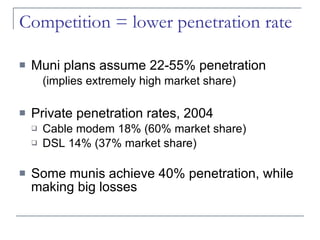
Competition = lower penetration rate Muni plans assume 22-55% penetration (implies extremely high market share) Private penetration rates, 2004 Cable modem 18% (60% market share) DSL 14% (37% market share) Some munis achieve 40% penetration, while making big losses
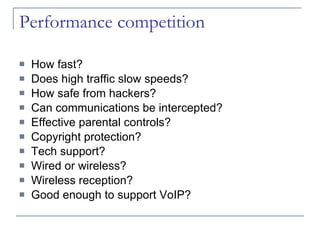
Performance competition How fast? Does high traffic slow speeds? How safe from hackers? Can communications be intercepted? Effective parental controls? Copyright protection? Tech support? Wired or wireless? Wireless reception? Good enough to support VoIP?
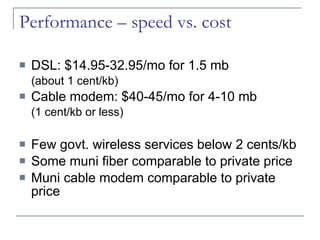
Performance – speed vs. cost DSL: $14.95-32.95/mo for 1.5 mb  (about 1 cent/kb) Cable modem: $40-45/mo for 4-10 mb (1 cent/kb or less) Few govt. wireless services below 2 cents/kb Some muni fiber comparable to private price Muni cable modem comparable to private price
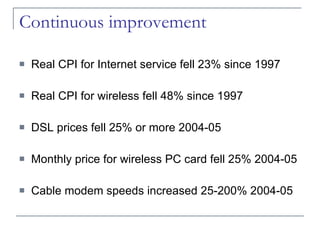
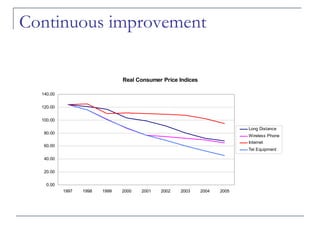
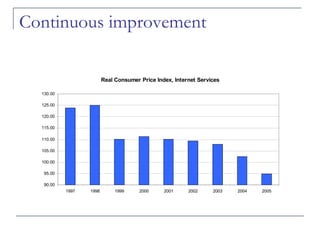
Continuous improvement Real CPI for Internet service fell 23% since 1997 Real CPI for wireless fell 48% since 1997 DSL prices fell 25% or more 2004-05 Monthly price for wireless PC card fell 25% 2004-05 Cable modem speeds increased 25-200% 2004-05
Continuous improvement
Lock-in Concept: Inferior technology with higher initial but lower long-term payoff gets entrenched due to network effects or increasing returns Will policymaking choose best technology? Interest group influence Short political time horizons (election cycle) Policy bundling  reduces competitive pressures Limits on decisionmakers’ ability to profit personally Subsidies exacerbate lock-in
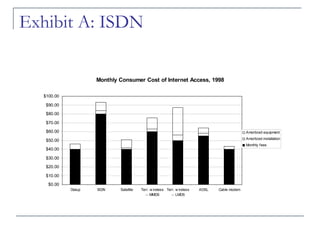
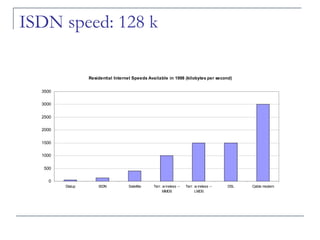
Exhibit A: ISDN
ISDN speed: 128 k
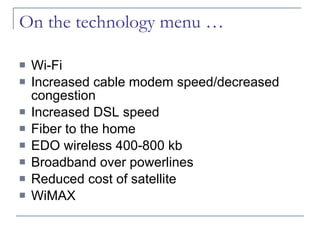
On the technology menu … Wi-Fi Increased cable modem speed/decreased congestion Increased DSL speed Fiber to the home EDO wireless 400-800 kb Broadband over powerlines Reduced cost of satellite WiMAX
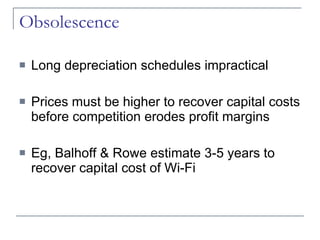
Obsolescence Long depreciation schedules impractical Prices must be higher to recover capital costs before competition erodes profit margins Eg, Balhoff & Rowe estimate 3-5 years to recover capital cost of Wi-Fi
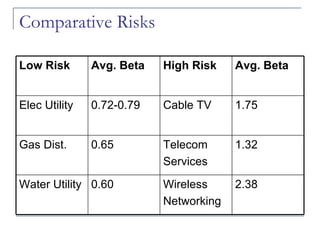
Comparative Risks 2.38 Wireless Networking 0.60 Water Utility 1.32 Telecom  Services 0.65 Gas Dist. 1.75 Cable TV 0.72-0.79 Elec Utility Avg. Beta High Risk Avg. Beta Low Risk
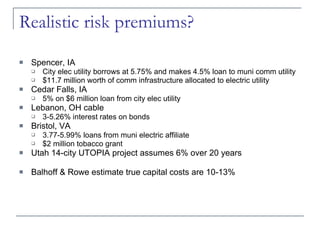
Realistic risk premiums? Spencer, IA City elec utility borrows at 5.75% and makes 4.5% loan to muni comm utility $11.7 million worth of comm infrastructure allocated to electric utility Cedar Falls, IA 5% on $6 million loan from city elec utility Lebanon, OH cable 3-5.26% interest rates on bonds Bristol, VA 3.77-5.99% loans from muni electric affiliate $2 million tobacco grant Utah 14-city UTOPIA project assumes 6% over 20 years Balhoff & Rowe estimate true capital costs are 10-13%
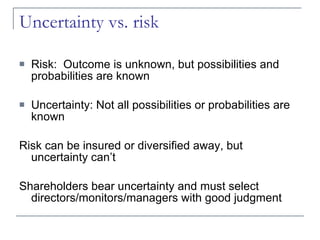
Uncertainty vs. risk Risk:  Outcome is unknown, but possibilities and probabilities are known Uncertainty: Not all possibilities or probabilities are known Risk can be insured or diversified away, but uncertainty can’t Shareholders bear uncertainty and must select directors/monitors/managers with good judgment
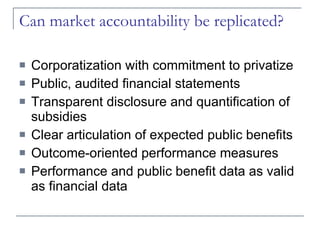
Can market accountability be replicated? Corporatization with commitment to privatize Public, audited financial statements Transparent disclosure and quantification of subsidies Clear articulation of expected public benefits Outcome-oriented performance measures Performance and public benefit data as valid as financial data
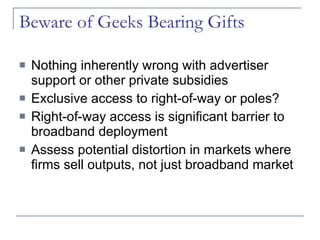
Beware of Geeks Bearing Gifts Nothing inherently wrong with advertiser support or other private subsidies Exclusive access to right-of-way or poles? Right-of-way access is significant barrier to broadband deployment Assess potential distortion in markets where firms sell outputs, not just broadband market
Conclusions Muni broadband may or may not be a good idea Broadband is subject to dynamic competition Any sound muni plan should include strategies for dealing with dynamic concerns

Ellig Govt Broadband 2005

  • 1.
    A Dynamic Perspectiveon Government Broadband Initiatives Jerry Ellig Senior Research Fellow
  • 2.
    Municipal electricity, gas,water Slow technological change Necessities Monopolies Not characteristics of broadband!
  • 3.
    Creative Destruction “competitionfrom the new commodity, the new technology, the new source of supply, the new type of organization – competition which commands a decisive cost or quality advantage and strikes not at the margins of the profits and the output of existing firms, but at their foundations and their very lives.” -- Joseph Schumpeter
  • 4.
    Dynamic competition ≠Static monopoly Competition Performance competition Continuous improvement Lock-in Obsolescence Risk Uncertainty
  • 5.
    Competition = lowerpenetration rate Muni plans assume 22-55% penetration (implies extremely high market share) Private penetration rates, 2004 Cable modem 18% (60% market share) DSL 14% (37% market share) Some munis achieve 40% penetration, while making big losses
  • 6.
    Performance competition Howfast? Does high traffic slow speeds? How safe from hackers? Can communications be intercepted? Effective parental controls? Copyright protection? Tech support? Wired or wireless? Wireless reception? Good enough to support VoIP?
  • 7.
    Performance – speedvs. cost DSL: $14.95-32.95/mo for 1.5 mb (about 1 cent/kb) Cable modem: $40-45/mo for 4-10 mb (1 cent/kb or less) Few govt. wireless services below 2 cents/kb Some muni fiber comparable to private price Muni cable modem comparable to private price
  • 8.
    Continuous improvement RealCPI for Internet service fell 23% since 1997 Real CPI for wireless fell 48% since 1997 DSL prices fell 25% or more 2004-05 Monthly price for wireless PC card fell 25% 2004-05 Cable modem speeds increased 25-200% 2004-05
  • 9.
  • 10.
  • 11.
    Lock-in Concept: Inferiortechnology with higher initial but lower long-term payoff gets entrenched due to network effects or increasing returns Will policymaking choose best technology? Interest group influence Short political time horizons (election cycle) Policy bundling reduces competitive pressures Limits on decisionmakers’ ability to profit personally Subsidies exacerbate lock-in
  • 12.
  • 13.
  • 14.
    On the technologymenu … Wi-Fi Increased cable modem speed/decreased congestion Increased DSL speed Fiber to the home EDO wireless 400-800 kb Broadband over powerlines Reduced cost of satellite WiMAX
  • 15.
    Obsolescence Long depreciationschedules impractical Prices must be higher to recover capital costs before competition erodes profit margins Eg, Balhoff & Rowe estimate 3-5 years to recover capital cost of Wi-Fi
  • 16.
    Comparative Risks 2.38Wireless Networking 0.60 Water Utility 1.32 Telecom Services 0.65 Gas Dist. 1.75 Cable TV 0.72-0.79 Elec Utility Avg. Beta High Risk Avg. Beta Low Risk
  • 17.
    Realistic risk premiums?Spencer, IA City elec utility borrows at 5.75% and makes 4.5% loan to muni comm utility $11.7 million worth of comm infrastructure allocated to electric utility Cedar Falls, IA 5% on $6 million loan from city elec utility Lebanon, OH cable 3-5.26% interest rates on bonds Bristol, VA 3.77-5.99% loans from muni electric affiliate $2 million tobacco grant Utah 14-city UTOPIA project assumes 6% over 20 years Balhoff & Rowe estimate true capital costs are 10-13%
  • 18.
    Uncertainty vs. riskRisk: Outcome is unknown, but possibilities and probabilities are known Uncertainty: Not all possibilities or probabilities are known Risk can be insured or diversified away, but uncertainty can’t Shareholders bear uncertainty and must select directors/monitors/managers with good judgment
  • 19.
    Can market accountabilitybe replicated? Corporatization with commitment to privatize Public, audited financial statements Transparent disclosure and quantification of subsidies Clear articulation of expected public benefits Outcome-oriented performance measures Performance and public benefit data as valid as financial data
  • 20.
    Beware of GeeksBearing Gifts Nothing inherently wrong with advertiser support or other private subsidies Exclusive access to right-of-way or poles? Right-of-way access is significant barrier to broadband deployment Assess potential distortion in markets where firms sell outputs, not just broadband market
  • 21.
    Conclusions Muni broadbandmay or may not be a good idea Broadband is subject to dynamic competition Any sound muni plan should include strategies for dealing with dynamic concerns