 Discussion: 
• “We Might as Well be 
Strangers” 
 Presentation: End of 
course 
 Paper #2 (Due Friday of 
finals week at 9:15) 
Homework Self-assessment 
 Exam Preparation 
Revisions due Friday, week 
11 before noon.
 Q: What is the proper way to come out to your parents? 
 Q: Are there better ways to come out? 
 Q: Is it necessary to come out to parents? 
 Q: How does Alison’s grandmother’s experience with her 
roommate’s family mirror Alison’s experience with her 
mother? 
 Q: In what ways, consciously or subconsciously, do we 
come out throughout our lifetimes? 
 Q: What is the most hurtful part of Alison’s mom’s 
reaction? 
 Q: Why did Alison not reveal to her mother that she had 
already come out to her grandmother, and that her 
grandmother accepted her homosexuality?
 Q: If the mom already “knew” that Alison was gay with Laura, then why 
didn’t she do anything sooner? 
 Why does Alison’s mother react so differently than Alison’s grandmother 
about coming out? 
 Q: Was it right for Alison to come out to her grandmother and mother 
separately? 
 Q: If we can make connections like Alison’s grandmother did towards her 
feeling, could it make the coming out experience a bit more easier, 
instead of exploding in rage like her mother? Does it possibly show the 
two types of people in this world between Allison’s mother and 
grandmother? 
 Q: Why did Alison’s grandmother not help her come out to her mother? 
 Q: If Alison’s grandmother had not had any Holocaust experience, would 
she have been as closed-minded as Alison’s mother?
Class 20: 
• Essay #2 
• Self-assessment 
• Exam #2 
Class 21: 
• Film 
Class 22: 
• Self-assessment due 
• Exam #2 
Class 23 
• Final paper due at noon.
 In this second half of our quarter, we have read and 
discussed multiple texts, theories, and opinions on both 
literature and literary analysis, and for this reason, I 
offer you many choices for your second essay: In a 
thesis driven essay of 2-5 pages (formatted in MLA 
style), analyze one or more aspects of one of the 
primary texts we have read in the second half of this 
quarter. Aim to convince readers that your 
interpretation adds to the conversation among those 
who read and write about queer texts. Back up your 
analysis with reasons and support from the story. 
Consider using one or more secondary sources to help 
support your ideas and assertions.
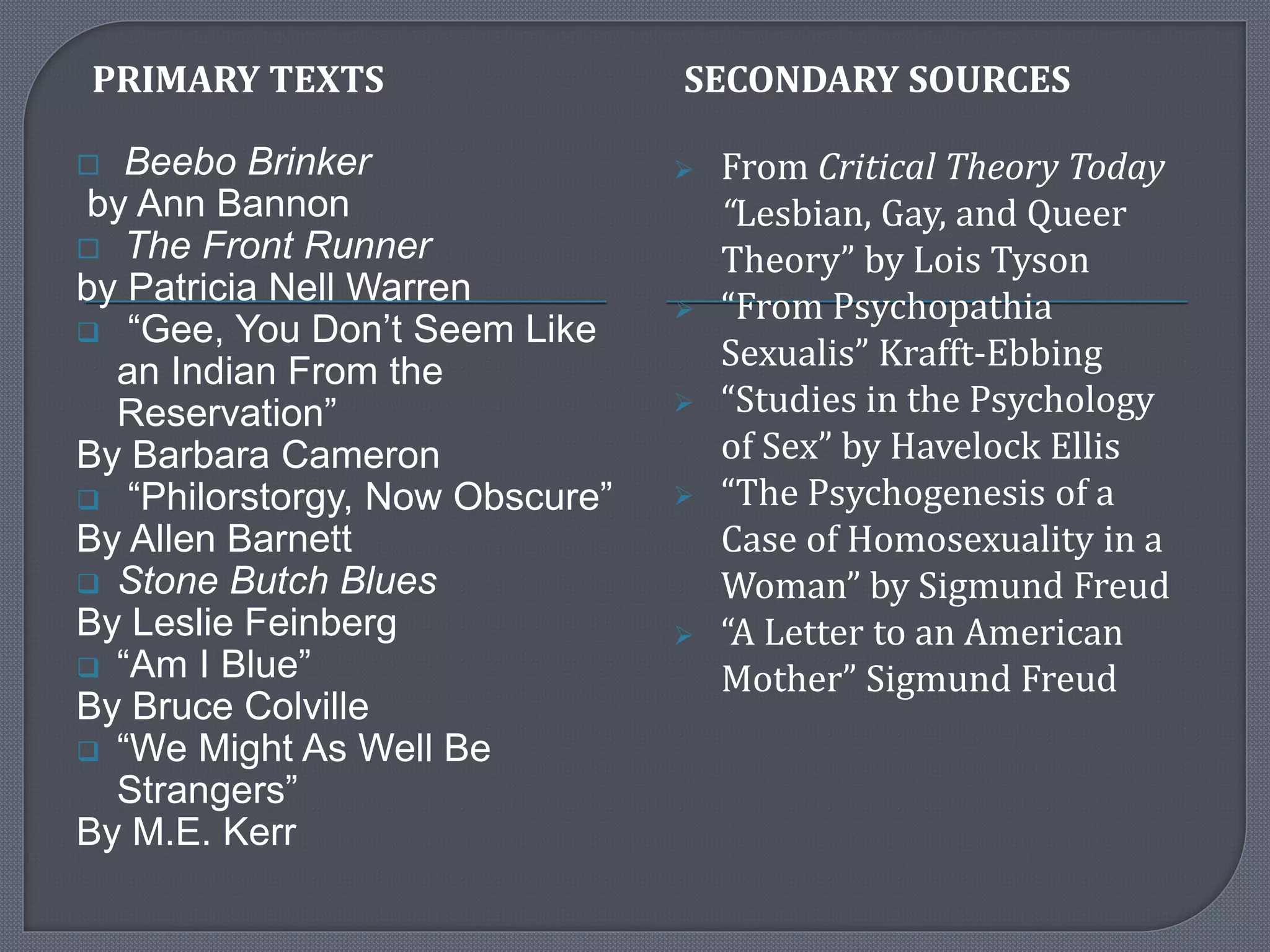
PRIMARY TEXTS 
 Beebo Brinker 
by Ann Bannon 
 The Front Runner 
by Patricia Nell Warren 
 “Gee, You Don’t Seem Like 
an Indian From the 
Reservation” 
By Barbara Cameron 
 “Philorstorgy, Now Obscure” 
By Allen Barnett 
 Stone Butch Blues 
By Leslie Feinberg 
 “Am I Blue” 
By Bruce Colville 
 “We Might As Well Be 
Strangers” 
By M.E. Kerr 
SECONDARY SOURCES 
 From Critical Theory Today 
“Lesbian, Gay, and Queer 
Theory” by Lois Tyson 
 “From Psychopathia 
Sexualis” Krafft-Ebbing 
 “Studies in the Psychology 
of Sex” by Havelock Ellis 
 “The Psychogenesis of a 
Case of Homosexuality in a 
Woman” by Sigmund Freud 
 “A Letter to an American 
Mother” Sigmund Freud
1. What are the politics (ideological agendas) of specific gay, 
lesbian, or queer works, and how are those politics revealed 
in...the work's thematic content or portrayals of its characters? 
2. What are the poetics (literary devices and strategies) of a 
specific lesbian, gay, or queer works? 
3. What does the work contribute to our knowledge of queer, gay, 
or lesbian experience and history, including literary history? 
4. How is queer, gay, or lesbian experience coded in texts that are 
by writers who are apparently homosexual? 
5. How might the works of heterosexual writers be reread to 
reveal an unspoken or unconscious lesbian, gay or queer 
presence? That is, does the work have an unconscious 
lesbian, gay or queer desire or conflict that it submerges?
6. What does the work reveal about the operations (socially, politically, 
psychologically) of heterosexism? 
7. How does the literary text illustrate the problematics of sexuality and 
sexual "identity," that is the ways in which human sexuality does not 
fall neatly into the separate categories defined by the words 
homosexual and heterosexual? 
8. What elements in the text exist in the middle, between the perceived 
masculine/feminine binary? In other words, what elements exhibit 
traits of both (bisexual)? 
9. What elements of the text can be perceived as being masculine 
(active, powerful) and feminine (passive, marginalized) and how do 
the characters support these traditional roles? 
10. What sort of support (if any) is given to elements or characters who 
question the masculine/feminine binary? What happens to those 
elements/characters?
 Manifestations of queerness on the body 
 Internalized oppression in lgbtqqia2p people 
 Identify, analyze and explain coded texts: when, how, and 
why? 
 Analyze the military as a homosocial/homosexual realm 
 Analyze and explain social stigma and consequences for 
homosexual behavior and those effects on queer people. 
 Identify, analyze, and explain demons and predators in queer 
literature. 
 Analyze spaces specific to queer characters 
 Analyze the connection between death and queerness
 Masculinity (in men 
and women) 
 Femininity (in men 
and women) 
 Race/Class/Sex 
privilege and 
queerness 
• Love 
• Guilt and blame 
• Medical and other 
social services 
• Isolation 
• Queer spaces 
• Violence 
• Oppression 
• Passing
Be Familiar with the Text 
 A good paper begins with the writer having a 
solid understanding of the work. Being able to 
have the whole text in your head when you begin 
thinking through ideas will actually allow you to 
write the paper more quickly in the long run. 
 Spend some time just thinking about the story. 
Flip back through the book and consider what 
interests you about this book—what seemed 
strange, new, or important?
 Consider how you might approach each topic. 
What will your answer to each question show about the 
text? 
So what? Why will anyone care? 
Try this phrase for each prompt to see if you have an 
idea: “This book/short story shows 
______________________. This is important because 
______________________.” 
For more information, see the presentation from class 10
Write about literature in present tense 
 Avoid using “thing,” “something,” “everything,” and 
“anything.” 
 Avoid writing in second person. 
 Avoid using contractions. 
 Cut Wordy Sentences 
 Avoid run-on sentences and fragments. 
 Check for misused words 
 Put commas and periods inside of quotation 
marks
 Does the paper follow MLA guidelines? 
• For help, click on “MLA Guidelines” and view the “Basic MLA 
format” video. 
 Is the page length within assigned limits? 
 Is the font type and size within the assigned 
guidelines? 
 Does the Header follow the assignment guidelines? 
 Is the professor's name spelled correctly? Kim Palmore 
 Is your name spelled correctly? 
 Does the paper have a title? Is it a good title? Is the title 
in the appropriate location? 
 Have you italicized book and movie titles and put 
stories, articles, and poems in quotation marks.
The homework post points (100) require self-assessment. 
Consider three aspects of your 
responses: First, how many of the posts did you 
make? Second, what was the quality of your 
response? Third, how timely were your 
submissions? Write a paragraph justifying your 
grade. You may submit this to me by email as 
soon as you finish post 20, but you must send it 
before class 22.
Passage Identification by author and work 
a. He looked into the dull costly garden. It improved. A man had 
come into it from the back of the yew hedge. He had on a 
canary-coloured shirt, and the effect was exactly right. The 
whole scene blazed. That was what the place wanted—not a 
flowerbed, but a man, who advanced with a confident tread 
down the amphitheatre, and as he came nearer Conway saw 
that besides being proper to the colour scheme he was a very 
proper youth. 
3. Character Identification 
a. The sound of an approaching train awoke him, and he started 
to his feet, remembering only his resolution, and afraid lest he 
should be too late. He stood watching the approaching 
locomotive, his teeth chattering, his lips drawn away from them 
in a frightened smile; once or twice he glanced nervously 
sidewise, as though he were being watched. When the right 
moment came, he jumped.
Author Identification 
She is best known for writing about the landscape of the 
American heartland and those who immigrated and settled 
there in the late nineteenth and early twentieth centuries. 
This is most vividly expressed in her two most famous 
novels, O Pioneers! (1913) and My Ántonia (1918). 
Comprehensive Essay Question: 500 words 
Using one or more texts, discuss what the works reveal about 
the operations (socially, politically, psychologically) of 
heterosexism.
Begin Paper 2 
QHQ 20: paper abstract 
or summary, with a thesis 
argument. 
Friday, Week 11, all 
revisions due before 
noon. 
Self-assessment due

Elit 10 class 20

  • 2.
     Discussion: •“We Might as Well be Strangers”  Presentation: End of course  Paper #2 (Due Friday of finals week at 9:15) Homework Self-assessment  Exam Preparation Revisions due Friday, week 11 before noon.
  • 3.
     Q: Whatis the proper way to come out to your parents?  Q: Are there better ways to come out?  Q: Is it necessary to come out to parents?  Q: How does Alison’s grandmother’s experience with her roommate’s family mirror Alison’s experience with her mother?  Q: In what ways, consciously or subconsciously, do we come out throughout our lifetimes?  Q: What is the most hurtful part of Alison’s mom’s reaction?  Q: Why did Alison not reveal to her mother that she had already come out to her grandmother, and that her grandmother accepted her homosexuality?
  • 4.
     Q: Ifthe mom already “knew” that Alison was gay with Laura, then why didn’t she do anything sooner?  Why does Alison’s mother react so differently than Alison’s grandmother about coming out?  Q: Was it right for Alison to come out to her grandmother and mother separately?  Q: If we can make connections like Alison’s grandmother did towards her feeling, could it make the coming out experience a bit more easier, instead of exploding in rage like her mother? Does it possibly show the two types of people in this world between Allison’s mother and grandmother?  Q: Why did Alison’s grandmother not help her come out to her mother?  Q: If Alison’s grandmother had not had any Holocaust experience, would she have been as closed-minded as Alison’s mother?
  • 5.
    Class 20: •Essay #2 • Self-assessment • Exam #2 Class 21: • Film Class 22: • Self-assessment due • Exam #2 Class 23 • Final paper due at noon.
  • 6.
     In thissecond half of our quarter, we have read and discussed multiple texts, theories, and opinions on both literature and literary analysis, and for this reason, I offer you many choices for your second essay: In a thesis driven essay of 2-5 pages (formatted in MLA style), analyze one or more aspects of one of the primary texts we have read in the second half of this quarter. Aim to convince readers that your interpretation adds to the conversation among those who read and write about queer texts. Back up your analysis with reasons and support from the story. Consider using one or more secondary sources to help support your ideas and assertions.
  • 7.
    PRIMARY TEXTS Beebo Brinker by Ann Bannon  The Front Runner by Patricia Nell Warren  “Gee, You Don’t Seem Like an Indian From the Reservation” By Barbara Cameron  “Philorstorgy, Now Obscure” By Allen Barnett  Stone Butch Blues By Leslie Feinberg  “Am I Blue” By Bruce Colville  “We Might As Well Be Strangers” By M.E. Kerr SECONDARY SOURCES  From Critical Theory Today “Lesbian, Gay, and Queer Theory” by Lois Tyson  “From Psychopathia Sexualis” Krafft-Ebbing  “Studies in the Psychology of Sex” by Havelock Ellis  “The Psychogenesis of a Case of Homosexuality in a Woman” by Sigmund Freud  “A Letter to an American Mother” Sigmund Freud
  • 8.
    1. What arethe politics (ideological agendas) of specific gay, lesbian, or queer works, and how are those politics revealed in...the work's thematic content or portrayals of its characters? 2. What are the poetics (literary devices and strategies) of a specific lesbian, gay, or queer works? 3. What does the work contribute to our knowledge of queer, gay, or lesbian experience and history, including literary history? 4. How is queer, gay, or lesbian experience coded in texts that are by writers who are apparently homosexual? 5. How might the works of heterosexual writers be reread to reveal an unspoken or unconscious lesbian, gay or queer presence? That is, does the work have an unconscious lesbian, gay or queer desire or conflict that it submerges?
  • 9.
    6. What doesthe work reveal about the operations (socially, politically, psychologically) of heterosexism? 7. How does the literary text illustrate the problematics of sexuality and sexual "identity," that is the ways in which human sexuality does not fall neatly into the separate categories defined by the words homosexual and heterosexual? 8. What elements in the text exist in the middle, between the perceived masculine/feminine binary? In other words, what elements exhibit traits of both (bisexual)? 9. What elements of the text can be perceived as being masculine (active, powerful) and feminine (passive, marginalized) and how do the characters support these traditional roles? 10. What sort of support (if any) is given to elements or characters who question the masculine/feminine binary? What happens to those elements/characters?
  • 10.
     Manifestations ofqueerness on the body  Internalized oppression in lgbtqqia2p people  Identify, analyze and explain coded texts: when, how, and why?  Analyze the military as a homosocial/homosexual realm  Analyze and explain social stigma and consequences for homosexual behavior and those effects on queer people.  Identify, analyze, and explain demons and predators in queer literature.  Analyze spaces specific to queer characters  Analyze the connection between death and queerness
  • 11.
     Masculinity (inmen and women)  Femininity (in men and women)  Race/Class/Sex privilege and queerness • Love • Guilt and blame • Medical and other social services • Isolation • Queer spaces • Violence • Oppression • Passing
  • 12.
    Be Familiar withthe Text  A good paper begins with the writer having a solid understanding of the work. Being able to have the whole text in your head when you begin thinking through ideas will actually allow you to write the paper more quickly in the long run.  Spend some time just thinking about the story. Flip back through the book and consider what interests you about this book—what seemed strange, new, or important?
  • 13.
     Consider howyou might approach each topic. What will your answer to each question show about the text? So what? Why will anyone care? Try this phrase for each prompt to see if you have an idea: “This book/short story shows ______________________. This is important because ______________________.” For more information, see the presentation from class 10
  • 14.
    Write about literaturein present tense  Avoid using “thing,” “something,” “everything,” and “anything.”  Avoid writing in second person.  Avoid using contractions.  Cut Wordy Sentences  Avoid run-on sentences and fragments.  Check for misused words  Put commas and periods inside of quotation marks
  • 15.
     Does thepaper follow MLA guidelines? • For help, click on “MLA Guidelines” and view the “Basic MLA format” video.  Is the page length within assigned limits?  Is the font type and size within the assigned guidelines?  Does the Header follow the assignment guidelines?  Is the professor's name spelled correctly? Kim Palmore  Is your name spelled correctly?  Does the paper have a title? Is it a good title? Is the title in the appropriate location?  Have you italicized book and movie titles and put stories, articles, and poems in quotation marks.
  • 16.
    The homework postpoints (100) require self-assessment. Consider three aspects of your responses: First, how many of the posts did you make? Second, what was the quality of your response? Third, how timely were your submissions? Write a paragraph justifying your grade. You may submit this to me by email as soon as you finish post 20, but you must send it before class 22.
  • 18.
    Passage Identification byauthor and work a. He looked into the dull costly garden. It improved. A man had come into it from the back of the yew hedge. He had on a canary-coloured shirt, and the effect was exactly right. The whole scene blazed. That was what the place wanted—not a flowerbed, but a man, who advanced with a confident tread down the amphitheatre, and as he came nearer Conway saw that besides being proper to the colour scheme he was a very proper youth. 3. Character Identification a. The sound of an approaching train awoke him, and he started to his feet, remembering only his resolution, and afraid lest he should be too late. He stood watching the approaching locomotive, his teeth chattering, his lips drawn away from them in a frightened smile; once or twice he glanced nervously sidewise, as though he were being watched. When the right moment came, he jumped.
  • 19.
    Author Identification Sheis best known for writing about the landscape of the American heartland and those who immigrated and settled there in the late nineteenth and early twentieth centuries. This is most vividly expressed in her two most famous novels, O Pioneers! (1913) and My Ántonia (1918). Comprehensive Essay Question: 500 words Using one or more texts, discuss what the works reveal about the operations (socially, politically, psychologically) of heterosexism.
  • 20.
    Begin Paper 2 QHQ 20: paper abstract or summary, with a thesis argument. Friday, Week 11, all revisions due before noon. Self-assessment due