ELIT 48C Class 36
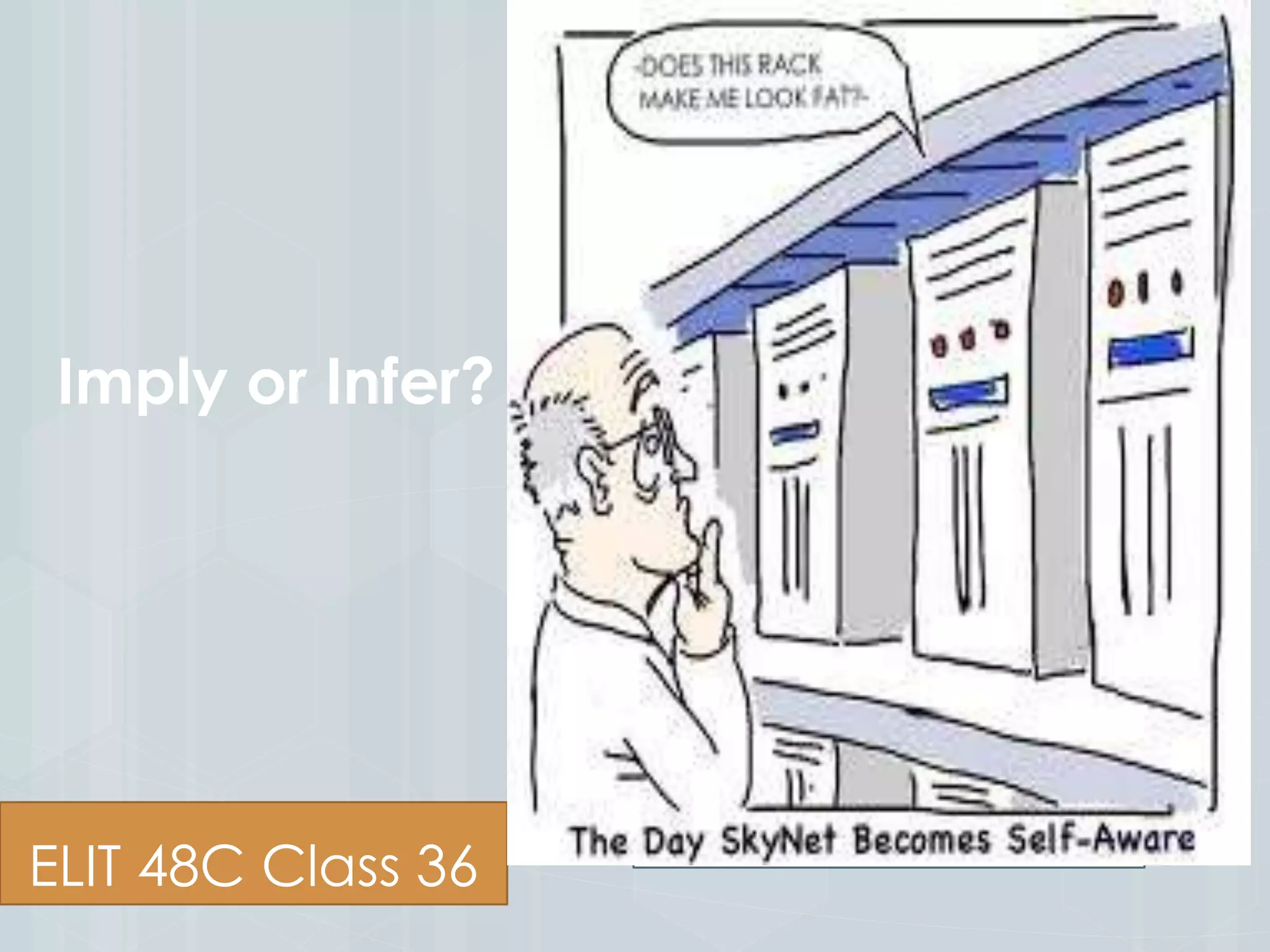
Imply or Infer?
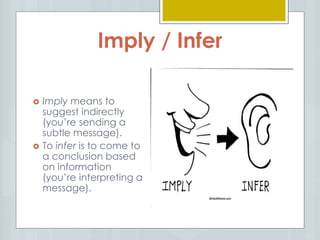
Imply / Infer
 Imply means to
suggest indirectly
(you’re sending a
subtle message).
 To infer is to come to
a conclusion based
on information
(you’re interpreting a
message).
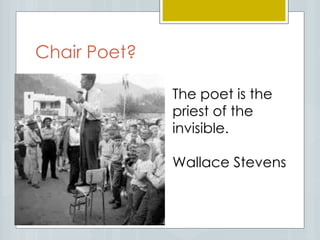
Chair Poet?
The poet is the
priest of the
invisible.
Wallace Stevens
AGENDA
La conciencia de la mestiza/
Towards a New Consciousness
“El Sonavabitche”
 Postmodernism and Intersections
of identity and oppression
Discuss
Five minutes!
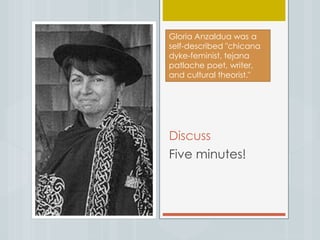
Gloria Anzaldua was a
self-described "chicana
dyke-feminist, tejana
patlache poet, writer,
and cultural theorist."
Intersections of identity and oppression
As a Mestiza I have no country, my homeland cast me out; yet all
countries are mine because I am every woman’s sister or potential
lover. (As a lesbian I have no race, my own people disclaim me; but I
am all races because there is the queer of me in all races.) I am
cultureless because, as a feminist, I challenge the collective
cultural/religious male-derived beliefs of Indo-Hispanics and Anglos,
yet I am cultured because I am participating in the creation of yet
another culture, a new story to explain the world and our
participation in it, a new value system with images and symbols that
connect us to each other and to the planet. Soy un amasamiento, I
am an act of kneading, of uniting, and joining that not only has
produced both a creature of darkness and a creature of light, but also
a creature that questions the definitions of light and dark and gives
them new meanings. (841)
 Gloria Anzaldua is among the many feminist theorists that
move into the realm of addressing postmodern
identities. In her discussion of a new emerging
consciousness in La conciencia de la mestiza: Towards a
New Consciousness, Anzaldua suggests the construction of
identities as multiple, hybrid, and more specifically,
created as a result of the Borderlands, those spaces that
intersect. While the people who live in the intersections
are privy to a world others don’t see or understand, it is a
space where cultures collide, often with incompatible
values, opposing histories, and contradictory experiences.
It can be difficult to be an individual, or member, of several
social, classed, gendered, racialized groups but never
feeling quite at home in either.
An example of the contradictions of which she speaks is through a brief
discussion of the identities of women of color. For instance, if an
African-American woman advocates for women’s rights, does this
mean that femininity and the struggle against gender oppression takes
precedence over her racial identity and her struggle against
colonization and racial oppression?
The inverse question can also be asked. If an African-American woman
of color takes a political stance for the end of her racial oppression,
does this mean that she devalues her experience as being oppressed
by her gender identity?
Anzaldua makes a plea to feminists to bridge identities and to
understand identities as always being constituted in the Borderlands.
The sorting out the contradictions embedded between these social
identities requires a tolerance for ambiguity.
Discuss Postmodernism, or Feminist Theory, or
Minority Theory in terms of Anzuldua
 Multiple Languages
 Not understanding
 Mixed Genres
 Embracing change
 Acknowledging difference
 Blended Identities
 Living in ambiguity
 Living a narrative of fragmentation—not a neat
beginning, middle, and end.
Language and Postmodernism
1. Q: How does using Spanish in her work
help Anzaldua give her theories more
depth than just using English?
2. How does Anzaldua’s use of “Spanglish”
affect the reader of her works?
3. How does Anzaldua’s use of Spanish
support of take away from her writing?
4. Q: Is Anzaldua writing in both English and
Spanish to describe how she is mixed and
struggling in both worlds?
Queerness and Postmodernism
 Q: Can the same transcendent social power
with which Anzaldua imbues queerness be
found in another groups? Can it be found in
every person? Does Anzaldua inadvertently
invoke a binary opposition between queer
and non-queer, or Chicana and “other”?
 Q: Why did Anzaldua say “colored
homosexuals have more knowledge of other
cultures” (844) when she refers to herself as
“cultureless” ? (841).
Blended Identity
 Q: Does Anzaldua feel more empowered or
marginalized by her status as a mestiza?
 Q: Can a person who is fighting for the rights
of humanity labeled as one ethnic make, be
a mestizo?
 Q: How is Gloria Anzaldua’s La conciencia
the answer or solution to the problems
presented in W.E.B Du Bois’s The Souls of Black
Folk?
Discuss themes or meaning in
“El Sonavabitche”
 The obvious themes in the poems are inequality,
race, machismo, immigration, identity, and
chicanismo.
 “El Sonavabitche” documents and comments on
the unjust treatment and advantages taken of
undocumented field workers. One theme I find
interesting is the way the law is manipulated as a
means of profiting in the poem.
 El Sonavabitche discusses the theme of power
within the context of immigration. Many people
have this power, the power of citizenship.
QHQ: “La Conciencia de la
Mestiza” and Patriarchy
 What does Gloria Anzaldua mean by “the new
man needs a movement?” (844)
 Q: How can men break free from being “fettered
to gender roles” (Andzaldua 844)? And what can
we do to make this a men’s issue while being
sensitive to women, feminists and people who
identify as LGBTQIA?
 Q: Anzaldua calls white conventions patriarchal,
but weren’t all old cultures patriarchal in some
way?
Author Introduction: Maxine Hong
Kingston
 Maxine "Ting Ting" Hong Kingston grew up in a
working-class neighborhood in Stockton,
California. Born in 1940 to Tom Hong and Brave
Orchid, Kingston is the oldest of her parents' six
American-born children. Kingston's parents serve
as the primary sources for the imaginative stories
she writes. Part 1 of Kingston’s autobiography
Warrior Woman is “No Name Woman,” a secret
story of an aunt from China that she never knew
she had.
HOMEWORK
 Read Maxine Hong Kingston
 Warrior Woman: Part 1 “No Name Woman
793-801
 Post #35: Choose one
 Discuss a theme or symbol from the reading
 QHQ
 Comment on the text via a critical lens.

Elit 48 c class 36 post qhq

  • 1.
    ELIT 48C Class36 Imply or Infer?
  • 2.
    Imply / Infer Imply means to suggest indirectly (you’re sending a subtle message).  To infer is to come to a conclusion based on information (you’re interpreting a message).
  • 3.
    Chair Poet? The poetis the priest of the invisible. Wallace Stevens
  • 4.
    AGENDA La conciencia dela mestiza/ Towards a New Consciousness “El Sonavabitche”  Postmodernism and Intersections of identity and oppression
  • 5.
    Discuss Five minutes! Gloria Anzalduawas a self-described "chicana dyke-feminist, tejana patlache poet, writer, and cultural theorist."
  • 6.
    Intersections of identityand oppression As a Mestiza I have no country, my homeland cast me out; yet all countries are mine because I am every woman’s sister or potential lover. (As a lesbian I have no race, my own people disclaim me; but I am all races because there is the queer of me in all races.) I am cultureless because, as a feminist, I challenge the collective cultural/religious male-derived beliefs of Indo-Hispanics and Anglos, yet I am cultured because I am participating in the creation of yet another culture, a new story to explain the world and our participation in it, a new value system with images and symbols that connect us to each other and to the planet. Soy un amasamiento, I am an act of kneading, of uniting, and joining that not only has produced both a creature of darkness and a creature of light, but also a creature that questions the definitions of light and dark and gives them new meanings. (841)
  • 7.
     Gloria Anzalduais among the many feminist theorists that move into the realm of addressing postmodern identities. In her discussion of a new emerging consciousness in La conciencia de la mestiza: Towards a New Consciousness, Anzaldua suggests the construction of identities as multiple, hybrid, and more specifically, created as a result of the Borderlands, those spaces that intersect. While the people who live in the intersections are privy to a world others don’t see or understand, it is a space where cultures collide, often with incompatible values, opposing histories, and contradictory experiences. It can be difficult to be an individual, or member, of several social, classed, gendered, racialized groups but never feeling quite at home in either.
  • 8.
    An example ofthe contradictions of which she speaks is through a brief discussion of the identities of women of color. For instance, if an African-American woman advocates for women’s rights, does this mean that femininity and the struggle against gender oppression takes precedence over her racial identity and her struggle against colonization and racial oppression? The inverse question can also be asked. If an African-American woman of color takes a political stance for the end of her racial oppression, does this mean that she devalues her experience as being oppressed by her gender identity? Anzaldua makes a plea to feminists to bridge identities and to understand identities as always being constituted in the Borderlands. The sorting out the contradictions embedded between these social identities requires a tolerance for ambiguity.
  • 9.
    Discuss Postmodernism, orFeminist Theory, or Minority Theory in terms of Anzuldua  Multiple Languages  Not understanding  Mixed Genres  Embracing change  Acknowledging difference  Blended Identities  Living in ambiguity  Living a narrative of fragmentation—not a neat beginning, middle, and end.
  • 10.
    Language and Postmodernism 1.Q: How does using Spanish in her work help Anzaldua give her theories more depth than just using English? 2. How does Anzaldua’s use of “Spanglish” affect the reader of her works? 3. How does Anzaldua’s use of Spanish support of take away from her writing? 4. Q: Is Anzaldua writing in both English and Spanish to describe how she is mixed and struggling in both worlds?
  • 11.
    Queerness and Postmodernism Q: Can the same transcendent social power with which Anzaldua imbues queerness be found in another groups? Can it be found in every person? Does Anzaldua inadvertently invoke a binary opposition between queer and non-queer, or Chicana and “other”?  Q: Why did Anzaldua say “colored homosexuals have more knowledge of other cultures” (844) when she refers to herself as “cultureless” ? (841).
  • 12.
    Blended Identity  Q:Does Anzaldua feel more empowered or marginalized by her status as a mestiza?  Q: Can a person who is fighting for the rights of humanity labeled as one ethnic make, be a mestizo?  Q: How is Gloria Anzaldua’s La conciencia the answer or solution to the problems presented in W.E.B Du Bois’s The Souls of Black Folk?
  • 13.
    Discuss themes ormeaning in “El Sonavabitche”  The obvious themes in the poems are inequality, race, machismo, immigration, identity, and chicanismo.  “El Sonavabitche” documents and comments on the unjust treatment and advantages taken of undocumented field workers. One theme I find interesting is the way the law is manipulated as a means of profiting in the poem.  El Sonavabitche discusses the theme of power within the context of immigration. Many people have this power, the power of citizenship.
  • 14.
    QHQ: “La Concienciade la Mestiza” and Patriarchy  What does Gloria Anzaldua mean by “the new man needs a movement?” (844)  Q: How can men break free from being “fettered to gender roles” (Andzaldua 844)? And what can we do to make this a men’s issue while being sensitive to women, feminists and people who identify as LGBTQIA?  Q: Anzaldua calls white conventions patriarchal, but weren’t all old cultures patriarchal in some way?
  • 15.
    Author Introduction: MaxineHong Kingston  Maxine "Ting Ting" Hong Kingston grew up in a working-class neighborhood in Stockton, California. Born in 1940 to Tom Hong and Brave Orchid, Kingston is the oldest of her parents' six American-born children. Kingston's parents serve as the primary sources for the imaginative stories she writes. Part 1 of Kingston’s autobiography Warrior Woman is “No Name Woman,” a secret story of an aunt from China that she never knew she had.
  • 16.
    HOMEWORK  Read MaxineHong Kingston  Warrior Woman: Part 1 “No Name Woman 793-801  Post #35: Choose one  Discuss a theme or symbol from the reading  QHQ  Comment on the text via a critical lens.