ELISA(enzyme linked
Immunosorbent
assay)
Presented By: Mohammad Zia Ullah
Reg. No.:22-ARID-3693
Subject Title: Soil Science
Presented To:Dr shujaat Hussain
Introduction
• ELISA (Enzyme-Linked Immunosorbent Assay) is a
biochemical technique used to detect and
quantify the presence of specific proteins,
antibodies, or antigens in a sample.
• It's a plate-based assay that uses enzymes to
detect immune responses, where an enzyme is
linked to an antibody or antigen, which binds
to a specific protein or molecule, producing a
colored or fluorescent signal that can be
measured.
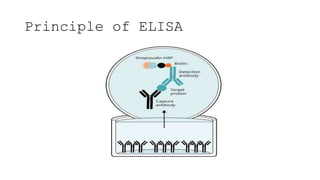
Principle of ELISA
Types of ELISA
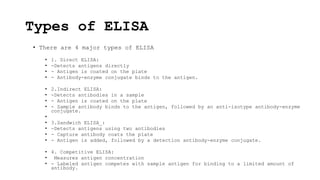
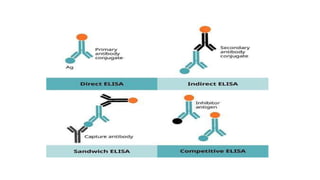
• There are 4 major types of ELISA
• 1. Direct ELISA:
• -Detects antigens directly
• - Antigen is coated on the plate
• - Antibody-enzyme conjugate binds to the antigen.
• 2.Indirect ELISA:
• -Detects antibodies in a sample
• - Antigen is coated on the plate
• - Sample antibody binds to the antigen, followed by an anti-isotype antibody-enzyme
conjugate.
•
• 3.Sandwich ELISA_:
• -Detects antigens using two antibodies
• - Capture antibody coats the plate
• - Antigen is added, followed by a detection antibody-enzyme conjugate.
• 4. Competitive ELISA:
• Measures antigen concentration
• - Labeled antigen competes with sample antigen for binding to a limited amount of
antibody.
Steps Involved
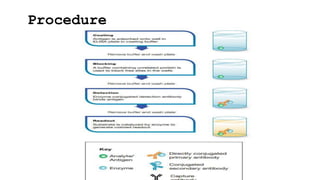
• The major steps involved in the process of ELISA (Enzyme-Linked
Immunosorbent Assay) are:
• - Plate Preparation
• -Sample Preparation:
• -Sample Addition
• -Incubation
• -Washing
• -Enzyme Conjugate Addition
• -Incubation
• -Washing
• -Substrate Addition
• -Incubation:
• -Stop Reaction
• -Measurement
Procedure
Application
• There are several applications of ELISA in
field
• -Diagnosis of Diseases
• -Vaccine Development and Quality Control
• -Food Safety and Quality Control
• -Environmental Monitoring
• -Research and Development
• -Quality Control in Biotechnology
Limitations
• Here are some limitations of ELISA:-
• -Specificity
• -Sensitivity
• -Interference
• -Time consuming
• -Enzyme instability
• -Operator dependent
• -Equipment requirements
• -Cost
Conclusion
• In conclusion, ELISA is a powerful and widely
used immunoassay technique that has
revolutionized the field of diagnostics,
research, and quality control. Its high
sensitivity, specificity, and versatility make
it an essential tool in various industries. We
have explored the principles, types,
applications, and limitations of ELISA,
highlighting its importance in detecting and
quantifying antigens, antibodies, and proteins.
Thank you.
Any Question?

ELISA (Enzyme linked immunosorbent Assay

  • 1.
    ELISA(enzyme linked Immunosorbent assay) Presented By:Mohammad Zia Ullah Reg. No.:22-ARID-3693 Subject Title: Soil Science Presented To:Dr shujaat Hussain
  • 2.
    Introduction • ELISA (Enzyme-LinkedImmunosorbent Assay) is a biochemical technique used to detect and quantify the presence of specific proteins, antibodies, or antigens in a sample. • It's a plate-based assay that uses enzymes to detect immune responses, where an enzyme is linked to an antibody or antigen, which binds to a specific protein or molecule, producing a colored or fluorescent signal that can be measured.
  • 3.
  • 4.
    Types of ELISA •There are 4 major types of ELISA • 1. Direct ELISA: • -Detects antigens directly • - Antigen is coated on the plate • - Antibody-enzyme conjugate binds to the antigen. • 2.Indirect ELISA: • -Detects antibodies in a sample • - Antigen is coated on the plate • - Sample antibody binds to the antigen, followed by an anti-isotype antibody-enzyme conjugate. • • 3.Sandwich ELISA_: • -Detects antigens using two antibodies • - Capture antibody coats the plate • - Antigen is added, followed by a detection antibody-enzyme conjugate. • 4. Competitive ELISA: • Measures antigen concentration • - Labeled antigen competes with sample antigen for binding to a limited amount of antibody.
  • 6.
    Steps Involved • Themajor steps involved in the process of ELISA (Enzyme-Linked Immunosorbent Assay) are: • - Plate Preparation • -Sample Preparation: • -Sample Addition • -Incubation • -Washing • -Enzyme Conjugate Addition • -Incubation • -Washing • -Substrate Addition • -Incubation: • -Stop Reaction • -Measurement
  • 7.
  • 8.
    Application • There areseveral applications of ELISA in field • -Diagnosis of Diseases • -Vaccine Development and Quality Control • -Food Safety and Quality Control • -Environmental Monitoring • -Research and Development • -Quality Control in Biotechnology
  • 9.
    Limitations • Here aresome limitations of ELISA:- • -Specificity • -Sensitivity • -Interference • -Time consuming • -Enzyme instability • -Operator dependent • -Equipment requirements • -Cost
  • 10.
    Conclusion • In conclusion,ELISA is a powerful and widely used immunoassay technique that has revolutionized the field of diagnostics, research, and quality control. Its high sensitivity, specificity, and versatility make it an essential tool in various industries. We have explored the principles, types, applications, and limitations of ELISA, highlighting its importance in detecting and quantifying antigens, antibodies, and proteins.
  • 11.