ELISA
BASICS
IVDW
September 29, 2005


Courtesy of:
Brett Roberts
Agdia, Inc.

      agdia
ELISA
Enzyme Linked Immuno-Sorbent
Assay
ELISA – an immunological test, using an enzyme
as a label to determine presence of target protein.

•The enzyme linkage or labeling allows you to
follow your target protein and if present (qualify)
and at what amounts (quantify).

•An enzyme conjugate is an enzyme bound or
joined with an antibody which binds with your
target protein. This enzyme labeling is a safe and
effective way to track your antibody.
Components
Antigen


• Any substance that stimulates an
immune response.

• The antigen is your target protein
which comes from your sample
extract. Example: Bt protein in corn
sample. The antigen binds to the
antibody.
Components
Antibody

• An antibody is a protein
made in response to an
antigen.

• Each antibody binds only to
its antigen.
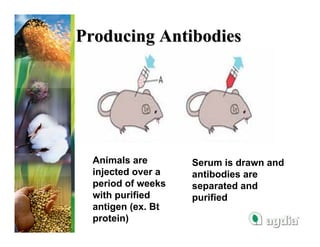
Producing Antibodies


  Animals are       Serum is drawn and
  injected over a   antibodies are
  period of weeks   separated and
  with purified     purified
  antigen (ex. Bt
  protein)
Components
Enzyme Conjugate

An enzyme conjugate (EC) is an
antibody joined with an enzyme.
Enzyme labeling allows the
researcher to follow the antibody.
This joining of the enzyme to
antibody is often called conjugation.
Enzyme Function

Enzymes are proteins that speed up the rate
of a chemical reaction without being used up
and usually react only to particular substrates.
The rate of this reaction is proportional to the
amount of enzyme present. In the case of
non-competitive ELISA, the more binding
you have of the enzyme conjugate to the
antigen, the stronger your color development
will be.
Substrate Function

A substrate is a compound or
substance that undergoes change.
Substrates bind to active sites on
the surface of enzymes and are
converted or changed. In ELISA
the specific substrate used
changes color.
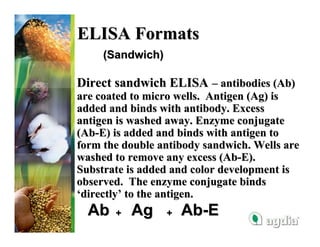
ELISA Formats
     (Sandwich)

Direct sandwich ELISA – antibodies (Ab)
are coated to micro wells. Antigen (Ag) is
added and binds with antibody. Excess
antigen is washed away. Enzyme conjugate
(Ab-E) is added and binds with antigen to
form the double antibody sandwich. Wells are
washed to remove any excess (Ab-E).
Substrate is added and color development is
observed. The enzyme conjugate binds
‘directly’ to the antigen.
  Ab   +   Ag     +   Ab-E
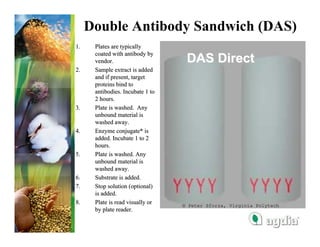
Double Antibody Sandwich (DAS)
1.    Plates are typically
      coated with antibody by
      vendor.                      DAS Direct
2.    Sample extract is added
      and if present, target
      proteins bind to
      antibodies. Incubate 1 to
      2 hours.
3.    Plate is washed. Any
      unbound material is
      washed away.
4.    Enzyme conjugate* is
      added. Incubate 1 to 2
      hours.
5.    Plate is washed. Any
      unbound material is
      washed away.
6.    Substrate is added.
7.    Stop solution (optional)
      is added.
8.    Plate is read visually or   © Peter Sforza, Virginia Polytech
      by plate reader.
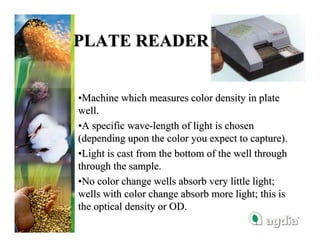
PLATE READER


•Machine which measures color density in plate
well.
•A specific wave-length of light is chosen
(depending upon the color you expect to capture).
•Light is cast from the bottom of the well through
through the sample.
•No color change wells absorb very little light;
wells with color change absorb more light; this is
the optical density or OD.
Reading plates

•Select proper wave-length on machine.
• Carefully wipe bottom of plate to remove
excess moisture. Plates that are wet may
diffuse your light source, giving inaccurate
readings.
•Mix the plate. This will distribute color
evenly. Some machines have a ‘mix’ setting.
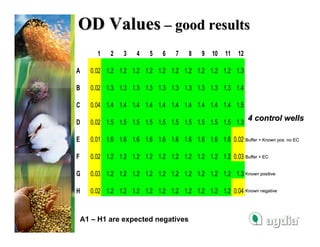
OD Values – good results
        1    2   3    4   5    6   7    8    9   10   11   12

A     0.02 1.2 1.2 1.2 1.2 1.2 1.2 1.2 1.2 1.2 1.2 1.3

B     0.02 1.3 1.3 1.3 1.3 1.3 1.3 1.3 1.3 1.3 1.3 1.4

C     0.04 1.4 1.4 1.4 1.4 1.4 1.4 1.4 1.4 1.4 1.4 1.5

D     0.02 1.5 1.5 1.5 1.5 1.5 1.5 1.5 1.5 1.5 1.5 1.3
                                                       4 control wells

E     0.01 1.6 1.6 1.6 1.6 1.6 1.6 1.6 1.6 1.6 1.6 0.02 Buffer + Known pos   no EC


F     0.02 1.2 1.2 1.2 1.2 1.2 1.2 1.2 1.2 1.2 1.2 0.03 Buffer + EC

G     0.03 1.2 1.2 1.2 1.2 1.2 1.2 1.2 1.2 1.2 1.2 1.3 Known positive

H     0.02 1.2 1.2 1.2 1.2 1.2 1.2 1.2 1.2 1.2 1.2 0.04 Known negative


    A1 – H1 are expected negatives
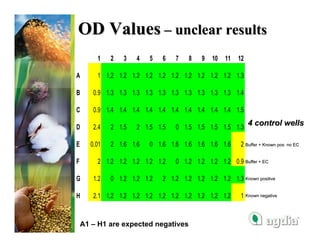
OD Values – unclear results
        1    2   3   4   5   6   7    8   9   10   11   12

A       1 1.2 1.2 1.2 1.2 1.2 1.2 1.2 1.2 1.2 1.2 1.3

B      0.9 1.3 1.3 1.3 1.3 1.3 1.3 1.3 1.3 1.3 1.3 1.4

C      0.9 1.4 1.4 1.4 1.4 1.4 1.4 1.4 1.4 1.4 1.4 1.5

D      2.4   2 1.5   2 1.5 1.5   0 1.5 1.5 1.5 1.5 1.3
                                                       4 control wells

E     0.01   2 1.6 1.6   0 1.6 1.6 1.6 1.6 1.6 1.6      2 Buffer + Known pos   no EC


F       2 1.2 1.2 1.2 1.2 1.2    0 1.2 1.2 1.2 1.2 0.9 Buffer + EC

G      1.2   0 1.2 1.2 1.2   2 1.2 1.2 1.2 1.2 1.2 1.3 Known positive

H      2.1 1.2 1.2 1.2 1.2 1.2 1.2 1.2 1.2 1.2 1.2      1 Known negative


    A1 – H1 are expected negatives
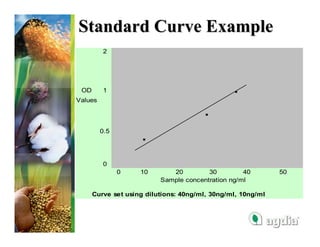
Standard Curve Example
         2


 OD      1                                      .
Values

                                       .
         0.5
                     .
         0
               0    10       20         30         40        50
                          Sample concentration ng/ml

      Curve set using dilutions: 40ng/ml, 30ng/ml, 10ng/ml
Questions?
Thank You

   agdia

Elisa basics[2]

  • 1.
    ELISA BASICS IVDW September 29, 2005 Courtesyof: Brett Roberts Agdia, Inc. agdia
  • 2.
    ELISA Enzyme Linked Immuno-Sorbent Assay ELISA– an immunological test, using an enzyme as a label to determine presence of target protein. •The enzyme linkage or labeling allows you to follow your target protein and if present (qualify) and at what amounts (quantify). •An enzyme conjugate is an enzyme bound or joined with an antibody which binds with your target protein. This enzyme labeling is a safe and effective way to track your antibody.
  • 3.
    Components Antigen • Any substancethat stimulates an immune response. • The antigen is your target protein which comes from your sample extract. Example: Bt protein in corn sample. The antigen binds to the antibody.
  • 4.
    Components Antibody • An antibodyis a protein made in response to an antigen. • Each antibody binds only to its antigen.
  • 5.
    Producing Antibodies Animals are Serum is drawn and injected over a antibodies are period of weeks separated and with purified purified antigen (ex. Bt protein)
  • 6.
    Components Enzyme Conjugate An enzymeconjugate (EC) is an antibody joined with an enzyme. Enzyme labeling allows the researcher to follow the antibody. This joining of the enzyme to antibody is often called conjugation.
  • 7.
    Enzyme Function Enzymes areproteins that speed up the rate of a chemical reaction without being used up and usually react only to particular substrates. The rate of this reaction is proportional to the amount of enzyme present. In the case of non-competitive ELISA, the more binding you have of the enzyme conjugate to the antigen, the stronger your color development will be.
  • 8.
    Substrate Function A substrateis a compound or substance that undergoes change. Substrates bind to active sites on the surface of enzymes and are converted or changed. In ELISA the specific substrate used changes color.
  • 9.
    ELISA Formats (Sandwich) Direct sandwich ELISA – antibodies (Ab) are coated to micro wells. Antigen (Ag) is added and binds with antibody. Excess antigen is washed away. Enzyme conjugate (Ab-E) is added and binds with antigen to form the double antibody sandwich. Wells are washed to remove any excess (Ab-E). Substrate is added and color development is observed. The enzyme conjugate binds ‘directly’ to the antigen. Ab + Ag + Ab-E
  • 10.
    Double Antibody Sandwich(DAS) 1. Plates are typically coated with antibody by vendor. DAS Direct 2. Sample extract is added and if present, target proteins bind to antibodies. Incubate 1 to 2 hours. 3. Plate is washed. Any unbound material is washed away. 4. Enzyme conjugate* is added. Incubate 1 to 2 hours. 5. Plate is washed. Any unbound material is washed away. 6. Substrate is added. 7. Stop solution (optional) is added. 8. Plate is read visually or © Peter Sforza, Virginia Polytech by plate reader.
  • 11.
    PLATE READER •Machine whichmeasures color density in plate well. •A specific wave-length of light is chosen (depending upon the color you expect to capture). •Light is cast from the bottom of the well through through the sample. •No color change wells absorb very little light; wells with color change absorb more light; this is the optical density or OD.
  • 12.
    Reading plates •Select properwave-length on machine. • Carefully wipe bottom of plate to remove excess moisture. Plates that are wet may diffuse your light source, giving inaccurate readings. •Mix the plate. This will distribute color evenly. Some machines have a ‘mix’ setting.
  • 13.
    OD Values –good results 1 2 3 4 5 6 7 8 9 10 11 12 A 0.02 1.2 1.2 1.2 1.2 1.2 1.2 1.2 1.2 1.2 1.2 1.3 B 0.02 1.3 1.3 1.3 1.3 1.3 1.3 1.3 1.3 1.3 1.3 1.4 C 0.04 1.4 1.4 1.4 1.4 1.4 1.4 1.4 1.4 1.4 1.4 1.5 D 0.02 1.5 1.5 1.5 1.5 1.5 1.5 1.5 1.5 1.5 1.5 1.3 4 control wells E 0.01 1.6 1.6 1.6 1.6 1.6 1.6 1.6 1.6 1.6 1.6 0.02 Buffer + Known pos no EC F 0.02 1.2 1.2 1.2 1.2 1.2 1.2 1.2 1.2 1.2 1.2 0.03 Buffer + EC G 0.03 1.2 1.2 1.2 1.2 1.2 1.2 1.2 1.2 1.2 1.2 1.3 Known positive H 0.02 1.2 1.2 1.2 1.2 1.2 1.2 1.2 1.2 1.2 1.2 0.04 Known negative A1 – H1 are expected negatives
  • 14.
    OD Values –unclear results 1 2 3 4 5 6 7 8 9 10 11 12 A 1 1.2 1.2 1.2 1.2 1.2 1.2 1.2 1.2 1.2 1.2 1.3 B 0.9 1.3 1.3 1.3 1.3 1.3 1.3 1.3 1.3 1.3 1.3 1.4 C 0.9 1.4 1.4 1.4 1.4 1.4 1.4 1.4 1.4 1.4 1.4 1.5 D 2.4 2 1.5 2 1.5 1.5 0 1.5 1.5 1.5 1.5 1.3 4 control wells E 0.01 2 1.6 1.6 0 1.6 1.6 1.6 1.6 1.6 1.6 2 Buffer + Known pos no EC F 2 1.2 1.2 1.2 1.2 1.2 0 1.2 1.2 1.2 1.2 0.9 Buffer + EC G 1.2 0 1.2 1.2 1.2 2 1.2 1.2 1.2 1.2 1.2 1.3 Known positive H 2.1 1.2 1.2 1.2 1.2 1.2 1.2 1.2 1.2 1.2 1.2 1 Known negative A1 – H1 are expected negatives
  • 15.
    Standard Curve Example 2 OD 1 . Values . 0.5 . 0 0 10 20 30 40 50 Sample concentration ng/ml Curve set using dilutions: 40ng/ml, 30ng/ml, 10ng/ml
  • 16.
  • 17.