MICRO CONTROLLER BASED
ELISA READER
By
P. Mahender Babu(10PQ1A0474)
G.Shyam Kumar(10PQ1A04A2)
OVERVIEW
• Objective
• Introduction
• Principle of Operation
• Description of the System
• Block Diagram
• Interfacing Stepper Motor with Microcontroller
• Elisa data from Three different patients
• Elisa Reader
• Applications of Elisa Reader
• Scope of Development
Introduction
Why known as ......ELISA?
ELISA is the abbreviation of Enzyme-Linked Immuno Sorbent
Assay
• Antigen of interest is absorbed on to plastic surface
(“sorbent”)
• Antigen is recognised by specific antibody (“immuno”)
• This antibody is recognised by second antibody (“immuno”)
which has enzyme attached (“enzyme- linked”)
• Substrate reacts with enzyme to produce product, usually
coloured.
ANTIGEN (Ag)
• Any molecule that induces
production of antibodies When
introduced in the body of an
animal is called antigen.
e.g. bacteria, viruses
ANTIBODY ( Ab)
• Proteins produced by the immune
system which help defend against
antigens.
e.g. lymphocytes
SYMBOL FOR ANTIBODY
SYMBOL FOR ANTIGEN
PRINCIPLE OF OPERATION
• It is based on the principle of Spectrophotometry
• A spectrophotometer is an instrument that measures the
amount of light absorbed by a sample.
DESCRIPTION OF THE SYSTEM
• Elisa Plate-Flat or bottomed 96 wells micro plate
• Light source: tungsten - halogen lamp
• Optical system: Grating Monochromator
• Optical Fibre
• MicroControllers-8051F124,ATMEL 89C52
• DRIVER IC 5804
• Detector: Photo diode
• Display: 24*2 line alphanumeric LCD
• Power supply: 230+-10% Ac, 50 Hz
• 2 Stepper Motors
Elisa Plate
•The equipment of ELISA consists of a micro-
plate which consists 96 wells. The wells are
arranged in the form of 8 rows and 12 columns.
By this arrangement we can detect 96 samples at
a time.
•Marked on one side alphabetically
•Numerically on the other side
Tungsten Lamp
This lamp consists of a tungsten filament enclosed in
a glass envelope, with a wavelength range of about
330 to 900 nm, are used for the visible region. It has
long life about 1200h.
Monochromator
Accepts polychromatic
input light from a lamp
and outputs
monochromatic light.
Optical Fibers
• Fibre optics (optical fibers) are long, thin
strands of very pure glass about the
diameter of a human hair. They are arranged
in bundles called optical cables and used to
transmit light signals over long distances.
It has the following parts:
• Core - Thin glass center of the fiber where
the light travels
• Cladding - Outer optical material
surrounding the core that reflects the light
back into the core
• Buffer coating - Plastic coating that protects
the fiber from damage and moisture
Micro Controller 8051F124
Thin Quad Flat Pack (TQFP)
MICROCONTROLLER C8051F124
Specifications:
• Core Processor: 8051
• Program Memory Size: l28k bytes of in-system programmable FLASH
memory
• RAM Size: 8448 (8k + 256) bytes of on-chip RAM
• Number of I /O: 64
• Package / Case: 100-TQFP
• Speed: 50MHz
• Oscillator Type: Internal
• Packaging: Tray
• Program Memory Type: FLASH ; EEPROM
• Data Converters: A/D 8x8b, 8x12b; D/A 2x12b
• Operating Temperature: -40°C ~ 85°C
• Connectivity: EBI/EMI, SMBus (2-Wire/I²C), SPI, UART/USART
• Peripherals: Brown-out Detect/Reset, POR, PWM, Temp Sensor, WDT
• Voltage - Supply (Vcc/Vdd): 2.7 V ~ 3.6 V
Microcontroller ATMEL AT89C52
• Compatible with MCS-5l Products
• 8k bytes of In-System Reprogrammable Flash Memory .
• Endurance: 1,000 Write/Erase Cycles
• Fully Static Operation: 0 Hz to 24 MHz
• Three-level Program Memory Lock.
• 256*8 -bit Internal RAM.
• 32 Programmable I/O Lines .
• Three 16-bit Timer/Counters .
• Eight Interrupt Sources .
• Programmable Serial Channel.
• Low-power Idle and Power-down Mode
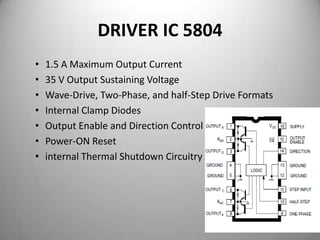
DRIVER IC 5804
• 1.5 A Maximum Output Current
• 35 V Output Sustaining Voltage
• Wave-Drive, Two-Phase, and half-Step Drive Formats
• Internal Clamp Diodes
• Output Enable and Direction Control
• Power-ON Reset
• internal Thermal Shutdown Circuitry
Silicon PIN Photodiodes
Photovoltaic V-Series
• Designed for low-noise, D.C. to
medium bandwidth
applications. Active areas range
from .31mm² to 100mm².
Applications include: low light
level measurements, particle
counting, chemical and
analytical measurement and
detection.
Display: 24*2 line alphanumeric LCD
Elisa data from Three different
patients
Positive
Control
Patient A Patient B Patient C
1.689 0.055 0.412 1.999
ELISA READER
Instrumentation Division (E.C.I.L)
APPLICATIONS OF ELISA READER
• Screening donated blood for evidence of viral contamination by
– Presence of HIV antibodies in blood.
– Mycobacterial antibodies in tuberculosis.
• Screening of viral and bacterial Infections
• Detection of Hepatitis B markers in serum.
• Detection of rotavirus in faeces.
• Measuring hormone levels
– HCG (as a test for pregnancy)
– LH (determining the time of ovulation)
– TSH, T3 and T4 (for thyroid function)
SCOPE FOR DEVELOPMENT:
• Using proper interface devices it can be
controlled through a computer.
DISADVANTAGE:
• Requires spectrophotometric plate reader.
REFERENCES
• www.techno2know.com
• http://www.silabs.com/
• www.tecan.com
• www.maxima.in.com
Any Queries ?

Microcontroller based ELISA Reader

  • 1.
    MICRO CONTROLLER BASED ELISAREADER By P. Mahender Babu(10PQ1A0474) G.Shyam Kumar(10PQ1A04A2)
  • 2.
    OVERVIEW • Objective • Introduction •Principle of Operation • Description of the System • Block Diagram • Interfacing Stepper Motor with Microcontroller • Elisa data from Three different patients • Elisa Reader • Applications of Elisa Reader • Scope of Development
  • 3.
    Introduction Why known as......ELISA? ELISA is the abbreviation of Enzyme-Linked Immuno Sorbent Assay • Antigen of interest is absorbed on to plastic surface (“sorbent”) • Antigen is recognised by specific antibody (“immuno”) • This antibody is recognised by second antibody (“immuno”) which has enzyme attached (“enzyme- linked”) • Substrate reacts with enzyme to produce product, usually coloured.
  • 4.
    ANTIGEN (Ag) • Anymolecule that induces production of antibodies When introduced in the body of an animal is called antigen. e.g. bacteria, viruses ANTIBODY ( Ab) • Proteins produced by the immune system which help defend against antigens. e.g. lymphocytes SYMBOL FOR ANTIBODY SYMBOL FOR ANTIGEN
  • 5.
    PRINCIPLE OF OPERATION •It is based on the principle of Spectrophotometry • A spectrophotometer is an instrument that measures the amount of light absorbed by a sample.
  • 7.
    DESCRIPTION OF THESYSTEM • Elisa Plate-Flat or bottomed 96 wells micro plate • Light source: tungsten - halogen lamp • Optical system: Grating Monochromator • Optical Fibre • MicroControllers-8051F124,ATMEL 89C52 • DRIVER IC 5804 • Detector: Photo diode • Display: 24*2 line alphanumeric LCD • Power supply: 230+-10% Ac, 50 Hz • 2 Stepper Motors
  • 8.
    Elisa Plate •The equipmentof ELISA consists of a micro- plate which consists 96 wells. The wells are arranged in the form of 8 rows and 12 columns. By this arrangement we can detect 96 samples at a time. •Marked on one side alphabetically •Numerically on the other side
  • 9.
    Tungsten Lamp This lampconsists of a tungsten filament enclosed in a glass envelope, with a wavelength range of about 330 to 900 nm, are used for the visible region. It has long life about 1200h. Monochromator Accepts polychromatic input light from a lamp and outputs monochromatic light.
  • 10.
    Optical Fibers • Fibreoptics (optical fibers) are long, thin strands of very pure glass about the diameter of a human hair. They are arranged in bundles called optical cables and used to transmit light signals over long distances. It has the following parts: • Core - Thin glass center of the fiber where the light travels • Cladding - Outer optical material surrounding the core that reflects the light back into the core • Buffer coating - Plastic coating that protects the fiber from damage and moisture
  • 11.
    Micro Controller 8051F124 ThinQuad Flat Pack (TQFP)
  • 12.
    MICROCONTROLLER C8051F124 Specifications: • CoreProcessor: 8051 • Program Memory Size: l28k bytes of in-system programmable FLASH memory • RAM Size: 8448 (8k + 256) bytes of on-chip RAM • Number of I /O: 64 • Package / Case: 100-TQFP • Speed: 50MHz • Oscillator Type: Internal • Packaging: Tray • Program Memory Type: FLASH ; EEPROM • Data Converters: A/D 8x8b, 8x12b; D/A 2x12b • Operating Temperature: -40°C ~ 85°C • Connectivity: EBI/EMI, SMBus (2-Wire/I²C), SPI, UART/USART • Peripherals: Brown-out Detect/Reset, POR, PWM, Temp Sensor, WDT • Voltage - Supply (Vcc/Vdd): 2.7 V ~ 3.6 V
  • 13.
    Microcontroller ATMEL AT89C52 •Compatible with MCS-5l Products • 8k bytes of In-System Reprogrammable Flash Memory . • Endurance: 1,000 Write/Erase Cycles • Fully Static Operation: 0 Hz to 24 MHz • Three-level Program Memory Lock. • 256*8 -bit Internal RAM. • 32 Programmable I/O Lines . • Three 16-bit Timer/Counters . • Eight Interrupt Sources . • Programmable Serial Channel. • Low-power Idle and Power-down Mode
  • 14.
    DRIVER IC 5804 •1.5 A Maximum Output Current • 35 V Output Sustaining Voltage • Wave-Drive, Two-Phase, and half-Step Drive Formats • Internal Clamp Diodes • Output Enable and Direction Control • Power-ON Reset • internal Thermal Shutdown Circuitry
  • 15.
    Silicon PIN Photodiodes PhotovoltaicV-Series • Designed for low-noise, D.C. to medium bandwidth applications. Active areas range from .31mm² to 100mm². Applications include: low light level measurements, particle counting, chemical and analytical measurement and detection.
  • 17.
    Display: 24*2 linealphanumeric LCD
  • 18.
    Elisa data fromThree different patients Positive Control Patient A Patient B Patient C 1.689 0.055 0.412 1.999
  • 19.
  • 20.
    APPLICATIONS OF ELISAREADER • Screening donated blood for evidence of viral contamination by – Presence of HIV antibodies in blood. – Mycobacterial antibodies in tuberculosis. • Screening of viral and bacterial Infections • Detection of Hepatitis B markers in serum. • Detection of rotavirus in faeces. • Measuring hormone levels – HCG (as a test for pregnancy) – LH (determining the time of ovulation) – TSH, T3 and T4 (for thyroid function)
  • 21.
    SCOPE FOR DEVELOPMENT: •Using proper interface devices it can be controlled through a computer. DISADVANTAGE: • Requires spectrophotometric plate reader.
  • 22.
  • 23.