ADULT LEADERSHIP DEVELOPMENT AND SPIRITUALITY IN MARTIAL
ARTS: A GROUNDED THEORY STUDY ON SERVANT LEADERSHIP IN A
NON-COMMERCIAL TAEKWONDO DOJANG
by
Elizabeth A. Bishop
A Dissertation
Submitted in Partial Fulfillment of the
Requirements for the Degree of
Doctor of Adult Education
Major: Higher and Adult Education
University of Memphis
August 2015
ii
Dedication
This dissertation would not have been possible without the love and
support of my three favorite people in the world, my family. My daughters have
seen the dedication I have put into my education and how hard I work and the
sacrifices I have made for them. My husband who always encouraged me every
time I encountered a new wall or felt I was spent of my energy and drive.
Without my family I would be empty and void of any real meaning in my life. I
love you.
To the faculty and staff of the Boling Center for Developmental Disabilities,
thank you for allowing me to embark on this new part of my career. The
leadership development and desire to see real change at a personal level were
inspired through the LEND program. I have had several colleagues and mentors
over the course of completing this doctorate. Their voices to just keep swimming
and to stay the course never left my head.
Finally, to my students and fellow taekwondo peeps. You have inspired
me most of all to see leadership and adult learning as something more than
academic pursuit or conformity to institutional expectations. Adults are amazing
learners – we have so much to share and give while at the same time able to
learn and incorporate new ideas into our thinking. I believe that death is when
you stop learning because you stop living and interacting with the world around
you. For my fellow adult learners --- never give up, never surrender.
iii
Acknowledgments
I would like to thank Grand Master Coker, Lead Instructor Deon Frisson,
and Pastor Steve Carpenter for their endurance and assistance in my research.
Without their support and cooperation this would not have been possible. Thank
you all very much.
I would further like to thank the members of my Committee, the faculty and
staff of the College of Education, Department of Leadership. Over the past eight
years, I have met and gotten to know many amazing teachers who have showed
me the same passion for adult learning and education that I now too possess. My
chair, Dr. Mitsunori Misawa who has taken my final ideas and helped me focus
them into this final work, has been a pivotal person to help me on the last few
legs of this journey. Dr. Barbara Mullins Nelson who was my first advisor who
helped me find my original path and shared my excitement of lifelong learning.
These two individuals have been the guiding forces leading me through the
doctoral process. My Committee, Dr. Larry McNeal, Dr. Charisse Gulosino, and
Dr. Charles Coker, have provided wonderful insight into my research and helped
me remain determined and focused in a positive and supportive fashion.
iv
Abstract
Bishop, Elizabeth A. Ed.D. The University of Memphis, August, 2015.
Adult leadership development and spirituality in martial arts: A grounded theory
study on servant leadership in a non-commercial taekwondo dojang. Major
Professor: Dr. Mitsunori Misawa.
This grounded theory study sought to understand how leadership as a
constructed concept develops in adult students engaged in learning a martial art,
taekwondo. This was accomplished through a qualitative case study using the
methods of data collection and analysis, specifically in-depth, semi-structured
interviewing, document and textual review, and field observations. The interviews
were conducted with adult students at Yeshá Ministries in Atoka, TN. Yeshá
Ministries is a non-profit, non-commercial accredited taekwondo dojang. The
interviews were related to the perceptions and understanding of leadership and
how taekwondo had affected the lives of adult students. The purpose of this
study was to understand how taekwondo contributes to the holistic development
of leaders and specifically development of servant leaders. Three themes
emerged from the data that provided a theory on servant leader development
from learning taekwondo; Authenticity, Identity, and Relationships. Learning
taekwondo, adults progress through a developmental process where they
explore fears, loss, challenges, conflicts and spiritual growth to find an authentic
self; identify with a leader or follower paradigm and identify with the act of leading
through service to others; and finally the process requires them to develop
multiple roles and relationships through mentorships, friendships, and other
roles. Studying servant leadership development in a non-commercial taekwondo
program has added to the leadership discourse on how leaders develop
v
cognitively, physically, emotionally, and spiritually. This study has implications for
leader development research centered on understanding how leaders develop
and in what environments are best suited to develop leaders. Spirituality and
context are crucial to the pursuit of understanding this developmental process.
Conclusions from this study indicate that research into servant leadership has
great potential for the adult learning field as corporations, politics, social
organizations, and higher education have a vested interest in future leaders who
are knowledgeable, effective and ethical. The plethora of leadership theories that
focus solely on characteristics or trait leadership are missing a large part of the
leadership force. By expanding our own view of what is a leader and considering
servant leaders as a vital and equivalent source of information, our
understanding of leadership and leader development can only be improved.
vi
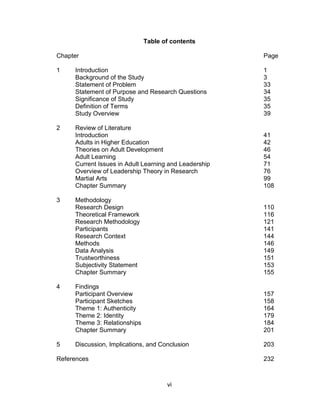
Table of contents
Chapter Page
1 Introduction 1
Background of the Study 3
Statement of Problem 33
Statement of Purpose and Research Questions 34
Significance of Study 35
Definition of Terms 35
Study Overview 39
2 Review of Literature
Introduction 41
Adults in Higher Education 42
Theories on Adult Development 46
Adult Learning 54
Current Issues in Adult Learning and Leadership 71
Overview of Leadership Theory in Research 76
Martial Arts 99
Chapter Summary 108
3 Methodology
Research Design 110
Theoretical Framework 116
Research Methodology 121
Participants 141
Research Context 144
Methods 146
Data Analysis 149
Trustworthiness 151
Subjectivity Statement 153
Chapter Summary 155
4 Findings
Participant Overview 157
Participant Sketches 158
Theme 1: Authenticity 164
Theme 2: Identity 179
Theme 3: Relationships 184
Chapter Summary 201
5 Discussion, Implications, and Conclusion 203
References 232
vii
Appendices 247
Appendix A: Semi-Structured Interview Guide 247
Appendix B: Non-Participant Observation Guide 249
Appendix C: Consent Form 250
Appendix D: Recruitment Flyer 254
Appendix E: IRB Approval Email 255
Appendix F: Site Permission Letters 256
1
Chapter 1
Introduction
Funk (1944) defined leader as “one who leads, a guide; chief; an
outstanding or forceful person; the catgut on the end of a fishing line to which the
hooks or flies are attached; a pipe to carry water from a roof” (p. 540). Merriam-
Webster (2014) defined leadership as “a position as leader of a group,
organization; the time when a person holds the position of leader; the power or
ability to lead other people” (http://www.merriam-
webster.com/dictionary/leadership). Both of these definitions, while 70 years
apart reflect how little our understanding of leaders and leadership has changed.
How do we become leaders and how do we develop leadership? Guthrie and
Jones (2012) stated “students encounter leadership development opportunities
while involved in higher education” (p. 53).
However, Guthrie and Jones (2012) stipulated that certain types of
experiences provided opportunity for leadership development. Guthrie and Jones
provided a framework based upon Kolb (1984) experiential learning to teach and
develop leadership for students that focused on the use of reflection and making
meaning from experiences. Guthrie and Jones argued that leadership
development opportunities existed for higher education students but not
necessarily in formal events. Guthrie and Jones further stated “Educators can
provide intentional learning opportunities through connecting each of these
leadership experiences with reflective learning. These developmental
opportunities create the necessary tension needed to encourage growth-
2
producing encounters that add to an individual students’ total life experience” (pp.
61-62). Experiential learning, can occur informally (Marsick & Watkins, 2001),
has a transformative nature (Mezirow, 1997), and involves meaning making
through physical, spiritual and cognitive processes (English, 2000; Freiler, 2008;
Tisdell, 2008). Meaning making in experiential learning is also based upon
specific contexts (Hamilton & Bean, 2005). I will describe each of these further in
the background section.
Like adult learning, leadership development is also based upon a complex
framework of learning, experience, relationship and context (Hamilton & Bean,
2005). Hamilton and Bean (2005) studied the development of leaders and
development of leadership as two separate processes; where leader
development is focused on the individual, leadership development is focused on
building of relationships. Research into leadership theories based on relationship
building resulted in transactional leadership (Burns, 1978), transformational
leadership (Bass, 1985; Burns, 1978), and servant leadership (Greenleaf,
1970/1991/2008). According to Hamilton and Bean (2005), leadership
development occurred in the social context. Efforts to learn or understand the
leadership experience and investigate leadership development led to research
studies aimed at measuring leadership behaviors in the contexts of workplace
(Arnold, Arad, Rhoades, & Drasgow, 2000); in non-profit and other organizations
(Reed, Vidaver-Cohen & Colwell, 2011; Sendjaya, 2003); and the general
population (van Dierendonck & Nuijten, 2011).
3
One context where leadership development and learning has been under
researched is sports. “Sport [is] an expression of our lives and attitudes” (Al
Huang & Lynch, 1992, p. 7). Martial arts is a sports context where both the
teacher-student and leader-follower dyads can be studied, and it is a sports
training paradigm that uses behavioral, physical, formal, and experiential
instruction to teach leadership development to all students (Min, 2000; Rowold,
2006). Adults can greatly benefit from this approach in other areas of their lives
(Bell, 2008; Min, 2000; Phillips, 2011). Adults are one of the largest groups of
new students enrolling in some form of martial arts and have specific motivations
for doing so (Fetto, 2003; Phillips, 2011). Martial arts have at the core of practice
an empowering aspect that can be cultivated for social change (Columbus &
Rice, 1998; Pater, 2010; Phillips, 2011; Tuite, 2012). With the potential for the
fusion of adult learning and leadership to occur in a martial art setting, and the
shared potential for experiential, transformative learning to result in social
change; martial arts is an important new context to study leadership development
and adult learning.
Background of Study
With the increase of adult learners in higher education (Kasworm, 2003)
adult educators have studied how adults develop cognitively as the basis for the
andragogical framework of teaching adults. Merriam (2001) reflected that the
previous 80 years of interest in how adults learn had yielded many theories and
models but no one explanation for how adults learn. Knowles (1984a, 1984b)
wrote progressively in the 1970s and 1980s with the theory that adults learn
4
differently and the pedagogical constructs used in education were not applicable
or adequate for adult students. Baumgartner (2001) reflected on four different
perspectives on adult development that had been derived from the years of
research in the field; behavioral/ mechanistic, cognitive/psychological,
contextual/socio cultural, and integrative. Each of these perspectives provided a
theoretical foundation for addressing adult development and learning
(Baumgartner, 2001).
Adult learning. Ebert, Burford and Brian (2003) wrote about the
significant impact the Highlander School started by Myles Horton in 1932, had on
adult learning from a developmental perspective. The Highlander School applied
the contextual/sociocultural perspective of adult development through activities
later described by Mezirow (2000) as transformative learning and leadership.
Ebert, et al. (2003) wrote that the transformative nature of the school provided
opportunity for leadership development through a shared experience. Wenger
(2006, 2010) provided another contextual/sociocultural concept on adult learning
and development through communities of practice. Communities of practice “can
be viewed as a social learning system” (Wenger, 2010, p. 1). Wenger used the
social learning concept of communities of practice as a domain in which adult
learning and leadership development occur both informally and formally. Wenger
(2010) wrote, “Over time, a history of learning becomes an informal and dynamic
social structure among the participants, and this is what a community of practice
is” (p. 2). There are nine social activities in which communities of practice can
operate: problem solving, request for information, seeking experience, reusing
5
assets, coordination and synergy, discussing developments, documentation
projects, visits, and mapping knowledge and identifying gaps (Wenger, 2006, pp.
2-3). These different social activities take place in work, home, dojang and the
community.
Adult learning through social activity that takes place in multiple contexts
can be seen in fields of business, medicine and other professions’ efforts for
continuing education. Billett (2002) wrote, “Guidance by others, situations, and
artifacts are central to learning through work because the knowledge to be
learned is historically, culturally, and situationally constituted” (p. 27). Stang and
Loup (2012) cited that the growing need for nutritionists in healthcare field
required continuing education methods that addressed leadership development.
The World Health Organization published Framework for Action on
Interprofessional Education and Collaborative Practice (2010) and cited
“research indicates that interprofessional education is more effective when
principles of adult learning are used, learning methods reflect the real world
practice experiences of students, and interaction occurs between students” (p.
24).
Four adult learning theories from the field of adult education also
incorporate the importance of social context to learning and awakened
conversations about the role and effects of power, culture, gender and
spirituality; transformative learning, informal learning, spirituality, and
embodiment.
6
Transformative learning. Mezirow (1997) wrote that adults organize
learning through frames of reference which are constructed meanings from our
experiences and assumptions about the world. Transformative learning occurs
when we can shift our frame of reference to one “that is more inclusive,
discriminating, self-reflective, and integrative of experience” (Mezirow, 1997, p.
5). Transformative learning takes place through reflection and cognitive change.
Mezirow (1997) gave four examples of how transformative learning takes place;
we “seek further evidence… establish new points of view… transform our point of
view” and use critical analysis and reflection (p. 7). Transformative learning
when applied to a specific context is self-directed learning (Pilling-Cormick,
1997). Pilling-Cormick (1997) stated, “Self-directed learning is based on the
interaction between student and educator within varying contexts of control” (p.
69). Control is stated as the amount of autonomy a student can direct to their
own learning. Pilling-Cormick developed a Self-Directed Learning Perception
Scale to assess student perceptions of factors that either helped or inhibited their
learning. Pilling-Cormick (1997) proposed that when students used self-directed,
critical reflection of their learning needs, the potential for transformative learning
was evident.
Informal learning. Much like transformative learning, informal/incidental
learning is very learner centric. Marsick and Watkins (2001) wrote that “informal
learning is usually intentional but not highly structured” (p. 25). As in
transformative learning, which is intentionally focused on critical reflection,
informal learning is often the result of an unexpected or unplanned experience
7
that is the catalyst to critically reflect on current level of knowledge or beliefs,
stimulates the learner to problem solve and develop new skills to enact solutions,
and to creatively explore future options (Marsick & Watkins, 1997).
Another informal learning context that employs reflection is experiential
learning as noted by Guthrie and Jones (2012). Guthrie and Jones (2012)
reference the four phases of Kolb’s (1984) experiential learning cycle; concrete
experience, abstract conceptualization, reflective observation, and active
experimentation. Of these four phases, Guthrie and Jones stated reflection was
the key to connect developmental process to experiential learning. Jiusto and
DiBiasio (2006) reported that experiential learning led to success in self-directed
and lifelong learning for students. The quantitative study of Jiusto and DiBiasio
(2006) looked at an experiential learning program as it prepared students to be
lifelong learners by adopting self-directed learning skills and attitudes. Jiusto and
DiBiasio (2006) used three assessment scales to measure the impact of
experiential learning on lifelong learning outcomes. Caffarella and Barnett (1994)
cited that experiences help to differentiate learners from each other. It is the
experiences that help to frame how we learn. Caffarella and Barnett (1994)
emphasized that informal learning experiences can be a catalyst, motivator and
opportunity to evaluate knowledge.
Spirituality. English (2000) bridged informal learning with spirituality.
English stated, “The whole of learning embraces the cognitive, spiritual, social,
emotional, physical, and affective dimensions” (p. 29). English examined
spirituality and learning as authentic spiritual development through three
8
components; “a strong sense of self; care, concern, and outreach to others; and
the continuous construction of meaning and knowledge” (p. 30). English
explored the concepts of mentorship, an exchange of knowledge, and self-
directed learning as “the building of mutuality and respect, the stretching to be all
one can be, is an explicitly spiritual dimension” (English, 2000, p. 33). Tisdell
(2008) defined spirituality as “an individual’s personal experience with the sacred,
which can be experienced anywhere…individuals’ creation of ultimate meaning
…connection to wholeness and the more authentic self” (p. 28). The common
point for Tisdell is that spirituality is not religion. “When defined as a journey or an
experience leading toward wholeness, everyone has a spirituality, but not
everyone has a religion” (Tisdell, 2008, p. 28). There is a connection between
spirituality and our experiences. Tisdell (2008) stated, “Even though spirituality is
generally seen as an individual’s experiences of what is perceived as sacred,
how one frames or understands those experiences can strongly influence one’s
beliefs and behaviors” (p. 29).
Embodiment. In addition to spirituality as a form of learning, embodiment,
or learning through the body has been provided as another holistic view for how
we learn. Freiler (2008) wrote that “embodiment and embodied learning generally
refer to a broader, more holistic view of constructing knowledge that engages the
body as a site of learning, usually in connection with other domains of knowing
(for example, spiritual, affective, symbolic, cultural, rational)” (p. 39). Embodied
learning utilizes experiences, body awareness exercises and social processes to
enhance the learning process. Embodied learning is another way of knowing
9
(Freiler, 2008). Freiler referenced four perspectives on embodied learning in
research; through sensual experiences, existentially, neural cognitive process of
body movement, and as a process to constructively unite the mind and body.
Freiler (2008) defined embodiment:
As a way to construct knowledge through direct engagement in bodily
experiences and inhabiting one’s body through a felt sense of being-in-
the-world. Simply stated, embodied learning involves being attentive to the
body and its experiences as a way of knowing. (p. 40)
Leader Development. Research into leader development focused on the
importance and role of context, citing that given leadership as a constructed
paradigm subject to interpretation due to experiences, culture and beliefs;
context is an essential element when due to experiences, exploring an
organization’s leadership paradigm (Hamilton & Bean, 2005). Kezar (2000)
presented the theory of positionality leadership exploring whether our
experiences and perspectives help interpret our own understanding of
leadership. This theory posed a way to look at multiple theories on leadership
and why this gap in interpretation exists. The gap is defined by the condition of
power. “Leadership is socially constructed between people” (Kezar, 2000, p.
724).
Leadership development research. Research in leadership
development has focused on observable elements such as behavior, personality,
characteristics, and philosophical orientations (Tng, 2009). Early leadership
research explored physical, cognition, and personality traits which yielded
10
conflicting conclusions stagnating the research into leadership for almost two
decades (Reichard et al., 2011). Later researchers concerned themselves with
quantifying leadership skill and leadership potential extending the research
beyond just identifying leadership traits and behaviors but measuring these
behaviors to affect outcomes and change (Arnold et al., 2000; Reed et al., 2011;
Sendjaya, 2003; van Dierendonck & Nuijten, 2011). Arnold et al. (2000) created a
scale to measure leadership behaviors of an empowered team versus the
leadership behaviors for managers of empowered teams. Arnold et al. (2000)
cited change in the business industry had elicited this move from hierarchical
management to the creation of empowered teams. Managers now instead of
directing work were now responsible for team support and encouragement (p.
250). In their study, interviews with leaders and team members created the
Empowering Leadership Questionnaire which was then administered to another
group of participants. Arnold et al. (2000) found “over time, workers in
empowered teams are granted more autonomy, self-direction, and control over
their work environment” (p. 250). Arnold et al. noted that managers needed a
new set of leadership skills yet a lack of research on leader behavior existed.
Arnold et al. (2000) efforts to identify a scale for measuring leadership in
empowering environments included three separate studies; the first study
identified key behaviors: leading by example, coaching, and participative decision
making, informing, and showing concern/interacting with the team. Arnold et al.
(2000) concluded “the set of behaviors that are required for effective leadership
in the empowered team environment seem to characterize ‘leadership’ rather
11
than ‘management’ behaviors” (p. 265). Most recently, efforts to measure
servant leadership have followed suit to isolate behaviors and personality traits in
order to measure effectiveness of servant leaders (Reed et al., 2011; Sendjaya,
2003; van Dierendonck & Nuijten, 2011). Sendjaya (2003) wanted to take servant
leadership from theoretical discussion to real application through the
development of a servant leadership behavior scale. Sendjaya reported six
dimensions of servant leadership behavior: voluntary subordination, authentic
self, covenantal relationship, responsible morality, transcendent spirituality, and
transforming influence. Reed et al. (2011) addressed Greenleaf’s idea that “the
ultimate responsibility for developing organizational and institutional capacity to
serve resides with top executives” (p. 419). Therefore, Reed et al. chose to
create the Executive Servant Leadership Scale to measure the construct of
ethical leadership and servant leadership to construct their model. Their
quantitative study revealed five first order factors of: interpersonal support,
building community, altruism, egalitarianism, and moral integrity. These five
factors contributed to what Reed et al. termed “Executive Servant Leadership” (p.
424). Reed et al. stated that with the interpersonal connection of our society,
understanding servant leadership “one form of ethical leadership that can assist
to configure a business climate in which value creation shares the stage with
moral accountability and the production of goods or services is anchored in social
concern” (p. 431). The work of van Dierendonck and Nuijten (2011) also
addressed a multi-dimensional scale to measure servant leadership in order to
establish training and leadership development protocols. Van Dierendonck and
12
Nuijten wrote, “In servant leadership the ideal of service is embedded in the
leader-follower relationship” (p. 249). They especially note the complexity of
servant leadership as a measurable construct and after review of literature,
included in their design eight aspects: empowerment, accountability, standing
back, humility, authenticity, courage, interpersonal acceptance, and stewardship.
After quantitative analysis, Van Dierendonck and Nuijten concluded that the
Servant Leadership Survey was a valid tool for measuring servant leadership and
added elements to the leadership field. In the body of qualitative work in
research on leadership development, the construct of leadership is addressed
from three different perspectives: philosophical, theoretical, or concrete.
Philosophical leadership research. Philosophical research addresses
leadership through a philosophical lens and sees the interrelationships with other
leadership traits like power, authority, and ethics.
Power. Power and the connection to leadership has been part of the
leadership discourse as business tycoons and other leaders become subjects in
the news for unethical or amoral behaviors. Kezar (2000) stated that power was
the one condition responsible for multiple theories on leadership and presented a
positional theory framework to incorporate the “multiple, overlapping identities
that influence our leadership perspective. Positional theory assumes that power
relations can change and that social categories are fluid and dynamic affected by
historical and social changes” (p. 726). Positional philosophy holds that
leadership is determined by one’s position in the world at that time and can
change as the social, political or philosophical climate changes.
13
Authority. Stein and Nelson (2003) proposed that leadership content
knowledge was the concrete element that informed behaviors and practices that
lead to strong leadership. Stein and Nelson stated, “Knowledge about subject
matter content is related in complex ways to knowledge about how to lead. In
some cases, subject matter knowledge appears to be transformed for the
purposes of providing leadership for instructional reform” (p. 424). Stein and
Nelson noted that leadership began with concrete knowledge that informed
leadership behaviors and development. However, Stein and Nelson later noted:
The construct of leadership content knowledge opens entirely new realms
of thought about leadership – connecting it to schooling, learning and
teaching – and raising the question whether generic studies of leadership
can really get at the heart of what it means to lead. (p. 446)
Ethics. Eicher-Catt (2005) proposed that ethics is a constructed reality and
leaders are those who can assist in making meaning based upon an ethical
framework. When it comes to ethical leadership it is a relative argument that
leaders need to possess ethics when it is the true leader who can help establish
the ethical norms. Eicher-Catt stated:
As a response to the sign of the other, a rhetorical ethic is one that
emerges from within the organizational discourse and is self-signifying of
the unique relationships so presented. It articulates an ethical stance that
is rhetorically constituted through the reflexive, reciprocal and reversible
acts of expression and perception realized within the tension that
compromises all human thought and action. We need leaders who
14
articulate a rhetorical ethic and authorize others to do the same. Only in
this way, will we present leadership discourse from ascending to the
powerful threshold of myth. (p. 25)
Theoretical leadership research. While philosophical research on
leadership sought to challenge perceptions of leadership and the common
discourse popularized by concrete leadership research; issues of leadership from
gender bias to power added to the leadership discourse and challenged the
theoretical research as well. Sanders, Hopkins, and Geroy (2003) proposed an
integrated theory of leadership that used spiritual dimensions of leadership to
bridge transactional and transformational leadership theories. Sanders et al.
presented that as the relationship between these theories could be defined on a
hierarchical continuum, the development of leaders also proceeded on a spiritual
plane. Sanders et al. focused the spiritual theoretical development of leadership
in three dimensions; consciousness, moral character and faith. The theory that
emerged was transcendental leadership with a foundation of spiritual and
consciousness awareness of self. “Our model…brings spirituality out of the
‘closet’ and places it where it belongs – in the mind (i.e. consciousness), the
heart (i.e. moral character), the soul (i.e. faith) and daily accomplishments of the
leader” (Stein & Nelson, 2003, p. 29).
Concrete leadership research. There are many philosophies and
theories on leadership however, several of these have made it to the operational
or concrete level of leadership and have been researched heavily in academia.
15
They are transactional leadership, transformational leadership and servant
leadership.
Transactional leadership. Transactional leadership (Burns, 1978)
describes the benefits entailed within the leader/follower relationship as a
recognize-reward type of agreement. The relationship takes on a contractual
function as the leader rewards followers for compliance or successful completion
of tasks or duties. Transactional leadership relies heavily on a hierarchical form
of interaction and an adherence to social norms and context. The focus of
transactional learning is on the leader behaviors. Rowold (2006) used the
Multifactor Leadership Questionnaire of Bass and Avolio (2000) to assess
transactional leadership based upon behaviors identified on that scale. The three
items on that scale addressing transactional leadership were contingent reward,
active management-by-exception and passive management-by-exception. I
discuss measurement instruments in more depth in the literature review. These
three items however, indicated that transactional leadership was an exchange of
goods for some service. Nevertheless, this relationship as noted by Sanders et
al. (2003) lacks the spiritual component that leaders need to have to be truly
effective. Because of the contingent relationship with followers, transactional
leaders can only be effective as long as their followers are satisfied with the
rewards received. For this reason, transactional leadership is limited in its
potential to develop future leaders.
Transformational leadership. Transformational leadership is based upon
leader behavior and the relationship with followers albeit this relationship is
16
based upon a different interaction. Shin and Zhou (2003) looked at
transformational leadership and how it contributed to creativity using intrinsic
motivation theory. Shin and Zhou found that transformational leadership was
significant for contributing to creativity. Transformational leaders use inspirational
behaviors that motivate followers to act. Transformational leadership is an
effective philosophy to employ in a variety of contexts. Transformational leaders
provide motivation and mobility for followers to some purpose with commitment
(Hay, 2006).
However, Hay (2006) provided characteristics and criticisms of
transformational leadership. While transformational leaders can be very effective
and positive, there is also the potential for abuse of power. There is little or no
guard against a transformational leader who lacks moral or ethical boundaries.
For this reason, transformational leadership could produce followers who are
motivated by unethical premises. There is however, one more leader-follower
relationship based theory, servant leadership.
Servant leadership. Greenleaf (1970/1991/2008) stated that “the servant
leader is servant first …It begins with the natural feeling that one wants to serve,
to serve first. Then conscious choice brings one to aspire to lead. That person is
sharply different from one who is leader first” (p. 15). Servant leadership has
service as the motivation for the leader-follower relationship. A servant leader
does not need hierarchy or charisma to motivate followers as in transactional and
transformative leadership. Sendjaya (2003) constructed a theoretical basis for
servant leadership through the development of a measurement scale. Sendjaya
17
cited the progress made in the field as not definitive enough to constitute
legitimacy of the theory of servant leadership as a model. Sendjaya (2005) began
an investigation into the theory of servant leadership with skepticism and
disbelief. The findings verified a new paradigm in thinking about leadership and
leader development. Sendjaya stated:
Servant leadership is not just another leadership style to adopt when the
situation calls for it, or that can be turned on and off at will. It is a
commitment of the heart to engage with others in a relationship
characterized by a service orientation, a holistic outlook and a moral-
spiritual emphasis. It is an attitude of the heart that shapes the decisions
and actions of great leaders at all levels. (Sendjaya, 2005, p. 7)
Drury (2005) investigated Greenleaf’s test for servant leadership as a
measure for faculty involvement and effectiveness in teaching in the classroom
by querying whether the philosophy of servant leadership to faculty behavior
would result in positive outcomes for the students. Drury proposed that a new
faculty model was needed in universities due to the growing need of students
and adult learners. Drury found that servant leadership characteristics were
indicative of teachers who were rated highly effective teachers. Drury stated,
“The findings of this study indicate that teachers do function as leaders, and
servant leadership is the best leadership mindset for the classroom” (p. 9).
Matteson and Irving (2006) compared servant leadership with self-
sacrificial leadership. They wrote “one of the central features of servant
leadership is…essentially focused on placing the needs of the followers before
18
the personal interests of the leader and initially working toward raising additional
servants” (p. 36). Self-sacrificial leadership occurred when the leader decided to
“forfeit one or more personal advantages for the sake of followers, the
organization or a mission” (Matteson & Irving, 2006, p. 37). Matteson and Irving
proposed an integrative model of servant leadership including a framework of
ontological character traits (being), attitudinal mindset (thinking) and actions or
behaviors (doing). Matteson and Irving proposed that self-sacrificial leadership
differed from servant leadership in the area of relationships with followers. While
the two seem similar, self-sacrificial leadership was more concerned about
outcomes based upon leader behavior than the relationship with followers and
omitted one of the integrative models dimensions, the ontological or individual
being of the leader.
Leadership in context. Ethics, values, and beliefs are evident in every
context and leaders help to shape and identify ethical norms as they adapt and
help shape leadership in that context (Eicher-Catt, 2005; Hamilton & Bean,
2005). Servant leadership is sensitive to contexts where ethical and moral
foundations are needed (Hamilton & Bean, 2005). Ethics and leadership are
connected by individual or group dynamics and context (Hornett & Fredricks,
2005). Hamilton and Bean (2005) stipulated that leadership development
happens within multiple contexts simultaneously. “Leadership development
targets both interpersonal and relational development. The concept of social
context as a dynamic interaction process among leaders, followers, and the
situation is emphasized in leadership development” (Hamilton & Bean, 2005, p.
19
344). Hamilton and Bean stated that “leadership emerges as a shared meaning”
(p. 344) because leaders learn how to reshape and reframe to fit the current
climate and context. Positional theory (Kezar, 2000), stated that interpretations
can change as social climates change and so we must look at leadership in a
specific context to understand how it is manifested in that context.
Spirituality. Just as ethics have been identified as helping shape the
leadership discourse in the workplace, spirituality has been identified as an
element of effective leaders in the workplace as well (Ferguson & Milliman, 2008;
Pawar, 2008, 2009; Phipps, 2012). Spirituality is identified with world view and
perspective (Mayhew, 2004). Having a spiritual foundation is an important
element of leadership that compliments development and maturity, a concept of
relationships with others, a guideline for how to interact with others and a
motivation for intentions (Nur, 2009). Since traditional management and
leadership programs do not incorporate the element of spirituality into their
programs, there is a key aspect of leader development missing.
Ethical treatment of others contributes as well to the leadership research
regarding the reciprocal relationship that exists between leaders and followers.
This relationship is described through three leader-follower theories;
transactional leadership (Burns, 1978), transformational leadership (Bass, 1985)
and servant leadership (Greenleaf, 1970/1991/2008). Each theory has a strong
connection with followers which can be effective for the purpose of mentoring
and developing future leaders. I will discuss each briefly here for purposes of
background but each is explained in more detail in the literature review.
20
Connecting leadership to adult education. The purpose of higher and
adult learning is to transform students into lifelong learners, mentors, teachers,
conscientious citizens, reformers, change agents and leaders (Bowman, 2005;
Horton & Freire, 1990; Tng, 2009; Westaby, Probst, & Lee, 2010). The process
of education emphasizes a transformative nature of which leader development is
a significant factor (Ebert et al., 2003; Hartley, 2007; Stang & Loup, 2012).
Industry executives desire workers who will be leaders also, and as such,
leadership is a highly researched and discussed concept in business, education
and healthcare fields (Hornett & Fredricks, 2005; Stang & Loup, 2012; Tng
2009). Industry executives want employees who have completed educational
training or advanced education and can demonstrate leadership ability and
managerial skills (Billet, 2002; Lemay, 2009). The outcome of education is a
competent next generation workforce of engineers, scientists, artists, social and
medical workers and educators.
A goal of higher education faculty is to prepare competent professionals in
these fields so that the industries are equipped with capable and efficient workers
(Hatcher, 2005; Hay, 2006; Rost, 1993). Employers in fields of business,
education and healthcare also demand leaders that can take the necessary steps
to be innovative and evolve for the future (Clarke, 2011; Hamilton & Bean, 2005;
Hatcher, 2005; Stein & Nelson, 2003). As such, a myriad of leadership
development programs that focus on attainment and retainment of leaders in
these industries have been produced to grow leaders “in-house”. Some
examples include the Leadership Education in Neurodevelopmental Disabilities
21
(LEND) program of the past 40 years by the Maternal and Child Health Bureau to
instill leadership in healthcare professionals. Another example is the Leadership
program at Harvard Business School for current business executives. The
Institutes Executive Education is a collaborative partner with higher education
and has partnered most recently with Wisconsin Business School to conduct a 5-
day leadership workshop for insurance company executives. Examples even
exist in the non-profit sector like the Leadership Education and Development
(LEAD) program for 8th to 12th graders interested in science and engineering
fields. A simple Google search for “leadership course” returned over 150 million
results. Leadership is a desired, needed, necessity in our everyday lives and as
such there are many different ideas on how to instill, grow, teach, or develop
leaders. While purposeful, these programs are examples that are highly complex
and are not transferrable between industries or engage the principles of adult
learning.
Future implications. Adult learning is lifelong learning, a continuum of
learning that exists beyond classroom environs and encompasses life
experiences. Merriam (2001) “adults learn as part of their daily lives” (p. 3).
Merriam (2001) outlined andragogy, the teaching of adults, with five assumptions
that adult learners are self-directed, have a library of life experiences that they
can draw upon for meaning making, have learning needs directly related to
change in social context, are problem driven, and motivated by internal forces.
Billet (2002) stated that knowledge and learning are based on context. Wenger
(2006) proposed the concept of “communities of practice” as alternative learning
22
environments for adults. Wenger (2006) defined communities of practice as
“groups of people who share a concern or a passion for something they do and
learn how to do it better as they interact regularly” (p. 1). Wenger (2010) stated
“engagement in social contexts involves a dual process of meaning making” (p.
1).
As in adult and lifelong learning, leadership development occurs
continuously and transcends classroom environments to communities of practice
that provide opportunities for adults to ascribe meaning to their experiences to
date as well as to learn from others and in turn construct new meaning as a
social context changes. An example of learning in a community of practice by
actively engaging in the activity of learning, is self-directed and employs the use
of mentors is sports. Sports in general provide opportunities for leadership,
learning to work on a team, as well as share in success and power. Al Huang
and Lynch (1992) wrote that the western approach to sports is a commentary on
our society in business and academics. Colleges are known by their sports
teams, not necessarily for the science department. Al Huang and Lynch
proposed that incorporating the eastern Tao, or The Way, into life unleashes the
unlimited leadership potential within. Playing sports is a spiritual combining of
physical and mental activities. The Tao in eastern philosophy allows for many
ways of being.
Leadership development through martial arts. Informal learning such
as self-directed learning and mentoring has been shown to be an effective
technique for adults (Ebert et al., 2003; English, 2000; Merriam, 2001).
23
Communities of practice provide opportunity to learn in an informal environment
(Wenger, 2006, 2010). Ebert et al. (2003) reflected on the Highlander School
approach to a community of practice that stated “The best way of learning is by
actually doing, which provides substance for reflection and growth” (p. 324).
English (2000) stated, “the building of mutuality and respect, the stretching to be
all one can be, is an explicitly spiritual dimension” (p. 33). This spiritual stretching
occurs over the course of the learning relationship with a mentor. English
emphasized the connection between mentoring a learner as a developmental
process to that learner becoming autonomous. This stretching occurs in marital
arts where the master instructor eventually passes from teacher to mentor to
colleague as the learner advances. Much of this advancement requires spiritual
growth from the student by mastery not of physical skills but of the tenets of that
martial art. Park and Gerrard (2000) wrote:
While many students do ultimately come to experience a sense of spiritual
growth though their study, taekwondo is not a form of religious worship.
Through rigorous training students of taekwondo strive to improve
themselves physically, mentally and spiritually. (p. 10)
Martial art learning in context. The eastern context of martial arts
employs a physical, mental and spiritual domain where all three co-exist called
the Tao or Way (Al Huang & Lynch, 1992). Martial arts, like taekwondo,
emphasize not only mastery of the body but also of the mind and the spirit of an
individual (Columbus & Rice, 1998; Phillips, 2011). Martial arts follow the same
tradition of treating the practitioner as a lifelong pursuer of perfection and self-
24
discipline (Min, 2000; Samane, 2012; Tuite, 2012). The benefits of participation
transcend the outward changes physically to change the student mentally,
emotionally, and spiritually (Al Huang & Lynch, 1992; Bell, 2008; Cheyne, 2014;
Columbus & Rice, 1998; Phillips, 2011; Twemlow & Sacco, 1998). In 1986,
Marketing News published an article comparing the philosophy and tenets of
martial arts to marketing executives. The article touted the tenets of taekwondo
as essential values for how to conduct business in the marketplace. “Martial arts
teaches the importance of diligence, knowledge, courage, and control” (p. 8).
Phillips (2011) wrote “it is more than a sport or an avenue to physical fitness, it is
a path to better physical, mental, emotional and spiritual health and well-being”
(p. 70). Philips lauded the benefit that marital arts training provides to women,
identifying a power disparity that martial arts helps to alleviate. Also, Philips
pointed out that martial arts has shown increases in overall health and flexibility
for middle-aged students increases as body fat decreases. The benefits of
marital arts helps alleviate stress for children diagnosed with Attention Deficit
Disorder (Cheyne, 2014) and increase resiliency (Bell, 2008).
Taekwondo is a martial art originating from Korea. Traditionally, an
unarmed self-defense, taekwondo has been in practice for over 2000 years (Park
& Gerrard, 2000). The practice follows three main principles, “Tae” which is
Korean for hand, “Kwon”, Korean for foot, and “Do” which is Korean for way or
art. Loosely interpreted taekwondo is The Art of the Kicking and Punching (Park
& Gerrard, 2000, p. xiii). Taekwondo teaches techniques using punches, blocks,
and kicks that are largely defensive. Taekwondo was a martial art developed by
25
traveling warriors, the Hwarang, in Korea between the years A.D. 668-A.D. 935.
The art of taekwondo was part of the education of Korean people that included
Confucian philosophy and Buddhist morals (Park & Gerrard, 2000). As such,
taekwondo is governed by five tenets or principles; Courtesy, Integrity,
Perseverance, Self-Control and Indomitable Spirit. These tenets emphasize a
code of conduct for warriors and practitioners of taekwondo to develop character
(Park & Gerrard, 2000). Park and Gerrard (2000) indicated that these principles
have changed slightly overtime, “taekwondo has remained an art centered on
personal growth and moral improvement” (p. xiii). These tenets represent the
spiritual growth of the student as they progress through the physical and mental
challenges of taekwondo.
According to Park and Gerrard (2000), the Hwarang were a group of noble
men between the ages of 16 and 20 who served as leaders from the royal family.
The Hwarang learned taekwondo from soldiers sent to help defend the kingdom
of Silla from attack from Japan. Silla was a small and underdeveloped part of the
Korean peninsula and therefore was vulnerable to invading armies and pirates.
Because the Hwarang were part of the nobility and the intent was to prepare the
people to defend themselves without weapons, taekwondo became a part of the
national education and the moral codes of conduct were established to ensure
the social welfare (Park & Gerrard, 2000).
Many martial arts have been added to the western culture, Karate, Jujitsu,
and others. Taekwondo is overseen by two leading organizations; The World
taekwondo Federation and the American taekwondo Association. Taekwondo
26
has been added as a sport in the Olympics and follows a competitive set of
guidelines and rules set by the Amateur Athletic Union. Competitive taekwondo
and traditional taekwondo also differ in what type of strikes are allowed in
competition and how points are awarded. Taekwondo schools, or Dojangs, also
have a specific Kwan or sponsor under which they follow a set of guidelines for
teaching, advancement and testing. These Kwans are associated with a Grand
Master who directs the training of all students and oversees the instruction
provided by instructors and leaders. Depending on which style of taekwondo is
being taught, Olympic versus Traditional, what Kwan your Dojang answers to is
indicative of the type of taekwondo taught.
Another element of the westernization of taekwondo is the emergence of a
belt system. Originally, students practiced their art in loose fitting undergarments
that were secured in place with belts (Park & Gerrard, 2000). These garments
absorbed sweat and overtime the belts became dirtier and dirtier. According to
Park and Gerrard (2000), “eventually, a dark belt came to symbolize someone
who had been practicing the art for a long time and was therefore a person of
advanced skill” (p. 4). Different dojangs can implement variations of color belt
systems but a colored belt simply identifies the student’s level of proficiency. The
World taekwondo Federation recognized five belt colors: white, yellow, green,
blue, and red. Each belt color has symbolic meaning; white is purity, yellow is the
rising sun and source of life, green is growing and thriving, blue is the color of the
sky which is open and boundless, and red is blood, the essence of life (Park &
Gerrard, 2000).
27
Finally, taekwondo, while rooted in Confucian and Buddhist origins, has a
spiritual element to practice. Park and Gerrard (2000) wrote, “The ultimate aim of
taekwondo is to bring its practitioners into harmony with the universe. This
harmony can only be achieved when opposite forces are distributed equally,
resulting in balance” (p. 6). Balance between negative forces or energies and
positive forces are evident in the techniques of blocking and sparring in
taekwondo. Balance is also evident through the symbolism of the belt rankings
indicating maturity in the art and the development or adherence to the tenets of
taekwondo.
Culture in context. Taekwondo is a type of martial art steeped in the
culture and traditions of Korea, a land that values spiritual, physical, and mental
growth. As value for learning is placed on the enrichment and development of
the whole person, taekwondo has much to contribute to the development of
leadership and learning for adults. Ancient folk tales from Korea communicated
lessons and teachings about spirituality, character, and ethics throughout the
storyline. Korea is land of three major religions; Buddhism, Confucianism, and
Christianity, yet a spirituality underlies each of these religions and it is common
that Korean people practice and accept elements of all three due to the emphasis
on spirituality rather than religion. Lee (2011) pointed out, despite the large
protestant Christian population in South Korea elements of Confucianism are still
found and can be attributed to the success of Christianity in South Korea. Other
cultural characteristics like collectivism, heavy emphasis on lifelong learning,
charismatic leadership, commitment to similarity, and the belief that religion is an
28
applicable to all in a society help to solidify the concept of a national spirituality.
Because lifelong pursuit of spirituality is so interwoven into the cultural
perspective of Koreans, there is a commitment to the pursuit of lifelong learning.
Mayhew (2004) stated that “spirituality and wholeness in higher education” is an
elusive target for educators trying to reach their students. Mayhew (2004) found
themes to catalogue spirituality having to do with current or past experiences,
connections with others or nature, group identification, and external and internal
meaning.
Understanding the influences of other cultures on education is important.
Research suggests that philosophies of adult learning are based primarily in
western culture. Globalization of learning and its impact need to be
acknowledged. Dodds (2008) stated that we are products of globalization in that
it affects us more than we do on globalization. Dodds (2008) discussed that
globalization is more than just an idea or particular belief and the results of
globalization can be expressed as an implement of power and change. University
professionals and students must learn to value and harness the multitude of
talents originating within various cultures, identities, ideologies, and backgrounds
to be successful as institutions of higher education” (Chavez, Guido-DiBrito, &
Mallory, 2003, p. 453).
Martial arts and relationship to power. Research in martial arts has
focused on the emancipatory aspect of learning a martial art, like taekwondo, and
emphasized the aspects of power and relationship between the master and
student and the martial artist and an attacker. The teaching on power has been
29
connected to leadership development (Pater, 2010; Samane, 2012; Tuite, 2012).
Pater wrote that teaching martial arts also accompanied a leadership training for
teaching safety. By practicing self-control, leaders can be more effective in their
roles as leaders. Tuite (2012) wrote that engaging in martial art training provided
an opportunity for self-reflection and exploration of power and personal beliefs
(ontological) and perspectives.
Thus, martial arts provides an emancipatory effect for learners. Fetto
(2003) researched teens who engaged in martial arts were more likely to see the
benefits in other areas of their life than their peers who engaged in other
recreational or sports activities (p. 10). Samane (2012) emphasized the benefits
to young children for teaching life skills in taekwondo to develop a “natural armor
and becoming their own superheroes” (p. 64). Unlike team sports which
encourage leadership, teamwork, and personal benefit, martial arts are seen as
an individualized practice or even as a self-defense rather than the lifelong
personal development. For example, Twemlow and Sacco (1998) found that
when the practice of taekwondo program that focused on respect and self-control
was combined with leadership and community service components, it provided
an effective alternative treatment for violent youth. Traditional sports or
competition based martial arts dojangs tend to ignore the philosophical aspects
of martial art training, however; when the mental is combined with the physical,
martial art training can be helpful for adolescents with behavioral, psychosocial or
even attention disorders. “Martial arts …offer an organizing framework for
understanding the world and a sense of historical connectedness, helping violent
30
adolescents overcome their dysfunctional circumstances” (Twemlow & Sacco,
1998, p. 505).
The benefits of martial arts are not limited to youth. Columbus and Rice
(1998) found four contexts in which adult students in the United States engaged
in martial art endeavors; criminal victimization (safety), growth and discovery
(personal awareness/consciousness), life transition (regain control or balance),
and task performance (application to everyday life). Columbus and Rice noted
that in each of these contexts there was a connection between the mind, body
and spirit that seemed to have “either compensatory or emancipatory adaptive
functions contingent with context” (p. 20).
Recently within this decade, research into leadership has shifted once
again to how leaders develop. Gottfried et al. (2011) connected motivation to
lead in the future with childhood intrinsic motivation. Adults who enjoy leadership
for no apparent compensation to do so had been significantly motivated
academically throughout childhood and adolescence. Murphy and Johnson
(2011) presented a framework to identify and explore the tasks associated with
leadership at early ages before adulthood. These efforts were preliminary yet
showed the next evolution in leadership research – how do leaders develop?
Educators in business schools have determined that to produce the next
generation of leaders, they must incorporate ethics into their curriculum (Hornett
& Fredricks, 2005). Job descriptions list duties and responsibilities that have
traditionally been assigned to leaders such as, good communication skills, ability
to lead and work with a group, and conflict negotiation. Employers want people
31
who are leaders or have leadership potential as employees. “Leaders get people
moving. They energize and mobilize. They take people and organizations to
places they have never been before. Leadership is not a fad, and the leadership
challenge never goes away” (Kouzes & Posner, 2012, p. 1). This is evident in the
plethora of training courses, management programs or team based projects
(Evans, 2005) Leaders are described as people who can motivate, mentor, and
move organizations and people forward (Maxwell, 2011). Likewise, ethics are
another desired and needed aspect in the workforce. Effective leaders are those
who understand the need for ethics or who possess a certain spiritual grounding.
Models for leadership development have focused on behaviors, situations,
society, characteristics, personalities or positions that segment leadership
development within a given context (Doh, 2003; Ligon, Hunter, & Mumford, 2008;
Murphy & Johnson, 2011; Rubin, 2009). In addition, researchers approach
leadership as an outcome of some teaching, training or experience and as such,
models of leadership types have a theoretical framework that address leadership
development from an end result point of view (Ciporen, 2010; Hay, 2006;
Matteson & Irving, 2006; Reichard et al., 2011; Sendjaya, 2003, 2005). This
outcome perspective on leadership documents a stagnant point in personal
development. While some researchers have tried to extend leadership to a
developmental process rather than an outcome of learning; little research has
been devoted to holistic progressive development of the entire person towards
leadership (Greenleaf, 1970/1991/2008; Tng, 2009). Research into the
connection between spirituality and leadership is still new in the fields of business
32
and healthcare (Burke, 2006; Ferguson & Milliman, 2008; Markow & Klenke,
2005; Mayhew, 2004; Nur, 2009, Pawar, 2008, 2009; Phipps, 2010). Spirituality
has been identified as an element of effective leaders in the workplace (Ferguson
& Milliman, 2008; Pawar, 2008, 2009; Phipps, 2010). Spirituality is identified with
world view and perspective (Mayhew, 2004). Having a spiritual foundation is an
important element of leadership that compliments development and maturity, a
concept of relationships with others, a guideline for how to interact with others
and a motivation for intentions (Nur, 2009). Since traditional management and
leadership programs do not incorporate the element of spirituality into their
programs, there is a key aspect of leader development missing.
Workplace spirituality has been linked with a particular leadership style of
servant leadership. Research on servant leadership has been largely theoretical
or attempted to construct a measurable tool by which to validate the existence of
this leadership style. The research has been mostly quantitative and
inconclusive. Sendjaya (2003) constructed a theoretical basis for servant
leadership through the development of a measurement scale. Sendjaya
presented a model of servant leadership behavior as a measurable instrument
that can be used to assist in the development of theory. Sendjaya’s research
named six domains/dimensions and 22 sub-dimensions of servant leadership.
The pilot test of the instrument was inconclusive as Sendjaya stated, “a possible
explanation was that principal component analysis is mathematically-driven
technique which may lead to false interpretation of data as it entirely disregards
the theoretical considerations behind the data” (p. 7).
33
While research in the fields of business, education, and social science has
segmented leadership development, research on the physical, mental, emotional
and spiritual benefits of martial arts training has been limited. Martial arts has
been seen as a model approach to marketing in business (Marketing News,
1986), reducing the symptoms for children with Attention Hyperactive Disorder
(Cheyne, 2014) and even with empowerment for women (Phillips, 2011).
Columbus and Rice (1998) found four contexts in which adult students in the
United States engaged in martial art endeavors; criminal victimization (safety),
growth and discovery (personal awareness/consciousness), life transition (regain
control or balance), and task performance (application to everyday life). They
noted that in each of these contexts there was a connection between the mind,
body and spirit that seemed to have “either compensatory or emancipatory
adaptive functions contingent with context” (Columbus & Rice, 1998, p. 20).
Statement of Problem
Some research has looked at the long term effects of taekwondo. As
discussed earlier, children and teens who engage in martial arts see application
in other areas of their lives (Fetto, 2003), learn natural coping and life skills
(Samane, 2012) and have increased reports of resiliency (Bell, 2008). Yet the
research is limited and not extensive to application for leadership development.
Martial arts is one of the fastest growing industries. Fetto (2003) wrote that 18.1
million Americans participate in at least some form of martial art per year, 9.4
million of which are adults; 5.5 million were teens and 3.2 million children. The
potential benefits of martial arts to help develop the next generation of adult
34
learners and leaders is great. As more people pursue martial arts as a
recreational activity, some of the leadership training present in martial arts is
deemphasized as the benefits to overall health or personal safety are
showcased. Although it is common to see university level courses and business
training programs focused on developing leaders, taekwondo has been
overlooked as an adult learning venue for developing leaders.
Statement of Purpose and Research Questions
The purpose of this grounded theory study was to understand how
taekwondo assisted adults in learning and becoming leaders in the context of an
informal, experiential, non-commercial taekwondo dojang. This study specifically
focused on leadership development for adult students actively engaged in
learning taekwondo. To study leadership in process through a martial arts
program was significant in that it provided another context for leader
development, applied a new philosophy, martial arts, to leader development and
incorporated all dimensions; physical, mental, emotional and spiritual, needed for
a leadership study. The following research questions guided this study:
1. How does learning taekwondo assist adults in learning and becoming
servant leaders?
2. How does taekwondo contribute to the development of servant leaders in
both the community and the dojang?
3. How does taekwondo connect to the andragogical perspectives of
learning?
35
Significance of Study
The significance of studying leadership development in a non-commercial
taekwondo program added to the leadership discourse on how leaders develop
cognitively, physically, emotionally, and spiritually. Leader development research
is centered on positional authority figures with power and influence to ascertain
the characteristics, philosophy or behaviors that helped them achieve that role
and has been the informing data on leadership theory and development.
Spirituality, context, and developmental process has not been part of this
research. This leadership development study contributed to the field of adult
learning by addressing how leaders develop and may help to inform how adult
learners can be assisted in unleashing their leadership potential. Studying
leadership from a social context, the emphasis on emancipatory function of
leadership may contribute to developing leaders who see a need for change or
social action. I will address these points in Chapter 4, findings.
Definition of Terms
Adult. Kegan (1994) defined adulthood as a conscious awakening that
occurred sometime after the teenage years. Kegan wrote, “adulthood itself is not
an end state but a vast evolutionary expanse encompassing a variety of
capacities of the mind” (p. 5). Kegan promoted that the adult is one whose mind
is bombarded with vast amounts of information and that information is filtered
through experiences, culture, society and faith as to “how we know” (p. 5). Kegan
wrote that adult development should be viewed holistically through the
development of the conscious mind and the machinations of that mind. Kegan’s
36
five Orders of Consciousness are not tied to a biological age but a mental
transition between ways of thinking and knowing. Kasworm (2003) defined the
adult student “as one who represented the status of age (typically defined as
twenty-five years of age and older)” (p. 3). Kasworm further stipulated that adults
had reached “the status of maturity and developmental complexity acquired
through life responsibilities, perspectives, and financial independence; and the
status of responsible and often-competing sets of adult roles reflecting work,
family, community, and college student commitments” (p. 3). Both Kegan and
Kasworm incorporated a mental capacity and cognitive element to the term
“adult” and indicated that the term is more than just a biological marking of time
but is reflective of the whole person; their thought processes and experiences
that inform those thought processes. For the purpose of this study, adults were
anyone who has reached the biological age of 22 and who had experienced or
attempted one or more the following: marriage, parenting, employment, health
crisis or higher education.
Andragogy. Andragogy is the term used to describe the theoretical and
functional foundations of adult education. This conceptual framework was
described by Knowles (1980) as “the art and science of how adults learn” (p. 43).
Merriam (2001) provided five assumptions about the adult learner as prescribed
by andragogy as: having independent self-concept and therefore can direct
learning, having life experiences to draw upon for learning, having learning needs
that are related to a changing social role in life, problem-centered and interested
in immediate application of learning, and is internally motivated (p. 5).
37
Dojang. Park and Gerrard (2000) refer to the dojang as the learning
environment or training hall for martial arts students. The dojang is a physical
location where students are taught martial arts. A dojang has certain rules that
govern the behavior of students and instructors. The dojang can also be a sacred
space wherein the instruction provided to students is reinforced through
repetition and modeling. According to Park and Gerrard the dojang is a place
where students learn as part of the community and is deserving of respect for the
learning and transformation that takes place in that space. Students bow when
entering and exiting the dojang as a physical demonstration of that respect.
Leadership. Shoemaker (1998) provided this definition, “leadership
fosters purpose, creativity, imagination and drive” (p. 29). Allyn and Bacon also
cited two other definitions of leadership by Gardner (1990) and Yukl (1994) which
emphasized the influential capacity of leadership to affect personal,
organizational or social goals (Allyn & Bacon, 1998, p. 30). Evans (2005) wrote
“leadership is about generating movements and currents within the organization.
Leaders produce change” (p. 4). Murrell (2011) defined leadership as the ability
to hone individual resources and then use those resources to achieve a goal or
resolution. For Murrell leadership began with who the individual was, then, that
internal motivation produced action and results (Personal communication,
summer 2011). Sternberg (2005) wrote that leadership:
Is, in large part, a function of creativity in generating ideas, analytical
intelligence in evaluating the quality of these ideas, practical intelligence in
38
implementing the ideas… and wisdom to ensure that the decisions and
their implementation are for the common good of all stakeholders. (p. 29)
Maxwell (1998/2007) wrote of 21 laws of leadership that addressed relationship
based behaviors and ways of thinking. For the purposes of this study, leadership
will be broadly defined by a combined representation of the whole person,
accounting for gender, race, culture, life experience and behaviors. Leadership
will be an action as well as personal philosophy or outlook on life and will be
broad in context.
Martial Arts. Martial arts refers to combat and war tactics of hand to hand
fighting originating in eastern Asia and the Pacific Islands (Min, 2000). There are
many different types and styles of martial arts, each with a specific culture or
country of origin. Martial arts can involve the use of weapons, hand to hand
fighting, deployment of several different styles of kicks and specific codes of
conduct. Taekwondo is a martial art style from Korea with three noted areas of
practice: self-defense, health and sport, and education (Wasik, 2014). Martial
arts have a spiritual origin and philosophy (Cynarski, 2014; Cynarski & Lee-
Barron, 2014) and even though westernized have maintained the spiritual
elements of mind over body and self-control (Cheyne, 2014; Twemlow & Sacco,
1998). Martial arts like taekwondo have been shown to have an effect on long
time practitioners towards positive life skills (Kim, Park, & Chung, 2012; Samane,
2012). Martial arts practice involves an emancipatory aspect to learning
(Columbus & Rice, 1998; Pater, 2010; Tuite, 2012).
39
Spirituality. Tisdell (2003) defined spirituality as having seven
assumptions: spirituality is not the same as religion, honors wholeness and
interconnectedness of all things, makes meaning, always present, progressions
towards an authentic self, unconscious construction of knowledge through
symbols, and is unexpected (p. 29). Mayhew (2004) wrote that spirituality means
something different to everyone based upon personal experience, cultural or
religious background. Mayhew (2004) argued that while problematic to define,
spirituality was a part of the human experience and therefore needed to be
understood from the individual perspectives in order to address educational
needs of students. Spirituality has also taken a place in the work environment as
businesses and organizations strive to meet the needs of employees. Pawar
(2009) defined workplace spirituality as reflections of “employee expressions and
experiences of spirituality at work which are facilitated by various organizational
aspects such as culture, organizational climate, leadership, and organizational
practices” (p. 245). Thus workplace spirituality is the esoteric link between the
employees’ experiences and the philosophical framework of the organization.
This is a powerful link as Pawar (2009) noted, “employees’ ethical well-being can
come from their experiencing the meaning/calling and community/ membership
aspects of workplace spirituality” (p. 245).
Study Overview
This chapter covered the following areas: background, problem statement,
purpose statement, research questions, and terms. Chapter 2 will cover a
literature review of adults in higher education, adult learning, theories on adult
40
development, current issues in adult learning and leadership, an overview of
leadership theory in research, and martial arts. Chapter 3 will cover the
epistemology, theoretical framework, methodology, methods, research
population, research context, data collection and analysis and assumptions and
limitations as well as a subjectivities statement. Chapter 4 will discuss the
findings from this study included themes that emerged and subcategories
contained within each theme. Chapter 5 will share the implications of this study,
discussion of findings and conclusions. This study sought to discover the
leadership development process inherent in a non-commercial taekwondo dojang
for adult students by collecting and analyzing their life experiences, motivations
for learning taekwondo and connection to their own spiritual identity.
41
Chapter 2
Literature Review
This study sought to understand the leadership development process
inherent in a non-commercial taekwondo dojang for adult students by collecting
and analyzing their life experiences, motivations for learning taekwondo and
connection to their own spiritual identity. The previous chapter discussed how
leader development research was centered on positional authority figures with
power and influence and observable characteristics or behaviors that helped
them achieve that role but there was little research on how leaders develop as
well as little research on holistic leadership that includes a spiritual dimension.
Likewise, there has been some evidence of the benefits of martial arts but little
has been done on how marital arts contributes to a holistic approach to leader
development. The connection to leadership and learning martial arts has great
potential for the growing number of adults who are enrolling in martial arts
programs. In this chapter, I provide a review of the body of knowledge on adult
learning, leadership development and the applications of both in martial arts. I
will begin with an overview of adults in higher education. Then I discuss leading
theories on adult development and learning. Next, I unpack the construct of
leadership and how relevant leadership theories pertained to this study. Finally,
this literature review will highlight the role martial arts plays in learning and
leadership and the implications of martial arts as a learning context for this study.
42
Adults in Higher Education
Kasworm (2003) wrote about the increasing rate of adult students in
higher education and some of the motivators to enroll and complete an academic
program. Kasworm defined the adult student as one who has achieved a status
of age but also had experienced a myriad of life experiences and responsibilities
in multiple adult roles of marriage, parenting, employment and education.
Kasworm (2003) noted that an increasing number of adults were entering or re-
entering higher education and that this was due in part to societal changes about
higher education and adult participation. Kasworm wrote, “Increased adult
participation in college represents changing beliefs by adults and our society
about the importance of a college credential linked to work stability, financial
support, and related life opportunities” (p. 4). For Kasworm, it is the very nature
of the complexity of adulthood that enriches the higher educational experience.
Likewise, the participation of adult learners in the educational environment
creates diverse, motivated, and engaged students. Kasworm emphasized, “Each
adult enrolls in college with a complex set of beliefs, internal demands, and
external pressures” (p. 5). The complexity of the adult student aids in their desire
to engage in higher education pursuits whether its job change, family change or
life change. Kasworm acknowledged that the complex needs of adult students
will require higher education to adapt as new leaders and administrators open
more opportunities for adult learners.
Adult educational philosophies. The mechanics of education are
steeped in philosophical undertones that have influenced educators over the past
43
100 years. The philosophies of education provide the foundation for curriculum
design, education and training of teachers and measures of success for students.
These philosophies however are not universal. Gutek (1997) wrote that
philosophies of Idealism, Realism and Thomism have influenced western
civilization and consequently the theories of education like “Perennialism, which
emphasizes the human being’s rationality, and Essentialism, which stresses
basic skills and subjects” (Gutek, 1997, p. 8). Gutek described the historical
theories of education such as Dewey’s Pragmatism that viewed education as a
transactional agreement between educator and student, and has prevailing
theories as to the focus on the school environment to focus on a child’s needs
and that the school is a social change agent for society. Gutek emphasized that
education is not a task devoid of philosophical or theoretic underpinnings but that
policy and procedure are intimately connected to philosophy of not only the
educational system but to the educator as well. Gutek stated, “It is valuable for
teachers to recognize various philosophies of education and to identify curricula
and methods in their relationship to particular philosophical positions. This
competency helps educators to examine and to criticize educational policies and
programs” (p. 9).
Elias and Merriam (2005) wrote in their textbook, Philosophical
Foundations of Adult Education, highlighted the many philosophical bases for
adult education from a historical and contextual background. Each chapter
details the historical underpinnings of each philosophy, various theorists and
contributors to that philosophy, applications in adult education and critiques or
44
debates from these philosophies. The liberal philosophy has origins in the Greek
philosophers of Socrates and Plato and holds as a tenet of learning on a liberal
education to develop the mind. Progressive philosophy focuses on the
connection between politics, social change and education. Many of the
educational programs of the progressive variety focus on experiential learning
and vocational experience. Behaviorist philosophy views learning as a
reinforceable activity that can be motivated and manipulated through the right
measures of control and programming. Humanistic philosophy is grounded in
existentialism and human psychology. Self-directed learning and participatory
learning that encourage autonomy are examples of this philosophy of adult
education. Radical or critical educational philosophy is concerned with education
as a force for social change or a questioning of the status quo. Analytic
philosophy tries to address the science behind adult education through
clarification and scientific method. Finally, postmodernism in adult education has
sought a philosophical argument to question everything previously thought of as
truth or known and attempts to reframe the discussion on adult educational
theory and practice.
The investigation into new approaches to educational philosophy like
postmodernism is similar to Gutek’s discussion of existentialism and
philosophical analysis. Gutek (1997) wrote that philosophical analysis tries to
“establish meaning in the language that we use in both common and scientific
discourse” (p. 9). Gutek wrote, “Analytic philosophers seek to establish meaning
rather than to create new philosophical or ideological systems” (p. 130). Analytic
45
Philosophy has an origin as an Anglo-American philosophy from late 19th century
by two leading philosophers G.E. Moore and Bertrand Russell. Philosophical
Analysis is concerned with classification and clarification of language that can
lead to improved and better conceived policies. Gutek (1997) noted that
philosophical analysis is a theory conducive to a technological age in education.
Gutek wrote, “The problems of understanding and communication are not only
those of sorting out messages sent out by the various media. They are also
problems of deciphering and of separating image from reality” (p. 134).
Humanistic adult education has a bearing on martial arts as a learning
environment for adults. Elias and Merriam (2005) wrote, “Humanistic adult
educators are concerned with the development of the whole person with a
special emphasis upon the affective dimensions of the personality” (p. 111).
Cynarski and Lee-Barron (2014) wrote of the holistic education of martial arts
students (p. 12). Humanistic education is focused on the learner and the
development of that learner through personally selected ways of learning
experiences to reach a point of self-actualization and growth. Elias and Merriam
wrote, “Growth is best fostered in a cooperative, supportive environment” (p.
130), therefore teachers are more in the role of facilitator rather than instructor
with content knowledge. Cynarski and Lee-Barron (2014) also referenced the
humanistic theory of martial arts as a pedagogy for physical education.
Adults in higher education and philosophies of adult development had
relevance for this study into how adults learn and in what contexts facilitate adult
learning. The context of martial arts provides a non-traditional yet semi-formal
46
environment that requires motivation from the adult student to engage in learning
martial arts, juggle multiple adult roles while learning new skills and acquiring
new knowledge, martial arts provides opportunities to apply learning in other
contexts that the adult may engage and allows for self-directed learning through
individual mastery of skills. Humanistic philosophy of adult education is closely in
line with martial arts through the development of the whole person through the
learning process. Martial arts employs the process of learning through self-
awareness and personal growth which is also part of the humanistic philosophy.
Next we will discuss the theories of how adults develop and mature.
Theories on Adult Development
Philosophies of adult education are the bedrock of theories that look at
adult cognitive development. Theories on how adults learn are necessary to
understand the efficacy of adult learning and educational practices. Theories on
adult cognitive development are informed by psychology and so take a parallel
approach to the educational philosophies discussed earlier.
Robert Kegan’s Orders of Consciousness. Kegan (1994) wrote about
the pressures of adult life and that maturity and development for adults takes on
a cognitive process. Kegan referred to this as the subject-object dilemma of
human development and wrote:
The suggestion that a given individual may over time come to organize her
experience according to a higher order principle suggests that what we
take as subject and what we take as object are not necessarily fixed for
us. They are not permanent. They can change. In fact transforming our
47
epistemologies, liberating ourselves from that in which we were
embedded, making what was subject into object so that we can “have it”
rather than “be had” by it – this is the most powerful way I know to
conceptualize the growth of the mind. (p. 34)
Kegan (1994) described five orders or levels of conscious development
and defined the action the individual takes to encourage this enlightenment. For
Kegan, adult development does not end at the physical but transcends the
physical to the mental cognitions throughout the lifespan. Kegan provided a
theory on adult development that focused attention on the mental and cognitive
process rather than the physical processes. Kegan identified five levels of
consciousness that human beings may ascend to throughout their lifespan. A
brief breakout of the functions and properties of the Third through Fifth Orders of
Consciousness pertaining to adult development is shown in Table 1.
At the third order of consciousness, which occurs starting at the teenage
years and into adulthood, the individual is maturing to understand they have a
place in the world, a role to play and that there is a society at large that has
certain expectations. This individual may choose to conform to the rules of
society and recognize interconnectedness with others around them to maintain a
status quo. The fourth order of consciousness however is the process that this
individual may take to question the norms or rules that have been prescribed to
them from previous generations or tradition. This individual is also an adult but
has a more systemic and critical nature of viewing the world around them and
seeks to understand the inner and outer workings of problems. This is a
48
problem-posing approach to look at the system and judge what is working or not
working, what fits best into that person’s framework of reference and what does
not fit is discarded or critically analyzed again. The fifth order of consciousness is
an individual who has undergone this critical phase of cognitive development but
has turned it back inward to try and understand the self better from a critical
perspective.
Kegan provided a compelling perspective on the cognitive development of
adults. The relevance of this theory for adult education is to understand that
cognitive development and adult learning are both lifelong journeys and what
works for one adult may not necessarily work for another as they may be on
different stages of that journey. Adult education approaches according to Kegan,
must recognize that adult development is not always a linear path.
Other adult developmental theories. Baumgartner (2001) provided an
overview of four categories for adult development and the subsequent impact on
adult education: behavioral/ mechanistic, cognitive/psychological,
contextual/sociocultural, and integrative. Each of these four categories are
steeped in psychological research and foundations however, Baumgartner
concluded, “each of the four lenses on adult development makes different
assumptions. Recognizing these different outlooks on adult development
broadens our perspective on adult development and its relation to practice” (p.
33). Baumgartner did not dismiss any approach to adult development as
incorrect but cited that the lens through which we view adult learners and their
development or potential will have a direct impact on their learning outcomes.
49
Behavioral/Mechanistic. Elias and Merriam (2005) wrote, “An
educational system can ensure the survival of individuals and of society by
carefully arranging the contingencies of reinforcement to meet these ends” (p.
92). The behaviorist developmental approach views adult development the same
way, as a controlled mechanism for ensuring specific behaviors through a
process of programmed responses to reinforcement. Development occurs
through the repetition of desired habits as determined by some outside authority
(i.e. teacher or society). Baumgartner (2001) wrote, “The teacher who embraces
this paradigm sees development as correct behavioral responses. People’s
personalities are a series of habits and the teacher’s job is to get the student to
develop good habits. Learning is additive in nature” (p. 30).
Psychological/Cognitive. Baumgartner (2001) summarized the
psychological/cognitive approach to adult development as a stage or phase
ordered process that moved in a lateral trajectory from stage to stage. Successful
completion of psychological tasks at each stage were required to progress to the
next. This theory of adult development proposed that learning occurs based
upon past life experiences and as a tiered process with each stage requiring
more complexity in thought and action. The philosophies of analytic adult
education helped to provide a foundation to this developmental theory as well.
Elias and Merriam (2005) stated, “Conceptual analysis then is concerned with the
grounds for knowledge, beliefs, actions, and activities that make up human life.
All areas of human activity can be subjected to this form of philosophical
analysis” (p. 194). Likewise Baumgartner (2001) stated that “the
50
psychological/cognitive approach to development asserts that people reach more
complex, integrated levels of development through active participation with their
environment” (p. 31). The psychological/cognitive development theory holds that
adults develop through continued reflection and critical analysis of experiences in
environments.
Contextual/Sociocultural. “The contextual/sociocultural perspective on
development works from the point of view that adult development cannot be
understood apart from the socio-historical context in when it occurs”
(Baumgartner, 2001, p. 31). The contextual/sociocultural developmental theory
regards human development as a product of the cultural elements of race, class,
gender, ethnicity and sexual orientation as influences for adult development.
Baumgartner wrote, “it is the intersection of these factors rather than a single
factor that affects adult development and learning (p. 31). Baumgartner
continued, “The contextual/sociocultural approach views individuals as
inextricable from the society in which they live; they develop in ways intrinsic to
themselves but molded by the discriminatory forces of society within which they
function” (p. 32). Baumgartner (2001) concluded that teachers using the
contextual/sociocultural developmental theory “may take an approach that
focuses on social justice, encouraging students to question critically why social
inequities exist and how these inequities remain part of the educational
experience” (p. 32). Elias and Merriam (2005) provided an educational
philosophy of radical and critical adult education that revolved around the social
contexts and emancipatory education. Critical adult education philosophy
51
identified learning as an opportunity to challenge socially established norms and
push the adult learner to consider the origins of their own beliefs (Elias &
Merriam, 2005).
Integrated developmental theory. Baumgartner (2001) stated, “The
integrated approach to adult development takes a holistic view of adult
development. This perspective is focused on how the intersections of mind, body,
and sociocultural influences affect development” (p. 32). This holistic view
included a conversation about spirituality as well as cultural and social status.
Baumgartner (2001) wrote, “Those believing in the integrative approach
recognize the intersection between mind, body, spirit, and sociocultural factors.
They recognize the importance of connecting students to course content in a
variety of ways to promote growth on several levels” (p. 32).
There are several different theories on how adults develop, whether
cognitively, behaviorally, emotionally, or an integration of all of these, human
development does not end at a biological age. It’s clear that through the different
theories that development and learning are parallel paths in the human story.
Adult development has relevance to this study through the self-development that
occurs through learning martial arts. For adult students, the integrated theory of
adult development has the most significance through the holistic development of
mind, body and spirit.
52
Table 1
Kegan’s Third, Fourth and Fifth Orders of Consciousness for Adult Development
Age
range
Order of
consciousness
Tasks of the learner
Teenage
years -
adult
Cross-
categorical
Reasons abstractly
Thinks hypothetically and deductively, make inferences, generalizes
Can form negative classes (i.e. The class of not all crows)
Sees relations as simultaneously reciprocal– mutual reciprocity
Becomes a member of society and espouses the norms and conventions of the
social surround
Ideals and values are externally imposed by the norms and conventions in the
social environment
Is aware of shared feelings, agreements, and expectations can internalize
another’s point of view in what becomes the co-construction of personal
experience, thus creating new capacity for empathy and sharing at an
internal rather than merely transactive level
Coordinates more than one point of view internally, thus creating emotions
experienced as internal subjective states rather than social transactions
Is self-conscious and aware of one’s own role as a member of society
System/complex
Adults
Thinks abstractly and can see relations between abstractions
Able to systematically produce all possible combinations of relations
Can systematically isolate variables to test hypotheses
Organizes own states or internal parts of self into systematic whole – becomes
one’s own institution
Formulates own ideology or philosophy
Constructs a generalized system regulative of interpersonal relationships and
relationships between relationships
Conscious of and regulates own multiple roles
Can distinguish self from one’s relationship
Can see self as the author of one’s inner psychological life
Creates identity for self and is autonomous and sees self as a complete person
53
Table 1 (continued)
Age
range
Order of
consciousness
Tasks of the learner
Trans-
system/trans-
complex
Adults usually
no earlier than
mid-life
Understands dialectics within self, within others, and in institutions
Can think trans-ideologically or post-ideologically; can identify with the process
of form creation which brings forms into being and subtends their relationship
Understands testing formulation, paradox, contradiction, and oppositeness
Is inter-institutional
Can see a relationship between forms and refuses to see oneself or other as a
single system or form
Can see an interpenetration of self and another person
Sharing and interaction help each to experience the multipleness so that each
self is helped to emerge
Is self-transformative
Can see an inter-penetration of selves
Uses inter-individuation to grow
The “completeness” of the fourth order is in essence an illusion or pretense of
completeness at the fifth order; can see self as only a partial construction of all
that the self is
The conflict experienced with others is a reminder of the tendency to pretend to
completeness; can see this conflict because it is needed to recover a truer
complexity; it is a reminder of our over-identification with completeness the
value of the relationship.
Note. Table adapted from Murrell (2011), summer course notes for LEAD 8530, Continuing Professional Education. Course provided
Background and development of continuing education for professionals, including medicine, law, social work, psychology, dentistry, and
education as well as other fields; examination of impetus and providers for such programs.
54
Adult Learning
Andragogy. Knowles wrote in the 1970s and 1980s about the theory that
adults learn differently and the pedagogical constructs used in education were
not applicable or adequate for adult learners. Knowles however was preceded by
other adult educators that were seeking to understand the field of adult education
that had not previously been distinguished. In 1984, Knowles described six
assumptions about adult learners that set them apart from younger learners; self-
concept, experience, readiness to learn, orientation to learn, motivation to learn
and the need to know. These six assumptions drew heavily upon the experiences
of adult learners and took into account that adult learners had exterior as well as
internal motivators for continuing education.
Merriam (2001) wrote that the question of how adults learn has been
around since the 1920s and still there is no clear, definitive understanding among
scholars. Merriam referenced Knowles and andragogy and noted a debate about
andragogy. Merriam noted several criticisms of andragogy: whether andragogy
met the criteria to be considered a theory; whether andragogy was strictly
principles for adult learners; and the nature of context in andragogy. In the melee
of debate throughout the 1990s, andragogy has taken on the role of guiding
principles and assumptions about adult learners. Also Merriam noted that the
theory of andragogy was revised to be more concerned with learning
environment than the individual learner. Thirdly, Merriam highlighted the
humanistic framework for andragogy and noted the continuing debate over the
role of context and experiences in the adult learner as having effect on the
55
learning process or for informing some of the assumptive principles of andragogy
itself. Merriam (2001) wrote:
Based in humanistic psychology, Knowles’s version of andragogy
presents the individual learner as one who is autonomous, free, and
growth-oriented. Critics have pointed out that there is little or no
acknowledgement that every person has been shaped by this or her
cultural and society that every person has a history, and that social
institutions and structures define, to a large extent, the learning
transaction irrespective of the individual learner. (p. 7)
Despite this ongoing philosophical tension of andragogy, Merriam noted that
andragogy has provided a guide to practice that has been adopted around the
world.
Rachal (2002) evaluated the position of importance of andragogy and
posed the question of what role andragogy played in adult education. Rachal
outlined the assumptions, fallacies and lack of research of the effectiveness of
anagogical practice and posed suggestions for future researchers. Rachal
concluded that andragogy was a powerful foundational theory but that much was
needed in research to establish the dominance of this theory to adult education.
Ways of knowing. Belenky, Clinchy, Goldberger, and Tarule (1986),
wrote of five ways in which women viewed knowledge acquisition: silence,
received knowing, subjective knowing, procedural knowing, and constructed
knowing. Belenky et al. wrote, “when the woman’s voice is included in the study
of human development, women’s lives and qualities are revealed and we can
56
observe the unfolding of these qualities in the lives of men” (p. 7). These five
ways of women’s knowledge included the experiences of women and how they
learned or perceived to learn. Silence and received knowing relied on the use of
authority and power. Silence knowing learned from being shown what is possible
by some external force. Received knowing learned from authority and took that
knowledge as absolute, finite truth. Neither of these ways of knowing required the
individual to understand or comprehend the knowledge given. Subjective
knowing and procedural knowing required more cognitive operations. The
knower questioned the external authority and either relied on their own
interpretation or personal experience. Knowing was now part of understanding
and that required a purpose for wanting to know or understand. For subjective
knowing that purpose was because the truth may be personal or have personal
meaning. In procedural knowing that purpose was to construct new knowledge or
understanding. In constructed knowing, not only was the meaning constructed
but the individual was changed or affected by this new meaning or knowledge.
This change resulted in a cycle of investigation to connect this knowledge to
context and new ideas and their relevance.
How we know what we know is dependent on how we learn. There are
many different perspectives on how adult learns but just a few that are relevant to
this study will be addressed: transformational learning, self-directed learning,
informal and incidental learning, experiential learning, spirituality, and
embodiment.
57
Transformational learning. A literature search on transformational
learning produced over 100 articles on the subject from 1994 to 2014. The
majority of the articles pertained to cross cultural or global issues (16) racial,
class and gender empowerment (13), application and context (19), or self-
development (5). Only a few addressed philosophical or theoretical debate (13)
and the remainder addressed settings where transformational learning can occur:
academic (14), community (9), non-traditional (10) and teacher or leader
development (12). The indications that transformative learning has on societal
change was recorded through the work of the Highlander School. Ebert et al.
(2003) wrote of the significant role that the Highlander Research and Education
Center had on adult learning. Ebert et al. compared the principles of the
Highlander school with that of transformative learning by detailing the origination
of the Highlander School as an emancipatory environment for social change.
Ebert et al. noted:
Highlander works to foster transformative education by assisting others in
their struggles to overcome obstacles, through beliefs in the value of self-
empowerment, the ability to change through education and learning, and a
faith in the strengths of people and communities themselves. (p. 323)
Ebert et al. noted that Highlander epitomized the transformative learning process
by seeing the learner as capable of orchestrating their own learning. This
orchestration required an atmosphere that was safe for the learner to explore
their own understanding and pursue new ideas and concepts. Ebert et al.
articulated, “Learners educate themselves through accepting as valid their
58
abilities to think and find truth as pertains to their self-defined problems” (p. 325).
Ebert et al. continued, “Subsequent transformative learning theory supports
learner efforts to grasp ideas and meaningful truths, critically question previously
assimilated social norms, and challenge the status quo” (p. 326).
Mezirow (1997) defined transformative learning as “the process of
effecting change in a frame of reference” (p. 5). Mezirow echoed the Highlander
philosophy of effecting change:
A defining condition of being human is that we have to understand the
meaning of our experience… in contemporary societies we much learn to
make our own interpretations rather than act on the purposes, beliefs,
judgments, and feelings of others. Facilitating such understanding is the
cardinal goals of adult education. Transformative learning develops
autonomous thinking. (p. 5)
Transformative learning for Mezirow took place through growth of our current
frame of reference to one that is more “inclusive, discriminating, self-reflective,
and integrative of experience” (Mezirow, 1997, p. 5). Mezirow stated that
transformative learning cannot take place if what is learned fits within a current
frame or perspective. Therefore, Mezirow highlighted four processes of learning
to: elaborate an existing point of view, establish a new point of view, transform
our point of view or use critical reflection on our point of view. Each of these are
ways to grow or expand our knowledge through learning in a transformational
process. To adult educators, Mezirow advised “educators must help learners
become aware and critical of their own and others’ assumptions. Learners need
59
practice in recognizing frames of reference…need to be assisted to participate
effectively in discourse” (p. 10). Mezirow argued that transformative learning “is
the essence of adult education” (p. 11). Mezirow further argued that
transformative learning values autonomous thinking and critical reflection to
involve the learner in the process and this process is to affect social change.
Mezirow concluded, “the nature of adult learning implies a set of ideal conditions
for its full realization that may serve as standards for judging both the quality of
adult education and the sociopolitical conditions that facilitate or impede learning”
(p. 11).
Self-directed learning. Autonomy in learning did not end with
transformative learning. Lindeman (1926/1989) wrote about the importance of the
individual in their own educational journey and stated:
Not that all adults should begin their reeducation by submitting to
intelligence test. On the contrary, the implication that ‘one change always
leaves a babbitting [foundation] on which another can be built’… Limits of
freedom are reached only when we have exhausted all of the possibilities
within grasp of growing capacities. (p. 47)
Lindeman was influential in broadening the perspective on adult learners and that
education of adult students should be an entirely new endeavor. Lindeman
(1926/1989) wrote that the current state of education was more a mass delivery
system rather than an education based upon the individual Lindeman stated:
Conventional education has somehow become enslaved to a false
premise: knowledge is conceived to be a precipitation, sediment of the
60
experience of others; it is neatly divided into subjects who in turn are
parceled out to students, not because students express eagerness or
interest, but because the subjects fit into a traditional scheme. (p. 111)
Lindeman espoused that adult education was at the heart an exercise of the
mind. It is a voluntary experience of the student and an understanding of
relationship with the teacher that provides the greatest benefit for adult learners.
Lindeman wrote:
Because adult education is free from the yoke of subject-tradition, its
builders are able to experiment boldly…if adult education is to produce a
difference of quality in the use of intelligence, its promoters will do well to
devote their major concern to method and not content. (p. 114)
The adult learner has to understand their own personal goals and be an
active participant in their own learning. Merriam (2001) wrote that adult
educators trusted research that was based upon educational outcomes for
children. Merriam discussed that a parallel theory of adult learning to Knowles’
andragogy was Self-Directed Learning based upon research of Houle (1961) and
Tough (1967, 1971). Merriam and Caffarella (1999) presented self-directed
learning as a goals based theory with the following goals which might alter
slightly dependent upon the researcher’s own perspective; development of the
learner’s own capacity to be self-directed; fostering transformational learning;
and as endorsing emancipatory learning and social action.
Pilling-Cormick (1997) defined self-directed learning as “based on the
interaction between student and educator within varying contexts of control” (p.
61
69). Pilling-Cormick proposed self-directed learning as a process with three
components, “a control factor, interaction between educator and student and
influences on the interaction between educators and student” (pp. 69-70). Pilling-
Cormick saw the process with the control on the outside of a large circle. Inside
the circle were social factors and other issues with the environment that were
playing on both the instructor and the student. These outside forces combined
with the amount of control a student had over their learning dictated the
interaction between the student and instructor conversely. Pilling-Cormick’s
model had a deeper understanding of the adult learner than just the goals based
theory of earlier researchers.
Self-directed learning and transformative learning are complimentary to
each other. Pilling-Cormick (1997) argued that certain contexts where a self-
directed learning process was in place could become a transformative learning
experience. “In self-directed learning, learners determine, investigate, and
evaluate their needs. When considering needs, the learner must reflect on his or
her learning processes” (p. 76). Pilling-Cormick stated this was where the
potential for transformative learning occurs – within the critical reflection. “No
longer are they recipients of a teacher-directed process: they are responsible and
accountable for their own development” (p. 77). Pilling-Cormick concluded, “If
reflection is fostered in self-directed process, then it can open up new
possibilities for transformation of assumptions, beliefs, and perspectives about
learning itself” (p. 77).
62
Informal and incidental learning. Marsick and Watkins attempted to
define and delineate informal and incidental learning in the adult educational
environment. They outlined three levels of learning: individual, team and
organizational but there was no clear understanding of how these three levels
worked collectively or independently. Marsick and Watkins defined informal
learning as “occur[ing] in institutions, but is not typically classroom-based or
highly structured, and control of learning rests primarily in the hands of the
learner” (p. 25). Incidental learning was defined as “a byproduct of some other
activity, such as task accomplishment, interpersonal interaction, sensing the
organizational culture, trial-and-error experimentation, or even formal learning”
(p. 25). Marsick and Watkins presented their theory of informal and incidental
learning by first discussing the research on informal learning as a validated form
of how people learn. Marsick and Watkins stated, “Informal and incidental
learning take place wherever people have the need, motivation, and opportunity
for learning” (p. 28). Marsick and Watkins provided six characteristics of informal
learning as: integrated in daily routines, triggered by external or internal stimuli,
not highly conscious, influenced by chance; unplanned, inductive process of
reflection and action, and linked to learning of others (p. 28). Informal and
incidental learning from the perspective of Marsick and Watkins involved a never-
ending cycle of meaning making based upon new information or stimuli
encountered in a specific context. Learning occurred at each intersection on the
meaning making cycle which is filtered through past experiences and current
need for problem-solving. However, while informal learning did not require an
63
external force or formal structure, it did require a trigger to start the learning
process. Marsick and Watkins (2001) provided three conditions needed for
informal learning to occur: critical reflection on knowledge and beliefs, stimulated
need to solve some sort of problem, and freedom to creatively draw from a deep
well of options. Marsick and Watkins concluded that adult educators “heed the
lessons learned informally and incidentally” (p. 32) as we seek to know more
about the learner.
Spirituality and learning. English (2000) cited informal learning
strategies as ways to facilitate spiritual development and learners by isolating the
spiritual dimension of learning. English premised “that the whole of learning
embraces the cognitive, spiritual, social, emotional, physical, and affective
dimensions” (p. 29). English compared three components of authentic spiritual
development as they related to adult learning that had informal learning concepts
such as: strong sense of self, a concern for others, and ongoing meaning
making. English provided a definition of mentoring and mentorship as a
relationship between two individuals that provided potential for change. However
English pointed out that the mentor relationship had more of a transactional
framework and did not address all the dimensions of learning. English also
connected self-directed learning again as an opportunity for spiritual
development. English cited “self-directed learning is concerned with increasing
self-understanding and awareness, which are dimensions of a relevant and
growing spirituality that occurs in relationship with others” (p. 32). The
relationship framework of mentorship paired with an ongoing reflective self-exam
64
in self-directed learning provided the context in which spiritual learning can occur.
Citing an example from experience, English (2000) stated:
The spiritual dimension is especially evident in the relationships that
develop, and the respect that characterizes the relationship between
faculty member and learner, and among learners. The building of
mutuality and respect, the stretching to be all one can be, is an explicitly
spiritual dimension. (p. 33)
English (2000) concluded that spiritual dimensions of adult learning, while
complex, are essential components of the learning process and that informal
incidental learning can be the context in which this dimension of learning is
discovered. The spiritual dimension of learning is a necessary component
towards authentic development of adult learners. English stated:
In that we bring all of ourselves to the teaching and learning act, we are all
spiritual beings… Those who facilitate informal and incidental learning
need to be aware that the spiritual is very much embodied in the teaching
and learning process. (p. 37)
Tisdell (2003) defined seven aspects of spirituality in relation to education:
spirituality is not the same as religion, spirituality is about wholeness and
interconnectedness, is fundamentally about meaning making, always present in
the learning environment, is concerned about moving to a more authentic self,
the unconscious construction of knowledge through symbols, and is unplanned.
Tisdell defined culture as referring to “a specific social group with a shared set of
values, beliefs, behaviors, and language” (p. 37). Tisdell compared the first five
65
components of spirituality with that of culturally relevant approaches an adult in
higher education and that all of these connect with spirituality. Tisdell (2003)
stated, “Indeed, we construct knowledge and make meaning in powerful and
unconscious ways through image, symbol, music, art, metaphor, and ritual” (p.
34). Tisdell further connected spirituality and an individual’s cultural identity
through the lens of emancipatory learning. Tisdell stated “for many people, there
is also a sense of communal responsibility to their spirituality that requires they
work for social justice and greater equity in the world” (p. 41).
Tisdell (2008) wrote “when defined as a journey or an experience leading
toward wholeness, everyone has a spirituality, but not everyone has a religion”
(p. 28). Tisdell contrasted spirituality with religion by stating spirituality as internal
experience with something sacred that could be experienced anywhere while
religion was an organized formal community based upon specific rules and
expected behaviors. Tisdell noted that spirituality “highlights its connection to
wholeness and the more authentic self” (p. 28). Tisdell promoted that spirituality
has a place in education as it relates to perceived understanding or references
that are based upon personal beliefs or context. Much like informal learning,
spirituality has an influence upon learning and meaning making through past
experiences and self-reflection. Tisdell also cited a connection between
experiential learning and spiritual development. Tisdell noted for specific types of
spiritual experiences that are directly related to adult learning: universal human
experiences across cultures, dreams, mindful meditation or experiences with
nature, and finally spiritual experiences dealing with personal identity. What
66
made these experiences spiritual in nature, claimed Tisdell, was that a new
power or empowerment or meaning was reframed from these experiences and
some sort of outcome was achieved. Tisdell (2008) concluded that spiritual
experiences are yet another way that people construct knowledge and meaning
and that these constructions can be empowering or have emancipatory effect
which enhances personal development and supports the learning process.
Tisdell stated:
There is power in trying to engage people in spiritual learning
opportunities that draw multiple realms of being, including the rational; the
affective; and the symbolic, imaginal, and spiritual domains. Engaging the
latter domains may be important for all learners in some contexts, but it
might be particularly important for learners whose cultures have been
marginalized; doing so often stimulates creativity for making change and
thus gives hope. (p. 34)
Experiential learning. Caffarella and Barnett (1994) proposed a model of
experiential learning that applied and took into account the unique aspects and
needs of adult learners. Caffarella and Barnett determined that experiences
differentiated adults from children but also further helped to define adult peer
groups. “Adults can call upon their past experiences and prior knowledge in
formulating learning activities, as well as serve as resources for each other
during learning events” (p. 30). Experiences can serve as a catalyst and
motivation for learning and provide opportunity to re-categorize or recreate
meaning based upon reflection on these experiences. Likewise, context formed
67
from experiences and life, have a direct impact on adult learning. Caffarella and
Barnett (1994) proposed:
An adult’s personal context consists of a person’s history (where they
have been), their current roles and responsibilities (where they are now),
and their personal aspirations and dreams (where they would like to go).
These personal images that adults carry around with them affect how they
see themselves as learners. (p. 33)
Caffarella and Barnett pointed out that context is both personal and social and
adult learners operate by balancing the two through the learning process of
identifying the positive and negative images from both spheres (p. 34).
Jiusto and DiBiasio (2006) wrote how experiential learning environments
promoted self-directed learning and ultimately lifelong learning. The quantitative
study showed significant impact that experiential learning using self-directed
learning approaches increased the probability of developing lifelong learners.
Jiusto and DiBiasio found that self-directed learning activities in an experiential
model yielded outcomes that supported lifelong learning (p. 203). However, this
quantitative study did not answer all the questions. Jiusto and DiBiasio stated:
Qualitative methodologies such as interview, observation, or ethnography
would be particularly useful. They allow for a deeper and more detailed
understanding of student learning (and preparation for self-learning) that is
constructed by interpreting observed behaviors and responses rather than
relying on self-reports. (p. 203)
68
Jiusto and DiBiasio (2006) concluded that research was needed to determine the
effects of negative experiences on student learning as well and cautioned that
more research was needed in determining the relevance of the experiential
model.
Guthrie and Jones (2012) proposed to connect experiential learning with
leadership education with the premise that “students encounter leadership
development opportunities while involved in higher education” (p. 53). Guthrie
and Jones (2012) cited Kolb’s (1984) four phased experiential learning cycle:
concrete experience, abstract conceptualization, reflective observation, and
active experimentation. Guthrie and Jones asked how students used their
experiences to learn and develop leadership knowledge. Guthrie and Jones
stated, “Reflection is the key to unlocking the developmental opportunities in
experience” (p. 56). For Guthrie and Jones experiential learning is nothing
without the reflective activity component. They provided three ways to conduct
reflective activities for students: written reflection through journaling, reflective
discussion, and use of case studies. Experiential learning was one key to
leadership development. Guthrie and Jones stated:
Leadership education occurs in a myriad of activities…Educators can
provide intentional learning opportunities through connecting each of
these leadership experiences with reflective learning. These
developmental opportunities create the necessary tension needed to
encourage growth-producing encounters that add to an individual
students’ total life experience. (pp. 59-62)
69
Embodied learning. Freiler (2008) stated that learning through the body
is another way of knowing that is an unique process of learning through physical
experiences. Freiler stated, “embodiment and embodied learning generally refer
to a broader, more holistic view of constructing knowledge that engages the body
as a site of learning, usually in connection with other domains of knowing (for
example, spiritual, affective, symbolic, cultural, rational)” (p. 39). Embodied
learning is similar to somatic learning and encompasses connecting bodily
experiences as a way to transmit or make meaning. Freiler stated “the nature of
experiencing and the learning drawn from the experience is more deeply related
to subjective meaning and interpretation than to purposive intent” (p. 39). Freiler
noted four variations of embodied learning in the literature. One variation focused
on physicality and sensing as a way of being in the world. A second variation
regarded embodiment as an internal processes to make meaning. A third
variation focused on neural embodiment that connected reason to the body and
the brain. The fourth variation was based upon unity of mind and body and
incorporated both objective and subjective ways of making meaning. Each of
these four perspectives Freiler condensed into the following definition of
embodied learning:
Embodiment is defined as a way to construct knowledge through direct
engagement in bodily experiences and having one’s body sense of being
in the world. It also involves a sense of connectedness and
interdependence to the essence of life experiencing within one’s complete
70
humanness, both body and mind, and perceiving, interacting, and
engaging with the surrounding world. (Freiler, 2008, p. 40)
Freiler (2008) noted that context, culture, past experiences, power constructs and
spirituality all incorporate an opportunity for embodied learning. Freiler noted that
embodied learning has a contextual base because it involves activities with the
body or an awareness of our bodily reactions when in specific contexts. The
context in which the learner is engaged has impact on how they learn. For
example Freiler noted, the experiences of miners in a mine pit or basketball
players on the court. These contextual arenas carry with them a sense that is felt
or known through the physical body. The physical act of being in that context
provides an opportunity to adopt or apply knowledge for that situation. Freiler
further explained that embodied learning was “becoming associated with holistic
frameworks and innovative practices that link bodies and minds through multiple
ways of knowing” (p. 43). Freiler advocated for embodiment to be incorporated
into the learning approaches and noted the benefits of a multidimensional
perspective and attention to context of different learning environments. Freiler
closed:
Learning occurs in social context and bodies, not just in minds. The
evolving understanding of embodiment is beginning to remove the body
from a place of otherness into practicing space where both body and mind
are being more holistically approached and valued. (p. 45)
Understanding how adults learn is important to this study because as
learners of martial arts, adults will bring specific motivations, stressors,
71
challenges and strengths to the process of learning. Andragogy is an important
concept as a philosophy that describes adult learners as having specific learning
needs. How adults construct knowledge or understand their own way of knowing
is also important because leadership is an internalized activity. Transformational
learning, self-directed learning, informal and incidental learning, spirituality,
experiential, and embodied learning all provide processes through which adult
learners achieve knowledge and apply new knowledge to enact some kind of
change or shift in their personal thinking. These types of learning are key
elements in the process of learning leadership and developing leaders.
Current Issues in Adult Learning and Leadership
Learning in context. Much in the literature has the caveat of context as a
factor in the learning process regardless of the approach. Billett (2002) noted that
the learning environment of the workplace provided a context through historical,
cultural and relational norms that were inherent in the workplace environment
and these norms form the context through which learning will occur in that
environment. These norms, reinforced through reciprocity of social interactions
with co-workers, added to the social and cognitive experiences by which learners
make meaning. Billett stated “these reciprocal workplace participatory practices
are central to understanding learning for and in the workplace” (p. 29).
Critical Theory. Brookfield (2001) wrote about the purpose of Critical
Theory as a solution to the myriad of conflicting theories in adult education. For
Brookfield critical theory as viewed by the philosophy of Karl Marx, viewed
humanity as disempowered because humanity was seen through the terms and
72
discourse of capitalism. Critical Theory sought to expose the disempowerment
and to reify humanity through emancipatory acts like transformative learning.
Brookfield lamented that Marxist theory was a vilified concept in the United
States and although, directly applicable to transformative learning in adult
education and critical theory, Marxism was rarely mentioned. Brookfield (2001)
critiqued higher education by the declaration that higher and adult education
programs simply boosted enrollment and increased fees as commodities for the
product of education. Brookfield wrote:
The exchange value of learning to read in adulthood (how such learning
will help the adult become more successful in the job market)
overshadows its use value (how it helps the adult develop self-confidence,
draw new meanings from life, become open to new perspectives on the
world, and develop the capacity to imagine more congenial, human ways
of living together on the planet). (p.11)
Brookfield (2001) wrote that the philosophy of critical theory provides an
emancipatory purpose to education and that to balance the business of
education with the purpose of education was the point of real distinction in adult
educational endeavors. Critical theory needed the people involved to want this
change to occur whereas scientific research did not require a “buy in” from
subjects philosophically. Brookfield discussed the importance of understanding
the ideology behind many of the philosophies and theories prevalent in adult
education and proposed Critical Theory as a perspective to illuminate the
ideologies.
73
Power and oppression. Likewise, Freire (2000) saw adult education and
the acknowledgement of the life experiences of adult learners as pivotal to
encouraging social change. Freire’s work in Brazil was based upon the concept
that adult education had an ability to upset established power balances and could
be used as a liberating force for social change. Freire talked of education as a
process for those who are in power to move from their position of oppressor to
one of liberator. Freire wrote:
The oppressor is solidary with the oppressed only when he stops
regarding the oppressed as an abstract category and sees them as
persons who have been unjustly dealt with, deprived of their voice,
cheated in the sale of their labor – when he stops making pious,
sentimental, and individualistic gestures and risks an act of love. (p. 50)
For Freire (2000) this is the start of the process of becoming student-teachers
and teacher-students in which, “They [students and teachers] become jointly
responsible for a process in which all grow” (p. 80). This process was a shift from
banking education, which stored information and facts in large caches of
knowledge held by those in power, to problem-posing education, which sought to
ask and answer questions of life and learning by all. For Freire, education was a
process of unfinished beings, learning from each other and constantly rewording
their world by what they learned from each other in concert with their personal
and communal growth. Likewise, Freire saw leadership as a dialogue between
leaders and those they seek to lead. Freire stated that leaders are as unfinished
as those they may be leading and leadership is more of an understanding by
74
leaders not to impose their will but rather to help liberate through a mutual
understanding by all around so that followers will become leaders as well.
A more contemporary view of power in education looked at the structure of
the system rather than the relationship. School management discourse used
distributed leadership to garner support and empower teachers. But Hatcher
(2005) claimed that the hierarchical power constructs that exits in education
showed the hegemonic system alive and well. Hatcher asked, “How is the
commitment of teachers to management agendas to be achieved” (p. 254).
Hatcher cited a tension between the idea of distributed leadership as a misnomer
while other theorists posed that leadership and power act independently. For
Hatcher, distributed leadership was a trap to keep those with power in power and
to continue a hierarchical structure status quo.
Role of culture in adult education. Crossley (2000) wrote that for adult
education to be relevant in the 21st century it must include a global perspective
on the world. This expansion of adult education into a global construct can be
accomplished through comparative and international research. Crossley wrote:
That if the potential of this development is to be fully realized, a
fundamental reconceptualization of comparative and international
research in education is essential, and that the strategic bridging of
cultures and traditions lies at the heart of this process. (p. 329)
Dodds (2008) continued this line of reasoning by investigating what
globalization meant to higher education. Dodds cited a conflict in the research
findings that institutions of higher education were the recipients of the changing
75
global market instead of the world being affected by an increasing globalized
higher education system. Globalization in higher education has come to embody
different meanings for faculty, students and administrators and as Dodds pointed
out, causes much variation within the research and literature. Dodds (2008)
wrote:
Globalisation remains a contested concept, within studies of higher
education as in many other fields. Rather than it being taken to refer
unambiguously to global flow, pressures, or trends, its meaning continued
to depend on the particular perspective adopted by contemporary
researchers. The same conflict is apparent concerning the impacts which
are attributed to globalisation, and with regard to the appropriate response
to globalisation amongst academics and HEIs more generally. (p. 514)
Having provided an overview of current issues in adult learning and
leadership, the issues of how learning and leadership for adults can address
issues of the essentiality of context in learning, the transformative nature of
power and oppression and critical thinking through adult education and the
importance of culture in adult education as part of the learning context. These
issues come up repeatedly when discussion of the process of adult learning is
approached as well as how each of the previously discussed adult learning
theories address these issues or ignores them. Understanding the issues that are
inherent in adult education and learning is relevant to this study as the approach
to adult learning and leadership development through martial arts must
remember the context in which the information is taught, the dynamics of power
76
and hierarchy as well as oppression, and the role of culture of the adult learners,
fellow students, instructors and others.
Overview of Leadership Theory in Research
“Leaders get people moving. They energize and mobilize. They take
people and organizations to places they have never been before. Leadership is
not a fad, and the leadership challenge never goes away” (Kouzes & Posner,
2012, p. 1). The topic of leadership has been treated in the research literature
from various perspectives and viewpoints. Different theories on leadership and
leadership style have spawned an entire industry for training programs and
leadership workshops designed to make better leaders. The following sections
will discuss several areas where leadership has been addressed in the literature
under the contexts of these theories and styles.
Leadership and learning. Rubin (2009) conducted research to determine
if mentoring, particularly peer mentoring, has an impact on behavior changes and
what type of training methodology would be best to use to train mentors quickly
and effectively. Nine mentor volunteers and 18 college freshmen developmental
students were subjects in this study. Analysis included review of the results on
the Learning and Study Skills Inventory (LASSI) to evaluate mentee progress on
study skills regarding will, skills, and self-regulatory behavior. Qualitative
feedback from mentors on the training provided and experience in general were
also collected. There was little to indicate that behaviors changed much due to
the mentoring while will and perceptions did somewhat improve through the
mentoring relationship. The mentoring took place over the course of one
77
semester and mentors were all positive about the experience but somewhat
negative of the training provided citing its irrelevance or too general to address
the myriad of situations encountered. A semester was possibly too short a
duration to establish the personal relationship to effectively impact behaviors.
There was not enough evidence to cite whether peer mentoring would have any
impact on behaviors (study habits). Rubin (2009) concluded that mentoring was a
personal relationship and while training can be effective for mentors, the training
provided was too general and ineffective to address concerns by freshmen
students.
Raabe and Beehr (2003) wrote that mentorship should be a natural
formation that relies on informal relations and not a formal hierarchy. Raabe and
Beehr chose to try and discover how perceptions of participants affect the impact
of mentoring and how other non-mentor relationships contribute to employee
outcomes. Subjects were employees in two different companies engaged in
formal mentoring programs supported and hosted by the company. The study
used 61 pairs of mentors/mentees. Mentees were given a questionnaire through
company mail and asked to rate items on a seven- point Likert scale of varying
degrees of agree/disagree. The items were designed to measure the
relationship with mentors, supervisors, coworkers and additional outcome
variables of job satisfaction, commitment to company and intentions to stay. The
mentor questionnaire measured some relationships as well as social support,
career development, and role modeling. Raabe and Beehr (2003) did not find any
significant differences in the results due to context of the company on the
78
perceptions of the mentor relationship. There was little agreement among
mentees and mentors on what they were getting and giving in the relationship.
Participants agreed the least on role modeling behaviors of the mentee. The
items and scales used indicate that agreement between mentees and mentors
exists mostly in the psychosocial support area. Moreover, the impact on
employee outcomes of job satisfaction, commitment and turnover did not have
any significant findings with the formal mentor relationship. Supervisors, co-
workers, and other non-mentor relationships however had significant findings for
employee outcomes. There was no evidence to suggest agreement in the
perception of the formal mentor relationship. This was surprising given the formal
program, the length of time the pairs spent together and the possible implications
for the career of the mentee. Raabe and Beehr (2003) concluded that mentoring
can be effective on employee outcomes but formal mentors should build in more
time with mentees to affect longer term outcomes and that coworkers and direct
supervisors might be better mentor candidates.
Adult development and leadership. Gottfried et al. (2011) sought to
identify the motivational factors present in childhood that contributed to
leadership development in adulthood. Gottfried et al. looked at the inherent
pleasure of engaging in an activity without motive and the motivation to lead as
non-calculating, socially normative and identity based across a twelve year time
span. The authors state that while there is knowledge that there are linkages
from childhood to adulthood pertaining to leadership ability and proclivity, there is
little research on the topic. Gottfried et al. found:
79
That academic intrinsic motivation in childhood and adolescence provides
a developmental motivational foundation for motivation to lead in
adulthood. As predicted, these motivational linkages were specific to the
aspects of adult motivation to lead that are conceptually similar to intrinsic
motivation, that is, affective identity and non-calculative, but not to the
social normative aspect of motivation to lead. (p. 516)
Ligon et al. (2008) reviewed 120 biographies of a sample of identified
outstanding leaders and looked to code specific developmental events of leaders’
lives based upon pre-established leadership styles. Ligon et al. then attempted to
link the specific type of experiences to a specific leadership style, charismatic,
ideological, or pragmatic. Ligon et al. cited Rivera (1994) that a commonality that
can be identified among all types of outstanding leaders revolves around crises.
Ligon et al. further cited Hunt, Boal, and Dodge (1999) that:
Outstanding leaders generally emerge when a social system is
experiencing a crisis, or a set of events creating turbulence and placed
institutions at risk of experiencing sub-optimal performance. Such
instability disrupts the way people construe their worlds and make ‘typical’
operating patterns unclear. Crises associated with outstanding leadership
are threatening, complex, and anxiety provoking. (p. 313)
Doh (2003) investigated the debate of how leaders emerge, either
naturally or by training. Doh started with a premise to determine if recognizable
characteristics (concepts, skills and attitudes of leadership) can be taught like
any other subject or is this capacity that only exists in some elite people. The
80
research conducted consisted of interviews with six subject matter experts in the
fields of business and education to record their own ideas on these questions
and to determine whether common threads prevailed throughout the participants’
answers. Doh concluded that there was agreement among the participants
regarding the question of whether leadership could be taught but it is a very
subjective endeavor that needs to be responsive to experiential learning and the
individual learner. Leadership can be taught but the tenets require leadership
education to be 1) meaningful, 2) experiential, 3) tailored, 4) practical, 5)
practiced, and 6) revised. The idea that most research has been conducted with
participants already engaged in a leadership type program seems to show the
development of a conceptual framework. If leadership can be taught it still
requires the learner to assimilate the information into action. That assumes a
moral or ethical component to leadership education and the learner. Therefore
leadership can be taught but it was a decision of the individual to enact that
knowledge.
Murphy and Johnson (2011) sought to propose an earlier view on
leadership development that would challenge the current views on leadership
development as beginning in adulthood. Murphy and Johnson proposed that the
process of leadership development has seeds much earlier and if identified can
illuminate the lifelong approach to leadership development. Murphy and Johnson
stated:
One limitation to our understanding of leader development is the focus on
developmental experiences that occur late in life. Most studies on leader
81
development examine managers and executives, ignoring develop in
youth and adolescence. Yet, leaders are likely to have had developmental
experiences well before reaching mid-management and these early
development experiences are important for adulthood. (p. 459)
Reichard et al. (2011) looked at the predictability of personality and
intelligence; two much researched leadership traits in adults applied to
adolescents. Reichard et al. found that indicators of future leadership potential
could be identified earlier in adolescents and could lead to development of youth
programs of that very nature. Reichard et al. (2011) stated:
There are a variety of theoretical arguments in the leadership literature as
to why leader traits are important predictors of leader emergence. Leader
emergence is defined herein as both an individual’s completion of leader-
like work duties and occupying positions of leadership or authority either
within or outside of the work domain. Leader emergence, rather than
effectiveness, is often a product of others’ perceptions of an individual’s
abilities. If the target individual is perceived to be “leader-like”, then others
will be more likely to elect or appoint the target individual into leadership
positions (i.e. leader emergence). (p. 472)
Reams (2005) examined the relationship of consciousness to leadership
development from an integrated approach. Reams stated:
Developmentalism is a key element of integral theory. The process of
development is one of a fusion or identification with one level, a
differentiation from or transcendence of that level, and an integration and
82
inclusion of a new level. This process, while fluid, tends to stabilize or
center itself on definite stages, or levels that are clearly recognizable. (p.
121)
Reams (2005) wrote of the tensions that exist in leader development and that
these tensions are fueled by personality, experiences and context that each
individual brings with them to the development process. Reams stated, “There is
a fundamental tension between the effect and role of the individual and the effect
and role of a host of other factors including followers and their relationship to
leadership, as well as to the context, situation, or environment” (p. 124). Integral
leadership has at the heart a developmental tenet. Reams concluded, “what
further distinguishes an integral perspective on leadership is that it also refers to
a very specific set of developmental capacities that transcends how leadership
has been seen up until now” (p. 127). How leaders develop continues to be a
sought after concept in research yet the connection to development and
leadership has been determined. These developmental constructs have provided
different frameworks on types of leadership.
Transformational leadership. Hay (2010) distinguished the
characteristics of transactional and transformative leadership because of different
views or theories that suggest on one hand they are varying degrees of the same
thing and another view that they are two separate and distinct styles of
leadership. The confusion that exists among researchers has serious
implications for leadership research. To prove that there are two distinct and
separate forms of leadership that share some common threads while each exist
83
as an independent style was the purpose of this review. Thus there is an
unmistakable relationship between the two styles and views that must be clarified
for the purposes of research in leadership and leadership education.
Researchers cited theories pertaining to both transactional and transformative
leadership and concluded that the two forms are complementary to each other.
Transformational leadership can deliver longer lasting outcomes and has been
seen as an augmentation to transactional leadership. They are not separate
forms but seem to enhance each other when they are both present in an
organization.
Ciporen (2010) attempted to answer the question does incorporating
personally transformative learning (PTL) into a training or educational experience
impact leadership development and potential. Deep change was seen as an
outcome of personally transformative learning. The study further wanted to
differentiate between those with a PTL as having different outcomes and what
barriers to PTL did those participants encounter? A final study group of 18
participants with a PTL and 18 participants without a PTL were analyzed by
reviewing pre and post interview transcripts and feedback reports from
supervisors. This was conducted on participants who had completed an
executive training program earlier. Ciporen (2010) found that the competencies
associated with transformative learning also have indication for creating
leadership and enhancing learning. Participants who experienced a PTL did
generate different and enhanced individual, interpersonal and organizational
outcomes. Both groups encountered barriers and supports but the PTL group
84
identified more barriers and supports than the non-PTL group. Ciporen (2010)
surmised that the PTL group encountered more barriers and supports due to an
enhanced awareness of the existence of both and that developing personal
transformative learning experiences into training programs can provide a richer
outcome for learning and leadership development.
Ebert et al. (2003) noted that leadership development was at the heart of
the transformative learning occurring at the Highlander School. Ebert et al. noted
that Myles Horton who founded Highlander observed that people responded to
local leaders. Ebert et al. stated, “Horton learned that the best way Highlander
could help groups transform was to work with leaders, who would then lead their
groups toward transformation” (p. 324).
Sternberg (2005) reviewed the efficacy of the WICS Model of leadership,
which breaks down leadership into four functions: Wisdom, Intelligence,
Creativity and the Synthesis of all three, to transactional and transformative
leadership. Sternberg connected the transactional or practical application of
leadership and the transformative or applicable leadership and the elements of
the WICS model. Transactional leadership is akin to the practical knowledge –
intelligence, transformative is the creativity and wisdom is the implicit theories
behind leadership development and research. Sternberg concluded that there
was evidence to support that the WICS model as a good fit for incorporating the
elements of leadership into a model that can be used to evaluate leadership and
focus evaluation on the productivity of a leader. Leadership can be measured in
outputs not necessarily actions. Culture and gender do not make a difference in
85
leadership; it’s the experiences that people ascribe meanings to that indicate
leadership ability and proclivity. All have the capability to be leaders but not all
build that capacity within themselves. Sternberg (2005) wrote, “Leadership is
essential to the successful functioning of virtually any organization. Scholars of
leadership attempt to understand what leads to success in leadership” (p. 96).
Sternberg proposed the multiple intelligences as the framework for the WICS
model. Sternberg wrote, “WICS holds that the best leaders exhibit all three
qualities of intelligence, creativity, and wisdom. It also holds that these skills can
be developed” (p. 97). Sternberg posited,
An effective leader needs creative skills and dispositions to come up with
ideas, academic skills and dispositions to decide whether they are good
ideas, practical skills and dispositions to make the ideas work and
convince others of the value of the ideas, and wisdom-based skills and
dispositions to ensure that the ideas are in the service of the common
good rather than just the good of the leader or perhaps some clique of
family members or followers. (p. 110)
Transformational leadership provides a theory on which to look at
leadership and leader development however, what elements are included in this
transformation and what is excluded continues to be of debate.
Ethical leadership. Clarke (2011) analyzed the concept of “respect” as it
is described and treated in various leadership perspectives. Clarke referenced
thirteen propositions for research on respect and concluded that research is still
inconclusive on what is meant by “respect”. Clarke noted, “Respect is a key
86
aspect of leadership, yet what we mean by the notion of respect in leadership
has not been explored extensively in the leadership literature” (p. 323). He
further stated, “The Integrated Model of Respect in Leadership presented here is
the first attempt in the literature to offer a conceptual framework for considering
how respect is generated in the leadership relationship and consider its influence
on leadership outcomes” (p. 323).
Hornett and Fredricks (2005) found that ethics and leadership were
connected by individual or group dynamics and context. Citing scandals in
business, Hornett and Fredricks sought to determine what leadership behaviors
in public and private lives of tainted leaders said about the perception of
leadership and ethical behaviors. Using a grounded theory approach, Hornett
and Fredricks found that leaders perceived to have taken care of their families or
employed family values were sympathized with more. Hornett and Fredericks
were surprised by these findings and upon returning to the literature found little
on ethical judgment was included in leadership theories. “One’s orientation to
these ethical dilemmas varies depending on where decisions are situated on the
continuum from moral relativism to moral absolutism, the two poles of ethical
thought” (p. 239). Hornett and Fredericks further suggested that culture has
some bearing on our understanding of ethical leadership as well. “A materialistic
cultural blurs the distinction between success and greed; leadership theories
need to address that” (p. 242). Hornett and Fredericks further stated,
“Consideration of moral values is difficult in a secular society but vital to the
87
maintenance of the trust and stewardship necessary for long term economic
viability of business enterprise” (p. 243).
Spiritual leadership. Sanders, Hopkins, and Geroy (2003) chose to
integrate transactional and transformational leadership along the spiritual
dimension into a transcendental theory on leadership. Sanders et al. wrote that
spirituality consisted of three dimensions: consciousness, moral character, and
faith. Sanders et al. stated that the transcendental theory on leadership
recognizes the interrelated aspects of both transformational leaders who employ
transactional behaviors and vice versa. Sanders et al. proposed model of
transcendental leadership addresses the need for society to recognize the role
that spirituality has in leadership development and organizational success. It is
the relationship between individual spirituality and leadership that is necessary.
“Our model suggests that the essence of leadership is better grasped by
exploring the leader’s internal components in addition to the external
manifestations of leadership” (p. 29).
Markow and Klenke (2005) wrote, “Spirituality is a complex, multifaceted
construct that involves ultimate and personal truths that individuals hold as
inviolable in their lives” (p. 9). Markow and Klenke looked at personal meaning
making, calling and organizational commitment through the lens of spiritual
leadership in the context of work and constructed a model for the relationships of
the three areas on seven different hypotheses. The quantitative study found that
while personal meaning alone did not predict organizational commitment when
combined with a sense of calling to the work, personal meaning making did have
88
a significant relationship with organizational commitment. Thus, spiritual
leadership implies that leaders are able to impart (or transmit) a sense of
personal meaning to followers. Markow and Klenke suggested that,
“organizational cultures that are spiritually grounded in transcendent values may
attract leaders who are called to leadership and create workplaces where
followers find meaning in their activities and become more engaged, responsible,
and creative” (p. 21).
Burke (2006) wrote that spirituality could make organizations and society
better. Burke stated, “A spiritual leadership approach asks fundamentally
different questions about what it means to be human, what we really mean by
growth, and what values and power distributions are needed to enhance both
organizations and society as a whole” (p. 15). Burke stated that a new
leadership paradigm urges leaders to:
Be the one who can show what it means to be human, what it means to be
authentic and how by modeling behavior that sees other humans
…worldviews, and other ways of knowing, other epistemologies, as not
only the most important aspect of any organization but as the way of
gaining deeper insights into their spiritual selves and into the spiritual lives
of others… (p. 23).
Likewise, Ferguson and Milliman (2008) found that spirituality has been
identified as an element of effective leaders in the workplace and cited that
values were an inherent element in the success of an organization and that
spiritual leadership provided a framework to base organizational values.
89
Ferguson and Milliman stated, “Leadership based on spiritual principles can
provide the foundation for proving authentic articulation of organizational values
as well as their implementation” (p. 445). Ferguson and Milliman (2008)
proposed that spiritual leadership provides a framework for establishing effective
organizational values. “Spiritual leadership is based on the premise that people
need and want something they can commit to, something they feel worthy of their
best efforts” (p. 446). Ferguson and Milliman further stipulated that values are
only effective if the leaders are authentic in carrying them throughout the
organization. “With a spiritual leadership perspective, organizational managers
are more likely to develop values that address both the mental and emotional
aspects of people and thereby tap into their inner needs, energy and
commitment” (p. 449).
Nur (2009) also found that having a spiritual foundation was an important
element for leadership and provided for development and maturity, concept of
relationships with others, a guideline for how to interact with others and
motivation for intentions. In interviews with five professing Christian CEOs who
employed spiritual leadership, Nur found that “the resulting leadership could be
described as one imbued with deep spirituality, consistency, fairness,
prayerfulness, genuineness, humbleness, and intentionality, and they lead by
example” (p. 45).
Phipps (2012) connected spirituality and strategic leadership. Phipps
defined spirituality as “the human desire for connection with the transcendent, the
desire for integration of the self into a meaningful whole, and the realization of
90
one’s potential” (p. 179). Phipps dealt with spirituality as a belief or schema upon
which a framework could be built that included mediating and moderating
variables. The mediating variables were constructive development and meta-
belief. Constructive development refers to beliefs at an individual level and which
can be used to construct our understanding of reality overtime through lived
experiences. Meta-belief is what the individual believes about their own
constructed reality. In other words, do we accept at face value what we have
been taught to believe and that is the only way to believe or do we question what
we have been taught and change the meta belief. This process of mediating
variables has strong implications for Phipps on our spiritualty and proposed “what
a leader believes about his or her spiritual beliefs (meta-belief) will mediate the
effect the leader’s beliefs on strategic decision making” (Phipps, 2012, p. 184).
Phipps concluded, “The particular style of leadership adopted and practiced by a
strategic leader will moderate the extent to which an individual’s spiritual belief
influences strategic decision making” (p. 184)
Servant leadership. Spirituality has been cited as a component to
leadership and leader development. One such spiritual based leadership theory
is servant leadership. Greenleaf (1970/1991/2008) wrote, “The servant-leader is
servant first- it begins with the natural feeling that one wants to serve, to serve
first. Then conscious choice brings one to aspire to lead” (p. 15). Greenleaf
believed that servant leaders’ priorities were to ensure that other people’s needs
were being met and by doing so, those being served would experience a
personal transformation and in turn become servant leaders as well. Servant
91
leadership addresses the human condition of wholeness. Greenleaf
(1970/1991/2008) wrote, “There is something subtle communicated to one who is
being served and led if, implicit in the compact between servant-leader and led,
is the understanding that the search for wholeness is something they share” (p.
37). Servant leadership is about relationship between those being served and
those serving that addresses the power disparities, educational and social
barriers and the need for connection to each other. Greenleaf described this as
“healing” and proposed that healing and caring for each other is best done in
community settings, not institutions. Communities, Greenleaf proposed, were the
best opportunity for servant leaders to emerge and help make social change.
Greenleaf stated, “The servant, by definition, is fully human. The servant-leader
is functionally superior because he is closer to the ground-he hears things, sees
things, knows things, and his intuitive insight is exceptional. Because of this he is
dependable and trusted” (p. 43). Greenleaf argued that servant leaders see the
problems as internal to themselves and that to change the world, people must
first change themselves. Greenleaf stated that a better society would only occur if
the world returned to a community way of thinking and relating to each other,
everyone took responsibility for their own contribution to the problems and chose
to serve the need of others and only to follow those who were demonstrating
servant leadership. Greenleaf stated, “Many people finding their wholeness
through many and varied contributions make a good society” (p. 46).
Greenleaf (1970/1991/2008) pinned that it was a dangerous creation to
pair servant with leader. Since then, others have sought to tame the servant
92
leader through creation of scales to measure it. Sendjaya (2003) constructed a
theoretical basis for servant leadership through the development of just such a
measurement scale. Sendjaya cited the progress made in the field as not
definitive enough to constitute legitimacy of the theory of servant leadership as a
model. Therefore Sendjaya presented a model of servant leadership behavior as
a measurable instrument that can be used to assist in the development of theory.
Sendjaya’s research named six domains/dimensions and twenty-two sub-
dimensions of servant leadership. A pilot test of the instrument was inconclusive
as Sendjaya stated, “a possible explanation was that principal component
analysis is mathematically-driven technique which may lead to false
interpretation of data as it entirely disregards the theoretical considerations
behind the data” (p. 7).
Much of the research on Greenleaf’s servant leadership theory has been
focused on measuring behaviors of servant leaders through quantitative studies.
Several studies have sought to create measurement scales for servant
leadership. Sendjaya (2005) investigated the theory of servant leadership was
begun with skepticism and disbelief and found in the literature review a
verification of a new paradigm in thinking about leadership and leader
development. Sendjaya stated:
Servant leadership is not just another leadership style to adopt when the
situation calls for it, or that can be turned on and off at will. It is a
commitment of the heart to engage with others in a relationship
characterized by a service orientation, a holistic outlook and a moral-
93
spiritual emphasis. It is an attitude of the heart that shapes the decisions
and actions of great leaders at all levels. (p. 7)
Sendjaya (2003) created the Servant Leadership Behavior Scale as part of
doctoral research. The SLBS included six dimensions of servant leadership:
voluntary subordination, authentic self, covenantal relationship, responsible
morality, transcendental spirituality and transforming influence. Sendjaya (2003)
wrote that the theoretical handling of servant leadership since Greenleaf’s work
in the 1970s demanded a more empirical investigation into the validity of this
theory of leadership in organizations. Sendjaya wrote:
In order to develop servant leadership into a more substantial construct
and theory than what exists presently, the concept of servant leadership
needs to be empirically tested and validated. Rigorous qualitative and
quantitative research studies on the constructs of servant leadership are
particularly critical, and supposedly are the only logical step to draw the
concepts into an intelligible whole. (p. 2)
Sendjaya (2003) created the SLBS to not only measure the constructs of servant
leadership behavior but also to capture the essence of these behaviors and the
implications on organizational behavior and outcomes. Sendjaya connected
servant leadership constructs of voluntary subordination, authentic self,
covenantal relationship, responsible morality, transcendental spirituality and
transforming influence with the Judeo-Christian faith and life of Jesus of Nazareth
providing a spiritual connection to servant leadership not seen in other such
efforts.
94
The Servant Leadership Survey of van Dierendonck and Nuijten (2011)
sought to construct a multi-dimensional instrument to measure servant
leadership through field studies in The Netherlands and the United Kingdom
(UK). Van Dierendonck and Nuijten based the scale also on leader behaviors
and identified eight essential leader characteristics: empowerment,
accountability, standing back, humility, authenticity, courage, interpersonal
acceptance, and stewardship. Through their quantitative study, van Dierendonck
and Nuijten found that servant leadership shared many characteristics with
ethical leadership however, servant leadership provided more emphasis on the
development of others as a primary objective. While they successfully validated
their servant leadership scale, van Dierendonck and Nuijten were unable to
determine what creates a servant leader as the survey was only able to measure
current well-being and outcomes. Van Dierendonck and Nuijten concluded:
Knowing how to describe servant leader behavior as experienced by
followers instead of in terms of leader’s motives or in the outcomes of
leadership behavior, allows for a better recognition, operationalization and
– ultimately, development of a practical instrument to encourage this kind
of leadership behavior. (p. 265).
Patterson (2003) presented a theoretical framework for studying servant
leader behaviors as value constructs. Patterson cited seven value constructs that
are part of the servant leader character: love, humility, altruism, vision, trust,
empowerment, and service. Patterson stipulated that servant leadership is a
virtuous theory and therefore implies a spiritual, internal, and ethical character of
95
the leader. Patterson (2003) wrote extensively that servant leaders exhibit these
virtues through actions, behaviors, and an inner spiritual faith in others. Patterson
stated, “These constructs are virtues and become illuminated within a servant
leadership context” (p. 2). Patterson concluded, “Servant leadership is about the
focus leaders have on others, particularly the leaders’ focus on the followers
he/she leads and serves” (p. 7).
Reed et al. (2011) wrote, “Ethical leaders model behavior that followers
and stakeholders can count on” (p. 415). The ethics of leadership for Reed et al.
required multiple dimensions to operate in concert with one another in a
framework of servant leadership. Reed et al. stated, “Among the numerous other
leadership frameworks present in the management literature, one that articulates
the emotional, relational, and moral dimensions of leadership in a particularly
useful way is the concept of Servant Leadership” (p. 416). Reed et al. compared
servant leadership with three other models: transformational leadership,
authentic leadership, and spiritual leadership. They attempted to measure the
servant leadership evident in executive leaders in organizations by creating a
scale that focused just on executives. Reed et al. stated, “In order to create
organizations and institutions that effectively serve society, top executives must
be the ones to demonstrate such leadership and inspire their followers to
emulate their actions” (p. 428). Reed et al. found that servant leadership was a
realistic form of ethical leadership and discussed the need for more research on
this leadership framework. Reed et al. concluded:
96
While the idea of servant leadership requires further critical examination to
determine its viability as a practice management strategy, it does hold
promise as one form of ethical leadership that can assist to configure a
business climate in which value creation shares the stage with moral
accountability and the production of goods or services is anchored in
social concern. (p. 431)
Drury (2005) investigated whether applying the philosophy of servant
leadership to faculty behavior would result in positive outcomes for the students.
Drury presented Greenleaf’s test for servant leadership as a measure for faculty
involvement and effectiveness in teaching in the classroom. Drury stated that a
new faculty model is needed in universities due to the growing need of students
and adult learners. Drury found that servant leadership characteristics were
indicative of highly effectively rated teachers. Drury stated, “The findings of this
study indicate that teachers do function as leaders, and servant leadership is the
best leadership mindset for the classroom” (p. 9).
Wallace (2007) constructed a philosophical framework for servant
leadership based upon a worldview concept using five world religions comparing
their compatibility with servant leadership as a philosophy. Wallace cited the
need for this work as unfinished business left on the subject from Robert
Greenleaf who introduced servant leadership as a new theory in 1970. The
emergence of servant leadership as a theory has been a slow process and
unsuccessful to attribute servant leadership to a specific world view. Although
Wallace found inconsistencies with the five major religions as support for a world
97
view basis for servant leadership, he did find that “a single worldview view may
support more than one leadership theory” (Wallace, 2007, p. 126). Wallace
stated, “With more examination of culture, we may find that our understanding of
leadership theories and their fungibility can be traced to world view. How
compatible will some theories be with some cultures?” (p. 125).
Matteson and Irving (2006) reviewed the literature and subsequent
theoretical base for follower-oriented leadership theories of servant leadership
and self-sacrificial leadership as a set of behaviors that leaders engage and as
sister theories should be integrated into a single behavioral theory. Matteson and
Irving approached this study from an ontological epistemology and find little to
support their efforts and yet encouraged future research in this area as the field
is in flux. However, “the findings of this study, while preliminary, suggest that
while these two leadership theories share several characteristics, they are likely
distinct phenomena” (p. 46).
Finally, Parris and Peachey (2013) conducted a systematic literature
review of servant leadership theory in organizational contexts. Parris and
Peachey reviewed of 39 empirical studies since 2004 on servant leadership
concluded that while there is no consensus on a definition of servant leadership
and the theory can be applied in diverse contexts that “servant leadership is a
viable leadership theory that helps organizations and improves the well-being of
followers” (p. 377). Moreover, Parris and Peachey stated that servant leadership
theory is applicable in a variety of cultures, contexts, and organizational settings.
Parris and Peachey noted that although servant leadership as a theory has been
98
in the discourse since the 1970s, no empirical research into the theory existed
before 2004. Likewise, the efforts of researchers has been stymied by the lack of
a clear definition of servant leadership and attempts to quantify the constructs in
order to conduct research thwarted those efforts. However, despite the
problematic nature of studying servant leadership there is evidence of its validity.
Parris and Peachey (2013) provided areas of future research for servant
leadership highlighting the need for researchers to study servant leadership in a
variety of contexts. Parris and Peachey stated, “there is a need to investigate the
antecedents of servant leadership development …examine other outcomes of
servant leadership, such as voluntarily organizational turnover, succession
planning, affective organizational commitment, and employee well-being” (p.
389).
Servant leadership has been a recent addition to the research library
through targeted studies to look at the managerial or organizational outcomes.
However, little research has been conducted to discuss how one becomes a
servant leader, what that means for the individual and what different contexts
other than work can servant leaders thrive. The next section of this literature
review will discuss one such context, martial arts, wherein servant leadership
theory is a good fit and has implication for servant leader development.
Much like understanding and discussing theories of adult development
and learning, the theories of leadership also need to be discussed for the
purposes of this study. There are many different leadership theories but the ones
deemed relevant to this study are those pertaining to transformative, ethical,
99
spiritual and servant leadership. Leadership development and adult development
can occur simultaneously and are intertwined in the study of martial arts.
Martial Arts
This section will discuss the type and research on application to other
fields that martial arts have been used in research previously. Areas that will be
shared include military, spiritual, sport and educational. A review of cultural
implications of martial arts for adult education and the topic of leadership will be
shown through a review of the origins of martial arts and specifically taekwondo
as well as the immigration of martial arts to the United States. These pieces of
the literature review are important to provide a foundation for the study of
leadership development through a martial art such as taekwondo as having
relevance for adult education. A connection to leadership will be shown through
the organization of the martial art in tenets of taekwondo and the formal and
informal instruction elements.
Leader development in martial arts. Kim et al. (2012) discussed the
benefits of practicing taekwondo for developing life skills. Kim et al. used the
World Health Organization 1996 definition of life skills as “’positive behavior skills
that can affectively deal with what is required of individuals in everyday life”’ (p.
109). Citing other researchers’, Kim et al. concluded that “long-term training in
taekwondo led to the individual’s physical development, emotional development,
social skills development, ethical development and mental discipline
development” (p. 110). Kim et al. recognized that the unique training practiced in
taekwondo provided a more effective environment for this type of character
100
development than other sports. Kim et al. (2012) provided three categories for
taekwondo character development: self-value, interpersonal relationships, and
social justice. Oh (2014) acknowledged that taekwondo provided students a way
“to build positive attitudes, self –esteem, respect, leadership skills and
responsibility” (p. 36). Therefore, Oh argued for taekwondo to be included in
physical education programs in schools and hypothesized that teachers would
benefit as well from learning taekwondo in order to incorporate it into the physical
education curriculum. The benefits of taekwondo extended beyond the physical
as Oh wrote, “Teacher candidates can greatly benefit from learning taekwondo
while receiving exposure to another culture and language” (p. 37). Oh stated that
authentic setting for teaching taekwondo in a physical education program
required that the PE teachers also incorporate the language, uniform, and
assessment of learning used in traditional taekwondo settings.
Meaning of context in taekwondo. Columbus and Rice (1998) wrote of
four contexts of experience for learning in martial arts: criminal victimization,
growth and discovery, life transition, and task performance. Using a
phenomenological framework, their findings included somatic or embodied
learning, spiritual awakening and empowerment through practicing martial arts.
In the cases of criminal victimization, martial arts were seen as a way to protect
one from harm or intended harm by others. In the cases of growth and discovery,
practitioners of martial arts were voluntarily engaging in a process of self-
discovery and awakening and a desire for balance and both mind and body.
Practitioners who were involved in some kind of life transition such as divorce,
101
death of spouse, or other major shift in one’s perceived trajectory of life. In these
situations, martial arts was an attempt to re-establish or establish for the first time
some sense of control over circumstances, a need for discipline, or structure.
Finally, task performance or anxiety over performance was another experience
that practitioners stated martial arts helped them learn strategies to overcome or
succeed. Focusing on the task or blocking out negative forces were strategies
taught through martial arts that helped adults in other areas of their life.
Columbus and Rice (1998) found that experiences that led students to martial
arts held both compensatory and emancipatory outcomes based upon context
however, “in each of the four situations, martial arts participation was
experienced as valuable when it helped an individual’s adaption to everyday life
circumstances” (p. 5).
Tao sports learning and leadership. Al Huang and Lynch (1992) wrote
“sport is an expression of our lives and attitudes” (p. 7). Basing their book
Thinking Body, Dancing Mind: Taosports for Extraordinary performance in
athletics, business and life, on the Tao Te Ching, an ancient Chinese teaching; Al
Huang and Lynch connect the esoteric elements of the Tao to inform how we
think about life. The western approach is juxtaposed against the eastern
philosophy of how to look at the world. Through a description of the “TaoAthlete”,
students of this way of practice in sport “can learn to transfer these principles
from your game to the rest of your life” (p. 11). The Tao way is a framework by
which to build a world view. Al Huang and Lynch offer a constructivist framework
for incorporating the Tao into learning and life:
102
We all participate in cycles of change. In traditional Chinese learning, the
cyclic transformation of all aspects of life is understood as a process of
constant movement. This process is the Tao – the Dance, the Sport, and
the Business of our many ways of being in this world. (Al Huang & Lynch,
1992, p. xxi)
Al Huang and Lynch offer a map to help one navigate through this way of
thinking through the repeated use of exercises, affirmation statements, and
visualizations. Using the demarcation of mental, emotional, behavioral, and
spiritual arenas, Al Huang and Lynch pursued to explain how the teachings of the
Tao apply to sport and life. Al Huang and Lynch address eight cognitive
processes that dealt with how a Tao student thinks about themselves: beliefs,
positive thinking, relaxation, vision, focusing, centering, intuition and reflection.
This thinking involves a concerted effort by the student to identify and address
positively how they think about themselves and their sport. Al Huang and Lynch
wrote, “Your attitude and beliefs influence what you experience in life. Personal
power is directly related to your mindset. What you believe, you become” (p. 31).
Beliefs about what you can do can empower or limit your potential. Positive
thinking and speech “are the seeds of your future experiences” (Al Huang &
Lynch, 1992, p. 37). Acknowledging the barriers in thinking also applies to the
tension that the emphasis on success in sports creates. “Relax in order to max”
is a way to change our way of thinking about performance. Al Huang and Lynch
stated, “optimal performance occurs with their physical, mental, and emotional
selves are relaxed and working harmoniously together prior to and during a
103
performance” (1992, p. 47). Mental preparation through a clear vision and focus
provides another cognitive element for training and success. “Focus your
thoughts and actions on one small aspect of the present, and you will create
personal power” (p. 59). The vision and focus helps lead to being centered in the
moment. “Centering is the condition of remaining true to yourself and performing
up to your capabilities, regardless of the changes in your external world” (p. 66).
Intuition and reflection offer cognitive thought processes for decision-making and
problem solving. Al Huang and Lynch (1992) stated that when used properly,
intuition and reflection each result in greater power and performance. Each of
these cognitive processes create the foundational mindset of the Tao student.
Then with a firm foundation, the Tao student can address six emotional barriers
to success: fears, fatigue, injuries, expectations, self-criticism, and perfectionism.
Al Huang and Lynch stated these are natural forces and that fighting them is
what leads to failure, not the force itself. In fact, these forces are opportunities for
transformative power (p. 148).
There are seven outcomes from the mental and emotional journey of Tao
sports: confidence, assertiveness, courageousness, detachment, egolessness,
selflessness, and conscientiousness. Al Huang and Lynch (1992) connected the
mental and physical aspects of Tao sports and learning with an inner spiritualism
that embodied the individual’s perspective on the world and their role to affect
change within that world. Al Huang and Lynch stated:
In Taoist terms, our power is the influence we have over daily living. In
TaoSports, power is an athlete’s inner balance and confidence. Feeling
104
confident is a state of being, an inner spiritual feeling about who you are
and how you are capable of performing. (p. 153)
The spiritual connection to the inner self is the guiding principle in
competition, winning, psychological tactics, motivation, goal setting, self-
improvement, synergy and leadership. Al Huang and Lynch (1992) defined
leadership as “the art of leading softly, from afar, while extending trust and
respect to those who would be led” (p. 244). This leading softly refers to the use
of force and counterforce, balance, and ethics. “Leaders need to set the example
by treating others as they themselves would like to be treated” (p. 244).
Leadership is again attributed to a frame or mindset, a reference by which to see
the world and one’s place in it. In Tao sports, the leader’s power is perpetuated
when it is shared with others. Al Huang and Lynch stated, “Basically, leaders who
follow the Tao will influence others by example. They will place the well-being of
their athletes above the well-being of themselves” (p. 247). This is in essence a
reflection of the Servant leadership model supported in marital arts philosophy.
The Warrior Pathway. Cynarski and Lee-Barron (2014) described the
various philosophical foundations for martial arts practice and gave specific
attention to the spirituality of the warrior pathway as an explanation for holistic
learning in martial arts. Cynarski and Lee-Barron wrote, “In the martial arts we
fine the aims to be far more aspirational, tending to concentrate upon the
improvement of the psychophysical personality and the task of becoming a better
person in general” (p. 11). Cynarski and Lee-Barron continued, “overall, ‘” The
Warrior’s Pathway”’ means pushing one’s own limits, a kind of transgression
105
through continuous effort of self-development-it is a moral way, improving the
character and personality of the fighter through his own weakness” (p. 12). The
warrior pathway is a transformative journey of spiritual awakening and growth
that acknowledges both the good and bad within oneself. Cynarski and Lee-
Barron touted, “Martial arts teach respect for others, for tradition and authority;
they improve emotional self-control, teach concentration, perseverance, integrity
and they help develop strong-willed people” (p. 12). The spiritual awakening
occurs along this process of self-improvement in that “the spiritual dimension of
the fight, the problems of making a moral choice and overcoming the
weaknesses that lead to spiritual decline” (Cynarski & Lee-Barron, 2014, p. 13).
Cynarski and Lee-Barron (2014) cited that the spiritual dimension of the warrior
pathway is not to engage in acts of aggression but to achieve an inner peace,
harmony and balance. Cynarski and Lee-Barron wrote, “The aim of studying
martial arts is to achieve a unity of mind, technique and body, improving the
personal character of the practitioner, cultivating moral principles and the
ongoing pursuit of self-perfection” (p. 14). Cynarski and Lee-Barron (2014) raised
concerns that the sportification of martials arts through commercial schools the
popular Mixed Martial Art combats (MMA) was eroding the philosophical and
historical relevance of the warrior pathway and declared “the correct practice of
martial arts increases both social interaction and social awareness among
people” (p. 15) rather than spectacles of violence.
Cynarski (2014) proffered the moral values of martial arts and the warrior
way with that of other philosophers that incorporated a Christian or a spiritual
106
ethic that changed the traditional warrior way and humanized martial arts.
Cynarski compared the Budō Charter which is “the basic idea that the spirit,
technique and body are united” (p. 5). Cynarski compared the articles of this
charter to the spirituality inherent in martial arts, including the relationship
between teacher and student. “In order to be an effective teacher (Article 5), a
master of Budō must constantly strive to improve the character and abilities of
students and to foster a process of mastering the mind and body” (p. 5). The
understanding of the spiritual dimension in martial arts is important because of
the existence of the “dark side” of martial arts. Cynarski wrote “the spiritual
dimension of the Way of the Warrior should be understood as the existence of
the spiritual realm, in when the hardest of battles (the inner struggle against evil)
is fought. These are our everyday moral choices” (p. 6). Likewise, Cynarski
wrote that the true way of the warrior rejects the violence and combat as a
solution to problems and that the popularization and sportification of martial arts
has perverted this as the basis of martial arts. Conversely, Cynarski (2014)
summarized, “authentic masters of the ways of martial arts rejected unnecessary
violence, especially where it reduced the moral way and martial arts are to
merely the fight. Resolving conflicts by fighting or the threat of using force is
inappropriate” (p. 6).
Embodied learning in martial arts. Wasik (2014) wrote that traditional
taekwondo is the art of disciplining the mind through the body. Wasik focused on
the three areas of practice of taekwondo, self-defense, health and sport, and
educational purposes. Wasik discussed the physical training as elemental in
107
addressing health and well-being. “Practising the formal patterns allows us to
keep our bodies fit, which also aids in spiritual development” (Wasik, 2014, p.
22). Educationally, the physical activity in taekwondo require a certain degree of
ethics and self-control so as not to become overly aggressive or violent. The
practice of taekwondo requires a self-reflection and development of self-
discipline. Wasik (2014) wrote, “It makes it possible to recognize strong and
weak points of one’s character and personality such as bravery against
cowardice, prowess against aggressiveness, pride versus vanity, etc.” (p. 24).
Wasik concluded that the role of instructor in developing the three areas of
taekwondo learning required the acknowledgement of how these three areas
intersected and influenced each other. Wasik wrote:
A competent instructor understands that training involves more than just
physical activity and realizes the importance of including the philosophy
underlying each martial art both in his teaching and in practice alike. (p.
24)
Wasik (2014) was making the argument for taekwondo as a practice taught only
for self-defense or military applications would lose the essence of its purpose
when not included with an educational or well-being components.
Martial arts provides a contextual environment that employs both formal
and informal learning for adults that helps to develop the entire person through
physical, mental, emotional and spiritual pursuits. Martial arts provides
opportunity for personal growth and self-awareness through learning and
leadership development and is a context that has not been applied to adult
108
learning and leadership before. The relevance of using martial arts in this study
was it provided a learning environment that adults enter into voluntarily and for
various internal motivators.
Chapter Summary
The literature reviewed suggests that there is possible connection
between leadership, adult education and development of leadership potential and
the intersection of both leadership and development in martial arts. None of
these subjects are simple and each is interconnected to a myriad of other topics
and paths of inquiry. In order to address each sufficiently I engaged in a
qualitative exploration of how leaders develop through martial arts. Exploration of
leader development through taekwondo is a valid path of inquiry as there is little
research in this area and the literature review shows it could be a valid context to
study. Chapter 3 will discuss my theoretical framework, methodology and
methods for conducting this research study.
109
Chapter 3
Methodology
The literature on leadership and leader development spans across the
fields of business, and education. Yet different perceptions on leadership do not
attend to the complex development of adults nor how leadership is defined for
every individual. Adult learning encourages self-directed activities in informal
settings that give credibility for lived experiences and opportunity to construct
new meaning and foster personal growth and development. Leadership
development occurs as part of this growth process on four personal dimensions;
mental, emotional, physical and spiritual.
An example of this non-traditional leadership development is evident in
martial arts. The teaching techniques of martial arts through peer mentoring, use
of cohorts in belt rankings and the advancement through mastery of skills and
behavior provides a unique environment to study non-traditional leadership
development for adults. As more people pursue martial arts as a recreational
activity, some of this leadership training is deemphasized. Using an existing but
little researched model of servant leadership I developed a theory based upon
the potential in martial arts for leadership development. The purpose of this
grounded theory study was to understand how taekwondo assisted adults in
learning and becoming leaders in the context of an informal, experiential, non-
commercial taekwondo dojang. This study specifically focused on leadership
development for adult students actively engaged in learning taekwondo. To study
leadership in process through a martial arts program was significant in that it
110
provided another context for leader development, applied a new philosophy,
martial arts, to leader development and incorporated all dimensions; physical,
mental, emotional and spiritual, needed for a leadership study. The following
research questions guided this study:
1. How does learning taekwondo assist adults in learning and becoming
servant leaders?
2. How does taekwondo contribute to the development of servant leaders in
both the community and in the dojang?
3. How does taekwondo connect to the andragogical perspectives of
learning?
This chapter outlines the theoretical perspective of this qualitative study,
methodology and methods for collecting and analyzing data, participant selection
and description, a description of the research setting, limitations, and a statement
of researcher subjectivities.
Research Design
This study was a grounded theory study using the methodology of
grounded theory and theoretical framework of Symbolic Interactionism. However,
before I discuss each of these elements, it’s important to distinguish qualitative
versus quantitative research. Quantitative research has a rich history and is
based in the scientific method of experimentation and controlling for variables in
order to isolate or test a hypothesis. Quantitative research uses statistical
analysis to determine validity, power, and significances of certain variables
against test hypotheses to learn or gain knowledge on a subject. Quantitative
111
studies can be quite large, use control and test groups, and involve many
controls to establish rigor and reliability of research efforts. However, quantitative
research cannot answer all the questions of the human condition. That must
occur in qualitative research. Malterud (2001) wrote, “Qualitative research
methods involve the systematic collection, organization, and interpretation of
textual material derived from talk or observation. It is used in the exploration of
meaning of social phenomena as experienced by individuals themselves, in their
natural context” (p. 483). Qualitative research provides an opportunity to look at
the experiences of individuals in their context to study human subject matter.
Qualitative picks up where quantitative leaves off. Malterud continued,
“Qualitative research methods are founded on an understanding of research as a
systematic and reflective process of development of knowledge that can
somehow by contested and shared, implying ambitions of transferability beyond
the study setting” (p. 483). For the purposes of studying leadership development
for adult learners, qualitative research was the best fit for this study. Qualitative
research allows for deeper inquiry into the experiences of research subjects and
allows for purposeful sampling of research participants through qualitative
interviewing. Qualitative research studies can have as few as one participant if it
meets the study needs but can have as many as 30 participants. Rarely are
qualitative studies very large. Qualitative research seeks to inquire and ask
further questions rather than prove a hypothesis or verify a possible Truth.
Qualitative research is concerned with all the possible answers and therefore
allows more flexibility for inquiry and discovery.
112
Epistemology. Crotty (1998) unpacked the elements of epistemology and
theoretical frameworks that are the necessary backbones to qualitative research.
Epistemology, theoretical frames and methodology construct a “scaffold learning”
(p. 1) that connect the research design and researcher. Epistemology is the
pursuit to discover how we know what we know. In brief it’s a study of knowing
that follows specific tenets of what is truth and how is truth known or
acknowledged as truth. The epistemology of researchers is deeply connected to
their view of the world and how the world works in concert with life. One cannot
conduct research without acknowledging an epistemological foundation.
Epistemology is the strong undercurrent of guiding principles for researchers as
they seek to understand reality. The undergirding of a researcher’s epistemology
will season the research framework, methodology and methods. There are three
views of epistemology; objectivism, constructionism and subjectivism. These
three views on what is knowledge and how do we know what and that we know
are markedly different in their foundations but there are common threads that link
them together as epistemologies. What is truth and how is it treated, what is the
genesis of knowledge, and what entity gives this view authority are key elements
to discuss in epistemological debates.
Objectivism. Objectivism has long been held as the undeniable metric by
which to view and conduct research as well as discovery and the pursuit of
knowledge. For Objectivists, knowledge exists in itself whether we acknowledge
it or not. The authority of what determines knowledge lies in the object itself.
This viewpoint fits cleanly into science and scientific study that believes an
113
answer exists we just have not unlocked it yet or discovered the evidence. The
Objectivist viewpoint is quite challenging as it dares researchers to seek
knowledge continuously in order to discover the truth of an idea or thing through
scientific study and empirical evidence. This viewpoint is one that many use to
continue debates in science such as evolution or creation. For the Objectivist,
evidence supports truth and that truth is knowledge in its own right whether it is
widely believed or not.
Subjectivism. Subjectivism takes an even broader view of the
understanding of multiple truths and in turn questions everything. Subjectivism
has been aligned with a postmodern perspectives that focus on critiquing
previous ways of thinking. Creswell (2008) stated:
The basic concept is that knowledge claims must be set within the
conditions of the world today and in the multiple perspectives of class,
race, gender, and other group affiliations. These are negative conditions,
and they show themselves in the present of hierarchies, power, and
control by individuals in these hierarchies, and the multiple meanings of
importance of marginalized people and groups. (p. 25)
Unlike Positivism which is concerned with one Truth and Constructionism which
is concerned with multiple voices of truth; Subjectivism is focused on the voice of
“the other” as a new source for additional truth. The other refers to the
disenfranchised groups that previous mainstream research has ignored or
erroneously lumped in the generalizations of the majority group in power. For
example, feminist research has sought to highlight the voice of women who have
114
been ignored for their unique perspective on researched issues. Feminism
likewise has branched out into the different perspectives of women in minority
groups as having a unique perspective different from that of white women.
Critical race theory poses the same concerns regarding the concealed
oppression by dominant social groups. Subjective research has provided new
opportunities to explore these unique perspectives and include previously
unknown avenues of research such as queer theory, critical theory and disability
theory. As the main function of subjectivist research continues to challenge,
disrupt and deconstruct previously held research efforts, new opportunities will
be presented to the academic community.
Constructionism. Conversely, Constructionism values the collaborative
efforts of many within a system to discover through continuous interaction a
meaning previously unknown. This reality is not a universal truth but it holds
significance for a culture, collective or moment in time that is no less valid than
scientific fact. Constructionists deem that meaning in an object is derived from
interaction between that object and a subject. Therefore, culture, people,
experiences, are all open to interpretation from, through and because of each
other. Constructionists are intentional in their research efforts and value
intricacies of reality that emerge from minute inputs. Objective research seeks to
explain or control the interactions or behaviors of variables and prefers a sterile
environment where the individual or cultures do not have a role. Constructionists
find that the authority of knowledge lies in the culture of the object or subject and
that to study one without the other is not a true reality. Constructionists seek to
115
understand a concept or idea and therefore engage in efforts to answer “how” or
“why” something occurs or is existent in the world. Constructionists see the truths
from multiple perspectives as equally important in constructing a better
understanding of the world around us.
Epistemology of this study. Seeking to understand a concept like
leadership in a specific context was best suited to constructionism, a worldview
epistemology that seeks to understand a phenomenon while believing that we
make meaning out of our world through our own uniqueness. Crotty (1998)
wrote that “what constructionism claims is that meanings are constructed by
human beings as they engage with the world they are interpreting” (p. 43).
Creswell (2007) continued, “these meanings are varied and multiple, leading the
researcher to look for the complexity of views rather than narrow the meanings
into a few categories or ideas” (p. 20). I agree with this view point of the world.
As we humans interact with the world and each other, enlightenment and
understanding is a natural result. Likewise, as we engage with each other new
questions arise that we may use to seek new or further understanding. This
constant pursuit of knowledge and refining of meaning of our past based upon
the present is a facet of qualitative practice. For Crotty (1998), constructionism is
a rejection of objectivist view that there is only one Truth that can be found in
continued scientific discovery. Truth, or meaning, comes in existence in and out
of our engagement with the realities of the world. These realities are situated
within specific contexts of culture and historical significance for the individual.
There is no meaning without a mind. Furthermore, Creswell (2007) summarized
116
that constructivist researchers have to study the interactions between others to
gain understanding into the various meanings of a concept and in doing so “focus
on the specific contexts in which people live and work in order to understand the
historical and cultural settings of the participants” (p. 21).
Theoretical Framework
Theory is the application of a world view on a particular set of
circumstances. Crotty (1998) stated that theoretical perspectives, “describe the
philosophical stance that lies behind our chosen methodology. …it provides a
context for the process and grounds its logic and criteria” (p. 7). Additionally,
theory provides further context to the epistemology or value system of a
particular world view. Bentz and Shapiro (1998) stated that “methodology is
parasitic on epistemology and ontology, and we believe that an individual who
use a particular research method without being able to articulate its
epistemological and ontological assumptions and preconditions is not a fully
human, fully responsible researcher” (p. 34). Theory allows flexibility and
interpretation to enter the discussion about epistemological views and enriches
the meaning of truth and multiple realities. Theory, as a contextual concept of a
larger world view, can be applied in either a macro setting or micro level setting.
Macro refers to a larger system view and micro refers to a more personal level.
Theoretical perspective is an assumption about reality that we use to ground an
epistemological view of knowledge. Therefore the macro level theory is
assumption pertaining to larger elements of a system with an epistemological
117
foundation while micro level is a different application of the theory at a more
intense or smaller level.
A macro level theoretical perspective that is consistent with
constructionism is Symbolic Interactionism. Crotty (1998) expanded that “In
social constructionism much of our meaning is tied up in symbols and the
meaning such symbols have on our understanding” (p. 72). In leadership, these
symbols could be a super hero, the President of the United States, or even a job
title or degree. Other symbols could be a ‘C’ on a jersey to denote captain, a
letterman jacket or other symbol of membership to an elite group. How we
interpret these symbols and make meaning of them influences how we interpret
the world around us and make meaning from that interpretation. Crotty wrote,
“Symbolic interactionism offers what is very much an American perspective on
life, society and the world” (p. 72). Symbolic Interactionism has three tenets
described by Herbert Blumer (1969) as cited by Crotty (1998) are:
 That human beings act towards things on the basis of the meanings
that these things have for them.
 That the meaning of such things is derived from and arises out of, the
social interaction that one has with one’s fellows
 That these meanings are handled in, and modified through an
interpretative process used by the person in dealing with what he
encounters. (p. 72)
Rivera (2014) stated, “metaphors are the result of a cognitive process by which a
concept or word that we apply to a new context in a figurative sense and in a
118
different by plausible way” (p. 67). These metaphors are socially constructed
through symbols in our world that we give meaning to on a daily basis. Rivera
(2014) continued:
The symbols, in this context, are social objects used for representation
and communication. They are representative of something more and we
act on them in accordance to the meaning they promote; they’re social in
the sense that they mean something to more than one individual. They are
critical because they shape our reality and allow our complex individual
and group life. Symbols allow us to develop and keep up shared
meanings. Social life depends on symbols and they produce mutual
understanding and knowledge accumulation. (p. 70)
Crotty (1998) further wrote that social constructionism, which guides Symbolic
Interactionism:
Dictates that human beings do not isolate parts of our world to make
individual meaning of each aspect but that we use the world within which
we are born to make meaning of new elements. This is a process that is
directed by a social system influenced by culture and symbols. It extends
beyond just ideas into behaviors, language and values. (p. 54)
Likewise, Oliver (2012) wrote, “this symbolic communication, drawing on shared
meanings, allows us to become aware of the experiences of others and interpret
their meaning” (p. 411).
When Symbolic Interactionism is applied to leadership it would warrant
that how we act towards leaders is based upon the meaning that leadership has
119
for us. An example could be that while Barak Obama does not reflect my world
view or political view, I would still respect the role that the office of President of
the United States demands. My meaning of leadership is constructed or
influenced by what my friends think about leadership and what my family
background or cultural background influences my understanding of leadership
and all of these meanings are in constant flux as new symbols are introduced
and interpreted through my own experiences or understanding.
A micro theoretical framework that was applied to this study was
Constructivist grounded theory. Charmaz (2006/2012) presented a new twist on
the framework of qualitative theory generation through grounded theory
methodology developed by Glaser and Strauss (1967) and later Strauss and
Corbin (1990). Charmaz (2006/2012) provided a historical reference to the
beginning of grounded theory to answer the objectivists in social research to
generate new theory and ideas rather than just verifying theories from an early
generation. For Glaser and Strauss this was the beginning of validating the rigor
and relevance of qualitative research methodology and practices to learn more
than just what but to investigate the why, how, and who. Charmaz (2006/2012)
stated, “grounded theory methods demystify the conduct of qualitative inquiry –
and expedite your research and enhance your excitement about it” (p. 4).
Charmaz (2006/2012) pushed the qualitative envelope further to provide a
constructivist epistemology to theory development and emergence. The
argument set forth by Charmaz (2006/2012) for the purpose and use of grounded
theory is it “serves as a way to learn about the worlds we student and a method
120
for developing theories to understand them…We construct our grounded theories
through our past and present involvements and interactions with people,
perspectives and research practices” (p. 10). The purpose of the book is to
provide basic guidelines for the use of grounded theory from a constructivist
epistemological framework.
Charmaz (2006/2012) stated “Constructivist grounded theory is part of the
interpretive tradition and objectivist grounded theory derives from positivism”
(p.130). Both epistemological frameworks can work with grounded theory but
differ on how data is treated. Constructivists want to know “how” and “why” of a
phenomenon and study the data to see the answer emerge. Objectivists treat
data not as part of a context or as emergent but as existing isolated from the
processes or as acted on events. Constructivist grounded theory interpret data
and see theories evolve from those interpretations. Objectivist grounded theorists
take the stance that the data are part of a knowable world and the researcher
discovers the facts by looking at the data. By contrasting the difference between
the frameworks that researchers operate when conducting research the
methodologies and theories that result from a grounded theory study are
elementary. Constructivists will look for the processes and actions of a
phenomenon and will make interpretative analysis to learn more about these
processes taking into account the context in which these processes occur. The
interpretations will lead to new understanding or enhanced understanding that
will emerge from the data collected. Objectivists will approach a phenomenon as
an outside observer, recording the facts as data and looking for verification of an
121
existing concept or idea. Objectivists look for the one answer and one reality;
constructivists recognize a fluidity in reality and the diversity of humanity that has
impact on the world leading to multiple realities and infinite answers. Another
interesting point about interviewing was the concept of language. Charmaz
reminded me that words are not absolute concepts and can have different
meaning for different people. I will not forget that “the researcher may have
entered the implicit world of meaning, but not of explicit words” (Charmaz,
2006/2012, p. 34). This is relevant for me in my research on leadership and
development of leaders. ‘Leadership’, ‘leading’, ‘leader’ are words that have
meaning for people in different contexts and implied meaning as to what
leadership means to them or how they identify someone as a leader. These
meanings can be both negative and positive or even contradictory and confusing.
I have to be clear in my own understanding of these concepts so that I do not
mistake my meaning as a universal understanding or misinterpret the meaning
from my participants. For grounded theorists it all comes back to the data itself
and studying, digesting, thinking and attending to language used.
Research Methodology
Choosing a particular methodology is vital to ensuring data collection and
analysis fit within the larger scope of the research design. Methodologies not
only provide a rationale for a specific use of methods but assist in ruling out
methods that would be inappropriate or unhelpful in data collection. Methods and
methodology are directly connected to the research question. Crotty (1998)
pointed out that “we need to be concerned about the process we have engaged
122
in; we need to lay that process out for the scrutiny of the observer; we need to
defend that process as a form of human inquiry that should be taken seriously”
(p. 13). Crotty further stated that this process of designing our research around
the methodologies and methods that will help to answer our question can lead a
researcher to discover the theoretical framework and epistemological
perspectives (Crotty, 1998, p. 13). Colwell (2006) wrote “For most research
questions, there are multiple techniques that can provide answers to the
researcher’s hypotheses. The issue should be which approach is appropriate for
the question(s) asked” (p. 39). Colwell further stated:
All of these methods may use techniques that are qualitative or
quantitative in nature to provide acceptable answers, depending on the
nature of the question. The issue should be whether the answer to an
educational question is defensible and persuasive to the informed reader.
(p. 39)
This is the relationship between methodologies and the larger research design.
Colwell discussed the connection between philosophy and the practice of
designing a methodology to answer a research question. Colwell (2006) stated,
“Through a methodical and careful explication, the philosopher clarifies ideas that
may be ambiguous and in disarray, and designs a conceptual framework that is
not only ordered but insightful” (p. 182).
Importance of Methodology. Methodology is a pivotal aspect of research.
If the epistemology and theoretical frameworks are compatible so will be the
methodology. However, if the methodology does not compliment the
123
epistemology or theoretical framework, a researcher risks the outcome of
incomplete, insufficient, or insignificant data. Many beginning researchers
mistake the methodology for the research instead of a step in the research
process. A researcher must understand their own philosophical base for doing
research and the methodology should fit with that philosophy.
Research is connected through the process of epistemological/
philosophical foundations that provide a theoretical framework to guide
methodologies and later methods used in conducting, analyzing and producing
research. Crotty (1998) stated that often these connections are not immediately
clear in the research design of many researchers yet they are elementary
components to conducting quality research. Crotty (1998) explained that the
choices a researcher makes in what methodologies and methods they will use is
directly connected to their assumption about reality and the theoretical
perspective a researcher holds about the world (p. 2). Crotty defined
methodologies as “the strategy, plan of action, process or design lying behind the
choice and use of particular methods and linking the choice and use of methods
to the desired outcomes” (p. 3). Methodologies provide a rationale for the choice
in the methods a researcher will use. If the connection is unclear or non-existent,
a researcher risks collecting data unrelated to the question at hand or insufficient
or insignificant data to answer the question. Because methodologies are part of
the process and can be connected to any of the epistemologies and theoretical
frameworks it is not a clear delineation of choice in following a particular pattern
for methodological choice. As such, there are no hard rules to adhere to in
124
choosing the rationale for method selection in data collection. This can prove a
challenge and roadblock for many researchers if they are not paying attention to
the underlying philosophical basis for their research.
All research is based upon methods and methodologies that follow a
philosophical theoretical application of an epistemological foundation of what and
where knowledge and truth originate. To conduct research in absence of these
foundations is to engage in incomplete efforts. For researchers, self-awareness
of their own epistemology and theoretical frameworks is an essential component
that assists them in directing and choosing methods and methodologies for
conducting research.
Grounded Theory Methodology. Grounded theory was proposed in
1967 by Barney Glaser and Anslem Strauss’ book The Discovery of grounded
theory where they challenged the existing view of quantitative studies as the sole
source for social science research. Although the beginnings of grounded theory
were positivistic in nature (Charmaz, 2003) over time both of these originators
took slightly different interpretations on the methodology itself. Grounded theory
is a qualitative research methodology employed by researchers for the past forty
years. Grounded theory, as a qualitative inquiry, encourages new interpretations,
new theories and applications of existing theories through qualitative research.
Glaser and Strauss (1967) endorsed grounded theory as an answer to the
emerging qualitative researchers in the social sciences field that sought to move
away from the Objectivist epistemology. Objectivist research sought to uncover
the existence of a central Truth that could be discovered through scientific study
125
and experimentation. Glaser and Strauss (1967) as social scientists did not think
the objectivist viewpoint fit with a field that studied the human element. Glaser
and Strauss (1967) sought the constructivist epistemology that included and
valued multiple voices to provide opportunity for new theories and knowledge to
emerge. Glaser and Strauss saw a disparity in the practices of researchers within
the field of sociology that sustained a research path that valued verification of
theory rather than discovery of new theory. Grounded theory was a direct
response to challenge social sciences researchers to fuse what type of research
was conducted with the implication that research had for the field.
Grounded theorists are concerned with fitness of research. Grounded
theory gave frustrated sociologist researchers a new perspective on how to
conduct meaningful and credible research in the field; however, quantitative
dissenters directly scoffed the notion of qualitative research as a definitive
practice (Glaser & Strauss, 1967). As such, Glaser and Strauss’ original work
has been tested and modified over the past forty years to substantiate grounded
theory as a viable and rigorous methodology for qualitative research. Some of
the modifications were a result of a falling out between the two founders of this
theory over a specific issue of analysis. Nevertheless, grounded theory allows for
generation of new ideas instead of verifying established theoretical viewpoints.
Treatment of Data. Emergence of new ideas is accomplished by
collecting and analyzing all the data, including historical documents, library
collections, caches of information such as letters, articles, and other relevant
materials in addition to interviewing and fieldwork. Glaser and Strauss (1967)
126
admonished researchers for ignoring sources of qualitative data from which there
are multiple “voices begging to be heard” (p. 163). Data from literary sources like
letters, articles, and journals is used to inform the researcher as a way to gain
contextualized understanding of an era or group of people in certain place or
time. The researchers’ own journal and memos as well as observation and field
notes are considered to be valuable sources for theory generation. There are
some real advantages to gathering data from written materials if such are
accessible, but a disadvantage if the materials just do not exist.
Theory building. Grounded theory has the versatility to generate various
theories. Glaser and Strauss (1967) discussed and contrasted six different
resulting theories from using grounded theory; substantive versus formal,
developmental or static, discussion or propositional. All six describe how the
discovered theory can be applied to a multitude of daily situations in a given
area. All six resulting theories are reciprocal for example, many formal theories
could lead to a substantive theory in a particular area. It is all in the application of
the discovered theory from the data. Grounded theory allows for substantive
theory to be discovered on a particular content area but that substantive theory
provides a crucial link to more formal theory.
Data analysis. Data collection and theory building from that data are the
operations for the grounded theory process of data analysis. The process of
grounded theory as an inductive method that tries to make sense of many data
sources and types of data to develop ideas on a level of generality and higher in
conceptual abstraction than the qualitative material being analyzed. Glaser and
127
Strauss (1967) stated that analysis was accomplished by beginning the analysis
with the end in mind. Glaser and Strauss introduced the concept of constant
comparative analysis and theoretical sampling as the backbones of grounded
theory. Analysis is an important part of any qualitative endeavor. Glaser and
Strauss determined that analysis of all data would coalesce when nothing new
emerges from the data. Everything was used and through constant comparative
analysis everything was included. Theory would emerge from the data and would
form itself. However, true test of the analytical process would be four tests of this
emergent theory of fit, comprehension, generality, and flexibility. The fit of the
theory has to be to the original area of the data collection and the experts in the
field have to be able to understand the theory and how it relates to that area.
Additionally, the theory has to be generalizable enough to multiple situations in
that same area not only to just one condition as well as have some controllability
to modify as those environments and situations change over time.
Grounded theory has traversed from an objectivist to constructivist
epistemology. Since 1967, other qualitative researchers have sought to move
grounded theory into a more constructivist application. While Glaser and Strauss
(1967) provided three ways that quantitative research could be used to generate
theory; secondary analysis, creating crude and core indices from concepts, and
generating new hypotheses from findings; Ezzy (2002) wrote that grounded
theory was, “contributing to the ongoing dialogue between academics,
researchers and other practitioners of qualitative methods” (p. xiv). Ezzy (2002)
described a disconnect in previous research methodologies and asked how can
128
research contribute to the body of knowledge when analysis ignored meaning.
For Ezzy (2002), qualitative analysis underwent a battle of the traditional
methods of research and has been plagued with naysayers who do not think it as
robust and rigorous as quantitative designs. Ezzy argued “that the interpretative
process at the heart of qualitative data analysis involves trying to understand the
practices and meanings of research participants from their perspective” (p. xii).
Listening to the voice of the data or ‘other’, the researcher gains new
understanding and can build new theory. Ezzy argued for the merge of the
innovative with traditional analysis as a way to ensure robust and rigorous
qualitative study. Qualitative research hinges upon the theoretical framework of
the researcher. Theory is all about the interpretative process and that theories
address the role of meaning and interpretation; shape how people explain what is
observed; shape how qualitative analysis is conducted and describe general
patterns of social behavior. Ezzy wrote, “Theory produced as part of qualitative
data analysis is typically a statement or a set of statements about relationships
between variables or concepts that focus on meanings and interpretations” (p.5).
The origins of grounded theory focused on establishing an alternative
purpose in research but really created a new methodology. This methodology
required a new way to analyze and regard data as a constantly emerging and live
source. Analysis of data until saturation yielded a new idea, concept or theory.
Theory building is the heart of grounded theory and Ezzy (2002) discussed three
types of theory building processes in the constructivist epistemology. Deductive
theory building starts with categories already in mind and then with selective
129
sampling, locating those categories within the data. Inductive theory building
looks for categories to emerge from the data itself and then seeks to understand
the relationship between the categories. Abduction theory building is where the
researcher makes leaps not necessarily contained within the data but from the
data to explain observations; an “ah ha” moment. All three processes are
necessary and can work in harmony with each other to generate true grounded
theory. Ezzy (2002) wrote, “This shuttling back and forth between general
propositions and empirical data is central to the process of discovery” (p. 15).
Furthermore, “the main point of grounded theory is not to avoid these
preconceptions, but to actively work to prevent preconceptions from narrowing
what is observed and theorized” (Ezzy, 2002, p. 11).
The application of grounded theory to generate new theory that includes
multiple voices is the transcended purpose of grounded theory methodology from
an objectivist to constructivist point of view. To regard data present in order to
discover and have ideas emerge from that data, keeping in mind what has come
before, and still be able to make a leap of theoretical proportion is the heart of the
interpretive power of qualitative research. Application of grounded theory in
constructivist epistemology addresses concerns of validity and rigor. One of
these concerns is researcher bias. Ezzy (2002) further stated that bias in
research does exist and has political implications for discussion. To address bias,
Ezzy outlined six elements of the interpretive model for rigor in qualitative
research: 1) skepticism of common sense, 2) research gives close scrutiny to the
lives of the subjects, 3) providing thick descriptions, 4) a focus on the process, 5)
130
life is constant change and researcher needs to have a sense of subjectivity and,
6) life is also complex, researcher needs a tolerance for complexity.
Addressing validity and rigor means that researchers have to rely on the
data as much as the analysis. Hall, Griffith, and McKenna (2013) defined
grounded theory as “a research methodology used or developing theories that
are derived from data and explain human interaction” (p. 17). Grounded theory
that comes from an overt constructivist approach to data that looks at the
interaction and the meaning of the contexts and constructs. Charmaz
(2006/2012) wrote that grounded theory is aligned with symbolic interactionism
and, while grounded theory focuses on the data, it is more of a constructed
approach rather than open discovery. Charmaz (2006/2012) decided to focus on
grounded theory as an interpretation of what occurs rather than defining an
absolute truth. Charmaz (2006/2012) stated, “Grounded theory methods
demystify the conduct of qualitative inquiry – and expedite your research and
enhance your excitement about it” (p. 4). Charmaz pushed the qualitative
envelope further to provide a constructivist epistemology to theory development
and emergence. The argument set forth by Charmaz for the purpose and use of
grounded theory is it “serves as a way to learn about the worlds we study and a
method for developing theories to understand them. We construct our grounded
theories through our past and present involvements and interactions with people,
perspectives and research practices” (p. 10). Charmaz (2006/2012) stated,
“Whether participants recounted their concerns without interruption or researcher
131
requests specific information, the result is a construction – or reconstruction – of
a reality” (p. 27).
Interviewing as a data collection method may seem deceptively simple
however, Charmaz (2006/2012) acknowledged vulnerability that both
researchers and participants bring to the interview that included perceptions
about each other, the topic, questions, and concerns over power and
relationships. Language usage and meaning are important to interviewing. Words
are not absolute concepts and can have different meaning for different people.
Charmaz asserted “the researcher may have entered the implicit world of
meaning, but not of explicit words” (p. 34). Words have meaning for people in
different contexts and implied meaning as to what that concept means to them or
how. These meanings can be both negative and positive or even contradictory
and confusing. Interviewing is a constructed relationship and to conduct
grounded theory interviews is to acknowledge the relevance of language and
therefore returning back to the data itself and studying, digesting, thinking and
attending to language used.
Grounded theory focuses on a submersion into data collection and
analysis. Grounded theory researchers look to let new theories emerge from this
data and not attempt to verify existing theories or fit data into prescribed
categories. In a study on leadership, grounded theory would fit because there are
many existing themes on leadership but there is still much to learn. Therefore,
looking at how leadership meaning is constructed in a taekwondo dojang
requires a constructivist epistemology. Grounded theory can be used to
132
understand the current perceptions of leadership discourse and construct a new
theory for leadership development and teaching in a particular martial art,
taekwondo. Taekwondo has many symbols associated with the practice that
have implied and overt meanings. When the theoretical perspective of symbolic
interactionism is applied to the teaching and potential leadership development of
students, grounded theory is a methodology that fits to see new theory on
leadership emerge.
Grounded theory has still more to provide to the qualitative research field
through the constructivist epistemology applied to data collection, data analysis
and methods. As the research field has been influenced by theorists of Glaser
and Strauss (1967) who first saw a need for a new approach to qualitative study
that provided rich data and rigor to Charmaz’s (2006/2012) viewpoint of a more
constructed meaning from grounded theory methodology there is still much to
learn in the field of qualitative research.
According to Charmaz (2003) grounded theory provided, “systematic
inductive guidelines for collecting and analyzing data to build middle-range
theoretical frameworks that explain collected data” (pp. 249-250). Although the
originators of grounded theory eventually chose different interpretations of how,
when and what types of analysis can be derived from grounded theory use, the
original premise that it is a methodology for developing theory not necessarily
verifying it can be implemented by various researchers with different
epistemological perspectives. Charmaz noted, “A simplified constructivist version
133
of grounded theory …can supply effective tools that can be adopted by
researchers from diverse perspectives” (p. 256).
Charmaz (2003) wrote that grounded theory fits best in fieldwork and
qualitative analysis. Because grounded theory can only depict a small picture of
a larger system it is not intended for use in studying large social systems or
making broad assumptions about a social system. Rather, grounded theory is
used to construct new theories, new categorizations and new meaning from
research subjects themselves.
According to Charmaz (2003), “grounded theory provides a systematic
analytic approach to qualitative analysis of ethnographic materials because it
consists of a set of explicit strategies” (p. 270). Charmaz further distinguished
grounded theory research from other qualitative research in that while the initial
questions and approaches may be concrete, grounded theory methods allow the
researcher to develop further questions that can probe deeper. The methods of
grounded theory are the strengths of the methodology. Grounded theory
methods provide analysis simultaneously as the data is collected allowing
opportunities to re-evaluate and correct the process as well as practice
comparison. Grounded theory methods result in the researcher being able to tell
a story from their interactions with the data collected. These methods include
coding of data, analytic memo writing, and journaling. Charmaz (2006/2012)
wrote, “Coding is the pivotal link between collecting data and developing an
emergent theory to explain these data. Through coding, you define what is
happening in the data and begin to grapple with what it means” (p. 46). Initial
134
coding is conducted spontaneously and are considered the first step in the
analytic process. Initial codes provide a first impression of the data and are open
to further analysis as more data is collected. Charmaz (2006/2012) provided
three ways to code data; word by word, line by line or incident by incident as
increasing units of data. In each process, the coding still has to fit the data, be
open to constant comparative analysis by other data as it is collected. Constant
comparative analysis employs the action of comparing data to find similarities
and differences, sequences of events, and over time. Coding and comparative
analysis provide for fit and relevance in grounded theory. Charmaz wrote:
Your study fits the empirical world when you have constructed codes and
developed them into categories that crystallize participants’’ experience. It
has relevance when you offer an incisive analytic framework that
interprets what is happening and makes relationships between implicit
processes and structures visible. (p. 54)
Coding as a process is extended to focused coding, axial coding and theoretical
coding. Focused coding looks at larger units of data to identify significant
concepts. Axial coding answers questions of ‘when, where, why, who, how, and
with what’ from categorical and sub categorical lens. Theoretical coding
according to Charmaz (2006/2012) “specify possible relationships between
categories you have developed in your focused coding” (p. 63). Theoretical
coding is a powerful tool in analysis and can “add precision and clarity-as long as
they fit your data and substantive analysis” (Charmaz, 2006/2012, p. 63).
135
Grounded theory is a methodology that has been used in Symbolic
Interactionism. The origins of grounded theory span forty years of qualitative
inquiry that have spawned new interpretations and applications for grounded
theory in qualitative research. Glaser and Strauss (1967) first espoused
grounded theory as a response to the emerging qualitative field and sought to
move away from the Objectivist epistemology of a central Truth that could be
discovered through scientific study and experimentation. Since 1967, other
qualitative researchers have sought to move grounded theory into a more
constructivist application. Hall et al. (2013) defined grounded theory as “a
research methodology used or developing theories that are derived from data
and explain human interaction” (p. 17). Charmaz (2006/2012) wrote that
grounded theory is aligned with symbolic interactionism and that while grounded
theory focuses on the data, it is more of constructed approach rather than open
discovery. Charmaz (2006/2012) wrote that qualitative research with grounded
theory is more of an interpretation of what occurs rather than defining an
absolute truth.
Using the philosophies and theories of adult education and learning, I
wanted to understand the current perceptions of leadership discourse and
construct a new theory for leadership development and teaching in a particular
martial art, taekwondo. Taekwondo has many symbols associated with the
practice that have implied and overt meanings. I applied the theoretical
perspective of Symbolic Interactionism to the teaching and potential leadership
development of adult students at a non-commercial taekwondo dojang. Likewise,
136
taekwondo provides a specific cohort of learners that are not divided by age but
by a ranking system inherent in the taekwondo practice. This cohort includes
both young and old and is not respective of age or ability. The advancement
through belt rankings is also not indicative of any age but does have some
specificity as to leadership and teaching ability. How adult students interpret
these symbols, expectations both covert and overt as well as the meaning for the
martial art practice itself has much to tell us about leadership and learning.
Sendjaya (2005) proposed a new paradigm in thinking about leadership
and leader development, Servant Leadership. Sendjaya stated:
Servant leadership is not just another leadership style to adopt when the
situation calls for it, or that can be turned on and off at will. It is a
commitment of the heart to engage with others in a relationship
characterized by a service orientation, a holistic outlook and a moral-
spiritual emphasis. It is an attitude of the heart that shapes the decisions
and actions of great leaders at all levels. (n.p.)
Robert Sternberg (2003) proposed a theory on leadership as Wisdom,
Intelligence, Creativity Synthesized or WICS as a way to evaluate outputs of
leadership. “Leadership is essential to the successful functioning of virtually any
organization. Scholars of leadership attempt to understand what leads to success
in leadership” (Sternberg, 2003, p. 96). Wallace (2007) attempted to construct a
philosophical framework for servant leadership based upon a worldview concept
using five world religions comparing their compatibility with servant leadership as
a philosophy. Although Wallace found inconsistencies with the five major
137
religions as support for a world view base for servant leadership, Wallace (2007)
noted, “a single worldview view may support more than one leadership theory”
(p. 126). Wallace stated, “With more examination of culture, we may find that our
understanding of leadership theories and their fungibility can be traced to world
view (p. 125).
There are also similar themes in the tenets of taekwondo (Hirsch, 2011;
Noel, 2012). Taekwondo has at the core of the martial art, tenets that provide
guidance to the initiate and master alike. They are courtesy, integrity, self-control,
indomitable spirit, and perseverance. While over time they have changed slightly,
each of these tenets are learned and practiced through the physical, mental,
emotional, and spiritual pursuits of learning taekwondo. Each tenet creates a
symbolic as well as tangible nature as students interact with each other,
instructors, and strangers. These tenets are evidence of maturity along the
Warrior Path and provide markers of experience and leadership. Likewise, Clarke
(2011) noted that, “Respect is a key aspect of leadership, yet what we mean by
the notion of respect in leadership has not been explored extensively in the
leadership literature” (p. 323). He further noted that, “The Integrated Model of
Respect in Leadership presented here is the first attempt in the literature to offer
a conceptual framework for considering how respect is generated in the
leadership relationship and consider its influence on leadership outcomes”
(Clarke, 2011, p. 323).
Case study. Case studies provide researchers with the opportunity to
focus their inquiry on to a specific case or a specific problem. Case studies are
138
“an exploration of a ‘bounded system’ of a case or multiple cases over time
through detail, in depth data collection involving multiple sources of information
rich in context” (Creswell, 1998, p. 61). Stake (1995) explained that case studies
are investigated because:
We are interested in them [case studies] for both their uniqueness and
commonality. We would like to hear their stories. We may have
reservations about some things the people tell us, just as they will
question some of the things we will tell about them. But we enter the
scene with a sincere interest in learning how they function in their ordinary
pursuits and milieus and with a willingness to put aside many
presumptions while we learn. (p. 1)
Yin (2009) provided a two layer definition of case studies as:
A case study is an empirical inquiry that investigates a contemporary
phenomenon in depth and within its real-life context especially when the
boundaries are between phenomenon and context are not clearly evident;
and the case study inquiry copes with the technically distinctive situation in
which there are many more variables of interest than data points, and as
one result relies on multiple sources of evidence, with data needing to
coverage in a triangulating fashion, and as another result benefits from the
prior development of theoretical propositions to guide data collection and
analysis. (p. 18)
Given the amount of competing theories regarding leadership development and
the models of leadership and adult learning, a case study to examine the
139
phenomenon on leadership development in a taekwondo dojang seemed
appropriate. Robert Stake (1978) proposed that the use of the case study in
qualitative inquiry allows for proliferation of knowledge and opportunity to build
theory or build upon a theory. A case study in that effort would be suited for my
research which seeks to strip away the previous research inconsistencies to
determine a different context for servant leadership and leadership development.
A case study allows for the focused investigation of problem and the validation of
experience and multiple voices to define that problem by asking ‘how’ and ‘why’
questions. Baxter and Jack (2008) stated rigorous qualitative case studies afford
researchers opportunities to explore or describe a phenomenon in context using
a variety of data sources. Case study allows the researcher to explore individuals
or organizations, simple through complex interventions, relationships,
communities, or programs and supports the deconstruction and subsequent
reconstruction of various phenomena. This approach was valuable for health
science research to develop theory, evaluate programs, or develop interventions
because of its flexibility and rigor. Yin (2009) wrote, “The case study method
allows investigators to retain the holistic and meaningful characteristics of real life
events” (p. 4). Through this method case study can be a valuable tool in the
pursuit of intangible concepts like leadership. Stake (1995) wrote, “Case study is
the study of the particularity and complexity of a single case, coming to
understand its activity within important circumstances” (p. xi.). One’s own
evaluation or understanding of leadership and how leadership is exemplified in
others as well as self was indelibly an intern individual.
140
Building theory through case study. Case studies can be used to help
build theory. Eisenhardt and Graebner (2007) wrote, “Building theory from case
studies is a research strategy that involves using one or more cases to create
theoretical constructs, propositions, and/or midrange theory from case-based,
empirical evidence” (p. 25). Eisenhardt and Graebner (2007) continued:
The central notion is to use cases as the basis from which to develop
theory inductively. The theory is emergent in the sense that it is situated in
and developed by recognizing pattern of relationships among constructs
within and across cases and their underlying logical arguments. (p. 25)
Stiles (2009) wrote, “theory-building case studies, however, aim to build a single
coherent theoretical account, one that is general, precise, and realistic” (p. 10).
Stiles proposed that theories come from peoples’ descriptions and observations
are then constantly revised into new descriptions and more observation and
theory building “knit observations together” (p. 10). Stiles continued to describe
theory building through the use of observable signs and meanings. Stiles defined
sign as:
The meaning of the sign… is in someone’s experience; it is the subjective
process that goes with hearing, seeing, or speaking the sign. The meaning
involves traces of other occasions and events previously experienced,
shaped by context and by personal and cultural history. (p. 15)
Case studies that involve observable phenomenon that can be used to build
theory through exploration of contextual, cultural or experiential avenues can
contribute to the body of knowledge on leadership development.
141
Participants
The participants for this grounded theory study were adult students
currently engaged in learning taekwondo at Yeshá Ministries in Atoka,
Tennessee. Because I wanted to isolate the experience of adult students in a
non-commercial taekwondo dojang that also incorporated a spiritual element, I
used purposeful sampling to select my participants. Participants were any adult
at least 22 years of age who had been engaged at the dojang for a minimum of
three months. The reason for the three-month criteria was that was the testing
cycle for the dojang. This also eliminated adding participants after study was
underway. Participants only included those adults who began their taekwondo
training as an adult or were continuing their martial arts training as an adult.
Because I wanted to look at leadership development and transference of holistic
learning in taekwondo to other areas of adult life, additional participant criteria
included adults who have experienced one or more of the following life
transitions: marriage, parenting, work, or returning to higher education. There
were 8 current adult students, 5 men and 3 women, at various belt rankings who
met these criteria.
Research Site
The research site was Yeshá Ministries in Atoka, TN. The Yeshá dojang in
Atoka started in 2009 by a student of Yeshá Ministries who had located to
Tennessee through a military transfer. The school has since undergone three
lead instructor transitions. The Atoka Yeshá site states on the webpage that the
school strives to achieve certain physical, mental, and spiritual goals for each
142
student. Originally, the school met at a church in Millington, TN but a flood in
2010 caused by several days of rain and rising river waters, forced the school to
relocate to Gateway Baptist Church in Atoka. The building sits on approximately
four acres on Rosemark Road in Shelby County, Tennessee. The neighborhood
around the church is primarily residential and rural. There are two gas stations, a
small strip mall and a car wash in the immediate proximity to the church. Directly
across the street is a day care center and small ball field that are associated with
the church. The church also runs a free coffee house in the strip mall on Friday
evenings as a place to gather and conduct small group meetings.
Atoka is a small rural community located in northwest Shelby County,
Tennessee. Atoka is located near a large Navy support base and many families
living in the area are military. The dojang experiences an ongoing high number of
families who transfer in and out of the area. The Atoka dojang has about 26
active students; 21% Hispanic, 76% Caucasian; 41% female, and 21% are adults
between the ages of 20 and 50.
The school meets twice a week on Tuesday evenings and Saturday
mornings. The church has no affiliation with the school or the ministry, however;
Yeshá and Gateway Baptist Church share a reciprocal relationship and support
activities and events of each other. Several of the students are members of
Gateway Baptist Church and live in the neighborhoods surrounding the church.
The church has been on this property for 20 years and has a thriving
congregation of mostly Caucasian families of all ages. Many of the church’s
members are military or former military. The building is a large split level metal
143
structure with a large sanctuary in the center and smaller meeting rooms and
offices on the outer edges. The Yeshá classes meet in the sanctuary after
removing the chairs used during services. The large space provides ample room
for the class to meet together as well as break up into smaller groups by belt
ranking to practice specific moves or more individualized instruction. Most
classes work this way with large group and small group activities. The class is
further divided into a White Belt (beginner) class and a Colored Belt (advanced)
class. The White Belt class begins half an hour before the Colored Belt class and
is only 45 min. long compared to the 90 min. colored belt class. The school is so
organized to allow for flow and good use of resources, both equipment and
human, to provide comprehensive instruction to a variety of students and
learning levels. Black Belt instructors move between groups or focus on a
specific group for a certain period of time. Instructors are all volunteers and are
not paid to teach. All but one of the current instructors were former students in
the Yeshá Atoka dojang. The dojang has about 26 active students, 6 to 50 years
of age, yet there are 105 members of the Atoka Yeshá Facebook page which
includes parents, students, and former members of the dojang. Class
participation varies season to season but membership is always open. Anyone
can start at any time. Yeshá Ministries is a 501(c) 3 organization and only a $30
annual fee is required to start. That fee covers liability insurance for the school on
the church property. Students are required to buy a uniform for $36.00 and a
student manual for $10. The next cost occurs at belt testing and only if the
student passes, which is a $45.00 testing fee. These costs are minimal when
144
compared with commercial schools that require monthly fees and other charges.
None of the instructors benefit financially from the school. Yeshá Ministries has
eight master instructors that run their own school as well as visit other schools
during testing to present belts.
Research Context
The setting for my case study was Yeshá Ministries non-profit taekwondo
dojang in Atoka, Tennessee. The Atoka dojang is one of a group of dojangs in
the United States under Yeshá Ministries. Yeshá Ministries began as a ministry
of Grand Master Charles Coker in 1983 in Jacksonville, Florida. Grand Master
Coker had a vision for using taekwondo training as a ministry to share the love of
Jesus with others through offering free taekwondo classes in his local church.
The ministry has grown to over nineteen dojangs in Florida, one in South
Carolina and one in Atoka, Tennessee. Yeshá Ministries is the only Amateur
Athletic Union (AAU) and United States of America taekwondo (USAT)
sanctioned dojang in this part of the country and boasts a nationally recognized
competition team. Yeshá Ministries gets its name from Yeshá, a Hebrew word
derived from the same root word as Yeshua (Jesus/Salvation). It means
“defender” or “protector”. The student demographics of all the Yeshá dojangs is
75% of students are from age 5 to 20; the remainder are adults age 21 to 60.
Fifty-two percent are female and 48% are male. Student ethnic and racial
diversity is 50% Caucasian, 20% Black, 15% Asian, and 15% Hispanic. While
Yeshá Ministries does not denote a specific denomination in the Christian faith,
many of the dojangs are held in local churches, community centers, and even
145
one shopping center. Family involvement is at the heart of Yeshá Ministries and
many parents and children attend class together. The family involvement
contributes to retainment of students over time as well as engages students of all
ages in the learning process.
Yeshá Ministries martial arts training is provided through a self-directed
type of curriculum. While the progression from white belt to black belt is laid out
in 11 different levels taught in three month segments; due to the nature of Yeshá
Ministries, many students go much slower. A student who does not take a break
can achieve their black belt ranking in two and a half years. However, many
students, young and old alike, face specific challenges that may delay their
progression. Younger students may take longer to develop the necessary
attention and accuracy in techniques while older students may have difficulty with
some of the physical demands. Injury, extracurricular activities, academic and
family demands on time and even burnout affect the progress of students. The
program meets twice a week and attendance is not mandatory. A 50%
attendance record is required in order to be eligible to test in any quarter. The
achievement of black belt ranking depends solely on the student’s own desire to
reach it. The dojang has produced an average of five new black belt instructors
per year since 2011.
All instructors at the dojang are volunteers, meaning, that after earning
their black belt, they are eligible to teach at the dojang. There is no obligation
however and no compensation for instructors – it is a service back to the dojang.
Black Belt instructors are typically first Dans (Degree) level but can continue their
146
martial art training while at the dojang through special classes and leadership
meetings. Therefore, even the instructor can be considered a student as they
continue their training and leadership development.
All this diversity and variability both in the students and instructors creates
a tenuous link to the teaching and learning that occurs in the dojang. Student
desire and attainment of the concepts, skills, and practices of taekwondo was
dependent upon the consistency, knowledge and teaching ability of the
instructors. Instructor and student retention is connected to their desire to learn
and be engaged in the dojang activities. As such, Yeshá Ministries was a ripe
environment to study leadership development.
Methods
Case study as a method allowed me to engage in different forms of data
collection concurrent with grounded theory methodology. Interviewing in
qualitative research is a proven method for data collection. There are
unstructured interviews that follow no direct guideline and can be useful in
collecting all sorts of data if the researcher needs to gather as much as possible.
Structured interviews use a scripted dialogue for the researcher to get at specific
questions and answers. Semi-structured interviews employ both methods by
using an interview guide of scripted yet open-ended questions that allow the
researcher to explore other topics that may arise during the course of the
interview. Interviews are very helpful when they are repeated events with the
same participants and when using transcripts from previous interviews to help
clarify emerging topics or issues (Yin, 2009). I used a semi-structured interview
147
(Appendix A) that included an interview guide with scripted open-ended
questions that allowed for expansion of topics of discussion. Interviews typically
lasted an hour but some were shorter. I needed two to three interviews with
some participants to cover the entire interview guide. I collected the stories
related to participants’ own learning during their study of taekwondo. The
interviews allowed me to spend more time with each person as I documented
their behaviors, personal philosophy on leadership and service, and continued to
delve deeper into how their experience in taekwondo activities has affected their
life outside of the taekwondo dojang. Interviews were planned to be conducted in
person, face to face, but as the project progressed, to be responsive to
participants’ availability and geographic location, some were conducted over
Skype, an online video call. Skype interviews still allowed face to face contact
between participants and myself and I was able to record the audio interaction.
Skype also allowed the participants to be at home with children, in a comfortable
environment and worked with their competing schedules of adult responsibilities
of work and school. I collected data through non-participant observations during
class and special events, reviewed organizational literature regarding beliefs,
origins and symbols of Yeshá Ministries on the Facebook page and websites,
and read the leadership and student manuals. I used personal memoing and
journaling of my non-participant observations as a participant observer. Reliability
of this data was insured through member checks of transcripts of the interviews,
triangulation between the participant comments, the symbols found in the
148
leadership and student manuals and my memos and journal entries of non-
participant observations.
To gain access to my participants I used a signed consent form (Appendix
C) for both the in-class non-participant observations and the interviews.
Interviews were conducted face to face or via Skype video calls and scheduled
according to the participants’ calendar. Interview location was at the dojang in
one of the side classrooms or, in the case of Skype, wherever the participant
happened to be at that time, usually their own home, to provide convenience and
quiet for the interview to take place.
Non participant observations took place during class periods. “Participant
observation is a qualitative method with roots in traditional ethnographic
research, whose objective is to help researchers learn the perspectives held by
study populations” (Mack, Woodsong, MacQueen, Guest, & Namey, 2005, p.13).
Participant observations are used in qualitative research when the researcher is
part of the research environment and take place in the research environment
rather than having participants come to the researcher. Participant observation
is an important data collection tool that “tries to learn what life is like for an
‘insider’ while remaining, inevitably, an ‘outsider’” (Mack et al., p.13). Non
participant observation differs from participant observation in that the researcher
only observes and remains an outsider to the activity under observation. Non
participant observation takes place in the research environment but the
researcher is not a part of the activity. In some cases, participants know they are
being observed and others the researcher could be screened. I observed each
149
participant for no longer than 15 min. at a time, journaling and observing their
responses, behaviors and interactions to their training using a Non-Participant
Observation Guide (Appendix B). The observations were in the open but I was
not part of the class therefore the observations were non-participant
observations. The reason to not be a participant observer was my status in the
community as an instructor I chose to sit out of class on observation days so as
to not be a part of the class in anyway. Both the interviews and observations
were recorded digitally for transcribing and review by the researcher only. These
recordings have been deleted with the conclusion of this study. Consent for the
recording was included as part of the consent form.
Data Analysis
Charmaz (2006/2012) stated “Constructivist grounded theory is part of the
interpretive tradition” (p.130). Analysis in grounded theory involves a constant
process of data collection and interpretation. Constructivist grounded theorists
want to know “how” and “why” of a phenomenon and study the data to see the
answer emerge. Constructivist grounded theory interprets data and sees theories
evolve from those interpretations. Constructivists will look for the processes and
actions of a phenomenon and will make interpretative analysis to learn more
about these processes taking into account the context in which these processes
occur. The interpretations will lead to new understanding or enhanced
understanding that will emerge from the data collected. Constructivist ground
theory analysis recognizes a fluidity in reality and the diversity of humanity that
has impact on the world leading to multiple realities and infinite answers. For
150
grounded theorists it all comes back to the data itself and studying, digesting,
thinking and attending to language used.
I transcribed the interviews and employed thematic coding as a first step
to gather data from each interview. In the coding I used the participant’s own
words to identify key elements in their responses so as to not force any of the
data from subsequent interviews into a prescribed meaning. After thematic
coding of all my interviews, I employed axial coding to find common threads
throughout all the interviews and then reviewed the transcripts again by this
structure for comparison. This constant comparative analysis used repeatedly,
looked at each interview in context and checked the validity of the context
against each interview. Elliott and Jordan (2010) wrote, “the integrity of the
analysis is thus achieved by the researcher working back and forth between the
data and the new codes, trying to get a sense of how well the emerging analysis
fits with the participants’ accounts from which it is derived” (p. 33). Finally, after I
exhausted the analysis of the data, I developed theoretical codes and again
checked those codes against the data from the interviews, memos and
documentation reviews. From the theoretical coding analysis the story behind
leadership development in a taekwondo dojang emerged from the data. The
emergent theory helped contextualize the leadership experience for each
participant. Analytic memoing was also employed throughout the data collection
process to help organize my thoughts. Non-participant observations provided
another source of data collection. I observed participants during class while they
participated in learning, teaching or mentoring others. These observations also
151
included interactions with parents, interactions with other students, and
interactions with other instructors. I recorded positive and negative interactions
as well as the quantity of such interactions during the limited time period. As
class attendance and participation varied among the participants not all were
observed during the course of this project. I also recorded their non-verbal and
verbal behaviors. These observations provided some data for several analytic
memos and field notes.
Trustworthiness
Trustworthiness of this study addressed several areas of concern:
credibility, transferability, dependability, and confirmability. Shenton (2003) wrote
of these four criteria as addressing the rigor of qualitative work. Credibility refers
to the assurance that the researcher is studying the intended phenomenon.
Transferability refers to whether the findings emerging from one study can be
applied to another setting. Dependability refers to the ability of a future
researcher to repeat the study and confirmability refers to the assurance of the
researcher that the findings come from the data and not researcher bias.
Credibility can be satisfied through a host of ways, most notably, with the
use of established methods of data collection such as semi-structured interview,
participant observations and document review; familiarity with the culture of the
study before collecting any data; using triangulation, ensuring participant honesty
in responses through informed consent, debriefing and peer scrutiny, and
member checks. I used qualitative methods of data collection, had an
established familiarity with Yeshá Ministries, I secured participant consent and
152
used only purposeful sampling to ensure participants willingness to volunteer. I
employed data triangulation through the different sources of data to look for
areas of agreement, comparison or dissimilarity. Guion, Diehl, and McDonald
(2011) wrote, “Triangulation is a method used by qualitative researchers to check
and establish validity in their studies by analyzing a research question from
multiple perspectives” (p. 1). Mathison (1988) stated that data triangulation can
also be extended to include time and space meaning that data triangulation of a
phenomenon changes over time should incorporate data collected at different
times and places for additional comparison. I used triangulation to look for
similarities and differences in the data gathered from textual analysis of the
leadership and student manuals and analytic memos and field notes of
observations against the contextual story on leadership development emergent
from the interview transcripts. At each stage of the process I employed member
checks by giving the participants transcripts of their interviews with the open
coding highlighted. I asked the participants to review the transcripts to see if I
captured their ideas correctly. I made revisions necessary and then applied the
axial coding and finally the contextual story of leadership in a taekwondo dojang
based upon the theoretical analysis back to the participants for review.
To satisfy the remaining three criteria of trustworthiness; transferability,
dependability, and confirmability; I conducted this study with the end in mind
meaning that I detailed the context of the taekwondo dojang so that others might
look for additional settings in which to find a holistic approach to leadership
development. I believed that the study was designed so that another researcher
153
could replicate this case study in a similar context of a martial arts dojang. I am
aware of my own subjectivities and relationship with this study and used methods
mentioned regarding credibility to ensure that my own perspectives did not inform
the findings. Morrow (2005) wrote that trustworthiness in qualitative
constructivist research is concerned with authenticity. “Credibility checks may be
conducted through direct contact with participants, through use of multiple data
sources, through a research team or audience, and by including verification (as
well as disconfirmation) steps in the analysis” (p. 257). Morrow wrote, “Another
reason to seek multiple data sources is to enhance the interpretive status of the
evidence. This criterion is met in part by the complementarity of interviewing and
other data sources such as observation” (p. 256). Morrow continued, “Through
repeated comparisons, the investigator is able to revise key assertions or
categories until they accurately reflect the experiences of participants” (p. 256).
Subjectivity Statement
My assumptions about my research were I assumed that leadership was a
measurable, tenable thing that I will be able to identify and capture contextually
and conceptually through the research efforts and methods of a case study. I
assumed as well that this research would provide a different perspective on the
discourse of leadership for a variety of fields. A further assumption is that
leadership is a personal attribute that anyone can possess and, with the right
approach, developed to heighten personal potential. As a member of this
organization, I currently knew all of my participants as fellow students; however, I
did not know their personal stories of how they began taekwondo nor what their
154
personal motivations for pursuing this training. I also did not know how
taekwondo has affected their life outside of class. I did not know the motivations
that kept them engaged in taekwondo and I did not know what their future plans
were for continuing their training. As a student myself, I have personally
experienced a change in my life from engaging in taekwondo. As a parent who
watched my child begin before I did, I have seen how this training has affected
her. Even as an adult with a diverse sports background, martial arts had never
been a desired pursuit for me so this was all very new and different when I
started. I have seen other taekwondo dojangs at competitions and realize that
Yeshá Ministries has something a little bit different than the others.
Furthermore, I have always been a very spiritual person and as a
teenager and young adult I went on mission trips, served in my church programs
and taught. While I received several awards for my mission work and even a
scholarship for college, I never saw myself as a leader. Leadership for me was
always tethered with power, popularity, and position. I saw myself as doing what
was expected of me and giving back to the ones who had mentored me. I did not
connect the people who had given so much of their time to me as leaders either,
they were serving me, not leading me. It has only been after much reading on
leadership and specifically, servant leadership and adult learning that I have
started to question my earlier ideas about leadership. This questioning has
carried over to my current pursuit of a black belt in taekwondo, a martial art that
is steeped in tradition and promotes an emphasis on leadership development.
155
Taekwondo teaches five tenets that are similarly connected to both my spiritual
and intellectual pursuits in leadership.
I recognize that I am personally fascinated with the concept of leadership,
how to measure it, how to identify it, how it connects with our innermost being. As
a missionary and social worker I discovered a love for people, as a student of
adult learning I am amazed by their untapped potential, and as a student of
martial arts I am finding a deeper connection between our spiritual, mental and
physical selves. I wanted to take this research back to my work, to share how we
can equip grad students with a leadership model that would enable them to
become lifelong learners so, they too would be able to better judge their own
leadership development in the future.
Chapter Summary
This chapter has provided an overview of the epistemology and theoretical
framework on this study. Using Constructionism as the epistemological
foundation for the theoretical framework of symbolic interactionism, I engaged in
a grounded theory study on leadership development among adult students of
taekwondo. This study constituted a single case of one taekwondo dojang in
Atoka, TN and engaged six adult students at various points in their training to
understand the construct of leadership by interviewing them on their experiences
and concepts of leadership, observing their interactions with instructors and
fellow students during class and document review. I used purposeful sampling to
identify my participants as they fit a specific set of criteria. I used constant
comparative analysis of all data collected including researcher memos and
156
journal entries. I transcribed the interviews and provided coded transcripts back
to my participants as part of a member check for trustworthiness. I have
disclosed my own association with this group in a subjectivities statement.
157
Chapter 4
Findings
This research sought to investigate the leadership development process
for adult students engaged in learning taekwondo in a non-commercial
environment. This chapter will present the findings from this research. The
following sections will be covered: participant overview, themes, and chapter
summary.
Participant Overview
The six participants were assigned a pseudonym that will be used later in
this chapter to identify statements they made during their interviews. The
pseudonyms allowed me to personalize the data for this dissertation while
maintaining confidentiality for each participant. Pseudonyms were randomly
chosen by myself and do not have any personal connection to the participants
themselves so they could not be later identified. Each participant in fitting with the
study criteria were adults at least 22 years of age and currently engaged as a
student in the Yeshá Ministries taekwondo dojang in Atoka, Tennessee. Each
participant had to be an engaged student for a minimum of three months.
Participants were both beginners and seasoned students including 1 first Dan
Black Belt and 1 second Dan Black Belt. During the course of this project,
several students advanced in their belt rankings while others chose to take a
break and not advance. The decision to advance for adults shows a level of
autonomy in the decision-making of being a student. These decisions will be
158
discussed in the analysis to follow. Table 2 provides demographics on each
participant.
Participant Sketches
Each participant was assigned a pseudonym that I chose randomly during
the course of this project. The pseudonym has no connection to the individuals at
all and cannot be used to identify them. I will now share a brief sketch of each
participant.
Donatello. Donatello is a 44-year-old black male. He is currently married
with five children, two of whom still live at home. He is also a grandfather of three
children. Donatello is a career military man and is currently a Chief in the Navy
on the cusp of retirement. In anticipation for his retirement from the Navy,
Donatello enrolled in a bachelor’s degree program and is currently looking for
employment in the private sector as a trainer. Donatello began learning
taekwondo three years ago when he lost a bet to his two sons who were
currently part of the dojang. Donatello indicated a desire to learn martial arts
from the time he was a young boy but family finances prevented that from
occurring. Donatello is a second Dan Black Belt in taekwondo. Dan is the level
given to advanced students to signify their mastery of skills past Black Belt. Prior
to Yeshá he had not had any martial art training. Donatello has been involved
with Yeshá for four years. Donatello’s two sons are Black Belt instructors and his
wife is also a volunteer with the organization. At the conclusion of this study,
Donatello has elected to take a brief break from the dojang but plans to return in
a month.
159
Michelangelo. Michelangelo is a 41-year-old white male. He is married
with two small children. Michelangelo is employed as a substitute teacher but is
also enrolled in a master’s program in special education. Prior to his career,
Michelangelo was an ordained pastor and served as pastor of a church in
Alabama before moving to Tennessee with his wife and children. In Alabama, he
and his wife were foster parents at a children’s home. Michelangelo has been
involved with Yeshá for about three years and prior to Yeshá, had no other
martial art training. He started coming with his daughter but later when his
daughter quit, Michelangelo decided to continue. He is currently the only member
of his family to be a part of Yeshá. During the course of this study, Michelangelo
attained his Black Belt ranking and has started instructing at the school regularly.
Raphael. Raphael is a 30-year-old white male who is currently a stay at
home dad to his two children. Currently, Raphael has stopped coming to class.
However, Raphael has an extensive martial arts background in Korean Stick
fighting and mixed martial arts. As a teenager he competed in numerous
tournaments and competitions but being in a military family, multiple moves
hindered his continuing his martial arts studies once the family moved to
Tennessee. Raphael returned to taekwondo when his 7-year-old son started at
Yeshá. Raphael made the deal that when his son passed his first belt, Raphael
would join the class as well. Despite chronic pain from previous martial arts
injuries and while awaiting a bi-lateral knee replacement, Raphael has advanced
to a yellow belt in taekwondo. Several members of Raphael’s family are involved
160
in Yeshá, his sister, nephew, wife, and son. Raphael has been involved in Yeshá
for about one year.
Leonardo. Leonardo is a married, 51-year-old father of six children. He is
employed full time as a technical analyst with the Navy. When he was young,
Leonardo took Jujitsu while living on a military base with his family. When they
moved, he was no longer able to continue. All six of Leonardo’s children are
homeschooled and Leonardo sought out taekwondo as a means to meet the
physical education requirement. As members of Gateway Baptist Church, the
family learned about Yeshá from a bulletin at the church. Leonardo has been
coming to the school for about 3 years. Currently, four of Leonardo’s children are
involved in the school at various belt rankings. Leonardo describes himself as a
self-motivated learner and has many interests outside of taekwondo like
camping, woodworking, and volunteering at the church. During the course of this
study, Leonardo shared that he was considering taking a break to pursue some
of these other interests.
Sophia. Sophia is 30-year-old mother of two young children. Sophia is a
full-time registered nurse and works long hours as well as being on call
occasionally. Sophia found Yeshá from her in-laws who are members of
Gateway Baptist Church. Sophia brought her son to Yeshá and it rekindled her
own interest. As a teenager, Sophia attained her Black Belt at age 17 through a
commercial school but did not go any further with it. Having found Yeshá,
Sophia decided to get back into it citing an opportunity to do something with her
son. Sophia was engaged in learning the forms and techniques for the Yeshá
161
Black Belt. This was noted by Sophia as a most challenging endeavor because
the commercial school had taught techniques differently. She stated that it was
like starting over completely. She has been involved with the school as both a
student and instructor for 6 months. Sophia’s sister also started working on a
Yeshá Black Belt but has since chosen to not pursue this, however Sophia is
continuing to work on her learning. Currently, there are four members of her
family involved in Yeshá, her sister-in-law, son, nephew and husband. During the
course of this study, Sophia’s work load and family responsibilities increased and
her attendance at class became intermittent yet she still remains committed to
the school.
Christina. Christina is a 44-year-old white woman. A divorced mother of
one, Christina lives 45 min. from the school in Ripley, Tennessee. Christina
found Yeshá after searching for a self-defense class for her young daughter out
of concern for her when going on visitation with her father. Christina was referred
to Yeshá through a happenstance encounter with an administrator at Dyersburg
Community College where Christina was enrolled for one class. Christina has a
bachelor’s degree in music and is employed part-time as a substitute teacher.
Christina is also working on a K-6 teaching certification. She lives next door to
her aging parents. Currently, Christina’s 9-year-old daughter takes taekwondo
with her and they have been engaged in learning for about 8 months. A very
spiritual person, Christina cites the Christian ministry of Yeshá that attracted her
to the dojang. Given the distance, Christina and her daughter only attend one
class per week and have yet to test for white advanced belt.
162
Table 2
Participant Demographics
Participant Gender Age Belt Rank Years
in
TWD
Marital
Status
Race/Ethnicity #
Children
Occupation
Donatello Male 44 2nd Dan
Black Belt
4 Married African
American
5 Navy Chief
Michelangelo Male 41 1st Dan
Black Belt
3 Married Caucasian 2 Substitute
Teacher
Sophia Female 30 Black Belt
in training
1 Married Caucasian 2 Nurse
Raphael Male 29 White
Advanced
1 Married Caucasian 2 Unemployed
Christina Female 44 White 9 mo. Divorced Caucasian 1 Teacher
Leonardo Male 51 Green 3 Married Caucasian 6 Navy
Analyst
Note. Participant demographics collected through interviews.
163
Findings
Data was collected from participant interviews, participant observations,
and document review of the Yeshá Leadership Manual. Specific utterances were
coded and grouped into categories and grouped again until themes emerged
from the existing data. Categories included topics like personal motivations for
starting and advancing in taekwondo; fears of failure; personal revelations;
service; parenting; and spirituality. Participants revealed insights into their own
growth as servant leaders through statements of concern for others, obligation to
others and service to others. Adults wrestled with the concepts of identity and a
decision to advance higher in the belt rankings as they encountered these
moments of growth and stretching. Leadership became a conscious decision as
the adults advanced and grew into servant leaders in taekwondo. The
experiences that were shared and observed fell into three major themes of
Authenticity, Identity and Relationships. I will discuss each of the three themes
and share direct examples from the data.
Themes
The findings from the interviews, observations, and document reviews
revealed three themes, authenticity, identity, and relationships. Each of these
themes provided for analysis of the data from the participants own perspective.
The theme of authenticity revealed what the adult students valued as important.
They reflected on their personal perspective and role in the dojang and
leadership. The theme of identity referred to the participants own reflection of
how they had changed and grown. The theme of relationships involved the adult
164
participants reflecting on the relationships they had gained from taekwondo.
These relationships facilitated the learning and leadership process.
Theme 1: Authenticity. The Yeshá Leadership Manual provides a
preface from its founder, Grand Master Charles Coker where he states the
philosophy of authenticity in Yeshá as being “one in spirit” between all the school
locations. Coker (2013) stated, “We needed to be more intentional, congruent,
and illustrate “like-mindedness” between all our locations so, no matter which
location one visited; the same knowledge, wisdom and skill sets could be
displayed and acquired” (p.4). This philosophy of unity among the leaders of
Yeshá means that each school authenticates it’s teachings by the others. There
is accountability and consistency that leads to authentic teaching and leadership.
Coker continued with this call to leadership,
You, our leaders of the future, have the responsibility to do that and to do
it well. I believe you have been called by to this position, in this specific
time frame as part of your developmental process before your Father! You
have been called to become a minister in this ministry – Yeshá Ministry to
be specific. With that comes the responsibility on your part to study to
show yourself approved so that there will be no question you are here ‘for
such a time as this’. (Yeshá Leadership Manual, 2013, p. 5)
The tenet of taekwondo that pairs with authenticity is integrity. Integrity is woven
into the leadership manual in the first few pages which outlines the organization
and administrative structure of Yeshá. Integrity is also a part of an opening
prayer that all students and instructors recite before each class. The Leadership
165
Manual referred to authenticity by using the phrase “been called”. Calling is
spiritually grounded in Christian faith and scripture. “The instructor is one who
devotes his or her time and efforts to passing on the knowledge, skills and
spiritual values necessary for the next generation to prosper” (Yeshá Leadership
Manual, 2013, p, 33). Authenticity in leadership and instruction is taught
throughout a student’s journey. Participants expressed concern over being seen
as authentic or having value while engaged in the learning process. Authenticity
was communicated through five categories: fears, loss, challenges, conflicts and
spiritual growth.
Fears. Several participants expressed the fear of being considered “silly”
or even “weak” as they progressed through the learning process. These fears
were directly connected to the adult student’s own perception of their authority as
adults or as parents. Donatello, 44-year-old second Dan Black Belt, expressed
his fear in being perceived as weak:
I was always taught to be tough. Don’t show those feelings because
people will take advantage of you. If you that older, gentler, kindly type of
person you can’t get nothing from them or out of people or whatever. And I
was like, wow, I hope people don’t think that they can just run me over.
That I am a pushover. Like don’t take my kindness for weakness. And I
started thinking about that and it was a big negative to me because . . . I
thought I was getting weak.
166
Sophia is a 30-year-old mother of two who obtained her Black Belt at a
commercial school in her teens. Sophia expressed the fear of not being
respected for the knowledge that she already possessed. Sophia stated:
It is difficult when you have your group assigned to me and they look at
you and they’re like, well you’re just this new person. Who are you to
instruct me when I don’t even have a Black Belt from [omitted] yet and just
got a uniform, with no belt, so that’s a challenge because I don’t want to
appear like I am coming in here with nothing under me. I think I really do it
sometimes feels or that would be my subconscious feelings that they think
well where did she come from? How can she teach me because I have
never seen her before, you know? Or if I go and talk to a parent, I am not
comfortable with that yet cause their child has been here from white belt
up and here I come in when they are at blue belt and it’s like ‘hey who is
this?’.
Michelangelo, 41-year-old substitute teacher, expressed the fear of not being
able to demonstrate physically the knowledge he now possessed:
But there were times when I wasn’t sure if I would be able to learn. I’ll be
honest I wasn’t sure if I would ever be able to do that and it was rather a
pleasant surprise to me to see how I have been able to progress with that.
Michelangelo also expressed concern about addressing conflict and
confrontation with others. A former preacher, Michelangelo stated he lacked
confidence to state an opinion in times of conflict. Michelangelo stated:
167
I think everything really for me goes back to that confidence. Having that
confidence to speak up and speaking my mind and not being afraid to
speak my mind even if someone else disagrees. I’ve always been one that
has shied away from anything that I might perceive as confrontation
whether is truly confrontation or not.
Christina, a 44-year-old single mother, expressed the fear of looking silly or being
ridiculed for being an adult student. “Well I felt kinda funny when I first started but
I thought to myself I am doing this for my daughter so she will feel comfortable
even if I don’t feel comfortable I am going to give it a shot”. Christina also
expressed the fear of confrontation as well as a desire to learn taekwondo for
self-defense:
Well I don’t know, the thought of having to get into a real fight sometime…
but it’s helpful to know if I did have to get into a fight, well … just the
thought of what happens to me if this happens in real life, am I going to be
able to defend myself?
Raphael, a 29-year-old former mixed martial arts fighter, expressed fears related
to his ability to be a super hero to his son. “Every boy looks at their dad like they
are the king of the world and nobody can defeat them”. Leonardo, a 51-year-old
father of six, did not express any specific fear yet his expressed desires were
apparent for his children to succeed in leadership where he was a self-identified
follower. Leonardo was also struggling with the desire to stay engaged in
taekwondo as he was losing interest and developing interests in other areas.
Leonardo stated:
168
I’m busy all the time but I know it’s been kinda hard because you know I
think if it wasn’t for the children I wouldn’t be there probably. Like [name
omitted], you know [they] found something in and of [themselves] that
makes [them] want to make Black Belt but not, not my focus. I’ve got so
many other things going on, things I’d like to do you know, wood working,
and stuff like that. Initially, it was just exercise but now I think it’s more so
leadership. I see it with [oldest son] now at 19 and blue advanced you
know I can tell that he’s been put out of his comfort zone and he’s stepped
you to it and he’s handled it I think quite well. I’m glad to see that ya’ll are
pushing him and I think it’s going to be really well for him as he goes on
into college. He wouldn’t have gotten that without taekwondo.
While fears were evident in the comments from the adult students it was clear
that perseverance, a tenet of taekwondo, was what helped them push through
the fears and develop as leaders.
Loss. There were expressed disappointments and lost opportunities
shared by the adults that seemed to share a fear of failure as well. Each
participant found success to counter-balance the fears of failure but there was
clearly some past experiences that they were holding on to that created a fear of
failing again. Leonardo discussed his lack of desire to lead in reference to seeing
his son lead classes. Leonardo explained:
I think the expectation of the thing is to give it a try. It seems difficult but
you push through it and you try to get better and next time you try it won’t
feel so awkward and do it again and before you know it you’re leading and
169
probably wasn’t as bad as you thought it would be. I don’t want to be the
boss, it’s easy just to be a follower. You know, if I had been pushed then
maybe more in those directions growing up when I got to be an adult it’s
something I wouldn’t be as afraid of as much.
Raphael talked about getting over his fear of embarrassment and pain. “Yes at
first I didn’t know that many people in there. When I got to know people a little
better I realized they didn’t care. That they actually wanted me in there and didn’t
mind helping me”. Christina’s concern about what others would think was
challenged by her ex-husband’s disapproval of taekwondo. Christina shared:
Well, personally I was a little bit concerned what others might think. For
example I do know that my daughter’s father, he really didn’t like the idea
of what we are doing. And I don’t know if he still does. He doesn’t seem to
think that it’s really Biblical to be able to do that. She’s [daughter] done her
best to explain it to him but that doesn’t always work as you know. He
thinks it’s just all about teaching people to fight and she [daughter] is trying
to explain to him that they are not teaching me to fight, they are teaching
me to defend myself.
Sophia discussed her personal fears of being seen as less knowledgeable than
the other instructors and with her observations of the school over time. Sophia
stated:
It’s different. It’s a good different at times but you know you can see the
frustrations of the adult leaders when they see things that shouldn’t be
done and it’s a work in progress and I understand that which is why I don’t
170
mind assisting to be a leader in this new position. Because I can see
where the dream is. I can see where the ministry is and I can see the
heart of it so the reality versus expectations you there are two completely
different things.
Sophia also referenced her past experience as a student in a commercial school
and contrasts the learning and instruction she received. Sophia stated:
I feel cheated. This is so much more serious than the commercial school.
It makes me feel like I am doing the real taekwondo. I am proud that my
son is learning it that way. It’s a real motivation point to know hey this is
the real deal, let’s do it the real way.
Donatello talked about his dreams of being a coach but that God had other plans
for him. Donatello shared:
I always wanted to be a football coach. That was a desire in my heart, but
howsoever, God said that is a desire in your heart and I want to give it to
you but I am going to give it to you in a different capacity. You’re gonna
stay right where you are. You have students, you have kids, you have
people that you can impact and they can impact you. Just the feeling of
me being able to give back and those students give back to me. It’s truly a
blessing and amazing.
Challenges. Each participant expressed specific challenges, physical
and mental, that they had to “push through” in order to find success and
ultimately joy. All referenced specific challenges in being an adult taekwondo
student, even the ones who had some previous martial arts experience.
171
Physically demanding challenges required adults to find an inner strength and
develop perseverance to “push through” the challenge. All cited this process of
perseverance as providing a joy and feeling of success in their personal life but
also noted that these challenges provided opportunities to develop mentoring
relationships and later to mentor to others. Donatello related this through his
desires and frustrations of leading and teaching at Yeshá:
I know I get stressed because I want everyone in that school to succeed
with everything we do. Those are some of the things that stress me out
when I see that they have so much potential they are scared to cross that
line cause if they cross that line something bad is going to happen. And
that stresses me. I don’t want it for me but I want it for those who are at
the school to be the best Yeshá school that Yeshá’s has. So it’s not about
me, it’s about others. I have nothing to do with it. It’s all about them.
Sophia’s past experience with the commercial school left her feeling cheated and
ill prepared to take on instructing at Yeshá and her confidence to do so
challenged her decision. Sophia stated:
There was a lot of positive opinions of Yeshá and the money is a big thing
and taking it seriously. The adults. How much they love it … and how
seriously ya’ll took it. That made me stay. Because of the leadership. The
good leadership and really seeing this school is not a money pit, no one is
getting paid to do this. It’s something that people enjoy and actually want
to do. That was what made me decide to stay.
172
Christina’s challenge was reconciling learning taekwondo with her Christian faith.
Christina explained:
We were listening in a devotional once where they had come in contact
with someone who said how you can say that what you are doing is
actually Biblically based and they backed it up with scripture in Matthew
where Jesus was talking about being able to resist an evil person. I
believe that was the one, and just me thinking about it too. Jesus was no
sissy… I believe there was more to him. I believe he was a very strong
individual and he learned and he knew self-control and how to maintain
that and just how to have a right attitude and those are some of the things
we learn right along with taekwondo.
Michelangelo described his success in belt advancement:
It means a greater opportunity for service but also, and as far as from my
personal vantage point, it means an even greater opportunity for influence
and that is what I have been focusing on lately. I occasionally surprise
myself with how I have been able to grow and develop as far as the
techniques and things are concerned. I think I’ve really surprised myself
more with the growth as far as leadership is concerned.
Raphael cited that the friendliness of the school and instructors helped him
combat his physical challenges in getting back into martial arts. After decades of
training, his body was physically depleted even to the point of needing bi-lateral
knee replacements. Years of smoking and drinking had also had a negative
effect on his physicality. Yet the attitude of the training environment did not
173
penalize him for these physical limitations but he found encouragement and
support. Raphael explained:
The work, the atmosphere of the school is everybody pitches in, everyone
does the same amount of work. The belief system it’s Christian-based.
You’re not doing it for yourself, you’re also doing it for God. Like the Yeshá
prayer says ‘help me become the extraordinary warrior you created me to
be’. That helped me push it along even more.
Leonardo described his challenge of being seen as a leader:
Feel like you are being looked up to, the fear of making mistakes. Or not
saying things the right way. I never liked getting into talking in front of
groups. I don’t mind talking one on one thing or among friends or work or
wherever else but actually having to get in front of a group of twenty or
more people and lead, it’s not something that I’ve been comfortable with.
Leonardo further explained how the atmosphere of the school helped him shift
perception of leadership. Leonardo stated:
Seeing the younger kids go to Black Belt and actually lead made me think
that it wasn’t something just for adults. I think the opportunities for
coaching and leadership are much greater in taekwondo than I think any
other sport. Even the older people, not just the kids.
Challenges that adult participants experienced lead to a deeper understanding of
themselves and helped them develop authenticity in their roles both within the
class and in their personal lives.
174
Conflict resolution. Conflict resolution was an ongoing activity for the
participants as they wrestled with upside down dynamics of being an adult
learner with a young adult teacher, trying something new for the first time or
returning to taekwondo after a long absence. Conflict recognition and later
resolution of that conflict forced the adult students out of comfort zones that they
had not seen themselves in previously. This disruption made them uncomfortable
but they all acknowledged that this discomfort led to new growth for them
personally. Sophia, Leonardo, Donatello, Michelangelo, Raphael, and Christina
all stated this resolution through the perseverance and indomitable spirit to press
on and push through the challenges and grow. Several noted this process as
helping them realize and see the larger mission of Yeshá as a ministry. Leonardo
stated:
I mean, taekwondo is always stretching you to try different things that you
didn’t know you could do before and to learn different forms so you are
constantly having to stretch yourself so there isn’t a whole lot in
taekwondo where you just sit still and not do something new so, I think
that just the fact that you are constantly being stretched, keeps you in that
mode when you are attacking other problems to kinda just realize ‘hey, it’s
you know an opportunity to be stretched a little bit and you’ll grow from it
so. Some of that just kinda built up you have to keep your mind growing
and learning.
175
Raphael noted, “It’s given me patience once again. Relearning stuff and getting
myself frustrated again. It’s teaching me patience, thinking ‘okay you don’t have it
yet but you are going to have it, calm down, you’ll get it’”. Michelangelo stated:
I have developed more confidence in my leadership ability. In my ability to
take charge. I’ve always been, even when I was a preacher, I was more of
a follower than a leader. And that’s not always a bad thing I guess but
there were times when I needed to be a leader and I didn’t step up as
much as I should have and this has helped me to have the courage and
the boldness to step up and to recognize when I need to step up.
Sophia reflected on her own growth in taekwondo. Sophia stated, “Courtesy, oh
gosh, now I’m thinking of all the tenets of taekwondo. Self-control is a big thing.
Integrity. Definitely perseverance and the spirit. You know having that
determination and centering yourself and not giving up and it’s, it’s all that”.
Christina reflected:
Well, being more physically fit to start off. And with it being a ministry like
Yeshá, although you are learning taekwondo, you are also learning
scriptural aspects also so and it’s good to be reminded of what the Word
of God says and the fact that not only are you learning to defend yourself
and you are being more physically fit at the same time with this ministry
there is the spiritual side.
For Donatello, the growth has been life changing. He noted in his concerns about
being perceived as weak at work as a time to reflect on who he was in the lives
of other people. Donatello stated:
176
It’s still an inner conflict within me because I’m just still not used to being
that way, what I think, I know what it is, what I hope it is [pause] is that I’m
falling and I am following that path of being a Christian. Loving, caring,
understanding, treat people the way I want to be treated. I’m not
developing weak limbs, I’m actually developing stronger limbs because I’m
displaying a different me.
Experiencing conflict in learning and growth lead the adult students to develop
authenticity in their perception of themselves. They reflected on who they were
when encountering a conflict of conscience, self-doubt, or uncertainty.
Spirituality. The participants also expressed spiritual challenges through
opportunities to reflect on and explore within themselves Yeshá’s mission to grow
individuals in all these areas and for the adults this was true as well. Spiritual
growth was cited through their personal relationship with God, reflections on
being in church, renewal of faith and confirmation of faith. This spiritual growth
contributed to their outlook on life and carried over into work and home
environments. Donatello noted that his personality had been so affected by his
spiritual growth that work colleagues commented openly to him about it:
Through Yeshá, because it brought me closer to God when I got baptized
I think it was, well I know there was another transformation there and I
know I even noticed it that I was a little bit different. Others even saw
something in me. They was like, hold up, this isn’t my Senior Chief and
what was really going on with you. They just said I seem a lot calmer,
177
happier like I’m enjoying life and I can say through taekwondo and our
school is some contributing factors to why the way I am now.
Raphael stated:
Again it’s bringing God into the martial arts its putting that in all aspects of
life. You’re not just going to church on Sunday and Wednesday, you’re
taught to bring it in everyday which when I was younger I didn’t have. It
helps put that in there with my son too. He needs it. I am learning it along
with him.
Michelangelo stated:
As I’ve gone through it, it’s become less about the art and more about the
leadership and the spiritual aspect of making an impact and having
influence on others, especially spiritually speaking. It’s been something
that I’ve tried to do and trying to lead people more in the spiritually
become closer to Christ and that’s been fulfilling.
Sophia referenced the friendships as pivotal in her growth:
Being invited back to church and doing church things with them it’s really
helped knowing that I’m around a good group of people . . . you don’t find
that everywhere. Anywhere, you know, in commercial schools you don’t
find it so here it’s definitely family and God centered so the relationships,
people you can trust and count on, it’s awesome.
Christina commented:
Well for me it’s about seeing how a lot of the practices are Biblically
based. For example, I was watching the videos a couple of weeks ago and
178
talking about the bowing how in other taekwondo classes apparently
students would bow all the way down … and in Yeshá Ministry taekwondo
when you bow you face your opponent and one reason why you do so, is
you don’t bow down to anyone else except Jesus Christ and I was very
impressed with that. Very impressed.
Authenticity was observed in the participants during classes. Donatello was
observed showing students how to do moves. He displayed focus and attention
on the students he was instructing. He provided praise with his correction and
even joked with students if they started to slip back into old habits. His manner
was very authoritative and confident in both what he said and how he said it.
Donatello observed everyone in the class including instructors. He was
conscious of multiple activities going on even when he was working with one
student or a one group of students. He would often watch other instructors and
add on to what they were saying. Authenticity in the instruction was clearly
observed in Donatello’s actions and verbal expressions.
Michelangelo was observed having a lot of interactions with students. He
provided positive feedback as well as correction. He would watch the entire
group and then instruct. He was also observed working one on one when he saw
a student struggling or a new student trying to learn moves. He would join in with
the students while another Black Belt instructed to help a student learn. He was
calm in his verbal utterances and provided consistent feedback through praise
and correction to students on moves they were learning.
179
Theme 2: Identity. Authenticity for adult learners and leaders was crucial
to their identity as students, parents, and teachers. The Yeshá Leadership
Manual provided several identities for leaders: role models, people developers,
and communicators. Furthermore, the manual stressed the multiple positions
that a leader in Yeshá has to maintain: relating to others, own individuality,
relating to peers, and as a continuing student. With these multiple pulls, identity
was a strong theme in my findings on a theory of how taekwondo developed
servant leaders. There were two categories that were captured in the theme of
Identity; Leader and Follower that fed into a developing a servant heart through
service to others.
Leader. Adults were specifically asked about their personal definition of a
leader. Michelangelo stated:
I expect leaders to have a plan, to have a vision for where they want the
group that they are leading to go and a plan on how to get there.
Leadership is motivating others and influencing others to share that vision
and to kinda take ownership in it so that a leader is not, a leader leads, he
does not drive from behind.
Donatello stated, “I would say lead by example. You have to be a good follower
to be a good leader. When you are leading people they look up to you as to how
you are doing”. Leonardo commented:
Good leaders motivate by finding what excites people and get them
excited about it. You have to give praise minimally, you have to know who
you are leading to know what excites them. And then you look at what
180
excites them and then say ‘okay how can we take advantage of that in
order to solve the problem that the leader wants solved’?
Raphael described leader as:
I would say a captain. Make good decisions of the bad decisions, be the
leader. Give a certain amount of authority over somebody and use it but
you don’t abuse it. Spiritually, someone who brings you closer to the Word
than you are, they can give advice on that. Emotionally, someone who’s
been through hardships has experiences and can maybe give you
guidance.
Identity was provided through various comments and statements from the
adults as they reflected on their taekwondo experiences as well as their beliefs
on leaders. Donatello, Michelangelo and Sophia identified themselves as being
some type of leader while Leonardo and Christina identified as followers.
Raphael did not have any clear identity as a leader or follower but had distinct
beliefs on how a leader should be identified.
Follower. The second category under Identity was that of a follower.
When asked about leadership Leonardo stated:
I’ve never been a really big leader type person. I don’t want to be the
boss. I like to lead by example. I don’t like the leadership division see I’m
more of a follower than a leader so I’m more excited to see my son lead
class than I would be to do it.
When asked about leadership ability, Raphael stated, “I don’t have as much
experience as I should. Taekwondo, it’s different than the way I’m used to and I
181
don’t know that much about it yet to be a leader”. Michelangelo stated that he
still struggled with the conflict of being a follower with his newfound experiences
in leadership. Michelangelo stated, “I struggle with that very idea…that is
something that I have been working on to develop more confidence and that I
need to be willing because as leaders, people can be, for lack of a better term,
targets of criticism”. Christina put it differently, “Well a lot of what goes on there
helps me. Well really I am finding out more about myself and who I am and who I
can become by being involved in the ministry there”. Being a follower was an
identity that participants expressed comfort with and safety. Their identity was
one of passive leadership where they chose more example type of activities.
Leonardo for instance reflected on his time serving as one of the co-leaders of
his son’s Royal Ambassadors group at church. Leonardo stated he only took the
role on because no one else was stepping up to do it. Raphael talked about his
previous martial arts experience when he was able to provide an example to
younger students. He was not the leader but he was able to share his
experience with others. Raphael stated he had similar opportunities to share his
experiences at Yeshá and he was most comfortable with that while still not
feeling capable of leading or having responsibility over any aspects of the class
or school.
Service to Others. The identification as a leader or follower indicated the
level of the participants’ view on service to others. All the participants except for
Sophia indicated that they had been involved in some kind of service to others.
Leonardo indicated that he had special interest in staying healthy for his wife.
182
Raphael wanted to learn taekwondo to spend time with his family and help his
sister and the Yeshá leaders as well with his experience. Sophia indicated a
desire to share her knowledge with the other students and the heart of Yeshá.
Sophia stated, “the prayer before class and the when we did the Bible studies at
the end. When you are reading your manual and the scriptures that go along with
everything you know there is a reason”.
Donatello was observed demonstrating Identity as he clearly took charge
of teaching but also was the most relaxed while instructing. He was observed
squatting down on the ground to watch a student perform a particular technique.
Donatello also joked with the student and provided not only verbal praise but also
gave a celebratory high-five when the student performed the technique correctly.
Donatello demonstrated a confident identity where he was personifying the
leadership roles listed in the Yeshá Manual.
Michelangelo was observed as somewhat less confident but competent in
his leadership role. His instruction was concise and positive yet his physical
affect and manner were less relaxed. He provided verbal praise but it was limited
to “good job” and “very good”. His physical affect was non-threatening yet not
approachable either. While he walked around the students and laughed with
them he did not seem to relax very much and was all business with instructing
and correcting. He displayed good eye contact with students, used their names
repeatedly when giving instructions and seemed to be focused on watching each
of them as they performed techniques. As a beginning instructor his identity is
still developing into the leadership positions listed in the Yeshá Manual.
183
Sophia was observed instructing twice. In both instances her facial
expressions were flat and her physical presence very rigid. She provided clear,
concise instructions to the students and also physically demonstrated the
techniques. She would instruct by asking them questions about where they
should land techniques as a way of prompting them to think about their moves.
Sophia demonstrated a reserved attitude while instructing. The first time
observing Sophia, she gave little praise and little hands on instruction. The
second time, she seemed more comfortable with physically touching the students
to correct their stances and technique. On both occasions however, she stood in
a protective or defensive posture with arms crossed in front of her chest. She
provided calm instruction but also would be authoritative in tone encouraging
students to be “strong” in their moves and to add power to their techniques.
Sophia several times would make eye contact with another Black Belt to confirm
what she was seeing. She provided some physical demonstration of moves but
relied heavily on verbal cues and instruction. Sophia’s identity is clearly in
transition. Sophia stated several times in her interviews how challenging this new
identity was for her and it is a new experience instructing. Her identity is evolving
with each class.
Identity as a leader or follower was important for the adult learners as they
progressed through the school and in developing a servant heart. They all
reflected on their personal beliefs and values of leaders and yet their own
identification with leadership was somewhat different. While Leonardo, Raphael
and Christina were more comfortable identifying as followers, there were clear
184
examples of their leadership potential in other activities or reflections shared
through the interview process.
Theme 3: Relationships. The Yeshá Leadership Manual provided the
theme of relationships throughout in the discussion of the relationship with God
and Jesus. The very name Yeshá is derived from the Hebrew word Yeshua
which was the Hebrew name of Jesus. The Leadership Manual also reads like a
call to ministry for Black Belt instructors.
This manual is designed to provide the operating principles needed to lead
and manage Yeshá schools, while ministering Christ through the use of
taekwondo. As a Yeshá leader, it is paramount to remember that God has
called you to minister to others – minister with love, patience, kindness,
gentleness and a general concern for the welfare of those you lead. As a
leader, loving those you lead is the only option. (Yeshá Leadership
Manual, 2013, p.3)
Relationships were a major theme in the participants’ comments as well as the
observations. Parent child relationships, friendships, and hierarchal relationships
of teacher to student and mentorship were common categories that adults
described as part of their taekwondo experience. These relationships were cited
as pivotal to the growth and development of the adult students as members of
the class but also attributed to their own understanding of leadership.
Relationships provided opportunity too for the adult students to engage in self-
reflection and contributed to their overall identity and sense of self.
185
Parent/Child. All the adult participants started taekwondo with their child.
Taekwondo was seen as an opportunity for the child to learn discipline, self-
defense or be active in a physical activity. All of the parents stated that their
participation was due to maintaining their child’s interest in taekwondo and the
added benefit of being able to do an activity alongside their child. Some benefits
of the parent participation included an increased bond or relationship with their
child through the shared activity. Leonardo stated:
I mean basketball, football whatever soccer it’s going to be within that age
group so you know and that’s gotta be a unique situation that taekwondo
helps out with cause you can actually get in there with your parents and
I’m doing it with my children so yeah, most of them I think are glad, glad to
have their dad there.
Donatello noted:
I think it was one of those dad/son things as they got older, being a
teenager you know, it was more so that ‘me and dad are doing something
together’. When they were coming up at a younger age I was really not
this dad… being in the Navy I was always working, working, working, and I
really did not spend a lot of time with them …But this right here it gave us
more time together and I think they was happy about that.
Christina noted that her daughter was the main reason for getting into
taekwondo. As a single parent, her concern for her daughter’s safety was a
motivator. Christina stated, “Well really I didn’t start for me I started for [name
omitted] and there were some issues she was having, bullying from other
186
students in the past”. Michelangelo’s daughters both started taekwondo with him
but later lost interest however he still continued with Yeshá. Michelangelo stated:
I have always had the personal belief that I want to finish what I start. If I
begin something I want to see it through … but more that I want to show
[daughters] that to continue on with something and the fulfillment that
comes from that.
Raphael confirmed:
Well that goes back to when I was a kid and me looking up to my dad, my
son looks up to me that way. I want to be the… knight in shining armor. I
want him to look at me just now I looked at my dad. That gave me the
drive to want to start taekwondo.
Sophia noted, “With my son, it’s gotten us closer because it’s our time. With my
daughter being born there is a lot of attention on her because she’s so young so
now its mommy and son time”.
The parent/child relationship was a strong motivator for starting taekwondo for all
participants and also served as a motivating factor in continuing to develop as
leaders. In developing a servant heart, participants developed beyond the
parent/child relationship to form other relationships with others.
Friendships. Developing friendships with fellow students, instructors and
other Yeshá leaders was noted by the adults as beneficial for their growth and
confidence in leadership ability. Leonardo stated:
At the time I’d say there was a bit more people than there are now and it
seemed like everyone was having fun, smiling during class. You could
187
sense that everyone was trying to help everyone else out it felt really nice
to know that you just weren’t being left to figure it out as you had a lot of
people helping out.
Leonardo continued later:
I’m gonna say, I mean it’s all been a friendly class. I remember when Ms.
[omitted] was going with us and getting the chance to get to know her and
talk with her it was kinda nice to having somebody in the upper age
[laughter] and just developing that relationship and it was kinda sad to see
her go in and in knowing that she missed us too that was mutual and so, I
said earlier it was kind of neat seeing everyone in the end inspiring, shake
hands, smile and pat each other on the back saying good job.
Leonardo continued that the friendship was the foundation of the relationships
that supported all the activities in taekwondo. Even in sparring activities,
Leonardo stated:
I think friendship if anything. You know sparring is you know a form of
controlled fighting so you can sit there and spar somebody and then at the
end of it be as close as you were before you started. Yeah [laughter] and I
know sometimes it’s difficult cause you know sparring you possibly get
hurt or you hurt somebody but at the end there is still you know that
friendship involved and I think that’s kinda neat. That’s a dynamic there
that’s you hardly ever see people go away mad. You may be mad but its
short and I hardly ever see anyone leave the building mad so. So I think
188
that dynamic of it is really neat. You know having controlled sparring and
shaking hands and leaving on a friendship basis so I think that’s neat.
Sophia related her friendships with a community of family. Sophia stated, “People
are taking the extra time with me and offering themselves which is wonderful
great support here it’s a good family, a good taekwondo family”. Sophia also
attributed the family atmosphere as one of Christian fellowship and acceptance.
Sophia noted:
The family cause it’s a ministry the goal is for Jesus and that is big and
just having that fellowship you know you can’t beat the fellowship. That’s
motivating, you know coming where you know there’s other people here
that know God and being around that.
The family is a source of responsibility and accountability of the members of the
class. Sophia stated:
Everyone’s real close which can be a good thing and a bad thing, just like
family, yeah, we may argue but everyone truly cares about each other. If
someone misses a class everyone talks to one another keeps each other
informed you know getting together doing things after testing that’s
awesome I didn’t experience that in a commercial school.
Sophia explained:
Friendships. Accountability. Those kind of relationships, it’s like family…
it’s really helped. It’s knowing that I’m around a good group of people. It’s
one of the reasons I’m encouraging my family to stay in it cause you don’t
189
find that everywhere . . . so here it’s definitely family and God centered so
the relationships, people you can trust and count on, it’s awesome.
Raphael cited the entire attitude of the school as well when he stated:
Very, very friendly atmosphere and it helped a lot too. Their willingness to
take a single person off to the side and help them figure out the
fundamental of say a spin sidekick. I wanted to come in. Everyone
seemed nice enough. I didn’t want to join somewhere and be ridiculed or
looked down at from not knowing this because of my years of different
martial arts.
For Raphael who had spent decades learning other martial arts in more
competitive or commercial dojangs, the Yeshá atmosphere was quite different.
Raphael cited compassion and forgiveness as a trademark of the school and the
leaders. Raphael stated:
Yeah the school is, it’s a lot more understanding again the ones that I was
at. More forgiving. If I were to miss several classes in a row at Mr. Tarpin’s
I’d have to scrub the mats or clean showers or bags or something. If I miss
classes at this school, its okay you’ll catch up. I’m almost 30 years old and
I have a family. I’m not always able to make it to class and that don’t get
held against me. So the understanding.
However, Raphael pointed out that missing classes was not something he
wanted to do. He shared, “When you go to our class you’re encouraged to come
here. It’s made where you want to be there. It’s a happy place you can go and
learn”. The learning is also a byproduct of this supportive environment. Raphael
190
stated, “Yeshá, they add on to what you already know and with a lovingly
pushing that’s what I was trying to say”. Christina also noted the atmosphere
early on at Yeshá. Christina stated:
There was a lot of encouragement that would go on cause when I first
started, I thought ‘they’re telling me I’m doing a good job but I am barely
doing anything at all’ it’s just a very encouraging and positive outlook that I
am getting.
Christina later noted:
Well for one thing I’ve gotten to meet people I wouldn’t have otherwise. I
consider that a valuable thing to be able to meet other brothers and sisters
of the faith and I look forward to actually getting to know a lot of the people
I have met, just getting to know them better.
Michelangelo stated that Yeshá from the beginning “felt like it was a place I
belonged”. Michelangelo explained:
I liked how it seemed laid back yet purposeful at the same time. The
intensity was there when it needed to be but the whole atmosphere was
friendly type atmosphere. Not a ‘oh you succeed or you’re outta here’ or
anything like that.
Michelangelo also cited that the relationships he developed through taekwondo
have helped add to him personally as each relationship has emerged and
changed over time. Michelangelo stated:
One of the things is I have a different type of relationship with so many
different kinds of people in the class. I really value that. And even with
191
some of the parents I’ve been able to develop more of a relationship and I
really value the variety of those relationships.
Donatello noted the different relationships as well. Donatello stated:
Now as far as the adults, in our class, it’s more of I think learning from
each other. Learning from each other and loving each other. Cause we
have not a lot of adults here but just the diversity. Dealing with the
different people.
Donatello later explained:
I’ve met some amazing people here. Some funny people. Some people
that you just want to embrace. Some people that I’ve never thought that I
would embrace if I wouldn’t have been here. Because we have just so
many different races creeds from different religions here but at the end of
the day I find out that we have a lot more in common than I thought we
would have. So the friendships I made here it was like having another
family and I’ve gotten to the point now where it’s almost like I look at a lot
of the students and even some of the adults as my kids now. And it is not
funny but it is funny because you walk around and then they look at you
and see their smiling faces you see their faces to where just compassion.
Sometime they want to try you, you don’t want to be too much of a lovey-
dovey type because you tried to show them little bit of light discipline and
how life truly can be and will be what you sit back and you say ‘know
what? That’s my child’ even if I’m 45 even if they’re 44 or, or whatever,
I’ve learned different styles of leadership from the others throughout.
192
Friendships were very important and the most cited category for this theme.
Friendships were a strong relationship that helped to develop leadership potential
in the participants. Friendships pushed the adults to think beyond their own
needs and to think of others’ needs as well.
Teacher/Student. The category of teacher/student referred to statements
from the adult learners where they reflected on their experiences with instruction
and being a student in Yeshá. The teacher/student dynamic was relevant to all
participants as they were all still students of taekwondo, some were instructors,
and all were parents. Donatello stated, “If anything, what kept me motivated was
the students… I don’t benefit from it moneywise that I am in it for the love of God
and the love of others. That motivates me”. Donatello later referred to his role as
a place of responsibility to the students. Donatello explained:
God, placed me in a place around other Christians and other students and
other people for me to teach. And I think, I am not the best leader in the
world, but I do my best with what I have and what knowledge I have to
help our students.
Donatello later expanded on this belief:
Just don’t halfway do it cause that’s not fair to not only the student but the
parent. Cause I feel that these students are brought here for a reason, and
they are here for a reason and their parents bring them here for a reason.
The teacher/student relationship is not limited to just those two parties but as
Donatello explained expands to others in the school. Donatello stated, “We want
our students and their family members to feel comfortable to come up and talk to
193
us pretty much about anything that is effecting them”. Donatello further
explained that this open relationship provides opportunities for the ministry to
occur. Donatello stated:
Knowing that I was able to help others. Getting those stories from parents
or the students. Looking at the smiling faces and the jumping up and down
of someone who may have accomplished something that they thought
they maybe couldn’t accomplish. Or you are out in town, and students
come running up to you at the store and hug you. Stuff like that really
motivates me.
Sophia’s teacher/student moments were more troubled in that she had the
instructor belt from another school but was having to relearn everything in the
Yeshá curriculum. This put her in a perceived disadvantage as her role of
instructor and student. She reflected:
But I think it’s difficult when you have your group … and they look at you
and they’re like, ‘well you’re just this new person. Who are you to instruct
me’ when I don’t even have a Black Belt yet [laughter] and just got a
uniform, with no belt, so that’s a challenge. Because I don’t want to appear
like I am coming in here with nothing under me.
Sophia further explained:
I think I really do it sometimes feels or that would be my subconscious
feelings that they think well where did she come from? How can she teach
me cause I have never seen her before you know or if I go and talk to a
parent, I am not comfortable doing that yet cause their child has been in
194
here from white belt up and here I come in when they are at blue belt and
it’s like hey who is this. So it’s, that’s a challenge because I want them to
understand that I am learning as I go this way and it’s difficult to
communicate that so…
As a student, Sophia was having to learn forms and techniques from other Black
Belt instructors who were much younger than she. This has also posed
challenges for her in the relationship as a student/instructor and as an adult/child.
Sophia stated:
Coming in with none of this experience with the palgwe forms it was a little
weird but and then having an 11-year-old show me how to do something
correctly that was a little different. But now I’m okay with it because they
do know it better than I do.
Sophia stated that the simultaneous roles of instructor and student had left her
feeling “challenged”, “disheartened”, and “frustrated”, however, “the big
appreciative thing was Mr. [name omitted] meeting with me and going over it with
me over and over and over again. It’s different because you want to be the best
and you know you are a Black Belt”. Sophia reconciled this discomfort when she
summed up the relationship between student and instructor:
I have to keep going because I can’t be out there teaching if I am not
practicing. This is how you have to do it, you have to be respectful cause if
they are not respectful to you, they are not going to be respectful to
themselves or other people out in the world.
195
Michelangelo took a similar approach as to what were the objectives or needs of
the student. Michelangelo stated, “Well I think it depends on what the learner
needs. There are some needs that are met better than others”. For Michelangelo
this need was confidence. Michelangelo stated:
I’ve learned that I have more determination than I thought maybe I did. I
knew that I had firmness in my beliefs but I would oftentimes yield to other
people or not push my desires or ideas or intentions or whatever but
taekwondo has helped me to develop my determination and to channel
that into proper avenues.
Michelangelo noted his own leadership development through the teacher/student
relationship. He stated:
Desiring to be more of an influence and lead the students and everyone
there in taekwondo and having a spiritual impact on them is something
that I think really is becoming more what will fulfill me as I’m involved in
taekwondo and certainly the teaching the physical aspects will be a part of
it but the spiritual impact will be the overwhelming and overarching part of
it that will define my role.
Christina stated her impressions of the teacher/student relationship was
somewhat troubling for her at first. Christina noted:
Well one thing I noticed right off was there were a lot of younger children
that were there and involved. . . I felt very awkward and clumsy to begin
with … I am starting to feel a little more relaxed and more comfortable with
the things that I do.
196
Christina also noted as an adult her expectations of the learning environment
were altered after being in the class for a time. She stated, “I found that although
it has a certain element of strictness it wasn’t as bad as I thought it would be and
that helped me feel more comfortable and two, there was a lot of encouragement
that would go on”. Christina found strength as a learner through her faith.
Christina stated, “Just knowing what the Bible says about being able to
persevere and press on press through and just to do my best”. Raphael’s
experience as a student/teacher in marital arts was quite different in that he was
returning to martial arts after several years. Also, his martial arts experience was
not in taekwondo so in many ways he was starting over. Raphael reflected on the
learning process, “some people stop at Black Belt, they get their Black Belt and
they’re done. No you can still learn stuff. The only reason I stopped my martial
arts stuff was there wasn’t much more I could learn from it. With Yeshá you’re
constantly learning”. Raphael expanded, “I’m a student and I’m not. I’m still
learning it even with the vast years of mixed martial arts that I have taekwondo is
Mars to me”. Raphael continued, “It’s given me patience once again, relearning
stuff getting myself frustrated again it’s teaching me patience again thinking okay
you don’t have it yet but you are going to have it calm down you’ll get it. It’s
teaching patience again”. The teacher/student paradigm for all the participants
provided a unique way to capture the role of this relationship in the growth and
development of servant leaders.
Mentorship. Mentorship is another relationship that all participants noted
in different ways. Some specifically mention it as mentorship, being mentored or
197
mentoring others. Other participants related to mentorship as having influence on
others or affecting others through a personal relationship. Examples included
sharing in specific accomplishments, reflecting on positive feedback from
colleagues or friends on behaviors, and getting or giving advice based upon life
experiences. Each of these activities reflected a certain acceptance of a
mentoring relationship as part of a developmental process in leadership growth.
Donatello noted, “At first you don’t get it, howsoever, since I have started
taekwondo, humble, being humble is very, very important. Don’t forget where you
came from. Never forget where you came from”. Donatello also shared a
personal mentoring experience:
I had a situation at the school that I had never experienced before I didn’t
know what to do. The school being a ministry and me still being new to, I’ll
say new as to being that leader, I called him and asked what do I do in this
situation. And he just put it to me well what do you think you should do?
He wanted me not to come to him with just the problem but also to
suggest a solution to the problem. And he would mentor me along the way
with any concerns that I had …
This mentoring experience became part of Donatello’s leadership development.
Donatello stated:
Even if it wasn’t mentoring them on taekwondo just anything in life, my life
experience. Just letting them know life isn’t easy and you are going to
have ups and downs there’s going to be obstacles in your way. You are
going to have to climb over them or around them. You are going to have to
198
figure out a way to overcome that obstacle. Cause if you can’t that
obstacle is always going to be there.
Mentorship also implied responsibility for Donatello who stated:
Even though I was engaged and focused and we clarified it and validated
what we needed to do as far as our game plan, their game plan as far as
me being a mentor; being a leader I have to make sure that I do good,
precise, correct follow-up with that individual. Because if I don’t that makes
me as a leader that really didn’t care about this.
Mentorship was a reflection of leader development for Donatello. He cited one
particular experience with a student when he shared:
Now we got to the tournament this individual so nervous, I call it shaking in
her boots. But she got out there to spar and she won first place. This
woman, this individual ran up the bleachers so happy and ecstatic. She
actually ran right past her husband came up and hugged me. But just to
see the joy and the tears coming out of her eyes, that right there is an
experience I will never ever forget. I almost cried that day.
Michelangelo noted his experience with mentorship at Yeshá as, “The personal
touch was a lot greater than I thought it would be. The relationships that have
been built. And that has been, the mentoring that goes on”. He even noted a
specific example of watching another teacher/student be mentored.
Michelangelo reflected:
Kinda of a third person experience I remember when I was going up for
red belt and that was when you were going up for Black Belt and you
199
actually did my qualification test. And Mr. Deon left it up to you to decide
whether I passed or not and you were so stressed about that. I remember
thinking that, that was a learning experience for me the way that he got
you through that. And so just to have confidence and to trust in my
perception of how to lead and how to lead others.
Michelangelo reflected also on his own experiences with impacting others when
he was a house parent at a children’s home in Alabama. He stated:
It was eye opening not only because they were teenage girls but because
of what they had gone through so that was an opportunity for leadership to
show them how to get out of that cycle and how to get out of that way of
life and um, and there were a couple, 2 or 3 that we impacted in a
noticeable way…
Christina’s reflections on her experience pertained more to her growth as a
student and a parent. She reflected on her faith as a guiding force in her life that
helped put her experiences into perspective. Christina noted that taekwondo had
helped her in self-confidence and assurance in her path in life. She stated:
Yes, to me it’s a good thing to have valuable lessons like perseverance
and self –control and patience and not allowing other individuals to
dominate to you or tell you how you should be thinking or feeling or who
you should be or what you should be but let the Lord direct your path and
He should be the one who tells you who you are because His Word tells
me who I am and His Word should tell each of us who we are in Him. Well
200
really I am finding out more about myself and who I am and who I can
become by being involved in the ministry there.
Raphael discussed how mentorship played an important role in his returning to
taekwondo:
I expected after being out for so long, being out of martial arts are mixed
martial arts, that they would take their time to work back into it I’d start it
white belt and then learn that a little bit and got a White events and so on
and so on. Oh no, no, the first few classes… Yeah he put me straight into
it there, there was no easing me into it. I liked it he was pushing me that’s
exactly what my instructors when I was younger did.
Raphael stated that he has certain expectations of mentors as well. Raphael
reflected:
Spiritually someone that brings you closer to all say the word then you are
they can give advice on that. Emotionally, someone who’s been through
hardships has experiences and can may be give you guidance.
Raphael transitioned to a role of mentor and stated:
Gratification seeing the younger people or even some of the older people
look up to me and, and, I hesitate to use the words, but influence. Seeing
an older guy like me doing it think oh man if he can do it I can do it too.
Goes along with encouragement. Kind of rewarding to see the younger
people try new things.
Donatello was observed having a unique relationship with his son who
was also a Black Belt instructor. They did not interact as parent/child but there
201
was a clear connection between them when they would discuss a student’s
technique or Donatello would have his son demonstrate or assist another
student. Donatello’s relationship with the students was also evident. He used
their names when speaking with them, I observed him coaching one student in
learning the butterfly kick. When the student got it right, Donatello celebrated
verbally and shared a high-five with the student. There was a clear love
demonstrated, patience and concern for the welfare of others as required of a
Yeshá leader.
Michelangelo was observed working one on one with a new student who
had just joined the school. The new student was trying to learn with others who
had been there for a while and was struggling. Michelangelo worked beside her,
doing the techniques with her. The smiles on both of their faces made a scary or
awkward situation easier for the student. Michelangelo was not too proud to work
one on one teaching the basics. Mentorship was an important category in this
theme as a relationship that inspires and combines relationships to develop
leaders. Leadership development requires the developing of relationships in
more than one area.
Chapter Summary
The findings from this study provided data to pose a new theory on how
taekwondo can develop adult learners towards leadership. Through the
experiences of learning martial arts, the servant leadership model of Yeshá
Ministries creates the learning environment for adults to engage in leadership
development by encouraging authentic leadership, personal identity and
202
relationship building. The theory of leader development through taekwondo
requires learners to engage in intrapersonal development, self-reflection and
inspection. Leadership and learning are parallel, ongoing events in taekwondo.
Students are not just restricted to learning martial arts but learn the interpersonal
skills and behaviors to develop leadership potential. The Five Tenets of
taekwondo, courtesy, integrity, self-control, indomitable spirit and perseverance
were all referenced and enhanced through the adult learners’ experiences. The
observations of the adult participants during class provided observable
application of these tenets as lessons that the students were putting to work in
their own lives.
203
Chapter 5
Discussion, Implications, and Conclusion
This study sought to discover the leadership development process
inherent in a non-commercial taekwondo dojang for adult students by collecting
and analyzing their life experiences, motivations for learning taekwondo and
connection to their own spiritual identity. The purpose of this grounded theory
study was to understand how taekwondo assisted adults in learning and
becoming leaders in the context of an informal, experiential, non-commercial
taekwondo dojang. This study specifically focused on leadership development for
adult students actively engaged in learning taekwondo. To study leadership in
process through a martial arts program was significant in that it provided another
context for leader development, applied a new philosophy, martial arts, to leader
development and incorporated all dimensions of learning; physical, mental,
emotional and spiritual, needed for a leadership study. The following research
questions guided this study:
1. How does learning taekwondo assist adults in learning and becoming
servant leaders?
2. How does taekwondo contribute to the development of servant
leaders in both the community and the dojang?
3. How does taekwondo connect to the andragogical perspectives of
learning?
Case study as a method allowed me to engage in different forms of data
collection concurrent with grounded theory. Interviewing in qualitative research is
204
a proven method for data collection. Using a semi-structured interview, I
collected the experiences of six adult students engaged in learning taekwondo.
Using non-participant observations, I collected observational data on these same
students as they engaged in learning, teaching and mentoring. Using artifact
review, I reviewed the organization’s published philosophy on leadership and
learning. I collected the stories related to participants’ own learning during their
study of taekwondo. The interviews allowed me to spend more time with each
person as I documented their behaviors, personal philosophy on leadership and
service, and continued to delve deeper into how their experience in taekwondo
activities had affected their life outside of the dojang. I collected data through
non-participant observations during class, reviewed of organizational literature
regarding beliefs, origins and symbols of Yeshá Ministries on the Facebook page
and websites, and read the leadership and student manuals. I used personal
memoing and journaling of my non-participant observations as a participant
observer. Reliability of this data was insured through member checks of
transcripts of the interviews, triangulation between the participant comments, the
symbols found in the leadership and student manuals and my memos and journal
entries of non-participant observations.
Non participant observations took place during class periods. I observed
each participant for no longer than 15 min. at a time, journaling and observing
their responses, behaviors and interactions to their training using a Non-
Participant Observation Guide (Appendix B). The observations were in the open
but I was not part of the class therefore the observations were non-participant
205
observations. The reason to not be a participant observer was my status in the
community as an instructor. I chose to sit out of class on observation days so as
to not be a part of the class in anyway. Both the interviews and observations
were recorded digitally for transcribing and review by the researcher only. These
recordings have been deleted with the conclusion of this study. Consent for the
recording was included as part of the consent form.
Overview of Findings
The findings from this study yielded three thematic areas in which a theory
of leadership development through taekwondo emerged. The three themes were
Authenticity, Identity and Relationships. Through exploring these three areas,
adults experienced personal growth, changes in behavior and perception, and
development of servant leadership traits. The findings suggest that adults
continue to develop as they learn and that learning and leadership are parallel
developmental activities.
Discussion
I will now address and discuss my findings in light of each of my research
questions. Each question was developed with the purpose of discovering a new
emergent theory in leadership development. A local taekwondo dojang was the
setting and adult learners were the subjects in which the topic of leadership
development was under inquiry. Servant leadership was the specific type of
leadership determined through the literature to employ holistic properties in
concert with the holistic development of students in martial arts. I will discuss my
206
findings by connecting my findings with the literature for each of my research
questions.
How does learning taekwondo assist adults in learning and
becoming servant leaders? This question was adequately answered through
the responses of the adult participants. Greenleaf (1970/1991/2008) believed that
servant leaders’ priorities were to ensure that other people’s needs were being
met and by doing so, those being served would experience a personal
transformation and in turn become servant leaders as well. Servant leadership
addresses the human condition of wholeness. Greenleaf wrote, “There is
something subtle communicated to one who is being served and led if, implicit in
the compact between servant-leader and led, is the understanding that the
search for wholeness is something they share” (p. 37). Servant leadership is
about relationship between those being served and those serving that addresses
the power disparities, educational and social barriers and the need for connection
to each other. Greenleaf described this as “healing” and proposed that healing
and caring for each other is best done in community settings, not institutions.
Communities, Greenleaf proposed, were the best opportunity for servant leaders
to emerge and help make social change. Greenleaf stated, “The servant, by
definition, is fully human. The servant-leader is functionally superior because he
is closer to the ground-he hears things, sees things, knows things, and his
intuitive insight is exceptional. Because of this he is dependable and trusted” (p.
43). Greenleaf argued that servant leaders see the problems as internal to
themselves and that to change the world, people must first change themselves.
207
Greenleaf stated that a better society would only occur if the world returned to a
community way of thinking and relating to each other, everyone took
responsibility for their own contribution to the problems and chose to serve the
need of others and only to follow those who were demonstrating servant
leadership. Greenleaf stated, “Many people finding their wholeness through
many and varied contributions make a good society” (p. 46). Sendjaya (2003)
wanted to take servant leadership from theoretical discussion to real application
through the development of a servant leadership behavior scale. Sendjaya
reported six dimensions of servant leadership behavior: voluntary subordination,
authentic self, covenantal relationship, responsible morality, transcendent
spirituality, and transforming influence. Through the themes of Authenticity,
Identity and Relationships, all the aspects of servant leaders; voluntary focusing
on other’s needs, searching for wholeness, healing and relationships, personal
transformation, and taking personal responsibility were addressed.
Voluntary focus on other’s needs. Each of the participants reflected on
their roles as it related to fellow students, parents, and instructors. For several of
them, it was the needs of the students or the needs of the dojang that provided
motivation for servant leadership. Donatello stated, “If anything, what kept me
motivated was the students… I don’t benefit from it moneywise that I am in it for
the love of God and the love of others. That motivates me”. To serve in Yeshá is
to voluntarily submit to becoming involved as the non-profit status does not
provide compensation to instructors. Sophia noted:
208
It’s a work in progress and I understand that which is why I don’t mind
assisting to be a leader in this new position. Because I can see where the
dream is. I can see where the ministry is and I can see the heart of it so
the reality versus expectations you there are two completely different
things.
Michelangelo stated, “It’s been something that I’ve tried to do and trying to lead
people more in the spiritual sense, become closer to Christ and that’s been
fulfilling”.
Searching for wholeness, healing and relationships. Each of the
participants noted fears and loss that they sought to overcome. Through the
interviews, participants reflected on their learning martial arts. Several noted a
fear of being seen as silly or weak, or that their position of authority in their life
roles of parent, boss, or teacher would somehow be compromised. Each adult
participant in this study shared that they overcame these issues through
perseverance, self-reflection, spiritual growth and the development of mentoring
relationships with other adult learners. Donatello stated:
It’s still an inner conflict within me because I’m just still not used to being
that way, what I think, I know what it is, what I hope it is [pause] is that I’m
falling and I am following that path of being a Christian. Loving, caring,
understanding, treat people the way I want to be treated.
Leonardo stated:
I mean, taekwondo is always stretching you to try different things that you
didn’t know you could do before and to learn different forms so you are
209
constantly having to stretch yourself so there isn’t a whole lot in
taekwondo where you just sit still and not do something new.
Due to his involvement in taekwondo, Michelangelo noted, “this has helped me to
have the courage and the boldness to step up and to recognize when I need to
step up”. Raphael indicated that he may have had issues with anger
management and connecting with people in the past, and that marital arts had
been an outlet for him. Since returning to martial arts with his family and
engaging in learning a new art, taekwondo, Raphael stated, “It’s given me
patience once again. Relearning stuff and getting myself frustrated again”.
Sophia reflected on how the stress relief she experienced in returning to
taekwondo and the benefit of having her family involved in it together. Sophia
shared in her interviews that her family history of taekwondo had begun with her
grandfather who studied while stationed in Korea. Her personal memories are
stored in a box including the board that she broke for her black belt test at age
17. Sophia shared that taekwondo has a personal grounding for her that she has
missed. Sophia stated, “Knowing how good I feel afterwards. Just how freeing it
is and how relaxing it is. It’s almost soothing because I have a lot of stressors in
my life and coming here gets my mind off of it”.
All the participants noted friendships that would not have existed outside
of taekwondo. Sophia referenced the friendships as the impetus for her returning
to church. Sophia stated, “Being invited back to church and doing church things
with them it’s really helped knowing that I’m around a good group of people”.
210
Leonardo shared that he personally had benefited from the friendliness of the
class as a whole. Leonardo responded, “Everyone was having fun, smiling during
class. You could sense that everyone was trying to help everyone else out”.
Raphael stated, “I didn’t want to join somewhere and be ridiculed or looked down
at from not knowing this because of my years of different martial arts”.
Personal transformation. Donatello, Michelangelo, Leonardo, Raphael,
Sophia, and Christine all indicated that they had transformed as a result of
learning taekwondo in the community of Yeshá Ministries. Donatello noted that
his perception of the world had changed and he himself had been humbled and
softened by the transformative process of taekwondo and becoming a servant
leader in the organization. Christina stated, “Well really I am finding out more
about myself and who I am and who I can become by being involved in the
ministry there”. Michelangelo also expressed the covenant that was initiated
when he decided to continue with his martial art training. Michelangelo stated, “I
struggle with that very idea…that is something that I have been working on to
develop more confidence and that I need to be willing because as leaders,
people can be, for lack of a better term, targets of criticism”.
Taking personal responsibility. There is a shared responsibility at
Yeshá as noted by the participants to serve and give back to the organization. A
larger mission at work that all the adults at various belt levels saw and bought
into. In the case of Sophia and Raphael who had experienced learning martial
arts in other settings, they noted the difference between Yeshá and commercial
schools through the relationships and environment. All the participants noted
211
through the relationships nurtured in Yeshá Ministries, social, educational and
emotional barriers had been broken down. Raphael explained:
The work, the atmosphere of the school is everybody pitches in, everyone
does the same amount of work. The belief system it’s Christian-based.
You’re not doing it for yourself, you’re also doing it for God. Like the Yeshá
prayer says ‘help me become the extraordinary warrior you created me to
be’. That helped me push it along even more.
How does taekwondo contribute to the development of servant
leaders in both the community and the dojang? Developing servant leaders in
the community and dojang drew upon the concept of transformative and informal
learning to affect social change in the community. Mezirow (1997) argued that
transformative learning “is the essence of adult education” (p. 11). Mezirow
further argued that transformative learning values autonomous thinking and
critical reflection to involve the learner in the process and this process is to affect
social change. Mezirow (1997) concluded, “the nature of adult learning implies a
set of ideal conditions for its full realization that may serve as standards for
judging both the quality of adult education and the sociopolitical conditions that
facilitate or impede learning” (p. 11). Gutek (1997) described historical theories
of education such as Dewey’s Pragmatism that viewed education as a
transactional agreement between educator and student, and has prevailing
theories as to the focus on the school environment to focus on a child’s needs
and that the school is a social change agent for society. Likewise, Freire (2000)
saw adult education and the acknowledgement of the life experiences of adult
212
learners as pivotal to encouraging social change. Freire’s work in Brazil was
based upon the concept that adult education had an ability to upset established
power balances and could be used as a liberating force for social change. Freire
(2000) talked of education as a process for those who are in power to move from
their position of oppressor to one of liberator. Marsick and Watkins (2001)
defined informal learning as “occur[ing] in institutions, but is not typically
classroom-based or highly structured, and control of learning rests primarily in
the hands of the learner” (p. 25). Incidental learning was defined as “a byproduct
of some other activity, such as task accomplishment, interpersonal interaction,
sensing the organizational culture, trial-and-error experimentation, or even formal
learning” (p. 25). Marsick and Watkins (2001) provided six characteristics of
informal learning as: integrated in daily routines, triggered by external or internal
stimuli, not highly conscious, influenced by chance; unplanned, inductive process
of reflection and action, and linked to learning of others (p. 28). Informal and
incidental learning from the perspective of Marsick and Watkins (2001) involved a
never-ending cycle of meaning making based upon new information or stimuli
encountered in a specific context. Learning occurred at each intersection on the
meaning making cycle which is filtered through past experiences and current
need for problem-solving. However, while informal learning did not require an
external force or formal structure, it did require a trigger to start the learning
process. Marsick and Watkins (2001) provided three conditions needed for
informal learning to occur: critical reflection on knowledge and beliefs, stimulated
213
need to solve some sort of problem, and freedom to creatively draw from a deep
well of options.
From the personal interviews all participants noted how through the
process of critical reflection they were stimulated to address an interpersonal
conflict or problem and had the autonomy to devise solutions to their conflicts.
This process of informally learning through taekwondo provided four out of six
participants the opportunity to note a change in their personal and professional
lives from taekwondo. Donatello stated that his co-workers had noted a change
in his personality but he also noted that he changed his approach in working with
people and students. Donatello reflected on his life experiences and childhood
as a context for why he believed the way he did and how he perceived himself as
a leader. Donatello reflected, “I was always taught to be tough. Don’t show those
feelings because people will take advantage of you. And I started thinking about
that and it was a big negative to me because . . . I thought I was getting weak”.
However, after reflecting, Donatello determined that he was not shown love as a
child and through taekwondo he had learned how to show love and concern for
others that he reflected, “I’m not developing weak limbs, I’m actually developing
stronger limbs because I’m displaying a different me”. This transformation of
character transferred to not only his home and role as instructor in the dojang but
Donatello referenced that his co-workers had noted this change in him. He
reflected on how he interacted with co-workers, supervisors and subordinate
personnel as being different because of how he approached teaching in the
dojang. Sophia noted her own change in how she approached life and given the
214
physical demands on her body by taekwondo had started losing weight. Her
personal transformation was affecting her relationship with her kids and husband.
She became an active member of the church community and of the school
attending regularly and posting on the Yeshá Facebook page encouragement
and praise to the students after and between classes. Sophia expressed the fear
of not being respected for the knowledge that she already possessed. Sophia
stated, “It is difficult when you have your group and they look at you and they’re
like, well you’re just this new person. Who are you to instruct me when I don’t
even have a Black Belt?” But upon reflection, Sophia determined that she had
the opportunity to exhibit the tenets of taekwondo. Sophia stated, “Courtesy, oh
gosh, now I’m thinking of all the tenets of taekwondo. Self-control is a big thing.
Integrity. Definitely perseverance and the spirit. You know having that
determination and centering yourself and not giving up and it’s, it’s all that”.
Michelangelo became an active leader in the school and took responsibility to
lead Bible study lessons and help assist other Black Belts while the lead
instructor took a short break. Michelangelo cited a new confidence in his
leadership ability as a result of taekwondo. Something he had not experienced
before even as a pastor of a church. Michelangelo stated:
It means an even greater opportunity for influence and that is what I have
been focusing on lately. I occasionally surprise myself with how I have
been able to grow and develop as far as the techniques and things are
concerned. I think I’ve really surprised myself more with the growth as far
as leadership is concerned.
215
Christina cited the opportunity to push her own understanding of marital arts and
grow spiritually through a different medium to draw closer to God. Christina
explained:
We were listening in a devotional once where they had come in contact
with someone who said how you can say that what you are doing is
actually Biblically based … and just me thinking about it too. Jesus was no
sissy… I believe there was more to him. I believe he was a very strong
individual and he learned and he knew self-control and how to maintain
that and just how to have a right attitude and those are some of the things
we learn right along with taekwondo.
Through the process of informal learning, taekwondo provided the
appropriate conditions of critical thinking on knowledge and beliefs, stimulated a
need to problem solve and allowed for freedom to creatively pull from life
experiences to problem solve for the adult participants. Each adult learner
integrated the lessons they learned about themselves into daily routines, were
influenced by the learning with and of others, encountered ‘chance’ learning by
having moments of epiphany and clarity about their life experiences and used
those moments to make meaning of their current place in the world at the time.
These informal learning led to changes in the personal lives of the adult learners.
Donatello made a profession of faith and was baptized as a Christian and
became a member of Gateway Baptist Church. He incorporated what he was
learning about himself into his daily routines at work and home. He was
becoming active in the church volunteering at vacation Bible school and a small
216
group Bible study class. His connections with the church also resulted in new
members coming to Yeshá and joining the taekwondo class. His love for the
school and the students was also reflected in the statements by the other adult
learners in their reflections on the leadership and atmosphere of the school.
Donatello was a force for the social change of how the school interacted with
each other as well as the community of the church and his own personal sphere
of influence.
How does taekwondo connect to the andragogical perspectives of
learning? Adult learning is lifelong learning, a continuum of learning that exists
beyond classroom environs and encompasses life experiences. Merriam (2001)
“adults learn as part of their daily lives” (p. 3). Merriam (2001) outlined
andragogy, the teaching of adults, with five assumptions that adult learners are
self-directed, have a library of life experiences that they can draw upon for
meaning making, have learning needs directly related to change in social
context, are problem driven, and motivated by internal forces. Billet (2002) stated
that knowledge and learning are based on context. Wenger (2006) proposed the
concept of “communities of practice” as alternative learning environments for
adults. Wenger (2006) defined communities of practice as “groups of people who
share a concern or a passion for something they do and learn how to do it better
as they interact regularly” (p. 1). Wenger (2010) stated “engagement in social
contexts involves a dual process of meaning making” (p. 1). Knowles wrote in the
1970s and 1980s about the theory that adults learn differently and the
pedagogical constructs used in education were not applicable or adequate for
217
adult learners. In 1984, Knowles described six assumptions about adult learners
that set them apart from younger learners; self-concept, experience, readiness to
learn, orientation to learn, motivation to learn and the need to know. Taekwondo
provided an ideal environment to study the elements of adult learning as learning
that occurred in a context beyond the classroom, as part of the daily life of adult,
based on context, in a community of practice and that required a process of
making meaning and relevance to the learner.
Self-concept. The adult learners in this study expressed their views on
their place in the world. They also expressed how they perceived the world and
how they perceived themselves in the world. These self-concepts contributed to
some of the fear and anxieties they referenced when beginning taekwondo. The
Yeshá Leadership Manual instructs leaders to examine themselves in regards to
who they are and who they have been called to be in the organization.
I believe you have been called by to this position, in this specific time
frame as part of your developmental process before your Father! You
have been called to become a minister in this ministry – Yeshá Ministry to
be specific. With that comes the responsibility on your part to study to
show yourself approved so that there will be no question you are here ‘for
such a time as this’. (Yeshá Leadership Manual, 2013, p. 5)
Christina had a moment of reflecting on her own self-concept when she stated,
“Well I felt kinda funny when I first started but I thought to myself I am doing this
for my daughter so she will feel comfortable even if I don’t feel comfortable I am
going to give it a shot”. Michelangelo and Leonardo both had opportunity to
218
reflect on their own self-concept and values about what a leader really should
embody. Both had a view on leadership based upon leading by example while at
the same time admitting they were more of a passive individual, uncomfortable
with concepts like conflict, authority and power. Michelangelo however noted a
change in his self-concept and noted that had he been less conflict avoidant in
former leadership positions, he might have enjoyed greater confidence in himself.
Leonardo noted that had he been pushed earlier on in his childhood, he too
might be so conflict avoidant and more comfortable with leading especially when
he sees a leadership opportunity.
Experience. The adult learners in this study brought with them personal
experience or a perceived knowledge of martial arts. Some had previous training
and advanced training in martial arts while others had experience in other areas
like leadership and service. All of them banked that experience to assist them in
learning something new. All of them wanted that experience to be recognized as
well by others. Experience was tied to their concept of self as well as several
reflected on their professional position as a leader and then their position in
Yeshá. Several had to reframe their self-concept based upon discrepancies in
their self-concept related to other roles in their life as they progressed through
learning taekwondo.
Readiness to Learn. The adult learners in this study displayed a
readiness and willingness to step out of comfort zones and learn something new.
Even the ones with previous martial arts experience cited that this was new
learning for them. All stated that they were willing to try and determined to push
219
through the challenges in order to succeed in the end. Sophia noted the
challenges of re-learning taekwondo from a different orientation presented
conflict for her. Sophia stated, “The adults. How much they love it … and how
seriously ya’ll took it. That made me stay. Because of the leadership. It’s
something that people enjoy and actually want to do. That was what made me
decide to stay”.
Orientation to learn. The Yeshá Leadership Manual (2013) was created
in order to assist instructors and future instructors to have a common foundation
to teach taekwondo but also to have the proper awareness of their role in the
process. The orientation for them to learn leadership and develop along with
others through relationships and a sense of identity created an authentic servant
leader. Donatello stated that the Leadership Manual was a rather foreign
language to him at first. Donatello explained:
The beginning I really didn’t understand what Yeshá Ministry taekwondo
was all about. I heard the ministry part and I really didn’t get it or
understand it I think until I became red advanced and there was that
transformation somewhere and I started going to Gateway. If it wasn’t for
Yeshá, I would never came here. I would’ve just on driving by the church.
Donatello’s experience was life changing where his submission to God oriented
him to learn about himself, leadership and servanthood in Yeshá Ministries, his
personal and professional life. Donatello shared his personal testimony of his
conversion to Christianity. He stated:
220
All the signs were there and the next thing you know, I don’t know how or
why, I stood up. I stood up, I walked to the front and I told the pastor, hey,
it’s my time. And if it wasn’t for Yeshá, I don’t thing, well, I am pretty sure I
wouldn’t have stood up and walked anywhere.
Motivation to learn. All the adult learners stated that their motivation to
learn taekwondo was their children. They each started taekwondo with their
children to learn together as a family and develop stronger family bonds. This
motivation also extended into being good role models for their children.
Michelangelo stated:
I have always had the personal belief that I want to finish what I start. If I
begin something I want to see it through … but more that I want to show
[daughters] that to continue on with something and the fulfillment that
comes from that.
Sophia’s experience in a commercial school caused her some concern when her
son started at Yeshá but overtime she saw a difference in the instruction that her
son was receiving. Sophia stated:
I feel cheated. This is so much more serious than the commercial school.
It makes me feel like I am doing the real taekwondo. I am proud that my
son is learning it that way. It’s a real motivation point to know hey this is
the real deal, let’s do it the real way.
Christina’s motivation was safety for her daughter and self-defense. She noted:
Well I don’t know, the thought of having to get into a real fight sometime…
but it’s helpful to know if I did have to get into a fight, well … just the
221
thought of what happens to me if this happens in real life, am I going to be
able to defend myself?
Need to know. Yeshá provided a transparency in the leadership process.
Students begin at the same point and progress through belt rankings, tests, and
opportunities to serve to reach Black Belt. Once at Black Belt level, students
have the opportunity to become instructors while still progressing as students.
Leadership is part of the learning process. Adult learners stated that learning
taekwondo was open, and free information and instruction. They were able to
learn from others in a community of practice. Sophia stated, “People are taking
the extra time with me and offering themselves which is wonderful great support
here it’s a good family, a good taekwondo family”. Raphael cited the entire
attitude of the school as well when he stated, “Very, very friendly atmosphere
and it helped a lot too. Their willingness to take a single person off to the side
and help them figure out the fundamental of say a spin sidekick. I wanted to
come in”.
Adult learning theories. Ebert et al. (2003) noted that the transformative
learning process was seeing the learner as capable of orchestrating their own
learning. The adult learner has to understand their own personal goals and be a
self-directed, active participant in their own learning. English (2000) cited
informal learning strategies as ways to facilitate spiritual development and
learners by isolating the spiritual dimension of learning. English (2000) premised
“that the whole of learning embraces the cognitive, spiritual, social, emotional,
physical, and affective dimensions” (p. 29). This study shows evidence that
222
taekwondo embraces all these elements of adult learning in that it helps
transform the learner and provides some autonomy to their learning trajectory
while in an informal setting that addresses the holistic needs of the learner from
mental, emotional and spiritual domains. Christina, Sophia, Donatello,
Michelangelo, and Raphael all referenced a spiritual growth from their
experiences in taekwondo.
Implications of Study
The significance of studying leadership development in a non-commercial
taekwondo program has added to the leadership discourse on how leaders
develop cognitively, physically, emotionally, and spiritually. Leader development
research centered on positional authority figures with power and influence limits
the understanding of how leaders develop and in what environments are best
suited to develop leaders. Spirituality and context are crucial to the pursuit of
understanding this developmental process. This leadership development study
contributed to the field of adult learning by addressing how leaders develop and
may help to inform how adult learners can be assisted in unleashing their
leadership potential. Studying leadership from a social context, the emphasis on
emancipatory function of leadership may contribute to developing leaders who
see a need for change or social action. Humanistic adult education has a
bearing on martial arts as a learning environment for adults. Elias and Merriam
(2005) wrote, “Humanistic adult educators are concerned with the development
of the whole person with a special emphasis upon the affective dimensions of the
personality” (p. 111). Cynarski and Lee-Barron (2014) wrote of the holistic
223
education of martial arts students. Humanistic education is focused on the
learner and the development of that learner through personally selected ways of
learning experiences to reach a point of self-actualization and growth. Elias and
Merriam wrote, “Growth is best fostered in a cooperative, supportive
environment” (p. 130), therefore teachers are more in the role of facilitator rather
than instructor with content knowledge. Cynarski and Lee-Barron (2014) also
referenced the humanistic theory of martial arts as a pedagogy for physical
education.
Adults in higher education and philosophies of adult development had
relevance for this study into how adults learn and in what contexts facilitate adult
learning. The context of martial arts provides a non-traditional yet semi-formal
environment that requires motivation from the adult student to engage in learning
martial arts, juggle multiple adult roles while learning new skills and acquiring
new knowledge, martial arts provides opportunities to apply learning in other
contexts that the adult may engage and allows for self-directed learning through
individual mastery of skills. Humanistic philosophy of adult education is closely in
line with martial arts through the development of the whole person through the
learning process. Martial arts employs the process of learning through self-
awareness and personal growth which is also part of the humanistic philosophy.
My theory for leadership development through taekwondo requires the
learner to engage actively in a holistic process of self-reflection, conflict
resolution, acknowledgement of leadership beliefs and identification of leadership
values, and the development of intrapersonal relationships with others in a
224
variety of intersecting roles. Figure 1 depicts the Servant Leadership
Development Theory as a linear process wherein each activity builds upon the
next for a continuous process of meaning making.
Figure 1. A visual layout of the major themes and concepts of leader
development and process inherent in taekwondo that develops servant leaders.
Each theme is listed with the concept below that the learner had to progress
through in order to emerge as a servant leader.
Authenticity. The theme of authenticity requires that the learner proceed
to acknowledge and confront fears on their ability as learners and leaders. In this
process, taekwondo provides an informal setting to reflect on their motivations to
learn, address fears and loss, confront challenges on the physical, emotional,
mental and spiritual domain, engage in problem solving and reflect on spiritual
growth. This first stage of servant leadership development provides the
foundation for authentic leadership later as servant leaders can draw from their
own experience to serve and help others as well. Having gone through this
Authenticity
•Fears
•Loss
•Challenges
•Conflict resolution
•Spirituality
Identity
•Leader vs.
Follower beliefs
•Leader/follower
values
•Servant
heart/service to
others
Relationships
•Friendships
•Parent/Child
•Teacher/Student
•Mentorship
225
process, all the participants in this study noted these changes in themselves as
being referential to working with others later on.
Identity. The concepts covered under the theme of Identity require the
learner to explore beliefs and values on leaders and followers. This process is
reflective in nature as they were confronted with a different leadership paradigm
in Yeshá Ministries taekwondo. Servant leadership requires the adult to reflect on
their own experiences with leadership, leader development and confront once
again, the concepts of authenticity (fears, loss, and conflict resolution) in order to
make meaning from the servant leadership process. The reflective part of the
Identity theme leads to the service to others concept and again helps make new
meaning for authentic servant leader development. For adult learners, this
requires seeing the leader/follower dyad as not a concrete relationship but more
as a reciprocal and recurrent process in which leading is synonymous with
serving. Developing a servant heart helps to move the learner to the final theme
of servant leader development, establishing a variety of intrapersonal
relationships.
Relationships. Servant leaders operate within several different types of
relationships which are fluid and evolving constantly. Servant leaders do not
need finite relationship boundaries but can flow between relationship roles based
upon the needs of others. This ability to drift between relationship roles is due in
most part to the identity concept of service to others and putting the needs of
others first. Servant leaders are not troubled by relationship boundaries but can
adapt overtime to what the relationship may require of them. Taekwondo is a
226
perfect environment to show this fluidity of relationship building and progression
because learners are never staying in one place but are constantly moving and
requiring different things from the relationships around them. Younger students
may find themselves mentoring peers or even older students based upon belt
ranking while adults may find themselves developing friendships with younger
instructors through the process of learning. In taekwondo, developing servant
leadership cannot be confined to specifying who will be a mentor and who may
be a friend. This ability to be comfortable with this fluidity in relationships is a
concept for servant leader development.
Grounded Theory
Grounded theory method is important to my research because it allowed a
new theory on leader development to emerge from qualitatively collected data.
Grounded theory contributes to the qualitative research as a constructivist
epistemology to theory development and emergence (Charmaz, 2006/2012). The
argument set forth by Charmaz for the purpose and use of grounded theory is it
“serves as a way to learn about the worlds we study and a method for developing
theories to understand them…We construct our grounded theories through our
past and present involvements and interactions with people, perspectives and
research practices” (p. 10). Constructivists want to know “how” and “why” of a
phenomenon and study the data to see the answer emerge. Constructivist
grounded theory interprets data to see theories evolve from those interpretations;
looks for the processes and actions of a phenomenon and will make
interpretative analysis to learn more about these processes taking into account
227
the context in which these processes occur and these interpretations will lead to
new understanding or enhanced understanding that will emerge from the data
collected. This is relevant for me in my research on leadership and development
of leaders. ‘Leadership’, ‘leading’, ‘leader’ are words that have meaning for
people in different contexts and implied meaning as to what leadership means to
them or how they identify someone as a leader. These meanings can be both
negative and positive or even contradictory and confusing. I had to be clear in
my own understanding of these concepts so that I did not mistake my meaning
as a universal understanding or misinterpret the meaning from my participants.
For grounded theorists it all comes back to the data itself and studying, digesting,
thinking and attending to language used.
Andragogy
Andragogy or how adults learn, was important to my study because it
involved applying the principles of adult learning to a new context of martial arts. I
also started with the premise that leadership is a learned phenomenon and the
learning process for adults to develop leadership had to have an andragogical
underpinning. Understanding how adults learn was important to this study
because as learners of martial arts, adults brought specific motivations,
stressors, challenges and strengths to the process of learning. Andragogy was
an important concept as a philosophy that described adult learners as having
specific learning needs. How adults construct knowledge or understand their
own way of knowing is also important because leadership is an internalized
activity. Transformational learning, self-directed learning, informal and incidental
228
learning, spirituality, experiential, and embodied learning all provide processes
through which adult learners achieve knowledge and apply new knowledge to
enact some kind of change or shift in their personal thinking. These types of
learning are key elements in the process of learning leadership and developing
leaders.
Recommendations for Future Research
This study provided a brief look into how leaders develop in learning
taekwondo but a longer study to look at leadership development trajectories over
time would possibly yield further evidence of the influence that taekwondo has on
developing leaders. For instance, the themes of authenticity, identity and
relationships might be indicative of learning something new and may not hold
true overtime as being significant in developing a servant leader. A longer study
could explore how these themes hold up overtime and whether servant leaders
return to repeat the process when confronted with a new problem or
developmental issue. A longer study could also look at servant leader burnout
and if overtime, servant leaders stop evolving.
Furthermore, Yeshá Ministries is a non-profit, spiritually based taekwondo
school and it would be interesting to take this theory of leader development and
apply it in other settings. For example, studying this theory of servant leadership
in professional leadership programs in different industries like business and
higher education where profit and clearly defined relationship roles are valued
could address some of the barriers that these industries are having in regards to
ethical practices, leadership transition and recruitment. How servant leaders
229
develop and how they hold up over time would provide great insight into the
development of leadership programs and leadership transition within the
business industry. Likewise, understanding how servant leaders are developed
would provide adult and higher education entities with tools to develop
professional continuing education programs, advanced degree preparation, and
assessment of learner outcomes.
Cultural implications of studying leadership development in taekwondo
schools in the United States versus taekwondo schools in Korea would also be
another setting or context in which to apply this theory. By looking at a different
cultural context could address questions of durability and sustainability of servant
leadership development. As our world is made smaller through globalization,
higher education and business would benefit from understanding the relevance
of this theory on servant leadership development on their industries. Leadership
is a socially, culturally and personally defined construct and servant leadership
development employs all these paradigms in a co-occurring process of reflection,
conflict resolution and meaning making.
Conclusion
This study sought to identify a theory to develop servant leaders through
learning taekwondo. The theory that emerged focused on adult learners
addressing their own authenticity, identity and relationships with others as a way
of discovering and developing leadership skills in concert with Servant
Leadership Model. Each of these themes identified concepts or constructs in
which the learner had to reconcile in order to move further in the process. This is
230
consistent with Kegan’s theory on adult development through orders of
consciousness that require intrapersonal reflection, conflict resolution and
constant meaning making from experiences. The findings suggest that
taekwondo addresses the needs of adult learners to be engaged in learning,
provides a context that is in concert with informal learning and creates conditions
for adult learners to engage in critical reflection, stimulate problem-solving, and
enjoy autonomy in creating solutions
This study further identified additional areas for future research into
servant leadership development through the application or longer investigation of
the Servant Leader Development theory and cultural implications. The theory
provides a new area for servant leader development to the leadership discourse
that is exploratory of the human experience. This study has implications for adult
learning through the application of servant leadership development in business,
higher education, and leadership training and transition.
Servant leadership has been part of the leadership discourse for almost
40 years yet still very little is known about how servant leaders develop, learn, or
change overtime. Research into servant leadership has great potential for the
adult learning field as corporations, politics, social organizations, and higher
education have a vested interest in future leaders who are knowledgeable,
effective and ethical. The plethora of leadership theories that focus solely on
characteristics or trait leadership are missing a large part of the leadership force.
By expanding our own view of what is a leader and considering servant leaders
as a vital and equivalent source of information, our understanding of leadership
231
and leader development can only be improved. Furthermore, addressing
leadership development from a qualitative lens can provide for more of the story
to emerge and opportunity to incorporate the voice of leaders, especially servant
leaders, who might not be recognized in a culture or society that is more
hierarchically skewed.
232
References
Al Huang, C., & Lynch, J. (1992). Thinking Body, Dancing Mind: Tao Sports for
extraordinary performance in athletics, business and life. New York:
Bantam Books.
Arnold, J.A., Arad, S., Rhoades, J.A., & Drasgow, F. (2000). The empowering
leadership questionnaire: The construction and validation of a new scale
for measuring leader behaviors. Journal of Organizational Behavior, 21,
249-269.
Ayman, R., & Korabik, K. (2010). Leadership: Why gender and culture matter.
American Psychologist, 65(3), 157-170.
Bass, B. M. (1985). Leadership and performance beyond expectation. New
York: Free Press.
Baumgartner, L. (2001). Four adult development theories and their implications
for practice. Focus on Basics, 5(B), 29-34.
Baxter, P., & Jack, S. (2008). Qualitative case study methodology: Study design
and implementation for novice researchers. The Qualitative Report, 13(4),
544-559.
Belenky, M. B., Clinchy, B. M., Goldberger, N. R., & Tarule, J. M. (1986).
Women's ways of knowing: The development of self, voice and mind. New
York: Basic Books.
Bell, C. (2008). Asian martial arts and resiliency. Ethnicity and Inequalities in
Health and Social Care, 1(2), 11 – 17.
233
Bentz, V., & Shapiro, J. (1998). Mindful Inquiry in Social Research. Thousand
Oaks: Sage.
Billet, S. (2002). Toward a workplace pedagogy: Guidance, participation, and
engagement. Adult Education Quarterly, 53(1), 27-43.
Bowman, R.F. (2005). Teacher as servant leader. The Clearing House, 78(6),
257-259.
Brookfield, S. (1992). Developing Criteria for Formal Theory Building in Adult
Education. Adult Education Quarterly, 42(2), 79-93.
Burke, R. (2006). Leadership and Spirituality. Foresight, 8(6), 14-25.
Burns, J. M. (1978). Leadership. New York: Harper & Row
Caffarella, R.S., & Barnett, B.G. (1994). Characteristics of adult learners and
foundations of experiential learning. New Directions for Adult and
Continuing Education, 62, 29-42.
Charmaz, K. (2003). Grounded theory: Objectivist and constructivist methods. In
N. K. Denzin & Y. S. Lincoln (Eds). Strategies for qualitative inquiry (2nd
ed.). Thousand Oaks: Sage.
Charmaz, K. (2006/2012). Constructing grounded theory: A practical guide
through qualitative analysis. Sage: Los Angeles.
Chavez, A., Guido-DiBrito, F., & Mallory, S. (2003). Learning to value the “other”:
A framework of individual diversity development. Journal of College
Student Development, 44(4), 453-469.
Cheyne, E. (2014). Teaching martial arts to children with Attention Deficit
Hyperactivity Disorder (ADHD): A resource designed from an instructors'
234
perspective. (Doctoral Dissertation). Retrieved from Dissertation Abstracts
International. (74 Section B).
Ciporen, R. (2010). The role of personally transformative learning in leadership
development: a case study. Journal of Leadership and Organization
Studies, 17(2), 177-191.
Clarke, N. (2011). An integrated conceptual model of respect in leadership. The
Leadership Quarterly, 22, 316-327.
Columbus, P. J., & Rice, D. (1998). Phenomenological meanings of martial arts
participation. Journal of Sport Behavior, 21(1), 16-29.
Colwell, R. (2006). Music Educators National Conference (U.S.). MENC
handbook of research methodologies. Oxford: Oxford University Press.
Creswell, J.W. (2007). Qualitative Inquiry and Research Design: Choosing
among five approaches. Thousand Oaks: Sage.
Crossley, M. (2000). Bridging cultures and traditions in the reconceptualization of
comparative and international education. Comparative Education, 36(3),
319-332.
Crotty, M. (1998). The Foundations of Social Research. Thousand Oaks: Sage.
Cynarski, W.J. (2014) Moral values, and the people of the noble way of martial
arts. IDO Movement for Culture, Journal of Martial Arts Anthropology,
14(1), 1-10.
Cynarski, W.J., & Lee-Barron, J. (2014). Philosophies of marital arts and their
pedagogical consequences. IDO Movement for Culture, Journal of Martial
Arts Anthropology, 14(1), 11-19.
235
Dodds, A. (2008). How does globalization interact with higher education? The
continuing lack of consensus. Comparative Education, 44(4), 505-517.
Doh, J.P. (2003). Can leadership be taught? Perspectives from management
educators. Academy of Management Learning and Education, 2(1), 54-67.
Downey, C. (2002). Moved to Motivate. Leadership, March/April 2002, 30-31.
Drury, S. (August, 2005). Teacher as servant leader: A faculty model for
effectiveness with students. Presented at the Servant Leadership
Research Roundtable. School of Leadership Studies, Regent University.
Ebert, O., Burford, M.L., & Brian, D. (2003). Highlander: Education for change.
Journal of Transformative Education, 1(4), 321-340.
Eicher-Catt, D. (2005). The myth of servant leadership: A feminist perspective.
Women and Language, 28(1), 17-25.
Eisenhardt, K. (1989). Building theories from case study research. Academy of
Management Review, 14(4), 532-550.
Eisenhardt, K. M. & Graebner, M.E. (2007). Theory building from cases:
opportunities and challenges. Academy of Management Journal, 50(1),
25–32.
Elias, J., & Merriam, S. (2005). Philosophical foundations of adult education (3rd
ed.). Malabar: Krieger.
English, L. (2000). Spiritual dimensions of informal learning. New Directions for
Adult and Continuing Education, 85, 29-38.
Evans, M. (2005). Course 18: Leadership. Excellence in Financial Management.
Retrieved from www.exinfm.com/training.
236
Ezzy, D. (2002). Qualitative Analysis: Practice and Innovation. London:
Routledge.
Ferguson, J., & Milliman, J. (2008). Creating effective core organizational values:
A spiritual leadership approach. International Journal of Public
Administration, 31, 439-459.
Fetto, J. (2003). HI-YAH! American Demographics, 25(4), 10.
Freiler, T.J. (2008). Learning through the body. New Directions for Adult and
Continuing Education, 119, 37-47.
Freire, P. (2000). Pedagogy of the oppressed (30th Anniversary Ed.). New York:
Bloomsbury Academic.
Funk, C.E. (Ed.). (1944). New Standard Pocket Dictionary. New York: Essential
Books.
Gerring, J. (2007). Case Study Research: Principles and Practice. Cambridge,
UK: Cambridge University Press.
Glaser, B.G., & Strauss, A.L. (1967). The discovery of grounded theory:
Strategies for qualitative research. New York: Aldine de Gruyter.
Gottfried, A.E., Gottfried, A.W., Reichard, R.J., Guerin, D.W., Oliver, P.H., &
Riggio, R.E. (2011). Motivational roots of leadership: A longitudinal study
from childhood through adulthood. The Leadership Quarterly, 22, 510-519.
Greenleaf, R. (1970/1991/2008). The Servant as Leader. Westfield: The Robert
Greenleaf Center for Servant Leadership.
237
Guion, L.A., Diehl, D.C., & McDonald, D. (2011). Triangulation: Establishing the
validity of qualitative studies. University of Florida Retrieved from
http://edis.ifas.ufl.edu.
Guthrie, K.L., & Jones, T.B. (2012). Teaching and learning: Using experiential
learning and reflection for leadership education. New Directions for
Student Services, 140, 53-63.
Hall, H., Griffiths, D., & McKenna, L. (2013). From Darwin to constructivism: The
evolution of grounded theory. Nurse Research, 20(3):17-21.
Hamilton, F., & Bean, C. (2005). The importance of context, beliefs, and values in
leadership development. Business Ethics: A European Review, 14(4),
336-347.
Hartley, D. (2007). The emergence of distributed leadership in education: Why
now? British Journal of Educational Studies, 55(2), 202-224.
Hatcher, R. (2005). The distribution of leadership and power in schools. British
Journal of Sociology in Education, 22(2), 253-267.
Hawkins, J., & Rust, V. (2001). Shifting perspectives on comparative research: A
view from the USA. Comparative Education, 37(4), 501-506.
Hay, I. (2006). Transformational leadership: Characteristics and criticisms. E-
Journal of Organizational Learning and Leadership, 5(2). Retrieved from
http://www.leadingtoday.org/weleadinlearning/transformationalleadership.
htm.
Hirsch, G. (2013). The Five Tenets of taekwondo. Retrieved from
http://www.hrknapa.com/5_Tenets_of_taekwondo.html
238
Hornett, A., & Fredericks, S. (2005). An empirical and theoretical exploration of
disconnections between leadership and ethics. Journal of Business Ethics,
59(3), 233-246.
Horton, M., & Freire, P. (1990). We make the road by walking: Conversation on
educational and social change. Philadelphia: Temple University Press.
Jiusto, S., & DiBiasio, D. (2006). Experimental learning environments: Do they
prepare our students to be self-directed, life-long learners? Journal of
Engineering Education, July, 195-204.
Kasworm, C. E. (2003). Setting the stage: Adults in higher education. New
Directions for Student Services, 102, 3-10.
Kegan, R. (1994). In over our heads: The mental demands of modern life.
Cambridge: Harvard University Press.
Kim, Y., Park, S., & Chung, Y. (2012). The relationships between taekwondo
character and taekwondo life skills developed by taekwondo educators.
International Journal of Applied Sports Sciences, 24(2), 109-120.
Knowles, M. (1984a). The adult learner (3rd ed.). Houston: Gulf Publishing.
Knowles, M. (1984b). Andragogy in action. San Francisco: Jossey-Bass.
Kolb, D. (1984). Experiential learning: Experience as the source of learning and
development. Upper Saddle River: Prentice Hall, Inc.
Kouzes, J., & Posner, B. (2012). The Leadership Challenge. (25th Ed.). San
Francisco: Jossey-Bass.
Leadership. (2014). In Merriam-Webster’s Online Dictionary. Retrieved from
http://www.merriam-webster.com/dictionary/leadership
239
Lee, S. (2011). Revisiting the Confucian norms in Korean church growth.
International Journal of Humanities and Social Science, 1(13), 87-103.
Lemay, L. (2009). The practice of collective and strategic leadership in the public
sector. The Innovation Journal, 14(1), 1-19.
Ligon, G.S., Hunter, S.T., & Mumford, M.D. (2008). Development of outstanding
leadership: A life narrative approach. The Leadership Quarterly, 19, 312-
334.
Lindeman, E. (1989). [Originally published 1926]. The Meaning of Adult
Education. Norman: Oklahoma Research Center for Continuing
Professional and Higher Education.
Locke, L.F., Spirduso, W.W., & Silverman, S. J. (2007). Proposals that work: A
guide for planning dissertations and grant proposals. (5th ed.). Thousand
Oaks: Sage.
Mack, N., Woodsong, C., MacQueen, K.M., Guest, G., & Namey, E. (2005).
Qualitative research methods: A data collector’s field guide. Research
Triangle Park: Family Health International.
Malterud, K. (2001). Qualitative research: Standards, challenges, and guidelines.
Lancet, 358, 483-488.
Markow, F., & Klenke, K. (2005). The effects of personal meaning and calling on
organizational commitment: An empirical investigation of spiritual
leadership. The International Journal of Organizational Analysis, 13(1), 8-
27.
240
Marsick, V.J., & Watkins, K.E. (2001). Informal and incidental learning. New
Directions for Adult and Continuing Education, 89, 25-34.
Martial arts strategy and tactics boost marketing performance. (1986). Marketing
News, 20(23), 9.
Mathison, S. (1988). Why triangulate? Educational Researcher, 17(2), 13-17.
Matteson, K., & Irving, J.A. (2006). Servant versus self-sacrificial leadership: A
behavioral comparison of two follower-oriented leadership theories.
International Journal of Leadership Studies, 2(1), 36-51.
Maxwell, J. (1998/2007). The 21 Irrefutable Laws of Leadership. Nashville, TN:
Thomas Nelson.
Mayhew, M. (2004). Exploring the essence of spirituality: A phenomenological
study of eight students with eight different worldviews. NASPA Journal,
41(3), 647-674.
Merriam, S. (2001). Andragogy and self-directed learning: Pillars of adult learning
theory. New Directions for Adult and Continuing Education, 89, 3-13.
Merriam, S.B., & Caffarella, R.S. (1999). Learning in adulthood: A
comprehensive guide (2nd Ed.). San Francisco: Jossey-Bass Publishers.
Mezirow, J. (1997). Transformative learning: Theory to practice. New Directions
for Adult and Continuing Education, 74, 5-12.
Morrow, S. (2005). Quality and trustworthiness in qualitative research in
counseling psychology. Journal of Counseling Psychology, 52(2), 250-
260.
241
Murphy, S.E., & Johnson, S.K. (2011). The benefits of a long-lens approach to
leader development: Understanding the seeds of leadership. The
Leadership Quarterly, 22, 459-470.
Noel, J.A. (2012). Taekwondo and Spirituality Course. San Francisco Theological
Seminary. Accessed online at
http://www.sfts.edu/faculty/noel/taekwondo/index.asp.
Nur, Y.A. (2009). Business as mission: The Spirit of leadership. The Business
Renaissance Quarterly, spring 2009, 45-62.
Oliver, C. (2012). The relationship between symbolic interactionism and
interpretive description. Qualitative Health Research, 22(3), 409-415.
Park, Y. H., & Gerrard, J. (2000). Black belt taekwondo. New York: Checkmark
Books.
Patterson, K. A. (2003). Servant leadership: A theoretical model. Presented at
the Servant Leadership Roundtable. Regent University School of
Leadership Studies, Virginia Beach, VA.
Pawar, B.S. (2008a). Two approaches to workplace spirituality facilitation: A
comparison and implications. Leadership and Organizational Development
Journal, 29(6), 544-567.
Pawar, B.S. (2008b). Some of the recent organizational behavior concepts as
precursors to workplace spirituality. Journal of Business Ethics, 88, 245-
261.
Pawar, B.S. (2009). Workplace spirituality facilitation: A comprehensive model.
Journal of Business Ethics, 90, 375-386.
242
Phillips, M. (2011). Classical Martial Arts Training: A Zen Approach to Health,
Wellness and Empowerment for Women. Canadian Woman Studies,
29(1/2), 67-71.
Phipps, K.A. (2010). Servant leadership and constructive development theory:
How servant leaders make meaning of service. Journal of Leadership
Education, 9(2), 151-170.
Phipps, K.A. (2011). Spirituality and strategic leadership: The influence of
spiritual beliefs in decision making. Journal of Business Ethics, 106(2),
177-189.
Pilling-Cormick, J. (1997). Transformative and Self-directed learning in practice.
New Directions for Adult and Continuing Education, 74, 69-77.
Price, L., & Patton, J. (2003). A new world order: Connecting adult
developmental theory to learning disabilities. Remedial and Special
Education, 24(6), 328-338.
Raabe, B., & Beehr, T. A. (2003). Formal mentoring versus supervisor and
coworker relationships: differences in perceptions and impact. Journal of
Organizational Behavior, 24, 271-293.
Rachal, J. (2002). Andragogy’s Detectives: Critiques of the present and a
proposal for the future. Adult Education Quarterly, 52(3), 210-227.
Reams, J. (2005). What’s integral about leadership? A reflection on leadership
and integral theory. Integral Review, 1, 118-132.
243
Reed, L.L., Vidaver-Cohen, D., & Colwell, S.R. (2011). A new scale to measure
executive servant leadership: Development, analysis, and implications for
research. Journal of Business Ethics, 101, 415-434.
Reichard, R. J., Riggio, R.E., Guerin, D.W., Oliver, P. H., Gottfried, A. W., &
Gottfried, A E. (2011). A longitudinal analysis of relationships between
adolescent personality and intelligence with adult leader emergence and
transformational leadership. The Leadership Quarterly 22, 471-481.
Rivera, J. (2014). Metaphors of organizational creativity: From symbolic
interactionism and constructivism. Review of Business and Finance
Studies, 5(2), 67-74.
Rost, J.C. (1993). Leadership development in the new millennium. Journal of
Leadership Studies, 1(1), 91-110.
Rowold, J. (2006). Transformative and Transactional leadership in Martial Arts.
Journal of Applied Sport Psychology, 18, 312-325.
Rubin, J. (2009). Peer mentor leadership training: Theory and implementation.
Academic Leadership Live The Online Journal, 7(1).
Samane, E. (2012). Life skills development empowers pro martial arts.
Franchising World, August 2012, p. 64.
Sanders, J.E., Hopkins, W.E., & Geroy, G.D. (2003). From transactional to
transcendental: Toward an integrated theory of leadership. Journal of
Leadership and Organizational Studies, 9(4), 21-31.
244
Sendjaya, S. (August, 2003). Development and validation of Servant Leadership
Behavior Scale. Published Proceedings from the Servant Leadership
Round Table. School of Leadership Studies, Regent University.
Sendjaya, S. (2005). Servant leadership: A quiet revolution in the workplace. 360
Degree Feedback. Retrieved
http://www.mlq.com.au/docs/feat/SendjayaS-2005November.pdf .
Shenton, A.K. (2004). Strategies for ensuring trustworthiness in qualitative
research projects. Education for Information, 22, 63-75.
Shin, S.J., & Zhou, J. (2003). Transformational leadership, conservation, and
creativity: Evidence from Korea. Academy of Management Journal, 46(6),
703-714.
Shoemaker, C.C.J. (1998). Leadership in Continuing and Distance Education.
Needham Heights: Allyn and Bacon.
Stake, R. (1978). The case study method in social inquiry. Educational
Researcher, 7(2), 5-8.
The Teal Trust. http://www.teal.org.uk/index.htm
Stang, J., & Loup, S. (2012). Leadership development: A key to success in the
future of pediatric and public health nutrition. PNPG Building Block for Life,
35(3), 1-6.
Stein, M.K., & Nelson, B.S. (2003). Leadership content knowledge. Educational
Evaluation and Policy Analysis, 25(4), 423-448.
Sternberg, R. (2005). The WICS model of organizational leadership. Working
Papers of Center for Public Leadership. http://hdl.handle.net/1721.1/55937
245
Stiles, W. B. (2003). When is a case study scientific research? Psychotherapy
Bulletin, 38, 6-11.
Stiles, W. B. (2007). Theory-building case studies of counselling and
psychotherapy. Counselling and Psychotherapy Research, 7, 122-127.
Stiles, W. B. (2009). Logical operations in theory-building case studies.
Pragmatic Case Studies in Psychotherapy, 5(3), Article 2, 9-22. Available:
http://hdl.rutgers.edu/1782.1/pcsp_journal
Tisdell, E. (2003). Exploring Spirituality and Culture in Adult and Higher
Education. Jossey-Bass: San Francisco.
Tisdell, E. (2008). Spirituality and Adult Learning. New Directions for Adult and
Continuing Education, 119, 27-36.
Tng, C.S. (2009). An educational leadership framework based on traditional and
contemporary leadership theories. E-Leader Kuala Lumpur. Retrieved
http://www.g-casea.com/PDF/malaysia/TNG.pdf.
Twemlow, S., & Sacco, F. (1998). The application of traditional martial arts
practice and theory to the treatment of violent adolescents. Adolescence,
33(131), 505.
Van Dierendonck, D., & Nuijten, I. (2011). The servant leadership survey:
Development and validation of a multidimensional measure. Journal of
Business Psychology, 26, 249-267.
Wallace, J.R. (2007). Servant leadership: A worldview perspective. International
Journal of Leadership Studies, 2(2), 114-132.
246
Wenger, E. (2006). Communities of practice: A brief introduction. Communities of
Practice, June 2006, www.ewenger.com/theory/.
Wenger, E. (2010). Communities of practice and social learning systems: The
career of a concept. Retrieved online www.ewenger.com
Westaby, J.D., Probst, T.M., & Lee, B.C. (2010). Leadership decision-making: A
behavioral reasoning theory analysis. The Leadership Quarterly, 21, 481-
495.
World Health Organization. (2010). Framework for action on interprofessional
education and collaborative practice. Department of Human Resources for
Health. http://www.who.int/hrh/nursing_midwifery/en/
Yeshá Leadership Manual. (2013). Personal copy.
Yeshá Ministries website. Retrieved from www.Yeshá .com.
Yin, R. (2009). Case study research: Design and methods (4th ed.). Thousand
Oaks: Sage.
247
Appendix A
Semi Structured Interview Guide
How does learning martial arts like taekwondo assist adults in learning and
becoming servant leaders?
Research Question 1: How does learning taekwondo assist adults in learning and
becoming servant leaders?
LQ1A: Tell me about your decision to start taekwondo?
Follow-up questions:
A. How long have you been studying taekwondo?
B. What got you interested in martial arts?
C. How did your experience match up with the reality?
D. When did you start, what age?
E. How did you get there?
F. What was your first impression of the leader of the dojang?
G. Where did you begin learning about taekwondo?
H. Who or what encouraged you?
I. What did you like/not like about it?
J. What or who kept you motivated to continue?
LQ1B: Tell me about your decision to pursue martial arts training?
Follow-up questions:
A. What was going on in your life at the time you started taekwondo?
B. What or who got you interested in taekwondo?
C. How did you find Yeshá?
D. What made you choose this dojang over others?
E. Had you ever taken martial arts before?
a. What was that experience like?
b. What type of martial art was this?
c. Why did you leave or quit?
F. What were your expectations of starting taekwondo (what was the
benefit or payoff)
G. What were your concerns about taking taekwondo?
H. How have you maintained your interest in taekwondo?
I. What are some valuable lessons/relationships that you gained from this
experience?
LQ1C: Tell me about your experiences with learning taekwondo?
Follow-up questions:
A. What were your expectations about attending classes?
B. What or who motivates you to learn?
C. What challenged/challenges you about taekwondo?
D. How are you improving your techniques?
E. How has taekwondo helped you in other areas of your life? Dojang,
home, friends, work etc.
LQ1D: Tell me in your own words what attaining your first belt ranking meant to
you.
248
Follow-up questions:
A. How did you feel about the learning process?
B. How did you feel about going further?
C. How has your perception of self-changed?
RQ2: How does taekwondo contribute to the development of servant leaders in
both the community and the dojang?
What is “leadership” in taekwondo?
LQ2A: Tell me about your expectations of leaders.
Follow-up questions:
A. How would you define leadership?
B. How would you identify a leader?
LQ2B: Tell me about some of your own experiences with leadership?
Follow-up questions:
A. What are some of your own leadership goals?
B. What are your expectations of yourself as a leader?
C.What are your concerns about your leadership ability?
D.How has taekwondo influenced your perceptions on leadership?
LQ2C: Tell me about some of your experiences with leader development?
Follow-up questions:
A. What motivates you to leader?
B. What expectations do you have for yourself and future opportunities
leadership?
C. Where or in what capacities do you lead?
LQ2D: Tell me about your leadership after/outside taekwondo?
A. Did you take on any leadership roles?
B. What kind of experiences have you had with leaders not affiliated with
martial arts (bosses, military, teachers, administrators)
LQ2E: Tell me about activities that you engage in outside of the dojang?
A. How long have you been engaged in this activity?
B. When do you start this activity?
C. How has taekwondo contributed to your activities outside the dojang?
RQ3: How does taekwondo connect to the andragogical perspectives of
learning?
LQ3A: Tell me more about what you have learned about yourself from your
martial arts training?
Follow-up questions:
A. How has practicing taekwondo impacted your sense of self?
B. How often do you practice your taekwondo?
C. What barriers have you encountered in studying taekwondo?
D. What other areas of your life have seen your learning experiences
reflected? (family roles, work related, personal)
LQ3B: How have these experiences differed or reminded you of taekwondo and
the leadership philosophy of Yeshá?
249
Appendix B
Non-Participant Observation Template
Unique Observation Number: Date: Time (IN & OUT): Location(s):
The purpose of this non-participant observation is to understand how Tae Kwon Do assists adults in learning and becoming leaders.
Research Questions:
Research Question 1: How does learning taekwondo assist adults in learning and becoming servant leaders?
Research Question 2: How does Tae kwon do contribute to the development of a leader/s in both the community and the dojang?
Research Question 3: How does taekwondo connect to the andragogical perspectives of learning?
Leadership in Tae Kwon Do Observation Guide
# + - Neutral Descriptions of what they do-
Activities, Conversations,
Interactions
Reflections of the
observer
Interactions with Parents
Interactions with Students
Interactions with Other
Instructors
Breaks
Physical Affect
Verbal Utterances
250
Appendix C
Consent Form
Consent to Participate in a Research Study
ADULT LEADERSHIP DEVELOPMENT AND SPIRITUALITY IN
MARTIAL ARTS: A GROUNDED THEORY STUDY OF SERVANT
LEADERSHIP IN A NON-COMMERCIAL TAE KWON DO DOJANG
1. WHY ARE YOU BEING INVITED TO TAKE PART IN THIS RESEARCH?
You are being invited to take part in a research study about servant leadership
development in martial arts. You are being invited to take part in this research
study because you are an adult student/instructor with Yeshá Ministries. If you
take part in this study, you will be one of eight to ten to do so.
2. WHO IS DOING THE STUDY?
The person in charge of this study is Elizabeth A. Bishop of University of
Memphis Department of Leadership in the College of Education, Health and
Human Sciences. She is being guided in this research by her doctoral chair, Dr.
Mitsunori Misawa. There may be other people on the research team assisting at
different times during the study.
3. WHAT IS THE PURPOSE OF THIS STUDY?
By doing this study, I hope to develop a model of leadership development that is
not in the current literature in adult education. Servant leadership in the context
of martial arts may have wider applications for education rather than the
traditional theories that present a more traditional view of leadership based upon
position or character.
4. ARE THERE REASONS WHY YOU SHOULD NOT TAKE PART IN THIS
STUDY?
To the best of my knowledge, there are no reasons that you should be excluded
from participation this study.
5. WHERE IS THE STUDY GOING TO TAKE PLACE AND HOW LONG WILL IT
LAST?
The research procedures will be conducted at Gateway Baptist Church 1915
Rosemark Road, Atoka, TN 38004 at the Tae Kwon Do school. You will need to
come to the school 2-3 times during the study before or after scheduled class to
participate in an interview. Each interview will take about one hour (sixty
minutes). Interviews will be scheduled according to your preference and will be
conducted in the same week. Alternate meeting location will be at Hebrews
Coffee Shop located at 1984 Rosemark Road on Friday evenings between 7 and
11 pm.
Your activities during Tae Kwon Do classes will be observed at least two (2)
times, by Elizabeth Bishop. Observations will take place during the regularly
scheduled Tae Kwon Do class either on a Tuesday or a Saturday. The
observations will only be for 15 minutes and you will not be required to do
251
anything special, simply continue with the class activities. The total amount of
time you will be asked to volunteer for this study is 6 hours over the next 60 days.
6. WHAT WILL YOU BE ASKED TO DO?
Each participant will be expected to participate in 2-3 separate interviews during
the course of 60 days beginning once this form is signed. Meeting times will be
agreed upon at least 10 days in advance by phone with the researcher, Elizabeth
Bishop, and yourself. Phone numbers will be provided for any last minute
communication or changes. Elizabeth Bishop will also be observing you during
regularly scheduled Tae Kwon Do classes on either Tuesday evenings or
Saturday mornings. These observations will be not be scheduled in advance as
they will take place during regularly scheduled class times. The scheduled
interviews will be recorded using a voice recorder and then typed by Elizabeth
Bishop. The transcripts will be given back to you to clarify for accuracy as well
as guide future interviews through this project. Your name will not be used in any
of the written notes nor will it appear in the final write up of this research. At the
end of the project all recorded interviews will be erased and written notes will be
destroyed. Timeline: February 19, 2015 to April 30, 2015.
WHAT ARE THE POSSIBLE RISKS AND DISCOMFORTS?
To the best of my knowledge, the things you will be doing have no more risk of
harm than you would experience in everyday life. The questions I will ask during
the interview are specifically designed to gather information on your idea of
leadership and how you view yourself as a leader. The questions will be directed
at your experiences in Tae Kwon Do, teaching, volunteering, and any other
relevant leadership activities that emerge from the interview process. You will
have no more risk than would be expected during a regular Tae Kwon Do class.
7. WILL YOU BENEFIT FROM TAKING PART IN THIS STUDY?
There is no guarantee that you will get any benefit from taking part in this study.
However, you may gain a better understanding of your own leadership style.
Your willingness to take part, however, may, in the future, help society as a
whole better understand this research topic.
8. DO YOU HAVE TO TAKE PART IN THE STUDY?
If you decide to take part in the study, it should be because you really want to
volunteer. You will not lose any benefits or rights you would normally have if you
choose not to volunteer. You can stop at any time during the study and still keep
the benefits and rights you had before volunteering. If you decide not to take part
in this study, your decision will have no effect on your Tae Kwon Do ranking or
future advancement in your practice of Tae Kwon Do.
9. IF YOU DON’T WANT TO TAKE PART IN THE STUDY, ARE THERE OTHER
CHOICES?
If you do not want to be in the study, there are no other choices except not to
take part in the study.
10. WHAT WILL IT COST YOU TO PARTICIPATE?
There are no costs associated with taking part in the study.
252
11. WILL YOU RECEIVE ANY REWARDS FOR TAKING PART IN THIS STUDY?
You will receive $5.00 for each completed interview for taking part in this study to
assist with gas to travel to the interview location. You will only receive the $5.00 if
you participate in the interview. Total rewards will not exceed $15 per participant.
12. WHO WILL SEE THE INFORMATION THAT YOU GIVE?
I will make every effort to keep private all research records that identify you to the
extent allowed by law. Your information will be combined with information from
other participants taking part in the study. When I write about the study to share it
with other researchers, I will write about the combined information I have
gathered. You will not be personally identified in these written materials. I may
publish the results of this study; however, I will keep your name and other
identifying information private. I will make every effort to prevent anyone who is
not on the research team from knowing that you gave us information, or what that
information is. I will keep private all research records that identify you to the
extent allowed by law. However, there are some circumstances in which I may
have to show your information to other people. For example, the law may require
me to show your information to a court or to tell authorities if you report
information about a child being abused or if you pose a danger to yourself or
someone else. Also, I may be required to show information which identifies you
to people who need to be sure I have done the research correctly; these would
be people from such organizations as the University of Memphis.
13. CAN YOUR TAKING PART IN THE STUDY END EARLY?
If you decide to take part in the study you still have the right to decide at any time
that you no longer want to continue. You will not be treated differently if you
decide to stop taking part in the study.
The individuals conducting the study may need to withdraw you from the study.
This may occur if you are not able to follow the directions they give you, if they
find that your being in the study is more risk than benefit to you. There are no
consequences for withdrawing early.
14. ARE YOU PARTICIPATING OR CAN YOU PARTICIPATE IN ANOTHER
RESEARCH STUDY AT THE SAME TIME AS PARTICIPATING IN THIS ONE?
You may take part in this study if you are currently involved in another research
study. It is important to let the investigator/your doctor know if you are in another
research study. You should also discuss with the investigator before you agree
to participate in another research study while you are enrolled in this study.
15. WHAT IF YOU HAVE QUESTIONS, SUGGESTIONS, CONCERNS, OR
COMPLAINTS?
Before you decide whether to accept this invitation to take part in the study,
please ask any questions that might come to mind now. Later, if you have
questions, suggestions, concerns, or complaints about the study, you can contact
the investigator, Elizabeth Bishop at 901-359-7927. If you have any questions
about your rights as a volunteer in this research, contact the Institutional Review
Board staff at the University of Memphis at 901-678-3074 or Dr. Mitsunori
Misawa at 901-678-4060. We will give you a signed copy of this consent form to
take with you.
253
16. WHAT IF NEW INFORMATION IS LEARNED DURING THE STUDY THAT
MIGHT AFFECT YOUR DECISION TO PARTICIPATE?
If the researcher learns of new information in regards to this study, and it might
change your willingness for you to stay in this study, the information will be
provided to you. You may be asked to sign a new permission form if the
information is provided to you after you have joined the study.
______________________________ ____________
Signature of person agreeing to take part in the study Date
________________________________ _____________
Printed name of person agreeing to take part in the study Date
________________________________ ____________
Name of [authorized] person obtaining informed consent Date
254
Appendix D
Recruitment Flyer
255
Appendix E
IRB Approval Email
Hello,
The University of Memphis Institutional Review Board, FWA00006815, has
reviewed and approved your submission in accordance with all applicable statuses
and regulations as well as ethical principles.
PI NAME: Elizabeth Bishop
CO-PI:
PROJECT TITLE: Adult leadership development and spirituality in martial arts:
a grounded case study of servant leadership in a non-commercial tae kwon do
dojang
FACULTY ADVISOR NAME (if applicable): Misawa Mitsunori
IRB ID: #3594
APPROVAL DATE: 2/10/2015
EXPIRATION DATE: 2/10/2016
LEVEL OF REVIEW: Expedited
Please Note: Modifications do not extend the expiration of the original approval
Approval of this project is given with the following obligations:
1. If this IRB approval has an expiration date, an approved renewal must be
in effect to continue the project prior to that date. If approval is not obtained,
the human consent form(s) and recruiting material(s) are no longer valid and
any research activities involving human subjects must stop.
2. When the project is finished or terminated, a completion form must be
completed and sent to the board.
3. No change may be made in the approved protocol without prior board
approval, whether the approved protocol was reviewed at the Exempt,
Expedited or Full Board level.
4. Exempt approval are considered to have no expiration date and no further
review is necessary unless the protocol needs modification.
Approval of this project is given with the following special obligations:
Thank you,
James P. Whelan, Ph.D.
Institutional Review Board Chair
The University of Memphis.
Note: Review outcomes will be communicated to the email address on file. This email should be
considered an official communication from the UM IRB. Consent Forms are no longer being
stamped as well. Please contact the IRB at IRB@memphis.edu if a letter on IRB letterhead is
required.
256
Appendix F
Site Permission Letters
257

Elizabeth Bishop Dissertation Final Version

  • 1.
    ADULT LEADERSHIP DEVELOPMENTAND SPIRITUALITY IN MARTIAL ARTS: A GROUNDED THEORY STUDY ON SERVANT LEADERSHIP IN A NON-COMMERCIAL TAEKWONDO DOJANG by Elizabeth A. Bishop A Dissertation Submitted in Partial Fulfillment of the Requirements for the Degree of Doctor of Adult Education Major: Higher and Adult Education University of Memphis August 2015
  • 2.
    ii Dedication This dissertation wouldnot have been possible without the love and support of my three favorite people in the world, my family. My daughters have seen the dedication I have put into my education and how hard I work and the sacrifices I have made for them. My husband who always encouraged me every time I encountered a new wall or felt I was spent of my energy and drive. Without my family I would be empty and void of any real meaning in my life. I love you. To the faculty and staff of the Boling Center for Developmental Disabilities, thank you for allowing me to embark on this new part of my career. The leadership development and desire to see real change at a personal level were inspired through the LEND program. I have had several colleagues and mentors over the course of completing this doctorate. Their voices to just keep swimming and to stay the course never left my head. Finally, to my students and fellow taekwondo peeps. You have inspired me most of all to see leadership and adult learning as something more than academic pursuit or conformity to institutional expectations. Adults are amazing learners – we have so much to share and give while at the same time able to learn and incorporate new ideas into our thinking. I believe that death is when you stop learning because you stop living and interacting with the world around you. For my fellow adult learners --- never give up, never surrender.
  • 3.
    iii Acknowledgments I would liketo thank Grand Master Coker, Lead Instructor Deon Frisson, and Pastor Steve Carpenter for their endurance and assistance in my research. Without their support and cooperation this would not have been possible. Thank you all very much. I would further like to thank the members of my Committee, the faculty and staff of the College of Education, Department of Leadership. Over the past eight years, I have met and gotten to know many amazing teachers who have showed me the same passion for adult learning and education that I now too possess. My chair, Dr. Mitsunori Misawa who has taken my final ideas and helped me focus them into this final work, has been a pivotal person to help me on the last few legs of this journey. Dr. Barbara Mullins Nelson who was my first advisor who helped me find my original path and shared my excitement of lifelong learning. These two individuals have been the guiding forces leading me through the doctoral process. My Committee, Dr. Larry McNeal, Dr. Charisse Gulosino, and Dr. Charles Coker, have provided wonderful insight into my research and helped me remain determined and focused in a positive and supportive fashion.
  • 4.
    iv Abstract Bishop, Elizabeth A.Ed.D. The University of Memphis, August, 2015. Adult leadership development and spirituality in martial arts: A grounded theory study on servant leadership in a non-commercial taekwondo dojang. Major Professor: Dr. Mitsunori Misawa. This grounded theory study sought to understand how leadership as a constructed concept develops in adult students engaged in learning a martial art, taekwondo. This was accomplished through a qualitative case study using the methods of data collection and analysis, specifically in-depth, semi-structured interviewing, document and textual review, and field observations. The interviews were conducted with adult students at Yeshá Ministries in Atoka, TN. Yeshá Ministries is a non-profit, non-commercial accredited taekwondo dojang. The interviews were related to the perceptions and understanding of leadership and how taekwondo had affected the lives of adult students. The purpose of this study was to understand how taekwondo contributes to the holistic development of leaders and specifically development of servant leaders. Three themes emerged from the data that provided a theory on servant leader development from learning taekwondo; Authenticity, Identity, and Relationships. Learning taekwondo, adults progress through a developmental process where they explore fears, loss, challenges, conflicts and spiritual growth to find an authentic self; identify with a leader or follower paradigm and identify with the act of leading through service to others; and finally the process requires them to develop multiple roles and relationships through mentorships, friendships, and other roles. Studying servant leadership development in a non-commercial taekwondo program has added to the leadership discourse on how leaders develop
  • 5.
    v cognitively, physically, emotionally,and spiritually. This study has implications for leader development research centered on understanding how leaders develop and in what environments are best suited to develop leaders. Spirituality and context are crucial to the pursuit of understanding this developmental process. Conclusions from this study indicate that research into servant leadership has great potential for the adult learning field as corporations, politics, social organizations, and higher education have a vested interest in future leaders who are knowledgeable, effective and ethical. The plethora of leadership theories that focus solely on characteristics or trait leadership are missing a large part of the leadership force. By expanding our own view of what is a leader and considering servant leaders as a vital and equivalent source of information, our understanding of leadership and leader development can only be improved.
  • 6.
    vi Table of contents ChapterPage 1 Introduction 1 Background of the Study 3 Statement of Problem 33 Statement of Purpose and Research Questions 34 Significance of Study 35 Definition of Terms 35 Study Overview 39 2 Review of Literature Introduction 41 Adults in Higher Education 42 Theories on Adult Development 46 Adult Learning 54 Current Issues in Adult Learning and Leadership 71 Overview of Leadership Theory in Research 76 Martial Arts 99 Chapter Summary 108 3 Methodology Research Design 110 Theoretical Framework 116 Research Methodology 121 Participants 141 Research Context 144 Methods 146 Data Analysis 149 Trustworthiness 151 Subjectivity Statement 153 Chapter Summary 155 4 Findings Participant Overview 157 Participant Sketches 158 Theme 1: Authenticity 164 Theme 2: Identity 179 Theme 3: Relationships 184 Chapter Summary 201 5 Discussion, Implications, and Conclusion 203 References 232
  • 7.
    vii Appendices 247 Appendix A:Semi-Structured Interview Guide 247 Appendix B: Non-Participant Observation Guide 249 Appendix C: Consent Form 250 Appendix D: Recruitment Flyer 254 Appendix E: IRB Approval Email 255 Appendix F: Site Permission Letters 256
  • 8.
    1 Chapter 1 Introduction Funk (1944)defined leader as “one who leads, a guide; chief; an outstanding or forceful person; the catgut on the end of a fishing line to which the hooks or flies are attached; a pipe to carry water from a roof” (p. 540). Merriam- Webster (2014) defined leadership as “a position as leader of a group, organization; the time when a person holds the position of leader; the power or ability to lead other people” (http://www.merriam- webster.com/dictionary/leadership). Both of these definitions, while 70 years apart reflect how little our understanding of leaders and leadership has changed. How do we become leaders and how do we develop leadership? Guthrie and Jones (2012) stated “students encounter leadership development opportunities while involved in higher education” (p. 53). However, Guthrie and Jones (2012) stipulated that certain types of experiences provided opportunity for leadership development. Guthrie and Jones provided a framework based upon Kolb (1984) experiential learning to teach and develop leadership for students that focused on the use of reflection and making meaning from experiences. Guthrie and Jones argued that leadership development opportunities existed for higher education students but not necessarily in formal events. Guthrie and Jones further stated “Educators can provide intentional learning opportunities through connecting each of these leadership experiences with reflective learning. These developmental opportunities create the necessary tension needed to encourage growth-
  • 9.
    2 producing encounters thatadd to an individual students’ total life experience” (pp. 61-62). Experiential learning, can occur informally (Marsick & Watkins, 2001), has a transformative nature (Mezirow, 1997), and involves meaning making through physical, spiritual and cognitive processes (English, 2000; Freiler, 2008; Tisdell, 2008). Meaning making in experiential learning is also based upon specific contexts (Hamilton & Bean, 2005). I will describe each of these further in the background section. Like adult learning, leadership development is also based upon a complex framework of learning, experience, relationship and context (Hamilton & Bean, 2005). Hamilton and Bean (2005) studied the development of leaders and development of leadership as two separate processes; where leader development is focused on the individual, leadership development is focused on building of relationships. Research into leadership theories based on relationship building resulted in transactional leadership (Burns, 1978), transformational leadership (Bass, 1985; Burns, 1978), and servant leadership (Greenleaf, 1970/1991/2008). According to Hamilton and Bean (2005), leadership development occurred in the social context. Efforts to learn or understand the leadership experience and investigate leadership development led to research studies aimed at measuring leadership behaviors in the contexts of workplace (Arnold, Arad, Rhoades, & Drasgow, 2000); in non-profit and other organizations (Reed, Vidaver-Cohen & Colwell, 2011; Sendjaya, 2003); and the general population (van Dierendonck & Nuijten, 2011).
  • 10.
    3 One context whereleadership development and learning has been under researched is sports. “Sport [is] an expression of our lives and attitudes” (Al Huang & Lynch, 1992, p. 7). Martial arts is a sports context where both the teacher-student and leader-follower dyads can be studied, and it is a sports training paradigm that uses behavioral, physical, formal, and experiential instruction to teach leadership development to all students (Min, 2000; Rowold, 2006). Adults can greatly benefit from this approach in other areas of their lives (Bell, 2008; Min, 2000; Phillips, 2011). Adults are one of the largest groups of new students enrolling in some form of martial arts and have specific motivations for doing so (Fetto, 2003; Phillips, 2011). Martial arts have at the core of practice an empowering aspect that can be cultivated for social change (Columbus & Rice, 1998; Pater, 2010; Phillips, 2011; Tuite, 2012). With the potential for the fusion of adult learning and leadership to occur in a martial art setting, and the shared potential for experiential, transformative learning to result in social change; martial arts is an important new context to study leadership development and adult learning. Background of Study With the increase of adult learners in higher education (Kasworm, 2003) adult educators have studied how adults develop cognitively as the basis for the andragogical framework of teaching adults. Merriam (2001) reflected that the previous 80 years of interest in how adults learn had yielded many theories and models but no one explanation for how adults learn. Knowles (1984a, 1984b) wrote progressively in the 1970s and 1980s with the theory that adults learn
  • 11.
    4 differently and thepedagogical constructs used in education were not applicable or adequate for adult students. Baumgartner (2001) reflected on four different perspectives on adult development that had been derived from the years of research in the field; behavioral/ mechanistic, cognitive/psychological, contextual/socio cultural, and integrative. Each of these perspectives provided a theoretical foundation for addressing adult development and learning (Baumgartner, 2001). Adult learning. Ebert, Burford and Brian (2003) wrote about the significant impact the Highlander School started by Myles Horton in 1932, had on adult learning from a developmental perspective. The Highlander School applied the contextual/sociocultural perspective of adult development through activities later described by Mezirow (2000) as transformative learning and leadership. Ebert, et al. (2003) wrote that the transformative nature of the school provided opportunity for leadership development through a shared experience. Wenger (2006, 2010) provided another contextual/sociocultural concept on adult learning and development through communities of practice. Communities of practice “can be viewed as a social learning system” (Wenger, 2010, p. 1). Wenger used the social learning concept of communities of practice as a domain in which adult learning and leadership development occur both informally and formally. Wenger (2010) wrote, “Over time, a history of learning becomes an informal and dynamic social structure among the participants, and this is what a community of practice is” (p. 2). There are nine social activities in which communities of practice can operate: problem solving, request for information, seeking experience, reusing
  • 12.
    5 assets, coordination andsynergy, discussing developments, documentation projects, visits, and mapping knowledge and identifying gaps (Wenger, 2006, pp. 2-3). These different social activities take place in work, home, dojang and the community. Adult learning through social activity that takes place in multiple contexts can be seen in fields of business, medicine and other professions’ efforts for continuing education. Billett (2002) wrote, “Guidance by others, situations, and artifacts are central to learning through work because the knowledge to be learned is historically, culturally, and situationally constituted” (p. 27). Stang and Loup (2012) cited that the growing need for nutritionists in healthcare field required continuing education methods that addressed leadership development. The World Health Organization published Framework for Action on Interprofessional Education and Collaborative Practice (2010) and cited “research indicates that interprofessional education is more effective when principles of adult learning are used, learning methods reflect the real world practice experiences of students, and interaction occurs between students” (p. 24). Four adult learning theories from the field of adult education also incorporate the importance of social context to learning and awakened conversations about the role and effects of power, culture, gender and spirituality; transformative learning, informal learning, spirituality, and embodiment.
  • 13.
    6 Transformative learning. Mezirow(1997) wrote that adults organize learning through frames of reference which are constructed meanings from our experiences and assumptions about the world. Transformative learning occurs when we can shift our frame of reference to one “that is more inclusive, discriminating, self-reflective, and integrative of experience” (Mezirow, 1997, p. 5). Transformative learning takes place through reflection and cognitive change. Mezirow (1997) gave four examples of how transformative learning takes place; we “seek further evidence… establish new points of view… transform our point of view” and use critical analysis and reflection (p. 7). Transformative learning when applied to a specific context is self-directed learning (Pilling-Cormick, 1997). Pilling-Cormick (1997) stated, “Self-directed learning is based on the interaction between student and educator within varying contexts of control” (p. 69). Control is stated as the amount of autonomy a student can direct to their own learning. Pilling-Cormick developed a Self-Directed Learning Perception Scale to assess student perceptions of factors that either helped or inhibited their learning. Pilling-Cormick (1997) proposed that when students used self-directed, critical reflection of their learning needs, the potential for transformative learning was evident. Informal learning. Much like transformative learning, informal/incidental learning is very learner centric. Marsick and Watkins (2001) wrote that “informal learning is usually intentional but not highly structured” (p. 25). As in transformative learning, which is intentionally focused on critical reflection, informal learning is often the result of an unexpected or unplanned experience
  • 14.
    7 that is thecatalyst to critically reflect on current level of knowledge or beliefs, stimulates the learner to problem solve and develop new skills to enact solutions, and to creatively explore future options (Marsick & Watkins, 1997). Another informal learning context that employs reflection is experiential learning as noted by Guthrie and Jones (2012). Guthrie and Jones (2012) reference the four phases of Kolb’s (1984) experiential learning cycle; concrete experience, abstract conceptualization, reflective observation, and active experimentation. Of these four phases, Guthrie and Jones stated reflection was the key to connect developmental process to experiential learning. Jiusto and DiBiasio (2006) reported that experiential learning led to success in self-directed and lifelong learning for students. The quantitative study of Jiusto and DiBiasio (2006) looked at an experiential learning program as it prepared students to be lifelong learners by adopting self-directed learning skills and attitudes. Jiusto and DiBiasio (2006) used three assessment scales to measure the impact of experiential learning on lifelong learning outcomes. Caffarella and Barnett (1994) cited that experiences help to differentiate learners from each other. It is the experiences that help to frame how we learn. Caffarella and Barnett (1994) emphasized that informal learning experiences can be a catalyst, motivator and opportunity to evaluate knowledge. Spirituality. English (2000) bridged informal learning with spirituality. English stated, “The whole of learning embraces the cognitive, spiritual, social, emotional, physical, and affective dimensions” (p. 29). English examined spirituality and learning as authentic spiritual development through three
  • 15.
    8 components; “a strongsense of self; care, concern, and outreach to others; and the continuous construction of meaning and knowledge” (p. 30). English explored the concepts of mentorship, an exchange of knowledge, and self- directed learning as “the building of mutuality and respect, the stretching to be all one can be, is an explicitly spiritual dimension” (English, 2000, p. 33). Tisdell (2008) defined spirituality as “an individual’s personal experience with the sacred, which can be experienced anywhere…individuals’ creation of ultimate meaning …connection to wholeness and the more authentic self” (p. 28). The common point for Tisdell is that spirituality is not religion. “When defined as a journey or an experience leading toward wholeness, everyone has a spirituality, but not everyone has a religion” (Tisdell, 2008, p. 28). There is a connection between spirituality and our experiences. Tisdell (2008) stated, “Even though spirituality is generally seen as an individual’s experiences of what is perceived as sacred, how one frames or understands those experiences can strongly influence one’s beliefs and behaviors” (p. 29). Embodiment. In addition to spirituality as a form of learning, embodiment, or learning through the body has been provided as another holistic view for how we learn. Freiler (2008) wrote that “embodiment and embodied learning generally refer to a broader, more holistic view of constructing knowledge that engages the body as a site of learning, usually in connection with other domains of knowing (for example, spiritual, affective, symbolic, cultural, rational)” (p. 39). Embodied learning utilizes experiences, body awareness exercises and social processes to enhance the learning process. Embodied learning is another way of knowing
  • 16.
    9 (Freiler, 2008). Freilerreferenced four perspectives on embodied learning in research; through sensual experiences, existentially, neural cognitive process of body movement, and as a process to constructively unite the mind and body. Freiler (2008) defined embodiment: As a way to construct knowledge through direct engagement in bodily experiences and inhabiting one’s body through a felt sense of being-in- the-world. Simply stated, embodied learning involves being attentive to the body and its experiences as a way of knowing. (p. 40) Leader Development. Research into leader development focused on the importance and role of context, citing that given leadership as a constructed paradigm subject to interpretation due to experiences, culture and beliefs; context is an essential element when due to experiences, exploring an organization’s leadership paradigm (Hamilton & Bean, 2005). Kezar (2000) presented the theory of positionality leadership exploring whether our experiences and perspectives help interpret our own understanding of leadership. This theory posed a way to look at multiple theories on leadership and why this gap in interpretation exists. The gap is defined by the condition of power. “Leadership is socially constructed between people” (Kezar, 2000, p. 724). Leadership development research. Research in leadership development has focused on observable elements such as behavior, personality, characteristics, and philosophical orientations (Tng, 2009). Early leadership research explored physical, cognition, and personality traits which yielded
  • 17.
    10 conflicting conclusions stagnatingthe research into leadership for almost two decades (Reichard et al., 2011). Later researchers concerned themselves with quantifying leadership skill and leadership potential extending the research beyond just identifying leadership traits and behaviors but measuring these behaviors to affect outcomes and change (Arnold et al., 2000; Reed et al., 2011; Sendjaya, 2003; van Dierendonck & Nuijten, 2011). Arnold et al. (2000) created a scale to measure leadership behaviors of an empowered team versus the leadership behaviors for managers of empowered teams. Arnold et al. (2000) cited change in the business industry had elicited this move from hierarchical management to the creation of empowered teams. Managers now instead of directing work were now responsible for team support and encouragement (p. 250). In their study, interviews with leaders and team members created the Empowering Leadership Questionnaire which was then administered to another group of participants. Arnold et al. (2000) found “over time, workers in empowered teams are granted more autonomy, self-direction, and control over their work environment” (p. 250). Arnold et al. noted that managers needed a new set of leadership skills yet a lack of research on leader behavior existed. Arnold et al. (2000) efforts to identify a scale for measuring leadership in empowering environments included three separate studies; the first study identified key behaviors: leading by example, coaching, and participative decision making, informing, and showing concern/interacting with the team. Arnold et al. (2000) concluded “the set of behaviors that are required for effective leadership in the empowered team environment seem to characterize ‘leadership’ rather
  • 18.
    11 than ‘management’ behaviors”(p. 265). Most recently, efforts to measure servant leadership have followed suit to isolate behaviors and personality traits in order to measure effectiveness of servant leaders (Reed et al., 2011; Sendjaya, 2003; van Dierendonck & Nuijten, 2011). Sendjaya (2003) wanted to take servant leadership from theoretical discussion to real application through the development of a servant leadership behavior scale. Sendjaya reported six dimensions of servant leadership behavior: voluntary subordination, authentic self, covenantal relationship, responsible morality, transcendent spirituality, and transforming influence. Reed et al. (2011) addressed Greenleaf’s idea that “the ultimate responsibility for developing organizational and institutional capacity to serve resides with top executives” (p. 419). Therefore, Reed et al. chose to create the Executive Servant Leadership Scale to measure the construct of ethical leadership and servant leadership to construct their model. Their quantitative study revealed five first order factors of: interpersonal support, building community, altruism, egalitarianism, and moral integrity. These five factors contributed to what Reed et al. termed “Executive Servant Leadership” (p. 424). Reed et al. stated that with the interpersonal connection of our society, understanding servant leadership “one form of ethical leadership that can assist to configure a business climate in which value creation shares the stage with moral accountability and the production of goods or services is anchored in social concern” (p. 431). The work of van Dierendonck and Nuijten (2011) also addressed a multi-dimensional scale to measure servant leadership in order to establish training and leadership development protocols. Van Dierendonck and
  • 19.
    12 Nuijten wrote, “Inservant leadership the ideal of service is embedded in the leader-follower relationship” (p. 249). They especially note the complexity of servant leadership as a measurable construct and after review of literature, included in their design eight aspects: empowerment, accountability, standing back, humility, authenticity, courage, interpersonal acceptance, and stewardship. After quantitative analysis, Van Dierendonck and Nuijten concluded that the Servant Leadership Survey was a valid tool for measuring servant leadership and added elements to the leadership field. In the body of qualitative work in research on leadership development, the construct of leadership is addressed from three different perspectives: philosophical, theoretical, or concrete. Philosophical leadership research. Philosophical research addresses leadership through a philosophical lens and sees the interrelationships with other leadership traits like power, authority, and ethics. Power. Power and the connection to leadership has been part of the leadership discourse as business tycoons and other leaders become subjects in the news for unethical or amoral behaviors. Kezar (2000) stated that power was the one condition responsible for multiple theories on leadership and presented a positional theory framework to incorporate the “multiple, overlapping identities that influence our leadership perspective. Positional theory assumes that power relations can change and that social categories are fluid and dynamic affected by historical and social changes” (p. 726). Positional philosophy holds that leadership is determined by one’s position in the world at that time and can change as the social, political or philosophical climate changes.
  • 20.
    13 Authority. Stein andNelson (2003) proposed that leadership content knowledge was the concrete element that informed behaviors and practices that lead to strong leadership. Stein and Nelson stated, “Knowledge about subject matter content is related in complex ways to knowledge about how to lead. In some cases, subject matter knowledge appears to be transformed for the purposes of providing leadership for instructional reform” (p. 424). Stein and Nelson noted that leadership began with concrete knowledge that informed leadership behaviors and development. However, Stein and Nelson later noted: The construct of leadership content knowledge opens entirely new realms of thought about leadership – connecting it to schooling, learning and teaching – and raising the question whether generic studies of leadership can really get at the heart of what it means to lead. (p. 446) Ethics. Eicher-Catt (2005) proposed that ethics is a constructed reality and leaders are those who can assist in making meaning based upon an ethical framework. When it comes to ethical leadership it is a relative argument that leaders need to possess ethics when it is the true leader who can help establish the ethical norms. Eicher-Catt stated: As a response to the sign of the other, a rhetorical ethic is one that emerges from within the organizational discourse and is self-signifying of the unique relationships so presented. It articulates an ethical stance that is rhetorically constituted through the reflexive, reciprocal and reversible acts of expression and perception realized within the tension that compromises all human thought and action. We need leaders who
  • 21.
    14 articulate a rhetoricalethic and authorize others to do the same. Only in this way, will we present leadership discourse from ascending to the powerful threshold of myth. (p. 25) Theoretical leadership research. While philosophical research on leadership sought to challenge perceptions of leadership and the common discourse popularized by concrete leadership research; issues of leadership from gender bias to power added to the leadership discourse and challenged the theoretical research as well. Sanders, Hopkins, and Geroy (2003) proposed an integrated theory of leadership that used spiritual dimensions of leadership to bridge transactional and transformational leadership theories. Sanders et al. presented that as the relationship between these theories could be defined on a hierarchical continuum, the development of leaders also proceeded on a spiritual plane. Sanders et al. focused the spiritual theoretical development of leadership in three dimensions; consciousness, moral character and faith. The theory that emerged was transcendental leadership with a foundation of spiritual and consciousness awareness of self. “Our model…brings spirituality out of the ‘closet’ and places it where it belongs – in the mind (i.e. consciousness), the heart (i.e. moral character), the soul (i.e. faith) and daily accomplishments of the leader” (Stein & Nelson, 2003, p. 29). Concrete leadership research. There are many philosophies and theories on leadership however, several of these have made it to the operational or concrete level of leadership and have been researched heavily in academia.
  • 22.
    15 They are transactionalleadership, transformational leadership and servant leadership. Transactional leadership. Transactional leadership (Burns, 1978) describes the benefits entailed within the leader/follower relationship as a recognize-reward type of agreement. The relationship takes on a contractual function as the leader rewards followers for compliance or successful completion of tasks or duties. Transactional leadership relies heavily on a hierarchical form of interaction and an adherence to social norms and context. The focus of transactional learning is on the leader behaviors. Rowold (2006) used the Multifactor Leadership Questionnaire of Bass and Avolio (2000) to assess transactional leadership based upon behaviors identified on that scale. The three items on that scale addressing transactional leadership were contingent reward, active management-by-exception and passive management-by-exception. I discuss measurement instruments in more depth in the literature review. These three items however, indicated that transactional leadership was an exchange of goods for some service. Nevertheless, this relationship as noted by Sanders et al. (2003) lacks the spiritual component that leaders need to have to be truly effective. Because of the contingent relationship with followers, transactional leaders can only be effective as long as their followers are satisfied with the rewards received. For this reason, transactional leadership is limited in its potential to develop future leaders. Transformational leadership. Transformational leadership is based upon leader behavior and the relationship with followers albeit this relationship is
  • 23.
    16 based upon adifferent interaction. Shin and Zhou (2003) looked at transformational leadership and how it contributed to creativity using intrinsic motivation theory. Shin and Zhou found that transformational leadership was significant for contributing to creativity. Transformational leaders use inspirational behaviors that motivate followers to act. Transformational leadership is an effective philosophy to employ in a variety of contexts. Transformational leaders provide motivation and mobility for followers to some purpose with commitment (Hay, 2006). However, Hay (2006) provided characteristics and criticisms of transformational leadership. While transformational leaders can be very effective and positive, there is also the potential for abuse of power. There is little or no guard against a transformational leader who lacks moral or ethical boundaries. For this reason, transformational leadership could produce followers who are motivated by unethical premises. There is however, one more leader-follower relationship based theory, servant leadership. Servant leadership. Greenleaf (1970/1991/2008) stated that “the servant leader is servant first …It begins with the natural feeling that one wants to serve, to serve first. Then conscious choice brings one to aspire to lead. That person is sharply different from one who is leader first” (p. 15). Servant leadership has service as the motivation for the leader-follower relationship. A servant leader does not need hierarchy or charisma to motivate followers as in transactional and transformative leadership. Sendjaya (2003) constructed a theoretical basis for servant leadership through the development of a measurement scale. Sendjaya
  • 24.
    17 cited the progressmade in the field as not definitive enough to constitute legitimacy of the theory of servant leadership as a model. Sendjaya (2005) began an investigation into the theory of servant leadership with skepticism and disbelief. The findings verified a new paradigm in thinking about leadership and leader development. Sendjaya stated: Servant leadership is not just another leadership style to adopt when the situation calls for it, or that can be turned on and off at will. It is a commitment of the heart to engage with others in a relationship characterized by a service orientation, a holistic outlook and a moral- spiritual emphasis. It is an attitude of the heart that shapes the decisions and actions of great leaders at all levels. (Sendjaya, 2005, p. 7) Drury (2005) investigated Greenleaf’s test for servant leadership as a measure for faculty involvement and effectiveness in teaching in the classroom by querying whether the philosophy of servant leadership to faculty behavior would result in positive outcomes for the students. Drury proposed that a new faculty model was needed in universities due to the growing need of students and adult learners. Drury found that servant leadership characteristics were indicative of teachers who were rated highly effective teachers. Drury stated, “The findings of this study indicate that teachers do function as leaders, and servant leadership is the best leadership mindset for the classroom” (p. 9). Matteson and Irving (2006) compared servant leadership with self- sacrificial leadership. They wrote “one of the central features of servant leadership is…essentially focused on placing the needs of the followers before
  • 25.
    18 the personal interestsof the leader and initially working toward raising additional servants” (p. 36). Self-sacrificial leadership occurred when the leader decided to “forfeit one or more personal advantages for the sake of followers, the organization or a mission” (Matteson & Irving, 2006, p. 37). Matteson and Irving proposed an integrative model of servant leadership including a framework of ontological character traits (being), attitudinal mindset (thinking) and actions or behaviors (doing). Matteson and Irving proposed that self-sacrificial leadership differed from servant leadership in the area of relationships with followers. While the two seem similar, self-sacrificial leadership was more concerned about outcomes based upon leader behavior than the relationship with followers and omitted one of the integrative models dimensions, the ontological or individual being of the leader. Leadership in context. Ethics, values, and beliefs are evident in every context and leaders help to shape and identify ethical norms as they adapt and help shape leadership in that context (Eicher-Catt, 2005; Hamilton & Bean, 2005). Servant leadership is sensitive to contexts where ethical and moral foundations are needed (Hamilton & Bean, 2005). Ethics and leadership are connected by individual or group dynamics and context (Hornett & Fredricks, 2005). Hamilton and Bean (2005) stipulated that leadership development happens within multiple contexts simultaneously. “Leadership development targets both interpersonal and relational development. The concept of social context as a dynamic interaction process among leaders, followers, and the situation is emphasized in leadership development” (Hamilton & Bean, 2005, p.
  • 26.
    19 344). Hamilton andBean stated that “leadership emerges as a shared meaning” (p. 344) because leaders learn how to reshape and reframe to fit the current climate and context. Positional theory (Kezar, 2000), stated that interpretations can change as social climates change and so we must look at leadership in a specific context to understand how it is manifested in that context. Spirituality. Just as ethics have been identified as helping shape the leadership discourse in the workplace, spirituality has been identified as an element of effective leaders in the workplace as well (Ferguson & Milliman, 2008; Pawar, 2008, 2009; Phipps, 2012). Spirituality is identified with world view and perspective (Mayhew, 2004). Having a spiritual foundation is an important element of leadership that compliments development and maturity, a concept of relationships with others, a guideline for how to interact with others and a motivation for intentions (Nur, 2009). Since traditional management and leadership programs do not incorporate the element of spirituality into their programs, there is a key aspect of leader development missing. Ethical treatment of others contributes as well to the leadership research regarding the reciprocal relationship that exists between leaders and followers. This relationship is described through three leader-follower theories; transactional leadership (Burns, 1978), transformational leadership (Bass, 1985) and servant leadership (Greenleaf, 1970/1991/2008). Each theory has a strong connection with followers which can be effective for the purpose of mentoring and developing future leaders. I will discuss each briefly here for purposes of background but each is explained in more detail in the literature review.
  • 27.
    20 Connecting leadership toadult education. The purpose of higher and adult learning is to transform students into lifelong learners, mentors, teachers, conscientious citizens, reformers, change agents and leaders (Bowman, 2005; Horton & Freire, 1990; Tng, 2009; Westaby, Probst, & Lee, 2010). The process of education emphasizes a transformative nature of which leader development is a significant factor (Ebert et al., 2003; Hartley, 2007; Stang & Loup, 2012). Industry executives desire workers who will be leaders also, and as such, leadership is a highly researched and discussed concept in business, education and healthcare fields (Hornett & Fredricks, 2005; Stang & Loup, 2012; Tng 2009). Industry executives want employees who have completed educational training or advanced education and can demonstrate leadership ability and managerial skills (Billet, 2002; Lemay, 2009). The outcome of education is a competent next generation workforce of engineers, scientists, artists, social and medical workers and educators. A goal of higher education faculty is to prepare competent professionals in these fields so that the industries are equipped with capable and efficient workers (Hatcher, 2005; Hay, 2006; Rost, 1993). Employers in fields of business, education and healthcare also demand leaders that can take the necessary steps to be innovative and evolve for the future (Clarke, 2011; Hamilton & Bean, 2005; Hatcher, 2005; Stein & Nelson, 2003). As such, a myriad of leadership development programs that focus on attainment and retainment of leaders in these industries have been produced to grow leaders “in-house”. Some examples include the Leadership Education in Neurodevelopmental Disabilities
  • 28.
    21 (LEND) program ofthe past 40 years by the Maternal and Child Health Bureau to instill leadership in healthcare professionals. Another example is the Leadership program at Harvard Business School for current business executives. The Institutes Executive Education is a collaborative partner with higher education and has partnered most recently with Wisconsin Business School to conduct a 5- day leadership workshop for insurance company executives. Examples even exist in the non-profit sector like the Leadership Education and Development (LEAD) program for 8th to 12th graders interested in science and engineering fields. A simple Google search for “leadership course” returned over 150 million results. Leadership is a desired, needed, necessity in our everyday lives and as such there are many different ideas on how to instill, grow, teach, or develop leaders. While purposeful, these programs are examples that are highly complex and are not transferrable between industries or engage the principles of adult learning. Future implications. Adult learning is lifelong learning, a continuum of learning that exists beyond classroom environs and encompasses life experiences. Merriam (2001) “adults learn as part of their daily lives” (p. 3). Merriam (2001) outlined andragogy, the teaching of adults, with five assumptions that adult learners are self-directed, have a library of life experiences that they can draw upon for meaning making, have learning needs directly related to change in social context, are problem driven, and motivated by internal forces. Billet (2002) stated that knowledge and learning are based on context. Wenger (2006) proposed the concept of “communities of practice” as alternative learning
  • 29.
    22 environments for adults.Wenger (2006) defined communities of practice as “groups of people who share a concern or a passion for something they do and learn how to do it better as they interact regularly” (p. 1). Wenger (2010) stated “engagement in social contexts involves a dual process of meaning making” (p. 1). As in adult and lifelong learning, leadership development occurs continuously and transcends classroom environments to communities of practice that provide opportunities for adults to ascribe meaning to their experiences to date as well as to learn from others and in turn construct new meaning as a social context changes. An example of learning in a community of practice by actively engaging in the activity of learning, is self-directed and employs the use of mentors is sports. Sports in general provide opportunities for leadership, learning to work on a team, as well as share in success and power. Al Huang and Lynch (1992) wrote that the western approach to sports is a commentary on our society in business and academics. Colleges are known by their sports teams, not necessarily for the science department. Al Huang and Lynch proposed that incorporating the eastern Tao, or The Way, into life unleashes the unlimited leadership potential within. Playing sports is a spiritual combining of physical and mental activities. The Tao in eastern philosophy allows for many ways of being. Leadership development through martial arts. Informal learning such as self-directed learning and mentoring has been shown to be an effective technique for adults (Ebert et al., 2003; English, 2000; Merriam, 2001).
  • 30.
    23 Communities of practiceprovide opportunity to learn in an informal environment (Wenger, 2006, 2010). Ebert et al. (2003) reflected on the Highlander School approach to a community of practice that stated “The best way of learning is by actually doing, which provides substance for reflection and growth” (p. 324). English (2000) stated, “the building of mutuality and respect, the stretching to be all one can be, is an explicitly spiritual dimension” (p. 33). This spiritual stretching occurs over the course of the learning relationship with a mentor. English emphasized the connection between mentoring a learner as a developmental process to that learner becoming autonomous. This stretching occurs in marital arts where the master instructor eventually passes from teacher to mentor to colleague as the learner advances. Much of this advancement requires spiritual growth from the student by mastery not of physical skills but of the tenets of that martial art. Park and Gerrard (2000) wrote: While many students do ultimately come to experience a sense of spiritual growth though their study, taekwondo is not a form of religious worship. Through rigorous training students of taekwondo strive to improve themselves physically, mentally and spiritually. (p. 10) Martial art learning in context. The eastern context of martial arts employs a physical, mental and spiritual domain where all three co-exist called the Tao or Way (Al Huang & Lynch, 1992). Martial arts, like taekwondo, emphasize not only mastery of the body but also of the mind and the spirit of an individual (Columbus & Rice, 1998; Phillips, 2011). Martial arts follow the same tradition of treating the practitioner as a lifelong pursuer of perfection and self-
  • 31.
    24 discipline (Min, 2000;Samane, 2012; Tuite, 2012). The benefits of participation transcend the outward changes physically to change the student mentally, emotionally, and spiritually (Al Huang & Lynch, 1992; Bell, 2008; Cheyne, 2014; Columbus & Rice, 1998; Phillips, 2011; Twemlow & Sacco, 1998). In 1986, Marketing News published an article comparing the philosophy and tenets of martial arts to marketing executives. The article touted the tenets of taekwondo as essential values for how to conduct business in the marketplace. “Martial arts teaches the importance of diligence, knowledge, courage, and control” (p. 8). Phillips (2011) wrote “it is more than a sport or an avenue to physical fitness, it is a path to better physical, mental, emotional and spiritual health and well-being” (p. 70). Philips lauded the benefit that marital arts training provides to women, identifying a power disparity that martial arts helps to alleviate. Also, Philips pointed out that martial arts has shown increases in overall health and flexibility for middle-aged students increases as body fat decreases. The benefits of marital arts helps alleviate stress for children diagnosed with Attention Deficit Disorder (Cheyne, 2014) and increase resiliency (Bell, 2008). Taekwondo is a martial art originating from Korea. Traditionally, an unarmed self-defense, taekwondo has been in practice for over 2000 years (Park & Gerrard, 2000). The practice follows three main principles, “Tae” which is Korean for hand, “Kwon”, Korean for foot, and “Do” which is Korean for way or art. Loosely interpreted taekwondo is The Art of the Kicking and Punching (Park & Gerrard, 2000, p. xiii). Taekwondo teaches techniques using punches, blocks, and kicks that are largely defensive. Taekwondo was a martial art developed by
  • 32.
    25 traveling warriors, theHwarang, in Korea between the years A.D. 668-A.D. 935. The art of taekwondo was part of the education of Korean people that included Confucian philosophy and Buddhist morals (Park & Gerrard, 2000). As such, taekwondo is governed by five tenets or principles; Courtesy, Integrity, Perseverance, Self-Control and Indomitable Spirit. These tenets emphasize a code of conduct for warriors and practitioners of taekwondo to develop character (Park & Gerrard, 2000). Park and Gerrard (2000) indicated that these principles have changed slightly overtime, “taekwondo has remained an art centered on personal growth and moral improvement” (p. xiii). These tenets represent the spiritual growth of the student as they progress through the physical and mental challenges of taekwondo. According to Park and Gerrard (2000), the Hwarang were a group of noble men between the ages of 16 and 20 who served as leaders from the royal family. The Hwarang learned taekwondo from soldiers sent to help defend the kingdom of Silla from attack from Japan. Silla was a small and underdeveloped part of the Korean peninsula and therefore was vulnerable to invading armies and pirates. Because the Hwarang were part of the nobility and the intent was to prepare the people to defend themselves without weapons, taekwondo became a part of the national education and the moral codes of conduct were established to ensure the social welfare (Park & Gerrard, 2000). Many martial arts have been added to the western culture, Karate, Jujitsu, and others. Taekwondo is overseen by two leading organizations; The World taekwondo Federation and the American taekwondo Association. Taekwondo
  • 33.
    26 has been addedas a sport in the Olympics and follows a competitive set of guidelines and rules set by the Amateur Athletic Union. Competitive taekwondo and traditional taekwondo also differ in what type of strikes are allowed in competition and how points are awarded. Taekwondo schools, or Dojangs, also have a specific Kwan or sponsor under which they follow a set of guidelines for teaching, advancement and testing. These Kwans are associated with a Grand Master who directs the training of all students and oversees the instruction provided by instructors and leaders. Depending on which style of taekwondo is being taught, Olympic versus Traditional, what Kwan your Dojang answers to is indicative of the type of taekwondo taught. Another element of the westernization of taekwondo is the emergence of a belt system. Originally, students practiced their art in loose fitting undergarments that were secured in place with belts (Park & Gerrard, 2000). These garments absorbed sweat and overtime the belts became dirtier and dirtier. According to Park and Gerrard (2000), “eventually, a dark belt came to symbolize someone who had been practicing the art for a long time and was therefore a person of advanced skill” (p. 4). Different dojangs can implement variations of color belt systems but a colored belt simply identifies the student’s level of proficiency. The World taekwondo Federation recognized five belt colors: white, yellow, green, blue, and red. Each belt color has symbolic meaning; white is purity, yellow is the rising sun and source of life, green is growing and thriving, blue is the color of the sky which is open and boundless, and red is blood, the essence of life (Park & Gerrard, 2000).
  • 34.
    27 Finally, taekwondo, whilerooted in Confucian and Buddhist origins, has a spiritual element to practice. Park and Gerrard (2000) wrote, “The ultimate aim of taekwondo is to bring its practitioners into harmony with the universe. This harmony can only be achieved when opposite forces are distributed equally, resulting in balance” (p. 6). Balance between negative forces or energies and positive forces are evident in the techniques of blocking and sparring in taekwondo. Balance is also evident through the symbolism of the belt rankings indicating maturity in the art and the development or adherence to the tenets of taekwondo. Culture in context. Taekwondo is a type of martial art steeped in the culture and traditions of Korea, a land that values spiritual, physical, and mental growth. As value for learning is placed on the enrichment and development of the whole person, taekwondo has much to contribute to the development of leadership and learning for adults. Ancient folk tales from Korea communicated lessons and teachings about spirituality, character, and ethics throughout the storyline. Korea is land of three major religions; Buddhism, Confucianism, and Christianity, yet a spirituality underlies each of these religions and it is common that Korean people practice and accept elements of all three due to the emphasis on spirituality rather than religion. Lee (2011) pointed out, despite the large protestant Christian population in South Korea elements of Confucianism are still found and can be attributed to the success of Christianity in South Korea. Other cultural characteristics like collectivism, heavy emphasis on lifelong learning, charismatic leadership, commitment to similarity, and the belief that religion is an
  • 35.
    28 applicable to allin a society help to solidify the concept of a national spirituality. Because lifelong pursuit of spirituality is so interwoven into the cultural perspective of Koreans, there is a commitment to the pursuit of lifelong learning. Mayhew (2004) stated that “spirituality and wholeness in higher education” is an elusive target for educators trying to reach their students. Mayhew (2004) found themes to catalogue spirituality having to do with current or past experiences, connections with others or nature, group identification, and external and internal meaning. Understanding the influences of other cultures on education is important. Research suggests that philosophies of adult learning are based primarily in western culture. Globalization of learning and its impact need to be acknowledged. Dodds (2008) stated that we are products of globalization in that it affects us more than we do on globalization. Dodds (2008) discussed that globalization is more than just an idea or particular belief and the results of globalization can be expressed as an implement of power and change. University professionals and students must learn to value and harness the multitude of talents originating within various cultures, identities, ideologies, and backgrounds to be successful as institutions of higher education” (Chavez, Guido-DiBrito, & Mallory, 2003, p. 453). Martial arts and relationship to power. Research in martial arts has focused on the emancipatory aspect of learning a martial art, like taekwondo, and emphasized the aspects of power and relationship between the master and student and the martial artist and an attacker. The teaching on power has been
  • 36.
    29 connected to leadershipdevelopment (Pater, 2010; Samane, 2012; Tuite, 2012). Pater wrote that teaching martial arts also accompanied a leadership training for teaching safety. By practicing self-control, leaders can be more effective in their roles as leaders. Tuite (2012) wrote that engaging in martial art training provided an opportunity for self-reflection and exploration of power and personal beliefs (ontological) and perspectives. Thus, martial arts provides an emancipatory effect for learners. Fetto (2003) researched teens who engaged in martial arts were more likely to see the benefits in other areas of their life than their peers who engaged in other recreational or sports activities (p. 10). Samane (2012) emphasized the benefits to young children for teaching life skills in taekwondo to develop a “natural armor and becoming their own superheroes” (p. 64). Unlike team sports which encourage leadership, teamwork, and personal benefit, martial arts are seen as an individualized practice or even as a self-defense rather than the lifelong personal development. For example, Twemlow and Sacco (1998) found that when the practice of taekwondo program that focused on respect and self-control was combined with leadership and community service components, it provided an effective alternative treatment for violent youth. Traditional sports or competition based martial arts dojangs tend to ignore the philosophical aspects of martial art training, however; when the mental is combined with the physical, martial art training can be helpful for adolescents with behavioral, psychosocial or even attention disorders. “Martial arts …offer an organizing framework for understanding the world and a sense of historical connectedness, helping violent
  • 37.
    30 adolescents overcome theirdysfunctional circumstances” (Twemlow & Sacco, 1998, p. 505). The benefits of martial arts are not limited to youth. Columbus and Rice (1998) found four contexts in which adult students in the United States engaged in martial art endeavors; criminal victimization (safety), growth and discovery (personal awareness/consciousness), life transition (regain control or balance), and task performance (application to everyday life). Columbus and Rice noted that in each of these contexts there was a connection between the mind, body and spirit that seemed to have “either compensatory or emancipatory adaptive functions contingent with context” (p. 20). Recently within this decade, research into leadership has shifted once again to how leaders develop. Gottfried et al. (2011) connected motivation to lead in the future with childhood intrinsic motivation. Adults who enjoy leadership for no apparent compensation to do so had been significantly motivated academically throughout childhood and adolescence. Murphy and Johnson (2011) presented a framework to identify and explore the tasks associated with leadership at early ages before adulthood. These efforts were preliminary yet showed the next evolution in leadership research – how do leaders develop? Educators in business schools have determined that to produce the next generation of leaders, they must incorporate ethics into their curriculum (Hornett & Fredricks, 2005). Job descriptions list duties and responsibilities that have traditionally been assigned to leaders such as, good communication skills, ability to lead and work with a group, and conflict negotiation. Employers want people
  • 38.
    31 who are leadersor have leadership potential as employees. “Leaders get people moving. They energize and mobilize. They take people and organizations to places they have never been before. Leadership is not a fad, and the leadership challenge never goes away” (Kouzes & Posner, 2012, p. 1). This is evident in the plethora of training courses, management programs or team based projects (Evans, 2005) Leaders are described as people who can motivate, mentor, and move organizations and people forward (Maxwell, 2011). Likewise, ethics are another desired and needed aspect in the workforce. Effective leaders are those who understand the need for ethics or who possess a certain spiritual grounding. Models for leadership development have focused on behaviors, situations, society, characteristics, personalities or positions that segment leadership development within a given context (Doh, 2003; Ligon, Hunter, & Mumford, 2008; Murphy & Johnson, 2011; Rubin, 2009). In addition, researchers approach leadership as an outcome of some teaching, training or experience and as such, models of leadership types have a theoretical framework that address leadership development from an end result point of view (Ciporen, 2010; Hay, 2006; Matteson & Irving, 2006; Reichard et al., 2011; Sendjaya, 2003, 2005). This outcome perspective on leadership documents a stagnant point in personal development. While some researchers have tried to extend leadership to a developmental process rather than an outcome of learning; little research has been devoted to holistic progressive development of the entire person towards leadership (Greenleaf, 1970/1991/2008; Tng, 2009). Research into the connection between spirituality and leadership is still new in the fields of business
  • 39.
    32 and healthcare (Burke,2006; Ferguson & Milliman, 2008; Markow & Klenke, 2005; Mayhew, 2004; Nur, 2009, Pawar, 2008, 2009; Phipps, 2010). Spirituality has been identified as an element of effective leaders in the workplace (Ferguson & Milliman, 2008; Pawar, 2008, 2009; Phipps, 2010). Spirituality is identified with world view and perspective (Mayhew, 2004). Having a spiritual foundation is an important element of leadership that compliments development and maturity, a concept of relationships with others, a guideline for how to interact with others and a motivation for intentions (Nur, 2009). Since traditional management and leadership programs do not incorporate the element of spirituality into their programs, there is a key aspect of leader development missing. Workplace spirituality has been linked with a particular leadership style of servant leadership. Research on servant leadership has been largely theoretical or attempted to construct a measurable tool by which to validate the existence of this leadership style. The research has been mostly quantitative and inconclusive. Sendjaya (2003) constructed a theoretical basis for servant leadership through the development of a measurement scale. Sendjaya presented a model of servant leadership behavior as a measurable instrument that can be used to assist in the development of theory. Sendjaya’s research named six domains/dimensions and 22 sub-dimensions of servant leadership. The pilot test of the instrument was inconclusive as Sendjaya stated, “a possible explanation was that principal component analysis is mathematically-driven technique which may lead to false interpretation of data as it entirely disregards the theoretical considerations behind the data” (p. 7).
  • 40.
    33 While research inthe fields of business, education, and social science has segmented leadership development, research on the physical, mental, emotional and spiritual benefits of martial arts training has been limited. Martial arts has been seen as a model approach to marketing in business (Marketing News, 1986), reducing the symptoms for children with Attention Hyperactive Disorder (Cheyne, 2014) and even with empowerment for women (Phillips, 2011). Columbus and Rice (1998) found four contexts in which adult students in the United States engaged in martial art endeavors; criminal victimization (safety), growth and discovery (personal awareness/consciousness), life transition (regain control or balance), and task performance (application to everyday life). They noted that in each of these contexts there was a connection between the mind, body and spirit that seemed to have “either compensatory or emancipatory adaptive functions contingent with context” (Columbus & Rice, 1998, p. 20). Statement of Problem Some research has looked at the long term effects of taekwondo. As discussed earlier, children and teens who engage in martial arts see application in other areas of their lives (Fetto, 2003), learn natural coping and life skills (Samane, 2012) and have increased reports of resiliency (Bell, 2008). Yet the research is limited and not extensive to application for leadership development. Martial arts is one of the fastest growing industries. Fetto (2003) wrote that 18.1 million Americans participate in at least some form of martial art per year, 9.4 million of which are adults; 5.5 million were teens and 3.2 million children. The potential benefits of martial arts to help develop the next generation of adult
  • 41.
    34 learners and leadersis great. As more people pursue martial arts as a recreational activity, some of the leadership training present in martial arts is deemphasized as the benefits to overall health or personal safety are showcased. Although it is common to see university level courses and business training programs focused on developing leaders, taekwondo has been overlooked as an adult learning venue for developing leaders. Statement of Purpose and Research Questions The purpose of this grounded theory study was to understand how taekwondo assisted adults in learning and becoming leaders in the context of an informal, experiential, non-commercial taekwondo dojang. This study specifically focused on leadership development for adult students actively engaged in learning taekwondo. To study leadership in process through a martial arts program was significant in that it provided another context for leader development, applied a new philosophy, martial arts, to leader development and incorporated all dimensions; physical, mental, emotional and spiritual, needed for a leadership study. The following research questions guided this study: 1. How does learning taekwondo assist adults in learning and becoming servant leaders? 2. How does taekwondo contribute to the development of servant leaders in both the community and the dojang? 3. How does taekwondo connect to the andragogical perspectives of learning?
  • 42.
    35 Significance of Study Thesignificance of studying leadership development in a non-commercial taekwondo program added to the leadership discourse on how leaders develop cognitively, physically, emotionally, and spiritually. Leader development research is centered on positional authority figures with power and influence to ascertain the characteristics, philosophy or behaviors that helped them achieve that role and has been the informing data on leadership theory and development. Spirituality, context, and developmental process has not been part of this research. This leadership development study contributed to the field of adult learning by addressing how leaders develop and may help to inform how adult learners can be assisted in unleashing their leadership potential. Studying leadership from a social context, the emphasis on emancipatory function of leadership may contribute to developing leaders who see a need for change or social action. I will address these points in Chapter 4, findings. Definition of Terms Adult. Kegan (1994) defined adulthood as a conscious awakening that occurred sometime after the teenage years. Kegan wrote, “adulthood itself is not an end state but a vast evolutionary expanse encompassing a variety of capacities of the mind” (p. 5). Kegan promoted that the adult is one whose mind is bombarded with vast amounts of information and that information is filtered through experiences, culture, society and faith as to “how we know” (p. 5). Kegan wrote that adult development should be viewed holistically through the development of the conscious mind and the machinations of that mind. Kegan’s
  • 43.
    36 five Orders ofConsciousness are not tied to a biological age but a mental transition between ways of thinking and knowing. Kasworm (2003) defined the adult student “as one who represented the status of age (typically defined as twenty-five years of age and older)” (p. 3). Kasworm further stipulated that adults had reached “the status of maturity and developmental complexity acquired through life responsibilities, perspectives, and financial independence; and the status of responsible and often-competing sets of adult roles reflecting work, family, community, and college student commitments” (p. 3). Both Kegan and Kasworm incorporated a mental capacity and cognitive element to the term “adult” and indicated that the term is more than just a biological marking of time but is reflective of the whole person; their thought processes and experiences that inform those thought processes. For the purpose of this study, adults were anyone who has reached the biological age of 22 and who had experienced or attempted one or more the following: marriage, parenting, employment, health crisis or higher education. Andragogy. Andragogy is the term used to describe the theoretical and functional foundations of adult education. This conceptual framework was described by Knowles (1980) as “the art and science of how adults learn” (p. 43). Merriam (2001) provided five assumptions about the adult learner as prescribed by andragogy as: having independent self-concept and therefore can direct learning, having life experiences to draw upon for learning, having learning needs that are related to a changing social role in life, problem-centered and interested in immediate application of learning, and is internally motivated (p. 5).
  • 44.
    37 Dojang. Park andGerrard (2000) refer to the dojang as the learning environment or training hall for martial arts students. The dojang is a physical location where students are taught martial arts. A dojang has certain rules that govern the behavior of students and instructors. The dojang can also be a sacred space wherein the instruction provided to students is reinforced through repetition and modeling. According to Park and Gerrard the dojang is a place where students learn as part of the community and is deserving of respect for the learning and transformation that takes place in that space. Students bow when entering and exiting the dojang as a physical demonstration of that respect. Leadership. Shoemaker (1998) provided this definition, “leadership fosters purpose, creativity, imagination and drive” (p. 29). Allyn and Bacon also cited two other definitions of leadership by Gardner (1990) and Yukl (1994) which emphasized the influential capacity of leadership to affect personal, organizational or social goals (Allyn & Bacon, 1998, p. 30). Evans (2005) wrote “leadership is about generating movements and currents within the organization. Leaders produce change” (p. 4). Murrell (2011) defined leadership as the ability to hone individual resources and then use those resources to achieve a goal or resolution. For Murrell leadership began with who the individual was, then, that internal motivation produced action and results (Personal communication, summer 2011). Sternberg (2005) wrote that leadership: Is, in large part, a function of creativity in generating ideas, analytical intelligence in evaluating the quality of these ideas, practical intelligence in
  • 45.
    38 implementing the ideas…and wisdom to ensure that the decisions and their implementation are for the common good of all stakeholders. (p. 29) Maxwell (1998/2007) wrote of 21 laws of leadership that addressed relationship based behaviors and ways of thinking. For the purposes of this study, leadership will be broadly defined by a combined representation of the whole person, accounting for gender, race, culture, life experience and behaviors. Leadership will be an action as well as personal philosophy or outlook on life and will be broad in context. Martial Arts. Martial arts refers to combat and war tactics of hand to hand fighting originating in eastern Asia and the Pacific Islands (Min, 2000). There are many different types and styles of martial arts, each with a specific culture or country of origin. Martial arts can involve the use of weapons, hand to hand fighting, deployment of several different styles of kicks and specific codes of conduct. Taekwondo is a martial art style from Korea with three noted areas of practice: self-defense, health and sport, and education (Wasik, 2014). Martial arts have a spiritual origin and philosophy (Cynarski, 2014; Cynarski & Lee- Barron, 2014) and even though westernized have maintained the spiritual elements of mind over body and self-control (Cheyne, 2014; Twemlow & Sacco, 1998). Martial arts like taekwondo have been shown to have an effect on long time practitioners towards positive life skills (Kim, Park, & Chung, 2012; Samane, 2012). Martial arts practice involves an emancipatory aspect to learning (Columbus & Rice, 1998; Pater, 2010; Tuite, 2012).
  • 46.
    39 Spirituality. Tisdell (2003)defined spirituality as having seven assumptions: spirituality is not the same as religion, honors wholeness and interconnectedness of all things, makes meaning, always present, progressions towards an authentic self, unconscious construction of knowledge through symbols, and is unexpected (p. 29). Mayhew (2004) wrote that spirituality means something different to everyone based upon personal experience, cultural or religious background. Mayhew (2004) argued that while problematic to define, spirituality was a part of the human experience and therefore needed to be understood from the individual perspectives in order to address educational needs of students. Spirituality has also taken a place in the work environment as businesses and organizations strive to meet the needs of employees. Pawar (2009) defined workplace spirituality as reflections of “employee expressions and experiences of spirituality at work which are facilitated by various organizational aspects such as culture, organizational climate, leadership, and organizational practices” (p. 245). Thus workplace spirituality is the esoteric link between the employees’ experiences and the philosophical framework of the organization. This is a powerful link as Pawar (2009) noted, “employees’ ethical well-being can come from their experiencing the meaning/calling and community/ membership aspects of workplace spirituality” (p. 245). Study Overview This chapter covered the following areas: background, problem statement, purpose statement, research questions, and terms. Chapter 2 will cover a literature review of adults in higher education, adult learning, theories on adult
  • 47.
    40 development, current issuesin adult learning and leadership, an overview of leadership theory in research, and martial arts. Chapter 3 will cover the epistemology, theoretical framework, methodology, methods, research population, research context, data collection and analysis and assumptions and limitations as well as a subjectivities statement. Chapter 4 will discuss the findings from this study included themes that emerged and subcategories contained within each theme. Chapter 5 will share the implications of this study, discussion of findings and conclusions. This study sought to discover the leadership development process inherent in a non-commercial taekwondo dojang for adult students by collecting and analyzing their life experiences, motivations for learning taekwondo and connection to their own spiritual identity.
  • 48.
    41 Chapter 2 Literature Review Thisstudy sought to understand the leadership development process inherent in a non-commercial taekwondo dojang for adult students by collecting and analyzing their life experiences, motivations for learning taekwondo and connection to their own spiritual identity. The previous chapter discussed how leader development research was centered on positional authority figures with power and influence and observable characteristics or behaviors that helped them achieve that role but there was little research on how leaders develop as well as little research on holistic leadership that includes a spiritual dimension. Likewise, there has been some evidence of the benefits of martial arts but little has been done on how marital arts contributes to a holistic approach to leader development. The connection to leadership and learning martial arts has great potential for the growing number of adults who are enrolling in martial arts programs. In this chapter, I provide a review of the body of knowledge on adult learning, leadership development and the applications of both in martial arts. I will begin with an overview of adults in higher education. Then I discuss leading theories on adult development and learning. Next, I unpack the construct of leadership and how relevant leadership theories pertained to this study. Finally, this literature review will highlight the role martial arts plays in learning and leadership and the implications of martial arts as a learning context for this study.
  • 49.
    42 Adults in HigherEducation Kasworm (2003) wrote about the increasing rate of adult students in higher education and some of the motivators to enroll and complete an academic program. Kasworm defined the adult student as one who has achieved a status of age but also had experienced a myriad of life experiences and responsibilities in multiple adult roles of marriage, parenting, employment and education. Kasworm (2003) noted that an increasing number of adults were entering or re- entering higher education and that this was due in part to societal changes about higher education and adult participation. Kasworm wrote, “Increased adult participation in college represents changing beliefs by adults and our society about the importance of a college credential linked to work stability, financial support, and related life opportunities” (p. 4). For Kasworm, it is the very nature of the complexity of adulthood that enriches the higher educational experience. Likewise, the participation of adult learners in the educational environment creates diverse, motivated, and engaged students. Kasworm emphasized, “Each adult enrolls in college with a complex set of beliefs, internal demands, and external pressures” (p. 5). The complexity of the adult student aids in their desire to engage in higher education pursuits whether its job change, family change or life change. Kasworm acknowledged that the complex needs of adult students will require higher education to adapt as new leaders and administrators open more opportunities for adult learners. Adult educational philosophies. The mechanics of education are steeped in philosophical undertones that have influenced educators over the past
  • 50.
    43 100 years. Thephilosophies of education provide the foundation for curriculum design, education and training of teachers and measures of success for students. These philosophies however are not universal. Gutek (1997) wrote that philosophies of Idealism, Realism and Thomism have influenced western civilization and consequently the theories of education like “Perennialism, which emphasizes the human being’s rationality, and Essentialism, which stresses basic skills and subjects” (Gutek, 1997, p. 8). Gutek described the historical theories of education such as Dewey’s Pragmatism that viewed education as a transactional agreement between educator and student, and has prevailing theories as to the focus on the school environment to focus on a child’s needs and that the school is a social change agent for society. Gutek emphasized that education is not a task devoid of philosophical or theoretic underpinnings but that policy and procedure are intimately connected to philosophy of not only the educational system but to the educator as well. Gutek stated, “It is valuable for teachers to recognize various philosophies of education and to identify curricula and methods in their relationship to particular philosophical positions. This competency helps educators to examine and to criticize educational policies and programs” (p. 9). Elias and Merriam (2005) wrote in their textbook, Philosophical Foundations of Adult Education, highlighted the many philosophical bases for adult education from a historical and contextual background. Each chapter details the historical underpinnings of each philosophy, various theorists and contributors to that philosophy, applications in adult education and critiques or
  • 51.
    44 debates from thesephilosophies. The liberal philosophy has origins in the Greek philosophers of Socrates and Plato and holds as a tenet of learning on a liberal education to develop the mind. Progressive philosophy focuses on the connection between politics, social change and education. Many of the educational programs of the progressive variety focus on experiential learning and vocational experience. Behaviorist philosophy views learning as a reinforceable activity that can be motivated and manipulated through the right measures of control and programming. Humanistic philosophy is grounded in existentialism and human psychology. Self-directed learning and participatory learning that encourage autonomy are examples of this philosophy of adult education. Radical or critical educational philosophy is concerned with education as a force for social change or a questioning of the status quo. Analytic philosophy tries to address the science behind adult education through clarification and scientific method. Finally, postmodernism in adult education has sought a philosophical argument to question everything previously thought of as truth or known and attempts to reframe the discussion on adult educational theory and practice. The investigation into new approaches to educational philosophy like postmodernism is similar to Gutek’s discussion of existentialism and philosophical analysis. Gutek (1997) wrote that philosophical analysis tries to “establish meaning in the language that we use in both common and scientific discourse” (p. 9). Gutek wrote, “Analytic philosophers seek to establish meaning rather than to create new philosophical or ideological systems” (p. 130). Analytic
  • 52.
    45 Philosophy has anorigin as an Anglo-American philosophy from late 19th century by two leading philosophers G.E. Moore and Bertrand Russell. Philosophical Analysis is concerned with classification and clarification of language that can lead to improved and better conceived policies. Gutek (1997) noted that philosophical analysis is a theory conducive to a technological age in education. Gutek wrote, “The problems of understanding and communication are not only those of sorting out messages sent out by the various media. They are also problems of deciphering and of separating image from reality” (p. 134). Humanistic adult education has a bearing on martial arts as a learning environment for adults. Elias and Merriam (2005) wrote, “Humanistic adult educators are concerned with the development of the whole person with a special emphasis upon the affective dimensions of the personality” (p. 111). Cynarski and Lee-Barron (2014) wrote of the holistic education of martial arts students (p. 12). Humanistic education is focused on the learner and the development of that learner through personally selected ways of learning experiences to reach a point of self-actualization and growth. Elias and Merriam wrote, “Growth is best fostered in a cooperative, supportive environment” (p. 130), therefore teachers are more in the role of facilitator rather than instructor with content knowledge. Cynarski and Lee-Barron (2014) also referenced the humanistic theory of martial arts as a pedagogy for physical education. Adults in higher education and philosophies of adult development had relevance for this study into how adults learn and in what contexts facilitate adult learning. The context of martial arts provides a non-traditional yet semi-formal
  • 53.
    46 environment that requiresmotivation from the adult student to engage in learning martial arts, juggle multiple adult roles while learning new skills and acquiring new knowledge, martial arts provides opportunities to apply learning in other contexts that the adult may engage and allows for self-directed learning through individual mastery of skills. Humanistic philosophy of adult education is closely in line with martial arts through the development of the whole person through the learning process. Martial arts employs the process of learning through self- awareness and personal growth which is also part of the humanistic philosophy. Next we will discuss the theories of how adults develop and mature. Theories on Adult Development Philosophies of adult education are the bedrock of theories that look at adult cognitive development. Theories on how adults learn are necessary to understand the efficacy of adult learning and educational practices. Theories on adult cognitive development are informed by psychology and so take a parallel approach to the educational philosophies discussed earlier. Robert Kegan’s Orders of Consciousness. Kegan (1994) wrote about the pressures of adult life and that maturity and development for adults takes on a cognitive process. Kegan referred to this as the subject-object dilemma of human development and wrote: The suggestion that a given individual may over time come to organize her experience according to a higher order principle suggests that what we take as subject and what we take as object are not necessarily fixed for us. They are not permanent. They can change. In fact transforming our
  • 54.
    47 epistemologies, liberating ourselvesfrom that in which we were embedded, making what was subject into object so that we can “have it” rather than “be had” by it – this is the most powerful way I know to conceptualize the growth of the mind. (p. 34) Kegan (1994) described five orders or levels of conscious development and defined the action the individual takes to encourage this enlightenment. For Kegan, adult development does not end at the physical but transcends the physical to the mental cognitions throughout the lifespan. Kegan provided a theory on adult development that focused attention on the mental and cognitive process rather than the physical processes. Kegan identified five levels of consciousness that human beings may ascend to throughout their lifespan. A brief breakout of the functions and properties of the Third through Fifth Orders of Consciousness pertaining to adult development is shown in Table 1. At the third order of consciousness, which occurs starting at the teenage years and into adulthood, the individual is maturing to understand they have a place in the world, a role to play and that there is a society at large that has certain expectations. This individual may choose to conform to the rules of society and recognize interconnectedness with others around them to maintain a status quo. The fourth order of consciousness however is the process that this individual may take to question the norms or rules that have been prescribed to them from previous generations or tradition. This individual is also an adult but has a more systemic and critical nature of viewing the world around them and seeks to understand the inner and outer workings of problems. This is a
  • 55.
    48 problem-posing approach tolook at the system and judge what is working or not working, what fits best into that person’s framework of reference and what does not fit is discarded or critically analyzed again. The fifth order of consciousness is an individual who has undergone this critical phase of cognitive development but has turned it back inward to try and understand the self better from a critical perspective. Kegan provided a compelling perspective on the cognitive development of adults. The relevance of this theory for adult education is to understand that cognitive development and adult learning are both lifelong journeys and what works for one adult may not necessarily work for another as they may be on different stages of that journey. Adult education approaches according to Kegan, must recognize that adult development is not always a linear path. Other adult developmental theories. Baumgartner (2001) provided an overview of four categories for adult development and the subsequent impact on adult education: behavioral/ mechanistic, cognitive/psychological, contextual/sociocultural, and integrative. Each of these four categories are steeped in psychological research and foundations however, Baumgartner concluded, “each of the four lenses on adult development makes different assumptions. Recognizing these different outlooks on adult development broadens our perspective on adult development and its relation to practice” (p. 33). Baumgartner did not dismiss any approach to adult development as incorrect but cited that the lens through which we view adult learners and their development or potential will have a direct impact on their learning outcomes.
  • 56.
    49 Behavioral/Mechanistic. Elias andMerriam (2005) wrote, “An educational system can ensure the survival of individuals and of society by carefully arranging the contingencies of reinforcement to meet these ends” (p. 92). The behaviorist developmental approach views adult development the same way, as a controlled mechanism for ensuring specific behaviors through a process of programmed responses to reinforcement. Development occurs through the repetition of desired habits as determined by some outside authority (i.e. teacher or society). Baumgartner (2001) wrote, “The teacher who embraces this paradigm sees development as correct behavioral responses. People’s personalities are a series of habits and the teacher’s job is to get the student to develop good habits. Learning is additive in nature” (p. 30). Psychological/Cognitive. Baumgartner (2001) summarized the psychological/cognitive approach to adult development as a stage or phase ordered process that moved in a lateral trajectory from stage to stage. Successful completion of psychological tasks at each stage were required to progress to the next. This theory of adult development proposed that learning occurs based upon past life experiences and as a tiered process with each stage requiring more complexity in thought and action. The philosophies of analytic adult education helped to provide a foundation to this developmental theory as well. Elias and Merriam (2005) stated, “Conceptual analysis then is concerned with the grounds for knowledge, beliefs, actions, and activities that make up human life. All areas of human activity can be subjected to this form of philosophical analysis” (p. 194). Likewise Baumgartner (2001) stated that “the
  • 57.
    50 psychological/cognitive approach todevelopment asserts that people reach more complex, integrated levels of development through active participation with their environment” (p. 31). The psychological/cognitive development theory holds that adults develop through continued reflection and critical analysis of experiences in environments. Contextual/Sociocultural. “The contextual/sociocultural perspective on development works from the point of view that adult development cannot be understood apart from the socio-historical context in when it occurs” (Baumgartner, 2001, p. 31). The contextual/sociocultural developmental theory regards human development as a product of the cultural elements of race, class, gender, ethnicity and sexual orientation as influences for adult development. Baumgartner wrote, “it is the intersection of these factors rather than a single factor that affects adult development and learning (p. 31). Baumgartner continued, “The contextual/sociocultural approach views individuals as inextricable from the society in which they live; they develop in ways intrinsic to themselves but molded by the discriminatory forces of society within which they function” (p. 32). Baumgartner (2001) concluded that teachers using the contextual/sociocultural developmental theory “may take an approach that focuses on social justice, encouraging students to question critically why social inequities exist and how these inequities remain part of the educational experience” (p. 32). Elias and Merriam (2005) provided an educational philosophy of radical and critical adult education that revolved around the social contexts and emancipatory education. Critical adult education philosophy
  • 58.
    51 identified learning asan opportunity to challenge socially established norms and push the adult learner to consider the origins of their own beliefs (Elias & Merriam, 2005). Integrated developmental theory. Baumgartner (2001) stated, “The integrated approach to adult development takes a holistic view of adult development. This perspective is focused on how the intersections of mind, body, and sociocultural influences affect development” (p. 32). This holistic view included a conversation about spirituality as well as cultural and social status. Baumgartner (2001) wrote, “Those believing in the integrative approach recognize the intersection between mind, body, spirit, and sociocultural factors. They recognize the importance of connecting students to course content in a variety of ways to promote growth on several levels” (p. 32). There are several different theories on how adults develop, whether cognitively, behaviorally, emotionally, or an integration of all of these, human development does not end at a biological age. It’s clear that through the different theories that development and learning are parallel paths in the human story. Adult development has relevance to this study through the self-development that occurs through learning martial arts. For adult students, the integrated theory of adult development has the most significance through the holistic development of mind, body and spirit.
  • 59.
    52 Table 1 Kegan’s Third,Fourth and Fifth Orders of Consciousness for Adult Development Age range Order of consciousness Tasks of the learner Teenage years - adult Cross- categorical Reasons abstractly Thinks hypothetically and deductively, make inferences, generalizes Can form negative classes (i.e. The class of not all crows) Sees relations as simultaneously reciprocal– mutual reciprocity Becomes a member of society and espouses the norms and conventions of the social surround Ideals and values are externally imposed by the norms and conventions in the social environment Is aware of shared feelings, agreements, and expectations can internalize another’s point of view in what becomes the co-construction of personal experience, thus creating new capacity for empathy and sharing at an internal rather than merely transactive level Coordinates more than one point of view internally, thus creating emotions experienced as internal subjective states rather than social transactions Is self-conscious and aware of one’s own role as a member of society System/complex Adults Thinks abstractly and can see relations between abstractions Able to systematically produce all possible combinations of relations Can systematically isolate variables to test hypotheses Organizes own states or internal parts of self into systematic whole – becomes one’s own institution Formulates own ideology or philosophy Constructs a generalized system regulative of interpersonal relationships and relationships between relationships Conscious of and regulates own multiple roles Can distinguish self from one’s relationship Can see self as the author of one’s inner psychological life Creates identity for self and is autonomous and sees self as a complete person
  • 60.
    53 Table 1 (continued) Age range Orderof consciousness Tasks of the learner Trans- system/trans- complex Adults usually no earlier than mid-life Understands dialectics within self, within others, and in institutions Can think trans-ideologically or post-ideologically; can identify with the process of form creation which brings forms into being and subtends their relationship Understands testing formulation, paradox, contradiction, and oppositeness Is inter-institutional Can see a relationship between forms and refuses to see oneself or other as a single system or form Can see an interpenetration of self and another person Sharing and interaction help each to experience the multipleness so that each self is helped to emerge Is self-transformative Can see an inter-penetration of selves Uses inter-individuation to grow The “completeness” of the fourth order is in essence an illusion or pretense of completeness at the fifth order; can see self as only a partial construction of all that the self is The conflict experienced with others is a reminder of the tendency to pretend to completeness; can see this conflict because it is needed to recover a truer complexity; it is a reminder of our over-identification with completeness the value of the relationship. Note. Table adapted from Murrell (2011), summer course notes for LEAD 8530, Continuing Professional Education. Course provided Background and development of continuing education for professionals, including medicine, law, social work, psychology, dentistry, and education as well as other fields; examination of impetus and providers for such programs.
  • 61.
    54 Adult Learning Andragogy. Knowleswrote in the 1970s and 1980s about the theory that adults learn differently and the pedagogical constructs used in education were not applicable or adequate for adult learners. Knowles however was preceded by other adult educators that were seeking to understand the field of adult education that had not previously been distinguished. In 1984, Knowles described six assumptions about adult learners that set them apart from younger learners; self- concept, experience, readiness to learn, orientation to learn, motivation to learn and the need to know. These six assumptions drew heavily upon the experiences of adult learners and took into account that adult learners had exterior as well as internal motivators for continuing education. Merriam (2001) wrote that the question of how adults learn has been around since the 1920s and still there is no clear, definitive understanding among scholars. Merriam referenced Knowles and andragogy and noted a debate about andragogy. Merriam noted several criticisms of andragogy: whether andragogy met the criteria to be considered a theory; whether andragogy was strictly principles for adult learners; and the nature of context in andragogy. In the melee of debate throughout the 1990s, andragogy has taken on the role of guiding principles and assumptions about adult learners. Also Merriam noted that the theory of andragogy was revised to be more concerned with learning environment than the individual learner. Thirdly, Merriam highlighted the humanistic framework for andragogy and noted the continuing debate over the role of context and experiences in the adult learner as having effect on the
  • 62.
    55 learning process orfor informing some of the assumptive principles of andragogy itself. Merriam (2001) wrote: Based in humanistic psychology, Knowles’s version of andragogy presents the individual learner as one who is autonomous, free, and growth-oriented. Critics have pointed out that there is little or no acknowledgement that every person has been shaped by this or her cultural and society that every person has a history, and that social institutions and structures define, to a large extent, the learning transaction irrespective of the individual learner. (p. 7) Despite this ongoing philosophical tension of andragogy, Merriam noted that andragogy has provided a guide to practice that has been adopted around the world. Rachal (2002) evaluated the position of importance of andragogy and posed the question of what role andragogy played in adult education. Rachal outlined the assumptions, fallacies and lack of research of the effectiveness of anagogical practice and posed suggestions for future researchers. Rachal concluded that andragogy was a powerful foundational theory but that much was needed in research to establish the dominance of this theory to adult education. Ways of knowing. Belenky, Clinchy, Goldberger, and Tarule (1986), wrote of five ways in which women viewed knowledge acquisition: silence, received knowing, subjective knowing, procedural knowing, and constructed knowing. Belenky et al. wrote, “when the woman’s voice is included in the study of human development, women’s lives and qualities are revealed and we can
  • 63.
    56 observe the unfoldingof these qualities in the lives of men” (p. 7). These five ways of women’s knowledge included the experiences of women and how they learned or perceived to learn. Silence and received knowing relied on the use of authority and power. Silence knowing learned from being shown what is possible by some external force. Received knowing learned from authority and took that knowledge as absolute, finite truth. Neither of these ways of knowing required the individual to understand or comprehend the knowledge given. Subjective knowing and procedural knowing required more cognitive operations. The knower questioned the external authority and either relied on their own interpretation or personal experience. Knowing was now part of understanding and that required a purpose for wanting to know or understand. For subjective knowing that purpose was because the truth may be personal or have personal meaning. In procedural knowing that purpose was to construct new knowledge or understanding. In constructed knowing, not only was the meaning constructed but the individual was changed or affected by this new meaning or knowledge. This change resulted in a cycle of investigation to connect this knowledge to context and new ideas and their relevance. How we know what we know is dependent on how we learn. There are many different perspectives on how adult learns but just a few that are relevant to this study will be addressed: transformational learning, self-directed learning, informal and incidental learning, experiential learning, spirituality, and embodiment.
  • 64.
    57 Transformational learning. Aliterature search on transformational learning produced over 100 articles on the subject from 1994 to 2014. The majority of the articles pertained to cross cultural or global issues (16) racial, class and gender empowerment (13), application and context (19), or self- development (5). Only a few addressed philosophical or theoretical debate (13) and the remainder addressed settings where transformational learning can occur: academic (14), community (9), non-traditional (10) and teacher or leader development (12). The indications that transformative learning has on societal change was recorded through the work of the Highlander School. Ebert et al. (2003) wrote of the significant role that the Highlander Research and Education Center had on adult learning. Ebert et al. compared the principles of the Highlander school with that of transformative learning by detailing the origination of the Highlander School as an emancipatory environment for social change. Ebert et al. noted: Highlander works to foster transformative education by assisting others in their struggles to overcome obstacles, through beliefs in the value of self- empowerment, the ability to change through education and learning, and a faith in the strengths of people and communities themselves. (p. 323) Ebert et al. noted that Highlander epitomized the transformative learning process by seeing the learner as capable of orchestrating their own learning. This orchestration required an atmosphere that was safe for the learner to explore their own understanding and pursue new ideas and concepts. Ebert et al. articulated, “Learners educate themselves through accepting as valid their
  • 65.
    58 abilities to thinkand find truth as pertains to their self-defined problems” (p. 325). Ebert et al. continued, “Subsequent transformative learning theory supports learner efforts to grasp ideas and meaningful truths, critically question previously assimilated social norms, and challenge the status quo” (p. 326). Mezirow (1997) defined transformative learning as “the process of effecting change in a frame of reference” (p. 5). Mezirow echoed the Highlander philosophy of effecting change: A defining condition of being human is that we have to understand the meaning of our experience… in contemporary societies we much learn to make our own interpretations rather than act on the purposes, beliefs, judgments, and feelings of others. Facilitating such understanding is the cardinal goals of adult education. Transformative learning develops autonomous thinking. (p. 5) Transformative learning for Mezirow took place through growth of our current frame of reference to one that is more “inclusive, discriminating, self-reflective, and integrative of experience” (Mezirow, 1997, p. 5). Mezirow stated that transformative learning cannot take place if what is learned fits within a current frame or perspective. Therefore, Mezirow highlighted four processes of learning to: elaborate an existing point of view, establish a new point of view, transform our point of view or use critical reflection on our point of view. Each of these are ways to grow or expand our knowledge through learning in a transformational process. To adult educators, Mezirow advised “educators must help learners become aware and critical of their own and others’ assumptions. Learners need
  • 66.
    59 practice in recognizingframes of reference…need to be assisted to participate effectively in discourse” (p. 10). Mezirow argued that transformative learning “is the essence of adult education” (p. 11). Mezirow further argued that transformative learning values autonomous thinking and critical reflection to involve the learner in the process and this process is to affect social change. Mezirow concluded, “the nature of adult learning implies a set of ideal conditions for its full realization that may serve as standards for judging both the quality of adult education and the sociopolitical conditions that facilitate or impede learning” (p. 11). Self-directed learning. Autonomy in learning did not end with transformative learning. Lindeman (1926/1989) wrote about the importance of the individual in their own educational journey and stated: Not that all adults should begin their reeducation by submitting to intelligence test. On the contrary, the implication that ‘one change always leaves a babbitting [foundation] on which another can be built’… Limits of freedom are reached only when we have exhausted all of the possibilities within grasp of growing capacities. (p. 47) Lindeman was influential in broadening the perspective on adult learners and that education of adult students should be an entirely new endeavor. Lindeman (1926/1989) wrote that the current state of education was more a mass delivery system rather than an education based upon the individual Lindeman stated: Conventional education has somehow become enslaved to a false premise: knowledge is conceived to be a precipitation, sediment of the
  • 67.
    60 experience of others;it is neatly divided into subjects who in turn are parceled out to students, not because students express eagerness or interest, but because the subjects fit into a traditional scheme. (p. 111) Lindeman espoused that adult education was at the heart an exercise of the mind. It is a voluntary experience of the student and an understanding of relationship with the teacher that provides the greatest benefit for adult learners. Lindeman wrote: Because adult education is free from the yoke of subject-tradition, its builders are able to experiment boldly…if adult education is to produce a difference of quality in the use of intelligence, its promoters will do well to devote their major concern to method and not content. (p. 114) The adult learner has to understand their own personal goals and be an active participant in their own learning. Merriam (2001) wrote that adult educators trusted research that was based upon educational outcomes for children. Merriam discussed that a parallel theory of adult learning to Knowles’ andragogy was Self-Directed Learning based upon research of Houle (1961) and Tough (1967, 1971). Merriam and Caffarella (1999) presented self-directed learning as a goals based theory with the following goals which might alter slightly dependent upon the researcher’s own perspective; development of the learner’s own capacity to be self-directed; fostering transformational learning; and as endorsing emancipatory learning and social action. Pilling-Cormick (1997) defined self-directed learning as “based on the interaction between student and educator within varying contexts of control” (p.
  • 68.
    61 69). Pilling-Cormick proposedself-directed learning as a process with three components, “a control factor, interaction between educator and student and influences on the interaction between educators and student” (pp. 69-70). Pilling- Cormick saw the process with the control on the outside of a large circle. Inside the circle were social factors and other issues with the environment that were playing on both the instructor and the student. These outside forces combined with the amount of control a student had over their learning dictated the interaction between the student and instructor conversely. Pilling-Cormick’s model had a deeper understanding of the adult learner than just the goals based theory of earlier researchers. Self-directed learning and transformative learning are complimentary to each other. Pilling-Cormick (1997) argued that certain contexts where a self- directed learning process was in place could become a transformative learning experience. “In self-directed learning, learners determine, investigate, and evaluate their needs. When considering needs, the learner must reflect on his or her learning processes” (p. 76). Pilling-Cormick stated this was where the potential for transformative learning occurs – within the critical reflection. “No longer are they recipients of a teacher-directed process: they are responsible and accountable for their own development” (p. 77). Pilling-Cormick concluded, “If reflection is fostered in self-directed process, then it can open up new possibilities for transformation of assumptions, beliefs, and perspectives about learning itself” (p. 77).
  • 69.
    62 Informal and incidentallearning. Marsick and Watkins attempted to define and delineate informal and incidental learning in the adult educational environment. They outlined three levels of learning: individual, team and organizational but there was no clear understanding of how these three levels worked collectively or independently. Marsick and Watkins defined informal learning as “occur[ing] in institutions, but is not typically classroom-based or highly structured, and control of learning rests primarily in the hands of the learner” (p. 25). Incidental learning was defined as “a byproduct of some other activity, such as task accomplishment, interpersonal interaction, sensing the organizational culture, trial-and-error experimentation, or even formal learning” (p. 25). Marsick and Watkins presented their theory of informal and incidental learning by first discussing the research on informal learning as a validated form of how people learn. Marsick and Watkins stated, “Informal and incidental learning take place wherever people have the need, motivation, and opportunity for learning” (p. 28). Marsick and Watkins provided six characteristics of informal learning as: integrated in daily routines, triggered by external or internal stimuli, not highly conscious, influenced by chance; unplanned, inductive process of reflection and action, and linked to learning of others (p. 28). Informal and incidental learning from the perspective of Marsick and Watkins involved a never- ending cycle of meaning making based upon new information or stimuli encountered in a specific context. Learning occurred at each intersection on the meaning making cycle which is filtered through past experiences and current need for problem-solving. However, while informal learning did not require an
  • 70.
    63 external force orformal structure, it did require a trigger to start the learning process. Marsick and Watkins (2001) provided three conditions needed for informal learning to occur: critical reflection on knowledge and beliefs, stimulated need to solve some sort of problem, and freedom to creatively draw from a deep well of options. Marsick and Watkins concluded that adult educators “heed the lessons learned informally and incidentally” (p. 32) as we seek to know more about the learner. Spirituality and learning. English (2000) cited informal learning strategies as ways to facilitate spiritual development and learners by isolating the spiritual dimension of learning. English premised “that the whole of learning embraces the cognitive, spiritual, social, emotional, physical, and affective dimensions” (p. 29). English compared three components of authentic spiritual development as they related to adult learning that had informal learning concepts such as: strong sense of self, a concern for others, and ongoing meaning making. English provided a definition of mentoring and mentorship as a relationship between two individuals that provided potential for change. However English pointed out that the mentor relationship had more of a transactional framework and did not address all the dimensions of learning. English also connected self-directed learning again as an opportunity for spiritual development. English cited “self-directed learning is concerned with increasing self-understanding and awareness, which are dimensions of a relevant and growing spirituality that occurs in relationship with others” (p. 32). The relationship framework of mentorship paired with an ongoing reflective self-exam
  • 71.
    64 in self-directed learningprovided the context in which spiritual learning can occur. Citing an example from experience, English (2000) stated: The spiritual dimension is especially evident in the relationships that develop, and the respect that characterizes the relationship between faculty member and learner, and among learners. The building of mutuality and respect, the stretching to be all one can be, is an explicitly spiritual dimension. (p. 33) English (2000) concluded that spiritual dimensions of adult learning, while complex, are essential components of the learning process and that informal incidental learning can be the context in which this dimension of learning is discovered. The spiritual dimension of learning is a necessary component towards authentic development of adult learners. English stated: In that we bring all of ourselves to the teaching and learning act, we are all spiritual beings… Those who facilitate informal and incidental learning need to be aware that the spiritual is very much embodied in the teaching and learning process. (p. 37) Tisdell (2003) defined seven aspects of spirituality in relation to education: spirituality is not the same as religion, spirituality is about wholeness and interconnectedness, is fundamentally about meaning making, always present in the learning environment, is concerned about moving to a more authentic self, the unconscious construction of knowledge through symbols, and is unplanned. Tisdell defined culture as referring to “a specific social group with a shared set of values, beliefs, behaviors, and language” (p. 37). Tisdell compared the first five
  • 72.
    65 components of spiritualitywith that of culturally relevant approaches an adult in higher education and that all of these connect with spirituality. Tisdell (2003) stated, “Indeed, we construct knowledge and make meaning in powerful and unconscious ways through image, symbol, music, art, metaphor, and ritual” (p. 34). Tisdell further connected spirituality and an individual’s cultural identity through the lens of emancipatory learning. Tisdell stated “for many people, there is also a sense of communal responsibility to their spirituality that requires they work for social justice and greater equity in the world” (p. 41). Tisdell (2008) wrote “when defined as a journey or an experience leading toward wholeness, everyone has a spirituality, but not everyone has a religion” (p. 28). Tisdell contrasted spirituality with religion by stating spirituality as internal experience with something sacred that could be experienced anywhere while religion was an organized formal community based upon specific rules and expected behaviors. Tisdell noted that spirituality “highlights its connection to wholeness and the more authentic self” (p. 28). Tisdell promoted that spirituality has a place in education as it relates to perceived understanding or references that are based upon personal beliefs or context. Much like informal learning, spirituality has an influence upon learning and meaning making through past experiences and self-reflection. Tisdell also cited a connection between experiential learning and spiritual development. Tisdell noted for specific types of spiritual experiences that are directly related to adult learning: universal human experiences across cultures, dreams, mindful meditation or experiences with nature, and finally spiritual experiences dealing with personal identity. What
  • 73.
    66 made these experiencesspiritual in nature, claimed Tisdell, was that a new power or empowerment or meaning was reframed from these experiences and some sort of outcome was achieved. Tisdell (2008) concluded that spiritual experiences are yet another way that people construct knowledge and meaning and that these constructions can be empowering or have emancipatory effect which enhances personal development and supports the learning process. Tisdell stated: There is power in trying to engage people in spiritual learning opportunities that draw multiple realms of being, including the rational; the affective; and the symbolic, imaginal, and spiritual domains. Engaging the latter domains may be important for all learners in some contexts, but it might be particularly important for learners whose cultures have been marginalized; doing so often stimulates creativity for making change and thus gives hope. (p. 34) Experiential learning. Caffarella and Barnett (1994) proposed a model of experiential learning that applied and took into account the unique aspects and needs of adult learners. Caffarella and Barnett determined that experiences differentiated adults from children but also further helped to define adult peer groups. “Adults can call upon their past experiences and prior knowledge in formulating learning activities, as well as serve as resources for each other during learning events” (p. 30). Experiences can serve as a catalyst and motivation for learning and provide opportunity to re-categorize or recreate meaning based upon reflection on these experiences. Likewise, context formed
  • 74.
    67 from experiences andlife, have a direct impact on adult learning. Caffarella and Barnett (1994) proposed: An adult’s personal context consists of a person’s history (where they have been), their current roles and responsibilities (where they are now), and their personal aspirations and dreams (where they would like to go). These personal images that adults carry around with them affect how they see themselves as learners. (p. 33) Caffarella and Barnett pointed out that context is both personal and social and adult learners operate by balancing the two through the learning process of identifying the positive and negative images from both spheres (p. 34). Jiusto and DiBiasio (2006) wrote how experiential learning environments promoted self-directed learning and ultimately lifelong learning. The quantitative study showed significant impact that experiential learning using self-directed learning approaches increased the probability of developing lifelong learners. Jiusto and DiBiasio found that self-directed learning activities in an experiential model yielded outcomes that supported lifelong learning (p. 203). However, this quantitative study did not answer all the questions. Jiusto and DiBiasio stated: Qualitative methodologies such as interview, observation, or ethnography would be particularly useful. They allow for a deeper and more detailed understanding of student learning (and preparation for self-learning) that is constructed by interpreting observed behaviors and responses rather than relying on self-reports. (p. 203)
  • 75.
    68 Jiusto and DiBiasio(2006) concluded that research was needed to determine the effects of negative experiences on student learning as well and cautioned that more research was needed in determining the relevance of the experiential model. Guthrie and Jones (2012) proposed to connect experiential learning with leadership education with the premise that “students encounter leadership development opportunities while involved in higher education” (p. 53). Guthrie and Jones (2012) cited Kolb’s (1984) four phased experiential learning cycle: concrete experience, abstract conceptualization, reflective observation, and active experimentation. Guthrie and Jones asked how students used their experiences to learn and develop leadership knowledge. Guthrie and Jones stated, “Reflection is the key to unlocking the developmental opportunities in experience” (p. 56). For Guthrie and Jones experiential learning is nothing without the reflective activity component. They provided three ways to conduct reflective activities for students: written reflection through journaling, reflective discussion, and use of case studies. Experiential learning was one key to leadership development. Guthrie and Jones stated: Leadership education occurs in a myriad of activities…Educators can provide intentional learning opportunities through connecting each of these leadership experiences with reflective learning. These developmental opportunities create the necessary tension needed to encourage growth-producing encounters that add to an individual students’ total life experience. (pp. 59-62)
  • 76.
    69 Embodied learning. Freiler(2008) stated that learning through the body is another way of knowing that is an unique process of learning through physical experiences. Freiler stated, “embodiment and embodied learning generally refer to a broader, more holistic view of constructing knowledge that engages the body as a site of learning, usually in connection with other domains of knowing (for example, spiritual, affective, symbolic, cultural, rational)” (p. 39). Embodied learning is similar to somatic learning and encompasses connecting bodily experiences as a way to transmit or make meaning. Freiler stated “the nature of experiencing and the learning drawn from the experience is more deeply related to subjective meaning and interpretation than to purposive intent” (p. 39). Freiler noted four variations of embodied learning in the literature. One variation focused on physicality and sensing as a way of being in the world. A second variation regarded embodiment as an internal processes to make meaning. A third variation focused on neural embodiment that connected reason to the body and the brain. The fourth variation was based upon unity of mind and body and incorporated both objective and subjective ways of making meaning. Each of these four perspectives Freiler condensed into the following definition of embodied learning: Embodiment is defined as a way to construct knowledge through direct engagement in bodily experiences and having one’s body sense of being in the world. It also involves a sense of connectedness and interdependence to the essence of life experiencing within one’s complete
  • 77.
    70 humanness, both bodyand mind, and perceiving, interacting, and engaging with the surrounding world. (Freiler, 2008, p. 40) Freiler (2008) noted that context, culture, past experiences, power constructs and spirituality all incorporate an opportunity for embodied learning. Freiler noted that embodied learning has a contextual base because it involves activities with the body or an awareness of our bodily reactions when in specific contexts. The context in which the learner is engaged has impact on how they learn. For example Freiler noted, the experiences of miners in a mine pit or basketball players on the court. These contextual arenas carry with them a sense that is felt or known through the physical body. The physical act of being in that context provides an opportunity to adopt or apply knowledge for that situation. Freiler further explained that embodied learning was “becoming associated with holistic frameworks and innovative practices that link bodies and minds through multiple ways of knowing” (p. 43). Freiler advocated for embodiment to be incorporated into the learning approaches and noted the benefits of a multidimensional perspective and attention to context of different learning environments. Freiler closed: Learning occurs in social context and bodies, not just in minds. The evolving understanding of embodiment is beginning to remove the body from a place of otherness into practicing space where both body and mind are being more holistically approached and valued. (p. 45) Understanding how adults learn is important to this study because as learners of martial arts, adults will bring specific motivations, stressors,
  • 78.
    71 challenges and strengthsto the process of learning. Andragogy is an important concept as a philosophy that describes adult learners as having specific learning needs. How adults construct knowledge or understand their own way of knowing is also important because leadership is an internalized activity. Transformational learning, self-directed learning, informal and incidental learning, spirituality, experiential, and embodied learning all provide processes through which adult learners achieve knowledge and apply new knowledge to enact some kind of change or shift in their personal thinking. These types of learning are key elements in the process of learning leadership and developing leaders. Current Issues in Adult Learning and Leadership Learning in context. Much in the literature has the caveat of context as a factor in the learning process regardless of the approach. Billett (2002) noted that the learning environment of the workplace provided a context through historical, cultural and relational norms that were inherent in the workplace environment and these norms form the context through which learning will occur in that environment. These norms, reinforced through reciprocity of social interactions with co-workers, added to the social and cognitive experiences by which learners make meaning. Billett stated “these reciprocal workplace participatory practices are central to understanding learning for and in the workplace” (p. 29). Critical Theory. Brookfield (2001) wrote about the purpose of Critical Theory as a solution to the myriad of conflicting theories in adult education. For Brookfield critical theory as viewed by the philosophy of Karl Marx, viewed humanity as disempowered because humanity was seen through the terms and
  • 79.
    72 discourse of capitalism.Critical Theory sought to expose the disempowerment and to reify humanity through emancipatory acts like transformative learning. Brookfield lamented that Marxist theory was a vilified concept in the United States and although, directly applicable to transformative learning in adult education and critical theory, Marxism was rarely mentioned. Brookfield (2001) critiqued higher education by the declaration that higher and adult education programs simply boosted enrollment and increased fees as commodities for the product of education. Brookfield wrote: The exchange value of learning to read in adulthood (how such learning will help the adult become more successful in the job market) overshadows its use value (how it helps the adult develop self-confidence, draw new meanings from life, become open to new perspectives on the world, and develop the capacity to imagine more congenial, human ways of living together on the planet). (p.11) Brookfield (2001) wrote that the philosophy of critical theory provides an emancipatory purpose to education and that to balance the business of education with the purpose of education was the point of real distinction in adult educational endeavors. Critical theory needed the people involved to want this change to occur whereas scientific research did not require a “buy in” from subjects philosophically. Brookfield discussed the importance of understanding the ideology behind many of the philosophies and theories prevalent in adult education and proposed Critical Theory as a perspective to illuminate the ideologies.
  • 80.
    73 Power and oppression.Likewise, Freire (2000) saw adult education and the acknowledgement of the life experiences of adult learners as pivotal to encouraging social change. Freire’s work in Brazil was based upon the concept that adult education had an ability to upset established power balances and could be used as a liberating force for social change. Freire talked of education as a process for those who are in power to move from their position of oppressor to one of liberator. Freire wrote: The oppressor is solidary with the oppressed only when he stops regarding the oppressed as an abstract category and sees them as persons who have been unjustly dealt with, deprived of their voice, cheated in the sale of their labor – when he stops making pious, sentimental, and individualistic gestures and risks an act of love. (p. 50) For Freire (2000) this is the start of the process of becoming student-teachers and teacher-students in which, “They [students and teachers] become jointly responsible for a process in which all grow” (p. 80). This process was a shift from banking education, which stored information and facts in large caches of knowledge held by those in power, to problem-posing education, which sought to ask and answer questions of life and learning by all. For Freire, education was a process of unfinished beings, learning from each other and constantly rewording their world by what they learned from each other in concert with their personal and communal growth. Likewise, Freire saw leadership as a dialogue between leaders and those they seek to lead. Freire stated that leaders are as unfinished as those they may be leading and leadership is more of an understanding by
  • 81.
    74 leaders not toimpose their will but rather to help liberate through a mutual understanding by all around so that followers will become leaders as well. A more contemporary view of power in education looked at the structure of the system rather than the relationship. School management discourse used distributed leadership to garner support and empower teachers. But Hatcher (2005) claimed that the hierarchical power constructs that exits in education showed the hegemonic system alive and well. Hatcher asked, “How is the commitment of teachers to management agendas to be achieved” (p. 254). Hatcher cited a tension between the idea of distributed leadership as a misnomer while other theorists posed that leadership and power act independently. For Hatcher, distributed leadership was a trap to keep those with power in power and to continue a hierarchical structure status quo. Role of culture in adult education. Crossley (2000) wrote that for adult education to be relevant in the 21st century it must include a global perspective on the world. This expansion of adult education into a global construct can be accomplished through comparative and international research. Crossley wrote: That if the potential of this development is to be fully realized, a fundamental reconceptualization of comparative and international research in education is essential, and that the strategic bridging of cultures and traditions lies at the heart of this process. (p. 329) Dodds (2008) continued this line of reasoning by investigating what globalization meant to higher education. Dodds cited a conflict in the research findings that institutions of higher education were the recipients of the changing
  • 82.
    75 global market insteadof the world being affected by an increasing globalized higher education system. Globalization in higher education has come to embody different meanings for faculty, students and administrators and as Dodds pointed out, causes much variation within the research and literature. Dodds (2008) wrote: Globalisation remains a contested concept, within studies of higher education as in many other fields. Rather than it being taken to refer unambiguously to global flow, pressures, or trends, its meaning continued to depend on the particular perspective adopted by contemporary researchers. The same conflict is apparent concerning the impacts which are attributed to globalisation, and with regard to the appropriate response to globalisation amongst academics and HEIs more generally. (p. 514) Having provided an overview of current issues in adult learning and leadership, the issues of how learning and leadership for adults can address issues of the essentiality of context in learning, the transformative nature of power and oppression and critical thinking through adult education and the importance of culture in adult education as part of the learning context. These issues come up repeatedly when discussion of the process of adult learning is approached as well as how each of the previously discussed adult learning theories address these issues or ignores them. Understanding the issues that are inherent in adult education and learning is relevant to this study as the approach to adult learning and leadership development through martial arts must remember the context in which the information is taught, the dynamics of power
  • 83.
    76 and hierarchy aswell as oppression, and the role of culture of the adult learners, fellow students, instructors and others. Overview of Leadership Theory in Research “Leaders get people moving. They energize and mobilize. They take people and organizations to places they have never been before. Leadership is not a fad, and the leadership challenge never goes away” (Kouzes & Posner, 2012, p. 1). The topic of leadership has been treated in the research literature from various perspectives and viewpoints. Different theories on leadership and leadership style have spawned an entire industry for training programs and leadership workshops designed to make better leaders. The following sections will discuss several areas where leadership has been addressed in the literature under the contexts of these theories and styles. Leadership and learning. Rubin (2009) conducted research to determine if mentoring, particularly peer mentoring, has an impact on behavior changes and what type of training methodology would be best to use to train mentors quickly and effectively. Nine mentor volunteers and 18 college freshmen developmental students were subjects in this study. Analysis included review of the results on the Learning and Study Skills Inventory (LASSI) to evaluate mentee progress on study skills regarding will, skills, and self-regulatory behavior. Qualitative feedback from mentors on the training provided and experience in general were also collected. There was little to indicate that behaviors changed much due to the mentoring while will and perceptions did somewhat improve through the mentoring relationship. The mentoring took place over the course of one
  • 84.
    77 semester and mentorswere all positive about the experience but somewhat negative of the training provided citing its irrelevance or too general to address the myriad of situations encountered. A semester was possibly too short a duration to establish the personal relationship to effectively impact behaviors. There was not enough evidence to cite whether peer mentoring would have any impact on behaviors (study habits). Rubin (2009) concluded that mentoring was a personal relationship and while training can be effective for mentors, the training provided was too general and ineffective to address concerns by freshmen students. Raabe and Beehr (2003) wrote that mentorship should be a natural formation that relies on informal relations and not a formal hierarchy. Raabe and Beehr chose to try and discover how perceptions of participants affect the impact of mentoring and how other non-mentor relationships contribute to employee outcomes. Subjects were employees in two different companies engaged in formal mentoring programs supported and hosted by the company. The study used 61 pairs of mentors/mentees. Mentees were given a questionnaire through company mail and asked to rate items on a seven- point Likert scale of varying degrees of agree/disagree. The items were designed to measure the relationship with mentors, supervisors, coworkers and additional outcome variables of job satisfaction, commitment to company and intentions to stay. The mentor questionnaire measured some relationships as well as social support, career development, and role modeling. Raabe and Beehr (2003) did not find any significant differences in the results due to context of the company on the
  • 85.
    78 perceptions of thementor relationship. There was little agreement among mentees and mentors on what they were getting and giving in the relationship. Participants agreed the least on role modeling behaviors of the mentee. The items and scales used indicate that agreement between mentees and mentors exists mostly in the psychosocial support area. Moreover, the impact on employee outcomes of job satisfaction, commitment and turnover did not have any significant findings with the formal mentor relationship. Supervisors, co- workers, and other non-mentor relationships however had significant findings for employee outcomes. There was no evidence to suggest agreement in the perception of the formal mentor relationship. This was surprising given the formal program, the length of time the pairs spent together and the possible implications for the career of the mentee. Raabe and Beehr (2003) concluded that mentoring can be effective on employee outcomes but formal mentors should build in more time with mentees to affect longer term outcomes and that coworkers and direct supervisors might be better mentor candidates. Adult development and leadership. Gottfried et al. (2011) sought to identify the motivational factors present in childhood that contributed to leadership development in adulthood. Gottfried et al. looked at the inherent pleasure of engaging in an activity without motive and the motivation to lead as non-calculating, socially normative and identity based across a twelve year time span. The authors state that while there is knowledge that there are linkages from childhood to adulthood pertaining to leadership ability and proclivity, there is little research on the topic. Gottfried et al. found:
  • 86.
    79 That academic intrinsicmotivation in childhood and adolescence provides a developmental motivational foundation for motivation to lead in adulthood. As predicted, these motivational linkages were specific to the aspects of adult motivation to lead that are conceptually similar to intrinsic motivation, that is, affective identity and non-calculative, but not to the social normative aspect of motivation to lead. (p. 516) Ligon et al. (2008) reviewed 120 biographies of a sample of identified outstanding leaders and looked to code specific developmental events of leaders’ lives based upon pre-established leadership styles. Ligon et al. then attempted to link the specific type of experiences to a specific leadership style, charismatic, ideological, or pragmatic. Ligon et al. cited Rivera (1994) that a commonality that can be identified among all types of outstanding leaders revolves around crises. Ligon et al. further cited Hunt, Boal, and Dodge (1999) that: Outstanding leaders generally emerge when a social system is experiencing a crisis, or a set of events creating turbulence and placed institutions at risk of experiencing sub-optimal performance. Such instability disrupts the way people construe their worlds and make ‘typical’ operating patterns unclear. Crises associated with outstanding leadership are threatening, complex, and anxiety provoking. (p. 313) Doh (2003) investigated the debate of how leaders emerge, either naturally or by training. Doh started with a premise to determine if recognizable characteristics (concepts, skills and attitudes of leadership) can be taught like any other subject or is this capacity that only exists in some elite people. The
  • 87.
    80 research conducted consistedof interviews with six subject matter experts in the fields of business and education to record their own ideas on these questions and to determine whether common threads prevailed throughout the participants’ answers. Doh concluded that there was agreement among the participants regarding the question of whether leadership could be taught but it is a very subjective endeavor that needs to be responsive to experiential learning and the individual learner. Leadership can be taught but the tenets require leadership education to be 1) meaningful, 2) experiential, 3) tailored, 4) practical, 5) practiced, and 6) revised. The idea that most research has been conducted with participants already engaged in a leadership type program seems to show the development of a conceptual framework. If leadership can be taught it still requires the learner to assimilate the information into action. That assumes a moral or ethical component to leadership education and the learner. Therefore leadership can be taught but it was a decision of the individual to enact that knowledge. Murphy and Johnson (2011) sought to propose an earlier view on leadership development that would challenge the current views on leadership development as beginning in adulthood. Murphy and Johnson proposed that the process of leadership development has seeds much earlier and if identified can illuminate the lifelong approach to leadership development. Murphy and Johnson stated: One limitation to our understanding of leader development is the focus on developmental experiences that occur late in life. Most studies on leader
  • 88.
    81 development examine managersand executives, ignoring develop in youth and adolescence. Yet, leaders are likely to have had developmental experiences well before reaching mid-management and these early development experiences are important for adulthood. (p. 459) Reichard et al. (2011) looked at the predictability of personality and intelligence; two much researched leadership traits in adults applied to adolescents. Reichard et al. found that indicators of future leadership potential could be identified earlier in adolescents and could lead to development of youth programs of that very nature. Reichard et al. (2011) stated: There are a variety of theoretical arguments in the leadership literature as to why leader traits are important predictors of leader emergence. Leader emergence is defined herein as both an individual’s completion of leader- like work duties and occupying positions of leadership or authority either within or outside of the work domain. Leader emergence, rather than effectiveness, is often a product of others’ perceptions of an individual’s abilities. If the target individual is perceived to be “leader-like”, then others will be more likely to elect or appoint the target individual into leadership positions (i.e. leader emergence). (p. 472) Reams (2005) examined the relationship of consciousness to leadership development from an integrated approach. Reams stated: Developmentalism is a key element of integral theory. The process of development is one of a fusion or identification with one level, a differentiation from or transcendence of that level, and an integration and
  • 89.
    82 inclusion of anew level. This process, while fluid, tends to stabilize or center itself on definite stages, or levels that are clearly recognizable. (p. 121) Reams (2005) wrote of the tensions that exist in leader development and that these tensions are fueled by personality, experiences and context that each individual brings with them to the development process. Reams stated, “There is a fundamental tension between the effect and role of the individual and the effect and role of a host of other factors including followers and their relationship to leadership, as well as to the context, situation, or environment” (p. 124). Integral leadership has at the heart a developmental tenet. Reams concluded, “what further distinguishes an integral perspective on leadership is that it also refers to a very specific set of developmental capacities that transcends how leadership has been seen up until now” (p. 127). How leaders develop continues to be a sought after concept in research yet the connection to development and leadership has been determined. These developmental constructs have provided different frameworks on types of leadership. Transformational leadership. Hay (2010) distinguished the characteristics of transactional and transformative leadership because of different views or theories that suggest on one hand they are varying degrees of the same thing and another view that they are two separate and distinct styles of leadership. The confusion that exists among researchers has serious implications for leadership research. To prove that there are two distinct and separate forms of leadership that share some common threads while each exist
  • 90.
    83 as an independentstyle was the purpose of this review. Thus there is an unmistakable relationship between the two styles and views that must be clarified for the purposes of research in leadership and leadership education. Researchers cited theories pertaining to both transactional and transformative leadership and concluded that the two forms are complementary to each other. Transformational leadership can deliver longer lasting outcomes and has been seen as an augmentation to transactional leadership. They are not separate forms but seem to enhance each other when they are both present in an organization. Ciporen (2010) attempted to answer the question does incorporating personally transformative learning (PTL) into a training or educational experience impact leadership development and potential. Deep change was seen as an outcome of personally transformative learning. The study further wanted to differentiate between those with a PTL as having different outcomes and what barriers to PTL did those participants encounter? A final study group of 18 participants with a PTL and 18 participants without a PTL were analyzed by reviewing pre and post interview transcripts and feedback reports from supervisors. This was conducted on participants who had completed an executive training program earlier. Ciporen (2010) found that the competencies associated with transformative learning also have indication for creating leadership and enhancing learning. Participants who experienced a PTL did generate different and enhanced individual, interpersonal and organizational outcomes. Both groups encountered barriers and supports but the PTL group
  • 91.
    84 identified more barriersand supports than the non-PTL group. Ciporen (2010) surmised that the PTL group encountered more barriers and supports due to an enhanced awareness of the existence of both and that developing personal transformative learning experiences into training programs can provide a richer outcome for learning and leadership development. Ebert et al. (2003) noted that leadership development was at the heart of the transformative learning occurring at the Highlander School. Ebert et al. noted that Myles Horton who founded Highlander observed that people responded to local leaders. Ebert et al. stated, “Horton learned that the best way Highlander could help groups transform was to work with leaders, who would then lead their groups toward transformation” (p. 324). Sternberg (2005) reviewed the efficacy of the WICS Model of leadership, which breaks down leadership into four functions: Wisdom, Intelligence, Creativity and the Synthesis of all three, to transactional and transformative leadership. Sternberg connected the transactional or practical application of leadership and the transformative or applicable leadership and the elements of the WICS model. Transactional leadership is akin to the practical knowledge – intelligence, transformative is the creativity and wisdom is the implicit theories behind leadership development and research. Sternberg concluded that there was evidence to support that the WICS model as a good fit for incorporating the elements of leadership into a model that can be used to evaluate leadership and focus evaluation on the productivity of a leader. Leadership can be measured in outputs not necessarily actions. Culture and gender do not make a difference in
  • 92.
    85 leadership; it’s theexperiences that people ascribe meanings to that indicate leadership ability and proclivity. All have the capability to be leaders but not all build that capacity within themselves. Sternberg (2005) wrote, “Leadership is essential to the successful functioning of virtually any organization. Scholars of leadership attempt to understand what leads to success in leadership” (p. 96). Sternberg proposed the multiple intelligences as the framework for the WICS model. Sternberg wrote, “WICS holds that the best leaders exhibit all three qualities of intelligence, creativity, and wisdom. It also holds that these skills can be developed” (p. 97). Sternberg posited, An effective leader needs creative skills and dispositions to come up with ideas, academic skills and dispositions to decide whether they are good ideas, practical skills and dispositions to make the ideas work and convince others of the value of the ideas, and wisdom-based skills and dispositions to ensure that the ideas are in the service of the common good rather than just the good of the leader or perhaps some clique of family members or followers. (p. 110) Transformational leadership provides a theory on which to look at leadership and leader development however, what elements are included in this transformation and what is excluded continues to be of debate. Ethical leadership. Clarke (2011) analyzed the concept of “respect” as it is described and treated in various leadership perspectives. Clarke referenced thirteen propositions for research on respect and concluded that research is still inconclusive on what is meant by “respect”. Clarke noted, “Respect is a key
  • 93.
    86 aspect of leadership,yet what we mean by the notion of respect in leadership has not been explored extensively in the leadership literature” (p. 323). He further stated, “The Integrated Model of Respect in Leadership presented here is the first attempt in the literature to offer a conceptual framework for considering how respect is generated in the leadership relationship and consider its influence on leadership outcomes” (p. 323). Hornett and Fredricks (2005) found that ethics and leadership were connected by individual or group dynamics and context. Citing scandals in business, Hornett and Fredricks sought to determine what leadership behaviors in public and private lives of tainted leaders said about the perception of leadership and ethical behaviors. Using a grounded theory approach, Hornett and Fredricks found that leaders perceived to have taken care of their families or employed family values were sympathized with more. Hornett and Fredericks were surprised by these findings and upon returning to the literature found little on ethical judgment was included in leadership theories. “One’s orientation to these ethical dilemmas varies depending on where decisions are situated on the continuum from moral relativism to moral absolutism, the two poles of ethical thought” (p. 239). Hornett and Fredericks further suggested that culture has some bearing on our understanding of ethical leadership as well. “A materialistic cultural blurs the distinction between success and greed; leadership theories need to address that” (p. 242). Hornett and Fredericks further stated, “Consideration of moral values is difficult in a secular society but vital to the
  • 94.
    87 maintenance of thetrust and stewardship necessary for long term economic viability of business enterprise” (p. 243). Spiritual leadership. Sanders, Hopkins, and Geroy (2003) chose to integrate transactional and transformational leadership along the spiritual dimension into a transcendental theory on leadership. Sanders et al. wrote that spirituality consisted of three dimensions: consciousness, moral character, and faith. Sanders et al. stated that the transcendental theory on leadership recognizes the interrelated aspects of both transformational leaders who employ transactional behaviors and vice versa. Sanders et al. proposed model of transcendental leadership addresses the need for society to recognize the role that spirituality has in leadership development and organizational success. It is the relationship between individual spirituality and leadership that is necessary. “Our model suggests that the essence of leadership is better grasped by exploring the leader’s internal components in addition to the external manifestations of leadership” (p. 29). Markow and Klenke (2005) wrote, “Spirituality is a complex, multifaceted construct that involves ultimate and personal truths that individuals hold as inviolable in their lives” (p. 9). Markow and Klenke looked at personal meaning making, calling and organizational commitment through the lens of spiritual leadership in the context of work and constructed a model for the relationships of the three areas on seven different hypotheses. The quantitative study found that while personal meaning alone did not predict organizational commitment when combined with a sense of calling to the work, personal meaning making did have
  • 95.
    88 a significant relationshipwith organizational commitment. Thus, spiritual leadership implies that leaders are able to impart (or transmit) a sense of personal meaning to followers. Markow and Klenke suggested that, “organizational cultures that are spiritually grounded in transcendent values may attract leaders who are called to leadership and create workplaces where followers find meaning in their activities and become more engaged, responsible, and creative” (p. 21). Burke (2006) wrote that spirituality could make organizations and society better. Burke stated, “A spiritual leadership approach asks fundamentally different questions about what it means to be human, what we really mean by growth, and what values and power distributions are needed to enhance both organizations and society as a whole” (p. 15). Burke stated that a new leadership paradigm urges leaders to: Be the one who can show what it means to be human, what it means to be authentic and how by modeling behavior that sees other humans …worldviews, and other ways of knowing, other epistemologies, as not only the most important aspect of any organization but as the way of gaining deeper insights into their spiritual selves and into the spiritual lives of others… (p. 23). Likewise, Ferguson and Milliman (2008) found that spirituality has been identified as an element of effective leaders in the workplace and cited that values were an inherent element in the success of an organization and that spiritual leadership provided a framework to base organizational values.
  • 96.
    89 Ferguson and Millimanstated, “Leadership based on spiritual principles can provide the foundation for proving authentic articulation of organizational values as well as their implementation” (p. 445). Ferguson and Milliman (2008) proposed that spiritual leadership provides a framework for establishing effective organizational values. “Spiritual leadership is based on the premise that people need and want something they can commit to, something they feel worthy of their best efforts” (p. 446). Ferguson and Milliman further stipulated that values are only effective if the leaders are authentic in carrying them throughout the organization. “With a spiritual leadership perspective, organizational managers are more likely to develop values that address both the mental and emotional aspects of people and thereby tap into their inner needs, energy and commitment” (p. 449). Nur (2009) also found that having a spiritual foundation was an important element for leadership and provided for development and maturity, concept of relationships with others, a guideline for how to interact with others and motivation for intentions. In interviews with five professing Christian CEOs who employed spiritual leadership, Nur found that “the resulting leadership could be described as one imbued with deep spirituality, consistency, fairness, prayerfulness, genuineness, humbleness, and intentionality, and they lead by example” (p. 45). Phipps (2012) connected spirituality and strategic leadership. Phipps defined spirituality as “the human desire for connection with the transcendent, the desire for integration of the self into a meaningful whole, and the realization of
  • 97.
    90 one’s potential” (p.179). Phipps dealt with spirituality as a belief or schema upon which a framework could be built that included mediating and moderating variables. The mediating variables were constructive development and meta- belief. Constructive development refers to beliefs at an individual level and which can be used to construct our understanding of reality overtime through lived experiences. Meta-belief is what the individual believes about their own constructed reality. In other words, do we accept at face value what we have been taught to believe and that is the only way to believe or do we question what we have been taught and change the meta belief. This process of mediating variables has strong implications for Phipps on our spiritualty and proposed “what a leader believes about his or her spiritual beliefs (meta-belief) will mediate the effect the leader’s beliefs on strategic decision making” (Phipps, 2012, p. 184). Phipps concluded, “The particular style of leadership adopted and practiced by a strategic leader will moderate the extent to which an individual’s spiritual belief influences strategic decision making” (p. 184) Servant leadership. Spirituality has been cited as a component to leadership and leader development. One such spiritual based leadership theory is servant leadership. Greenleaf (1970/1991/2008) wrote, “The servant-leader is servant first- it begins with the natural feeling that one wants to serve, to serve first. Then conscious choice brings one to aspire to lead” (p. 15). Greenleaf believed that servant leaders’ priorities were to ensure that other people’s needs were being met and by doing so, those being served would experience a personal transformation and in turn become servant leaders as well. Servant
  • 98.
    91 leadership addresses thehuman condition of wholeness. Greenleaf (1970/1991/2008) wrote, “There is something subtle communicated to one who is being served and led if, implicit in the compact between servant-leader and led, is the understanding that the search for wholeness is something they share” (p. 37). Servant leadership is about relationship between those being served and those serving that addresses the power disparities, educational and social barriers and the need for connection to each other. Greenleaf described this as “healing” and proposed that healing and caring for each other is best done in community settings, not institutions. Communities, Greenleaf proposed, were the best opportunity for servant leaders to emerge and help make social change. Greenleaf stated, “The servant, by definition, is fully human. The servant-leader is functionally superior because he is closer to the ground-he hears things, sees things, knows things, and his intuitive insight is exceptional. Because of this he is dependable and trusted” (p. 43). Greenleaf argued that servant leaders see the problems as internal to themselves and that to change the world, people must first change themselves. Greenleaf stated that a better society would only occur if the world returned to a community way of thinking and relating to each other, everyone took responsibility for their own contribution to the problems and chose to serve the need of others and only to follow those who were demonstrating servant leadership. Greenleaf stated, “Many people finding their wholeness through many and varied contributions make a good society” (p. 46). Greenleaf (1970/1991/2008) pinned that it was a dangerous creation to pair servant with leader. Since then, others have sought to tame the servant
  • 99.
    92 leader through creationof scales to measure it. Sendjaya (2003) constructed a theoretical basis for servant leadership through the development of just such a measurement scale. Sendjaya cited the progress made in the field as not definitive enough to constitute legitimacy of the theory of servant leadership as a model. Therefore Sendjaya presented a model of servant leadership behavior as a measurable instrument that can be used to assist in the development of theory. Sendjaya’s research named six domains/dimensions and twenty-two sub- dimensions of servant leadership. A pilot test of the instrument was inconclusive as Sendjaya stated, “a possible explanation was that principal component analysis is mathematically-driven technique which may lead to false interpretation of data as it entirely disregards the theoretical considerations behind the data” (p. 7). Much of the research on Greenleaf’s servant leadership theory has been focused on measuring behaviors of servant leaders through quantitative studies. Several studies have sought to create measurement scales for servant leadership. Sendjaya (2005) investigated the theory of servant leadership was begun with skepticism and disbelief and found in the literature review a verification of a new paradigm in thinking about leadership and leader development. Sendjaya stated: Servant leadership is not just another leadership style to adopt when the situation calls for it, or that can be turned on and off at will. It is a commitment of the heart to engage with others in a relationship characterized by a service orientation, a holistic outlook and a moral-
  • 100.
    93 spiritual emphasis. Itis an attitude of the heart that shapes the decisions and actions of great leaders at all levels. (p. 7) Sendjaya (2003) created the Servant Leadership Behavior Scale as part of doctoral research. The SLBS included six dimensions of servant leadership: voluntary subordination, authentic self, covenantal relationship, responsible morality, transcendental spirituality and transforming influence. Sendjaya (2003) wrote that the theoretical handling of servant leadership since Greenleaf’s work in the 1970s demanded a more empirical investigation into the validity of this theory of leadership in organizations. Sendjaya wrote: In order to develop servant leadership into a more substantial construct and theory than what exists presently, the concept of servant leadership needs to be empirically tested and validated. Rigorous qualitative and quantitative research studies on the constructs of servant leadership are particularly critical, and supposedly are the only logical step to draw the concepts into an intelligible whole. (p. 2) Sendjaya (2003) created the SLBS to not only measure the constructs of servant leadership behavior but also to capture the essence of these behaviors and the implications on organizational behavior and outcomes. Sendjaya connected servant leadership constructs of voluntary subordination, authentic self, covenantal relationship, responsible morality, transcendental spirituality and transforming influence with the Judeo-Christian faith and life of Jesus of Nazareth providing a spiritual connection to servant leadership not seen in other such efforts.
  • 101.
    94 The Servant LeadershipSurvey of van Dierendonck and Nuijten (2011) sought to construct a multi-dimensional instrument to measure servant leadership through field studies in The Netherlands and the United Kingdom (UK). Van Dierendonck and Nuijten based the scale also on leader behaviors and identified eight essential leader characteristics: empowerment, accountability, standing back, humility, authenticity, courage, interpersonal acceptance, and stewardship. Through their quantitative study, van Dierendonck and Nuijten found that servant leadership shared many characteristics with ethical leadership however, servant leadership provided more emphasis on the development of others as a primary objective. While they successfully validated their servant leadership scale, van Dierendonck and Nuijten were unable to determine what creates a servant leader as the survey was only able to measure current well-being and outcomes. Van Dierendonck and Nuijten concluded: Knowing how to describe servant leader behavior as experienced by followers instead of in terms of leader’s motives or in the outcomes of leadership behavior, allows for a better recognition, operationalization and – ultimately, development of a practical instrument to encourage this kind of leadership behavior. (p. 265). Patterson (2003) presented a theoretical framework for studying servant leader behaviors as value constructs. Patterson cited seven value constructs that are part of the servant leader character: love, humility, altruism, vision, trust, empowerment, and service. Patterson stipulated that servant leadership is a virtuous theory and therefore implies a spiritual, internal, and ethical character of
  • 102.
    95 the leader. Patterson(2003) wrote extensively that servant leaders exhibit these virtues through actions, behaviors, and an inner spiritual faith in others. Patterson stated, “These constructs are virtues and become illuminated within a servant leadership context” (p. 2). Patterson concluded, “Servant leadership is about the focus leaders have on others, particularly the leaders’ focus on the followers he/she leads and serves” (p. 7). Reed et al. (2011) wrote, “Ethical leaders model behavior that followers and stakeholders can count on” (p. 415). The ethics of leadership for Reed et al. required multiple dimensions to operate in concert with one another in a framework of servant leadership. Reed et al. stated, “Among the numerous other leadership frameworks present in the management literature, one that articulates the emotional, relational, and moral dimensions of leadership in a particularly useful way is the concept of Servant Leadership” (p. 416). Reed et al. compared servant leadership with three other models: transformational leadership, authentic leadership, and spiritual leadership. They attempted to measure the servant leadership evident in executive leaders in organizations by creating a scale that focused just on executives. Reed et al. stated, “In order to create organizations and institutions that effectively serve society, top executives must be the ones to demonstrate such leadership and inspire their followers to emulate their actions” (p. 428). Reed et al. found that servant leadership was a realistic form of ethical leadership and discussed the need for more research on this leadership framework. Reed et al. concluded:
  • 103.
    96 While the ideaof servant leadership requires further critical examination to determine its viability as a practice management strategy, it does hold promise as one form of ethical leadership that can assist to configure a business climate in which value creation shares the stage with moral accountability and the production of goods or services is anchored in social concern. (p. 431) Drury (2005) investigated whether applying the philosophy of servant leadership to faculty behavior would result in positive outcomes for the students. Drury presented Greenleaf’s test for servant leadership as a measure for faculty involvement and effectiveness in teaching in the classroom. Drury stated that a new faculty model is needed in universities due to the growing need of students and adult learners. Drury found that servant leadership characteristics were indicative of highly effectively rated teachers. Drury stated, “The findings of this study indicate that teachers do function as leaders, and servant leadership is the best leadership mindset for the classroom” (p. 9). Wallace (2007) constructed a philosophical framework for servant leadership based upon a worldview concept using five world religions comparing their compatibility with servant leadership as a philosophy. Wallace cited the need for this work as unfinished business left on the subject from Robert Greenleaf who introduced servant leadership as a new theory in 1970. The emergence of servant leadership as a theory has been a slow process and unsuccessful to attribute servant leadership to a specific world view. Although Wallace found inconsistencies with the five major religions as support for a world
  • 104.
    97 view basis forservant leadership, he did find that “a single worldview view may support more than one leadership theory” (Wallace, 2007, p. 126). Wallace stated, “With more examination of culture, we may find that our understanding of leadership theories and their fungibility can be traced to world view. How compatible will some theories be with some cultures?” (p. 125). Matteson and Irving (2006) reviewed the literature and subsequent theoretical base for follower-oriented leadership theories of servant leadership and self-sacrificial leadership as a set of behaviors that leaders engage and as sister theories should be integrated into a single behavioral theory. Matteson and Irving approached this study from an ontological epistemology and find little to support their efforts and yet encouraged future research in this area as the field is in flux. However, “the findings of this study, while preliminary, suggest that while these two leadership theories share several characteristics, they are likely distinct phenomena” (p. 46). Finally, Parris and Peachey (2013) conducted a systematic literature review of servant leadership theory in organizational contexts. Parris and Peachey reviewed of 39 empirical studies since 2004 on servant leadership concluded that while there is no consensus on a definition of servant leadership and the theory can be applied in diverse contexts that “servant leadership is a viable leadership theory that helps organizations and improves the well-being of followers” (p. 377). Moreover, Parris and Peachey stated that servant leadership theory is applicable in a variety of cultures, contexts, and organizational settings. Parris and Peachey noted that although servant leadership as a theory has been
  • 105.
    98 in the discoursesince the 1970s, no empirical research into the theory existed before 2004. Likewise, the efforts of researchers has been stymied by the lack of a clear definition of servant leadership and attempts to quantify the constructs in order to conduct research thwarted those efforts. However, despite the problematic nature of studying servant leadership there is evidence of its validity. Parris and Peachey (2013) provided areas of future research for servant leadership highlighting the need for researchers to study servant leadership in a variety of contexts. Parris and Peachey stated, “there is a need to investigate the antecedents of servant leadership development …examine other outcomes of servant leadership, such as voluntarily organizational turnover, succession planning, affective organizational commitment, and employee well-being” (p. 389). Servant leadership has been a recent addition to the research library through targeted studies to look at the managerial or organizational outcomes. However, little research has been conducted to discuss how one becomes a servant leader, what that means for the individual and what different contexts other than work can servant leaders thrive. The next section of this literature review will discuss one such context, martial arts, wherein servant leadership theory is a good fit and has implication for servant leader development. Much like understanding and discussing theories of adult development and learning, the theories of leadership also need to be discussed for the purposes of this study. There are many different leadership theories but the ones deemed relevant to this study are those pertaining to transformative, ethical,
  • 106.
    99 spiritual and servantleadership. Leadership development and adult development can occur simultaneously and are intertwined in the study of martial arts. Martial Arts This section will discuss the type and research on application to other fields that martial arts have been used in research previously. Areas that will be shared include military, spiritual, sport and educational. A review of cultural implications of martial arts for adult education and the topic of leadership will be shown through a review of the origins of martial arts and specifically taekwondo as well as the immigration of martial arts to the United States. These pieces of the literature review are important to provide a foundation for the study of leadership development through a martial art such as taekwondo as having relevance for adult education. A connection to leadership will be shown through the organization of the martial art in tenets of taekwondo and the formal and informal instruction elements. Leader development in martial arts. Kim et al. (2012) discussed the benefits of practicing taekwondo for developing life skills. Kim et al. used the World Health Organization 1996 definition of life skills as “’positive behavior skills that can affectively deal with what is required of individuals in everyday life”’ (p. 109). Citing other researchers’, Kim et al. concluded that “long-term training in taekwondo led to the individual’s physical development, emotional development, social skills development, ethical development and mental discipline development” (p. 110). Kim et al. recognized that the unique training practiced in taekwondo provided a more effective environment for this type of character
  • 107.
    100 development than othersports. Kim et al. (2012) provided three categories for taekwondo character development: self-value, interpersonal relationships, and social justice. Oh (2014) acknowledged that taekwondo provided students a way “to build positive attitudes, self –esteem, respect, leadership skills and responsibility” (p. 36). Therefore, Oh argued for taekwondo to be included in physical education programs in schools and hypothesized that teachers would benefit as well from learning taekwondo in order to incorporate it into the physical education curriculum. The benefits of taekwondo extended beyond the physical as Oh wrote, “Teacher candidates can greatly benefit from learning taekwondo while receiving exposure to another culture and language” (p. 37). Oh stated that authentic setting for teaching taekwondo in a physical education program required that the PE teachers also incorporate the language, uniform, and assessment of learning used in traditional taekwondo settings. Meaning of context in taekwondo. Columbus and Rice (1998) wrote of four contexts of experience for learning in martial arts: criminal victimization, growth and discovery, life transition, and task performance. Using a phenomenological framework, their findings included somatic or embodied learning, spiritual awakening and empowerment through practicing martial arts. In the cases of criminal victimization, martial arts were seen as a way to protect one from harm or intended harm by others. In the cases of growth and discovery, practitioners of martial arts were voluntarily engaging in a process of self- discovery and awakening and a desire for balance and both mind and body. Practitioners who were involved in some kind of life transition such as divorce,
  • 108.
    101 death of spouse,or other major shift in one’s perceived trajectory of life. In these situations, martial arts was an attempt to re-establish or establish for the first time some sense of control over circumstances, a need for discipline, or structure. Finally, task performance or anxiety over performance was another experience that practitioners stated martial arts helped them learn strategies to overcome or succeed. Focusing on the task or blocking out negative forces were strategies taught through martial arts that helped adults in other areas of their life. Columbus and Rice (1998) found that experiences that led students to martial arts held both compensatory and emancipatory outcomes based upon context however, “in each of the four situations, martial arts participation was experienced as valuable when it helped an individual’s adaption to everyday life circumstances” (p. 5). Tao sports learning and leadership. Al Huang and Lynch (1992) wrote “sport is an expression of our lives and attitudes” (p. 7). Basing their book Thinking Body, Dancing Mind: Taosports for Extraordinary performance in athletics, business and life, on the Tao Te Ching, an ancient Chinese teaching; Al Huang and Lynch connect the esoteric elements of the Tao to inform how we think about life. The western approach is juxtaposed against the eastern philosophy of how to look at the world. Through a description of the “TaoAthlete”, students of this way of practice in sport “can learn to transfer these principles from your game to the rest of your life” (p. 11). The Tao way is a framework by which to build a world view. Al Huang and Lynch offer a constructivist framework for incorporating the Tao into learning and life:
  • 109.
    102 We all participatein cycles of change. In traditional Chinese learning, the cyclic transformation of all aspects of life is understood as a process of constant movement. This process is the Tao – the Dance, the Sport, and the Business of our many ways of being in this world. (Al Huang & Lynch, 1992, p. xxi) Al Huang and Lynch offer a map to help one navigate through this way of thinking through the repeated use of exercises, affirmation statements, and visualizations. Using the demarcation of mental, emotional, behavioral, and spiritual arenas, Al Huang and Lynch pursued to explain how the teachings of the Tao apply to sport and life. Al Huang and Lynch address eight cognitive processes that dealt with how a Tao student thinks about themselves: beliefs, positive thinking, relaxation, vision, focusing, centering, intuition and reflection. This thinking involves a concerted effort by the student to identify and address positively how they think about themselves and their sport. Al Huang and Lynch wrote, “Your attitude and beliefs influence what you experience in life. Personal power is directly related to your mindset. What you believe, you become” (p. 31). Beliefs about what you can do can empower or limit your potential. Positive thinking and speech “are the seeds of your future experiences” (Al Huang & Lynch, 1992, p. 37). Acknowledging the barriers in thinking also applies to the tension that the emphasis on success in sports creates. “Relax in order to max” is a way to change our way of thinking about performance. Al Huang and Lynch stated, “optimal performance occurs with their physical, mental, and emotional selves are relaxed and working harmoniously together prior to and during a
  • 110.
    103 performance” (1992, p.47). Mental preparation through a clear vision and focus provides another cognitive element for training and success. “Focus your thoughts and actions on one small aspect of the present, and you will create personal power” (p. 59). The vision and focus helps lead to being centered in the moment. “Centering is the condition of remaining true to yourself and performing up to your capabilities, regardless of the changes in your external world” (p. 66). Intuition and reflection offer cognitive thought processes for decision-making and problem solving. Al Huang and Lynch (1992) stated that when used properly, intuition and reflection each result in greater power and performance. Each of these cognitive processes create the foundational mindset of the Tao student. Then with a firm foundation, the Tao student can address six emotional barriers to success: fears, fatigue, injuries, expectations, self-criticism, and perfectionism. Al Huang and Lynch stated these are natural forces and that fighting them is what leads to failure, not the force itself. In fact, these forces are opportunities for transformative power (p. 148). There are seven outcomes from the mental and emotional journey of Tao sports: confidence, assertiveness, courageousness, detachment, egolessness, selflessness, and conscientiousness. Al Huang and Lynch (1992) connected the mental and physical aspects of Tao sports and learning with an inner spiritualism that embodied the individual’s perspective on the world and their role to affect change within that world. Al Huang and Lynch stated: In Taoist terms, our power is the influence we have over daily living. In TaoSports, power is an athlete’s inner balance and confidence. Feeling
  • 111.
    104 confident is astate of being, an inner spiritual feeling about who you are and how you are capable of performing. (p. 153) The spiritual connection to the inner self is the guiding principle in competition, winning, psychological tactics, motivation, goal setting, self- improvement, synergy and leadership. Al Huang and Lynch (1992) defined leadership as “the art of leading softly, from afar, while extending trust and respect to those who would be led” (p. 244). This leading softly refers to the use of force and counterforce, balance, and ethics. “Leaders need to set the example by treating others as they themselves would like to be treated” (p. 244). Leadership is again attributed to a frame or mindset, a reference by which to see the world and one’s place in it. In Tao sports, the leader’s power is perpetuated when it is shared with others. Al Huang and Lynch stated, “Basically, leaders who follow the Tao will influence others by example. They will place the well-being of their athletes above the well-being of themselves” (p. 247). This is in essence a reflection of the Servant leadership model supported in marital arts philosophy. The Warrior Pathway. Cynarski and Lee-Barron (2014) described the various philosophical foundations for martial arts practice and gave specific attention to the spirituality of the warrior pathway as an explanation for holistic learning in martial arts. Cynarski and Lee-Barron wrote, “In the martial arts we fine the aims to be far more aspirational, tending to concentrate upon the improvement of the psychophysical personality and the task of becoming a better person in general” (p. 11). Cynarski and Lee-Barron continued, “overall, ‘” The Warrior’s Pathway”’ means pushing one’s own limits, a kind of transgression
  • 112.
    105 through continuous effortof self-development-it is a moral way, improving the character and personality of the fighter through his own weakness” (p. 12). The warrior pathway is a transformative journey of spiritual awakening and growth that acknowledges both the good and bad within oneself. Cynarski and Lee- Barron touted, “Martial arts teach respect for others, for tradition and authority; they improve emotional self-control, teach concentration, perseverance, integrity and they help develop strong-willed people” (p. 12). The spiritual awakening occurs along this process of self-improvement in that “the spiritual dimension of the fight, the problems of making a moral choice and overcoming the weaknesses that lead to spiritual decline” (Cynarski & Lee-Barron, 2014, p. 13). Cynarski and Lee-Barron (2014) cited that the spiritual dimension of the warrior pathway is not to engage in acts of aggression but to achieve an inner peace, harmony and balance. Cynarski and Lee-Barron wrote, “The aim of studying martial arts is to achieve a unity of mind, technique and body, improving the personal character of the practitioner, cultivating moral principles and the ongoing pursuit of self-perfection” (p. 14). Cynarski and Lee-Barron (2014) raised concerns that the sportification of martials arts through commercial schools the popular Mixed Martial Art combats (MMA) was eroding the philosophical and historical relevance of the warrior pathway and declared “the correct practice of martial arts increases both social interaction and social awareness among people” (p. 15) rather than spectacles of violence. Cynarski (2014) proffered the moral values of martial arts and the warrior way with that of other philosophers that incorporated a Christian or a spiritual
  • 113.
    106 ethic that changedthe traditional warrior way and humanized martial arts. Cynarski compared the Budō Charter which is “the basic idea that the spirit, technique and body are united” (p. 5). Cynarski compared the articles of this charter to the spirituality inherent in martial arts, including the relationship between teacher and student. “In order to be an effective teacher (Article 5), a master of Budō must constantly strive to improve the character and abilities of students and to foster a process of mastering the mind and body” (p. 5). The understanding of the spiritual dimension in martial arts is important because of the existence of the “dark side” of martial arts. Cynarski wrote “the spiritual dimension of the Way of the Warrior should be understood as the existence of the spiritual realm, in when the hardest of battles (the inner struggle against evil) is fought. These are our everyday moral choices” (p. 6). Likewise, Cynarski wrote that the true way of the warrior rejects the violence and combat as a solution to problems and that the popularization and sportification of martial arts has perverted this as the basis of martial arts. Conversely, Cynarski (2014) summarized, “authentic masters of the ways of martial arts rejected unnecessary violence, especially where it reduced the moral way and martial arts are to merely the fight. Resolving conflicts by fighting or the threat of using force is inappropriate” (p. 6). Embodied learning in martial arts. Wasik (2014) wrote that traditional taekwondo is the art of disciplining the mind through the body. Wasik focused on the three areas of practice of taekwondo, self-defense, health and sport, and educational purposes. Wasik discussed the physical training as elemental in
  • 114.
    107 addressing health andwell-being. “Practising the formal patterns allows us to keep our bodies fit, which also aids in spiritual development” (Wasik, 2014, p. 22). Educationally, the physical activity in taekwondo require a certain degree of ethics and self-control so as not to become overly aggressive or violent. The practice of taekwondo requires a self-reflection and development of self- discipline. Wasik (2014) wrote, “It makes it possible to recognize strong and weak points of one’s character and personality such as bravery against cowardice, prowess against aggressiveness, pride versus vanity, etc.” (p. 24). Wasik concluded that the role of instructor in developing the three areas of taekwondo learning required the acknowledgement of how these three areas intersected and influenced each other. Wasik wrote: A competent instructor understands that training involves more than just physical activity and realizes the importance of including the philosophy underlying each martial art both in his teaching and in practice alike. (p. 24) Wasik (2014) was making the argument for taekwondo as a practice taught only for self-defense or military applications would lose the essence of its purpose when not included with an educational or well-being components. Martial arts provides a contextual environment that employs both formal and informal learning for adults that helps to develop the entire person through physical, mental, emotional and spiritual pursuits. Martial arts provides opportunity for personal growth and self-awareness through learning and leadership development and is a context that has not been applied to adult
  • 115.
    108 learning and leadershipbefore. The relevance of using martial arts in this study was it provided a learning environment that adults enter into voluntarily and for various internal motivators. Chapter Summary The literature reviewed suggests that there is possible connection between leadership, adult education and development of leadership potential and the intersection of both leadership and development in martial arts. None of these subjects are simple and each is interconnected to a myriad of other topics and paths of inquiry. In order to address each sufficiently I engaged in a qualitative exploration of how leaders develop through martial arts. Exploration of leader development through taekwondo is a valid path of inquiry as there is little research in this area and the literature review shows it could be a valid context to study. Chapter 3 will discuss my theoretical framework, methodology and methods for conducting this research study.
  • 116.
    109 Chapter 3 Methodology The literatureon leadership and leader development spans across the fields of business, and education. Yet different perceptions on leadership do not attend to the complex development of adults nor how leadership is defined for every individual. Adult learning encourages self-directed activities in informal settings that give credibility for lived experiences and opportunity to construct new meaning and foster personal growth and development. Leadership development occurs as part of this growth process on four personal dimensions; mental, emotional, physical and spiritual. An example of this non-traditional leadership development is evident in martial arts. The teaching techniques of martial arts through peer mentoring, use of cohorts in belt rankings and the advancement through mastery of skills and behavior provides a unique environment to study non-traditional leadership development for adults. As more people pursue martial arts as a recreational activity, some of this leadership training is deemphasized. Using an existing but little researched model of servant leadership I developed a theory based upon the potential in martial arts for leadership development. The purpose of this grounded theory study was to understand how taekwondo assisted adults in learning and becoming leaders in the context of an informal, experiential, non- commercial taekwondo dojang. This study specifically focused on leadership development for adult students actively engaged in learning taekwondo. To study leadership in process through a martial arts program was significant in that it
  • 117.
    110 provided another contextfor leader development, applied a new philosophy, martial arts, to leader development and incorporated all dimensions; physical, mental, emotional and spiritual, needed for a leadership study. The following research questions guided this study: 1. How does learning taekwondo assist adults in learning and becoming servant leaders? 2. How does taekwondo contribute to the development of servant leaders in both the community and in the dojang? 3. How does taekwondo connect to the andragogical perspectives of learning? This chapter outlines the theoretical perspective of this qualitative study, methodology and methods for collecting and analyzing data, participant selection and description, a description of the research setting, limitations, and a statement of researcher subjectivities. Research Design This study was a grounded theory study using the methodology of grounded theory and theoretical framework of Symbolic Interactionism. However, before I discuss each of these elements, it’s important to distinguish qualitative versus quantitative research. Quantitative research has a rich history and is based in the scientific method of experimentation and controlling for variables in order to isolate or test a hypothesis. Quantitative research uses statistical analysis to determine validity, power, and significances of certain variables against test hypotheses to learn or gain knowledge on a subject. Quantitative
  • 118.
    111 studies can bequite large, use control and test groups, and involve many controls to establish rigor and reliability of research efforts. However, quantitative research cannot answer all the questions of the human condition. That must occur in qualitative research. Malterud (2001) wrote, “Qualitative research methods involve the systematic collection, organization, and interpretation of textual material derived from talk or observation. It is used in the exploration of meaning of social phenomena as experienced by individuals themselves, in their natural context” (p. 483). Qualitative research provides an opportunity to look at the experiences of individuals in their context to study human subject matter. Qualitative picks up where quantitative leaves off. Malterud continued, “Qualitative research methods are founded on an understanding of research as a systematic and reflective process of development of knowledge that can somehow by contested and shared, implying ambitions of transferability beyond the study setting” (p. 483). For the purposes of studying leadership development for adult learners, qualitative research was the best fit for this study. Qualitative research allows for deeper inquiry into the experiences of research subjects and allows for purposeful sampling of research participants through qualitative interviewing. Qualitative research studies can have as few as one participant if it meets the study needs but can have as many as 30 participants. Rarely are qualitative studies very large. Qualitative research seeks to inquire and ask further questions rather than prove a hypothesis or verify a possible Truth. Qualitative research is concerned with all the possible answers and therefore allows more flexibility for inquiry and discovery.
  • 119.
    112 Epistemology. Crotty (1998)unpacked the elements of epistemology and theoretical frameworks that are the necessary backbones to qualitative research. Epistemology, theoretical frames and methodology construct a “scaffold learning” (p. 1) that connect the research design and researcher. Epistemology is the pursuit to discover how we know what we know. In brief it’s a study of knowing that follows specific tenets of what is truth and how is truth known or acknowledged as truth. The epistemology of researchers is deeply connected to their view of the world and how the world works in concert with life. One cannot conduct research without acknowledging an epistemological foundation. Epistemology is the strong undercurrent of guiding principles for researchers as they seek to understand reality. The undergirding of a researcher’s epistemology will season the research framework, methodology and methods. There are three views of epistemology; objectivism, constructionism and subjectivism. These three views on what is knowledge and how do we know what and that we know are markedly different in their foundations but there are common threads that link them together as epistemologies. What is truth and how is it treated, what is the genesis of knowledge, and what entity gives this view authority are key elements to discuss in epistemological debates. Objectivism. Objectivism has long been held as the undeniable metric by which to view and conduct research as well as discovery and the pursuit of knowledge. For Objectivists, knowledge exists in itself whether we acknowledge it or not. The authority of what determines knowledge lies in the object itself. This viewpoint fits cleanly into science and scientific study that believes an
  • 120.
    113 answer exists wejust have not unlocked it yet or discovered the evidence. The Objectivist viewpoint is quite challenging as it dares researchers to seek knowledge continuously in order to discover the truth of an idea or thing through scientific study and empirical evidence. This viewpoint is one that many use to continue debates in science such as evolution or creation. For the Objectivist, evidence supports truth and that truth is knowledge in its own right whether it is widely believed or not. Subjectivism. Subjectivism takes an even broader view of the understanding of multiple truths and in turn questions everything. Subjectivism has been aligned with a postmodern perspectives that focus on critiquing previous ways of thinking. Creswell (2008) stated: The basic concept is that knowledge claims must be set within the conditions of the world today and in the multiple perspectives of class, race, gender, and other group affiliations. These are negative conditions, and they show themselves in the present of hierarchies, power, and control by individuals in these hierarchies, and the multiple meanings of importance of marginalized people and groups. (p. 25) Unlike Positivism which is concerned with one Truth and Constructionism which is concerned with multiple voices of truth; Subjectivism is focused on the voice of “the other” as a new source for additional truth. The other refers to the disenfranchised groups that previous mainstream research has ignored or erroneously lumped in the generalizations of the majority group in power. For example, feminist research has sought to highlight the voice of women who have
  • 121.
    114 been ignored fortheir unique perspective on researched issues. Feminism likewise has branched out into the different perspectives of women in minority groups as having a unique perspective different from that of white women. Critical race theory poses the same concerns regarding the concealed oppression by dominant social groups. Subjective research has provided new opportunities to explore these unique perspectives and include previously unknown avenues of research such as queer theory, critical theory and disability theory. As the main function of subjectivist research continues to challenge, disrupt and deconstruct previously held research efforts, new opportunities will be presented to the academic community. Constructionism. Conversely, Constructionism values the collaborative efforts of many within a system to discover through continuous interaction a meaning previously unknown. This reality is not a universal truth but it holds significance for a culture, collective or moment in time that is no less valid than scientific fact. Constructionists deem that meaning in an object is derived from interaction between that object and a subject. Therefore, culture, people, experiences, are all open to interpretation from, through and because of each other. Constructionists are intentional in their research efforts and value intricacies of reality that emerge from minute inputs. Objective research seeks to explain or control the interactions or behaviors of variables and prefers a sterile environment where the individual or cultures do not have a role. Constructionists find that the authority of knowledge lies in the culture of the object or subject and that to study one without the other is not a true reality. Constructionists seek to
  • 122.
    115 understand a conceptor idea and therefore engage in efforts to answer “how” or “why” something occurs or is existent in the world. Constructionists see the truths from multiple perspectives as equally important in constructing a better understanding of the world around us. Epistemology of this study. Seeking to understand a concept like leadership in a specific context was best suited to constructionism, a worldview epistemology that seeks to understand a phenomenon while believing that we make meaning out of our world through our own uniqueness. Crotty (1998) wrote that “what constructionism claims is that meanings are constructed by human beings as they engage with the world they are interpreting” (p. 43). Creswell (2007) continued, “these meanings are varied and multiple, leading the researcher to look for the complexity of views rather than narrow the meanings into a few categories or ideas” (p. 20). I agree with this view point of the world. As we humans interact with the world and each other, enlightenment and understanding is a natural result. Likewise, as we engage with each other new questions arise that we may use to seek new or further understanding. This constant pursuit of knowledge and refining of meaning of our past based upon the present is a facet of qualitative practice. For Crotty (1998), constructionism is a rejection of objectivist view that there is only one Truth that can be found in continued scientific discovery. Truth, or meaning, comes in existence in and out of our engagement with the realities of the world. These realities are situated within specific contexts of culture and historical significance for the individual. There is no meaning without a mind. Furthermore, Creswell (2007) summarized
  • 123.
    116 that constructivist researchershave to study the interactions between others to gain understanding into the various meanings of a concept and in doing so “focus on the specific contexts in which people live and work in order to understand the historical and cultural settings of the participants” (p. 21). Theoretical Framework Theory is the application of a world view on a particular set of circumstances. Crotty (1998) stated that theoretical perspectives, “describe the philosophical stance that lies behind our chosen methodology. …it provides a context for the process and grounds its logic and criteria” (p. 7). Additionally, theory provides further context to the epistemology or value system of a particular world view. Bentz and Shapiro (1998) stated that “methodology is parasitic on epistemology and ontology, and we believe that an individual who use a particular research method without being able to articulate its epistemological and ontological assumptions and preconditions is not a fully human, fully responsible researcher” (p. 34). Theory allows flexibility and interpretation to enter the discussion about epistemological views and enriches the meaning of truth and multiple realities. Theory, as a contextual concept of a larger world view, can be applied in either a macro setting or micro level setting. Macro refers to a larger system view and micro refers to a more personal level. Theoretical perspective is an assumption about reality that we use to ground an epistemological view of knowledge. Therefore the macro level theory is assumption pertaining to larger elements of a system with an epistemological
  • 124.
    117 foundation while microlevel is a different application of the theory at a more intense or smaller level. A macro level theoretical perspective that is consistent with constructionism is Symbolic Interactionism. Crotty (1998) expanded that “In social constructionism much of our meaning is tied up in symbols and the meaning such symbols have on our understanding” (p. 72). In leadership, these symbols could be a super hero, the President of the United States, or even a job title or degree. Other symbols could be a ‘C’ on a jersey to denote captain, a letterman jacket or other symbol of membership to an elite group. How we interpret these symbols and make meaning of them influences how we interpret the world around us and make meaning from that interpretation. Crotty wrote, “Symbolic interactionism offers what is very much an American perspective on life, society and the world” (p. 72). Symbolic Interactionism has three tenets described by Herbert Blumer (1969) as cited by Crotty (1998) are:  That human beings act towards things on the basis of the meanings that these things have for them.  That the meaning of such things is derived from and arises out of, the social interaction that one has with one’s fellows  That these meanings are handled in, and modified through an interpretative process used by the person in dealing with what he encounters. (p. 72) Rivera (2014) stated, “metaphors are the result of a cognitive process by which a concept or word that we apply to a new context in a figurative sense and in a
  • 125.
    118 different by plausibleway” (p. 67). These metaphors are socially constructed through symbols in our world that we give meaning to on a daily basis. Rivera (2014) continued: The symbols, in this context, are social objects used for representation and communication. They are representative of something more and we act on them in accordance to the meaning they promote; they’re social in the sense that they mean something to more than one individual. They are critical because they shape our reality and allow our complex individual and group life. Symbols allow us to develop and keep up shared meanings. Social life depends on symbols and they produce mutual understanding and knowledge accumulation. (p. 70) Crotty (1998) further wrote that social constructionism, which guides Symbolic Interactionism: Dictates that human beings do not isolate parts of our world to make individual meaning of each aspect but that we use the world within which we are born to make meaning of new elements. This is a process that is directed by a social system influenced by culture and symbols. It extends beyond just ideas into behaviors, language and values. (p. 54) Likewise, Oliver (2012) wrote, “this symbolic communication, drawing on shared meanings, allows us to become aware of the experiences of others and interpret their meaning” (p. 411). When Symbolic Interactionism is applied to leadership it would warrant that how we act towards leaders is based upon the meaning that leadership has
  • 126.
    119 for us. Anexample could be that while Barak Obama does not reflect my world view or political view, I would still respect the role that the office of President of the United States demands. My meaning of leadership is constructed or influenced by what my friends think about leadership and what my family background or cultural background influences my understanding of leadership and all of these meanings are in constant flux as new symbols are introduced and interpreted through my own experiences or understanding. A micro theoretical framework that was applied to this study was Constructivist grounded theory. Charmaz (2006/2012) presented a new twist on the framework of qualitative theory generation through grounded theory methodology developed by Glaser and Strauss (1967) and later Strauss and Corbin (1990). Charmaz (2006/2012) provided a historical reference to the beginning of grounded theory to answer the objectivists in social research to generate new theory and ideas rather than just verifying theories from an early generation. For Glaser and Strauss this was the beginning of validating the rigor and relevance of qualitative research methodology and practices to learn more than just what but to investigate the why, how, and who. Charmaz (2006/2012) stated, “grounded theory methods demystify the conduct of qualitative inquiry – and expedite your research and enhance your excitement about it” (p. 4). Charmaz (2006/2012) pushed the qualitative envelope further to provide a constructivist epistemology to theory development and emergence. The argument set forth by Charmaz (2006/2012) for the purpose and use of grounded theory is it “serves as a way to learn about the worlds we student and a method
  • 127.
    120 for developing theoriesto understand them…We construct our grounded theories through our past and present involvements and interactions with people, perspectives and research practices” (p. 10). The purpose of the book is to provide basic guidelines for the use of grounded theory from a constructivist epistemological framework. Charmaz (2006/2012) stated “Constructivist grounded theory is part of the interpretive tradition and objectivist grounded theory derives from positivism” (p.130). Both epistemological frameworks can work with grounded theory but differ on how data is treated. Constructivists want to know “how” and “why” of a phenomenon and study the data to see the answer emerge. Objectivists treat data not as part of a context or as emergent but as existing isolated from the processes or as acted on events. Constructivist grounded theory interpret data and see theories evolve from those interpretations. Objectivist grounded theorists take the stance that the data are part of a knowable world and the researcher discovers the facts by looking at the data. By contrasting the difference between the frameworks that researchers operate when conducting research the methodologies and theories that result from a grounded theory study are elementary. Constructivists will look for the processes and actions of a phenomenon and will make interpretative analysis to learn more about these processes taking into account the context in which these processes occur. The interpretations will lead to new understanding or enhanced understanding that will emerge from the data collected. Objectivists will approach a phenomenon as an outside observer, recording the facts as data and looking for verification of an
  • 128.
    121 existing concept oridea. Objectivists look for the one answer and one reality; constructivists recognize a fluidity in reality and the diversity of humanity that has impact on the world leading to multiple realities and infinite answers. Another interesting point about interviewing was the concept of language. Charmaz reminded me that words are not absolute concepts and can have different meaning for different people. I will not forget that “the researcher may have entered the implicit world of meaning, but not of explicit words” (Charmaz, 2006/2012, p. 34). This is relevant for me in my research on leadership and development of leaders. ‘Leadership’, ‘leading’, ‘leader’ are words that have meaning for people in different contexts and implied meaning as to what leadership means to them or how they identify someone as a leader. These meanings can be both negative and positive or even contradictory and confusing. I have to be clear in my own understanding of these concepts so that I do not mistake my meaning as a universal understanding or misinterpret the meaning from my participants. For grounded theorists it all comes back to the data itself and studying, digesting, thinking and attending to language used. Research Methodology Choosing a particular methodology is vital to ensuring data collection and analysis fit within the larger scope of the research design. Methodologies not only provide a rationale for a specific use of methods but assist in ruling out methods that would be inappropriate or unhelpful in data collection. Methods and methodology are directly connected to the research question. Crotty (1998) pointed out that “we need to be concerned about the process we have engaged
  • 129.
    122 in; we needto lay that process out for the scrutiny of the observer; we need to defend that process as a form of human inquiry that should be taken seriously” (p. 13). Crotty further stated that this process of designing our research around the methodologies and methods that will help to answer our question can lead a researcher to discover the theoretical framework and epistemological perspectives (Crotty, 1998, p. 13). Colwell (2006) wrote “For most research questions, there are multiple techniques that can provide answers to the researcher’s hypotheses. The issue should be which approach is appropriate for the question(s) asked” (p. 39). Colwell further stated: All of these methods may use techniques that are qualitative or quantitative in nature to provide acceptable answers, depending on the nature of the question. The issue should be whether the answer to an educational question is defensible and persuasive to the informed reader. (p. 39) This is the relationship between methodologies and the larger research design. Colwell discussed the connection between philosophy and the practice of designing a methodology to answer a research question. Colwell (2006) stated, “Through a methodical and careful explication, the philosopher clarifies ideas that may be ambiguous and in disarray, and designs a conceptual framework that is not only ordered but insightful” (p. 182). Importance of Methodology. Methodology is a pivotal aspect of research. If the epistemology and theoretical frameworks are compatible so will be the methodology. However, if the methodology does not compliment the
  • 130.
    123 epistemology or theoreticalframework, a researcher risks the outcome of incomplete, insufficient, or insignificant data. Many beginning researchers mistake the methodology for the research instead of a step in the research process. A researcher must understand their own philosophical base for doing research and the methodology should fit with that philosophy. Research is connected through the process of epistemological/ philosophical foundations that provide a theoretical framework to guide methodologies and later methods used in conducting, analyzing and producing research. Crotty (1998) stated that often these connections are not immediately clear in the research design of many researchers yet they are elementary components to conducting quality research. Crotty (1998) explained that the choices a researcher makes in what methodologies and methods they will use is directly connected to their assumption about reality and the theoretical perspective a researcher holds about the world (p. 2). Crotty defined methodologies as “the strategy, plan of action, process or design lying behind the choice and use of particular methods and linking the choice and use of methods to the desired outcomes” (p. 3). Methodologies provide a rationale for the choice in the methods a researcher will use. If the connection is unclear or non-existent, a researcher risks collecting data unrelated to the question at hand or insufficient or insignificant data to answer the question. Because methodologies are part of the process and can be connected to any of the epistemologies and theoretical frameworks it is not a clear delineation of choice in following a particular pattern for methodological choice. As such, there are no hard rules to adhere to in
  • 131.
    124 choosing the rationalefor method selection in data collection. This can prove a challenge and roadblock for many researchers if they are not paying attention to the underlying philosophical basis for their research. All research is based upon methods and methodologies that follow a philosophical theoretical application of an epistemological foundation of what and where knowledge and truth originate. To conduct research in absence of these foundations is to engage in incomplete efforts. For researchers, self-awareness of their own epistemology and theoretical frameworks is an essential component that assists them in directing and choosing methods and methodologies for conducting research. Grounded Theory Methodology. Grounded theory was proposed in 1967 by Barney Glaser and Anslem Strauss’ book The Discovery of grounded theory where they challenged the existing view of quantitative studies as the sole source for social science research. Although the beginnings of grounded theory were positivistic in nature (Charmaz, 2003) over time both of these originators took slightly different interpretations on the methodology itself. Grounded theory is a qualitative research methodology employed by researchers for the past forty years. Grounded theory, as a qualitative inquiry, encourages new interpretations, new theories and applications of existing theories through qualitative research. Glaser and Strauss (1967) endorsed grounded theory as an answer to the emerging qualitative researchers in the social sciences field that sought to move away from the Objectivist epistemology. Objectivist research sought to uncover the existence of a central Truth that could be discovered through scientific study
  • 132.
    125 and experimentation. Glaserand Strauss (1967) as social scientists did not think the objectivist viewpoint fit with a field that studied the human element. Glaser and Strauss (1967) sought the constructivist epistemology that included and valued multiple voices to provide opportunity for new theories and knowledge to emerge. Glaser and Strauss saw a disparity in the practices of researchers within the field of sociology that sustained a research path that valued verification of theory rather than discovery of new theory. Grounded theory was a direct response to challenge social sciences researchers to fuse what type of research was conducted with the implication that research had for the field. Grounded theorists are concerned with fitness of research. Grounded theory gave frustrated sociologist researchers a new perspective on how to conduct meaningful and credible research in the field; however, quantitative dissenters directly scoffed the notion of qualitative research as a definitive practice (Glaser & Strauss, 1967). As such, Glaser and Strauss’ original work has been tested and modified over the past forty years to substantiate grounded theory as a viable and rigorous methodology for qualitative research. Some of the modifications were a result of a falling out between the two founders of this theory over a specific issue of analysis. Nevertheless, grounded theory allows for generation of new ideas instead of verifying established theoretical viewpoints. Treatment of Data. Emergence of new ideas is accomplished by collecting and analyzing all the data, including historical documents, library collections, caches of information such as letters, articles, and other relevant materials in addition to interviewing and fieldwork. Glaser and Strauss (1967)
  • 133.
    126 admonished researchers forignoring sources of qualitative data from which there are multiple “voices begging to be heard” (p. 163). Data from literary sources like letters, articles, and journals is used to inform the researcher as a way to gain contextualized understanding of an era or group of people in certain place or time. The researchers’ own journal and memos as well as observation and field notes are considered to be valuable sources for theory generation. There are some real advantages to gathering data from written materials if such are accessible, but a disadvantage if the materials just do not exist. Theory building. Grounded theory has the versatility to generate various theories. Glaser and Strauss (1967) discussed and contrasted six different resulting theories from using grounded theory; substantive versus formal, developmental or static, discussion or propositional. All six describe how the discovered theory can be applied to a multitude of daily situations in a given area. All six resulting theories are reciprocal for example, many formal theories could lead to a substantive theory in a particular area. It is all in the application of the discovered theory from the data. Grounded theory allows for substantive theory to be discovered on a particular content area but that substantive theory provides a crucial link to more formal theory. Data analysis. Data collection and theory building from that data are the operations for the grounded theory process of data analysis. The process of grounded theory as an inductive method that tries to make sense of many data sources and types of data to develop ideas on a level of generality and higher in conceptual abstraction than the qualitative material being analyzed. Glaser and
  • 134.
    127 Strauss (1967) statedthat analysis was accomplished by beginning the analysis with the end in mind. Glaser and Strauss introduced the concept of constant comparative analysis and theoretical sampling as the backbones of grounded theory. Analysis is an important part of any qualitative endeavor. Glaser and Strauss determined that analysis of all data would coalesce when nothing new emerges from the data. Everything was used and through constant comparative analysis everything was included. Theory would emerge from the data and would form itself. However, true test of the analytical process would be four tests of this emergent theory of fit, comprehension, generality, and flexibility. The fit of the theory has to be to the original area of the data collection and the experts in the field have to be able to understand the theory and how it relates to that area. Additionally, the theory has to be generalizable enough to multiple situations in that same area not only to just one condition as well as have some controllability to modify as those environments and situations change over time. Grounded theory has traversed from an objectivist to constructivist epistemology. Since 1967, other qualitative researchers have sought to move grounded theory into a more constructivist application. While Glaser and Strauss (1967) provided three ways that quantitative research could be used to generate theory; secondary analysis, creating crude and core indices from concepts, and generating new hypotheses from findings; Ezzy (2002) wrote that grounded theory was, “contributing to the ongoing dialogue between academics, researchers and other practitioners of qualitative methods” (p. xiv). Ezzy (2002) described a disconnect in previous research methodologies and asked how can
  • 135.
    128 research contribute tothe body of knowledge when analysis ignored meaning. For Ezzy (2002), qualitative analysis underwent a battle of the traditional methods of research and has been plagued with naysayers who do not think it as robust and rigorous as quantitative designs. Ezzy argued “that the interpretative process at the heart of qualitative data analysis involves trying to understand the practices and meanings of research participants from their perspective” (p. xii). Listening to the voice of the data or ‘other’, the researcher gains new understanding and can build new theory. Ezzy argued for the merge of the innovative with traditional analysis as a way to ensure robust and rigorous qualitative study. Qualitative research hinges upon the theoretical framework of the researcher. Theory is all about the interpretative process and that theories address the role of meaning and interpretation; shape how people explain what is observed; shape how qualitative analysis is conducted and describe general patterns of social behavior. Ezzy wrote, “Theory produced as part of qualitative data analysis is typically a statement or a set of statements about relationships between variables or concepts that focus on meanings and interpretations” (p.5). The origins of grounded theory focused on establishing an alternative purpose in research but really created a new methodology. This methodology required a new way to analyze and regard data as a constantly emerging and live source. Analysis of data until saturation yielded a new idea, concept or theory. Theory building is the heart of grounded theory and Ezzy (2002) discussed three types of theory building processes in the constructivist epistemology. Deductive theory building starts with categories already in mind and then with selective
  • 136.
    129 sampling, locating thosecategories within the data. Inductive theory building looks for categories to emerge from the data itself and then seeks to understand the relationship between the categories. Abduction theory building is where the researcher makes leaps not necessarily contained within the data but from the data to explain observations; an “ah ha” moment. All three processes are necessary and can work in harmony with each other to generate true grounded theory. Ezzy (2002) wrote, “This shuttling back and forth between general propositions and empirical data is central to the process of discovery” (p. 15). Furthermore, “the main point of grounded theory is not to avoid these preconceptions, but to actively work to prevent preconceptions from narrowing what is observed and theorized” (Ezzy, 2002, p. 11). The application of grounded theory to generate new theory that includes multiple voices is the transcended purpose of grounded theory methodology from an objectivist to constructivist point of view. To regard data present in order to discover and have ideas emerge from that data, keeping in mind what has come before, and still be able to make a leap of theoretical proportion is the heart of the interpretive power of qualitative research. Application of grounded theory in constructivist epistemology addresses concerns of validity and rigor. One of these concerns is researcher bias. Ezzy (2002) further stated that bias in research does exist and has political implications for discussion. To address bias, Ezzy outlined six elements of the interpretive model for rigor in qualitative research: 1) skepticism of common sense, 2) research gives close scrutiny to the lives of the subjects, 3) providing thick descriptions, 4) a focus on the process, 5)
  • 137.
    130 life is constantchange and researcher needs to have a sense of subjectivity and, 6) life is also complex, researcher needs a tolerance for complexity. Addressing validity and rigor means that researchers have to rely on the data as much as the analysis. Hall, Griffith, and McKenna (2013) defined grounded theory as “a research methodology used or developing theories that are derived from data and explain human interaction” (p. 17). Grounded theory that comes from an overt constructivist approach to data that looks at the interaction and the meaning of the contexts and constructs. Charmaz (2006/2012) wrote that grounded theory is aligned with symbolic interactionism and, while grounded theory focuses on the data, it is more of a constructed approach rather than open discovery. Charmaz (2006/2012) decided to focus on grounded theory as an interpretation of what occurs rather than defining an absolute truth. Charmaz (2006/2012) stated, “Grounded theory methods demystify the conduct of qualitative inquiry – and expedite your research and enhance your excitement about it” (p. 4). Charmaz pushed the qualitative envelope further to provide a constructivist epistemology to theory development and emergence. The argument set forth by Charmaz for the purpose and use of grounded theory is it “serves as a way to learn about the worlds we study and a method for developing theories to understand them. We construct our grounded theories through our past and present involvements and interactions with people, perspectives and research practices” (p. 10). Charmaz (2006/2012) stated, “Whether participants recounted their concerns without interruption or researcher
  • 138.
    131 requests specific information,the result is a construction – or reconstruction – of a reality” (p. 27). Interviewing as a data collection method may seem deceptively simple however, Charmaz (2006/2012) acknowledged vulnerability that both researchers and participants bring to the interview that included perceptions about each other, the topic, questions, and concerns over power and relationships. Language usage and meaning are important to interviewing. Words are not absolute concepts and can have different meaning for different people. Charmaz asserted “the researcher may have entered the implicit world of meaning, but not of explicit words” (p. 34). Words have meaning for people in different contexts and implied meaning as to what that concept means to them or how. These meanings can be both negative and positive or even contradictory and confusing. Interviewing is a constructed relationship and to conduct grounded theory interviews is to acknowledge the relevance of language and therefore returning back to the data itself and studying, digesting, thinking and attending to language used. Grounded theory focuses on a submersion into data collection and analysis. Grounded theory researchers look to let new theories emerge from this data and not attempt to verify existing theories or fit data into prescribed categories. In a study on leadership, grounded theory would fit because there are many existing themes on leadership but there is still much to learn. Therefore, looking at how leadership meaning is constructed in a taekwondo dojang requires a constructivist epistemology. Grounded theory can be used to
  • 139.
    132 understand the currentperceptions of leadership discourse and construct a new theory for leadership development and teaching in a particular martial art, taekwondo. Taekwondo has many symbols associated with the practice that have implied and overt meanings. When the theoretical perspective of symbolic interactionism is applied to the teaching and potential leadership development of students, grounded theory is a methodology that fits to see new theory on leadership emerge. Grounded theory has still more to provide to the qualitative research field through the constructivist epistemology applied to data collection, data analysis and methods. As the research field has been influenced by theorists of Glaser and Strauss (1967) who first saw a need for a new approach to qualitative study that provided rich data and rigor to Charmaz’s (2006/2012) viewpoint of a more constructed meaning from grounded theory methodology there is still much to learn in the field of qualitative research. According to Charmaz (2003) grounded theory provided, “systematic inductive guidelines for collecting and analyzing data to build middle-range theoretical frameworks that explain collected data” (pp. 249-250). Although the originators of grounded theory eventually chose different interpretations of how, when and what types of analysis can be derived from grounded theory use, the original premise that it is a methodology for developing theory not necessarily verifying it can be implemented by various researchers with different epistemological perspectives. Charmaz noted, “A simplified constructivist version
  • 140.
    133 of grounded theory…can supply effective tools that can be adopted by researchers from diverse perspectives” (p. 256). Charmaz (2003) wrote that grounded theory fits best in fieldwork and qualitative analysis. Because grounded theory can only depict a small picture of a larger system it is not intended for use in studying large social systems or making broad assumptions about a social system. Rather, grounded theory is used to construct new theories, new categorizations and new meaning from research subjects themselves. According to Charmaz (2003), “grounded theory provides a systematic analytic approach to qualitative analysis of ethnographic materials because it consists of a set of explicit strategies” (p. 270). Charmaz further distinguished grounded theory research from other qualitative research in that while the initial questions and approaches may be concrete, grounded theory methods allow the researcher to develop further questions that can probe deeper. The methods of grounded theory are the strengths of the methodology. Grounded theory methods provide analysis simultaneously as the data is collected allowing opportunities to re-evaluate and correct the process as well as practice comparison. Grounded theory methods result in the researcher being able to tell a story from their interactions with the data collected. These methods include coding of data, analytic memo writing, and journaling. Charmaz (2006/2012) wrote, “Coding is the pivotal link between collecting data and developing an emergent theory to explain these data. Through coding, you define what is happening in the data and begin to grapple with what it means” (p. 46). Initial
  • 141.
    134 coding is conductedspontaneously and are considered the first step in the analytic process. Initial codes provide a first impression of the data and are open to further analysis as more data is collected. Charmaz (2006/2012) provided three ways to code data; word by word, line by line or incident by incident as increasing units of data. In each process, the coding still has to fit the data, be open to constant comparative analysis by other data as it is collected. Constant comparative analysis employs the action of comparing data to find similarities and differences, sequences of events, and over time. Coding and comparative analysis provide for fit and relevance in grounded theory. Charmaz wrote: Your study fits the empirical world when you have constructed codes and developed them into categories that crystallize participants’’ experience. It has relevance when you offer an incisive analytic framework that interprets what is happening and makes relationships between implicit processes and structures visible. (p. 54) Coding as a process is extended to focused coding, axial coding and theoretical coding. Focused coding looks at larger units of data to identify significant concepts. Axial coding answers questions of ‘when, where, why, who, how, and with what’ from categorical and sub categorical lens. Theoretical coding according to Charmaz (2006/2012) “specify possible relationships between categories you have developed in your focused coding” (p. 63). Theoretical coding is a powerful tool in analysis and can “add precision and clarity-as long as they fit your data and substantive analysis” (Charmaz, 2006/2012, p. 63).
  • 142.
    135 Grounded theory isa methodology that has been used in Symbolic Interactionism. The origins of grounded theory span forty years of qualitative inquiry that have spawned new interpretations and applications for grounded theory in qualitative research. Glaser and Strauss (1967) first espoused grounded theory as a response to the emerging qualitative field and sought to move away from the Objectivist epistemology of a central Truth that could be discovered through scientific study and experimentation. Since 1967, other qualitative researchers have sought to move grounded theory into a more constructivist application. Hall et al. (2013) defined grounded theory as “a research methodology used or developing theories that are derived from data and explain human interaction” (p. 17). Charmaz (2006/2012) wrote that grounded theory is aligned with symbolic interactionism and that while grounded theory focuses on the data, it is more of constructed approach rather than open discovery. Charmaz (2006/2012) wrote that qualitative research with grounded theory is more of an interpretation of what occurs rather than defining an absolute truth. Using the philosophies and theories of adult education and learning, I wanted to understand the current perceptions of leadership discourse and construct a new theory for leadership development and teaching in a particular martial art, taekwondo. Taekwondo has many symbols associated with the practice that have implied and overt meanings. I applied the theoretical perspective of Symbolic Interactionism to the teaching and potential leadership development of adult students at a non-commercial taekwondo dojang. Likewise,
  • 143.
    136 taekwondo provides aspecific cohort of learners that are not divided by age but by a ranking system inherent in the taekwondo practice. This cohort includes both young and old and is not respective of age or ability. The advancement through belt rankings is also not indicative of any age but does have some specificity as to leadership and teaching ability. How adult students interpret these symbols, expectations both covert and overt as well as the meaning for the martial art practice itself has much to tell us about leadership and learning. Sendjaya (2005) proposed a new paradigm in thinking about leadership and leader development, Servant Leadership. Sendjaya stated: Servant leadership is not just another leadership style to adopt when the situation calls for it, or that can be turned on and off at will. It is a commitment of the heart to engage with others in a relationship characterized by a service orientation, a holistic outlook and a moral- spiritual emphasis. It is an attitude of the heart that shapes the decisions and actions of great leaders at all levels. (n.p.) Robert Sternberg (2003) proposed a theory on leadership as Wisdom, Intelligence, Creativity Synthesized or WICS as a way to evaluate outputs of leadership. “Leadership is essential to the successful functioning of virtually any organization. Scholars of leadership attempt to understand what leads to success in leadership” (Sternberg, 2003, p. 96). Wallace (2007) attempted to construct a philosophical framework for servant leadership based upon a worldview concept using five world religions comparing their compatibility with servant leadership as a philosophy. Although Wallace found inconsistencies with the five major
  • 144.
    137 religions as supportfor a world view base for servant leadership, Wallace (2007) noted, “a single worldview view may support more than one leadership theory” (p. 126). Wallace stated, “With more examination of culture, we may find that our understanding of leadership theories and their fungibility can be traced to world view (p. 125). There are also similar themes in the tenets of taekwondo (Hirsch, 2011; Noel, 2012). Taekwondo has at the core of the martial art, tenets that provide guidance to the initiate and master alike. They are courtesy, integrity, self-control, indomitable spirit, and perseverance. While over time they have changed slightly, each of these tenets are learned and practiced through the physical, mental, emotional, and spiritual pursuits of learning taekwondo. Each tenet creates a symbolic as well as tangible nature as students interact with each other, instructors, and strangers. These tenets are evidence of maturity along the Warrior Path and provide markers of experience and leadership. Likewise, Clarke (2011) noted that, “Respect is a key aspect of leadership, yet what we mean by the notion of respect in leadership has not been explored extensively in the leadership literature” (p. 323). He further noted that, “The Integrated Model of Respect in Leadership presented here is the first attempt in the literature to offer a conceptual framework for considering how respect is generated in the leadership relationship and consider its influence on leadership outcomes” (Clarke, 2011, p. 323). Case study. Case studies provide researchers with the opportunity to focus their inquiry on to a specific case or a specific problem. Case studies are
  • 145.
    138 “an exploration ofa ‘bounded system’ of a case or multiple cases over time through detail, in depth data collection involving multiple sources of information rich in context” (Creswell, 1998, p. 61). Stake (1995) explained that case studies are investigated because: We are interested in them [case studies] for both their uniqueness and commonality. We would like to hear their stories. We may have reservations about some things the people tell us, just as they will question some of the things we will tell about them. But we enter the scene with a sincere interest in learning how they function in their ordinary pursuits and milieus and with a willingness to put aside many presumptions while we learn. (p. 1) Yin (2009) provided a two layer definition of case studies as: A case study is an empirical inquiry that investigates a contemporary phenomenon in depth and within its real-life context especially when the boundaries are between phenomenon and context are not clearly evident; and the case study inquiry copes with the technically distinctive situation in which there are many more variables of interest than data points, and as one result relies on multiple sources of evidence, with data needing to coverage in a triangulating fashion, and as another result benefits from the prior development of theoretical propositions to guide data collection and analysis. (p. 18) Given the amount of competing theories regarding leadership development and the models of leadership and adult learning, a case study to examine the
  • 146.
    139 phenomenon on leadershipdevelopment in a taekwondo dojang seemed appropriate. Robert Stake (1978) proposed that the use of the case study in qualitative inquiry allows for proliferation of knowledge and opportunity to build theory or build upon a theory. A case study in that effort would be suited for my research which seeks to strip away the previous research inconsistencies to determine a different context for servant leadership and leadership development. A case study allows for the focused investigation of problem and the validation of experience and multiple voices to define that problem by asking ‘how’ and ‘why’ questions. Baxter and Jack (2008) stated rigorous qualitative case studies afford researchers opportunities to explore or describe a phenomenon in context using a variety of data sources. Case study allows the researcher to explore individuals or organizations, simple through complex interventions, relationships, communities, or programs and supports the deconstruction and subsequent reconstruction of various phenomena. This approach was valuable for health science research to develop theory, evaluate programs, or develop interventions because of its flexibility and rigor. Yin (2009) wrote, “The case study method allows investigators to retain the holistic and meaningful characteristics of real life events” (p. 4). Through this method case study can be a valuable tool in the pursuit of intangible concepts like leadership. Stake (1995) wrote, “Case study is the study of the particularity and complexity of a single case, coming to understand its activity within important circumstances” (p. xi.). One’s own evaluation or understanding of leadership and how leadership is exemplified in others as well as self was indelibly an intern individual.
  • 147.
    140 Building theory throughcase study. Case studies can be used to help build theory. Eisenhardt and Graebner (2007) wrote, “Building theory from case studies is a research strategy that involves using one or more cases to create theoretical constructs, propositions, and/or midrange theory from case-based, empirical evidence” (p. 25). Eisenhardt and Graebner (2007) continued: The central notion is to use cases as the basis from which to develop theory inductively. The theory is emergent in the sense that it is situated in and developed by recognizing pattern of relationships among constructs within and across cases and their underlying logical arguments. (p. 25) Stiles (2009) wrote, “theory-building case studies, however, aim to build a single coherent theoretical account, one that is general, precise, and realistic” (p. 10). Stiles proposed that theories come from peoples’ descriptions and observations are then constantly revised into new descriptions and more observation and theory building “knit observations together” (p. 10). Stiles continued to describe theory building through the use of observable signs and meanings. Stiles defined sign as: The meaning of the sign… is in someone’s experience; it is the subjective process that goes with hearing, seeing, or speaking the sign. The meaning involves traces of other occasions and events previously experienced, shaped by context and by personal and cultural history. (p. 15) Case studies that involve observable phenomenon that can be used to build theory through exploration of contextual, cultural or experiential avenues can contribute to the body of knowledge on leadership development.
  • 148.
    141 Participants The participants forthis grounded theory study were adult students currently engaged in learning taekwondo at Yeshá Ministries in Atoka, Tennessee. Because I wanted to isolate the experience of adult students in a non-commercial taekwondo dojang that also incorporated a spiritual element, I used purposeful sampling to select my participants. Participants were any adult at least 22 years of age who had been engaged at the dojang for a minimum of three months. The reason for the three-month criteria was that was the testing cycle for the dojang. This also eliminated adding participants after study was underway. Participants only included those adults who began their taekwondo training as an adult or were continuing their martial arts training as an adult. Because I wanted to look at leadership development and transference of holistic learning in taekwondo to other areas of adult life, additional participant criteria included adults who have experienced one or more of the following life transitions: marriage, parenting, work, or returning to higher education. There were 8 current adult students, 5 men and 3 women, at various belt rankings who met these criteria. Research Site The research site was Yeshá Ministries in Atoka, TN. The Yeshá dojang in Atoka started in 2009 by a student of Yeshá Ministries who had located to Tennessee through a military transfer. The school has since undergone three lead instructor transitions. The Atoka Yeshá site states on the webpage that the school strives to achieve certain physical, mental, and spiritual goals for each
  • 149.
    142 student. Originally, theschool met at a church in Millington, TN but a flood in 2010 caused by several days of rain and rising river waters, forced the school to relocate to Gateway Baptist Church in Atoka. The building sits on approximately four acres on Rosemark Road in Shelby County, Tennessee. The neighborhood around the church is primarily residential and rural. There are two gas stations, a small strip mall and a car wash in the immediate proximity to the church. Directly across the street is a day care center and small ball field that are associated with the church. The church also runs a free coffee house in the strip mall on Friday evenings as a place to gather and conduct small group meetings. Atoka is a small rural community located in northwest Shelby County, Tennessee. Atoka is located near a large Navy support base and many families living in the area are military. The dojang experiences an ongoing high number of families who transfer in and out of the area. The Atoka dojang has about 26 active students; 21% Hispanic, 76% Caucasian; 41% female, and 21% are adults between the ages of 20 and 50. The school meets twice a week on Tuesday evenings and Saturday mornings. The church has no affiliation with the school or the ministry, however; Yeshá and Gateway Baptist Church share a reciprocal relationship and support activities and events of each other. Several of the students are members of Gateway Baptist Church and live in the neighborhoods surrounding the church. The church has been on this property for 20 years and has a thriving congregation of mostly Caucasian families of all ages. Many of the church’s members are military or former military. The building is a large split level metal
  • 150.
    143 structure with alarge sanctuary in the center and smaller meeting rooms and offices on the outer edges. The Yeshá classes meet in the sanctuary after removing the chairs used during services. The large space provides ample room for the class to meet together as well as break up into smaller groups by belt ranking to practice specific moves or more individualized instruction. Most classes work this way with large group and small group activities. The class is further divided into a White Belt (beginner) class and a Colored Belt (advanced) class. The White Belt class begins half an hour before the Colored Belt class and is only 45 min. long compared to the 90 min. colored belt class. The school is so organized to allow for flow and good use of resources, both equipment and human, to provide comprehensive instruction to a variety of students and learning levels. Black Belt instructors move between groups or focus on a specific group for a certain period of time. Instructors are all volunteers and are not paid to teach. All but one of the current instructors were former students in the Yeshá Atoka dojang. The dojang has about 26 active students, 6 to 50 years of age, yet there are 105 members of the Atoka Yeshá Facebook page which includes parents, students, and former members of the dojang. Class participation varies season to season but membership is always open. Anyone can start at any time. Yeshá Ministries is a 501(c) 3 organization and only a $30 annual fee is required to start. That fee covers liability insurance for the school on the church property. Students are required to buy a uniform for $36.00 and a student manual for $10. The next cost occurs at belt testing and only if the student passes, which is a $45.00 testing fee. These costs are minimal when
  • 151.
    144 compared with commercialschools that require monthly fees and other charges. None of the instructors benefit financially from the school. Yeshá Ministries has eight master instructors that run their own school as well as visit other schools during testing to present belts. Research Context The setting for my case study was Yeshá Ministries non-profit taekwondo dojang in Atoka, Tennessee. The Atoka dojang is one of a group of dojangs in the United States under Yeshá Ministries. Yeshá Ministries began as a ministry of Grand Master Charles Coker in 1983 in Jacksonville, Florida. Grand Master Coker had a vision for using taekwondo training as a ministry to share the love of Jesus with others through offering free taekwondo classes in his local church. The ministry has grown to over nineteen dojangs in Florida, one in South Carolina and one in Atoka, Tennessee. Yeshá Ministries is the only Amateur Athletic Union (AAU) and United States of America taekwondo (USAT) sanctioned dojang in this part of the country and boasts a nationally recognized competition team. Yeshá Ministries gets its name from Yeshá, a Hebrew word derived from the same root word as Yeshua (Jesus/Salvation). It means “defender” or “protector”. The student demographics of all the Yeshá dojangs is 75% of students are from age 5 to 20; the remainder are adults age 21 to 60. Fifty-two percent are female and 48% are male. Student ethnic and racial diversity is 50% Caucasian, 20% Black, 15% Asian, and 15% Hispanic. While Yeshá Ministries does not denote a specific denomination in the Christian faith, many of the dojangs are held in local churches, community centers, and even
  • 152.
    145 one shopping center.Family involvement is at the heart of Yeshá Ministries and many parents and children attend class together. The family involvement contributes to retainment of students over time as well as engages students of all ages in the learning process. Yeshá Ministries martial arts training is provided through a self-directed type of curriculum. While the progression from white belt to black belt is laid out in 11 different levels taught in three month segments; due to the nature of Yeshá Ministries, many students go much slower. A student who does not take a break can achieve their black belt ranking in two and a half years. However, many students, young and old alike, face specific challenges that may delay their progression. Younger students may take longer to develop the necessary attention and accuracy in techniques while older students may have difficulty with some of the physical demands. Injury, extracurricular activities, academic and family demands on time and even burnout affect the progress of students. The program meets twice a week and attendance is not mandatory. A 50% attendance record is required in order to be eligible to test in any quarter. The achievement of black belt ranking depends solely on the student’s own desire to reach it. The dojang has produced an average of five new black belt instructors per year since 2011. All instructors at the dojang are volunteers, meaning, that after earning their black belt, they are eligible to teach at the dojang. There is no obligation however and no compensation for instructors – it is a service back to the dojang. Black Belt instructors are typically first Dans (Degree) level but can continue their
  • 153.
    146 martial art trainingwhile at the dojang through special classes and leadership meetings. Therefore, even the instructor can be considered a student as they continue their training and leadership development. All this diversity and variability both in the students and instructors creates a tenuous link to the teaching and learning that occurs in the dojang. Student desire and attainment of the concepts, skills, and practices of taekwondo was dependent upon the consistency, knowledge and teaching ability of the instructors. Instructor and student retention is connected to their desire to learn and be engaged in the dojang activities. As such, Yeshá Ministries was a ripe environment to study leadership development. Methods Case study as a method allowed me to engage in different forms of data collection concurrent with grounded theory methodology. Interviewing in qualitative research is a proven method for data collection. There are unstructured interviews that follow no direct guideline and can be useful in collecting all sorts of data if the researcher needs to gather as much as possible. Structured interviews use a scripted dialogue for the researcher to get at specific questions and answers. Semi-structured interviews employ both methods by using an interview guide of scripted yet open-ended questions that allow the researcher to explore other topics that may arise during the course of the interview. Interviews are very helpful when they are repeated events with the same participants and when using transcripts from previous interviews to help clarify emerging topics or issues (Yin, 2009). I used a semi-structured interview
  • 154.
    147 (Appendix A) thatincluded an interview guide with scripted open-ended questions that allowed for expansion of topics of discussion. Interviews typically lasted an hour but some were shorter. I needed two to three interviews with some participants to cover the entire interview guide. I collected the stories related to participants’ own learning during their study of taekwondo. The interviews allowed me to spend more time with each person as I documented their behaviors, personal philosophy on leadership and service, and continued to delve deeper into how their experience in taekwondo activities has affected their life outside of the taekwondo dojang. Interviews were planned to be conducted in person, face to face, but as the project progressed, to be responsive to participants’ availability and geographic location, some were conducted over Skype, an online video call. Skype interviews still allowed face to face contact between participants and myself and I was able to record the audio interaction. Skype also allowed the participants to be at home with children, in a comfortable environment and worked with their competing schedules of adult responsibilities of work and school. I collected data through non-participant observations during class and special events, reviewed organizational literature regarding beliefs, origins and symbols of Yeshá Ministries on the Facebook page and websites, and read the leadership and student manuals. I used personal memoing and journaling of my non-participant observations as a participant observer. Reliability of this data was insured through member checks of transcripts of the interviews, triangulation between the participant comments, the symbols found in the
  • 155.
    148 leadership and studentmanuals and my memos and journal entries of non- participant observations. To gain access to my participants I used a signed consent form (Appendix C) for both the in-class non-participant observations and the interviews. Interviews were conducted face to face or via Skype video calls and scheduled according to the participants’ calendar. Interview location was at the dojang in one of the side classrooms or, in the case of Skype, wherever the participant happened to be at that time, usually their own home, to provide convenience and quiet for the interview to take place. Non participant observations took place during class periods. “Participant observation is a qualitative method with roots in traditional ethnographic research, whose objective is to help researchers learn the perspectives held by study populations” (Mack, Woodsong, MacQueen, Guest, & Namey, 2005, p.13). Participant observations are used in qualitative research when the researcher is part of the research environment and take place in the research environment rather than having participants come to the researcher. Participant observation is an important data collection tool that “tries to learn what life is like for an ‘insider’ while remaining, inevitably, an ‘outsider’” (Mack et al., p.13). Non participant observation differs from participant observation in that the researcher only observes and remains an outsider to the activity under observation. Non participant observation takes place in the research environment but the researcher is not a part of the activity. In some cases, participants know they are being observed and others the researcher could be screened. I observed each
  • 156.
    149 participant for nolonger than 15 min. at a time, journaling and observing their responses, behaviors and interactions to their training using a Non-Participant Observation Guide (Appendix B). The observations were in the open but I was not part of the class therefore the observations were non-participant observations. The reason to not be a participant observer was my status in the community as an instructor I chose to sit out of class on observation days so as to not be a part of the class in anyway. Both the interviews and observations were recorded digitally for transcribing and review by the researcher only. These recordings have been deleted with the conclusion of this study. Consent for the recording was included as part of the consent form. Data Analysis Charmaz (2006/2012) stated “Constructivist grounded theory is part of the interpretive tradition” (p.130). Analysis in grounded theory involves a constant process of data collection and interpretation. Constructivist grounded theorists want to know “how” and “why” of a phenomenon and study the data to see the answer emerge. Constructivist grounded theory interprets data and sees theories evolve from those interpretations. Constructivists will look for the processes and actions of a phenomenon and will make interpretative analysis to learn more about these processes taking into account the context in which these processes occur. The interpretations will lead to new understanding or enhanced understanding that will emerge from the data collected. Constructivist ground theory analysis recognizes a fluidity in reality and the diversity of humanity that has impact on the world leading to multiple realities and infinite answers. For
  • 157.
    150 grounded theorists itall comes back to the data itself and studying, digesting, thinking and attending to language used. I transcribed the interviews and employed thematic coding as a first step to gather data from each interview. In the coding I used the participant’s own words to identify key elements in their responses so as to not force any of the data from subsequent interviews into a prescribed meaning. After thematic coding of all my interviews, I employed axial coding to find common threads throughout all the interviews and then reviewed the transcripts again by this structure for comparison. This constant comparative analysis used repeatedly, looked at each interview in context and checked the validity of the context against each interview. Elliott and Jordan (2010) wrote, “the integrity of the analysis is thus achieved by the researcher working back and forth between the data and the new codes, trying to get a sense of how well the emerging analysis fits with the participants’ accounts from which it is derived” (p. 33). Finally, after I exhausted the analysis of the data, I developed theoretical codes and again checked those codes against the data from the interviews, memos and documentation reviews. From the theoretical coding analysis the story behind leadership development in a taekwondo dojang emerged from the data. The emergent theory helped contextualize the leadership experience for each participant. Analytic memoing was also employed throughout the data collection process to help organize my thoughts. Non-participant observations provided another source of data collection. I observed participants during class while they participated in learning, teaching or mentoring others. These observations also
  • 158.
    151 included interactions withparents, interactions with other students, and interactions with other instructors. I recorded positive and negative interactions as well as the quantity of such interactions during the limited time period. As class attendance and participation varied among the participants not all were observed during the course of this project. I also recorded their non-verbal and verbal behaviors. These observations provided some data for several analytic memos and field notes. Trustworthiness Trustworthiness of this study addressed several areas of concern: credibility, transferability, dependability, and confirmability. Shenton (2003) wrote of these four criteria as addressing the rigor of qualitative work. Credibility refers to the assurance that the researcher is studying the intended phenomenon. Transferability refers to whether the findings emerging from one study can be applied to another setting. Dependability refers to the ability of a future researcher to repeat the study and confirmability refers to the assurance of the researcher that the findings come from the data and not researcher bias. Credibility can be satisfied through a host of ways, most notably, with the use of established methods of data collection such as semi-structured interview, participant observations and document review; familiarity with the culture of the study before collecting any data; using triangulation, ensuring participant honesty in responses through informed consent, debriefing and peer scrutiny, and member checks. I used qualitative methods of data collection, had an established familiarity with Yeshá Ministries, I secured participant consent and
  • 159.
    152 used only purposefulsampling to ensure participants willingness to volunteer. I employed data triangulation through the different sources of data to look for areas of agreement, comparison or dissimilarity. Guion, Diehl, and McDonald (2011) wrote, “Triangulation is a method used by qualitative researchers to check and establish validity in their studies by analyzing a research question from multiple perspectives” (p. 1). Mathison (1988) stated that data triangulation can also be extended to include time and space meaning that data triangulation of a phenomenon changes over time should incorporate data collected at different times and places for additional comparison. I used triangulation to look for similarities and differences in the data gathered from textual analysis of the leadership and student manuals and analytic memos and field notes of observations against the contextual story on leadership development emergent from the interview transcripts. At each stage of the process I employed member checks by giving the participants transcripts of their interviews with the open coding highlighted. I asked the participants to review the transcripts to see if I captured their ideas correctly. I made revisions necessary and then applied the axial coding and finally the contextual story of leadership in a taekwondo dojang based upon the theoretical analysis back to the participants for review. To satisfy the remaining three criteria of trustworthiness; transferability, dependability, and confirmability; I conducted this study with the end in mind meaning that I detailed the context of the taekwondo dojang so that others might look for additional settings in which to find a holistic approach to leadership development. I believed that the study was designed so that another researcher
  • 160.
    153 could replicate thiscase study in a similar context of a martial arts dojang. I am aware of my own subjectivities and relationship with this study and used methods mentioned regarding credibility to ensure that my own perspectives did not inform the findings. Morrow (2005) wrote that trustworthiness in qualitative constructivist research is concerned with authenticity. “Credibility checks may be conducted through direct contact with participants, through use of multiple data sources, through a research team or audience, and by including verification (as well as disconfirmation) steps in the analysis” (p. 257). Morrow wrote, “Another reason to seek multiple data sources is to enhance the interpretive status of the evidence. This criterion is met in part by the complementarity of interviewing and other data sources such as observation” (p. 256). Morrow continued, “Through repeated comparisons, the investigator is able to revise key assertions or categories until they accurately reflect the experiences of participants” (p. 256). Subjectivity Statement My assumptions about my research were I assumed that leadership was a measurable, tenable thing that I will be able to identify and capture contextually and conceptually through the research efforts and methods of a case study. I assumed as well that this research would provide a different perspective on the discourse of leadership for a variety of fields. A further assumption is that leadership is a personal attribute that anyone can possess and, with the right approach, developed to heighten personal potential. As a member of this organization, I currently knew all of my participants as fellow students; however, I did not know their personal stories of how they began taekwondo nor what their
  • 161.
    154 personal motivations forpursuing this training. I also did not know how taekwondo has affected their life outside of class. I did not know the motivations that kept them engaged in taekwondo and I did not know what their future plans were for continuing their training. As a student myself, I have personally experienced a change in my life from engaging in taekwondo. As a parent who watched my child begin before I did, I have seen how this training has affected her. Even as an adult with a diverse sports background, martial arts had never been a desired pursuit for me so this was all very new and different when I started. I have seen other taekwondo dojangs at competitions and realize that Yeshá Ministries has something a little bit different than the others. Furthermore, I have always been a very spiritual person and as a teenager and young adult I went on mission trips, served in my church programs and taught. While I received several awards for my mission work and even a scholarship for college, I never saw myself as a leader. Leadership for me was always tethered with power, popularity, and position. I saw myself as doing what was expected of me and giving back to the ones who had mentored me. I did not connect the people who had given so much of their time to me as leaders either, they were serving me, not leading me. It has only been after much reading on leadership and specifically, servant leadership and adult learning that I have started to question my earlier ideas about leadership. This questioning has carried over to my current pursuit of a black belt in taekwondo, a martial art that is steeped in tradition and promotes an emphasis on leadership development.
  • 162.
    155 Taekwondo teaches fivetenets that are similarly connected to both my spiritual and intellectual pursuits in leadership. I recognize that I am personally fascinated with the concept of leadership, how to measure it, how to identify it, how it connects with our innermost being. As a missionary and social worker I discovered a love for people, as a student of adult learning I am amazed by their untapped potential, and as a student of martial arts I am finding a deeper connection between our spiritual, mental and physical selves. I wanted to take this research back to my work, to share how we can equip grad students with a leadership model that would enable them to become lifelong learners so, they too would be able to better judge their own leadership development in the future. Chapter Summary This chapter has provided an overview of the epistemology and theoretical framework on this study. Using Constructionism as the epistemological foundation for the theoretical framework of symbolic interactionism, I engaged in a grounded theory study on leadership development among adult students of taekwondo. This study constituted a single case of one taekwondo dojang in Atoka, TN and engaged six adult students at various points in their training to understand the construct of leadership by interviewing them on their experiences and concepts of leadership, observing their interactions with instructors and fellow students during class and document review. I used purposeful sampling to identify my participants as they fit a specific set of criteria. I used constant comparative analysis of all data collected including researcher memos and
  • 163.
    156 journal entries. Itranscribed the interviews and provided coded transcripts back to my participants as part of a member check for trustworthiness. I have disclosed my own association with this group in a subjectivities statement.
  • 164.
    157 Chapter 4 Findings This researchsought to investigate the leadership development process for adult students engaged in learning taekwondo in a non-commercial environment. This chapter will present the findings from this research. The following sections will be covered: participant overview, themes, and chapter summary. Participant Overview The six participants were assigned a pseudonym that will be used later in this chapter to identify statements they made during their interviews. The pseudonyms allowed me to personalize the data for this dissertation while maintaining confidentiality for each participant. Pseudonyms were randomly chosen by myself and do not have any personal connection to the participants themselves so they could not be later identified. Each participant in fitting with the study criteria were adults at least 22 years of age and currently engaged as a student in the Yeshá Ministries taekwondo dojang in Atoka, Tennessee. Each participant had to be an engaged student for a minimum of three months. Participants were both beginners and seasoned students including 1 first Dan Black Belt and 1 second Dan Black Belt. During the course of this project, several students advanced in their belt rankings while others chose to take a break and not advance. The decision to advance for adults shows a level of autonomy in the decision-making of being a student. These decisions will be
  • 165.
    158 discussed in theanalysis to follow. Table 2 provides demographics on each participant. Participant Sketches Each participant was assigned a pseudonym that I chose randomly during the course of this project. The pseudonym has no connection to the individuals at all and cannot be used to identify them. I will now share a brief sketch of each participant. Donatello. Donatello is a 44-year-old black male. He is currently married with five children, two of whom still live at home. He is also a grandfather of three children. Donatello is a career military man and is currently a Chief in the Navy on the cusp of retirement. In anticipation for his retirement from the Navy, Donatello enrolled in a bachelor’s degree program and is currently looking for employment in the private sector as a trainer. Donatello began learning taekwondo three years ago when he lost a bet to his two sons who were currently part of the dojang. Donatello indicated a desire to learn martial arts from the time he was a young boy but family finances prevented that from occurring. Donatello is a second Dan Black Belt in taekwondo. Dan is the level given to advanced students to signify their mastery of skills past Black Belt. Prior to Yeshá he had not had any martial art training. Donatello has been involved with Yeshá for four years. Donatello’s two sons are Black Belt instructors and his wife is also a volunteer with the organization. At the conclusion of this study, Donatello has elected to take a brief break from the dojang but plans to return in a month.
  • 166.
    159 Michelangelo. Michelangelo isa 41-year-old white male. He is married with two small children. Michelangelo is employed as a substitute teacher but is also enrolled in a master’s program in special education. Prior to his career, Michelangelo was an ordained pastor and served as pastor of a church in Alabama before moving to Tennessee with his wife and children. In Alabama, he and his wife were foster parents at a children’s home. Michelangelo has been involved with Yeshá for about three years and prior to Yeshá, had no other martial art training. He started coming with his daughter but later when his daughter quit, Michelangelo decided to continue. He is currently the only member of his family to be a part of Yeshá. During the course of this study, Michelangelo attained his Black Belt ranking and has started instructing at the school regularly. Raphael. Raphael is a 30-year-old white male who is currently a stay at home dad to his two children. Currently, Raphael has stopped coming to class. However, Raphael has an extensive martial arts background in Korean Stick fighting and mixed martial arts. As a teenager he competed in numerous tournaments and competitions but being in a military family, multiple moves hindered his continuing his martial arts studies once the family moved to Tennessee. Raphael returned to taekwondo when his 7-year-old son started at Yeshá. Raphael made the deal that when his son passed his first belt, Raphael would join the class as well. Despite chronic pain from previous martial arts injuries and while awaiting a bi-lateral knee replacement, Raphael has advanced to a yellow belt in taekwondo. Several members of Raphael’s family are involved
  • 167.
    160 in Yeshá, hissister, nephew, wife, and son. Raphael has been involved in Yeshá for about one year. Leonardo. Leonardo is a married, 51-year-old father of six children. He is employed full time as a technical analyst with the Navy. When he was young, Leonardo took Jujitsu while living on a military base with his family. When they moved, he was no longer able to continue. All six of Leonardo’s children are homeschooled and Leonardo sought out taekwondo as a means to meet the physical education requirement. As members of Gateway Baptist Church, the family learned about Yeshá from a bulletin at the church. Leonardo has been coming to the school for about 3 years. Currently, four of Leonardo’s children are involved in the school at various belt rankings. Leonardo describes himself as a self-motivated learner and has many interests outside of taekwondo like camping, woodworking, and volunteering at the church. During the course of this study, Leonardo shared that he was considering taking a break to pursue some of these other interests. Sophia. Sophia is 30-year-old mother of two young children. Sophia is a full-time registered nurse and works long hours as well as being on call occasionally. Sophia found Yeshá from her in-laws who are members of Gateway Baptist Church. Sophia brought her son to Yeshá and it rekindled her own interest. As a teenager, Sophia attained her Black Belt at age 17 through a commercial school but did not go any further with it. Having found Yeshá, Sophia decided to get back into it citing an opportunity to do something with her son. Sophia was engaged in learning the forms and techniques for the Yeshá
  • 168.
    161 Black Belt. Thiswas noted by Sophia as a most challenging endeavor because the commercial school had taught techniques differently. She stated that it was like starting over completely. She has been involved with the school as both a student and instructor for 6 months. Sophia’s sister also started working on a Yeshá Black Belt but has since chosen to not pursue this, however Sophia is continuing to work on her learning. Currently, there are four members of her family involved in Yeshá, her sister-in-law, son, nephew and husband. During the course of this study, Sophia’s work load and family responsibilities increased and her attendance at class became intermittent yet she still remains committed to the school. Christina. Christina is a 44-year-old white woman. A divorced mother of one, Christina lives 45 min. from the school in Ripley, Tennessee. Christina found Yeshá after searching for a self-defense class for her young daughter out of concern for her when going on visitation with her father. Christina was referred to Yeshá through a happenstance encounter with an administrator at Dyersburg Community College where Christina was enrolled for one class. Christina has a bachelor’s degree in music and is employed part-time as a substitute teacher. Christina is also working on a K-6 teaching certification. She lives next door to her aging parents. Currently, Christina’s 9-year-old daughter takes taekwondo with her and they have been engaged in learning for about 8 months. A very spiritual person, Christina cites the Christian ministry of Yeshá that attracted her to the dojang. Given the distance, Christina and her daughter only attend one class per week and have yet to test for white advanced belt.
  • 169.
    162 Table 2 Participant Demographics ParticipantGender Age Belt Rank Years in TWD Marital Status Race/Ethnicity # Children Occupation Donatello Male 44 2nd Dan Black Belt 4 Married African American 5 Navy Chief Michelangelo Male 41 1st Dan Black Belt 3 Married Caucasian 2 Substitute Teacher Sophia Female 30 Black Belt in training 1 Married Caucasian 2 Nurse Raphael Male 29 White Advanced 1 Married Caucasian 2 Unemployed Christina Female 44 White 9 mo. Divorced Caucasian 1 Teacher Leonardo Male 51 Green 3 Married Caucasian 6 Navy Analyst Note. Participant demographics collected through interviews.
  • 170.
    163 Findings Data was collectedfrom participant interviews, participant observations, and document review of the Yeshá Leadership Manual. Specific utterances were coded and grouped into categories and grouped again until themes emerged from the existing data. Categories included topics like personal motivations for starting and advancing in taekwondo; fears of failure; personal revelations; service; parenting; and spirituality. Participants revealed insights into their own growth as servant leaders through statements of concern for others, obligation to others and service to others. Adults wrestled with the concepts of identity and a decision to advance higher in the belt rankings as they encountered these moments of growth and stretching. Leadership became a conscious decision as the adults advanced and grew into servant leaders in taekwondo. The experiences that were shared and observed fell into three major themes of Authenticity, Identity and Relationships. I will discuss each of the three themes and share direct examples from the data. Themes The findings from the interviews, observations, and document reviews revealed three themes, authenticity, identity, and relationships. Each of these themes provided for analysis of the data from the participants own perspective. The theme of authenticity revealed what the adult students valued as important. They reflected on their personal perspective and role in the dojang and leadership. The theme of identity referred to the participants own reflection of how they had changed and grown. The theme of relationships involved the adult
  • 171.
    164 participants reflecting onthe relationships they had gained from taekwondo. These relationships facilitated the learning and leadership process. Theme 1: Authenticity. The Yeshá Leadership Manual provides a preface from its founder, Grand Master Charles Coker where he states the philosophy of authenticity in Yeshá as being “one in spirit” between all the school locations. Coker (2013) stated, “We needed to be more intentional, congruent, and illustrate “like-mindedness” between all our locations so, no matter which location one visited; the same knowledge, wisdom and skill sets could be displayed and acquired” (p.4). This philosophy of unity among the leaders of Yeshá means that each school authenticates it’s teachings by the others. There is accountability and consistency that leads to authentic teaching and leadership. Coker continued with this call to leadership, You, our leaders of the future, have the responsibility to do that and to do it well. I believe you have been called by to this position, in this specific time frame as part of your developmental process before your Father! You have been called to become a minister in this ministry – Yeshá Ministry to be specific. With that comes the responsibility on your part to study to show yourself approved so that there will be no question you are here ‘for such a time as this’. (Yeshá Leadership Manual, 2013, p. 5) The tenet of taekwondo that pairs with authenticity is integrity. Integrity is woven into the leadership manual in the first few pages which outlines the organization and administrative structure of Yeshá. Integrity is also a part of an opening prayer that all students and instructors recite before each class. The Leadership
  • 172.
    165 Manual referred toauthenticity by using the phrase “been called”. Calling is spiritually grounded in Christian faith and scripture. “The instructor is one who devotes his or her time and efforts to passing on the knowledge, skills and spiritual values necessary for the next generation to prosper” (Yeshá Leadership Manual, 2013, p, 33). Authenticity in leadership and instruction is taught throughout a student’s journey. Participants expressed concern over being seen as authentic or having value while engaged in the learning process. Authenticity was communicated through five categories: fears, loss, challenges, conflicts and spiritual growth. Fears. Several participants expressed the fear of being considered “silly” or even “weak” as they progressed through the learning process. These fears were directly connected to the adult student’s own perception of their authority as adults or as parents. Donatello, 44-year-old second Dan Black Belt, expressed his fear in being perceived as weak: I was always taught to be tough. Don’t show those feelings because people will take advantage of you. If you that older, gentler, kindly type of person you can’t get nothing from them or out of people or whatever. And I was like, wow, I hope people don’t think that they can just run me over. That I am a pushover. Like don’t take my kindness for weakness. And I started thinking about that and it was a big negative to me because . . . I thought I was getting weak.
  • 173.
    166 Sophia is a30-year-old mother of two who obtained her Black Belt at a commercial school in her teens. Sophia expressed the fear of not being respected for the knowledge that she already possessed. Sophia stated: It is difficult when you have your group assigned to me and they look at you and they’re like, well you’re just this new person. Who are you to instruct me when I don’t even have a Black Belt from [omitted] yet and just got a uniform, with no belt, so that’s a challenge because I don’t want to appear like I am coming in here with nothing under me. I think I really do it sometimes feels or that would be my subconscious feelings that they think well where did she come from? How can she teach me because I have never seen her before, you know? Or if I go and talk to a parent, I am not comfortable with that yet cause their child has been here from white belt up and here I come in when they are at blue belt and it’s like ‘hey who is this?’. Michelangelo, 41-year-old substitute teacher, expressed the fear of not being able to demonstrate physically the knowledge he now possessed: But there were times when I wasn’t sure if I would be able to learn. I’ll be honest I wasn’t sure if I would ever be able to do that and it was rather a pleasant surprise to me to see how I have been able to progress with that. Michelangelo also expressed concern about addressing conflict and confrontation with others. A former preacher, Michelangelo stated he lacked confidence to state an opinion in times of conflict. Michelangelo stated:
  • 174.
    167 I think everythingreally for me goes back to that confidence. Having that confidence to speak up and speaking my mind and not being afraid to speak my mind even if someone else disagrees. I’ve always been one that has shied away from anything that I might perceive as confrontation whether is truly confrontation or not. Christina, a 44-year-old single mother, expressed the fear of looking silly or being ridiculed for being an adult student. “Well I felt kinda funny when I first started but I thought to myself I am doing this for my daughter so she will feel comfortable even if I don’t feel comfortable I am going to give it a shot”. Christina also expressed the fear of confrontation as well as a desire to learn taekwondo for self-defense: Well I don’t know, the thought of having to get into a real fight sometime… but it’s helpful to know if I did have to get into a fight, well … just the thought of what happens to me if this happens in real life, am I going to be able to defend myself? Raphael, a 29-year-old former mixed martial arts fighter, expressed fears related to his ability to be a super hero to his son. “Every boy looks at their dad like they are the king of the world and nobody can defeat them”. Leonardo, a 51-year-old father of six, did not express any specific fear yet his expressed desires were apparent for his children to succeed in leadership where he was a self-identified follower. Leonardo was also struggling with the desire to stay engaged in taekwondo as he was losing interest and developing interests in other areas. Leonardo stated:
  • 175.
    168 I’m busy allthe time but I know it’s been kinda hard because you know I think if it wasn’t for the children I wouldn’t be there probably. Like [name omitted], you know [they] found something in and of [themselves] that makes [them] want to make Black Belt but not, not my focus. I’ve got so many other things going on, things I’d like to do you know, wood working, and stuff like that. Initially, it was just exercise but now I think it’s more so leadership. I see it with [oldest son] now at 19 and blue advanced you know I can tell that he’s been put out of his comfort zone and he’s stepped you to it and he’s handled it I think quite well. I’m glad to see that ya’ll are pushing him and I think it’s going to be really well for him as he goes on into college. He wouldn’t have gotten that without taekwondo. While fears were evident in the comments from the adult students it was clear that perseverance, a tenet of taekwondo, was what helped them push through the fears and develop as leaders. Loss. There were expressed disappointments and lost opportunities shared by the adults that seemed to share a fear of failure as well. Each participant found success to counter-balance the fears of failure but there was clearly some past experiences that they were holding on to that created a fear of failing again. Leonardo discussed his lack of desire to lead in reference to seeing his son lead classes. Leonardo explained: I think the expectation of the thing is to give it a try. It seems difficult but you push through it and you try to get better and next time you try it won’t feel so awkward and do it again and before you know it you’re leading and
  • 176.
    169 probably wasn’t asbad as you thought it would be. I don’t want to be the boss, it’s easy just to be a follower. You know, if I had been pushed then maybe more in those directions growing up when I got to be an adult it’s something I wouldn’t be as afraid of as much. Raphael talked about getting over his fear of embarrassment and pain. “Yes at first I didn’t know that many people in there. When I got to know people a little better I realized they didn’t care. That they actually wanted me in there and didn’t mind helping me”. Christina’s concern about what others would think was challenged by her ex-husband’s disapproval of taekwondo. Christina shared: Well, personally I was a little bit concerned what others might think. For example I do know that my daughter’s father, he really didn’t like the idea of what we are doing. And I don’t know if he still does. He doesn’t seem to think that it’s really Biblical to be able to do that. She’s [daughter] done her best to explain it to him but that doesn’t always work as you know. He thinks it’s just all about teaching people to fight and she [daughter] is trying to explain to him that they are not teaching me to fight, they are teaching me to defend myself. Sophia discussed her personal fears of being seen as less knowledgeable than the other instructors and with her observations of the school over time. Sophia stated: It’s different. It’s a good different at times but you know you can see the frustrations of the adult leaders when they see things that shouldn’t be done and it’s a work in progress and I understand that which is why I don’t
  • 177.
    170 mind assisting tobe a leader in this new position. Because I can see where the dream is. I can see where the ministry is and I can see the heart of it so the reality versus expectations you there are two completely different things. Sophia also referenced her past experience as a student in a commercial school and contrasts the learning and instruction she received. Sophia stated: I feel cheated. This is so much more serious than the commercial school. It makes me feel like I am doing the real taekwondo. I am proud that my son is learning it that way. It’s a real motivation point to know hey this is the real deal, let’s do it the real way. Donatello talked about his dreams of being a coach but that God had other plans for him. Donatello shared: I always wanted to be a football coach. That was a desire in my heart, but howsoever, God said that is a desire in your heart and I want to give it to you but I am going to give it to you in a different capacity. You’re gonna stay right where you are. You have students, you have kids, you have people that you can impact and they can impact you. Just the feeling of me being able to give back and those students give back to me. It’s truly a blessing and amazing. Challenges. Each participant expressed specific challenges, physical and mental, that they had to “push through” in order to find success and ultimately joy. All referenced specific challenges in being an adult taekwondo student, even the ones who had some previous martial arts experience.
  • 178.
    171 Physically demanding challengesrequired adults to find an inner strength and develop perseverance to “push through” the challenge. All cited this process of perseverance as providing a joy and feeling of success in their personal life but also noted that these challenges provided opportunities to develop mentoring relationships and later to mentor to others. Donatello related this through his desires and frustrations of leading and teaching at Yeshá: I know I get stressed because I want everyone in that school to succeed with everything we do. Those are some of the things that stress me out when I see that they have so much potential they are scared to cross that line cause if they cross that line something bad is going to happen. And that stresses me. I don’t want it for me but I want it for those who are at the school to be the best Yeshá school that Yeshá’s has. So it’s not about me, it’s about others. I have nothing to do with it. It’s all about them. Sophia’s past experience with the commercial school left her feeling cheated and ill prepared to take on instructing at Yeshá and her confidence to do so challenged her decision. Sophia stated: There was a lot of positive opinions of Yeshá and the money is a big thing and taking it seriously. The adults. How much they love it … and how seriously ya’ll took it. That made me stay. Because of the leadership. The good leadership and really seeing this school is not a money pit, no one is getting paid to do this. It’s something that people enjoy and actually want to do. That was what made me decide to stay.
  • 179.
    172 Christina’s challenge wasreconciling learning taekwondo with her Christian faith. Christina explained: We were listening in a devotional once where they had come in contact with someone who said how you can say that what you are doing is actually Biblically based and they backed it up with scripture in Matthew where Jesus was talking about being able to resist an evil person. I believe that was the one, and just me thinking about it too. Jesus was no sissy… I believe there was more to him. I believe he was a very strong individual and he learned and he knew self-control and how to maintain that and just how to have a right attitude and those are some of the things we learn right along with taekwondo. Michelangelo described his success in belt advancement: It means a greater opportunity for service but also, and as far as from my personal vantage point, it means an even greater opportunity for influence and that is what I have been focusing on lately. I occasionally surprise myself with how I have been able to grow and develop as far as the techniques and things are concerned. I think I’ve really surprised myself more with the growth as far as leadership is concerned. Raphael cited that the friendliness of the school and instructors helped him combat his physical challenges in getting back into martial arts. After decades of training, his body was physically depleted even to the point of needing bi-lateral knee replacements. Years of smoking and drinking had also had a negative effect on his physicality. Yet the attitude of the training environment did not
  • 180.
    173 penalize him forthese physical limitations but he found encouragement and support. Raphael explained: The work, the atmosphere of the school is everybody pitches in, everyone does the same amount of work. The belief system it’s Christian-based. You’re not doing it for yourself, you’re also doing it for God. Like the Yeshá prayer says ‘help me become the extraordinary warrior you created me to be’. That helped me push it along even more. Leonardo described his challenge of being seen as a leader: Feel like you are being looked up to, the fear of making mistakes. Or not saying things the right way. I never liked getting into talking in front of groups. I don’t mind talking one on one thing or among friends or work or wherever else but actually having to get in front of a group of twenty or more people and lead, it’s not something that I’ve been comfortable with. Leonardo further explained how the atmosphere of the school helped him shift perception of leadership. Leonardo stated: Seeing the younger kids go to Black Belt and actually lead made me think that it wasn’t something just for adults. I think the opportunities for coaching and leadership are much greater in taekwondo than I think any other sport. Even the older people, not just the kids. Challenges that adult participants experienced lead to a deeper understanding of themselves and helped them develop authenticity in their roles both within the class and in their personal lives.
  • 181.
    174 Conflict resolution. Conflictresolution was an ongoing activity for the participants as they wrestled with upside down dynamics of being an adult learner with a young adult teacher, trying something new for the first time or returning to taekwondo after a long absence. Conflict recognition and later resolution of that conflict forced the adult students out of comfort zones that they had not seen themselves in previously. This disruption made them uncomfortable but they all acknowledged that this discomfort led to new growth for them personally. Sophia, Leonardo, Donatello, Michelangelo, Raphael, and Christina all stated this resolution through the perseverance and indomitable spirit to press on and push through the challenges and grow. Several noted this process as helping them realize and see the larger mission of Yeshá as a ministry. Leonardo stated: I mean, taekwondo is always stretching you to try different things that you didn’t know you could do before and to learn different forms so you are constantly having to stretch yourself so there isn’t a whole lot in taekwondo where you just sit still and not do something new so, I think that just the fact that you are constantly being stretched, keeps you in that mode when you are attacking other problems to kinda just realize ‘hey, it’s you know an opportunity to be stretched a little bit and you’ll grow from it so. Some of that just kinda built up you have to keep your mind growing and learning.
  • 182.
    175 Raphael noted, “It’sgiven me patience once again. Relearning stuff and getting myself frustrated again. It’s teaching me patience, thinking ‘okay you don’t have it yet but you are going to have it, calm down, you’ll get it’”. Michelangelo stated: I have developed more confidence in my leadership ability. In my ability to take charge. I’ve always been, even when I was a preacher, I was more of a follower than a leader. And that’s not always a bad thing I guess but there were times when I needed to be a leader and I didn’t step up as much as I should have and this has helped me to have the courage and the boldness to step up and to recognize when I need to step up. Sophia reflected on her own growth in taekwondo. Sophia stated, “Courtesy, oh gosh, now I’m thinking of all the tenets of taekwondo. Self-control is a big thing. Integrity. Definitely perseverance and the spirit. You know having that determination and centering yourself and not giving up and it’s, it’s all that”. Christina reflected: Well, being more physically fit to start off. And with it being a ministry like Yeshá, although you are learning taekwondo, you are also learning scriptural aspects also so and it’s good to be reminded of what the Word of God says and the fact that not only are you learning to defend yourself and you are being more physically fit at the same time with this ministry there is the spiritual side. For Donatello, the growth has been life changing. He noted in his concerns about being perceived as weak at work as a time to reflect on who he was in the lives of other people. Donatello stated:
  • 183.
    176 It’s still aninner conflict within me because I’m just still not used to being that way, what I think, I know what it is, what I hope it is [pause] is that I’m falling and I am following that path of being a Christian. Loving, caring, understanding, treat people the way I want to be treated. I’m not developing weak limbs, I’m actually developing stronger limbs because I’m displaying a different me. Experiencing conflict in learning and growth lead the adult students to develop authenticity in their perception of themselves. They reflected on who they were when encountering a conflict of conscience, self-doubt, or uncertainty. Spirituality. The participants also expressed spiritual challenges through opportunities to reflect on and explore within themselves Yeshá’s mission to grow individuals in all these areas and for the adults this was true as well. Spiritual growth was cited through their personal relationship with God, reflections on being in church, renewal of faith and confirmation of faith. This spiritual growth contributed to their outlook on life and carried over into work and home environments. Donatello noted that his personality had been so affected by his spiritual growth that work colleagues commented openly to him about it: Through Yeshá, because it brought me closer to God when I got baptized I think it was, well I know there was another transformation there and I know I even noticed it that I was a little bit different. Others even saw something in me. They was like, hold up, this isn’t my Senior Chief and what was really going on with you. They just said I seem a lot calmer,
  • 184.
    177 happier like I’menjoying life and I can say through taekwondo and our school is some contributing factors to why the way I am now. Raphael stated: Again it’s bringing God into the martial arts its putting that in all aspects of life. You’re not just going to church on Sunday and Wednesday, you’re taught to bring it in everyday which when I was younger I didn’t have. It helps put that in there with my son too. He needs it. I am learning it along with him. Michelangelo stated: As I’ve gone through it, it’s become less about the art and more about the leadership and the spiritual aspect of making an impact and having influence on others, especially spiritually speaking. It’s been something that I’ve tried to do and trying to lead people more in the spiritually become closer to Christ and that’s been fulfilling. Sophia referenced the friendships as pivotal in her growth: Being invited back to church and doing church things with them it’s really helped knowing that I’m around a good group of people . . . you don’t find that everywhere. Anywhere, you know, in commercial schools you don’t find it so here it’s definitely family and God centered so the relationships, people you can trust and count on, it’s awesome. Christina commented: Well for me it’s about seeing how a lot of the practices are Biblically based. For example, I was watching the videos a couple of weeks ago and
  • 185.
    178 talking about thebowing how in other taekwondo classes apparently students would bow all the way down … and in Yeshá Ministry taekwondo when you bow you face your opponent and one reason why you do so, is you don’t bow down to anyone else except Jesus Christ and I was very impressed with that. Very impressed. Authenticity was observed in the participants during classes. Donatello was observed showing students how to do moves. He displayed focus and attention on the students he was instructing. He provided praise with his correction and even joked with students if they started to slip back into old habits. His manner was very authoritative and confident in both what he said and how he said it. Donatello observed everyone in the class including instructors. He was conscious of multiple activities going on even when he was working with one student or a one group of students. He would often watch other instructors and add on to what they were saying. Authenticity in the instruction was clearly observed in Donatello’s actions and verbal expressions. Michelangelo was observed having a lot of interactions with students. He provided positive feedback as well as correction. He would watch the entire group and then instruct. He was also observed working one on one when he saw a student struggling or a new student trying to learn moves. He would join in with the students while another Black Belt instructed to help a student learn. He was calm in his verbal utterances and provided consistent feedback through praise and correction to students on moves they were learning.
  • 186.
    179 Theme 2: Identity.Authenticity for adult learners and leaders was crucial to their identity as students, parents, and teachers. The Yeshá Leadership Manual provided several identities for leaders: role models, people developers, and communicators. Furthermore, the manual stressed the multiple positions that a leader in Yeshá has to maintain: relating to others, own individuality, relating to peers, and as a continuing student. With these multiple pulls, identity was a strong theme in my findings on a theory of how taekwondo developed servant leaders. There were two categories that were captured in the theme of Identity; Leader and Follower that fed into a developing a servant heart through service to others. Leader. Adults were specifically asked about their personal definition of a leader. Michelangelo stated: I expect leaders to have a plan, to have a vision for where they want the group that they are leading to go and a plan on how to get there. Leadership is motivating others and influencing others to share that vision and to kinda take ownership in it so that a leader is not, a leader leads, he does not drive from behind. Donatello stated, “I would say lead by example. You have to be a good follower to be a good leader. When you are leading people they look up to you as to how you are doing”. Leonardo commented: Good leaders motivate by finding what excites people and get them excited about it. You have to give praise minimally, you have to know who you are leading to know what excites them. And then you look at what
  • 187.
    180 excites them andthen say ‘okay how can we take advantage of that in order to solve the problem that the leader wants solved’? Raphael described leader as: I would say a captain. Make good decisions of the bad decisions, be the leader. Give a certain amount of authority over somebody and use it but you don’t abuse it. Spiritually, someone who brings you closer to the Word than you are, they can give advice on that. Emotionally, someone who’s been through hardships has experiences and can maybe give you guidance. Identity was provided through various comments and statements from the adults as they reflected on their taekwondo experiences as well as their beliefs on leaders. Donatello, Michelangelo and Sophia identified themselves as being some type of leader while Leonardo and Christina identified as followers. Raphael did not have any clear identity as a leader or follower but had distinct beliefs on how a leader should be identified. Follower. The second category under Identity was that of a follower. When asked about leadership Leonardo stated: I’ve never been a really big leader type person. I don’t want to be the boss. I like to lead by example. I don’t like the leadership division see I’m more of a follower than a leader so I’m more excited to see my son lead class than I would be to do it. When asked about leadership ability, Raphael stated, “I don’t have as much experience as I should. Taekwondo, it’s different than the way I’m used to and I
  • 188.
    181 don’t know thatmuch about it yet to be a leader”. Michelangelo stated that he still struggled with the conflict of being a follower with his newfound experiences in leadership. Michelangelo stated, “I struggle with that very idea…that is something that I have been working on to develop more confidence and that I need to be willing because as leaders, people can be, for lack of a better term, targets of criticism”. Christina put it differently, “Well a lot of what goes on there helps me. Well really I am finding out more about myself and who I am and who I can become by being involved in the ministry there”. Being a follower was an identity that participants expressed comfort with and safety. Their identity was one of passive leadership where they chose more example type of activities. Leonardo for instance reflected on his time serving as one of the co-leaders of his son’s Royal Ambassadors group at church. Leonardo stated he only took the role on because no one else was stepping up to do it. Raphael talked about his previous martial arts experience when he was able to provide an example to younger students. He was not the leader but he was able to share his experience with others. Raphael stated he had similar opportunities to share his experiences at Yeshá and he was most comfortable with that while still not feeling capable of leading or having responsibility over any aspects of the class or school. Service to Others. The identification as a leader or follower indicated the level of the participants’ view on service to others. All the participants except for Sophia indicated that they had been involved in some kind of service to others. Leonardo indicated that he had special interest in staying healthy for his wife.
  • 189.
    182 Raphael wanted tolearn taekwondo to spend time with his family and help his sister and the Yeshá leaders as well with his experience. Sophia indicated a desire to share her knowledge with the other students and the heart of Yeshá. Sophia stated, “the prayer before class and the when we did the Bible studies at the end. When you are reading your manual and the scriptures that go along with everything you know there is a reason”. Donatello was observed demonstrating Identity as he clearly took charge of teaching but also was the most relaxed while instructing. He was observed squatting down on the ground to watch a student perform a particular technique. Donatello also joked with the student and provided not only verbal praise but also gave a celebratory high-five when the student performed the technique correctly. Donatello demonstrated a confident identity where he was personifying the leadership roles listed in the Yeshá Manual. Michelangelo was observed as somewhat less confident but competent in his leadership role. His instruction was concise and positive yet his physical affect and manner were less relaxed. He provided verbal praise but it was limited to “good job” and “very good”. His physical affect was non-threatening yet not approachable either. While he walked around the students and laughed with them he did not seem to relax very much and was all business with instructing and correcting. He displayed good eye contact with students, used their names repeatedly when giving instructions and seemed to be focused on watching each of them as they performed techniques. As a beginning instructor his identity is still developing into the leadership positions listed in the Yeshá Manual.
  • 190.
    183 Sophia was observedinstructing twice. In both instances her facial expressions were flat and her physical presence very rigid. She provided clear, concise instructions to the students and also physically demonstrated the techniques. She would instruct by asking them questions about where they should land techniques as a way of prompting them to think about their moves. Sophia demonstrated a reserved attitude while instructing. The first time observing Sophia, she gave little praise and little hands on instruction. The second time, she seemed more comfortable with physically touching the students to correct their stances and technique. On both occasions however, she stood in a protective or defensive posture with arms crossed in front of her chest. She provided calm instruction but also would be authoritative in tone encouraging students to be “strong” in their moves and to add power to their techniques. Sophia several times would make eye contact with another Black Belt to confirm what she was seeing. She provided some physical demonstration of moves but relied heavily on verbal cues and instruction. Sophia’s identity is clearly in transition. Sophia stated several times in her interviews how challenging this new identity was for her and it is a new experience instructing. Her identity is evolving with each class. Identity as a leader or follower was important for the adult learners as they progressed through the school and in developing a servant heart. They all reflected on their personal beliefs and values of leaders and yet their own identification with leadership was somewhat different. While Leonardo, Raphael and Christina were more comfortable identifying as followers, there were clear
  • 191.
    184 examples of theirleadership potential in other activities or reflections shared through the interview process. Theme 3: Relationships. The Yeshá Leadership Manual provided the theme of relationships throughout in the discussion of the relationship with God and Jesus. The very name Yeshá is derived from the Hebrew word Yeshua which was the Hebrew name of Jesus. The Leadership Manual also reads like a call to ministry for Black Belt instructors. This manual is designed to provide the operating principles needed to lead and manage Yeshá schools, while ministering Christ through the use of taekwondo. As a Yeshá leader, it is paramount to remember that God has called you to minister to others – minister with love, patience, kindness, gentleness and a general concern for the welfare of those you lead. As a leader, loving those you lead is the only option. (Yeshá Leadership Manual, 2013, p.3) Relationships were a major theme in the participants’ comments as well as the observations. Parent child relationships, friendships, and hierarchal relationships of teacher to student and mentorship were common categories that adults described as part of their taekwondo experience. These relationships were cited as pivotal to the growth and development of the adult students as members of the class but also attributed to their own understanding of leadership. Relationships provided opportunity too for the adult students to engage in self- reflection and contributed to their overall identity and sense of self.
  • 192.
    185 Parent/Child. All theadult participants started taekwondo with their child. Taekwondo was seen as an opportunity for the child to learn discipline, self- defense or be active in a physical activity. All of the parents stated that their participation was due to maintaining their child’s interest in taekwondo and the added benefit of being able to do an activity alongside their child. Some benefits of the parent participation included an increased bond or relationship with their child through the shared activity. Leonardo stated: I mean basketball, football whatever soccer it’s going to be within that age group so you know and that’s gotta be a unique situation that taekwondo helps out with cause you can actually get in there with your parents and I’m doing it with my children so yeah, most of them I think are glad, glad to have their dad there. Donatello noted: I think it was one of those dad/son things as they got older, being a teenager you know, it was more so that ‘me and dad are doing something together’. When they were coming up at a younger age I was really not this dad… being in the Navy I was always working, working, working, and I really did not spend a lot of time with them …But this right here it gave us more time together and I think they was happy about that. Christina noted that her daughter was the main reason for getting into taekwondo. As a single parent, her concern for her daughter’s safety was a motivator. Christina stated, “Well really I didn’t start for me I started for [name omitted] and there were some issues she was having, bullying from other
  • 193.
    186 students in thepast”. Michelangelo’s daughters both started taekwondo with him but later lost interest however he still continued with Yeshá. Michelangelo stated: I have always had the personal belief that I want to finish what I start. If I begin something I want to see it through … but more that I want to show [daughters] that to continue on with something and the fulfillment that comes from that. Raphael confirmed: Well that goes back to when I was a kid and me looking up to my dad, my son looks up to me that way. I want to be the… knight in shining armor. I want him to look at me just now I looked at my dad. That gave me the drive to want to start taekwondo. Sophia noted, “With my son, it’s gotten us closer because it’s our time. With my daughter being born there is a lot of attention on her because she’s so young so now its mommy and son time”. The parent/child relationship was a strong motivator for starting taekwondo for all participants and also served as a motivating factor in continuing to develop as leaders. In developing a servant heart, participants developed beyond the parent/child relationship to form other relationships with others. Friendships. Developing friendships with fellow students, instructors and other Yeshá leaders was noted by the adults as beneficial for their growth and confidence in leadership ability. Leonardo stated: At the time I’d say there was a bit more people than there are now and it seemed like everyone was having fun, smiling during class. You could
  • 194.
    187 sense that everyonewas trying to help everyone else out it felt really nice to know that you just weren’t being left to figure it out as you had a lot of people helping out. Leonardo continued later: I’m gonna say, I mean it’s all been a friendly class. I remember when Ms. [omitted] was going with us and getting the chance to get to know her and talk with her it was kinda nice to having somebody in the upper age [laughter] and just developing that relationship and it was kinda sad to see her go in and in knowing that she missed us too that was mutual and so, I said earlier it was kind of neat seeing everyone in the end inspiring, shake hands, smile and pat each other on the back saying good job. Leonardo continued that the friendship was the foundation of the relationships that supported all the activities in taekwondo. Even in sparring activities, Leonardo stated: I think friendship if anything. You know sparring is you know a form of controlled fighting so you can sit there and spar somebody and then at the end of it be as close as you were before you started. Yeah [laughter] and I know sometimes it’s difficult cause you know sparring you possibly get hurt or you hurt somebody but at the end there is still you know that friendship involved and I think that’s kinda neat. That’s a dynamic there that’s you hardly ever see people go away mad. You may be mad but its short and I hardly ever see anyone leave the building mad so. So I think
  • 195.
    188 that dynamic ofit is really neat. You know having controlled sparring and shaking hands and leaving on a friendship basis so I think that’s neat. Sophia related her friendships with a community of family. Sophia stated, “People are taking the extra time with me and offering themselves which is wonderful great support here it’s a good family, a good taekwondo family”. Sophia also attributed the family atmosphere as one of Christian fellowship and acceptance. Sophia noted: The family cause it’s a ministry the goal is for Jesus and that is big and just having that fellowship you know you can’t beat the fellowship. That’s motivating, you know coming where you know there’s other people here that know God and being around that. The family is a source of responsibility and accountability of the members of the class. Sophia stated: Everyone’s real close which can be a good thing and a bad thing, just like family, yeah, we may argue but everyone truly cares about each other. If someone misses a class everyone talks to one another keeps each other informed you know getting together doing things after testing that’s awesome I didn’t experience that in a commercial school. Sophia explained: Friendships. Accountability. Those kind of relationships, it’s like family… it’s really helped. It’s knowing that I’m around a good group of people. It’s one of the reasons I’m encouraging my family to stay in it cause you don’t
  • 196.
    189 find that everywhere. . . so here it’s definitely family and God centered so the relationships, people you can trust and count on, it’s awesome. Raphael cited the entire attitude of the school as well when he stated: Very, very friendly atmosphere and it helped a lot too. Their willingness to take a single person off to the side and help them figure out the fundamental of say a spin sidekick. I wanted to come in. Everyone seemed nice enough. I didn’t want to join somewhere and be ridiculed or looked down at from not knowing this because of my years of different martial arts. For Raphael who had spent decades learning other martial arts in more competitive or commercial dojangs, the Yeshá atmosphere was quite different. Raphael cited compassion and forgiveness as a trademark of the school and the leaders. Raphael stated: Yeah the school is, it’s a lot more understanding again the ones that I was at. More forgiving. If I were to miss several classes in a row at Mr. Tarpin’s I’d have to scrub the mats or clean showers or bags or something. If I miss classes at this school, its okay you’ll catch up. I’m almost 30 years old and I have a family. I’m not always able to make it to class and that don’t get held against me. So the understanding. However, Raphael pointed out that missing classes was not something he wanted to do. He shared, “When you go to our class you’re encouraged to come here. It’s made where you want to be there. It’s a happy place you can go and learn”. The learning is also a byproduct of this supportive environment. Raphael
  • 197.
    190 stated, “Yeshá, theyadd on to what you already know and with a lovingly pushing that’s what I was trying to say”. Christina also noted the atmosphere early on at Yeshá. Christina stated: There was a lot of encouragement that would go on cause when I first started, I thought ‘they’re telling me I’m doing a good job but I am barely doing anything at all’ it’s just a very encouraging and positive outlook that I am getting. Christina later noted: Well for one thing I’ve gotten to meet people I wouldn’t have otherwise. I consider that a valuable thing to be able to meet other brothers and sisters of the faith and I look forward to actually getting to know a lot of the people I have met, just getting to know them better. Michelangelo stated that Yeshá from the beginning “felt like it was a place I belonged”. Michelangelo explained: I liked how it seemed laid back yet purposeful at the same time. The intensity was there when it needed to be but the whole atmosphere was friendly type atmosphere. Not a ‘oh you succeed or you’re outta here’ or anything like that. Michelangelo also cited that the relationships he developed through taekwondo have helped add to him personally as each relationship has emerged and changed over time. Michelangelo stated: One of the things is I have a different type of relationship with so many different kinds of people in the class. I really value that. And even with
  • 198.
    191 some of theparents I’ve been able to develop more of a relationship and I really value the variety of those relationships. Donatello noted the different relationships as well. Donatello stated: Now as far as the adults, in our class, it’s more of I think learning from each other. Learning from each other and loving each other. Cause we have not a lot of adults here but just the diversity. Dealing with the different people. Donatello later explained: I’ve met some amazing people here. Some funny people. Some people that you just want to embrace. Some people that I’ve never thought that I would embrace if I wouldn’t have been here. Because we have just so many different races creeds from different religions here but at the end of the day I find out that we have a lot more in common than I thought we would have. So the friendships I made here it was like having another family and I’ve gotten to the point now where it’s almost like I look at a lot of the students and even some of the adults as my kids now. And it is not funny but it is funny because you walk around and then they look at you and see their smiling faces you see their faces to where just compassion. Sometime they want to try you, you don’t want to be too much of a lovey- dovey type because you tried to show them little bit of light discipline and how life truly can be and will be what you sit back and you say ‘know what? That’s my child’ even if I’m 45 even if they’re 44 or, or whatever, I’ve learned different styles of leadership from the others throughout.
  • 199.
    192 Friendships were veryimportant and the most cited category for this theme. Friendships were a strong relationship that helped to develop leadership potential in the participants. Friendships pushed the adults to think beyond their own needs and to think of others’ needs as well. Teacher/Student. The category of teacher/student referred to statements from the adult learners where they reflected on their experiences with instruction and being a student in Yeshá. The teacher/student dynamic was relevant to all participants as they were all still students of taekwondo, some were instructors, and all were parents. Donatello stated, “If anything, what kept me motivated was the students… I don’t benefit from it moneywise that I am in it for the love of God and the love of others. That motivates me”. Donatello later referred to his role as a place of responsibility to the students. Donatello explained: God, placed me in a place around other Christians and other students and other people for me to teach. And I think, I am not the best leader in the world, but I do my best with what I have and what knowledge I have to help our students. Donatello later expanded on this belief: Just don’t halfway do it cause that’s not fair to not only the student but the parent. Cause I feel that these students are brought here for a reason, and they are here for a reason and their parents bring them here for a reason. The teacher/student relationship is not limited to just those two parties but as Donatello explained expands to others in the school. Donatello stated, “We want our students and their family members to feel comfortable to come up and talk to
  • 200.
    193 us pretty muchabout anything that is effecting them”. Donatello further explained that this open relationship provides opportunities for the ministry to occur. Donatello stated: Knowing that I was able to help others. Getting those stories from parents or the students. Looking at the smiling faces and the jumping up and down of someone who may have accomplished something that they thought they maybe couldn’t accomplish. Or you are out in town, and students come running up to you at the store and hug you. Stuff like that really motivates me. Sophia’s teacher/student moments were more troubled in that she had the instructor belt from another school but was having to relearn everything in the Yeshá curriculum. This put her in a perceived disadvantage as her role of instructor and student. She reflected: But I think it’s difficult when you have your group … and they look at you and they’re like, ‘well you’re just this new person. Who are you to instruct me’ when I don’t even have a Black Belt yet [laughter] and just got a uniform, with no belt, so that’s a challenge. Because I don’t want to appear like I am coming in here with nothing under me. Sophia further explained: I think I really do it sometimes feels or that would be my subconscious feelings that they think well where did she come from? How can she teach me cause I have never seen her before you know or if I go and talk to a parent, I am not comfortable doing that yet cause their child has been in
  • 201.
    194 here from whitebelt up and here I come in when they are at blue belt and it’s like hey who is this. So it’s, that’s a challenge because I want them to understand that I am learning as I go this way and it’s difficult to communicate that so… As a student, Sophia was having to learn forms and techniques from other Black Belt instructors who were much younger than she. This has also posed challenges for her in the relationship as a student/instructor and as an adult/child. Sophia stated: Coming in with none of this experience with the palgwe forms it was a little weird but and then having an 11-year-old show me how to do something correctly that was a little different. But now I’m okay with it because they do know it better than I do. Sophia stated that the simultaneous roles of instructor and student had left her feeling “challenged”, “disheartened”, and “frustrated”, however, “the big appreciative thing was Mr. [name omitted] meeting with me and going over it with me over and over and over again. It’s different because you want to be the best and you know you are a Black Belt”. Sophia reconciled this discomfort when she summed up the relationship between student and instructor: I have to keep going because I can’t be out there teaching if I am not practicing. This is how you have to do it, you have to be respectful cause if they are not respectful to you, they are not going to be respectful to themselves or other people out in the world.
  • 202.
    195 Michelangelo took asimilar approach as to what were the objectives or needs of the student. Michelangelo stated, “Well I think it depends on what the learner needs. There are some needs that are met better than others”. For Michelangelo this need was confidence. Michelangelo stated: I’ve learned that I have more determination than I thought maybe I did. I knew that I had firmness in my beliefs but I would oftentimes yield to other people or not push my desires or ideas or intentions or whatever but taekwondo has helped me to develop my determination and to channel that into proper avenues. Michelangelo noted his own leadership development through the teacher/student relationship. He stated: Desiring to be more of an influence and lead the students and everyone there in taekwondo and having a spiritual impact on them is something that I think really is becoming more what will fulfill me as I’m involved in taekwondo and certainly the teaching the physical aspects will be a part of it but the spiritual impact will be the overwhelming and overarching part of it that will define my role. Christina stated her impressions of the teacher/student relationship was somewhat troubling for her at first. Christina noted: Well one thing I noticed right off was there were a lot of younger children that were there and involved. . . I felt very awkward and clumsy to begin with … I am starting to feel a little more relaxed and more comfortable with the things that I do.
  • 203.
    196 Christina also notedas an adult her expectations of the learning environment were altered after being in the class for a time. She stated, “I found that although it has a certain element of strictness it wasn’t as bad as I thought it would be and that helped me feel more comfortable and two, there was a lot of encouragement that would go on”. Christina found strength as a learner through her faith. Christina stated, “Just knowing what the Bible says about being able to persevere and press on press through and just to do my best”. Raphael’s experience as a student/teacher in marital arts was quite different in that he was returning to martial arts after several years. Also, his martial arts experience was not in taekwondo so in many ways he was starting over. Raphael reflected on the learning process, “some people stop at Black Belt, they get their Black Belt and they’re done. No you can still learn stuff. The only reason I stopped my martial arts stuff was there wasn’t much more I could learn from it. With Yeshá you’re constantly learning”. Raphael expanded, “I’m a student and I’m not. I’m still learning it even with the vast years of mixed martial arts that I have taekwondo is Mars to me”. Raphael continued, “It’s given me patience once again, relearning stuff getting myself frustrated again it’s teaching me patience again thinking okay you don’t have it yet but you are going to have it calm down you’ll get it. It’s teaching patience again”. The teacher/student paradigm for all the participants provided a unique way to capture the role of this relationship in the growth and development of servant leaders. Mentorship. Mentorship is another relationship that all participants noted in different ways. Some specifically mention it as mentorship, being mentored or
  • 204.
    197 mentoring others. Otherparticipants related to mentorship as having influence on others or affecting others through a personal relationship. Examples included sharing in specific accomplishments, reflecting on positive feedback from colleagues or friends on behaviors, and getting or giving advice based upon life experiences. Each of these activities reflected a certain acceptance of a mentoring relationship as part of a developmental process in leadership growth. Donatello noted, “At first you don’t get it, howsoever, since I have started taekwondo, humble, being humble is very, very important. Don’t forget where you came from. Never forget where you came from”. Donatello also shared a personal mentoring experience: I had a situation at the school that I had never experienced before I didn’t know what to do. The school being a ministry and me still being new to, I’ll say new as to being that leader, I called him and asked what do I do in this situation. And he just put it to me well what do you think you should do? He wanted me not to come to him with just the problem but also to suggest a solution to the problem. And he would mentor me along the way with any concerns that I had … This mentoring experience became part of Donatello’s leadership development. Donatello stated: Even if it wasn’t mentoring them on taekwondo just anything in life, my life experience. Just letting them know life isn’t easy and you are going to have ups and downs there’s going to be obstacles in your way. You are going to have to climb over them or around them. You are going to have to
  • 205.
    198 figure out away to overcome that obstacle. Cause if you can’t that obstacle is always going to be there. Mentorship also implied responsibility for Donatello who stated: Even though I was engaged and focused and we clarified it and validated what we needed to do as far as our game plan, their game plan as far as me being a mentor; being a leader I have to make sure that I do good, precise, correct follow-up with that individual. Because if I don’t that makes me as a leader that really didn’t care about this. Mentorship was a reflection of leader development for Donatello. He cited one particular experience with a student when he shared: Now we got to the tournament this individual so nervous, I call it shaking in her boots. But she got out there to spar and she won first place. This woman, this individual ran up the bleachers so happy and ecstatic. She actually ran right past her husband came up and hugged me. But just to see the joy and the tears coming out of her eyes, that right there is an experience I will never ever forget. I almost cried that day. Michelangelo noted his experience with mentorship at Yeshá as, “The personal touch was a lot greater than I thought it would be. The relationships that have been built. And that has been, the mentoring that goes on”. He even noted a specific example of watching another teacher/student be mentored. Michelangelo reflected: Kinda of a third person experience I remember when I was going up for red belt and that was when you were going up for Black Belt and you
  • 206.
    199 actually did myqualification test. And Mr. Deon left it up to you to decide whether I passed or not and you were so stressed about that. I remember thinking that, that was a learning experience for me the way that he got you through that. And so just to have confidence and to trust in my perception of how to lead and how to lead others. Michelangelo reflected also on his own experiences with impacting others when he was a house parent at a children’s home in Alabama. He stated: It was eye opening not only because they were teenage girls but because of what they had gone through so that was an opportunity for leadership to show them how to get out of that cycle and how to get out of that way of life and um, and there were a couple, 2 or 3 that we impacted in a noticeable way… Christina’s reflections on her experience pertained more to her growth as a student and a parent. She reflected on her faith as a guiding force in her life that helped put her experiences into perspective. Christina noted that taekwondo had helped her in self-confidence and assurance in her path in life. She stated: Yes, to me it’s a good thing to have valuable lessons like perseverance and self –control and patience and not allowing other individuals to dominate to you or tell you how you should be thinking or feeling or who you should be or what you should be but let the Lord direct your path and He should be the one who tells you who you are because His Word tells me who I am and His Word should tell each of us who we are in Him. Well
  • 207.
    200 really I amfinding out more about myself and who I am and who I can become by being involved in the ministry there. Raphael discussed how mentorship played an important role in his returning to taekwondo: I expected after being out for so long, being out of martial arts are mixed martial arts, that they would take their time to work back into it I’d start it white belt and then learn that a little bit and got a White events and so on and so on. Oh no, no, the first few classes… Yeah he put me straight into it there, there was no easing me into it. I liked it he was pushing me that’s exactly what my instructors when I was younger did. Raphael stated that he has certain expectations of mentors as well. Raphael reflected: Spiritually someone that brings you closer to all say the word then you are they can give advice on that. Emotionally, someone who’s been through hardships has experiences and can may be give you guidance. Raphael transitioned to a role of mentor and stated: Gratification seeing the younger people or even some of the older people look up to me and, and, I hesitate to use the words, but influence. Seeing an older guy like me doing it think oh man if he can do it I can do it too. Goes along with encouragement. Kind of rewarding to see the younger people try new things. Donatello was observed having a unique relationship with his son who was also a Black Belt instructor. They did not interact as parent/child but there
  • 208.
    201 was a clearconnection between them when they would discuss a student’s technique or Donatello would have his son demonstrate or assist another student. Donatello’s relationship with the students was also evident. He used their names when speaking with them, I observed him coaching one student in learning the butterfly kick. When the student got it right, Donatello celebrated verbally and shared a high-five with the student. There was a clear love demonstrated, patience and concern for the welfare of others as required of a Yeshá leader. Michelangelo was observed working one on one with a new student who had just joined the school. The new student was trying to learn with others who had been there for a while and was struggling. Michelangelo worked beside her, doing the techniques with her. The smiles on both of their faces made a scary or awkward situation easier for the student. Michelangelo was not too proud to work one on one teaching the basics. Mentorship was an important category in this theme as a relationship that inspires and combines relationships to develop leaders. Leadership development requires the developing of relationships in more than one area. Chapter Summary The findings from this study provided data to pose a new theory on how taekwondo can develop adult learners towards leadership. Through the experiences of learning martial arts, the servant leadership model of Yeshá Ministries creates the learning environment for adults to engage in leadership development by encouraging authentic leadership, personal identity and
  • 209.
    202 relationship building. Thetheory of leader development through taekwondo requires learners to engage in intrapersonal development, self-reflection and inspection. Leadership and learning are parallel, ongoing events in taekwondo. Students are not just restricted to learning martial arts but learn the interpersonal skills and behaviors to develop leadership potential. The Five Tenets of taekwondo, courtesy, integrity, self-control, indomitable spirit and perseverance were all referenced and enhanced through the adult learners’ experiences. The observations of the adult participants during class provided observable application of these tenets as lessons that the students were putting to work in their own lives.
  • 210.
    203 Chapter 5 Discussion, Implications,and Conclusion This study sought to discover the leadership development process inherent in a non-commercial taekwondo dojang for adult students by collecting and analyzing their life experiences, motivations for learning taekwondo and connection to their own spiritual identity. The purpose of this grounded theory study was to understand how taekwondo assisted adults in learning and becoming leaders in the context of an informal, experiential, non-commercial taekwondo dojang. This study specifically focused on leadership development for adult students actively engaged in learning taekwondo. To study leadership in process through a martial arts program was significant in that it provided another context for leader development, applied a new philosophy, martial arts, to leader development and incorporated all dimensions of learning; physical, mental, emotional and spiritual, needed for a leadership study. The following research questions guided this study: 1. How does learning taekwondo assist adults in learning and becoming servant leaders? 2. How does taekwondo contribute to the development of servant leaders in both the community and the dojang? 3. How does taekwondo connect to the andragogical perspectives of learning? Case study as a method allowed me to engage in different forms of data collection concurrent with grounded theory. Interviewing in qualitative research is
  • 211.
    204 a proven methodfor data collection. Using a semi-structured interview, I collected the experiences of six adult students engaged in learning taekwondo. Using non-participant observations, I collected observational data on these same students as they engaged in learning, teaching and mentoring. Using artifact review, I reviewed the organization’s published philosophy on leadership and learning. I collected the stories related to participants’ own learning during their study of taekwondo. The interviews allowed me to spend more time with each person as I documented their behaviors, personal philosophy on leadership and service, and continued to delve deeper into how their experience in taekwondo activities had affected their life outside of the dojang. I collected data through non-participant observations during class, reviewed of organizational literature regarding beliefs, origins and symbols of Yeshá Ministries on the Facebook page and websites, and read the leadership and student manuals. I used personal memoing and journaling of my non-participant observations as a participant observer. Reliability of this data was insured through member checks of transcripts of the interviews, triangulation between the participant comments, the symbols found in the leadership and student manuals and my memos and journal entries of non-participant observations. Non participant observations took place during class periods. I observed each participant for no longer than 15 min. at a time, journaling and observing their responses, behaviors and interactions to their training using a Non- Participant Observation Guide (Appendix B). The observations were in the open but I was not part of the class therefore the observations were non-participant
  • 212.
    205 observations. The reasonto not be a participant observer was my status in the community as an instructor. I chose to sit out of class on observation days so as to not be a part of the class in anyway. Both the interviews and observations were recorded digitally for transcribing and review by the researcher only. These recordings have been deleted with the conclusion of this study. Consent for the recording was included as part of the consent form. Overview of Findings The findings from this study yielded three thematic areas in which a theory of leadership development through taekwondo emerged. The three themes were Authenticity, Identity and Relationships. Through exploring these three areas, adults experienced personal growth, changes in behavior and perception, and development of servant leadership traits. The findings suggest that adults continue to develop as they learn and that learning and leadership are parallel developmental activities. Discussion I will now address and discuss my findings in light of each of my research questions. Each question was developed with the purpose of discovering a new emergent theory in leadership development. A local taekwondo dojang was the setting and adult learners were the subjects in which the topic of leadership development was under inquiry. Servant leadership was the specific type of leadership determined through the literature to employ holistic properties in concert with the holistic development of students in martial arts. I will discuss my
  • 213.
    206 findings by connectingmy findings with the literature for each of my research questions. How does learning taekwondo assist adults in learning and becoming servant leaders? This question was adequately answered through the responses of the adult participants. Greenleaf (1970/1991/2008) believed that servant leaders’ priorities were to ensure that other people’s needs were being met and by doing so, those being served would experience a personal transformation and in turn become servant leaders as well. Servant leadership addresses the human condition of wholeness. Greenleaf wrote, “There is something subtle communicated to one who is being served and led if, implicit in the compact between servant-leader and led, is the understanding that the search for wholeness is something they share” (p. 37). Servant leadership is about relationship between those being served and those serving that addresses the power disparities, educational and social barriers and the need for connection to each other. Greenleaf described this as “healing” and proposed that healing and caring for each other is best done in community settings, not institutions. Communities, Greenleaf proposed, were the best opportunity for servant leaders to emerge and help make social change. Greenleaf stated, “The servant, by definition, is fully human. The servant-leader is functionally superior because he is closer to the ground-he hears things, sees things, knows things, and his intuitive insight is exceptional. Because of this he is dependable and trusted” (p. 43). Greenleaf argued that servant leaders see the problems as internal to themselves and that to change the world, people must first change themselves.
  • 214.
    207 Greenleaf stated thata better society would only occur if the world returned to a community way of thinking and relating to each other, everyone took responsibility for their own contribution to the problems and chose to serve the need of others and only to follow those who were demonstrating servant leadership. Greenleaf stated, “Many people finding their wholeness through many and varied contributions make a good society” (p. 46). Sendjaya (2003) wanted to take servant leadership from theoretical discussion to real application through the development of a servant leadership behavior scale. Sendjaya reported six dimensions of servant leadership behavior: voluntary subordination, authentic self, covenantal relationship, responsible morality, transcendent spirituality, and transforming influence. Through the themes of Authenticity, Identity and Relationships, all the aspects of servant leaders; voluntary focusing on other’s needs, searching for wholeness, healing and relationships, personal transformation, and taking personal responsibility were addressed. Voluntary focus on other’s needs. Each of the participants reflected on their roles as it related to fellow students, parents, and instructors. For several of them, it was the needs of the students or the needs of the dojang that provided motivation for servant leadership. Donatello stated, “If anything, what kept me motivated was the students… I don’t benefit from it moneywise that I am in it for the love of God and the love of others. That motivates me”. To serve in Yeshá is to voluntarily submit to becoming involved as the non-profit status does not provide compensation to instructors. Sophia noted:
  • 215.
    208 It’s a workin progress and I understand that which is why I don’t mind assisting to be a leader in this new position. Because I can see where the dream is. I can see where the ministry is and I can see the heart of it so the reality versus expectations you there are two completely different things. Michelangelo stated, “It’s been something that I’ve tried to do and trying to lead people more in the spiritual sense, become closer to Christ and that’s been fulfilling”. Searching for wholeness, healing and relationships. Each of the participants noted fears and loss that they sought to overcome. Through the interviews, participants reflected on their learning martial arts. Several noted a fear of being seen as silly or weak, or that their position of authority in their life roles of parent, boss, or teacher would somehow be compromised. Each adult participant in this study shared that they overcame these issues through perseverance, self-reflection, spiritual growth and the development of mentoring relationships with other adult learners. Donatello stated: It’s still an inner conflict within me because I’m just still not used to being that way, what I think, I know what it is, what I hope it is [pause] is that I’m falling and I am following that path of being a Christian. Loving, caring, understanding, treat people the way I want to be treated. Leonardo stated: I mean, taekwondo is always stretching you to try different things that you didn’t know you could do before and to learn different forms so you are
  • 216.
    209 constantly having tostretch yourself so there isn’t a whole lot in taekwondo where you just sit still and not do something new. Due to his involvement in taekwondo, Michelangelo noted, “this has helped me to have the courage and the boldness to step up and to recognize when I need to step up”. Raphael indicated that he may have had issues with anger management and connecting with people in the past, and that marital arts had been an outlet for him. Since returning to martial arts with his family and engaging in learning a new art, taekwondo, Raphael stated, “It’s given me patience once again. Relearning stuff and getting myself frustrated again”. Sophia reflected on how the stress relief she experienced in returning to taekwondo and the benefit of having her family involved in it together. Sophia shared in her interviews that her family history of taekwondo had begun with her grandfather who studied while stationed in Korea. Her personal memories are stored in a box including the board that she broke for her black belt test at age 17. Sophia shared that taekwondo has a personal grounding for her that she has missed. Sophia stated, “Knowing how good I feel afterwards. Just how freeing it is and how relaxing it is. It’s almost soothing because I have a lot of stressors in my life and coming here gets my mind off of it”. All the participants noted friendships that would not have existed outside of taekwondo. Sophia referenced the friendships as the impetus for her returning to church. Sophia stated, “Being invited back to church and doing church things with them it’s really helped knowing that I’m around a good group of people”.
  • 217.
    210 Leonardo shared thathe personally had benefited from the friendliness of the class as a whole. Leonardo responded, “Everyone was having fun, smiling during class. You could sense that everyone was trying to help everyone else out”. Raphael stated, “I didn’t want to join somewhere and be ridiculed or looked down at from not knowing this because of my years of different martial arts”. Personal transformation. Donatello, Michelangelo, Leonardo, Raphael, Sophia, and Christine all indicated that they had transformed as a result of learning taekwondo in the community of Yeshá Ministries. Donatello noted that his perception of the world had changed and he himself had been humbled and softened by the transformative process of taekwondo and becoming a servant leader in the organization. Christina stated, “Well really I am finding out more about myself and who I am and who I can become by being involved in the ministry there”. Michelangelo also expressed the covenant that was initiated when he decided to continue with his martial art training. Michelangelo stated, “I struggle with that very idea…that is something that I have been working on to develop more confidence and that I need to be willing because as leaders, people can be, for lack of a better term, targets of criticism”. Taking personal responsibility. There is a shared responsibility at Yeshá as noted by the participants to serve and give back to the organization. A larger mission at work that all the adults at various belt levels saw and bought into. In the case of Sophia and Raphael who had experienced learning martial arts in other settings, they noted the difference between Yeshá and commercial schools through the relationships and environment. All the participants noted
  • 218.
    211 through the relationshipsnurtured in Yeshá Ministries, social, educational and emotional barriers had been broken down. Raphael explained: The work, the atmosphere of the school is everybody pitches in, everyone does the same amount of work. The belief system it’s Christian-based. You’re not doing it for yourself, you’re also doing it for God. Like the Yeshá prayer says ‘help me become the extraordinary warrior you created me to be’. That helped me push it along even more. How does taekwondo contribute to the development of servant leaders in both the community and the dojang? Developing servant leaders in the community and dojang drew upon the concept of transformative and informal learning to affect social change in the community. Mezirow (1997) argued that transformative learning “is the essence of adult education” (p. 11). Mezirow further argued that transformative learning values autonomous thinking and critical reflection to involve the learner in the process and this process is to affect social change. Mezirow (1997) concluded, “the nature of adult learning implies a set of ideal conditions for its full realization that may serve as standards for judging both the quality of adult education and the sociopolitical conditions that facilitate or impede learning” (p. 11). Gutek (1997) described historical theories of education such as Dewey’s Pragmatism that viewed education as a transactional agreement between educator and student, and has prevailing theories as to the focus on the school environment to focus on a child’s needs and that the school is a social change agent for society. Likewise, Freire (2000) saw adult education and the acknowledgement of the life experiences of adult
  • 219.
    212 learners as pivotalto encouraging social change. Freire’s work in Brazil was based upon the concept that adult education had an ability to upset established power balances and could be used as a liberating force for social change. Freire (2000) talked of education as a process for those who are in power to move from their position of oppressor to one of liberator. Marsick and Watkins (2001) defined informal learning as “occur[ing] in institutions, but is not typically classroom-based or highly structured, and control of learning rests primarily in the hands of the learner” (p. 25). Incidental learning was defined as “a byproduct of some other activity, such as task accomplishment, interpersonal interaction, sensing the organizational culture, trial-and-error experimentation, or even formal learning” (p. 25). Marsick and Watkins (2001) provided six characteristics of informal learning as: integrated in daily routines, triggered by external or internal stimuli, not highly conscious, influenced by chance; unplanned, inductive process of reflection and action, and linked to learning of others (p. 28). Informal and incidental learning from the perspective of Marsick and Watkins (2001) involved a never-ending cycle of meaning making based upon new information or stimuli encountered in a specific context. Learning occurred at each intersection on the meaning making cycle which is filtered through past experiences and current need for problem-solving. However, while informal learning did not require an external force or formal structure, it did require a trigger to start the learning process. Marsick and Watkins (2001) provided three conditions needed for informal learning to occur: critical reflection on knowledge and beliefs, stimulated
  • 220.
    213 need to solvesome sort of problem, and freedom to creatively draw from a deep well of options. From the personal interviews all participants noted how through the process of critical reflection they were stimulated to address an interpersonal conflict or problem and had the autonomy to devise solutions to their conflicts. This process of informally learning through taekwondo provided four out of six participants the opportunity to note a change in their personal and professional lives from taekwondo. Donatello stated that his co-workers had noted a change in his personality but he also noted that he changed his approach in working with people and students. Donatello reflected on his life experiences and childhood as a context for why he believed the way he did and how he perceived himself as a leader. Donatello reflected, “I was always taught to be tough. Don’t show those feelings because people will take advantage of you. And I started thinking about that and it was a big negative to me because . . . I thought I was getting weak”. However, after reflecting, Donatello determined that he was not shown love as a child and through taekwondo he had learned how to show love and concern for others that he reflected, “I’m not developing weak limbs, I’m actually developing stronger limbs because I’m displaying a different me”. This transformation of character transferred to not only his home and role as instructor in the dojang but Donatello referenced that his co-workers had noted this change in him. He reflected on how he interacted with co-workers, supervisors and subordinate personnel as being different because of how he approached teaching in the dojang. Sophia noted her own change in how she approached life and given the
  • 221.
    214 physical demands onher body by taekwondo had started losing weight. Her personal transformation was affecting her relationship with her kids and husband. She became an active member of the church community and of the school attending regularly and posting on the Yeshá Facebook page encouragement and praise to the students after and between classes. Sophia expressed the fear of not being respected for the knowledge that she already possessed. Sophia stated, “It is difficult when you have your group and they look at you and they’re like, well you’re just this new person. Who are you to instruct me when I don’t even have a Black Belt?” But upon reflection, Sophia determined that she had the opportunity to exhibit the tenets of taekwondo. Sophia stated, “Courtesy, oh gosh, now I’m thinking of all the tenets of taekwondo. Self-control is a big thing. Integrity. Definitely perseverance and the spirit. You know having that determination and centering yourself and not giving up and it’s, it’s all that”. Michelangelo became an active leader in the school and took responsibility to lead Bible study lessons and help assist other Black Belts while the lead instructor took a short break. Michelangelo cited a new confidence in his leadership ability as a result of taekwondo. Something he had not experienced before even as a pastor of a church. Michelangelo stated: It means an even greater opportunity for influence and that is what I have been focusing on lately. I occasionally surprise myself with how I have been able to grow and develop as far as the techniques and things are concerned. I think I’ve really surprised myself more with the growth as far as leadership is concerned.
  • 222.
    215 Christina cited theopportunity to push her own understanding of marital arts and grow spiritually through a different medium to draw closer to God. Christina explained: We were listening in a devotional once where they had come in contact with someone who said how you can say that what you are doing is actually Biblically based … and just me thinking about it too. Jesus was no sissy… I believe there was more to him. I believe he was a very strong individual and he learned and he knew self-control and how to maintain that and just how to have a right attitude and those are some of the things we learn right along with taekwondo. Through the process of informal learning, taekwondo provided the appropriate conditions of critical thinking on knowledge and beliefs, stimulated a need to problem solve and allowed for freedom to creatively pull from life experiences to problem solve for the adult participants. Each adult learner integrated the lessons they learned about themselves into daily routines, were influenced by the learning with and of others, encountered ‘chance’ learning by having moments of epiphany and clarity about their life experiences and used those moments to make meaning of their current place in the world at the time. These informal learning led to changes in the personal lives of the adult learners. Donatello made a profession of faith and was baptized as a Christian and became a member of Gateway Baptist Church. He incorporated what he was learning about himself into his daily routines at work and home. He was becoming active in the church volunteering at vacation Bible school and a small
  • 223.
    216 group Bible studyclass. His connections with the church also resulted in new members coming to Yeshá and joining the taekwondo class. His love for the school and the students was also reflected in the statements by the other adult learners in their reflections on the leadership and atmosphere of the school. Donatello was a force for the social change of how the school interacted with each other as well as the community of the church and his own personal sphere of influence. How does taekwondo connect to the andragogical perspectives of learning? Adult learning is lifelong learning, a continuum of learning that exists beyond classroom environs and encompasses life experiences. Merriam (2001) “adults learn as part of their daily lives” (p. 3). Merriam (2001) outlined andragogy, the teaching of adults, with five assumptions that adult learners are self-directed, have a library of life experiences that they can draw upon for meaning making, have learning needs directly related to change in social context, are problem driven, and motivated by internal forces. Billet (2002) stated that knowledge and learning are based on context. Wenger (2006) proposed the concept of “communities of practice” as alternative learning environments for adults. Wenger (2006) defined communities of practice as “groups of people who share a concern or a passion for something they do and learn how to do it better as they interact regularly” (p. 1). Wenger (2010) stated “engagement in social contexts involves a dual process of meaning making” (p. 1). Knowles wrote in the 1970s and 1980s about the theory that adults learn differently and the pedagogical constructs used in education were not applicable or adequate for
  • 224.
    217 adult learners. In1984, Knowles described six assumptions about adult learners that set them apart from younger learners; self-concept, experience, readiness to learn, orientation to learn, motivation to learn and the need to know. Taekwondo provided an ideal environment to study the elements of adult learning as learning that occurred in a context beyond the classroom, as part of the daily life of adult, based on context, in a community of practice and that required a process of making meaning and relevance to the learner. Self-concept. The adult learners in this study expressed their views on their place in the world. They also expressed how they perceived the world and how they perceived themselves in the world. These self-concepts contributed to some of the fear and anxieties they referenced when beginning taekwondo. The Yeshá Leadership Manual instructs leaders to examine themselves in regards to who they are and who they have been called to be in the organization. I believe you have been called by to this position, in this specific time frame as part of your developmental process before your Father! You have been called to become a minister in this ministry – Yeshá Ministry to be specific. With that comes the responsibility on your part to study to show yourself approved so that there will be no question you are here ‘for such a time as this’. (Yeshá Leadership Manual, 2013, p. 5) Christina had a moment of reflecting on her own self-concept when she stated, “Well I felt kinda funny when I first started but I thought to myself I am doing this for my daughter so she will feel comfortable even if I don’t feel comfortable I am going to give it a shot”. Michelangelo and Leonardo both had opportunity to
  • 225.
    218 reflect on theirown self-concept and values about what a leader really should embody. Both had a view on leadership based upon leading by example while at the same time admitting they were more of a passive individual, uncomfortable with concepts like conflict, authority and power. Michelangelo however noted a change in his self-concept and noted that had he been less conflict avoidant in former leadership positions, he might have enjoyed greater confidence in himself. Leonardo noted that had he been pushed earlier on in his childhood, he too might be so conflict avoidant and more comfortable with leading especially when he sees a leadership opportunity. Experience. The adult learners in this study brought with them personal experience or a perceived knowledge of martial arts. Some had previous training and advanced training in martial arts while others had experience in other areas like leadership and service. All of them banked that experience to assist them in learning something new. All of them wanted that experience to be recognized as well by others. Experience was tied to their concept of self as well as several reflected on their professional position as a leader and then their position in Yeshá. Several had to reframe their self-concept based upon discrepancies in their self-concept related to other roles in their life as they progressed through learning taekwondo. Readiness to Learn. The adult learners in this study displayed a readiness and willingness to step out of comfort zones and learn something new. Even the ones with previous martial arts experience cited that this was new learning for them. All stated that they were willing to try and determined to push
  • 226.
    219 through the challengesin order to succeed in the end. Sophia noted the challenges of re-learning taekwondo from a different orientation presented conflict for her. Sophia stated, “The adults. How much they love it … and how seriously ya’ll took it. That made me stay. Because of the leadership. It’s something that people enjoy and actually want to do. That was what made me decide to stay”. Orientation to learn. The Yeshá Leadership Manual (2013) was created in order to assist instructors and future instructors to have a common foundation to teach taekwondo but also to have the proper awareness of their role in the process. The orientation for them to learn leadership and develop along with others through relationships and a sense of identity created an authentic servant leader. Donatello stated that the Leadership Manual was a rather foreign language to him at first. Donatello explained: The beginning I really didn’t understand what Yeshá Ministry taekwondo was all about. I heard the ministry part and I really didn’t get it or understand it I think until I became red advanced and there was that transformation somewhere and I started going to Gateway. If it wasn’t for Yeshá, I would never came here. I would’ve just on driving by the church. Donatello’s experience was life changing where his submission to God oriented him to learn about himself, leadership and servanthood in Yeshá Ministries, his personal and professional life. Donatello shared his personal testimony of his conversion to Christianity. He stated:
  • 227.
    220 All the signswere there and the next thing you know, I don’t know how or why, I stood up. I stood up, I walked to the front and I told the pastor, hey, it’s my time. And if it wasn’t for Yeshá, I don’t thing, well, I am pretty sure I wouldn’t have stood up and walked anywhere. Motivation to learn. All the adult learners stated that their motivation to learn taekwondo was their children. They each started taekwondo with their children to learn together as a family and develop stronger family bonds. This motivation also extended into being good role models for their children. Michelangelo stated: I have always had the personal belief that I want to finish what I start. If I begin something I want to see it through … but more that I want to show [daughters] that to continue on with something and the fulfillment that comes from that. Sophia’s experience in a commercial school caused her some concern when her son started at Yeshá but overtime she saw a difference in the instruction that her son was receiving. Sophia stated: I feel cheated. This is so much more serious than the commercial school. It makes me feel like I am doing the real taekwondo. I am proud that my son is learning it that way. It’s a real motivation point to know hey this is the real deal, let’s do it the real way. Christina’s motivation was safety for her daughter and self-defense. She noted: Well I don’t know, the thought of having to get into a real fight sometime… but it’s helpful to know if I did have to get into a fight, well … just the
  • 228.
    221 thought of whathappens to me if this happens in real life, am I going to be able to defend myself? Need to know. Yeshá provided a transparency in the leadership process. Students begin at the same point and progress through belt rankings, tests, and opportunities to serve to reach Black Belt. Once at Black Belt level, students have the opportunity to become instructors while still progressing as students. Leadership is part of the learning process. Adult learners stated that learning taekwondo was open, and free information and instruction. They were able to learn from others in a community of practice. Sophia stated, “People are taking the extra time with me and offering themselves which is wonderful great support here it’s a good family, a good taekwondo family”. Raphael cited the entire attitude of the school as well when he stated, “Very, very friendly atmosphere and it helped a lot too. Their willingness to take a single person off to the side and help them figure out the fundamental of say a spin sidekick. I wanted to come in”. Adult learning theories. Ebert et al. (2003) noted that the transformative learning process was seeing the learner as capable of orchestrating their own learning. The adult learner has to understand their own personal goals and be a self-directed, active participant in their own learning. English (2000) cited informal learning strategies as ways to facilitate spiritual development and learners by isolating the spiritual dimension of learning. English (2000) premised “that the whole of learning embraces the cognitive, spiritual, social, emotional, physical, and affective dimensions” (p. 29). This study shows evidence that
  • 229.
    222 taekwondo embraces allthese elements of adult learning in that it helps transform the learner and provides some autonomy to their learning trajectory while in an informal setting that addresses the holistic needs of the learner from mental, emotional and spiritual domains. Christina, Sophia, Donatello, Michelangelo, and Raphael all referenced a spiritual growth from their experiences in taekwondo. Implications of Study The significance of studying leadership development in a non-commercial taekwondo program has added to the leadership discourse on how leaders develop cognitively, physically, emotionally, and spiritually. Leader development research centered on positional authority figures with power and influence limits the understanding of how leaders develop and in what environments are best suited to develop leaders. Spirituality and context are crucial to the pursuit of understanding this developmental process. This leadership development study contributed to the field of adult learning by addressing how leaders develop and may help to inform how adult learners can be assisted in unleashing their leadership potential. Studying leadership from a social context, the emphasis on emancipatory function of leadership may contribute to developing leaders who see a need for change or social action. Humanistic adult education has a bearing on martial arts as a learning environment for adults. Elias and Merriam (2005) wrote, “Humanistic adult educators are concerned with the development of the whole person with a special emphasis upon the affective dimensions of the personality” (p. 111). Cynarski and Lee-Barron (2014) wrote of the holistic
  • 230.
    223 education of martialarts students. Humanistic education is focused on the learner and the development of that learner through personally selected ways of learning experiences to reach a point of self-actualization and growth. Elias and Merriam wrote, “Growth is best fostered in a cooperative, supportive environment” (p. 130), therefore teachers are more in the role of facilitator rather than instructor with content knowledge. Cynarski and Lee-Barron (2014) also referenced the humanistic theory of martial arts as a pedagogy for physical education. Adults in higher education and philosophies of adult development had relevance for this study into how adults learn and in what contexts facilitate adult learning. The context of martial arts provides a non-traditional yet semi-formal environment that requires motivation from the adult student to engage in learning martial arts, juggle multiple adult roles while learning new skills and acquiring new knowledge, martial arts provides opportunities to apply learning in other contexts that the adult may engage and allows for self-directed learning through individual mastery of skills. Humanistic philosophy of adult education is closely in line with martial arts through the development of the whole person through the learning process. Martial arts employs the process of learning through self- awareness and personal growth which is also part of the humanistic philosophy. My theory for leadership development through taekwondo requires the learner to engage actively in a holistic process of self-reflection, conflict resolution, acknowledgement of leadership beliefs and identification of leadership values, and the development of intrapersonal relationships with others in a
  • 231.
    224 variety of intersectingroles. Figure 1 depicts the Servant Leadership Development Theory as a linear process wherein each activity builds upon the next for a continuous process of meaning making. Figure 1. A visual layout of the major themes and concepts of leader development and process inherent in taekwondo that develops servant leaders. Each theme is listed with the concept below that the learner had to progress through in order to emerge as a servant leader. Authenticity. The theme of authenticity requires that the learner proceed to acknowledge and confront fears on their ability as learners and leaders. In this process, taekwondo provides an informal setting to reflect on their motivations to learn, address fears and loss, confront challenges on the physical, emotional, mental and spiritual domain, engage in problem solving and reflect on spiritual growth. This first stage of servant leadership development provides the foundation for authentic leadership later as servant leaders can draw from their own experience to serve and help others as well. Having gone through this Authenticity •Fears •Loss •Challenges •Conflict resolution •Spirituality Identity •Leader vs. Follower beliefs •Leader/follower values •Servant heart/service to others Relationships •Friendships •Parent/Child •Teacher/Student •Mentorship
  • 232.
    225 process, all theparticipants in this study noted these changes in themselves as being referential to working with others later on. Identity. The concepts covered under the theme of Identity require the learner to explore beliefs and values on leaders and followers. This process is reflective in nature as they were confronted with a different leadership paradigm in Yeshá Ministries taekwondo. Servant leadership requires the adult to reflect on their own experiences with leadership, leader development and confront once again, the concepts of authenticity (fears, loss, and conflict resolution) in order to make meaning from the servant leadership process. The reflective part of the Identity theme leads to the service to others concept and again helps make new meaning for authentic servant leader development. For adult learners, this requires seeing the leader/follower dyad as not a concrete relationship but more as a reciprocal and recurrent process in which leading is synonymous with serving. Developing a servant heart helps to move the learner to the final theme of servant leader development, establishing a variety of intrapersonal relationships. Relationships. Servant leaders operate within several different types of relationships which are fluid and evolving constantly. Servant leaders do not need finite relationship boundaries but can flow between relationship roles based upon the needs of others. This ability to drift between relationship roles is due in most part to the identity concept of service to others and putting the needs of others first. Servant leaders are not troubled by relationship boundaries but can adapt overtime to what the relationship may require of them. Taekwondo is a
  • 233.
    226 perfect environment toshow this fluidity of relationship building and progression because learners are never staying in one place but are constantly moving and requiring different things from the relationships around them. Younger students may find themselves mentoring peers or even older students based upon belt ranking while adults may find themselves developing friendships with younger instructors through the process of learning. In taekwondo, developing servant leadership cannot be confined to specifying who will be a mentor and who may be a friend. This ability to be comfortable with this fluidity in relationships is a concept for servant leader development. Grounded Theory Grounded theory method is important to my research because it allowed a new theory on leader development to emerge from qualitatively collected data. Grounded theory contributes to the qualitative research as a constructivist epistemology to theory development and emergence (Charmaz, 2006/2012). The argument set forth by Charmaz for the purpose and use of grounded theory is it “serves as a way to learn about the worlds we study and a method for developing theories to understand them…We construct our grounded theories through our past and present involvements and interactions with people, perspectives and research practices” (p. 10). Constructivists want to know “how” and “why” of a phenomenon and study the data to see the answer emerge. Constructivist grounded theory interprets data to see theories evolve from those interpretations; looks for the processes and actions of a phenomenon and will make interpretative analysis to learn more about these processes taking into account
  • 234.
    227 the context inwhich these processes occur and these interpretations will lead to new understanding or enhanced understanding that will emerge from the data collected. This is relevant for me in my research on leadership and development of leaders. ‘Leadership’, ‘leading’, ‘leader’ are words that have meaning for people in different contexts and implied meaning as to what leadership means to them or how they identify someone as a leader. These meanings can be both negative and positive or even contradictory and confusing. I had to be clear in my own understanding of these concepts so that I did not mistake my meaning as a universal understanding or misinterpret the meaning from my participants. For grounded theorists it all comes back to the data itself and studying, digesting, thinking and attending to language used. Andragogy Andragogy or how adults learn, was important to my study because it involved applying the principles of adult learning to a new context of martial arts. I also started with the premise that leadership is a learned phenomenon and the learning process for adults to develop leadership had to have an andragogical underpinning. Understanding how adults learn was important to this study because as learners of martial arts, adults brought specific motivations, stressors, challenges and strengths to the process of learning. Andragogy was an important concept as a philosophy that described adult learners as having specific learning needs. How adults construct knowledge or understand their own way of knowing is also important because leadership is an internalized activity. Transformational learning, self-directed learning, informal and incidental
  • 235.
    228 learning, spirituality, experiential,and embodied learning all provide processes through which adult learners achieve knowledge and apply new knowledge to enact some kind of change or shift in their personal thinking. These types of learning are key elements in the process of learning leadership and developing leaders. Recommendations for Future Research This study provided a brief look into how leaders develop in learning taekwondo but a longer study to look at leadership development trajectories over time would possibly yield further evidence of the influence that taekwondo has on developing leaders. For instance, the themes of authenticity, identity and relationships might be indicative of learning something new and may not hold true overtime as being significant in developing a servant leader. A longer study could explore how these themes hold up overtime and whether servant leaders return to repeat the process when confronted with a new problem or developmental issue. A longer study could also look at servant leader burnout and if overtime, servant leaders stop evolving. Furthermore, Yeshá Ministries is a non-profit, spiritually based taekwondo school and it would be interesting to take this theory of leader development and apply it in other settings. For example, studying this theory of servant leadership in professional leadership programs in different industries like business and higher education where profit and clearly defined relationship roles are valued could address some of the barriers that these industries are having in regards to ethical practices, leadership transition and recruitment. How servant leaders
  • 236.
    229 develop and howthey hold up over time would provide great insight into the development of leadership programs and leadership transition within the business industry. Likewise, understanding how servant leaders are developed would provide adult and higher education entities with tools to develop professional continuing education programs, advanced degree preparation, and assessment of learner outcomes. Cultural implications of studying leadership development in taekwondo schools in the United States versus taekwondo schools in Korea would also be another setting or context in which to apply this theory. By looking at a different cultural context could address questions of durability and sustainability of servant leadership development. As our world is made smaller through globalization, higher education and business would benefit from understanding the relevance of this theory on servant leadership development on their industries. Leadership is a socially, culturally and personally defined construct and servant leadership development employs all these paradigms in a co-occurring process of reflection, conflict resolution and meaning making. Conclusion This study sought to identify a theory to develop servant leaders through learning taekwondo. The theory that emerged focused on adult learners addressing their own authenticity, identity and relationships with others as a way of discovering and developing leadership skills in concert with Servant Leadership Model. Each of these themes identified concepts or constructs in which the learner had to reconcile in order to move further in the process. This is
  • 237.
    230 consistent with Kegan’stheory on adult development through orders of consciousness that require intrapersonal reflection, conflict resolution and constant meaning making from experiences. The findings suggest that taekwondo addresses the needs of adult learners to be engaged in learning, provides a context that is in concert with informal learning and creates conditions for adult learners to engage in critical reflection, stimulate problem-solving, and enjoy autonomy in creating solutions This study further identified additional areas for future research into servant leadership development through the application or longer investigation of the Servant Leader Development theory and cultural implications. The theory provides a new area for servant leader development to the leadership discourse that is exploratory of the human experience. This study has implications for adult learning through the application of servant leadership development in business, higher education, and leadership training and transition. Servant leadership has been part of the leadership discourse for almost 40 years yet still very little is known about how servant leaders develop, learn, or change overtime. Research into servant leadership has great potential for the adult learning field as corporations, politics, social organizations, and higher education have a vested interest in future leaders who are knowledgeable, effective and ethical. The plethora of leadership theories that focus solely on characteristics or trait leadership are missing a large part of the leadership force. By expanding our own view of what is a leader and considering servant leaders as a vital and equivalent source of information, our understanding of leadership
  • 238.
    231 and leader developmentcan only be improved. Furthermore, addressing leadership development from a qualitative lens can provide for more of the story to emerge and opportunity to incorporate the voice of leaders, especially servant leaders, who might not be recognized in a culture or society that is more hierarchically skewed.
  • 239.
    232 References Al Huang, C.,& Lynch, J. (1992). Thinking Body, Dancing Mind: Tao Sports for extraordinary performance in athletics, business and life. New York: Bantam Books. Arnold, J.A., Arad, S., Rhoades, J.A., & Drasgow, F. (2000). The empowering leadership questionnaire: The construction and validation of a new scale for measuring leader behaviors. Journal of Organizational Behavior, 21, 249-269. Ayman, R., & Korabik, K. (2010). Leadership: Why gender and culture matter. American Psychologist, 65(3), 157-170. Bass, B. M. (1985). Leadership and performance beyond expectation. New York: Free Press. Baumgartner, L. (2001). Four adult development theories and their implications for practice. Focus on Basics, 5(B), 29-34. Baxter, P., & Jack, S. (2008). Qualitative case study methodology: Study design and implementation for novice researchers. The Qualitative Report, 13(4), 544-559. Belenky, M. B., Clinchy, B. M., Goldberger, N. R., & Tarule, J. M. (1986). Women's ways of knowing: The development of self, voice and mind. New York: Basic Books. Bell, C. (2008). Asian martial arts and resiliency. Ethnicity and Inequalities in Health and Social Care, 1(2), 11 – 17.
  • 240.
    233 Bentz, V., &Shapiro, J. (1998). Mindful Inquiry in Social Research. Thousand Oaks: Sage. Billet, S. (2002). Toward a workplace pedagogy: Guidance, participation, and engagement. Adult Education Quarterly, 53(1), 27-43. Bowman, R.F. (2005). Teacher as servant leader. The Clearing House, 78(6), 257-259. Brookfield, S. (1992). Developing Criteria for Formal Theory Building in Adult Education. Adult Education Quarterly, 42(2), 79-93. Burke, R. (2006). Leadership and Spirituality. Foresight, 8(6), 14-25. Burns, J. M. (1978). Leadership. New York: Harper & Row Caffarella, R.S., & Barnett, B.G. (1994). Characteristics of adult learners and foundations of experiential learning. New Directions for Adult and Continuing Education, 62, 29-42. Charmaz, K. (2003). Grounded theory: Objectivist and constructivist methods. In N. K. Denzin & Y. S. Lincoln (Eds). Strategies for qualitative inquiry (2nd ed.). Thousand Oaks: Sage. Charmaz, K. (2006/2012). Constructing grounded theory: A practical guide through qualitative analysis. Sage: Los Angeles. Chavez, A., Guido-DiBrito, F., & Mallory, S. (2003). Learning to value the “other”: A framework of individual diversity development. Journal of College Student Development, 44(4), 453-469. Cheyne, E. (2014). Teaching martial arts to children with Attention Deficit Hyperactivity Disorder (ADHD): A resource designed from an instructors'
  • 241.
    234 perspective. (Doctoral Dissertation).Retrieved from Dissertation Abstracts International. (74 Section B). Ciporen, R. (2010). The role of personally transformative learning in leadership development: a case study. Journal of Leadership and Organization Studies, 17(2), 177-191. Clarke, N. (2011). An integrated conceptual model of respect in leadership. The Leadership Quarterly, 22, 316-327. Columbus, P. J., & Rice, D. (1998). Phenomenological meanings of martial arts participation. Journal of Sport Behavior, 21(1), 16-29. Colwell, R. (2006). Music Educators National Conference (U.S.). MENC handbook of research methodologies. Oxford: Oxford University Press. Creswell, J.W. (2007). Qualitative Inquiry and Research Design: Choosing among five approaches. Thousand Oaks: Sage. Crossley, M. (2000). Bridging cultures and traditions in the reconceptualization of comparative and international education. Comparative Education, 36(3), 319-332. Crotty, M. (1998). The Foundations of Social Research. Thousand Oaks: Sage. Cynarski, W.J. (2014) Moral values, and the people of the noble way of martial arts. IDO Movement for Culture, Journal of Martial Arts Anthropology, 14(1), 1-10. Cynarski, W.J., & Lee-Barron, J. (2014). Philosophies of marital arts and their pedagogical consequences. IDO Movement for Culture, Journal of Martial Arts Anthropology, 14(1), 11-19.
  • 242.
    235 Dodds, A. (2008).How does globalization interact with higher education? The continuing lack of consensus. Comparative Education, 44(4), 505-517. Doh, J.P. (2003). Can leadership be taught? Perspectives from management educators. Academy of Management Learning and Education, 2(1), 54-67. Downey, C. (2002). Moved to Motivate. Leadership, March/April 2002, 30-31. Drury, S. (August, 2005). Teacher as servant leader: A faculty model for effectiveness with students. Presented at the Servant Leadership Research Roundtable. School of Leadership Studies, Regent University. Ebert, O., Burford, M.L., & Brian, D. (2003). Highlander: Education for change. Journal of Transformative Education, 1(4), 321-340. Eicher-Catt, D. (2005). The myth of servant leadership: A feminist perspective. Women and Language, 28(1), 17-25. Eisenhardt, K. (1989). Building theories from case study research. Academy of Management Review, 14(4), 532-550. Eisenhardt, K. M. & Graebner, M.E. (2007). Theory building from cases: opportunities and challenges. Academy of Management Journal, 50(1), 25–32. Elias, J., & Merriam, S. (2005). Philosophical foundations of adult education (3rd ed.). Malabar: Krieger. English, L. (2000). Spiritual dimensions of informal learning. New Directions for Adult and Continuing Education, 85, 29-38. Evans, M. (2005). Course 18: Leadership. Excellence in Financial Management. Retrieved from www.exinfm.com/training.
  • 243.
    236 Ezzy, D. (2002).Qualitative Analysis: Practice and Innovation. London: Routledge. Ferguson, J., & Milliman, J. (2008). Creating effective core organizational values: A spiritual leadership approach. International Journal of Public Administration, 31, 439-459. Fetto, J. (2003). HI-YAH! American Demographics, 25(4), 10. Freiler, T.J. (2008). Learning through the body. New Directions for Adult and Continuing Education, 119, 37-47. Freire, P. (2000). Pedagogy of the oppressed (30th Anniversary Ed.). New York: Bloomsbury Academic. Funk, C.E. (Ed.). (1944). New Standard Pocket Dictionary. New York: Essential Books. Gerring, J. (2007). Case Study Research: Principles and Practice. Cambridge, UK: Cambridge University Press. Glaser, B.G., & Strauss, A.L. (1967). The discovery of grounded theory: Strategies for qualitative research. New York: Aldine de Gruyter. Gottfried, A.E., Gottfried, A.W., Reichard, R.J., Guerin, D.W., Oliver, P.H., & Riggio, R.E. (2011). Motivational roots of leadership: A longitudinal study from childhood through adulthood. The Leadership Quarterly, 22, 510-519. Greenleaf, R. (1970/1991/2008). The Servant as Leader. Westfield: The Robert Greenleaf Center for Servant Leadership.
  • 244.
    237 Guion, L.A., Diehl,D.C., & McDonald, D. (2011). Triangulation: Establishing the validity of qualitative studies. University of Florida Retrieved from http://edis.ifas.ufl.edu. Guthrie, K.L., & Jones, T.B. (2012). Teaching and learning: Using experiential learning and reflection for leadership education. New Directions for Student Services, 140, 53-63. Hall, H., Griffiths, D., & McKenna, L. (2013). From Darwin to constructivism: The evolution of grounded theory. Nurse Research, 20(3):17-21. Hamilton, F., & Bean, C. (2005). The importance of context, beliefs, and values in leadership development. Business Ethics: A European Review, 14(4), 336-347. Hartley, D. (2007). The emergence of distributed leadership in education: Why now? British Journal of Educational Studies, 55(2), 202-224. Hatcher, R. (2005). The distribution of leadership and power in schools. British Journal of Sociology in Education, 22(2), 253-267. Hawkins, J., & Rust, V. (2001). Shifting perspectives on comparative research: A view from the USA. Comparative Education, 37(4), 501-506. Hay, I. (2006). Transformational leadership: Characteristics and criticisms. E- Journal of Organizational Learning and Leadership, 5(2). Retrieved from http://www.leadingtoday.org/weleadinlearning/transformationalleadership. htm. Hirsch, G. (2013). The Five Tenets of taekwondo. Retrieved from http://www.hrknapa.com/5_Tenets_of_taekwondo.html
  • 245.
    238 Hornett, A., &Fredericks, S. (2005). An empirical and theoretical exploration of disconnections between leadership and ethics. Journal of Business Ethics, 59(3), 233-246. Horton, M., & Freire, P. (1990). We make the road by walking: Conversation on educational and social change. Philadelphia: Temple University Press. Jiusto, S., & DiBiasio, D. (2006). Experimental learning environments: Do they prepare our students to be self-directed, life-long learners? Journal of Engineering Education, July, 195-204. Kasworm, C. E. (2003). Setting the stage: Adults in higher education. New Directions for Student Services, 102, 3-10. Kegan, R. (1994). In over our heads: The mental demands of modern life. Cambridge: Harvard University Press. Kim, Y., Park, S., & Chung, Y. (2012). The relationships between taekwondo character and taekwondo life skills developed by taekwondo educators. International Journal of Applied Sports Sciences, 24(2), 109-120. Knowles, M. (1984a). The adult learner (3rd ed.). Houston: Gulf Publishing. Knowles, M. (1984b). Andragogy in action. San Francisco: Jossey-Bass. Kolb, D. (1984). Experiential learning: Experience as the source of learning and development. Upper Saddle River: Prentice Hall, Inc. Kouzes, J., & Posner, B. (2012). The Leadership Challenge. (25th Ed.). San Francisco: Jossey-Bass. Leadership. (2014). In Merriam-Webster’s Online Dictionary. Retrieved from http://www.merriam-webster.com/dictionary/leadership
  • 246.
    239 Lee, S. (2011).Revisiting the Confucian norms in Korean church growth. International Journal of Humanities and Social Science, 1(13), 87-103. Lemay, L. (2009). The practice of collective and strategic leadership in the public sector. The Innovation Journal, 14(1), 1-19. Ligon, G.S., Hunter, S.T., & Mumford, M.D. (2008). Development of outstanding leadership: A life narrative approach. The Leadership Quarterly, 19, 312- 334. Lindeman, E. (1989). [Originally published 1926]. The Meaning of Adult Education. Norman: Oklahoma Research Center for Continuing Professional and Higher Education. Locke, L.F., Spirduso, W.W., & Silverman, S. J. (2007). Proposals that work: A guide for planning dissertations and grant proposals. (5th ed.). Thousand Oaks: Sage. Mack, N., Woodsong, C., MacQueen, K.M., Guest, G., & Namey, E. (2005). Qualitative research methods: A data collector’s field guide. Research Triangle Park: Family Health International. Malterud, K. (2001). Qualitative research: Standards, challenges, and guidelines. Lancet, 358, 483-488. Markow, F., & Klenke, K. (2005). The effects of personal meaning and calling on organizational commitment: An empirical investigation of spiritual leadership. The International Journal of Organizational Analysis, 13(1), 8- 27.
  • 247.
    240 Marsick, V.J., &Watkins, K.E. (2001). Informal and incidental learning. New Directions for Adult and Continuing Education, 89, 25-34. Martial arts strategy and tactics boost marketing performance. (1986). Marketing News, 20(23), 9. Mathison, S. (1988). Why triangulate? Educational Researcher, 17(2), 13-17. Matteson, K., & Irving, J.A. (2006). Servant versus self-sacrificial leadership: A behavioral comparison of two follower-oriented leadership theories. International Journal of Leadership Studies, 2(1), 36-51. Maxwell, J. (1998/2007). The 21 Irrefutable Laws of Leadership. Nashville, TN: Thomas Nelson. Mayhew, M. (2004). Exploring the essence of spirituality: A phenomenological study of eight students with eight different worldviews. NASPA Journal, 41(3), 647-674. Merriam, S. (2001). Andragogy and self-directed learning: Pillars of adult learning theory. New Directions for Adult and Continuing Education, 89, 3-13. Merriam, S.B., & Caffarella, R.S. (1999). Learning in adulthood: A comprehensive guide (2nd Ed.). San Francisco: Jossey-Bass Publishers. Mezirow, J. (1997). Transformative learning: Theory to practice. New Directions for Adult and Continuing Education, 74, 5-12. Morrow, S. (2005). Quality and trustworthiness in qualitative research in counseling psychology. Journal of Counseling Psychology, 52(2), 250- 260.
  • 248.
    241 Murphy, S.E., &Johnson, S.K. (2011). The benefits of a long-lens approach to leader development: Understanding the seeds of leadership. The Leadership Quarterly, 22, 459-470. Noel, J.A. (2012). Taekwondo and Spirituality Course. San Francisco Theological Seminary. Accessed online at http://www.sfts.edu/faculty/noel/taekwondo/index.asp. Nur, Y.A. (2009). Business as mission: The Spirit of leadership. The Business Renaissance Quarterly, spring 2009, 45-62. Oliver, C. (2012). The relationship between symbolic interactionism and interpretive description. Qualitative Health Research, 22(3), 409-415. Park, Y. H., & Gerrard, J. (2000). Black belt taekwondo. New York: Checkmark Books. Patterson, K. A. (2003). Servant leadership: A theoretical model. Presented at the Servant Leadership Roundtable. Regent University School of Leadership Studies, Virginia Beach, VA. Pawar, B.S. (2008a). Two approaches to workplace spirituality facilitation: A comparison and implications. Leadership and Organizational Development Journal, 29(6), 544-567. Pawar, B.S. (2008b). Some of the recent organizational behavior concepts as precursors to workplace spirituality. Journal of Business Ethics, 88, 245- 261. Pawar, B.S. (2009). Workplace spirituality facilitation: A comprehensive model. Journal of Business Ethics, 90, 375-386.
  • 249.
    242 Phillips, M. (2011).Classical Martial Arts Training: A Zen Approach to Health, Wellness and Empowerment for Women. Canadian Woman Studies, 29(1/2), 67-71. Phipps, K.A. (2010). Servant leadership and constructive development theory: How servant leaders make meaning of service. Journal of Leadership Education, 9(2), 151-170. Phipps, K.A. (2011). Spirituality and strategic leadership: The influence of spiritual beliefs in decision making. Journal of Business Ethics, 106(2), 177-189. Pilling-Cormick, J. (1997). Transformative and Self-directed learning in practice. New Directions for Adult and Continuing Education, 74, 69-77. Price, L., & Patton, J. (2003). A new world order: Connecting adult developmental theory to learning disabilities. Remedial and Special Education, 24(6), 328-338. Raabe, B., & Beehr, T. A. (2003). Formal mentoring versus supervisor and coworker relationships: differences in perceptions and impact. Journal of Organizational Behavior, 24, 271-293. Rachal, J. (2002). Andragogy’s Detectives: Critiques of the present and a proposal for the future. Adult Education Quarterly, 52(3), 210-227. Reams, J. (2005). What’s integral about leadership? A reflection on leadership and integral theory. Integral Review, 1, 118-132.
  • 250.
    243 Reed, L.L., Vidaver-Cohen,D., & Colwell, S.R. (2011). A new scale to measure executive servant leadership: Development, analysis, and implications for research. Journal of Business Ethics, 101, 415-434. Reichard, R. J., Riggio, R.E., Guerin, D.W., Oliver, P. H., Gottfried, A. W., & Gottfried, A E. (2011). A longitudinal analysis of relationships between adolescent personality and intelligence with adult leader emergence and transformational leadership. The Leadership Quarterly 22, 471-481. Rivera, J. (2014). Metaphors of organizational creativity: From symbolic interactionism and constructivism. Review of Business and Finance Studies, 5(2), 67-74. Rost, J.C. (1993). Leadership development in the new millennium. Journal of Leadership Studies, 1(1), 91-110. Rowold, J. (2006). Transformative and Transactional leadership in Martial Arts. Journal of Applied Sport Psychology, 18, 312-325. Rubin, J. (2009). Peer mentor leadership training: Theory and implementation. Academic Leadership Live The Online Journal, 7(1). Samane, E. (2012). Life skills development empowers pro martial arts. Franchising World, August 2012, p. 64. Sanders, J.E., Hopkins, W.E., & Geroy, G.D. (2003). From transactional to transcendental: Toward an integrated theory of leadership. Journal of Leadership and Organizational Studies, 9(4), 21-31.
  • 251.
    244 Sendjaya, S. (August,2003). Development and validation of Servant Leadership Behavior Scale. Published Proceedings from the Servant Leadership Round Table. School of Leadership Studies, Regent University. Sendjaya, S. (2005). Servant leadership: A quiet revolution in the workplace. 360 Degree Feedback. Retrieved http://www.mlq.com.au/docs/feat/SendjayaS-2005November.pdf . Shenton, A.K. (2004). Strategies for ensuring trustworthiness in qualitative research projects. Education for Information, 22, 63-75. Shin, S.J., & Zhou, J. (2003). Transformational leadership, conservation, and creativity: Evidence from Korea. Academy of Management Journal, 46(6), 703-714. Shoemaker, C.C.J. (1998). Leadership in Continuing and Distance Education. Needham Heights: Allyn and Bacon. Stake, R. (1978). The case study method in social inquiry. Educational Researcher, 7(2), 5-8. The Teal Trust. http://www.teal.org.uk/index.htm Stang, J., & Loup, S. (2012). Leadership development: A key to success in the future of pediatric and public health nutrition. PNPG Building Block for Life, 35(3), 1-6. Stein, M.K., & Nelson, B.S. (2003). Leadership content knowledge. Educational Evaluation and Policy Analysis, 25(4), 423-448. Sternberg, R. (2005). The WICS model of organizational leadership. Working Papers of Center for Public Leadership. http://hdl.handle.net/1721.1/55937
  • 252.
    245 Stiles, W. B.(2003). When is a case study scientific research? Psychotherapy Bulletin, 38, 6-11. Stiles, W. B. (2007). Theory-building case studies of counselling and psychotherapy. Counselling and Psychotherapy Research, 7, 122-127. Stiles, W. B. (2009). Logical operations in theory-building case studies. Pragmatic Case Studies in Psychotherapy, 5(3), Article 2, 9-22. Available: http://hdl.rutgers.edu/1782.1/pcsp_journal Tisdell, E. (2003). Exploring Spirituality and Culture in Adult and Higher Education. Jossey-Bass: San Francisco. Tisdell, E. (2008). Spirituality and Adult Learning. New Directions for Adult and Continuing Education, 119, 27-36. Tng, C.S. (2009). An educational leadership framework based on traditional and contemporary leadership theories. E-Leader Kuala Lumpur. Retrieved http://www.g-casea.com/PDF/malaysia/TNG.pdf. Twemlow, S., & Sacco, F. (1998). The application of traditional martial arts practice and theory to the treatment of violent adolescents. Adolescence, 33(131), 505. Van Dierendonck, D., & Nuijten, I. (2011). The servant leadership survey: Development and validation of a multidimensional measure. Journal of Business Psychology, 26, 249-267. Wallace, J.R. (2007). Servant leadership: A worldview perspective. International Journal of Leadership Studies, 2(2), 114-132.
  • 253.
    246 Wenger, E. (2006).Communities of practice: A brief introduction. Communities of Practice, June 2006, www.ewenger.com/theory/. Wenger, E. (2010). Communities of practice and social learning systems: The career of a concept. Retrieved online www.ewenger.com Westaby, J.D., Probst, T.M., & Lee, B.C. (2010). Leadership decision-making: A behavioral reasoning theory analysis. The Leadership Quarterly, 21, 481- 495. World Health Organization. (2010). Framework for action on interprofessional education and collaborative practice. Department of Human Resources for Health. http://www.who.int/hrh/nursing_midwifery/en/ Yeshá Leadership Manual. (2013). Personal copy. Yeshá Ministries website. Retrieved from www.Yeshá .com. Yin, R. (2009). Case study research: Design and methods (4th ed.). Thousand Oaks: Sage.
  • 254.
    247 Appendix A Semi StructuredInterview Guide How does learning martial arts like taekwondo assist adults in learning and becoming servant leaders? Research Question 1: How does learning taekwondo assist adults in learning and becoming servant leaders? LQ1A: Tell me about your decision to start taekwondo? Follow-up questions: A. How long have you been studying taekwondo? B. What got you interested in martial arts? C. How did your experience match up with the reality? D. When did you start, what age? E. How did you get there? F. What was your first impression of the leader of the dojang? G. Where did you begin learning about taekwondo? H. Who or what encouraged you? I. What did you like/not like about it? J. What or who kept you motivated to continue? LQ1B: Tell me about your decision to pursue martial arts training? Follow-up questions: A. What was going on in your life at the time you started taekwondo? B. What or who got you interested in taekwondo? C. How did you find Yeshá? D. What made you choose this dojang over others? E. Had you ever taken martial arts before? a. What was that experience like? b. What type of martial art was this? c. Why did you leave or quit? F. What were your expectations of starting taekwondo (what was the benefit or payoff) G. What were your concerns about taking taekwondo? H. How have you maintained your interest in taekwondo? I. What are some valuable lessons/relationships that you gained from this experience? LQ1C: Tell me about your experiences with learning taekwondo? Follow-up questions: A. What were your expectations about attending classes? B. What or who motivates you to learn? C. What challenged/challenges you about taekwondo? D. How are you improving your techniques? E. How has taekwondo helped you in other areas of your life? Dojang, home, friends, work etc. LQ1D: Tell me in your own words what attaining your first belt ranking meant to you.
  • 255.
    248 Follow-up questions: A. Howdid you feel about the learning process? B. How did you feel about going further? C. How has your perception of self-changed? RQ2: How does taekwondo contribute to the development of servant leaders in both the community and the dojang? What is “leadership” in taekwondo? LQ2A: Tell me about your expectations of leaders. Follow-up questions: A. How would you define leadership? B. How would you identify a leader? LQ2B: Tell me about some of your own experiences with leadership? Follow-up questions: A. What are some of your own leadership goals? B. What are your expectations of yourself as a leader? C.What are your concerns about your leadership ability? D.How has taekwondo influenced your perceptions on leadership? LQ2C: Tell me about some of your experiences with leader development? Follow-up questions: A. What motivates you to leader? B. What expectations do you have for yourself and future opportunities leadership? C. Where or in what capacities do you lead? LQ2D: Tell me about your leadership after/outside taekwondo? A. Did you take on any leadership roles? B. What kind of experiences have you had with leaders not affiliated with martial arts (bosses, military, teachers, administrators) LQ2E: Tell me about activities that you engage in outside of the dojang? A. How long have you been engaged in this activity? B. When do you start this activity? C. How has taekwondo contributed to your activities outside the dojang? RQ3: How does taekwondo connect to the andragogical perspectives of learning? LQ3A: Tell me more about what you have learned about yourself from your martial arts training? Follow-up questions: A. How has practicing taekwondo impacted your sense of self? B. How often do you practice your taekwondo? C. What barriers have you encountered in studying taekwondo? D. What other areas of your life have seen your learning experiences reflected? (family roles, work related, personal) LQ3B: How have these experiences differed or reminded you of taekwondo and the leadership philosophy of Yeshá?
  • 256.
    249 Appendix B Non-Participant ObservationTemplate Unique Observation Number: Date: Time (IN & OUT): Location(s): The purpose of this non-participant observation is to understand how Tae Kwon Do assists adults in learning and becoming leaders. Research Questions: Research Question 1: How does learning taekwondo assist adults in learning and becoming servant leaders? Research Question 2: How does Tae kwon do contribute to the development of a leader/s in both the community and the dojang? Research Question 3: How does taekwondo connect to the andragogical perspectives of learning? Leadership in Tae Kwon Do Observation Guide # + - Neutral Descriptions of what they do- Activities, Conversations, Interactions Reflections of the observer Interactions with Parents Interactions with Students Interactions with Other Instructors Breaks Physical Affect Verbal Utterances
  • 257.
    250 Appendix C Consent Form Consentto Participate in a Research Study ADULT LEADERSHIP DEVELOPMENT AND SPIRITUALITY IN MARTIAL ARTS: A GROUNDED THEORY STUDY OF SERVANT LEADERSHIP IN A NON-COMMERCIAL TAE KWON DO DOJANG 1. WHY ARE YOU BEING INVITED TO TAKE PART IN THIS RESEARCH? You are being invited to take part in a research study about servant leadership development in martial arts. You are being invited to take part in this research study because you are an adult student/instructor with Yeshá Ministries. If you take part in this study, you will be one of eight to ten to do so. 2. WHO IS DOING THE STUDY? The person in charge of this study is Elizabeth A. Bishop of University of Memphis Department of Leadership in the College of Education, Health and Human Sciences. She is being guided in this research by her doctoral chair, Dr. Mitsunori Misawa. There may be other people on the research team assisting at different times during the study. 3. WHAT IS THE PURPOSE OF THIS STUDY? By doing this study, I hope to develop a model of leadership development that is not in the current literature in adult education. Servant leadership in the context of martial arts may have wider applications for education rather than the traditional theories that present a more traditional view of leadership based upon position or character. 4. ARE THERE REASONS WHY YOU SHOULD NOT TAKE PART IN THIS STUDY? To the best of my knowledge, there are no reasons that you should be excluded from participation this study. 5. WHERE IS THE STUDY GOING TO TAKE PLACE AND HOW LONG WILL IT LAST? The research procedures will be conducted at Gateway Baptist Church 1915 Rosemark Road, Atoka, TN 38004 at the Tae Kwon Do school. You will need to come to the school 2-3 times during the study before or after scheduled class to participate in an interview. Each interview will take about one hour (sixty minutes). Interviews will be scheduled according to your preference and will be conducted in the same week. Alternate meeting location will be at Hebrews Coffee Shop located at 1984 Rosemark Road on Friday evenings between 7 and 11 pm. Your activities during Tae Kwon Do classes will be observed at least two (2) times, by Elizabeth Bishop. Observations will take place during the regularly scheduled Tae Kwon Do class either on a Tuesday or a Saturday. The observations will only be for 15 minutes and you will not be required to do
  • 258.
    251 anything special, simplycontinue with the class activities. The total amount of time you will be asked to volunteer for this study is 6 hours over the next 60 days. 6. WHAT WILL YOU BE ASKED TO DO? Each participant will be expected to participate in 2-3 separate interviews during the course of 60 days beginning once this form is signed. Meeting times will be agreed upon at least 10 days in advance by phone with the researcher, Elizabeth Bishop, and yourself. Phone numbers will be provided for any last minute communication or changes. Elizabeth Bishop will also be observing you during regularly scheduled Tae Kwon Do classes on either Tuesday evenings or Saturday mornings. These observations will be not be scheduled in advance as they will take place during regularly scheduled class times. The scheduled interviews will be recorded using a voice recorder and then typed by Elizabeth Bishop. The transcripts will be given back to you to clarify for accuracy as well as guide future interviews through this project. Your name will not be used in any of the written notes nor will it appear in the final write up of this research. At the end of the project all recorded interviews will be erased and written notes will be destroyed. Timeline: February 19, 2015 to April 30, 2015. WHAT ARE THE POSSIBLE RISKS AND DISCOMFORTS? To the best of my knowledge, the things you will be doing have no more risk of harm than you would experience in everyday life. The questions I will ask during the interview are specifically designed to gather information on your idea of leadership and how you view yourself as a leader. The questions will be directed at your experiences in Tae Kwon Do, teaching, volunteering, and any other relevant leadership activities that emerge from the interview process. You will have no more risk than would be expected during a regular Tae Kwon Do class. 7. WILL YOU BENEFIT FROM TAKING PART IN THIS STUDY? There is no guarantee that you will get any benefit from taking part in this study. However, you may gain a better understanding of your own leadership style. Your willingness to take part, however, may, in the future, help society as a whole better understand this research topic. 8. DO YOU HAVE TO TAKE PART IN THE STUDY? If you decide to take part in the study, it should be because you really want to volunteer. You will not lose any benefits or rights you would normally have if you choose not to volunteer. You can stop at any time during the study and still keep the benefits and rights you had before volunteering. If you decide not to take part in this study, your decision will have no effect on your Tae Kwon Do ranking or future advancement in your practice of Tae Kwon Do. 9. IF YOU DON’T WANT TO TAKE PART IN THE STUDY, ARE THERE OTHER CHOICES? If you do not want to be in the study, there are no other choices except not to take part in the study. 10. WHAT WILL IT COST YOU TO PARTICIPATE? There are no costs associated with taking part in the study.
  • 259.
    252 11. WILL YOURECEIVE ANY REWARDS FOR TAKING PART IN THIS STUDY? You will receive $5.00 for each completed interview for taking part in this study to assist with gas to travel to the interview location. You will only receive the $5.00 if you participate in the interview. Total rewards will not exceed $15 per participant. 12. WHO WILL SEE THE INFORMATION THAT YOU GIVE? I will make every effort to keep private all research records that identify you to the extent allowed by law. Your information will be combined with information from other participants taking part in the study. When I write about the study to share it with other researchers, I will write about the combined information I have gathered. You will not be personally identified in these written materials. I may publish the results of this study; however, I will keep your name and other identifying information private. I will make every effort to prevent anyone who is not on the research team from knowing that you gave us information, or what that information is. I will keep private all research records that identify you to the extent allowed by law. However, there are some circumstances in which I may have to show your information to other people. For example, the law may require me to show your information to a court or to tell authorities if you report information about a child being abused or if you pose a danger to yourself or someone else. Also, I may be required to show information which identifies you to people who need to be sure I have done the research correctly; these would be people from such organizations as the University of Memphis. 13. CAN YOUR TAKING PART IN THE STUDY END EARLY? If you decide to take part in the study you still have the right to decide at any time that you no longer want to continue. You will not be treated differently if you decide to stop taking part in the study. The individuals conducting the study may need to withdraw you from the study. This may occur if you are not able to follow the directions they give you, if they find that your being in the study is more risk than benefit to you. There are no consequences for withdrawing early. 14. ARE YOU PARTICIPATING OR CAN YOU PARTICIPATE IN ANOTHER RESEARCH STUDY AT THE SAME TIME AS PARTICIPATING IN THIS ONE? You may take part in this study if you are currently involved in another research study. It is important to let the investigator/your doctor know if you are in another research study. You should also discuss with the investigator before you agree to participate in another research study while you are enrolled in this study. 15. WHAT IF YOU HAVE QUESTIONS, SUGGESTIONS, CONCERNS, OR COMPLAINTS? Before you decide whether to accept this invitation to take part in the study, please ask any questions that might come to mind now. Later, if you have questions, suggestions, concerns, or complaints about the study, you can contact the investigator, Elizabeth Bishop at 901-359-7927. If you have any questions about your rights as a volunteer in this research, contact the Institutional Review Board staff at the University of Memphis at 901-678-3074 or Dr. Mitsunori Misawa at 901-678-4060. We will give you a signed copy of this consent form to take with you.
  • 260.
    253 16. WHAT IFNEW INFORMATION IS LEARNED DURING THE STUDY THAT MIGHT AFFECT YOUR DECISION TO PARTICIPATE? If the researcher learns of new information in regards to this study, and it might change your willingness for you to stay in this study, the information will be provided to you. You may be asked to sign a new permission form if the information is provided to you after you have joined the study. ______________________________ ____________ Signature of person agreeing to take part in the study Date ________________________________ _____________ Printed name of person agreeing to take part in the study Date ________________________________ ____________ Name of [authorized] person obtaining informed consent Date
  • 261.
  • 262.
    255 Appendix E IRB ApprovalEmail Hello, The University of Memphis Institutional Review Board, FWA00006815, has reviewed and approved your submission in accordance with all applicable statuses and regulations as well as ethical principles. PI NAME: Elizabeth Bishop CO-PI: PROJECT TITLE: Adult leadership development and spirituality in martial arts: a grounded case study of servant leadership in a non-commercial tae kwon do dojang FACULTY ADVISOR NAME (if applicable): Misawa Mitsunori IRB ID: #3594 APPROVAL DATE: 2/10/2015 EXPIRATION DATE: 2/10/2016 LEVEL OF REVIEW: Expedited Please Note: Modifications do not extend the expiration of the original approval Approval of this project is given with the following obligations: 1. If this IRB approval has an expiration date, an approved renewal must be in effect to continue the project prior to that date. If approval is not obtained, the human consent form(s) and recruiting material(s) are no longer valid and any research activities involving human subjects must stop. 2. When the project is finished or terminated, a completion form must be completed and sent to the board. 3. No change may be made in the approved protocol without prior board approval, whether the approved protocol was reviewed at the Exempt, Expedited or Full Board level. 4. Exempt approval are considered to have no expiration date and no further review is necessary unless the protocol needs modification. Approval of this project is given with the following special obligations: Thank you, James P. Whelan, Ph.D. Institutional Review Board Chair The University of Memphis. Note: Review outcomes will be communicated to the email address on file. This email should be considered an official communication from the UM IRB. Consent Forms are no longer being stamped as well. Please contact the IRB at IRB@memphis.edu if a letter on IRB letterhead is required.
  • 263.
  • 264.