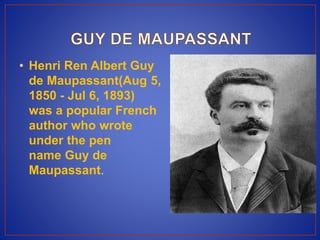


• Henri Ren Albert Guy
de Maupassant(Aug 5,
1850 - Jul 6, 1893)
was a popular French
author who wrote
under the pen
name Guy de
Maupassant.
• He is considered one of the fathers of the
modern short story as well as one of its finest
practitioners.
• His prolific and deeply admired body of work
influenced a great number of writers
including Somerset Maugham, O.
Henry, Anton Chekhov, and Henry James.
• He was a popular writer during his lifetime
and had the good fortune to see that his
stories were widely read.
• As a young man he fought in the Franco-
Prussian war.
• He drew heavily on that experience and that
war provides for many of stories which often
depict the tragedy and suffering of innocent
civilians caught to his works.
• Also it showed realist properties works by
Maupassant and even only showed the good
side of realism. Therefore he separated from
Emile Zola.
• Pessimistic form that was closer to human
life to her naturalism.
• Guy de Maupassant suffered from mental
illness in his later years and attempted
suicide on January 2nd, 1892. He was
committed to a private asylum in Paris and
died the following year.
• THE NECLACE
• A PIECE OF STRING
• MADEMOISELLE
• MISS HARRIET
• MY UNCLE JULES
• FOUND ON A DROWNED MAN
• THE WRECK
• Mathilde, the main woman character in this
short story, is being described as unhappy
because of her and her husband’s being
poor.
• The complication starts when she and her
husband are invited to a rich people’s ball.
She buys a new gown, and to go with it, she
borrows an elegant diamond necklace from
her friend Madame Forestier.
• The peak of this short story is when Mathilde
discovers that she lost the diamond
necklace.
• To replace the lost diamond necklace,
Mathilde and her husband buy another one
exactly the same, for thirty-four thousand
francs, from its original price of forty francs,
such a very big amount of money for the
couple. The eighteen thousand francs was
inherited by her husband from his father, and
the rest of the amount he borrows from
various sources.
• The problem resolves itself, though in a
negative manner, when Mathilde and Madame
Forestier meet again after ten years, and the
latter tells the former that the diamond
necklace she borrowed was fake.
MATHILDE LOISEL : Mathilde Loisel - The
protagonist of the story. Mathilde has been
blessed with physical beauty but not with the
affluent lifestyle she yearns for, and she feels
deeply discontented with her lot in life. When
she prepares to attend a fancy party, she
borrows a diamond necklace from her friend
Madame Forestier, then loses the necklace and
must work for ten years to pay off a
replacement. Her one night of radiance cost
her and Monsieur Loisel any chance for future
happiness.
• MONSIEUR LOISEL : Mathilde’s husband.
Monsieur Loisel is content with the small pleasures
of his life but does his best to appease Mathilde’s
demands and assuage her complaints. He loves
Mathilde immensely but does not truly understand
her, and he seems to underestimate the depth of her
unhappiness.
He pays dearly for something he had never wanted in
the
frist place.
MADAME FORESTIER : Mathilde’s wealthy friend.
Madame Forestier treats Mathilde kindly, but
Mathilde is bitterly jealous of Madame Forestier’s
wealth, and the kindness pains her. Madame Forestier
lends Mathilde the necklace for the party and does not
inspect it when Mathilde returns it.
• The point of view of this story is that of a
third person narrator. The story is not told
from the point of view of Madame Loisel or
anyone else who is actually involved in the
story. Instead, it is just some uninvolved
narrator.
• The narrator is omniscient. The narrator can
see what the characters are thinking,
although this ability is not used much in the
story. However, we are told, for example, that
Madame Loisel is not happy because she
thinks she has married beneath her that she
• The moment Mathilde notices the necklace is
missing, she should have confessed to
Madame Forestier. Then she would have
found out that the necklace was phony, and
wouldn't have to work for years to pay for a
necklace that wasn't hers. Because of her
pride, she decided to pretend that nothing
had happened. The irony is that because of
her pride, she loses the best years of her life,
and never has a chance to live the life of
luxury she longed for
• Given that Mathilde cannot go to the party
without jewels, the necklace represents both
her greed and artificial nature. First, Mathilde's
inability to be satisfied with only a dress,
her need for the necklace proves her greed.
Compounding this, Mathilde is not happy at
first with the choice of jewelry Madame
Forestier offers her. She actually asks if there
are
any other necklaces.
• By the end of the story, readers find out that
the necklace if fake. The fact that Mathilde
wore it like it was real, needed it to appear
important (and not what she was), shows her
artificiality. The necklace, therefore, represents
Mathilde herself: both look like they are
worth more than they actually are.
• The first conflict is the woman's, Matilda, feelings of inadequacy
as she is not married into the life that
she feels would award her the beautiful things she wants. This is
an internal conflict.
The external conflict arises after she has worn the necklace. She
has to find a way to replace the lost
necklace. She believes it to be very valuable and can not figure
out what she should do. This led to
her husband using all his savings from an inheritance and then
having to borrow the rest of the sum.
They had to work desperately hard for ten years to pay it all back.
Matilda has changed her life and all because she could not accept
that she had once had a better life.
• Dramatic irony : Madame Loisel gave up 10
years of her life just to tell a lie that she lost
the necklace. The necklace was fake, it's
irony because Mathide Loisel had never
expected to borrow a fake necklace from her
rich friend, Madame Fostier. The necklace
was supposed to make Mathilde Loisel look
rich but it actually made her poorer than
before.
The necklace
The necklace

The necklace

  • 2.
    • Henri RenAlbert Guy de Maupassant(Aug 5, 1850 - Jul 6, 1893) was a popular French author who wrote under the pen name Guy de Maupassant.
  • 3.
    • He isconsidered one of the fathers of the modern short story as well as one of its finest practitioners. • His prolific and deeply admired body of work influenced a great number of writers including Somerset Maugham, O. Henry, Anton Chekhov, and Henry James. • He was a popular writer during his lifetime and had the good fortune to see that his stories were widely read. • As a young man he fought in the Franco- Prussian war.
  • 4.
    • He drewheavily on that experience and that war provides for many of stories which often depict the tragedy and suffering of innocent civilians caught to his works. • Also it showed realist properties works by Maupassant and even only showed the good side of realism. Therefore he separated from Emile Zola. • Pessimistic form that was closer to human life to her naturalism. • Guy de Maupassant suffered from mental illness in his later years and attempted suicide on January 2nd, 1892. He was committed to a private asylum in Paris and died the following year.
  • 5.
    • THE NECLACE •A PIECE OF STRING • MADEMOISELLE • MISS HARRIET • MY UNCLE JULES • FOUND ON A DROWNED MAN • THE WRECK
  • 6.
    • Mathilde, themain woman character in this short story, is being described as unhappy because of her and her husband’s being poor. • The complication starts when she and her husband are invited to a rich people’s ball. She buys a new gown, and to go with it, she borrows an elegant diamond necklace from her friend Madame Forestier. • The peak of this short story is when Mathilde discovers that she lost the diamond necklace.
  • 7.
    • To replacethe lost diamond necklace, Mathilde and her husband buy another one exactly the same, for thirty-four thousand francs, from its original price of forty francs, such a very big amount of money for the couple. The eighteen thousand francs was inherited by her husband from his father, and the rest of the amount he borrows from various sources. • The problem resolves itself, though in a negative manner, when Mathilde and Madame Forestier meet again after ten years, and the latter tells the former that the diamond necklace she borrowed was fake.
  • 8.
    MATHILDE LOISEL :Mathilde Loisel - The protagonist of the story. Mathilde has been blessed with physical beauty but not with the affluent lifestyle she yearns for, and she feels deeply discontented with her lot in life. When she prepares to attend a fancy party, she borrows a diamond necklace from her friend Madame Forestier, then loses the necklace and must work for ten years to pay off a replacement. Her one night of radiance cost her and Monsieur Loisel any chance for future happiness.
  • 9.
    • MONSIEUR LOISEL: Mathilde’s husband. Monsieur Loisel is content with the small pleasures of his life but does his best to appease Mathilde’s demands and assuage her complaints. He loves Mathilde immensely but does not truly understand her, and he seems to underestimate the depth of her unhappiness. He pays dearly for something he had never wanted in the frist place. MADAME FORESTIER : Mathilde’s wealthy friend. Madame Forestier treats Mathilde kindly, but Mathilde is bitterly jealous of Madame Forestier’s wealth, and the kindness pains her. Madame Forestier lends Mathilde the necklace for the party and does not inspect it when Mathilde returns it.
  • 10.
    • The pointof view of this story is that of a third person narrator. The story is not told from the point of view of Madame Loisel or anyone else who is actually involved in the story. Instead, it is just some uninvolved narrator. • The narrator is omniscient. The narrator can see what the characters are thinking, although this ability is not used much in the story. However, we are told, for example, that Madame Loisel is not happy because she thinks she has married beneath her that she
  • 11.
    • The momentMathilde notices the necklace is missing, she should have confessed to Madame Forestier. Then she would have found out that the necklace was phony, and wouldn't have to work for years to pay for a necklace that wasn't hers. Because of her pride, she decided to pretend that nothing had happened. The irony is that because of her pride, she loses the best years of her life, and never has a chance to live the life of luxury she longed for
  • 12.
    • Given thatMathilde cannot go to the party without jewels, the necklace represents both her greed and artificial nature. First, Mathilde's inability to be satisfied with only a dress, her need for the necklace proves her greed. Compounding this, Mathilde is not happy at first with the choice of jewelry Madame Forestier offers her. She actually asks if there are any other necklaces.
  • 13.
    • By theend of the story, readers find out that the necklace if fake. The fact that Mathilde wore it like it was real, needed it to appear important (and not what she was), shows her artificiality. The necklace, therefore, represents Mathilde herself: both look like they are worth more than they actually are.
  • 14.
    • The firstconflict is the woman's, Matilda, feelings of inadequacy as she is not married into the life that she feels would award her the beautiful things she wants. This is an internal conflict. The external conflict arises after she has worn the necklace. She has to find a way to replace the lost necklace. She believes it to be very valuable and can not figure out what she should do. This led to her husband using all his savings from an inheritance and then having to borrow the rest of the sum. They had to work desperately hard for ten years to pay it all back. Matilda has changed her life and all because she could not accept that she had once had a better life.
  • 15.
    • Dramatic irony: Madame Loisel gave up 10 years of her life just to tell a lie that she lost the necklace. The necklace was fake, it's irony because Mathide Loisel had never expected to borrow a fake necklace from her rich friend, Madame Fostier. The necklace was supposed to make Mathilde Loisel look rich but it actually made her poorer than before.