Click to edit Master title style
1
Elements of Computer
and Communication
System
2.2 Data/Information
2.2.1 Units of Measurement of
Capacity
Click to edit Master title style
2 2
Data consists of individual facts or
pieces of information that by
themselves may not make much
sense of a person. A computer
primary job is to process these
tiny pieces of data in various
ways, converting them into useful
information.
Click to edit Master title style
3 3
Data includes texts and numbers,
sounds, images, and videos that we
input into the computer for processing.
Raw data are normal inputs entered
into the computer. The software that
the user decides to operate on the
determine largely the resulting output.
Processed data are called information
and they are useful to people.
Click to edit Master title style
4 4
 Classification of Data
Formatted Data – includes the numerical or
alphabetical data
Text – is a series of letters, numbers and other
characters
Image – is a data in the form of picture, a graph or a
hand- drawn picture
Audio – is data in the form of sounds
Video – combined pictures that are displayed to
portray action
Click to edit Master title style
5 5
 Units of Measurement for Capacity
The terms units of measurement for capacity are usually used in the
world of computing to describe disk space, or data storage space, and
system memory.
According to the IBM Dictionary of computing, when used to describe
disk storage capacity, a megabyte is 1,000,000 bytes in decimal notation.
But when the term megabyte is used for real and virtual storage, and
channel volume, 2 to the 20th power or 1,048,576bytes is the
appropriate notation. According to the Microsoft Press Computer
Dictionary, a megabyte means either 1,000,000 bytes or 1,048,576 bytes.
When referring to a megabyte for disk storage, the hard drive
manufacturers use the standard that a megabyte is 1,000,000 bytes. This
means that when you buy an 80 Gigabyte Hard drive you will get a total
of 80,000,000,000 bytes of available storage.
Click to edit Master title style
6 6
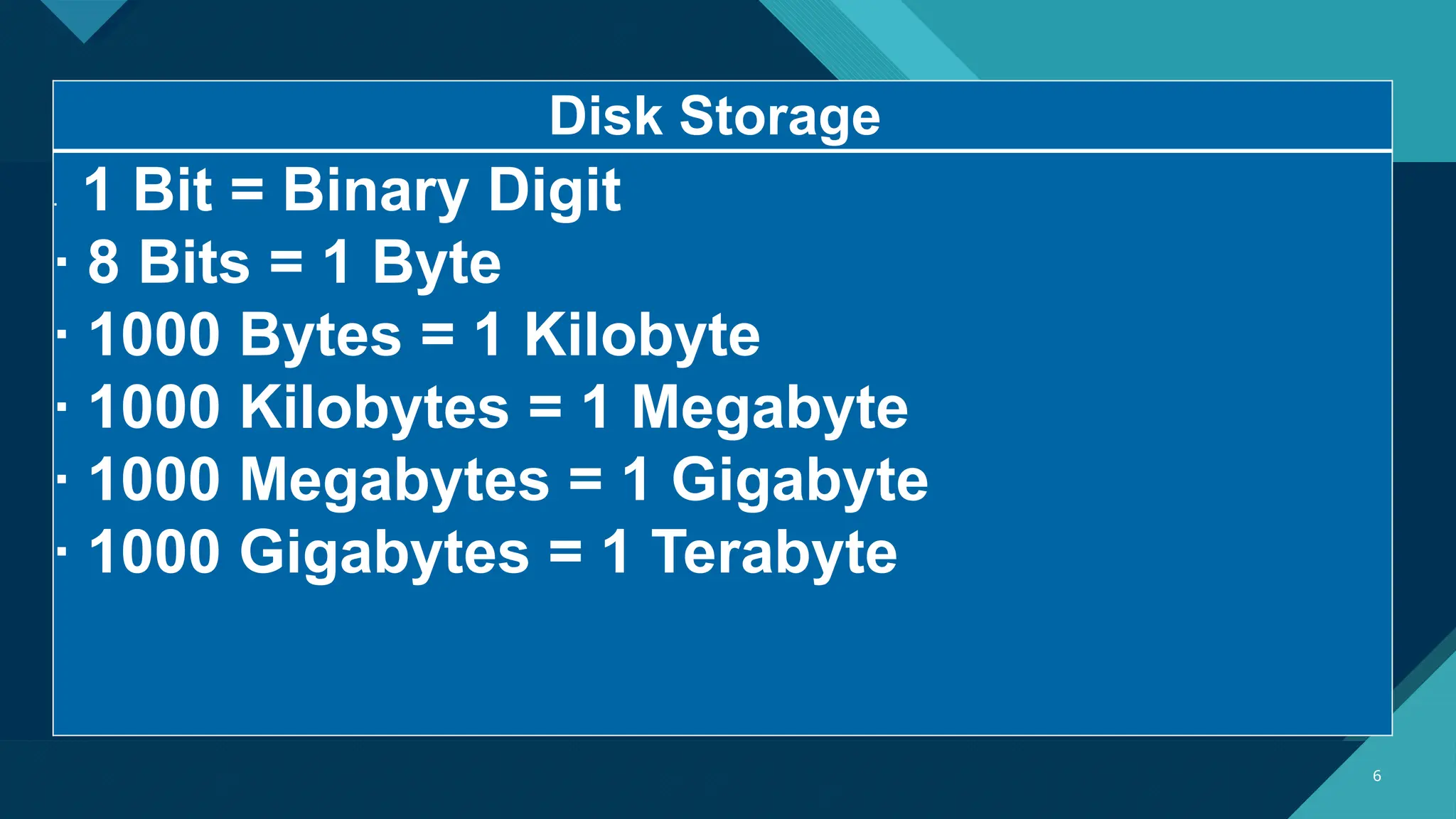
Disk Storage
· 1 Bit = Binary Digit
· 8 Bits = 1 Byte
· 1000 Bytes = 1 Kilobyte
· 1000 Kilobytes = 1 Megabyte
· 1000 Megabytes = 1 Gigabyte
· 1000 Gigabytes = 1 Terabyte
Click to edit Master title style
7 7
This is based on the IBM Dictionary of computing
method to describe disk storage - the simplest.
Bit: A Bit is the smallest unit of data that a computer uses. It can
be used to represent two states of information, such as Yes or
No.
Byte: A Byte is equal to 8 Bits. A Byte can represent 256 states of
information, for example, numbers or a combination of numbers
and letters. 1 Byte could be equal to one character. 10 Bytes could
be equal to a word. 100 Bytes would equal an average sentence.
Click to edit Master title style
8 8
Kilobyte: A Kilobyte is approximately 1,000 Bytes, actually 1,024
Bytes depending on which definition is used. 1 Kilobyte would be
equal to this paragraph you are reading, whereas 100 Kilobytes
would equal an entire page.
Megabyte: A Megabyte is approximately 1,000 Kilobytes. In the
early days of computing, a Megabyte was considered to be a
large amount of data. These days with a 500 Gigabyte hard drive
on a computer being common, a Megabyte doesn't seem like
much anymore. One of those old 3-1/2 inch floppy disks can hold
1.44 Megabytes or the equivalent of a small book. 100 Megabytes
might hold a couple volumes of Encyclopedias. 600 Megabytes is
about the amount of data that will fit on a CD-ROM disk.
Click to edit Master title style
9 9
Gigabyte: A Gigabyte is approximately 1,000 Megabytes. A Gigabyte is
still a very common term used these days when referring to disk space or
drive storage. 1 Gigabyte of data is almost twice the amount of data that
a CD-ROM can hold. But it's about one thousand times the capacity of a 3-
1/2 floppy disk. 1 Gigabyte could hold the contents of about 10 yards of
books on a shelf. 100 Gigabytes could hold the entire library floor of
academic journals.
Terabyte: A Terabyte is approximately one trillion bytes, or 1,000
Gigabytes. There was a time that I never thought I would see a 1 Terabyte
hard drive, now one and two terabyte drives are the normal specs for
many new computers. To put it in some perspective, a Terabyte could
hold about 3.6 million 300 Kilobyte images or maybe about 300 hours of
good quality video. A Terabyte could hold 1,000 copies of the Encyclopedia
Britannica. Ten Terabytes could hold the printed collection of the Library
of Congress. That's a lot of data
Click to edit Master title style
10
Thank you and God Bless us all!

Elements of Computer Data-Information.pptx

  • 1.
    Click to editMaster title style 1 Elements of Computer and Communication System 2.2 Data/Information 2.2.1 Units of Measurement of Capacity
  • 2.
    Click to editMaster title style 2 2 Data consists of individual facts or pieces of information that by themselves may not make much sense of a person. A computer primary job is to process these tiny pieces of data in various ways, converting them into useful information.
  • 3.
    Click to editMaster title style 3 3 Data includes texts and numbers, sounds, images, and videos that we input into the computer for processing. Raw data are normal inputs entered into the computer. The software that the user decides to operate on the determine largely the resulting output. Processed data are called information and they are useful to people.
  • 4.
    Click to editMaster title style 4 4  Classification of Data Formatted Data – includes the numerical or alphabetical data Text – is a series of letters, numbers and other characters Image – is a data in the form of picture, a graph or a hand- drawn picture Audio – is data in the form of sounds Video – combined pictures that are displayed to portray action
  • 5.
    Click to editMaster title style 5 5  Units of Measurement for Capacity The terms units of measurement for capacity are usually used in the world of computing to describe disk space, or data storage space, and system memory. According to the IBM Dictionary of computing, when used to describe disk storage capacity, a megabyte is 1,000,000 bytes in decimal notation. But when the term megabyte is used for real and virtual storage, and channel volume, 2 to the 20th power or 1,048,576bytes is the appropriate notation. According to the Microsoft Press Computer Dictionary, a megabyte means either 1,000,000 bytes or 1,048,576 bytes. When referring to a megabyte for disk storage, the hard drive manufacturers use the standard that a megabyte is 1,000,000 bytes. This means that when you buy an 80 Gigabyte Hard drive you will get a total of 80,000,000,000 bytes of available storage.
  • 6.
    Click to editMaster title style 6 6 Disk Storage · 1 Bit = Binary Digit · 8 Bits = 1 Byte · 1000 Bytes = 1 Kilobyte · 1000 Kilobytes = 1 Megabyte · 1000 Megabytes = 1 Gigabyte · 1000 Gigabytes = 1 Terabyte
  • 7.
    Click to editMaster title style 7 7 This is based on the IBM Dictionary of computing method to describe disk storage - the simplest. Bit: A Bit is the smallest unit of data that a computer uses. It can be used to represent two states of information, such as Yes or No. Byte: A Byte is equal to 8 Bits. A Byte can represent 256 states of information, for example, numbers or a combination of numbers and letters. 1 Byte could be equal to one character. 10 Bytes could be equal to a word. 100 Bytes would equal an average sentence.
  • 8.
    Click to editMaster title style 8 8 Kilobyte: A Kilobyte is approximately 1,000 Bytes, actually 1,024 Bytes depending on which definition is used. 1 Kilobyte would be equal to this paragraph you are reading, whereas 100 Kilobytes would equal an entire page. Megabyte: A Megabyte is approximately 1,000 Kilobytes. In the early days of computing, a Megabyte was considered to be a large amount of data. These days with a 500 Gigabyte hard drive on a computer being common, a Megabyte doesn't seem like much anymore. One of those old 3-1/2 inch floppy disks can hold 1.44 Megabytes or the equivalent of a small book. 100 Megabytes might hold a couple volumes of Encyclopedias. 600 Megabytes is about the amount of data that will fit on a CD-ROM disk.
  • 9.
    Click to editMaster title style 9 9 Gigabyte: A Gigabyte is approximately 1,000 Megabytes. A Gigabyte is still a very common term used these days when referring to disk space or drive storage. 1 Gigabyte of data is almost twice the amount of data that a CD-ROM can hold. But it's about one thousand times the capacity of a 3- 1/2 floppy disk. 1 Gigabyte could hold the contents of about 10 yards of books on a shelf. 100 Gigabytes could hold the entire library floor of academic journals. Terabyte: A Terabyte is approximately one trillion bytes, or 1,000 Gigabytes. There was a time that I never thought I would see a 1 Terabyte hard drive, now one and two terabyte drives are the normal specs for many new computers. To put it in some perspective, a Terabyte could hold about 3.6 million 300 Kilobyte images or maybe about 300 hours of good quality video. A Terabyte could hold 1,000 copies of the Encyclopedia Britannica. Ten Terabytes could hold the printed collection of the Library of Congress. That's a lot of data
  • 10.
    Click to editMaster title style 10 Thank you and God Bless us all!