Elements of
Communication System
Outline
• Communication
• Defining Communication
• Defining Telecommunication
• Communication System
• Flow of Messages in a Communication System
• Modes of Transmission
• Relative Number of Sources and Destination
• Modes of Transmission
• Telecommunication
• Telecommunication Services
• Telecommunication Infrastructure
• Tanzania Telecommunication
Ecosystem, TTE
• Telecommunication Ecosystem
• The Case of Tanzania
Communication
• The Romans
• The Romans used the Latin word “communicare” when they meant "to make common, to
share, or to impart.
• Sharing of Information
• Communication is the sharing of information or messages between two or more
entities.
• Exchange of Information
• Communication is the exchange of information between two or more entities.
Telecommunication
• Telecommunication is the exchange of information between two or more
entities by electrical or electronic means.
• It includes a wide range of information transmitting technologies such as
telephones (wired and wireless), microwave communications, fiber optics,
satellites, radio and television broadcasting, the internet and telegraphs.
• All telecommunication is communication. Not all communication is
telecommunication.
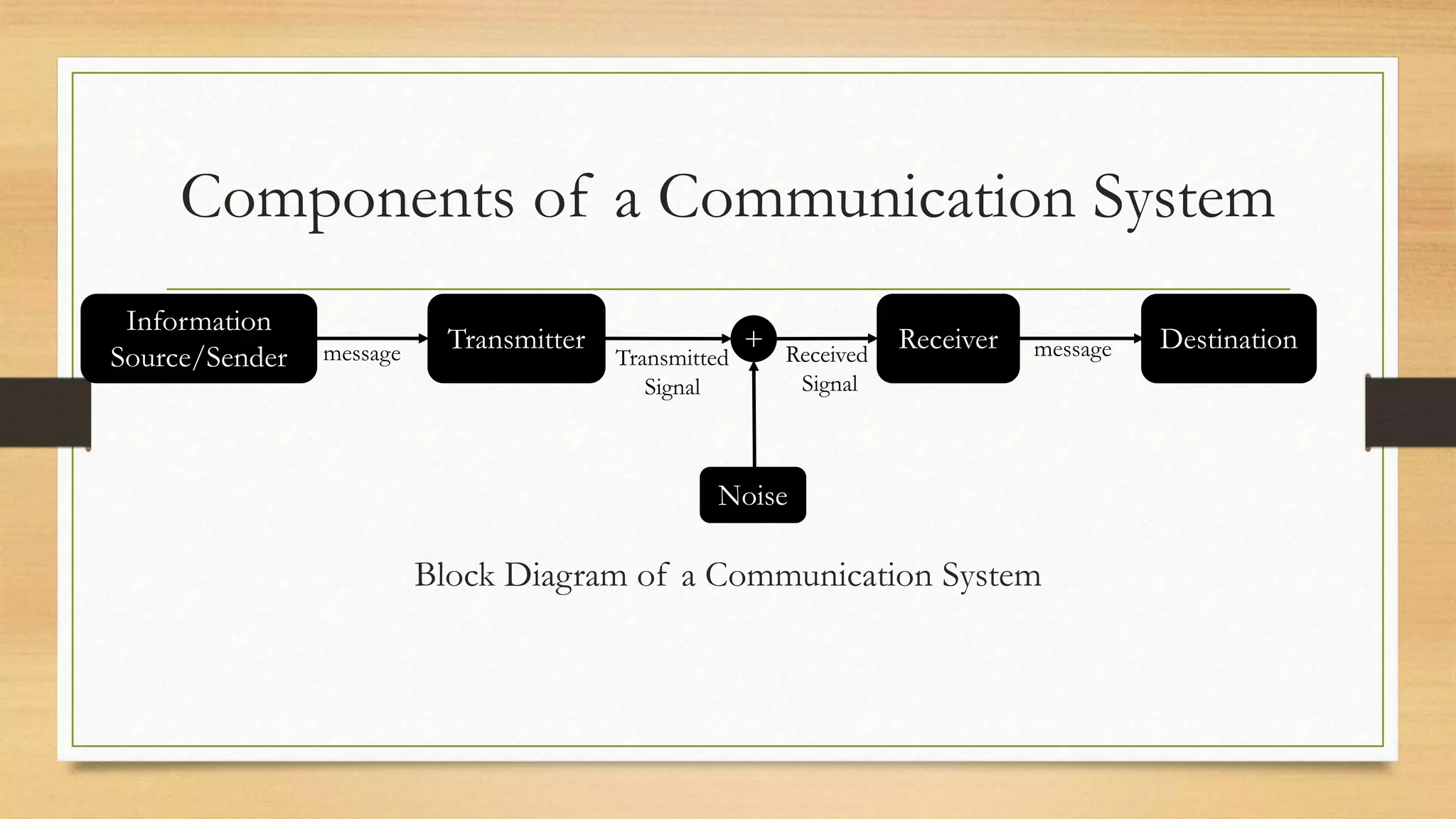
Components of a Communication System
Block Diagram of a Communication System
Information
Source/Sender
Transmitter Receiver Destination
+
Noise
message Transmitted
Signal
Received
Signal
message
Components of a Communication System
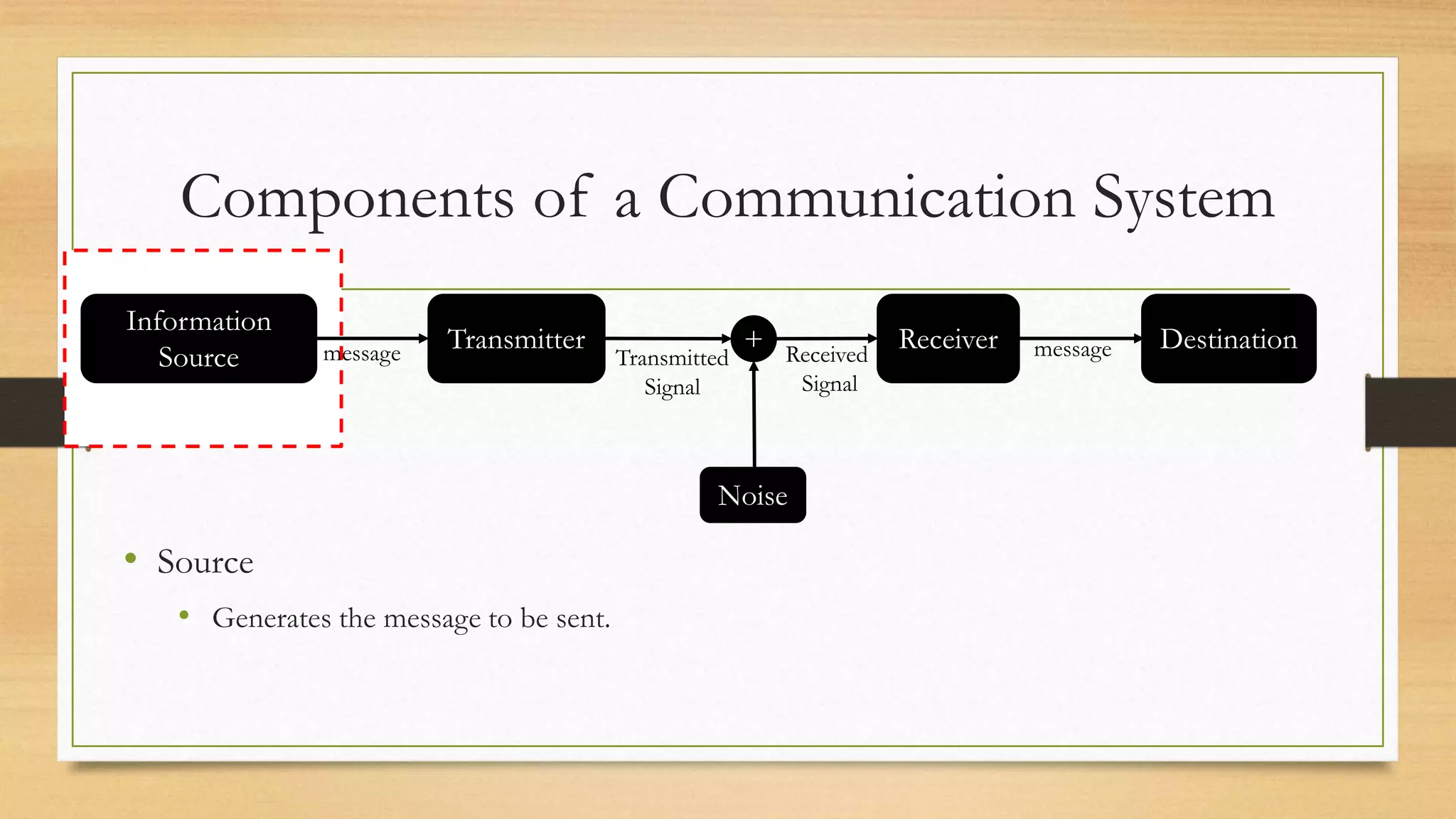
• Source
• Generates the message to be sent.
Information
Source
Transmitter Receiver Destination
+
Noise
message Transmitted
Signal
Received
Signal
message
Components of a Communication System
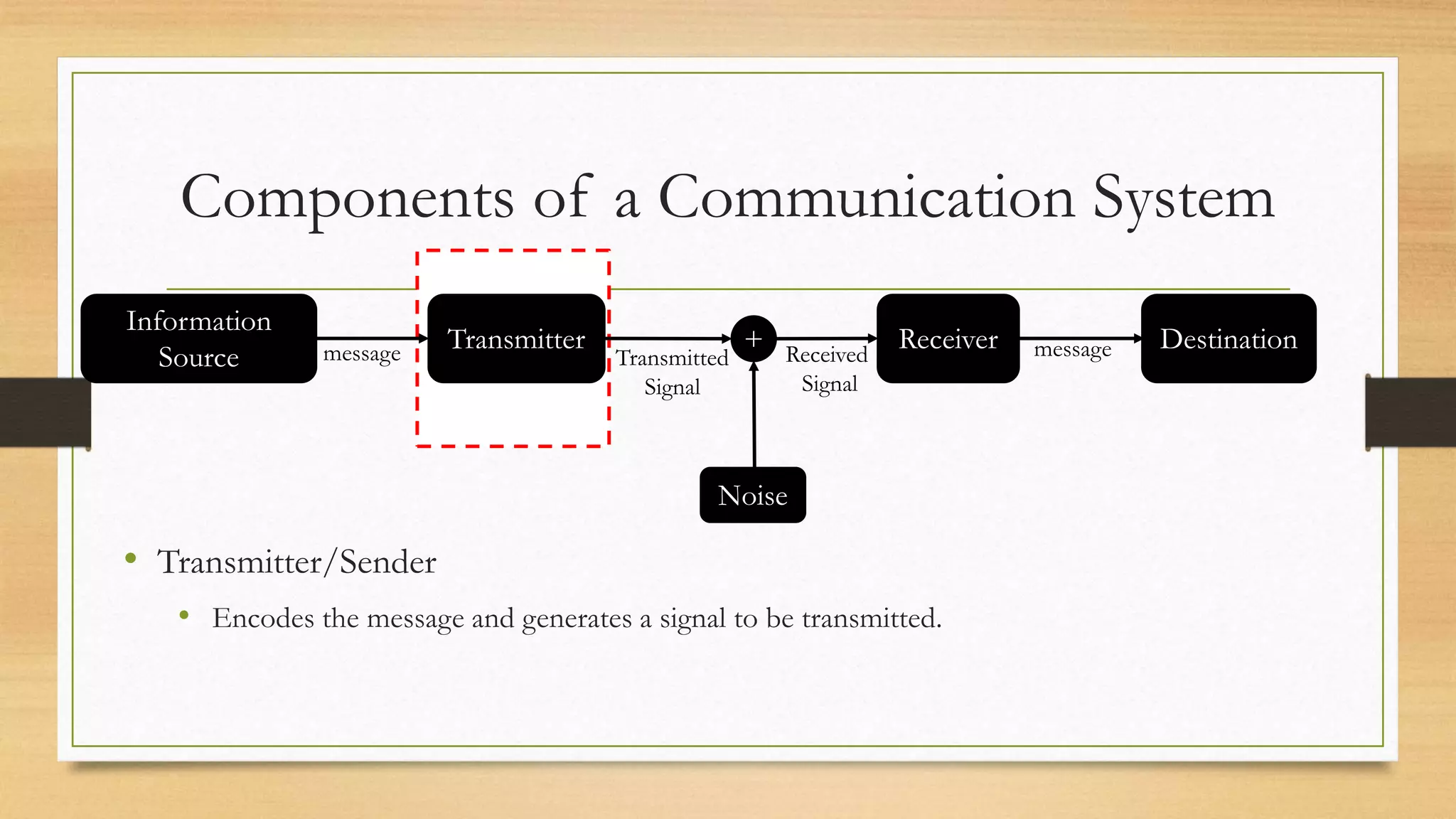
• Transmitter/Sender
• Encodes the message and generates a signal to be transmitted.
Information
Source
Transmitter Receiver Destination
+
Noise
message Transmitted
Signal
Received
Signal
message
Components of a Communication System
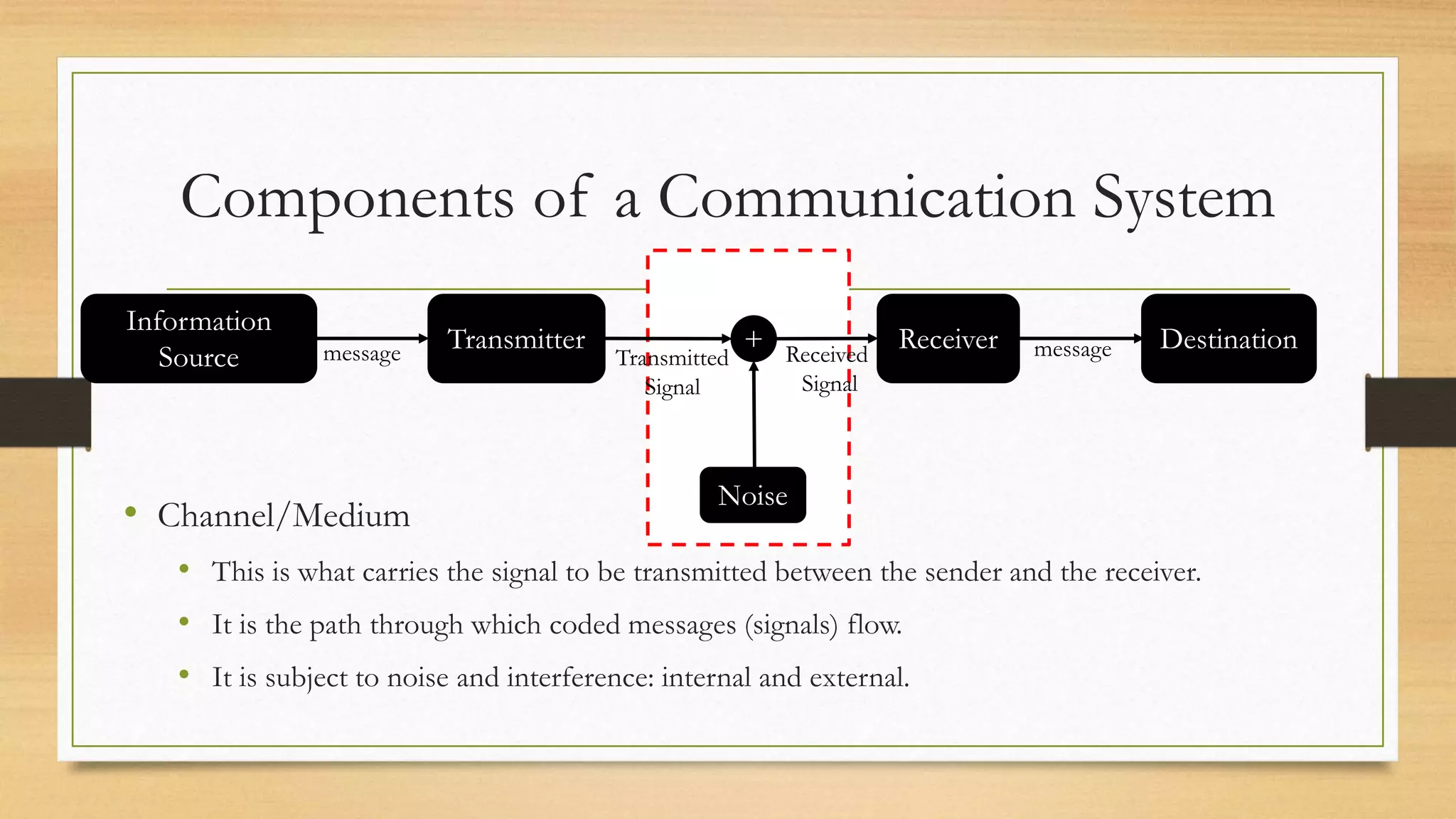
• Channel/Medium
• This is what carries the signal to be transmitted between the sender and the receiver.
• It is the path through which coded messages (signals) flow.
• It is subject to noise and interference: internal and external.
Information
Source
Transmitter Receiver Destination
+
Noise
message Transmitted
Signal
Received
Signal
message
Components of a Communication System
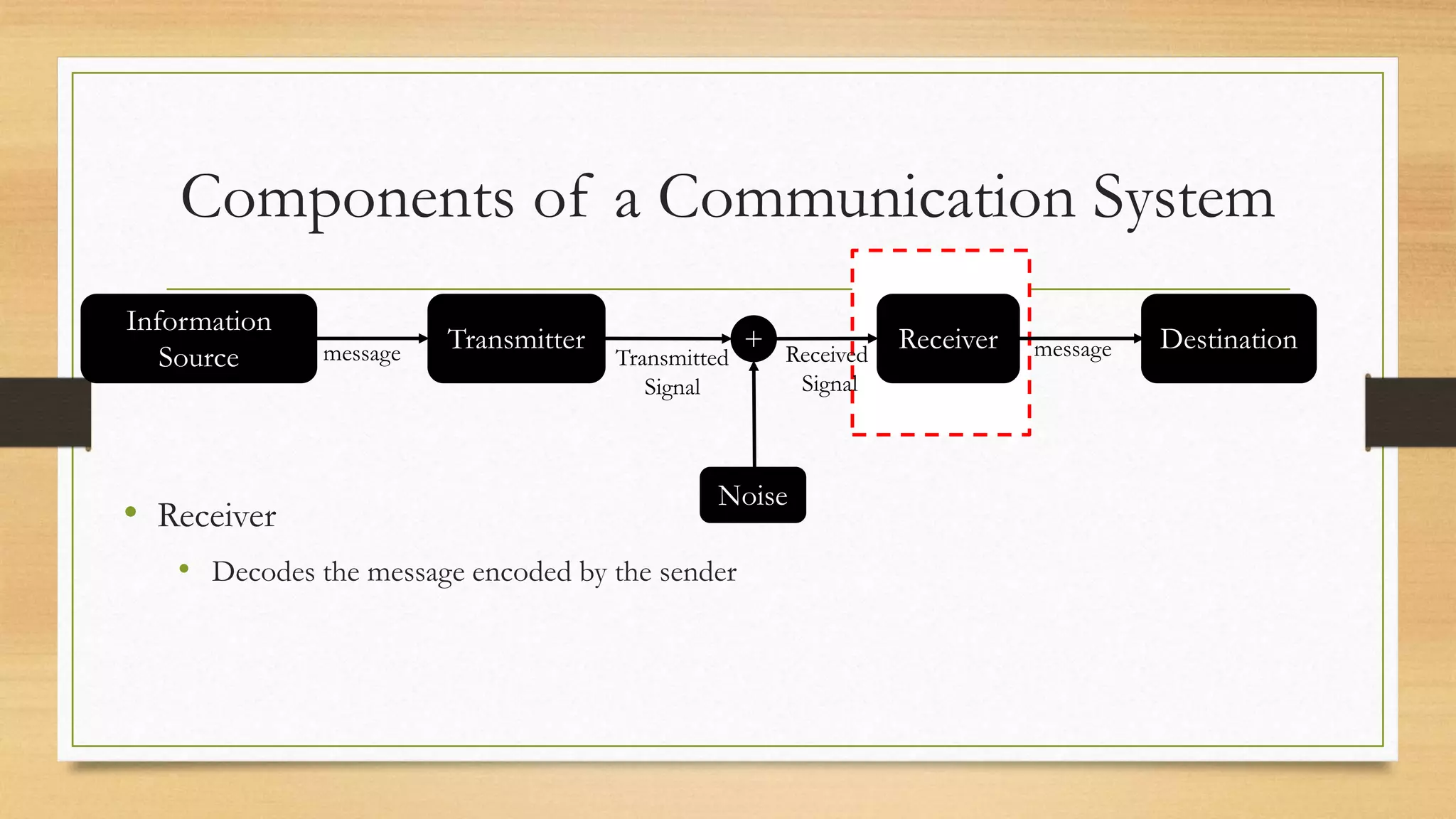
• Receiver
• Decodes the message encoded by the sender
Information
Source
Transmitter Receiver Destination
+
Noise
message Transmitted
Signal
Received
Signal
message
Components of a Communication System
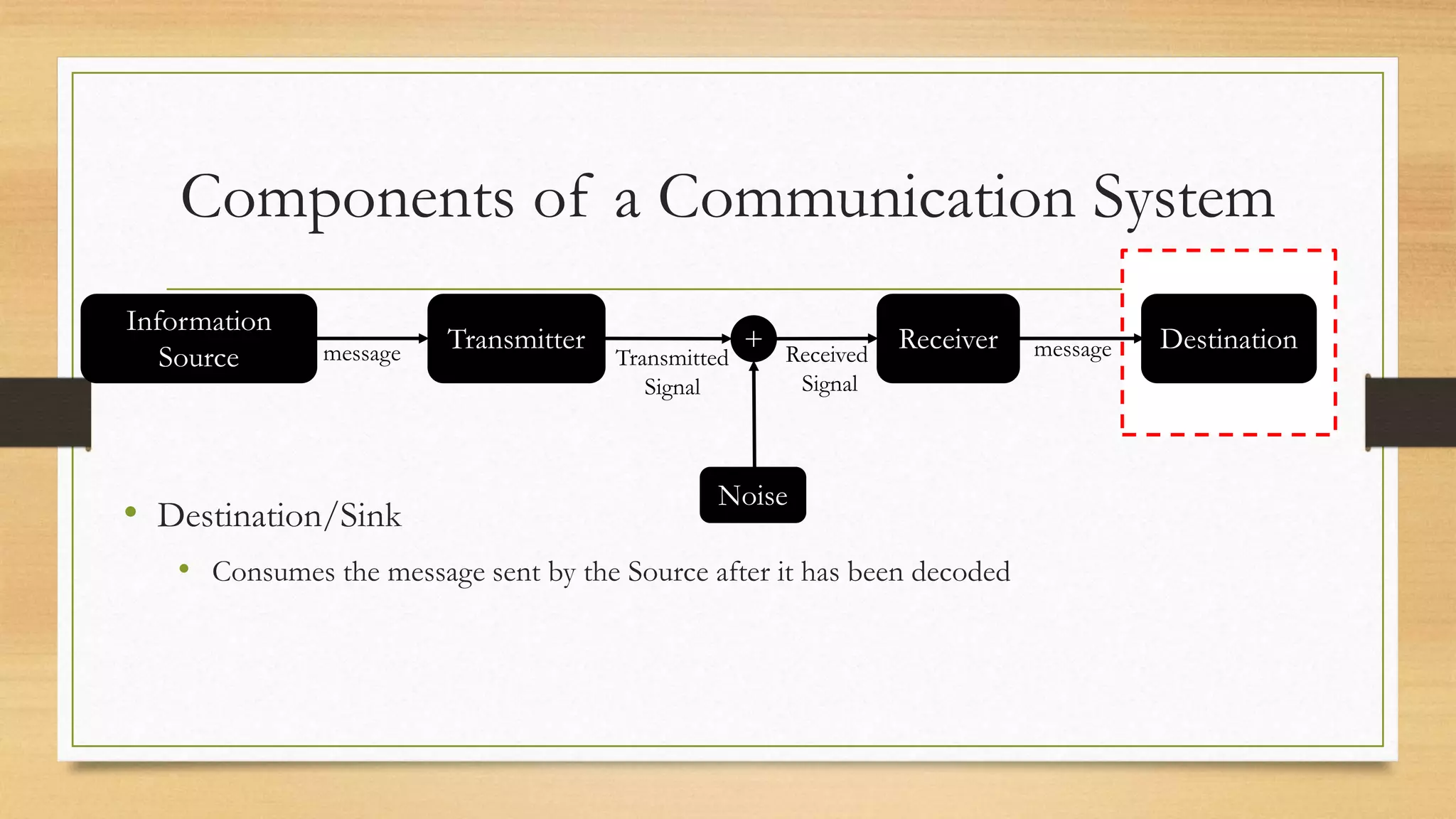
• Destination/Sink
• Consumes the message sent by the Source after it has been decoded
Information
Source
Transmitter Receiver Destination
+
Noise
message Transmitted
Signal
Received
Signal
message
Flow of Messages
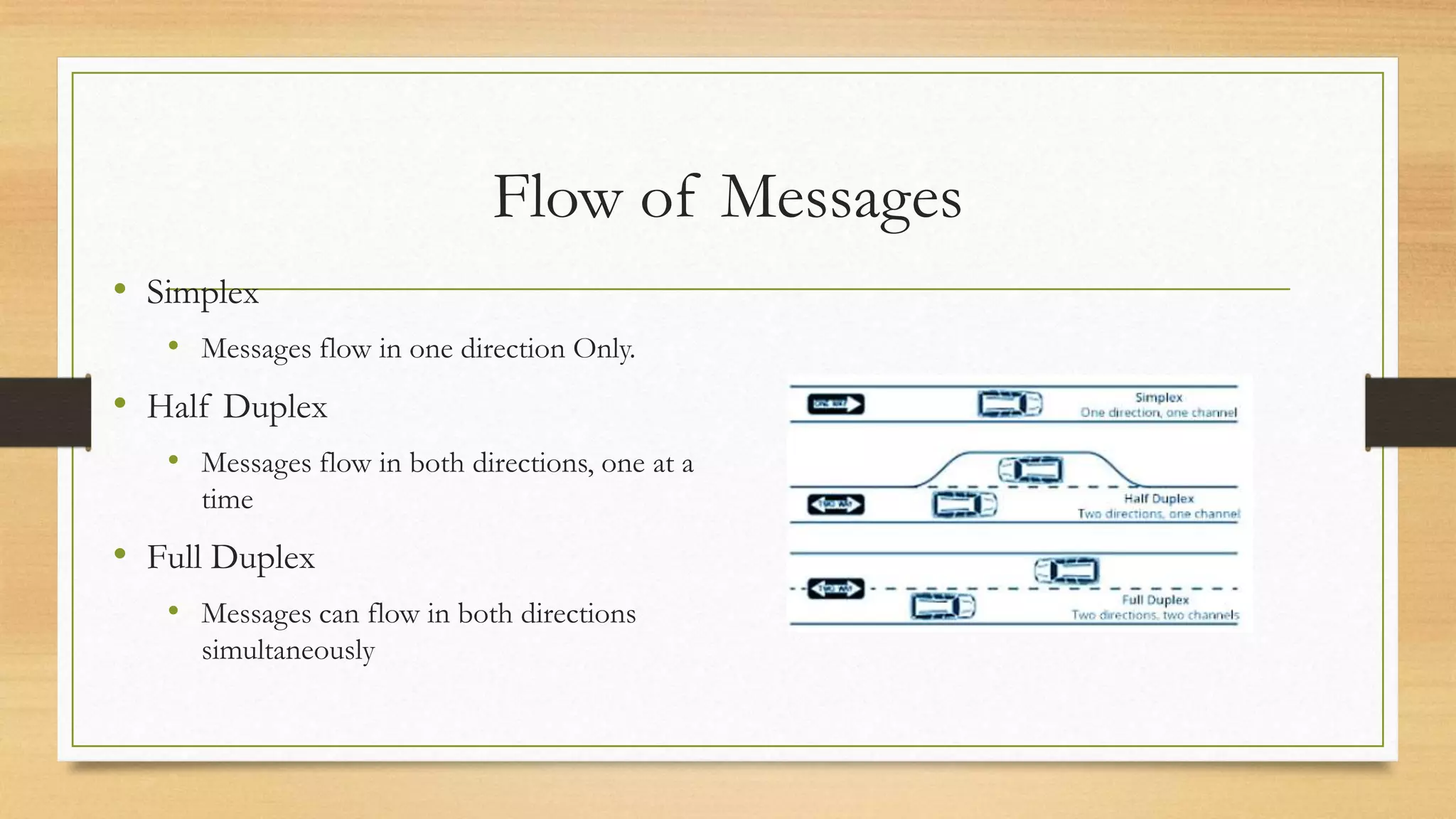
• Simplex
• Messages flow in one direction Only.
• Half Duplex
• Messages flow in both directions, one at a
time
• Full Duplex
• Messages can flow in both directions
simultaneously
Unicast, Broadcast, Multicast
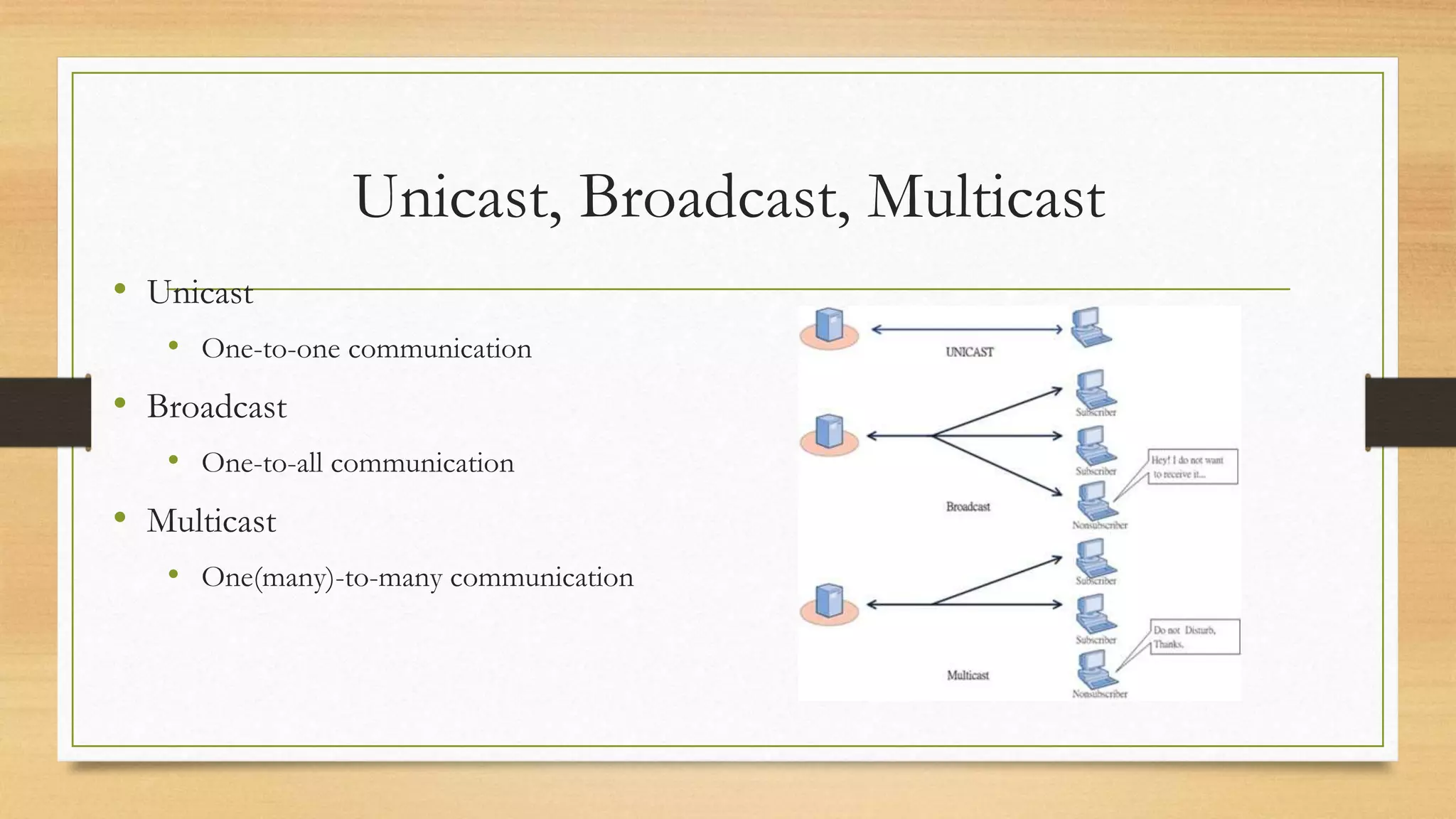
• Unicast
• One-to-one communication
• Broadcast
• One-to-all communication
• Multicast
• One(many)-to-many communication
Voice Services
• Refers to the use of electrical signals to transmit human voice across a
distance.
• Primary service in the PSTN and Cellular Telecommunication Systems.
• Available in the Internet as VoIP.
Video Services
• Refers to the use of electrical signals to transmit moving pictures and sound
across a distance.
• A primary service of the obsolete ISDN
• Available in Cellular telecommunication Systems 3G onwards
• Available in Internet and CATV networks
Data Services
• The use of electrical signals to exchange encoded text and images between
computerized devices across a distance.
• Telegraph is one of the first telecommunication data service
• Available in the PSTN as Fax
• Available in cellular networks as SMS and MMS
• Available in the Internet as Email and WWW
Multimedia Services
• A service providing a combination of voice, data and video.
• Watching a movie with or without subtitles
Infrastructure
• Organizations, personnel, procedures, facilities and networks employed to
transmit and receive information by electrical or electronic means.
• User Equipment
• Access Network
• Transport Network
• Data centers
• Generally, telecommunication networks and systems which carry information
from one point to another.
User Equipment
• Captures the message from the source and converts it into a signal ready for
transmission.
• Phones
• Computer
• Networked Printer, Scanner
• Fax Machine
• They do ADC/DAC, Modulation/Demodulation etc
Access Network
• Connects the user equipment to a telecommunication network.
• Basetransceiver station (BTS)
• Local Area Network Switch
• Satellite earth Station
• PSTN Local Loop
Transport Network
• Microwave System
• Optical Fiber System
• Satellite System
Data Center
• This houses server computers and storage facility.
• Mass Storage
• Powerful Computers
• Cooling Mechanisms
Telecommunication Ecosystems (TTE)
• An ecosystem is a community of living and non-living things that work
together.
• The telecommunications ecosystem brings together a dynamic group of
diverse market players providing differing technologies, products, and
services while interacting within a common environment.
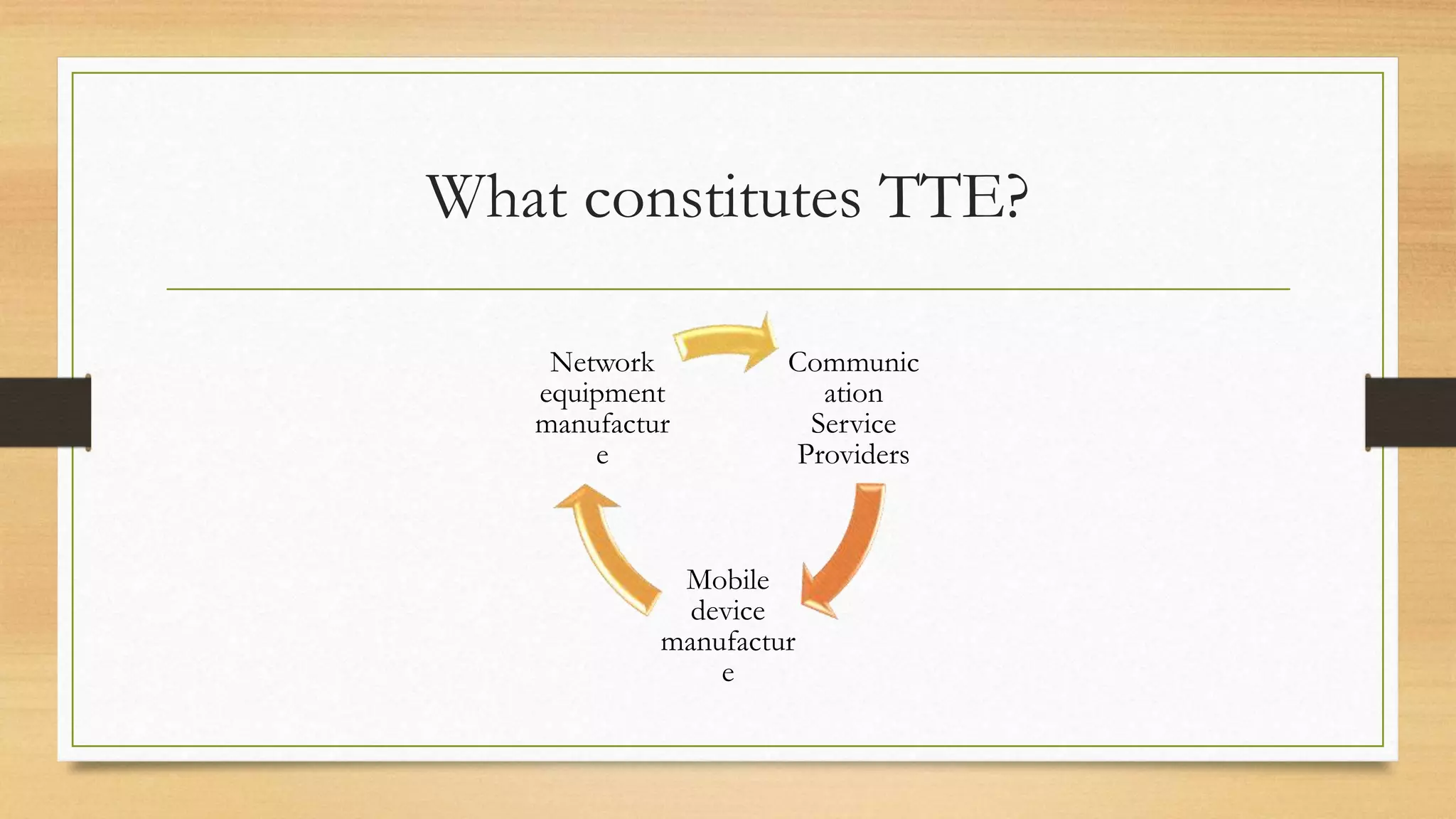
What constitutes TTE?
• Users consumers of telecommunications services.
• Technology providers -These include telecom system manufacturers like
Ericsson, Cisco, Huawei and Alcatel; mobile phone producers like Apple,
Motorola, Samsung, and Sony-Ericsson; and electronic accessory makers like
Toshiba, Acer, and Dell.
• Network operators Included in this category are Vodacom, Airtel, tiGo,
Halotel etc.
What constitutes TTE?
• Content providers Content includes materials that end-users are looking for.
They come in the form of textual information, video and audio
presentations. Professionally produced pieces can be provided by media and
entertainment outfits and broadcast channels.
• Regulators-These are here to protect the end user's interest, ensure fair play
by the operators, content and solution providers
What constitutes TTE?
Communic
ation
Service
Providers
Mobile
device
manufactur
e
Network
equipment
manufactur
e

Elements of Communication System.pptx

  • 1.
  • 2.
    Outline • Communication • DefiningCommunication • Defining Telecommunication • Communication System • Flow of Messages in a Communication System • Modes of Transmission • Relative Number of Sources and Destination • Modes of Transmission • Telecommunication • Telecommunication Services • Telecommunication Infrastructure • Tanzania Telecommunication Ecosystem, TTE • Telecommunication Ecosystem • The Case of Tanzania
  • 3.
    Communication • The Romans •The Romans used the Latin word “communicare” when they meant "to make common, to share, or to impart. • Sharing of Information • Communication is the sharing of information or messages between two or more entities. • Exchange of Information • Communication is the exchange of information between two or more entities.
  • 4.
    Telecommunication • Telecommunication isthe exchange of information between two or more entities by electrical or electronic means. • It includes a wide range of information transmitting technologies such as telephones (wired and wireless), microwave communications, fiber optics, satellites, radio and television broadcasting, the internet and telegraphs. • All telecommunication is communication. Not all communication is telecommunication.
  • 5.
    Components of aCommunication System Block Diagram of a Communication System Information Source/Sender Transmitter Receiver Destination + Noise message Transmitted Signal Received Signal message
  • 6.
    Components of aCommunication System • Source • Generates the message to be sent. Information Source Transmitter Receiver Destination + Noise message Transmitted Signal Received Signal message
  • 7.
    Components of aCommunication System • Transmitter/Sender • Encodes the message and generates a signal to be transmitted. Information Source Transmitter Receiver Destination + Noise message Transmitted Signal Received Signal message
  • 8.
    Components of aCommunication System • Channel/Medium • This is what carries the signal to be transmitted between the sender and the receiver. • It is the path through which coded messages (signals) flow. • It is subject to noise and interference: internal and external. Information Source Transmitter Receiver Destination + Noise message Transmitted Signal Received Signal message
  • 9.
    Components of aCommunication System • Receiver • Decodes the message encoded by the sender Information Source Transmitter Receiver Destination + Noise message Transmitted Signal Received Signal message
  • 10.
    Components of aCommunication System • Destination/Sink • Consumes the message sent by the Source after it has been decoded Information Source Transmitter Receiver Destination + Noise message Transmitted Signal Received Signal message
  • 11.
    Flow of Messages •Simplex • Messages flow in one direction Only. • Half Duplex • Messages flow in both directions, one at a time • Full Duplex • Messages can flow in both directions simultaneously
  • 12.
    Unicast, Broadcast, Multicast •Unicast • One-to-one communication • Broadcast • One-to-all communication • Multicast • One(many)-to-many communication
  • 13.
    Voice Services • Refersto the use of electrical signals to transmit human voice across a distance. • Primary service in the PSTN and Cellular Telecommunication Systems. • Available in the Internet as VoIP.
  • 14.
    Video Services • Refersto the use of electrical signals to transmit moving pictures and sound across a distance. • A primary service of the obsolete ISDN • Available in Cellular telecommunication Systems 3G onwards • Available in Internet and CATV networks
  • 15.
    Data Services • Theuse of electrical signals to exchange encoded text and images between computerized devices across a distance. • Telegraph is one of the first telecommunication data service • Available in the PSTN as Fax • Available in cellular networks as SMS and MMS • Available in the Internet as Email and WWW
  • 16.
    Multimedia Services • Aservice providing a combination of voice, data and video. • Watching a movie with or without subtitles
  • 17.
    Infrastructure • Organizations, personnel,procedures, facilities and networks employed to transmit and receive information by electrical or electronic means. • User Equipment • Access Network • Transport Network • Data centers • Generally, telecommunication networks and systems which carry information from one point to another.
  • 18.
    User Equipment • Capturesthe message from the source and converts it into a signal ready for transmission. • Phones • Computer • Networked Printer, Scanner • Fax Machine • They do ADC/DAC, Modulation/Demodulation etc
  • 19.
    Access Network • Connectsthe user equipment to a telecommunication network. • Basetransceiver station (BTS) • Local Area Network Switch • Satellite earth Station • PSTN Local Loop
  • 20.
    Transport Network • MicrowaveSystem • Optical Fiber System • Satellite System
  • 21.
    Data Center • Thishouses server computers and storage facility. • Mass Storage • Powerful Computers • Cooling Mechanisms
  • 22.
    Telecommunication Ecosystems (TTE) •An ecosystem is a community of living and non-living things that work together. • The telecommunications ecosystem brings together a dynamic group of diverse market players providing differing technologies, products, and services while interacting within a common environment.
  • 23.
    What constitutes TTE? •Users consumers of telecommunications services. • Technology providers -These include telecom system manufacturers like Ericsson, Cisco, Huawei and Alcatel; mobile phone producers like Apple, Motorola, Samsung, and Sony-Ericsson; and electronic accessory makers like Toshiba, Acer, and Dell. • Network operators Included in this category are Vodacom, Airtel, tiGo, Halotel etc.
  • 24.
    What constitutes TTE? •Content providers Content includes materials that end-users are looking for. They come in the form of textual information, video and audio presentations. Professionally produced pieces can be provided by media and entertainment outfits and broadcast channels. • Regulators-These are here to protect the end user's interest, ensure fair play by the operators, content and solution providers
  • 25.

Editor's Notes

  • #15 ISDN-Integrated Services Digital Network is a circuit-switched telephone network system, which also provides access to packet switched networks, designed to allow digital transmission of voice and data over ordinary telephone copper wires, resulting in potentially better voice quality than an analog phone can provide CATV is one of the most common methods of transmitted television signals to a consumer's home, using radio frequency signals transmitted through coaxial cable. More recently, CATV can also be transmitted using optical fiber, which utilizes pulses of light to transmit a signal.