Electronic Sensors to detect impurities in water
Objectives Selection of a Parameter used to check the  presence of pathogens in water  Different methods (under research) to detect the presence and amount of bacteria and virus in water Glimpse on sensors available in market to detect and filter pathogens
Need of a parameter to test pathogens Disease causing pathogens cannot be tested directly Because, They are Difficult to isolate and identify Cost of analysis Length of time to analyze With all the analysis presence of only one substance will be known Most of the labs use E.coli as a parameter to test pathogens present in water because It is easy to collect and test, Presence and Concentration Relatively harmless to environment If more fecal coliform populations present in water, the greater likelihood that pathogens are present
Research in the field of testing E.coli The well established lab method is  To collect the sample of water to place the water in agar ( Nutrient environment for E.coli to grow) for some hours Test the rate of growth and compare The main disadvantage with this method is Time consumption So the recent research  is to develop a handheld device to detect the presence of coli within few minutes  as its presence can detect the following disease causing pathogens sore throats  diarrhea abdominal cramps hepatitis respiratory infections chest pains
Detection of E.coli using resonant frequency Method1:  (under research) Parameter Used : Change in resonating frequency Principle Used : The oscillating frequency of a substance changes when the bacteria gets accumulated on its surface. Expected time (as specified) : 10 min Layer containing Antibodies of E.coli Voltage source Slither of Glass Piezoelectric surface
Working  Anti bodies present in glass will attract the E.coli if present in water As Alternating voltage is applied to the piezoelectric substance it will contract and expand making the glass slither to resonate Depending upon the amount of E.coli attached to the antibodies the resonating frequency of glass varies  Using a sensor to detect the frequency variation, the amount of E.coli present can be analyzed
Detection of E.coli using capacitance Parameter Used: Variation in the capacitance Principle used : “ The capacitance of the capacitor is changed when the material between the capacitor plates changes” Expected Time to detect : within 30 min
Working At first Dummy capacitor is given a slightly higher value than sense capacitor  in such way that Sense amplifier gives high voltage (saying False) The plates of sense capacitors is layered with antibodies of E.coli or nutrient media, So if immersed in water E.coli or viruses get stick to it. This infact changes the capacitor value and the sense amplifier now gives   low voltage (saying true for presence of E.coli)
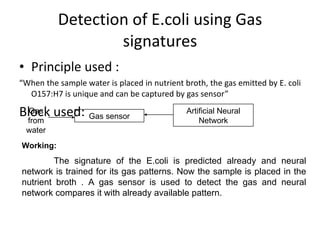
Detection of E.coli using Gas signatures Principle used : “ When the sample water is placed in nutrient broth, the gas emitted by E. coli O157:H7 is unique and can be captured by gas sensor” Block used: Gas sensor Artificial Neural Network Working: The signature of the E.coli is predicted already and neural network is trained for its gas patterns. Now the sample is placed in the nutrient broth . A gas sensor is used to detect the gas and neural network compares it with already available pattern.   Gas from water
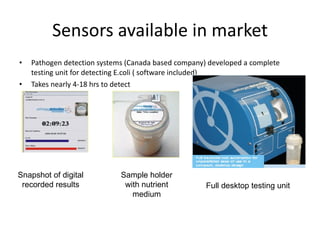
Sensors available in market Pathogen detection systems (Canada based company) developed a complete testing unit for detecting E.coli ( software included) Takes nearly 4-18 hrs to detect Snapshot of digital recorded results Sample holder with nutrient medium Full desktop testing unit
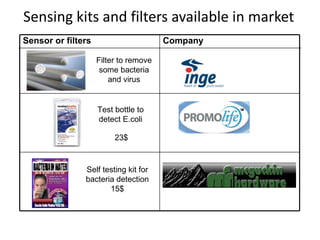
Sensing kits and filters available in market Filter to remove some bacteria and virus Test bottle to detect E.coli 23$ Self testing kit for bacteria detection 15$ Sensor or filters Company
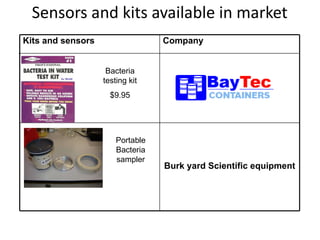
Sensors and kits available in market Bacteria testing kit $9.95 Portable Bacteria sampler Kits and sensors Company Burk yard Scientific equipment

Electronic sensors

  • 1.
    Electronic Sensors todetect impurities in water
  • 2.
    Objectives Selection ofa Parameter used to check the presence of pathogens in water Different methods (under research) to detect the presence and amount of bacteria and virus in water Glimpse on sensors available in market to detect and filter pathogens
  • 3.
    Need of aparameter to test pathogens Disease causing pathogens cannot be tested directly Because, They are Difficult to isolate and identify Cost of analysis Length of time to analyze With all the analysis presence of only one substance will be known Most of the labs use E.coli as a parameter to test pathogens present in water because It is easy to collect and test, Presence and Concentration Relatively harmless to environment If more fecal coliform populations present in water, the greater likelihood that pathogens are present
  • 4.
    Research in thefield of testing E.coli The well established lab method is To collect the sample of water to place the water in agar ( Nutrient environment for E.coli to grow) for some hours Test the rate of growth and compare The main disadvantage with this method is Time consumption So the recent research is to develop a handheld device to detect the presence of coli within few minutes as its presence can detect the following disease causing pathogens sore throats diarrhea abdominal cramps hepatitis respiratory infections chest pains
  • 5.
    Detection of E.coliusing resonant frequency Method1: (under research) Parameter Used : Change in resonating frequency Principle Used : The oscillating frequency of a substance changes when the bacteria gets accumulated on its surface. Expected time (as specified) : 10 min Layer containing Antibodies of E.coli Voltage source Slither of Glass Piezoelectric surface
  • 6.
    Working Antibodies present in glass will attract the E.coli if present in water As Alternating voltage is applied to the piezoelectric substance it will contract and expand making the glass slither to resonate Depending upon the amount of E.coli attached to the antibodies the resonating frequency of glass varies Using a sensor to detect the frequency variation, the amount of E.coli present can be analyzed
  • 7.
    Detection of E.coliusing capacitance Parameter Used: Variation in the capacitance Principle used : “ The capacitance of the capacitor is changed when the material between the capacitor plates changes” Expected Time to detect : within 30 min
  • 8.
    Working At firstDummy capacitor is given a slightly higher value than sense capacitor in such way that Sense amplifier gives high voltage (saying False) The plates of sense capacitors is layered with antibodies of E.coli or nutrient media, So if immersed in water E.coli or viruses get stick to it. This infact changes the capacitor value and the sense amplifier now gives low voltage (saying true for presence of E.coli)
  • 9.
    Detection of E.coliusing Gas signatures Principle used : “ When the sample water is placed in nutrient broth, the gas emitted by E. coli O157:H7 is unique and can be captured by gas sensor” Block used: Gas sensor Artificial Neural Network Working: The signature of the E.coli is predicted already and neural network is trained for its gas patterns. Now the sample is placed in the nutrient broth . A gas sensor is used to detect the gas and neural network compares it with already available pattern. Gas from water
  • 10.
    Sensors available inmarket Pathogen detection systems (Canada based company) developed a complete testing unit for detecting E.coli ( software included) Takes nearly 4-18 hrs to detect Snapshot of digital recorded results Sample holder with nutrient medium Full desktop testing unit
  • 11.
    Sensing kits andfilters available in market Filter to remove some bacteria and virus Test bottle to detect E.coli 23$ Self testing kit for bacteria detection 15$ Sensor or filters Company
  • 12.
    Sensors and kitsavailable in market Bacteria testing kit $9.95 Portable Bacteria sampler Kits and sensors Company Burk yard Scientific equipment

Editor's Notes

  • #3 Objectives & Deliverables: GDM Process: Project Description: Project/Business Objective(s): Project Deliverables: Customer CTQ’s Performance Summary: Program Status: Schedule Finished inchstones >90% on time (this period) Finished inchstones 80-90% on time (this period) Finished inchstones <80% on time (this period) G Y R