The Institute ofChartered Accountants of India (ICAI)
Submitted By: Manoj Surana
Registration No: CRO0784265
Submitted To: ICAI Branch, Bhilwara
Electronic Data
Interchange (EDI)
3.
Acknowledgement
I sincerely appreciatethe Institute of Chartered Accountants of India
(ICAI) for organizing the ITT training and providing us with this
valuable learning experience.
A heartfelt thanks to our facilitators and mentors for their unwavering
support and guidance.
I also acknowledge the encouragement and collaboration of my
fellow participants, which made this journey truly enriching.
4.
Electronic Data Interchange
(EDI):Streamlining Business
Communication
Electronic Data Interchange streamlines business communication.
Instead of creating, mailing, and manually entering documents,
companies send standardized electronic messages directly between
systems. This shift reduces delays and errors.
This technology transforms how businesses exchange information
by moving from paper-based methods to digital communication.
Let’s explore how EDI works and why it matters.
KS
5.
Paper Based Processvs EDI Process
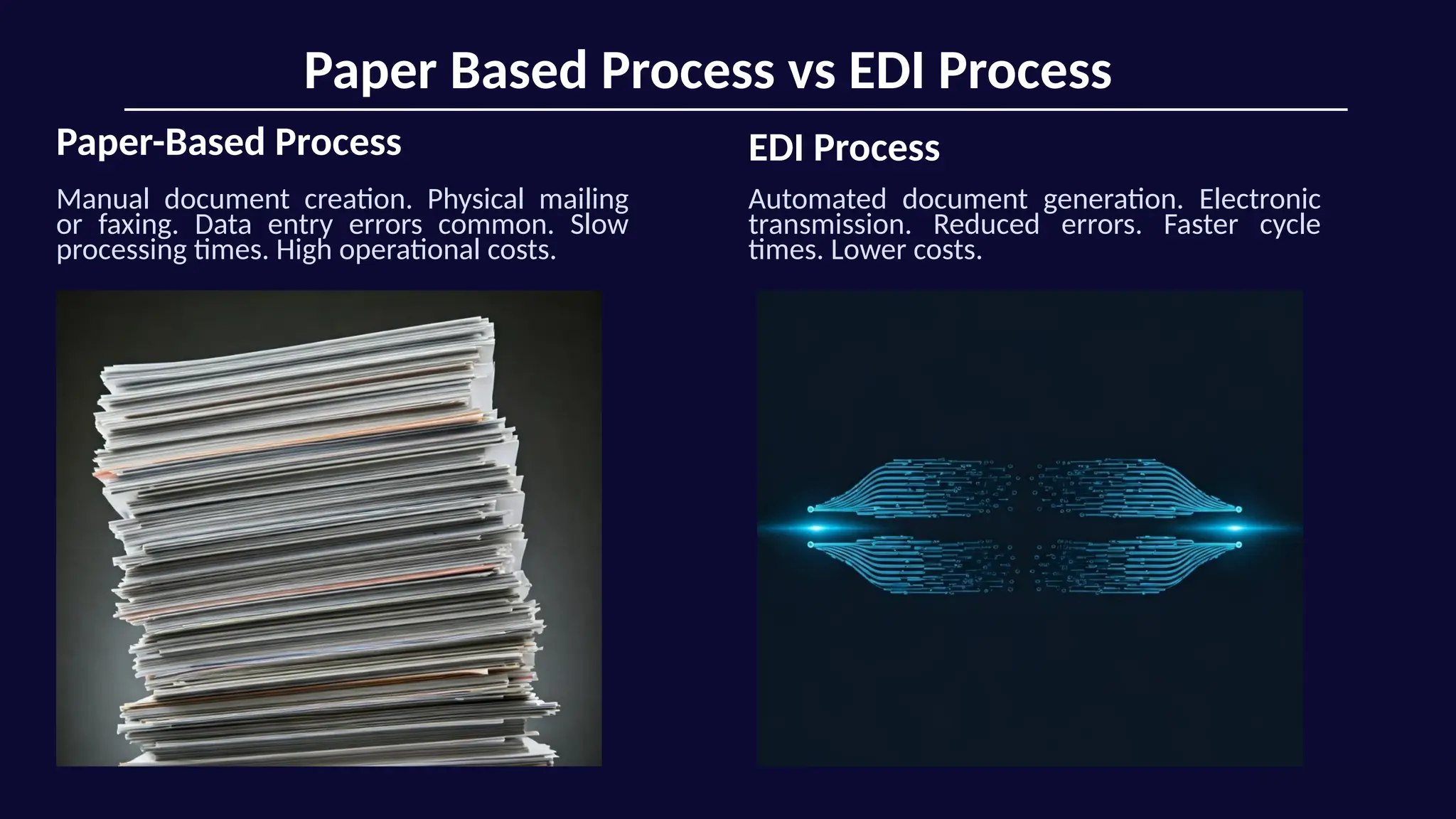
Paper-Based Process
Manual document creation. Physical mailing
or faxing. Data entry errors common. Slow
processing times. High operational costs.
EDI Process
Automated document generation. Electronic
transmission. Reduced errors. Faster cycle
times. Lower costs.
6.
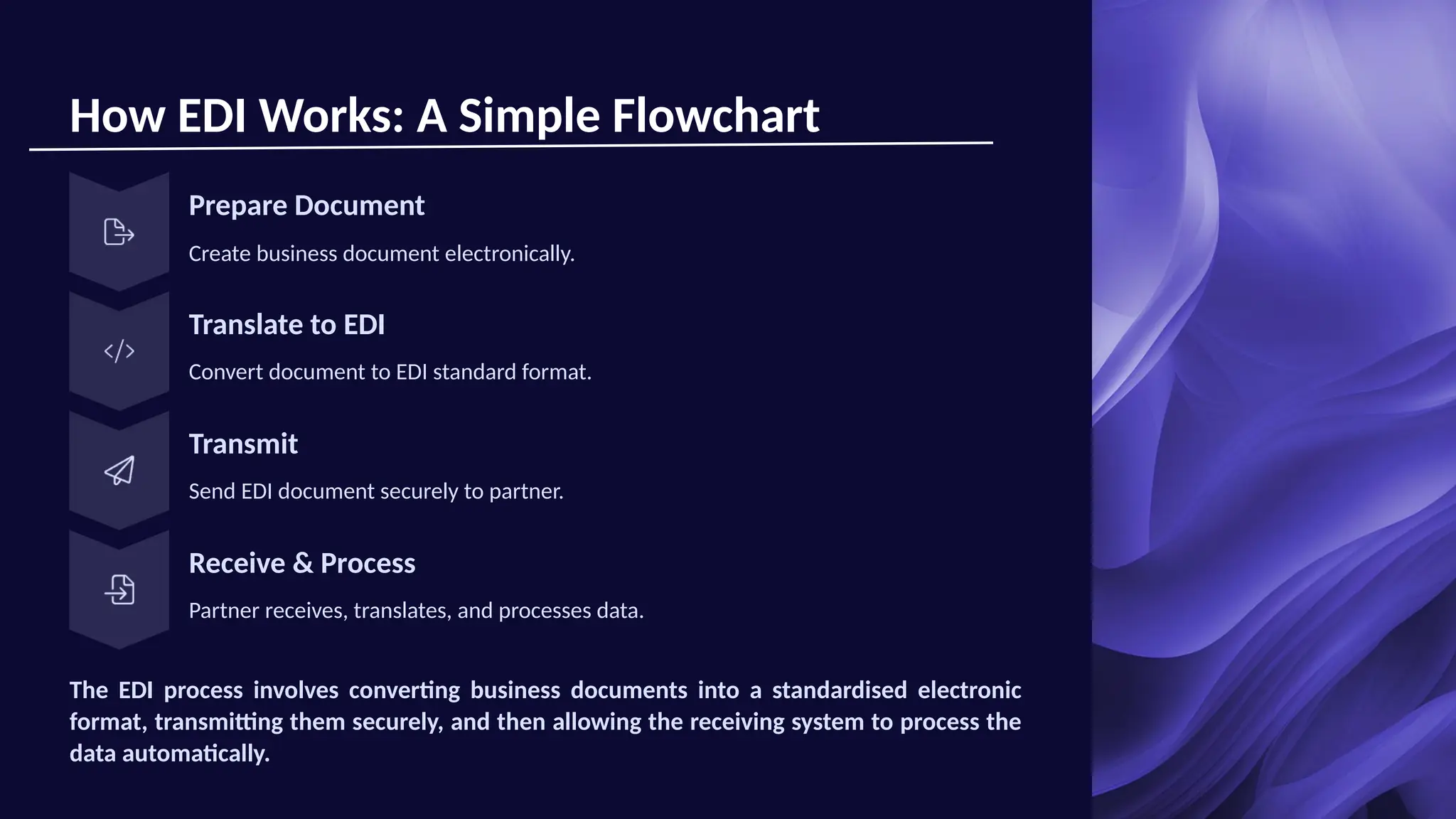
How EDI Works:A Simple Flowchart
Prepare Document
Create business document electronically.
Translate to EDI
Convert document to EDI standard format.
Transmit
Send EDI document securely to partner.
Receive & Process
Partner receives, translates, and processes data.
The EDI process involves converting business documents into a standardised electronic
format, transmitting them securely, and then allowing the receiving system to process the
data automatically.
7.
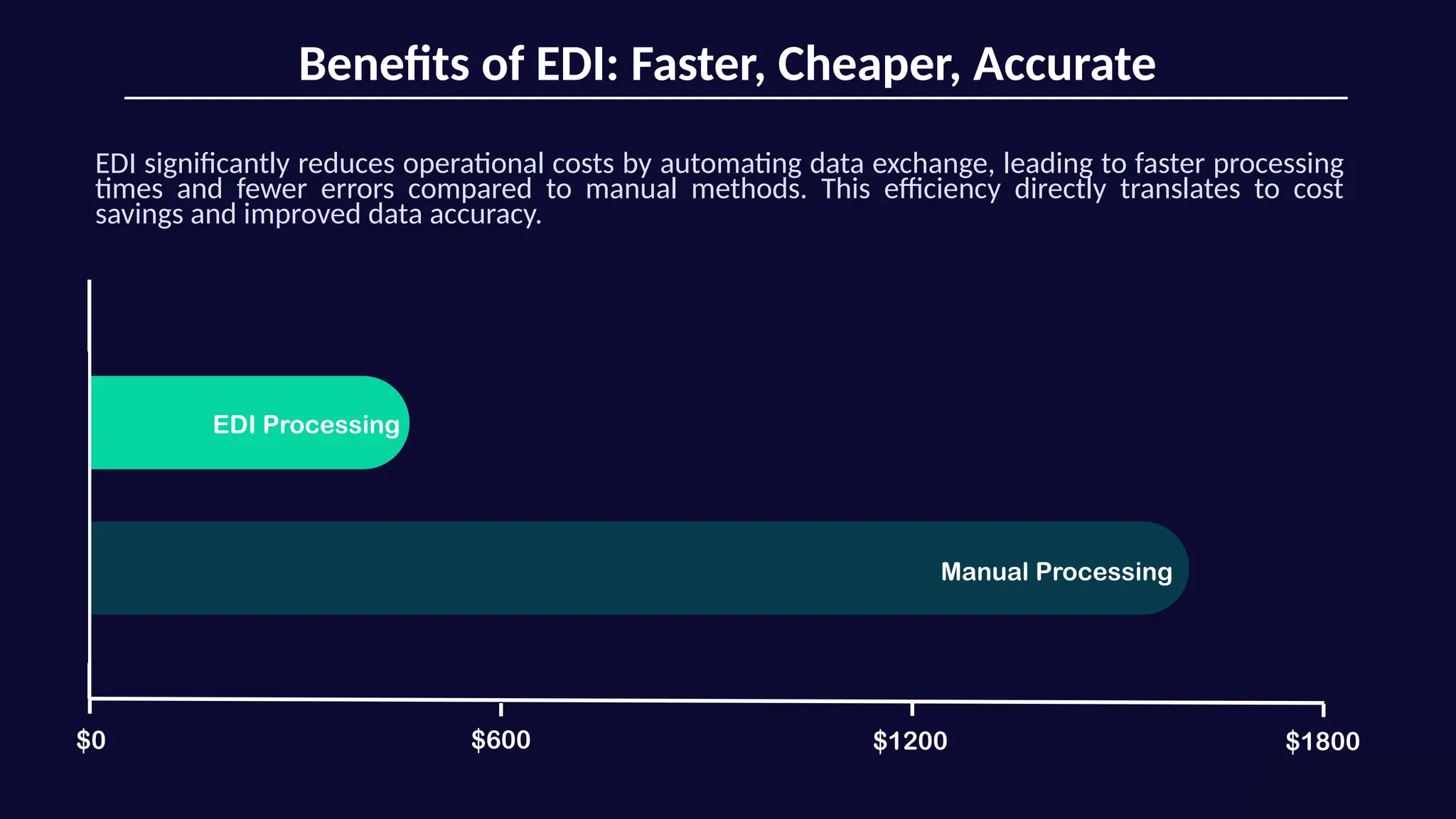
Benefits of EDI:Faster, Cheaper, Accurate
EDI significantly reduces operational costs by automating data exchange, leading to faster processing
times and fewer errors compared to manual methods. This efficiency directly translates to cost
savings and improved data accuracy.
$0 $600 $1200
EDI Processing
$1800
Manual Processing
8.
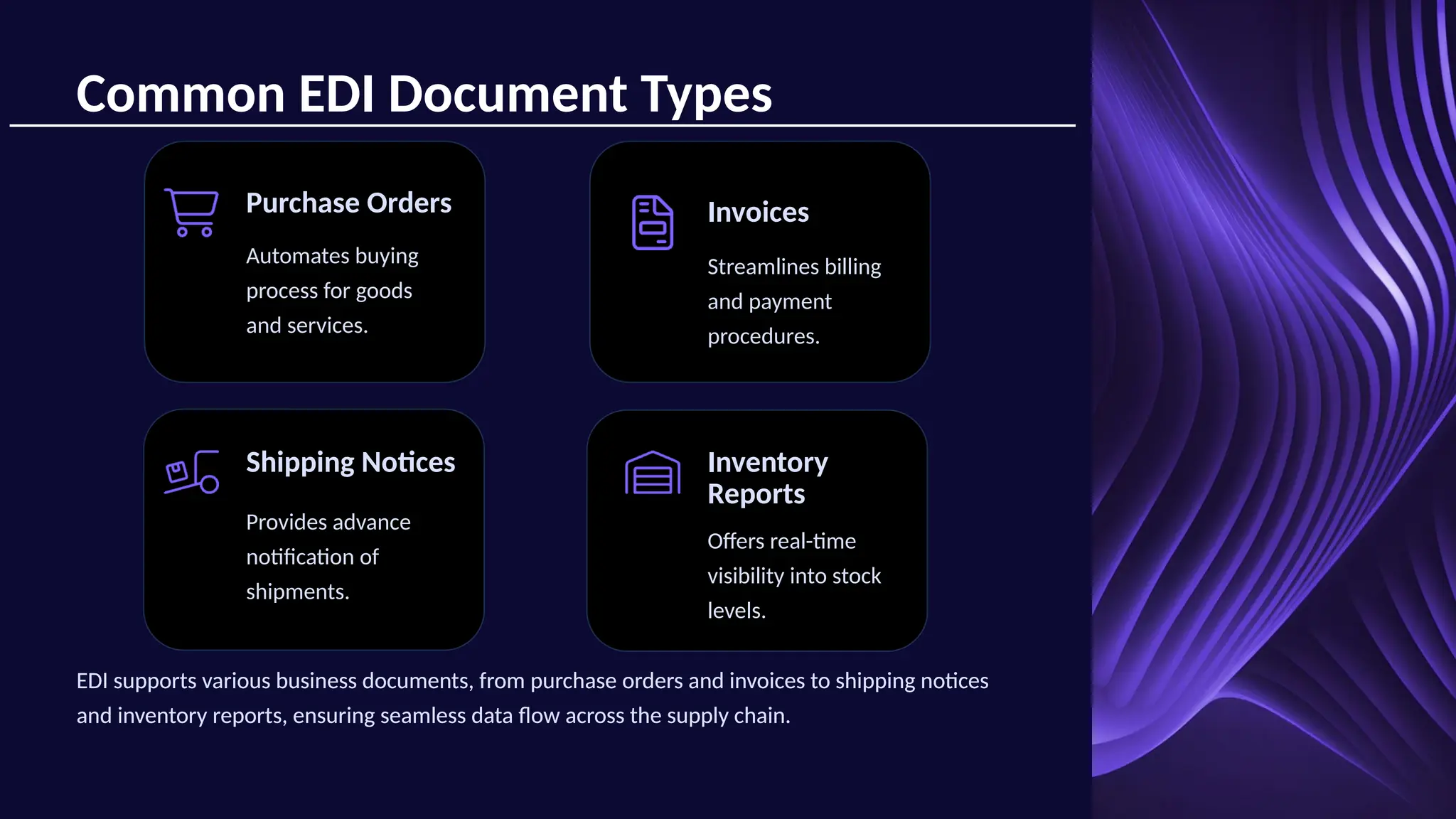
Common EDI DocumentTypes
EDI supports various business documents, from purchase orders and invoices to shipping notices
and inventory reports, ensuring seamless data flow across the supply chain.
Purchase Orders
Automates buying
process for goods
and services.
Invoices
Streamlines billing
and payment
procedures.
Shipping Notices
Provides advance
notification of
shipments.
Inventory
Reports
Offers real-time
visibility into stock
levels.
EDI supports various business documents, from purchase orders and invoices to shipping notices
and inventory reports, ensuring seamless data flow across the supply chain.
9.
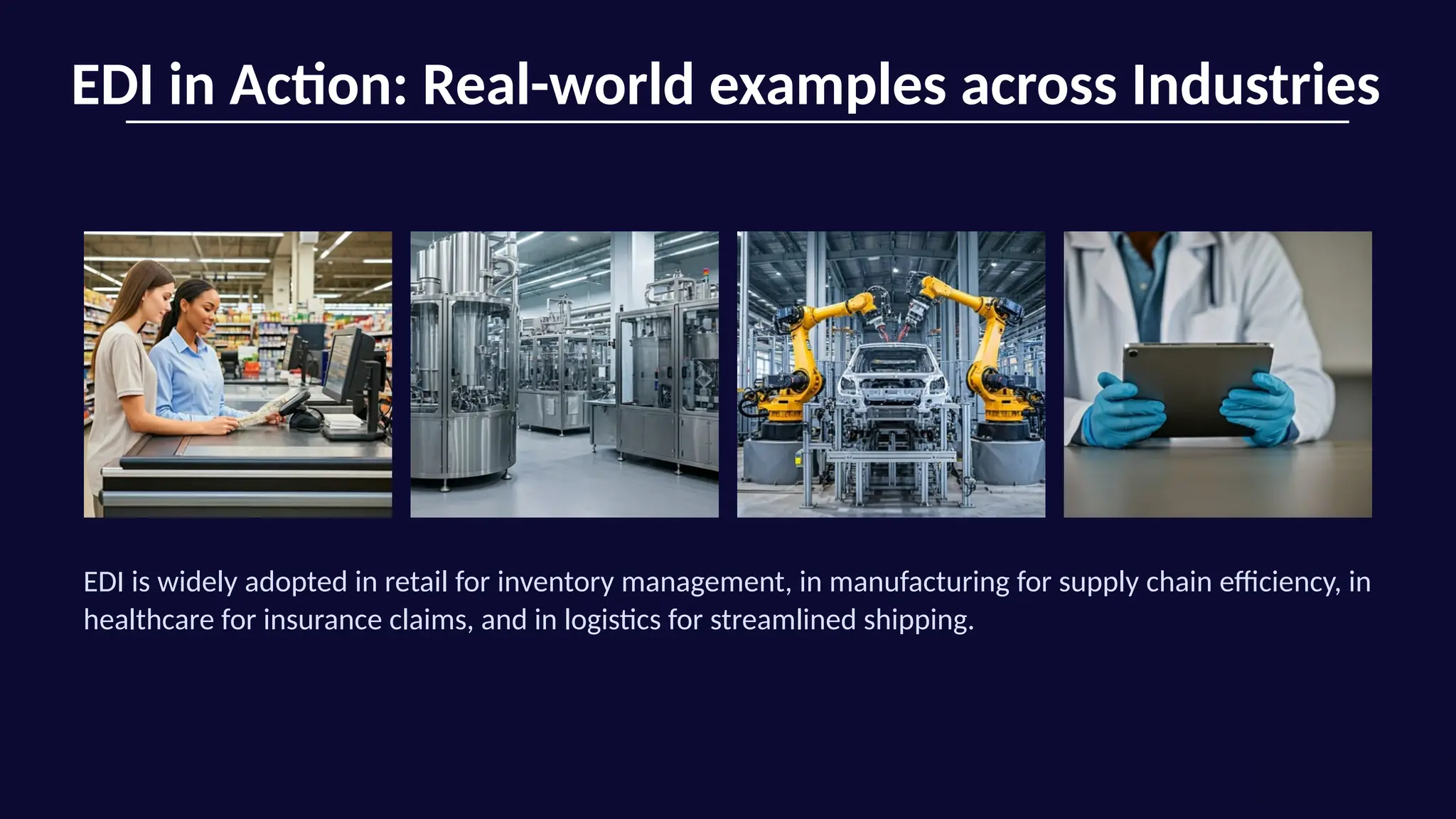
EDI in Action:Real-world examples across Industries
EDI is widely adopted in retail for inventory management, in manufacturing for supply chain efficiency, in
healthcare for insurance claims, and in logistics for streamlined shipping.
10.
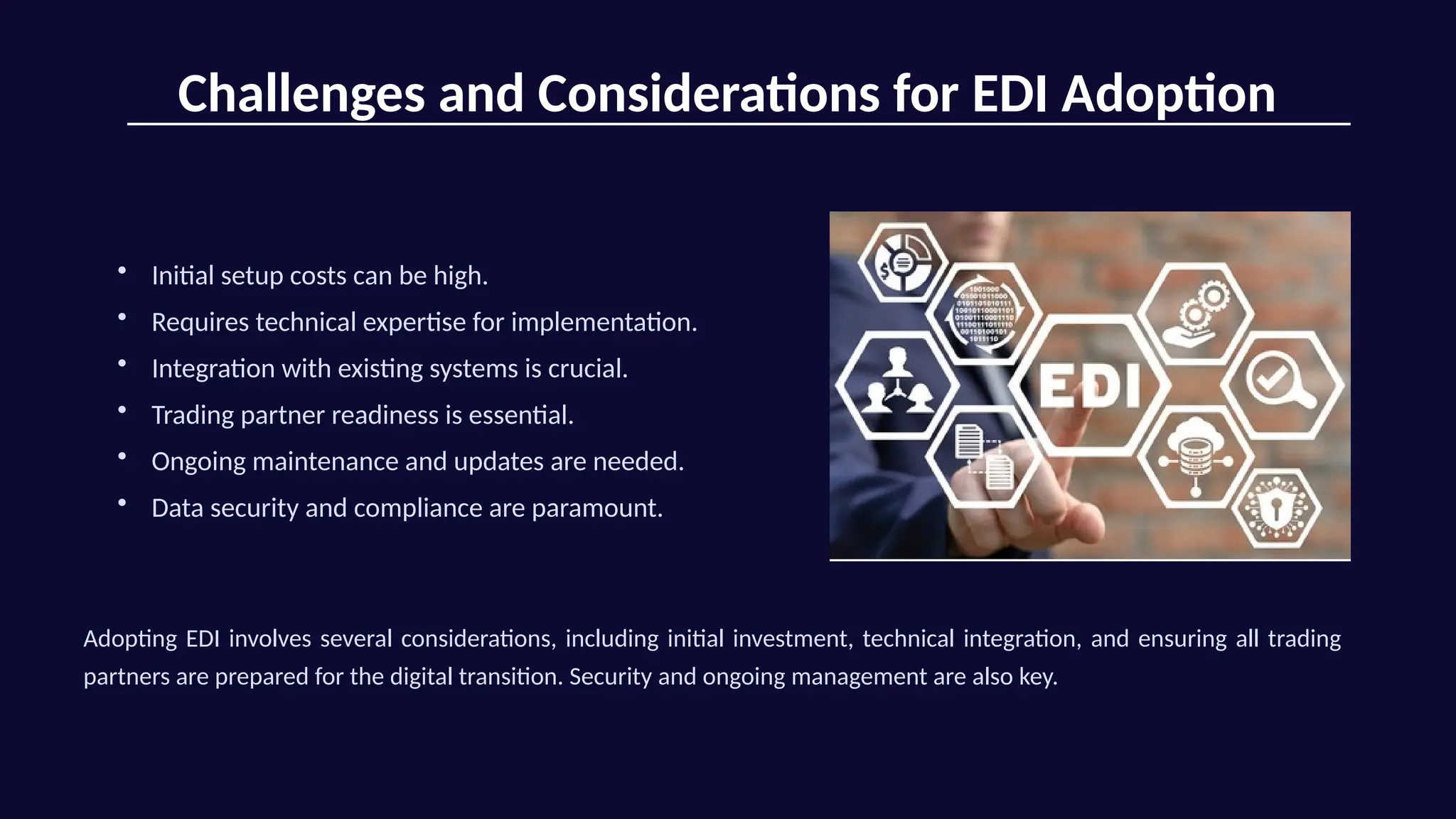
Challenges and Considerationsfor EDI Adoption
• Initial setup costs can be high.
• Requires technical expertise for implementation.
• Integration with existing systems is crucial.
• Trading partner readiness is essential.
• Ongoing maintenance and updates are needed.
• Data security and compliance are paramount.
Adopting EDI involves several considerations, including initial investment, technical integration, and ensuring all trading
partners are prepared for the digital transition. Security and ongoing management are also key.
11.
Conclusion: EDI –The Future of Business
Data Exchange
90%
Cost Reduction
Potential savings in
document processing.
70%
Error Decrease
Reduction in manual
data entry errors.
10x
Speed Increase
Faster transaction
processing than paper.
EDI offers a robust framework for efficient, accurate, and cost-effective business
data exchange. It's a critical tool for modern businesses aiming to enhance
operational efficiency and build stronger trading partner relationships. Embrace
EDI for a smarter future!




![[DSC Europe 25] Ivan Peric - Intelligence Swarm Logic and Techno-Functional M...](https://cdn.slidesharecdn.com/ss_thumbnails/7my7c97fsduiccadgavw-2-251212103249-5a03f7c6-thumbnail.jpg?width=640&height=640&fit=bounds)


![[DSC Europe 25] Nikolay Burlutskiy - Best Practices for Building Enterprise M...](https://cdn.slidesharecdn.com/ss_thumbnails/uirvaiuvq8y1w8hzd9tx-7-251212103249-2619edb4-thumbnail.jpg?width=640&height=640&fit=bounds)
![[DSC Europe 25] Uros Pesic - The Reality of AI in Marketing.pdf](https://cdn.slidesharecdn.com/ss_thumbnails/rtkodnmtycovsllvzsyn-9-251215095918-b0c6bfe3-thumbnail.jpg?width=640&height=640&fit=bounds)
![[DSC Europe 25] Debmalya Biswas - Agentification: the art of transforming man...](https://cdn.slidesharecdn.com/ss_thumbnails/r5azlggvtqiaiiusrqdr-4-251212103249-5a12c89b-thumbnail.jpg?width=640&height=640&fit=bounds)


![[DSC Europe 25] Branko Dzakula - From Defense to Attack: How AI Redefines Cyb...](https://cdn.slidesharecdn.com/ss_thumbnails/80bdzdxpr3ky2g0qvyk9-8-251211083048-ce5fc1ee-thumbnail.jpg?width=640&height=640&fit=bounds)


![[DSC Europe 25] Bassam Maharmeh - Artificial Intelligence: Opportunities and ...](https://cdn.slidesharecdn.com/ss_thumbnails/thhfmr2fqpawzj7hsjpg-5-251211083048-2c23204f-thumbnail.jpg?width=640&height=640&fit=bounds)


![[DSC Europe 25] Katherine Forrest - AI NOW: Understanding the Velocity of Cha...](https://cdn.slidesharecdn.com/ss_thumbnails/wvvbruqfrci0sfq9xwgb-4-251212104007-e5ad1987-thumbnail.jpg?width=640&height=640&fit=bounds)

