In electrical engineering, the dependability and longevity of components are critical. Electronic
devices are subjected to numerous stressors throughout their lifespan, including temperature
fluctuations, voltage variations, and mechanical vibrations. To ensure these components
perform optimally over their intended lifespan, engineers rely on a critical tool: electrical life
testing.
What is Electrical Life Testing?
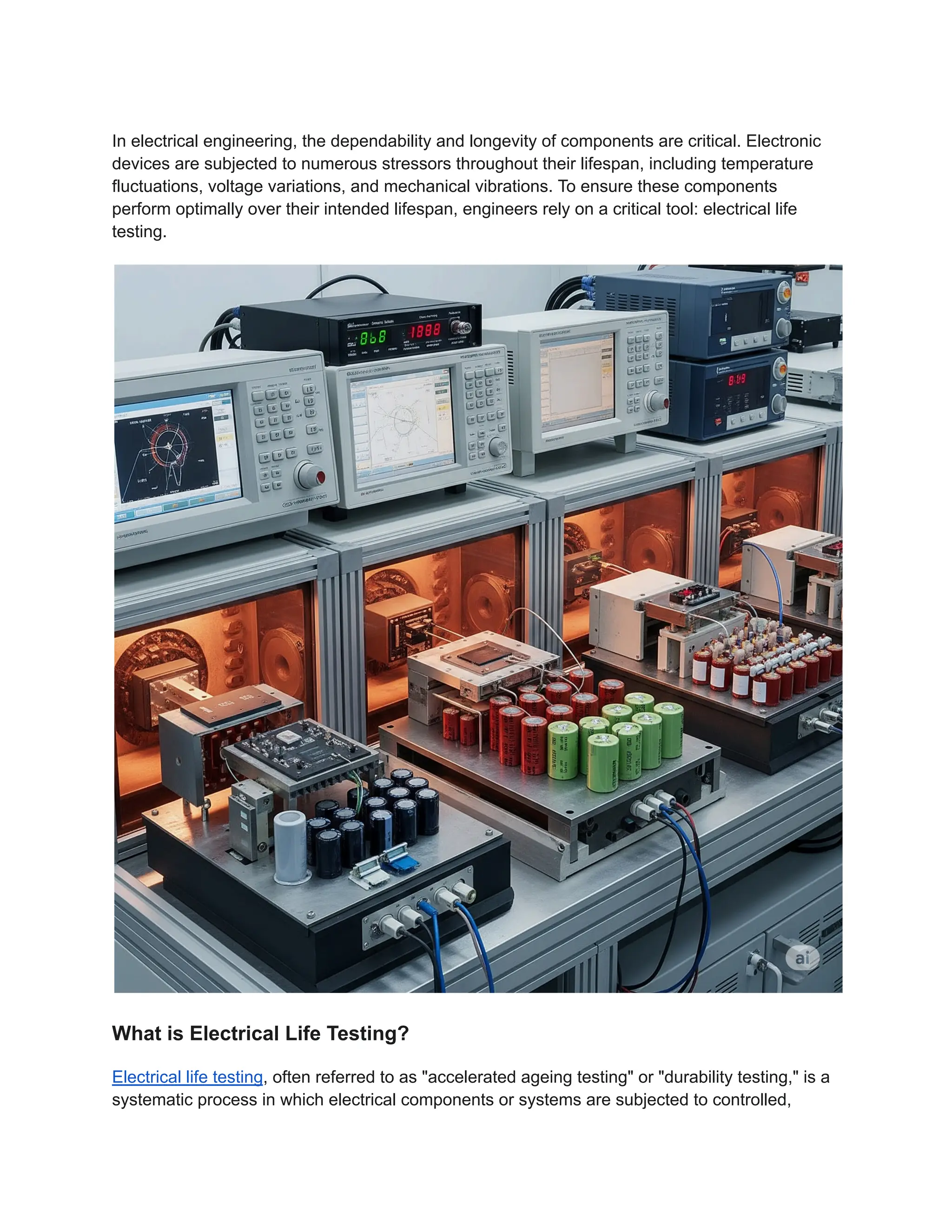
Electrical life testing, often referred to as "accelerated ageing testing" or "durability testing," is a
systematic process in which electrical components or systems are subjected to controlled,
stressful operating conditions that simulate or accelerate the ageing they would experience in
real-world use. The primary goal is to predict their lifespan, identify potential failures, and
validate their design before mass production.
Importance of Electrical Life Testing
Implementing electrical life testing is crucial for several key reasons:
●​ Lifespan prediction enables manufacturers to determine how long a product will
operate dependably and precisely.
●​ Identification of Failure Modes: It reveals design weaknesses or manufacturing
defects that could lead to premature failures.
●​ Enhanced Reliability: By identifying and addressing issues early, the overall quality and
robustness of the product are improved.
●​ Cost Reduction: Preventing failures in the field reduces warranty costs, repairs, and
customer dissatisfaction.
●​ Regulatory Compliance: Many products must meet specific reliability standards to be
marketed.
Common Types of Electrical Life Tests
Various methodologies are used for electrical life testing, tailored to the component’s
characteristics and application:
●​ High Temperature Operating Life (HTOL) Test:
○​ Components are operated at significantly higher temperatures than normal.
○​ Accelerates failure mechanisms related to temperature, such as insulation
degradation or solder joint fatigue.
●​ Power Cycling Test:
○​ Repeated on-off cycles are applied, often with temperature changes.
○​ Assesses resistance to thermal and mechanical fatigue caused by material
expansion and contraction.
●​ Voltage/Current Stability Test:
○​ Subjects the component to voltages or currents above nominal levels.
○​ Identifies failures related to electrical overload or dielectric breakdown.
●​ Temperature, Humidity, Bias (THB) Test:
○​ Combining high temperatures, humidity, and electrical bias.
○​ Detects failures caused by corrosion, ion migration, or material degradation due
to moisture.
Methodology and Key Considerations
Planning and executing an electrical life test requires a meticulous approach:
1.​ Defining Objectives: Establish what the test aims to achieve (e.g., predicting lifespan,
identifying specific failures).
2.​ Sample Selection: Choose a representative number of components or systems for
testing.
3.​ Designing Test Conditions:
○​ Stress Factors: Determine which parameters (temperature, voltage, humidity)
will be varied.
○​ Stress Levels: Select stress levels that accelerate ageing without inducing
unrealistic failure modes.
○​ Test Duration: Calculate the time needed to obtain meaningful results.
4.​ Monitoring and Measurement:
○​ Record key parameters such as voltage, current, temperature, and functional
performance.
○​ Detect any deviations or failures during the test.
5.​ Data Analysis:
○​ Use statistical models (e.g., Weibull distribution) to predict lifespan and analyse
failure modes.
○​ Identify the root causes of any observed failures.
Conclusion
Electrical life testing is a crucial component in the development process of electronic products.
By subjecting components to conditions that simulate accelerated ageing, manufacturers can
ensure reliability, enhance quality, and ultimately deliver more robust and durable products to
their customers. It is an investment that translates into lower warranty costs, greater customer
satisfaction, and a strong market reputation.

Electrical Life Testing_ Ensuring Long-Term Reliability by CPL-Group UK.pdf

  • 1.
    In electrical engineering,the dependability and longevity of components are critical. Electronic devices are subjected to numerous stressors throughout their lifespan, including temperature fluctuations, voltage variations, and mechanical vibrations. To ensure these components perform optimally over their intended lifespan, engineers rely on a critical tool: electrical life testing. What is Electrical Life Testing? Electrical life testing, often referred to as "accelerated ageing testing" or "durability testing," is a systematic process in which electrical components or systems are subjected to controlled,
  • 2.
    stressful operating conditionsthat simulate or accelerate the ageing they would experience in real-world use. The primary goal is to predict their lifespan, identify potential failures, and validate their design before mass production. Importance of Electrical Life Testing Implementing electrical life testing is crucial for several key reasons: ●​ Lifespan prediction enables manufacturers to determine how long a product will operate dependably and precisely. ●​ Identification of Failure Modes: It reveals design weaknesses or manufacturing defects that could lead to premature failures. ●​ Enhanced Reliability: By identifying and addressing issues early, the overall quality and robustness of the product are improved. ●​ Cost Reduction: Preventing failures in the field reduces warranty costs, repairs, and customer dissatisfaction. ●​ Regulatory Compliance: Many products must meet specific reliability standards to be marketed. Common Types of Electrical Life Tests Various methodologies are used for electrical life testing, tailored to the component’s characteristics and application: ●​ High Temperature Operating Life (HTOL) Test: ○​ Components are operated at significantly higher temperatures than normal. ○​ Accelerates failure mechanisms related to temperature, such as insulation degradation or solder joint fatigue. ●​ Power Cycling Test: ○​ Repeated on-off cycles are applied, often with temperature changes. ○​ Assesses resistance to thermal and mechanical fatigue caused by material expansion and contraction. ●​ Voltage/Current Stability Test: ○​ Subjects the component to voltages or currents above nominal levels. ○​ Identifies failures related to electrical overload or dielectric breakdown. ●​ Temperature, Humidity, Bias (THB) Test: ○​ Combining high temperatures, humidity, and electrical bias. ○​ Detects failures caused by corrosion, ion migration, or material degradation due to moisture. Methodology and Key Considerations Planning and executing an electrical life test requires a meticulous approach:
  • 3.
    1.​ Defining Objectives:Establish what the test aims to achieve (e.g., predicting lifespan, identifying specific failures). 2.​ Sample Selection: Choose a representative number of components or systems for testing. 3.​ Designing Test Conditions: ○​ Stress Factors: Determine which parameters (temperature, voltage, humidity) will be varied. ○​ Stress Levels: Select stress levels that accelerate ageing without inducing unrealistic failure modes. ○​ Test Duration: Calculate the time needed to obtain meaningful results. 4.​ Monitoring and Measurement: ○​ Record key parameters such as voltage, current, temperature, and functional performance. ○​ Detect any deviations or failures during the test. 5.​ Data Analysis: ○​ Use statistical models (e.g., Weibull distribution) to predict lifespan and analyse failure modes. ○​ Identify the root causes of any observed failures. Conclusion Electrical life testing is a crucial component in the development process of electronic products. By subjecting components to conditions that simulate accelerated ageing, manufacturers can ensure reliability, enhance quality, and ultimately deliver more robust and durable products to their customers. It is an investment that translates into lower warranty costs, greater customer satisfaction, and a strong market reputation.