12/02/2026 1
EEE
SRI RAMAKRISHNA ENGINEERING COLLEGE
[Educational Service: SNR Sons Charitable Trust]
[Autonomous Institution, Accredited by NAAC with ‘A’ Grade]
[Approved by AICTE and Permanently Affiliated to Anna University, Chennai]
[ISO 9001:2015 Certified and all eligible programmes Accredited by NBA]
Vattamalaipalayam, N.G.G.O. Colony Post, Coimbatore – 641 022.
Department of Electrical and Electronics Engineering
20EE217 ELECTRIC VEHICLE TECHNOLOGY
Prepared by:
Mr.B.Sridhar, AP(Sl.G)/EEE
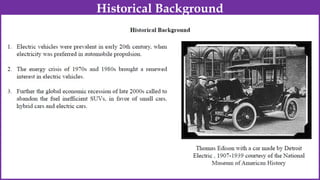
 In 1834, the first non-rechargeable battery operated EV (tricycle) was built by
Thomas Davenport.
 After invention of lead-acid battery, a rechargeable battery based EV was built by
David Salomons in 1874.
 After 12 years, first electric trolley system was built by Frank Sprague in 1886.
 In 1900, among 4200 automobiles sold in USA, 38% were EV, 22% were ICE and
40% steam Powered Vehicle.
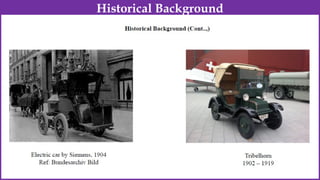
 Several companies in US, England and France made Evs by 1900.
Historical Background
 Electric Carriage and Wagon Company, US 1894 “Electrobat”.
 Pope manufacturing company, US 500 EVs by 1898 “Columbia”.
 Riker Electric Motor Company, US “Victoria” in 1897.
 London Electric Cab Company, England in 1897.
 Bouquet, Garcin and Schivre (BGS), France [1899-1906].
 BGS EVs in 1900 had world record of 290 Km/charge.
 An EV named “Jamais Contente” captured a record of 110 Km/Hr in 1899.
 By 1912, nearly 34,000 EVs were registered in US.
Historical Background
EVs disappeared by 1930s.
 First development was that, Henry Ford mass produced ‘Ford Model T’ in 1925
and reduced its price by over 1/3rd
to its price in 1909.
 This made EVs costlier compared to ICE.
 The 2nd
development was invention of automobiles starter motor, by Charles
Keetering, that helped remove manual cranking required in ICE and enabled
Electric ignition and start.
 This made ICE user friendly compared to Evs.
Historical Background
Reasons that led resurgence of EVs in 1970s.
 The Arab Oil Enbargo of 1973 increased demands for alternate energy sources.
 Increased air pollution led to worst smog in London in 1950s and in California in
1960s/70s retriggered strict emission regulations.
In 1976, Congress Enacted Public Law 94-413, the Electric and Hybrid Vehicle
Research Development and Demonstration Act. This act authorized a federal program
electric and hybrid electric vehicle technologies and to demonstrate the commercial
feasibility of Evs.
In 1990, California Air Resource Board (CARB) established rules that 2% of all
vehicles sold in California in 1998 should be Zero Emission Vehicle (ZEV) and it
should be 10% by 2003.
Historical Background
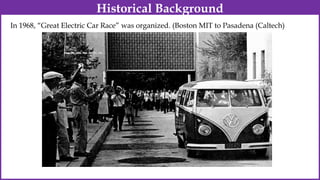
In 1968, “Great Electric Car Race” was organized. (Boston MIT to Pasadena (Caltech)
Historical Background
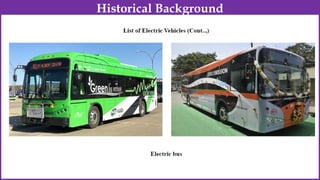
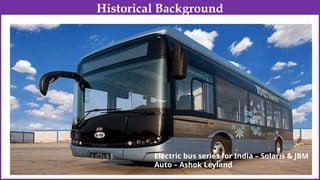
Electric bus series for India – Solaris & JBM
Auto – Ashok Leyland
Historical Background
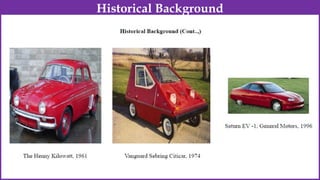
• Many automakers in US, Japan and Europe started development of Evs.
 In US, General Motors, Ford, Chrysler, US Electric Car and Solectria etc.
 In Japan, Toyota, Nissan, Honda, Mazda, Daihatsu, Mitsubishi, Suzuki, Isuzu, Subara etc.
 In Europe, PSA Peugeot, Renault, BMW, Benz, Audi, Volvo, Opel, Volkswagen, Fiat, Bedford etc.
• GM built number of experimental EVs, such as Electrovair in 1966, Electrovan in 1968, Electrovette in 1979
etc.
 SCR based SE DC motor, with NI-Zn Batteries, 60 miles/Hr, 80 Km range
• Ford EV projects resulted in Fiesta EV, Escort, Aerostar, Ecostar in 1970s.
• Nissan developed EV-4, EV-Resort, President EV, Cedric-EV in 1970s/1980s.
• Toyota produced series in EVs named EV-10 to Ev-40 in 1980s.
• Fiat experimental EVs were X1/23, Y10, in 1980s and Elettra in 1990s.
• BMW produced E30E, E36E in early 90s and E1 in mid 90s.
Historical Background
• Popular EVs in 1990s/Early 2000
– GM EV1 [100 KW, IM, VRLA, 0-100 Km/hr in 9 sec, 144 Km]
– Nissan Altera EV [62 KW, PMSM, Co-Li, 120 Km/hr, 192 Km]
– NIES Luciole [72 KW, In-wheel PMSM, VRLA, 130 Km/hr, Solar]
– HKU-U2001 [45 KW, PMSM, Ni Cd, 110 Km/hr, 176 Km]
– Reva [13 KW, SE DC, VRLA, 65 Km/hr, 80 Km]
• Popular HEVs in 1990s
 Toyota Prius [52 KW, ICE, 33 KW PMSM, Ni mH, 160 Km/hr]
 Honda Insight [50 KW, ICE, 10 KW PMSM, Ni mH, 26-30 Km/L]
• Popular FCEV in 1990s/early 2000
 Toyota Prius [52 KW, ICE, 33 KW PMSM, Ni mH, 160 Km/hr]
 Honda Insight [50 KW, ICE, 10 KW PMSM, Ni mH, 26-30 Km/L]
Historical Background
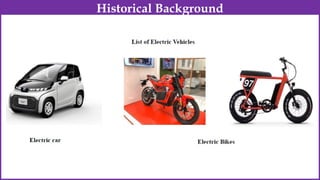
• Current Popular EVs
• Tesla Roadstar (2007), Model-S (2012), Model-X (2015), Model-3 (2017)
• Nissan Leaf
• Chevy Bolt
• BMW i3
• Current Popular HEVs are mostly PHEVs variants.
• Honda Accord Hybrid
• Toyota Camry, Pirus Hybrid
• Lexus RX 450h
• Volvo XC60 T8
• BMW 740e xDrive
Historical Background
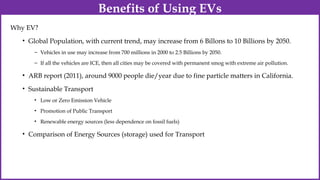
Why EV?
• Global Population, with current trend, may increase from 6 Billons to 10 Billions by 2050.
– Vehicles in use may increase from 700 millions in 2000 to 2.5 Billions by 2050.
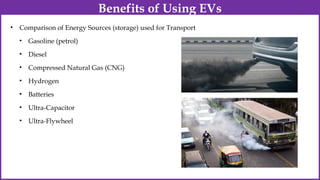
– If all the vehicles are ICE, then all cities may be covered with permanent smog with extreme air pollution.
• ARB report (2011), around 9000 people die/year due to fine particle matters in California.
• Sustainable Transport
• Low or Zero Emission Vehicle
• Promotion of Public Transport
• Renewable energy sources (less dependence on fossil fuels)
• Comparison of Energy Sources (storage) used for Transport
Benefits of Using EVs
• Comparison of Energy Sources (storage) used for Transport
• Gasoline (petrol)
• Diesel
• Compressed Natural Gas (CNG)
• Hydrogen
• Batteries
• Ultra-Capacitor
• Ultra-Flywheel
Benefits of Using EVs
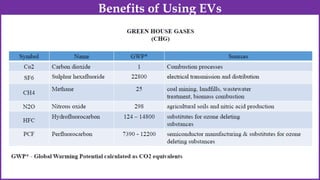
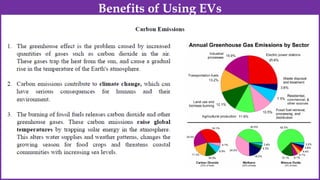
• Pollutants and Greenhouse Gases
• Particulate Matter (PMx)
• CO, CO2
• CH4
• NOx [N2O, NO and NO2]
• Volatile Organic Compound (VOC)
• Total Hydrocarbon
• Sox [SO2]
Benefits of Using EVs
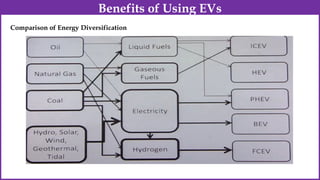
Comparison of Energy Diversification
Benefits of Using EVs
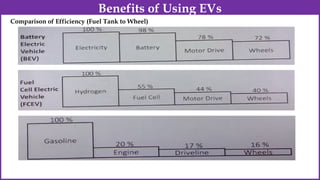
Comparison of Efficiency (Fuel Tank to Wheel)
Benefits of Using EVs
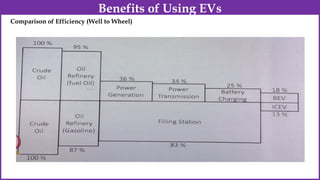
Comparison of Efficiency (Well to Wheel)
Benefits of Using EVs
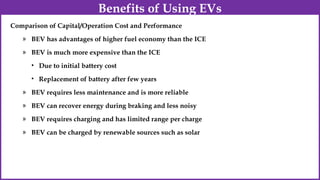
Comparison of Capital/Operation Cost and Performance
» BEV has advantages of higher fuel economy than the ICE
» BEV is much more expensive than the ICE
• Due to initial battery cost
• Replacement of battery after few years
» BEV requires less maintenance and is more reliable
» BEV can recover energy during braking and less noisy
» BEV requires charging and has limited range per charge
» BEV can be charged by renewable sources such as solar
Benefits of Using EVs
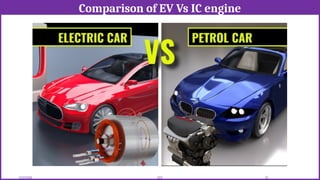
Comparison of EV Vs IC engine
12/02/2026 25
EEE
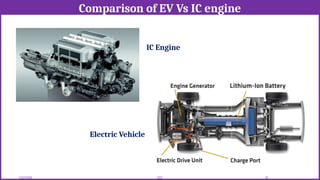
Comparison of EV Vs IC engine
12/02/2026 26
EEE
IC Engine
Electric Vehicle
Types of EVs
12/02/2026 27
EEE
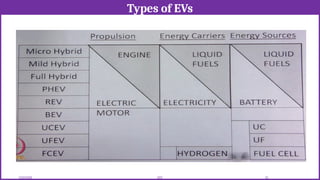
1. Propulsion Devices
2. Energy Sources
3. Energy Carriers etc
Types of EVs
12/02/2026 28
EEE
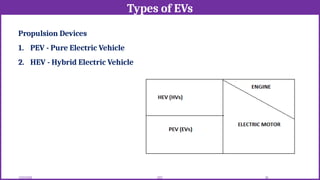
Propulsion Devices
1. PEV - Pure Electric Vehicle
2. HEV - Hybrid Electric Vehicle
Types of EVs
12/02/2026 29
EEE
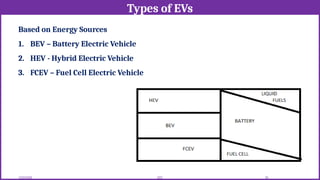
Based on Energy Sources
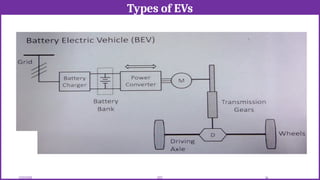
1. BEV – Battery Electric Vehicle
2. HEV - Hybrid Electric Vehicle
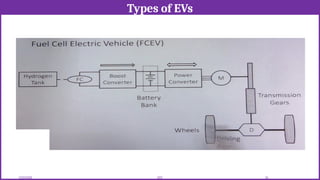
3. FCEV – Fuel Cell Electric Vehicle
Types of EVs
12/02/2026 30
EEE
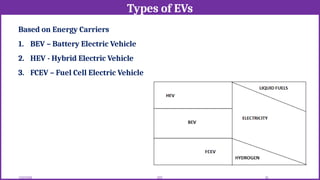
Based on Energy Carriers
1. BEV – Battery Electric Vehicle
2. HEV - Hybrid Electric Vehicle
3. FCEV – Fuel Cell Electric Vehicle
Types of EVs
12/02/2026 31
EEE
Pure Electric Vehicle
1. BEV – Battery
2. FCEV – Battery + Fuel Cell
3. UCEV – Battery + UC
4. UFEV – Battery + UF
Types of HEVs
12/02/2026 32
EEE
Conventional HEV
1. Micro Hybrid
2. Mild Hybrid
3. Full Hybrid
Grid-Able HEV
4. Plug-in Hybrid
5. Range Extended
Types of EVs
12/02/2026 33
EEE
Types of EVs
12/02/2026 34
EEE
Types of EVs
12/02/2026 35
EEE
Types of EVs
12/02/2026 36
EEE
Conventional Full Hybrid EV
1. Series Hybrid
2. Parallel Hybrid
3. Series Parallel Hybrid
4. Complex Hybrid
Types of EVs
12/02/2026 37
EEE
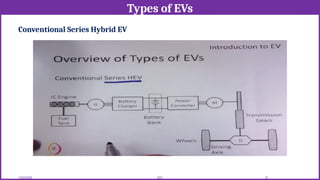
Conventional Series Hybrid EV
Types of EVs
12/02/2026 38
EEE
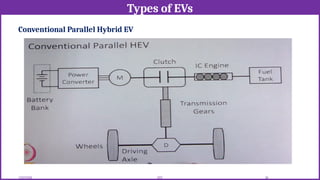
Conventional Parallel Hybrid EV
Types of EVs
12/02/2026 39
EEE
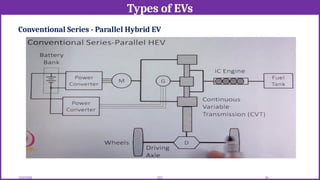
Conventional Series - Parallel Hybrid EV
Architecture of Hybrid and Electric Vehicles
12/02/2026 40
EEE
What exactly is an HEV?
The term hybrid vehicle refers to a vehicle with at least two sources of power.
hybrid-electric vehicle indicates that one source of power is provided by an electric motor.
The other source of motive power can come from a number of different technologies, but is
typically provided by an internal combustion engine designed to run on either gasoline or
diesel fuel.
As proposed by Technical Committee (Electric Road Vehicles) of the
International Electrotechnical Commission, an HEV is a vehicle in which propulsion
energy is available from two or more types of energy sources and at least one of
them can deliver electrical energy.
Hybrid-Electric Vehicle
12/02/2026 41
EEE
Based on this general definition, there are many types of HEVs, such as:
• Gasoline ICE and battery
• Diesel ICE and battery
• Battery and FC
• Battery and capacitor
• Battery and flywheel
• Battery and battery hybrids.
Energy Use in Conventional Vehicles
12/02/2026 42
EEE
In order to understand how a HEV may save energy, it is necessary first to examine how conventional vehicles use
energy. The breakdown of energy use in a vehicle is as follows:
1. In order to maintain movement, vehicles must produce power at the wheels to overcome:
a. Aerodynamic drag (air friction on the body surfaces of the vehicle, coupled with pressure forces
caused by the air flow)
b. Rolling resistance (the resistive forces between tires and the road surface)
c. Resistive gravity forces associated with climbing a grade
2. Further, to accelerate, the vehicle must its inertia. Most of the energy expended in acceleration is then lost as
heat in the brakes when the vehicle is brought to a stop.
3. The vehicle must provide power for accessories such as heating fan, lights, power steering, and air conditioning.
4. Finally, a vehicle will need to be capable of delivering power for acceleration with very little delay when the
driver depresses the accelerator, which may necessitate keeping the power source in a standby (energy-using)
mode.
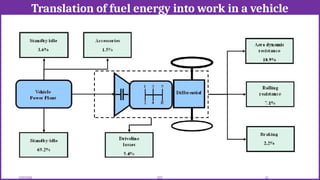
Translation of fuel energy into work in a vehicle
12/02/2026 43
EEE
Energy Savings Potential of Hybrid Drivetrains
12/02/2026 44
EEE
In terms of overall energy efficiency, the conceptual advantages of a hybrid over a conventional
vehicle are:
• Regenerative braking
• More efficient operation of the ICE, including reduction of idle
• Smaller ICE:
• Potential for higher weight
• Electrical losses
HEV Configurations
12/02/2026 45
EEE
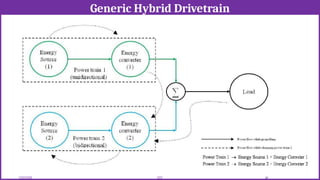
The various possible ways of combining the power flow to meet the driving requirements are:
i. Powertrain 1 alone delivers power
ii. Powertrain 2 alone delivers power
iii. Both powertrain 1 and 2 deliver power to load at the same time
iv. Powertrain 2 obtains power from load (regenerative braking)
v. Powertrain 2 obtains power from powertrain 1
vi. Powertrain 2 obtains power from powertrain 1 and load at the same time
vii. Powertrain 1 delivers power simultaneously to load and to powertrain 2
viii. Powertrain 1 delivers power to powertrain 2 and powertrain 2 delivers power ton load
ix. Powertrain 1 delivers power to load and load delivers power to powertrain 2.
Generic Hybrid Drivetrain
12/02/2026 46
EEE
HEV Configurations
12/02/2026 47
EEE
Hybrid drivetrain concept can be implemented by different configurations as follows:
 Series configuration
 Parallel configuration
 Series-parallel configuration
 Complex configuration
The functional block diagrams of the various HEV configurations is shown in Figure,
it can be observed that the key feature of:
 Series hybrid is to couple the ICE with the generator to produce electricity for pure electric
propulsion.
 Parallel hybrid is to couple both the ICE and electric motor with the transmission via the
same drive shaft to propel the vehicle.
Series Hybrid Configuration
12/02/2026 48
EEE
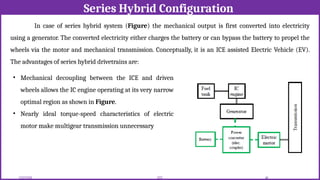
In case of series hybrid system (Figure) the mechanical output is first converted into electricity
using a generator. The converted electricity either charges the battery or can bypass the battery to propel the
wheels via the motor and mechanical transmission. Conceptually, it is an ICE assisted Electric Vehicle (EV).
The advantages of series hybrid drivetrains are:
• Mechanical decoupling between the ICE and driven
wheels allows the IC engine operating at its very narrow
optimal region as shown in Figure.
• Nearly ideal torque-speed characteristics of electric
motor make multigear transmission unnecessary
Series Hybrid Configuration
12/02/2026 49
EEE
However, a series hybrid drivetrain has the following disadvantages:
• The energy is converted twice (mechanical to electrical and then to mechanical) and this reduces the
overall efficiency.
• Two electric machines are needed and a big traction motor is required because it is the only torque
source of the driven wheels.
The series hybrid drivetrain is used in heavy commercial vehicles, military vehicles and buses.
The reason is that large vehicles have enough space for the bulky engine/generator system.
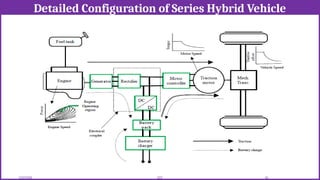
Detailed Configuration of Series Hybrid Vehicle
12/02/2026 50
EEE
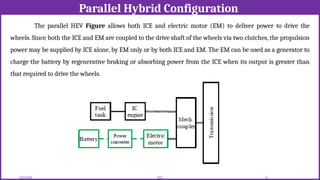
Parallel Hybrid Configuration
12/02/2026 51
EEE
The parallel HEV Figure allows both ICE and electric motor (EM) to deliver power to drive the
wheels. Since both the ICE and EM are coupled to the drive shaft of the wheels via two clutches, the propulsion
power may be supplied by ICE alone, by EM only or by both ICE and EM. The EM can be used as a generator to
charge the battery by regenerative braking or absorbing power from the ICE when its output is greater than
that required to drive the wheels.
Parallel Hybrid Configuration
12/02/2026 52
EEE
The advantages of the parallel hybrid drivetrain are:
• Both engine and electric motor directly supply torques to the driven wheels and no energy form
conversion occurs, hence energy loss is less
• Compactness due to no need of the generator and smaller traction motor.
The drawbacks of parallel hybrid drivetrains are:
• Mechanical coupling between the engines and the driven wheels, thus the engine operating points
cannot be fixed in a narrow speed region.
• The mechanical configuration and the control strategy are complex compared to series hybrid
drivetrain.
Due to its compact characteristics, small vehicles use parallel configuration. Most passenger
cars employ this configuration.
Series-Parallel Hybrid Configuration
12/02/2026 53
EEE
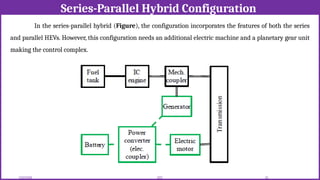
In the series-parallel hybrid (Figure), the configuration incorporates the features of both the series
and parallel HEVs. However, this configuration needs an additional electric machine and a planetary gear unit
making the control complex.
Complex Hybrid Configuration
12/02/2026 54
EEE
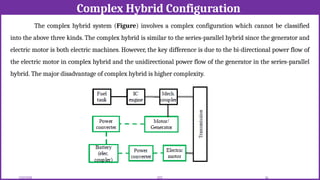
The complex hybrid system (Figure) involves a complex configuration which cannot be classified
into the above three kinds. The complex hybrid is similar to the series-parallel hybrid since the generator and
electric motor is both electric machines. However, the key difference is due to the bi-directional power flow of
the electric motor in complex hybrid and the unidirectional power flow of the generator in the series-parallel
hybrid. The major disadvantage of complex hybrid is higher complexity.
Power Flow in HEVs
12/02/2026 55
EEE
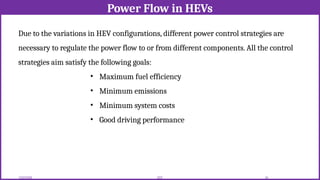
Due to the variations in HEV configurations, different power control strategies are
necessary to regulate the power flow to or from different components. All the control
strategies aim satisfy the following goals:
• Maximum fuel efficiency
• Minimum emissions
• Minimum system costs
• Good driving performance
Power Flow in HEVs
12/02/2026 56
EEE
The design of power control strategies for HEVs involves different considerations such
as:
Optimal ICE operating point: The optimal operating point on the torque-speed plane
of the ICE can be based on maximization of fuel economy, the minimization of
emissions or a compromise between fuel economy and emissions.
Optimal ICE operating line: In case the ICE needs to deliver different power demands,
the corresponding optimal operating points constitute an optimal operating line.
Safe battery voltage: The battery voltage may be significantly altered during
discharging, generator charging or regenerative charging. This battery voltage should
not exceed the maximum voltage limit nor should it fall below the minimum voltage
limit.
Power Flow Control in Series Hybrid
12/02/2026 57
EEE
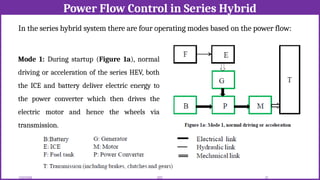
In the series hybrid system there are four operating modes based on the power flow:
Mode 1: During startup (Figure 1a), normal
driving or acceleration of the series HEV, both
the ICE and battery deliver electric energy to
the power converter which then drives the
electric motor and hence the wheels via
transmission.
Power Flow Control in Series Hybrid
12/02/2026 58
EEE
In the series hybrid system there are four operating modes based on the power flow:
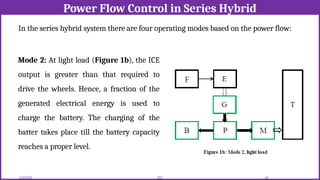
Mode 2: At light load (Figure 1b), the ICE
output is greater than that required to
drive the wheels. Hence, a fraction of the
generated electrical energy is used to
charge the battery. The charging of the
batter takes place till the battery capacity
reaches a proper level.
Power Flow Control in Series Hybrid
12/02/2026 59
EEE
In the series hybrid system there are four operating modes based on the power flow:
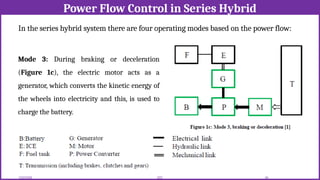
Mode 3: During braking or deceleration
(Figure 1c), the electric motor acts as a
generator, which converts the kinetic energy of
the wheels into electricity and this, is used to
charge the battery.
Power Flow Control in Series Hybrid
12/02/2026 60
EEE
In the series hybrid system there are four operating modes based on the power flow:
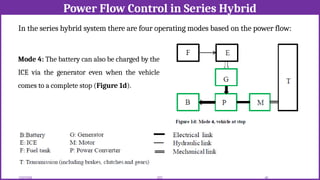
Mode 4: The battery can also be charged by the
ICE via the generator even when the vehicle
comes to a complete stop (Figure 1d).
Power Flow Control in Parallel Hybrid
12/02/2026 61
EEE
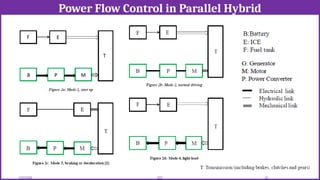
In the parallel hybrid system there are four operating modes based on the
power flow:
Mode 1: During start up or full throttle acceleration (Figure 2a); both the ICE and the EM
share the required power to propel the vehicle. Typically, the relative distribution between the
ICE and electric motor is 80-20%.
Mode 2: During normal driving (Figure 2b), the required traction power is supplied by the ICE
only and the EM remains in off mode.
Mode 3: During braking or deceleration (Figure 2c), the EM acts as a generator to charge the
battery via the power converter.
Mode 4: Under light load condition (Figure 2d), the traction power is delivered by the ICE and
the ICE also charges the battery via the EM.
Power Flow Control in Parallel Hybrid
12/02/2026 62
EEE
Power Flow Control in Series-Parallel Hybrid
12/02/2026 63
EEE
The series-parallel hybrid system involves the features of series and parallel hybrid
systems. Hence, a number of operation modes are feasible. Therefore, these hybrid systems are
classified into two categories: the ICE dominated and the EM dominated.
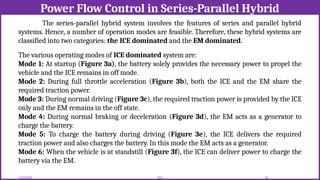
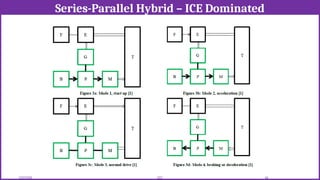
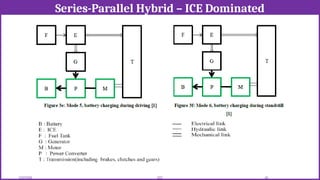
The various operating modes of ICE dominated system are:
Mode 1: At startup (Figure 3a), the battery solely provides the necessary power to propel the
vehicle and the ICE remains in off mode.
Mode 2: During full throttle acceleration (Figure 3b), both the ICE and the EM share the
required traction power.
Mode 3: During normal driving (Figure 3c), the required traction power is provided by the ICE
only and the EM remains in the off state.
Mode 4: During normal braking or deceleration (Figure 3d), the EM acts as a generator to
charge the battery.
Mode 5: To charge the battery during driving (Figure 3e), the ICE delivers the required
traction power and also charges the battery. In this mode the EM acts as a generator.
Mode 6: When the vehicle is at standstill (Figure 3f), the ICE can deliver power to charge the
battery via the EM.
Series-Parallel Hybrid – ICE Dominated
12/02/2026 64
EEE
Series-Parallel Hybrid – ICE Dominated
12/02/2026 65
EEE
Series-Parallel Hybrid – EM Dominated
12/02/2026 66
EEE
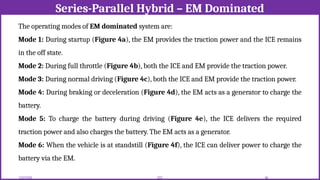
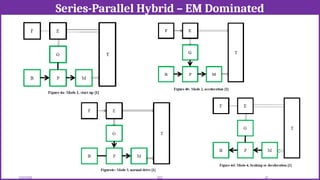
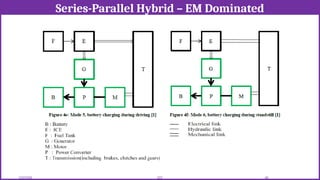
The operating modes of EM dominated system are:
Mode 1: During startup (Figure 4a), the EM provides the traction power and the ICE remains
in the off state.
Mode 2: During full throttle (Figure 4b), both the ICE and EM provide the traction power.
Mode 3: During normal driving (Figure 4c), both the ICE and EM provide the traction power.
Mode 4: During braking or deceleration (Figure 4d), the EM acts as a generator to charge the
battery.
Mode 5: To charge the battery during driving (Figure 4e), the ICE delivers the required
traction power and also charges the battery. The EM acts as a generator.
Mode 6: When the vehicle is at standstill (Figure 4f), the ICE can deliver power to charge the
battery via the EM.
Series-Parallel Hybrid – EM Dominated
12/02/2026 67
EEE
Series-Parallel Hybrid – EM Dominated
12/02/2026 68
EEE
Power Flow Control Complex Hybrid Control
12/02/2026 69
EEE
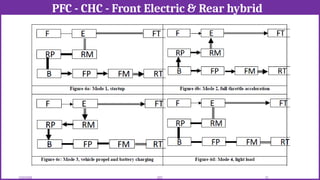
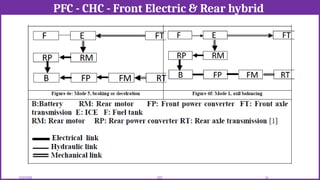
The complex hybrid vehicle configurations are of two types:
 Front hybrid rear electric
 Front electric and rear hybrid
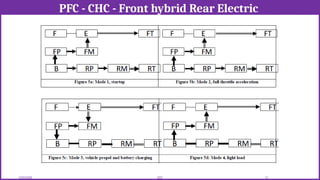
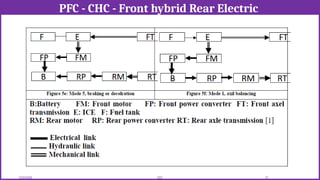
PFC - CHC - Front hybrid Rear Electric
12/02/2026 70
EEE
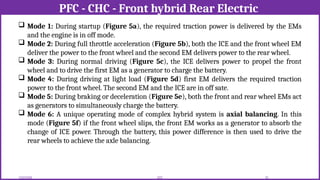
 Mode 1: During startup (Figure 5a), the required traction power is delivered by the EMs
and the engine is in off mode.
 Mode 2: During full throttle acceleration (Figure 5b), both the ICE and the front wheel EM
deliver the power to the front wheel and the second EM delivers power to the rear wheel.
 Mode 3: During normal driving (Figure 5c), the ICE delivers power to propel the front
wheel and to drive the first EM as a generator to charge the battery.
 Mode 4: During driving at light load (Figure 5d) first EM delivers the required traction
power to the front wheel. The second EM and the ICE are in off sate.
 Mode 5: During braking or deceleration (Figure 5e), both the front and rear wheel EMs act
as generators to simultaneously charge the battery.
 Mode 6: A unique operating mode of complex hybrid system is axial balancing. In this
mode (Figure 5f) if the front wheel slips, the front EM works as a generator to absorb the
change of ICE power. Through the battery, this power difference is then used to drive the
rear wheels to achieve the axle balancing.
PFC - CHC - Front hybrid Rear Electric
12/02/2026 71
EEE
PFC - CHC - Front hybrid Rear Electric
12/02/2026 72
EEE
PFC - CHC - Front Electric & Rear hybrid
12/02/2026 73
EEE
PFC - CHC - Front Electric & Rear hybrid
12/02/2026 74
EEE

Electric Vehicle Technology Architecture.pptx

  • 1.
    12/02/2026 1 EEE SRI RAMAKRISHNAENGINEERING COLLEGE [Educational Service: SNR Sons Charitable Trust] [Autonomous Institution, Accredited by NAAC with ‘A’ Grade] [Approved by AICTE and Permanently Affiliated to Anna University, Chennai] [ISO 9001:2015 Certified and all eligible programmes Accredited by NBA] Vattamalaipalayam, N.G.G.O. Colony Post, Coimbatore – 641 022. Department of Electrical and Electronics Engineering 20EE217 ELECTRIC VEHICLE TECHNOLOGY Prepared by: Mr.B.Sridhar, AP(Sl.G)/EEE
  • 2.
     In 1834,the first non-rechargeable battery operated EV (tricycle) was built by Thomas Davenport.  After invention of lead-acid battery, a rechargeable battery based EV was built by David Salomons in 1874.  After 12 years, first electric trolley system was built by Frank Sprague in 1886.  In 1900, among 4200 automobiles sold in USA, 38% were EV, 22% were ICE and 40% steam Powered Vehicle.  Several companies in US, England and France made Evs by 1900. Historical Background
  • 3.
     Electric Carriageand Wagon Company, US 1894 “Electrobat”.  Pope manufacturing company, US 500 EVs by 1898 “Columbia”.  Riker Electric Motor Company, US “Victoria” in 1897.  London Electric Cab Company, England in 1897.  Bouquet, Garcin and Schivre (BGS), France [1899-1906].  BGS EVs in 1900 had world record of 290 Km/charge.  An EV named “Jamais Contente” captured a record of 110 Km/Hr in 1899.  By 1912, nearly 34,000 EVs were registered in US. Historical Background
  • 4.
    EVs disappeared by1930s.  First development was that, Henry Ford mass produced ‘Ford Model T’ in 1925 and reduced its price by over 1/3rd to its price in 1909.  This made EVs costlier compared to ICE.  The 2nd development was invention of automobiles starter motor, by Charles Keetering, that helped remove manual cranking required in ICE and enabled Electric ignition and start.  This made ICE user friendly compared to Evs. Historical Background
  • 5.
    Reasons that ledresurgence of EVs in 1970s.  The Arab Oil Enbargo of 1973 increased demands for alternate energy sources.  Increased air pollution led to worst smog in London in 1950s and in California in 1960s/70s retriggered strict emission regulations. In 1976, Congress Enacted Public Law 94-413, the Electric and Hybrid Vehicle Research Development and Demonstration Act. This act authorized a federal program electric and hybrid electric vehicle technologies and to demonstrate the commercial feasibility of Evs. In 1990, California Air Resource Board (CARB) established rules that 2% of all vehicles sold in California in 1998 should be Zero Emission Vehicle (ZEV) and it should be 10% by 2003. Historical Background
  • 6.
    In 1968, “GreatElectric Car Race” was organized. (Boston MIT to Pasadena (Caltech) Historical Background
  • 7.
  • 8.
  • 9.
  • 10.
  • 11.
  • 12.
    Electric bus seriesfor India – Solaris & JBM Auto – Ashok Leyland Historical Background
  • 13.
    • Many automakersin US, Japan and Europe started development of Evs.  In US, General Motors, Ford, Chrysler, US Electric Car and Solectria etc.  In Japan, Toyota, Nissan, Honda, Mazda, Daihatsu, Mitsubishi, Suzuki, Isuzu, Subara etc.  In Europe, PSA Peugeot, Renault, BMW, Benz, Audi, Volvo, Opel, Volkswagen, Fiat, Bedford etc. • GM built number of experimental EVs, such as Electrovair in 1966, Electrovan in 1968, Electrovette in 1979 etc.  SCR based SE DC motor, with NI-Zn Batteries, 60 miles/Hr, 80 Km range • Ford EV projects resulted in Fiesta EV, Escort, Aerostar, Ecostar in 1970s. • Nissan developed EV-4, EV-Resort, President EV, Cedric-EV in 1970s/1980s. • Toyota produced series in EVs named EV-10 to Ev-40 in 1980s. • Fiat experimental EVs were X1/23, Y10, in 1980s and Elettra in 1990s. • BMW produced E30E, E36E in early 90s and E1 in mid 90s. Historical Background
  • 14.
    • Popular EVsin 1990s/Early 2000 – GM EV1 [100 KW, IM, VRLA, 0-100 Km/hr in 9 sec, 144 Km] – Nissan Altera EV [62 KW, PMSM, Co-Li, 120 Km/hr, 192 Km] – NIES Luciole [72 KW, In-wheel PMSM, VRLA, 130 Km/hr, Solar] – HKU-U2001 [45 KW, PMSM, Ni Cd, 110 Km/hr, 176 Km] – Reva [13 KW, SE DC, VRLA, 65 Km/hr, 80 Km] • Popular HEVs in 1990s  Toyota Prius [52 KW, ICE, 33 KW PMSM, Ni mH, 160 Km/hr]  Honda Insight [50 KW, ICE, 10 KW PMSM, Ni mH, 26-30 Km/L] • Popular FCEV in 1990s/early 2000  Toyota Prius [52 KW, ICE, 33 KW PMSM, Ni mH, 160 Km/hr]  Honda Insight [50 KW, ICE, 10 KW PMSM, Ni mH, 26-30 Km/L] Historical Background
  • 15.
    • Current PopularEVs • Tesla Roadstar (2007), Model-S (2012), Model-X (2015), Model-3 (2017) • Nissan Leaf • Chevy Bolt • BMW i3 • Current Popular HEVs are mostly PHEVs variants. • Honda Accord Hybrid • Toyota Camry, Pirus Hybrid • Lexus RX 450h • Volvo XC60 T8 • BMW 740e xDrive Historical Background
  • 16.
    Why EV? • GlobalPopulation, with current trend, may increase from 6 Billons to 10 Billions by 2050. – Vehicles in use may increase from 700 millions in 2000 to 2.5 Billions by 2050. – If all the vehicles are ICE, then all cities may be covered with permanent smog with extreme air pollution. • ARB report (2011), around 9000 people die/year due to fine particle matters in California. • Sustainable Transport • Low or Zero Emission Vehicle • Promotion of Public Transport • Renewable energy sources (less dependence on fossil fuels) • Comparison of Energy Sources (storage) used for Transport Benefits of Using EVs
  • 17.
    • Comparison ofEnergy Sources (storage) used for Transport • Gasoline (petrol) • Diesel • Compressed Natural Gas (CNG) • Hydrogen • Batteries • Ultra-Capacitor • Ultra-Flywheel Benefits of Using EVs
  • 18.
    • Pollutants andGreenhouse Gases • Particulate Matter (PMx) • CO, CO2 • CH4 • NOx [N2O, NO and NO2] • Volatile Organic Compound (VOC) • Total Hydrocarbon • Sox [SO2] Benefits of Using EVs
  • 19.
  • 20.
  • 21.
    Comparison of EnergyDiversification Benefits of Using EVs
  • 22.
    Comparison of Efficiency(Fuel Tank to Wheel) Benefits of Using EVs
  • 23.
    Comparison of Efficiency(Well to Wheel) Benefits of Using EVs
  • 24.
    Comparison of Capital/OperationCost and Performance » BEV has advantages of higher fuel economy than the ICE » BEV is much more expensive than the ICE • Due to initial battery cost • Replacement of battery after few years » BEV requires less maintenance and is more reliable » BEV can recover energy during braking and less noisy » BEV requires charging and has limited range per charge » BEV can be charged by renewable sources such as solar Benefits of Using EVs
  • 25.
    Comparison of EVVs IC engine 12/02/2026 25 EEE
  • 26.
    Comparison of EVVs IC engine 12/02/2026 26 EEE IC Engine Electric Vehicle
  • 27.
    Types of EVs 12/02/202627 EEE 1. Propulsion Devices 2. Energy Sources 3. Energy Carriers etc
  • 28.
    Types of EVs 12/02/202628 EEE Propulsion Devices 1. PEV - Pure Electric Vehicle 2. HEV - Hybrid Electric Vehicle
  • 29.
    Types of EVs 12/02/202629 EEE Based on Energy Sources 1. BEV – Battery Electric Vehicle 2. HEV - Hybrid Electric Vehicle 3. FCEV – Fuel Cell Electric Vehicle
  • 30.
    Types of EVs 12/02/202630 EEE Based on Energy Carriers 1. BEV – Battery Electric Vehicle 2. HEV - Hybrid Electric Vehicle 3. FCEV – Fuel Cell Electric Vehicle
  • 31.
    Types of EVs 12/02/202631 EEE Pure Electric Vehicle 1. BEV – Battery 2. FCEV – Battery + Fuel Cell 3. UCEV – Battery + UC 4. UFEV – Battery + UF
  • 32.
    Types of HEVs 12/02/202632 EEE Conventional HEV 1. Micro Hybrid 2. Mild Hybrid 3. Full Hybrid Grid-Able HEV 4. Plug-in Hybrid 5. Range Extended
  • 33.
  • 34.
  • 35.
  • 36.
    Types of EVs 12/02/202636 EEE Conventional Full Hybrid EV 1. Series Hybrid 2. Parallel Hybrid 3. Series Parallel Hybrid 4. Complex Hybrid
  • 37.
    Types of EVs 12/02/202637 EEE Conventional Series Hybrid EV
  • 38.
    Types of EVs 12/02/202638 EEE Conventional Parallel Hybrid EV
  • 39.
    Types of EVs 12/02/202639 EEE Conventional Series - Parallel Hybrid EV
  • 40.
    Architecture of Hybridand Electric Vehicles 12/02/2026 40 EEE What exactly is an HEV? The term hybrid vehicle refers to a vehicle with at least two sources of power. hybrid-electric vehicle indicates that one source of power is provided by an electric motor. The other source of motive power can come from a number of different technologies, but is typically provided by an internal combustion engine designed to run on either gasoline or diesel fuel. As proposed by Technical Committee (Electric Road Vehicles) of the International Electrotechnical Commission, an HEV is a vehicle in which propulsion energy is available from two or more types of energy sources and at least one of them can deliver electrical energy.
  • 41.
    Hybrid-Electric Vehicle 12/02/2026 41 EEE Basedon this general definition, there are many types of HEVs, such as: • Gasoline ICE and battery • Diesel ICE and battery • Battery and FC • Battery and capacitor • Battery and flywheel • Battery and battery hybrids.
  • 42.
    Energy Use inConventional Vehicles 12/02/2026 42 EEE In order to understand how a HEV may save energy, it is necessary first to examine how conventional vehicles use energy. The breakdown of energy use in a vehicle is as follows: 1. In order to maintain movement, vehicles must produce power at the wheels to overcome: a. Aerodynamic drag (air friction on the body surfaces of the vehicle, coupled with pressure forces caused by the air flow) b. Rolling resistance (the resistive forces between tires and the road surface) c. Resistive gravity forces associated with climbing a grade 2. Further, to accelerate, the vehicle must its inertia. Most of the energy expended in acceleration is then lost as heat in the brakes when the vehicle is brought to a stop. 3. The vehicle must provide power for accessories such as heating fan, lights, power steering, and air conditioning. 4. Finally, a vehicle will need to be capable of delivering power for acceleration with very little delay when the driver depresses the accelerator, which may necessitate keeping the power source in a standby (energy-using) mode.
  • 43.
    Translation of fuelenergy into work in a vehicle 12/02/2026 43 EEE
  • 44.
    Energy Savings Potentialof Hybrid Drivetrains 12/02/2026 44 EEE In terms of overall energy efficiency, the conceptual advantages of a hybrid over a conventional vehicle are: • Regenerative braking • More efficient operation of the ICE, including reduction of idle • Smaller ICE: • Potential for higher weight • Electrical losses
  • 45.
    HEV Configurations 12/02/2026 45 EEE Thevarious possible ways of combining the power flow to meet the driving requirements are: i. Powertrain 1 alone delivers power ii. Powertrain 2 alone delivers power iii. Both powertrain 1 and 2 deliver power to load at the same time iv. Powertrain 2 obtains power from load (regenerative braking) v. Powertrain 2 obtains power from powertrain 1 vi. Powertrain 2 obtains power from powertrain 1 and load at the same time vii. Powertrain 1 delivers power simultaneously to load and to powertrain 2 viii. Powertrain 1 delivers power to powertrain 2 and powertrain 2 delivers power ton load ix. Powertrain 1 delivers power to load and load delivers power to powertrain 2.
  • 46.
  • 47.
    HEV Configurations 12/02/2026 47 EEE Hybriddrivetrain concept can be implemented by different configurations as follows:  Series configuration  Parallel configuration  Series-parallel configuration  Complex configuration The functional block diagrams of the various HEV configurations is shown in Figure, it can be observed that the key feature of:  Series hybrid is to couple the ICE with the generator to produce electricity for pure electric propulsion.  Parallel hybrid is to couple both the ICE and electric motor with the transmission via the same drive shaft to propel the vehicle.
  • 48.
    Series Hybrid Configuration 12/02/202648 EEE In case of series hybrid system (Figure) the mechanical output is first converted into electricity using a generator. The converted electricity either charges the battery or can bypass the battery to propel the wheels via the motor and mechanical transmission. Conceptually, it is an ICE assisted Electric Vehicle (EV). The advantages of series hybrid drivetrains are: • Mechanical decoupling between the ICE and driven wheels allows the IC engine operating at its very narrow optimal region as shown in Figure. • Nearly ideal torque-speed characteristics of electric motor make multigear transmission unnecessary
  • 49.
    Series Hybrid Configuration 12/02/202649 EEE However, a series hybrid drivetrain has the following disadvantages: • The energy is converted twice (mechanical to electrical and then to mechanical) and this reduces the overall efficiency. • Two electric machines are needed and a big traction motor is required because it is the only torque source of the driven wheels. The series hybrid drivetrain is used in heavy commercial vehicles, military vehicles and buses. The reason is that large vehicles have enough space for the bulky engine/generator system.
  • 50.
    Detailed Configuration ofSeries Hybrid Vehicle 12/02/2026 50 EEE
  • 51.
    Parallel Hybrid Configuration 12/02/202651 EEE The parallel HEV Figure allows both ICE and electric motor (EM) to deliver power to drive the wheels. Since both the ICE and EM are coupled to the drive shaft of the wheels via two clutches, the propulsion power may be supplied by ICE alone, by EM only or by both ICE and EM. The EM can be used as a generator to charge the battery by regenerative braking or absorbing power from the ICE when its output is greater than that required to drive the wheels.
  • 52.
    Parallel Hybrid Configuration 12/02/202652 EEE The advantages of the parallel hybrid drivetrain are: • Both engine and electric motor directly supply torques to the driven wheels and no energy form conversion occurs, hence energy loss is less • Compactness due to no need of the generator and smaller traction motor. The drawbacks of parallel hybrid drivetrains are: • Mechanical coupling between the engines and the driven wheels, thus the engine operating points cannot be fixed in a narrow speed region. • The mechanical configuration and the control strategy are complex compared to series hybrid drivetrain. Due to its compact characteristics, small vehicles use parallel configuration. Most passenger cars employ this configuration.
  • 53.
    Series-Parallel Hybrid Configuration 12/02/202653 EEE In the series-parallel hybrid (Figure), the configuration incorporates the features of both the series and parallel HEVs. However, this configuration needs an additional electric machine and a planetary gear unit making the control complex.
  • 54.
    Complex Hybrid Configuration 12/02/202654 EEE The complex hybrid system (Figure) involves a complex configuration which cannot be classified into the above three kinds. The complex hybrid is similar to the series-parallel hybrid since the generator and electric motor is both electric machines. However, the key difference is due to the bi-directional power flow of the electric motor in complex hybrid and the unidirectional power flow of the generator in the series-parallel hybrid. The major disadvantage of complex hybrid is higher complexity.
  • 55.
    Power Flow inHEVs 12/02/2026 55 EEE Due to the variations in HEV configurations, different power control strategies are necessary to regulate the power flow to or from different components. All the control strategies aim satisfy the following goals: • Maximum fuel efficiency • Minimum emissions • Minimum system costs • Good driving performance
  • 56.
    Power Flow inHEVs 12/02/2026 56 EEE The design of power control strategies for HEVs involves different considerations such as: Optimal ICE operating point: The optimal operating point on the torque-speed plane of the ICE can be based on maximization of fuel economy, the minimization of emissions or a compromise between fuel economy and emissions. Optimal ICE operating line: In case the ICE needs to deliver different power demands, the corresponding optimal operating points constitute an optimal operating line. Safe battery voltage: The battery voltage may be significantly altered during discharging, generator charging or regenerative charging. This battery voltage should not exceed the maximum voltage limit nor should it fall below the minimum voltage limit.
  • 57.
    Power Flow Controlin Series Hybrid 12/02/2026 57 EEE In the series hybrid system there are four operating modes based on the power flow: Mode 1: During startup (Figure 1a), normal driving or acceleration of the series HEV, both the ICE and battery deliver electric energy to the power converter which then drives the electric motor and hence the wheels via transmission.
  • 58.
    Power Flow Controlin Series Hybrid 12/02/2026 58 EEE In the series hybrid system there are four operating modes based on the power flow: Mode 2: At light load (Figure 1b), the ICE output is greater than that required to drive the wheels. Hence, a fraction of the generated electrical energy is used to charge the battery. The charging of the batter takes place till the battery capacity reaches a proper level.
  • 59.
    Power Flow Controlin Series Hybrid 12/02/2026 59 EEE In the series hybrid system there are four operating modes based on the power flow: Mode 3: During braking or deceleration (Figure 1c), the electric motor acts as a generator, which converts the kinetic energy of the wheels into electricity and this, is used to charge the battery.
  • 60.
    Power Flow Controlin Series Hybrid 12/02/2026 60 EEE In the series hybrid system there are four operating modes based on the power flow: Mode 4: The battery can also be charged by the ICE via the generator even when the vehicle comes to a complete stop (Figure 1d).
  • 61.
    Power Flow Controlin Parallel Hybrid 12/02/2026 61 EEE In the parallel hybrid system there are four operating modes based on the power flow: Mode 1: During start up or full throttle acceleration (Figure 2a); both the ICE and the EM share the required power to propel the vehicle. Typically, the relative distribution between the ICE and electric motor is 80-20%. Mode 2: During normal driving (Figure 2b), the required traction power is supplied by the ICE only and the EM remains in off mode. Mode 3: During braking or deceleration (Figure 2c), the EM acts as a generator to charge the battery via the power converter. Mode 4: Under light load condition (Figure 2d), the traction power is delivered by the ICE and the ICE also charges the battery via the EM.
  • 62.
    Power Flow Controlin Parallel Hybrid 12/02/2026 62 EEE
  • 63.
    Power Flow Controlin Series-Parallel Hybrid 12/02/2026 63 EEE The series-parallel hybrid system involves the features of series and parallel hybrid systems. Hence, a number of operation modes are feasible. Therefore, these hybrid systems are classified into two categories: the ICE dominated and the EM dominated. The various operating modes of ICE dominated system are: Mode 1: At startup (Figure 3a), the battery solely provides the necessary power to propel the vehicle and the ICE remains in off mode. Mode 2: During full throttle acceleration (Figure 3b), both the ICE and the EM share the required traction power. Mode 3: During normal driving (Figure 3c), the required traction power is provided by the ICE only and the EM remains in the off state. Mode 4: During normal braking or deceleration (Figure 3d), the EM acts as a generator to charge the battery. Mode 5: To charge the battery during driving (Figure 3e), the ICE delivers the required traction power and also charges the battery. In this mode the EM acts as a generator. Mode 6: When the vehicle is at standstill (Figure 3f), the ICE can deliver power to charge the battery via the EM.
  • 64.
    Series-Parallel Hybrid –ICE Dominated 12/02/2026 64 EEE
  • 65.
    Series-Parallel Hybrid –ICE Dominated 12/02/2026 65 EEE
  • 66.
    Series-Parallel Hybrid –EM Dominated 12/02/2026 66 EEE The operating modes of EM dominated system are: Mode 1: During startup (Figure 4a), the EM provides the traction power and the ICE remains in the off state. Mode 2: During full throttle (Figure 4b), both the ICE and EM provide the traction power. Mode 3: During normal driving (Figure 4c), both the ICE and EM provide the traction power. Mode 4: During braking or deceleration (Figure 4d), the EM acts as a generator to charge the battery. Mode 5: To charge the battery during driving (Figure 4e), the ICE delivers the required traction power and also charges the battery. The EM acts as a generator. Mode 6: When the vehicle is at standstill (Figure 4f), the ICE can deliver power to charge the battery via the EM.
  • 67.
    Series-Parallel Hybrid –EM Dominated 12/02/2026 67 EEE
  • 68.
    Series-Parallel Hybrid –EM Dominated 12/02/2026 68 EEE
  • 69.
    Power Flow ControlComplex Hybrid Control 12/02/2026 69 EEE The complex hybrid vehicle configurations are of two types:  Front hybrid rear electric  Front electric and rear hybrid
  • 70.
    PFC - CHC- Front hybrid Rear Electric 12/02/2026 70 EEE  Mode 1: During startup (Figure 5a), the required traction power is delivered by the EMs and the engine is in off mode.  Mode 2: During full throttle acceleration (Figure 5b), both the ICE and the front wheel EM deliver the power to the front wheel and the second EM delivers power to the rear wheel.  Mode 3: During normal driving (Figure 5c), the ICE delivers power to propel the front wheel and to drive the first EM as a generator to charge the battery.  Mode 4: During driving at light load (Figure 5d) first EM delivers the required traction power to the front wheel. The second EM and the ICE are in off sate.  Mode 5: During braking or deceleration (Figure 5e), both the front and rear wheel EMs act as generators to simultaneously charge the battery.  Mode 6: A unique operating mode of complex hybrid system is axial balancing. In this mode (Figure 5f) if the front wheel slips, the front EM works as a generator to absorb the change of ICE power. Through the battery, this power difference is then used to drive the rear wheels to achieve the axle balancing.
  • 71.
    PFC - CHC- Front hybrid Rear Electric 12/02/2026 71 EEE
  • 72.
    PFC - CHC- Front hybrid Rear Electric 12/02/2026 72 EEE
  • 73.
    PFC - CHC- Front Electric & Rear hybrid 12/02/2026 73 EEE
  • 74.
    PFC - CHC- Front Electric & Rear hybrid 12/02/2026 74 EEE