E-Learning Website
Development
From development to distribution
Introduction
Welcome to our presentation on
E-Learning Website Development.
In this digital era, the demand for
flexible and accessible education
solutions is ever-growing.
E-Learning websites provide a
platform for learners to access
educational resources
conveniently from anywhere with
an internet connection.
Importance: E-Learning breaks the barriers of
traditional education by offering flexibility, accessibility,
and personalized learning experiences.
Statistics: According to , the global e-learning market is
projected to reach
Importance of E-Learning
Accessibility: Learners can access course
materials anytime, anywhere.
Flexibility: E-Learning accommodates diverse
schedules and learning paces.
Cost-effectiveness: Eliminates the need for
physical infrastructure, reducing costs for both
learners and institutions.
Personalized Learning: Tailored content and
adaptive learning technologies cater to individual
learner needs.
Scalability: E-Learning platforms can
accommodate large numbers of learners without
geographical constraints.
Advantages of E-Learning Websites
Advantages:
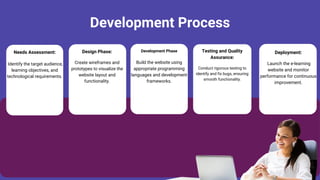
Needs Assessment:
Identify the target audience,
learning objectives, and
technological requirements.
Testing and Quality
Assurance:
Conduct rigorous testing to
identify and fix bugs, ensuring
smooth functionality.
Development Process
Design Phase:
Create wireframes and
prototypes to visualize the
website layout and
functionality.
Development Phase
Build the website using
appropriate programming
languages and development
frameworks.
Deployment:
Launch the e-learning
website and monitor
performance for continuous
improvement.
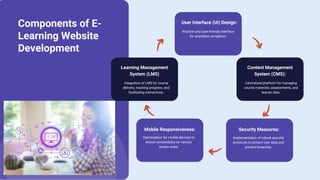
Components of E-
Learning Website
Development
User Interface (UI) Design:
Intuitive and user-friendly interface
for seamless navigation.
Content Management
System (CMS):
Centralized platform for managing
course materials, assessments, and
learner data.
Security Measures:
Implementation of robust security
protocols to protect user data and
prevent breaches.
Mobile Responsiveness:
Optimization for mobile devices to
ensure accessibility on various
screen sizes.
Learning Management
System (LMS)
Integration of LMS for course
delivery, tracking progress, and
facilitating interactions.
Conclusion
Phone Number
+1 503 575 7893
Email Address
contact@ibrinfotech.com
Website
www.ibrinfotech.com

E-learning Website Development IBR Infotech

  • 1.
  • 2.
    Introduction Welcome to ourpresentation on E-Learning Website Development. In this digital era, the demand for flexible and accessible education solutions is ever-growing. E-Learning websites provide a platform for learners to access educational resources conveniently from anywhere with an internet connection.
  • 3.
    Importance: E-Learning breaksthe barriers of traditional education by offering flexibility, accessibility, and personalized learning experiences. Statistics: According to , the global e-learning market is projected to reach Importance of E-Learning
  • 4.
    Accessibility: Learners canaccess course materials anytime, anywhere. Flexibility: E-Learning accommodates diverse schedules and learning paces. Cost-effectiveness: Eliminates the need for physical infrastructure, reducing costs for both learners and institutions. Personalized Learning: Tailored content and adaptive learning technologies cater to individual learner needs. Scalability: E-Learning platforms can accommodate large numbers of learners without geographical constraints. Advantages of E-Learning Websites Advantages:
  • 5.
    Needs Assessment: Identify thetarget audience, learning objectives, and technological requirements. Testing and Quality Assurance: Conduct rigorous testing to identify and fix bugs, ensuring smooth functionality. Development Process Design Phase: Create wireframes and prototypes to visualize the website layout and functionality. Development Phase Build the website using appropriate programming languages and development frameworks. Deployment: Launch the e-learning website and monitor performance for continuous improvement.
  • 6.
    Components of E- LearningWebsite Development User Interface (UI) Design: Intuitive and user-friendly interface for seamless navigation. Content Management System (CMS): Centralized platform for managing course materials, assessments, and learner data. Security Measures: Implementation of robust security protocols to protect user data and prevent breaches. Mobile Responsiveness: Optimization for mobile devices to ensure accessibility on various screen sizes. Learning Management System (LMS) Integration of LMS for course delivery, tracking progress, and facilitating interactions.
  • 7.
    Conclusion Phone Number +1 503575 7893 Email Address contact@ibrinfotech.com Website www.ibrinfotech.com