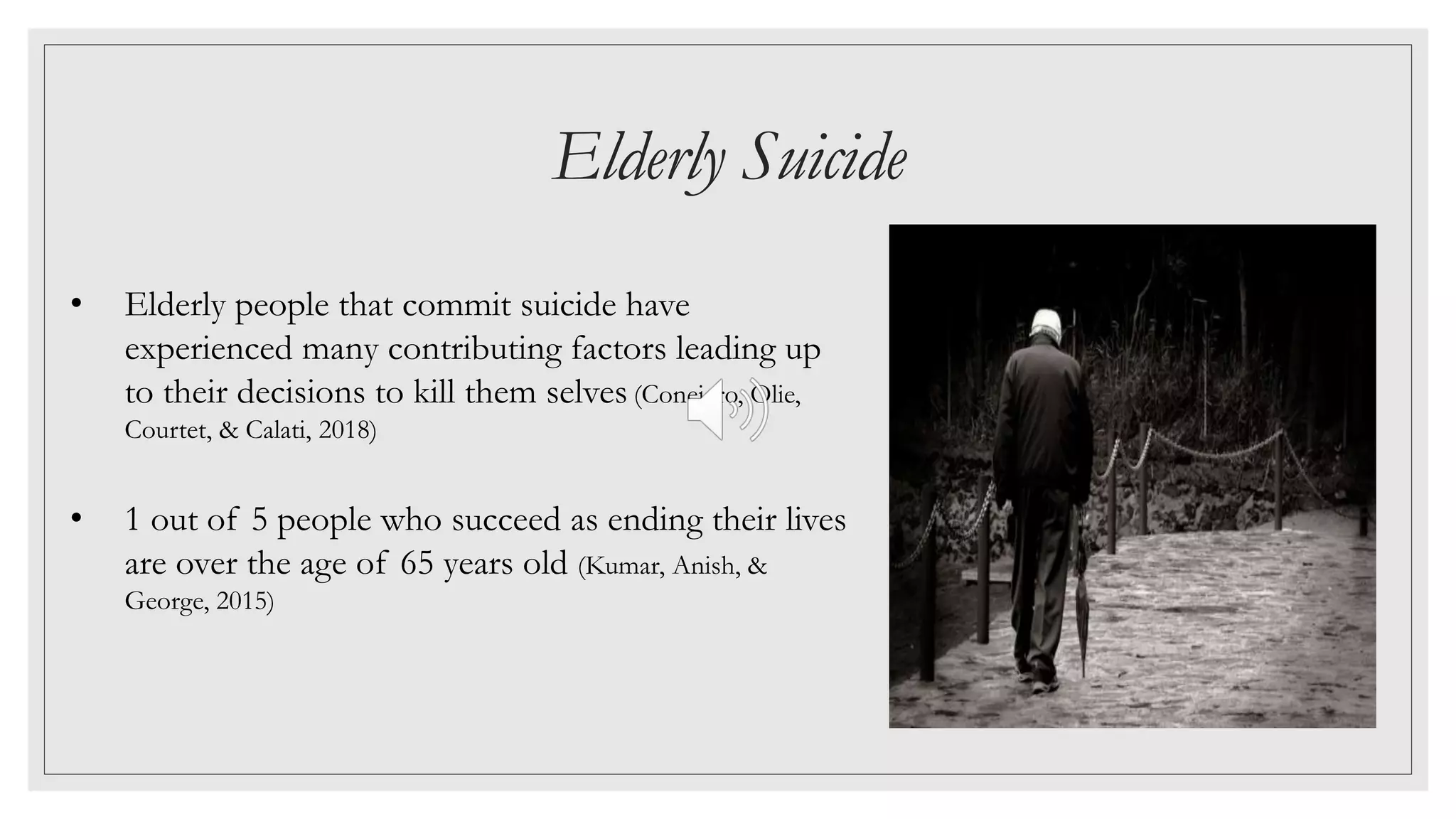
• Elderly people that commit suicide have
experienced many contributing factors leading up
to their decisions to kill them selves (Conejero, Olie,
Courtet, & Calati, 2018)
• 1 out of 5 people who succeed as ending their lives
are over the age of 65 years old (Kumar, Anish, &
George, 2015)
Elderly Suicide
Sense of usefulness
◦ “Loneliness and depression are
more severe among empty-nest
than not-empty-nest rural elderly
adults” (Wang, Hu, Xiao, & Zhou, 2017, p. 1).
◦ “Loneliness was a mediating
variable between empty-nest
syndrome and depression” (Wang,
Hu, Xiao, & Zhou, 2017, p. 1).
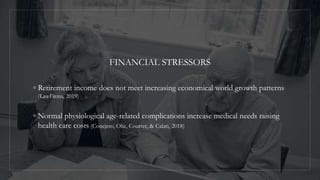
FINANCIAL STRESSORS
◦ Retirement income does not meet increasing economical world growth patterns
(LawFirms, 2019)
◦ Normal physiological age-related complications increase medical needs raising
health care costs (Conejero, Olie, Courtet, & Calati, 2018)
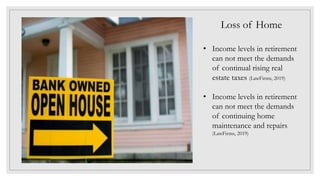
Loss of Home
• Income levels in retirement
can not meet the demands
of continual rising real
estate taxes (LawFirms, 2019)
• Income levels in retirement
can not meet the demands
of continuing home
maintenance and repairs
(LawFirms, 2019)
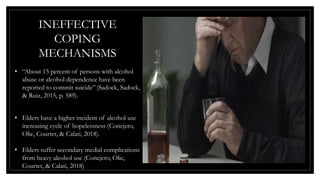
INEFFECTIVE
COPING
MECHANISMS
• “About 15 percent of persons with alcohol
abuse or alcohol dependence have been
reported to commit suicide” (Sadock, Sadock,
& Ruiz, 2015, p. 589).
• Elders have a higher incident of alcohol use
increasing cycle of hopelessness (Conejero,
Olie, Courtet, & Calati, 2018).
• Elders suffer secondary medial complications
from heavy alcohol use (Conejero, Olie,
Courtet, & Calati, 2018)
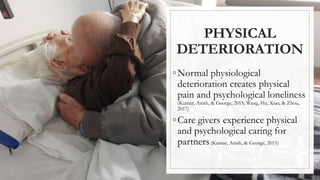
PHYSICAL
DETERIORATION
◦Normal physiological
deterioration creates physical
pain and psychological loneliness
(Kumar, Anish, & George, 2015; Wang, Hu, Xiao, & Zhou,
2017)
◦Care givers experience physical
and psychological caring for
partners(Kumar, Anish, & George, 2015)
LOSS OF
LIFE
PARTNER
(CONEJERO,OLIE,COURTET,&
CALATI,2018)
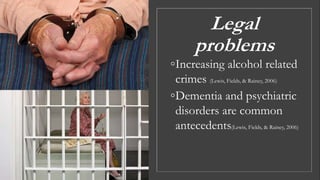
Legal
problems
◦Increasing alcohol related
crimes (Lewis, Fields, & Rainey, 2006)
◦Dementia and psychiatric
disorders are common
antecedents(Lewis, Fields, & Rainey, 2006)
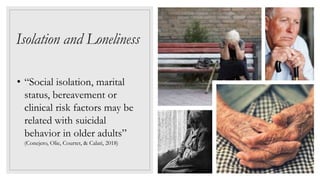
Isolation and Loneliness
• “Social isolation, marital
status, bereavement or
clinical risk factors may be
related with suicidal
behavior in older adults”
(Conejero, Olie, Courtet, & Calati, 2018)
Lethality
◦ “Suicide attempts are often more lethal in older adults than
in younger adults” (Administration on Aging [AoA], 2012,
p. 1)
◦ “Firearms are the most common means of suicide in older
adults (67%), followed by poisoning (14%) and suffocation”
(12%) (AoA, 2012, p. 1)
◦ “Older adults are nearly twice as likely to use firearms as a
means of suicide than are people under age 60” (AoA,
2012, p. 1)
Healthcare Providers Interventions
• Identify and support people at risk of suicide.Identify and support
• Teach coping and problem-solving skills to help people manage challenges with their relationships, jobs,
health, or other concerns.Teach
• Promote safe and supportive environments. This includes safely storing medications and firearms to
reduce access among people at risk.Promote
• Offer activities that bring people together, so they feel connected and not alone.Offer
• Connect people at risk to effective and coordinated mental and physical healthcare.Connect
• Expand options for temporary help for those struggling to make ends meet.Expand
• Prevent future risk of suicide among those who have lost a friend or loved one to suicidePrevent
(Center for Disease Control and Prevention [CDC], 2018)
References
◦ Administration on Aging. (2012). Older americans behavioral health issue brief 4: Preventing suicide in
older adults. Older Americans Behavioral Health Technical Assistance Center, 1-4. Retrieved from
https://acl.gov/sites/default/files/programs/2016-11/Issue%20Brief%204%20Preventing%20Suicide.pdf
◦ Center for Disease Control and Prevention. (2018). Vital signs | Suicide [Fact sheet]. Retrieved from
https://www.cdc.gov/vitalsigns/pdf/vs-0618-suicide-H.pdf
◦ Conejero, I., Olie, E., Courtet, P., & Calati, R. (2018). Suicide in older adults: current perspectives. Clinical
Interventions in Aging, 13, 691-699. Retrieved from
https://www.ncbi.nlm.nih.gov/pmc/articles/PMC5916258/pdf/cia-13-691.pdf
◦ Kumar, P., Anish, P., & George, B. (2015). Risk factors for suicide in elderly in comparison to younger age
groups. Indian Journal of Psychiatry, 57(3), 249-254. http://dx.doi.org/10.4103/0019-5545.166614
◦ LawFirms. (2019). Foreclosures on the Elderly. Retrieved from
https://www.lawfirms.com/resources/foreclosure/foreclosures-elderly
◦ Lewis, C., Fields, C., & Rainey, E. (2006). A study of geriatric forensic evaluees: Who are the violent elderly?
The Journal of the American Academy of Psychiatry and the Law, 34(3), 324-332. Retrieved from
http://jaapl.org/content/jaapl/34/3/324.full.pdf
◦ Sadock, B., Sadock, V., & Ruiz, P. (2015). Synopsis of psychiatry | Behavioral sciences / clinical psychiatry (11th ed.).
Philadelphia, PA: Wolters Kluwer.
◦ Wang, G., Hu, M., Xiao, S., & Zhou, L. (2017). Loneliness and depression among rural empty-nest elderly
adults in Liuyang, China: a cross-sectional study. BMJ Open, 1-8. http://dx.doi.org/10.1136/bmjopen-2017-
016091

Elderly suicide with audio

  • 1.
    • Elderly peoplethat commit suicide have experienced many contributing factors leading up to their decisions to kill them selves (Conejero, Olie, Courtet, & Calati, 2018) • 1 out of 5 people who succeed as ending their lives are over the age of 65 years old (Kumar, Anish, & George, 2015) Elderly Suicide
  • 2.
    Sense of usefulness ◦“Loneliness and depression are more severe among empty-nest than not-empty-nest rural elderly adults” (Wang, Hu, Xiao, & Zhou, 2017, p. 1). ◦ “Loneliness was a mediating variable between empty-nest syndrome and depression” (Wang, Hu, Xiao, & Zhou, 2017, p. 1).
  • 3.
    FINANCIAL STRESSORS ◦ Retirementincome does not meet increasing economical world growth patterns (LawFirms, 2019) ◦ Normal physiological age-related complications increase medical needs raising health care costs (Conejero, Olie, Courtet, & Calati, 2018)
  • 4.
    Loss of Home •Income levels in retirement can not meet the demands of continual rising real estate taxes (LawFirms, 2019) • Income levels in retirement can not meet the demands of continuing home maintenance and repairs (LawFirms, 2019)
  • 5.
    INEFFECTIVE COPING MECHANISMS • “About 15percent of persons with alcohol abuse or alcohol dependence have been reported to commit suicide” (Sadock, Sadock, & Ruiz, 2015, p. 589). • Elders have a higher incident of alcohol use increasing cycle of hopelessness (Conejero, Olie, Courtet, & Calati, 2018). • Elders suffer secondary medial complications from heavy alcohol use (Conejero, Olie, Courtet, & Calati, 2018)
  • 6.
    PHYSICAL DETERIORATION ◦Normal physiological deterioration createsphysical pain and psychological loneliness (Kumar, Anish, & George, 2015; Wang, Hu, Xiao, & Zhou, 2017) ◦Care givers experience physical and psychological caring for partners(Kumar, Anish, & George, 2015)
  • 7.
  • 8.
    Legal problems ◦Increasing alcohol related crimes(Lewis, Fields, & Rainey, 2006) ◦Dementia and psychiatric disorders are common antecedents(Lewis, Fields, & Rainey, 2006)
  • 9.
    Isolation and Loneliness •“Social isolation, marital status, bereavement or clinical risk factors may be related with suicidal behavior in older adults” (Conejero, Olie, Courtet, & Calati, 2018)
  • 10.
    Lethality ◦ “Suicide attemptsare often more lethal in older adults than in younger adults” (Administration on Aging [AoA], 2012, p. 1) ◦ “Firearms are the most common means of suicide in older adults (67%), followed by poisoning (14%) and suffocation” (12%) (AoA, 2012, p. 1) ◦ “Older adults are nearly twice as likely to use firearms as a means of suicide than are people under age 60” (AoA, 2012, p. 1)
  • 11.
    Healthcare Providers Interventions •Identify and support people at risk of suicide.Identify and support • Teach coping and problem-solving skills to help people manage challenges with their relationships, jobs, health, or other concerns.Teach • Promote safe and supportive environments. This includes safely storing medications and firearms to reduce access among people at risk.Promote • Offer activities that bring people together, so they feel connected and not alone.Offer • Connect people at risk to effective and coordinated mental and physical healthcare.Connect • Expand options for temporary help for those struggling to make ends meet.Expand • Prevent future risk of suicide among those who have lost a friend or loved one to suicidePrevent (Center for Disease Control and Prevention [CDC], 2018)
  • 12.
    References ◦ Administration onAging. (2012). Older americans behavioral health issue brief 4: Preventing suicide in older adults. Older Americans Behavioral Health Technical Assistance Center, 1-4. Retrieved from https://acl.gov/sites/default/files/programs/2016-11/Issue%20Brief%204%20Preventing%20Suicide.pdf ◦ Center for Disease Control and Prevention. (2018). Vital signs | Suicide [Fact sheet]. Retrieved from https://www.cdc.gov/vitalsigns/pdf/vs-0618-suicide-H.pdf ◦ Conejero, I., Olie, E., Courtet, P., & Calati, R. (2018). Suicide in older adults: current perspectives. Clinical Interventions in Aging, 13, 691-699. Retrieved from https://www.ncbi.nlm.nih.gov/pmc/articles/PMC5916258/pdf/cia-13-691.pdf ◦ Kumar, P., Anish, P., & George, B. (2015). Risk factors for suicide in elderly in comparison to younger age groups. Indian Journal of Psychiatry, 57(3), 249-254. http://dx.doi.org/10.4103/0019-5545.166614 ◦ LawFirms. (2019). Foreclosures on the Elderly. Retrieved from https://www.lawfirms.com/resources/foreclosure/foreclosures-elderly ◦ Lewis, C., Fields, C., & Rainey, E. (2006). A study of geriatric forensic evaluees: Who are the violent elderly? The Journal of the American Academy of Psychiatry and the Law, 34(3), 324-332. Retrieved from http://jaapl.org/content/jaapl/34/3/324.full.pdf ◦ Sadock, B., Sadock, V., & Ruiz, P. (2015). Synopsis of psychiatry | Behavioral sciences / clinical psychiatry (11th ed.). Philadelphia, PA: Wolters Kluwer. ◦ Wang, G., Hu, M., Xiao, S., & Zhou, L. (2017). Loneliness and depression among rural empty-nest elderly adults in Liuyang, China: a cross-sectional study. BMJ Open, 1-8. http://dx.doi.org/10.1136/bmjopen-2017- 016091