Studies on BGO crystals
                                      Roma1 EMC Group


                                                        1
Davide Pinci – INFN Sezione di Roma
Intro
    Because of the large background we already know we'll have to reduce the
    integration time on the FEE on the barrel EMC;

    In order to evaluate the impact of a shorter integration time on the energy
    resolution we made a simple exercise;

    The signal of a PMT reading a BGO crystal (we haven't found a CsI one) was
    sent into an Ortec pre-amplifier with a variable integration time and registered
    with a digital oscilloscope;

    The crystal was irradiated with a    137
                                               Cs source;

    In an off-line analysis, event by event, we evaluated:
                –   The total charge as the integral of waveform;
                –   The signal amplitude, to emulate the response of a shaper placed
                    downstream of the pre-amplifier;


    A shorter integration time can be a solution also in case of a non-fully Lyso
    based forward calorimeter;


                                                                                       2
Davide Pinci – INFN Sezione di Roma
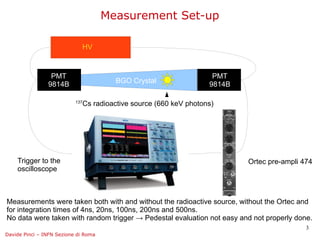
Measurement Set-up

                             HV


                 PMT                                                   PMT
                9814B                     BGO Crystal                 9814B

                           137
                                 Cs radioactive source (660 keV photons)


    Trigger to the                                                            Ortec pre-ampli 474
    oscilloscope


Measurements were taken both with and without the radioactive source, without the Ortec and
for integration times of 4ns, 20ns, 100ns, 200ns and 500ns.
No data were taken with random trigger → Pedestal evaluation not easy and not properly done.
                                                                                               3
Davide Pinci – INFN Sezione di Roma
Average signals
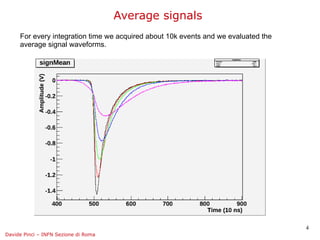
     For every integration time we acquired about 10k events and we evaluated the
     average signal waveforms.


                                                                                    4
Davide Pinci – INFN Sezione di Roma
Circuit model
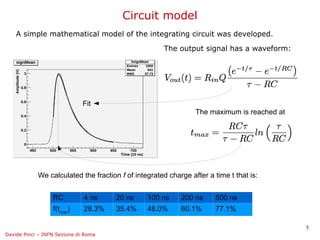
    A simple mathematical model of the integrating circuit was developed.

                                                     The output signal has a waveform:


                              Fit
                                                                The maximum is reached at


            We calculated the fraction f of integrated charge after a time t that is:


                  RC          4 ns    20 ns     100 ns     200 ns     500 ns
                  f(tmax)     28.3%   35.4%     48.0%      60.1%      77.1%

                                                                                            5
Davide Pinci – INFN Sezione di Roma
Spectra
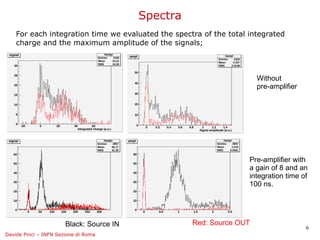
    For each integration time we evaluated the spectra of the total integrated
    charge and the maximum amplitude of the signals;


                                                                      Without
                                                                      pre-amplifier


                                                                    Pre-amplifier with
                                                                    a gain of 8 and an
                                                                    integration time of
                                                                    100 ns.


                       Black: Source IN             Red: Source OUT
                                                                                      6
Davide Pinci – INFN Sezione di Roma
Peak amplitude vs RC
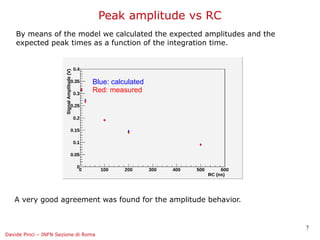
    By means of the model we calculated the expected amplitudes and the
    expected peak times as a function of the integration time.


                                 Blue: calculated
                                 Red: measured


   A very good agreement was found for the amplitude behavior.


                                                                          7
Davide Pinci – INFN Sezione di Roma
Resolution vs RC


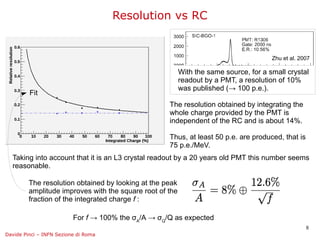
                                                                                       Zhu et al. 2007

                                                          With the same source, for a small crystal
                                                          readout by a PMT, a resolution of 10%
                                                          was published (→ 100 p.e.).
         Fit
                                                     The resolution obtained by integrating the
                                                     whole charge provided by the PMT is
                                                     independent of the RC and is about 14%.

                                                     Thus, at least 50 p.e. are produced, that is
                                                     75 p.e./MeV.
  Taking into account that it is an L3 crystal readout by a 20 years old PMT this number seems
  reasonable.

         The resolution obtained by looking at the peak
         amplitude improves with the square root of the
         fraction of the integrated charge f :

                          For f → 100% the σA/A → σQ/Q as expected
                                                                                                    8
Davide Pinci – INFN Sezione di Roma
First conclusion and future steps

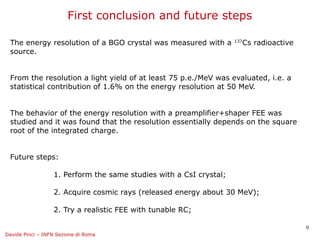
 The energy resolution of a BGO crystal was measured with a         137
                                                                          Cs radioactive
 source.


 From the resolution a light yield of at least 75 p.e./MeV was evaluated, i.e. a
 statistical contribution of 1.6% on the energy resolution at 50 MeV.


 The behavior of the energy resolution with a preamplifier+shaper FEE was
 studied and it was found that the resolution essentially depends on the square
 root of the integrated charge.


 Future steps:

                  1. Perform the same studies with a CsI crystal;

                  2. Acquire cosmic rays (released energy about 30 MeV);

                  2. Try a realistic FEE with tunable RC;

                                                                                           9
Davide Pinci – INFN Sezione di Roma
The BGO re-solution
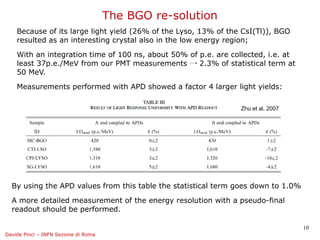
    Because of its large light yield (26% of the Lyso, 13% of the CsI(Tl)), BGO
    resulted as an interesting crystal also in the low energy region;

    With an integration time of 100 ns, about 50% of p.e. are collected, i.e. at
    least 37p.e./MeV from our PMT measurements → 2.3% of statistical term at
    50 MeV.

    Measurements performed with APD showed a factor 4 larger light yields:

                                                                 Zhu et al. 2007


  By using the APD values from this table the statistical term goes down to 1.0%

  A more detailed measurement of the energy resolution with a pseudo-final
  readout should be performed.

                                                                                   10
Davide Pinci – INFN Sezione di Roma
Evaluation of the rad-Bhabha background
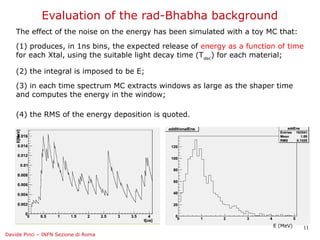
    The effect of the noise on the energy has been simulated with a toy MC that:

    (1) produces, in 1ns bins, the expected release of energy as a function of time
    for each Xtal, using the suitable light decay time (T dec) for each material;

    (2) the integral is imposed to be E;

    (3) in each time spectrum MC extracts windows as large as the shaper time
    and computes the energy in the window;

    (4) the RMS of the energy deposition is quoted.


                                                                          E (MeV)   11
Davide Pinci – INFN Sezione di Roma
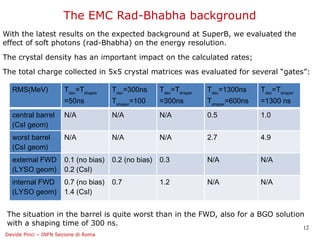
The EMC Rad-Bhabha background
With the latest results on the expected background at SuperB, we evaluated the
effect of soft photons (rad-Bhabha) on the energy resolution.

The crystal density has an important impact on the calculated rates;

The total charge collected in 5x5 crystal matrices was evaluated for several “gates”:

  RMS(MeV)            Tdec=Tshaper    Tdec=300ns      Tdec=Tshaper   Tdec=1300ns     Tdec=Tshaper
                      =50ns           Tshaper=100     =300ns         Tshaper=600ns   =1300 ns
  central barrel      N/A             N/A             N/A            0.5             1.0
  (CsI geom)
  worst barrel        N/A             N/A             N/A            2.7             4.9
  (CsI geom)
  external FWD        0.1 (no bias)   0.2 (no bias)   0.3            N/A             N/A
  (LYSO geom)         0.2 (CsI)
  internal FWD        0.7 (no bias)   0.7             1.2            N/A             N/A
  (LYSO geom)         1.4 (CsI)


 The situation in the barrel is quite worst than in the FWD, also for a BGO solution
 with a shaping time of 300 ns.
                                                                                                    12
Davide Pinci – INFN Sezione di Roma
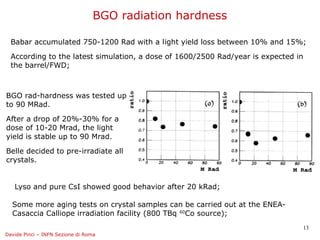
BGO radiation hardness

  Babar accumulated 750-1200 Rad with a light yield loss between 10% and 15%;

  According to the latest simulation, a dose of 1600/2500 Rad/year is expected in
  the barrel/FWD;


BGO rad-hardness was tested up
to 90 MRad.

After a drop of 20%-30% for a
dose of 10-20 Mrad, the light
yield is stable up to 90 Mrad.

Belle decided to pre-irradiate all
crystals.


   Lyso and pure CsI showed good behavior after 20 kRad;

  Some more aging tests on crystal samples can be carried out at the ENEA-
  Casaccia Calliope irradiation facility (800 TBq 60Co source);
                                                                                13
Davide Pinci – INFN Sezione di Roma
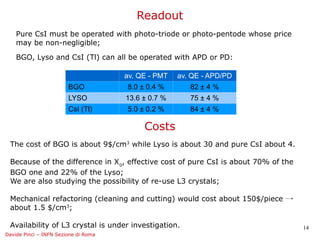
Readout
    Pure CsI must be operated with photo-triode or photo-pentode whose price
    may be non-negligible;

    BGO, Lyso and CsI (Tl) can all be operated with APD or PD:

                                      av. QE - PMT   av. QE - APD/PD
                        BGO           8.0 ± 0.4 %       82 ± 4 %
                        LYSO          13.6 ± 0.7 %      75 ± 4 %
                        CsI (Tl)      5.0 ± 0.2 %       84 ± 4 %

                                           Costs
 The cost of BGO is about 9$/cm3 while Lyso is about 30 and pure CsI about 4.

 Because of the difference in X 0, effective cost of pure CsI is about 70% of the
 BGO one and 22% of the Lyso;
 We are also studying the possibility of re-use L3 crystals;

 Mechanical refactoring (cleaning and cutting) would cost about 150$/piece →
 about 1.5 $/cm3;

 Availability of L3 crystal is under investigation.                                 14
Davide Pinci – INFN Sezione di Roma
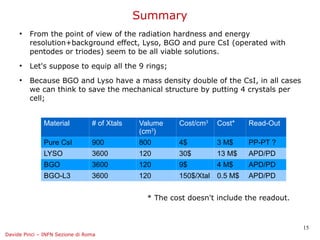
Summary
     ●
         From the point of view of the radiation hardness and energy
         resolution+background effect, Lyso, BGO and pure CsI (operated with
         pentodes or triodes) seem to be all viable solutions.
     ●
         Let's suppose to equip all the 9 rings;
     ●
         Because BGO and Lyso have a mass density double of the CsI, in all cases
         we can think to save the mechanical structure by putting 4 crystals per
         cell;


               Material          # of Xtals   Valume    Cost/cm3   Cost*   Read-Out
                                              (cm3)
               Pure CsI          900          800       4$         3 M$    PP-PT ?
               LYSO              3600         120       30$        13 M$   APD/PD
               BGO               3600         120       9$         4 M$    APD/PD
               BGO-L3            3600         120       150$/Xtal 0.5 M$   APD/PD


                                                * The cost doesn't include the readout.


                                                                                          15
Davide Pinci – INFN Sezione di Roma
Conclusion
    Measurements showed that working with an integration time shorter than the
    crystal proper time is feasible and that the resolution follows the poissonian
    fluctuation of the number of collected photoelectrons;

    This may help in reducing the very large effect of background in the barrel.

    BGO has interesting properties:
                –   High light yield also in the low energy region;
                –   Scintillation time compatible with the expected photon
                    background;
                –   Good radiation hardness to operate in SuperB;
                –   A good price.

  It's thus worth going on with studies on BGO as a real possible, less expensive
  alternative to the Lyso. Proposal for further studies:

        - Ageing test (at Casaccia);

        - Try a realistic FEE with tunable RC;

        - Measurement of performance with test-beam;

  A 100 xtal matrix (currently instrumented with PMTs) is available in Roma.
                                                                                     16
Davide Pinci – INFN Sezione di Roma
Back-up


                                                17
Davide Pinci – INFN Sezione di Roma
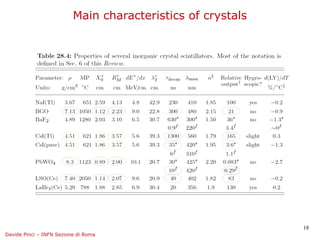
Main characteristics of crystals


                                                             18
Davide Pinci – INFN Sezione di Roma
Pure CsI performance


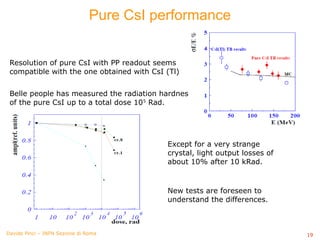
 Resolution of pure CsI with PP readout seems
 compatible with the one obtained with CsI (Tl)


 Belle people has measured the radiation hardness
 of the pure CsI up to a total dose 105 Rad.


                                           Except for a very strange
                                           crystal, light output losses of
                                           about 10% after 10 kRad.


                                           New tests are foreseen to
                                           understand the differences.


Davide Pinci – INFN Sezione di Roma                                          19
Lyso radiation hardness
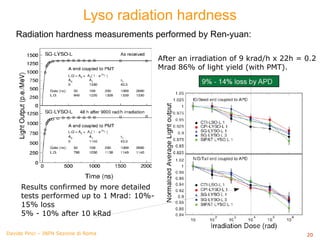
   Radiation hardness measurements performed by Ren-yuan:

                                          After an irradiation of 9 krad/h x 22h = 0.2
                                          Mrad 86% of light yield (with PMT).


     Results confirmed by more detailed
     tests performed up to 1 Mrad: 10%-
     15% loss
     5% - 10% after 10 kRad

Davide Pinci – INFN Sezione di Roma                                                20
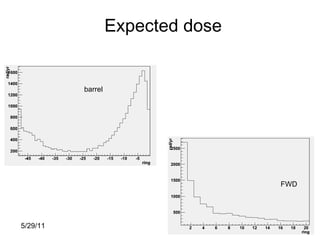
Expected dose


          barrel


                                   FWD


5/29/11
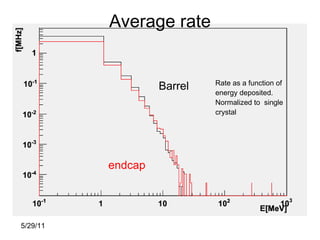
Average rate


                   Barrel   Rate as a function of
                            energy deposited.
                            Normalized to single
                            crystal


          endcap


5/29/11
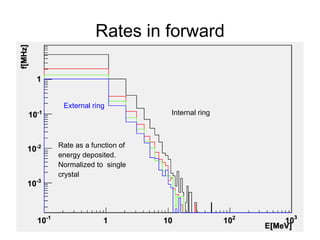
Rates in forward


           External ring
                                  Internal ring


          Rate as a function of
          energy deposited.
          Normalized to single
          crystal


5/29/11
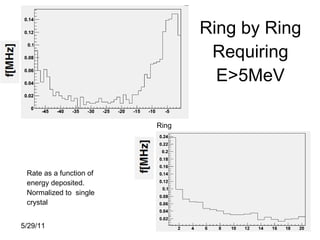
Ring by Ring
                                 Requiring
                                  E>5MeV

                         Ring


 Rate as a function of
 energy deposited.
 Normalized to single
 crystal


5/29/11                         Ring (from closest to beam)

elba11

  • 1.
    Studies on BGOcrystals Roma1 EMC Group 1 Davide Pinci – INFN Sezione di Roma
  • 2.
    Intro Because of the large background we already know we'll have to reduce the integration time on the FEE on the barrel EMC; In order to evaluate the impact of a shorter integration time on the energy resolution we made a simple exercise; The signal of a PMT reading a BGO crystal (we haven't found a CsI one) was sent into an Ortec pre-amplifier with a variable integration time and registered with a digital oscilloscope; The crystal was irradiated with a 137 Cs source; In an off-line analysis, event by event, we evaluated: – The total charge as the integral of waveform; – The signal amplitude, to emulate the response of a shaper placed downstream of the pre-amplifier; A shorter integration time can be a solution also in case of a non-fully Lyso based forward calorimeter; 2 Davide Pinci – INFN Sezione di Roma
  • 3.
    Measurement Set-up HV PMT PMT 9814B BGO Crystal 9814B 137 Cs radioactive source (660 keV photons) Trigger to the Ortec pre-ampli 474 oscilloscope Measurements were taken both with and without the radioactive source, without the Ortec and for integration times of 4ns, 20ns, 100ns, 200ns and 500ns. No data were taken with random trigger → Pedestal evaluation not easy and not properly done. 3 Davide Pinci – INFN Sezione di Roma
  • 4.
    Average signals For every integration time we acquired about 10k events and we evaluated the average signal waveforms. 4 Davide Pinci – INFN Sezione di Roma
  • 5.
    Circuit model A simple mathematical model of the integrating circuit was developed. The output signal has a waveform: Fit The maximum is reached at We calculated the fraction f of integrated charge after a time t that is: RC 4 ns 20 ns 100 ns 200 ns 500 ns f(tmax) 28.3% 35.4% 48.0% 60.1% 77.1% 5 Davide Pinci – INFN Sezione di Roma
  • 6.
    Spectra For each integration time we evaluated the spectra of the total integrated charge and the maximum amplitude of the signals; Without pre-amplifier Pre-amplifier with a gain of 8 and an integration time of 100 ns. Black: Source IN Red: Source OUT 6 Davide Pinci – INFN Sezione di Roma
  • 7.
    Peak amplitude vsRC By means of the model we calculated the expected amplitudes and the expected peak times as a function of the integration time. Blue: calculated Red: measured A very good agreement was found for the amplitude behavior. 7 Davide Pinci – INFN Sezione di Roma
  • 8.
    Resolution vs RC Zhu et al. 2007 With the same source, for a small crystal readout by a PMT, a resolution of 10% was published (→ 100 p.e.). Fit The resolution obtained by integrating the whole charge provided by the PMT is independent of the RC and is about 14%. Thus, at least 50 p.e. are produced, that is 75 p.e./MeV. Taking into account that it is an L3 crystal readout by a 20 years old PMT this number seems reasonable. The resolution obtained by looking at the peak amplitude improves with the square root of the fraction of the integrated charge f : For f → 100% the σA/A → σQ/Q as expected 8 Davide Pinci – INFN Sezione di Roma
  • 9.
    First conclusion andfuture steps The energy resolution of a BGO crystal was measured with a 137 Cs radioactive source. From the resolution a light yield of at least 75 p.e./MeV was evaluated, i.e. a statistical contribution of 1.6% on the energy resolution at 50 MeV. The behavior of the energy resolution with a preamplifier+shaper FEE was studied and it was found that the resolution essentially depends on the square root of the integrated charge. Future steps: 1. Perform the same studies with a CsI crystal; 2. Acquire cosmic rays (released energy about 30 MeV); 2. Try a realistic FEE with tunable RC; 9 Davide Pinci – INFN Sezione di Roma
  • 10.
    The BGO re-solution Because of its large light yield (26% of the Lyso, 13% of the CsI(Tl)), BGO resulted as an interesting crystal also in the low energy region; With an integration time of 100 ns, about 50% of p.e. are collected, i.e. at least 37p.e./MeV from our PMT measurements → 2.3% of statistical term at 50 MeV. Measurements performed with APD showed a factor 4 larger light yields: Zhu et al. 2007 By using the APD values from this table the statistical term goes down to 1.0% A more detailed measurement of the energy resolution with a pseudo-final readout should be performed. 10 Davide Pinci – INFN Sezione di Roma
  • 11.
    Evaluation of therad-Bhabha background The effect of the noise on the energy has been simulated with a toy MC that: (1) produces, in 1ns bins, the expected release of energy as a function of time for each Xtal, using the suitable light decay time (T dec) for each material; (2) the integral is imposed to be E; (3) in each time spectrum MC extracts windows as large as the shaper time and computes the energy in the window; (4) the RMS of the energy deposition is quoted. E (MeV) 11 Davide Pinci – INFN Sezione di Roma
  • 12.
    The EMC Rad-Bhabhabackground With the latest results on the expected background at SuperB, we evaluated the effect of soft photons (rad-Bhabha) on the energy resolution. The crystal density has an important impact on the calculated rates; The total charge collected in 5x5 crystal matrices was evaluated for several “gates”: RMS(MeV) Tdec=Tshaper Tdec=300ns Tdec=Tshaper Tdec=1300ns Tdec=Tshaper =50ns Tshaper=100 =300ns Tshaper=600ns =1300 ns central barrel N/A N/A N/A 0.5 1.0 (CsI geom) worst barrel N/A N/A N/A 2.7 4.9 (CsI geom) external FWD 0.1 (no bias) 0.2 (no bias) 0.3 N/A N/A (LYSO geom) 0.2 (CsI) internal FWD 0.7 (no bias) 0.7 1.2 N/A N/A (LYSO geom) 1.4 (CsI) The situation in the barrel is quite worst than in the FWD, also for a BGO solution with a shaping time of 300 ns. 12 Davide Pinci – INFN Sezione di Roma
  • 13.
    BGO radiation hardness Babar accumulated 750-1200 Rad with a light yield loss between 10% and 15%; According to the latest simulation, a dose of 1600/2500 Rad/year is expected in the barrel/FWD; BGO rad-hardness was tested up to 90 MRad. After a drop of 20%-30% for a dose of 10-20 Mrad, the light yield is stable up to 90 Mrad. Belle decided to pre-irradiate all crystals. Lyso and pure CsI showed good behavior after 20 kRad; Some more aging tests on crystal samples can be carried out at the ENEA- Casaccia Calliope irradiation facility (800 TBq 60Co source); 13 Davide Pinci – INFN Sezione di Roma
  • 14.
    Readout Pure CsI must be operated with photo-triode or photo-pentode whose price may be non-negligible; BGO, Lyso and CsI (Tl) can all be operated with APD or PD: av. QE - PMT av. QE - APD/PD BGO 8.0 ± 0.4 % 82 ± 4 % LYSO 13.6 ± 0.7 % 75 ± 4 % CsI (Tl) 5.0 ± 0.2 % 84 ± 4 % Costs The cost of BGO is about 9$/cm3 while Lyso is about 30 and pure CsI about 4. Because of the difference in X 0, effective cost of pure CsI is about 70% of the BGO one and 22% of the Lyso; We are also studying the possibility of re-use L3 crystals; Mechanical refactoring (cleaning and cutting) would cost about 150$/piece → about 1.5 $/cm3; Availability of L3 crystal is under investigation. 14 Davide Pinci – INFN Sezione di Roma
  • 15.
    Summary ● From the point of view of the radiation hardness and energy resolution+background effect, Lyso, BGO and pure CsI (operated with pentodes or triodes) seem to be all viable solutions. ● Let's suppose to equip all the 9 rings; ● Because BGO and Lyso have a mass density double of the CsI, in all cases we can think to save the mechanical structure by putting 4 crystals per cell; Material # of Xtals Valume Cost/cm3 Cost* Read-Out (cm3) Pure CsI 900 800 4$ 3 M$ PP-PT ? LYSO 3600 120 30$ 13 M$ APD/PD BGO 3600 120 9$ 4 M$ APD/PD BGO-L3 3600 120 150$/Xtal 0.5 M$ APD/PD * The cost doesn't include the readout. 15 Davide Pinci – INFN Sezione di Roma
  • 16.
    Conclusion Measurements showed that working with an integration time shorter than the crystal proper time is feasible and that the resolution follows the poissonian fluctuation of the number of collected photoelectrons; This may help in reducing the very large effect of background in the barrel. BGO has interesting properties: – High light yield also in the low energy region; – Scintillation time compatible with the expected photon background; – Good radiation hardness to operate in SuperB; – A good price. It's thus worth going on with studies on BGO as a real possible, less expensive alternative to the Lyso. Proposal for further studies: - Ageing test (at Casaccia); - Try a realistic FEE with tunable RC; - Measurement of performance with test-beam; A 100 xtal matrix (currently instrumented with PMTs) is available in Roma. 16 Davide Pinci – INFN Sezione di Roma
  • 17.
    Back-up 17 Davide Pinci – INFN Sezione di Roma
  • 18.
    Main characteristics ofcrystals 18 Davide Pinci – INFN Sezione di Roma
  • 19.
    Pure CsI performance Resolution of pure CsI with PP readout seems compatible with the one obtained with CsI (Tl) Belle people has measured the radiation hardness of the pure CsI up to a total dose 105 Rad. Except for a very strange crystal, light output losses of about 10% after 10 kRad. New tests are foreseen to understand the differences. Davide Pinci – INFN Sezione di Roma 19
  • 20.
    Lyso radiation hardness Radiation hardness measurements performed by Ren-yuan: After an irradiation of 9 krad/h x 22h = 0.2 Mrad 86% of light yield (with PMT). Results confirmed by more detailed tests performed up to 1 Mrad: 10%- 15% loss 5% - 10% after 10 kRad Davide Pinci – INFN Sezione di Roma 20
  • 21.
    Expected dose barrel FWD 5/29/11
  • 22.
    Average rate Barrel Rate as a function of energy deposited. Normalized to single crystal endcap 5/29/11
  • 23.
    Rates in forward External ring Internal ring Rate as a function of energy deposited. Normalized to single crystal 5/29/11
  • 24.
    Ring by Ring Requiring E>5MeV Ring Rate as a function of energy deposited. Normalized to single crystal 5/29/11 Ring (from closest to beam)