EKKLĒSIA IN THE 
NEW TESTAMENT
For Discussion 
• WHAT?! 
• Background: Meaning and context 
• Ekklēsia before the New Testament 
• Etymology of ekklēsia 
• In Greco-Roman society 
• In the Old Testament (LXX) 
• Ekklēsia in the New Testament 
• Summary of uses 
• Non-universal uses 
• Potentially universal uses 
• Conclusion
WHAT?! 
ἐκκλησία 
Ekklēsia = “Church” = Universal (catholic) church? 
• Where does this sense come from? 
• Is it consistent in the NT? 
• (Is it present even once in the NT???) 
• How would 1st century readers/hearers have perceived 
this word?
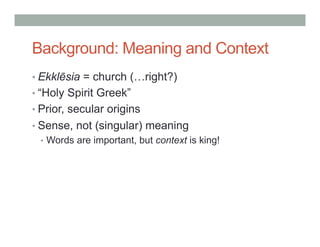
Background: Meaning and Context 
• Ekklēsia = church (…right?) 
• “Holy Spirit Greek” 
• Prior, secular origins 
• Sense, not (singular) meaning 
• Words are important, but context is king!
Ekklēsia before the New Testament 
• Etymology/Origins 
• In Greco-Roman Society 
• In the Septuagint (LXX)
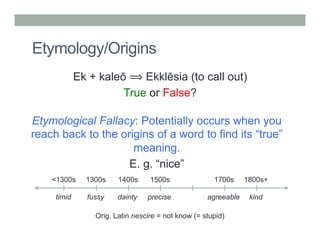
Etymology/Origins 
Ek + kaleō ⟹ Ekklēsia (to call out) 
True or False? 
Etymological Fallacy: Potentially occurs when you 
reach back to the origins of a word to find its “true” 
<1300s 
timid 
1300s 
fussy 
meaning. 
E. g. “nice” 
1400s 
dainty 
1500s 
precise 
1700s 
agreeable 
1800s+ 
kind 
Orig. Latin nescire = not know (= stupid)
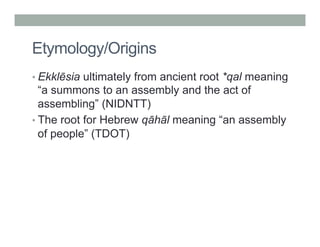
Etymology/Origins 
• Ekklēsia ultimately from ancient root *qal meaning 
“a summons to an assembly and the act of 
assembling” (NIDNTT) 
• The root for Hebrew qāhāl meaning “an assembly 
of people” (TDOT)
Etymology/Origins 
• Louis Berkhof (Systematic Theology)noted that 
the term “church” can trace its origins back to the 
Greek adjective kuriakos, meaning “belonging to 
the Lord.” 
• Used only twice in the NT (1 Cor 11:20; Rev 1:10) 
• In neither NT instance does it have anything to do with 
the body of believers 
• What gives?! 
• Meaning is never to be derived from a term alone, but 
from its particular usage, which can change over time.
In Greco-Roman Society 
Familiar civic function of the ekklēsia in the Greek 
city-state: 
• The assembly would gather to discuss suggested 
changes in law, appointment of officials, internal and 
external policies, and (in special judicial cases such as 
treason) sitting in judgment 
The ekklēsia is never found to be explicitly 
associated with a religious function in Greco- 
Roman society.
In the LXX – Lexical 
Ekklēsia employed in LXX ~100 times 
Two terms in Hebrew Scripture for the assembly or 
congregation: qāhāl and ‘edah 
• Qāhāl: More frequently used to refer to the congregation 
in assembly or the act of assembling. 
• ‘Edah: Used to refer to Israel in the aggregate, despite 
any geographic separation. 
If ekklēsia were to carry any universal overtones in 
the minds of Jewish readers, which Hebrew term 
would you expect to see translated into ekklēsia in 
the LXX? 
• In reality, ‘edah is never translated as ekklēsia in the LXX.
In the LXX – Theological 
Do the ekklēsia in the LXX constitute some 
theological significance, such as covenant renewal 
with Yahweh? 
• Those who answer in the affirmative would equate the NT 
ekklēsia tou theou (assembly of God) with OT Israel 
• Requires a “spiritual” reading of the OT 
• Those who answer in the negative recognize that the Gk. 
terms ekklēsia and sunagōgē are used almost 
interchangeably in the LXX to refer to any sort of 
gathering with no inherent theological implication
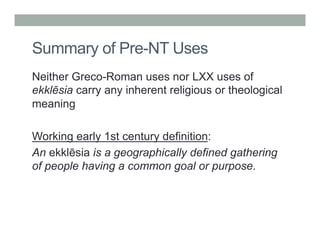
Summary of Pre-NT Uses 
Neither Greco-Roman uses nor LXX uses of 
ekklēsia carry any inherent religious or theological 
meaning 
Working early 1st century definition: 
An ekklēsia is a geographically defined gathering 
of people having a common goal or purpose.
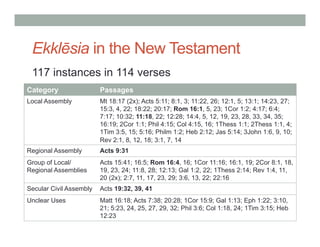
Ekklēsia in the New Testament 
117 instances in 114 verses 
Category Passages 
Local Assembly Mt 18:17 (2x); Acts 5:11; 8:1, 3; 11:22, 26; 12:1, 5; 13:1; 14:23, 27; 
15:3, 4, 22; 18:22; 20:17; Rom 16:1, 5, 23; 1Cor 1:2; 4:17; 6:4; 
7:17; 10:32; 11:18, 22; 12:28; 14:4, 5, 12, 19, 23, 28, 33, 34, 35; 
16:19; 2Cor 1:1; Phil 4:15; Col 4:15, 16; 1Thess 1:1; 2Thess 1:1, 4; 
1Tim 3:5, 15; 5:16; Philm 1:2; Heb 2:12; Jas 5:14; 3John 1:6, 9, 10; 
Rev 2:1, 8, 12, 18; 3:1, 7, 14 
Regional Assembly Acts 9:31 
Group of Local/ 
Regional Assemblies 
Acts 15:41; 16:5; Rom 16:4, 16; 1Cor 11:16; 16:1, 19; 2Cor 8:1, 18, 
19, 23, 24; 11:8, 28; 12:13; Gal 1:2, 22; 1Thess 2:14; Rev 1:4, 11, 
20 (2x); 2:7, 11, 17, 23, 29; 3:6, 13, 22; 22:16 
Secular Civil Assembly Acts 19:32, 39, 41 
Unclear Uses Matt 16:18; Acts 7:38; 20:28; 1Cor 15:9; Gal 1:13; Eph 1:22; 3:10, 
21; 5:23, 24, 25, 27, 29, 32; Phil 3:6; Col 1:18, 24; 1Tim 3:15; Heb 
12:23
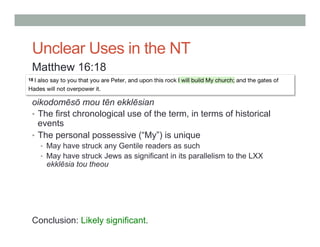
Unclear Uses in the NT 
Matthew 16:18 
oikodomēsō mou tēn ekklēsian 
• The first chronological use of the term, in terms of historical 
events 
• The personal possessive (“My”) is unique 
• May have struck any Gentile readers as such 
• May have struck Jews as significant in its parallelism to the LXX 
ekklēsia tou theou 
Conclusion: Likely significant.
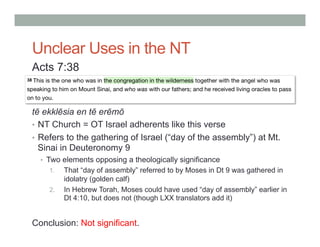
Unclear Uses in the NT 
Acts 7:38 
tē ekklēsia en tē erēmō 
• NT Church = OT Israel adherents like this verse 
• Refers to the gathering of Israel (“day of the assembly”) at Mt. 
Sinai in Deuteronomy 9 
• Two elements opposing a theologically significance 
1. That “day of assembly” referred to by Moses in Dt 9 was gathered in 
idolatry (golden calf) 
2. In Hebrew Torah, Moses could have used “day of assembly” earlier in 
Dt 4:10, but does not (though LXX translators add it) 
Conclusion: Not significant.
Unclear Uses in the NT 
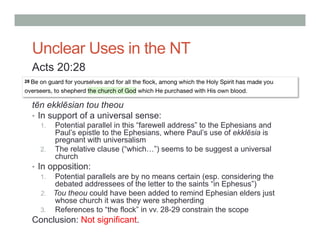
Acts 20:28 
tēn ekklēsian tou theou 
• In support of a universal sense: 
1. Potential parallel in this “farewell address” to the Ephesians and 
Paul’s epistle to the Ephesians, where Paul’s use of ekklēsia is 
pregnant with universalism 
2. The relative clause (“which…”) seems to be suggest a universal 
church 
• In opposition: 
1. Potential parallels are by no means certain (esp. considering the 
debated addressees of the letter to the saints “in Ephesus”) 
2. Tou theou could have been added to remind Ephesian elders just 
whose church it was they were shepherding 
3. References to “the flock” in vv. 28-29 constrain the scope 
Conclusion: Not significant.
Unclear Uses in the NT 
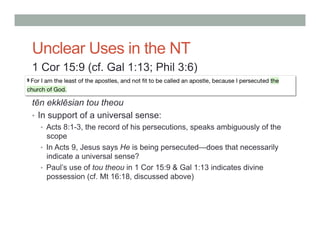
1 Cor 15:9 (cf. Gal 1:13; Phil 3:6) 
tēn ekklēsian tou theou 
• In support of a universal sense: 
• Acts 8:1-3, the record of his persecutions, speaks ambiguously of the 
scope 
• In Acts 9, Jesus says He is being persecuted—does that necessarily 
indicate a universal sense? 
• Paul’s use of tou theou in 1 Cor 15:9 & Gal 1:13 indicates divine 
possession (cf. Mt 16:18, discussed above)
Unclear Uses in the NT 
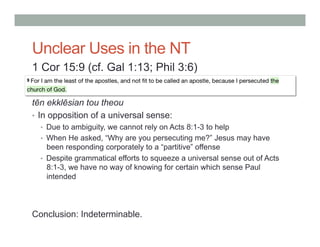
1 Cor 15:9 (cf. Gal 1:13; Phil 3:6) 
tēn ekklēsian tou theou 
• In opposition of a universal sense: 
• Due to ambiguity, we cannot rely on Acts 8:1-3 to help 
• When He asked, “Why are you persecuting me?” Jesus may have 
been responding corporately to a “partitive” offense 
• Despite grammatical efforts to squeeze a universal sense out of Acts 
8:1-3, we have no way of knowing for certain which sense Paul 
intended 
Conclusion: Indeterminable.
Unclear Uses in the NT 
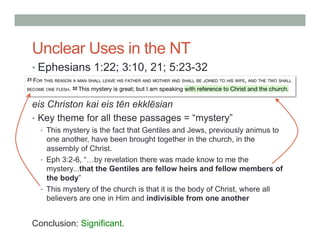
• Ephesians 1:22; 3:10, 21; 5:23-32 
eis Christon kai eis tēn ekklēsian 
• Key theme for all these passages = “mystery” 
• This mystery is the fact that Gentiles and Jews, previously animus to 
one another, have been brought together in the church, in the 
assembly of Christ. 
• Eph 3:2-6, “…by revelation there was made know to me the 
mystery...that the Gentiles are fellow heirs and fellow members of 
the body” 
• This mystery of the church is that it is the body of Christ, where all 
believers are one in Him and indivisible from one another 
Conclusion: Significant.
Unclear Uses in the NT 
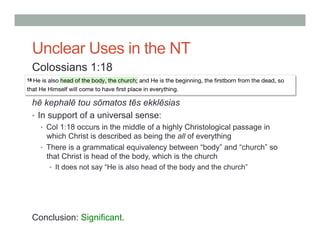
Colossians 1:18 
hē kephalē tou sōmatos tēs ekklēsias 
• In support of a universal sense: 
• Col 1:18 occurs in the middle of a highly Christological passage in 
which Christ is described as being the all of everything 
• There is a grammatical equivalency between “body” and “church” so 
that Christ is head of the body, which is the church 
• It does not say “He is also head of the body and the church” 
Conclusion: Significant.
Unclear Uses in the NT 
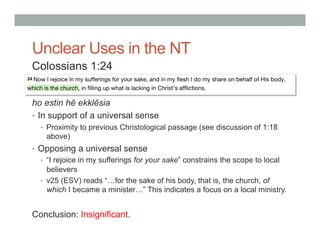
Colossians 1:24 
ho estin hē ekklēsia 
• In support of a universal sense 
• Proximity to previous Christological passage (see discussion of 1:18 
above) 
• Opposing a universal sense 
• “I rejoice in my sufferings for your sake” constrains the scope to local 
believers 
• v25 (ESV) reads “…for the sake of his body, that is, the church, of 
which I became a minister…” This indicates a focus on a local ministry. 
Conclusion: Insignificant.
Unclear Uses in the NT 
Hebrews 12:23 
kai ekklēsia prōtotokōn 
• Heb 12:22-24 demonstrates a contrast between the “assembly 
in the wilderness” and this new assembly 
• “assembly of the firstborn” is the possessive equivalent to “My 
church” in Mt. 16:18 
• This letter being written to a specific body of believers actually 
supports a universal sense: 
• “But you [local] have come…to the assembly [universal] of the 
firstborn” 
• First encounter of the descriptor “enrolled in heaven,” indicating 
a special class 
Conclusion: Significant.
Reevaluating the Approach 
WAIT! Have we been going about this all wrong?! 
Here’s what we’ve been doing: 
• Look at each verse and decide if ekklēsia is used 
universally. 
But remember! To the early 1st century person 
living in the Roman empire, there was no universal 
sense to the word ekklēsia! Perhaps we should 
have been doing this: 
• Look at each verse and decide if ekklēsia cannot be used 
in its known sense, leaving open the possibility for this 
new sense.
Conclusion 
• Words are important, but context is king 
• Think and discuss: Any instances where ekklēsia 
cannot be local, regional, secular assembly, where 
there are no other options than “universal church”? 
• Read: Enrich your understanding by learning about 
the cultures in which the text was written 
• Rome and Jerusalem: The Clash of Ancient Civilizations 
by Martin Goodman 
• An Introduction to the New Testament, Vols. 1-3 
by D. Edmond Hiebert 
BONUS! 
A sure cure for insomnia: 
https://shepherdstheologicalseminary.academia.edu/SteveYoung

Ekklēsia in the New Testament

  • 1.
    EKKLĒSIA IN THE NEW TESTAMENT
  • 2.
    For Discussion •WHAT?! • Background: Meaning and context • Ekklēsia before the New Testament • Etymology of ekklēsia • In Greco-Roman society • In the Old Testament (LXX) • Ekklēsia in the New Testament • Summary of uses • Non-universal uses • Potentially universal uses • Conclusion
  • 3.
    WHAT?! ἐκκλησία Ekklēsia= “Church” = Universal (catholic) church? • Where does this sense come from? • Is it consistent in the NT? • (Is it present even once in the NT???) • How would 1st century readers/hearers have perceived this word?
  • 4.
    Background: Meaning andContext • Ekklēsia = church (…right?) • “Holy Spirit Greek” • Prior, secular origins • Sense, not (singular) meaning • Words are important, but context is king!
  • 5.
    Ekklēsia before theNew Testament • Etymology/Origins • In Greco-Roman Society • In the Septuagint (LXX)
  • 6.
    Etymology/Origins Ek +kaleō ⟹ Ekklēsia (to call out) True or False? Etymological Fallacy: Potentially occurs when you reach back to the origins of a word to find its “true” <1300s timid 1300s fussy meaning. E. g. “nice” 1400s dainty 1500s precise 1700s agreeable 1800s+ kind Orig. Latin nescire = not know (= stupid)
  • 7.
    Etymology/Origins • Ekklēsiaultimately from ancient root *qal meaning “a summons to an assembly and the act of assembling” (NIDNTT) • The root for Hebrew qāhāl meaning “an assembly of people” (TDOT)
  • 8.
    Etymology/Origins • LouisBerkhof (Systematic Theology)noted that the term “church” can trace its origins back to the Greek adjective kuriakos, meaning “belonging to the Lord.” • Used only twice in the NT (1 Cor 11:20; Rev 1:10) • In neither NT instance does it have anything to do with the body of believers • What gives?! • Meaning is never to be derived from a term alone, but from its particular usage, which can change over time.
  • 9.
    In Greco-Roman Society Familiar civic function of the ekklēsia in the Greek city-state: • The assembly would gather to discuss suggested changes in law, appointment of officials, internal and external policies, and (in special judicial cases such as treason) sitting in judgment The ekklēsia is never found to be explicitly associated with a religious function in Greco- Roman society.
  • 10.
    In the LXX– Lexical Ekklēsia employed in LXX ~100 times Two terms in Hebrew Scripture for the assembly or congregation: qāhāl and ‘edah • Qāhāl: More frequently used to refer to the congregation in assembly or the act of assembling. • ‘Edah: Used to refer to Israel in the aggregate, despite any geographic separation. If ekklēsia were to carry any universal overtones in the minds of Jewish readers, which Hebrew term would you expect to see translated into ekklēsia in the LXX? • In reality, ‘edah is never translated as ekklēsia in the LXX.
  • 11.
    In the LXX– Theological Do the ekklēsia in the LXX constitute some theological significance, such as covenant renewal with Yahweh? • Those who answer in the affirmative would equate the NT ekklēsia tou theou (assembly of God) with OT Israel • Requires a “spiritual” reading of the OT • Those who answer in the negative recognize that the Gk. terms ekklēsia and sunagōgē are used almost interchangeably in the LXX to refer to any sort of gathering with no inherent theological implication
  • 12.
    Summary of Pre-NTUses Neither Greco-Roman uses nor LXX uses of ekklēsia carry any inherent religious or theological meaning Working early 1st century definition: An ekklēsia is a geographically defined gathering of people having a common goal or purpose.
  • 13.
    Ekklēsia in theNew Testament 117 instances in 114 verses Category Passages Local Assembly Mt 18:17 (2x); Acts 5:11; 8:1, 3; 11:22, 26; 12:1, 5; 13:1; 14:23, 27; 15:3, 4, 22; 18:22; 20:17; Rom 16:1, 5, 23; 1Cor 1:2; 4:17; 6:4; 7:17; 10:32; 11:18, 22; 12:28; 14:4, 5, 12, 19, 23, 28, 33, 34, 35; 16:19; 2Cor 1:1; Phil 4:15; Col 4:15, 16; 1Thess 1:1; 2Thess 1:1, 4; 1Tim 3:5, 15; 5:16; Philm 1:2; Heb 2:12; Jas 5:14; 3John 1:6, 9, 10; Rev 2:1, 8, 12, 18; 3:1, 7, 14 Regional Assembly Acts 9:31 Group of Local/ Regional Assemblies Acts 15:41; 16:5; Rom 16:4, 16; 1Cor 11:16; 16:1, 19; 2Cor 8:1, 18, 19, 23, 24; 11:8, 28; 12:13; Gal 1:2, 22; 1Thess 2:14; Rev 1:4, 11, 20 (2x); 2:7, 11, 17, 23, 29; 3:6, 13, 22; 22:16 Secular Civil Assembly Acts 19:32, 39, 41 Unclear Uses Matt 16:18; Acts 7:38; 20:28; 1Cor 15:9; Gal 1:13; Eph 1:22; 3:10, 21; 5:23, 24, 25, 27, 29, 32; Phil 3:6; Col 1:18, 24; 1Tim 3:15; Heb 12:23
  • 14.
    Unclear Uses inthe NT Matthew 16:18 oikodomēsō mou tēn ekklēsian • The first chronological use of the term, in terms of historical events • The personal possessive (“My”) is unique • May have struck any Gentile readers as such • May have struck Jews as significant in its parallelism to the LXX ekklēsia tou theou Conclusion: Likely significant.
  • 15.
    Unclear Uses inthe NT Acts 7:38 tē ekklēsia en tē erēmō • NT Church = OT Israel adherents like this verse • Refers to the gathering of Israel (“day of the assembly”) at Mt. Sinai in Deuteronomy 9 • Two elements opposing a theologically significance 1. That “day of assembly” referred to by Moses in Dt 9 was gathered in idolatry (golden calf) 2. In Hebrew Torah, Moses could have used “day of assembly” earlier in Dt 4:10, but does not (though LXX translators add it) Conclusion: Not significant.
  • 16.
    Unclear Uses inthe NT Acts 20:28 tēn ekklēsian tou theou • In support of a universal sense: 1. Potential parallel in this “farewell address” to the Ephesians and Paul’s epistle to the Ephesians, where Paul’s use of ekklēsia is pregnant with universalism 2. The relative clause (“which…”) seems to be suggest a universal church • In opposition: 1. Potential parallels are by no means certain (esp. considering the debated addressees of the letter to the saints “in Ephesus”) 2. Tou theou could have been added to remind Ephesian elders just whose church it was they were shepherding 3. References to “the flock” in vv. 28-29 constrain the scope Conclusion: Not significant.
  • 17.
    Unclear Uses inthe NT 1 Cor 15:9 (cf. Gal 1:13; Phil 3:6) tēn ekklēsian tou theou • In support of a universal sense: • Acts 8:1-3, the record of his persecutions, speaks ambiguously of the scope • In Acts 9, Jesus says He is being persecuted—does that necessarily indicate a universal sense? • Paul’s use of tou theou in 1 Cor 15:9 & Gal 1:13 indicates divine possession (cf. Mt 16:18, discussed above)
  • 18.
    Unclear Uses inthe NT 1 Cor 15:9 (cf. Gal 1:13; Phil 3:6) tēn ekklēsian tou theou • In opposition of a universal sense: • Due to ambiguity, we cannot rely on Acts 8:1-3 to help • When He asked, “Why are you persecuting me?” Jesus may have been responding corporately to a “partitive” offense • Despite grammatical efforts to squeeze a universal sense out of Acts 8:1-3, we have no way of knowing for certain which sense Paul intended Conclusion: Indeterminable.
  • 19.
    Unclear Uses inthe NT • Ephesians 1:22; 3:10, 21; 5:23-32 eis Christon kai eis tēn ekklēsian • Key theme for all these passages = “mystery” • This mystery is the fact that Gentiles and Jews, previously animus to one another, have been brought together in the church, in the assembly of Christ. • Eph 3:2-6, “…by revelation there was made know to me the mystery...that the Gentiles are fellow heirs and fellow members of the body” • This mystery of the church is that it is the body of Christ, where all believers are one in Him and indivisible from one another Conclusion: Significant.
  • 20.
    Unclear Uses inthe NT Colossians 1:18 hē kephalē tou sōmatos tēs ekklēsias • In support of a universal sense: • Col 1:18 occurs in the middle of a highly Christological passage in which Christ is described as being the all of everything • There is a grammatical equivalency between “body” and “church” so that Christ is head of the body, which is the church • It does not say “He is also head of the body and the church” Conclusion: Significant.
  • 21.
    Unclear Uses inthe NT Colossians 1:24 ho estin hē ekklēsia • In support of a universal sense • Proximity to previous Christological passage (see discussion of 1:18 above) • Opposing a universal sense • “I rejoice in my sufferings for your sake” constrains the scope to local believers • v25 (ESV) reads “…for the sake of his body, that is, the church, of which I became a minister…” This indicates a focus on a local ministry. Conclusion: Insignificant.
  • 22.
    Unclear Uses inthe NT Hebrews 12:23 kai ekklēsia prōtotokōn • Heb 12:22-24 demonstrates a contrast between the “assembly in the wilderness” and this new assembly • “assembly of the firstborn” is the possessive equivalent to “My church” in Mt. 16:18 • This letter being written to a specific body of believers actually supports a universal sense: • “But you [local] have come…to the assembly [universal] of the firstborn” • First encounter of the descriptor “enrolled in heaven,” indicating a special class Conclusion: Significant.
  • 23.
    Reevaluating the Approach WAIT! Have we been going about this all wrong?! Here’s what we’ve been doing: • Look at each verse and decide if ekklēsia is used universally. But remember! To the early 1st century person living in the Roman empire, there was no universal sense to the word ekklēsia! Perhaps we should have been doing this: • Look at each verse and decide if ekklēsia cannot be used in its known sense, leaving open the possibility for this new sense.
  • 24.
    Conclusion • Wordsare important, but context is king • Think and discuss: Any instances where ekklēsia cannot be local, regional, secular assembly, where there are no other options than “universal church”? • Read: Enrich your understanding by learning about the cultures in which the text was written • Rome and Jerusalem: The Clash of Ancient Civilizations by Martin Goodman • An Introduction to the New Testament, Vols. 1-3 by D. Edmond Hiebert BONUS! A sure cure for insomnia: https://shepherdstheologicalseminary.academia.edu/SteveYoung