Insights from
Matthew 6.25-34
 (oral sharing)
Matthew 6.33
     “Seek ye first
 The Kingdom of God
And His Righteousness
 And all these things
Shall be added unto to
          you
  A-lle-lu… Alleluia
       (repeat)
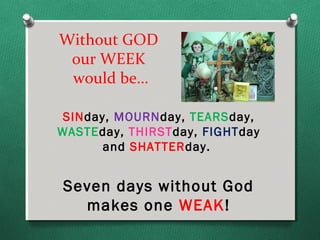
Without GOD
 our WEEK
 would be…

 SINday, MOURNday, TEARSday,
WASTEday, THIRSTday, FIGHTday
       and SHATTERday.


Seven days without God
  makes one WEAK!
“CHURCH” is…
      (summary)
O Building/Physical Structure
O Place of Worship and Prayer
O Hierarchy
O Community of Believers
Results from Church Survey
O What is the most common notion of the
 church according to:
  O First Year students               -----
  O Second Year students              -----
  O Third Year students               -----
  O Fourth and Fifth Year Students ------
  O Tallying all the scores, what is the most
    common notion of the church?
  O Any unique responses about the church?
O The church defines today as…


    “ the community of baptized men
   and women who, united in Christ,
      and guided by the Holy Spirit,
        press onward towards the
   Kingdom of God and are bearers
        of a message of salvation
        intended for all men (and
                women).”


         GAUDIUM ET SPES (GS) 1
ORIGIN OF THE WORD
     “CHURCH”
    IN THE BIBLE
Theology of the Word
         by Fr. James Meehan, SJ
O With the coming of the HS amidst the
 sound “a s a vio le nt wind blo wing ” and the
 appearance of “to ng ue s like fire whic h
 d is tribute d the m s e lve s a nd s e ttle d o n e a c h
 o ne o f the m ”(Acts 2:2-3) there began for
 all men to see, the life of the Christian
 community which has continued down to
 our own day and will remain until the Lord
 returns.
O The early chapters of Acts of the
 Apostles depict for us the first day
 of this community: a period
 characterized by a profound unity
 among all believers and an exultant
 joy in their possession of the Holy
 Spirit and in the visible but real
 presence among them of the risen
 Jesus.
O The When the divinely inspired
 writers of the NT wished to
 give a name to the community
 born of Christ and the Spirit,
 they frequently employed the
 Greek word e kkle s ia often
 translated into English
 as“church”.
O [Ekkle s ia ] was not a word coined by
  the sacred writers themselves, for it
  already existed in the secular Greek of
  their day.
O The Englishword“assembly” perhaps
  best conveys the idea of what e kkle s ia
  meant in ordinary usage: an assembly
  of men, and in particular, an assembly
  of citizens “called together to
  deliberate upon affairs of state.
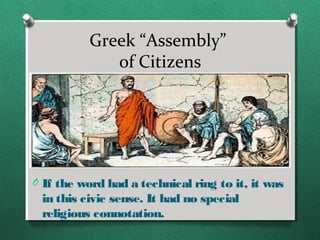
Greek “Assembly”
             of Citizens


O If the word had a technical ring to it, it was
 in this civic sense. It had no special
 religious connotation.
O Although the word had no special
  religious meaning in ordinary Greek, it
  very definitely did in the Greek
  translation of the Hebrew OT known
  as Septuagint, a version of the Sacred
  Scriptures substantially completed a
  century or so before the Christian Era.
O The word Ekkle s ia was chosen to
  render a Hebrew word rich in
  theological context.
O The word was q a ha l “assembly”.
O Qahal “assembly”or Qe ha l
 Ya hwe h, “the assembly of the
 Lord,” designated the Hebrew
 people of the old at those
 moments in their history when
 they were most especially “called
 together”.
Two Characteristics of
         Qe ha l Ya hwe h
1. The people did not constitute themselves
   the “assembly of the Lord. Rather, it was
   God who took the initiative; It was He who
   freely summoned them to Himself.
2. The purpose of their being“called together”
   by the Lord was that they might become a
   sacred and holy people, a community
   consecrated to the worship of God.
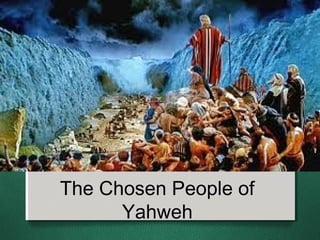
The Chosen People of
      Yahweh
O [The Lord said to Moses] “Thus shall you
 say to the house of Jacob; tell the Israelites:
 You have seen for yourselves how I treated
 the Egyptians and how I bore you up on
 eagle wings and brought you here to myself.
 Therefore, if you hearken to my voice and
 keep my covenant, you shall be my special
 possession, dearer to me than all other
 people, though all the earth is mine. You
 shall be to me kingdom of priests, a holy
 nation. That is what you must tell the
 Israelites” (Ex o d us 1 9 : 3 -6 ).
O The author of the book of
 Deuteronomy … picture Moses
 as recalling to the Israelites, who
 are about to enter the Promised
 land, all that God had said and
 done when “the Lord spoke to
 you on the mountain from the
 midst of the fire on the d a y o f the
 a s s e m bly ”(Deut. 9:10)
O The Hebrew word qahal, then, is rich in
  meaning. Literally it signifies an
  assembly, a convocation, But the
  reality it refers to is much more than a
  mere grouping of men. It is essentially
  a divinely created assembly.
O Yahweh, the lord, and He alone
  gathered His people to Himself and
  made them His own. He and He alone
  made them hole … and consecrated
  them to His worship.
ORIGIN OF THE CHURCH

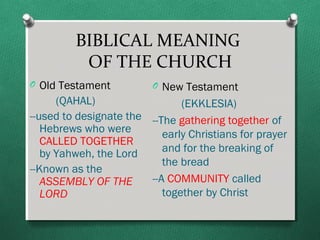
   Old Testament – “ QAHAL ”

 New Testament – “ EKKLESIA ”
BIBLICAL MEANING
          OF THE CHURCH
O Old Testament          O New Testament
      (QAHAL)                  (EKKLESIA)
--used to designate the --The gathering together of
   Hebrews who were        early Christians for prayer
   CALLED TOGETHER
   by Yahweh, the Lord     and for the breaking of
                           the bread
--Known as the
   ASSEMBLY OF THE      --A COMMUNITY called
   LORD                    together by Christ
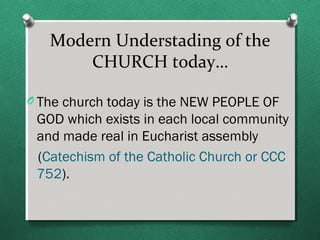
Modern Understading of the
       CHURCH today…

O The church today is the NEW PEOPLE OF
 GOD which exists in each local community
 and made real in Eucharist assembly
 (Catechism of the Catholic Church or CCC
 752).
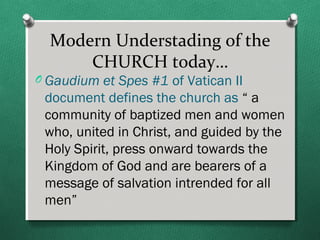
Modern Understading of the
      CHURCH today…
O Gaudium et Spes #1 of Vatican II
 document defines the church as “ a
 community of baptized men and women
 who, united in Christ, and guided by the
 Holy Spirit, press onward towards the
 Kingdom of God and are bearers of a
 message of salvation intrended for all
 men”
Understanding
 A New Term
What do we mean
 when we say:


  I am a
CHRISTIAN.
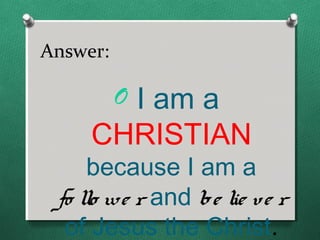
Answer:

          O I am a
     CHRISTIAN
      because I am a
 fo llo we r and be lie ve r
  of Jesus the Christ.
How about …

   O As a Christian,

I am a CATHOLIC.
Answer:

O CATHOLIC means universal or
  all embracing as defined by St.
  Ignatius of Antioch in 100 AD.
O As member of the Catholic
  church, we embrace and accept
  all types of persons.
In addition, but what do we
          mean by:
       O I am a
   ROMAN
Answer:
O I am a ROMAN
     CATHOLIC
 because I submit
 myself to the authority
 of the Pope in Rome.
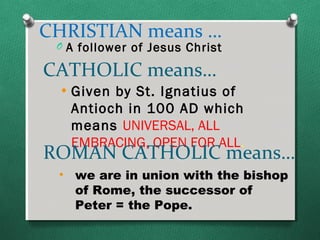
CHRISTIAN means …
 O A follower of Jesus Christ

CATHOLIC means…
 • Given by St. Ignatius of
   Antioch in 100 AD which
   means UNIVERSAL, ALL
   EMBRACING, OPEN FOR ALL.
ROMAN CATHOLIC means…
 • we are in union with the bishop
   of Rome, the successor of
   Peter = the Pope.

Intro to church

  • 1.
  • 2.
    Matthew 6.33 “Seek ye first The Kingdom of God And His Righteousness And all these things Shall be added unto to you A-lle-lu… Alleluia (repeat)
  • 3.
    Without GOD ourWEEK would be… SINday, MOURNday, TEARSday, WASTEday, THIRSTday, FIGHTday and SHATTERday. Seven days without God makes one WEAK!
  • 4.
    “CHURCH” is… (summary) O Building/Physical Structure O Place of Worship and Prayer O Hierarchy O Community of Believers
  • 5.
    Results from ChurchSurvey O What is the most common notion of the church according to: O First Year students ----- O Second Year students ----- O Third Year students ----- O Fourth and Fifth Year Students ------ O Tallying all the scores, what is the most common notion of the church? O Any unique responses about the church?
  • 6.
    O The churchdefines today as… “ the community of baptized men and women who, united in Christ, and guided by the Holy Spirit, press onward towards the Kingdom of God and are bearers of a message of salvation intended for all men (and women).” GAUDIUM ET SPES (GS) 1
  • 7.
    ORIGIN OF THEWORD “CHURCH” IN THE BIBLE
  • 8.
    Theology of theWord by Fr. James Meehan, SJ O With the coming of the HS amidst the sound “a s a vio le nt wind blo wing ” and the appearance of “to ng ue s like fire whic h d is tribute d the m s e lve s a nd s e ttle d o n e a c h o ne o f the m ”(Acts 2:2-3) there began for all men to see, the life of the Christian community which has continued down to our own day and will remain until the Lord returns.
  • 9.
    O The earlychapters of Acts of the Apostles depict for us the first day of this community: a period characterized by a profound unity among all believers and an exultant joy in their possession of the Holy Spirit and in the visible but real presence among them of the risen Jesus.
  • 10.
    O The Whenthe divinely inspired writers of the NT wished to give a name to the community born of Christ and the Spirit, they frequently employed the Greek word e kkle s ia often translated into English as“church”.
  • 11.
    O [Ekkle sia ] was not a word coined by the sacred writers themselves, for it already existed in the secular Greek of their day. O The Englishword“assembly” perhaps best conveys the idea of what e kkle s ia meant in ordinary usage: an assembly of men, and in particular, an assembly of citizens “called together to deliberate upon affairs of state.
  • 12.
    Greek “Assembly” of Citizens O If the word had a technical ring to it, it was in this civic sense. It had no special religious connotation.
  • 13.
    O Although theword had no special religious meaning in ordinary Greek, it very definitely did in the Greek translation of the Hebrew OT known as Septuagint, a version of the Sacred Scriptures substantially completed a century or so before the Christian Era. O The word Ekkle s ia was chosen to render a Hebrew word rich in theological context.
  • 14.
    O The wordwas q a ha l “assembly”. O Qahal “assembly”or Qe ha l Ya hwe h, “the assembly of the Lord,” designated the Hebrew people of the old at those moments in their history when they were most especially “called together”.
  • 15.
    Two Characteristics of Qe ha l Ya hwe h 1. The people did not constitute themselves the “assembly of the Lord. Rather, it was God who took the initiative; It was He who freely summoned them to Himself. 2. The purpose of their being“called together” by the Lord was that they might become a sacred and holy people, a community consecrated to the worship of God.
  • 16.
  • 17.
    O [The Lordsaid to Moses] “Thus shall you say to the house of Jacob; tell the Israelites: You have seen for yourselves how I treated the Egyptians and how I bore you up on eagle wings and brought you here to myself. Therefore, if you hearken to my voice and keep my covenant, you shall be my special possession, dearer to me than all other people, though all the earth is mine. You shall be to me kingdom of priests, a holy nation. That is what you must tell the Israelites” (Ex o d us 1 9 : 3 -6 ).
  • 18.
    O The authorof the book of Deuteronomy … picture Moses as recalling to the Israelites, who are about to enter the Promised land, all that God had said and done when “the Lord spoke to you on the mountain from the midst of the fire on the d a y o f the a s s e m bly ”(Deut. 9:10)
  • 19.
    O The Hebrewword qahal, then, is rich in meaning. Literally it signifies an assembly, a convocation, But the reality it refers to is much more than a mere grouping of men. It is essentially a divinely created assembly. O Yahweh, the lord, and He alone gathered His people to Himself and made them His own. He and He alone made them hole … and consecrated them to His worship.
  • 20.
    ORIGIN OF THECHURCH  Old Testament – “ QAHAL ”  New Testament – “ EKKLESIA ”
  • 21.
    BIBLICAL MEANING OF THE CHURCH O Old Testament O New Testament (QAHAL) (EKKLESIA) --used to designate the --The gathering together of Hebrews who were early Christians for prayer CALLED TOGETHER by Yahweh, the Lord and for the breaking of the bread --Known as the ASSEMBLY OF THE --A COMMUNITY called LORD together by Christ
  • 22.
    Modern Understading ofthe CHURCH today… O The church today is the NEW PEOPLE OF GOD which exists in each local community and made real in Eucharist assembly (Catechism of the Catholic Church or CCC 752).
  • 23.
    Modern Understading ofthe CHURCH today… O Gaudium et Spes #1 of Vatican II document defines the church as “ a community of baptized men and women who, united in Christ, and guided by the Holy Spirit, press onward towards the Kingdom of God and are bearers of a message of salvation intrended for all men”
  • 24.
  • 25.
    What do wemean when we say: I am a CHRISTIAN.
  • 26.
    Answer: O I am a CHRISTIAN because I am a fo llo we r and be lie ve r of Jesus the Christ.
  • 31.
    How about … O As a Christian, I am a CATHOLIC.
  • 32.
    Answer: O CATHOLIC meansuniversal or all embracing as defined by St. Ignatius of Antioch in 100 AD. O As member of the Catholic church, we embrace and accept all types of persons.
  • 33.
    In addition, butwhat do we mean by: O I am a ROMAN
  • 34.
    Answer: O I ama ROMAN CATHOLIC because I submit myself to the authority of the Pope in Rome.
  • 35.
    CHRISTIAN means … O A follower of Jesus Christ CATHOLIC means… • Given by St. Ignatius of Antioch in 100 AD which means UNIVERSAL, ALL EMBRACING, OPEN FOR ALL. ROMAN CATHOLIC means… • we are in union with the bishop of Rome, the successor of Peter = the Pope.