Health Informatics New Zealand
                  www.hinz.org.nz


Electronic Health Records:
The Thin End of the Wedge
          Phil Brimacombe
       Chief Information Officer


                                           1
Health Informatics New Zealand
                      www.hinz.org.nz


Agenda

 Auckland Region DHBs EHR direction
 CCM: a completed EHR project
 TestSafe: an EHR project in progress
 ARMHIT: an EHR project coming up


Auckland DHBs EHR direction
 Driven by the RISSP
 Improving health outcomes through information
 exchange
 Information systems will contribute to the development
 of new processes for improved clinical effectiveness
 and efficiency
 Information systems will support the priority
 development of Primary Health Care. The emphasis will
 be on supporting new models of healthcare in
 preference to automating current processes
 A number of projects building towards CDR, CWS, HES


                                                          2
Health Informatics New Zealand
                            www.hinz.org.nz


Auckland DHBs EHR direction
 CDR: Develop and publish a regional Clinical Data
 Repository architecture that will allow logical integration of
 patient records and clinical images. Implement in stages to
 enable delivery of Key Projects such as Chronic Care
 Management, Mental Health, and Community, Ambulatory
 and Disability systems.
 CWS: Extend the scope and use of the Concerto clinical
 workstation to provide secure and seamless access to
 clinical information. Ensure access at point of care including
 mobile and bedside.
 HES: Implement a regional repository of all clinical Health
 Event Summaries (including discharge summaries) across
 Primary, Community, outpatient, and inpatient care. Allow
 clinicians and patients to access relevant information.


Why have a CDR?
 Data for patient care is in different places inside the enterprise
  –   PiMS, CMS, Éclair, PACS, Specialty databases
 Some key clinical data unavailable at point of care
  –   Alerts/Allergies, problem lists, current medications
 Communication between systems not standardised
  –   Expensive to create, support, maintain extend
 ‘Enterprise’ are separate entities
  –   Counties Manukau, Waitemata & ADHB
 Many specialist systems collecting data that needs to be generally
 available (at least in summary)
  –   Lab, Cardiology
 Some fundamental processes not computerised
  –   Internal Referrals, handover of care
 External entities needing/supplying data increasing
  –   GP, PHO, NGO, Patient, Labs


                                                                      3
Health Informatics New Zealand
                            www.hinz.org.nz


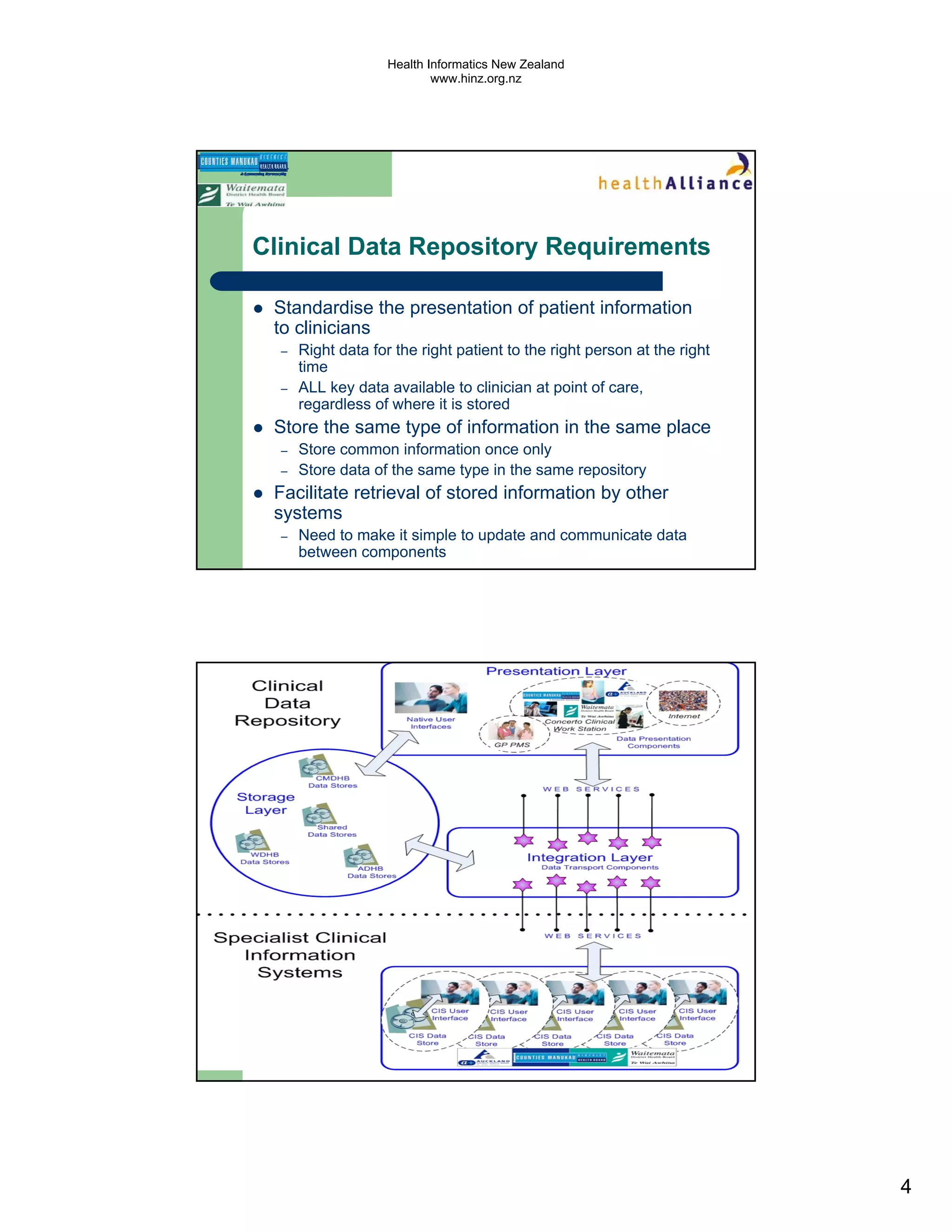
Clinical Data Repository Requirements

 Standardise the presentation of patient information
 to clinicians
  –   Right data for the right patient to the right person at the right
      time
  –   ALL key data available to clinician at point of care,
      regardless of where it is stored
 Store the same type of information in the same place
  –   Store common information once only
  –   Store data of the same type in the same repository
 Facilitate retrieval of stored information by other
 systems
  –   Need to make it simple to update and communicate data
      between components


Clinical Data Repository


                                                                          4
Health Informatics New Zealand
                                  www.hinz.org.nz


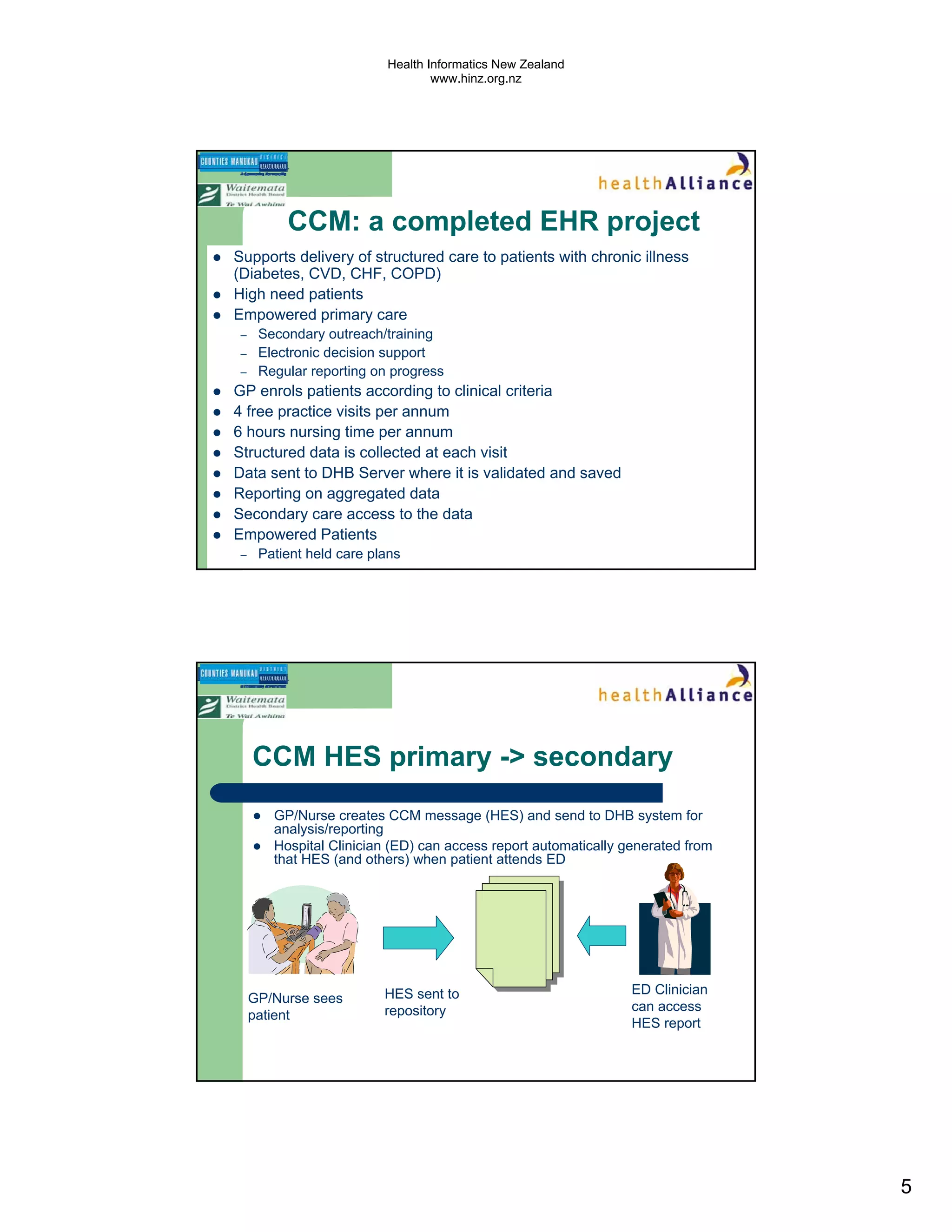
          CCM: a completed EHR project
Supports delivery of structured care to patients with chronic illness
(Diabetes, CVD, CHF, COPD)
High need patients
Empowered primary care
 –    Secondary outreach/training
 –    Electronic decision support
 –    Regular reporting on progress
GP enrols patients according to clinical criteria
4 free practice visits per annum
6 hours nursing time per annum
Structured data is collected at each visit
Data sent to DHB Server where it is validated and saved
Reporting on aggregated data
Secondary care access to the data
Empowered Patients
 –    Patient held care plans


     CCM HES primary -> secondary
        GP/Nurse creates CCM message (HES) and send to DHB system for
        analysis/reporting
        Hospital Clinician (ED) can access report automatically generated from
        that HES (and others) when patient attends ED


                          HES sent to                            ED Clinician
     GP/Nurse sees
                          repository                             can access
     patient
                                                                 HES report


                                                                                 5
Health Informatics New Zealand
                www.hinz.org.nz


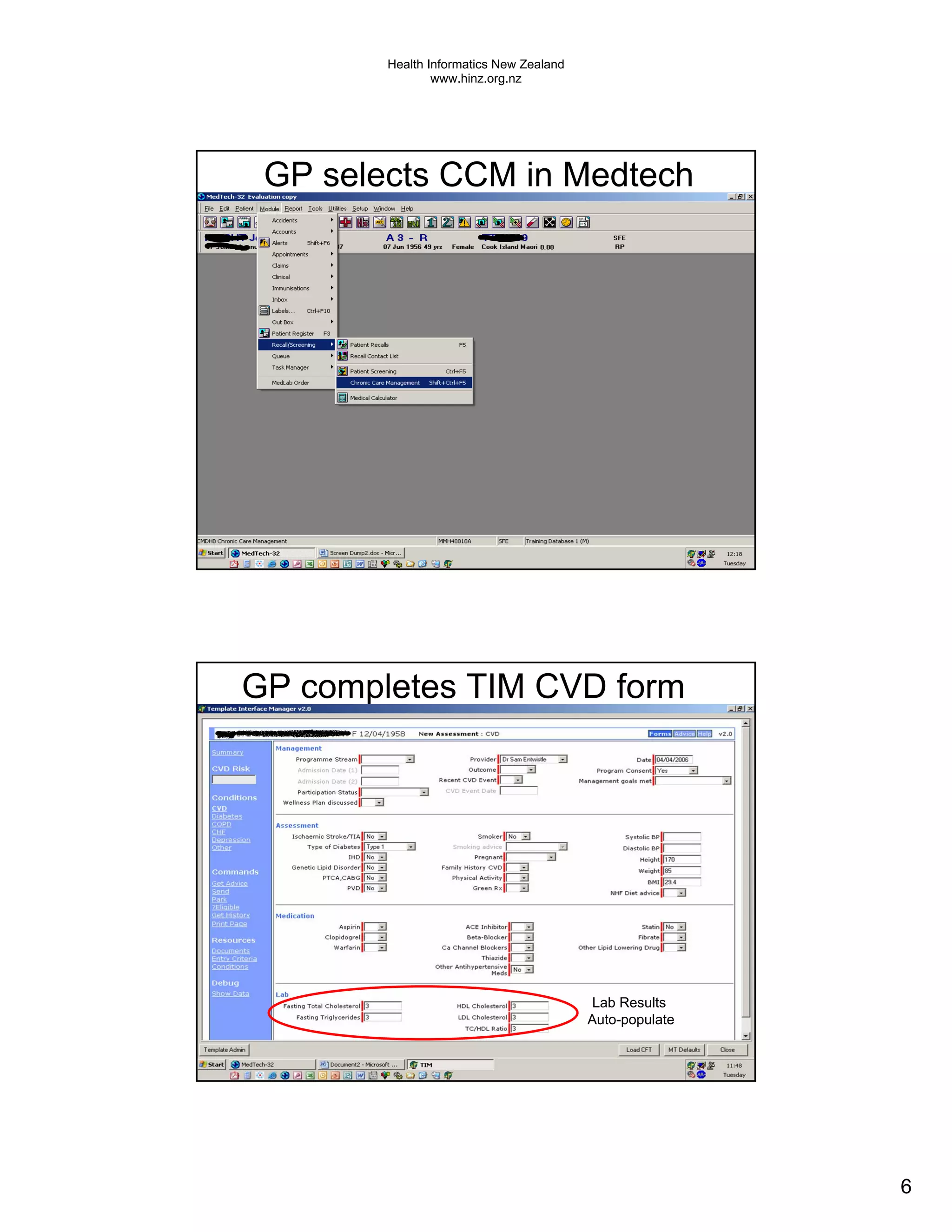
 GP selects CCM in Medtech


GP completes TIM CVD form


                                          Lab Results
                                         Auto-populate


                                                         6
Health Informatics New Zealand
                      www.hinz.org.nz


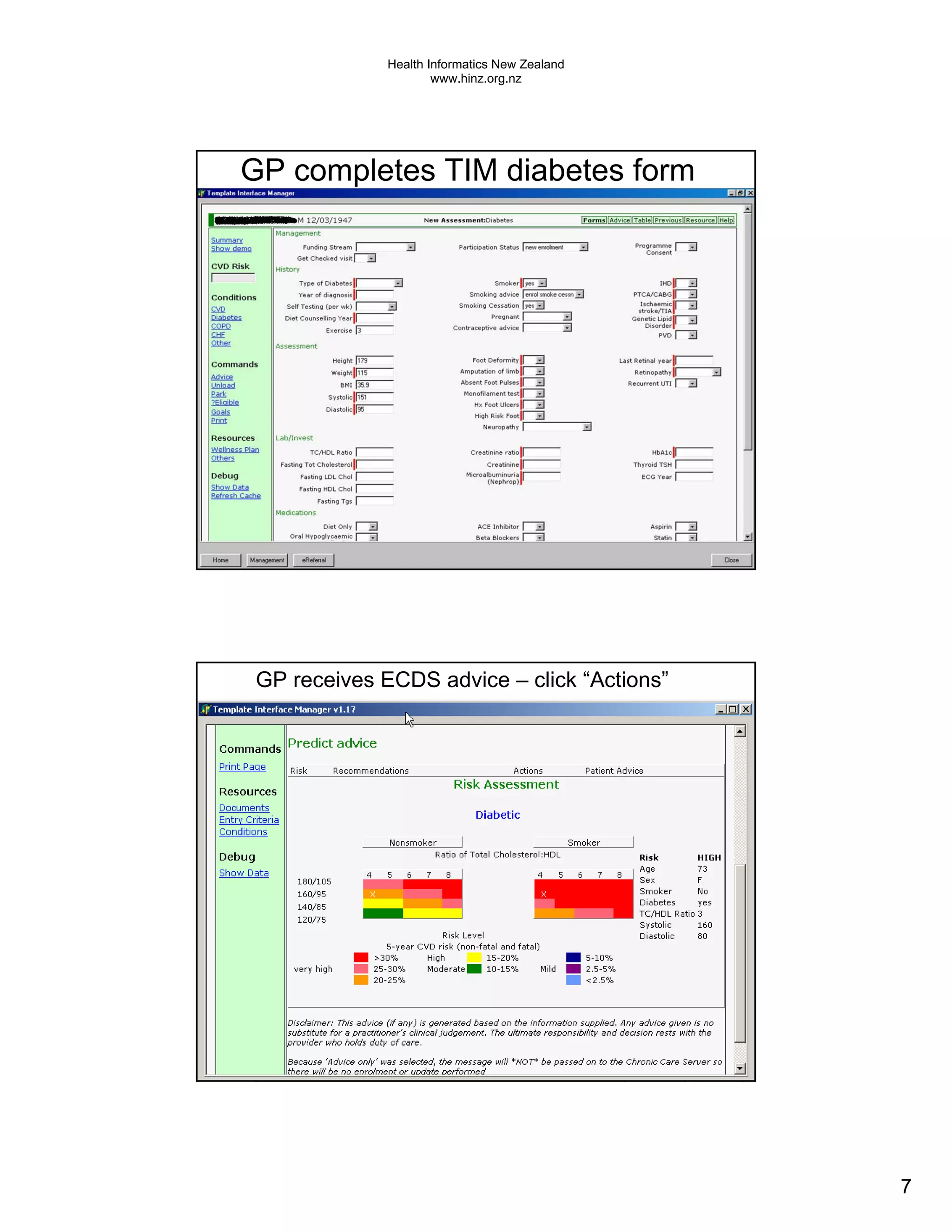
GP completes TIM diabetes form


 GP receives ECDS advice – click “Actions”


                                               7
Health Informatics New Zealand
                     www.hinz.org.nz


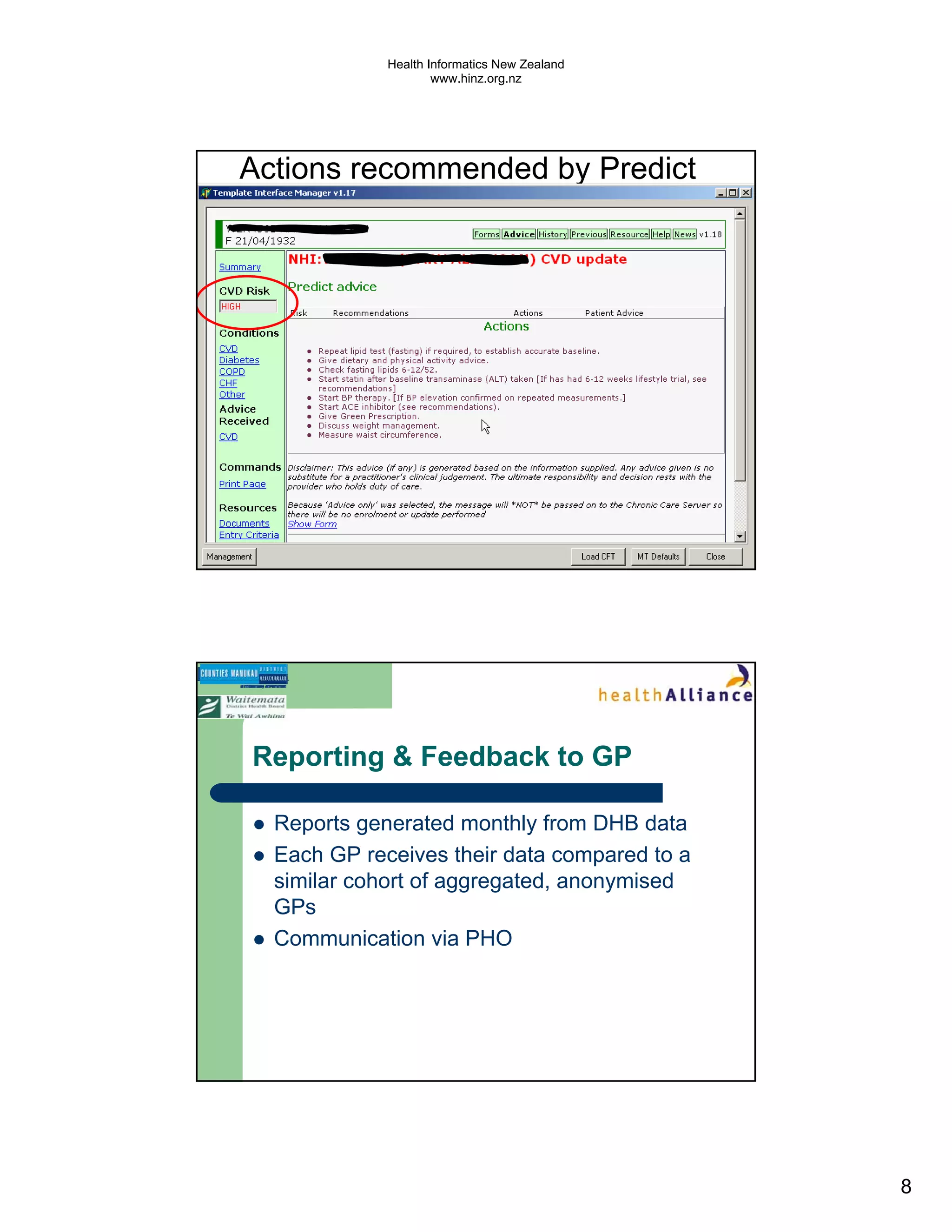
Actions recommended by Predict


Reporting & Feedback to GP

  Reports generated monthly from DHB data
  Each GP receives their data compared to a
  similar cohort of aggregated, anonymised
  GPs
  Communication via PHO


                                              8
Health Informatics New Zealand
                    www.hinz.org.nz


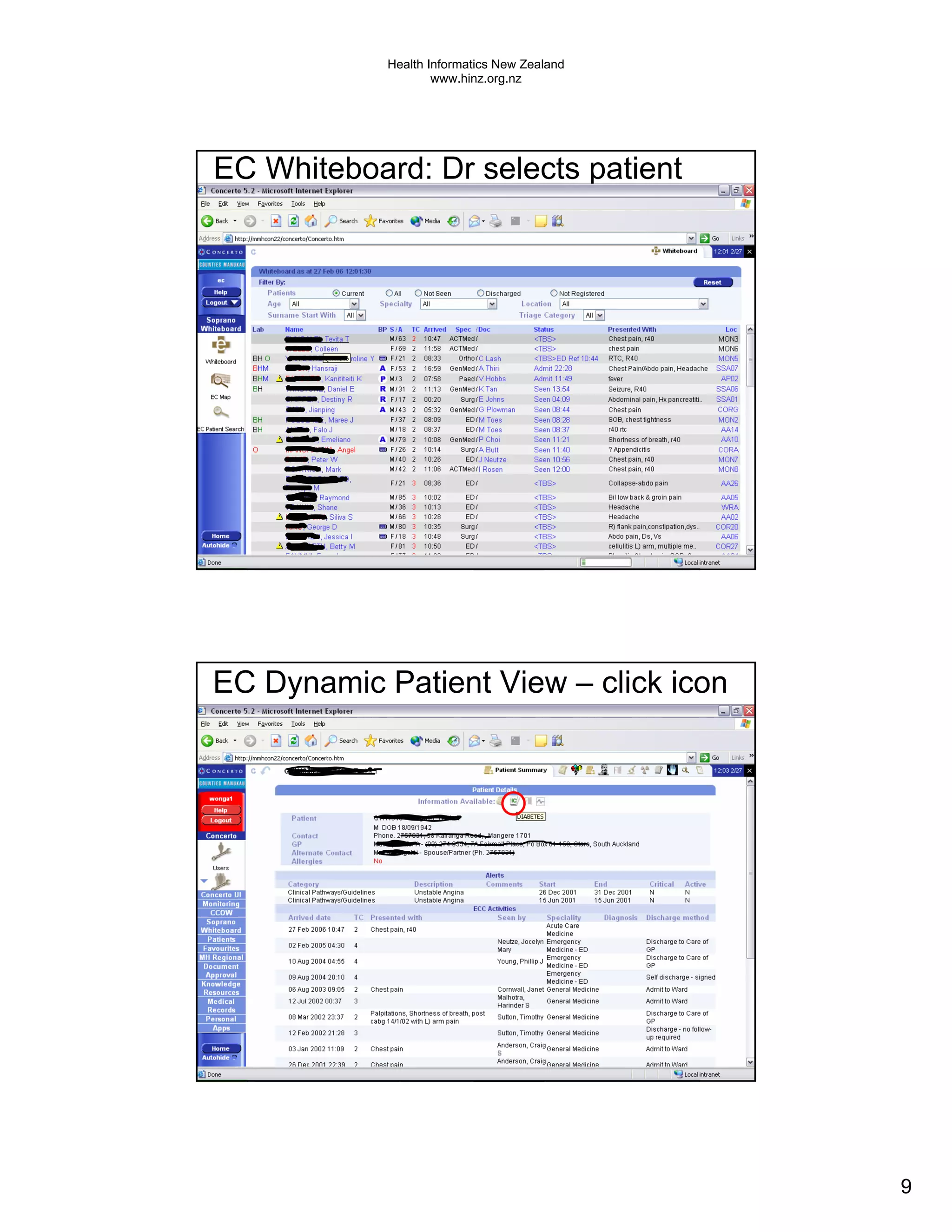
EC Whiteboard: Dr selects patient


EC Dynamic Patient View – click icon


                                             9
Health Informatics New Zealand
                        www.hinz.org.nz


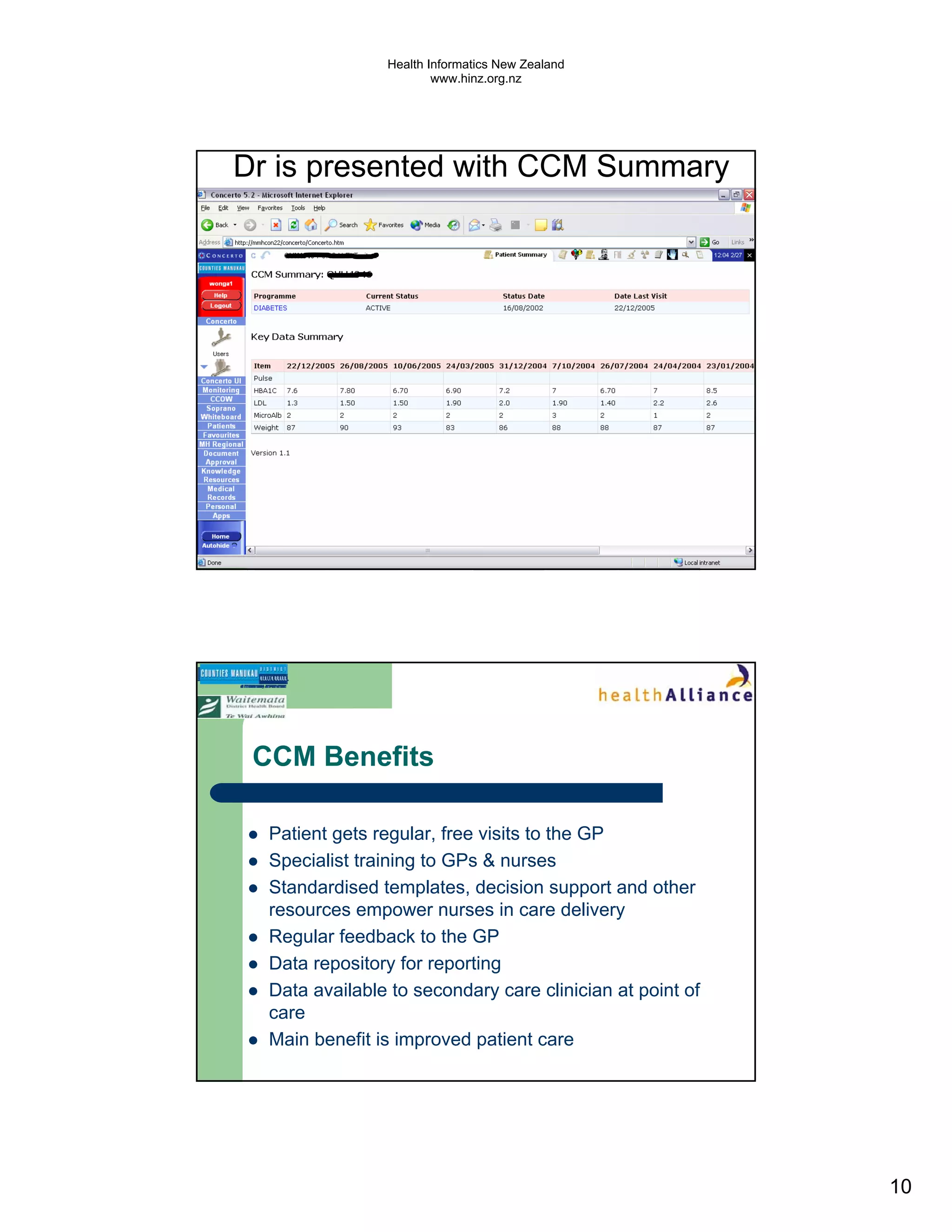
Dr is presented with CCM Summary


 CCM Benefits

  Patient gets regular, free visits to the GP
  Specialist training to GPs & nurses
  Standardised templates, decision support and other
  resources empower nurses in care delivery
  Regular feedback to the GP
  Data repository for reporting
  Data available to secondary care clinician at point of
  care
  Main benefit is improved patient care


                                                           10
Health Informatics New Zealand
                                       www.hinz.org.nz


TestSafe: an EHR project in progress

 Before TestSafe – ‘Regional Éclair’
   All results from Auckland DHB laboratories
       –   Excluding: A+ Mental Health and Sexual Health
      All results performed by Community
      Laboratories requested by DHB clinicians
       –   where the requesting GP has indicated ‘copy to’ a
           DHB
       –   Approximately 15% of all Community based
           laboratory tests were routed to the Regional Éclair
           repository


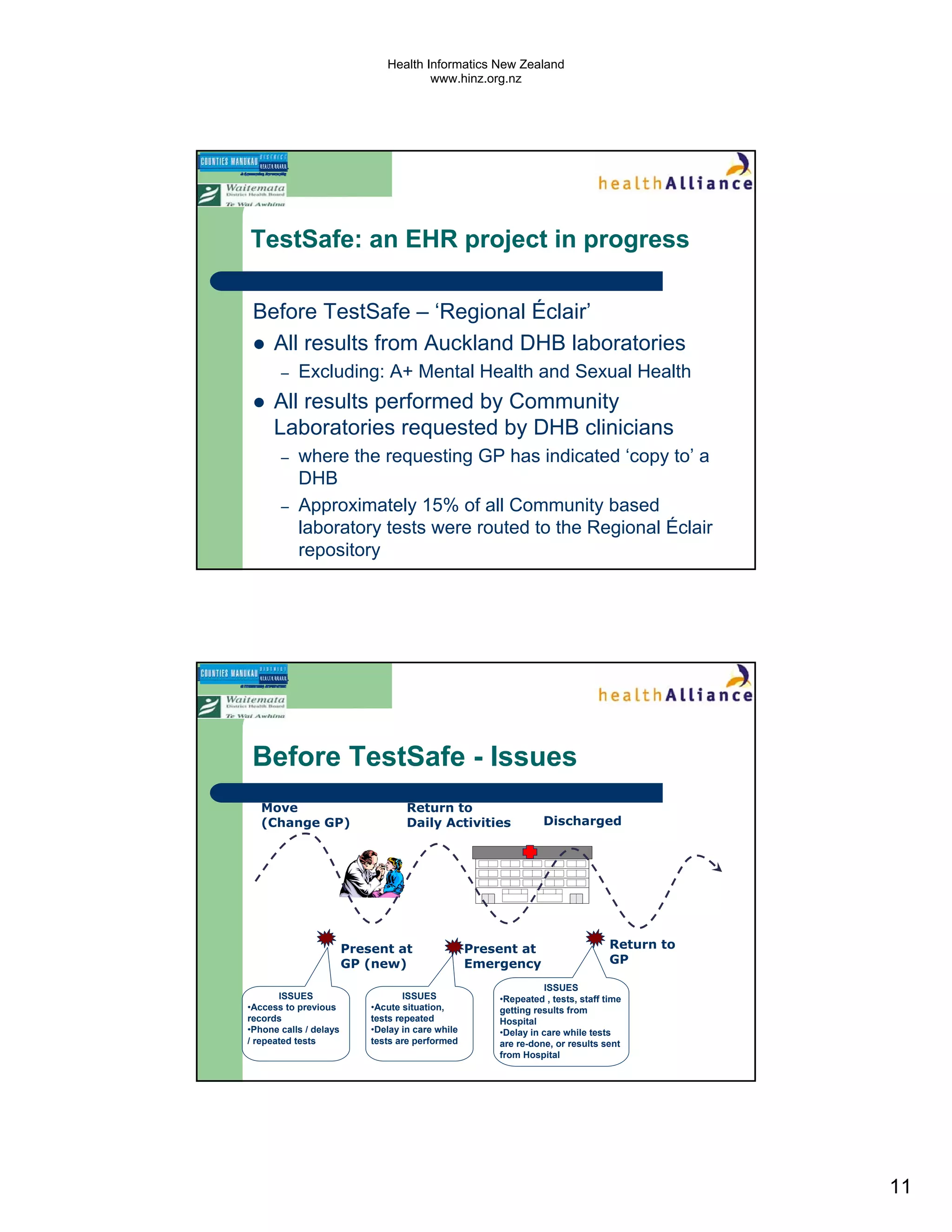
 Before TestSafe - Issues
   Move                             Return to
   (Change GP)                      Daily Activities             Discharged


                        Present at                 Present at                    Return to
                        GP (new)                   Emergency                     GP

                                                                  ISSUES
       ISSUES                       ISSUES             •Repeated , tests, staff time
•Access to previous         •Acute situation,          getting results from
records                     tests repeated             Hospital
•Phone calls / delays       •Delay in care while       •Delay in care while tests
/ repeated tests            tests are performed        are re-done, or results sent
                                                       from Hospital


                                                                                             11
Health Informatics New Zealand
                               www.hinz.org.nz


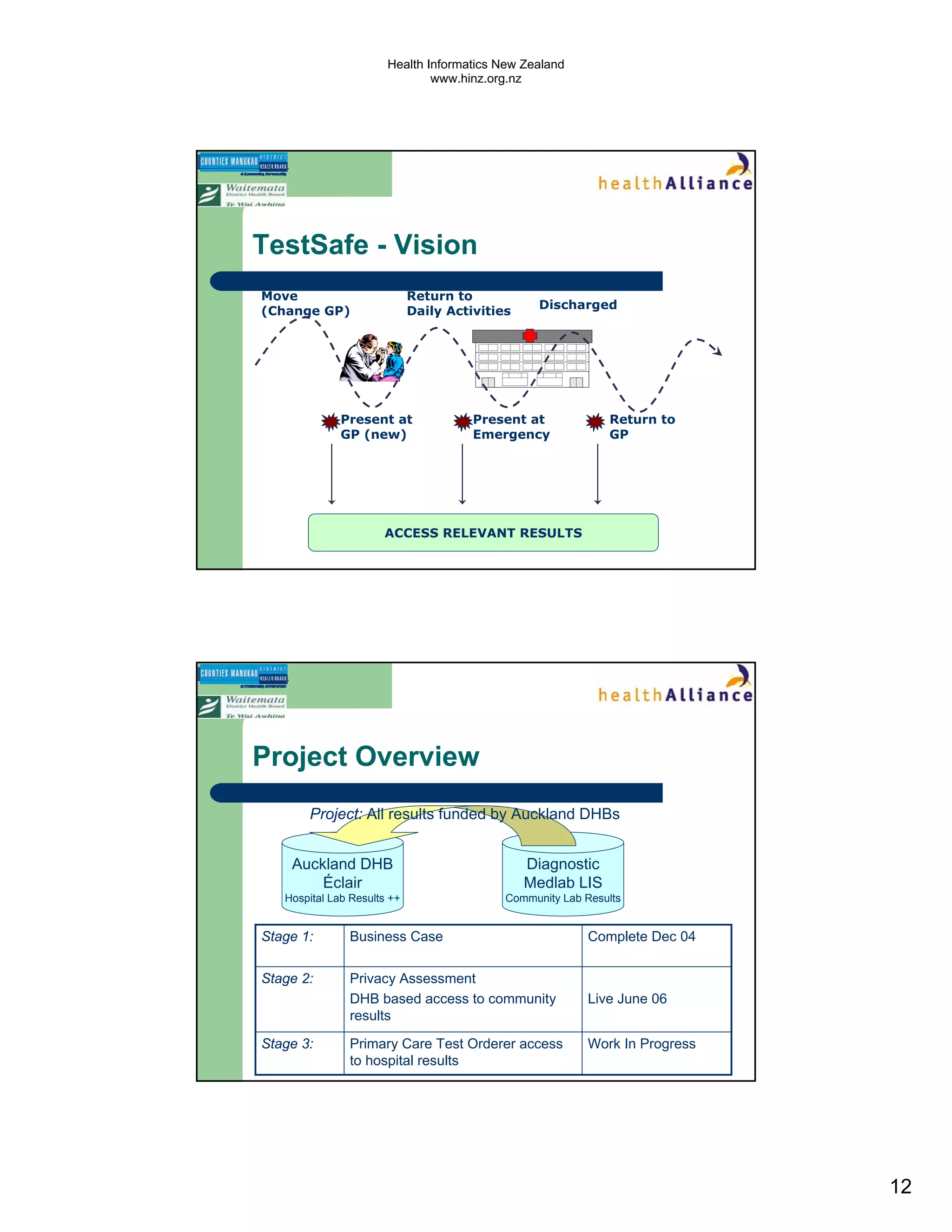
TestSafe - Vision
Move                         Return to
(Change GP)                  Daily Activities     Discharged


              Present at               Present at             Return to
              GP (new)                 Emergency              GP


                      ACCESS RELEVANT RESULTS


Project Overview
       Project: All results funded by Auckland DHBs


    Auckland DHB                                Diagnostic
        Éclair                                  Medlab LIS
   Hospital Lab Results ++                  Community Lab Results


Stage 1:       Business Case                              Complete Dec 04


Stage 2:       Privacy Assessment
               DHB based access to community              Live June 06
               results

Stage 3:       Primary Care Test Orderer access           Work In Progress
               to hospital results


                                                                             12
Health Informatics New Zealand
                              www.hinz.org.nz


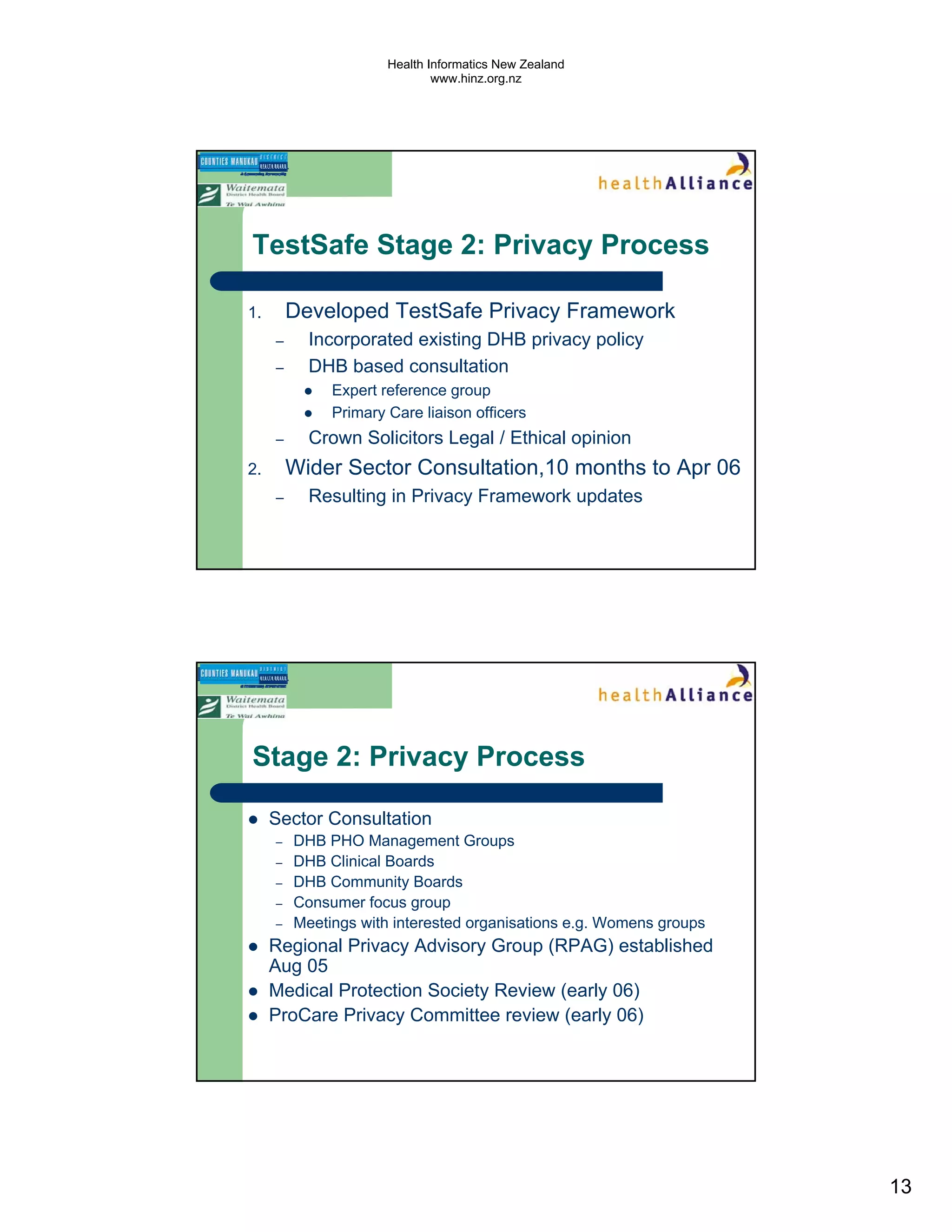
TestSafe Stage 2: Privacy Process

1.       Developed TestSafe Privacy Framework
     –     Incorporated existing DHB privacy policy
     –     DHB based consultation
              Expert reference group
              Primary Care liaison officers
     –     Crown Solicitors Legal / Ethical opinion
2.       Wider Sector Consultation,10 months to Apr 06
     –     Resulting in Privacy Framework updates


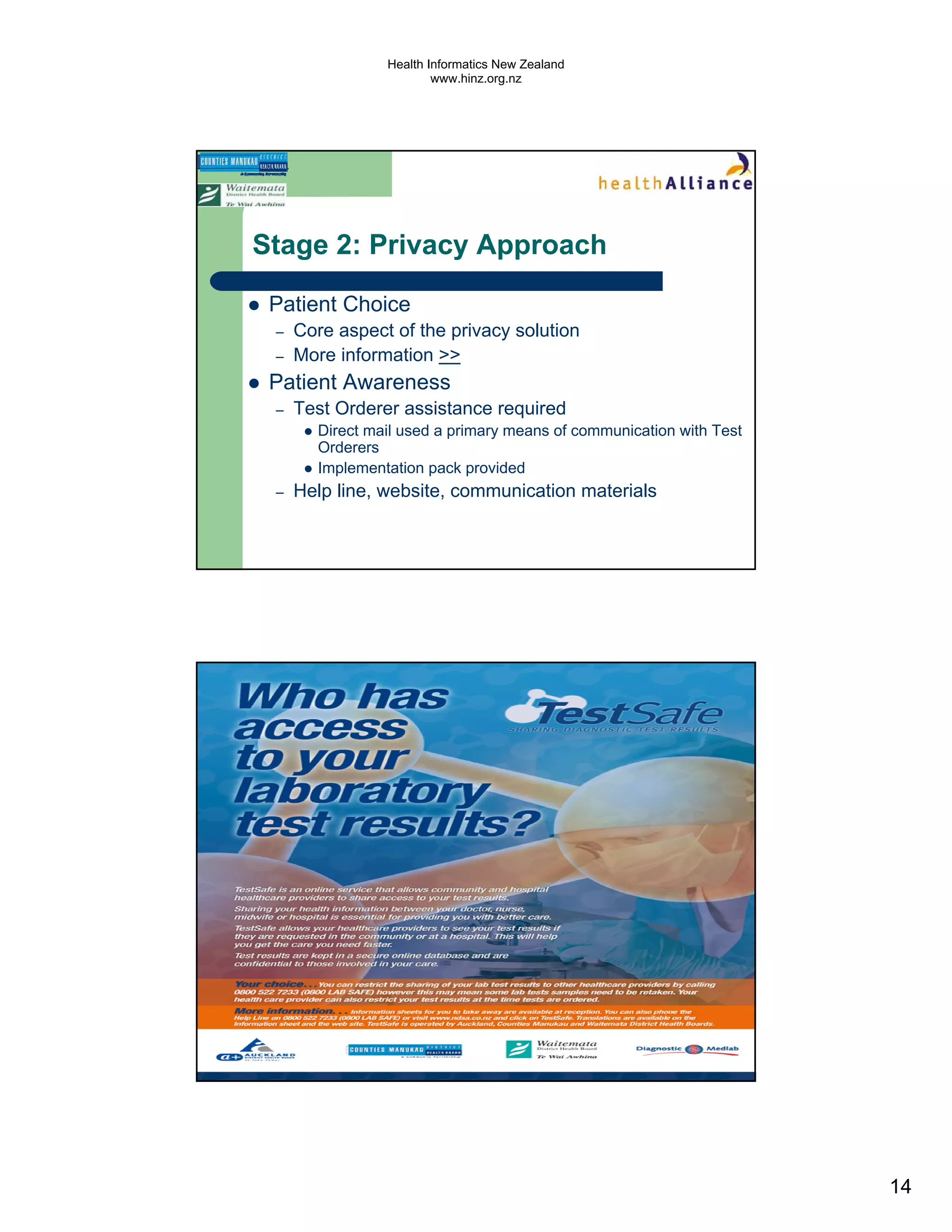
Stage 2: Privacy Process

     Sector Consultation
     –   DHB PHO Management Groups
     –   DHB Clinical Boards
     –   DHB Community Boards
     –   Consumer focus group
     –   Meetings with interested organisations e.g. Womens groups
     Regional Privacy Advisory Group (RPAG) established
     Aug 05
     Medical Protection Society Review (early 06)
     ProCare Privacy Committee review (early 06)


                                                                     13
Health Informatics New Zealand
                        www.hinz.org.nz


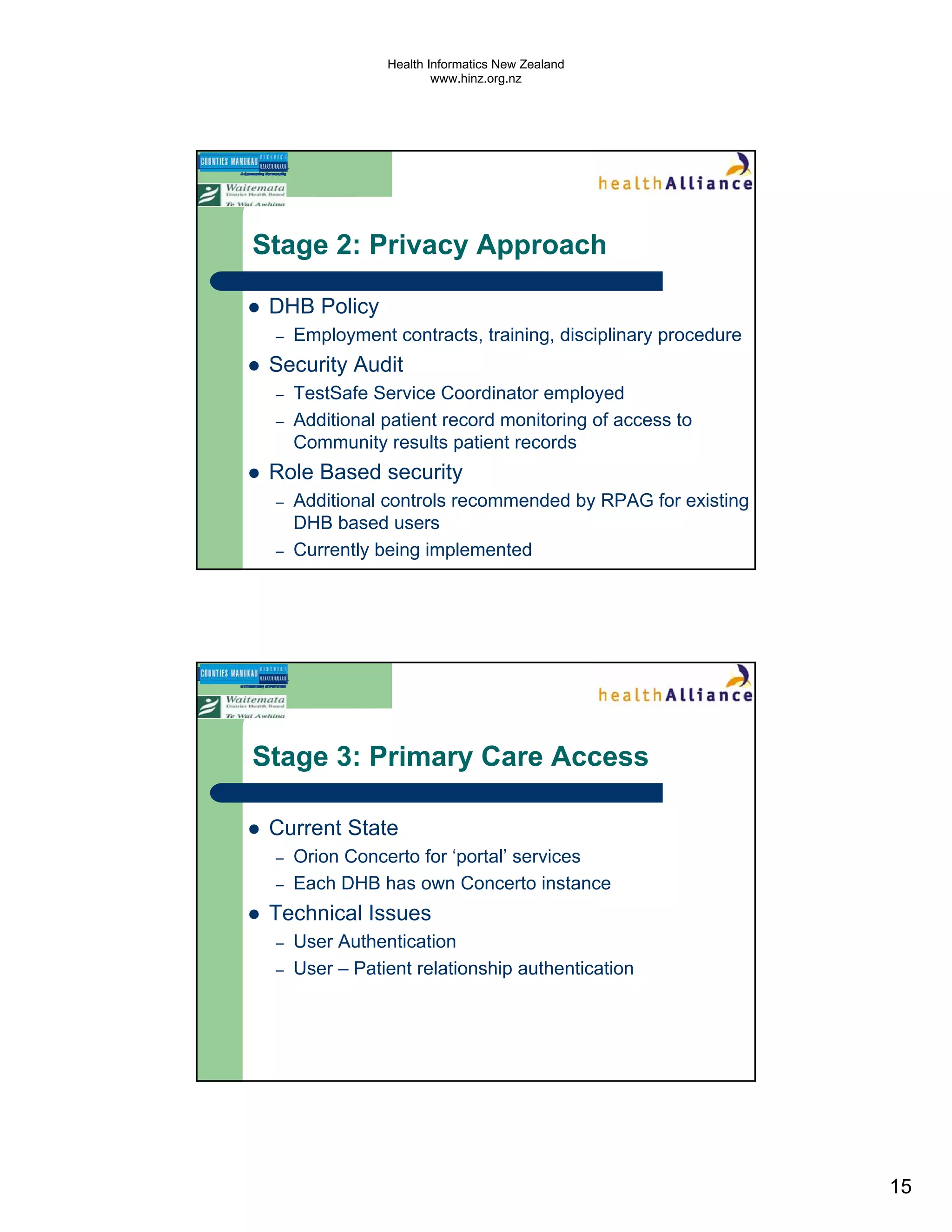
Stage 2: Privacy Approach

 Patient Choice
 –   Core aspect of the privacy solution
 –   More information >>
 Patient Awareness
 –   Test Orderer assistance required
       Direct mail used a primary means of communication with Test
       Orderers
       Implementation pack provided
 –   Help line, website, communication materials


                                                                     14
Health Informatics New Zealand
                        www.hinz.org.nz


Stage 2: Privacy Approach

 DHB Policy
 –   Employment contracts, training, disciplinary procedure
 Security Audit
 –   TestSafe Service Coordinator employed
 –   Additional patient record monitoring of access to
     Community results patient records
 Role Based security
 –   Additional controls recommended by RPAG for existing
     DHB based users
 –   Currently being implemented


Stage 3: Primary Care Access

 Current State
 –   Orion Concerto for ‘portal’ services
 –   Each DHB has own Concerto instance
 Technical Issues
 –   User Authentication
 –   User – Patient relationship authentication


                                                              15
Health Informatics New Zealand
                                            www.hinz.org.nz


             Stage 3: Primary Care Access

                    Separate Concerto for Primary Care access
                    planned
                    Possible use of PHO-Patient registers to verify
                    patient relationship
                    –   ‘Break Glass’ override available
                    ‘Copy To’ feature included


id Component View


        ADHB GP


        CMDHB GP                 External Concerto                        Web Eclair (Test

                                                                                Safe)


                                                        DHB Application


        WDHB GP


                                  DHB Concerto


                                                                                             16
Health Informatics New Zealand
                              www.hinz.org.nz


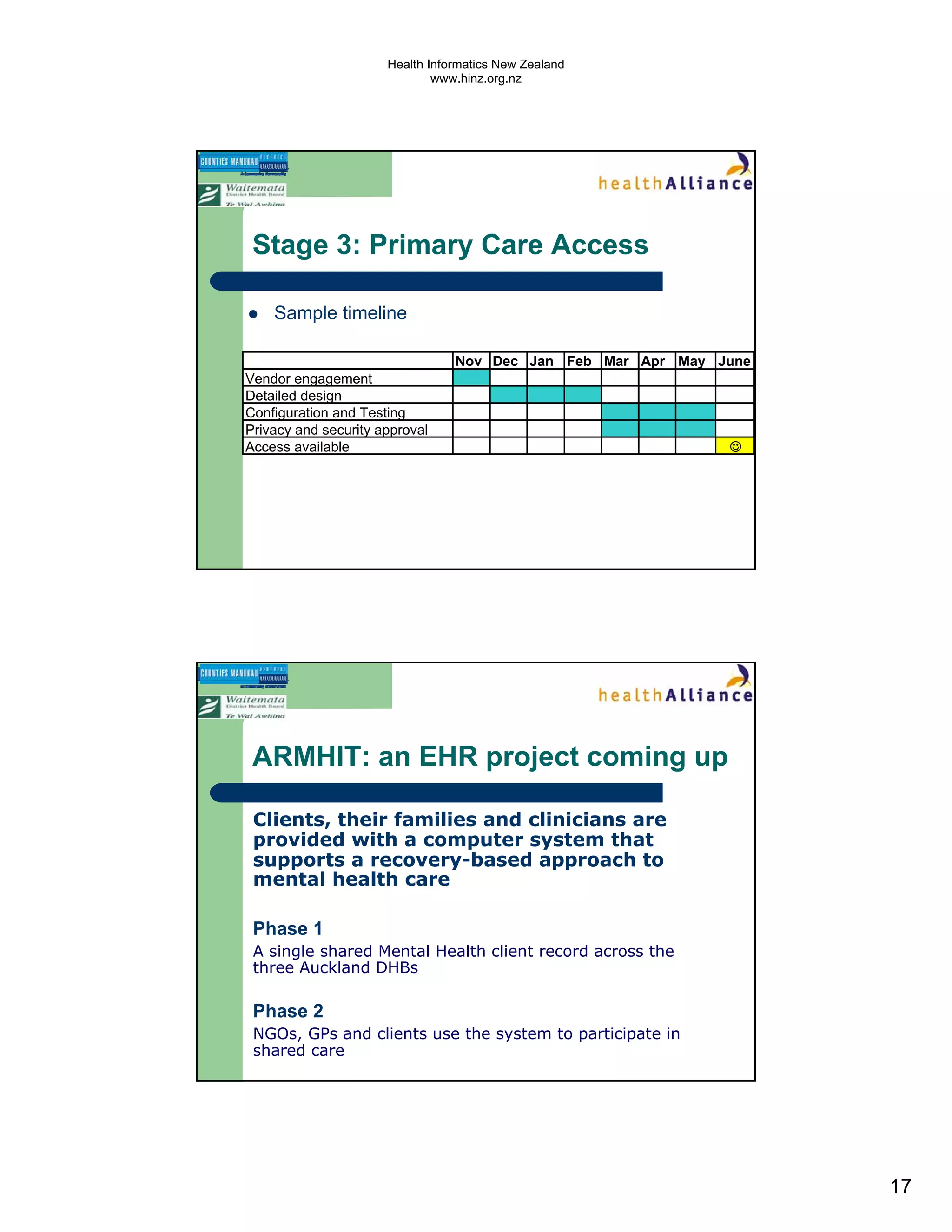
 Stage 3: Primary Care Access

    Sample timeline

                                 Nov Dec Jan Feb Mar Apr May June
Vendor engagement
Detailed design
Configuration and Testing
Privacy and security approval
Access available                                              ☺


 ARMHIT: an EHR project coming up

 Clients, their families and clinicians are
 provided with a computer system that
 supports a recovery-based approach to
 mental health care

 Phase 1
 A single shared Mental Health client record across the
 three Auckland DHBs

 Phase 2
 NGOs, GPs and clients use the system to participate in
 shared care


                                                                    17
Health Informatics New Zealand
                          www.hinz.org.nz


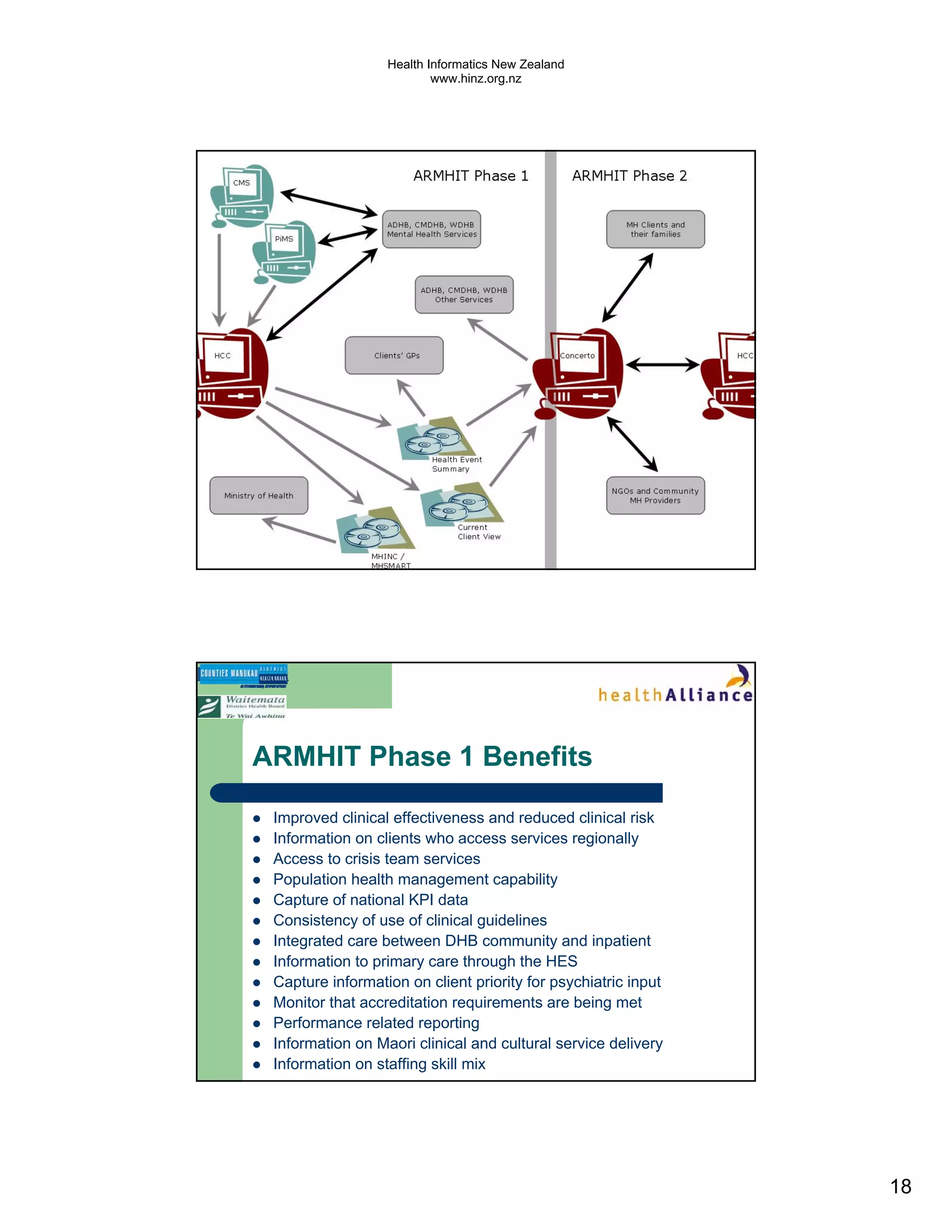
ARMHIT Specific flow


ARMHIT Phase 1 Benefits

 Improved clinical effectiveness and reduced clinical risk
 Information on clients who access services regionally
 Access to crisis team services
 Population health management capability
 Capture of national KPI data
 Consistency of use of clinical guidelines
 Integrated care between DHB community and inpatient
 Information to primary care through the HES
 Capture information on client priority for psychiatric input
 Monitor that accreditation requirements are being met
 Performance related reporting
 Information on Maori clinical and cultural service delivery
 Information on staffing skill mix


                                                                18
Health Informatics New Zealand
                       www.hinz.org.nz


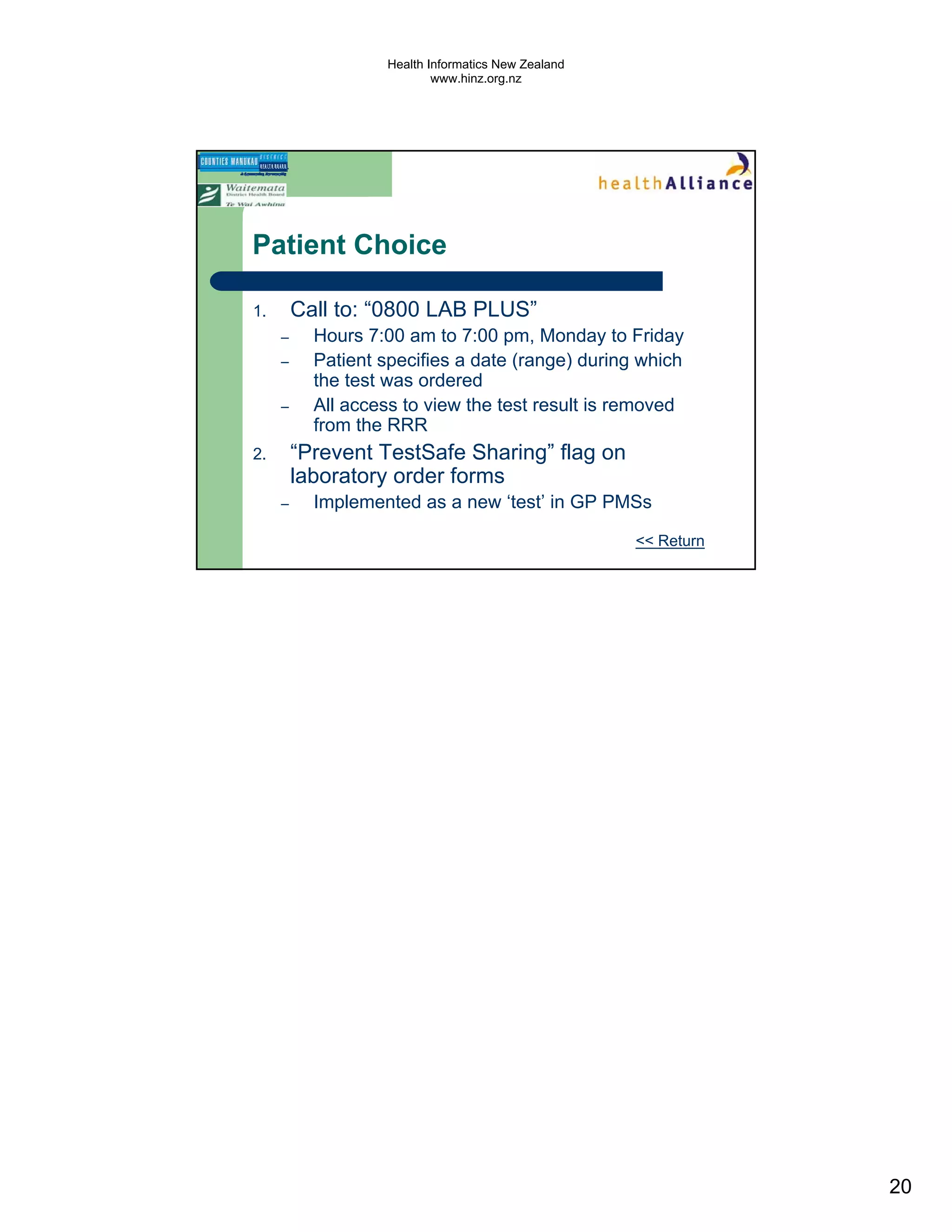
Conclusion

 There is no conclusion, building an EHR is a
 never ending journey
 –   E referrals
 –   Medication record
 –   Community & disability
 –   Diabetes retinal screening
 Health Event Summaries the key to information
 exchange


                                                 19
Health Informatics New Zealand
                           www.hinz.org.nz


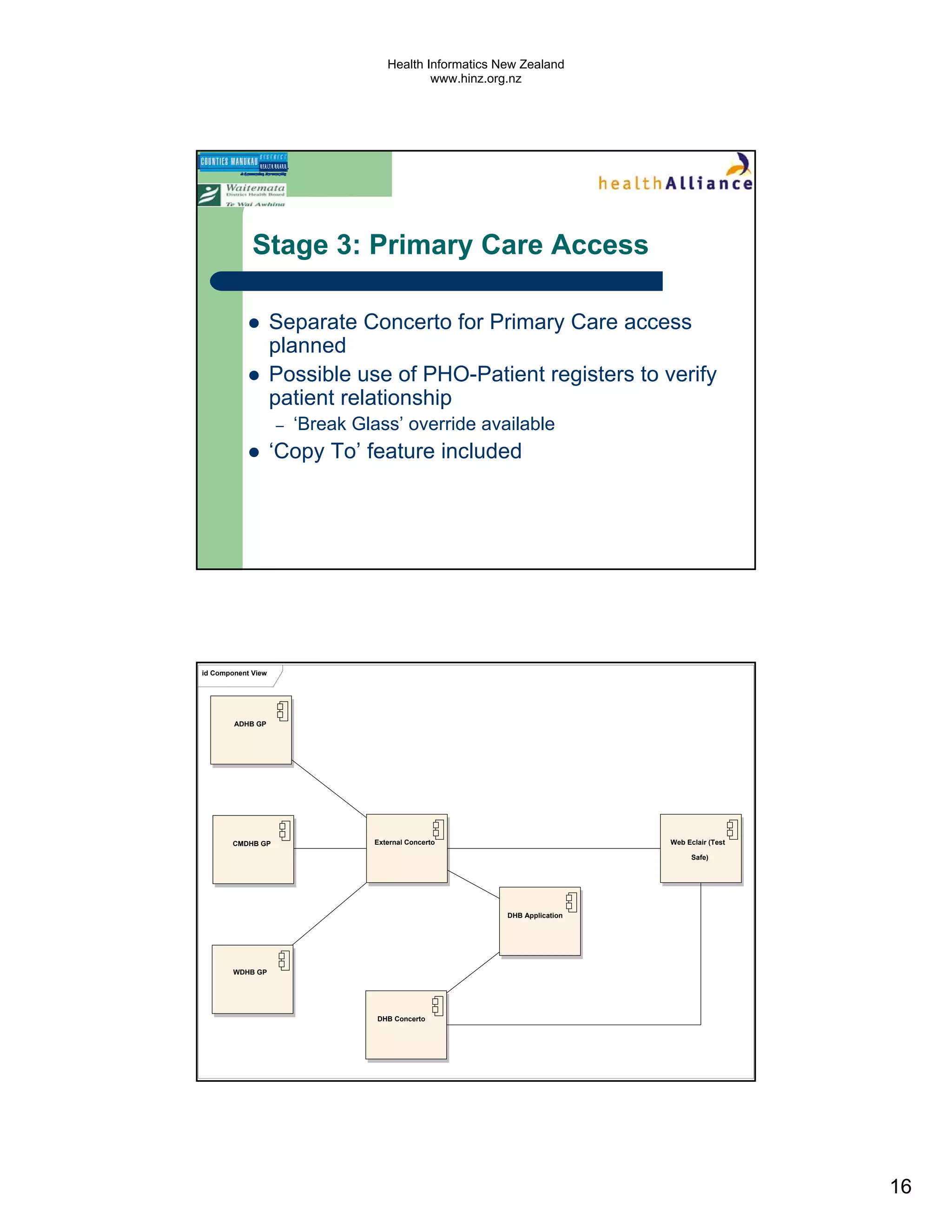
Patient Choice

1.       Call to: “0800 LAB PLUS”
     –     Hours 7:00 am to 7:00 pm, Monday to Friday
     –     Patient specifies a date (range) during which
           the test was ordered
     –     All access to view the test result is removed
           from the RRR
2.       “Prevent TestSafe Sharing” flag on
         laboratory order forms
     –     Implemented as a new ‘test’ in GP PMSs

                                                    << Return


                                                                20

EHRs - The thin end of the wedge

  • 1.
    Health Informatics NewZealand www.hinz.org.nz Electronic Health Records: The Thin End of the Wedge Phil Brimacombe Chief Information Officer 1
  • 2.
    Health Informatics NewZealand www.hinz.org.nz Agenda Auckland Region DHBs EHR direction CCM: a completed EHR project TestSafe: an EHR project in progress ARMHIT: an EHR project coming up Auckland DHBs EHR direction Driven by the RISSP Improving health outcomes through information exchange Information systems will contribute to the development of new processes for improved clinical effectiveness and efficiency Information systems will support the priority development of Primary Health Care. The emphasis will be on supporting new models of healthcare in preference to automating current processes A number of projects building towards CDR, CWS, HES 2
  • 3.
    Health Informatics NewZealand www.hinz.org.nz Auckland DHBs EHR direction CDR: Develop and publish a regional Clinical Data Repository architecture that will allow logical integration of patient records and clinical images. Implement in stages to enable delivery of Key Projects such as Chronic Care Management, Mental Health, and Community, Ambulatory and Disability systems. CWS: Extend the scope and use of the Concerto clinical workstation to provide secure and seamless access to clinical information. Ensure access at point of care including mobile and bedside. HES: Implement a regional repository of all clinical Health Event Summaries (including discharge summaries) across Primary, Community, outpatient, and inpatient care. Allow clinicians and patients to access relevant information. Why have a CDR? Data for patient care is in different places inside the enterprise – PiMS, CMS, Éclair, PACS, Specialty databases Some key clinical data unavailable at point of care – Alerts/Allergies, problem lists, current medications Communication between systems not standardised – Expensive to create, support, maintain extend ‘Enterprise’ are separate entities – Counties Manukau, Waitemata & ADHB Many specialist systems collecting data that needs to be generally available (at least in summary) – Lab, Cardiology Some fundamental processes not computerised – Internal Referrals, handover of care External entities needing/supplying data increasing – GP, PHO, NGO, Patient, Labs 3
  • 4.
    Health Informatics NewZealand www.hinz.org.nz Clinical Data Repository Requirements Standardise the presentation of patient information to clinicians – Right data for the right patient to the right person at the right time – ALL key data available to clinician at point of care, regardless of where it is stored Store the same type of information in the same place – Store common information once only – Store data of the same type in the same repository Facilitate retrieval of stored information by other systems – Need to make it simple to update and communicate data between components Clinical Data Repository 4
  • 5.
    Health Informatics NewZealand www.hinz.org.nz CCM: a completed EHR project Supports delivery of structured care to patients with chronic illness (Diabetes, CVD, CHF, COPD) High need patients Empowered primary care – Secondary outreach/training – Electronic decision support – Regular reporting on progress GP enrols patients according to clinical criteria 4 free practice visits per annum 6 hours nursing time per annum Structured data is collected at each visit Data sent to DHB Server where it is validated and saved Reporting on aggregated data Secondary care access to the data Empowered Patients – Patient held care plans CCM HES primary -> secondary GP/Nurse creates CCM message (HES) and send to DHB system for analysis/reporting Hospital Clinician (ED) can access report automatically generated from that HES (and others) when patient attends ED HES sent to ED Clinician GP/Nurse sees repository can access patient HES report 5
  • 6.
    Health Informatics NewZealand www.hinz.org.nz GP selects CCM in Medtech GP completes TIM CVD form Lab Results Auto-populate 6
  • 7.
    Health Informatics NewZealand www.hinz.org.nz GP completes TIM diabetes form GP receives ECDS advice – click “Actions” 7
  • 8.
    Health Informatics NewZealand www.hinz.org.nz Actions recommended by Predict Reporting & Feedback to GP Reports generated monthly from DHB data Each GP receives their data compared to a similar cohort of aggregated, anonymised GPs Communication via PHO 8
  • 9.
    Health Informatics NewZealand www.hinz.org.nz EC Whiteboard: Dr selects patient EC Dynamic Patient View – click icon 9
  • 10.
    Health Informatics NewZealand www.hinz.org.nz Dr is presented with CCM Summary CCM Benefits Patient gets regular, free visits to the GP Specialist training to GPs & nurses Standardised templates, decision support and other resources empower nurses in care delivery Regular feedback to the GP Data repository for reporting Data available to secondary care clinician at point of care Main benefit is improved patient care 10
  • 11.
    Health Informatics NewZealand www.hinz.org.nz TestSafe: an EHR project in progress Before TestSafe – ‘Regional Éclair’ All results from Auckland DHB laboratories – Excluding: A+ Mental Health and Sexual Health All results performed by Community Laboratories requested by DHB clinicians – where the requesting GP has indicated ‘copy to’ a DHB – Approximately 15% of all Community based laboratory tests were routed to the Regional Éclair repository Before TestSafe - Issues Move Return to (Change GP) Daily Activities Discharged Present at Present at Return to GP (new) Emergency GP ISSUES ISSUES ISSUES •Repeated , tests, staff time •Access to previous •Acute situation, getting results from records tests repeated Hospital •Phone calls / delays •Delay in care while •Delay in care while tests / repeated tests tests are performed are re-done, or results sent from Hospital 11
  • 12.
    Health Informatics NewZealand www.hinz.org.nz TestSafe - Vision Move Return to (Change GP) Daily Activities Discharged Present at Present at Return to GP (new) Emergency GP ACCESS RELEVANT RESULTS Project Overview Project: All results funded by Auckland DHBs Auckland DHB Diagnostic Éclair Medlab LIS Hospital Lab Results ++ Community Lab Results Stage 1: Business Case Complete Dec 04 Stage 2: Privacy Assessment DHB based access to community Live June 06 results Stage 3: Primary Care Test Orderer access Work In Progress to hospital results 12
  • 13.
    Health Informatics NewZealand www.hinz.org.nz TestSafe Stage 2: Privacy Process 1. Developed TestSafe Privacy Framework – Incorporated existing DHB privacy policy – DHB based consultation Expert reference group Primary Care liaison officers – Crown Solicitors Legal / Ethical opinion 2. Wider Sector Consultation,10 months to Apr 06 – Resulting in Privacy Framework updates Stage 2: Privacy Process Sector Consultation – DHB PHO Management Groups – DHB Clinical Boards – DHB Community Boards – Consumer focus group – Meetings with interested organisations e.g. Womens groups Regional Privacy Advisory Group (RPAG) established Aug 05 Medical Protection Society Review (early 06) ProCare Privacy Committee review (early 06) 13
  • 14.
    Health Informatics NewZealand www.hinz.org.nz Stage 2: Privacy Approach Patient Choice – Core aspect of the privacy solution – More information >> Patient Awareness – Test Orderer assistance required Direct mail used a primary means of communication with Test Orderers Implementation pack provided – Help line, website, communication materials 14
  • 15.
    Health Informatics NewZealand www.hinz.org.nz Stage 2: Privacy Approach DHB Policy – Employment contracts, training, disciplinary procedure Security Audit – TestSafe Service Coordinator employed – Additional patient record monitoring of access to Community results patient records Role Based security – Additional controls recommended by RPAG for existing DHB based users – Currently being implemented Stage 3: Primary Care Access Current State – Orion Concerto for ‘portal’ services – Each DHB has own Concerto instance Technical Issues – User Authentication – User – Patient relationship authentication 15
  • 16.
    Health Informatics NewZealand www.hinz.org.nz Stage 3: Primary Care Access Separate Concerto for Primary Care access planned Possible use of PHO-Patient registers to verify patient relationship – ‘Break Glass’ override available ‘Copy To’ feature included id Component View ADHB GP CMDHB GP External Concerto Web Eclair (Test Safe) DHB Application WDHB GP DHB Concerto 16
  • 17.
    Health Informatics NewZealand www.hinz.org.nz Stage 3: Primary Care Access Sample timeline Nov Dec Jan Feb Mar Apr May June Vendor engagement Detailed design Configuration and Testing Privacy and security approval Access available ☺ ARMHIT: an EHR project coming up Clients, their families and clinicians are provided with a computer system that supports a recovery-based approach to mental health care Phase 1 A single shared Mental Health client record across the three Auckland DHBs Phase 2 NGOs, GPs and clients use the system to participate in shared care 17
  • 18.
    Health Informatics NewZealand www.hinz.org.nz ARMHIT Specific flow ARMHIT Phase 1 Benefits Improved clinical effectiveness and reduced clinical risk Information on clients who access services regionally Access to crisis team services Population health management capability Capture of national KPI data Consistency of use of clinical guidelines Integrated care between DHB community and inpatient Information to primary care through the HES Capture information on client priority for psychiatric input Monitor that accreditation requirements are being met Performance related reporting Information on Maori clinical and cultural service delivery Information on staffing skill mix 18
  • 19.
    Health Informatics NewZealand www.hinz.org.nz Conclusion There is no conclusion, building an EHR is a never ending journey – E referrals – Medication record – Community & disability – Diabetes retinal screening Health Event Summaries the key to information exchange 19
  • 20.
    Health Informatics NewZealand www.hinz.org.nz Patient Choice 1. Call to: “0800 LAB PLUS” – Hours 7:00 am to 7:00 pm, Monday to Friday – Patient specifies a date (range) during which the test was ordered – All access to view the test result is removed from the RRR 2. “Prevent TestSafe Sharing” flag on laboratory order forms – Implemented as a new ‘test’ in GP PMSs << Return 20