© 
2014 
Dirk 
Ehnts 
12th International Post-Keynesian Conference (UMKC) 
Samuelson 
and 
Davidson 
on 
ergodicity: 
a 
reformula>on 
Dirk 
Ehnts, 
Free 
University 
Berlin 
Miguel 
Carrión 
Álvarez, 
Banco 
Santander 
Madrid
© 
2014 
Dirk 
Ehnts 
Samuelson 
and 
Davidson 
on 
ergodicity: 
a 
reformula>on 
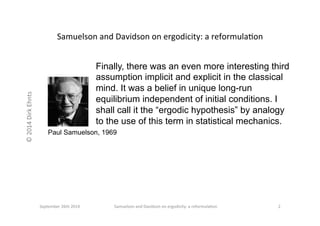
Finally, there was an even more interesting third 
assumption implicit and explicit in the classical 
mind. It was a belief in unique long-run 
equilibrium independent of initial conditions. I 
shall call it the “ergodic hypothesis” by analogy 
to the use of this term in statistical mechanics. 
Paul Samuelson, 1969 
September 
26th 
2014 
Samuelson 
and 
Davidson 
on 
ergodicity: 
a 
reformula>on 
2
© 
2014 
Dirk 
Ehnts 
Samuelson 
and 
Davidson 
on 
ergodicity: 
a 
reformula>on 
Finally, there was an even more interesting third 
assumption implicit and explicit in the classical 
mind. It was a belief in unique long-run 
equilibrium independent of initial conditions. I 
shall call it the “ergodic hypothesis” by analogy 
to the use of this term in statistical mechanics. 
Paul Samuelson, 1969 
Furthermore in an article published in 1969 
Samuelson argued that the „ergodic hypothesis 
[axiom]“ is a necessary foundation if economics 
is a hard science [Samuelson, 1969, p. 184]. 
Paul Davidson, 2006 
September 
26th 
2014 
Samuelson 
and 
Davidson 
on 
ergodicity: 
a 
reformula>on 
3
© 
2014 
Dirk 
Ehnts 
Samuelson 
and 
Davidson 
on 
ergodicity: 
a 
reformula>on 
Ergodicity 
in 
a 
nutshell: 
If 
you 
throw 
six 
dice 
at 
one 
point 
in 
>me 
and 
the 
average 
is 
the 
same 
as 
throwing 
a 
die 
six 
>mes 
in 
a 
row, 
then 
the 
ensemble 
average 
and 
the 
'me 
average 
are 
iden>cal 
– 
the 
system 
is 
ergodic. 
In 
[non-­‐]ergodic 
system, 
you 
can[not] 
derive 
the 
probabili>es 
of 
a 
single 
future 
event 
just 
by 
looking 
at 
the 
past 
historical 
development 
of 
a 
single 
instance 
of 
the 
system. 
14. 
April 
2014 
Neuere 
Ansätze 
der 
Geldtheorie 
4
© 
2014 
Dirk 
Ehnts 
Samuelson 
and 
Davidson 
on 
ergodicity: 
a 
reformula>on 
„by 
analogy 
to 
the 
use 
of 
this 
term 
in 
sta>s>cal 
mechanics“: 
Hence, 
to 
the 
mythical 
ques>on 
of 
whether 
the 
ergodic 
hypothesis 
jus>fies 
sta>s>cal 
mechanics, 
the 
answer 
is 
worse 
than 
no: 
it 
is 
not 
the 
right 
ques>on. 
Indeed, 
the 
ques>on 
cannot 
be 
anymore 
whether 
nature 
strictly 
obeys 
the 
demands 
of 
ergodicity; 
rather, 
the 
ques>on 
ought 
to 
ask 
how 
good 
an 
idealiza>on 
the 
theory 
really 
is. 
Emch 
and 
Liu 
(2001, 
§9.5) 
14. 
April 
2014 
Neuere 
Ansätze 
der 
Geldtheorie 
5
© 
2014 
Dirk 
Ehnts 
Samuelson 
and 
Davidson 
on 
ergodicity: 
a 
reformula>on 
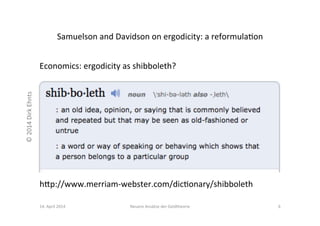
Economics: 
ergodicity 
as 
shibboleth? 
hfp://www.merriam-­‐webster.com/dic>onary/shibboleth 
14. 
April 
2014 
Neuere 
Ansätze 
der 
Geldtheorie 
6
© 
2014 
Dirk 
Ehnts 
Samuelson 
and 
Davidson 
on 
ergodicity: 
a 
reformula>on 
“[I]t is possible, but not 
necessarily assumed, that an 
ergodic state for P [the 
probability distribution] will 
emerge in the limit as T [time] 
goes to infinity.” 
Samuelson (1965, 43) 
September 
26th 
2014 
Samuelson 
and 
Davidson 
on 
ergodicity: 
a 
reformula>on 
7
© 
2014 
Dirk 
Ehnts 
Samuelson 
and 
Davidson 
on 
ergodicity: 
a 
reformula>on 
“Finally, there was an even more interesting third 
assumption implicit and explicit in the classical 
mind. It was a belief in unique long-run equilibrium 
independent of initial conditions. I shall call it the 
“ergodic hypothesis” by analogy to the use of this 
term in statistical mechanics. Remember that the 
classical economists were fatalists (a synonym for 
“believers in equilibrium”!) . Harriet Martineau, who 
made fairy tales out of economics (…), believed that if 
the state redivided income each morning, by night the 
rich would again be sleeping in their comfortable beds 
and the poor under the bridges. (I think she thought 
this a cogent argument against egalitarian taxes.)” 
Samuelson (1968, 11-12) 
September 
26th 
2014 
Samuelson 
and 
Davidson 
on 
ergodicity: 
a 
reformula>on 
8
© 
2014 
Dirk 
Ehnts 
Samuelson 
and 
Davidson 
on 
ergodicity: 
a 
reformula>on 
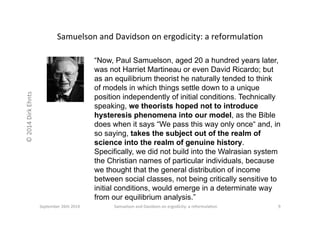
“Now, Paul Samuelson, aged 20 a hundred years later, 
was not Harriet Martineau or even David Ricardo; but 
as an equilibrium theorist he naturally tended to think 
of models in which things settle down to a unique 
position independently of initial conditions. Technically 
speaking, we theorists hoped not to introduce 
hysteresis phenomena into our model, as the Bible 
does when it says “We pass this way only once“ and, in 
so saying, takes the subject out of the realm of 
science into the realm of genuine history. 
Specifically, we did not build into the Walrasian system 
the Christian names of particular individuals, because 
we thought that the general distribution of income 
between social classes, not being critically sensitive to 
initial conditions, would emerge in a determinate way 
from our equilibrium analysis.” 
September 
26th 
2014 
Samuelson 
and 
Davidson 
on 
ergodicity: 
a 
reformula>on 
9
© 
2014 
Dirk 
Ehnts 
Samuelson 
and 
Davidson 
on 
ergodicity: 
a 
reformula>on 
In 1968, MIT Professor and later Nobel 
Prize winner Paul Samuelson wrote that 
in their quest to provide a hard scientific 
basis for the economics discipline 
modern economists must believe in a 
‚unique long run equilibrium [i.e., an 
inevitable outcome for the economy] 
independent of the initial conditions’. 
Davidson (1996, 65) 
September 
26th 
2014 
Samuelson 
and 
Davidson 
on 
ergodicity: 
a 
reformula>on 
10
© 
2014 
Dirk 
Ehnts 
Samuelson 
and 
Davidson 
on 
ergodicity: 
a 
reformula>on 
Indeed, Samuelson (1969, p. 184) has 
made the acceptance of the „ergodic 
hypothesis“ the sine qua non of the 
scientific method in economics. 
[Samuelson (1969, p. 184) indicated that 
he used the term ergodic „by analogy to 
the use of this term in [19th century] 
statistical mechanics“ in order to remove 
economics from the „realm of genuine 
history,“ and keep it in the „realm of 
science.“] 
Davidson (2006,11) 
September 
26th 
2014 
Samuelson 
and 
Davidson 
on 
ergodicity: 
a 
reformula>on 
11
© 
2014 
Dirk 
Ehnts 
Samuelson 
and 
Davidson 
on 
ergodicity: 
a 
reformula>on 
“Now, Paul Samuelson, aged 20 a hundred years 
later, was not Harriet Martineau or even David Ricardo; 
but as an equilibrium theorist he naturally tended to 
think of models in which things settle down to a unique 
position independently of initial conditions. Technically 
speaking, we theorists hoped not to introduce 
hysteresis phenomena into our model, as the Bible 
does when it says “We pass this way only once“ and, in 
so saying, takes the subject out of the realm of 
science into the realm of genuine history.“ 
… ‘having once been a jackass’ ... 
“What Classical and Neoclassical Monetary Theory 
Really was” (1968), Paul Samuelson (1915-2009) 
September 
26th 
2014 
Samuelson 
and 
Davidson 
on 
ergodicity: 
a 
reformula>on 
12
© 
2014 
Dirk 
Ehnts 
Samuelson 
and 
Davidson 
on 
ergodicity: 
a 
reformula>on 
Uncertainty and ergodicity 
Davidson has often stressed (fundamental/true) 
uncertainty in his writings. However, there are ergodic 
systems which are completely deterministic but do not 
allow predictions to be made. These chaotic systems 
are part of the real world! 
While terms like "ergodic", "stationary", "conservative", 
"predictable" or "deterministic" have natural language 
meanings, they are also overloaded from dynamical 
systems theory and practice where their meanings are 
most definitely not coterminous. 
September 
26th 
2014 
Samuelson 
and 
Davidson 
on 
ergodicity: 
a 
reformula>on 
13
© 
2014 
Dirk 
Ehnts 
Samuelson 
and 
Davidson 
on 
ergodicity: 
a 
reformula>on 
Uncertainty and ergodicity 
We believe that a different term should be used to 
describe the ‘non-predictability of the future’ that is 
compatible with un-/certain but also compatible with 
non-/ergodic. 
September 
26th 
2014 
Samuelson 
and 
Davidson 
on 
ergodicity: 
a 
reformula>on 
14
© 
2014 
Dirk 
Ehnts 
Samuelson 
and 
Davidson 
on 
ergodicity: 
a 
reformula>on 
Stochastic (and non-stochastic): 
1660s, "pertaining to conjecture," from Greek 
stokhastikos "able to guess, conjecturing," from 
stokhazesthai "to guess, aim at, conjecture," from 
stokhos "a guess, aim, target, mark," literally "pointed 
stick set up for archers to shoot at," from PIE *stogh-, 
variant of root *stegh- "to stick, prick; pointed" (see 
sting (v.)). The sense of "randomly determined" is from 
1934, from German stochastik (1917). 
Online Etymology Dictionary 
September 
26th 
2014 
Samuelson 
and 
Davidson 
on 
ergodicity: 
a 
reformula>on 
15
© 
2014 
Dirk 
Ehnts 
Samuelson 
and 
Davidson 
on 
ergodicity: 
a 
reformula>on 
“Speaking of randomness in the ordinary sense of this 
word, we mean those phenomena in which we do not 
find regularities allowing us to predict their behavior. 
Generally speaking, there are no reasons to assume that 
random in this sense phenomena are subject to some 
probabilistic laws. Hence, it is necessary to distinguish 
between randomness in this broad sense and stochastic 
randomness (which is the subject of probability theory).” 
Kolmogorov (1983, first paragraph) 
September 
26th 
2014 
Samuelson 
and 
Davidson 
on 
ergodicity: 
a 
reformula>on 
16
© 
2014 
Dirk 
Ehnts 
Samuelson 
and 
Davidson 
on 
ergodicity: 
a 
reformula>on 
Davidson (2007, 102): 
‚In a wider sense, however, ergodicity means the 
presumption of a preprogrammed stable, conservative 
system where the past, present, and future reality are 
predetermined whether the system is stochastic or 
not.’ 
September 
26th 
2014 
Samuelson 
and 
Davidson 
on 
ergodicity: 
a 
reformula>on 
17
© 
2014 
Dirk 
Ehnts 
Samuelson 
and 
Davidson 
on 
ergodicity: 
a 
reformula>on 
Davidson (2007, 102): 
‚In a wider sense, however, ergodicity means the 
presumption of a preprogrammed stable, conservative 
system where the past, present, and future reality are 
predetermined whether the system is stochastic or 
not.’ 
“When I use a word,” Humpty Dumpty said in rather a scornful tone, 
“it means just what I choose it to mean — neither more nor less.” 
“The question is,” said Alice, “whether you can make words mean so many different things.” 
“The question is,” said Humpty Dumpty, “which is to be master—that's all.” 
Lewis Carroll (1797: Through the looking glass) 
September 
26th 
2014 
Samuelson 
and 
Davidson 
on 
ergodicity: 
a 
reformula>on 
18
Here’s the master: Keynes (1921, 23): 
© 
2014 
Dirk 
Ehnts 
Samuelson 
and 
Davidson 
on 
ergodicity: 
a 
reformula>on 
September 
26th 
2014 
Samuelson 
and 
Davidson 
on 
ergodicity: 
a 
reformula>on 
19
© 
2014 
Dirk 
Ehnts 
Samuelson 
and 
Davidson 
on 
ergodicity: 
a 
reformula>on 
Keynes (1921, 23): 
September 
26th 
2014 
Samuelson 
and 
Davidson 
on 
ergodicity: 
a 
reformula>on 
20
© 
2014 
Dirk 
Ehnts 
Samuelson 
and 
Davidson 
on 
ergodicity: 
a 
reformula>on 
Keynes (1921): probability of future events not enough 
to understand today’s prices! 
Demand for insurance (CDS, …) depends on ‘beauty 
contest’ (Keynes, GT) and this situation is one of 
reflexivity (Soros). 
AIG mattered, underwrote CDS market and got prices 
wrong when ‘specially large demand’ arose! 
In our terms: markets are described by non-stochastic 
processes! 
September 
26th 
2014 
Samuelson 
and 
Davidson 
on 
ergodicity: 
a 
reformula>on 
21
© 
2014 
Dirk 
Ehnts 
Samuelson 
and 
Davidson 
on 
ergodicity: 
a 
reformula>on 
Book-making deals with non-stochastic randomness 
(or uncertainty, etc.) – to ‘protect the book’ is of utmost 
importance! 
Even in the case of fundamental uncertainty in the 
sense of Keynes and Davidson, it still makes sense to 
‘protect the book’. 
Failures on a systemic level will be solved on a 
systemic level, hence individuals do not prepare for 
them! (citi’s Chuck Prince: “as long as the music is 
playing, you’ve got to get up and dance”) 
September 
26th 
2014 
Samuelson 
and 
Davidson 
on 
ergodicity: 
a 
reformula>on 
22
© 
2014 
Dirk 
Ehnts 
„Missouri, 
Missouri. 
Well, 
well, 
well, 
everything 
is 
so 
uncertain.“ 
– Mark 
Twain, 
The 
Gilded 
Age 
September 
26th 
2014 
Samuelson 
and 
Davidson 
on 
ergodicity: 
a 
reformula>on 
23

Samuelson and Davidson on Ergodicity

  • 1.
    © 2014 Dirk Ehnts 12th International Post-Keynesian Conference (UMKC) Samuelson and Davidson on ergodicity: a reformula>on Dirk Ehnts, Free University Berlin Miguel Carrión Álvarez, Banco Santander Madrid
  • 2.
    © 2014 Dirk Ehnts Samuelson and Davidson on ergodicity: a reformula>on Finally, there was an even more interesting third assumption implicit and explicit in the classical mind. It was a belief in unique long-run equilibrium independent of initial conditions. I shall call it the “ergodic hypothesis” by analogy to the use of this term in statistical mechanics. Paul Samuelson, 1969 September 26th 2014 Samuelson and Davidson on ergodicity: a reformula>on 2
  • 3.
    © 2014 Dirk Ehnts Samuelson and Davidson on ergodicity: a reformula>on Finally, there was an even more interesting third assumption implicit and explicit in the classical mind. It was a belief in unique long-run equilibrium independent of initial conditions. I shall call it the “ergodic hypothesis” by analogy to the use of this term in statistical mechanics. Paul Samuelson, 1969 Furthermore in an article published in 1969 Samuelson argued that the „ergodic hypothesis [axiom]“ is a necessary foundation if economics is a hard science [Samuelson, 1969, p. 184]. Paul Davidson, 2006 September 26th 2014 Samuelson and Davidson on ergodicity: a reformula>on 3
  • 4.
    © 2014 Dirk Ehnts Samuelson and Davidson on ergodicity: a reformula>on Ergodicity in a nutshell: If you throw six dice at one point in >me and the average is the same as throwing a die six >mes in a row, then the ensemble average and the 'me average are iden>cal – the system is ergodic. In [non-­‐]ergodic system, you can[not] derive the probabili>es of a single future event just by looking at the past historical development of a single instance of the system. 14. April 2014 Neuere Ansätze der Geldtheorie 4
  • 5.
    © 2014 Dirk Ehnts Samuelson and Davidson on ergodicity: a reformula>on „by analogy to the use of this term in sta>s>cal mechanics“: Hence, to the mythical ques>on of whether the ergodic hypothesis jus>fies sta>s>cal mechanics, the answer is worse than no: it is not the right ques>on. Indeed, the ques>on cannot be anymore whether nature strictly obeys the demands of ergodicity; rather, the ques>on ought to ask how good an idealiza>on the theory really is. Emch and Liu (2001, §9.5) 14. April 2014 Neuere Ansätze der Geldtheorie 5
  • 6.
    © 2014 Dirk Ehnts Samuelson and Davidson on ergodicity: a reformula>on Economics: ergodicity as shibboleth? hfp://www.merriam-­‐webster.com/dic>onary/shibboleth 14. April 2014 Neuere Ansätze der Geldtheorie 6
  • 7.
    © 2014 Dirk Ehnts Samuelson and Davidson on ergodicity: a reformula>on “[I]t is possible, but not necessarily assumed, that an ergodic state for P [the probability distribution] will emerge in the limit as T [time] goes to infinity.” Samuelson (1965, 43) September 26th 2014 Samuelson and Davidson on ergodicity: a reformula>on 7
  • 8.
    © 2014 Dirk Ehnts Samuelson and Davidson on ergodicity: a reformula>on “Finally, there was an even more interesting third assumption implicit and explicit in the classical mind. It was a belief in unique long-run equilibrium independent of initial conditions. I shall call it the “ergodic hypothesis” by analogy to the use of this term in statistical mechanics. Remember that the classical economists were fatalists (a synonym for “believers in equilibrium”!) . Harriet Martineau, who made fairy tales out of economics (…), believed that if the state redivided income each morning, by night the rich would again be sleeping in their comfortable beds and the poor under the bridges. (I think she thought this a cogent argument against egalitarian taxes.)” Samuelson (1968, 11-12) September 26th 2014 Samuelson and Davidson on ergodicity: a reformula>on 8
  • 9.
    © 2014 Dirk Ehnts Samuelson and Davidson on ergodicity: a reformula>on “Now, Paul Samuelson, aged 20 a hundred years later, was not Harriet Martineau or even David Ricardo; but as an equilibrium theorist he naturally tended to think of models in which things settle down to a unique position independently of initial conditions. Technically speaking, we theorists hoped not to introduce hysteresis phenomena into our model, as the Bible does when it says “We pass this way only once“ and, in so saying, takes the subject out of the realm of science into the realm of genuine history. Specifically, we did not build into the Walrasian system the Christian names of particular individuals, because we thought that the general distribution of income between social classes, not being critically sensitive to initial conditions, would emerge in a determinate way from our equilibrium analysis.” September 26th 2014 Samuelson and Davidson on ergodicity: a reformula>on 9
  • 10.
    © 2014 Dirk Ehnts Samuelson and Davidson on ergodicity: a reformula>on In 1968, MIT Professor and later Nobel Prize winner Paul Samuelson wrote that in their quest to provide a hard scientific basis for the economics discipline modern economists must believe in a ‚unique long run equilibrium [i.e., an inevitable outcome for the economy] independent of the initial conditions’. Davidson (1996, 65) September 26th 2014 Samuelson and Davidson on ergodicity: a reformula>on 10
  • 11.
    © 2014 Dirk Ehnts Samuelson and Davidson on ergodicity: a reformula>on Indeed, Samuelson (1969, p. 184) has made the acceptance of the „ergodic hypothesis“ the sine qua non of the scientific method in economics. [Samuelson (1969, p. 184) indicated that he used the term ergodic „by analogy to the use of this term in [19th century] statistical mechanics“ in order to remove economics from the „realm of genuine history,“ and keep it in the „realm of science.“] Davidson (2006,11) September 26th 2014 Samuelson and Davidson on ergodicity: a reformula>on 11
  • 12.
    © 2014 Dirk Ehnts Samuelson and Davidson on ergodicity: a reformula>on “Now, Paul Samuelson, aged 20 a hundred years later, was not Harriet Martineau or even David Ricardo; but as an equilibrium theorist he naturally tended to think of models in which things settle down to a unique position independently of initial conditions. Technically speaking, we theorists hoped not to introduce hysteresis phenomena into our model, as the Bible does when it says “We pass this way only once“ and, in so saying, takes the subject out of the realm of science into the realm of genuine history.“ … ‘having once been a jackass’ ... “What Classical and Neoclassical Monetary Theory Really was” (1968), Paul Samuelson (1915-2009) September 26th 2014 Samuelson and Davidson on ergodicity: a reformula>on 12
  • 13.
    © 2014 Dirk Ehnts Samuelson and Davidson on ergodicity: a reformula>on Uncertainty and ergodicity Davidson has often stressed (fundamental/true) uncertainty in his writings. However, there are ergodic systems which are completely deterministic but do not allow predictions to be made. These chaotic systems are part of the real world! While terms like "ergodic", "stationary", "conservative", "predictable" or "deterministic" have natural language meanings, they are also overloaded from dynamical systems theory and practice where their meanings are most definitely not coterminous. September 26th 2014 Samuelson and Davidson on ergodicity: a reformula>on 13
  • 14.
    © 2014 Dirk Ehnts Samuelson and Davidson on ergodicity: a reformula>on Uncertainty and ergodicity We believe that a different term should be used to describe the ‘non-predictability of the future’ that is compatible with un-/certain but also compatible with non-/ergodic. September 26th 2014 Samuelson and Davidson on ergodicity: a reformula>on 14
  • 15.
    © 2014 Dirk Ehnts Samuelson and Davidson on ergodicity: a reformula>on Stochastic (and non-stochastic): 1660s, "pertaining to conjecture," from Greek stokhastikos "able to guess, conjecturing," from stokhazesthai "to guess, aim at, conjecture," from stokhos "a guess, aim, target, mark," literally "pointed stick set up for archers to shoot at," from PIE *stogh-, variant of root *stegh- "to stick, prick; pointed" (see sting (v.)). The sense of "randomly determined" is from 1934, from German stochastik (1917). Online Etymology Dictionary September 26th 2014 Samuelson and Davidson on ergodicity: a reformula>on 15
  • 16.
    © 2014 Dirk Ehnts Samuelson and Davidson on ergodicity: a reformula>on “Speaking of randomness in the ordinary sense of this word, we mean those phenomena in which we do not find regularities allowing us to predict their behavior. Generally speaking, there are no reasons to assume that random in this sense phenomena are subject to some probabilistic laws. Hence, it is necessary to distinguish between randomness in this broad sense and stochastic randomness (which is the subject of probability theory).” Kolmogorov (1983, first paragraph) September 26th 2014 Samuelson and Davidson on ergodicity: a reformula>on 16
  • 17.
    © 2014 Dirk Ehnts Samuelson and Davidson on ergodicity: a reformula>on Davidson (2007, 102): ‚In a wider sense, however, ergodicity means the presumption of a preprogrammed stable, conservative system where the past, present, and future reality are predetermined whether the system is stochastic or not.’ September 26th 2014 Samuelson and Davidson on ergodicity: a reformula>on 17
  • 18.
    © 2014 Dirk Ehnts Samuelson and Davidson on ergodicity: a reformula>on Davidson (2007, 102): ‚In a wider sense, however, ergodicity means the presumption of a preprogrammed stable, conservative system where the past, present, and future reality are predetermined whether the system is stochastic or not.’ “When I use a word,” Humpty Dumpty said in rather a scornful tone, “it means just what I choose it to mean — neither more nor less.” “The question is,” said Alice, “whether you can make words mean so many different things.” “The question is,” said Humpty Dumpty, “which is to be master—that's all.” Lewis Carroll (1797: Through the looking glass) September 26th 2014 Samuelson and Davidson on ergodicity: a reformula>on 18
  • 19.
    Here’s the master:Keynes (1921, 23): © 2014 Dirk Ehnts Samuelson and Davidson on ergodicity: a reformula>on September 26th 2014 Samuelson and Davidson on ergodicity: a reformula>on 19
  • 20.
    © 2014 Dirk Ehnts Samuelson and Davidson on ergodicity: a reformula>on Keynes (1921, 23): September 26th 2014 Samuelson and Davidson on ergodicity: a reformula>on 20
  • 21.
    © 2014 Dirk Ehnts Samuelson and Davidson on ergodicity: a reformula>on Keynes (1921): probability of future events not enough to understand today’s prices! Demand for insurance (CDS, …) depends on ‘beauty contest’ (Keynes, GT) and this situation is one of reflexivity (Soros). AIG mattered, underwrote CDS market and got prices wrong when ‘specially large demand’ arose! In our terms: markets are described by non-stochastic processes! September 26th 2014 Samuelson and Davidson on ergodicity: a reformula>on 21
  • 22.
    © 2014 Dirk Ehnts Samuelson and Davidson on ergodicity: a reformula>on Book-making deals with non-stochastic randomness (or uncertainty, etc.) – to ‘protect the book’ is of utmost importance! Even in the case of fundamental uncertainty in the sense of Keynes and Davidson, it still makes sense to ‘protect the book’. Failures on a systemic level will be solved on a systemic level, hence individuals do not prepare for them! (citi’s Chuck Prince: “as long as the music is playing, you’ve got to get up and dance”) September 26th 2014 Samuelson and Davidson on ergodicity: a reformula>on 22
  • 23.
    © 2014 Dirk Ehnts „Missouri, Missouri. Well, well, well, everything is so uncertain.“ – Mark Twain, The Gilded Age September 26th 2014 Samuelson and Davidson on ergodicity: a reformula>on 23