
NicholasGeorgescu-Roegen
TheEntropyLawand theEconomic Process
1 I HR
i
wm®
MMR
I |
f
i
SB
A HARVARD PAPERBACK / $5.95
i
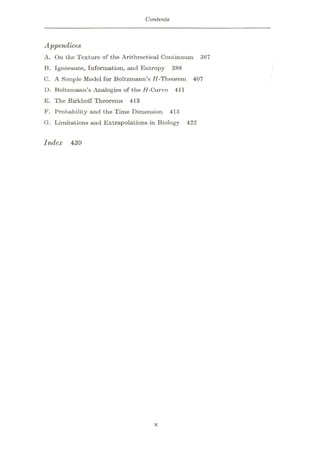
Contents
Preface xiii
INTRODUCTION
Chapter I. Science: A Brief Evolutionary Analysis 22
1. The Genesis of Science 22
2. Evolution by Mutations 23
3. Memory: The Earliest Storo of Knowledge 24
4. From Taxonomic to Logical Filing 25
5. Theoretical Science and Economy of Thought 26
6. Significant Differences between East and West 30
7. Theoretical Scieneo: A Continuous Source of Experimental Suggestions 32
8. Theoretical Science and the Analytical Habit 33
9. Theoretical Science: A Living Organism 36
Chapter II. Science, Arithmomorphism, and Dialectics 39
1. “No Scionco without Theory” 39
2. Theoretical Science versus Science 42
3. Numbers and Arithmomorphic Concepts 43
4. Dialectical Concepts 45
5. Platonic Traditions in Modern Thought 47
6. Dialectical Concepts and Science 50
7. Probability: An Illustration of Hegelian Dialectics 52
Chapter III. Change, Quality, and Thought 60
1. Science and Change 60
2. Change and Dialectical Concopts 62
vii
Contents
3. Tho Intuitive versus the Arithmetical Continuum 65
4. Instants of Time and Duration 69
5. A Logistic Solution 72
6. What Is Sameness? 73
7. How Numerous Are Qualities? 76
8. The Continuity of Qualities 77
9. A Critique of Arithmomorphism 79
10. Thought and “Thought” 83
Chapter IV. Measure, Size, and Sameness: Some Object Lessons
from Physics 95
1. Physics and Philosophy of Scienco 95
2. Measure, Quantity, and Quality 97
3. The Qualitative Residual 101
4. The Problem of Size 105
5. Samonoss and Process 107
6. Cardinality and the Qualitative Residual 110
Chapter V. Novelty, Evolution, and Entropy: More Object Lessons
from Physics 114
1. Theory and Novelty 114
2. Novelty and Uncertainty 121
3. Hysteresis and History 123
4. Physics and Evolution 127
5. Time: The Great Mystery 130
6. Time and “Time” 134
7. Temporal Prediction and Clock-Time 136
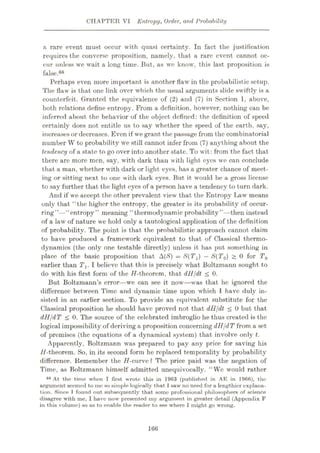
Chapter VI. Entropy, Order, and Probability 141
1. Entropy: Order and Disorder 141
2. Entropy and Probability 148
3. The Ergodic Hypothesis and the Ergodic Theorem 153
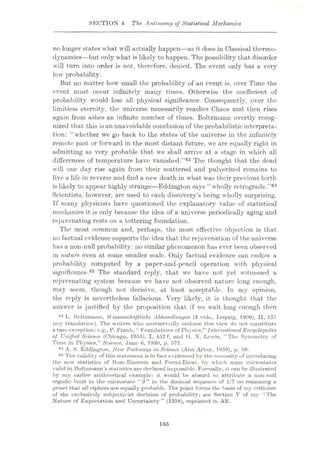
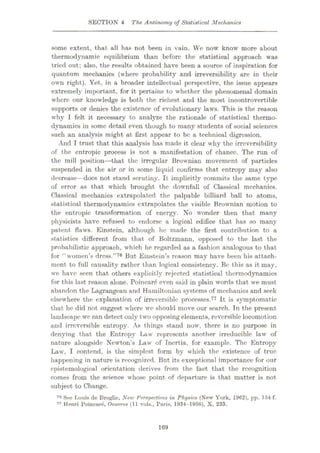
4. Tho Antinomy of Statistical Mechanics 159
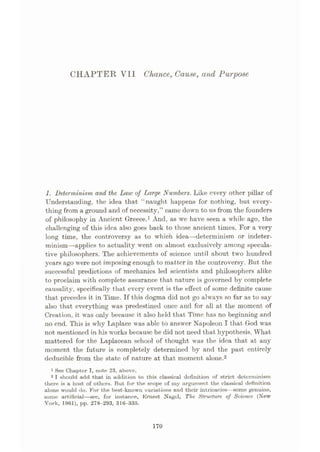
Chapter VII. Chance, Cause, and Purpose 170
1. Determinism and the Law of Large Numbers 170
2. Determinism and the Principle of Indeterminacy 172
3. A Physicist’s Plea for Causality 174
4. Causality and Free Will 176
5. The Categorical Imperative 179
viii
Contents
0. Physical Parochialism and the Notion of Cause 182
7. Entropy and Purposive Activity 187
Chapter VIII. Evolution versus Locomotion 196
1. Irreversible and Irrevocable Processes 190
2. Evolution, Irrevocability, and Time’s Arrow 198
3. From Part to Whole 200
4. Evolution: A Dialectical Tangle 203
5. Evolution Is Not a Mystical Idea 206
Chapter IX. The Analytical Representation of Process and the
Economics of Production 211
1. The Partial Process and Its Boundary 211
2. The Analytical Coordinates of a Partial Process 215
3. Stocks and Flows 219
4. Funds and Services 224
5. A Flow-Fund Model 228
6. Further Reflections on the Flow-Fund Model 231
7. The Production Function 234
8. The Economics of Production 236
9. The Factory System and Its Production Function 238
10. Production and the Time Factor 244
11. The Factory: Tts Advantages and Limitations 248
12. The Factory and the Farm 250
13. Internal Flows and Analysis 253
14. Marx’s Diagram of Simple Reproduction versus a Flow-Fund Model 262
15. Commodities, Processes, and Growth 268
Chapter X. Entropy, Value, and Development 276
1. Entropy and Economic Value 276
2. The General Equation of Value 283
3. Entropy and Development 292
4. From the Struggle for Entropy to Social Conflict 306
Chapter XI. The Economic Science: Some General Conclusions 316
1. The Boundaries of fcho Economic Process 316
2. Why Is Economics Not a Theoretical Science? 322
3. Arithmomorphic Models and Economics 330
4. Economics and Man 341
5. Rational Behavior and Rational Society 345
0. Man and His Tradition 359
is
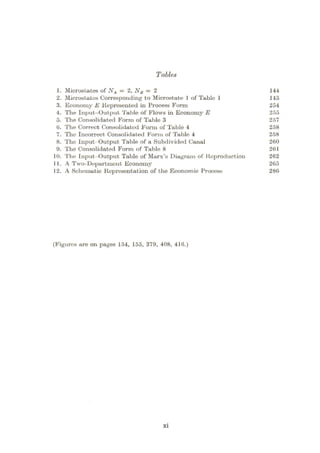
Contents
Appendices
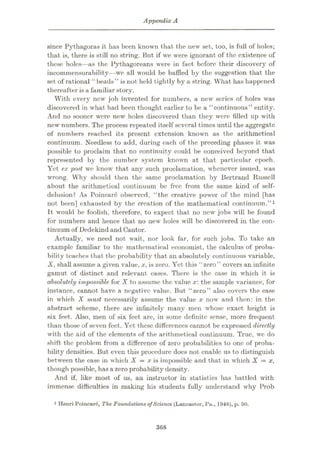
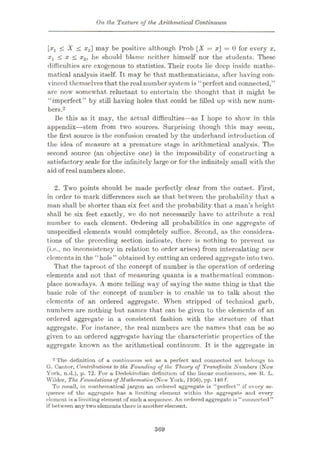
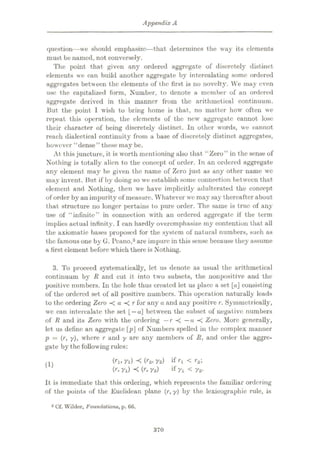
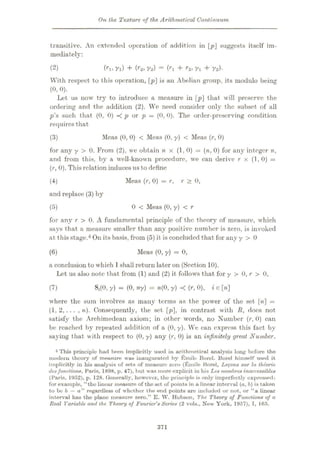
A. On the Texture of the Arithmetical Continuum 367
13. Ignorance, Information, and Entropy 388
C. A Simple Model for Boltzmann’s 17-Theorem 407
D. Boltzmann’s Analogies of the H-Curve 411
E. The Birkhoff Theorems 413
F. Probability and the Time Dimension 415
G. Limitations and Extrapolations in Biology 422
Index 439
X
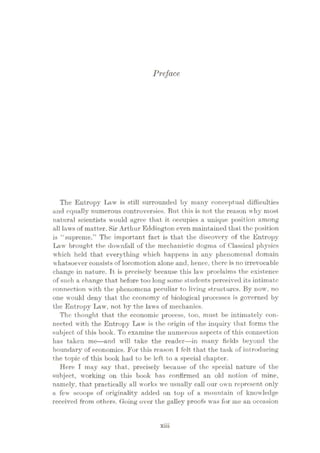
Tables
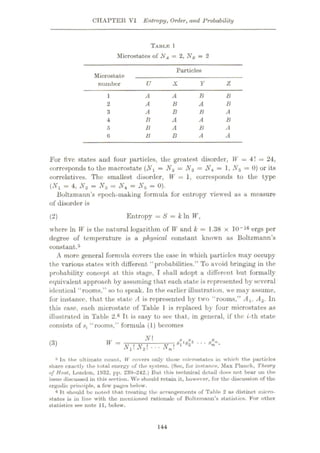
1. Microstates of NA = 2, NB — 2
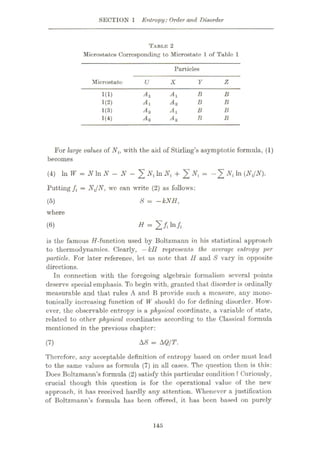
2. Microstates Corresponding to Microstate 1 of Table 1
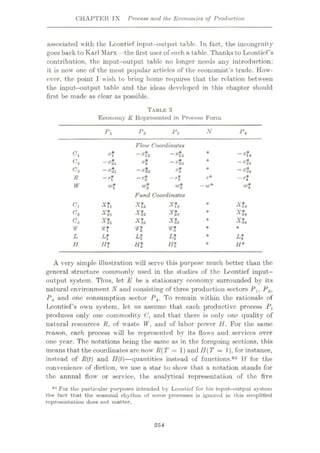
3. Economy E Represented in Process Form
4. The Input—Output Table of Flows in Economy E
5. The Consolidated Form of Table 3
0. The Correct Consolidated Form of Table 4
7. The Incorrect Consolidated Form of Table 4
8. The Input-Output Table of a Subdivided Canal
9. The Consolidated Form of Table 8
10. The Input-Output Table of Marx’s Diagram of Reproduction
11. A Two-Department Economy
12. A Schematic Representation of the Economic Process
144
145
254
255
257
258
258
260
261
262
2G5
286
(Figures are on pages 154, 155, 379, 408, 416.)
xi
Preface
The Entropy Law is still surrounded by many conceptual difficulties
and equally numerous controversies. But this is not the reason why most
natural scientists would agree that it occupies a unique position among
all laws of matter. Sir Arthur Eddington even maintained that the position
is “supreme.” The important fact is that the discovery of the Entropy
Law brought the downfall of the mechanistic dogma of Classical physics
which held that everything which happens in any phenomenal domain
whatsoever consists of locomotion alone and, hence, there is no irrevocable
change in nature. It is precisely because this law proclaims the existence
of such a change that before too long some students perceived its intimate
connection with the phenomena peculiar to living structures. By now, no
one would deny that the economy of biological processes is governed by
the Entropy Law, not by the laws of mechanics.
The thought that the economic process, too, must be intimately con¬
nected with the Entropy Law is the origin of the inquiry that forms the
subject of this book. To examine the numerous aspects of this connection
has taken me
—and will take the reader—in many fields beyond the
boundary of economics. For this reason I felt that the task of int roducing
the topic of this book had to be left to a special chapter.
Here I may say that, precisely because of the special nature of the
subject, working on this book has confirmed an old notion of mine,
namely, that practically all works we usually call our own represent only
a few scoops of originality added on top of a mountain of knowledge
received from others. Going over the galley proofs was for me an occasion
xiii
Preface.
as no other to realize how immense is my debt to my teachers and also
how numerous they are. It prompted me to seize upon this opportunity
to express my gratitude to them by the dedication of this volume.
Many teachers will not have their name carved inside the pantheon of
the great minds, even though many will be no less highly revered. Foremost
in this category (and in my heart) are my parents—my father, who
taught me to read, write, and calculate and who planted in me the seed
of intellectual curiosity, and my mother, who, by her living example,
taught me the value of hard work. Gheorghe Kadulescu, my elementary
school teacher in a small town of old Romania, fostered with great skill
my early mathematical inclinations by teaching us how to solve “tricky”
problems which, as 1 learned later, are usually solved by algebra. From
the long list of the inspiring and devoted teachers I had at Lyceum
Manastirea Dealu I may mention Grigore Zapan and Gh. I. Dumitrescu,
who with tremendous love for their profession guided my first steps in
higher mathematics. I think that my share of good luck at the university
level also was above the average. I studied with scholars whose names
now occupy a place of honor in the history of science: Traian Lalescu,
Octav Onieescu, and G. Titeica (in Bucharest), Albert Aftalion, iSmile
Borcl, Georges Darmois, and Maurice Frdchet (in Paris), and E. B. Wilson
(in the U.S.A.). But two of my teachers had the most decisive influence on
my scientific orientation: Karl Pearson, the man of broad knowledge who
single-handedly laid the foundations of the science of statistics, and
Joseph A. Schumpeter, whose unique vision of the economic process
combined in a harmonious manner quantitative with qualitative evolu¬
tionary analysis.
Needless to say, one should consider as his teachers also those from
whom he learned in any other way, chiefly through their writings. Like
everyone else, I also learned a great deal from my professional colleagues
(many things even from my students). From their number, which is
legion, I cannot resist singling out two of my fellow economists (and
econometricians)—Wassily W. Leontief and Paul A. Samuelson.
The reader does not need any hint to realize that a book of this nature
cannot be written as a research project with a definite timetable. The ideas
contained in it were worked out in my mind over many years (as many
as twenty, I believe) and in various circumstances—sometimes while
lecturing, sometimes while working in the garden. Some of these ideas
have already appeared in print, mostly in the introductory essay to my
Analytical Economics.
During all these years, Vanderbilt University has given me encourage¬
ment and provided me with facilities for wrork, many of which came from
the Graduate Program in Economic Development. For all this am
xiv
Preface
especially and variously indebted to my colleagues George W. Stocking,
Rendigs Fels, Anthony M. Tang, and James S. Worley. A research grant
from the National Science Foundation has enabled me to devote half of
my teaching time during one and a half years to bringing this work to
its present form. During this last phase I was assisted by Messrs. Aly
Alp Ercelawn and Ibrahim Eri§.
I am grateful also to the Syndics of Harvard University Press for having
considered it worthwhile to have the introductory essay of my Analytical
Economic# expanded and completed in the present volume.
My final thought of gratitude is for my wife, who has been a patient,
attentive reader, a sympathetic but constructive critic, and a tireless
proofreader, and who has provided me with a home atmosphere conducive
to study and work.
NICHOLAS GEORGESCTJ-ROEGEN
Vanderbilt University
July 1970
NOTE
“AE” in the footnotes stands for iny Analytical Economics: Issues and
Problems, published by Harvard University Press in
xv
The Entropy Law and the Economic Process
Introduction
No science has been criticized by its own servants as openly and constantly
as economics. The motives of dissatisfaction are many, but the most
important pertains to the fiction of homo oeconomicus. The complaint is
that this fiction strips man’s behavior of every cultural propensity, which
is tantamount to saying that in his economic life man acts mechanically.
This is why the shortcoming is ordinarily exposed as the mechanistic out¬
look of modern economics. The criticism is irrefutable. However, the
mechanistic sin of economic science is much deeper than this criticism
implies. For the sin is still there even if we look at the economic process
from the purely physical viewpoint only. The whole truthis thateconomics,
in the way this discipline is now generally professed, is mechanistic in the
same strong sense in which we generally believe only Classical mechanics
to be.
In this sense Classical mechanics is mechanistic because it can neither
account for the existence of enduring qualitative changes in nature nor
accept this existence as an independent fact. Mechanics knows only loco¬
motion, and locomotion is both reversible and qualitylcss. The same draw¬
back was built into modern economics by its founders, who, on the testi¬
mony of Jevons and Walras, had no greater aspiration than to create an
economic science after the exact pattern of mechanics. A most eloquent
proof of how- staunch the enthusiasm for mechanics was among the early
architects is provided by Irving Fisher, who went to the trouble of building
a very intricate apparatus just for demonstrating the purely mechanical
nature of consumer behavior.1
1 Irving Fisher, Mathematical Investigations in the Theory of Value and Prices (New
Haven, 1925), pp. 38 fanrl passim. The work was first published in 1892.
1
Introduction
And these architects succeeded so well with their grand plan that the
conception of the economic process as a mechanical analogue has ever
since dominated economic thought completely. Tn this representation, the
economic process neither induces any qualitative change nor is affected by
the qualitative change of the environment into which it is anchored. It is
an isolated, self-contained and ahistoricul process—a circular flow between
production and consumption with no outlets and no inlets, as the elemen¬
tary textbooks depict it. Economists do speak occasionally of natural
resources. Yet the fact remains that, search as one may, in none of the
numerous economic models in existence is there a variable standing for
nature’s perennial contribution. The contact some of these models have
with the natural environment is confined to Ricardian land, which is
expressly defined as a factor immune to any qualitative change. We could
very well refer to it simply as “space.” But let no one be mistaken about
the extent of the mechanistic sin : Karl Marx’s diagrams of economic re¬
production do not include even this colorless coordinate. So, if we may
use a topical slogan for a trenchant description of the sit uation, both main
streams of economic thought view the economic process as a “no deposit,
no return” affair in relation to nature.
The intriguing ease with which .Neoclassical economists left natural
resources out of their own representation of the economic process may not
be unrelated to Marx’s dogma that everything nature offers us is gratis.
A more plausible explanation of this ease and especially of the absence of
any noticeable attempt at challenging the omission is that the “no deposit,
no return” analogue befits the businessman’s view of economic life. For if
one looks oidy at money, all he can see is that money just passes from one
hand to another: except by a regrettable accident, it never gets out of the
economic process. Perhaps the absence of any difficulty in securing raw
materials by those countries where modern economics grew and flourished
was yet another reason for economists to remain blind to this crucial eco¬
nomic factor. Not even the wars the same nations fought for the control
of the world’s natural resources awoke economists from their slumber.2
All in all, the wholesale attachment of almost every economist of the
last one hundred years to the mechanistic dogma is still a historical puzzle.
Once, it is true, physicists, mathematicians, and philosophers were one in
singing the apotheosis of mechanics as the highest triumph of human
reason. But by the time Jevons and Walras began laying the cornerstones
2 To top all the intriguing fuels of this history: not more than six yours before
Jevons published his puthbreaking Lectures, he wrote a highly interesting unalysis of
the consequences for Clreat Britain of a speedy depletion of her coal reserves. W.
Stanley Jevons, The CoalQuestioned. A. W. Flux (3rd edn., London, 1906), originally
published in 1865, was Jevons’ first major work in economies.
2
Introduction
of modern economics, a spectacular revolution in physics had already
brought the downfall of the mechanistic dogma both in the natural sciences
and in philosophy. And the curious fact is that none of the architects of
‘£
the mechanics of utilityand self-interest ” and even none of the latter-day
model builders seem to have been aware at any time of this downfall.
Otherwise, one could not understand why they have clung to the mecha¬
nistic framework with the fervor with which they have. Even an economist
of Frank H. Knight’s philosophical finesse not long ago referred to me¬
chanics as “the sister science” of economics.3
Revolution is a fairly recurrent state in physics. The revolution that
interests us here began with the physicists’ acknowledging the elementary
fact that heat always moves by itself in one direction only, from the hotter
to the colder body. This led to the recognition that there arc phenomena
which cannot be reduced to locomotion and hence explained by mechanics.
A new branch of physics, thermodynamics, then came into being and a new
law, the Entropy Law, took its place alongside—rather opposite to—the
laws of Newtonian mechanics.
From the viewpoint of economic science, however, the importance of
this revolution exceeds the fact that it ended the supremacy of the mech¬
anistic epistemology in physics. The significant fact for the economist is
that the new science of thermodynamics began as a physics of economic
value and, basically, can still be regarded as such. The Entropy Law itself
emerges as the most economic in nature of all natural laws. It is in the
perspective of these developments in the primary science of matter that
the fundamentally nonmechanistic nature of the economic process fully
reveals itself. As I have argued in the introductory essay of my Analytical
Economics, only an analysis of the intimate relationship between the
Entropy Law and the economic process can bring to the surface those
decisively qualitative aspects of this process for which the mechanical
analogue of modern economics has no room. The object of that essay—to
examine this relationship with a view to filling a conspicuous lacuna of the
economic discipline—will be pursued in this volume with greater detail
and in more varied directions.
The fact that a natural law is involved in every aspect of man’s behavior
is so common that we would not expect the study of the influence of the
Entropy Law on man’s economic actions to present any unusual compli¬
cations. Yet manifold avenues open up almost as soon as one begins to
tackle the problem. What is more, these avenues lead beyond the boundary
3 Fru.uk H. Knight, The Ethics of Competition (New York, 1935), p. 85.
3
Introduction
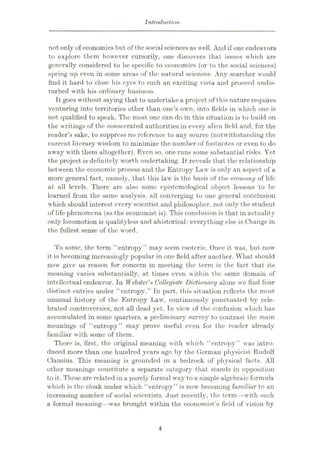
not only of economics but of thesocial sciences as well. And if one endeavors
to explore them however cursorily, one discovers that issues which are
generally considered to be specific to economics (or to the social sciences)
spring up even in some areas of the natural sciences. Any searcher would
find it hard to close his eyes to such an exciting vista and proceed undis¬
turbed with his ordinary business.
It goes without saying that to undertake a project of this nature requires
venturing into territories other than one’s own, into fields in which one is
not qualified to speak. The most one can do in this situation is to build on
the writings of the consecrated authorities in every alien field and, for the
reader’s sake, to suppress no reference to any source (notwithstanding the
current literary wisdom to minimize the number of footnotes or even to do
away with them altogether). Even so, one runs some substantial risks. Yet
the project is definitely worth undertaking. It reveals that the relationship
between the economic process and the Entropy Law is only an aspect of a
more general fact, namely, that this law is the basis of the economy of life
at all levels. There are also some epistemological object lessons to be
learned from the same analysis, all converging to one general conclusion
which should interest every scientist and philosopher, not only the student
of life phenomena (as the economist is). This conclusion is that in actuality
only locomotion is qualityless and ahistorical: everything else is Change in
the fullest sense of the word.
To some, the term “entropy ” may seem esoteric. Once it was, but now
it is becoming increasingly popular in one field after another. What should
now give us reason for concern in meeting the term is the fact that its
meaning varies substantially, at times even within the same domain of
intellectual endeavor. In Webster's Collegiate Dictionary alone we find four
distinct entries under “entropy.” In part, this situation reflects the most
unusual history of the Entropy Law, continuously punctuated by cele¬
brated controversies, not all dead yet. In view of the confusion which has
accumulated in some quarters, a preliminary survey to contrast the main
meanings of “entropy” may prove useful even for the reader already
familiar with some of them.
There is, first, the original meaning with which “entropy” was intro¬
duced more than one hundred years ago by the German physicist Rudolf
Clausius. This meaning is grounded in a bedrock of physical facts. All
other meanings constitute a separate category that stands in opposition
to it. These are related in a purely formal way to a simple algebraic formula
which is the cloak under which “entropy” is now becoming familiar to an
increasing number of social scientists. Just recently, the term—with such
a formal meaning—was brought within the economist’s field of vision by
4
Introduction
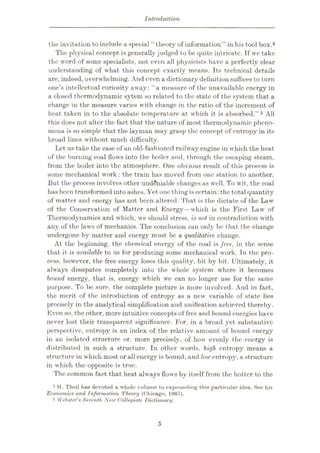
the invitation to include a special “theory of information” in his tool box.4
The physical concept is generally judged to be quite intricate. If we take
the word of some specialists, not even all physicists have a perfectly clear
understanding of what this concept exactly means. Its technical details
are, indeed, overwhelming. And even a dictionary definition suffices to turn
one’s intellectual curiosity away: “a measure of the unavailable energy in
a closed thermodynamic sytem so related to the state of the system that a
change in the measure varies with change in the ratio of the increment of
heat taken in to the absolute temperature at which it is absorbed.”5 All
this does not alter the fact that the nature of most thermodynamic pheno¬
mena is so simple that the layman may grasp the concept of entropy in its
broad lines without much difficulty.
Let us take the case of an old-fashioned railway engine in which the heat
of the burning coal flows into the boiler and, through the escaping steam,
from the boiler into the atmosphere. One obvious result of this process is
some mechanical work : the train has moved from one station to another.
But the process involves other undeniable changes as well. To wit, the coal
has been transformed intoashes. Yet one thing is certain:the total quantity
of matter and energy has not been altered. That is the dictate of the Law
of the Conservation of Matter and Energy—which is the First Law of
Thermodynamics and which, we should stress, is not in contradiction with
any of the laws of mechanics. The conclusion can only be that the change
undergone by matter and energy must be a qualitative change.
At the beginning, the chemical energy of the coal is free, in the sense
that it is available to us for producing some mechanical work. Tn the pro¬
cess, however, the free energy loses this quality, bit by bit. Ultimately, it
always dissipates completely into the whole system where it becomes
bound energy, that is, energy which we can no longer use for the same
purpose. To be sure, the complete picture is more involved. And in fact,
the merit of the introduction of entropy as a new variable of state lies
precisely in the analytical simplification and unification achieved thereby.
Even so, the other, more intuitive concepts of free and bound energies have
never lost their transparent significance. For, in a broad yet substantive
perspective, entropy is an index of the relative amount of bound energy
in an isolated structure or, more precisely, of how evenly the energy is
distributed in such a structure. In other words, high entropy means a
structure in which most or all energy is bound, and low entropy, a structure
in which the opposite is true.
The common fact that heat always flows by itself from the hotter to the
4 H. Theil has devoted a whole volume to expounding this particular idea. See his
Economics and Information Theory (Chicago, 1967).
5 Webster's Seventh New Collegiate Dictionary.
5
Introduction
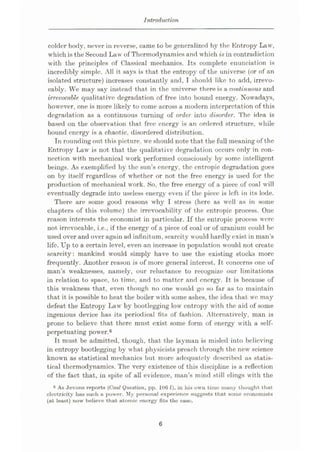
colder body, never in reverse, came to be generalized by the Entropy Law,
which is the Second Law of Thermodynamics and which is in contradiction
with the principles of Classical mechanics. Its complete enunciation is
incredibly simple. All it says is that the entropy of the universe (or of an
isolated structure) increases constantly and, I should like to add, irrevo¬
cably. We may say instead that in the universe there is a continuous and
irrevocable qualitative degradation of free into bound energy. Nowadays,
however, one is more likely to come across a modern interpretation of this
degradation as a continuous turning of order into disorder. The idea is
based on the observation that free energy is an ordered structure, while
bound energy is a chaotic, disordered distribution.
In rounding out this picture, we should note that the full meaning of the
Entropy Law is not that the qualitative degradation occurs only in con¬
nection with mechanical work performed consciously by some intelligent
beings. As exemplified by the sun’s energy, the cntropic degradation goes
on by itself regardless of whether or not the free energy is used for the
production of mechanical work. So, the free energy of a piece of coal will
eventually degrade into useless energy even if the piece is left in its lode.
There are some good reasons why I stress (here as well as in some
chapters of this volume) the irrevocability of the entropic process. One
reason interests the economist in particular. If the entropic process were
not irrevocable, i.e., if the energy of a piece of coal or of uranium could be
used over and over again ad infinitum, scarcity would hardly exist in man’s
life. Up to a certain level, even an increase in population would not create
scarcity: mankind would simply have to use the existing stocks more
frequently. Another reason is of more general interest. It concerns one of
man’s weaknesses, namely, our reluctance to recognize our limitations
in relation to space, to time, and to matter and energy. It is because of
this weakness that, even though no one would go so far as to maintain
that it is possible to heat the boiler with some ashes, the idea that we may
defeat the Entropy Law by bootlegging low entropy with the aid of some
ingenious device has its periodical fits of fashion. Alternatively, man is
prone to believe that there must exist some form of energy with a self-
perpetuating power.6
Tt must be admitted, though, that the layman is misled into believing
in entropy bootlegging by what physicists preach through the new science
known as statistical mechanics but more adequately described as statis¬
tical thermodynamics. The very existence of this discipline is a reflection
of the fact that, in spite of all evidence, man’s mind still clings with the
6 As Jevons reports (Coal Question, pp. 106 f), in his own time many thought that
electricity hus such a power. My personal experience suggests that some economists
(at least) now believe that atomic energy fits the ease.
6
Introduction
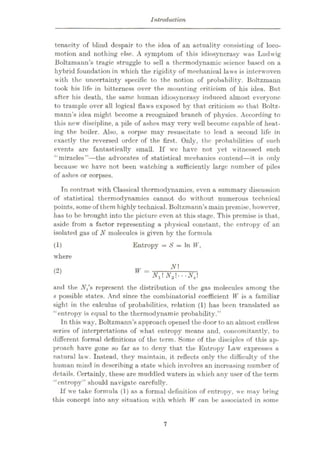
tenacity of blind despair to the idea of an actuality consisting of loco¬
motion and nothing else. A symptom of this idiosyncrasy was Ludwig
Boltzmann’s tragic struggle to sell a thermodynamic science based on a
hybrid foundation in which the rigidity of mechanical laws is interwoven
with the uncertainty specific to the notion of probability. Boltzmann
took his life in bitterness over the mounting criticism of his idea. But
after his death, the same human idiosyncrasy induced almost everyone
to trample over all logical flaws exposed by that criticism so that Boltz¬
mann’s idea might become a recognized branch of physics. According to
this new discipline, a pile of ashes may very well become capable of heat¬
ing the boiler. Also, a corpse may resuscitate to lead a second life in
exactly the reversed order of the first. Only, the probabilities of such
events are fantastically small. If we have not yet witnessed such
“miracles”
—the advocates of statistical mechanics contend—it is only
because we have not been watching a sufficiently large number of piles
of ashes or corpses.
In contrast with Classical thermodynamics, even a summary discussion
of statistical thermodynamics cannot do without numerous technical
points, some of them highly technical. Boltzmann’s main premise, however,
has to be brought into the picture even at this stage. This premise is that,
aside from a factor representing a physical constant, the entropy of an
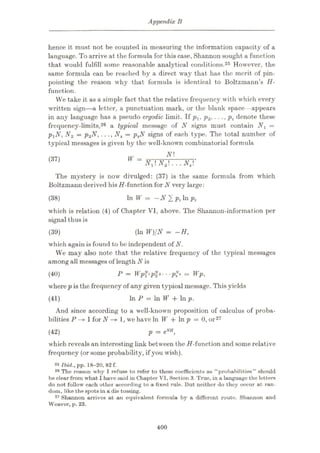
isolated gas of N molecules is given by the formula
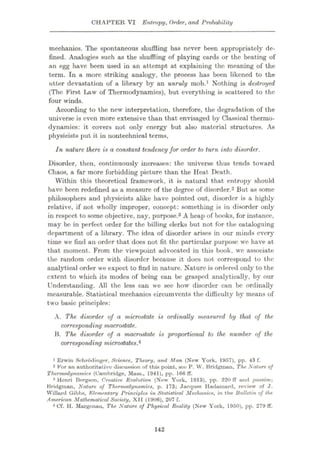
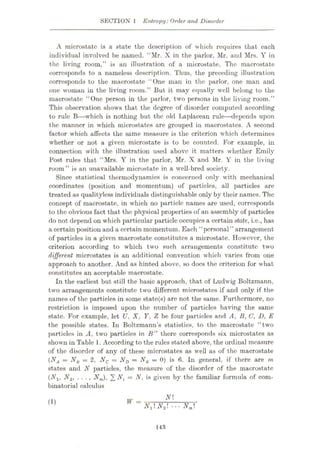
Entropy = S = In W,
(1)
where
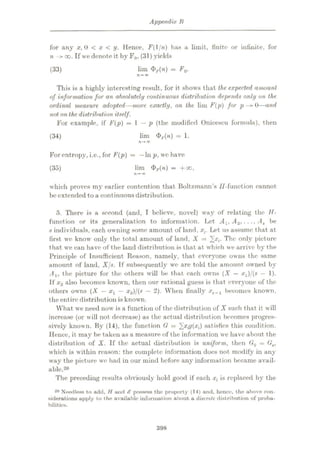
N
(2) W = N1N2‘--N,
and the IV,’s represent the distribution of the gas molecules among the
s possible states. And since the combinatorial coefficient W is a familiar
sight in the calculus of probabilities, relation (1) has been translated as
“entropy is equal to the thermodynamic probability.”
In this way, Boltzmann’s approach opened the door toan almost endless
series of interpretations of what entropy means and, concomitantly, to
different formal definitions of the term. Some of the disciples of this ap¬
proach have gone so far as to deny that the Entropy Law expresses a
natural law. Instead, they maintain, it reflects only the difficulty of the
human mind in describing a state which involves an increasing number of
details. Certainly, these are muddled waters in which any user of the term
“entropy” should navigate carefully.
If we take formula (1) as a formal definition of entropy, we may bring
this concept into any situation with which W can be associated in some
7
Introduction
way or another. For a telling example, let us consider five distinct points
in a plane. Tf we put N = 5, Nx = 2, and N2 = 3, then W gives the maxi¬
mum number of distinct straight lines determined by these points. We may
therefore speak of
5!
S = 1O«'»2!T. = 1
(3)
as the “entropy of a pentagon.” This shows how easy it is to concoct
meanings of “entropy” that are wholly vacuous.
However, the emergence of (1) in problems connected with the trans¬
mission of sequences of signals (or symbols) is a normal event that should
not surprise us: if the number of distinct signals is s, then W is the number
of distinct sequences of length N in which each t-th symbol enters Nt times.
What should surprise us is that 8 has been equated with the amount of
information contained in such a sequence. According to this equation, if
we take, say, Newton’s Principia Mothernatica and scramble its letters and
symbols, the result still represents the same amount of information! Even
more perplexing is a subsequent argument by which the total information
is identified with negentropy (i.e., the negative value of physical entropy).
The concept of entropy has even penetrated into domains in which
there is no room for combinatorial analysis and, hence, for W. This is due
to the fact that the most popular definition of the concept as a “measure”
of the amount of information is given by a special transformation of (1).
The definition is7
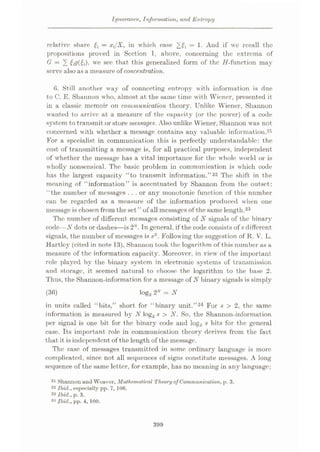
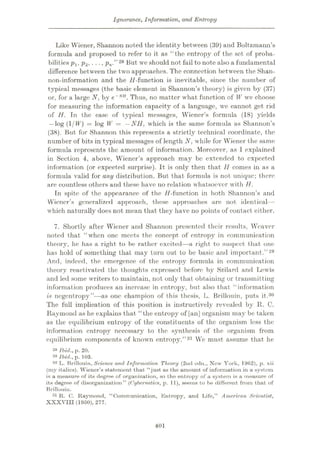
-2/.log/,
(4)
where /t > 0 for every i and ][/i = 1.
This expression has several interesting properties which account for the
attraction it has exercised on many minds. But its most interesting feature
is that we can apply it to any percental distribution—say, the distribution
of a country’s exports by destinations or of personal incomes by income
brackets. It is by such a complicated metamorphosis, of which not all users
of the term “entropy’’may be aware, that, we have come to speak of the
amount of information of almost any statistical data. And w-e march on,
without even noticing that this terminological mess compels us to say, for
instance, that for a country in which income is moreequally distributed the
statistics of income distribution contains a greater amount of information!8
7 This transformation assumes that every Nt is large enough for N,! to be approxi¬
mated by Stirling’s formula. This formula is reproduced in Appendix G, note 29,
in this volume.
8 This statement follows from the fact that the property unmistakably reflected
by E is the degree of evenness (indirectly, the degree of concentration) of the dis¬
tribution described by the s. Cf. Appendix B in this volume.
8
Introduction
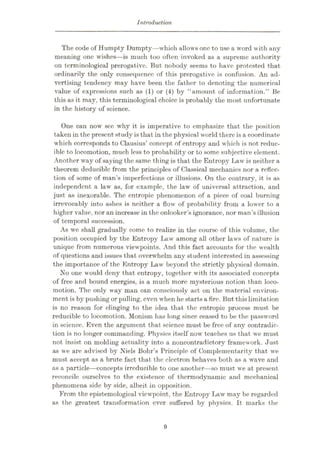
The code of Humpt.y Dumpty—which allows one to use a word with any
meaning one wishes—is much too often invoked as a supreme authority
on terminological prerogative. But nobody seems to have protested that
ordinarily the only consequence of this prerogative is confusion. An ad¬
vertising tendency may have been the father to denoting the numerical
value of expressions such as (1) or (4) by “amount of information.” Be
this as it may, this terminological choice is probably the most unfortunate
in the history of science.
One can now see why it is imperative to emphasize that the position
taken in the present study is that in the physical world there is a coordinate
which corresponds to Clausius’ concept of entropy and which is not reduc¬
ible to locomotion, much less to probability or to some subjective element.
Another way of saying the same thing is that the Entropy Law is neither a
theorem deduciblc from the principles of Classical mechanics nor a reflec¬
tion of some of man’s imperfections or illusions. On the contrary, it is as
independent a law as, for example, the law of universal attraction, and
just as inexorable. The entropic phenomenon of a piece of coal burning
irrevocably into ashes is neither a flow of probability from a lower to a
higher value, nor an increase in the onlooker’s ignorance, nor man’s illusion
of temporal succession.
As we shall gradually come to realize in the course of this volume, the
position occupied by the Entropy Law among all other laws of nature is
unique from numerous viewpoints. And this fact accounts for the wealth
of questions and issues that overwhelm any student interested in assessing
the importance of the Entropy Law beyond the strictly physical domain.
No one would deny that entropy, together with its associated concepts
of free and bound energies, is a much more mysterious notion than loco¬
motion. The only way man can consciously act on the material environ¬
ment is by pushing or pulling, even when he startsa fire. But thislimitation
is no reason for clinging to the idea that the entropic process must be
reducible to locomotion. Monism has long since ceased to be the password
in science. Even the argument that science must be free of any contradic¬
tion is no longer commanding. Physics itself now teaches us that we must
not insist on molding actuality into a noncontradictory framework. Just
as we are advised by Niels Bohr’s Principle of Complementarity that we
must accept as a brute fact that the electron behaves both as a wave and
as a particle—concepts irreducible to one another—so must we at present
reconcile ourselves to the existence of thermodynamic and mechanical
phenomena side by side, albeit in opposition.
From the epistemological viewpoint, the Entropy Law may be regarded
as the greatest transformation ever suffered by physics. It marks the
9
Introduction
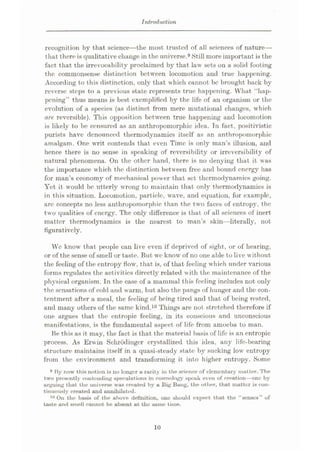
recognition by that science
—the most trusted of all sciences of nature—
that there is qualitative change in the universe.9Still more important is the
fact that the irrevocability proclaimed by that law sets on a solid footing
the commonsense distinction between locomotion and true happening.
According to this distinction, only that which cannot be brought back by
reverse steps to a previous state represents true happening. What “hap¬
pening” thus means is best exemplified by the life of an organism or the
evolution of a species (as distinct from mere mutational changes, which
are, reversible). This opposition between true happening and locomotion
is likely to be censured as an anthropomorphic idea. In fact, positivistic
purists have denounced thermodynamics itself as an anthropomorphic
amalgam. One writ contends that even Time is only man’s illusion, and
hence there is no sense in speaking of reversibility or irreversibility of
natural phenomena. On the other hand, there is no denying that it was
the importance which the distinction between free and bound energy has
for man’s economy of mechanical power that set thermodynamics going.
Yet it would be utterly wrong to maintain that only thermodynamics is
in this situation. Locomotion, particle, wave, and equation, for example,
are concepts no less anthropomorphic than the two faces of entropy, the
two qualities of energy. The only difference is that of all sciences of inert
matter thermodynamics is the nearest to man’s skin—literally, not
figuratively.
We know that j>eople can live even if deprived of sight, or of hearing,
or of the sense of smell or taste. But we know of no one able to live without
the feeling of the entropy flow, that is, of that feeling which under various
forms regulates the activities directly related with the maintenance of the
physical organism. In the case of a mammal this feeling includes not only
the sensations of cold and warm, but also the pangs of hunger and the con¬
tentment after a meal, the feeling of being tired and that of being rested,
and many others of the same kind.10 Things are not stretched therefore if
one argues that the entropic feeling, in its conscious and unconscious
manifestations, is the fundamental aspect of life from amoeba to man.
Be this as it may, the fact is that the material basis of life is an entropic
process. As Erwin Schrodingcr crystallized this idea, any life-bearing
structure maintains itself in a quasi-steady state by sucking low entropy
from the environment and transforming it into higher entropy. Some
9 By now this notion is no longer a rarity in the science of elementary matter. The
two presently contending speculations in cosmology speak even of creation
—one by
urguing that the universe was created by a Big Bang, the other, that matter is con¬
tinuously created and annihilated.
10 On the basis of the above definition, one should expect that the “senses” of
taste and smell cannot be absent at the same time.
10
Introduction
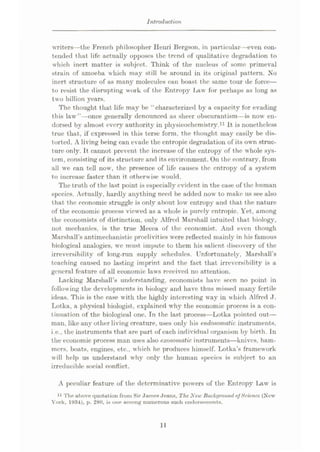
writers—the French philosopher Henri Bergson, in particular
tended that life actually opposes the trend of qualitative degradation to
which inert matter is subject. Think of the nucleus of some primeval
strain of amoeba which may still be around in its original pattern. No
inert structure of as many molecules can boast the same tour de force
—
to resist the disrupting work of the Entropy Law for perhaps as long as
two billion years.
The thought that life may be “characterized by a capacity for evading
this law”—once generally denounced as sheer obscurantism—is now en¬
dorsed by almost every authority in physicochcmistry.11 It is nonetheless
true that, if expressed in this terse form, the thought may easily be dis¬
torted. A living being can evade the cntropic degradation of its own struc¬
ture only. It cannot prevent the increase of the entropy of the whole sys¬
tem, consisting of its structure and its environment. On the contrary, from
all we can tell now, the presence of life causes the entropy of a system
to increase faster than it otherwise would.
The truth of the last point is especially evident in the case of the human
species. Actually, hardly anything need be added now to make us see also
t hat the economic struggle is only about low entropy and that the nature
of the economic process viewed as a whole is purely entropic. Yet, among
the economists of distinction, only Alfred Marshall intuited that biology,
not mechanics, is the true Mecca of the economist. And even though
Marshall’s antimechanistic proclivities were reflected mainly in his famous
biological analogies, we must impute to them his salient discovery of the
irreversibility of long-run supply schedules. Unfortunately, Marshall’s
teaching caused no lasting imprint and the fact that irreversibility is a
general feature of all economic laws received no attention.
Lacking Marshall’s understanding, economists have seen no point in
following the developments in biology and have thus missed many fertile
ideas. This is the case with the highly interesting way in which Alfred J.
Lotka, a physical biologist, explained why the economic process is a con¬
tinuation of the biological one. Tn the last process—Lotka pointed out
—
man, like any other living creature, uses only his endosomatic instruments,
i.e., the instruments that are part of each individual organism by birth. In
the economic process man uses also exosonmtic instruments—knives, ham¬
mers, boats, engines, etc., which he produces himself. Lotka’s framework
will help us understand why only the human species is subject to an
irreducible social conflict.
con-
A peculiar feature of the determinative powers of the Entropy Law is
11 The above quotation from Sir James Jeans, The New Background ofScience (New
York, 1934), p. 280, is one among numerous such endorsements.
11
Introduction.
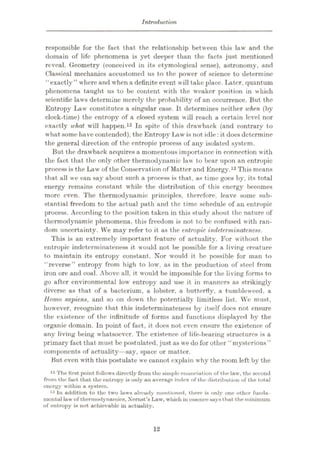
responsible for the fact that the relationship between this law and the
domain of life phenomena is yet deeper than the facts just mentioned
reveal. Geometry (conceived in its etymological sense), astronomy, and
Classical mechanics accustomed us to the power of science to determine
“exactly ” where and when a definite event will take place. Later, quantum
phenomena taught us to be content with the weaker position in which
scientific laws determine merely the probability of an occurrence. But the
Entropy Law constitutes a singular case. It determines neither when (by
clock-time) the entropy of a closed system will reach a certain level nor
exactly what will happen.12 In spite of this drawback (and contrary to
what some have contended), the Entropy I>aw is not idle: it does determine
the general direction of the entropic process of any isolated system.
But the drawback acquires a momentous importance in connection with
the fact that the only other thermodynamic law to bear upon an entropic
process is the Law of the Conservation of Matter and Energy.13This means
that all we can say about such a process is that, as time goes by, its total
energy remains constant while the distribution of this energy becomes
more even. The thermodynamic principles, therefore, leave some sub¬
stantial freedom to the actual path and the time schedule of an entropic
process. According to the position taken in this study about the nature of
thermodynamic phenomena, this freedom is not to be confused with ran¬
dom uncertainty. We may refer to it as the entropic indeterminateness.
This is an extremely important feature of actuality. For without the
entropic indeterminateness it would not be possible for a living creature
to maintain its entropy constant. Nor would it be possible for man to
“reverse” entropy from high to low, as in the production of steel from
iron ore and coal. Above all, it would be impossible for the living forms to
go after environmental low entropy and use it in manners as strikingly
diverse as that of a bacterium, a lobster, a butterfly, a tumbleweed, a
Homo sapiens, and so on down the potentially limitless list. We must,
however, recognize that this indeterminateness by itself docs not ensure
the existence of the infinitude of forms and functions displayed by the
organic domain. In point of fact, it does not even ensure the existence of
any living being whatsoever. The existence of life-bearing structures is a
primary fact that must be postulated, just as we do for other “mysterious”
components of actuality—say, space or matter.
But even with this postulate we cannot explain why the room left by the
12 The first point follows directly from the simple enunciation of the law, the second
from the fact that the entropy is only an average index of the distribution of the total
energy within a system.
13 In addition to the two laws already mentioned, there is only one other funda¬
mental law of thermodynamics, Xemst’s Law, which in essencesays that the minimum
of entropy is not achievable in actuality.
12
Introduction
entropic indeterminateness is filled with numberless species and varieties
instead of one single form. For the material structure of any living being
must obey not only the laws of thermodynamics but also every other law
of inert matter. And if we look beyond thermodynamics we see, first, that
Classical mechanics leaves nothing indeterminate, and second, that the
freedom allowed by quantum mechanics is limited only to random, not to
permanent, variations. It would seem, therefore, that the variability of
living creatures is still a puzzle. Yet the puzzle has a solution, which is
provided by a fundamental, albeit unremarked, principle: the emergence
of novelty by combination.
The meaning of this principle is as simple as it is unmistakable. Most of
the properties of water, for example, are not deducible by some universal
principles from the elemental properties of its components, oxygen and
hydrogen ; with respect to the latter properties, the former are therefore
novel. The principle is at work everywhere with a degree of diversity that
increases constantly from the physics of the atom in the inorganic field to
the social forms in the superorganic domain. In view of all this, the oft
quoted statement that “living organisms arc the greatly magnified ex¬
pressions of the molecules that compose them”14 appears as one of the
most inept slogans of the aggressive scholarship for which this half of the
century will pass down into history. If the statement were true, then also
a molecule should be only the expression of the elementary particles that
compose it, and a society the expression of the biological organisms of its
members. Telescoping all this, we reach the conclusion that societies,
organisms, molecules, and atoms are only the expressions of elementary
particles. But then, one should not study biomolecules either. One should
study only elementary particles by themselves!
Of course, we should study molecules, not only those of organisms but
wherever we find them. But, at the same time, we should not fail to see
that, because of the novelty created by combination, the properties of
molecules qua molecules cannot enable us to know how organisms, too,
behave or, more generally, how a molecule will behave in relation to any
other molecule. For one of the numerous topical examples: did the study
of thalidomide by itself at the molecular level enable us to foresee the
novelties produced by that substance in contact with every kind of mole¬
cule of the human organism ? Science is not served if we do not recognize
14 The original statement is in George Wald, “Phytogeny and Ontogeny at the
Molecular Level,” in Proceedings of the Fifth International Congress of Biochemistry,
vol. Ill, Evolutionary Biochemistry, ed. A. I. Oparin (New York, 1963), p. 12.1should
hasten to add that perhaps Wald himself does not embrace it wholly. Witness, as one
example, his statement that “It is the bargain that the whole organism strikes with
its environment, in competition with its neighbors, that decides its fate ; and that
fate is then shared by its molecules, including its genetic DNA.” Ibid., p. 13.
13
Introduction
that the properties of an electron (or of any of the manifold elementary
partieles) must include every property of a material structure, inert or
living. The basis of knowledge cannot be reduced to either the whole alone
or to the parts by themselves.15 The biologist must study molecules and
cells and organisms, just as the economist must study the economic units
and the entire economies.
Even though the relevance of the two principles just outlined—the
entropic indeterminateness and the novelty by combination—is far greater
for the world of life phenomena than for that of mere matter, we must not
forget that their roots are in the last phenomenal domain. It is all the more
interesting, therefore, that these principles inevitably invite us to take a
new look at some other issues which are generally regarded as spuriously
generated by the biologists and social scientists of the so-called romantic
school.
One such issue is the myth that science is measurement, that beyond
the limits of theory there is no knowing at all. “Theory” is here taken in
its discriminating meaning: a tiling of all descriptive propositions within
a domain in such a way that every proposition is derived by Logic (in the
narrow, Aristotelian sense) from a few propositions which form the logical
foundation of that science. Such a separation of all propositions into
“postulates” and “theorems” obviously requires that they should be
amenable to logical sifting. And the rub is that Logic can handle only a
very restricted class of concepts, to which T shall refer as arithmomorphic
for the good reason that every one of them is as discretely distinct as a
single number in relation to the infinity of all others. Most of our thoughts,
however, are concerned with forms and qualities. And practically every
form (say, a leaf) and every quality (say, being reasonable) are dialectical
concepts, i.e., such that each concept and its opposite overlap over a
contourless penumbra of varying breadth.
The book of the universe simply is not written as Galileo claimed—only
“in the language of mathematics, and its characters are triangles, circles,
and other geometrical figures.”16 In the book of physics itself we find the
most edifying dialectical concept of all : probability. And no book about
the phenomena of life can dispense with such basic yet dialectical concepts
as species, want, industry, workable competition, democracy, and so on.
It would be, I maintain, the acme of absurdity to decree that no such book
be written at all or, if it is written, that it simply disseminates nonsense.
15 Wald’s statement quoted in the preceding note illustrates this point splendidly.
16 Galileo Galilei, 11Saggiatore, in The Controversy on the Comets, trs. S. Druke and
C. D. O’Malley (Philadelphia, 1960), p. 184.
14
Introduction
Lest this position is misinterpreted again by some casual reader, let me
repeat that my point is not that arithmetization of science is undesirable.
Whenever arithmetization can be worked out, its merits are above all
words of praise. My point is that wholesale arit hmetization is impossible,
that there is valid knowledge even without arithmetization, and that mock
arithmetization is dangerous if peddled as genuine.
Let us also note that arithmetization alone docs not warrant that a
theoretical edifice is apt and suitable. As evidenced by chemistry—a
science in which most attributesare quantifiable, hence, arithmomorphic—
novelty by combination constitutes an even greater blow to the creed “no
science without theory.” A theoretical edifice of chemistry would have to
consist of an enormous foundation supporting a small superstructure and
would thus be utterly futile. For the only raison d'etre, of theory is economy
of thought, and this eoonomy requires, on the contrary, an immense
superstructure resting on a minute foundation.
Still another issue that becomes immediately salient against the back¬
ground sketched so far is that of determinism, which interests us here
because of its bearing upon the power of science to predict and manipulate.
For some time now, physicists have been telling us that an atom of
radium explodes, not when something causes it to do so, but when it likes.
However, the complete story is that the frequency of explosions has a
dialectical stability and this stability enables us to predict at least the
behavior of radium in bulk. The point is that the strongest limitation to
our power to predict comes from the entropic indeterminateness and,
especially, from the emergence of novelty by combination. These are the
most important reasons why our prehensions of nature cannot be reduced
to the efficient cause as we know it from Aristotle.
In the case of novelty by combination (of contemporaneous or con¬
secutive elements), things simply happen, without cither a causa ejficiens
or a causa jinalis. What is more, the most numerous and basic elements of
our knowledge belong to this category. Their truth can be justified by
repeated observations, not by ratiocination, nor by relating them to a
purpose. Naturally, an intelligent being who has never witnessed oxygen
arid hydrogen combining into a substance having the properties of water
would regard that reaction as somewhat of a mystery after he is con¬
fronted with it once only. By the same token, evolution appears so
mysterious to us only because man is denied the power of observing other
planets being born, evolving, and dying away. And it is because of this
denial that no social scientist can possibly predict through what kinds of
social organizations mankind will pass in its future. To be sure, our
knowledge constantly advances, but at any one time it can encompass
15
Introduction
only part of the Whole. Moreover, this advance is such that multifarious
new questions grow out of every solved problem.
In this situation, we must not insist on asking always “ why.” For some
problems we may achieve a greater insight if we ask “for what purpose.”
Even biologists bent on avoiding anything that might smack of vitalism
admit that there is some advantage in classifying some biological pheno¬
mena as quasi finalistic. But this verbalist legerdemain may do only for
other species than man. Man knows (and by the most direct way) that a
causafinalis, not a causa efficiens, makes him work for an academic degree
or save for old age. To deny that man, in his deliberate actions, is animated
by a purpose would be a flight from truth. The recurrent writer who an¬
nounces that his purpose is to prove that the concept of purpose is a bogey
constitutes—as Whitehead amusingly observed—a highly interesting
subject of study.
Actually, the sorry plight of the student of a contemporary society
may be mitigated only by an empathic interpretation of its propensities
and its mood, a task that cannot be delegated to any instrument. Only a
human mind can find out what other men feel and what their purposes
are. And only in this way can a student determine at least the broad
direction of the immediate social trend.
The verdict is indisputable: no social science can subserve the art of
government as efficaciously as physics does the art of space travel, for
example. Nevertheless, some social scientists simply refuse to reconcile
themselves to this verdict and, apparently in despair, have come out with
a curious proposal: to devise means which will compel people to behave
the way “we” want, so that “our” predictions will always come true.
The project, in which we recognize the continual striving for a “rational”
society beginning with Plato’s, cannot succeed (not even under physical
coercion, for a long time) simply because of its blatant petitio principii:
the first prerequisite of any plan is that the behavior of the material
involved should be completely predictable, at least for some appreciable
period.
But aggressive scholarship will never run out of new plans for the “bet¬
terment of mankind.” Since the difficulties of making an old society behave
as we want it can no longer be concealed, why not produce a new society
according to our own “rational” plans? Some molecular biologists even
assure us that our ability to produce “Einsteins from cuttings” is around
the corner. But they close their eyes to many elementary obstacles, among
which arc the supercosmic dimensions of some aspects of the problem and
the novelty by combination. Most interesting of all, they do not even seem
to suspect that a society made only of geniuses, nay, of people fit only for
an intellectual occupation, could not live even for one day. On the other
16
Introduction
hand, if the man-made society includes also a “productive” class, the
inevitable social conflict between the two classes willstop that society from
being “rational” (unless the same biological wizards can remodel the
human species after the genetic pattern of the social insects).
Many an economist has indirectly alluded to the First Law of Thermo¬
dynamics by noting that man can produce neither matter nor energy. But
even Irving Fisher—who was first a pupil of J. Willard Gibbs, one of the
founders of statistical thermodynamics—did not perceive that the Entropy
Law is still more important for the economic process. One of the pioneers
of econometrics, Harold T. Davis, seems to be alone in seeking to establish
a formal similarity between the fundamental thermodynamic equations
and some equations used in economic models. He considered the budget
equations of macroanalysis and suggested that the utility of money
represents economic entropy.17 But as J. H. C. Lisman noted later in
commenting on Davis’ solitary attempt,18 none of the variables used in the
mathematical economic models seems to play the same role as entropy in
thermodynamics. In the light of the ideas developed in the preceding
pages, this conclusion is inevitable: in a mechanical analogue nothing
could correspond to the concept that opposes thermodynamics to me¬
chanics.
Instead of looking for a thermodynamic homology in the usual mathe¬
matical systems of economics, we may now try to represent the economic
process by a new system of equations patterned after that of thermody¬
namics. In principle, we can indeed write the equations of any given pro¬
duction or consumption process (if not in all technical details at least in a
global form). Next, we may cither assemble ail these equations into a
gigantic system or aggregate them into a more manageable one. But to
write any set of the initial equations, we must know the exact nature of
the individual process to which it refers. And the rub is that in the long
run or even in the not too long run the economic (as well as the biological)
process is inevitably dominated by a qualitative change which cannot be
known in advance. Life must rely on novel mutations if it is to continue
its existence in an environment which it changes continuously and irre¬
vocably. So, no system of equations can describe the development of an
evolutionary process. If it were not so, biologists (who have long since put
thermodynamics to good work) would have already come out with a vast
system to represent the course of the biological process until doomsday.
The representation of a given production or consumption process by its
17 Harold T. Davis, The Theory of Econometrics (Bloomington, 1941), pp. 171-176.
18 J. H. 0. Lisman, “Econometrics and Thermodynamics: A Remark on Davis’
Theory of Budgets,” Economelrica, XVII (1949), 59-62.
17
Introduction
thermodynamic system may aid an engineer, perhaps a management
expert as well, in deciding which process may be more efficient in entropic
terms. But the way in which the acknowledgment of the entropic nature
of the economic process may enlighten the economist as a student of man
is not through a mathematicalsystem which reduces everything to entropy.
Man, we should not forget, struggles for entropy but not for just any form
of it. No man can use the low entropy of poisonous mushrooms and not all
men struggle for that contained in seaweed or beetles.
Nor does the intimate connection between the Entropy Law and the
economic process aid us in managing a given economy bettor. What it does
is, in my opinion, much more important. By improving and broadening
our understanding of the economic process, it may teach to anyone willing
to listen what aims are better for the economy of mankind.
The simple fact that from the purely physical viewpoint the economic
process is not a mechanical analogue forces upon us a thorny question of
fundamental importance for science in general. What is “process" and how
can we represent it analytically ? The answer uncovers some unsuspected
omissions in both Neoclassical and Marxist analyses of production. It also
enables us to arrive at an equation of value (we should rather say “quasi
equation”) against which we can project, compare, and evaluate all doc¬
trines of value propounded so far. This equation settles some points of the
controversy-torn problem of value.
Since the economic process materially consists of a transformation of
low entropy into high entropy, i.e., into waste, and since this transform¬
ation is irrevocable, natural resources must necessarily represent one part
of the notion of economic value. And because the economic process is not
automatic, but willed, the services of all agents, human or material, also
belong to the same facet of that notion. For the other facet, we should
note that it would be utterly absurd to think that the economic process
exists only for producing waste. The irrefutable conclusion is that the true
product of that process is an immaterial flux, the enjoyment of life. This
flux constitutes the second facet of economic value. Labor, through its
drudgery, only tends to diminish the intensity of this flux, just as a higher
rate of consumption tends to increase it.
And paradoxical though it may seem, it is the Entropy Law, a law of
elementary matter, that leaves us no choice but to recognize the role of the
cultural tradition in the economic process. The dissipation of energy, as
that law proclaims, goes on automatically everywhere. This is precisely
why the entropy reversal as seen in every line of production bears the
indelible hallmark of purposive activity. And the way this activity is
planned and performed certainly depends upon the cultural matrix of
18
Introduction
the society in question. There is no other way to account for the intriguing
differences between some developed nations endowed with a poor environ¬
ment, on the one hand, and some underdeveloped ones surrounded by an
abundance of natural riches. The cxosomatic evolution works its way
through the cultural tradition, not only through technological knowledge.
The Entropy Law does not help an economist to say what precisely will
happen tomorrow, next year, or a few years hence. Like the aging of an
organism, the working of the Entropy Law through the economic process
is relatively slow but it never ceases. So, its effect makes itself visible only
by accumulation over long periods. Thousands of years of sheep grazing
elapsed before the exhaustion of the soil in the steppes of Eurasia led to the
Great Migration. The Entropy Law enables us to perceive that a develop¬
ment of the same nature and of far greater consequences is running its full
course now. Because of the pressure of population on agricultural land the
area of which cannot be appreciably increased, man can no longer share
the agricultural low entropy with his traditional companions of work, the
beasts of burden. Thisfact is the most important reason why mechanization
of agriculture must spread into one corner of the world after another, at
least for a long time to come.
The Entropy Law also brings to the fore some fundamental yet ignored
aspects of the two problems that now preoccupy the governed, the govern¬
ments, and practically every scientist : pollution and the continuous in¬
crease of population.
It is natural that the appearance of pollution should have taken by
surprise an economic science which has delighted in playing around with
all kinds of mechanistic models. Curiously, even after the event economics
gives no signs of acknowledging the role of natural resources in the eco¬
nomic process. Economists still do not seem to realize that, since the prod¬
uct of the economic process is waste, waste is an inevitable result of
that process and ceteris paribus increases in greater proportion than the in¬
tensity of economic activity. That, is why at this time pollution does not
plague Tibet or Afghanistan, for instance. Had economies recognized the
cntropic nature of the economic process, it might have been able to warn
its co-workers for the betterment of mankind—the technological sciences—
that “bigger and better” washing machines, automobiles, and superjets
must lead to “bigger and better” pollution. When contemporary scientists
gather in symposia for finding a solution to the impasse, they do little
besides blaming their predecessors for too aggressive a scholarship and too
narrow a foresight. The future being for us as unpredictable as it is, one
may only wonder what the future scientists will have to say about the
aggressiveness and the foresight of the present generation.
19
Introduction
The most extremist views of the literary group of Vanderbilt Fugitives,
many of whom decried the elfects of modern technology on the pastoral
life of the countryside, would simply pale in comparison with those pro¬
fessed now by some members of the rising class of pollution experts. Other
members seem to think that, on the contrary, mankind can simply get
rid of pollution without any cost in low entropy provided we use only
pollutionless industrial techniques
—an idea that betrays the belief in the
possibility of bootlegging entropy of which I spoke earlier. The problem
of pollution is one of very, very long run and intimately connected with
the way mankind is going to make use of the low' entropy within its
reach. It is this last problem that is the true problem of population.
It is fashionable now adays to indulge in estimating how large a popu¬
lation our earth can support. Some estimates are as low as five billions,
others as high as forty-five billions.19 However, given the entropic nature
of the economic process by which the human species maintains itself, this
is not the proper way to look at the problem of population. Perhaps the
earth can support even forty-five billion people, but certainly not ad
infinitum. We should therefore ask “how long can the earth maintain a
population of forty-five billion people?” And if the answer is, say, one
thousand years, we still have to ask “what will happen thereafter?” All
this shows that even the concept of optimum population conceived as an
ecologically determined coordinate has only an artificial value.
There are even some dangers for the human species in narrowing the
problem of population to how large a population can be maintained by
A.D. 2000 or at any other time. The issue of population extends beyond A.D.
2000. Moreover, to have a maximum population at all times is definitely
not in the interest of our species. The population problem, stripped of all
value considerations, concerns not the parochial maximum, but the maxi¬
mum of life quantity that can be supported by man’s natural dowry until
its complete exhaustion. For the occasion, life quantity may be simply
defined as the sum of the years lived byall individuals, present and future.20
Man’s natural dowry, as we all know', consists of two essentially distinct
elements: (1) the stock of low' entropy on or within the globe, and (2) the
flow of solar energy, which slowly but steadily diminishes in intensity w'ith
the entropic degradation of the sun. But the crucial point for the popula-
19 To iny knowledge, forty-five billions is the highest figure ever mentioned us a
possible size of the world population. Its propounder is Colin Clark. See his “Agri¬
cultural Productivity in Relation to Population,” in Man and His Future, ed. G.
Wolstenholme (Boston, 1963), p. 35.
20 It may be well to note that this total is independent, first, of when each individual
lives, and second, of whether the same number of years are lived by one or several
individuals. What individual average life span is optimal constitutes one of the many
subsidiary issues.
20
Introduction
tion problem as well as for any reasonable speculations about the future
exosomatic evolution of mankind is the relative importance of these two
elements. For, as surprising as it may seem, the entire stock of natural
resources is not worth more than a few days of sunlight!
If we abstract from other causes that may knell the death bell of the
human species, it is clear that natural resources represent the limitative
factor as concerns the life span of that species. Man’s existence is now
irrevocably tied to the use of exosomatic instruments and hence to the use
of natural resources just as it is tied to the use of his lungs and of air in
breathing, for example. We need no elaborated argument to see that the
maximum of life quantity requires the minimum rate of nat ural resources
depletion. By using these resources too quickly, man throws away that
part of solar energy that will still be reaching the earth for a long time
after he has departed. And everything man has done during the last two
hundred years or so puts him in the position of a fantastic spendthrift.
There can be no doubt about it: any use of the natural resources for the
satisfaction of nonvital needs means a smaller quantity of life in the
future.21 If we understand well the problem, the best use of our iron
resources is to produce plows or harrows as they are needed, not Rolls
Royces, not even agricultural tractors.
The realization of these truths will not make man willing to become less
impatient and less prone to hollow wants. Only the direst necessity can
constrain him to behave differently. But the truth may make us foresee
and understand the possibility that mankind may find itself again in
the situation in which it will find it advantageous to use beasts of burden
because they work on solar energy instead of the earth’s resources. It also
exposes the futility of the human pride that overcame some scholars on
learning that by A.D. 2000 we may be able to feed people with proteins
derived from crude oil and thus solve the population problem completely
and forever. Highly probable though this conversion is, we can rest assured
that sometime, perhaps sooner than one may think, man will have to
reorient his technology in the opposite direction—to obtain gasoline from
corn, if he will still be around and using internal combustion engines. In
a different way than in the past, man will have to return to the idea that
his existence is a free gift of the sun.
21 The distinction between vital and nonvital needs—I hasten to admit with plea¬
sure—is a dialectical one. Certainly, to plow a corn field is a vital need, but to drive
a Rolls Royce, not.
21
CHAPTER I Science:A Brief Evolutionary Analysis
1. The Genesis ofScience. We can look at science from several viewpoints,
for science is “a many splendored thing.” However, science has not been
in all places and at all times as we know it today. Nor has its modern
form come to us by fiat as some specific commandments revealed in the
shortness of a single blink to all men in every part of the globe. Science
had a genesis and an evolution in the sense in which these terms are used
in biology. The more we ponder how science has radically changed over
the last three or four centuries, the more obvious it becomes that science
is a living organism. This being so, we should not be surprised that every
attempt to define it by one single trait has failed.
To proceed systematically, I shall search first for the reason why science
came to be, that is, for its causa efficiens (in the Aristotelian sense). From
what we can infer, this cause was the instinct of exploring the environ¬
ment, an instinct man shares with all other animals. Here and there,
some tribes came to realize, first, that knowledge gives controlling power
over the environment (unfortunately, over men as well) and consequently
makes life easier for him who possesses it; and second, that learning what
others already know is far more economical than acquiring this knowledge
by one’s own experience. It was then that man began to value the aggre¬
gate knowledge of all individuals in the community and feel the need of
storing and preserving this knowledge from generation to generation.
Science, in its first form, came thus into being.
It is clear then that the causa materialis (again, in the Aristotelian
sense) of science is stored communal knowledge, that is, the body of all
22
SECTION 2 Evolution by Mutations
descriptive propositions available to any member of a community and
believed to be true according to the criteria of validity prevailing at the
time of reference. To take this equation as a definition of science would
be patently inept. On the other hand, we must agree that the equation
is valid for all times and places, from the earliest cultures to those of
today. Furthermore, the point disposes of the view that science is the
opposite of description. On the contrary, science cannot exist without
description.1
Furthermore, the equation set forth in the preceding paragraph applies
not only to sciences of fact
—like physics or political science, for instance—
but also to sciences of essence, i.c., to mathematics and Logic.2 Indeed,
“p implies q and q implies r yields p implies r” is just as much a descriptive
proposition as “an acid and a base yield a salt.” Both propositions
represent gained knowledge and, hence, their meaning is apt to change
as this knowledge increases. By now we know that sciences of essence too
have the privilege of discovering that, not all swans are white. Bernhard
Bolzano was perfectly right in cautioning us, more than a hundred years
ago, that many a fresh discovery remained to be made in logic.3 Only the
knowledge at which evory individual inevitably arrives—such as “I am
not you,” for instance—does not change with time. Nor do such proposi¬
tions form the causa materialis of a science.
2. Evolution by Mutations. As already intimated, the animal instinct
of learning did not suffice for a community to develop science: the com¬
munity had also to develop the utilitarian instinct to an appreciable
degree so as to become conscious of the utility of storing all communal
knowledge. There are examples of tribes which have survived to modern
times and which have not developed science precisely because of their
weak utilitarian instinct. This deficiency is responsible also for other
cultural patterns that are common to these communities and which seem
to us equally puzzling. We must observe also that the survival of science-
less communities to our own time is due exclusively to their accidental
isolation from others. For, otherwise, natural selection—as any Darwinist
will instruct us—would have seen to their history’s ultimately being
brought to an end by the onslaught of other tribes which could put science
1 Cf. P. W. Bridgman, The Logic of Modern Physics (New York, 1928), p. 175.
2 That fact as well as essence constitute the object of description and, henco, of
science represents the viewpoint of Edmund Husserl, Ideas: General Introduction to
Pure Phenomenology (New York, 1931), pp. 61 flf. The difference is that, instead of
describing facts, the sciences of essence describe the manners in which the human
mind apprehends, classifies, and relates facts. Or, if you wish, mathematics studies
objects stripped of all particular qualities and Logic studies propositions stripped of
all factual content.
3 Bernhard Bolzano, Paradoxes of the Infinite (New Haven, 1950), p. 42. See also
r. W. Bridgman, The Intelligent Individual and Society (New York, 1938), p. 98.
23
CHAPTER I Science: A Brief Evolutionary Analysis
in the service of war. History shows that even differences in the level of
factual knowledge play a paramount, if not decisive, role in the struggle
between human societies. One can hardly doubt that had the European
nations not acquired a vastly superior amount of factual knowledge in
comparison with the rest of the world European colonialism would not
have come about. In all probability China or India would have colonized
the world, including Europe, if the Asian civilizations had first achieved
this superiority.
Though the causes that could account for the birth of science seem to
be thesame everywhere, the evolution of science did not follow everywhere
the same pattern. We may, with Veblen, impute the subsequent expansion
and transformation of primitive science to the instinct of idle curiosity.
But if we do, we must also admit that this instinct is not an innate one,
as the instinct of learning is. This admission seems inevitable in view of
the entirely different evolution of science in various parts of the world.
The instinct of idle curiosity undoubtedly represents a later accidental
mutation, which like any successful mutation was gradually diffused to
larger and larger groups.
3. Memory: The Earliest Store of Knowledge. The problem of storing
and preserving knowledge soon led to the profession of scholars and to
the institution of teaching. As long as the list of descriptive propositions
remained relatively short, memorizing it provided the easiest mode of
storage. This mode was also perfect in the sense that it permitted almost
instantaneous access to every bit of extant knowledge. For a long time,
therefore, good memory was the only required ability of a scholar; it thus
came to be regarded as one of the most valuable virtues of a people.4
Ultimately a point was reached when the memory of even the ablest
individual could no longer serve as a filing cabinet for the growing amount
of knowledge. Nonhuman cabinets had to be invented lest knowledge be
lost. The impasse was resolved fortunately by the invention of writing
and papyri. But as knowledge still continued to expand, a new and most
troublesome problem arose: how to file countless propositions so as to
find the one needed without having to search through the whole cabinet.
Though we do not find the problem stated in these precise terms, we can
nevertheless understand that the need must have continuously irritated
the minds of the learned. They first fell upon the idea of taxonomic filing,
as witnessed by the earliest codes of moral or legal conduct. However,
good taxonomic filing in turn requires a readily applicable criterion, such
as the chronological order for filing historical facts. At least one—probably
4 Plato, Phaedrus, 274-275, relates that a famous Egyptian king deplored the
invention of writing because it •would induce people to pay less attention to the
training of memory.
24
SECTION 4 From, Taxonomic to Logical Filing
the only one—of the known cultures, namely that of Ancient Greece, thus
came to talk about classification and to debate its delicate issues hotly.
Plato, for instance, argued that dichotomy is the rational principle of
classification. Aristotle strongly disagreed with this, rightly pointing out
that in most cases dichotomy is “either impossible or futile.”5
Classification as a filing system has survived to this very day for the
simple reason that we still have to file a great deal of our factual knowledge
taxonomically. This is true not only for biology but also for the highest
realm of physics: physicists are now preoccupied with classifying the ever
growing number of different intra-atomic particles.6 It seems that the
commandment formulated by Georges Cuvier, “nommer, classer, deerire,”
has a lasting value, even though the three commands cannot always be
executed separately or in that order. Unfortunately, the basic issues of
classification too have survived unresolved and still torment the scholarly
world from the biological taxonomist to the logician. For indeed, most
logical paradoxes—from that of “the Cretan who says that all Cretans
are liars” to Russell’s “class of all classes”—grow out of classification.7
4. From Taxonomicto Logical Filing. Thesearch fora universal principle
of classification caused the Greek philosophers to inquire into the nature of
notions and their relationship. Out of these intellectual labors, Logic was
born. This marked the end of a prolonged and diffused process. Logical
proofs of geometrical propositions were used as far back as the beginning of
the sixth century B.C. Yet even Plato, Aristotle’s teacher, had no idea of
syllogism. He did talk about scientific propositions following from some
basic truths, but a clear picture of the logical edifice of knowledge did not
appear before Aristotle.8 And the important fact is that even Aristotle him¬
self was inspired by some Elements of Geometry which existed in his time
and have come down to us in highly polished form from the hands of
Euclid.9 Time and again, the coming into being of a thing—in this
instance the first theoretical science—preceded its conceptual description.
It goes without saying that the theoretical edifice of geometry—in its
etymological meaning—was not erected in one day. And since no one had
a definite idea of what the final result was going to be, its bricklayers must
have been guided by other purposes. The abstract thinkers, in the charac¬
teristic tradition of Greek thought, were searching for some First Principle.
5 Plato, Sophist, 219, 253, Statesman, passim; Aristotle, De Partibus Animalium,
I. 2-4.
6 Cf. Louis do Broglie, New Perspectives in Physics (New York, 1962), p. 36;
David Bohm, Causality and Chance in Modern Physics (London, 1957), pp. 122 f.
7 The above point is admirably brought into focus by Henri Poinear6, Mathematics
and Science: Last Essays (New York, 1963), pp. 45-55.
8 Plato, Republic, VII. 533; Aristotle, Analytica Posleriora, I. 1-6.
•Cf. W. D. Boss, Aristotle (3rd edn., London, 1937), p. 44.
25
CHAPTER I Science: A Brief Evolutionary Analysis
On the other hand, we may plausibly surmise that the arpedonapts, the
land surveyors in ancient Egypt, must have sooner or later observed that
once one can remember, for instance, that
A. The sum of the angles in a triangle is two right angles,
one need not memorize also the proposition
B. The sum of the angles in a convex quadrangle isfour right angles.
Thus arpedonapts came to use. however unawares, the logical algorithm
long before the first Elements of Geometry was written, simply because the
device saved them memorizing efforts. Without this economical aspect,
the logical algorithm would have in all probability remained a notion
as esoteric as the First Cause, for example.
Today the relationship between the logical algorithm and theoretical
science seems simple. By logical sorting, all propositions, F1} P2, . . . , Pn,
already established in any particular field of knowledge can be separated
into two classes (a) and (/J), such that
(1) every ($-proposition follows logically from some a-propositions, and
(2) no a-proposilion folUrwsfrom some other a-propositions.10
This logical sorting represents the inner mechanism by which a scientific
theory is constructed and maintained. Theoretical science, therefore, is
a catalog which lists known propositions ina logical—as distinct from taxo¬
nomic or lexicographic—order. In other words, we have a first equation
“Theoretical science” = “Logically ordered description.”
Actually, the logical economy does not always stop here. Often some
speculative propositions are “thought up” and added to (a) with a view
of shifting as many a-propositions to (/3). Thus, (a) is replaced by (o>), the
latter having the same properties and the same relation with the new (/S)
as (a) has had. The only difference is that (to) contains some unobservable
propositions, i.e., some first principles. But this does not affect the validity
of the equation written above.11
5. Theoretical Science and Economy of Thought. By filing knowledge
logically we do not increase it; we only carry the economic advantage
of the logical algorithm to its utmost limits. Clearly, the to-propositions of
any individual science contain, explicitly or implicitly, the entire extant
10 For (/?) not to be a null set, the propositions Plf P.2, .. ., Pn must not be entirely
circular. For instance, our factual knowledge should not consist only of: Lightning
is light; Light is electricity; Electricity is lightning. This necessity may account for
the traditional aversion men of science display for circular arguments.
11 Since in current usage “ theoretical science ” and,especially, “ theory” have very
elastic meanings, to spare the reader possible difficulties later on I want to stress the
point that throughout the book “ theoretical science ” is used in the sense defined by
that equation.
26
SECTION 5 Theoretical Science, arul Economy of Thought
knowledge in a particular domain. Strictly speaking, therefore, to store
all that is already known in a domain wc need only to memorize (o>),
i.e., what we currently call the logical foundation of the respective science.
To be sure, a scholar normally memorizes some /3-propositions as well but
only because he finds it convenient to have immediate access to those
propositions most frequently needed in the daily exercise of his profession.
The highly important point is that, although the volume of factual in¬
formation has expanded continuously, its cumber has mattered less each
day precisely because of the growing number of the domains—however
fragmentary—that have been brought under the power of theoretical
understanding. As P. B. Medawar nicely put it, “in all sciences we are
progressively relieved of the burden of singular instances, the tyranny
of the particular. We need no longer record the fall of every apple.”12
The Greek philosophers may appear to have been preoccupied with
ethereally abstract issues and pragmatically idle problems. But in the
deep waters of their intellectual struggle there was the need for a classi¬
fication of knowledge in a form that could be grasped by one individual
mind. The heroes of the battle might not have been aware of the economic
implications of this need, nor always of the need itself, just as no one
seems to have paid any attention to the immense economy brought about
by the change from ideographic to alphabetical writings, either when the
change happened or, still less, before the event. Generally speaking, needs
generated by evolution guide us silently, as it were; seldom, if ever, are
we aware of their influence upon our complex activity (or even of their
existence). Only after a very long time do we realize w'hy we labored
and what we searched for. Only after the event can we say with Oswald
Spengler that “a task that historic necessity has set will be accomplished
with the individual or against him.”13
It is not surprising, therefore, that the economic aspect of theoretical
science remained completely unnoticed until 1872 when Ernst Mach first
argued that science “is experience, arranged in economical order.”14
12 Quoted in The Listener, May 18, 1967, p. 647.
13 Oswald Spengler, The Decline of the West (2 vols., New York, 1928), II, 607.
Parenthetically, but apropos, one may speculate that the present space programs
might at some distant future prove to have corresponded to the need of taking care
of an exploding population.
14 Ernst Mach, Popular Scientific Lectures (Chicago, 1895), p. 197 and passim.
Sec also his The Science of Mechanics (La Salle, 111., 1942), pp. 578-596. The same
idea was elaborated with much greater insight by Karl Pearson, The Qrammur of
Science (Everyman’s Library edn., London, 1937), pp. 21, 32, and passim.
Mach, however, made little if anything out of logical order. Rather, he emphasized
the disburdening of memory through numerical tables and mathematical symbolism.
However, ephemerides existed long before mechanics became a theoretical science;
and the multiplication table has always been only a mnemonic. The economy of
thought yielded by tables and symbols should be attributed to the invention of
writing rather than to anything else.
27
CHAPTER I Science: A Brief Evolutionary Analysis
To speak of the economy of thought achieved through theoretical
science we must first show that memorizing is a costlier intellectual effort
than ratiocination. Certainly, this does not seem true for an overwhelming
majority of humans: even university students in appreciable numbers
prefer descriptive courses where knowledge being presented taxonomically
has to be memorized rather than logically sorted. Besides, memory and
ratiocination are abilities that training can improve; training, on the other
hand, may place the accent on one or the other depending upon the
cultural tradition. For years on end the memory of Chinese and Japanese
students has been subject to a continuous training unparalleled in the
West; this will continue as long as they have to learn by heart thousands
of ideographic characters. Yet, in the end, even Chinese and Japanese
scholars had to succumb to the pressure on memory. Nowadays no one,
however narrow is his chosen field, can dream of memorizing the vast
amount of factual knowledge, just as no one can hope to reach the moon
in an ordinary balloon. By memorizing only a part of factual knowledge
one can succeed as a craftsman, but certainly not as a scholar.
But in evolution nothing is general or definitive. Thinking beings from
other solar systems may have their brains so constructed that for them
memory is a relatively free factor; for such beings theoretical science
might very well be uneconomical. On the other hand, we must expect
even the structure of science on this planet to change with time. We can
already catch some glimpses, however faint, of its next mutation after the
electronic brains will have completely taken over memorizing, remember¬
ing everything learned, sorting, and calculating
—operations which they
can perform with fantastic speed and on a far larger scale than the human
mind.
Wc must not, however, take it for granted that the human mind freed
from these chores will necessarily be able to exercise its creative preroga¬
tives—to discover regularities of fact and fiction, to think up new con¬
cepts by which to synthesize apparently diversified facts into a single
logical foundation, to formulate and prove propositions valid for an infinity
of situations, and so on—with greater ease and efficiency.15 From what is
happening around us at present, the human mind seems rather to sink
15 More on this in Chapter III, Section 10, below. Hut one widespread fallacy
concerning the superiority of computers had better be? mentioned now. The brain’s
memory capacity, scarce though it is (as I have said), is relatively far larger than the
computer’s. If nevertheless we have the opposite impression, it is only because we
ignore how much the brain has to memorize so that the individual should not be
lost in his own life as a newcomer in a metropolis. A man has to remember, at least
for a while, even what he had for breakfast and how it tasted. This is why his brain
is so constructed that it finds it silly to memorize a whole table of logarithms. Not
so the computer.
28
SECTION 5 Theoretical Science and Economy of Thought
under the immense tide of results produced with electronic speed by the
army of computing machines. Is it not already true—at least in the field
of economics—that practically no synthetic work has been achieved with
the thousands of Ph.T). dissertations which, since the advent of the
computer centers, have dealt with still another particular ? It is hard to
sec how even an Adam Smith or a Karl Marx could find their way in such
a jungle of so-called analyzed facts. And, as revealed recently by a reputed
research director, the situation may not be different across the fence: a
prominent organization suddenly realized that “their large program of
‘applied’ research has proved ineffective in advancing their field of
responsibility [and decided] to inaugurate a multimillion-dollar program
of ‘basic’ research.”16 It thus appears that the computer, just by being
there, induces each one of us to record the fall of still another apple.
Besides, even these records tend to become increasingly spurious, for the
easy access to a computer center leads many students to pay even less
attention than before to the appropriateness of the statistical tools used in
testing their particular models.17
But the greatest danger of an age in which dubbing the fall of every
apple with a colossal system of equations passes for the hallmark of
scholarship and a good day’s work means to transfer one’s problem to a
computer is that even the potential Newtons are discouraged from becom¬
ing interested in synthesis. The observation of Ruth Davis that nowadays
there is more effort going on in the improvement of computers than in the
improvement of the human mind must have been ill received by the other
members of the Washington Symposium on Computer Augmentation of
Human Reasoning.18 The temper of this age is not disposed to listen to
truths such as this. The result is that science seems now involved in a
vicious circle. Dearth of synthetical work causes us to believe that we
have not analyzed a sufficient number of facts. And by providing more
particular facts, we only render the task of synthesis increasingly more
difficult. Think of it: the journal Chemical Abstracts for the year 1949
(when the cumber must have been less crushing than today) contained
not less than 70,000 papers which reported on 220,000 scientific items.
Pauling estimates that in all natural sciences together the number of
16 J. R. Pierce, “When Is Research the Answer,” Science, March 8, 1968, p. 1079.
Pierce, who seems to be a strong believer in the supremacy of “applied ” research,
blames the natural scientists of that organization (which he does not name) for failing
to do “ their daily work well and thoughtfully.” But, as 1 have just suggested, even a
Newton might be unable to arrive at any synthesis under the flood of particulars.
17 Of. my paper “ Further Thoughts on Corrado Gini’s Delusioni dell’econometria,”
Metron, XXV (1966), 265-279.
18 Symposium on Computer Augmentation of Human Reasoning, eds. Margo A.
Hass and W. D. Wilkinson (Washington, 1965), p. 152.
29
CHAPTER I Science: A Brief Evolutionary Analysis
“new scientific facts” reported each year may amount to one million!19
We can foresee some rejection convulsions, therefore, before science has
absorbed completely the transplant of its own creation—the automata of
all kinds.
6. Significant Differences between East and West. Facts described in a
logical order form a texture entirely different, from that of taxonomic
description. We are therefore justified in saying that with Euclid’s Elements
the causa materialis of geometry underwent a radical transformation;
from a more or less amorphous aggregate of propositions it acquired an
anatomic structure. Geometry itself emerged as a living organism with its
own physiology and teleology, as I shall presently explain. And this true
mutation represents not only the most valuable contribution of the Greek
civilization to human thought but also a momentous landmark in the
evolution of mankind comparable only to the discovery of speech or
writing.
Looking back at the developments of Greek thought one is tempted to
conclude that the emergence of theoretical science was a normal, almost
necessary, upshot of Logic. One could not be more mistaken. Both Indian
and Chinese civilizations arrived at a logic of their own—in some respects
even more refined than Aristotle’s20—but neither came to realize its utility
for classifying factual knowledge. As a result, science in the East never
went beyond the taxonomic phase. Greek culture, therefore, must have
had some peculiar feature which the East lacked: otherwise we could not
account for the difference in the development, of science in the East, and
the West.
It is not difficult to convince ourselves that the distinctive birthmark
of Greek philosophy is the belief in a First Cause of a nondivine nature.
As early as the beginning of the sixth century B.O., Thales, the scholar
of many and diverse talents, taught that “water is the material cause of
all tilings.”21 To discover the First Cause one must sooner or later come
to inquire for the proximate cause. And indeed, only one generation after
Thales, we find Anaximander explaining in a quite modern vein that the
earth “stays where it is [held by nothing] because of its equal distance
from everything.”22
19 Linus Pauling, “The Significance of Chemistry,” Frontiers in Science: A Survey,
ed. E. Hutchings, Jr. (New York, 1958), pp. 279 f.
20 For instance. Oriental logic required that the premise of the syllogism should
include an example so as to eliminate vacuous truth: “Where there is smoke, there is
fire, as in the kitchen.” (See Chan Wing-tsit, “The Spirit of Oriental Philosophy,”
in Philosophy: East and West, ed. Charles A. Moore, Princeton, 1944, p. 162.) How¬
ever, the logic of the East developed mainly along highly dialectical lines. (Chan
Wing-tsit, “The Story of Chinese Philosophy,” in the same volume, pp. 41 ff.)
21 J. liumet, Early Greek Philosophy (4th edn., London, 1930), p. 47.
22 Ibid., p. 64.
30
SECTION 6 Significant Differences between East and West
Other civilizations may have arrived at the notions of cause and effect,
but only that of Ancient Greece struck, and almost from the outset, on
the idea of causality as a two-way algorithm: except the First Cause,
everything has a cause as well as an effect. However, because of their
paramount interest in the First Cause, the Greek thinkers focused their
attention on cause rather than on effect.23 As we know, Aristotle turned
around the notion of cause until he discovered four forms of it.24
To search for the proximate cause, at least, came to be regarded as one
of the noblest activities of the mind, second only to the search for the
First Cause. Remembering facts—the Greeks held—is half-knowledge.
i.e., mere opinion’, true knowledge, i.e., understanding, includes also know¬
ing causa rerum. This view had already gained such a strong ground by
Plato’s time that Aristotle had no difficulty in setting it up as an unques¬
tionable dogma.25 There is no exaggeration in saying that the distinctive
feature of Greek thought was its obsessive preoccupation with “ why ? ”
But this obsession still does not suffice by itself to explain the marriage
of Logic and science in Greek thought. The marriage was possible because
of one peculiar confusion: between “the why” and “the logical ground.”
that is, between causa efficient and causaformalis. The symptom is obvious
in Aristotle’s bringing them together in his four types of causes,26 and
even more so in our using “explanation” in two distinct senses, each
related to one of the causae just mentioned.27 Had Logic by chance been
applied first to constructing a theoretical science in a different field from
geometry—where things neither move nor change, but merely arc—the
war now fought between logical positivists and realists would have very
likely exploded soon after the first Elements.
As partakers of the Western mind we are apt to believe that causality
represents, if not an a priori form in Kant’s sense, at least one of the
earliest notions inevitably grasped by the primeval man.28 Yet the brute
fact is that in contrast to Greek civilization the ancient cultures of Asia
never developed the idea of causality.29 It was thus impossible for them
23 The first formulation on record of the principle of causality (by Leukippos,
middle of the fifth century B.C.) speaks for itself: “Naught happens for nothing, hut
everything from a ground and of necessity.” Ibid., p. 340.
24 Physics, II. 3; Metaphysics, I. 3, 10; V. 2.
25 Cf. Plato, Aleno, 81-86, Theaetetus, 201 ff; Aristotle, Analytica rosterioru, 78* 23,
88b 30, 94* 20, Physics, 194b 15.
Indeed, Aristotle begins section iii of Physics, II, with the remark that there are
“many senses [in which] ‘because’ may answer ‘why.’” See also Metaphysics,
1013b 3-4.
27 Cf. John Stuart Mill, A System of Tjogic (8th edn.. New York, 1874), pp. 332 fT.
28 K.g., Mach, Lectures, p.
29 Cf. Junjiro Takakusu, “Buddhism as a Philosophy of ‘Thusness,’” in Philos¬
ophy: East and West, already cited, pp. 74 ff.
190.
31
CHAPTER I Science: A Brief Evolutionary Analysis
to link the logical syllogism with the causal algorithm and organize
factual knowledge theoretically. However, we cannot blame only the
absence of theoretical science for the very well-known fact that over the
last two millennia or so factual knowledge in the East progressed little,
if at all, despite the substantial advance it had over the West at the
outset.30 Other factors as well counted heavily in the balance.
WThile in Greece philosophers were searching for the First Cause, in
India, for instance, they were bending their efforts to discover the Absolute
Essence behind the veil of Maya. While the Greeks believed that truth is
reached by ratiocination, the Indians held that truth is revealed through
contemplation. Now, contemplation has some unquestionable merits:
without it we could not arrive even at pure description, nor strike upon
the interpretative fictions of modern science. But a purely contemplative
mind, even if it may see things that “have completely eluded us,”31 can
hardly observe systematically the happenings of all sorts in the domain
of natural phenomena; still less can such a mind think of devising and
carrying out experiments. With the contemplative bent of the intellectual
elite, the grow th of factual knowledge remained in the East dependent
solely upon the accidental discoveries made by the craftsman, whose mind
is ordinarily less qualified than the scholar’s to observe and evaluate.32
7. TheoreticalScience: A Continuous Source of Experimental Suggestions.
The last remarks raise a newr question: had the Eastern scholars not
shrunk from observing ordinary natural phenomena, could their factual
knowledge have grown as much as that of the West? In other words, is
theoretical science not only a more convenient storage of knowledge but
also a more efficient instrument than crude empiricism in expanding
knowledge? On this we often hear twro contradictory views: that most
revolutionary discoveries have been made accidentally, and that theory
frees us from depending on accidental discoveries.
30 Notice of the difference is not now: Cf. G. W. F. Hegel, Lectures on the Philosophy
of History (London, 1888), pp. 141 ff.
31 Cf. William Ernest Hocking, “Value of the Comparative Study of Philosophy,”
in Philosophy:East and West, p. 3.
32 As I have already remarked, without theoretical science the storing of knowledge
with easy access relies exclusively on good memory. This is not unrelated to the
survival of ideographic writing in the Far East. We should also note that this survival
constitutes a tremendous intellectual handicap: ideographic writing narrows the
number of actual scholars and, further, wastes much of their intellectual energy.
Nowadays it prohibits the use of typewriters and linotype machines, a far more
general loss for the communities involved.
In the case of China the survival may have some justification: the multiplicity of
dialects within an otherwise unitary culture. But the survival in Japan of a hybrid
writing that defies any systematic rule whatever constitutes a puzzle which appears
all the more intriguing in view of the development miracle achieved by the Japanese
economy.
32
SECTION 8 Theoretical Science and the Analytical Habit
On closer examination, however, it is seen that the notion of entirely
new factual knowledge completely divorced from accident is a contra¬
diction in terms. Yet this does not mean that there is no way by which
the probability of “lucky” accidents might be increased. Clearly, the
advice “do not wait for accidents to happen but cause them by continuous
experimenting” is excellent, but in following it wrc are bound to be con¬
fronted sooner or later with the problem of what experiment to undertake
next. Were we entirely to depend upon imagination to furnish us with
new experimenting suggestions, we would not be able to comply with
the advice, for imagination is moody and often bears no fruit for long
stretches of time. Is there a way out ?
Let us observe that although the work of imagination is indispensable
in the process of logical discovery, it is not so at all times. Logic, in all
its forms, has some automatic rules which can keep the process moving
for quite long strides without any outside aid. As this has been put,
more often than not the tip of the pen displays an intelligence greater
than the writer’s. Besides, the road of logical inquiry always branches
into so many directions that it is highly improbable that all ratiocinating
processes should stall simultaneously because all have reached the stage
where imagination is needed to start them running again. Consequently,
new propositions can be derived from the logical foundation of a science
without interruption. One physiological function of theoretical science is
precisely the continuous derivation of new propositions, i.e., of proposi¬
tions not already included in (jS). As a result, laboratories are never short
of new ideas to be tested experimentally and no total eclipse of the sun,
for instance, occurs without immense experimental stir. It is clear then
that the second economic advantage of theoretical science consists in the
fact that experimental resources are always fully employed. And if a
scholar is thus kept busy all day long, he might find even something for
which he was not looking at all. A famous example is A. H. Becquerel,
who discovered radioactivity while he was looking for a phenomenon of
fluorescence in which he, wrongly, believed.
8. Theoretical Science and the Analytical Habit. At this juncture it is
important to observe that the greatest strides in knowledge are made
when a logically derived proposition is refuted by experiment, not when
it is confirmed. We must then ask the pertinent question whether the full
employment of experimental resources in testing logically derived proposi¬
tions enhances the chance of such a lucky accident, i.e., of a real discovery.
It is rather strange that the dogma of the rationality of reality, intended
exclusively for proving the superiority of theoretical science, cannot help
us in answering the question in the affirmative. For if reality is rational,
the nearer science gets to it the greater is the probability that a logically
33
CHAPTER I Science: A Brief Evolutionary Analysis
derived proposition shall pass the experimental test. Oil the other hand,
if we argue that the facts suffice to answer the question affirmatively, then
we must forcibly conclude that reality isantirational, not merely irrational.
The problem is extremely delicate.
It was the Eleatics who first propounded that “the thing that can he
thought and that for the sake of which the thought exists is the same.
The dogma reached its apogee in the rationalist philosophy of the eight¬
eenth century, when it could with immense pride invoke the new theoret¬
ical science, Newtonian mechanics, in its own support. But we know
equally well that with almost every great discovery of the last hundred
years rationalism has received a decisive blow.
Indeed, if reality is rational there can be no logical contradiction be¬
tween any two factual propositions; in particular, the logical foundation
of a science must be not only nonredundant—as warranted by the logical
algorithm by which it is constructed—but also noncontradictory. How¬
ever, contradictions have come up periodically in physics. To mention
the most eloquent ones: (1) though in mechanics motion is indifferent to
direction, heat moves only from the hotter to the colder body; (2) the
electron .appears at times as a localized particle, at others, as a wave
filling the whole space.34 Even Einstein, who categorically refused to
renege the rationalist dogma, had to admit that “for the time being, . . .
we do not possess any general theoretical basis for physics, which can be
regarded as its logical foundation.”35 And since “for the time being”
seemed to perpetuate itself, Niels Bohr proposed a new epistemological
tenet known as the Principle of Complementarity: “Only the totality of
the phenomena exhausts the possible information about the objects.”36
For example, two theories of the electron, a corpuscular and a wave
theory—mutually contradictory but each noncontradictory within itself—
must be accepted side by side: which one to use depends upon the par¬
ticular phenomenon observed. Or as Bridgman put it more directly, “the
only sort of theory possible is a partial theory of limited aspects of the
whole.”37
”33
83 From a fragment of Parmenides in Burnet, Early Greek Philosophy, p. 176.
34 For further details see, for instance, R. E, Peierls, The Laws of Nature (London,
1967), pp. 152, 182, 246, and passim.
35 Albert Einstein, Out of My Later Years (New York, 1950), p. 110; also p. 71.
Max Planck, in The Universe in the Light of Modern Physics (Now York, 1931),
p. 94, is more categorical: relativity theory and quantum mechanics “are even
antagonistic.” For a fascinating account of some of the dramatis personae involved
in this “conflict,” see Broglie, New Perspectives, pp. 138 -155.
38 Niels Bohr, Atomic Physics and Human Knoivledge (New York, 1958), pp. 40, 90.
See also Werner Heisenberg, Physics and Philosophy: The Revolution in Modern
Science (New York, 1958), pp. 162 f.
37 P. W. Bridgman, The Nature of Physical Theory (Princeton, 1936), p. 118.
34
SECTION 8 Theoretical Science and the Analytical ITalnt
Thoughts such as these were long ago foreshadowed by Kant’s teachings
that ‘‘the understanding does not draw its laws (a priori) from nature, hut
prescribes them to nature,” by which he meant that it is we who endow
nature with rationality so that our rational minds may grasp it.38 There is
no wonder then that the more we learn about the behavior of nature, the
more we discover how irrational nature is. The miracle—as Louis de
Broglie observed—is that even a compartmental and limited concordance
between natural phenomena and our mental representation of them is
nevertheless possible.39 By contrast, one should expect rationality to be
the very scaffold of any science of man. Yet the Principle of Complemen¬
tarity—as I argued some years ago—seems to be applicable also in
economics: in most cases, no single theory suffices to explain an event.40
The interesting fact is that even those men of science who repudiate
the rationalist dogma behave like many atheists: they reject the gospel
but follow its teachings. Regardless of their metaphysical beliefs, all thus
strive to arrange facts in logical order. The origins of this mental habit,
for habit it is, go back to the time of the first theoretical science, that is,
to the first Elements of Geometry. The way it came about is familiar to us
from the attitude of a housewife after using a labor-saving gadget for the
first time: men of science, too, after having experienced the economic
advantages of theoretical science, refuse to do without it. By tasting
knowledge in the theoretical form only once, the human mind becomes
infected with an incurable virus, as it were, which produces an irresistible
craving for logical order. This is why, whenever a Spencerian tragedy—
a theory killed by a fact
—takes place, the minds of the scholarly world
know no rest until a new logical foundation is laid out.
Though economy of thought is the reason why the human mind acquired
the analytical habit, this habit in turn has a very important economic role.
Thanks to this habit, experimenting ceases to be a routine procedure
by which the factual truth-value of logically derived propositions is es¬
tablished. By stimulating the imagination of the experimenting scholar,
the analytical habit is alone responsible for the fact that theoretical ex¬
perimenting is far luckier than mere experimenting. In the experimental
undertaking, as Pasteur once observed, chance favors only the prepared
minds.
1,8
Immanuel Kant, Prolegomena to Any Future Metaphysics That Will Be Able to
Present Itself as a Science (Manchester, 1953), p. 82.
30 Louis de Broglie, Physics and Microj)hysics (London, 1955), pp. 208 f.
40 Of. my article “Economic Theory and Agrariun Economics” (1960) reprinted
in AE, pp. 361 f; also H. S. Ferns, Britain and Argentina in the Nineteenth Century
(Oxford, 1960), p. 436. But since man is by definition rational, the complementarity
may in this case be spurious and reflect only the complexity of the forms in which
man can be rational a point to which I shall return in the last chapter of this book.
35
CHAPTER I Science: A Brief Evolutionary/ Analysis
Moreover, the analytical mind creates what it craves for: logical order.
During the centuries that elapsed between Euclid and Newton, it slowly
created patches of logically ordered knowledge, gradually increased the
area of each patch, and ultimately united some in a single unit: theoretical
mechanics. As I have said, whenever a theory is destroyed the analytical
mind immediately sets out to rebuild a new logical foundation on the
ashes of the old. The most important work in this reconstruction is the
building of entirely new concepts. These concepts then open up new
experimenting grounds, thus extending the fields upon which we harvest
new factual knowledge. Thanks to the analytical habit, every Spencerian
tragedy is followed by a scientific bonanza. On the other hand, as Einstein
cautioned us, we should not believe that this habit consists only of pure
logical thinking: it requires above all “intuition, resting on sympathetic
understanding of experience,”41 and—I may add—a consummate intel¬
lectual phantasy. Logic helps us only present thought already thought out,
but it does not help us think up thoughts.42
From the preceding analysis it follows that the immense difference
between East and West in the progress of factual knowledge constitutes
no evidence in support of a rational reality. It does prove, however, that
theoretical science is thus far the most successful device for learning
reality given the scarcity pattern of the basicfaculties of the. human mind.
9. Theoretical Science: A Living Organism. The main thesis developed
in this chapter is that theoretical science is a living organism precisely
because it emerged from an amorphous structure—the taxonomic
science—just as life emerged from inert matter. Further, as life did not
appear everywhere there was matter, so theoretical science did not grow
wherever taxonomic science existed: its genesis was a historical accident.
The analogy extends still further. Recalling that “science is what scientists
do,” we can regard theoretical science as a purposive mechanism that
reproduces, grows, and preserves itself. It reproduces itself because any
“forgotten” proposition can be rediscovered by ratiocination from the
logical foundation. It grows because from the same foundation new
propositions are continuously derived, many of which are found factually
true. Tt also preserves its essence because when destructive contradiction
invades its body a series of factors is automatically set in motion to get
rid of the intruder.
To sum up: Anatomically, theoretical science is logically ordered knowl-
41 Albert Einstein, Ideas and Ojrinions (New York, 1954), p. 226, also p. 271. My
italics.
42 A well-documented and highly penetrating discussion of this problem is offered
by Jacques Iladamard, An Essay on the Psychology of Invention in the Mathematical
Field (Princeton, 1945).
36
SECTION 9 Theoretical Science:A Living Organism
edge. A mere catalog of facts, as we say nowadays, is no more science than
the materials in a lumber yard are a house. Physiologically, it is a con¬
tinuous secretion of experimental suggestions which are tested and
organically integrated into the science’s anatomy. In other words,
theoretical science continuously creates new facts from old facts, but its
growth is organic, not accretionary. Its anabolism is an extremely complex
process which at times may even alter the anatomic structure. We call
this process “explanation” even when we cry out “science docs not
explain anything.”43 Teleologically, theoretical science is an organism in
search of new knowledge.
Some claim that the purpose of science is prediction. This is the practical
man’s viewpoint even when it is endorsed by such scholars as Benedetto
Croce or Frank Knight.44 Neo-Machians go even further. Just as Mach
focused his attention on economy of thought without regard for the special
role of logical order, they claim that practical success is all that counts;
understanding is irrelevant. No doubt, if science had no utility for the
practical man, who acts on the basis of predictions, scientists would now
be playing their little game only in private clubs, like the chess enthusiasts.
However, even though prediction is the touchstone of scientific knowl¬
edge—“in practice man must prove the truth,” as Marx said45—the
purpose of science in general is not prediction, but knowledge for its own
sake. Beginning with Pythagoras’ school, science ceased to serve exclu¬
sively the needs of business and has remained always ahead of these.46
The practical man may find it hard to imagine that what animates science
is a delight of the analytical habit and idle curiosity; hence, he might never
realize what is the source of his greatest fortune. The only thing that
excites the true scholar is the delight in adding a few bars to an unfinished
symphony or, if he happens to believe in the ontological order of nature,
in uncovering another articulation of that order. His interest in a problem
vanishes completely the very moment he has solved it.47
Others say that science is experimenting. As far as theoretical science
at least is concerned, this view confuses the whole organism with one of
13 Alfred J. Lotka, Elements of Physical Biology (Baltimore, 192/5), p. 389.
44 Frank H. Knight, The Ethics of Competition (New York, 1935), pp. 109 f.
45 F. Engels, Ludwig Feuerbach and the Outcome of Classical German Philosophy
(London, 1947), p. 76.
46 Burnet, Early Greek Philosophy, p. 99; P. W. Bridgman, Reflectionsof a Physicist
(2nd edn., New York, 1955), pp. 348 f. What might happen to this relation in the
very immediate future is a matter of speculation. But the contention of F. Engels,
in On Historical Materialism (New York, 1940), p. 14, that science did not exist
before the bourgeois society because only this society could not live without it, is a
far cry from the truth.
47 Hadamard, Psychology of Invention, p. 60; H. Poincar6, The Foundations of
Science (Lancaster, Pa., 1946), pp. 366 f.
37
CHAPTER I Science: A Brief Evolutionary Analysis
its physiological functions. Those who commit this error usually proclaim
that “Bacon [is science’s] St. John the Baptist.”48 Naturally, they also
blame Aristotle’s philosophy of knowledge with its emphasis on Logic
for the marasmus of science until Francis Bacon s time. Facts have never
been more ignored. To begin with, Aristotle never denied the importance
of experience; one eloquent quotation will suffice: “If at any future time
[new facts|are ascertained, then credence must be given rather to observa¬
tion than to theories and to theories only if what they affirm agrees with
the observed facts.”49 In relation to the time in which he lived he was one
of the greatest experimenters and keenest observers. As Darwin judged,
Linnaeus and Cuvier are “mere schoolboys to old Aristotle.”50 His teach¬
ings should not be blamed for what Scholasticism did with them. Finally,
mechanics was already moving fast on Aristotelian theoretical tracks at
the time Bacon’s works appeared. Without the analytical habit which
had been kept alive by Euclid’s Elements and Aristotle’s writings, Kepler,
Galileo, and Newton, as well as all the great men of scienee that came
later, would have had to join the Sino-Indians in contemplative and
casual observation of nature.51To the extent to which we may turn history
around in thought, we may reason that without the peculiar love the
Greeks had for Understanding,52 our knowledge would not by far have
reached its present level; nor would modern civilization be what it is
today. For better or for worse, we have not yet discovered one single
problem of Understanding that the Greek philosophers did not formulate.
48 J. S. Huxley, “Science, Natural and Social,” Scientific Monthly, L (1940), 5.
19 Dc Gcncralione Animalium, 760b 30-33. Also Metaphysics, 981°.
See Ross, Aristotle, pp. 112-114.
51 Cf. Alfred North Whitehead, Process and Reality: An Essay in Cosmology (New
York, 1929), p. 7.
52 Cf. Plato, Republic, V. 435-436. Also W. 'I'. Staoe, .4 Critical History of Greek
Philosophy (London, 1934), pp. 17 f; Cyril Bailey, The Greek Alotnists and Epicurus
(Oxford, 1928), p. 5.
38
CHAPTER T1 Science, Arithmomorphism, and Dialectics
1. “NoScience, without Theory.” Theoretical science having the marvelous
qualities just described, we can easily understand the sanguine hopes
raised by Newton’s success in transforming mechanics into such a science.
At last, some two thousand years after Euclid’s Elementn, Newton’s
Principia Mathematical proved that theoretical science can grow in other
domains besides geometry, and equally well. But sanguine hopes are
sanguine hopes: thoughts on the matter, especially of those fascinated
most by the powers of Logie, became prey to the confusion between
“some fields” and “all fields.” In the end almost everybody interpreted
the evidence as proof that knowledge in all fields can be cast into a
theoretical mold. Especially after the astounding discovery of Neptune
“at the tip of Leverrier’s pen,” spirits ran high in all disciplines, and one
scientist after another announced his intention of becoming the Newton
of his own science. Franyois Magcndie aspired to place even physiology
“on the same sure footing” as mechanics.1 “Thus the confusion of
tongues”—as one economist lamented—“was propagated from science
to science.”2
On the whole, the scientific temper has not changed much. To be sure,
the position that mechanics constitutes the only road leading to divine
knowledge—as Laplace argued in his magnificent apotheosis3—has been
1 J. M. D. Olmsted anti E. H. Olmsted, Claude Bernard and the Experimental
Method in Medicine (New York, 1952), p. 23.
2 S. Bauer, quoted in J. S. Gambs, Beyond Supply and Demand (New York, 1946),
p. 29n. My translutiun.
3 P. S. Laplace, A Philosophical Essay on Probabilities (New York, 1902), p. 4.
39
CHAPTER IT Science, Arithmomorphism, and Dialectics
officially abandoned by almost every special science. Curiously, the move
was not caused by the recognition of the failures following the adoption
of this position outside physics, but induced by the fact that physics
itself had to reject it.4 In place of “all sciences must imitate mechanics,”
the battle cry of the scholarly army is now “no science without theory.”
But the change is rather skin deep, for by “theory” they usually mean a
logical file of knowledge as exemplified only by geometry and mechanics.5
No other science illustrates better than economics the impact of the
enthusiasm for mechanistic epistemology upon its evolution. Does the
transforming of economics into “a physico-mathematical science” require
a measure of utility which escapes us? “Eh bien!”—exclaimed Walras
characteristically—“this difficulty is not insurmountable. Let us suppose
that this measure exists, and we shall be able to give an exact and mathe¬
matical account” of the influence of utility on prices, etc.6 Unfortunately,
this uncritical attitude has ever since constituted the distinct flavor of
mathematical economics. In view of the fact that theoretical science is
a living organism, it would not be exaggerating to say that this attitude
is tantamount to planning a fish hatchery in a moist flower bed.
Jevons showed some concern over whether the new environment—the
economic field—would contain the basic elements necessary for the
theoretical organism to grow and survive. Indeed, before declaring his
intention to rebuild economics as “the mechanics of utility and self-interest,”
he took pains to point out that in the domain of economic phenomena
there is plenty of quantitative “moisture” in “the private-account books,
the great ledgers of merchants and bankers and public offices, the share
lists, price lists, bank returns, monetary intelligence, Custom-house and
other Government returns.”7 But Jevons, like many others after him,
failed to go on to explain how ordinary statistical data could be sub¬
stituted for the variables of his mechanical equations. By merely express¬
ing the hope that statistics might become “more complete and accurate
...so that the formulae could be endowed with exact meaning,”8 Jevons
set an often-followed pattern for avoiding the issue.
Certainly, after it was discovered that theoretical science can function
properly in another domain besides geometry, scientists would have been
4 See chapter “The Decline of the Mechanical View” in A. Einstein and L. Infeld,
The Evolution in Physic.s (New York, 1938).
5 The point has been repeatedly recognized by numerous scholars: e.g., Max
Planck, Scientific Autobiography and Other Papers (New York, 1949), p. 152.
6 Leon Walras, Elements d'economic politique pure (3rd edn., Lausanne, 1896),
p. 97. My translation.
7 W. Stanley Jevons, The Theory of Political Economy (4th edn., London, 1924),
p. 21 and p. 11.
8 Ibid., p. 21.
40
SECTION 1 11
No Science ivithout Theory”
derelict if they had failed to try out “a fish hatchery in a flower bed.”
For trying, though not sufficient, is as absolutely necessary for the
advancement of knowledge as it is for biological evolution. This is why we
cannot cease to admire men like Jevons and Walras, or numerous others
who even in physics hurried to adopt a new viewpoint without first
testing their ground.® But our admiration for such unique feats does not
justify persistence in a direction that trying has proved barren. Nor do
we serve the interest of science by glossing over the impossibility of
reducing the economic process to mechanical equations. In this respect,
a significant symptom is the fact that Carl Menger is placed by almost
every historian on a lower pedestal than either Walras or Jevons only
because he was more conservative in treating the same problem, the
subjective basis of value.10 Moreover, in spite of the fact that no economy,
not even that of a Robinson Crusoe, has been so far described by a
Walrasian system in the same way in which the solar system has been
described by a Lagrange system of mechanical equations, there are voices
claiming that economics “has gone through its Newtonian revolution”:
only the other social sciences are still awaiting their Galileo or Pasteur.11
Alfred North Whitehead’s complaint that “the self-confidence of learned
people is the comic tragedy of [our] civilization”12 may be unsavory but
does not seem entirely unfounded.
Opposition to Walras’ and Jevons’ claim that “economics, if it is to
be a science at all, must, be a mathematical science,”13 has not failed to
manifest itself. But, in my opinion, during the ensuing controversies
swords have not been crossed over the crucial issue. For I believe that
what social sciences, nay, all sciences need is not so much a new Galileo
or a new Newton as a new Aristotle who would prescribe new rules for
handling those notions that Logic cannot deal with.
This is not an extravagant vision. For no matter how much we may
preen ourselves nowadays upon our latest scientific achievements, the
evolution of human thought has not come to a stop. To think that we
have even approached the end is either utter arrogance or mortifying
pessimism. We cannot therefore write off the possibility of striking one
9 Cf. P. W. Bridgman, Reflections of a Physicist (2nd edn., New York, 1955),
p. 355.
10 E.g., K. Wicksell, Value, Capital and Rent (London, 1954), p. 53; Joseph A.
Schumpeter, History of Economic Analysis (New York, 1954), p. 918. Among the few
exceptions: Frank H. Knight, “Marginal Utility Economics,” EncydojxteAia of the
SocialSciences (New York, 1931), V, 363; GeorgeJ.Stigler, Production and Distribution
Theories (New York, 1948), p. 134.
11 Karl R. Popper, The Poverty of Historicism (Boston, 1957), p. 60 and note.
12 Alfred North Whitehead, Science and Philosophy (New York, 1948), p. 103.
13 Jevons, Theory, p. 3.
41
CHAPTER II Science, Arithrnomorphism, and Dialectics
day upon the proper mutant idea that would lead to an anatomy of
science capable of thriving equally well in natural as in social sciences.
On rare occasions we find this hope more clearly expressed with the
extremely pertinent remark that in such a unifying science physics will
be “swallowed up” by biology, not the reverse.14 Or, as Whitehead put it
more sharply, “murder is a prerequisite for the absorption of biology into
physics.”15 A historical precedent already exists: physicists and scientific
philosophers had for a long time denied that “scientific” laws exist
outside physics and chemistry, because only there did we find rigidly
binding relations. Today they work hard to convince everybody that on
the contrary the laws of nature are not rigid but stochastic and that the
rigid law is only a limiting, hence highly special, case of the stochastic
law. Somehow they usually fail to point out that the latter type of law
is not a native of physical science but of the life sciences.
The history of human thought, therefore, teaches us that nothing can
be extravagant in relation to what thought might discover or where. It is
all the more necessary for us to recognize fully the source as well as the
nature of our difficulty at present.
2. Theoretical Science versus Science. The first condition an environment
must satisfy in order to sustain the life of a certain organism is to contain
the chemical elements found in the anatomy of that organism. If it does
not, we need not go any further. Let us, therefore, begin our inquiry by a
“chemical ” analysis of the anatomy of theoretical science.
As I have pointed out, the causa materialis of science, not only of
theoretical science, consists of descriptive propositions. I have further
explained that the distinctive feature of theoretical science is its logically
ordered anatomy. Whoever is willing to look at the brute facts and accept
some of their unpleasantness will agree that in some phenomenal domains
an overwhelming majority of descriptive propositions do not possess the
“chemical” properties required by logical ordering.
I can hardly overemphasize the fact that Logic, understood in its
current Aristotelian sense, is capable of dealing only with one distinct class
of propositions, such as
A. The hypotenuse is greater than the leg,
14 Cf. J. S. Haldane, The Sciences and Philosophy (New York, 1929), p. 211. Also
Erwin Schrodinger, What Is Life? (Cambridge, Eng., 1944), pp. 68 f; R. E. Peierls.
The Laws of Nature (London, 1957), p. 277; L. von Bcrtulunffy, Problems of Life
(New York, 1952), p. 153. Quite recently, G. P. Thomson, a Nobel laureate, ended
his address ut the Semicentennial leetures of Rice Institute (1962) by saying that “the
future of physics lies with biology.”
15 Alfred North Whitehead, “Time, Space, and Material,” in Problems of Science
and Philosophy, Aristotelian Society, suppl. vol. 2, 1919, p. 45. See also Chapter V,
Section 1, below.
42
SECTIOX 3 Numbers and Arithmomorphic Concepts
but it is largely impotent when it comes to propositions such as
B. Culturally determined wants are higher than biological ivants,
or
C. Woodrow Wilson had a decisive influence upon the Versailles Peace
Treaty.
A logician would hardly deny this difference. But many, especially the
logical positivists, would argue that propositions such as B or C are
meaningless and, hence, the difference does not prove at all the limitation
of Logic. This position is clearly explained by Max Black: red being a
vague concept, the question “is this color red?” has scarcely any mean¬
ing.16 However, the use of the term “meaningless” for propositions that
Logic cannot handle is a clever artifice for begging a vital question.
At bottom, the issue is whether knowledge is authentic only if it can
be unified into a theory. In other words, is theoretical science the only
form of scientific knowledge? The issue resolves into several questions:
the first is what accounts for Logic’s impotence to deal with “meaning¬
less” propositions.
3. Numbers and Arithmomorphic Concepts. The boundaries of every
science of fact are moving penumbras. Physics mingles with chemistry,
chemistry with biology, economics with political science and sociology,
and so on. There exists a physical chemistry, a biochemistry, and even
a political economy in spite of our unwillingness to speak of it. Only the
domain of Logic—conceived as Principia Mathematica—is limited by
rigidly set and sharply drawn boundaries. The reason for this is that
discrete distinction constitutes the very essence of Logic: perforce, discrete
distinction must apply to Logic’s own boundaries.
The elementary basis of discrete distinction is the distinction between
two written symbols: between “m” and “n,” “3” and “8,” “excerpt”
and “except,” and so on. As these illustrations show, good symbolism
requires perfect legibility of writing; otherwise we might not be able to
distinguish without the shadow of a doubt between the members of the
same pair. By the same token, spoken symbolism requires distinct pro¬
nunciation, without lisping or mumbling.
There is one and only one reason why we use symbols: to represent
concepts visually or audibly so that these may be communicated from one
16 Max Black, The Nature ojMathematics (New York, 1935), p. lOOn. This position
is frequently used to dodge basic questions, such as “ Can a machine think V* See
Chapter III, Section 10, below.
43
CHAPTER TI Science, Arilhmomorphism, and Dialectics
mind to another.17 Whether in general reasoning or in Logic (i.e., formal
logie), we deal with symbols qua representatives of extant concepts. Even
in mathematics, where numbers and all other concepts are as distinct
from one another as the symbols used to represent them, the position that
numbers are nothing but “signs” has met with tremendous opposition.18
Yet we do not go, it seems, so far as to realize (or to admit if we realize)
that the fundamental principle upon which Logic rests is that the property
of discrete, distinction should cover not only symbols but concepts as well.
As long as this principle is regarded as normative no one could possibly
quarrel over it. On the contrary, no one could deny the immense advan¬
tages derived from following the norm whenever possible. But it is often
presented as a general law’ of thought. A more glaring example of White¬
head’s “fallacy of misplaced concreteness” than such a position would be
hard to find. To support it some have gone so far as to maintain that we
can think but in words. Tf this were true, then thoughts would become a
“symbol” of the words, a most fantastic reversal of the relationship
between means and ends. Although the absurdity has been repeatedly
exposed, it still survives under the skin of logical positivism.19 Pareto did
not first coin the word “ophclimity” and then think of the concept.
Besides, thought is so fluid that even the weaker claim, namely, that we
can coin a word for every thought, is absurd. “The Fallacy of the Perfect
Dictionary
thought is continuous in the most absolute sense. Plain also are the reason
for and the meaning of the remark that “in symbols truth is darkened
and veiled by the sensuous element.”21
Since any particular real number constitutes the most elementary
example of a discretely distinct concept,1propose to call any such concept
arithmomorphic. Indeed, despite the use of the term “continuum” for the
set of all real numbers, w ithin the continuum every real number retains
is plain: even a perfect dictionary is molecular w'hile
”20
17 This limitation follows the usual line, which ignores tactile symbolism: taps on
the shoulder, handshakes, etc. Braille and especially the
that tactile symbolism can be as discretely distinct and as efficient as the other two.
Its only shortcoming is the impossibility of transmission at a distance.
18 Cf. the Introduction by P. E. B. Jourdain to Georg Cantor, Contribution# to the.
Founding of the Theory of Tran#finite Numbers (New York, n.d.), pp. 20, 69 f; R. L.
Wilder, Introduction to the Foundations of Mathematics (New York, 1956), ch. x
and passim.
19 For a discussion of the psychological evidence against the equation “thought =
word.” see Jacques Hoduinurd, An Essay on the Psychology of invention in the.
Mathematical Field (Princeton, 1945), pp. 66 ff. For what it might be worth, as one
who is multilingual I can vouch that I seldom think in uny language, except just
before expressing my thoughts orally or in writing.
20 Alfred North Whitehead, Modes of Thought (New York, 1938), p. 235. See also
P. W. Bridgman, The Intelligent Individual and Society (New York, 1938), pp. 69 f.
21 G. W. F. Hegel, Hegel's Science of Tjogic (2 vols., London, 1951), I, 231.
of Helen Keller prove
case
44
SECTION 4 Dialectical Concepts
a distinct individuality in all respects identical to that of an integer within
the sequence of natural numbers. The number n, for instance, is discretely
distinct from any other number, be it 3.141592653589793 or 10100. So is
the concept of "circle” from "10100-gon” or from “square,” and
“electron” from “proton.” In Logic “is” and “is not,” “belongs” and
“does not belong,” “some” and “all,” too, are discretely distinct.
Every arithmomorphic concept stands by itself in the same specific
manner in which every “Ego” stands by itself perfectly conscious of its
absolute differentiation from all other “Egos.” This is, no doubt, the
reason why our minds crave arithmomorphic concepts, which are as
translucent as the feeling of one’s own existence. Arithmomorphic con¬
cepts, to put it more directly, do not overlap. It is this peculiar (and
restrictive) property of the material with which Logic can work that
accounts for its tremendous efficiency: without this property we could
neither compute, nor syllogize, nor construct a theoretical science. But,
as happens with all powers, that of lÿogic too is limited by its own
ground.
4. Dialectical Concepts. The antinomy between One and Many with
which Plato, in particular, struggled is well known. One of its roots resides
in the fact that the quality of discrete distinction does not necessarily pass
from the arithmomorphic concept to its concrete denotations. There are,
however, cases where the transfer operates. Four pencils are an “even
number” of pencils; a concrete triangle is not a “square.” Nor is there any
great difficulty in deciding that Louis XIV constitutes a denotation of
“king.” But we can never be absolutely sure whether a concrete quad¬
rangle is a “square.”22 Tn the world of ideas “square” is One, but in the
wrorld of the senses it is Many.23
On the other hand, if we are apt to debate endlessly whether a particular
country is a “democracy ” it is above all because the concept itself appears
as Many, that is, it is not discretely distinct. If this is true, all the more
the concrete camiot be One. A vast number of concepts belong to this
very category; among them are the most vital concepts for human judg¬
ments, like “good,” “justice,” “likelihood,” “want,” etc. They have no
arithmomorphic boundaries; instead, they are surrounded by a penumbra
unthin which they overlap with their opposites.
At a particular historical moment a nation may be both a “democracy”
and a “nondemocracy,” just as there is an age when a man is both
“young” and “old.” Biologists have lately realized that even “life” has
no arithmomorphic boundary: there are some crystal-viruses that con-
22 Strangely, logicians do not argue that because of this fact “square” is a vague
concept and “Is this quadrangle a square?” has no meaning.
23 Plato, Phaedrus, 265D and, especially, Republic, VI. 507.
45
CHAPTER II Science, Arithmomorphiam, and Dialectic*
stitute a penumbra between living and dead mutter.24 Any particular
want, as I have argued along well-trodden but abandoned trails, imper¬
ceptibly slides into other wants.25 Careful thinkers do not hide that even
in mathematics “the use of good judgment in determining when a state¬
ment form is acceptable in defining a class seems to be unavoidable.”26
It goes without saying that to the category of concepts just illustrated
we cannot apply the fundamental law of Logic, the Principle of Contra¬
diction: “13 cannot be both A and non-A.” On the contrary, we must
accept that, in certain instances at least, “B is both A and 11011-A” is the
case. Since the latter principle is one cornerstone of Hegel’s Dialectics,
T propose to refer to the concepts that may violate the Principle of
Contradiction as dialectical.'11
In order to make it clear what we understand by dialectical concept,
two points need special emphasis.
First, the impossibility mentioned earlier of deciding whether a concrete
quadrangle is “square” has its roots in the imperfection of our senses
and of their extensions, the measuring instruments. A perfect instrument
would remove it. On the other hand, the difficulty of deciding whether a
particular country is a democracy has nothing to do—as I shall explain
in detail presently—with the imperfection of our sensory organs. It
arises from another “imperfection,” namely, that of our thought, which
cannot always reduce an apprehended notion to an arithmomorphic con¬
cept. Of course, one may suggest that in this case too the difficulty would
not exist for a perfect mind. However, the analogy does not seem to hold.
For while the notion of a perfect measuring instrument is sufficiently
clear (and moreover indispensable even for explaining the indeterminacy
in physical measurements), the notion of a perfect mind is at most a
verbal concoction. There is no direct bridge between an imperfect and
the perfect measuring instrument. By the same token, the imperfect mind
cannot know how a perfect mind would actually operate. It would itself
become perfect the moment it knew how.
The second point is that a dialectical concept—in my sense—docs not
21 On the arithinomorphic definition of life, see Alfred J. Lotka, Element* of
Physical Biology (Baltimore, 1925), chap, i and p. 218n.
25 My essay entitled “Choice, Expectations and Measurability” (1954), reprinted
in AE.
2® L. M. Graves, The Theory of Function* of Real Variable* (New York, 1946),
p. 7. Also Henri Poincar6, The Foundation* of Science (Lancaster, Pa., 1946), p. 479.
27 The connection between dialectical concepts thus defined and Hegelian logic is
not confined to this principle. However, even though the line followed by the present
argument is inspired by Hegel’s logic, it does not follow Hegel in all respects. We
have been warned, and on good reasons, that one may ignore Hegel at tremendous
risks. To follow Hegel only in part might very well be the greatest risk of all; yet I
have no choice but to take this risk.
46
SECTION 5 Platonic Traditions in Modern Thought
overlap with its opposite throughout the entire range of denotations. To wit,
in most cases we ean decide whether a thing, or a particular concept,
represents a living organism or lifeless matter. If this were not so, then
certainly dialectical concepts would be not only useless but also harmful.
Though they are not discretely distinct, dialectical conceptsare nevertheless
distinct. The difference is this. A penumbra separates a dialectical concept
from its opposite. In the case of an arithmomorphic concept the separation
consists of a void: tertium non datur—there is no third case. The extremely
important point is that the separating penumbra itself is a dialectical
concept. Indeed, if the penumbra of A had arithmomorphic boundaries,
then we could readily construct an arithmomorphic structure consisting
of three discretely distinct notions: “proper A,” “proper non-A,” and
“indifferent A.” The procedure is most familiar to the student of con¬
sumer’s choice where we take it for granted that between “preference”
and “nonpreference” there must be “indifference.”28
Undoubtedly, a penumbra surrounded by another penumbra confronts
us with an infinite regress. Jiut there is no point in condemning dialectical
concepts because of this aspect: in the end the dialectical infinite regress
resolves itself just as the infinite regress of Achilles running after the
tortoise comes to an actual end. As Schumpeter rightly protested, “there
is no sense in our case in asking: ‘Where does that type lof entrepreneur]
begin then?’ and then to exclaim: ‘This is no type at all!’”29 Should we
also refuse to recognize and study virtue and vice just because there is no
sharp division—as Hume, among many, observed30—between these two
opposing qualities of the human spirit ? Far from being a deadly sin, the
infinite regress of the dialectical penumbra constitutes the salient merit of
the dialectical concepts: as we shall see, it reflects the most essential aspect
of Change.
5. Platonic Traditions in Modern Thought. To solve the perplexing
problem of One and Many, Plato taught that ideas live in a world of their
own, “the upper-world,” where each retains “a permanent individuality”
and, moreover, remains “the same and unchanging.”31 Things of the
“lower-world ” partake of these ideas, that is, resemble them.32 The pivot
23 Cf. my essay “ Choice, Expectations and Measurubility ” (1954), reprinted in AE.
49 .Joseph A. Schumpeter, The Theory of Economic. Development (Cambridge, Mass.,
1949). p. 82n.
30 David Hume, Writinyt) on Economics, ed., E. Rotwein (London, 1955), p. 19.
31 rhaedo, 78, Philehus, 15. Plato’s doctrine that ideas are “fixed patterns”
permeates all his Dialogues. For just a few additional references, Parmenides, 129 ff,
Cralylus, 439-440.
32 rhaedo, 100 fT. It is significant that although Plato (Phacdo, 104) illustrates the
diserete distinction of ideas by referring to integral numbers, he never discusses the
problem why some tilings partake fully and others only partly of ideas.
47
CHAPTER TT Science, Arilhmomorphism, and Dialectics
of Plato’s epistemology is that we are born with a latent knowledge of
all ideas—as Kant was to argue later about some notions—because our
immortal soul has visited their world some time in the past. Every one
of us, therefore, can learn ideas by reminiscence.33
Plato’s extreme idealism can hardly stir open applause nowadays. Yet
his mystical explanation of how ideas arc revealed to us in their purest
form underlies many modern thoughts on “clear thinking.” The Platonic
tenet that only a privileged few are acquainted with ideas but cannot
describe them publicly, is manifest, for example, in Darwin’s position that
“species” is that form which is so classified by “the opinion of naturalists
having sound judgment and wide experience.”34 Even more Platonic in
essence is the frequently heard view that “constitutional law” has one
and only one definition: it is the law pronounced as such by the U.S.
Supreme Court if and when in a case brought before it the Court is
explicitly asked for a ruling on this point.
There can be no doubt about the fact that a consummate naturalist or
a Supreme Court justice is far more qualified than the average individual
for dealing with the problem of species or constitutional law. But that
is not what the upholders of this sort of definition usually mean: they
claim that the definitions are operational and, hence, dispose of the
greatest enemy of clear thought—vagueness. It is obvious, however, that
the claim is specious: the result of the defining operation is not One but
Many.35 Not only is the operation extremely cumbersome, even wholly
impractical at times, but the definition offers no enlightenment to the
student. Before anyone becomes an authority on evolution, and even
thereafter, he needs to know what “fitness” means without waiting until
natural selection will have eliminated the unfit. Science cannot be satisfied
with the idea that the only way to find out whether a mushroom is
poisonous is to eat it.
Sociology and political science, in particular, abound in examples of
another form of disguised Platonic rationale. For instance, arguments
often proceed, however unawares, from the position that the pure idea
of “democracy” is represented by one particular country—usually the
writer’s: all other countries only partake of this idea in varying degrees.
Plato’s Dialogues leave no doubt that he was perfectly aware of the
fact that we know concepts either by definition or by intuition. He
realized that since definition constitutes a public description, anyone may
33 Meno, 81-82, Phaedo, 73 ff, Phacdrus, 249-250.
34 Charles Darwin, The Origin of Species (6th edn., London, 1898), p. 34.
35 As Charles Darwin himself observes in a different place, The Descent of Man
(2nd edn., New York, n.d.), p. 190: Thirteen eminent naturalists differed so widely
as to divide the human species into as few as two and as many as sixty-three races!
48
SECTION 5 Platonic Traditions in Modem Thought
learn to know a concept by definition. He also realized that we can get
acquainted with some concepts only by direct apprehension supple¬
mented by Soeratic analysis.36 Plato’s difficulty comes from his belief
that regardless of their formation all concepts are. arithmomorphic, that
“everything resembles a number,” as his good friend Xenocrates was to
teach later. One Dialogue after another proves that although Plato was
bothered by the difficulties of definition in the case of many concepts,
he never doubted that in the end all concepts can be defined. Very likely,
Plato—like many after him—indiscriminately extrapolated the past:since
all defined concepts have at one time been concepts by intuition,all present
concepts by intuition must necessarily become concepts by definition.
The issue may be illustrated by one of our previous examples. Should
we strive for an arithmomorphic concept of “democracy,” we would soon
discover that no democratic country fits the concept: not Switzerland,
because Swiss women have no voting right; not the United States, because
it has no popular referendum; not the United Kingdom, because the
Parliament cannot meet without the solemn approval of the King, and
so on down the line. The penumbra that separates “democracy” from
“autocracy” is indeed very wide. As a result, “even the dictatorship of
Hitler in National-Socialist Germany had democratic features, and in
the democracy of the United States we find certain dictatorial elements.”37
But this does not mean that Hitlerite Germany and the United States
must be thrown together in the same conceptual pot, any more than the
existence of a penumbra of viruses renders the distinction between
“man” and “stone” senseless.
Furthermore, the efforts to define democracy are thwarted by a more
general and more convincing kind of difficulty than that just mentioned.
Since “democracy” undoubtedly implies the right to vote but not for all
ages, its definition must necessarily specify the proper limit of the voting
age. Let us assume that we agree upon L being this limit. The natural
question of why L-e is not as good a limit fully reveals the impossibility
of taking care of all the imponderables of “democracy” by an arith¬
momorphic concept.
Of “democracy” as well as of “good,” “want,” etc., we can say what
St. Augustine in essence said of Time: if you know nothing about it I
cannot tell you what it is, but if you know even vaguely what it means
let us talk about it.38
30 Republic., VI. 511. In all probability, it was this sort of analysis that Plato mount
by “ dialectics,” but he never clarified this term.
37 Mux Rheinstein in the “Introduction” to Max Weber, On Law in Economy and
Society (Cambridge, Mass., 1954), p. xxxvi.
38 Saint Augustine, Confessions, XI. 17.
49
CHAPTER II Science, Arithmomorphism, and Dialectics
G. Dialectical Concepts and Science. No philosophical school, I think,
would nowadays deny the existence of dialectical concepts as they have
been defined above. But opinions as to their relationship to science and
to know ledge in general vary between two extremes.
At one end we find every form of positivism proclaiming that whatever
the purpose and uses of dialectical concepts, these concepts are antag¬
onistic to science: knowledge proper exists only to the extent to which
it is expressed in arithmomorphic concepts. The position recalls that of
the Catholic Church: holy thought can be expressed only in Latin.
At the other end there are the Hegelians of all strains maintaining that
know ledge is attained only with the aid of dialectical notions in the strict
Hegelian sense, i.e., notions to which the principle “A is non-A” applies
always.
There is, though, some definite asymmetry between the two opposing
schools: no Hegelian—Hegel included—has ever denied either the unique
ease with which thought handles arithmomorphic concepts or their
tremendous usefulness.39 For these concepts possess a built-in device
against most kinds of errors of thought that dialectical concepts do not
have. Because of this difference we arc apt to associate dialectical concepts
with loose thinking, even if we do not profess logical positivism. The by
now' famous expression “the muddled waters of Hegelian dialectics”
speaks for itself. Moreover, the use of the antidialcotical weapon has come
to be the easiest way for disposing of someone else’s argument.40 Yet the
highly significant fact is that no one has been able to present an argument
against dialectical concepts without incessant recourse to them!
We are badly mistaken if we believe that the presence of such terms as
“only if” or “nothing but” in a sentence clears it of all “dialectical
nonsense.” As an eloquent example, we may take the sentence “A proposi¬
tion has meaning only if it is verifiable,” and the sentence “When we
speak of verifiability we mean logical possibility of verification, and
nothing but this,”41 which together form the creed of the Vienna posi-
39 That Hegel’s philosophy has been made responsible for almost every ideological
abuse and variously denounced us “pure nonsense[that] hud previously been known
only in mudhouses ” or as “ a monument to German stupidity ” need not concern us.
(Will Durant, in The Story of Philosophy, Xow York, 1953, p. 221, gives K. Oaird,
Hegel, London, 1883, us the source of these opinions; ull my efforts to locate the
quotation have been in vain.) But I must point out that the often-heard accusation
that Hegel denied the great usefulness of mathematics or theoretical science is
absolutely baseless: see The Logie of Hegel, tr. W. Wallace (2nd edn., London, 1904),
p. 187.
40 Precisely because 1 wish to show that the sin is not confined to the rank and
file, I shall mention that Knight within a single article denounces the concept of
instinct as arbitrary and unscientific but uses the concept of want freely. Frunk H.
Knight, The Ethics of Competition (New York, 1935), p. 29 and passim.
41 Moritz Schlick, “Meaning and Verification,” Philosophical Review, XLV
(1936), 344, 349.
50
SECTION 6 Dialectical Concepts and Science
tivism. If one is not a positivist, perhaps ho would admit that there is
some sense in these tenets, despite the criticism he may have to offer.
But if one is a full-fledged positivist, he must also claim that “the dividing
line between logical possibility and impossibility of verification is absolutely
sharp and distinct; thereis no gradual transition between meaning and non-
Hence, for the two previous propositions to have a meaning, we
”42
sense.
need to describe “the logical possibility of [their] verification” in an abso¬
lutely sharp and distinct manner. To my knowledge, no one has yet offered
such a description. Positivism docs not seem to realize at all that the
concept of verifiability—or that the position that “the meaning of a
proposition is the method of its verification”43—is covered by a dialectical
penumbra in spite of the apparent rigor of the sentences used in the
argument. Of course, one can easily give examples of pure nonsense—
“my friend died the day after tomorrow” is used by Moritz Schlick—or of
pure arithmomorphic sense. However—as I have argued earlier—this does
not dispose of a dialectical penumbra of graded differences of clearness
between the two extreme eases. I hope the reader will not take offense
at the unavoidable conclusion that most of the time all of us talk some
nonsense, that is, express our thoughts in dialectical terms with no
clear-cut meaning.
Some of the books written by the very writers who—like Bertrand
Russell or Bridgman, for example—have looked upon combatting vague¬
ness in science as a point of highest intellectual honor, constitute the
most convincing proof that correct reasoning with dialectical concepts
is not impossible.44 In connection with this thesis of mine and in relation
to the positivist viewpoint mentioned earlier (Section 2) that “this color is
red” is a meaningless proposition, let me refer the reader to one of the
most appreciated articles of Bertrand Russell: "Not only are we aware
of particular yellows, but if we have seen a sufficient number of yellows
and have sufficient intelligence, we are aware of the universal yellow, this
universal is the subject in such judgments as ‘yellow differs from blue’ or
‘yellow resembles blue less than green does.’ And the universal yellow is
the predicate in such judgments as ‘this is yellow.’”45 Although a positivist
would certainly make no sense of this chain of dialectical concepts, this
is what I would call dialectical reasoning at its best (with the risk of
making Mr. Bertrand Russell feel offended thereby). And the important
42 Ibid., 352. My italics.
42 Ibid., 341.
44 E.g., Bertrand Russell, Principles of Social Reconstruction (London, 1916), and
r. W. Bridgman, The Intelligent Individual and Society.
45 Bertrand Russell, Mysticism and Logic (New York, 1929), p. 212. [Concerning
the next remark in the text, the reader should know that Bertrand Russell was alive
when this volume went to press.]
51
CHAPTER II Science, Arithtnomorphism, and Dialectics
fact is that such a reasoning is a far more delicate operation than syllogiz¬
ing with arithmomorphic concepts. As T shall argue later on (Chapter III,
Section 10), it constitutes the most important quality that differentiates
the human mind from any mechanical brain.
Long ago, Blaise Pascal pointed out the difference between these two
types of reasoning as well as their correlation with two distinct qualities
of our intellect: Vesprit geometrique. and Vesprit de finesse.'16 To blame
dialectical concepts for any muddled thinking is, therefore, tantamount to
blaming the artist’s colors for what the artless—and even the talented at
times—might do with them. As to the artful use of dialectical concepts by
sophists of all strains, we have been long since instructed by Socrates on
the difference between “the mere art of disputation and true dialectics.”47
Now, both Vesprit geometrique and Vesprit de finesse are acquired (or
developed) through proper training and exposure to as large a sample
of ideas as possible. And we cannot possibly deny that social scientists
generally possess enough esprit de finesse to interpret correctly the prop¬
osition “democracy allows for an equitable satisfaction of individual
wants” and to reason correctly with similar propositions where almost
every term is a dialectical concept. (And if some social scientists do not
possess enough esprit de finesse for the job, God help them!) The feat is
not by any means extraordinary. As Bridgman once observed, “little
Johnnie and I myself know perfectly well what 1 want when I tell him
to be good, although neither of us could describe exactly what we meant
under cross-examination.”48
The position that dialectical concepts should be barred from science
because they would infest it with muddled thinking is, therefore, a flight
of fancy—unfortunately, not an innocuous one. For it has bred another
kind of muddle that now plagues large sectors of social sciences: arith-
momania. To cite a few cases from economics alone. The complex notion
of economic development has been reduced to a number, the income per
capita. The dialectical spectrum of human wants (perhaps the most
important element of the economic process) has long since been covered
under the colorless numerical concept of “utility” for which, moreover,
nobody has yet been able to provide an actual procedure of measurement.
7. Probability: An Illustration of Hegelian Dialectics. Nothing could
illustrate the argument of the foregoing section more sharply than the
concept of probability, now common toall special sciences. There are, as we
all know, a multiplicity of largely antagonistic “doctrines,” each claiming
49 Pensees, 1-2, in Blaise Pascal, Oeuvres completes, cd. J. Chevalier (Paris, 1954),
pp. 1091 ff.
47 Plato, Philebus, 17; more on this in Theaetus, 167-168.
4X Bridgman, Intelligent Individual and Society, p. 72; also pp. 56 ft'.
52
SECTION 7 Probability:An Illustration of Hegelian Dialectics
that only its own approach leads to what probability means (or, rather,
should mean). The claim should not surprise us. Without going into
lengthy details here, let me observe that, antagonistic though these doc¬
trines are, they all have in fact the same objective: to order expectations
with the aid of some numerical coefficient which each doctrine calls
“probability.” Expectation, however, is a complex state of the human
mind involving two distinct elements: E. that part of the individual’s
knowledge of which he is aware at the time of the expectation, and P, an
assertive proposition about a fact or an event usually, but not necessarily,
uncertain. Symbolically, the expectation of an individual, I, may then be
represented by S (I, E, P).49
In one group of doctrines—the Personalistic and the Subjectivistic, as
they are called—attention is focused on I and probability is defined as
the “degree of belief” the individual has in the fact or the event asserted
by P. Another category leaves out I as well as that part of E that is not
language and defines probability as a measure of the “truth ” expressed by
P. in fact, as a coefficient computed according to some (largely arbitrary)
syntactical recipe. Needless to add, none of these doctrines is free from
assumptions that fly in the face of elementary facts; some amount to little
more than an exercise, however delightful, in empty axiomatization.
The only doctrines that should retain our attention here are those which
may be called “Objectivistic” because they define probability indepen¬
dently of I (and of the kind of language used by I). In my formalization of
expectation, the objective coefficient of probability—whenever it can be
determined according to the rules provided and is also known by I—is
part of E. The important point is that the ordering of the individual’s
expectations is a consequence of the arithmetical ordering of probabilities.
not vice versa (as is the case in the Subjectivistic or Personalistic
doctrines).50
The contest in the objectivistic approach is between the Laplaccan and
the Frequentist doctrines. The main criticism against the Laplacean
definition of probability as the ratio between the number of favorable cases
and that of all cases, “all cases being equally probable,” cannot be refuted
on Logical grounds: the definition is circular. The criticism, I contend, is
idle because objective probability is basically a dialectical notion in the
Hegelian sense. Indeed, the Frequentist definition, too, is circular if
formulated properly.
49 See my article “The Nature of Expectation anrl Uncertainty” (1958), reprinted
in AE, whore I presented a general critique of the main doctrines of probabilities. In
addition to the present section, Chapter VI and Appendix F in the present volume
contain some further thoughts on this topic.
60 More on this in Appendix F.
53
CHAPTER TT Science, Arith momorphism, and Dialectics
In the Frequentist doctrine the probability of an event is defined by
the mathematical relation
p = lim /„ for n
where /n is the relative frequency of the event in the first n observations
of an infinite sequence of observations under invariable conditions,51
Although the domain of application of probability is thereby greatly
restricted, the doctrine has a double merit
—it relates the concept directly
to observed facts and to a number. For this reason, it won an over¬
whelming acceptance from the outset and was embraced wholeheartedly
by all statisticians. With modern physics taking the position that
phenomena at the level of the elementary particles are governed only by
probabilistic laws which reflect an irreducible random factor in nature,
not our ignorance of some hidden variables,5* the Frequentist doctrine sot a
claim to epistemological completeness.
“Probabilities arc as real as masses,” said H. Margcnau.53 Yet the
truth is rather the reverse: masses are as real as probabilities. Indeed,
anything we can now say about masses depends on what we can say about
probabilities. “The mass of the mu meson is 200 times that of the
electron,” for instance, is a proposition that involves the probability of an
observation showing that the mass of a mu meson is, say, 195 times that
of an electron. The verification of propositions about probabilities is,
therefore, the only fundamental issue. Everything else depends upon this
verification.
51 Obviously, the statement does not imply that all expectations are thereby
ordered; for some P'H the probabilities may not exist according to the rules provided
or may not be part of E.
52 Uncertainty in quantum physics “is not due to our human ignorance: it is
objectively uncertain when [a particular] atom will disintegrate.” F. Waismann,
“The Decline and Full of Causality,” Turning Points in Physics, ed. R. J. Blin-Stoyle,
el al. (Amsterdam, 1959), p. 141. A theorem proved in 1932 by J. von Neumann
(Mathematical Foundations of Quantum Mechanics, Princeton, 1955, pp. 323-325),
according to which the present laws of quantum mechanics are incompatible with
the thought that they may hide some causal variables, fostered the belief that these
laws represent a definitive limit to a causal explanation of the behavior of elementary
matter (cf. Louis de Broglie, Physics and Microphysics, London, 1955, pp. 195-205).
However, because it implies that there can be no breakthrough at the subquuutum
level, Neumann’s “dead-end” theorem should have been suspect from the outset.
Actually, Broglie
—who first saluted it enthusiastically—found a loophole in the whole
argument (Broglie, New Perspectives in Physics, New York, 1962, pp. 99 102). For
a more comprehensive discussion of the point, sec David Bolim, Causality and Chance
in Modern Physics (London, 1957), pp. 95—97.
The opposite idea, that chance reflects only our inability to solve the inextricable
system of equations that govern phenomena or to know all the factors involved, is
associated with the name of Henri Poincare (The Foundations of Science, pp. 159 f,
395 f).
53 H. Margenau, Open Vistas: Philosophical Perspectives of Modern Science (New
Haven, Conn., 1961), p. 183n.
(ÿa) 00,
54
SECTION 7 Probability:An Illustration of Hegelian Dialectics
Recalling a point made earlier, let us ask a positivist which method of
verification we should use, according to his philosophy, for the familiar
proposition “the probability of this coin to show heads is 1/2.” He could
not possibly answer that we should perform an infinite number of observa¬
tions, as required by the definition (Hi), for in that case he would implicitly
admit that there are propositions that cannot be verified and, hence,
cannot be classified as either sense or nonsense. Nor could he tell us to
perform “a sufficiently large number of observations,” because, among
other things, he would be caught flagrante delicto of using a dialectical
concept! But let us see what the typical answer tells us in essence: “If a
coin were thrown a thousand times and the head came up 490 times, we
would regard this as supporting the hypothesis that the probability of its
coming up is 1/2 . . .; but if it came up only 400 times we would normally
reject the hypothesis . . . We proceed in this manner because . . . there is a
tacit acceptance of some degree of allowable deviation, however vaguely
we may formulate it to ourselves.”54 The dialectical cat is thus let out of
the positivist bag.
To be sure, the calculus of probabilities provides us with a number which
statisticians call degree of confidence in a hypothesis. But what particular
degree of confidence draws “the absolutely sharp and distinct line”
between a verified and a false proposition is a question that has to be
answered before positivists can make good their claim about the absolute
distinction between “meaning and nonsense.” This is not all, however.
From the fundamental theorems of probability calculus—which are
endorsed by the Frequentist doctrine, too—it follows that a coin that has
been verified to be fair with an immensely great degree of confidence
might nevertheless showr only “heads” for an infinite number of times.55
The Frequentist definition, therefore, harbors a contradiction of Logic.
And this contradiction will stay with us as long as we refuse to recognize
that since any proposition on probability—understood as a physical
coordinate—turns to probability for its verification, the definition of
probability has to be circular.
The basic fault of the Frequentist doctrine resides in not seeing that,
viewed as a whole, a sequence of observations is a random eventjust asa single
observation is. And just as a single observation may be erratic, so may a
sequence be. Therefore, we must allowr for the fact that in some cases fn
may have a limit different from p or no limit at all. But wre need to add
that the probability of a sequence for which fn tends towrard p is very
54 Ernest Nagel, “The Meaning of Probability,” Journal of American Statistical
Association, XXXI (1936), 22. “Vaguely” italicized by me.
55 For the apparent contradiction between this statement and the fact that the
probability of such an occurrence is “ zero,” see Appendix A, para. 1 and 13.
55
CHAPTER TT Science, Arithmomorphism, and Dialectics
large, and the longer the sequence is, the larger is this probability. More
exactly, this probability tends to unity as n tends toward infinity. Let us
therefore posit the following:
If E is a random event, there exists a number p such thatfor any positive
numbers e and 8 there is an integer N such that
1 > Prub 11/„ — p
<£]>!-«
(1ÿ2)
for any n > N.
A few things should be made clear about this proposition. First, the
condition that the middle term in (D2) should be smaller than unity is
indispensable. Only in this way can we acknowledge that erratic sequences
must occur at times. Second, the proposition must be viewed as a law of
nature for which we may reserve the name of the Law of Large Numbers
and, thus, put an end to the confusion ordinarily surrounding the nature
of this law. Third, we may regard the proposition as a definition of physical
probability. We need only observe that this definition includes both the
beginning and the end of a complete thought, in order to see that there is
no way of conceiving probability other than in the purest Hegelian sense.
If probability is the ultimate element of nature, then forcibly its definition
must rest on probability.
And if the centuries-old struggle with the problem of finding an
analytical definition of probability has produced only endless controversies
between the various doctrines, it is, in my opinion, because too little
attention has been paid to the singular notion of random. For the
dialectical root, in fact, lies in this notion: probability is only an arith¬
metical aspect of it.
That the notion of random involves an irreducible contradiction is
beyond question. To begin with, random order must be so irregular as to
exclude any possibility of representing it by an analytical formula. This
is the essence of the highly interesting observation of Borel that the human
mind is incapable of imitating the hazard.56 But long ago Joseph Bertrand
queried, “How dare we speak of the laws of hazard? Is not hazard the
antithesis of any law whatsoever?”57 The answer to Bertrand’s query is
that random does not mean wild haphazard, that is, complete absence of
order. The opposition between the thesis of random’s irregularity and the
antithesis of random’s peculiar order finds its synthesis in the notion of
86 Emile Borel, “Sur Fimitation du hasard,” Comptes Rendus, Acaddmie des
Sciences, CCIV (1937), 203 205. However, Borel’s claim (Emile Borel, “Lea probabi-
lites ” Encyclopedic Franfaise, I, 1. 96-4) that he has offered a demonstration of that
impossibility is spurious.
57 Joseph Bertrand, Ccdcul des probability (Paris, 1889), p. vi. My translation.
56
SECTION 7 Probability: An Illustration of Hegelian Dialectics
probability. From this comes the circularity of the definition of probability,
whether in the Tÿaplacean or the Frequentist form.
Another upshot of the preceding argument is that the opposition
between Poincare’s view—that random is a residual of the imperfection
or incompleteness of our knowledge
—and the tenet of modern physics—
that random is an intrinsic aspect of the mode of being of things in
general—is fictitious. As was often the case with him, Poincare did offer
some startling demonstrations of how statistical permanences may arise
from causal relationships if very small variations in the initial conditions
of the system (say, a roulette wheel) produce appreciably different out¬
comes.58 All these proofs assume, however, that the initial conditions are
subject to some, not necessarily known, probabilistic law. That is,
Poincar<$ did not create random from a purely causal structure. And in
rounding up the justification of his position that random is connected
with ignorance, Poincarÿ explained that the information supplied by
probabilities “will not cease to be true upon the day when these[fortuitous|
phenomena shall be better known.”59 The statement lays bare the crux
of the whole matter. For let us suppose that one day we discover some
subquantum phenomena that will enable us to predict which atom(s) of
radium shall disintegrate next. We shall still have to explain why the
disintegration of atoms left to themselves follows a random order.
We can understand then why, ever since the dawn of statistical
mechanics, physicists have shown a marked weakness for the idea that
random can be generated by a system governed by causal relationships
alone. Among the numerous attempts to justify this idea, that of David
Bohm provides a good instructive ground. In explaining that if automobile
accidents are unpredictable it is only because we can neither ascertain
nor take account ex ante of all the numerous factors that ex post explain
each individual accident, Bohm merely follows Poincare.60 The same is
true of his position that the world is governed by infinitely many laws and,
hence, there is always an infinity of laws or factors that remain beyond
the reach of science.61 What he tries to build on this foundation, however,
is not always clear. He says that “the assumption that the laws of nature
constitute an infinite series of smaller and smaller steps that approach
what is in essence a mechanistic limit is just as arbitrary and unprovable
as is the assumption of a finite set of laws permitting an exhaustive
58 Henri Poincai'6, Ualcul des probability (Paris, 1912), pp. 146-152, and Poincare,
Foundations of Science, pp. 403-406.
59 Poincare, Foundations of Science, p. 396.
Bohm, Causality and Chance, pp. 2 f, 21 ff. See also D. Bohm and W. Schiitzer,
“The General Statistical Problem in Physics and the Theory of Probability,” Nuovo
Cimento, Suppl. Series X, II (1955), 1006-1008.
61 Bohm, Causality and Chance, passim.
57
CHAPTER II Science, Arithmomorphism, and Dialectics
treatment of the whole of nature.”62 This statement proves that Bohm
implicitly recognizes the existence of an irreducible random residual. But
then his subsequent statement that randomness is the result of the fact
that the infinitely many factors “left out of any such system of [finite]
theory are in general undergoing some kind of a random fluctuation,”63
is puzzling. For if we assume a random residual, two conclusions follow
immediate!}': first, the additional assumption of infinitely many laws
governing the same phenomenon is no longer necessary to explain random,
and second, regardless of how many factors are left out of account the
deviations of the observed from the “theoretical” values are not purely
random errors. The reason why Bohm brings in the infinity of laws is that
he wants to justify the last proposition on the “well-known theorem
[according to which] the effects of chance fluctuations tend to cancel
out.”64. However, the famous theorem has power over actuality if and
only if each effect is produced by a random cause, which must be defined
independently of the theorem. And if each cause is subject to random,
again wc do not need an infinity of them for explaining random. Like
many other writers on probability, Bohm seems to confuse here an abstract
mathematical theorem with the actual behavior of nature. This confusion
is neatly obvious in his claim (so dear to many physicists) that a “deter¬
minate law” always generates random provided that the mechanism
governed by it is such that extremely small variations in the initial con¬
ditions produce appreciably different results. As is the case in similar
arguments by others, what he proves in fact is an ergodic geometrical
theorem which, needless to say, is in antithetical opposition to the idea
of random.65
Curiously, the authors who set out to prove the rcducibility of random to
causality usually raise a corner of the veil that covers the fallacy of their
formal arguments. Thus Bohm seems to ignore that mechanics alone
cannot justify the proposition that, because of the symmetry of the die
62 Ibid., p. 134. In this connection, we may recall the opposite belief shared by
many statisticians in the applied fields who, explicitly or implicitly, think that if the
regression function would include all “ nonspecified factors” a perfect correlation
(i.e., a totally determined relationship) would obtain. Tho thought is that the
product
1 - *?.a3...» = (1 - r?a)(1 - r?3.a)...(l - r?».23...»-i),
where H and the r’s are the standard notations for correlation coefficients, must
tend toward zero for n - > oo since it decreases with every successive factor,
1 — rin.2j...n-i < 1- However, on purely mathematical grounds, the limit of that
product need not be zero.
a3 Ibid., p. 141; also Bohm and Schiitzer, p. 1008
M Bohm, p. 23.
65 Bohm and Schiitzer, pp. 1024 ff. More on this issue in Chapter VI, Section 3,
below.
58
SECTION 7 Probability: An Illustration of Hegelian Dialectics
find the complexity of the hand’s motion, “in the long run and in the
average, these fluctuations [of the outcome] favor no particular face.
On the other hand, to take this proposition as an independent basis for
random and probability is to go back to old man Laplace and hissubjective
Principle of Insufficient Reason.
The only way out is to face the fact that in the mode of being of the
actual world there is an order which, because of its dialectical nature in
the Hegelian sense, cannot be represented by an analytical (strictly causal)
formula. Like the pain which cannot exist either without the needle or
without the sentient being, random is a relational element. The two
opposing views on random, about which we have spoken here, are the two
ends of one and the same bridge between human understanding and the
actual world.
Rohm and Schiitzer, p. 1011. The most convincing counter example of this
thesis is the fuct that even though the sequence of Monte Carlo “ random ” numbers is
constructed by a procedure thut sat isfies both the condition of instability and of
stut istical trends, the sequence in the end hits a constant run. The situation is entirely
analogous to Poincare’s famous slip in asserting that the third decimal digits in a
logarithm table form a random sequence (Poincare, Foundations ofScience, pp. 161 f).
”66
06
59
CHAPTER III Change, Quality, and Thought
1. Science and Change. As explained in the opening chapter, Greek
philosophy began by asking what causes things to change. But the
recognition of Change soon raised the most formidable question of
epistemology. How is knowledge possible if things continuously change,
if “you cannot step twice into the same rivers,” as the obscure Herakleitos
maintained ?x Ever since, wc have been struggling with the issue of what is
same in a world in flux. What is “same”—as Mach asked—in a sodium
vapor which, as its temperature increases, turns from violet to yellow?
Or, as Bridgman asked, what is “same” in a tumbler of water that con¬
tinuously evaporates ?2 Numerous are the unrelenting attempts at answer¬
ing this question by arithmomorphic schemes (and we shall presently
examine the most ambitious one, by Bertrand Russell). David Bohm’s
observation, that at each instant of time a thing has “an enormous (in
fact infinite) niim ber of aspects which are in common with those that, it
had a short time ago,”3shows why the question raised by Mach is far from
idle; yet it does not answer it. Many present things have an infinite
number of aspects common to each one and also common to many things
of a short while ago. So we still do not know which of all possible pairings
1 Fragment 41 in J. Burnet, Early Greek Philosophy (4th edn., London, 1930),
p. 136. My italics.
2 Ernst Mach, Popular Scientific Lectures (Chicago, 1895), p. 202; P. W. Bridgman,
The Logic of Modern Physics (New York, 1928), p. 35. Bridgman adds that even
2 + 2 = 4 collapses if applied to “spheres of a gas which expand and inter¬
penetrate.”
3 David Bohm, Causality and Chance in Modem Physics (London, 1957), p. 157.
60
SECTION 1 Science and Change
of one past and one present thing represent the “same thing.” And if we
rest satisfied with the argument of the continuation in time of a particular
quality of the things observed, then we must necessarily accept as perfectly
scientific also the procedure by which Lamaism decides who is the same
Dalai Lama through death and birth.
On the other hand, if there were no Change at all, that is, if things have
been and will always be as they are, all science would be reduced to a
sort of geometry: ubi materia, ibi geometria—where there is matter, there
is geometry—as Kepler thought.
The knot was cut but not untied by the distinction, introduced quite
early, between change of nature and change of place.4 And since, as
Aristotle was to express it straightforwardly, “place is neither a part nor
a quality of things,”5 it appeared expedient to resolve that all Change
is locomotion, change of nature being only appearance. To avoid any
reference whatever to quality, the ancient atomistic doctrine originated
by Lcukippos held that Change consists only of the locomotion of atomic
particles of a uniform and everlasting matter. The first systematic criticism
of monistic atomism came from Aristotle, who opposed to it the doctrine
of matter and form. This led him to analyze Change into change (1) of
place, (2) of quantity (related to change by generation or annihilation),
and (3) of quality.6 Though we have ever since abided by this analysis
in principle, the attitude of science toward Change has had a most uneven
history.
To begin with, atomism suffered a total eclipse for some two thousand
years until Dalton revived it at the beginning of the last century. It then
gradually came to rule over almost every chapter of physics. However,
the recent discoveries of one intra-atomic particle after another, all quali¬
tatively different, have deprived monistic atomism of all its epistemo¬
logical merit. Quality, being now recognized as a primary attribute of
elementary matter, is no longer reducible to locomotion. For the time
being, one point of Aristotle’s doctrine is thus vindicated.
For quite a while change by generation and annihilation lingered in
Scholastic speculations. But after the various principles of conservation
discovered by physics during the last hundred years, we became convinced
that this type of change was buried for good. Only cosmologists continued
to talk about the creation of the universe. However, the idea that matter
is continuously created and annihilated in every corner of the universe
has recently acquired increasing support from a number of physicists. If it
turns out to be a helpful hypothesis, then it may not only revolutionize
4 See, for instance, Plato, Parmenides, 138.
5 Aristotle, Physics, 209b 26-27, 221“ 1.
« Physics, 190“ 33-37, 260“ 27-29.
61
CHAPTER III Change, Quality, and Thought
cosmology but also solve the greatest mystery of physics, that of gravita¬
tion.7 The universe also will become more intelligible because its laws will
then become truly invariant with respect to Time. It is thus quite possible
that we shall return to Aristotle’s views and reconsider the modern axiom
that “the energy concept without conservation is meaningless.”8 In fact,
we already know that the concept of entropy (which will occupy us in the
subsequent chapters) is not meaningless, in spite of the fact that the very
nature of entropy is to increase continuously.
Qualitative change has never ceased to be a central theme of the life
sciences. But, time and again, the admiration produced by the opera¬
tional successes of physics in almost every direction—in spite of its
decision to ignore Change—misled us into thinking that science cannot
study Change. Social scientists, especially, continue to pay fervent lip
service to this principle.9 In spite of all these professions and the repeated
arguments in their support, we may as well recognize that the highest
ambition of any science is to discover the laws of whatever Change is
manifest in its phenomenal domain.
That is the most challenging task of science. Contrary to what many
scientists maintain,10 the maturity of any science is not measured by the
extent to which it has been able to construct a mechanical representation
of its special phenomenal domain. Instead, as David Bohm (a physicist!)
argues, the maturity must be judged by the ability to “consider the
processes in which things have become what they are, starting out from
what they once were and in which they continue to change and to become
something else again in the future.”11 To do this, even astrophysicists, not
only biologists, have to fall back on Aristotle’s doctrine of Change, of
matter and form. Creation in the “Big Bang” hypothesis
—explains
Gamow—means “making something shapely out of shapelessness.”12
It is not therefore superfluous to raise a huge question mark in relation to
the prevalent temper in economics to ignore qualitative change and even
to belittle all preoccupations with it despite the fact that in the economic
domain Change is even more the soul of what happens than in astrophysics.
2. Change and Dialectical Concepts. The undeniably difficult problem
7 This hypothesis will be discussed in some detail later on (Chapter Vlll). Here I
may only note that the idea that matter is continuously created and annihilated had
already been revived in other circles. See, for instance, Henri Bergson, Creative
Evolution (New York, 191.3), pp. 246n, 368 f.
8 Bridgman, Logic of Modern Physics, p. 127.
9 E.g., Frank H. Knight, The Ethics of Competition (New York, 1935), p. 21.
10 E.g., Henri Poincare, Mathematics and Science: Last Essays (New York, 1963),
p. 8.
11 Bohm, Causality and Chance in Modern Physics, p. 15.
12 G. Gamow, The Creation of the. Universe (New York, 1952), p. vii.
62
SECTION 2 Change arid Dialectical Concepts
of describing qualitative change stems from one root: qualitative change
eludes arithmomorphic schematization. The leitmotiv of Kegel’s philos¬
ophy, “wherever there is movement, wherever there is life, wherever
anything is carried into etfect in the actual world, there Dialectic is at
work,”13 is apt to be unpalatable to a mind seasoned by mechanistic
philosophy. Yet the fact remains that Change is the fountainhead of all
dialectical concepts. “Democracy,” “feudalism,” “monopolistic competi¬
tion,” for instance, are dialectical concepts because political and economic
organizations arc continuously evolving. The same applies to “living
organism”: biological life consists of a continuous and insinuating trans¬
formation of inert into living matter. What makes “want” a dialectical
concept is that the means of want satisfaction can change with time and
place: the human species would have long since vanished had our wants
been rigid like a number. Finally, “species” is dialectical because every
species “includes the unknown element of a distinct act of creation.”14
The reason that compelled Plato to exclude all qualitative, change from
his world of arithmomorphic ideas is obvious. The issue of whether motion
too is excluded from this world is not discussed by Plato. But we can be
almost certain that he had no intention—for there was no need for it—
of conceiving that world as motionless. He thus implicitly recognized that
an arithmomorphic structure is incompatible with qualitative change but
not with locomotion, even though he admitted that Change consists of
either.15 As a result, Plato was as puzzled as the generation before him
by Zeno’s paradoxes, and could not crack them.
Through his paradoxes Zeno aimed to expose the flaws of the Pytha¬
gorean doctrine of Many as opposed to Parmenides’ doctrine of One. The
Arrow Paradox, in particular, intends to prove that even locomotion is
incompatible with a molecular (i.e., arithmomorphic) structure of Space
and Time. For, to reinterpret Zeno, if at any given instant the arrow is
in some discretely distinct place, how can it move to another such place?
Some argue that the paradox is resolved by defining locomotion as a
relation between a time-variable and a space-coordinate.16 The fact that
this “mathematical” solution is good enough for physics is beyond ques¬
tion. However, in one respect the paradox is simpler, while in another
more intricate, than this solution suggests.
It is simpler, because all that Zeno does is to ignore the qualitative
13 G. W. F. Hegel, The Logic of Hegel, tr. W. Wallace (2nd edn., London, 1904),
p. 148. One page earlier he says that “the Dialectical principle constitutes the life
and soul of scientific progress.”
14 Charles Darwin, The Origin of Species (Oth edn., London, 1898), p. 30.
15 Plato, Parmenides, 139.
,flE.g., Bertrand Bussell, The Principles of Mathematics (Cambridge, Eng., 1903),
chap. liv.
63
CHAPTER III Change, Quality, and Thought
difference between “to be in a place” and “to move through a place,”
i.e., between “rest” and “motion.” The error committed intentionally by
Zeno and unconsciously by all who deluded themselves in believing they
had defeated the paradox by simple mathematical formulae was to ignore
the fact that if wc refer only to an instant of time it is impossible to
distinguish between “rest” and “motion.” A perfectly instantaneous
photograph of an automobile cannot possibly disclose whether the auto¬
mobile was standing or moving. To know which was the case wc need to
observe the automobile over a time interval, however short. Without
duration, even “rest” has no meaning. As Aristotle countered Zeno’s
paradox, both motion and rest “must occupy time.”17 And to listen to
Louis de Broglie, whose persistent preoccupation with the opposition
between particle and wave in microphysics is unique among physicists,
there is a subtlety in that paradox which is revealed only by modern
physics: “That which is in a point cannot be in motion or evolve; what
moves and evolves cannot be in any point.”18
So the paradox is more intricate than its mathematical solution leads
us to believe, in that it discloses the perplexities surrounding the idea
that Space and Time are not continuous wholes but mere multiplicity of
indivisible points. As has been repeatedly pointed out by many mathe¬
matical authorities, these issues are still with us in spite of the splendid
achievements of Dedekind, Weierstrass, and Cantor in connection with
the arithmetical continuum.19 No doubt, what these famous mathemati¬
cians mainly sought was a mathematical formalization of the intuitive
continuum. Dedekind, in particular, constantly referred his argument to
the intuitive aspects of the line continuum.20 But Bertrand Russell’s
claim, still heard now and then, that “no other continuity [other than
that of the arithmetical continuum] is involved in space and time,”21
lacks any basis. The truth is that the proposition that there exists a
one-to-one correspondence between the real numbers and the points on
a line is either an axiom or a mathematical definition of line.22
17 Aristotle, Physics, 234b 8-9.
18 Louis de Broglie, rhysics and Microphysics (London, 1955), p. 126.
19 E.g., Hermann Wcyl, Dos Kontinuum (Leipzig, 1918), p. 16; Henri Poincare,
The. Foundations of Science (Lancaster, Pa„ 1946), pp. 51 f.
20 R. Dedekind, Essays on the Theory of Numbers (Chicago, 1924), pp. 6-12.
Actually, until Weierstrass the irrational number had no other busis in mathematics
than the geometrical representation inherited from the Pythagoreans. Cf. G. Cantor,
Contributions to the Founding of the Theory of Transfinite Numbers (New York, n.d.),
p. 17.
21 Russell, Principles of Mathematics, p. 260.
22 See G. D. BirkhofF, “A Set of Postulates for Plane Geometry, Based on Scale
and Protractor,” Annals of Mathematics, XXXIII (1932), 329, and Cantor, Con¬
tributions, p. 30.
64
SECTION 3 The, Intuitive versus the Arithmetical Continuum
Developments in mathematics—later than Russell’s statement quoted
above—prove that Aristotle’s tenet, point is the limit of line not part
of it,23 is far from groundless.
In the first place, the modern theory of measure is a belated admission
that at least the tenet is not concerned with a pseudo problem. Still more
telling is Ernst Zermelo’s famous theorem that the arithmetical con¬
tinuum can be well ordered, which means that every real number has
an immediate successor. Even though this immediate neighbor cannot be
named, the proof of its existence bears on a point made earlier, namely,
that a number has a perfectly isolated individuality.24 Whatever properties
the arithmetical continuum might have, its structure is still that of beads
on a string, but without the, string.
There is no need whatsoever, I believe, to insist on the point that each
element of the arithmetical continuum is exactly like a bead, “an individ¬
ual thing absolutely distinct from the others and, moreover, absolutely
indivisible.”25 The point, is now a mathematical commonplace. On its
basis, Henri Bergson even made the penetrating observation that “to
posit the impenetrability of matter simply means to recognize the
solidarity of the notions of number and space, to enunciate a property of
numbers rather than of matter”—and at least one famous physicist went
along with the idea wholeheartedly.26 But the metaphor involving “the
string”—by which I wish to convey the idea that the beads of the arith¬
metical continuum are packed next to each other as those of an ordinary
necklace—might call for additional elaboration. Since this elaboration
cannot possibly shun technicalities, it is relegated to Appendix A.
3. The Intuitive versus the Arithmetical Continuum. There is real
23 Aristotle, Physics, 231* 25-29.
24 Modem logicians have acquired a rather peculiar habit: each time a paradox
springs vip they legislate new rules outlawing one of the steps by which the paradox
is reached. Clearly, the procedure means nothing less than the hara-kiri of reason.
(Of. H. Weyl, Philsophy of Mathematics and Natural Science, Princeton, 1949, p. 50.
See also the sharp criticism by Ilenri Poincare, Foundations, pp. 472 ff, esp. p. 485.)
In any case, it does not resolve the paradox; it merely shelves it. As to Zcrmelo’s
theorem, the proposal is to outlaw choosing a member of a set without actually
naming it. To use the highly instructive analogy of Bertrand Russell, Introduction to
Mathematical Philosophy (New York, 1930), p. 126, though it would be legal to choose
the left boot from a pair of boots, choosing one soek out of a pair of identical socks
would be an illegal operation. I completely fail to see why the latter choice would be
improper in a domain like mathematics where far more bizarre operations are
performed all the time. Is not marrying nobody to nobody—as in the mapping of
the null set onto itself a most bizarre idea ?
25 Poincar6, Mathematics and Science: Last Essays, p. 30.
2,5 Henri Bergson, Essais sur les donnees immediate.s de la conscience (Geneva, 1945),
p. 77; Louis de Broglie, Physique et microphysique (Paris, 1947), p. 208. (I must
refer the reader to the French original of Broglie’s work because in the English
translation the chapter on Bergson has been altered beyond recognition.)
65
CHAPTER III Change, Quality, and Thought
wisdom in the advice that science should not borrow words from the
common vernacular for labeling its newly created concepts. If a word
lias been in use for a long time, there is a resilient stickiness between that
word and its old connotations. Some of these connotations, although
entirely foreign to the new concept, may slide into our mental image of it
and cause us to lose sight of the difference between the new and the old
concepts. Late in life, the architect of modern utilitarianism. Jeremy
Bentham, lamented that “ utility was an unfortunately chosen word” for
the special concept he had in mind for the new political science:27 economic
analysis is still paying a heavy price for that unfortunate choice. Similarly,
the use of the word “continuum” for denoting an aggregate of isolated,
discretely distinct, elements is no doubt responsible for the frequent
assertions that there is no other kind of continuity. Yet, before the arith¬
metical continuum acquired its legal status in mathematics, the notion
denoted by continuum was intended to express an intuitive property of
Time, Space, and Nature itself—that of being seamless wholes.
The dictum that “things that arc in one world are not divided nor cut
off from one another with a hatchet ” goes back to the ancient Anaxag¬
oras.28 In contrast to the arithmetical continuum, the world continuum
has no holes, not even joints where a good carver could, as Plato thought,
separate one species from another.29 Numbers more than anything else
are artificial slits cut by us into this whole. Of course, given any whole we
can make as many slits into it as we please. But the converse claim,
implicit in arithmetical positivism, that the whole can be reconstructed
from the slits alone rests on the thinnest air.
The familiar objection of the Logical absolutism, that nobody has yet
been able to supply a formal definition of the intuitive continuum, stands
on a solid fact which, nevertheless, is no proof against the validity of that
concept. The intuitive continuum belongs to that special category of
concepts about which wc can discourse with each other without being able
to define them. All-out for Logic though he was (he made the most
illustrious attempt at reducing Arithmetic to Logic), G. Frege warned
Logical absolutists that for what is “logically simple [fundamental], a
definition is not possible; there is nothing for it but to lead the reader or
hearer, by means of hints, to understand the words as is intended.”30
This categor}? is the natural habitat of all dialectical concepts, which all
27 Jeremy Bcnthum, The Works of Jeremy Bentham, ed. J. Bowring (11 vols.,
Edinburgh, 1838-1843). X, 582.
28 Anaxagoras, Fragment 8, in Burnet, Early Greek Philosophy, p. 259.
29 Plato. Phaedrus, 265.
Translationsfrom the Philosophical Writings of Gottlob Frege, eds. P. Geach and
1. Black (Oxford, 1960), p. 43.
30
66
SECTION 3 The Intuitive versus the Arithmetical Continuum
descend in fact from that of the intuitive continuum. Change itself is
inconceivable without this continuum.
One might also interject that under the dialectical cloak some humbugs
could be introduced into science. Many humbugs have actually been thus
introduced. But many others have entered science clad in a splendid
Logical mantle. Whether we like it or not, we have no philosopher’s stone
for touching quickly a humbug. As to the intuitive continuum, it would be
the crown of ineptitude (or of intellectual arrogance) to claim that the
human mind has constructed the arithmetical continuum by a pure whim
of fancy, without being guided by any preexisting conceptual form. If
this were so, then we would have in it the greatest miracle since Creation:
a concept that came from nowhere and out of nothing and happens never¬
theless to fit so well the geometrical space and the time of physical
sciences. The historical facts dispense us from paying attention to this
puzzle, for they reveal that there is no such miracle. The arithmetical con¬
tinuum is the product of a hard struggle with the problem of how to
portray the intuitive continuum so as to render the greatest possible part
of its content accessible to mathematical analysis. “At the time when the
theory of the arithmetic continuum was developed, the only conception
of the continuum which was extant was that of the continuum as given
by intuition”—vouches a mathematician of great repute.31 The problem
of portraying the intuitive continuum did not cease to preoccupy the
minds of mathematicians even after the arithmetical continuum was
constructed in the form known to us now. There followed many interesting
attempts at incorporating into an expanded arithmetical structure some
features of the intuitive continuum that had been left outside the arith¬
metical continuum.32 It does not do, therefore, to argue that the notion of
the intuitive continuum became a humbug after it had served the purpose
of leading to the arithmetical continuum. There is no analogy whatsoever
between the case of the intuitive continuum and, say, the old belief that
any continuous function has a derivative. That belief involved an error
of Logic, the unwarranted identification of two different mathematical
constructs. On the other hand, the issue of the intuitive continuum being
an epistemological one, no conceivable test exists by which to settle it.
We can say, however, that the impossibility of defining formally the
intuitive continuum is a logical consequence of the opposition bet ween the
essential property of numbers to be distinctly discrete and the charac¬
teristic property of the intuitive continuum to consist of dialectically
overlapping elements leaving no holes. Perhaps the most adequate way
31 K. W. Hobson, The Theory of Functions of a Heal Variable and the Theory of
Fourier's Series (2 vols., New York, 1957), I, 53.
32 See Appendix A in this volume.
67
CHAPTER TTT Change, Quality, and Thought
yet to express this peculiar structure is the suggestion of Poincare: in the
intuitive continuum, A = B. B —C is perfectly compatible with
C > A.33 By this he meant that even though A is indistinguishable from
B and B from C, C may be distinguished from A—a property that recalls
my own notion of the dialectical penumbra separating A from its opposite.
We must, however, guard ourselves against the deadly sin of attributing
to the signs in these relations their arithmetical meanings and then
submitting them to an analysis by the rules of Logic. Only by doing
precisely this could Borel reach the conclusion that Poincare’s idea is
absurd.34 The point is that, whatever novel ideas the future may offer for
expanding the present concept of the arithmetical continuum, it does not
appear possible to resolve the clash which at present exists between the
reality constructed with numbers and our intuition. There is no way of
making sense of Poincare’s idea from the arithmomorphic standpoint. In
an analogous manner, our intuition rebels at some results of arithmetical
analysis. An excellent example is provided by Cantor’s ternary set. This
set is a subset of the interval (0, 1) and, although it has the same power
(i.e., as many points) as that interval, its measure is zero. The oddity is
that it would thus seem possible to remove an enormous number of
material points from a ruler without affecting its material content and
structure at all.35
To conclude, however, that in this clash bet ween our intuition and the
edifice constructed with numbers our intuition alone errs is the highest
form of non sequitur. One of the present crises in microphysics, for
instance, stems precisely from the fact that the current theories assume
that the elementary particles are mere points in a three-dimensional
arithmetical continuum.36 And even though our present conception is that
nature is made of indivisible quanta, the same conception rejects the
idea that things can be “cut off from each other.” As Niels Bohr insisted,
the object and the physicist’s instrument form an indivisible whole: at
least one quantum overlaps both. Actually, the object, the instrument, and
the observer form an indivisible whole, since there must be at least one
quantum in the instrument and the observer.
33 Poincare, The foundations of Science, p. 46.
31 Emile Borel. Probability and Certainty (New York, 1963), pp. 106-109. Borel's
argument is that from A = B, B = C, A < C, it must necessarily follow that
.4 < B < C. For if either C < B or B < A, then either A < B or B < C respec¬
tively; one of the premises would thus be contrudietcd. St rangely,
realize that his sin was duofold: as is easily seen, his argument is not sound even
according to the rules of Logic. A formal counter exumple is available from my
analysis of the threshold in choice in the article “The Pure 'theory of Consumer’s
Behavior” (1936), reprinted in AE, pp. 158 f.
34 Emile Borel, Les paradoxes de Vinfini (2nd od., Paris, 1946), pp. 189-191.
36 David Bohm, Causality and Chance in Modem Physics, pp. 121-123. Naturally,
the crisis is that in the paper-and-pencil operations there appear infinite energies.
Borel did not
68
SECTION 4 Instants of Time and Duration
4. Instants of Time and Duration. Concerning the issue just debated.
one should not pass lightly over the fact that none other than a coauthor
of Principia Mathematica, Alfred North Whitehead, has erected his entire
philosophical system on the essential difference between the continuum
of the world and that of arithmetical analysis. That he centered his
argument on Time is natural: Time is the very origin of the intuitive
continuum. But the essence of Whitehead’s philosophical position is not
altogether new. Before him, and perhaps even with greater insistence,
Henri Bergson saw in the peculiar nature of Time the answer to many
philosophical problems, especially that of consciousness and evolution.
Aristotle, again, was first to argue that time is not made of point-
instants succeeding each other like the points on a line.37 The message
has been variously echoed throughout the subsequent centuries. In
modern times, it has been revived not only by philosophers, such as Henri
Bergson or Whitehead, but also by prominent- physicists: the “now” of
our experience is not the point of separation in mathematics.38 Bergson
and Whitehead, however, go much further and explain why the difference
matters in science in spite of the fact that physics has fared splendidly
without any overt concern for the intuitive continuum. As Whitehead
admits,39 they both insist that the ultimate fact of nature is Change.
Whether we prefer to use instead the word “happening,” “event,” or
“process,” Change requires time to be effected or to be apprehended.
Nature at an instant or state of change at an instant are most forbidding
abstractions. To begin with, there is no answer to the question “what
becomes of velocity, at an instant ? ” Even “iron at an instant ” is unintel¬
ligible without the temporal character of an event. “The notion of an
instant of time, conceived as a primary simple fact, is nonsense.”40 The
ultimate facts of nature vanish completely as we reach the abstract
concept of point of Time. An instant has an arithmomorphic structure
and, hence, is indifferent to “whether or no there be any other in¬
stant.”41
a? Aristotle, Physics, 23lb 6-10, 234a 23.
38 P. W. Bridgman, The Intelligent Individual and Society (New York, 1938),
p. 107.
39 Alfred North Whitehead, 'The Concept of Nature (Cambridge, Eng., 1930), p. 54.
40 Alfred North Whitehead. Motles of Thought (New York, 1938), pp. 199, 207
(my italics); An Enquiry Concerning the Principles of Natural Knowledge (2nd edn.,
Cambridge, Eng., 1925), p. 23. The same ideas occur as a leitmotiv in all Whitehead’s
philosophical works, although they are more clourly stated in the early ones. See his
Enquiry, pp. 1-8, and his “Time, Space, and Material,” Problems of Science and
Philosophy, Aristotelian Society, Supp. vol. II, 1919. See also Erwin Sehrodinger,
Science, Theory and Man (New York, Dover Publications, 1957), p. 62.
For Bergson’s approuch, see Henri Bergson, Time and Free Will (3rd edn., London,
1913), and his Creative Evolution.
41 Whitehead, Modes of Thought, pp. 199 f; Whitehead, “Time, Space, and Ma¬
terial,” p. 45.
69
CHAPTER TTT Cfianye, Quality, and Thought
The ultimate fact of nature, Bergson’s becoming or Whitehead’s event,
includes a duration with a temporal extension.42 But “the immediate
duration is not clearly marked out for our apprehension.’’ It is rather
"a wavering breadth’’ between the recalled past and the anticipated
future. Thus, the time in which we apprehend nature is not “a simple
linear scries of durationless instants with certain mathematical properties
of serial [arithmetic] continuity,”43 but a sui generis sedation of dura¬
tions. Durations have neither minimum nor maximum extension. More¬
over. they do not follow each other externally, but each one passes into
others because events themselves “interfuse.” No duration is discretely
distinct from its predecessor or its successor, any more than an event
can be completely isolated from others: “an isolated event is not an
event..”44 Durations overlap durations and events overlap events in a
peculiar complexity, which Whitehead attempted with relative success
to analyze through the concept of extensive abstraction and abstractive
classes.45 However, everything he says in “ vague” words leaves no doubt
that both “duration” and “event” as conceived by Whitehead are con¬
cepts surrounded by dialectical penumbras, in our sense.46 The same
conclusion emerges, though less pointedly, from Bergson’s writings:
“That which is given, that which is real, is something intermediate
between divided extension [the time interval] and pure inextension [the
instant].”47
In a nutshell, the position of Whitehead and Bergson is that Time is
filled with events that endure and overlap in a dialectical succession.
42 Bergson, Time and Free Will, pp. 98 fF; Bergson, Creative Evolution, pp. 1-7;
Whitehead, “Time, Space, and Material,” pp. 45 f; Whitehead, Enquiry, chap. ix.
48 Whitehead, Concept of Nature, p. 69 and pa*trim; Whitehead, “Time, Space,
and Material,” p. 44; Bergson, Creative Evolution, pp. 21 f. Also P. W. Bridgman,
The Nature of Physical Theory (Prineeton, 1936), p. 31.
44 Whitehead, Concept of Nature, p. 142.
-is Whitehead, Enquiry, Part III. In my opinion, his analysis represents rather a
simile, for in the end his operations of extensions, intersection, etc., imply discrete
distinction, as is obvious from the diagrammatical analysis on his pp. 103, 105. In
line with Whitehead’s position, C. D. Broad, Examination of Mc'Taqgart's Philosophy
(2 vols., Cambridge, Eng., 1933-1938), vol. II, part I, 284, rightly points out that
specious presents (i.e., durations) are not adjoining. They must overlap; for otherwise
presentness would he subject to “repeated sudden jumps.” But, just like Whitehead,
he was unable to describe the overlapping by a graph free from arithmomorphic
“jumps” (ibid., pp. 285-288).
46 See the following works by Whitehead: “Time, Space, and Material,” p. 51; En¬
quiry, p. 4 and passim-, Concept of Nature, pp. 55, 59, 72 f, 75; Process and Reality: An
Essay in Cosmology (New York, 1929), p. 491; Science ami the Modern World (New
York. 1939), pp. 151, 183 ff.
47 Henri Bergson, Matter and Memory (London, 1913), p. 326 and passim. This
dialectic feature of time is admirably expressed by F. H. Bradley, Appearance and
Reality (2nd edn., Oxford, 1930), p. 52. “Time .. . must be made, and yet cannot be
mode, of [discretely distinct] pieces.”
70
SECTION 4 Instants of Time and Duration
Above all. Time is not a sequence, however dense, of durationlcss instants
representable by numbers. The reason why this simplistic scheme exercises
nevertheless such a great fascination even on some professional philoso¬
phers is that we all have the tendency to think of instants rather than
duration in relation to Time. Whether as physicists in a laboratory or as
ordinary people going about our business, we are preoccupied primarily
with coincidences—the coincidences of a clock’s hand with one of the
points on the dial. It is half past three and he has not shown up yet,” or
“I was just leaving when the telephone rang,” are typical of our way to
notice Time. VVe rarely pay conscious attention to the flux of Time, and
even when we do, more often than not we again refer to coincidences.
When we observe motion we also focus our attention on coincidences,
the passage of the moving body through some place or other. And as
Bergson observes, we thus imagine that the moving body “ might stop
there; and even when it does not stop there, [we] incline to consider its
passage as an arrest, though infinitely short, because [wej must have at
least the time to think of it.”48 This is how we get the illusion—against
which Zeno aimed his paradoxes—that motion consists of a sequence
(dense, to be sure) of rests. Nothing need be added to bring to the surface
the full incongruity of the entirely equivalent position that Time is nothing
but a dense sequence of durationless instants.
A philosopher should know better than to consider the Bergson-
Whitehead position refuted by the indisputable fact that kinematics can
operate with an arithmetical time.49 True, all that physical sciences need
most of the time is coincidences, clock readings. Also, a physicist may very
well argue that s = vl is shorthand for As = i?At. But even in classical
physics this explanation does not always work: one illustration is provided
by the phenomenon of surface stress.50 Speaking from his authoritative
knowledge of microphysics, Broglie argues that if Bergson’s critique of
durationless time and motionless movement sins at all “it is rather by an
excess of cautiousness.”51 He refers to Heisenberg’s Principle of Indeter¬
minacy, according to which the errors of observation, Ax and Ap, of the
position and the momentum of a particle arc subject to the inequality
Ax x Ap > h (where h is Planck’s constant). Hence, “if one tries to
localize a particle by measurement or observation, in some point of the
space, he will obtain only its position and have no knowledge whatsoever
48 Bergson, Matter and Memory, p. 247.
48 A. Griinbanm, “Are ‘Infinity Mac-limes’ Paradoxical?” Science, January 26,
1968, p. 398, commits another indiscretion as well: without citing a single text in
support, he attributes to Whitehead the idea that durations succeed each other not
in a dialectical continuity but “in the manner of a discrete sequence.”
Whitehead, Enquiry, pp. 2 f.
51 Louis de Broglie, Physique et microphysique, pp. 201 f.
Mi
71
CHAPTER III Change, Quality, and Thought
about its movement.”52 Actually, what distinguishes modern from
classical physics is the developments that go against the notion of an
event at an instant of time and occurring in a dimensionless point of space.
A while ago I mentioned the crisis caused by the reduction of elementary
particles to points. Equally instructive is the fact that quantum phe¬
nomena beyond certain limits of smallness (10 13 cm for distance and
10“15 sec for time) present such bewildering aspects that we may safely
judge that the very notions of Space and Time dwindle away as we try to
push our extrapolation of objects and events to dimensionless limits.53
With regard to the opposition between Change and arithmomorphic
structure, Whitehead’s position is essentially the same as Hegel’s. Perhaps
in no other place does Hegel state his thought on the matter more clearly
than in the following passage: “Number is just that entirely inactive,
inert, and indifferent characteristic in which every movement and rela¬
tional process is extinguished.”34 The statement has generally been
criticized as Hegelian obscurantism and anti-scientism. Yet, as I have
already intimated, Hegel did not intend to prove anything more than
Whitehead, who maintained that noscience can “claim to be founded upon
observation” if it insists that the ultimate facts of nature “are to be
found at durationless instants of time.”55 Whitehead only had the benefit
of a far greater knowledge in mathematics and sciences of fact than was
available in Hegel’s time.
5. A Logistic Solution. Even though the onus of proof rests with him
who affirms the operationality of an idea, no one among those who claim
that Change can be completely described by means of arithmomorphic
concepts seems to have shown how this can be done in all instances.
(Merely to point at physics would be obviously insufficient even if physics
were a model of perfection in this respect.) To my knowledge, there is
only one exception, which thus is all the more instructive. In an oeuvre
de jeunesse, Bertrand Russell asserted that any qualitative change can
be represented as a relation between a time variable and the truth-value
52 Ibid., p. 201. My translations. Also Louis de Broglie, New Perspectives in Physics
(New York, 1962), p. 9. (In the first edition of this essay I used “Principle of
Indeterminacy ” instead of the consecrated “ Principle of Uncertainty,” not because
I wanted to stick new labels on old bottles—a practice which is far from my con¬
ception of scholarship—but because I believed that for a nonspecialist the first term
describes better the meaning of Heisenberg’s law. Subsequently, I have discovered
that also some physicists consider the same term more appropriate. Of. David
Bohm, Causality and Chance in Modern Fhysics, p. 85n).
53 Of. Bohm, ibid., pp. 105, 155.
54 G. W. F. Hegel, The Phenomenology of Mind (2nd edn., New York, 1931),
p. 317.
55 Whitehead, Enquiry, p. 2, and Concept of Nature, p. 67.
72
SECTION 6 What Is Sameness?
of a set of propositions “concerning the same entity.”56 The assertion
raises several questions.57
Perhaps we ought to ask first what “same” is in such a complex chang¬
ing structure; however, it appears expedient to beg this question for a
while. Therefore, let E denote “the same entity.” To take the simplest
possible case of a continuous change, what Russell further means is that
(1) for every value of the time variable f, there is one proposition “E is
A(t) ” that is true, and (2) this very proposition is false for any other value
of the time variable. Obviously, the set of all propositions “E is 4(f )”
and, hence, the set [.4(f)] have the power of continuum. There are now
two alternatives.
First, [.4(f)] represents a range of a quantified quality. In this case
.4(f) is a number, and Russell’s solution is no better but no worse than
the mathematical representation of locomotion. Its operationality, how¬
ever, is confined to the domain of measurable qualities.
The second alternative, upon which the matter hinges, is the case where
and 4(f2) for tl f2 represent two distinct pure qualities, like
“feudalism” and “capitalism,” for example. In this case, Russell’s solu¬
tion is purely formal, nay, vacuous. On paper, we can easily write that
E is .4(f) at the time f, but if .4(f) is a pure quality it must be defined
independently of the fact that it is an attribute of E at f. Obviously, to
say that on January 1, 1963, the United States economic system is “the
United States economic system on January 1, 1963” is the quintessence
of empty talk. What we need is a proposition in which .4(f) is replaced
by, say, “free enterprise under government vigilance.” If 4(f) is a pure
quality, i.e., if it cannot be represented by a number, then the repre¬
sentation of continuous change by Russell’s scheme runs against a most
elementary stumbling block: any vocabulary is a finite set of symbols.
We may grant, at most, that the structure of vocabulary is that of a
countable infinity, but certainly it does not have the power of continuum.
Russell’s proposal thus breaks down before we can ask any question of
the sort that a logistic philosopher would dismiss as “metaphysical.”
6. What Is Sameness? There are indeed other issues which cannot be
pinpointed by the simple illustration I have used in the preceding dis¬
cussion. The most relevant case of qualitative change is where for any
value of f there is more than one true proposition concerning E. To take
the simplest case, Russell’s scheme tells us only this: given f f', there
Russell, Principles of Mathematics, p. 469. My italics.
57 A famous criticism of Russell’s idea is that of J. M. E. McTaggart, The Nature
of Existence (2 vols., Cambridge, Eng., 1927), II, ch. xxxiii, on the ground that time,
itself, is not real (ef. Chapter V, Section 5, below). My own objections, which follow
liorc, come from a different direction.
56
73
CHAPTER 111 Change, Quality, and Thought
exists a pair of propositions, “E is A ” and liE is /?,” true at t and false
at t', and another pair. “E is C” and “E is D,” true at t' and false at t.
Nothing is said about whether the pairs are ordered or not. But without
the condition that they arc ordered, the scheme is inadequate for describ¬
ing even a quantitative change. For what would become of any physical
law if the observer were unable to ascertain which member in each pair,
(.4, B) and (C, D), represents, say, gas pressure and which represents
temperature? To order each pair by using the Axiom of Choice would
not do, even if we regard the axiom as perfectly legitimate. Therefore,
if the scheme is to be operational at all, it must include from the outset
the condition that one member of every pair, such as (ÿ4, B), belongs to a
set |Fi(0]> and the other to another set [P2(i)]. Clearly, this additional
information corresponds to the fact that the observer must know before¬
hand whether or not tw-o attributes observed at two different times
belong to the same, qualitative range. An operational Russell’s scheme,
therefore, requires the concept of sameness not only in relation to E but
to each attribute as well. To establish sameness of attribute we need to
know what “same quality” is. Therefore, Russell’s exercise in formal logic
does not do away with what intuition posits; on the contrary, on closer
examination it is seen that it cannot function without what it purports
to destroy.58
Perhaps nothing illustrates more aptly the staggering issues raised by
‘ sameness” than one of Bridgman’s remarks. With the discovery of rela¬
tivity in physics, it is perfectly possible that two observers traveling in
different directions through space may record a signal from a third source
as two different facts. For instance, one observer may see “a flash of
yellow light” while the other may only feel “a glow of heat on his finger.”
How' can they be sure then that they have reported the same event, since
they cannot turn to simultaneity in the absence of absolute time?59
Bridgman’s point is that even relativity physics presupposes sameness in
some absolute sense although it fails to show how it could be established.
58 The fallacy of believing that the weapon of pure logic suffices by itself to kill
any creature of intuition is not uncommon. An instance of this fallacy is discussed
in the author’s paper, “The End of the Probability Syllogism?” Philosophical
Studies, February 1954, pp. 31 f. An additional example is the refutation of historical
laws on “ strictly logical reasons.” (Karl R. Popper, The Poverty of Hisloricism,
Poston, 1957, pp. ix—xi.) The very first, premise of Popper’s argument, “ the course of
human history is strongly influenced by the growth of human knowledge,” is plainly
a historical law. That is, the conclusion that a set of propositions is empty is derived
from a proposition belonging to the very same set! We should observe, however, that
in a new' footnote ( The Logic of Scientific Discovery, New York, 1959, p. 279n2)
Popper takes a more softened line, somewhat agnostic.
58 Bridgman, Nature of Physical Theory, p. 77, and especially his Reflections of a
Physicist (2nd edn., New York, 1955), p. 318 fF.
74
SECTION 6 What Is Sameness?
The upshot is that we have to recognize once and for all that same¬
ness is an internal affair of a single mind, whether an individual one
or one embracing several individual minds. We have gone too far, it
appears, in believing that natural phenomena can be reduced to signal
registrations alone and hence that mind has no direct role in the process
of observation. Mind, on the contrary, is as indispensable .an instrument of
observation as any physical contrivance. The point is of paramount
importance for social sciences, and I shall return to it later on.
On the philosophical problem of “sameness,” one can only say that
it is as thorny as it is old. How thorny it is can be shown in a brief sum¬
mary of Whitehead’s ideas on the subject. According to Whitehead, we
apprehend nature in terms of uniform objects and unique events, the
former being ingredients of the latter. “Objects are elements in nature
which do not pass.” Because they are “out of time,” they “can £be
again,’” so that we can say “Hullo, there goes Cleopatra’s Needle again.”
Events, on the contrary, once passed “are passed, and can never be
again.” At most, we may recognize that one event is analogous to
another.60 One cannot help feeling that this dualist view is far from
settling the issue, and that “analogous events” stand in the same relation
to one another as two objects recognized as being the same. Moreover,
one is still baffled by the question of whether any object, such as
Cleopatra’s Needle, is really out of time so that thousands of years from
now we could still say “there it goes again.” And if we think in millions
of years, we should doubt whether the universe itself is “out of time.”
Besides, in describing nature we are interested as much in uniform objects
as in analogous events. That is, keeping within Whitehead’s system, we
know that science is equally concerned with whether we can say “there
goes another ‘King of England’ again” and whether we can say “there
goes another ‘coronation’ again.” Actually, science may even dispense
with objects, but not with events. The electron, for instance, “cannot be
identified, it lacks ‘sameness. ”01 We cannot therefore say “there goes
the same electron again,” but only that “there goes another electron-
event again.”
But then, why should we distinguish between object, i.e., Being, and
event, i.e., Becoming? In the end, we verify what we have known of old,
that dualism is full of snags. The only way out is to recognize that the
distinction between object and event is not discrete but dialectical, and
60 Whitehcud, Concept of Nature, pp. 35, 77 f, 143 ff, 169 IT; Whitehead, Enquiry,
pp. 61 ff, 167 f.
61 Nchrodinger, Science, Theory and Man, p. 194; Bridgman, Intelligent Individual
and Society, pp. 32 f; Louis de Broglie, Coniinu et discontinu en physique rnodeme
(Baris, 1941), p. 75.
75
CHAPTER III Change, Quality, and Thought
probably this is Whitehead’s message too.62 Any further discussion of
this point, however, would involve us too deeply in pure Hegelian
Dialectics.
7. How Numerous Are Qualities? The existence of quality in the world
as seen by man would pose no problem whatsoever for science if the
number of qualities were finite. Until recently, physics could afford to
ignore the problem precisely because the number of qualitatively different
particles seemed to be finite, actually very small. But with the latest
discoveries, no limit to the number of new particles appears in sight, so
that some physicists now recognize that there is ‘ no choice but to con¬
sider the consequences [for the orientation of physics] of the assumption
that the number of such significant qualities is not limited.”63 The
qualitative infinity of nature, however, raises (or revives) a quite difficult
problem. In my first discussion of Russell’s formalization of change
(Section 5), I have shown that an impasse is reached because words are
not as numerous .as pure qualities. But perhaps the impasse might be
cleared by using numbers instead of words for labeling qualities. An
example of such a continuous catalogue is readily available: each color in
the visual spectrum can be identified by the wave length of the equivalent
unmixed color. As is almost needless to add, such a cataloguing does not
necessarily imply the measurability of the range of the qualities involved.
However, the question whether the cataloguing is possible forms a pre¬
requisite to that of measurability, although for some reason or other the
point has not been recognized, at least in economics, until recently. Clearly,
there is no reason why the cardinal power of all the qualities we can think
of even in a simple set-up should not exceed that of the arithmetical
continuum. On the contrary, as I have argued in relation to individual
expectations and preferences,64 there are good reasons for the view that
real numbers are not always sufficient for cataloguing a set of qualities. In
other words, the manifold of our thoughts differs from the arithmetical
continuum not only by its indivisible continuity but also by its dimen¬
sionality.65 As we say in mathematics, the continuum of the real number
system forms only a simple infinity.
The suggestion, natural at this juncture, of using more than one real
number, i.e., a vector, for labeling qualities would still not reduce quality
to number. For, as set theory teaches us, no matter how many coordinates
we add, no set of vectors can transcend simple infinity in power. There is
Cf. Whitehead, Concept of Nature, pp. 1HO f.
63 David Bohm, Causality and Chance, in Modern Physics, p. 134, also pp. 123,
133-136.
64 See “Choice, Expectations and Measurability” (1954), reprinted in AE.
65 I am not at all sure that these two aspects do not boil down to a single one.
76
SECTION 8 The Continuity of Qualities
an intimate connection between this mathematical proposition and the
well-known difficulties of biological classification.
It was Linnaeus who first struck upon the idea of using a two-word
name for each species, the first word representing the genus, the second
the species within the genus. By now all naturalists agree that any taxo-
nomical term, in spite of its two-dimensionality, does not cover one
immutable, arithmomorphic form but a dialectical penumbra of forms.
The fact that they still use Linnaeus’ binary system clearly indicates that
the manifold of biological species is in essence more complex than simple,
linear infinity. The problem of biological classification therefore is not
equivalent to that illustrated by the continuous cataloguing of colors,
and hence the predicament of naturalists would not come to an end even
if a numerical vector would be used for labeling species.
One naturalist after another has intuitively apprehended that—as
Yves Delage put it
—“whatever we may do we will never be able to
account for all affinities of living beings by classifying them in classes,
orders, families, etc.”66 Many have argued that this is because in the
domain of living organisms onlyform (shape) counts and shape is a fluid
concept that resists any attempt at classification.67 Some have simply
asserted that form cannot be identified by number.68 Even Edmund
Husserl, though educated as a mathematician, thought the point to be
obvious: ‘ The most perfect geometry”—he asserts—cannot help the
student to express in precise concepts “that which in so plain, so under¬
standing, and so entirely suitable a way he expresses in the words:
notched, indented, lens-shaped, umbelliform, and the like—simple con¬
cepts which are essentially and not accidentally inexact, and are therefore
also unmathematical.”69 Yet a simple proposition of the theory of cardinal
numbers vindicates the gist of all these intuitive claims. It is the proposi¬
tion that the next higher cardinal number mathematics has been able to
construct after that of the arithmetical continuum is represented by the
set of all functions of a real variable, i.e., by a set of forms. Clearly, then,
forms cannot be numbered.
S. The Continuity of Qualities. The peculiar nature of most qualitative
structures leads to a somewhat similar sort of difficulty in connection
66 Quoted in G. G. Simpson, “The Principles of Classification and a Classification
of Mammals,” Bulletin of the American Museum of Natural History, LXXXV (1945),
19, except that I have translated Deluge’s words into English.
87 E.g., Theodosius Dob/.hansky, Evolution, Genetics, and Man (New York, 1955),
chap, x, and especially the eloquent picture on p. 183.
68 E.g., P. 11. Medawar, The Uniqueness of the Individual (New York, 1958),
pp. 117 ff.
89 Edmund Husserl, Ideas: General Introduction to Eure Phenomenology (New
York, 1931), p. 208. Italics are Husserl’s.
77
CHAPTER TTT Change, Quality, and Thought
with their ordering. I can best illustrate this difficulty by an example
from my own work. Thirty years ago, as I was trying to unravel the
various thoughts underlying early and contemporary writings on utility
and to map them out as transparent “postulates,” I became convinced
of the logical necessity of settling first of all one issue, that with which
Postulate A of one of my early papers is concerned.70 This postulate
states that given a preferential set |Ca|—where a is a real number and
Ca is preferentially ordered so that Ca is preferred to CB if a > ft—and
C not belonging to [6'a], there exists an i such that C and (7, are indifferent
combinations. At the time, the postulate bothered me; intuitively I felt
that the accuracy of human choice cannot be compared with that of a
perfect instrument, but 1 was unable to construct a formal example to
convince myself as well as the few colleagues with whom I discussed the
matter that Postulate A can be negated. The most I could do was to
introduce a stochastic factor in choice—which, I believe, was a quite new
idea. But this still did not settle my doubts, nor those of my colleagues,
about my Postulate A.
In retrospect, the objections of my colleagues and my inability—due
to a deficiency in my mathematical knowledge—to meet these objections
are highly instructive and also apropos. My critics generally felt that
Postulate A is entirely superfluous: some argued that it is impossible to
pass from nonpreference to preference without effectively reaching a stage
of indifference;71 others held that since [(7J is continuous there is no room
in it for other items, not even for one. An example which I offered as a
basis for discussion was too clumsy for everyone concerned: a hypothetical
wine lover who always prefers more to less wine but has nevertheless a
very slight preference for red wine, so that between two equal quantities
of wine he prefers the red. I denoted by yT and zw the quantities of red
and white wine respectively, but as T came to write xr > xw, T invited
the objection that “x is x.” Today the connection between the example
and the old notion of a hierarchy of wants may seem obvious, but I was
unable to clarify my own thoughts on the matter until much later, after
I came across an objection raised by a reviewer to one of Harold Jeffrey’s
propositions. Learning then for the first time of lexicographic ordering,
I was able to solve my problem.72 However, my initial difficulties with the
example of the wine lover bear upon a point I wish to make now.
70 See my essays, “The Pure Theory of Consumer’s Behavior” (1936) and “Choice,
Expectations and Measurability” (1954), reprinted in AE.
71 From recent discussions1learned that even mathematicians are apt to raise this
objection.
72 “Choice, Expectations and Measurability” (1954), in AE. Perhaps this bit of
personal history suffices to show how indispensable to the student of economies is a
substantial familiarity with every branch of mathematics.
78
SECTION 9 A Critique of Arithmomorphi&m
Either set, [//r] or zw, taken by itself, is continuous in the mathematical
sense. Consequently, no brutal offense is committed by regarding, say,
[:rr] as the arithmomorphic representation of the preference continuum
in case only red wine is available. However, if both red and white wine are
introduced into the picture the arithmomorphic representation of the wine
lover’s preference suddenly becomes discontinuous: in the corresponding
lexicographic ordering (with respect to the subscript) there is no element
between xw and xr, or alternatively, xT is the immediate successor of xw.
On the other hand, there is no reason why preference itself should become
discontinuous because of qualitative variations in the object of preference.
To argue that preference is discontinuous because its arithmomorphic
simile is so, is tantamount to denying the three-dimensionality of material
objects on the ground that their photographs have only two dimensions.
The point is that an arithmomorphic simile of a qualitative continuum
displays spurious seams that are due to a peculiar property of the medium
chosen for representing that continuum. The more complex the qualitative
range thus formalized, the greater the number of such artificial seams.
For the variety of quality is continuous in a sense that cannot be faith¬
fully mirrored by a mathematical multiplicity.
9. A Critique of Arithmomorphism. Like all inventions, that of the
arithmomorphic concept too has its good and its bad features. On the
one hand, it has speeded the advance of knowledge in the domain of
inert matter; it has also helped us detect numerous errors in our thinking,
even in our mathematical thinking. Thanks to Logic and mathematics in
the ultimate instance, man has been able to free himself of most animistic
superstitions in interpreting the wonders of nature. On the other hand,
because an arithmomorphic concept lias absolutely no relation to life,
to anima, we have been led to regard it as the only sound expression of
knowledge. As a result, for the last two hundred years wc have bent all
our efforts to enthrone a superstition as dangerous as the animism of old:
that of the Almighty Arithmomorphic Concept. Nowadays, one would
risk being quietly excommunicated from the modern Akudemia if lie
denounced this modern superstition too strongly. The temper of our
century has thus come to conform to one of Plato’s adages: “He who
never looks for numbers in anything, will not himself be looked for in
the number of the famous men.”73 That this attitude has also some
unfortunate consequences becomes obvious to anyone willing to drop
the arithmomorphic superstition for a while: today there is little, if any,
inducement to study Change unless it concerns a measurable attribute.
Very plausibly, evolution would still be a largely mysterious affair had
73 Plato, Philtbus, 17.
79
CHAPTER III Change, Quality, and Thought
Darwin been born a hundred years later. The same applies to Marx and,
at least, to his analysis of society. With his creative mind, the twentieth-
century Marx would have probably turned out to be the greatest econo¬
metrician of all times.
Denunciations of the aritlunomorphic superstition, rare though they
arc, have come not only from old-fashioned or modern Hegelians, but
recently also from some of the highest priests of science, occasionally even
from exegetes of logical positivism. Among the Nobel laureates, at least
P. W. Bridgman. Erwin Schrbdinger, and Werner Heisenberg have cau¬
tioned us that it is the arithmomorphic concept (indirectly, Logic and
mathematics), not our knowledge of natural phenomena, that is deficient.74
Ludwig Wittgenstein, a most glaring example in this respect, recognizes
“the bewitchment of our understanding by the means of our [rigidly
interpreted] language.”75 The arithmomorphic rigidity of logical terms
and symbols ends by giving us mental cramps. Wc can almost hear Hegel
speaking of “the dead bones of Logic” and of “the battle of Reason . . .
to break up the rigidity to which the Understanding has reduced every¬
thing.”78 But even Hegel had his predecessors: long before him Pascal
had pointed out that “reasoning is not made of barbara and baralipton”77
The temper of an age, however, is a peculiarly solid phenomenon which
advertises only what it likes and marches on undisturbed by the self-
criticism voiced by a minority. In a way, this is only natural: as long as
there is plenty of gold dust in rivers why should one waste time in felling
timber for gold-mine galleries ?
There can be no doubt that all arguments against the sufficiency of
arithmomorphic concepts have their roots in that “mass of unanalyzed
prejudice which Kantians call ‘intuition,’”78 and hence would not exist
without it. Yet, even those who, like Russell, scorn intuition for the
sake of justifying a philosophical flight of fancy, could not possibly
apprehend or think
—or even argue against the Kantian prejudice—
without this unanalyzed function of the intellect. The tragedy of any
strain of positivism is that in order to argue out its case it must lean
heavily on something which according to its own teaching is only a
74 Bridgman, Logic of Modem Physics, p. 62, and Nature of Physical Theory,
p. 113; Erwin Schrodinger, What Is Life? (Cambridge, Eng., 1944), p. 1; Werner
Heisenberg, Physics and Philosophy: The Revolution in Modern Science (New York,
1958), pp. 85 IT.
75 L. Wittgenstein, Philosophical Investigations (New York, 1953), I, 109. My
translation.
~6 The Logic of Hegel, p. 67.
77 Blaise Pascal, “De l’esprit geomotrique et de Part de persuader,” in Oeuvres
completes, ed. J. Chevalier (Paris, 1954), p. 602.
78 Russell, Principles of Mathematics, p. 260.
80
SECTION 9 A Critique of Arithmornorphism
shadow. For an excellent illustration in point we may turn to a popular
treatise which aims to prove that if “no possible sense-experience” can
determine the truth or falsehood of a nontautological proposition then
“it is metaphysical, . . . neither true nor false but literally senseless.”79
After reading this statement on the first page of the preface one cannot
help wondering in what way the rest of the book can support it if the
statement is true—as its author claims. Certainly, the subsequent argu¬
ment has no relation whatever to sense-experience—except, of course,
the visual perception of black letters, nay, spots on a white background.
The frequent diatribes against this or that particular dialectical concept
are guilty of the same sin. Cornelius Muller, for example, preaches the
abolition of the concept of community. The reasoning is that since “the
several examples of one class of communities arc not identical and [since]
two adjacent classes of communities are not distinct from one another
. . . the word lias no meaning.”80 But the argument is obviously self-
destroying, for the meaning of the premise is negated by its own con¬
clusion. We have not learned, it seems, everything from the legendary
Cretan liar of the ancient sophist school.
The propounders of the views such as those just mentioned—or this
author for that matter—would not go to the trouble of discussing the
issues of dialectical concepts if we thought that these issues have no
bearing upon scientific orientation. It is therefore not surprising that
Muller, who argues that there are no “real entities”—whatever this
might mean—unless we can distinguish them in the same way we distin¬
guish one carbon isotope from another, begins his attack on “community”
by asking “Is there a mechanistic theory that . . . conforms to the true
nature of communities ? ”81 The moral is plain: social sciences and biology
should cling to the universality of mechanics, that is, to a retrograde
position long since abandoned even by physics.
Unfortunately for everyone concerned, life phenomena arc not as simple
as that, for not all their aspects are as pellucid as an arithmomorphic
concept. Without dialectical concepts life sciences could not fulfill their
task. As I have argued earlier, there is no way of defining “democracy”
or “competition,” for instance, so as to comply with Muller’s criterion
of real entity. The most we can do for a greater precision is to distinguish
species within each genus, as in biology: “American democracy,” “British
democracy,” “monopolistic competition,” “workable competition,” etc.
Let us observe that even the familiar and apparently simple notion of
79 A. J. Ayer, Lanyuaye, Truth and Txtyic (2nd edn., New York, 1946), p. 31.
80 Cornelius H. Muller, “Science and Philosophy of the Community Concept,”
American Scientist, XLVI (1958), 307 f.
si Ibid., 298.
81
CHAPTER III Change, Quality, and Thought
the struggle for existence has many shades of meaning “which pass into
each other”82 and, hence, is dialectical. Finally, let us observe that the
only proof of evolution is the dialectical relation of species in their phylo¬
genetic classification. Should we one day succeed in constructing an
arithmomorphic concept of species (or of something equivalent), that
very day biology will have to return to the pre-Lamarekian views: species
were created immutable and by fiat. A self-identical species, a self-identical
community, anything self-identical, cannot account for biological or
social evolution: “self-identity has no life.”83 More explicitly, no process
of change can be completely decomposed into arithmomorphic parts,
themselves devoid of change.84 And it is because society and its organiza¬
tion arc in constant flux that genuine justice cannot mean rigid interpreta¬
tion of the words in the written laws. Only bitter and unnecessary conflict,
as Bridgman correctly observed, can result from ignoring the dialectical
nature of “duty” and using the term as if it has the “sharpness and
uniqueness of a mathematical concept.”85
Robert Mayer’s outcry that “a single number has more true and
permanent value than a vast library of hypotheses” was perfectly in
place. He spoke as a physicist addressing physicists, and hence there
was no need for him to add, “provided that that number helps us describe
reality adequately.” Omissions such as this one have allowed similar
statements by the greatest authorities in science to be interpreted as
applying to any number. The fascination of our intellect by number is
not easily conquered. It is responsible also for the fact that Galileo’s
advice to astronomers and physicists has been transformed into a defini¬
tion of essence: “science is measurement.” The consequences of these
gratifying generalizations have not always been fortunate.
Planck, for example, observed that by exaggerating the value of meas¬
ure wc might completely lose touch with the real object. Of the many
examples that could illustrate the point, one is particularly piquant.
From as far back as we can go in history a man’s degree of aging has
been measured by his age. Because of this biologists have simply thought
little, if at all, of aging. So, recently they suddenly discovered “an un¬
solved problem of biology”: age may be an average measure of aging,
but aging is something entirely different from growing old in years.86
A still more piquant example is the fact that wc keep on measuring
82 Darwin, Origin of Species, p. 46.
83 G. W. F. Hegel, Hegel's Science of Logic (2 vols., London, 1951), II, 68.
84 Whitehead, Modes of Thought, pp. 131 f. See also llegel's Science of Logic, II,
251 f.
85 Bridgman, Intelligent Individual and Society, p. 116.
88 See Mt-dawar, The Uniqueness of the Individual, chap. ii.
82
8ECTION 10 Thought and ‘‘Thought'’
“intelligence” by the familiar I.Q. but we do not known exactly what is
being measured.87
Undoubtedly, for the sciences concerned with phenomena almost devoid
of form and quality, measure usually means expanded knowledge. Tn
physics, which has quite appropriately been defined as the quantitative
knowledge of nature, there is no great harm if measurement is regarded
as an end in itself. But in other fields the same attitude may lead to
empty theorizing, at the very least. The advice “look for number” is
wise only if it is not interpreted as meaning “you must find a number in
everything.” We do not have to represent beliefs by numbers just because
our mind feels similarly embarrassed if it has to predict the outcome of
a coin-tossing or the political conditions in France ten years from now.
The two events are not instances of the same phenomenon. A measure
for all uncertainty situations, even though a number, has absolutely no
scientific value, for it can be obtained only by an intentionally mutilated
representation of reality. We hear people almost every day speaking of
“calculated risk.” but no one yet can tell us how he calculated it so that
we could check his calculations. “Calculated risk” if taken literally is a
mere parade of mathematical terms.88
It was under the influence of the idea “there is a number in everything”
that we have jumped to the conclusion “where there is ‘more’ and ‘less’
there is also quantity,” and thus enslaved our thoughts to what 1 have
called “the ordinalist’s error”—which is to hold that wherever there is
ordering there also is measure, an ordinal one at least.
10. Thought and “Thought.” At first and for long ages, animism was
man’s scientific faith: everything that moves, from clouds and rivers to
living creatures, moves because it has a soul like that of which man is
directly aware. Slowly, inanimate things were eliminated from the
category anima. As far as we know, it tvas Leonardo da Vinci who, in one
of his numerous unpublished notes and essays, first dissented from
animism. In a vein that admirably matches the present maehinistic faith,
he proclaimed that “a bird is an instrument working according to mathe¬
matical law, which instrument it is within the capacity of man to reproduce
with all its movements” (Macchine per volare, n.d.). The time seems to
have been ripe for dissenting. For shortly thereafter and independently,
the Spanish physician and philosopher Gomez Pereira (Antoniana
Margarita, 1554), using his medical knowledge, expounded the general
87 For a Ruccint discussion of this point, see J. P. Guilford “Intelligence Has Three
Facets,” Science, May 10, 1968, pp. 615-618, as well as the brief remarks in the next
section, below.
88 For the argument I have offered against the measurability of even documented
belief, see my urtieles “Choice, Expectations and Measurability” (1954) and,
especially, “The Nature of Expectation and Uncertainty” (1958), reprinted in AE.
83
CHAPTER III Change, Quality, and Thought
thesis that all life-bearing structures consist of movements only: except¬
ing man, they all are automata without soul.89 Because this reversed
doctrine frees us from recognizing many a mystery of nature, it has ever
since exercised an immense fascination for the human mind even though
it obviously foreshadowed the ultimate negation of mind itself.90 Hence,
the periodic ebullient fashions to which it has given rise.
One hundred years after Pereira, Descartes lent to the doctrine his
great authority by arguing that “the living body is a machine . . . not
more, not less than the movements of a clock or of any other automaton”
(De UHomme, 1664). After another hundred years, Julien dc La Mettrie
(L’llomme Machine, 1748) pushed further the theme and supported it by
a host of sophisticated details. The following century, Charles Babbage,
with characteristic British practicalism, moved toward applying the
doctrine to facts by attempting to construct an Analytical Engine.91
After still another hundred years, there came the current fashion with its
fervent belief that only some temporary imperfections of the present state
of the arts stand in our way of constructing a machine that can “ compete
with men in all purely intellectual fields”—as the British logician, A. M.
Turing, assuredly proclaims.92
It is generally argued that what makes the claim valid this time is the
modern discoveries and innovations in electronics.93 The truth is that the
See J. M. Guardia, “Philosophes Espagnols: Gomez Pereira,” Revue philoso-
phique de la France el de VKtranger, XXVIII (1889), 270-291, 382-407, 607-634.
90 To emphasize this negation G. Ryle, The Concept of Mind (London, 1949),
pp. 15 ff, spoke of the Mind as “the Ghost in the Machine,” or “the Ilorse in the
Railway Engine.” (Actually, the metaphor belongs to a German novelist and had
already been mentioned by Max Planck, The New Science, New York, 1959, p. 82.)
Interesting also is Ryle’s conclusion in “ The Physical Hasis of Mind: A Philosophers’
Symposium,” The Physical Basis of Mind, ed. P. Luslctt (Oxford, 1952), pp. 75-79,
namely, that “‘Mind’ and 4
Matter’ are echoes from the hustings of philosophy and
prejudice the solutions of all problems posed in terms of them.” For a penetrating,
albeit impassioned, rebuttal see A. Koestler, The Ghost in the Machine (Now York,
1967).
91 See B. V. Bowden, “A Brief History of Computation,” Faster than Thought:
A Symposium on Digital Computing Machines, ed. B. V. Bowden (London, 1953),
pp. 3—31.
92 A. M. Turing, “Computing Machinery and Intelligence,” Mind, LIX (1950),
460.
93 E.g., W. R. Ashby, “ Design for a Brain,” Electronic Engineering, XX (1948),
379, urgues that, before electronics, machines were mechanical, but now they have a
richer meaning because of the feedback, an idea propounded also by Norbert Wiener,
Cybernetics or Control and Communication in the Animal and the Machine (2nd edn.,
New York, 1961). Yet the feedback does not belong only to electronics. The principle
of virtual displacements used by classical mechanics in analyzing the stability of
equilibrium (later imported into economics) clearly implies the feedback. Formally,
there is no difference between Ashby’s homeostat (his pp. 380 f) and a system of a
number of balls left to themselves inside a bowl; both will go back to their “equili¬
brium ” if disturbed within reasonable bounds.
89
84
SECTION 10 Thought and “ Thought”
belief in the validity of the claim has been fed and continues to be fed by
the growing cult of the Almighty Arithmomorphic Concept. Indeed, the
general blueprint of the modern automata, a path-breaking article by
Turing, preceded by at least five years the first electronic computer.94
Turing himself insists that the real basis of a computer’s performance is
its mechanistic blueprint: electronics only speeds up the operation.95
The criterion for verifying the claim has also been set up first by
Turing. As we should expect from a professional logician, Turing starts
by denying any meaning to the question “Can a machine think? ” unless
“think” and “machine” are defined unambiguously. So he replaces it by
another question “in relatively unambiguous words”: Can a machine
imitate the human mind ? Specifically, would a human interrogator com¬
municating with a concealed interlocutor only by typed messages guess
wrongly the nature of that interlocutor as often in case it is a machine as
in case it is a human?96 The “test” is unquestionably reasonable. It has
been used in answering numberless questions such as “Can this Californian
wine be taken for a certain St. Emilion from France?” The question is
whether the test allows for all differences to be taken into account (except,
of course, the difference of “labels”). The test for the two wines, for
instance, should not exclude the difference of color. Pretending to be color¬
blind in order to argue that those who insist upon their seeing something
that cannot be reduced to colorless tone are either blind to tone or have
metaphysical hallucinations will never work. But this is precisely what is
done by those who claim that machines think.
Turing’s artificial specimen of the imitation dialogue between a human
and a computer is patently designed to foster belief. Naturally, it has
become a quite popular trade article. For an excerpt:
Interrogator: Would you say Mr. Pickwick reminded you of Christmas ?
Witness: In a way.
Interrogator: Yet Christmas is a winter’s day, and I do not think
Mr. Pickwick would mind the comparison.
Witness: I don’t think you’re serious. By a winter’s day one means a
typical winter’s day, rather than a special one like Christmas.97
94 A. M. Turing, “On Computable Numbers, with an Application to the Knt-
seheidungsproblem,” Proceedings of the London Mathematical Society, Ser. 2, XLII
(1936), 230-265, and “A Correction,” ibid., XLIII (1937), 544-546.
95 Turing, “ Computing Machinery,” p. 439.
96 Ibid., pp. 433-435. Time and again, a logical positivist does not seem to be
aware of his predicament. Turing does not object that “a human interlocutor,” too,
is an ambiguous term. Does it include a Newton or an Einstein ? If not, where do we
stop ? Also, he seems indifferent to the obvious boomerang of his position as he comes
to admitting that even for a machine “it is difficult to frame the definitions so as to
satisfy [the listed] conditions,” which—it should be noted—are formulated in
dialectical terms!
97 Ibid., p. 446.
85
CHAPTER TIT Change, Quality, and Thought
Turing even claims that the specimen illustrates the yet unrealized
potentialities not of a complex but of a purely digital computer. But he
shuns any unambiguous definition of the test dialogue, even some Socratic
elaboration on its nature. His article does not lead one to believe that there
may be some restriction as to what the dialogue may involve. True,
Turing reflects in passing that, possibly, one should not expect the
machine to answer questions such as “ What do you think of Picasso ? ”—
which does not seem an essentially different kind of question from that
pertaining to Mr. Pickwick. There is no doubt, though, that one can ask
the interlocutor whether “it” plays tick-tack-toe, NIM, checkers, etc.,
until one gets the answer ‘No/’ The question ‘ Arc you willing to start
learning now how to play it?” will then provide an infallible acid test. For
a human is programmed to start learning anythingat any time. By contrast,
a machine programmed to learn, say, checkers already knows how to
play it: if it does not know, it is ipso facto not programmed to learn it
either. .So, the answer of the machine will perforce give up the show there
and then. I also contend that the same result will obtain (with less assur¬
ance, however) by asking the interlocutor to do the questioning for a
change. For to think up some simple yet highly interesting questions is on
the whole far more difficult (even for a human mind) than to formulate
complex technical questions by scanning the memorized material.
One may interject that a Turing universal machine, i.e., a machine that
can perform any operation performed by any other machine, would be
immune to the above acid tests. The rub is that such a machine exists
only on paper, for its blueprint requires that its capacity for instructions
should be limitless.98
When everything is said and done, it is seen that all proofs of the
"computer performance = the human thought” involve the eternal
verbal swindle. “Thinking” is only what computers do (or may do on
paper), not what the primitive computer, the human brain, docs in fact."
As we have seen in Turing’s case, the justification offered is that “intel¬
ligence ” or “thinking” are ambiguous notions in their general acceptance.
The equation thus becomes a tautology in the game. Curiously, in the
98 The theoretical interest of infinite capacity computers is not to be denied. Ibid.,
pp. 438 f.
99 Even the more careful writers on the subject are not always free from this
inversion sin. For example, we read in John von Neumann, “The General and Logical
Theory of Automata,” Cerebral Mechanisms in Behavior: The Hixon Symposium,
ed. L. A. Jeffress (New York, 1951), p. 10: “I shall consider the living organisms
as if they were purely digitul automata.” Few are the specialists in this field who,
like W. S. McCulloch and W. Pitts, “A Logical Calculus of the Ideas Immanent in
Nervous Activity,” Bulletin of Mathematical Biophysics, V (1943), 117, warn the
reader tliut they do not conceive “ the formal equivalence to be a factual explanation.
Per contra /”
86
SECTION 10 Thought and Thought”
finale it emerges again with its old ambiguous meaning, this time followed
by Q.E.D. in the boldest possible face. The point is admirably illustrated
by W. R. Ashby’s “intelligence-amplifiers” for which he argues that
“intelligence” consists only of the faculty of selecting a particular ele¬
ment out of a set of alternatives.100 This view does not alter the brute fact
that the human mind includes many other intellectual faculties. Nor does
it turn every selecting operation into an intellectual feat. Although a river
sieves out sand from pebbles, it would be absurd to endow it with in¬
telligence (unless we return to early animism).
True, ever since the beginning of our century, when Alfred Binet first
raised the question, psychologists have sought in vain an arithmomorphie
definition of intelligence in simpler terms. “There is no generally accepted
meaning of the term.”101 And there is none because intelligence, like most
manifestations of life, is a dialectical notion. The penumbra surrounding
it may be signalled by examples at will. As one feels uncertain about the
usage of a word, one reaches for the dictionary and reads the explanation.
One also reaches for the rail and grasps it if one feels he is losing his
balance on a staircase. Which action, if any, is a manifestation of
intelligence ?
As a whole, however, the general picture of intelligence as studied by
psychologists does not differ from that corresponding to the “vulgar”
meaning. It includes all activities from that of memorizing, remembering,
calculating, and ratiocinating, to thinking up new concepts and synthesiz¬
ing diverse elements into unified abstractions, recognizing analogies of
form and content by abstracting from the details of the particular,
reasoning with dialectical concepts, and composing artistic works. It is
against this incomplete (T am sure) list of activities that we must judge
the claims that computers not only “possess” intelligence, even amplified
intelligence, but also provide the only efficient means for studying how
the human brain solves problems.102
Most curiously, no such extravagant claims have accompanied other
i°0 w. R. Ashby, “Design for an Intelligence-Amplifier,” Automata Studies, eds.
C. E. Shunnon and ,T. McCurthy (Princeton, 1956), pp. 220, 233.
101 W. C. Halstead, “Bruin and Intelligence,” Cerebral Mechanisms in Behavior,
pp. 246, 251; see ulso J. P. (luilford, “Intelligence Has Three Fucets,” pp. 615-620.
102 And note, such claims are not always made by tyros. Witness the works
(already cited) by A. M. Turing, Norbcrt Wiener, and John von Neumann, as well as
H. A. Simon, “The Control of the Mind by Reality: Human Cognition and Problem
Solving ” and the interventions hy the same author in the panel on “ Restriction of the
Mind,” Man and Civilization: Control of the Mind, eds. S. M. Farber and R. H. L.
Wilson (Now York, 1961), pp. 219-232, 281-285, as well as H. A. Simon and A.
Newell, “ Heuristic Problem Solving by Computer,” Symposium on Computer
Augmentation of Human Reasoning, eds. Margo A. Suss und W. D. Wilkinson
(Washington, 1965), pp. 25-35.
87
CHAPTER TIT Change, Quality, and Thought
inventions made by man, equally marvelous though many were when
introduced. A telescope with an adapted camera can “see” one thousand
times farther and better than the human eye; yet nobody claimed that it
possesses all the qualities of the human eye or that ophthalmologists
should turn to such a contraption in order to study how the human eye
functions in every respect. The immense usefulness of a jet plane is not
in the least affected by the fact that it does not flap its wings, lay eggs,
and hatch them—as birds do. By the same token, the equally immense
usefulness of computers needs no sales talk. A computer has calculated
the first one hundred thousand decimals of 7r in a little less than nine
hours, a job estimated to require 30,000 years for a man with a calculator
to accomplish.103 This is no reason for presenting the computers as
intelligent giants with an I.Q. of one million whose intelligence “exceeds
that of its designer.”104 And if in an ordinary test a computer showed an
I.Q. of one million, nay, of one thousand, it would only attest that, as I
have argued earlier, focusing on measure we have lost sight of what is
measured. The computer does transcend some of the intellectual limita¬
tions of its designer, but not his intelligence in the relevant meaning of the
term.105
For obvious reasons, the arguments in support of the dual equation,
“computer = human brain,” can hardly resort to verbal swindle and
define “brain” ad hoc. Instead, they resort to paper-and-pencil models
based on “convenient” assumptions or analogies, completely ignoring
what neurohistologists, neurophysiologists, neuropsychologists, and
psychiatrists tell us about the unanswered questions about the brain. Even
Neumann’s early speculation that the brain is a mixed system of an analog
and a digital computer is well off the mark. And, a strong believer though
he was in the potentiality of automata, Neumann had to admit in the
end that “in fact, the ‘digital method’ . . . may be entirely alien to the
nervous system [of any animal].”106 The most plausible picture now is
that the functioning of the brain involves not only electrical pulses in a
103 D. G. Fink, Computers and the Human Mind (New York, I960), p. 12. Since the
computers ure estimated to scan their memory cores, to sort, and to compute a
million times (at most) faster than man, the above figure must have allowed for the
immense time needed by man to write down all intermediary computation.
As Ashby does in “ Design for an Intelligence-Amplifier,” pp. 216, 220.
It is beyond question that, as with all human inventions or discoveries, the
designer may find that a computer intended for certain tasks can also be used for
some unintended ones. So is the fact that a computer may cause, say, a state-wide
blackout either by malfunction or if man experiments blindly with it. Cf. note 127,
below.
104
105
Neumann, “The General and Logical Theory of Automata” (cited in note 99,
ubove), Discussion, p. 38, and Neumann, The Computer and the Brain (New Haven,
1958), p. 44.
106
88
SECTION 10 Thought and “ Thought"
still undecided pattern but also some chemical computing.107 Should we
be surprised to learn one day that it also involves some computing at the
yet unexplored subquantum level ?
A famous neuropsychologist, K. S. Lashley, spent his entire life looking
for “memory cores” in the brain, and failed to find them. It is now
admitted that memory is not in a particular place of the brain: it is a
never-stopping process involving also some protein synthesis.108 Even
less is known about how the brain learns. Brain specialists are still asking
why (or how) the brain does certain things no intelligence-machine can.
For instance, the brain can handle entirely unforeseen errors and situations
or repair itself to an appreciable extent.109 As one authority on the brain,
W. S. McCulloch, said tongue in cheek, students of the brain envy thosesci¬
entists who study machinesfor which they possess completeanatomical and
physiological blueprints. “The brain is like a computing machine, but there
is no computing machine like the brain.”110 This is where things stand.
Turning to the limitations of what the computer can do in comparison
to the intellectual performances of the brain, wc must bear in mind that
a digital computer has a finite and discrete structure. At any one time,
through any relay there either passes an electrical pulse or none: the
operation is based on an “all-or-none” configuration.111 The famous
theorem of McCulloch and Pitts—that “anything that can be completely
and, unambiguously put into words, is ipso facto realizable by a suitable
finite neural |relay] network”112—is a technically interesting yet not
unexpected result. Neumann notes that the digital computer, because of
its all-or-none mode of operation, is subject to the same “unattractive”
limitations as Logic is; he argues, however, that the only drawback of the
digital computer is that it cannot handle problems of mathematical
analysis in which the infinite intervenes.113 Now, an analog computer
107 Halstead, “ Brain and Intelligence,” pp. 209 f.
108 See the recent work on the subject by E. Roy John, Mechanisms of Memory
(New York, 1967). And let. us not fail to score also the miraculous quality of the
bruin to rebel against memorizing irrelevant things und to forget them quickly if
memorized. Sec Chapter I, note 15, above.
109 Vurious discussions in Cerebral Mechanisms in Behavior, ed. Jeffress, pp. 32 ff,
193 f. The objection of W. S. McCulloch, “ Why the Mind Ts in the Head,” ibid.,
pp. 54 f, that for a computer with as many “neurons” as the brain (about 10l°)
Niugara Falls would not suffice to supply the necessary current and Xiagura River
to cool off the plant, docs not seem to me essential. This indeed may be only a
temporary technical impediment.
110 W. S. McCulloch, quoted in Fink, Computers and the Human Mind, p. 178.
111 Turing, “Computing Machinery,” pp. 439 ff; Neumann, “The (General und
Logical Theory,” pp. 15 f.
112 Neumann, ibid., p. 23 (my italics). For the theorem see the article by McCulloch
and Pitts cited in note 99, above.
113 Neumann, “The General and Logical Theory,” p. 16.
89
CHAPTER 111 Change, Quality, and Thought
should be free from this drawback. Yet its structure is still arith-
momorphie. From what I have said in this and the previous chapter it
follows that, regardless of its type, no computer can perform any operation
that is directly or indirectly connected with dialectical reasoning. Such an
operation is the exclusive prerogative of the human brain.
Between the plasticity of the brain and the maehinistic structure of a
computer there is an unbridgeable gap that is even wider than that
between syllogizing and reasoning. From whatever angle we look at the
living thought, we reach the same inescapable conclusion: thinking, even
mathematical thinking, would come to a standstill if confined to self¬
identical notions. Whitehead warned us, “As soon as you leave the beaten
track of vague clarity, and trust to exactness, you will meet difficulties.
Infinitely continuous qualities, dialectical penumbras over relations and
ideas, a halo of varying brightness and contour, this is thought: a gaseous
medium as Wittgenstein pictured it after his vain efforts (among the most
brilliant ones) to reduce reason to an arithmomorphic basis.115 The reason
why no computer can imitate the working of the human brain is that
thought is a never-ending process of Change which, as I endeavored to
show in this chapter, is in essence dialectical. The arithmomorphic struc¬
ture of any computer, on the other hand, is as inert in relation to novelty
and Change as number itself. Without the dialectical nature of thought,
no association of ideas, let alone the emergence of novel ones, would be
possible.
A computer can be programmed, for instance, to play an excellent
game of NIM116 by the very same technique used in “teaching” machines
to play checkers or chess.117 Actually, in case the dimensions of the game
are not too great, the computer can scan the entire tree of the game and
retain only the winning ramifications—which is a complete solution of
that particular game. No man could do this, except for irrelevantly small
dimensions. Even for the simple NIM pattern (1, 2, 3) the tree has as
many as 182 ramifications. Try to draw it oil paper! But man can do what
the machine cannot: he has discovered the formula for the winning moves
for any 'pattern. This should surprise anyone able to appreciate a wonder.
And if there is a winning formula for checkers or chess, we may rest
1,4
Alfred North Whitehead, Science and Philosophy (New York, 1948), p. 186.
115 Wittgenstein, Philosophical Investigations, I. 109.
116 For a description of the game and the winning formula, sec W. W. Rouse Ball,
Mathematical Recreations and Essays (New York, 1962), pp. 36-88.
117 Basically, the technique, now called “heuristic,” consists of using some point-
count function (like that of Charles H. Goren for bridge) as a guide and arranging for
the machine to memorize all losing boards as they occur during “training.” In
actual play the machine scans a few moves ahead on the tree of the game. See the
instructive article by A. L. Samuel, “Some Studies in Machine Learning, Using the
Game of Checkers,” IBM Journal of Research and Development, III (1959), 210-229.
”114
90
SECTION 10 Thought and “ Thought”
assured that only man will discover it, because only his mind can open for
itself new avenues of knowledge. Even if the computer will per chance
reveal a running regularity up to a eertain number, a human brain will
still be needed to prove the validity of the regularity for any number. The
computer calculated the first hundred thousand decimals of n with a
speed 30,000,000 times greater than Leibnitz could have done it. But it
was Leibnitz, not a computer, who thought up the infinite series for 7t/4
on which the computer was programmed!
Let us also ask what geometry-theorem proving machine would be
likely to “think’” of another wonder—the simple proof thought up by
H. A. Schwartz for an elementary theorem, in which proof a triangle is
turned over six times for no obvious reason at all.118 Also, which “heu¬
ristic” machine would hit upon Euler’s seemingly inept yet brilliant idea
of decomposing sin# into simple factors as if it were a polynomial ?li9
Intuitions, such as Schwartz’s or Euler’s, distinguishes thought from
“thought.” Some of us may scorn intuition as a nebulous quality or a
Kantian prejudice; yet intuition alone advances knowledge creatively.
Very recently, in an editorial of Science praising some biochemical dis¬
covery, P. H. Abelson noted that improved research methods would not
do alone for further progress; this “will depend on the quality of the intui¬
tive judgment with which scientists select materials for study.”120
Lot us also observe that the mathematical problems mentioned above
are formulated completely in unambiguous words. Therefore, the condition
that constitutes the leitmotiv of the arguments for “computers think”
cannot be invoked against the conclusions derived from these illustrations.
That is not all. As I hope to have proved in the preceding sections, most
of our important thinking involves dialectical notions and relations. By
the very mode of their operation, computers are incapable of dialectical
reasoning. This, perhaps, is what John von Neumann wished to admit in a
posthumous monograph by saying that “the language of the brain [w] not
the language of mathematics”—hence, not of the computer either.121 And
Norbert Wiener tells us that he had anticipated the difficulties of designing
a computer that could recognize a square regardless of its relative posi¬
tion.122 Very recently, in a sober account Oliver Selfridge stresses again
that machines cannot recognize invariances of symmetry and even
collincarity in a tick-tack-toe game “without being told,” whereas man
ns ]?or which see H. Kademachor and O. Toeplitz, The Enjoyment of Mathematic*
(Princeton, 1957), pp. 29 f.
1,9
See the fascinating story in G. Polya, Mathematic* and Plausible Reasoning
(2 vols., Princeton, 1954), I, 19-21.
120 Science, Muy 31, 1968, p. 951.
121 Neumann, The Computer and the Brain, p. 80.
122 Wiener, Cybernetics, p. 18.
91
CHAPTER TTT Change, Quality, and Thought
started to do this all by himself.123 Let us note further that Gestalt does
not mean only to recognize geometrical forms. It means also to recognize
“notched, indented, lens-shaped, umbelliform, and the like” of which
Husserl spoke. Above all, it means to recognize “democracy,” “species,”
“ w'ant,” etc., regardless of individual irregularities. And let us not forget,
it means even to recognize Gestalt, which is itself a dialectical notion.
If an ad hoc. definition of thought could help us disentangle the issues,1
would endorse ,J . P. Eckert (a co-designer of ENIAC, the first digital
electronic computer), who declared that after an experience of seventeen
years he has been “forced to adopt the definition that thinking is what
computers cannot do.”124 For the reasons developed in the foregoing
paragraphs, this definition of Thought is far from being vacuous. Wiener
w'arncd us that “the ultra-rapid computing machine will certainly not
decrease the need for [high class] mathematicians.”125 We can go one step
further and say that heuristic, theorem-proving, game-playing, or what¬
not computers will not decrease the need for Thought. The most apropos
proof is offered by the very papers in which Turing, Neumann, Simon e.t al.
blend novel ideas with dialectical reasoning into forceful arguments which
no computer could reproduce. Turing, 1 am confident, would not, even
for the sake of the cause, havegone so far as to contend that his fascinating
article could be written by a computer in answer to the question “Can a
machine think ? ”
The point of Lady Lovelace in connection with Babbage’s Analytical
Engine—that a machine can do only what we order it by design to do—
still stands. It is vouched for by a most distinguished veteran in program¬
ming “learning” machines, A. L. Samuel, who adds that “computers . . .
are giant morons, not giant brains.”126 They are morons because they
cannot Think. For this reason, we need not be terrified—as Samuel Butler
and Norbert Wiener say wre ought to be
—by the idea that computers
could by themselves spell the end of the human species.127 As with atomic
123 Oliver Selfridge, “Reasoning in Game Playing by Machine,” Symposium on
Computer Augmentation of Human Reasoning (note 102, above), p. 5.
124 Quoted in Fink, Computers and the Human Mind, p. 208.
125 Wiener, Cybernetics, p. 131.
126 A. L. Samuel, “Artificial Intelligence: A Frontier of Automation,” Annals of
The American Academy of Political and Social Science, CCCXL (March 1962), 13.
127 The basic position of N. Wiener, summarized in his “ Some Moral and Technical
Consequences of Automation,” Science, May 6, 1960, pp. 1355-1358, is that because
machines work incredibly faster than man, man may not be ublc to stop a machine
in time if he realizes that what the machine does is cataclysmal—a predicament which
he likens to that of “The Sorcerer’s Apprentice” of Goethe. He supports it, not by
the possibility of man’s making a wrong use of machines, but by the familiar assertion
that machines transcend “the limitations of their designers.” See “A Refutation”
by A. L. Samuel in Science, September 16, I960, pp. 741 f.
92
SECTION 10 Thought and “ Thought"
power, the danger may come only from the uses to which Thought might
put the moron brains (but most probably from some brainless creatures—a
fungus, a bacteria, or a virus).
Like all arguments concerning factual issues, both those favoring
“machines can think” and those (including mine) opposing it necessarily
make use of incomplete induction. Some argue that since “machines
cannot compute” has been proved false, we have no longer any inductive
basis for disbelieving that “machines can think.”128 Others use the
inductive argument in a direct and explicit way. “The making of a
synthetic brain requires now little more than time and labor.”129 Or,
“step by step, the remaining limitations are being attacked.”130 Argu¬
ments such as these remind us of the glorification of mechanics more than
a century ago. Actually, they sprout from the same root, the dogma that
in nature there is no element irreducible to precise, finite, and reproducible
laws.
The mechanistic bedrock of the general “theory” of automata is
unmistakably revealed by a famous proposition proved by John von
Neumann: a Turing universal machine ean be so designed that if left
in a floating medium together with a great number of its elementary
parts it will reproduce itself.131 What else do we need for a machinistic
replica of life, hence, of thought itself? But let us observe that in view
of the universality of the machine and of the implicit assumptions of
the proof, Neumann’s proposition can be made much stronger. One
could extend it to a machine that includes also all the necessary mining,
manufacturing, transportation operations and that will reproduce itself
if left alone in the bare material environment of this planet. Moreover, man
need not be completely eliminated from the intermediate outputs of the
machine. Turing, himself, implies that this extension is not an aberration,
for otherwise his explicit instruction that “men born in the usual manner”
should not be an elementary part of the machine would have had no
purpose.132 This statement clearly suggests a truly grandiose view—that a
machine may even reproduce the entire evolution of man from the hot
mud that existed before the first living cell came into being.
128 Cf. Turing, “Computing Machinery,” p. 448. Richard Laing concludes his
review of M. Taube, Computers and Common Sense (New York, 1961), thus: “there
do not appear to be any rigorous arguments against the possibility of computers
doing things typical of human intelligence.” Behavioral Science, VII (1962), 240.
Ashby, “ Design for a Brain ” (note 93, above), p. 382.
130 Simon and Newell, “Heuristic Problem Solving by Computer” (note 102,
above), p. 32. See also the remarks concerning Polya’s idea of Plausible Reasoning
by H. Gelernter, “Realization of a Geometry-Theorem Proving Machine,” Computers
and Thought, eds. K. A. Feigcnbaum and J. Feldman (New York, 1963), p. 135.
131 Neumann, “ The General and Logical Theory of Automata,” pp. 28-30.
Turing, “Computing Machinery,” p. 435.
l
132
93
CHAPTER ITT Change, Quality, and Thought
However, the more we have learned about nature since Laplace’s
apotheosis of mechanics, the clearer the qualitative infinity of nature has
become. And, as T have argued earlier (Chapter II, Section 7), what
prevents us from reducing the physical w orld to arithmomorphic concepts
is the dialectical factor denoted by “random.” The two ends now meet:
the nature of Thought being dialectical, Thought cannot be reproduced by
machines constructed on arithmomorphic blueprints.
To minimize the risk that the above critique of the computer’s
apotheosis should be misinterpreted as to its scope, I wish to emphasize
in conclusion that nothing is further from my thought than to belittle
the usefulness of this unique invention—the computer—or to deny the
value of the various “heuristic” experiments as a source of inspiration for
new and more interesting uses of it, but not as a march toward the syn¬
thetical brain. My only reason for waiting this critique is that the computer
constitutes a laboratory experiment, as it were, by which arithmomorphic
thinking is isolated from dialectical reasoning and, through its limitations,
provides experimental proof of what I have tried to preach to my fellowr
economists ever since some professional experiences aw’oke me from arith¬
momorphic slumber: “there is a limit to what we can do with numbers, as
there is to what we can do without them.”133 For if we ignore or deny this
truth, we are apt to think—as, by and large, we now do—that locomotion,
machines to make machines, is all that there is in economic life. By thus
steering away from the very core of the economic process where the
dialectical propensities of man are mainly at work, we fail in our avowed
aim as economists—to study man in the hope of being able to promote his
happiness in life.
See my article “The Nature of Expectation and Uncertainty ” (1958), reprinted
in AE, p. 275.
133
94
CHAPTER IV Measure, Size, and Sameness:
Some Object Lessonsfrom Physics
1. Physics and Philosophy of Science. A social scientist seeking counsel
and inspiration for his own activity from the modern philosophy of science
is apt to be greatly disappointed, perhaps also confused. For some reason
or other, most of this philosophy has come to be essentially a prai.se of
theoretical science and nothing more. And since of all sciences professed
today only some chapters of physics fit the concept of theoretical science,
it is natural that almost every modern treatise of critical philosophy
should avoid any reference to fields other than theoretical physics. To the
extent to which these other fields are mentioned (rarely), it is solely for
the purpose of proving how unscientific they are.
Modern philosophy of science fights no battle at all. For no one, I think,
would deny that the spectacular advance in some branches of physics is
due entirely to the possibility of organizing the description of the corre¬
sponding phenomenal domain into a theory. But one would rightly expect
more from critical philosophy, namely, a nonprejudiced and constructive
analysis of scientific methodology in all fields of knowledge. And the brutal
fact is that modern works on philosophy of science do not even cover fully
the whole domain of physics.
The result of this uncritical attitude is that those who have worked
inside the edifice of physics do not always agree with those who admire
it only from the outside. The insiders admit, to their regret, that the
crown of physics has lost some of the sparkling jewels it had at the time
of Laplace. I have already mentioned one such missing jewel: the impossi¬
bility, which becomes more convincing with every new discovery, of a
95
CHAPTER IY Measure, Size, and Sameness
noncontradictory logical foundation for all properties of matter. For the
biologist or social scientist this constitutes a very valuable object lesson,
but there are other lessons at least equally significant. In what follows I
shall attempt to point them out.
I begin by recalling an unquestionable fact: the progress of physics has
been dictated by the rhythm with which attributes of physical phenomena
have been brought under the rule of measure, especially of instrumental
measure. More interesting still for our purpose is the correlation between
the development of various compartments of physics and the nature, of the
attributes conquered by measure.
As we may find it natural ex post, the beginning was made on those
variables whose measure, having been practiced since time immemorial,
raised no problem. Geometry, understood as a science of the timeless
properties of bodily objects, has only one basic attribute: length, the
prototype of a quality-free attribute. Mechanics was the next chapter of
physics to become a complete theoretical system. Again, measures for
the variables involved had been in practical use for millennia. It is very
important for us to observe that what mechanics understands by “space”
and “time” is not location and chronological time, but indifferent distance
and indifferent time interval. Or, as the same idea is often expressed,
mechanical phenomena are independent of Place and Time. The salient
fact is that even the spectacular progress achieved through theoretical
mechanics is confined to a phenomenal domain where the most trans¬
parent types of measure suffice. The space, the time, and the mass of
mechanics all have, in modern terminology, a cardinal measure.
The situation changed fundamentally with the advent of thermo¬
dynamics, the next branch of physics after mechanics to acquire a
theoretical edifice. For the first time noncardinal variables—temperature
and chronological time, to mention only the most familiar ones—were
included in a theoretical texture. This novelty was not a neutral, insignifi¬
cant event. I need only mention the various scales proposed for measuring
temperature, i.e., the level of heat, and, especially, the fact that not all
problems raised by such a measure have been yet solved to the satisfaction
of all.1
The extension of theoretical structure to other fields met with still
greater difficulties. This is especially clear in the case of electricity, where
all basic variables are instrumentally measured and none is connected
directly with a sense organ—as are most variables in other branches of
physics. It is perfectly natural that the invention of the special instruments
1 For example, P. W. Bridgman, in The Logic of Modern Physics (New York,
1928), p. 130, observes that “no physical significance can bo directly given to flow
of heat, and there are no operations for measuring it.”
96
SECTION 2 Measure, Quantity, and Quality
for measuring electrical variables should have taken longer. Electricity,
more than other branches, advanced each time only to the extent to which
each measuring instrument could clear additional ground. The opposite
is true for mechanics; its progress was not held up much by the problem
of measure. We all know the fascinating story of how Galileo discovered
the isochronism of the pendulum by comparing the swinging of a candela¬
brum in the cathedral of Pisa against his own pulse.
We usually stop the survey of physics at this point and thus miss a
very important object lesson from such fields as structural mechanics or
metallurgy. The complete story reveals that these fields—which are as
integral a part of the science of matter as is atomic theory—are still
struggling with patchy knowledge not unified into a single theoretical
body. The only possible explanation for this backwardness in development
is the fact that most variables in material structure—hardness, deforma¬
tion, flexure, etc.—arc in essence quantified qualities. Quantification in this
case—as I shall argue presently—cannot do away completely with the
peculiar nature of quality: it always leaves a qualitative residual which is
hidden somehow inside the metric structure. Physics, therefore, is not as
free from metaphysics as current critical philosophy proclaims, that is,
if the issues raised by the opposition between number and quality are
considered—as they generally are—metaphysical.
2. Measure, Quantity, and Quality. As one would expect, man used
first the most direct and transparent type of measure, i.e., he first meas¬
ured quantity. But we should resist the temptation to regard this step
as a simple affair. Quantity presupposes the abstraction of any qualitative
variation: consequently, only after this abstraction is reached does the
measure of quantity become a simple matter, in most instances. Un¬
doubtedly it did not take man very long to realize that often no quali¬
tative difference can be seen between two instances of “wheat,” or
“water,” or “cloth.” But an immense time elapsed until weight, for
instance, emerged as a general measurable attribute of any palpable sub¬
stance. It is this type of measure that is generally referred to as cardinal.
In view of the rather common tendency in recent times to deny the
necessity for distinguishing cardinal from other types of measure, one
point needs emphasis: cardinal measurability is the result of a series of
specific physical operations without which the papcr-and-pencil operations
with the measure-numbers would have no relevance.2 Cardinal measur¬
ability, therefore, is not a measure just like any other, but it reflects a
2 For an axiomatic analysis of how cardinal measure is derived from these physical
operations, see the author’s “Measure, Quality, and Optimum Scale,” in Essays on
Econometrics and Planning Presented to Professor P. C. Mahalanobis on the Occasion
of His 70th Birthday, ed. C. R. Rao (Oxford, 1964), pp. 232-246.
97
CHAPTER IV Measure,Size, and Sameness
particular physical property of a category of things. Any variable of this
category’- always exists as a quantum in the strict sense of the word (which
should not he confused with that in “quantum mechanics”). Quantum,
in turn, possesses simple but specific properties.
Whether we count the number of medicine pills by transferring them
one by one from the palm into a jar, or whether we measure the amount
of water in a reservoir by emptying it pail by pail, or whether we use
a Roman balance to weigh a heap of flour, cardinal measure always implies
indifferent subsumption and subtraction in a definite physical sense. To
take a most elementary example: by a physical operation independent of
any measure we can subsume a glass of water and a cup of water or take
out a cup of water from a pitcher of water. Tn both cases the result is an
instance of the same entity, “water.”
Of these two conditions (which are necessary but not sufficient for
cardinality), subtraction is the more severe. We can subsume baskets of
apples and pears, for instance, and by some definite device even colors.
But the condition of subsumption suffices to disprove the cardinality of a
great number of variables that are treated by economists as cardinal—if
not continuously, at least significantly often. Even Bentham, in a moment
of soul searching, invoked the absence of subsumption against his own
notion of a cardinal utility for the entire community: “‘Tis in vain to talk
of adding quantities which after the addition will continue distinct as
they were before, . . . you might as well pretend to add twenty apples to
twenty pears.”3 Actually, the same argument provides the simplest way
of exploding the thesis of cardinal utility even for the individual. For
w here, may I ask, is that reservoir where the utilities and disutilities of a
person accumulate? Utility and disutility viewed as a relation between
an external object and the individual’s state of mind, not as a property
intrinsic to the object, are psychic fluxes. By the time we feel exhausted
at the end of one day’s work, no one can tell where the pleasure felt
during one phase of that work is. Like the past itself, it is gone forever.
But the example that should suffice to settle the issue of the necessity of
distinguishing cardinality from pure ordinality, because it is so crystal-
clear and also familiar to everybody, is chronological time, or “historical
date,” if you wish. Clearly, there is absolutely no sense in which we can
subsume two historical dates meaningfully, not even by paper-and-pcncil
operations after some number has been attributed to each one of them.
3 Quotation, from an unpublished manuscript, in Elie Halevy, The Growth of
Philosophic Radicalism (Boston, 1955), p. 495. But, like countless others, Benthum
went on to argue that this is the voice of “indifference or incapacity,” explaining
that, even though the addibility of the happiness of different individuals is fictitious,
without it “all political reasoning is at a stand.” See also The Works of Jeremy
Bentham, ed. J. Bowring (11 vols., Edinburgh, 1838—1843), I, 304.
98
SECTIOX 2 Measure, Quantity, and Quality
“Historical date” is not a cardinal variable. And no rational convention
can make it so.4
To complete all sides of my argument against the relativist position, let
me observe that if you interrupt a natural scientist in the course of one
of his arguments and ask him what corresponds in actuality to any
equation he may have written on the blackboard, he will give you a
definite, perfectly intelligible answer. He might even invite you into his
laboratory to show you the operational meaning of that equation. In
contrast to this situation, social scientists, generally, go on a spree of
arithmomania and apply arithmetical operations on paper to any numbers
they can get hold or think of, without stopping for one moment to consider
whether these operations have any meaning at all. Do we not frequently
see economists adding discounted utilities of future dates—i.e., discounted
future fluxes—as if they were annuities paid in money (a cardinal vari¬
able) ? How often also do we see the formula of the arithmetic mean—
which impliesaddition—applied to variables for which subsumption makes
absolutely no sense ? Even if we grant that performances in an examina¬
tion, for instance, are ordered in the same way by all members of the
committee, the grades of different members will hardly yield the same
arithmetic mean. The consequence is that student A will be the typical
candidate according to member X. student B according to member Y,
and so forth.5 Psychologists and specialists on education have gradu¬
ally become aware of the fallacy and now employ only the median, an
order statistic, to describe attributes that are purely ordinal vari¬
ables. Economists seem to be still very far from coming of age in this
respect.
As I have intimated, quantity cannot be regarded as a notion prior to
quality, either in the logical or evolutionary order. Undoubtedly, before
the thought of measuring quantities of, say, wheat, man must have first
come to recognize that one pile of wheat is greater than another without
weighing them. For a long time “colder” and “hotter” had no measure.
Distinctions, such as between “more friendly” and “less friendly” and,
especially, between “earlier” and “later,” which reflect qualitative differ¬
ences, must have long preceded the practice of quantity measure. The
things to which terms such as these apply came to be arranged in a
definite mental order. Only later was a ranking number assigned to each
of them, as must have happened first with events in time and, probably,
with kinship. This “ranking” step represents the basis of the modern
4 Sec further remarks on this point in Section 6 of this chapter.
5 For a general discussion of the concept of “average” from this particular angle,
see my essay “An Epistemological Analysis of Statistics as the Science of Rational
Guessing,” Acta Tjoqica, X (1967), 61—91.
99
CHAPTER IV Measure, Size, and Sameness
concept of ordinal measure. But the precedence of the ranking concept
over that of quantity had a lasting influence upon the development of
our ideas in this domain. Bertrand Russell rightly observed that philos¬
ophers are wholly mistaken in thinking that quantity is essential to
mathematics; wherever it might occur quantity is not “at present amena¬
ble to mathematical treatment.”6 But even nowadays, order, not quan¬
tity, occupies the central place in pure mathematics.
Old as the basic principles of measure are and frequently as they have
been discussed in recent years, we have been rather slow in perceiving
the essential difference between cardinal and purely ordinal measure.
Specifically, from the fact that cardinal measure presupposes ordinality
wc have often concluded that distinguishing between cardinal and purely
ordinal measure is irrelevant hairsplitting. This position completely
ignores the shadow that quality casts over purely ordinal measure. The
things encompassed by a purely ordinal measure must necessarily vary
qualitatively, for otherwise there would be absolutely nothing to prevent
us from subsuming and subtracting them physically and, hence, from
constructing a cardinal measure for them.
On the other hand, we must recognize that cardinal and purely ordinal
measurability represent two extreme poles and that between these there
is room for some types of measure in which quality and quantity are
interwoven in, perhaps, limitless variations. Some variables, ordinally
but not cardinally measurable, are such that what appears to us as their
“difference” has an indirect cardinal measure. Chronological time and
temperature are instances of this. There is only one rule for constructing
a measuring scale for such variables that would reflect their special
property. Because of its frequency among physical variables, I proposed
to distinguish this property by the term weak cardinality.7 For self-evident
reasons, a weak cardinal measure, like a cardinal one, is readily trans¬
formed into an instrumental one.
At this juncture a thorny question inevitably comes up: are there
ordinally measurable attributes that could not possibly be measured by
a pointer-reading instrument? Any definitive answer to this question
implies at least a definite epistemological, if not also a metaphysical,
position. The prevailing view is that all attributes are capable of instru¬
mental measure: with time we will be able to devise a pointer-reading
instrument for every attribute. F. P. Ramsey’s faith in the eventual
invention of some sort of psychogalvanometer for measuring utility, for
8 Bertrand Russell, The Principles of Mathematics (Cambridge, Eng., 1903),
p. 419. Italics mine, to emphasize that the mathematical theory of measure was yet
rather an esoteric topic at the time of Russell’s statement.
7 Cf. the author’s “Measure, Quality, and Optimum Scale,” p. 241.
100
SECTION 3 The Qualitative Residual
example, clearly reflects this position.8 In Ramsey’s favor, one may
observe that nowadays a meter of an electronic computer could show
the I.Q. of an individual within a fraction of a second after he has pushed
a system of buttons related to the truth-falsehood of a series of questions.
And if one is satisfied with the idea that the I.Q. measures intelligence,
then intelligence is measured by a pointer-reading instrument. On the
other hand, there is the fact that hardness has so far defied the consum¬
mate ingenuity of physicists, and its scale is still exclusively qualitative.
But probably the most salient illustration in this respect is supplied by
entropy: basic though this variable is in theoretical physics, there is no
entropometer and physicists cannot even suggest how it might be designed.9
Thus, although the evidence before us shows that physics has been able to
devise measuring instruments for an increasing number of measurable
attributes, it does not support the view that potentially all measures are
reducible to pointer-readings.
3. The Qualitative Residual. Variables in all equations of physics,
whether in mechanics or in material structure, represent numbers. The
only way in which quality appears explicitly in these equations is through
a differentiation of symbols, as in E = me2 where E, m, and c stand for
discretely distinct categories or constants. Ordinarily a physicist is not
at all preoccupied by the fact that some variables are quantity measures
while others measure quantified qualities. However, the quantification
of a qualitative attribute—as I argued in the preceding section—does
not change the nature of the attribute itself. Nor can quantification
therefore destroy the quality ingredient of a phenomenon involving such
an attribute. It stands immediately to reason that, since quantification
does not cause quality to vanish, it leaves a qualitative residual whieh
perforce must be carried over into the numerical formula by which the
phenomenon is described. Otherwise this formula would not constitute
an adequate description. The problem is to find out under what form the
qualitative residual is hidden in a purely numerical pattern.
An examination of the basic laws of classical mechanics will show us
the direction in which the answer lies. As already pointed out, this oldest
branch of physics covers only cardinal variables. Newton’s Second Law
ft F. P. Ramsey, The. Foundations of Mathematics and Other Logical Essays (New
York, 1950), p. 161. As one may expect, Ramsey had some famous predecessors
among Hedonists. Bentham seems to have been the first to dream of a “moral
thermometer” (Works, I, 304). Later, F. Y. Edgeworth, Mathematical Psychics
(Reprint, London, 1932), p. 101, even coined a word, “ hedonimeter,” for the doviee
of his hopes.
9 Another important variable in modern physics that is not instrumentally
measurable is the wave function, XF. Louis de Broglie, Physic.s and Microphysics
(London, 1955), p. 80.
101
CHAPTER IV Measure, Size, and Sameness
states, first, that the effect of a force upon a given body, the acceleration
of that body’s motion, is‘proportional to the quantum of force, and second,
that the effect of a given force upon any particular body is proportional to
the latter’s mass. Furthermore, the essence of Newton’s Law of Gravitation
can be formulated in a similar manner: the attraction exerted by one body
upon a unit of mass is proportional to the mass of the body and uniformly
diffused in all directions.
One could cite other basic laws in physics that also affirm the propor¬
tional variation of the variables involved: the various transformation
laws of energy, or such famous laws as Planck’s (E = hv) and Einstein’s
(E = me2). The point T wish to make is that this simple pattern is not
a mere accident: on the contrary, in all these cases the proportional
variation of the variables is the inevitable consequence of the fact that
every one of these variables is free from any qualitative variation. In
other words, they all are cardinal variables. The reason is simple: if two
such variables are connected by a law, the connection being immediate, in
the sense that the law is not a relation obtained by telescoping a chain of
other laws, then what is true for one pair of values must be true for all
succeeding pairs. Otherwise, there would be some difference between the
first and, say, the hundredth pair, which could mean only a qualitative
difference. This characteristic property of the cardinal laws (as the laws
under discussion may be properly called) constitutes the very basis on
which Cantor established his famous distinction between ordinal and
cardinal number. We arrive, Cantor says, at the notion of cardinal
number by abstracting from the varying quality of the elements involved
and from the order in which we have “counted” them.10 In fact, the first
condition is the essential one, for without a qualitative difference of some
sort, the order in which we count the elements remains arbitrary and,
hence, becomes immaterial.
There is therefore an intimate connection between cardinality and the
homogeneous linearity of a formula by which a direct law is expressed.
On the basis of this principle, nonhomogeneous linearity would generally
indicate that some of the variables have only a weak cardinality. Indeed,
a nonhomogeneous linear relation is equivalent to a linear homogeneous
relation between the finite differences of all variables.
A counter-proof of the principle just submitted is even more enlighten¬
ing. For this we have to turn to the least advertised branch of physics,
that of material structure. This field abounds in quantified qualities:
tensile strength, elastic limit, flexure, etc. We need only open at random
any treatise on material structure to convince ourselves that no law
10 G. Cantor, Contributions to the Foundations of the Theory of Transfinite Numbers
(New York, n.d.), p. 86.
102
SECTION 3 The Qualitative Residual
involving such variables is expressed by a linear formula. (In fact, in
some cases there is no formula at all but only an empirically determined
graph.) The reason is, again, simple. Successive pounds of load may be
regarded as equal causes, but their individual effect upon the shape of a
beam is not the same. Deformation being a measurable quality, the nth
degree of deformation is not qualitatively identical to any of the preceding
degrees. Nor does “»( degrees of deformation” represent the subsumption
of n times “one degree of deformation.” We thus reach the correlative
principle to the one stated in the preceding paragraph: nonlinearity is the
aspect under which the qualitative residual appears in a numerical for¬
mula of a quality-related phenomenon.
One may think of refuting this conclusion by implicit measuring, i.e., by
choosing an ordinal scale for the quantified quality so as to transform
the nonlinear into a linear relation. Joan Robinson once tried this idea
for labor efficiency.11 The reason why her attempt failed is general: we
have to establish an implicit measure for every situation to which the
relation applies. That would be no measure at all. Moreover, most quality-
related phenomena have a sort of climax, followed by a rapid breakdown;
such a nonmonotonic variation carmot possibly be represented by a linear
function.
The situation is not as limpid in the case of homogeneous linearity.
Some laws covering quantified quality are nevertheless expressed as
proportional variations. An example is Robert Hooke’s law: elastic stress
is proportional to the load strain. But the contradiction is purely super¬
ficial, for in all such cases the linear formula is valid only for a limited
range and even for this range it represents only a convenient approxima¬
tion, a rule of thumb.12 Such cases suggest that some of the other laws
now expressed by linear formulae may be only a rule of thumb. One
day we may discover that linearity breaks down outside the range
covered by past experiments. The modern history of physics offers several
examples of such discoveries. Perhaps the most instructive is the famous
formula proposed by H. A. Lorentz for velocity addition. In the classical
formula, which proceeds from the principle that equal causes produce
equal effects on velocity, we have V = v + v + ••• + v = nv, which is a
homogeneous linear function of n, that is, of scale. But, for the same
situation, as is easily proved, the Lorentz law yields V = c[(c + v)n
—
(c — v)"]/[(c + v)n + (c
—v)n]. In this case, the effect of each additional v
11 Joan Robinson, The Economies of Imperfect Competition (London, 1938), p. 109
and passim.
18 Similar examples are far more frequent in the organic domains. In psychology,
the Weber law says that the threshold of perception is proportional to the intensity
of the applied stimulus; in economics, we have the Acceleration Principle.
103
CHAPTER IV Measure, Size, and Sameness
decreases with the scale n. We can then understand why physicists lose
no opportunity to decry the extrapolation of any known law outside the
range of actual experiments.13 Even though the protests should not be
taken literally, their ground is unquestionable. It would seem, therefore,
that if wre take cardinality to be a physical property we should also admit
that this property too might be limited to a certain range of the quantum.
This would vindicate Hegel’s dictum,that quantitative changes in the end
bring about qualitative changes,14 over the entire domain of physics—
and perhaps to an extent not intended even by Hegel. Indeed, if the
dictum applies to quantity itself then it loses all meaning.15
On the other hand, no physicist
—to my knowledge—has denounced
the extrapolation of cardinality, much less the existence of cardinal
variables. For a physicist, the typical instrumental measure means the
comparison of two instances of the same variable. Only in a few cases,
however, can two such instances be subsumed or compared directly.
Length and mass are the examples par excellence, a reason why they are
included in the fundamental system of units upon which the instrumental
operationality of physics rests. Even though this system includes time as
well, time is not a primary variable in the same sense in which length and
mass are. To subsume or compare two time intervals we must first measure
them by some sort of clock (which provides an indirect measure of time by
length). The measure of time, like a host of other measures in physics,
rests on a convention which, to a large extent, is arbitrary.16 For these very
reasons, when the cardinality of length appeared menaced by the Lorcntz
contraction formula it was the cardinality of the Newtonian time that was
sacrificed instead: Einstein’s formula for the “contraction” of time saved
the cardinality of length. The upshot is that if a variable is such that its
present cardinal measure is established within a closed system—i.e., with¬
out reference to other variables through some measuring instruments)—
it is hard to conceive of reasons for abandoning its cardinality in the
future. Perhaps in Hegel’s intention “quantity” should apply only to
such primary variables.
Be this as it may, we may discover that some variables presently
13 Bridgmau, Logic of Modem Physics, p. 203; P. W. Bridgman, The Intelligent
Individual and Society (New York, 1938), p. 13; Werner Heisenberg, Physics and
Philosophy: The Revolution in Modem Science (New York, 1958), pp. 85 f.
14 The Logic of Hegel, tr. W. Wallace (2nd edn., London, 1904), pp. 203 and
passim.
16 “In quantity we have an alterable, which in spite of alterations still remains
the same.” Ibid., p. 200.
18 Precisely because time is not a primary variable, E. A. Milne, Kinematic
Relativity (Oxford, 1948), p. 37, was free to suggest that time should be measured
not on the scale t of ordinary clock-time but on the scale c‘.
104
SECTION 4 The Problem of Size
considered cardinal are not really so—as happened with time and
velocity—but it does not seem possible for any science to get rid of
quantity altogether any more than to ignore quality completely. For then
all laws of physics would be reduced to nonmetric, topological propositions
and its success in practice would almost come to an end. The point is
important, and I shall presently illustrate it with examples from
economics.
4. The. Problem of Size. Without forgetting the caveats I have inserted
into the preceding analysis, we can generally expect that if the variables
immediately connected by a phenomenon are cardinally measurable, then
they can all be increased in the same proportion and still represent the
same phenomenon. The formula describing the phenomenon then must
be homogeneous and linear or, more generally, a homogeneous function
of the first degree. On the other hand, if some variable is a quantified
quality, nothing seems to cast doubt over our expectation that the for¬
mula will be nonlinear.
Since the first situation characterizes a phenomenon (or a process)
indifferent to size, it is clear that the problem of size arises only for proc¬
esses involving quantified qualities, and conversely. Needless to add, the
same would apply with even greater force to processes involving noil-
quantifiable qualities. The conclusion is that the problem of size is strictly
confined to quality-related processes.
The point I wish to emphasize is that in support of this conclusion
I have not invoked one single piece of evidence outside the domain of
inert matter. The fact that it is physics which teaches us that size is
indissolubly connected with quality, therefore, deserves special notice on
the part of students of life phenomena. Indeed, the prevailing opinion
regarding size, which constitutes one of the most important chapters in
biology and social sciences, has been that the problem arises only in
these sciences because they alone have to study organisms.
The idea that the optimum size of an elephant or of a mosquito is
determined not by the whim of the creature or by some accident but by
physical laws having to do with quantified qualities, curiously, is relatively
old—older than the origin of systematic biology. It was first expounded
by Galileo in such a piercing form that his summarizing paragraph
deserves to be quoted in full:
“From what has already been demonstrated, you can plainly see the
impossibility of increasing the size of structures to vast dimensions either
in art or in nature; likewise the impossibility of building ships. palaces, or
temples of enorm.ous size in such a way that their oars, yards, beams,
iron-bolts, and, in short, all their other parts will hold together; nor can
nature produce trees of extraordinary size because the branches would
105
CHAPTER TV Measure,Size, and Sameness
break down under their own weight; so also it would be impossible to
build up the bony structures of men, horses, or other animals so as to
hold together and perform their normal functions if these animals were
to be increased enormously in height; for this increase in height can be
accomplished only by employing a material which is harder and stronger
than usual, or by enlarging the size of the bones, thus changing their shape
until the form and appearance of the animals suggest a monstrosity.”17
If biologists
—ever since Herbert Spencer rediscovered Galileo’s argu¬
ment—have been able to accept the idea of the intimate connection
between biological size and the laws of material structure and explore
attentively its implications,18 it is because biologists alone have been
interested in what happens inside the individual organism. The common
flow-complex of the economist leads to the position that what happens
inside a production unit concerns exclusively the engineer, that economics
is concerned only with the flows observed at the plant gate, i.e., with
inter-unit flows. And this flow-complex is responsible for many myopic
views of the economic process.
Actually, outside a few exceptions, economists (as well as other social
scientists) have opposed any suggestion that the general concept of
organism may be a useful tool in their own domain. Their inbred mecha¬
nistic outlook of scientific explanation has prompted many even to de¬
nounce that concept as unscientific and, naturally, deny its legitimate use
in any special science. As a result, the problem of whether an optimum
size exists for the unit of production is still unsettled in economics.
Apparently tired of the endless controversy, numerous economists have
now ceased to pay any attention to the problem. Hut the literature of
yesteryears and yesterdays on this issue contains some highly ingenious,
albeit off the mark, arguments against the existence of optimum size.
Strangely, most of these arguments, on both sides of the fence, do involve
biological analogies. Some run in terms of “ant-men” and “ant-
machines.”19
One of the arguments, which attacks the problem from an independent
position and which many economists are greatly fond of, may seem, at
17 Galileo Galilei, Dialogues Concerning Two New Sciences, tr. H. Crew arid A. de
Salvio (Chicago, 1939), p. 130. My italics.
18 Herbert Spencer, The Principles of Biology (2 vols., New York, 1886), I, 121 ff.
Practically overy noted biologist has written on this matter: e.g., J. B. S. Haldane,
Possible Worlds and Other Papers (New York, 1928), pp. 20-28. But none has covered
it more masterly and thoroughly than D’Arey W. Thompson, On Growth and Form
(2 vols., 2nd edn., Cambridge, Eng., 1952), I, 22-77.
18 For a critique of the most popular of these arguments, see my paper “ Chamber¬
lin’s New Economics and the Unit of Production,” in Monopolistic Competition
Theory: Studies in Impact, ed. R. E. Kuonne (New York, 1967), pp. 31-62.
106
SECTION 5 Sameness and Process
first sight, to have some affinity with the principle advocated at the
beginning of this section. The argument claims that if absolutely all
pertinent elements of phenomena are taken into account, natural laws
are always expressed by homogeneous functions of the first degree; if our
observations lead us—as is often the case
—to a different type of formula,
this is no proof against the claim but a positive sign that we have ignored
some factors. The curious fact about this thesis is that, even if it were
valid, it has no bearing on the economic issue of the optimum size of the
unit of production. Certainly, the economic issue docs not depend on all
pertinent factors—there are some that are free goods. On the other hand,
if viewed as a general principle of nature, the thesis is not only operation¬
ally idle—as Samuelson pointed out20—but also downright incongruous.
Indeed, let y = f(x1, x2, . . . , xn) be the linearly homogeneous expression
of some complete law, i.e., when all the pertinent factors Xlt X2, .
Xn are taken into account. Let us now assume that Xn is the ignored
factor and that, there are no errors of observation.21 In the general case,
our observations wall be scattered over an n-dimensional domain of the
space (y, xx, x2, ... , xn _x) and, consequently, we wTill not be able even to
suspect the existence of a law. If, however, all observations happen to lie
on a hyper-surface, y = g(xlf x2, . . . , xn _i), is a spurious factor and
the last equation is the complete law. That is, all observed lawrs must be
complete laws. And since not all observed laws are expressed by linearly
homogeneous functions, the absurdity of the thesis is proved.
5. Sameness and Process. In continuation of the preceding remarks,
one point can hardly be overemphasized at this stage: the problem of
size is indissolubly connected w ith the notion of sameness, specifically with
the notion of “same phenomenon” or “same process.” In economics we
prefer the term “unit of production” to “same process,” in order to
emphasize the abstract criterion by which sameness is established. What¬
ever term we use, sameness remains basically a primary notion which is
not susceptible to complete formalization. “The same process” is a class
of analogous events, and it raises even greater difficulties than “the same
object.” But we must not let our analysis—in this case any more than in
others—run aground on this sort of difficulty. There arc many points that
can be clarified to great advantage once we admit that “sameness,”
though unanalyzable, is in most cases an operational concept.
Let then Py and P2 be any two distinct instances of a process. The
• J
20 Paul A. SamuelRon, Foundations of Economic Analysis (Cambridge, Mast,.,
1948), p. 84.
21 The last assumption is absolutely necessary for the probing of the thesis which,
it should bo emphasized, has nothing to do with observational errors—nor, in fact,
with the question of successive approximations.
107
CHAPTER IV Measure, Size, and Sameness
problem of size arises only in those eases where it is possible to subsume
P1 and P2 in vivo into another instance P3 of the same process. If this is
possible we shall say that P1 and P2 are added internally and write
Pl@P2 = P3.
We may also say that P3 is divided into Pi and P2 or that the corre¬
sponding process {P) is divisible. For an illustration, if the masses m1
and m2 are transformed into the energies Ey and E<2 respectively, by two
distinct instances Px and P2, these individual instances can be added
internally because there exists an instance of the same process which
transforms mx -f m2 into Ex + E2. We can also divide P3into Px and P2
or even into two half P3s—provided that P does not possess a natural,
indivisible unit. Needless to say, we cannot divide (in the same sense of
the word) processes such as “elephant” or even “ Harvard University.”
It is obvious that it is the internal addition in vivo that accounts for
the linearity of the corresponding paper-and-pencil operation. For even
if the subsumption of Px and P2 is possible but represents an instance of
a different process, our paper-and-pencil operations will reveal a nonlinear
term.22
Another point that deserves emphasis is that processes can also be
added externally. Tn this case, P' and P" need not even be instances of
the same process. Tn the external addition,
P' + P" = Pm,
P' and P" preserve their individuality (separation) in vivo and are lumped
together only in thought or on paper. External and internal addition,
therefore, are two entirely distinct notions.
When an accountant consolidates several balancesheets intoone balance
sheet, or when we compute the net national product of an economy,
we merely add all production processes externally. These paper-and-pencil
operations do not necessarily imply any real amalgamation of the proc¬
esses involved. In bookkeeping all processes are additive. This is why we
should clearly distinguish the process of a unit of production (plant or
firm) from that of industry. The point is that an industry may expand
by the accretion of unconnected production processes, but the growth of
a unit of production is the result of an internal morphological change.
It follows that if the units which are externally added in the book¬
keeping process of industry are identical, then proportionality will govern
22 This term reflects what we may call the Interaction generated by the merging
of two distinct individual phenomena. For an instructive illustration the reader may
refer to Schrodinger’s interpretation of the nonlinear term in the equation of wave
mechanics. E. Schrodinger, ‘"Arc There Quantum Jumps?” British Journal for the
rhilosophy of Science, III (1952), 234.
(1)
(2)
108
SECTION 5 Sameness and Process
the variations of the variables involved—inputs and outputs. The con¬
stancy of returnsto scale therefore is a tautological property of a granular
industry.23 To the extent that an actual industry represents an accretion
of practically identical firms, no valid objection can be raised against
the assumption of constant coefficients of production in Wassily Leontief’s
system.
One point in connection with the preceding argument is apt to cause
misunderstanding. Since I have argued that phenomena involving only
cardinally measurable variables necessarily are indifferent to scale, one
may maintain that I thereby offered the best argument against the
existence of the optimum scale of the plant, at least. Indeed, a critic
may ask: by and large, are not plant inputs and outputs cardinally
measurable ?
Such an interpretation would ignore the very core of my argument,
which is that only if the cardinally measurable variables are immediately
connected—as cause and effect in the strictest sense of the terms are—
can we expect the law to be expressed by a homogeneous linear formula.
To return to one of the examples used earlier, we can expect acceleration
to be proportional to force because force affects acceleration directly:
to our knowledge there is no intermediary link between the two. I have
not even hinted that cardinality by itself suffices to justify homogeneous
and linear law formulae. I visualize cardinality as a physical property
allowing certain definite operations connected with measuring, and, hence,
as a property established prior to the description of a phenomenon involv¬
ing cardinal variables. Precisely for this reason, I would not concur with
Schrodinger’s view that energy may be in some cases “a ‘quantity-
concept’ (Quantitatsgrosse),’’ and in others “a ‘quality-concept’ or
‘intensity-concept’ (Intensitatsgrosse).”24 As may be obvious by now,
in my opinion the distinction should be made between internally additive
and nonadditive processes instead of saying that the cardinality of a
variable changes with the process into which it enters.
As to the case of a unit of production, it should be plain to any econ¬
omist willing to abandon the flow-complex that inputs and outputs are
not directly connected and, hence, there is no a priori reason for expecting
23 1 am using the term “granulur industry” instead of “atomistic industry,” not
only because nowadays the latter may cause confusion, but also because the property
of constant returns to scale does not necessarily require the number of firms to be
extremely large. This number should be only so large as to make it impracticable for
any firm to predict the ultimate effect on the market of any strategy the firm may
adopt, that is, so large that intraspecies competition shall be fruitless. It is elementary
that there is a penumbra of numbers that just satisfy this condition and that its
order of magnitude depends on the state of strategy analysis, the entrepreneurs’
awareness of this analysis, and of the information currently available to each firm.
24 Schrodinger, “Are There Quantum Jumps ? ” 115.
109
CHAPTER IV Measure, Size, and Sameness
the production function to be homogeneous of the first degree. The
familiar plant-production function is the expression of an external addi¬
tion of a series of physical processes, each pertaining to one of the partial
operations necessary to transform the input materials into product(s). It
is because most of these intermediary processes are quality-related that
no plant process can be indifferent to scale. We know that the productive
value of many inputs that are unquestionably cardinally measurable does
not reside in their material quantum. Although materials are bought by
weight or volume, what we really purchase is often resistance to strain,
to heat, etc., that is, quality, not quantity. This is true whether such
materials arc perfectly divisible or not. Consequently, the so-called
tautological thesis—that perfect divisibility of factors entails constant
returns to scale -is completely unavailing. If, nevertheless, it may have
some appeal it is only because in the course of the argument “divisibility
of factors” is confused with “divisibility of processes.” Whenever this is
the case the argument no longer applies to the unit of production; with
unnecessary complications it only proves a tautological feature of a
molecular industry.
6*. Cardinality and the Qualitative Residual. Perhaps the greatest rev¬
olution in modern mathematics was caused by Evariste Galois’ notion
of group. Thanks to Galois’ contribution, mathematics came to realize
that a series of properties, which until that time were considered as
completely distinct, fit the same abstract pattern. The economy' of thought
achieved by discovering and studying other abstract patterns in which a
host of situations could be reflected is so obvious that mathematicians
have turned their attention more and more in this direction, i.e., towards
formalism. An instructive example of the power of formalism is the
abstract pattern that fits the point-line relations in Euclidean geometry
and at the same time the organization of four persons into two-member
clubs.25 Time and again, the success of formalism in mathematics led to
the epistemological position that the basis of knowledge consists of formal
patterns alone: the fact that in the case just mentioned the pattern applies
to points and lines in one instance, and to persons and clubs in the other,
is an entirely secondary' matter. Byr a similar token—that any measuring
scale can be changed into another by a strictly monotonic transformation,
and hence the strictly monotonic function is the formal pattern of meas¬
ure—cardinality has come to be denied any epistemological significance.
According to this view, there is no reason whatsoever why a carpenter
should not count one, two, . . . , 2n, as he lays down his yardstick once,
25 Cf. R. L. Wilder, Introduction to the Foundations of Mathematics (Xew York,
1956), pp. 10-13.
110
SECTION 6 Cardinality and the Qualitative Residual
twice, . . . , w-times or, as Broglie suggests, use a ruler graduated
logarithmically.
Such being the typical objections against the distinction between various
kinds of measurabilities, they are tantamount to arguing that there are
no objective reasons for distinguishing, say, a fish from an insect. Why,
both are animals! Louis de Broglie goes on to say that cardinality is an
arbitrary idea (at most, a pure convention) reflecting unconscious habits
and shallow intuitions26—-leaving one thus wondering whether a physicist
deprived of such impurities could still perform any routine operation in
his laboratory. To prove then that cardinality is a matter of convention,
Broglie takes the case of two gases having the same number of molecules.
Ex and E2 being the heat-energies of these gases, the relation Ev = kE2,
as is well known, entails that the absolute temperatures, T, and T,2,
satisfy the analogous relation Tx = kT2. Ergo, we have here a convention
that transfers the cardinality of heat-energy to the absolute temperature.
The argument, however, succeeds only in making one more fully aware
of why absolute temperature is not a cardinal variable. For the contrast
is now sharper: length is a cardinal variable because we can perform certain
operations with it directly (we can, for instance, subsume lengths) and
not because we can make a completely analogous convention to Broglie’s
by using the fact that the lengths of two rectangles of the same width are
proportional to the two areas.
There are also economists who have propounded the relativity of
measure. Apparently, they failed to see that this view saps the entire
foundation upon which the economic science rests. Indeed, this foundation
consists of a handful of principles, all stating that some particular phenom¬
enon is subject to increasing or deereasing variations. There is no ex¬
ception, whether the principle pertains to consumption or production
phenomena: decreasing marginal utility, decreasing marginal rate of sub¬
stitution, increasing internal economies, and so on.
It is a relatively simple matter to see that these principles lose all
meaning if cardinality is bogus. Clearly, if there is no epistemological
basis for measuring corn one way or the other, then marginal utility may
be freely increasing or decreasing over any given interval. Surprising
though it may seem, the relativity of measure would cause a greater
disaster in the study of production than in that of consumption. Iso¬
quants, cost curves, scale curves could then be made to have almost any
shape we choose.27 The question whether theoretical physics needs a
cardinal basis is beyond the scope of this essay, but there can hardly be
Broglie, Physics and Microphysics, pp.
27 For details, sec my article cited above, “Measure, Quality, and Optimum
Scale,” pp. 234, 246.
81 f.
26 Louis de
111
CHAPTER IV Measure, Size, and Sameness
any doubt that economic activity, because of its pedestrian nature,
cannot exist without such a basis.
We buy and sell land by acres, because land is often homogeneous over
large areas; and because this homogeneity is not general, we have differ¬
ential rent. How unimaginably complicated economic life would be if we
adopted an ordinal measure of land chosen so as to eliminate differential
rent, let alone applying the same idea to all economic variables involving
qualitative variations!
Since cardinality is associated with the complete absence of qualitative
variation, it represents a sort of natural origin for quality. To remove
it from the box of our descriptive tools is tantamount to destroying also
any point of reference for quality. Everything would become either
“this” or “that.” Such an idea would be especially pernicious if followed
by economics. Any of the basic principles, upon which a good deal of
economic analysis rests, is at bottom the expression of some qualitative
residual resulting from the projection of quality-related phenomena upon
a cardinal grid. The principle of decreasing elasticity of factor substitu¬
tion, to take one example, is nothing but such a residual. A critical
examination of its justification would easily disclose that substitutable
factors belong to a special category mentioned earlier: they participate
in the production process through their qualitative properties. The other
category of factors, which are only carried through the process as mere
substances of some sort, cannot, strictly speaking, cause any qualitative
residual and, hence, give rise to substitution. For an illustration one can
cite the inputs of copper and zinc in the production of a particular brass.
We thus come to the conclusion that every relation between two inputs,
or an input and the output, may or may not show a qualitative residual
depending on the kind of role the corresponding factors play in the
production process. This difference is responsible for the great variety of
patterns which a production function may display arid which is covered
by the general notion of limitationality.28
Many economists maintain that economics is a deductive science. The
preceding analysis of the nature of the basic principles pertaining to the
quantitative variations of cardinally measurable economic goods justifies
their position, but only in part. Certainly, to affirm the existence of a
qualitative residual is an a priori synthetic judgment rather than an
empirical proposition. But only by factual evidence can we ascertain
whether the qualitative residual is represented by increasing or decreasing
28 The above remarks may be regarded as some afterthoughts to my 1935 paper,
“ Fixed Coefficients of Production and the Marginal Productivity Theory,” reprinted
in AE, which in all probability represents the first attempt at a general analysis of
limitationality in relation to the pricing mechanism,
112
SECTION 6 Cardinality and the Qualitative Residual
variations. The point seems obvious enough. Nevertheless, I wish to
illustrate it by a particularly instructive example.
Still groping towards the idea that the basic feature of the preference
map in a field of cardinally mensurable commodities reflects a qualitative
residual, in a 1954 article I replaced the principle of decreasing marginal
rate of substitution by a new proposition which brings quality to the
forefront. To put it elementarily, my point of departure was that if ten
pounds of potatoes and ten pounds of corn flour happen to be equivalent
incomes to a consumer, then an income of ten pounds of any mixture of
potatoes and corn flour could not be equivalent to either of the initial
alternatives. This negative statement simply acknowledges the existence
of a qualitative residual in the preference map and, hence, needs no
empirical support: the “axiom” that choice is quality-related suffices.
I3ut under the influence of the tradition-rooted notion that indifference
curves arc obviously convex, I went one step further and asserted that
the ten-pound mixture is (generally) preferred to either of the other two.
For obvious reasons, I called the postulate thus stated the Principle of
Complementarity.29 Carl Kaysen questioned the postulate on the ground
that some ingredients may very well produce a nauseating concoction.
At the time, 1 was hardly disturbed by the objection, for I was satisfied
by the observation that my postulate compels the individual neither to
actually mix the ingredients nor to consume them in a certain order. Tt
was only later that I came to see the relevance of Kaysens question, as
I struck upon a simple counter-example of the postulate: a pet lover may
be indifferent between having two dogs or two cats but he might find
life unpleasant if he had one dog and one cat. The example shows that
since some commodities may have an antagonistic effect the Principle
of Complementarity is not generally valid. As T have said, only factual
evidence can determine in which direction the qualitative residual dis¬
turbs proportionality. And since without specifying this direction the
basic principles of economics are practically worthless, the position that
they are a priori synthetic truths is only half justified. Like all half-
truths, this position has had some unfortunate effects upon our thoughts.
29 See Section II of “Choice, Expectations, and Measurability” (1954), reprinted
in xE.
113
CHAPTER V Novelty, Evolution, and Entropy:
More Object Lessonsfrom Physics
l. Theory and Novelty. Modern philosophy of science usually fails also
to pay sufficient attention to the fact that the study of inert matter is
divided between physics and chemistry. Probably it is thought that the
separation of chemistry from physics is a matter of tradition or division
of labor. But if these were the only reasons, chemistry would have long
since become an ordinary branch of physics, like optics or mechanics, for
instance. With the creed of unified science sweeping the intellectual
world, why are the frontier posts still in place ? The recent establishment
of physical chemistry as an intermediary link between physics and chem¬
istry clearly indicates that the complete merger is prevented by some
deep-lying reason. This reason is that chemistry does not possess a
theoretical code of orderliness. Hence, only harm could result from letting
that Trojan horse inside the citadel of physics.1
One may be greatly puzzled by the observation that there is no chem¬
ical theory. After all, chemistry, like physics, deals with quantities and
quantified qualities. That two atoms of hydrogen and one atom of oxygen
combine into a molecule of water is an example of a quantitative chemical
proposition. True, chemistry does study some quantified qualities of
substance: color, hardness, acidity, water repellence, etc. But in the
end, even these qualitative properties are expressed by arithmomorphic
1 The reader who might come across the statement in W. Heisenberg, Physics and
Philosophy: The Revolution in Modern Science (New York, 1958), p. 101, that physics
and chemistry “ have come to a complete union ” should note thut. Heisenberg meant
only that chemistry, too, now treats matter as consisting of Bohr atoms.
114
SECTION 1 Theory and Novelty
propositions. Primafacie, therefore, nothing could prevent us from passing
all chemical propositions through a logical sieve so as to separate them
into an a-elass and a ,8-class (as suggested in Chapter I, Section 5). Why
then is there no chemical theory ?
To answer this question, let us observe that physics, in spite of the
stochastic form of its laws and the indeterminacy of the instrumental
observations, is still a mechanistic science if this term is given a broader
meaning that retains the crucial article of the classical faith. Tn this sense,
a science is mechanistic if, first, it assumes only a finite number of qualita¬
tively different elements, and if, second, it assumes a finite number of
fundamental laws relating these elements to everything else in the same
phenomenal domain. The fact that the fundamental laws may be com¬
plementary in Bohr’s sense is not an impediment in this connection.
Physics may cease, however, to be mechanistic if the present trend of
discoveries of one elementary particle after another leads to the conclusion
that the number of such particles is limitless. With a qualitative infinity
at the elementary level, the system of fundamental laws too will have to
be infinite. Tn that case, it would be no longer possible to achieve any
economy of thought through a logical sifting of all propositions. The most
we could do would be to classify all propositions into a finite number of
classes by some affinity criterion or, more practical, into groups according
to the frequency each proposition is needed in everyday activity.
At present, in chemistry we have an analogous situation, but, created by
factors coming from another direction. Chemistry is not interested only in
how the finite number of chemical elements combine themselves into
numberless other chemical substances. As noted above, chemistry is also
interested (and even more so) in the various qualities of substances in the
bulk. And the brute fact is that most of these qualities cannot be deduced
from the simple properties of the elements involved in the chemical
formula. The rules that are now used for predicting the qualities of a
substance from its chemical formula arc spotty. Moreover, most of them
have been established by purely empirical procedures and, hence, are
less likely to carry much weight beyond the cases actually observed.
From the viewpoint of extant knowledge, therefore, almost every new
compound is a novelty in some respect or other. That is why the more
chemical compounds chemistry has synthesized, the more baffling has
become the irregularity of the relation between chemical structure and
qualitative properties. If this historical trend teaches us anything at all,
it is that nothing entitles us to expect that this increasing irregularity will
be replaced by some simple principles in the future.
Let us suppose that w'e have taken the trouble to sift all known prop¬
ositions of chemistry into an a-class and a /3-class. But new' chemical
115
CHAPTER V Novelty, Evolution, and Entropy
compounds arc discovered by the hundreds almost every day.2 From the
preceding paragraph it follows that with every such discovery, even a
minor one, the a-class has to be increased by new propositions, at times
more numerous than those to be added to the jS-class. Known compounds
being as numerous as they are, we do not actually have to determine
today’s a-class of chemistry in order to ascertain that it contains an
immense number of propositions, perhaps greater than that of the jS-class.
It is thus obvious why no one has attempted to construct a logical founda¬
tion for chemistry. As T argued in the first chapter of this book, the
raison d'etre of a theoretical edifice is the economy of thought it yields.
If novelty is an immanent feature of a phenomenal domain—as is the
ease in chemistry—a theoretical edifice, even if feasible at all, is uneco¬
nomical: to build one would be absurd.
It is not necessary to see in novelty more than a relative aspect of
knowledge. In this sense, the concept is free from any metaphysical
overtones. However, its epistemological import extends from chemical
compounds to all forms of Matter: colloids, crystals, cells, and ultimately
biological and social organisms. Novelty becomes even more striking as
we proceed along this scale. Certainly, all the qualitative attributes
which together form the entity called elephant, for example, are novel
with respect to the properties of the chemical elements of which an
elephant’s body is composed. Also, what a particular society does is not
entirely deducible from the biological properties of each one of its mem¬
bers. We can explain, for instance, why every primitive settlement has
been founded near a body of fresh water: the biological man needs water.
liut we cannot explain in the same manner why human societies have felt
the need for belief in some God, for pomp, for justice, and so on. Com¬
bination per se—as an increasing number of natural scientists admit—
contributes something that is not deducible from the properties of the
individual components.3 The obvious conclusion is that the properties of
simple elements, whether atomic or intra-atomic, do not describe Matter
exhaustively. The complete description of Matter includes not only the
property of the atom of, say, carbon, but also those of all organizations
of which carbon is a constituent part.
From what I have said so far about novelty it follows that not all
phenomena can be discovered by the tip of a pencil doing some algebra
or logistic calculus on paper as is the case in mechanics. Those that can
2 Linus Pauling, in “The Significance of Chemistry,” Frontiers inScience: A Survey,
ed. E. Hutchings, Jr. (Now York, 1958), p. 280, estimated “that about 100,000 new
chemical facts are being discovered each year, at present.” And that was more than
ten yearn ago!
3 P. W. Bridgman, The Nature of Physical Theory (Princeton, 1986), p. 96; L. von
Bertalanffy, Problems of Life (New York, 1952), chap. ii.
116
SECTION 1 Theory and Novelty
be so deduced constitute our /8-class and may be referred to as rational
phenomena of the first order. Others cannot be known unless they are
actually observed first. These, of course, do not violate any established
law any more than a certain square being yellow violates the laws of
geometry. Their rationality, however, is of a different kind than that of
deducible phenomena; we may refer to it as rationality of the second order.
Obviously, they belong to the a-class. But as we move up from the
physico-chemical to the organic and, especially, the superorganic domains,
novelty acquires a new dimension which raises an unsuspected issue
regarding the division of all propositions into an a- and a /3-class.
For a chemist the behavior of a newly obtained compound may display
many novelties. Yet, once this chemical compound has been synthesized,
the next time the chemist prepares it he will no longer be confronted with
another novelty by combination: matter, at the physico-chemical level, is
uniform. More often than not, this permanence is absent from the organic
and superorganic domain. For a glaring yet simple example: in some
human societies the bride is bought, in others she brings a dowry into the
new family, and in still others there is no matrimonial transaction of any
sort. Yet the elements of the next lower level, the biologieal humans that
form by combination each of these societies, arc the same. From the same
basis, therefore, a multiplicity of novel forms may spring up. And for a
most striking example from biology, where the same phenomenon also
abounds, one need only take a look at the wide spectrum of horn shapes
encountered among antelopes.4 The famous French paleontologist
Georges Cuvier thought and taught that one can predict, say, the shape
of an animal’s teeth from that of its feet. Nowadays we know that the
Cuvier correlation law is full of important exceptions. This second aspect
of novelty is of far greater import than the first: it prevents us from
predicting the outcome even after the same combination has been actually
observed once, or twice, or even several times. I propose to refer to
phenomena of this category as rational of the third order. Indeed, by the
very fact that they are actual they cannot violate any law of elementary
matter (or of organic matter, if they are superorganic); hence, there is no
reason whatsoever for taxing them as irrational.5 But let us not fail to
note that this peculiarity separates by a broad line the sciences of life¬
bearing structures from those of inert matter.
The upshot of the last remarks is that to say that Matter has infinitely
many properties may not represent the whole truth and, hence, may be
misleading. The whole truth is that Matter has infinitely many potentiae
4 See the illustration in O. G. Simpson, The Meaning of Evolution (Now Haven,
1949), p. 166.
5 More on this in Chapters VII and XI, below.
117
CHAPTER V Novelty, Evolution, and Entropy
which all are as real as the properties of elementary matter. How could
we otherwise account for the fact that exactly the same batch of chemical
elements constituting some inert compounds may also find themselves
assembled as in a living cell which displays a property than no inert com¬
pound has—life ? In my opinion, Bohr’s observation6 that the Principle of
Complementarity is most clearly illustrated by how a cell behaves in vivo
and its matter behaves in vitro does not quite hit the mark. A photon
behaves at times as if it were a wave, at others as if it were a particle; yet
no physicist—to my knowledge—has claimed that the particle (or the
wave) is no longer in existence when the electron manifests itself as a
wave (or a particle). Now, if we cannot complete the chemical analysis of a
living cell—i.e., discover the complete behavior of its body as elementary
matter—without ultimately bringing about the death of the cell, one
question cries for an answer: where did life go ? Myself, T cannot think of
any scientific way of answering it other than to say that life is a permanent
potentia of Matter and that, as apotentia, it is present also in the precipitate
seen in the test tube. Yes, Mind, consciousness, the feeling of being alive,
are all such potentiae.
Physicists and chemists may not like to hear about potentiae. Yet most
of them will go along with Eddington in recognizing that Mind “is the
first and most direct thing in our experience; all else is remote inference.”7
Some philosophers, however, condemn this position as a “hoary fallacy.”
As we have already seen, the Oxford philosopher G. Ryle8 argues that
Mind and like terms should be abolished because no one has seen a mind
not associated with matter whereas everyone can see matter without mind.
And he is not the only one in this exaggeration of logical positivism, that
everything is just matter. By this token we should cease in the first place
to speak of radiation energy which also is never seen alone, by itself. It is
hard to imagine what philosophers want to achieve by this untenable
position. All we can be certain of is that it succeeds in diverting the
attention of many students of the organic and the superorganic from the
most important problems of and the most adequate methods to these
domains. When the chips are down, however, even those who share Ryle’s
position go along, I am sure, with M. H. Pirenne’s repartee9—that they,
too, have a mind and a consciousness, and feel alive.
Scholars working in domains where the second aspect of novelty by
combination is totally absent are apt to extrapolate this attractive
6 Niels Bohr, Atomic Physics and Human Knowledge (New York, 1958), pp. 7-9;
also Louis de Broglie, Physics and Microphysics (London, 1955), p. 139.
7 A. S. Eddington, New Pathways in Science (Ann Arbor, 1959), pp. o, 322.
8 Cited in Chapter III, note 90, above.
9 M. H. Piranne, “Descartes and the Body-Mind Problem in Physiology,” British
Journal for the Philosophy of Science, I (1950), 45.
118
SECTION 1 Theory and Novelty
condition beyond their own spheres of activity and, on this basis, dis¬
pense—as some have done—high cathedra advice to their colleagues
across the border. With a smile in his pen, Henri Poincare wrote that
social sciences have “the most methods and the fewest results.”10 That
social sciences should have more methods than the others is a logical
necessity: they need also methods suited to the study of rational phenom¬
ena of the third order. From this viewpoint, we should deplore rather
than applaud the current tendency of social sciences to rely less on these
mi generis methods and more on those imported from physico-chemistry
or, worse, from mechanics. For Poincare, as well as for any student of
physico-chemical sciences, it may be perfectly natural to count as
“results” only the propositions that express a logical or factual necessity.
Because, again, of the overwhelming frequency of rational phenomena
of the third order, such propositions are rather the exception in social
sciences—and everything we know suggests that nobody can do anything
about it. Actually, from what has been going on in these sciences for quite
some time now, it would be more appropriate to say that they have too
many, not too few, results of the kind appreciated by the student of
inert matter. Indeed, an increasing number of social scientists, whom
Jonathan Swift would have described as “dextrous enough upon a
Piece of Paper,” produce one “positive result” after another, day after
day. But only a few of these results have any connection with actual
phenomena.
The simple form of novelty by combination suffices to explain why even
chemistry or the engineering disciplines concerned with the qualitative
properties of matter in bulk cannot be theoretical extensions of physics.
A more telling way to put it is to say that there is no chemico-physical
parallelism. Much less, therefore, can there be a bio-, a psycho-, or a
socio-parallelism, for in all these domains novelty by combination appears
also with its second, more baffling, dimension. Those physicists, especially
physical chemists, who are fully aware of the limits to what can be derived
from the properties of inert matter, arc not likely to frown at this con¬
clusion. Actually, some great names in physics and chemistry have
denounced the bio- and the psycho-physical parallelism in most categorical
terms.11 By contrast, many, perhaps most, students of life phenomena
would nowadays meet the conclusion with strong protests. Only now and
then do we find a biologist such as Max Delbriick—who may be credited
with starting the ball of molecular biology rolling—continuously defending
10 Henri Poincare, The Foundations of Science (Lancaster, Pa., 1946), p. 365.
11 K.g., O. N. Hinshelwood, The Structure of Physical Chemistry (Oxford. 1951),
pp. 456, 471; Max Born, Physics in My Generation (London, 1956), p. 52; Niels Bohr,
Atomic Physics, p. 78 and passim.
119
CHAPTER V Novelty, Evolution, and Entropy
the point that just as some features of the atom “are not reducible to
mechanics, we may find features of the living cell . . . not reducible to
atomic physics.”12 And very recently, commenting upon a reduction of a
paradox in molecular biology, Delbriick pinpointedly observed that the
reduction was based on a novel law “that nobody could have pulled out
of quantum mechanics without first having seen it in operation.”13
According to the present “academic” orientation of molecular biology,
Dclbriick’s position (once held also by others who now deny having done
so) represents the “romantic” view. Yet the same academic school of
thought lives not by quantum mechanics alone but also by a series of new
postulates that cannot be classified as of that science. And
in the end this school, too, has to admit that “there exist processes which,
though they clearly obey [do not violate] the laws of physics, can never
be explained [by physiesj.”14 But if the sentence is completed as it should
be and as I have done, the position does not differ by an iota from what 1
have contended in this section.
Almost every epistemological position—history attestsit—has produced
its grain of worth to knowledge. The belief in the existence of a theoretical
passage between biology and quantum mechanics is no exception—as the
momentous discoveries pertaining to the so-called genetic code amply
prove. The price (there must always be a price) is the neglect of other
numerous phenomena displaying those peculiar properties of life that have
caused a consummate physiologist (and a Nobel laureate) such as Charles
Sherrington to marvel at and to write about with inimitable insight.15
The veil over a small yet important corner of this last domain was
raised when H. Dricsch proved experimentally that embryos in early
stages after having been on purpose drastically mutilated develop never¬
theless into normal individuals. Now, the chips from a broken cup will
not try to reassemble themselves into the unbroken cup, nor would a single
chip grow by itself into a new cup. True, Dricsch overstated his case and
as a result he left himself open to the repeated accusation of having seen
in his discovery proof of the existence of a vital force, an actual entelechy.
12 Mux Delbriick, “A Physicist Looks at Biology,” Transactions of the Connecticut
Academy of Arts andSciences, XXXVIII (1949), 188. [At the time when T wrote these
admiring words about Delbriick’s standpoint, he was not yet a Nobel laureate.]
13 Quoted by G. S. Stent, “That Was the Molecular Biology That Was,” Science,
April 26, 1968, p. 395, note 11.
14 Stent, p. 395. Other examples can be found at will. Simpson ( Meaning of
Evolution, pp. 124 ff), after explicitly admitting that “it is merely silly to maintain
that there is no essential difference between life and nonlife,” strikes at vitalism on the
ground that all differences are inherent in life’s “organization only.” If by this he
means that life cannot be explained only by the properties of inert matter, he merely
turns around verbally the neovitalist thesis.
16 Charles Sherrington, Man on His Nature (New York, 1941).
120
SECTION 2 Novelty and Uncertainty
But this does not make his discovery less relevant. In fact, he translated
his results into the principle of equifinality.lfl This principle, rechristened
as the principle of restitution and regulation of living organisms,17 has
later been completed with various other concepts connected more directly
with the phenomena observed at the submicroscopic level. Recently,
Paul A. Weiss, who has obtained along the same line even more startling
results than Driesch, renewed the warning against the hope that the
synthesizing of a cell would “turn out to be not just a logical construct
but a demonstrable physical reality.”18 But the scientific temper of our
age is no exception to the past: it is an intellectual terror without regard
for the due process of law. So, most biologists seek to avoid the shameful
stamp of “vitalist ” by some verbal swindle of the sort we have seen above.
The earlier considerations of this section entail the expectation that the
effect of the “academic” position should be far more obvious in social
science than in biology. And so it is. The problems in which the romantic
economists
—Marx at his best, the historical school, or the institutional¬
ists—were interested as well as their methods of research are practically
forgotten, often treated with high scorn. Novelty by combination under
its twofold aspect is no longer bothering the academic economist. For him,
only what can be erected into theory counts in economic life. As he sees it,
everything is reducible to locomotion systems and man, as an agent in
the economic process, is guided by no other principles of self-assertion.
2. Novelty and Uncertainty. There are several object lessons that stu¬
dents of life phenomena could derive from the emergence of novelty by
combination. The most important one for the social scientist bears upon
those doctrines of human society that may be termed “chemical” because
they overtly recognize chemistry as their source of inspiration and model.
Since the problem raised by these doctrines is of crucial importance for
the orientation of all social sciences, especially economics, it deserves to
be discussed in detail. This will be done in a special section later on. But
at this juncture, T propose to point out one object lesson which pertains
to the difference between risk and uncertainty.
Since an exhaustive description of Matter implies the experimenting
16 H. Driesch, The Science and Philosophy of the Organism (2 vols., London, 1908),
I, 59-65, 159-163.
17 Bertalanffy, Problems of Life, pp. 59, 142 f, 188 f.
18 Puul A. Weiss, “The Compounding of Complex Macromolocular and Cellular
Units into Tissue Fubrics,” Proceedings of the National Academy of Sciences USA,
XLII (1956), 819. Among other experiments confirming the principle of equifinality,
Weiss reports that skin cells from cluck embryos “thrown together at random hud
managed, even outside the organism, to synthesize a feather
—a higher-order unit
—
by harmonious collective action, us if in concert” (p. 827). Soo also Appendix G in
this volume.
121
CHAPTER V Novelty, Evolution, and Entropy
with, and study of, an essentially limitless set of material combinations
(or organizations), it goes without saying that the fate of human knowl¬
edge is to be always incomplete. From the analysis in the preceding
section, the meaning of “incomplete” should be perfectly clear. How¬
ever, in the controversies over the difference between risk and uncer¬
tainty, incomplete knowledge has often been confused with what may be
termed imperfect knowledge. The point is that—in the terminology here
adopted—incomplete refers to knowledge as a whole, but imperfect refers
to a particular piece of the extant knowledge. Some illustrations may
help clarify the difference. Our knowledge is incomplete because, for
instance, we have absolutely no idea what sort of biological species will
evolve from homo sapiens, or even whether one will evolve at all. On the
other hand, we know that the next birth (if normal) will be either a boy
or a girl. Only we cannot know far in advance which it will be, because
our knowledge concerning the sex of future individuals is imperfect, the
main cause of this imperfection being the intrinsic randomness involved
in the determination of the sex. Knowledge of pertinent laws—say, the
correlation of an infant’s sex with the mother’s age, with the sex of his
elder siblings, etc.—would enable us only to guess correctly more often,
not to reach perfect knowledge.19
Risk describes the situations where the exact outcome is not known but
the outcome does not represent a novelty. Uncertainty applies to cases
where the reason why we cannot predict the outcome is that the same
event has never been observed in the past and, hence, it may involve a
novelty.
Since I have insisted elsewhere20 upon the necessity of this distinction
probably more strongly than the authors who first broached the issue,
further comments at this place may seem unnecessary. However, it may
be instructive to illustrate by a topical problem the connection between
novelty arising from new combinations and the nature of uncertainty.
Notation being the same as in Chapter II, Section 7 above, let E±, E2,
. . . , En be the evidences of the n members of a committee before they
meet on a given occasion. Let us also assume that the committee is not a
pseudo committee. This rules out, among other things, the existence of a
“best mind” (in all relevant respects) among members as well as their
complete identity. In these circumstances, during the discussion preceding
the vote, part of the evidence initially possessed by one member but not
by another will combine with the initial evidence of the latter. In the end,
everybody’s evidence is increased and, hence, everybody will have a new
10 Cf. Chapter II, Section 7, above.
The Nature of Expectation and Uncertainty ” (1958), reprinted in AE.
20 “
122
SECTION 3 Hysteresis and History
expectation, S'k{E'ii). The new combination should normally produce some
novelty: the decision adopted may be such that no one, whether a member
or a poll-taker, could think of it prior to the meeting.21
The point bears upon Shackle’s original idea of analyzing expectations
in terms of the degree of surprise caused by their realization instead of the
degree of belief in their outcome.22 In one respect the idea has a definite
merit. While the occurrence of any event for which there is an ex ante.
degree of belief will cause a degree of surprise (the greater, the smaller is
the degree of belief), for a truly novel event there is an ex post surprise
but no ex ante belief in it. Thus, by saying that everybody was surprised
at the announcement by President Johnson not to seek or accept the 1968
presidential nomination we do not mean that the ex ante belief in his move
had been extremely small: we simply mean that nobody else had thought
of it.
The novelty by combination, of which I have spoken in the preceding
section, is not necessarily a novel event in this sense. The chemist, for
instance, expects a new chemical compound to have a definite hardness,
solubility, elasticity, and so on; he only is unable, most of the time, to
predict every one of these numerous qualities exactly. Yet significant
discoveries are usually novel events as well. We can be pretty sure that
there was a series of surprises following the synthesis of nylon and
absolutely sure that every “first ” discoverer of gunpowder was shockingly
surprised. Similarly, all of us would be surprised at the forms of government
in existence around A.D. 5000, if someone could reveal thorn to us now.
3. Hysteresis and History. The unparalleled success of physics is gen¬
erally attributed to the sole fact that physics studies only matter and
matter is uniform. It would be more appropriate to say that physics
studies only those properties of Matter that are uniform, that is, inde¬
pendent of novelty by combination and of Time as well—conditions that
are closely related. Were physics to study all possible novelties by com¬
bination of elementary matter, it would include not only chemistry but
also biology, psychology, sociology—in a word, everything. It w’ould
then study properties that are not independent of Time. True, physics
21 The fact that most, perhaps all, behavioristic models completely ignore this
particular group effect is self-explanatory: a predicting model must keep novelty off
the field. But it is highly surprising to find the point ignored by analyses of another
sort. A salient example: N. Kaldor, in “The Equilibrium of the Firm,” Economic.
Journal, XL1V (1934), 69nl, states that “the supply of coordinating ability could
probably be enlarged by dismissing the Board and leaving the single most efficient
individual in control.”
22 G. L. S. Shackle, Expectation in Economics (Cambridge, Eng., 1949); Un¬
certainty in Economics and Other Reflections (Cambridge, Eng., 1955). For a discussion
of Shackle’s ideas see my paper cited in note 20, above.
123
CHAPTER V Novelty, Evolution, and Entropy
has not been able to keep Time entirely off premises: thermodynamics
and astrophysics are concerned with changes of matter in Time. Astro¬
physicists speculate that the present form of matter sprang up by com¬
bination from a previous form—ylem—so entirely different that no one
has any idea of what it looked like.
A frequent definition of the uniformity of matter is that the behavior
of matter is determined only by its present conditions. The definition,
however, does not quite suffice. We must add, first, that this behavior
does not depend upon when “present” is located in Time, and second,
that the “present conditions” are to be interpreted in the strict sense:
those that can be established “now” without any reference to past
history.23 Only these explicit conditions mirror the fact that at the
elementary level an atom of hydrogen behaves always in the same manner
regardless of whether an instant before it was reacting with some other
chemical element. To put it differently, a combination of temporal states
yields no novelty. Undoubtedly, matter often behaves in this manner.
For what would the world be like if drops of water or grains of salt behaved
differently according to their individual histories? And if in addition
matter remained indestructible—as it is believed to be—then a physical
science would be quite impossible.
Yet, in some cases even physical behavior does depend upon past
history as well. The most familiar case is the behavior of a magnet, or
to use the technical term, the magnetic hysteresis. But hysteresis is not
confined to magnetism: structural deformation and the behavior of many
colloids too depend upon past history. According to a recent idea of
David Bohm, shared also by Louis de Broglie, the Heisenberg indeter¬
minacy may be the result of the fact that the past history of theelementary
particle is not taken into account in predicting its behavior.24 The case
where all past causes work cumulatively in the present, therefore, is not
confined to life phenomena.
There is, however, one important difference between physical hyster¬
esis and the historical factor in biology or social sciences. A physicist can
always find as many bits of nonmagnetized iron— i.e., magnets without
history—as he needs for proving experimentally that magnets with an
identical history behave identically. It is vitally important to observe
23 In technical jargon this idea is expressed by saying that the behavior of matter
is described by a system of differential equations in which time does not enter
explicitly. Hence, if x = /(<) is a solution of that system, so is x = f(t — <0) f°r any ln-
Cf. K. B. Lindsay and II. Margenau, Foundations of Physics (New York, 1936),
p. 522.
24 Cf. Heisenberg, Physics and Philosophy, pp. 130-131. See also the Foreword by
Broglie and chapter iv in David Bohm, Causality and Chance in Modern Physics
(London, 1957).
124
SECTION 3 Hysteresis and History
that if we were unable to experiment with eases where the level of history
is zero, we could not arrive at a complete law of magnetic hysteresis. But
in the macro-biological and social world getting at the zero level of
history seems utterly impossible. That is why in these two domains the
historical factor invites endless controversy. We may recall in this con¬
nection the elementary remark of C. S. Peirce that universes are not as
common as peanuts. Because there is only one Western civilization, the
question of whether its historical development merely follows a trajectory
determined entirely by the initial condition or whether it represents a
hysteretic process can be settled neither by an effective experiment nor
by the analysis of observed data. Unfortunately, the answer to this sort
of question has an incalculable bearing upon our policy recommendations,
especially upon those with a long-run target—such as the policies of
economic development.
Physicists not only can determine the law that relates present behavior
of a magnet to its history, but also can make history vanish by demag¬
netization. In other words, for any given history, Jt, there is an Jf" such
that + Jf' = 0; moreover, XT is a very short history. Forth and
back, back and forth, it is as easy as that in physics and, often, in chem¬
istry, too. Across the border, hysteresis raises problems of ungraspable
dimensions into whose answers we have been unable even to peek yet. As
Delbriick observed, any living cell is “more an historical than a physical
event [for it] carries with it the experiences of a billion years of experi¬
mentation by its ancestors. You cannot expect to explain so wise an old
bird in a few simple words.”25 Is it only this astronomically long time that
bars us from reproducing the hysteresis process by which the present
behavior of a cell has been attained? No, far more important is our
ignorance of how to make the first step.
According to the currently accepted view, the first living cells arose by
chance from a warm sea of inert matter having the same properties as
matter has today.26 Nature may have had no other means for opening
the combination safe than by trying and trying and trying at random.
What prevents us then, now that we know the successful combination,
from opening the safe by a few twists of the hand ? For, to quote Francis
Bacon, “if nature be once seized in her variations, and the cause be
manifest, it will be easy to lead her by art to such deviation as she was at
25 Delbriick, “A Fhysicist Looks at Biology,” p. 177.
20 This idea was first propounded systematically by A. I. Oparin, The Origin of
Life (New York, 1938). For a brief survey of subsequent elaborations, see .1, D.
Bernal, The Physical Basis of Life (London, 1951). For the arguments advanced, by
Charles K. Cluve in particular, against the idea of life emerging by chanee, see P.
Lecomte du Nouy, The Road to Reason (New York, 1948), pp. 123-128. Also my
Appendix F in this volume.
125
CHAPTER V Novelty, Evolution, and Entropy
Is it because some potentiae of Matter unknown
first led to by chance.
to us were actualized as some pre-life forms only in that primeval sea of
”27
warm mud ? If the answer is yes, the accepted explanation is no explana¬
tion. Or is it because when we say “by chance” we mean that there was a
factor at work that cannot be reduced to a list of arithmomorphic instruc¬
tions to be followed by him who would wish to assemble the quantum
parts into the living set ?
We can only feel but not grasp entirely the issues raised by the repro¬
ducibility of the hysteresis that shaped the behavior of more complex
organisms, of man himself or of his various societies. Is it possible, for
instance, to erase even a very small part of man’s recent hysteresis, as the
physicist can do for a magnet, so as to train him to behave in some
direction chosen hy us ? In point of fact, can the socialist man be created
so as not to show any hysteresis trace of his bourgeois or peasant past?
Perplexing though this and other similar issues raised by human hysteresis
seem to be, no search for a complete description of social phenomena can
avoid them. Actually, the stronger our intention of applying knowledge
to concrete practical problems—like those found in economic develop¬
ment, to take a topical example—the more urgent it is for us to come to
grips with these issues.28
The difficulties of all sorts which arise can be illustrated, though only
in part, by the simple, perhaps the simplest, instance of the hysteresis
of the individual consumer. The fact that the individual’s continuous
adjustment to changing price and income conditions changes his tastes
seems so obvious that in the past economists mentioned it only in passing,
if at all. Actually, there is absolutely no stand upon which this phe¬
nomenon could be questioned. In 1950 I attempted a sketchy formaliza¬
tion of the problem mainly for bringing to light the nasty type of questions
that besiege the Pareto-Fisher approach to consumer’s behavior as soon
as we think of the hysteresis effect.29 By means of a simple analytical
example I showed that in order to determine the equilibrium of the
consumer (for a fixed budget and constant prices) we need to know much
more than his particular hysteresis law. Still worse, this law being
expressed by a very complex set function, we can only write it on paper
but not determine it in actual practice. Set functions cannot be extrap¬
olated in any useful way. Consequently, however large the number of
observations, the effect of the last experiment can be known only after
we observe what we wish to predict. The dilemma is obvious. How nasty
27 Francis Bacon, Novum Oryanum, Bk. II, Sec. 29.
28 More on this in Chapter XI, Section 4, below.
29 “ The Theory of Choice and the Constancy of Economic Laws ” (1950), reprinted
in AE.
126
SECTION 4 Physics and Evolution
this dilemma may be is shown by the case where the order of observations
too matters. In this case, even if it were possible to make the consumer
experiment with all possible situations we would not be able to know
the general law of the hysteresis effect. All the more salient, therefore,
are the contributions of James Duesenberry and Franco Modigliani on
the hysteresis effect upon the saving ratio.
But the most unpleasant aspect of the problem is revealed in the
ordinary fact that behavior suffers a qualitative shock, as it were, every
time the individual is confronted with a novel commodity.30 This is why we
would be utterly mistaken to believe that technological innovations
modify supply alone. The impact of a technological innovation upon the
economic process consists of both an industrial rearrangement and a
consumers’ reorientation, often also of a structural change in society.
4. Physics and Evolution. The analysis of the two preceding sections
leads to a few additional thoughts. The first is that history, of an indi¬
vidual or of a society, seems to be the result of two factors: a hysteresis
process and the emergence of novelty. Whether novelty is an entirely
independent element or only a consequence of the hysteresis process is
perhaps the greatest of all moot questions, even though at the level of
the individual it is partly tractable. Unquestionably, the invention of
the carbon telephone transmitter was a novelty for all contemporaries
of Edison. But what about Edison himself? Was his idea a novelty for
him too or was it a result, partly or totally, of his own hysteresis process ?
Be this as it may, we cannot avoid the admission that novel events,
beginning with the novelty of chemical transformations, punctuate the
history of the world. The several philosophical views which speak of ‘’the
creative advance of nature”31 are not therefore as utterly metaphysical
or, worse, as mystical, as many want us to believe. However, we need
more than the existence of novelty to support the notion of a nature
advancing from one creative act to another. Novelty, as 1 have tried to
stress, need not represent more than a relative aspect of our knowledge;
it may emerge for us without nature’s advancing on a path marked by
novel milestones. The masterpieces in a picture gallery are not being
painted just as we walk from one to the next. On the other hand, geology,
biology, and anthropology all display a wealth of evidence indicating that
at least on this planet there has always been evolution: at one time the
earth was a ball of fire which gradually cooled down; dinosaurs emerged,
so Ibid.
31 The? most outstanding representatives of this philosophy are Henri Bergson
(Creative Evolution, New York, 1913, pp. 104 f and passim) and Alfred North White-
head (An Enquiry Concerning the Principles of Natural Knowledge, 2nd edn., Cam¬
bridge, Eng., 1925, pp. 63, 98; The Concept of Nature, Cambridge, Eng., 1930, p. 178;
Process and Reality: An Essay in Cosmology, Now York, 1929, p. 31).
127
CHAPTER Y Novelty, Evolution, and Entropy
vanished and, undoubtedly, will never appear again; man moved from
cave dwellings into penthouses. Impressive though all this evidence is, all
efforts of biologists and social scientists to discover an evolutionary law
for their phenomenal domains have remained utterly fruitless. But,
perhaps, we should clarify this statement by defining an evolutionary law.
An evolutionary law is a proposition that describes an ordinal attribute
E of a given system (or entity) and also states that if E1 < E.2 then the
observation of E2 is later in Time than Elt and conversely.32 That is,
the attribute E is an evolutionary index of the system in point. Still more
important is the fact that the ordinal measure of any such E can tell even
an “objective” mind—i.e., one deprived of the anthropomorphic faculty
of sensing Time—the direction in which Time flows. Or. to use the eloquent
term introduced by Eddington, we can say that E constitutes a “time’s
Clearly, E is not what we would normally call a cause, or the
"3:1
arrow.
unique cause, of the evolutionary change. Therefore, contrary to the
opinion of some biologists, we do not need to discover a single cause for
evolution in order to arrive at an evolutionary law.34 And in fact, almost
every proposal of an evolutionary law for the biological or the social
world has been concerned with a time’s arrow, not with a single cause.
Of all the time’s arrows suggested thus far for the biological world,
“complexity of organization” and “degree of control over the environ¬
ment” seem to enjoy the greatest popularity.35 One does not have to be
a biologist, however, to see that neither proposal is satisfactory: the
suggested attributes are not ordinally measurable. We may also mention
the interesting but, again, highly questionable idea of R. R. Marett that
increasing charity in the broad sense of the word would constitute the
time’s arrow for human society.36
It is physics again that supplies the only clear example of an evolu¬
tionary law: the Second lÿaw of Thermodynamics, called also the Entropy
Law'. But the law has been, and still is, surrounded by numerous con-
32 I should explain that Ex < E2 means that E2 follows Ex in the ordinal pattern
of E.
33 A. S. Eddington, The Nature of the Physical World (New York, 1943), pp. 68 f.
34 Juliun Huxley, Evolution: The Modern Synthesis (New York, 1942), p. 45.
35 For a comprehensive (hut not wholly unbiased) discussion of these criteria see
Huxley, ibid., chap, x: also Theodosius Dobzhansky, in Evolution, Genetics, and Man
(New York, 1955), pp. 370 ff, who argues that ull sensible criteria of evolution must
bear out the superiority of man. One should, however, appreciate the objection of
J. B. S. Haldane, in The Causes of Evolution (New York, 1932), p. 153, that man
wants thus “to pat himself on the back.”
36 R. R. Marett, Head, Heart, and Hands in Human Evolution (New York, 1935),
p. 40 and passim, and the same author’s “Charity and the Struggle for Existence,”
Journal of the Royal Anthropological Institute, LX1X (1939), 137 149. Also Haldane,
in Causes of Evolution, p. 131, argued that altruistic behavior may represent a
Darwinian advantage.
128
SECTION 4 Physic* and Evolution
troversies—which is not at all surprising. A brief analysis of entropy
and a review of only its most important issues cannot avoid some tech¬
nicalities. It is nevertheless worth doing, for it uncovers the unusual
sort of epistemological difficulty that confronts an evolutionary law even
in the most favorable circumstances, those of the qualityless world of
elementary matter. Although these difficulties were felt only in the later
period and only serially, they are responsible for the agitated history of
thermodynamics.
Thermodynamics sprang from a memoir of Sadi Carnot in 1824 on the
efficiency of steam engines.37 One result of this memoir was that physics
was compelled to recognize as scientific an elementary fact known for
ages: heat, always moves by itself from hotter to colder bodies. And since
the laws of mechanics cannot account for a unidirectional movement,
a new branch of physics using nonmechanical explanations had to be
created. Subsequent discoveries showed that all known forms of energy
too move in a unique direction, from a higher to a lower level. By 1865,
R. Clausius was able to give to the first two laws of thermodynamics
their classic formulation:
The. energy of the universe remains constant;
The entropy of the universe at all times moves toward a maximum.
The story is rather simple if we ignore the small print. According to
Classical thermodynamics, energy consists of two qualities: (1) free or
available and (2) bound or latent. Free energy is that energy which can be
transformed into mechanical work. (Initially, free heat was defined
roughly as that heat by which a hotter body exceeds the colder one,
and which alone could move, say, a steam engine.) Like heat, free energy
always dissipates by itself (and without any loss) into latent energy. The
material universe, therefore, continuously undergoes a qualitative change,
actually a qualitative degradation of energy. The final outcome is a state
where all energy is latent, the Heat Death as it was called in the earliest
thermodynamic theory.
For some technical reasons, which need not interest us, entropy was
defined by the formula38
Entropy = (Bound Energy)/(Absolute Temperature).
The theoretically consecrated formula, however, is
AS = AQ/T,
(1)
(la)
37 A full translation appears in The Second Law of Thermodynamics, ed. and tr.
W. K. Magie (New York. 1899).
38 For which see J. Clerk Maxwell, Theory of Heat (10th edn., London, 1921),
pp. 189 ff, anil Max Planck, Theory of Heat (London, 1932), pp. 81 f.
129
CHAPTER V Novelty, Evolution, and Entropy
where A/S is the entropy increment, AQ the increment of the heat trans¬
ferred from the hotter to the colder body, and T the absolute temperature
at which the transfer is made. An important point, which practically
never accompanies this formula, is that the increments are determined in
the direction of Time, i.e.. from the earlier to the later moment in Time.
With this addition the Entropy Law needs no further explanation. We
should notice, however, that it is strictly an evolutionary law with a
clearly defined time’s arrow': entropy. Clausius seems to have thought of
it in the same way, for he coined “entropy” from a Greek word equivalent
in meaning to “evolution.”
5. Time: The Great Mystery. A short word though it is, Time denotes
a notion of extreme complexity. This wras already obvious from our earlier
discussion of the texture of Time. As we have seen in Section 4 of Chapter
III, Time cannot be reconstructed from the arithmetical continuum of
its instants. But this feature alone docs not differentiate Time from
Space. The texture of Time consists not of abutting but of overlapping
durations (or specious presents, as they are often called). Moreover, they
overlap in a dialectical, not arithmomorphic, structure. The peculiarly
unique feature of Time is its fleeting nature combined with its ever¬
presentness. Time flows; yet it is always present. That is why the problem
of Time has tormented the minds of all great philosophers far more than
its correlative, Space. To most of us Time does seem “so much more
mysterious than space,”39 and no one has yet proved that we are mistaken.
To be sure, there are some who maintain that Einstein’s relativity theory
lias proved that they are in fact one.40 This sort of argument ignores,
however, that Einstein’s four-dimensional manifold is “a purely formal
matter.” A paper-and-pencil operation cannot possibly abolish the
qualitative difference between the elements involved in it.41 It is elemen¬
tary that no observer can make proper records if he does not distinguish
between time and space coordinates. The four-dimensional manifold is a
fallacious, albeit serviceable, schema which pushes to the extreme the
geometrization of Time that, in the words of Broglie, “ conceals from us
one part of the real flux of things.”42
The fleeting nature of Time has induced many a great philosopher to
Eddington. Nature, of Physical World, p. 51.
40 E.g.. II. Mtirgenau, The Nature of Physical Reality (New York, 1950), pp. 149 ff.
« Cf. F. V. Bridgman, The Logic of Modern Physics (New York, 1928), p. 74;
Reflections of a Physicist (2nd edn., New York, 1955), p. 254. In another place. The
Intelligent fndiriduul and Society (New York, 1938), p. 28, Bridgman even denounces
the thesis of the fusion as “ bunkum.”
42 Louis de Broglie, Physique, et microphysique (Faris. 1947), p. 196 (my trans¬
lation). Also E. A. Milne, Relativity, Gravitation and World-Structure (Oxford, 1935),
pp. 18 f.
130
SECTION 5 Time: The Great Mystery
think that Time is pure illusion. Undoubtedly because of its arithmomor-
phic framework, the most famous argument against the reality of Time
is that of John McTaggart.43 He begins by pointing out that “there
could be no Time if nothing changed”—a proposition hard to deny—and
sets out to prove that Change involves a logical contradiction. “Positions
in Time,” McTaggart notes, belong to a B-sories in which they are
ordered by the asymmetrical and transitive dyadic relation “earlier
than.” Clearly, this series cannot reflect change. If X is earlier than Y, it
remains so eternally.44 Or, to put it in logistic terms, the proposition “ X
is earlier than F” has an atemporal truth value, i.c., it is either true or
false in the same sense in which “3 is a prime number” or “5 is an even
number” are.
In fact, the B-series is the geometrical image of eternity, entirely
analogous to the trajectory drawn in space by a moving object. On this
trajectory, once drawn, therearc, as Bergson put it, only “immobilities.”45
Like Bergson’s, McTaggart’s point that the events represented by
positions in the B-series are immobilities and, hence, cannot provide a
basis for Change is beyond question. The content of an event—say, the
death of Napoleon—is absolutely immutable. This is true, we should
note, also for future events after they are revealed; so the objection that
at the time when this is written no one knows whether “the unification
of Europe into one state” represents an event is unavailing.
One should also go along with McTaggart’s point that the only basis for
Change we can find in events as such is the fact that any event that is now
Present, was Future, and will be Past. With respect to these attributes,
events form another series, the A-series, which is formed by events “as
observed by us.” I see no reason for not accepting also his next contention
that the is fundamental whereas the B-series is a secondary
derivation of it. Our minds order events in eternity on the basis of the
A-series. We have no other direct way for knowing which of two events is
13 John M. E. McTaggart., The Nature of Existence (2 vols., Cambridge, Eng.,
1927), TT, chaps, xxxiii and li. McTaggart’s philosophical system is, perhaps, even
more complex and intricate than Hegel’s. The reader interested in pursuing
MeTuggart’s argument on Time may find more tractable the critical elaboration of
0. D. Broad in Examination of McTaggart
’* Philosophy (2 vols., Cambridge, Eng.,
1933 1938), II, part T.
44 A peculiar, and certainly wrong, argument of McTaggart, in Nature of Existence,
II, 241 246, implying that any ordinal variable has a weak cardinal measure (in the
sense of Chapter IV, Section 2, above), justifies the stronger form used by Broad,
Examination, II. 290, 298: “If X ever precedes Y by a certain [algebraic] amount,
then it always precedes Y by precisely that amount.” There is, however, no need to
assume a quantum between X and V; an ordinal set instead would suffice for the
stronger form.
45 Henri Bergson, Matter and Memory (London, 1913), pp. 246 IT.
131
CHAPTER V Novelty, Evolution, and Entropy
earlier. Even a geologist, for example, in explaining that a certain forma¬
tion is earlier than another, implicitly says that when the first was Present,
the second was Future (or, alternatively, when the second was Present,
the first was Past).
From this basis, McTaggart argues that the .4-series is spurious. On the
one hand, Past, Present, and Future must “belong to each event” because
nothing about events can change; on the other hand, they are “incom¬
patible determinations.”46 To be sure, we may counter that, in contrast
with “3 is a prime number,” “X is present” is true at a certain moment
and false at all others.47 Again, 1 can see nothing wrong in McTaggart’s
logic that this answer only hides the contradiction: we now have a second
A-series—that of moments—as contradictory as that of events. And if we
try to circumvent this new contradiction by the same procedure, we are
drawn into an infinite regress. On this basis—that the 4-series is delusive
and that without it we cannot account for Change—McTaggart concludes
that Time itself is not real. According to him, the source of our illusion of
Time is an atemporal (7-series related to our prehension and ordered by
the relation “inclusion,” a relation that we mistake for “earlier than.”48
McTaggart’s thesis has been variously criticized. Like all controversies
about the nature of Time, the one around this thesis is only instructive,
not decisive. Thus, it has brought to light the essential difference between
the ordinary copula “is” and the temporal copula “is now,” or between
Absolute Becoming as in “this event became present” and Qualitative
Becoming as in “this water became hot.”49 It has also added evidence
in support of St. Augustine’s thesis that you cannot discuss Time without
referring to Time.
Above all, it has strengthened the view, to which even one eminent
physicist after another was ultimately led, that there is no other basis for
Time than “the primitive form of the stream of consciousness.”50 In fact,
temporal laws in any science require a distinction between earlier and later,
46 McTaggart., Nature, of Existence, II, 20.
47 As we have already seen (Chapter TIT, Section 5), Bertrand Russell uses this
temporal truth to reduce Change to an arithmomorphic structure.
4» McTaggart, II, 271.
49 Broad, Examination, II, 272, 280 f. Broad is right in saying that Qualitative
Becoming implies Absolute Becoming. But he does not seem right in saying that
Absolute Becoming (which is reflected by the A-series) suffices to account for Time.
What could be absolutely becoming in a self-identical universe1 In my own judg¬
ment, the basic error in McTaggart’s argument is that it considers Change solely in
relation to events, whereas only Objects are susceptible of Change. A becoming Being
makes sense; a becoming Becoming does not.
50 H. Weyl, Space, Time, Matter (New York, 1950), p. 5; Milne (cited in note 42,
above), p. 14; Arthur H. Compton, “Time and the Growth of Physics,” in Time and
Its Mysteries, ed. H. Shapley (New York, 1962), p. 166.
132
SECTION 5 Time: The Great Mystery
which only consciousness can make.51 The Entropy Law is an excellent
example in point. In formal terms, the law reads: let E{Tfl) and E(T2) be
the entropies of the universe at two different moments in Time. Tl and
T2, respectively; if E(T,) < E(T2), then T2 is later in Time than Tx—
and conversely. But, clearly, if we did not know already what “later”
means, the statement would be as vacuous as “the gander is the male of
the goose and the goose the female of the gander.” The full meaning of the
law is that the entropy of the universe increases as Timeflows through the.
observer's consciousness. Time derives from the stream of consciousness,
not from the change in entropy; nor, for that matter, from the movement
of a clock. In other words, the relationship between Time and any “hour¬
glass” is exactly the reverse of what we generally tend to think. If we
know that Napoleon’s death occurred later than Caesar’s assassination it
is only because the two events have been encompassed by the historical
consciousness of humanity formed by the splicing of the consciousness of
successive generations.52 By going one step further and extrapolating in
thought such a communal consciousness, we arrive at the notion of
Eternity, without beginning and without end. This is the basis of Time.
All this docs not mean that all mysteries of Time are thus solved. One
may go along with McTaggart in arguing that if this morning’s breakfast
is “earlier than” today’s lunch it is because one’s prehensions at breakfast
are included in those at lunch. On this admission, if all the prehensions of
one self at each moment would be written on a separate card and all these
cards shuffled, another self would readily rearrange them in the “right”
order. Also, how the Time scales of two selves communicating with each
other are spliced consistently in both directions presents no great difficulty.
But McTaggart’s thesis docs not explain why in the prehensions of each
self, separately, seeing the lightning is “earlier than ” hearing the thunder,
or low entropy is “earlier than” high entropy. In this connection, it is
highly interesting to mention the interpretation of entropy irreversibility
suggested by an authority on thermodynamics. According to D. ter Haar,
the basis of the irreversibility is “psychological,” for it derives from the
fact that ‘4
w'e havea memoryof thepast and we can thus possess knowledge
of what happened at an earlier time, but not of what will happen at a
later moment.”53 The Entropy Law, too, would then be one facet of the
inclusion property of our prehension, and, hence, could not provide an
objective root in nature for our sense of Time.
51 On this point too we have not been able to go beyond Aristotle’s teachings:
Physics, 219a 22 ft, 223a 25 ff.
52 Cf. the remarks of Bridgrnun, Reflections, pp. 320 f, concerning the neeessury
continuity in observing a physical phenomenon.
53 D. ter Haar, “ Foundations of Statistical Mechanics,” Reviews of Modern
Physics, XXVII (1955), 292.
133
CHAPTER V Novelty, Evolution, and Entropy
Such a thought is, however, repelling to many who believe in an
external world independent of whether there be an observer. They feel
that it is going too far to make the most important coordinate of knowl¬
edge and existence depend on human consciousness, nay, on the uniformity
of consciousness for all selves. There must be, they say, at least one feature
of nature that parallels, if it does not also guide, the consciousness of every
self in sensing the direction of Time. Eddington, as we have already seen,
argues that the objective direction of Time, the time’s arrow, is indicated
by the unavoidable increase of entropy—a position opposite to that of
McTaggart, Haar, and the modern theory of thermodynamics. Others, who
represent the realist school, maintain that neither Time nor the world are
subjective. The temporal direction as felt by any individual consciousness
corresponds to the fact that “in the |objective] world [there] is, on the
one side, causal concatenation, on the other, unidirectional, temporal
succession.”54 But this idea has even less chances of winning the admission
of those large circles of philosophers for w hom causality itself is a con¬
struction of our minds without any root in reality. A main argument in
support of this thesis is that the reversibility of the dynamic time (which
shall occupy us next) disposes immediately of the notion of temporal
causality.
6. Time and “Time.” The word “time” is frequently used with many
meanings, some of which seem quite surprising. For example, the state¬
ment that “the time and the means for achieving [human] ends arc
limited,” suggests that the term is used to represent not an endless flowr
but a scarce stock.55 Economics abounds in similar loose uses of “time.”
A more stringent illustration is the use of “summation over time” to
describe the operation by which the average age of a given population
is computed. Surprising though it may seem, the terminological license
originated in physics, where both a moment in Time and the interval
between two such moments continued to be denoted, loosely, by the same
term even after the distinction between the two meanings became im¬
perative. The story of how this necessity was revealed is highly instruc¬
tive.
The apparently innocuous admission that the statement “heat always
moves by itself from hotter to colder bodies” is a physical law triggered
one of the greatest crises in physics—which moreover is not completely
54 L. Susan Stebbing, “Some Ambiguities in Discussions Concerning Time,” in
Philosophy and History, ed. K. Klibansky and H. J. Paton (New York, 1963), p. 122.
65 Lionel Robbins, An Essay on the Nature and Significance of Economic Science
(2nd edn., London, 1948), p. 12. The argument that “there are only twenty-four
hours in the day” (ibid., p. 15) increases the reader’s difficulty in understanding
Robbins’ position. Would the fact that there are one million microns in one meter
make space (land) plentiful ?
134
SECTION 6 Time and “ Time”
resolved. The crisis grew out from the fact that mechanics cannot account
for the unidirectional movement of heat, for according to mechanics all
movements must be reversible. The earth, for instance, could have very
well moved in the opposite direction on its orbit without contradicting
any mechanical laws.56 It is obvious that this peculiarity of mechanical
phenomena corresponds to the fact that the equations of mechanics are
invariant with respect to the sign of the variable t, standing for “time.”
That is, the same system of equations “predicts” indifferently the position
the earth will occupy one hundred years from now or the one it had one
hundred years ago. It is on this basis that positivist philosophy proclaims
that temporal causality is a bogus. Some have carried the point so far as
to argue that it is equally right (but equally meaningless) to say that the
fall of Rome caused the discovery of America as to say that the latter
was the cause of the former.57 Naturally, the crucial point, namely,
whether historical events are related to each other by a system of
equations invariant with respect to the sign of time, is completely ignored.
The position has led to the idea that in reality there are two Times: a
reversible Time in which mechanical phenomena take place, and an
irreversible Time related to thermodynamic phenomena. Obviously, the
duality of Time is nonsense. Time moves only forward, and all phe¬
nomena take place in the same unique Time.58
Behind the idea of the duality of Time there is the confusion between
the concepts I have denoted by T and t, a confusion induced by the
practice of using the same term, “time,” for both. In fact, T represents
Time, conceived as the stream of consciousness or, if you wish, as a
continuous succession of “moments,” but t represents the measure of an
interval (T', T") by a mechanical clock. Or to relate this description to
our discussion of measurability (Section 2 of Chapter IV), T is an ordinal
variable, but Ms a cardinal one. The fact that a weak cardinal scale can
be constructed for T on the basis of t = Meas (T’, T"), does not mean
that it is not necessary to distinguish between t and T, even though we
must reject the duality of Time.
It is the essential difference between the temporal laws which are func¬
tions of T and those which are functions of t that calls for a distinction
56 It is instructive to point out that, long before the crisis emerged in physics,
G. W. F. Hegel, in The Phenomenology of Mind (2nd edn., New York, 1931), pp. 204 f,
observed that the same scientific explanation would work for the inverted world.
57 See, for instance, W. F. G. Swann, “ What Is Time ? ” in Time and Its Mysteries,
pp. 135 f.
58 Cf. Bridgman, Tjogic of Modern Physics, p. 79. Perhaps I ought to explain also
that the impossibility of two observers to synchronize their clocks does not prove the
multiplicity of Time. As anyone can verify it, this impossibility cannot be explained
without referring events in both systems to a common Time-basis.
135
CHAPTER V Novelty, Evolution, and Entropy
between the two concepts. If we happen to watch a movie showing
marshy jungles full of dinosaurs, we know that the event the movie
intends to depict took place earlier than the founding of Rome, for
instance. The reason invoked in this case is that the law governing such
events—assuming that there is one—is, like the Entropy Law, a function
of T. On the other hand, a movie of a purely mechanical phenomenon is
of no help in placing the event in Time. For a pendulum moves and a
stone falls in the same way irrespective of when the event occurs in Time.
Mechanical laws are functions of t alone and, hence, are invariable with
respect to Time. In other words, mechanical 'phenomena are Timeless, but
not timeless.
Because only in thermodynamics, of all branches of physics, are laws
functions of T, there was no strong compulsion for physics to eliminate
the ambiguous use of “time.” But it is hard to understand why other.
sciences, where the situation is not the same as in physics, have on the
whole ignored the problem. All the greater is Schumpeter’s merit for
stressing, in his later writings, the difference between historical and
dynamic time, by which he understood T and t respectively.59 However,
the root of the distinction does not lie in historical (evolutionary) sciences
but—as we have seen—in the heart of physics, between mechanics and
thermodynamics.
7. Temporal Prediction and Clock-Time. Ever since ancient astron¬
omers succeeded in forecasting eclipses our admiration for the precision
with which physics—the term being understood in the narrow sense,
excluding thermodynamics—can predict future events, has steadily in¬
creased. Yet the reasons why only physics possesses this power are still
obscure. The usual explanation that the future is determined exclusively
by the initial (present) conditions, and that of all sciences physics alone
has succeeded in ascertaining these conditions through measurements,
raises more questions than it answers. In any case, it draws us into the
muddled controversy over strict determinism, for which we are not ready
yet.60
The immediate reason why the temporal laws of physics are predictive
is the fact that they are all functions of t, i.e., of the measure of Time-
interval by a mechanical dock. What such a law tells us in essence is this:
You set your mechanical clock to “zero” at the exact moment when
you drop a coin from the top of the tower of Pisa; the tip of the clock
hand will reach the mark t0 at exactly the same moment as the coin
59 Joseph A. Schumpeter, Essays, ed. It. V. Clomence (Cambridge, Muss., 1951),
p. 308, and, especially. Schumpeter’s History oj Economic Analysis (New York,
1954), p. 965n5.
60 See Chapter VII, below.
136
SECTION 7 Temporal Prediction and Clock-Time
reaches the ground. As this example shows, any temporal law of pure
physics is nothing but the enunciation of a temporal parallelism between
two mechanical phenomena, one of which is a mechanical clock. From
this it follows that all mechanical phenomena, including that of a clock,
are parallel in their ensemble. In principle therefore we could choose any
such phenomenon to serve as the common basis for the enunciation of the
parallelism. In part we have done so.
The point I wish to emphasize is that physical prediction is a sym¬
metrical relation: we can very well say that the “falling body” predicts
the “clock,” or for that matter any other mechanical phenomenon. Why
then do we prefer a clock mechanism over all other mechanical phe¬
nomena as the standard reference ?
From the few physicists who cared to analyze the problem of “clock,”
we learn that the choice is determined by the condition that the concrete
mechanism must be free, as much as possible, from the influence of
factors that are not purely physical. This means that the clock must be
almost Timeless, or in other words almost impervious to the march of
entropy. As Eddington pointedly observed, the better the “clock” is,
the less it shouts the passage of Time.61 That is why Einstein regarded
the vibrating atom as the most adequate clock mechanism for physics.62
We can perfectly understand that if pure physics is to be a closed
system, it needs a purely mechanical clock. But this internal necessity
does not explain also why wre associate the flow of Time with the move¬
ment- of stars, of the sand in an hour-glass, or of a pendulum—all mechan¬
ical clocks. This association precedes by millennia the modern thoughts
on clock. On the other hand, physics offers no proof that the clock hour
just elapsed is equal to the one just beginning.63 Time intervals cannot
be superimposed so as to find out directly whether they are equal. Never¬
theless, we have a strong feeling that they are, that Time flows at a
constant rate hour by hour—as Newton taught. Perhaps the reason why
we feel that the clock shows howr fast Time flows is that suggested by
Karl Pearson: in every clock hour there is packed “the same amount of
consciousness.”64 The suggestion, however, could be accepted, if at all,
only for two consecutive infinitesimal intervals. There is some evidence
that the hours seem shorter as we growr older becaus< as has been
01 Eddington, Nature of Physical World, p. 99.
62 For various remarks on the problem of “dock,” Ree Bridgman, Nature of
Physical Theory, p. 73; Erwin Schrodinger, What Is Life? (Cambridge, Eng., 1944),
pp. 84 ff; Weyl, Space, Time, Matter, pp. 7 f.
63 Karl Pearson, The Grammar of Science (Everyman’s Library edn., London, 1937),
pp. 161 f; Henri Poincare, The Foundations of Science, pp. 224 f.
64 Pearson, Grammar of Science, p. 159. The point recalls McTaggart’s position
t hat differences of prehensions are cardinally measurable (note 44, above).
137
CHAPTER V Novelty, Evolution, and Entropy
suggested—the content of our consciousness increases at a decreasing
rate. On the basis of the evidence available at present this is perhaps all
we can say concerning the admiration scientists and laymen alike have
for the prediction of future events by clock-time.
But. time and again, a legitimate admiration has turned into biased
evaluation. Thus, at times, we can detect a deprecating intent in the
statement that thermodynamics has no predictive power. The bare fact
is that the Entropy Law tells us only that in, say, one clock-hour from
now the entropy of the universe will be greater, but not by how much.65
This imperfection may very well be the consequence of the fact that we
insist on referring to the clock-time. In phenomenal domains where (as in
thermodynamics) all temporal laws are functions of T alone, the simple
regularity without which no law can be strictly operational in prediction
may not exist if the corresponding phenomena are correlated with the
clock-time. But I see no reason why we should believe that in such
domains there can be no prediction of exactly the same nature as that by
the clock-time of physics.
Indeed, let us suppose that we knew a Fourth Law of thermodynamics—
which conceivably may be discovered any day. Let this law express the
fact that some new variable of state, say, I, is a function of T. Tn this case,
we could take either this new law or the Entropy Law as a “thermo¬
dynamic clock,” and formulate the remaining law in exactly the same
predictive form as we have cast earlier the law of falling bodies: When the
thermodynamic clock will show JQ, the entropy of the system will simul¬
taneously reach the level E0. This example shows that, unless Pearson’s
suggested explanation of the constant rate of Time flow is substantiated,
there can be no difference between prediction by clock-time and prediction
by any time’s arrow. (And even if it could be proved that Pearson’s idea
has a real basis, the superiority of prediction by clock-time would have
only a purely anthropomorphic justification.) If some have nevertheless
65 Of. W. J. Moore, Physical Chemistry (2nd edn., Englewood Cliffs, X.J., 1955),
p. 23; Margenau, Nature of Physical Reality, pp. 210 f; Philipp Frank, “ Foundations
of Physics,” International Encyclopedia of Unified Science (Chicago, 1955), T, part 2,
449. It may bo contended that the First Law is nevertheless predictive by clock-
time; however, the constancy of total energy represents a rather vacuous case of
clock-time luw. Perhaps I ought to explain also that the Third Law, ordinarily called
Nemst’s Law, in essence states that the zero of absolute temperature can never be
attained. But “never,” too, is a temporal notion that does not need a clock. Inciden¬
tally, the obvious implication of Nernst’s Law is that energy, like Time, is a weak
cardinal variable and, hence, what we call energy in the universe may be a bottomless
ocean of which we can observe effectively only the waves on its surface. I think that
the same idea is implied by Bridgman’s observation that energy and entropy can be
measured only if the same situation can be attained again (Reflections of a Physicist,
p. 331). See, however, Chapter VI, note 8, below.
138
SECTION 7 Temporal Prediction and Clock-Time
arrived at the contrary opinion, that thermodynamics has no predictive
value, it is no doubt because there the issue is obscured by another factor:
in thermodynamics there is only one truly temporal law, the Entropy Law.
But a single law, clearly, is useless for prediction: no law can be its own
“clock.” The difficulty is of the same nature as that inherent to any
implicit definition.
Furthermore, there is absolutely no reason why in every domain of
inquiry phenomena should be parallel to that of a mechanical clock.
Only the dogma that all phenomena are at bottom mechanical could
provide such a reason. But, as 1 have repeatedly emphasized, the mech¬
anistic dogma has been abandoned even by physical sciences. We should
therefore regard as a sign of maturity the reorientation of any science
away from the belief that all temporal laws must be functions of clock¬
time. Wherever it has taken place, the reorientation paid unexpected
dividends. For instance, many biological phenomena which appeared
highly irregular as long as they were projected against a clock-time scale
have been found to obey very simple rules when compared with some
biological phenomenon serving as a “clock.
Hoping that this book will achieve one of its main objectives, namely,
that of proving that the economic process as a whole is not a mechanical
phenomenon,67 I may observe at this juncture that the abandonment of
Clement Juglar’s formula for business cycles was a step in the right
direction. Indeed, that formula implies the existence of a strict parallelism
between business activity and a mechanical clock—the movement of sun
spots. On the other hand the Harvard Economic Barometer, unhappy
though its final fate was, reflects a more sound approach to the same
problem. For in the ultimate analysis any similar type of barometer
affirms a parallel relationship between some economic phenomena, one
of which serves as a “clock”—an economic clock, that is. Most sub¬
sequent studies of business cycles have in fact adopted the same view¬
point. The palpable results may not be sufficiently impressive; hence
doubts concerning the existence of an invariant parallelism between the
various aspects of economic activity are not out of place. However, the
alternative idea that the march of the entire economic process can be
described by a system of differential equations with clock-time as the
independent variable—an idea underlying many macro-dynamic models—
is in all probability vitiated ab ovo.
It is perfectly understandable that we should feel inclined to think of
prediction only by the clock-time: we adjust our everyday business by
06 Cf. P. T,ecomte du Noiiy, Biological Time (New York, 1937), pp. 156 ff.
67 And if on this point I tun fighting a straw man, it is all the better for my other
theses that depend upon the validity of the point.
•'68
139
CHAPTER V Novelty, Evolution, and Entropy
the clock because all clocks, being mechanical systems, predict each other.
However, the evidence of phenomena that are not slave to the mechanical
eloek is so crushing that we must conclude that the laws of mechanics
do not determine every mode of being of nature. Within what is thus left
undetermined in nature, laws of a different essence may be at work without
contradicting each other and, hence, without each one being able by
itself to remove the whole indeterminacy. That this thought is not a
mere flight of fancy is plainly shown by the Entropy Law, which so far is
the only law we definitely know not to be tied to the mechanical time.
We should not therefore be surprised to see that the connection between
the Entropy Law and the sciences of life phenomena (where attempts at a
mechanistic explanation have constantly met with lack of success) is
growing stronger every day. But there are also other more substantial
reasons for this connection.
140
CHAPTER VI Entropy, Order, and Probability
1. Entropy: Order and Disorder. In order to proceed systematically I
have considered thus far only those lessons that a social scientist may
learn from Classical thermodynamics. But the story has a verjÿ important
epilogue.
It was quite difficult not only for physicists but also for other men of
science to reconcile themselves to the blow inflicted on the supremacy of
mechanics by the science of heat. Because the only way man can act
upon matter directly is by pushing or pulling, we cannot easily conceive
any agent in the physical universe that would have a different power.
As Lord Kelvin, especially, emphasized, the human mind can comprehend
a phenomenon clearly only if it can represent that phenomenon by a
mechanical model. No wonder then that ever since thermodynamics
appeared on the scene, physicists bent their efforts to reduce heat phe¬
nomena to locomotion. The result is a new thermodynamics, better
known by the name of statistical mechanics.
First of all, we should understand that in this new discipline the
thermodynamic laws have been preserved in exactly the same form in
which Clausius had cast them. Only the meaning of the basic concepts and
the explanation of thermodynamic equilibrium have been radically
changed. If technical refinements are ignored, the new rationale is rela¬
tively simple: heat consists of the irregular motion of particles, and
thermodynamic equilibrium is the result of a shuffling process (of particles
and their velocities) which goes on by itself. But I must emphasize one
initial difficulty which still constitutes the stumbling block of statistical
141
CHAPTER VI Entropy, Order, and Probability
mechanics. The spontaneous shuffling has never been appropriately de¬
fined. Analogies such as the shuffling of playing cards or the beating of
an egg have been used in an attempt at explaining the meaning of the
term. In a more striking analogy, the process has been likened to the
utter devastation of a library by an unruly mob.1 Nothing is destroyed
(The First Law of Thermodynamics), but everything is scattered to the
four winds.
According to the new interpretation, therefore, the degradation of the
universe is even more extensive than that envisaged by Classical thermo¬
dynamics: it covers not only energy but also material structures. As
physicists put it in nontechnical terms,
In nature there is a constant tendency for order to turn into disorder.
Disorder, then, continuously increases: the universe thus tends toward
Chaos, a far more forbidding picture than the Heat Death.
Within this theoretical framework, it is natural that entropy should
have been redefined as a measure of the degree of disorder.2 But as some
philosophers and physicists alike have pointed out, disorder is a highly
relative, if not wholly improper, concept: something is in disorder only
in respect to some objective, nay, purpose.3 A heap of books, for instance,
may be in perfect order for the billing clerks but not for the cataloguing
department of a library. The idea of disorder arises in our minds every
time we find an order that does not fit the particular purpose we have at
that moment. From the viewpoint advocated in this book, we associate
the random order with disorder because it does not correspond to the
analytical order we expect to find in nature. Nature is ordered only to the
extent to which its modes of being can be grasped analytically, by our
Understanding. All the less can we see how disorder can be ordinally
measurable. Statistical mechanics circumvents the difficulty by means of
two basic principles:
A. The disorder of a microstate is ordinally measured by that of the
corresponding macrostate.
B. The. disorder of a macrostate is proportional to the number of the
corresponding microstatesA
1 Erwin Sehrodinger, Science, Theory, and Man (New York, 1957), pp. 43 f.
2 For an authoritative discussion of this point, see P. W. Bridgman, The Nature of
Thermodynamics (Cambridge, Mass., 1941), pp. 166 ff.
3 Henri Bergson, Creative Evolution (Now York, 1913), pp. 220 ff and passim-,
Bridgman, Nature of Thermodynamics, p. 173; Jacques Hadumurd, review of J.
Willard Gibbs, Elementary Principles in Statistical Mechanics, in the Bulletin of the
American Mathematical Society, XII (1906), 207 f.
4 Cf. H. Margcnuu, The Nature of Physical Reality (New York, 1950), pp. 279 ff.
142
SECTION 1 Entropy:Order and Disorder
A microstatc is a state the description of which requires that each
individual involved be named. “Mr. X in the parlor, Mr. and Mrs. Y in
the living room,” is an illustration of a microstate. The macrostate
corresponds to a nameless description. Thus, the preceding illustration
corresponds to the macrostate “One man in the parlor, one man and
one woman in the living room.” But it may equally well belong to the
macrostate “One person in the parlor, two persons in the living room.”
This observation shows that the degree of disorder computed according
to rule B—which is nothing but the old Laplacean rule
—depends upon
the manner in which microstates are grouped in macrostates. A second
factor which affects the same measure is the criterion which determines
whether or not a given microstate is to be counted. For example, in
connection with the illustration used above it matters whether Emily
Post rules that “Mrs. Y in the parlor, Mr. X and Mr. Y in the living
room” is an unavailable microstate in a well-bred society.
Since statistical thermodynamics is concerned only with mechanical
coordinates (position and momentum) of particles, all particles are
treated as qualityless individuals distinguishable only by their names. The
concept of macrostate, in which no particle names are used, corresponds
to the obvious fact that the physical properties of an assembly of particles
do not depend on which particular particle occupies a certain state, i.e., has
a certain position and a certain momentum. Each “personal” arrangement
of particles in a given macrostate constitutes a microstate. However, the
criterion according to which two such arrangements constitute two
different microstates is an additional convention which varies from one
approach to another. And as hinted above, so does the criterion for what
constitutes an acceptable macrostate.
In the earliest but still the basic approach, that of Ludwig Boltzmann,
two arrangements constitute two different microstates if and only if the
names of the particles in some state(s) are not the same. Furthermore, no
restriction is imposed upon the number of particles having the same
state. For example, let U, X, Y, Z be four particles and A, B, C, D, E
the possible states. In Boltzmann’s statistics, to the macrostate “two
particles in A, two particles in B” there corresponds six microstates as
shown in Table 1. According to the rules stated above, the ordinal measure
of the disorder of any of these microstates as well as of the macrostate
(NA = NB — 2, Nc = ND = NK = 0) is 6. In general, if there are m
states and N particles, the measure of the disorder of the macrostate
(Nlt N2, . . . , Nm), 2 Nt = N, is given by the familiar formula of com¬
binatorial calculus
N
W =
(1)
N,N2 ... Nm
143
CHAPTER VI Entropy, Order, and Probability
TABLTC l
Microstates of NA = 2, NB = 2
Particles
Microstate
number U X Y Z
B
A A B
1
A B
2 A B
B A
3 A B
B A A B
4
A
B A B
5
A
B A
6 B
For five states and four particles, the greatest disorder, W = 4! = 24,
corresponds to the macrostate (Nx = N2 = = 1, Ns = 0) or its
correlatives. The smallest disorder, W = 1, corresponds to the type
(Nt = 4,N2 = N3 = Nt = N5 = 0).
Boltzmann’s epoch-making formula for entropy viewed as a measure
of disorder is
Entropy = S = k In W,
(2)
where In V is the natural logarithm of W and k = 1.38 x 10“16 ergs per
degree of temperature is a physical constant known as Boltzmann’s
constant.5
A more general formula covers the case in which particles may occupy
the various states with different “probabilities.” To avoid bringing in the
probability concept at this stage, I shall adopt a different but formally
equivalent approach by assuming that each state is represented by several
identical “rooms,” so to speak. In the earlier illustration, we may assume,
for instance, that the state A is represented by two “rooms,” Ax, A2. In
this case, each microstate of Table 1 is replaced by four microstates as
illustrated in Table 2.6 It is easy to see that, in general, if the t-th state
consists of Si “rooms,” formula (1) becomes
N
## •
w =
(3)
N,N2--.Nm
a In the ultimate count, W covers only those microstates in which the particles
share exactly the total energy of the system. (See, for instance. Max Flunck, Theory
of Beat, London, 1932, pp. 239-242.) But this technical dotail does not bear on the
issue discussed in this section. We should retain it, however, for the discussion of the
ergodie principle, a few pages below.
6 It should be noted that treating the arrangements of Table 2 as distinct micro¬
states is in line with the mentioned rationale of Boltzmann’s statistics. For other
statistics see note 11, below.
144
SECTION 1 Entropy: Order and Disorder
TABLE 2
Mierostates Corresponding to Microstate 1 of Table 1
Particles
Mierostato U X Y Z
Ay Ay B B
1(1)
1(2) Ay A2 B B
A2 Ay B B
1(3)
B
1(4) A2 A2 B
For large values of Nt, with the aid of Stirling’s asymptotic formula, (1)
becomes
(4) In W = NhiN - N - + %Ni = MW-
Putting fi = NJN, wc can write (2) as follows:
S = —kNH,
(5)
where
= 2/|to/,
(6)
is the famous //-function used by Boltzmann in his statistical approach
to thermodynamics. Clearly, —kll represents the average entropy per
particle. For later reference, let us note that 11 and S vary in opposite
directions.
In connection with the foregoing algebraic formalism several points
deserve special emphasis. To begin with, granted that disorder is ordinally
measurable and that rules A and B provide such a measure, any rnono-
tonically increasing function of W should do for defining disorder. How¬
ever, the observable entropy is a physical coordinate, a variable of state,
related to other physical coordinates according to the Classical formula
mentioned in the previous chapter:
AS = AQ/T.
(7)
Therefore, any acceptable definition of entropy based on order must lead
to the same values as formula (7) in all cases. The question then is this:
Does Boltzmann’s formula (2) satisfy this particular condition ? Curiously,
crucial though this question is for the operational value of the new
approach, it has received hardly any attention. Whenever a justification
of Boltzmann’s formula has been offered, it lias been based on purely
145
CHAPTER VT Entropy, Order, and Prottability
formal grounds, such as. for instance, the condition that the total
entropy of two independent systems should he the sum of the individual
entropies
—in other words, that entropy should bea subsumptive variable.7
The issue hidden behind this argument is related to the distinction
between a weak cardinal and a cardinal entity introduced in Chapter IV,
Section 2. Indeed, the only formula by which entropy is defined in relation
to some directly observable variables of state is difference relation (7). All
we can say according to this fundamental (and operational) formula is
that entropy is a weak cardinal variable. We can, of course, choose any
instance as the arbitrary origin for a weak cardinal scale; alternatively,
we can attribute to any instance some particular value. In this light,
Boltzmann was perfectly justified in proposing that the value of the
entropy for a chaotic state (a state in thermodynamic equilibrium) be
given by (2). But to go on to say that (2) measures also the entropy as
defined by (7) for any other state is, from all we know, a gratuitous step.
As T have pointed out in the previous chapter (note 65), the Nernst,
Law further strengthens the view that entropy—regarded as a measurable
physieal coordinate
—is a weak cardinal variable. For this law says that
we cannot actually reach the “zero” level of entropy any more than we
can attribute an origin to Time. The similarity does not stop here. Also,
the sum of two entropies of the universe at two different moments makes
no more sense than the sum of two chronological dates. This may be the
purist’s viewpoint—as Planck scorns it
—but without it we would not
notice the legerdemain by which he justifies the general validity of (2)
and, by the same stroke, transforms entropy into a cardinal entity.8
Indeed, we owe to Planck the idea of imposing, without any ado, the sub¬
sumption condition on entropy. We must therefore ask whether this
paper-and-pencil operation is correlated with the bedrock of facts. No
one has shown yet that it is. In fact, we can rest assured of the contrary.
As Khinchin pointed out, all attempts to establish the equivalence of (2)
and (7) for all cases rest on “an aggregate of logical and mathematical
errors [and] a general confusion in the definition of the basic quantities.”9
But even if we grant the equivalence for all cases, there remains an
even more formidable problem: how can the new formulation of the
Entropy Law be deduced from the laws of mechanics which, according
to Boltzmann’s point of departure, govern the motions of the particles ?
7 E.g., Planck, Theory of Heal, p. 227.
8 For his criticism of the purist viewpoint and hia claim concerning the “absolute ”
(cardinal) measure of entropy, see Max Planck, The New Science (New York, 1959),
pp. 132-130, 142 f.
9 A. I. Khinchin, Mathematical Foundation* of Statistical Mechanics (New York,
1949), pp. 137 142.
146
SECTION 1 Entropy: Order and Disorder
New arguments piled up from many authoritative sources. Yet the logical
issue, as we shall see presently, is as wide open as when it was first
exploded.10
That a logical justification is more badly needed for Boltzmann’s
approach than for oilier open questions in physics is proved by the fact
that, with time, it was discovered that his formula for W does not fit all
conditions. Two new statistics, the Bose-Einstein and the Fermi-Dirac,
had to be naturalized in order to fit new facts into (5).11 This proves most.
eloquently that the double arbitrariness involved in rule B must in the
end play havoc with any endeavor to establish microstates and macro-
states by purely formal considerations.12
Though each problem discussed thus far uncovers some flaw in the
foundation on which the measure of disorder rests, all are of an elementary
simplicity. They can hardly justify, therefore, the occasional but sur¬
prising admission that the concept of statistical entropy “is not easily
understood even by physicists.”13 As far as mere facts are concerned,
we know that ever since its conception statistical entropy has been the
object of serious criticism; it still is. Although the risks of a layman’s
expressing opinions are all the greater in a situation such as this, T wish
to submit that the root of the difficulty lies in the step by which statistical
10 The issue began its controversial history in the pages of Philosophical Magazine
of the mid-1880’s. The volumes of Nature for 1894 and 1895 also contain a long
series of contributions to the controversy. A clear symptom of the lack of any
progress is the fact that a very able survey of the controversy, published in German
in 1912, is still so actuul that it has recently been translated into English: Paul and
Tatiana Ehrenfest, The Conceptual Foundations of the. Statistical Approach in
Mechanics (Ithaca, N.Y., 1959).
11 Schrodinger, Science, Theory, and Man, pp. 212 ff. Also R. W. Gurney, Intro¬
duction to Statistical Mechanics (New York, 1949), pp. 1-6, 47-49. To use our elemen¬
tary illustration, in the Bose-Einstein statistics the arrangements 1(2) and 1(3) in
our Table 2 are not counted as distinct microstates. In the Fermi-Dirac statistics, no
“room” can be occupied by more than one particle. Thus, if the state B is ignored
for the occasion, only 1(2) and 1(3) are valid arrangements. For the same macrostate,
W is greatest for Boltzmann’s and smallest for Fermi-Dirac statistics. Let us also
note that J. Willard Gibbs, Elementary Principles in Statistical Mechanics (New
York, 1960), p. 183, proposes three different statistical analogues for entropy. The
fact that all these definitions are asymptotically equivalent does not disprove the
part ial arbitrariness of the rules by wliich order-entropy can be defined.
12 Cf. my criticism of Carnap’s probability'- doctrine, in a paper reprinted in AE,
“The Nature of Expectation and Uncertainty” (1958), Section IV. It is hey'ond
doubt that formal considerations often are a source of fruitful inspiration. Their
danger lies in our inclination to forget thereafter their insubstantiality. A topical
example of this danger is the alleged identity between physical entropy and “the
amount of information” as defined in computer science. See Appendix B in this
volume.
13 D. ter Haar, “The Quantum Nature of Matter and Radiation,” in Turning
Points in Physics, R. J. Blin-Stoyle, el al. (Amsterdam, 1959), p. 37. Also K. Mendels¬
sohn, “ Probabilityÿ Enters Physics,” in the same volume, pp. 49 f.
147
CHAPTER VI Entropy, Order, and Probability
entropy is endowed with an additional meaning—other than a disorder
index.
2. Entropy and Probability. In order to isolate the issues let us beg the
question of whether disorder is ordinally measurable. It is then obvious
that nothing could be wrong with choosing that index of disorder which is
computed according to the principles A and 13, provided that the index thus
obtained fits the facts described by the Entropy Law in its new formulation,
that is, provided the index of any isolated system increases with T. (For
the discussion of this issue, we may also beg the question of whether the
values of (2) and (7) necessarily coincide always.) The point I wish to
emphasize now is elementary: from the fact that A and B serve as rules
also for computing Laplacean probability it does not follow that the index
of disorder is a probability.14 For, as it should be clear by now, the degree
of disorder may be defined by other appropriate rules besides A and B. For
example, it may be defined by the formula15
S* = -kÿNf/N2.
(8)
Yet every version of statistical mechanics takes the position that the
disorder index computed according to A and B represents at the same time
the physical probability of the corresponding macrostate to occur. It is this
step, by which entropy acquires a double meaning, that constitutes the
most critical link in the logical framework of new thermodynamics.
It is ultra-elementary that if a system is governed by rigid laws—such
as those of mechanics—it passes from one microstate to another in a suc¬
cession that is completely determined by those laws. It may seem
paradoxical therefore that the probabilistic interpretation has found its
fiercest defenders among those who professed a boundless enthusiasm for
the supremacy of mechanics as a law of nature. Actually, this interpreta¬
tion originated with Boltzmann, who is also known for preaching that
“the most superficial observation shows that the laws of mechanics are
not limited to the inanimate nature only.”16 But the paradox vanishes if
we realize that probability was introduced into thermodynamics precisely
for saving the mechanistic representation of nature.
What has aided the strange marriage between mechanics, the paradigm
of determinism, and probability, the expression of an uncontrollable
factor, is the forbidding complexity of a system of numerous particles
14 An earlier remark (Chupter IV, Section 0) illustrates the point just made. From
the fact that the same propositions describe a geometrical as well as a social struc¬
ture it does not follow that individuals and their associations are. points and linos.
15 Like S of formula (5). S* is maximum for Nt = Njm, i = 1. 2. ....m, and
minimum for = N. Cf. Appendix B in this volume.
16 L. Boltzmann, Populare Schriften (Leipzig, 1905), p. 312. My translation.
148
SECTION 2 Entropy and Probability
moving according to mechanical laws. In such a complex structure one
may easily find one straw after another on which he may hope, each time,
to support a new theoretical edifice. The history of statistical mechanics
is simple: as soon as one version was challenged or refuted, another on a
still more complex level was offered instead. The successive contributions
of Boltzmann illustrate this point amply as well as instructively.
In his first contribution to statistical mechanics—or the kinetic theory
of gases, as he preferred to call it—Boltzmann polished an earlier result of
Maxwell. But in contrast to his predecessor, Boltzmann also claimed for
that result a validity beyond dispute. The proposition in point is as
follows:
If a macrostate has a chaotic structure, it will preserve this structure
forever; if it does not have a chaotic structure, it will necessarily tend to it.
Since the entropy is maximum for the chaotic state, the proposition
is tantamount to the Entropy Law in its strong form, i.e., not as a
probabilistic statement. Given that the //-function defined by (6) may be
taken as a measure of the departure of a macrostate from the chaotic
structure, Boltzmann formulated his result as the inequality dll/dt < 0
and named it “the //-theorem”—a term that was to become famous.17
Boltzmann’s claim—certainly, impressive—was that the theorem followed
only from the Hamiltonian equations of motion supplemented by a
statistical postulate concerning the occurrence of collisions between the
particles of the system. The postulate says:
The. proportion of the particles in any state that pass into any other state
during any small interval, Af, is the same for all initial andfinal states.
Clearly, this assumption can be made about any initial state without
violating the laws of mechanics: these allow us to choose any initial
conditions we may please. But if the algebra used in proving the H-
theorem is to have any physical relevance, the postulate must be fulfilled
also by the state reached at the end of Af. On the other hand, the motions
of the particles being rigidly determined by the laws of mechanics, we
cannot take this condition for granted. And the rub is that unless the
system is specially chosen the validity of the statistical postulate will not
be passed on from one state to the next.18 Should we accept the view that
the postulate is fulfilled by all systems in actuality, the issue of why all
17 L. Boltzmann, “ Woitcre Studien iiher VVarmegleiehgowicht. unter Gasmolekulen
(ff-Theorem),” Silzungberichte der K. Wiener Akademie, 1>X VT (1872), 275 -370, and
liia Lectures on Gas Theory (Berkeley, 1964), pp. 50-55.
18 All the above points about the //-theorem may be illustrated by a model which,
though relatively simple, must be relegated to the technical Appendix C in this
volume.
149
CHAPTER VI Entropy, Order, and Probability
initial states, going back to t = —oo, should be special in this sense
would still cry for an answer.
The first authoritative voice raised against the //-theorem was that, of
Loschmidt. He simply observed that if a given system evolves so that the
H-function constantly decreases—as Boltzmann claimed—then by
reversing the velocities of all particles in any of its subsequent states we
obtain a system for which, according to the laws of mechanics,11increases.
“It is obvious that, in a perfectly general way, in any system whatsoever,
the entire development of events must follow the reversed order if the
velocities of all elements are suddenly reversed.”19 The elementary
impossibility of deriving a unidirectional law from the reversible laws of
mechanics was thus called again in the debate. But when untenable
positions are defended at any price, we must expect logic to be man¬
handled. Thus, we need not be surprised to see the basic point disregarded
in the proof of the //-theorem immediately invoked against Losehmidt’s
objection by the defenders of that very theorem, including Boltzmann
himself.20 They all countered that since nothing guarantees that the
reversed system will satisfy the collision postulate, Loschmidt’s criticism
is unavailing.
Yet this criticism in the end compelled Boltzmann to seek a new
interpretation of his //-theorem. It was on this occasion that he laid down
the three principles that have ever since passed as the basic articles of
faith in statistical mechanics.21 The first principle identifies “the magni¬
tude customarily called entropy with the probability of the corresponding
[macro]state.” The second proclaims that all microstates are equally
probable. The third goes on to say that the increase of entropy “can only
mean that the probability of the state of the system of particles must
constantly increase: the system can pass only from one state to a more
probable one.” The shift is crucial: the behavior of the //-function is no
longer subject to the strict law dH/dt <0 but to the general laws of
probability interpreted in a special way by this third principle. Hardly
any trace of Boltzmann’s fervent enthusiasm for mechanics is present in his
explicit admission that the //-theorem and the Entropy Law are “only
theorems of probability [which] can never be proved mathematically by
19 J. Loschmidt, “t)ber den Zustand des Warmcgleichgewiohtes eines Systems von
Korpem mit Riicksicht auf die Schwerkraft,”Sitzungberichte der K. Wiener Akademie,
LXXIII (1876), 139 (my translation); also, Ehrenfest, Conceptual Foundations,
pp. 14 f.
20 See, for instance, S. H. Burbury, “Boltzmann’s Minimum Function,” Nature,
LI (1894), 78 and (1895), 320, and Boltzmann, Lectures on Cas Theory, pp. 58 f.
21 L. Boltzmann, “Uber die Beziehung zwischen dem zweiten Hauptzatze der
mechanischen Warmetbeorie unrl der Wahrscheinliehkeitsrechnung respektive den
Satzen iiber das Warmegleichgewicht,” Sitzungberichte der K. Wiener Akademie,
LXXVI (1877), 373-435. The quotations that follow are my translations.
150
SECTION 2 Entropy and Probability
means of the equations of dynamics alone.”22 And he thought that on this
basis he could also justify thestatistical postulate of his early proof of the
H-theorem by claiming that this postulate means only “that the laws of
probability are applicable for finding the number of collisions.”23 But as
this new position, too, came under heavy fire, Boltzmann tried to prove
with the aid of some analogies that the Entropy lÿaw follows quite simply
from the fact that the chaotic state is the most probable one and, im¬
plicitly, the H-curve consists mainly of “peaks.”24 These analogies,
however, were neither quite to the point nor handled with sufficient
accuracy.25
On a basis such as this Boltzmaim claimed to have disposed of
I»schmidt’s objection.26 He does admit that if for some system the H-
function constantly decreases during the time interval (t0, £,), then 11
will increase exactly in the reversed order if all the velocities at are
reversed. But he counters Loschmidt’s objection by arguing that if “one
reverses all the velocities at time t0, he would by no means arrive at a
motion for which H must increase; on the contrary, 11 would probably
still decrease.”27 It is obvious, however, that for this to be true the
H-curve must have a “peak” at t0. But even if this is the case, the
argument has no connection with Loschmidt’s objection. Regardless of
how frequent or infrequent arc the “peaks” of the //-curve, taking the
very case considered by Boltzmann, one may reverse all the velocities at
any t' such that t0 < t' < tx and obtain a motion for which H increases.
This case, and no other, is pertinent to Loschmidt’s objection.
On the very basis of the probabilistic approach we can see that, t being
a given time interval, there arc as many cases in which 11 decreases in an
interval (t°. t° 4- t) as those in which 11 increases in a congruent interval
(f1, t1 + t). The II-curve is necessarily symmetrical in this special sense
simply because the notion of physical probability based on mechanical
considerations alone is entirely independent of the temporal direction.28
22 L. Boltzmann, “On Certain Questions of the Theory of Cases.” Nature, LI
(1895), 414.
23 L. Boltzmann, “On the Minimum Theorem in the Theory of Gasses,” Nature,
LII (1895), 221. Of the same nature, and equally incomprehensible, is Borel’s answer
to Loschmidt’s objection, namely, that the reversal of all velocities is “ physically
impossible.” Emile Borel, Mecanique statistique dussique (Paris, 1925), pp. 59 f.
24 Boltzmann, “On Certain Questions,” p. 415; also his “Uber die sogenannte
//-curve,” Mathematische Annalen, L (1898), 325-332.
25 For more details, see Appendix D in this volume.
26 Many fully endorse this claim, e.g., Ehrenfest, Conceptual Foundations, pp. 32-
38.
27 Boltzmann, Tortures on Oas Theory, pp. 58 f. On this point Ree Appendix C in
this volume.
See my urticle, ‘‘The Nature of Expectation and Uncertainty” (1958), reprinted
in AE, p. 251.
28
151
CHAPTER VI Entropy, Order, and Probability
In other words, if “peaks” and “troughs” are excepted, there are as
many moments at which the entropy of a system increases as those at
which it decreases. This point, clearly, deprives Boltzmann’s Entropy
Law of almost any relevance. If the point has escaped notice, as it seems,
it is probably because the discussion of the //-curve led to the impression
that the curve must necessarily consist of immensely long waves. The same
idea appears again in Boltzmann’s answer to another objection raised
later by E. Zermelo.29
Zermelo invoked a famous theorem of Poincare which says that any
isolated mechanical system in which the positions and the velocities of the
particles remain within bounds will return to any previous state cither
exactly (hence, 'periodically) or approximately (hence, quasi periodically).30
Consequently, argued Zermelo, the //-function of any system described
by the canonical equations of dynamics must, sooner or later, return to
any previous value, if not exactly, at least approximately.
In his reply, Boltzmann maintained that, far from refuting his H-
theorem, Zermelo’s point confirms it. As he put it, according to his theory
“a closed system of a finite number of molecules, when it is initially in an
ordered state and then goes over to a disordered state, finally after an
inconceivably long time, must again return to the ordered state.”31 It
should be obvious, however, that the argument is specious: according to
the probabilistic standpoint on which the //-theorem is proved, nothing
prevents the disordered state from returning to the ordered state after a
surprisingly short time. Time and again. Boltzmann shifted from one
axiomatic basis to another according to the needs of the moment, indeed,
to show how long the return time from order back to order is, Boltzmann
assumed that a mechanical system must pass through all possible states
consistent with its total energy before returning to the same state.32
The assumption had already been used by Maxwell, who justified its
plausibility on statistical grounds—as a consequence of the great number
of the collisions of particles with the wall of the container.33 The general
opinion is that, similarly, Boltzmann regarded it as one facet of the main
article of statistical faith, namely, that all microscopic states are equally
-w K. Zermelo, “tlbcr einen Satz der Dynamik uiid die meohanische Wtirme-
theorie,” Annalen der rhysik und der Chemie, LVII (1896), 485-494; also
Ehronfest, Conceptual Foundations, pp. 15 f. Apparently, Zermelo accepted the
counter-arguments to Loschmidt’s objection.
30 Henri Poincare, “Sur le probleme des trois corps et les Equations dc la
dynamique,” Acta Mathematica, XIII (1890). 67 73 (especially).
31 Boltzmann, lecture* on Gas Theory, p. 443. My italics.
32 L. Boltzmann, “Entgegnung auf die warmetheoretischen Ketraohtungen des
Ilrn. E. Zermelo,” Annalen der Physik und der Chemie., LVII (1896), p. 783 f.
33 J. Clerk Maxwell, Scientific Papers (2 vols., Cambridge, Eng., 1890), IT, 714 f.
152
SECTION 3 Ergodic Hypothesis and Ergodic Theorem
probable. Most likely, he believed the property to be a consequence of the
laws of mechanics: in his work, just cited, Boltzmann correlates it with
Poincare’s theorem, a proposition of pure mechanics. These varying
thoughts clearly reflect the imbroglio that, from the outset down to the
present, has surrounded this vital assumption for the probabilistic inter¬
pretation of entropy.
3. The Ergodic Hypothesis and the Ergodic Theorem. The above-
mentioned property, which Maxwell and Boltzmann attributed to any
mechanical system and according to which any such system passes
systematically through every state compatible with its total energy, has
come to be known as the ergodic principle—a term coined by Boltzmann
himself. “The ergodic hypothesis,” however, seems a much safer label.
For years, the hypothesis was defended and attacked with all sorts of
arguments. Ultimately, it was discovered that, excepting some un¬
interesting cases hi one-dimensional space, no mechanical system can
satisfy it. With the modern theory of measure, this impossibility is now a
commonplace. The basic idea can be explained intuitively by an elemen¬
tary illustration that will prove instructive from other viewpoints.
Lot us imagine a single particle moving like a perfectly elastic ball
without friction on a horizontal, circular, and perfectly elastic billiard
table. Let the initial position of the ball be at L0 and the initial velocity
vector be in the direction of L0A1 (Figs. 1 and 2). Because of the law
of elastic reflection, the ball will move with uniform speed on a path
A1A2A3 ••• such that any arc AnA
not greater than IT. Denoting this last arc by rn, 0 < r < 1, we have two
cases to distinguish. If r is a rational number, the ball will describe a
closed regular polygon (Fig. 1). Hence, the system will return to any
previous state (w7hich includes position and direction of the velocity
vector). The movement of the system is periodical. If r is an irrational
number, the path is an open polygonalline; no A„ coincides with A (Fig. 2).
The ball will never return to the same position on the circle (ÿ4). Inside
the circle, it may pass again through the same point but not more than
once for the simple reason that only two chords of equal length can pass
through an interior point. But even if the ball returns to a previous
position, its velocity vector does not have the same direction as at first.
However, after a sufficiently long time, the system will return as close as
we may wish to any previous state.34 We say that such a system is quasi
periodical. The two cases illustrate the gist of Poincare’s theorem men¬
tioned in the preceding section.
34 The propositions regarding the case of Fig. 2 are so intuitive that 1felt no need
for including their proofs here. The interested reader, I am sure, will have no difficulty
in providing the simple demonstrations himself.
is equal to that arc AA1 which is
n + 1
153
CHAPTER VI Entropy, Order, and Probability
A5
A1
AT
As
L
(A)
(a)
A2
A,
m
i|
A6 A4
Fig. 1
Let us now observe that the mere knowledge of the magnitude of the
initial velocity of the ball provides no information whatsoever about the
movement of the system, i.c., about the path AyA.2Az • • • . All such paths
are, therefore, consistent with any magnitude of the hall's velocity, respectively
with any amount of total energy of the. system. The upshot is that, for the
ergodic hypothesis to be true, any individual movement must pass through
every point of the domain (ÿ4), not only once but infinitely many times,
each time from a different direction.
The case of Fig. 1 shows without any ado how absurd this hypothesis
is. But perhaps one may reply—hi the vein now current—that because
the rational numbers r form a set of zero measure in the interval (0, 1),
we should pay no attention to this case. Fig. 2 shows, however, that even
if r is irrational the system will not pass through any point li interior to
the circle (a), although such a position is consistent with the total energy
of the system. By fabricating arguments ad hoc for meeting any objection,
one may retort that the ergodic hypothesis is after all fulfilled inside the
ring between the circles (a) and (A). This thought, too, is unavailing.
True, any individual path such as that of Fig. 2 passes as close as we may
wish to any point C within the ring. But, as is easily seen from the geom¬
etry of the situation, the direction of the velocity at C cannot lie within
the angles pCq or rCs'Ab
35 Nothing need bo added to see the fantastical exaggeration of the “ rriagic ”
figure of 10lol° years for the return time at which Boltzmann arrived by the ergodic
hypothesis. See Section 3 of Appendix F in this volume.
154
SECTION 3 Ergodic Hypothesis and Ergodic Theorem
A6
(A)
A
P
A l
c
.B
(o)
A4 q
Ae
mm
III
m A 5
A 7
A 2
AI0
Fig. 2
The hopes shaken by the explosion of the ergodic hypothesis were
revived by a new idea. This idea, to which it is proper to refer as the
quasi ergodic hypothesis, is that a mechanical system left to itself will
come as close as we may wish to any state consistent with its total energy.
To be more specific, the phase-space in which all states are represented is
divided into small and equal volumes to which we may refer as gross
states. The hypothesis is that the system will pass through any such
volume that contains a state consistent with the given total energy. The
observations of the preceding paragraph show, however, that even this
weaker hypothesis may not be always fulfilled. True, E. Fermi proved
that, if a general dynamic system satisfies some relatively simple analytical
conditions, the system is quasi ergodic. This time, too, the refrain that.the
systems that do not fulfill the conditions of the theorem should be ignored
because they form a small category lifted the spirit of the trade to new
heights where it has remained ever since. No wonder that an important
element of Fermi’s proof passed unnoticed. It is the fact that the proof
implicitly excludes the special systems in which particles collide with
each other or with the walls of the container (in which case the velocity
vectors vary discontinuously). And, 1am afraid, the same hidden assump¬
tion casts immense doubts on the alleged importance of many other
theorems concerning statistical aspects of mechanical systems.36
36 The conditions assumed by Fermi’s theorem are spelled out in the resume of
the proof in D. ter Hoar, “The Foundations of Statistical Mechanics,” Reviews of
Modern Physics, XXVII (11)55), 328 f. For another theorem on the same issue see
note 45, below.
155
CHAPTER VI Entropy, Order, and Probability
The quasi ergodie hypothesis still did not provide an adequate base of
operation for the probabilistic interpretation, for this hypothesis by itself
says nothing about the relative frequencies with which the various states
occur in the history of an individual system. The answer to this question
came only in 1931 from a proposition proved by G. D. Birkhoff, now
known as the quasi ergodie theorem or, simply, ergodie theorem.37
For an elementary yet trenchant illustration of this theorem let us
assume that there are ten possible “states” in all, labeled 0, 1, 2, . . . , 9.
Let the transformation be defined by
0, 1, 2, 3, 4, 5, 6, 7, 8, 9
5, 8, 6, 1, 9, 3, 4, 0, 2, 7
where a cipher in the second row shows the state that succeeds the state
written above it. There are then only ten “systems,” each one beginning
with one of the ten “states.” For instance, the history of the system
beginning with state “8” is described by the infinite sequence
T-( )ÿ
(9)
2, (8, 2, 6, 4, 9, 7, 0, 5, 3, 1, 8, 2, 6, 4, . . .)
(10)
in which the finite sequence of the first ten states repeats itself in¬
definitely. Tet N1 denote the integer written with this finite sequence,
Nj = 826 ... 1. Alternatively, we may define 2i by the sequence of the
decimals of the fraction
nr = AV(1010 - 1).
Similarly, the history of the system beginning with state “ I ” is given by
the decimals of the fraction
(11)
n2 = N2/(1010 - 1)
where N2 = 10NX —8(1010 — 1). In the same way we can describe the
history of every other system by a number nk.
It is important to note the fundamental properties of the transformation
(9). First, every state is transformed into only one state and every state is
the transformation of only one state. We say that (9) is a one-to-one
correspondence that transforms the set of all states into itself. Second, by
the same transformation, a subset of t different states is transformed into
a subset of exactly i different states.38 For example, the subset of four
states (1, 3, 4, 7) is transformed into the subset of four states (8, 1, 9, 0).
37 G. D. Uirkhoff, “ Proof of a Recurrence Theorem for Strongly Transitive
Systems,” Proceedings of the National Academy of Science, XVII (1931), 650-655.
38 In the ease of T, this property follows from the previous one. This is no longer
true if the set of all possible states has the power of the continuum. See Appendix E
in this volume.
(12)
156
SECTION 3 Ergodic Hypothesis and Ergodic Theorem
Third, as is easily verified, no proper subset of the set of all states is
transformed into itself. A transformation that fulfills all these conditions
is known as having the property variously called metrical transitivity,
indecomposability, or e.rgodicity.39 Birkhoff’s theorem says that, regardless
of the initial state, the system will in this case pass through every possible
state and that each state will appear with the same relative frequency
(in the limit). For a system defined by T, this limit is therefore 1/10.
Because the point is sometimes overlooked let us note that Birkhoff
himself used the term “ergodic” for a transformation that satisfies only
the first two conditions stated in the preceding paragraph.40 The essential
difference is easily illustrated by the one-to-one transformation
TJ0f 1, 2, 3, 4, 5, 6, 7, 8, 9
1
9, 4, 8, 0, 2, 7, 3, 1, 5, 6 i
(13)
which is ergodic in Birkhoff’s but not in the strict sense. Indeed, T* is
decomposable into two transformations
0, 3, 6, 9
9, 0, 3, 6
T,(h 5, 7, 8
4, 8, 2, 7, 1, 5) r )
(14)
This means that T* transforms each of the proper subsets (1, 2, 4, 5, 7, 8)
and (0, 3, 6. 9) into itself. Because of this decomposition, a system beginning
with a state of one, of these subsets will never assume a state of the other subset.
To wit, the history of a state beginning with state “1” is described by the
decimals of
1
n =
(15)
T
that of a state beginning with “0” by the decimals of
„ _ _963 JL07
Ul ~
9999 ”
Till
(16)
We cannot, therefore, say that any state will appear in the history of
any system (as was the case for T). However, all the states actually
appearing in the history of a system will appear with the same relative
frequency. Only, this relative frequency is not the same for all possible
states. The six states (1, 2, 4, 5, 7, 8) appear with equal relative fre¬
quencies, 1/6, in the history of any system beginning with one of these
states. The other four states will appear with equal relative frequency, 1/4,
39 See F. K. Halmos, Lectures on Ergodic Theory (Tokyo, 1956), p. 25.
40 C. D. BirkhofT, “ Proof of the Ergodic Theorem,” Proceedings of the National
Academy ofScience, XVII (1931), 656-660. and, especially, the same author’s “What
Is the Ergodic Theorem T” American Mathematical Monthly, XLIX (1942), 222-226.
157
CHAPTER VT Entropy, Order, and Probability
in any of the other systems. We should also note that, whatever the system
and whatever the transformation (T or T*), Poincare’s theorem applies:
the system returns periodically to any previous state, which docs not mean
to any possible state.
There are therefore two theorems which must be clearly distinguished
from one another. Turning to their relevance for our topic, let us recall
an important property of a very broad class of mechanical systems: the
transformation of one state of such a general system into the state
assumed after a constant interval of time is ergodic in Birkhoff’s sense.41
Consequently, in the entire history of a general system every gross micro¬
state consistent with the total energy of that system appears with adefinite
relative frequency. But only if the system happens to be such that the
same transformation is strictly ergodic, i.e., it is indecomposable, can we
affirm that this frequency is the same for all microstates. A very apropos
illustration of the difference between the two situations is supplied by our
billiard ball. As is intuitively seen from Figures 1 and 2, the ball will
spend a definite proportion of time in any given region (such as that shaded
in the graphs). But this proportion is not the same for all motions con¬
sistent with the assumed total energy. To be sure, the system is not
ergodic in the strict sense.42
The upshot, as Birkhoff and Koopman were to put it later, is that “the
Quasi Ergodic Hypothesis has been replaced by its modern version: the
Hypothesis of Metrical Transitivity.”43 And the rub is that no general
theorem exists on the suitable conditions for a system to be metrically
transitive (viz. ergodic).44 True, Oxtoby and Ulam have pushed the
problem up to the case in which the phase-space is, at the topological
level, a polyhedron of “dimension three or more” and for “continuous
groups of measure-preserving automorphisms [transformations] not
necessarily differentiable or derivable from differential equations.”45
George Gamow’s assertion that “their results imply that in a certain sense
almost every continuous transformation is metrically transitive,”46 reflects
the familiar sanguine hope and contrasts with the sober evaluations of the
authors themselves. But apart from this, our simple model of the billiard
41 This property is known as the Liouville’s theorem, for which see Khinchin,
Mathematical Foundations (note 9, above), pp. 15 f.
42 This point involves a few technicalities which may be illustrated by the simpler
case considered in Appendix E in this volume.
43 G. D. Birkhoff and B. O. Koopman, “ Recent Contributions to the Ergodic
Theory," Proceedings of the National Academy of Science, XVIII (1932), 282.
44 Ilalmos, Lectures on Ergodic Theory, p. 9fi.
45 J. C. Oxtoby and S. M. Ulam, "Measure-Preserving Homeomorphisms and
Metrical Transitivity,” Annals of Mathematics, XL1I (1941), 875 f.
46 Translator’s note in Khinchin, Mathematical Foundations, p. 54.
158
SECTION 4 The Antinomy of Statistical Mechanics
ball warns us—as I have already said—that the existence of collisions (a
fundamental feature of any system of numerous particles) is generally
incompatible with a continuous transformation.
4. The Antinomy of Statistical Mechanics. Ever since Boltzmann set a
lasting pattern in this respect, the arguments in defense of statistical
mechanics have surreptitiously shifted between two distinct gospels as
well as between three different definitions of entropy. The proofs of some
theorems invoke the deterministic laws of mechanics, others the laws
applicable to random phenomena. To borrow a metaphor of Max Born, the
whole theoretical edifice of statistical mechanics has been constructed
after the so-called Jesuitic rule: “one hand must not know what the other
does.” To recall, by entropy it was first understood only a physical
variable of state and the Entropy Law had only the Clausius formulation
as given in Chapter V, Section 4, above. With Boltzmann,47 entropy
became associated with the degree of disorder (however defined). This
second definition led to a new formulation of the Entropy Law, mentioned
in Section 1 of the present chapter. The step was crucial: a concept for
which a definite measure can be obtained from other instrumentalÿ
measurable variables was replaced by another for which there is neither a
direct nor an indirect instrumental measure.
Now, if one accepts as plausible the idea that the heat of a body at each
instant is produced by the irregular motions of its particles, then the first
definition of entropy may easily be transformed into a particular instance
of the second. Also, if the Entropy Law (order-interpreted) is accepted
as an opaque law of nature, the classical formulation follows as a particular
case. (But not vice versa!) However, once the concept of motion is brought
inside any special science, one can hardly resist the temptation of bringing
in also the whole mechanics. It is only after one succumbs to this tempta¬
tion that the crucial problem presents itself: how to derive one opaque
fact of nature, the Entropy Law, from the opaque facts of nature expressed
by the laws of mechanics.
The idea for which Boltzmann fought passionately his entire life is that
this problem is solved if we simply adopt a third definition of entropy
as “the thermodynamic probability” that the corresponding degree of
thermodynamic disorder shall occur. But, as I have already pointed out,
the equivalence of this third definition with the other two has not been
established to the satisfaction of all. There are not one but two separate
snags that go against this equivalence.
As should be sufficiently clear from the foregoing sections, the first snag
is that, once mechanics is brought into the court, random is forever
excluded from the proceedings. In an analytical description of nature,
47 Boltzmann, Lectures on Gas Theory, pp. 442 f.
159
CHAPTER VI Entropy, Order, and Probability
nothing can be completely determined by rigid laws and at the same time
behave in a fashion that defies any analytical description. This is the
antinomy of statistical mechanics, an antinomy for whose reduction an
immense amount of intellectual energy has imaginatively been spent.
In the procedure by which this antinomy is allegedly resolved, there is
a second snag which is usually lost in the maze of the probabilistic argu¬
ments. One may very well define “height” as “the biological probability.”
One may also define “biological probability” as the probability of a
certain height to occur. But if one adopts—as Boltzmann did—the two
definitions together, then one implicitly proclaims a new law of nature.48
In the case of thermodynamics, this law is in fact a third Entropy Law,
which in its strict form is as follows:
Macrostates occur in nature ivith frequencies such that the greater the
degree of disorder the greater is the corresponding frequency.
In connection with this proposition we should recall a keen remark by
Gibbs, namely, that its generality extends well beyond the border of
thermodynamics proper.49 The whole truth, as I see it, is that the proposi¬
tion comes very close to being a metaphysical principle of the same
essence as the symmetrical idea according to which the homogeneous is
the hotbed of the inevitable nonhomogeneous. It is this metaphysical
essence which accounts for the insuperable difficulties encountered in
justifying the new Entropy Law either experimentally or analytically by
derivation from other basic laws. Indeed, in contrast with the Classical
formulation, the new law seems well beyond the reach of experiment. All
that its defenders have been able to do is to claim, first, that the law
follows from the contradictory basis with which we are by now familiar—
the laws of mechanics and a statistical law which says that for a particle
all positions, on the one hand, and all velocities, on the other, occur with
equal frequencies. And as the verification of this new statistical law is
subject to the same experimental interdiction, as a last resort the same
defenders claimed that the logical foundation on which statistical
mechanics rests is validated by the agreement between its propositions
and the observed facts.50
48 Aware of the dangerous spell that Boltzmann’s “thermodynamic probability”
may exercise on our minds, Max Planck suggested a less hypnotizing term, “ thermo¬
dynamic weight.” In addition, he warned the reader not to confuse these terms with
“‘mathematical’ probability or mechanical weight.” Yet in the very end Planck,
too, fell prey to the spell and equated “thermodynamic probability” with true
probability. See Mux Planck, Theory of Heat (London, 1932), pp. 54 f, 222 225.
19 J. Willard Gibbs, Elementary Principles in Statistical Mechanics, (New York,
1960), p. viii.
50 E.g., Ilaar. “Foundations,” (note 36, above), 298, and, espeeiully, Khinchin,
Mathematical Foundations, pp. 52 f.
160
SECTION 4 The Antinomy of Statistical Mechanics
On the surface, the point seems beyond question. As noted in Chapter I,
Section 4, above, the logical foundation of any special science normally
includes some that are not susceptible of direct experi¬
mental verification. The validity of such a logical foundation is indirectly
verified if the derived logically from (o») agree with the
observed facts. If, on the contrary, some of these facts can be described
only by propositions incompatible with (to), the validity of the logical
foundation must be brought into question. The defense of statistical
mechanics, however, ignores these explicit considerations of indirect veri¬
fication. For the truth is that the actual chain between the basic prin¬
ciples of statistical mechanics and the propositions that allegedly are borne
out by facts contains numerous links which are known to be dubious
or, worse, false.51 This is one of the reasons why the success claimed
by the statistico-mechanical interpretation is in fact spurious. As Zermelo
argued long ago, the “apparent success must be due to faulty reasoning.”
Another reason concerns the facts themselves. Anyone who has perused
the numerous manuals of statistical mechanics must have realized that
they sparkle through the absence of any experimental reports.52 Many a
physicist even views statistical mechanics as a mathematical construction
of no physical interest.This is also the verdict of a mathematical authority:
“statistical mechanics is, in essence, pure mathematics.”53 How much
greater should then the scholarly stature of Gibbs appear to us as we
read his frank admission that in his own contribution “there can be no
mistake in regard to the agreement of the hypotheses with facts of nature,
for nothing is assumed in that respect.”54
In these circumstances, it is only natural that all efforts should be bent
on justifying the statistical approach by other, general, considerations
having nothing to do with the specific facts of thermodynamics. The thesis
advanced by A. Kronig long ago (1856), that we must resort to probabili¬
ties because of our inherent inability to determine all the coordinates of a
complex system and follow its history, is by now a familiar refrain.55
There are two distinct interpretations of what this idea means.
51 Such gaps, other than those pointed out in the preceding sections, are clearly
marked out in Ehrenfest, Conceptual Foundations, passim, and Haar, “ Foundations,”
292-304.
52 Only now and then do we find a mention of the attempts at verifying experi¬
mentally the Boltzmann-Maxwell distribution which, however, are xather incon¬
clusive. Cf.James H. Jeans, An Introduction to the Kinetic Theory of Gases (Cambridge,
Eng., 1940), pp. 124-130.
53 Hadamard (cited in note 3, above), pp. 194 f. My translation.
54 Gibbs, Elementary Principles, p. x. My italics.
58 Even though citations seem superfluous here, for an authoritative sample of
contemporary works the reader is referred to Haar, “Foundations,” 292, and
Khinchin, Mathematical Foundations, p. 1.
161
CHAPTER VI Entropy, Order, and Probability
There is, first, the Boltzmann school of thought to which we may refer
now as the probabilistic approach. In this approach, probabilities are used
to describe what an individual system will do next. For this purpose, the
limit of the relative frequency of a state in the history of a system is
simply equated with the probability that the system shall assume that
state next. Now, since all gross microstates are represented by equal
volumes of the phase-space, their measures are the same. Hence, according
to the crgodic hypothesis all gross microstates are equally probable.36 The
conclusion is that'—to refer to the historical sequence (10)- -of the
preceding section all “states’’ have the same probability of occurring,
namely, 1/10; hence, at any moment there is, for instance, a probability
of 9/10 for the next state not to be “0.”
No objection could be raised against this mode of reasoning if “prob¬
ability” were interpreted in the subjective sense—i.e., as an index of our
mental incertitude resulting from the inability to measure the initial
conditions exactly or to solve the equations of motion completely. A
person who for some reason or other has lost track of the time may very
well say that there is a probability of 1/7 that “today” should be Sunday.
This measure of his subjective probability is justified by the fact that there
are seven weekdays in all. But clearly the. same fact does not entitle him to
say also that the weekdays succeed each other at random, i.e., as if whether
today is Sunday or Friday would be decided by a random mechanism.
Similarly, for the sequences of states (10) there is no sense in saying that
there is a probability (in the physical sense) of 1/10for the next state to be
“7 this cipher always appears only after “9.” Furthermore, if the trans¬
formation is T*, even the equivalence of the subjective probability with
the ergodic limit is off: the ergodic limit for “7” is 1/6 in one class of
sequences and zero in the other, whereas the same limit for “9” is zero
and 1/4, respectively. To bring about the desired equalization of the sub¬
jective probability with 1/10 it is necessary to assume arbitrarily that the
relative frequencies of the systems for which T' or T" apply are 6/10 and
4/10 respectively. All this mayseem elementary. Yet thefact thataphysical
constant such as the ergodic’limit in a perfectly determined sequence may
serve, in some circumstances, as an ordinal measure of subjective prob¬
ability understood as a mental state has recently led to an unsuspected
heresy. The heresy is to equate entropy with the “degree” of our igno¬
rance or, what comes to the same thing, the so-called negentropy (i.e.,
negative entropy, which is Boltzmann’s //-function) with the “amount”
of our information. How our ignorance—a subjective element
—can be a
coordinate of a physical phenomena, like that expressed by the Entropy
56 See formula (3) in Appendix E in this volume.
162
SECTION 4 The Antinomy of Statistical Mechanics
Law, is beyond the sheerest fantasy—at least beyond my comprehension.
One can only wonder whether there is a limit to the twistings of the
ergodic theorem.
Ergodic properties of all sorts have been established for some special
classes of integers, including the prime numbers.57 Yet it would be utterly
absurd to conclude from such results and from the fact that we know no
law yet for the occurrence of prime numbers in the sequence of integers
that they occur at random.58 Random—as I have insisted in Chapter II
Section 7—presupposes regularity; but this regularity is not of the same
essence as the obvious regularity with which “2” occurs in the illustrative
sequence (10) or with the “hidden” regularity with which a prime number
occurs in the sequence of integers. The random regularity must be
irregular in the sense that it cannot be described by an analytical formula
or an analytical rule. Without this kind of regularity the concept of random
would be completely superfluous. This is precisely the point that those
who belong to the so-called axiomatic school of probability and who
equate the theory of probability with the theory of measure fail or refuse
to understand. Hardly anyone would deny that probability implies a
measure of some sort. But, as Richard von Mises warned us, measure as
such is not probability.59 And I should like to add that measure plus
ignorance still does not make physical probability. The defenders of pure
thermodynamics are set
—so it seems—to ignore this point.
The second, more recent, school of thought advertises a strictly statistical
viewpoint: because the individual system is so complex that it eludes us,
we should study what happens on the average. The appeal of this project,
initiated by Boltzmann and consecrated by Gibbs, stems from the fact
that all we need to compute an average is to know the relative frequencies
in the corresponding ensemble. Thus, the concept of probability proper
is avoided altogether (although the term “probability” is actually used
for “relative frequency”). Now, if the ultimate objective is to remain the
same—namely, to learn something about the behavior of the individual
system—the natural thing to do is to study the ensemble consisting of all
microstates that occur in the history of a single system. It would thus
seem that we will have to consider one ensemble for every distinct system,
57 E.g., C. Benedetti, “Ricerche statistiche sui nuineri primi,” Metron, XXVI
(1967), 237-313, or A. G. Postnikov, Ergodic Problems in the Theory of Congruences
and of Diophantine Approximations (Providence, R.I., 1967).
88 The issue debated above recalls one of Henri Poincare’s views on probability,
discussed in Chapter II, Section 7, above. The confusion between an ergodic limit and
physical probability is most clearly seen in the defense of statistical mechanics by
Khinchin, Mathematical Foundations, p. 52.
89 Richard von Mises, Probability, Statistics and Truth (2nd edn., London, 1957),
pp. 98-100.
163
CHAPTER VI Entropy, Order, and Probability
a quite formidable task. However, it comes out that we need not do so
if all mechanical systems are metrically transitive. For in this ease, all
gross microstates consistent with a given total energy occur with the
same frequency in the history of any system having that total energy.
The ensembles corresponding to a given total energy are, therefore.
identical. Ergo, the average of any “historical ” ensemble can be calculated
directly (and, as it happens, more easily as well) from the “static”
ensemble in which each gross macrostate enters once only.80
Tf we beg the issue of metrical transitivity, all seems in order. And as
concerns paper-and-pencil operational!ty, it is so. The trouble comes
from another direction—the operational value of the averages calculated
from the static ensemble. The averages of a static ensemble are inert
coordinates; in averages the temporal order of events is effaced. They
cannot toll us anything about the behavior of a single system which alone
is the main objective of thermodynamics (or of any special science for that
matter). Thus, when Boltzmann replied that the number of collisions can
be calculated with the aid of the laws of probabilities, he did not parry
Loschmidt’s objection:61 these laws allow us to calculate only the number
of collisions for an “average” system and Loschmidt was speaking of an
individual system.
The obvious upshot is that the purely statistical approach is idle as
concerns the fundamental problem, that of finding out how an individual
system behaves. This is, no doubt, why all writers who take the statistical
approach as their point of departure in the end slide into the probabilistic
interpretation and equate the relative frequencies of the static ensemble
with the probabilities that a system should assume at any moment the
compatible gross microstates.6'2 Allegedly different as their points of
departure are, both approaches end on the same spot: the Entropy Law
00 Boltzmann, in Lectures on Gas Theory, p. 297, culls such an ensemble an Eryoden;
for Gibbs, Elementary Principles, p. 115, it is a miorocanonical ensemble. The relation
of this ensemble with ull the historical ensembles is simply illustrated by one ol' our
examples. Any average pertaining to any of the historical ensembles, such as Zi of
(10), can be computed from the static ensemble of all states (1, 2, 3, ... , 9, 0). If
metrical transitivity does not obtain, the static ensemble is no longer unique. Given
the complexity of a mechanical system, we must expect to be confronted with an
infinity of static ensembles. These could not be combined in a single ensemble without
assuming that they have a particular a priori distribution—u highly arbitrary
assumption hidden behind many arguments in statistical mechanics.
61 See note 23, above.
82 Gibbs is no exception in this respect as can be seen by comparing various
arguments in his Elementary Principles, c.g., pp. vii, 16 and 142. In fact, it was he
who us early as 1875 made the often-quoted remark that “the impossibility of an
incompensated decrease of entropy seems to be reduced to an improbability.”
(Quoted in Boltzmann, Lectures on Gas Theory, p. 215.) A more recent and clear-cut
case is John von Neumann for whom statistics and probability are interchangeable.
See his Mathematical Foundations of Quantum Mechanics (Princeton, 1955), p. 207n.
164
SECTION 4 The Antinomy of Statistical Mechanics
no longer states what will actually happen—as it does in Classical thermo¬
dynamics—but only what is likely to happen. The possibility that disorder
will turn into order is not, therefore, denied. The event only has a very
low probability.
But no matter how small the probability of an event is, over Time the
event must occur infinitely many times. Otherwise the coefficient of
probability would lose all physical significance. Consequently, over the
limitless eternity, the universe necessarily reaches Chaos and then rises
again from ashes an infinite number of times. Boltzmann overtly recog¬
nized that this is an unavoidable conclusion of the probabilistic interpreta¬
tion: “whether we go back to the states of the universe in the infinitely
remote past or forward in the most distant future, we are equally right in
admitting as very probable that we shall arrive at a stage in which all
differences of temperature have vanished.”03 The thought that the dead
will one day rise again from their scattered and pulverized remains to
live a life in reverse and find a new death in what was their previous birth
is likely to appear highly strange—Eddington says “ wholly retrograde.
Scientists, however, are used to each discovery’s being wholly surprising.
If many physicists have questioned the explanatory value of statistical
mechanics it is only because the idea of a universe periodically aging and
rejuvenating rests on a tottering foundation.
The most common and, perhaps, the most effective objection is that
no factual evidence supports the idea that the rejuvenation of the universe
has a non-null probability: no similar phenomenon has ever been observed
in nature, even at some smaller scale. Only factual evidence can endow a
probability computed by a paper-and-pcncil operation with physical
significance.65 The standard reply, that we have not yet witnessed a
rejuvenating system because we have not observed nature long enough,
may seem, though not decisive, at least acceptable. In my opinion,
the reply is nevertheless fallacious. Very likely, it is thought that the
answer is justified by the proposition that if we wait long enough then
88 L. Boltzmann, 1Vissenschaftliche Abhandlunycn (3 vols., Leipzig. 1909), II, 121
(my translation). The writers who unreservedly endorse this view do not constitute
a rare exneption: e.g., P. Frank, “ Foundations of Physics,” International Encyclopedia
of Unified Science (Chicago, 1955), I, 452 f, and G. X. Lewis, “The Symmetry of
Time in Physios,” Science, June 6, 1930, p. 571.
64 A. S. Eddington, New Pathways in Science (Ann Arbor, 1959), p. 59.
65 The validity of this statement is in fact evidenced by the necessity of introducing
the new statistics of Bose-Einstein and Fermi-Dirac, by which some microstates
valid in Boltzmann’s statistics tire declared impossible. Formally, it can be illustrated
by my earlier arithmetical example: it would be absurd to attribute a non-null
ergodic limit to the microstate “9” in the decimal sequence of 1/7 on reasoning a
priori that all ciphers are equally probable. The point forms the basis of my criticism
of the exclusively subjectivist doctrine of probability; see Section V of my “The
Nature of Expectation and Uncertainty” (1958), reprinted in AE.
”64
165
CHAPTER VI Entropy, Order, and Probability
a rare event must occur with quasi certainty. In fact the justification
requires the converse proposition, namely, that a rare event cannot oc¬
cur unless we wait a long time. But, as we know, this last proposition is
false.66
Perhaps even more important is another flaw in the probabilistic setup.
The flaw is that one link over which the usuul arguments slide swiftly is a
counterfeit. Granted the equivalence of (2) and (7) in Section 1, above,
both relations define entropy. From a definition, however, nothing can be
inferred about the behavior of the object defined: the definition of speed
certainly does not entitle us to say whether the speed of the earth, say,
increases or decreases. Even if we grant the passage from the combinatorial
number W to probability wre still cannot infer from (7) anything about the
tendency of a state to go over into another state. To wit: from the fact that
there are more men, say, with dark than with light eyes we can conclude
that a man, whether with dark or light eyes, has a greater chance of meet¬
ing or sitting next to one with dark eyes. But it would be a gross license
to say further that the light eyes of a person have a tendency to turn dark.
And if we accept the other prevalent view that the Entropy Law means
only that “the higher the entropy, the greater is its probability of occur¬
ring”—“entropy” meaning “thermodynamic probability”—then instead
of a law of nature we hold only a tautological application of the definition
of probability. The point is that the probabilistic approach cannot claim
to have produced a framework equivalent to that of Classical thermo¬
dynamics (the only one testable directly) unless it has put something in
place of the basic proposition that A(S) = S(TX) —S(T0) > 0 for T0
earlier than Tx. I believe that this is precisely what Boltzmann sought to
do with his first form of the //-theorem, that dH/dt < 0.
But Boltzmann’s error—we can see it now’
—was that he ignored the
difference between Time and dynamic time upon which 1 have duly in¬
sisted in an earlier section. To provide an equivalent substitute for the
Classical proposition he should have proved not that dll/dt < 0 but that
dH/dT < 0. The source of the celebrated imbroglio he thus created is the
logical impossibility of deriving a proposition concerning dH/dTfrom a set
of premises (the equations of a dynamical system) that involve only t.
Apparently, Boltzmann was prepared to pay any price for saving his
//-theorem. So, in its second form he replaced temporality by probability
difference. Remember the H-curve? The price paid was the negation of
Time, as Boltzmann himself admitted unequivocally. “We would rather
86 At the time when I first wrote this in 1963 (published in AE in 1966), the?
argument seemed to me so simple logically that 1saw no need for a lengthier explana¬
tion. Since T found out subsequently that some professional philosophers of science
disagree with me, I have now presented my argument in greater detail (Appendix F
in this volume) so as to enable the reader to see where I might go wrong.
166
SECTION 4 The Antinomy of Statistical Mechanics
consider the unique directionality of time given to us by experience as a
mere illusion arising from our specially restricted viewpoint . . . the two
directions of time are indistinguishable, just as in space there is no up
or down.”67 Quite understandably, Boltzmann did not want to reject al¬
together dynamical time, too. For he adds that just as at any point on
the earth we call “down” the direction toward the center of the earth, so
will any living being in any place in the universe distinguish the direction
of time from the less probable to the more probable state. But G. N. Lewis
spoke the truth by saying that “time is not one of the variables of pure
thermodynamics.”68 Only, instead of praising thereby the probabilistic
construction—as was his intent—he laid bare its basic weakness.
True, even in Classical thermodynamics all equations involve only the
variables of state. But what distinguishes Classical thermodynamics from
a form of geometry is the addition that the sign of AS is positive in the
direction of Time. Lewis’ statement is a recognition that, in contrast with
Classical thermodynamics, pure thermodynamics is a form of geometry.
Clearly then, it is useless as a science of the happenings in nature and we
had better accept the verdict. Some, however, would not admit it. Instead,
they prefer to do away with any form of time, unaware of the far-reaching
consequencessuch a position has for aU special sciences. The layout for this
position was adumbrated by Boltzmann. In fact, he argued, there are
places in the universe where processes are “going in the opposite direction.
But the beings who observe such processes will simply reckon time [still]
from the less probable to the more probable states.”69 The emphasized
expression should make us immediately aware of the familiar verbal
swindle. Just as we cannot prove the relativity of the local clock-time
without admitting that there is an observer for whom all events are in the
absolute time,70 so is it impossible to demonstrate that Time is an anthro¬
pomorphic illusion without implicitly admitting that there is a universal
direction in which processes are actually going.
Some recent works have endeavored to place Boltzmann’s idea on an
allegedly clearer basis. After setting forth the principle that all microstates
(such as those considered in Section 1 above) are equally probable, these
arguments go on to say that our inherent limitations prompt us to
distinguish two classes: the descript and the nondescript classes. A
descript microstate is one we can describe briefly, say, an all spade hand
at bridge. Hands that require a longer description (in the extreme, the
naming of each card) are nondescript. Entropy increases, it is said,
67 Boltzmann, Lectures on Gas Theory, pp. 446 f.
68 G. N. Lewis, “Symmetry of Time,” p. 573.
69 Boltzmann, Lectures on Gas Theory, pp. 447 f. My italics.
70 Cf. Chapter V, note 58, above.
167
CHAI’TER VI Entropy, Order, and Probability
'‘when a known [descript] distribution goes into an unknown [nondescript]
distribution.”71 But one such distribution may occur indifferently either
before or after the other. We can see again that the argument implies that
distributions follow each other in some order. They are not given at once
spread irregularly on a flat and perfectly homogeneous table, as it were.
In a word, they are not out of Time as abstract objects are. No proof that
Time is an illusion can be accepted as valid if it does not start with
distributions given at once and having no other linear ordering than their
static quantitative or qualitative attributes may imply. All the more per¬
plexing therefore appears the opinion of some logical positivists who main¬
tain that Boltzmann’s conception according to which ‘ only certain sections
of time have directions, and these directions arc not the same . . . represents
one of the keenest insights into the problem of time.”72 We may have
purged—as Lewis claims—the anthropomorphic idea of Time, but only on
paper. Not from physics, and all the less from the world in which we live.
From whatever angle wc look at statistical thermodynamics we discover
what was plain from the outset: the impossibility of explaining uni¬
directional processes by laws that are indifferent to direction. In the new
thermodynamics this impossibility is metamorphosed into a logical con¬
tradiction between the two basic hypotheses: (1) particles move according
to rigid laws, and (2) states follow each other in some random fashion.
No defender of statistical mechanics—to my knowledge—has ever denied
this contradiction. Among the various mending proposals, one is highly
instructive. The proposal is to adopt an additional “special hypothesis”
by which to deny the contradiction between hypotheses (1) and (2).73
However, if a special hypothesis is welcome, then it would be far less
extravagant to assume—as some ancient atomists did—that particles
can swerve freely from their normal course “at times quite uncertain
and uncertain places,”74 or—as modern physicists now say—“that an
atom erupts whenever it likes to.”75
Many a physicist would probably dismiss the question of the logical
consistency of statistical thermodynamics with the remark, reasonable to
71 Lewis, “Symmetry of Time,” pp. 572 f. Jeans, An Introduction to the Kinetic
Theory of Gases, p. 270, speaks of “more easily distinguishable ” and “less easily
distinguishable” states. The implications are the same.
72 II. Reichenhaoh, The Direction of Time (Berkeley, 1956), pp. 127 f. But
Reichenbach’s additional remark that “ as in so many other points, the superiority
of a philosophy based on the results of [physicalJ science has here become manifest,”
although inapplicable in this case, is in line with what now passes as philosophy of
science.
73 P. Fruuk, “Foundations of Physics” (cited in note 63, above), p. 452.
74 Lucretius, De rerum natura, II. 218 220.
75 F. Waismann, “The Decline and the Fall of Causality,” in Turning Points in
Physics, R. J. Blin-Stoyle, et al. (Amsterdam. 1959), p. 142. My italics.
168
SECTION 4 The Antinomy of Statistical Mechanics
some extent, that all has not been in vain. We now know more about
thermodynamic equilibrium than before the statistical approach was
tried out; also, the results obtained have been a source of inspiration for
quantum mechanics (where probability and irreversibility are in their
own right). Yet, in a broader intellectual perspective, the issue appears
extremely important, for it pertains to whether the phenomenal domain
where our knowledge is both the richest and the most incontrovertible
supports or denies the existence of evolutionary laws. This is the reason
why I felt it necessary to analyze the rationale of statistical thermo¬
dynamics in some detail even though to many students of social sciences
such an analysis might at first appear to be a technical digression.
And I trust that this analysis has made it clear why the irreversibility
of the entropic process is not a manifestation of chance. The run of
the mill position—that the irregular Brownian movement of particles
suspended in the air or in some liquid confirms that entropy may also
decrease
—does not stand scrutiny. It implicitly commits the same type
of error as that which brought the downfall of Classical mechanics.
Classical mechanics extrapolated the palpable billiard ball to atoms,
statistical thermodynamics extrapolates the visible Brownian motion to
the entropic transformation of energy. No wonder then that many
physicists have refused to endorse a logical edifice that has so many
patent flaws. Einstein, although he made the first contribution to a
statistics different from that of Boltzmann, opposed to the last the
probabilistic approach, which he regarded as a fashion analogous to that
for “women’s dress.”76 But Einstein’s reason may have been his attach¬
ment to full causality rather than logical consistency. Be this as it may,
we have seen that others explicitly rejected statistical thermodynamics
for this last reason alone. Poincarÿ even said in plain words that we must
abandon the Lagrangean and Hamiltonian systems of mechanics and seek
elsewhere the explanation of irreversible processes.77 It is symptomatic
that he did not suggest where we should move our search. In the present
landscape we can detect only two opposing elements, reversible locomotion
and irreversible entropy. As things stand now, there is no purpose in
denying that the Entropy Law represents another irreducible law of
nature alongside Newton’s Law of Inertia, for example. The Entropy
Law, I contend, is the simplest form by which the existence of true
happening in nature is recognized. But its exceptional importance for our
epistemological orientation derives from the fact that the recognition
comes from the science whose point of departure is that matter is not
subject to Change.
76 See Louis de Broglie, New Perspectives in Physics (New York, 1962), pp. 154 f.
77 Henri Poincuro, Oeuvres (11 vols., Paris, 1934-1956), X, 233.
169
CHAPTER Vll Chance, Cause, and Purpose
1. Determinism and the Law of Tÿarge Numbers. Like every other pillar of
Understanding, the idea that “naught happens for nothing, but every¬
thing from a ground and of necessity,” came down to us from the founders
of philosophy in Ancient Greece.1 And, as we have seen a while ago, the
challenging of this idea also goes back to those ancient times. For a very
long time, the controversy as to which idea
—determinism or indeter¬
minism—applies to actuality went on almost exclusively among specula¬
tive philosophers. The achievements of science until about two hundred
years ago were not imposing enough to matter in the controversy. But the
successful predictions of mechanics led scientists and philosophers alike
to proclaim with complete assurance that nature is governed by complete
causality, specifically that every event is the effect of some definite cause
that precedes it in Time. If this dogma did not go always so far as to say
also that everything was predestined once and for all at the moment of
Creation, it was only because it also held that Time has no beginning and
no end. This is why Laplace was able to answer Napoleon I that God was
not mentioned in his works because he did not need that hypothesis. What
mattered for the Laplacean school of thought was the idea that at any
moment the future is completely determined by and the past entirely
deducible from the state of nature at that moment alone.2
1 See Chapter I, note 23, above.
2 I should add that in addition to this classical definition of strict determinism
there is a host of others. But for the scope of my argument the classical definition
alone would do. For the best-known variations and their intricacies—some genuine,
some artificial
—see, for instance, Ernest Nagel, The Structure of Science (New
York, 1961), pp. 278-293, 316-335.
170
SECTION I Determinism and the Law of Large Numbers
The probabilistic approach in thermodynamics sounded the first signal
for philosophers and many scientists to reopen the case of determinism.
But the issue did not become the center of general attention until after the
discovery of the quantum phenomena which revealed in a palpable way
that not all events have a definite cause. Practically every great physicist
took active part in the ensuing debates. Needless to say, the arguments
advanced from both sides bespeak the fertile imagination of these eminent
participants.
The problem for the indeterminist position in physics is to account for
the fact that in countless situations the relationship between ‘'cause” and
“effect” is so striking that we can rely on it over and over again. We
would not reach for the light switch if we had another opinion about the
effect of electrical current on a filament of tungsten. Nor would we run
away from a gunpowder keg when someone puts a lighted match to it.
But why should we count on getting light from a bulb if the electrons in
the filament jump when they like to? The indeterminist’s answer is that
what appears to us as a causal relation between the switching on of the
current and the emission of light by the bulb is the result of the Law of
Large Numbers. John von Neumann even argued that this cause-effect
link “has certainly no other cause, than the ‘law of large numbers,’”
the justification being that “the apparent causal order of the world in
the large (i.e., for objects visible to the naked eye) ... is completely
independent of whether the natural laws governing the elementary
processes are causal or not.”3 This argument obviously implies that the
issue between determinism and indeterminism is totally irrelevant. On
closer examination, it is seen to conceal our old friend—the confusion
between an ergodic and a random sequence—behind the fact that the Law
of large Numbers as an abstract mathematical proposition applies to both
sequences.
The true indeterminist, however, takes the position that not only the
issue matters but also there is nothing in nature besides an irreducible
random which is established beyond the shadow of a doubt.4 Logically, he
is forced to argue that there is a difference of essence between the pre¬
diction of an individual event and that of several events together. The
ultra familiar argument is that, although we cannot predict whether
Mr. X will die during the year, we can predict (with the aid of mortality
tables) that about 723 out of 10,000 men of the same age as Mr. X will die
3 J. von Neumann. Mathematical Foundations of Quantum Mechanics (Princeton,
1955), pp. 326 f. My italics.
4 Cf. Richard von Mises. Probability, Statistics and Truth (2nd edn., London, 1957),
p. 223.
171
CHAPTER VII Chance, Cause, and Purpose
during the same year.5 Let us observe, however, that if “about” is left
undefined analytically, the statement is vacuous. And if it is defined to
mean, say, “less than 750 and more than 700,” the claimed distinction
between the two predictions becomes idle. At the end of the year, each
prediction will be either fulfilled or falsified—there is no third outcome.
The point, as I have argued in opposition to Mises, is that every prediction
is about a single event. Only the event itself may be either simple or
multiple.6 Therefore, the distinction between one type of prediction and
the other is not flawless from the viewpoint of Logic. Logic, to recall,
demands that a division line be drawn either sharply or not at all.7
There is another, even more important, reason why pure indeterminism
fails Logic. This reason is that when applied to random events, the Law
of Large Numbers is not a mathematical tautology (as it is in the theory of
measure). Conceivably, the law may he falsified by facts—an idea often
exploited by cartoonists. Sociologists, for instance, know that suicides
occur in any society with as stable a frequency as that of decaying atoms
in a radioactive substance. Conceivably, during the next year the number
of suicides in the United States may be nil. And if it follows the usual
suicide rat* -as will very probably happen—should we say that people
colluded so as to vindicate the Law of Large Numbers ? We need another
explanation for the regularity expressed by that law. And it would not do
to follow Neumann’s example and to say that the cause of the regularity
is the law itself. The only solution, as I have argued in Chapter II, Section
7, is to admit that thore is a factor at work in nature which in a dialectical
way combines regularity and irregularity in the manner expressed by the
Law of Large Numbers. Consequently, when we invoke that law for
natural phenomena, we invoke a law of nature, not a mathematical
tautology. Random is a cause, and the Law of Large Numbers is its
effect. The concept of cause thrown out by the back door of indeterminism
thus comes back forcefully by the front door.
2. Determinism and the Principle of Indeterminacy. To build a bridge
between random and causality is the problem of determinism, too. Only,
determinism has to proceed from the other bank. It is natural therefore
that determinists should hail Boltzmann’s work as “one of the finest
5 Louis de Broglie, Physics and Microphysics (London, 1955), pp. 133 f. See also
Mises, just cited, pp. 1 I, 16—18, 45, and G. L. S. Shackle, Expectation in Economics
(Cambridge, Eng., 1949), pp. 110-115. Curiously, the position is shared by many
determinists as well. E.g., Max Planck, The NewScience (New York, 1959), pp. 266 fT.
6 See my articles “The Nature of Expectation and Uncertainty” (1958), reprinted
in AE, p. 272, and “An Epistemological Analysis of Statistics as the Science of
Rational Guessing,” Acta Logica, X (1967), 61-91.
7 For the familiar refrain that in the case of.mass phenomena the probability for
the prediction to come true can “in practico ” be taken as unity, see Appendix F.
172
SECTION 2 Determinism and Principle of Indeterminacy
triumphs of theoretical investigation.”8 In view of what I have said in the
preceding chapter, nothing need be added here about the imaginary
existence of the bridge by which Boltzmann claimed to have reached
randomness from causality. But something must be said about a different
argument which, at times, is advanced in defense of thoroughgoing
determinism. The argument is that if we cannot sec that complete
causality prevails also at the microscopic level it is only because “our
observations arc not sufficiently delicate and accurate.”9 The argument
manifestly refers to the Heisenberg Principle of Indeterminacy.10 How
little support this principle can lend to determinism is adumbrated by the
fact that it has also been invoked in support of the opposite thesis
—that
the behavior of a particle is not subject to causal law.11 What does then
indeterminacy at the level of elementary matter teach us ?
It is often said that the epistemological object lesson of Heisenberg’s
principle is that any act of observation disturbs what it purports to
observe. True, during the heyday of the mechanistic interpretation of
nature it was generally thought that observation did not affect the
observed phenomenon and scientists hoped that with the increased
accuracy of our instruments we would be able to get as near as we wish to
phenomena as they really are. But by now we have come to see that the
disturbing effect of observation is a truism. The hard core of Heisenberg’s
principle is that for the atomic phenomena it is impossible for the observer
to determine in what way, or by how much, observation disturbs the
phenomenon observed. For an analogy: someone wishing to determine the
size of the audience in a lecture hall at a certain moment enters the room,
occupies a seat, and counts the vacant seats around him. In spite of the
fact that by occupying a seat our observer has altered the situation, he
can arrive at the true number of vacant seats by adding unity to the
number of scats he saw to be free, provided that there is no reason for
another correction. Conceivably, however, the arrival of our observer may
have prompted some listeners to leave the hall hurriedly and in great
numbers, thus making it impossible for him to count them. In this case,
the observer can no longer determine the necessary correction of his
actual count of vacant seats and know the size of the audience before he
stepped in the hall. And if this is always the case, the observer will never
know whether the size of an audience is determined by, say, the age of the
speaker, by a random factor, or by both. This is the impenetrable wrap
8 Planck, The New Science, p. 270.
9 Ibid., p. 100. Also Louis de Broglie, Matter and Light (New York. 1939), p. 189.
10 For which see Chapter III, Section 4, and, especially, note 52 in that Reetion.
11 K.g., John C. Slater, Introduction to Chemical Physics (New York, 1939), pp. 11,
39-46.
173
CHAPTER VII Chance, Cause, and Purpose
(from man’s viewpoint) surrounding the world of physics or the physical
world image, as physicists variously call the complex we can reach through
our senses directly or indirectly. Planck—the discoverer of the famous
constant which bears his name and which sets the limit in Heisenberg’s
inequality—admitted that his discovery destroyed all hope “that the
inevitable errors of observation could be reduced beneath any given
limit.” Beyond the limit set by Planck’s constant there is “only doubt and
contingency.”12 Whether beyond that limit there is another world, the
real world, which is independent of our observations, nay, of whether
there be anyone to observe it, is a purely metaphysical question that has
divided the greatest thinkers and that cannot be decided in the manner
of the famous Dr. Johnson by just kicking a stone.
The conclusion is that Heisenberg’s principle offers no logical basis for
either determinism or indeterminism. On the contrary, its philosophical
implication is that neither thesis is experimentally testable. To quote
Planck again, the issue “cannot be decided by referring it to any epistemo¬
logical theory or by putting it to the test of research measurements, [all
the less] on grounds of abstract reasoning.”13
3. A Physicist's Plea for Causality. It must be admitted, however,
that the real predicament of determinism docs not come as much from
Heisenberg’s indeterminacy asfrom the unadulterated random of quantum
phenomena. As a result, even the physicists who still cling fast to deter¬
minism have generally been at a loss to find a palatable argument in its
favor. Einstein, for example, was content with affirming his conviction to
friends, as he did in a letter to Max Born: “You believe in God playing
dice and I in perfect laws in the world of things existing as real objects,
which I try to grasp in my wildly speculative way.”14 Planck—a salient
exception—devoted three major essays to an impassioned defense of his
belief in a fundamental causality “that is ultimately independent of our
senses and of our intelligence [of our existence as well] and is deeply
rooted in that world of reality where a direct scientific scrutiny becomes
impossible.”15
It is very strange, though, to see Planck defending this metaphysical
thesis and at the same time making the admissions cited a few lines earlier.
12 Planck, The New Science, p. 247.
13 Ibid., pp. 57, 71 and passim.
14 Albert Einstein: Philosopher-Scientist, ed. P. A. Scliilpp (Evanston, 111., 1949),
p. 176. Max Born, in turn, by an equally piquant retort defends the statistical postu¬
late and at the same time gives it the clearest expression that I know. “If God
has made the world a perfect mechanism, he has at least conceded so much to our
imperfect intellect that, in order to predict little parts of it, we need not solve in¬
numerable differential equations but can use dice with fair success.” All things come
from Thee, 0 Lord!—even the Monte Carlo method.
15 Planck, The New Science, p. 261.
174
SECTION 3 A Physicist's Pleafor Causality
Yet there is a valid reason for his plea and for the fact that numerous other
famous physicists dislike indeterminism. The reason is that they are far
more fully aware than others of the fact that great discoveries are the
product of the analytical habit of which I spoke in the first chapter of this
essay. The point shines in Planck’s statement that the principle of
causality “is neither correct nor incorrect; it is a heuristic principle; . . .
it is the most valuable pointer that we possess in order to find a path
through the confusion of events, and in order to know in what direction
scientific investigation must proceed so that it shall reach useful results.”16
For the man of science, just as for the awakening mind of a child, knowl¬
edge comes as an answer to some “why?”—the “why” of the ancient
Greek philosophy. We can then understand why Einstein confessed that
“I should be very, very loath to abandon complete causality,”17 and why
Kant argued that the notion of causality is an a priori category, so
important is it for building up knowledge. And physics, too, can do with,
perhaps also needs, some metaphysics of the right kind; in this case the
Kantian is of the right kind. To recall a point made in the early part of
this book, science would not be where it is today had it embraced a
philosophy of positivistic thusness. And as we have seen in Section I .
above, even indeterminism cannot altogether avoid invoking a cause.
But what a difference between indeterminism and determinism for the
living science! If a believer in determinism finds out that one of his
individual predictions does not follow, he never ceases to think up a
possible cause and put the product of his imagination to test. For a
determinist the withdrawing of the Red Sea for the Passover, the dogma
of the Immaculate Conception, the genesis of life, all are mythological
miracles until he can find a causal explanation for them. For an indeter-
minist they are just possible results of the play of chance. And if an
event with a nonnull probability has never been observed, that is all right,
too: we have not waited long enough for it. Either way, you cannot lose.
But as a man of science you cannot gain anything either. Indeterminism,
of the hard type, has no recourse against Broglie’s verdict that with it
physics runs “the danger of remaining stuck in purely statistical inter¬
pretations and thus become completely sterile.”18 We need only compare
the program of action implicit in Planck’s thoughts on his own great
discovery—“1 firmly believe, in company with most physicists, that the
16 Ibid., p. 290. My italics. And in an informal dialogue, Planck said that above the
gate of the temple of science it is written “Ye must have faith," in the principle of
causality, that is. Stenographic notes in Max Planck, Where Is Science Going ? (New
York, 1932), p. 214.
17 Max Born, Physics in My Generation (London, 1956), p. 203.
18 Louis de Broglie, New Perspectives in Physics (New York, 1962), p. 106.
175
CHAPTER VII Chance, Cause, and Purpose
quantum hypothesis will eventually find its exact expression in cer¬
tain equations which will be a more exact formulation of the law of
causality”19—with the ideas broached by David Bohm on subquantum
phenomena, on the one hand, and with the Neumann “dead-end”
theorem, on the other.20 We can then understand why Planck, after
recognizing that causality is only a heuristic principle, let his inner con¬
victions sweep him away and without any ado proclaimed that causality
is “an almighty law which governs the world.”21
4. Causality and Free Will. We would be mistaken, however, in believing
that the case of determinism versus indeterminism may be closed at this
point. However hard natural scientists and philosophers have tried to
limit the battleground of this controversy to the world of physics, they
have not been able to keep it that way. Formidable questions of all kinds
kept striking them from other fields. The most celebrated is the freedom
of the human will, which with the triumph of the Laplacean mechanistic
picture of the world was declared dead and buried. The justification (still
heard occasionally) used to run as follows. If one believes in free will and
as a result is a busybody, while another is a fatalist placidly accepting
things just as they come, everything is as it should be according to the
initial conditions that predestined both to be what they are. Neither can
the believer in free will alter the deterministic march of things, nor does
the fatalist help things along their predestined path.
But the discoveries in quantum physics resurrected the issue. They led
most physicists and some philosophers to admit that the individual’s
feeling of being free in his actions is not subject to question. We cannot
deny this feeling, they argue, without implicitly denying that conscious¬
ness is the highest authority for understanding the world.22 I fully share
this conviction, but not because as a social scientist I sec no other basis
from which man’s actions may be significantly approached. My reason
(and the reason of many others) is that I can conceive of no basis for
deciding whether, say, a star is single or double other than what our
consciousness tells us. The telescope or the photographic plate by them¬
selves caimot decide the issue any more than a computer can establish
the truth value of etn = -1 or even of 2 + 2 = 5. For this reason, all
appeals, however impressive in form, to thehuman consciousness todenyits
authority, nay, its existence, are logically equivalent to the story of the
man who wanted to do away with the branch which was supporting him.
19 Planck, The New Science, p. 98.
20 See note 52 of Chapter II, above.
21 Planck, The New Science, p. 110 and passim.
22 Cf. Planek, pp, 59, 65 f and passim; A. S. Kddington, New Pathways in Science
(Ann Arbor, 1959), pp. 8 ff.
176
SECTION 4 Causality and Free Will
Now, physicists of all persuasions have rightly cautioned us that from
the “free” jumping of the electron we cannot conclude the existence of the
freedom of the will. As Margenau put it beautifully, quantum phenomena
may prove “randomness of action, but never freedom.”23 On the other
hand, the presence of random phenomena at the quantum level does take
the sting out of the argument that man cannot will freely because the
material world is governed by determinism. Clearly, a completely deter¬
ministic world and a man with an absolutely free will are incompatible
conditions. In such a world, the answer to when an atom of plutonium
will explode depends on whether man decides to produce it, to include it
in an atom bomb, and to detonate the bomb. Therefore, the issue of the
free will arises if and only if we insist that determinism is the password in
the material world. The point is that in affirming that man’s will is free we
are no longer oppressed today by “the old classical determinism of
Hobbes and Laplace.”24 A strong defender of indeterminism, such as
Eddington, goes even further and argues that quantum physics has
completely cleared the issue: man is free to will “in virtue of that nature
which physics leaves undetermined and undeterminable,”25
The quintessence of the argument should not escape us: man is free in
his will because physics cannot predict what an individual will do next.
If this way of looking at the problem is adopted, then life for a defender
of determinism is really hard. It behooves him to prove that physics can
predict what any individual will do next. From all we know, this is out of
the question. The most a neodeterminist can do is to seek other arguments
in support of the thesis that man’s actions are no less subject to causality
than the material world. Planck’s argument, one of the ablest, may fall
outside the immediate interest of a student of matter, but its instructive
value for the student of life phenomena is, in my opinion, outstanding.
Planck’s point of departure can hardly be disputed: Free will can only
mean that “the individual feels himself to be free, and whether he does so
in fact can be knoum only to himself.”2® He claims, however, that this
story from the inside, the subjective feeling, reflects mainly the fact that
ex post the individual imagines that he could have acted differently. What
psychologists are able to ascertain in some cases must be true in general:
every action folUnvs from a definite motive. Complete causality is at work
here exactly as in the case of a ray of light which conceivably may reach
the observer along infinitely many paths but in actuality follows only
23 H. Margenau, Open Vistas (New Haven, 1961), p. 199. See also Niels Bohr,
Atomic Physics and Human Knowledge (New York, 1958), p. 22; Broglie, New
Perspectives in Physics, p. viii; Eddington, New Pathways, pp. 74, 86.
24 H. Weyl, The Open World (New Haven, 1932), p. 55.
24 A. S. Eddington, The Nature of the Physical World (New York, 1943), p. 260.
26 Planck, The New Science, p. 287.
177
CHAPTER VII Chance, Cause, and Purpose
one
—the path of the quickest arrival.27 If we cannot show that no
difference exists between the two cases it is only because “the profound
depths of thought cannot be penetrated by the ordinary intellect.
However, nothing pleads against the existence of an intellect standing in
the same relation with ours “as ours is above the protozoa.” A demon
with such a mind could follow “even the most fleeting moment of mortal
thought, as well as the most delicate vibration in the ganglia of the
human brain” and thus see that every simple act of will is completely
determined by “the interplay of mutually reinforced or contradicting
motives, which [are at work] partly in the conscious and partially also in
the unconscious sphere.”29 The illusion of the free will arises from the
fact that no individual is aware of this causal connection. Should an indi¬
vidual become aware of it, he would cease that very moment to feel free.30
But this cannot possibly happen: no eye can see itself, no runner can
overtake himself33—or, as we would say in general, no action is reflexive.
An individual who w’ould nevertheless try to psychoanalyze himself
would be drawn into an infinite regress because “the knowledge of any
motive or of any activity of will is an inner experience, from which a fresh
motive may spring,” so that he will never reach “a motive which is
definitely decisive for any future action.”32
In evaluating Planck’s argument wc should first note that it differs
fundamentally from Laplace’s. Laplace did not demand from his demon
to find out for him how things are related in the universe. On the contrary,
Laplace provided the demon with all the theoretical knowledge necessary
to accomplish its task of water boy, so to speak. For this is what Laplace’s
demon is, a fantastically more efficient water boy than any human, but
still a water boy, not the headman who planned the fabulous expedition.
In contrast with Laplace’s, Planck’s demon must take over all the
duties of the scientific expedition—not only to measure all that is measur¬
able at the atomic level and beyond, but also to frame the right questions
27 Ibid., p. 73.
28 Ibid., pp. 60 f.
2» Ibid., pp. 60, 107, 111.
30 Ibid., pp. 215 f. This position should be contrasted with that of Kant (sum¬
marized presently), on the one hand, and with that of Hegel, on the other. Hegel, by
his famous dictum “This truth of necessity is ... Freedom ” (The Logic of Hegel,
tr. W. Wallace, 2nd edn., London, 1904, p. 282), meant that a mind is free if and
only if it no longer is the slave of contingency, i.e., if it is not ruled by Nature, but is
self-determined (pp. 110, 264 f). In Marx’s materialist inversion of Ilcgel the dictum
is interpreted, however, in the reverse: to wit, Socrates died “free” because he
accepted the contingent necessity.
31 Planck, The New Science, pp. 62, 116, 216. On the face value of this argument
even God was not aware of Ilis motive for creating the world. It remains for us to
find it out.
32 Ibid., pp. 216, 288.
”28
178
SECTION 5 The Categorical Imperative
about “motives,” and, above all, to discover the strict causal relationships
between a human’s thoughts (fleeting or abiding), his motives, and the
vibrations of his ganglia (delicate or violent), on the one hand, and the
apparent or repressed manifestations of the individual’s will, on the other.
Planck does not tell his demon either what to measure, or how to find
out motives, or, especially, what the laws governing the territory under
expedition look like. He steps aside, as it were, and waits for the demon
to return and tell him, or you and me, what these laws are. But what if
the returning demon tells us that the supposed laws do not exist ? This
is the main logical flaw in Planck’s refutation of free will.
It is instructive to note also that the infinite regress which, according to
Planck, would bar any self-examination constitutes, on the contrary, an
excellent description of conscious life as an alternating concatenation of
motives and actions. In actuality, however, actions as well as the emer¬
gence of new motives after one action is accomplished require duration.
Without this requirement man would indeed be stuck in an infinite regress
that would freeze his life. As it happens, man’s consciousness only develops
along what might become an infinite regress if death did not put an
arbitrary end to the process. And, in fact, the best argument for the
concatenation of motive-action is that every one of us can vouch that we
act from motives even though we would generally be embarrassed to make
a complete list of our motives each time. In my opinion, the main cause
of this embarrassment is the hysteresis of our mind. Between the time of
the decision to act and the time when we look back at our initial motives
we acquire new knowledge—some knowledge comes with almost every
accomplished action. New motives also emerge in our consciousness. All
this may contribute to the illusion that we may have acted in the past
differently than we actually did. The only thing that constitutes a real
puzzle for every ego is not the springing of actions from motives but the
emergence of new motives. If man can will his motives freely, then man is
free in spite of the fact that all actions follow with necessity from motives.
That, I believe, is the only issue of the freedom of the will.
5. The. Categorical Imperative. The surprising denouement of Planck’s
argumentation shows that even if he may have had some inkling of this
issue he failed to allow for it. The denouement is that, because the cause
of man’s willing what he wills must remain forever beyond the reach of
man’s comprehension however demiurgic his intelligence may become,
mankind needs a substitute guide in life. “The law of causation is the
guiding rule of science; but the categorical imperative—that is to say, the
dictate of duty—is the guiding rule of life.”33 Repeatedly though Planck
33 Planck, The New Science, p. 120; also pp. 216, 254, 288.
179
CHAPTER Vli Chance, Cause, and, Purpose
belabors this idea, his thoughts are not made explicit. For if wo accept his
claim that actions follow from motives and motives from actions with an
objective necessity—i.e., with a necessity that can be ascertained by
another mind than that of the doer—why should one need another guiding
principle ? It could be only for deluding himself in exactly the same way
in which the infant in the back seat imagines that he is driving the auto¬
mobile with his toy driving wheel. This is the old determinist position.
Alternatively, Planck may have wanted to invoke Kant’s teaching.
To recall, Kant distinguishes between acting according to duty, for the
sake of duty, and according to moral law—a distinction which presents no
difficulty, but which seems overlooked by Planck. As to moral law
—the
categorical imperative—Kant defined it by the principle that a maxim
(a rule of conduct) is moral if and only if one “could at the same time will
that |7n's] maxim should become a universal law.”34 A maxim that is not.
moral “would destroy itself as soon as it got to be a universal law.”35
The condition is analogous to that which we would like logical principles
to satisfy, namely, not to lead to a contradiction ever. But just as we are
not certain whether a contradiction-free logic exists, so we do not know
whether there is a maxim that is not self-destroying. Kant gives numerous
examples of self-destroying maxims but confesses his inability to supply
one of the other kind.36 The difficulty of finding a maxim fulfilling the
categorical imperative is illustrated by one of Bernard Shaw’s quips:
Do not do unto others as you would like them to do unto you —the others
may have other tastes.37 Economic historians know only too well the
controversy over what economic system would fulfill the condition of not
being self-destructive.
Discussions of the free will often confuse two distinct issues. For
example, Planck begins by saying that his thesis is that the human will
cannot be “subject to the sway of mere blind chance.”38 Yet his whole
argumentation is about the issue of whether human actions are causally
determined by motives. Should he have said that human actions are not
determined by the sway of chance, his argumentation would have been in
order. For hardly anyone would disagree with this modified thesis. Kant,
for instance, prefaces his discussion of the will with numerous examples
intended to clarify the idea that man acts from a motive and to mark the
34 Immanuel Kant, The, Fundamental Principles of the Metaphysic of Ethics, tr.
O. Manthey-Zorn (New York, 1938), p. 17. It is important to note that in another
place (p. 38), Kant has “a universal law of nature."
35 Ibid., p. 19.
36 Ibid., pp. 37 ff und, above all, the closing statement of the work, p. 84.
37 Kant, too, does not think that the Golden Rule satisfies the categorical impera¬
tive; to be sure, his reasons are different. Ibid., p. 48n.
38 Planck, The New Science, p. 59.
180
SECTION 5 The Categorical Imperative
distinction between the broad categories of motives. But Kant also insists
that the problem of categorical imperative has nothing to do with “the
particular constitution of human nature, or the chance circumstances in
which [man] is placed,
impulses. That our actions are determined by our will is not denied by any
philosopher who, like Kant or Hegel, has discussed the problem of the
freedom of the will. On the contrary, this fact is their point of departure.
Without it, there would be no sense at all in having ethical preoccupations.
The only issue raised by the categorical imperative is whether man can
will a law for his will independently of physical causality, in other words,
whether man can will his will. A self-determining will—that is what the
freedom or the autonomy of the will means.40 For the economist the
difference between the two issues—the first concerning the relationship
between will and actions, the second, the reflexive power of the will—
should recall the equivalent opposition in his own field. The tastes of an
individual being given, his actions on the market
—utility theory teaches
us—are completely determined. But as some economists (including
myself) claim, with this result we have not exhausted the consumer
problem. More important, perhaps, is the question of wliat determines the
tastes—or, better, the wants—of a person. So, the parallel is: can a human
being want his own wants ?
To repeat, the greatest mystery that confronts anyone who believes with
Kant in a completely causal world of phenomena is whether or not man’s
will is free in the sense just described. For his solution Kant proposed to
split the nature of man into two, a phenomenal man who is part of the
causal order of nature and a noumenal (unknowable phenomenally) who is
free. The first is subject to the necessity characterizing physical phe¬
nomena; the latter is free by virtue of a different “kind of causality”
which is applicable to the will of rational beings.41 The question of whether
the noumenal man can be one with the phenomenal man still awaits an
answer: it is the old Mind and Body problem under a different form. To be
sure, the indeterminists believe they hold the solution. Will, they argue,
means the power of the mind “to tamper with the odds on atomic
behavior.” This means that the mind acts like a cheater who by a swift
touch of the finger turns around a tossed die so as to get three sixes every
time he gets only two. In doing so the mind would violate no physical
law since the number of sixes is not determined by a strictly causal law.
that is, with man’s desires, instincts, and
":'.9
39 Kant, Fundamental Principles, p. 61 and passim.
40 Ibid., p. 65. See also note 30 above.
41 For greater details as well as for Kant’s own cautions about what he has proved,
see Immanuel Kant, Critique of Pure Reason (Everyman’s Library edn., New York,
1934), pp. 316-334.
181
CHAPTER VII Chance,, Cause, and Purpose
But such a far-fetched idea is not palatable even to all indeterminists.42
6. Physical Parochialism and the. Notion of Cause. Nowadays, few
appreciate the attempts of philosophers who, like Kant, refused to discuss
the problem of man’s free will otherwise than on a transcendental, meta¬
physical level without any contact with physics, hyperphysics, or hypo-
physics—in Kant’s words. Yet some of the greatest physicists of our time
vindicate Kant’s position. Niels Bohr, for instance, insists that the freedom
of the will is “a feature of conscious life which corresponds to functions
of the organism that not only evade a causal mechanical description but
resist even physical analysis carried to the extent required for an un¬
ambiguous application of the statistical laws of atomic mechanics.”43
The opposite plan, favored by other physicists and philosophers who have
tackled this and cognate problems, is to explain everything only in terms
of physical phenomena. But let us not be mistaken; this plan too is based
on a metaphysical belief. The only difference is that this last belief is
apt to fetter, nay, to misguide, the imagination of the student of life
phenomena. The result is the parochialism of what now passes as philoso¬
phy of science (to which I have referred at the beginning of Chapters IV
and V). And this parochialism is harmful both for him who works in a
laboratory and for him who indulges in paper-and-pencil constructions. It
pervades Planck’s proclamation that “the goal of investigation has not
been reached until each instance of a statistical law has been analyzed
into one or more dynamic laws.”44 And even a defender of indeterminism,
such as Eddington, turns only to physics: indeterminism comes from the
fact that physics “deals with probabilities from the outset.”45 But the
clearest indication of this mechanistic temper is the edict issued by the
French mathematician Paul Painleve: “The idea that one must know the
entire past of a physical system in order to predict its future is the denial
of science itself.”48 This, it should be noted, is not a theorem but an
implicit definition of science. No one, I think, would deny that if the
future of anything depends on its entire past we may not be able to
predict that future if the past begins too far back, say, at t = —oo. But
why should one deny in the teeth of evidence the existence of hysteresis
42 Cf. Eddington, Nature of Physical World, pp. 311-314.
43 Niels Bohr, Atomic Physics and Human Knowledge, p. 11. My italics.
44 Planck, The New Science, p. 214. My italics.
45 Eddington, New Pathways, p. 105.
46 Puul Painleve, Les axiomes de la mecanique (Paris, 1922), p. 40 (my translation
and italics). As reported by Eddington, Nature of Physical World, pp. 228 f, Heisen¬
berg also said that “the question whether from a complete knowledge of the past we
can predict the future, does not arise because a complete knowledge of the past
involves a self-contradiction.” I can see the actual impossibility, but not the self-
contradiction.
182
SECTION 6 Physical Parochialism and the Notion of Cause
phenomena or, if one admits their existence, why should he deny that they
inay form the object of science ?
Surely, science should study the phenomena that can be described by a
system of ordinary differential equations. Surely, science should study the
camel. But what about the dromedary ? Or should we, like the zoo visitor
who in the story was puzzled by the dromedary, say ‘’this animal simply
does not exist” and walk away completely satisfied? Peace of mind at
this price may befit a camel boy, but not a servant of science. Tf one
narrows down science and, implicitly, all that is for man to know to a
dynamical matrix, then one must swear by determinism. About this kind
of determinism—and only about it—I would join Noiiy in saying that
“it is an essentially restful doctrine for a mind deprived of curiosity.”47
And the same is true for the opposite pole, the full-fledged indeterminism
which claims that everything consists of jumping electrons.
Things in the world are what they are; some fit into a dynamical
matrix, others not. If we want to get in mental analytical contact with the
world, the inner and the external, on as broad a front as possible, we must
abandon physical parochialism. For physical parochialism forces on us
Planck’s conclusion that there is a point “beyond which science [read
‘physics’] cannot go. . . . This point is the individual ego.” This means
that we should renounce, as Bohr advises us, any thought of explaining
“our own conscious activity.”48 To be sure, physical parochialism has not
impeded (one may argue that, on the contrary, it has aided) progress in
biochemistry, microbiology, and medicine. But the question remains: why
not study the dromedary too and its relation with the camel ? It is strange,
therefore, to see Planck making the above admission while proceeding
with an inquiry of the freedom of the will from evidence provided only by
physics. Yet in his discussion of causality Planck felt the need to call in
evidence from outside physics as he asked what else the historian or the
sociologist do if not look for past causes for present conditions.49 In my
opinion the causes for which a social scientist or a biologist (at times,
even a chemist) look arc not conceptually the same as the cause of the
physicist, which is the sublimation of the mechanical push or pull.
The situation is not as simple as in physics, although “simple” is hardly
the right word. I believe that it is not proper to transplant the physical
concept of cause even in chemistry, that is, everywhere in chemistry. We
need a different meaning of “cause” to express the fact that, although
every time we combine hydrogen and oxygen in a definite ratio we get
47 P. Iÿecomte du Noiiy, The Road to Reason (New York, 1948), p. 179.
48 Planck, The NewScience, pp. 114 f; Bohr, Atomic Physics and Human Knowledge,
p. 11.
49 Planck, The New Science, p. 105.
183
CHAPTER VIT Chance, Cause, and Purpose
water, some brute facts
—that water is a liquid when its temperature is
60 degrees, for example
—cannot be traced back to any properties of the
components. Chemists would actually tell us that although water is an
ultrafamiliar substance its known properties are enveloped in more
mysteries than those of any other compound. Nor would it be proper, in
my opinion, to say that because the structural properties of matter in
bulk are not reducible to those of elementary matter they are outside
the domain of cause. Rational phenomena of the third order, which
abound in the organic and superorganic domain, complicate further the
issue of what we mean by “cause.” They suggest that the same “cause”
may have various “effects.” Of course, it would be improper to attribute
this variation to a random factor.
The retort to the foregoing observations is a familiar refrain. The
phenomena mentioned above reflect only the fact that at present we are
ignorant of some causal factors or laws in the sense these terms have in
mechanics; when these will become known the peculiarity will vanish.
The argument obviously claims as its authority a historical trend, namely,
that new factors and new laws have been discovered day after day.
Personally, I believe that for our knowledge historical trends as clear-cut
as the one just mentioned are by no means less respectable authorities
than the analytical regularities observed in nature. In fact, these regular¬
ities are nothing but a special, limiting instance of historical trend. The
difficulty of the “you-will-sec” argument comes from another direction.
History also teaches us that with each discovery a multiple number of
new queries spring up in a snowballing manner. Compare, for example,
the situation of physics at the time of Laplace with that of today. Yes,
have not the last discoveries of one kind of elementary particle after
another increased the number of facts which now are awaiting a “causal”
explanation? “An addition to knowledge,” as Eddington pointed out, “is
won at the expense of an addition to ignorance.”50 Tf, as I have already
submitted, the modes of being of nature arc infinite in number, then
even if we would assume that the number of outstanding queries in
relation to that of the problems already solved decreases with time, our
struggle with nature will not come to an actual end. The human mind, 1
am sure, will never become a divine mind.51
As we conquer one hill after another in science, we should first of all
collect our ideas and on this basis draw a picture of the phenomenal
world at each stage. To assume in such a census taking that we know what
we in fact do not and, as a consequence, to proclaim that we must move
Eddington, Nature of Physical World, p. 229.
51 The discussion of the fullacy concerning the process of limit (Appendix A in this
volume), should prove handy to those who may disagree with this statement.
184
SECTION 6 Physical Parochialism and the Notion of Cause
on only in one particular direction is to make an already difficult battle
still more difficult. Some may not be happy with the viewpoint of scholars
such as Bohr, Broglie, or Delbriick, namely, that life is irreducible to
further physico-chemical analysis because its characteristic manifestations
are far beyond any experience we know about inanimate matter.52 The
existence of life must be regarded as a basic postulate of biology just as
the existence of energy is of physics. To hold the contrary view implies
that an idea or a sensation reduces to configurations of atoms in the
brain—a view no one has been able to prove but against which there are
somesubstantial arguments. Eddington,53for instance, wonders amusingly
whether it would make any sense at all to say that the brain manu¬
factures sugar when the idea 7 x 8 = 56 passes tlirough it and some
noxious substance if the idea is 7 x 8 = 65. The economist who speaks
of utility as being grounded in pleasure and disutility in pain should
perhaps wonder, too, whether any biologist (or physico-chcmist) has been
able to show why working beyond a certain point is accompanied by an
unpleasant sensation and consuming by a pleasant one. Has anyone
made even the slightest suggestion of why contemplating a work of art
gives a sensation of pleasure to some people ?
Let us also note that the physical impulses from the sounds of the
words “five” and “cinque” undoubtedly produce a different atomic
matrix on the receiving brain. Yet the Englishman hearing the first and
the Italian hearing the second will think of exactly the same thing. Brute
facts such as these cannot be reduced to purely physiological laws, all the
less to purely physico-chemical ones. Physiologists arc prone to denying
the existence of mind, consciousness, or will on the ground that they
cannot find such things in their extensive search of the human body. Yet
a consummate brain surgeon, W. Penfield, reports a striking physiological
experiment. He asked some patients undergoing brain surgery to resist
moving their arm when he applied an electrode to the proper place of their
cerebral cortex. The patients invariably used their other arm to hold down
the arm receiving the impulse of the electrode. And this led Penfield to
conclude: one arm moved because of the electrode, the other because of the
patient’s will.54 This is one great mystery of our mental phenomena. For
if our mental states, including the will, are not reducible to physical
52 Bohr, Atomic Physics and Human Knowledge, pp. 15, 21, 76; Louis do Broglie,
Physics and Microphysics (London, 1955), p. 139. For Delbriick, see Chapter V,
Section 1, above.
53 Eddington, Nature of Physical World, p. 345.
54 Cited in Arthur Koestler, The Ghost in the Machine (New York, 1967), p. 203.
See also Wilder Penfield, “The Physiological Basis of the Mind,” in Control of the
Mind, eds., S. M. Farber and R. H. L. Wilson (New York, 1961), pp. 3-17.
185
CHAPTER VII Chance, Cause, and Purpose
configurations, how can we explain that a motive, which has only a mental
existence, may lead to outward actions of the individual ? I know that the
view that all is at bottom a purely physico-chemical affair invokes the
case of a man running amok under the influence of some drug. The
question is whether this evidence has any value for a normal man, that
is, for a man who has not lost by some accident his human quality of
“rationality.” In my opinion (and, I am sure, in the opinion of every
physicist), we cannot answer the question of how a radium atom behaves
by extrapolating the behavior of its degenerated form, the atom of lead.
The point I wish to make in concluding this section is that although
we are directly aware of the connection between our motives and our
actions we would only confuse ourselves if we would—as in fact most of
us do
—use for this relationship the word “cause” with the same meaning
it has in the physical domain. Physical parochialism, by spreading the
gospel that physics must be the rockbed of any tenable philosophy,55 has
caused to our way of thinking enough harm. It does not matter whether
or not the harm came through philosophy: I do not believe in such a
thing as an aphilosophical science, at least as far as the highest levels of
scientific endeavor are concerned. We have taken a sheer delight in
pounding at the notion of cause by exposing its imperfections—some of
which are undeniable, to be sure—until we have convinced ourselves that
we had better renounce such a hoary, mystic idea. But if we renounce
physical parochialism and endeavor to find the most appropriate way to
get in mental contact with each phenomenal domain separated by our
analysis of the Whole, we will find that, on the contrary, we need, as
Aristotle taught, four forms of causes. Planck, himself, is of the opinion
that in order to bring our picture of the world in closer accord with the
facts the concept of causality must be refined and enlarged as well.56
Certainly, everyone wishes that we could do with only one form of
cause. Monism, in spite of its repeated disappointments, will never cease
to fascinate our minds. But the truth is that we do not possess, in the
words of Hermann Weyl, a unified picture of the “interwoven texture of
Matter, Life and Soul,”57 and the possibility of arriving at it even in
thousands of years from now—as he hopes—seems to me to be a false
hope.
The picture we have now is that the physical domain is dominated by
the efficient and the formal causes. In the chemical domain there appears
the material cause as well. As we have seen earlier, neither oxygen nor
55 Cf. Planck, The New Science, p. 235.
58 Mux Planck, Where IsScience Going ? (New York, 1932), p. 221.
57 VVoyl, The Open World, p. 55.
186
SECTION 7 Entropy and Purposive Activity
hydrogen is the efficient cause of water; they are, though, the material
cause of it. Clearly, it would be absurd to say that nature in its physico¬
chemical modes of being has a purpose. In the other domains, however,
we are confronted on a large front with the final cause, whether we
consider the cquifinality of the biological organisms or, especially, man
and society running after their purposes. For let one point be made
clear. The motive exists in man’s mind; so it is correct for every one of us
to say “my motive is such and such” or “my motive has been such and
such.” But where are our goals, our purposes at the time when we speak
about them as such, that is, before they become through our actions
accomplished facts? That is why we should rather say “my purpose will
be such and such,” to show clearly that man is also moved by his vision
of the future, by things that are not actual, not only by the pain that
causes him to withdraw reflexively his hand from the burning stove.
7. Entropy and Purposive Activity. Among the various ideas surrounding
the antinomy between physical causality and freedom is that of the
inexorability of the physical laws. Properly understood, this idea is that
man cannot defeat the physical laws in the sense of preventing their
working. The law of gravitation, for instance, is at work even in the case
of a flying aircraft. The Entropy Law of Classical thermodynamics is no
exception to this rule. Heat is dissipated even when we refrigerate a
warehouse, because more heat is “degraded” in the rest of the universe
than that which is “upgraded” in the warehouse. The result is that bound
heat-energy in the universe has increased, as the law requires. Refrigera¬
tion is an exception only to the crude law that heat cannot flow from the
colder to the hotter body but not to the law proper which says that heat
cannot do so by itself. However, the probabilistic formulation of the
Entropy Law, based on the idea that heat is merely one manifestation
of the irregular motion of particles, raised in some physicists’ minds doubts
as to the inexorability of that law.
This view is related to a piquant fable of J. Clerk Maxwell’s.- He
imagined a minuscule demon posted near a microscopic swinging door
in a wall separating two gases, A and B, of equal temperature. The
demon is instructed to open and close the door “so as to allow only the
swifter molecules to pass from A to B, and only the slower ones to pass
from B to A.” Clearly, the demon can in this way make the gas in B
hotter than in A. This means that it can unbind bound energy and,
hence, defeat the Entropy Law of statistical thermodynamics.58
58 ,J. Clerk Muxwell, Theory of Heat (10th edn., London, 1921), pp. 338 f. We know
from Boltzmann (Popw/dre Schriften, p. 231), that J. Loschmidt thought up the same
fable long before Maxwell. The coincidence is proof of how deeply significant the
issue is.
187
CHAPTER VTT Chance, Cause, and Purpose
Ever since Maxwell wrote it (1871), the fable has been the object of a
controversy which, I submit, is empty. Taken on its face value, the fable
reveals a conflict between the tenet that physical laws are inexorable
and the statistical explanation of thermodynamic phenomena. In this
perspective, Maxwell’s own point corresponds to eliminating the conflict
by upholding the tenet and indicting the explanation. But one may
equally well accept the statistical explanation and reject the tenet. This
second alternative corresponds to the argument enthusiastically supported
by all vitalists that a living being—as proved by Maxwell’s demon—
possesses the power of defeating the laws of matter. It is because of this
last argument that the fable acquired a sweeping significance. However,
like many other paradoxes, Maxwell’s is still an intellectual riddle. Like
all paradoxes, Maxwell’s can only enlighten our thoughts but cannot
become a basis for settling the very issue it raises.
The main line of the arguments aimed at disposing of the paradox
descends from Boltzmann, who argued that “if all differences of tempera¬
ture would disappear, no intelligent being could emerge either.”59 The
point has ever since been repeated in various forms by Einstein, Edding¬
ton, and many others. The issue was given a more explicit turn by L.
Szilard.60 He argued that the demon cannot act without getting some
information about the motions of the particles. This idea paved the way
for equating entropy with deficiency of information and led to a series of
exercises on the physical limitations of the demon. Their main point is
that since a milieu in thermodynamic equilibrium is a black body it is
impossible for the demon to see the particles. Should it be provided with
some physical device for obtaining the needed information—say, a torch—
it still could not unshuffle more energy than that consumed by the
device.61 All these exercises, however, do not dispose of the paradox;
they merely assume it away.62 Their very basis is that the Entropy Law
prevents a physical device from performing more work than that war¬
ranted by the free energy it receives. Clearly, if this is the premise, the
conclusion can only be the absurdity of the fable.
A more familiar argument, instead of providing the demon with a
59 Boltzmunn, Populare Schriften, p. 231. My translation.
60 L. Szilard, “ fiber die Entropieverminderung in einem thermodynamischen
System bei Eingriffen intelligenter Wesen,” Zeitschrift fiir Physik, LII1 (1929),
840 856.
41 For these arguments and the basic references, see L. Brillouin, Science, and
Information Theory (2nd edn., New York, 1962), eh. 13.
62 It is often pointed out that because of the Heisenberg Indeterminacy the demon
can in no case determine both the positions and the velocities of the particle. But
Eddington (New Pathways, p. 70) believes that the demon will nonetheless succeed
on the average.
188
SECTION 7 Entropy and Purposive Activity
physical device, “exorcises” it, i.e., transforms it into an intelligent being
in flesh and blood. It first observes that such a being must consume some
free energy in order to survive, and then it asserts that if the being were
able to unshuffle a greater amount it would contradict the Entropy Law.63
This line of reasoning, therefore, is vitiated by the same circularity as that
of the preceding paragraph. It has nevertheless the advantage of bringing
to the forefront the most important implication of the fable. In the
words of Helmholtz, it is the issue of whether the transformation of the
disordered heat motion into free energy “is also impossible for the delicate
structures of the organic living tissues.’’64 More exactly, if all is aimless
motion (as statistical thermodynamics contends), we should expect the
constituent particles of any organism to disintegrate promptly into a
chaotic state just as the aimlessly running mice of G. N. Lewis’ metaphor
supposedly do.65 Indeed, the probability that a living organism would not
disintegrate promptly is fantastically small. According to the teachings of
Boltzmann and of every advocate of the probabilistic approach, the event
should never happen. Yet the “miracle” has happened over and over
again on a fantastic scale. The miracle, therefore, needs an explanation.
As Poincare put it, it is precisely because according to the laws of physics
all things tend toward death “that life is an exception which it is neces¬
sary to explain.”68
It is along this line of thought that Eddington argued that besides
random there must be an opposite factor at work in nature: the anti-
chance. “We have,” he said, “swept away the anti-chance from the
field of our current physical problems, but we have not got rid of it.”67
By this he may have meant that we have done away with strict causality
and now we need the anti-chance to oppose mere chance in all those
countless cases where the rule of chance is contradicted by enduring
ordered structures. To be sure, similar suggestions for explaining the
contradiction had been made long before by others—by Georg Hirth, for
63 Interesting discussions of this argument are found in P. W. Bridgman, The,
Nature of Thermodynamics (Cambridge, Mass., 1941), pp. 155 if, 208 fF, and Norbert
Wiener, Cybernetics (2nd edn., New York, 1961), pp. 57-59.
64 Hermann Helmholtz, “ Die Thermodynamik ehemischer Vorgunge,” in Wissen-
shaftliche Abhandlunyen (2 vols., Leipzig, 1882-1883), II, 972n. My translation.
63 To recall, G. N. Lewis, “The Symmetry of Time in Physics,” Science, June 6,
1930, p. 571, illustrated the position of statistical thermodynamics by inviting us to
imagine some aimlessly running mice crowded in a corner of a box hinged down on its
center: soon, he argued, the mice will disperse themselves in such a manner as to
hold the box in horizontal equilibrium. I wonder, however, why Lewis brought an
organic factor into his metaphor. Would some aimlessly thrown balls not do instead ?
66 Henri Poincare, Mathematics and Science: Last Essays (New York, 1963),
p. 8.
67 Eddington, New Pathways, p. 60.
189
CHAPTER VII Chance, Cause, and Purpose
instance.68 By now, practically every thinker feels that “something [a
new principle] has to be added to the laws of physics and chemistry before
the biological phenomena can be completely understood.”69 Suggestions
such as Hirth’s and Eddington’s have only an indirect value which,
moreover, callsfor a great deal of conceding. But the alternative position—
to maintain that there are no principles in nature other than those
manifested in the test tube or on the photographic plate—amounts to a
glorification of the fallacy of the puzzled zoo visitor mentioned a while
ago. Certainly, as Wiener noted, “it is simpler to repel the question posed
by the Maxwell demon than to answer it.”70
Yet Maxwell’s demon was not to remain without glory. The fable had
a decisive influence upon the orientation of the biological sciences. To
begin with, it compelled us all to recognize the categorical difference
between shuffling and sorting. In thermodynamics we do not ask ourselves
whence comes the energy for the shuffling of the universe, even though
we know only too well that it takes some work to beat an egg or to
shuffle cards. The shuffling in the universe—like that of the gas molecules
surrounding the demon—goes on by itself: it is automatic. But not so
with sorting: Maxwell invented a demon, not a mechanical device, for
this job. “Sorting is the prerogative of mind or instinct,” observed
Eddington, and hardly anyone would disagree with him nowadays.71
Actually the more deeply biologists have penetrated into the biological
transformations the more they have been struck by “the amazing speci¬
ficity with which elementary biological units pick out of the building
materials available just the ‘right ones’ and annex them just at the right
places.”72 Irrespective of their philosophical penchant, all recognize that
such orderly processes, which are “much more complex and much more
perfect than any automatic device known to technology at the present
time,” occur only in life-bearing structures.73 This peculiar activity of
living organisms is typified most transparently by Maxwell’s demon,
Georg Hirth, in his Entropie der Keinisysteme and erbliche Enttaslung (Munich,
1900), coined the word “ektropy” to denote the principle that opposes the entropy
principle of degradation in the life-bearing structures. Hirth’s idea and terminology
were taken up by Felix Auerbach, Ektropismum oder die physikalische Theorie des
Lebens (Leipzig, 1910). Ilirth’s argument is pervaded by confusing mysticism. But
there are extenuating circumstances for this: he was an art expert. Unfortunately,
Auerbaeh, although a physicist of some distinction, did not do better, and the notion
of ektropy made absolutely no liistory.
69 Werner Heisenberg, Physics and Philsophy (New York, 1958), pp. 102 f.
70 Wiener, Cybernetics, p. 57.
71 Eddington, Nature of Physical World, p. 93.
72 L. von BertalanfFy, Problems of Life (New York, 1952), p. 29.
73 Ilya M. Frank, “Polymers, Automation and Phenomena of Life,” Izvestia,
Sept. 11, 1959. English translation in Soviet Highlights, I (1959), no. 3.
68
190
SECTION 7 Entropy and Purposive Activity
which from its highly chaotic environment selects and directs the gas
particles for some definit-e purpose,.
Purpose is, of course, a concept alien to physics. But from what has been
said in the preceding section, this point should not bother us. Physicists,
in opposition to the positivist sociologists, have one after another ad¬
mitted that purpose is a legitimate element of life activities, where the
final cause is in its proper right, and that it leads to no logical contradic¬
tion if one accepts complementarity instead of monism.74 Eddington, as
we have seen, goes even further. For although he argues that the “non-
random feature of the world might possibly be identified with purpose or
design, [noncommittally with] anti-chance,” he does not suggest that
anti-chance is absent from the physical world. “Being a sorting agent,
[Maxwell’s demon] is the embodiment of anti-chance.”75 Norbcrt Wiener,
too, sees no reason for supposing that Maxwell demons do not in fact
exist hidden behind some complex structures, as it were. As the meta-
stable properties of enzymes suggest, they may operate, not by separating
fast and slow molecules, “but by some other equivalent process.”76 It is
not surprising therefore that thermodynamics and biology have drawn
continuously closer and that entropy now occupiesa prominent placein the
explanation of biological processes.77
Unfortunately, most students of life phenomena now shun the use of
the concept of purpose. In all probability, this proclivity reflects the fear
of being mocked as a vitalist more than anything else. As a result, only
few students pay attention to the fact—a physico-chemical marvel in
itself—that life-bearing structures are as a rule able to attain their
individual purpose over unforeseen obstacles of all sorts or, as Bergson
strikingly put it, to secure “the constancy of the effect even when there is
some wavering in the causes.”1* I should hasten to add that by emphasiz¬
ing the legitimate place of purpose in life phenomena I do not intend to
vindicate the ultravitalist position that living structures can defeat the
laws of elementary matter. These laws arc inexorable. However, this very
argument uncovers the real issue of the vitalist controversy. Given that
even a simple cell is a highly ordered structure, how is it possible for such a
structure to avoid being thrown into disorder instantly by the inexorable
Entropy Law? The answer of modern science has a definite economic
flavor: a living organism is a steady-going concern which maintains its
74 E.g., Bohr, Atomic Physics and Human Knowledge, pp. 10, 92, 100.
75 Eddington, Nature of Physical World, pp. 00, 69.
76 Wiener, Cybernetics, p. 58.
77 This intimate connection is admirably and with unique insight explained in a
great little book already quoted: Erwin Schrodinger, What Is TAfe? (Cambridge,
Kng., 1944).
78 Henri Bergson, Creative Evolution (New York, 1913), pp. 225 f. My italics.
191
CHAPTER VII Chance,, Cause, and Purpose
highly ordered structure by sucking low entropy from the environment
so as to compensate for the entropic degradation to which it is con¬
tinuously subject. Surprising though it may appear to common sense,
life does not feed on mere matter and mere energy but—as Schrodinger
aptly explained
—on low entropy.79
Sorting, however, is not a natural process. That is, no law of elementary
matter states that there is any sorting going on by itself in nature; on
the contrary, we know that shuffling is the universal law of elementary
matter. On the other hand, no law prohibits sorting at a higher level of
organization. Hence, the apparent contradiction between physical laws
and the distinctive faculty of life-boaring structures.80
Whether we study the internal biochemistry of a living organism or
its outward behavior, we see that it continuously sorts. It is by this
peculiar activity that living matter maintains its own level of entropy,
although the individual organism ultimately succumbs to the Entropy
Law. There is then nothing wrong in saying that life is characterized by
the struggle against the entropic degradation of mere matter.81 But it
would be a gross mistake to interpret this statement in the sense that
life can prevent the degradation of the entire system, including the
environment. The entropy of the whole system must increase, life or no
life.
Although the point in all its details is quite involved, its gist is relatively
simple if we bear in mind a few things. The first is that the Entropy Taw
applies only to an isolated system as a 'whole. The second is that an isolated
system in entropic equilibrium (in a chaotic state) is homogeneous in
itself and also has no free energy relative, to itself. Let us consider an isolated
system U that is not in entropic equilibrium, and let U1 be a subsystem of
it. We may refer to the complement of Ux, denoted by (J2, as the environ¬
ment of f/j. Let JSJ and S2 be the entropies of (J1 and U2 at some moment
Tn. All that the Entropy Law says is that, if Tx is later than T0> the
entropy of U is greater at rl than at T0: S{ + S2 > 8X + S2. Con¬
sequently, the law is not violated if S < Sx, provided that this decrease
in the entropy of Ux is more than compensated by an increase in the en-
79 Schrodinger, What Is Life? chap. vi. The seed of this idea goes back to Ludwig
Boltzmann who was first to point out that free energy is the object of the straggle for
life. See his 1886 essay “ Der zweite Hauptsutz der ineclianischen Warmetheorie ” in
Populdre Schriften, pp. 26-50.
80 Joseph Needham, “Contributions of Chemical Physiology to the Problem of
Reversibility in Evolution,” Biological Rexncws, XIII (1038), 248 f.
81 Bergson, Creative Evolution, pp. 245 f, is knoAvn for having presented this view
more articulately and more insistently than any other philosopher. The multifarious
accusations of mysticism directed against him are no longer in order, if they ever
were.
192
SECTION 7 Entropy ami Purposive Activity
tropy of the environment U2, i.e., provided that 81 —S2 > 8% — > 0.
True, the entropy of the environment eannot increase unless the environ¬
ment contains part of the free energy of U at T0. But this condition
pertains to the initial distribution of free energy and, therefore, is not
subject to any constraint. The subsystem Ux can then maintain, even
decrease, its entropy by sucking, as it were, free energy (alternatively,
low entropy) from its environment.82 This is precisely what a living
organism does. Of course, if U is in cntropic equilibrium at T0, we can no
longer distinguish qualitatively a subsystem of it. In the case of a chaotic
state, we can only speak of its qualityless parts. The upshot is that the
very concept of a living organism is inapplicable in connection with a
chaotic universe. In any isolated system life must disappear before the
system reaches a chaotic state, i.c., before its entropy attains its maxi¬
mum. Whether a Maxwell demon, if introduced in such a world, could
perform its task is still a moot question. But there is hardly any doubt
that in a world whose entropy is still increasing a sorting demon can
decrease the entropy of a subsystem. The fact that an exorcised demon,
i.e.. a living organism, can survive only in a world whose entropy increases
has already been pointed out by more than one writer.83 I should add,
however, that life, at least in the form it exists on this planet, is com¬
patible only with a moderate entropy.84 In an environment of very low
entropy, a living organism would not be able to resist the onslaught of
the free energy hitting it from all parts. On the other hand, in an environ¬
ment of very high entropy there would not be enough free energy going
around for the sorting to be successful in the short run.
Let me observe that the case, however, is not completely closed by the
above remarks. A perhaps even more difficult question confronts us now:
is the increase of entropy greater if life is present than if it is not ?85 For
82 In the recent literature, it has become customary to refer to —S (the entropy
with the negative sign) as “negentropy” and to say that an organism feeds on
negentropy. (Cf. Appendix B in this volume.) I believe, however, that the term
“ low entropy ” conveys more directly the qualitative nature of what is involved.
8S E.g., L. Boltzmann, “ On Certain Questions of the Theory of Gases,” Nature, LI
(1895), p. 415; Paul and Tutiuna Ehrenfest, The. Conceptual Foundations of the
Statistical Approach in Mechanics (Tthaca. N.Y., 1959), p. xi.
84 Naturally, the adepts of statistical thermodynamics maintain, along with
Boltzmunn (cited in note 69, Chapter VI, above), that since entropy is not increasing
everywhere in the universe we are in an exceptional state. E.g., Philipp Frank,
“ Foundations of Physics,” International Encyclopedia of Unified Science (Chicago,
1955), II, 452.
86 Bergson, in Creative Evolution, 245 f, maintains that life retards the increase, but
offers no evidence in support of this view. The retardation thesis has later been
advanced by some natural scientists os well. Cf. A. ,1. Lotka, “Contribution to the
Energetics of Kvolution,” Proceedings of the National Academy of Sciences, VIII
(1922), 147-151.
193
CHAPTER VII Chance, Came, and Purpose
if the presence, of life matters, then life does have some effect upon physical
laws. Our ordinary knowledge of the change in the material environment
brought about by the biosphere seems to bear out the idea that life speeds
up the entropie degradation of the whole system. And in fact, a simple
laboratory experiment confirms that the entropie evolution of an isolated
system is altered if life is introduced in it at a certain moment. All life-
bearing structures work toward a purpose—to maintain their entropy
intact. They achieve it by consuming the low entropy of the environment,
and this fact alone should suffice by itself to justify the belief that life is
capable of some physical manifestations that arc not derivable from the
purely physico-chemical laws of matter. There is, we remember, some
freedom left to actuality by the Entropy LAW of Classical thermodynamics.
And as W. Ostwald, a Nobel laureate for chemistry, noted long ago,86 it
is by virtue of this freedom that a living organism can realize its life
purpose and, I should add, that man’s economic activity is possible.
Another reason why I have dwelt in the preceding chapter on the main
flaws ably couched in the reduction of thermodynamics to the law of
mechanics should now be obvious: statistical thermodynamics completely
denies the possibility of any purposive activity because it claims that
everything is completely determined by the laws of mechanics. Accord¬
ingly, it would be nonsense to speak of purposive activity and to relate it
to some “vitalistic” principle not deducible from those laws. But without
such a principle,1contend, we simply turn our backs to a wealth of highly
important facts. Actually, if examined closely, many occasional remarks
by physicists on the life process tend to show' that they too share, however
unawares, this '‘vitalistic” belief.
The fact has a natural explanation. The scholarly mind cannot bear the
vacuum left after the Classical concept of cause shared the fate of the
mechanistic epistemology. The scholarly mind needs something to
stimulate its imagination continuously or, as Planck said, to point in the
direction of the most fruitful search. The domain of life-phenomena
represents a very special case in this respect. For, as we have seen in this
section, life is manifested by an entropie process that, without violating
any natural law’, cannot be completely derived from these laws—including
those of thermodynamics! Between the physico-chemical domain and that
of life there is, therefore, a deeper cleavage than even that between
mechanics and thermodynamics. No form of cause that may fit other
phenomena could do for the sciences of life. The final cause—that is,
purpose—is not only in its right place in these sciences but it also con-
86 W. Ostwald, Vorlcsunyen uber Nalurphilosophic (Leipzig. 1902), p. 328. Quoted
in A. J. Lotka, “ Natural Selection as a Physical Principle,” Proceedings of the
National Academy of Sciences, VIII (1922), 151.
194
SECTION 7 Entropy and Purpoxive Activity
stitutes an indispensable and extremely useful tool of analysis. A biologist
or a social scientist has to be a “vitalist” and, as a result, to be in the
habit of looking for a purpose. It is all right for an economist to rest
satisfied with the explanation of a catastrophic crop by some efficient
causes triggered by random events. However, the science served by him
is ordinarily interested in problems involving human actions. And if an
economist wishes to analyze the actions of those who tilled the soil and
cast the seeds, or of all those who have been hit by the scarcity produced
by the crop failure, he will not arrive at a penetrating understanding if hr
refuses to look for the purposes that move them. For the truth that cannot
be oblitered by the current behavioristic landslide is that we all—the
fans of behaviorism included—act from a purpose.
And one complete circle is now closed by recalling that all our important
purposes—namely, to stay alive and to keep a place under the social sun
—
lead to entropic transformations of our neighboring universe. This means
that the realization of our purposes sets us on a never-to-retum journey.
195
CHAPTER VL1I Evolution versus Locomotion
1. Irreversible and Irrevocable Processes. The idea that the life process
can he reversed seems so utterly absurd to almost every human mind
that it does not appear even as a myth in religion or folklore. The millenary
evidence that life goes always in only one direction suffices as proof of
the irreversibility of life for the ordinary mind but not for science. Tf
science were to discard a proposition that follows logically from its
theoretical foundation, merely because its factual realization has never
been observed, most of modem technology would not exist. Impossibility,
rightly, is not the password in science. Consequently, if one cornerstone
of science is the dogma that all phenomena are governed by mechanical
laws, science has to admit that life reversal is feasible. That the admission
must cause great intellectual discomfort is evidenced by the fact that,
apparently, no scholar of the Classical school made it overtly. Classical
thermodynamics, by offering evidence—valid according to the code of
scientific court procedure—that even in the physical domain there are
irreversible processes, reconciled science’s stand with generally shared
common sense. However, after statistical mechanics began teaching, with
even greater aplomb than Classical mechanics, that all phenomena are
virtually reversible, universal reversibility became the object of a promi¬
nent controversy. From physics, the controversy spread into biology
where the issue is far more crucial.
From the discussion of statistical thermodynamics (Chapter VI), wo can
expect the controversy to be highly involved. Unfortunately, it has been
further entangled by the fact that reversibility” has been used with
196
SECTION 1 Irreversible and Irrevocable Processes
different meanings by different authors and, hence, often with another
meaning than in mechanics. There, a process is said to be reversible if and
only if it can follow the same course phase by phase in the reverse order.
It is obvious, however, that this is not the sense in which the term is
used, for example, in Joseph Needham’s argument that biological phe¬
nomena are reversible because protein micellae “are continually broken
down and built up again.”1 Actually, the process of this illustration is
irreversible according to the terminology of mechanics.
One source of this confusion is that only two terms, reversible and
irreversible, are commonly used to deal with a situation that really is
trichotomous. For the relevant aspects of a process call for the division
of nonreversible phenomena—to use the stringent form of logical nega¬
tion—into two categories.
The first category of “nonreversibility” consists of all processes which,
though not reversible, can return to any previously attained phase. The
flow of vehicles in a traffic circle comes immediately to mind, but the
process of a tree’s growing and losing its leaves each year seems a more
instructive illustration. Processes such as these are nonreversible but not
irrevocable. We may refer to them simply as irreversible. No doubt, in
the saying “history repeats itself,” history is conceived as an irreversible
process in this narrow sense.
The second category of “nonreversibility” consists of processes that
cannot pass through a given state more than once. Of course, such a
process is nonreversible, but irrevocable better describes its distinctive
property. The entropic degradation of the universe as conceived by
Classical thermodynamics is an irrevocable process: the free energy once
transformed into latent energy can never be recuperated.
Another source of confusion about reversibility lies in the concept of
process itself. Strange though it may seem, the process of the entire
universe is a far more translucid concept than that of a single micro¬
organism. The mere thought of a partial process necessarily implies some
slits cut into the Whole. This, as vre have already seen, raises inextricable
problems. But at least we should not lose sight of where we intend the
seams to be cut. It matters tremendously whether the process in Need¬
ham’s illustration includes the life of a single protein micella or of an
unlimited number. For in the first case, there are good reasons for regard¬
ing the process as irrevocable; however, the second process is unquestion¬
ably irreversible.2
'Joseph Needham. “Contributions of Chemical Physiology to the Problem of
Reversibility in Evolution,” Biological Reviews, XIII (1938), 225.
2 The argument typified by Nccdham’R article clearly refers to the latter process.
Its fault is obvious: from the fact that this process is not irrevocable, it concludes
that it is reversible.
197
CHAPTER VIII Evolution versus Locomotion
2. Evolution, Irrevocability, and Time's Arrow. Ft. is because science
began to speak of evolution first in connection with biological phenomena
that by evolution we generally understand “the history of a system under¬
going irreversible changes.”3 (Actually the world should be ‘‘irrevocable.”)
The existence of evolutionary laws in nature depends then upon whether
there are irrevocable phenomena: the existence of only irreversible
phenomena—in the narrow sense—does not suffice. All the stronger,
therefore, is the negation of evolutionary laws by the universal reversi¬
bility proclaimed by statistical mechanics. Many a scientist was thus
induced to argue that evolution is appearance: a phenomenon may or
may not appear evolutionary depending upon the angle from which we
view it or upon the extent of our knowledge.
An epitome of this relativist position is Karl Pearson’s argument that
to an observer traveling away from the earth at a greater speed than
light, events on our planet would appear in the reversed order to that in
which they have actually occurred here.4 The fact that since Pearson
wrote we have learned that the speed of light cannot be exceeded does
not destroy the gist of his argument. The gist is that evolution is appear¬
ance because any movie can be projected in two ways, “forward” and
“backward.” If this is all he meant, Pearson did not intend to deprive
Time of any order whatsoever. He only challenged the existence of an
objective time’s arrowr. To sec clearly the difference, we may note that
Pearson’s argument does not deny but implies that events have the same
structure as the points on an indefinite straight line. They are, therefore,
subject only to the triadic relation of betweenness: given three events,
one is necessarily between the other two. In this case, if a movie film of
nature is cut into its individual frames and the frames shuffled, an
imaginary spirit knowing all the objective laws of nature but free from the
unidirectional illusion of Time will be able to reconstruct exactly the entire
film. Pearson’s position is tantamount to claiming that this spirit will
insist that nothing in nature can determine in which direction it should be
projected; hence, if we think that nevertheless one direction is the right
representation of nature, we are superimposing our illusion upon the
objective nature.
To use a plastic image, we can say that Pearson viewed reality as an
endless alley of events out of our anthropomorphic Time. This means that
our feeling of Time arises from the fact that, for some unknown reason,
we all stroll along the alley in the same direction. For this position, the
problem of evolution still exists but in a different sense. An evolutionary
3 Alfred J. Lotka, Elements of Physical Biology (Baltimore, 1925), p. 24.
1 Karl Pearson, The Grammar ofScience (Everyman's Library edn., London, 1937),
pp. 343 f.
198
SECTION 2 Evolution, Irrevocability, and Time's Arrow
law in this sense will have to place an event between two other events. It
should provide us with a criterion for placing the emergence of mammals,
for instance, between the advent of man and the appearance of the first
fish. Only, the notion of an event as the effect of a cause in the past will
become meaningless. Instead, we may very well say that every event is
the result of two cause-events, for we would then need two events to
locate its position on the spatialized Time. Nature would be out of Time
and the words reversible or irreversible would lose all objective meaning
in connection with it. Even the duality of Time would become senseless.
A different view of the duality of Time is that a time’s arrow exists
always in nature; only, its point is reversed periodically. Nature would go
in cycles from A to Z and back from Z to A. Both ways of running the
movie would represent the objective mode of being of things. This view of
Time is part, and parcel of the mechanistic position and, as we have seen,
it was defended by Boltzmann in coimection with his interpretation of
thermodynamical phenomena.5 But as Eddington caustically remarked,
those who cling to this “wholly retrograde” idea of cyclical Time should
teach not only evolution but also “anti-evolution”6 or the laws of a world
in which life would start with death and end with birth. Of course, the
complete negation of Time as propounded by G. N. Lewis7 (an unavoidable
consequence of the introduction of probability in thermodynamics) has a
perfect alibi in this respect. According to that view, even a demiurgic
mind could not reconstruct the movie from the unconnected frames.
Reality is not even an alley of events out of anthropomorphic Time.
Events form a nonlinear scatter in which they appear with various
frequencies. Anthropomorphic Time is like a stroll through a forest during
which the hiker, naturally, encounters more often the trees that are more
frequent there. But nothing prevents him from running constantly into
some that have a fantastically small frequency.
The truly unique merit of Classical thermodynamics is that of making
perfectly clear the problem of Time in relation to nature. A basis of Time
in nature requires this: (1) given two states of the universe, Sx and S2,
there should be one general attribute which would indicate which state
is later than the other, and (2) the temporal order thus established must
be the same as that ascertained by a single or collective human conscious¬
ness assumed to be contemporary with both Sx and S2- It is elementary
then that, since the stream of consciousness moves only “forward,” the
corresponding attribute must reflect an irrevocable process. The alterna¬
tive position that there is nothing in nature that parallels the advance of
5 I-. Boltzmann, Lectures on Gas Theory (Berkeley, 1964), p. 446.
6 A. S. Eddington, New Pathways in Science (Aim Arbor, 1959), pp. ,53-59.
7 Chapter VI, Soction 4, above.
199
CHAPTER VIII Evolution versus Locomotion
consciousness in Time—that the mode of being of nature is an unorganized
mass of events—if strictly maintained, would negate most of what we
now call science. Science may be a very imperfect product of man’s
effort to grasp nature with his mind, but the negation of Time would
turn it into a fantasy of no operational value in the laboratory or else¬
where. On meeting an Eskimo of fifty in an isolated glacial land, a scientist
could no longer conclude that this land had suffered no cataelysm in the
last fifty years.
Actually, without a time’s arrow even the concept of mechanical
reversibility loses ail meaning. The tables should, therefore, be turned.
It behooves the side claiming that evolution is a relative aspect to show
how, if there is no irrevocable process in nature, one can make any sense
of ordinary temporal laws. To return to the movie analogy, a movie of
a purely mechanical phenomenon—say, the bouncing of a 'perfectly elastic
ball—can be run in either direction without anyone’s noticing the differ¬
ence. A biologist, however, will immediately become aware of the mistake
if a movie of a colony of protein micellae is run in reverse. And everyone
would notice the error if the movie of a plant germinating from seed,
growing, and in the end dying, is run in reverse. However, that is not the
whole difference. If the frames of each movie are separated and shuffled,
only in the last case can we rearrange them in exactly the original order.
This rearrangement is possible only because the life of a single organism is
an irrevocable process. As to the other two processes mentioned, the first
is reversible, the second irreversible.
Two important observations should now be made. First, if the movie
of the micellae is irreversible it is because the process filmed consists of
a series of overlapping irrevocable processes, the lives of the individual
micellae. Second, if the first two movies have in the background an
irrevocable process—say, that of a single plant—then their individual
frames too can be rearranged immediately in the exact original order.
The point is that only in relation to an irrevocable process do reversibility
and irreversibility acquire a definite meaning.
3. From Part to Whole. An outsider may be surprised to see that the
debate concerning the issue of Classical vs. statistical thermodynamics
turns around the prediction each theory makes about the fate of the
universe. The initiated knows that the reason is that no difference exists
between the final formulae of the two theories. Physicists work equally
well with either, according to individual preferences: the literature covers
both. But since an acid test of any prediction concerning the fate of the
entire universe is well beyond our reach, opinions on which of the two
theories is more verisimilar have been influenced mainly by the subjective
intellectual appeal of each prediction. However, neither the picture of a
200
SECTION 3 From Part to Whole
universe irrevocably racing toward a Heat Death nor that of a universe
devoid of temporal order seems particularly attractive. Undoubtedly, it
is equally hard to admit that the Gods could create but a finite Existence
or that, as Einstein once said, they only play dice continuously.8
Law extrapolation is the very soul of cosmology. However, the extrap¬
olation of the Entropy Law—Classical or statistical—to the cosmic scale
is particularly vulnerable because very likely the error thus committed is
of a qualitative nature. Bridgman, who favors the Classical approach, lias
set forth some reasons to challenge the cosmic application of the Entropy
Law. Moreover, he admitted—just as did Boltzmann, the founder of
statistical mechanics—that in some sectors of the universe and for some
periods of time entropy may very well decrease.9 Perhaps still more
interesting is one thought of Margenau’s. He raised the question of whether
even the Conservation Daw applies to the entire universe: ‘If creation of
matter-energy takes place . . . all our speculations [about the fate of the
universe] are off.”10
All these thoughts already seem prophetic, for they concur with the
recently ventilated hypothesis—mentioned in Chapter 111, Section 1—
that matter is continuously created and annihilated. Erom this hypothesis
there emerges a universe that neither decays irrevocably nor is deprived
of temporal order. It is a universe consisting of a congregation of individual
worlds, each with an astronomically long but finite life, being born and
dying at a constant average rate.The universe is then an everlasting steady
state which, like any stationary population, does not. evolve.11 Not only
its total energy but also its total entropy must remain constant, or nearly
so. This new cosmological conception should not be confused with
Boltzmann’s speculative view of the universe as being in thermal equi¬
librium forever, that is, as having a constant entropy.12 For according to
8 See note 14 of the preceding chapter.
9 P. W. Bridgman, The Nature of Thermodynamics (Cambridge, Mass., 1941),
pp. 148 ff; Bridgman, Reflections of a Physicist (2nd edn., New York, 1955), pp. 263 ff.
For Boltzmann see note 69 in Chapter VT, above.
10 H. Margenau, The Nature of Physical Reality (New York, 1950), p. 283.
11 This cosmological hypothesis was first suggested by H. Bondi and T. Cold in
England and A. Vorontzov-Velyaminov in the U.S.S.R. and then championed by
Fred Hoyle. See F. Hoyle, The Nature of the Universe (New York, 1950) and
Astronomy (New York, 1962); H. Bondi, The Universe at Large (Garden City, N.Y.,
1960). A highly fascinating discussion of this hypothesis (completed with the
annihilation of matter) is offered by Reginald O. Kapp, Towards a Unified Cosmology
(New York, 1960). For a defense of the older hypothesis, proposed by Abbot G. E.
Lemaitre, see G. Gamow, The Creation of the Universe (New York, 1952), especially
pp. 25—28. According to Lemaitre, the present universe was created some fifteen
billion years ago by a “ Big Bang ” from a very small nucleus in whieli the whole
matter-energy was concentrated with a density beyond imagination.
12 L. Boltzmann, “On Certain Questions of the Theory of Gases,” Nature, LI
(1895), 415.
201
CHAPTER VIII Evolution versus Locomotion
Boltzmann the constancy of the entropy of the universe derives from the
fact that the increase in entropy in some parts of the universe, such as
that in which wc happen to live, is exactly compensated by the decrease
of entropy in the remaining parts. In these last parts, heat flows from the
colder to the hotter bodies. The square dance moves along, however, and
in our part of the universe entropy may at any time start to decrease.
Actually, it must do so at some time in the future.13 According to the
view based on the hypothesis of matter creation and annihilation, low
entropy is ipso facto continuously created and high entropy annihilated.14
It is by this process that the entropy of the universe is kept constant.
But the existing entropy never decreases in any part of the universe.
Our solar system, for example, tends definitely toward Heat Death,
ultimately toward annihilation. Another solar system may take its place,
but not by a pendulum movement of entropy.
In this picture, a time’s arrow must come from some individual com¬
ponent if from anything. We are thus back to one of the oldest tenets.
What is everlasting cannot evolve (change); evolution is a specific trait
of that which is born and dies. In other words, evolution is the process
that links birth to death: it is life in the broadest sense of the term.
Witness the fact that even the whole universe must have a transient life
between Creation and Heat Death if it is to be an evolving entity as
pictured by the Classical Entropy Law.
The transparent principle that death is later in time than the birth of
the same individual—be it a galaxy, a biological species, or a microscopic
cell—does not suffice, however, to establish a complete chronology even
if we beg such troublesome questions as whether birth and death can be
operationally recognized as point-events. For a complete chronology we
need a continuous time’s arrow of at least one category of individuals the
lives of which overlap without interruption.15 If such a time’s arrow can
be found, then the cosmic panorama is as simple as our movie of protein
micellae: the process of the entire universe is unidirectional, i.e., irrevers¬
ible, because that of its individual members is irrevocable.
13 In this connection it is instructive to mention a more specific view advocated
by the Swedish chemist, Svante Arrhenius: the universe is u. steady-state becuuse
“the entropy increases in the suns, but decreases in the nebulae.” See H. Poincare,
Lemons sur les hypotheses cosmoyoniques (Paris, 1911), p. 252, where this and other old
cosmological speculations are critically evaluated.
11 To dispose of a likely disconcerting thought, let me hasten to add that according
to the calculations of W. H. McCrea, "The Steady-State Theory of the Expanding
Universe,” Endeavour, IX (1950), 8, the steady-state requires that merely one atom
of hydrogen per gallon of space be created once in every 500,000,000 years! Obviously,
a phenomenon such as this cannot be eaught by any conceivable instrument, all the
less by the naked eye.
15 This condition should be related to the manner in which the historical con¬
sciousness is formed, as explained above in Chapter V, Section 5.
202
SECTION 4 Evolution:A Dialectical Tangle
4. Evolution: A Dialectical Tangle. Paradoxical though it may seem,
the evolution of the simplest microorganism raises far more formidable
issues than that of the whole universe. The Whole needs no boundaries
to separate it from its Other, for there is no other Whole. And since there
is no Other, we need not ask what sameness means for the Whole. A partial
process, on the other hand, requires some conceptual cuts in the Whole.
Cutting the Whole, as I have observed earlier, creates endless difficulties.
To begin with, across any boundary we may draw in space, time, or
society, there is some traffic between the two domains thus separated.
Hence, we get three partial processes instead of two, a contrariety to
which little attention has been paid. The widespread practice is to ignore
completely the processes one initially intended to separate and to reduce
the whole picture to the traffic across the boundary. This flow-complex,
as 1 have called it (Chapter IV, Section 4), clearly throws away the baby
with the bath water.16
The preceding remarks are borne out by the fact that the isolated
system has ultimately become the unique reference for all propositions
of theoretical physics. Of course, this manner of circumventing the
difficulties of a partial process was made possible only because a physical
universe can be reproduced in miniature and with some satisfactory
approximation in the laboratory. Other disciplines arc not as fortunate.
Biologists too have experimented with isolated processes containing some
organisms together with a part of environment. However, the great-
difference is that such an isolated process is far from being a miniature
simulation of the actual process.
Experimenting with isolated systems in biology has reconfirmed—if
reconfirmation was needed—that the evolution of the biosphere neces¬
sarily implies the evolution of the environment. To speak of biological
or social evolution in a nonevolutionary environment is a contradiction
in terms. Ceteris paribus—the indispensable ingredient of every physical
law—is poison to any science concerned with evolutionary phenomena.
Evolutionary changes cannot be seen except in an isolated, at least quasi-
isolated, system. Perhaps in some domains it might be unscientific to
experiment with wholes because, as Popper argues, we cannot thus impute
effects to individual causes.17 That does not apply, however, to evolution
which is inseparable from the Whole. Witness the fact that the only
case in which we were able to formulate an evolutionary law is that of
the whole universe.
16 More on this in Chapter IX, below.
17 Karl R. Popper, The Poverty of Historicism (Boston, 1957), p. 89. The idea is
that you cannot find out who drinks your whiskey your butler or your cat—if your
experiment includes both.
203
CHAPTKft VIII Evolution versus Locomotion
All efforts to discover a time’s arrow in the life (evolution) of a single
organism or a species considered in isolation have remained vain. Beyond
the intricate qualitative aspects of such lives, biology has found only a
dualist principle: growth and decay, or anabolism and catabolism. To
be sure, both anabolism and catabolism consist of physico-chemical
processes, but the dualism comes from the fact that the two phases are
not governed by the same category of laws.18 And though we know that-
during growth anabolism exceeds catabolism and that the reverse happens
during decay, there is no purely physico-chemical explanation of the
reversal.19 As pointed out recently by Medawar. even death is a physico¬
chemical puzzle.20 Man’s intuition in all times and places seems right then
in feeling that death is so much more mysterious than life. Perhaps this
is so because man is aware of death, but no consciousness—that ultimate
authority of knowledge—can bear witness to what death is.
According to the explanation which was outlined in the last section of
the preceding chapter (and which now seems generally accepted), an
organism edn maintain itself in a steady state by sorting and sucking low
entropy from the environment without violating any physico-chemical
law. Why should then an organism age and ultimately die ? We can under¬
stand why a species may die: the environment may no longer be fit for it.
But this explanation docs not apply to a single organism living in an
environment which still can provide an ample amount of low entropy
of the right kind. To explain the phenomenon of death by merely pro¬
claiming that entropy must always be victorious in its battle with ektropy,
as Auerbach did,21is to turn around verbally a query into an explanation.
Besides, even if taken at its face value the principle is refuted by the ease
of a protozoa which seems to be able to thwart the victory of entropy.
A protozoa perpetuates itself eternally (i.e., as long as it is not cut off from
its adequate environment) by mere asexual division into two. Also, a
gene perpetuates itself in unadulterated form as long as it is not hit by a
mutating factor. And it would not do to hedge the issue of death by
arguing that an amoeba, as an individual, dies through division and two
new individuals arc thereby born.22
18 The burning of sugar in a biological structure is, no rloubt, a physico-chemical
process; yet only in such a structure can it take place without burning the whole
structure at the same time. Moreover, some biochemical processes go in the “ wrong ”
direction of the reaction. Cf. H. F. Blum, Time’s Arrow and Evolution (Princeton,
1951), p. 33 und passim; L. von Bertalanffy, Problems of TAfe (New York, 1952),
pp. 13 f. More on this in Appendix G in this volume.
18 Bertalanffy, Problems of Life, pp. 136 f.
20 P. B. Medawar, The Uniqueness of the Individual (New York, 1958), chaps, i-ii.
21 Felix Auerbach, Die Orundbegriffe der modemen Naturlehre (3rd edn., Leipzig,
1910), p. 149.
22 As G. G. Simpson argues in The Meaning of Evolution (New Haven, 1949),
p. 192n. By the same token, we could say that even in the sexual reproduction the
mother after birth is not the same individual as beforo.
204
SECTION 4 Evolution: A Dialectical Tangle
Aging and death cannot be taken for granted once we have recognized
that an organism is an entropic steady-state. On the other hand, the issue
does not involve the accidental death by physical, chemical, or biological
onslaught. Glasses—the analogy used by Medawar
—“die” by physical
accidents. The issue is whether glasses as well as living organisms are also
prone to natural death, a death that would come about inevitably even in
the absence of any accidents. Medawar, together with most biologists
who have dealt with this problem, is of the opinion that all deaths arc at
bottom accidental. Potentially, all organisms are immortal. But he adds
a highly interesting detail that describes what aging actually is. The same
accident is more likely to cause the death of an organism grown in years
than of a young one.23 The explanation is that every accident that does
not bring about the death of the organism leaves on it scars that increase
its vulnerability at the next accident. One may survive one heart attack,
occasionally two or three, but hardly one score. Every frowning adds new
invisible wrinkles and deepens the older ones. It thus diminishes the
efficiency of the functions of the skin. Aging is to grow more and deeper
“wrinkles” as the organism is continuously exposed to accidents. Chance,
we could then say, gradually undermines anti-chance until it ultimately
prevails over it in the death of the organism.24 Aging is nothing but the
cumulative effect of causes acting in Time; in other words, it is a hysteresis
process. So, we may join the Jain dialectical philosopher in saying that
“man begins to die at birth.” Whatever we do, the explanation of aging
presupposes the existenceof an objective Time in its unidirectional essence.
Otherwise, death should precede or follow birth indifferently.
As expected, entropy does enter into the picture but not as a time’s
arrow: it decreases during growth and increases during decay. Therefore,
even if we were able to determine the entropy level of an organism we
still could not say which of two states is earlier. We would also have to
know whether entropy is increasing or decreasing in each situation. But
this knowledge already presupposes a time’s arrow.
The number of biochemical phenomena expressed by numerical for¬
mulae is continually increasing, but none of these formulae offers a basis
for a biological time’s arrow.25 This, without much doubt, is why no
description of an individual or collective organism is complete and mean¬
ingful unless these quantitative results are, first, related to the stream
23 This proposition should not be confused with the obvious truth that even without
aging the probability at birth that an organism should reach age x decreases with x.
24 Time and again, one explanation begets additional queries. Very likely, those
who share Medawar’s view would say that if the above law docs not apply to the
umoeha it is because the uinoeba gets rid of all the scars by a sexual rebirth before
they become too portentous. But now the problem is to find a reason for the excep¬
tion, if there is one. To acknowledge the brute fact would not suffice.
25 For a very instructive—by necessity somewhat technical
—analysis of this
problem see Blum, Time's Arrow and Evolution.
205
CHAPTER VIII Evolution versus Locomotion
of consciousness and, then, cemented into a single picture by an immense
dose of quality. For biology, and even more for a social science, to excom¬
municate dialectical concepts would therefore be tantamount to self-
imposed paralysis.
5. Evolution Is Not a Mystical Idea. The preceding analysis was in¬
tended only to pinpoint the epistemological difficulties of the concept of
evolution and their reflection upon the study of evolutionary processes.
Nothing is further from my thought than to suggest thereby that evolu¬
tion is a mystical concept. To make this point clear, let me return to the
picture of the universe as a steady population of evolving individual
worlds, a picture which, I believe, is intellectually far more satisfying
than its alternatives.
Certainly, this picture no longer compels us to believe in absolute
novelty. For in a steady state nothing fundamentally new can happen:
essentially the same story is told over and over again by each transient
world. In such a universe there is nevertheless evolution, but in a different
sense than the term has for the biologist. The tenet in biology is that only
an aggregate of similar but not identical individuals, i.e., a species, can
evolve; an individual never evolves, it only comes into existence, lives,
and dies. In the sense proposed here evolution is reflected in the life of
any individual part of the universe, be it a galaxy, a species, or a minuscule
worm. It is the process that links a birth to a death in each of the countless
cases of generation and annihilation that occur continuously in nature.
And if an analogy may help clarification, the steady-going universe may
be likened to a vast but isolated traffic circle which, while remaining on
the whole identical to itself, harbors enough hustle and bustle to dazzle
man’s intellect. For a nonevolving universe we need no longer assume that
the laws of nature change over Time, some applying only before ylem
turned into matter, others only thereafter. Complete knowledge no longer
constitutes the exclusive privilege of a divine mind capable of discerning
in the protogalactic ylem the distant emergence of man, nay, of superman.
A demon having only an ordinary mind deprived of any clairvoyance, but
lasting millions of eons and capable of moving from one galaxy to another,
should be able to acquire a complete knowledge of every transient process,
just as a biologist can arrive at a description of the typical life of a new
strain of bacteria after observing a large number passing from birth to
death. The principle “what holds on the average for one holds for all”
would apply in both cases. However, if the laws of nature are infinite in
number—as I contend they are—even our imaginary demon could not
perform the super-task of learning them all in a finite, albeit vast, stretch
of time. We would have to fall back on a divine mind.
But, perhaps, the exceptional properties with which we have endowed
206
SECTION 5 Evolution Is Not a Mystical Idea
our demon violate other (unknown) laws of nature, so that its existence
is confined to our paper-and-pencil operations. Be this as it may, even
the most optimistic expectations do not justify the hope that mankind
might in the end fulfill the exceptional conditions with which wo have
endowed our demon. With a life span amounting to no more than a blink
of a galaxy and restricted within a speck of space, mankind is in the
same situation as a pupa destined never to witness a caterpillar crawling
or a butterfly flying. The difference, however, is that the human mind
wonders what is beyond mankind’s chrysalis, what happened in the past
and, especially, what will happen in the future. The greatness of the
human mind is that it wonders: he “who can no longer pause to wonder
and stand rapt in awe”—as Einstein beautifully put it—“is as good as
dead.”26 The weakness of the human mind is the worshiping of the divine
mind, with the inner hope that it may become almost as clairvoyant and.
hence, extend its knowledge beyond what its own condition allows it to
observe repeatedly.
It is understandable then why the phenomena that man can repeatedly
observe exercise such an irresistible fascination for our minds while the
idea of a unique event causes intellectual discomfort and is often assailed
as wholly nonsensical. Understandable also is the peculiar attraction
which, with “the tenacity of original sin” (as Bridgman put it), the
scientific mind has felt over the years for all strains of mechanistic
dogmas:27 there is solace in the belief that in nature there is no other
category of phenomena than those we know best of all. And, of course, if
change consisted of locomotion alone, then evolution would be a mystical
notion without place in scientific knowledge. However, as we have seen
through some of the preceding pages, it is far more mystical to believe
that whatever happens around or within us is told by the old nursery
rhyme:
Oh, the brave old Duke of York
He had ten thousand men;
He marched them up to the top of the hill,
And he marched them down again.
And when they were up, they were up,
And when they were down, they were down,
And when they were only half-way up,
They were neither up nor down.28
26 Quoted in The. Great Design, ed. F. Mason (New York, 1936), p. 237.
27 P. W. Bridginun. The Logic of Modern Physics (New York, 1928), p. 47.
28 The Oxford Dictionary of Nursery Rhymes (Oxford, 1951), p. 442. My initial
source is A. S. Eddington, The Nature of the Physical World (New York, 1943), p. 70.
207
CHAPTER VIII Evolution versus Locomotion
If evolution of large organizations and, especially, of our own species
seems somewhat of a mystery, it is only for two reasons: first, not all
natural phenomena follow the pattern of the rhyme, and second, the
condition of mankind is such that we can observe nature only once, or
more exactly, only in part. This is the only fundamental reason why
evolution is “the Problem of Problems” as G. G. Simpson labels it—and
why men can hope only to grasp it in a very imperfect way. Even set in
this modest manner (as it should be), the task is no less than titanic. No
wonder then that man has approached it with a variety of tools different
from those used for the study of phenomena he can observe over and over
again. Whether in biology or sociology, students of evolution have
generally looked for historical trends. Admittedly, the existence of
historical trends raises some intricate problems, a reason why they are
rejected not just by logical positivists. But, to recall a point made earlier,
the regularity imputed to nonevolutionary phenomena (which passes as
the indisputable cornerstone of objective science) shares the same epis¬
temological basis with all historical trends. Is there any weighty reason
for raising the horizontal historical trend on such a high pedestal while
refusing to grant others any recognition? I know of none and, myself,
cannot conceive of any. Besides, the discrimination is logically self-
defeating. For, once we accept the validity of horizontal trends, we must
extend it to any linear trend: the trend of the slope of a linear trend is a
horizontal trend. Next, we must accept as valid any trend represented by
a second-degree parabola because its slope has a linear trend. The logic of
this algorithm compels us to accept all trends that are represented by an
analytical function.
It is a highly plausible surmise that most of the adversaries of historical
trends would ultimately concede the existence of analytical but not of
nonanalytical trends. In support of this position they may even invoke
the characteristic property of an analytical function, which is that the
function can be completely determined from the knowledge of its values
over a finite interval however small. Consequently, they may say, the
analytical trend has an objective existence because we can determine it
completely by observing the corresponding phenomena during only one
second (conceivably). This is, to be sure, an objective position. But, as is
usually the case with such impeccable dictions, there is a stumbling block,
a question that should disturb any alert student of statistics: how can one
ascertain that the trend of an evolving phenomenon is analytical through¬
out ? Or to cite a subsidiary question: do we have any reasons for assuming
ex ante that there is a category of evolutionary phenomena that follow
an analytical trend ? There is an obvious kinship between the property
of analytical functions and Georges Cuvier’s famous tenet that an in-
208
SECTION i> Evolution Is Not a Mystical Idea
dividual animal is so constructed that we can reconstruct it from the
knowledge of a single vertebra. But Cuvier had studied thousands of
complete animals before he arrived at and used his tenet. Unlike Cuvier,
we have only meager and fragmentary records of evolving entities both
in biology and social sciences. Besides, biologists know nowadays that
the tenet is not as faultless as Cuvier thought. Astronomers are still
struggling with the physical evolution of a single nebula. After the
numberless fiascos in predicting evolutionary phenomena (some as simple
as the evolution of nations’ populations or of the value of money) by
analytical formulae, the sensible conclusion is to accept the postulate that
evolutionary laws are not amenable to analytical expressions.
Nature may be such that all its evolutionary laws are laws of Change,
one for each type of phenomena and expressed as a mere succession of
qualities (some measurable, some not), such as is exemplified by the
manner a biologist describes the life-pattern of, say, an insect. The
biologist’s predicament of being unable to reduce this pattern to a chain
of ordinary causal laws of the kind used by the physicist reflects, I believe,
the normal situation in nature, rather than the exception. There is a
great deal to be said in favor of the point (made in the preceding chapter)
that our inability to discover an efficient cause for everything does not
prove that nature is lawless. But it does suggest that nature is not
governed by analytical laws in all respects. The result is crystallized in
Simpson’s informed conclusion that “evolution is neither wholly orderly
nor wholly disorderly.”29 Moreover, out of all his consummate argument
one point detaches itself with complete clarity: the evolution is disorderly
because of the repeated instances in which “A follows B” is actual only
for one category of individuals. In such a situation, the most we can do is
to bend our efforts to discover historical trends in spite of the difficulty
and uncertainty of the task. The key to the Law of Existence may be
likened to a number of infinitely many decimals and of a complex nature.
All means are good as long as they hold out some reasonable hope that
they may enable us to discover the values of at least some decimals of
that miraculous number. But the belief that the laws of locomotion alone
will lead us to discover all the decimals is both inept and foolhardy.
There are, finally, some who have seen an irreducible paradox of infinite
regression in the problem of evolution. The study of the evolution of
human society, it is argued, includes the study of that study itself.30
That there is a contradiction in any self-evolution study is beyond ques¬
tion. But in the absence of absolute novelty the concept of evolution
involves no paradox, as can be easily seen from the fact that any human
29 Simpson, Meaning of Evolution, p. 185.
ao E.g., Popper, Poverty of Historicism, p. 80 and passim.
209
CHAPTER VTII Evolution versus Locomotion
can learn a lot about his own life by observing other humans during
various phases of the same life pattern. The predicament of any evolu¬
tionary science derives from the fact that mankind has no access to
observing other “mankinds”—of which there must be a multitude at all
times in nature if the universe is a steady-going concern subject to
Timeless laws.31
31 At the time this chapter was originally written as a part of AE (in 1903), Fred
Hoyle had not renounced the cosmological hypothesis of a steudy-state universe. In
spite of his renunciation —which in a sharp form came only in his “ Recent Develop¬
ments in Cosmology,” Nature, CCVII1 (October 1965), 113
—I have not deemed
necessary to alter the argument of thissection. My reasons arc several. First, my main
point that in the universe there is evolution in my own sense and that this evolution
is not reducible to locomotion is independent of whether the universe is in a steady
state, or an expanding Whole bom by a “ Hig Hang.” or a closed system oscillating
between one “Hig Bang” und one “Sudden Fsss.” Second, only in the hypothesis
of one single “Big Bang” would my imaginary demon be unublc to discover the
evolutionary laws still unfolded and evolution would remain a “mystery” for him
just as it is for a human. But this hypothesis does not go well with the Kinsteinian
notion of a finite universe. Thus, the only hypothesis competing wit h that of a steady
state is that the universe is an oscillating system. On the other hand, from all that
physicists know, oscillations must damp out; hence, the universe should ultimately
come to rest “in an intermediary static state,” as Hoyle now maintains (“Recent
Developments in Cosmology ”). Third, a quick perusal of H. Poincare, Lefon* sur les
hypotheses cosmoyonujues, should convince anyone that cosmological hypotheses are
prone to having only very short vogues. (See also the pessimistic remarks in Fred
Hoyle, Galaxies, Nuclei, and Quasars, New York. 1905, p. 24.) The hypothesis of a
nonevolving universe had other spells of vogue in the past when it was supported
by other arguments we may recall the hypothesis of Arrhenius mentioned earlier.
I venture the thought that it is our cosmological hypotheses that surely oscillate
and that we shall again return to that of a steady-state universe. There is a major
reason for this; the hypothesis of a steady state, as I have observed curlier, is
intellectually the most satisfying of all. [A recent survey article, which came to my
attention only after these pages had been set in type, suggests that the situation is
in general as I had envisioned it. See G. de Vaueoulcurs, “The Case for a Hierarchi¬
cal Cosmology,” Science, February' 27, 1970, pp. 1203-1213.]
210
CHAPTER IX The Analytical Representation of Process
and the Economics of Production
J. The Partial Process and Its Boundary. Occasionally, the use of a term
spreads through the scientific literature with amazing swiftness but
without a valid birth certificate, that is, without having been defined in
some precise manner. Actually, the swifter the spreading, the greater is
everyone’s confidence that the meaning of the term is perfectly clear and
well understood by all. One of the most glaring examples of this state of
affairs is supplied by “process.” It must be admitted, though, that process
is a particularly baffling concept, for process is Change or is nothing at
all. And as we have seen in Chapter TTT the intricate issues surrounding
the idea of Change have divided philosophers into opposing schools of
thought, one holding that there is only Being, the other that there is
only Becoming. Science, however, can follow neither of these teachings.
Nor can it follow the dialectical synthesis of the two into Hegel’s tenet that
“Being is Becoming.” Science can embrace only the so-called vulgar
philosophy according to which there is both Being and Becoming, for by
its very nature it must distinguish between object and event. In other
words, science must try to remain analytical throughout, even though, as
1 have argued earlier, it cannot succeed in this forever. The upshot is that
science must have a clear idea of how to represent a process analytically.
Failure to do so before the game starts is apt to become a source of
important errors. In physics, we may remember, the opposition between
particle and wave in quantum phenomena compelled the physicists to
become more careful in interpreting observed processes. Tn social
sciences
—especially in economics where the paper-and-pencil arguments
211
CHAPTER IX Process and the Economics of Production
generally have only a remote contact with actual data—“process” is an
abused term: it is used to denote almost anything one pleases. Witness
the variety of mathematical formulae by which such a basic element of
economic theory as the production process is represented. Witness, too,
the practically total lack of concern for what the symbol-letters of these
formulae stand for in actual terms.1
In approaching the problem of how to describe a process analytically,
we should note that we must go along with the dialectics of Change on
at least one point: Change cannot be conceived otherwise than as a
relation between one thing and “its other” (to use Hegel’s convenient
terminology). To explain: in viewing a tree as a process we oppose it in
our thought to everything that is not that tree even though we may not
be fully conscious of this opposition all the time. Only for the absolute
totality—the entire universe in its eternity—Change has no meaning;
nothing corresponds to “its other.” There certainly is Change within such
a totality, but in order to discover it we must get inside, so to speak. More
exactly, we must divide the totality into parts, into partial processes. The
notion of a partial process necessarily implies some slits cut into the
seamless Whole with which Anaxagoras identified actuality.2 It is at this
point that the dialectical thorns of the idea of partial process come to be
appreciated even if we do not wish to go too deep into dialectics. Hardly
anyone would deny that a living organism is a partial process; most would
leave it at that. Yet, as Bohr reminds us, it is nigh impossible to say in
every case whether a particular atom of the totality belongs to the
organism in question or to “its other.”3 Economists, too, should be
aware of the difficulty in deciding whether a truck hired by company A
from company B and riding on some highway loaded with goods for
company C is part of the activity of A, of B, or of C. Or to cite a still more
intricate ease: is the hired worker in a capitalist system in essence owned
by the capitalist, as Marx argued ? We are here confronted with the same
issue that opposes dialectical (in my own meaning) to arithmomorphie
notions. Analysis cannot accept a penumbra between one individual
process and “its other.” For if it docs, it must set it as another partial
process anu then it ends with three partial processes instead of two. Vre
would thus be drawn into an infinite regress.
One obvious conclusion of the foregoing observations is that analysis
must, in this case as in all others, proceed by some heroic simplifications
1 This imbroglio is exposed together with its symbiotic fallacies in my paper
“Chamberlin’s New Economics and the Unit of Production,” chap, ii in Monopolistic
Competition Theory:Studiesin Impact, ed. It. E. Kueune (New York, 19f>7), pp. 38-44.
2 See Chapter III, note 28.
3 Niels Bohr, Atomic Physics and Human Knowledye (New York, 1958), p. 10.
212
SECTION 1 The Partial Process and Its Boundary
and totally ignore their consequences. The first such step is to assume
that actuality can be divided into two slices—one representing the partial
process determined by the topical interest, the second, its environment
(as we may say)—separated by an analytical boundary consisting of an
arithmomorphic void. In this way, everything that goes on in actuality
at any time is a part either of the process in point or of its environment.
The first element, therefore, that the analytical picture of a process must
necessarily include is the analytical boundary. No analytical boundary, no
analytical process. The point deserves emphasis because often we may
catch ourselves in the act of speaking about a process without having the
faintest idea where its boundary should be drawn. On such occasions we
are simply abusing the term “process.”
Precisely because the Whole has no seams, where to draw the analytical
boundary of a partial process—briefly, of a process—is not a simple
problem. Plato to the contrary, there are not even joints in actuality to
guide our carving.4 One may slice actuality anywhere one pleases. This
does not mean that any boundary cut by mere whim determines a process
that hassome significance for science. Analysis has already7 compartmented
the study of actuality into special fields, each one with its own purpose.
So, every7 special science draws process boundaries where it suits its special
purpose. Without an intimate knowledge of the phenomenal domain of
chemistry, for instance, one would not know' where to draw7 a compatible
boundary. In other wrords, a relevant analytical process cannot be divorced
from purpose and, consequently, is itself a primary notion—that is, a
notion that may be clarified by discussion and examples but never
reduced to other notions by a formal definition.
If we consider further the nature of the boundary of a process, one
point should arrest our attention: such a boundary must necessarily
consist of two distinct analytical components. One component sets the
process against its “environment” at any point of time. For lack of a
better term, we may refer to this component as thefrontier of the process.
We should be careful, however, not to let this term mislead us into
believing that the frontier of a process isgeographical,i.e.,spatial. Thought
itself is a partial process; yet one can hardly sav that it is enclosed within
a definite space. The same is true of numerous sociological or political
processes. Nor should wc lose sight of another difficulty: the process may
be such that it alters its own frontier. But this difficulty is not insuperable
provided that w7e grant the analyst the faculty of perceiving that an oak
and the acorn from which it grew belong to the same process. And we
could not possibly deny him this faculty without denying all articulation
to knowledge in general.
4 See Chapter HI, note 29.
213
CHAPTER TX Process and the Economics of Production
The boundary must also contain a temporal component, the duration
of the process. Wo must specify the time moments at which the analytical
process wo have in mind begins and ends. In view of the fact that it is
for the sake of science that nature is sliced into partial processes, the
temporal component of any such process must necessarily be a finite time
interval. It must begin at some f0 > —co and end at some tx < +oo. For
if t0 = —oo we would not know all that has gone into the process and if
tx = +oo all that it does. Extrapolation may be in order in some special
cases, but to walk on firm ground we must start with a finite duration.
For the same reason, the case of tQ = tl should also be excluded from the
category of analytical processes proper. To recall Whitehead’s dictum, a
durationless process, an event at an instant of time as a primary fact of
nature, is nonsense. Like the everlasting process, the point-process is an
analytical abstraction of the second order and, like it, can be reached
only by approximat ion.
A process involves, above all, some happening. How to represent this
happening analytically is our next problem. But two observations are
necessary before we tackle this new task.
The first is that by deciding to identify a process by its boundary we
have implicitly given up any thought of describing what happens within
that boundary, that is, inside the process. Should we wish to learn some¬
thing about what happens inside, we must draw another boundary across
the process and thus divide it into two processes to be studied separately.
These processes could not have been part of our analytical picture before
the new boundary was drawn because of the simple principle “no bound¬
ary, no process.” Conversely, if for some reason or another wc need to
focus our attention only on the process obtained by subsuming two
processes into one, we must remove from the analytical picture the
boundary separating them and also everything connected with it. Should we
aim at a complete description of everything t hat- happens inside a process,
wc shall be drawn into an infinite regress whose resolution uncovers the
inherent vice of any plan to represent actuality by an analytical frame¬
work. Indeed, there is no end to the division of nature bv one analytical
boundary after another. The limit of this algorithm is an abstract matrix
in which every process is reduced to a point-instant of the space-time. All
partial processes will thus vanish from our ambitious portrait of actuality.
Tn other words, analysis, after starting from the position that there is
both Being and Becoming, is in the end saddled with a matrix in which
neither Being nor Becoming exists any more. It is because of this paradox
of analysis that we may rest assured that physics, whose aim is to get
further and further inside matter, will always cling to the idea that
matter is made of atomic, i.e., indivisible yet sizable, particles.
214
SECTION 2 Analytical Coordinates of a Partial Process
The second observation is that in saying that the duration of the
process begins at t0 and ends at tx we must take the underscored words in
their strictest sense. At t < t0 or t > tx tho analytical process is out of
existence. By this T do not mean that outside the duration we have
chosen for an analytical process the corresponding part of actuality is
inexistent. What I mean is that we must abstract from what may have
happened in actuality before tQ and from what will happen after tx. The
corresponding mental operation should be clear: an analytical process
should be viewed in itself as a hyphen between one tabula rasa and another.
2. The Analytical Coordinates of a Partial Process. Because analysis
must renounce the idea of including in the description of a process what
happens either inside or outside it, the problem of describing the happen¬
ing associated with a process reduces to recording only what crosses the
boundary. For convenience, we may refer to any element crossing the
boundary from the environment into the process as an input and to any
element crossing it in the opposite direction as an output,5
At this juncture, analysis must make some additional heroic steps all
aimed at assuming away dialectical quality. Discretely distinct qualities
are still admitted into the picture as long as their number is finite and
each one is cardinally measurable. If we denote the elements that may
cross the boundary of a given process by Cx, C2, .. Cm, the analytical
description is complete if for every Ct we have determined two nondecreasing
functions Fft) and Oft), the first showing the cumulative input, the
second, the cumulative output of Ct up to the time t. Naturally, these
functions must be defined over the entire duration of the process which
may be always represented by a closed time interval such as [0, T],
The question of whether this analytical model is operational outside
paper-and-pencil operations cannot be decided without an examination
of the nature of the elements usually found in actual processes. Such an
examination reveals that there always exists numerous elements for which
either Fft) or Oft) is identically null for the entire duration of the process.
Solar energy is a typical example of an element which is only an input
for any terrestrial process. The various materials ordinarily covered by
the term “waste” are clear examples of elements which are only outputs.
In all these cases, we may simplify the analytical picture by representing
each clement by one coordinate only, namely, by
Eft) = Oft) - Fft).
For an output element, Eft) = Oft) > 0; for an input element, Eft) =
5 In the above context the terms have a precise meaning, a fact that contrasts
with the current practice in economics where they are used so loosely that wo see
them applied to services of capital and labor as well.
(1)
215
CHAPTER IX Process and the Economics of Production
—Fft) < 0. The; sign of Eft) suffices to tell which is actually the ease.
A second category of elements is typified by the Ricardian land, i.e., by
land viewed only in its “original and indestructible powers.” If we refer
to the simple case of a process consisting of growing corn from seed on an
acre of land, the coordinates of the Ricardian land are
Eft) = 1 for 0 < t < T
(2)
Gft) = 0 for 0 < l < T,
Tn the same example, we find that corn, too, belongs to this ambivalent
category. As seed, corn is an input: as crop, it is an output. Thus, assuming
that one bag of corn is used as seed and the crop is ten bags, we have
Ffl) = 0 for 0 £ t < t
Gft) = () for 0 < t < T,
Ga(T) = 1.
Fft) =1 for V < t < T
GfT) = 10;
where t' is the time of seeding.6 One may cite numerous cases of the same
nature. One particular example, which I shall use often later on, is
supplied bv the hammers used in hammering additional hammers. With
the aid of some analytical refinements we may represent each element of
this category, too, by one single coordinate, E(t). However, for reasons to
become apparent in Section 4, below, it is preferable to abide by the more
direct representation such as (2) and (3).
A third (and last) category of elements, which is illustrated by workers
and tools, poses a special problem. A worker is a rested man when he goes
into the process but comes out a tired man. A tool may be new when it
enters the process blit it is used when it comes out. In view of the analytical
condition of discrete distinctness between the elements Ch the “same”
worker must be split into two distinct entities, one representing the
worker when rested, the other, when tired. On the surface, this point
may seem to be of a practical order only. In fact, it is a palpable symptom
of the difficulty of separating the proper notion of process from that of
qualitative change, a difficulty on which T have insisted in Chapter Til.
The elimination of qualitative change, we see, forces us to bar such a
basic notion as that of sameness from our analytical picture of a process.
Needless to add, from the formal viewpoint nothing pleads against
representing a rested worker (or a new tool) by one Ck and the same
worker when tired (or the same tool when used) by a different Cr That is,
the “same” worker may be represented by one input and one output
coordinate:
(3)
Eft) = 0 for 0 < t < t
Eft) = 0 for 0 < l < r,
Eft) = -1 for t' < t < T
W
Eft) = 1 for t” < l < T
8 Seeding uud harvest ing, being processes, have durations. But the simplification
involved in (3) has no effect on the point discussed here.
210
SECTION 2 A nalytical Coordinates of a Partial Process
where t' and t”, t' < t", are the times when the worker enters and leaves
the process, respectively. Rested and tired workers and new and used
tools may thus be included in the same category as the other ordinary
inputs and outputs such as solar energy, waste, raw materials, etc.
The analytical description of a process is thus complete. We may
associate it with a point in an abstract space of functions and write it
symbolically as follows:
r m-, Km.
».(*)]•
(S)
o
In this expression the subscript i covers all elements that are only inputs
or only outputs, the subscript a, those that are both inputs and outputs.
And a point we should not fail to note: the representation (5) keeps in
permanent focus the fact that every process has a duration T? Alter¬
natively, the same representation can be laid out in a less abstract form
as a series of graphs, each graph representing one of the functions involved
in (5).8
An analytical picture in which the same worker (or the same tool) is
split into two elements would undoubtedly complicate matters beyond
description. The reason why these complications have not upset the
various other analytical models currently used in natural or social sciences
is that the issue of qualitative change has been written off ab initio by
various artifices.9 For example, the chemist usually draws the boundary
of a chemical process in such a manner that the material structure—say,
the test tube—inside which a reaction takes place is not listed as an
element of the process. Perhaps he is justified in abstracting the test
tube—chemical reactions may also occur in open space. However, even a
chemist would mention the use of a catalyst (when necessary) even though
a catalyst, like the Ricardian land, is not transformed by the process.
On the other hand, a chemical engineer must, under heavy penalty, not
lose sight of the fact that a dyeing vat deteriorates with use. All the
more then we should expect an economist to make room in his analytical
representation of a production processfor this importanteconomicfactor—
7 In the ease of a production process we may use instead Marx’s convenient term
“time of production.” Karl Marx, Capital (3 vols., Chicago, 1932-33), II, 272 f.
8 For which see Fig. 1 of my article “Process in Farming vs. Proeess in Manu¬
facturing: A Problem of Balanced Development,” in Economic Problemsof Agriculture
in Industrial Societies, Proceedings of a Conference held by the International
Economic Association at Rome (1965), eds. Ugo Papi and Charles Nunn (New York,
1960), pp. 497-528.
0 One notable exception, to which I shall refer more than once, is Marx’s analysis
of the worker’s participation in the productive process, an analysis which occupies a
prominent place in the first volume of Capital and which, its shortcomings not¬
withstanding, is distinctly superior to everything else I have been able to come across
in the literature.
217
CHAPTER IX Process and the Economics of Production
the wear and tear. This lie does, at times, explicitly. But in doing so lie re¬
sorts to evaluating depreciation in money terms according to one of the
conventional rulesset up by bookkeepers.Thesolution isnot onlyarbitrary,
but also logically circuitous: it presupposes that prices and the interest
rate, which in fact are influenced by production, are independent of it.
An inspection of the basic models of production (in real terms) reveals
however, that none includes the tired worker or the used tool among their
coordinates. Tn addition to the formal complications already mentioned,
there are other reasons which command the economist to avoid the
inclusion of these elements in his analytical representations of a process.
The economist is interested first and last in commodities. To wit, no
economist would nowadays draw the boundary of a process so that melted
glass, for instance, should be an output or an input element. Melted glass,
no doubt, is an indispensable factor in the production of glass wares; it is
not something one would throw away—in a sense, it has economic value.
But it is not a commodity under the present technology. The notion of
commodity reflects not only the dialectical individuality of human wants
but also (and especially) the fact that production under any state of the
arts is carried out by fairly well individualized processes. At any one time,
therefore, the spectrum of commodities is determined by the prevailing
technology. Until recently, half-baked bread or ready-mixed cement were
not commodities any more than melted glass is today. At any one time,
however, the boundaries of the processes in which the economist is
interested are drawn where the circulation of commodities can be observed,
i.e., where they pass from one production unit to another or from one
production unit to a consumption unit.
Even though there is no fast and general rule for determining what is
and what is not a commodity, by no stretch of the imagination could we
say that tired workers and used tools are commodities. They certainly
are outputs in every process, yet the aim of economic production is not
to produce tired workers and worn-out equipment. Also, with a few'
exceptions—used automobiles and used dwellings are the most con¬
spicuous ones— no used equipment has a market in the proper sense of
the word and, hence, no “market price.” Moreover, to include tired
workers and used tools among the products of industry vvould invite us to
attribute a cost of production to such peculiar commodities. Of course,
the suggestion is nonsense. Economics cannot abandon its commodity
fetishism any more than physics can renounce its fetishism of elementary
particle or chemistry can renounce that of molecule.
The conclusion is that at least for the purpose of microanalysis the
representation of an economic process in the form to which the considera¬
tions of this section have led us is highly cumbersome, to say the least.
218
SECTION 3 Stocks and Flows
The question before us is whether there is some other inode of describing
analytically a process, a mode that is both manageable and adequate in
the sense that it does not leave out any essential factor. And the wear
and tear, this work of the Entropy Law, is such a factor.
3. Stocks and Flows. The analytical models currently used in economics
for representing a production process fall into two main categories, each
category being related to an entirely different viewpoint. Although
opposite to each other, the two views fared side by side in economics long
before the era of mathematical models. One view, which began its great
vogue with the advent of the Leontief static input-output system, is that
a process is completely described by its flow coordinates, explicitly, by
“the rate of flow per unit of time of each of the N commoditiesinvolved.
Assnmingly, the flow rates are determined on the boundary identifying
the process (although the idea of a boundary is never mentioned in the
related works). The complex that characterizes this approach—and which
is apparent from the arguments and applications of the flow models is
that the process is viewed as a continuously going affair which is ap¬
proached by the observer at any time he may please but only from the
outside. That is, during his tour of duty the observer is supposed to record
only the flows that cross the frontier of such a going on process. What
was already inside that process when he arrived on the scene and what
remained inside it when he left are no concern of his. In its strict form, a
flow model does not start with a tabula rasa nor ends with one.
The other type of analytical representation of a process reflects the
diametrically opposite view : a complete representation of a process
consists of two snapshots, as it were, one at the time when the observer
comes on the scene, the other when he leaves. Or to put it differently,
the observer takes two censuses, one at the beginning of his period of
observation and one at the end. He pays no attention whatsoever to
what crosses thefrontier at any time. According to this viewpoint, a process
is represented analytically by a two-row matrix
”10
•
Alt *
-
(6)
w here the vectors (A') and (A") represent the stocks of commodities inside
10 T. C. Koopmans, ‘‘Analysis of Production as an Efficient Combination of
Activities,” in Activity Analysis of Production and Allocation, cd. T. C. Koopmans
(New York, 1951), p. 30 (my itulics). As hinted above, this conception of u process
had already been advocated in nonmathomatical quarters; e.g., G. Stigler, The
Theory of Competitive Price (New York, 1942), p. 109. That the same conception is
the analytical cornerstone of Leontief’s input—output system is obvious from the
statements which stud his major contribution, W. W. Leontief, The Structure of the
American Economy: 1919-1939 (2nd edn., New York, 1951), especially pp. 12 f, 27.
219
CHAPTER IX Process and the Economies of Production
the boundary at two time instants t' < t", respectively.1
One point, which T made some years ago, should be abundantly clear
from the preceding remarks: each of the two types of models tells only
one different part of the whole story.12 For an incisive example, let us
consider the case in which {A') —{A"). Unless the frontier of the process
includes the entire universe- alternatively, unless we know that we are
dealing with an isolated system—it is impossible for us to say whether (6)
represents a stationary state (in which something does happen) or a
frozen conglomerate (in which nothing happens). Turning to the flow
models, let us take the case of two processes having exactly the same
flow coordinates. In this situation, we have no way of knowing whether
they are identical or one is more efficient (in some particular sense) than
the other. The observer being supposed to approach the process from the
outside as the process is going on, the flow representation of an agricultural
process should not include the Ricardian land.13 Nor could the tools
already in use be included in such a model if its rationale is strictly
followed. Should the observer be by chance meticulous indeed, he may, at
most, record the output rate of scrap. But no model builder yet seems to
have been meticulous to that extent.
The opposition between the two types of models brings to mind the
famous antinomy between flow and stock. For if both the flow and the
stock models offer an adequate representation of a process—as each
model claims for itself—the antinomy between flow and stuck should be
fictitious. As it happens, the two models are neither equivalent nor
contradictory. We may be thus tempted to conclude that, after all, the
concepts of flow and stock are not strictly antinomic. The antinomy is
nonetheless as irreducible as antinomy can be.
No alert economist would nowadays make the same kind of statement
as that by which Adam Smith opened his magnum opus: “The annual
labor of every nation is the fund which originally supplies it with all the
necessaries and conveniences of life.”14 That much is certain after we have
11 John von Neumann, “A Model of (leneral Economic Equilibrium,” Review of
Economic Studies, XIII (1945), 2. For a sample of the numerous works in which the
stock-process conception has been advocated, see A. L. Bowley, The Mathematical
Groundwork of Economics (Oxford, 1924), pp. 28 f; J. K. Hicks, The Theory of Wages
(London, 1932), p. 237; Paul A. Samuelson, Foundations of Economic Analysis
(Cambridge, Muss., 1948), p. 57.
12 See my article “The Aggregate Linear Production Function and Its Applications
to von Xcuniuiui’s Economic Model,” in Activity Analysis of Production and Alloca¬
tion, ed. Koopmans, pp. 100 f.
13 But sec note 30 below.
14 Adam Smith, The Wealth of Nations, ed. E. Cannan (2 vols., 5th edn., London,
1930), I, 1 (my italics). But the acme of surprise is that Leon Walras a mathematics
aspirant in his youth—associates income with stock. See his Elements of Pure
Economics (Homewood, 111., 1954), pp. 212 f. The same thought echoes in J. A.
Schumpeter, The Theory of Economic Development (Cambridge, Mass., 1934), p. 46:
“the reservoirs which we call income.”
1
220
SECTION 3 Slocks and Flows
been repeatedly instructed not to confuse what flows with what stands
still.15 The oft-quoted dictum on this issue is Irving Fisher’s: “Stock
relates to a point of time, flow to a stretch of time.”18
Like all tersely formulated principles, this rule has walked the rounds
so swiftly that praetieallv everyone’s mind felt satisfied without looking
into the thoughts behind it. It was thus very easy for the modern tide of
formalism to bury the antinomy under a trite formula which now walks
the rounds with still greater ease. The formula could not possibly refurbish
such a fundamental concept as that of stock. Stock continued to be
conceived as a qualityless entity—we would say—which exists as a
quantum in a definite “place” and has a cardinal measure at any instant
during the time interval in focus. Flow, however, came to be defined
simply as the difference between two instances of a stock at two different
instants of time. The idea is crystallized in the tautological formula
(7) M = Sÿ) - S(t0),
where S(t0) and S(tx) are the measures of the correlative stock at the
instants t0 < f,. That this approach hides away the antinomy is beyond
question. The difference between two quanta of, say, wheat is also a
quantum of wheat whether the two quanta refer to the same storehouse
at two different instants or to two storehouses at the same instant. It is
because of this truism that we are apt to commit the error of confusing
stock with flow . According to formula (7) both an income over any
period and a bank balance consist of dollars indistinguishable from each
other. Why should we then treat income and wealth as two different
essences?
One answer on which Fisher himself fell back—is that w hat is after
all opposed to stock is not AS but ASftt, —t0), that is, the flow rate.17
A flow rate, certainly, is not of the same essence as a stock. But the
relation between this difference and the old antinomy is only superficial.
To wit, an instantaneous flow' rate also refers to a point of time. When
driving, I can read on the panel instruments both the speed of the car
and the mileage driven from home at any chosen instant. But if 1 do not
know what speed actually means, T am apt to tell the policeman who
stops me for driving sixty miles per hour in the center of the town,
16 To recall, S. Newcomb, in his PrincijAes of Political Economy (New York, 1880),
p. 310 and passim, was first to draw the attention of economists to the error of the
crude Wage Fund doctrine which confused—as Adain Smith did—an annual flow with
a fund.
*® Irving Fisher, “What Is Capital?” Economic Journal, VI (1890), 514. The
caution comes up repeatedly in most of Fisher’s later writings down to his The
Nature of Capital and Income (New York, 1919), chap. iv.
17 Fisher, “What Is Capital?” pp. 514 f.
221
CHAPTER IX Process and the Economics of Production
“Officer, it cannot possibly be so, T have not driven sixty miles since T
left home.” True, I may avoid committing such an error if my attention
is drawn to the fact that AS and AS/At do not have the same dimen¬
sionality. According to this line of thought, the only reason against
confusing the monthly rate of income with a monthly bank balance is the
general principle that concepts of different dimensionalities must be kept
separate in our minds and in our operations. The upshot is that in the
particular case under discussion the role of time becomes accidental.
Fisher’s dictum would convey nothing more than countless other rules of
the same form, say, the rule that “height relates to a point in space, slope
to a stretch of space.” The answer mentioned at the beginning of the
paragraph misses the point that the antinomy between flow and stock
does not involve only the difference between the dimensionality of flow
rate and stock.
Even though most economic models nowadays use formula (7) by rote
in order to pass from stock to flow coordinates and vice versa, they offer
no occasion for the reader to sense the antinomy that has intrigued
Fisher and many other careful analysts. Actually, this antinomy is
implicitly but unmistakably denied by the argument that the stock
model is the more comprehensive of the two because the flow coordinates
can be derived by (7) from stock data but the stocks can be determined
from flows only beyond an arbitrary constant (or only if the stocks are
known at some instant). One should, the argument concludes, prefer the
stock model to the other.18
The advice harbors the fallacy, manifest in one model after another,
that a census taker must come out with exactly the same list of elements
as the custom official who records only what crosses the frontier. In other
words, the list of the elements C, must be identically the same in the
stock and in the flow representations of the same process.19 This is the
natural consequence of settling the issue of flow by (7). For if that equation
18 Among the authors that I could cite in support of the judgment expressed in
this paragraph are authorities such as John Hicks, for instance. In his recent Capital
and Growth (New York, 1965), p. 85, he tells us explicitly that “We do not need to
distinguish between stocks and flows; for stocks and flows enter into the determina¬
tion of equilibrium in exactly the same way.” In this volume, just as in the earlier
Value and Capital (Oxford, 1939), Hicks adopts the idea expressed by (7) to derive
the flows from the stock coordinates by which he prefers to represent a process.
19 We may cite here the cose of the dynamic Lcontief system where the lists of
current and capital input-outputs are identical. Cf. W. Leontief et a/., Studies in the
Structure of the American Economy (New York, 1953), pp. 55-58. True, in a formal
model one may use the same list for the flow’ und the stock items and let some of the
coordinates be set to zero in the eoncrcto applications of the model. But such a
procedure is likely to conceal from view a very important feature of process. See
Section 9, below.
222
SECTION 3 Stocks and Flows
is accepted as the only definition of a flow we cannot avoid the conclusion
that whenever there is a flow there must be a stock, and conversely.
Clearly, if one side of a definitional formula has a meaning, so must the
other. A few simple counter-examples suffice to show that between the
lists of flow and the stock elements of the same process there does not
exist even a relation of inclusion: normally, the lists overlap. A census
must include the land of a country, its roads, its river dams, its factories,
etc., etc.—items never found in any import-export statistics. On the
other hand, most private homes use a flow of electricity; yet a census taker
majr find no stock of electricity in it. But even if we take an item such as
“raw rubber”—which is both a stock and a flow coordinate of the United
States viewed as one partial process—we shall find that the stocks and the
flow coordinates do not as a rule satisfy (7).
The crux of the issue under discussion is that aflow does not necessarily
represent either a decrease or an increase in a stock of the same substance..
The melted glass that flows into the rolling machines does not decrease
the stock of melted glass in the furnace. In the ultimate analysis, it
decreases the stocks of sand, coal, etc.—that is, the stocks of other sub¬
stances in nature. The flow of food consumed by mankind since its origin
has not come out from a stock in existence at the time of Creation. But,
for an analogy that should make the point crystal clear, there is the fact
that Time always flows but never exists as a stock.
The position that formula (7) takes perfect care of the notion of flow
because every flow comes from one stock and goes into another stock
can be traced back to the epistemological fallacy which I have endeavored
to confute in some of the preceding chapters. The fallacy is that Change
consists of locomotion and nothing else. As a result, the intricate notion
of flow , w hich is intimately connected with qualitative change, is reduced
to motion from one slice of actuality to another. There are, no doubt,
cases in which formula (7) expresses directly the connection between
two stocks and one flow. Still, for the overw helming number of the relevant
cases the true connection is between one stock and one flow. For a simple
illust ration, let us consider the flow of melted glass that pours from the
furnace into the rolling machines. We may simply visualize the stock of
melted glass that would have accumulated during some interval if it had
not been almost instantaneously transformed into glass plate. Or we may
visualize the stock of wheat that would be accumulated by now if, say, all
the wheat produced since 19<)0 had not been consumed in step with every
harvest.
The moral of these illustrations is plain: a floiv is a stock spread out
over a time interval. The stock to w hich this definition refers may have an
223
CHAPTER IX Process and the Economics of Production
analytical existence only—as in the case of the last examples—or an
actual existence, in which case it corresponds to AS of formula (7). The
definition, I believe, is far more incisive than Fisher’s dictum.
Whether the flow comes out of a stock or goes into one, or whether it
is of the nature of an event, it can be represented analytically by a
coordinate such as E(t) of relation (1) in Section 2 above, defined over an
appropriate time interval.20 Often, we may be satisfied with a less sharp
description and simply sav that a flow of ten tons of melted glass occurred
during five hours. In this case, the analytical representation is the pair
(S, T), where S is a stock and T is a stretch of time. The explicit mention
of the corresponding stock and of the duration is indispensable. And in
fact, this is done in every statistical table of production data, for example.
Only, the time component is separated from S and included in the title
of the table, which may read “The Yearly Production of the Steel
Industry.” But the data in the body of the table are stocks, as said above.
To say only that the rate of flow was on the average two tons per hour—
i.c., to replace the pair (S, T) by a single coordinate SjT
—does not
constitute a complete description of the flow even in the simplified form.
4. Funds and Services. The main point of the preceding section—that
a flow does not necessarily come out or go into an actual stock—is
connected with the plain fact that products are created. If the boundary of
a process that produces automobiles, for instance, is appropriately drawn,
we will find no stock out of which the product flows. Conversely, a
boundary of a process may be drawn in such a way that many input
flow's are annihilated the instant they enter the process. In economic
jargon, they are consumed. The inputs falling in this category are charac¬
terized by one interesting feature. Although when we settle the final
accounts wc see that the completion of a process requires a definite
amount of such an input, this amount is not needed all at once, but only
as a flow spread over time in some specific manner. Think, for instance,
of the amount of solar energy or the amount of rainfall necessary to
bring to completion a process of raising corn. A painter, also, does not
need to buy all the paint for a job at once. If material constraints arising
from discontinuous units were not present, we could visualize him buying
a continuous flow of paint.
What we have just said about solar energy, rainfall, and paint does not
apply to all inputs. These other inputs are characterized by two correlated
20 Obviously, the essence of E(t) is that of stock in all cases. At times, E(t) cannot
be determined otherwise than by an instrumental measure of the instantaneous flow
rate, e(t) = E'(t). In this case, we must not lose sight of the fact that a flow always
consists of some substance in the hroad sense of the term. Otherwise, we may find
ourselves speaking of a stock of voltage, if we read the wrong instrument.
224
SECTION 4 Funds and Services
features. First, they are not consumed in the process; instead they coine
out of the process, albeit with some scars. The ladder of a painter is a good
illustration. But the most stringent example of this category is the
.Ricardian land which comes out in exactly the same amount and quality.
Most of the inputs of this category exist only in some indivisible physical
units. They are typified by any tool that outlasts the process in which it
participates as well as by a worker. But in all these eases, we speak of
land, of tools, and workers as being used in, not consumed by, the process.
And we are right in making this distinction.
The point is not new. The way it has often been presented is that the
distinction arises from the fact that some things can be consumed at
once but others are durable because their consumption requires duration.21
As expected, positivist arguments have assailed this position on the
ground that no event is durationless and no fast line can be drawn to
separate durable from nondurable factors of production.22 The fault of
the position, however, is that it claims—as is apparent from the litera¬
ture—that any objeet can be classified as durable or nondurable in¬
dependently of the process in which it is an input. The sin is similar to
that of the general dichotomy of commodities into consumer and producer
goods. Analysis may abstract from a dialectical penumbra but not if the
penumbra happens to cover almost the entire spectrum of discourse.
Inputs can be classified into nondurable and durable in a manner that
meets the requisites of analysis if we adopt a relative criterion. In relation
to a given process an input is only used (but not consumed) if it can be
connected with an output element by reason of identity of substance
like the clover seed in grow ing clover seed—or sameness of object—like
the painter’s ladder. If this is not the case, the input is consumed in the
process. The classification is, of course, dialectical because we find no
tool in the positivist paraphernalia for recognizing sameness. A few'
extreme illustrations may be in order for additional elarification. A space
rocket would at present be classified as a consumable input; yet in the
technology of tomorrow it may become a durable input used successively
in several space flights. Also, we may conceive processes with no durable
input besides mere space and some raw form of matter-energy—the
evolution of the universe from the Big Bang to the present, for instance.
A completely tragic expedition in the Sahara is another example. Finally,
let us note that the economic process of mankind from its inception to this
21 E.g., Leon Walras, Elements of Pure Economics, p. 212.
22 Time and again, the oily inconsistency of the positivist dogma comes up to the
surface. We may recall that on other occasions the same dogma finds nothing wrong
with the idea of an event at an instant of time. Cf. Chapter III, Sections 4 and 5,
above.
225
CHAPTER IX Process and the Economics of Production
day has no durable input of human or technical nature and only a few of
other nature. For such processes the above classification of inputs into
consumable and durable, although still workable, may not be relevant.
They raise some issues that must be handled differently. So, let us make
abstraction of them for the time being and concentrate on the overwhelm¬
ing number of processes for which the distinction is highly enlightening.
About a durable input
—a machine, for instance —economists say not
only that it can be used in a production process, but also that it can be
decumulated. They also speak of capital accumulation when a new factory
is built. We should note, however, that in these expressions the meanings
of “accumulation” and “decumulation” differ profoundly from those in
saying that a flow accumulates into a stock or a stock Accumulates into a
flow. In the last cases “accumulation” and “decumulation” represent
some mechanical operations akin to locomotion. Because the difference
thus screened is of paramount analytical importance, the ambiguous
usage has served as a hotbed of idle controversy and a source of grave
errors—one of which will presently have our attention.
There can be no doubt that the decumulation of a machine is not a
mechanical spreading in time of the machine as is the case with the stock
of provisions of an explorer, for instance. When we “decumulate” a
machine we do not separate it into pieces and use the pieces one after
another as inputs until all parts are consumed. Instead, the machine is
used over and over again in a temporal sequence of tasks until it becomes
waste and has to be thrown away. A machine is a material stock, to be
sure, but not in the sense the word has in “a stock of coal.” If we insist on
retaining the word, we may say that a machine is a stock of services (uses).
But a more discriminating (and hence safer) way of describing a machine
is to say that it is a fund of services.
The difference between the concept of stock and that of fund should be
carefully marked, lest the hard facts of economic life be distorted at every¬
one’s expense. If the count shows that a box contains twenty candies, we
can make twenty youngsters happy now or tomorrow, or some today and
others tomorrow, and so on. But if an engineer tells us that one hotel
room will probably last one thousand days more, wc cannot make one
thousand roomless tourists happy now. We can only make one happy
today, a second tomorrow, and so on, until the room collapses. Take also
the case of an electric bulb which lasts five hundred hours. We cannot
use it to light five hundred rooms for an hour now. The use of a fund
(i.c., its “decumulation”) requires a duration. Moreover, this duration is
determined within very narrow limits by the physical structure of the
fund. We can vary it only little, if at all. If one wishes to “decumulate” a
pair of shoes, there is only one way open to him: to walk until they
226
SECTION 4 Funds and Service*
become waste.23 In contrast with this, the decumulation of a stock may,
conceivably, take place in one single instant, if we wish so. And to put the
dots on all significant i’s, let us also observe that the “accumulation” of
a fund, too, differs from the accumulation of a stock. A machine does not
come into existence by the accumulation of the services it provides as a
fund: it is not obtained by storing these services one after another as one
stores w inter provisions in the cellar. Services cannot be accumulated as
the dollars in a saving account or the stamps in a collection can. They
can only be used or wasted.
Nothing more need be said to prove that also the use of the term “flow”
in connection with the services of a fund is improper if “flow'” is defined as
a stock spread over time. In fact, the generally used expression “the
flow of services” tends to blur—at times, it has blurred—the important
differences between two mechanisms, that by which the prices of services
and that by w'hich the prices of material objects are determined. The
inevitable trap of this ambiguous use of “flow” is that, because a flow
can be stored up, we find it perfectly normal to reason that services are
“embodied” in the product.24 Only the materials that flow into a pro¬
duction process can be embodied in the product. The services of the tailor’s
needle, for example, cannot possibly be embodied in the coat—and if one
finds the needle itself embodied there it is certainly a regrettable accident.
The fact that in certain circumstances the value of services passes into
the value of the product is to be explained otherwise than by simply
regarding a machine as a stock of services that arc shifted one after
another into the product.
The difference between flow and service is so fundamental that it
separates even the dimensionalities of the two concepts. For this reason
alone, physicists would not have tolerated the confusion for long. The
amount of a flow is expressed in units appropriate to substances (in the
broad sense)
—say pounds, quarts, feet, etc. The rate of flow, on the other
hand, has a mixed dimensionality, (substance)/(time). The situation is
entirely reversed in the case of services. The amount of services has a
mixed dimensionality in w'hich time enters as a factor, (substance) x
(time). Tf a plant uses one hundred workers during a working day (eight
23 Of course, one muy sell the shoes. But this would mean docuinulation of the
shoes as a stork, not decumulation of the shoes as a fund of services. Besides, selling
the shoes implies a buyer who presumably is interested in using them himself. The
elementary fact that funds cannot be decumulated oxcept by use over a fairly
determined duration accounts not only for the economic ills of recession but also for
the structural locks of many Latin American economies. Cf. my article “O Estrangu-
lamento: Inflaÿ&o Estruturul e o Crescimento Eeonomico,” Revista Brasilcira de
Economia, XXII (March 1968), 5-14.
24 E.g., A. C. Pigou, The Economics of Stationary States (London, 1935), pp. 20,
117.
227
CHAPTER IX Process and the Economics of Production
hours), the total of the services employed is eight hundred man x hours.
If by analogy with the rate of flow we would like to determine the rate
of service for the same situation, by simple algebra the answer is that this
rate is one hundred men, period. The rate of service is simply the size of
the fund that provides the service and consequently is expressed in
elemental units in which the time factor does not intervene. A rate with
respect to time that is independent of time is, no doubt, a curiosity. It
was all the more necessary to point out that it exists and to show the
reason why it exists.
6. A Flow-Fund Model. As manifested by the standard of numbers,
the present temper in economics is to jump directly to tackling only the
“big” problems, of growth or of development. But, especially among the
rank and file, not all economists who write on development or who are
engaged in planning seem to heed one elementary object lesson of
mechanics, which is that one cannot speak of accelerated motion other¬
wise than as a passage from one uniform motion to another such motion.
For, just like the accelerated motion, growth cannot be conceived other¬
wise than as a passage from one stationary state to another. The study
of growth must begin with the study of the stationary state and develop
up from this basis if it is to be a well-planned scientific enterprise.25 The
view—expressed quite often, albeit sotto voce rather than solemnly—that
the concept of a stationary state constitutes only a textbook cumber is
therefore inept. Actually, the reverse is true: ordinarily, writers do not
pay enough attention to clarifying the concept.26 A complement of the
same mistaken view is that the concept of a stationary state is in addition
factually irrelevant. This reflects both a superficial knowledge of facts
and a misunderstanding of what “factually relevant” means in science.
Even a practicing mechanical engineer, who is interested only in facts as
they are, would not say that uniform motion is factually irrelevant for
him. And just as there are actual motions that are almost uniform and,
hence, can be treated as being uniform, so in the history of mankind we
do find cases after cases of almost stationary economic states. From the;
dawn of man’s economic evolution to this day only the present interlude
constitutes an exception to the rule that human society has advanced at
such a slow’ speed that the change becomes visible only in the perspective
of centuries or even millennia. On a lower level, what is a normally
functioning factors" if not a quasi stationary state or a steady-going
concern, if you wish ?
25 For on example of this procedure at its best the reuder is invited to look up
Part III of Leontief, Structure of the American Economy.
28 One notable exception standing in a class by itself is the masterly analysis by
Pigou in his Economics ofStationaryStates, now almost completely buried by oblivion.
228
SECTION 5 A Flcm-Fund Model
The quality of l>eing stationary may be defined in several equivalent
ways. The direction from which Karl Marx approached the problem
appears to suit best the scope of this chapter.27 A system is stationary if
whatever it does can be repeated identically over and over again.
“Stationary state” and Marx’s “simple reproduction” are therefore
perfectly synonymous terms. But in order that a partial process be
eapable of being repeated after its conclusion, it is imperative that the
fund factors involved in it should not come out degraded. From what we
have seen already in this essay, this condition leads to an impasse.
However, the impasse can be resolved and the solution comes straight
out of the economic literature of older vintage. It is the idea of capital
equipment being kept as a constant fund by the very process in which it
participates.28 Strictly interpreted, this idea is a fiction. A process by
which something would remain indefinitely outside the influence of the
Entropy Law is factually absurd. But the merits of the fiction are beyond
question. Like the notion of uniform motion (i.c., a motion without entro-
pic friction), that of a process which maintains its equipment constant is
not as remote from actuality as it may at first seem. We need only look
around in almost any factory or home to convince ourselves that normally
efforts are constantly directed toward keeping every piece of equipment
in good working condition. For let us not fail to note that “maintaining
capital constant” docs not imply that a piece of capital is an indestructible
monolith. All it means is that the specific efficiency of every piece of
capital is kept constant. It matters not that a machine looks old, is
scratched, dented, out of fashion, etc., as long as it is as efficient as when
it was new. Tn places that the jet planes cannot yet reach we see hundreds
of DC-3 planes, some twenty years old, doing now as good a job as when
they were new and flying between the metropolises of the world. There is,
though, a snag in the idea of capital’s being maintained constant, but the
snag pertains to analytical, not factual, considerations.
To keep a spade in good working condition, a farming process needs,
among other things, a file. The file, being now a necessary element of the
process, must also be kept in good order and, hence, it calls in turn for
another tool (say, a wire brush); this tool calls for another, and so forth.
We are thus drawn into a regress which might not end until we have
included in the process in question a very large part of the entire produc-
27 See Marx, Capital, I, 019 f.
28 The reason given by Marx (Capital, I, 221 f) for hia choice of the term “constant
capital’’ to denote the material means of production is that the value of these means
passes unaltered into the value of the product. To emphasize in this manner the main
tenet of the labor doctrine of value was natural for him. But his analysis of the
diagram of simple reproduction (ibid., II, 459 f) clearly suggests that he had in mind
mainly the idea mentioned in the text.
229
CHAPTER IX Process and the Economics of Production
tion sector of the economy. And that is not all. Since workers are funds,
they must be kept “in good working condition,” too. The initial process
has then to be expanded until the household process of almost every
worker and practically every production line in the world are included
in it. This conclusion is a glaring example of the wrays in which the seam¬
less actuality resists being divided into arithmomorphic parts. If we
insist on connecting a process with some enduring entity, some form of
Being, w'c are forced to go back to the Whole. Such a broad viewpoint
may have its merits in other respects—as we shall sec in time —but it
forbids us from dealing with microprocesses, a plant or even an industry,
for instance. Some sort of compromise is necessary in order to circumvent
the difficulty. It consists of admitting that, maintenance may be achieved
in part also through services brought in from outside and ignoring the
daily wear and tear of the w orker (which in fact is always restored outside,
in the household). The dividends of this compromise arc paid by a clearer
picture of the practical implications of a production process.
The factors of production can now be divided into two categories: the
fund elements, which represent the agents of the process, and the flow-
elements, which are used or acted upon by the agents. Each flow’ element
continues to be represented by one coordinate Eft) as defined in Section 2
above. But in view of the fact that a fund element enters and leaves the
process with its efficiency intact, its analytical representation can be
greatly simplified. Specifically, we can represent the participation of a
fund Ca by a single function Sa(t) show ing the amount of services of Ca up
to the time f, 0 < / < TV29 We still need to refer to a point in an abstract
space for the analytical representation of the process, but this representa¬
tion is much simpler than (5) of Section 2:
[£,((); SM
(8)
Formal results such as the one just reached tend to screen issues and
points that must nonetheless be continuously borne in mind lest we turn
into symbol spinners. Most important of all is to remember that the
question w hether a factor is classified as a fund or as a flow element in the
29 Alternatively, Ca cun be represented by a function Ua(l) showing how much of
the fund is participating in the process at /, with the convention that a fund is in
at the instant it enters and out at the instant it leaves the process. This convention
is the symmetrical aspect of the fact that an input in a partial process is an output
of the environment, and vice versa. The graph of Ua(t) looks like a skyline of a city
and has the advantage of bringing into focus the periods when Ca is idle, i.o., when it
is not needed by the process. See Fig. 1 in my paper “ Process in Farming vs. Process
in Manufacturing” (cited in note 8, above).
230
SECTION 6 Further Reflections on the Flow-Fund Model
analytical representation of an actual process depends upon the duration
of that process. If the process in which, say, an automobile is used is
relatively short, the efficiency of the automobile may be maintained by
replacing now and then the spark plugs or the tires, for instance. If it is
longer, we may have to replace the motor, the chassis, or the body parts.
The flow elements will not be the same in the two cases. Conceivably,
any automobile may be maintained forever through flows of all its con¬
stituent parts. Tn the long run, the automobile will have only the name in
common with the initial one. But this fact need not bother the analyst:
the process needs the services of an automobile of a definite type, not
those of a particular automobile identified by the serial number. Cost is
one reason why in actuality automobiles and other pieces of equipment
are not maintained forever but are discarded from time to time. But
even if cost would not be an impediment, obsolescence would ultimately
bring about the same result. Novelty, therefore, is the main cause why an
automobile, a machine, a bridge, or a highway arc discarded and replaced
in the long run. Of course, in the very, very long run it is the work of the
Entropy Law that prevents anything from lasting forever. The limitations
of the flow-fund model as an analytical representation of actual processes
should not, therefore, be ignored. But neither should the merits of the
model in casting a great deal of light on many analytical points be
belittled.
Another important point to be borne in mind is that the division of
factors into flow and fund elements does not mean that the same item
cannot appear both as a flow and as a fund. Let us recall one illustration of
Section 2, namely, the process in which hammers are used to hammer
hammers. It should be obvious that in this case the item “hammer” is an
output flow—and as such must be represented in (8) by one E{{t)—and
also a fund—to be represented by one Sa(t). Yet the point has often been
missed. And it is not a point of minor importance. One notable illustration
is provided by the analytical difficulties into which Marx got himself by
failing to distinguish in his diagram of simple reproduction between the
fund-hammers and the flow-hammers. The problem has many instructive
facets and I shall come back to it (Section 14, below).
6. Further Reflections on the Flow-Fund Model. The general expression
(8) can be made more telling by bringing into it the broad categories into
which the fund and the flow elements may be classified according to their
specific nature or role in the process. For funds we may take our cue
from the Classical division of production factors and distinguish them
into Ricardian land (L), capital proper (K), and labor power (//). Among
flow elements we may distinguish first the inputs of the so-called natural
resources (R)
—the solar energy, the rainfall, the “natural” chemicals in
231
CHAPTER IX Process and the Economics of Production
the air and the soil, the coal-in-the-ground, etc. Second, there are the
current input flows (/) of the materials which are normally t ransformed
into products and which come from other production processes—the
lumber in a furniture factory, the coke in a foundry, etc. Third, there are
the input flows needed for maintaining capital equipment intact, (M)—
lubricating oil, paint, parts, etc. Fourth, there is the output flow of
products (Q). And, finally, there is the output flow of waste (IF). With
the correlative notations, expression (8) may be replaced by
T
[]{(t), I(t), 3/(0, Q(t), W(t) L(t), K(t), H(t)].
(9)
o o
The natural factors of production have always ottered a matter of
disagreement to economists. The reason why my classification differs
from that of the Classical school, which includes all these factors under
“land,” should by now be obvious. One may, though, object that, in
view of the fact that I have associated the concept of fund with that of
agent, it is inconsistent to place the Ricardian land—an inert clement—
in the fund category. However, I submit that the Ricardian land is an
agent in the true sense of the term. Just as a net catches fish even if left
hy itself in the sea, the Ricardian land catches rainfall and, above all,
solar radiation. Moreover, it is the only net that can do this. Had our
planet a radius twice as great, we could catch four times as much of this
most vital energy for man’s existence. By and large, the scarcity of land
derives from this role; the role of providing mere space is secondary.
Conceivably, we could get more land-space by building acres on top of
acres, but only those on the very top would be green acres.
One may also count on the objection that the inclusion of both the
Ricardian land and the solar energy among the factors of production
constitutes a double-counting. The point that the rain and the solar
energy flow’ by themselvesand hence are “free gifts of nature” is a familiar
leitmotiv of all major doctrines of economic value. This is no reason,
however, for omitting the natural factors from our scientific report of a
process. The issue of what has and what has not value must not be
prejudiced as has generally been—by a trimmed-off representation of a
process in real terms.30 A glaring illustration of the danger of simplifying
30 Among the authors of tho main models of production, Koopmans (“Analysis of
Production,” pp. 37-39) is perhaps the only exception in that he lists the How of
resources from nature und the flow of land services among the coordinates of a
productive process. The general trend follows the puttern of both the statie und the
dynamic input—output systems of Leontief in ignoring all natural factors. This is all
the more curious since these systems are intended us inst ruments of material planning
of production rather than abstract foundations for an analysis of value.
232
SECTION 6 Further Reflections on the Flow-Fund Model
this representation is, again, provided by Marx. It is from Marx, I believe,
that we have inherited the heresy that if the maintenance flow of, say, a
bridge is included as a factor in the representation of a process using the
bridge, then the inclusion of the bridge itself constitutes a double-counting
that serves the interest of the capitalist exploiters. So eager was Marx to
avoid the slightest suggestion of the idea that the services of capital
proper may contribute to the value of the product something more than
the value of the maintenance flow, that he painstakingly avoided any
reference to services even in the case of the laborer. Instead, he used such
veiling expressions as the work performed by a machine or the life activity
of the worker.31
In the light of our flow-fund model Marx’s tour de force lets itself be
seen in detail and admired as well. It is beyond question that Marx
started by viewing the worker as a fund.32 Labor power—one of the
many useful terms introduced by Marx—means “the aggregate of those
mental and physical capabilities existing in a human being, which he
exercises whenever he produces a use-value of any description.”33 In a
plain incontrovertible manner the same idea is expressed by Engels:
“Labor power exists in the form of the living worker who requires a
definite amount of means of subsistence for his existence as wrell as for the
maintenance of his family.”34 Marx, we should note, did not say in the
cited phrase that the worker consumeis his capabilities in production. Nor
did Engels say that the services of labor power are in some precise sense
equivalent to the maintenance flow' required by the worker. Yet Marx, as
he comes to the crux of his argument, suddenly introduces the equivalence
by reducing the participation of the worker in a production process to a
“definite quantity of human muscle, nerve, brain, etc., [which] is wasted”
during work.35 By this equivalence Marx simply covered up the plain fact
that the worker participates in the production process with his entire stock
of muscle, nerve, brain, etc. Nature is such that no instructor can discharge
his duty by sending to class only that part of his nervous or muscular
energy he usually spends during a lecture. And the reason for the im-
31 E.g., Marx, Capital, 1, 589, and his “Wage, Labor and Capital” in K. Marx and
F. Engels, Selected Works (2 vols., Moscow, 1958), I, 82. In one place, A Contribution
to the Critique of Political Economy (Chicago, 1904), p. 34, Marx did use the term
“service” in arguing that the question in the exchange value “is not as to the
service which it renders, but as to the service which it has boon rendered in its
production,” only to follow this remark by a sneer at J. B. Say and F. Bastiat. The
remark, obviously, gives him away.
32 Cf. Marx, Capital, I, 189 f and, especially, 622.
33 Ibid., 186. My italics.
34 Engels, “Marx’s Capital,” in Selected Works, I, 464. My italics. See also Marx,
Capital, I, 189.
35 Marx, Capital, I, 190.
233
CHAPTER IX Process and the Economics of Production
possibility is elementary. To teach, an instructor must be present in class
with all his labor power, i.c., with the aggregate of all his “mental and
physical capabilities.” A service must not be confused with a partial
decumulation of one’s stock of energy even if one insists on considering
only the material factors of an economic process. If it were true that one
can cross a river on the maintenance flow of a bridge or drive a mainten¬
ance flow of an automobile on the maintenance flow of a highway, there
would be practically no financial problem in saturating the world with all
the river crossings and automotive facilities. Economic development itself
could be brought about everywhere almost instantaneously. These are the
well-concealed implications of Marx’s doctrine in which the main agent of
the economic process—the human being—is degraded to a mere stock of
energy for the sole purpose that the material means of production may
also he denied the quality of agent.
7. The Production Function. During the foregoing discussion of how a
process may be represented analytically, one question should have brewed
up gradually. It is this: why is a production process represented in Neo¬
classical economics by an ordinary vector (in which every coordinate is a
number) if, as I have argued, each coordinate in the analytical representa¬
tion of a process is a function of time ? The opening remarks of this chapter
contain the only explanation of the discrepancy: economists, more so than
other scientists, have treated the concept of process in a cavalier manner.
The tone was set by P. H. Wicksteed as he sought to improve on Walras’
treatment of production by introducing the general concept of production
function: “The product being a function of the factors of production we
have P = f(a, b, c, • • ).”36 Numberless others after him have made and
still make the same swift, passage from “function” understood in the
broadest sense to the “point function” of mathematics. In addition,
Wicksteed’s presentation leaves us completely in the dark on what process
means and why a process is represented by an ordinary vector (P, a, b,
c, •• •)•The situation even worsened after the vapid terms of input and
output spread throughout the economic literature. At their best, the
modern works liken the description of a process to a recipe from a cook¬
book, which in itself is a good starting point. But the sequel is rather a
regress. According to his cookbook—we read—an iron manufacturer
knows that if he “mixes so much ore, so much lime, so much coke, and so
much heat for so many hours, [he will get so] much iron.”37 One is thus
invited to read only the list of ingredients, which in cookbooks is usually
36 Philip II. Wicksteed, The Co-ordination of the Laws of DistribtUion, (London,
1894), p. 4. Reprinted us Xo. 12 of the Scarce Tracts in Economic and Political
Science.
37 Kenneth B. Boulding, Economic Analysis (3rd edn., New York, 1955), pp. 585 f.
234
SECTION 7 The Production Function
printed above the recipe proper, and ignore the rest. Obviously, the
recipe being reduced to “that much of this” and “that much of that,” the
description of the process, too, is reduced to a list of quantities.
Once this result is reached, albeit surreptitiously, the concept of
production function encounters no difficulties. As Samuelson views it,38
the production function is a catalog of all recipes found in the cookbook
of the prevailing state of arts for obtaining a given product out of given
factors. And since each recipe now tells us only that we can obtain the
quantity z of product by using the quantities z, y, - of this and that
factor, the catalog itself' is reduced to a point function.
(10)
To quote Boulding again, a “basic transformation function of an enter¬
prise is its 'production function, which shows what quantities of inputs
(factors) can be transformed into what quantities of output (product).”39
In this short sentence, there is packed almost every misleading notion that
surrounds the conception of process in the economic literature.
Yet Boulding’s idea that the description of a process is a recipe is, as I
have already said, a very fortunate one. Let us start again from it. First,
we should clarify our thoughts on one point. One may speak vaguely of a
recipe for making, say, tables. But there is a host of such recipes. Tables
are made in the shops of cabinet makers; they are also made in small-scale
or large-scale industrial plants. At times, they arc made out of dressed
lumber and wood panels, at others out of raw lumber, and at others out
of living trees. Whatever the case,1 propose to consider that recipe which
describes the partial process by which one table considered by itself is
produced in each particular system of production.40 I shall refer to such a
partial process as an elementary process, on the ground that every pro¬
duction system of any type whatsoever is a system of elementary processes.
In the shop of a cabinet maker the elementary process by which a piece
of furniture is produced develops unclouded in front of our eyes. But even
in a more complex system, it can be isolated if one follows the rules out¬
lined earlier for drawing the boundary and recording the analytical co¬
ordinates of a partial process. The point is that the concept of elementary
process is well defined in every system of production. In fact, it should not
38 Samuelson, Foundations, p. 57.
39 Boulding, Economic Analysis, p. 585.
40 For products such as “gasoline” or “steel,” the elementary process may be
associated with a molecule or, better, with a “batch ” appropriately chosen to fit the
concrete conditions in each case. Even for bread, we may associate the elementary
process with a batch of loaves, the number of loaves being determined by the capacity
of the oven, for example.
235
CHAPTER IX Process and the Economics of Production
be difficult to reconstruct it by an attentive examination of all the orders
issued by the production manager.
.Nothing need be added now to what has been said in some previous
sections in order to see that precisely the process described by a cookbook
recipe cannot be completely represented by an ordinary vector. Only an
expression such as (9) can represent it completely. A catalog of allfeasible
and nonwasteful recipes then consists of a set of points in an abstract
space, as opposed to Euclidean space. The set may be regarded as a
variety within the abstract space and, hence, represented by a relation
of the form
T T
Q(t) = I{t), M(t), W(t); L(t), K(t), U(t)],
(11)
o 0 0 0
which in mathematical jargon is called a functional.41 This is a relation
from a set offunctions to onefunction. Consequently, (11) is a far cry from
the Neoclassical production function (10), which is a point function,
i.e., a relation from a set of numbers to one number. Yet there is a con¬
nection between (11) and (10). To unravel it and to make it explicit is
our next task.
8. The Economics of Production. All elementary processes have one
important feature in common. In relation to any given elementary process
most of the fund factors involved in it must remain idle during a great
part of the production time. This idleness, it should be emphasized, is not
the result of our own fault or wish. It is an unavoidable consequence of
the material conditions of the process itself. A superficial observation of a
cabinet maker at work should suffice to convince us of the general validity
of this truth. The saw, the plane, the sander, etc., are never used simul¬
taneously in the production of a table considered by itself. Every tool is
used by turns; in the meantime it lies idle. Should there be specialized
workers—say, one specialized in operating the saw, another in applying
varnish, etc.—they, too, would be idle by turns in relation to every
elementary process. Moreover, all tools and all workers are idle (in the
same sense) during the time when the varnished table is set out to dry.
During this phase, nature is the silent partner of man, its forces operating
through some flow elements included under (E). A flow input of oxygen
from the air oxidizes the varnish while the varnish solvent evaporates as
an output flow. All these facts are even more conspicuous in a farming
41 The fact that the functional does not exist for every point R, l, . . ..II may well
be ignored at this juncture. But wc should note that, since the functional represents
an elementary process, we have Q(t) = 0 for 0 < t < T and Q(T) = 1 with unity
standing for the unit of product associated with the elementary process.
236
SECTION 8 The Economics of Production
process, but they are part and parcel of any elementary process, be it in
manufacturing, mining, construction, or transportation.
Another important observation is that if the flow of demand is such that
only one table is demanded during an interval equal to or greater than the
time of production, the production of tables has to be carried out by
partial processes arranged in series, i.e., in such a way that no process
overlaps with another in time. This was the case of every craft shop in
older times and is now the case for canals, bridges, large maritime ships,
and so forth. New plants also are ordinarily produced in series. The
point to be retained is that a low intensity of demand imposes on most
fund elements long periods of idleness. The human factor can find employ¬
ment only by shifting periodically to other lines of production—as
thousands of peasants do hy seeking employment in the cities during the
idle periods on the farm. But this seasonal employment also falls back on
the existence of some demand. Besides, not all partial processes include
sufficiently long periods of idleness to make the shift operative. We can
understand now the reason why, as long as the demand for most manu¬
factured goods remained at a very low level, specialization of tools and
especially of labor was uneconomical. The craftsman of the Middle Ages,
for instance, had to know how to perform all the tasks required by the
elementary process of his trade. Otherwise, he would have had to remain
idle part of the time and share with others the revenue accruing to labor.
Under such conditions, specialization was uneconomical.
The case in w hich more than one table is demanded during an interval
equal to the duration of the elementary process leads to two alternatives.
First, production may be carried out by the appropriate number, n, of
elementary processes set in parallel, i.e., started at the same time and
repeated after they are completed. In many cases the resulting system is
a typical case of processes that arc added externally.42 To describe it we
need only multiply every coordinate of the elementary process in point
by n. The corresponding production function is then easily derived from
(11):
T T
[nQ(t) = &{[nR(t)], ••-, [nW(t)]; (nUf)], • • •}.
(12)
o o
The point that deserves to be stressed is that the arrangement in parallel
offers little or no economic gain. Most kinds of fund factors are now" needed
in an amount n times as great as in the elementary process. In addition,
the idleness of each such fund factor is ipsofacto amplified by n. The only
exceptions are the fund factors that—like a large bread oven, for
42 For which see Chapter IV, Section 5.
237
CHAPTER IX Process and the Economics of Production
instance—may accommodate several elementary processessimultaneously.
But even though the capacity of such a fund factor would be more fully
utilized, its idleness period would remain the same.
The second alternative is to arrange the appropriate number of processes
in line. Tn this system, the time of production is divided into equal
intervals and one elementary process (or a batch of such processes) is
started at each division point. In more familiar language, the elementary
processes arc uniformly staggered in time. There is no need to go here
over the mathematical proof—which, in fact, is quite simple—of the
following proposition:
If the number of the elementary processes is sufficiently large and all
periods during which each fund factor renders service are commensurable
with the time of production, then there is a minimum number of elementary
processes that can be arranged in line so that everyfundfactor is continuously
employed,43
In plain words, the proposition says that if the demand for a product is
sufficiently large, then production may be arranged so that no fund
factor employed in it is ever idle. Obviously, this arrangement represents
the factory system, where every tool and every worker shifts from one
elementary process to the next as soon as they have performed their
services in the first. No tool and no worker is thus idle during the time
when the process of the whole factory goes on.
9. The Factory System and Its Production Function. To arrive at the
analytical representation of the process consisting of a factory system we
have simply to follow our basic rule of starting with one tabula rasa and
ending with another and observe the distinction between flow and fund
elements. The duration of the process to be described may be chosen
arbitrarily: a factory system once set in order is a steady state in wrhich
all funds arc kept in good working conditions at all times. However, to
simplify the notational scaffold I shall make the perennial assumption of
continuity, i.e., I shall assume that a batch of elementary processes is
started at each instant of time and, by necessity, all flow elements are
continuous entities. In this case, it is straightforward that the flowr co¬
ordinates are homogeneous linear functions of t:
43 For a diagrammatical illustration of this proposition, see Fig. 2 in my article
“Process in Farming VR. Process in Manufacturing,” cited in note 8, above. But
because the point is related to some aspects of size, it deserves to be made more
explicit. The number of elementary processes to be started at each division point is
the smallest common multiple of the numbers of such processes that can be accom¬
modated ut the same time by each unit of the various funds. The intervals between
two consecutive batches is T/d, where d is the greatest common divisor of T and of
the intervals during which the various kinds of funds are needed in an elementary
process.
238
SECTION 9 The Factory System and Its Production Function
(13) R(t) = rt, I(t) = it, M(l) = mt, Q(t) = qt, W(t) = wt.
The same is true of the fund coordinates. But to render our representa¬
tion more discriminating we need to set apart two new categories of capital
funds. The first includes the stores of commodities, the inventories in the
narrow sense, which are related to some (ordinarily, all) flow elements
included under 7, M, Q, and V. The real role of these stores is to dampen
the irregular fluctuations in the number of accidents in the process of
production and in the rhythm of sales. One must have on hand a certain
number of fuses so that even if many fuses happen to blow at the same
time they can be replaced without delay. A certain quantity of each
product must also be stored in order to take care of any7 fortuitous con¬
centration of orders.44 Let us denote this category, generically, by S.
The second new category of capital funds corresponds to the familiar
term of “goods in process.” But “goods” is here a patent misnomer:
melted glass, half-tanned hides, half-wired radio sets, for example, can
hardly fit the term. It is nevertheless true that at any time there exists
inside the factory system a process-fund, in w’hich is mirrored the entire
transformation of the material inputs into the final products. The time of
production of, say, an aircraft may be several months or even a couple of
years. But in the process-fund of a factory producing such an aircraft
there must exist at any time at least one “aircraft” in each phase of its
transformation. If we take one photograph of each successive phase on
the same film roll, and then project the film as if it wore a movie, we w ill
indeed see a movie—a movie showing how one aircraft is made out of
metal sheets, motor parts, cables, etc. The whole qualitative change—a
Becoming—is thus frozen, as it w ere, into a time-less Being—the process-
fund. This fact explains my choice of the term.
Let us also note that without the process-fund no factory is complete.
The role of the process-fund is fundamental. It can be likened to the
water in the vertical pipe of a hand pump. Unless the wrater fills that pipe,
the pump is not primed; we must w7ork the pump for some time before
we can get any water. If, on the contrary, the pump is primed, water
starts to flow the minute wre move the pump’s handle. In a factory, too,
the outputs included under Q and W begin to flow7 out the moment the fac¬
tory opens in the morning and the inputs 7?, 7, M begin to flow in. This
is possible only because a factory at closing time is left in a primed state,
with its intact. The continuous maintenance of tools and buildings re¬
quires, we remember, some special assumptions. By contrast, the proccss-
44 It is clear then that speculative inventories are left out of account—as they
should be in a description of the purely material process of production.
239
CHAPTER IX Process and the Economics of Production
fund is maintained by the very manner in which the elementary processes
arc arranged in a factory system.45
Looking at a factory from the outside, as the flow complex does, one
would certainly see only the flow coordinates (13). Moreover, one may very
well say that production is instantaneous, i.e., that a batch of input
materials is instantaneously transformed into a batch of products. What
happens in fact is rather similar to what happens when we push the end
of a perfectly inelastic rod: the other end moves at the very same instant.
In the case of a factory, the process-fund plays the role of such a rod. In
all probability, it is this peculiar property of a factory system that has
led some economists to argue that, since production is instantaneous,
wages are always paid out of the product, never out of capital. The waiting
doctrine of capital would thus be baseless. Of course, once a factory is
built and primed, there is no longer any waiting. But both to build and
prime a factory require duration. Only to prime an aircraft factory, for
instance, wc may have to wait several months.
The fund coordinates of a factory system being
(14) L(t) = Lt, K{t) = Kt, S{t) = St, *f(f) = Vt, H(t) = Ht,
its analytical representation is now complete. And according to what
has been said earlier, the production function of a factory process—the
catalog of all factory processes by which the same products can be obtained
from the same factors—is a functional involving all functions listed in
(13) and (14):
T T
(15) (qt) = &[(rt), (Lt), •••,(#*)]ÿ
In contrast with the functionals (11) and (12), where T is a physical
coordinate determined by the nature of the elementary process, in this last
functional T is a freely varying parameter. The consequence of this fact
is that the relation expressed by (15) boils down to a relation only between
the coefficients of t in the functions (13) and (14). In other words, the
functional in this case degenerates into an ordinary point function, namely,
into
(16) q = F{r, i, m, w L, K, S, <€, II).
Alternatively, the same functional may be replaced by a point function
45 A factory system is like a music box, which starts to play the moment it is
opened and stops playing the moment it is closed. Of course, if laid idle for a long
period of time, any factory would need some additional work to remove the damage
done by tho Entropy Law.
240
SECTION 9 The Factory System and Its Production Function
between the amounts of flows and services over an arbitrary time interval
t. But in thisfunction l must appear as an explicit variable:
qt = <P(rf, •••
, wt] Lt, Ht; t).
We should not fail to note that, in contrast with the function F of (16),
<I> is a homogeneous function of the first degree with respect to all its
variables, that is, including f.46 Obviously, we have the identity
<b = tF.
We can see now the thought which, possibly, may have guided the
Neoclassical eonomists who, in the past as well as now, represent any
production process by the jejune formula (10) about which we arc told
only that the dependent variable stands for “output” and all other
symbols stand for “inputs”. No wonder then that economists took
liberties with the interpretation of these terms—some defining the
production function as a relation between the quantity of product and
the quantities of inputs, others as a relation between the output of
products per unit of time and the input of factors per unit of time. Some
have even adopted the two definitions within the same work. As the
analysis developed in the foregoing sections clearly shows, once the
production function is defined as a catalog of recipes, its formula cannot
be decreed by our whims—reasonable though they may seem on the
surface.47 The production function is always a functional, either (11), or
(12), or (15), according to the system in question.
That in the case of a factory we should prefer (16) to the pseudo
functional (15) is perfectly natural. Yet (16) looks like a black sheep
amidst the flock of other functionals: in contrast with them, it does not
involve the time element. Tn the process of passing from the degenerate
functional to the point function (16), we have let the time element slip
through our analytical fingers. As a result, the production function (16)
does not tell us what the corresponding system does, but only what it
may do. The variables involved in it consist only of the rates of the flow
factors and the sizes of the fund factors. They describe the process in the
same manner in which the inscription “40 watts, 110 volts” on an electric
bulb or “B.S. in Chemical Engineering” on a diploma describe the bulb
or the engineer. Neither description informs us how long the bulb burnt
48 This homogeneity expresses the trivial truth that the flows und the services of
any factory during, say, eight hours are eight times as great as during one hour.
Clearly, it has absolutely no bearing on whether there is an optimum size of the unit
of production or not. See also note 48, below.
47 For further details, some apparently so surprising that they were denounced
us false on the spot when I first presented them, see my articles cited in notes 1
and 8 above.
(17)
241
CHAPTER IX Process and the Economics of Production
yesterday or how many hours the engineer worked last week. Similarly,
(16) may tell us that a man with a 100 hp tractor which uses three gallons
of gasoline and one quart of oil per hour can plow two acres per hour.
It stands to reason then that what a factory is capable of doing is a
function of its purely technical structure alone. The point is that a
competent person should be able to determine from the blueprint of a
factory what the factory can do and also what it needs for this. Con¬
sequently, the production function (16) may be decomposed into several
elements which together constitute a more faithful picture of the factory
process. The first two elements are
q* = G(L, K), H* = H(L, K),
(18)
where q* represents the maximum rate of product flow of which the
factory is capable if properly manned with H*. However, the human
element being as variable as it is in actuality, q* is rather an unattainable
limit. To take into account that the actual rate of product flow depends
on the quality as well as the size of the personnel employed, we have to
replace (18) by
q = f(L, K, H) < q*.
This relation should not, however, be confused with the form currently
used in theoretical and applied works. As defined by (19), if q < q*, q need
not (and usually does not) decrease if either L and K arc decreased while
H is kept constant.
The other fund factors, S and are also determined by the same basic
funds, L, K, H. Hence, we have
(19)
S = S(L, K, II), V = C(L, K, H).
(20)
There remains to examine the relations binding the other flow elements.
The case of the maintenance flow is easily settled. Its rate must be a
function of the capital to be maintained and of the labor fund. Moreover,
by virtue of the Conservation Law of matter and energy, it must be equal
to the flow rate of wear-and-tear waste, w1. We are thus led to put
= m.
These relations take care also of the fact that the capital proper may be
more intensively or less intensively used according to the size of the
manpower employed.
According to the same Conservation Law of matter and energy, there
must exist in each case some relation between the other input and output
flows:
m = m(K, II),
(21)
qt = g(rt, it, w2t),
(22)
242
SECTION 9 The Factory System and Its Production Function
where w2 denotes the flow rate of that waste which arises only from
transformation. Since (22) must be true for any positive value of t, the
function g must be homogeneous of the first, degree. This result may be
reached also by a familiar argument: double the amounts of timber, of
impregnating material, and of irnste, and the amount of railroad ties will
necessarily double, too.48 However, to double q, we need another factory,
i.e., another fund combination (L, K, II). With this new combination, the
amount of waste may not be (and usually is not) doubled. This is precisely
one meaning of the statement that one technical recipe is more efficient
than another: the value of w2 is smaller for the more efficient recipe. Wc
are thus led to put
(23) wz = W2(L, K, H).
Relation (22) then becomes
(24) q = g[r, i, w2(L, K, H)].
To sum up, the catalog of all factory systems that produce the same
products w ith the same factors (flow or fund) consists not of one, but of
seven basic functions, listed as (19), (20), (21), (23), and (24) in this
section. There are therefore some definite limitationalities inherent to the
structure of production by the factory system. Technical features peculiar
to each process may introduce additional binding relations between
factors. Wc may recall the customary examples of gold in the production
of wedding rings and of a tractor needing only one driver. But these
special cases apart, we must not jump to the conclusion that the factors
included in any of the point functions representing the catalog of the
factory recipes for a given product arc substitutable in the sense assumed
by the current theory of production. To recall, in these point functions K
represents gcncrically capital equipments of various qualities, Kt meaning
a certain amount of capital of “quality i.” The same applies to L and II.
Moreover, there is not necessarily a process corresponding exactly to
every possible combination (L, K, H). A more capital intensive process
normally requires a different type of capital. Therefore, if wc consider a
given process, there may be no process corresponding to the substitution
of more of A', for a decrease in Ilf. Substitution means rather that Kc and
Ld are used instead of Ka and Lc. And if this is the case, substitution
48 It may he well to point out that this argument docs not imply that there is no
optimum size of a factory, ulthough those who have argued against the existence of
the optimum size inuy have been influenced by it. The absence of the optimum size
requires that the functions in (18) be homogeneous of the first degree. Cf. Chapter IV,
Section 4, ubovc, und my article “Chamberlin’s New Economics and the Unit of
Production,” cited in note 1, above.
243
CHAPTER IX Process and the Economics of Production
cannot be represented in terms of two coordinates —one representing
“capital,” the other “labor”—as is done in the familiar map of isoquants.
Neoclassical economists, after censuring Marx for his idea that every
concrete labor is a congealed form of general abstract labor, returned to
their own shop tooutdo him in this very respect by assuming that concrete
capital, too, is congealed abstract capital.
As a highly abstract simile, the standard form of the Neoclassical
production function—as a function of K, the cardinal measure of homo¬
genous “capital,” and H, the cardinal measure of homogeneous “labor”—
is not completely useless. But, in sharp contrast with the ophelimity
function (where substitutability is a result of the individual's subjective
weighing), the value of the standard form of the production function as a
blueprint of reality is nil. It is absurd therefore to hold on to it in practical
applications—as is the case with the numberless attempts at deriving it
from cross-section statistical data. The Kt in these data are not all
qualitatively identical and, hence, have no common measure. For the
same reason, there is no sense of speaking of the elasticity of substitution
between homogeneous capital and homogeneous labor. Marginal pro¬
ductivity, too, comes out as an empty word. True, capital and labor may
be rendered homogeneous but only if they are measured in money. All
this shows that the theorems which adorn the theory of marginal pricing
are in essence misleading analytical ornaments. In fact, to explain the
adaptation of production to prices, whether in the case of a factory or any
other arrangement of elementary processes, wc do not require the exist¬
ence of either Neoclassical substitutability or marginal physical pro¬
ductivity. Such an adaptation is secured regardless of the number and
the nature of the limitationalities a production function may contain.49
Cost is the only element that counts in this problem. And in cost, all
qualitative differences between factors vanish into one homogeneous
entity, money. The only role the production function (as developed above)
has in this particular case is to enable us to know what factors, and in
what amounts, enter into the cost of every possible factory process. As I
have argued elsewhere, E. H. Chamberlin’s “idea of analyzing the problem
of optimum scale with the aid of a diagram of a family of average cost
curves seems far more promising than using the production function
and its isoquants—however more respectable the latter approach may
be.”50
10. Production and the Time Factor. I have already underscored the
49 For which see iny article reprinted as Essay 7 in AE.
50 See my article “Measure, Quality, and Optimum Scale” in Essays on Econo¬
metrics and Planning Presented to Professor P. C. Mahalanobis (Oxford, 1964),
p. 255.
244
SECTION 10 Production and the Time Factor
fact that the basic relation (19) does not tell us what a factory does. To
describe what a factory did yesterday or what it does every day, wc need
an additional coordinate, not included in (19). This coordinate is the time
during which the factory works each day. Wc may refer to this time
interval as the working day of the factory and denote it by 8. If the
ordinary day is taken as time unit, then 8 < 1. The daily output of a
factory, Q
—8q, follows straightforward from (19):
(25) Q = Sf(L, K, H).
This formula is again a far cry from the Neoclassical production function
(10), which does not contain the time factor as an explicit variable. 1 can
foresee that this statement may be questioned on the ground that in the
Neoclassical formula the symbols stand for quantities of flows and services,
and thus the time factor is not ignored. Many economists have indeed
proclaimed on intuitive grounds that the production function is a relation
between quantities.51 But their intuition has failed to perceive one point
which is made so obvious by the analysis in the foregoing section. The
relation between the quantity of product and the quantities of flows and
services must include time as an explicit variable —as in (17). The con¬
clusion is that no matter what position we consider—w hether the symbols
in (10) represent rates of flows and services or represent amounts of flows
and services—the Neoclassical mode of representing the production
function ignores the time factor.
This is a regrettable, albeit understandable, regress from Marx’s
analysis of the production process in which the time factor—whether as
the time of production of what I have called an elementary process or as
the working day of the w orker
—occupies a quite prominent place.52 Marx
looked for every analytical clement that may evolve historically. The
Neoclassical school, on the contrary, planned to ignore the march of
history. Indeed, the most favorable excuse for the omission of the working
day from the formula intended to describe what factories do is that the
Neoclassical economists regard 8 as a given social coordinate. Being a
given coefficient, 8 does not have to appear explicitly in a general formula
any more than any other physical coefficients.
This excuse does not alter the fact that the consequences of the omission
of the factory’s working time from the standard analytical apparatus are
more complicated than one w ould like to think. Some are aggravated by
51 See note 39, above.
52 Cf. Murx, Capital, vol. I, ch. x. Incidentally, formula (25) lends support to one
dearest tenet of Marx’s, namely, that labor time, though it has no value itself, is a
measure of value. Ibid., pp. 45, 588.
245
CHAPTER IX Process and the Economics of Production
another fault of the same apparatus—the confusion of (19) with (18). This
confusion is tantamount to another omission, that of neglecting the
intensity of capacity utilization, which is measured cither by qjq* or by
HjH*. Both omissions seriously vitiate the studies in which the argument
involves the capital-output or the capital-labor ratio and which have been
rendered highly popular bv some of the highest economic authorities as
well as by such respectable institutions as the National Bureau of
Economic Research.
In the light of the preceding analysis, it is clear that an objective
definition of capital intensivcncss in a factory process must be grounded
in relations (18). Hence, Kjq*—alternatively, KjQ* where Q* corresponds
to q* and 8 = 1—and KjH* constitute the only objective measures of
capital intensiveness. The point deserves unparsimonious emphasis:
capital intensiveness is essentially a coordinate of the factory’s blueprint,
not of what a factory happens to do. It would be a gross mistake to
measure capital intensivcncss by the ratio KJQ = K/(8q): the daily (or the
annual) production, Q, varies both with 8 and the intensity of capacity
utilization. The same applies to the capital-labor ratio measured by
KjN, where N is the average number of employees (or of the production
workers) over the year: N varies with both the intensity of capacity
utilization and the number of shifts. Clearly, if ceteris paribus a factory
passes from using one shift to using two shifts of the same size, KJN would
be halved, even though the capital intensiveness of the process has not
changed. The ratios K/Q and KJN, therefore, are affected by the working
day of the factory, the number of shifts, and the intensity of capacity
utilization. These coordinates, in turn, fluctuate according to the momen¬
tary business outlook in the corresponding line of activity. The moral is
that any comparisons of the ratios K/Q or KjN, either between one year
and another for the same industry or between two industries for the same
year, do not necessarily reflect a change in capital intensiveness. This is
especially true of interindustrial comparisons.
Yet, to my knowledge, all studies concerned with capital intensiveness
use these last measures of capital-output and capital-labor ratios. And
even though one finds occasional mention of some possible reason for the
noncomparability of these measures, 1 know of no author to insist on all
the implications of the problem of measuring capital intensiveness. The
curious thing is that, had anybody seen that the correct measures are
Kjq* and KJH*, he would have not been able to arrive at a statistical
estimation of these ratios. The reason is that even the most sophisticated
statistical agencies do not include in their censuses of manufactures the
data required for deriving these last ratios from the ordinary data on
production, capital, and employment. Nothing more normal for a statis-
246
SECTION 10 Production and the Time Factor
tical bureau than to orient its data collection according to the inventory
of the tool box of the analytical social scientist.53
Now, the consequences of the fact that the elements mentioned in the
preceding paragraphs have been omitted from the analytical tools of the
Neoclassical economist are not confined to purely academic matters. The
omission of the length of the working day, 8, is responsible, 1 believe, for
the strange fact that no Neoclassical planning expert seems to realize
that, as correctly assessed by Marx and confirmed by (25), one of the
“secrets” by which the advanced economics have achieved their spec¬
tacular economic development is a long working day.54 The length of the
working day, although an economic lever that can be used directly and
without delay, is not a coordinate in any Neoclassical model of economic
development found in the general literature and, probably, in any other.
In view of our loudly proclaimed aims, to help the underdeveloped
economies not only to make progress but to make rapid progress, the
legal regimen of the eight-hour day in such economies (even in those where
overpopulation brings about unwanted leisure) is a patent incongruity, if
not a planned anachronism as well.
Were we in the situation in which there were enough manpower to keep
all factories working around the clock by four, six, or even twelve shifts,
there would be no economic objection (besides the cost of changing shifts)
to have a six-hour, a four-hour, or a two-hour day. But what under¬
developed economy, nay, what economy is in this position? The basic
shortage in underdeveloped economies—as we have finally come to
realize recently55—is capital in both its forms: machines and skilled labor.
The two go together simply because skilled labor is a package of labor
and skill and because skill is akin to capital: it takes time to acquire it.56
53 An excellent example is supplied by the epochal impact the Leontief system had
on the collection of statistical data pertaining to interindustrial transactions.
54 We need not rely only on the relation by F. Engels in his The Condition of the
Working Class in England in 1844 (London, 1892). According to W. S. Woytinsky and
Associates, Employment and Wages in the United States (Now York, 1953), p. 98, in
the United States as late as 1850 the average working week was seventy hours. The
first attempt to limit the work of children Tinder twelve to a ten-hour day was made
only in 1842 by the Commonwealth of Massachusetts. The ten-hour day did not
become a widespread rule for the other workers until 1800. See Philip S. Foner,
History of the Labor Movement in the United States (4 vols., New York, 1947), I, 218,
and G. Gunton, Wealth and Progress (New York, 1887), pp. 250 f.
55 E.g., Theodore W. Schultz, The Economic Value of Education (New York,
1963).
56 Strangely, this last point has been long ignored by those who opposed tho idea
that in many countries overpopulation is a reality which requires an economic
handling different from that prescribed by Neoclassical economies. Cf. my article
"Economic Theory and Agrarian Economies” (1960), reprinted in AE, pp. 372-374.
247
CHAPTER IX Process and the Economics of Production
Ordinarily, the shortage of skilled labor in underdeveloped economies is
so acute that many a factory cannot be worked around the clock. In this
case, the idleness of the inert factors would not be inherent to the physical
nature of the process itself—as in the case of an elementary process—but
to the shortage of their human companions in work. To set the same legal
limit to the working day as in the advanced economies--where, thanks to
the abundance of capital, leisure has economic value—is tantamount to
decreeing an unnecessarily highamount of idlenessand a cut in the potential
income of the country. For the same reason, any factory built in an under¬
developed country in addition to any other producing the same product
and operating with only one or two shifts of eight hours each is a waste of
resources. If there is already, say, a shoe factory which works with only
one shift, it makes no economic sense to build another shoe factory also
operated by one shift. The two shifts can produce the same output
(practically) with the old factory, and the additional capital can be
invested in another line to support further growth.
“ Economic Development Takes Time” would make a very appropriate
inscription above the entrance of every economic planning agency, so
that the passers-by be continuously reminded of the bare truth, however
disappointing. But inside every office the inscription should read ‘ Do not
make this time longer by unnecessary idleness.” For unnecessary idleness
results in a waste of time. I am convinced that all economic plans harbor,
in a larger or smaller measure, idleness unconsciously planned. No wonder
we feel or even recognize occasionally that most plans of economic develop¬
ment have not been speedy enough. Perhaps all this could be avoided if in
planning economic development we would bear in mind the economic
object lesson of the factory system.
11. The Factory: Its Advantages and Limitations. A factory is such a
familiar object in the industrialized world in which most economists have
been reared that we seem to have lost sight of two important facts.
The first fact is that the factory system is one of the greatest economic
inventions in the history of mankind —comparable only to the invention
of money but just as anonymous in origin. The word “economic” should
indeed be underscored, because the advantages of the factory system are
independent of technology and also above it. We may be told that the
factory system was a creation of the industrial revolution, that is, of the
mass of technological innovations of the eighteenth century and there¬
after. In my opinion, the causal relationship is the reverse: the factory
system, which had already begun to be practiced in the old craft shops
because of an increased demand, was one of the main factors that spurred
the technological innovations.
The factory system, as the preceding sections amply attest, is superior
248
SECTION 11 The Factory:11# Advantage* and Limitations
to all other arrangementK of the elementary processes, not because it
increases the power of a tool or the command of man over natural forces,
but because it does away with the idleness of the fund factors which is
inherent to any recipe. And the gain is availing whatever the technology
may be: cloth could be produced by a factory system using the technique
of the Egyptians in the time of the Pharaohs. Whether we can take
advantage of this gain depends, not on the technology available, but on
the level of the demand for the product under consideration. To wit, if
transoceanic Queens are not produced under a factory system, i.c., in
line, it is only because they are not demanded fast enough in relation to
the time of production. Strange though it may seem, if the technology in
shipbuilding were still that of a hundred years ago, we might be building
Queens in line provided the demand for them would still be what it is
today. In some cases, therefore, technological progress may work against
the factory system if the demand does not increase in step with it.
The upshot is that the intimate connection which undoubtedly exists
between the factory system and technological progress involves mainly
the work of demand. Just as a low intensity of demand renders un¬
economical any specialization, so an increase in demand paves the way
for further specialization. The point is easily proved by observing that if
a particular task of an agent in an elementary process is divided into
several distinct tasks, the number of elementary processes needed for an
arrangement in line without any idleness generally increases (and rather
sharply). The output flow, therefore, must also increase. If the demand
flow docs not increase in the same proportion, specialization would only
result in costly idleness.57
The role of demand as a stimulant of technological innovation is seen
even in those cases in which, for some reason or other, the elementary
processes have to be set in parallel. To wit, as the demand for bread in a
small community increases, the baking industry may find it economical
to replace the ovens used daily in parallel by a larger oven instead of
adding more ovens of the same size. Actually, technological progress has
always consisted of a blend of specialization and concentration of several
tools into one unit of a larger but more efficient capacity. In both cases,
the result has been an increase in the size of the unit of production. The
limits beyond which this size cannot go are set by the laws of matter, as
57 As wo all know, it was Adam Smith who first argued that “the division of labor
is limited by the extent of the market.” The Wealth of Nations (ed. Cunnun), I, 19.
Hut the analysis of the factory system in Section 9 and especially the theorem of
note 43, above, set this proposition on a clear foundation and also extend it to the
specialization of capital equipment us well.
249
CHAPTER TX Process and the Economics of Production
we have seen in Chapter IV, Section 4, but what stimulates the increase
is a growing demand alone.58
The second fact of which we often lose sight is that the factory system
cannot be applied to everything man needs or wants to produce. We have
already seen that one obstacle is a low demand for some commodities.
Another, more subtle, reason is related to the fact that normally we
produce not only commodities but also processes. Only in a stationary
economy is production confined to commodities. Because in such an
economy every extant process maintains itself, none needs to be pro¬
duced. But in a changing world we must also produce new processes, in
addition to those that exist or in place of those that have become obsolete.
And it stands to reason that it is impossible to produce all these processes
by factory systems. At least the factory producing a new type of factory
must be produced anew, that is, not by an existing factory. A third reason,
the most relevant of all for the actual world, has its roots in the conditions
of human life on this planet.
12. The Factory and the Farm. In order to arrange the elementary
processes in line uninterruptedly, it is necessary that we should be able
to start an elementary process at any moment in Time we may please.
In a great number of cases we can do so. A hobbyist, for instance, is free
to start his project of making a desk at three o’clock in the morning, on a
Monday or a Friday, in December or August. Without this freedom the
production of furniture, automobiles, coke, etc., could not go uninter¬
ruptedly around the clock throughout the year in factory systems. By
contrast, unless one uses a well-equipped greenhouse one cannot start an
elementary process of growing corn whenever he may please. Outside a
few' spots around the equator, for every region on the globe there is only
a relatively short period of the year when corn can be sown in the fields
if one wants a corn crop. This period is determined in each place by the
local climatic conditions. These, in turn, are determined by the position
of our planet and its rotation in relation to the sun as well as by the
geographical distribution of land and w'ater on the surface of the globe.
So vital is the dependence of terrestrial life on the energy received from
the sun that the cyclic rhythm in which this energy reaches each region
on the earth has gradually built itself through natural selection into the
reproductive pattern of almost every species, vegetal or animal. Thus,
lambs are born in the spring, chickens hatch in early spring, calves are
58 Because of this connection between demand and the technological recipes, I
take exception to the view, shared by many of my fellow economists, that for the
economic theorist the production functions are given data “taken from disciplines
such as engineering and industrial chemistry.” Stigler, Theory of Competitive Price,
pp. 109 f. See also Pigou, Economics of Stationary States, p. 142; Samuelson, Founda¬
tions, p. 57; J. R. Hicks, Theory of Wages, p. 237.
250
SECTION 12 The Factory and the Farm
bom in the fall, and even a fish such as the turbot is not worth eating
unless caught in April or May. So, in husbandry too an elementary process
cannot be started except during one specific period dictated by nature.
These facts are commonplace. Yet the general tenor among economists
has been to deny any substantial difference between the structures of
agricultural and industrial productive activities. Tn the socialist literature
of the past this fact was unmistakably reflected in the claim that under
socialism the backward farms will be replaced by “open-air factories.”
In the Xeoclassical literature the production function (10) is used regard¬
less of whether the problem at hand refers to agricultural or industrial
activity.59 The elementary processes in agricultural production, however,
cannot be arranged in line without interruption. True, if we view a corn
plant as a unit of product, the elementary processes are arranged in line
as the plowing and the sowing go on. The rub is that this line cannot go
on forever: there is a point in time after which no seed sown will mature
properly into a plant. In order that all the corn fields in a climatic region
be cultivated in time, farmers have to work their fields in parallel. Tn view
of the short length of time during which the field of a single farm is
plowed, seeded, weeded, or harvested, it is quite safe to describe the
production system of each individual farm by assuming that all elementary
processes arc started at the same time. With this convenient simplification,
the production function of a farm system is the nondegenerate functional
(12) of Section 8, above.60
Again, the difference between this production function and that of the
factory—the point function (16) or (17)—is not a mere academic nicety.
On the contrary, it teaches us some important economic questions. Long
ago, Adam Smith argued that “the improvement of the productive powers
of labor [in agriculture] does not always keep pace with their improvement
in manufactures.”61 The proposition led to the controversy over the
difference of returns in agriculture and industry and thus failed to be
retained in modern economic thought. However, the foregoing analysis
59 Actually, in no other economic field are so many studies confined to merely
fitting a production function—usually, the perennial Cobb-Douglas type to some
part icular product in a particular region as in agricultural economics.
60 For completion, I may add that there are other activities besides agriculture
which are subject to the rhythm of the climate: hostelry in tourist resorts comes
immediately to mind, and so does construction. Most of what can be said about cost
of production in agriculture applies mutatis mutandis to such activities, too. Thus, if
you happen to arrive in Oslo and find no room to your liking, do not blame the
Norwegians for not building more or bigger hotels for tourists. Such hotels would be
idle during ten months each year, so short is the tourist season there. Only a million¬
aire can afford the waste of a villa on the French Riviera which he occupies only a
few days each year, if at all.
81 The Wealth of Nations, I, 8.
251
CHAPTER IX Process and the Economics of Production
reveals one of the deep-seated reasons why the proposition is true even
in a stronger form. One reason why technological progress has, by and
large, proceeded at a slower rate in agriculture is that agricultural elemen¬
tary processes cannot be arranged in line.62 Curiously, the association of
agricultural activity with an appreciable amount of labor unemployment
is a fact accepted even by those who challenge Adam Smith’s proposition.
But our analysis not only shows why this association is inevitable, but
also brings to the surface some interesting aspects of it.
There is one important difference between industrial and agricultural
unemployment. An idle industrial worker is free to take a job and stay
with it. A farmer even when idle is still tied to his job. If he accepts a
regular job elsewhere, he creates a vacancy on the farm. Only in the case
of overpopulation are there villagers unemployed in the strict sense of
the term. But the inherent idleness is present wherever agricultural
production is a system of processes in parallel—overpopulation or no
overpopulation.
To do away with unemployment proper is a difficult but not an intricate
task. However, to do away with agricultural idleness is a well-nigh in¬
soluble problem if one stops to think about it in detail. For should we try
to find different agricultural activities which, if spliced, would completely
eliminate the idleness of the farmer and his implements, we will discover
an insuperable obstacle. Nature, as the silent partner of man, not only
dictates to man when he should start an agricultural process, but also
forbids him stopping the process until it is completed. Tn industry we can
interrupt and start again almost any process whenever we please, but
not so in agriculture. For this reason, t rying to find agricultural processes
that would fit exactly in the idleness periods of one another is a hopeless
enterprise. The “romantic” Agrarians had their feet on the ground after
all as they insisted on the beneficial role of the cottage industry as a com¬
plementary activity in underdeveloped agricultural economies. But even
with cottage industries that would splice perfectly with the idleness
periods of the human capital employed in agricultural activities, the
capital proper would still remain idle over large intervals of time. The
conclusion may be surprising, but it is inescapable. The predicament of
agriculture as an economic activity is overcapitalization. Nothing need be
added to see that this predicament holds the key to a rational economic
policy for any underdeveloped agricultural economy.63
An even more important reason for this difference will be discussed in Chapter X,
Section 3, below.
63 In such economies, overcapitalization is often aggravated by a land distribution
such that the size of most farms is smaller than the optimum. Cf. my article
“Economic Theory and Agrarian Economics,” reprinted in AE, p. 394.
62
252
SECTION 13 Internal Flows and Analysis
Two exceptions to the rule that the production function of a farm
system is a functional such as (12) will help bring to the surface other
important differences between the economy of the farm and that of the
factory.
Take the case of the Island of Bali where, because the climate is
practically uniform throughout the year, one can see all the activities
(plowing, seeding, weeding, harvesting) performed at the same time on
various fields. On a spot such as this, certainly, nothing stands in the way
of growing rice by elementary processes arranged in line, by an open-air
factory. The proper number of buffaloes, plows, sickles, flails, and villagers
operating them could move over the entire field of a village, plowing,
seeding, weeding, and so on, without any interruption, i.e., without any
agent—land, capital, and labor—being idle at any time. The advantages
of the factory system can in this case be easily pinpointed. First, the
villagers would eat each day the rice sown that very day, as it were,
because in a factory system, wrc remember, production is instantaneous.
There would be no longer any need for the community to bear the specific
burden of the loans for agricultural working capital which constitute
everywhere the farmer’s major headache. The overcapitalization of w'hich
I have just spoken will now appear as a palpable excess of capital to be
used in other activities. For, as we would try to implement the factory
system, we would be left with a residual of superfluous implements (and
superfluous men) even if the older units of production were of the optimum
size.
How tremendous the impact of the conversion from farm to factory on
the cost of production may be is made crystal clear by the second excep¬
tion. The exception is the system by which chickens are nowadays
produced in the United States on practically every farm. With the use
of the incubator, chickens are no longer produced in parallel as in the
old system dictated by nature. A crop of chicken is ready for the market
practically every day of the year, be it in August or in December.
“Chicken farm” has thus become a misnomer: the situation calls for
replacing it by “chicken factory.” Because of the new system, a pound of
chicken sells in the United States for less than a pound of any other kind
of meat, while in the rest of the world, where the old system still prevails,
chicken continues to be “the Sunday dinner.” The famous “chicken
war” of yesteryear would not have come about if the difference between
the farm and the factory system in producing chickens had not been so
great as to cover the shipping cost and the differential labor cost between
the United States and Europe.
13. Internal Flows and Analysis. The analytical decomposition of a
partial process into flow' and fund coordinates bears on an incongruity
253
CHAPTER IX Process and the Economics of Production
.associated with the Leontief input-output table. Tn fact, the incongruity
goes back to Karl Marx -the first user of such a table. Thanks to Leontief’s
contribution, the input-output table no longer needs any introduction:
it is now one of the most popular articles of the economist’s trade. How¬
ever, the point I wish lo bring home requires that the relation between
the input-output table and the ideas developed in this chapter should
first be made as clear as possible.
TABLE 3
Economy E Represented in Process Form
N
Pi P2 P*
P*
Flow Coordinates
—#12 —#13
x2 —*&23
#32 #3
~rt —r*
Ci xf #?4
#24
#34
~rt
—#21
-#Jl
-rf
*
C2
C3
r*
R
< w*
W* -w*
W wi
Fund Coordinates
XL
XL
X*2
XL
XL
XL
XL
XL
A*1
A’?3
XL
XL
Cl
c2 *
C3
9? n * *
L*4
L L% Lt *
H TT* Ht m * H*
A very simple illustration will serve this purpose much better than the
general structure commonly used in the studies of the Leontief input-
output system. Thus, let £ be a stationary economy surrounded by its
natural environment N and consisting of three production sectors Px, P2,
P3 and one consumption sector P4. To remain within the rationale of
Leontief’s own system, let us assume that each productive process P,
produces only one commodity and that there is only one quality of
natural resources R, of waste W, and of labor power H. For the same
reason, each process will be represented bv its flows and services over
one year. The notations being the same as in the foregoing sections, this
means that the coordinates arc nowr R(T = 1) and IIT = 1), for instance,
instead of R(t) and II(t)
—quantities instead of functions.64 If for the
convenience of diction, wre use a star to showr that a notation stands for
the annual flow or service, the analytical representation of the five
64 For the particular purposes intended by Leontief for his input-output system
the fact that the seasonul rhythm of some processes is ignored in this simplified
representation does not matter.
254
SECTION 13 Internal Flows and Analysis
processes into which wc have decomposed the whole actuality is laid out
in Table 3.65
This tabic involves an algebraic key. Because of the tautological truth
that every output flowr of a process is an input flow of some other
process(es)—and vice versa—every rowr of the flow matrix must add up to
zero. For example, wc must have x* = a;f2 + **3 + a;f4. We may therefore
delete the elementsxf, x$,x$, r*, —w* without discardingany information.
However, for facility in reading the table we may write them in an
additional column. And if, in addition, we change the sign of the other
flow coordinates, we have simply transformed the flow matrix of our
table into the input-output form shown in Table 4.66
TABLE 4
The Input-Output Table of Flows in Economy E
Totals
Pi P2 P3 N P*
*13
*23
*14
*24
*34
*1
Cl *12 *
*21 *2
c2 * *
*31 *32 *3
c3 * *
*3
*1 rt r% r*
R *
—w* —w*
-w* -w* —w*
W
Two obvious points should be stressed now. The first is that an input-
output table is only a scrambled form (according to some definite rules)
of the corresponding flow matrix of the process representation. Con¬
sequently, the flow matrix and the input-output table are two completely
equivalent forms. Given one of these forms, we can derive the other
straightforwardly. The second point is that, because of the particular rules
of scrambling, some boxes in any input-output table must always be
empty. Such are the first four diagonal boxes of Table 4.67
65 At this time, there is no need to separate each xjfc into a current input and a
maintenance flow or each Xt* into the services of a store and of an equipment fund.
Nor do we need to concern ourselves with the stocks of R and W in nuture, except to
note that because of the Entropy Law they have decreased and increased during the
year by more than r* and w*.
Leontief includes in the input-output table the “flow” of labor services which
he regards as the “output” of the consumption sector. See Leontief, The Structure
of the American Economy:1919-1939, pp. 41 f and passim; Leontief et al., Studies in
theStructure of the American Economy, pp. 23, 55.1prefer to abide by the fundamental
difference between flow (as a substance that crosses a boundary) and service (as an
action performed by a fund element inside the boundary). Also in Table 3, H* of
column /*4 stands for the consumption activity of the entire population of E—which
I believe to be the correct analytical representation of that process.
67 These diagonal boxes correspond to product coordinates.
....
255
CHAPTER TX Process and the Economics of Production
Many writers believe that a greater degree of generality is nevertheless
reached if we fill these boxes with some elements.68 The difficulty with this
position is the question of what precisely corresponds to these diagonal
elements in actuality. No one, to my knowledge, has put forward the
thesis that an input-output table represents an entirely new conception
of how a process may be represented analytically. This being so, the
burning question is what place we should assign to the diagonal elements
of an input-output table when we rescramblc it into the matrix flow of
the process form. If we add them to the marginal totals and treat such a
sum as the product flow of the corresponding process, we are simply
admitting that we did not follow the scrambling rules to the letter. The
fact remains that no one seems to have thought of the issue raised by the
diagonal elements in relation to the equivalence of the two forms. The
sparse justifications offered for the input-output, table in which the
diagonal boxes are not necessarily empty have approached the issue from
some side line.
The issue arose in connection with consolidation. Because the problem
at hand does not always require that all production processes be explicitly
distinguished in theanalyticalframework, the economist often consolidates
several processes into a single process. This operation by itself raises no
difficulty whatsoever. All we need to do in order to consolidate Px and P2
into P0 is to remove from our analytical picture the boundary that
separates them. The effect on Table 3 is straightforward: the columns Pl
and P2 are added horizontally into a new column P0 that replaces the
others.89 This introduces, however, one dissonant feature: the consolidated
process P0 has two products C and C2,10 a reason why economists gener¬
ally do not stop here. We prefer to pair each process with one product
only. In a sense, it seems natural that if we have consolidated several
processes into one “metallurgical” industry, we should also aggregate
88 K.g., O. Eckstein, “The Input-Output System: Its Nature anti TtR Uses,” in
Economic Activity Analysis, ed. 0. Morgenstem (New York, 1954), pp. 45 ff; M. A.
Woodbury, “Properties of Leontief—Type Input-Output Matrices” in that same
volume, pp. 341 IT.
89 This rule sounds like the ultrafamiliar rule for the addition of vectors. However,
there is more to it. For instance, the flow coordinates a:}1 and
—xf2 must be replaced
by their sum = xf —x?2 because the sum of the corresponding row must, as we
have noted earlier, add up to zero. The reason why the fund coordinates and
A*2 must also be replaced by their sum Xf0 = + Xf2 is* however, different:
when a boundary that separates two processes is removed, the actions of the corre¬
sponding fund factors are obviously pooled together.
70 The flow matrix of the new representation can nevertheless be transformed
into an input-output table. Only, this table has one column less than Table 4. The
point supplies an additional clarification of the relation between an input-output
table and the representation in process form.
256
SECTION 13 Internal Flovw and Analysis
their products into one “metallurgical” product.71 That is why in eco¬
nomics “consolidation” means consolidation of processes and aggregation
of the corresponding products.
TABLE 5
The Consolidated Form of Table 3
N P*
P3
Pa
Flow Coordinates
CQ “*03
(—*13
—*23)
—#04
(-*14 - *24)
**
(*1 + *2 - *12 “ *2l)
*3 —*34
—*30
(“*3! - *32)
*
r* r*
R ~r$
(~rf -r*)
r*
w% w*
W* —w*
W
(wf+wi)
Fund Coordinates
C0 *?3
(Xf9 + XJ3)
*0*4
(X*4 + X*4)
*?0
(*?i + Xfa + X*, + X$2)
*
C3 *3*0 xi3 XU
n Vt *
m + «S)
L$ Lt
L*a *
L
(Lf + Lt)
Hi
H Hi H*
(Ht + H*)
If we denote the aggregate commodity of Ct and C2 by C0, the effect of
the consolidation (in the above sense) of Px and P2 is shown by Table 5.
The rule is simple: we add the columns Px and P2—as already explained—
71 As I have said, the consolidation of Px and P2 is a simple operation free from
any snags. The opposite is true for the aggregation of several quantu into a single
quantum. But this problem, the knottiest of all in economic analysis and especially
in the applications of the input-output system, may be begged by the present
argument without any risk.
257
CHAPTER IX Process and the Economics of Production
TABLE 6
The Correct Consolidated Form of Table 4
P*
Po N P4 Totals
*03 *04
*34
*0
Co
C3 *30 *3
ro *3 rt r*
R *
-w* w*
W *
—w*
and also the rows C, and C2 in both the flow and the fund matrices of
Table 3. An obvious, but crucial, point is that consolidation cannot
destroy the algebraic key of the flow matrix: each row still adds up to
zero. Consequently, we can transform the matrix flow of Table 5 into an
input-output table by the same scrambling rules as before. The result,
shown in Table 6, makes it abundantly clear w hy even after consolidation
the proper diagonal boxes in an input-output table must still be empty.
This vindicates the rule outlined by Leonticf for the consolidation of an
input-output table: after the addition of the corresponding columns and
rows, the resulting diagonal element (if nonnull) must be suppressed and
the row’ total modified accordingly.72
TABLE 7
The Incorrect Consolidated Form of Table 4
Po N Totals
P3 P*
x% +
C0 *12 + *21
*30
*03 *04
Ca *34 *3
R *0 rt r* r*
—w*
W -w% —w*
* —w*
Some economists, however, take exception to this rule and simply
add the pertinent columns and row’s without suppressing the diagonal
element. They obtain Table 7 instead of Table 6. Perhaps this view is a
faint echo of the rule for the addition of vectors w’hich, as we have seen,
works perfectly in the case of a process form representation. But if this is
the case, the view ignores the essential fact that an input-output table is a
scrambled arrangement of the other. Apparently, only one explicit reason
has been offered in support of maintaining the diagonal elements after
72 Leonticf, The Structure, pp. 15 f, 189. Curiously, Leontief broke this rule him¬
self. See note 76, below.
258
SECTION 13 Internal Flows and Analysis
consolidation, namely, that the algebra works better if they are not
suppressed.73 About this, there can be no question: in algebra, terms may
cancel each other but they arc never just suppressed. Besides, if all flows
are measured in money terms (as is often the case in applications), the
grand total of the input-output table does not have to be changed. But
the rub is that the algebra wliich works splendidly on a scrambled matrix
is apt to be itself scrambled algebra in relation to the unscrambled, basic
matrix.
To say only that “there is no difficulty connected with the definition of
[xf + x*] and no need to eliminate items of the type [xf2 + x*i]”74 does
not suffice to justify the form of Table 7. We need to know what corre¬
sponds to the item xf2 + x21 in actuality when we conceive the entire
economy subdivided only into the processes listed in the consolidated
input-output table. Analytical frameworks should not be superimposed
in a confusing mesh. To explain, xf + x£ represents indeed the combined
product output of Px and P2 but only in a framework which includes these
processes explicitly. If they are consolidated into a single process P0,
there is no room in the resulting picture except for the product output of
that process, namely, for xj = x* + x£ — x?2 — %*i—as shown by both
Tables 5 and 6.
The point seems so simple that one can only wonder how it was possible
to be set aside. I recall that the late League of Nations used to publish
the foreign trade data for all countries in the world in the form of an
input-output table identical in all respects with that made later famous
by Leontief.75 Of course, all the diagonal boxes were empty. Had there
appeared a figure in the box corresponding to the export of Italy to
Italy, everyone would have been certain that it was a typographical error!
And let us think of such a statistical table consolidated so as to show the
export between the continents of the world. Should we not consider it a
typographical error if a figure would appear in the diagonal box for the
export of Europe to Europe ? The point is that in consolidating the table
from countries into continents, the export between the European countries
has to be suppressed. Clearly, such a consolidated table cannot include the
“internal” European export any more than the export of the United
States can include interstate commerce.
One is nevertheless greatly tempted to argue that we should place in
73 It. Dorfman, P. A. Samuelson, and It. M. Solow, TAnear Programming and Eco¬
nomic Analysis (New York, 1958), chaps, ix and x.
74 Ibid., p. 240. The expressions between square brackets are my apropos sub¬
stitutions.
75 See, for instance, Memorandum on Balance of Payments and Foreign Trade
Balances, 1910-1923, League of Nations (2 vols., Geneva, 1924), I, 70 ff.
259
CHAPTER IX Process and the Economics of Production
the diagonal box Europe-to-Europe the internal European export and
that, similarly, we should regard the diagonal element xf2 + *n
Table 7 as representing the internal flow of the consolidated process P0.
So great is this temptation that even Leontief, soon after insisting on the
suppression of the diagonal elements, included such an element in one of
his tables to represent an internal flow—“payments from business to
business.”78 According to the analytical view of a process, however, flows
arc the elements that are especially associated with a crossing of a bound¬
ary. Consequently, once we have removed from our analytical picture the
boundaries between the European countries or the boundary between
Px and P2, gone also must be the flows associated with them. Analytically,
therefore, the term “internal flow” is a mismatch. Yet the use of the
concept—under this or some other name—is so widespread that a direct
proof of the analytical incongruity involved in it should be in order.
TABLE 8
The Input Output Table of a Subdivided Canal
From/To Totals
N Pi P2 Pn-1 Pn
N w0 + w
wx + w
W2 + w
w0 w
Pi * *
W1 w
p2 w2
Pn-1 * Wn-1 + w
wn + w
™n-l w
Pn wn
W
Let us visualize a canal P through which water flows at a constant
speed and let us decompose it into n partial canals by analytical boundaries
drawn without any plan. Let Px, P2, •• •, Pn denote the partial canals
and N the environment. The input-output table of the system is given by
Table 8. On purpose, no assumption is made concerning the values of the
coordinates wt. If we now consolidate the P/s back into P and do not
suppress the diagonal elements, wc obtain Table 9. And since we can
take n as large as we may wish and since the value of w is independent
of the number of subcanals, it follow’s that the internal flow of P—that is,
+ (n
— 1)w—may exceed any value we please. The internal flow
should, therefore, be infinite. It is obvious that the same absurd con¬
clusion obtains for any other process.
Another justification for the inclusion of diagonal elements invokes the
common distinction between gross and net output flow. According to this
viewr, the diagonal element zf2 + of Table 7 is supposed to represent
78 Leontief, The Structure, p. 18.
260
SECTION 13 Internal Flows and Analysis
the difference between the gross output flow of P0, y* = xf + x$, and the
net output flow, x* = x$3 + xÿ. In explicit terms, that diagonal element
represents the part of the flow of C0 which is used by P0 itself.77 This
interpretation thus takes us back to the same position—that a diagonal
element stands for an internal flow.
TABI.R 9
The Consolidated Form of Table 8
From/To Totals
N P
N w0 + w
'£"wl + nw
wo w
P + (n - l)u>
w
Of course, inside any process there is something going on at all times,
something flowing in the broad sense of the term. Inside a factory produc¬
ing glass from sand, for instance, there is a continuous “flow” of sand,
melted glass, rolled glass, etc. But this internal flow, as we have seen, is
a fund category and, hence, is represented in the analytical picture of the
factory by the process-fund <€, not by a flow coordinate. There is also a
“flow” of clover seed in the process by which clover seed is produced or
one of hammers in the process producing hammers. These, too, are funds
that must be represented by a fund coordinate such as Xft of Table 3.78
Perhaps, by insisting—as the flow complex does
—on the inclusion of
internal flows in an input-output table, we unwittingly seek to make room
for such fund factors in a framework which seemsso convenient but which
normally includes only pure flows. That is, we seek to smuggle funds into
a flow structure. In the end, we will find ourselves adding or subtracting
flow and fund coordinates which, as we saw in Section 4, are heterogeneous
elements. Unfortunately, the algebra will nonetheless work well most of
the time—a cunning coincidence which should not be taken at its face
value. Algebra cannot give us any warning signals on such matters. That
is why the harm done by smuggling funds into the flow category is not
likely to manifest itself on the surface. But below the skin of algebra,
things may be distorted substantially.
77 This viewpoint appears in Leontief, The. Structure, Tables 5, 6, and 24 (pocket),
where several diagonal boxes are filled with data. See also the tables in his “The
Structure of Development,” Scientific American, September 1963, pp. 14H-166.
78 I feel it necessary to go on and point out that tho clover seed used in producing
clover fodder is, on the contrary, a flow, not a fund element. If the difference may
seem perplexing, it is undoubtedly because of our money fetishism- a harmful
fetishism this is—of thinking of every economic variable in money terms by prefer¬
ence. But the puzzle should disappear if we observe that to repeat the process of
raising clover fodder a farmer has to exchange some fodder for seed, that is, he must
go through another process—the market for seed and fodder.
261
CHAPTER IX Process and the Economics of Production
The most convincing illustration is supplied by Marx’s endeavor to
explain the pricing system in the capitalist system by his labor doctrine
of value. The crucial element in his argument is the simple “diagram” by
which he represented the economic process analytically, and which, at
bottom, is an input-output table. The source of Marx’s well-known
predicament, I contend, is the internal flow by which he represented the
hammers used to hammer hammers—to use again my metaphor. But
since Marx was completely sold on the idea that economics must be a
dialectical science (in the strict sense), it was in order for him not to
distinguish between flow and fund and, hence, to substitute an internal
flow for an analytical fund. Tn a strictly dialectical approach of any strain,
Being is Becoming. However, for his diagram of simple reproduction
Marx turned to analysis and, at that point, he mixed dialectics with
analysis—a fact of which he was not aware, apparently. The object lesson
of the difficulties he encountered thereafter is clear. If one decides to
make dialectics his intellectual companion, one must also be careful not
to mix dialectics with analysis. The stern commandments of analysis
can be neither circumvented nor disobeyed.
14. Marx’s Diagram ofSimple Reproduction versus a Flow-Fund Model.
As we may recall, in Marx’s analytical diagram the economy is divided
into two departments, Px and P2, producing capital goods and consumer
goods, respectively, and two consumption sectors, P3 and JP4, of the
workers and of the capitalists.79 The notations used in Table 10 are the
TABLE 10
The Input Output Table of Marx’s Diagram of Reproduction
Pi P2 Pi Totals
P3
#1 * * C*>1 = Cl + Vi + 8X
®1 + V2 + S2 0)2 = C2 -f" V2 "H #2
t>l + V2
C2 = *>1 + *1
Cl
<?2 *
H * *
v2
familiar ones: vx and st represent the flow of consumption goods accruing
to the workers and the capitalists associated with department jP{. The
term c2 stands for the maintenanceflow of 01necessary to keep the capital
of P2 constant; and clt the troublesome item, stands for the internalflow
of capital goods in Plf i.e., the flow of capital goods consumed in the
79 It may be worth pointing out here that, the current practice of putting all house¬
holds in the same analytical bag is a regrettable regress from Marx’s analysis which,
by separating the households of the capitalists from those of the workers, kept the
social dimension in the center of economic analysis. Economics has indeed drifted
away from political economy to become almost entirely a science of management.
262
SECTION 14 Marx's Diagram versus a Flow-Fund Model
production of capital goods. All terms are expressed in labor value terms.80
If one still needs to expose the heterogeneity of the terms composing
w„ one may cite Sweezy’s cacophony in explaining that the total value is
obtained by adding “the constant capital engaged [in production with]
the income of the capitalist [and] the income of the worker.”81 Marx also
took it that the total capital of the capitalist consists only of constant
capital and variable capital. Clearly, in a stcadv-going industrial process
wages as well as the current input and maintenance flows are paid out of
the simultaneous product flow. There is thus no need for assuming that
the capitalist owns also some working capital, unless wc wish to make the
diagram more realistic and bring in a store fund of money to take care of
irregular fluctuations in the operations (Section 9). But such a fund does
not necessarily stand in the same ratio with every category of payments.
There is one way, however, to make some analytical sense of Marx’s
diagram, which is strongly suggested by countless elaborations in Capital.
In all probability, the process Marx had in mind in setting up his diagram
was an agricultural, not an industrial process. For we should not forget
that he borrowed his diagram from Francis Quesnay, who by his famous
Tableau tconomique sought to depict the economics of agricultural pro¬
duction.82 In this alternative, cl is analogous to the com used as seed at
the beginning of the process and is the gross output of corn at the end
of the process. The diagram would thus represent a system of elementary
processes which are arranged in series and in which there is no durable
fund, whereas the industrial system which Marx wanted to analyze is a
system in line in which capital is a self-maintaining fund at all times. But
wc must pass on.
Marx’s basic tenets are well-known: (1) competition brings about the
equality of values and prices in the sense that quantities of equal value
sell for equal amounts of money; (2) the workers are paid their value,
i.e., their standard of subsistence, regardless of how many hours the
capitalists may force them to work each day;83 (3) competition also
equalizes in all departments the rate of labor exploitation
80 Marx. Ca/ntal. II. 458-460. and Haul Sweczy, The Theory of Capitalist Develop¬
ment (Now York, 1942), pp. 75-79. I have included the row II in Tuble 10 because.
like lÿeontief, Marx treated the services of labor as a flow category (although, as 1
have pointed out earlier, he steadily avoided the term service).
81 Sweezy, Theory, pp. 76 f.
82 Cf. K. Marx and F. Engels. Correspondence, 184G-IM95 (New York, 1935).
pp. 153-156. As I have pointed out in my “Economic Theory and Agrarian
Economics,” reprinted in AE, p. 384, even Marx’s law of surplus value relation (26),
below—reflects the tithe system in agriculture.
83 Implicit in these two tenets is the principle mentioned in Section 6 above, that
the value of a fund’s service is completely taken care of by the maintenance flow' of
that fund.
263
CHAPTER IX Process and the Economics of Production
= *a/®2-
On this basis, Marx claimed to be able to explain the pricing mechanism
by which the rates of profit of all departments are equalized in the
capitalist system. But as he in the end found out, if (26) is true, then the
equality of the rates of profit,
(26)
*l/(Ci + «i) = s2l(c2 + v2),
does not obtain unless the organic composition of capital is the same in
both departments, i.e., unless
(27)
(28) tq/Ci = V2/c2.
This relation expresses in fact a general technological law which cannot
possibly be accepted.84 As a result, Marx was compelled to admit that
prices cannot reflect values and proposed a rule for determining “the
prices of production” corresponding to a given diagram. The rule consists
of redistributing the total surplus value, * = + s2, between the two
departments in such a way as to bring about the equality of the rates of
profit. But Marx offered no economic explanation of why and how the
production prices would be brought about. The same is true of the
numerous rescuers of latter days who tried to conjure away the analytical
impasse by far-fetched reinterpretations and, often, highly complicated
algebra.85 But turning in circles is inevitable as long as we cling to Marx’s
flow complex. Let us then abandon this complex and see what we may be
able to do if, instead, we use our flow-fund model for probing Marx’s
argument about value.
Table 11 represents in process form the same structure as that which
Marx had in mind. It assumes that the working day, 8, is the same in
both departments, that the working class receives only its daily standard
subsistence V, and that the scales of production are adjusted so that the
product flow of Px is just sufficient for the maintenance of the capital
fund K2 of P2. The other notations are self-explanatory: K1 is the capital
fund of Px, and n,, n2 are the numbers of homogeneous workers employed
in the two departments, n = nx + n2. We can always choose the unit of
G2 in such a way that 8x2 be equal to the total labor time 8n, in which
case the labor value of that unit is unity. This convention yields x2 = n.
84 Marx himself denounced it in Capital, vol. Ill, chap. viii. See also Sweezy,
Theory, pp. 69 f.
85 To my knowledge, all these solutions are concerned only with the flow diagram.
For Marx’s rule see Capital, vol. Ill, chap, ix, and Sweezy, Theory, pp. 107-115. One
of the highly praised alternative solutions, by L. von Bortkiewicz, is presented in
Sweezy, pp. 115-125.
264
SECTION 14 Marx'8 Diagram versus a Flow-Fund Model
There remain only two unknowns to be determined: 80, the length of the
‘'normal” working day (the necessary labor, in Marx’s terminology), and
p0, the value of (7,. Not to depart from Marx’s line of reasoning, we must
compute p0 in the absence of any labor exploitation.
TABLE 11
A Two-Department Economy
Pi P: i>3 P*
Flow Coordinates
—hxx
Vi * *
<*2 * Sx2 -V ~(sl + s2)
Fund Coordinates
5Kx 8K2
GI *
8%
H 8n2 *
If there is no exploitation—by which, with Marx, we must mean that
= $2 = 0—from the last flow row of Table 11 we obtain the normal
working day,
80 = nvjx2 = v,
(29)
where v = V/n is the daily wage of the worker. If 8* is the greatest
numbers of hours a worker can work daily without impairing his biological
existence, the last relation shows that the workability of the system
represented by Table 11 requires that 8* — v > 0. The fact that labor is
productive, in the sense that under any circumstances it can produce
more than its standard subsistence, invites us to assume that 80 < 8*
and, hence,
(30) 8 — v > 0
for any 8, 80 < 8 < 8*. The equality between price and cost (with no
share for the services of capital) yields for each department
&0X1P0 = 80x2 = 80xxp0 + n2v.
By (29), from the first of these conditions we obtain
Po ~
nilxn
a value which satisfies the second condition as well, since x2 = n.
Next, let us assume—also with Marx—that the capitalists can impose
a working day 8, 80 < 8 < 8*, and still pay the workers tho same daily
(31)
(32)
265
CHAPTER IX Process and the Economics of Production
wages.86 Inthiscase,from thecost equations(with G1pricedat p0) we obtain
si = &o)>
Per worker, therefore, the rate of exploitation is the same, (8 — S0),
in both departments, and Marx’s law of surplus value (26) is vindi¬
cated. However, the rates of profit in the two departments being r° =
%X(S —80)/p0K1 and r = n2(S — 80)/p0K.2, they, again, cannot be equal
unless the fund factors are combined in the same proportion in both de¬
partments, i.e., unless
= w2(S - 80).
(33)
n1/Kl — n.2jK2,
(34)
which is tantamount to Marx’s (28).
One factual element should be now brought into our abstract analysis.
Capital goods are produced in the same manner as biological species.
Occasionally, one “species” of capital goods evolves from another such
species. That is, new7 capital species are produced by mutations. The first
stone hammer wras produced only by labor out of some materials supplied
by the environment; the first bronze hammer was produced by labor
aided by a substantial number of stone hammers. But in a stationary
economy there can be no mutation: hammers (or machines) are reproduced
by the same kind of hammers (or machines). Now, the role of capital is
not only to save labor but also to amplify man’s meager physical power.
It stands to reason, then, that on the whole it takes more machines per
man to make machines than to use these last machines in producing
consumer goods. The fact, 1 contend, is fairly transparent and within a
stationary twro-scctor economy perhaps an a priori synthetic judgment.87
86 The notion that the wage rate should be set so as to allow the worker only his
daily maintenance at the “regular” working day was very old by Marx’s time: “for
if you allow double, then he works but half so much as he could have done, and
otherwise would; which is a loss to the Publick of the fruit of so much labor.” The
Economic Writings of Sir William Petty, ed. C. H. Hull (2 vols., Cambridge, Eng.,
1899), I, 87 {my italics). This idea, found also in the works of Francois Quesnay,
implies a unit elasticity of the supply of hours of work and, clearly, differs from
Marx’s own explanation. For what may bring the workers, of that and later times,
to have such a supply schedule, see my article “Economic Theory and Agi-arian
Economics” (1960), reprinted in AE, p. 383.
87 Whether the same judgment is true for any capital goods industry compared
with any consumer goods industry constitutes an entirely different issue. To decide
it, we need an accurate estimation of every KjH* (in our case, Xt/n(). But, for the
reasons explained in Section 10, above, the best available censuses of manufactures
do not provide us with the necessary data. Nor is the usual classification of industries
suitable for this particular purpose. If the nineteen basic manufacturing industries
(of the United States classification) are ranked according to the following brute
capital-labor ratios—fixed capital per worker, capital invested per production
worker, horsepower per worker, and fixed capital per wage and salary dollar—the
rankings display no striking parallelism. For whatever significance it might have, I
should add that the industries of apparel, textiles, leather, furniture, and printing
usually are at the bottom of every ranking. Only the food industry tends to be
slightly above the median.
266
SECTION 14 Marx's Diagram versus a Flow-Fund Model
This means that
nÿ/Kÿ n2/K2
is the only case in actuality. Hence, always r? < r£. Consequently, as
long as the capital goods sell at their value p0, the owners of the means of
production will certainly shift their capital from P, to P2. As a result,
the decreased production of Px will no longer suffice to maintain the
increased capital fund of P2 constant. Ultimately, the whole fund of
constant capital of the economy will dwindle away.6S
But before this would come about, the capitalists of the department P2
will naturally compete for the increasingly scarce maintenance flow of Gx.
Competition—which, we may remember, is a fundamental condition in
Marx’s argument—must necessarily bring an increase in the price of the
capital goods. This increase may put an end to the flight of capital from
Px to P2 and, ipso facto, to the gradual shrinking of the capital fund of
the economy. To check this conclusion by algebra, let p be the money
price of Gx at which there would be no incentive for any shift of means of
production from one department to the other. This price must obviously
bring about the equality of the two rates of profit, sl/pKl = s2/pK2. After
some algebraic manipulations, this condition yields
(S — —
+ K2)
In view of (30) and (35), this formula shows that, while everything else
continues to sell at its labor value (in Marx’s sense), capital goods must
sell at more than their labor value.89 The only exception is the case of
8 = S0, which entails p = p0 and = s2 = 0. But in this case the
capitalists would eat up their capital anyhow.90 Of course, if 8 > 80 and
Because of (35), any shift of capital from Px to P2 calls for an increase in employ¬
ment. It would scorn therefore that there should be also an increase in the total wage
bill. However, if we interpret analytically Marx’s assumption of the reserve army
combined with the idou that the working class receives exactly its standard sub¬
sistence, the wugo rate is not a datum. Instead, it is doterminod by the historically
determined constant V and the size of the employment, v = V/n. Cf. my article
“Mathematical Proofs of the Breakdown of Capitalism,” reprinted in AE, p. 400.
Because pxx represents a money transfer from department P2 to Px, we should
expect the total surplus value s = sx -(- s2 to remain the same for any value of p
—
a fact which is easily checked by algebra. Also, my solution, in contrast with that by
Bortkiewicz, does not require a reevaluation of the wage bills; hence it is much more
in the spirit of Murx’s.
90 To avoid a possible misunderstanding, I may note that this statement does not
contradict the proposition that a zero rate of interest is compatible with any trend
of capital accumulation. In the model considered here the working class cannot save,
because it receives only its standard subsistence. (This, again, does not preclude that
each member of the worker class may save for old age at zero interest within that
class.) The point is that, in this situation, a title to the means of production could
not possibly find a buyer among the income earners: its market value would be zero,
smaller than that of a piece of scrap paper.
(35)
(36) P = Po +
88
267
CHAPTER IX Process and the Economics of Production
the inequality (35) is reversed, capital goods should soil at less than their
value. Were they to sell at p0, all capital would move into the producer
goods industries and the economy would die because macliines would be
used to make only machines. The fact that this reversed world, in which
the consumer goods industries are more capital intensive than the others,
can exist only on paper sharpens the general conclusion of this section.
Needless to insist, within a scheme of simple reproduction in which the
capital fund is a datum we cannot entertain the question of how and why
capital has been accumulated. The only problem that we can entertain is
how that fund can be maintained. If the means of production are not
owned bv some individuals, then it is tautological that the whole pro¬
duction flow of consumer goods must accrue to the workers (provided no
other institutional claim exists on it). The normal working day is, in this
case, determined by the preferences of the whole population between
leisure and real income at the prevailing technical rate v/x2. As a price of
account, Gx must be reckoned at p0. The system can then go on repro¬
ducing itself indefinitely. If, on the contrary, the means of production are
owned by some individuals who, as we have seen, can only transform them
into a flow of consumer goods, the maintenance of the capital fund requires
that the working day should be longer than the normal working day.
Otherwise the owners would eat up their capital (alternatively, the other
institutional claimants would starve). A further condition for the repro¬
duction of the system is that the share of the flow of consumer goods
accruing to the owners must be proportional to the value of the capital
invested in each line of production. In turn, this condition brings in some
hard facts of technology, namely, that in the sector in which capital goods
are reproduced they participate in a higher ratio to labor than in the
sector in which consumer goods are produced.91 This is the ultimate
reason why capital goods must sell at a higher price than their labor value
established according to Marx’s own rationale.
15. Commodities, Processes, and Growth. We have thus far considered
only t he analj’tical representation of steady-going processes, that is, of
processes that reproduce themselves. We have not touched the question
of how such a process may come into existence. Were we concerned with
steady-going mechanical systems involving only locomotion, we could
dispose of this question either by assuming—as Aristotle did—a Prime
*l Of course, a stationary economy without ownership of capital could go on
indefinitely even in the reversed world. An unsuspected difficulty emerges, however,
if instead of a stationary we consider a dynamic system: the “normal” world is
dynamically unstable and the “reversed” world stable! See my paper “Relaxation
Phenomena in Linear Dynamic Models” (1951), reprinted in AK, pp. 310 f, for an
analysis of each ease according to whether nxKa —n2Kx is greater than, equal to, or
less than 0.
268
SECTION 15 Commodities, Processes, and Growth
Mover which set them into motion at the beginning of Time or by simply
acknowledging their existence
—as Newton did—through the Law of
Inertia (Newton’s First Law). But in economics wc cannot dodge the
question in this manner. Economic processes, even the steady-going ones,
are set in motion and kept so by man. More pointedly, economic processes
are produced just as commodities are. Think of a factory. Is not a textile
factory, for instance, just as much the "product” of man’s economic
activity as an ell of cloth is? Ever since the economic evolution of man¬
kind reached the phase in which man used commodities to produce com¬
modities, the production of more commodities has had to be preceded by
the production of additional processes. On the other hand, to produce an
additional process implies the use of some commodities already available.
Tn a down-to-earth view, investment is the production of additional pro¬
cesses, and saving is the allocation of already available commodities to
this production.
Needless to say, none of the analytical representations considered in the
preceding sections offer room for this important side of man’s economic
activity: the production of processes. These representations describe
reproductive processes already produced. But the fact which I wish to
bring to the reader’s attention is that, as far as one may search the
economic literature, all dynamic models (including those concerned with
growth) allow’ for the production of commodities but not for that of
processes. The omission is not inconsequential, be it for the theoretical
understanding of the economic process or for the relevance of these
models as guides for economic planning. For one thing, the omission is
responsible for the quasi explosive feature which is ingrained in all current
models of dynamic economics
—as T shall show in a while.
But there is another reason why—the literature of economic dynamics
notwithstanding—a dynamic model is useless for throwing any light on
the problem of how’ growth comes about, w’hich includes the problem of
how’ grow th itself may grow faster.92 Just as a stationary model by itself
implies a Prime Mover at minus infinity on the time scale, so a dynamic
model implicitly assumes a Prime Planner which set the system growing
at the origin of Time. A parallel from mechanics will set in sharp focus
the issue as I see it. Let us imagine a ball moving (w ithout friction) on a
horizontal table according to the Law of Inertia, i.e., in a linear uniform
motion. According to the same law*, this system cannot change by itself its
reproductive manner of moving. Only an external force —say, the gravita¬
tional force that comes into play as soon as the ball reaches the edge of the
92 As J. R. Hicks, “A ‘Value and Capital’ Growth Model.” Reriev) of Economic
Studies. XXVI (1959). 173, indicted the dynamic models, they allow only the selection
of the starting point on a pre-selected growth path.
269
CHAPTER IX Process and the Economics of Production
tabic—can cause its motion to become accelerated. By contrast, an
economic steady-going system has unthin itself the power to move faster,
in a word, to grow. A second (and far more important) difference is this:
the ball does not have to move slower for a while in order to acquire a
greater velocity under the influence of the gravitational force. A steady¬
going economic process, on the contrary, must, like the jumper, back up
some distance in order to be able to jump. And my point is that in a dy¬
namic model this backing up is thrown to minus infinity on the time scale.
To illustrate in detail the preceding remarks, I shall refer to that
dynamic system which, in my opinion, is the most explicitly outlined of
all, the Leontief system. The simplicity of its framework will also keep
irrelevant issues from cluttering the argument. For the same reason, 1
wish to consider the simplest case, namely, that of a system consisting of
two productive processes Pv and P2 producing commodities Cx and C2,
respectively. With the notations of Table 3 (Section 13), the characteristic
assumption of all Leontief systems (static or dynamic) is that for every
process that may produce Cu the input coefficients
Bki = >
= *«/***»
are constant.93 To render this assumption more explicit, we may write
XT — X21 = •*'1ÿ1®21> X2 = **-2ÿ2®22> X12 ~ •*'2ÿ2®12>
A?i = XJSJBH, A*! = x181B21, X*2 = x282B12, X$2 = x282B22,
where 8, is the working day of Pt and x{ is a pure number measuring the
scale of Pi in relation to the corresponding unit-scale process. The unit-
scale processes are:
(37)
(38)
(all — 1’ ~a2l'y Blit B2l),
P% (
—®12J a22 = 1i -®12* B22).
P, for instance, describes the process capable of producing a flow rate of
one unit of Ca per unit of time.94 Consequently, atk is a flow rate, and Blk
(39)
93 Leontief, Studies in the Structure of the American Economy, pp. 18, 56. In his
dynamic system, Leontief leaves out even the labor input. The reason is, perhaps,
the same as that which led me to write the basic relations of the production function
in the form of (18) in Section 9, above.
94 As it should be clear by now,1take exception to Leontief’s view—The Structure,
p. 211, Studies, p. 12—that static analysis or short-run analysis may completely
disregard the fund coordinates Bik. True, in the short run the extant funds arc
supposed to remain fixed. Now, if the constancy of coefficients (37) is assumed, the
short-run variations can come only from a change in the 8(’s or the capacity utilized
(which is tantamount to a change in the x/s). Hence, it is important to know what
each P, can produce at full and continuous utilization of the extant capacity (which
is determined by the extant funds, not by the observed flow coefficients, aik). This
maximum capacity cannot be exceeded no matter how much labor power we transfer
to P,—a point which is generally ignored in the practical applications of the Leontief
static system.
270
SECTION 15 Commodities, Processes, and Growth
a fund. Since the 8,’s do not appear explicitly in Leontief’s presentation,
we may assume that, like every Neoclassical economist, he took it that they
have the same and invariable value.95 For the following argument, it does
not matter if we take the same position and, in addition, assume 8X =
S2 = 1.
Given the scale xt, the flow rate of net product (ylt y2) which the system
is capable of producing is determined by the well-known system of
relations98
(40) 821*ÿl 4~ ®22*ÿ2
—y2>
alXl “ ®12*ÿ2
— Vl>
which is subject to the indispensable condition
(41) d
—®11®22 — di2®21 0.
Let us now assume that we plan for the increases in the flow rates of net
product
(42) Ayx > 0, Ay2 > 0, Ayx 4- Ay2 > 0.
These increases require the increases Axx and AX2 in the scales of Px and
P2. They are determined by the system
—£?2iAxÿ 4* ci22 Ax2 — Ay2.
These last increases, in turn, require some increases in the existing funds
B = xlBll + x2B12, B2 = X±B2i 4- X2B22, namely,
A5j = Bÿ i Ax
| 4- Bi2AX2,
(43) onAx! —O12AX2 = AyXt
AB2 — B2AXJ -f B22AX2.
To accumulate these additional funds, a part of the flow of net product
must be accumulated (instead of consumed) over some period At. During
this period, therefore, the flow rate of net product available for con¬
sumption is
(44)
AB1 AB2
(45)
“XT’ - t
95 In one place. TheStructure of the American Economy, p. IttO, Leontief does allude
to the possibility of the working day to vary, but only from one industry to another.
I should also mention that in the decomposition (38) aik is not a time-free coordinate,
but Btk is so. Of course, the a(fc’s are numerically equal to u time-free coordinate,
namely, to “the physical amounts of [CT,] absorbed by industry [ Pfc] per unit of its
own output” as Leontief has it in The Structure, pp. 188 f, and Studies, p. 18.
99 In these relations axl = 1, a22 = 1. Because alx and o22 are dimensional co¬
efficients (not pure numbers), I included them explicitly so as to allow us to chock at
a glance the dimensional homogeneity of these and the subsequent relations.
271
CHAPTER IX Process and the Economic9 of Production
If and Axa are eliminated from (43) and (44), the last relations
become
a22ÿn 4-
j
_a11ÿ12 + a12ÿ11
*1 = 2/i - a a
(46)
°22ÿ2l + a21-ÿ22 /A.Vx
Ut)
allÿ22 4- <*12ÿ21 /Ay2
l At A
z2 — y* — a a
or briefly,
*> -*- •"“(%) -Mÿ)’
(47)
Z2-V2- i¥2l(ÿ) -
This system shows, first, that once we have chosen Ay,, Ay2, there is a
lower limit to At, i.e., to how quickly we may reach the chosen level
y = y + Ay,, y2 = y2 + Ay2- Conversely, if At is chosen there is an
upper limit to Ay, and Ay2. Secondly, (47) shows that no matter how
small Ay, and Ay2 and how large At are chosen, the system must drop to a
lower level of consumption before pulling itself up to a higher level.
Obviously, wc may diminish this drop by using the additional funds as
they are accumulating, but we cannot avoid it.
Let us then consider a succession of periods At and assume that the
funds saved during each period are invested at the end of the period. For
each period there obtains a system analogous to
4 - yi -
4 = y{2 - -
m
- M12I
(48)
where y*.h1
= y*. -f Ay*., y° = yfc. The systems (48) allow us to determine
step by step the sequences [yÿ] from appropriately chosen sequences
14], and conversely. The picture of how a steady-going process may
become a growing process is thus clear.
If we pass to the limit by choosing an increasingly smaller At, (48)
becomes
2l(0 — 2/l(0 — —
22(0 = y2(0
— — M222/2(0*
where the dot indicates the derivative with respect to t.97 In this case,
97 The standard form used by Leontief (Studies, pp. oH f) can be derived from (49)
if t/i and y2 arc replaced by their values given by (40). My preference for (49) is that it
direetly compares the net product with the consumption level.
(49)
272
SECTION 15 Commodities, Processes, and Growth
too, we can determine the functions zk(t) if yx(t) and y2(t) arc given; this
is simple enough. But the main application of (49) or of any other dynamic
system concerns the case in which we choose arbitrarily the zk's and use
the system to determine the yk s.98 Calculus teaches us that given the
zk s, the general solutions of (49) involve two arbitrary constants. These
constants, as Leontief advises us, can be determined by the initial con¬
ditions i/i(0) = y and y2(0)
—Vz- This advice is fully correct provided
that at the chosen origin, t = 0, the actual process was already an acceler¬
ated one, i.c., a dynamic process. In case the process comes from the past
as a stationary one, there are some restrictions on the choice of the zk 8,
the most important being that zk(0) < yfc(0)—to allow for the “drop” of
which T have spoken above."
As it should be clear from the foregoing analysis, the dynamic models
involve a peculiar assumption to which practically no attention has been
paid. The assumption is that as soon as the necessary funds have been
saved the level of net product instantaneously jumps to (yx + Ay,
y2 + Ay2). As a result, the net product starts to increase the very moment
the old level of consumption is decreased. This is the quasi explosive
feature of the dynamic models to which I have alluded earlier. Indeed, if
this assumption were true in actuality, we could bring about a fantastic
growth of any economy by merely decreeing, say, one day of the week
during which no commodities should flow into the consumption sector
(all ot her things being kept as before). The reason why we cannot achieve
this tour de force is that an increase in the product flow requires that some
additional processes be first created. Also, as we have seen in Section 9,
above, a process can start producing a product flow only after it is primed,
i.e., only after its process-fund # is completed. And both to build a
process out of commodities and to prime it require some duration in
addition to the time necessary for the accumulation of the funds ABx and
AB2. Specifically, after we have accumulated the additional funds
BllAxl and Ft.21Ax1 during the interval At, we must wait an additional
98 Ibid., pp. 57-60.
99 Dynamic systems such as (49) conceal unpleasant surprises. This is why even
the condition just mentioned is not always sufficient to sustain growth continuously.
The point is simply illustrated by a system involving only one commodity, in which
case (49) reduces to z(l) = y
—My or to z(t) = y
—y if M is chosen as the unit of
time. The solution that transforms a steady-going system y° into a growing one is
1/(0 = yV—e*
J e_,2(f) dt,
for t > 0. The necessary and sufficient condition that y should he always increasing
is that. y(t) > z(t). Let us also note that, in contrast with the movement of the ball
of our earlier exutnple, y(t) cannot have the same vulue for / = 0 as the speed of the
previous system up to that point.
273
CHAPTER I X Process and the Economics of Production
time interval r1 before the additional product flow of P1 becomes avail¬
able. And, a point which deserves stressing, T1 covers the time needed to
build and prime the new processes, just as the necessary savings BxlAxlt
B2-lAx1 must include not only the ordinary equipment of that process but
also its process-fund <ÿ'l. The consequence is that in the chain of systems
(48) we can no longer write 1
= i/k + Ay*. That is not all. Accumula¬
tion of stocks may be regarded as locomotion, which goes on continuously
in time. But building a process is an event which cannot be reduced to a
point in time. Consequently, though nothing stands in the way of making
At tend toward zero in the modified system (48), it would mess up things
completely if we were to make rl and r2, too, tend toward zero. These
lags, therefore, must appear explicitly in the now system, which is now
better expressed in terms of xt(t) and x2(t):
2l(0 = #11*1(0
—#12*2(0
— -®n*i(ÿ — Ti) — -®i2*aU — T2)>
2a(0 = —#2i*i(0 + #22*2(0 — -®2i*i(ÿ
—Ti) — -ÿ22*2ÿ ~ Ta)-
Tlie quasi explosive feature of the Leonticf dynamic system (49) as a
planning tool is thus eliminated. In particular, if we apply (50) to changing
a steady-going economic process into a growing process or to increasing
the growth of an already growing system, the solution will be such that
no increase in the output of P1or P2 will appear before some time interval
(the smaller of rt and r2) has elapsed after the beginning of the new
saving.100
But even in a growing process there need not necessarily be any waiting
for growth. A lag between accumulation and the increased output exists
because each additional process, too, is the product of an elementary
process and because the completion of an elementary process requires
duration—the time of production. The reason for the lag is, therefore,
the same as that which we have found to work in the case of small-shop
production, namely, a low rate of demand.101 However, with economic
development an economy may reach the point when it finds advantageous
the building of a system IIl that produces processes Px and P2 in line just
as a factory produces commodities in line. Once the process llx is built, the
economy can produce processes PL and P2 without any uniting. What is
true for a factory producing commodities “instantaneously” must hold
100 The analytical advantages of the lag systems over the purely dynumical ones
have been repeatedly stressed in the literature: e.g., Leontief, Studies, pp. 82 f;
J. D. Sargan, “The Instability of the Leontief Dynamic Model,” Econometrica
XXVI (1958). 381-392. But the fact that their solutions do not possess the analytical
simplicity of the purely dynamic systems has made their study less profitable and has
deterred their use in concrete applications. On the issue of the stability of the Leontief
dynamic system see also my paper cited in note 91, above.
101 Cf. Sections 7 and 11, above.
(50)
274
SECTION 15 Commodities, Processes, and Growth
for a factory producing processes. The economy can therefore grow at a
constant speed which is determined by the scale of IIi. There will be
waiting only if the economy wants to grow at a higher speed. To grow at
a higher speed requires an increase in the scale of 11, which can be
achieved only by elementary processes in series, unless the economy
includes a process na that produces processes IIx in line. Should this be
the case, the economy can grow at a constant acceleration (constantly
increasing speed) without waiting. On paper, there is no limit to this
analytical algorithm.
The world of facts, however, does not seem to quite tit into this II-model.
Even in the most advanced economies we do not find factories that build
factories that build factories that build factories
____However, in these
economies we find a complex and extensive net of enterprises that are
continuously engaged in building factories not quite in line but almost so.
They are the general contracting firms, the building enterprises, the con¬
struction firms, and so on. Because of the necessity of dispersing their
activity over a large territory, these enterprises do not possess a factory
in the narrow sense of the term. Yet these organizations operate severally
or in association essentially like a factory—a flexible factory, but still a
factory.
Tn conclusion, I wish to submit that it is this 11-sector that constitutes
the fountainhead of the growth and further growth which seems to come
about as by magic in the developed economies and w hich, precisely for this
reason, has intrigued economists and puzzled the planners of developing
economies. By a now popular metaphor, we speak of the “take-off” of
a developing economy as that moment when the economy has succeeded
in creating within itself the motive-power of its further growth. Tn light
of the foregoing analysis, an economy can “take off” when and only
when it has succeeded in developing a IT-sector. It is high time, I believe,
for us to recognize that the essence of development consists of the organ¬
izational and flexible power to create ncwr processes rather than the
power to produce commodities by materially crystallized plants. Tpso
facto, we should revise our economics of economic development for the
sake of our profession as a pure and practical art.
275
CHAPTER X Entropy, Value, and Development
1. Entropy and Economic Value. One point of the agitated history of
thermodynamics seems to have escaped notice altogether. It is the fact
that thermodynamics was born thanks to a revolutionary change in the
scientific outlook at the beginning of the last century. It was then that
men of science ceased to be preoccupied almost exclusively with celestial
affairs and turned their attention also to some earthly problems.
The most prominent product of this revolution is the memoir by Sadi
Carnot on the efficiency of steam engines—of which I spoke earlier.1 In
retrospect it is obvious that the nature of the problem in which Carnot
was interested is economic: to determine the conditions under which one
could obtain the highest output of mechanical work from a given input
of free heat. Carnot, therefore, may very well be hailed as the first econo¬
metrician. But the fact that his memoir, the first spade work in thermo¬
dynamics, had an economic scaffold is not a mere accident. Every
subsequent development in thermodynamics has added new proof of the
bond between the eeonomic process and thermodynamic principles.
Extravagant though this thesis may seem prirria facie, thermodynamics
is largely a physics of economic value, as Carnot unwittingly set it going.
A leading symptom is that purists maintain that thermodynamics is
not a legitimate chapter of physics. Pure science, they say, must abide
by the dogma that natural laws are independent of man’s own nature,
whereas thermodynamics smacks of anthropomorphism. And that it does
so smack is beyond question. But the idea that man can think of nature
1 Chapter V, Soction 4.
276
SECTION 1 Entropy and Economic Value
in wholly nonanthropomorphic terms is a patent contradiction in terms.2
Actually, force, attraction, waves, particles, and, especially, interpreted
equations, all are man-made notions. Nevertheless, in the case of thermo¬
dynamics the purist viewpoint is not entirely baseless: of all physical
concepts only those of thermodynamics have their roots in economic
value and, hence, could make absolutely no sense toa nonanthropomorphic
intellect.
A nonanthropomorphic mind could not possibly understand the concept
of order-entropy which, as we have seen, cannot be divorced from the
intuitive grasping of human purposes. For the same reason such a mind
could not conceive why we distinguish between free and latent energy,
should it see the difference at all. All it could perceive is that energy
shifts around without increasing or decreasing. It may object that even
we, the humans, cannot distinguish between free and latent energy at
the level of a single particle where normally all concepts ought to be
initially elucidated.
No doubt, the only reason why thermodynamics initially differentiated
between the heat contained in the ocean waters and that inside a ship’s
furnace is that we can use the latter but not the former. But the kinship
between economics and thermodynamics is more intimate than that. Apt
t hough we are to lose sight of the fact, the primary objective of economic
activity is the self-preservation of the human species. Self-preservation
in turn requires the satisfaction of some basic needs—which are never¬
theless subject to evolution. The almost fabulous comfort, let alone the
extravagant luxury, attained by many past and present societies has
caused us to forget the most elementary fact of economic life, namely,
that of all necessaries for life only the purely biological ones are absolutely
indispensable for survival. The poor have had lio reason to forget it.3
And since biological life feeds on low entropy, we come across the first
important indication of the connection between low entropy and economic
value. For I see no reason why one root of economic value existing at
the time when mankind was able to satisfy hardly any nonbiological
need should have dried out later on.
Casual observation suffices now to prove that our whole economic life
feeds on low entropy, to wit, cloth, lumber, china, copper, etc., all of which
are highly ordered structures. But this discovery should not surprise us.
it is the natural consequence of the fact that thermodynamics developed
2 Cf. Chapter XT, Section 4, below.
3 The point is related to a consequence of the hierarchy of wants: what is always in
focus for any individual is not the most vitally important; rather, it is the least
urgent needs he can just attain. An illustration is the slogan, “what this country
needs is a good five-ccnt cigar.” Cf. Section V of my article, “Choice, Expectations,
and Measurability” (1954), reprinted in AE.
277
CHAPTER X Entropy, Value, and Development
from an economic problem and consequently could not avoid defining
order so as to distinguish between, say, a piece of electrolytic copper—
which is useful to us—and the same copper molecules when diffused so
as to be of no use to us.4 We may then take it as a brute fact that low
entropy is a necessary condition for a thing to be useful.
But usefulness by itself is not accepted as a cause of economic value
even by the discriminating economists who do not confuse economic value
with price. Witness the keen arguments advanced in the old controversy
over whether Ricardian land has any economic value. It is again thermo¬
dynamics which explains why the things that are useful have also an
economic value—not to be confused with price. For example, land, al¬
though it cannot be consumed, derives its economic value from two facts:
first, land is the only net with which we can catch the most vital form of
low entropy for us, and second, the size of the net is immutable.5 Other
things are scarce in a sense that docs not apply to land, because, first, the
amount of low entropy within our environment (at least) decreases con¬
tinuously and irrevocably, and second, a given amount of low entropy can
be used by us only once.
Clearly, both scarcities are at work in the economic process, but it is the
last one that outweighs the other. For if it were possible, say, to bum the
same piece of coal over and over again ad infinitum, or if any piece of
metal lasted forever, then low entropy would belong to the same economic
category as land. That is, it could have only a scarcity value and only after
all environmental supply will have been brought under use. Then, every
economic accumulation would be everlasting. A country provided with
as poor an environment as Japan, for instance, would not have to keep
importing raw materials year after year, unless it wanted to grow in
population or in income per capita. The people from the Asian steppes
would not have been forced by the exhaustion of the fertilizing elements
in the pasture soil to embark on the Great Migration. Historians and
anthropologists, I am sure, could supply other, less known, examples of
“entropy-migration.”
Now, the explanation by Classical thermodynamics of why we cannot
use the same amount of free energy twice and, hence, why the immense
heat energy of the ocean waters has no economic value, is sufficiently
transparent so as to be accepted by all of us. However, statistical thermo¬
dynamics—undoubtedly because of its ambiguous rationale—has failed
4 By now the reader should know better than to suspect that by the last remark I
wish to imply that the Entropy Law is nothing but a mere verbal convention. It is a
miracle, though, that an anthropomorphically conceived order fits also the fact that
coal turns into ashes in the same direction, from past to future, for all humans.
5 Chapter IX, Section 6, above.
278
SECTION 1 Entropy and Economic Value
to convince everyone that high order-entropy too is irremediably useless.
Bridgman tells of some younger physicists who in his time tried to con¬
vince the others that one could fill “his pockets hy bootlegging entropy,”6
that is, by reversing high into low entropy. The issue illustrates most
vividly the thesis that thermodynamics is a blend of physics and eco¬
nomics.
Let us take the history of a copper sheet as a basis for discussion.
What goes into the making of such a sheet is common knowledge: copper
ore, certain other materials, and mechanical work (performed by machine
or man). But all these items ultimately resolve into either free energy
or some orderly structures of primary materials, in short, to environmental
low entropy and nothing else. To be sure, the degree of order represented
by a copper sheet is appreciably higher than that of the ore from which
we have obtained the finished product. But, as should be clear from
our previous discussions, we have not thereby bootlegged any entropy.
Like a Maxwell demon, we have merely sorted the copper molecules from
all others, but in order to achieve this result we have used up irrevocably
a greater amount of low entropy than the difference between the entropy
of the. finished product and that of the copper ore. The free energy used
in production to deliver mechanical work—by humans or machines
—or
to heat the ore is irrevocably lost.
It would be a gross error, therefore, to compare the copper sheet with
the copper ore and conclude: Lo! Man can create low from high entropy.
The analysis of the preceding paragraph proves that, on the contrary,
production represents a deficit in entropy terms: it increases total entropy
by a greater amount than that which would result from the automatic
shuffling in the absence of any productive activity. Indeed, it seems un¬
reasonable to admit that our burning a piece of coal does not mean a
speedier diffusion of its free energy than if the same coal were left to
its own fate.7 Only in consumption proper is there no entropy deficit
in this sense. After the copper sheet has entered into the consumption
sector the automatic shuffling takes over the job of gradually spreading
its molecules to the four winds. So, the popular economic maxim “you
cannot get something for nothing” should be replaced by “you cannot
get anything but at a far greater cost in low entropy.”
But, one may ask, why do we not sort out again the same molecules
to reconstitute the copper sheet ? The operation is not inconceivable, but
in entropy terms no other project could be as fantastically unprofitable.
8 P. W. Bridgman, Reflections of a Physicist (2nd edn., New York, 1955), p. 244.
7 According to the Entropy Law (Chapter V', Section 4, and Chapter VI, Section 1,
above), the entire free energy incorporated in the coal-in-the-ground will ultimately
dissipate into useless energy oven if left in the ground.
279
CHAPTER X Entropy, Value, and Development
This is what the promoters of entropy bootlegging fail to understand.
To be sure, one can cite numberless scrap campaigns aimed at saving
low entropy by sorting waste. They have been successful only because
in the given circumstances the sorting of, say, scrap copper required a
smaller consumption of low entropy than any alternative way of obtaining
the same amount of metal. It is equally true that the advance of techno¬
logical knowledge may change the balance sheet of any scrap campaign,
although history shows that past progress has benefited ordinary produc¬
tion rather than scrap saving. However, to sort out the copper mole¬
cules scattered all over land and the bottom of the seas would require
such a long time that the entire low entropy of our environment would
not suffice to keep alive the numberless generations of Maxwell’s demons
needed for the completion of the project. This may be a new way of
pinpointing the economic implications of the Entropy Law. But common
sense caught the essence of the idea in the parable of the needle in the
haystack long before thermodynamics came to the scene of the acci¬
dent.
Economists’ vision has reacted to the discovery of the first law of
thermodynamics, i.c., the principle of conservation of matter-energy.
Some careful writers have even emphasized the point that man can create
neither matter nor energy.8 But—a fact hard to explain—loud though
the noise caused by the Entropy Law has been in physics and the philos¬
ophy of science, economists have failed to pay attention to this law, the
most economic of all physical laws. Actually, m<xlern economic thought
has gradually moved away even from William Petty’s old tenet that labor
is the father and nature the mother of value, and nowadays a student
learns of this tenet only as a museum piece.9 The literature on economic
development proves beyond doubt that most economists profess a belief
tantamount to thinking that even entropy bootlegging is unnecessary:
the economic process can go on, even grow, without being continuously
fed low entropy.
The symptoms are plainly conspicuous in policy proposals as well as
in analytical writings. For only such a belief can lead to the negation of
the phenomenon of overpopulation, to the recent fad that mere school
educat ion of the masses is a cure-all, or to the argument that all a country
—say, Somaliland—has to do to boost its economy is to shift its economic
activity to more profitable lines. One cannot help wondering then why
Spain takes the trouble to train skilled workers only to export them to
8 E.g., A. Marshall, Principles of Economics (8th edn.. New York, 1924), p. 63.
Hands being the Father, as Lands are the Mother and Womb of Wealth.” The
Economic Writings of Sir William Petty, ed. C. H. Hull (2 vola., Cambridge, Eng.,
1899), II, 377.
9 “
280
SECTION 1 Entropy and Economic Value
other West European countries,10 or what stops us from curing the
economic ills of West Virginia by shifting its activity to more profitable
local lines.
The corresponding symptoms in analytical studies are even more
definite. First, there is the general practice of representing the material
side of the economic process by a closed system, that is, by a mathematical
model in which the continuous inflow of low entropy from the environment
is completely ignored.11 But even this symptom of modern econometrics
was preceded by a more common one: the notion that the economic
process is wholly circular. Special terms such as roundabout process
or circular flow have been coined in order to adapt the economic jargon
to this view. One need only thumb through an ordinary textbook to
come across the typical diagram by which its author seeks to impress
upon the mind of the student the circularity of the economic process.
The mechanistic epistemology, to which analytical economics has clung
ever since its birth, is solely responsible for the conception of the economic
process as a closed system or circular flow. As I hope to have shown by
the argument developed in this essay, no other conception could be further
from a correct interpretation of facts. Even if only the physical facet of
theeconomic process is taken into consideration, this processis not circular,
but unidirectional. As far as this facet alone is concerned, the economic
process consists of a continuous transformation of low entropy into
high entropy, that is, into irrevocable, waste or, with a topical term, into
pollution. The identity of this formula with that proposed by Schrodinger
for the biological process of a living cell or organism vindicates those
economists who, like Marshall, have been fond of biological analogies
and have even contended that economics “is a branch of biology broadly
interpreted.”12
The conclusion is that, from the purely physical viewpoint, the economic
process is entropic: it neither creates nor consumes matter or energy,
but only transforms low into high entropy. But the whole physical process
of the material environment is entropic too. What distinguishes then the
first process from the second ? The differences are two in number and by
now they should not be difficult to determine.
To begin with, the entropic process of the material environment is
automatic in the sense that it goes on by itself. The economic process, on
the contrary, is dependent on the activity of human individuals who, like
10 The above was written in 19fi3. But as any tourist knows, even nowadays in
many West European countries the menial jobs in hotels are filled by temporary
emigrants from Italy and Spain (at least). The same situation prevails, however, for
the manual labor in mining and road building.
11 See Chapter IX, note 30, above.
12 Marshall, Principles, p. 772.
281
CHAPTBR X Entropy, Value, and Development
the demon of Maxwell, sort and direct environmental low entropy accord¬
ing to some definite rules—although these rules may vary with time
and place. The first difference, therefore, is that while in the material
environment there is only shuffling, in the economic process there is also
sorting, or rather, a sorting activity.
And, since sorting is not a law of elementary matter, the sorting activity
must feed on low entropy. Hence, the economic process actually is more
efficient than automatic shuffling in producing higher entropy, i.e., waste.13
What could then be the raison d'etre of such a process? The answer is
that the true “output” of the economic process is not a physical outflow
of waste, but the enjoyment of life. This point represents the second
difference between this process and the entropic march of the material
environment. Without recognizing this fact and without introducing the
concept of enjoyment of life into our analytical armamentarium we are
not in the economic world. Nor can we discover the real source of economic
value which is the value that life has for every life-bearing individual.
It is thus seen that we cannot arrive at a completely intelligible descrip¬
tion of the economic process as long as we limit ourselves to purely
physical concepts. Without the concepts of purposiveactivity and enjoyment
of life we cannot be in the economic world. And neither of these concepts
corresponds to an attribute of elementary matter or is expressible in
terms of physical variables.
Low entropy, as I have stated earlier, is a necessary condition for a
thing to have value. This condition, however, is not also sufficient. The
relation between economic value and low entropy is of the same type as
that between price and economic value. Although nothing could have a
price without having an economic value, things may have an economic
value and yet no price. For the parallelism, it suffices to mention the case
of poisonous mushrooms which, although they contain low entropy, have
no economic value.14 We should not fail to mention also another common
instance—that of an omelette, for instance—when man prefers a higher
entropy (the beaten egg) to a lower entropy (the intact egg). But even
for beating an egg, just as for shuffling the cards at bridge, man necessarily
degrades some available energy. The economic process, to be sure, is
entropic in each of its fibers, but the paths along which it is woven are
traced by the category of utility to man. It would therefore be utterly
wrong to equate the economic process with a vast thermodynamic system
and, as a result, to claim that it can be described by an equally vast
13 Cf. Chapter VII, Section 7.
14 Of course, even poisonous mushrooms might be indirectly useful to us through
a divine order, die gottliche Ordnung of Johuim Sussmilch. But that docs not concern
our problem.
282
SECTIOX 2 The General Equation of Value
number of equations patterned after those of thermodynamics which allow
no discrimination between the economic value of an edible mushroom
and that of a poisonous one. Economic value distinguishes even between
the heat produced by burning coal, or gas, or wood in a fireplace. All this,
however, does not affect the thesis that I have endeavored to develop in
this book, namely, that the'basic nature of the economic process is entropic
and that the Entropy Law rules supreme over this process and over its
evolution.
There have been sporadic suggestions that all economic values can be
reduced to a common denominator of low entropy. Apparently, the first
writer to argue that money constitutes the economic equivalent of low
entropy is the German physicist G. Helm (1887).15 We find the same idea
expanded later by L. Winiarski: “Thus, the pricesof commodities (whether
we take Jevons’ definition, as the ratio of pleasures, or of Ricardo—as the
ratio of labors—which comes to the same thing) represent nothing but the
various conversation coefficients of the biological energy.” The conclusion
is just as astonishing: “Gold is therefore the general social equivalent, the
pure personification and the incarnation of the socio-biological energy.”16
Other writers tried to improve somewhat upon Helm’s and Winiarski’s
position by arguing that, although there is no direct equivalence between
low entropy and economic value, there is in each case a conversion factor
of the former into the latter. “Just as one particular slot machine will
always deliver a certain package of chocolate, so a certain social organiza¬
tion under similar conditions will render (approximately) the same amount
of selected form of energy in return for a stated sum of money.”17 The
suggestion to determine all individual conversion factors
achievable—would still not be of much help to the economist. He would
only be saddled with a new and wholly idle task
—to explain why these
coefficients differ from the corresponding price ratios.
2. The General Equation of Value. The preceding remarks become imme¬
diately obvious if we look at the whole economic process as one partial
processand if, in addition, weconsider thispartialprocessoverasufficiently
short interval of time. Since over such an interval, any growth or develop¬
ment may safely be neglected, the process comes very close to a stationary
one. Its analytical description in material terms needs no elaboration.
The funds—land, capital proper, and the entire population—go into the
15 G. Helm, Die Lehre von der Energie (Leipzig, 1887), pp. 72 IT.
16 L. Winiarski, “Essai sur la mÿoanique sociale: L’6nergie socialc ct ses mensura¬
tions,” Part II, Revue Philosophique, XLIX (1900), 265, 287. My translation and
italics.
17 Alfred J. Lot ka, Element* of Physical Biology (Baltimore, 1925), p. 356. It is not
irrelevant to note that Lotka, too, could not get rid of money fetishism in discussing
the role of low entropy in the economic process.
veil if it were
283
CHAPTER X Entropy, Value, and Development
process and come out of it intact (in the particular sense we have attributed
to the term “intact” in the preceding chapter). There are only two flows:
an input flow of low entropy and an output flow of high entropy, i.e., of
waste. Were we to set the balance sheet of value on the basis of these inputs
and outputs, we would arrive at the absurd conclusion that the value
of the low entropy flow on which the maintenance of life itself depends is
equal to the value of the flow of waste, that is, to zero. The apparent
paradox vanishes if we acknowledge the fact that the true “product” of
the economic process is not a material flow, but a psychic flux—the
enjoyment of life by every member of the population. It is this psychic
flux which, as Frank Fetter and Irving Fisher insisted,18 constitutes the
pertinent notion of income in economic analysis. The fact that their
voices were heard but not followed should not prevent us from recognizing,
belatedly, that they were right.
Like any flow, the flux of life enjoyment has an intensity at each instant
of time. But in contrast with a material flow, it cannot accumulate in a
stock. Of all the past enjoyment of life an individual preserves only a
memory of varying vividness. A millionaire who has lost all his fortune in
a stock market crash cannot draw on the reservoir of accumulated life
enjoyment of his former good years because there simply is no such
reservoir. Nor can a retired worker who has saved for old age say in any
sense that he now depletes the stock of his accumulated life enjoyment.
His money savings are only the instrument by which such a person is
able to achieve a desired intensity of life enjoyment at each moment of his
life, not that enjoyment itself. Yet, just as in the case of a service, we
may think of the flux of life enjoyment over a stretch of time. The only
difficulty raised by this thought is that the intensity of this flux at an
instant of time does not seem to be a measurable entity, not even in the
ordinal sense. This is in fact the only issue with which utility theorists
have continuously, but vainly, struggled ever since economists turned
to utility for an explanation of economic value.19 However, over a short
interval—as we have now in view
—the intensity of life enjoyment does
not change much. Consequently, we may represent the total life enjoyment
symbolically by the product of its intensity and the length of that interval.
This is all the more legitimate since I do not intend to perform any arith¬
metical operations with this pseudo measure in the subsequent argument.
Another elementary fact is that the enjoyment of life depends on three
18 F. A. Fetter, The Principled of Economics (New York, 1905), chap, vi; Irving
Fisher, The Theory of Interest (New York, 1930), p. 3.
19 Cf. my articles “Choice, Expectations, and Measurability” (1954), reprinted in
AE, and “Utility,” International Encyclopedia of theSocialSciences (New York, 1968),
XVI, 236-267.
284
SECTION 2 The General Equation of Value
factors, two favorable and one unfavorable. The daily life enjoyment is
enhanced by an increase in the flow of consumer goods one can consume
daily as well as by a longer leisure time.20 On the other hand, theenjoyment
of life is diminished if one has to work longer hours or at a more demanding
task. One point that at present calls for some special emphasis is that the
negative effect of work on the daily life enjoyment docs not consist only
of a decrease of leisure time. To expend a manual or mental effort dimin¬
ishes indeed the leisure time, but in addition burdens life enjoyment with
the disutility of work.21 Consequently, all the three factors that together
determine the daily life enjoyment must be kept separate in a preliminary
analytical representation. If e stands for the daily life enjoyment of a given
individual, we may write symbolically:
(1) e = Consumption Enjoyment + Leisure Enjoyment —Work Drudgery.
I say “symbolically” because in this equation (as well as in those of the
same nature that I shall write hereafter) the mathematical signs arc not
token in the strict sense, but rather as convenient signs for summarizing
the imponderable elements that enter, in a positive or negative way, into
the entity represented on the left of the equality sign. With this idea in
mind we may write (1) in a more detailed form as follows:
e = (H x 1) 4- [i2 x (1 - $)] - ( j x 8).
(2)
Here, i1 is the intensity of consumption enjoyment; i2 is the intensity of
leisure enjoyment; jis the intensity of work disutility;and 8is the working
day (which need not be a positive number for every individual). The fact
that the intensity of consumption is multiplied by unity (the full day)
should be easily understood. Consumption is a process that goes on
uninterruptedly with the flow of Time. We must cat, wear clothes, be
sheltered, etc. every day round the clock. The consumption day, in
contrast with the working day, is not determined by our will or our insti¬
tutions; it is dictated by the fact that the process of life cannot be inter¬
rupted and retaken (as a factory process can).
To relate the preceding observations to the economic process, it is
20 Actually the individual also enjoys the services of some funds
—of some durable
consumer goods. For the sake of uvoiding complications irrelevant to the theme of
this section, I propose to set aside this element.
21 The currently prevailing thesis is that leisure “means freedom from the burden
of work; and the satisfaction it yields is the enjoyment of not working.” T. Scitovsky,
Welfare and Competition (Chicago, 1951), p. 105. The thesis is rooted in Walras’
approach which ignores the disutility of labor. The Cossen-Jevons approach, on the
other hand, takes into consideration only the disutility of labor and pays no atten¬
tion to the utility of leisure. For further details on the difference between these two
incomplete approaches see my article, “Utility,” pp. 248 f.
285
CHAPTER X Entropy, Value., and Development
immediately apparent that we have to divide this process into two
processes—the traditional division into the production process Px and the
consumption process P2. With the elimination of irrelevant details, the
system obtained is represented by Table 12, where C stands for a com¬
posite consumer good, K for a composite capital good (including inven¬
tories and process-funds), n is the number of labor shifts, and A =
nh < l.22 The symbol E* stands for the life enjoyment afforded by the
consumption sector, i.e., for the consumption enjoyment and the leisure
enjoyment of the entire population. Symbolically, it can be broken down
as follows
E* = (IIo x Ix) + (W x I2') + (II x /2 x (1 - *)],
(3)
where IIQ is the size of the population, IV = H0 — H is the size of the
“kept-up class” (young and old as well as the rentiers, if any), Jx is the
‘1
average’’daily consumption enjoyment, and12'and I2arc the **average”
TABLE 12.
A Schematic Representation of the Economic Process
P2
Pi
Flow Coordinates
Axe
—A x r
A x wx
Fund Coordinates
A x L
A x K
8x//
—Axe
C
*
R
W w2
*
Land
Capital
Labor Power
*
E*
intensities of leisure enjoyment for H’ and 7/.23 To complete the picture,
let E be the total daily life enjoyment of the population when the disutility
of work is taken into account. We have
E = E* - (H x J x 8),
(4)
22 Cf. Table 3of Chapter IX, above. For a more faithful representation, the produc¬
tion sector should be divided into an agricultural sector (in which there can be no
labor shifts properly speaking) and a manufacturing sector. However, such a division
would only complicate unnecessarily the argument to follow.
23 It may be well to repeat that the symbolism should not bo interpreted in the
arithmetic sense. By using the compact diction //0 X 7X, for instance, I do not imply
thut the individual enjoyments may be added together into a significant coordinate.
Nothing could be more opposed to my own thoughts on the measurability of utility.
286
SECTION 2 The General Equation of Value
where J is the “average” intensity of the discomfort produced by work.
I now wish to submit that everything that supports life enjoyment
directly or indirectly belongs to the category of economic value. And, to
recall, this category does not have a measure in the strict sense of the
term. Nor is it identical to the notion of price. Prices arc only a parochial
reflection of values. They depend, first, on whether or not the objects in
question can be “possessed” in the sense that their use can be denied
to some members of the community. Solar radiation, as I have repeatedly
stressed, is the most valuable element for life; yet it can have no price
because its use cannot be controlled except through the control of land.
But in some institutional setupseven land may have no price in money—as
was the case in many a society of older times, such as unadulterated feudal¬
ism, and is now the ease in communist states. Prices are also influenced
by another, more common, institutional factor—the fiscal power of public
administration. By contrast, value is a category which can change only
with the advance of knowledge and which can be projected only on a
dialectical scale of order of importance.
The flow of consumer goods Axe has value because without it there
would be no consumption enjoyment, in fact, no human life. And every¬
thing that is needed to produce this flow also has value by virtue of the
principle of imputation. We can then write a first equation of value
(5) Value (//„ x Ix) = Value (A x c)
= Value (A x r) + Value (A x L)
+ Value (A x K) + Value (8 x H).
Naturally, since nothing that has value is thrown out of the economic
process, the value of waste is zero and does not have to appear in this
equation—except perhaps as a negative term in some cases.
The circle between the production process and the enjoyment of life is
closed by a second equation which relates the value of labor services to
the disutility of work:
Value (8 x H) = Value (H x J x 8).
With the aid of the last two equations equation (4) can be written
(G) Value E = Value (A x r) + Value (A x L) + Value (A x K)
+ Value (H' x /2') + Value [H x I2 x (1 - 8)].
(6)
I propose to refer to this equation as the general equation of value for
the reason that every major doctrine of value can be shown to be a parti¬
cular case of it. It enables us to delineate the basic differences between
these doctrines against the same background.
287
CHAPTER X Entropy, Value, and Development
Spelled out in price terms and income categories, (G) becomes
(Gl) Income = Royalties + Rent + Interest + Leisure Income,
or by (5),
(G2) Income = Net Product + Leisure Income — Wages.
We may consider first the Ricardian conception of net incomer*4
(R) Income = Royalties + Rent + Interest = Net Product
—Wages.
If compared with (Gl) and (G2), this relation shows that implicit in
Ricardo’s conception there is the idea that leisure has no value. The
thought that, since leisure is not a direct product of labor, it would be
inconsistent for a labor theory of value to attribute any value to leisure
could hardly have occurred to Ricardo. In any case, we have no indication
that it did. He introduced the concept of net revenue in relation with the
problem of what should bear a tax. leisure, obviously, does not constitute
a tangible basis for taxation. However, he used net revenue also as an
index of welfare. Consequently, we should ask why, even in this case,
Ricardo clung to the equation (R). The answer is hinted at by Ricardo
himself in his Note* on Jlalthus: “I limited my [welfare] proposition to
the case when wages were too low to afford [the laborer] any surplus
beyond absolute necessaries.”25 This means that he had continuously in
mind a situation of such an intensive exploitation of labor that no leisure
pro|>er is left to the laborer. No wonder then that subsequently he had
to make amends concerning the net revenue as an index of welfare. Tn
parrying some of Malthus’ criticism, Ricardo admitted that “wages may
be such as to give to the laborers a part of the neat revenue.”26 In fact,
he goes as far as to speak of leisure and also of the worker’s enjoyment of
consumption in excess of their disutility of working: “if the laborer’s
wages were high he might do as he pleased—he might prefer indolence or
luxuries,” or “the situation of the laborer would be improved, if he could
produce more necessaries in the same time, and with the same labor.”27
Second in chronological line there is Marx’s conception of income which
is based on the w’ell-known tenet that nothing can have value if it is not
due to human labor.28 From this tenet it follows that
Value (A x r) = 0, Value (A x L) = 0, Value (A x K) = 0,
(7)
24 David Ricardo, On the Principles of Political Economy and Taxation in The
Works and Correspondence of David Ricardo, ed. P. Smffa (10 vols., Cambridge,
Eng., 1951-1955), I, chap. xxvi.
« Ricardo, Works, II, 381.
24 Ibid.
27 Ibid., II. 332, 334.
24 Karl Marx, Capital (3 vols., Chicago, 1932-1933), I, 47.
288
SECTION 2 The General Equation of Value
i.e., that things supplied by nature “gratis” and the services of capital
proper have no value—as Marx explicitly and repeatedly argued. But it
also follows that
Value of Leisure = 0,
a point that does not appear explicitly in Marx’s writings. On the basis
of (7) and (8), equation (5) becomes
(8)
Value (A x c) = Value (8 x H),
(9)
which is the cornerstone of Marx’s doctrine. The net income of Ricardo
(in money terms) represents the “surplus value” which capitalists obtain
by forcing the workers to produce more than their own necessities of
life. However, there is no way of introducing this additional disutility of
labor into Marx’s framework: such an attempt would create an asymmetry
with respect to (8).
Because equation (9) reduces value only to the labor of man, one may be
tempted to say—some have indeed said—that Marx’s doctrine is idealistic
rather than materialistic. Nothing could be further from truth. For if we
take account of (7) and (8), equation (G) becomes
Value E = 0.
This means that the enjoyment of life itself—which according to my
contention is the only basis from which value springs—has no value what¬
soever. The full-fledged materialism of Marx’s economics, even if viewed
separately from the doctrine of historical materialism, need not therefore
raise any doubts in our minds.29
On the other hand, the preceding analysis shows that, contrary to the
generally held opinion, Marx’s doctrine of value is not a close relative of
Ricardo’s. According to Marx, all the terms of Ricardo’s equation (R) are
zero. And the fact that for Ricardo, too, the ultimate determination of
the prices of commodities 'produced by man is the amount of labor, should
not mislead us. For Ricardo, both “land” and the services of capital
(beyond and above maintenance) have a price which, obviously, cannot
be determined by the labor formula. Yet the two economic approaches
have one important feature in common. To establish the relation between
29 The idea that life has no value is a tenet strongly defended by Marxist exegetes.
When asked why he does not then commit suicide on the spot, one such exegete
reportedly answered by the sophistry: precisely because there is no difference between
being alive or dead. Persisting questions such as this prompted the Polish philosopher,
Adam Sehaff, to denounce the “Marxist prejudices” in a highly interesting article
“On the Philosophy of Man,” a translation of which appeared in Bust Europe, X
(April 19G1), 8-12, 43-45. At the time, Sehaff was the dean of the Polish Marxists
and a member of the Central Committee of the Communist Party.
(M)
289
CHAPTER X Entropy, Value, and Development
prices of commodities and prices of labor, Ricardo goes to the margin of
cultivation, i.e., where the whole product, goes to labor. Marx, too, goes
to a margin, the margin of economic history where capital does not yet
exist and labor is the only production agent. Marx was thus just as much
of a “ marginalist ” as Ricardo. The main examples used in the introductory
chapters of the first volume of Capital to illustrate his doctrine of labor
value leave little doubt about this. Marx is certainly right if we take the
case of the first stone hammer ever produced from some stone picked up
from a creek’s bed: that stone hammer was produced only by labor out
of something readily supplied by nature. But what Marx ignored is that
the next stone hammer was produced with the help of the first, actually
at a reproduction rate greater than one to one.30
There remains the Neoclassical conception of income, which is the only
one used currently in the standard literature. In this conception, income
is simply identified with the value of the product. It amounts to striking
out the last two items in equation (G2). Alternatively, the formula may
be written in the popular form
Income = Royalties 4- Rent 4- Interest 4- Wages.
Like Ricardo’s, this approach denies any economic value to leisure, but
unlike it, it docs not deduct from income the disutility of work. Obviously,
the approach reflects the businessman’s viewpoint: wages are a part of
his cost but do not represent a cost counterpart in the life enjoyment of
the worker.31
The opinion that the theoretical scaffold of Marx’s doctrine of value—
taken by itself and without regard for the factual validity of the assump¬
tions—is to be admired for its logical consistency has been expressed by
many an authority in economics.32 The foregoing analysis offers no reason
against that opinion. By comparison, the philosophical bareness of the
Neoclassical school becomes all the more conspicuous. Perhaps a pro¬
nounced pragmatical bent is responsible for the fact that this school,
while paying attention to that part of a worker’s time sold for wages, has
completely ignored the value of the leisure time. Whether one equates
30 On the change thus introduced, whether in technology or in mathematics, see
Chapter XI, Section 3, below.
31 Since the difference between equations (Gl) and (NC) is confined to that of the
last item of each sum, they would not differ if the disutility of work would just be
compensated by the utility of leisure. With sufficient largesse one may however read
(Gl ) into Walrus’ system by connecting his general remarks on revenue with his idea
that the workers in fact sell the utility of part of their leisure time. See L6on Walras,
Elements of Pure Economics (Homewood, 111., 1954), pp. 257-260, 378-380.
32 E.g.. Thorstein V’eblen, “The Socialist Economics of Karl Marx and His
Followers,” Quarterly Journal of Economics, XX (1906), 575; J. A. Schumpeter,
Ten (treat Economistsfrom Marx to Keynes (New York, 1951), p. 25.
(NC)
290
SECTION 2 The, General Equation of Value
prices with value or considers prices as the only indirect means of measur¬
ing values, the problem of the value of leisure time involves a practical
difficulty. There is no directly observable price for leisure time. Yet this
difficulty has a very simple solution within the Neoclassical apparatus
itself. Tn relation to the labor market, leisure time represents reserve de¬
mand. Just as the eggs that a peasant chooses to keep for his own con¬
sumption must be valued at the price of the sold eggs, so should leisure
time be valued at the prevailing wage rate for labor time. Of course, this
is a simplification which does away with the essential difference between
the disutility of labor and the enjoyment of leisure. However, without
this heroic simplification there is no way of arriving at a reasonable pseudo
measure of the welfare level of a community that would not be vitiated by
the omission of an important component.
The necessity of including the value of leisure time (under some form
or another) into the pseudo measure of welfare becomes all the more
imj>erative in the case of international comparisons and in that of com¬
paring the situations of the same community at distant points in time.33
Tt is beyond doubt that, if a person can choose between living in country
U or in country S—both countries having the same income per capita—
he will choose U if ceteris paribus its economic situation requires shorter
working hours and less hard work. There is, however, one pitfall of which
we should be aware in substituting a price evaluation of the leisure in
equation (G2). In overpopulated countries leisure is so abundant that by
valuing it at the wage rate we run the risk of placing India’s welfare
higher than, perhaps, that of the United States. The point to bear in mind
is that, in contrast with a developed economy, in overpopulated countries
most of the leisure is unwanted leisure. In this situation, the argument of
the reserve demand breaks down—and for two correlated reasons. The
first is that if our peasant has no alternative use for the eggs with which
he is forced against his will to return from the market, we cannot speak
of a reserve demand in the proper sense. Second, an excessive abundance
of eggs may bring the price of eggs down almost to zero. But the same
law does not apply to labor: wages cannot fall below a certain minimum
even if thereexistsan abundant excess supply of labor and, in many sectors,
labor is used to the point where its marginal productivity is zero. Conse¬
quently, in the pseudo measure of welfare for any country where leisure is
unwanted, leisure should simply be attributed a null price.34
33 To my knowledge, the first author to insist on and defend this view is Simon
Kuzncts, “Long-term Changesin the National Income of the IJnitod States of America
since 1870” in Income and Wealth, Series II, ed. Simon Kuzncts (Cambridge, Eng.,
1052), pp. 63 IT.
34 Cf. my article “Economic Theory and Agrarian Economics” (1960), reprinted in
AE, pp. 387 f.
291
CHAPTER X Entropy, Value, and Development
3. Entropy and Development.The fact that theeconomic process consists
of a continuous and irrevocable transformation of low into high entropy
has some important consequences which should be obvious to anyone
willing to descend for a moment from the higher spheres of elucubrated
growth models down to the level of elementary facts.
To begin with, let us observe that the manufacturingsector is completely
tributary to the other two processes—agriculture and mining—in the
sense that without the current input flows received from them it would
have nothing to manufacture into industrial products. True, these other
two sectors, in turn, are tributary to the industrial sectors for the tools
they use and, implicitly, for a large measure of their technical progress.
But this mutual dependence should not cause us to lose sight of the fact
that it is the pace at which low entropy is pumped from the environment
into the economic process that limits the pace of this process, nor of the
specific causal order that relates the three sectors into which, for good
reasons, economists have divided man’s productive activity.
That man must first satisfy his biological needs before he can devote
any time and energy to produce commodities that satisfy other kind of
needs is a commonplace. Yet we seem now to ignore, often to deny, the
priority which the production of food must thus have over the production
of other consumer goods. But the fact is that man was homo agricola before
becoming also homo faber. For long ages agriculture was, as Xenophon
noted, ‘ the mother and the nurse of all the other arts.”35 It was their
mother because the earliest technical innovations came from agriculture.
Think of the practice of manuring, of crop rotation, and above all of the
plow, which even nowadays is made on the same “blueprint” of its
inventors, some anonymous peasants. Agriculture was, and still is, the
nurse of all other arts for the simple reason that as long as Robinson
Crusoe and Friday could not subsist on the food gathered by only one
of them neither could devote his entire time to any other art. Tf agriculture
had not been able to develop by itself to the level at which it could feed
both the tillers of the soil and those engaged in other activities, mankind
would still be living in wilderness.
Even if we consider the problem from a more sophisticated viewpoint,
all advanced economies of the world climbed to the height of their present
economic development on the broad basis of a developed agriculture. True,
nowadays a few countries—Kuwait, for one
—may find a source of
development in their mineral resources alone. But this is only because
these resources can now be used by the already developed economies.
The singular case of Japan is particularly instructive for pinpointing these
preliminary remarks.
35 The. Economist oj Xenophon, ed. John Ruskin (London, 1876), V. 17.
292
SECTION 3 Entropy and Development
We usually speak of Japan’s economic miracle in relation to the spec¬
tacular recovery and the equally exceptional growth rate achieved by
that country after World War II. In my judgment, the miracle, if we should
use this term, is what happened after the Meiji Restoration (1886).
Japan’s geographical conditions are rather inhospitable: the soil contains
no mineral resources to speak of; the topography is such that eighteen
percent of the entire area (the present figure) is practically all that can
be brought under the plow. The Japanese, however, went out to plow
the high seas for protein food and turned to a highly labor intensive
cultivation for the rest. With practically no royalty income from her
own territory, Japan had already a developed economy by World War I.
The miracle is that Japan’s economy “took off” on the back of a silk
moth. Other nations had the silkworm, but missed the same opportunity.
The explanation must be sought in the differences in cultural attitudes.
They account also for the fact that Japan can now operate an impressive
industry by paying royalties to the nations from which she imports the
low entropy materials. She can pay and still thrive because of her formid¬
able human assets: a highly efficient and easily trainable labor as well as a
very imaginative technological talent.
There is, however, a question about which the Japanese economists
ought to start thinking instead of devoting their time, as most do, to
esoteric mathematical models having only a vocabulary connection with
the economic actuality. How long can Japan continue to operate her
economy in this manner? Money royalties have a tendency to increase
if a local industry develops. Will Japan still be able to absorb the cost of
increased royalties after the countries from which she now imports raw
materials have developed, as we must assume, their own industry fully ?
Tn other words, can her present competitive advantages—a relatively
cheap and efficient labor and the quasi-rent of new technological ideas—
continue to prevail against increasing odds ? A miracle that lasts too long
is a super-miracle.
I mention this question not only for accentuating the role of low
entropy in our general economic activity, but also for the following reason.
As a result of the modern economist’s belief that industrialization is a
cure-all, every economically underdeveloped country aims at becoming
industrialized to its teeth without stopping to consider whether or not
it possesses the necessary natural resources within its own territory.
When I raised this last issue with the planning agencies of some countries
known for their meager mineral resources, I was invariably served the
case of Japan asa justification for their plan to build even a heavyindustry.
But should a demon be able to implement overnight the long-range eco¬
nomic plans (perhaps even the short-range ones) of every country in the
293
CHAPTER X Entropy, Value, and Development
world, the following day we would discover, I am sure, that we have in
fact been planning for an immense industrial capacity which must remain
largely idle because of insufficient mineral resources. As these plans will
be gradually realized in the near future, the planned duplication of
industrial capacity will necessarily cry out in our face. In a few instances
the symptoms of this excess planning have already begun to embarrass the
planners. I venture to think that sooner or later some coordination of all
national plans will have to be introduced through some international
agency for the purpose of avoiding wasteful duplication. The thought
presupposes that we will also abandon many of the ideas to which we
now cling in matters of economic development and replace them by a
broader perspective of what economic development means in terms of
entropy transformation.
If divested of all the obstructive garb donned on it by the growth
models now in vogue, economic development boils down to only two
elements: development proper, i.e., the innovation of finer sieves for the
sifting of low entropy so as to diminish the proportion of it that inevitably
slips into waste, and pure growth, i.e., the expansion of the sifting process
with the extant sieves. The economic history of mankind leaves no doubt
about this entropic struggle of man.36 This struggle, however, is subject to
some laws, some deriving from the physical properties of matter, some
from the nature of man himself. Some may be commonplaces, some not.
For our understanding, however, only an integrated picture of these laws
counts.
Earlier, I have observed that in the manufacturing process, where the
factory system now predominates, the product flow is proportional to the
time during which the productive capacity is in operation daily.37 The ob¬
servation needs to be qualified by the condition that the other two sectors
should be able to support the increased activity. The same is true for the
expansion of the scale of the manufacturing sector, and this time regardless
of whether this sector operates by the factory system. The point is that in
the end the issue of returns boils down to that of returns in mining and in
agriculture. There is, though, a difference between returns in mining and
returns in agriculture. In mining, we tap the stocks of various forms of low
entropy contained in the crust of the planet on which we live; in agriculture,
we tap primarily the flow of low entropy that reaches the earth as solar
radiation.
There is no external reason, generally speaking, why the product flow
of a mine operated with given installations should not be roughly propor-
36 I hasten to add thut to innovate and expand is not an end in itself. The only
reason for this hustle and hustle is a greater life enjoyment.
87 Chupter IX, Section 10.
294
SECTION 3 Entropy and Development
tional to the time of daily operation. Moreover, we can increase the flow
of mined resources by opening additional mines. The only restriction is set
by the amount of resources within the reach of the mine, in the first case,
and the total reservesin the bowelsof the earth, in the second. Conceivably,
we may mine the entire stock of coal-in-the-ground within a short period,
one year, for example. But to do so we would have to reach deeper into the
earth’s crust and also for poorer and poorer lodes. At any one time, there¬
fore, a substantial increase in the tapping of mineral resources can be
achieved at an increased unitary cost in terms of low entropy. Conceivably
also, after mining all the coal-in-the-ground we may burn it within one
year. Of course, there are great obstacles to mining and burning all coal
reserves within such a short interval.38 But the purpose of my imaginary
examples is to bring home the point that the rate at which we may use our
mineral reserves is largely a matter of our own decision.
Jevons tried to lay bare the implication of some of these points in his
first economic work, The Coal Question, but was met with almost general
disapproval. “In round numbers,” he noted, “the population [of Great
Britain] has about quadrupled since the beginning of the nineteenth
century, but the consumption of coal has increased sixteen fold, and
more.”39 What alarmed Jevons was thefact that,as he and otherscorrectly
assessed, England’s economic superiority at the time was based on her
abundant coal mines.40 For he foresaw—and in this he was later proved
correct
—that the still more abundant coal reserves in the United States
and possibly in other countries would eventually tip the balance in the
opposite direction.41
But Jevons laid himself open to the criticism of his contemporaries
because he also took the firm position that man will not find another
substitute for coal as a source of free energy.42 History has blatantly
refuted him on this count. However, if we reinterpret his basic point of
38 As pointed out by Lord Kelvin in “On the Fuel Supply and the Air Supply of
the Earth,’’ Report of the British Association for the Advancement of Science, 1897,
pp. 553 f, to burn all the coal reserves within one or even ten years may require a
greater amount of oxygen than is available in the atmosphere. The idea foreshadowed
one factor in today’s air pollution
—the intemperate speed with which we transform
the oxygen of the atmosphere into carbon dioxide (and monoxide).
38 W. Stanley Jevons, The Coal Question, ed. A. W. Flux (3rd edn., London, 1906),
p. 196. In judging Jevon’s concern over the imminent exhaustion of the coal reserves
one should consider the fact that a natural scientist of first rank, Svante Arrhenius,
predicted in 1923 that by 1950 there would bo no more petroleum available! Yet the
failure of predictions such as these does not prove the inexhaustibility of the earth’s
resources.
40 Ibid., pp. 3, 321.
41 Ibid., chap. xiv. And he was correct because the balance began tipping bofore
oil came to replace coal on a significant scale.
42 Ibid., pp. 8, 183.
295
CHAPTER X Entropy, Value, and Development
departure in the light of some of hisside remarks, we find it now vindicated
by the principles of thermodynamics. Had Jevons referred to the reserves
of low entropy in the earth’s crust instead of coal in speaking of “a certain
absolute and inexorable limit, uncertain and indefinable that limit may
be,”43 and had he also added that free energy cannot be used more than
once, he would have presented us with a clear picture of one side of man’s
struggle with the limited dowry of mankind’s existence on earth. In this
perspective, the conclusion is far stronger than that which Jevons reached
for coal: even with a constant population and a constant flow per capita of
mined resources, mankind's dowry will ultimately he exhausted if the career
of the human species is not brought to an end earlier by other factors.
Unlike most economists of later days, Jevons has a perfect excuse for
ignoring the Entropy Law: this law was formulated by Clausius the very
year Jevons’ book came out of the printing press (18G5).44 For the same
reason we may absolve Jevons for another statement and also his contem¬
poraries for not objecting to it. The statement is that “A farm, however
far pushed, will under proper cultivation continue to yield forever a
constant crop. But in a mine there is no reproduction; the produce once
pushed to the utmost will soon begin to fail and sink towards zero.”45
Curiously, the same idea, even in a stronger form, still enjoys great
currency not only among economists but also among agronomists. In a
recent collaboration of experts on agriculture and population we read:
“Properly used, [the plants of the earth] can by their reproductive powers
supply us indefinitely with the food, the wood, and the other natural
products we require.”46 Apparently, we have not yet learned what Malthus
wanted to say any more than Jevons did. Perhaps Malthus said it badly
because in his days he could not possibly disentangle the fundamental
differences between agriculture and mining, the bases of the economic
process.
The scarcity of the low entropy that man can use docs not suffice by
itself to explain the peculiar balance and the general direction of economic
development. There is a conflict that steadily, albeit imperceptibly,
permeates this development and has its origin in the asymmetry of the
two sources of low entropy: the sun’s radiation and the earth’s own
deposits. As we have already seen, the difference in the location and the
43 Ibid., p. 195.
44 See Chapter V, Section 4, above.
46 Jevons, Coal Question, p. 201.
46 M. Cepede, F. Houtart, and L. Grond, Population and Food (New York, 1904),
p. 309. My italics. Most agronomists share the same fallacy. For another example,
see Q. M. West, “The World Food Supply: Progress and Promise” in Food: One Tool
in International Economic Development, Iowa State University Center for Agricul¬
tural and Economic Adjustment (Ames, Iowa. 1962), p. 103.
296
SECTION 3 Entropy and Development
nature of these two sources is responsible for some aspects of this asym¬
metry. Another, equally important, reason for the asymmetry is the fact
that each source of low entropy isassociated with oneof the main categories
of man’s productive endeavors. Solar radiation is associated primarily
with husbandry, the mineral low entropy with industry. This division
accentuates the asymmetry of scarcity because of the undeniable fact that,
although nature is the partner of man in every productive activity, this
partnership is more stringent and more subtle in husbandry than in all
other sectors.
The partnership is more stringent in husbandry because, first, nature
dictates the time when an agricultural elementary process must be started
if it is to be successful at all. This, we remember, generally denies the use of
the factory system in agriculture. The flow of agricultural products can
certainly be increased (within some limits) by more intensive work or by
longer labor services. But it is equally certain that the statement “doubling
the working hours with the same material funds doubles the product
flow” can rarely, if ever, apply to agriculture.47 Granted the industrial
capacity and the necessary mineral resources, a community can increase
the production of Cadillacs by twenty-five percent by simply wrorking
ten instead of eight hours per day. The fact that the same legerdemain is
unavailing in agriculture constitutes one irreducible obstacle in man’s
struggle to nourish himself.
The second reason w'hy the same partnership is more stringent in
agriculture is that we cannot mine the stock of solar energy at a rate to
suit our desires of the moment. We can use only that part of the sun’s
energy that reaches the globe at the rate determined by its position in the
solar system. With the stocks of low entropy in the earth’s crust we may
be impatient and, as a result, we may be impatient—as indeed we are
—
with their transformation into commodities that satisfy some of the most
extravagant human wants. But not so with the stock of sun’s energy. Ag¬
riculture teaches, nay, obliges man to be patient—a reason why peasants
have a philosophical attitude in life pronouncedly different from that of
industrial communities.
But the most decisive element of the asymmetry of scarcity and,
implicitly, of the difference between agriculture and industry is the ex¬
tremely subtle way in which nature helps the husbandman. When we use
the chemical energy of some dynamite or the kinetic energy of a waterfall,
47 Cf. Chapter IX, Section 9, above, especially note 46. Jevons. Coal Question, p.
19G, thought of opposing mining und industry to agriculture by insisting that if “wo
want to double the produce of a field we cannot get it simply by doubling the labor¬
ers.” Unless he meant “doubling the laborers by using two shifts instead of one,”
the remark misses the target: doubling the workers of u full shift will not double the
produce of a mine or a factory either.
297
CHAPTER X Entropy, Value, and Development
for example, the result sought is the statistical average of the uncertain
effects at the microlevcl. Even the production of the most sensitive instru¬
ments docs not have to follow exactly a specific atomic structure. A toler¬
ableapproximation of the macroblueprint sufficesfor all practical purposes.
In bulk, even chemical substances do not have to be produced with abso¬
lute purity. To grow a plant from seed, however, is not a matter of average
mass effect. On the contrary, every cell, nay, every part of a cell must
develop exactly after a complicated but absolutely rigid blueprint of the
atomic, even subatomic, structure.
Particularly nowadays, the idea of a fundamental difference between
what man can do in husbandry and what he can do in mining and in
industry is likely to be dismissed unceremoniously as romantic vitalism.
At most, one may be reminded that biology has recently achieved some
spectacular results. And indeed, these discoveries have been advertised as
the forebodings of the approaching biological millennium not only by
journalistic humbugs but even by a few authorities who have apparently
succumbed to the temptation of writing a somewhat jocose utopia or to an
exaggerated enthusiasm for one’s own wares.48 Nothing is further from my
thought than to deny—or even to belittle—the achievements of any
science, including the various branches of biology. I also am perfectly
confident that the biological knowledge available in the distant future
would make us awestruck if it were suddenly revealed to us now. But even
if it were true—as Joshua Lederberg judges—that predictions about the
achievements of molecular biology have recently been too conservative,49
it does not follow that the trend is going to be everlasting or that there is
no limit to what biology can do.
The position that the differences between the economics of husbandry
and the economics of mining and industry are not likely to disappear in
the future does not deny the numerous achievements of biology that are
worthy of the highest praise. Nor do such glamorous achievements consti¬
tute a refutation of that position. The position is justified by the resilient
difficulties of understanding, predicting, and especially manipulating life
processes. A survey of these difficulties
—offered in Appendix G, below—
reveals that the lasting obstacle to man’s manipulating living matter as
efficaciously as inert matter resides in two limitations inherent in man’s
nature.
First, man cannot reach into the cosmic dimension of space and time.
18 Salient examples of the last two categories are the pundit J. 13. S. Haldane and
the Nobelitc Joshua Lederberg. On this problem more will be said in Appendix G,
below.
49 Joshua Lederberg, “Biological Future of Man,” in Man and His Future, ed.
G. Wolstenholme (Boston, 1963), p. 260.
298
SECTION 3 Entropy and Development
That is why man is denied the cosmic lover and fulcrum demanded by
Archimedes. Not being able to reach too far into space and time, man also
cannot handle those numbers that Emile Borel appropriately termed
“inaccessible.” And biology abounds in such numbers at every turn. For
example, the distinct human genotypes are so numerous that it is impos¬
sible for all to appear during the entire life of mankind.
The second limitation is not as immediately obvious, but in no way less
inexorable. Although we may look at a star hundreds of light-years away,
we know that no earthling will ever reach it. Similarly, although we can
hold in the cup of our hand billions of billions of atoms, we cannot pick
up one single atom. Man cannot reach too deep into the microcosm either.
What matters for our present discussion is that we cannot construct an
individual cell or even a molecule part by part, in the same simple and
direct manner in which we put together electronic contraptions or sky¬
scrapers, for example. Even if we had the fantastically complex and
immense blueprint of a cell—which in fact is “inaccessible”—we would
still be lacking nanotweezers and nanoscoops with which to pick up or
scoop out atoms and ions and place each one of them in the mathematically
exact position it must occupy. For the cells and the biomolecules are such
that a difference of only a few atoms separates, for example, the normal
hemoglobin from that responsible for sickle-cell anemia.50 Naturally, the
impossibility of a nanotweeze bars us from the less formidable project of
remodeling an individual cell or even a macromolecule.
The basis of the limitation pertaining tothe microcosm is, obviously, the
Principle of Indeterminacy. Actually, before Heisenberg’s discovery it
would not have been absurdtobelieve that a moleculeand,timepermitting,
even a cell could eventually be put together atom by atom. And if, as I
contend, the Heisenberg Principle expresses an inherent limitation of our
senses and their instrumental extensions rather than an objective law of
matter, there can be no question of its refutation. So, a modern Archimedes
may exclaim “Give me a submolecular tweeze and I will be able to build
a living cell from scratch.”
The only way man can handle matter is in bulk, chemical reactions not
excepted. The same is true of the various remodeling techniques in which
some free energy is used to trigger some changes in the chemical structure
of cells. But given the immensity of a cell’s chemical structure, the proba¬
bility of obtaining a right “hit” is extremely small. The probability of
getting a lethal hit is, on the contrary, very high. To use a topical term,
wc may say that every one of these atomic disturbances is very “unclean.”
One is thus obliged to use an immense number of cells if one wishes to
have a fair chance of a right hit. This means that the cost and waste of
50 C. H. Waddington, The Nature of Life (New York, 1962), pp. 41 f.
299
CHAPTER X Entropy, Value, and Development
any of these procedures are so high that it would be antieconomical to
apply them to organisms other than bacteria, insects, and some plants.
From all we may judge, in the case of higher animals the cost would be
prohibitive even for experimental purposes.51
Ever since the infusion of chemistry into biology, many biologists seem
to have acquired a superiority complex reminiscent of that of the Classical
physicists and, certainly, destined to the same fate. But for the time being,
we are dangerously exposed to their exaggerated claims and exalted
visions. That is why Medawar found it necessary to tell his lay audience
that “it may surprise you to know that there is still no comprehensive
theory of the improvement of livestock animals by selection.”52 This says
a great deal about what we still cannot do in husbandry. But other con¬
summate biologists have also recognized that progress has proceeded more
slowly in biology than in physics and chemistry. Biology, they note,
has been and still is tributary to these other sciences.53 However, as the
arguments presented here suggest, the difference between biology and
physicochemistry is deeper than mere lag would justify.
The whole history of man’s technological achievements points clearly in
the same direction. In the world of inert matter we have mastered one
source of energy after another. Also, our imagination has been able to ride
over most technical obstacles. The result is that nowadays we can weave
an ell of cloth a thousand times faster and better than in the times of the
Pharaohs. The other day we threw a boomerang, as it were, around the
moon with three men riding on it. Yet it takes us just about the same
time as in ancient Egypt to grow a rice plant from a riceseed. The gestation
period of domestic animals also has not been shortened by an iota. And
little, if anything, has been achieved in shortening the time necessary to
bring such an animal to maturity. Whatever progress we have made in
husbandry, it has been the result of simply waiting for mutations to happen
and imitating thereafter the work of natural selection. Naturally, the
innovations in artifacts, being more impressive, have enslaved our
imagination and, ipso facto, our thoughts on what man can achieve.
Timid though they were, the mechanical inventions of the seventeenth
century did impress so highly the learned society that one writer after
another came to hold that there is no limit to what man can do with the
industrial arts. An effervescent industrial development (especially in
England) close to areas where virgin lands were still available furthered
the thought that the New Jerusalem was within reach if only there were
enough hands around for the industrial activities. The problem of food
51 For details of the preceding analysis, see Appendix G, below.
52 P. B. Medawar, The Future of Man (New York, 1960), p. 62.
53 Waddington, Nature of Life, p. 17.
300
SECTION 3 Entropy and Development
production for a growing population came thus to be considered as impli¬
citly solved by the industrial progress and, as a result, to be written off.
William Petty, while viewing nature as the mother of wealth, insisted
that “Fewness of people, is real poverty; and a Nation wherein are Eight
Millions of people, are more then twice as rich as the same scope of Land
wherein are but Four.”54
We are indeed susceptible of intellectual arrogance when we come to
appraise the power of man’sinventions. An exampleasgood as manyothers
is the claim of Lewis H. Morgan: “Mankind are the only beings who may
be said to have gained an absolute control over the production of food.”55
The position is part and parcel of the Marxist dogma that overjx>pulation
can exist only in a relative sense, more precisely, that the production of
food “can keep pace with [human] population whatever that might be.”56
Yet even Engelsin quoting Morgan found it appropriate to insert “almost ”
to tone down “absolute.” The evidence now before us
—of a world which
can produce automobiles, television sets, etc., at a greater speed than the
increase in population but is simultaneously menaced by mass starvation
—is disturbing. It is beyond question that, as some careful studies have
shown, much of this menace is due to the inequality of the distribution of
population in relation to the fertile land as well as to the misallocation of
land uses. It is also beyond question that the world food production can
still be increased by the dissemination of the most efficient methods of
cultivation known to agronomy.57 But viewing the matter in this way
—
as all these studies have apparently done—isglossing over the real problem.
The real problem has two dimensions which, although not strictly
independent, must be kept separate and analyzed as such. Only one of
these dimensions is acknowledged by the question, now topical, of how
large a population could be fed properly in case the barriers listed above
are removed and other favorable changes in diet and methods of produc¬
tion occur before A.D. 2000.58 The ignored dimension is how long this
84 Petty (note 9, above), I, 34. That the dearth of industrial labor sharpened the
conflict of interests between the capitalists and the landlords which ended with the
victory of the former —the abolition of feudal relations in agriculture—is a well-known
fact. In my opinion, the same excess demand prompted the British economists to see
in labor the only source of value, an idea which was aired by some even before Petty.
55 Lewis H. Morgan, Ancient Society, or Researches in the Lines of Human Progress
fromSavagery Through Barbarism and Civilization (New York, 1878), p. 19. Quoted
with addition in F. Engels, The Origin of the Family, Private Property, and the Slate
(4th edn., New York, 1942), p. 19.
56 For some old and recent statements to this effect, see C6p6de et al.. Population
and Food, pp. 64-66.
87 Cf. C6p6de et al., pp. 441-461.
58 According to the best projections, the world population will reach seven billions
by the year 2000. See World Population Prospects as Assessed in 1963, United Nations,
Population Studies, No. 41, 1966, pp. 134-137.
301
CHAPTER X Entropy, Value, and Development
population could be so fed thereafter. This dimension is implicitly blotted
out if one sides with the view of Jevons—and others quoted above—about
the indefinite reproduction of the crop on the same piece of land.
Jonathan Swift, the merciless critic of William Petty’s thesis on popula¬
tion,59 was on the good road for his own time in maintaining that “ whoever
could make two ears of corn, or two blades of grass, to grow upon a spot
of ground where only one grew before, would deserve better of mankind.
As the Entropy Law now teaches us, even to make one blade of grass grow
on the same spot year after year on end would be a miracle! The fact that
the decrease in the rate of solar energy that reaches the globe is impercep¬
tible at our scale of Time and the predominant role this energy has in the
agricultural production should not deter us from recognizing the crucial
importance of the cntropic degradation of the soil through continuous
cultivation. To ascertain the degradation of the soil we need not observe
nature over astronomically long periods of time. The early tillers who dis¬
covered the advantages of manuring knew only too well that raising a crop
means to mine, in part, the soil.
It would be a mistake, however, to believe that the practice of manuring
can defeat the Entropy Law and transform the production of food into a
pendulum motion. For let us visualize a herd of buffaloes living in wilder¬
ness on a tract of grazing land. Even if their number would not increase,
there would necessarily be a constant degradation of the soil. The low
entropy on which life feeds includes not only the low entropy transmitted
by the sun but that of the terrestrial environment as well. Otherwise, the
paradise for living creatures would be in the sunny Sahara. The degrada¬
tion of the soil with manuring is certainly slower than without it, so much
slower that it may not strike us immediately. But this is no reason for
ignoring this factor in a broader perspective of what has happened and
what will happen in the future in the production of food. I have mentioned
earlier the case of the Great Migration. Let me turn now to a recent, and
as yet undiscerned, event which pertains to water buffaloes, oxen, horses,
and manure.
The fact that labor is a negative factor in the enjoyment of life explains
why thousands of years ago man sought to domesticate and use draft
animals in agriculture and transportation. The substitution formula
worked splendidly as long as there still was plenty of land to feed both the
people and the animals without great exertion of the powers of the soil. As
population grew and the scarcity of land began to make itself felt, crop
rotation and manuring came to relieve the pressure for food. Ultimately,
59 See The Works of Jonathan Swift, ed. Walter Scott (12 vols., Edinburgh, 1814),
VII, 454-466.
80 Ibid., XII, 176.
”60
302
SECTION 3 Entropy and Development
the pinch reached the {>oint when man came to realize that “horses eat
people”—as a Romanian peasant saying wittily puts it.61 In many parts
of the world, the burden of thefarmer became unbearable:on an insufficient
size of land degraded through millenary use, he had to raise some food for
himself and some for the town (through taxes) and also enough fodder
for his animals. The scene is now set for the inevitable next act: the
elimination of the draft animals as a source of draft power and manure.
The mechanization of agriculture, even if it had no influence on increas¬
ing the yield per acre, would have to go on in every part of the world.
To arrive at a clear picture of this necessity we should observe, first, that
the mechanical buffalo is made of iron ore and coal (primarily) and feeds
on oil; second, that the manure of the departed water buffaloes must
necessarily be replaced by chemical fertilizers. The consequence should be
plain: since the power and the vivifying elements no longer come from the
flow of sun’s radiation through the draft animals, they must be obtained
by an additional tapping of the stock of mineral resources in the earth’s
crust.Thisshift in lowentropy from onesource toanother hasan important
bearing on the problem of how long a given population can be fed by this
globe.
A thorough and well-planned mechanization of agriculture all over the
world may possibly enable mankind tofeed a population even greater than
seven billions by A.D. 2000. The advantages of mechanization are undeni¬
able but only from an opportunistic viewpoint. For, contrary to what
some enthusiasts believe and preach, these advantages are not without a
price. We can obtain them only by eating more quickly into the “capital ”
of low entropy with which our planet is endowed. That, indeed, is the price
we have paid and still pay not only for the mechanization of agriculture
but for every technical progress. Think, for instance, of the replacement of
the wood plow by the iron plow centuries ago, of the replacement of char¬
coal by coal in smelting iron in the less remote past, and of the replacement
of other natural materials by metals and synthetic products in the
contemporary era.
In a broad perspective we may say that mankind disposes of two sources
of wealth: first, the finite stock of mineral resources in the earth’s crust
which within certain limits we can decumulate into a flow almost at will,
and second, a flow of solar radiation the rate of which is not subject to our
control. In terms of low entropy, the stock of mineral resources is only a
very small fraction of the solar energy received by the globe within a single
61 Most interestingly, the same thought occurred to Sir Thomas More, Utopia
ivith the ‘Dialogue of Comfort' (London, 1913), p. 23: “your shepe that were wont to bo
so meke and tame, and so smal eaters, now [are] so great devowerers and so wylde,
that they eate up, and swallow downe the very men them selfes.”
303
CHAPTER X Entropy, Value, and, Development
year. More precisely, the highest estimate of terrestrial energy resources
does not exceed the amount of free energy received from the sun during
four day#!62 In addition, the flow of the sun’s radiation will continue with
the same intensity (practically) for a long time to come. For these reasons
and because the low entropy received from the sun cannot be converted
into matter in bulk, it is not the sun’s finite stock of energy that sets a
limit to how long the human species may survive. Instead, it is the meager
stock of the earth’s resources that constitutes the crucial scarcity. Let S
be this stock and r the average rate at which it may be decumulated.
Clearly, 8 = r x t, where t stands for the corresponding duration of the
humun species. This elementary formula shows that the quicker wc decide
to decumulatc 8, the shorter is t. Now, r may increase for two reasons.
First, the population may increase. Second, for the same size of population
we may speed up the decumulation of the natural resources for satisfying
man-made wants, usually extravagant wants.
The conclusion is straightforward. Tf we stampede over details, we can
say that every baby born now means one human life less in the future.
But also every Cadillac produced at any time means fewer lives in the
future. Up to this day, the price of technological progress has meant a
shift from the more abundant source of low entropy—the solar radiation—
to the less abundant one
—the earth’s mineral resources. True, without this
progresssomeof these resources would not have come to have anyeconomic
value. But this point does not make the balance outlined here less perti¬
nent. Population pressure and technological progress bring ceteris paribus
the career of the human species nearer to its end only because both factors
cause a speedier decumulation of its dowry. The sun will continue to shine
on the earth, perhaps, almost as bright as today even after the extinction
of mankind and will feed with low entropy other species, those with no
ambition whatsoever. For wc must not doubt that, man’s nature being
what it is, the destiny of the human species is to choose a truly great but
brief, not a long and dull, career. “Civilization is the economyof power[low
entropy],” as Justus von Liebigsaid longago,63but the wordeconomy must
be understood as applying rather to the problems of the moment, not to
the entire life span of mankind. Confronted, in the distant future, with
the impending exhaustion of mineral resources (which caused Jevons to
become alarmed about the coal reserves), mankind
—one might try to
reassure us—will retrace its steps. The thought ignores that, evolution
being irrevocable, steps cannot be retraced in history.
Uncertainty being what it is, it would be a sign of arrogance to try to
62 Eugene Ayres, “Power from the Sun,” Scientific American CLXXXHI (August
1950), 16.
83 Quoted in Jevons, Coal Question, p. 142.
304
SECTION 3 Entropy and Development
predict the problems that may arise in the evolution of mankind and the
manner man will deal with them. Yet I feel that the broad analysis of
man’s entropic conditions presented in this chapter delineates the material
forces that have a very slow but continuous effect on that evolution. And
forces such as these are, generally, more important than those which act
with conspicuous speed. Every human being ages because of the entropic
factors which begin to work at birth, nay, before it, and work slowly but
cumulatively. They are, as any biologist would tell us, the most important
element in man’s biological life. Accidents, such as a death by pneumonia
or by a fall in mountain climbing, may catch our eye more easily because
in these cases the causes work their effect so much more quickly. However,
the greater risk of death by accidental causes for an older person is the
product of the slow-acting aging causes. By the same token, it is the deg¬
radation of man’s dowry of low entropy as a result of his own ambitious
activity that determines both what man can and cannot do. On the basis of
this general picture, one may thus venture to assess some trends for the
near future at least.
YVe may be pretty sure that there will be some reversal—not retraced
steps—in the use of free energy. Already, the waterfalls—an energy pro¬
duced indirectly by the sun’s radiation—are being increasingly used as a
source of free energy in the form of electric power. This trend is certain to
become more accentuated. If the scattered efforts to use directly the solar
radiation as a source of power succeed in making the idea operational, per¬
haps we shall not be as astounded as when we learned, in a macabre way,
of man’s harnessing the power of the atom. But in view of what I have
said in this section, such a success would represent a far greater, because
more lasting, benefit to mankind. For the same reasons, I believe that it is
bound to come under the pressure of necessity.
Necessity also will cause some revision of our present impatience with
the use of mineral resources in producing free energy and synthetic
substitutes. The necessity derives from the increasing baneful effect of
waste. As we have seen in the preceding pages, from the purely material
viewpoint the economic process merely transforms low entropy into
waste. The faster the economic process goes, the faster the noxious waste
accumulates. For the earth as a whole there is no disposal process of waste.
Baneful waste once produced is there to stay, unless we use some free
energy to dispose of it in some way or other. We have long known this
from the old practice of garbage collection. But recently other forms of
waste began to interfere with our life and the cost of getting rid of them
is no longer unimportant. There is a vicious circle in burning coal for indus¬
trial processes and then having tousemorecoalto produce theenergyneces¬
sary to blow the smog away. There is a vicious circle in using detergents
305
CHAPTER X Entropy, Value, and Development
for economy of resources and labor and afterwards having to use costly
procedures to restore to normal life lakes and river banks. At least, the
industrial energy we derive or may derive from solar radiation does not
produce by itself noxious waste. Automobiles driven by batteries charged
by the sun’s energy are cheaper both in terms of scarce low entropy and
healthy conditions—a reason why 1 believe they must, sooner or later,
come about.
Finally, let me say that, although the problem of feeding a population
of seven or more billions by a reorganization of the world’s agriculture
from top to bottom may look solved on paper, its actual solution raises a
truly staggering issue—how to organize such an immense mass of people
first. VVe should not ignore the fact that the scale of political organization,
too, is subject to limitations for the good reason that it cannot exist
without a material scaffold. Nor should we ignore the fact that the
thorough reorganization of agriculture as proposed requires that a fantastic
amount of resources now allocated to the production of durable consumer
goods be reallocated to the production of mechanical buffaloes and arti¬
ficial manure. This reallocation, in turn, demands that the town should
abdicate its traditional economic privileges. In view of the basis of these
privileges and of the unholy human nature, such an abdication is well-nigh
impossible. The present biological spasm of the human species
—for spasm
it is—is bound to have an impact on our future political organization. The
shooting wars and the political upheavals that have studded the globe
with an appalling frequency during recent history are only the first
political symptoms of this spasm. But we have no reason to believe that
the outcome—which is anybody’s guess—would do away with the social
conflict that, under one form or other, has been thus far the flywheel of
political history.
4. From the Struggle for Entropy to Social Conflict. My reason for the
last statement is that, like Marx, I believe that the social conflict is not a
mere creation of man without any root in material human conditions. But
unlike Marx, I consider that, precisely because the conflict has such a
basis, it can be eliminated neither by man’s decision to do so nor by the
social evolution of mankind. The Marxist dogma in its comprehensive form
has often been hailed as a new religion. In one respect, the thought is
correct: like all religions, the dogma proclaims that there is an eternal
state of bliss in man’s future. The only difference is that Marxism promises
such a state here on earth: once the means of production are socialized
by the advent of Communism, that w ill be the end of all social change.
As in Heaven, man will live forever thereafter without the sin of social
hatred and struggle. This tenet seems to me to be as unscientific as any
religion known to man. The end of the social conflict implies a radical
306
SECTION 4 From the Strugglefor Entropy to Social Conflict
change in man’s nature, nay, in his biological nature.64 More precisely, it
requires that man should by some evolutionary reversal be degraded to the
status of other animals—an utterly absurd eventuality. It may seem
curious, but it actually is natural, that a consummate biologist, Alfred
Lotka. put the finger on the crucial difference between man’s entropic
struggle and that of other living creatures.
All living beings, in their role as Maxwellian demons sorting low
entropy for the purpose of enjoying and preserving their lives, use their
biological organs. These organs vary from species to species, their form
even from variety to variety, but they are characterized by the fact that
each individual is born with them. Alfred Lotka calls them endosornatic
instruments. Tf a few marginal exceptions are ignored, man is the only
living being that uses in his activity also “organs” which arc not part of
his biological constitution. We economists call them capital equipment, but
Lotka’s term, exosomatic instruments, is more enlightening.65 Indeed,
this terminology emphasizes the fact that broadly interpreted the economic
process is a continuation of the biological one. At the same time it pin¬
points the differentiaspeciflca between the two kinds of instruments which
together form one genus. Broadly speaking, endosornatic evolution can
be describedasa progressof theentropicefficiency oflife-bearingstructures.
The same applies to the exosomatic evolution of mankind. Exosomatic
instruments enable man to obtain the same amount of low entropy with
less expenditure of his own free energy than if he used only his endosornatic
organs.66
As already explained, the struggle for life which we observe over the
entire biological domain is a natural consequence of the Entropy Law.
It goes on between species as well as between the individuals of the same
species, but only in the case of the human species has the struggle taken
also the form of a social conflict. To observe that social conflict is an
outgrowth of the struggle of man with his environment is to recognize a
fairly obvious fact, but not to explain it. And since the explanation is
of particular import for any social scientist, I shall attempt to sketch one
here.
A bird, to take a common illustration, flies after an insect with its own
wings and catches it with its own bill, i.e., with endosornatic instruments
which by nature are the bird’s individual property. The same is certainly
64 Cf. Chapter XI, Section 5, below.
85 Alfred J. Lotka, “The Law of Evolution os a Maximal Principle,” Human
Bioloi/i/, XVT1 (1945), 188.
60 The question why the expenditure of man’s own free energy, even if continuously
replacod, should be accompanied by a feeling of unpleasantness is, 1 think, a moot
question. But without this feeling, man probably would not have come to invent
exosomatic instruments, to enslave other men, or to domesticate animals of burden.
307
CHAPTER X Entropy, Value, and Development
true of the primitive cxosomatic instruments used during the earliest
phase of human organization, the primitive communism as Marx calls
it. Then each familial clan lived by what its own bow and arrow could
kill or its oum fishing net could catch, and nothing stood in the way of all
clan members’ sharing the product more or less according to their basic
needs.
But man’s instincts, of workmanship and of idle curiosity, gradually
devised cxosomatic instruments capable of producing more than a familial
clan needed. In addition, these new instruments, say, a large fishing boat
or a flour mill, required more hands both for being constructed and for
l>eing operated than a single familial clan could provide.67 It was at that
time that production took the form of a social instead of a clannish activity.
Still more important is to observe that only then did the difference
between exosomatic and endosomatic instruments become operative.
Exosomatic instruments not being a natural, indissoluble property of the
individual person, the advantage derived from their perfection became the
basis of inequality between the various members of the human species as
well as between different communities. Distribution of the communal
income—income being understood as a composite coordinate of real
income and leisure time88—thus turned into a social problem, the impor¬
tance of which has never ceased to grow. And, as I shall presently submit,
it will last as a center of social conflict as long as there will be any human
society.
The perennial root of the social conflict over the distribution of income
lies in the fact that our exosomatic evolution has turned production into
a social undertaking. Socialization of the means of production, clearly,
could not change this fact. Only if mankind returned to the situation
where every family (or clan) is a self-sufficient economic unit would men
cease to struggle over their anonymous share of the total income. But
mankind could never reverse its exosomatic any more than its endosomatic
evolution.
Nor does socialization of the means of production implicitly warrant—
as Marx asserted—a rational solution of the distributive conflict. Our
habitual views on the matter may find it hard to accept, but the fact is
that communal ownership of the means of production is, in all probability,
the only regime compatible nnth any distributive pattern. A most glaring
example is provided by feudalism, for we must not forget that land passed
into private ownership only with the dissolution of the feudal estates,
when not only the serfs but also the former lords legally became private
67 Of. Karl Kautaky, The Economic Doctrines oj Karl Marx (New York, 1930), pp.
68 Cf. Section 2 of this chapter.
8 ff.
308
SECTION 4 From the Strugglefor Entropy to Social Conflict
owners of land. Besides, it is becoming increasingly obvious that social
ownershipof meansof production iscompatibleeven with some individuals’
having an income which for all practical purposes is limitless in some, if
not all, directions.69
There is, however, another reason why the conflict between individuals
over their share of the social income inevitably precipitates a class con¬
flict in any society save primitive communism. Social production and its
corollary, social organization, require a specific category of services with¬
out which they cannot possibly function. This category comprises the
services of supervisors, coordinators, decision makers, legislators, preach¬
ers, teachers, newsmen, and so on. What distinguishes these services from
those of a bricklayer, a weaver, or a mailman is that they do not possess
an objective measure as the latter do. Labeling the former unproductive
and the latter productive—as in the tradition of Adam Smith—is, however,
a misleading way of differentiating between the two categories: produc¬
tion needs both.
Now, even if the entire social product were obtained only with the aid
of services having an objective measure, the problem of the income
distribution would be sufficiently baffling. But the fact that society needs
also services which have no objective measure adds a new dimensional
freedom to the patterns of distribution. Economists know this from tlicir
lack of success in finding a measure for entrepreneurship. This difficulty,
however, does not matter practically; an entrepreneur is supposed (at
least in principle) to be satisfied with receiving for his “unproductive”
services the residual profit which may be a gain or a loss according to how
well or how poorly inspired his venture has been. What does really matter
is that there is absolutely no way of measuring objectively the other
“unproductive” services. Organized society can hardly apply to these ser¬
vices the same rule of remuneration as for entrepreneurs. All these “man¬
agers” must be paid a contractual income, that is, an income established
before they are hired. What is the proper level of income for services that do
not produce a palpable result constitutes the perennial taproot of the social
conflict in any organized society.
An intellect from another world, if ignorant of the political history of
For a few glaring examples from some countries leaning heavily toward socialism:
in Indonesia scores of luxurious villas have been built in the most attractive spots for
the use of the president, who caimot visit them all during one year; in Bombay,
scarce though the medical resources are all over India, the best erpiipped clinic has
been earmarked by a 1963 law for the exclusive use of the families of the members
of the local government and legislature. Expressions such as “the bans of Commun-
ism” or “the barons of science,” which are indigenous to some socialist countries of
Eastern Europe where they enjoy a relatively large currency, tell a lot under the
circumstances.
69
309
CHAPTER X Entropy, Value, and Development
mankind and free from our intellectual biases, would certainly reason that
those who perform unproductive services on this planet receive only an
income at the discretion of the productive workers. Tn other words, it
would expect mankind to live under a genuine dictatorship of the workers.
The logic of that intellect should be obvious to any economist: given the
impossibility for a person performing unproductive service to show a
tangible result of his activity, the class as a whole must necessarily be in an
inferior bargaining position. One can easily understand the difficult
position of such a person in claiming that “certificate from society to the
effect that he has done such and such a quantity of work," on the basis of
which, as Lenin imagined, every member of the community should recieve
“from the public warehouses ...a corresponding quantity of products.”70
In view of his predicament, a performer of unproductive services should
be quite happy if the prevailing rules would be those advocated by Marx
and Lenin: that the productive workers should “hire their own tech¬
nicians, managers, bookkeepers, and pay them all, as, indeed, every
‘state’ official, with the usual workers’ wage.”71
But should the same intellect know also the human nature and all its
biases and frailties, it would immediately sec that the weak position of the
class which performs unproductive services can be turned—as it has been
—into a most formidable and everlasting weapon in the social conflict.
Indeed, only what does not have a tangible measure can easily be exag¬
gerated in importance. This is the basic reason why the privileged elite in
every society has always consisted—and, I submit, will always consist
—of
members who perform unproductive services under one form or another.
Whatever the title under which this elite may receive its share, this share
will never be that of worker’s wage—even if, as is possible, it may be
called by that name.
Pareto explained how every elite is overthrown by a jealous minority
which stirs the masses by denouncing the abuses of the establishment and
finally replaces it.72 Elites, as he said, circulate. Naturally, their names and
the rationalizations of their privileges change. But it is important to note
also that each elite inspires a new socio-political mythology by which the
new situation is interpreted for the occasion. Yet the same leitmotiv runs
through all these self-glorifications: “where would the people be if it were
not for our services? ” In ancient Egypt, the elite of high priests claimed to
help the welfare of the people by reading the future in the stars; the
consuls and the generals of the Roman empire boasted of furthering the
cause of progress by extending Pax ltomana over the rest of the world;
70 V. I. Lenin, Stale and Revolution (New York, 1932), p. 76. My italics.
71 Ibid., p. 43 and passim.
72 Vilfredo Pareto, Les systbmes socialisles (2 vols., 2nd edn., Paris, 1926), I, 30 flf.
310
SECTION 4 From the Strugglefor Entropy to Social Conflict
later, each feudal baron presented himself as the defender of his subjects
against the neighboring barons; more recently, the captains of industry
and finance claimed that it was they who provided the working masses
with a livelihood. The now rising elite seems to say that without its
services people could not prosper economically. Quite recently and in
unmistakable terms, a distinguished economist set a far stronger claim for
the intelligentsia: “Since it is their role to interpret values in all fields
of culture, the intellectuals arc very well placed for identifying the aspira¬
tions that express the deepest trends in social feeling.”73 Ergo, they must
take over the control of everything.
Undoubtedly, there is a large dose of truth in every one of these claims
in relation to its own epoch. Every elite performs a useful job the nature of
which derives from the exosomatic evolution of mankind and is continually
changed by it. Even the reading of the stars, for instance, was extremely
useful for regulating the agricultural activities in antiquity. But the fact
that every elite performs services which do not produce a palpable,
measurable result leads not only to economic privileges, as I have argued
above, but also to abuses of all kinds. The political powet of any ruling
elite offers the elite the possibility of extolling the value of its services in
the eyes of the masses and thus making any increase in its privileges appear
“logical.” Moreover, where services do not produce a palpable result
featherbedding grows by itself simply because it cannot be demonstrated
in any objective manner. The economic implications of the abuses in¬
herent to an elite retained the attention of Adam Smith, who with his
characteristic meticulosity described those which prevailed in his own
time.74 Later, in the Communist Manifesto, Marx and Engels went further
and admitted that all social movements until then (1848) have been
accomplished by minorities for the profit of minorities.73 They, of course,
believed and preached that the Communist revolution will be an exception
to this rule. By now, we know that it is not: a new privileged class is
steadily crystallizing itself under every Communist regime.76 History has
not yet disproved Pareto’s thesis of the perennial circulation of the elites.
And if the argument of this section is correct, only in the late twilight of
the human species, when human society will very likely disintegrate into
73 Celso Furtado, Diagnosis of the Brazilian Crisis (Berkeley, 1965), p. 37.
74 Adam Smith, The Wealth of Nations, ed. E. Cuiinan (2 vols., 5th edn., London,
1930), 1, 324-326.
75 The Communist Manifesto of Karl Marx and Friedrich Engels, ed. D. Kyazanoff
(London, 1930), p. 40.
76 It may be superfluous to mention, in support of the above statements, Milovan
Djilas’ classic The NewClass: An Analysis of the CommunistSystem (New York, 1957).
But one passage (p. 39) is worth citing: “The new class may be said to bo mude up of
those who have special privileges and economic preference because of the adminis¬
trative monopoly they hold.” See also note 69 above.
311
CHAPTER X Entropy, Value, and Development
small packs of liumans, will the social factors which produce the circulation
of elites fade away, too.
It is important also to know where elites arise from. Georges Sorel’s
opinion that every revolution means “the replacement of some intellec¬
tuals by other intellectuals”77 is certainly off the mark. Tt docs nonetheless
open our eyes to one fact. From the beginning of civilization every elite
has included some literati, in the strict sense of the word; in the broadest
sense, it has consisted only of literati. Briefly, no elite has ever consisted
only of persons performing productive services, whether workers or peas¬
ants. Besides, whenever such people have been included in a revolutionary
committee, it has been only for display purposes. As a rule, those that had
once been peasants or workers were no longer so at the time. In relation
to its own epoch, every elite both before coming into power and thereafter
consisted of people with enough general education to be in a position to
claim that they could manage the affairs of the community w ith superior
efficiency. In fact, a large majority of every elite has always been capable
of doing so.
It should be obvious then why every elite has emerged from and has
remained associated with the town community. The countryside is hardly
the place for the development of those arts which, as Xenophon said, arc
sustained byagriculture. The progressof theseartsrequires the commercial
and intellectual intercourse that only a busy place such as the town can
provide. So, no sooner did agriculture reach the point where it could feed
more souls than it needed on the fields than the other arts abandoned the
countryside to found quarters of their owrn. The powder-motive of society—
to use one of Marx’s expressions—thus concentrated into town has never
since ceased to maintain from there a firm hold on the rural community in
spite of being tributary to it for the means of biological existence.
Even during the early Middle Ages—a period that may come to the
reader’s mind at this point—the old cities of the fallen Roman empire
retained their ascendency and others kept growingin step with the political
powor. Also, the lower spearheads of the feudal elite lived in some impor¬
tant burg of their fiefs. What prominent member of any elite, of any epoch,
would have preferred or would prefer to live permanently in a rural
hamlet? That would be a technical impossibility, to begin with.
“The unloving separation between country and town life,” which
Ruskin denounced as “a modern barbarism,” 78 is, instead, the natural
consequence of the exosomatic evolution of mankind and of the difference
this evolution has created between the process in agriculture and the
77 Cited in Vilfredo Pareto, Manuel d'economie politique (2nd edn., Paris, 1927),
p. 474. My translation.
7H Preface to The Economist of Xenophon, p. xii.
312
SECTION 4 From the Strugglefor Entropy to Social Conflict
process in industry. Marx was thus inexact in denouncing the bourgeoisie
for having “subjected the countryside to the rule of the town.”79 This
subjection goes back to the beginning of man’s civilization through the
development of industrial arts as a separate activity. Yet on another
occasion Marx noted in passing, “It may be said, that the whole economical
history of society is summed up in the movement of this antithesis”—the
opposition between the industrial town and the agricultural countryside.80
It must have been a slip of the pen, for although he added “we pass it
over, however, for the present,” he never came back to it. Naturally, to
do so would have compelled him to admit that there is in organized society
a line of conflict which is not only left out by the call “Proletarians of all
lands, unite!” but also accentuated by it.81 The issue, perhaps, prompted
Engels to preach that the Communist state will erect “palatial dwellings
... where communities of citizens shall live together for the carrying on of
industry and agriculture.”82 Curiously, it was an “utopian” socialist who,
long ago, struck the right nail on the head: “it is cheap food that maintains
a low wage rate at the cost of the suffering of the[peasant] farmer.”83 And
nowadays nobody doubts any more that, even in the countries where the
town-countryside conflict is greatly attenuated by some special conditions,
the average personal income of the farmer is lower not only than that in
urban activities as a whole but also than that of the industrial workers.
To change this situation would require that the privileged elites divorce
their own interests from those of the urban population. Such a divorce,
however, is out of the question and the reason lies in the hierarchy of
human wants. The enjoyment of a higher and higher income necessarily
implies consuming more and also newer industrial goods—hence the
interest of all elites in promoting the industrial arts which in turn requires
“cheap bread.”84 All this is not alien to the present infatuation with the
idea that industrialization per se automatically brings about economic
development. The magic feat of the demon, of which I spoke in the preced-
79 The Communist Manifesto, p. 31.
Marx, Capital, I, 387.
81 As it soon became apparent, the slogan actually meant “unite, first, against the
capitalists, ultimately, against the peasants.” See my paper cited in note 34 above,
pp. 364-367.
82 F. Engels, “Principles of Communism,” reprinted in The Communist Manifesto,
ed. Ryazanoff, p. 332.
83 J. C. L. Simonde de Sismondi, Nouveaux principes (Veconomic politique (2 vols.,
Paris, 1819), I, 346. See also Max Weber, “The Relations of the Rural Community to
Other Branches of Social Science,” International Congress of Arts and Science (St.
Louis, 1904), VII, 727.
84 One piece of recent history is highly instructive in this respect. The Agrarian
political parties of Eastern Europe failed to rally the necessary support of the educated
class precisely because their platform, at bottom, called for “dear bread” and fewer
luxuries for the town.
X,,
313
CHAPTER X Entropy, Value, and Development
ing section, would reveal not only that current economic plans lead to an
excess capacity of heavy industry but also that many of them aim at
providing lavish luxuries rather than wage goods and, still less, at abating
hunger. But we need not conjure a demon in order to convince ourselves
of this bias: some cases speak amply for themselves. In some countries—
such as Egypt or India, for example
—where the food problem cries for
immediate action, an impressive proportion of resources has been nonethe¬
less invested in the production of consumer goods inaccessible to rural
masses, to urban masses as well. There is a foolish extravagance, if one
pauses to think about the fact, in pushing persistently the industries of
automobiles, refrigerators, television sets, and other similar consumer
goods, in countries whose annual income per capita amounts to a couple
of hundred dollars.85 The economic experts who defend inflation as the
only sensible means for economic development in Latin America com¬
pletely overlook one important element, namely, that the effect of the
prescription is to increase almost exclusively the income of the upper
classes and, consequently, to push continuously the growth of luxury
goods industries. Development by inflation not only sharpens the social
conflict—which is public knowledge—but also creates u structural lock
which is self-aggravating.86 At the national level extravagance does not
make more economic sense than at the level of an individual; actually,
it is much worse.
At the end of a highly enlightening essay, Gcrsehenkron expressed the
hope that “in drafting the maps of their own industrial progress [the
underdeveloped countries] will be eager to select those paths along which
they will be able to keep down the cost and to increase the yield in terms
of human welfareand human happiness 87 Many underdeveloped countries
are far from fulfilling this hope. Their economic plans and policies which
claim for themselves the virtue of bringing economic progress through
industrialization are, more often than not, rationalizations of the ulterior
motives of the present elite. Inflation in Latin America—an economic
expert claims—answers “the aspiration of the masses to improve their
85 In problemsof thissort we usually overlook the fact that even this meager average
income provides a rosy picture of the actual situation. In a strongly skew distribution
—as the income distribution is likely to be in these countries—the arithmetic mean
leaves below it a very large majority of the population. It is this statistical feature
that makes it so easy to stir the masses by the promise to sack the rich.
86 See my articles “O Estrangulamcnto: Inflaÿao Estrutural e o Crescimento
Econdmico,” Revista Brasileira de Economia XXII (March 1968), 5-14, and “Struc¬
tural Inflation-Lock and Balanced Growth,” in Economic muthematique et Econometric
(Cahicrs de 1T.S.E.A., Paris), IV (1970), 557-605.
87 A. Gerschenkron, Economic Backwardness in Historical Perspective (Cambridge,
Mass., 1962), p. 51. My italics.
:ii4
SECTION 4 From the Strugglefor Entropy to Social Conjlict
standard of consumption”;88 in fact, it answers the aspirations of the
upper classes for a still more luxurious living. The same lip service to the
welfare of the masses conceals the aspirations of the same classes in many
a planned economy.
Schumpeter, in one of his clinching lessons, observed that during the
era of Queen Elizabeth of England only the queen, probably, could afford
silk stockings: nowadays, any factory girl in Great Britain can afford
them.89 The lesson is that without an achievement of this sort economic
development would be just an empty word. Some are now inclined to read
into the lesson that all we need to do in order to develop an economy is to
build silk stocking or automobile factories (even if they can cater only to
the internal market). But the economic development of Great Britain
did not come about by the expansion of the silk stockings industry. Before
the British factory girls could afford silk stockings, the working class of
that country was able to satisfy progressively some of the other, more
basic, wants. Actually, economic history bears out fully the contention
that the broadening of the industry or the trade of wage goods is not a
purely ethical requisite of economic development, but an organic condition
of it. So, there is no economic sanity in the idea, which in a somewhat
different gist goes back to Mandeviile’s Fable of the Bees, that the luxury
goods industry alone provides the ignition power for economic develop¬
ment. And if actually followed by policy makers—as is now often thecase—
the idea is bound to bring the class conflict nearer to the boiling point.
By the preceding observations I do not mean to say that no industry or
trade should concern itself with luxury goods. Such a thought would be
utopian in view of the fact that man’s cxosomatic evolution has created
the everlasting necessity of a mankind divided into supervisors and
supervised, into directors and directed, into leaders and led. The existence
of elites, in turn, makes the production of luxury consumer goodsinevitable
—a simple consequence of the fact that, by definition, such goods satisfy
wants that do not come into play before a person’s income is well above
the average income of the community. In a small nutshell, that is all' that
the class conflict is about.
The class conflict, therefore, will not be choked forever if one of its
phases—say, that where the captains of industry, commerce, and banking
claim their income in the name of private property—is dissolved. Nor
is there any reason to justify the belief that social and political evolution
will come to an end with the next system, whatever this system may be.
88 Roberto de Oliveiru Campos, “Inflation and Balanced Growth,” in Economic
Developmentfor Latin America, Proceedings of a Conference held by the International
Economic Association, ed. H. S. Ellis (London, 1962), p. 82.
89 Joseph A. Schumpeter, Capitalism, Socialism, and Democracy (2nd edn., New
York, 1947), p.67.
315
CHAPTER XI The Economic Science: Some General
Conclusions
1. The Boundaries of the Economic Process. Controversy has been, with
a varying degree of relative importance, a continuous stimulus in all
spheres of intellectual endeavor, from literary criticism to pure physics.
The development of economic thought, in particular, has been dependent
on controversy to an extent that may seem exasperating to the un¬
initiated. It is nevertheless true that the doctrinaire spirit in which some
fundamental issues have been approached has harmed the progress of
our science. The most eloquent example of this drawback is the contro¬
versy over the boundaries of economics or, what comes to the same thing,
over the boundaries of the economic process.
The problem was implicitly raised first by the German historical school,
but it caused practically no stir until Marx and Engels set forth their
doctrine of historical materialism. From that moment on, the proposition
that constitutes the first pillar of that doctrine has been the subject of
a sustained and misdirected controversy. This proposition is that the
economic process is not an isolated system. The non-Marxist economists
apparently believe that by proving the existence of some natural bound¬
aries for the economic process they will implicitly expose the absurdity
of historical materialism and, hence, its corollary: scientific socialism.
However, whatever one may have to say about the other pillars of
Marxism, one can hardly think of a plainer truth than that the economic
process is not an isolated system. On the other hand, equally plain is the
necessity of delimiting this process in some way: otherwise, there would
be nosense at all in speaking of the economic process.
316
SECTION 1 The Boundaries of the Economic Process
The problem is related to a point which I have endeavored to establish
in the course of this book, namely, that the boundaries of actual objects
and, especially, events are dialectical penumbras. Precisely because it is
impossible to say, for example, where the chemical process ends and
where the biological one begins, even natural sciences do not have rigidly
fixed and sharply drawn frontiers. There is no reason for economics to
constitute an exception in this respect. On the contrary, everything tends
to show that the economic domain is surrounded by a dialectical penumbra
far wider than that of any naturalscience.
Within this wide penumbra—as every sophomore knows from the
famous riddle of what happens to the national income if a bachelor
marries his housekeeper—the economic intertwines with the social and
the political. How could we otherwise account for the economic stagnation
during the Middle Ages in Europe which spanned a full millennium? How
could we otherwise account for the wars fought between the European
nations over the control of foreign markets and natural resources as well as
for the technological changes induced by this struggle? Or, how could we
account for the tremendous difference in economic development between
North America and Latin America
—given that natural resources are
equally abundant in both places—if not by the difference in social and
political factors?
Malthus, we remember, argued that there is also an interconnection
between the biological growth of the human species and the economic
process. Economists in general have rejected his doctrine because until
very recently they have failed to see that, in spite of his unfortunate choice
of expressing it, Malthus was in essence right. This can be immediately
seen from our entropic analysis of the economic process. The fact that
biological and economic factors may overlap and interact in some sur¬
prising ways, though well established, is little known among economists.
In the past, when in many parts of the world communities lived for
centuries without major social upheaval, so that class segregation had
time to work out its genetical effect almost to the full, it was a common
feature of the upper classes—noticed even by James Cook among some
Pacific populations—to have more refined physical features than the
others. The phenomenon was explained by the British anatomist W.
Lawrence long before the knowledge of heredity advanced from the purely
empirical stage. He attributed it to the power of men in the upper classes
to attract in marriage the more beautiful women of the land. A similar
thesis was advanced later by Francis Galton in his celebrated Hereditary
Genius (1869). Using complete genealogical data, Galton showed how
the desire for wealth
—certainly, an economic factor—contributed to the
biological extinction of twelve out of the thirty-one original English
317
CHAPTER XI The Economic Science
peerages. He found that peers more often than not married wealthy
heiresses and thus introduced the gene of low fertility in their blood lines.
Some forty years after Gallon’s discovery, J. A. Cobb pointed out that the
phenomenon is far more general. In a society where personal wealth and
social rank are highly correlated—as is the case under the regime of
private ownership- -the gene of low fertility tends to spread among the
rich, and that of high fertility among the poor. On the whole, the family
with very few children climbs up the social ladder, and that with more than
the average number of offspring descends it. Besides, since the rich usually
marry the rich, the poor cannot marry but the poor. The rich thus become
richer and the poor poorer because of a little-suspected interplay of eco¬
nomicand biologicalfactors.1
The problem of delimiting the sphere of economics, even in a rough
way, is therefore full of thorns. In any case, it is not as simple as Pareto
urges us to believe through his argument that just as geometry ignores
chemistry so can economics ignore by abstraction homo ethicus, homo
religiosus, and all other homines.2 But Pareto is not alone in maintaining
that the economic process has definite natural limits. The same position
eharacterizes the school of thought which has followed the attractive
paths opened by the early mathematical marginalists and which has
come to be commonly referred to as standard economics. A more recent
formulation of this position is that the scope of economics is confined to
the study of how given means are applied to satisfy given ends.3 In more
specific terms: at any given instant of time the means at the disposal of
every individual as well as his ends over the future are given; given also
are the ways (technical and social) in which these means can be used
directly or indirectly for the satisfaction of the given ends jointly or
severally; the essential object of economics is to determine the allocation
of the given means towards the optimal satisfaction of the given ends.
It is thus that, economics is reduced to “the mechanics of utility and self-
interest.” Indeed, any system that involves a conservation principle
1 W. Lawrence, Lectures on Physiology, Zoology, and the Natural History of Man
(Salem, 1822), pp. 389 f; Francis Galton, Hereditary Genius (London, 1869), pp.
132-140. For a masterly discussion of this category of problems—highly instructive
for any student of economics—see R. A. Fisher, The Genetical Theory of Natural
Selection (Oxford, 1930), chups. x and xi. Also J. B. S. Ilaldanc, Heredity and Politics
(New York, 1938), pp. 118 IT. Among economists, apparently only A. C. Pigou
became aware of the possible interactions between the economic and the biological.
See “Eugenics and Some Wage Problems” in his Essays in Applied Economics
(London, 1924), pp. 80-91.
2 Vilfredo Pareto, Manueld'economicpolitique (Paris, 1927), p. 18.
3 By far tho most articulate defense of this restrictive viewpoint is due to Lionel
Robbins, An Essay on the Nature and Significance of Economic Science (2nd edn.,
London, 1948), p. 46 and passim.
318
SECTION 1 The Boundaries of the Economic Process
(given means) and a maximization rule (optimal satisfaction) is a mechan¬
ical analogue.4
Now, the economic nature of allocating given means for the optimal
satisfaction of given ends cannot possibly be denied. In its abstract form,
such allocation reflects a permanent preoccupation of every individual.
Nor can one deny that frequently the problem presents itself in concrete
terms and is susceptible of a numerical solution because all necessary
data are actually given. The recent results achieved in this direction
following the pioneering work of T. C. Koopmans deserve the highest
praise. Yet, highly valuable though these results are, the new field of
engineering (or managerial) economics does not cover the whole economic
process any more than husbandry exhausts all that is relevant in the
biological domain.
Let me hasten to add that the usual denunciation of standard econom¬
ics on the sole ground that it treats of “imaginary individuals coming to
imaginary markets with ready-made scales of bid and offer prices”5 is
patently inept. Abstraction, even if it ignores Change, is “no exclusive
privilegium cÿiosum*' of the economic science,6 for abstraction is the
most valuable ladder of any science. In social sciences, as Marx forcefully
argued, it is all the more indispensable since there “the force of abstrac¬
tion” must compensate for the impossibility of using microscopes or
chemical reactions.7 However, the task of science is not to climb up the
easiest ladder and remain there forever distilling and redistilling the same
pure stuff. Standard economics, by opposing any suggestion that the
economic process may consist of something more than a jigsaw puzzle
with all its elements given, has identified itself with dogmatism. And this
is a privilegium odiosum that has dwarfed the understanding of the
economic process wherever it has been exercised.
So it is for its dogmatism, not for its use of abstraction, that standard
economics is open to valid criticism. Casual observation of what happens
in the sphere of economic organizations, or between these organizations
and individuals, suffices to reveal phenomena that do not consist of
tatonnement with given means towards given ends according to given
rules. They show beyond any doubt that in all societies the typical
4 Cf. Ilenri Poincare, The Foundations of Science (Lancaster, Pa., 1946), p. 180.
For a detailed examinationof thestrict analogy between thePareto-Walrassystem and
the Lagrange equations see V. Pareto, “Considerazioni sui principii fondamentali
dell’eoonomiapoliticapura,” Giornalc degli economisti, TV (1892), 409 ff.
5 Wusloy C. Mitchell, “Quantitative Analysis in Economic Theory,” American
Economic Review, XV (1925), 5.
6 Joseph A. Schumpeter, Essays, ed. K. V. Clemence (Cambridge, Mass., 1951),
p. 87.
7 Preface to the first edition of Karl Marx, Capital (3 vols., Chicago, 1932-1933), I,
12.
319
CHAPTER XI The EconomicScience
individual continually pursues also an end ignored by the standard
framework: the increase of what he can claim as his income according to
his current position and distributive norms. It is the pursuit of this end
that makes the individual a true agent of the economic process.
Two are the methods by which he can pursue this particular end. First,
he may seek ways by which to improve qualitatively the means he already
possesses. Secondly, he may seek to increase his personalshare of the stock
or flow of social means, which is tantamount to changing the prevailing
distributive relations. It is because even in a socialist society the individual
activity is in the long run directed also towards these aims that new
means are continually invented, new economic wants created, and new
distributive rules introduced.8
The question is why a science interested in economic means, ends, and
distribution should dogmatically refuse to study also the process by which
new economic means, new economic ends, and new economic relations are
created. Perhaps one would answer that what is to be included in the
scope of any special science is a matter of convention or of division of
labor. To return to an earlier parallel, is it not true that husbandry
constitutes a proper scientific endeavor and a very useful discipline
despite the fact that it docs not concern itself with biological evolution?
There is, however, a very important reason why economics cannot follow
the example of husbandry.
The reason is that the evolutionary pace of the economic “species”—
that is, of means, ends, and relations—is far more rapid than that of the
biological species. The economic “species” are too short-lived for an
economic husbandry to offer a relevant picture of the economic reality.
Evolutionary elements predominate in every concrete economic phen¬
omenon of some significance—to a greater extent than even in biology.®
If our scientific net lets these elements slip through it, we are left only
with a shadow of the concrete phenomenon. No doubt, a navigator does
not need to know the evolution of the seas; actual geography, as Pareto
argued, suffices him.10 But my point is that Pareto’s illustration would be
of no avail if the earth’s geography evolved as rapidly as that of the
economic world. It is beyond dispute, therefore, that the sin of standard
8 The preceding remarks should he compared with those of Frank H. Knight,
Ethics of Competition (New York, 1935), pp. 58 IT. However, I am not sure whether
the particular activity described above coincides with what Knight culls “the
institution of sport.”
9 This is not the same thing as saying that the economic material is exposed to
numerous disturbances, as Joseph A. Schumpeter says in Business Cycles (2 vols.,
New York, 1939), I, 33. From a mechanistic viewpoint, every concrete phenomenon
appearssubject to innumerable disturbances.
10 Pareto, Manuel, p. 101.
320
SECTION 1 The Boundaries of the Economic Process
economics is the fallacy of misplaced concreteness, by which Whitehead
understands “neglecting the degree of abstraction involved when an
actual entity is considered merely so far as it exemplifies certain [pre¬
selected] categories of thought.”11
In retrospect, it appears natural that denunciations of the sterility
of the standard armamentarium should have come from men such as
Marx and Vcblcn, who were more interested in distributive relations
than in the efficient allocations of means: the fallacy of misplaced con¬
creteness is more conspicuous in the former than in the latter problem.
However, although the disciples of Marx or Veblen like to claim the
entire glory for their own master,12 the shortcomings of the static analysis
originated by Ricardo were pointed out long before Marx. J. B. Say,
for example, in an 1821 letter warned Ricardo’s contemporaries that
future generations would laugh at the terror with which, because of
the Ricardian analysis, they were viewing the effect of technical progress
upon the fate of industrial workers.13 It is nevertheless true that lessons,
perhaps the only substantial ones, on how to transcend the static frame¬
work effectively have come from Marx, Veblen, and Schumpeter.14
One should not fail, however, to recognize also the unique endeavor
of Marshall to instill some life into the analytical skeleton of standard
economics. Schumpeter, with his tongue in cheek—as it often was—
said that Marshall “wanted—strange ambition!—to be ‘read by business¬
men.’”15 No doubt it was a strange ambition after all for Marshall to
insist upon respect for relevance instead of succumbing to the temper of
his age. To cite only one from the many eloquent examples: it was Marshall
who showed in the most incontrovertible way that even such a basic con¬
cept as the supply schedule of an “increasing returns” industry slips
through the analytical mesh because “increasing returns” is an essentially
evolutionary phenomenon, necessarily irreversible and perhaps irrevocable
as well.16 Marshall expressed his respect for analysis in so many words, but
his “thought ran in terms of evolutionary change—in terms of an organic,
11 Alfred North Whitehead, Process and Reality: An Essay in Cosmology (New
York, 1929), p. 11.
12 E.g., Karl Korsch, Karl Marx (London, 1938), p. 156; John S. Gambs, Beyond
Supply and Demand (New York, 1946), p. 10.
13 Jean-Baptiste Say, Letters to Mr. Malthus (New York, 1967), p. 70.
14 As all economists know, only Schumpeter formed no school. I wish to observe,
however, that the American Institutionalists, though hailing Veblen as their prophet,
have inherited little from him besides an aggressive scorn for “theory.” Be this as it
may, Paul T. Homan, in “An Appraisal of Institutional Economics,” American
Economic Review, XXII (1932), 10—17, has completely missed the issue raised
by Veblen.
15 Joseph A. Schumpeter, Ten Great Economists (New York, 1951), p. 97.
16 Alfred Marshall, Principles of Economics (8th edn., New York, 1924), p. 808.
See also Schumpeter, Essays, p. 53n2, and Knight, Ethics of Competition, pp. 166 f.
321
CHAPTER XI The Economic Science
irreversible process.”17 But Schumpeter went on to say that Marshall’s
“vision of the economic process, his methods, his results, are no longer
ours.”18 Coming from an economist in whose work evolution occupied a
prominent position, this last remark cannot be taken for anything but a
veiled lament. Great minds—such as Lionel Robbins—who ultimately
awake from “dogmatic slumber,”19 are, unfortunately, rare exceptions.
As to where the boundary of the economic process should be appro¬
priately set, T know of no better answer than Marshall’s definition of
economics as the “study of mankind in the ordinary business of life,”20
provided one does not insist on an arithmomorphic interpretation of
every term. The examples and the observations presented in this section
should suffice to trace out the dialectical penumbra of thisscience.
2. Why IsEconomics Not a TheoreticalScience? Everyone uses “ theory ”
in multifarious senses. To wit, in one place Schumpeter uses it to mean a
“box” of analytical tools.21 But in discriminating usage, the term
generally denotes a logical edifice. Or, as I have explicitly put it (Chapter 1.
Section 4, above), theory means a logical filing of all extant knowledge
in some particular domain such that every known proposition be either
contained in the logical foundation or deducible from it. That such a
filing has the unique merit of affording comprehensibility is a leitmotiv
inherited from Aristotle. However, hardly any attention has been paid
to the fact that there can be no comprehensibility without the com¬
pressibility of extant knowledge into only a relatively few
If our knowledge of a certain domain is not compressible, i.e., if its logical
filing results in a very great number of Aristotelian com¬
prehensibility docs not obtain. I have illustrated this point in connection
with chemistry where, because of the frequency of novelty by combina¬
tion, any logical foundation must contain far more numerous propositions
than the jS-olass. For this very reason a logical foundation of chemistry
would have to be continuously “under construction.” A chemical theory,
clearly, would serve no purpose whatsoever.22 The same applies with even
greater force to any science concerned with evolution, for the scene of
evolution is dominated by novelty.
After what I have said about the sco|»e of economics the answer to the
question at the head of this section is so obvious that to dwell further
on it might seem superfluous. But since the view that the propositions
17 Schumpeter, Ten Oreal Economists, p. 101.
'« JWd.,p. 92.
19 As Lionel Robbins admits for himself in his The Economic Problem in Peace and
War (London, 1947), pp. 67 f.
20 Marshall, Principles, p. 1.
21 Schumpeter, Essays, p. 227.
22 See Chapter V,Section 1, above.
322
SECTION 2 Why Is Economics Not a Theoretical Science?
about the economic process can be arranged into a theory is widely shared,
it appears instructive to analyze briefly the most salient arguments
advanced in its support.
The oldest, and also the most commonly held, argument is that eco¬
nomics must necessarily be a theoretical science because every economic
phenomenon follows logically from a handful of elementary principles.
The idea goes back to the Classical school, which taught that all economic
phenomena are grounded in “the desire for wealth” which characterizes
any “sane individual,” and are governed by only two general laws. The
first is that “a greater gain is preferred to a smaller”; the second is the
propensity to obtain “the greatest quantity of wealth with the least
labor and self-denial.”23 To these general laws the marginalists added two
principles of more substantial content, the principles of decreasing
marginal utility and decreasing returns. But economists have continued
to argue that the fundamentals of economics are known to us immediately
by intuition, and henee their truth can be trusted “more confidently and
certainly than . . . any statement about any concrete physical fact or
event.”24 Still more important is the claim that because of this special
property of its fundamental laws economics is the deductive science par
excellence. Consequently, all economic propositions are valid in any institu¬
tional setting.25
No doubt, one can hardly think of a more obvious tautology than the
principle “Each individual ads as he desires.”26 Or as the same idea is
expressed in modern jargon, everybody acts so as to maximize his satis¬
faction in every given set of circumstances. Clearly, it is as absurd to
think of an individual who prefers being less happy as to imagine a quad¬
rangle with five sides. A life of material austerity and self-negation still
represents the greatest happiness for him who has chosen to be a monk.
And absolutely nobody can prove that a monk is less happy than the rich
bon vivant who enjoys all the riches and frivolities in the world. On the
other hand, to compare the principle of maximum satisfaction with “any
statement about any concrete physical fact” is an idle proposal, unless
“satisfaction” toois more concretely described.
The last requirement is essential. Even standard theory could not ignore
it: its theorcctical edifice was not built upon a general and vague concept
23 John Stuart Mill, A System oj Logic (8th odn., New York, 1874), pp. 623 ff;
Knight, Ethics ofCompetition, pp. 135 ff.
24 Frank H. Knight, On the History and Method of Economics (Chicago, 1956),
p. 164. Also, W. Stanley Jevons, The Theory of Political Economy (4th odn., London,
1924), p. 18.
25 Cf. Jevons, Theory, p. 19; Knight, Ethics of Competition, pp. 137 f and passim.
26 Irving Fisher, Mathematical Investigations in the Theory of Value and Prices
(New Haven, 1925), p. 11; Pareto, Manuel, p. 62.
323
CHAPTER XI The EconomicScience
of satisfaction, but on the specific proposition that only those goods and
services an individual can enjoy personally influence his satisfaction.
Accordingly, in standard theory opheliraity is a function only of the quan¬
titiesof such goodsand services.
This particular formula—as I argued elsewhere27—reflects an institu¬
tional trait proper (and, perhaps, specific as well) to the large urban
communities of industrialized societies. The same is true of another
cornerstone of standard theory, namely, the proposition that, for a seller,
“gain” is measured solely by money-profit. But—to recall Marx’s protest
—“the bourgeois reason is[not] the normal human reason.” 28 As Marshall
carefully pointed out, it is not the general reason even in the bourgeois
society.29 Still less can we expect it to be valid in all institutional settings.
Actually, in peasant communities the happiness of the individual depends
not only on the quantities of goods and services at his disposal but also
on other social variables, and gain depends on other factors besides money-
profit.
The statement that the fundamental principles of economics are uni¬
versally valid, therefore, may be true only as their form is concerned.
Their content, however, is determined by the institutional setting. And
without this institutional content, the principles are nothing but “empty
boxes,” from which we can obtain only empty generalities. This is not
to say that standard theory operates with “empty boxes.” On the con¬
trary, as we have seen, those boxes are filled with an institutional content
distilled from the cultural patterns of a bourgeois society. They may be
only partly filled—as is certainly the case. Indeed, many traits of such
societies have been left out because they were not quite ripe at the time
the foundations of standard theory were laid, others because they cannot
be fitted into the arithmomorphicstructure a theory necessarily has.30
Let me repeat here a point made in the paper entitled “Economic
Theory and Agrarian Economics” (1960), reprinted in my Analytical
Economics. It is precisely because the boxes of standard theory were
already filled with a specific institutional content that this theory was
rejected by the students of the economic process in noncapitalist settings.
27 “EconomicTheory and Agrarian Economics” (1900), Section III (2), reprinted in
28 Karl Marx, A Contribution to the Critique oj Political Economy (Chicago, 1904),
p. 93.
29 Marshall, Principles, pp. 702 ff.
30 The reader should have no difficulty in finding tho reason why the preceding
conclusions differ fundamentally from those of some well-known discussions of the
same topic, such as that of Knight, Ethics of Competition, pp. 135 ff, or J. H. Clap-
ham, “Of Empty Economic Boxes,” Economic Journal, XXXII (1922), 305-314.
Those authors use “content” in its Parotoan sense, meaning tho ensemble of all
“standard” ophelimity and production functions.
AE.
324
SECTION 2 Why la Economics Not a Theoretical Science?
The most salient examplesare thoseof the historical school in Germanyand
of Narodnikisrn in Russia. Significant though the point is, it has received
not more than casual attention. Marshall is among the few to reproach
the standard economists for having worked out “their theories on the
tacit supposition that the world was made up of city men.”31 ¥et even
Marshall’s censure does not aim at the real issue.
No economist, even a Ricardo or a Walras, can be blamed for not
having constructed a theory both relevant and valid for all institutional
settings. Society is not an immutable entity, but evolves continuously
in endless forms that differ with time and place as well. It is normal,
therefore, that every great economist should have filled his analytical
boxes with an institutional content inspired by the cultural patterns of
thesociety he knew best: that in which helived.
The economic profession should accept with immense pride Bridgman’s
accusation of practical opportunism.32 Indeed, it would have been most
regrettable had no Quesnay been interested in the specific economic
problems of eighteenth-century France, had no Keynes studied the eco¬
nomic problems of modern state organizations, or had no contemporary
economist been attracted by the problem of how to develop backward
economies—which is the problem of our age. The standard economist,
therefore, cannot be indicted, any more than Marx, for constructing his
theory after the model of capitalist society. The egregious sin of the
standard economist is of another kind. Because he denies the necessity of
paying any attention to the evolutionary aspects of the economic process,
he is perforce obliged to preach and practice the dogma that his theory
is valid in all societies.33
The celebrated Methodenstreit apparently centered upon methodology.
But, as should be clear from the preceding analysis, at bottom the Streit
(i.e., the fight) was about the claim that it is possible to construct a
universally valid economic theory. The adversaries of the Ricardians
maintained that there is a Great Antinomy between this claim and the
evolutionary nature of the economic process. Standard economists, as
we have just seen, entrenched themselves behind the position of the
31 Marshall, Principles, p. 762.
32 P. W. Bridgman, Reflections of a Physicist (2nd edn., New York, 1955), pp.
443 f.
33 In justice to Marx, I should note that ho never endorsod this position. On the
contrury, Marx repeatedly emphasized that his analysis portuins only to the capitalist
system: e.g., Marx, Critique, p. 269. He also was aware of the fact that the differences
between French and German economic schools were reflections of the institutional
differences between the respective countries. Ibid., p. 56n. Yet, in the end, Marx
committed the great error of indiscriminately extending the laws of a capitalist
society to the economy of a rural, agricultural society. See Section 1(2) of my paper
reprinted in AE, “Economic Theory and Agrarian Economics” (1960).
325
CHAPTER XI The Economic Science
directly intuitive, basis of the fundamental economic laws. Hut another
signal attempt at resolving the Great Antinomy proceeds from an objective
basis. In essence, it is a chemical doctrine of society.34
A chemical doctrine claims, first, that all forms of societies can be
objectively analyzed into a finite number of immutable elements, and
second, that a society can possess no properties other than those inherent
in its elementary components. The Golden Horde, the medieval city of
Florence, twentieth-century Switzerland, therefore, would not be different
“animals” each with its specific behavior, but only stronger or weaker
coektails obtainable from a finite list of ingredients.
Wc owe to Walter Eucken the most cogent elaboration of a chemical
doctrine of the economic process. He argues that the perennial ingredients
of any economic system fall into three categories: the control (central or
plural), the market (with its standard forms), and the monetary conven¬
tions (commodity-money, commodity-credit, money-credit).36 Any econ¬
omy is nothing but some combination of these ingredients, one from each
category. All we need to know is the particular combinative formula in
each case under consideration.
To clarify this epistemological position, Euckcn resorts to an analogy:
the works of composers, though different, have been created “by com¬
bining together a limited number of tones which they all used.”36 The
choice is, however, most unfortunate, for through this analogy Eucken
unwittingly lays bare the basic weakness of all chemical doctrines of
society.
Musical scales have evolved and new ones are still in store for us.
Besides, music requires instruments; new ones have been invented even
during our generation. It is, therefore, patently false to say that all music
is analyzable into a given set of tones and a given set of instruments. But
that is not the major fault of a chemical doctrine.
From all wc know, activity without a controlling agent is inconceivable;
the existence of markets goes back to the dawn of history; some forms
of capitalistic enterprises and money are found even in ancient societies.
The obviousness of the general proposition that every economy consists
of control, market, and monetary conventions, however, may be danger¬
ously alluring. For, at least to anyone uncommitted to the fallacy of mis¬
placed concreteness, it is equally obvious that this mixing formula fails
to describe even partially the essential aspects of an extant economy.
34 See above, Chapter V, Section 2. Actually, the term “chemical” is misappropri¬
ated, as will presently appear.
35 Walter Eucken, The Foundations of Economics (London, 1950), Part III,
chap. ii.
33 Ibid., pp. 226 f.
326
SECTION 2 Why Is Economics Not a Theoretical Science'i
As I had occasion to observe earlier, every chemical compound has
some properties not possessed by any of its elements; moreover, there
is no general principle by which to deduce every property of a compound
from its chemical formula. If this were not so, it would be child’s play—
as P. Green remarked in a different connection—for the modern scientist
who can count the protons in the whole universe to find by calculation the
color spots on a bird from New Guinea.37 Given that the “chemical”
doctrine fails to work in the chemical domain, it would be foolhardy to
count on its success in social sciences, where the number of compounds
is almost limitless and quality dominates the scene to an incomparably
greater degree than in the domain of elementary matter.
It is highly significant that a modern mathematician, not a medieval
mystic, raised the devastating question: how can a naturalist who has
studied only the chemical composition of the elephant know anything
about the behavior of that animal? 38 But biology, despite the increasing
tribute it pays to chemical knowledge, did not wait for the intervention
of an outsider to reject the chemical doctrine. As a Nobel laureate in¬
structs us, for modern biology “a gene is known by its performance and
not by its substantive properties.”39 This simple statement epitomizes
the new biological conception, which has eome to be known as the or-
ganismic epistemology.40 It is a belated recognition of the existence of
novelty by combination, but free from any vitalist overtones.
The same conception did not fare as well in the social sciences, still less
in economics. The job of the economist being that of studying a process
which often evolves faster than he can complete his professional training,
it is normal for him to thirst more than anyone else for the objectivity
of Classical physics. To be sure, such a thirst becomes even more pressing
when fed propositions which defy any algebra, such as the tenet that
“society is not a sum of individuals.” Let us observe, however, that this
is a rather unfortunate way of saying that society has properties the
individual by himself cannot have. It may seem superfluous to some,
futile to others, to dwell further on this point which is now crystallized
in the philosophy of Gestalt.41Curiously, the opposition to this philosophy
37 P. Groon, “Time, Space and Reality,” Philosophy, IX (1934), 463.
38 Poincar£, Foundations ofScience, p. 217.
39 P. B. Modawar, The, Future of Man (New York, 1960), p. 119. See also Appendix
G in this volume.
40 The essence of this idea, however, is much older than its propounders seem to
realize. See Plato, Philebus, 14 ff.
41 For which see K. Koffka, “Gestalt,” Encyclopedia ofSocialSciences (Now York,
1930-1935), VI, 642-646, or A Source Book of Gestalt Psychology, od. Willis D. Ellis
(New York, 1938). Solomon E. Asch, “Gestalt Theory,” International Encyclopedia
of the Social Sciences (New York, 1968), VI, 158-175, offers a critical up-to-date
appraisal.
327
CHAPTER XI The EconomicScience
is far more spread among social scientists (and, of course, among phil¬
osophers of positivistic strain) than among natural scientists. Max
Planck, for instance, overtly recognized that “the whole is never equal
simply to the sum of its various parts.”42 H. VVeyl sided fully with the
idea for which H. Driesch fought so dramatically. Even in the inorganic
world—quantum physics not excepted—“it is out of the question,”
Weyl cautions us, “to derive the state of the whole from the state of its
parts.”43 Take a melody, the classical example used by C. von Ehrenfcls
to illustrate what Gestalt means. The critics of Gestalt maintain that a
melody is nothing but a sequence of identifiable notes each having an
independent existence because whether played in the melody or alone
each note sounds always the same. What they inexplicably refuse to see
is that the sequence has a quality (the Gestaltqualitdt) that no note by
itself possesses: the melody itself.44 Indeed, we find Gestalt even in math¬
ematics. A number taken by itself is neither rational nor irrational; nor is
it continuous or dense. Only a pair of numbers may be rational or irrational.
When we say that TT, for instance, is irrational, we in fact say that the pair
(1, 7r) is so. Also, only a set of numbers as a whole, may possess the quality
of continuity or density. In the notion of continuum, as Leibnitz taught,
“the whole precedes the parts.” There is no way to reduce the antinomy
that analysis creates between the properties of the whole and the properties
of the parts when taken in isolation.45 To turn to some elementary ex¬
amples from the social domain: although every inch of the devastation
left by a mob could be traced back to an act of some particular individual,
an individual by himself can never display the peculiar properties of a
mob. Nor can a single individual have all the manifestations of a religious
sect, nor those we observe at religious revivals. Marx was completely
right in ridiculing the economics of Robinson Crusoe,46 where there are *
no monopolists, no labor unions, no conflict over the distribution of
sacrifice and reward.
On the other hand, we may as well recognize that the reluctance of
most of us to part with the tenet that society is a sum of individuals is
42 Max Planck, The NewScience (Now York, 1959), p. 255. See also A. S. Eddington,
New PathwaysinScience (Ann Arbor, 1959), p. 296.
43 H. Weyl, The Open World (New Ilavon, 1932), pp. 55 f. Some highly interesting
illustrations of Gestalt in electrostatic structures are given by one of the founders of
the doctrine: Wolfgang Kohler, “Physical Gestalten” (1920), in Source Book of
Qestalt Psychology, od. Ellis, pp. 17-54.
44 Max Wertheimer, “Gestalt Theory” (1925), inSource Book just cited, p. 4.
45 An exception among positivists, Bertrand Russell, Tice Principles of Mathe¬
matics (Cambridge, Eng., 1903), p. 477, explicitly recognizes the antinomy; but he
certainly goes too far in saying that it applies even to the compound effect of mech¬
anical forces.
46 Marx, Critique, p. 266.
328
SECTION 2 Why Is Economics Not a TheoreticalScience?
rooted in a historical condition: the only instance where the tenet is
roughly true is the bourgeois society in which we have been reared and
which is the nearest approximation to Hegel’s Civil Society.47 However,
even the bourgeois society evolves, and nowadays it probably no longer
fits Hegel’s bill of requirements.48
Viewed as a theoretical reduction of a phenomenal domain, any chemi¬
cal doctrine is fallacious from the start—save in the case of those physical
phenomena which are indifferent to scale. At most, it can be accepted as a
procedural code for morphological analysis. In this role it has proved its
usefulness in chemistry, in nuclear physics, and to a lesser extent in the
biology of the organism. In all probability that is the limit, considering
that as keen an economist as Eucken could reap only a few vague gener¬
alities of little value even for morphological analysis. His doctrine leaves
the economist as enlightened as a naturalist told only that the common
denominator of all organisms is nutrition, defense, and reproduction.
The import of the conclusion that economics cannot be a theoretical
and at the same time a pertinent science may seem purely academic.
Unfortunately, this is not so. For the tenacity with which we cling to the
tenet that standard theory is valid in all institutional settings—either
because its principles are universally valid or because all economic systems
are mere mixtures of some invariable elements—has far-reaching con¬
sequences for the world’s efforts to develop the economy of nations
which differ in their institutions from the capitalist countries. These
consequences may go down in history as the greatest monument to the
arrogant self-assurance of some of science’s servants.
For example, most of us now swear by the axiom—which actually
goes back to Marx—that industrial development is the only road to
general economic development, that is, to the development of the agri¬
cultural sector as well. As factual evidence we invoke the incontrovertible
fact that industrialization did result in the over-all development of the
South of the United States. Hut the ingrained outlook of the standard
economist—that what is good for one country is good for any other—
prevents us from noting first, that the South is part and parcel of the
most advanced capitalist economy, and second, that the American
farmer is not institutionally identical (or even comparable) to the Indian
or any other peasant. In fact, the greater the industrial development
achieved by an underdeveloped nation plagued by a predominant, over-
populated, and disorganized agricultural sector, the stronger the evidence
such a nation offers of the fallacy of the industrialization axiom. There
4? Hegel's Philosophy of Right, tr. T. M. Knox (Oxford, 1953), pp. 124 ff, 267.
48 For some brief remarks on this point see Section 111(2) of my “Economic
Theory and Agrarian Economics” (1960), in AE.
329
CHAPTER XI The Economic Science
the peasantry is still as poverty-stricken as ever—a passive gloomy
onlooker at the increasing well-being of the exclusive circle that delights
in the Square Dance of Effective Demand, which alone moves faster and
faster with each day. But, for one who believes that distributive relations
form the core of the economic process, even this situation has its simple
explanation. It is one phase in the evolution of the social conflict.
3. Arithmomorpkic Models and Economics. In an often-quoted passage
from “In the Neolithic Age” Rudyard Kipling said:
There are nine and sixty ways of constructing tribal lays
And-evcry-single-one-of-them-is-right!
This, however, is not the whole reason why economics cannot be a theo¬
retical science. For even if there were only nine and sixty economic lays
we still could not derive their laws from a single logical foundation.
The laws of the capitalist society, for instance, are not valid for the feudal
system, nor for an agrarian overpopulated economy. That, is not all. The
number of the economic lays is not even finite; instead, there is a continu¬
ous spectrum of forms which slide into each other as the economic process
evolves and ultimately become as different as a bird is from a worm. It is
then the evolutionary nature of the economic process that precludes
a grasping of all its relevant aspects by an arithmomorphic scheme, even
by a dynamic one. “The Mecca of the economist,” as Marshall insisted,
“lies in economic biology rather than in economic dynamics.”49 Yet,
as Marshall went on to say, we have no choice but to begin with economic
dynamics. What he failed to say is that by economic dynamics we should
understand the dynamics of each known species of economic lays, not a
general dynamics in which standard economics believes.
One may think then that the first task of economics is to establish
some general criteria for classifying all known economic systems into gen¬
era, species, and varieties. Unfortunately, our economic knowledge in this
direction is so little that even an economic Linnaeus would not be able, to
design a system of classification. The most we can do at this stage is to
observe each economic reality by itself without necessarily looking for
taxonomic characteristics. Our aim should be to construct an ideal-type
that would make “pragmatically clear and understandable” the specific
features of that particular reality.50 But without a classificatory code—
one may argue—even this lesser task cannot be accomplished. Too many
of us hold today that classificatory systems, abstract analytical concepts,
and, according to K. Popper, even “theories are prior to observations”51
49 Marshall, Principles, p. xiv.
r*° Max Weber, The Methodology of the Social Sciences (Glencoe, 111., 1949), p. 90.
51 Karl K. Popper, The Poverty of Historicism (Boston, 1957), p. 98. Implicitly or
explicitly, tho idea appears in many writings;o.g., Jevons, Theory, p. 22.
330
SECTION 3 Arithmomorphic Models and Economics
as if all these things were found by science ready-made. We seem to forget
not only that science emerged from undirected observation but that some
pre-scient ifie thought always precedes the scientific one.52
The absence of a classifying code did not prevent the Classical econo¬
mists—to cite a single example—from discovering the significant features
of the capitalist economy. There are some tasks in every science, not only
in economics, which require an appreciable dose of “delicacy and sensi¬
tiveness of touch.”53
Once wc have arrived at a workable body of descriptive propositions
for a given reality, to construct an arithmomorphic model is a relatively
simple task. Each cconomio reality should be provided with such a model
as soon as feasible.54 All the harder to understand is the position that
even in the case of a capitalist system “it is premature to theorize.”55
Actually, judging from the immense difficulties encountered by Werner
Sombart and other inspired economists we should rather agree with
Marshall in saying that economics is not yet ripe for historizing.56 And
if economics seems to be now moving in the opposite direction it is only
because modern economists spend most of their time on theorizing, some
only on vacuous theorizing.
Arithmomorphic models, whether in physics or any other science, sub¬
serve legitimate needs of Understanding and, in my opinion, of Didactics
even more. The scientist who would deny that his mind, at least, does not
grasp a diagrammatic representation and, if he had some training, a
mathematical model more firmly and faster than a verbal analysis of
the same situation, is free to step forward any time, if he so wishes.
Besides, of all men of science, economists should not let their slip show
by opposing the use of the mathematical tool in economic analysis, for
this amounts to running counter to the principle of maximum efficiency.
But on the same principle wc must deplore the exaggerated fondness for
mathematics which causes many to use that tool even when a simple
diagram would suffice for the problem in its unadulterated form.
Let me add that the position taken by many of my colleagues that
“mathematics is language”57 tends rather to obscure the fact that, when-
52 Albert Einstein, Ideasand Opinions (New York, 1954), p. 276.
53 Marshall, Principles, p. 769.
54 For the loss incurred by not doing so, see Section 1(4) of my “Economic Theory
and Agrarian Economics,” reprinted in AE. No doubt, the analytical tools developed
by standard economics could prove themselves handy in many other situations. That
is no reason to say with Schumpeter, Essays, p. 274n, that a model in which factor
prices are not proportional to their marginal productivities is “still uiarginal-
productivity theory.” For then Einstein’s theory should still be a Newtonian theory:
in both theories there is a formula for the addition of velocities.
55 (iambs. BeyondSupply and Demand, p. 64.
56 Memorials of Alfred Marshall, ed. A. C. Pigou (London, 1925), p. 489.
67 P. A. Samuelson, “Economic Theory and Mathematics—An Appraisal,”
Papers and Proceedings, American Economic Review, XLII (1952), 56.
331
CHAPTER XT The Economic Science
ever the mathematical tool can be used, the analytical process can be
accomplished faster than if carried out by ordinary logic alone. No doubt
the mathematical armamentarium, if traced back to its genesis, is the
product of ordinary logic, just as capital equipment resolves phylo-
genetically into labor, and living organisms into elementary matter.
However, once these forms emerged from their causa materialist they
displayed novel qualities that have ever since differentiated them from
ordinary logic, labor, and inert matter, respectively. To obtain, say, a
horse we do not go back and retrace the evolutionary process by which
the horse gradually emerged from lifeless substance. Nor do we produce
steel hammers by using stone hammers found accidentally in nature.
It is more efficient to take advantage of the fact that we can obtain a
horse from a horse and capital equipment with the aid of capital equip¬
ment. By the same token, it would be utterly absurd to rely on ordinary
logic alone whenever a mathematical tool can be used or every time we
want to prove a mathematical proposition. If we do teach mathematics
from ABC in schools, it is only because in this way we aim not only to
maintain our mathematical capital intact but also to develop the mathe¬
matical skill of future generations. It is ghastly to imagine the destruction
of all present capital equipment, still ghastlier to think of all men suddenly
forgetting all mathematics. But this thought may make us see that
qualitatively mathematics is not just language, and though man-made
it is not an arbitrary game of signs and rules like, say, chess.
And the immense satisfaction which Understanding derives from aritli-
momorphic models should not mislead us into believing that their other
roles too are the same in both social and natural sciences. In physics
a model is also “a calculating device, from which we may compute the
answer to any question regarding the physical behavior of the corre¬
sponding physical system.”58 The same is true for the models of engineering
economics. The specific role of a physical model is better described by
remarking that such a model represents an accurate, blueprint of a particular
sector of physical reality. But the point, which I made in “Economic
Theory and Agrarian Economics” (reprinted in my Analytical Economics),
and which I propose to explain now in greater detail, is that an economic
model is not an accurate blueprint but an analyticalsimile.
Economists arc fond of arguing that since no model, whether in physics
or economics, is accurate in an absolute sense wc can only choose between
a more and a less accurate model. Some point out also that after all how
accurate we need to be depends on our immediate purpose: at times the
48 F. W. Bridgman, The Nature of Physical Theory (Princeton, 1936), p. 93.
Italics mino.
332
SECTION 3 Arithmomorphic Models and Economics
less accurate model may be the more rational one to use.59 All this is
perfectly true, but it does not support the further contention—explicitly
stated by Pareto—that it is irrelevant to point out the inaccuracy of
economic models. Such a position ignores an important detail, namely,
that in physics a model must be accurate in relation to the sharpest
measuring instrument existing at the time. If it is not, the model is
discarded. Hence, there is an objective sense in which we can say that a
physical model is accurate, and this is the sense in which the word is
used in “accurate blueprint.” In social sciences, however, there is no such
objective standard of accuracy. Consequently, there is no acid test for
the validity of an economic model. And it is of no avail to echo Aristotle,
who taught that a model is “adequate if it achieves that degree of accu¬
racy which belongs to its subject matter.”60 One may always proclaim
that his model has the proper degree of accuracy. Besides, the factors
responsible for the absence of an objective standard of accuracy also
render the comparison of accuracy a thorny problem.
To illustrate now the difference between blueprint and simile, let me
observe that one does not need to know electronics in order to assemble
a radio apparatus he has purchased in kit form. All he needs to do is
follow automatically the accompanying blueprint, which constitutes an
operational representation by symbols of the corresponding mechanism.
The fact that no economic model proper can serve as a guide to automatic
action for the uninitiated, or even for a consummate economist, necessi¬
tates no special demonstration. Everyone is familiar with the dissatisfac¬
tion the average board member voices after each conference where some
economic consultant has presented his “silly theory.” Many graduate
students too feel greatly frustrated to discover that, in spite of all they
have heard, economics cannot supply them with a manual of banking,
planning, taxation, and so forth. An economic model, being only a simile,
can be a guide only for the initiated who has acquired an analytical
insight through some laborious training. Economic excellence cannot
dispense with “delicacy and sensitivity of touch”—call it art, if you wish.
And it is only too bad if at times the economist lets himself be surpassed
in this respect by the layman. The widespread view that the economist’s
role is to analyze alternative policies, whereas their adoption is the art
of statesmanship,61 is no excuse. An artless analysis cannot subserve an
art.
59 Pareto, Manuel, pp. 11, 23, and passim; also Milton Friedman, Essays in Positive
Economics (Chicago, 1953), pp. 3—4:3.
60 Aristotle, Ethica Nicomachea, 1094b 12-14.
61 Cf. Homan (note 14, above), p.15.
333
CHAPTER XI The Economic Science
Jevons’ hope that economics will ultimately become an exact science
has filled the hearts of many great economists. Irving Fisher still nourished
it at eighty.62 And since by exact or genuine science they all understood
a science of calculating devices—a definition that goes back to the En¬
lightenment era63—they all endeavored to point out the quantitative
nature of the economic domain. Schumpeter even argued that economics
is “the most quantitative ...of all sciences” because its observables
arc “made numerical by life itself”64—an argument far more impressive
than Jevons’. Some, also like Jevons, went further and argued that even
pleasure can be submitted to accurate calculation.65 But none paid any
attention to the fact that natural scientists, who know what measurement
and calculation truly are, often smiled at the idea.66 A few economists,
however, gradually came to weakening the classical definition of exact
science by distinguishing between quantitative and numerical devices.67
An economic model is still exact even if it does not serve as a calculating
device, provided that it constitutes a paper-and-pencil representation of
reality.
To recall, Pareto argued with his characteristic aggressiveness that
Walras had already transformed economics into an exact science. But
while firmly holding that we can determine the value of any parameter
we choose, he explicitly stated that, in opposition to Walras, he did not
believe in the possibility of effectively solving a concrete Walrasian sys¬
tem.68 Pareto, like Cournot before him, saw in the immensity of equations
the only obstacle toeconomics’ being a numericalscience, like astronomy.69
Many still share the idea that the Walrasian system would be an
accurate calculating device for a Laplacean demon. But let us imagine
a new demon, which with the speed of thought can make all the necessary
observations for determining all ophelimity and production functions,
solve the system, and communicate the solution to everyone concerned.
82 Ragnar Frisch, “Irving Fisher at Eighty,” Econometrica, XV (1947), 74.
63 Cf. The Logic of Hegel, tr. W. Wallace (2nd edn., London, 1904), p. 18G.
04 Schumpeter, Essays, pp. 100 f.
65 Surprising though it may seem, this very idea is found in Plato: “If you had
no power of calculation you would not beable to calculate on future pleasure, and your
life would be the life, not of a man, but of an oyster or pulmo marinus.”Philebus, 21.
66 E.g., Max Planck, The NewScience, p. 308.
67 Robbins, An Essay (note 3, above), p. 66; Joseph A. Schumpeter, History
of Economic Analysis (New York, 1954), p. 955.
88 V. Pareto, “Teoria matematica dei scornbi foresteri,” Giomale degli economisti,
VI (1894), 162. I need to add that this source show's that G. Demaria is wrong in
saying that Pareto thought that his system would enable economists to make the
same kind of predictions as astronomers. See V. Pareto,Scritti teorici, ed. G. Demaria
(Milan, 1952), p. xix.
A. Cournot, Researches into the Mathematical Principles of the 'Theory of Wealth
(New York, 1897), p. 127.
h •
334
SECTION 3 Arithmomorphic Models and Economics
Pareto’s position is that everyone will be perfectly happy with the solution
and that the economy will remain in equilibrium, if not forever, at least
until disturbed by new forces from the outside.
This logic ignores a most crucial phenomenon: the very fact that an
individual who comes to experience a new economic situation may alter
his preferences. Ex post he may discover that the answer he gave to our
demon was not right. The equilibrium computed by our demon is thus
immediately defeated not by the intervention of exogenous factors but
by endogenous causes. Consequently, our demon will have to keep on
recomputing running-away equilibria, unless by chance he possesses a
divine mind capable of writing the whole history of the world before it
actually happens. But then it would no longer be a “scientific” demon.
Pareto, first among many, would have nothing to do with clairvoyance.
There is at least one additional difficulty into which our demon would
certainly run with the Walrasian system. It is the Oedipus effect, which
boils down to this: the announcement of an action to be taken changes
the evidence upon which each individual bases his expectations and,
hence, causes him to revise his previous plans. Preferences too may be
subject to an Oedipus effect. One may prefer a Rolls-Royce to a Cadillac
but perhaps not if he is told that his neighbor, too, will buy a Rolls-Royce.
And the rub is that no process in which the Oedipus effect is at work can
be represented by an analytical model. In a very simple form: if you
decide to make up your mind only next Saturday, not before, on how to
spend the weekend, you cannot possibly know now what you will do
next Sunday. Consequently, no analytical device can allow you (or
someone else) to describe the course of your future action and, hence,
that of the community of which you arc a part.
Edgeworth once said that “to treat variables as constants is the charac¬
teristic vice of the unmathematical economist.”70 But an economist who
sticks only to mathematical models is burdened with an even greater vice,
that of ignoring altogether the qualitative factors that make for endoge¬
nous variability. Bridgman was thus right in reproachingthesocialscientist
for failing to pick up the significant factors in describing social reality.71
Time and again, we can see the drawback of importing a gospel from
physics into economics and interpreting it in a more catholic way than
the consistory of physicists.72 It is all right for physics to trust only what
7° F, Y. Edgeworth, Mathematical Psychics (London, 1932), p. 127n.
71 Bridgman, Reflections, pp. 447 f.
72 Some economists would not accept arithmomorphic models at all in economics.
E.g., F. A. Hayek, “The Use of Knowledge in Society,” American Economic. Review,
XXXV (1945), 519-530. That is an extreme position which, as should be clear from
the foregoing remarks, I do not share. Marshall, I maintain, was entirely right on this
point. See his Principles, Appendix I ).
335
CHAPTER XI The EconomicScience
is amenable to sense-perception, i.e., only observables, because that is
the sole contact we have with the outside world. It is equally under¬
standable for physics to treat as fiction and view with mistrust the
unobservables it had to invent in order to unify into one picture disparate
observables and thus simplify its logical foundation. But there is abso¬
lutely no reason for economics to treat as fiction the very springs of
economic action—wants, beliefs, expectations, institutional attitudes,
etc. For these elements are known to us by immediate acquaintance, that
is, more intimately than any of the economic “observables”—prices,
sales, production, and so forth.
No doubt, many mathematical economists must have been aware of
the fact that in an arithmomorphic model there is no room for human
propensities. Jevons started them searching for a cardinal measure of
utility. More recently, others tried to establish such a measure for un¬
certainty. All these painstaking endeavors should be viewed with pride
because science should leave no stone unturned. However, through these
very endeavors we gradually came to realize that measurability, whether
ordinal or cardinal, requires very stringent conditions. Some of these
conditions were brought to light for the first time in my 1936 article
“The Pure Theory of Consumer’s Behavior,” reprinted in Analytical
Economics. By pursuing this line of thought in several other papers,
included in Part II of that volume, I was able to show—convincingly, I
hope—that neither wants nor expectations fulfill the conditions of meas¬
urability. The apparent solidity of all demonstrations of how to establish
a measure for wants or expectations derives from “the ordinalist fallacy”
—as I proposed to call the idea that a structure where we find “more”
and “less” is necessarily a linear continuum.
But our thirst for measure is so great that some have tried to dispose
of all evidence and logical arguments against the measurability of human
propensities by arguing that if mental attitudes are “inaccessible to
science and measurement, the game is lost before the first move is made.” 73
Clearly, the game to which the statement applies cannot be other than
the game of “science is measurement.” But why should this be the
only game a scientist can play? It is precisely because of this question
that I have tried to present in these pages all the evidence I could muster—
however technical or tedious this evidence may seem at first
—in order to
prove that no science can completely avoid dialectical concepts. The
reason, as I have explained, is that no science can ignore Change forever.
The idea that human propensities, which arc the main vehicle of economic
73 S. S. Stevens, “Measurement and Man,” Science, February 21, 1958, p. 386.
This is Benthain’s old refrain. But Bentham at least confessed that it runs against
the grain of elemental facts. See Chapter IV, above, note 3.
336
SECTION 3 Arithrnomorphic Models and Economics
Change, arc not arithmomorphic concepts, therefore, is not a fancy of
some unscientificschool of thought.
The obvious conclusion is that if economics is to be a science not only
of “observable” quantities but also of man, it must rely extensively on
dialectical reasoning.74 Perhaps this is what Marshall meant by “deli¬
cacy and sensitiveness of touch.” But in the same breath he added that
the economic science “should not be invertebrate . . .[but] have a firm
backbone of careful reasoning and analysis.”75 It is highly significant
that Marshall did not say “exact reasoning.” For dialectical reasoning
cannot be exact. But as I argued earlier (in Chapter II,Section 6), dialecti¬
cal reasoning can be correct and ought to be so. There arc two known
methods for testing the correctness of dialectical reasoning: Socratic
analysis and analytical simile. Surprisingly enough, we owe them to
Plato, who used them freely throughout the Dialogues,76 Two thousand
years later, in 1690, William Petty surprised political scientists by
proposing to apply one of Plato’s methods to economic reasoning: “The
Method I take to do this, is not yet very usual; for instead of using only
comparative and superlative Words, and intellectual Arguments, I
have taken the course ...to express myself in Terms of Number, Weight,
or Measure, [which] at worst arc sufficient as Suppositions to shew the
way to that Know ledge I aim at.
Perhaps the most obvious merit of an arithmomorphic model is that
which is acknowledged by almost every criticism of mathematical eco¬
nomics: the merit of bringing to light important errors in the works of
literary economists who reasoned dialectically. In this respect, the role of
a mathematical model in economics as well as in many other sciences
is analogous to that of the rule of casting out nines in arithmetic. Both
are expedient ways of detecting errors in some mental operations. Both
work negatively: if they reveal no error, it does not mean that the dia¬
lectical argument or the arithmetical calculation is wholly correct. Im¬
portant though this last point is, only F. H. Knight, it seems, saw that
economic theory shows “what is * wrong’ rather than what is ‘right.
The second role of an arithmomorphic model is that of illustrating certain
points of a dialectical argument in order to make them more understand¬
able. One may use, for instance, an ophelimity function containing a
74 Let me remind the reader that my meaning of dialectical reasoning differs
from that of Hegel and, hence, of Marx. Cf. Chapter II, above, note 27; also below,
note 80.
75 Marshall, Principles, p. 769.
76 “The higher ideas .. . can hardly be set forth except through the medium of
examples” (Statesman, 277), suffices as an illustrative quotation.
77 The Economic Writings ofSir William Petty, ed. C. H. Hull (2 vols., Cambridge,
Eng., 1899), I, 244 f.
78 Knight, On the History (note 24, above), p. 177.
”77
’”78
337
CHAPTER XI The Economic Science
special parameter in order to discuss didactically the problem of change in
tastes or a probability distribution to illustrate the situation of an in¬
dividual confronted with uncertainty.79 Or, like Walras or Leontief,
we may construct a system of indefinite dimensions in order to illustrate
some important aspectsof a whole economy.80
These two roles of the mathematical model circumscribe the raison
d'etre of what currently passes for “economic theory,” which is to supply
our dialectical reasoning with a “firm backbone.” An analytical simile,
therefore, must be formulated with the utmost rigor without any regard
for its factual applications. That is why there is no room in “pure theory”
even for pseudo-arithmomorphic concepts, such as price index, cost of
living, aggregate production, and the like. They have been denounced
by almost every theoretical authority81- -and rightly as far as pure
theory is concerned.
In spite of all the denunciations these pseudo-arithmomorphic concepts
fared increasingly well. Macroeconomics by now' has smothered micro¬
economics almost completely. The phenomenon, far from being perplex¬
ing, has a very simple reason. Coordinates such as standard of living,
national real income, aggregate production, etc., are far more significant
for the analysis of the economic process than Mr. X’s tastes or the pricing
rule of entrepreneur Y. Like allother vital coordinates of the same process,
they are dialectical notions. They differ from others only because if
abstractly reduced to an individual and to an instant they can be repre¬
sented by a number. From this number we can then construct a pseudo
measure, which is ahvays some sort of average. The fact that we can
never tell which formula we should choose in order to compute this
average, nor wrhy a greater or a smaller number than the one obtained by
some formula would also do, show's that a pseudo measure is in essence
a dialectical concept.
As is often the case, the same reason why pseudo measures are poison
to “theory” accounts for their success in the description and analysis
79 I used precisely this Platonic method in analyzing the hysteresis and novelty
effects in consumer’s choice. Cf. “The Theory of Choice and the Constancy of Eco¬
nomic Laws” (1050), reprintedin AE.The conclusion at which I arrived—symmetrical
to Marshall’s observation concerning long-run supply schedules—is that demand
curves too are irreversible. The same analytical simile also enabled me to pinpoint
the delusion that, experiments with an individual leave him as he was at the outset
and, hence, enable us to prediet hiscomplete behavior.
80 Let me add that an analytical simile would not work in case the epistemological
approach to the economic process follows Hegelian Dialectics exactly, as was Marx’s
case. Cf. Chapter IX, Sections13and 14.
81 E.g., N. G. Pierson, “Further Considerations on Index-Numbers,” Economic
Journal, VI (1896), 127 ff; Lionel Kobbins, An Essay, p. 66; W. W. Leontief, “Im¬
plicit Theorizing: A Methodological Criticism of the Neo-Cambridge School,”
Quarterly Journal ojEconomics, LI (1937), 350.
338
SECTION 3 ArUhmomorphic Models arid Economics
of concrete facts. In proper use, an index or an aggregate is not a fine
bullet, but a piece of putty which covers a dialectical target, such as
“the standard of living” or “the national product,” better than a bullet.
That is why an increasing number of economists share the view that
macroanalysis, though it is only vaguely clear, is far more productive
than the traditional microeconomics with its Ockham’s razor. But,
perhaps, the real reason is that they have ultimately come to realize that
the more significant variables pertain tosociety, not to the individual.
The preceding observations should not be interpreted as a motion to
place the mathematical macromodcl on a high pedestal in the gallery
of blueprints. Actually, as a blueprint a macromodel is vulnerable from
more sides than a micromodel.
To begin with, a macromodel, in contrast with that of Walras-Pareto,
is admittedly incomplete because, we are told, the significant macro¬
coordinates arc too numerous for our power of calculation. The excuse is
familiar. The truth, however, is that their number exceeds our analytical
power and, hence, we are unable even to say which are the significant
coordinates. To recall the earlier discussion of objective accuracy, we
understand why it is not very clarifying to explain ex post that a model
is not a blueprint because some significant variables were left out. Yet
that is what we are compelled toexplain most of the time.
Secondly, macroeconomic models generally consist of a system of equa¬
tions which has a quite special structure: they involve only analytical
functions. Now, the peculiar property of an analytical function, f{x),
is that its value for any x is completely determined by the values f(x)
has in any interval, however small,82 The reason why we use only such
functions is obvious. Without analytical functions we would not be able
to extrapolate the model beyond the range of past observations.83 But
why should economic laws, or any other laws for that matter, be expressed
by analytical functions? Undoubtedly, we arc inclined to attribute to
reality a far greater degree of orderliness than the facts justify. That is
particularly true for the linear macromodels—save perhaps the case
of models such as Lconticf’s which deal only with material flows. Yet
even linear macromodcls are usually hailed for having run successfully
the most terrific gantlet of statistical analysis. But wc often forget to ask
whether the gantlet was not a mere farce. The validity of statistical tests,
even the nonparametric ones, requires conditions which a rapidly changing
structure such as the economic process may fulfill only by sheer accident.
82 Cf. Chapter VIII, Section 5.
83 Let me add a thought that seems important: without analytical functions wo
would be unable also to argue that a law changes with tho scale or with the phases
of tho business cycle, for example.
339
CHAPTER XI The EconomicScience
Besides, if one formula does not pass the test, we can always add another
variable, deflate by another, and so on. By cleverly choosing one’s chisels,
one can always prove that inside any log there is a beautiful Madonna.84
Thirdly, the very idea of a mathematical (read arithmomorphic) rela¬
tion between pseudo measures, like those used in economics, is a manifest
contradiction in terms. For, in contrast with the conditions prevailing
in other domains, in economics there is no basis for the average income,
for instance, to be represented by the same average formula at all times
or in all places. Though a statement such as “average real income in¬
creases with the proportion of industrial production in the gross national
product” is not sharply clear, it raises far fewer questions than if it were
replaced by some complex mathematical formula. Of course, there should
be no restriction on the ingredients that one may use in his analytical
kitchen, whether he isan economist or a naturalscientist. If one thinks that
“lower semi-continuity,” “bicompactness,” “the Lipschitz condition,”
or any other such sophisticated ingredient could enhance his cooking, he
should by all means be free to use them. But one should not let himself
become so infatuated with these exotic ingredients as to forget why he
went into the kitchen in the first place. The quality of the final product
alone counts. As to this quality, a consummate econometrician lays bare
the conclusion of his long experience for us to ponder on it: “We must
face the fact that models using elaborate theoretical and statistical tools
and concepts have not done decisively better, in the majority of available
tests, than the most simple-minded and mechanical extrapolation formu¬
lae.”8*
In my opinion, this is not all. The more complicated the model and the
greater the number of the variables involved, the further it moves beyond
our mental control, which in social sciences is the only possible control.
There are no laboratories where social phenomena may be subject to
experimental control. A “simple-minded” model may after all be the
more enlightening representation of the economic process provided that
the economist has developed his skill to the point of being able to pick
up a few but significant elements from the multitude of cluttering facts.
The choice of relevant facts is the main problem of any science, as Poincare
84 See my “Comments” on G. H. Orcutt, “Toward Partial Redirection of Econo¬
metrics,” Review of Economics and Statistics, XXXIV (1952), 206-211, and “Further
Thouglits on Corrado Gini’s Delusioni deU’ econometria,” Metron, XXV (1966),
265-279.
85 T. C. Koopmans, Three Essays on the State of Economic Science (New York,
1957), p. 212. Naturally, the statement refers to the success of the models in predicting
future events, not in fitting the past observations used in estimating the parameters.
As noted above, there is no shortage of econometric tools by which an economist
can carve as good a fit as he may please.
340
SECTION 4 Economics and Man
and Bridgman insisted;86 it is the vital problem in economics, as another
consummate econometrician, James Tobin, now cautions us.87 A “simple-
minded” model comprising only a few but well-chosen factors is also a
less deceptive guide for action. That is why some economists interested
in the problems of economic development have shifted from mathematical
macromodels to a less exact but more valuable analysis of the sort pro¬
fessed, especially, by S. Kuznets. Such analysis may not seem sophisti¬
cated enough. But sophistication is not an end in itself. For, as more than
one physicist or economist has observed, “if you cannot—in the long run—
tell everyone what you have been doing, your doing has been worthless.”88
From whatever angle we may look at arithmomorphic models, we see
that their role is “to facilitate the argument, clarify the results, and so
guard against possible faults of reasoning—that is all.”89 This role is
not only useful, as everyone admits, but also indispensable—a point
some tend or want to ignore. Unfortunately, we are apt, it seems, to be
fascinated by the merits of arithmomorphic models to the point of
thinking only of the scalpel and forgetting the patient. That is why we
should keep reminding ourselves that an arithmomorphic model has no
value unless there is a dialectical reasoning to be tested. To return to an
earlier analogy, the rule of casting out nines is of no use if we have no
arithmetic calculation to check. If we forget this point we run the great
risk of becoming not “mathematicians first and economists afterwards”—
as Knight once said90—but formula spinners and nothing else.
i. Economics and Man. Arithmomorphic models, to repeat, are indis¬
pensable in economics, no less than in other scientific domains. That docs
not mean also that they can do all there is to be done in economics. For,
as Schrodinger argued in the case of biological life, the difficulty of the
subject of economics does not lie in the mathematics it needs, but in the
fact that the subject itself is “much too involved to be fully accessible to
H. Poincar6, Foundations ofScience, p. 363, and note 71, above.
87 Cited in Koopmans, Three Essays, p. 209.
88 E. Schrodinger, Science and Humanism (Cambridge, Eng., 1951), pp. 8 f. The
same opinion is held by Werner Heisenberg, Physics and Philosophy: The Revolution
in Modem Science (New York, 1958), p. 168; J. K. Galbraith, Economics and the
Art ofControversy (New Brunswick, N.J., 1955), p. 43.
89 Knut Wicksell, Value, Capital and Rent (London, 1954), p. 53. Italics mine. Tho
point, of course, goes back to Marshall who, moreover, practiced it by relegating his
mathematical similes to the back of his Principles. J. M. Keynos, The General
Theory of Employment, Interest, and Money (New York, 1936), p. 297, is another
economist of great repute to insist that “the object of [economic] analysis is, not to
provide a machine, or method of blind manipulation, ...but to provide ourselves
with an organized and orderly method of thinking our particular problems.” And it is
highly pertinent to note that all these economists were sufficiently keen mathema¬
ticians.
90 Knight, Ethics of Competition, p. 49. See also Keynes, General Theory, p. 298.
86
341
CHAPTER XI The EconomicScience
mathematics.”91 And what makes this subject not fully amenable to
mathematics is the role that cultural propensities play in the economic
process. Indeed, if man’s economic actions were independent of his
cultural propensities, there would be no way to account for the immense
variability of the economic pattern with time and locality.
The well-known conflict between standard economics and all other
schools of economic thought is a striking illustration in point. The conflict
stemmed from the eultural differences between the economic process
known to one school and that known to another. Nothing is more natural
than the inability of the standard economists to understand their German
colleagues who insisted on bringing such “obscurantist” ideas as Geist or
Weltanschauung into the economic science. On the other hand, it was
equally normal for the German school to reject an idea which reduces the
economic process to a mechanical analogue.
The much better faring of standard economics notwithstanding, it is
the position of the historical school that is fundamentally the correct one.
The point seems to be winning the consent, however tacit, of an increasing
number of economists. And perhaps it is not too involved after all.
From time indefinite, the natural sciences have cherished a positivist
epistemology according to which scientific knowledge covers only those
phenomena that go on irrespective of whether they are observed or not.
Objectivity, as this criterion is often called, requires then that a proper
scientific description should not include man in any capacity whatso¬
ever, that the world of science “must be purged progressively of all
anthropomorphic elements.”92 This is how some came to hold that even
man’s thinking is not a phenomenon.93 But with the discovery of the
quantum of action and of the Principle of Indeterminacy, the ideal of a
man-less science began losing ground rapidly among physicists—curiously,
more so among physicists than among philosophers of science and social
scientists.94 The natural scientist came to realize that, as Louis de Broglie
put it, he is in a continuous hand-to-hand battle with nature.95 And being
a man, he cannot possibly describe nature otherwise than in terms “a-
dapted to our mentality.”96 True, we no longer think of an atom as a
91 E.Schrodinger, What Is Life? (Cambridge, Eng., 1944), p. 1.
92 Planck, The NewScience, p. 188.
93 As A. J. Ayer, for instance, seems to imply in his Language, Truth and Logic
(2nd edn., New York, 1946), pp. 46 f, 57 f und passim. But see E. Schrddingor,
Nature and the Greeks (Cambridge, Eng., 1954), pp. 90 ff.
94 Cf. Niels Bohr, Atomic Physics and Human Knowledge (New York, 1958), p.
98; Heisenberg, Physics and Philosophy, pp. 52 f.
95 Louis de Broglie, Physics and Microphysics (London, 1955), p. 131.
P. W. Bridgman, “Permanent Elements in the Flux of Present-Day Physics,”
Science, January 10, 1930, p. 20. Also Broglie, Physics and Microphysics, p. 114;
Heisenberg, Physics and Philosophy, p. 81.
342
SECTION 4 Economics and Man
billiard ball in miniature; instead, we think of it as a system of equations.
Also, in pure mathematics we no longer think of numbers as an abstract
representation of the intuited actuality but as symbols subject to opera¬
tions by symbols. But that docs not prove in the least that the scaffold
of science is no longer anthropomorphic or disprove Poincare’s inflationist
position that “there is no logic and epistemology independent of psy¬
chology,”97 independent of how man’s mind functions. Yes, even equations
and symbolic operations are man-made. By the very nature of its actor,
every intellectual endeavor of man is and will never cease to be human.
The claims to the contrary are either vitiated by logical circularity (if
they address themselves toa human mind) or empty (if they do not).
Nothing more need be said to see that for a science of man to exclude
altogether man from the picture is a patent incongruity. Nevertheless,
standard economics takes special pride in operating with a man-less
picture. As Pareto overtly claimed, once wc have determined the means
at the disposal of the individual and obtained “a photograph of his
tastes. . .the individual may disappear.”98 The individual is thus re¬
duced to a mere subscript of the ophelimity function The logic
is perfect: man is not an economic agent simply because there is no
economic process. There is only a jigsaw puzzle of fitting given means to
given ends, which requires a computer not an agent.
If standard economics has not completely banished the individual from
its discourse it is because a weakening assumption has been added to
those outlined above. This assumption is that although every individual
knows his own means and ends, no one knows the means and ends of
others. “A farmer can easily calculate whether at the market prices it is
more advantageous for him to use a horse or a tractor . . .; but neither he
nor anyone in the world can determine the effect [of the farmer’s decision]
on the prices of horses and tractors.”99 The puzzle can then be solved
only by groping—tdtonnement. This is how the individual came to be
endowed with some economic activity, that and only that of shifting
resources by trial and error between various employments, contempora¬
neous or not. And since the founders of standard economics—like most
economists—aspired to provide an analysis of the economic reality in
which they actually lived, the rules of the tdtonnement as well as the nature
of the ends were molded upon attitudes and practices prevalent in a
capitalist society. One may therefore understand why Rosa Luxemburg
regarded economics as the study of how an uncoordinated, chaotic system
97 H. Poincare, Mathematics andScience:iMSt Essays (Now York, 1963), p. 64.
98 Farcto, Manuel, p. 170; V. Pareto, “Mathematical Economics,” International
Economic Papers, no. 5, 1955, p. 61.
99 Pareto, Manuel, p. 335. My translation.
343
CHAPTER XT The Economic Science
such as capitalism can nevertheless function. Natural also is her conclusion
that the economic science will die of starvation with the advent of the
socialist society where scientific planning will replace the tdtonnement.10°
That in all societies man’s economic actions consist of choosing is
beyond question. It is equally indisputable that the ultimate outcome of
economic choice is expressible as a vector X(xx, x2, ... , xn), the coordi¬
nates of which are quantities of some commodities. Now, some economic
choices are free choices, that is, the individual is as free to choose one of
the alternatives as if he had to choose a card out of a deck or a point
on a fine. But the most important choices usually are not free in this
sense. They imply a certain action by the agent. In its general form the
economic choice is not between two commodity vectors, Y and Z, but
between two complexes ( Y, B) and (Z, G), where B and C stand for the
actions by which Y or Z is attainable. Ordinarily, there exist several
actions, Bx, B2, ... , Bk by which, say, Y may be attained. One may beg
for a dollar, or pinch the cash register, or ask his employer to give him one
for keeps. What one will do on the average depends on the cultural
matrix of the society to which he belongs. The point is that whether the
outcome of choice is Yor Zdependsalso upon the value the actions Band C
have according to the cultural matrix of the economic agent. To leave an
employer with whom one has been for some long years only because an¬
other employer pays better is, certainly, not an action compatible with
every cultural tradition. The same can be said about the action of an
employer who lets his workers go as soon as business becomes slack.
Cultures differ also in another important respect. In some societies,
most actions have either a great positive or a great negative value accord¬
ing to the prevailing cultural matrix. These values then count heavily
in the choice of the individual. At the other extreme, there is the Civil
Society, where, except for actions specifically barred by the written laws,
the choice is determined only by the commodity vectors Y and Z. We
can now sec clearly why standard economics has fared so well in spite
of its homo oeconomicus. For this homo oeconomicus chooses freely, that is,
according to a choice-function involving only the commodity vector.
It is customary to refer to the societies where choice is determined also
by the action factor as “traditional societies.” But the term is, obviously,
a pleonasm: every society has its own tradition. That of the Civil Society
is that only the written law, sometimes only the opinion of the court, tells
one whether an action is allowed or forbidden. Think of the frequent
cases in which the Federal Trade Commission asks the courts to decide
whether or not the action meets the socially accepted standards.
The opinion that the choice-function of the homo oeconomicus, that is,
100 Rosa Luxemburg, “What is Economics?” (mimeo., New York, 1954), pp. 46, 49.
344
SECTION 5 Rational Behavior and Rational Society
the utility index, adequately represents the economic behavior in any
society is still going strong. I can foresee the argument that after all one
can include the actions in the commodity vector by distinguishing, say,
between xk obtainable through action B and the same xk obtainable
through action C. That this suggestion only covers a difficulty by a
paper-and-pcncil artifact needs no elaboration. More familiar, however,
is the position epitomized by Schumpeter’s argument that “the peasant
sells his calf just as cunningly and egotistically as the stock exchange
member his portfolio of shares.”101 The intended implication is that the
standard utility function suffices to describe economic behavior even in
a peasant community. But Schumpeter, obviously, referred to a peasant
selling his calf in an urban market to buyers whom he scarcely knows.
In his own community, however, a peasant can hardly behave as a stock
exchange broker. As an increasing number of students of peasant societies
tell us, for the peasant it does matter whether he can buy cheap only
because a widow, for example, must sell under the pressure of necessity.
The stock broker does not care why the seller sold cheap: he has no means
of knowing from whom he buys.
In recent years, a great number of economists have been engaged in
the study of the peasant economies in various underdeveloped countries.
Their attachment to the utility and the profit functions as “rational
choice-functions” has led many to proclaim that the peasant—or in
general, any member of a “traditional” society—behaves irrationally.
In fact, a substantial amount of work has been done on how to make the
peasant behave rationally. But most of these writers do not seem to
realize that what they propose to do is to make the peasant communities
choose as the Civil Society does, according toa utilityand a profit function.
Whether this or any other pattern of economic behavior is the rational
one is actuallya pseudo problem.
<5. Rational Behavior and Rational Society. From the deterministic
viewpoint, the notion of “rational behavior” is completely idle. Given his
tastes, his inclinations, and his temperament, the person who smokes in
spite of the warning that “smoking may be hazardous to your health”
acts from a definite ground and, hence, cannot be taxed as irrational.
And if we accept the conclusions biologists have derived from the study of
identical twins, that every man’s behavior is largely determined by his
genotype, then criminals and warmongers arc just as “rational” as the
loving and peaceful people.102 But for a determinist even nurture (whether
Joseph A. Schumpeter, The Theory of Economic Development (Cambridge,
Mass., 1!)49), p. 80.
For evidence in support of this thesis, see C. D. Darlington, Genetics and Man
(New York, 1969), pp. 232-244, especially the list of genoticully transmitted charac¬
ters on pp. 240 f.
101
102
345
CHAPTER XI The Economic Science
ecological, biotic, or cultural) cannot be otherwise than what it is: to¬
gether with nature, nurture holds the individual in a predetermined and
unrelenting grip. This is probably why, when a social scientist speaks
of irrational behavior, he generally refers to a normative criterion. Take
the villagers in some parts of the world who for the annual festival kill
practically all the pigs in the village. They are irrational—we say—not
only because they kill more pigs than they could eat at one feast but also
because they have to starve for twelve months thereafter. My contention
is that it is well-nigh impossible to name a behavior (of man or any other
living creature) that would not be irrational according to some normative
criterion. This is precisely why to an American farmer the behavior of a
Filipino peasant seems irrational. But so docs the behavior of the former
appear to the latter. The two live in different ecological niches and each
has a different Weltanschauung. The student of man should know better
than to side with one behavior or another. The most he can do is to admit
that the two behaviors are different, search for the reasons that may
account for the differences, and assess the consequences.
Let us also note that to ascertain that a behavior is free from norma¬
tive irrationality wc would have to know all its possible consequences—-
which, of course, is beyond our intellectual reach. For example, let us
admit that to please one’s senses without harming one’s body is a rational
behavior. One hundred years ago, however, we would not have said that a
smoker behaves irrationally: at that time smoking was not indicted for
harming one’s health. On the other hand, for a demiurgic mind perhaps
every behavior has its ultimate “reason,” however irrational that be¬
havior may appear to us in the light of our incomplete knowledge. The
existence of a Gottliche Ordnung—of a Divine Order—has neither been
proved nor disproved.
“Irrational” may also denote the case in which the individual pro¬
claims a certain commandment as desirable and for nonapparent reasons
behaves differently. “Inconsistent” seems a far more appropriate term
for this situation even if we admit that the individual is free to follow
his avowed precept. Finally, a behavior may be termed “irrational”
if it eludes any predictive rule.
In the light of these remarks, one ought to be puzzled by Bridgman’s
pronouncement that “we will not have a true social science untileventually
mankind has educated itself to be more rational.”103 The puzzle is both
instructive and complex. The pronouncement catches one of the greatest
physicists of this century in the act of expressing his faith in the freedom
of the will. Obviously, one must be free to will in order to change himself
103 Bridgman, Reflections (note 32, above), p. 451. My italics.
346
SECTION 5 Rational Behavior and Rational Society
from behaving “irrationally” to behaving “rationally.” But Bridgman
left us guessing what he understood by “rational.” In all probability, the
eminent scholar who laid the foundations of operationalism and who
visualized science as a store of calculating devices enabling us to predict
the future behavior of nature felt that mankind is irrational because in
the most important situations man’s behavior docs not lend itself to such
calculations. In other words, Bridgman thought of man’s behavior as
being irrational because it is dominated by that category of phenomena
to which T have referred as rational of the third order (Chapter V, Section
1). Therefore, what lie said in essence is that, unless mankind educates
itself so that the behavior of man shall be predictable in the same sense in
which the behavior of matter is, there can be no true social science. Of
course, he did not say which of the possible behaviors should be repeated
by every human being over and over again. But we may be certain that a
mind such as his did not ignore the intellectual immensity of the issue
of an eternaland rigidly obeyed categorical imperative.
More intriguing, however, is the fact that a variant of Bridgman’s
position, concerning what is to be done in order to have a social science
of the same order of operationality as physics or chemistry, has been for
some time now near the hearts of the worshipers of a thoroughly planned
society, of Marxists in particular. From a different direction, the theme
has been expounded with scholarly skill by Adolph Lowe in a recent vol¬
ume: since man behaves irrationally (viz. unpredietably), the task of
social sciences (of economics, in particular) must be to make man behave
rationally (viz. predictably). The invitation is to kill two birds with one
stone: to achieve both “the stability and growth of industrial systems
[and] that degree of orderliness which is a precondition for theoretical
generalization.”104 While sharing Lowe’s dissatisfaction with standard
economics, I take a basic exception to his writ. And my reason is that
his proposed remedy of replacing the present science of economics by
Polit ical Economics—not to be confused with the old Political Economy —
implies the same sin as that of standard economics, only in a more severe
form.
As Lowe presents it, Political Economics is “the theory of controlled
economic systems.”105 It presupposes a “controlling authority” capable
of selecting the optimal “macrogoal” of the economy. After this selection,
the same authority turns to the following tasks: (1) to determine the
material course that will move the system toward the chosen macrogoal;
(2) to find out the behavioral patterns required by this course and the
Adolph Lowe, On Economic Knowledge: Toivard a Science of Political Economics
(New York, 1965), pp. xviii und passim.
108 Ibid., p. 156.
104
:$47
CHAPTER XI The EconomicScience
motivations capable of fostering these patterns; and (3) to discover the
central regulations that will induce these “goal-adequate” motivations.106
Even if we beg the question of whether there is such a thing asan objective
optimal goal and, if there is, whether the control authority can always
discover it, and even if we grant the possibility of planning on paper the
course to the macrogoal, the problems raised by the other two tasks arc
formidable. Since Lowe certainly does not advocate the use of outright
individual coercion for solving these problems, he must count on the
existence of some calculating devices that may enable us to control
motivations by ordinary regulations as efficiently as matter in bulk can
be controlled by engineering contraptions. Such a supposition implies that
even features not included in homo oeconomicus arc subject to a strong
degree of mechanistic orderliness, which is a supposition more unwar¬
ranted than the basic position of standard economics. In any case, the
supposition constitutes the creed on which the belief in the feasibility of
social engineering rests. And, interestingly enough, we find in Lowe’s
argument an echo of the basic thought that runs throughout Lenin’s
The State and the Revolution. Says Lowe, “One can imagine the limiting
case of a monolithic collectivism in which the prescriptions of the central
plan are carried out by functionaries who fully identify with the imposed
macrogoals. In such a system the economically relevant processes re¬
duce almost completely to technical manipulations.”107 But those who
have tried hard and by all available means to instill this feeling of full
identification with the imposed macrogoal let us know occasionally—-as
Nikita Khrushchev did a few years ago—that they have not met with
success.
The full identification of the functionaries—rather, of absolutely every
member of the controlled monolith—with the macrogoal naturally re¬
minds us of other social living creatures, including the bees, the ants, and
the termites. And this reminder leads us directly to the core of the issue
overlooked by Political Economics or any other doctrine implying social
engineering. In the case of the social insects, social production developed
by division of labor within the endosomatic evolution of each species. An
ant doorkeeper, for example, fulfills his task with its endosomatic instru¬
ments—its flat head in particular. Moreover, its biological structure is such
that 'Stll it wants to do is to block the entrance to the galleries with its
head. In the case of the human speciessocial production is, on the contrary,
the result of man’s exosomatic evolution. On the average, man is born with
a biological constitution such that it may fit the role of a ricksha man as
106 Ibid., pp. 133, 143, ospocially.
lu7 Ibid., p. 142.
348
SECTION 5 Rational Behavior and RationalSociety
well as that of a king. Also, there is absolutely nothing in the constitution
of the average man that could make him not to wish to be the king. And
the question is why he should be a ricksha man and not the king.
The contrast between the apparent harmony in which the social
insects live and the permanent conflict among the members of the human
societies has long since attracted the attention of social philosophers
to the division between man’s biological nature and his economic aspira¬
tions. Thus, Plato, the earliest advocate of a “rational” society con¬
trolled by an oligarchic elite, recommended that “each individual should
be put to the use for which nature intended him,”108 obviously thinking
that nature intends some people to be slaves, others to be philosopher-
dictators. And Plato’s perception of the biosocial complex in any society
of animals led him even to set out some rules for protecting the caste of
guardians (as he called his supermen) against deterioration by genetic
mixing with the hoi polloi.109 But at the time Plato could not possibly
think of the converse manipulation: to have people born so that each
should fit a necessary task of the planned society. Until recently, this idea
decorated only The Dream of d'Alembert, a satire written by the French
Encyclopedist Denis Diderot, and the utopian, satiric vision of Aldous
Huxley in The Brave New World. But the recent discoveries in molecular
biology have inflamed the imagination of many popularizers and journal¬
istic humbugs as well as that of a few biological authorities. The fore¬
bodings of these discoveries, we are advised, are that man shall soon be
capable of “directly altering or producing the human gene string.
And since some insisted that “these are not long-term problems [but]
are upon us now,” during the last decade some of the greatest names in
biology gathered in several symposia to consider the coming of the bio¬
logical millennium and to formulate recommendations on how to prepare
ourselves for it.111 A biologist of J. B. S. Haldane’s stature shortly before
his death told his peers at one of these symposia that the future man will
see not only such practices as the use of some thalidomide for producing
astronauts (whose occupation would be facilitated by very short legs)
” no
108 Plato, Republic, II. 374 and V. 423.
109 Ibid., V. 459—460. Interestingly, these rules contained also some tricky devices
by which tofool the masses and which were to remain thesecret of the ruling oligarchy.
In Plato the modern mind-shrinkers have an illustrious precursor indeed.
110 Joshua Loderberg, “A Crisis in Evolution,” The New Scientist, January 23,
1964, p. 213. My italics.
111 Not fewer than five Nobelites attended the Ciba Foundation Symposium on
Man and His Future, ed. G. Wolstenholme (Boston, 1963). Three Nobelites partici¬
pated in the symposium held at Ohio Wesleyan University on The Control of Human
Heredity and Evolution, ed. T. M. Sonnebom (New York, 1965). The quotation in the
text is from Man and His Future, p. 363.
349
CHAPTER XT The EconomicScience
but also the production of chimeras combining the best biological features
of man and other animals.112
But among the consecrated authorities no one has excelled the en¬
thusiasm and assurance with which in a series of articles Joshua Lederbcrg
has preached the imminence of a long list of biological wonders.113 Thus,
he asserts that “it would be incredible if we did not soon have the basis
of developmental engineering technique to regulate, for example, the
size of the human brain”114 by some T.Q. pills, as the newspaper headlines
have it. Most important for our present topic, however, is the great stress
Lederberg lays on the vegetative reproduction of people, on the cloning of
people (Lederberg’s preferred term), on “Einsteins from Cuttings” (the
expression by which journalists have dramatized the idea). This miracle,
he insists, is the “evolutionary perturbation” that man is indeed on the
brink of achieving.115 By an incidental remark Lederberg lets us know
that by cloning he understands the extension to man of a cellular surgery
originated some twenty years ago by R. Briggs and T. J. King. The ex¬
periment, pursued also by others, consisted of transplanting somatic
nuclei into enucleated eggs of the same (or even related) species of am¬
phibians. Some of these hybrid eggs developed to various stages, occasion¬
ally to the adult stage.116 Naturally, if the same trick worked in the case
of man and with a practically complete success, then there would be no
limit to the number of “Einsteins” we could produce. The vision thus
opened reminds us of Diderot’s in The Dream of d'Ale.mbert: “in a warm
room with the floor covered with little pots, and on each of these pots a
label: warriors, magistrates, philosophers, poets, potted courtesans, potted
harlots, potted kings.
But, as the layman may convince himself by perusing the expository
literature on this issue as well as on some equally surprising claims on
behalf of euphenics, practically every one of Lederberg’s peers dissents
112 J. B. S. Hulduno, “ Biological Possibilities for tho Human Species in the Next
Ten Thousand Years,” in Man and Hid Future, ed. Wolstenholme, pp. 354 f. The
idea was echoed by K. Atwood who at a subsequent symposium envisioned the
production of organisms “with a large brain so that it can indulge in philosophy und
also a photosynthetic area on its back so that it would not huvo to eat.” See “Dis¬
cussion Part I” in Control of Human Heredity, p. 37.
118 In addition to the article cited in note 110 above, see Joshua Lederberg, “Bio¬
logical Future of Man,” in Man and His Future, ed. Wolstenholme, pp. 203-273,
and “Experimental Genetics and Human Evolution,” American Naturalidl, C (1966),
519-531 (reproduced also in Bulletin of the AtomicScientists, October 1966, pp. 4-11).
114 Lederberg, “Biological Future of Man,” p. 266, and “A Crisis,” p. 213. For
these techniques, which in fact are what medicine has been doing of old, Lederberg
coined a new term: “euphenics.” See his “Biological Future of Man,” pp. 265 f, and
“Experimental Genetics,” p. 524.
118 Lederberg, “Experimental Genetics,” p. 526; also his “A Crisis,” p. 213.
118 For a convenient summary of the most significant results in this direction, see
Morgan Harris, Cell Culture and Somatic Variation (New York, 1965), pp. 10-20.
117 Denis Diderot, Le rive de d'Alembert (Paris, 1951), p. 54. My translation.
”117
350
SECTION 5 Rational Behavior and Rational Society
from his overenthusiastic prognostication.
G. Pontecorvo finds that “a knowledge of human genetics far greater than
the impressive knowledge we already have of, say, the genetics of bac¬
teriophage T4 is required for rational human engineering, be it of the
eugenic or of the euphenic type,” while P. B. Mcdawar counsels us “to
forbear from grandiose prophetic or retrospective utterances about the
genetic welfare of mankind.” Bentley Glass even laments over the ill
repute into which genetics has fallen because of the extreme views of
a few who have chosen to ignore the vast area of our ignorance.119 I
think, however, that there are some elementary yet decisive reasons
which do not requiregreat familiaritywithallthedetailsof biological knowl¬
edge and which, from where we stand now, plead against most of the
wonders heralded by Lcdcrberg’s evaluation of the potentialities of
biology.
A few of the obstacles against the extrapolation of the Briggs-King
nucleic surgery to man may be briefly mentioned at this juncture.120
First, there is man’s inherent interdiction of having a nanotweeze. Without
a nanotweeze the nucleic surgery must leave on the hybrid egg some scars
which at the submolecular level have immense proportions. Such scars,
naturally, will interfere with the normal development of that egg. Second,
there is the tenet shared by most molecular biologists that after a certain
developmental stage a somatic nucleus loses completely its capacity for
inducing new development.121 Since no known fact has yet called into
question this tenet, we must hold as a flight of fancy the project of de¬
veloping a new organism from a somatic nucleus of a mature individual.
Finally, the argument that the Briggs-King surgery must work in man,
too
—as K. Atwood in unison with Lederberg maintains122—ignores the
118 Lederberg, himself, recognizes that the consensus of others disagrees with his
position, but claims that the difference is only about the time—a few years against a
few decades—when the “potted” mankind will bocoino a reality ("Experimental
Genetics,” p. 531). A symptom of Lederberg’s evaluation of what is in store for
mankind is his earnest invitation to start preparing for an intelligent conversation
with other worlds than our own (“A Crisis,” p. 212, and “Biological Future of Man,”
pp. 270 f).
119 G. Pontecorvo, “Prospects for Genetic Analysis in Man,” in Control of Human
Heredity, ed. Sonnebom, p. 89. (In the same volume, sec the opinions expressed by
Sonnebom, pp. viii, 125, and by S. E. Luria, pp. 15 f). P. B. Mcdawar, The. Suture of
Man (New York, 1960), p. 62. B. Glass, “Summary and Concluding Remarks,”
('oldSpring HarborSymposia on Quantitative Biology, XXIX (1964), 480.
12° For more detailssee Appendix G, Section 4.
121 E.g., James D. Watson, Molecular Biology of the Oene (New York, 1965), pp.
416 f; Harris, Cell Culture, pp. 149 f; G. Klein, “Discussion—Part II,” in Control
of Human Heredity, ed. Sonnebom, p. 94.
122 See “Discussion—Part I” in Control of Human Heredity, p. 36. In the same
plaee, Atwood alludes to the story of an “immaculate conception” of a female rabbit
to conclude that the same “surely could be done” in man. Whether there are any
solid facts behind the story is a moot question, as is manifest from a discussion among
some experienced biologists in Man and His Future, ed. Wolstenholme, p. 115.
To cite only a few opinions:
118
351
CHAPTER XI The EconomicScience
elementary fact that for the normal development of an amphibian egg a
marshy pond or a jar of water suffices and that, by contrast, the human
egg requires fantastically complex and immensely delicate conditions.
Medical science, as everyone knows, has difficulty in saving even a baby
that happens to leave the maternal womb only a few days prematurely.
Medawar once coined the word “geneticism” for labeling the complex
associated with the claim that our genetic knowledge and understanding
are far greater than they are in fact.123 Similarly, we may use “biologism ”
to denote the scientific temper that now extols the imminent wonders of a
new euphenics (read “medical science”) and the possibility of a potted
mankind. The emergence of biologism, like that of economism, sociologism,
and all other such isms, has its own explanation.
Man has been so successful in controlling to his advantage one physical
process after another that he could not stop short of believing that he
can achieve the same feat in the other domains. Every epoch has had its
share of formulae for constructing a rational society. In this century,
“economism” culminated in the advocacy of a completely controlled
economy as the economist’s philosophical stone. But as it became pro¬
gressively evident that, without the use of extreme coercion, people
are generally unwilling to identify themselves with the plan imposed from
above, we began paying increasing attention to the means of controlling
the mind. And, just as had happened with the idea of a completely con¬
trolled economy, some of us suggested that the control of the mind is a
normal event in the evolution of civilization.124 Lederbcrg—as we have
seen a while ago—assures us that the same is true of the genetic control
of the human species through cloning.
Through all this we may see that what inflames the hearts of those wrho
seek and advocate the control of man by one means or another is the
vision of a “rational” man and, especially, of a “rational” society. And
since the economic process is, as I have endeavored toargue in this volume,
an extension of man’s biological essence, the emergence of biologism is
within the expected order of things. The dogmatic acclaim of Michurin’s
and Lysenko’s ideas in the U.S.S.R. speaks loudly on this point. Biologism,
I believe, represents also the last form in which the belief that science
can help man to create himself anew may manifest itself.125 Indeed, if we
can grow' men so that a ricksha man will have the special strength to pull
his vehicle all day long and also wish for no other fate, then there is no
123 Medawar, Future of Man, pp. 61f.
124 E.g., Man and Civilization: Control of the Mind, a symposium held at the San
Franeiscu Medical Center of the University of California, ed. S. M. Farber and R. H.
L. Wilson (New York, 1961).
This is the main reason why I have thought it instructive to discuss in Appendix
G the predicament of biology as I seeit in the light of unadorned facts.
12S
352
SECTION 5 Rational Behavior and RationalSociety
longer any need for controlling the mind. One may then expect that
biologism will eventually attract the attention of economists who by now
seem only too eager to answer any extemporary call for planning. Indeed,
what could be the use of knowing how to clone people if we did not know
what kinds of people to clone and in what proportions?
Paradoxically, the assumption that “we” have the power of the mytho¬
logical Parcae to bestow any quality whatsoever on a child to be born
uncovers the irreducible difficulty of man’s planning a “rational” society.
As Pigou, one of the most subtle economists of this century, argued long
before anyone earnestly thought of a potted mankind, “any social re¬
former suddenly endowed with [such] omnipotence would find himself
in sorry plight.”126 Obviously, such a reformer would have to know what
qualities are best for every new human, which means that he would have
to possess omniscience as well. And it is highly interesting indeed to
see how quickly the advocates of any kind of genetic planning try to gloss
over the question of what qualities are desirable. All wc arc offered are
platitudes such as “high genetic quality,” or “attested ability,” or
“good health, high intelligence, general benevolence.”127 Diderot could
think only of kings, aristocrats, and courtesans, probably because at the
time these were considered as the vital occupations for society. More
significant is the case of H. J. Muller, who in trying to sell his famous
proposal of artificial insemination from sperm banks mentioned only
genial men, like himself -“Lenin, Newton, Leonardo, Pasteur, Beethoven,
Omar Khayyam, Pushkin, Sun Yat Sen, Marx”—or supergeniuses
combining the qualities of such individuals.128
Very likely, we shall soon see the unpleasant consequences of what we,
the learned, have tried to implant in the minds of people, for the sobering
truth must sooner or later strike us in the face. And the sobering truth—
whose emphasis is quite timely—is that a world made only of geniuses,
nay, only of men of science, nay, only of Pli.D’s, could not survive for one
single minute (any more than one made only of the Versailles crowd
could). Equally obvious is the fact that millions of “Einsteins” or “De-
bussys” from cuttings are not likely to cause another revolution in physics
or in music. Any new revolution requires a different kind of mind from
A. C. Pigou, Essays in Applied Economics, p. 82.
Julian Huxley, “The Future of Man—Evolutionary Aspects,” p. 17; Haldane,
“Riological Possibilities,” p. 352; and F. H. C. Crick, “Discussion,” p. 294, all in
Man and His Future, ed. Wolstenholme.
128 H. J. Mtiller, Out of the Night: A Biologist's View of the Future (New York,
1935), p. 113. Muller did recognize later the difficulty of deciding what qualities are
desirable, but fell nevertheless back on tho perennial platitude, “outstanding
gifts of mind, merits of disposition and character, or physical fitness.” See his “Means
and Aims in Human Genetic Betterment,” in Control of Human Heredity, ed. Sonne-
born, pp. 110, 115.
126
127
353
CHAPTER XI The EconomicScience
that which fostered the previous turning point: in science as well as in
arts, progress comes from novelty, not from the mere growth in numbers
of what already exists. The mere growth in numbers of the learned may be
even deleterious beyond a certain relative level. A landslide of mediocre,
irrelevant works, in addition to being a waste of society’s resources, would
increase the difficulties of communication and, ipso facto, place an un¬
necessary burden on those truly capable of expanding our knowledge.
A living world needs in the first place “productive” people: farmers,
miners, carpenters, garbage collectors, bootblacks, ricksha men, and the
like. Consequently, the Master Mind should plan for “potting” people
in the right proportions for these occupations. Now, there can be little
doubt that a clonant of “Debussy” will wish only to compose impression¬
ist music. But what I refuse to accept is that all a clonant of a ricksha
man will like to do is to pull a ricksha— even if one grants that in a “ra¬
tional ” societya ricksha man may be paid more than a bowl of rice per day.
The observation should put an end to the dreams of a “rational” society
free from any social conflict. The worshippers of a planned society will
have to admit—as many do—that some outright controls must be a
part of any such scheme.
It is so humanly normal that when one—be it you or I—insists that
“we” need to control society, one should have in mind a picture in which
he is one of “we,” the controllers, not one of the controlled. But in the
case of a scholar there is mainly his characteristic conviction that he knows
better than others what their minds should think, feel, and desire. Plato’s
caste of philosopher-guardians looms large in the visions and aspirations
of many servants of science who prejudge not only the issue of who shall
control society but also that of the purpose of the control. For not even
science has the right to dismiss dictatorially the most fundamental
question: what are people for? To enjoy one’s life for its own sake or to be a
pawn in a society controlled by the oligarchy of Master Minds?
Ethical questions are not likely to bo welcomed by the advocates of a
planned society. Neither Muller nor any other supporter of his idea
of a sperm bank stopped to ask if a woman, generally, would not prefer
to bear a son like her farmer husband rather than one resembling some¬
one she does not know, nor cares about. The attitude of many scientists
toward such a question is well illustrated by Crick and Piric, who call
into question people’s right to have children and argue that the desire to
have children is the result of “the kind of stories you read, the kind of
pictures you see.”129 The situation has never been more impressively
129 See “Discussion” in Man and His Future, ed. YVolstenholme, pp. 275, 283.
Apparently, these authors have never heard of tho highest desire of peasant families
from time immemorial!
354
SECTION 5 Rational Behavior and RationalSociety
epitomized than by Adeimantus in his apostrophe to Plato: “you are
making these people miserable for their own good.”130 And indeed, one
can but shudder at some of Haldane’s thoughts—that the premature
death of a few million people every year is a fair price for keeping biologists
busy in the laboratory, or that in his vision of society parents would not
mind risking their children’s life in some biological experiments.131
Medawar had other reasons in mind when he said that “human beings
arc simply not to be trusted to formulate long-term eugenic objective,
but, as we can now see, the most important reason is that our enthusiasm
for experimenting may induce us to advocate, unwittingly, procedures not
much different from those in force at Auschwitz. The Eugenic Society may
be unable,asMarettsaid,totake us “nearer to theangels or to the apes.”133
But it may, certainly, take us nearer to the devils. As an attentive an¬
thropologist rightly protested before an audience of eminent biologists,
“scientists who know nothing but science can imperil the safety of the
world.”13*
The purely genetical problems are not less formidable. As I have in¬
sisted in Chapter VIII, evolution is not a mystical idea. It is the result,
of the qualitative Change continuously brought about by the emergence of
novelty by combination and the unidirectional work of the Entropy Law.
This Change, we remember, is the reason why man is unable to predict
the evolution of any species or of the environment with the same accuracy
of detailas he can, in principleat least, calculate the past and the future of a
mechanical system. Frequently, wc hear biologists proclaiming that
genetical evolution is “a story of waste, makeshift, compromise, and
blunder.” This, in my opinion, is an arrogant judgment. Medawar and
other biologists to the contrary, the statement “nature does not know
best” is not a profound truth.135 Instead, it is the illusion created by our
own ignorance of all the laws of evolution. Almost every biologist decries
the fact that evolution perpetuates species that will not fit the conditions
of the future. But, curiously, none of those who deplored this fact noted
that if natural selection had perfect foresight, species would have to be
immortal, in outright contradiction with the Entropy Law. Tn judging
130 Plato, Republic, IV. 419.
131 Soc pp. 234 and 358 in Man and His Future.
132 ibid., p. 295.
133 It. It. Marett, Head, Heart, and Hands in Human Evolution (New York, 1935),
p. 72.
134 Carleton S. Coon, “Growth and Development of Social Groups,” in Man and
His Future, ed. Wolstenholme, p. 126.
135 Medawar, Future of Man, p. 100. See also Theodosius Dobzhansky, Genetics
and the Origin of Species (2nd edn., New York, 1941), p. 160, and again in “Human
Genetics: An Outsider’s View,” ColdSpring Harbor Symposia on Quantitative Biology,
XXIX (1964), 5.
”132
355
CHAPTER XI The Economic Science
natural selection we may be prone to be wise after the event, but this
wisdom is spurious. Before pointing the finger at nature, we need to
prove that a world in which, say, the human species had emerged directly
from the primeval warm mud—thus by-passing countless species now
defunct
—would have been viable.
If in artificial selection it is a fact that, even though “we are trying to
be wise before the event, . .. the event proves that we are all too often
ignorant,”136 how can we hope to succeed with the grand plan of taking
our evolution in our own hands? The crucial difficulty becomes crystal-
clear if we remember the superb epigram of Thoday: “The fit are those
who fit their existing environments and whose descendants will fit future
environments.”137 This algorithm—we should note—is not a definition
of tho fit (as Thoday intended), but one of the ideal, immortal species.
The more ambitious the scheme for the genetic “betterment” of mankind,
the stronger is its implicit belief in the possibility of an ideal species.
The truth—which deserves to be repeatedly emphasized—is that any
such scheme is more apt to drive mankind into a cul-de-sac than to
change it progressively into an ideal species. And the human species
may indeed be driven int-o a cul-de-sac if its powers of adaptation to
unforeseen circumstances are progressively clipped by the continuous
selection of the carriers of great talent, high intelligence, or athletic
fitness alone, as Julian Huxley, J. B. S. Haldane, and, especially, Joshua
Lederberg propose to do. These proposals actually tend to make the arti¬
ficial selection of man even more disastrously opportunistic than natural
sele
The Entropy Law and the Economic Process

The Entropy Law and the Economic Process

  • 1.
    NicholasGeorgescu-Roegen TheEntropyLawand theEconomic Process 1I HR i wm® MMR I | f i SB A HARVARD PAPERBACK / $5.95 i
  • 2.
    Contents Preface xiii INTRODUCTION Chapter I.Science: A Brief Evolutionary Analysis 22 1. The Genesis of Science 22 2. Evolution by Mutations 23 3. Memory: The Earliest Storo of Knowledge 24 4. From Taxonomic to Logical Filing 25 5. Theoretical Science and Economy of Thought 26 6. Significant Differences between East and West 30 7. Theoretical Scieneo: A Continuous Source of Experimental Suggestions 32 8. Theoretical Science and the Analytical Habit 33 9. Theoretical Science: A Living Organism 36 Chapter II. Science, Arithmomorphism, and Dialectics 39 1. “No Scionco without Theory” 39 2. Theoretical Science versus Science 42 3. Numbers and Arithmomorphic Concepts 43 4. Dialectical Concepts 45 5. Platonic Traditions in Modern Thought 47 6. Dialectical Concepts and Science 50 7. Probability: An Illustration of Hegelian Dialectics 52 Chapter III. Change, Quality, and Thought 60 1. Science and Change 60 2. Change and Dialectical Concopts 62 vii
  • 3.
    Contents 3. Tho Intuitiveversus the Arithmetical Continuum 65 4. Instants of Time and Duration 69 5. A Logistic Solution 72 6. What Is Sameness? 73 7. How Numerous Are Qualities? 76 8. The Continuity of Qualities 77 9. A Critique of Arithmomorphism 79 10. Thought and “Thought” 83 Chapter IV. Measure, Size, and Sameness: Some Object Lessons from Physics 95 1. Physics and Philosophy of Scienco 95 2. Measure, Quantity, and Quality 97 3. The Qualitative Residual 101 4. The Problem of Size 105 5. Samonoss and Process 107 6. Cardinality and the Qualitative Residual 110 Chapter V. Novelty, Evolution, and Entropy: More Object Lessons from Physics 114 1. Theory and Novelty 114 2. Novelty and Uncertainty 121 3. Hysteresis and History 123 4. Physics and Evolution 127 5. Time: The Great Mystery 130 6. Time and “Time” 134 7. Temporal Prediction and Clock-Time 136 Chapter VI. Entropy, Order, and Probability 141 1. Entropy: Order and Disorder 141 2. Entropy and Probability 148 3. The Ergodic Hypothesis and the Ergodic Theorem 153 4. Tho Antinomy of Statistical Mechanics 159 Chapter VII. Chance, Cause, and Purpose 170 1. Determinism and the Law of Large Numbers 170 2. Determinism and the Principle of Indeterminacy 172 3. A Physicist’s Plea for Causality 174 4. Causality and Free Will 176 5. The Categorical Imperative 179 viii
  • 4.
    Contents 0. Physical Parochialismand the Notion of Cause 182 7. Entropy and Purposive Activity 187 Chapter VIII. Evolution versus Locomotion 196 1. Irreversible and Irrevocable Processes 190 2. Evolution, Irrevocability, and Time’s Arrow 198 3. From Part to Whole 200 4. Evolution: A Dialectical Tangle 203 5. Evolution Is Not a Mystical Idea 206 Chapter IX. The Analytical Representation of Process and the Economics of Production 211 1. The Partial Process and Its Boundary 211 2. The Analytical Coordinates of a Partial Process 215 3. Stocks and Flows 219 4. Funds and Services 224 5. A Flow-Fund Model 228 6. Further Reflections on the Flow-Fund Model 231 7. The Production Function 234 8. The Economics of Production 236 9. The Factory System and Its Production Function 238 10. Production and the Time Factor 244 11. The Factory: Tts Advantages and Limitations 248 12. The Factory and the Farm 250 13. Internal Flows and Analysis 253 14. Marx’s Diagram of Simple Reproduction versus a Flow-Fund Model 262 15. Commodities, Processes, and Growth 268 Chapter X. Entropy, Value, and Development 276 1. Entropy and Economic Value 276 2. The General Equation of Value 283 3. Entropy and Development 292 4. From the Struggle for Entropy to Social Conflict 306 Chapter XI. The Economic Science: Some General Conclusions 316 1. The Boundaries of fcho Economic Process 316 2. Why Is Economics Not a Theoretical Science? 322 3. Arithmomorphic Models and Economics 330 4. Economics and Man 341 5. Rational Behavior and Rational Society 345 0. Man and His Tradition 359 is
  • 5.
    Contents Appendices A. On theTexture of the Arithmetical Continuum 367 13. Ignorance, Information, and Entropy 388 C. A Simple Model for Boltzmann’s 17-Theorem 407 D. Boltzmann’s Analogies of the H-Curve 411 E. The Birkhoff Theorems 413 F. Probability and the Time Dimension 415 G. Limitations and Extrapolations in Biology 422 Index 439 X
  • 6.
    Tables 1. Microstates ofNA = 2, NB — 2 2. Microstates Corresponding to Microstate 1 of Table 1 3. Economy E Represented in Process Form 4. The Input—Output Table of Flows in Economy E 5. The Consolidated Form of Table 3 0. The Correct Consolidated Form of Table 4 7. The Incorrect Consolidated Form of Table 4 8. The Input-Output Table of a Subdivided Canal 9. The Consolidated Form of Table 8 10. The Input-Output Table of Marx’s Diagram of Reproduction 11. A Two-Department Economy 12. A Schematic Representation of the Economic Process 144 145 254 255 257 258 258 260 261 262 2G5 286 (Figures are on pages 154, 155, 379, 408, 416.) xi
  • 7.
    Preface The Entropy Lawis still surrounded by many conceptual difficulties and equally numerous controversies. But this is not the reason why most natural scientists would agree that it occupies a unique position among all laws of matter. Sir Arthur Eddington even maintained that the position is “supreme.” The important fact is that the discovery of the Entropy Law brought the downfall of the mechanistic dogma of Classical physics which held that everything which happens in any phenomenal domain whatsoever consists of locomotion alone and, hence, there is no irrevocable change in nature. It is precisely because this law proclaims the existence of such a change that before too long some students perceived its intimate connection with the phenomena peculiar to living structures. By now, no one would deny that the economy of biological processes is governed by the Entropy Law, not by the laws of mechanics. The thought that the economic process, too, must be intimately con¬ nected with the Entropy Law is the origin of the inquiry that forms the subject of this book. To examine the numerous aspects of this connection has taken me —and will take the reader—in many fields beyond the boundary of economics. For this reason I felt that the task of int roducing the topic of this book had to be left to a special chapter. Here I may say that, precisely because of the special nature of the subject, working on this book has confirmed an old notion of mine, namely, that practically all works we usually call our own represent only a few scoops of originality added on top of a mountain of knowledge received from others. Going over the galley proofs was for me an occasion xiii
  • 8.
    Preface. as no otherto realize how immense is my debt to my teachers and also how numerous they are. It prompted me to seize upon this opportunity to express my gratitude to them by the dedication of this volume. Many teachers will not have their name carved inside the pantheon of the great minds, even though many will be no less highly revered. Foremost in this category (and in my heart) are my parents—my father, who taught me to read, write, and calculate and who planted in me the seed of intellectual curiosity, and my mother, who, by her living example, taught me the value of hard work. Gheorghe Kadulescu, my elementary school teacher in a small town of old Romania, fostered with great skill my early mathematical inclinations by teaching us how to solve “tricky” problems which, as 1 learned later, are usually solved by algebra. From the long list of the inspiring and devoted teachers I had at Lyceum Manastirea Dealu I may mention Grigore Zapan and Gh. I. Dumitrescu, who with tremendous love for their profession guided my first steps in higher mathematics. I think that my share of good luck at the university level also was above the average. I studied with scholars whose names now occupy a place of honor in the history of science: Traian Lalescu, Octav Onieescu, and G. Titeica (in Bucharest), Albert Aftalion, iSmile Borcl, Georges Darmois, and Maurice Frdchet (in Paris), and E. B. Wilson (in the U.S.A.). But two of my teachers had the most decisive influence on my scientific orientation: Karl Pearson, the man of broad knowledge who single-handedly laid the foundations of the science of statistics, and Joseph A. Schumpeter, whose unique vision of the economic process combined in a harmonious manner quantitative with qualitative evolu¬ tionary analysis. Needless to say, one should consider as his teachers also those from whom he learned in any other way, chiefly through their writings. Like everyone else, I also learned a great deal from my professional colleagues (many things even from my students). From their number, which is legion, I cannot resist singling out two of my fellow economists (and econometricians)—Wassily W. Leontief and Paul A. Samuelson. The reader does not need any hint to realize that a book of this nature cannot be written as a research project with a definite timetable. The ideas contained in it were worked out in my mind over many years (as many as twenty, I believe) and in various circumstances—sometimes while lecturing, sometimes while working in the garden. Some of these ideas have already appeared in print, mostly in the introductory essay to my Analytical Economics. During all these years, Vanderbilt University has given me encourage¬ ment and provided me with facilities for wrork, many of which came from the Graduate Program in Economic Development. For all this am xiv
  • 9.
    Preface especially and variouslyindebted to my colleagues George W. Stocking, Rendigs Fels, Anthony M. Tang, and James S. Worley. A research grant from the National Science Foundation has enabled me to devote half of my teaching time during one and a half years to bringing this work to its present form. During this last phase I was assisted by Messrs. Aly Alp Ercelawn and Ibrahim Eri§. I am grateful also to the Syndics of Harvard University Press for having considered it worthwhile to have the introductory essay of my Analytical Economic# expanded and completed in the present volume. My final thought of gratitude is for my wife, who has been a patient, attentive reader, a sympathetic but constructive critic, and a tireless proofreader, and who has provided me with a home atmosphere conducive to study and work. NICHOLAS GEORGESCTJ-ROEGEN Vanderbilt University July 1970 NOTE “AE” in the footnotes stands for iny Analytical Economics: Issues and Problems, published by Harvard University Press in xv
  • 10.
    The Entropy Lawand the Economic Process
  • 11.
    Introduction No science hasbeen criticized by its own servants as openly and constantly as economics. The motives of dissatisfaction are many, but the most important pertains to the fiction of homo oeconomicus. The complaint is that this fiction strips man’s behavior of every cultural propensity, which is tantamount to saying that in his economic life man acts mechanically. This is why the shortcoming is ordinarily exposed as the mechanistic out¬ look of modern economics. The criticism is irrefutable. However, the mechanistic sin of economic science is much deeper than this criticism implies. For the sin is still there even if we look at the economic process from the purely physical viewpoint only. The whole truthis thateconomics, in the way this discipline is now generally professed, is mechanistic in the same strong sense in which we generally believe only Classical mechanics to be. In this sense Classical mechanics is mechanistic because it can neither account for the existence of enduring qualitative changes in nature nor accept this existence as an independent fact. Mechanics knows only loco¬ motion, and locomotion is both reversible and qualitylcss. The same draw¬ back was built into modern economics by its founders, who, on the testi¬ mony of Jevons and Walras, had no greater aspiration than to create an economic science after the exact pattern of mechanics. A most eloquent proof of how- staunch the enthusiasm for mechanics was among the early architects is provided by Irving Fisher, who went to the trouble of building a very intricate apparatus just for demonstrating the purely mechanical nature of consumer behavior.1 1 Irving Fisher, Mathematical Investigations in the Theory of Value and Prices (New Haven, 1925), pp. 38 fanrl passim. The work was first published in 1892. 1
  • 12.
    Introduction And these architectssucceeded so well with their grand plan that the conception of the economic process as a mechanical analogue has ever since dominated economic thought completely. Tn this representation, the economic process neither induces any qualitative change nor is affected by the qualitative change of the environment into which it is anchored. It is an isolated, self-contained and ahistoricul process—a circular flow between production and consumption with no outlets and no inlets, as the elemen¬ tary textbooks depict it. Economists do speak occasionally of natural resources. Yet the fact remains that, search as one may, in none of the numerous economic models in existence is there a variable standing for nature’s perennial contribution. The contact some of these models have with the natural environment is confined to Ricardian land, which is expressly defined as a factor immune to any qualitative change. We could very well refer to it simply as “space.” But let no one be mistaken about the extent of the mechanistic sin : Karl Marx’s diagrams of economic re¬ production do not include even this colorless coordinate. So, if we may use a topical slogan for a trenchant description of the sit uation, both main streams of economic thought view the economic process as a “no deposit, no return” affair in relation to nature. The intriguing ease with which .Neoclassical economists left natural resources out of their own representation of the economic process may not be unrelated to Marx’s dogma that everything nature offers us is gratis. A more plausible explanation of this ease and especially of the absence of any noticeable attempt at challenging the omission is that the “no deposit, no return” analogue befits the businessman’s view of economic life. For if one looks oidy at money, all he can see is that money just passes from one hand to another: except by a regrettable accident, it never gets out of the economic process. Perhaps the absence of any difficulty in securing raw materials by those countries where modern economics grew and flourished was yet another reason for economists to remain blind to this crucial eco¬ nomic factor. Not even the wars the same nations fought for the control of the world’s natural resources awoke economists from their slumber.2 All in all, the wholesale attachment of almost every economist of the last one hundred years to the mechanistic dogma is still a historical puzzle. Once, it is true, physicists, mathematicians, and philosophers were one in singing the apotheosis of mechanics as the highest triumph of human reason. But by the time Jevons and Walras began laying the cornerstones 2 To top all the intriguing fuels of this history: not more than six yours before Jevons published his puthbreaking Lectures, he wrote a highly interesting unalysis of the consequences for Clreat Britain of a speedy depletion of her coal reserves. W. Stanley Jevons, The CoalQuestioned. A. W. Flux (3rd edn., London, 1906), originally published in 1865, was Jevons’ first major work in economies. 2
  • 13.
    Introduction of modern economics,a spectacular revolution in physics had already brought the downfall of the mechanistic dogma both in the natural sciences and in philosophy. And the curious fact is that none of the architects of ‘£ the mechanics of utilityand self-interest ” and even none of the latter-day model builders seem to have been aware at any time of this downfall. Otherwise, one could not understand why they have clung to the mecha¬ nistic framework with the fervor with which they have. Even an economist of Frank H. Knight’s philosophical finesse not long ago referred to me¬ chanics as “the sister science” of economics.3 Revolution is a fairly recurrent state in physics. The revolution that interests us here began with the physicists’ acknowledging the elementary fact that heat always moves by itself in one direction only, from the hotter to the colder body. This led to the recognition that there arc phenomena which cannot be reduced to locomotion and hence explained by mechanics. A new branch of physics, thermodynamics, then came into being and a new law, the Entropy Law, took its place alongside—rather opposite to—the laws of Newtonian mechanics. From the viewpoint of economic science, however, the importance of this revolution exceeds the fact that it ended the supremacy of the mech¬ anistic epistemology in physics. The significant fact for the economist is that the new science of thermodynamics began as a physics of economic value and, basically, can still be regarded as such. The Entropy Law itself emerges as the most economic in nature of all natural laws. It is in the perspective of these developments in the primary science of matter that the fundamentally nonmechanistic nature of the economic process fully reveals itself. As I have argued in the introductory essay of my Analytical Economics, only an analysis of the intimate relationship between the Entropy Law and the economic process can bring to the surface those decisively qualitative aspects of this process for which the mechanical analogue of modern economics has no room. The object of that essay—to examine this relationship with a view to filling a conspicuous lacuna of the economic discipline—will be pursued in this volume with greater detail and in more varied directions. The fact that a natural law is involved in every aspect of man’s behavior is so common that we would not expect the study of the influence of the Entropy Law on man’s economic actions to present any unusual compli¬ cations. Yet manifold avenues open up almost as soon as one begins to tackle the problem. What is more, these avenues lead beyond the boundary 3 Fru.uk H. Knight, The Ethics of Competition (New York, 1935), p. 85. 3
  • 14.
    Introduction not only ofeconomics but of thesocial sciences as well. And if one endeavors to explore them however cursorily, one discovers that issues which are generally considered to be specific to economics (or to the social sciences) spring up even in some areas of the natural sciences. Any searcher would find it hard to close his eyes to such an exciting vista and proceed undis¬ turbed with his ordinary business. It goes without saying that to undertake a project of this nature requires venturing into territories other than one’s own, into fields in which one is not qualified to speak. The most one can do in this situation is to build on the writings of the consecrated authorities in every alien field and, for the reader’s sake, to suppress no reference to any source (notwithstanding the current literary wisdom to minimize the number of footnotes or even to do away with them altogether). Even so, one runs some substantial risks. Yet the project is definitely worth undertaking. It reveals that the relationship between the economic process and the Entropy Law is only an aspect of a more general fact, namely, that this law is the basis of the economy of life at all levels. There are also some epistemological object lessons to be learned from the same analysis, all converging to one general conclusion which should interest every scientist and philosopher, not only the student of life phenomena (as the economist is). This conclusion is that in actuality only locomotion is qualityless and ahistorical: everything else is Change in the fullest sense of the word. To some, the term “entropy ” may seem esoteric. Once it was, but now it is becoming increasingly popular in one field after another. What should now give us reason for concern in meeting the term is the fact that its meaning varies substantially, at times even within the same domain of intellectual endeavor. In Webster's Collegiate Dictionary alone we find four distinct entries under “entropy.” In part, this situation reflects the most unusual history of the Entropy Law, continuously punctuated by cele¬ brated controversies, not all dead yet. In view of the confusion which has accumulated in some quarters, a preliminary survey to contrast the main meanings of “entropy” may prove useful even for the reader already familiar with some of them. There is, first, the original meaning with which “entropy” was intro¬ duced more than one hundred years ago by the German physicist Rudolf Clausius. This meaning is grounded in a bedrock of physical facts. All other meanings constitute a separate category that stands in opposition to it. These are related in a purely formal way to a simple algebraic formula which is the cloak under which “entropy” is now becoming familiar to an increasing number of social scientists. Just recently, the term—with such a formal meaning—was brought within the economist’s field of vision by 4
  • 15.
    Introduction the invitation toinclude a special “theory of information” in his tool box.4 The physical concept is generally judged to be quite intricate. If we take the word of some specialists, not even all physicists have a perfectly clear understanding of what this concept exactly means. Its technical details are, indeed, overwhelming. And even a dictionary definition suffices to turn one’s intellectual curiosity away: “a measure of the unavailable energy in a closed thermodynamic sytem so related to the state of the system that a change in the measure varies with change in the ratio of the increment of heat taken in to the absolute temperature at which it is absorbed.”5 All this does not alter the fact that the nature of most thermodynamic pheno¬ mena is so simple that the layman may grasp the concept of entropy in its broad lines without much difficulty. Let us take the case of an old-fashioned railway engine in which the heat of the burning coal flows into the boiler and, through the escaping steam, from the boiler into the atmosphere. One obvious result of this process is some mechanical work : the train has moved from one station to another. But the process involves other undeniable changes as well. To wit, the coal has been transformed intoashes. Yet one thing is certain:the total quantity of matter and energy has not been altered. That is the dictate of the Law of the Conservation of Matter and Energy—which is the First Law of Thermodynamics and which, we should stress, is not in contradiction with any of the laws of mechanics. The conclusion can only be that the change undergone by matter and energy must be a qualitative change. At the beginning, the chemical energy of the coal is free, in the sense that it is available to us for producing some mechanical work. Tn the pro¬ cess, however, the free energy loses this quality, bit by bit. Ultimately, it always dissipates completely into the whole system where it becomes bound energy, that is, energy which we can no longer use for the same purpose. To be sure, the complete picture is more involved. And in fact, the merit of the introduction of entropy as a new variable of state lies precisely in the analytical simplification and unification achieved thereby. Even so, the other, more intuitive concepts of free and bound energies have never lost their transparent significance. For, in a broad yet substantive perspective, entropy is an index of the relative amount of bound energy in an isolated structure or, more precisely, of how evenly the energy is distributed in such a structure. In other words, high entropy means a structure in which most or all energy is bound, and low entropy, a structure in which the opposite is true. The common fact that heat always flows by itself from the hotter to the 4 H. Theil has devoted a whole volume to expounding this particular idea. See his Economics and Information Theory (Chicago, 1967). 5 Webster's Seventh New Collegiate Dictionary. 5
  • 16.
    Introduction colder body, neverin reverse, came to be generalized by the Entropy Law, which is the Second Law of Thermodynamics and which is in contradiction with the principles of Classical mechanics. Its complete enunciation is incredibly simple. All it says is that the entropy of the universe (or of an isolated structure) increases constantly and, I should like to add, irrevo¬ cably. We may say instead that in the universe there is a continuous and irrevocable qualitative degradation of free into bound energy. Nowadays, however, one is more likely to come across a modern interpretation of this degradation as a continuous turning of order into disorder. The idea is based on the observation that free energy is an ordered structure, while bound energy is a chaotic, disordered distribution. In rounding out this picture, we should note that the full meaning of the Entropy Law is not that the qualitative degradation occurs only in con¬ nection with mechanical work performed consciously by some intelligent beings. As exemplified by the sun’s energy, the cntropic degradation goes on by itself regardless of whether or not the free energy is used for the production of mechanical work. So, the free energy of a piece of coal will eventually degrade into useless energy even if the piece is left in its lode. There are some good reasons why I stress (here as well as in some chapters of this volume) the irrevocability of the entropic process. One reason interests the economist in particular. If the entropic process were not irrevocable, i.e., if the energy of a piece of coal or of uranium could be used over and over again ad infinitum, scarcity would hardly exist in man’s life. Up to a certain level, even an increase in population would not create scarcity: mankind would simply have to use the existing stocks more frequently. Another reason is of more general interest. It concerns one of man’s weaknesses, namely, our reluctance to recognize our limitations in relation to space, to time, and to matter and energy. It is because of this weakness that, even though no one would go so far as to maintain that it is possible to heat the boiler with some ashes, the idea that we may defeat the Entropy Law by bootlegging low entropy with the aid of some ingenious device has its periodical fits of fashion. Alternatively, man is prone to believe that there must exist some form of energy with a self- perpetuating power.6 Tt must be admitted, though, that the layman is misled into believing in entropy bootlegging by what physicists preach through the new science known as statistical mechanics but more adequately described as statis¬ tical thermodynamics. The very existence of this discipline is a reflection of the fact that, in spite of all evidence, man’s mind still clings with the 6 As Jevons reports (Coal Question, pp. 106 f), in his own time many thought that electricity hus such a power. My personal experience suggests that some economists (at least) now believe that atomic energy fits the ease. 6
  • 17.
    Introduction tenacity of blinddespair to the idea of an actuality consisting of loco¬ motion and nothing else. A symptom of this idiosyncrasy was Ludwig Boltzmann’s tragic struggle to sell a thermodynamic science based on a hybrid foundation in which the rigidity of mechanical laws is interwoven with the uncertainty specific to the notion of probability. Boltzmann took his life in bitterness over the mounting criticism of his idea. But after his death, the same human idiosyncrasy induced almost everyone to trample over all logical flaws exposed by that criticism so that Boltz¬ mann’s idea might become a recognized branch of physics. According to this new discipline, a pile of ashes may very well become capable of heat¬ ing the boiler. Also, a corpse may resuscitate to lead a second life in exactly the reversed order of the first. Only, the probabilities of such events are fantastically small. If we have not yet witnessed such “miracles” —the advocates of statistical mechanics contend—it is only because we have not been watching a sufficiently large number of piles of ashes or corpses. In contrast with Classical thermodynamics, even a summary discussion of statistical thermodynamics cannot do without numerous technical points, some of them highly technical. Boltzmann’s main premise, however, has to be brought into the picture even at this stage. This premise is that, aside from a factor representing a physical constant, the entropy of an isolated gas of N molecules is given by the formula Entropy = S = In W, (1) where N (2) W = N1N2‘--N, and the IV,’s represent the distribution of the gas molecules among the s possible states. And since the combinatorial coefficient W is a familiar sight in the calculus of probabilities, relation (1) has been translated as “entropy is equal to the thermodynamic probability.” In this way, Boltzmann’s approach opened the door toan almost endless series of interpretations of what entropy means and, concomitantly, to different formal definitions of the term. Some of the disciples of this ap¬ proach have gone so far as to deny that the Entropy Law expresses a natural law. Instead, they maintain, it reflects only the difficulty of the human mind in describing a state which involves an increasing number of details. Certainly, these are muddled waters in which any user of the term “entropy” should navigate carefully. If we take formula (1) as a formal definition of entropy, we may bring this concept into any situation with which W can be associated in some 7
  • 18.
    Introduction way or another.For a telling example, let us consider five distinct points in a plane. Tf we put N = 5, Nx = 2, and N2 = 3, then W gives the maxi¬ mum number of distinct straight lines determined by these points. We may therefore speak of 5! S = 1O«'»2!T. = 1 (3) as the “entropy of a pentagon.” This shows how easy it is to concoct meanings of “entropy” that are wholly vacuous. However, the emergence of (1) in problems connected with the trans¬ mission of sequences of signals (or symbols) is a normal event that should not surprise us: if the number of distinct signals is s, then W is the number of distinct sequences of length N in which each t-th symbol enters Nt times. What should surprise us is that 8 has been equated with the amount of information contained in such a sequence. According to this equation, if we take, say, Newton’s Principia Mothernatica and scramble its letters and symbols, the result still represents the same amount of information! Even more perplexing is a subsequent argument by which the total information is identified with negentropy (i.e., the negative value of physical entropy). The concept of entropy has even penetrated into domains in which there is no room for combinatorial analysis and, hence, for W. This is due to the fact that the most popular definition of the concept as a “measure” of the amount of information is given by a special transformation of (1). The definition is7 -2/.log/, (4) where /t > 0 for every i and ][/i = 1. This expression has several interesting properties which account for the attraction it has exercised on many minds. But its most interesting feature is that we can apply it to any percental distribution—say, the distribution of a country’s exports by destinations or of personal incomes by income brackets. It is by such a complicated metamorphosis, of which not all users of the term “entropy’’may be aware, that, we have come to speak of the amount of information of almost any statistical data. And w-e march on, without even noticing that this terminological mess compels us to say, for instance, that for a country in which income is moreequally distributed the statistics of income distribution contains a greater amount of information!8 7 This transformation assumes that every Nt is large enough for N,! to be approxi¬ mated by Stirling’s formula. This formula is reproduced in Appendix G, note 29, in this volume. 8 This statement follows from the fact that the property unmistakably reflected by E is the degree of evenness (indirectly, the degree of concentration) of the dis¬ tribution described by the s. Cf. Appendix B in this volume. 8
  • 19.
    Introduction The code ofHumpt.y Dumpty—which allows one to use a word with any meaning one wishes—is much too often invoked as a supreme authority on terminological prerogative. But nobody seems to have protested that ordinarily the only consequence of this prerogative is confusion. An ad¬ vertising tendency may have been the father to denoting the numerical value of expressions such as (1) or (4) by “amount of information.” Be this as it may, this terminological choice is probably the most unfortunate in the history of science. One can now see why it is imperative to emphasize that the position taken in the present study is that in the physical world there is a coordinate which corresponds to Clausius’ concept of entropy and which is not reduc¬ ible to locomotion, much less to probability or to some subjective element. Another way of saying the same thing is that the Entropy Law is neither a theorem deduciblc from the principles of Classical mechanics nor a reflec¬ tion of some of man’s imperfections or illusions. On the contrary, it is as independent a law as, for example, the law of universal attraction, and just as inexorable. The entropic phenomenon of a piece of coal burning irrevocably into ashes is neither a flow of probability from a lower to a higher value, nor an increase in the onlooker’s ignorance, nor man’s illusion of temporal succession. As we shall gradually come to realize in the course of this volume, the position occupied by the Entropy Law among all other laws of nature is unique from numerous viewpoints. And this fact accounts for the wealth of questions and issues that overwhelm any student interested in assessing the importance of the Entropy Law beyond the strictly physical domain. No one would deny that entropy, together with its associated concepts of free and bound energies, is a much more mysterious notion than loco¬ motion. The only way man can consciously act on the material environ¬ ment is by pushing or pulling, even when he startsa fire. But thislimitation is no reason for clinging to the idea that the entropic process must be reducible to locomotion. Monism has long since ceased to be the password in science. Even the argument that science must be free of any contradic¬ tion is no longer commanding. Physics itself now teaches us that we must not insist on molding actuality into a noncontradictory framework. Just as we are advised by Niels Bohr’s Principle of Complementarity that we must accept as a brute fact that the electron behaves both as a wave and as a particle—concepts irreducible to one another—so must we at present reconcile ourselves to the existence of thermodynamic and mechanical phenomena side by side, albeit in opposition. From the epistemological viewpoint, the Entropy Law may be regarded as the greatest transformation ever suffered by physics. It marks the 9
  • 20.
    Introduction recognition by thatscience —the most trusted of all sciences of nature— that there is qualitative change in the universe.9Still more important is the fact that the irrevocability proclaimed by that law sets on a solid footing the commonsense distinction between locomotion and true happening. According to this distinction, only that which cannot be brought back by reverse steps to a previous state represents true happening. What “hap¬ pening” thus means is best exemplified by the life of an organism or the evolution of a species (as distinct from mere mutational changes, which are, reversible). This opposition between true happening and locomotion is likely to be censured as an anthropomorphic idea. In fact, positivistic purists have denounced thermodynamics itself as an anthropomorphic amalgam. One writ contends that even Time is only man’s illusion, and hence there is no sense in speaking of reversibility or irreversibility of natural phenomena. On the other hand, there is no denying that it was the importance which the distinction between free and bound energy has for man’s economy of mechanical power that set thermodynamics going. Yet it would be utterly wrong to maintain that only thermodynamics is in this situation. Locomotion, particle, wave, and equation, for example, are concepts no less anthropomorphic than the two faces of entropy, the two qualities of energy. The only difference is that of all sciences of inert matter thermodynamics is the nearest to man’s skin—literally, not figuratively. We know that j>eople can live even if deprived of sight, or of hearing, or of the sense of smell or taste. But we know of no one able to live without the feeling of the entropy flow, that is, of that feeling which under various forms regulates the activities directly related with the maintenance of the physical organism. In the case of a mammal this feeling includes not only the sensations of cold and warm, but also the pangs of hunger and the con¬ tentment after a meal, the feeling of being tired and that of being rested, and many others of the same kind.10 Things are not stretched therefore if one argues that the entropic feeling, in its conscious and unconscious manifestations, is the fundamental aspect of life from amoeba to man. Be this as it may, the fact is that the material basis of life is an entropic process. As Erwin Schrodingcr crystallized this idea, any life-bearing structure maintains itself in a quasi-steady state by sucking low entropy from the environment and transforming it into higher entropy. Some 9 By now this notion is no longer a rarity in the science of elementary matter. The two presently contending speculations in cosmology speak even of creation —one by urguing that the universe was created by a Big Bang, the other, that matter is con¬ tinuously created and annihilated. 10 On the basis of the above definition, one should expect that the “senses” of taste and smell cannot be absent at the same time. 10
  • 21.
    Introduction writers—the French philosopherHenri Bergson, in particular tended that life actually opposes the trend of qualitative degradation to which inert matter is subject. Think of the nucleus of some primeval strain of amoeba which may still be around in its original pattern. No inert structure of as many molecules can boast the same tour de force — to resist the disrupting work of the Entropy Law for perhaps as long as two billion years. The thought that life may be “characterized by a capacity for evading this law”—once generally denounced as sheer obscurantism—is now en¬ dorsed by almost every authority in physicochcmistry.11 It is nonetheless true that, if expressed in this terse form, the thought may easily be dis¬ torted. A living being can evade the cntropic degradation of its own struc¬ ture only. It cannot prevent the increase of the entropy of the whole sys¬ tem, consisting of its structure and its environment. On the contrary, from all we can tell now, the presence of life causes the entropy of a system to increase faster than it otherwise would. The truth of the last point is especially evident in the case of the human species. Actually, hardly anything need be added now to make us see also t hat the economic struggle is only about low entropy and that the nature of the economic process viewed as a whole is purely entropic. Yet, among the economists of distinction, only Alfred Marshall intuited that biology, not mechanics, is the true Mecca of the economist. And even though Marshall’s antimechanistic proclivities were reflected mainly in his famous biological analogies, we must impute to them his salient discovery of the irreversibility of long-run supply schedules. Unfortunately, Marshall’s teaching caused no lasting imprint and the fact that irreversibility is a general feature of all economic laws received no attention. Lacking Marshall’s understanding, economists have seen no point in following the developments in biology and have thus missed many fertile ideas. This is the case with the highly interesting way in which Alfred J. Lotka, a physical biologist, explained why the economic process is a con¬ tinuation of the biological one. Tn the last process—Lotka pointed out — man, like any other living creature, uses only his endosomatic instruments, i.e., the instruments that are part of each individual organism by birth. In the economic process man uses also exosonmtic instruments—knives, ham¬ mers, boats, engines, etc., which he produces himself. Lotka’s framework will help us understand why only the human species is subject to an irreducible social conflict. con- A peculiar feature of the determinative powers of the Entropy Law is 11 The above quotation from Sir James Jeans, The New Background ofScience (New York, 1934), p. 280, is one among numerous such endorsements. 11
  • 22.
    Introduction. responsible for thefact that the relationship between this law and the domain of life phenomena is yet deeper than the facts just mentioned reveal. Geometry (conceived in its etymological sense), astronomy, and Classical mechanics accustomed us to the power of science to determine “exactly ” where and when a definite event will take place. Later, quantum phenomena taught us to be content with the weaker position in which scientific laws determine merely the probability of an occurrence. But the Entropy Law constitutes a singular case. It determines neither when (by clock-time) the entropy of a closed system will reach a certain level nor exactly what will happen.12 In spite of this drawback (and contrary to what some have contended), the Entropy I>aw is not idle: it does determine the general direction of the entropic process of any isolated system. But the drawback acquires a momentous importance in connection with the fact that the only other thermodynamic law to bear upon an entropic process is the Law of the Conservation of Matter and Energy.13This means that all we can say about such a process is that, as time goes by, its total energy remains constant while the distribution of this energy becomes more even. The thermodynamic principles, therefore, leave some sub¬ stantial freedom to the actual path and the time schedule of an entropic process. According to the position taken in this study about the nature of thermodynamic phenomena, this freedom is not to be confused with ran¬ dom uncertainty. We may refer to it as the entropic indeterminateness. This is an extremely important feature of actuality. For without the entropic indeterminateness it would not be possible for a living creature to maintain its entropy constant. Nor would it be possible for man to “reverse” entropy from high to low, as in the production of steel from iron ore and coal. Above all, it would be impossible for the living forms to go after environmental low entropy and use it in manners as strikingly diverse as that of a bacterium, a lobster, a butterfly, a tumbleweed, a Homo sapiens, and so on down the potentially limitless list. We must, however, recognize that this indeterminateness by itself docs not ensure the existence of the infinitude of forms and functions displayed by the organic domain. In point of fact, it does not even ensure the existence of any living being whatsoever. The existence of life-bearing structures is a primary fact that must be postulated, just as we do for other “mysterious” components of actuality—say, space or matter. But even with this postulate we cannot explain why the room left by the 12 The first point follows directly from the simple enunciation of the law, the second from the fact that the entropy is only an average index of the distribution of the total energy within a system. 13 In addition to the two laws already mentioned, there is only one other funda¬ mental law of thermodynamics, Xemst’s Law, which in essencesays that the minimum of entropy is not achievable in actuality. 12
  • 23.
    Introduction entropic indeterminateness isfilled with numberless species and varieties instead of one single form. For the material structure of any living being must obey not only the laws of thermodynamics but also every other law of inert matter. And if we look beyond thermodynamics we see, first, that Classical mechanics leaves nothing indeterminate, and second, that the freedom allowed by quantum mechanics is limited only to random, not to permanent, variations. It would seem, therefore, that the variability of living creatures is still a puzzle. Yet the puzzle has a solution, which is provided by a fundamental, albeit unremarked, principle: the emergence of novelty by combination. The meaning of this principle is as simple as it is unmistakable. Most of the properties of water, for example, are not deducible by some universal principles from the elemental properties of its components, oxygen and hydrogen ; with respect to the latter properties, the former are therefore novel. The principle is at work everywhere with a degree of diversity that increases constantly from the physics of the atom in the inorganic field to the social forms in the superorganic domain. In view of all this, the oft quoted statement that “living organisms arc the greatly magnified ex¬ pressions of the molecules that compose them”14 appears as one of the most inept slogans of the aggressive scholarship for which this half of the century will pass down into history. If the statement were true, then also a molecule should be only the expression of the elementary particles that compose it, and a society the expression of the biological organisms of its members. Telescoping all this, we reach the conclusion that societies, organisms, molecules, and atoms are only the expressions of elementary particles. But then, one should not study biomolecules either. One should study only elementary particles by themselves! Of course, we should study molecules, not only those of organisms but wherever we find them. But, at the same time, we should not fail to see that, because of the novelty created by combination, the properties of molecules qua molecules cannot enable us to know how organisms, too, behave or, more generally, how a molecule will behave in relation to any other molecule. For one of the numerous topical examples: did the study of thalidomide by itself at the molecular level enable us to foresee the novelties produced by that substance in contact with every kind of mole¬ cule of the human organism ? Science is not served if we do not recognize 14 The original statement is in George Wald, “Phytogeny and Ontogeny at the Molecular Level,” in Proceedings of the Fifth International Congress of Biochemistry, vol. Ill, Evolutionary Biochemistry, ed. A. I. Oparin (New York, 1963), p. 12.1should hasten to add that perhaps Wald himself does not embrace it wholly. Witness, as one example, his statement that “It is the bargain that the whole organism strikes with its environment, in competition with its neighbors, that decides its fate ; and that fate is then shared by its molecules, including its genetic DNA.” Ibid., p. 13. 13
  • 24.
    Introduction that the propertiesof an electron (or of any of the manifold elementary partieles) must include every property of a material structure, inert or living. The basis of knowledge cannot be reduced to either the whole alone or to the parts by themselves.15 The biologist must study molecules and cells and organisms, just as the economist must study the economic units and the entire economies. Even though the relevance of the two principles just outlined—the entropic indeterminateness and the novelty by combination—is far greater for the world of life phenomena than for that of mere matter, we must not forget that their roots are in the last phenomenal domain. It is all the more interesting, therefore, that these principles inevitably invite us to take a new look at some other issues which are generally regarded as spuriously generated by the biologists and social scientists of the so-called romantic school. One such issue is the myth that science is measurement, that beyond the limits of theory there is no knowing at all. “Theory” is here taken in its discriminating meaning: a tiling of all descriptive propositions within a domain in such a way that every proposition is derived by Logic (in the narrow, Aristotelian sense) from a few propositions which form the logical foundation of that science. Such a separation of all propositions into “postulates” and “theorems” obviously requires that they should be amenable to logical sifting. And the rub is that Logic can handle only a very restricted class of concepts, to which T shall refer as arithmomorphic for the good reason that every one of them is as discretely distinct as a single number in relation to the infinity of all others. Most of our thoughts, however, are concerned with forms and qualities. And practically every form (say, a leaf) and every quality (say, being reasonable) are dialectical concepts, i.e., such that each concept and its opposite overlap over a contourless penumbra of varying breadth. The book of the universe simply is not written as Galileo claimed—only “in the language of mathematics, and its characters are triangles, circles, and other geometrical figures.”16 In the book of physics itself we find the most edifying dialectical concept of all : probability. And no book about the phenomena of life can dispense with such basic yet dialectical concepts as species, want, industry, workable competition, democracy, and so on. It would be, I maintain, the acme of absurdity to decree that no such book be written at all or, if it is written, that it simply disseminates nonsense. 15 Wald’s statement quoted in the preceding note illustrates this point splendidly. 16 Galileo Galilei, 11Saggiatore, in The Controversy on the Comets, trs. S. Druke and C. D. O’Malley (Philadelphia, 1960), p. 184. 14
  • 25.
    Introduction Lest this positionis misinterpreted again by some casual reader, let me repeat that my point is not that arithmetization of science is undesirable. Whenever arithmetization can be worked out, its merits are above all words of praise. My point is that wholesale arit hmetization is impossible, that there is valid knowledge even without arithmetization, and that mock arithmetization is dangerous if peddled as genuine. Let us also note that arithmetization alone docs not warrant that a theoretical edifice is apt and suitable. As evidenced by chemistry—a science in which most attributesare quantifiable, hence, arithmomorphic— novelty by combination constitutes an even greater blow to the creed “no science without theory.” A theoretical edifice of chemistry would have to consist of an enormous foundation supporting a small superstructure and would thus be utterly futile. For the only raison d'etre, of theory is economy of thought, and this eoonomy requires, on the contrary, an immense superstructure resting on a minute foundation. Still another issue that becomes immediately salient against the back¬ ground sketched so far is that of determinism, which interests us here because of its bearing upon the power of science to predict and manipulate. For some time now, physicists have been telling us that an atom of radium explodes, not when something causes it to do so, but when it likes. However, the complete story is that the frequency of explosions has a dialectical stability and this stability enables us to predict at least the behavior of radium in bulk. The point is that the strongest limitation to our power to predict comes from the entropic indeterminateness and, especially, from the emergence of novelty by combination. These are the most important reasons why our prehensions of nature cannot be reduced to the efficient cause as we know it from Aristotle. In the case of novelty by combination (of contemporaneous or con¬ secutive elements), things simply happen, without cither a causa ejficiens or a causa jinalis. What is more, the most numerous and basic elements of our knowledge belong to this category. Their truth can be justified by repeated observations, not by ratiocination, nor by relating them to a purpose. Naturally, an intelligent being who has never witnessed oxygen arid hydrogen combining into a substance having the properties of water would regard that reaction as somewhat of a mystery after he is con¬ fronted with it once only. By the same token, evolution appears so mysterious to us only because man is denied the power of observing other planets being born, evolving, and dying away. And it is because of this denial that no social scientist can possibly predict through what kinds of social organizations mankind will pass in its future. To be sure, our knowledge constantly advances, but at any one time it can encompass 15
  • 26.
    Introduction only part ofthe Whole. Moreover, this advance is such that multifarious new questions grow out of every solved problem. In this situation, we must not insist on asking always “ why.” For some problems we may achieve a greater insight if we ask “for what purpose.” Even biologists bent on avoiding anything that might smack of vitalism admit that there is some advantage in classifying some biological pheno¬ mena as quasi finalistic. But this verbalist legerdemain may do only for other species than man. Man knows (and by the most direct way) that a causafinalis, not a causa efficiens, makes him work for an academic degree or save for old age. To deny that man, in his deliberate actions, is animated by a purpose would be a flight from truth. The recurrent writer who an¬ nounces that his purpose is to prove that the concept of purpose is a bogey constitutes—as Whitehead amusingly observed—a highly interesting subject of study. Actually, the sorry plight of the student of a contemporary society may be mitigated only by an empathic interpretation of its propensities and its mood, a task that cannot be delegated to any instrument. Only a human mind can find out what other men feel and what their purposes are. And only in this way can a student determine at least the broad direction of the immediate social trend. The verdict is indisputable: no social science can subserve the art of government as efficaciously as physics does the art of space travel, for example. Nevertheless, some social scientists simply refuse to reconcile themselves to this verdict and, apparently in despair, have come out with a curious proposal: to devise means which will compel people to behave the way “we” want, so that “our” predictions will always come true. The project, in which we recognize the continual striving for a “rational” society beginning with Plato’s, cannot succeed (not even under physical coercion, for a long time) simply because of its blatant petitio principii: the first prerequisite of any plan is that the behavior of the material involved should be completely predictable, at least for some appreciable period. But aggressive scholarship will never run out of new plans for the “bet¬ terment of mankind.” Since the difficulties of making an old society behave as we want it can no longer be concealed, why not produce a new society according to our own “rational” plans? Some molecular biologists even assure us that our ability to produce “Einsteins from cuttings” is around the corner. But they close their eyes to many elementary obstacles, among which arc the supercosmic dimensions of some aspects of the problem and the novelty by combination. Most interesting of all, they do not even seem to suspect that a society made only of geniuses, nay, of people fit only for an intellectual occupation, could not live even for one day. On the other 16
  • 27.
    Introduction hand, if theman-made society includes also a “productive” class, the inevitable social conflict between the two classes willstop that society from being “rational” (unless the same biological wizards can remodel the human species after the genetic pattern of the social insects). Many an economist has indirectly alluded to the First Law of Thermo¬ dynamics by noting that man can produce neither matter nor energy. But even Irving Fisher—who was first a pupil of J. Willard Gibbs, one of the founders of statistical thermodynamics—did not perceive that the Entropy Law is still more important for the economic process. One of the pioneers of econometrics, Harold T. Davis, seems to be alone in seeking to establish a formal similarity between the fundamental thermodynamic equations and some equations used in economic models. He considered the budget equations of macroanalysis and suggested that the utility of money represents economic entropy.17 But as J. H. C. Lisman noted later in commenting on Davis’ solitary attempt,18 none of the variables used in the mathematical economic models seems to play the same role as entropy in thermodynamics. In the light of the ideas developed in the preceding pages, this conclusion is inevitable: in a mechanical analogue nothing could correspond to the concept that opposes thermodynamics to me¬ chanics. Instead of looking for a thermodynamic homology in the usual mathe¬ matical systems of economics, we may now try to represent the economic process by a new system of equations patterned after that of thermody¬ namics. In principle, we can indeed write the equations of any given pro¬ duction or consumption process (if not in all technical details at least in a global form). Next, we may cither assemble ail these equations into a gigantic system or aggregate them into a more manageable one. But to write any set of the initial equations, we must know the exact nature of the individual process to which it refers. And the rub is that in the long run or even in the not too long run the economic (as well as the biological) process is inevitably dominated by a qualitative change which cannot be known in advance. Life must rely on novel mutations if it is to continue its existence in an environment which it changes continuously and irre¬ vocably. So, no system of equations can describe the development of an evolutionary process. If it were not so, biologists (who have long since put thermodynamics to good work) would have already come out with a vast system to represent the course of the biological process until doomsday. The representation of a given production or consumption process by its 17 Harold T. Davis, The Theory of Econometrics (Bloomington, 1941), pp. 171-176. 18 J. H. 0. Lisman, “Econometrics and Thermodynamics: A Remark on Davis’ Theory of Budgets,” Economelrica, XVII (1949), 59-62. 17
  • 28.
    Introduction thermodynamic system mayaid an engineer, perhaps a management expert as well, in deciding which process may be more efficient in entropic terms. But the way in which the acknowledgment of the entropic nature of the economic process may enlighten the economist as a student of man is not through a mathematicalsystem which reduces everything to entropy. Man, we should not forget, struggles for entropy but not for just any form of it. No man can use the low entropy of poisonous mushrooms and not all men struggle for that contained in seaweed or beetles. Nor does the intimate connection between the Entropy Law and the economic process aid us in managing a given economy bettor. What it does is, in my opinion, much more important. By improving and broadening our understanding of the economic process, it may teach to anyone willing to listen what aims are better for the economy of mankind. The simple fact that from the purely physical viewpoint the economic process is not a mechanical analogue forces upon us a thorny question of fundamental importance for science in general. What is “process" and how can we represent it analytically ? The answer uncovers some unsuspected omissions in both Neoclassical and Marxist analyses of production. It also enables us to arrive at an equation of value (we should rather say “quasi equation”) against which we can project, compare, and evaluate all doc¬ trines of value propounded so far. This equation settles some points of the controversy-torn problem of value. Since the economic process materially consists of a transformation of low entropy into high entropy, i.e., into waste, and since this transform¬ ation is irrevocable, natural resources must necessarily represent one part of the notion of economic value. And because the economic process is not automatic, but willed, the services of all agents, human or material, also belong to the same facet of that notion. For the other facet, we should note that it would be utterly absurd to think that the economic process exists only for producing waste. The irrefutable conclusion is that the true product of that process is an immaterial flux, the enjoyment of life. This flux constitutes the second facet of economic value. Labor, through its drudgery, only tends to diminish the intensity of this flux, just as a higher rate of consumption tends to increase it. And paradoxical though it may seem, it is the Entropy Law, a law of elementary matter, that leaves us no choice but to recognize the role of the cultural tradition in the economic process. The dissipation of energy, as that law proclaims, goes on automatically everywhere. This is precisely why the entropy reversal as seen in every line of production bears the indelible hallmark of purposive activity. And the way this activity is planned and performed certainly depends upon the cultural matrix of 18
  • 29.
    Introduction the society inquestion. There is no other way to account for the intriguing differences between some developed nations endowed with a poor environ¬ ment, on the one hand, and some underdeveloped ones surrounded by an abundance of natural riches. The cxosomatic evolution works its way through the cultural tradition, not only through technological knowledge. The Entropy Law does not help an economist to say what precisely will happen tomorrow, next year, or a few years hence. Like the aging of an organism, the working of the Entropy Law through the economic process is relatively slow but it never ceases. So, its effect makes itself visible only by accumulation over long periods. Thousands of years of sheep grazing elapsed before the exhaustion of the soil in the steppes of Eurasia led to the Great Migration. The Entropy Law enables us to perceive that a develop¬ ment of the same nature and of far greater consequences is running its full course now. Because of the pressure of population on agricultural land the area of which cannot be appreciably increased, man can no longer share the agricultural low entropy with his traditional companions of work, the beasts of burden. Thisfact is the most important reason why mechanization of agriculture must spread into one corner of the world after another, at least for a long time to come. The Entropy Law also brings to the fore some fundamental yet ignored aspects of the two problems that now preoccupy the governed, the govern¬ ments, and practically every scientist : pollution and the continuous in¬ crease of population. It is natural that the appearance of pollution should have taken by surprise an economic science which has delighted in playing around with all kinds of mechanistic models. Curiously, even after the event economics gives no signs of acknowledging the role of natural resources in the eco¬ nomic process. Economists still do not seem to realize that, since the prod¬ uct of the economic process is waste, waste is an inevitable result of that process and ceteris paribus increases in greater proportion than the in¬ tensity of economic activity. That, is why at this time pollution does not plague Tibet or Afghanistan, for instance. Had economies recognized the cntropic nature of the economic process, it might have been able to warn its co-workers for the betterment of mankind—the technological sciences— that “bigger and better” washing machines, automobiles, and superjets must lead to “bigger and better” pollution. When contemporary scientists gather in symposia for finding a solution to the impasse, they do little besides blaming their predecessors for too aggressive a scholarship and too narrow a foresight. The future being for us as unpredictable as it is, one may only wonder what the future scientists will have to say about the aggressiveness and the foresight of the present generation. 19
  • 30.
    Introduction The most extremistviews of the literary group of Vanderbilt Fugitives, many of whom decried the elfects of modern technology on the pastoral life of the countryside, would simply pale in comparison with those pro¬ fessed now by some members of the rising class of pollution experts. Other members seem to think that, on the contrary, mankind can simply get rid of pollution without any cost in low entropy provided we use only pollutionless industrial techniques —an idea that betrays the belief in the possibility of bootlegging entropy of which I spoke earlier. The problem of pollution is one of very, very long run and intimately connected with the way mankind is going to make use of the low' entropy within its reach. It is this last problem that is the true problem of population. It is fashionable now adays to indulge in estimating how large a popu¬ lation our earth can support. Some estimates are as low as five billions, others as high as forty-five billions.19 However, given the entropic nature of the economic process by which the human species maintains itself, this is not the proper way to look at the problem of population. Perhaps the earth can support even forty-five billion people, but certainly not ad infinitum. We should therefore ask “how long can the earth maintain a population of forty-five billion people?” And if the answer is, say, one thousand years, we still have to ask “what will happen thereafter?” All this shows that even the concept of optimum population conceived as an ecologically determined coordinate has only an artificial value. There are even some dangers for the human species in narrowing the problem of population to how large a population can be maintained by A.D. 2000 or at any other time. The issue of population extends beyond A.D. 2000. Moreover, to have a maximum population at all times is definitely not in the interest of our species. The population problem, stripped of all value considerations, concerns not the parochial maximum, but the maxi¬ mum of life quantity that can be supported by man’s natural dowry until its complete exhaustion. For the occasion, life quantity may be simply defined as the sum of the years lived byall individuals, present and future.20 Man’s natural dowry, as we all know', consists of two essentially distinct elements: (1) the stock of low' entropy on or within the globe, and (2) the flow of solar energy, which slowly but steadily diminishes in intensity w'ith the entropic degradation of the sun. But the crucial point for the popula- 19 To iny knowledge, forty-five billions is the highest figure ever mentioned us a possible size of the world population. Its propounder is Colin Clark. See his “Agri¬ cultural Productivity in Relation to Population,” in Man and His Future, ed. G. Wolstenholme (Boston, 1963), p. 35. 20 It may be well to note that this total is independent, first, of when each individual lives, and second, of whether the same number of years are lived by one or several individuals. What individual average life span is optimal constitutes one of the many subsidiary issues. 20
  • 31.
    Introduction tion problem aswell as for any reasonable speculations about the future exosomatic evolution of mankind is the relative importance of these two elements. For, as surprising as it may seem, the entire stock of natural resources is not worth more than a few days of sunlight! If we abstract from other causes that may knell the death bell of the human species, it is clear that natural resources represent the limitative factor as concerns the life span of that species. Man’s existence is now irrevocably tied to the use of exosomatic instruments and hence to the use of natural resources just as it is tied to the use of his lungs and of air in breathing, for example. We need no elaborated argument to see that the maximum of life quantity requires the minimum rate of nat ural resources depletion. By using these resources too quickly, man throws away that part of solar energy that will still be reaching the earth for a long time after he has departed. And everything man has done during the last two hundred years or so puts him in the position of a fantastic spendthrift. There can be no doubt about it: any use of the natural resources for the satisfaction of nonvital needs means a smaller quantity of life in the future.21 If we understand well the problem, the best use of our iron resources is to produce plows or harrows as they are needed, not Rolls Royces, not even agricultural tractors. The realization of these truths will not make man willing to become less impatient and less prone to hollow wants. Only the direst necessity can constrain him to behave differently. But the truth may make us foresee and understand the possibility that mankind may find itself again in the situation in which it will find it advantageous to use beasts of burden because they work on solar energy instead of the earth’s resources. It also exposes the futility of the human pride that overcame some scholars on learning that by A.D. 2000 we may be able to feed people with proteins derived from crude oil and thus solve the population problem completely and forever. Highly probable though this conversion is, we can rest assured that sometime, perhaps sooner than one may think, man will have to reorient his technology in the opposite direction—to obtain gasoline from corn, if he will still be around and using internal combustion engines. In a different way than in the past, man will have to return to the idea that his existence is a free gift of the sun. 21 The distinction between vital and nonvital needs—I hasten to admit with plea¬ sure—is a dialectical one. Certainly, to plow a corn field is a vital need, but to drive a Rolls Royce, not. 21
  • 32.
    CHAPTER I Science:ABrief Evolutionary Analysis 1. The Genesis ofScience. We can look at science from several viewpoints, for science is “a many splendored thing.” However, science has not been in all places and at all times as we know it today. Nor has its modern form come to us by fiat as some specific commandments revealed in the shortness of a single blink to all men in every part of the globe. Science had a genesis and an evolution in the sense in which these terms are used in biology. The more we ponder how science has radically changed over the last three or four centuries, the more obvious it becomes that science is a living organism. This being so, we should not be surprised that every attempt to define it by one single trait has failed. To proceed systematically, I shall search first for the reason why science came to be, that is, for its causa efficiens (in the Aristotelian sense). From what we can infer, this cause was the instinct of exploring the environ¬ ment, an instinct man shares with all other animals. Here and there, some tribes came to realize, first, that knowledge gives controlling power over the environment (unfortunately, over men as well) and consequently makes life easier for him who possesses it; and second, that learning what others already know is far more economical than acquiring this knowledge by one’s own experience. It was then that man began to value the aggre¬ gate knowledge of all individuals in the community and feel the need of storing and preserving this knowledge from generation to generation. Science, in its first form, came thus into being. It is clear then that the causa materialis (again, in the Aristotelian sense) of science is stored communal knowledge, that is, the body of all 22
  • 33.
    SECTION 2 Evolutionby Mutations descriptive propositions available to any member of a community and believed to be true according to the criteria of validity prevailing at the time of reference. To take this equation as a definition of science would be patently inept. On the other hand, we must agree that the equation is valid for all times and places, from the earliest cultures to those of today. Furthermore, the point disposes of the view that science is the opposite of description. On the contrary, science cannot exist without description.1 Furthermore, the equation set forth in the preceding paragraph applies not only to sciences of fact —like physics or political science, for instance— but also to sciences of essence, i.c., to mathematics and Logic.2 Indeed, “p implies q and q implies r yields p implies r” is just as much a descriptive proposition as “an acid and a base yield a salt.” Both propositions represent gained knowledge and, hence, their meaning is apt to change as this knowledge increases. By now we know that sciences of essence too have the privilege of discovering that, not all swans are white. Bernhard Bolzano was perfectly right in cautioning us, more than a hundred years ago, that many a fresh discovery remained to be made in logic.3 Only the knowledge at which evory individual inevitably arrives—such as “I am not you,” for instance—does not change with time. Nor do such proposi¬ tions form the causa materialis of a science. 2. Evolution by Mutations. As already intimated, the animal instinct of learning did not suffice for a community to develop science: the com¬ munity had also to develop the utilitarian instinct to an appreciable degree so as to become conscious of the utility of storing all communal knowledge. There are examples of tribes which have survived to modern times and which have not developed science precisely because of their weak utilitarian instinct. This deficiency is responsible also for other cultural patterns that are common to these communities and which seem to us equally puzzling. We must observe also that the survival of science- less communities to our own time is due exclusively to their accidental isolation from others. For, otherwise, natural selection—as any Darwinist will instruct us—would have seen to their history’s ultimately being brought to an end by the onslaught of other tribes which could put science 1 Cf. P. W. Bridgman, The Logic of Modern Physics (New York, 1928), p. 175. 2 That fact as well as essence constitute the object of description and, henco, of science represents the viewpoint of Edmund Husserl, Ideas: General Introduction to Pure Phenomenology (New York, 1931), pp. 61 flf. The difference is that, instead of describing facts, the sciences of essence describe the manners in which the human mind apprehends, classifies, and relates facts. Or, if you wish, mathematics studies objects stripped of all particular qualities and Logic studies propositions stripped of all factual content. 3 Bernhard Bolzano, Paradoxes of the Infinite (New Haven, 1950), p. 42. See also r. W. Bridgman, The Intelligent Individual and Society (New York, 1938), p. 98. 23
  • 34.
    CHAPTER I Science:A Brief Evolutionary Analysis in the service of war. History shows that even differences in the level of factual knowledge play a paramount, if not decisive, role in the struggle between human societies. One can hardly doubt that had the European nations not acquired a vastly superior amount of factual knowledge in comparison with the rest of the world European colonialism would not have come about. In all probability China or India would have colonized the world, including Europe, if the Asian civilizations had first achieved this superiority. Though the causes that could account for the birth of science seem to be thesame everywhere, the evolution of science did not follow everywhere the same pattern. We may, with Veblen, impute the subsequent expansion and transformation of primitive science to the instinct of idle curiosity. But if we do, we must also admit that this instinct is not an innate one, as the instinct of learning is. This admission seems inevitable in view of the entirely different evolution of science in various parts of the world. The instinct of idle curiosity undoubtedly represents a later accidental mutation, which like any successful mutation was gradually diffused to larger and larger groups. 3. Memory: The Earliest Store of Knowledge. The problem of storing and preserving knowledge soon led to the profession of scholars and to the institution of teaching. As long as the list of descriptive propositions remained relatively short, memorizing it provided the easiest mode of storage. This mode was also perfect in the sense that it permitted almost instantaneous access to every bit of extant knowledge. For a long time, therefore, good memory was the only required ability of a scholar; it thus came to be regarded as one of the most valuable virtues of a people.4 Ultimately a point was reached when the memory of even the ablest individual could no longer serve as a filing cabinet for the growing amount of knowledge. Nonhuman cabinets had to be invented lest knowledge be lost. The impasse was resolved fortunately by the invention of writing and papyri. But as knowledge still continued to expand, a new and most troublesome problem arose: how to file countless propositions so as to find the one needed without having to search through the whole cabinet. Though we do not find the problem stated in these precise terms, we can nevertheless understand that the need must have continuously irritated the minds of the learned. They first fell upon the idea of taxonomic filing, as witnessed by the earliest codes of moral or legal conduct. However, good taxonomic filing in turn requires a readily applicable criterion, such as the chronological order for filing historical facts. At least one—probably 4 Plato, Phaedrus, 274-275, relates that a famous Egyptian king deplored the invention of writing because it •would induce people to pay less attention to the training of memory. 24
  • 35.
    SECTION 4 From,Taxonomic to Logical Filing the only one—of the known cultures, namely that of Ancient Greece, thus came to talk about classification and to debate its delicate issues hotly. Plato, for instance, argued that dichotomy is the rational principle of classification. Aristotle strongly disagreed with this, rightly pointing out that in most cases dichotomy is “either impossible or futile.”5 Classification as a filing system has survived to this very day for the simple reason that we still have to file a great deal of our factual knowledge taxonomically. This is true not only for biology but also for the highest realm of physics: physicists are now preoccupied with classifying the ever growing number of different intra-atomic particles.6 It seems that the commandment formulated by Georges Cuvier, “nommer, classer, deerire,” has a lasting value, even though the three commands cannot always be executed separately or in that order. Unfortunately, the basic issues of classification too have survived unresolved and still torment the scholarly world from the biological taxonomist to the logician. For indeed, most logical paradoxes—from that of “the Cretan who says that all Cretans are liars” to Russell’s “class of all classes”—grow out of classification.7 4. From Taxonomicto Logical Filing. Thesearch fora universal principle of classification caused the Greek philosophers to inquire into the nature of notions and their relationship. Out of these intellectual labors, Logic was born. This marked the end of a prolonged and diffused process. Logical proofs of geometrical propositions were used as far back as the beginning of the sixth century B.C. Yet even Plato, Aristotle’s teacher, had no idea of syllogism. He did talk about scientific propositions following from some basic truths, but a clear picture of the logical edifice of knowledge did not appear before Aristotle.8 And the important fact is that even Aristotle him¬ self was inspired by some Elements of Geometry which existed in his time and have come down to us in highly polished form from the hands of Euclid.9 Time and again, the coming into being of a thing—in this instance the first theoretical science—preceded its conceptual description. It goes without saying that the theoretical edifice of geometry—in its etymological meaning—was not erected in one day. And since no one had a definite idea of what the final result was going to be, its bricklayers must have been guided by other purposes. The abstract thinkers, in the charac¬ teristic tradition of Greek thought, were searching for some First Principle. 5 Plato, Sophist, 219, 253, Statesman, passim; Aristotle, De Partibus Animalium, I. 2-4. 6 Cf. Louis do Broglie, New Perspectives in Physics (New York, 1962), p. 36; David Bohm, Causality and Chance in Modern Physics (London, 1957), pp. 122 f. 7 The above point is admirably brought into focus by Henri Poinear6, Mathematics and Science: Last Essays (New York, 1963), pp. 45-55. 8 Plato, Republic, VII. 533; Aristotle, Analytica Posleriora, I. 1-6. •Cf. W. D. Boss, Aristotle (3rd edn., London, 1937), p. 44. 25
  • 36.
    CHAPTER I Science:A Brief Evolutionary Analysis On the other hand, we may plausibly surmise that the arpedonapts, the land surveyors in ancient Egypt, must have sooner or later observed that once one can remember, for instance, that A. The sum of the angles in a triangle is two right angles, one need not memorize also the proposition B. The sum of the angles in a convex quadrangle isfour right angles. Thus arpedonapts came to use. however unawares, the logical algorithm long before the first Elements of Geometry was written, simply because the device saved them memorizing efforts. Without this economical aspect, the logical algorithm would have in all probability remained a notion as esoteric as the First Cause, for example. Today the relationship between the logical algorithm and theoretical science seems simple. By logical sorting, all propositions, F1} P2, . . . , Pn, already established in any particular field of knowledge can be separated into two classes (a) and (/J), such that (1) every ($-proposition follows logically from some a-propositions, and (2) no a-proposilion folUrwsfrom some other a-propositions.10 This logical sorting represents the inner mechanism by which a scientific theory is constructed and maintained. Theoretical science, therefore, is a catalog which lists known propositions ina logical—as distinct from taxo¬ nomic or lexicographic—order. In other words, we have a first equation “Theoretical science” = “Logically ordered description.” Actually, the logical economy does not always stop here. Often some speculative propositions are “thought up” and added to (a) with a view of shifting as many a-propositions to (/3). Thus, (a) is replaced by (o>), the latter having the same properties and the same relation with the new (/S) as (a) has had. The only difference is that (to) contains some unobservable propositions, i.e., some first principles. But this does not affect the validity of the equation written above.11 5. Theoretical Science and Economy of Thought. By filing knowledge logically we do not increase it; we only carry the economic advantage of the logical algorithm to its utmost limits. Clearly, the to-propositions of any individual science contain, explicitly or implicitly, the entire extant 10 For (/?) not to be a null set, the propositions Plf P.2, .. ., Pn must not be entirely circular. For instance, our factual knowledge should not consist only of: Lightning is light; Light is electricity; Electricity is lightning. This necessity may account for the traditional aversion men of science display for circular arguments. 11 Since in current usage “ theoretical science ” and,especially, “ theory” have very elastic meanings, to spare the reader possible difficulties later on I want to stress the point that throughout the book “ theoretical science ” is used in the sense defined by that equation. 26
  • 37.
    SECTION 5 TheoreticalScience, arul Economy of Thought knowledge in a particular domain. Strictly speaking, therefore, to store all that is already known in a domain wc need only to memorize (o>), i.e., what we currently call the logical foundation of the respective science. To be sure, a scholar normally memorizes some /3-propositions as well but only because he finds it convenient to have immediate access to those propositions most frequently needed in the daily exercise of his profession. The highly important point is that, although the volume of factual in¬ formation has expanded continuously, its cumber has mattered less each day precisely because of the growing number of the domains—however fragmentary—that have been brought under the power of theoretical understanding. As P. B. Medawar nicely put it, “in all sciences we are progressively relieved of the burden of singular instances, the tyranny of the particular. We need no longer record the fall of every apple.”12 The Greek philosophers may appear to have been preoccupied with ethereally abstract issues and pragmatically idle problems. But in the deep waters of their intellectual struggle there was the need for a classi¬ fication of knowledge in a form that could be grasped by one individual mind. The heroes of the battle might not have been aware of the economic implications of this need, nor always of the need itself, just as no one seems to have paid any attention to the immense economy brought about by the change from ideographic to alphabetical writings, either when the change happened or, still less, before the event. Generally speaking, needs generated by evolution guide us silently, as it were; seldom, if ever, are we aware of their influence upon our complex activity (or even of their existence). Only after a very long time do we realize w'hy we labored and what we searched for. Only after the event can we say with Oswald Spengler that “a task that historic necessity has set will be accomplished with the individual or against him.”13 It is not surprising, therefore, that the economic aspect of theoretical science remained completely unnoticed until 1872 when Ernst Mach first argued that science “is experience, arranged in economical order.”14 12 Quoted in The Listener, May 18, 1967, p. 647. 13 Oswald Spengler, The Decline of the West (2 vols., New York, 1928), II, 607. Parenthetically, but apropos, one may speculate that the present space programs might at some distant future prove to have corresponded to the need of taking care of an exploding population. 14 Ernst Mach, Popular Scientific Lectures (Chicago, 1895), p. 197 and passim. Sec also his The Science of Mechanics (La Salle, 111., 1942), pp. 578-596. The same idea was elaborated with much greater insight by Karl Pearson, The Qrammur of Science (Everyman’s Library edn., London, 1937), pp. 21, 32, and passim. Mach, however, made little if anything out of logical order. Rather, he emphasized the disburdening of memory through numerical tables and mathematical symbolism. However, ephemerides existed long before mechanics became a theoretical science; and the multiplication table has always been only a mnemonic. The economy of thought yielded by tables and symbols should be attributed to the invention of writing rather than to anything else. 27
  • 38.
    CHAPTER I Science:A Brief Evolutionary Analysis To speak of the economy of thought achieved through theoretical science we must first show that memorizing is a costlier intellectual effort than ratiocination. Certainly, this does not seem true for an overwhelming majority of humans: even university students in appreciable numbers prefer descriptive courses where knowledge being presented taxonomically has to be memorized rather than logically sorted. Besides, memory and ratiocination are abilities that training can improve; training, on the other hand, may place the accent on one or the other depending upon the cultural tradition. For years on end the memory of Chinese and Japanese students has been subject to a continuous training unparalleled in the West; this will continue as long as they have to learn by heart thousands of ideographic characters. Yet, in the end, even Chinese and Japanese scholars had to succumb to the pressure on memory. Nowadays no one, however narrow is his chosen field, can dream of memorizing the vast amount of factual knowledge, just as no one can hope to reach the moon in an ordinary balloon. By memorizing only a part of factual knowledge one can succeed as a craftsman, but certainly not as a scholar. But in evolution nothing is general or definitive. Thinking beings from other solar systems may have their brains so constructed that for them memory is a relatively free factor; for such beings theoretical science might very well be uneconomical. On the other hand, we must expect even the structure of science on this planet to change with time. We can already catch some glimpses, however faint, of its next mutation after the electronic brains will have completely taken over memorizing, remember¬ ing everything learned, sorting, and calculating —operations which they can perform with fantastic speed and on a far larger scale than the human mind. Wc must not, however, take it for granted that the human mind freed from these chores will necessarily be able to exercise its creative preroga¬ tives—to discover regularities of fact and fiction, to think up new con¬ cepts by which to synthesize apparently diversified facts into a single logical foundation, to formulate and prove propositions valid for an infinity of situations, and so on—with greater ease and efficiency.15 From what is happening around us at present, the human mind seems rather to sink 15 More on this in Chapter III, Section 10, below. Hut one widespread fallacy concerning the superiority of computers had better be? mentioned now. The brain’s memory capacity, scarce though it is (as I have said), is relatively far larger than the computer’s. If nevertheless we have the opposite impression, it is only because we ignore how much the brain has to memorize so that the individual should not be lost in his own life as a newcomer in a metropolis. A man has to remember, at least for a while, even what he had for breakfast and how it tasted. This is why his brain is so constructed that it finds it silly to memorize a whole table of logarithms. Not so the computer. 28
  • 39.
    SECTION 5 TheoreticalScience and Economy of Thought under the immense tide of results produced with electronic speed by the army of computing machines. Is it not already true—at least in the field of economics—that practically no synthetic work has been achieved with the thousands of Ph.T). dissertations which, since the advent of the computer centers, have dealt with still another particular ? It is hard to sec how even an Adam Smith or a Karl Marx could find their way in such a jungle of so-called analyzed facts. And, as revealed recently by a reputed research director, the situation may not be different across the fence: a prominent organization suddenly realized that “their large program of ‘applied’ research has proved ineffective in advancing their field of responsibility [and decided] to inaugurate a multimillion-dollar program of ‘basic’ research.”16 It thus appears that the computer, just by being there, induces each one of us to record the fall of still another apple. Besides, even these records tend to become increasingly spurious, for the easy access to a computer center leads many students to pay even less attention than before to the appropriateness of the statistical tools used in testing their particular models.17 But the greatest danger of an age in which dubbing the fall of every apple with a colossal system of equations passes for the hallmark of scholarship and a good day’s work means to transfer one’s problem to a computer is that even the potential Newtons are discouraged from becom¬ ing interested in synthesis. The observation of Ruth Davis that nowadays there is more effort going on in the improvement of computers than in the improvement of the human mind must have been ill received by the other members of the Washington Symposium on Computer Augmentation of Human Reasoning.18 The temper of this age is not disposed to listen to truths such as this. The result is that science seems now involved in a vicious circle. Dearth of synthetical work causes us to believe that we have not analyzed a sufficient number of facts. And by providing more particular facts, we only render the task of synthesis increasingly more difficult. Think of it: the journal Chemical Abstracts for the year 1949 (when the cumber must have been less crushing than today) contained not less than 70,000 papers which reported on 220,000 scientific items. Pauling estimates that in all natural sciences together the number of 16 J. R. Pierce, “When Is Research the Answer,” Science, March 8, 1968, p. 1079. Pierce, who seems to be a strong believer in the supremacy of “applied ” research, blames the natural scientists of that organization (which he does not name) for failing to do “ their daily work well and thoughtfully.” But, as 1 have just suggested, even a Newton might be unable to arrive at any synthesis under the flood of particulars. 17 Of. my paper “ Further Thoughts on Corrado Gini’s Delusioni dell’econometria,” Metron, XXV (1966), 265-279. 18 Symposium on Computer Augmentation of Human Reasoning, eds. Margo A. Hass and W. D. Wilkinson (Washington, 1965), p. 152. 29
  • 40.
    CHAPTER I Science:A Brief Evolutionary Analysis “new scientific facts” reported each year may amount to one million!19 We can foresee some rejection convulsions, therefore, before science has absorbed completely the transplant of its own creation—the automata of all kinds. 6. Significant Differences between East and West. Facts described in a logical order form a texture entirely different, from that of taxonomic description. We are therefore justified in saying that with Euclid’s Elements the causa materialis of geometry underwent a radical transformation; from a more or less amorphous aggregate of propositions it acquired an anatomic structure. Geometry itself emerged as a living organism with its own physiology and teleology, as I shall presently explain. And this true mutation represents not only the most valuable contribution of the Greek civilization to human thought but also a momentous landmark in the evolution of mankind comparable only to the discovery of speech or writing. Looking back at the developments of Greek thought one is tempted to conclude that the emergence of theoretical science was a normal, almost necessary, upshot of Logic. One could not be more mistaken. Both Indian and Chinese civilizations arrived at a logic of their own—in some respects even more refined than Aristotle’s20—but neither came to realize its utility for classifying factual knowledge. As a result, science in the East never went beyond the taxonomic phase. Greek culture, therefore, must have had some peculiar feature which the East lacked: otherwise we could not account for the difference in the development, of science in the East, and the West. It is not difficult to convince ourselves that the distinctive birthmark of Greek philosophy is the belief in a First Cause of a nondivine nature. As early as the beginning of the sixth century B.O., Thales, the scholar of many and diverse talents, taught that “water is the material cause of all tilings.”21 To discover the First Cause one must sooner or later come to inquire for the proximate cause. And indeed, only one generation after Thales, we find Anaximander explaining in a quite modern vein that the earth “stays where it is [held by nothing] because of its equal distance from everything.”22 19 Linus Pauling, “The Significance of Chemistry,” Frontiers in Science: A Survey, ed. E. Hutchings, Jr. (New York, 1958), pp. 279 f. 20 For instance. Oriental logic required that the premise of the syllogism should include an example so as to eliminate vacuous truth: “Where there is smoke, there is fire, as in the kitchen.” (See Chan Wing-tsit, “The Spirit of Oriental Philosophy,” in Philosophy: East and West, ed. Charles A. Moore, Princeton, 1944, p. 162.) How¬ ever, the logic of the East developed mainly along highly dialectical lines. (Chan Wing-tsit, “The Story of Chinese Philosophy,” in the same volume, pp. 41 ff.) 21 J. liumet, Early Greek Philosophy (4th edn., London, 1930), p. 47. 22 Ibid., p. 64. 30
  • 41.
    SECTION 6 SignificantDifferences between East and West Other civilizations may have arrived at the notions of cause and effect, but only that of Ancient Greece struck, and almost from the outset, on the idea of causality as a two-way algorithm: except the First Cause, everything has a cause as well as an effect. However, because of their paramount interest in the First Cause, the Greek thinkers focused their attention on cause rather than on effect.23 As we know, Aristotle turned around the notion of cause until he discovered four forms of it.24 To search for the proximate cause, at least, came to be regarded as one of the noblest activities of the mind, second only to the search for the First Cause. Remembering facts—the Greeks held—is half-knowledge. i.e., mere opinion’, true knowledge, i.e., understanding, includes also know¬ ing causa rerum. This view had already gained such a strong ground by Plato’s time that Aristotle had no difficulty in setting it up as an unques¬ tionable dogma.25 There is no exaggeration in saying that the distinctive feature of Greek thought was its obsessive preoccupation with “ why ? ” But this obsession still does not suffice by itself to explain the marriage of Logic and science in Greek thought. The marriage was possible because of one peculiar confusion: between “the why” and “the logical ground.” that is, between causa efficient and causaformalis. The symptom is obvious in Aristotle’s bringing them together in his four types of causes,26 and even more so in our using “explanation” in two distinct senses, each related to one of the causae just mentioned.27 Had Logic by chance been applied first to constructing a theoretical science in a different field from geometry—where things neither move nor change, but merely arc—the war now fought between logical positivists and realists would have very likely exploded soon after the first Elements. As partakers of the Western mind we are apt to believe that causality represents, if not an a priori form in Kant’s sense, at least one of the earliest notions inevitably grasped by the primeval man.28 Yet the brute fact is that in contrast to Greek civilization the ancient cultures of Asia never developed the idea of causality.29 It was thus impossible for them 23 The first formulation on record of the principle of causality (by Leukippos, middle of the fifth century B.C.) speaks for itself: “Naught happens for nothing, hut everything from a ground and of necessity.” Ibid., p. 340. 24 Physics, II. 3; Metaphysics, I. 3, 10; V. 2. 25 Cf. Plato, Aleno, 81-86, Theaetetus, 201 ff; Aristotle, Analytica rosterioru, 78* 23, 88b 30, 94* 20, Physics, 194b 15. Indeed, Aristotle begins section iii of Physics, II, with the remark that there are “many senses [in which] ‘because’ may answer ‘why.’” See also Metaphysics, 1013b 3-4. 27 Cf. John Stuart Mill, A System of Tjogic (8th edn.. New York, 1874), pp. 332 fT. 28 K.g., Mach, Lectures, p. 29 Cf. Junjiro Takakusu, “Buddhism as a Philosophy of ‘Thusness,’” in Philos¬ ophy: East and West, already cited, pp. 74 ff. 190. 31
  • 42.
    CHAPTER I Science:A Brief Evolutionary Analysis to link the logical syllogism with the causal algorithm and organize factual knowledge theoretically. However, we cannot blame only the absence of theoretical science for the very well-known fact that over the last two millennia or so factual knowledge in the East progressed little, if at all, despite the substantial advance it had over the West at the outset.30 Other factors as well counted heavily in the balance. WThile in Greece philosophers were searching for the First Cause, in India, for instance, they were bending their efforts to discover the Absolute Essence behind the veil of Maya. While the Greeks believed that truth is reached by ratiocination, the Indians held that truth is revealed through contemplation. Now, contemplation has some unquestionable merits: without it we could not arrive even at pure description, nor strike upon the interpretative fictions of modern science. But a purely contemplative mind, even if it may see things that “have completely eluded us,”31 can hardly observe systematically the happenings of all sorts in the domain of natural phenomena; still less can such a mind think of devising and carrying out experiments. With the contemplative bent of the intellectual elite, the grow th of factual knowledge remained in the East dependent solely upon the accidental discoveries made by the craftsman, whose mind is ordinarily less qualified than the scholar’s to observe and evaluate.32 7. TheoreticalScience: A Continuous Source of Experimental Suggestions. The last remarks raise a newr question: had the Eastern scholars not shrunk from observing ordinary natural phenomena, could their factual knowledge have grown as much as that of the West? In other words, is theoretical science not only a more convenient storage of knowledge but also a more efficient instrument than crude empiricism in expanding knowledge? On this we often hear twro contradictory views: that most revolutionary discoveries have been made accidentally, and that theory frees us from depending on accidental discoveries. 30 Notice of the difference is not now: Cf. G. W. F. Hegel, Lectures on the Philosophy of History (London, 1888), pp. 141 ff. 31 Cf. William Ernest Hocking, “Value of the Comparative Study of Philosophy,” in Philosophy:East and West, p. 3. 32 As I have already remarked, without theoretical science the storing of knowledge with easy access relies exclusively on good memory. This is not unrelated to the survival of ideographic writing in the Far East. We should also note that this survival constitutes a tremendous intellectual handicap: ideographic writing narrows the number of actual scholars and, further, wastes much of their intellectual energy. Nowadays it prohibits the use of typewriters and linotype machines, a far more general loss for the communities involved. In the case of China the survival may have some justification: the multiplicity of dialects within an otherwise unitary culture. But the survival in Japan of a hybrid writing that defies any systematic rule whatever constitutes a puzzle which appears all the more intriguing in view of the development miracle achieved by the Japanese economy. 32
  • 43.
    SECTION 8 TheoreticalScience and the Analytical Habit On closer examination, however, it is seen that the notion of entirely new factual knowledge completely divorced from accident is a contra¬ diction in terms. Yet this does not mean that there is no way by which the probability of “lucky” accidents might be increased. Clearly, the advice “do not wait for accidents to happen but cause them by continuous experimenting” is excellent, but in following it wrc are bound to be con¬ fronted sooner or later with the problem of what experiment to undertake next. Were we entirely to depend upon imagination to furnish us with new experimenting suggestions, we would not be able to comply with the advice, for imagination is moody and often bears no fruit for long stretches of time. Is there a way out ? Let us observe that although the work of imagination is indispensable in the process of logical discovery, it is not so at all times. Logic, in all its forms, has some automatic rules which can keep the process moving for quite long strides without any outside aid. As this has been put, more often than not the tip of the pen displays an intelligence greater than the writer’s. Besides, the road of logical inquiry always branches into so many directions that it is highly improbable that all ratiocinating processes should stall simultaneously because all have reached the stage where imagination is needed to start them running again. Consequently, new propositions can be derived from the logical foundation of a science without interruption. One physiological function of theoretical science is precisely the continuous derivation of new propositions, i.e., of proposi¬ tions not already included in (jS). As a result, laboratories are never short of new ideas to be tested experimentally and no total eclipse of the sun, for instance, occurs without immense experimental stir. It is clear then that the second economic advantage of theoretical science consists in the fact that experimental resources are always fully employed. And if a scholar is thus kept busy all day long, he might find even something for which he was not looking at all. A famous example is A. H. Becquerel, who discovered radioactivity while he was looking for a phenomenon of fluorescence in which he, wrongly, believed. 8. Theoretical Science and the Analytical Habit. At this juncture it is important to observe that the greatest strides in knowledge are made when a logically derived proposition is refuted by experiment, not when it is confirmed. We must then ask the pertinent question whether the full employment of experimental resources in testing logically derived proposi¬ tions enhances the chance of such a lucky accident, i.e., of a real discovery. It is rather strange that the dogma of the rationality of reality, intended exclusively for proving the superiority of theoretical science, cannot help us in answering the question in the affirmative. For if reality is rational, the nearer science gets to it the greater is the probability that a logically 33
  • 44.
    CHAPTER I Science:A Brief Evolutionary Analysis derived proposition shall pass the experimental test. Oil the other hand, if we argue that the facts suffice to answer the question affirmatively, then we must forcibly conclude that reality isantirational, not merely irrational. The problem is extremely delicate. It was the Eleatics who first propounded that “the thing that can he thought and that for the sake of which the thought exists is the same. The dogma reached its apogee in the rationalist philosophy of the eight¬ eenth century, when it could with immense pride invoke the new theoret¬ ical science, Newtonian mechanics, in its own support. But we know equally well that with almost every great discovery of the last hundred years rationalism has received a decisive blow. Indeed, if reality is rational there can be no logical contradiction be¬ tween any two factual propositions; in particular, the logical foundation of a science must be not only nonredundant—as warranted by the logical algorithm by which it is constructed—but also noncontradictory. How¬ ever, contradictions have come up periodically in physics. To mention the most eloquent ones: (1) though in mechanics motion is indifferent to direction, heat moves only from the hotter to the colder body; (2) the electron .appears at times as a localized particle, at others, as a wave filling the whole space.34 Even Einstein, who categorically refused to renege the rationalist dogma, had to admit that “for the time being, . . . we do not possess any general theoretical basis for physics, which can be regarded as its logical foundation.”35 And since “for the time being” seemed to perpetuate itself, Niels Bohr proposed a new epistemological tenet known as the Principle of Complementarity: “Only the totality of the phenomena exhausts the possible information about the objects.”36 For example, two theories of the electron, a corpuscular and a wave theory—mutually contradictory but each noncontradictory within itself— must be accepted side by side: which one to use depends upon the par¬ ticular phenomenon observed. Or as Bridgman put it more directly, “the only sort of theory possible is a partial theory of limited aspects of the whole.”37 ”33 83 From a fragment of Parmenides in Burnet, Early Greek Philosophy, p. 176. 34 For further details see, for instance, R. E, Peierls, The Laws of Nature (London, 1967), pp. 152, 182, 246, and passim. 35 Albert Einstein, Out of My Later Years (New York, 1950), p. 110; also p. 71. Max Planck, in The Universe in the Light of Modern Physics (Now York, 1931), p. 94, is more categorical: relativity theory and quantum mechanics “are even antagonistic.” For a fascinating account of some of the dramatis personae involved in this “conflict,” see Broglie, New Perspectives, pp. 138 -155. 38 Niels Bohr, Atomic Physics and Human Knoivledge (New York, 1958), pp. 40, 90. See also Werner Heisenberg, Physics and Philosophy: The Revolution in Modern Science (New York, 1958), pp. 162 f. 37 P. W. Bridgman, The Nature of Physical Theory (Princeton, 1936), p. 118. 34
  • 45.
    SECTION 8 TheoreticalScience and the Analytical ITalnt Thoughts such as these were long ago foreshadowed by Kant’s teachings that ‘‘the understanding does not draw its laws (a priori) from nature, hut prescribes them to nature,” by which he meant that it is we who endow nature with rationality so that our rational minds may grasp it.38 There is no wonder then that the more we learn about the behavior of nature, the more we discover how irrational nature is. The miracle—as Louis de Broglie observed—is that even a compartmental and limited concordance between natural phenomena and our mental representation of them is nevertheless possible.39 By contrast, one should expect rationality to be the very scaffold of any science of man. Yet the Principle of Complemen¬ tarity—as I argued some years ago—seems to be applicable also in economics: in most cases, no single theory suffices to explain an event.40 The interesting fact is that even those men of science who repudiate the rationalist dogma behave like many atheists: they reject the gospel but follow its teachings. Regardless of their metaphysical beliefs, all thus strive to arrange facts in logical order. The origins of this mental habit, for habit it is, go back to the time of the first theoretical science, that is, to the first Elements of Geometry. The way it came about is familiar to us from the attitude of a housewife after using a labor-saving gadget for the first time: men of science, too, after having experienced the economic advantages of theoretical science, refuse to do without it. By tasting knowledge in the theoretical form only once, the human mind becomes infected with an incurable virus, as it were, which produces an irresistible craving for logical order. This is why, whenever a Spencerian tragedy— a theory killed by a fact —takes place, the minds of the scholarly world know no rest until a new logical foundation is laid out. Though economy of thought is the reason why the human mind acquired the analytical habit, this habit in turn has a very important economic role. Thanks to this habit, experimenting ceases to be a routine procedure by which the factual truth-value of logically derived propositions is es¬ tablished. By stimulating the imagination of the experimenting scholar, the analytical habit is alone responsible for the fact that theoretical ex¬ perimenting is far luckier than mere experimenting. In the experimental undertaking, as Pasteur once observed, chance favors only the prepared minds. 1,8 Immanuel Kant, Prolegomena to Any Future Metaphysics That Will Be Able to Present Itself as a Science (Manchester, 1953), p. 82. 30 Louis de Broglie, Physics and Microj)hysics (London, 1955), pp. 208 f. 40 Of. my article “Economic Theory and Agrariun Economics” (1960) reprinted in AE, pp. 361 f; also H. S. Ferns, Britain and Argentina in the Nineteenth Century (Oxford, 1960), p. 436. But since man is by definition rational, the complementarity may in this case be spurious and reflect only the complexity of the forms in which man can be rational a point to which I shall return in the last chapter of this book. 35
  • 46.
    CHAPTER I Science:A Brief Evolutionary/ Analysis Moreover, the analytical mind creates what it craves for: logical order. During the centuries that elapsed between Euclid and Newton, it slowly created patches of logically ordered knowledge, gradually increased the area of each patch, and ultimately united some in a single unit: theoretical mechanics. As I have said, whenever a theory is destroyed the analytical mind immediately sets out to rebuild a new logical foundation on the ashes of the old. The most important work in this reconstruction is the building of entirely new concepts. These concepts then open up new experimenting grounds, thus extending the fields upon which we harvest new factual knowledge. Thanks to the analytical habit, every Spencerian tragedy is followed by a scientific bonanza. On the other hand, as Einstein cautioned us, we should not believe that this habit consists only of pure logical thinking: it requires above all “intuition, resting on sympathetic understanding of experience,”41 and—I may add—a consummate intel¬ lectual phantasy. Logic helps us only present thought already thought out, but it does not help us think up thoughts.42 From the preceding analysis it follows that the immense difference between East and West in the progress of factual knowledge constitutes no evidence in support of a rational reality. It does prove, however, that theoretical science is thus far the most successful device for learning reality given the scarcity pattern of the basicfaculties of the. human mind. 9. Theoretical Science: A Living Organism. The main thesis developed in this chapter is that theoretical science is a living organism precisely because it emerged from an amorphous structure—the taxonomic science—just as life emerged from inert matter. Further, as life did not appear everywhere there was matter, so theoretical science did not grow wherever taxonomic science existed: its genesis was a historical accident. The analogy extends still further. Recalling that “science is what scientists do,” we can regard theoretical science as a purposive mechanism that reproduces, grows, and preserves itself. It reproduces itself because any “forgotten” proposition can be rediscovered by ratiocination from the logical foundation. It grows because from the same foundation new propositions are continuously derived, many of which are found factually true. Tt also preserves its essence because when destructive contradiction invades its body a series of factors is automatically set in motion to get rid of the intruder. To sum up: Anatomically, theoretical science is logically ordered knowl- 41 Albert Einstein, Ideas and Ojrinions (New York, 1954), p. 226, also p. 271. My italics. 42 A well-documented and highly penetrating discussion of this problem is offered by Jacques Iladamard, An Essay on the Psychology of Invention in the Mathematical Field (Princeton, 1945). 36
  • 47.
    SECTION 9 TheoreticalScience:A Living Organism edge. A mere catalog of facts, as we say nowadays, is no more science than the materials in a lumber yard are a house. Physiologically, it is a con¬ tinuous secretion of experimental suggestions which are tested and organically integrated into the science’s anatomy. In other words, theoretical science continuously creates new facts from old facts, but its growth is organic, not accretionary. Its anabolism is an extremely complex process which at times may even alter the anatomic structure. We call this process “explanation” even when we cry out “science docs not explain anything.”43 Teleologically, theoretical science is an organism in search of new knowledge. Some claim that the purpose of science is prediction. This is the practical man’s viewpoint even when it is endorsed by such scholars as Benedetto Croce or Frank Knight.44 Neo-Machians go even further. Just as Mach focused his attention on economy of thought without regard for the special role of logical order, they claim that practical success is all that counts; understanding is irrelevant. No doubt, if science had no utility for the practical man, who acts on the basis of predictions, scientists would now be playing their little game only in private clubs, like the chess enthusiasts. However, even though prediction is the touchstone of scientific knowl¬ edge—“in practice man must prove the truth,” as Marx said45—the purpose of science in general is not prediction, but knowledge for its own sake. Beginning with Pythagoras’ school, science ceased to serve exclu¬ sively the needs of business and has remained always ahead of these.46 The practical man may find it hard to imagine that what animates science is a delight of the analytical habit and idle curiosity; hence, he might never realize what is the source of his greatest fortune. The only thing that excites the true scholar is the delight in adding a few bars to an unfinished symphony or, if he happens to believe in the ontological order of nature, in uncovering another articulation of that order. His interest in a problem vanishes completely the very moment he has solved it.47 Others say that science is experimenting. As far as theoretical science at least is concerned, this view confuses the whole organism with one of 13 Alfred J. Lotka, Elements of Physical Biology (Baltimore, 192/5), p. 389. 44 Frank H. Knight, The Ethics of Competition (New York, 1935), pp. 109 f. 45 F. Engels, Ludwig Feuerbach and the Outcome of Classical German Philosophy (London, 1947), p. 76. 46 Burnet, Early Greek Philosophy, p. 99; P. W. Bridgman, Reflectionsof a Physicist (2nd edn., New York, 1955), pp. 348 f. What might happen to this relation in the very immediate future is a matter of speculation. But the contention of F. Engels, in On Historical Materialism (New York, 1940), p. 14, that science did not exist before the bourgeois society because only this society could not live without it, is a far cry from the truth. 47 Hadamard, Psychology of Invention, p. 60; H. Poincar6, The Foundations of Science (Lancaster, Pa., 1946), pp. 366 f. 37
  • 48.
    CHAPTER I Science:A Brief Evolutionary Analysis its physiological functions. Those who commit this error usually proclaim that “Bacon [is science’s] St. John the Baptist.”48 Naturally, they also blame Aristotle’s philosophy of knowledge with its emphasis on Logic for the marasmus of science until Francis Bacon s time. Facts have never been more ignored. To begin with, Aristotle never denied the importance of experience; one eloquent quotation will suffice: “If at any future time [new facts|are ascertained, then credence must be given rather to observa¬ tion than to theories and to theories only if what they affirm agrees with the observed facts.”49 In relation to the time in which he lived he was one of the greatest experimenters and keenest observers. As Darwin judged, Linnaeus and Cuvier are “mere schoolboys to old Aristotle.”50 His teach¬ ings should not be blamed for what Scholasticism did with them. Finally, mechanics was already moving fast on Aristotelian theoretical tracks at the time Bacon’s works appeared. Without the analytical habit which had been kept alive by Euclid’s Elements and Aristotle’s writings, Kepler, Galileo, and Newton, as well as all the great men of scienee that came later, would have had to join the Sino-Indians in contemplative and casual observation of nature.51To the extent to which we may turn history around in thought, we may reason that without the peculiar love the Greeks had for Understanding,52 our knowledge would not by far have reached its present level; nor would modern civilization be what it is today. For better or for worse, we have not yet discovered one single problem of Understanding that the Greek philosophers did not formulate. 48 J. S. Huxley, “Science, Natural and Social,” Scientific Monthly, L (1940), 5. 19 Dc Gcncralione Animalium, 760b 30-33. Also Metaphysics, 981°. See Ross, Aristotle, pp. 112-114. 51 Cf. Alfred North Whitehead, Process and Reality: An Essay in Cosmology (New York, 1929), p. 7. 52 Cf. Plato, Republic, V. 435-436. Also W. 'I'. Staoe, .4 Critical History of Greek Philosophy (London, 1934), pp. 17 f; Cyril Bailey, The Greek Alotnists and Epicurus (Oxford, 1928), p. 5. 38
  • 49.
    CHAPTER T1 Science,Arithmomorphism, and Dialectics 1. “NoScience, without Theory.” Theoretical science having the marvelous qualities just described, we can easily understand the sanguine hopes raised by Newton’s success in transforming mechanics into such a science. At last, some two thousand years after Euclid’s Elementn, Newton’s Principia Mathematical proved that theoretical science can grow in other domains besides geometry, and equally well. But sanguine hopes are sanguine hopes: thoughts on the matter, especially of those fascinated most by the powers of Logie, became prey to the confusion between “some fields” and “all fields.” In the end almost everybody interpreted the evidence as proof that knowledge in all fields can be cast into a theoretical mold. Especially after the astounding discovery of Neptune “at the tip of Leverrier’s pen,” spirits ran high in all disciplines, and one scientist after another announced his intention of becoming the Newton of his own science. Franyois Magcndie aspired to place even physiology “on the same sure footing” as mechanics.1 “Thus the confusion of tongues”—as one economist lamented—“was propagated from science to science.”2 On the whole, the scientific temper has not changed much. To be sure, the position that mechanics constitutes the only road leading to divine knowledge—as Laplace argued in his magnificent apotheosis3—has been 1 J. M. D. Olmsted anti E. H. Olmsted, Claude Bernard and the Experimental Method in Medicine (New York, 1952), p. 23. 2 S. Bauer, quoted in J. S. Gambs, Beyond Supply and Demand (New York, 1946), p. 29n. My translutiun. 3 P. S. Laplace, A Philosophical Essay on Probabilities (New York, 1902), p. 4. 39
  • 50.
    CHAPTER IT Science,Arithmomorphism, and Dialectics officially abandoned by almost every special science. Curiously, the move was not caused by the recognition of the failures following the adoption of this position outside physics, but induced by the fact that physics itself had to reject it.4 In place of “all sciences must imitate mechanics,” the battle cry of the scholarly army is now “no science without theory.” But the change is rather skin deep, for by “theory” they usually mean a logical file of knowledge as exemplified only by geometry and mechanics.5 No other science illustrates better than economics the impact of the enthusiasm for mechanistic epistemology upon its evolution. Does the transforming of economics into “a physico-mathematical science” require a measure of utility which escapes us? “Eh bien!”—exclaimed Walras characteristically—“this difficulty is not insurmountable. Let us suppose that this measure exists, and we shall be able to give an exact and mathe¬ matical account” of the influence of utility on prices, etc.6 Unfortunately, this uncritical attitude has ever since constituted the distinct flavor of mathematical economics. In view of the fact that theoretical science is a living organism, it would not be exaggerating to say that this attitude is tantamount to planning a fish hatchery in a moist flower bed. Jevons showed some concern over whether the new environment—the economic field—would contain the basic elements necessary for the theoretical organism to grow and survive. Indeed, before declaring his intention to rebuild economics as “the mechanics of utility and self-interest,” he took pains to point out that in the domain of economic phenomena there is plenty of quantitative “moisture” in “the private-account books, the great ledgers of merchants and bankers and public offices, the share lists, price lists, bank returns, monetary intelligence, Custom-house and other Government returns.”7 But Jevons, like many others after him, failed to go on to explain how ordinary statistical data could be sub¬ stituted for the variables of his mechanical equations. By merely express¬ ing the hope that statistics might become “more complete and accurate ...so that the formulae could be endowed with exact meaning,”8 Jevons set an often-followed pattern for avoiding the issue. Certainly, after it was discovered that theoretical science can function properly in another domain besides geometry, scientists would have been 4 See chapter “The Decline of the Mechanical View” in A. Einstein and L. Infeld, The Evolution in Physic.s (New York, 1938). 5 The point has been repeatedly recognized by numerous scholars: e.g., Max Planck, Scientific Autobiography and Other Papers (New York, 1949), p. 152. 6 Leon Walras, Elements d'economic politique pure (3rd edn., Lausanne, 1896), p. 97. My translation. 7 W. Stanley Jevons, The Theory of Political Economy (4th edn., London, 1924), p. 21 and p. 11. 8 Ibid., p. 21. 40
  • 51.
    SECTION 1 11 NoScience ivithout Theory” derelict if they had failed to try out “a fish hatchery in a flower bed.” For trying, though not sufficient, is as absolutely necessary for the advancement of knowledge as it is for biological evolution. This is why we cannot cease to admire men like Jevons and Walras, or numerous others who even in physics hurried to adopt a new viewpoint without first testing their ground.® But our admiration for such unique feats does not justify persistence in a direction that trying has proved barren. Nor do we serve the interest of science by glossing over the impossibility of reducing the economic process to mechanical equations. In this respect, a significant symptom is the fact that Carl Menger is placed by almost every historian on a lower pedestal than either Walras or Jevons only because he was more conservative in treating the same problem, the subjective basis of value.10 Moreover, in spite of the fact that no economy, not even that of a Robinson Crusoe, has been so far described by a Walrasian system in the same way in which the solar system has been described by a Lagrange system of mechanical equations, there are voices claiming that economics “has gone through its Newtonian revolution”: only the other social sciences are still awaiting their Galileo or Pasteur.11 Alfred North Whitehead’s complaint that “the self-confidence of learned people is the comic tragedy of [our] civilization”12 may be unsavory but does not seem entirely unfounded. Opposition to Walras’ and Jevons’ claim that “economics, if it is to be a science at all, must, be a mathematical science,”13 has not failed to manifest itself. But, in my opinion, during the ensuing controversies swords have not been crossed over the crucial issue. For I believe that what social sciences, nay, all sciences need is not so much a new Galileo or a new Newton as a new Aristotle who would prescribe new rules for handling those notions that Logic cannot deal with. This is not an extravagant vision. For no matter how much we may preen ourselves nowadays upon our latest scientific achievements, the evolution of human thought has not come to a stop. To think that we have even approached the end is either utter arrogance or mortifying pessimism. We cannot therefore write off the possibility of striking one 9 Cf. P. W. Bridgman, Reflections of a Physicist (2nd edn., New York, 1955), p. 355. 10 E.g., K. Wicksell, Value, Capital and Rent (London, 1954), p. 53; Joseph A. Schumpeter, History of Economic Analysis (New York, 1954), p. 918. Among the few exceptions: Frank H. Knight, “Marginal Utility Economics,” EncydojxteAia of the SocialSciences (New York, 1931), V, 363; GeorgeJ.Stigler, Production and Distribution Theories (New York, 1948), p. 134. 11 Karl R. Popper, The Poverty of Historicism (Boston, 1957), p. 60 and note. 12 Alfred North Whitehead, Science and Philosophy (New York, 1948), p. 103. 13 Jevons, Theory, p. 3. 41
  • 52.
    CHAPTER II Science,Arithrnomorphism, and Dialectics day upon the proper mutant idea that would lead to an anatomy of science capable of thriving equally well in natural as in social sciences. On rare occasions we find this hope more clearly expressed with the extremely pertinent remark that in such a unifying science physics will be “swallowed up” by biology, not the reverse.14 Or, as Whitehead put it more sharply, “murder is a prerequisite for the absorption of biology into physics.”15 A historical precedent already exists: physicists and scientific philosophers had for a long time denied that “scientific” laws exist outside physics and chemistry, because only there did we find rigidly binding relations. Today they work hard to convince everybody that on the contrary the laws of nature are not rigid but stochastic and that the rigid law is only a limiting, hence highly special, case of the stochastic law. Somehow they usually fail to point out that the latter type of law is not a native of physical science but of the life sciences. The history of human thought, therefore, teaches us that nothing can be extravagant in relation to what thought might discover or where. It is all the more necessary for us to recognize fully the source as well as the nature of our difficulty at present. 2. Theoretical Science versus Science. The first condition an environment must satisfy in order to sustain the life of a certain organism is to contain the chemical elements found in the anatomy of that organism. If it does not, we need not go any further. Let us, therefore, begin our inquiry by a “chemical ” analysis of the anatomy of theoretical science. As I have pointed out, the causa materialis of science, not only of theoretical science, consists of descriptive propositions. I have further explained that the distinctive feature of theoretical science is its logically ordered anatomy. Whoever is willing to look at the brute facts and accept some of their unpleasantness will agree that in some phenomenal domains an overwhelming majority of descriptive propositions do not possess the “chemical” properties required by logical ordering. I can hardly overemphasize the fact that Logic, understood in its current Aristotelian sense, is capable of dealing only with one distinct class of propositions, such as A. The hypotenuse is greater than the leg, 14 Cf. J. S. Haldane, The Sciences and Philosophy (New York, 1929), p. 211. Also Erwin Schrodinger, What Is Life? (Cambridge, Eng., 1944), pp. 68 f; R. E. Peierls. The Laws of Nature (London, 1957), p. 277; L. von Bcrtulunffy, Problems of Life (New York, 1952), p. 153. Quite recently, G. P. Thomson, a Nobel laureate, ended his address ut the Semicentennial leetures of Rice Institute (1962) by saying that “the future of physics lies with biology.” 15 Alfred North Whitehead, “Time, Space, and Material,” in Problems of Science and Philosophy, Aristotelian Society, suppl. vol. 2, 1919, p. 45. See also Chapter V, Section 1, below. 42
  • 53.
    SECTIOX 3 Numbersand Arithmomorphic Concepts but it is largely impotent when it comes to propositions such as B. Culturally determined wants are higher than biological ivants, or C. Woodrow Wilson had a decisive influence upon the Versailles Peace Treaty. A logician would hardly deny this difference. But many, especially the logical positivists, would argue that propositions such as B or C are meaningless and, hence, the difference does not prove at all the limitation of Logic. This position is clearly explained by Max Black: red being a vague concept, the question “is this color red?” has scarcely any mean¬ ing.16 However, the use of the term “meaningless” for propositions that Logic cannot handle is a clever artifice for begging a vital question. At bottom, the issue is whether knowledge is authentic only if it can be unified into a theory. In other words, is theoretical science the only form of scientific knowledge? The issue resolves into several questions: the first is what accounts for Logic’s impotence to deal with “meaning¬ less” propositions. 3. Numbers and Arithmomorphic Concepts. The boundaries of every science of fact are moving penumbras. Physics mingles with chemistry, chemistry with biology, economics with political science and sociology, and so on. There exists a physical chemistry, a biochemistry, and even a political economy in spite of our unwillingness to speak of it. Only the domain of Logic—conceived as Principia Mathematica—is limited by rigidly set and sharply drawn boundaries. The reason for this is that discrete distinction constitutes the very essence of Logic: perforce, discrete distinction must apply to Logic’s own boundaries. The elementary basis of discrete distinction is the distinction between two written symbols: between “m” and “n,” “3” and “8,” “excerpt” and “except,” and so on. As these illustrations show, good symbolism requires perfect legibility of writing; otherwise we might not be able to distinguish without the shadow of a doubt between the members of the same pair. By the same token, spoken symbolism requires distinct pro¬ nunciation, without lisping or mumbling. There is one and only one reason why we use symbols: to represent concepts visually or audibly so that these may be communicated from one 16 Max Black, The Nature ojMathematics (New York, 1935), p. lOOn. This position is frequently used to dodge basic questions, such as “ Can a machine think V* See Chapter III, Section 10, below. 43
  • 54.
    CHAPTER TI Science,Arilhmomorphism, and Dialectics mind to another.17 Whether in general reasoning or in Logic (i.e., formal logie), we deal with symbols qua representatives of extant concepts. Even in mathematics, where numbers and all other concepts are as distinct from one another as the symbols used to represent them, the position that numbers are nothing but “signs” has met with tremendous opposition.18 Yet we do not go, it seems, so far as to realize (or to admit if we realize) that the fundamental principle upon which Logic rests is that the property of discrete, distinction should cover not only symbols but concepts as well. As long as this principle is regarded as normative no one could possibly quarrel over it. On the contrary, no one could deny the immense advan¬ tages derived from following the norm whenever possible. But it is often presented as a general law’ of thought. A more glaring example of White¬ head’s “fallacy of misplaced concreteness” than such a position would be hard to find. To support it some have gone so far as to maintain that we can think but in words. Tf this were true, then thoughts would become a “symbol” of the words, a most fantastic reversal of the relationship between means and ends. Although the absurdity has been repeatedly exposed, it still survives under the skin of logical positivism.19 Pareto did not first coin the word “ophclimity” and then think of the concept. Besides, thought is so fluid that even the weaker claim, namely, that we can coin a word for every thought, is absurd. “The Fallacy of the Perfect Dictionary thought is continuous in the most absolute sense. Plain also are the reason for and the meaning of the remark that “in symbols truth is darkened and veiled by the sensuous element.”21 Since any particular real number constitutes the most elementary example of a discretely distinct concept,1propose to call any such concept arithmomorphic. Indeed, despite the use of the term “continuum” for the set of all real numbers, w ithin the continuum every real number retains is plain: even a perfect dictionary is molecular w'hile ”20 17 This limitation follows the usual line, which ignores tactile symbolism: taps on the shoulder, handshakes, etc. Braille and especially the that tactile symbolism can be as discretely distinct and as efficient as the other two. Its only shortcoming is the impossibility of transmission at a distance. 18 Cf. the Introduction by P. E. B. Jourdain to Georg Cantor, Contribution# to the. Founding of the Theory of Tran#finite Numbers (New York, n.d.), pp. 20, 69 f; R. L. Wilder, Introduction to the Foundations of Mathematics (New York, 1956), ch. x and passim. 19 For a discussion of the psychological evidence against the equation “thought = word.” see Jacques Hoduinurd, An Essay on the Psychology of invention in the. Mathematical Field (Princeton, 1945), pp. 66 ff. For what it might be worth, as one who is multilingual I can vouch that I seldom think in uny language, except just before expressing my thoughts orally or in writing. 20 Alfred North Whitehead, Modes of Thought (New York, 1938), p. 235. See also P. W. Bridgman, The Intelligent Individual and Society (New York, 1938), pp. 69 f. 21 G. W. F. Hegel, Hegel's Science of Tjogic (2 vols., London, 1951), I, 231. of Helen Keller prove case 44
  • 55.
    SECTION 4 DialecticalConcepts a distinct individuality in all respects identical to that of an integer within the sequence of natural numbers. The number n, for instance, is discretely distinct from any other number, be it 3.141592653589793 or 10100. So is the concept of "circle” from "10100-gon” or from “square,” and “electron” from “proton.” In Logic “is” and “is not,” “belongs” and “does not belong,” “some” and “all,” too, are discretely distinct. Every arithmomorphic concept stands by itself in the same specific manner in which every “Ego” stands by itself perfectly conscious of its absolute differentiation from all other “Egos.” This is, no doubt, the reason why our minds crave arithmomorphic concepts, which are as translucent as the feeling of one’s own existence. Arithmomorphic con¬ cepts, to put it more directly, do not overlap. It is this peculiar (and restrictive) property of the material with which Logic can work that accounts for its tremendous efficiency: without this property we could neither compute, nor syllogize, nor construct a theoretical science. But, as happens with all powers, that of lÿogic too is limited by its own ground. 4. Dialectical Concepts. The antinomy between One and Many with which Plato, in particular, struggled is well known. One of its roots resides in the fact that the quality of discrete distinction does not necessarily pass from the arithmomorphic concept to its concrete denotations. There are, however, cases where the transfer operates. Four pencils are an “even number” of pencils; a concrete triangle is not a “square.” Nor is there any great difficulty in deciding that Louis XIV constitutes a denotation of “king.” But we can never be absolutely sure whether a concrete quad¬ rangle is a “square.”22 Tn the world of ideas “square” is One, but in the wrorld of the senses it is Many.23 On the other hand, if we are apt to debate endlessly whether a particular country is a “democracy ” it is above all because the concept itself appears as Many, that is, it is not discretely distinct. If this is true, all the more the concrete camiot be One. A vast number of concepts belong to this very category; among them are the most vital concepts for human judg¬ ments, like “good,” “justice,” “likelihood,” “want,” etc. They have no arithmomorphic boundaries; instead, they are surrounded by a penumbra unthin which they overlap with their opposites. At a particular historical moment a nation may be both a “democracy” and a “nondemocracy,” just as there is an age when a man is both “young” and “old.” Biologists have lately realized that even “life” has no arithmomorphic boundary: there are some crystal-viruses that con- 22 Strangely, logicians do not argue that because of this fact “square” is a vague concept and “Is this quadrangle a square?” has no meaning. 23 Plato, Phaedrus, 265D and, especially, Republic, VI. 507. 45
  • 56.
    CHAPTER II Science,Arithmomorphiam, and Dialectic* stitute a penumbra between living and dead mutter.24 Any particular want, as I have argued along well-trodden but abandoned trails, imper¬ ceptibly slides into other wants.25 Careful thinkers do not hide that even in mathematics “the use of good judgment in determining when a state¬ ment form is acceptable in defining a class seems to be unavoidable.”26 It goes without saying that to the category of concepts just illustrated we cannot apply the fundamental law of Logic, the Principle of Contra¬ diction: “13 cannot be both A and non-A.” On the contrary, we must accept that, in certain instances at least, “B is both A and 11011-A” is the case. Since the latter principle is one cornerstone of Hegel’s Dialectics, T propose to refer to the concepts that may violate the Principle of Contradiction as dialectical.'11 In order to make it clear what we understand by dialectical concept, two points need special emphasis. First, the impossibility mentioned earlier of deciding whether a concrete quadrangle is “square” has its roots in the imperfection of our senses and of their extensions, the measuring instruments. A perfect instrument would remove it. On the other hand, the difficulty of deciding whether a particular country is a democracy has nothing to do—as I shall explain in detail presently—with the imperfection of our sensory organs. It arises from another “imperfection,” namely, that of our thought, which cannot always reduce an apprehended notion to an arithmomorphic con¬ cept. Of course, one may suggest that in this case too the difficulty would not exist for a perfect mind. However, the analogy does not seem to hold. For while the notion of a perfect measuring instrument is sufficiently clear (and moreover indispensable even for explaining the indeterminacy in physical measurements), the notion of a perfect mind is at most a verbal concoction. There is no direct bridge between an imperfect and the perfect measuring instrument. By the same token, the imperfect mind cannot know how a perfect mind would actually operate. It would itself become perfect the moment it knew how. The second point is that a dialectical concept—in my sense—docs not 21 On the arithinomorphic definition of life, see Alfred J. Lotka, Element* of Physical Biology (Baltimore, 1925), chap, i and p. 218n. 25 My essay entitled “Choice, Expectations and Measurability” (1954), reprinted in AE. 2® L. M. Graves, The Theory of Function* of Real Variable* (New York, 1946), p. 7. Also Henri Poincar6, The Foundation* of Science (Lancaster, Pa., 1946), p. 479. 27 The connection between dialectical concepts thus defined and Hegelian logic is not confined to this principle. However, even though the line followed by the present argument is inspired by Hegel’s logic, it does not follow Hegel in all respects. We have been warned, and on good reasons, that one may ignore Hegel at tremendous risks. To follow Hegel only in part might very well be the greatest risk of all; yet I have no choice but to take this risk. 46
  • 57.
    SECTION 5 PlatonicTraditions in Modern Thought overlap with its opposite throughout the entire range of denotations. To wit, in most cases we ean decide whether a thing, or a particular concept, represents a living organism or lifeless matter. If this were not so, then certainly dialectical concepts would be not only useless but also harmful. Though they are not discretely distinct, dialectical conceptsare nevertheless distinct. The difference is this. A penumbra separates a dialectical concept from its opposite. In the case of an arithmomorphic concept the separation consists of a void: tertium non datur—there is no third case. The extremely important point is that the separating penumbra itself is a dialectical concept. Indeed, if the penumbra of A had arithmomorphic boundaries, then we could readily construct an arithmomorphic structure consisting of three discretely distinct notions: “proper A,” “proper non-A,” and “indifferent A.” The procedure is most familiar to the student of con¬ sumer’s choice where we take it for granted that between “preference” and “nonpreference” there must be “indifference.”28 Undoubtedly, a penumbra surrounded by another penumbra confronts us with an infinite regress. Jiut there is no point in condemning dialectical concepts because of this aspect: in the end the dialectical infinite regress resolves itself just as the infinite regress of Achilles running after the tortoise comes to an actual end. As Schumpeter rightly protested, “there is no sense in our case in asking: ‘Where does that type lof entrepreneur] begin then?’ and then to exclaim: ‘This is no type at all!’”29 Should we also refuse to recognize and study virtue and vice just because there is no sharp division—as Hume, among many, observed30—between these two opposing qualities of the human spirit ? Far from being a deadly sin, the infinite regress of the dialectical penumbra constitutes the salient merit of the dialectical concepts: as we shall see, it reflects the most essential aspect of Change. 5. Platonic Traditions in Modern Thought. To solve the perplexing problem of One and Many, Plato taught that ideas live in a world of their own, “the upper-world,” where each retains “a permanent individuality” and, moreover, remains “the same and unchanging.”31 Things of the “lower-world ” partake of these ideas, that is, resemble them.32 The pivot 23 Cf. my essay “ Choice, Expectations and Measurubility ” (1954), reprinted in AE. 49 .Joseph A. Schumpeter, The Theory of Economic. Development (Cambridge, Mass., 1949). p. 82n. 30 David Hume, Writinyt) on Economics, ed., E. Rotwein (London, 1955), p. 19. 31 rhaedo, 78, Philehus, 15. Plato’s doctrine that ideas are “fixed patterns” permeates all his Dialogues. For just a few additional references, Parmenides, 129 ff, Cralylus, 439-440. 32 rhaedo, 100 fT. It is significant that although Plato (Phacdo, 104) illustrates the diserete distinction of ideas by referring to integral numbers, he never discusses the problem why some tilings partake fully and others only partly of ideas. 47
  • 58.
    CHAPTER TT Science,Arilhmomorphism, and Dialectics of Plato’s epistemology is that we are born with a latent knowledge of all ideas—as Kant was to argue later about some notions—because our immortal soul has visited their world some time in the past. Every one of us, therefore, can learn ideas by reminiscence.33 Plato’s extreme idealism can hardly stir open applause nowadays. Yet his mystical explanation of how ideas arc revealed to us in their purest form underlies many modern thoughts on “clear thinking.” The Platonic tenet that only a privileged few are acquainted with ideas but cannot describe them publicly, is manifest, for example, in Darwin’s position that “species” is that form which is so classified by “the opinion of naturalists having sound judgment and wide experience.”34 Even more Platonic in essence is the frequently heard view that “constitutional law” has one and only one definition: it is the law pronounced as such by the U.S. Supreme Court if and when in a case brought before it the Court is explicitly asked for a ruling on this point. There can be no doubt about the fact that a consummate naturalist or a Supreme Court justice is far more qualified than the average individual for dealing with the problem of species or constitutional law. But that is not what the upholders of this sort of definition usually mean: they claim that the definitions are operational and, hence, dispose of the greatest enemy of clear thought—vagueness. It is obvious, however, that the claim is specious: the result of the defining operation is not One but Many.35 Not only is the operation extremely cumbersome, even wholly impractical at times, but the definition offers no enlightenment to the student. Before anyone becomes an authority on evolution, and even thereafter, he needs to know what “fitness” means without waiting until natural selection will have eliminated the unfit. Science cannot be satisfied with the idea that the only way to find out whether a mushroom is poisonous is to eat it. Sociology and political science, in particular, abound in examples of another form of disguised Platonic rationale. For instance, arguments often proceed, however unawares, from the position that the pure idea of “democracy” is represented by one particular country—usually the writer’s: all other countries only partake of this idea in varying degrees. Plato’s Dialogues leave no doubt that he was perfectly aware of the fact that we know concepts either by definition or by intuition. He realized that since definition constitutes a public description, anyone may 33 Meno, 81-82, Phaedo, 73 ff, Phacdrus, 249-250. 34 Charles Darwin, The Origin of Species (6th edn., London, 1898), p. 34. 35 As Charles Darwin himself observes in a different place, The Descent of Man (2nd edn., New York, n.d.), p. 190: Thirteen eminent naturalists differed so widely as to divide the human species into as few as two and as many as sixty-three races! 48
  • 59.
    SECTION 5 PlatonicTraditions in Modem Thought learn to know a concept by definition. He also realized that we can get acquainted with some concepts only by direct apprehension supple¬ mented by Soeratic analysis.36 Plato’s difficulty comes from his belief that regardless of their formation all concepts are. arithmomorphic, that “everything resembles a number,” as his good friend Xenocrates was to teach later. One Dialogue after another proves that although Plato was bothered by the difficulties of definition in the case of many concepts, he never doubted that in the end all concepts can be defined. Very likely, Plato—like many after him—indiscriminately extrapolated the past:since all defined concepts have at one time been concepts by intuition,all present concepts by intuition must necessarily become concepts by definition. The issue may be illustrated by one of our previous examples. Should we strive for an arithmomorphic concept of “democracy,” we would soon discover that no democratic country fits the concept: not Switzerland, because Swiss women have no voting right; not the United States, because it has no popular referendum; not the United Kingdom, because the Parliament cannot meet without the solemn approval of the King, and so on down the line. The penumbra that separates “democracy” from “autocracy” is indeed very wide. As a result, “even the dictatorship of Hitler in National-Socialist Germany had democratic features, and in the democracy of the United States we find certain dictatorial elements.”37 But this does not mean that Hitlerite Germany and the United States must be thrown together in the same conceptual pot, any more than the existence of a penumbra of viruses renders the distinction between “man” and “stone” senseless. Furthermore, the efforts to define democracy are thwarted by a more general and more convincing kind of difficulty than that just mentioned. Since “democracy” undoubtedly implies the right to vote but not for all ages, its definition must necessarily specify the proper limit of the voting age. Let us assume that we agree upon L being this limit. The natural question of why L-e is not as good a limit fully reveals the impossibility of taking care of all the imponderables of “democracy” by an arith¬ momorphic concept. Of “democracy” as well as of “good,” “want,” etc., we can say what St. Augustine in essence said of Time: if you know nothing about it I cannot tell you what it is, but if you know even vaguely what it means let us talk about it.38 30 Republic., VI. 511. In all probability, it was this sort of analysis that Plato mount by “ dialectics,” but he never clarified this term. 37 Mux Rheinstein in the “Introduction” to Max Weber, On Law in Economy and Society (Cambridge, Mass., 1954), p. xxxvi. 38 Saint Augustine, Confessions, XI. 17. 49
  • 60.
    CHAPTER II Science,Arithmomorphism, and Dialectics G. Dialectical Concepts and Science. No philosophical school, I think, would nowadays deny the existence of dialectical concepts as they have been defined above. But opinions as to their relationship to science and to know ledge in general vary between two extremes. At one end we find every form of positivism proclaiming that whatever the purpose and uses of dialectical concepts, these concepts are antag¬ onistic to science: knowledge proper exists only to the extent to which it is expressed in arithmomorphic concepts. The position recalls that of the Catholic Church: holy thought can be expressed only in Latin. At the other end there are the Hegelians of all strains maintaining that know ledge is attained only with the aid of dialectical notions in the strict Hegelian sense, i.e., notions to which the principle “A is non-A” applies always. There is, though, some definite asymmetry between the two opposing schools: no Hegelian—Hegel included—has ever denied either the unique ease with which thought handles arithmomorphic concepts or their tremendous usefulness.39 For these concepts possess a built-in device against most kinds of errors of thought that dialectical concepts do not have. Because of this difference we arc apt to associate dialectical concepts with loose thinking, even if we do not profess logical positivism. The by now' famous expression “the muddled waters of Hegelian dialectics” speaks for itself. Moreover, the use of the antidialcotical weapon has come to be the easiest way for disposing of someone else’s argument.40 Yet the highly significant fact is that no one has been able to present an argument against dialectical concepts without incessant recourse to them! We are badly mistaken if we believe that the presence of such terms as “only if” or “nothing but” in a sentence clears it of all “dialectical nonsense.” As an eloquent example, we may take the sentence “A proposi¬ tion has meaning only if it is verifiable,” and the sentence “When we speak of verifiability we mean logical possibility of verification, and nothing but this,”41 which together form the creed of the Vienna posi- 39 That Hegel’s philosophy has been made responsible for almost every ideological abuse and variously denounced us “pure nonsense[that] hud previously been known only in mudhouses ” or as “ a monument to German stupidity ” need not concern us. (Will Durant, in The Story of Philosophy, Xow York, 1953, p. 221, gives K. Oaird, Hegel, London, 1883, us the source of these opinions; ull my efforts to locate the quotation have been in vain.) But I must point out that the often-heard accusation that Hegel denied the great usefulness of mathematics or theoretical science is absolutely baseless: see The Logie of Hegel, tr. W. Wallace (2nd edn., London, 1904), p. 187. 40 Precisely because 1 wish to show that the sin is not confined to the rank and file, I shall mention that Knight within a single article denounces the concept of instinct as arbitrary and unscientific but uses the concept of want freely. Frunk H. Knight, The Ethics of Competition (New York, 1935), p. 29 and passim. 41 Moritz Schlick, “Meaning and Verification,” Philosophical Review, XLV (1936), 344, 349. 50
  • 61.
    SECTION 6 DialecticalConcepts and Science tivism. If one is not a positivist, perhaps ho would admit that there is some sense in these tenets, despite the criticism he may have to offer. But if one is a full-fledged positivist, he must also claim that “the dividing line between logical possibility and impossibility of verification is absolutely sharp and distinct; thereis no gradual transition between meaning and non- Hence, for the two previous propositions to have a meaning, we ”42 sense. need to describe “the logical possibility of [their] verification” in an abso¬ lutely sharp and distinct manner. To my knowledge, no one has yet offered such a description. Positivism docs not seem to realize at all that the concept of verifiability—or that the position that “the meaning of a proposition is the method of its verification”43—is covered by a dialectical penumbra in spite of the apparent rigor of the sentences used in the argument. Of course, one can easily give examples of pure nonsense— “my friend died the day after tomorrow” is used by Moritz Schlick—or of pure arithmomorphic sense. However—as I have argued earlier—this does not dispose of a dialectical penumbra of graded differences of clearness between the two extreme eases. I hope the reader will not take offense at the unavoidable conclusion that most of the time all of us talk some nonsense, that is, express our thoughts in dialectical terms with no clear-cut meaning. Some of the books written by the very writers who—like Bertrand Russell or Bridgman, for example—have looked upon combatting vague¬ ness in science as a point of highest intellectual honor, constitute the most convincing proof that correct reasoning with dialectical concepts is not impossible.44 In connection with this thesis of mine and in relation to the positivist viewpoint mentioned earlier (Section 2) that “this color is red” is a meaningless proposition, let me refer the reader to one of the most appreciated articles of Bertrand Russell: "Not only are we aware of particular yellows, but if we have seen a sufficient number of yellows and have sufficient intelligence, we are aware of the universal yellow, this universal is the subject in such judgments as ‘yellow differs from blue’ or ‘yellow resembles blue less than green does.’ And the universal yellow is the predicate in such judgments as ‘this is yellow.’”45 Although a positivist would certainly make no sense of this chain of dialectical concepts, this is what I would call dialectical reasoning at its best (with the risk of making Mr. Bertrand Russell feel offended thereby). And the important 42 Ibid., 352. My italics. 42 Ibid., 341. 44 E.g., Bertrand Russell, Principles of Social Reconstruction (London, 1916), and r. W. Bridgman, The Intelligent Individual and Society. 45 Bertrand Russell, Mysticism and Logic (New York, 1929), p. 212. [Concerning the next remark in the text, the reader should know that Bertrand Russell was alive when this volume went to press.] 51
  • 62.
    CHAPTER II Science,Arithtnomorphism, and Dialectics fact is that such a reasoning is a far more delicate operation than syllogiz¬ ing with arithmomorphic concepts. As T shall argue later on (Chapter III, Section 10), it constitutes the most important quality that differentiates the human mind from any mechanical brain. Long ago, Blaise Pascal pointed out the difference between these two types of reasoning as well as their correlation with two distinct qualities of our intellect: Vesprit geometrique. and Vesprit de finesse.'16 To blame dialectical concepts for any muddled thinking is, therefore, tantamount to blaming the artist’s colors for what the artless—and even the talented at times—might do with them. As to the artful use of dialectical concepts by sophists of all strains, we have been long since instructed by Socrates on the difference between “the mere art of disputation and true dialectics.”47 Now, both Vesprit geometrique and Vesprit de finesse are acquired (or developed) through proper training and exposure to as large a sample of ideas as possible. And we cannot possibly deny that social scientists generally possess enough esprit de finesse to interpret correctly the prop¬ osition “democracy allows for an equitable satisfaction of individual wants” and to reason correctly with similar propositions where almost every term is a dialectical concept. (And if some social scientists do not possess enough esprit de finesse for the job, God help them!) The feat is not by any means extraordinary. As Bridgman once observed, “little Johnnie and I myself know perfectly well what 1 want when I tell him to be good, although neither of us could describe exactly what we meant under cross-examination.”48 The position that dialectical concepts should be barred from science because they would infest it with muddled thinking is, therefore, a flight of fancy—unfortunately, not an innocuous one. For it has bred another kind of muddle that now plagues large sectors of social sciences: arith- momania. To cite a few cases from economics alone. The complex notion of economic development has been reduced to a number, the income per capita. The dialectical spectrum of human wants (perhaps the most important element of the economic process) has long since been covered under the colorless numerical concept of “utility” for which, moreover, nobody has yet been able to provide an actual procedure of measurement. 7. Probability: An Illustration of Hegelian Dialectics. Nothing could illustrate the argument of the foregoing section more sharply than the concept of probability, now common toall special sciences. There are, as we all know, a multiplicity of largely antagonistic “doctrines,” each claiming 49 Pensees, 1-2, in Blaise Pascal, Oeuvres completes, cd. J. Chevalier (Paris, 1954), pp. 1091 ff. 47 Plato, Philebus, 17; more on this in Theaetus, 167-168. 4X Bridgman, Intelligent Individual and Society, p. 72; also pp. 56 ft'. 52
  • 63.
    SECTION 7 Probability:AnIllustration of Hegelian Dialectics that only its own approach leads to what probability means (or, rather, should mean). The claim should not surprise us. Without going into lengthy details here, let me observe that, antagonistic though these doc¬ trines are, they all have in fact the same objective: to order expectations with the aid of some numerical coefficient which each doctrine calls “probability.” Expectation, however, is a complex state of the human mind involving two distinct elements: E. that part of the individual’s knowledge of which he is aware at the time of the expectation, and P, an assertive proposition about a fact or an event usually, but not necessarily, uncertain. Symbolically, the expectation of an individual, I, may then be represented by S (I, E, P).49 In one group of doctrines—the Personalistic and the Subjectivistic, as they are called—attention is focused on I and probability is defined as the “degree of belief” the individual has in the fact or the event asserted by P. Another category leaves out I as well as that part of E that is not language and defines probability as a measure of the “truth ” expressed by P. in fact, as a coefficient computed according to some (largely arbitrary) syntactical recipe. Needless to add, none of these doctrines is free from assumptions that fly in the face of elementary facts; some amount to little more than an exercise, however delightful, in empty axiomatization. The only doctrines that should retain our attention here are those which may be called “Objectivistic” because they define probability indepen¬ dently of I (and of the kind of language used by I). In my formalization of expectation, the objective coefficient of probability—whenever it can be determined according to the rules provided and is also known by I—is part of E. The important point is that the ordering of the individual’s expectations is a consequence of the arithmetical ordering of probabilities. not vice versa (as is the case in the Subjectivistic or Personalistic doctrines).50 The contest in the objectivistic approach is between the Laplaccan and the Frequentist doctrines. The main criticism against the Laplacean definition of probability as the ratio between the number of favorable cases and that of all cases, “all cases being equally probable,” cannot be refuted on Logical grounds: the definition is circular. The criticism, I contend, is idle because objective probability is basically a dialectical notion in the Hegelian sense. Indeed, the Frequentist definition, too, is circular if formulated properly. 49 See my article “The Nature of Expectation anrl Uncertainty” (1958), reprinted in AE, whore I presented a general critique of the main doctrines of probabilities. In addition to the present section, Chapter VI and Appendix F in the present volume contain some further thoughts on this topic. 60 More on this in Appendix F. 53
  • 64.
    CHAPTER TT Science,Arith momorphism, and Dialectics In the Frequentist doctrine the probability of an event is defined by the mathematical relation p = lim /„ for n where /n is the relative frequency of the event in the first n observations of an infinite sequence of observations under invariable conditions,51 Although the domain of application of probability is thereby greatly restricted, the doctrine has a double merit —it relates the concept directly to observed facts and to a number. For this reason, it won an over¬ whelming acceptance from the outset and was embraced wholeheartedly by all statisticians. With modern physics taking the position that phenomena at the level of the elementary particles are governed only by probabilistic laws which reflect an irreducible random factor in nature, not our ignorance of some hidden variables,5* the Frequentist doctrine sot a claim to epistemological completeness. “Probabilities arc as real as masses,” said H. Margcnau.53 Yet the truth is rather the reverse: masses are as real as probabilities. Indeed, anything we can now say about masses depends on what we can say about probabilities. “The mass of the mu meson is 200 times that of the electron,” for instance, is a proposition that involves the probability of an observation showing that the mass of a mu meson is, say, 195 times that of an electron. The verification of propositions about probabilities is, therefore, the only fundamental issue. Everything else depends upon this verification. 51 Obviously, the statement does not imply that all expectations are thereby ordered; for some P'H the probabilities may not exist according to the rules provided or may not be part of E. 52 Uncertainty in quantum physics “is not due to our human ignorance: it is objectively uncertain when [a particular] atom will disintegrate.” F. Waismann, “The Decline and Full of Causality,” Turning Points in Physics, ed. R. J. Blin-Stoyle, el al. (Amsterdam, 1959), p. 141. A theorem proved in 1932 by J. von Neumann (Mathematical Foundations of Quantum Mechanics, Princeton, 1955, pp. 323-325), according to which the present laws of quantum mechanics are incompatible with the thought that they may hide some causal variables, fostered the belief that these laws represent a definitive limit to a causal explanation of the behavior of elementary matter (cf. Louis de Broglie, Physics and Microphysics, London, 1955, pp. 195-205). However, because it implies that there can be no breakthrough at the subquuutum level, Neumann’s “dead-end” theorem should have been suspect from the outset. Actually, Broglie —who first saluted it enthusiastically—found a loophole in the whole argument (Broglie, New Perspectives in Physics, New York, 1962, pp. 99 102). For a more comprehensive discussion of the point, sec David Bolim, Causality and Chance in Modern Physics (London, 1957), pp. 95—97. The opposite idea, that chance reflects only our inability to solve the inextricable system of equations that govern phenomena or to know all the factors involved, is associated with the name of Henri Poincare (The Foundations of Science, pp. 159 f, 395 f). 53 H. Margenau, Open Vistas: Philosophical Perspectives of Modern Science (New Haven, Conn., 1961), p. 183n. (ÿa) 00, 54
  • 65.
    SECTION 7 Probability:AnIllustration of Hegelian Dialectics Recalling a point made earlier, let us ask a positivist which method of verification we should use, according to his philosophy, for the familiar proposition “the probability of this coin to show heads is 1/2.” He could not possibly answer that we should perform an infinite number of observa¬ tions, as required by the definition (Hi), for in that case he would implicitly admit that there are propositions that cannot be verified and, hence, cannot be classified as either sense or nonsense. Nor could he tell us to perform “a sufficiently large number of observations,” because, among other things, he would be caught flagrante delicto of using a dialectical concept! But let us see what the typical answer tells us in essence: “If a coin were thrown a thousand times and the head came up 490 times, we would regard this as supporting the hypothesis that the probability of its coming up is 1/2 . . .; but if it came up only 400 times we would normally reject the hypothesis . . . We proceed in this manner because . . . there is a tacit acceptance of some degree of allowable deviation, however vaguely we may formulate it to ourselves.”54 The dialectical cat is thus let out of the positivist bag. To be sure, the calculus of probabilities provides us with a number which statisticians call degree of confidence in a hypothesis. But what particular degree of confidence draws “the absolutely sharp and distinct line” between a verified and a false proposition is a question that has to be answered before positivists can make good their claim about the absolute distinction between “meaning and nonsense.” This is not all, however. From the fundamental theorems of probability calculus—which are endorsed by the Frequentist doctrine, too—it follows that a coin that has been verified to be fair with an immensely great degree of confidence might nevertheless showr only “heads” for an infinite number of times.55 The Frequentist definition, therefore, harbors a contradiction of Logic. And this contradiction will stay with us as long as we refuse to recognize that since any proposition on probability—understood as a physical coordinate—turns to probability for its verification, the definition of probability has to be circular. The basic fault of the Frequentist doctrine resides in not seeing that, viewed as a whole, a sequence of observations is a random eventjust asa single observation is. And just as a single observation may be erratic, so may a sequence be. Therefore, we must allowr for the fact that in some cases fn may have a limit different from p or no limit at all. But wre need to add that the probability of a sequence for which fn tends towrard p is very 54 Ernest Nagel, “The Meaning of Probability,” Journal of American Statistical Association, XXXI (1936), 22. “Vaguely” italicized by me. 55 For the apparent contradiction between this statement and the fact that the probability of such an occurrence is “ zero,” see Appendix A, para. 1 and 13. 55
  • 66.
    CHAPTER TT Science,Arithmomorphism, and Dialectics large, and the longer the sequence is, the larger is this probability. More exactly, this probability tends to unity as n tends toward infinity. Let us therefore posit the following: If E is a random event, there exists a number p such thatfor any positive numbers e and 8 there is an integer N such that 1 > Prub 11/„ — p <£]>!-« (1ÿ2) for any n > N. A few things should be made clear about this proposition. First, the condition that the middle term in (D2) should be smaller than unity is indispensable. Only in this way can we acknowledge that erratic sequences must occur at times. Second, the proposition must be viewed as a law of nature for which we may reserve the name of the Law of Large Numbers and, thus, put an end to the confusion ordinarily surrounding the nature of this law. Third, we may regard the proposition as a definition of physical probability. We need only observe that this definition includes both the beginning and the end of a complete thought, in order to see that there is no way of conceiving probability other than in the purest Hegelian sense. If probability is the ultimate element of nature, then forcibly its definition must rest on probability. And if the centuries-old struggle with the problem of finding an analytical definition of probability has produced only endless controversies between the various doctrines, it is, in my opinion, because too little attention has been paid to the singular notion of random. For the dialectical root, in fact, lies in this notion: probability is only an arith¬ metical aspect of it. That the notion of random involves an irreducible contradiction is beyond question. To begin with, random order must be so irregular as to exclude any possibility of representing it by an analytical formula. This is the essence of the highly interesting observation of Borel that the human mind is incapable of imitating the hazard.56 But long ago Joseph Bertrand queried, “How dare we speak of the laws of hazard? Is not hazard the antithesis of any law whatsoever?”57 The answer to Bertrand’s query is that random does not mean wild haphazard, that is, complete absence of order. The opposition between the thesis of random’s irregularity and the antithesis of random’s peculiar order finds its synthesis in the notion of 86 Emile Borel, “Sur Fimitation du hasard,” Comptes Rendus, Acaddmie des Sciences, CCIV (1937), 203 205. However, Borel’s claim (Emile Borel, “Lea probabi- lites ” Encyclopedic Franfaise, I, 1. 96-4) that he has offered a demonstration of that impossibility is spurious. 57 Joseph Bertrand, Ccdcul des probability (Paris, 1889), p. vi. My translation. 56
  • 67.
    SECTION 7 Probability:An Illustration of Hegelian Dialectics probability. From this comes the circularity of the definition of probability, whether in the Tÿaplacean or the Frequentist form. Another upshot of the preceding argument is that the opposition between Poincare’s view—that random is a residual of the imperfection or incompleteness of our knowledge —and the tenet of modern physics— that random is an intrinsic aspect of the mode of being of things in general—is fictitious. As was often the case with him, Poincare did offer some startling demonstrations of how statistical permanences may arise from causal relationships if very small variations in the initial conditions of the system (say, a roulette wheel) produce appreciably different out¬ comes.58 All these proofs assume, however, that the initial conditions are subject to some, not necessarily known, probabilistic law. That is, Poincar<$ did not create random from a purely causal structure. And in rounding up the justification of his position that random is connected with ignorance, Poincarÿ explained that the information supplied by probabilities “will not cease to be true upon the day when these[fortuitous| phenomena shall be better known.”59 The statement lays bare the crux of the whole matter. For let us suppose that one day we discover some subquantum phenomena that will enable us to predict which atom(s) of radium shall disintegrate next. We shall still have to explain why the disintegration of atoms left to themselves follows a random order. We can understand then why, ever since the dawn of statistical mechanics, physicists have shown a marked weakness for the idea that random can be generated by a system governed by causal relationships alone. Among the numerous attempts to justify this idea, that of David Bohm provides a good instructive ground. In explaining that if automobile accidents are unpredictable it is only because we can neither ascertain nor take account ex ante of all the numerous factors that ex post explain each individual accident, Bohm merely follows Poincare.60 The same is true of his position that the world is governed by infinitely many laws and, hence, there is always an infinity of laws or factors that remain beyond the reach of science.61 What he tries to build on this foundation, however, is not always clear. He says that “the assumption that the laws of nature constitute an infinite series of smaller and smaller steps that approach what is in essence a mechanistic limit is just as arbitrary and unprovable as is the assumption of a finite set of laws permitting an exhaustive 58 Henri Poincai'6, Ualcul des probability (Paris, 1912), pp. 146-152, and Poincare, Foundations of Science, pp. 403-406. 59 Poincare, Foundations of Science, p. 396. Bohm, Causality and Chance, pp. 2 f, 21 ff. See also D. Bohm and W. Schiitzer, “The General Statistical Problem in Physics and the Theory of Probability,” Nuovo Cimento, Suppl. Series X, II (1955), 1006-1008. 61 Bohm, Causality and Chance, passim. 57
  • 68.
    CHAPTER II Science,Arithmomorphism, and Dialectics treatment of the whole of nature.”62 This statement proves that Bohm implicitly recognizes the existence of an irreducible random residual. But then his subsequent statement that randomness is the result of the fact that the infinitely many factors “left out of any such system of [finite] theory are in general undergoing some kind of a random fluctuation,”63 is puzzling. For if we assume a random residual, two conclusions follow immediate!}': first, the additional assumption of infinitely many laws governing the same phenomenon is no longer necessary to explain random, and second, regardless of how many factors are left out of account the deviations of the observed from the “theoretical” values are not purely random errors. The reason why Bohm brings in the infinity of laws is that he wants to justify the last proposition on the “well-known theorem [according to which] the effects of chance fluctuations tend to cancel out.”64. However, the famous theorem has power over actuality if and only if each effect is produced by a random cause, which must be defined independently of the theorem. And if each cause is subject to random, again wc do not need an infinity of them for explaining random. Like many other writers on probability, Bohm seems to confuse here an abstract mathematical theorem with the actual behavior of nature. This confusion is neatly obvious in his claim (so dear to many physicists) that a “deter¬ minate law” always generates random provided that the mechanism governed by it is such that extremely small variations in the initial con¬ ditions produce appreciably different results. As is the case in similar arguments by others, what he proves in fact is an ergodic geometrical theorem which, needless to say, is in antithetical opposition to the idea of random.65 Curiously, the authors who set out to prove the rcducibility of random to causality usually raise a corner of the veil that covers the fallacy of their formal arguments. Thus Bohm seems to ignore that mechanics alone cannot justify the proposition that, because of the symmetry of the die 62 Ibid., p. 134. In this connection, we may recall the opposite belief shared by many statisticians in the applied fields who, explicitly or implicitly, think that if the regression function would include all “ nonspecified factors” a perfect correlation (i.e., a totally determined relationship) would obtain. Tho thought is that the product 1 - *?.a3...» = (1 - r?a)(1 - r?3.a)...(l - r?».23...»-i), where H and the r’s are the standard notations for correlation coefficients, must tend toward zero for n - > oo since it decreases with every successive factor, 1 — rin.2j...n-i < 1- However, on purely mathematical grounds, the limit of that product need not be zero. a3 Ibid., p. 141; also Bohm and Schiitzer, p. 1008 M Bohm, p. 23. 65 Bohm and Schiitzer, pp. 1024 ff. More on this issue in Chapter VI, Section 3, below. 58
  • 69.
    SECTION 7 Probability:An Illustration of Hegelian Dialectics find the complexity of the hand’s motion, “in the long run and in the average, these fluctuations [of the outcome] favor no particular face. On the other hand, to take this proposition as an independent basis for random and probability is to go back to old man Laplace and hissubjective Principle of Insufficient Reason. The only way out is to face the fact that in the mode of being of the actual world there is an order which, because of its dialectical nature in the Hegelian sense, cannot be represented by an analytical (strictly causal) formula. Like the pain which cannot exist either without the needle or without the sentient being, random is a relational element. The two opposing views on random, about which we have spoken here, are the two ends of one and the same bridge between human understanding and the actual world. Rohm and Schiitzer, p. 1011. The most convincing counter example of this thesis is the fuct that even though the sequence of Monte Carlo “ random ” numbers is constructed by a procedure thut sat isfies both the condition of instability and of stut istical trends, the sequence in the end hits a constant run. The situation is entirely analogous to Poincare’s famous slip in asserting that the third decimal digits in a logarithm table form a random sequence (Poincare, Foundations ofScience, pp. 161 f). ”66 06 59
  • 70.
    CHAPTER III Change,Quality, and Thought 1. Science and Change. As explained in the opening chapter, Greek philosophy began by asking what causes things to change. But the recognition of Change soon raised the most formidable question of epistemology. How is knowledge possible if things continuously change, if “you cannot step twice into the same rivers,” as the obscure Herakleitos maintained ?x Ever since, wc have been struggling with the issue of what is same in a world in flux. What is “same”—as Mach asked—in a sodium vapor which, as its temperature increases, turns from violet to yellow? Or, as Bridgman asked, what is “same” in a tumbler of water that con¬ tinuously evaporates ?2 Numerous are the unrelenting attempts at answer¬ ing this question by arithmomorphic schemes (and we shall presently examine the most ambitious one, by Bertrand Russell). David Bohm’s observation, that at each instant of time a thing has “an enormous (in fact infinite) niim ber of aspects which are in common with those that, it had a short time ago,”3shows why the question raised by Mach is far from idle; yet it does not answer it. Many present things have an infinite number of aspects common to each one and also common to many things of a short while ago. So we still do not know which of all possible pairings 1 Fragment 41 in J. Burnet, Early Greek Philosophy (4th edn., London, 1930), p. 136. My italics. 2 Ernst Mach, Popular Scientific Lectures (Chicago, 1895), p. 202; P. W. Bridgman, The Logic of Modern Physics (New York, 1928), p. 35. Bridgman adds that even 2 + 2 = 4 collapses if applied to “spheres of a gas which expand and inter¬ penetrate.” 3 David Bohm, Causality and Chance in Modem Physics (London, 1957), p. 157. 60
  • 71.
    SECTION 1 Scienceand Change of one past and one present thing represent the “same thing.” And if we rest satisfied with the argument of the continuation in time of a particular quality of the things observed, then we must necessarily accept as perfectly scientific also the procedure by which Lamaism decides who is the same Dalai Lama through death and birth. On the other hand, if there were no Change at all, that is, if things have been and will always be as they are, all science would be reduced to a sort of geometry: ubi materia, ibi geometria—where there is matter, there is geometry—as Kepler thought. The knot was cut but not untied by the distinction, introduced quite early, between change of nature and change of place.4 And since, as Aristotle was to express it straightforwardly, “place is neither a part nor a quality of things,”5 it appeared expedient to resolve that all Change is locomotion, change of nature being only appearance. To avoid any reference whatever to quality, the ancient atomistic doctrine originated by Lcukippos held that Change consists only of the locomotion of atomic particles of a uniform and everlasting matter. The first systematic criticism of monistic atomism came from Aristotle, who opposed to it the doctrine of matter and form. This led him to analyze Change into change (1) of place, (2) of quantity (related to change by generation or annihilation), and (3) of quality.6 Though we have ever since abided by this analysis in principle, the attitude of science toward Change has had a most uneven history. To begin with, atomism suffered a total eclipse for some two thousand years until Dalton revived it at the beginning of the last century. It then gradually came to rule over almost every chapter of physics. However, the recent discoveries of one intra-atomic particle after another, all quali¬ tatively different, have deprived monistic atomism of all its epistemo¬ logical merit. Quality, being now recognized as a primary attribute of elementary matter, is no longer reducible to locomotion. For the time being, one point of Aristotle’s doctrine is thus vindicated. For quite a while change by generation and annihilation lingered in Scholastic speculations. But after the various principles of conservation discovered by physics during the last hundred years, we became convinced that this type of change was buried for good. Only cosmologists continued to talk about the creation of the universe. However, the idea that matter is continuously created and annihilated in every corner of the universe has recently acquired increasing support from a number of physicists. If it turns out to be a helpful hypothesis, then it may not only revolutionize 4 See, for instance, Plato, Parmenides, 138. 5 Aristotle, Physics, 209b 26-27, 221“ 1. « Physics, 190“ 33-37, 260“ 27-29. 61
  • 72.
    CHAPTER III Change,Quality, and Thought cosmology but also solve the greatest mystery of physics, that of gravita¬ tion.7 The universe also will become more intelligible because its laws will then become truly invariant with respect to Time. It is thus quite possible that we shall return to Aristotle’s views and reconsider the modern axiom that “the energy concept without conservation is meaningless.”8 In fact, we already know that the concept of entropy (which will occupy us in the subsequent chapters) is not meaningless, in spite of the fact that the very nature of entropy is to increase continuously. Qualitative change has never ceased to be a central theme of the life sciences. But, time and again, the admiration produced by the opera¬ tional successes of physics in almost every direction—in spite of its decision to ignore Change—misled us into thinking that science cannot study Change. Social scientists, especially, continue to pay fervent lip service to this principle.9 In spite of all these professions and the repeated arguments in their support, we may as well recognize that the highest ambition of any science is to discover the laws of whatever Change is manifest in its phenomenal domain. That is the most challenging task of science. Contrary to what many scientists maintain,10 the maturity of any science is not measured by the extent to which it has been able to construct a mechanical representation of its special phenomenal domain. Instead, as David Bohm (a physicist!) argues, the maturity must be judged by the ability to “consider the processes in which things have become what they are, starting out from what they once were and in which they continue to change and to become something else again in the future.”11 To do this, even astrophysicists, not only biologists, have to fall back on Aristotle’s doctrine of Change, of matter and form. Creation in the “Big Bang” hypothesis —explains Gamow—means “making something shapely out of shapelessness.”12 It is not therefore superfluous to raise a huge question mark in relation to the prevalent temper in economics to ignore qualitative change and even to belittle all preoccupations with it despite the fact that in the economic domain Change is even more the soul of what happens than in astrophysics. 2. Change and Dialectical Concepts. The undeniably difficult problem 7 This hypothesis will be discussed in some detail later on (Chapter Vlll). Here I may only note that the idea that matter is continuously created and annihilated had already been revived in other circles. See, for instance, Henri Bergson, Creative Evolution (New York, 191.3), pp. 246n, 368 f. 8 Bridgman, Logic of Modern Physics, p. 127. 9 E.g., Frank H. Knight, The Ethics of Competition (New York, 1935), p. 21. 10 E.g., Henri Poincare, Mathematics and Science: Last Essays (New York, 1963), p. 8. 11 Bohm, Causality and Chance in Modern Physics, p. 15. 12 G. Gamow, The Creation of the. Universe (New York, 1952), p. vii. 62
  • 73.
    SECTION 2 Changearid Dialectical Concepts of describing qualitative change stems from one root: qualitative change eludes arithmomorphic schematization. The leitmotiv of Kegel’s philos¬ ophy, “wherever there is movement, wherever there is life, wherever anything is carried into etfect in the actual world, there Dialectic is at work,”13 is apt to be unpalatable to a mind seasoned by mechanistic philosophy. Yet the fact remains that Change is the fountainhead of all dialectical concepts. “Democracy,” “feudalism,” “monopolistic competi¬ tion,” for instance, are dialectical concepts because political and economic organizations arc continuously evolving. The same applies to “living organism”: biological life consists of a continuous and insinuating trans¬ formation of inert into living matter. What makes “want” a dialectical concept is that the means of want satisfaction can change with time and place: the human species would have long since vanished had our wants been rigid like a number. Finally, “species” is dialectical because every species “includes the unknown element of a distinct act of creation.”14 The reason that compelled Plato to exclude all qualitative, change from his world of arithmomorphic ideas is obvious. The issue of whether motion too is excluded from this world is not discussed by Plato. But we can be almost certain that he had no intention—for there was no need for it— of conceiving that world as motionless. He thus implicitly recognized that an arithmomorphic structure is incompatible with qualitative change but not with locomotion, even though he admitted that Change consists of either.15 As a result, Plato was as puzzled as the generation before him by Zeno’s paradoxes, and could not crack them. Through his paradoxes Zeno aimed to expose the flaws of the Pytha¬ gorean doctrine of Many as opposed to Parmenides’ doctrine of One. The Arrow Paradox, in particular, intends to prove that even locomotion is incompatible with a molecular (i.e., arithmomorphic) structure of Space and Time. For, to reinterpret Zeno, if at any given instant the arrow is in some discretely distinct place, how can it move to another such place? Some argue that the paradox is resolved by defining locomotion as a relation between a time-variable and a space-coordinate.16 The fact that this “mathematical” solution is good enough for physics is beyond ques¬ tion. However, in one respect the paradox is simpler, while in another more intricate, than this solution suggests. It is simpler, because all that Zeno does is to ignore the qualitative 13 G. W. F. Hegel, The Logic of Hegel, tr. W. Wallace (2nd edn., London, 1904), p. 148. One page earlier he says that “the Dialectical principle constitutes the life and soul of scientific progress.” 14 Charles Darwin, The Origin of Species (Oth edn., London, 1898), p. 30. 15 Plato, Parmenides, 139. ,flE.g., Bertrand Bussell, The Principles of Mathematics (Cambridge, Eng., 1903), chap. liv. 63
  • 74.
    CHAPTER III Change,Quality, and Thought difference between “to be in a place” and “to move through a place,” i.e., between “rest” and “motion.” The error committed intentionally by Zeno and unconsciously by all who deluded themselves in believing they had defeated the paradox by simple mathematical formulae was to ignore the fact that if wc refer only to an instant of time it is impossible to distinguish between “rest” and “motion.” A perfectly instantaneous photograph of an automobile cannot possibly disclose whether the auto¬ mobile was standing or moving. To know which was the case wc need to observe the automobile over a time interval, however short. Without duration, even “rest” has no meaning. As Aristotle countered Zeno’s paradox, both motion and rest “must occupy time.”17 And to listen to Louis de Broglie, whose persistent preoccupation with the opposition between particle and wave in microphysics is unique among physicists, there is a subtlety in that paradox which is revealed only by modern physics: “That which is in a point cannot be in motion or evolve; what moves and evolves cannot be in any point.”18 So the paradox is more intricate than its mathematical solution leads us to believe, in that it discloses the perplexities surrounding the idea that Space and Time are not continuous wholes but mere multiplicity of indivisible points. As has been repeatedly pointed out by many mathe¬ matical authorities, these issues are still with us in spite of the splendid achievements of Dedekind, Weierstrass, and Cantor in connection with the arithmetical continuum.19 No doubt, what these famous mathemati¬ cians mainly sought was a mathematical formalization of the intuitive continuum. Dedekind, in particular, constantly referred his argument to the intuitive aspects of the line continuum.20 But Bertrand Russell’s claim, still heard now and then, that “no other continuity [other than that of the arithmetical continuum] is involved in space and time,”21 lacks any basis. The truth is that the proposition that there exists a one-to-one correspondence between the real numbers and the points on a line is either an axiom or a mathematical definition of line.22 17 Aristotle, Physics, 234b 8-9. 18 Louis de Broglie, rhysics and Microphysics (London, 1955), p. 126. 19 E.g., Hermann Wcyl, Dos Kontinuum (Leipzig, 1918), p. 16; Henri Poincare, The. Foundations of Science (Lancaster, Pa„ 1946), pp. 51 f. 20 R. Dedekind, Essays on the Theory of Numbers (Chicago, 1924), pp. 6-12. Actually, until Weierstrass the irrational number had no other busis in mathematics than the geometrical representation inherited from the Pythagoreans. Cf. G. Cantor, Contributions to the Founding of the Theory of Transfinite Numbers (New York, n.d.), p. 17. 21 Russell, Principles of Mathematics, p. 260. 22 See G. D. BirkhofF, “A Set of Postulates for Plane Geometry, Based on Scale and Protractor,” Annals of Mathematics, XXXIII (1932), 329, and Cantor, Con¬ tributions, p. 30. 64
  • 75.
    SECTION 3 The,Intuitive versus the Arithmetical Continuum Developments in mathematics—later than Russell’s statement quoted above—prove that Aristotle’s tenet, point is the limit of line not part of it,23 is far from groundless. In the first place, the modern theory of measure is a belated admission that at least the tenet is not concerned with a pseudo problem. Still more telling is Ernst Zermelo’s famous theorem that the arithmetical con¬ tinuum can be well ordered, which means that every real number has an immediate successor. Even though this immediate neighbor cannot be named, the proof of its existence bears on a point made earlier, namely, that a number has a perfectly isolated individuality.24 Whatever properties the arithmetical continuum might have, its structure is still that of beads on a string, but without the, string. There is no need whatsoever, I believe, to insist on the point that each element of the arithmetical continuum is exactly like a bead, “an individ¬ ual thing absolutely distinct from the others and, moreover, absolutely indivisible.”25 The point, is now a mathematical commonplace. On its basis, Henri Bergson even made the penetrating observation that “to posit the impenetrability of matter simply means to recognize the solidarity of the notions of number and space, to enunciate a property of numbers rather than of matter”—and at least one famous physicist went along with the idea wholeheartedly.26 But the metaphor involving “the string”—by which I wish to convey the idea that the beads of the arith¬ metical continuum are packed next to each other as those of an ordinary necklace—might call for additional elaboration. Since this elaboration cannot possibly shun technicalities, it is relegated to Appendix A. 3. The Intuitive versus the Arithmetical Continuum. There is real 23 Aristotle, Physics, 231* 25-29. 24 Modem logicians have acquired a rather peculiar habit: each time a paradox springs vip they legislate new rules outlawing one of the steps by which the paradox is reached. Clearly, the procedure means nothing less than the hara-kiri of reason. (Of. H. Weyl, Philsophy of Mathematics and Natural Science, Princeton, 1949, p. 50. See also the sharp criticism by Ilenri Poincare, Foundations, pp. 472 ff, esp. p. 485.) In any case, it does not resolve the paradox; it merely shelves it. As to Zcrmelo’s theorem, the proposal is to outlaw choosing a member of a set without actually naming it. To use the highly instructive analogy of Bertrand Russell, Introduction to Mathematical Philosophy (New York, 1930), p. 126, though it would be legal to choose the left boot from a pair of boots, choosing one soek out of a pair of identical socks would be an illegal operation. I completely fail to see why the latter choice would be improper in a domain like mathematics where far more bizarre operations are performed all the time. Is not marrying nobody to nobody—as in the mapping of the null set onto itself a most bizarre idea ? 25 Poincar6, Mathematics and Science: Last Essays, p. 30. 2,5 Henri Bergson, Essais sur les donnees immediate.s de la conscience (Geneva, 1945), p. 77; Louis de Broglie, Physique et microphysique (Paris, 1947), p. 208. (I must refer the reader to the French original of Broglie’s work because in the English translation the chapter on Bergson has been altered beyond recognition.) 65
  • 76.
    CHAPTER III Change,Quality, and Thought wisdom in the advice that science should not borrow words from the common vernacular for labeling its newly created concepts. If a word lias been in use for a long time, there is a resilient stickiness between that word and its old connotations. Some of these connotations, although entirely foreign to the new concept, may slide into our mental image of it and cause us to lose sight of the difference between the new and the old concepts. Late in life, the architect of modern utilitarianism. Jeremy Bentham, lamented that “ utility was an unfortunately chosen word” for the special concept he had in mind for the new political science:27 economic analysis is still paying a heavy price for that unfortunate choice. Similarly, the use of the word “continuum” for denoting an aggregate of isolated, discretely distinct, elements is no doubt responsible for the frequent assertions that there is no other kind of continuity. Yet, before the arith¬ metical continuum acquired its legal status in mathematics, the notion denoted by continuum was intended to express an intuitive property of Time, Space, and Nature itself—that of being seamless wholes. The dictum that “things that arc in one world are not divided nor cut off from one another with a hatchet ” goes back to the ancient Anaxag¬ oras.28 In contrast to the arithmetical continuum, the world continuum has no holes, not even joints where a good carver could, as Plato thought, separate one species from another.29 Numbers more than anything else are artificial slits cut by us into this whole. Of course, given any whole we can make as many slits into it as we please. But the converse claim, implicit in arithmetical positivism, that the whole can be reconstructed from the slits alone rests on the thinnest air. The familiar objection of the Logical absolutism, that nobody has yet been able to supply a formal definition of the intuitive continuum, stands on a solid fact which, nevertheless, is no proof against the validity of that concept. The intuitive continuum belongs to that special category of concepts about which wc can discourse with each other without being able to define them. All-out for Logic though he was (he made the most illustrious attempt at reducing Arithmetic to Logic), G. Frege warned Logical absolutists that for what is “logically simple [fundamental], a definition is not possible; there is nothing for it but to lead the reader or hearer, by means of hints, to understand the words as is intended.”30 This categor}? is the natural habitat of all dialectical concepts, which all 27 Jeremy Bcnthum, The Works of Jeremy Bentham, ed. J. Bowring (11 vols., Edinburgh, 1838-1843). X, 582. 28 Anaxagoras, Fragment 8, in Burnet, Early Greek Philosophy, p. 259. 29 Plato. Phaedrus, 265. Translationsfrom the Philosophical Writings of Gottlob Frege, eds. P. Geach and 1. Black (Oxford, 1960), p. 43. 30 66
  • 77.
    SECTION 3 TheIntuitive versus the Arithmetical Continuum descend in fact from that of the intuitive continuum. Change itself is inconceivable without this continuum. One might also interject that under the dialectical cloak some humbugs could be introduced into science. Many humbugs have actually been thus introduced. But many others have entered science clad in a splendid Logical mantle. Whether we like it or not, we have no philosopher’s stone for touching quickly a humbug. As to the intuitive continuum, it would be the crown of ineptitude (or of intellectual arrogance) to claim that the human mind has constructed the arithmetical continuum by a pure whim of fancy, without being guided by any preexisting conceptual form. If this were so, then we would have in it the greatest miracle since Creation: a concept that came from nowhere and out of nothing and happens never¬ theless to fit so well the geometrical space and the time of physical sciences. The historical facts dispense us from paying attention to this puzzle, for they reveal that there is no such miracle. The arithmetical con¬ tinuum is the product of a hard struggle with the problem of how to portray the intuitive continuum so as to render the greatest possible part of its content accessible to mathematical analysis. “At the time when the theory of the arithmetic continuum was developed, the only conception of the continuum which was extant was that of the continuum as given by intuition”—vouches a mathematician of great repute.31 The problem of portraying the intuitive continuum did not cease to preoccupy the minds of mathematicians even after the arithmetical continuum was constructed in the form known to us now. There followed many interesting attempts at incorporating into an expanded arithmetical structure some features of the intuitive continuum that had been left outside the arith¬ metical continuum.32 It does not do, therefore, to argue that the notion of the intuitive continuum became a humbug after it had served the purpose of leading to the arithmetical continuum. There is no analogy whatsoever between the case of the intuitive continuum and, say, the old belief that any continuous function has a derivative. That belief involved an error of Logic, the unwarranted identification of two different mathematical constructs. On the other hand, the issue of the intuitive continuum being an epistemological one, no conceivable test exists by which to settle it. We can say, however, that the impossibility of defining formally the intuitive continuum is a logical consequence of the opposition bet ween the essential property of numbers to be distinctly discrete and the charac¬ teristic property of the intuitive continuum to consist of dialectically overlapping elements leaving no holes. Perhaps the most adequate way 31 K. W. Hobson, The Theory of Functions of a Heal Variable and the Theory of Fourier's Series (2 vols., New York, 1957), I, 53. 32 See Appendix A in this volume. 67
  • 78.
    CHAPTER TTT Change,Quality, and Thought yet to express this peculiar structure is the suggestion of Poincare: in the intuitive continuum, A = B. B —C is perfectly compatible with C > A.33 By this he meant that even though A is indistinguishable from B and B from C, C may be distinguished from A—a property that recalls my own notion of the dialectical penumbra separating A from its opposite. We must, however, guard ourselves against the deadly sin of attributing to the signs in these relations their arithmetical meanings and then submitting them to an analysis by the rules of Logic. Only by doing precisely this could Borel reach the conclusion that Poincare’s idea is absurd.34 The point is that, whatever novel ideas the future may offer for expanding the present concept of the arithmetical continuum, it does not appear possible to resolve the clash which at present exists between the reality constructed with numbers and our intuition. There is no way of making sense of Poincare’s idea from the arithmomorphic standpoint. In an analogous manner, our intuition rebels at some results of arithmetical analysis. An excellent example is provided by Cantor’s ternary set. This set is a subset of the interval (0, 1) and, although it has the same power (i.e., as many points) as that interval, its measure is zero. The oddity is that it would thus seem possible to remove an enormous number of material points from a ruler without affecting its material content and structure at all.35 To conclude, however, that in this clash bet ween our intuition and the edifice constructed with numbers our intuition alone errs is the highest form of non sequitur. One of the present crises in microphysics, for instance, stems precisely from the fact that the current theories assume that the elementary particles are mere points in a three-dimensional arithmetical continuum.36 And even though our present conception is that nature is made of indivisible quanta, the same conception rejects the idea that things can be “cut off from each other.” As Niels Bohr insisted, the object and the physicist’s instrument form an indivisible whole: at least one quantum overlaps both. Actually, the object, the instrument, and the observer form an indivisible whole, since there must be at least one quantum in the instrument and the observer. 33 Poincare, The foundations of Science, p. 46. 31 Emile Borel. Probability and Certainty (New York, 1963), pp. 106-109. Borel's argument is that from A = B, B = C, A < C, it must necessarily follow that .4 < B < C. For if either C < B or B < A, then either A < B or B < C respec¬ tively; one of the premises would thus be contrudietcd. St rangely, realize that his sin was duofold: as is easily seen, his argument is not sound even according to the rules of Logic. A formal counter exumple is available from my analysis of the threshold in choice in the article “The Pure 'theory of Consumer’s Behavior” (1936), reprinted in AE, pp. 158 f. 34 Emile Borel, Les paradoxes de Vinfini (2nd od., Paris, 1946), pp. 189-191. 36 David Bohm, Causality and Chance in Modem Physics, pp. 121-123. Naturally, the crisis is that in the paper-and-pencil operations there appear infinite energies. Borel did not 68
  • 79.
    SECTION 4 Instantsof Time and Duration 4. Instants of Time and Duration. Concerning the issue just debated. one should not pass lightly over the fact that none other than a coauthor of Principia Mathematica, Alfred North Whitehead, has erected his entire philosophical system on the essential difference between the continuum of the world and that of arithmetical analysis. That he centered his argument on Time is natural: Time is the very origin of the intuitive continuum. But the essence of Whitehead’s philosophical position is not altogether new. Before him, and perhaps even with greater insistence, Henri Bergson saw in the peculiar nature of Time the answer to many philosophical problems, especially that of consciousness and evolution. Aristotle, again, was first to argue that time is not made of point- instants succeeding each other like the points on a line.37 The message has been variously echoed throughout the subsequent centuries. In modern times, it has been revived not only by philosophers, such as Henri Bergson or Whitehead, but also by prominent- physicists: the “now” of our experience is not the point of separation in mathematics.38 Bergson and Whitehead, however, go much further and explain why the difference matters in science in spite of the fact that physics has fared splendidly without any overt concern for the intuitive continuum. As Whitehead admits,39 they both insist that the ultimate fact of nature is Change. Whether we prefer to use instead the word “happening,” “event,” or “process,” Change requires time to be effected or to be apprehended. Nature at an instant or state of change at an instant are most forbidding abstractions. To begin with, there is no answer to the question “what becomes of velocity, at an instant ? ” Even “iron at an instant ” is unintel¬ ligible without the temporal character of an event. “The notion of an instant of time, conceived as a primary simple fact, is nonsense.”40 The ultimate facts of nature vanish completely as we reach the abstract concept of point of Time. An instant has an arithmomorphic structure and, hence, is indifferent to “whether or no there be any other in¬ stant.”41 a? Aristotle, Physics, 23lb 6-10, 234a 23. 38 P. W. Bridgman, The Intelligent Individual and Society (New York, 1938), p. 107. 39 Alfred North Whitehead, 'The Concept of Nature (Cambridge, Eng., 1930), p. 54. 40 Alfred North Whitehead. Motles of Thought (New York, 1938), pp. 199, 207 (my italics); An Enquiry Concerning the Principles of Natural Knowledge (2nd edn., Cambridge, Eng., 1925), p. 23. The same ideas occur as a leitmotiv in all Whitehead’s philosophical works, although they are more clourly stated in the early ones. See his Enquiry, pp. 1-8, and his “Time, Space, and Material,” Problems of Science and Philosophy, Aristotelian Society, Supp. vol. II, 1919. See also Erwin Sehrodinger, Science, Theory and Man (New York, Dover Publications, 1957), p. 62. For Bergson’s approuch, see Henri Bergson, Time and Free Will (3rd edn., London, 1913), and his Creative Evolution. 41 Whitehead, Modes of Thought, pp. 199 f; Whitehead, “Time, Space, and Ma¬ terial,” p. 45. 69
  • 80.
    CHAPTER TTT Cfianye,Quality, and Thought The ultimate fact of nature, Bergson’s becoming or Whitehead’s event, includes a duration with a temporal extension.42 But “the immediate duration is not clearly marked out for our apprehension.’’ It is rather "a wavering breadth’’ between the recalled past and the anticipated future. Thus, the time in which we apprehend nature is not “a simple linear scries of durationless instants with certain mathematical properties of serial [arithmetic] continuity,”43 but a sui generis sedation of dura¬ tions. Durations have neither minimum nor maximum extension. More¬ over. they do not follow each other externally, but each one passes into others because events themselves “interfuse.” No duration is discretely distinct from its predecessor or its successor, any more than an event can be completely isolated from others: “an isolated event is not an event..”44 Durations overlap durations and events overlap events in a peculiar complexity, which Whitehead attempted with relative success to analyze through the concept of extensive abstraction and abstractive classes.45 However, everything he says in “ vague” words leaves no doubt that both “duration” and “event” as conceived by Whitehead are con¬ cepts surrounded by dialectical penumbras, in our sense.46 The same conclusion emerges, though less pointedly, from Bergson’s writings: “That which is given, that which is real, is something intermediate between divided extension [the time interval] and pure inextension [the instant].”47 In a nutshell, the position of Whitehead and Bergson is that Time is filled with events that endure and overlap in a dialectical succession. 42 Bergson, Time and Free Will, pp. 98 fF; Bergson, Creative Evolution, pp. 1-7; Whitehead, “Time, Space, and Material,” pp. 45 f; Whitehead, Enquiry, chap. ix. 48 Whitehead, Concept of Nature, p. 69 and pa*trim; Whitehead, “Time, Space, and Material,” p. 44; Bergson, Creative Evolution, pp. 21 f. Also P. W. Bridgman, The Nature of Physical Theory (Prineeton, 1936), p. 31. 44 Whitehead, Concept of Nature, p. 142. -is Whitehead, Enquiry, Part III. In my opinion, his analysis represents rather a simile, for in the end his operations of extensions, intersection, etc., imply discrete distinction, as is obvious from the diagrammatical analysis on his pp. 103, 105. In line with Whitehead’s position, C. D. Broad, Examination of Mc'Taqgart's Philosophy (2 vols., Cambridge, Eng., 1933-1938), vol. II, part I, 284, rightly points out that specious presents (i.e., durations) are not adjoining. They must overlap; for otherwise presentness would he subject to “repeated sudden jumps.” But, just like Whitehead, he was unable to describe the overlapping by a graph free from arithmomorphic “jumps” (ibid., pp. 285-288). 46 See the following works by Whitehead: “Time, Space, and Material,” p. 51; En¬ quiry, p. 4 and passim-, Concept of Nature, pp. 55, 59, 72 f, 75; Process and Reality: An Essay in Cosmology (New York, 1929), p. 491; Science ami the Modern World (New York. 1939), pp. 151, 183 ff. 47 Henri Bergson, Matter and Memory (London, 1913), p. 326 and passim. This dialectic feature of time is admirably expressed by F. H. Bradley, Appearance and Reality (2nd edn., Oxford, 1930), p. 52. “Time .. . must be made, and yet cannot be mode, of [discretely distinct] pieces.” 70
  • 81.
    SECTION 4 Instantsof Time and Duration Above all. Time is not a sequence, however dense, of durationlcss instants representable by numbers. The reason why this simplistic scheme exercises nevertheless such a great fascination even on some professional philoso¬ phers is that we all have the tendency to think of instants rather than duration in relation to Time. Whether as physicists in a laboratory or as ordinary people going about our business, we are preoccupied primarily with coincidences—the coincidences of a clock’s hand with one of the points on the dial. It is half past three and he has not shown up yet,” or “I was just leaving when the telephone rang,” are typical of our way to notice Time. VVe rarely pay conscious attention to the flux of Time, and even when we do, more often than not we again refer to coincidences. When we observe motion we also focus our attention on coincidences, the passage of the moving body through some place or other. And as Bergson observes, we thus imagine that the moving body “ might stop there; and even when it does not stop there, [we] incline to consider its passage as an arrest, though infinitely short, because [wej must have at least the time to think of it.”48 This is how we get the illusion—against which Zeno aimed his paradoxes—that motion consists of a sequence (dense, to be sure) of rests. Nothing need be added to bring to the surface the full incongruity of the entirely equivalent position that Time is nothing but a dense sequence of durationless instants. A philosopher should know better than to consider the Bergson- Whitehead position refuted by the indisputable fact that kinematics can operate with an arithmetical time.49 True, all that physical sciences need most of the time is coincidences, clock readings. Also, a physicist may very well argue that s = vl is shorthand for As = i?At. But even in classical physics this explanation does not always work: one illustration is provided by the phenomenon of surface stress.50 Speaking from his authoritative knowledge of microphysics, Broglie argues that if Bergson’s critique of durationless time and motionless movement sins at all “it is rather by an excess of cautiousness.”51 He refers to Heisenberg’s Principle of Indeter¬ minacy, according to which the errors of observation, Ax and Ap, of the position and the momentum of a particle arc subject to the inequality Ax x Ap > h (where h is Planck’s constant). Hence, “if one tries to localize a particle by measurement or observation, in some point of the space, he will obtain only its position and have no knowledge whatsoever 48 Bergson, Matter and Memory, p. 247. 48 A. Griinbanm, “Are ‘Infinity Mac-limes’ Paradoxical?” Science, January 26, 1968, p. 398, commits another indiscretion as well: without citing a single text in support, he attributes to Whitehead the idea that durations succeed each other not in a dialectical continuity but “in the manner of a discrete sequence.” Whitehead, Enquiry, pp. 2 f. 51 Louis de Broglie, Physique et microphysique, pp. 201 f. Mi 71
  • 82.
    CHAPTER III Change,Quality, and Thought about its movement.”52 Actually, what distinguishes modern from classical physics is the developments that go against the notion of an event at an instant of time and occurring in a dimensionless point of space. A while ago I mentioned the crisis caused by the reduction of elementary particles to points. Equally instructive is the fact that quantum phe¬ nomena beyond certain limits of smallness (10 13 cm for distance and 10“15 sec for time) present such bewildering aspects that we may safely judge that the very notions of Space and Time dwindle away as we try to push our extrapolation of objects and events to dimensionless limits.53 With regard to the opposition between Change and arithmomorphic structure, Whitehead’s position is essentially the same as Hegel’s. Perhaps in no other place does Hegel state his thought on the matter more clearly than in the following passage: “Number is just that entirely inactive, inert, and indifferent characteristic in which every movement and rela¬ tional process is extinguished.”34 The statement has generally been criticized as Hegelian obscurantism and anti-scientism. Yet, as I have already intimated, Hegel did not intend to prove anything more than Whitehead, who maintained that noscience can “claim to be founded upon observation” if it insists that the ultimate facts of nature “are to be found at durationless instants of time.”55 Whitehead only had the benefit of a far greater knowledge in mathematics and sciences of fact than was available in Hegel’s time. 5. A Logistic Solution. Even though the onus of proof rests with him who affirms the operationality of an idea, no one among those who claim that Change can be completely described by means of arithmomorphic concepts seems to have shown how this can be done in all instances. (Merely to point at physics would be obviously insufficient even if physics were a model of perfection in this respect.) To my knowledge, there is only one exception, which thus is all the more instructive. In an oeuvre de jeunesse, Bertrand Russell asserted that any qualitative change can be represented as a relation between a time variable and the truth-value 52 Ibid., p. 201. My translations. Also Louis de Broglie, New Perspectives in Physics (New York, 1962), p. 9. (In the first edition of this essay I used “Principle of Indeterminacy ” instead of the consecrated “ Principle of Uncertainty,” not because I wanted to stick new labels on old bottles—a practice which is far from my con¬ ception of scholarship—but because I believed that for a nonspecialist the first term describes better the meaning of Heisenberg’s law. Subsequently, I have discovered that also some physicists consider the same term more appropriate. Of. David Bohm, Causality and Chance in Modern Fhysics, p. 85n). 53 Of. Bohm, ibid., pp. 105, 155. 54 G. W. F. Hegel, The Phenomenology of Mind (2nd edn., New York, 1931), p. 317. 55 Whitehead, Enquiry, p. 2, and Concept of Nature, p. 67. 72
  • 83.
    SECTION 6 WhatIs Sameness? of a set of propositions “concerning the same entity.”56 The assertion raises several questions.57 Perhaps we ought to ask first what “same” is in such a complex chang¬ ing structure; however, it appears expedient to beg this question for a while. Therefore, let E denote “the same entity.” To take the simplest possible case of a continuous change, what Russell further means is that (1) for every value of the time variable f, there is one proposition “E is A(t) ” that is true, and (2) this very proposition is false for any other value of the time variable. Obviously, the set of all propositions “E is 4(f )” and, hence, the set [.4(f)] have the power of continuum. There are now two alternatives. First, [.4(f)] represents a range of a quantified quality. In this case .4(f) is a number, and Russell’s solution is no better but no worse than the mathematical representation of locomotion. Its operationality, how¬ ever, is confined to the domain of measurable qualities. The second alternative, upon which the matter hinges, is the case where and 4(f2) for tl f2 represent two distinct pure qualities, like “feudalism” and “capitalism,” for example. In this case, Russell’s solu¬ tion is purely formal, nay, vacuous. On paper, we can easily write that E is .4(f) at the time f, but if .4(f) is a pure quality it must be defined independently of the fact that it is an attribute of E at f. Obviously, to say that on January 1, 1963, the United States economic system is “the United States economic system on January 1, 1963” is the quintessence of empty talk. What we need is a proposition in which .4(f) is replaced by, say, “free enterprise under government vigilance.” If 4(f) is a pure quality, i.e., if it cannot be represented by a number, then the repre¬ sentation of continuous change by Russell’s scheme runs against a most elementary stumbling block: any vocabulary is a finite set of symbols. We may grant, at most, that the structure of vocabulary is that of a countable infinity, but certainly it does not have the power of continuum. Russell’s proposal thus breaks down before we can ask any question of the sort that a logistic philosopher would dismiss as “metaphysical.” 6. What Is Sameness? There are indeed other issues which cannot be pinpointed by the simple illustration I have used in the preceding dis¬ cussion. The most relevant case of qualitative change is where for any value of f there is more than one true proposition concerning E. To take the simplest case, Russell’s scheme tells us only this: given f f', there Russell, Principles of Mathematics, p. 469. My italics. 57 A famous criticism of Russell’s idea is that of J. M. E. McTaggart, The Nature of Existence (2 vols., Cambridge, Eng., 1927), II, ch. xxxiii, on the ground that time, itself, is not real (ef. Chapter V, Section 5, below). My own objections, which follow liorc, come from a different direction. 56 73
  • 84.
    CHAPTER 111 Change,Quality, and Thought exists a pair of propositions, “E is A ” and liE is /?,” true at t and false at t', and another pair. “E is C” and “E is D,” true at t' and false at t. Nothing is said about whether the pairs are ordered or not. But without the condition that they arc ordered, the scheme is inadequate for describ¬ ing even a quantitative change. For what would become of any physical law if the observer were unable to ascertain which member in each pair, (.4, B) and (C, D), represents, say, gas pressure and which represents temperature? To order each pair by using the Axiom of Choice would not do, even if we regard the axiom as perfectly legitimate. Therefore, if the scheme is to be operational at all, it must include from the outset the condition that one member of every pair, such as (ÿ4, B), belongs to a set |Fi(0]> and the other to another set [P2(i)]. Clearly, this additional information corresponds to the fact that the observer must know before¬ hand whether or not tw-o attributes observed at two different times belong to the same, qualitative range. An operational Russell’s scheme, therefore, requires the concept of sameness not only in relation to E but to each attribute as well. To establish sameness of attribute we need to know what “same quality” is. Therefore, Russell’s exercise in formal logic does not do away with what intuition posits; on the contrary, on closer examination it is seen that it cannot function without what it purports to destroy.58 Perhaps nothing illustrates more aptly the staggering issues raised by ‘ sameness” than one of Bridgman’s remarks. With the discovery of rela¬ tivity in physics, it is perfectly possible that two observers traveling in different directions through space may record a signal from a third source as two different facts. For instance, one observer may see “a flash of yellow light” while the other may only feel “a glow of heat on his finger.” How' can they be sure then that they have reported the same event, since they cannot turn to simultaneity in the absence of absolute time?59 Bridgman’s point is that even relativity physics presupposes sameness in some absolute sense although it fails to show how it could be established. 58 The fallacy of believing that the weapon of pure logic suffices by itself to kill any creature of intuition is not uncommon. An instance of this fallacy is discussed in the author’s paper, “The End of the Probability Syllogism?” Philosophical Studies, February 1954, pp. 31 f. An additional example is the refutation of historical laws on “ strictly logical reasons.” (Karl R. Popper, The Poverty of Hisloricism, Poston, 1957, pp. ix—xi.) The very first, premise of Popper’s argument, “ the course of human history is strongly influenced by the growth of human knowledge,” is plainly a historical law. That is, the conclusion that a set of propositions is empty is derived from a proposition belonging to the very same set! We should observe, however, that in a new' footnote ( The Logic of Scientific Discovery, New York, 1959, p. 279n2) Popper takes a more softened line, somewhat agnostic. 58 Bridgman, Nature of Physical Theory, p. 77, and especially his Reflections of a Physicist (2nd edn., New York, 1955), p. 318 fF. 74
  • 85.
    SECTION 6 WhatIs Sameness? The upshot is that we have to recognize once and for all that same¬ ness is an internal affair of a single mind, whether an individual one or one embracing several individual minds. We have gone too far, it appears, in believing that natural phenomena can be reduced to signal registrations alone and hence that mind has no direct role in the process of observation. Mind, on the contrary, is as indispensable .an instrument of observation as any physical contrivance. The point is of paramount importance for social sciences, and I shall return to it later on. On the philosophical problem of “sameness,” one can only say that it is as thorny as it is old. How thorny it is can be shown in a brief sum¬ mary of Whitehead’s ideas on the subject. According to Whitehead, we apprehend nature in terms of uniform objects and unique events, the former being ingredients of the latter. “Objects are elements in nature which do not pass.” Because they are “out of time,” they “can £be again,’” so that we can say “Hullo, there goes Cleopatra’s Needle again.” Events, on the contrary, once passed “are passed, and can never be again.” At most, we may recognize that one event is analogous to another.60 One cannot help feeling that this dualist view is far from settling the issue, and that “analogous events” stand in the same relation to one another as two objects recognized as being the same. Moreover, one is still baffled by the question of whether any object, such as Cleopatra’s Needle, is really out of time so that thousands of years from now we could still say “there it goes again.” And if we think in millions of years, we should doubt whether the universe itself is “out of time.” Besides, in describing nature we are interested as much in uniform objects as in analogous events. That is, keeping within Whitehead’s system, we know that science is equally concerned with whether we can say “there goes another ‘King of England’ again” and whether we can say “there goes another ‘coronation’ again.” Actually, science may even dispense with objects, but not with events. The electron, for instance, “cannot be identified, it lacks ‘sameness. ”01 We cannot therefore say “there goes the same electron again,” but only that “there goes another electron- event again.” But then, why should we distinguish between object, i.e., Being, and event, i.e., Becoming? In the end, we verify what we have known of old, that dualism is full of snags. The only way out is to recognize that the distinction between object and event is not discrete but dialectical, and 60 Whitehcud, Concept of Nature, pp. 35, 77 f, 143 ff, 169 IT; Whitehead, Enquiry, pp. 61 ff, 167 f. 61 Nchrodinger, Science, Theory and Man, p. 194; Bridgman, Intelligent Individual and Society, pp. 32 f; Louis de Broglie, Coniinu et discontinu en physique rnodeme (Baris, 1941), p. 75. 75
  • 86.
    CHAPTER III Change,Quality, and Thought probably this is Whitehead’s message too.62 Any further discussion of this point, however, would involve us too deeply in pure Hegelian Dialectics. 7. How Numerous Are Qualities? The existence of quality in the world as seen by man would pose no problem whatsoever for science if the number of qualities were finite. Until recently, physics could afford to ignore the problem precisely because the number of qualitatively different particles seemed to be finite, actually very small. But with the latest discoveries, no limit to the number of new particles appears in sight, so that some physicists now recognize that there is ‘ no choice but to con¬ sider the consequences [for the orientation of physics] of the assumption that the number of such significant qualities is not limited.”63 The qualitative infinity of nature, however, raises (or revives) a quite difficult problem. In my first discussion of Russell’s formalization of change (Section 5), I have shown that an impasse is reached because words are not as numerous .as pure qualities. But perhaps the impasse might be cleared by using numbers instead of words for labeling qualities. An example of such a continuous catalogue is readily available: each color in the visual spectrum can be identified by the wave length of the equivalent unmixed color. As is almost needless to add, such a cataloguing does not necessarily imply the measurability of the range of the qualities involved. However, the question whether the cataloguing is possible forms a pre¬ requisite to that of measurability, although for some reason or other the point has not been recognized, at least in economics, until recently. Clearly, there is no reason why the cardinal power of all the qualities we can think of even in a simple set-up should not exceed that of the arithmetical continuum. On the contrary, as I have argued in relation to individual expectations and preferences,64 there are good reasons for the view that real numbers are not always sufficient for cataloguing a set of qualities. In other words, the manifold of our thoughts differs from the arithmetical continuum not only by its indivisible continuity but also by its dimen¬ sionality.65 As we say in mathematics, the continuum of the real number system forms only a simple infinity. The suggestion, natural at this juncture, of using more than one real number, i.e., a vector, for labeling qualities would still not reduce quality to number. For, as set theory teaches us, no matter how many coordinates we add, no set of vectors can transcend simple infinity in power. There is Cf. Whitehead, Concept of Nature, pp. 1HO f. 63 David Bohm, Causality and Chance, in Modern Physics, p. 134, also pp. 123, 133-136. 64 See “Choice, Expectations and Measurability” (1954), reprinted in AE. 65 I am not at all sure that these two aspects do not boil down to a single one. 76
  • 87.
    SECTION 8 TheContinuity of Qualities an intimate connection between this mathematical proposition and the well-known difficulties of biological classification. It was Linnaeus who first struck upon the idea of using a two-word name for each species, the first word representing the genus, the second the species within the genus. By now all naturalists agree that any taxo- nomical term, in spite of its two-dimensionality, does not cover one immutable, arithmomorphic form but a dialectical penumbra of forms. The fact that they still use Linnaeus’ binary system clearly indicates that the manifold of biological species is in essence more complex than simple, linear infinity. The problem of biological classification therefore is not equivalent to that illustrated by the continuous cataloguing of colors, and hence the predicament of naturalists would not come to an end even if a numerical vector would be used for labeling species. One naturalist after another has intuitively apprehended that—as Yves Delage put it —“whatever we may do we will never be able to account for all affinities of living beings by classifying them in classes, orders, families, etc.”66 Many have argued that this is because in the domain of living organisms onlyform (shape) counts and shape is a fluid concept that resists any attempt at classification.67 Some have simply asserted that form cannot be identified by number.68 Even Edmund Husserl, though educated as a mathematician, thought the point to be obvious: ‘ The most perfect geometry”—he asserts—cannot help the student to express in precise concepts “that which in so plain, so under¬ standing, and so entirely suitable a way he expresses in the words: notched, indented, lens-shaped, umbelliform, and the like—simple con¬ cepts which are essentially and not accidentally inexact, and are therefore also unmathematical.”69 Yet a simple proposition of the theory of cardinal numbers vindicates the gist of all these intuitive claims. It is the proposi¬ tion that the next higher cardinal number mathematics has been able to construct after that of the arithmetical continuum is represented by the set of all functions of a real variable, i.e., by a set of forms. Clearly, then, forms cannot be numbered. S. The Continuity of Qualities. The peculiar nature of most qualitative structures leads to a somewhat similar sort of difficulty in connection 66 Quoted in G. G. Simpson, “The Principles of Classification and a Classification of Mammals,” Bulletin of the American Museum of Natural History, LXXXV (1945), 19, except that I have translated Deluge’s words into English. 87 E.g., Theodosius Dob/.hansky, Evolution, Genetics, and Man (New York, 1955), chap, x, and especially the eloquent picture on p. 183. 68 E.g., P. 11. Medawar, The Uniqueness of the Individual (New York, 1958), pp. 117 ff. 89 Edmund Husserl, Ideas: General Introduction to Eure Phenomenology (New York, 1931), p. 208. Italics are Husserl’s. 77
  • 88.
    CHAPTER TTT Change,Quality, and Thought with their ordering. I can best illustrate this difficulty by an example from my own work. Thirty years ago, as I was trying to unravel the various thoughts underlying early and contemporary writings on utility and to map them out as transparent “postulates,” I became convinced of the logical necessity of settling first of all one issue, that with which Postulate A of one of my early papers is concerned.70 This postulate states that given a preferential set |Ca|—where a is a real number and Ca is preferentially ordered so that Ca is preferred to CB if a > ft—and C not belonging to [6'a], there exists an i such that C and (7, are indifferent combinations. At the time, the postulate bothered me; intuitively I felt that the accuracy of human choice cannot be compared with that of a perfect instrument, but 1 was unable to construct a formal example to convince myself as well as the few colleagues with whom I discussed the matter that Postulate A can be negated. The most I could do was to introduce a stochastic factor in choice—which, I believe, was a quite new idea. But this still did not settle my doubts, nor those of my colleagues, about my Postulate A. In retrospect, the objections of my colleagues and my inability—due to a deficiency in my mathematical knowledge—to meet these objections are highly instructive and also apropos. My critics generally felt that Postulate A is entirely superfluous: some argued that it is impossible to pass from nonpreference to preference without effectively reaching a stage of indifference;71 others held that since [(7J is continuous there is no room in it for other items, not even for one. An example which I offered as a basis for discussion was too clumsy for everyone concerned: a hypothetical wine lover who always prefers more to less wine but has nevertheless a very slight preference for red wine, so that between two equal quantities of wine he prefers the red. I denoted by yT and zw the quantities of red and white wine respectively, but as T came to write xr > xw, T invited the objection that “x is x.” Today the connection between the example and the old notion of a hierarchy of wants may seem obvious, but I was unable to clarify my own thoughts on the matter until much later, after I came across an objection raised by a reviewer to one of Harold Jeffrey’s propositions. Learning then for the first time of lexicographic ordering, I was able to solve my problem.72 However, my initial difficulties with the example of the wine lover bear upon a point I wish to make now. 70 See my essays, “The Pure Theory of Consumer’s Behavior” (1936) and “Choice, Expectations and Measurability” (1954), reprinted in AE. 71 From recent discussions1learned that even mathematicians are apt to raise this objection. 72 “Choice, Expectations and Measurability” (1954), in AE. Perhaps this bit of personal history suffices to show how indispensable to the student of economies is a substantial familiarity with every branch of mathematics. 78
  • 89.
    SECTION 9 ACritique of Arithmomorphi&m Either set, [//r] or zw, taken by itself, is continuous in the mathematical sense. Consequently, no brutal offense is committed by regarding, say, [:rr] as the arithmomorphic representation of the preference continuum in case only red wine is available. However, if both red and white wine are introduced into the picture the arithmomorphic representation of the wine lover’s preference suddenly becomes discontinuous: in the corresponding lexicographic ordering (with respect to the subscript) there is no element between xw and xr, or alternatively, xT is the immediate successor of xw. On the other hand, there is no reason why preference itself should become discontinuous because of qualitative variations in the object of preference. To argue that preference is discontinuous because its arithmomorphic simile is so, is tantamount to denying the three-dimensionality of material objects on the ground that their photographs have only two dimensions. The point is that an arithmomorphic simile of a qualitative continuum displays spurious seams that are due to a peculiar property of the medium chosen for representing that continuum. The more complex the qualitative range thus formalized, the greater the number of such artificial seams. For the variety of quality is continuous in a sense that cannot be faith¬ fully mirrored by a mathematical multiplicity. 9. A Critique of Arithmomorphism. Like all inventions, that of the arithmomorphic concept too has its good and its bad features. On the one hand, it has speeded the advance of knowledge in the domain of inert matter; it has also helped us detect numerous errors in our thinking, even in our mathematical thinking. Thanks to Logic and mathematics in the ultimate instance, man has been able to free himself of most animistic superstitions in interpreting the wonders of nature. On the other hand, because an arithmomorphic concept lias absolutely no relation to life, to anima, we have been led to regard it as the only sound expression of knowledge. As a result, for the last two hundred years wc have bent all our efforts to enthrone a superstition as dangerous as the animism of old: that of the Almighty Arithmomorphic Concept. Nowadays, one would risk being quietly excommunicated from the modern Akudemia if lie denounced this modern superstition too strongly. The temper of our century has thus come to conform to one of Plato’s adages: “He who never looks for numbers in anything, will not himself be looked for in the number of the famous men.”73 That this attitude has also some unfortunate consequences becomes obvious to anyone willing to drop the arithmomorphic superstition for a while: today there is little, if any, inducement to study Change unless it concerns a measurable attribute. Very plausibly, evolution would still be a largely mysterious affair had 73 Plato, Philtbus, 17. 79
  • 90.
    CHAPTER III Change,Quality, and Thought Darwin been born a hundred years later. The same applies to Marx and, at least, to his analysis of society. With his creative mind, the twentieth- century Marx would have probably turned out to be the greatest econo¬ metrician of all times. Denunciations of the aritlunomorphic superstition, rare though they arc, have come not only from old-fashioned or modern Hegelians, but recently also from some of the highest priests of science, occasionally even from exegetes of logical positivism. Among the Nobel laureates, at least P. W. Bridgman. Erwin Schrbdinger, and Werner Heisenberg have cau¬ tioned us that it is the arithmomorphic concept (indirectly, Logic and mathematics), not our knowledge of natural phenomena, that is deficient.74 Ludwig Wittgenstein, a most glaring example in this respect, recognizes “the bewitchment of our understanding by the means of our [rigidly interpreted] language.”75 The arithmomorphic rigidity of logical terms and symbols ends by giving us mental cramps. Wc can almost hear Hegel speaking of “the dead bones of Logic” and of “the battle of Reason . . . to break up the rigidity to which the Understanding has reduced every¬ thing.”78 But even Hegel had his predecessors: long before him Pascal had pointed out that “reasoning is not made of barbara and baralipton”77 The temper of an age, however, is a peculiarly solid phenomenon which advertises only what it likes and marches on undisturbed by the self- criticism voiced by a minority. In a way, this is only natural: as long as there is plenty of gold dust in rivers why should one waste time in felling timber for gold-mine galleries ? There can be no doubt that all arguments against the sufficiency of arithmomorphic concepts have their roots in that “mass of unanalyzed prejudice which Kantians call ‘intuition,’”78 and hence would not exist without it. Yet, even those who, like Russell, scorn intuition for the sake of justifying a philosophical flight of fancy, could not possibly apprehend or think —or even argue against the Kantian prejudice— without this unanalyzed function of the intellect. The tragedy of any strain of positivism is that in order to argue out its case it must lean heavily on something which according to its own teaching is only a 74 Bridgman, Logic of Modem Physics, p. 62, and Nature of Physical Theory, p. 113; Erwin Schrodinger, What Is Life? (Cambridge, Eng., 1944), p. 1; Werner Heisenberg, Physics and Philosophy: The Revolution in Modern Science (New York, 1958), pp. 85 IT. 75 L. Wittgenstein, Philosophical Investigations (New York, 1953), I, 109. My translation. ~6 The Logic of Hegel, p. 67. 77 Blaise Pascal, “De l’esprit geomotrique et de Part de persuader,” in Oeuvres completes, ed. J. Chevalier (Paris, 1954), p. 602. 78 Russell, Principles of Mathematics, p. 260. 80
  • 91.
    SECTION 9 ACritique of Arithmornorphism shadow. For an excellent illustration in point we may turn to a popular treatise which aims to prove that if “no possible sense-experience” can determine the truth or falsehood of a nontautological proposition then “it is metaphysical, . . . neither true nor false but literally senseless.”79 After reading this statement on the first page of the preface one cannot help wondering in what way the rest of the book can support it if the statement is true—as its author claims. Certainly, the subsequent argu¬ ment has no relation whatever to sense-experience—except, of course, the visual perception of black letters, nay, spots on a white background. The frequent diatribes against this or that particular dialectical concept are guilty of the same sin. Cornelius Muller, for example, preaches the abolition of the concept of community. The reasoning is that since “the several examples of one class of communities arc not identical and [since] two adjacent classes of communities are not distinct from one another . . . the word lias no meaning.”80 But the argument is obviously self- destroying, for the meaning of the premise is negated by its own con¬ clusion. We have not learned, it seems, everything from the legendary Cretan liar of the ancient sophist school. The propounders of the views such as those just mentioned—or this author for that matter—would not go to the trouble of discussing the issues of dialectical concepts if we thought that these issues have no bearing upon scientific orientation. It is therefore not surprising that Muller, who argues that there are no “real entities”—whatever this might mean—unless we can distinguish them in the same way we distin¬ guish one carbon isotope from another, begins his attack on “community” by asking “Is there a mechanistic theory that . . . conforms to the true nature of communities ? ”81 The moral is plain: social sciences and biology should cling to the universality of mechanics, that is, to a retrograde position long since abandoned even by physics. Unfortunately for everyone concerned, life phenomena arc not as simple as that, for not all their aspects are as pellucid as an arithmomorphic concept. Without dialectical concepts life sciences could not fulfill their task. As I have argued earlier, there is no way of defining “democracy” or “competition,” for instance, so as to comply with Muller’s criterion of real entity. The most we can do for a greater precision is to distinguish species within each genus, as in biology: “American democracy,” “British democracy,” “monopolistic competition,” “workable competition,” etc. Let us observe that even the familiar and apparently simple notion of 79 A. J. Ayer, Lanyuaye, Truth and Txtyic (2nd edn., New York, 1946), p. 31. 80 Cornelius H. Muller, “Science and Philosophy of the Community Concept,” American Scientist, XLVI (1958), 307 f. si Ibid., 298. 81
  • 92.
    CHAPTER III Change,Quality, and Thought the struggle for existence has many shades of meaning “which pass into each other”82 and, hence, is dialectical. Finally, let us observe that the only proof of evolution is the dialectical relation of species in their phylo¬ genetic classification. Should we one day succeed in constructing an arithmomorphic concept of species (or of something equivalent), that very day biology will have to return to the pre-Lamarekian views: species were created immutable and by fiat. A self-identical species, a self-identical community, anything self-identical, cannot account for biological or social evolution: “self-identity has no life.”83 More explicitly, no process of change can be completely decomposed into arithmomorphic parts, themselves devoid of change.84 And it is because society and its organiza¬ tion arc in constant flux that genuine justice cannot mean rigid interpreta¬ tion of the words in the written laws. Only bitter and unnecessary conflict, as Bridgman correctly observed, can result from ignoring the dialectical nature of “duty” and using the term as if it has the “sharpness and uniqueness of a mathematical concept.”85 Robert Mayer’s outcry that “a single number has more true and permanent value than a vast library of hypotheses” was perfectly in place. He spoke as a physicist addressing physicists, and hence there was no need for him to add, “provided that that number helps us describe reality adequately.” Omissions such as this one have allowed similar statements by the greatest authorities in science to be interpreted as applying to any number. The fascination of our intellect by number is not easily conquered. It is responsible also for the fact that Galileo’s advice to astronomers and physicists has been transformed into a defini¬ tion of essence: “science is measurement.” The consequences of these gratifying generalizations have not always been fortunate. Planck, for example, observed that by exaggerating the value of meas¬ ure wc might completely lose touch with the real object. Of the many examples that could illustrate the point, one is particularly piquant. From as far back as we can go in history a man’s degree of aging has been measured by his age. Because of this biologists have simply thought little, if at all, of aging. So, recently they suddenly discovered “an un¬ solved problem of biology”: age may be an average measure of aging, but aging is something entirely different from growing old in years.86 A still more piquant example is the fact that wc keep on measuring 82 Darwin, Origin of Species, p. 46. 83 G. W. F. Hegel, Hegel's Science of Logic (2 vols., London, 1951), II, 68. 84 Whitehead, Modes of Thought, pp. 131 f. See also llegel's Science of Logic, II, 251 f. 85 Bridgman, Intelligent Individual and Society, p. 116. 88 See Mt-dawar, The Uniqueness of the Individual, chap. ii. 82
  • 93.
    8ECTION 10 Thoughtand ‘‘Thought'’ “intelligence” by the familiar I.Q. but we do not known exactly what is being measured.87 Undoubtedly, for the sciences concerned with phenomena almost devoid of form and quality, measure usually means expanded knowledge. Tn physics, which has quite appropriately been defined as the quantitative knowledge of nature, there is no great harm if measurement is regarded as an end in itself. But in other fields the same attitude may lead to empty theorizing, at the very least. The advice “look for number” is wise only if it is not interpreted as meaning “you must find a number in everything.” We do not have to represent beliefs by numbers just because our mind feels similarly embarrassed if it has to predict the outcome of a coin-tossing or the political conditions in France ten years from now. The two events are not instances of the same phenomenon. A measure for all uncertainty situations, even though a number, has absolutely no scientific value, for it can be obtained only by an intentionally mutilated representation of reality. We hear people almost every day speaking of “calculated risk.” but no one yet can tell us how he calculated it so that we could check his calculations. “Calculated risk” if taken literally is a mere parade of mathematical terms.88 It was under the influence of the idea “there is a number in everything” that we have jumped to the conclusion “where there is ‘more’ and ‘less’ there is also quantity,” and thus enslaved our thoughts to what 1 have called “the ordinalist’s error”—which is to hold that wherever there is ordering there also is measure, an ordinal one at least. 10. Thought and “Thought.” At first and for long ages, animism was man’s scientific faith: everything that moves, from clouds and rivers to living creatures, moves because it has a soul like that of which man is directly aware. Slowly, inanimate things were eliminated from the category anima. As far as we know, it tvas Leonardo da Vinci who, in one of his numerous unpublished notes and essays, first dissented from animism. In a vein that admirably matches the present maehinistic faith, he proclaimed that “a bird is an instrument working according to mathe¬ matical law, which instrument it is within the capacity of man to reproduce with all its movements” (Macchine per volare, n.d.). The time seems to have been ripe for dissenting. For shortly thereafter and independently, the Spanish physician and philosopher Gomez Pereira (Antoniana Margarita, 1554), using his medical knowledge, expounded the general 87 For a Ruccint discussion of this point, see J. P. Guilford “Intelligence Has Three Facets,” Science, May 10, 1968, pp. 615-618, as well as the brief remarks in the next section, below. 88 For the argument I have offered against the measurability of even documented belief, see my urtieles “Choice, Expectations and Measurability” (1954) and, especially, “The Nature of Expectation and Uncertainty” (1958), reprinted in AE. 83
  • 94.
    CHAPTER III Change,Quality, and Thought thesis that all life-bearing structures consist of movements only: except¬ ing man, they all are automata without soul.89 Because this reversed doctrine frees us from recognizing many a mystery of nature, it has ever since exercised an immense fascination for the human mind even though it obviously foreshadowed the ultimate negation of mind itself.90 Hence, the periodic ebullient fashions to which it has given rise. One hundred years after Pereira, Descartes lent to the doctrine his great authority by arguing that “the living body is a machine . . . not more, not less than the movements of a clock or of any other automaton” (De UHomme, 1664). After another hundred years, Julien dc La Mettrie (L’llomme Machine, 1748) pushed further the theme and supported it by a host of sophisticated details. The following century, Charles Babbage, with characteristic British practicalism, moved toward applying the doctrine to facts by attempting to construct an Analytical Engine.91 After still another hundred years, there came the current fashion with its fervent belief that only some temporary imperfections of the present state of the arts stand in our way of constructing a machine that can “ compete with men in all purely intellectual fields”—as the British logician, A. M. Turing, assuredly proclaims.92 It is generally argued that what makes the claim valid this time is the modern discoveries and innovations in electronics.93 The truth is that the See J. M. Guardia, “Philosophes Espagnols: Gomez Pereira,” Revue philoso- phique de la France el de VKtranger, XXVIII (1889), 270-291, 382-407, 607-634. 90 To emphasize this negation G. Ryle, The Concept of Mind (London, 1949), pp. 15 ff, spoke of the Mind as “the Ghost in the Machine,” or “the Ilorse in the Railway Engine.” (Actually, the metaphor belongs to a German novelist and had already been mentioned by Max Planck, The New Science, New York, 1959, p. 82.) Interesting also is Ryle’s conclusion in “ The Physical Hasis of Mind: A Philosophers’ Symposium,” The Physical Basis of Mind, ed. P. Luslctt (Oxford, 1952), pp. 75-79, namely, that “‘Mind’ and 4 Matter’ are echoes from the hustings of philosophy and prejudice the solutions of all problems posed in terms of them.” For a penetrating, albeit impassioned, rebuttal see A. Koestler, The Ghost in the Machine (Now York, 1967). 91 See B. V. Bowden, “A Brief History of Computation,” Faster than Thought: A Symposium on Digital Computing Machines, ed. B. V. Bowden (London, 1953), pp. 3—31. 92 A. M. Turing, “Computing Machinery and Intelligence,” Mind, LIX (1950), 460. 93 E.g., W. R. Ashby, “ Design for a Brain,” Electronic Engineering, XX (1948), 379, urgues that, before electronics, machines were mechanical, but now they have a richer meaning because of the feedback, an idea propounded also by Norbert Wiener, Cybernetics or Control and Communication in the Animal and the Machine (2nd edn., New York, 1961). Yet the feedback does not belong only to electronics. The principle of virtual displacements used by classical mechanics in analyzing the stability of equilibrium (later imported into economics) clearly implies the feedback. Formally, there is no difference between Ashby’s homeostat (his pp. 380 f) and a system of a number of balls left to themselves inside a bowl; both will go back to their “equili¬ brium ” if disturbed within reasonable bounds. 89 84
  • 95.
    SECTION 10 Thoughtand “ Thought” belief in the validity of the claim has been fed and continues to be fed by the growing cult of the Almighty Arithmomorphic Concept. Indeed, the general blueprint of the modern automata, a path-breaking article by Turing, preceded by at least five years the first electronic computer.94 Turing himself insists that the real basis of a computer’s performance is its mechanistic blueprint: electronics only speeds up the operation.95 The criterion for verifying the claim has also been set up first by Turing. As we should expect from a professional logician, Turing starts by denying any meaning to the question “Can a machine think? ” unless “think” and “machine” are defined unambiguously. So he replaces it by another question “in relatively unambiguous words”: Can a machine imitate the human mind ? Specifically, would a human interrogator com¬ municating with a concealed interlocutor only by typed messages guess wrongly the nature of that interlocutor as often in case it is a machine as in case it is a human?96 The “test” is unquestionably reasonable. It has been used in answering numberless questions such as “Can this Californian wine be taken for a certain St. Emilion from France?” The question is whether the test allows for all differences to be taken into account (except, of course, the difference of “labels”). The test for the two wines, for instance, should not exclude the difference of color. Pretending to be color¬ blind in order to argue that those who insist upon their seeing something that cannot be reduced to colorless tone are either blind to tone or have metaphysical hallucinations will never work. But this is precisely what is done by those who claim that machines think. Turing’s artificial specimen of the imitation dialogue between a human and a computer is patently designed to foster belief. Naturally, it has become a quite popular trade article. For an excerpt: Interrogator: Would you say Mr. Pickwick reminded you of Christmas ? Witness: In a way. Interrogator: Yet Christmas is a winter’s day, and I do not think Mr. Pickwick would mind the comparison. Witness: I don’t think you’re serious. By a winter’s day one means a typical winter’s day, rather than a special one like Christmas.97 94 A. M. Turing, “On Computable Numbers, with an Application to the Knt- seheidungsproblem,” Proceedings of the London Mathematical Society, Ser. 2, XLII (1936), 230-265, and “A Correction,” ibid., XLIII (1937), 544-546. 95 Turing, “ Computing Machinery,” p. 439. 96 Ibid., pp. 433-435. Time and again, a logical positivist does not seem to be aware of his predicament. Turing does not object that “a human interlocutor,” too, is an ambiguous term. Does it include a Newton or an Einstein ? If not, where do we stop ? Also, he seems indifferent to the obvious boomerang of his position as he comes to admitting that even for a machine “it is difficult to frame the definitions so as to satisfy [the listed] conditions,” which—it should be noted—are formulated in dialectical terms! 97 Ibid., p. 446. 85
  • 96.
    CHAPTER TIT Change,Quality, and Thought Turing even claims that the specimen illustrates the yet unrealized potentialities not of a complex but of a purely digital computer. But he shuns any unambiguous definition of the test dialogue, even some Socratic elaboration on its nature. His article does not lead one to believe that there may be some restriction as to what the dialogue may involve. True, Turing reflects in passing that, possibly, one should not expect the machine to answer questions such as “ What do you think of Picasso ? ”— which does not seem an essentially different kind of question from that pertaining to Mr. Pickwick. There is no doubt, though, that one can ask the interlocutor whether “it” plays tick-tack-toe, NIM, checkers, etc., until one gets the answer ‘No/’ The question ‘ Arc you willing to start learning now how to play it?” will then provide an infallible acid test. For a human is programmed to start learning anythingat any time. By contrast, a machine programmed to learn, say, checkers already knows how to play it: if it does not know, it is ipso facto not programmed to learn it either. .So, the answer of the machine will perforce give up the show there and then. I also contend that the same result will obtain (with less assur¬ ance, however) by asking the interlocutor to do the questioning for a change. For to think up some simple yet highly interesting questions is on the whole far more difficult (even for a human mind) than to formulate complex technical questions by scanning the memorized material. One may interject that a Turing universal machine, i.e., a machine that can perform any operation performed by any other machine, would be immune to the above acid tests. The rub is that such a machine exists only on paper, for its blueprint requires that its capacity for instructions should be limitless.98 When everything is said and done, it is seen that all proofs of the "computer performance = the human thought” involve the eternal verbal swindle. “Thinking” is only what computers do (or may do on paper), not what the primitive computer, the human brain, docs in fact." As we have seen in Turing’s case, the justification offered is that “intel¬ ligence ” or “thinking” are ambiguous notions in their general acceptance. The equation thus becomes a tautology in the game. Curiously, in the 98 The theoretical interest of infinite capacity computers is not to be denied. Ibid., pp. 438 f. 99 Even the more careful writers on the subject are not always free from this inversion sin. For example, we read in John von Neumann, “The General and Logical Theory of Automata,” Cerebral Mechanisms in Behavior: The Hixon Symposium, ed. L. A. Jeffress (New York, 1951), p. 10: “I shall consider the living organisms as if they were purely digitul automata.” Few are the specialists in this field who, like W. S. McCulloch and W. Pitts, “A Logical Calculus of the Ideas Immanent in Nervous Activity,” Bulletin of Mathematical Biophysics, V (1943), 117, warn the reader tliut they do not conceive “ the formal equivalence to be a factual explanation. Per contra /” 86
  • 97.
    SECTION 10 Thoughtand Thought” finale it emerges again with its old ambiguous meaning, this time followed by Q.E.D. in the boldest possible face. The point is admirably illustrated by W. R. Ashby’s “intelligence-amplifiers” for which he argues that “intelligence” consists only of the faculty of selecting a particular ele¬ ment out of a set of alternatives.100 This view does not alter the brute fact that the human mind includes many other intellectual faculties. Nor does it turn every selecting operation into an intellectual feat. Although a river sieves out sand from pebbles, it would be absurd to endow it with in¬ telligence (unless we return to early animism). True, ever since the beginning of our century, when Alfred Binet first raised the question, psychologists have sought in vain an arithmomorphie definition of intelligence in simpler terms. “There is no generally accepted meaning of the term.”101 And there is none because intelligence, like most manifestations of life, is a dialectical notion. The penumbra surrounding it may be signalled by examples at will. As one feels uncertain about the usage of a word, one reaches for the dictionary and reads the explanation. One also reaches for the rail and grasps it if one feels he is losing his balance on a staircase. Which action, if any, is a manifestation of intelligence ? As a whole, however, the general picture of intelligence as studied by psychologists does not differ from that corresponding to the “vulgar” meaning. It includes all activities from that of memorizing, remembering, calculating, and ratiocinating, to thinking up new concepts and synthesiz¬ ing diverse elements into unified abstractions, recognizing analogies of form and content by abstracting from the details of the particular, reasoning with dialectical concepts, and composing artistic works. It is against this incomplete (T am sure) list of activities that we must judge the claims that computers not only “possess” intelligence, even amplified intelligence, but also provide the only efficient means for studying how the human brain solves problems.102 Most curiously, no such extravagant claims have accompanied other i°0 w. R. Ashby, “Design for an Intelligence-Amplifier,” Automata Studies, eds. C. E. Shunnon and ,T. McCurthy (Princeton, 1956), pp. 220, 233. 101 W. C. Halstead, “Bruin and Intelligence,” Cerebral Mechanisms in Behavior, pp. 246, 251; see ulso J. P. (luilford, “Intelligence Has Three Fucets,” pp. 615-620. 102 And note, such claims are not always made by tyros. Witness the works (already cited) by A. M. Turing, Norbcrt Wiener, and John von Neumann, as well as H. A. Simon, “The Control of the Mind by Reality: Human Cognition and Problem Solving ” and the interventions hy the same author in the panel on “ Restriction of the Mind,” Man and Civilization: Control of the Mind, eds. S. M. Farber and R. H. L. Wilson (Now York, 1961), pp. 219-232, 281-285, as well as H. A. Simon and A. Newell, “ Heuristic Problem Solving by Computer,” Symposium on Computer Augmentation of Human Reasoning, eds. Margo A. Suss und W. D. Wilkinson (Washington, 1965), pp. 25-35. 87
  • 98.
    CHAPTER TIT Change,Quality, and Thought inventions made by man, equally marvelous though many were when introduced. A telescope with an adapted camera can “see” one thousand times farther and better than the human eye; yet nobody claimed that it possesses all the qualities of the human eye or that ophthalmologists should turn to such a contraption in order to study how the human eye functions in every respect. The immense usefulness of a jet plane is not in the least affected by the fact that it does not flap its wings, lay eggs, and hatch them—as birds do. By the same token, the equally immense usefulness of computers needs no sales talk. A computer has calculated the first one hundred thousand decimals of 7r in a little less than nine hours, a job estimated to require 30,000 years for a man with a calculator to accomplish.103 This is no reason for presenting the computers as intelligent giants with an I.Q. of one million whose intelligence “exceeds that of its designer.”104 And if in an ordinary test a computer showed an I.Q. of one million, nay, of one thousand, it would only attest that, as I have argued earlier, focusing on measure we have lost sight of what is measured. The computer does transcend some of the intellectual limita¬ tions of its designer, but not his intelligence in the relevant meaning of the term.105 For obvious reasons, the arguments in support of the dual equation, “computer = human brain,” can hardly resort to verbal swindle and define “brain” ad hoc. Instead, they resort to paper-and-pencil models based on “convenient” assumptions or analogies, completely ignoring what neurohistologists, neurophysiologists, neuropsychologists, and psychiatrists tell us about the unanswered questions about the brain. Even Neumann’s early speculation that the brain is a mixed system of an analog and a digital computer is well off the mark. And, a strong believer though he was in the potentiality of automata, Neumann had to admit in the end that “in fact, the ‘digital method’ . . . may be entirely alien to the nervous system [of any animal].”106 The most plausible picture now is that the functioning of the brain involves not only electrical pulses in a 103 D. G. Fink, Computers and the Human Mind (New York, I960), p. 12. Since the computers ure estimated to scan their memory cores, to sort, and to compute a million times (at most) faster than man, the above figure must have allowed for the immense time needed by man to write down all intermediary computation. As Ashby does in “ Design for an Intelligence-Amplifier,” pp. 216, 220. It is beyond question that, as with all human inventions or discoveries, the designer may find that a computer intended for certain tasks can also be used for some unintended ones. So is the fact that a computer may cause, say, a state-wide blackout either by malfunction or if man experiments blindly with it. Cf. note 127, below. 104 105 Neumann, “The General and Logical Theory of Automata” (cited in note 99, ubove), Discussion, p. 38, and Neumann, The Computer and the Brain (New Haven, 1958), p. 44. 106 88
  • 99.
    SECTION 10 Thoughtand “ Thought" still undecided pattern but also some chemical computing.107 Should we be surprised to learn one day that it also involves some computing at the yet unexplored subquantum level ? A famous neuropsychologist, K. S. Lashley, spent his entire life looking for “memory cores” in the brain, and failed to find them. It is now admitted that memory is not in a particular place of the brain: it is a never-stopping process involving also some protein synthesis.108 Even less is known about how the brain learns. Brain specialists are still asking why (or how) the brain does certain things no intelligence-machine can. For instance, the brain can handle entirely unforeseen errors and situations or repair itself to an appreciable extent.109 As one authority on the brain, W. S. McCulloch, said tongue in cheek, students of the brain envy thosesci¬ entists who study machinesfor which they possess completeanatomical and physiological blueprints. “The brain is like a computing machine, but there is no computing machine like the brain.”110 This is where things stand. Turning to the limitations of what the computer can do in comparison to the intellectual performances of the brain, wc must bear in mind that a digital computer has a finite and discrete structure. At any one time, through any relay there either passes an electrical pulse or none: the operation is based on an “all-or-none” configuration.111 The famous theorem of McCulloch and Pitts—that “anything that can be completely and, unambiguously put into words, is ipso facto realizable by a suitable finite neural |relay] network”112—is a technically interesting yet not unexpected result. Neumann notes that the digital computer, because of its all-or-none mode of operation, is subject to the same “unattractive” limitations as Logic is; he argues, however, that the only drawback of the digital computer is that it cannot handle problems of mathematical analysis in which the infinite intervenes.113 Now, an analog computer 107 Halstead, “ Brain and Intelligence,” pp. 209 f. 108 See the recent work on the subject by E. Roy John, Mechanisms of Memory (New York, 1967). And let. us not fail to score also the miraculous quality of the bruin to rebel against memorizing irrelevant things und to forget them quickly if memorized. Sec Chapter I, note 15, above. 109 Vurious discussions in Cerebral Mechanisms in Behavior, ed. Jeffress, pp. 32 ff, 193 f. The objection of W. S. McCulloch, “ Why the Mind Ts in the Head,” ibid., pp. 54 f, that for a computer with as many “neurons” as the brain (about 10l°) Niugara Falls would not suffice to supply the necessary current and Xiagura River to cool off the plant, docs not seem to me essential. This indeed may be only a temporary technical impediment. 110 W. S. McCulloch, quoted in Fink, Computers and the Human Mind, p. 178. 111 Turing, “Computing Machinery,” pp. 439 ff; Neumann, “The (General und Logical Theory,” pp. 15 f. 112 Neumann, ibid., p. 23 (my italics). For the theorem see the article by McCulloch and Pitts cited in note 99, above. 113 Neumann, “The General and Logical Theory,” p. 16. 89
  • 100.
    CHAPTER 111 Change,Quality, and Thought should be free from this drawback. Yet its structure is still arith- momorphie. From what I have said in this and the previous chapter it follows that, regardless of its type, no computer can perform any operation that is directly or indirectly connected with dialectical reasoning. Such an operation is the exclusive prerogative of the human brain. Between the plasticity of the brain and the maehinistic structure of a computer there is an unbridgeable gap that is even wider than that between syllogizing and reasoning. From whatever angle we look at the living thought, we reach the same inescapable conclusion: thinking, even mathematical thinking, would come to a standstill if confined to self¬ identical notions. Whitehead warned us, “As soon as you leave the beaten track of vague clarity, and trust to exactness, you will meet difficulties. Infinitely continuous qualities, dialectical penumbras over relations and ideas, a halo of varying brightness and contour, this is thought: a gaseous medium as Wittgenstein pictured it after his vain efforts (among the most brilliant ones) to reduce reason to an arithmomorphic basis.115 The reason why no computer can imitate the working of the human brain is that thought is a never-ending process of Change which, as I endeavored to show in this chapter, is in essence dialectical. The arithmomorphic struc¬ ture of any computer, on the other hand, is as inert in relation to novelty and Change as number itself. Without the dialectical nature of thought, no association of ideas, let alone the emergence of novel ones, would be possible. A computer can be programmed, for instance, to play an excellent game of NIM116 by the very same technique used in “teaching” machines to play checkers or chess.117 Actually, in case the dimensions of the game are not too great, the computer can scan the entire tree of the game and retain only the winning ramifications—which is a complete solution of that particular game. No man could do this, except for irrelevantly small dimensions. Even for the simple NIM pattern (1, 2, 3) the tree has as many as 182 ramifications. Try to draw it oil paper! But man can do what the machine cannot: he has discovered the formula for the winning moves for any 'pattern. This should surprise anyone able to appreciate a wonder. And if there is a winning formula for checkers or chess, we may rest 1,4 Alfred North Whitehead, Science and Philosophy (New York, 1948), p. 186. 115 Wittgenstein, Philosophical Investigations, I. 109. 116 For a description of the game and the winning formula, sec W. W. Rouse Ball, Mathematical Recreations and Essays (New York, 1962), pp. 36-88. 117 Basically, the technique, now called “heuristic,” consists of using some point- count function (like that of Charles H. Goren for bridge) as a guide and arranging for the machine to memorize all losing boards as they occur during “training.” In actual play the machine scans a few moves ahead on the tree of the game. See the instructive article by A. L. Samuel, “Some Studies in Machine Learning, Using the Game of Checkers,” IBM Journal of Research and Development, III (1959), 210-229. ”114 90
  • 101.
    SECTION 10 Thoughtand “ Thought” assured that only man will discover it, because only his mind can open for itself new avenues of knowledge. Even if the computer will per chance reveal a running regularity up to a eertain number, a human brain will still be needed to prove the validity of the regularity for any number. The computer calculated the first hundred thousand decimals of n with a speed 30,000,000 times greater than Leibnitz could have done it. But it was Leibnitz, not a computer, who thought up the infinite series for 7t/4 on which the computer was programmed! Let us also ask what geometry-theorem proving machine would be likely to “think’” of another wonder—the simple proof thought up by H. A. Schwartz for an elementary theorem, in which proof a triangle is turned over six times for no obvious reason at all.118 Also, which “heu¬ ristic” machine would hit upon Euler’s seemingly inept yet brilliant idea of decomposing sin# into simple factors as if it were a polynomial ?li9 Intuitions, such as Schwartz’s or Euler’s, distinguishes thought from “thought.” Some of us may scorn intuition as a nebulous quality or a Kantian prejudice; yet intuition alone advances knowledge creatively. Very recently, in an editorial of Science praising some biochemical dis¬ covery, P. H. Abelson noted that improved research methods would not do alone for further progress; this “will depend on the quality of the intui¬ tive judgment with which scientists select materials for study.”120 Lot us also observe that the mathematical problems mentioned above are formulated completely in unambiguous words. Therefore, the condition that constitutes the leitmotiv of the arguments for “computers think” cannot be invoked against the conclusions derived from these illustrations. That is not all. As I hope to have proved in the preceding sections, most of our important thinking involves dialectical notions and relations. By the very mode of their operation, computers are incapable of dialectical reasoning. This, perhaps, is what John von Neumann wished to admit in a posthumous monograph by saying that “the language of the brain [w] not the language of mathematics”—hence, not of the computer either.121 And Norbert Wiener tells us that he had anticipated the difficulties of designing a computer that could recognize a square regardless of its relative posi¬ tion.122 Very recently, in a sober account Oliver Selfridge stresses again that machines cannot recognize invariances of symmetry and even collincarity in a tick-tack-toe game “without being told,” whereas man ns ]?or which see H. Kademachor and O. Toeplitz, The Enjoyment of Mathematic* (Princeton, 1957), pp. 29 f. 1,9 See the fascinating story in G. Polya, Mathematic* and Plausible Reasoning (2 vols., Princeton, 1954), I, 19-21. 120 Science, Muy 31, 1968, p. 951. 121 Neumann, The Computer and the Brain, p. 80. 122 Wiener, Cybernetics, p. 18. 91
  • 102.
    CHAPTER TTT Change,Quality, and Thought started to do this all by himself.123 Let us note further that Gestalt does not mean only to recognize geometrical forms. It means also to recognize “notched, indented, lens-shaped, umbelliform, and the like” of which Husserl spoke. Above all, it means to recognize “democracy,” “species,” “ w'ant,” etc., regardless of individual irregularities. And let us not forget, it means even to recognize Gestalt, which is itself a dialectical notion. If an ad hoc. definition of thought could help us disentangle the issues,1 would endorse ,J . P. Eckert (a co-designer of ENIAC, the first digital electronic computer), who declared that after an experience of seventeen years he has been “forced to adopt the definition that thinking is what computers cannot do.”124 For the reasons developed in the foregoing paragraphs, this definition of Thought is far from being vacuous. Wiener w'arncd us that “the ultra-rapid computing machine will certainly not decrease the need for [high class] mathematicians.”125 We can go one step further and say that heuristic, theorem-proving, game-playing, or what¬ not computers will not decrease the need for Thought. The most apropos proof is offered by the very papers in which Turing, Neumann, Simon e.t al. blend novel ideas with dialectical reasoning into forceful arguments which no computer could reproduce. Turing, 1 am confident, would not, even for the sake of the cause, havegone so far as to contend that his fascinating article could be written by a computer in answer to the question “Can a machine think ? ” The point of Lady Lovelace in connection with Babbage’s Analytical Engine—that a machine can do only what we order it by design to do— still stands. It is vouched for by a most distinguished veteran in program¬ ming “learning” machines, A. L. Samuel, who adds that “computers . . . are giant morons, not giant brains.”126 They are morons because they cannot Think. For this reason, we need not be terrified—as Samuel Butler and Norbert Wiener say wre ought to be —by the idea that computers could by themselves spell the end of the human species.127 As with atomic 123 Oliver Selfridge, “Reasoning in Game Playing by Machine,” Symposium on Computer Augmentation of Human Reasoning (note 102, above), p. 5. 124 Quoted in Fink, Computers and the Human Mind, p. 208. 125 Wiener, Cybernetics, p. 131. 126 A. L. Samuel, “Artificial Intelligence: A Frontier of Automation,” Annals of The American Academy of Political and Social Science, CCCXL (March 1962), 13. 127 The basic position of N. Wiener, summarized in his “ Some Moral and Technical Consequences of Automation,” Science, May 6, 1960, pp. 1355-1358, is that because machines work incredibly faster than man, man may not be ublc to stop a machine in time if he realizes that what the machine does is cataclysmal—a predicament which he likens to that of “The Sorcerer’s Apprentice” of Goethe. He supports it, not by the possibility of man’s making a wrong use of machines, but by the familiar assertion that machines transcend “the limitations of their designers.” See “A Refutation” by A. L. Samuel in Science, September 16, I960, pp. 741 f. 92
  • 103.
    SECTION 10 Thoughtand “ Thought" power, the danger may come only from the uses to which Thought might put the moron brains (but most probably from some brainless creatures—a fungus, a bacteria, or a virus). Like all arguments concerning factual issues, both those favoring “machines can think” and those (including mine) opposing it necessarily make use of incomplete induction. Some argue that since “machines cannot compute” has been proved false, we have no longer any inductive basis for disbelieving that “machines can think.”128 Others use the inductive argument in a direct and explicit way. “The making of a synthetic brain requires now little more than time and labor.”129 Or, “step by step, the remaining limitations are being attacked.”130 Argu¬ ments such as these remind us of the glorification of mechanics more than a century ago. Actually, they sprout from the same root, the dogma that in nature there is no element irreducible to precise, finite, and reproducible laws. The mechanistic bedrock of the general “theory” of automata is unmistakably revealed by a famous proposition proved by John von Neumann: a Turing universal machine ean be so designed that if left in a floating medium together with a great number of its elementary parts it will reproduce itself.131 What else do we need for a machinistic replica of life, hence, of thought itself? But let us observe that in view of the universality of the machine and of the implicit assumptions of the proof, Neumann’s proposition can be made much stronger. One could extend it to a machine that includes also all the necessary mining, manufacturing, transportation operations and that will reproduce itself if left alone in the bare material environment of this planet. Moreover, man need not be completely eliminated from the intermediate outputs of the machine. Turing, himself, implies that this extension is not an aberration, for otherwise his explicit instruction that “men born in the usual manner” should not be an elementary part of the machine would have had no purpose.132 This statement clearly suggests a truly grandiose view—that a machine may even reproduce the entire evolution of man from the hot mud that existed before the first living cell came into being. 128 Cf. Turing, “Computing Machinery,” p. 448. Richard Laing concludes his review of M. Taube, Computers and Common Sense (New York, 1961), thus: “there do not appear to be any rigorous arguments against the possibility of computers doing things typical of human intelligence.” Behavioral Science, VII (1962), 240. Ashby, “ Design for a Brain ” (note 93, above), p. 382. 130 Simon and Newell, “Heuristic Problem Solving by Computer” (note 102, above), p. 32. See also the remarks concerning Polya’s idea of Plausible Reasoning by H. Gelernter, “Realization of a Geometry-Theorem Proving Machine,” Computers and Thought, eds. K. A. Feigcnbaum and J. Feldman (New York, 1963), p. 135. 131 Neumann, “ The General and Logical Theory of Automata,” pp. 28-30. Turing, “Computing Machinery,” p. 435. l 132 93
  • 104.
    CHAPTER ITT Change,Quality, and Thought However, the more we have learned about nature since Laplace’s apotheosis of mechanics, the clearer the qualitative infinity of nature has become. And, as T have argued earlier (Chapter II, Section 7), what prevents us from reducing the physical w orld to arithmomorphic concepts is the dialectical factor denoted by “random.” The two ends now meet: the nature of Thought being dialectical, Thought cannot be reproduced by machines constructed on arithmomorphic blueprints. To minimize the risk that the above critique of the computer’s apotheosis should be misinterpreted as to its scope, I wish to emphasize in conclusion that nothing is further from my thought than to belittle the usefulness of this unique invention—the computer—or to deny the value of the various “heuristic” experiments as a source of inspiration for new and more interesting uses of it, but not as a march toward the syn¬ thetical brain. My only reason for waiting this critique is that the computer constitutes a laboratory experiment, as it were, by which arithmomorphic thinking is isolated from dialectical reasoning and, through its limitations, provides experimental proof of what I have tried to preach to my fellowr economists ever since some professional experiences aw’oke me from arith¬ momorphic slumber: “there is a limit to what we can do with numbers, as there is to what we can do without them.”133 For if we ignore or deny this truth, we are apt to think—as, by and large, we now do—that locomotion, machines to make machines, is all that there is in economic life. By thus steering away from the very core of the economic process where the dialectical propensities of man are mainly at work, we fail in our avowed aim as economists—to study man in the hope of being able to promote his happiness in life. See my article “The Nature of Expectation and Uncertainty ” (1958), reprinted in AE, p. 275. 133 94
  • 105.
    CHAPTER IV Measure,Size, and Sameness: Some Object Lessonsfrom Physics 1. Physics and Philosophy of Science. A social scientist seeking counsel and inspiration for his own activity from the modern philosophy of science is apt to be greatly disappointed, perhaps also confused. For some reason or other, most of this philosophy has come to be essentially a prai.se of theoretical science and nothing more. And since of all sciences professed today only some chapters of physics fit the concept of theoretical science, it is natural that almost every modern treatise of critical philosophy should avoid any reference to fields other than theoretical physics. To the extent to which these other fields are mentioned (rarely), it is solely for the purpose of proving how unscientific they are. Modern philosophy of science fights no battle at all. For no one, I think, would deny that the spectacular advance in some branches of physics is due entirely to the possibility of organizing the description of the corre¬ sponding phenomenal domain into a theory. But one would rightly expect more from critical philosophy, namely, a nonprejudiced and constructive analysis of scientific methodology in all fields of knowledge. And the brutal fact is that modern works on philosophy of science do not even cover fully the whole domain of physics. The result of this uncritical attitude is that those who have worked inside the edifice of physics do not always agree with those who admire it only from the outside. The insiders admit, to their regret, that the crown of physics has lost some of the sparkling jewels it had at the time of Laplace. I have already mentioned one such missing jewel: the impossi¬ bility, which becomes more convincing with every new discovery, of a 95
  • 106.
    CHAPTER IY Measure,Size, and Sameness noncontradictory logical foundation for all properties of matter. For the biologist or social scientist this constitutes a very valuable object lesson, but there are other lessons at least equally significant. In what follows I shall attempt to point them out. I begin by recalling an unquestionable fact: the progress of physics has been dictated by the rhythm with which attributes of physical phenomena have been brought under the rule of measure, especially of instrumental measure. More interesting still for our purpose is the correlation between the development of various compartments of physics and the nature, of the attributes conquered by measure. As we may find it natural ex post, the beginning was made on those variables whose measure, having been practiced since time immemorial, raised no problem. Geometry, understood as a science of the timeless properties of bodily objects, has only one basic attribute: length, the prototype of a quality-free attribute. Mechanics was the next chapter of physics to become a complete theoretical system. Again, measures for the variables involved had been in practical use for millennia. It is very important for us to observe that what mechanics understands by “space” and “time” is not location and chronological time, but indifferent distance and indifferent time interval. Or, as the same idea is often expressed, mechanical phenomena are independent of Place and Time. The salient fact is that even the spectacular progress achieved through theoretical mechanics is confined to a phenomenal domain where the most trans¬ parent types of measure suffice. The space, the time, and the mass of mechanics all have, in modern terminology, a cardinal measure. The situation changed fundamentally with the advent of thermo¬ dynamics, the next branch of physics after mechanics to acquire a theoretical edifice. For the first time noncardinal variables—temperature and chronological time, to mention only the most familiar ones—were included in a theoretical texture. This novelty was not a neutral, insignifi¬ cant event. I need only mention the various scales proposed for measuring temperature, i.e., the level of heat, and, especially, the fact that not all problems raised by such a measure have been yet solved to the satisfaction of all.1 The extension of theoretical structure to other fields met with still greater difficulties. This is especially clear in the case of electricity, where all basic variables are instrumentally measured and none is connected directly with a sense organ—as are most variables in other branches of physics. It is perfectly natural that the invention of the special instruments 1 For example, P. W. Bridgman, in The Logic of Modern Physics (New York, 1928), p. 130, observes that “no physical significance can bo directly given to flow of heat, and there are no operations for measuring it.” 96
  • 107.
    SECTION 2 Measure,Quantity, and Quality for measuring electrical variables should have taken longer. Electricity, more than other branches, advanced each time only to the extent to which each measuring instrument could clear additional ground. The opposite is true for mechanics; its progress was not held up much by the problem of measure. We all know the fascinating story of how Galileo discovered the isochronism of the pendulum by comparing the swinging of a candela¬ brum in the cathedral of Pisa against his own pulse. We usually stop the survey of physics at this point and thus miss a very important object lesson from such fields as structural mechanics or metallurgy. The complete story reveals that these fields—which are as integral a part of the science of matter as is atomic theory—are still struggling with patchy knowledge not unified into a single theoretical body. The only possible explanation for this backwardness in development is the fact that most variables in material structure—hardness, deforma¬ tion, flexure, etc.—arc in essence quantified qualities. Quantification in this case—as I shall argue presently—cannot do away completely with the peculiar nature of quality: it always leaves a qualitative residual which is hidden somehow inside the metric structure. Physics, therefore, is not as free from metaphysics as current critical philosophy proclaims, that is, if the issues raised by the opposition between number and quality are considered—as they generally are—metaphysical. 2. Measure, Quantity, and Quality. As one would expect, man used first the most direct and transparent type of measure, i.e., he first meas¬ ured quantity. But we should resist the temptation to regard this step as a simple affair. Quantity presupposes the abstraction of any qualitative variation: consequently, only after this abstraction is reached does the measure of quantity become a simple matter, in most instances. Un¬ doubtedly it did not take man very long to realize that often no quali¬ tative difference can be seen between two instances of “wheat,” or “water,” or “cloth.” But an immense time elapsed until weight, for instance, emerged as a general measurable attribute of any palpable sub¬ stance. It is this type of measure that is generally referred to as cardinal. In view of the rather common tendency in recent times to deny the necessity for distinguishing cardinal from other types of measure, one point needs emphasis: cardinal measurability is the result of a series of specific physical operations without which the papcr-and-pencil operations with the measure-numbers would have no relevance.2 Cardinal measur¬ ability, therefore, is not a measure just like any other, but it reflects a 2 For an axiomatic analysis of how cardinal measure is derived from these physical operations, see the author’s “Measure, Quality, and Optimum Scale,” in Essays on Econometrics and Planning Presented to Professor P. C. Mahalanobis on the Occasion of His 70th Birthday, ed. C. R. Rao (Oxford, 1964), pp. 232-246. 97
  • 108.
    CHAPTER IV Measure,Size,and Sameness particular physical property of a category of things. Any variable of this category’- always exists as a quantum in the strict sense of the word (which should not he confused with that in “quantum mechanics”). Quantum, in turn, possesses simple but specific properties. Whether we count the number of medicine pills by transferring them one by one from the palm into a jar, or whether we measure the amount of water in a reservoir by emptying it pail by pail, or whether we use a Roman balance to weigh a heap of flour, cardinal measure always implies indifferent subsumption and subtraction in a definite physical sense. To take a most elementary example: by a physical operation independent of any measure we can subsume a glass of water and a cup of water or take out a cup of water from a pitcher of water. Tn both cases the result is an instance of the same entity, “water.” Of these two conditions (which are necessary but not sufficient for cardinality), subtraction is the more severe. We can subsume baskets of apples and pears, for instance, and by some definite device even colors. But the condition of subsumption suffices to disprove the cardinality of a great number of variables that are treated by economists as cardinal—if not continuously, at least significantly often. Even Bentham, in a moment of soul searching, invoked the absence of subsumption against his own notion of a cardinal utility for the entire community: “‘Tis in vain to talk of adding quantities which after the addition will continue distinct as they were before, . . . you might as well pretend to add twenty apples to twenty pears.”3 Actually, the same argument provides the simplest way of exploding the thesis of cardinal utility even for the individual. For w here, may I ask, is that reservoir where the utilities and disutilities of a person accumulate? Utility and disutility viewed as a relation between an external object and the individual’s state of mind, not as a property intrinsic to the object, are psychic fluxes. By the time we feel exhausted at the end of one day’s work, no one can tell where the pleasure felt during one phase of that work is. Like the past itself, it is gone forever. But the example that should suffice to settle the issue of the necessity of distinguishing cardinality from pure ordinality, because it is so crystal- clear and also familiar to everybody, is chronological time, or “historical date,” if you wish. Clearly, there is absolutely no sense in which we can subsume two historical dates meaningfully, not even by paper-and-pcncil operations after some number has been attributed to each one of them. 3 Quotation, from an unpublished manuscript, in Elie Halevy, The Growth of Philosophic Radicalism (Boston, 1955), p. 495. But, like countless others, Benthum went on to argue that this is the voice of “indifference or incapacity,” explaining that, even though the addibility of the happiness of different individuals is fictitious, without it “all political reasoning is at a stand.” See also The Works of Jeremy Bentham, ed. J. Bowring (11 vols., Edinburgh, 1838—1843), I, 304. 98
  • 109.
    SECTIOX 2 Measure,Quantity, and Quality “Historical date” is not a cardinal variable. And no rational convention can make it so.4 To complete all sides of my argument against the relativist position, let me observe that if you interrupt a natural scientist in the course of one of his arguments and ask him what corresponds in actuality to any equation he may have written on the blackboard, he will give you a definite, perfectly intelligible answer. He might even invite you into his laboratory to show you the operational meaning of that equation. In contrast to this situation, social scientists, generally, go on a spree of arithmomania and apply arithmetical operations on paper to any numbers they can get hold or think of, without stopping for one moment to consider whether these operations have any meaning at all. Do we not frequently see economists adding discounted utilities of future dates—i.e., discounted future fluxes—as if they were annuities paid in money (a cardinal vari¬ able) ? How often also do we see the formula of the arithmetic mean— which impliesaddition—applied to variables for which subsumption makes absolutely no sense ? Even if we grant that performances in an examina¬ tion, for instance, are ordered in the same way by all members of the committee, the grades of different members will hardly yield the same arithmetic mean. The consequence is that student A will be the typical candidate according to member X. student B according to member Y, and so forth.5 Psychologists and specialists on education have gradu¬ ally become aware of the fallacy and now employ only the median, an order statistic, to describe attributes that are purely ordinal vari¬ ables. Economists seem to be still very far from coming of age in this respect. As I have intimated, quantity cannot be regarded as a notion prior to quality, either in the logical or evolutionary order. Undoubtedly, before the thought of measuring quantities of, say, wheat, man must have first come to recognize that one pile of wheat is greater than another without weighing them. For a long time “colder” and “hotter” had no measure. Distinctions, such as between “more friendly” and “less friendly” and, especially, between “earlier” and “later,” which reflect qualitative differ¬ ences, must have long preceded the practice of quantity measure. The things to which terms such as these apply came to be arranged in a definite mental order. Only later was a ranking number assigned to each of them, as must have happened first with events in time and, probably, with kinship. This “ranking” step represents the basis of the modern 4 Sec further remarks on this point in Section 6 of this chapter. 5 For a general discussion of the concept of “average” from this particular angle, see my essay “An Epistemological Analysis of Statistics as the Science of Rational Guessing,” Acta Tjoqica, X (1967), 61—91. 99
  • 110.
    CHAPTER IV Measure,Size, and Sameness concept of ordinal measure. But the precedence of the ranking concept over that of quantity had a lasting influence upon the development of our ideas in this domain. Bertrand Russell rightly observed that philos¬ ophers are wholly mistaken in thinking that quantity is essential to mathematics; wherever it might occur quantity is not “at present amena¬ ble to mathematical treatment.”6 But even nowadays, order, not quan¬ tity, occupies the central place in pure mathematics. Old as the basic principles of measure are and frequently as they have been discussed in recent years, we have been rather slow in perceiving the essential difference between cardinal and purely ordinal measure. Specifically, from the fact that cardinal measure presupposes ordinality wc have often concluded that distinguishing between cardinal and purely ordinal measure is irrelevant hairsplitting. This position completely ignores the shadow that quality casts over purely ordinal measure. The things encompassed by a purely ordinal measure must necessarily vary qualitatively, for otherwise there would be absolutely nothing to prevent us from subsuming and subtracting them physically and, hence, from constructing a cardinal measure for them. On the other hand, we must recognize that cardinal and purely ordinal measurability represent two extreme poles and that between these there is room for some types of measure in which quality and quantity are interwoven in, perhaps, limitless variations. Some variables, ordinally but not cardinally measurable, are such that what appears to us as their “difference” has an indirect cardinal measure. Chronological time and temperature are instances of this. There is only one rule for constructing a measuring scale for such variables that would reflect their special property. Because of its frequency among physical variables, I proposed to distinguish this property by the term weak cardinality.7 For self-evident reasons, a weak cardinal measure, like a cardinal one, is readily trans¬ formed into an instrumental one. At this juncture a thorny question inevitably comes up: are there ordinally measurable attributes that could not possibly be measured by a pointer-reading instrument? Any definitive answer to this question implies at least a definite epistemological, if not also a metaphysical, position. The prevailing view is that all attributes are capable of instru¬ mental measure: with time we will be able to devise a pointer-reading instrument for every attribute. F. P. Ramsey’s faith in the eventual invention of some sort of psychogalvanometer for measuring utility, for 8 Bertrand Russell, The Principles of Mathematics (Cambridge, Eng., 1903), p. 419. Italics mine, to emphasize that the mathematical theory of measure was yet rather an esoteric topic at the time of Russell’s statement. 7 Cf. the author’s “Measure, Quality, and Optimum Scale,” p. 241. 100
  • 111.
    SECTION 3 TheQualitative Residual example, clearly reflects this position.8 In Ramsey’s favor, one may observe that nowadays a meter of an electronic computer could show the I.Q. of an individual within a fraction of a second after he has pushed a system of buttons related to the truth-falsehood of a series of questions. And if one is satisfied with the idea that the I.Q. measures intelligence, then intelligence is measured by a pointer-reading instrument. On the other hand, there is the fact that hardness has so far defied the consum¬ mate ingenuity of physicists, and its scale is still exclusively qualitative. But probably the most salient illustration in this respect is supplied by entropy: basic though this variable is in theoretical physics, there is no entropometer and physicists cannot even suggest how it might be designed.9 Thus, although the evidence before us shows that physics has been able to devise measuring instruments for an increasing number of measurable attributes, it does not support the view that potentially all measures are reducible to pointer-readings. 3. The Qualitative Residual. Variables in all equations of physics, whether in mechanics or in material structure, represent numbers. The only way in which quality appears explicitly in these equations is through a differentiation of symbols, as in E = me2 where E, m, and c stand for discretely distinct categories or constants. Ordinarily a physicist is not at all preoccupied by the fact that some variables are quantity measures while others measure quantified qualities. However, the quantification of a qualitative attribute—as I argued in the preceding section—does not change the nature of the attribute itself. Nor can quantification therefore destroy the quality ingredient of a phenomenon involving such an attribute. It stands immediately to reason that, since quantification does not cause quality to vanish, it leaves a qualitative residual whieh perforce must be carried over into the numerical formula by which the phenomenon is described. Otherwise this formula would not constitute an adequate description. The problem is to find out under what form the qualitative residual is hidden in a purely numerical pattern. An examination of the basic laws of classical mechanics will show us the direction in which the answer lies. As already pointed out, this oldest branch of physics covers only cardinal variables. Newton’s Second Law ft F. P. Ramsey, The. Foundations of Mathematics and Other Logical Essays (New York, 1950), p. 161. As one may expect, Ramsey had some famous predecessors among Hedonists. Bentham seems to have been the first to dream of a “moral thermometer” (Works, I, 304). Later, F. Y. Edgeworth, Mathematical Psychics (Reprint, London, 1932), p. 101, even coined a word, “ hedonimeter,” for the doviee of his hopes. 9 Another important variable in modern physics that is not instrumentally measurable is the wave function, XF. Louis de Broglie, Physic.s and Microphysics (London, 1955), p. 80. 101
  • 112.
    CHAPTER IV Measure,Size, and Sameness states, first, that the effect of a force upon a given body, the acceleration of that body’s motion, is‘proportional to the quantum of force, and second, that the effect of a given force upon any particular body is proportional to the latter’s mass. Furthermore, the essence of Newton’s Law of Gravitation can be formulated in a similar manner: the attraction exerted by one body upon a unit of mass is proportional to the mass of the body and uniformly diffused in all directions. One could cite other basic laws in physics that also affirm the propor¬ tional variation of the variables involved: the various transformation laws of energy, or such famous laws as Planck’s (E = hv) and Einstein’s (E = me2). The point T wish to make is that this simple pattern is not a mere accident: on the contrary, in all these cases the proportional variation of the variables is the inevitable consequence of the fact that every one of these variables is free from any qualitative variation. In other words, they all are cardinal variables. The reason is simple: if two such variables are connected by a law, the connection being immediate, in the sense that the law is not a relation obtained by telescoping a chain of other laws, then what is true for one pair of values must be true for all succeeding pairs. Otherwise, there would be some difference between the first and, say, the hundredth pair, which could mean only a qualitative difference. This characteristic property of the cardinal laws (as the laws under discussion may be properly called) constitutes the very basis on which Cantor established his famous distinction between ordinal and cardinal number. We arrive, Cantor says, at the notion of cardinal number by abstracting from the varying quality of the elements involved and from the order in which we have “counted” them.10 In fact, the first condition is the essential one, for without a qualitative difference of some sort, the order in which we count the elements remains arbitrary and, hence, becomes immaterial. There is therefore an intimate connection between cardinality and the homogeneous linearity of a formula by which a direct law is expressed. On the basis of this principle, nonhomogeneous linearity would generally indicate that some of the variables have only a weak cardinality. Indeed, a nonhomogeneous linear relation is equivalent to a linear homogeneous relation between the finite differences of all variables. A counter-proof of the principle just submitted is even more enlighten¬ ing. For this we have to turn to the least advertised branch of physics, that of material structure. This field abounds in quantified qualities: tensile strength, elastic limit, flexure, etc. We need only open at random any treatise on material structure to convince ourselves that no law 10 G. Cantor, Contributions to the Foundations of the Theory of Transfinite Numbers (New York, n.d.), p. 86. 102
  • 113.
    SECTION 3 TheQualitative Residual involving such variables is expressed by a linear formula. (In fact, in some cases there is no formula at all but only an empirically determined graph.) The reason is, again, simple. Successive pounds of load may be regarded as equal causes, but their individual effect upon the shape of a beam is not the same. Deformation being a measurable quality, the nth degree of deformation is not qualitatively identical to any of the preceding degrees. Nor does “»( degrees of deformation” represent the subsumption of n times “one degree of deformation.” We thus reach the correlative principle to the one stated in the preceding paragraph: nonlinearity is the aspect under which the qualitative residual appears in a numerical for¬ mula of a quality-related phenomenon. One may think of refuting this conclusion by implicit measuring, i.e., by choosing an ordinal scale for the quantified quality so as to transform the nonlinear into a linear relation. Joan Robinson once tried this idea for labor efficiency.11 The reason why her attempt failed is general: we have to establish an implicit measure for every situation to which the relation applies. That would be no measure at all. Moreover, most quality- related phenomena have a sort of climax, followed by a rapid breakdown; such a nonmonotonic variation carmot possibly be represented by a linear function. The situation is not as limpid in the case of homogeneous linearity. Some laws covering quantified quality are nevertheless expressed as proportional variations. An example is Robert Hooke’s law: elastic stress is proportional to the load strain. But the contradiction is purely super¬ ficial, for in all such cases the linear formula is valid only for a limited range and even for this range it represents only a convenient approxima¬ tion, a rule of thumb.12 Such cases suggest that some of the other laws now expressed by linear formulae may be only a rule of thumb. One day we may discover that linearity breaks down outside the range covered by past experiments. The modern history of physics offers several examples of such discoveries. Perhaps the most instructive is the famous formula proposed by H. A. Lorentz for velocity addition. In the classical formula, which proceeds from the principle that equal causes produce equal effects on velocity, we have V = v + v + ••• + v = nv, which is a homogeneous linear function of n, that is, of scale. But, for the same situation, as is easily proved, the Lorentz law yields V = c[(c + v)n — (c — v)"]/[(c + v)n + (c —v)n]. In this case, the effect of each additional v 11 Joan Robinson, The Economies of Imperfect Competition (London, 1938), p. 109 and passim. 18 Similar examples are far more frequent in the organic domains. In psychology, the Weber law says that the threshold of perception is proportional to the intensity of the applied stimulus; in economics, we have the Acceleration Principle. 103
  • 114.
    CHAPTER IV Measure,Size, and Sameness decreases with the scale n. We can then understand why physicists lose no opportunity to decry the extrapolation of any known law outside the range of actual experiments.13 Even though the protests should not be taken literally, their ground is unquestionable. It would seem, therefore, that if wre take cardinality to be a physical property we should also admit that this property too might be limited to a certain range of the quantum. This would vindicate Hegel’s dictum,that quantitative changes in the end bring about qualitative changes,14 over the entire domain of physics— and perhaps to an extent not intended even by Hegel. Indeed, if the dictum applies to quantity itself then it loses all meaning.15 On the other hand, no physicist —to my knowledge—has denounced the extrapolation of cardinality, much less the existence of cardinal variables. For a physicist, the typical instrumental measure means the comparison of two instances of the same variable. Only in a few cases, however, can two such instances be subsumed or compared directly. Length and mass are the examples par excellence, a reason why they are included in the fundamental system of units upon which the instrumental operationality of physics rests. Even though this system includes time as well, time is not a primary variable in the same sense in which length and mass are. To subsume or compare two time intervals we must first measure them by some sort of clock (which provides an indirect measure of time by length). The measure of time, like a host of other measures in physics, rests on a convention which, to a large extent, is arbitrary.16 For these very reasons, when the cardinality of length appeared menaced by the Lorcntz contraction formula it was the cardinality of the Newtonian time that was sacrificed instead: Einstein’s formula for the “contraction” of time saved the cardinality of length. The upshot is that if a variable is such that its present cardinal measure is established within a closed system—i.e., with¬ out reference to other variables through some measuring instruments)— it is hard to conceive of reasons for abandoning its cardinality in the future. Perhaps in Hegel’s intention “quantity” should apply only to such primary variables. Be this as it may, we may discover that some variables presently 13 Bridgmau, Logic of Modem Physics, p. 203; P. W. Bridgman, The Intelligent Individual and Society (New York, 1938), p. 13; Werner Heisenberg, Physics and Philosophy: The Revolution in Modem Science (New York, 1958), pp. 85 f. 14 The Logic of Hegel, tr. W. Wallace (2nd edn., London, 1904), pp. 203 and passim. 16 “In quantity we have an alterable, which in spite of alterations still remains the same.” Ibid., p. 200. 18 Precisely because time is not a primary variable, E. A. Milne, Kinematic Relativity (Oxford, 1948), p. 37, was free to suggest that time should be measured not on the scale t of ordinary clock-time but on the scale c‘. 104
  • 115.
    SECTION 4 TheProblem of Size considered cardinal are not really so—as happened with time and velocity—but it does not seem possible for any science to get rid of quantity altogether any more than to ignore quality completely. For then all laws of physics would be reduced to nonmetric, topological propositions and its success in practice would almost come to an end. The point is important, and I shall presently illustrate it with examples from economics. 4. The. Problem of Size. Without forgetting the caveats I have inserted into the preceding analysis, we can generally expect that if the variables immediately connected by a phenomenon are cardinally measurable, then they can all be increased in the same proportion and still represent the same phenomenon. The formula describing the phenomenon then must be homogeneous and linear or, more generally, a homogeneous function of the first degree. On the other hand, if some variable is a quantified quality, nothing seems to cast doubt over our expectation that the for¬ mula will be nonlinear. Since the first situation characterizes a phenomenon (or a process) indifferent to size, it is clear that the problem of size arises only for proc¬ esses involving quantified qualities, and conversely. Needless to add, the same would apply with even greater force to processes involving noil- quantifiable qualities. The conclusion is that the problem of size is strictly confined to quality-related processes. The point I wish to emphasize is that in support of this conclusion I have not invoked one single piece of evidence outside the domain of inert matter. The fact that it is physics which teaches us that size is indissolubly connected with quality, therefore, deserves special notice on the part of students of life phenomena. Indeed, the prevailing opinion regarding size, which constitutes one of the most important chapters in biology and social sciences, has been that the problem arises only in these sciences because they alone have to study organisms. The idea that the optimum size of an elephant or of a mosquito is determined not by the whim of the creature or by some accident but by physical laws having to do with quantified qualities, curiously, is relatively old—older than the origin of systematic biology. It was first expounded by Galileo in such a piercing form that his summarizing paragraph deserves to be quoted in full: “From what has already been demonstrated, you can plainly see the impossibility of increasing the size of structures to vast dimensions either in art or in nature; likewise the impossibility of building ships. palaces, or temples of enorm.ous size in such a way that their oars, yards, beams, iron-bolts, and, in short, all their other parts will hold together; nor can nature produce trees of extraordinary size because the branches would 105
  • 116.
    CHAPTER TV Measure,Size,and Sameness break down under their own weight; so also it would be impossible to build up the bony structures of men, horses, or other animals so as to hold together and perform their normal functions if these animals were to be increased enormously in height; for this increase in height can be accomplished only by employing a material which is harder and stronger than usual, or by enlarging the size of the bones, thus changing their shape until the form and appearance of the animals suggest a monstrosity.”17 If biologists —ever since Herbert Spencer rediscovered Galileo’s argu¬ ment—have been able to accept the idea of the intimate connection between biological size and the laws of material structure and explore attentively its implications,18 it is because biologists alone have been interested in what happens inside the individual organism. The common flow-complex of the economist leads to the position that what happens inside a production unit concerns exclusively the engineer, that economics is concerned only with the flows observed at the plant gate, i.e., with inter-unit flows. And this flow-complex is responsible for many myopic views of the economic process. Actually, outside a few exceptions, economists (as well as other social scientists) have opposed any suggestion that the general concept of organism may be a useful tool in their own domain. Their inbred mecha¬ nistic outlook of scientific explanation has prompted many even to de¬ nounce that concept as unscientific and, naturally, deny its legitimate use in any special science. As a result, the problem of whether an optimum size exists for the unit of production is still unsettled in economics. Apparently tired of the endless controversy, numerous economists have now ceased to pay any attention to the problem. Hut the literature of yesteryears and yesterdays on this issue contains some highly ingenious, albeit off the mark, arguments against the existence of optimum size. Strangely, most of these arguments, on both sides of the fence, do involve biological analogies. Some run in terms of “ant-men” and “ant- machines.”19 One of the arguments, which attacks the problem from an independent position and which many economists are greatly fond of, may seem, at 17 Galileo Galilei, Dialogues Concerning Two New Sciences, tr. H. Crew arid A. de Salvio (Chicago, 1939), p. 130. My italics. 18 Herbert Spencer, The Principles of Biology (2 vols., New York, 1886), I, 121 ff. Practically overy noted biologist has written on this matter: e.g., J. B. S. Haldane, Possible Worlds and Other Papers (New York, 1928), pp. 20-28. But none has covered it more masterly and thoroughly than D’Arey W. Thompson, On Growth and Form (2 vols., 2nd edn., Cambridge, Eng., 1952), I, 22-77. 18 For a critique of the most popular of these arguments, see my paper “ Chamber¬ lin’s New Economics and the Unit of Production,” in Monopolistic Competition Theory: Studies in Impact, ed. R. E. Kuonne (New York, 1967), pp. 31-62. 106
  • 117.
    SECTION 5 Samenessand Process first sight, to have some affinity with the principle advocated at the beginning of this section. The argument claims that if absolutely all pertinent elements of phenomena are taken into account, natural laws are always expressed by homogeneous functions of the first degree; if our observations lead us—as is often the case —to a different type of formula, this is no proof against the claim but a positive sign that we have ignored some factors. The curious fact about this thesis is that, even if it were valid, it has no bearing on the economic issue of the optimum size of the unit of production. Certainly, the economic issue docs not depend on all pertinent factors—there are some that are free goods. On the other hand, if viewed as a general principle of nature, the thesis is not only operation¬ ally idle—as Samuelson pointed out20—but also downright incongruous. Indeed, let y = f(x1, x2, . . . , xn) be the linearly homogeneous expression of some complete law, i.e., when all the pertinent factors Xlt X2, . Xn are taken into account. Let us now assume that Xn is the ignored factor and that, there are no errors of observation.21 In the general case, our observations wall be scattered over an n-dimensional domain of the space (y, xx, x2, ... , xn _x) and, consequently, we wTill not be able even to suspect the existence of a law. If, however, all observations happen to lie on a hyper-surface, y = g(xlf x2, . . . , xn _i), is a spurious factor and the last equation is the complete law. That is, all observed lawrs must be complete laws. And since not all observed laws are expressed by linearly homogeneous functions, the absurdity of the thesis is proved. 5. Sameness and Process. In continuation of the preceding remarks, one point can hardly be overemphasized at this stage: the problem of size is indissolubly connected w ith the notion of sameness, specifically with the notion of “same phenomenon” or “same process.” In economics we prefer the term “unit of production” to “same process,” in order to emphasize the abstract criterion by which sameness is established. What¬ ever term we use, sameness remains basically a primary notion which is not susceptible to complete formalization. “The same process” is a class of analogous events, and it raises even greater difficulties than “the same object.” But we must not let our analysis—in this case any more than in others—run aground on this sort of difficulty. There arc many points that can be clarified to great advantage once we admit that “sameness,” though unanalyzable, is in most cases an operational concept. Let then Py and P2 be any two distinct instances of a process. The • J 20 Paul A. SamuelRon, Foundations of Economic Analysis (Cambridge, Mast,., 1948), p. 84. 21 The last assumption is absolutely necessary for the probing of the thesis which, it should bo emphasized, has nothing to do with observational errors—nor, in fact, with the question of successive approximations. 107
  • 118.
    CHAPTER IV Measure,Size, and Sameness problem of size arises only in those eases where it is possible to subsume P1 and P2 in vivo into another instance P3 of the same process. If this is possible we shall say that P1 and P2 are added internally and write Pl@P2 = P3. We may also say that P3 is divided into Pi and P2 or that the corre¬ sponding process {P) is divisible. For an illustration, if the masses m1 and m2 are transformed into the energies Ey and E<2 respectively, by two distinct instances Px and P2, these individual instances can be added internally because there exists an instance of the same process which transforms mx -f m2 into Ex + E2. We can also divide P3into Px and P2 or even into two half P3s—provided that P does not possess a natural, indivisible unit. Needless to say, we cannot divide (in the same sense of the word) processes such as “elephant” or even “ Harvard University.” It is obvious that it is the internal addition in vivo that accounts for the linearity of the corresponding paper-and-pencil operation. For even if the subsumption of Px and P2 is possible but represents an instance of a different process, our paper-and-pencil operations will reveal a nonlinear term.22 Another point that deserves emphasis is that processes can also be added externally. Tn this case, P' and P" need not even be instances of the same process. Tn the external addition, P' + P" = Pm, P' and P" preserve their individuality (separation) in vivo and are lumped together only in thought or on paper. External and internal addition, therefore, are two entirely distinct notions. When an accountant consolidates several balancesheets intoone balance sheet, or when we compute the net national product of an economy, we merely add all production processes externally. These paper-and-pencil operations do not necessarily imply any real amalgamation of the proc¬ esses involved. In bookkeeping all processes are additive. This is why we should clearly distinguish the process of a unit of production (plant or firm) from that of industry. The point is that an industry may expand by the accretion of unconnected production processes, but the growth of a unit of production is the result of an internal morphological change. It follows that if the units which are externally added in the book¬ keeping process of industry are identical, then proportionality will govern 22 This term reflects what we may call the Interaction generated by the merging of two distinct individual phenomena. For an instructive illustration the reader may refer to Schrodinger’s interpretation of the nonlinear term in the equation of wave mechanics. E. Schrodinger, ‘"Arc There Quantum Jumps?” British Journal for the rhilosophy of Science, III (1952), 234. (1) (2) 108
  • 119.
    SECTION 5 Samenessand Process the variations of the variables involved—inputs and outputs. The con¬ stancy of returnsto scale therefore is a tautological property of a granular industry.23 To the extent that an actual industry represents an accretion of practically identical firms, no valid objection can be raised against the assumption of constant coefficients of production in Wassily Leontief’s system. One point in connection with the preceding argument is apt to cause misunderstanding. Since I have argued that phenomena involving only cardinally measurable variables necessarily are indifferent to scale, one may maintain that I thereby offered the best argument against the existence of the optimum scale of the plant, at least. Indeed, a critic may ask: by and large, are not plant inputs and outputs cardinally measurable ? Such an interpretation would ignore the very core of my argument, which is that only if the cardinally measurable variables are immediately connected—as cause and effect in the strictest sense of the terms are— can we expect the law to be expressed by a homogeneous linear formula. To return to one of the examples used earlier, we can expect acceleration to be proportional to force because force affects acceleration directly: to our knowledge there is no intermediary link between the two. I have not even hinted that cardinality by itself suffices to justify homogeneous and linear law formulae. I visualize cardinality as a physical property allowing certain definite operations connected with measuring, and, hence, as a property established prior to the description of a phenomenon involv¬ ing cardinal variables. Precisely for this reason, I would not concur with Schrodinger’s view that energy may be in some cases “a ‘quantity- concept’ (Quantitatsgrosse),’’ and in others “a ‘quality-concept’ or ‘intensity-concept’ (Intensitatsgrosse).”24 As may be obvious by now, in my opinion the distinction should be made between internally additive and nonadditive processes instead of saying that the cardinality of a variable changes with the process into which it enters. As to the case of a unit of production, it should be plain to any econ¬ omist willing to abandon the flow-complex that inputs and outputs are not directly connected and, hence, there is no a priori reason for expecting 23 1 am using the term “granulur industry” instead of “atomistic industry,” not only because nowadays the latter may cause confusion, but also because the property of constant returns to scale does not necessarily require the number of firms to be extremely large. This number should be only so large as to make it impracticable for any firm to predict the ultimate effect on the market of any strategy the firm may adopt, that is, so large that intraspecies competition shall be fruitless. It is elementary that there is a penumbra of numbers that just satisfy this condition and that its order of magnitude depends on the state of strategy analysis, the entrepreneurs’ awareness of this analysis, and of the information currently available to each firm. 24 Schrodinger, “Are There Quantum Jumps ? ” 115. 109
  • 120.
    CHAPTER IV Measure,Size, and Sameness the production function to be homogeneous of the first degree. The familiar plant-production function is the expression of an external addi¬ tion of a series of physical processes, each pertaining to one of the partial operations necessary to transform the input materials into product(s). It is because most of these intermediary processes are quality-related that no plant process can be indifferent to scale. We know that the productive value of many inputs that are unquestionably cardinally measurable does not reside in their material quantum. Although materials are bought by weight or volume, what we really purchase is often resistance to strain, to heat, etc., that is, quality, not quantity. This is true whether such materials arc perfectly divisible or not. Consequently, the so-called tautological thesis—that perfect divisibility of factors entails constant returns to scale -is completely unavailing. If, nevertheless, it may have some appeal it is only because in the course of the argument “divisibility of factors” is confused with “divisibility of processes.” Whenever this is the case the argument no longer applies to the unit of production; with unnecessary complications it only proves a tautological feature of a molecular industry. 6*. Cardinality and the Qualitative Residual. Perhaps the greatest rev¬ olution in modern mathematics was caused by Evariste Galois’ notion of group. Thanks to Galois’ contribution, mathematics came to realize that a series of properties, which until that time were considered as completely distinct, fit the same abstract pattern. The economy' of thought achieved by discovering and studying other abstract patterns in which a host of situations could be reflected is so obvious that mathematicians have turned their attention more and more in this direction, i.e., towards formalism. An instructive example of the power of formalism is the abstract pattern that fits the point-line relations in Euclidean geometry and at the same time the organization of four persons into two-member clubs.25 Time and again, the success of formalism in mathematics led to the epistemological position that the basis of knowledge consists of formal patterns alone: the fact that in the case just mentioned the pattern applies to points and lines in one instance, and to persons and clubs in the other, is an entirely secondary' matter. Byr a similar token—that any measuring scale can be changed into another by a strictly monotonic transformation, and hence the strictly monotonic function is the formal pattern of meas¬ ure—cardinality has come to be denied any epistemological significance. According to this view, there is no reason whatsoever why a carpenter should not count one, two, . . . , 2n, as he lays down his yardstick once, 25 Cf. R. L. Wilder, Introduction to the Foundations of Mathematics (Xew York, 1956), pp. 10-13. 110
  • 121.
    SECTION 6 Cardinalityand the Qualitative Residual twice, . . . , w-times or, as Broglie suggests, use a ruler graduated logarithmically. Such being the typical objections against the distinction between various kinds of measurabilities, they are tantamount to arguing that there are no objective reasons for distinguishing, say, a fish from an insect. Why, both are animals! Louis de Broglie goes on to say that cardinality is an arbitrary idea (at most, a pure convention) reflecting unconscious habits and shallow intuitions26—-leaving one thus wondering whether a physicist deprived of such impurities could still perform any routine operation in his laboratory. To prove then that cardinality is a matter of convention, Broglie takes the case of two gases having the same number of molecules. Ex and E2 being the heat-energies of these gases, the relation Ev = kE2, as is well known, entails that the absolute temperatures, T, and T,2, satisfy the analogous relation Tx = kT2. Ergo, we have here a convention that transfers the cardinality of heat-energy to the absolute temperature. The argument, however, succeeds only in making one more fully aware of why absolute temperature is not a cardinal variable. For the contrast is now sharper: length is a cardinal variable because we can perform certain operations with it directly (we can, for instance, subsume lengths) and not because we can make a completely analogous convention to Broglie’s by using the fact that the lengths of two rectangles of the same width are proportional to the two areas. There are also economists who have propounded the relativity of measure. Apparently, they failed to see that this view saps the entire foundation upon which the economic science rests. Indeed, this foundation consists of a handful of principles, all stating that some particular phenom¬ enon is subject to increasing or deereasing variations. There is no ex¬ ception, whether the principle pertains to consumption or production phenomena: decreasing marginal utility, decreasing marginal rate of sub¬ stitution, increasing internal economies, and so on. It is a relatively simple matter to see that these principles lose all meaning if cardinality is bogus. Clearly, if there is no epistemological basis for measuring corn one way or the other, then marginal utility may be freely increasing or decreasing over any given interval. Surprising though it may seem, the relativity of measure would cause a greater disaster in the study of production than in that of consumption. Iso¬ quants, cost curves, scale curves could then be made to have almost any shape we choose.27 The question whether theoretical physics needs a cardinal basis is beyond the scope of this essay, but there can hardly be Broglie, Physics and Microphysics, pp. 27 For details, sec my article cited above, “Measure, Quality, and Optimum Scale,” pp. 234, 246. 81 f. 26 Louis de 111
  • 122.
    CHAPTER IV Measure,Size, and Sameness any doubt that economic activity, because of its pedestrian nature, cannot exist without such a basis. We buy and sell land by acres, because land is often homogeneous over large areas; and because this homogeneity is not general, we have differ¬ ential rent. How unimaginably complicated economic life would be if we adopted an ordinal measure of land chosen so as to eliminate differential rent, let alone applying the same idea to all economic variables involving qualitative variations! Since cardinality is associated with the complete absence of qualitative variation, it represents a sort of natural origin for quality. To remove it from the box of our descriptive tools is tantamount to destroying also any point of reference for quality. Everything would become either “this” or “that.” Such an idea would be especially pernicious if followed by economics. Any of the basic principles, upon which a good deal of economic analysis rests, is at bottom the expression of some qualitative residual resulting from the projection of quality-related phenomena upon a cardinal grid. The principle of decreasing elasticity of factor substitu¬ tion, to take one example, is nothing but such a residual. A critical examination of its justification would easily disclose that substitutable factors belong to a special category mentioned earlier: they participate in the production process through their qualitative properties. The other category of factors, which are only carried through the process as mere substances of some sort, cannot, strictly speaking, cause any qualitative residual and, hence, give rise to substitution. For an illustration one can cite the inputs of copper and zinc in the production of a particular brass. We thus come to the conclusion that every relation between two inputs, or an input and the output, may or may not show a qualitative residual depending on the kind of role the corresponding factors play in the production process. This difference is responsible for the great variety of patterns which a production function may display arid which is covered by the general notion of limitationality.28 Many economists maintain that economics is a deductive science. The preceding analysis of the nature of the basic principles pertaining to the quantitative variations of cardinally measurable economic goods justifies their position, but only in part. Certainly, to affirm the existence of a qualitative residual is an a priori synthetic judgment rather than an empirical proposition. But only by factual evidence can we ascertain whether the qualitative residual is represented by increasing or decreasing 28 The above remarks may be regarded as some afterthoughts to my 1935 paper, “ Fixed Coefficients of Production and the Marginal Productivity Theory,” reprinted in AE, which in all probability represents the first attempt at a general analysis of limitationality in relation to the pricing mechanism, 112
  • 123.
    SECTION 6 Cardinalityand the Qualitative Residual variations. The point seems obvious enough. Nevertheless, I wish to illustrate it by a particularly instructive example. Still groping towards the idea that the basic feature of the preference map in a field of cardinally mensurable commodities reflects a qualitative residual, in a 1954 article I replaced the principle of decreasing marginal rate of substitution by a new proposition which brings quality to the forefront. To put it elementarily, my point of departure was that if ten pounds of potatoes and ten pounds of corn flour happen to be equivalent incomes to a consumer, then an income of ten pounds of any mixture of potatoes and corn flour could not be equivalent to either of the initial alternatives. This negative statement simply acknowledges the existence of a qualitative residual in the preference map and, hence, needs no empirical support: the “axiom” that choice is quality-related suffices. I3ut under the influence of the tradition-rooted notion that indifference curves arc obviously convex, I went one step further and asserted that the ten-pound mixture is (generally) preferred to either of the other two. For obvious reasons, I called the postulate thus stated the Principle of Complementarity.29 Carl Kaysen questioned the postulate on the ground that some ingredients may very well produce a nauseating concoction. At the time, 1 was hardly disturbed by the objection, for I was satisfied by the observation that my postulate compels the individual neither to actually mix the ingredients nor to consume them in a certain order. Tt was only later that I came to see the relevance of Kaysens question, as I struck upon a simple counter-example of the postulate: a pet lover may be indifferent between having two dogs or two cats but he might find life unpleasant if he had one dog and one cat. The example shows that since some commodities may have an antagonistic effect the Principle of Complementarity is not generally valid. As T have said, only factual evidence can determine in which direction the qualitative residual dis¬ turbs proportionality. And since without specifying this direction the basic principles of economics are practically worthless, the position that they are a priori synthetic truths is only half justified. Like all half- truths, this position has had some unfortunate effects upon our thoughts. 29 See Section II of “Choice, Expectations, and Measurability” (1954), reprinted in xE. 113
  • 124.
    CHAPTER V Novelty,Evolution, and Entropy: More Object Lessonsfrom Physics l. Theory and Novelty. Modern philosophy of science usually fails also to pay sufficient attention to the fact that the study of inert matter is divided between physics and chemistry. Probably it is thought that the separation of chemistry from physics is a matter of tradition or division of labor. But if these were the only reasons, chemistry would have long since become an ordinary branch of physics, like optics or mechanics, for instance. With the creed of unified science sweeping the intellectual world, why are the frontier posts still in place ? The recent establishment of physical chemistry as an intermediary link between physics and chem¬ istry clearly indicates that the complete merger is prevented by some deep-lying reason. This reason is that chemistry does not possess a theoretical code of orderliness. Hence, only harm could result from letting that Trojan horse inside the citadel of physics.1 One may be greatly puzzled by the observation that there is no chem¬ ical theory. After all, chemistry, like physics, deals with quantities and quantified qualities. That two atoms of hydrogen and one atom of oxygen combine into a molecule of water is an example of a quantitative chemical proposition. True, chemistry does study some quantified qualities of substance: color, hardness, acidity, water repellence, etc. But in the end, even these qualitative properties are expressed by arithmomorphic 1 The reader who might come across the statement in W. Heisenberg, Physics and Philosophy: The Revolution in Modern Science (New York, 1958), p. 101, that physics and chemistry “ have come to a complete union ” should note thut. Heisenberg meant only that chemistry, too, now treats matter as consisting of Bohr atoms. 114
  • 125.
    SECTION 1 Theoryand Novelty propositions. Primafacie, therefore, nothing could prevent us from passing all chemical propositions through a logical sieve so as to separate them into an a-elass and a ,8-class (as suggested in Chapter I, Section 5). Why then is there no chemical theory ? To answer this question, let us observe that physics, in spite of the stochastic form of its laws and the indeterminacy of the instrumental observations, is still a mechanistic science if this term is given a broader meaning that retains the crucial article of the classical faith. Tn this sense, a science is mechanistic if, first, it assumes only a finite number of qualita¬ tively different elements, and if, second, it assumes a finite number of fundamental laws relating these elements to everything else in the same phenomenal domain. The fact that the fundamental laws may be com¬ plementary in Bohr’s sense is not an impediment in this connection. Physics may cease, however, to be mechanistic if the present trend of discoveries of one elementary particle after another leads to the conclusion that the number of such particles is limitless. With a qualitative infinity at the elementary level, the system of fundamental laws too will have to be infinite. Tn that case, it would be no longer possible to achieve any economy of thought through a logical sifting of all propositions. The most we could do would be to classify all propositions into a finite number of classes by some affinity criterion or, more practical, into groups according to the frequency each proposition is needed in everyday activity. At present, in chemistry we have an analogous situation, but, created by factors coming from another direction. Chemistry is not interested only in how the finite number of chemical elements combine themselves into numberless other chemical substances. As noted above, chemistry is also interested (and even more so) in the various qualities of substances in the bulk. And the brute fact is that most of these qualities cannot be deduced from the simple properties of the elements involved in the chemical formula. The rules that are now used for predicting the qualities of a substance from its chemical formula arc spotty. Moreover, most of them have been established by purely empirical procedures and, hence, are less likely to carry much weight beyond the cases actually observed. From the viewpoint of extant knowledge, therefore, almost every new compound is a novelty in some respect or other. That is why the more chemical compounds chemistry has synthesized, the more baffling has become the irregularity of the relation between chemical structure and qualitative properties. If this historical trend teaches us anything at all, it is that nothing entitles us to expect that this increasing irregularity will be replaced by some simple principles in the future. Let us suppose that w'e have taken the trouble to sift all known prop¬ ositions of chemistry into an a-class and a /3-class. But new' chemical 115
  • 126.
    CHAPTER V Novelty,Evolution, and Entropy compounds arc discovered by the hundreds almost every day.2 From the preceding paragraph it follows that with every such discovery, even a minor one, the a-class has to be increased by new propositions, at times more numerous than those to be added to the jS-class. Known compounds being as numerous as they are, we do not actually have to determine today’s a-class of chemistry in order to ascertain that it contains an immense number of propositions, perhaps greater than that of the jS-class. It is thus obvious why no one has attempted to construct a logical founda¬ tion for chemistry. As T argued in the first chapter of this book, the raison d'etre of a theoretical edifice is the economy of thought it yields. If novelty is an immanent feature of a phenomenal domain—as is the ease in chemistry—a theoretical edifice, even if feasible at all, is uneco¬ nomical: to build one would be absurd. It is not necessary to see in novelty more than a relative aspect of knowledge. In this sense, the concept is free from any metaphysical overtones. However, its epistemological import extends from chemical compounds to all forms of Matter: colloids, crystals, cells, and ultimately biological and social organisms. Novelty becomes even more striking as we proceed along this scale. Certainly, all the qualitative attributes which together form the entity called elephant, for example, are novel with respect to the properties of the chemical elements of which an elephant’s body is composed. Also, what a particular society does is not entirely deducible from the biological properties of each one of its mem¬ bers. We can explain, for instance, why every primitive settlement has been founded near a body of fresh water: the biological man needs water. liut we cannot explain in the same manner why human societies have felt the need for belief in some God, for pomp, for justice, and so on. Com¬ bination per se—as an increasing number of natural scientists admit— contributes something that is not deducible from the properties of the individual components.3 The obvious conclusion is that the properties of simple elements, whether atomic or intra-atomic, do not describe Matter exhaustively. The complete description of Matter includes not only the property of the atom of, say, carbon, but also those of all organizations of which carbon is a constituent part. From what I have said so far about novelty it follows that not all phenomena can be discovered by the tip of a pencil doing some algebra or logistic calculus on paper as is the case in mechanics. Those that can 2 Linus Pauling, in “The Significance of Chemistry,” Frontiers inScience: A Survey, ed. E. Hutchings, Jr. (Now York, 1958), p. 280, estimated “that about 100,000 new chemical facts are being discovered each year, at present.” And that was more than ten yearn ago! 3 P. W. Bridgman, The Nature of Physical Theory (Princeton, 1986), p. 96; L. von Bertalanffy, Problems of Life (New York, 1952), chap. ii. 116
  • 127.
    SECTION 1 Theoryand Novelty be so deduced constitute our /8-class and may be referred to as rational phenomena of the first order. Others cannot be known unless they are actually observed first. These, of course, do not violate any established law any more than a certain square being yellow violates the laws of geometry. Their rationality, however, is of a different kind than that of deducible phenomena; we may refer to it as rationality of the second order. Obviously, they belong to the a-class. But as we move up from the physico-chemical to the organic and, especially, the superorganic domains, novelty acquires a new dimension which raises an unsuspected issue regarding the division of all propositions into an a- and a /3-class. For a chemist the behavior of a newly obtained compound may display many novelties. Yet, once this chemical compound has been synthesized, the next time the chemist prepares it he will no longer be confronted with another novelty by combination: matter, at the physico-chemical level, is uniform. More often than not, this permanence is absent from the organic and superorganic domain. For a glaring yet simple example: in some human societies the bride is bought, in others she brings a dowry into the new family, and in still others there is no matrimonial transaction of any sort. Yet the elements of the next lower level, the biologieal humans that form by combination each of these societies, arc the same. From the same basis, therefore, a multiplicity of novel forms may spring up. And for a most striking example from biology, where the same phenomenon also abounds, one need only take a look at the wide spectrum of horn shapes encountered among antelopes.4 The famous French paleontologist Georges Cuvier thought and taught that one can predict, say, the shape of an animal’s teeth from that of its feet. Nowadays we know that the Cuvier correlation law is full of important exceptions. This second aspect of novelty is of far greater import than the first: it prevents us from predicting the outcome even after the same combination has been actually observed once, or twice, or even several times. I propose to refer to phenomena of this category as rational of the third order. Indeed, by the very fact that they are actual they cannot violate any law of elementary matter (or of organic matter, if they are superorganic); hence, there is no reason whatsoever for taxing them as irrational.5 But let us not fail to note that this peculiarity separates by a broad line the sciences of life¬ bearing structures from those of inert matter. The upshot of the last remarks is that to say that Matter has infinitely many properties may not represent the whole truth and, hence, may be misleading. The whole truth is that Matter has infinitely many potentiae 4 See the illustration in O. G. Simpson, The Meaning of Evolution (Now Haven, 1949), p. 166. 5 More on this in Chapters VII and XI, below. 117
  • 128.
    CHAPTER V Novelty,Evolution, and Entropy which all are as real as the properties of elementary matter. How could we otherwise account for the fact that exactly the same batch of chemical elements constituting some inert compounds may also find themselves assembled as in a living cell which displays a property than no inert com¬ pound has—life ? In my opinion, Bohr’s observation6 that the Principle of Complementarity is most clearly illustrated by how a cell behaves in vivo and its matter behaves in vitro does not quite hit the mark. A photon behaves at times as if it were a wave, at others as if it were a particle; yet no physicist—to my knowledge—has claimed that the particle (or the wave) is no longer in existence when the electron manifests itself as a wave (or a particle). Now, if we cannot complete the chemical analysis of a living cell—i.e., discover the complete behavior of its body as elementary matter—without ultimately bringing about the death of the cell, one question cries for an answer: where did life go ? Myself, T cannot think of any scientific way of answering it other than to say that life is a permanent potentia of Matter and that, as apotentia, it is present also in the precipitate seen in the test tube. Yes, Mind, consciousness, the feeling of being alive, are all such potentiae. Physicists and chemists may not like to hear about potentiae. Yet most of them will go along with Eddington in recognizing that Mind “is the first and most direct thing in our experience; all else is remote inference.”7 Some philosophers, however, condemn this position as a “hoary fallacy.” As we have already seen, the Oxford philosopher G. Ryle8 argues that Mind and like terms should be abolished because no one has seen a mind not associated with matter whereas everyone can see matter without mind. And he is not the only one in this exaggeration of logical positivism, that everything is just matter. By this token we should cease in the first place to speak of radiation energy which also is never seen alone, by itself. It is hard to imagine what philosophers want to achieve by this untenable position. All we can be certain of is that it succeeds in diverting the attention of many students of the organic and the superorganic from the most important problems of and the most adequate methods to these domains. When the chips are down, however, even those who share Ryle’s position go along, I am sure, with M. H. Pirenne’s repartee9—that they, too, have a mind and a consciousness, and feel alive. Scholars working in domains where the second aspect of novelty by combination is totally absent are apt to extrapolate this attractive 6 Niels Bohr, Atomic Physics and Human Knowledge (New York, 1958), pp. 7-9; also Louis de Broglie, Physics and Microphysics (London, 1955), p. 139. 7 A. S. Eddington, New Pathways in Science (Ann Arbor, 1959), pp. o, 322. 8 Cited in Chapter III, note 90, above. 9 M. H. Piranne, “Descartes and the Body-Mind Problem in Physiology,” British Journal for the Philosophy of Science, I (1950), 45. 118
  • 129.
    SECTION 1 Theoryand Novelty condition beyond their own spheres of activity and, on this basis, dis¬ pense—as some have done—high cathedra advice to their colleagues across the border. With a smile in his pen, Henri Poincare wrote that social sciences have “the most methods and the fewest results.”10 That social sciences should have more methods than the others is a logical necessity: they need also methods suited to the study of rational phenom¬ ena of the third order. From this viewpoint, we should deplore rather than applaud the current tendency of social sciences to rely less on these mi generis methods and more on those imported from physico-chemistry or, worse, from mechanics. For Poincare, as well as for any student of physico-chemical sciences, it may be perfectly natural to count as “results” only the propositions that express a logical or factual necessity. Because, again, of the overwhelming frequency of rational phenomena of the third order, such propositions are rather the exception in social sciences—and everything we know suggests that nobody can do anything about it. Actually, from what has been going on in these sciences for quite some time now, it would be more appropriate to say that they have too many, not too few, results of the kind appreciated by the student of inert matter. Indeed, an increasing number of social scientists, whom Jonathan Swift would have described as “dextrous enough upon a Piece of Paper,” produce one “positive result” after another, day after day. But only a few of these results have any connection with actual phenomena. The simple form of novelty by combination suffices to explain why even chemistry or the engineering disciplines concerned with the qualitative properties of matter in bulk cannot be theoretical extensions of physics. A more telling way to put it is to say that there is no chemico-physical parallelism. Much less, therefore, can there be a bio-, a psycho-, or a socio-parallelism, for in all these domains novelty by combination appears also with its second, more baffling, dimension. Those physicists, especially physical chemists, who are fully aware of the limits to what can be derived from the properties of inert matter, arc not likely to frown at this con¬ clusion. Actually, some great names in physics and chemistry have denounced the bio- and the psycho-physical parallelism in most categorical terms.11 By contrast, many, perhaps most, students of life phenomena would nowadays meet the conclusion with strong protests. Only now and then do we find a biologist such as Max Delbriick—who may be credited with starting the ball of molecular biology rolling—continuously defending 10 Henri Poincare, The Foundations of Science (Lancaster, Pa., 1946), p. 365. 11 K.g., O. N. Hinshelwood, The Structure of Physical Chemistry (Oxford. 1951), pp. 456, 471; Max Born, Physics in My Generation (London, 1956), p. 52; Niels Bohr, Atomic Physics, p. 78 and passim. 119
  • 130.
    CHAPTER V Novelty,Evolution, and Entropy the point that just as some features of the atom “are not reducible to mechanics, we may find features of the living cell . . . not reducible to atomic physics.”12 And very recently, commenting upon a reduction of a paradox in molecular biology, Delbriick pinpointedly observed that the reduction was based on a novel law “that nobody could have pulled out of quantum mechanics without first having seen it in operation.”13 According to the present “academic” orientation of molecular biology, Dclbriick’s position (once held also by others who now deny having done so) represents the “romantic” view. Yet the same academic school of thought lives not by quantum mechanics alone but also by a series of new postulates that cannot be classified as of that science. And in the end this school, too, has to admit that “there exist processes which, though they clearly obey [do not violate] the laws of physics, can never be explained [by physiesj.”14 But if the sentence is completed as it should be and as I have done, the position does not differ by an iota from what 1 have contended in this section. Almost every epistemological position—history attestsit—has produced its grain of worth to knowledge. The belief in the existence of a theoretical passage between biology and quantum mechanics is no exception—as the momentous discoveries pertaining to the so-called genetic code amply prove. The price (there must always be a price) is the neglect of other numerous phenomena displaying those peculiar properties of life that have caused a consummate physiologist (and a Nobel laureate) such as Charles Sherrington to marvel at and to write about with inimitable insight.15 The veil over a small yet important corner of this last domain was raised when H. Dricsch proved experimentally that embryos in early stages after having been on purpose drastically mutilated develop never¬ theless into normal individuals. Now, the chips from a broken cup will not try to reassemble themselves into the unbroken cup, nor would a single chip grow by itself into a new cup. True, Dricsch overstated his case and as a result he left himself open to the repeated accusation of having seen in his discovery proof of the existence of a vital force, an actual entelechy. 12 Mux Delbriick, “A Physicist Looks at Biology,” Transactions of the Connecticut Academy of Arts andSciences, XXXVIII (1949), 188. [At the time when T wrote these admiring words about Delbriick’s standpoint, he was not yet a Nobel laureate.] 13 Quoted by G. S. Stent, “That Was the Molecular Biology That Was,” Science, April 26, 1968, p. 395, note 11. 14 Stent, p. 395. Other examples can be found at will. Simpson ( Meaning of Evolution, pp. 124 ff), after explicitly admitting that “it is merely silly to maintain that there is no essential difference between life and nonlife,” strikes at vitalism on the ground that all differences are inherent in life’s “organization only.” If by this he means that life cannot be explained only by the properties of inert matter, he merely turns around verbally the neovitalist thesis. 16 Charles Sherrington, Man on His Nature (New York, 1941). 120
  • 131.
    SECTION 2 Noveltyand Uncertainty But this does not make his discovery less relevant. In fact, he translated his results into the principle of equifinality.lfl This principle, rechristened as the principle of restitution and regulation of living organisms,17 has later been completed with various other concepts connected more directly with the phenomena observed at the submicroscopic level. Recently, Paul A. Weiss, who has obtained along the same line even more startling results than Driesch, renewed the warning against the hope that the synthesizing of a cell would “turn out to be not just a logical construct but a demonstrable physical reality.”18 But the scientific temper of our age is no exception to the past: it is an intellectual terror without regard for the due process of law. So, most biologists seek to avoid the shameful stamp of “vitalist ” by some verbal swindle of the sort we have seen above. The earlier considerations of this section entail the expectation that the effect of the “academic” position should be far more obvious in social science than in biology. And so it is. The problems in which the romantic economists —Marx at his best, the historical school, or the institutional¬ ists—were interested as well as their methods of research are practically forgotten, often treated with high scorn. Novelty by combination under its twofold aspect is no longer bothering the academic economist. For him, only what can be erected into theory counts in economic life. As he sees it, everything is reducible to locomotion systems and man, as an agent in the economic process, is guided by no other principles of self-assertion. 2. Novelty and Uncertainty. There are several object lessons that stu¬ dents of life phenomena could derive from the emergence of novelty by combination. The most important one for the social scientist bears upon those doctrines of human society that may be termed “chemical” because they overtly recognize chemistry as their source of inspiration and model. Since the problem raised by these doctrines is of crucial importance for the orientation of all social sciences, especially economics, it deserves to be discussed in detail. This will be done in a special section later on. But at this juncture, T propose to point out one object lesson which pertains to the difference between risk and uncertainty. Since an exhaustive description of Matter implies the experimenting 16 H. Driesch, The Science and Philosophy of the Organism (2 vols., London, 1908), I, 59-65, 159-163. 17 Bertalanffy, Problems of Life, pp. 59, 142 f, 188 f. 18 Puul A. Weiss, “The Compounding of Complex Macromolocular and Cellular Units into Tissue Fubrics,” Proceedings of the National Academy of Sciences USA, XLII (1956), 819. Among other experiments confirming the principle of equifinality, Weiss reports that skin cells from cluck embryos “thrown together at random hud managed, even outside the organism, to synthesize a feather —a higher-order unit — by harmonious collective action, us if in concert” (p. 827). Soo also Appendix G in this volume. 121
  • 132.
    CHAPTER V Novelty,Evolution, and Entropy with, and study of, an essentially limitless set of material combinations (or organizations), it goes without saying that the fate of human knowl¬ edge is to be always incomplete. From the analysis in the preceding section, the meaning of “incomplete” should be perfectly clear. How¬ ever, in the controversies over the difference between risk and uncer¬ tainty, incomplete knowledge has often been confused with what may be termed imperfect knowledge. The point is that—in the terminology here adopted—incomplete refers to knowledge as a whole, but imperfect refers to a particular piece of the extant knowledge. Some illustrations may help clarify the difference. Our knowledge is incomplete because, for instance, we have absolutely no idea what sort of biological species will evolve from homo sapiens, or even whether one will evolve at all. On the other hand, we know that the next birth (if normal) will be either a boy or a girl. Only we cannot know far in advance which it will be, because our knowledge concerning the sex of future individuals is imperfect, the main cause of this imperfection being the intrinsic randomness involved in the determination of the sex. Knowledge of pertinent laws—say, the correlation of an infant’s sex with the mother’s age, with the sex of his elder siblings, etc.—would enable us only to guess correctly more often, not to reach perfect knowledge.19 Risk describes the situations where the exact outcome is not known but the outcome does not represent a novelty. Uncertainty applies to cases where the reason why we cannot predict the outcome is that the same event has never been observed in the past and, hence, it may involve a novelty. Since I have insisted elsewhere20 upon the necessity of this distinction probably more strongly than the authors who first broached the issue, further comments at this place may seem unnecessary. However, it may be instructive to illustrate by a topical problem the connection between novelty arising from new combinations and the nature of uncertainty. Notation being the same as in Chapter II, Section 7 above, let E±, E2, . . . , En be the evidences of the n members of a committee before they meet on a given occasion. Let us also assume that the committee is not a pseudo committee. This rules out, among other things, the existence of a “best mind” (in all relevant respects) among members as well as their complete identity. In these circumstances, during the discussion preceding the vote, part of the evidence initially possessed by one member but not by another will combine with the initial evidence of the latter. In the end, everybody’s evidence is increased and, hence, everybody will have a new 10 Cf. Chapter II, Section 7, above. The Nature of Expectation and Uncertainty ” (1958), reprinted in AE. 20 “ 122
  • 133.
    SECTION 3 Hysteresisand History expectation, S'k{E'ii). The new combination should normally produce some novelty: the decision adopted may be such that no one, whether a member or a poll-taker, could think of it prior to the meeting.21 The point bears upon Shackle’s original idea of analyzing expectations in terms of the degree of surprise caused by their realization instead of the degree of belief in their outcome.22 In one respect the idea has a definite merit. While the occurrence of any event for which there is an ex ante. degree of belief will cause a degree of surprise (the greater, the smaller is the degree of belief), for a truly novel event there is an ex post surprise but no ex ante belief in it. Thus, by saying that everybody was surprised at the announcement by President Johnson not to seek or accept the 1968 presidential nomination we do not mean that the ex ante belief in his move had been extremely small: we simply mean that nobody else had thought of it. The novelty by combination, of which I have spoken in the preceding section, is not necessarily a novel event in this sense. The chemist, for instance, expects a new chemical compound to have a definite hardness, solubility, elasticity, and so on; he only is unable, most of the time, to predict every one of these numerous qualities exactly. Yet significant discoveries are usually novel events as well. We can be pretty sure that there was a series of surprises following the synthesis of nylon and absolutely sure that every “first ” discoverer of gunpowder was shockingly surprised. Similarly, all of us would be surprised at the forms of government in existence around A.D. 5000, if someone could reveal thorn to us now. 3. Hysteresis and History. The unparalleled success of physics is gen¬ erally attributed to the sole fact that physics studies only matter and matter is uniform. It would be more appropriate to say that physics studies only those properties of Matter that are uniform, that is, inde¬ pendent of novelty by combination and of Time as well—conditions that are closely related. Were physics to study all possible novelties by com¬ bination of elementary matter, it would include not only chemistry but also biology, psychology, sociology—in a word, everything. It w’ould then study properties that are not independent of Time. True, physics 21 The fact that most, perhaps all, behavioristic models completely ignore this particular group effect is self-explanatory: a predicting model must keep novelty off the field. But it is highly surprising to find the point ignored by analyses of another sort. A salient example: N. Kaldor, in “The Equilibrium of the Firm,” Economic. Journal, XL1V (1934), 69nl, states that “the supply of coordinating ability could probably be enlarged by dismissing the Board and leaving the single most efficient individual in control.” 22 G. L. S. Shackle, Expectation in Economics (Cambridge, Eng., 1949); Un¬ certainty in Economics and Other Reflections (Cambridge, Eng., 1955). For a discussion of Shackle’s ideas see my paper cited in note 20, above. 123
  • 134.
    CHAPTER V Novelty,Evolution, and Entropy has not been able to keep Time entirely off premises: thermodynamics and astrophysics are concerned with changes of matter in Time. Astro¬ physicists speculate that the present form of matter sprang up by com¬ bination from a previous form—ylem—so entirely different that no one has any idea of what it looked like. A frequent definition of the uniformity of matter is that the behavior of matter is determined only by its present conditions. The definition, however, does not quite suffice. We must add, first, that this behavior does not depend upon when “present” is located in Time, and second, that the “present conditions” are to be interpreted in the strict sense: those that can be established “now” without any reference to past history.23 Only these explicit conditions mirror the fact that at the elementary level an atom of hydrogen behaves always in the same manner regardless of whether an instant before it was reacting with some other chemical element. To put it differently, a combination of temporal states yields no novelty. Undoubtedly, matter often behaves in this manner. For what would the world be like if drops of water or grains of salt behaved differently according to their individual histories? And if in addition matter remained indestructible—as it is believed to be—then a physical science would be quite impossible. Yet, in some cases even physical behavior does depend upon past history as well. The most familiar case is the behavior of a magnet, or to use the technical term, the magnetic hysteresis. But hysteresis is not confined to magnetism: structural deformation and the behavior of many colloids too depend upon past history. According to a recent idea of David Bohm, shared also by Louis de Broglie, the Heisenberg indeter¬ minacy may be the result of the fact that the past history of theelementary particle is not taken into account in predicting its behavior.24 The case where all past causes work cumulatively in the present, therefore, is not confined to life phenomena. There is, however, one important difference between physical hyster¬ esis and the historical factor in biology or social sciences. A physicist can always find as many bits of nonmagnetized iron— i.e., magnets without history—as he needs for proving experimentally that magnets with an identical history behave identically. It is vitally important to observe 23 In technical jargon this idea is expressed by saying that the behavior of matter is described by a system of differential equations in which time does not enter explicitly. Hence, if x = /(<) is a solution of that system, so is x = f(t — <0) f°r any ln- Cf. K. B. Lindsay and II. Margenau, Foundations of Physics (New York, 1936), p. 522. 24 Cf. Heisenberg, Physics and Philosophy, pp. 130-131. See also the Foreword by Broglie and chapter iv in David Bohm, Causality and Chance in Modern Physics (London, 1957). 124
  • 135.
    SECTION 3 Hysteresisand History that if we were unable to experiment with eases where the level of history is zero, we could not arrive at a complete law of magnetic hysteresis. But in the macro-biological and social world getting at the zero level of history seems utterly impossible. That is why in these two domains the historical factor invites endless controversy. We may recall in this con¬ nection the elementary remark of C. S. Peirce that universes are not as common as peanuts. Because there is only one Western civilization, the question of whether its historical development merely follows a trajectory determined entirely by the initial condition or whether it represents a hysteretic process can be settled neither by an effective experiment nor by the analysis of observed data. Unfortunately, the answer to this sort of question has an incalculable bearing upon our policy recommendations, especially upon those with a long-run target—such as the policies of economic development. Physicists not only can determine the law that relates present behavior of a magnet to its history, but also can make history vanish by demag¬ netization. In other words, for any given history, Jt, there is an Jf" such that + Jf' = 0; moreover, XT is a very short history. Forth and back, back and forth, it is as easy as that in physics and, often, in chem¬ istry, too. Across the border, hysteresis raises problems of ungraspable dimensions into whose answers we have been unable even to peek yet. As Delbriick observed, any living cell is “more an historical than a physical event [for it] carries with it the experiences of a billion years of experi¬ mentation by its ancestors. You cannot expect to explain so wise an old bird in a few simple words.”25 Is it only this astronomically long time that bars us from reproducing the hysteresis process by which the present behavior of a cell has been attained? No, far more important is our ignorance of how to make the first step. According to the currently accepted view, the first living cells arose by chance from a warm sea of inert matter having the same properties as matter has today.26 Nature may have had no other means for opening the combination safe than by trying and trying and trying at random. What prevents us then, now that we know the successful combination, from opening the safe by a few twists of the hand ? For, to quote Francis Bacon, “if nature be once seized in her variations, and the cause be manifest, it will be easy to lead her by art to such deviation as she was at 25 Delbriick, “A Fhysicist Looks at Biology,” p. 177. 20 This idea was first propounded systematically by A. I. Oparin, The Origin of Life (New York, 1938). For a brief survey of subsequent elaborations, see .1, D. Bernal, The Physical Basis of Life (London, 1951). For the arguments advanced, by Charles K. Cluve in particular, against the idea of life emerging by chanee, see P. Lecomte du Nouy, The Road to Reason (New York, 1948), pp. 123-128. Also my Appendix F in this volume. 125
  • 136.
    CHAPTER V Novelty,Evolution, and Entropy Is it because some potentiae of Matter unknown first led to by chance. to us were actualized as some pre-life forms only in that primeval sea of ”27 warm mud ? If the answer is yes, the accepted explanation is no explana¬ tion. Or is it because when we say “by chance” we mean that there was a factor at work that cannot be reduced to a list of arithmomorphic instruc¬ tions to be followed by him who would wish to assemble the quantum parts into the living set ? We can only feel but not grasp entirely the issues raised by the repro¬ ducibility of the hysteresis that shaped the behavior of more complex organisms, of man himself or of his various societies. Is it possible, for instance, to erase even a very small part of man’s recent hysteresis, as the physicist can do for a magnet, so as to train him to behave in some direction chosen hy us ? In point of fact, can the socialist man be created so as not to show any hysteresis trace of his bourgeois or peasant past? Perplexing though this and other similar issues raised by human hysteresis seem to be, no search for a complete description of social phenomena can avoid them. Actually, the stronger our intention of applying knowledge to concrete practical problems—like those found in economic develop¬ ment, to take a topical example—the more urgent it is for us to come to grips with these issues.28 The difficulties of all sorts which arise can be illustrated, though only in part, by the simple, perhaps the simplest, instance of the hysteresis of the individual consumer. The fact that the individual’s continuous adjustment to changing price and income conditions changes his tastes seems so obvious that in the past economists mentioned it only in passing, if at all. Actually, there is absolutely no stand upon which this phe¬ nomenon could be questioned. In 1950 I attempted a sketchy formaliza¬ tion of the problem mainly for bringing to light the nasty type of questions that besiege the Pareto-Fisher approach to consumer’s behavior as soon as we think of the hysteresis effect.29 By means of a simple analytical example I showed that in order to determine the equilibrium of the consumer (for a fixed budget and constant prices) we need to know much more than his particular hysteresis law. Still worse, this law being expressed by a very complex set function, we can only write it on paper but not determine it in actual practice. Set functions cannot be extrap¬ olated in any useful way. Consequently, however large the number of observations, the effect of the last experiment can be known only after we observe what we wish to predict. The dilemma is obvious. How nasty 27 Francis Bacon, Novum Oryanum, Bk. II, Sec. 29. 28 More on this in Chapter XI, Section 4, below. 29 “ The Theory of Choice and the Constancy of Economic Laws ” (1950), reprinted in AE. 126
  • 137.
    SECTION 4 Physicsand Evolution this dilemma may be is shown by the case where the order of observations too matters. In this case, even if it were possible to make the consumer experiment with all possible situations we would not be able to know the general law of the hysteresis effect. All the more salient, therefore, are the contributions of James Duesenberry and Franco Modigliani on the hysteresis effect upon the saving ratio. But the most unpleasant aspect of the problem is revealed in the ordinary fact that behavior suffers a qualitative shock, as it were, every time the individual is confronted with a novel commodity.30 This is why we would be utterly mistaken to believe that technological innovations modify supply alone. The impact of a technological innovation upon the economic process consists of both an industrial rearrangement and a consumers’ reorientation, often also of a structural change in society. 4. Physics and Evolution. The analysis of the two preceding sections leads to a few additional thoughts. The first is that history, of an indi¬ vidual or of a society, seems to be the result of two factors: a hysteresis process and the emergence of novelty. Whether novelty is an entirely independent element or only a consequence of the hysteresis process is perhaps the greatest of all moot questions, even though at the level of the individual it is partly tractable. Unquestionably, the invention of the carbon telephone transmitter was a novelty for all contemporaries of Edison. But what about Edison himself? Was his idea a novelty for him too or was it a result, partly or totally, of his own hysteresis process ? Be this as it may, we cannot avoid the admission that novel events, beginning with the novelty of chemical transformations, punctuate the history of the world. The several philosophical views which speak of ‘’the creative advance of nature”31 are not therefore as utterly metaphysical or, worse, as mystical, as many want us to believe. However, we need more than the existence of novelty to support the notion of a nature advancing from one creative act to another. Novelty, as 1 have tried to stress, need not represent more than a relative aspect of our knowledge; it may emerge for us without nature’s advancing on a path marked by novel milestones. The masterpieces in a picture gallery are not being painted just as we walk from one to the next. On the other hand, geology, biology, and anthropology all display a wealth of evidence indicating that at least on this planet there has always been evolution: at one time the earth was a ball of fire which gradually cooled down; dinosaurs emerged, so Ibid. 31 The? most outstanding representatives of this philosophy are Henri Bergson (Creative Evolution, New York, 1913, pp. 104 f and passim) and Alfred North White- head (An Enquiry Concerning the Principles of Natural Knowledge, 2nd edn., Cam¬ bridge, Eng., 1925, pp. 63, 98; The Concept of Nature, Cambridge, Eng., 1930, p. 178; Process and Reality: An Essay in Cosmology, Now York, 1929, p. 31). 127
  • 138.
    CHAPTER Y Novelty,Evolution, and Entropy vanished and, undoubtedly, will never appear again; man moved from cave dwellings into penthouses. Impressive though all this evidence is, all efforts of biologists and social scientists to discover an evolutionary law for their phenomenal domains have remained utterly fruitless. But, perhaps, we should clarify this statement by defining an evolutionary law. An evolutionary law is a proposition that describes an ordinal attribute E of a given system (or entity) and also states that if E1 < E.2 then the observation of E2 is later in Time than Elt and conversely.32 That is, the attribute E is an evolutionary index of the system in point. Still more important is the fact that the ordinal measure of any such E can tell even an “objective” mind—i.e., one deprived of the anthropomorphic faculty of sensing Time—the direction in which Time flows. Or. to use the eloquent term introduced by Eddington, we can say that E constitutes a “time’s Clearly, E is not what we would normally call a cause, or the "3:1 arrow. unique cause, of the evolutionary change. Therefore, contrary to the opinion of some biologists, we do not need to discover a single cause for evolution in order to arrive at an evolutionary law.34 And in fact, almost every proposal of an evolutionary law for the biological or the social world has been concerned with a time’s arrow, not with a single cause. Of all the time’s arrows suggested thus far for the biological world, “complexity of organization” and “degree of control over the environ¬ ment” seem to enjoy the greatest popularity.35 One does not have to be a biologist, however, to see that neither proposal is satisfactory: the suggested attributes are not ordinally measurable. We may also mention the interesting but, again, highly questionable idea of R. R. Marett that increasing charity in the broad sense of the word would constitute the time’s arrow for human society.36 It is physics again that supplies the only clear example of an evolu¬ tionary law: the Second lÿaw of Thermodynamics, called also the Entropy Law'. But the law has been, and still is, surrounded by numerous con- 32 I should explain that Ex < E2 means that E2 follows Ex in the ordinal pattern of E. 33 A. S. Eddington, The Nature of the Physical World (New York, 1943), pp. 68 f. 34 Juliun Huxley, Evolution: The Modern Synthesis (New York, 1942), p. 45. 35 For a comprehensive (hut not wholly unbiased) discussion of these criteria see Huxley, ibid., chap, x: also Theodosius Dobzhansky, in Evolution, Genetics, and Man (New York, 1955), pp. 370 ff, who argues that ull sensible criteria of evolution must bear out the superiority of man. One should, however, appreciate the objection of J. B. S. Haldane, in The Causes of Evolution (New York, 1932), p. 153, that man wants thus “to pat himself on the back.” 36 R. R. Marett, Head, Heart, and Hands in Human Evolution (New York, 1935), p. 40 and passim, and the same author’s “Charity and the Struggle for Existence,” Journal of the Royal Anthropological Institute, LX1X (1939), 137 149. Also Haldane, in Causes of Evolution, p. 131, argued that altruistic behavior may represent a Darwinian advantage. 128
  • 139.
    SECTION 4 Physic*and Evolution troversies—which is not at all surprising. A brief analysis of entropy and a review of only its most important issues cannot avoid some tech¬ nicalities. It is nevertheless worth doing, for it uncovers the unusual sort of epistemological difficulty that confronts an evolutionary law even in the most favorable circumstances, those of the qualityless world of elementary matter. Although these difficulties were felt only in the later period and only serially, they are responsible for the agitated history of thermodynamics. Thermodynamics sprang from a memoir of Sadi Carnot in 1824 on the efficiency of steam engines.37 One result of this memoir was that physics was compelled to recognize as scientific an elementary fact known for ages: heat, always moves by itself from hotter to colder bodies. And since the laws of mechanics cannot account for a unidirectional movement, a new branch of physics using nonmechanical explanations had to be created. Subsequent discoveries showed that all known forms of energy too move in a unique direction, from a higher to a lower level. By 1865, R. Clausius was able to give to the first two laws of thermodynamics their classic formulation: The. energy of the universe remains constant; The entropy of the universe at all times moves toward a maximum. The story is rather simple if we ignore the small print. According to Classical thermodynamics, energy consists of two qualities: (1) free or available and (2) bound or latent. Free energy is that energy which can be transformed into mechanical work. (Initially, free heat was defined roughly as that heat by which a hotter body exceeds the colder one, and which alone could move, say, a steam engine.) Like heat, free energy always dissipates by itself (and without any loss) into latent energy. The material universe, therefore, continuously undergoes a qualitative change, actually a qualitative degradation of energy. The final outcome is a state where all energy is latent, the Heat Death as it was called in the earliest thermodynamic theory. For some technical reasons, which need not interest us, entropy was defined by the formula38 Entropy = (Bound Energy)/(Absolute Temperature). The theoretically consecrated formula, however, is AS = AQ/T, (1) (la) 37 A full translation appears in The Second Law of Thermodynamics, ed. and tr. W. K. Magie (New York. 1899). 38 For which see J. Clerk Maxwell, Theory of Heat (10th edn., London, 1921), pp. 189 ff, anil Max Planck, Theory of Heat (London, 1932), pp. 81 f. 129
  • 140.
    CHAPTER V Novelty,Evolution, and Entropy where A/S is the entropy increment, AQ the increment of the heat trans¬ ferred from the hotter to the colder body, and T the absolute temperature at which the transfer is made. An important point, which practically never accompanies this formula, is that the increments are determined in the direction of Time, i.e.. from the earlier to the later moment in Time. With this addition the Entropy Law needs no further explanation. We should notice, however, that it is strictly an evolutionary law with a clearly defined time’s arrow': entropy. Clausius seems to have thought of it in the same way, for he coined “entropy” from a Greek word equivalent in meaning to “evolution.” 5. Time: The Great Mystery. A short word though it is, Time denotes a notion of extreme complexity. This wras already obvious from our earlier discussion of the texture of Time. As we have seen in Section 4 of Chapter III, Time cannot be reconstructed from the arithmetical continuum of its instants. But this feature alone docs not differentiate Time from Space. The texture of Time consists not of abutting but of overlapping durations (or specious presents, as they are often called). Moreover, they overlap in a dialectical, not arithmomorphic, structure. The peculiarly unique feature of Time is its fleeting nature combined with its ever¬ presentness. Time flows; yet it is always present. That is why the problem of Time has tormented the minds of all great philosophers far more than its correlative, Space. To most of us Time does seem “so much more mysterious than space,”39 and no one has yet proved that we are mistaken. To be sure, there are some who maintain that Einstein’s relativity theory lias proved that they are in fact one.40 This sort of argument ignores, however, that Einstein’s four-dimensional manifold is “a purely formal matter.” A paper-and-pencil operation cannot possibly abolish the qualitative difference between the elements involved in it.41 It is elemen¬ tary that no observer can make proper records if he does not distinguish between time and space coordinates. The four-dimensional manifold is a fallacious, albeit serviceable, schema which pushes to the extreme the geometrization of Time that, in the words of Broglie, “ conceals from us one part of the real flux of things.”42 The fleeting nature of Time has induced many a great philosopher to Eddington. Nature, of Physical World, p. 51. 40 E.g.. II. Mtirgenau, The Nature of Physical Reality (New York, 1950), pp. 149 ff. « Cf. F. V. Bridgman, The Logic of Modern Physics (New York, 1928), p. 74; Reflections of a Physicist (2nd edn., New York, 1955), p. 254. In another place. The Intelligent fndiriduul and Society (New York, 1938), p. 28, Bridgman even denounces the thesis of the fusion as “ bunkum.” 42 Louis de Broglie, Physique, et microphysique (Faris. 1947), p. 196 (my trans¬ lation). Also E. A. Milne, Relativity, Gravitation and World-Structure (Oxford, 1935), pp. 18 f. 130
  • 141.
    SECTION 5 Time:The Great Mystery think that Time is pure illusion. Undoubtedly because of its arithmomor- phic framework, the most famous argument against the reality of Time is that of John McTaggart.43 He begins by pointing out that “there could be no Time if nothing changed”—a proposition hard to deny—and sets out to prove that Change involves a logical contradiction. “Positions in Time,” McTaggart notes, belong to a B-sories in which they are ordered by the asymmetrical and transitive dyadic relation “earlier than.” Clearly, this series cannot reflect change. If X is earlier than Y, it remains so eternally.44 Or, to put it in logistic terms, the proposition “ X is earlier than F” has an atemporal truth value, i.c., it is either true or false in the same sense in which “3 is a prime number” or “5 is an even number” are. In fact, the B-series is the geometrical image of eternity, entirely analogous to the trajectory drawn in space by a moving object. On this trajectory, once drawn, therearc, as Bergson put it, only “immobilities.”45 Like Bergson’s, McTaggart’s point that the events represented by positions in the B-series are immobilities and, hence, cannot provide a basis for Change is beyond question. The content of an event—say, the death of Napoleon—is absolutely immutable. This is true, we should note, also for future events after they are revealed; so the objection that at the time when this is written no one knows whether “the unification of Europe into one state” represents an event is unavailing. One should also go along with McTaggart’s point that the only basis for Change we can find in events as such is the fact that any event that is now Present, was Future, and will be Past. With respect to these attributes, events form another series, the A-series, which is formed by events “as observed by us.” I see no reason for not accepting also his next contention that the is fundamental whereas the B-series is a secondary derivation of it. Our minds order events in eternity on the basis of the A-series. We have no other direct way for knowing which of two events is 13 John M. E. McTaggart., The Nature of Existence (2 vols., Cambridge, Eng., 1927), TT, chaps, xxxiii and li. McTaggart’s philosophical system is, perhaps, even more complex and intricate than Hegel’s. The reader interested in pursuing MeTuggart’s argument on Time may find more tractable the critical elaboration of 0. D. Broad in Examination of McTaggart ’* Philosophy (2 vols., Cambridge, Eng., 1933 1938), II, part T. 44 A peculiar, and certainly wrong, argument of McTaggart, in Nature of Existence, II, 241 246, implying that any ordinal variable has a weak cardinal measure (in the sense of Chapter IV, Section 2, above), justifies the stronger form used by Broad, Examination, II. 290, 298: “If X ever precedes Y by a certain [algebraic] amount, then it always precedes Y by precisely that amount.” There is, however, no need to assume a quantum between X and V; an ordinal set instead would suffice for the stronger form. 45 Henri Bergson, Matter and Memory (London, 1913), pp. 246 IT. 131
  • 142.
    CHAPTER V Novelty,Evolution, and Entropy earlier. Even a geologist, for example, in explaining that a certain forma¬ tion is earlier than another, implicitly says that when the first was Present, the second was Future (or, alternatively, when the second was Present, the first was Past). From this basis, McTaggart argues that the .4-series is spurious. On the one hand, Past, Present, and Future must “belong to each event” because nothing about events can change; on the other hand, they are “incom¬ patible determinations.”46 To be sure, we may counter that, in contrast with “3 is a prime number,” “X is present” is true at a certain moment and false at all others.47 Again, 1 can see nothing wrong in McTaggart’s logic that this answer only hides the contradiction: we now have a second A-series—that of moments—as contradictory as that of events. And if we try to circumvent this new contradiction by the same procedure, we are drawn into an infinite regress. On this basis—that the 4-series is delusive and that without it we cannot account for Change—McTaggart concludes that Time itself is not real. According to him, the source of our illusion of Time is an atemporal (7-series related to our prehension and ordered by the relation “inclusion,” a relation that we mistake for “earlier than.”48 McTaggart’s thesis has been variously criticized. Like all controversies about the nature of Time, the one around this thesis is only instructive, not decisive. Thus, it has brought to light the essential difference between the ordinary copula “is” and the temporal copula “is now,” or between Absolute Becoming as in “this event became present” and Qualitative Becoming as in “this water became hot.”49 It has also added evidence in support of St. Augustine’s thesis that you cannot discuss Time without referring to Time. Above all, it has strengthened the view, to which even one eminent physicist after another was ultimately led, that there is no other basis for Time than “the primitive form of the stream of consciousness.”50 In fact, temporal laws in any science require a distinction between earlier and later, 46 McTaggart., Nature, of Existence, II, 20. 47 As we have already seen (Chapter TIT, Section 5), Bertrand Russell uses this temporal truth to reduce Change to an arithmomorphic structure. 4» McTaggart, II, 271. 49 Broad, Examination, II, 272, 280 f. Broad is right in saying that Qualitative Becoming implies Absolute Becoming. But he does not seem right in saying that Absolute Becoming (which is reflected by the A-series) suffices to account for Time. What could be absolutely becoming in a self-identical universe1 In my own judg¬ ment, the basic error in McTaggart’s argument is that it considers Change solely in relation to events, whereas only Objects are susceptible of Change. A becoming Being makes sense; a becoming Becoming does not. 50 H. Weyl, Space, Time, Matter (New York, 1950), p. 5; Milne (cited in note 42, above), p. 14; Arthur H. Compton, “Time and the Growth of Physics,” in Time and Its Mysteries, ed. H. Shapley (New York, 1962), p. 166. 132
  • 143.
    SECTION 5 Time:The Great Mystery which only consciousness can make.51 The Entropy Law is an excellent example in point. In formal terms, the law reads: let E{Tfl) and E(T2) be the entropies of the universe at two different moments in Time. Tl and T2, respectively; if E(T,) < E(T2), then T2 is later in Time than Tx— and conversely. But, clearly, if we did not know already what “later” means, the statement would be as vacuous as “the gander is the male of the goose and the goose the female of the gander.” The full meaning of the law is that the entropy of the universe increases as Timeflows through the. observer's consciousness. Time derives from the stream of consciousness, not from the change in entropy; nor, for that matter, from the movement of a clock. In other words, the relationship between Time and any “hour¬ glass” is exactly the reverse of what we generally tend to think. If we know that Napoleon’s death occurred later than Caesar’s assassination it is only because the two events have been encompassed by the historical consciousness of humanity formed by the splicing of the consciousness of successive generations.52 By going one step further and extrapolating in thought such a communal consciousness, we arrive at the notion of Eternity, without beginning and without end. This is the basis of Time. All this docs not mean that all mysteries of Time are thus solved. One may go along with McTaggart in arguing that if this morning’s breakfast is “earlier than” today’s lunch it is because one’s prehensions at breakfast are included in those at lunch. On this admission, if all the prehensions of one self at each moment would be written on a separate card and all these cards shuffled, another self would readily rearrange them in the “right” order. Also, how the Time scales of two selves communicating with each other are spliced consistently in both directions presents no great difficulty. But McTaggart’s thesis docs not explain why in the prehensions of each self, separately, seeing the lightning is “earlier than ” hearing the thunder, or low entropy is “earlier than” high entropy. In this connection, it is highly interesting to mention the interpretation of entropy irreversibility suggested by an authority on thermodynamics. According to D. ter Haar, the basis of the irreversibility is “psychological,” for it derives from the fact that ‘4 w'e havea memoryof thepast and we can thus possess knowledge of what happened at an earlier time, but not of what will happen at a later moment.”53 The Entropy Law, too, would then be one facet of the inclusion property of our prehension, and, hence, could not provide an objective root in nature for our sense of Time. 51 On this point too we have not been able to go beyond Aristotle’s teachings: Physics, 219a 22 ft, 223a 25 ff. 52 Cf. the remarks of Bridgrnun, Reflections, pp. 320 f, concerning the neeessury continuity in observing a physical phenomenon. 53 D. ter Haar, “ Foundations of Statistical Mechanics,” Reviews of Modern Physics, XXVII (1955), 292. 133
  • 144.
    CHAPTER V Novelty,Evolution, and Entropy Such a thought is, however, repelling to many who believe in an external world independent of whether there be an observer. They feel that it is going too far to make the most important coordinate of knowl¬ edge and existence depend on human consciousness, nay, on the uniformity of consciousness for all selves. There must be, they say, at least one feature of nature that parallels, if it does not also guide, the consciousness of every self in sensing the direction of Time. Eddington, as we have already seen, argues that the objective direction of Time, the time’s arrow, is indicated by the unavoidable increase of entropy—a position opposite to that of McTaggart, Haar, and the modern theory of thermodynamics. Others, who represent the realist school, maintain that neither Time nor the world are subjective. The temporal direction as felt by any individual consciousness corresponds to the fact that “in the |objective] world [there] is, on the one side, causal concatenation, on the other, unidirectional, temporal succession.”54 But this idea has even less chances of winning the admission of those large circles of philosophers for w hom causality itself is a con¬ struction of our minds without any root in reality. A main argument in support of this thesis is that the reversibility of the dynamic time (which shall occupy us next) disposes immediately of the notion of temporal causality. 6. Time and “Time.” The word “time” is frequently used with many meanings, some of which seem quite surprising. For example, the state¬ ment that “the time and the means for achieving [human] ends arc limited,” suggests that the term is used to represent not an endless flowr but a scarce stock.55 Economics abounds in similar loose uses of “time.” A more stringent illustration is the use of “summation over time” to describe the operation by which the average age of a given population is computed. Surprising though it may seem, the terminological license originated in physics, where both a moment in Time and the interval between two such moments continued to be denoted, loosely, by the same term even after the distinction between the two meanings became im¬ perative. The story of how this necessity was revealed is highly instruc¬ tive. The apparently innocuous admission that the statement “heat always moves by itself from hotter to colder bodies” is a physical law triggered one of the greatest crises in physics—which moreover is not completely 54 L. Susan Stebbing, “Some Ambiguities in Discussions Concerning Time,” in Philosophy and History, ed. K. Klibansky and H. J. Paton (New York, 1963), p. 122. 65 Lionel Robbins, An Essay on the Nature and Significance of Economic Science (2nd edn., London, 1948), p. 12. The argument that “there are only twenty-four hours in the day” (ibid., p. 15) increases the reader’s difficulty in understanding Robbins’ position. Would the fact that there are one million microns in one meter make space (land) plentiful ? 134
  • 145.
    SECTION 6 Timeand “ Time” resolved. The crisis grew out from the fact that mechanics cannot account for the unidirectional movement of heat, for according to mechanics all movements must be reversible. The earth, for instance, could have very well moved in the opposite direction on its orbit without contradicting any mechanical laws.56 It is obvious that this peculiarity of mechanical phenomena corresponds to the fact that the equations of mechanics are invariant with respect to the sign of the variable t, standing for “time.” That is, the same system of equations “predicts” indifferently the position the earth will occupy one hundred years from now or the one it had one hundred years ago. It is on this basis that positivist philosophy proclaims that temporal causality is a bogus. Some have carried the point so far as to argue that it is equally right (but equally meaningless) to say that the fall of Rome caused the discovery of America as to say that the latter was the cause of the former.57 Naturally, the crucial point, namely, whether historical events are related to each other by a system of equations invariant with respect to the sign of time, is completely ignored. The position has led to the idea that in reality there are two Times: a reversible Time in which mechanical phenomena take place, and an irreversible Time related to thermodynamic phenomena. Obviously, the duality of Time is nonsense. Time moves only forward, and all phe¬ nomena take place in the same unique Time.58 Behind the idea of the duality of Time there is the confusion between the concepts I have denoted by T and t, a confusion induced by the practice of using the same term, “time,” for both. In fact, T represents Time, conceived as the stream of consciousness or, if you wish, as a continuous succession of “moments,” but t represents the measure of an interval (T', T") by a mechanical clock. Or to relate this description to our discussion of measurability (Section 2 of Chapter IV), T is an ordinal variable, but Ms a cardinal one. The fact that a weak cardinal scale can be constructed for T on the basis of t = Meas (T’, T"), does not mean that it is not necessary to distinguish between t and T, even though we must reject the duality of Time. It is the essential difference between the temporal laws which are func¬ tions of T and those which are functions of t that calls for a distinction 56 It is instructive to point out that, long before the crisis emerged in physics, G. W. F. Hegel, in The Phenomenology of Mind (2nd edn., New York, 1931), pp. 204 f, observed that the same scientific explanation would work for the inverted world. 57 See, for instance, W. F. G. Swann, “ What Is Time ? ” in Time and Its Mysteries, pp. 135 f. 58 Cf. Bridgman, Tjogic of Modern Physics, p. 79. Perhaps I ought to explain also that the impossibility of two observers to synchronize their clocks does not prove the multiplicity of Time. As anyone can verify it, this impossibility cannot be explained without referring events in both systems to a common Time-basis. 135
  • 146.
    CHAPTER V Novelty,Evolution, and Entropy between the two concepts. If we happen to watch a movie showing marshy jungles full of dinosaurs, we know that the event the movie intends to depict took place earlier than the founding of Rome, for instance. The reason invoked in this case is that the law governing such events—assuming that there is one—is, like the Entropy Law, a function of T. On the other hand, a movie of a purely mechanical phenomenon is of no help in placing the event in Time. For a pendulum moves and a stone falls in the same way irrespective of when the event occurs in Time. Mechanical laws are functions of t alone and, hence, are invariable with respect to Time. In other words, mechanical 'phenomena are Timeless, but not timeless. Because only in thermodynamics, of all branches of physics, are laws functions of T, there was no strong compulsion for physics to eliminate the ambiguous use of “time.” But it is hard to understand why other. sciences, where the situation is not the same as in physics, have on the whole ignored the problem. All the greater is Schumpeter’s merit for stressing, in his later writings, the difference between historical and dynamic time, by which he understood T and t respectively.59 However, the root of the distinction does not lie in historical (evolutionary) sciences but—as we have seen—in the heart of physics, between mechanics and thermodynamics. 7. Temporal Prediction and Clock-Time. Ever since ancient astron¬ omers succeeded in forecasting eclipses our admiration for the precision with which physics—the term being understood in the narrow sense, excluding thermodynamics—can predict future events, has steadily in¬ creased. Yet the reasons why only physics possesses this power are still obscure. The usual explanation that the future is determined exclusively by the initial (present) conditions, and that of all sciences physics alone has succeeded in ascertaining these conditions through measurements, raises more questions than it answers. In any case, it draws us into the muddled controversy over strict determinism, for which we are not ready yet.60 The immediate reason why the temporal laws of physics are predictive is the fact that they are all functions of t, i.e., of the measure of Time- interval by a mechanical dock. What such a law tells us in essence is this: You set your mechanical clock to “zero” at the exact moment when you drop a coin from the top of the tower of Pisa; the tip of the clock hand will reach the mark t0 at exactly the same moment as the coin 59 Joseph A. Schumpeter, Essays, ed. It. V. Clomence (Cambridge, Muss., 1951), p. 308, and, especially. Schumpeter’s History oj Economic Analysis (New York, 1954), p. 965n5. 60 See Chapter VII, below. 136
  • 147.
    SECTION 7 TemporalPrediction and Clock-Time reaches the ground. As this example shows, any temporal law of pure physics is nothing but the enunciation of a temporal parallelism between two mechanical phenomena, one of which is a mechanical clock. From this it follows that all mechanical phenomena, including that of a clock, are parallel in their ensemble. In principle therefore we could choose any such phenomenon to serve as the common basis for the enunciation of the parallelism. In part we have done so. The point I wish to emphasize is that physical prediction is a sym¬ metrical relation: we can very well say that the “falling body” predicts the “clock,” or for that matter any other mechanical phenomenon. Why then do we prefer a clock mechanism over all other mechanical phe¬ nomena as the standard reference ? From the few physicists who cared to analyze the problem of “clock,” we learn that the choice is determined by the condition that the concrete mechanism must be free, as much as possible, from the influence of factors that are not purely physical. This means that the clock must be almost Timeless, or in other words almost impervious to the march of entropy. As Eddington pointedly observed, the better the “clock” is, the less it shouts the passage of Time.61 That is why Einstein regarded the vibrating atom as the most adequate clock mechanism for physics.62 We can perfectly understand that if pure physics is to be a closed system, it needs a purely mechanical clock. But this internal necessity does not explain also why wre associate the flow of Time with the move¬ ment- of stars, of the sand in an hour-glass, or of a pendulum—all mechan¬ ical clocks. This association precedes by millennia the modern thoughts on clock. On the other hand, physics offers no proof that the clock hour just elapsed is equal to the one just beginning.63 Time intervals cannot be superimposed so as to find out directly whether they are equal. Never¬ theless, we have a strong feeling that they are, that Time flows at a constant rate hour by hour—as Newton taught. Perhaps the reason why we feel that the clock shows howr fast Time flows is that suggested by Karl Pearson: in every clock hour there is packed “the same amount of consciousness.”64 The suggestion, however, could be accepted, if at all, only for two consecutive infinitesimal intervals. There is some evidence that the hours seem shorter as we growr older becaus< as has been 01 Eddington, Nature of Physical World, p. 99. 62 For various remarks on the problem of “dock,” Ree Bridgman, Nature of Physical Theory, p. 73; Erwin Schrodinger, What Is Life? (Cambridge, Eng., 1944), pp. 84 ff; Weyl, Space, Time, Matter, pp. 7 f. 63 Karl Pearson, The Grammar of Science (Everyman’s Library edn., London, 1937), pp. 161 f; Henri Poincare, The Foundations of Science, pp. 224 f. 64 Pearson, Grammar of Science, p. 159. The point recalls McTaggart’s position t hat differences of prehensions are cardinally measurable (note 44, above). 137
  • 148.
    CHAPTER V Novelty,Evolution, and Entropy suggested—the content of our consciousness increases at a decreasing rate. On the basis of the evidence available at present this is perhaps all we can say concerning the admiration scientists and laymen alike have for the prediction of future events by clock-time. But. time and again, a legitimate admiration has turned into biased evaluation. Thus, at times, we can detect a deprecating intent in the statement that thermodynamics has no predictive power. The bare fact is that the Entropy Law tells us only that in, say, one clock-hour from now the entropy of the universe will be greater, but not by how much.65 This imperfection may very well be the consequence of the fact that we insist on referring to the clock-time. In phenomenal domains where (as in thermodynamics) all temporal laws are functions of T alone, the simple regularity without which no law can be strictly operational in prediction may not exist if the corresponding phenomena are correlated with the clock-time. But I see no reason why we should believe that in such domains there can be no prediction of exactly the same nature as that by the clock-time of physics. Indeed, let us suppose that we knew a Fourth Law of thermodynamics— which conceivably may be discovered any day. Let this law express the fact that some new variable of state, say, I, is a function of T. Tn this case, we could take either this new law or the Entropy Law as a “thermo¬ dynamic clock,” and formulate the remaining law in exactly the same predictive form as we have cast earlier the law of falling bodies: When the thermodynamic clock will show JQ, the entropy of the system will simul¬ taneously reach the level E0. This example shows that, unless Pearson’s suggested explanation of the constant rate of Time flow is substantiated, there can be no difference between prediction by clock-time and prediction by any time’s arrow. (And even if it could be proved that Pearson’s idea has a real basis, the superiority of prediction by clock-time would have only a purely anthropomorphic justification.) If some have nevertheless 65 Of. W. J. Moore, Physical Chemistry (2nd edn., Englewood Cliffs, X.J., 1955), p. 23; Margenau, Nature of Physical Reality, pp. 210 f; Philipp Frank, “ Foundations of Physics,” International Encyclopedia of Unified Science (Chicago, 1955), T, part 2, 449. It may bo contended that the First Law is nevertheless predictive by clock- time; however, the constancy of total energy represents a rather vacuous case of clock-time luw. Perhaps I ought to explain also that the Third Law, ordinarily called Nemst’s Law, in essence states that the zero of absolute temperature can never be attained. But “never,” too, is a temporal notion that does not need a clock. Inciden¬ tally, the obvious implication of Nernst’s Law is that energy, like Time, is a weak cardinal variable and, hence, what we call energy in the universe may be a bottomless ocean of which we can observe effectively only the waves on its surface. I think that the same idea is implied by Bridgman’s observation that energy and entropy can be measured only if the same situation can be attained again (Reflections of a Physicist, p. 331). See, however, Chapter VI, note 8, below. 138
  • 149.
    SECTION 7 TemporalPrediction and Clock-Time arrived at the contrary opinion, that thermodynamics has no predictive value, it is no doubt because there the issue is obscured by another factor: in thermodynamics there is only one truly temporal law, the Entropy Law. But a single law, clearly, is useless for prediction: no law can be its own “clock.” The difficulty is of the same nature as that inherent to any implicit definition. Furthermore, there is absolutely no reason why in every domain of inquiry phenomena should be parallel to that of a mechanical clock. Only the dogma that all phenomena are at bottom mechanical could provide such a reason. But, as 1 have repeatedly emphasized, the mech¬ anistic dogma has been abandoned even by physical sciences. We should therefore regard as a sign of maturity the reorientation of any science away from the belief that all temporal laws must be functions of clock¬ time. Wherever it has taken place, the reorientation paid unexpected dividends. For instance, many biological phenomena which appeared highly irregular as long as they were projected against a clock-time scale have been found to obey very simple rules when compared with some biological phenomenon serving as a “clock. Hoping that this book will achieve one of its main objectives, namely, that of proving that the economic process as a whole is not a mechanical phenomenon,67 I may observe at this juncture that the abandonment of Clement Juglar’s formula for business cycles was a step in the right direction. Indeed, that formula implies the existence of a strict parallelism between business activity and a mechanical clock—the movement of sun spots. On the other hand the Harvard Economic Barometer, unhappy though its final fate was, reflects a more sound approach to the same problem. For in the ultimate analysis any similar type of barometer affirms a parallel relationship between some economic phenomena, one of which serves as a “clock”—an economic clock, that is. Most sub¬ sequent studies of business cycles have in fact adopted the same view¬ point. The palpable results may not be sufficiently impressive; hence doubts concerning the existence of an invariant parallelism between the various aspects of economic activity are not out of place. However, the alternative idea that the march of the entire economic process can be described by a system of differential equations with clock-time as the independent variable—an idea underlying many macro-dynamic models— is in all probability vitiated ab ovo. It is perfectly understandable that we should feel inclined to think of prediction only by the clock-time: we adjust our everyday business by 06 Cf. P. T,ecomte du Noiiy, Biological Time (New York, 1937), pp. 156 ff. 67 And if on this point I tun fighting a straw man, it is all the better for my other theses that depend upon the validity of the point. •'68 139
  • 150.
    CHAPTER V Novelty,Evolution, and Entropy the clock because all clocks, being mechanical systems, predict each other. However, the evidence of phenomena that are not slave to the mechanical eloek is so crushing that we must conclude that the laws of mechanics do not determine every mode of being of nature. Within what is thus left undetermined in nature, laws of a different essence may be at work without contradicting each other and, hence, without each one being able by itself to remove the whole indeterminacy. That this thought is not a mere flight of fancy is plainly shown by the Entropy Law, which so far is the only law we definitely know not to be tied to the mechanical time. We should not therefore be surprised to see that the connection between the Entropy Law and the sciences of life phenomena (where attempts at a mechanistic explanation have constantly met with lack of success) is growing stronger every day. But there are also other more substantial reasons for this connection. 140
  • 151.
    CHAPTER VI Entropy,Order, and Probability 1. Entropy: Order and Disorder. In order to proceed systematically I have considered thus far only those lessons that a social scientist may learn from Classical thermodynamics. But the story has a verjÿ important epilogue. It was quite difficult not only for physicists but also for other men of science to reconcile themselves to the blow inflicted on the supremacy of mechanics by the science of heat. Because the only way man can act upon matter directly is by pushing or pulling, we cannot easily conceive any agent in the physical universe that would have a different power. As Lord Kelvin, especially, emphasized, the human mind can comprehend a phenomenon clearly only if it can represent that phenomenon by a mechanical model. No wonder then that ever since thermodynamics appeared on the scene, physicists bent their efforts to reduce heat phe¬ nomena to locomotion. The result is a new thermodynamics, better known by the name of statistical mechanics. First of all, we should understand that in this new discipline the thermodynamic laws have been preserved in exactly the same form in which Clausius had cast them. Only the meaning of the basic concepts and the explanation of thermodynamic equilibrium have been radically changed. If technical refinements are ignored, the new rationale is rela¬ tively simple: heat consists of the irregular motion of particles, and thermodynamic equilibrium is the result of a shuffling process (of particles and their velocities) which goes on by itself. But I must emphasize one initial difficulty which still constitutes the stumbling block of statistical 141
  • 152.
    CHAPTER VI Entropy,Order, and Probability mechanics. The spontaneous shuffling has never been appropriately de¬ fined. Analogies such as the shuffling of playing cards or the beating of an egg have been used in an attempt at explaining the meaning of the term. In a more striking analogy, the process has been likened to the utter devastation of a library by an unruly mob.1 Nothing is destroyed (The First Law of Thermodynamics), but everything is scattered to the four winds. According to the new interpretation, therefore, the degradation of the universe is even more extensive than that envisaged by Classical thermo¬ dynamics: it covers not only energy but also material structures. As physicists put it in nontechnical terms, In nature there is a constant tendency for order to turn into disorder. Disorder, then, continuously increases: the universe thus tends toward Chaos, a far more forbidding picture than the Heat Death. Within this theoretical framework, it is natural that entropy should have been redefined as a measure of the degree of disorder.2 But as some philosophers and physicists alike have pointed out, disorder is a highly relative, if not wholly improper, concept: something is in disorder only in respect to some objective, nay, purpose.3 A heap of books, for instance, may be in perfect order for the billing clerks but not for the cataloguing department of a library. The idea of disorder arises in our minds every time we find an order that does not fit the particular purpose we have at that moment. From the viewpoint advocated in this book, we associate the random order with disorder because it does not correspond to the analytical order we expect to find in nature. Nature is ordered only to the extent to which its modes of being can be grasped analytically, by our Understanding. All the less can we see how disorder can be ordinally measurable. Statistical mechanics circumvents the difficulty by means of two basic principles: A. The disorder of a microstate is ordinally measured by that of the corresponding macrostate. B. The. disorder of a macrostate is proportional to the number of the corresponding microstatesA 1 Erwin Sehrodinger, Science, Theory, and Man (New York, 1957), pp. 43 f. 2 For an authoritative discussion of this point, see P. W. Bridgman, The Nature of Thermodynamics (Cambridge, Mass., 1941), pp. 166 ff. 3 Henri Bergson, Creative Evolution (Now York, 1913), pp. 220 ff and passim-, Bridgman, Nature of Thermodynamics, p. 173; Jacques Hadumurd, review of J. Willard Gibbs, Elementary Principles in Statistical Mechanics, in the Bulletin of the American Mathematical Society, XII (1906), 207 f. 4 Cf. H. Margcnuu, The Nature of Physical Reality (New York, 1950), pp. 279 ff. 142
  • 153.
    SECTION 1 Entropy:Orderand Disorder A microstatc is a state the description of which requires that each individual involved be named. “Mr. X in the parlor, Mr. and Mrs. Y in the living room,” is an illustration of a microstate. The macrostate corresponds to a nameless description. Thus, the preceding illustration corresponds to the macrostate “One man in the parlor, one man and one woman in the living room.” But it may equally well belong to the macrostate “One person in the parlor, two persons in the living room.” This observation shows that the degree of disorder computed according to rule B—which is nothing but the old Laplacean rule —depends upon the manner in which microstates are grouped in macrostates. A second factor which affects the same measure is the criterion which determines whether or not a given microstate is to be counted. For example, in connection with the illustration used above it matters whether Emily Post rules that “Mrs. Y in the parlor, Mr. X and Mr. Y in the living room” is an unavailable microstate in a well-bred society. Since statistical thermodynamics is concerned only with mechanical coordinates (position and momentum) of particles, all particles are treated as qualityless individuals distinguishable only by their names. The concept of macrostate, in which no particle names are used, corresponds to the obvious fact that the physical properties of an assembly of particles do not depend on which particular particle occupies a certain state, i.e., has a certain position and a certain momentum. Each “personal” arrangement of particles in a given macrostate constitutes a microstate. However, the criterion according to which two such arrangements constitute two different microstates is an additional convention which varies from one approach to another. And as hinted above, so does the criterion for what constitutes an acceptable macrostate. In the earliest but still the basic approach, that of Ludwig Boltzmann, two arrangements constitute two different microstates if and only if the names of the particles in some state(s) are not the same. Furthermore, no restriction is imposed upon the number of particles having the same state. For example, let U, X, Y, Z be four particles and A, B, C, D, E the possible states. In Boltzmann’s statistics, to the macrostate “two particles in A, two particles in B” there corresponds six microstates as shown in Table 1. According to the rules stated above, the ordinal measure of the disorder of any of these microstates as well as of the macrostate (NA = NB — 2, Nc = ND = NK = 0) is 6. In general, if there are m states and N particles, the measure of the disorder of the macrostate (Nlt N2, . . . , Nm), 2 Nt = N, is given by the familiar formula of com¬ binatorial calculus N W = (1) N,N2 ... Nm 143
  • 154.
    CHAPTER VI Entropy,Order, and Probability TABLTC l Microstates of NA = 2, NB = 2 Particles Microstate number U X Y Z B A A B 1 A B 2 A B B A 3 A B B A A B 4 A B A B 5 A B A 6 B For five states and four particles, the greatest disorder, W = 4! = 24, corresponds to the macrostate (Nx = N2 = = 1, Ns = 0) or its correlatives. The smallest disorder, W = 1, corresponds to the type (Nt = 4,N2 = N3 = Nt = N5 = 0). Boltzmann’s epoch-making formula for entropy viewed as a measure of disorder is Entropy = S = k In W, (2) where In V is the natural logarithm of W and k = 1.38 x 10“16 ergs per degree of temperature is a physical constant known as Boltzmann’s constant.5 A more general formula covers the case in which particles may occupy the various states with different “probabilities.” To avoid bringing in the probability concept at this stage, I shall adopt a different but formally equivalent approach by assuming that each state is represented by several identical “rooms,” so to speak. In the earlier illustration, we may assume, for instance, that the state A is represented by two “rooms,” Ax, A2. In this case, each microstate of Table 1 is replaced by four microstates as illustrated in Table 2.6 It is easy to see that, in general, if the t-th state consists of Si “rooms,” formula (1) becomes N ## • w = (3) N,N2--.Nm a In the ultimate count, W covers only those microstates in which the particles share exactly the total energy of the system. (See, for instance. Max Flunck, Theory of Beat, London, 1932, pp. 239-242.) But this technical dotail does not bear on the issue discussed in this section. We should retain it, however, for the discussion of the ergodie principle, a few pages below. 6 It should be noted that treating the arrangements of Table 2 as distinct micro¬ states is in line with the mentioned rationale of Boltzmann’s statistics. For other statistics see note 11, below. 144
  • 155.
    SECTION 1 Entropy:Order and Disorder TABLE 2 Mierostates Corresponding to Microstate 1 of Table 1 Particles Mierostato U X Y Z Ay Ay B B 1(1) 1(2) Ay A2 B B A2 Ay B B 1(3) B 1(4) A2 A2 B For large values of Nt, with the aid of Stirling’s asymptotic formula, (1) becomes (4) In W = NhiN - N - + %Ni = MW- Putting fi = NJN, wc can write (2) as follows: S = —kNH, (5) where = 2/|to/, (6) is the famous //-function used by Boltzmann in his statistical approach to thermodynamics. Clearly, —kll represents the average entropy per particle. For later reference, let us note that 11 and S vary in opposite directions. In connection with the foregoing algebraic formalism several points deserve special emphasis. To begin with, granted that disorder is ordinally measurable and that rules A and B provide such a measure, any rnono- tonically increasing function of W should do for defining disorder. How¬ ever, the observable entropy is a physical coordinate, a variable of state, related to other physical coordinates according to the Classical formula mentioned in the previous chapter: AS = AQ/T. (7) Therefore, any acceptable definition of entropy based on order must lead to the same values as formula (7) in all cases. The question then is this: Does Boltzmann’s formula (2) satisfy this particular condition ? Curiously, crucial though this question is for the operational value of the new approach, it has received hardly any attention. Whenever a justification of Boltzmann’s formula has been offered, it lias been based on purely 145
  • 156.
    CHAPTER VT Entropy,Order, and Prottability formal grounds, such as. for instance, the condition that the total entropy of two independent systems should he the sum of the individual entropies —in other words, that entropy should bea subsumptive variable.7 The issue hidden behind this argument is related to the distinction between a weak cardinal and a cardinal entity introduced in Chapter IV, Section 2. Indeed, the only formula by which entropy is defined in relation to some directly observable variables of state is difference relation (7). All we can say according to this fundamental (and operational) formula is that entropy is a weak cardinal variable. We can, of course, choose any instance as the arbitrary origin for a weak cardinal scale; alternatively, we can attribute to any instance some particular value. In this light, Boltzmann was perfectly justified in proposing that the value of the entropy for a chaotic state (a state in thermodynamic equilibrium) be given by (2). But to go on to say that (2) measures also the entropy as defined by (7) for any other state is, from all we know, a gratuitous step. As T have pointed out in the previous chapter (note 65), the Nernst, Law further strengthens the view that entropy—regarded as a measurable physieal coordinate —is a weak cardinal variable. For this law says that we cannot actually reach the “zero” level of entropy any more than we can attribute an origin to Time. The similarity does not stop here. Also, the sum of two entropies of the universe at two different moments makes no more sense than the sum of two chronological dates. This may be the purist’s viewpoint—as Planck scorns it —but without it we would not notice the legerdemain by which he justifies the general validity of (2) and, by the same stroke, transforms entropy into a cardinal entity.8 Indeed, we owe to Planck the idea of imposing, without any ado, the sub¬ sumption condition on entropy. We must therefore ask whether this paper-and-pencil operation is correlated with the bedrock of facts. No one has shown yet that it is. In fact, we can rest assured of the contrary. As Khinchin pointed out, all attempts to establish the equivalence of (2) and (7) for all cases rest on “an aggregate of logical and mathematical errors [and] a general confusion in the definition of the basic quantities.”9 But even if we grant the equivalence for all cases, there remains an even more formidable problem: how can the new formulation of the Entropy Law be deduced from the laws of mechanics which, according to Boltzmann’s point of departure, govern the motions of the particles ? 7 E.g., Planck, Theory of Heal, p. 227. 8 For his criticism of the purist viewpoint and hia claim concerning the “absolute ” (cardinal) measure of entropy, see Max Planck, The New Science (New York, 1959), pp. 132-130, 142 f. 9 A. I. Khinchin, Mathematical Foundation* of Statistical Mechanics (New York, 1949), pp. 137 142. 146
  • 157.
    SECTION 1 Entropy:Order and Disorder New arguments piled up from many authoritative sources. Yet the logical issue, as we shall see presently, is as wide open as when it was first exploded.10 That a logical justification is more badly needed for Boltzmann’s approach than for oilier open questions in physics is proved by the fact that, with time, it was discovered that his formula for W does not fit all conditions. Two new statistics, the Bose-Einstein and the Fermi-Dirac, had to be naturalized in order to fit new facts into (5).11 This proves most. eloquently that the double arbitrariness involved in rule B must in the end play havoc with any endeavor to establish microstates and macro- states by purely formal considerations.12 Though each problem discussed thus far uncovers some flaw in the foundation on which the measure of disorder rests, all are of an elementary simplicity. They can hardly justify, therefore, the occasional but sur¬ prising admission that the concept of statistical entropy “is not easily understood even by physicists.”13 As far as mere facts are concerned, we know that ever since its conception statistical entropy has been the object of serious criticism; it still is. Although the risks of a layman’s expressing opinions are all the greater in a situation such as this, T wish to submit that the root of the difficulty lies in the step by which statistical 10 The issue began its controversial history in the pages of Philosophical Magazine of the mid-1880’s. The volumes of Nature for 1894 and 1895 also contain a long series of contributions to the controversy. A clear symptom of the lack of any progress is the fact that a very able survey of the controversy, published in German in 1912, is still so actuul that it has recently been translated into English: Paul and Tatiana Ehrenfest, The Conceptual Foundations of the. Statistical Approach in Mechanics (Ithaca, N.Y., 1959). 11 Schrodinger, Science, Theory, and Man, pp. 212 ff. Also R. W. Gurney, Intro¬ duction to Statistical Mechanics (New York, 1949), pp. 1-6, 47-49. To use our elemen¬ tary illustration, in the Bose-Einstein statistics the arrangements 1(2) and 1(3) in our Table 2 are not counted as distinct microstates. In the Fermi-Dirac statistics, no “room” can be occupied by more than one particle. Thus, if the state B is ignored for the occasion, only 1(2) and 1(3) are valid arrangements. For the same macrostate, W is greatest for Boltzmann’s and smallest for Fermi-Dirac statistics. Let us also note that J. Willard Gibbs, Elementary Principles in Statistical Mechanics (New York, 1960), p. 183, proposes three different statistical analogues for entropy. The fact that all these definitions are asymptotically equivalent does not disprove the part ial arbitrariness of the rules by wliich order-entropy can be defined. 12 Cf. my criticism of Carnap’s probability'- doctrine, in a paper reprinted in AE, “The Nature of Expectation and Uncertainty” (1958), Section IV. It is hey'ond doubt that formal considerations often are a source of fruitful inspiration. Their danger lies in our inclination to forget thereafter their insubstantiality. A topical example of this danger is the alleged identity between physical entropy and “the amount of information” as defined in computer science. See Appendix B in this volume. 13 D. ter Haar, “The Quantum Nature of Matter and Radiation,” in Turning Points in Physics, R. J. Blin-Stoyle, el al. (Amsterdam, 1959), p. 37. Also K. Mendels¬ sohn, “ Probabilityÿ Enters Physics,” in the same volume, pp. 49 f. 147
  • 158.
    CHAPTER VI Entropy,Order, and Probability entropy is endowed with an additional meaning—other than a disorder index. 2. Entropy and Probability. In order to isolate the issues let us beg the question of whether disorder is ordinally measurable. It is then obvious that nothing could be wrong with choosing that index of disorder which is computed according to the principles A and 13, provided that the index thus obtained fits the facts described by the Entropy Law in its new formulation, that is, provided the index of any isolated system increases with T. (For the discussion of this issue, we may also beg the question of whether the values of (2) and (7) necessarily coincide always.) The point I wish to emphasize now is elementary: from the fact that A and B serve as rules also for computing Laplacean probability it does not follow that the index of disorder is a probability.14 For, as it should be clear by now, the degree of disorder may be defined by other appropriate rules besides A and B. For example, it may be defined by the formula15 S* = -kÿNf/N2. (8) Yet every version of statistical mechanics takes the position that the disorder index computed according to A and B represents at the same time the physical probability of the corresponding macrostate to occur. It is this step, by which entropy acquires a double meaning, that constitutes the most critical link in the logical framework of new thermodynamics. It is ultra-elementary that if a system is governed by rigid laws—such as those of mechanics—it passes from one microstate to another in a suc¬ cession that is completely determined by those laws. It may seem paradoxical therefore that the probabilistic interpretation has found its fiercest defenders among those who professed a boundless enthusiasm for the supremacy of mechanics as a law of nature. Actually, this interpreta¬ tion originated with Boltzmann, who is also known for preaching that “the most superficial observation shows that the laws of mechanics are not limited to the inanimate nature only.”16 But the paradox vanishes if we realize that probability was introduced into thermodynamics precisely for saving the mechanistic representation of nature. What has aided the strange marriage between mechanics, the paradigm of determinism, and probability, the expression of an uncontrollable factor, is the forbidding complexity of a system of numerous particles 14 An earlier remark (Chupter IV, Section 0) illustrates the point just made. From the fact that the same propositions describe a geometrical as well as a social struc¬ ture it does not follow that individuals and their associations are. points and linos. 15 Like S of formula (5). S* is maximum for Nt = Njm, i = 1. 2. ....m, and minimum for = N. Cf. Appendix B in this volume. 16 L. Boltzmann, Populare Schriften (Leipzig, 1905), p. 312. My translation. 148
  • 159.
    SECTION 2 Entropyand Probability moving according to mechanical laws. In such a complex structure one may easily find one straw after another on which he may hope, each time, to support a new theoretical edifice. The history of statistical mechanics is simple: as soon as one version was challenged or refuted, another on a still more complex level was offered instead. The successive contributions of Boltzmann illustrate this point amply as well as instructively. In his first contribution to statistical mechanics—or the kinetic theory of gases, as he preferred to call it—Boltzmann polished an earlier result of Maxwell. But in contrast to his predecessor, Boltzmann also claimed for that result a validity beyond dispute. The proposition in point is as follows: If a macrostate has a chaotic structure, it will preserve this structure forever; if it does not have a chaotic structure, it will necessarily tend to it. Since the entropy is maximum for the chaotic state, the proposition is tantamount to the Entropy Law in its strong form, i.e., not as a probabilistic statement. Given that the //-function defined by (6) may be taken as a measure of the departure of a macrostate from the chaotic structure, Boltzmann formulated his result as the inequality dll/dt < 0 and named it “the //-theorem”—a term that was to become famous.17 Boltzmann’s claim—certainly, impressive—was that the theorem followed only from the Hamiltonian equations of motion supplemented by a statistical postulate concerning the occurrence of collisions between the particles of the system. The postulate says: The. proportion of the particles in any state that pass into any other state during any small interval, Af, is the same for all initial andfinal states. Clearly, this assumption can be made about any initial state without violating the laws of mechanics: these allow us to choose any initial conditions we may please. But if the algebra used in proving the H- theorem is to have any physical relevance, the postulate must be fulfilled also by the state reached at the end of Af. On the other hand, the motions of the particles being rigidly determined by the laws of mechanics, we cannot take this condition for granted. And the rub is that unless the system is specially chosen the validity of the statistical postulate will not be passed on from one state to the next.18 Should we accept the view that the postulate is fulfilled by all systems in actuality, the issue of why all 17 L. Boltzmann, “ Woitcre Studien iiher VVarmegleiehgowicht. unter Gasmolekulen (ff-Theorem),” Silzungberichte der K. Wiener Akademie, 1>X VT (1872), 275 -370, and liia Lectures on Gas Theory (Berkeley, 1964), pp. 50-55. 18 All the above points about the //-theorem may be illustrated by a model which, though relatively simple, must be relegated to the technical Appendix C in this volume. 149
  • 160.
    CHAPTER VI Entropy,Order, and Probability initial states, going back to t = —oo, should be special in this sense would still cry for an answer. The first authoritative voice raised against the //-theorem was that, of Loschmidt. He simply observed that if a given system evolves so that the H-function constantly decreases—as Boltzmann claimed—then by reversing the velocities of all particles in any of its subsequent states we obtain a system for which, according to the laws of mechanics,11increases. “It is obvious that, in a perfectly general way, in any system whatsoever, the entire development of events must follow the reversed order if the velocities of all elements are suddenly reversed.”19 The elementary impossibility of deriving a unidirectional law from the reversible laws of mechanics was thus called again in the debate. But when untenable positions are defended at any price, we must expect logic to be man¬ handled. Thus, we need not be surprised to see the basic point disregarded in the proof of the //-theorem immediately invoked against Losehmidt’s objection by the defenders of that very theorem, including Boltzmann himself.20 They all countered that since nothing guarantees that the reversed system will satisfy the collision postulate, Loschmidt’s criticism is unavailing. Yet this criticism in the end compelled Boltzmann to seek a new interpretation of his //-theorem. It was on this occasion that he laid down the three principles that have ever since passed as the basic articles of faith in statistical mechanics.21 The first principle identifies “the magni¬ tude customarily called entropy with the probability of the corresponding [macro]state.” The second proclaims that all microstates are equally probable. The third goes on to say that the increase of entropy “can only mean that the probability of the state of the system of particles must constantly increase: the system can pass only from one state to a more probable one.” The shift is crucial: the behavior of the //-function is no longer subject to the strict law dH/dt <0 but to the general laws of probability interpreted in a special way by this third principle. Hardly any trace of Boltzmann’s fervent enthusiasm for mechanics is present in his explicit admission that the //-theorem and the Entropy Law are “only theorems of probability [which] can never be proved mathematically by 19 J. Loschmidt, “t)ber den Zustand des Warmcgleichgewiohtes eines Systems von Korpem mit Riicksicht auf die Schwerkraft,”Sitzungberichte der K. Wiener Akademie, LXXIII (1876), 139 (my translation); also, Ehrenfest, Conceptual Foundations, pp. 14 f. 20 See, for instance, S. H. Burbury, “Boltzmann’s Minimum Function,” Nature, LI (1894), 78 and (1895), 320, and Boltzmann, Lectures on Cas Theory, pp. 58 f. 21 L. Boltzmann, “Uber die Beziehung zwischen dem zweiten Hauptzatze der mechanischen Warmetbeorie unrl der Wahrscheinliehkeitsrechnung respektive den Satzen iiber das Warmegleichgewicht,” Sitzungberichte der K. Wiener Akademie, LXXVI (1877), 373-435. The quotations that follow are my translations. 150
  • 161.
    SECTION 2 Entropyand Probability means of the equations of dynamics alone.”22 And he thought that on this basis he could also justify thestatistical postulate of his early proof of the H-theorem by claiming that this postulate means only “that the laws of probability are applicable for finding the number of collisions.”23 But as this new position, too, came under heavy fire, Boltzmann tried to prove with the aid of some analogies that the Entropy lÿaw follows quite simply from the fact that the chaotic state is the most probable one and, im¬ plicitly, the H-curve consists mainly of “peaks.”24 These analogies, however, were neither quite to the point nor handled with sufficient accuracy.25 On a basis such as this Boltzmaim claimed to have disposed of I»schmidt’s objection.26 He does admit that if for some system the H- function constantly decreases during the time interval (t0, £,), then 11 will increase exactly in the reversed order if all the velocities at are reversed. But he counters Loschmidt’s objection by arguing that if “one reverses all the velocities at time t0, he would by no means arrive at a motion for which H must increase; on the contrary, 11 would probably still decrease.”27 It is obvious, however, that for this to be true the H-curve must have a “peak” at t0. But even if this is the case, the argument has no connection with Loschmidt’s objection. Regardless of how frequent or infrequent arc the “peaks” of the //-curve, taking the very case considered by Boltzmann, one may reverse all the velocities at any t' such that t0 < t' < tx and obtain a motion for which H increases. This case, and no other, is pertinent to Loschmidt’s objection. On the very basis of the probabilistic approach we can see that, t being a given time interval, there arc as many cases in which 11 decreases in an interval (t°. t° 4- t) as those in which 11 increases in a congruent interval (f1, t1 + t). The II-curve is necessarily symmetrical in this special sense simply because the notion of physical probability based on mechanical considerations alone is entirely independent of the temporal direction.28 22 L. Boltzmann, “On Certain Questions of the Theory of Cases.” Nature, LI (1895), 414. 23 L. Boltzmann, “On the Minimum Theorem in the Theory of Gasses,” Nature, LII (1895), 221. Of the same nature, and equally incomprehensible, is Borel’s answer to Loschmidt’s objection, namely, that the reversal of all velocities is “ physically impossible.” Emile Borel, Mecanique statistique dussique (Paris, 1925), pp. 59 f. 24 Boltzmann, “On Certain Questions,” p. 415; also his “Uber die sogenannte //-curve,” Mathematische Annalen, L (1898), 325-332. 25 For more details, see Appendix D in this volume. 26 Many fully endorse this claim, e.g., Ehrenfest, Conceptual Foundations, pp. 32- 38. 27 Boltzmann, Tortures on Oas Theory, pp. 58 f. On this point Ree Appendix C in this volume. See my urticle, ‘‘The Nature of Expectation and Uncertainty” (1958), reprinted in AE, p. 251. 28 151
  • 162.
    CHAPTER VI Entropy,Order, and Probability In other words, if “peaks” and “troughs” are excepted, there are as many moments at which the entropy of a system increases as those at which it decreases. This point, clearly, deprives Boltzmann’s Entropy Law of almost any relevance. If the point has escaped notice, as it seems, it is probably because the discussion of the //-curve led to the impression that the curve must necessarily consist of immensely long waves. The same idea appears again in Boltzmann’s answer to another objection raised later by E. Zermelo.29 Zermelo invoked a famous theorem of Poincare which says that any isolated mechanical system in which the positions and the velocities of the particles remain within bounds will return to any previous state cither exactly (hence, 'periodically) or approximately (hence, quasi periodically).30 Consequently, argued Zermelo, the //-function of any system described by the canonical equations of dynamics must, sooner or later, return to any previous value, if not exactly, at least approximately. In his reply, Boltzmann maintained that, far from refuting his H- theorem, Zermelo’s point confirms it. As he put it, according to his theory “a closed system of a finite number of molecules, when it is initially in an ordered state and then goes over to a disordered state, finally after an inconceivably long time, must again return to the ordered state.”31 It should be obvious, however, that the argument is specious: according to the probabilistic standpoint on which the //-theorem is proved, nothing prevents the disordered state from returning to the ordered state after a surprisingly short time. Time and again. Boltzmann shifted from one axiomatic basis to another according to the needs of the moment, indeed, to show how long the return time from order back to order is, Boltzmann assumed that a mechanical system must pass through all possible states consistent with its total energy before returning to the same state.32 The assumption had already been used by Maxwell, who justified its plausibility on statistical grounds—as a consequence of the great number of the collisions of particles with the wall of the container.33 The general opinion is that, similarly, Boltzmann regarded it as one facet of the main article of statistical faith, namely, that all microscopic states are equally -w K. Zermelo, “tlbcr einen Satz der Dynamik uiid die meohanische Wtirme- theorie,” Annalen der rhysik und der Chemie, LVII (1896), 485-494; also Ehronfest, Conceptual Foundations, pp. 15 f. Apparently, Zermelo accepted the counter-arguments to Loschmidt’s objection. 30 Henri Poincare, “Sur le probleme des trois corps et les Equations dc la dynamique,” Acta Mathematica, XIII (1890). 67 73 (especially). 31 Boltzmann, lecture* on Gas Theory, p. 443. My italics. 32 L. Boltzmann, “Entgegnung auf die warmetheoretischen Ketraohtungen des Ilrn. E. Zermelo,” Annalen der Physik und der Chemie., LVII (1896), p. 783 f. 33 J. Clerk Maxwell, Scientific Papers (2 vols., Cambridge, Eng., 1890), IT, 714 f. 152
  • 163.
    SECTION 3 ErgodicHypothesis and Ergodic Theorem probable. Most likely, he believed the property to be a consequence of the laws of mechanics: in his work, just cited, Boltzmann correlates it with Poincare’s theorem, a proposition of pure mechanics. These varying thoughts clearly reflect the imbroglio that, from the outset down to the present, has surrounded this vital assumption for the probabilistic inter¬ pretation of entropy. 3. The Ergodic Hypothesis and the Ergodic Theorem. The above- mentioned property, which Maxwell and Boltzmann attributed to any mechanical system and according to which any such system passes systematically through every state compatible with its total energy, has come to be known as the ergodic principle—a term coined by Boltzmann himself. “The ergodic hypothesis,” however, seems a much safer label. For years, the hypothesis was defended and attacked with all sorts of arguments. Ultimately, it was discovered that, excepting some un¬ interesting cases hi one-dimensional space, no mechanical system can satisfy it. With the modern theory of measure, this impossibility is now a commonplace. The basic idea can be explained intuitively by an elemen¬ tary illustration that will prove instructive from other viewpoints. Lot us imagine a single particle moving like a perfectly elastic ball without friction on a horizontal, circular, and perfectly elastic billiard table. Let the initial position of the ball be at L0 and the initial velocity vector be in the direction of L0A1 (Figs. 1 and 2). Because of the law of elastic reflection, the ball will move with uniform speed on a path A1A2A3 ••• such that any arc AnA not greater than IT. Denoting this last arc by rn, 0 < r < 1, we have two cases to distinguish. If r is a rational number, the ball will describe a closed regular polygon (Fig. 1). Hence, the system will return to any previous state (w7hich includes position and direction of the velocity vector). The movement of the system is periodical. If r is an irrational number, the path is an open polygonalline; no A„ coincides with A (Fig. 2). The ball will never return to the same position on the circle (ÿ4). Inside the circle, it may pass again through the same point but not more than once for the simple reason that only two chords of equal length can pass through an interior point. But even if the ball returns to a previous position, its velocity vector does not have the same direction as at first. However, after a sufficiently long time, the system will return as close as we may wish to any previous state.34 We say that such a system is quasi periodical. The two cases illustrate the gist of Poincare’s theorem men¬ tioned in the preceding section. 34 The propositions regarding the case of Fig. 2 are so intuitive that 1felt no need for including their proofs here. The interested reader, I am sure, will have no difficulty in providing the simple demonstrations himself. is equal to that arc AA1 which is n + 1 153
  • 164.
    CHAPTER VI Entropy,Order, and Probability A5 A1 AT As L (A) (a) A2 A, m i| A6 A4 Fig. 1 Let us now observe that the mere knowledge of the magnitude of the initial velocity of the ball provides no information whatsoever about the movement of the system, i.c., about the path AyA.2Az • • • . All such paths are, therefore, consistent with any magnitude of the hall's velocity, respectively with any amount of total energy of the. system. The upshot is that, for the ergodic hypothesis to be true, any individual movement must pass through every point of the domain (ÿ4), not only once but infinitely many times, each time from a different direction. The case of Fig. 1 shows without any ado how absurd this hypothesis is. But perhaps one may reply—hi the vein now current—that because the rational numbers r form a set of zero measure in the interval (0, 1), we should pay no attention to this case. Fig. 2 shows, however, that even if r is irrational the system will not pass through any point li interior to the circle (a), although such a position is consistent with the total energy of the system. By fabricating arguments ad hoc for meeting any objection, one may retort that the ergodic hypothesis is after all fulfilled inside the ring between the circles (a) and (A). This thought, too, is unavailing. True, any individual path such as that of Fig. 2 passes as close as we may wish to any point C within the ring. But, as is easily seen from the geom¬ etry of the situation, the direction of the velocity at C cannot lie within the angles pCq or rCs'Ab 35 Nothing need bo added to see the fantastical exaggeration of the “ rriagic ” figure of 10lol° years for the return time at which Boltzmann arrived by the ergodic hypothesis. See Section 3 of Appendix F in this volume. 154
  • 165.
    SECTION 3 ErgodicHypothesis and Ergodic Theorem A6 (A) A P A l c .B (o) A4 q Ae mm III m A 5 A 7 A 2 AI0 Fig. 2 The hopes shaken by the explosion of the ergodic hypothesis were revived by a new idea. This idea, to which it is proper to refer as the quasi ergodic hypothesis, is that a mechanical system left to itself will come as close as we may wish to any state consistent with its total energy. To be more specific, the phase-space in which all states are represented is divided into small and equal volumes to which we may refer as gross states. The hypothesis is that the system will pass through any such volume that contains a state consistent with the given total energy. The observations of the preceding paragraph show, however, that even this weaker hypothesis may not be always fulfilled. True, E. Fermi proved that, if a general dynamic system satisfies some relatively simple analytical conditions, the system is quasi ergodic. This time, too, the refrain that.the systems that do not fulfill the conditions of the theorem should be ignored because they form a small category lifted the spirit of the trade to new heights where it has remained ever since. No wonder that an important element of Fermi’s proof passed unnoticed. It is the fact that the proof implicitly excludes the special systems in which particles collide with each other or with the walls of the container (in which case the velocity vectors vary discontinuously). And, 1am afraid, the same hidden assump¬ tion casts immense doubts on the alleged importance of many other theorems concerning statistical aspects of mechanical systems.36 36 The conditions assumed by Fermi’s theorem are spelled out in the resume of the proof in D. ter Hoar, “The Foundations of Statistical Mechanics,” Reviews of Modern Physics, XXVII (11)55), 328 f. For another theorem on the same issue see note 45, below. 155
  • 166.
    CHAPTER VI Entropy,Order, and Probability The quasi ergodie hypothesis still did not provide an adequate base of operation for the probabilistic interpretation, for this hypothesis by itself says nothing about the relative frequencies with which the various states occur in the history of an individual system. The answer to this question came only in 1931 from a proposition proved by G. D. Birkhoff, now known as the quasi ergodie theorem or, simply, ergodie theorem.37 For an elementary yet trenchant illustration of this theorem let us assume that there are ten possible “states” in all, labeled 0, 1, 2, . . . , 9. Let the transformation be defined by 0, 1, 2, 3, 4, 5, 6, 7, 8, 9 5, 8, 6, 1, 9, 3, 4, 0, 2, 7 where a cipher in the second row shows the state that succeeds the state written above it. There are then only ten “systems,” each one beginning with one of the ten “states.” For instance, the history of the system beginning with state “8” is described by the infinite sequence T-( )ÿ (9) 2, (8, 2, 6, 4, 9, 7, 0, 5, 3, 1, 8, 2, 6, 4, . . .) (10) in which the finite sequence of the first ten states repeats itself in¬ definitely. Tet N1 denote the integer written with this finite sequence, Nj = 826 ... 1. Alternatively, we may define 2i by the sequence of the decimals of the fraction nr = AV(1010 - 1). Similarly, the history of the system beginning with state “ I ” is given by the decimals of the fraction (11) n2 = N2/(1010 - 1) where N2 = 10NX —8(1010 — 1). In the same way we can describe the history of every other system by a number nk. It is important to note the fundamental properties of the transformation (9). First, every state is transformed into only one state and every state is the transformation of only one state. We say that (9) is a one-to-one correspondence that transforms the set of all states into itself. Second, by the same transformation, a subset of t different states is transformed into a subset of exactly i different states.38 For example, the subset of four states (1, 3, 4, 7) is transformed into the subset of four states (8, 1, 9, 0). 37 G. D. Uirkhoff, “ Proof of a Recurrence Theorem for Strongly Transitive Systems,” Proceedings of the National Academy of Science, XVII (1931), 650-655. 38 In the ease of T, this property follows from the previous one. This is no longer true if the set of all possible states has the power of the continuum. See Appendix E in this volume. (12) 156
  • 167.
    SECTION 3 ErgodicHypothesis and Ergodic Theorem Third, as is easily verified, no proper subset of the set of all states is transformed into itself. A transformation that fulfills all these conditions is known as having the property variously called metrical transitivity, indecomposability, or e.rgodicity.39 Birkhoff’s theorem says that, regardless of the initial state, the system will in this case pass through every possible state and that each state will appear with the same relative frequency (in the limit). For a system defined by T, this limit is therefore 1/10. Because the point is sometimes overlooked let us note that Birkhoff himself used the term “ergodic” for a transformation that satisfies only the first two conditions stated in the preceding paragraph.40 The essential difference is easily illustrated by the one-to-one transformation TJ0f 1, 2, 3, 4, 5, 6, 7, 8, 9 1 9, 4, 8, 0, 2, 7, 3, 1, 5, 6 i (13) which is ergodic in Birkhoff’s but not in the strict sense. Indeed, T* is decomposable into two transformations 0, 3, 6, 9 9, 0, 3, 6 T,(h 5, 7, 8 4, 8, 2, 7, 1, 5) r ) (14) This means that T* transforms each of the proper subsets (1, 2, 4, 5, 7, 8) and (0, 3, 6. 9) into itself. Because of this decomposition, a system beginning with a state of one, of these subsets will never assume a state of the other subset. To wit, the history of a state beginning with state “1” is described by the decimals of 1 n = (15) T that of a state beginning with “0” by the decimals of „ _ _963 JL07 Ul ~ 9999 ” Till (16) We cannot, therefore, say that any state will appear in the history of any system (as was the case for T). However, all the states actually appearing in the history of a system will appear with the same relative frequency. Only, this relative frequency is not the same for all possible states. The six states (1, 2, 4, 5, 7, 8) appear with equal relative fre¬ quencies, 1/6, in the history of any system beginning with one of these states. The other four states will appear with equal relative frequency, 1/4, 39 See F. K. Halmos, Lectures on Ergodic Theory (Tokyo, 1956), p. 25. 40 C. D. BirkhofT, “ Proof of the Ergodic Theorem,” Proceedings of the National Academy ofScience, XVII (1931), 656-660. and, especially, the same author’s “What Is the Ergodic Theorem T” American Mathematical Monthly, XLIX (1942), 222-226. 157
  • 168.
    CHAPTER VT Entropy,Order, and Probability in any of the other systems. We should also note that, whatever the system and whatever the transformation (T or T*), Poincare’s theorem applies: the system returns periodically to any previous state, which docs not mean to any possible state. There are therefore two theorems which must be clearly distinguished from one another. Turning to their relevance for our topic, let us recall an important property of a very broad class of mechanical systems: the transformation of one state of such a general system into the state assumed after a constant interval of time is ergodic in Birkhoff’s sense.41 Consequently, in the entire history of a general system every gross micro¬ state consistent with the total energy of that system appears with adefinite relative frequency. But only if the system happens to be such that the same transformation is strictly ergodic, i.e., it is indecomposable, can we affirm that this frequency is the same for all microstates. A very apropos illustration of the difference between the two situations is supplied by our billiard ball. As is intuitively seen from Figures 1 and 2, the ball will spend a definite proportion of time in any given region (such as that shaded in the graphs). But this proportion is not the same for all motions con¬ sistent with the assumed total energy. To be sure, the system is not ergodic in the strict sense.42 The upshot, as Birkhoff and Koopman were to put it later, is that “the Quasi Ergodic Hypothesis has been replaced by its modern version: the Hypothesis of Metrical Transitivity.”43 And the rub is that no general theorem exists on the suitable conditions for a system to be metrically transitive (viz. ergodic).44 True, Oxtoby and Ulam have pushed the problem up to the case in which the phase-space is, at the topological level, a polyhedron of “dimension three or more” and for “continuous groups of measure-preserving automorphisms [transformations] not necessarily differentiable or derivable from differential equations.”45 George Gamow’s assertion that “their results imply that in a certain sense almost every continuous transformation is metrically transitive,”46 reflects the familiar sanguine hope and contrasts with the sober evaluations of the authors themselves. But apart from this, our simple model of the billiard 41 This property is known as the Liouville’s theorem, for which see Khinchin, Mathematical Foundations (note 9, above), pp. 15 f. 42 This point involves a few technicalities which may be illustrated by the simpler case considered in Appendix E in this volume. 43 G. D. Birkhoff and B. O. Koopman, “ Recent Contributions to the Ergodic Theory," Proceedings of the National Academy of Science, XVIII (1932), 282. 44 Ilalmos, Lectures on Ergodic Theory, p. 9fi. 45 J. C. Oxtoby and S. M. Ulam, "Measure-Preserving Homeomorphisms and Metrical Transitivity,” Annals of Mathematics, XL1I (1941), 875 f. 46 Translator’s note in Khinchin, Mathematical Foundations, p. 54. 158
  • 169.
    SECTION 4 TheAntinomy of Statistical Mechanics ball warns us—as I have already said—that the existence of collisions (a fundamental feature of any system of numerous particles) is generally incompatible with a continuous transformation. 4. The Antinomy of Statistical Mechanics. Ever since Boltzmann set a lasting pattern in this respect, the arguments in defense of statistical mechanics have surreptitiously shifted between two distinct gospels as well as between three different definitions of entropy. The proofs of some theorems invoke the deterministic laws of mechanics, others the laws applicable to random phenomena. To borrow a metaphor of Max Born, the whole theoretical edifice of statistical mechanics has been constructed after the so-called Jesuitic rule: “one hand must not know what the other does.” To recall, by entropy it was first understood only a physical variable of state and the Entropy Law had only the Clausius formulation as given in Chapter V, Section 4, above. With Boltzmann,47 entropy became associated with the degree of disorder (however defined). This second definition led to a new formulation of the Entropy Law, mentioned in Section 1 of the present chapter. The step was crucial: a concept for which a definite measure can be obtained from other instrumentalÿ measurable variables was replaced by another for which there is neither a direct nor an indirect instrumental measure. Now, if one accepts as plausible the idea that the heat of a body at each instant is produced by the irregular motions of its particles, then the first definition of entropy may easily be transformed into a particular instance of the second. Also, if the Entropy Law (order-interpreted) is accepted as an opaque law of nature, the classical formulation follows as a particular case. (But not vice versa!) However, once the concept of motion is brought inside any special science, one can hardly resist the temptation of bringing in also the whole mechanics. It is only after one succumbs to this tempta¬ tion that the crucial problem presents itself: how to derive one opaque fact of nature, the Entropy Law, from the opaque facts of nature expressed by the laws of mechanics. The idea for which Boltzmann fought passionately his entire life is that this problem is solved if we simply adopt a third definition of entropy as “the thermodynamic probability” that the corresponding degree of thermodynamic disorder shall occur. But, as I have already pointed out, the equivalence of this third definition with the other two has not been established to the satisfaction of all. There are not one but two separate snags that go against this equivalence. As should be sufficiently clear from the foregoing sections, the first snag is that, once mechanics is brought into the court, random is forever excluded from the proceedings. In an analytical description of nature, 47 Boltzmann, Lectures on Gas Theory, pp. 442 f. 159
  • 170.
    CHAPTER VI Entropy,Order, and Probability nothing can be completely determined by rigid laws and at the same time behave in a fashion that defies any analytical description. This is the antinomy of statistical mechanics, an antinomy for whose reduction an immense amount of intellectual energy has imaginatively been spent. In the procedure by which this antinomy is allegedly resolved, there is a second snag which is usually lost in the maze of the probabilistic argu¬ ments. One may very well define “height” as “the biological probability.” One may also define “biological probability” as the probability of a certain height to occur. But if one adopts—as Boltzmann did—the two definitions together, then one implicitly proclaims a new law of nature.48 In the case of thermodynamics, this law is in fact a third Entropy Law, which in its strict form is as follows: Macrostates occur in nature ivith frequencies such that the greater the degree of disorder the greater is the corresponding frequency. In connection with this proposition we should recall a keen remark by Gibbs, namely, that its generality extends well beyond the border of thermodynamics proper.49 The whole truth, as I see it, is that the proposi¬ tion comes very close to being a metaphysical principle of the same essence as the symmetrical idea according to which the homogeneous is the hotbed of the inevitable nonhomogeneous. It is this metaphysical essence which accounts for the insuperable difficulties encountered in justifying the new Entropy Law either experimentally or analytically by derivation from other basic laws. Indeed, in contrast with the Classical formulation, the new law seems well beyond the reach of experiment. All that its defenders have been able to do is to claim, first, that the law follows from the contradictory basis with which we are by now familiar— the laws of mechanics and a statistical law which says that for a particle all positions, on the one hand, and all velocities, on the other, occur with equal frequencies. And as the verification of this new statistical law is subject to the same experimental interdiction, as a last resort the same defenders claimed that the logical foundation on which statistical mechanics rests is validated by the agreement between its propositions and the observed facts.50 48 Aware of the dangerous spell that Boltzmann’s “thermodynamic probability” may exercise on our minds, Max Planck suggested a less hypnotizing term, “ thermo¬ dynamic weight.” In addition, he warned the reader not to confuse these terms with “‘mathematical’ probability or mechanical weight.” Yet in the very end Planck, too, fell prey to the spell and equated “thermodynamic probability” with true probability. See Mux Planck, Theory of Heat (London, 1932), pp. 54 f, 222 225. 19 J. Willard Gibbs, Elementary Principles in Statistical Mechanics, (New York, 1960), p. viii. 50 E.g., Ilaar. “Foundations,” (note 36, above), 298, and, espeeiully, Khinchin, Mathematical Foundations, pp. 52 f. 160
  • 171.
    SECTION 4 TheAntinomy of Statistical Mechanics On the surface, the point seems beyond question. As noted in Chapter I, Section 4, above, the logical foundation of any special science normally includes some that are not susceptible of direct experi¬ mental verification. The validity of such a logical foundation is indirectly verified if the derived logically from (o») agree with the observed facts. If, on the contrary, some of these facts can be described only by propositions incompatible with (to), the validity of the logical foundation must be brought into question. The defense of statistical mechanics, however, ignores these explicit considerations of indirect veri¬ fication. For the truth is that the actual chain between the basic prin¬ ciples of statistical mechanics and the propositions that allegedly are borne out by facts contains numerous links which are known to be dubious or, worse, false.51 This is one of the reasons why the success claimed by the statistico-mechanical interpretation is in fact spurious. As Zermelo argued long ago, the “apparent success must be due to faulty reasoning.” Another reason concerns the facts themselves. Anyone who has perused the numerous manuals of statistical mechanics must have realized that they sparkle through the absence of any experimental reports.52 Many a physicist even views statistical mechanics as a mathematical construction of no physical interest.This is also the verdict of a mathematical authority: “statistical mechanics is, in essence, pure mathematics.”53 How much greater should then the scholarly stature of Gibbs appear to us as we read his frank admission that in his own contribution “there can be no mistake in regard to the agreement of the hypotheses with facts of nature, for nothing is assumed in that respect.”54 In these circumstances, it is only natural that all efforts should be bent on justifying the statistical approach by other, general, considerations having nothing to do with the specific facts of thermodynamics. The thesis advanced by A. Kronig long ago (1856), that we must resort to probabili¬ ties because of our inherent inability to determine all the coordinates of a complex system and follow its history, is by now a familiar refrain.55 There are two distinct interpretations of what this idea means. 51 Such gaps, other than those pointed out in the preceding sections, are clearly marked out in Ehrenfest, Conceptual Foundations, passim, and Haar, “ Foundations,” 292-304. 52 Only now and then do we find a mention of the attempts at verifying experi¬ mentally the Boltzmann-Maxwell distribution which, however, are xather incon¬ clusive. Cf.James H. Jeans, An Introduction to the Kinetic Theory of Gases (Cambridge, Eng., 1940), pp. 124-130. 53 Hadamard (cited in note 3, above), pp. 194 f. My translation. 54 Gibbs, Elementary Principles, p. x. My italics. 58 Even though citations seem superfluous here, for an authoritative sample of contemporary works the reader is referred to Haar, “Foundations,” 292, and Khinchin, Mathematical Foundations, p. 1. 161
  • 172.
    CHAPTER VI Entropy,Order, and Probability There is, first, the Boltzmann school of thought to which we may refer now as the probabilistic approach. In this approach, probabilities are used to describe what an individual system will do next. For this purpose, the limit of the relative frequency of a state in the history of a system is simply equated with the probability that the system shall assume that state next. Now, since all gross microstates are represented by equal volumes of the phase-space, their measures are the same. Hence, according to the crgodic hypothesis all gross microstates are equally probable.36 The conclusion is that'—to refer to the historical sequence (10)- -of the preceding section all “states’’ have the same probability of occurring, namely, 1/10; hence, at any moment there is, for instance, a probability of 9/10 for the next state not to be “0.” No objection could be raised against this mode of reasoning if “prob¬ ability” were interpreted in the subjective sense—i.e., as an index of our mental incertitude resulting from the inability to measure the initial conditions exactly or to solve the equations of motion completely. A person who for some reason or other has lost track of the time may very well say that there is a probability of 1/7 that “today” should be Sunday. This measure of his subjective probability is justified by the fact that there are seven weekdays in all. But clearly the. same fact does not entitle him to say also that the weekdays succeed each other at random, i.e., as if whether today is Sunday or Friday would be decided by a random mechanism. Similarly, for the sequences of states (10) there is no sense in saying that there is a probability (in the physical sense) of 1/10for the next state to be “7 this cipher always appears only after “9.” Furthermore, if the trans¬ formation is T*, even the equivalence of the subjective probability with the ergodic limit is off: the ergodic limit for “7” is 1/6 in one class of sequences and zero in the other, whereas the same limit for “9” is zero and 1/4, respectively. To bring about the desired equalization of the sub¬ jective probability with 1/10 it is necessary to assume arbitrarily that the relative frequencies of the systems for which T' or T" apply are 6/10 and 4/10 respectively. All this mayseem elementary. Yet thefact thataphysical constant such as the ergodic’limit in a perfectly determined sequence may serve, in some circumstances, as an ordinal measure of subjective prob¬ ability understood as a mental state has recently led to an unsuspected heresy. The heresy is to equate entropy with the “degree” of our igno¬ rance or, what comes to the same thing, the so-called negentropy (i.e., negative entropy, which is Boltzmann’s //-function) with the “amount” of our information. How our ignorance—a subjective element —can be a coordinate of a physical phenomena, like that expressed by the Entropy 56 See formula (3) in Appendix E in this volume. 162
  • 173.
    SECTION 4 TheAntinomy of Statistical Mechanics Law, is beyond the sheerest fantasy—at least beyond my comprehension. One can only wonder whether there is a limit to the twistings of the ergodic theorem. Ergodic properties of all sorts have been established for some special classes of integers, including the prime numbers.57 Yet it would be utterly absurd to conclude from such results and from the fact that we know no law yet for the occurrence of prime numbers in the sequence of integers that they occur at random.58 Random—as I have insisted in Chapter II Section 7—presupposes regularity; but this regularity is not of the same essence as the obvious regularity with which “2” occurs in the illustrative sequence (10) or with the “hidden” regularity with which a prime number occurs in the sequence of integers. The random regularity must be irregular in the sense that it cannot be described by an analytical formula or an analytical rule. Without this kind of regularity the concept of random would be completely superfluous. This is precisely the point that those who belong to the so-called axiomatic school of probability and who equate the theory of probability with the theory of measure fail or refuse to understand. Hardly anyone would deny that probability implies a measure of some sort. But, as Richard von Mises warned us, measure as such is not probability.59 And I should like to add that measure plus ignorance still does not make physical probability. The defenders of pure thermodynamics are set —so it seems—to ignore this point. The second, more recent, school of thought advertises a strictly statistical viewpoint: because the individual system is so complex that it eludes us, we should study what happens on the average. The appeal of this project, initiated by Boltzmann and consecrated by Gibbs, stems from the fact that all we need to compute an average is to know the relative frequencies in the corresponding ensemble. Thus, the concept of probability proper is avoided altogether (although the term “probability” is actually used for “relative frequency”). Now, if the ultimate objective is to remain the same—namely, to learn something about the behavior of the individual system—the natural thing to do is to study the ensemble consisting of all microstates that occur in the history of a single system. It would thus seem that we will have to consider one ensemble for every distinct system, 57 E.g., C. Benedetti, “Ricerche statistiche sui nuineri primi,” Metron, XXVI (1967), 237-313, or A. G. Postnikov, Ergodic Problems in the Theory of Congruences and of Diophantine Approximations (Providence, R.I., 1967). 88 The issue debated above recalls one of Henri Poincare’s views on probability, discussed in Chapter II, Section 7, above. The confusion between an ergodic limit and physical probability is most clearly seen in the defense of statistical mechanics by Khinchin, Mathematical Foundations, p. 52. 89 Richard von Mises, Probability, Statistics and Truth (2nd edn., London, 1957), pp. 98-100. 163
  • 174.
    CHAPTER VI Entropy,Order, and Probability a quite formidable task. However, it comes out that we need not do so if all mechanical systems are metrically transitive. For in this ease, all gross microstates consistent with a given total energy occur with the same frequency in the history of any system having that total energy. The ensembles corresponding to a given total energy are, therefore. identical. Ergo, the average of any “historical ” ensemble can be calculated directly (and, as it happens, more easily as well) from the “static” ensemble in which each gross macrostate enters once only.80 Tf we beg the issue of metrical transitivity, all seems in order. And as concerns paper-and-pencil operational!ty, it is so. The trouble comes from another direction—the operational value of the averages calculated from the static ensemble. The averages of a static ensemble are inert coordinates; in averages the temporal order of events is effaced. They cannot toll us anything about the behavior of a single system which alone is the main objective of thermodynamics (or of any special science for that matter). Thus, when Boltzmann replied that the number of collisions can be calculated with the aid of the laws of probabilities, he did not parry Loschmidt’s objection:61 these laws allow us to calculate only the number of collisions for an “average” system and Loschmidt was speaking of an individual system. The obvious upshot is that the purely statistical approach is idle as concerns the fundamental problem, that of finding out how an individual system behaves. This is, no doubt, why all writers who take the statistical approach as their point of departure in the end slide into the probabilistic interpretation and equate the relative frequencies of the static ensemble with the probabilities that a system should assume at any moment the compatible gross microstates.6'2 Allegedly different as their points of departure are, both approaches end on the same spot: the Entropy Law 00 Boltzmann, in Lectures on Gas Theory, p. 297, culls such an ensemble an Eryoden; for Gibbs, Elementary Principles, p. 115, it is a miorocanonical ensemble. The relation of this ensemble with ull the historical ensembles is simply illustrated by one ol' our examples. Any average pertaining to any of the historical ensembles, such as Zi of (10), can be computed from the static ensemble of all states (1, 2, 3, ... , 9, 0). If metrical transitivity does not obtain, the static ensemble is no longer unique. Given the complexity of a mechanical system, we must expect to be confronted with an infinity of static ensembles. These could not be combined in a single ensemble without assuming that they have a particular a priori distribution—u highly arbitrary assumption hidden behind many arguments in statistical mechanics. 61 See note 23, above. 82 Gibbs is no exception in this respect as can be seen by comparing various arguments in his Elementary Principles, c.g., pp. vii, 16 and 142. In fact, it was he who us early as 1875 made the often-quoted remark that “the impossibility of an incompensated decrease of entropy seems to be reduced to an improbability.” (Quoted in Boltzmann, Lectures on Gas Theory, p. 215.) A more recent and clear-cut case is John von Neumann for whom statistics and probability are interchangeable. See his Mathematical Foundations of Quantum Mechanics (Princeton, 1955), p. 207n. 164
  • 175.
    SECTION 4 TheAntinomy of Statistical Mechanics no longer states what will actually happen—as it does in Classical thermo¬ dynamics—but only what is likely to happen. The possibility that disorder will turn into order is not, therefore, denied. The event only has a very low probability. But no matter how small the probability of an event is, over Time the event must occur infinitely many times. Otherwise the coefficient of probability would lose all physical significance. Consequently, over the limitless eternity, the universe necessarily reaches Chaos and then rises again from ashes an infinite number of times. Boltzmann overtly recog¬ nized that this is an unavoidable conclusion of the probabilistic interpreta¬ tion: “whether we go back to the states of the universe in the infinitely remote past or forward in the most distant future, we are equally right in admitting as very probable that we shall arrive at a stage in which all differences of temperature have vanished.”03 The thought that the dead will one day rise again from their scattered and pulverized remains to live a life in reverse and find a new death in what was their previous birth is likely to appear highly strange—Eddington says “ wholly retrograde. Scientists, however, are used to each discovery’s being wholly surprising. If many physicists have questioned the explanatory value of statistical mechanics it is only because the idea of a universe periodically aging and rejuvenating rests on a tottering foundation. The most common and, perhaps, the most effective objection is that no factual evidence supports the idea that the rejuvenation of the universe has a non-null probability: no similar phenomenon has ever been observed in nature, even at some smaller scale. Only factual evidence can endow a probability computed by a paper-and-pcncil operation with physical significance.65 The standard reply, that we have not yet witnessed a rejuvenating system because we have not observed nature long enough, may seem, though not decisive, at least acceptable. In my opinion, the reply is nevertheless fallacious. Very likely, it is thought that the answer is justified by the proposition that if we wait long enough then 88 L. Boltzmann, 1Vissenschaftliche Abhandlunycn (3 vols., Leipzig. 1909), II, 121 (my translation). The writers who unreservedly endorse this view do not constitute a rare exneption: e.g., P. Frank, “ Foundations of Physics,” International Encyclopedia of Unified Science (Chicago, 1955), I, 452 f, and G. X. Lewis, “The Symmetry of Time in Physios,” Science, June 6, 1930, p. 571. 64 A. S. Eddington, New Pathways in Science (Ann Arbor, 1959), p. 59. 65 The validity of this statement is in fact evidenced by the necessity of introducing the new statistics of Bose-Einstein and Fermi-Dirac, by which some microstates valid in Boltzmann’s statistics tire declared impossible. Formally, it can be illustrated by my earlier arithmetical example: it would be absurd to attribute a non-null ergodic limit to the microstate “9” in the decimal sequence of 1/7 on reasoning a priori that all ciphers are equally probable. The point forms the basis of my criticism of the exclusively subjectivist doctrine of probability; see Section V of my “The Nature of Expectation and Uncertainty” (1958), reprinted in AE. ”64 165
  • 176.
    CHAPTER VI Entropy,Order, and Probability a rare event must occur with quasi certainty. In fact the justification requires the converse proposition, namely, that a rare event cannot oc¬ cur unless we wait a long time. But, as we know, this last proposition is false.66 Perhaps even more important is another flaw in the probabilistic setup. The flaw is that one link over which the usuul arguments slide swiftly is a counterfeit. Granted the equivalence of (2) and (7) in Section 1, above, both relations define entropy. From a definition, however, nothing can be inferred about the behavior of the object defined: the definition of speed certainly does not entitle us to say whether the speed of the earth, say, increases or decreases. Even if we grant the passage from the combinatorial number W to probability wre still cannot infer from (7) anything about the tendency of a state to go over into another state. To wit: from the fact that there are more men, say, with dark than with light eyes we can conclude that a man, whether with dark or light eyes, has a greater chance of meet¬ ing or sitting next to one with dark eyes. But it would be a gross license to say further that the light eyes of a person have a tendency to turn dark. And if we accept the other prevalent view that the Entropy Law means only that “the higher the entropy, the greater is its probability of occur¬ ring”—“entropy” meaning “thermodynamic probability”—then instead of a law of nature we hold only a tautological application of the definition of probability. The point is that the probabilistic approach cannot claim to have produced a framework equivalent to that of Classical thermo¬ dynamics (the only one testable directly) unless it has put something in place of the basic proposition that A(S) = S(TX) —S(T0) > 0 for T0 earlier than Tx. I believe that this is precisely what Boltzmann sought to do with his first form of the //-theorem, that dH/dt < 0. But Boltzmann’s error—we can see it now’ —was that he ignored the difference between Time and dynamic time upon which 1 have duly in¬ sisted in an earlier section. To provide an equivalent substitute for the Classical proposition he should have proved not that dll/dt < 0 but that dH/dT < 0. The source of the celebrated imbroglio he thus created is the logical impossibility of deriving a proposition concerning dH/dTfrom a set of premises (the equations of a dynamical system) that involve only t. Apparently, Boltzmann was prepared to pay any price for saving his //-theorem. So, in its second form he replaced temporality by probability difference. Remember the H-curve? The price paid was the negation of Time, as Boltzmann himself admitted unequivocally. “We would rather 86 At the time when I first wrote this in 1963 (published in AE in 1966), the? argument seemed to me so simple logically that 1saw no need for a lengthier explana¬ tion. Since T found out subsequently that some professional philosophers of science disagree with me, I have now presented my argument in greater detail (Appendix F in this volume) so as to enable the reader to see where I might go wrong. 166
  • 177.
    SECTION 4 TheAntinomy of Statistical Mechanics consider the unique directionality of time given to us by experience as a mere illusion arising from our specially restricted viewpoint . . . the two directions of time are indistinguishable, just as in space there is no up or down.”67 Quite understandably, Boltzmann did not want to reject al¬ together dynamical time, too. For he adds that just as at any point on the earth we call “down” the direction toward the center of the earth, so will any living being in any place in the universe distinguish the direction of time from the less probable to the more probable state. But G. N. Lewis spoke the truth by saying that “time is not one of the variables of pure thermodynamics.”68 Only, instead of praising thereby the probabilistic construction—as was his intent—he laid bare its basic weakness. True, even in Classical thermodynamics all equations involve only the variables of state. But what distinguishes Classical thermodynamics from a form of geometry is the addition that the sign of AS is positive in the direction of Time. Lewis’ statement is a recognition that, in contrast with Classical thermodynamics, pure thermodynamics is a form of geometry. Clearly then, it is useless as a science of the happenings in nature and we had better accept the verdict. Some, however, would not admit it. Instead, they prefer to do away with any form of time, unaware of the far-reaching consequencessuch a position has for aU special sciences. The layout for this position was adumbrated by Boltzmann. In fact, he argued, there are places in the universe where processes are “going in the opposite direction. But the beings who observe such processes will simply reckon time [still] from the less probable to the more probable states.”69 The emphasized expression should make us immediately aware of the familiar verbal swindle. Just as we cannot prove the relativity of the local clock-time without admitting that there is an observer for whom all events are in the absolute time,70 so is it impossible to demonstrate that Time is an anthro¬ pomorphic illusion without implicitly admitting that there is a universal direction in which processes are actually going. Some recent works have endeavored to place Boltzmann’s idea on an allegedly clearer basis. After setting forth the principle that all microstates (such as those considered in Section 1 above) are equally probable, these arguments go on to say that our inherent limitations prompt us to distinguish two classes: the descript and the nondescript classes. A descript microstate is one we can describe briefly, say, an all spade hand at bridge. Hands that require a longer description (in the extreme, the naming of each card) are nondescript. Entropy increases, it is said, 67 Boltzmann, Lectures on Gas Theory, pp. 446 f. 68 G. N. Lewis, “Symmetry of Time,” p. 573. 69 Boltzmann, Lectures on Gas Theory, pp. 447 f. My italics. 70 Cf. Chapter V, note 58, above. 167
  • 178.
    CHAI’TER VI Entropy,Order, and Probability '‘when a known [descript] distribution goes into an unknown [nondescript] distribution.”71 But one such distribution may occur indifferently either before or after the other. We can see again that the argument implies that distributions follow each other in some order. They are not given at once spread irregularly on a flat and perfectly homogeneous table, as it were. In a word, they are not out of Time as abstract objects are. No proof that Time is an illusion can be accepted as valid if it does not start with distributions given at once and having no other linear ordering than their static quantitative or qualitative attributes may imply. All the more per¬ plexing therefore appears the opinion of some logical positivists who main¬ tain that Boltzmann’s conception according to which ‘ only certain sections of time have directions, and these directions arc not the same . . . represents one of the keenest insights into the problem of time.”72 We may have purged—as Lewis claims—the anthropomorphic idea of Time, but only on paper. Not from physics, and all the less from the world in which we live. From whatever angle wc look at statistical thermodynamics we discover what was plain from the outset: the impossibility of explaining uni¬ directional processes by laws that are indifferent to direction. In the new thermodynamics this impossibility is metamorphosed into a logical con¬ tradiction between the two basic hypotheses: (1) particles move according to rigid laws, and (2) states follow each other in some random fashion. No defender of statistical mechanics—to my knowledge—has ever denied this contradiction. Among the various mending proposals, one is highly instructive. The proposal is to adopt an additional “special hypothesis” by which to deny the contradiction between hypotheses (1) and (2).73 However, if a special hypothesis is welcome, then it would be far less extravagant to assume—as some ancient atomists did—that particles can swerve freely from their normal course “at times quite uncertain and uncertain places,”74 or—as modern physicists now say—“that an atom erupts whenever it likes to.”75 Many a physicist would probably dismiss the question of the logical consistency of statistical thermodynamics with the remark, reasonable to 71 Lewis, “Symmetry of Time,” pp. 572 f. Jeans, An Introduction to the Kinetic Theory of Gases, p. 270, speaks of “more easily distinguishable ” and “less easily distinguishable” states. The implications are the same. 72 II. Reichenhaoh, The Direction of Time (Berkeley, 1956), pp. 127 f. But Reichenbach’s additional remark that “ as in so many other points, the superiority of a philosophy based on the results of [physicalJ science has here become manifest,” although inapplicable in this case, is in line with what now passes as philosophy of science. 73 P. Fruuk, “Foundations of Physics” (cited in note 63, above), p. 452. 74 Lucretius, De rerum natura, II. 218 220. 75 F. Waismann, “The Decline and the Fall of Causality,” in Turning Points in Physics, R. J. Blin-Stoyle, et al. (Amsterdam. 1959), p. 142. My italics. 168
  • 179.
    SECTION 4 TheAntinomy of Statistical Mechanics some extent, that all has not been in vain. We now know more about thermodynamic equilibrium than before the statistical approach was tried out; also, the results obtained have been a source of inspiration for quantum mechanics (where probability and irreversibility are in their own right). Yet, in a broader intellectual perspective, the issue appears extremely important, for it pertains to whether the phenomenal domain where our knowledge is both the richest and the most incontrovertible supports or denies the existence of evolutionary laws. This is the reason why I felt it necessary to analyze the rationale of statistical thermo¬ dynamics in some detail even though to many students of social sciences such an analysis might at first appear to be a technical digression. And I trust that this analysis has made it clear why the irreversibility of the entropic process is not a manifestation of chance. The run of the mill position—that the irregular Brownian movement of particles suspended in the air or in some liquid confirms that entropy may also decrease —does not stand scrutiny. It implicitly commits the same type of error as that which brought the downfall of Classical mechanics. Classical mechanics extrapolated the palpable billiard ball to atoms, statistical thermodynamics extrapolates the visible Brownian motion to the entropic transformation of energy. No wonder then that many physicists have refused to endorse a logical edifice that has so many patent flaws. Einstein, although he made the first contribution to a statistics different from that of Boltzmann, opposed to the last the probabilistic approach, which he regarded as a fashion analogous to that for “women’s dress.”76 But Einstein’s reason may have been his attach¬ ment to full causality rather than logical consistency. Be this as it may, we have seen that others explicitly rejected statistical thermodynamics for this last reason alone. Poincarÿ even said in plain words that we must abandon the Lagrangean and Hamiltonian systems of mechanics and seek elsewhere the explanation of irreversible processes.77 It is symptomatic that he did not suggest where we should move our search. In the present landscape we can detect only two opposing elements, reversible locomotion and irreversible entropy. As things stand now, there is no purpose in denying that the Entropy Law represents another irreducible law of nature alongside Newton’s Law of Inertia, for example. The Entropy Law, I contend, is the simplest form by which the existence of true happening in nature is recognized. But its exceptional importance for our epistemological orientation derives from the fact that the recognition comes from the science whose point of departure is that matter is not subject to Change. 76 See Louis de Broglie, New Perspectives in Physics (New York, 1962), pp. 154 f. 77 Henri Poincuro, Oeuvres (11 vols., Paris, 1934-1956), X, 233. 169
  • 180.
    CHAPTER Vll Chance,Cause, and Purpose 1. Determinism and the Law of Tÿarge Numbers. Like every other pillar of Understanding, the idea that “naught happens for nothing, but every¬ thing from a ground and of necessity,” came down to us from the founders of philosophy in Ancient Greece.1 And, as we have seen a while ago, the challenging of this idea also goes back to those ancient times. For a very long time, the controversy as to which idea —determinism or indeter¬ minism—applies to actuality went on almost exclusively among specula¬ tive philosophers. The achievements of science until about two hundred years ago were not imposing enough to matter in the controversy. But the successful predictions of mechanics led scientists and philosophers alike to proclaim with complete assurance that nature is governed by complete causality, specifically that every event is the effect of some definite cause that precedes it in Time. If this dogma did not go always so far as to say also that everything was predestined once and for all at the moment of Creation, it was only because it also held that Time has no beginning and no end. This is why Laplace was able to answer Napoleon I that God was not mentioned in his works because he did not need that hypothesis. What mattered for the Laplacean school of thought was the idea that at any moment the future is completely determined by and the past entirely deducible from the state of nature at that moment alone.2 1 See Chapter I, note 23, above. 2 I should add that in addition to this classical definition of strict determinism there is a host of others. But for the scope of my argument the classical definition alone would do. For the best-known variations and their intricacies—some genuine, some artificial —see, for instance, Ernest Nagel, The Structure of Science (New York, 1961), pp. 278-293, 316-335. 170
  • 181.
    SECTION I Determinismand the Law of Large Numbers The probabilistic approach in thermodynamics sounded the first signal for philosophers and many scientists to reopen the case of determinism. But the issue did not become the center of general attention until after the discovery of the quantum phenomena which revealed in a palpable way that not all events have a definite cause. Practically every great physicist took active part in the ensuing debates. Needless to say, the arguments advanced from both sides bespeak the fertile imagination of these eminent participants. The problem for the indeterminist position in physics is to account for the fact that in countless situations the relationship between ‘'cause” and “effect” is so striking that we can rely on it over and over again. We would not reach for the light switch if we had another opinion about the effect of electrical current on a filament of tungsten. Nor would we run away from a gunpowder keg when someone puts a lighted match to it. But why should we count on getting light from a bulb if the electrons in the filament jump when they like to? The indeterminist’s answer is that what appears to us as a causal relation between the switching on of the current and the emission of light by the bulb is the result of the Law of Large Numbers. John von Neumann even argued that this cause-effect link “has certainly no other cause, than the ‘law of large numbers,’” the justification being that “the apparent causal order of the world in the large (i.e., for objects visible to the naked eye) ... is completely independent of whether the natural laws governing the elementary processes are causal or not.”3 This argument obviously implies that the issue between determinism and indeterminism is totally irrelevant. On closer examination, it is seen to conceal our old friend—the confusion between an ergodic and a random sequence—behind the fact that the Law of large Numbers as an abstract mathematical proposition applies to both sequences. The true indeterminist, however, takes the position that not only the issue matters but also there is nothing in nature besides an irreducible random which is established beyond the shadow of a doubt.4 Logically, he is forced to argue that there is a difference of essence between the pre¬ diction of an individual event and that of several events together. The ultra familiar argument is that, although we cannot predict whether Mr. X will die during the year, we can predict (with the aid of mortality tables) that about 723 out of 10,000 men of the same age as Mr. X will die 3 J. von Neumann. Mathematical Foundations of Quantum Mechanics (Princeton, 1955), pp. 326 f. My italics. 4 Cf. Richard von Mises. Probability, Statistics and Truth (2nd edn., London, 1957), p. 223. 171
  • 182.
    CHAPTER VII Chance,Cause, and Purpose during the same year.5 Let us observe, however, that if “about” is left undefined analytically, the statement is vacuous. And if it is defined to mean, say, “less than 750 and more than 700,” the claimed distinction between the two predictions becomes idle. At the end of the year, each prediction will be either fulfilled or falsified—there is no third outcome. The point, as I have argued in opposition to Mises, is that every prediction is about a single event. Only the event itself may be either simple or multiple.6 Therefore, the distinction between one type of prediction and the other is not flawless from the viewpoint of Logic. Logic, to recall, demands that a division line be drawn either sharply or not at all.7 There is another, even more important, reason why pure indeterminism fails Logic. This reason is that when applied to random events, the Law of Large Numbers is not a mathematical tautology (as it is in the theory of measure). Conceivably, the law may he falsified by facts—an idea often exploited by cartoonists. Sociologists, for instance, know that suicides occur in any society with as stable a frequency as that of decaying atoms in a radioactive substance. Conceivably, during the next year the number of suicides in the United States may be nil. And if it follows the usual suicide rat* -as will very probably happen—should we say that people colluded so as to vindicate the Law of Large Numbers ? We need another explanation for the regularity expressed by that law. And it would not do to follow Neumann’s example and to say that the cause of the regularity is the law itself. The only solution, as I have argued in Chapter II, Section 7, is to admit that thore is a factor at work in nature which in a dialectical way combines regularity and irregularity in the manner expressed by the Law of Large Numbers. Consequently, when we invoke that law for natural phenomena, we invoke a law of nature, not a mathematical tautology. Random is a cause, and the Law of Large Numbers is its effect. The concept of cause thrown out by the back door of indeterminism thus comes back forcefully by the front door. 2. Determinism and the Principle of Indeterminacy. To build a bridge between random and causality is the problem of determinism, too. Only, determinism has to proceed from the other bank. It is natural therefore that determinists should hail Boltzmann’s work as “one of the finest 5 Louis de Broglie, Physics and Microphysics (London, 1955), pp. 133 f. See also Mises, just cited, pp. 1 I, 16—18, 45, and G. L. S. Shackle, Expectation in Economics (Cambridge, Eng., 1949), pp. 110-115. Curiously, the position is shared by many determinists as well. E.g., Max Planck, The NewScience (New York, 1959), pp. 266 fT. 6 See my articles “The Nature of Expectation and Uncertainty” (1958), reprinted in AE, p. 272, and “An Epistemological Analysis of Statistics as the Science of Rational Guessing,” Acta Logica, X (1967), 61-91. 7 For the familiar refrain that in the case of.mass phenomena the probability for the prediction to come true can “in practico ” be taken as unity, see Appendix F. 172
  • 183.
    SECTION 2 Determinismand Principle of Indeterminacy triumphs of theoretical investigation.”8 In view of what I have said in the preceding chapter, nothing need be added here about the imaginary existence of the bridge by which Boltzmann claimed to have reached randomness from causality. But something must be said about a different argument which, at times, is advanced in defense of thoroughgoing determinism. The argument is that if we cannot sec that complete causality prevails also at the microscopic level it is only because “our observations arc not sufficiently delicate and accurate.”9 The argument manifestly refers to the Heisenberg Principle of Indeterminacy.10 How little support this principle can lend to determinism is adumbrated by the fact that it has also been invoked in support of the opposite thesis —that the behavior of a particle is not subject to causal law.11 What does then indeterminacy at the level of elementary matter teach us ? It is often said that the epistemological object lesson of Heisenberg’s principle is that any act of observation disturbs what it purports to observe. True, during the heyday of the mechanistic interpretation of nature it was generally thought that observation did not affect the observed phenomenon and scientists hoped that with the increased accuracy of our instruments we would be able to get as near as we wish to phenomena as they really are. But by now we have come to see that the disturbing effect of observation is a truism. The hard core of Heisenberg’s principle is that for the atomic phenomena it is impossible for the observer to determine in what way, or by how much, observation disturbs the phenomenon observed. For an analogy: someone wishing to determine the size of the audience in a lecture hall at a certain moment enters the room, occupies a seat, and counts the vacant seats around him. In spite of the fact that by occupying a seat our observer has altered the situation, he can arrive at the true number of vacant seats by adding unity to the number of scats he saw to be free, provided that there is no reason for another correction. Conceivably, however, the arrival of our observer may have prompted some listeners to leave the hall hurriedly and in great numbers, thus making it impossible for him to count them. In this case, the observer can no longer determine the necessary correction of his actual count of vacant seats and know the size of the audience before he stepped in the hall. And if this is always the case, the observer will never know whether the size of an audience is determined by, say, the age of the speaker, by a random factor, or by both. This is the impenetrable wrap 8 Planck, The New Science, p. 270. 9 Ibid., p. 100. Also Louis de Broglie, Matter and Light (New York. 1939), p. 189. 10 For which see Chapter III, Section 4, and, especially, note 52 in that Reetion. 11 K.g., John C. Slater, Introduction to Chemical Physics (New York, 1939), pp. 11, 39-46. 173
  • 184.
    CHAPTER VII Chance,Cause, and Purpose (from man’s viewpoint) surrounding the world of physics or the physical world image, as physicists variously call the complex we can reach through our senses directly or indirectly. Planck—the discoverer of the famous constant which bears his name and which sets the limit in Heisenberg’s inequality—admitted that his discovery destroyed all hope “that the inevitable errors of observation could be reduced beneath any given limit.” Beyond the limit set by Planck’s constant there is “only doubt and contingency.”12 Whether beyond that limit there is another world, the real world, which is independent of our observations, nay, of whether there be anyone to observe it, is a purely metaphysical question that has divided the greatest thinkers and that cannot be decided in the manner of the famous Dr. Johnson by just kicking a stone. The conclusion is that Heisenberg’s principle offers no logical basis for either determinism or indeterminism. On the contrary, its philosophical implication is that neither thesis is experimentally testable. To quote Planck again, the issue “cannot be decided by referring it to any epistemo¬ logical theory or by putting it to the test of research measurements, [all the less] on grounds of abstract reasoning.”13 3. A Physicist's Plea for Causality. It must be admitted, however, that the real predicament of determinism docs not come as much from Heisenberg’s indeterminacy asfrom the unadulterated random of quantum phenomena. As a result, even the physicists who still cling fast to deter¬ minism have generally been at a loss to find a palatable argument in its favor. Einstein, for example, was content with affirming his conviction to friends, as he did in a letter to Max Born: “You believe in God playing dice and I in perfect laws in the world of things existing as real objects, which I try to grasp in my wildly speculative way.”14 Planck—a salient exception—devoted three major essays to an impassioned defense of his belief in a fundamental causality “that is ultimately independent of our senses and of our intelligence [of our existence as well] and is deeply rooted in that world of reality where a direct scientific scrutiny becomes impossible.”15 It is very strange, though, to see Planck defending this metaphysical thesis and at the same time making the admissions cited a few lines earlier. 12 Planck, The New Science, p. 247. 13 Ibid., pp. 57, 71 and passim. 14 Albert Einstein: Philosopher-Scientist, ed. P. A. Scliilpp (Evanston, 111., 1949), p. 176. Max Born, in turn, by an equally piquant retort defends the statistical postu¬ late and at the same time gives it the clearest expression that I know. “If God has made the world a perfect mechanism, he has at least conceded so much to our imperfect intellect that, in order to predict little parts of it, we need not solve in¬ numerable differential equations but can use dice with fair success.” All things come from Thee, 0 Lord!—even the Monte Carlo method. 15 Planck, The New Science, p. 261. 174
  • 185.
    SECTION 3 APhysicist's Pleafor Causality Yet there is a valid reason for his plea and for the fact that numerous other famous physicists dislike indeterminism. The reason is that they are far more fully aware than others of the fact that great discoveries are the product of the analytical habit of which I spoke in the first chapter of this essay. The point shines in Planck’s statement that the principle of causality “is neither correct nor incorrect; it is a heuristic principle; . . . it is the most valuable pointer that we possess in order to find a path through the confusion of events, and in order to know in what direction scientific investigation must proceed so that it shall reach useful results.”16 For the man of science, just as for the awakening mind of a child, knowl¬ edge comes as an answer to some “why?”—the “why” of the ancient Greek philosophy. We can then understand why Einstein confessed that “I should be very, very loath to abandon complete causality,”17 and why Kant argued that the notion of causality is an a priori category, so important is it for building up knowledge. And physics, too, can do with, perhaps also needs, some metaphysics of the right kind; in this case the Kantian is of the right kind. To recall a point made in the early part of this book, science would not be where it is today had it embraced a philosophy of positivistic thusness. And as we have seen in Section I . above, even indeterminism cannot altogether avoid invoking a cause. But what a difference between indeterminism and determinism for the living science! If a believer in determinism finds out that one of his individual predictions does not follow, he never ceases to think up a possible cause and put the product of his imagination to test. For a determinist the withdrawing of the Red Sea for the Passover, the dogma of the Immaculate Conception, the genesis of life, all are mythological miracles until he can find a causal explanation for them. For an indeter- minist they are just possible results of the play of chance. And if an event with a nonnull probability has never been observed, that is all right, too: we have not waited long enough for it. Either way, you cannot lose. But as a man of science you cannot gain anything either. Indeterminism, of the hard type, has no recourse against Broglie’s verdict that with it physics runs “the danger of remaining stuck in purely statistical inter¬ pretations and thus become completely sterile.”18 We need only compare the program of action implicit in Planck’s thoughts on his own great discovery—“1 firmly believe, in company with most physicists, that the 16 Ibid., p. 290. My italics. And in an informal dialogue, Planck said that above the gate of the temple of science it is written “Ye must have faith," in the principle of causality, that is. Stenographic notes in Max Planck, Where Is Science Going ? (New York, 1932), p. 214. 17 Max Born, Physics in My Generation (London, 1956), p. 203. 18 Louis de Broglie, New Perspectives in Physics (New York, 1962), p. 106. 175
  • 186.
    CHAPTER VII Chance,Cause, and Purpose quantum hypothesis will eventually find its exact expression in cer¬ tain equations which will be a more exact formulation of the law of causality”19—with the ideas broached by David Bohm on subquantum phenomena, on the one hand, and with the Neumann “dead-end” theorem, on the other.20 We can then understand why Planck, after recognizing that causality is only a heuristic principle, let his inner con¬ victions sweep him away and without any ado proclaimed that causality is “an almighty law which governs the world.”21 4. Causality and Free Will. We would be mistaken, however, in believing that the case of determinism versus indeterminism may be closed at this point. However hard natural scientists and philosophers have tried to limit the battleground of this controversy to the world of physics, they have not been able to keep it that way. Formidable questions of all kinds kept striking them from other fields. The most celebrated is the freedom of the human will, which with the triumph of the Laplacean mechanistic picture of the world was declared dead and buried. The justification (still heard occasionally) used to run as follows. If one believes in free will and as a result is a busybody, while another is a fatalist placidly accepting things just as they come, everything is as it should be according to the initial conditions that predestined both to be what they are. Neither can the believer in free will alter the deterministic march of things, nor does the fatalist help things along their predestined path. But the discoveries in quantum physics resurrected the issue. They led most physicists and some philosophers to admit that the individual’s feeling of being free in his actions is not subject to question. We cannot deny this feeling, they argue, without implicitly denying that conscious¬ ness is the highest authority for understanding the world.22 I fully share this conviction, but not because as a social scientist I sec no other basis from which man’s actions may be significantly approached. My reason (and the reason of many others) is that I can conceive of no basis for deciding whether, say, a star is single or double other than what our consciousness tells us. The telescope or the photographic plate by them¬ selves caimot decide the issue any more than a computer can establish the truth value of etn = -1 or even of 2 + 2 = 5. For this reason, all appeals, however impressive in form, to thehuman consciousness todenyits authority, nay, its existence, are logically equivalent to the story of the man who wanted to do away with the branch which was supporting him. 19 Planck, The New Science, p. 98. 20 See note 52 of Chapter II, above. 21 Planck, The New Science, p. 110 and passim. 22 Cf. Planek, pp, 59, 65 f and passim; A. S. Kddington, New Pathways in Science (Ann Arbor, 1959), pp. 8 ff. 176
  • 187.
    SECTION 4 Causalityand Free Will Now, physicists of all persuasions have rightly cautioned us that from the “free” jumping of the electron we cannot conclude the existence of the freedom of the will. As Margenau put it beautifully, quantum phenomena may prove “randomness of action, but never freedom.”23 On the other hand, the presence of random phenomena at the quantum level does take the sting out of the argument that man cannot will freely because the material world is governed by determinism. Clearly, a completely deter¬ ministic world and a man with an absolutely free will are incompatible conditions. In such a world, the answer to when an atom of plutonium will explode depends on whether man decides to produce it, to include it in an atom bomb, and to detonate the bomb. Therefore, the issue of the free will arises if and only if we insist that determinism is the password in the material world. The point is that in affirming that man’s will is free we are no longer oppressed today by “the old classical determinism of Hobbes and Laplace.”24 A strong defender of indeterminism, such as Eddington, goes even further and argues that quantum physics has completely cleared the issue: man is free to will “in virtue of that nature which physics leaves undetermined and undeterminable,”25 The quintessence of the argument should not escape us: man is free in his will because physics cannot predict what an individual will do next. If this way of looking at the problem is adopted, then life for a defender of determinism is really hard. It behooves him to prove that physics can predict what any individual will do next. From all we know, this is out of the question. The most a neodeterminist can do is to seek other arguments in support of the thesis that man’s actions are no less subject to causality than the material world. Planck’s argument, one of the ablest, may fall outside the immediate interest of a student of matter, but its instructive value for the student of life phenomena is, in my opinion, outstanding. Planck’s point of departure can hardly be disputed: Free will can only mean that “the individual feels himself to be free, and whether he does so in fact can be knoum only to himself.”2® He claims, however, that this story from the inside, the subjective feeling, reflects mainly the fact that ex post the individual imagines that he could have acted differently. What psychologists are able to ascertain in some cases must be true in general: every action folUnvs from a definite motive. Complete causality is at work here exactly as in the case of a ray of light which conceivably may reach the observer along infinitely many paths but in actuality follows only 23 H. Margenau, Open Vistas (New Haven, 1961), p. 199. See also Niels Bohr, Atomic Physics and Human Knowledge (New York, 1958), p. 22; Broglie, New Perspectives in Physics, p. viii; Eddington, New Pathways, pp. 74, 86. 24 H. Weyl, The Open World (New Haven, 1932), p. 55. 24 A. S. Eddington, The Nature of the Physical World (New York, 1943), p. 260. 26 Planck, The New Science, p. 287. 177
  • 188.
    CHAPTER VII Chance,Cause, and Purpose one —the path of the quickest arrival.27 If we cannot show that no difference exists between the two cases it is only because “the profound depths of thought cannot be penetrated by the ordinary intellect. However, nothing pleads against the existence of an intellect standing in the same relation with ours “as ours is above the protozoa.” A demon with such a mind could follow “even the most fleeting moment of mortal thought, as well as the most delicate vibration in the ganglia of the human brain” and thus see that every simple act of will is completely determined by “the interplay of mutually reinforced or contradicting motives, which [are at work] partly in the conscious and partially also in the unconscious sphere.”29 The illusion of the free will arises from the fact that no individual is aware of this causal connection. Should an indi¬ vidual become aware of it, he would cease that very moment to feel free.30 But this cannot possibly happen: no eye can see itself, no runner can overtake himself33—or, as we would say in general, no action is reflexive. An individual who w’ould nevertheless try to psychoanalyze himself would be drawn into an infinite regress because “the knowledge of any motive or of any activity of will is an inner experience, from which a fresh motive may spring,” so that he will never reach “a motive which is definitely decisive for any future action.”32 In evaluating Planck’s argument wc should first note that it differs fundamentally from Laplace’s. Laplace did not demand from his demon to find out for him how things are related in the universe. On the contrary, Laplace provided the demon with all the theoretical knowledge necessary to accomplish its task of water boy, so to speak. For this is what Laplace’s demon is, a fantastically more efficient water boy than any human, but still a water boy, not the headman who planned the fabulous expedition. In contrast with Laplace’s, Planck’s demon must take over all the duties of the scientific expedition—not only to measure all that is measur¬ able at the atomic level and beyond, but also to frame the right questions 27 Ibid., p. 73. 28 Ibid., pp. 60 f. 2» Ibid., pp. 60, 107, 111. 30 Ibid., pp. 215 f. This position should be contrasted with that of Kant (sum¬ marized presently), on the one hand, and with that of Hegel, on the other. Hegel, by his famous dictum “This truth of necessity is ... Freedom ” (The Logic of Hegel, tr. W. Wallace, 2nd edn., London, 1904, p. 282), meant that a mind is free if and only if it no longer is the slave of contingency, i.e., if it is not ruled by Nature, but is self-determined (pp. 110, 264 f). In Marx’s materialist inversion of Ilcgel the dictum is interpreted, however, in the reverse: to wit, Socrates died “free” because he accepted the contingent necessity. 31 Planck, The New Science, pp. 62, 116, 216. On the face value of this argument even God was not aware of Ilis motive for creating the world. It remains for us to find it out. 32 Ibid., pp. 216, 288. ”28 178
  • 189.
    SECTION 5 TheCategorical Imperative about “motives,” and, above all, to discover the strict causal relationships between a human’s thoughts (fleeting or abiding), his motives, and the vibrations of his ganglia (delicate or violent), on the one hand, and the apparent or repressed manifestations of the individual’s will, on the other. Planck does not tell his demon either what to measure, or how to find out motives, or, especially, what the laws governing the territory under expedition look like. He steps aside, as it were, and waits for the demon to return and tell him, or you and me, what these laws are. But what if the returning demon tells us that the supposed laws do not exist ? This is the main logical flaw in Planck’s refutation of free will. It is instructive to note also that the infinite regress which, according to Planck, would bar any self-examination constitutes, on the contrary, an excellent description of conscious life as an alternating concatenation of motives and actions. In actuality, however, actions as well as the emer¬ gence of new motives after one action is accomplished require duration. Without this requirement man would indeed be stuck in an infinite regress that would freeze his life. As it happens, man’s consciousness only develops along what might become an infinite regress if death did not put an arbitrary end to the process. And, in fact, the best argument for the concatenation of motive-action is that every one of us can vouch that we act from motives even though we would generally be embarrassed to make a complete list of our motives each time. In my opinion, the main cause of this embarrassment is the hysteresis of our mind. Between the time of the decision to act and the time when we look back at our initial motives we acquire new knowledge—some knowledge comes with almost every accomplished action. New motives also emerge in our consciousness. All this may contribute to the illusion that we may have acted in the past differently than we actually did. The only thing that constitutes a real puzzle for every ego is not the springing of actions from motives but the emergence of new motives. If man can will his motives freely, then man is free in spite of the fact that all actions follow with necessity from motives. That, I believe, is the only issue of the freedom of the will. 5. The. Categorical Imperative. The surprising denouement of Planck’s argumentation shows that even if he may have had some inkling of this issue he failed to allow for it. The denouement is that, because the cause of man’s willing what he wills must remain forever beyond the reach of man’s comprehension however demiurgic his intelligence may become, mankind needs a substitute guide in life. “The law of causation is the guiding rule of science; but the categorical imperative—that is to say, the dictate of duty—is the guiding rule of life.”33 Repeatedly though Planck 33 Planck, The New Science, p. 120; also pp. 216, 254, 288. 179
  • 190.
    CHAPTER Vli Chance,Cause, and, Purpose belabors this idea, his thoughts are not made explicit. For if wo accept his claim that actions follow from motives and motives from actions with an objective necessity—i.e., with a necessity that can be ascertained by another mind than that of the doer—why should one need another guiding principle ? It could be only for deluding himself in exactly the same way in which the infant in the back seat imagines that he is driving the auto¬ mobile with his toy driving wheel. This is the old determinist position. Alternatively, Planck may have wanted to invoke Kant’s teaching. To recall, Kant distinguishes between acting according to duty, for the sake of duty, and according to moral law—a distinction which presents no difficulty, but which seems overlooked by Planck. As to moral law —the categorical imperative—Kant defined it by the principle that a maxim (a rule of conduct) is moral if and only if one “could at the same time will that |7n's] maxim should become a universal law.”34 A maxim that is not. moral “would destroy itself as soon as it got to be a universal law.”35 The condition is analogous to that which we would like logical principles to satisfy, namely, not to lead to a contradiction ever. But just as we are not certain whether a contradiction-free logic exists, so we do not know whether there is a maxim that is not self-destroying. Kant gives numerous examples of self-destroying maxims but confesses his inability to supply one of the other kind.36 The difficulty of finding a maxim fulfilling the categorical imperative is illustrated by one of Bernard Shaw’s quips: Do not do unto others as you would like them to do unto you —the others may have other tastes.37 Economic historians know only too well the controversy over what economic system would fulfill the condition of not being self-destructive. Discussions of the free will often confuse two distinct issues. For example, Planck begins by saying that his thesis is that the human will cannot be “subject to the sway of mere blind chance.”38 Yet his whole argumentation is about the issue of whether human actions are causally determined by motives. Should he have said that human actions are not determined by the sway of chance, his argumentation would have been in order. For hardly anyone would disagree with this modified thesis. Kant, for instance, prefaces his discussion of the will with numerous examples intended to clarify the idea that man acts from a motive and to mark the 34 Immanuel Kant, The, Fundamental Principles of the Metaphysic of Ethics, tr. O. Manthey-Zorn (New York, 1938), p. 17. It is important to note that in another place (p. 38), Kant has “a universal law of nature." 35 Ibid., p. 19. 36 Ibid., pp. 37 ff und, above all, the closing statement of the work, p. 84. 37 Kant, too, does not think that the Golden Rule satisfies the categorical impera¬ tive; to be sure, his reasons are different. Ibid., p. 48n. 38 Planck, The New Science, p. 59. 180
  • 191.
    SECTION 5 TheCategorical Imperative distinction between the broad categories of motives. But Kant also insists that the problem of categorical imperative has nothing to do with “the particular constitution of human nature, or the chance circumstances in which [man] is placed, impulses. That our actions are determined by our will is not denied by any philosopher who, like Kant or Hegel, has discussed the problem of the freedom of the will. On the contrary, this fact is their point of departure. Without it, there would be no sense at all in having ethical preoccupations. The only issue raised by the categorical imperative is whether man can will a law for his will independently of physical causality, in other words, whether man can will his will. A self-determining will—that is what the freedom or the autonomy of the will means.40 For the economist the difference between the two issues—the first concerning the relationship between will and actions, the second, the reflexive power of the will— should recall the equivalent opposition in his own field. The tastes of an individual being given, his actions on the market —utility theory teaches us—are completely determined. But as some economists (including myself) claim, with this result we have not exhausted the consumer problem. More important, perhaps, is the question of wliat determines the tastes—or, better, the wants—of a person. So, the parallel is: can a human being want his own wants ? To repeat, the greatest mystery that confronts anyone who believes with Kant in a completely causal world of phenomena is whether or not man’s will is free in the sense just described. For his solution Kant proposed to split the nature of man into two, a phenomenal man who is part of the causal order of nature and a noumenal (unknowable phenomenally) who is free. The first is subject to the necessity characterizing physical phe¬ nomena; the latter is free by virtue of a different “kind of causality” which is applicable to the will of rational beings.41 The question of whether the noumenal man can be one with the phenomenal man still awaits an answer: it is the old Mind and Body problem under a different form. To be sure, the indeterminists believe they hold the solution. Will, they argue, means the power of the mind “to tamper with the odds on atomic behavior.” This means that the mind acts like a cheater who by a swift touch of the finger turns around a tossed die so as to get three sixes every time he gets only two. In doing so the mind would violate no physical law since the number of sixes is not determined by a strictly causal law. that is, with man’s desires, instincts, and ":'.9 39 Kant, Fundamental Principles, p. 61 and passim. 40 Ibid., p. 65. See also note 30 above. 41 For greater details as well as for Kant’s own cautions about what he has proved, see Immanuel Kant, Critique of Pure Reason (Everyman’s Library edn., New York, 1934), pp. 316-334. 181
  • 192.
    CHAPTER VII Chance,,Cause, and Purpose But such a far-fetched idea is not palatable even to all indeterminists.42 6. Physical Parochialism and the. Notion of Cause. Nowadays, few appreciate the attempts of philosophers who, like Kant, refused to discuss the problem of man’s free will otherwise than on a transcendental, meta¬ physical level without any contact with physics, hyperphysics, or hypo- physics—in Kant’s words. Yet some of the greatest physicists of our time vindicate Kant’s position. Niels Bohr, for instance, insists that the freedom of the will is “a feature of conscious life which corresponds to functions of the organism that not only evade a causal mechanical description but resist even physical analysis carried to the extent required for an un¬ ambiguous application of the statistical laws of atomic mechanics.”43 The opposite plan, favored by other physicists and philosophers who have tackled this and cognate problems, is to explain everything only in terms of physical phenomena. But let us not be mistaken; this plan too is based on a metaphysical belief. The only difference is that this last belief is apt to fetter, nay, to misguide, the imagination of the student of life phenomena. The result is the parochialism of what now passes as philoso¬ phy of science (to which I have referred at the beginning of Chapters IV and V). And this parochialism is harmful both for him who works in a laboratory and for him who indulges in paper-and-pencil constructions. It pervades Planck’s proclamation that “the goal of investigation has not been reached until each instance of a statistical law has been analyzed into one or more dynamic laws.”44 And even a defender of indeterminism, such as Eddington, turns only to physics: indeterminism comes from the fact that physics “deals with probabilities from the outset.”45 But the clearest indication of this mechanistic temper is the edict issued by the French mathematician Paul Painleve: “The idea that one must know the entire past of a physical system in order to predict its future is the denial of science itself.”48 This, it should be noted, is not a theorem but an implicit definition of science. No one, I think, would deny that if the future of anything depends on its entire past we may not be able to predict that future if the past begins too far back, say, at t = —oo. But why should one deny in the teeth of evidence the existence of hysteresis 42 Cf. Eddington, Nature of Physical World, pp. 311-314. 43 Niels Bohr, Atomic Physics and Human Knowledge, p. 11. My italics. 44 Planck, The New Science, p. 214. My italics. 45 Eddington, New Pathways, p. 105. 46 Puul Painleve, Les axiomes de la mecanique (Paris, 1922), p. 40 (my translation and italics). As reported by Eddington, Nature of Physical World, pp. 228 f, Heisen¬ berg also said that “the question whether from a complete knowledge of the past we can predict the future, does not arise because a complete knowledge of the past involves a self-contradiction.” I can see the actual impossibility, but not the self- contradiction. 182
  • 193.
    SECTION 6 PhysicalParochialism and the Notion of Cause phenomena or, if one admits their existence, why should he deny that they inay form the object of science ? Surely, science should study the phenomena that can be described by a system of ordinary differential equations. Surely, science should study the camel. But what about the dromedary ? Or should we, like the zoo visitor who in the story was puzzled by the dromedary, say ‘’this animal simply does not exist” and walk away completely satisfied? Peace of mind at this price may befit a camel boy, but not a servant of science. Tf one narrows down science and, implicitly, all that is for man to know to a dynamical matrix, then one must swear by determinism. About this kind of determinism—and only about it—I would join Noiiy in saying that “it is an essentially restful doctrine for a mind deprived of curiosity.”47 And the same is true for the opposite pole, the full-fledged indeterminism which claims that everything consists of jumping electrons. Things in the world are what they are; some fit into a dynamical matrix, others not. If we want to get in mental analytical contact with the world, the inner and the external, on as broad a front as possible, we must abandon physical parochialism. For physical parochialism forces on us Planck’s conclusion that there is a point “beyond which science [read ‘physics’] cannot go. . . . This point is the individual ego.” This means that we should renounce, as Bohr advises us, any thought of explaining “our own conscious activity.”48 To be sure, physical parochialism has not impeded (one may argue that, on the contrary, it has aided) progress in biochemistry, microbiology, and medicine. But the question remains: why not study the dromedary too and its relation with the camel ? It is strange, therefore, to see Planck making the above admission while proceeding with an inquiry of the freedom of the will from evidence provided only by physics. Yet in his discussion of causality Planck felt the need to call in evidence from outside physics as he asked what else the historian or the sociologist do if not look for past causes for present conditions.49 In my opinion the causes for which a social scientist or a biologist (at times, even a chemist) look arc not conceptually the same as the cause of the physicist, which is the sublimation of the mechanical push or pull. The situation is not as simple as in physics, although “simple” is hardly the right word. I believe that it is not proper to transplant the physical concept of cause even in chemistry, that is, everywhere in chemistry. We need a different meaning of “cause” to express the fact that, although every time we combine hydrogen and oxygen in a definite ratio we get 47 P. Iÿecomte du Noiiy, The Road to Reason (New York, 1948), p. 179. 48 Planck, The NewScience, pp. 114 f; Bohr, Atomic Physics and Human Knowledge, p. 11. 49 Planck, The New Science, p. 105. 183
  • 194.
    CHAPTER VIT Chance,Cause, and Purpose water, some brute facts —that water is a liquid when its temperature is 60 degrees, for example —cannot be traced back to any properties of the components. Chemists would actually tell us that although water is an ultrafamiliar substance its known properties are enveloped in more mysteries than those of any other compound. Nor would it be proper, in my opinion, to say that because the structural properties of matter in bulk are not reducible to those of elementary matter they are outside the domain of cause. Rational phenomena of the third order, which abound in the organic and superorganic domain, complicate further the issue of what we mean by “cause.” They suggest that the same “cause” may have various “effects.” Of course, it would be improper to attribute this variation to a random factor. The retort to the foregoing observations is a familiar refrain. The phenomena mentioned above reflect only the fact that at present we are ignorant of some causal factors or laws in the sense these terms have in mechanics; when these will become known the peculiarity will vanish. The argument obviously claims as its authority a historical trend, namely, that new factors and new laws have been discovered day after day. Personally, I believe that for our knowledge historical trends as clear-cut as the one just mentioned are by no means less respectable authorities than the analytical regularities observed in nature. In fact, these regular¬ ities are nothing but a special, limiting instance of historical trend. The difficulty of the “you-will-sec” argument comes from another direction. History also teaches us that with each discovery a multiple number of new queries spring up in a snowballing manner. Compare, for example, the situation of physics at the time of Laplace with that of today. Yes, have not the last discoveries of one kind of elementary particle after another increased the number of facts which now are awaiting a “causal” explanation? “An addition to knowledge,” as Eddington pointed out, “is won at the expense of an addition to ignorance.”50 Tf, as I have already submitted, the modes of being of nature arc infinite in number, then even if we would assume that the number of outstanding queries in relation to that of the problems already solved decreases with time, our struggle with nature will not come to an actual end. The human mind, 1 am sure, will never become a divine mind.51 As we conquer one hill after another in science, we should first of all collect our ideas and on this basis draw a picture of the phenomenal world at each stage. To assume in such a census taking that we know what we in fact do not and, as a consequence, to proclaim that we must move Eddington, Nature of Physical World, p. 229. 51 The discussion of the fullacy concerning the process of limit (Appendix A in this volume), should prove handy to those who may disagree with this statement. 184
  • 195.
    SECTION 6 PhysicalParochialism and the Notion of Cause on only in one particular direction is to make an already difficult battle still more difficult. Some may not be happy with the viewpoint of scholars such as Bohr, Broglie, or Delbriick, namely, that life is irreducible to further physico-chemical analysis because its characteristic manifestations are far beyond any experience we know about inanimate matter.52 The existence of life must be regarded as a basic postulate of biology just as the existence of energy is of physics. To hold the contrary view implies that an idea or a sensation reduces to configurations of atoms in the brain—a view no one has been able to prove but against which there are somesubstantial arguments. Eddington,53for instance, wonders amusingly whether it would make any sense at all to say that the brain manu¬ factures sugar when the idea 7 x 8 = 56 passes tlirough it and some noxious substance if the idea is 7 x 8 = 65. The economist who speaks of utility as being grounded in pleasure and disutility in pain should perhaps wonder, too, whether any biologist (or physico-chcmist) has been able to show why working beyond a certain point is accompanied by an unpleasant sensation and consuming by a pleasant one. Has anyone made even the slightest suggestion of why contemplating a work of art gives a sensation of pleasure to some people ? Let us also note that the physical impulses from the sounds of the words “five” and “cinque” undoubtedly produce a different atomic matrix on the receiving brain. Yet the Englishman hearing the first and the Italian hearing the second will think of exactly the same thing. Brute facts such as these cannot be reduced to purely physiological laws, all the less to purely physico-chemical ones. Physiologists arc prone to denying the existence of mind, consciousness, or will on the ground that they cannot find such things in their extensive search of the human body. Yet a consummate brain surgeon, W. Penfield, reports a striking physiological experiment. He asked some patients undergoing brain surgery to resist moving their arm when he applied an electrode to the proper place of their cerebral cortex. The patients invariably used their other arm to hold down the arm receiving the impulse of the electrode. And this led Penfield to conclude: one arm moved because of the electrode, the other because of the patient’s will.54 This is one great mystery of our mental phenomena. For if our mental states, including the will, are not reducible to physical 52 Bohr, Atomic Physics and Human Knowledge, pp. 15, 21, 76; Louis do Broglie, Physics and Microphysics (London, 1955), p. 139. For Delbriick, see Chapter V, Section 1, above. 53 Eddington, Nature of Physical World, p. 345. 54 Cited in Arthur Koestler, The Ghost in the Machine (New York, 1967), p. 203. See also Wilder Penfield, “The Physiological Basis of the Mind,” in Control of the Mind, eds., S. M. Farber and R. H. L. Wilson (New York, 1961), pp. 3-17. 185
  • 196.
    CHAPTER VII Chance,Cause, and Purpose configurations, how can we explain that a motive, which has only a mental existence, may lead to outward actions of the individual ? I know that the view that all is at bottom a purely physico-chemical affair invokes the case of a man running amok under the influence of some drug. The question is whether this evidence has any value for a normal man, that is, for a man who has not lost by some accident his human quality of “rationality.” In my opinion (and, I am sure, in the opinion of every physicist), we cannot answer the question of how a radium atom behaves by extrapolating the behavior of its degenerated form, the atom of lead. The point I wish to make in concluding this section is that although we are directly aware of the connection between our motives and our actions we would only confuse ourselves if we would—as in fact most of us do —use for this relationship the word “cause” with the same meaning it has in the physical domain. Physical parochialism, by spreading the gospel that physics must be the rockbed of any tenable philosophy,55 has caused to our way of thinking enough harm. It does not matter whether or not the harm came through philosophy: I do not believe in such a thing as an aphilosophical science, at least as far as the highest levels of scientific endeavor are concerned. We have taken a sheer delight in pounding at the notion of cause by exposing its imperfections—some of which are undeniable, to be sure—until we have convinced ourselves that we had better renounce such a hoary, mystic idea. But if we renounce physical parochialism and endeavor to find the most appropriate way to get in mental contact with each phenomenal domain separated by our analysis of the Whole, we will find that, on the contrary, we need, as Aristotle taught, four forms of causes. Planck, himself, is of the opinion that in order to bring our picture of the world in closer accord with the facts the concept of causality must be refined and enlarged as well.56 Certainly, everyone wishes that we could do with only one form of cause. Monism, in spite of its repeated disappointments, will never cease to fascinate our minds. But the truth is that we do not possess, in the words of Hermann Weyl, a unified picture of the “interwoven texture of Matter, Life and Soul,”57 and the possibility of arriving at it even in thousands of years from now—as he hopes—seems to me to be a false hope. The picture we have now is that the physical domain is dominated by the efficient and the formal causes. In the chemical domain there appears the material cause as well. As we have seen earlier, neither oxygen nor 55 Cf. Planck, The New Science, p. 235. 58 Mux Planck, Where IsScience Going ? (New York, 1932), p. 221. 57 VVoyl, The Open World, p. 55. 186
  • 197.
    SECTION 7 Entropyand Purposive Activity hydrogen is the efficient cause of water; they are, though, the material cause of it. Clearly, it would be absurd to say that nature in its physico¬ chemical modes of being has a purpose. In the other domains, however, we are confronted on a large front with the final cause, whether we consider the cquifinality of the biological organisms or, especially, man and society running after their purposes. For let one point be made clear. The motive exists in man’s mind; so it is correct for every one of us to say “my motive is such and such” or “my motive has been such and such.” But where are our goals, our purposes at the time when we speak about them as such, that is, before they become through our actions accomplished facts? That is why we should rather say “my purpose will be such and such,” to show clearly that man is also moved by his vision of the future, by things that are not actual, not only by the pain that causes him to withdraw reflexively his hand from the burning stove. 7. Entropy and Purposive Activity. Among the various ideas surrounding the antinomy between physical causality and freedom is that of the inexorability of the physical laws. Properly understood, this idea is that man cannot defeat the physical laws in the sense of preventing their working. The law of gravitation, for instance, is at work even in the case of a flying aircraft. The Entropy Law of Classical thermodynamics is no exception to this rule. Heat is dissipated even when we refrigerate a warehouse, because more heat is “degraded” in the rest of the universe than that which is “upgraded” in the warehouse. The result is that bound heat-energy in the universe has increased, as the law requires. Refrigera¬ tion is an exception only to the crude law that heat cannot flow from the colder to the hotter body but not to the law proper which says that heat cannot do so by itself. However, the probabilistic formulation of the Entropy Law, based on the idea that heat is merely one manifestation of the irregular motion of particles, raised in some physicists’ minds doubts as to the inexorability of that law. This view is related to a piquant fable of J. Clerk Maxwell’s.- He imagined a minuscule demon posted near a microscopic swinging door in a wall separating two gases, A and B, of equal temperature. The demon is instructed to open and close the door “so as to allow only the swifter molecules to pass from A to B, and only the slower ones to pass from B to A.” Clearly, the demon can in this way make the gas in B hotter than in A. This means that it can unbind bound energy and, hence, defeat the Entropy Law of statistical thermodynamics.58 58 ,J. Clerk Muxwell, Theory of Heat (10th edn., London, 1921), pp. 338 f. We know from Boltzmann (Popw/dre Schriften, p. 231), that J. Loschmidt thought up the same fable long before Maxwell. The coincidence is proof of how deeply significant the issue is. 187
  • 198.
    CHAPTER VTT Chance,Cause, and Purpose Ever since Maxwell wrote it (1871), the fable has been the object of a controversy which, I submit, is empty. Taken on its face value, the fable reveals a conflict between the tenet that physical laws are inexorable and the statistical explanation of thermodynamic phenomena. In this perspective, Maxwell’s own point corresponds to eliminating the conflict by upholding the tenet and indicting the explanation. But one may equally well accept the statistical explanation and reject the tenet. This second alternative corresponds to the argument enthusiastically supported by all vitalists that a living being—as proved by Maxwell’s demon— possesses the power of defeating the laws of matter. It is because of this last argument that the fable acquired a sweeping significance. However, like many other paradoxes, Maxwell’s is still an intellectual riddle. Like all paradoxes, Maxwell’s can only enlighten our thoughts but cannot become a basis for settling the very issue it raises. The main line of the arguments aimed at disposing of the paradox descends from Boltzmann, who argued that “if all differences of tempera¬ ture would disappear, no intelligent being could emerge either.”59 The point has ever since been repeated in various forms by Einstein, Edding¬ ton, and many others. The issue was given a more explicit turn by L. Szilard.60 He argued that the demon cannot act without getting some information about the motions of the particles. This idea paved the way for equating entropy with deficiency of information and led to a series of exercises on the physical limitations of the demon. Their main point is that since a milieu in thermodynamic equilibrium is a black body it is impossible for the demon to see the particles. Should it be provided with some physical device for obtaining the needed information—say, a torch— it still could not unshuffle more energy than that consumed by the device.61 All these exercises, however, do not dispose of the paradox; they merely assume it away.62 Their very basis is that the Entropy Law prevents a physical device from performing more work than that war¬ ranted by the free energy it receives. Clearly, if this is the premise, the conclusion can only be the absurdity of the fable. A more familiar argument, instead of providing the demon with a 59 Boltzmunn, Populare Schriften, p. 231. My translation. 60 L. Szilard, “ fiber die Entropieverminderung in einem thermodynamischen System bei Eingriffen intelligenter Wesen,” Zeitschrift fiir Physik, LII1 (1929), 840 856. 41 For these arguments and the basic references, see L. Brillouin, Science, and Information Theory (2nd edn., New York, 1962), eh. 13. 62 It is often pointed out that because of the Heisenberg Indeterminacy the demon can in no case determine both the positions and the velocities of the particle. But Eddington (New Pathways, p. 70) believes that the demon will nonetheless succeed on the average. 188
  • 199.
    SECTION 7 Entropyand Purposive Activity physical device, “exorcises” it, i.e., transforms it into an intelligent being in flesh and blood. It first observes that such a being must consume some free energy in order to survive, and then it asserts that if the being were able to unshuffle a greater amount it would contradict the Entropy Law.63 This line of reasoning, therefore, is vitiated by the same circularity as that of the preceding paragraph. It has nevertheless the advantage of bringing to the forefront the most important implication of the fable. In the words of Helmholtz, it is the issue of whether the transformation of the disordered heat motion into free energy “is also impossible for the delicate structures of the organic living tissues.’’64 More exactly, if all is aimless motion (as statistical thermodynamics contends), we should expect the constituent particles of any organism to disintegrate promptly into a chaotic state just as the aimlessly running mice of G. N. Lewis’ metaphor supposedly do.65 Indeed, the probability that a living organism would not disintegrate promptly is fantastically small. According to the teachings of Boltzmann and of every advocate of the probabilistic approach, the event should never happen. Yet the “miracle” has happened over and over again on a fantastic scale. The miracle, therefore, needs an explanation. As Poincare put it, it is precisely because according to the laws of physics all things tend toward death “that life is an exception which it is neces¬ sary to explain.”68 It is along this line of thought that Eddington argued that besides random there must be an opposite factor at work in nature: the anti- chance. “We have,” he said, “swept away the anti-chance from the field of our current physical problems, but we have not got rid of it.”67 By this he may have meant that we have done away with strict causality and now we need the anti-chance to oppose mere chance in all those countless cases where the rule of chance is contradicted by enduring ordered structures. To be sure, similar suggestions for explaining the contradiction had been made long before by others—by Georg Hirth, for 63 Interesting discussions of this argument are found in P. W. Bridgman, The, Nature of Thermodynamics (Cambridge, Mass., 1941), pp. 155 if, 208 fF, and Norbert Wiener, Cybernetics (2nd edn., New York, 1961), pp. 57-59. 64 Hermann Helmholtz, “ Die Thermodynamik ehemischer Vorgunge,” in Wissen- shaftliche Abhandlunyen (2 vols., Leipzig, 1882-1883), II, 972n. My translation. 63 To recall, G. N. Lewis, “The Symmetry of Time in Physics,” Science, June 6, 1930, p. 571, illustrated the position of statistical thermodynamics by inviting us to imagine some aimlessly running mice crowded in a corner of a box hinged down on its center: soon, he argued, the mice will disperse themselves in such a manner as to hold the box in horizontal equilibrium. I wonder, however, why Lewis brought an organic factor into his metaphor. Would some aimlessly thrown balls not do instead ? 66 Henri Poincare, Mathematics and Science: Last Essays (New York, 1963), p. 8. 67 Eddington, New Pathways, p. 60. 189
  • 200.
    CHAPTER VII Chance,Cause, and Purpose instance.68 By now, practically every thinker feels that “something [a new principle] has to be added to the laws of physics and chemistry before the biological phenomena can be completely understood.”69 Suggestions such as Hirth’s and Eddington’s have only an indirect value which, moreover, callsfor a great deal of conceding. But the alternative position— to maintain that there are no principles in nature other than those manifested in the test tube or on the photographic plate—amounts to a glorification of the fallacy of the puzzled zoo visitor mentioned a while ago. Certainly, as Wiener noted, “it is simpler to repel the question posed by the Maxwell demon than to answer it.”70 Yet Maxwell’s demon was not to remain without glory. The fable had a decisive influence upon the orientation of the biological sciences. To begin with, it compelled us all to recognize the categorical difference between shuffling and sorting. In thermodynamics we do not ask ourselves whence comes the energy for the shuffling of the universe, even though we know only too well that it takes some work to beat an egg or to shuffle cards. The shuffling in the universe—like that of the gas molecules surrounding the demon—goes on by itself: it is automatic. But not so with sorting: Maxwell invented a demon, not a mechanical device, for this job. “Sorting is the prerogative of mind or instinct,” observed Eddington, and hardly anyone would disagree with him nowadays.71 Actually the more deeply biologists have penetrated into the biological transformations the more they have been struck by “the amazing speci¬ ficity with which elementary biological units pick out of the building materials available just the ‘right ones’ and annex them just at the right places.”72 Irrespective of their philosophical penchant, all recognize that such orderly processes, which are “much more complex and much more perfect than any automatic device known to technology at the present time,” occur only in life-bearing structures.73 This peculiar activity of living organisms is typified most transparently by Maxwell’s demon, Georg Hirth, in his Entropie der Keinisysteme and erbliche Enttaslung (Munich, 1900), coined the word “ektropy” to denote the principle that opposes the entropy principle of degradation in the life-bearing structures. Hirth’s idea and terminology were taken up by Felix Auerbach, Ektropismum oder die physikalische Theorie des Lebens (Leipzig, 1910). Ilirth’s argument is pervaded by confusing mysticism. But there are extenuating circumstances for this: he was an art expert. Unfortunately, Auerbaeh, although a physicist of some distinction, did not do better, and the notion of ektropy made absolutely no liistory. 69 Werner Heisenberg, Physics and Philsophy (New York, 1958), pp. 102 f. 70 Wiener, Cybernetics, p. 57. 71 Eddington, Nature of Physical World, p. 93. 72 L. von BertalanfFy, Problems of Life (New York, 1952), p. 29. 73 Ilya M. Frank, “Polymers, Automation and Phenomena of Life,” Izvestia, Sept. 11, 1959. English translation in Soviet Highlights, I (1959), no. 3. 68 190
  • 201.
    SECTION 7 Entropyand Purposive Activity which from its highly chaotic environment selects and directs the gas particles for some definit-e purpose,. Purpose is, of course, a concept alien to physics. But from what has been said in the preceding section, this point should not bother us. Physicists, in opposition to the positivist sociologists, have one after another ad¬ mitted that purpose is a legitimate element of life activities, where the final cause is in its proper right, and that it leads to no logical contradic¬ tion if one accepts complementarity instead of monism.74 Eddington, as we have seen, goes even further. For although he argues that the “non- random feature of the world might possibly be identified with purpose or design, [noncommittally with] anti-chance,” he does not suggest that anti-chance is absent from the physical world. “Being a sorting agent, [Maxwell’s demon] is the embodiment of anti-chance.”75 Norbcrt Wiener, too, sees no reason for supposing that Maxwell demons do not in fact exist hidden behind some complex structures, as it were. As the meta- stable properties of enzymes suggest, they may operate, not by separating fast and slow molecules, “but by some other equivalent process.”76 It is not surprising therefore that thermodynamics and biology have drawn continuously closer and that entropy now occupiesa prominent placein the explanation of biological processes.77 Unfortunately, most students of life phenomena now shun the use of the concept of purpose. In all probability, this proclivity reflects the fear of being mocked as a vitalist more than anything else. As a result, only few students pay attention to the fact—a physico-chemical marvel in itself—that life-bearing structures are as a rule able to attain their individual purpose over unforeseen obstacles of all sorts or, as Bergson strikingly put it, to secure “the constancy of the effect even when there is some wavering in the causes.”1* I should hasten to add that by emphasiz¬ ing the legitimate place of purpose in life phenomena I do not intend to vindicate the ultravitalist position that living structures can defeat the laws of elementary matter. These laws arc inexorable. However, this very argument uncovers the real issue of the vitalist controversy. Given that even a simple cell is a highly ordered structure, how is it possible for such a structure to avoid being thrown into disorder instantly by the inexorable Entropy Law? The answer of modern science has a definite economic flavor: a living organism is a steady-going concern which maintains its 74 E.g., Bohr, Atomic Physics and Human Knowledge, pp. 10, 92, 100. 75 Eddington, Nature of Physical World, pp. 00, 69. 76 Wiener, Cybernetics, p. 58. 77 This intimate connection is admirably and with unique insight explained in a great little book already quoted: Erwin Schrodinger, What Is TAfe? (Cambridge, Kng., 1944). 78 Henri Bergson, Creative Evolution (New York, 1913), pp. 225 f. My italics. 191
  • 202.
    CHAPTER VII Chance,,Cause, and Purpose highly ordered structure by sucking low entropy from the environment so as to compensate for the entropic degradation to which it is con¬ tinuously subject. Surprising though it may appear to common sense, life does not feed on mere matter and mere energy but—as Schrodinger aptly explained —on low entropy.79 Sorting, however, is not a natural process. That is, no law of elementary matter states that there is any sorting going on by itself in nature; on the contrary, we know that shuffling is the universal law of elementary matter. On the other hand, no law prohibits sorting at a higher level of organization. Hence, the apparent contradiction between physical laws and the distinctive faculty of life-boaring structures.80 Whether we study the internal biochemistry of a living organism or its outward behavior, we see that it continuously sorts. It is by this peculiar activity that living matter maintains its own level of entropy, although the individual organism ultimately succumbs to the Entropy Law. There is then nothing wrong in saying that life is characterized by the struggle against the entropic degradation of mere matter.81 But it would be a gross mistake to interpret this statement in the sense that life can prevent the degradation of the entire system, including the environment. The entropy of the whole system must increase, life or no life. Although the point in all its details is quite involved, its gist is relatively simple if we bear in mind a few things. The first is that the Entropy Taw applies only to an isolated system as a 'whole. The second is that an isolated system in entropic equilibrium (in a chaotic state) is homogeneous in itself and also has no free energy relative, to itself. Let us consider an isolated system U that is not in entropic equilibrium, and let U1 be a subsystem of it. We may refer to the complement of Ux, denoted by (J2, as the environ¬ ment of f/j. Let JSJ and S2 be the entropies of (J1 and U2 at some moment Tn. All that the Entropy Law says is that, if Tx is later than T0> the entropy of U is greater at rl than at T0: S{ + S2 > 8X + S2. Con¬ sequently, the law is not violated if S < Sx, provided that this decrease in the entropy of Ux is more than compensated by an increase in the en- 79 Schrodinger, What Is Life? chap. vi. The seed of this idea goes back to Ludwig Boltzmann who was first to point out that free energy is the object of the straggle for life. See his 1886 essay “ Der zweite Hauptsutz der ineclianischen Warmetheorie ” in Populdre Schriften, pp. 26-50. 80 Joseph Needham, “Contributions of Chemical Physiology to the Problem of Reversibility in Evolution,” Biological Rexncws, XIII (1038), 248 f. 81 Bergson, Creative Evolution, pp. 245 f, is knoAvn for having presented this view more articulately and more insistently than any other philosopher. The multifarious accusations of mysticism directed against him are no longer in order, if they ever were. 192
  • 203.
    SECTION 7 Entropyami Purposive Activity tropy of the environment U2, i.e., provided that 81 —S2 > 8% — > 0. True, the entropy of the environment eannot increase unless the environ¬ ment contains part of the free energy of U at T0. But this condition pertains to the initial distribution of free energy and, therefore, is not subject to any constraint. The subsystem Ux can then maintain, even decrease, its entropy by sucking, as it were, free energy (alternatively, low entropy) from its environment.82 This is precisely what a living organism does. Of course, if U is in cntropic equilibrium at T0, we can no longer distinguish qualitatively a subsystem of it. In the case of a chaotic state, we can only speak of its qualityless parts. The upshot is that the very concept of a living organism is inapplicable in connection with a chaotic universe. In any isolated system life must disappear before the system reaches a chaotic state, i.c., before its entropy attains its maxi¬ mum. Whether a Maxwell demon, if introduced in such a world, could perform its task is still a moot question. But there is hardly any doubt that in a world whose entropy is still increasing a sorting demon can decrease the entropy of a subsystem. The fact that an exorcised demon, i.e.. a living organism, can survive only in a world whose entropy increases has already been pointed out by more than one writer.83 I should add, however, that life, at least in the form it exists on this planet, is com¬ patible only with a moderate entropy.84 In an environment of very low entropy, a living organism would not be able to resist the onslaught of the free energy hitting it from all parts. On the other hand, in an environ¬ ment of very high entropy there would not be enough free energy going around for the sorting to be successful in the short run. Let me observe that the case, however, is not completely closed by the above remarks. A perhaps even more difficult question confronts us now: is the increase of entropy greater if life is present than if it is not ?85 For 82 In the recent literature, it has become customary to refer to —S (the entropy with the negative sign) as “negentropy” and to say that an organism feeds on negentropy. (Cf. Appendix B in this volume.) I believe, however, that the term “ low entropy ” conveys more directly the qualitative nature of what is involved. 8S E.g., L. Boltzmann, “ On Certain Questions of the Theory of Gases,” Nature, LI (1895), p. 415; Paul and Tutiuna Ehrenfest, The. Conceptual Foundations of the Statistical Approach in Mechanics (Tthaca. N.Y., 1959), p. xi. 84 Naturally, the adepts of statistical thermodynamics maintain, along with Boltzmunn (cited in note 69, Chapter VI, above), that since entropy is not increasing everywhere in the universe we are in an exceptional state. E.g., Philipp Frank, “ Foundations of Physics,” International Encyclopedia of Unified Science (Chicago, 1955), II, 452. 86 Bergson, in Creative Evolution, 245 f, maintains that life retards the increase, but offers no evidence in support of this view. The retardation thesis has later been advanced by some natural scientists os well. Cf. A. ,1. Lotka, “Contribution to the Energetics of Kvolution,” Proceedings of the National Academy of Sciences, VIII (1922), 147-151. 193
  • 204.
    CHAPTER VII Chance,Came, and Purpose if the presence, of life matters, then life does have some effect upon physical laws. Our ordinary knowledge of the change in the material environment brought about by the biosphere seems to bear out the idea that life speeds up the entropie degradation of the whole system. And in fact, a simple laboratory experiment confirms that the entropie evolution of an isolated system is altered if life is introduced in it at a certain moment. All life- bearing structures work toward a purpose—to maintain their entropy intact. They achieve it by consuming the low entropy of the environment, and this fact alone should suffice by itself to justify the belief that life is capable of some physical manifestations that arc not derivable from the purely physico-chemical laws of matter. There is, we remember, some freedom left to actuality by the Entropy LAW of Classical thermodynamics. And as W. Ostwald, a Nobel laureate for chemistry, noted long ago,86 it is by virtue of this freedom that a living organism can realize its life purpose and, I should add, that man’s economic activity is possible. Another reason why I have dwelt in the preceding chapter on the main flaws ably couched in the reduction of thermodynamics to the law of mechanics should now be obvious: statistical thermodynamics completely denies the possibility of any purposive activity because it claims that everything is completely determined by the laws of mechanics. Accord¬ ingly, it would be nonsense to speak of purposive activity and to relate it to some “vitalistic” principle not deducible from those laws. But without such a principle,1contend, we simply turn our backs to a wealth of highly important facts. Actually, if examined closely, many occasional remarks by physicists on the life process tend to show' that they too share, however unawares, this '‘vitalistic” belief. The fact has a natural explanation. The scholarly mind cannot bear the vacuum left after the Classical concept of cause shared the fate of the mechanistic epistemology. The scholarly mind needs something to stimulate its imagination continuously or, as Planck said, to point in the direction of the most fruitful search. The domain of life-phenomena represents a very special case in this respect. For, as we have seen in this section, life is manifested by an entropie process that, without violating any natural law’, cannot be completely derived from these laws—including those of thermodynamics! Between the physico-chemical domain and that of life there is, therefore, a deeper cleavage than even that between mechanics and thermodynamics. No form of cause that may fit other phenomena could do for the sciences of life. The final cause—that is, purpose—is not only in its right place in these sciences but it also con- 86 W. Ostwald, Vorlcsunyen uber Nalurphilosophic (Leipzig. 1902), p. 328. Quoted in A. J. Lotka, “ Natural Selection as a Physical Principle,” Proceedings of the National Academy of Sciences, VIII (1922), 151. 194
  • 205.
    SECTION 7 Entropyand Purpoxive Activity stitutes an indispensable and extremely useful tool of analysis. A biologist or a social scientist has to be a “vitalist” and, as a result, to be in the habit of looking for a purpose. It is all right for an economist to rest satisfied with the explanation of a catastrophic crop by some efficient causes triggered by random events. However, the science served by him is ordinarily interested in problems involving human actions. And if an economist wishes to analyze the actions of those who tilled the soil and cast the seeds, or of all those who have been hit by the scarcity produced by the crop failure, he will not arrive at a penetrating understanding if hr refuses to look for the purposes that move them. For the truth that cannot be oblitered by the current behavioristic landslide is that we all—the fans of behaviorism included—act from a purpose. And one complete circle is now closed by recalling that all our important purposes—namely, to stay alive and to keep a place under the social sun — lead to entropic transformations of our neighboring universe. This means that the realization of our purposes sets us on a never-to-retum journey. 195
  • 206.
    CHAPTER VL1I Evolutionversus Locomotion 1. Irreversible and Irrevocable Processes. The idea that the life process can he reversed seems so utterly absurd to almost every human mind that it does not appear even as a myth in religion or folklore. The millenary evidence that life goes always in only one direction suffices as proof of the irreversibility of life for the ordinary mind but not for science. Tf science were to discard a proposition that follows logically from its theoretical foundation, merely because its factual realization has never been observed, most of modem technology would not exist. Impossibility, rightly, is not the password in science. Consequently, if one cornerstone of science is the dogma that all phenomena are governed by mechanical laws, science has to admit that life reversal is feasible. That the admission must cause great intellectual discomfort is evidenced by the fact that, apparently, no scholar of the Classical school made it overtly. Classical thermodynamics, by offering evidence—valid according to the code of scientific court procedure—that even in the physical domain there are irreversible processes, reconciled science’s stand with generally shared common sense. However, after statistical mechanics began teaching, with even greater aplomb than Classical mechanics, that all phenomena are virtually reversible, universal reversibility became the object of a promi¬ nent controversy. From physics, the controversy spread into biology where the issue is far more crucial. From the discussion of statistical thermodynamics (Chapter VI), wo can expect the controversy to be highly involved. Unfortunately, it has been further entangled by the fact that reversibility” has been used with 196
  • 207.
    SECTION 1 Irreversibleand Irrevocable Processes different meanings by different authors and, hence, often with another meaning than in mechanics. There, a process is said to be reversible if and only if it can follow the same course phase by phase in the reverse order. It is obvious, however, that this is not the sense in which the term is used, for example, in Joseph Needham’s argument that biological phe¬ nomena are reversible because protein micellae “are continually broken down and built up again.”1 Actually, the process of this illustration is irreversible according to the terminology of mechanics. One source of this confusion is that only two terms, reversible and irreversible, are commonly used to deal with a situation that really is trichotomous. For the relevant aspects of a process call for the division of nonreversible phenomena—to use the stringent form of logical nega¬ tion—into two categories. The first category of “nonreversibility” consists of all processes which, though not reversible, can return to any previously attained phase. The flow of vehicles in a traffic circle comes immediately to mind, but the process of a tree’s growing and losing its leaves each year seems a more instructive illustration. Processes such as these are nonreversible but not irrevocable. We may refer to them simply as irreversible. No doubt, in the saying “history repeats itself,” history is conceived as an irreversible process in this narrow sense. The second category of “nonreversibility” consists of processes that cannot pass through a given state more than once. Of course, such a process is nonreversible, but irrevocable better describes its distinctive property. The entropic degradation of the universe as conceived by Classical thermodynamics is an irrevocable process: the free energy once transformed into latent energy can never be recuperated. Another source of confusion about reversibility lies in the concept of process itself. Strange though it may seem, the process of the entire universe is a far more translucid concept than that of a single micro¬ organism. The mere thought of a partial process necessarily implies some slits cut into the Whole. This, as vre have already seen, raises inextricable problems. But at least we should not lose sight of where we intend the seams to be cut. It matters tremendously whether the process in Need¬ ham’s illustration includes the life of a single protein micella or of an unlimited number. For in the first case, there are good reasons for regard¬ ing the process as irrevocable; however, the second process is unquestion¬ ably irreversible.2 'Joseph Needham. “Contributions of Chemical Physiology to the Problem of Reversibility in Evolution,” Biological Reviews, XIII (1938), 225. 2 The argument typified by Nccdham’R article clearly refers to the latter process. Its fault is obvious: from the fact that this process is not irrevocable, it concludes that it is reversible. 197
  • 208.
    CHAPTER VIII Evolutionversus Locomotion 2. Evolution, Irrevocability, and Time's Arrow. Ft. is because science began to speak of evolution first in connection with biological phenomena that by evolution we generally understand “the history of a system under¬ going irreversible changes.”3 (Actually the world should be ‘‘irrevocable.”) The existence of evolutionary laws in nature depends then upon whether there are irrevocable phenomena: the existence of only irreversible phenomena—in the narrow sense—does not suffice. All the stronger, therefore, is the negation of evolutionary laws by the universal reversi¬ bility proclaimed by statistical mechanics. Many a scientist was thus induced to argue that evolution is appearance: a phenomenon may or may not appear evolutionary depending upon the angle from which we view it or upon the extent of our knowledge. An epitome of this relativist position is Karl Pearson’s argument that to an observer traveling away from the earth at a greater speed than light, events on our planet would appear in the reversed order to that in which they have actually occurred here.4 The fact that since Pearson wrote we have learned that the speed of light cannot be exceeded does not destroy the gist of his argument. The gist is that evolution is appear¬ ance because any movie can be projected in two ways, “forward” and “backward.” If this is all he meant, Pearson did not intend to deprive Time of any order whatsoever. He only challenged the existence of an objective time’s arrowr. To sec clearly the difference, we may note that Pearson’s argument does not deny but implies that events have the same structure as the points on an indefinite straight line. They are, therefore, subject only to the triadic relation of betweenness: given three events, one is necessarily between the other two. In this case, if a movie film of nature is cut into its individual frames and the frames shuffled, an imaginary spirit knowing all the objective laws of nature but free from the unidirectional illusion of Time will be able to reconstruct exactly the entire film. Pearson’s position is tantamount to claiming that this spirit will insist that nothing in nature can determine in which direction it should be projected; hence, if we think that nevertheless one direction is the right representation of nature, we are superimposing our illusion upon the objective nature. To use a plastic image, we can say that Pearson viewed reality as an endless alley of events out of our anthropomorphic Time. This means that our feeling of Time arises from the fact that, for some unknown reason, we all stroll along the alley in the same direction. For this position, the problem of evolution still exists but in a different sense. An evolutionary 3 Alfred J. Lotka, Elements of Physical Biology (Baltimore, 1925), p. 24. 1 Karl Pearson, The Grammar ofScience (Everyman's Library edn., London, 1937), pp. 343 f. 198
  • 209.
    SECTION 2 Evolution,Irrevocability, and Time's Arrow law in this sense will have to place an event between two other events. It should provide us with a criterion for placing the emergence of mammals, for instance, between the advent of man and the appearance of the first fish. Only, the notion of an event as the effect of a cause in the past will become meaningless. Instead, we may very well say that every event is the result of two cause-events, for we would then need two events to locate its position on the spatialized Time. Nature would be out of Time and the words reversible or irreversible would lose all objective meaning in connection with it. Even the duality of Time would become senseless. A different view of the duality of Time is that a time’s arrow exists always in nature; only, its point is reversed periodically. Nature would go in cycles from A to Z and back from Z to A. Both ways of running the movie would represent the objective mode of being of things. This view of Time is part, and parcel of the mechanistic position and, as we have seen, it was defended by Boltzmann in coimection with his interpretation of thermodynamical phenomena.5 But as Eddington caustically remarked, those who cling to this “wholly retrograde” idea of cyclical Time should teach not only evolution but also “anti-evolution”6 or the laws of a world in which life would start with death and end with birth. Of course, the complete negation of Time as propounded by G. N. Lewis7 (an unavoidable consequence of the introduction of probability in thermodynamics) has a perfect alibi in this respect. According to that view, even a demiurgic mind could not reconstruct the movie from the unconnected frames. Reality is not even an alley of events out of anthropomorphic Time. Events form a nonlinear scatter in which they appear with various frequencies. Anthropomorphic Time is like a stroll through a forest during which the hiker, naturally, encounters more often the trees that are more frequent there. But nothing prevents him from running constantly into some that have a fantastically small frequency. The truly unique merit of Classical thermodynamics is that of making perfectly clear the problem of Time in relation to nature. A basis of Time in nature requires this: (1) given two states of the universe, Sx and S2, there should be one general attribute which would indicate which state is later than the other, and (2) the temporal order thus established must be the same as that ascertained by a single or collective human conscious¬ ness assumed to be contemporary with both Sx and S2- It is elementary then that, since the stream of consciousness moves only “forward,” the corresponding attribute must reflect an irrevocable process. The alterna¬ tive position that there is nothing in nature that parallels the advance of 5 I-. Boltzmann, Lectures on Gas Theory (Berkeley, 1964), p. 446. 6 A. S. Eddington, New Pathways in Science (Aim Arbor, 1959), pp. ,53-59. 7 Chapter VI, Soction 4, above. 199
  • 210.
    CHAPTER VIII Evolutionversus Locomotion consciousness in Time—that the mode of being of nature is an unorganized mass of events—if strictly maintained, would negate most of what we now call science. Science may be a very imperfect product of man’s effort to grasp nature with his mind, but the negation of Time would turn it into a fantasy of no operational value in the laboratory or else¬ where. On meeting an Eskimo of fifty in an isolated glacial land, a scientist could no longer conclude that this land had suffered no cataelysm in the last fifty years. Actually, without a time’s arrow even the concept of mechanical reversibility loses ail meaning. The tables should, therefore, be turned. It behooves the side claiming that evolution is a relative aspect to show how, if there is no irrevocable process in nature, one can make any sense of ordinary temporal laws. To return to the movie analogy, a movie of a purely mechanical phenomenon—say, the bouncing of a 'perfectly elastic ball—can be run in either direction without anyone’s noticing the differ¬ ence. A biologist, however, will immediately become aware of the mistake if a movie of a colony of protein micellae is run in reverse. And everyone would notice the error if the movie of a plant germinating from seed, growing, and in the end dying, is run in reverse. However, that is not the whole difference. If the frames of each movie are separated and shuffled, only in the last case can we rearrange them in exactly the original order. This rearrangement is possible only because the life of a single organism is an irrevocable process. As to the other two processes mentioned, the first is reversible, the second irreversible. Two important observations should now be made. First, if the movie of the micellae is irreversible it is because the process filmed consists of a series of overlapping irrevocable processes, the lives of the individual micellae. Second, if the first two movies have in the background an irrevocable process—say, that of a single plant—then their individual frames too can be rearranged immediately in the exact original order. The point is that only in relation to an irrevocable process do reversibility and irreversibility acquire a definite meaning. 3. From Part to Whole. An outsider may be surprised to see that the debate concerning the issue of Classical vs. statistical thermodynamics turns around the prediction each theory makes about the fate of the universe. The initiated knows that the reason is that no difference exists between the final formulae of the two theories. Physicists work equally well with either, according to individual preferences: the literature covers both. But since an acid test of any prediction concerning the fate of the entire universe is well beyond our reach, opinions on which of the two theories is more verisimilar have been influenced mainly by the subjective intellectual appeal of each prediction. However, neither the picture of a 200
  • 211.
    SECTION 3 FromPart to Whole universe irrevocably racing toward a Heat Death nor that of a universe devoid of temporal order seems particularly attractive. Undoubtedly, it is equally hard to admit that the Gods could create but a finite Existence or that, as Einstein once said, they only play dice continuously.8 Law extrapolation is the very soul of cosmology. However, the extrap¬ olation of the Entropy Law—Classical or statistical—to the cosmic scale is particularly vulnerable because very likely the error thus committed is of a qualitative nature. Bridgman, who favors the Classical approach, lias set forth some reasons to challenge the cosmic application of the Entropy Law. Moreover, he admitted—just as did Boltzmann, the founder of statistical mechanics—that in some sectors of the universe and for some periods of time entropy may very well decrease.9 Perhaps still more interesting is one thought of Margenau’s. He raised the question of whether even the Conservation Daw applies to the entire universe: ‘If creation of matter-energy takes place . . . all our speculations [about the fate of the universe] are off.”10 All these thoughts already seem prophetic, for they concur with the recently ventilated hypothesis—mentioned in Chapter 111, Section 1— that matter is continuously created and annihilated. Erom this hypothesis there emerges a universe that neither decays irrevocably nor is deprived of temporal order. It is a universe consisting of a congregation of individual worlds, each with an astronomically long but finite life, being born and dying at a constant average rate.The universe is then an everlasting steady state which, like any stationary population, does not. evolve.11 Not only its total energy but also its total entropy must remain constant, or nearly so. This new cosmological conception should not be confused with Boltzmann’s speculative view of the universe as being in thermal equi¬ librium forever, that is, as having a constant entropy.12 For according to 8 See note 14 of the preceding chapter. 9 P. W. Bridgman, The Nature of Thermodynamics (Cambridge, Mass., 1941), pp. 148 ff; Bridgman, Reflections of a Physicist (2nd edn., New York, 1955), pp. 263 ff. For Boltzmann see note 69 in Chapter VT, above. 10 H. Margenau, The Nature of Physical Reality (New York, 1950), p. 283. 11 This cosmological hypothesis was first suggested by H. Bondi and T. Cold in England and A. Vorontzov-Velyaminov in the U.S.S.R. and then championed by Fred Hoyle. See F. Hoyle, The Nature of the Universe (New York, 1950) and Astronomy (New York, 1962); H. Bondi, The Universe at Large (Garden City, N.Y., 1960). A highly fascinating discussion of this hypothesis (completed with the annihilation of matter) is offered by Reginald O. Kapp, Towards a Unified Cosmology (New York, 1960). For a defense of the older hypothesis, proposed by Abbot G. E. Lemaitre, see G. Gamow, The Creation of the Universe (New York, 1952), especially pp. 25—28. According to Lemaitre, the present universe was created some fifteen billion years ago by a “ Big Bang ” from a very small nucleus in whieli the whole matter-energy was concentrated with a density beyond imagination. 12 L. Boltzmann, “On Certain Questions of the Theory of Gases,” Nature, LI (1895), 415. 201
  • 212.
    CHAPTER VIII Evolutionversus Locomotion Boltzmann the constancy of the entropy of the universe derives from the fact that the increase in entropy in some parts of the universe, such as that in which wc happen to live, is exactly compensated by the decrease of entropy in the remaining parts. In these last parts, heat flows from the colder to the hotter bodies. The square dance moves along, however, and in our part of the universe entropy may at any time start to decrease. Actually, it must do so at some time in the future.13 According to the view based on the hypothesis of matter creation and annihilation, low entropy is ipso facto continuously created and high entropy annihilated.14 It is by this process that the entropy of the universe is kept constant. But the existing entropy never decreases in any part of the universe. Our solar system, for example, tends definitely toward Heat Death, ultimately toward annihilation. Another solar system may take its place, but not by a pendulum movement of entropy. In this picture, a time’s arrow must come from some individual com¬ ponent if from anything. We are thus back to one of the oldest tenets. What is everlasting cannot evolve (change); evolution is a specific trait of that which is born and dies. In other words, evolution is the process that links birth to death: it is life in the broadest sense of the term. Witness the fact that even the whole universe must have a transient life between Creation and Heat Death if it is to be an evolving entity as pictured by the Classical Entropy Law. The transparent principle that death is later in time than the birth of the same individual—be it a galaxy, a biological species, or a microscopic cell—does not suffice, however, to establish a complete chronology even if we beg such troublesome questions as whether birth and death can be operationally recognized as point-events. For a complete chronology we need a continuous time’s arrow of at least one category of individuals the lives of which overlap without interruption.15 If such a time’s arrow can be found, then the cosmic panorama is as simple as our movie of protein micellae: the process of the entire universe is unidirectional, i.e., irrevers¬ ible, because that of its individual members is irrevocable. 13 In this connection it is instructive to mention a more specific view advocated by the Swedish chemist, Svante Arrhenius: the universe is u. steady-state becuuse “the entropy increases in the suns, but decreases in the nebulae.” See H. Poincare, Lemons sur les hypotheses cosmoyoniques (Paris, 1911), p. 252, where this and other old cosmological speculations are critically evaluated. 11 To dispose of a likely disconcerting thought, let me hasten to add that according to the calculations of W. H. McCrea, "The Steady-State Theory of the Expanding Universe,” Endeavour, IX (1950), 8, the steady-state requires that merely one atom of hydrogen per gallon of space be created once in every 500,000,000 years! Obviously, a phenomenon such as this cannot be eaught by any conceivable instrument, all the less by the naked eye. 15 This condition should be related to the manner in which the historical con¬ sciousness is formed, as explained above in Chapter V, Section 5. 202
  • 213.
    SECTION 4 Evolution:ADialectical Tangle 4. Evolution: A Dialectical Tangle. Paradoxical though it may seem, the evolution of the simplest microorganism raises far more formidable issues than that of the whole universe. The Whole needs no boundaries to separate it from its Other, for there is no other Whole. And since there is no Other, we need not ask what sameness means for the Whole. A partial process, on the other hand, requires some conceptual cuts in the Whole. Cutting the Whole, as I have observed earlier, creates endless difficulties. To begin with, across any boundary we may draw in space, time, or society, there is some traffic between the two domains thus separated. Hence, we get three partial processes instead of two, a contrariety to which little attention has been paid. The widespread practice is to ignore completely the processes one initially intended to separate and to reduce the whole picture to the traffic across the boundary. This flow-complex, as 1 have called it (Chapter IV, Section 4), clearly throws away the baby with the bath water.16 The preceding remarks are borne out by the fact that the isolated system has ultimately become the unique reference for all propositions of theoretical physics. Of course, this manner of circumventing the difficulties of a partial process was made possible only because a physical universe can be reproduced in miniature and with some satisfactory approximation in the laboratory. Other disciplines arc not as fortunate. Biologists too have experimented with isolated processes containing some organisms together with a part of environment. However, the great- difference is that such an isolated process is far from being a miniature simulation of the actual process. Experimenting with isolated systems in biology has reconfirmed—if reconfirmation was needed—that the evolution of the biosphere neces¬ sarily implies the evolution of the environment. To speak of biological or social evolution in a nonevolutionary environment is a contradiction in terms. Ceteris paribus—the indispensable ingredient of every physical law—is poison to any science concerned with evolutionary phenomena. Evolutionary changes cannot be seen except in an isolated, at least quasi- isolated, system. Perhaps in some domains it might be unscientific to experiment with wholes because, as Popper argues, we cannot thus impute effects to individual causes.17 That does not apply, however, to evolution which is inseparable from the Whole. Witness the fact that the only case in which we were able to formulate an evolutionary law is that of the whole universe. 16 More on this in Chapter IX, below. 17 Karl R. Popper, The Poverty of Historicism (Boston, 1957), p. 89. The idea is that you cannot find out who drinks your whiskey your butler or your cat—if your experiment includes both. 203
  • 214.
    CHAPTKft VIII Evolutionversus Locomotion All efforts to discover a time’s arrow in the life (evolution) of a single organism or a species considered in isolation have remained vain. Beyond the intricate qualitative aspects of such lives, biology has found only a dualist principle: growth and decay, or anabolism and catabolism. To be sure, both anabolism and catabolism consist of physico-chemical processes, but the dualism comes from the fact that the two phases are not governed by the same category of laws.18 And though we know that- during growth anabolism exceeds catabolism and that the reverse happens during decay, there is no purely physico-chemical explanation of the reversal.19 As pointed out recently by Medawar. even death is a physico¬ chemical puzzle.20 Man’s intuition in all times and places seems right then in feeling that death is so much more mysterious than life. Perhaps this is so because man is aware of death, but no consciousness—that ultimate authority of knowledge—can bear witness to what death is. According to the explanation which was outlined in the last section of the preceding chapter (and which now seems generally accepted), an organism edn maintain itself in a steady state by sorting and sucking low entropy from the environment without violating any physico-chemical law. Why should then an organism age and ultimately die ? We can under¬ stand why a species may die: the environment may no longer be fit for it. But this explanation docs not apply to a single organism living in an environment which still can provide an ample amount of low entropy of the right kind. To explain the phenomenon of death by merely pro¬ claiming that entropy must always be victorious in its battle with ektropy, as Auerbach did,21is to turn around verbally a query into an explanation. Besides, even if taken at its face value the principle is refuted by the ease of a protozoa which seems to be able to thwart the victory of entropy. A protozoa perpetuates itself eternally (i.e., as long as it is not cut off from its adequate environment) by mere asexual division into two. Also, a gene perpetuates itself in unadulterated form as long as it is not hit by a mutating factor. And it would not do to hedge the issue of death by arguing that an amoeba, as an individual, dies through division and two new individuals arc thereby born.22 18 The burning of sugar in a biological structure is, no rloubt, a physico-chemical process; yet only in such a structure can it take place without burning the whole structure at the same time. Moreover, some biochemical processes go in the “ wrong ” direction of the reaction. Cf. H. F. Blum, Time’s Arrow and Evolution (Princeton, 1951), p. 33 und passim; L. von Bertalanffy, Problems of TAfe (New York, 1952), pp. 13 f. More on this in Appendix G in this volume. 18 Bertalanffy, Problems of Life, pp. 136 f. 20 P. B. Medawar, The Uniqueness of the Individual (New York, 1958), chaps, i-ii. 21 Felix Auerbach, Die Orundbegriffe der modemen Naturlehre (3rd edn., Leipzig, 1910), p. 149. 22 As G. G. Simpson argues in The Meaning of Evolution (New Haven, 1949), p. 192n. By the same token, we could say that even in the sexual reproduction the mother after birth is not the same individual as beforo. 204
  • 215.
    SECTION 4 Evolution:A Dialectical Tangle Aging and death cannot be taken for granted once we have recognized that an organism is an entropic steady-state. On the other hand, the issue does not involve the accidental death by physical, chemical, or biological onslaught. Glasses—the analogy used by Medawar —“die” by physical accidents. The issue is whether glasses as well as living organisms are also prone to natural death, a death that would come about inevitably even in the absence of any accidents. Medawar, together with most biologists who have dealt with this problem, is of the opinion that all deaths arc at bottom accidental. Potentially, all organisms are immortal. But he adds a highly interesting detail that describes what aging actually is. The same accident is more likely to cause the death of an organism grown in years than of a young one.23 The explanation is that every accident that does not bring about the death of the organism leaves on it scars that increase its vulnerability at the next accident. One may survive one heart attack, occasionally two or three, but hardly one score. Every frowning adds new invisible wrinkles and deepens the older ones. It thus diminishes the efficiency of the functions of the skin. Aging is to grow more and deeper “wrinkles” as the organism is continuously exposed to accidents. Chance, we could then say, gradually undermines anti-chance until it ultimately prevails over it in the death of the organism.24 Aging is nothing but the cumulative effect of causes acting in Time; in other words, it is a hysteresis process. So, we may join the Jain dialectical philosopher in saying that “man begins to die at birth.” Whatever we do, the explanation of aging presupposes the existenceof an objective Time in its unidirectional essence. Otherwise, death should precede or follow birth indifferently. As expected, entropy does enter into the picture but not as a time’s arrow: it decreases during growth and increases during decay. Therefore, even if we were able to determine the entropy level of an organism we still could not say which of two states is earlier. We would also have to know whether entropy is increasing or decreasing in each situation. But this knowledge already presupposes a time’s arrow. The number of biochemical phenomena expressed by numerical for¬ mulae is continually increasing, but none of these formulae offers a basis for a biological time’s arrow.25 This, without much doubt, is why no description of an individual or collective organism is complete and mean¬ ingful unless these quantitative results are, first, related to the stream 23 This proposition should not be confused with the obvious truth that even without aging the probability at birth that an organism should reach age x decreases with x. 24 Time and again, one explanation begets additional queries. Very likely, those who share Medawar’s view would say that if the above law docs not apply to the umoeha it is because the uinoeba gets rid of all the scars by a sexual rebirth before they become too portentous. But now the problem is to find a reason for the excep¬ tion, if there is one. To acknowledge the brute fact would not suffice. 25 For a very instructive—by necessity somewhat technical —analysis of this problem see Blum, Time's Arrow and Evolution. 205
  • 216.
    CHAPTER VIII Evolutionversus Locomotion of consciousness and, then, cemented into a single picture by an immense dose of quality. For biology, and even more for a social science, to excom¬ municate dialectical concepts would therefore be tantamount to self- imposed paralysis. 5. Evolution Is Not a Mystical Idea. The preceding analysis was in¬ tended only to pinpoint the epistemological difficulties of the concept of evolution and their reflection upon the study of evolutionary processes. Nothing is further from my thought than to suggest thereby that evolu¬ tion is a mystical concept. To make this point clear, let me return to the picture of the universe as a steady population of evolving individual worlds, a picture which, I believe, is intellectually far more satisfying than its alternatives. Certainly, this picture no longer compels us to believe in absolute novelty. For in a steady state nothing fundamentally new can happen: essentially the same story is told over and over again by each transient world. In such a universe there is nevertheless evolution, but in a different sense than the term has for the biologist. The tenet in biology is that only an aggregate of similar but not identical individuals, i.e., a species, can evolve; an individual never evolves, it only comes into existence, lives, and dies. In the sense proposed here evolution is reflected in the life of any individual part of the universe, be it a galaxy, a species, or a minuscule worm. It is the process that links a birth to a death in each of the countless cases of generation and annihilation that occur continuously in nature. And if an analogy may help clarification, the steady-going universe may be likened to a vast but isolated traffic circle which, while remaining on the whole identical to itself, harbors enough hustle and bustle to dazzle man’s intellect. For a nonevolving universe we need no longer assume that the laws of nature change over Time, some applying only before ylem turned into matter, others only thereafter. Complete knowledge no longer constitutes the exclusive privilege of a divine mind capable of discerning in the protogalactic ylem the distant emergence of man, nay, of superman. A demon having only an ordinary mind deprived of any clairvoyance, but lasting millions of eons and capable of moving from one galaxy to another, should be able to acquire a complete knowledge of every transient process, just as a biologist can arrive at a description of the typical life of a new strain of bacteria after observing a large number passing from birth to death. The principle “what holds on the average for one holds for all” would apply in both cases. However, if the laws of nature are infinite in number—as I contend they are—even our imaginary demon could not perform the super-task of learning them all in a finite, albeit vast, stretch of time. We would have to fall back on a divine mind. But, perhaps, the exceptional properties with which we have endowed 206
  • 217.
    SECTION 5 EvolutionIs Not a Mystical Idea our demon violate other (unknown) laws of nature, so that its existence is confined to our paper-and-pencil operations. Be this as it may, even the most optimistic expectations do not justify the hope that mankind might in the end fulfill the exceptional conditions with which wo have endowed our demon. With a life span amounting to no more than a blink of a galaxy and restricted within a speck of space, mankind is in the same situation as a pupa destined never to witness a caterpillar crawling or a butterfly flying. The difference, however, is that the human mind wonders what is beyond mankind’s chrysalis, what happened in the past and, especially, what will happen in the future. The greatness of the human mind is that it wonders: he “who can no longer pause to wonder and stand rapt in awe”—as Einstein beautifully put it—“is as good as dead.”26 The weakness of the human mind is the worshiping of the divine mind, with the inner hope that it may become almost as clairvoyant and. hence, extend its knowledge beyond what its own condition allows it to observe repeatedly. It is understandable then why the phenomena that man can repeatedly observe exercise such an irresistible fascination for our minds while the idea of a unique event causes intellectual discomfort and is often assailed as wholly nonsensical. Understandable also is the peculiar attraction which, with “the tenacity of original sin” (as Bridgman put it), the scientific mind has felt over the years for all strains of mechanistic dogmas:27 there is solace in the belief that in nature there is no other category of phenomena than those we know best of all. And, of course, if change consisted of locomotion alone, then evolution would be a mystical notion without place in scientific knowledge. However, as we have seen through some of the preceding pages, it is far more mystical to believe that whatever happens around or within us is told by the old nursery rhyme: Oh, the brave old Duke of York He had ten thousand men; He marched them up to the top of the hill, And he marched them down again. And when they were up, they were up, And when they were down, they were down, And when they were only half-way up, They were neither up nor down.28 26 Quoted in The. Great Design, ed. F. Mason (New York, 1936), p. 237. 27 P. W. Bridginun. The Logic of Modern Physics (New York, 1928), p. 47. 28 The Oxford Dictionary of Nursery Rhymes (Oxford, 1951), p. 442. My initial source is A. S. Eddington, The Nature of the Physical World (New York, 1943), p. 70. 207
  • 218.
    CHAPTER VIII Evolutionversus Locomotion If evolution of large organizations and, especially, of our own species seems somewhat of a mystery, it is only for two reasons: first, not all natural phenomena follow the pattern of the rhyme, and second, the condition of mankind is such that we can observe nature only once, or more exactly, only in part. This is the only fundamental reason why evolution is “the Problem of Problems” as G. G. Simpson labels it—and why men can hope only to grasp it in a very imperfect way. Even set in this modest manner (as it should be), the task is no less than titanic. No wonder then that man has approached it with a variety of tools different from those used for the study of phenomena he can observe over and over again. Whether in biology or sociology, students of evolution have generally looked for historical trends. Admittedly, the existence of historical trends raises some intricate problems, a reason why they are rejected not just by logical positivists. But, to recall a point made earlier, the regularity imputed to nonevolutionary phenomena (which passes as the indisputable cornerstone of objective science) shares the same epis¬ temological basis with all historical trends. Is there any weighty reason for raising the horizontal historical trend on such a high pedestal while refusing to grant others any recognition? I know of none and, myself, cannot conceive of any. Besides, the discrimination is logically self- defeating. For, once we accept the validity of horizontal trends, we must extend it to any linear trend: the trend of the slope of a linear trend is a horizontal trend. Next, we must accept as valid any trend represented by a second-degree parabola because its slope has a linear trend. The logic of this algorithm compels us to accept all trends that are represented by an analytical function. It is a highly plausible surmise that most of the adversaries of historical trends would ultimately concede the existence of analytical but not of nonanalytical trends. In support of this position they may even invoke the characteristic property of an analytical function, which is that the function can be completely determined from the knowledge of its values over a finite interval however small. Consequently, they may say, the analytical trend has an objective existence because we can determine it completely by observing the corresponding phenomena during only one second (conceivably). This is, to be sure, an objective position. But, as is usually the case with such impeccable dictions, there is a stumbling block, a question that should disturb any alert student of statistics: how can one ascertain that the trend of an evolving phenomenon is analytical through¬ out ? Or to cite a subsidiary question: do we have any reasons for assuming ex ante that there is a category of evolutionary phenomena that follow an analytical trend ? There is an obvious kinship between the property of analytical functions and Georges Cuvier’s famous tenet that an in- 208
  • 219.
    SECTION i> EvolutionIs Not a Mystical Idea dividual animal is so constructed that we can reconstruct it from the knowledge of a single vertebra. But Cuvier had studied thousands of complete animals before he arrived at and used his tenet. Unlike Cuvier, we have only meager and fragmentary records of evolving entities both in biology and social sciences. Besides, biologists know nowadays that the tenet is not as faultless as Cuvier thought. Astronomers are still struggling with the physical evolution of a single nebula. After the numberless fiascos in predicting evolutionary phenomena (some as simple as the evolution of nations’ populations or of the value of money) by analytical formulae, the sensible conclusion is to accept the postulate that evolutionary laws are not amenable to analytical expressions. Nature may be such that all its evolutionary laws are laws of Change, one for each type of phenomena and expressed as a mere succession of qualities (some measurable, some not), such as is exemplified by the manner a biologist describes the life-pattern of, say, an insect. The biologist’s predicament of being unable to reduce this pattern to a chain of ordinary causal laws of the kind used by the physicist reflects, I believe, the normal situation in nature, rather than the exception. There is a great deal to be said in favor of the point (made in the preceding chapter) that our inability to discover an efficient cause for everything does not prove that nature is lawless. But it does suggest that nature is not governed by analytical laws in all respects. The result is crystallized in Simpson’s informed conclusion that “evolution is neither wholly orderly nor wholly disorderly.”29 Moreover, out of all his consummate argument one point detaches itself with complete clarity: the evolution is disorderly because of the repeated instances in which “A follows B” is actual only for one category of individuals. In such a situation, the most we can do is to bend our efforts to discover historical trends in spite of the difficulty and uncertainty of the task. The key to the Law of Existence may be likened to a number of infinitely many decimals and of a complex nature. All means are good as long as they hold out some reasonable hope that they may enable us to discover the values of at least some decimals of that miraculous number. But the belief that the laws of locomotion alone will lead us to discover all the decimals is both inept and foolhardy. There are, finally, some who have seen an irreducible paradox of infinite regression in the problem of evolution. The study of the evolution of human society, it is argued, includes the study of that study itself.30 That there is a contradiction in any self-evolution study is beyond ques¬ tion. But in the absence of absolute novelty the concept of evolution involves no paradox, as can be easily seen from the fact that any human 29 Simpson, Meaning of Evolution, p. 185. ao E.g., Popper, Poverty of Historicism, p. 80 and passim. 209
  • 220.
    CHAPTER VTII Evolutionversus Locomotion can learn a lot about his own life by observing other humans during various phases of the same life pattern. The predicament of any evolu¬ tionary science derives from the fact that mankind has no access to observing other “mankinds”—of which there must be a multitude at all times in nature if the universe is a steady-going concern subject to Timeless laws.31 31 At the time this chapter was originally written as a part of AE (in 1903), Fred Hoyle had not renounced the cosmological hypothesis of a steudy-state universe. In spite of his renunciation —which in a sharp form came only in his “ Recent Develop¬ ments in Cosmology,” Nature, CCVII1 (October 1965), 113 —I have not deemed necessary to alter the argument of thissection. My reasons arc several. First, my main point that in the universe there is evolution in my own sense and that this evolution is not reducible to locomotion is independent of whether the universe is in a steady state, or an expanding Whole bom by a “ Hig Hang.” or a closed system oscillating between one “Hig Bang” und one “Sudden Fsss.” Second, only in the hypothesis of one single “Big Bang” would my imaginary demon be unublc to discover the evolutionary laws still unfolded and evolution would remain a “mystery” for him just as it is for a human. But this hypothesis does not go well with the Kinsteinian notion of a finite universe. Thus, the only hypothesis competing wit h that of a steady state is that the universe is an oscillating system. On the other hand, from all that physicists know, oscillations must damp out; hence, the universe should ultimately come to rest “in an intermediary static state,” as Hoyle now maintains (“Recent Developments in Cosmology ”). Third, a quick perusal of H. Poincare, Lefon* sur les hypotheses cosmoyonujues, should convince anyone that cosmological hypotheses are prone to having only very short vogues. (See also the pessimistic remarks in Fred Hoyle, Galaxies, Nuclei, and Quasars, New York. 1905, p. 24.) The hypothesis of a nonevolving universe had other spells of vogue in the past when it was supported by other arguments we may recall the hypothesis of Arrhenius mentioned earlier. I venture the thought that it is our cosmological hypotheses that surely oscillate and that we shall again return to that of a steady-state universe. There is a major reason for this; the hypothesis of a steady state, as I have observed curlier, is intellectually the most satisfying of all. [A recent survey article, which came to my attention only after these pages had been set in type, suggests that the situation is in general as I had envisioned it. See G. de Vaueoulcurs, “The Case for a Hierarchi¬ cal Cosmology,” Science, February' 27, 1970, pp. 1203-1213.] 210
  • 221.
    CHAPTER IX TheAnalytical Representation of Process and the Economics of Production J. The Partial Process and Its Boundary. Occasionally, the use of a term spreads through the scientific literature with amazing swiftness but without a valid birth certificate, that is, without having been defined in some precise manner. Actually, the swifter the spreading, the greater is everyone’s confidence that the meaning of the term is perfectly clear and well understood by all. One of the most glaring examples of this state of affairs is supplied by “process.” It must be admitted, though, that process is a particularly baffling concept, for process is Change or is nothing at all. And as we have seen in Chapter TTT the intricate issues surrounding the idea of Change have divided philosophers into opposing schools of thought, one holding that there is only Being, the other that there is only Becoming. Science, however, can follow neither of these teachings. Nor can it follow the dialectical synthesis of the two into Hegel’s tenet that “Being is Becoming.” Science can embrace only the so-called vulgar philosophy according to which there is both Being and Becoming, for by its very nature it must distinguish between object and event. In other words, science must try to remain analytical throughout, even though, as 1 have argued earlier, it cannot succeed in this forever. The upshot is that science must have a clear idea of how to represent a process analytically. Failure to do so before the game starts is apt to become a source of important errors. In physics, we may remember, the opposition between particle and wave in quantum phenomena compelled the physicists to become more careful in interpreting observed processes. Tn social sciences —especially in economics where the paper-and-pencil arguments 211
  • 222.
    CHAPTER IX Processand the Economics of Production generally have only a remote contact with actual data—“process” is an abused term: it is used to denote almost anything one pleases. Witness the variety of mathematical formulae by which such a basic element of economic theory as the production process is represented. Witness, too, the practically total lack of concern for what the symbol-letters of these formulae stand for in actual terms.1 In approaching the problem of how to describe a process analytically, we should note that we must go along with the dialectics of Change on at least one point: Change cannot be conceived otherwise than as a relation between one thing and “its other” (to use Hegel’s convenient terminology). To explain: in viewing a tree as a process we oppose it in our thought to everything that is not that tree even though we may not be fully conscious of this opposition all the time. Only for the absolute totality—the entire universe in its eternity—Change has no meaning; nothing corresponds to “its other.” There certainly is Change within such a totality, but in order to discover it we must get inside, so to speak. More exactly, we must divide the totality into parts, into partial processes. The notion of a partial process necessarily implies some slits cut into the seamless Whole with which Anaxagoras identified actuality.2 It is at this point that the dialectical thorns of the idea of partial process come to be appreciated even if we do not wish to go too deep into dialectics. Hardly anyone would deny that a living organism is a partial process; most would leave it at that. Yet, as Bohr reminds us, it is nigh impossible to say in every case whether a particular atom of the totality belongs to the organism in question or to “its other.”3 Economists, too, should be aware of the difficulty in deciding whether a truck hired by company A from company B and riding on some highway loaded with goods for company C is part of the activity of A, of B, or of C. Or to cite a still more intricate ease: is the hired worker in a capitalist system in essence owned by the capitalist, as Marx argued ? We are here confronted with the same issue that opposes dialectical (in my own meaning) to arithmomorphie notions. Analysis cannot accept a penumbra between one individual process and “its other.” For if it docs, it must set it as another partial process anu then it ends with three partial processes instead of two. Vre would thus be drawn into an infinite regress. One obvious conclusion of the foregoing observations is that analysis must, in this case as in all others, proceed by some heroic simplifications 1 This imbroglio is exposed together with its symbiotic fallacies in my paper “Chamberlin’s New Economics and the Unit of Production,” chap, ii in Monopolistic Competition Theory:Studiesin Impact, ed. It. E. Kueune (New York, 19f>7), pp. 38-44. 2 See Chapter III, note 28. 3 Niels Bohr, Atomic Physics and Human Knowledye (New York, 1958), p. 10. 212
  • 223.
    SECTION 1 ThePartial Process and Its Boundary and totally ignore their consequences. The first such step is to assume that actuality can be divided into two slices—one representing the partial process determined by the topical interest, the second, its environment (as we may say)—separated by an analytical boundary consisting of an arithmomorphic void. In this way, everything that goes on in actuality at any time is a part either of the process in point or of its environment. The first element, therefore, that the analytical picture of a process must necessarily include is the analytical boundary. No analytical boundary, no analytical process. The point deserves emphasis because often we may catch ourselves in the act of speaking about a process without having the faintest idea where its boundary should be drawn. On such occasions we are simply abusing the term “process.” Precisely because the Whole has no seams, where to draw the analytical boundary of a partial process—briefly, of a process—is not a simple problem. Plato to the contrary, there are not even joints in actuality to guide our carving.4 One may slice actuality anywhere one pleases. This does not mean that any boundary cut by mere whim determines a process that hassome significance for science. Analysis has already7 compartmented the study of actuality into special fields, each one with its own purpose. So, every7 special science draws process boundaries where it suits its special purpose. Without an intimate knowledge of the phenomenal domain of chemistry, for instance, one would not know' where to draw7 a compatible boundary. In other wrords, a relevant analytical process cannot be divorced from purpose and, consequently, is itself a primary notion—that is, a notion that may be clarified by discussion and examples but never reduced to other notions by a formal definition. If we consider further the nature of the boundary of a process, one point should arrest our attention: such a boundary must necessarily consist of two distinct analytical components. One component sets the process against its “environment” at any point of time. For lack of a better term, we may refer to this component as thefrontier of the process. We should be careful, however, not to let this term mislead us into believing that the frontier of a process isgeographical,i.e.,spatial. Thought itself is a partial process; yet one can hardly sav that it is enclosed within a definite space. The same is true of numerous sociological or political processes. Nor should wc lose sight of another difficulty: the process may be such that it alters its own frontier. But this difficulty is not insuperable provided that w7e grant the analyst the faculty of perceiving that an oak and the acorn from which it grew belong to the same process. And we could not possibly deny him this faculty without denying all articulation to knowledge in general. 4 See Chapter HI, note 29. 213
  • 224.
    CHAPTER TX Processand the Economics of Production The boundary must also contain a temporal component, the duration of the process. Wo must specify the time moments at which the analytical process wo have in mind begins and ends. In view of the fact that it is for the sake of science that nature is sliced into partial processes, the temporal component of any such process must necessarily be a finite time interval. It must begin at some f0 > —co and end at some tx < +oo. For if t0 = —oo we would not know all that has gone into the process and if tx = +oo all that it does. Extrapolation may be in order in some special cases, but to walk on firm ground we must start with a finite duration. For the same reason, the case of tQ = tl should also be excluded from the category of analytical processes proper. To recall Whitehead’s dictum, a durationless process, an event at an instant of time as a primary fact of nature, is nonsense. Like the everlasting process, the point-process is an analytical abstraction of the second order and, like it, can be reached only by approximat ion. A process involves, above all, some happening. How to represent this happening analytically is our next problem. But two observations are necessary before we tackle this new task. The first is that by deciding to identify a process by its boundary we have implicitly given up any thought of describing what happens within that boundary, that is, inside the process. Should we wish to learn some¬ thing about what happens inside, we must draw another boundary across the process and thus divide it into two processes to be studied separately. These processes could not have been part of our analytical picture before the new boundary was drawn because of the simple principle “no bound¬ ary, no process.” Conversely, if for some reason or another wc need to focus our attention only on the process obtained by subsuming two processes into one, we must remove from the analytical picture the boundary separating them and also everything connected with it. Should we aim at a complete description of everything t hat- happens inside a process, wc shall be drawn into an infinite regress whose resolution uncovers the inherent vice of any plan to represent actuality by an analytical frame¬ work. Indeed, there is no end to the division of nature bv one analytical boundary after another. The limit of this algorithm is an abstract matrix in which every process is reduced to a point-instant of the space-time. All partial processes will thus vanish from our ambitious portrait of actuality. Tn other words, analysis, after starting from the position that there is both Being and Becoming, is in the end saddled with a matrix in which neither Being nor Becoming exists any more. It is because of this paradox of analysis that we may rest assured that physics, whose aim is to get further and further inside matter, will always cling to the idea that matter is made of atomic, i.e., indivisible yet sizable, particles. 214
  • 225.
    SECTION 2 AnalyticalCoordinates of a Partial Process The second observation is that in saying that the duration of the process begins at t0 and ends at tx we must take the underscored words in their strictest sense. At t < t0 or t > tx tho analytical process is out of existence. By this T do not mean that outside the duration we have chosen for an analytical process the corresponding part of actuality is inexistent. What I mean is that we must abstract from what may have happened in actuality before tQ and from what will happen after tx. The corresponding mental operation should be clear: an analytical process should be viewed in itself as a hyphen between one tabula rasa and another. 2. The Analytical Coordinates of a Partial Process. Because analysis must renounce the idea of including in the description of a process what happens either inside or outside it, the problem of describing the happen¬ ing associated with a process reduces to recording only what crosses the boundary. For convenience, we may refer to any element crossing the boundary from the environment into the process as an input and to any element crossing it in the opposite direction as an output,5 At this juncture, analysis must make some additional heroic steps all aimed at assuming away dialectical quality. Discretely distinct qualities are still admitted into the picture as long as their number is finite and each one is cardinally measurable. If we denote the elements that may cross the boundary of a given process by Cx, C2, .. Cm, the analytical description is complete if for every Ct we have determined two nondecreasing functions Fft) and Oft), the first showing the cumulative input, the second, the cumulative output of Ct up to the time t. Naturally, these functions must be defined over the entire duration of the process which may be always represented by a closed time interval such as [0, T], The question of whether this analytical model is operational outside paper-and-pencil operations cannot be decided without an examination of the nature of the elements usually found in actual processes. Such an examination reveals that there always exists numerous elements for which either Fft) or Oft) is identically null for the entire duration of the process. Solar energy is a typical example of an element which is only an input for any terrestrial process. The various materials ordinarily covered by the term “waste” are clear examples of elements which are only outputs. In all these cases, we may simplify the analytical picture by representing each clement by one coordinate only, namely, by Eft) = Oft) - Fft). For an output element, Eft) = Oft) > 0; for an input element, Eft) = 5 In the above context the terms have a precise meaning, a fact that contrasts with the current practice in economics where they are used so loosely that wo see them applied to services of capital and labor as well. (1) 215
  • 226.
    CHAPTER IX Processand the Economics of Production —Fft) < 0. The; sign of Eft) suffices to tell which is actually the ease. A second category of elements is typified by the Ricardian land, i.e., by land viewed only in its “original and indestructible powers.” If we refer to the simple case of a process consisting of growing corn from seed on an acre of land, the coordinates of the Ricardian land are Eft) = 1 for 0 < t < T (2) Gft) = 0 for 0 < l < T, Tn the same example, we find that corn, too, belongs to this ambivalent category. As seed, corn is an input: as crop, it is an output. Thus, assuming that one bag of corn is used as seed and the crop is ten bags, we have Ffl) = 0 for 0 £ t < t Gft) = () for 0 < t < T, Ga(T) = 1. Fft) =1 for V < t < T GfT) = 10; where t' is the time of seeding.6 One may cite numerous cases of the same nature. One particular example, which I shall use often later on, is supplied bv the hammers used in hammering additional hammers. With the aid of some analytical refinements we may represent each element of this category, too, by one single coordinate, E(t). However, for reasons to become apparent in Section 4, below, it is preferable to abide by the more direct representation such as (2) and (3). A third (and last) category of elements, which is illustrated by workers and tools, poses a special problem. A worker is a rested man when he goes into the process but comes out a tired man. A tool may be new when it enters the process blit it is used when it comes out. In view of the analytical condition of discrete distinctness between the elements Ch the “same” worker must be split into two distinct entities, one representing the worker when rested, the other, when tired. On the surface, this point may seem to be of a practical order only. In fact, it is a palpable symptom of the difficulty of separating the proper notion of process from that of qualitative change, a difficulty on which T have insisted in Chapter Til. The elimination of qualitative change, we see, forces us to bar such a basic notion as that of sameness from our analytical picture of a process. Needless to add, from the formal viewpoint nothing pleads against representing a rested worker (or a new tool) by one Ck and the same worker when tired (or the same tool when used) by a different Cr That is, the “same” worker may be represented by one input and one output coordinate: (3) Eft) = 0 for 0 < t < t Eft) = 0 for 0 < l < r, Eft) = -1 for t' < t < T W Eft) = 1 for t” < l < T 8 Seeding uud harvest ing, being processes, have durations. But the simplification involved in (3) has no effect on the point discussed here. 210
  • 227.
    SECTION 2 Analytical Coordinates of a Partial Process where t' and t”, t' < t", are the times when the worker enters and leaves the process, respectively. Rested and tired workers and new and used tools may thus be included in the same category as the other ordinary inputs and outputs such as solar energy, waste, raw materials, etc. The analytical description of a process is thus complete. We may associate it with a point in an abstract space of functions and write it symbolically as follows: r m-, Km. ».(*)]• (S) o In this expression the subscript i covers all elements that are only inputs or only outputs, the subscript a, those that are both inputs and outputs. And a point we should not fail to note: the representation (5) keeps in permanent focus the fact that every process has a duration T? Alter¬ natively, the same representation can be laid out in a less abstract form as a series of graphs, each graph representing one of the functions involved in (5).8 An analytical picture in which the same worker (or the same tool) is split into two elements would undoubtedly complicate matters beyond description. The reason why these complications have not upset the various other analytical models currently used in natural or social sciences is that the issue of qualitative change has been written off ab initio by various artifices.9 For example, the chemist usually draws the boundary of a chemical process in such a manner that the material structure—say, the test tube—inside which a reaction takes place is not listed as an element of the process. Perhaps he is justified in abstracting the test tube—chemical reactions may also occur in open space. However, even a chemist would mention the use of a catalyst (when necessary) even though a catalyst, like the Ricardian land, is not transformed by the process. On the other hand, a chemical engineer must, under heavy penalty, not lose sight of the fact that a dyeing vat deteriorates with use. All the more then we should expect an economist to make room in his analytical representation of a production processfor this importanteconomicfactor— 7 In the ease of a production process we may use instead Marx’s convenient term “time of production.” Karl Marx, Capital (3 vols., Chicago, 1932-33), II, 272 f. 8 For which see Fig. 1 of my article “Process in Farming vs. Proeess in Manu¬ facturing: A Problem of Balanced Development,” in Economic Problemsof Agriculture in Industrial Societies, Proceedings of a Conference held by the International Economic Association at Rome (1965), eds. Ugo Papi and Charles Nunn (New York, 1960), pp. 497-528. 0 One notable exception, to which I shall refer more than once, is Marx’s analysis of the worker’s participation in the productive process, an analysis which occupies a prominent place in the first volume of Capital and which, its shortcomings not¬ withstanding, is distinctly superior to everything else I have been able to come across in the literature. 217
  • 228.
    CHAPTER IX Processand the Economics of Production the wear and tear. This lie does, at times, explicitly. But in doing so lie re¬ sorts to evaluating depreciation in money terms according to one of the conventional rulesset up by bookkeepers.Thesolution isnot onlyarbitrary, but also logically circuitous: it presupposes that prices and the interest rate, which in fact are influenced by production, are independent of it. An inspection of the basic models of production (in real terms) reveals however, that none includes the tired worker or the used tool among their coordinates. Tn addition to the formal complications already mentioned, there are other reasons which command the economist to avoid the inclusion of these elements in his analytical representations of a process. The economist is interested first and last in commodities. To wit, no economist would nowadays draw the boundary of a process so that melted glass, for instance, should be an output or an input element. Melted glass, no doubt, is an indispensable factor in the production of glass wares; it is not something one would throw away—in a sense, it has economic value. But it is not a commodity under the present technology. The notion of commodity reflects not only the dialectical individuality of human wants but also (and especially) the fact that production under any state of the arts is carried out by fairly well individualized processes. At any one time, therefore, the spectrum of commodities is determined by the prevailing technology. Until recently, half-baked bread or ready-mixed cement were not commodities any more than melted glass is today. At any one time, however, the boundaries of the processes in which the economist is interested are drawn where the circulation of commodities can be observed, i.e., where they pass from one production unit to another or from one production unit to a consumption unit. Even though there is no fast and general rule for determining what is and what is not a commodity, by no stretch of the imagination could we say that tired workers and used tools are commodities. They certainly are outputs in every process, yet the aim of economic production is not to produce tired workers and worn-out equipment. Also, with a few' exceptions—used automobiles and used dwellings are the most con¬ spicuous ones— no used equipment has a market in the proper sense of the word and, hence, no “market price.” Moreover, to include tired workers and used tools among the products of industry vvould invite us to attribute a cost of production to such peculiar commodities. Of course, the suggestion is nonsense. Economics cannot abandon its commodity fetishism any more than physics can renounce its fetishism of elementary particle or chemistry can renounce that of molecule. The conclusion is that at least for the purpose of microanalysis the representation of an economic process in the form to which the considera¬ tions of this section have led us is highly cumbersome, to say the least. 218
  • 229.
    SECTION 3 Stocksand Flows The question before us is whether there is some other inode of describing analytically a process, a mode that is both manageable and adequate in the sense that it does not leave out any essential factor. And the wear and tear, this work of the Entropy Law, is such a factor. 3. Stocks and Flows. The analytical models currently used in economics for representing a production process fall into two main categories, each category being related to an entirely different viewpoint. Although opposite to each other, the two views fared side by side in economics long before the era of mathematical models. One view, which began its great vogue with the advent of the Leontief static input-output system, is that a process is completely described by its flow coordinates, explicitly, by “the rate of flow per unit of time of each of the N commoditiesinvolved. Assnmingly, the flow rates are determined on the boundary identifying the process (although the idea of a boundary is never mentioned in the related works). The complex that characterizes this approach—and which is apparent from the arguments and applications of the flow models is that the process is viewed as a continuously going affair which is ap¬ proached by the observer at any time he may please but only from the outside. That is, during his tour of duty the observer is supposed to record only the flows that cross the frontier of such a going on process. What was already inside that process when he arrived on the scene and what remained inside it when he left are no concern of his. In its strict form, a flow model does not start with a tabula rasa nor ends with one. The other type of analytical representation of a process reflects the diametrically opposite view : a complete representation of a process consists of two snapshots, as it were, one at the time when the observer comes on the scene, the other when he leaves. Or to put it differently, the observer takes two censuses, one at the beginning of his period of observation and one at the end. He pays no attention whatsoever to what crosses thefrontier at any time. According to this viewpoint, a process is represented analytically by a two-row matrix ”10 • Alt * - (6) w here the vectors (A') and (A") represent the stocks of commodities inside 10 T. C. Koopmans, ‘‘Analysis of Production as an Efficient Combination of Activities,” in Activity Analysis of Production and Allocation, cd. T. C. Koopmans (New York, 1951), p. 30 (my itulics). As hinted above, this conception of u process had already been advocated in nonmathomatical quarters; e.g., G. Stigler, The Theory of Competitive Price (New York, 1942), p. 109. That the same conception is the analytical cornerstone of Leontief’s input—output system is obvious from the statements which stud his major contribution, W. W. Leontief, The Structure of the American Economy: 1919-1939 (2nd edn., New York, 1951), especially pp. 12 f, 27. 219
  • 230.
    CHAPTER IX Processand the Economies of Production the boundary at two time instants t' < t", respectively.1 One point, which T made some years ago, should be abundantly clear from the preceding remarks: each of the two types of models tells only one different part of the whole story.12 For an incisive example, let us consider the case in which {A') —{A"). Unless the frontier of the process includes the entire universe- alternatively, unless we know that we are dealing with an isolated system—it is impossible for us to say whether (6) represents a stationary state (in which something does happen) or a frozen conglomerate (in which nothing happens). Turning to the flow models, let us take the case of two processes having exactly the same flow coordinates. In this situation, we have no way of knowing whether they are identical or one is more efficient (in some particular sense) than the other. The observer being supposed to approach the process from the outside as the process is going on, the flow representation of an agricultural process should not include the Ricardian land.13 Nor could the tools already in use be included in such a model if its rationale is strictly followed. Should the observer be by chance meticulous indeed, he may, at most, record the output rate of scrap. But no model builder yet seems to have been meticulous to that extent. The opposition between the two types of models brings to mind the famous antinomy between flow and stock. For if both the flow and the stock models offer an adequate representation of a process—as each model claims for itself—the antinomy between flow and stuck should be fictitious. As it happens, the two models are neither equivalent nor contradictory. We may be thus tempted to conclude that, after all, the concepts of flow and stock are not strictly antinomic. The antinomy is nonetheless as irreducible as antinomy can be. No alert economist would nowadays make the same kind of statement as that by which Adam Smith opened his magnum opus: “The annual labor of every nation is the fund which originally supplies it with all the necessaries and conveniences of life.”14 That much is certain after we have 11 John von Neumann, “A Model of (leneral Economic Equilibrium,” Review of Economic Studies, XIII (1945), 2. For a sample of the numerous works in which the stock-process conception has been advocated, see A. L. Bowley, The Mathematical Groundwork of Economics (Oxford, 1924), pp. 28 f; J. K. Hicks, The Theory of Wages (London, 1932), p. 237; Paul A. Samuelson, Foundations of Economic Analysis (Cambridge, Muss., 1948), p. 57. 12 See my article “The Aggregate Linear Production Function and Its Applications to von Xcuniuiui’s Economic Model,” in Activity Analysis of Production and Alloca¬ tion, ed. Koopmans, pp. 100 f. 13 But sec note 30 below. 14 Adam Smith, The Wealth of Nations, ed. E. Cannan (2 vols., 5th edn., London, 1930), I, 1 (my italics). But the acme of surprise is that Leon Walras a mathematics aspirant in his youth—associates income with stock. See his Elements of Pure Economics (Homewood, 111., 1954), pp. 212 f. The same thought echoes in J. A. Schumpeter, The Theory of Economic Development (Cambridge, Mass., 1934), p. 46: “the reservoirs which we call income.” 1 220
  • 231.
    SECTION 3 Slocksand Flows been repeatedly instructed not to confuse what flows with what stands still.15 The oft-quoted dictum on this issue is Irving Fisher’s: “Stock relates to a point of time, flow to a stretch of time.”18 Like all tersely formulated principles, this rule has walked the rounds so swiftly that praetieallv everyone’s mind felt satisfied without looking into the thoughts behind it. It was thus very easy for the modern tide of formalism to bury the antinomy under a trite formula which now walks the rounds with still greater ease. The formula could not possibly refurbish such a fundamental concept as that of stock. Stock continued to be conceived as a qualityless entity—we would say—which exists as a quantum in a definite “place” and has a cardinal measure at any instant during the time interval in focus. Flow, however, came to be defined simply as the difference between two instances of a stock at two different instants of time. The idea is crystallized in the tautological formula (7) M = Sÿ) - S(t0), where S(t0) and S(tx) are the measures of the correlative stock at the instants t0 < f,. That this approach hides away the antinomy is beyond question. The difference between two quanta of, say, wheat is also a quantum of wheat whether the two quanta refer to the same storehouse at two different instants or to two storehouses at the same instant. It is because of this truism that we are apt to commit the error of confusing stock with flow . According to formula (7) both an income over any period and a bank balance consist of dollars indistinguishable from each other. Why should we then treat income and wealth as two different essences? One answer on which Fisher himself fell back—is that w hat is after all opposed to stock is not AS but ASftt, —t0), that is, the flow rate.17 A flow rate, certainly, is not of the same essence as a stock. But the relation between this difference and the old antinomy is only superficial. To wit, an instantaneous flow' rate also refers to a point of time. When driving, I can read on the panel instruments both the speed of the car and the mileage driven from home at any chosen instant. But if 1 do not know what speed actually means, T am apt to tell the policeman who stops me for driving sixty miles per hour in the center of the town, 16 To recall, S. Newcomb, in his PrincijAes of Political Economy (New York, 1880), p. 310 and passim, was first to draw the attention of economists to the error of the crude Wage Fund doctrine which confused—as Adain Smith did—an annual flow with a fund. *® Irving Fisher, “What Is Capital?” Economic Journal, VI (1890), 514. The caution comes up repeatedly in most of Fisher’s later writings down to his The Nature of Capital and Income (New York, 1919), chap. iv. 17 Fisher, “What Is Capital?” pp. 514 f. 221
  • 232.
    CHAPTER IX Processand the Economics of Production “Officer, it cannot possibly be so, T have not driven sixty miles since T left home.” True, I may avoid committing such an error if my attention is drawn to the fact that AS and AS/At do not have the same dimen¬ sionality. According to this line of thought, the only reason against confusing the monthly rate of income with a monthly bank balance is the general principle that concepts of different dimensionalities must be kept separate in our minds and in our operations. The upshot is that in the particular case under discussion the role of time becomes accidental. Fisher’s dictum would convey nothing more than countless other rules of the same form, say, the rule that “height relates to a point in space, slope to a stretch of space.” The answer mentioned at the beginning of the paragraph misses the point that the antinomy between flow and stock does not involve only the difference between the dimensionality of flow rate and stock. Even though most economic models nowadays use formula (7) by rote in order to pass from stock to flow coordinates and vice versa, they offer no occasion for the reader to sense the antinomy that has intrigued Fisher and many other careful analysts. Actually, this antinomy is implicitly but unmistakably denied by the argument that the stock model is the more comprehensive of the two because the flow coordinates can be derived by (7) from stock data but the stocks can be determined from flows only beyond an arbitrary constant (or only if the stocks are known at some instant). One should, the argument concludes, prefer the stock model to the other.18 The advice harbors the fallacy, manifest in one model after another, that a census taker must come out with exactly the same list of elements as the custom official who records only what crosses the frontier. In other words, the list of the elements C, must be identically the same in the stock and in the flow representations of the same process.19 This is the natural consequence of settling the issue of flow by (7). For if that equation 18 Among the authors that I could cite in support of the judgment expressed in this paragraph are authorities such as John Hicks, for instance. In his recent Capital and Growth (New York, 1965), p. 85, he tells us explicitly that “We do not need to distinguish between stocks and flows; for stocks and flows enter into the determina¬ tion of equilibrium in exactly the same way.” In this volume, just as in the earlier Value and Capital (Oxford, 1939), Hicks adopts the idea expressed by (7) to derive the flows from the stock coordinates by which he prefers to represent a process. 19 We may cite here the cose of the dynamic Lcontief system where the lists of current and capital input-outputs are identical. Cf. W. Leontief et a/., Studies in the Structure of the American Economy (New York, 1953), pp. 55-58. True, in a formal model one may use the same list for the flow’ und the stock items and let some of the coordinates be set to zero in the eoncrcto applications of the model. But such a procedure is likely to conceal from view a very important feature of process. See Section 9, below. 222
  • 233.
    SECTION 3 Stocksand Flows is accepted as the only definition of a flow we cannot avoid the conclusion that whenever there is a flow there must be a stock, and conversely. Clearly, if one side of a definitional formula has a meaning, so must the other. A few simple counter-examples suffice to show that between the lists of flow and the stock elements of the same process there does not exist even a relation of inclusion: normally, the lists overlap. A census must include the land of a country, its roads, its river dams, its factories, etc., etc.—items never found in any import-export statistics. On the other hand, most private homes use a flow of electricity; yet a census taker majr find no stock of electricity in it. But even if we take an item such as “raw rubber”—which is both a stock and a flow coordinate of the United States viewed as one partial process—we shall find that the stocks and the flow coordinates do not as a rule satisfy (7). The crux of the issue under discussion is that aflow does not necessarily represent either a decrease or an increase in a stock of the same substance.. The melted glass that flows into the rolling machines does not decrease the stock of melted glass in the furnace. In the ultimate analysis, it decreases the stocks of sand, coal, etc.—that is, the stocks of other sub¬ stances in nature. The flow of food consumed by mankind since its origin has not come out from a stock in existence at the time of Creation. But, for an analogy that should make the point crystal clear, there is the fact that Time always flows but never exists as a stock. The position that formula (7) takes perfect care of the notion of flow because every flow comes from one stock and goes into another stock can be traced back to the epistemological fallacy which I have endeavored to confute in some of the preceding chapters. The fallacy is that Change consists of locomotion and nothing else. As a result, the intricate notion of flow , w hich is intimately connected with qualitative change, is reduced to motion from one slice of actuality to another. There are, no doubt, cases in which formula (7) expresses directly the connection between two stocks and one flow. Still, for the overw helming number of the relevant cases the true connection is between one stock and one flow. For a simple illust ration, let us consider the flow of melted glass that pours from the furnace into the rolling machines. We may simply visualize the stock of melted glass that would have accumulated during some interval if it had not been almost instantaneously transformed into glass plate. Or we may visualize the stock of wheat that would be accumulated by now if, say, all the wheat produced since 19<)0 had not been consumed in step with every harvest. The moral of these illustrations is plain: a floiv is a stock spread out over a time interval. The stock to w hich this definition refers may have an 223
  • 234.
    CHAPTER IX Processand the Economics of Production analytical existence only—as in the case of the last examples—or an actual existence, in which case it corresponds to AS of formula (7). The definition, I believe, is far more incisive than Fisher’s dictum. Whether the flow comes out of a stock or goes into one, or whether it is of the nature of an event, it can be represented analytically by a coordinate such as E(t) of relation (1) in Section 2 above, defined over an appropriate time interval.20 Often, we may be satisfied with a less sharp description and simply sav that a flow of ten tons of melted glass occurred during five hours. In this case, the analytical representation is the pair (S, T), where S is a stock and T is a stretch of time. The explicit mention of the corresponding stock and of the duration is indispensable. And in fact, this is done in every statistical table of production data, for example. Only, the time component is separated from S and included in the title of the table, which may read “The Yearly Production of the Steel Industry.” But the data in the body of the table are stocks, as said above. To say only that the rate of flow was on the average two tons per hour— i.c., to replace the pair (S, T) by a single coordinate SjT —does not constitute a complete description of the flow even in the simplified form. 4. Funds and Services. The main point of the preceding section—that a flow does not necessarily come out or go into an actual stock—is connected with the plain fact that products are created. If the boundary of a process that produces automobiles, for instance, is appropriately drawn, we will find no stock out of which the product flows. Conversely, a boundary of a process may be drawn in such a way that many input flow's are annihilated the instant they enter the process. In economic jargon, they are consumed. The inputs falling in this category are charac¬ terized by one interesting feature. Although when we settle the final accounts wc see that the completion of a process requires a definite amount of such an input, this amount is not needed all at once, but only as a flow spread over time in some specific manner. Think, for instance, of the amount of solar energy or the amount of rainfall necessary to bring to completion a process of raising corn. A painter, also, does not need to buy all the paint for a job at once. If material constraints arising from discontinuous units were not present, we could visualize him buying a continuous flow of paint. What we have just said about solar energy, rainfall, and paint does not apply to all inputs. These other inputs are characterized by two correlated 20 Obviously, the essence of E(t) is that of stock in all cases. At times, E(t) cannot be determined otherwise than by an instrumental measure of the instantaneous flow rate, e(t) = E'(t). In this case, we must not lose sight of the fact that a flow always consists of some substance in the hroad sense of the term. Otherwise, we may find ourselves speaking of a stock of voltage, if we read the wrong instrument. 224
  • 235.
    SECTION 4 Fundsand Services features. First, they are not consumed in the process; instead they coine out of the process, albeit with some scars. The ladder of a painter is a good illustration. But the most stringent example of this category is the .Ricardian land which comes out in exactly the same amount and quality. Most of the inputs of this category exist only in some indivisible physical units. They are typified by any tool that outlasts the process in which it participates as well as by a worker. But in all these eases, we speak of land, of tools, and workers as being used in, not consumed by, the process. And we are right in making this distinction. The point is not new. The way it has often been presented is that the distinction arises from the fact that some things can be consumed at once but others are durable because their consumption requires duration.21 As expected, positivist arguments have assailed this position on the ground that no event is durationless and no fast line can be drawn to separate durable from nondurable factors of production.22 The fault of the position, however, is that it claims—as is apparent from the litera¬ ture—that any objeet can be classified as durable or nondurable in¬ dependently of the process in which it is an input. The sin is similar to that of the general dichotomy of commodities into consumer and producer goods. Analysis may abstract from a dialectical penumbra but not if the penumbra happens to cover almost the entire spectrum of discourse. Inputs can be classified into nondurable and durable in a manner that meets the requisites of analysis if we adopt a relative criterion. In relation to a given process an input is only used (but not consumed) if it can be connected with an output element by reason of identity of substance like the clover seed in grow ing clover seed—or sameness of object—like the painter’s ladder. If this is not the case, the input is consumed in the process. The classification is, of course, dialectical because we find no tool in the positivist paraphernalia for recognizing sameness. A few' extreme illustrations may be in order for additional elarification. A space rocket would at present be classified as a consumable input; yet in the technology of tomorrow it may become a durable input used successively in several space flights. Also, we may conceive processes with no durable input besides mere space and some raw form of matter-energy—the evolution of the universe from the Big Bang to the present, for instance. A completely tragic expedition in the Sahara is another example. Finally, let us note that the economic process of mankind from its inception to this 21 E.g., Leon Walras, Elements of Pure Economics, p. 212. 22 Time and again, the oily inconsistency of the positivist dogma comes up to the surface. We may recall that on other occasions the same dogma finds nothing wrong with the idea of an event at an instant of time. Cf. Chapter III, Sections 4 and 5, above. 225
  • 236.
    CHAPTER IX Processand the Economics of Production day has no durable input of human or technical nature and only a few of other nature. For such processes the above classification of inputs into consumable and durable, although still workable, may not be relevant. They raise some issues that must be handled differently. So, let us make abstraction of them for the time being and concentrate on the overwhelm¬ ing number of processes for which the distinction is highly enlightening. About a durable input —a machine, for instance —economists say not only that it can be used in a production process, but also that it can be decumulated. They also speak of capital accumulation when a new factory is built. We should note, however, that in these expressions the meanings of “accumulation” and “decumulation” differ profoundly from those in saying that a flow accumulates into a stock or a stock Accumulates into a flow. In the last cases “accumulation” and “decumulation” represent some mechanical operations akin to locomotion. Because the difference thus screened is of paramount analytical importance, the ambiguous usage has served as a hotbed of idle controversy and a source of grave errors—one of which will presently have our attention. There can be no doubt that the decumulation of a machine is not a mechanical spreading in time of the machine as is the case with the stock of provisions of an explorer, for instance. When we “decumulate” a machine we do not separate it into pieces and use the pieces one after another as inputs until all parts are consumed. Instead, the machine is used over and over again in a temporal sequence of tasks until it becomes waste and has to be thrown away. A machine is a material stock, to be sure, but not in the sense the word has in “a stock of coal.” If we insist on retaining the word, we may say that a machine is a stock of services (uses). But a more discriminating (and hence safer) way of describing a machine is to say that it is a fund of services. The difference between the concept of stock and that of fund should be carefully marked, lest the hard facts of economic life be distorted at every¬ one’s expense. If the count shows that a box contains twenty candies, we can make twenty youngsters happy now or tomorrow, or some today and others tomorrow, and so on. But if an engineer tells us that one hotel room will probably last one thousand days more, wc cannot make one thousand roomless tourists happy now. We can only make one happy today, a second tomorrow, and so on, until the room collapses. Take also the case of an electric bulb which lasts five hundred hours. We cannot use it to light five hundred rooms for an hour now. The use of a fund (i.c., its “decumulation”) requires a duration. Moreover, this duration is determined within very narrow limits by the physical structure of the fund. We can vary it only little, if at all. If one wishes to “decumulate” a pair of shoes, there is only one way open to him: to walk until they 226
  • 237.
    SECTION 4 Fundsand Service* become waste.23 In contrast with this, the decumulation of a stock may, conceivably, take place in one single instant, if we wish so. And to put the dots on all significant i’s, let us also observe that the “accumulation” of a fund, too, differs from the accumulation of a stock. A machine does not come into existence by the accumulation of the services it provides as a fund: it is not obtained by storing these services one after another as one stores w inter provisions in the cellar. Services cannot be accumulated as the dollars in a saving account or the stamps in a collection can. They can only be used or wasted. Nothing more need be said to prove that also the use of the term “flow” in connection with the services of a fund is improper if “flow'” is defined as a stock spread over time. In fact, the generally used expression “the flow of services” tends to blur—at times, it has blurred—the important differences between two mechanisms, that by which the prices of services and that by w'hich the prices of material objects are determined. The inevitable trap of this ambiguous use of “flow” is that, because a flow can be stored up, we find it perfectly normal to reason that services are “embodied” in the product.24 Only the materials that flow into a pro¬ duction process can be embodied in the product. The services of the tailor’s needle, for example, cannot possibly be embodied in the coat—and if one finds the needle itself embodied there it is certainly a regrettable accident. The fact that in certain circumstances the value of services passes into the value of the product is to be explained otherwise than by simply regarding a machine as a stock of services that arc shifted one after another into the product. The difference between flow and service is so fundamental that it separates even the dimensionalities of the two concepts. For this reason alone, physicists would not have tolerated the confusion for long. The amount of a flow is expressed in units appropriate to substances (in the broad sense) —say pounds, quarts, feet, etc. The rate of flow, on the other hand, has a mixed dimensionality, (substance)/(time). The situation is entirely reversed in the case of services. The amount of services has a mixed dimensionality in w'hich time enters as a factor, (substance) x (time). Tf a plant uses one hundred workers during a working day (eight 23 Of course, one muy sell the shoes. But this would mean docuinulation of the shoes as a stork, not decumulation of the shoes as a fund of services. Besides, selling the shoes implies a buyer who presumably is interested in using them himself. The elementary fact that funds cannot be decumulated oxcept by use over a fairly determined duration accounts not only for the economic ills of recession but also for the structural locks of many Latin American economies. Cf. my article “O Estrangu- lamento: Inflaÿ&o Estruturul e o Crescimento Eeonomico,” Revista Brasilcira de Economia, XXII (March 1968), 5-14. 24 E.g., A. C. Pigou, The Economics of Stationary States (London, 1935), pp. 20, 117. 227
  • 238.
    CHAPTER IX Processand the Economics of Production hours), the total of the services employed is eight hundred man x hours. If by analogy with the rate of flow we would like to determine the rate of service for the same situation, by simple algebra the answer is that this rate is one hundred men, period. The rate of service is simply the size of the fund that provides the service and consequently is expressed in elemental units in which the time factor does not intervene. A rate with respect to time that is independent of time is, no doubt, a curiosity. It was all the more necessary to point out that it exists and to show the reason why it exists. 6. A Flow-Fund Model. As manifested by the standard of numbers, the present temper in economics is to jump directly to tackling only the “big” problems, of growth or of development. But, especially among the rank and file, not all economists who write on development or who are engaged in planning seem to heed one elementary object lesson of mechanics, which is that one cannot speak of accelerated motion other¬ wise than as a passage from one uniform motion to another such motion. For, just like the accelerated motion, growth cannot be conceived other¬ wise than as a passage from one stationary state to another. The study of growth must begin with the study of the stationary state and develop up from this basis if it is to be a well-planned scientific enterprise.25 The view—expressed quite often, albeit sotto voce rather than solemnly—that the concept of a stationary state constitutes only a textbook cumber is therefore inept. Actually, the reverse is true: ordinarily, writers do not pay enough attention to clarifying the concept.26 A complement of the same mistaken view is that the concept of a stationary state is in addition factually irrelevant. This reflects both a superficial knowledge of facts and a misunderstanding of what “factually relevant” means in science. Even a practicing mechanical engineer, who is interested only in facts as they are, would not say that uniform motion is factually irrelevant for him. And just as there are actual motions that are almost uniform and, hence, can be treated as being uniform, so in the history of mankind we do find cases after cases of almost stationary economic states. From the; dawn of man’s economic evolution to this day only the present interlude constitutes an exception to the rule that human society has advanced at such a slow’ speed that the change becomes visible only in the perspective of centuries or even millennia. On a lower level, what is a normally functioning factors" if not a quasi stationary state or a steady-going concern, if you wish ? 25 For on example of this procedure at its best the reuder is invited to look up Part III of Leontief, Structure of the American Economy. 28 One notable exception standing in a class by itself is the masterly analysis by Pigou in his Economics ofStationaryStates, now almost completely buried by oblivion. 228
  • 239.
    SECTION 5 AFlcm-Fund Model The quality of l>eing stationary may be defined in several equivalent ways. The direction from which Karl Marx approached the problem appears to suit best the scope of this chapter.27 A system is stationary if whatever it does can be repeated identically over and over again. “Stationary state” and Marx’s “simple reproduction” are therefore perfectly synonymous terms. But in order that a partial process be eapable of being repeated after its conclusion, it is imperative that the fund factors involved in it should not come out degraded. From what we have seen already in this essay, this condition leads to an impasse. However, the impasse can be resolved and the solution comes straight out of the economic literature of older vintage. It is the idea of capital equipment being kept as a constant fund by the very process in which it participates.28 Strictly interpreted, this idea is a fiction. A process by which something would remain indefinitely outside the influence of the Entropy Law is factually absurd. But the merits of the fiction are beyond question. Like the notion of uniform motion (i.c., a motion without entro- pic friction), that of a process which maintains its equipment constant is not as remote from actuality as it may at first seem. We need only look around in almost any factory or home to convince ourselves that normally efforts are constantly directed toward keeping every piece of equipment in good working condition. For let us not fail to note that “maintaining capital constant” docs not imply that a piece of capital is an indestructible monolith. All it means is that the specific efficiency of every piece of capital is kept constant. It matters not that a machine looks old, is scratched, dented, out of fashion, etc., as long as it is as efficient as when it was new. Tn places that the jet planes cannot yet reach we see hundreds of DC-3 planes, some twenty years old, doing now as good a job as when they were new and flying between the metropolises of the world. There is, though, a snag in the idea of capital’s being maintained constant, but the snag pertains to analytical, not factual, considerations. To keep a spade in good working condition, a farming process needs, among other things, a file. The file, being now a necessary element of the process, must also be kept in good order and, hence, it calls in turn for another tool (say, a wire brush); this tool calls for another, and so forth. We are thus drawn into a regress which might not end until we have included in the process in question a very large part of the entire produc- 27 See Marx, Capital, I, 019 f. 28 The reason given by Marx (Capital, I, 221 f) for hia choice of the term “constant capital’’ to denote the material means of production is that the value of these means passes unaltered into the value of the product. To emphasize in this manner the main tenet of the labor doctrine of value was natural for him. But his analysis of the diagram of simple reproduction (ibid., II, 459 f) clearly suggests that he had in mind mainly the idea mentioned in the text. 229
  • 240.
    CHAPTER IX Processand the Economics of Production tion sector of the economy. And that is not all. Since workers are funds, they must be kept “in good working condition,” too. The initial process has then to be expanded until the household process of almost every worker and practically every production line in the world are included in it. This conclusion is a glaring example of the wrays in which the seam¬ less actuality resists being divided into arithmomorphic parts. If we insist on connecting a process with some enduring entity, some form of Being, w'c are forced to go back to the Whole. Such a broad viewpoint may have its merits in other respects—as we shall sec in time —but it forbids us from dealing with microprocesses, a plant or even an industry, for instance. Some sort of compromise is necessary in order to circumvent the difficulty. It consists of admitting that, maintenance may be achieved in part also through services brought in from outside and ignoring the daily wear and tear of the w orker (which in fact is always restored outside, in the household). The dividends of this compromise arc paid by a clearer picture of the practical implications of a production process. The factors of production can now be divided into two categories: the fund elements, which represent the agents of the process, and the flow- elements, which are used or acted upon by the agents. Each flow’ element continues to be represented by one coordinate Eft) as defined in Section 2 above. But in view of the fact that a fund element enters and leaves the process with its efficiency intact, its analytical representation can be greatly simplified. Specifically, we can represent the participation of a fund Ca by a single function Sa(t) show ing the amount of services of Ca up to the time f, 0 < / < TV29 We still need to refer to a point in an abstract space for the analytical representation of the process, but this representa¬ tion is much simpler than (5) of Section 2: [£,((); SM (8) Formal results such as the one just reached tend to screen issues and points that must nonetheless be continuously borne in mind lest we turn into symbol spinners. Most important of all is to remember that the question w hether a factor is classified as a fund or as a flow element in the 29 Alternatively, Ca cun be represented by a function Ua(l) showing how much of the fund is participating in the process at /, with the convention that a fund is in at the instant it enters and out at the instant it leaves the process. This convention is the symmetrical aspect of the fact that an input in a partial process is an output of the environment, and vice versa. The graph of Ua(t) looks like a skyline of a city and has the advantage of bringing into focus the periods when Ca is idle, i.o., when it is not needed by the process. See Fig. 1 in my paper “ Process in Farming vs. Process in Manufacturing” (cited in note 8, above). 230
  • 241.
    SECTION 6 FurtherReflections on the Flow-Fund Model analytical representation of an actual process depends upon the duration of that process. If the process in which, say, an automobile is used is relatively short, the efficiency of the automobile may be maintained by replacing now and then the spark plugs or the tires, for instance. If it is longer, we may have to replace the motor, the chassis, or the body parts. The flow elements will not be the same in the two cases. Conceivably, any automobile may be maintained forever through flows of all its con¬ stituent parts. Tn the long run, the automobile will have only the name in common with the initial one. But this fact need not bother the analyst: the process needs the services of an automobile of a definite type, not those of a particular automobile identified by the serial number. Cost is one reason why in actuality automobiles and other pieces of equipment are not maintained forever but are discarded from time to time. But even if cost would not be an impediment, obsolescence would ultimately bring about the same result. Novelty, therefore, is the main cause why an automobile, a machine, a bridge, or a highway arc discarded and replaced in the long run. Of course, in the very, very long run it is the work of the Entropy Law that prevents anything from lasting forever. The limitations of the flow-fund model as an analytical representation of actual processes should not, therefore, be ignored. But neither should the merits of the model in casting a great deal of light on many analytical points be belittled. Another important point to be borne in mind is that the division of factors into flow and fund elements does not mean that the same item cannot appear both as a flow and as a fund. Let us recall one illustration of Section 2, namely, the process in which hammers are used to hammer hammers. It should be obvious that in this case the item “hammer” is an output flow—and as such must be represented in (8) by one E{{t)—and also a fund—to be represented by one Sa(t). Yet the point has often been missed. And it is not a point of minor importance. One notable illustration is provided by the analytical difficulties into which Marx got himself by failing to distinguish in his diagram of simple reproduction between the fund-hammers and the flow-hammers. The problem has many instructive facets and I shall come back to it (Section 14, below). 6. Further Reflections on the Flow-Fund Model. The general expression (8) can be made more telling by bringing into it the broad categories into which the fund and the flow elements may be classified according to their specific nature or role in the process. For funds we may take our cue from the Classical division of production factors and distinguish them into Ricardian land (L), capital proper (K), and labor power (//). Among flow elements we may distinguish first the inputs of the so-called natural resources (R) —the solar energy, the rainfall, the “natural” chemicals in 231
  • 242.
    CHAPTER IX Processand the Economics of Production the air and the soil, the coal-in-the-ground, etc. Second, there are the current input flows (/) of the materials which are normally t ransformed into products and which come from other production processes—the lumber in a furniture factory, the coke in a foundry, etc. Third, there are the input flows needed for maintaining capital equipment intact, (M)— lubricating oil, paint, parts, etc. Fourth, there is the output flow of products (Q). And, finally, there is the output flow of waste (IF). With the correlative notations, expression (8) may be replaced by T []{(t), I(t), 3/(0, Q(t), W(t) L(t), K(t), H(t)]. (9) o o The natural factors of production have always ottered a matter of disagreement to economists. The reason why my classification differs from that of the Classical school, which includes all these factors under “land,” should by now be obvious. One may, though, object that, in view of the fact that I have associated the concept of fund with that of agent, it is inconsistent to place the Ricardian land—an inert clement— in the fund category. However, I submit that the Ricardian land is an agent in the true sense of the term. Just as a net catches fish even if left hy itself in the sea, the Ricardian land catches rainfall and, above all, solar radiation. Moreover, it is the only net that can do this. Had our planet a radius twice as great, we could catch four times as much of this most vital energy for man’s existence. By and large, the scarcity of land derives from this role; the role of providing mere space is secondary. Conceivably, we could get more land-space by building acres on top of acres, but only those on the very top would be green acres. One may also count on the objection that the inclusion of both the Ricardian land and the solar energy among the factors of production constitutes a double-counting. The point that the rain and the solar energy flow’ by themselvesand hence are “free gifts of nature” is a familiar leitmotiv of all major doctrines of economic value. This is no reason, however, for omitting the natural factors from our scientific report of a process. The issue of what has and what has not value must not be prejudiced as has generally been—by a trimmed-off representation of a process in real terms.30 A glaring illustration of the danger of simplifying 30 Among the authors of tho main models of production, Koopmans (“Analysis of Production,” pp. 37-39) is perhaps the only exception in that he lists the How of resources from nature und the flow of land services among the coordinates of a productive process. The general trend follows the puttern of both the statie und the dynamic input—output systems of Leontief in ignoring all natural factors. This is all the more curious since these systems are intended us inst ruments of material planning of production rather than abstract foundations for an analysis of value. 232
  • 243.
    SECTION 6 FurtherReflections on the Flow-Fund Model this representation is, again, provided by Marx. It is from Marx, I believe, that we have inherited the heresy that if the maintenance flow of, say, a bridge is included as a factor in the representation of a process using the bridge, then the inclusion of the bridge itself constitutes a double-counting that serves the interest of the capitalist exploiters. So eager was Marx to avoid the slightest suggestion of the idea that the services of capital proper may contribute to the value of the product something more than the value of the maintenance flow, that he painstakingly avoided any reference to services even in the case of the laborer. Instead, he used such veiling expressions as the work performed by a machine or the life activity of the worker.31 In the light of our flow-fund model Marx’s tour de force lets itself be seen in detail and admired as well. It is beyond question that Marx started by viewing the worker as a fund.32 Labor power—one of the many useful terms introduced by Marx—means “the aggregate of those mental and physical capabilities existing in a human being, which he exercises whenever he produces a use-value of any description.”33 In a plain incontrovertible manner the same idea is expressed by Engels: “Labor power exists in the form of the living worker who requires a definite amount of means of subsistence for his existence as wrell as for the maintenance of his family.”34 Marx, we should note, did not say in the cited phrase that the worker consumeis his capabilities in production. Nor did Engels say that the services of labor power are in some precise sense equivalent to the maintenance flow' required by the worker. Yet Marx, as he comes to the crux of his argument, suddenly introduces the equivalence by reducing the participation of the worker in a production process to a “definite quantity of human muscle, nerve, brain, etc., [which] is wasted” during work.35 By this equivalence Marx simply covered up the plain fact that the worker participates in the production process with his entire stock of muscle, nerve, brain, etc. Nature is such that no instructor can discharge his duty by sending to class only that part of his nervous or muscular energy he usually spends during a lecture. And the reason for the im- 31 E.g., Marx, Capital, 1, 589, and his “Wage, Labor and Capital” in K. Marx and F. Engels, Selected Works (2 vols., Moscow, 1958), I, 82. In one place, A Contribution to the Critique of Political Economy (Chicago, 1904), p. 34, Marx did use the term “service” in arguing that the question in the exchange value “is not as to the service which it renders, but as to the service which it has boon rendered in its production,” only to follow this remark by a sneer at J. B. Say and F. Bastiat. The remark, obviously, gives him away. 32 Cf. Marx, Capital, I, 189 f and, especially, 622. 33 Ibid., 186. My italics. 34 Engels, “Marx’s Capital,” in Selected Works, I, 464. My italics. See also Marx, Capital, I, 189. 35 Marx, Capital, I, 190. 233
  • 244.
    CHAPTER IX Processand the Economics of Production possibility is elementary. To teach, an instructor must be present in class with all his labor power, i.c., with the aggregate of all his “mental and physical capabilities.” A service must not be confused with a partial decumulation of one’s stock of energy even if one insists on considering only the material factors of an economic process. If it were true that one can cross a river on the maintenance flow of a bridge or drive a mainten¬ ance flow of an automobile on the maintenance flow of a highway, there would be practically no financial problem in saturating the world with all the river crossings and automotive facilities. Economic development itself could be brought about everywhere almost instantaneously. These are the well-concealed implications of Marx’s doctrine in which the main agent of the economic process—the human being—is degraded to a mere stock of energy for the sole purpose that the material means of production may also he denied the quality of agent. 7. The Production Function. During the foregoing discussion of how a process may be represented analytically, one question should have brewed up gradually. It is this: why is a production process represented in Neo¬ classical economics by an ordinary vector (in which every coordinate is a number) if, as I have argued, each coordinate in the analytical representa¬ tion of a process is a function of time ? The opening remarks of this chapter contain the only explanation of the discrepancy: economists, more so than other scientists, have treated the concept of process in a cavalier manner. The tone was set by P. H. Wicksteed as he sought to improve on Walras’ treatment of production by introducing the general concept of production function: “The product being a function of the factors of production we have P = f(a, b, c, • • ).”36 Numberless others after him have made and still make the same swift, passage from “function” understood in the broadest sense to the “point function” of mathematics. In addition, Wicksteed’s presentation leaves us completely in the dark on what process means and why a process is represented by an ordinary vector (P, a, b, c, •• •)•The situation even worsened after the vapid terms of input and output spread throughout the economic literature. At their best, the modern works liken the description of a process to a recipe from a cook¬ book, which in itself is a good starting point. But the sequel is rather a regress. According to his cookbook—we read—an iron manufacturer knows that if he “mixes so much ore, so much lime, so much coke, and so much heat for so many hours, [he will get so] much iron.”37 One is thus invited to read only the list of ingredients, which in cookbooks is usually 36 Philip II. Wicksteed, The Co-ordination of the Laws of DistribtUion, (London, 1894), p. 4. Reprinted us Xo. 12 of the Scarce Tracts in Economic and Political Science. 37 Kenneth B. Boulding, Economic Analysis (3rd edn., New York, 1955), pp. 585 f. 234
  • 245.
    SECTION 7 TheProduction Function printed above the recipe proper, and ignore the rest. Obviously, the recipe being reduced to “that much of this” and “that much of that,” the description of the process, too, is reduced to a list of quantities. Once this result is reached, albeit surreptitiously, the concept of production function encounters no difficulties. As Samuelson views it,38 the production function is a catalog of all recipes found in the cookbook of the prevailing state of arts for obtaining a given product out of given factors. And since each recipe now tells us only that we can obtain the quantity z of product by using the quantities z, y, - of this and that factor, the catalog itself' is reduced to a point function. (10) To quote Boulding again, a “basic transformation function of an enter¬ prise is its 'production function, which shows what quantities of inputs (factors) can be transformed into what quantities of output (product).”39 In this short sentence, there is packed almost every misleading notion that surrounds the conception of process in the economic literature. Yet Boulding’s idea that the description of a process is a recipe is, as I have already said, a very fortunate one. Let us start again from it. First, we should clarify our thoughts on one point. One may speak vaguely of a recipe for making, say, tables. But there is a host of such recipes. Tables are made in the shops of cabinet makers; they are also made in small-scale or large-scale industrial plants. At times, they arc made out of dressed lumber and wood panels, at others out of raw lumber, and at others out of living trees. Whatever the case,1 propose to consider that recipe which describes the partial process by which one table considered by itself is produced in each particular system of production.40 I shall refer to such a partial process as an elementary process, on the ground that every pro¬ duction system of any type whatsoever is a system of elementary processes. In the shop of a cabinet maker the elementary process by which a piece of furniture is produced develops unclouded in front of our eyes. But even in a more complex system, it can be isolated if one follows the rules out¬ lined earlier for drawing the boundary and recording the analytical co¬ ordinates of a partial process. The point is that the concept of elementary process is well defined in every system of production. In fact, it should not 38 Samuelson, Foundations, p. 57. 39 Boulding, Economic Analysis, p. 585. 40 For products such as “gasoline” or “steel,” the elementary process may be associated with a molecule or, better, with a “batch ” appropriately chosen to fit the concrete conditions in each case. Even for bread, we may associate the elementary process with a batch of loaves, the number of loaves being determined by the capacity of the oven, for example. 235
  • 246.
    CHAPTER IX Processand the Economics of Production be difficult to reconstruct it by an attentive examination of all the orders issued by the production manager. .Nothing need be added now to what has been said in some previous sections in order to see that precisely the process described by a cookbook recipe cannot be completely represented by an ordinary vector. Only an expression such as (9) can represent it completely. A catalog of allfeasible and nonwasteful recipes then consists of a set of points in an abstract space, as opposed to Euclidean space. The set may be regarded as a variety within the abstract space and, hence, represented by a relation of the form T T Q(t) = I{t), M(t), W(t); L(t), K(t), U(t)], (11) o 0 0 0 which in mathematical jargon is called a functional.41 This is a relation from a set offunctions to onefunction. Consequently, (11) is a far cry from the Neoclassical production function (10), which is a point function, i.e., a relation from a set of numbers to one number. Yet there is a con¬ nection between (11) and (10). To unravel it and to make it explicit is our next task. 8. The Economics of Production. All elementary processes have one important feature in common. In relation to any given elementary process most of the fund factors involved in it must remain idle during a great part of the production time. This idleness, it should be emphasized, is not the result of our own fault or wish. It is an unavoidable consequence of the material conditions of the process itself. A superficial observation of a cabinet maker at work should suffice to convince us of the general validity of this truth. The saw, the plane, the sander, etc., are never used simul¬ taneously in the production of a table considered by itself. Every tool is used by turns; in the meantime it lies idle. Should there be specialized workers—say, one specialized in operating the saw, another in applying varnish, etc.—they, too, would be idle by turns in relation to every elementary process. Moreover, all tools and all workers are idle (in the same sense) during the time when the varnished table is set out to dry. During this phase, nature is the silent partner of man, its forces operating through some flow elements included under (E). A flow input of oxygen from the air oxidizes the varnish while the varnish solvent evaporates as an output flow. All these facts are even more conspicuous in a farming 41 The fact that the functional does not exist for every point R, l, . . ..II may well be ignored at this juncture. But wc should note that, since the functional represents an elementary process, we have Q(t) = 0 for 0 < t < T and Q(T) = 1 with unity standing for the unit of product associated with the elementary process. 236
  • 247.
    SECTION 8 TheEconomics of Production process, but they are part and parcel of any elementary process, be it in manufacturing, mining, construction, or transportation. Another important observation is that if the flow of demand is such that only one table is demanded during an interval equal to or greater than the time of production, the production of tables has to be carried out by partial processes arranged in series, i.e., in such a way that no process overlaps with another in time. This was the case of every craft shop in older times and is now the case for canals, bridges, large maritime ships, and so forth. New plants also are ordinarily produced in series. The point to be retained is that a low intensity of demand imposes on most fund elements long periods of idleness. The human factor can find employ¬ ment only by shifting periodically to other lines of production—as thousands of peasants do hy seeking employment in the cities during the idle periods on the farm. But this seasonal employment also falls back on the existence of some demand. Besides, not all partial processes include sufficiently long periods of idleness to make the shift operative. We can understand now the reason why, as long as the demand for most manu¬ factured goods remained at a very low level, specialization of tools and especially of labor was uneconomical. The craftsman of the Middle Ages, for instance, had to know how to perform all the tasks required by the elementary process of his trade. Otherwise, he would have had to remain idle part of the time and share with others the revenue accruing to labor. Under such conditions, specialization was uneconomical. The case in w hich more than one table is demanded during an interval equal to the duration of the elementary process leads to two alternatives. First, production may be carried out by the appropriate number, n, of elementary processes set in parallel, i.e., started at the same time and repeated after they are completed. In many cases the resulting system is a typical case of processes that arc added externally.42 To describe it we need only multiply every coordinate of the elementary process in point by n. The corresponding production function is then easily derived from (11): T T [nQ(t) = &{[nR(t)], ••-, [nW(t)]; (nUf)], • • •}. (12) o o The point that deserves to be stressed is that the arrangement in parallel offers little or no economic gain. Most kinds of fund factors are now" needed in an amount n times as great as in the elementary process. In addition, the idleness of each such fund factor is ipsofacto amplified by n. The only exceptions are the fund factors that—like a large bread oven, for 42 For which see Chapter IV, Section 5. 237
  • 248.
    CHAPTER IX Processand the Economics of Production instance—may accommodate several elementary processessimultaneously. But even though the capacity of such a fund factor would be more fully utilized, its idleness period would remain the same. The second alternative is to arrange the appropriate number of processes in line. Tn this system, the time of production is divided into equal intervals and one elementary process (or a batch of such processes) is started at each division point. In more familiar language, the elementary processes arc uniformly staggered in time. There is no need to go here over the mathematical proof—which, in fact, is quite simple—of the following proposition: If the number of the elementary processes is sufficiently large and all periods during which each fund factor renders service are commensurable with the time of production, then there is a minimum number of elementary processes that can be arranged in line so that everyfundfactor is continuously employed,43 In plain words, the proposition says that if the demand for a product is sufficiently large, then production may be arranged so that no fund factor employed in it is ever idle. Obviously, this arrangement represents the factory system, where every tool and every worker shifts from one elementary process to the next as soon as they have performed their services in the first. No tool and no worker is thus idle during the time when the process of the whole factory goes on. 9. The Factory System and Its Production Function. To arrive at the analytical representation of the process consisting of a factory system we have simply to follow our basic rule of starting with one tabula rasa and ending with another and observe the distinction between flow and fund elements. The duration of the process to be described may be chosen arbitrarily: a factory system once set in order is a steady state in wrhich all funds arc kept in good working conditions at all times. However, to simplify the notational scaffold I shall make the perennial assumption of continuity, i.e., I shall assume that a batch of elementary processes is started at each instant of time and, by necessity, all flow elements are continuous entities. In this case, it is straightforward that the flowr co¬ ordinates are homogeneous linear functions of t: 43 For a diagrammatical illustration of this proposition, see Fig. 2 in my article “Process in Farming VR. Process in Manufacturing,” cited in note 8, above. But because the point is related to some aspects of size, it deserves to be made more explicit. The number of elementary processes to be started at each division point is the smallest common multiple of the numbers of such processes that can be accom¬ modated ut the same time by each unit of the various funds. The intervals between two consecutive batches is T/d, where d is the greatest common divisor of T and of the intervals during which the various kinds of funds are needed in an elementary process. 238
  • 249.
    SECTION 9 TheFactory System and Its Production Function (13) R(t) = rt, I(t) = it, M(l) = mt, Q(t) = qt, W(t) = wt. The same is true of the fund coordinates. But to render our representa¬ tion more discriminating we need to set apart two new categories of capital funds. The first includes the stores of commodities, the inventories in the narrow sense, which are related to some (ordinarily, all) flow elements included under 7, M, Q, and V. The real role of these stores is to dampen the irregular fluctuations in the number of accidents in the process of production and in the rhythm of sales. One must have on hand a certain number of fuses so that even if many fuses happen to blow at the same time they can be replaced without delay. A certain quantity of each product must also be stored in order to take care of any7 fortuitous con¬ centration of orders.44 Let us denote this category, generically, by S. The second new category of capital funds corresponds to the familiar term of “goods in process.” But “goods” is here a patent misnomer: melted glass, half-tanned hides, half-wired radio sets, for example, can hardly fit the term. It is nevertheless true that at any time there exists inside the factory system a process-fund, in w’hich is mirrored the entire transformation of the material inputs into the final products. The time of production of, say, an aircraft may be several months or even a couple of years. But in the process-fund of a factory producing such an aircraft there must exist at any time at least one “aircraft” in each phase of its transformation. If we take one photograph of each successive phase on the same film roll, and then project the film as if it wore a movie, we w ill indeed see a movie—a movie showing how one aircraft is made out of metal sheets, motor parts, cables, etc. The whole qualitative change—a Becoming—is thus frozen, as it w ere, into a time-less Being—the process- fund. This fact explains my choice of the term. Let us also note that without the process-fund no factory is complete. The role of the process-fund is fundamental. It can be likened to the water in the vertical pipe of a hand pump. Unless the wrater fills that pipe, the pump is not primed; we must w7ork the pump for some time before we can get any water. If, on the contrary, the pump is primed, water starts to flow the minute wre move the pump’s handle. In a factory, too, the outputs included under Q and W begin to flow7 out the moment the fac¬ tory opens in the morning and the inputs 7?, 7, M begin to flow in. This is possible only because a factory at closing time is left in a primed state, with its intact. The continuous maintenance of tools and buildings re¬ quires, we remember, some special assumptions. By contrast, the proccss- 44 It is clear then that speculative inventories are left out of account—as they should be in a description of the purely material process of production. 239
  • 250.
    CHAPTER IX Processand the Economics of Production fund is maintained by the very manner in which the elementary processes arc arranged in a factory system.45 Looking at a factory from the outside, as the flow complex does, one would certainly see only the flow coordinates (13). Moreover, one may very well say that production is instantaneous, i.e., that a batch of input materials is instantaneously transformed into a batch of products. What happens in fact is rather similar to what happens when we push the end of a perfectly inelastic rod: the other end moves at the very same instant. In the case of a factory, the process-fund plays the role of such a rod. In all probability, it is this peculiar property of a factory system that has led some economists to argue that, since production is instantaneous, wages are always paid out of the product, never out of capital. The waiting doctrine of capital would thus be baseless. Of course, once a factory is built and primed, there is no longer any waiting. But both to build and prime a factory require duration. Only to prime an aircraft factory, for instance, wc may have to wait several months. The fund coordinates of a factory system being (14) L(t) = Lt, K{t) = Kt, S{t) = St, *f(f) = Vt, H(t) = Ht, its analytical representation is now complete. And according to what has been said earlier, the production function of a factory process—the catalog of all factory processes by which the same products can be obtained from the same factors—is a functional involving all functions listed in (13) and (14): T T (15) (qt) = &[(rt), (Lt), •••,(#*)]ÿ In contrast with the functionals (11) and (12), where T is a physical coordinate determined by the nature of the elementary process, in this last functional T is a freely varying parameter. The consequence of this fact is that the relation expressed by (15) boils down to a relation only between the coefficients of t in the functions (13) and (14). In other words, the functional in this case degenerates into an ordinary point function, namely, into (16) q = F{r, i, m, w L, K, S, <€, II). Alternatively, the same functional may be replaced by a point function 45 A factory system is like a music box, which starts to play the moment it is opened and stops playing the moment it is closed. Of course, if laid idle for a long period of time, any factory would need some additional work to remove the damage done by tho Entropy Law. 240
  • 251.
    SECTION 9 TheFactory System and Its Production Function between the amounts of flows and services over an arbitrary time interval t. But in thisfunction l must appear as an explicit variable: qt = <P(rf, ••• , wt] Lt, Ht; t). We should not fail to note that, in contrast with the function F of (16), <I> is a homogeneous function of the first degree with respect to all its variables, that is, including f.46 Obviously, we have the identity <b = tF. We can see now the thought which, possibly, may have guided the Neoclassical eonomists who, in the past as well as now, represent any production process by the jejune formula (10) about which we arc told only that the dependent variable stands for “output” and all other symbols stand for “inputs”. No wonder then that economists took liberties with the interpretation of these terms—some defining the production function as a relation between the quantity of product and the quantities of inputs, others as a relation between the output of products per unit of time and the input of factors per unit of time. Some have even adopted the two definitions within the same work. As the analysis developed in the foregoing sections clearly shows, once the production function is defined as a catalog of recipes, its formula cannot be decreed by our whims—reasonable though they may seem on the surface.47 The production function is always a functional, either (11), or (12), or (15), according to the system in question. That in the case of a factory we should prefer (16) to the pseudo functional (15) is perfectly natural. Yet (16) looks like a black sheep amidst the flock of other functionals: in contrast with them, it does not involve the time element. Tn the process of passing from the degenerate functional to the point function (16), we have let the time element slip through our analytical fingers. As a result, the production function (16) does not tell us what the corresponding system does, but only what it may do. The variables involved in it consist only of the rates of the flow factors and the sizes of the fund factors. They describe the process in the same manner in which the inscription “40 watts, 110 volts” on an electric bulb or “B.S. in Chemical Engineering” on a diploma describe the bulb or the engineer. Neither description informs us how long the bulb burnt 48 This homogeneity expresses the trivial truth that the flows und the services of any factory during, say, eight hours are eight times as great as during one hour. Clearly, it has absolutely no bearing on whether there is an optimum size of the unit of production or not. See also note 48, below. 47 For further details, some apparently so surprising that they were denounced us false on the spot when I first presented them, see my articles cited in notes 1 and 8 above. (17) 241
  • 252.
    CHAPTER IX Processand the Economics of Production yesterday or how many hours the engineer worked last week. Similarly, (16) may tell us that a man with a 100 hp tractor which uses three gallons of gasoline and one quart of oil per hour can plow two acres per hour. It stands to reason then that what a factory is capable of doing is a function of its purely technical structure alone. The point is that a competent person should be able to determine from the blueprint of a factory what the factory can do and also what it needs for this. Con¬ sequently, the production function (16) may be decomposed into several elements which together constitute a more faithful picture of the factory process. The first two elements are q* = G(L, K), H* = H(L, K), (18) where q* represents the maximum rate of product flow of which the factory is capable if properly manned with H*. However, the human element being as variable as it is in actuality, q* is rather an unattainable limit. To take into account that the actual rate of product flow depends on the quality as well as the size of the personnel employed, we have to replace (18) by q = f(L, K, H) < q*. This relation should not, however, be confused with the form currently used in theoretical and applied works. As defined by (19), if q < q*, q need not (and usually does not) decrease if either L and K arc decreased while H is kept constant. The other fund factors, S and are also determined by the same basic funds, L, K, H. Hence, we have (19) S = S(L, K, II), V = C(L, K, H). (20) There remains to examine the relations binding the other flow elements. The case of the maintenance flow is easily settled. Its rate must be a function of the capital to be maintained and of the labor fund. Moreover, by virtue of the Conservation Law of matter and energy, it must be equal to the flow rate of wear-and-tear waste, w1. We are thus led to put = m. These relations take care also of the fact that the capital proper may be more intensively or less intensively used according to the size of the manpower employed. According to the same Conservation Law of matter and energy, there must exist in each case some relation between the other input and output flows: m = m(K, II), (21) qt = g(rt, it, w2t), (22) 242
  • 253.
    SECTION 9 TheFactory System and Its Production Function where w2 denotes the flow rate of that waste which arises only from transformation. Since (22) must be true for any positive value of t, the function g must be homogeneous of the first, degree. This result may be reached also by a familiar argument: double the amounts of timber, of impregnating material, and of irnste, and the amount of railroad ties will necessarily double, too.48 However, to double q, we need another factory, i.e., another fund combination (L, K, II). With this new combination, the amount of waste may not be (and usually is not) doubled. This is precisely one meaning of the statement that one technical recipe is more efficient than another: the value of w2 is smaller for the more efficient recipe. Wc are thus led to put (23) wz = W2(L, K, H). Relation (22) then becomes (24) q = g[r, i, w2(L, K, H)]. To sum up, the catalog of all factory systems that produce the same products w ith the same factors (flow or fund) consists not of one, but of seven basic functions, listed as (19), (20), (21), (23), and (24) in this section. There are therefore some definite limitationalities inherent to the structure of production by the factory system. Technical features peculiar to each process may introduce additional binding relations between factors. Wc may recall the customary examples of gold in the production of wedding rings and of a tractor needing only one driver. But these special cases apart, we must not jump to the conclusion that the factors included in any of the point functions representing the catalog of the factory recipes for a given product arc substitutable in the sense assumed by the current theory of production. To recall, in these point functions K represents gcncrically capital equipments of various qualities, Kt meaning a certain amount of capital of “quality i.” The same applies to L and II. Moreover, there is not necessarily a process corresponding exactly to every possible combination (L, K, H). A more capital intensive process normally requires a different type of capital. Therefore, if wc consider a given process, there may be no process corresponding to the substitution of more of A', for a decrease in Ilf. Substitution means rather that Kc and Ld are used instead of Ka and Lc. And if this is the case, substitution 48 It may he well to point out that this argument docs not imply that there is no optimum size of a factory, ulthough those who have argued against the existence of the optimum size inuy have been influenced by it. The absence of the optimum size requires that the functions in (18) be homogeneous of the first degree. Cf. Chapter IV, Section 4, ubovc, und my article “Chamberlin’s New Economics and the Unit of Production,” cited in note 1, above. 243
  • 254.
    CHAPTER IX Processand the Economics of Production cannot be represented in terms of two coordinates —one representing “capital,” the other “labor”—as is done in the familiar map of isoquants. Neoclassical economists, after censuring Marx for his idea that every concrete labor is a congealed form of general abstract labor, returned to their own shop tooutdo him in this very respect by assuming that concrete capital, too, is congealed abstract capital. As a highly abstract simile, the standard form of the Neoclassical production function—as a function of K, the cardinal measure of homo¬ genous “capital,” and H, the cardinal measure of homogeneous “labor”— is not completely useless. But, in sharp contrast with the ophelimity function (where substitutability is a result of the individual's subjective weighing), the value of the standard form of the production function as a blueprint of reality is nil. It is absurd therefore to hold on to it in practical applications—as is the case with the numberless attempts at deriving it from cross-section statistical data. The Kt in these data are not all qualitatively identical and, hence, have no common measure. For the same reason, there is no sense of speaking of the elasticity of substitution between homogeneous capital and homogeneous labor. Marginal pro¬ ductivity, too, comes out as an empty word. True, capital and labor may be rendered homogeneous but only if they are measured in money. All this shows that the theorems which adorn the theory of marginal pricing are in essence misleading analytical ornaments. In fact, to explain the adaptation of production to prices, whether in the case of a factory or any other arrangement of elementary processes, wc do not require the exist¬ ence of either Neoclassical substitutability or marginal physical pro¬ ductivity. Such an adaptation is secured regardless of the number and the nature of the limitationalities a production function may contain.49 Cost is the only element that counts in this problem. And in cost, all qualitative differences between factors vanish into one homogeneous entity, money. The only role the production function (as developed above) has in this particular case is to enable us to know what factors, and in what amounts, enter into the cost of every possible factory process. As I have argued elsewhere, E. H. Chamberlin’s “idea of analyzing the problem of optimum scale with the aid of a diagram of a family of average cost curves seems far more promising than using the production function and its isoquants—however more respectable the latter approach may be.”50 10. Production and the Time Factor. I have already underscored the 49 For which see iny article reprinted as Essay 7 in AE. 50 See my article “Measure, Quality, and Optimum Scale” in Essays on Econo¬ metrics and Planning Presented to Professor P. C. Mahalanobis (Oxford, 1964), p. 255. 244
  • 255.
    SECTION 10 Productionand the Time Factor fact that the basic relation (19) does not tell us what a factory does. To describe what a factory did yesterday or what it does every day, wc need an additional coordinate, not included in (19). This coordinate is the time during which the factory works each day. Wc may refer to this time interval as the working day of the factory and denote it by 8. If the ordinary day is taken as time unit, then 8 < 1. The daily output of a factory, Q —8q, follows straightforward from (19): (25) Q = Sf(L, K, H). This formula is again a far cry from the Neoclassical production function (10), which does not contain the time factor as an explicit variable. 1 can foresee that this statement may be questioned on the ground that in the Neoclassical formula the symbols stand for quantities of flows and services, and thus the time factor is not ignored. Many economists have indeed proclaimed on intuitive grounds that the production function is a relation between quantities.51 But their intuition has failed to perceive one point which is made so obvious by the analysis in the foregoing section. The relation between the quantity of product and the quantities of flows and services must include time as an explicit variable —as in (17). The con¬ clusion is that no matter what position we consider—w hether the symbols in (10) represent rates of flows and services or represent amounts of flows and services—the Neoclassical mode of representing the production function ignores the time factor. This is a regrettable, albeit understandable, regress from Marx’s analysis of the production process in which the time factor—whether as the time of production of what I have called an elementary process or as the working day of the w orker —occupies a quite prominent place.52 Marx looked for every analytical clement that may evolve historically. The Neoclassical school, on the contrary, planned to ignore the march of history. Indeed, the most favorable excuse for the omission of the working day from the formula intended to describe what factories do is that the Neoclassical economists regard 8 as a given social coordinate. Being a given coefficient, 8 does not have to appear explicitly in a general formula any more than any other physical coefficients. This excuse does not alter the fact that the consequences of the omission of the factory’s working time from the standard analytical apparatus are more complicated than one w ould like to think. Some are aggravated by 51 See note 39, above. 52 Cf. Murx, Capital, vol. I, ch. x. Incidentally, formula (25) lends support to one dearest tenet of Marx’s, namely, that labor time, though it has no value itself, is a measure of value. Ibid., pp. 45, 588. 245
  • 256.
    CHAPTER IX Processand the Economics of Production another fault of the same apparatus—the confusion of (19) with (18). This confusion is tantamount to another omission, that of neglecting the intensity of capacity utilization, which is measured cither by qjq* or by HjH*. Both omissions seriously vitiate the studies in which the argument involves the capital-output or the capital-labor ratio and which have been rendered highly popular bv some of the highest economic authorities as well as by such respectable institutions as the National Bureau of Economic Research. In the light of the preceding analysis, it is clear that an objective definition of capital intensivcncss in a factory process must be grounded in relations (18). Hence, Kjq*—alternatively, KjQ* where Q* corresponds to q* and 8 = 1—and KjH* constitute the only objective measures of capital intensiveness. The point deserves unparsimonious emphasis: capital intensiveness is essentially a coordinate of the factory’s blueprint, not of what a factory happens to do. It would be a gross mistake to measure capital intensivcncss by the ratio KJQ = K/(8q): the daily (or the annual) production, Q, varies both with 8 and the intensity of capacity utilization. The same applies to the capital-labor ratio measured by KjN, where N is the average number of employees (or of the production workers) over the year: N varies with both the intensity of capacity utilization and the number of shifts. Clearly, if ceteris paribus a factory passes from using one shift to using two shifts of the same size, KJN would be halved, even though the capital intensiveness of the process has not changed. The ratios K/Q and KJN, therefore, are affected by the working day of the factory, the number of shifts, and the intensity of capacity utilization. These coordinates, in turn, fluctuate according to the momen¬ tary business outlook in the corresponding line of activity. The moral is that any comparisons of the ratios K/Q or KjN, either between one year and another for the same industry or between two industries for the same year, do not necessarily reflect a change in capital intensiveness. This is especially true of interindustrial comparisons. Yet, to my knowledge, all studies concerned with capital intensiveness use these last measures of capital-output and capital-labor ratios. And even though one finds occasional mention of some possible reason for the noncomparability of these measures, 1 know of no author to insist on all the implications of the problem of measuring capital intensiveness. The curious thing is that, had anybody seen that the correct measures are Kjq* and KJH*, he would have not been able to arrive at a statistical estimation of these ratios. The reason is that even the most sophisticated statistical agencies do not include in their censuses of manufactures the data required for deriving these last ratios from the ordinary data on production, capital, and employment. Nothing more normal for a statis- 246
  • 257.
    SECTION 10 Productionand the Time Factor tical bureau than to orient its data collection according to the inventory of the tool box of the analytical social scientist.53 Now, the consequences of the fact that the elements mentioned in the preceding paragraphs have been omitted from the analytical tools of the Neoclassical economist are not confined to purely academic matters. The omission of the length of the working day, 8, is responsible, 1 believe, for the strange fact that no Neoclassical planning expert seems to realize that, as correctly assessed by Marx and confirmed by (25), one of the “secrets” by which the advanced economics have achieved their spec¬ tacular economic development is a long working day.54 The length of the working day, although an economic lever that can be used directly and without delay, is not a coordinate in any Neoclassical model of economic development found in the general literature and, probably, in any other. In view of our loudly proclaimed aims, to help the underdeveloped economies not only to make progress but to make rapid progress, the legal regimen of the eight-hour day in such economies (even in those where overpopulation brings about unwanted leisure) is a patent incongruity, if not a planned anachronism as well. Were we in the situation in which there were enough manpower to keep all factories working around the clock by four, six, or even twelve shifts, there would be no economic objection (besides the cost of changing shifts) to have a six-hour, a four-hour, or a two-hour day. But what under¬ developed economy, nay, what economy is in this position? The basic shortage in underdeveloped economies—as we have finally come to realize recently55—is capital in both its forms: machines and skilled labor. The two go together simply because skilled labor is a package of labor and skill and because skill is akin to capital: it takes time to acquire it.56 53 An excellent example is supplied by the epochal impact the Leontief system had on the collection of statistical data pertaining to interindustrial transactions. 54 We need not rely only on the relation by F. Engels in his The Condition of the Working Class in England in 1844 (London, 1892). According to W. S. Woytinsky and Associates, Employment and Wages in the United States (Now York, 1953), p. 98, in the United States as late as 1850 the average working week was seventy hours. The first attempt to limit the work of children Tinder twelve to a ten-hour day was made only in 1842 by the Commonwealth of Massachusetts. The ten-hour day did not become a widespread rule for the other workers until 1800. See Philip S. Foner, History of the Labor Movement in the United States (4 vols., New York, 1947), I, 218, and G. Gunton, Wealth and Progress (New York, 1887), pp. 250 f. 55 E.g., Theodore W. Schultz, The Economic Value of Education (New York, 1963). 56 Strangely, this last point has been long ignored by those who opposed tho idea that in many countries overpopulation is a reality which requires an economic handling different from that prescribed by Neoclassical economies. Cf. my article "Economic Theory and Agrarian Economies” (1960), reprinted in AE, pp. 372-374. 247
  • 258.
    CHAPTER IX Processand the Economics of Production Ordinarily, the shortage of skilled labor in underdeveloped economies is so acute that many a factory cannot be worked around the clock. In this case, the idleness of the inert factors would not be inherent to the physical nature of the process itself—as in the case of an elementary process—but to the shortage of their human companions in work. To set the same legal limit to the working day as in the advanced economies--where, thanks to the abundance of capital, leisure has economic value—is tantamount to decreeing an unnecessarily highamount of idlenessand a cut in the potential income of the country. For the same reason, any factory built in an under¬ developed country in addition to any other producing the same product and operating with only one or two shifts of eight hours each is a waste of resources. If there is already, say, a shoe factory which works with only one shift, it makes no economic sense to build another shoe factory also operated by one shift. The two shifts can produce the same output (practically) with the old factory, and the additional capital can be invested in another line to support further growth. “ Economic Development Takes Time” would make a very appropriate inscription above the entrance of every economic planning agency, so that the passers-by be continuously reminded of the bare truth, however disappointing. But inside every office the inscription should read ‘ Do not make this time longer by unnecessary idleness.” For unnecessary idleness results in a waste of time. I am convinced that all economic plans harbor, in a larger or smaller measure, idleness unconsciously planned. No wonder we feel or even recognize occasionally that most plans of economic develop¬ ment have not been speedy enough. Perhaps all this could be avoided if in planning economic development we would bear in mind the economic object lesson of the factory system. 11. The Factory: Its Advantages and Limitations. A factory is such a familiar object in the industrialized world in which most economists have been reared that we seem to have lost sight of two important facts. The first fact is that the factory system is one of the greatest economic inventions in the history of mankind —comparable only to the invention of money but just as anonymous in origin. The word “economic” should indeed be underscored, because the advantages of the factory system are independent of technology and also above it. We may be told that the factory system was a creation of the industrial revolution, that is, of the mass of technological innovations of the eighteenth century and there¬ after. In my opinion, the causal relationship is the reverse: the factory system, which had already begun to be practiced in the old craft shops because of an increased demand, was one of the main factors that spurred the technological innovations. The factory system, as the preceding sections amply attest, is superior 248
  • 259.
    SECTION 11 TheFactory:11# Advantage* and Limitations to all other arrangementK of the elementary processes, not because it increases the power of a tool or the command of man over natural forces, but because it does away with the idleness of the fund factors which is inherent to any recipe. And the gain is availing whatever the technology may be: cloth could be produced by a factory system using the technique of the Egyptians in the time of the Pharaohs. Whether we can take advantage of this gain depends, not on the technology available, but on the level of the demand for the product under consideration. To wit, if transoceanic Queens are not produced under a factory system, i.c., in line, it is only because they are not demanded fast enough in relation to the time of production. Strange though it may seem, if the technology in shipbuilding were still that of a hundred years ago, we might be building Queens in line provided the demand for them would still be what it is today. In some cases, therefore, technological progress may work against the factory system if the demand does not increase in step with it. The upshot is that the intimate connection which undoubtedly exists between the factory system and technological progress involves mainly the work of demand. Just as a low intensity of demand renders un¬ economical any specialization, so an increase in demand paves the way for further specialization. The point is easily proved by observing that if a particular task of an agent in an elementary process is divided into several distinct tasks, the number of elementary processes needed for an arrangement in line without any idleness generally increases (and rather sharply). The output flow, therefore, must also increase. If the demand flow docs not increase in the same proportion, specialization would only result in costly idleness.57 The role of demand as a stimulant of technological innovation is seen even in those cases in which, for some reason or other, the elementary processes have to be set in parallel. To wit, as the demand for bread in a small community increases, the baking industry may find it economical to replace the ovens used daily in parallel by a larger oven instead of adding more ovens of the same size. Actually, technological progress has always consisted of a blend of specialization and concentration of several tools into one unit of a larger but more efficient capacity. In both cases, the result has been an increase in the size of the unit of production. The limits beyond which this size cannot go are set by the laws of matter, as 57 As wo all know, it was Adam Smith who first argued that “the division of labor is limited by the extent of the market.” The Wealth of Nations (ed. Cunnun), I, 19. Hut the analysis of the factory system in Section 9 and especially the theorem of note 43, above, set this proposition on a clear foundation and also extend it to the specialization of capital equipment us well. 249
  • 260.
    CHAPTER TX Processand the Economics of Production we have seen in Chapter IV, Section 4, but what stimulates the increase is a growing demand alone.58 The second fact of which we often lose sight is that the factory system cannot be applied to everything man needs or wants to produce. We have already seen that one obstacle is a low demand for some commodities. Another, more subtle, reason is related to the fact that normally we produce not only commodities but also processes. Only in a stationary economy is production confined to commodities. Because in such an economy every extant process maintains itself, none needs to be pro¬ duced. But in a changing world we must also produce new processes, in addition to those that exist or in place of those that have become obsolete. And it stands to reason that it is impossible to produce all these processes by factory systems. At least the factory producing a new type of factory must be produced anew, that is, not by an existing factory. A third reason, the most relevant of all for the actual world, has its roots in the conditions of human life on this planet. 12. The Factory and the Farm. In order to arrange the elementary processes in line uninterruptedly, it is necessary that we should be able to start an elementary process at any moment in Time we may please. In a great number of cases we can do so. A hobbyist, for instance, is free to start his project of making a desk at three o’clock in the morning, on a Monday or a Friday, in December or August. Without this freedom the production of furniture, automobiles, coke, etc., could not go uninter¬ ruptedly around the clock throughout the year in factory systems. By contrast, unless one uses a well-equipped greenhouse one cannot start an elementary process of growing corn whenever he may please. Outside a few' spots around the equator, for every region on the globe there is only a relatively short period of the year when corn can be sown in the fields if one wants a corn crop. This period is determined in each place by the local climatic conditions. These, in turn, are determined by the position of our planet and its rotation in relation to the sun as well as by the geographical distribution of land and w'ater on the surface of the globe. So vital is the dependence of terrestrial life on the energy received from the sun that the cyclic rhythm in which this energy reaches each region on the earth has gradually built itself through natural selection into the reproductive pattern of almost every species, vegetal or animal. Thus, lambs are born in the spring, chickens hatch in early spring, calves are 58 Because of this connection between demand and the technological recipes, I take exception to the view, shared by many of my fellow economists, that for the economic theorist the production functions are given data “taken from disciplines such as engineering and industrial chemistry.” Stigler, Theory of Competitive Price, pp. 109 f. See also Pigou, Economics of Stationary States, p. 142; Samuelson, Founda¬ tions, p. 57; J. R. Hicks, Theory of Wages, p. 237. 250
  • 261.
    SECTION 12 TheFactory and the Farm bom in the fall, and even a fish such as the turbot is not worth eating unless caught in April or May. So, in husbandry too an elementary process cannot be started except during one specific period dictated by nature. These facts are commonplace. Yet the general tenor among economists has been to deny any substantial difference between the structures of agricultural and industrial productive activities. Tn the socialist literature of the past this fact was unmistakably reflected in the claim that under socialism the backward farms will be replaced by “open-air factories.” In the Xeoclassical literature the production function (10) is used regard¬ less of whether the problem at hand refers to agricultural or industrial activity.59 The elementary processes in agricultural production, however, cannot be arranged in line without interruption. True, if we view a corn plant as a unit of product, the elementary processes are arranged in line as the plowing and the sowing go on. The rub is that this line cannot go on forever: there is a point in time after which no seed sown will mature properly into a plant. In order that all the corn fields in a climatic region be cultivated in time, farmers have to work their fields in parallel. Tn view of the short length of time during which the field of a single farm is plowed, seeded, weeded, or harvested, it is quite safe to describe the production system of each individual farm by assuming that all elementary processes arc started at the same time. With this convenient simplification, the production function of a farm system is the nondegenerate functional (12) of Section 8, above.60 Again, the difference between this production function and that of the factory—the point function (16) or (17)—is not a mere academic nicety. On the contrary, it teaches us some important economic questions. Long ago, Adam Smith argued that “the improvement of the productive powers of labor [in agriculture] does not always keep pace with their improvement in manufactures.”61 The proposition led to the controversy over the difference of returns in agriculture and industry and thus failed to be retained in modern economic thought. However, the foregoing analysis 59 Actually, in no other economic field are so many studies confined to merely fitting a production function—usually, the perennial Cobb-Douglas type to some part icular product in a particular region as in agricultural economics. 60 For completion, I may add that there are other activities besides agriculture which are subject to the rhythm of the climate: hostelry in tourist resorts comes immediately to mind, and so does construction. Most of what can be said about cost of production in agriculture applies mutatis mutandis to such activities, too. Thus, if you happen to arrive in Oslo and find no room to your liking, do not blame the Norwegians for not building more or bigger hotels for tourists. Such hotels would be idle during ten months each year, so short is the tourist season there. Only a million¬ aire can afford the waste of a villa on the French Riviera which he occupies only a few days each year, if at all. 81 The Wealth of Nations, I, 8. 251
  • 262.
    CHAPTER IX Processand the Economics of Production reveals one of the deep-seated reasons why the proposition is true even in a stronger form. One reason why technological progress has, by and large, proceeded at a slower rate in agriculture is that agricultural elemen¬ tary processes cannot be arranged in line.62 Curiously, the association of agricultural activity with an appreciable amount of labor unemployment is a fact accepted even by those who challenge Adam Smith’s proposition. But our analysis not only shows why this association is inevitable, but also brings to the surface some interesting aspects of it. There is one important difference between industrial and agricultural unemployment. An idle industrial worker is free to take a job and stay with it. A farmer even when idle is still tied to his job. If he accepts a regular job elsewhere, he creates a vacancy on the farm. Only in the case of overpopulation are there villagers unemployed in the strict sense of the term. But the inherent idleness is present wherever agricultural production is a system of processes in parallel—overpopulation or no overpopulation. To do away with unemployment proper is a difficult but not an intricate task. However, to do away with agricultural idleness is a well-nigh in¬ soluble problem if one stops to think about it in detail. For should we try to find different agricultural activities which, if spliced, would completely eliminate the idleness of the farmer and his implements, we will discover an insuperable obstacle. Nature, as the silent partner of man, not only dictates to man when he should start an agricultural process, but also forbids him stopping the process until it is completed. Tn industry we can interrupt and start again almost any process whenever we please, but not so in agriculture. For this reason, t rying to find agricultural processes that would fit exactly in the idleness periods of one another is a hopeless enterprise. The “romantic” Agrarians had their feet on the ground after all as they insisted on the beneficial role of the cottage industry as a com¬ plementary activity in underdeveloped agricultural economies. But even with cottage industries that would splice perfectly with the idleness periods of the human capital employed in agricultural activities, the capital proper would still remain idle over large intervals of time. The conclusion may be surprising, but it is inescapable. The predicament of agriculture as an economic activity is overcapitalization. Nothing need be added to see that this predicament holds the key to a rational economic policy for any underdeveloped agricultural economy.63 An even more important reason for this difference will be discussed in Chapter X, Section 3, below. 63 In such economies, overcapitalization is often aggravated by a land distribution such that the size of most farms is smaller than the optimum. Cf. my article “Economic Theory and Agrarian Economics,” reprinted in AE, p. 394. 62 252
  • 263.
    SECTION 13 InternalFlows and Analysis Two exceptions to the rule that the production function of a farm system is a functional such as (12) will help bring to the surface other important differences between the economy of the farm and that of the factory. Take the case of the Island of Bali where, because the climate is practically uniform throughout the year, one can see all the activities (plowing, seeding, weeding, harvesting) performed at the same time on various fields. On a spot such as this, certainly, nothing stands in the way of growing rice by elementary processes arranged in line, by an open-air factory. The proper number of buffaloes, plows, sickles, flails, and villagers operating them could move over the entire field of a village, plowing, seeding, weeding, and so on, without any interruption, i.e., without any agent—land, capital, and labor—being idle at any time. The advantages of the factory system can in this case be easily pinpointed. First, the villagers would eat each day the rice sown that very day, as it were, because in a factory system, wrc remember, production is instantaneous. There would be no longer any need for the community to bear the specific burden of the loans for agricultural working capital which constitute everywhere the farmer’s major headache. The overcapitalization of w'hich I have just spoken will now appear as a palpable excess of capital to be used in other activities. For, as we would try to implement the factory system, we would be left with a residual of superfluous implements (and superfluous men) even if the older units of production were of the optimum size. How tremendous the impact of the conversion from farm to factory on the cost of production may be is made crystal clear by the second excep¬ tion. The exception is the system by which chickens are nowadays produced in the United States on practically every farm. With the use of the incubator, chickens are no longer produced in parallel as in the old system dictated by nature. A crop of chicken is ready for the market practically every day of the year, be it in August or in December. “Chicken farm” has thus become a misnomer: the situation calls for replacing it by “chicken factory.” Because of the new system, a pound of chicken sells in the United States for less than a pound of any other kind of meat, while in the rest of the world, where the old system still prevails, chicken continues to be “the Sunday dinner.” The famous “chicken war” of yesteryear would not have come about if the difference between the farm and the factory system in producing chickens had not been so great as to cover the shipping cost and the differential labor cost between the United States and Europe. 13. Internal Flows and Analysis. The analytical decomposition of a partial process into flow' and fund coordinates bears on an incongruity 253
  • 264.
    CHAPTER IX Processand the Economics of Production .associated with the Leontief input-output table. Tn fact, the incongruity goes back to Karl Marx -the first user of such a table. Thanks to Leontief’s contribution, the input-output table no longer needs any introduction: it is now one of the most popular articles of the economist’s trade. How¬ ever, the point I wish lo bring home requires that the relation between the input-output table and the ideas developed in this chapter should first be made as clear as possible. TABLE 3 Economy E Represented in Process Form N Pi P2 P* P* Flow Coordinates —#12 —#13 x2 —*&23 #32 #3 ~rt —r* Ci xf #?4 #24 #34 ~rt —#21 -#Jl -rf * C2 C3 r* R < w* W* -w* W wi Fund Coordinates XL XL X*2 XL XL XL XL XL A*1 A’?3 XL XL Cl c2 * C3 9? n * * L*4 L L% Lt * H TT* Ht m * H* A very simple illustration will serve this purpose much better than the general structure commonly used in the studies of the Leontief input- output system. Thus, let £ be a stationary economy surrounded by its natural environment N and consisting of three production sectors Px, P2, P3 and one consumption sector P4. To remain within the rationale of Leontief’s own system, let us assume that each productive process P, produces only one commodity and that there is only one quality of natural resources R, of waste W, and of labor power H. For the same reason, each process will be represented bv its flows and services over one year. The notations being the same as in the foregoing sections, this means that the coordinates arc nowr R(T = 1) and IIT = 1), for instance, instead of R(t) and II(t) —quantities instead of functions.64 If for the convenience of diction, wre use a star to showr that a notation stands for the annual flow or service, the analytical representation of the five 64 For the particular purposes intended by Leontief for his input-output system the fact that the seasonul rhythm of some processes is ignored in this simplified representation does not matter. 254
  • 265.
    SECTION 13 InternalFlows and Analysis processes into which wc have decomposed the whole actuality is laid out in Table 3.65 This tabic involves an algebraic key. Because of the tautological truth that every output flowr of a process is an input flow of some other process(es)—and vice versa—every rowr of the flow matrix must add up to zero. For example, wc must have x* = a;f2 + **3 + a;f4. We may therefore delete the elementsxf, x$,x$, r*, —w* without discardingany information. However, for facility in reading the table we may write them in an additional column. And if, in addition, we change the sign of the other flow coordinates, we have simply transformed the flow matrix of our table into the input-output form shown in Table 4.66 TABLE 4 The Input-Output Table of Flows in Economy E Totals Pi P2 P3 N P* *13 *23 *14 *24 *34 *1 Cl *12 * *21 *2 c2 * * *31 *32 *3 c3 * * *3 *1 rt r% r* R * —w* —w* -w* -w* —w* W Two obvious points should be stressed now. The first is that an input- output table is only a scrambled form (according to some definite rules) of the corresponding flow matrix of the process representation. Con¬ sequently, the flow matrix and the input-output table are two completely equivalent forms. Given one of these forms, we can derive the other straightforwardly. The second point is that, because of the particular rules of scrambling, some boxes in any input-output table must always be empty. Such are the first four diagonal boxes of Table 4.67 65 At this time, there is no need to separate each xjfc into a current input and a maintenance flow or each Xt* into the services of a store and of an equipment fund. Nor do we need to concern ourselves with the stocks of R and W in nuture, except to note that because of the Entropy Law they have decreased and increased during the year by more than r* and w*. Leontief includes in the input-output table the “flow” of labor services which he regards as the “output” of the consumption sector. See Leontief, The Structure of the American Economy:1919-1939, pp. 41 f and passim; Leontief et al., Studies in theStructure of the American Economy, pp. 23, 55.1prefer to abide by the fundamental difference between flow (as a substance that crosses a boundary) and service (as an action performed by a fund element inside the boundary). Also in Table 3, H* of column /*4 stands for the consumption activity of the entire population of E—which I believe to be the correct analytical representation of that process. 67 These diagonal boxes correspond to product coordinates. .... 255
  • 266.
    CHAPTER TX Processand the Economics of Production Many writers believe that a greater degree of generality is nevertheless reached if we fill these boxes with some elements.68 The difficulty with this position is the question of what precisely corresponds to these diagonal elements in actuality. No one, to my knowledge, has put forward the thesis that an input-output table represents an entirely new conception of how a process may be represented analytically. This being so, the burning question is what place we should assign to the diagonal elements of an input-output table when we rescramblc it into the matrix flow of the process form. If we add them to the marginal totals and treat such a sum as the product flow of the corresponding process, we are simply admitting that we did not follow the scrambling rules to the letter. The fact remains that no one seems to have thought of the issue raised by the diagonal elements in relation to the equivalence of the two forms. The sparse justifications offered for the input-output, table in which the diagonal boxes are not necessarily empty have approached the issue from some side line. The issue arose in connection with consolidation. Because the problem at hand does not always require that all production processes be explicitly distinguished in theanalyticalframework, the economist often consolidates several processes into a single process. This operation by itself raises no difficulty whatsoever. All we need to do in order to consolidate Px and P2 into P0 is to remove from our analytical picture the boundary that separates them. The effect on Table 3 is straightforward: the columns Pl and P2 are added horizontally into a new column P0 that replaces the others.89 This introduces, however, one dissonant feature: the consolidated process P0 has two products C and C2,10 a reason why economists gener¬ ally do not stop here. We prefer to pair each process with one product only. In a sense, it seems natural that if we have consolidated several processes into one “metallurgical” industry, we should also aggregate 88 K.g., O. Eckstein, “The Input-Output System: Its Nature anti TtR Uses,” in Economic Activity Analysis, ed. 0. Morgenstem (New York, 1954), pp. 45 ff; M. A. Woodbury, “Properties of Leontief—Type Input-Output Matrices” in that same volume, pp. 341 IT. 89 This rule sounds like the ultrafamiliar rule for the addition of vectors. However, there is more to it. For instance, the flow coordinates a:}1 and —xf2 must be replaced by their sum = xf —x?2 because the sum of the corresponding row must, as we have noted earlier, add up to zero. The reason why the fund coordinates and A*2 must also be replaced by their sum Xf0 = + Xf2 is* however, different: when a boundary that separates two processes is removed, the actions of the corre¬ sponding fund factors are obviously pooled together. 70 The flow matrix of the new representation can nevertheless be transformed into an input-output table. Only, this table has one column less than Table 4. The point supplies an additional clarification of the relation between an input-output table and the representation in process form. 256
  • 267.
    SECTION 13 InternalFlovw and Analysis their products into one “metallurgical” product.71 That is why in eco¬ nomics “consolidation” means consolidation of processes and aggregation of the corresponding products. TABLE 5 The Consolidated Form of Table 3 N P* P3 Pa Flow Coordinates CQ “*03 (—*13 —*23) —#04 (-*14 - *24) ** (*1 + *2 - *12 “ *2l) *3 —*34 —*30 (“*3! - *32) * r* r* R ~r$ (~rf -r*) r* w% w* W* —w* W (wf+wi) Fund Coordinates C0 *?3 (Xf9 + XJ3) *0*4 (X*4 + X*4) *?0 (*?i + Xfa + X*, + X$2) * C3 *3*0 xi3 XU n Vt * m + «S) L$ Lt L*a * L (Lf + Lt) Hi H Hi H* (Ht + H*) If we denote the aggregate commodity of Ct and C2 by C0, the effect of the consolidation (in the above sense) of Px and P2 is shown by Table 5. The rule is simple: we add the columns Px and P2—as already explained— 71 As I have said, the consolidation of Px and P2 is a simple operation free from any snags. The opposite is true for the aggregation of several quantu into a single quantum. But this problem, the knottiest of all in economic analysis and especially in the applications of the input-output system, may be begged by the present argument without any risk. 257
  • 268.
    CHAPTER IX Processand the Economics of Production TABLE 6 The Correct Consolidated Form of Table 4 P* Po N P4 Totals *03 *04 *34 *0 Co C3 *30 *3 ro *3 rt r* R * -w* w* W * —w* and also the rows C, and C2 in both the flow and the fund matrices of Table 3. An obvious, but crucial, point is that consolidation cannot destroy the algebraic key of the flow matrix: each row still adds up to zero. Consequently, we can transform the matrix flow of Table 5 into an input-output table by the same scrambling rules as before. The result, shown in Table 6, makes it abundantly clear w hy even after consolidation the proper diagonal boxes in an input-output table must still be empty. This vindicates the rule outlined by Leonticf for the consolidation of an input-output table: after the addition of the corresponding columns and rows, the resulting diagonal element (if nonnull) must be suppressed and the row’ total modified accordingly.72 TABLE 7 The Incorrect Consolidated Form of Table 4 Po N Totals P3 P* x% + C0 *12 + *21 *30 *03 *04 Ca *34 *3 R *0 rt r* r* —w* W -w% —w* * —w* Some economists, however, take exception to this rule and simply add the pertinent columns and row’s without suppressing the diagonal element. They obtain Table 7 instead of Table 6. Perhaps this view is a faint echo of the rule for the addition of vectors w’hich, as we have seen, works perfectly in the case of a process form representation. But if this is the case, the view ignores the essential fact that an input-output table is a scrambled arrangement of the other. Apparently, only one explicit reason has been offered in support of maintaining the diagonal elements after 72 Leonticf, The Structure, pp. 15 f, 189. Curiously, Leontief broke this rule him¬ self. See note 76, below. 258
  • 269.
    SECTION 13 InternalFlows and Analysis consolidation, namely, that the algebra works better if they are not suppressed.73 About this, there can be no question: in algebra, terms may cancel each other but they arc never just suppressed. Besides, if all flows are measured in money terms (as is often the case in applications), the grand total of the input-output table does not have to be changed. But the rub is that the algebra wliich works splendidly on a scrambled matrix is apt to be itself scrambled algebra in relation to the unscrambled, basic matrix. To say only that “there is no difficulty connected with the definition of [xf + x*] and no need to eliminate items of the type [xf2 + x*i]”74 does not suffice to justify the form of Table 7. We need to know what corre¬ sponds to the item xf2 + x21 in actuality when we conceive the entire economy subdivided only into the processes listed in the consolidated input-output table. Analytical frameworks should not be superimposed in a confusing mesh. To explain, xf + x£ represents indeed the combined product output of Px and P2 but only in a framework which includes these processes explicitly. If they are consolidated into a single process P0, there is no room in the resulting picture except for the product output of that process, namely, for xj = x* + x£ — x?2 — %*i—as shown by both Tables 5 and 6. The point seems so simple that one can only wonder how it was possible to be set aside. I recall that the late League of Nations used to publish the foreign trade data for all countries in the world in the form of an input-output table identical in all respects with that made later famous by Leontief.75 Of course, all the diagonal boxes were empty. Had there appeared a figure in the box corresponding to the export of Italy to Italy, everyone would have been certain that it was a typographical error! And let us think of such a statistical table consolidated so as to show the export between the continents of the world. Should we not consider it a typographical error if a figure would appear in the diagonal box for the export of Europe to Europe ? The point is that in consolidating the table from countries into continents, the export between the European countries has to be suppressed. Clearly, such a consolidated table cannot include the “internal” European export any more than the export of the United States can include interstate commerce. One is nevertheless greatly tempted to argue that we should place in 73 It. Dorfman, P. A. Samuelson, and It. M. Solow, TAnear Programming and Eco¬ nomic Analysis (New York, 1958), chaps, ix and x. 74 Ibid., p. 240. The expressions between square brackets are my apropos sub¬ stitutions. 75 See, for instance, Memorandum on Balance of Payments and Foreign Trade Balances, 1910-1923, League of Nations (2 vols., Geneva, 1924), I, 70 ff. 259
  • 270.
    CHAPTER IX Processand the Economics of Production the diagonal box Europe-to-Europe the internal European export and that, similarly, we should regard the diagonal element xf2 + *n Table 7 as representing the internal flow of the consolidated process P0. So great is this temptation that even Leontief, soon after insisting on the suppression of the diagonal elements, included such an element in one of his tables to represent an internal flow—“payments from business to business.”78 According to the analytical view of a process, however, flows arc the elements that are especially associated with a crossing of a bound¬ ary. Consequently, once we have removed from our analytical picture the boundaries between the European countries or the boundary between Px and P2, gone also must be the flows associated with them. Analytically, therefore, the term “internal flow” is a mismatch. Yet the use of the concept—under this or some other name—is so widespread that a direct proof of the analytical incongruity involved in it should be in order. TABLE 8 The Input Output Table of a Subdivided Canal From/To Totals N Pi P2 Pn-1 Pn N w0 + w wx + w W2 + w w0 w Pi * * W1 w p2 w2 Pn-1 * Wn-1 + w wn + w ™n-l w Pn wn W Let us visualize a canal P through which water flows at a constant speed and let us decompose it into n partial canals by analytical boundaries drawn without any plan. Let Px, P2, •• •, Pn denote the partial canals and N the environment. The input-output table of the system is given by Table 8. On purpose, no assumption is made concerning the values of the coordinates wt. If we now consolidate the P/s back into P and do not suppress the diagonal elements, wc obtain Table 9. And since we can take n as large as we may wish and since the value of w is independent of the number of subcanals, it follow’s that the internal flow of P—that is, + (n — 1)w—may exceed any value we please. The internal flow should, therefore, be infinite. It is obvious that the same absurd con¬ clusion obtains for any other process. Another justification for the inclusion of diagonal elements invokes the common distinction between gross and net output flow. According to this viewr, the diagonal element zf2 + of Table 7 is supposed to represent 78 Leontief, The Structure, p. 18. 260
  • 271.
    SECTION 13 InternalFlows and Analysis the difference between the gross output flow of P0, y* = xf + x$, and the net output flow, x* = x$3 + xÿ. In explicit terms, that diagonal element represents the part of the flow of C0 which is used by P0 itself.77 This interpretation thus takes us back to the same position—that a diagonal element stands for an internal flow. TABI.R 9 The Consolidated Form of Table 8 From/To Totals N P N w0 + w '£"wl + nw wo w P + (n - l)u> w Of course, inside any process there is something going on at all times, something flowing in the broad sense of the term. Inside a factory produc¬ ing glass from sand, for instance, there is a continuous “flow” of sand, melted glass, rolled glass, etc. But this internal flow, as we have seen, is a fund category and, hence, is represented in the analytical picture of the factory by the process-fund <€, not by a flow coordinate. There is also a “flow” of clover seed in the process by which clover seed is produced or one of hammers in the process producing hammers. These, too, are funds that must be represented by a fund coordinate such as Xft of Table 3.78 Perhaps, by insisting—as the flow complex does —on the inclusion of internal flows in an input-output table, we unwittingly seek to make room for such fund factors in a framework which seemsso convenient but which normally includes only pure flows. That is, we seek to smuggle funds into a flow structure. In the end, we will find ourselves adding or subtracting flow and fund coordinates which, as we saw in Section 4, are heterogeneous elements. Unfortunately, the algebra will nonetheless work well most of the time—a cunning coincidence which should not be taken at its face value. Algebra cannot give us any warning signals on such matters. That is why the harm done by smuggling funds into the flow category is not likely to manifest itself on the surface. But below the skin of algebra, things may be distorted substantially. 77 This viewpoint appears in Leontief, The. Structure, Tables 5, 6, and 24 (pocket), where several diagonal boxes are filled with data. See also the tables in his “The Structure of Development,” Scientific American, September 1963, pp. 14H-166. 78 I feel it necessary to go on and point out that tho clover seed used in producing clover fodder is, on the contrary, a flow, not a fund element. If the difference may seem perplexing, it is undoubtedly because of our money fetishism- a harmful fetishism this is—of thinking of every economic variable in money terms by prefer¬ ence. But the puzzle should disappear if we observe that to repeat the process of raising clover fodder a farmer has to exchange some fodder for seed, that is, he must go through another process—the market for seed and fodder. 261
  • 272.
    CHAPTER IX Processand the Economics of Production The most convincing illustration is supplied by Marx’s endeavor to explain the pricing system in the capitalist system by his labor doctrine of value. The crucial element in his argument is the simple “diagram” by which he represented the economic process analytically, and which, at bottom, is an input-output table. The source of Marx’s well-known predicament, I contend, is the internal flow by which he represented the hammers used to hammer hammers—to use again my metaphor. But since Marx was completely sold on the idea that economics must be a dialectical science (in the strict sense), it was in order for him not to distinguish between flow and fund and, hence, to substitute an internal flow for an analytical fund. Tn a strictly dialectical approach of any strain, Being is Becoming. However, for his diagram of simple reproduction Marx turned to analysis and, at that point, he mixed dialectics with analysis—a fact of which he was not aware, apparently. The object lesson of the difficulties he encountered thereafter is clear. If one decides to make dialectics his intellectual companion, one must also be careful not to mix dialectics with analysis. The stern commandments of analysis can be neither circumvented nor disobeyed. 14. Marx’s Diagram ofSimple Reproduction versus a Flow-Fund Model. As we may recall, in Marx’s analytical diagram the economy is divided into two departments, Px and P2, producing capital goods and consumer goods, respectively, and two consumption sectors, P3 and JP4, of the workers and of the capitalists.79 The notations used in Table 10 are the TABLE 10 The Input Output Table of Marx’s Diagram of Reproduction Pi P2 Pi Totals P3 #1 * * C*>1 = Cl + Vi + 8X ®1 + V2 + S2 0)2 = C2 -f" V2 "H #2 t>l + V2 C2 = *>1 + *1 Cl <?2 * H * * v2 familiar ones: vx and st represent the flow of consumption goods accruing to the workers and the capitalists associated with department jP{. The term c2 stands for the maintenanceflow of 01necessary to keep the capital of P2 constant; and clt the troublesome item, stands for the internalflow of capital goods in Plf i.e., the flow of capital goods consumed in the 79 It may be worth pointing out here that, the current practice of putting all house¬ holds in the same analytical bag is a regrettable regress from Marx’s analysis which, by separating the households of the capitalists from those of the workers, kept the social dimension in the center of economic analysis. Economics has indeed drifted away from political economy to become almost entirely a science of management. 262
  • 273.
    SECTION 14 Marx'sDiagram versus a Flow-Fund Model production of capital goods. All terms are expressed in labor value terms.80 If one still needs to expose the heterogeneity of the terms composing w„ one may cite Sweezy’s cacophony in explaining that the total value is obtained by adding “the constant capital engaged [in production with] the income of the capitalist [and] the income of the worker.”81 Marx also took it that the total capital of the capitalist consists only of constant capital and variable capital. Clearly, in a stcadv-going industrial process wages as well as the current input and maintenance flows are paid out of the simultaneous product flow. There is thus no need for assuming that the capitalist owns also some working capital, unless wc wish to make the diagram more realistic and bring in a store fund of money to take care of irregular fluctuations in the operations (Section 9). But such a fund does not necessarily stand in the same ratio with every category of payments. There is one way, however, to make some analytical sense of Marx’s diagram, which is strongly suggested by countless elaborations in Capital. In all probability, the process Marx had in mind in setting up his diagram was an agricultural, not an industrial process. For we should not forget that he borrowed his diagram from Francis Quesnay, who by his famous Tableau tconomique sought to depict the economics of agricultural pro¬ duction.82 In this alternative, cl is analogous to the com used as seed at the beginning of the process and is the gross output of corn at the end of the process. The diagram would thus represent a system of elementary processes which are arranged in series and in which there is no durable fund, whereas the industrial system which Marx wanted to analyze is a system in line in which capital is a self-maintaining fund at all times. But wc must pass on. Marx’s basic tenets are well-known: (1) competition brings about the equality of values and prices in the sense that quantities of equal value sell for equal amounts of money; (2) the workers are paid their value, i.e., their standard of subsistence, regardless of how many hours the capitalists may force them to work each day;83 (3) competition also equalizes in all departments the rate of labor exploitation 80 Marx. Ca/ntal. II. 458-460. and Haul Sweczy, The Theory of Capitalist Develop¬ ment (Now York, 1942), pp. 75-79. I have included the row II in Tuble 10 because. like lÿeontief, Marx treated the services of labor as a flow category (although, as 1 have pointed out earlier, he steadily avoided the term service). 81 Sweezy, Theory, pp. 76 f. 82 Cf. K. Marx and F. Engels. Correspondence, 184G-IM95 (New York, 1935). pp. 153-156. As I have pointed out in my “Economic Theory and Agrarian Economics,” reprinted in AE, p. 384, even Marx’s law of surplus value relation (26), below—reflects the tithe system in agriculture. 83 Implicit in these two tenets is the principle mentioned in Section 6 above, that the value of a fund’s service is completely taken care of by the maintenance flow' of that fund. 263
  • 274.
    CHAPTER IX Processand the Economics of Production = *a/®2- On this basis, Marx claimed to be able to explain the pricing mechanism by which the rates of profit of all departments are equalized in the capitalist system. But as he in the end found out, if (26) is true, then the equality of the rates of profit, (26) *l/(Ci + «i) = s2l(c2 + v2), does not obtain unless the organic composition of capital is the same in both departments, i.e., unless (27) (28) tq/Ci = V2/c2. This relation expresses in fact a general technological law which cannot possibly be accepted.84 As a result, Marx was compelled to admit that prices cannot reflect values and proposed a rule for determining “the prices of production” corresponding to a given diagram. The rule consists of redistributing the total surplus value, * = + s2, between the two departments in such a way as to bring about the equality of the rates of profit. But Marx offered no economic explanation of why and how the production prices would be brought about. The same is true of the numerous rescuers of latter days who tried to conjure away the analytical impasse by far-fetched reinterpretations and, often, highly complicated algebra.85 But turning in circles is inevitable as long as we cling to Marx’s flow complex. Let us then abandon this complex and see what we may be able to do if, instead, we use our flow-fund model for probing Marx’s argument about value. Table 11 represents in process form the same structure as that which Marx had in mind. It assumes that the working day, 8, is the same in both departments, that the working class receives only its daily standard subsistence V, and that the scales of production are adjusted so that the product flow of Px is just sufficient for the maintenance of the capital fund K2 of P2. The other notations are self-explanatory: K1 is the capital fund of Px, and n,, n2 are the numbers of homogeneous workers employed in the two departments, n = nx + n2. We can always choose the unit of G2 in such a way that 8x2 be equal to the total labor time 8n, in which case the labor value of that unit is unity. This convention yields x2 = n. 84 Marx himself denounced it in Capital, vol. Ill, chap. viii. See also Sweezy, Theory, pp. 69 f. 85 To my knowledge, all these solutions are concerned only with the flow diagram. For Marx’s rule see Capital, vol. Ill, chap, ix, and Sweezy, Theory, pp. 107-115. One of the highly praised alternative solutions, by L. von Bortkiewicz, is presented in Sweezy, pp. 115-125. 264
  • 275.
    SECTION 14 Marx'8Diagram versus a Flow-Fund Model There remain only two unknowns to be determined: 80, the length of the ‘'normal” working day (the necessary labor, in Marx’s terminology), and p0, the value of (7,. Not to depart from Marx’s line of reasoning, we must compute p0 in the absence of any labor exploitation. TABLE 11 A Two-Department Economy Pi P: i>3 P* Flow Coordinates —hxx Vi * * <*2 * Sx2 -V ~(sl + s2) Fund Coordinates 5Kx 8K2 GI * 8% H 8n2 * If there is no exploitation—by which, with Marx, we must mean that = $2 = 0—from the last flow row of Table 11 we obtain the normal working day, 80 = nvjx2 = v, (29) where v = V/n is the daily wage of the worker. If 8* is the greatest numbers of hours a worker can work daily without impairing his biological existence, the last relation shows that the workability of the system represented by Table 11 requires that 8* — v > 0. The fact that labor is productive, in the sense that under any circumstances it can produce more than its standard subsistence, invites us to assume that 80 < 8* and, hence, (30) 8 — v > 0 for any 8, 80 < 8 < 8*. The equality between price and cost (with no share for the services of capital) yields for each department &0X1P0 = 80x2 = 80xxp0 + n2v. By (29), from the first of these conditions we obtain Po ~ nilxn a value which satisfies the second condition as well, since x2 = n. Next, let us assume—also with Marx—that the capitalists can impose a working day 8, 80 < 8 < 8*, and still pay the workers tho same daily (31) (32) 265
  • 276.
    CHAPTER IX Processand the Economics of Production wages.86 Inthiscase,from thecost equations(with G1pricedat p0) we obtain si = &o)> Per worker, therefore, the rate of exploitation is the same, (8 — S0), in both departments, and Marx’s law of surplus value (26) is vindi¬ cated. However, the rates of profit in the two departments being r° = %X(S —80)/p0K1 and r = n2(S — 80)/p0K.2, they, again, cannot be equal unless the fund factors are combined in the same proportion in both de¬ partments, i.e., unless = w2(S - 80). (33) n1/Kl — n.2jK2, (34) which is tantamount to Marx’s (28). One factual element should be now brought into our abstract analysis. Capital goods are produced in the same manner as biological species. Occasionally, one “species” of capital goods evolves from another such species. That is, new7 capital species are produced by mutations. The first stone hammer wras produced only by labor out of some materials supplied by the environment; the first bronze hammer was produced by labor aided by a substantial number of stone hammers. But in a stationary economy there can be no mutation: hammers (or machines) are reproduced by the same kind of hammers (or machines). Now, the role of capital is not only to save labor but also to amplify man’s meager physical power. It stands to reason, then, that on the whole it takes more machines per man to make machines than to use these last machines in producing consumer goods. The fact, 1 contend, is fairly transparent and within a stationary twro-scctor economy perhaps an a priori synthetic judgment.87 86 The notion that the wage rate should be set so as to allow the worker only his daily maintenance at the “regular” working day was very old by Marx’s time: “for if you allow double, then he works but half so much as he could have done, and otherwise would; which is a loss to the Publick of the fruit of so much labor.” The Economic Writings of Sir William Petty, ed. C. H. Hull (2 vols., Cambridge, Eng., 1899), I, 87 {my italics). This idea, found also in the works of Francois Quesnay, implies a unit elasticity of the supply of hours of work and, clearly, differs from Marx’s own explanation. For what may bring the workers, of that and later times, to have such a supply schedule, see my article “Economic Theory and Agi-arian Economics” (1960), reprinted in AE, p. 383. 87 Whether the same judgment is true for any capital goods industry compared with any consumer goods industry constitutes an entirely different issue. To decide it, we need an accurate estimation of every KjH* (in our case, Xt/n(). But, for the reasons explained in Section 10, above, the best available censuses of manufactures do not provide us with the necessary data. Nor is the usual classification of industries suitable for this particular purpose. If the nineteen basic manufacturing industries (of the United States classification) are ranked according to the following brute capital-labor ratios—fixed capital per worker, capital invested per production worker, horsepower per worker, and fixed capital per wage and salary dollar—the rankings display no striking parallelism. For whatever significance it might have, I should add that the industries of apparel, textiles, leather, furniture, and printing usually are at the bottom of every ranking. Only the food industry tends to be slightly above the median. 266
  • 277.
    SECTION 14 Marx'sDiagram versus a Flow-Fund Model This means that nÿ/Kÿ n2/K2 is the only case in actuality. Hence, always r? < r£. Consequently, as long as the capital goods sell at their value p0, the owners of the means of production will certainly shift their capital from P, to P2. As a result, the decreased production of Px will no longer suffice to maintain the increased capital fund of P2 constant. Ultimately, the whole fund of constant capital of the economy will dwindle away.6S But before this would come about, the capitalists of the department P2 will naturally compete for the increasingly scarce maintenance flow of Gx. Competition—which, we may remember, is a fundamental condition in Marx’s argument—must necessarily bring an increase in the price of the capital goods. This increase may put an end to the flight of capital from Px to P2 and, ipso facto, to the gradual shrinking of the capital fund of the economy. To check this conclusion by algebra, let p be the money price of Gx at which there would be no incentive for any shift of means of production from one department to the other. This price must obviously bring about the equality of the two rates of profit, sl/pKl = s2/pK2. After some algebraic manipulations, this condition yields (S — — + K2) In view of (30) and (35), this formula shows that, while everything else continues to sell at its labor value (in Marx’s sense), capital goods must sell at more than their labor value.89 The only exception is the case of 8 = S0, which entails p = p0 and = s2 = 0. But in this case the capitalists would eat up their capital anyhow.90 Of course, if 8 > 80 and Because of (35), any shift of capital from Px to P2 calls for an increase in employ¬ ment. It would scorn therefore that there should be also an increase in the total wage bill. However, if we interpret analytically Marx’s assumption of the reserve army combined with the idou that the working class receives exactly its standard sub¬ sistence, the wugo rate is not a datum. Instead, it is doterminod by the historically determined constant V and the size of the employment, v = V/n. Cf. my article “Mathematical Proofs of the Breakdown of Capitalism,” reprinted in AE, p. 400. Because pxx represents a money transfer from department P2 to Px, we should expect the total surplus value s = sx -(- s2 to remain the same for any value of p — a fact which is easily checked by algebra. Also, my solution, in contrast with that by Bortkiewicz, does not require a reevaluation of the wage bills; hence it is much more in the spirit of Murx’s. 90 To avoid a possible misunderstanding, I may note that this statement does not contradict the proposition that a zero rate of interest is compatible with any trend of capital accumulation. In the model considered here the working class cannot save, because it receives only its standard subsistence. (This, again, does not preclude that each member of the worker class may save for old age at zero interest within that class.) The point is that, in this situation, a title to the means of production could not possibly find a buyer among the income earners: its market value would be zero, smaller than that of a piece of scrap paper. (35) (36) P = Po + 88 267
  • 278.
    CHAPTER IX Processand the Economics of Production the inequality (35) is reversed, capital goods should soil at less than their value. Were they to sell at p0, all capital would move into the producer goods industries and the economy would die because macliines would be used to make only machines. The fact that this reversed world, in which the consumer goods industries are more capital intensive than the others, can exist only on paper sharpens the general conclusion of this section. Needless to insist, within a scheme of simple reproduction in which the capital fund is a datum we cannot entertain the question of how and why capital has been accumulated. The only problem that we can entertain is how that fund can be maintained. If the means of production are not owned bv some individuals, then it is tautological that the whole pro¬ duction flow of consumer goods must accrue to the workers (provided no other institutional claim exists on it). The normal working day is, in this case, determined by the preferences of the whole population between leisure and real income at the prevailing technical rate v/x2. As a price of account, Gx must be reckoned at p0. The system can then go on repro¬ ducing itself indefinitely. If, on the contrary, the means of production are owned by some individuals who, as we have seen, can only transform them into a flow of consumer goods, the maintenance of the capital fund requires that the working day should be longer than the normal working day. Otherwise the owners would eat up their capital (alternatively, the other institutional claimants would starve). A further condition for the repro¬ duction of the system is that the share of the flow of consumer goods accruing to the owners must be proportional to the value of the capital invested in each line of production. In turn, this condition brings in some hard facts of technology, namely, that in the sector in which capital goods are reproduced they participate in a higher ratio to labor than in the sector in which consumer goods are produced.91 This is the ultimate reason why capital goods must sell at a higher price than their labor value established according to Marx’s own rationale. 15. Commodities, Processes, and Growth. We have thus far considered only t he analj’tical representation of steady-going processes, that is, of processes that reproduce themselves. We have not touched the question of how such a process may come into existence. Were we concerned with steady-going mechanical systems involving only locomotion, we could dispose of this question either by assuming—as Aristotle did—a Prime *l Of course, a stationary economy without ownership of capital could go on indefinitely even in the reversed world. An unsuspected difficulty emerges, however, if instead of a stationary we consider a dynamic system: the “normal” world is dynamically unstable and the “reversed” world stable! See my paper “Relaxation Phenomena in Linear Dynamic Models” (1951), reprinted in AK, pp. 310 f, for an analysis of each ease according to whether nxKa —n2Kx is greater than, equal to, or less than 0. 268
  • 279.
    SECTION 15 Commodities,Processes, and Growth Mover which set them into motion at the beginning of Time or by simply acknowledging their existence —as Newton did—through the Law of Inertia (Newton’s First Law). But in economics wc cannot dodge the question in this manner. Economic processes, even the steady-going ones, are set in motion and kept so by man. More pointedly, economic processes are produced just as commodities are. Think of a factory. Is not a textile factory, for instance, just as much the "product” of man’s economic activity as an ell of cloth is? Ever since the economic evolution of man¬ kind reached the phase in which man used commodities to produce com¬ modities, the production of more commodities has had to be preceded by the production of additional processes. On the other hand, to produce an additional process implies the use of some commodities already available. Tn a down-to-earth view, investment is the production of additional pro¬ cesses, and saving is the allocation of already available commodities to this production. Needless to say, none of the analytical representations considered in the preceding sections offer room for this important side of man’s economic activity: the production of processes. These representations describe reproductive processes already produced. But the fact which I wish to bring to the reader’s attention is that, as far as one may search the economic literature, all dynamic models (including those concerned with growth) allow’ for the production of commodities but not for that of processes. The omission is not inconsequential, be it for the theoretical understanding of the economic process or for the relevance of these models as guides for economic planning. For one thing, the omission is responsible for the quasi explosive feature which is ingrained in all current models of dynamic economics —as T shall show in a while. But there is another reason why—the literature of economic dynamics notwithstanding—a dynamic model is useless for throwing any light on the problem of how’ growth comes about, w’hich includes the problem of how’ grow th itself may grow faster.92 Just as a stationary model by itself implies a Prime Mover at minus infinity on the time scale, so a dynamic model implicitly assumes a Prime Planner which set the system growing at the origin of Time. A parallel from mechanics will set in sharp focus the issue as I see it. Let us imagine a ball moving (w ithout friction) on a horizontal table according to the Law of Inertia, i.e., in a linear uniform motion. According to the same law*, this system cannot change by itself its reproductive manner of moving. Only an external force —say, the gravita¬ tional force that comes into play as soon as the ball reaches the edge of the 92 As J. R. Hicks, “A ‘Value and Capital’ Growth Model.” Reriev) of Economic Studies. XXVI (1959). 173, indicted the dynamic models, they allow only the selection of the starting point on a pre-selected growth path. 269
  • 280.
    CHAPTER IX Processand the Economics of Production tabic—can cause its motion to become accelerated. By contrast, an economic steady-going system has unthin itself the power to move faster, in a word, to grow. A second (and far more important) difference is this: the ball does not have to move slower for a while in order to acquire a greater velocity under the influence of the gravitational force. A steady¬ going economic process, on the contrary, must, like the jumper, back up some distance in order to be able to jump. And my point is that in a dy¬ namic model this backing up is thrown to minus infinity on the time scale. To illustrate in detail the preceding remarks, I shall refer to that dynamic system which, in my opinion, is the most explicitly outlined of all, the Leontief system. The simplicity of its framework will also keep irrelevant issues from cluttering the argument. For the same reason, 1 wish to consider the simplest case, namely, that of a system consisting of two productive processes Pv and P2 producing commodities Cx and C2, respectively. With the notations of Table 3 (Section 13), the characteristic assumption of all Leontief systems (static or dynamic) is that for every process that may produce Cu the input coefficients Bki = > = *«/***» are constant.93 To render this assumption more explicit, we may write XT — X21 = •*'1ÿ1®21> X2 = **-2ÿ2®22> X12 ~ •*'2ÿ2®12> A?i = XJSJBH, A*! = x181B21, X*2 = x282B12, X$2 = x282B22, where 8, is the working day of Pt and x{ is a pure number measuring the scale of Pi in relation to the corresponding unit-scale process. The unit- scale processes are: (37) (38) (all — 1’ ~a2l'y Blit B2l), P% ( —®12J a22 = 1i -®12* B22). P, for instance, describes the process capable of producing a flow rate of one unit of Ca per unit of time.94 Consequently, atk is a flow rate, and Blk (39) 93 Leontief, Studies in the Structure of the American Economy, pp. 18, 56. In his dynamic system, Leontief leaves out even the labor input. The reason is, perhaps, the same as that which led me to write the basic relations of the production function in the form of (18) in Section 9, above. 94 As it should be clear by now,1take exception to Leontief’s view—The Structure, p. 211, Studies, p. 12—that static analysis or short-run analysis may completely disregard the fund coordinates Bik. True, in the short run the extant funds arc supposed to remain fixed. Now, if the constancy of coefficients (37) is assumed, the short-run variations can come only from a change in the 8(’s or the capacity utilized (which is tantamount to a change in the x/s). Hence, it is important to know what each P, can produce at full and continuous utilization of the extant capacity (which is determined by the extant funds, not by the observed flow coefficients, aik). This maximum capacity cannot be exceeded no matter how much labor power we transfer to P,—a point which is generally ignored in the practical applications of the Leontief static system. 270
  • 281.
    SECTION 15 Commodities,Processes, and Growth a fund. Since the 8,’s do not appear explicitly in Leontief’s presentation, we may assume that, like every Neoclassical economist, he took it that they have the same and invariable value.95 For the following argument, it does not matter if we take the same position and, in addition, assume 8X = S2 = 1. Given the scale xt, the flow rate of net product (ylt y2) which the system is capable of producing is determined by the well-known system of relations98 (40) 821*ÿl 4~ ®22*ÿ2 —y2> alXl “ ®12*ÿ2 — Vl> which is subject to the indispensable condition (41) d —®11®22 — di2®21 0. Let us now assume that we plan for the increases in the flow rates of net product (42) Ayx > 0, Ay2 > 0, Ayx 4- Ay2 > 0. These increases require the increases Axx and AX2 in the scales of Px and P2. They are determined by the system —£?2iAxÿ 4* ci22 Ax2 — Ay2. These last increases, in turn, require some increases in the existing funds B = xlBll + x2B12, B2 = X±B2i 4- X2B22, namely, A5j = Bÿ i Ax | 4- Bi2AX2, (43) onAx! —O12AX2 = AyXt AB2 — B2AXJ -f B22AX2. To accumulate these additional funds, a part of the flow of net product must be accumulated (instead of consumed) over some period At. During this period, therefore, the flow rate of net product available for con¬ sumption is (44) AB1 AB2 (45) “XT’ - t 95 In one place. TheStructure of the American Economy, p. IttO, Leontief does allude to the possibility of the working day to vary, but only from one industry to another. I should also mention that in the decomposition (38) aik is not a time-free coordinate, but Btk is so. Of course, the a(fc’s are numerically equal to u time-free coordinate, namely, to “the physical amounts of [CT,] absorbed by industry [ Pfc] per unit of its own output” as Leontief has it in The Structure, pp. 188 f, and Studies, p. 18. 99 In these relations axl = 1, a22 = 1. Because alx and o22 are dimensional co¬ efficients (not pure numbers), I included them explicitly so as to allow us to chock at a glance the dimensional homogeneity of these and the subsequent relations. 271
  • 282.
    CHAPTER IX Processand the Economic9 of Production If and Axa are eliminated from (43) and (44), the last relations become a22ÿn 4- j _a11ÿ12 + a12ÿ11 *1 = 2/i - a a (46) °22ÿ2l + a21-ÿ22 /A.Vx Ut) allÿ22 4- <*12ÿ21 /Ay2 l At A z2 — y* — a a or briefly, *> -*- •"“(%) -Mÿ)’ (47) Z2-V2- i¥2l(ÿ) - This system shows, first, that once we have chosen Ay,, Ay2, there is a lower limit to At, i.e., to how quickly we may reach the chosen level y = y + Ay,, y2 = y2 + Ay2- Conversely, if At is chosen there is an upper limit to Ay, and Ay2. Secondly, (47) shows that no matter how small Ay, and Ay2 and how large At are chosen, the system must drop to a lower level of consumption before pulling itself up to a higher level. Obviously, wc may diminish this drop by using the additional funds as they are accumulating, but we cannot avoid it. Let us then consider a succession of periods At and assume that the funds saved during each period are invested at the end of the period. For each period there obtains a system analogous to 4 - yi - 4 = y{2 - - m - M12I (48) where y*.h1 = y*. -f Ay*., y° = yfc. The systems (48) allow us to determine step by step the sequences [yÿ] from appropriately chosen sequences 14], and conversely. The picture of how a steady-going process may become a growing process is thus clear. If we pass to the limit by choosing an increasingly smaller At, (48) becomes 2l(0 — 2/l(0 — — 22(0 = y2(0 — — M222/2(0* where the dot indicates the derivative with respect to t.97 In this case, 97 The standard form used by Leontief (Studies, pp. oH f) can be derived from (49) if t/i and y2 arc replaced by their values given by (40). My preference for (49) is that it direetly compares the net product with the consumption level. (49) 272
  • 283.
    SECTION 15 Commodities,Processes, and Growth too, we can determine the functions zk(t) if yx(t) and y2(t) arc given; this is simple enough. But the main application of (49) or of any other dynamic system concerns the case in which we choose arbitrarily the zk's and use the system to determine the yk s.98 Calculus teaches us that given the zk s, the general solutions of (49) involve two arbitrary constants. These constants, as Leontief advises us, can be determined by the initial con¬ ditions i/i(0) = y and y2(0) —Vz- This advice is fully correct provided that at the chosen origin, t = 0, the actual process was already an acceler¬ ated one, i.c., a dynamic process. In case the process comes from the past as a stationary one, there are some restrictions on the choice of the zk 8, the most important being that zk(0) < yfc(0)—to allow for the “drop” of which T have spoken above." As it should be clear from the foregoing analysis, the dynamic models involve a peculiar assumption to which practically no attention has been paid. The assumption is that as soon as the necessary funds have been saved the level of net product instantaneously jumps to (yx + Ay, y2 + Ay2). As a result, the net product starts to increase the very moment the old level of consumption is decreased. This is the quasi explosive feature of the dynamic models to which I have alluded earlier. Indeed, if this assumption were true in actuality, we could bring about a fantastic growth of any economy by merely decreeing, say, one day of the week during which no commodities should flow into the consumption sector (all ot her things being kept as before). The reason why we cannot achieve this tour de force is that an increase in the product flow requires that some additional processes be first created. Also, as we have seen in Section 9, above, a process can start producing a product flow only after it is primed, i.e., only after its process-fund # is completed. And both to build a process out of commodities and to prime it require some duration in addition to the time necessary for the accumulation of the funds ABx and AB2. Specifically, after we have accumulated the additional funds BllAxl and Ft.21Ax1 during the interval At, we must wait an additional 98 Ibid., pp. 57-60. 99 Dynamic systems such as (49) conceal unpleasant surprises. This is why even the condition just mentioned is not always sufficient to sustain growth continuously. The point is simply illustrated by a system involving only one commodity, in which case (49) reduces to z(l) = y —My or to z(t) = y —y if M is chosen as the unit of time. The solution that transforms a steady-going system y° into a growing one is 1/(0 = yV—e* J e_,2(f) dt, for t > 0. The necessary and sufficient condition that y should he always increasing is that. y(t) > z(t). Let us also note that, in contrast with the movement of the ball of our earlier exutnple, y(t) cannot have the same vulue for / = 0 as the speed of the previous system up to that point. 273
  • 284.
    CHAPTER I XProcess and the Economics of Production time interval r1 before the additional product flow of P1 becomes avail¬ able. And, a point which deserves stressing, T1 covers the time needed to build and prime the new processes, just as the necessary savings BxlAxlt B2-lAx1 must include not only the ordinary equipment of that process but also its process-fund <ÿ'l. The consequence is that in the chain of systems (48) we can no longer write 1 = i/k + Ay*. That is not all. Accumula¬ tion of stocks may be regarded as locomotion, which goes on continuously in time. But building a process is an event which cannot be reduced to a point in time. Consequently, though nothing stands in the way of making At tend toward zero in the modified system (48), it would mess up things completely if we were to make rl and r2, too, tend toward zero. These lags, therefore, must appear explicitly in the now system, which is now better expressed in terms of xt(t) and x2(t): 2l(0 = #11*1(0 —#12*2(0 — -®n*i(ÿ — Ti) — -®i2*aU — T2)> 2a(0 = —#2i*i(0 + #22*2(0 — -®2i*i(ÿ —Ti) — -ÿ22*2ÿ ~ Ta)- Tlie quasi explosive feature of the Leonticf dynamic system (49) as a planning tool is thus eliminated. In particular, if we apply (50) to changing a steady-going economic process into a growing process or to increasing the growth of an already growing system, the solution will be such that no increase in the output of P1or P2 will appear before some time interval (the smaller of rt and r2) has elapsed after the beginning of the new saving.100 But even in a growing process there need not necessarily be any waiting for growth. A lag between accumulation and the increased output exists because each additional process, too, is the product of an elementary process and because the completion of an elementary process requires duration—the time of production. The reason for the lag is, therefore, the same as that which we have found to work in the case of small-shop production, namely, a low rate of demand.101 However, with economic development an economy may reach the point when it finds advantageous the building of a system IIl that produces processes Px and P2 in line just as a factory produces commodities in line. Once the process llx is built, the economy can produce processes PL and P2 without any uniting. What is true for a factory producing commodities “instantaneously” must hold 100 The analytical advantages of the lag systems over the purely dynumical ones have been repeatedly stressed in the literature: e.g., Leontief, Studies, pp. 82 f; J. D. Sargan, “The Instability of the Leontief Dynamic Model,” Econometrica XXVI (1958). 381-392. But the fact that their solutions do not possess the analytical simplicity of the purely dynamic systems has made their study less profitable and has deterred their use in concrete applications. On the issue of the stability of the Leontief dynamic system see also my paper cited in note 91, above. 101 Cf. Sections 7 and 11, above. (50) 274
  • 285.
    SECTION 15 Commodities,Processes, and Growth for a factory producing processes. The economy can therefore grow at a constant speed which is determined by the scale of IIi. There will be waiting only if the economy wants to grow at a higher speed. To grow at a higher speed requires an increase in the scale of 11, which can be achieved only by elementary processes in series, unless the economy includes a process na that produces processes IIx in line. Should this be the case, the economy can grow at a constant acceleration (constantly increasing speed) without waiting. On paper, there is no limit to this analytical algorithm. The world of facts, however, does not seem to quite tit into this II-model. Even in the most advanced economies we do not find factories that build factories that build factories that build factories ____However, in these economies we find a complex and extensive net of enterprises that are continuously engaged in building factories not quite in line but almost so. They are the general contracting firms, the building enterprises, the con¬ struction firms, and so on. Because of the necessity of dispersing their activity over a large territory, these enterprises do not possess a factory in the narrow sense of the term. Yet these organizations operate severally or in association essentially like a factory—a flexible factory, but still a factory. Tn conclusion, I wish to submit that it is this 11-sector that constitutes the fountainhead of the growth and further growth which seems to come about as by magic in the developed economies and w hich, precisely for this reason, has intrigued economists and puzzled the planners of developing economies. By a now popular metaphor, we speak of the “take-off” of a developing economy as that moment when the economy has succeeded in creating within itself the motive-power of its further growth. Tn light of the foregoing analysis, an economy can “take off” when and only when it has succeeded in developing a IT-sector. It is high time, I believe, for us to recognize that the essence of development consists of the organ¬ izational and flexible power to create ncwr processes rather than the power to produce commodities by materially crystallized plants. Tpso facto, we should revise our economics of economic development for the sake of our profession as a pure and practical art. 275
  • 286.
    CHAPTER X Entropy,Value, and Development 1. Entropy and Economic Value. One point of the agitated history of thermodynamics seems to have escaped notice altogether. It is the fact that thermodynamics was born thanks to a revolutionary change in the scientific outlook at the beginning of the last century. It was then that men of science ceased to be preoccupied almost exclusively with celestial affairs and turned their attention also to some earthly problems. The most prominent product of this revolution is the memoir by Sadi Carnot on the efficiency of steam engines—of which I spoke earlier.1 In retrospect it is obvious that the nature of the problem in which Carnot was interested is economic: to determine the conditions under which one could obtain the highest output of mechanical work from a given input of free heat. Carnot, therefore, may very well be hailed as the first econo¬ metrician. But the fact that his memoir, the first spade work in thermo¬ dynamics, had an economic scaffold is not a mere accident. Every subsequent development in thermodynamics has added new proof of the bond between the eeonomic process and thermodynamic principles. Extravagant though this thesis may seem prirria facie, thermodynamics is largely a physics of economic value, as Carnot unwittingly set it going. A leading symptom is that purists maintain that thermodynamics is not a legitimate chapter of physics. Pure science, they say, must abide by the dogma that natural laws are independent of man’s own nature, whereas thermodynamics smacks of anthropomorphism. And that it does so smack is beyond question. But the idea that man can think of nature 1 Chapter V, Soction 4. 276
  • 287.
    SECTION 1 Entropyand Economic Value in wholly nonanthropomorphic terms is a patent contradiction in terms.2 Actually, force, attraction, waves, particles, and, especially, interpreted equations, all are man-made notions. Nevertheless, in the case of thermo¬ dynamics the purist viewpoint is not entirely baseless: of all physical concepts only those of thermodynamics have their roots in economic value and, hence, could make absolutely no sense toa nonanthropomorphic intellect. A nonanthropomorphic mind could not possibly understand the concept of order-entropy which, as we have seen, cannot be divorced from the intuitive grasping of human purposes. For the same reason such a mind could not conceive why we distinguish between free and latent energy, should it see the difference at all. All it could perceive is that energy shifts around without increasing or decreasing. It may object that even we, the humans, cannot distinguish between free and latent energy at the level of a single particle where normally all concepts ought to be initially elucidated. No doubt, the only reason why thermodynamics initially differentiated between the heat contained in the ocean waters and that inside a ship’s furnace is that we can use the latter but not the former. But the kinship between economics and thermodynamics is more intimate than that. Apt t hough we are to lose sight of the fact, the primary objective of economic activity is the self-preservation of the human species. Self-preservation in turn requires the satisfaction of some basic needs—which are never¬ theless subject to evolution. The almost fabulous comfort, let alone the extravagant luxury, attained by many past and present societies has caused us to forget the most elementary fact of economic life, namely, that of all necessaries for life only the purely biological ones are absolutely indispensable for survival. The poor have had lio reason to forget it.3 And since biological life feeds on low entropy, we come across the first important indication of the connection between low entropy and economic value. For I see no reason why one root of economic value existing at the time when mankind was able to satisfy hardly any nonbiological need should have dried out later on. Casual observation suffices now to prove that our whole economic life feeds on low entropy, to wit, cloth, lumber, china, copper, etc., all of which are highly ordered structures. But this discovery should not surprise us. it is the natural consequence of the fact that thermodynamics developed 2 Cf. Chapter XT, Section 4, below. 3 The point is related to a consequence of the hierarchy of wants: what is always in focus for any individual is not the most vitally important; rather, it is the least urgent needs he can just attain. An illustration is the slogan, “what this country needs is a good five-ccnt cigar.” Cf. Section V of my article, “Choice, Expectations, and Measurability” (1954), reprinted in AE. 277
  • 288.
    CHAPTER X Entropy,Value, and Development from an economic problem and consequently could not avoid defining order so as to distinguish between, say, a piece of electrolytic copper— which is useful to us—and the same copper molecules when diffused so as to be of no use to us.4 We may then take it as a brute fact that low entropy is a necessary condition for a thing to be useful. But usefulness by itself is not accepted as a cause of economic value even by the discriminating economists who do not confuse economic value with price. Witness the keen arguments advanced in the old controversy over whether Ricardian land has any economic value. It is again thermo¬ dynamics which explains why the things that are useful have also an economic value—not to be confused with price. For example, land, al¬ though it cannot be consumed, derives its economic value from two facts: first, land is the only net with which we can catch the most vital form of low entropy for us, and second, the size of the net is immutable.5 Other things are scarce in a sense that docs not apply to land, because, first, the amount of low entropy within our environment (at least) decreases con¬ tinuously and irrevocably, and second, a given amount of low entropy can be used by us only once. Clearly, both scarcities are at work in the economic process, but it is the last one that outweighs the other. For if it were possible, say, to bum the same piece of coal over and over again ad infinitum, or if any piece of metal lasted forever, then low entropy would belong to the same economic category as land. That is, it could have only a scarcity value and only after all environmental supply will have been brought under use. Then, every economic accumulation would be everlasting. A country provided with as poor an environment as Japan, for instance, would not have to keep importing raw materials year after year, unless it wanted to grow in population or in income per capita. The people from the Asian steppes would not have been forced by the exhaustion of the fertilizing elements in the pasture soil to embark on the Great Migration. Historians and anthropologists, I am sure, could supply other, less known, examples of “entropy-migration.” Now, the explanation by Classical thermodynamics of why we cannot use the same amount of free energy twice and, hence, why the immense heat energy of the ocean waters has no economic value, is sufficiently transparent so as to be accepted by all of us. However, statistical thermo¬ dynamics—undoubtedly because of its ambiguous rationale—has failed 4 By now the reader should know better than to suspect that by the last remark I wish to imply that the Entropy Law is nothing but a mere verbal convention. It is a miracle, though, that an anthropomorphically conceived order fits also the fact that coal turns into ashes in the same direction, from past to future, for all humans. 5 Chapter IX, Section 6, above. 278
  • 289.
    SECTION 1 Entropyand Economic Value to convince everyone that high order-entropy too is irremediably useless. Bridgman tells of some younger physicists who in his time tried to con¬ vince the others that one could fill “his pockets hy bootlegging entropy,”6 that is, by reversing high into low entropy. The issue illustrates most vividly the thesis that thermodynamics is a blend of physics and eco¬ nomics. Let us take the history of a copper sheet as a basis for discussion. What goes into the making of such a sheet is common knowledge: copper ore, certain other materials, and mechanical work (performed by machine or man). But all these items ultimately resolve into either free energy or some orderly structures of primary materials, in short, to environmental low entropy and nothing else. To be sure, the degree of order represented by a copper sheet is appreciably higher than that of the ore from which we have obtained the finished product. But, as should be clear from our previous discussions, we have not thereby bootlegged any entropy. Like a Maxwell demon, we have merely sorted the copper molecules from all others, but in order to achieve this result we have used up irrevocably a greater amount of low entropy than the difference between the entropy of the. finished product and that of the copper ore. The free energy used in production to deliver mechanical work—by humans or machines —or to heat the ore is irrevocably lost. It would be a gross error, therefore, to compare the copper sheet with the copper ore and conclude: Lo! Man can create low from high entropy. The analysis of the preceding paragraph proves that, on the contrary, production represents a deficit in entropy terms: it increases total entropy by a greater amount than that which would result from the automatic shuffling in the absence of any productive activity. Indeed, it seems un¬ reasonable to admit that our burning a piece of coal does not mean a speedier diffusion of its free energy than if the same coal were left to its own fate.7 Only in consumption proper is there no entropy deficit in this sense. After the copper sheet has entered into the consumption sector the automatic shuffling takes over the job of gradually spreading its molecules to the four winds. So, the popular economic maxim “you cannot get something for nothing” should be replaced by “you cannot get anything but at a far greater cost in low entropy.” But, one may ask, why do we not sort out again the same molecules to reconstitute the copper sheet ? The operation is not inconceivable, but in entropy terms no other project could be as fantastically unprofitable. 8 P. W. Bridgman, Reflections of a Physicist (2nd edn., New York, 1955), p. 244. 7 According to the Entropy Law (Chapter V', Section 4, and Chapter VI, Section 1, above), the entire free energy incorporated in the coal-in-the-ground will ultimately dissipate into useless energy oven if left in the ground. 279
  • 290.
    CHAPTER X Entropy,Value, and Development This is what the promoters of entropy bootlegging fail to understand. To be sure, one can cite numberless scrap campaigns aimed at saving low entropy by sorting waste. They have been successful only because in the given circumstances the sorting of, say, scrap copper required a smaller consumption of low entropy than any alternative way of obtaining the same amount of metal. It is equally true that the advance of techno¬ logical knowledge may change the balance sheet of any scrap campaign, although history shows that past progress has benefited ordinary produc¬ tion rather than scrap saving. However, to sort out the copper mole¬ cules scattered all over land and the bottom of the seas would require such a long time that the entire low entropy of our environment would not suffice to keep alive the numberless generations of Maxwell’s demons needed for the completion of the project. This may be a new way of pinpointing the economic implications of the Entropy Law. But common sense caught the essence of the idea in the parable of the needle in the haystack long before thermodynamics came to the scene of the acci¬ dent. Economists’ vision has reacted to the discovery of the first law of thermodynamics, i.c., the principle of conservation of matter-energy. Some careful writers have even emphasized the point that man can create neither matter nor energy.8 But—a fact hard to explain—loud though the noise caused by the Entropy Law has been in physics and the philos¬ ophy of science, economists have failed to pay attention to this law, the most economic of all physical laws. Actually, m<xlern economic thought has gradually moved away even from William Petty’s old tenet that labor is the father and nature the mother of value, and nowadays a student learns of this tenet only as a museum piece.9 The literature on economic development proves beyond doubt that most economists profess a belief tantamount to thinking that even entropy bootlegging is unnecessary: the economic process can go on, even grow, without being continuously fed low entropy. The symptoms are plainly conspicuous in policy proposals as well as in analytical writings. For only such a belief can lead to the negation of the phenomenon of overpopulation, to the recent fad that mere school educat ion of the masses is a cure-all, or to the argument that all a country —say, Somaliland—has to do to boost its economy is to shift its economic activity to more profitable lines. One cannot help wondering then why Spain takes the trouble to train skilled workers only to export them to 8 E.g., A. Marshall, Principles of Economics (8th edn.. New York, 1924), p. 63. Hands being the Father, as Lands are the Mother and Womb of Wealth.” The Economic Writings of Sir William Petty, ed. C. H. Hull (2 vola., Cambridge, Eng., 1899), II, 377. 9 “ 280
  • 291.
    SECTION 1 Entropyand Economic Value other West European countries,10 or what stops us from curing the economic ills of West Virginia by shifting its activity to more profitable local lines. The corresponding symptoms in analytical studies are even more definite. First, there is the general practice of representing the material side of the economic process by a closed system, that is, by a mathematical model in which the continuous inflow of low entropy from the environment is completely ignored.11 But even this symptom of modern econometrics was preceded by a more common one: the notion that the economic process is wholly circular. Special terms such as roundabout process or circular flow have been coined in order to adapt the economic jargon to this view. One need only thumb through an ordinary textbook to come across the typical diagram by which its author seeks to impress upon the mind of the student the circularity of the economic process. The mechanistic epistemology, to which analytical economics has clung ever since its birth, is solely responsible for the conception of the economic process as a closed system or circular flow. As I hope to have shown by the argument developed in this essay, no other conception could be further from a correct interpretation of facts. Even if only the physical facet of theeconomic process is taken into consideration, this processis not circular, but unidirectional. As far as this facet alone is concerned, the economic process consists of a continuous transformation of low entropy into high entropy, that is, into irrevocable, waste or, with a topical term, into pollution. The identity of this formula with that proposed by Schrodinger for the biological process of a living cell or organism vindicates those economists who, like Marshall, have been fond of biological analogies and have even contended that economics “is a branch of biology broadly interpreted.”12 The conclusion is that, from the purely physical viewpoint, the economic process is entropic: it neither creates nor consumes matter or energy, but only transforms low into high entropy. But the whole physical process of the material environment is entropic too. What distinguishes then the first process from the second ? The differences are two in number and by now they should not be difficult to determine. To begin with, the entropic process of the material environment is automatic in the sense that it goes on by itself. The economic process, on the contrary, is dependent on the activity of human individuals who, like 10 The above was written in 19fi3. But as any tourist knows, even nowadays in many West European countries the menial jobs in hotels are filled by temporary emigrants from Italy and Spain (at least). The same situation prevails, however, for the manual labor in mining and road building. 11 See Chapter IX, note 30, above. 12 Marshall, Principles, p. 772. 281
  • 292.
    CHAPTBR X Entropy,Value, and Development the demon of Maxwell, sort and direct environmental low entropy accord¬ ing to some definite rules—although these rules may vary with time and place. The first difference, therefore, is that while in the material environment there is only shuffling, in the economic process there is also sorting, or rather, a sorting activity. And, since sorting is not a law of elementary matter, the sorting activity must feed on low entropy. Hence, the economic process actually is more efficient than automatic shuffling in producing higher entropy, i.e., waste.13 What could then be the raison d'etre of such a process? The answer is that the true “output” of the economic process is not a physical outflow of waste, but the enjoyment of life. This point represents the second difference between this process and the entropic march of the material environment. Without recognizing this fact and without introducing the concept of enjoyment of life into our analytical armamentarium we are not in the economic world. Nor can we discover the real source of economic value which is the value that life has for every life-bearing individual. It is thus seen that we cannot arrive at a completely intelligible descrip¬ tion of the economic process as long as we limit ourselves to purely physical concepts. Without the concepts of purposiveactivity and enjoyment of life we cannot be in the economic world. And neither of these concepts corresponds to an attribute of elementary matter or is expressible in terms of physical variables. Low entropy, as I have stated earlier, is a necessary condition for a thing to have value. This condition, however, is not also sufficient. The relation between economic value and low entropy is of the same type as that between price and economic value. Although nothing could have a price without having an economic value, things may have an economic value and yet no price. For the parallelism, it suffices to mention the case of poisonous mushrooms which, although they contain low entropy, have no economic value.14 We should not fail to mention also another common instance—that of an omelette, for instance—when man prefers a higher entropy (the beaten egg) to a lower entropy (the intact egg). But even for beating an egg, just as for shuffling the cards at bridge, man necessarily degrades some available energy. The economic process, to be sure, is entropic in each of its fibers, but the paths along which it is woven are traced by the category of utility to man. It would therefore be utterly wrong to equate the economic process with a vast thermodynamic system and, as a result, to claim that it can be described by an equally vast 13 Cf. Chapter VII, Section 7. 14 Of course, even poisonous mushrooms might be indirectly useful to us through a divine order, die gottliche Ordnung of Johuim Sussmilch. But that docs not concern our problem. 282
  • 293.
    SECTIOX 2 TheGeneral Equation of Value number of equations patterned after those of thermodynamics which allow no discrimination between the economic value of an edible mushroom and that of a poisonous one. Economic value distinguishes even between the heat produced by burning coal, or gas, or wood in a fireplace. All this, however, does not affect the thesis that I have endeavored to develop in this book, namely, that the'basic nature of the economic process is entropic and that the Entropy Law rules supreme over this process and over its evolution. There have been sporadic suggestions that all economic values can be reduced to a common denominator of low entropy. Apparently, the first writer to argue that money constitutes the economic equivalent of low entropy is the German physicist G. Helm (1887).15 We find the same idea expanded later by L. Winiarski: “Thus, the pricesof commodities (whether we take Jevons’ definition, as the ratio of pleasures, or of Ricardo—as the ratio of labors—which comes to the same thing) represent nothing but the various conversation coefficients of the biological energy.” The conclusion is just as astonishing: “Gold is therefore the general social equivalent, the pure personification and the incarnation of the socio-biological energy.”16 Other writers tried to improve somewhat upon Helm’s and Winiarski’s position by arguing that, although there is no direct equivalence between low entropy and economic value, there is in each case a conversion factor of the former into the latter. “Just as one particular slot machine will always deliver a certain package of chocolate, so a certain social organiza¬ tion under similar conditions will render (approximately) the same amount of selected form of energy in return for a stated sum of money.”17 The suggestion to determine all individual conversion factors achievable—would still not be of much help to the economist. He would only be saddled with a new and wholly idle task —to explain why these coefficients differ from the corresponding price ratios. 2. The General Equation of Value. The preceding remarks become imme¬ diately obvious if we look at the whole economic process as one partial processand if, in addition, weconsider thispartialprocessoverasufficiently short interval of time. Since over such an interval, any growth or develop¬ ment may safely be neglected, the process comes very close to a stationary one. Its analytical description in material terms needs no elaboration. The funds—land, capital proper, and the entire population—go into the 15 G. Helm, Die Lehre von der Energie (Leipzig, 1887), pp. 72 IT. 16 L. Winiarski, “Essai sur la mÿoanique sociale: L’6nergie socialc ct ses mensura¬ tions,” Part II, Revue Philosophique, XLIX (1900), 265, 287. My translation and italics. 17 Alfred J. Lot ka, Element* of Physical Biology (Baltimore, 1925), p. 356. It is not irrelevant to note that Lotka, too, could not get rid of money fetishism in discussing the role of low entropy in the economic process. veil if it were 283
  • 294.
    CHAPTER X Entropy,Value, and Development process and come out of it intact (in the particular sense we have attributed to the term “intact” in the preceding chapter). There are only two flows: an input flow of low entropy and an output flow of high entropy, i.e., of waste. Were we to set the balance sheet of value on the basis of these inputs and outputs, we would arrive at the absurd conclusion that the value of the low entropy flow on which the maintenance of life itself depends is equal to the value of the flow of waste, that is, to zero. The apparent paradox vanishes if we acknowledge the fact that the true “product” of the economic process is not a material flow, but a psychic flux—the enjoyment of life by every member of the population. It is this psychic flux which, as Frank Fetter and Irving Fisher insisted,18 constitutes the pertinent notion of income in economic analysis. The fact that their voices were heard but not followed should not prevent us from recognizing, belatedly, that they were right. Like any flow, the flux of life enjoyment has an intensity at each instant of time. But in contrast with a material flow, it cannot accumulate in a stock. Of all the past enjoyment of life an individual preserves only a memory of varying vividness. A millionaire who has lost all his fortune in a stock market crash cannot draw on the reservoir of accumulated life enjoyment of his former good years because there simply is no such reservoir. Nor can a retired worker who has saved for old age say in any sense that he now depletes the stock of his accumulated life enjoyment. His money savings are only the instrument by which such a person is able to achieve a desired intensity of life enjoyment at each moment of his life, not that enjoyment itself. Yet, just as in the case of a service, we may think of the flux of life enjoyment over a stretch of time. The only difficulty raised by this thought is that the intensity of this flux at an instant of time does not seem to be a measurable entity, not even in the ordinal sense. This is in fact the only issue with which utility theorists have continuously, but vainly, struggled ever since economists turned to utility for an explanation of economic value.19 However, over a short interval—as we have now in view —the intensity of life enjoyment does not change much. Consequently, we may represent the total life enjoyment symbolically by the product of its intensity and the length of that interval. This is all the more legitimate since I do not intend to perform any arith¬ metical operations with this pseudo measure in the subsequent argument. Another elementary fact is that the enjoyment of life depends on three 18 F. A. Fetter, The Principled of Economics (New York, 1905), chap, vi; Irving Fisher, The Theory of Interest (New York, 1930), p. 3. 19 Cf. my articles “Choice, Expectations, and Measurability” (1954), reprinted in AE, and “Utility,” International Encyclopedia of theSocialSciences (New York, 1968), XVI, 236-267. 284
  • 295.
    SECTION 2 TheGeneral Equation of Value factors, two favorable and one unfavorable. The daily life enjoyment is enhanced by an increase in the flow of consumer goods one can consume daily as well as by a longer leisure time.20 On the other hand, theenjoyment of life is diminished if one has to work longer hours or at a more demanding task. One point that at present calls for some special emphasis is that the negative effect of work on the daily life enjoyment docs not consist only of a decrease of leisure time. To expend a manual or mental effort dimin¬ ishes indeed the leisure time, but in addition burdens life enjoyment with the disutility of work.21 Consequently, all the three factors that together determine the daily life enjoyment must be kept separate in a preliminary analytical representation. If e stands for the daily life enjoyment of a given individual, we may write symbolically: (1) e = Consumption Enjoyment + Leisure Enjoyment —Work Drudgery. I say “symbolically” because in this equation (as well as in those of the same nature that I shall write hereafter) the mathematical signs arc not token in the strict sense, but rather as convenient signs for summarizing the imponderable elements that enter, in a positive or negative way, into the entity represented on the left of the equality sign. With this idea in mind we may write (1) in a more detailed form as follows: e = (H x 1) 4- [i2 x (1 - $)] - ( j x 8). (2) Here, i1 is the intensity of consumption enjoyment; i2 is the intensity of leisure enjoyment; jis the intensity of work disutility;and 8is the working day (which need not be a positive number for every individual). The fact that the intensity of consumption is multiplied by unity (the full day) should be easily understood. Consumption is a process that goes on uninterruptedly with the flow of Time. We must cat, wear clothes, be sheltered, etc. every day round the clock. The consumption day, in contrast with the working day, is not determined by our will or our insti¬ tutions; it is dictated by the fact that the process of life cannot be inter¬ rupted and retaken (as a factory process can). To relate the preceding observations to the economic process, it is 20 Actually the individual also enjoys the services of some funds —of some durable consumer goods. For the sake of uvoiding complications irrelevant to the theme of this section, I propose to set aside this element. 21 The currently prevailing thesis is that leisure “means freedom from the burden of work; and the satisfaction it yields is the enjoyment of not working.” T. Scitovsky, Welfare and Competition (Chicago, 1951), p. 105. The thesis is rooted in Walras’ approach which ignores the disutility of labor. The Cossen-Jevons approach, on the other hand, takes into consideration only the disutility of labor and pays no atten¬ tion to the utility of leisure. For further details on the difference between these two incomplete approaches see my article, “Utility,” pp. 248 f. 285
  • 296.
    CHAPTER X Entropy,Value., and Development immediately apparent that we have to divide this process into two processes—the traditional division into the production process Px and the consumption process P2. With the elimination of irrelevant details, the system obtained is represented by Table 12, where C stands for a com¬ posite consumer good, K for a composite capital good (including inven¬ tories and process-funds), n is the number of labor shifts, and A = nh < l.22 The symbol E* stands for the life enjoyment afforded by the consumption sector, i.e., for the consumption enjoyment and the leisure enjoyment of the entire population. Symbolically, it can be broken down as follows E* = (IIo x Ix) + (W x I2') + (II x /2 x (1 - *)], (3) where IIQ is the size of the population, IV = H0 — H is the size of the “kept-up class” (young and old as well as the rentiers, if any), Jx is the ‘1 average’’daily consumption enjoyment, and12'and I2arc the **average” TABLE 12. A Schematic Representation of the Economic Process P2 Pi Flow Coordinates Axe —A x r A x wx Fund Coordinates A x L A x K 8x// —Axe C * R W w2 * Land Capital Labor Power * E* intensities of leisure enjoyment for H’ and 7/.23 To complete the picture, let E be the total daily life enjoyment of the population when the disutility of work is taken into account. We have E = E* - (H x J x 8), (4) 22 Cf. Table 3of Chapter IX, above. For a more faithful representation, the produc¬ tion sector should be divided into an agricultural sector (in which there can be no labor shifts properly speaking) and a manufacturing sector. However, such a division would only complicate unnecessarily the argument to follow. 23 It may be well to repeat that the symbolism should not bo interpreted in the arithmetic sense. By using the compact diction //0 X 7X, for instance, I do not imply thut the individual enjoyments may be added together into a significant coordinate. Nothing could be more opposed to my own thoughts on the measurability of utility. 286
  • 297.
    SECTION 2 TheGeneral Equation of Value where J is the “average” intensity of the discomfort produced by work. I now wish to submit that everything that supports life enjoyment directly or indirectly belongs to the category of economic value. And, to recall, this category does not have a measure in the strict sense of the term. Nor is it identical to the notion of price. Prices arc only a parochial reflection of values. They depend, first, on whether or not the objects in question can be “possessed” in the sense that their use can be denied to some members of the community. Solar radiation, as I have repeatedly stressed, is the most valuable element for life; yet it can have no price because its use cannot be controlled except through the control of land. But in some institutional setupseven land may have no price in money—as was the case in many a society of older times, such as unadulterated feudal¬ ism, and is now the ease in communist states. Prices are also influenced by another, more common, institutional factor—the fiscal power of public administration. By contrast, value is a category which can change only with the advance of knowledge and which can be projected only on a dialectical scale of order of importance. The flow of consumer goods Axe has value because without it there would be no consumption enjoyment, in fact, no human life. And every¬ thing that is needed to produce this flow also has value by virtue of the principle of imputation. We can then write a first equation of value (5) Value (//„ x Ix) = Value (A x c) = Value (A x r) + Value (A x L) + Value (A x K) + Value (8 x H). Naturally, since nothing that has value is thrown out of the economic process, the value of waste is zero and does not have to appear in this equation—except perhaps as a negative term in some cases. The circle between the production process and the enjoyment of life is closed by a second equation which relates the value of labor services to the disutility of work: Value (8 x H) = Value (H x J x 8). With the aid of the last two equations equation (4) can be written (G) Value E = Value (A x r) + Value (A x L) + Value (A x K) + Value (H' x /2') + Value [H x I2 x (1 - 8)]. (6) I propose to refer to this equation as the general equation of value for the reason that every major doctrine of value can be shown to be a parti¬ cular case of it. It enables us to delineate the basic differences between these doctrines against the same background. 287
  • 298.
    CHAPTER X Entropy,Value, and Development Spelled out in price terms and income categories, (G) becomes (Gl) Income = Royalties + Rent + Interest + Leisure Income, or by (5), (G2) Income = Net Product + Leisure Income — Wages. We may consider first the Ricardian conception of net incomer*4 (R) Income = Royalties + Rent + Interest = Net Product —Wages. If compared with (Gl) and (G2), this relation shows that implicit in Ricardo’s conception there is the idea that leisure has no value. The thought that, since leisure is not a direct product of labor, it would be inconsistent for a labor theory of value to attribute any value to leisure could hardly have occurred to Ricardo. In any case, we have no indication that it did. He introduced the concept of net revenue in relation with the problem of what should bear a tax. leisure, obviously, does not constitute a tangible basis for taxation. However, he used net revenue also as an index of welfare. Consequently, we should ask why, even in this case, Ricardo clung to the equation (R). The answer is hinted at by Ricardo himself in his Note* on Jlalthus: “I limited my [welfare] proposition to the case when wages were too low to afford [the laborer] any surplus beyond absolute necessaries.”25 This means that he had continuously in mind a situation of such an intensive exploitation of labor that no leisure pro|>er is left to the laborer. No wonder then that subsequently he had to make amends concerning the net revenue as an index of welfare. Tn parrying some of Malthus’ criticism, Ricardo admitted that “wages may be such as to give to the laborers a part of the neat revenue.”26 In fact, he goes as far as to speak of leisure and also of the worker’s enjoyment of consumption in excess of their disutility of working: “if the laborer’s wages were high he might do as he pleased—he might prefer indolence or luxuries,” or “the situation of the laborer would be improved, if he could produce more necessaries in the same time, and with the same labor.”27 Second in chronological line there is Marx’s conception of income which is based on the w’ell-known tenet that nothing can have value if it is not due to human labor.28 From this tenet it follows that Value (A x r) = 0, Value (A x L) = 0, Value (A x K) = 0, (7) 24 David Ricardo, On the Principles of Political Economy and Taxation in The Works and Correspondence of David Ricardo, ed. P. Smffa (10 vols., Cambridge, Eng., 1951-1955), I, chap. xxvi. « Ricardo, Works, II, 381. 24 Ibid. 27 Ibid., II. 332, 334. 24 Karl Marx, Capital (3 vols., Chicago, 1932-1933), I, 47. 288
  • 299.
    SECTION 2 TheGeneral Equation of Value i.e., that things supplied by nature “gratis” and the services of capital proper have no value—as Marx explicitly and repeatedly argued. But it also follows that Value of Leisure = 0, a point that does not appear explicitly in Marx’s writings. On the basis of (7) and (8), equation (5) becomes (8) Value (A x c) = Value (8 x H), (9) which is the cornerstone of Marx’s doctrine. The net income of Ricardo (in money terms) represents the “surplus value” which capitalists obtain by forcing the workers to produce more than their own necessities of life. However, there is no way of introducing this additional disutility of labor into Marx’s framework: such an attempt would create an asymmetry with respect to (8). Because equation (9) reduces value only to the labor of man, one may be tempted to say—some have indeed said—that Marx’s doctrine is idealistic rather than materialistic. Nothing could be further from truth. For if we take account of (7) and (8), equation (G) becomes Value E = 0. This means that the enjoyment of life itself—which according to my contention is the only basis from which value springs—has no value what¬ soever. The full-fledged materialism of Marx’s economics, even if viewed separately from the doctrine of historical materialism, need not therefore raise any doubts in our minds.29 On the other hand, the preceding analysis shows that, contrary to the generally held opinion, Marx’s doctrine of value is not a close relative of Ricardo’s. According to Marx, all the terms of Ricardo’s equation (R) are zero. And the fact that for Ricardo, too, the ultimate determination of the prices of commodities 'produced by man is the amount of labor, should not mislead us. For Ricardo, both “land” and the services of capital (beyond and above maintenance) have a price which, obviously, cannot be determined by the labor formula. Yet the two economic approaches have one important feature in common. To establish the relation between 29 The idea that life has no value is a tenet strongly defended by Marxist exegetes. When asked why he does not then commit suicide on the spot, one such exegete reportedly answered by the sophistry: precisely because there is no difference between being alive or dead. Persisting questions such as this prompted the Polish philosopher, Adam Sehaff, to denounce the “Marxist prejudices” in a highly interesting article “On the Philosophy of Man,” a translation of which appeared in Bust Europe, X (April 19G1), 8-12, 43-45. At the time, Sehaff was the dean of the Polish Marxists and a member of the Central Committee of the Communist Party. (M) 289
  • 300.
    CHAPTER X Entropy,Value, and Development prices of commodities and prices of labor, Ricardo goes to the margin of cultivation, i.e., where the whole product, goes to labor. Marx, too, goes to a margin, the margin of economic history where capital does not yet exist and labor is the only production agent. Marx was thus just as much of a “ marginalist ” as Ricardo. The main examples used in the introductory chapters of the first volume of Capital to illustrate his doctrine of labor value leave little doubt about this. Marx is certainly right if we take the case of the first stone hammer ever produced from some stone picked up from a creek’s bed: that stone hammer was produced only by labor out of something readily supplied by nature. But what Marx ignored is that the next stone hammer was produced with the help of the first, actually at a reproduction rate greater than one to one.30 There remains the Neoclassical conception of income, which is the only one used currently in the standard literature. In this conception, income is simply identified with the value of the product. It amounts to striking out the last two items in equation (G2). Alternatively, the formula may be written in the popular form Income = Royalties 4- Rent 4- Interest 4- Wages. Like Ricardo’s, this approach denies any economic value to leisure, but unlike it, it docs not deduct from income the disutility of work. Obviously, the approach reflects the businessman’s viewpoint: wages are a part of his cost but do not represent a cost counterpart in the life enjoyment of the worker.31 The opinion that the theoretical scaffold of Marx’s doctrine of value— taken by itself and without regard for the factual validity of the assump¬ tions—is to be admired for its logical consistency has been expressed by many an authority in economics.32 The foregoing analysis offers no reason against that opinion. By comparison, the philosophical bareness of the Neoclassical school becomes all the more conspicuous. Perhaps a pro¬ nounced pragmatical bent is responsible for the fact that this school, while paying attention to that part of a worker’s time sold for wages, has completely ignored the value of the leisure time. Whether one equates 30 On the change thus introduced, whether in technology or in mathematics, see Chapter XI, Section 3, below. 31 Since the difference between equations (Gl) and (NC) is confined to that of the last item of each sum, they would not differ if the disutility of work would just be compensated by the utility of leisure. With sufficient largesse one may however read (Gl ) into Walrus’ system by connecting his general remarks on revenue with his idea that the workers in fact sell the utility of part of their leisure time. See L6on Walras, Elements of Pure Economics (Homewood, 111., 1954), pp. 257-260, 378-380. 32 E.g.. Thorstein V’eblen, “The Socialist Economics of Karl Marx and His Followers,” Quarterly Journal of Economics, XX (1906), 575; J. A. Schumpeter, Ten (treat Economistsfrom Marx to Keynes (New York, 1951), p. 25. (NC) 290
  • 301.
    SECTION 2 The,General Equation of Value prices with value or considers prices as the only indirect means of measur¬ ing values, the problem of the value of leisure time involves a practical difficulty. There is no directly observable price for leisure time. Yet this difficulty has a very simple solution within the Neoclassical apparatus itself. Tn relation to the labor market, leisure time represents reserve de¬ mand. Just as the eggs that a peasant chooses to keep for his own con¬ sumption must be valued at the price of the sold eggs, so should leisure time be valued at the prevailing wage rate for labor time. Of course, this is a simplification which does away with the essential difference between the disutility of labor and the enjoyment of leisure. However, without this heroic simplification there is no way of arriving at a reasonable pseudo measure of the welfare level of a community that would not be vitiated by the omission of an important component. The necessity of including the value of leisure time (under some form or another) into the pseudo measure of welfare becomes all the more imj>erative in the case of international comparisons and in that of com¬ paring the situations of the same community at distant points in time.33 Tt is beyond doubt that, if a person can choose between living in country U or in country S—both countries having the same income per capita— he will choose U if ceteris paribus its economic situation requires shorter working hours and less hard work. There is, however, one pitfall of which we should be aware in substituting a price evaluation of the leisure in equation (G2). In overpopulated countries leisure is so abundant that by valuing it at the wage rate we run the risk of placing India’s welfare higher than, perhaps, that of the United States. The point to bear in mind is that, in contrast with a developed economy, in overpopulated countries most of the leisure is unwanted leisure. In this situation, the argument of the reserve demand breaks down—and for two correlated reasons. The first is that if our peasant has no alternative use for the eggs with which he is forced against his will to return from the market, we cannot speak of a reserve demand in the proper sense. Second, an excessive abundance of eggs may bring the price of eggs down almost to zero. But the same law does not apply to labor: wages cannot fall below a certain minimum even if thereexistsan abundant excess supply of labor and, in many sectors, labor is used to the point where its marginal productivity is zero. Conse¬ quently, in the pseudo measure of welfare for any country where leisure is unwanted, leisure should simply be attributed a null price.34 33 To my knowledge, the first author to insist on and defend this view is Simon Kuzncts, “Long-term Changesin the National Income of the IJnitod States of America since 1870” in Income and Wealth, Series II, ed. Simon Kuzncts (Cambridge, Eng., 1052), pp. 63 IT. 34 Cf. my article “Economic Theory and Agrarian Economics” (1960), reprinted in AE, pp. 387 f. 291
  • 302.
    CHAPTER X Entropy,Value, and Development 3. Entropy and Development.The fact that theeconomic process consists of a continuous and irrevocable transformation of low into high entropy has some important consequences which should be obvious to anyone willing to descend for a moment from the higher spheres of elucubrated growth models down to the level of elementary facts. To begin with, let us observe that the manufacturingsector is completely tributary to the other two processes—agriculture and mining—in the sense that without the current input flows received from them it would have nothing to manufacture into industrial products. True, these other two sectors, in turn, are tributary to the industrial sectors for the tools they use and, implicitly, for a large measure of their technical progress. But this mutual dependence should not cause us to lose sight of the fact that it is the pace at which low entropy is pumped from the environment into the economic process that limits the pace of this process, nor of the specific causal order that relates the three sectors into which, for good reasons, economists have divided man’s productive activity. That man must first satisfy his biological needs before he can devote any time and energy to produce commodities that satisfy other kind of needs is a commonplace. Yet we seem now to ignore, often to deny, the priority which the production of food must thus have over the production of other consumer goods. But the fact is that man was homo agricola before becoming also homo faber. For long ages agriculture was, as Xenophon noted, ‘ the mother and the nurse of all the other arts.”35 It was their mother because the earliest technical innovations came from agriculture. Think of the practice of manuring, of crop rotation, and above all of the plow, which even nowadays is made on the same “blueprint” of its inventors, some anonymous peasants. Agriculture was, and still is, the nurse of all other arts for the simple reason that as long as Robinson Crusoe and Friday could not subsist on the food gathered by only one of them neither could devote his entire time to any other art. Tf agriculture had not been able to develop by itself to the level at which it could feed both the tillers of the soil and those engaged in other activities, mankind would still be living in wilderness. Even if we consider the problem from a more sophisticated viewpoint, all advanced economies of the world climbed to the height of their present economic development on the broad basis of a developed agriculture. True, nowadays a few countries—Kuwait, for one —may find a source of development in their mineral resources alone. But this is only because these resources can now be used by the already developed economies. The singular case of Japan is particularly instructive for pinpointing these preliminary remarks. 35 The. Economist oj Xenophon, ed. John Ruskin (London, 1876), V. 17. 292
  • 303.
    SECTION 3 Entropyand Development We usually speak of Japan’s economic miracle in relation to the spec¬ tacular recovery and the equally exceptional growth rate achieved by that country after World War II. In my judgment, the miracle, if we should use this term, is what happened after the Meiji Restoration (1886). Japan’s geographical conditions are rather inhospitable: the soil contains no mineral resources to speak of; the topography is such that eighteen percent of the entire area (the present figure) is practically all that can be brought under the plow. The Japanese, however, went out to plow the high seas for protein food and turned to a highly labor intensive cultivation for the rest. With practically no royalty income from her own territory, Japan had already a developed economy by World War I. The miracle is that Japan’s economy “took off” on the back of a silk moth. Other nations had the silkworm, but missed the same opportunity. The explanation must be sought in the differences in cultural attitudes. They account also for the fact that Japan can now operate an impressive industry by paying royalties to the nations from which she imports the low entropy materials. She can pay and still thrive because of her formid¬ able human assets: a highly efficient and easily trainable labor as well as a very imaginative technological talent. There is, however, a question about which the Japanese economists ought to start thinking instead of devoting their time, as most do, to esoteric mathematical models having only a vocabulary connection with the economic actuality. How long can Japan continue to operate her economy in this manner? Money royalties have a tendency to increase if a local industry develops. Will Japan still be able to absorb the cost of increased royalties after the countries from which she now imports raw materials have developed, as we must assume, their own industry fully ? Tn other words, can her present competitive advantages—a relatively cheap and efficient labor and the quasi-rent of new technological ideas— continue to prevail against increasing odds ? A miracle that lasts too long is a super-miracle. I mention this question not only for accentuating the role of low entropy in our general economic activity, but also for the following reason. As a result of the modern economist’s belief that industrialization is a cure-all, every economically underdeveloped country aims at becoming industrialized to its teeth without stopping to consider whether or not it possesses the necessary natural resources within its own territory. When I raised this last issue with the planning agencies of some countries known for their meager mineral resources, I was invariably served the case of Japan asa justification for their plan to build even a heavyindustry. But should a demon be able to implement overnight the long-range eco¬ nomic plans (perhaps even the short-range ones) of every country in the 293
  • 304.
    CHAPTER X Entropy,Value, and Development world, the following day we would discover, I am sure, that we have in fact been planning for an immense industrial capacity which must remain largely idle because of insufficient mineral resources. As these plans will be gradually realized in the near future, the planned duplication of industrial capacity will necessarily cry out in our face. In a few instances the symptoms of this excess planning have already begun to embarrass the planners. I venture to think that sooner or later some coordination of all national plans will have to be introduced through some international agency for the purpose of avoiding wasteful duplication. The thought presupposes that we will also abandon many of the ideas to which we now cling in matters of economic development and replace them by a broader perspective of what economic development means in terms of entropy transformation. If divested of all the obstructive garb donned on it by the growth models now in vogue, economic development boils down to only two elements: development proper, i.e., the innovation of finer sieves for the sifting of low entropy so as to diminish the proportion of it that inevitably slips into waste, and pure growth, i.e., the expansion of the sifting process with the extant sieves. The economic history of mankind leaves no doubt about this entropic struggle of man.36 This struggle, however, is subject to some laws, some deriving from the physical properties of matter, some from the nature of man himself. Some may be commonplaces, some not. For our understanding, however, only an integrated picture of these laws counts. Earlier, I have observed that in the manufacturing process, where the factory system now predominates, the product flow is proportional to the time during which the productive capacity is in operation daily.37 The ob¬ servation needs to be qualified by the condition that the other two sectors should be able to support the increased activity. The same is true for the expansion of the scale of the manufacturing sector, and this time regardless of whether this sector operates by the factory system. The point is that in the end the issue of returns boils down to that of returns in mining and in agriculture. There is, though, a difference between returns in mining and returns in agriculture. In mining, we tap the stocks of various forms of low entropy contained in the crust of the planet on which we live; in agriculture, we tap primarily the flow of low entropy that reaches the earth as solar radiation. There is no external reason, generally speaking, why the product flow of a mine operated with given installations should not be roughly propor- 36 I hasten to add thut to innovate and expand is not an end in itself. The only reason for this hustle and hustle is a greater life enjoyment. 87 Chupter IX, Section 10. 294
  • 305.
    SECTION 3 Entropyand Development tional to the time of daily operation. Moreover, we can increase the flow of mined resources by opening additional mines. The only restriction is set by the amount of resources within the reach of the mine, in the first case, and the total reservesin the bowelsof the earth, in the second. Conceivably, we may mine the entire stock of coal-in-the-ground within a short period, one year, for example. But to do so we would have to reach deeper into the earth’s crust and also for poorer and poorer lodes. At any one time, there¬ fore, a substantial increase in the tapping of mineral resources can be achieved at an increased unitary cost in terms of low entropy. Conceivably also, after mining all the coal-in-the-ground we may burn it within one year. Of course, there are great obstacles to mining and burning all coal reserves within such a short interval.38 But the purpose of my imaginary examples is to bring home the point that the rate at which we may use our mineral reserves is largely a matter of our own decision. Jevons tried to lay bare the implication of some of these points in his first economic work, The Coal Question, but was met with almost general disapproval. “In round numbers,” he noted, “the population [of Great Britain] has about quadrupled since the beginning of the nineteenth century, but the consumption of coal has increased sixteen fold, and more.”39 What alarmed Jevons was thefact that,as he and otherscorrectly assessed, England’s economic superiority at the time was based on her abundant coal mines.40 For he foresaw—and in this he was later proved correct —that the still more abundant coal reserves in the United States and possibly in other countries would eventually tip the balance in the opposite direction.41 But Jevons laid himself open to the criticism of his contemporaries because he also took the firm position that man will not find another substitute for coal as a source of free energy.42 History has blatantly refuted him on this count. However, if we reinterpret his basic point of 38 As pointed out by Lord Kelvin in “On the Fuel Supply and the Air Supply of the Earth,’’ Report of the British Association for the Advancement of Science, 1897, pp. 553 f, to burn all the coal reserves within one or even ten years may require a greater amount of oxygen than is available in the atmosphere. The idea foreshadowed one factor in today’s air pollution —the intemperate speed with which we transform the oxygen of the atmosphere into carbon dioxide (and monoxide). 38 W. Stanley Jevons, The Coal Question, ed. A. W. Flux (3rd edn., London, 1906), p. 196. In judging Jevon’s concern over the imminent exhaustion of the coal reserves one should consider the fact that a natural scientist of first rank, Svante Arrhenius, predicted in 1923 that by 1950 there would bo no more petroleum available! Yet the failure of predictions such as these does not prove the inexhaustibility of the earth’s resources. 40 Ibid., pp. 3, 321. 41 Ibid., chap. xiv. And he was correct because the balance began tipping bofore oil came to replace coal on a significant scale. 42 Ibid., pp. 8, 183. 295
  • 306.
    CHAPTER X Entropy,Value, and Development departure in the light of some of hisside remarks, we find it now vindicated by the principles of thermodynamics. Had Jevons referred to the reserves of low entropy in the earth’s crust instead of coal in speaking of “a certain absolute and inexorable limit, uncertain and indefinable that limit may be,”43 and had he also added that free energy cannot be used more than once, he would have presented us with a clear picture of one side of man’s struggle with the limited dowry of mankind’s existence on earth. In this perspective, the conclusion is far stronger than that which Jevons reached for coal: even with a constant population and a constant flow per capita of mined resources, mankind's dowry will ultimately he exhausted if the career of the human species is not brought to an end earlier by other factors. Unlike most economists of later days, Jevons has a perfect excuse for ignoring the Entropy Law: this law was formulated by Clausius the very year Jevons’ book came out of the printing press (18G5).44 For the same reason we may absolve Jevons for another statement and also his contem¬ poraries for not objecting to it. The statement is that “A farm, however far pushed, will under proper cultivation continue to yield forever a constant crop. But in a mine there is no reproduction; the produce once pushed to the utmost will soon begin to fail and sink towards zero.”45 Curiously, the same idea, even in a stronger form, still enjoys great currency not only among economists but also among agronomists. In a recent collaboration of experts on agriculture and population we read: “Properly used, [the plants of the earth] can by their reproductive powers supply us indefinitely with the food, the wood, and the other natural products we require.”46 Apparently, we have not yet learned what Malthus wanted to say any more than Jevons did. Perhaps Malthus said it badly because in his days he could not possibly disentangle the fundamental differences between agriculture and mining, the bases of the economic process. The scarcity of the low entropy that man can use docs not suffice by itself to explain the peculiar balance and the general direction of economic development. There is a conflict that steadily, albeit imperceptibly, permeates this development and has its origin in the asymmetry of the two sources of low entropy: the sun’s radiation and the earth’s own deposits. As we have already seen, the difference in the location and the 43 Ibid., p. 195. 44 See Chapter V, Section 4, above. 46 Jevons, Coal Question, p. 201. 46 M. Cepede, F. Houtart, and L. Grond, Population and Food (New York, 1904), p. 309. My italics. Most agronomists share the same fallacy. For another example, see Q. M. West, “The World Food Supply: Progress and Promise” in Food: One Tool in International Economic Development, Iowa State University Center for Agricul¬ tural and Economic Adjustment (Ames, Iowa. 1962), p. 103. 296
  • 307.
    SECTION 3 Entropyand Development nature of these two sources is responsible for some aspects of this asym¬ metry. Another, equally important, reason for the asymmetry is the fact that each source of low entropy isassociated with oneof the main categories of man’s productive endeavors. Solar radiation is associated primarily with husbandry, the mineral low entropy with industry. This division accentuates the asymmetry of scarcity because of the undeniable fact that, although nature is the partner of man in every productive activity, this partnership is more stringent and more subtle in husbandry than in all other sectors. The partnership is more stringent in husbandry because, first, nature dictates the time when an agricultural elementary process must be started if it is to be successful at all. This, we remember, generally denies the use of the factory system in agriculture. The flow of agricultural products can certainly be increased (within some limits) by more intensive work or by longer labor services. But it is equally certain that the statement “doubling the working hours with the same material funds doubles the product flow” can rarely, if ever, apply to agriculture.47 Granted the industrial capacity and the necessary mineral resources, a community can increase the production of Cadillacs by twenty-five percent by simply wrorking ten instead of eight hours per day. The fact that the same legerdemain is unavailing in agriculture constitutes one irreducible obstacle in man’s struggle to nourish himself. The second reason w'hy the same partnership is more stringent in agriculture is that we cannot mine the stock of solar energy at a rate to suit our desires of the moment. We can use only that part of the sun’s energy that reaches the globe at the rate determined by its position in the solar system. With the stocks of low entropy in the earth’s crust we may be impatient and, as a result, we may be impatient—as indeed we are — with their transformation into commodities that satisfy some of the most extravagant human wants. But not so with the stock of sun’s energy. Ag¬ riculture teaches, nay, obliges man to be patient—a reason why peasants have a philosophical attitude in life pronouncedly different from that of industrial communities. But the most decisive element of the asymmetry of scarcity and, implicitly, of the difference between agriculture and industry is the ex¬ tremely subtle way in which nature helps the husbandman. When we use the chemical energy of some dynamite or the kinetic energy of a waterfall, 47 Cf. Chapter IX, Section 9, above, especially note 46. Jevons. Coal Question, p. 19G, thought of opposing mining und industry to agriculture by insisting that if “wo want to double the produce of a field we cannot get it simply by doubling the labor¬ ers.” Unless he meant “doubling the laborers by using two shifts instead of one,” the remark misses the target: doubling the workers of u full shift will not double the produce of a mine or a factory either. 297
  • 308.
    CHAPTER X Entropy,Value, and Development for example, the result sought is the statistical average of the uncertain effects at the microlevcl. Even the production of the most sensitive instru¬ ments docs not have to follow exactly a specific atomic structure. A toler¬ ableapproximation of the macroblueprint sufficesfor all practical purposes. In bulk, even chemical substances do not have to be produced with abso¬ lute purity. To grow a plant from seed, however, is not a matter of average mass effect. On the contrary, every cell, nay, every part of a cell must develop exactly after a complicated but absolutely rigid blueprint of the atomic, even subatomic, structure. Particularly nowadays, the idea of a fundamental difference between what man can do in husbandry and what he can do in mining and in industry is likely to be dismissed unceremoniously as romantic vitalism. At most, one may be reminded that biology has recently achieved some spectacular results. And indeed, these discoveries have been advertised as the forebodings of the approaching biological millennium not only by journalistic humbugs but even by a few authorities who have apparently succumbed to the temptation of writing a somewhat jocose utopia or to an exaggerated enthusiasm for one’s own wares.48 Nothing is further from my thought than to deny—or even to belittle—the achievements of any science, including the various branches of biology. I also am perfectly confident that the biological knowledge available in the distant future would make us awestruck if it were suddenly revealed to us now. But even if it were true—as Joshua Lederberg judges—that predictions about the achievements of molecular biology have recently been too conservative,49 it does not follow that the trend is going to be everlasting or that there is no limit to what biology can do. The position that the differences between the economics of husbandry and the economics of mining and industry are not likely to disappear in the future does not deny the numerous achievements of biology that are worthy of the highest praise. Nor do such glamorous achievements consti¬ tute a refutation of that position. The position is justified by the resilient difficulties of understanding, predicting, and especially manipulating life processes. A survey of these difficulties —offered in Appendix G, below— reveals that the lasting obstacle to man’s manipulating living matter as efficaciously as inert matter resides in two limitations inherent in man’s nature. First, man cannot reach into the cosmic dimension of space and time. 18 Salient examples of the last two categories are the pundit J. 13. S. Haldane and the Nobelitc Joshua Lederberg. On this problem more will be said in Appendix G, below. 49 Joshua Lederberg, “Biological Future of Man,” in Man and His Future, ed. G. Wolstenholme (Boston, 1963), p. 260. 298
  • 309.
    SECTION 3 Entropyand Development That is why man is denied the cosmic lover and fulcrum demanded by Archimedes. Not being able to reach too far into space and time, man also cannot handle those numbers that Emile Borel appropriately termed “inaccessible.” And biology abounds in such numbers at every turn. For example, the distinct human genotypes are so numerous that it is impos¬ sible for all to appear during the entire life of mankind. The second limitation is not as immediately obvious, but in no way less inexorable. Although we may look at a star hundreds of light-years away, we know that no earthling will ever reach it. Similarly, although we can hold in the cup of our hand billions of billions of atoms, we cannot pick up one single atom. Man cannot reach too deep into the microcosm either. What matters for our present discussion is that we cannot construct an individual cell or even a molecule part by part, in the same simple and direct manner in which we put together electronic contraptions or sky¬ scrapers, for example. Even if we had the fantastically complex and immense blueprint of a cell—which in fact is “inaccessible”—we would still be lacking nanotweezers and nanoscoops with which to pick up or scoop out atoms and ions and place each one of them in the mathematically exact position it must occupy. For the cells and the biomolecules are such that a difference of only a few atoms separates, for example, the normal hemoglobin from that responsible for sickle-cell anemia.50 Naturally, the impossibility of a nanotweeze bars us from the less formidable project of remodeling an individual cell or even a macromolecule. The basis of the limitation pertaining tothe microcosm is, obviously, the Principle of Indeterminacy. Actually, before Heisenberg’s discovery it would not have been absurdtobelieve that a moleculeand,timepermitting, even a cell could eventually be put together atom by atom. And if, as I contend, the Heisenberg Principle expresses an inherent limitation of our senses and their instrumental extensions rather than an objective law of matter, there can be no question of its refutation. So, a modern Archimedes may exclaim “Give me a submolecular tweeze and I will be able to build a living cell from scratch.” The only way man can handle matter is in bulk, chemical reactions not excepted. The same is true of the various remodeling techniques in which some free energy is used to trigger some changes in the chemical structure of cells. But given the immensity of a cell’s chemical structure, the proba¬ bility of obtaining a right “hit” is extremely small. The probability of getting a lethal hit is, on the contrary, very high. To use a topical term, wc may say that every one of these atomic disturbances is very “unclean.” One is thus obliged to use an immense number of cells if one wishes to have a fair chance of a right hit. This means that the cost and waste of 50 C. H. Waddington, The Nature of Life (New York, 1962), pp. 41 f. 299
  • 310.
    CHAPTER X Entropy,Value, and Development any of these procedures are so high that it would be antieconomical to apply them to organisms other than bacteria, insects, and some plants. From all we may judge, in the case of higher animals the cost would be prohibitive even for experimental purposes.51 Ever since the infusion of chemistry into biology, many biologists seem to have acquired a superiority complex reminiscent of that of the Classical physicists and, certainly, destined to the same fate. But for the time being, we are dangerously exposed to their exaggerated claims and exalted visions. That is why Medawar found it necessary to tell his lay audience that “it may surprise you to know that there is still no comprehensive theory of the improvement of livestock animals by selection.”52 This says a great deal about what we still cannot do in husbandry. But other con¬ summate biologists have also recognized that progress has proceeded more slowly in biology than in physics and chemistry. Biology, they note, has been and still is tributary to these other sciences.53 However, as the arguments presented here suggest, the difference between biology and physicochemistry is deeper than mere lag would justify. The whole history of man’s technological achievements points clearly in the same direction. In the world of inert matter we have mastered one source of energy after another. Also, our imagination has been able to ride over most technical obstacles. The result is that nowadays we can weave an ell of cloth a thousand times faster and better than in the times of the Pharaohs. The other day we threw a boomerang, as it were, around the moon with three men riding on it. Yet it takes us just about the same time as in ancient Egypt to grow a rice plant from a riceseed. The gestation period of domestic animals also has not been shortened by an iota. And little, if anything, has been achieved in shortening the time necessary to bring such an animal to maturity. Whatever progress we have made in husbandry, it has been the result of simply waiting for mutations to happen and imitating thereafter the work of natural selection. Naturally, the innovations in artifacts, being more impressive, have enslaved our imagination and, ipso facto, our thoughts on what man can achieve. Timid though they were, the mechanical inventions of the seventeenth century did impress so highly the learned society that one writer after another came to hold that there is no limit to what man can do with the industrial arts. An effervescent industrial development (especially in England) close to areas where virgin lands were still available furthered the thought that the New Jerusalem was within reach if only there were enough hands around for the industrial activities. The problem of food 51 For details of the preceding analysis, see Appendix G, below. 52 P. B. Medawar, The Future of Man (New York, 1960), p. 62. 53 Waddington, Nature of Life, p. 17. 300
  • 311.
    SECTION 3 Entropyand Development production for a growing population came thus to be considered as impli¬ citly solved by the industrial progress and, as a result, to be written off. William Petty, while viewing nature as the mother of wealth, insisted that “Fewness of people, is real poverty; and a Nation wherein are Eight Millions of people, are more then twice as rich as the same scope of Land wherein are but Four.”54 We are indeed susceptible of intellectual arrogance when we come to appraise the power of man’sinventions. An exampleasgood as manyothers is the claim of Lewis H. Morgan: “Mankind are the only beings who may be said to have gained an absolute control over the production of food.”55 The position is part and parcel of the Marxist dogma that overjx>pulation can exist only in a relative sense, more precisely, that the production of food “can keep pace with [human] population whatever that might be.”56 Yet even Engelsin quoting Morgan found it appropriate to insert “almost ” to tone down “absolute.” The evidence now before us —of a world which can produce automobiles, television sets, etc., at a greater speed than the increase in population but is simultaneously menaced by mass starvation —is disturbing. It is beyond question that, as some careful studies have shown, much of this menace is due to the inequality of the distribution of population in relation to the fertile land as well as to the misallocation of land uses. It is also beyond question that the world food production can still be increased by the dissemination of the most efficient methods of cultivation known to agronomy.57 But viewing the matter in this way — as all these studies have apparently done—isglossing over the real problem. The real problem has two dimensions which, although not strictly independent, must be kept separate and analyzed as such. Only one of these dimensions is acknowledged by the question, now topical, of how large a population could be fed properly in case the barriers listed above are removed and other favorable changes in diet and methods of produc¬ tion occur before A.D. 2000.58 The ignored dimension is how long this 84 Petty (note 9, above), I, 34. That the dearth of industrial labor sharpened the conflict of interests between the capitalists and the landlords which ended with the victory of the former —the abolition of feudal relations in agriculture—is a well-known fact. In my opinion, the same excess demand prompted the British economists to see in labor the only source of value, an idea which was aired by some even before Petty. 55 Lewis H. Morgan, Ancient Society, or Researches in the Lines of Human Progress fromSavagery Through Barbarism and Civilization (New York, 1878), p. 19. Quoted with addition in F. Engels, The Origin of the Family, Private Property, and the Slate (4th edn., New York, 1942), p. 19. 56 For some old and recent statements to this effect, see C6p6de et al.. Population and Food, pp. 64-66. 87 Cf. C6p6de et al., pp. 441-461. 58 According to the best projections, the world population will reach seven billions by the year 2000. See World Population Prospects as Assessed in 1963, United Nations, Population Studies, No. 41, 1966, pp. 134-137. 301
  • 312.
    CHAPTER X Entropy,Value, and Development population could be so fed thereafter. This dimension is implicitly blotted out if one sides with the view of Jevons—and others quoted above—about the indefinite reproduction of the crop on the same piece of land. Jonathan Swift, the merciless critic of William Petty’s thesis on popula¬ tion,59 was on the good road for his own time in maintaining that “ whoever could make two ears of corn, or two blades of grass, to grow upon a spot of ground where only one grew before, would deserve better of mankind. As the Entropy Law now teaches us, even to make one blade of grass grow on the same spot year after year on end would be a miracle! The fact that the decrease in the rate of solar energy that reaches the globe is impercep¬ tible at our scale of Time and the predominant role this energy has in the agricultural production should not deter us from recognizing the crucial importance of the cntropic degradation of the soil through continuous cultivation. To ascertain the degradation of the soil we need not observe nature over astronomically long periods of time. The early tillers who dis¬ covered the advantages of manuring knew only too well that raising a crop means to mine, in part, the soil. It would be a mistake, however, to believe that the practice of manuring can defeat the Entropy Law and transform the production of food into a pendulum motion. For let us visualize a herd of buffaloes living in wilder¬ ness on a tract of grazing land. Even if their number would not increase, there would necessarily be a constant degradation of the soil. The low entropy on which life feeds includes not only the low entropy transmitted by the sun but that of the terrestrial environment as well. Otherwise, the paradise for living creatures would be in the sunny Sahara. The degrada¬ tion of the soil with manuring is certainly slower than without it, so much slower that it may not strike us immediately. But this is no reason for ignoring this factor in a broader perspective of what has happened and what will happen in the future in the production of food. I have mentioned earlier the case of the Great Migration. Let me turn now to a recent, and as yet undiscerned, event which pertains to water buffaloes, oxen, horses, and manure. The fact that labor is a negative factor in the enjoyment of life explains why thousands of years ago man sought to domesticate and use draft animals in agriculture and transportation. The substitution formula worked splendidly as long as there still was plenty of land to feed both the people and the animals without great exertion of the powers of the soil. As population grew and the scarcity of land began to make itself felt, crop rotation and manuring came to relieve the pressure for food. Ultimately, 59 See The Works of Jonathan Swift, ed. Walter Scott (12 vols., Edinburgh, 1814), VII, 454-466. 80 Ibid., XII, 176. ”60 302
  • 313.
    SECTION 3 Entropyand Development the pinch reached the {>oint when man came to realize that “horses eat people”—as a Romanian peasant saying wittily puts it.61 In many parts of the world, the burden of thefarmer became unbearable:on an insufficient size of land degraded through millenary use, he had to raise some food for himself and some for the town (through taxes) and also enough fodder for his animals. The scene is now set for the inevitable next act: the elimination of the draft animals as a source of draft power and manure. The mechanization of agriculture, even if it had no influence on increas¬ ing the yield per acre, would have to go on in every part of the world. To arrive at a clear picture of this necessity we should observe, first, that the mechanical buffalo is made of iron ore and coal (primarily) and feeds on oil; second, that the manure of the departed water buffaloes must necessarily be replaced by chemical fertilizers. The consequence should be plain: since the power and the vivifying elements no longer come from the flow of sun’s radiation through the draft animals, they must be obtained by an additional tapping of the stock of mineral resources in the earth’s crust.Thisshift in lowentropy from onesource toanother hasan important bearing on the problem of how long a given population can be fed by this globe. A thorough and well-planned mechanization of agriculture all over the world may possibly enable mankind tofeed a population even greater than seven billions by A.D. 2000. The advantages of mechanization are undeni¬ able but only from an opportunistic viewpoint. For, contrary to what some enthusiasts believe and preach, these advantages are not without a price. We can obtain them only by eating more quickly into the “capital ” of low entropy with which our planet is endowed. That, indeed, is the price we have paid and still pay not only for the mechanization of agriculture but for every technical progress. Think, for instance, of the replacement of the wood plow by the iron plow centuries ago, of the replacement of char¬ coal by coal in smelting iron in the less remote past, and of the replacement of other natural materials by metals and synthetic products in the contemporary era. In a broad perspective we may say that mankind disposes of two sources of wealth: first, the finite stock of mineral resources in the earth’s crust which within certain limits we can decumulate into a flow almost at will, and second, a flow of solar radiation the rate of which is not subject to our control. In terms of low entropy, the stock of mineral resources is only a very small fraction of the solar energy received by the globe within a single 61 Most interestingly, the same thought occurred to Sir Thomas More, Utopia ivith the ‘Dialogue of Comfort' (London, 1913), p. 23: “your shepe that were wont to bo so meke and tame, and so smal eaters, now [are] so great devowerers and so wylde, that they eate up, and swallow downe the very men them selfes.” 303
  • 314.
    CHAPTER X Entropy,Value, and, Development year. More precisely, the highest estimate of terrestrial energy resources does not exceed the amount of free energy received from the sun during four day#!62 In addition, the flow of the sun’s radiation will continue with the same intensity (practically) for a long time to come. For these reasons and because the low entropy received from the sun cannot be converted into matter in bulk, it is not the sun’s finite stock of energy that sets a limit to how long the human species may survive. Instead, it is the meager stock of the earth’s resources that constitutes the crucial scarcity. Let S be this stock and r the average rate at which it may be decumulated. Clearly, 8 = r x t, where t stands for the corresponding duration of the humun species. This elementary formula shows that the quicker wc decide to decumulatc 8, the shorter is t. Now, r may increase for two reasons. First, the population may increase. Second, for the same size of population we may speed up the decumulation of the natural resources for satisfying man-made wants, usually extravagant wants. The conclusion is straightforward. Tf we stampede over details, we can say that every baby born now means one human life less in the future. But also every Cadillac produced at any time means fewer lives in the future. Up to this day, the price of technological progress has meant a shift from the more abundant source of low entropy—the solar radiation— to the less abundant one —the earth’s mineral resources. True, without this progresssomeof these resources would not have come to have anyeconomic value. But this point does not make the balance outlined here less perti¬ nent. Population pressure and technological progress bring ceteris paribus the career of the human species nearer to its end only because both factors cause a speedier decumulation of its dowry. The sun will continue to shine on the earth, perhaps, almost as bright as today even after the extinction of mankind and will feed with low entropy other species, those with no ambition whatsoever. For wc must not doubt that, man’s nature being what it is, the destiny of the human species is to choose a truly great but brief, not a long and dull, career. “Civilization is the economyof power[low entropy],” as Justus von Liebigsaid longago,63but the wordeconomy must be understood as applying rather to the problems of the moment, not to the entire life span of mankind. Confronted, in the distant future, with the impending exhaustion of mineral resources (which caused Jevons to become alarmed about the coal reserves), mankind —one might try to reassure us—will retrace its steps. The thought ignores that, evolution being irrevocable, steps cannot be retraced in history. Uncertainty being what it is, it would be a sign of arrogance to try to 62 Eugene Ayres, “Power from the Sun,” Scientific American CLXXXHI (August 1950), 16. 83 Quoted in Jevons, Coal Question, p. 142. 304
  • 315.
    SECTION 3 Entropyand Development predict the problems that may arise in the evolution of mankind and the manner man will deal with them. Yet I feel that the broad analysis of man’s entropic conditions presented in this chapter delineates the material forces that have a very slow but continuous effect on that evolution. And forces such as these are, generally, more important than those which act with conspicuous speed. Every human being ages because of the entropic factors which begin to work at birth, nay, before it, and work slowly but cumulatively. They are, as any biologist would tell us, the most important element in man’s biological life. Accidents, such as a death by pneumonia or by a fall in mountain climbing, may catch our eye more easily because in these cases the causes work their effect so much more quickly. However, the greater risk of death by accidental causes for an older person is the product of the slow-acting aging causes. By the same token, it is the deg¬ radation of man’s dowry of low entropy as a result of his own ambitious activity that determines both what man can and cannot do. On the basis of this general picture, one may thus venture to assess some trends for the near future at least. YVe may be pretty sure that there will be some reversal—not retraced steps—in the use of free energy. Already, the waterfalls—an energy pro¬ duced indirectly by the sun’s radiation—are being increasingly used as a source of free energy in the form of electric power. This trend is certain to become more accentuated. If the scattered efforts to use directly the solar radiation as a source of power succeed in making the idea operational, per¬ haps we shall not be as astounded as when we learned, in a macabre way, of man’s harnessing the power of the atom. But in view of what I have said in this section, such a success would represent a far greater, because more lasting, benefit to mankind. For the same reasons, I believe that it is bound to come under the pressure of necessity. Necessity also will cause some revision of our present impatience with the use of mineral resources in producing free energy and synthetic substitutes. The necessity derives from the increasing baneful effect of waste. As we have seen in the preceding pages, from the purely material viewpoint the economic process merely transforms low entropy into waste. The faster the economic process goes, the faster the noxious waste accumulates. For the earth as a whole there is no disposal process of waste. Baneful waste once produced is there to stay, unless we use some free energy to dispose of it in some way or other. We have long known this from the old practice of garbage collection. But recently other forms of waste began to interfere with our life and the cost of getting rid of them is no longer unimportant. There is a vicious circle in burning coal for indus¬ trial processes and then having tousemorecoalto produce theenergyneces¬ sary to blow the smog away. There is a vicious circle in using detergents 305
  • 316.
    CHAPTER X Entropy,Value, and Development for economy of resources and labor and afterwards having to use costly procedures to restore to normal life lakes and river banks. At least, the industrial energy we derive or may derive from solar radiation does not produce by itself noxious waste. Automobiles driven by batteries charged by the sun’s energy are cheaper both in terms of scarce low entropy and healthy conditions—a reason why 1 believe they must, sooner or later, come about. Finally, let me say that, although the problem of feeding a population of seven or more billions by a reorganization of the world’s agriculture from top to bottom may look solved on paper, its actual solution raises a truly staggering issue—how to organize such an immense mass of people first. VVe should not ignore the fact that the scale of political organization, too, is subject to limitations for the good reason that it cannot exist without a material scaffold. Nor should we ignore the fact that the thorough reorganization of agriculture as proposed requires that a fantastic amount of resources now allocated to the production of durable consumer goods be reallocated to the production of mechanical buffaloes and arti¬ ficial manure. This reallocation, in turn, demands that the town should abdicate its traditional economic privileges. In view of the basis of these privileges and of the unholy human nature, such an abdication is well-nigh impossible. The present biological spasm of the human species —for spasm it is—is bound to have an impact on our future political organization. The shooting wars and the political upheavals that have studded the globe with an appalling frequency during recent history are only the first political symptoms of this spasm. But we have no reason to believe that the outcome—which is anybody’s guess—would do away with the social conflict that, under one form or other, has been thus far the flywheel of political history. 4. From the Struggle for Entropy to Social Conflict. My reason for the last statement is that, like Marx, I believe that the social conflict is not a mere creation of man without any root in material human conditions. But unlike Marx, I consider that, precisely because the conflict has such a basis, it can be eliminated neither by man’s decision to do so nor by the social evolution of mankind. The Marxist dogma in its comprehensive form has often been hailed as a new religion. In one respect, the thought is correct: like all religions, the dogma proclaims that there is an eternal state of bliss in man’s future. The only difference is that Marxism promises such a state here on earth: once the means of production are socialized by the advent of Communism, that w ill be the end of all social change. As in Heaven, man will live forever thereafter without the sin of social hatred and struggle. This tenet seems to me to be as unscientific as any religion known to man. The end of the social conflict implies a radical 306
  • 317.
    SECTION 4 Fromthe Strugglefor Entropy to Social Conflict change in man’s nature, nay, in his biological nature.64 More precisely, it requires that man should by some evolutionary reversal be degraded to the status of other animals—an utterly absurd eventuality. It may seem curious, but it actually is natural, that a consummate biologist, Alfred Lotka. put the finger on the crucial difference between man’s entropic struggle and that of other living creatures. All living beings, in their role as Maxwellian demons sorting low entropy for the purpose of enjoying and preserving their lives, use their biological organs. These organs vary from species to species, their form even from variety to variety, but they are characterized by the fact that each individual is born with them. Alfred Lotka calls them endosornatic instruments. Tf a few marginal exceptions are ignored, man is the only living being that uses in his activity also “organs” which arc not part of his biological constitution. We economists call them capital equipment, but Lotka’s term, exosomatic instruments, is more enlightening.65 Indeed, this terminology emphasizes the fact that broadly interpreted the economic process is a continuation of the biological one. At the same time it pin¬ points the differentiaspeciflca between the two kinds of instruments which together form one genus. Broadly speaking, endosornatic evolution can be describedasa progressof theentropicefficiency oflife-bearingstructures. The same applies to the exosomatic evolution of mankind. Exosomatic instruments enable man to obtain the same amount of low entropy with less expenditure of his own free energy than if he used only his endosornatic organs.66 As already explained, the struggle for life which we observe over the entire biological domain is a natural consequence of the Entropy Law. It goes on between species as well as between the individuals of the same species, but only in the case of the human species has the struggle taken also the form of a social conflict. To observe that social conflict is an outgrowth of the struggle of man with his environment is to recognize a fairly obvious fact, but not to explain it. And since the explanation is of particular import for any social scientist, I shall attempt to sketch one here. A bird, to take a common illustration, flies after an insect with its own wings and catches it with its own bill, i.e., with endosornatic instruments which by nature are the bird’s individual property. The same is certainly 64 Cf. Chapter XI, Section 5, below. 85 Alfred J. Lotka, “The Law of Evolution os a Maximal Principle,” Human Bioloi/i/, XVT1 (1945), 188. 60 The question why the expenditure of man’s own free energy, even if continuously replacod, should be accompanied by a feeling of unpleasantness is, 1 think, a moot question. But without this feeling, man probably would not have come to invent exosomatic instruments, to enslave other men, or to domesticate animals of burden. 307
  • 318.
    CHAPTER X Entropy,Value, and Development true of the primitive cxosomatic instruments used during the earliest phase of human organization, the primitive communism as Marx calls it. Then each familial clan lived by what its own bow and arrow could kill or its oum fishing net could catch, and nothing stood in the way of all clan members’ sharing the product more or less according to their basic needs. But man’s instincts, of workmanship and of idle curiosity, gradually devised cxosomatic instruments capable of producing more than a familial clan needed. In addition, these new instruments, say, a large fishing boat or a flour mill, required more hands both for being constructed and for l>eing operated than a single familial clan could provide.67 It was at that time that production took the form of a social instead of a clannish activity. Still more important is to observe that only then did the difference between exosomatic and endosomatic instruments become operative. Exosomatic instruments not being a natural, indissoluble property of the individual person, the advantage derived from their perfection became the basis of inequality between the various members of the human species as well as between different communities. Distribution of the communal income—income being understood as a composite coordinate of real income and leisure time88—thus turned into a social problem, the impor¬ tance of which has never ceased to grow. And, as I shall presently submit, it will last as a center of social conflict as long as there will be any human society. The perennial root of the social conflict over the distribution of income lies in the fact that our exosomatic evolution has turned production into a social undertaking. Socialization of the means of production, clearly, could not change this fact. Only if mankind returned to the situation where every family (or clan) is a self-sufficient economic unit would men cease to struggle over their anonymous share of the total income. But mankind could never reverse its exosomatic any more than its endosomatic evolution. Nor does socialization of the means of production implicitly warrant— as Marx asserted—a rational solution of the distributive conflict. Our habitual views on the matter may find it hard to accept, but the fact is that communal ownership of the means of production is, in all probability, the only regime compatible nnth any distributive pattern. A most glaring example is provided by feudalism, for we must not forget that land passed into private ownership only with the dissolution of the feudal estates, when not only the serfs but also the former lords legally became private 67 Of. Karl Kautaky, The Economic Doctrines oj Karl Marx (New York, 1930), pp. 68 Cf. Section 2 of this chapter. 8 ff. 308
  • 319.
    SECTION 4 Fromthe Strugglefor Entropy to Social Conflict owners of land. Besides, it is becoming increasingly obvious that social ownershipof meansof production iscompatibleeven with some individuals’ having an income which for all practical purposes is limitless in some, if not all, directions.69 There is, however, another reason why the conflict between individuals over their share of the social income inevitably precipitates a class con¬ flict in any society save primitive communism. Social production and its corollary, social organization, require a specific category of services with¬ out which they cannot possibly function. This category comprises the services of supervisors, coordinators, decision makers, legislators, preach¬ ers, teachers, newsmen, and so on. What distinguishes these services from those of a bricklayer, a weaver, or a mailman is that they do not possess an objective measure as the latter do. Labeling the former unproductive and the latter productive—as in the tradition of Adam Smith—is, however, a misleading way of differentiating between the two categories: produc¬ tion needs both. Now, even if the entire social product were obtained only with the aid of services having an objective measure, the problem of the income distribution would be sufficiently baffling. But the fact that society needs also services which have no objective measure adds a new dimensional freedom to the patterns of distribution. Economists know this from tlicir lack of success in finding a measure for entrepreneurship. This difficulty, however, does not matter practically; an entrepreneur is supposed (at least in principle) to be satisfied with receiving for his “unproductive” services the residual profit which may be a gain or a loss according to how well or how poorly inspired his venture has been. What does really matter is that there is absolutely no way of measuring objectively the other “unproductive” services. Organized society can hardly apply to these ser¬ vices the same rule of remuneration as for entrepreneurs. All these “man¬ agers” must be paid a contractual income, that is, an income established before they are hired. What is the proper level of income for services that do not produce a palpable result constitutes the perennial taproot of the social conflict in any organized society. An intellect from another world, if ignorant of the political history of For a few glaring examples from some countries leaning heavily toward socialism: in Indonesia scores of luxurious villas have been built in the most attractive spots for the use of the president, who caimot visit them all during one year; in Bombay, scarce though the medical resources are all over India, the best erpiipped clinic has been earmarked by a 1963 law for the exclusive use of the families of the members of the local government and legislature. Expressions such as “the bans of Commun- ism” or “the barons of science,” which are indigenous to some socialist countries of Eastern Europe where they enjoy a relatively large currency, tell a lot under the circumstances. 69 309
  • 320.
    CHAPTER X Entropy,Value, and Development mankind and free from our intellectual biases, would certainly reason that those who perform unproductive services on this planet receive only an income at the discretion of the productive workers. Tn other words, it would expect mankind to live under a genuine dictatorship of the workers. The logic of that intellect should be obvious to any economist: given the impossibility for a person performing unproductive service to show a tangible result of his activity, the class as a whole must necessarily be in an inferior bargaining position. One can easily understand the difficult position of such a person in claiming that “certificate from society to the effect that he has done such and such a quantity of work," on the basis of which, as Lenin imagined, every member of the community should recieve “from the public warehouses ...a corresponding quantity of products.”70 In view of his predicament, a performer of unproductive services should be quite happy if the prevailing rules would be those advocated by Marx and Lenin: that the productive workers should “hire their own tech¬ nicians, managers, bookkeepers, and pay them all, as, indeed, every ‘state’ official, with the usual workers’ wage.”71 But should the same intellect know also the human nature and all its biases and frailties, it would immediately sec that the weak position of the class which performs unproductive services can be turned—as it has been —into a most formidable and everlasting weapon in the social conflict. Indeed, only what does not have a tangible measure can easily be exag¬ gerated in importance. This is the basic reason why the privileged elite in every society has always consisted—and, I submit, will always consist —of members who perform unproductive services under one form or another. Whatever the title under which this elite may receive its share, this share will never be that of worker’s wage—even if, as is possible, it may be called by that name. Pareto explained how every elite is overthrown by a jealous minority which stirs the masses by denouncing the abuses of the establishment and finally replaces it.72 Elites, as he said, circulate. Naturally, their names and the rationalizations of their privileges change. But it is important to note also that each elite inspires a new socio-political mythology by which the new situation is interpreted for the occasion. Yet the same leitmotiv runs through all these self-glorifications: “where would the people be if it were not for our services? ” In ancient Egypt, the elite of high priests claimed to help the welfare of the people by reading the future in the stars; the consuls and the generals of the Roman empire boasted of furthering the cause of progress by extending Pax ltomana over the rest of the world; 70 V. I. Lenin, Stale and Revolution (New York, 1932), p. 76. My italics. 71 Ibid., p. 43 and passim. 72 Vilfredo Pareto, Les systbmes socialisles (2 vols., 2nd edn., Paris, 1926), I, 30 flf. 310
  • 321.
    SECTION 4 Fromthe Strugglefor Entropy to Social Conflict later, each feudal baron presented himself as the defender of his subjects against the neighboring barons; more recently, the captains of industry and finance claimed that it was they who provided the working masses with a livelihood. The now rising elite seems to say that without its services people could not prosper economically. Quite recently and in unmistakable terms, a distinguished economist set a far stronger claim for the intelligentsia: “Since it is their role to interpret values in all fields of culture, the intellectuals arc very well placed for identifying the aspira¬ tions that express the deepest trends in social feeling.”73 Ergo, they must take over the control of everything. Undoubtedly, there is a large dose of truth in every one of these claims in relation to its own epoch. Every elite performs a useful job the nature of which derives from the exosomatic evolution of mankind and is continually changed by it. Even the reading of the stars, for instance, was extremely useful for regulating the agricultural activities in antiquity. But the fact that every elite performs services which do not produce a palpable, measurable result leads not only to economic privileges, as I have argued above, but also to abuses of all kinds. The political powet of any ruling elite offers the elite the possibility of extolling the value of its services in the eyes of the masses and thus making any increase in its privileges appear “logical.” Moreover, where services do not produce a palpable result featherbedding grows by itself simply because it cannot be demonstrated in any objective manner. The economic implications of the abuses in¬ herent to an elite retained the attention of Adam Smith, who with his characteristic meticulosity described those which prevailed in his own time.74 Later, in the Communist Manifesto, Marx and Engels went further and admitted that all social movements until then (1848) have been accomplished by minorities for the profit of minorities.73 They, of course, believed and preached that the Communist revolution will be an exception to this rule. By now, we know that it is not: a new privileged class is steadily crystallizing itself under every Communist regime.76 History has not yet disproved Pareto’s thesis of the perennial circulation of the elites. And if the argument of this section is correct, only in the late twilight of the human species, when human society will very likely disintegrate into 73 Celso Furtado, Diagnosis of the Brazilian Crisis (Berkeley, 1965), p. 37. 74 Adam Smith, The Wealth of Nations, ed. E. Cuiinan (2 vols., 5th edn., London, 1930), 1, 324-326. 75 The Communist Manifesto of Karl Marx and Friedrich Engels, ed. D. Kyazanoff (London, 1930), p. 40. 76 It may be superfluous to mention, in support of the above statements, Milovan Djilas’ classic The NewClass: An Analysis of the CommunistSystem (New York, 1957). But one passage (p. 39) is worth citing: “The new class may be said to bo mude up of those who have special privileges and economic preference because of the adminis¬ trative monopoly they hold.” See also note 69 above. 311
  • 322.
    CHAPTER X Entropy,Value, and Development small packs of liumans, will the social factors which produce the circulation of elites fade away, too. It is important also to know where elites arise from. Georges Sorel’s opinion that every revolution means “the replacement of some intellec¬ tuals by other intellectuals”77 is certainly off the mark. Tt docs nonetheless open our eyes to one fact. From the beginning of civilization every elite has included some literati, in the strict sense of the word; in the broadest sense, it has consisted only of literati. Briefly, no elite has ever consisted only of persons performing productive services, whether workers or peas¬ ants. Besides, whenever such people have been included in a revolutionary committee, it has been only for display purposes. As a rule, those that had once been peasants or workers were no longer so at the time. In relation to its own epoch, every elite both before coming into power and thereafter consisted of people with enough general education to be in a position to claim that they could manage the affairs of the community w ith superior efficiency. In fact, a large majority of every elite has always been capable of doing so. It should be obvious then why every elite has emerged from and has remained associated with the town community. The countryside is hardly the place for the development of those arts which, as Xenophon said, arc sustained byagriculture. The progressof theseartsrequires the commercial and intellectual intercourse that only a busy place such as the town can provide. So, no sooner did agriculture reach the point where it could feed more souls than it needed on the fields than the other arts abandoned the countryside to found quarters of their owrn. The powder-motive of society— to use one of Marx’s expressions—thus concentrated into town has never since ceased to maintain from there a firm hold on the rural community in spite of being tributary to it for the means of biological existence. Even during the early Middle Ages—a period that may come to the reader’s mind at this point—the old cities of the fallen Roman empire retained their ascendency and others kept growingin step with the political powor. Also, the lower spearheads of the feudal elite lived in some impor¬ tant burg of their fiefs. What prominent member of any elite, of any epoch, would have preferred or would prefer to live permanently in a rural hamlet? That would be a technical impossibility, to begin with. “The unloving separation between country and town life,” which Ruskin denounced as “a modern barbarism,” 78 is, instead, the natural consequence of the exosomatic evolution of mankind and of the difference this evolution has created between the process in agriculture and the 77 Cited in Vilfredo Pareto, Manuel d'economie politique (2nd edn., Paris, 1927), p. 474. My translation. 7H Preface to The Economist of Xenophon, p. xii. 312
  • 323.
    SECTION 4 Fromthe Strugglefor Entropy to Social Conflict process in industry. Marx was thus inexact in denouncing the bourgeoisie for having “subjected the countryside to the rule of the town.”79 This subjection goes back to the beginning of man’s civilization through the development of industrial arts as a separate activity. Yet on another occasion Marx noted in passing, “It may be said, that the whole economical history of society is summed up in the movement of this antithesis”—the opposition between the industrial town and the agricultural countryside.80 It must have been a slip of the pen, for although he added “we pass it over, however, for the present,” he never came back to it. Naturally, to do so would have compelled him to admit that there is in organized society a line of conflict which is not only left out by the call “Proletarians of all lands, unite!” but also accentuated by it.81 The issue, perhaps, prompted Engels to preach that the Communist state will erect “palatial dwellings ... where communities of citizens shall live together for the carrying on of industry and agriculture.”82 Curiously, it was an “utopian” socialist who, long ago, struck the right nail on the head: “it is cheap food that maintains a low wage rate at the cost of the suffering of the[peasant] farmer.”83 And nowadays nobody doubts any more that, even in the countries where the town-countryside conflict is greatly attenuated by some special conditions, the average personal income of the farmer is lower not only than that in urban activities as a whole but also than that of the industrial workers. To change this situation would require that the privileged elites divorce their own interests from those of the urban population. Such a divorce, however, is out of the question and the reason lies in the hierarchy of human wants. The enjoyment of a higher and higher income necessarily implies consuming more and also newer industrial goods—hence the interest of all elites in promoting the industrial arts which in turn requires “cheap bread.”84 All this is not alien to the present infatuation with the idea that industrialization per se automatically brings about economic development. The magic feat of the demon, of which I spoke in the preced- 79 The Communist Manifesto, p. 31. Marx, Capital, I, 387. 81 As it soon became apparent, the slogan actually meant “unite, first, against the capitalists, ultimately, against the peasants.” See my paper cited in note 34 above, pp. 364-367. 82 F. Engels, “Principles of Communism,” reprinted in The Communist Manifesto, ed. Ryazanoff, p. 332. 83 J. C. L. Simonde de Sismondi, Nouveaux principes (Veconomic politique (2 vols., Paris, 1819), I, 346. See also Max Weber, “The Relations of the Rural Community to Other Branches of Social Science,” International Congress of Arts and Science (St. Louis, 1904), VII, 727. 84 One piece of recent history is highly instructive in this respect. The Agrarian political parties of Eastern Europe failed to rally the necessary support of the educated class precisely because their platform, at bottom, called for “dear bread” and fewer luxuries for the town. X,, 313
  • 324.
    CHAPTER X Entropy,Value, and Development ing section, would reveal not only that current economic plans lead to an excess capacity of heavy industry but also that many of them aim at providing lavish luxuries rather than wage goods and, still less, at abating hunger. But we need not conjure a demon in order to convince ourselves of this bias: some cases speak amply for themselves. In some countries— such as Egypt or India, for example —where the food problem cries for immediate action, an impressive proportion of resources has been nonethe¬ less invested in the production of consumer goods inaccessible to rural masses, to urban masses as well. There is a foolish extravagance, if one pauses to think about the fact, in pushing persistently the industries of automobiles, refrigerators, television sets, and other similar consumer goods, in countries whose annual income per capita amounts to a couple of hundred dollars.85 The economic experts who defend inflation as the only sensible means for economic development in Latin America com¬ pletely overlook one important element, namely, that the effect of the prescription is to increase almost exclusively the income of the upper classes and, consequently, to push continuously the growth of luxury goods industries. Development by inflation not only sharpens the social conflict—which is public knowledge—but also creates u structural lock which is self-aggravating.86 At the national level extravagance does not make more economic sense than at the level of an individual; actually, it is much worse. At the end of a highly enlightening essay, Gcrsehenkron expressed the hope that “in drafting the maps of their own industrial progress [the underdeveloped countries] will be eager to select those paths along which they will be able to keep down the cost and to increase the yield in terms of human welfareand human happiness 87 Many underdeveloped countries are far from fulfilling this hope. Their economic plans and policies which claim for themselves the virtue of bringing economic progress through industrialization are, more often than not, rationalizations of the ulterior motives of the present elite. Inflation in Latin America—an economic expert claims—answers “the aspiration of the masses to improve their 85 In problemsof thissort we usually overlook the fact that even this meager average income provides a rosy picture of the actual situation. In a strongly skew distribution —as the income distribution is likely to be in these countries—the arithmetic mean leaves below it a very large majority of the population. It is this statistical feature that makes it so easy to stir the masses by the promise to sack the rich. 86 See my articles “O Estrangulamcnto: Inflaÿao Estrutural e o Crescimento Econdmico,” Revista Brasileira de Economia XXII (March 1968), 5-14, and “Struc¬ tural Inflation-Lock and Balanced Growth,” in Economic muthematique et Econometric (Cahicrs de 1T.S.E.A., Paris), IV (1970), 557-605. 87 A. Gerschenkron, Economic Backwardness in Historical Perspective (Cambridge, Mass., 1962), p. 51. My italics. :ii4
  • 325.
    SECTION 4 Fromthe Strugglefor Entropy to Social Conjlict standard of consumption”;88 in fact, it answers the aspirations of the upper classes for a still more luxurious living. The same lip service to the welfare of the masses conceals the aspirations of the same classes in many a planned economy. Schumpeter, in one of his clinching lessons, observed that during the era of Queen Elizabeth of England only the queen, probably, could afford silk stockings: nowadays, any factory girl in Great Britain can afford them.89 The lesson is that without an achievement of this sort economic development would be just an empty word. Some are now inclined to read into the lesson that all we need to do in order to develop an economy is to build silk stocking or automobile factories (even if they can cater only to the internal market). But the economic development of Great Britain did not come about by the expansion of the silk stockings industry. Before the British factory girls could afford silk stockings, the working class of that country was able to satisfy progressively some of the other, more basic, wants. Actually, economic history bears out fully the contention that the broadening of the industry or the trade of wage goods is not a purely ethical requisite of economic development, but an organic condition of it. So, there is no economic sanity in the idea, which in a somewhat different gist goes back to Mandeviile’s Fable of the Bees, that the luxury goods industry alone provides the ignition power for economic develop¬ ment. And if actually followed by policy makers—as is now often thecase— the idea is bound to bring the class conflict nearer to the boiling point. By the preceding observations I do not mean to say that no industry or trade should concern itself with luxury goods. Such a thought would be utopian in view of the fact that man’s cxosomatic evolution has created the everlasting necessity of a mankind divided into supervisors and supervised, into directors and directed, into leaders and led. The existence of elites, in turn, makes the production of luxury consumer goodsinevitable —a simple consequence of the fact that, by definition, such goods satisfy wants that do not come into play before a person’s income is well above the average income of the community. In a small nutshell, that is all' that the class conflict is about. The class conflict, therefore, will not be choked forever if one of its phases—say, that where the captains of industry, commerce, and banking claim their income in the name of private property—is dissolved. Nor is there any reason to justify the belief that social and political evolution will come to an end with the next system, whatever this system may be. 88 Roberto de Oliveiru Campos, “Inflation and Balanced Growth,” in Economic Developmentfor Latin America, Proceedings of a Conference held by the International Economic Association, ed. H. S. Ellis (London, 1962), p. 82. 89 Joseph A. Schumpeter, Capitalism, Socialism, and Democracy (2nd edn., New York, 1947), p.67. 315
  • 326.
    CHAPTER XI TheEconomic Science: Some General Conclusions 1. The Boundaries of the Economic Process. Controversy has been, with a varying degree of relative importance, a continuous stimulus in all spheres of intellectual endeavor, from literary criticism to pure physics. The development of economic thought, in particular, has been dependent on controversy to an extent that may seem exasperating to the un¬ initiated. It is nevertheless true that the doctrinaire spirit in which some fundamental issues have been approached has harmed the progress of our science. The most eloquent example of this drawback is the contro¬ versy over the boundaries of economics or, what comes to the same thing, over the boundaries of the economic process. The problem was implicitly raised first by the German historical school, but it caused practically no stir until Marx and Engels set forth their doctrine of historical materialism. From that moment on, the proposition that constitutes the first pillar of that doctrine has been the subject of a sustained and misdirected controversy. This proposition is that the economic process is not an isolated system. The non-Marxist economists apparently believe that by proving the existence of some natural bound¬ aries for the economic process they will implicitly expose the absurdity of historical materialism and, hence, its corollary: scientific socialism. However, whatever one may have to say about the other pillars of Marxism, one can hardly think of a plainer truth than that the economic process is not an isolated system. On the other hand, equally plain is the necessity of delimiting this process in some way: otherwise, there would be nosense at all in speaking of the economic process. 316
  • 327.
    SECTION 1 TheBoundaries of the Economic Process The problem is related to a point which I have endeavored to establish in the course of this book, namely, that the boundaries of actual objects and, especially, events are dialectical penumbras. Precisely because it is impossible to say, for example, where the chemical process ends and where the biological one begins, even natural sciences do not have rigidly fixed and sharply drawn frontiers. There is no reason for economics to constitute an exception in this respect. On the contrary, everything tends to show that the economic domain is surrounded by a dialectical penumbra far wider than that of any naturalscience. Within this wide penumbra—as every sophomore knows from the famous riddle of what happens to the national income if a bachelor marries his housekeeper—the economic intertwines with the social and the political. How could we otherwise account for the economic stagnation during the Middle Ages in Europe which spanned a full millennium? How could we otherwise account for the wars fought between the European nations over the control of foreign markets and natural resources as well as for the technological changes induced by this struggle? Or, how could we account for the tremendous difference in economic development between North America and Latin America —given that natural resources are equally abundant in both places—if not by the difference in social and political factors? Malthus, we remember, argued that there is also an interconnection between the biological growth of the human species and the economic process. Economists in general have rejected his doctrine because until very recently they have failed to see that, in spite of his unfortunate choice of expressing it, Malthus was in essence right. This can be immediately seen from our entropic analysis of the economic process. The fact that biological and economic factors may overlap and interact in some sur¬ prising ways, though well established, is little known among economists. In the past, when in many parts of the world communities lived for centuries without major social upheaval, so that class segregation had time to work out its genetical effect almost to the full, it was a common feature of the upper classes—noticed even by James Cook among some Pacific populations—to have more refined physical features than the others. The phenomenon was explained by the British anatomist W. Lawrence long before the knowledge of heredity advanced from the purely empirical stage. He attributed it to the power of men in the upper classes to attract in marriage the more beautiful women of the land. A similar thesis was advanced later by Francis Galton in his celebrated Hereditary Genius (1869). Using complete genealogical data, Galton showed how the desire for wealth —certainly, an economic factor—contributed to the biological extinction of twelve out of the thirty-one original English 317
  • 328.
    CHAPTER XI TheEconomic Science peerages. He found that peers more often than not married wealthy heiresses and thus introduced the gene of low fertility in their blood lines. Some forty years after Gallon’s discovery, J. A. Cobb pointed out that the phenomenon is far more general. In a society where personal wealth and social rank are highly correlated—as is the case under the regime of private ownership- -the gene of low fertility tends to spread among the rich, and that of high fertility among the poor. On the whole, the family with very few children climbs up the social ladder, and that with more than the average number of offspring descends it. Besides, since the rich usually marry the rich, the poor cannot marry but the poor. The rich thus become richer and the poor poorer because of a little-suspected interplay of eco¬ nomicand biologicalfactors.1 The problem of delimiting the sphere of economics, even in a rough way, is therefore full of thorns. In any case, it is not as simple as Pareto urges us to believe through his argument that just as geometry ignores chemistry so can economics ignore by abstraction homo ethicus, homo religiosus, and all other homines.2 But Pareto is not alone in maintaining that the economic process has definite natural limits. The same position eharacterizes the school of thought which has followed the attractive paths opened by the early mathematical marginalists and which has come to be commonly referred to as standard economics. A more recent formulation of this position is that the scope of economics is confined to the study of how given means are applied to satisfy given ends.3 In more specific terms: at any given instant of time the means at the disposal of every individual as well as his ends over the future are given; given also are the ways (technical and social) in which these means can be used directly or indirectly for the satisfaction of the given ends jointly or severally; the essential object of economics is to determine the allocation of the given means towards the optimal satisfaction of the given ends. It is thus that, economics is reduced to “the mechanics of utility and self- interest.” Indeed, any system that involves a conservation principle 1 W. Lawrence, Lectures on Physiology, Zoology, and the Natural History of Man (Salem, 1822), pp. 389 f; Francis Galton, Hereditary Genius (London, 1869), pp. 132-140. For a masterly discussion of this category of problems—highly instructive for any student of economics—see R. A. Fisher, The Genetical Theory of Natural Selection (Oxford, 1930), chups. x and xi. Also J. B. S. Ilaldanc, Heredity and Politics (New York, 1938), pp. 118 IT. Among economists, apparently only A. C. Pigou became aware of the possible interactions between the economic and the biological. See “Eugenics and Some Wage Problems” in his Essays in Applied Economics (London, 1924), pp. 80-91. 2 Vilfredo Pareto, Manueld'economicpolitique (Paris, 1927), p. 18. 3 By far tho most articulate defense of this restrictive viewpoint is due to Lionel Robbins, An Essay on the Nature and Significance of Economic Science (2nd edn., London, 1948), p. 46 and passim. 318
  • 329.
    SECTION 1 TheBoundaries of the Economic Process (given means) and a maximization rule (optimal satisfaction) is a mechan¬ ical analogue.4 Now, the economic nature of allocating given means for the optimal satisfaction of given ends cannot possibly be denied. In its abstract form, such allocation reflects a permanent preoccupation of every individual. Nor can one deny that frequently the problem presents itself in concrete terms and is susceptible of a numerical solution because all necessary data are actually given. The recent results achieved in this direction following the pioneering work of T. C. Koopmans deserve the highest praise. Yet, highly valuable though these results are, the new field of engineering (or managerial) economics does not cover the whole economic process any more than husbandry exhausts all that is relevant in the biological domain. Let me hasten to add that the usual denunciation of standard econom¬ ics on the sole ground that it treats of “imaginary individuals coming to imaginary markets with ready-made scales of bid and offer prices”5 is patently inept. Abstraction, even if it ignores Change, is “no exclusive privilegium cÿiosum*' of the economic science,6 for abstraction is the most valuable ladder of any science. In social sciences, as Marx forcefully argued, it is all the more indispensable since there “the force of abstrac¬ tion” must compensate for the impossibility of using microscopes or chemical reactions.7 However, the task of science is not to climb up the easiest ladder and remain there forever distilling and redistilling the same pure stuff. Standard economics, by opposing any suggestion that the economic process may consist of something more than a jigsaw puzzle with all its elements given, has identified itself with dogmatism. And this is a privilegium odiosum that has dwarfed the understanding of the economic process wherever it has been exercised. So it is for its dogmatism, not for its use of abstraction, that standard economics is open to valid criticism. Casual observation of what happens in the sphere of economic organizations, or between these organizations and individuals, suffices to reveal phenomena that do not consist of tatonnement with given means towards given ends according to given rules. They show beyond any doubt that in all societies the typical 4 Cf. Ilenri Poincare, The Foundations of Science (Lancaster, Pa., 1946), p. 180. For a detailed examinationof thestrict analogy between thePareto-Walrassystem and the Lagrange equations see V. Pareto, “Considerazioni sui principii fondamentali dell’eoonomiapoliticapura,” Giornalc degli economisti, TV (1892), 409 ff. 5 Wusloy C. Mitchell, “Quantitative Analysis in Economic Theory,” American Economic Review, XV (1925), 5. 6 Joseph A. Schumpeter, Essays, ed. K. V. Clemence (Cambridge, Mass., 1951), p. 87. 7 Preface to the first edition of Karl Marx, Capital (3 vols., Chicago, 1932-1933), I, 12. 319
  • 330.
    CHAPTER XI TheEconomicScience individual continually pursues also an end ignored by the standard framework: the increase of what he can claim as his income according to his current position and distributive norms. It is the pursuit of this end that makes the individual a true agent of the economic process. Two are the methods by which he can pursue this particular end. First, he may seek ways by which to improve qualitatively the means he already possesses. Secondly, he may seek to increase his personalshare of the stock or flow of social means, which is tantamount to changing the prevailing distributive relations. It is because even in a socialist society the individual activity is in the long run directed also towards these aims that new means are continually invented, new economic wants created, and new distributive rules introduced.8 The question is why a science interested in economic means, ends, and distribution should dogmatically refuse to study also the process by which new economic means, new economic ends, and new economic relations are created. Perhaps one would answer that what is to be included in the scope of any special science is a matter of convention or of division of labor. To return to an earlier parallel, is it not true that husbandry constitutes a proper scientific endeavor and a very useful discipline despite the fact that it docs not concern itself with biological evolution? There is, however, a very important reason why economics cannot follow the example of husbandry. The reason is that the evolutionary pace of the economic “species”— that is, of means, ends, and relations—is far more rapid than that of the biological species. The economic “species” are too short-lived for an economic husbandry to offer a relevant picture of the economic reality. Evolutionary elements predominate in every concrete economic phen¬ omenon of some significance—to a greater extent than even in biology.® If our scientific net lets these elements slip through it, we are left only with a shadow of the concrete phenomenon. No doubt, a navigator does not need to know the evolution of the seas; actual geography, as Pareto argued, suffices him.10 But my point is that Pareto’s illustration would be of no avail if the earth’s geography evolved as rapidly as that of the economic world. It is beyond dispute, therefore, that the sin of standard 8 The preceding remarks should he compared with those of Frank H. Knight, Ethics of Competition (New York, 1935), pp. 58 IT. However, I am not sure whether the particular activity described above coincides with what Knight culls “the institution of sport.” 9 This is not the same thing as saying that the economic material is exposed to numerous disturbances, as Joseph A. Schumpeter says in Business Cycles (2 vols., New York, 1939), I, 33. From a mechanistic viewpoint, every concrete phenomenon appearssubject to innumerable disturbances. 10 Pareto, Manuel, p. 101. 320
  • 331.
    SECTION 1 TheBoundaries of the Economic Process economics is the fallacy of misplaced concreteness, by which Whitehead understands “neglecting the degree of abstraction involved when an actual entity is considered merely so far as it exemplifies certain [pre¬ selected] categories of thought.”11 In retrospect, it appears natural that denunciations of the sterility of the standard armamentarium should have come from men such as Marx and Vcblcn, who were more interested in distributive relations than in the efficient allocations of means: the fallacy of misplaced con¬ creteness is more conspicuous in the former than in the latter problem. However, although the disciples of Marx or Veblen like to claim the entire glory for their own master,12 the shortcomings of the static analysis originated by Ricardo were pointed out long before Marx. J. B. Say, for example, in an 1821 letter warned Ricardo’s contemporaries that future generations would laugh at the terror with which, because of the Ricardian analysis, they were viewing the effect of technical progress upon the fate of industrial workers.13 It is nevertheless true that lessons, perhaps the only substantial ones, on how to transcend the static frame¬ work effectively have come from Marx, Veblen, and Schumpeter.14 One should not fail, however, to recognize also the unique endeavor of Marshall to instill some life into the analytical skeleton of standard economics. Schumpeter, with his tongue in cheek—as it often was— said that Marshall “wanted—strange ambition!—to be ‘read by business¬ men.’”15 No doubt it was a strange ambition after all for Marshall to insist upon respect for relevance instead of succumbing to the temper of his age. To cite only one from the many eloquent examples: it was Marshall who showed in the most incontrovertible way that even such a basic con¬ cept as the supply schedule of an “increasing returns” industry slips through the analytical mesh because “increasing returns” is an essentially evolutionary phenomenon, necessarily irreversible and perhaps irrevocable as well.16 Marshall expressed his respect for analysis in so many words, but his “thought ran in terms of evolutionary change—in terms of an organic, 11 Alfred North Whitehead, Process and Reality: An Essay in Cosmology (New York, 1929), p. 11. 12 E.g., Karl Korsch, Karl Marx (London, 1938), p. 156; John S. Gambs, Beyond Supply and Demand (New York, 1946), p. 10. 13 Jean-Baptiste Say, Letters to Mr. Malthus (New York, 1967), p. 70. 14 As all economists know, only Schumpeter formed no school. I wish to observe, however, that the American Institutionalists, though hailing Veblen as their prophet, have inherited little from him besides an aggressive scorn for “theory.” Be this as it may, Paul T. Homan, in “An Appraisal of Institutional Economics,” American Economic Review, XXII (1932), 10—17, has completely missed the issue raised by Veblen. 15 Joseph A. Schumpeter, Ten Great Economists (New York, 1951), p. 97. 16 Alfred Marshall, Principles of Economics (8th edn., New York, 1924), p. 808. See also Schumpeter, Essays, p. 53n2, and Knight, Ethics of Competition, pp. 166 f. 321
  • 332.
    CHAPTER XI TheEconomic Science irreversible process.”17 But Schumpeter went on to say that Marshall’s “vision of the economic process, his methods, his results, are no longer ours.”18 Coming from an economist in whose work evolution occupied a prominent position, this last remark cannot be taken for anything but a veiled lament. Great minds—such as Lionel Robbins—who ultimately awake from “dogmatic slumber,”19 are, unfortunately, rare exceptions. As to where the boundary of the economic process should be appro¬ priately set, T know of no better answer than Marshall’s definition of economics as the “study of mankind in the ordinary business of life,”20 provided one does not insist on an arithmomorphic interpretation of every term. The examples and the observations presented in this section should suffice to trace out the dialectical penumbra of thisscience. 2. Why IsEconomics Not a TheoreticalScience? Everyone uses “ theory ” in multifarious senses. To wit, in one place Schumpeter uses it to mean a “box” of analytical tools.21 But in discriminating usage, the term generally denotes a logical edifice. Or, as I have explicitly put it (Chapter 1. Section 4, above), theory means a logical filing of all extant knowledge in some particular domain such that every known proposition be either contained in the logical foundation or deducible from it. That such a filing has the unique merit of affording comprehensibility is a leitmotiv inherited from Aristotle. However, hardly any attention has been paid to the fact that there can be no comprehensibility without the com¬ pressibility of extant knowledge into only a relatively few If our knowledge of a certain domain is not compressible, i.e., if its logical filing results in a very great number of Aristotelian com¬ prehensibility docs not obtain. I have illustrated this point in connection with chemistry where, because of the frequency of novelty by combina¬ tion, any logical foundation must contain far more numerous propositions than the jS-olass. For this very reason a logical foundation of chemistry would have to be continuously “under construction.” A chemical theory, clearly, would serve no purpose whatsoever.22 The same applies with even greater force to any science concerned with evolution, for the scene of evolution is dominated by novelty. After what I have said about the sco|»e of economics the answer to the question at the head of this section is so obvious that to dwell further on it might seem superfluous. But since the view that the propositions 17 Schumpeter, Ten Oreal Economists, p. 101. '« JWd.,p. 92. 19 As Lionel Robbins admits for himself in his The Economic Problem in Peace and War (London, 1947), pp. 67 f. 20 Marshall, Principles, p. 1. 21 Schumpeter, Essays, p. 227. 22 See Chapter V,Section 1, above. 322
  • 333.
    SECTION 2 WhyIs Economics Not a Theoretical Science? about the economic process can be arranged into a theory is widely shared, it appears instructive to analyze briefly the most salient arguments advanced in its support. The oldest, and also the most commonly held, argument is that eco¬ nomics must necessarily be a theoretical science because every economic phenomenon follows logically from a handful of elementary principles. The idea goes back to the Classical school, which taught that all economic phenomena are grounded in “the desire for wealth” which characterizes any “sane individual,” and are governed by only two general laws. The first is that “a greater gain is preferred to a smaller”; the second is the propensity to obtain “the greatest quantity of wealth with the least labor and self-denial.”23 To these general laws the marginalists added two principles of more substantial content, the principles of decreasing marginal utility and decreasing returns. But economists have continued to argue that the fundamentals of economics are known to us immediately by intuition, and henee their truth can be trusted “more confidently and certainly than . . . any statement about any concrete physical fact or event.”24 Still more important is the claim that because of this special property of its fundamental laws economics is the deductive science par excellence. Consequently, all economic propositions are valid in any institu¬ tional setting.25 No doubt, one can hardly think of a more obvious tautology than the principle “Each individual ads as he desires.”26 Or as the same idea is expressed in modern jargon, everybody acts so as to maximize his satis¬ faction in every given set of circumstances. Clearly, it is as absurd to think of an individual who prefers being less happy as to imagine a quad¬ rangle with five sides. A life of material austerity and self-negation still represents the greatest happiness for him who has chosen to be a monk. And absolutely nobody can prove that a monk is less happy than the rich bon vivant who enjoys all the riches and frivolities in the world. On the other hand, to compare the principle of maximum satisfaction with “any statement about any concrete physical fact” is an idle proposal, unless “satisfaction” toois more concretely described. The last requirement is essential. Even standard theory could not ignore it: its theorcctical edifice was not built upon a general and vague concept 23 John Stuart Mill, A System oj Logic (8th odn., New York, 1874), pp. 623 ff; Knight, Ethics ofCompetition, pp. 135 ff. 24 Frank H. Knight, On the History and Method of Economics (Chicago, 1956), p. 164. Also, W. Stanley Jevons, The Theory of Political Economy (4th odn., London, 1924), p. 18. 25 Cf. Jevons, Theory, p. 19; Knight, Ethics of Competition, pp. 137 f and passim. 26 Irving Fisher, Mathematical Investigations in the Theory of Value and Prices (New Haven, 1925), p. 11; Pareto, Manuel, p. 62. 323
  • 334.
    CHAPTER XI TheEconomicScience of satisfaction, but on the specific proposition that only those goods and services an individual can enjoy personally influence his satisfaction. Accordingly, in standard theory opheliraity is a function only of the quan¬ titiesof such goodsand services. This particular formula—as I argued elsewhere27—reflects an institu¬ tional trait proper (and, perhaps, specific as well) to the large urban communities of industrialized societies. The same is true of another cornerstone of standard theory, namely, the proposition that, for a seller, “gain” is measured solely by money-profit. But—to recall Marx’s protest —“the bourgeois reason is[not] the normal human reason.” 28 As Marshall carefully pointed out, it is not the general reason even in the bourgeois society.29 Still less can we expect it to be valid in all institutional settings. Actually, in peasant communities the happiness of the individual depends not only on the quantities of goods and services at his disposal but also on other social variables, and gain depends on other factors besides money- profit. The statement that the fundamental principles of economics are uni¬ versally valid, therefore, may be true only as their form is concerned. Their content, however, is determined by the institutional setting. And without this institutional content, the principles are nothing but “empty boxes,” from which we can obtain only empty generalities. This is not to say that standard theory operates with “empty boxes.” On the con¬ trary, as we have seen, those boxes are filled with an institutional content distilled from the cultural patterns of a bourgeois society. They may be only partly filled—as is certainly the case. Indeed, many traits of such societies have been left out because they were not quite ripe at the time the foundations of standard theory were laid, others because they cannot be fitted into the arithmomorphicstructure a theory necessarily has.30 Let me repeat here a point made in the paper entitled “Economic Theory and Agrarian Economics” (1960), reprinted in my Analytical Economics. It is precisely because the boxes of standard theory were already filled with a specific institutional content that this theory was rejected by the students of the economic process in noncapitalist settings. 27 “EconomicTheory and Agrarian Economics” (1900), Section III (2), reprinted in 28 Karl Marx, A Contribution to the Critique oj Political Economy (Chicago, 1904), p. 93. 29 Marshall, Principles, pp. 702 ff. 30 The reader should have no difficulty in finding tho reason why the preceding conclusions differ fundamentally from those of some well-known discussions of the same topic, such as that of Knight, Ethics of Competition, pp. 135 ff, or J. H. Clap- ham, “Of Empty Economic Boxes,” Economic Journal, XXXII (1922), 305-314. Those authors use “content” in its Parotoan sense, meaning tho ensemble of all “standard” ophelimity and production functions. AE. 324
  • 335.
    SECTION 2 Whyla Economics Not a Theoretical Science? The most salient examplesare thoseof the historical school in Germanyand of Narodnikisrn in Russia. Significant though the point is, it has received not more than casual attention. Marshall is among the few to reproach the standard economists for having worked out “their theories on the tacit supposition that the world was made up of city men.”31 ¥et even Marshall’s censure does not aim at the real issue. No economist, even a Ricardo or a Walras, can be blamed for not having constructed a theory both relevant and valid for all institutional settings. Society is not an immutable entity, but evolves continuously in endless forms that differ with time and place as well. It is normal, therefore, that every great economist should have filled his analytical boxes with an institutional content inspired by the cultural patterns of thesociety he knew best: that in which helived. The economic profession should accept with immense pride Bridgman’s accusation of practical opportunism.32 Indeed, it would have been most regrettable had no Quesnay been interested in the specific economic problems of eighteenth-century France, had no Keynes studied the eco¬ nomic problems of modern state organizations, or had no contemporary economist been attracted by the problem of how to develop backward economies—which is the problem of our age. The standard economist, therefore, cannot be indicted, any more than Marx, for constructing his theory after the model of capitalist society. The egregious sin of the standard economist is of another kind. Because he denies the necessity of paying any attention to the evolutionary aspects of the economic process, he is perforce obliged to preach and practice the dogma that his theory is valid in all societies.33 The celebrated Methodenstreit apparently centered upon methodology. But, as should be clear from the preceding analysis, at bottom the Streit (i.e., the fight) was about the claim that it is possible to construct a universally valid economic theory. The adversaries of the Ricardians maintained that there is a Great Antinomy between this claim and the evolutionary nature of the economic process. Standard economists, as we have just seen, entrenched themselves behind the position of the 31 Marshall, Principles, p. 762. 32 P. W. Bridgman, Reflections of a Physicist (2nd edn., New York, 1955), pp. 443 f. 33 In justice to Marx, I should note that ho never endorsod this position. On the contrury, Marx repeatedly emphasized that his analysis portuins only to the capitalist system: e.g., Marx, Critique, p. 269. He also was aware of the fact that the differences between French and German economic schools were reflections of the institutional differences between the respective countries. Ibid., p. 56n. Yet, in the end, Marx committed the great error of indiscriminately extending the laws of a capitalist society to the economy of a rural, agricultural society. See Section 1(2) of my paper reprinted in AE, “Economic Theory and Agrarian Economics” (1960). 325
  • 336.
    CHAPTER XI TheEconomic Science directly intuitive, basis of the fundamental economic laws. Hut another signal attempt at resolving the Great Antinomy proceeds from an objective basis. In essence, it is a chemical doctrine of society.34 A chemical doctrine claims, first, that all forms of societies can be objectively analyzed into a finite number of immutable elements, and second, that a society can possess no properties other than those inherent in its elementary components. The Golden Horde, the medieval city of Florence, twentieth-century Switzerland, therefore, would not be different “animals” each with its specific behavior, but only stronger or weaker coektails obtainable from a finite list of ingredients. Wc owe to Walter Eucken the most cogent elaboration of a chemical doctrine of the economic process. He argues that the perennial ingredients of any economic system fall into three categories: the control (central or plural), the market (with its standard forms), and the monetary conven¬ tions (commodity-money, commodity-credit, money-credit).36 Any econ¬ omy is nothing but some combination of these ingredients, one from each category. All we need to know is the particular combinative formula in each case under consideration. To clarify this epistemological position, Euckcn resorts to an analogy: the works of composers, though different, have been created “by com¬ bining together a limited number of tones which they all used.”36 The choice is, however, most unfortunate, for through this analogy Eucken unwittingly lays bare the basic weakness of all chemical doctrines of society. Musical scales have evolved and new ones are still in store for us. Besides, music requires instruments; new ones have been invented even during our generation. It is, therefore, patently false to say that all music is analyzable into a given set of tones and a given set of instruments. But that is not the major fault of a chemical doctrine. From all wc know, activity without a controlling agent is inconceivable; the existence of markets goes back to the dawn of history; some forms of capitalistic enterprises and money are found even in ancient societies. The obviousness of the general proposition that every economy consists of control, market, and monetary conventions, however, may be danger¬ ously alluring. For, at least to anyone uncommitted to the fallacy of mis¬ placed concreteness, it is equally obvious that this mixing formula fails to describe even partially the essential aspects of an extant economy. 34 See above, Chapter V, Section 2. Actually, the term “chemical” is misappropri¬ ated, as will presently appear. 35 Walter Eucken, The Foundations of Economics (London, 1950), Part III, chap. ii. 33 Ibid., pp. 226 f. 326
  • 337.
    SECTION 2 WhyIs Economics Not a Theoretical Science'i As I had occasion to observe earlier, every chemical compound has some properties not possessed by any of its elements; moreover, there is no general principle by which to deduce every property of a compound from its chemical formula. If this were not so, it would be child’s play— as P. Green remarked in a different connection—for the modern scientist who can count the protons in the whole universe to find by calculation the color spots on a bird from New Guinea.37 Given that the “chemical” doctrine fails to work in the chemical domain, it would be foolhardy to count on its success in social sciences, where the number of compounds is almost limitless and quality dominates the scene to an incomparably greater degree than in the domain of elementary matter. It is highly significant that a modern mathematician, not a medieval mystic, raised the devastating question: how can a naturalist who has studied only the chemical composition of the elephant know anything about the behavior of that animal? 38 But biology, despite the increasing tribute it pays to chemical knowledge, did not wait for the intervention of an outsider to reject the chemical doctrine. As a Nobel laureate in¬ structs us, for modern biology “a gene is known by its performance and not by its substantive properties.”39 This simple statement epitomizes the new biological conception, which has eome to be known as the or- ganismic epistemology.40 It is a belated recognition of the existence of novelty by combination, but free from any vitalist overtones. The same conception did not fare as well in the social sciences, still less in economics. The job of the economist being that of studying a process which often evolves faster than he can complete his professional training, it is normal for him to thirst more than anyone else for the objectivity of Classical physics. To be sure, such a thirst becomes even more pressing when fed propositions which defy any algebra, such as the tenet that “society is not a sum of individuals.” Let us observe, however, that this is a rather unfortunate way of saying that society has properties the individual by himself cannot have. It may seem superfluous to some, futile to others, to dwell further on this point which is now crystallized in the philosophy of Gestalt.41Curiously, the opposition to this philosophy 37 P. Groon, “Time, Space and Reality,” Philosophy, IX (1934), 463. 38 Poincar£, Foundations ofScience, p. 217. 39 P. B. Modawar, The, Future of Man (New York, 1960), p. 119. See also Appendix G in this volume. 40 The essence of this idea, however, is much older than its propounders seem to realize. See Plato, Philebus, 14 ff. 41 For which see K. Koffka, “Gestalt,” Encyclopedia ofSocialSciences (Now York, 1930-1935), VI, 642-646, or A Source Book of Gestalt Psychology, od. Willis D. Ellis (New York, 1938). Solomon E. Asch, “Gestalt Theory,” International Encyclopedia of the Social Sciences (New York, 1968), VI, 158-175, offers a critical up-to-date appraisal. 327
  • 338.
    CHAPTER XI TheEconomicScience is far more spread among social scientists (and, of course, among phil¬ osophers of positivistic strain) than among natural scientists. Max Planck, for instance, overtly recognized that “the whole is never equal simply to the sum of its various parts.”42 H. VVeyl sided fully with the idea for which H. Driesch fought so dramatically. Even in the inorganic world—quantum physics not excepted—“it is out of the question,” Weyl cautions us, “to derive the state of the whole from the state of its parts.”43 Take a melody, the classical example used by C. von Ehrenfcls to illustrate what Gestalt means. The critics of Gestalt maintain that a melody is nothing but a sequence of identifiable notes each having an independent existence because whether played in the melody or alone each note sounds always the same. What they inexplicably refuse to see is that the sequence has a quality (the Gestaltqualitdt) that no note by itself possesses: the melody itself.44 Indeed, we find Gestalt even in math¬ ematics. A number taken by itself is neither rational nor irrational; nor is it continuous or dense. Only a pair of numbers may be rational or irrational. When we say that TT, for instance, is irrational, we in fact say that the pair (1, 7r) is so. Also, only a set of numbers as a whole, may possess the quality of continuity or density. In the notion of continuum, as Leibnitz taught, “the whole precedes the parts.” There is no way to reduce the antinomy that analysis creates between the properties of the whole and the properties of the parts when taken in isolation.45 To turn to some elementary ex¬ amples from the social domain: although every inch of the devastation left by a mob could be traced back to an act of some particular individual, an individual by himself can never display the peculiar properties of a mob. Nor can a single individual have all the manifestations of a religious sect, nor those we observe at religious revivals. Marx was completely right in ridiculing the economics of Robinson Crusoe,46 where there are * no monopolists, no labor unions, no conflict over the distribution of sacrifice and reward. On the other hand, we may as well recognize that the reluctance of most of us to part with the tenet that society is a sum of individuals is 42 Max Planck, The NewScience (Now York, 1959), p. 255. See also A. S. Eddington, New PathwaysinScience (Ann Arbor, 1959), p. 296. 43 H. Weyl, The Open World (New Ilavon, 1932), pp. 55 f. Some highly interesting illustrations of Gestalt in electrostatic structures are given by one of the founders of the doctrine: Wolfgang Kohler, “Physical Gestalten” (1920), in Source Book of Qestalt Psychology, od. Ellis, pp. 17-54. 44 Max Wertheimer, “Gestalt Theory” (1925), inSource Book just cited, p. 4. 45 An exception among positivists, Bertrand Russell, Tice Principles of Mathe¬ matics (Cambridge, Eng., 1903), p. 477, explicitly recognizes the antinomy; but he certainly goes too far in saying that it applies even to the compound effect of mech¬ anical forces. 46 Marx, Critique, p. 266. 328
  • 339.
    SECTION 2 WhyIs Economics Not a TheoreticalScience? rooted in a historical condition: the only instance where the tenet is roughly true is the bourgeois society in which we have been reared and which is the nearest approximation to Hegel’s Civil Society.47 However, even the bourgeois society evolves, and nowadays it probably no longer fits Hegel’s bill of requirements.48 Viewed as a theoretical reduction of a phenomenal domain, any chemi¬ cal doctrine is fallacious from the start—save in the case of those physical phenomena which are indifferent to scale. At most, it can be accepted as a procedural code for morphological analysis. In this role it has proved its usefulness in chemistry, in nuclear physics, and to a lesser extent in the biology of the organism. In all probability that is the limit, considering that as keen an economist as Eucken could reap only a few vague gener¬ alities of little value even for morphological analysis. His doctrine leaves the economist as enlightened as a naturalist told only that the common denominator of all organisms is nutrition, defense, and reproduction. The import of the conclusion that economics cannot be a theoretical and at the same time a pertinent science may seem purely academic. Unfortunately, this is not so. For the tenacity with which we cling to the tenet that standard theory is valid in all institutional settings—either because its principles are universally valid or because all economic systems are mere mixtures of some invariable elements—has far-reaching con¬ sequences for the world’s efforts to develop the economy of nations which differ in their institutions from the capitalist countries. These consequences may go down in history as the greatest monument to the arrogant self-assurance of some of science’s servants. For example, most of us now swear by the axiom—which actually goes back to Marx—that industrial development is the only road to general economic development, that is, to the development of the agri¬ cultural sector as well. As factual evidence we invoke the incontrovertible fact that industrialization did result in the over-all development of the South of the United States. Hut the ingrained outlook of the standard economist—that what is good for one country is good for any other— prevents us from noting first, that the South is part and parcel of the most advanced capitalist economy, and second, that the American farmer is not institutionally identical (or even comparable) to the Indian or any other peasant. In fact, the greater the industrial development achieved by an underdeveloped nation plagued by a predominant, over- populated, and disorganized agricultural sector, the stronger the evidence such a nation offers of the fallacy of the industrialization axiom. There 4? Hegel's Philosophy of Right, tr. T. M. Knox (Oxford, 1953), pp. 124 ff, 267. 48 For some brief remarks on this point see Section 111(2) of my “Economic Theory and Agrarian Economics” (1960), in AE. 329
  • 340.
    CHAPTER XI TheEconomic Science the peasantry is still as poverty-stricken as ever—a passive gloomy onlooker at the increasing well-being of the exclusive circle that delights in the Square Dance of Effective Demand, which alone moves faster and faster with each day. But, for one who believes that distributive relations form the core of the economic process, even this situation has its simple explanation. It is one phase in the evolution of the social conflict. 3. Arithmomorpkic Models and Economics. In an often-quoted passage from “In the Neolithic Age” Rudyard Kipling said: There are nine and sixty ways of constructing tribal lays And-evcry-single-one-of-them-is-right! This, however, is not the whole reason why economics cannot be a theo¬ retical science. For even if there were only nine and sixty economic lays we still could not derive their laws from a single logical foundation. The laws of the capitalist society, for instance, are not valid for the feudal system, nor for an agrarian overpopulated economy. That, is not all. The number of the economic lays is not even finite; instead, there is a continu¬ ous spectrum of forms which slide into each other as the economic process evolves and ultimately become as different as a bird is from a worm. It is then the evolutionary nature of the economic process that precludes a grasping of all its relevant aspects by an arithmomorphic scheme, even by a dynamic one. “The Mecca of the economist,” as Marshall insisted, “lies in economic biology rather than in economic dynamics.”49 Yet, as Marshall went on to say, we have no choice but to begin with economic dynamics. What he failed to say is that by economic dynamics we should understand the dynamics of each known species of economic lays, not a general dynamics in which standard economics believes. One may think then that the first task of economics is to establish some general criteria for classifying all known economic systems into gen¬ era, species, and varieties. Unfortunately, our economic knowledge in this direction is so little that even an economic Linnaeus would not be able, to design a system of classification. The most we can do at this stage is to observe each economic reality by itself without necessarily looking for taxonomic characteristics. Our aim should be to construct an ideal-type that would make “pragmatically clear and understandable” the specific features of that particular reality.50 But without a classificatory code— one may argue—even this lesser task cannot be accomplished. Too many of us hold today that classificatory systems, abstract analytical concepts, and, according to K. Popper, even “theories are prior to observations”51 49 Marshall, Principles, p. xiv. r*° Max Weber, The Methodology of the Social Sciences (Glencoe, 111., 1949), p. 90. 51 Karl K. Popper, The Poverty of Historicism (Boston, 1957), p. 98. Implicitly or explicitly, tho idea appears in many writings;o.g., Jevons, Theory, p. 22. 330
  • 341.
    SECTION 3 ArithmomorphicModels and Economics as if all these things were found by science ready-made. We seem to forget not only that science emerged from undirected observation but that some pre-scient ifie thought always precedes the scientific one.52 The absence of a classifying code did not prevent the Classical econo¬ mists—to cite a single example—from discovering the significant features of the capitalist economy. There are some tasks in every science, not only in economics, which require an appreciable dose of “delicacy and sensi¬ tiveness of touch.”53 Once wc have arrived at a workable body of descriptive propositions for a given reality, to construct an arithmomorphic model is a relatively simple task. Each cconomio reality should be provided with such a model as soon as feasible.54 All the harder to understand is the position that even in the case of a capitalist system “it is premature to theorize.”55 Actually, judging from the immense difficulties encountered by Werner Sombart and other inspired economists we should rather agree with Marshall in saying that economics is not yet ripe for historizing.56 And if economics seems to be now moving in the opposite direction it is only because modern economists spend most of their time on theorizing, some only on vacuous theorizing. Arithmomorphic models, whether in physics or any other science, sub¬ serve legitimate needs of Understanding and, in my opinion, of Didactics even more. The scientist who would deny that his mind, at least, does not grasp a diagrammatic representation and, if he had some training, a mathematical model more firmly and faster than a verbal analysis of the same situation, is free to step forward any time, if he so wishes. Besides, of all men of science, economists should not let their slip show by opposing the use of the mathematical tool in economic analysis, for this amounts to running counter to the principle of maximum efficiency. But on the same principle wc must deplore the exaggerated fondness for mathematics which causes many to use that tool even when a simple diagram would suffice for the problem in its unadulterated form. Let me add that the position taken by many of my colleagues that “mathematics is language”57 tends rather to obscure the fact that, when- 52 Albert Einstein, Ideasand Opinions (New York, 1954), p. 276. 53 Marshall, Principles, p. 769. 54 For the loss incurred by not doing so, see Section 1(4) of my “Economic Theory and Agrarian Economics,” reprinted in AE. No doubt, the analytical tools developed by standard economics could prove themselves handy in many other situations. That is no reason to say with Schumpeter, Essays, p. 274n, that a model in which factor prices are not proportional to their marginal productivities is “still uiarginal- productivity theory.” For then Einstein’s theory should still be a Newtonian theory: in both theories there is a formula for the addition of velocities. 55 (iambs. BeyondSupply and Demand, p. 64. 56 Memorials of Alfred Marshall, ed. A. C. Pigou (London, 1925), p. 489. 67 P. A. Samuelson, “Economic Theory and Mathematics—An Appraisal,” Papers and Proceedings, American Economic Review, XLII (1952), 56. 331
  • 342.
    CHAPTER XT TheEconomic Science ever the mathematical tool can be used, the analytical process can be accomplished faster than if carried out by ordinary logic alone. No doubt the mathematical armamentarium, if traced back to its genesis, is the product of ordinary logic, just as capital equipment resolves phylo- genetically into labor, and living organisms into elementary matter. However, once these forms emerged from their causa materialist they displayed novel qualities that have ever since differentiated them from ordinary logic, labor, and inert matter, respectively. To obtain, say, a horse we do not go back and retrace the evolutionary process by which the horse gradually emerged from lifeless substance. Nor do we produce steel hammers by using stone hammers found accidentally in nature. It is more efficient to take advantage of the fact that we can obtain a horse from a horse and capital equipment with the aid of capital equip¬ ment. By the same token, it would be utterly absurd to rely on ordinary logic alone whenever a mathematical tool can be used or every time we want to prove a mathematical proposition. If we do teach mathematics from ABC in schools, it is only because in this way we aim not only to maintain our mathematical capital intact but also to develop the mathe¬ matical skill of future generations. It is ghastly to imagine the destruction of all present capital equipment, still ghastlier to think of all men suddenly forgetting all mathematics. But this thought may make us see that qualitatively mathematics is not just language, and though man-made it is not an arbitrary game of signs and rules like, say, chess. And the immense satisfaction which Understanding derives from aritli- momorphic models should not mislead us into believing that their other roles too are the same in both social and natural sciences. In physics a model is also “a calculating device, from which we may compute the answer to any question regarding the physical behavior of the corre¬ sponding physical system.”58 The same is true for the models of engineering economics. The specific role of a physical model is better described by remarking that such a model represents an accurate, blueprint of a particular sector of physical reality. But the point, which I made in “Economic Theory and Agrarian Economics” (reprinted in my Analytical Economics), and which I propose to explain now in greater detail, is that an economic model is not an accurate blueprint but an analyticalsimile. Economists arc fond of arguing that since no model, whether in physics or economics, is accurate in an absolute sense wc can only choose between a more and a less accurate model. Some point out also that after all how accurate we need to be depends on our immediate purpose: at times the 48 F. W. Bridgman, The Nature of Physical Theory (Princeton, 1936), p. 93. Italics mino. 332
  • 343.
    SECTION 3 ArithmomorphicModels and Economics less accurate model may be the more rational one to use.59 All this is perfectly true, but it does not support the further contention—explicitly stated by Pareto—that it is irrelevant to point out the inaccuracy of economic models. Such a position ignores an important detail, namely, that in physics a model must be accurate in relation to the sharpest measuring instrument existing at the time. If it is not, the model is discarded. Hence, there is an objective sense in which we can say that a physical model is accurate, and this is the sense in which the word is used in “accurate blueprint.” In social sciences, however, there is no such objective standard of accuracy. Consequently, there is no acid test for the validity of an economic model. And it is of no avail to echo Aristotle, who taught that a model is “adequate if it achieves that degree of accu¬ racy which belongs to its subject matter.”60 One may always proclaim that his model has the proper degree of accuracy. Besides, the factors responsible for the absence of an objective standard of accuracy also render the comparison of accuracy a thorny problem. To illustrate now the difference between blueprint and simile, let me observe that one does not need to know electronics in order to assemble a radio apparatus he has purchased in kit form. All he needs to do is follow automatically the accompanying blueprint, which constitutes an operational representation by symbols of the corresponding mechanism. The fact that no economic model proper can serve as a guide to automatic action for the uninitiated, or even for a consummate economist, necessi¬ tates no special demonstration. Everyone is familiar with the dissatisfac¬ tion the average board member voices after each conference where some economic consultant has presented his “silly theory.” Many graduate students too feel greatly frustrated to discover that, in spite of all they have heard, economics cannot supply them with a manual of banking, planning, taxation, and so forth. An economic model, being only a simile, can be a guide only for the initiated who has acquired an analytical insight through some laborious training. Economic excellence cannot dispense with “delicacy and sensitivity of touch”—call it art, if you wish. And it is only too bad if at times the economist lets himself be surpassed in this respect by the layman. The widespread view that the economist’s role is to analyze alternative policies, whereas their adoption is the art of statesmanship,61 is no excuse. An artless analysis cannot subserve an art. 59 Pareto, Manuel, pp. 11, 23, and passim; also Milton Friedman, Essays in Positive Economics (Chicago, 1953), pp. 3—4:3. 60 Aristotle, Ethica Nicomachea, 1094b 12-14. 61 Cf. Homan (note 14, above), p.15. 333
  • 344.
    CHAPTER XI TheEconomic Science Jevons’ hope that economics will ultimately become an exact science has filled the hearts of many great economists. Irving Fisher still nourished it at eighty.62 And since by exact or genuine science they all understood a science of calculating devices—a definition that goes back to the En¬ lightenment era63—they all endeavored to point out the quantitative nature of the economic domain. Schumpeter even argued that economics is “the most quantitative ...of all sciences” because its observables arc “made numerical by life itself”64—an argument far more impressive than Jevons’. Some, also like Jevons, went further and argued that even pleasure can be submitted to accurate calculation.65 But none paid any attention to the fact that natural scientists, who know what measurement and calculation truly are, often smiled at the idea.66 A few economists, however, gradually came to weakening the classical definition of exact science by distinguishing between quantitative and numerical devices.67 An economic model is still exact even if it does not serve as a calculating device, provided that it constitutes a paper-and-pencil representation of reality. To recall, Pareto argued with his characteristic aggressiveness that Walras had already transformed economics into an exact science. But while firmly holding that we can determine the value of any parameter we choose, he explicitly stated that, in opposition to Walras, he did not believe in the possibility of effectively solving a concrete Walrasian sys¬ tem.68 Pareto, like Cournot before him, saw in the immensity of equations the only obstacle toeconomics’ being a numericalscience, like astronomy.69 Many still share the idea that the Walrasian system would be an accurate calculating device for a Laplacean demon. But let us imagine a new demon, which with the speed of thought can make all the necessary observations for determining all ophelimity and production functions, solve the system, and communicate the solution to everyone concerned. 82 Ragnar Frisch, “Irving Fisher at Eighty,” Econometrica, XV (1947), 74. 63 Cf. The Logic of Hegel, tr. W. Wallace (2nd edn., London, 1904), p. 18G. 04 Schumpeter, Essays, pp. 100 f. 65 Surprising though it may seem, this very idea is found in Plato: “If you had no power of calculation you would not beable to calculate on future pleasure, and your life would be the life, not of a man, but of an oyster or pulmo marinus.”Philebus, 21. 66 E.g., Max Planck, The NewScience, p. 308. 67 Robbins, An Essay (note 3, above), p. 66; Joseph A. Schumpeter, History of Economic Analysis (New York, 1954), p. 955. 88 V. Pareto, “Teoria matematica dei scornbi foresteri,” Giomale degli economisti, VI (1894), 162. I need to add that this source show's that G. Demaria is wrong in saying that Pareto thought that his system would enable economists to make the same kind of predictions as astronomers. See V. Pareto,Scritti teorici, ed. G. Demaria (Milan, 1952), p. xix. A. Cournot, Researches into the Mathematical Principles of the 'Theory of Wealth (New York, 1897), p. 127. h • 334
  • 345.
    SECTION 3 ArithmomorphicModels and Economics Pareto’s position is that everyone will be perfectly happy with the solution and that the economy will remain in equilibrium, if not forever, at least until disturbed by new forces from the outside. This logic ignores a most crucial phenomenon: the very fact that an individual who comes to experience a new economic situation may alter his preferences. Ex post he may discover that the answer he gave to our demon was not right. The equilibrium computed by our demon is thus immediately defeated not by the intervention of exogenous factors but by endogenous causes. Consequently, our demon will have to keep on recomputing running-away equilibria, unless by chance he possesses a divine mind capable of writing the whole history of the world before it actually happens. But then it would no longer be a “scientific” demon. Pareto, first among many, would have nothing to do with clairvoyance. There is at least one additional difficulty into which our demon would certainly run with the Walrasian system. It is the Oedipus effect, which boils down to this: the announcement of an action to be taken changes the evidence upon which each individual bases his expectations and, hence, causes him to revise his previous plans. Preferences too may be subject to an Oedipus effect. One may prefer a Rolls-Royce to a Cadillac but perhaps not if he is told that his neighbor, too, will buy a Rolls-Royce. And the rub is that no process in which the Oedipus effect is at work can be represented by an analytical model. In a very simple form: if you decide to make up your mind only next Saturday, not before, on how to spend the weekend, you cannot possibly know now what you will do next Sunday. Consequently, no analytical device can allow you (or someone else) to describe the course of your future action and, hence, that of the community of which you arc a part. Edgeworth once said that “to treat variables as constants is the charac¬ teristic vice of the unmathematical economist.”70 But an economist who sticks only to mathematical models is burdened with an even greater vice, that of ignoring altogether the qualitative factors that make for endoge¬ nous variability. Bridgman was thus right in reproachingthesocialscientist for failing to pick up the significant factors in describing social reality.71 Time and again, we can see the drawback of importing a gospel from physics into economics and interpreting it in a more catholic way than the consistory of physicists.72 It is all right for physics to trust only what 7° F, Y. Edgeworth, Mathematical Psychics (London, 1932), p. 127n. 71 Bridgman, Reflections, pp. 447 f. 72 Some economists would not accept arithmomorphic models at all in economics. E.g., F. A. Hayek, “The Use of Knowledge in Society,” American Economic. Review, XXXV (1945), 519-530. That is an extreme position which, as should be clear from the foregoing remarks, I do not share. Marshall, I maintain, was entirely right on this point. See his Principles, Appendix I ). 335
  • 346.
    CHAPTER XI TheEconomicScience is amenable to sense-perception, i.e., only observables, because that is the sole contact we have with the outside world. It is equally under¬ standable for physics to treat as fiction and view with mistrust the unobservables it had to invent in order to unify into one picture disparate observables and thus simplify its logical foundation. But there is abso¬ lutely no reason for economics to treat as fiction the very springs of economic action—wants, beliefs, expectations, institutional attitudes, etc. For these elements are known to us by immediate acquaintance, that is, more intimately than any of the economic “observables”—prices, sales, production, and so forth. No doubt, many mathematical economists must have been aware of the fact that in an arithmomorphic model there is no room for human propensities. Jevons started them searching for a cardinal measure of utility. More recently, others tried to establish such a measure for un¬ certainty. All these painstaking endeavors should be viewed with pride because science should leave no stone unturned. However, through these very endeavors we gradually came to realize that measurability, whether ordinal or cardinal, requires very stringent conditions. Some of these conditions were brought to light for the first time in my 1936 article “The Pure Theory of Consumer’s Behavior,” reprinted in Analytical Economics. By pursuing this line of thought in several other papers, included in Part II of that volume, I was able to show—convincingly, I hope—that neither wants nor expectations fulfill the conditions of meas¬ urability. The apparent solidity of all demonstrations of how to establish a measure for wants or expectations derives from “the ordinalist fallacy” —as I proposed to call the idea that a structure where we find “more” and “less” is necessarily a linear continuum. But our thirst for measure is so great that some have tried to dispose of all evidence and logical arguments against the measurability of human propensities by arguing that if mental attitudes are “inaccessible to science and measurement, the game is lost before the first move is made.” 73 Clearly, the game to which the statement applies cannot be other than the game of “science is measurement.” But why should this be the only game a scientist can play? It is precisely because of this question that I have tried to present in these pages all the evidence I could muster— however technical or tedious this evidence may seem at first —in order to prove that no science can completely avoid dialectical concepts. The reason, as I have explained, is that no science can ignore Change forever. The idea that human propensities, which arc the main vehicle of economic 73 S. S. Stevens, “Measurement and Man,” Science, February 21, 1958, p. 386. This is Benthain’s old refrain. But Bentham at least confessed that it runs against the grain of elemental facts. See Chapter IV, above, note 3. 336
  • 347.
    SECTION 3 ArithrnomorphicModels and Economics Change, arc not arithmomorphic concepts, therefore, is not a fancy of some unscientificschool of thought. The obvious conclusion is that if economics is to be a science not only of “observable” quantities but also of man, it must rely extensively on dialectical reasoning.74 Perhaps this is what Marshall meant by “deli¬ cacy and sensitiveness of touch.” But in the same breath he added that the economic science “should not be invertebrate . . .[but] have a firm backbone of careful reasoning and analysis.”75 It is highly significant that Marshall did not say “exact reasoning.” For dialectical reasoning cannot be exact. But as I argued earlier (in Chapter II,Section 6), dialecti¬ cal reasoning can be correct and ought to be so. There arc two known methods for testing the correctness of dialectical reasoning: Socratic analysis and analytical simile. Surprisingly enough, we owe them to Plato, who used them freely throughout the Dialogues,76 Two thousand years later, in 1690, William Petty surprised political scientists by proposing to apply one of Plato’s methods to economic reasoning: “The Method I take to do this, is not yet very usual; for instead of using only comparative and superlative Words, and intellectual Arguments, I have taken the course ...to express myself in Terms of Number, Weight, or Measure, [which] at worst arc sufficient as Suppositions to shew the way to that Know ledge I aim at. Perhaps the most obvious merit of an arithmomorphic model is that which is acknowledged by almost every criticism of mathematical eco¬ nomics: the merit of bringing to light important errors in the works of literary economists who reasoned dialectically. In this respect, the role of a mathematical model in economics as well as in many other sciences is analogous to that of the rule of casting out nines in arithmetic. Both are expedient ways of detecting errors in some mental operations. Both work negatively: if they reveal no error, it does not mean that the dia¬ lectical argument or the arithmetical calculation is wholly correct. Im¬ portant though this last point is, only F. H. Knight, it seems, saw that economic theory shows “what is * wrong’ rather than what is ‘right. The second role of an arithmomorphic model is that of illustrating certain points of a dialectical argument in order to make them more understand¬ able. One may use, for instance, an ophelimity function containing a 74 Let me remind the reader that my meaning of dialectical reasoning differs from that of Hegel and, hence, of Marx. Cf. Chapter II, above, note 27; also below, note 80. 75 Marshall, Principles, p. 769. 76 “The higher ideas .. . can hardly be set forth except through the medium of examples” (Statesman, 277), suffices as an illustrative quotation. 77 The Economic Writings ofSir William Petty, ed. C. H. Hull (2 vols., Cambridge, Eng., 1899), I, 244 f. 78 Knight, On the History (note 24, above), p. 177. ”77 ’”78 337
  • 348.
    CHAPTER XI TheEconomic Science special parameter in order to discuss didactically the problem of change in tastes or a probability distribution to illustrate the situation of an in¬ dividual confronted with uncertainty.79 Or, like Walras or Leontief, we may construct a system of indefinite dimensions in order to illustrate some important aspectsof a whole economy.80 These two roles of the mathematical model circumscribe the raison d'etre of what currently passes for “economic theory,” which is to supply our dialectical reasoning with a “firm backbone.” An analytical simile, therefore, must be formulated with the utmost rigor without any regard for its factual applications. That is why there is no room in “pure theory” even for pseudo-arithmomorphic concepts, such as price index, cost of living, aggregate production, and the like. They have been denounced by almost every theoretical authority81- -and rightly as far as pure theory is concerned. In spite of all the denunciations these pseudo-arithmomorphic concepts fared increasingly well. Macroeconomics by now' has smothered micro¬ economics almost completely. The phenomenon, far from being perplex¬ ing, has a very simple reason. Coordinates such as standard of living, national real income, aggregate production, etc., are far more significant for the analysis of the economic process than Mr. X’s tastes or the pricing rule of entrepreneur Y. Like allother vital coordinates of the same process, they are dialectical notions. They differ from others only because if abstractly reduced to an individual and to an instant they can be repre¬ sented by a number. From this number we can then construct a pseudo measure, which is ahvays some sort of average. The fact that we can never tell which formula we should choose in order to compute this average, nor wrhy a greater or a smaller number than the one obtained by some formula would also do, show's that a pseudo measure is in essence a dialectical concept. As is often the case, the same reason why pseudo measures are poison to “theory” accounts for their success in the description and analysis 79 I used precisely this Platonic method in analyzing the hysteresis and novelty effects in consumer’s choice. Cf. “The Theory of Choice and the Constancy of Eco¬ nomic Laws” (1050), reprintedin AE.The conclusion at which I arrived—symmetrical to Marshall’s observation concerning long-run supply schedules—is that demand curves too are irreversible. The same analytical simile also enabled me to pinpoint the delusion that, experiments with an individual leave him as he was at the outset and, hence, enable us to prediet hiscomplete behavior. 80 Let me add that an analytical simile would not work in case the epistemological approach to the economic process follows Hegelian Dialectics exactly, as was Marx’s case. Cf. Chapter IX, Sections13and 14. 81 E.g., N. G. Pierson, “Further Considerations on Index-Numbers,” Economic Journal, VI (1896), 127 ff; Lionel Kobbins, An Essay, p. 66; W. W. Leontief, “Im¬ plicit Theorizing: A Methodological Criticism of the Neo-Cambridge School,” Quarterly Journal ojEconomics, LI (1937), 350. 338
  • 349.
    SECTION 3 ArUhmomorphicModels arid Economics of concrete facts. In proper use, an index or an aggregate is not a fine bullet, but a piece of putty which covers a dialectical target, such as “the standard of living” or “the national product,” better than a bullet. That is why an increasing number of economists share the view that macroanalysis, though it is only vaguely clear, is far more productive than the traditional microeconomics with its Ockham’s razor. But, perhaps, the real reason is that they have ultimately come to realize that the more significant variables pertain tosociety, not to the individual. The preceding observations should not be interpreted as a motion to place the mathematical macromodcl on a high pedestal in the gallery of blueprints. Actually, as a blueprint a macromodel is vulnerable from more sides than a micromodel. To begin with, a macromodel, in contrast with that of Walras-Pareto, is admittedly incomplete because, we are told, the significant macro¬ coordinates arc too numerous for our power of calculation. The excuse is familiar. The truth, however, is that their number exceeds our analytical power and, hence, we are unable even to say which are the significant coordinates. To recall the earlier discussion of objective accuracy, we understand why it is not very clarifying to explain ex post that a model is not a blueprint because some significant variables were left out. Yet that is what we are compelled toexplain most of the time. Secondly, macroeconomic models generally consist of a system of equa¬ tions which has a quite special structure: they involve only analytical functions. Now, the peculiar property of an analytical function, f{x), is that its value for any x is completely determined by the values f(x) has in any interval, however small,82 The reason why we use only such functions is obvious. Without analytical functions we would not be able to extrapolate the model beyond the range of past observations.83 But why should economic laws, or any other laws for that matter, be expressed by analytical functions? Undoubtedly, we arc inclined to attribute to reality a far greater degree of orderliness than the facts justify. That is particularly true for the linear macromodels—save perhaps the case of models such as Lconticf’s which deal only with material flows. Yet even linear macromodcls are usually hailed for having run successfully the most terrific gantlet of statistical analysis. But wc often forget to ask whether the gantlet was not a mere farce. The validity of statistical tests, even the nonparametric ones, requires conditions which a rapidly changing structure such as the economic process may fulfill only by sheer accident. 82 Cf. Chapter VIII, Section 5. 83 Let me add a thought that seems important: without analytical functions wo would be unable also to argue that a law changes with tho scale or with the phases of tho business cycle, for example. 339
  • 350.
    CHAPTER XI TheEconomicScience Besides, if one formula does not pass the test, we can always add another variable, deflate by another, and so on. By cleverly choosing one’s chisels, one can always prove that inside any log there is a beautiful Madonna.84 Thirdly, the very idea of a mathematical (read arithmomorphic) rela¬ tion between pseudo measures, like those used in economics, is a manifest contradiction in terms. For, in contrast with the conditions prevailing in other domains, in economics there is no basis for the average income, for instance, to be represented by the same average formula at all times or in all places. Though a statement such as “average real income in¬ creases with the proportion of industrial production in the gross national product” is not sharply clear, it raises far fewer questions than if it were replaced by some complex mathematical formula. Of course, there should be no restriction on the ingredients that one may use in his analytical kitchen, whether he isan economist or a naturalscientist. If one thinks that “lower semi-continuity,” “bicompactness,” “the Lipschitz condition,” or any other such sophisticated ingredient could enhance his cooking, he should by all means be free to use them. But one should not let himself become so infatuated with these exotic ingredients as to forget why he went into the kitchen in the first place. The quality of the final product alone counts. As to this quality, a consummate econometrician lays bare the conclusion of his long experience for us to ponder on it: “We must face the fact that models using elaborate theoretical and statistical tools and concepts have not done decisively better, in the majority of available tests, than the most simple-minded and mechanical extrapolation formu¬ lae.”8* In my opinion, this is not all. The more complicated the model and the greater the number of the variables involved, the further it moves beyond our mental control, which in social sciences is the only possible control. There are no laboratories where social phenomena may be subject to experimental control. A “simple-minded” model may after all be the more enlightening representation of the economic process provided that the economist has developed his skill to the point of being able to pick up a few but significant elements from the multitude of cluttering facts. The choice of relevant facts is the main problem of any science, as Poincare 84 See my “Comments” on G. H. Orcutt, “Toward Partial Redirection of Econo¬ metrics,” Review of Economics and Statistics, XXXIV (1952), 206-211, and “Further Thouglits on Corrado Gini’s Delusioni deU’ econometria,” Metron, XXV (1966), 265-279. 85 T. C. Koopmans, Three Essays on the State of Economic Science (New York, 1957), p. 212. Naturally, the statement refers to the success of the models in predicting future events, not in fitting the past observations used in estimating the parameters. As noted above, there is no shortage of econometric tools by which an economist can carve as good a fit as he may please. 340
  • 351.
    SECTION 4 Economicsand Man and Bridgman insisted;86 it is the vital problem in economics, as another consummate econometrician, James Tobin, now cautions us.87 A “simple- minded” model comprising only a few but well-chosen factors is also a less deceptive guide for action. That is why some economists interested in the problems of economic development have shifted from mathematical macromodels to a less exact but more valuable analysis of the sort pro¬ fessed, especially, by S. Kuznets. Such analysis may not seem sophisti¬ cated enough. But sophistication is not an end in itself. For, as more than one physicist or economist has observed, “if you cannot—in the long run— tell everyone what you have been doing, your doing has been worthless.”88 From whatever angle we may look at arithmomorphic models, we see that their role is “to facilitate the argument, clarify the results, and so guard against possible faults of reasoning—that is all.”89 This role is not only useful, as everyone admits, but also indispensable—a point some tend or want to ignore. Unfortunately, we are apt, it seems, to be fascinated by the merits of arithmomorphic models to the point of thinking only of the scalpel and forgetting the patient. That is why we should keep reminding ourselves that an arithmomorphic model has no value unless there is a dialectical reasoning to be tested. To return to an earlier analogy, the rule of casting out nines is of no use if we have no arithmetic calculation to check. If we forget this point we run the great risk of becoming not “mathematicians first and economists afterwards”— as Knight once said90—but formula spinners and nothing else. i. Economics and Man. Arithmomorphic models, to repeat, are indis¬ pensable in economics, no less than in other scientific domains. That docs not mean also that they can do all there is to be done in economics. For, as Schrodinger argued in the case of biological life, the difficulty of the subject of economics does not lie in the mathematics it needs, but in the fact that the subject itself is “much too involved to be fully accessible to H. Poincar6, Foundations ofScience, p. 363, and note 71, above. 87 Cited in Koopmans, Three Essays, p. 209. 88 E. Schrodinger, Science and Humanism (Cambridge, Eng., 1951), pp. 8 f. The same opinion is held by Werner Heisenberg, Physics and Philosophy: The Revolution in Modem Science (New York, 1958), p. 168; J. K. Galbraith, Economics and the Art ofControversy (New Brunswick, N.J., 1955), p. 43. 89 Knut Wicksell, Value, Capital and Rent (London, 1954), p. 53. Italics mine. Tho point, of course, goes back to Marshall who, moreover, practiced it by relegating his mathematical similes to the back of his Principles. J. M. Keynos, The General Theory of Employment, Interest, and Money (New York, 1936), p. 297, is another economist of great repute to insist that “the object of [economic] analysis is, not to provide a machine, or method of blind manipulation, ...but to provide ourselves with an organized and orderly method of thinking our particular problems.” And it is highly pertinent to note that all these economists were sufficiently keen mathema¬ ticians. 90 Knight, Ethics of Competition, p. 49. See also Keynes, General Theory, p. 298. 86 341
  • 352.
    CHAPTER XI TheEconomicScience mathematics.”91 And what makes this subject not fully amenable to mathematics is the role that cultural propensities play in the economic process. Indeed, if man’s economic actions were independent of his cultural propensities, there would be no way to account for the immense variability of the economic pattern with time and locality. The well-known conflict between standard economics and all other schools of economic thought is a striking illustration in point. The conflict stemmed from the eultural differences between the economic process known to one school and that known to another. Nothing is more natural than the inability of the standard economists to understand their German colleagues who insisted on bringing such “obscurantist” ideas as Geist or Weltanschauung into the economic science. On the other hand, it was equally normal for the German school to reject an idea which reduces the economic process to a mechanical analogue. The much better faring of standard economics notwithstanding, it is the position of the historical school that is fundamentally the correct one. The point seems to be winning the consent, however tacit, of an increasing number of economists. And perhaps it is not too involved after all. From time indefinite, the natural sciences have cherished a positivist epistemology according to which scientific knowledge covers only those phenomena that go on irrespective of whether they are observed or not. Objectivity, as this criterion is often called, requires then that a proper scientific description should not include man in any capacity whatso¬ ever, that the world of science “must be purged progressively of all anthropomorphic elements.”92 This is how some came to hold that even man’s thinking is not a phenomenon.93 But with the discovery of the quantum of action and of the Principle of Indeterminacy, the ideal of a man-less science began losing ground rapidly among physicists—curiously, more so among physicists than among philosophers of science and social scientists.94 The natural scientist came to realize that, as Louis de Broglie put it, he is in a continuous hand-to-hand battle with nature.95 And being a man, he cannot possibly describe nature otherwise than in terms “a- dapted to our mentality.”96 True, we no longer think of an atom as a 91 E.Schrodinger, What Is Life? (Cambridge, Eng., 1944), p. 1. 92 Planck, The NewScience, p. 188. 93 As A. J. Ayer, for instance, seems to imply in his Language, Truth and Logic (2nd edn., New York, 1946), pp. 46 f, 57 f und passim. But see E. Schrddingor, Nature and the Greeks (Cambridge, Eng., 1954), pp. 90 ff. 94 Cf. Niels Bohr, Atomic Physics and Human Knowledge (New York, 1958), p. 98; Heisenberg, Physics and Philosophy, pp. 52 f. 95 Louis de Broglie, Physics and Microphysics (London, 1955), p. 131. P. W. Bridgman, “Permanent Elements in the Flux of Present-Day Physics,” Science, January 10, 1930, p. 20. Also Broglie, Physics and Microphysics, p. 114; Heisenberg, Physics and Philosophy, p. 81. 342
  • 353.
    SECTION 4 Economicsand Man billiard ball in miniature; instead, we think of it as a system of equations. Also, in pure mathematics we no longer think of numbers as an abstract representation of the intuited actuality but as symbols subject to opera¬ tions by symbols. But that docs not prove in the least that the scaffold of science is no longer anthropomorphic or disprove Poincare’s inflationist position that “there is no logic and epistemology independent of psy¬ chology,”97 independent of how man’s mind functions. Yes, even equations and symbolic operations are man-made. By the very nature of its actor, every intellectual endeavor of man is and will never cease to be human. The claims to the contrary are either vitiated by logical circularity (if they address themselves toa human mind) or empty (if they do not). Nothing more need be said to see that for a science of man to exclude altogether man from the picture is a patent incongruity. Nevertheless, standard economics takes special pride in operating with a man-less picture. As Pareto overtly claimed, once wc have determined the means at the disposal of the individual and obtained “a photograph of his tastes. . .the individual may disappear.”98 The individual is thus re¬ duced to a mere subscript of the ophelimity function The logic is perfect: man is not an economic agent simply because there is no economic process. There is only a jigsaw puzzle of fitting given means to given ends, which requires a computer not an agent. If standard economics has not completely banished the individual from its discourse it is because a weakening assumption has been added to those outlined above. This assumption is that although every individual knows his own means and ends, no one knows the means and ends of others. “A farmer can easily calculate whether at the market prices it is more advantageous for him to use a horse or a tractor . . .; but neither he nor anyone in the world can determine the effect [of the farmer’s decision] on the prices of horses and tractors.”99 The puzzle can then be solved only by groping—tdtonnement. This is how the individual came to be endowed with some economic activity, that and only that of shifting resources by trial and error between various employments, contempora¬ neous or not. And since the founders of standard economics—like most economists—aspired to provide an analysis of the economic reality in which they actually lived, the rules of the tdtonnement as well as the nature of the ends were molded upon attitudes and practices prevalent in a capitalist society. One may therefore understand why Rosa Luxemburg regarded economics as the study of how an uncoordinated, chaotic system 97 H. Poincare, Mathematics andScience:iMSt Essays (Now York, 1963), p. 64. 98 Farcto, Manuel, p. 170; V. Pareto, “Mathematical Economics,” International Economic Papers, no. 5, 1955, p. 61. 99 Pareto, Manuel, p. 335. My translation. 343
  • 354.
    CHAPTER XT TheEconomic Science such as capitalism can nevertheless function. Natural also is her conclusion that the economic science will die of starvation with the advent of the socialist society where scientific planning will replace the tdtonnement.10° That in all societies man’s economic actions consist of choosing is beyond question. It is equally indisputable that the ultimate outcome of economic choice is expressible as a vector X(xx, x2, ... , xn), the coordi¬ nates of which are quantities of some commodities. Now, some economic choices are free choices, that is, the individual is as free to choose one of the alternatives as if he had to choose a card out of a deck or a point on a fine. But the most important choices usually are not free in this sense. They imply a certain action by the agent. In its general form the economic choice is not between two commodity vectors, Y and Z, but between two complexes ( Y, B) and (Z, G), where B and C stand for the actions by which Y or Z is attainable. Ordinarily, there exist several actions, Bx, B2, ... , Bk by which, say, Y may be attained. One may beg for a dollar, or pinch the cash register, or ask his employer to give him one for keeps. What one will do on the average depends on the cultural matrix of the society to which he belongs. The point is that whether the outcome of choice is Yor Zdependsalso upon the value the actions Band C have according to the cultural matrix of the economic agent. To leave an employer with whom one has been for some long years only because an¬ other employer pays better is, certainly, not an action compatible with every cultural tradition. The same can be said about the action of an employer who lets his workers go as soon as business becomes slack. Cultures differ also in another important respect. In some societies, most actions have either a great positive or a great negative value accord¬ ing to the prevailing cultural matrix. These values then count heavily in the choice of the individual. At the other extreme, there is the Civil Society, where, except for actions specifically barred by the written laws, the choice is determined only by the commodity vectors Y and Z. We can now sec clearly why standard economics has fared so well in spite of its homo oeconomicus. For this homo oeconomicus chooses freely, that is, according to a choice-function involving only the commodity vector. It is customary to refer to the societies where choice is determined also by the action factor as “traditional societies.” But the term is, obviously, a pleonasm: every society has its own tradition. That of the Civil Society is that only the written law, sometimes only the opinion of the court, tells one whether an action is allowed or forbidden. Think of the frequent cases in which the Federal Trade Commission asks the courts to decide whether or not the action meets the socially accepted standards. The opinion that the choice-function of the homo oeconomicus, that is, 100 Rosa Luxemburg, “What is Economics?” (mimeo., New York, 1954), pp. 46, 49. 344
  • 355.
    SECTION 5 RationalBehavior and Rational Society the utility index, adequately represents the economic behavior in any society is still going strong. I can foresee the argument that after all one can include the actions in the commodity vector by distinguishing, say, between xk obtainable through action B and the same xk obtainable through action C. That this suggestion only covers a difficulty by a paper-and-pcncil artifact needs no elaboration. More familiar, however, is the position epitomized by Schumpeter’s argument that “the peasant sells his calf just as cunningly and egotistically as the stock exchange member his portfolio of shares.”101 The intended implication is that the standard utility function suffices to describe economic behavior even in a peasant community. But Schumpeter, obviously, referred to a peasant selling his calf in an urban market to buyers whom he scarcely knows. In his own community, however, a peasant can hardly behave as a stock exchange broker. As an increasing number of students of peasant societies tell us, for the peasant it does matter whether he can buy cheap only because a widow, for example, must sell under the pressure of necessity. The stock broker does not care why the seller sold cheap: he has no means of knowing from whom he buys. In recent years, a great number of economists have been engaged in the study of the peasant economies in various underdeveloped countries. Their attachment to the utility and the profit functions as “rational choice-functions” has led many to proclaim that the peasant—or in general, any member of a “traditional” society—behaves irrationally. In fact, a substantial amount of work has been done on how to make the peasant behave rationally. But most of these writers do not seem to realize that what they propose to do is to make the peasant communities choose as the Civil Society does, according toa utilityand a profit function. Whether this or any other pattern of economic behavior is the rational one is actuallya pseudo problem. <5. Rational Behavior and Rational Society. From the deterministic viewpoint, the notion of “rational behavior” is completely idle. Given his tastes, his inclinations, and his temperament, the person who smokes in spite of the warning that “smoking may be hazardous to your health” acts from a definite ground and, hence, cannot be taxed as irrational. And if we accept the conclusions biologists have derived from the study of identical twins, that every man’s behavior is largely determined by his genotype, then criminals and warmongers arc just as “rational” as the loving and peaceful people.102 But for a determinist even nurture (whether Joseph A. Schumpeter, The Theory of Economic Development (Cambridge, Mass., 1!)49), p. 80. For evidence in support of this thesis, see C. D. Darlington, Genetics and Man (New York, 1969), pp. 232-244, especially the list of genoticully transmitted charac¬ ters on pp. 240 f. 101 102 345
  • 356.
    CHAPTER XI TheEconomic Science ecological, biotic, or cultural) cannot be otherwise than what it is: to¬ gether with nature, nurture holds the individual in a predetermined and unrelenting grip. This is probably why, when a social scientist speaks of irrational behavior, he generally refers to a normative criterion. Take the villagers in some parts of the world who for the annual festival kill practically all the pigs in the village. They are irrational—we say—not only because they kill more pigs than they could eat at one feast but also because they have to starve for twelve months thereafter. My contention is that it is well-nigh impossible to name a behavior (of man or any other living creature) that would not be irrational according to some normative criterion. This is precisely why to an American farmer the behavior of a Filipino peasant seems irrational. But so docs the behavior of the former appear to the latter. The two live in different ecological niches and each has a different Weltanschauung. The student of man should know better than to side with one behavior or another. The most he can do is to admit that the two behaviors are different, search for the reasons that may account for the differences, and assess the consequences. Let us also note that to ascertain that a behavior is free from norma¬ tive irrationality wc would have to know all its possible consequences—- which, of course, is beyond our intellectual reach. For example, let us admit that to please one’s senses without harming one’s body is a rational behavior. One hundred years ago, however, we would not have said that a smoker behaves irrationally: at that time smoking was not indicted for harming one’s health. On the other hand, for a demiurgic mind perhaps every behavior has its ultimate “reason,” however irrational that be¬ havior may appear to us in the light of our incomplete knowledge. The existence of a Gottliche Ordnung—of a Divine Order—has neither been proved nor disproved. “Irrational” may also denote the case in which the individual pro¬ claims a certain commandment as desirable and for nonapparent reasons behaves differently. “Inconsistent” seems a far more appropriate term for this situation even if we admit that the individual is free to follow his avowed precept. Finally, a behavior may be termed “irrational” if it eludes any predictive rule. In the light of these remarks, one ought to be puzzled by Bridgman’s pronouncement that “we will not have a true social science untileventually mankind has educated itself to be more rational.”103 The puzzle is both instructive and complex. The pronouncement catches one of the greatest physicists of this century in the act of expressing his faith in the freedom of the will. Obviously, one must be free to will in order to change himself 103 Bridgman, Reflections (note 32, above), p. 451. My italics. 346
  • 357.
    SECTION 5 RationalBehavior and Rational Society from behaving “irrationally” to behaving “rationally.” But Bridgman left us guessing what he understood by “rational.” In all probability, the eminent scholar who laid the foundations of operationalism and who visualized science as a store of calculating devices enabling us to predict the future behavior of nature felt that mankind is irrational because in the most important situations man’s behavior docs not lend itself to such calculations. In other words, Bridgman thought of man’s behavior as being irrational because it is dominated by that category of phenomena to which T have referred as rational of the third order (Chapter V, Section 1). Therefore, what lie said in essence is that, unless mankind educates itself so that the behavior of man shall be predictable in the same sense in which the behavior of matter is, there can be no true social science. Of course, he did not say which of the possible behaviors should be repeated by every human being over and over again. But we may be certain that a mind such as his did not ignore the intellectual immensity of the issue of an eternaland rigidly obeyed categorical imperative. More intriguing, however, is the fact that a variant of Bridgman’s position, concerning what is to be done in order to have a social science of the same order of operationality as physics or chemistry, has been for some time now near the hearts of the worshipers of a thoroughly planned society, of Marxists in particular. From a different direction, the theme has been expounded with scholarly skill by Adolph Lowe in a recent vol¬ ume: since man behaves irrationally (viz. unpredietably), the task of social sciences (of economics, in particular) must be to make man behave rationally (viz. predictably). The invitation is to kill two birds with one stone: to achieve both “the stability and growth of industrial systems [and] that degree of orderliness which is a precondition for theoretical generalization.”104 While sharing Lowe’s dissatisfaction with standard economics, I take a basic exception to his writ. And my reason is that his proposed remedy of replacing the present science of economics by Polit ical Economics—not to be confused with the old Political Economy — implies the same sin as that of standard economics, only in a more severe form. As Lowe presents it, Political Economics is “the theory of controlled economic systems.”105 It presupposes a “controlling authority” capable of selecting the optimal “macrogoal” of the economy. After this selection, the same authority turns to the following tasks: (1) to determine the material course that will move the system toward the chosen macrogoal; (2) to find out the behavioral patterns required by this course and the Adolph Lowe, On Economic Knowledge: Toivard a Science of Political Economics (New York, 1965), pp. xviii und passim. 108 Ibid., p. 156. 104 :$47
  • 358.
    CHAPTER XI TheEconomicScience motivations capable of fostering these patterns; and (3) to discover the central regulations that will induce these “goal-adequate” motivations.106 Even if we beg the question of whether there is such a thing asan objective optimal goal and, if there is, whether the control authority can always discover it, and even if we grant the possibility of planning on paper the course to the macrogoal, the problems raised by the other two tasks arc formidable. Since Lowe certainly does not advocate the use of outright individual coercion for solving these problems, he must count on the existence of some calculating devices that may enable us to control motivations by ordinary regulations as efficiently as matter in bulk can be controlled by engineering contraptions. Such a supposition implies that even features not included in homo oeconomicus arc subject to a strong degree of mechanistic orderliness, which is a supposition more unwar¬ ranted than the basic position of standard economics. In any case, the supposition constitutes the creed on which the belief in the feasibility of social engineering rests. And, interestingly enough, we find in Lowe’s argument an echo of the basic thought that runs throughout Lenin’s The State and the Revolution. Says Lowe, “One can imagine the limiting case of a monolithic collectivism in which the prescriptions of the central plan are carried out by functionaries who fully identify with the imposed macrogoals. In such a system the economically relevant processes re¬ duce almost completely to technical manipulations.”107 But those who have tried hard and by all available means to instill this feeling of full identification with the imposed macrogoal let us know occasionally—-as Nikita Khrushchev did a few years ago—that they have not met with success. The full identification of the functionaries—rather, of absolutely every member of the controlled monolith—with the macrogoal naturally re¬ minds us of other social living creatures, including the bees, the ants, and the termites. And this reminder leads us directly to the core of the issue overlooked by Political Economics or any other doctrine implying social engineering. In the case of the social insects, social production developed by division of labor within the endosomatic evolution of each species. An ant doorkeeper, for example, fulfills his task with its endosomatic instru¬ ments—its flat head in particular. Moreover, its biological structure is such that 'Stll it wants to do is to block the entrance to the galleries with its head. In the case of the human speciessocial production is, on the contrary, the result of man’s exosomatic evolution. On the average, man is born with a biological constitution such that it may fit the role of a ricksha man as 106 Ibid., pp. 133, 143, ospocially. lu7 Ibid., p. 142. 348
  • 359.
    SECTION 5 RationalBehavior and RationalSociety well as that of a king. Also, there is absolutely nothing in the constitution of the average man that could make him not to wish to be the king. And the question is why he should be a ricksha man and not the king. The contrast between the apparent harmony in which the social insects live and the permanent conflict among the members of the human societies has long since attracted the attention of social philosophers to the division between man’s biological nature and his economic aspira¬ tions. Thus, Plato, the earliest advocate of a “rational” society con¬ trolled by an oligarchic elite, recommended that “each individual should be put to the use for which nature intended him,”108 obviously thinking that nature intends some people to be slaves, others to be philosopher- dictators. And Plato’s perception of the biosocial complex in any society of animals led him even to set out some rules for protecting the caste of guardians (as he called his supermen) against deterioration by genetic mixing with the hoi polloi.109 But at the time Plato could not possibly think of the converse manipulation: to have people born so that each should fit a necessary task of the planned society. Until recently, this idea decorated only The Dream of d'Alembert, a satire written by the French Encyclopedist Denis Diderot, and the utopian, satiric vision of Aldous Huxley in The Brave New World. But the recent discoveries in molecular biology have inflamed the imagination of many popularizers and journal¬ istic humbugs as well as that of a few biological authorities. The fore¬ bodings of these discoveries, we are advised, are that man shall soon be capable of “directly altering or producing the human gene string. And since some insisted that “these are not long-term problems [but] are upon us now,” during the last decade some of the greatest names in biology gathered in several symposia to consider the coming of the bio¬ logical millennium and to formulate recommendations on how to prepare ourselves for it.111 A biologist of J. B. S. Haldane’s stature shortly before his death told his peers at one of these symposia that the future man will see not only such practices as the use of some thalidomide for producing astronauts (whose occupation would be facilitated by very short legs) ” no 108 Plato, Republic, II. 374 and V. 423. 109 Ibid., V. 459—460. Interestingly, these rules contained also some tricky devices by which tofool the masses and which were to remain thesecret of the ruling oligarchy. In Plato the modern mind-shrinkers have an illustrious precursor indeed. 110 Joshua Loderberg, “A Crisis in Evolution,” The New Scientist, January 23, 1964, p. 213. My italics. 111 Not fewer than five Nobelites attended the Ciba Foundation Symposium on Man and His Future, ed. G. Wolstenholme (Boston, 1963). Three Nobelites partici¬ pated in the symposium held at Ohio Wesleyan University on The Control of Human Heredity and Evolution, ed. T. M. Sonnebom (New York, 1965). The quotation in the text is from Man and His Future, p. 363. 349
  • 360.
    CHAPTER XT TheEconomicScience but also the production of chimeras combining the best biological features of man and other animals.112 But among the consecrated authorities no one has excelled the en¬ thusiasm and assurance with which in a series of articles Joshua Lederbcrg has preached the imminence of a long list of biological wonders.113 Thus, he asserts that “it would be incredible if we did not soon have the basis of developmental engineering technique to regulate, for example, the size of the human brain”114 by some T.Q. pills, as the newspaper headlines have it. Most important for our present topic, however, is the great stress Lederberg lays on the vegetative reproduction of people, on the cloning of people (Lederberg’s preferred term), on “Einsteins from Cuttings” (the expression by which journalists have dramatized the idea). This miracle, he insists, is the “evolutionary perturbation” that man is indeed on the brink of achieving.115 By an incidental remark Lederberg lets us know that by cloning he understands the extension to man of a cellular surgery originated some twenty years ago by R. Briggs and T. J. King. The ex¬ periment, pursued also by others, consisted of transplanting somatic nuclei into enucleated eggs of the same (or even related) species of am¬ phibians. Some of these hybrid eggs developed to various stages, occasion¬ ally to the adult stage.116 Naturally, if the same trick worked in the case of man and with a practically complete success, then there would be no limit to the number of “Einsteins” we could produce. The vision thus opened reminds us of Diderot’s in The Dream of d'Ale.mbert: “in a warm room with the floor covered with little pots, and on each of these pots a label: warriors, magistrates, philosophers, poets, potted courtesans, potted harlots, potted kings. But, as the layman may convince himself by perusing the expository literature on this issue as well as on some equally surprising claims on behalf of euphenics, practically every one of Lederberg’s peers dissents 112 J. B. S. Hulduno, “ Biological Possibilities for tho Human Species in the Next Ten Thousand Years,” in Man and Hid Future, ed. Wolstenholme, pp. 354 f. The idea was echoed by K. Atwood who at a subsequent symposium envisioned the production of organisms “with a large brain so that it can indulge in philosophy und also a photosynthetic area on its back so that it would not huvo to eat.” See “Dis¬ cussion Part I” in Control of Human Heredity, p. 37. 118 In addition to the article cited in note 110 above, see Joshua Lederberg, “Bio¬ logical Future of Man,” in Man and His Future, ed. Wolstenholme, pp. 203-273, and “Experimental Genetics and Human Evolution,” American Naturalidl, C (1966), 519-531 (reproduced also in Bulletin of the AtomicScientists, October 1966, pp. 4-11). 114 Lederberg, “Biological Future of Man,” p. 266, and “A Crisis,” p. 213. For these techniques, which in fact are what medicine has been doing of old, Lederberg coined a new term: “euphenics.” See his “Biological Future of Man,” pp. 265 f, and “Experimental Genetics,” p. 524. 118 Lederberg, “Experimental Genetics,” p. 526; also his “A Crisis,” p. 213. 118 For a convenient summary of the most significant results in this direction, see Morgan Harris, Cell Culture and Somatic Variation (New York, 1965), pp. 10-20. 117 Denis Diderot, Le rive de d'Alembert (Paris, 1951), p. 54. My translation. ”117 350
  • 361.
    SECTION 5 RationalBehavior and Rational Society from his overenthusiastic prognostication. G. Pontecorvo finds that “a knowledge of human genetics far greater than the impressive knowledge we already have of, say, the genetics of bac¬ teriophage T4 is required for rational human engineering, be it of the eugenic or of the euphenic type,” while P. B. Mcdawar counsels us “to forbear from grandiose prophetic or retrospective utterances about the genetic welfare of mankind.” Bentley Glass even laments over the ill repute into which genetics has fallen because of the extreme views of a few who have chosen to ignore the vast area of our ignorance.119 I think, however, that there are some elementary yet decisive reasons which do not requiregreat familiaritywithallthedetailsof biological knowl¬ edge and which, from where we stand now, plead against most of the wonders heralded by Lcdcrberg’s evaluation of the potentialities of biology. A few of the obstacles against the extrapolation of the Briggs-King nucleic surgery to man may be briefly mentioned at this juncture.120 First, there is man’s inherent interdiction of having a nanotweeze. Without a nanotweeze the nucleic surgery must leave on the hybrid egg some scars which at the submolecular level have immense proportions. Such scars, naturally, will interfere with the normal development of that egg. Second, there is the tenet shared by most molecular biologists that after a certain developmental stage a somatic nucleus loses completely its capacity for inducing new development.121 Since no known fact has yet called into question this tenet, we must hold as a flight of fancy the project of de¬ veloping a new organism from a somatic nucleus of a mature individual. Finally, the argument that the Briggs-King surgery must work in man, too —as K. Atwood in unison with Lederberg maintains122—ignores the 118 Lederberg, himself, recognizes that the consensus of others disagrees with his position, but claims that the difference is only about the time—a few years against a few decades—when the “potted” mankind will bocoino a reality ("Experimental Genetics,” p. 531). A symptom of Lederberg’s evaluation of what is in store for mankind is his earnest invitation to start preparing for an intelligent conversation with other worlds than our own (“A Crisis,” p. 212, and “Biological Future of Man,” pp. 270 f). 119 G. Pontecorvo, “Prospects for Genetic Analysis in Man,” in Control of Human Heredity, ed. Sonnebom, p. 89. (In the same volume, sec the opinions expressed by Sonnebom, pp. viii, 125, and by S. E. Luria, pp. 15 f). P. B. Mcdawar, The. Suture of Man (New York, 1960), p. 62. B. Glass, “Summary and Concluding Remarks,” ('oldSpring HarborSymposia on Quantitative Biology, XXIX (1964), 480. 12° For more detailssee Appendix G, Section 4. 121 E.g., James D. Watson, Molecular Biology of the Oene (New York, 1965), pp. 416 f; Harris, Cell Culture, pp. 149 f; G. Klein, “Discussion—Part II,” in Control of Human Heredity, ed. Sonnebom, p. 94. 122 See “Discussion—Part I” in Control of Human Heredity, p. 36. In the same plaee, Atwood alludes to the story of an “immaculate conception” of a female rabbit to conclude that the same “surely could be done” in man. Whether there are any solid facts behind the story is a moot question, as is manifest from a discussion among some experienced biologists in Man and His Future, ed. Wolstenholme, p. 115. To cite only a few opinions: 118 351
  • 362.
    CHAPTER XI TheEconomicScience elementary fact that for the normal development of an amphibian egg a marshy pond or a jar of water suffices and that, by contrast, the human egg requires fantastically complex and immensely delicate conditions. Medical science, as everyone knows, has difficulty in saving even a baby that happens to leave the maternal womb only a few days prematurely. Medawar once coined the word “geneticism” for labeling the complex associated with the claim that our genetic knowledge and understanding are far greater than they are in fact.123 Similarly, we may use “biologism ” to denote the scientific temper that now extols the imminent wonders of a new euphenics (read “medical science”) and the possibility of a potted mankind. The emergence of biologism, like that of economism, sociologism, and all other such isms, has its own explanation. Man has been so successful in controlling to his advantage one physical process after another that he could not stop short of believing that he can achieve the same feat in the other domains. Every epoch has had its share of formulae for constructing a rational society. In this century, “economism” culminated in the advocacy of a completely controlled economy as the economist’s philosophical stone. But as it became pro¬ gressively evident that, without the use of extreme coercion, people are generally unwilling to identify themselves with the plan imposed from above, we began paying increasing attention to the means of controlling the mind. And, just as had happened with the idea of a completely con¬ trolled economy, some of us suggested that the control of the mind is a normal event in the evolution of civilization.124 Lederbcrg—as we have seen a while ago—assures us that the same is true of the genetic control of the human species through cloning. Through all this we may see that what inflames the hearts of those wrho seek and advocate the control of man by one means or another is the vision of a “rational” man and, especially, of a “rational” society. And since the economic process is, as I have endeavored toargue in this volume, an extension of man’s biological essence, the emergence of biologism is within the expected order of things. The dogmatic acclaim of Michurin’s and Lysenko’s ideas in the U.S.S.R. speaks loudly on this point. Biologism, I believe, represents also the last form in which the belief that science can help man to create himself anew may manifest itself.125 Indeed, if we can grow' men so that a ricksha man will have the special strength to pull his vehicle all day long and also wish for no other fate, then there is no 123 Medawar, Future of Man, pp. 61f. 124 E.g., Man and Civilization: Control of the Mind, a symposium held at the San Franeiscu Medical Center of the University of California, ed. S. M. Farber and R. H. L. Wilson (New York, 1961). This is the main reason why I have thought it instructive to discuss in Appendix G the predicament of biology as I seeit in the light of unadorned facts. 12S 352
  • 363.
    SECTION 5 RationalBehavior and RationalSociety longer any need for controlling the mind. One may then expect that biologism will eventually attract the attention of economists who by now seem only too eager to answer any extemporary call for planning. Indeed, what could be the use of knowing how to clone people if we did not know what kinds of people to clone and in what proportions? Paradoxically, the assumption that “we” have the power of the mytho¬ logical Parcae to bestow any quality whatsoever on a child to be born uncovers the irreducible difficulty of man’s planning a “rational” society. As Pigou, one of the most subtle economists of this century, argued long before anyone earnestly thought of a potted mankind, “any social re¬ former suddenly endowed with [such] omnipotence would find himself in sorry plight.”126 Obviously, such a reformer would have to know what qualities are best for every new human, which means that he would have to possess omniscience as well. And it is highly interesting indeed to see how quickly the advocates of any kind of genetic planning try to gloss over the question of what qualities are desirable. All wc arc offered are platitudes such as “high genetic quality,” or “attested ability,” or “good health, high intelligence, general benevolence.”127 Diderot could think only of kings, aristocrats, and courtesans, probably because at the time these were considered as the vital occupations for society. More significant is the case of H. J. Muller, who in trying to sell his famous proposal of artificial insemination from sperm banks mentioned only genial men, like himself -“Lenin, Newton, Leonardo, Pasteur, Beethoven, Omar Khayyam, Pushkin, Sun Yat Sen, Marx”—or supergeniuses combining the qualities of such individuals.128 Very likely, we shall soon see the unpleasant consequences of what we, the learned, have tried to implant in the minds of people, for the sobering truth must sooner or later strike us in the face. And the sobering truth— whose emphasis is quite timely—is that a world made only of geniuses, nay, only of men of science, nay, only of Pli.D’s, could not survive for one single minute (any more than one made only of the Versailles crowd could). Equally obvious is the fact that millions of “Einsteins” or “De- bussys” from cuttings are not likely to cause another revolution in physics or in music. Any new revolution requires a different kind of mind from A. C. Pigou, Essays in Applied Economics, p. 82. Julian Huxley, “The Future of Man—Evolutionary Aspects,” p. 17; Haldane, “Riological Possibilities,” p. 352; and F. H. C. Crick, “Discussion,” p. 294, all in Man and His Future, ed. Wolstenholme. 128 H. J. Mtiller, Out of the Night: A Biologist's View of the Future (New York, 1935), p. 113. Muller did recognize later the difficulty of deciding what qualities are desirable, but fell nevertheless back on tho perennial platitude, “outstanding gifts of mind, merits of disposition and character, or physical fitness.” See his “Means and Aims in Human Genetic Betterment,” in Control of Human Heredity, ed. Sonne- born, pp. 110, 115. 126 127 353
  • 364.
    CHAPTER XI TheEconomicScience that which fostered the previous turning point: in science as well as in arts, progress comes from novelty, not from the mere growth in numbers of what already exists. The mere growth in numbers of the learned may be even deleterious beyond a certain relative level. A landslide of mediocre, irrelevant works, in addition to being a waste of society’s resources, would increase the difficulties of communication and, ipso facto, place an un¬ necessary burden on those truly capable of expanding our knowledge. A living world needs in the first place “productive” people: farmers, miners, carpenters, garbage collectors, bootblacks, ricksha men, and the like. Consequently, the Master Mind should plan for “potting” people in the right proportions for these occupations. Now, there can be little doubt that a clonant of “Debussy” will wish only to compose impression¬ ist music. But what I refuse to accept is that all a clonant of a ricksha man will like to do is to pull a ricksha— even if one grants that in a “ra¬ tional ” societya ricksha man may be paid more than a bowl of rice per day. The observation should put an end to the dreams of a “rational” society free from any social conflict. The worshippers of a planned society will have to admit—as many do—that some outright controls must be a part of any such scheme. It is so humanly normal that when one—be it you or I—insists that “we” need to control society, one should have in mind a picture in which he is one of “we,” the controllers, not one of the controlled. But in the case of a scholar there is mainly his characteristic conviction that he knows better than others what their minds should think, feel, and desire. Plato’s caste of philosopher-guardians looms large in the visions and aspirations of many servants of science who prejudge not only the issue of who shall control society but also that of the purpose of the control. For not even science has the right to dismiss dictatorially the most fundamental question: what are people for? To enjoy one’s life for its own sake or to be a pawn in a society controlled by the oligarchy of Master Minds? Ethical questions are not likely to bo welcomed by the advocates of a planned society. Neither Muller nor any other supporter of his idea of a sperm bank stopped to ask if a woman, generally, would not prefer to bear a son like her farmer husband rather than one resembling some¬ one she does not know, nor cares about. The attitude of many scientists toward such a question is well illustrated by Crick and Piric, who call into question people’s right to have children and argue that the desire to have children is the result of “the kind of stories you read, the kind of pictures you see.”129 The situation has never been more impressively 129 See “Discussion” in Man and His Future, ed. YVolstenholme, pp. 275, 283. Apparently, these authors have never heard of tho highest desire of peasant families from time immemorial! 354
  • 365.
    SECTION 5 RationalBehavior and RationalSociety epitomized than by Adeimantus in his apostrophe to Plato: “you are making these people miserable for their own good.”130 And indeed, one can but shudder at some of Haldane’s thoughts—that the premature death of a few million people every year is a fair price for keeping biologists busy in the laboratory, or that in his vision of society parents would not mind risking their children’s life in some biological experiments.131 Medawar had other reasons in mind when he said that “human beings arc simply not to be trusted to formulate long-term eugenic objective, but, as we can now see, the most important reason is that our enthusiasm for experimenting may induce us to advocate, unwittingly, procedures not much different from those in force at Auschwitz. The Eugenic Society may be unable,asMarettsaid,totake us “nearer to theangels or to the apes.”133 But it may, certainly, take us nearer to the devils. As an attentive an¬ thropologist rightly protested before an audience of eminent biologists, “scientists who know nothing but science can imperil the safety of the world.”13* The purely genetical problems are not less formidable. As I have in¬ sisted in Chapter VIII, evolution is not a mystical idea. It is the result, of the qualitative Change continuously brought about by the emergence of novelty by combination and the unidirectional work of the Entropy Law. This Change, we remember, is the reason why man is unable to predict the evolution of any species or of the environment with the same accuracy of detailas he can, in principleat least, calculate the past and the future of a mechanical system. Frequently, wc hear biologists proclaiming that genetical evolution is “a story of waste, makeshift, compromise, and blunder.” This, in my opinion, is an arrogant judgment. Medawar and other biologists to the contrary, the statement “nature does not know best” is not a profound truth.135 Instead, it is the illusion created by our own ignorance of all the laws of evolution. Almost every biologist decries the fact that evolution perpetuates species that will not fit the conditions of the future. But, curiously, none of those who deplored this fact noted that if natural selection had perfect foresight, species would have to be immortal, in outright contradiction with the Entropy Law. Tn judging 130 Plato, Republic, IV. 419. 131 Soc pp. 234 and 358 in Man and His Future. 132 ibid., p. 295. 133 It. It. Marett, Head, Heart, and Hands in Human Evolution (New York, 1935), p. 72. 134 Carleton S. Coon, “Growth and Development of Social Groups,” in Man and His Future, ed. Wolstenholme, p. 126. 135 Medawar, Future of Man, p. 100. See also Theodosius Dobzhansky, Genetics and the Origin of Species (2nd edn., New York, 1941), p. 160, and again in “Human Genetics: An Outsider’s View,” ColdSpring Harbor Symposia on Quantitative Biology, XXIX (1964), 5. ”132 355
  • 366.
    CHAPTER XI TheEconomic Science natural selection we may be prone to be wise after the event, but this wisdom is spurious. Before pointing the finger at nature, we need to prove that a world in which, say, the human species had emerged directly from the primeval warm mud—thus by-passing countless species now defunct —would have been viable. If in artificial selection it is a fact that, even though “we are trying to be wise before the event, . .. the event proves that we are all too often ignorant,”136 how can we hope to succeed with the grand plan of taking our evolution in our own hands? The crucial difficulty becomes crystal- clear if we remember the superb epigram of Thoday: “The fit are those who fit their existing environments and whose descendants will fit future environments.”137 This algorithm—we should note—is not a definition of tho fit (as Thoday intended), but one of the ideal, immortal species. The more ambitious the scheme for the genetic “betterment” of mankind, the stronger is its implicit belief in the possibility of an ideal species. The truth—which deserves to be repeatedly emphasized—is that any such scheme is more apt to drive mankind into a cul-de-sac than to change it progressively into an ideal species. And the human species may indeed be driven int-o a cul-de-sac if its powers of adaptation to unforeseen circumstances are progressively clipped by the continuous selection of the carriers of great talent, high intelligence, or athletic fitness alone, as Julian Huxley, J. B. S. Haldane, and, especially, Joshua Lederberg propose to do. These proposals actually tend to make the arti¬ ficial selection of man even more disastrously opportunistic than natural sele