Copyright © by EC-Council. All Rights Reserved. Reproduction is Strictly Prohibited.
Cloud Computing Threats and Countermeasures
Module 11
Copyright © by EC-Council. All Rights Reserved. Reproduction is Strictly Prohibited.
Module Objectives
Understanding Cloud Computing Concepts
Overview of Container Technology
Understanding Cloud Computing Threats
Overview of Cloud Attacks and Tools
Understanding Cloud Attack Countermeasures
Overview of Various Cloud Computing Security Tools
Copyright © by EC-Council. All Rights Reserved. Reproduction is Strictly Prohibited.
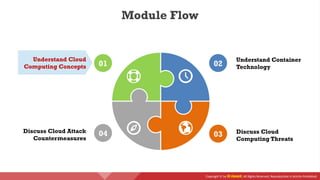
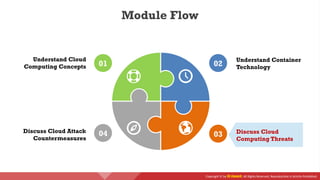
Understand Cloud
Computing Concepts
Discuss Cloud
Computing Threats
Understand Container
Technology
Discuss Cloud Attack
Countermeasures
02
03
04
01
Module Flow
Copyright © by EC-Council. All Rights Reserved. Reproduction is Strictly Prohibited.
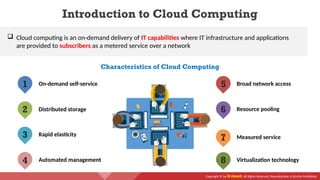
Characteristics of Cloud Computing
 Cloud computing is an on-demand delivery of IT capabilities where IT infrastructure and applications
are provided to subscribers as a metered service over a network
On-demand self-service Broad network access
Distributed storage Resource pooling
Rapid elasticity Measured service
Automated management Virtualization technology
1
2
3
4
5
6
7
8
Introduction to Cloud Computing
Copyright © by EC-Council. All Rights Reserved. Reproduction is Strictly Prohibited.
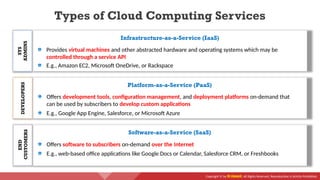
Types of Cloud Computing Services
Software-as-a-Service (SaaS)
Offers software to subscribers on-demand over the Internet
E.g., web-based office applications like Google Docs or Calendar, Salesforce CRM, or Freshbooks
END
CUSTOMERS
Platform-as-a-Service (PaaS)
Offers development tools, configuration management, and deployment platforms on-demand that
can be used by subscribers to develop custom applications
E.g., Google App Engine, Salesforce, or Microsoft Azure
DEVELOPERS
Infrastructure-as-a-Service (IaaS)
Provides virtual machines and other abstracted hardware and operating systems which may be
controlled through a service API
E.g., Amazon EC2, Microsoft OneDrive, or Rackspace
SYS
ADMINS
Copyright © by EC-Council. All Rights Reserved. Reproduction is Strictly Prohibited.
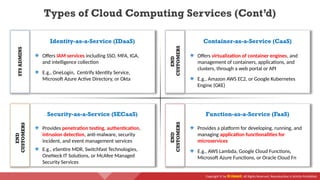
Types of Cloud Computing Services (Cont’d)
Function-as-a-Service (FaaS)
Provides a platform for developing, running, and
managing application functionalities for
microservices
E.g., AWS Lambda, Google Cloud Functions,
Microsoft Azure Functions, or Oracle Cloud Fn
END
CUSTOMERS
Security-as-a-Service (SECaaS)
Provides penetration testing, authentication,
intrusion detection, anti-malware, security
incident, and event management services
E.g., eSentire MDR, Switchfast Technologies,
OneNeck IT Solutions, or McAfee Managed
Security Services
END
CUSTOMERS
Identity-as-a-Service (IDaaS)
Offers IAM services including SSO, MFA, IGA,
and intelligence collection
E.g., OneLogin, Centrify Identity Service,
Microsoft Azure Active Directory, or Okta
SYS
ADMINS
Container-as-a-Service (CaaS)
Offers virtualization of container engines, and
management of containers, applications, and
clusters, through a web portal or API
E.g., Amazon AWS EC2, or Google Kubernetes
Engine (GKE)
END
CUSTOMERS
Copyright © by EC-Council. All Rights Reserved. Reproduction is Strictly Prohibited.
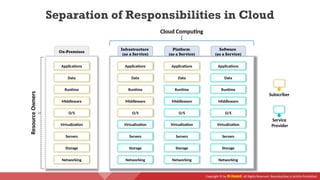
Applications Applications Applications Applications
Data Data Data Data
Runtime Runtime Runtime Runtime
Middleware Middleware Middleware Middleware
O/S O/S O/S O/S
Virtualization Virtualization Virtualization Virtualization
Servers Servers Servers Servers
Storage Storage Storage Storage
Networking Networking Networking Networking
On-Premises
Infrastructure
(as a Service)
Platform
(as a Service)
Software
(as a Service)
Resource
Owners Cloud Computing
Subscriber
Service
Provider
Separation of Responsibilities in Cloud
Copyright © by EC-Council. All Rights Reserved. Reproduction is Strictly Prohibited.
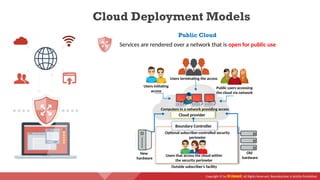
Cloud Deployment Models
Services are rendered over a network that is open for public use
Users terminating the access
Users that access the cloud within
the security perimeter
Public users accessing
the cloud via network
Users initiating
access
Boundary Controller
Outside subscriber’s facility
Cloud provider
New
hardware
Computers in a network providing access
Optional subscriber-controlled security
perimeter
Old
hardware
Public Cloud
Copyright © by EC-Council. All Rights Reserved. Reproduction is Strictly Prohibited.
Cloud Deployment Models (Cont’d)
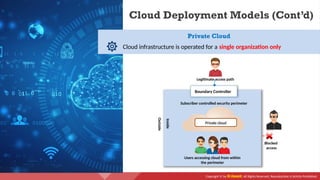
Private Cloud
Cloud infrastructure is operated for a single organization only
Legitimate access path
Boundary Controller
Subscriber controlled security perimeter
Inside
Outside
Blocked
access
Users accessing cloud from within
the perimeter
Private cloud
Copyright © by EC-Council. All Rights Reserved. Reproduction is Strictly Prohibited.
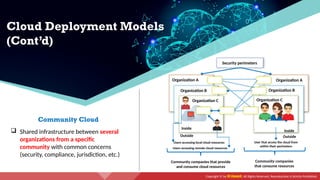
Community Cloud
 Shared infrastructure between several
organizations from a specific
community with common concerns
(security, compliance, jurisdiction, etc.)
Cloud Deployment Models
(Cont’d)
Inside
Outside
Inside
Outside
Community companies that provide
and consume cloud resources
Community companies
that consume resources
Organization A Organization A
Organization B Organization B
Organization C
Organization C
Users accessing remote cloud resources
Security perimeters
User that access the cloud from
within their perimeters
Users accessing local cloud resources
Copyright © by EC-Council. All Rights Reserved. Reproduction is Strictly Prohibited.
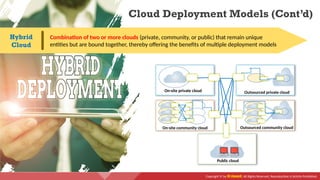
Combination of two or more clouds (private, community, or public) that remain unique
entities but are bound together, thereby offering the benefits of multiple deployment models
Cloud Deployment Models (Cont’d)
Hybrid
Cloud
On-site private cloud Outsourced private cloud
Outsourced community cloud
Public cloud
On-site community cloud
Copyright © by EC-Council. All Rights Reserved. Reproduction is Strictly Prohibited.
Cloud Deployment Models (Cont’d)
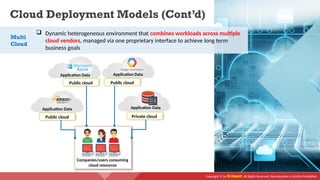
 Dynamic heterogeneous environment that combines workloads across multiple
cloud vendors, managed via one proprietary interface to achieve long term
business goals
Multi
Cloud
Application Data
Private cloud
Public cloud
Public cloud
Public cloud
Application Data Application Data
Application Data
Companies/users consuming
cloud resources
Copyright © by EC-Council. All Rights Reserved. Reproduction is Strictly Prohibited.
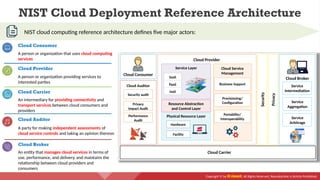
NIST cloud computing reference architecture defines five major actors:
Cloud Carrier
Security
Privacy
Cloud Provider
Service Layer
SaaS
PaaS
IaaS
Resource Abstraction
and Control Layer
Physical Resource Layer
Cloud Service
Management
Business Support
Provisioning/
Configuration
Portability/
Interoperability
Facility
Hardware
Cloud Consumer
Cloud Auditor
Security audit
Cloud Broker
Service
Intermediation
Service
Aggregation
Privacy
Impact Audit
Service
Arbitrage
Performance
Audit
NIST Cloud Deployment Reference Architecture
A person or organization that uses cloud computing
services
A person or organization providing services to
interested parties
An intermediary for providing connectivity and
transport services between cloud consumers and
providers
A party for making independent assessments of
cloud service controls and taking an opinion thereon
An entity that manages cloud services in terms of
use, performance, and delivery, and maintains the
relationship between cloud providers and
consumers
Cloud Consumer
Cloud Provider
Cloud Carrier
Cloud Broker
Cloud Auditor
Copyright © by EC-Council. All Rights Reserved. Reproduction is Strictly Prohibited.
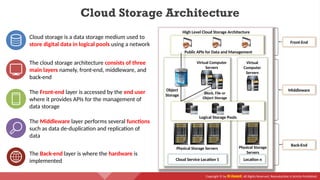
High Level Cloud Storage Architecture
Public APIs for Data and Management
Logical Storage Pools
Virtual Computer
Servers
Virtual
Computer
Servers
Object
Storage
Cloud Service Location 1 Location n
Block, File or
Object Storage
Physical Storage Servers Physical Storage
Servers
Front-End
Middleware
Back-End
Cloud storage is a data storage medium used to
store digital data in logical pools using a network
The cloud storage architecture consists of three
main layers namely, front-end, middleware, and
back-end
The Front-end layer is accessed by the end user
where it provides APIs for the management of
data storage
The Middleware layer performs several functions
such as data de-duplication and replication of
data
The Back-end layer is where the hardware is
implemented
Cloud Storage Architecture
Copyright © by EC-Council. All Rights Reserved. Reproduction is Strictly Prohibited.
Cloud Service Providers
https://aws.amazon.com
https://azure.microsoft.com
https://cloud.google.com https://www.ibm.com
Copyright © by EC-Council. All Rights Reserved. Reproduction is Strictly Prohibited.
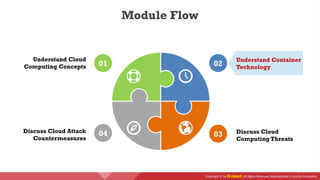
Module Flow
Understand Cloud
Computing Concepts
Discuss Cloud
Computing Threats
Understand Container
Technology
Discuss Cloud Attack
Countermeasures
02
03
04
01
Copyright © by EC-Council. All Rights Reserved. Reproduction is Strictly Prohibited.
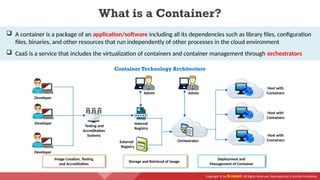
 A container is a package of an application/software including all its dependencies such as library files, configuration
files, binaries, and other resources that run independently of other processes in the cloud environment
 CaaS is a service that includes the virtualization of containers and container management through orchestrators
Container Technology Architecture
Developer
Testing and
Accreditation
Systems
Admin Admin
Internal
Registry
External
Registry
Orchestrator
Host with
Containers
Host with
Containers
Host with
Containers
Image Creation, Testing
and Accreditation
Storage and Retrieval of Image
Deployment and
Management of Container
Developer
Developer
What is a Container?
Copyright © by EC-Council. All Rights Reserved. Reproduction is Strictly Prohibited.
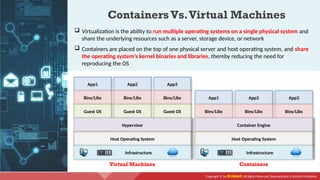
 Virtualization is the ability to run multiple operating systems on a single physical system and
share the underlying resources such as a server, storage device, or network
 Containers are placed on the top of one physical server and host operating system, and share
the operating system’s kernel binaries and libraries, thereby reducing the need for
reproducing the OS
ContainersVs.Virtual Machines
App1 App2 App3
Bins/Libs Bins/Libs Bins/Libs
Guest OS Guest OS Guest OS
Hypervisor
Host Operating System
Container Engine
Host Operating System
App1 App2 App3
Bins/Libs Bins/Libs Bins/Libs
Virtual Machines Containers
Infrastructure Infrastructure
Copyright © by EC-Council. All Rights Reserved. Reproduction is Strictly Prohibited.
What is Docker?
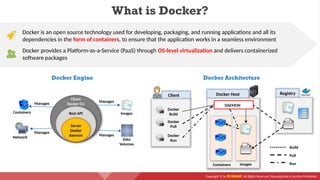
Docker is an open source technology used for developing, packaging, and running applications and all its
dependencies in the form of containers, to ensure that the application works in a seamless environment
Docker provides a Platform-as-a-Service (PaaS) through OS-level virtualization and delivers containerized
software packages
Docker Engine Docker Architecture
Containers Images
Data
Volumes
Network
Manages
Manages
Manages
Manages
Server
Docker
daemon
Rest API
Client
Docker CLI
Docker
Build
Docker
Pull
Docker
Run
Client
Images
Containers
DAEMON
Build
Pull
Run
Docker Host Registry
Copyright © by EC-Council. All Rights Reserved. Reproduction is Strictly Prohibited.
Monolithic Application
Data Access Layer
Business Logic
App 1 App 2
User Interface
Microservice Microservice Microservice Microservice
Microservices Application
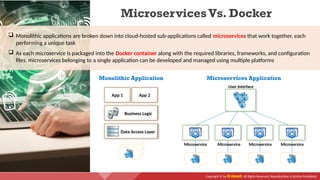
 Monolithic applications are broken down into cloud-hosted sub-applications called microservices that work together, each
performing a unique task
 As each microservice is packaged into the Docker container along with the required libraries, frameworks, and configuration
files, microservices belonging to a single application can be developed and managed using multiple platforms
MicroservicesVs. Docker
Copyright © by EC-Council. All Rights Reserved. Reproduction is Strictly Prohibited.
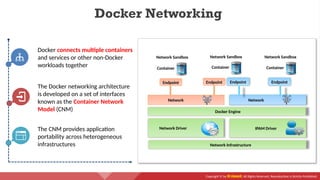
Docker connects multiple containers
and services or other non-Docker
workloads together
The Docker networking architecture
is developed on a set of interfaces
known as the Container Network
Model (CNM)
The CNM provides application
portability across heterogeneous
infrastructures
Docker Networking
Network Infrastructure
Container
Endpoint Endpoint
Endpoint
Container
Endpoint
Container
Docker Engine
Network Driver IPAM Driver
Network Sandbox Network Sandbox Network Sandbox
Network Network
Copyright © by EC-Council. All Rights Reserved. Reproduction is Strictly Prohibited.
Container Orchestration
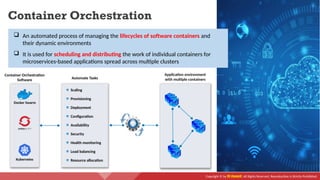
 An automated process of managing the lifecycles of software containers and
their dynamic environments
 It is used for scheduling and distributing the work of individual containers for
microservices-based applications spread across multiple clusters
Container Orchestration
Software
Application environment
with multiple containers
Kubernetes
Docker Swarm
Scaling
Provisioning
Deployment
Configuration
Availability
Security
Health monitoring
Load balancing
Resource allocation
Automate Tasks
Copyright © by EC-Council. All Rights Reserved. Reproduction is Strictly Prohibited.
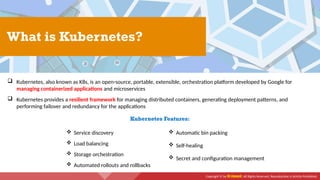
 Kubernetes, also known as K8s, is an open-source, portable, extensible, orchestration platform developed by Google for
managing containerized applications and microservices
 Kubernetes provides a resilient framework for managing distributed containers, generating deployment patterns, and
performing failover and redundancy for the applications
What is Kubernetes?
Kubernetes Features:
 Service discovery
 Load balancing
 Storage orchestration
 Automated rollouts and rollbacks
 Automatic bin packing
 Self-healing
 Secret and configuration management
Copyright © by EC-Council. All Rights Reserved. Reproduction is Strictly Prohibited.
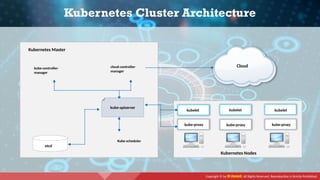
Kubernetes Master
Kubernetes Nodes
kube-controller-
manager
cloud-controller-
manager
kube-apiserver
etcd
Kube-scheduler
kubelet kubelet kubelet
kube-proxy kube-proxy kube-proxy
Cloud
Kubernetes Cluster Architecture
Copyright © by EC-Council. All Rights Reserved. Reproduction is Strictly Prohibited.
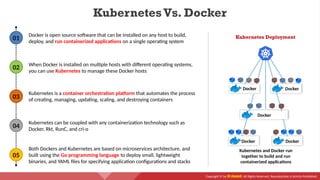
Kubernetes Deployment
Docker Docker
Docker
Docker Docker
Kubernetes and Docker run
together to build and run
containerized applications
Docker is open source software that can be installed on any host to build,
deploy, and run containerized applications on a single operating system
Kubernetes Vs. Docker
02
03
04
05
01
When Docker is installed on multiple hosts with different operating systems,
you can use Kubernetes to manage these Docker hosts
Kubernetes is a container orchestration platform that automates the process
of creating, managing, updating, scaling, and destroying containers
Kubernetes can be coupled with any containerization technology such as
Docker, Rkt, RunC, and cri-o
Both Dockers and Kubernetes are based on microservices architecture, and
built using the Go programming language to deploy small, lightweight
binaries, and YAML files for specifying application configurations and stacks
Copyright © by EC-Council. All Rights Reserved. Reproduction is Strictly Prohibited.
01
02
03
04
05
06
07
08
09
10
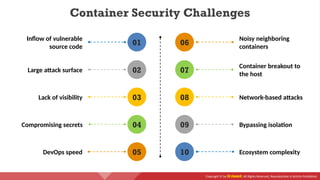
Inflow of vulnerable
source code
Large attack surface
Lack of visibility
Compromising secrets
DevOps speed
Noisy neighboring
containers
Container breakout to
the host
Network-based attacks
Bypassing isolation
Ecosystem complexity
Container Security Challenges
Copyright © by EC-Council. All Rights Reserved. Reproduction is Strictly Prohibited.
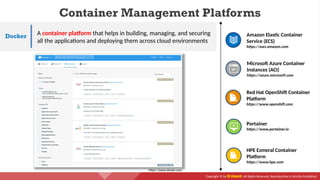
Docker A container platform that helps in building, managing, and securing
all the applications and deploying them across cloud environments
Amazon Elastic Container
Service (ECS)
https://aws.amazon.com
HPE Ezmeral Container
Platform
https://www.hpe.com
Microsoft Azure Container
Instances (ACI)
https://azure.microsoft.com
Portainer
https://www.portainer.io
Red Hat OpenShift Container
Platform
https://www.openshift.com
https://www.docker.com
Container Management Platforms
Copyright © by EC-Council. All Rights Reserved. Reproduction is Strictly Prohibited.
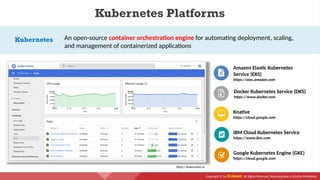
Kubernetes
https://kubernetes.io
An open-source container orchestration engine for automating deployment, scaling,
and management of containerized applications
Amazon Elastic Kubernetes
Service (EKS)
https://aws.amazon.com
Google Kubernetes Engine (GKE)
https://cloud.google.com
Knative
https://cloud.google.com
Docker Kubernetes Service (DKS)
https://www.docker.com
IBM Cloud Kubernetes Service
https://www.ibm.com
Kubernetes Platforms
Copyright © by EC-Council. All Rights Reserved. Reproduction is Strictly Prohibited.
Understand Cloud
Computing Concepts
Discuss Cloud
Computing Threats
Understand Container
Technology
Discuss Cloud Attack
Countermeasures
02
03
04
01
Module Flow
Copyright © by EC-Council. All Rights Reserved. Reproduction is Strictly Prohibited.
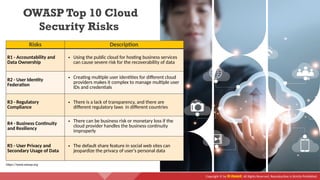
Risks Description
R1 - Accountability and
Data Ownership
• Using the public cloud for hosting business services
can cause severe risk for the recoverability of data
R2 - User Identity
Federation
• Creating multiple user identities for different cloud
providers makes it complex to manage multiple user
IDs and credentials
R3 - Regulatory
Compliance
• There is a lack of transparency, and there are
different regulatory laws in different countries
R4 - Business Continuity
and Resiliency
• There can be business risk or monetary loss if the
cloud provider handles the business continuity
improperly
R5 - User Privacy and
Secondary Usage of Data
• The default share feature in social web sites can
jeopardize the privacy of user's personal data
https://www.owasp.org
OWASP Top 10 Cloud
Security Risks
Copyright © by EC-Council. All Rights Reserved. Reproduction is Strictly Prohibited.
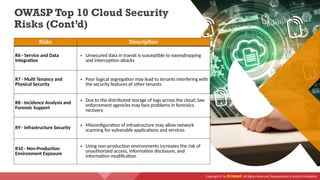
OWASP Top 10 Cloud Security
Risks (Cont’d)
Risks Description
R6 - Service and Data
Integration
• Unsecured data in transit is susceptible to eavesdropping
and interception attacks
R7 - Multi Tenancy and
Physical Security
• Poor logical segregation may lead to tenants interfering with
the security features of other tenants
R8 - Incidence Analysis and
Forensic Support
• Due to the distributed storage of logs across the cloud, law
enforcement agencies may face problems in forensics
recovery
R9 - Infrastructure Security • Misconfiguration of infrastructure may allow network
scanning for vulnerable applications and services
R10 - Non-Production
Environment Exposure
• Using non-production environments increases the risk of
unauthorized access, information disclosure, and
information modification
Copyright © by EC-Council. All Rights Reserved. Reproduction is Strictly Prohibited.
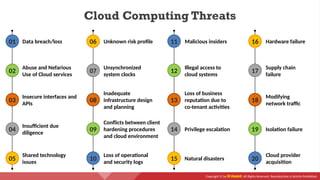
Cloud Computing Threats
Hardware failure
Supply chain
failure
Modifying
network traffic
Isolation failure
Cloud provider
acquisition
Malicious insiders
Illegal access to
cloud systems
Loss of business
reputation due to
co-tenant activities
Privilege escalation
Natural disasters
Unknown risk profile
Unsynchronized
system clocks
Inadequate
infrastructure design
and planning
Conflicts between client
hardening procedures
and cloud environment
Loss of operational
and security logs
Data breach/loss
Abuse and Nefarious
Use of Cloud services
Insecure interfaces and
APIs
Insufficient due
diligence
Shared technology
issues
16
17
18
19
20
11
12
13
14
15
06
07
08
09
10
02
03
04
05
01
Copyright © by EC-Council. All Rights Reserved. Reproduction is Strictly Prohibited.
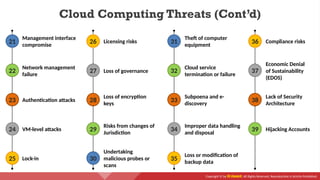
Cloud Computing Threats (Cont’d)
Compliance risks
Economic Denial
of Sustainability
(EDOS)
Lack of Security
Architecture
Hijacking Accounts
Theft of computer
equipment
Cloud service
termination or failure
Subpoena and e-
discovery
Improper data handling
and disposal
Loss or modification of
backup data
Licensing risks
Loss of governance
Loss of encryption
keys
Risks from changes of
Jurisdiction
Undertaking
malicious probes or
scans
Management interface
compromise
Network management
failure
Authentication attacks
VM-level attacks
Lock-in
36
37
38
39
31
32
33
34
35
26
27
28
29
30
22
23
24
25
21
Copyright © by EC-Council. All Rights Reserved. Reproduction is Strictly Prohibited.
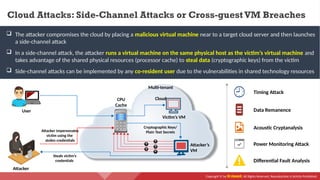
 The attacker compromises the cloud by placing a malicious virtual machine near to a target cloud server and then launches
a side-channel attack
 In a side-channel attack, the attacker runs a virtual machine on the same physical host as the victim’s virtual machine and
takes advantage of the shared physical resources (processor cache) to steal data (cryptographic keys) from the victim
 Side-channel attacks can be implemented by any co-resident user due to the vulnerabilities in shared technology resources
Timing Attack
Acoustic Cryptanalysis
Data Remanence
Power Monitoring Attack
Differential Fault Analysis
Cloud Attacks: Side-Channel Attacks or Cross-guest VM Breaches
Attacker
User
Victim’s VM
Attacker’s
VM
Multi-tenant
Cloud
Attacker impersonates
victim using the
stolen credentials
Steals victim’s
credentials
CPU
Cache
Cryptographic Keys/
Plain Text Secrets
Copyright © by EC-Council. All Rights Reserved. Reproduction is Strictly Prohibited.
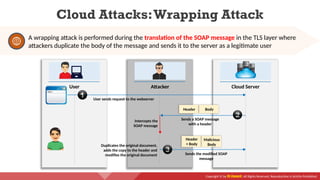
A wrapping attack is performed during the translation of the SOAP message in the TLS layer where
attackers duplicate the body of the message and sends it to the server as a legitimate user
Cloud Attacks:Wrapping Attack
User Attacker Cloud Server
User sends request to the webserver
Sends a SOAP message
with a header
Header Body
Header
+ Body
Intercepts the
SOAP message
Duplicates the original document,
adds the copy to the header and
modifies the original document Sends the modified SOAP
message
Malicious
Body
Copyright © by EC-Council. All Rights Reserved. Reproduction is Strictly Prohibited.
Victim Attacker
Cloud Attacks: Man-in-the-Cloud (MITC) Attack
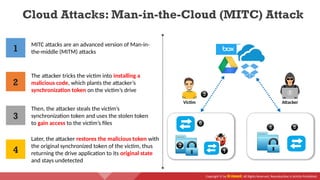
The attacker tricks the victim into installing a
malicious code, which plants the attacker’s
synchronization token on the victim’s drive
2
1
3
4
Then, the attacker steals the victim’s
synchronization token and uses the stolen token
to gain access to the victim’s files
MITC attacks are an advanced version of Man-in-
the-middle (MITM) attacks
Later, the attacker restores the malicious token with
the original synchronized token of the victim, thus
returning the drive application to its original state
and stays undetected
Copyright © by EC-Council. All Rights Reserved. Reproduction is Strictly Prohibited.
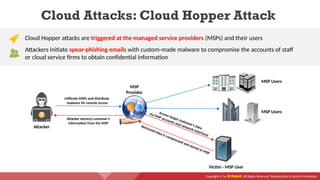
Cloud Attacks: Cloud Hopper Attack
Cloud Hopper attacks are triggered at the managed service providers (MSPs) and their users
Attackers initiate spear-phishing emails with custom-made malware to compromise the accounts of staff
or cloud service firms to obtain confidential information
MSP Users
Attacker
Infiltrate MSPs and distribute
malware for remote access
Attacker extracts customer’s
information from the MSP
Access target customer’s data
via MSP accounts and network interfaces
Retrieved data is compressed and stored in MSP
MSP
Provider
MSP Users
Victim - MSP User
Copyright © by EC-Council. All Rights Reserved. Reproduction is Strictly Prohibited.
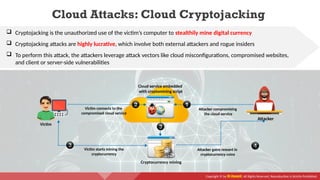
 Cryptojacking is the unauthorized use of the victim’s computer to stealthily mine digital currency
 Cryptojacking attacks are highly lucrative, which involve both external attackers and rogue insiders
 To perform this attack, the attackers leverage attack vectors like cloud misconfigurations, compromised websites,
and client or server-side vulnerabilities
Cloud Attacks: Cloud Cryptojacking
Victim
Attacker
Cryptocurrency mining
Cloud service embedded
with cryptomining script
Attacker compromising
the cloud service
Victim connects to the
compromised cloud service
Victim starts mining the
cryptocurrency
Attacker gains reward in
cryptocurrency coins
Copyright © by EC-Council. All Rights Reserved. Reproduction is Strictly Prohibited.
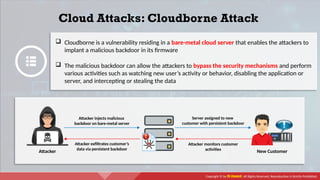
Cloud Attacks: Cloudborne Attack
 Cloudborne is a vulnerability residing in a bare-metal cloud server that enables the attackers to
implant a malicious backdoor in its firmware
 The malicious backdoor can allow the attackers to bypass the security mechanisms and perform
various activities such as watching new user’s activity or behavior, disabling the application or
server, and intercepting or stealing the data
Attacker
Attacker injects malicious
backdoor on bare-metal server
New Customer
Server assigned to new
customer with persistent backdoor
Attacker exfiltrates customer’s
data via persistent backdoor
Attacker monitors customer
activities
Copyright © by EC-Council. All Rights Reserved. Reproduction is Strictly Prohibited.
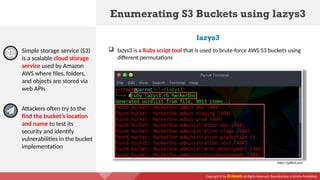
Enumerating S3 Buckets using lazys3
Simple storage service (S3)
is a scalable cloud storage
service used by Amazon
AWS where files, folders,
and objects are stored via
web APIs
lazys3
Attackers often try to the
find the bucket’s location
and name to test its
security and identify
vulnerabilities in the bucket
implementation
https://github.com
 lazys3 is a Ruby script tool that is used to brute-force AWS S3 buckets using
different permutations
Copyright © by EC-Council. All Rights Reserved. Reproduction is Strictly Prohibited.
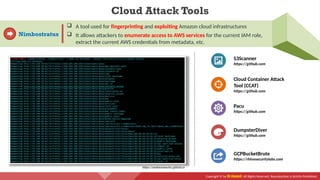
Cloud Attack Tools
Nimbostratus
 A tool used for fingerprinting and exploiting Amazon cloud infrastructures
 It allows attackers to enumerate access to AWS services for the current IAM role,
extract the current AWS credentials from meta­
data, etc.
S3Scanner
https://github.com
Cloud Container Attack
Tool (CCAT)
https://github.com
Pacu
https://github.com
DumpsterDiver
https://github.com
GCPBucketBrute
https://rhinosecuritylabs.com
https://andresriancho.github.io
Copyright © by EC-Council. All Rights Reserved. Reproduction is Strictly Prohibited.
Understand Cloud
Computing Concepts
Discuss Cloud
Computing Threats
Understand Container
Technology
Discuss Cloud Attack
Countermeasures
02
03
04
01
Module Flow
Copyright © by EC-Council. All Rights Reserved. Reproduction is Strictly Prohibited.
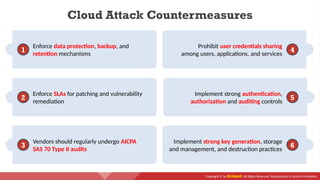
Cloud Attack Countermeasures
Enforce data protection, backup, and
retention mechanisms
Prohibit user credentials sharing
among users, applications, and services
1 4
Enforce SLAs for patching and vulnerability
remediation
Implement strong authentication,
authorization and auditing controls
2 5
Vendors should regularly undergo AICPA
SAS 70 Type II audits
Implement strong key generation, storage
and management, and destruction practices
3 6
Copyright © by EC-Council. All Rights Reserved. Reproduction is Strictly Prohibited.
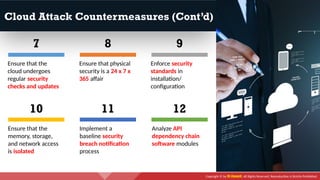
Cloud Attack Countermeasures (Cont’d)
7 8 9
10 11 12
Ensure that the
cloud undergoes
regular security
checks and updates
Ensure that physical
security is a 24 x 7 x
365 affair
Enforce security
standards in
installation/
configuration
Ensure that the
memory, storage,
and network access
is isolated
Implement a
baseline security
breach notification
process
Analyze API
dependency chain
software modules
Copyright © by EC-Council. All Rights Reserved. Reproduction is Strictly Prohibited.
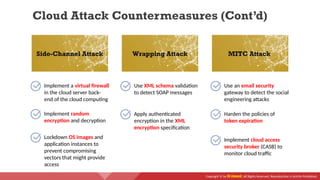
Use XML schema validation
to detect SOAP messages
Apply authenticated
encryption in the XML
encryption specification
Use an email security
gateway to detect the social
engineering attacks
Harden the policies of
token expiration
Lockdown OS images and
application instances to
prevent compromising
vectors that might provide
access
Implement a virtual firewall
in the cloud server back-
end of the cloud computing
Implement random
encryption and decryption
Implement cloud access
security broker (CASB) to
monitor cloud traffic
Cloud Attack Countermeasures (Cont’d)
Side-Channel Attack Wrapping Attack MITC Attack
Copyright © by EC-Council. All Rights Reserved. Reproduction is Strictly Prohibited.
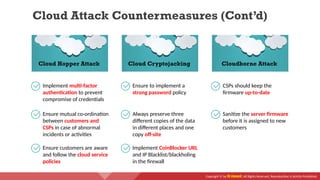
Ensure to implement a
strong password policy
Always preserve three
different copies of the data
in different places and one
copy off-site
CSPs should keep the
firmware up-to-date
Sanitize the server firmware
before it is assigned to new
customers
Ensure customers are aware
and follow the cloud service
policies
Implement multi-factor
authentication to prevent
compromise of credentials
Ensure mutual co-ordination
between customers and
CSPs in case of abnormal
incidents or activities
Cloud Attack Countermeasures (Cont’d)
Implement CoinBlocker URL
and IP Blacklist/blackholing
in the firewall
Cloud Hopper Attack Cloud Cryptojacking Cloudborne Attack
Copyright © by EC-Council. All Rights Reserved. Reproduction is Strictly Prohibited.
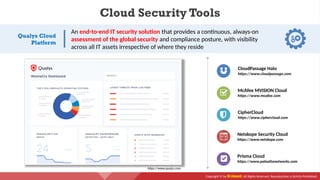
Cloud Security Tools
CloudPassage Halo
https://www.cloudpassage.com
McAfee MVISION Cloud
https://www.mcafee.com
CipherCloud
https://www.ciphercloud.com
Netskope Security Cloud
https://www.netskope.com
Prisma Cloud
https://www.paloaltonetworks.com
Qualys Cloud
Platform
An end-to-end IT security solution that provides a continuous, always-on
assessment of the global security and compliance posture, with visibility
across all IT assets irrespective of where they reside
https://www.qualys.com
Copyright © by EC-Council. All Rights Reserved. Reproduction is Strictly Prohibited.
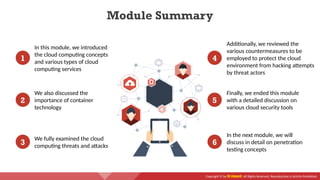
1
In this module, we introduced
the cloud computing concepts
and various types of cloud
computing services
4
Additionally, we reviewed the
various countermeasures to be
employed to protect the cloud
environment from hacking attempts
by threat actors
2
We also discussed the
importance of container
technology
5
Finally, we ended this module
with a detailed discussion on
various cloud security tools
3
We fully examined the cloud
computing threats and attacks 6
In the next module, we will
discuss in detail on penetration
testing concepts
Module Summary

EHEv1 Module 11 Cloud Computing Threats and Countermeasures.pptx

  • 1.
    Copyright © byEC-Council. All Rights Reserved. Reproduction is Strictly Prohibited. Cloud Computing Threats and Countermeasures Module 11
  • 2.
    Copyright © byEC-Council. All Rights Reserved. Reproduction is Strictly Prohibited. Module Objectives Understanding Cloud Computing Concepts Overview of Container Technology Understanding Cloud Computing Threats Overview of Cloud Attacks and Tools Understanding Cloud Attack Countermeasures Overview of Various Cloud Computing Security Tools
  • 3.
    Copyright © byEC-Council. All Rights Reserved. Reproduction is Strictly Prohibited. Understand Cloud Computing Concepts Discuss Cloud Computing Threats Understand Container Technology Discuss Cloud Attack Countermeasures 02 03 04 01 Module Flow
  • 4.
    Copyright © byEC-Council. All Rights Reserved. Reproduction is Strictly Prohibited. Characteristics of Cloud Computing  Cloud computing is an on-demand delivery of IT capabilities where IT infrastructure and applications are provided to subscribers as a metered service over a network On-demand self-service Broad network access Distributed storage Resource pooling Rapid elasticity Measured service Automated management Virtualization technology 1 2 3 4 5 6 7 8 Introduction to Cloud Computing
  • 5.
    Copyright © byEC-Council. All Rights Reserved. Reproduction is Strictly Prohibited. Types of Cloud Computing Services Software-as-a-Service (SaaS) Offers software to subscribers on-demand over the Internet E.g., web-based office applications like Google Docs or Calendar, Salesforce CRM, or Freshbooks END CUSTOMERS Platform-as-a-Service (PaaS) Offers development tools, configuration management, and deployment platforms on-demand that can be used by subscribers to develop custom applications E.g., Google App Engine, Salesforce, or Microsoft Azure DEVELOPERS Infrastructure-as-a-Service (IaaS) Provides virtual machines and other abstracted hardware and operating systems which may be controlled through a service API E.g., Amazon EC2, Microsoft OneDrive, or Rackspace SYS ADMINS
  • 6.
    Copyright © byEC-Council. All Rights Reserved. Reproduction is Strictly Prohibited. Types of Cloud Computing Services (Cont’d) Function-as-a-Service (FaaS) Provides a platform for developing, running, and managing application functionalities for microservices E.g., AWS Lambda, Google Cloud Functions, Microsoft Azure Functions, or Oracle Cloud Fn END CUSTOMERS Security-as-a-Service (SECaaS) Provides penetration testing, authentication, intrusion detection, anti-malware, security incident, and event management services E.g., eSentire MDR, Switchfast Technologies, OneNeck IT Solutions, or McAfee Managed Security Services END CUSTOMERS Identity-as-a-Service (IDaaS) Offers IAM services including SSO, MFA, IGA, and intelligence collection E.g., OneLogin, Centrify Identity Service, Microsoft Azure Active Directory, or Okta SYS ADMINS Container-as-a-Service (CaaS) Offers virtualization of container engines, and management of containers, applications, and clusters, through a web portal or API E.g., Amazon AWS EC2, or Google Kubernetes Engine (GKE) END CUSTOMERS
  • 7.
    Copyright © byEC-Council. All Rights Reserved. Reproduction is Strictly Prohibited. Applications Applications Applications Applications Data Data Data Data Runtime Runtime Runtime Runtime Middleware Middleware Middleware Middleware O/S O/S O/S O/S Virtualization Virtualization Virtualization Virtualization Servers Servers Servers Servers Storage Storage Storage Storage Networking Networking Networking Networking On-Premises Infrastructure (as a Service) Platform (as a Service) Software (as a Service) Resource Owners Cloud Computing Subscriber Service Provider Separation of Responsibilities in Cloud
  • 8.
    Copyright © byEC-Council. All Rights Reserved. Reproduction is Strictly Prohibited. Cloud Deployment Models Services are rendered over a network that is open for public use Users terminating the access Users that access the cloud within the security perimeter Public users accessing the cloud via network Users initiating access Boundary Controller Outside subscriber’s facility Cloud provider New hardware Computers in a network providing access Optional subscriber-controlled security perimeter Old hardware Public Cloud
  • 9.
    Copyright © byEC-Council. All Rights Reserved. Reproduction is Strictly Prohibited. Cloud Deployment Models (Cont’d) Private Cloud Cloud infrastructure is operated for a single organization only Legitimate access path Boundary Controller Subscriber controlled security perimeter Inside Outside Blocked access Users accessing cloud from within the perimeter Private cloud
  • 10.
    Copyright © byEC-Council. All Rights Reserved. Reproduction is Strictly Prohibited. Community Cloud  Shared infrastructure between several organizations from a specific community with common concerns (security, compliance, jurisdiction, etc.) Cloud Deployment Models (Cont’d) Inside Outside Inside Outside Community companies that provide and consume cloud resources Community companies that consume resources Organization A Organization A Organization B Organization B Organization C Organization C Users accessing remote cloud resources Security perimeters User that access the cloud from within their perimeters Users accessing local cloud resources
  • 11.
    Copyright © byEC-Council. All Rights Reserved. Reproduction is Strictly Prohibited. Combination of two or more clouds (private, community, or public) that remain unique entities but are bound together, thereby offering the benefits of multiple deployment models Cloud Deployment Models (Cont’d) Hybrid Cloud On-site private cloud Outsourced private cloud Outsourced community cloud Public cloud On-site community cloud
  • 12.
    Copyright © byEC-Council. All Rights Reserved. Reproduction is Strictly Prohibited. Cloud Deployment Models (Cont’d)  Dynamic heterogeneous environment that combines workloads across multiple cloud vendors, managed via one proprietary interface to achieve long term business goals Multi Cloud Application Data Private cloud Public cloud Public cloud Public cloud Application Data Application Data Application Data Companies/users consuming cloud resources
  • 13.
    Copyright © byEC-Council. All Rights Reserved. Reproduction is Strictly Prohibited. NIST cloud computing reference architecture defines five major actors: Cloud Carrier Security Privacy Cloud Provider Service Layer SaaS PaaS IaaS Resource Abstraction and Control Layer Physical Resource Layer Cloud Service Management Business Support Provisioning/ Configuration Portability/ Interoperability Facility Hardware Cloud Consumer Cloud Auditor Security audit Cloud Broker Service Intermediation Service Aggregation Privacy Impact Audit Service Arbitrage Performance Audit NIST Cloud Deployment Reference Architecture A person or organization that uses cloud computing services A person or organization providing services to interested parties An intermediary for providing connectivity and transport services between cloud consumers and providers A party for making independent assessments of cloud service controls and taking an opinion thereon An entity that manages cloud services in terms of use, performance, and delivery, and maintains the relationship between cloud providers and consumers Cloud Consumer Cloud Provider Cloud Carrier Cloud Broker Cloud Auditor
  • 14.
    Copyright © byEC-Council. All Rights Reserved. Reproduction is Strictly Prohibited. High Level Cloud Storage Architecture Public APIs for Data and Management Logical Storage Pools Virtual Computer Servers Virtual Computer Servers Object Storage Cloud Service Location 1 Location n Block, File or Object Storage Physical Storage Servers Physical Storage Servers Front-End Middleware Back-End Cloud storage is a data storage medium used to store digital data in logical pools using a network The cloud storage architecture consists of three main layers namely, front-end, middleware, and back-end The Front-end layer is accessed by the end user where it provides APIs for the management of data storage The Middleware layer performs several functions such as data de-duplication and replication of data The Back-end layer is where the hardware is implemented Cloud Storage Architecture
  • 15.
    Copyright © byEC-Council. All Rights Reserved. Reproduction is Strictly Prohibited. Cloud Service Providers https://aws.amazon.com https://azure.microsoft.com https://cloud.google.com https://www.ibm.com
  • 16.
    Copyright © byEC-Council. All Rights Reserved. Reproduction is Strictly Prohibited. Module Flow Understand Cloud Computing Concepts Discuss Cloud Computing Threats Understand Container Technology Discuss Cloud Attack Countermeasures 02 03 04 01
  • 17.
    Copyright © byEC-Council. All Rights Reserved. Reproduction is Strictly Prohibited.  A container is a package of an application/software including all its dependencies such as library files, configuration files, binaries, and other resources that run independently of other processes in the cloud environment  CaaS is a service that includes the virtualization of containers and container management through orchestrators Container Technology Architecture Developer Testing and Accreditation Systems Admin Admin Internal Registry External Registry Orchestrator Host with Containers Host with Containers Host with Containers Image Creation, Testing and Accreditation Storage and Retrieval of Image Deployment and Management of Container Developer Developer What is a Container?
  • 18.
    Copyright © byEC-Council. All Rights Reserved. Reproduction is Strictly Prohibited.  Virtualization is the ability to run multiple operating systems on a single physical system and share the underlying resources such as a server, storage device, or network  Containers are placed on the top of one physical server and host operating system, and share the operating system’s kernel binaries and libraries, thereby reducing the need for reproducing the OS ContainersVs.Virtual Machines App1 App2 App3 Bins/Libs Bins/Libs Bins/Libs Guest OS Guest OS Guest OS Hypervisor Host Operating System Container Engine Host Operating System App1 App2 App3 Bins/Libs Bins/Libs Bins/Libs Virtual Machines Containers Infrastructure Infrastructure
  • 19.
    Copyright © byEC-Council. All Rights Reserved. Reproduction is Strictly Prohibited. What is Docker? Docker is an open source technology used for developing, packaging, and running applications and all its dependencies in the form of containers, to ensure that the application works in a seamless environment Docker provides a Platform-as-a-Service (PaaS) through OS-level virtualization and delivers containerized software packages Docker Engine Docker Architecture Containers Images Data Volumes Network Manages Manages Manages Manages Server Docker daemon Rest API Client Docker CLI Docker Build Docker Pull Docker Run Client Images Containers DAEMON Build Pull Run Docker Host Registry
  • 20.
    Copyright © byEC-Council. All Rights Reserved. Reproduction is Strictly Prohibited. Monolithic Application Data Access Layer Business Logic App 1 App 2 User Interface Microservice Microservice Microservice Microservice Microservices Application  Monolithic applications are broken down into cloud-hosted sub-applications called microservices that work together, each performing a unique task  As each microservice is packaged into the Docker container along with the required libraries, frameworks, and configuration files, microservices belonging to a single application can be developed and managed using multiple platforms MicroservicesVs. Docker
  • 21.
    Copyright © byEC-Council. All Rights Reserved. Reproduction is Strictly Prohibited. Docker connects multiple containers and services or other non-Docker workloads together The Docker networking architecture is developed on a set of interfaces known as the Container Network Model (CNM) The CNM provides application portability across heterogeneous infrastructures Docker Networking Network Infrastructure Container Endpoint Endpoint Endpoint Container Endpoint Container Docker Engine Network Driver IPAM Driver Network Sandbox Network Sandbox Network Sandbox Network Network
  • 22.
    Copyright © byEC-Council. All Rights Reserved. Reproduction is Strictly Prohibited. Container Orchestration  An automated process of managing the lifecycles of software containers and their dynamic environments  It is used for scheduling and distributing the work of individual containers for microservices-based applications spread across multiple clusters Container Orchestration Software Application environment with multiple containers Kubernetes Docker Swarm Scaling Provisioning Deployment Configuration Availability Security Health monitoring Load balancing Resource allocation Automate Tasks
  • 23.
    Copyright © byEC-Council. All Rights Reserved. Reproduction is Strictly Prohibited.  Kubernetes, also known as K8s, is an open-source, portable, extensible, orchestration platform developed by Google for managing containerized applications and microservices  Kubernetes provides a resilient framework for managing distributed containers, generating deployment patterns, and performing failover and redundancy for the applications What is Kubernetes? Kubernetes Features:  Service discovery  Load balancing  Storage orchestration  Automated rollouts and rollbacks  Automatic bin packing  Self-healing  Secret and configuration management
  • 24.
    Copyright © byEC-Council. All Rights Reserved. Reproduction is Strictly Prohibited. Kubernetes Master Kubernetes Nodes kube-controller- manager cloud-controller- manager kube-apiserver etcd Kube-scheduler kubelet kubelet kubelet kube-proxy kube-proxy kube-proxy Cloud Kubernetes Cluster Architecture
  • 25.
    Copyright © byEC-Council. All Rights Reserved. Reproduction is Strictly Prohibited. Kubernetes Deployment Docker Docker Docker Docker Docker Kubernetes and Docker run together to build and run containerized applications Docker is open source software that can be installed on any host to build, deploy, and run containerized applications on a single operating system Kubernetes Vs. Docker 02 03 04 05 01 When Docker is installed on multiple hosts with different operating systems, you can use Kubernetes to manage these Docker hosts Kubernetes is a container orchestration platform that automates the process of creating, managing, updating, scaling, and destroying containers Kubernetes can be coupled with any containerization technology such as Docker, Rkt, RunC, and cri-o Both Dockers and Kubernetes are based on microservices architecture, and built using the Go programming language to deploy small, lightweight binaries, and YAML files for specifying application configurations and stacks
  • 26.
    Copyright © byEC-Council. All Rights Reserved. Reproduction is Strictly Prohibited. 01 02 03 04 05 06 07 08 09 10 Inflow of vulnerable source code Large attack surface Lack of visibility Compromising secrets DevOps speed Noisy neighboring containers Container breakout to the host Network-based attacks Bypassing isolation Ecosystem complexity Container Security Challenges
  • 27.
    Copyright © byEC-Council. All Rights Reserved. Reproduction is Strictly Prohibited. Docker A container platform that helps in building, managing, and securing all the applications and deploying them across cloud environments Amazon Elastic Container Service (ECS) https://aws.amazon.com HPE Ezmeral Container Platform https://www.hpe.com Microsoft Azure Container Instances (ACI) https://azure.microsoft.com Portainer https://www.portainer.io Red Hat OpenShift Container Platform https://www.openshift.com https://www.docker.com Container Management Platforms
  • 28.
    Copyright © byEC-Council. All Rights Reserved. Reproduction is Strictly Prohibited. Kubernetes https://kubernetes.io An open-source container orchestration engine for automating deployment, scaling, and management of containerized applications Amazon Elastic Kubernetes Service (EKS) https://aws.amazon.com Google Kubernetes Engine (GKE) https://cloud.google.com Knative https://cloud.google.com Docker Kubernetes Service (DKS) https://www.docker.com IBM Cloud Kubernetes Service https://www.ibm.com Kubernetes Platforms
  • 29.
    Copyright © byEC-Council. All Rights Reserved. Reproduction is Strictly Prohibited. Understand Cloud Computing Concepts Discuss Cloud Computing Threats Understand Container Technology Discuss Cloud Attack Countermeasures 02 03 04 01 Module Flow
  • 30.
    Copyright © byEC-Council. All Rights Reserved. Reproduction is Strictly Prohibited. Risks Description R1 - Accountability and Data Ownership • Using the public cloud for hosting business services can cause severe risk for the recoverability of data R2 - User Identity Federation • Creating multiple user identities for different cloud providers makes it complex to manage multiple user IDs and credentials R3 - Regulatory Compliance • There is a lack of transparency, and there are different regulatory laws in different countries R4 - Business Continuity and Resiliency • There can be business risk or monetary loss if the cloud provider handles the business continuity improperly R5 - User Privacy and Secondary Usage of Data • The default share feature in social web sites can jeopardize the privacy of user's personal data https://www.owasp.org OWASP Top 10 Cloud Security Risks
  • 31.
    Copyright © byEC-Council. All Rights Reserved. Reproduction is Strictly Prohibited. OWASP Top 10 Cloud Security Risks (Cont’d) Risks Description R6 - Service and Data Integration • Unsecured data in transit is susceptible to eavesdropping and interception attacks R7 - Multi Tenancy and Physical Security • Poor logical segregation may lead to tenants interfering with the security features of other tenants R8 - Incidence Analysis and Forensic Support • Due to the distributed storage of logs across the cloud, law enforcement agencies may face problems in forensics recovery R9 - Infrastructure Security • Misconfiguration of infrastructure may allow network scanning for vulnerable applications and services R10 - Non-Production Environment Exposure • Using non-production environments increases the risk of unauthorized access, information disclosure, and information modification
  • 32.
    Copyright © byEC-Council. All Rights Reserved. Reproduction is Strictly Prohibited. Cloud Computing Threats Hardware failure Supply chain failure Modifying network traffic Isolation failure Cloud provider acquisition Malicious insiders Illegal access to cloud systems Loss of business reputation due to co-tenant activities Privilege escalation Natural disasters Unknown risk profile Unsynchronized system clocks Inadequate infrastructure design and planning Conflicts between client hardening procedures and cloud environment Loss of operational and security logs Data breach/loss Abuse and Nefarious Use of Cloud services Insecure interfaces and APIs Insufficient due diligence Shared technology issues 16 17 18 19 20 11 12 13 14 15 06 07 08 09 10 02 03 04 05 01
  • 33.
    Copyright © byEC-Council. All Rights Reserved. Reproduction is Strictly Prohibited. Cloud Computing Threats (Cont’d) Compliance risks Economic Denial of Sustainability (EDOS) Lack of Security Architecture Hijacking Accounts Theft of computer equipment Cloud service termination or failure Subpoena and e- discovery Improper data handling and disposal Loss or modification of backup data Licensing risks Loss of governance Loss of encryption keys Risks from changes of Jurisdiction Undertaking malicious probes or scans Management interface compromise Network management failure Authentication attacks VM-level attacks Lock-in 36 37 38 39 31 32 33 34 35 26 27 28 29 30 22 23 24 25 21
  • 34.
    Copyright © byEC-Council. All Rights Reserved. Reproduction is Strictly Prohibited.  The attacker compromises the cloud by placing a malicious virtual machine near to a target cloud server and then launches a side-channel attack  In a side-channel attack, the attacker runs a virtual machine on the same physical host as the victim’s virtual machine and takes advantage of the shared physical resources (processor cache) to steal data (cryptographic keys) from the victim  Side-channel attacks can be implemented by any co-resident user due to the vulnerabilities in shared technology resources Timing Attack Acoustic Cryptanalysis Data Remanence Power Monitoring Attack Differential Fault Analysis Cloud Attacks: Side-Channel Attacks or Cross-guest VM Breaches Attacker User Victim’s VM Attacker’s VM Multi-tenant Cloud Attacker impersonates victim using the stolen credentials Steals victim’s credentials CPU Cache Cryptographic Keys/ Plain Text Secrets
  • 35.
    Copyright © byEC-Council. All Rights Reserved. Reproduction is Strictly Prohibited. A wrapping attack is performed during the translation of the SOAP message in the TLS layer where attackers duplicate the body of the message and sends it to the server as a legitimate user Cloud Attacks:Wrapping Attack User Attacker Cloud Server User sends request to the webserver Sends a SOAP message with a header Header Body Header + Body Intercepts the SOAP message Duplicates the original document, adds the copy to the header and modifies the original document Sends the modified SOAP message Malicious Body
  • 36.
    Copyright © byEC-Council. All Rights Reserved. Reproduction is Strictly Prohibited. Victim Attacker Cloud Attacks: Man-in-the-Cloud (MITC) Attack The attacker tricks the victim into installing a malicious code, which plants the attacker’s synchronization token on the victim’s drive 2 1 3 4 Then, the attacker steals the victim’s synchronization token and uses the stolen token to gain access to the victim’s files MITC attacks are an advanced version of Man-in- the-middle (MITM) attacks Later, the attacker restores the malicious token with the original synchronized token of the victim, thus returning the drive application to its original state and stays undetected
  • 37.
    Copyright © byEC-Council. All Rights Reserved. Reproduction is Strictly Prohibited. Cloud Attacks: Cloud Hopper Attack Cloud Hopper attacks are triggered at the managed service providers (MSPs) and their users Attackers initiate spear-phishing emails with custom-made malware to compromise the accounts of staff or cloud service firms to obtain confidential information MSP Users Attacker Infiltrate MSPs and distribute malware for remote access Attacker extracts customer’s information from the MSP Access target customer’s data via MSP accounts and network interfaces Retrieved data is compressed and stored in MSP MSP Provider MSP Users Victim - MSP User
  • 38.
    Copyright © byEC-Council. All Rights Reserved. Reproduction is Strictly Prohibited.  Cryptojacking is the unauthorized use of the victim’s computer to stealthily mine digital currency  Cryptojacking attacks are highly lucrative, which involve both external attackers and rogue insiders  To perform this attack, the attackers leverage attack vectors like cloud misconfigurations, compromised websites, and client or server-side vulnerabilities Cloud Attacks: Cloud Cryptojacking Victim Attacker Cryptocurrency mining Cloud service embedded with cryptomining script Attacker compromising the cloud service Victim connects to the compromised cloud service Victim starts mining the cryptocurrency Attacker gains reward in cryptocurrency coins
  • 39.
    Copyright © byEC-Council. All Rights Reserved. Reproduction is Strictly Prohibited. Cloud Attacks: Cloudborne Attack  Cloudborne is a vulnerability residing in a bare-metal cloud server that enables the attackers to implant a malicious backdoor in its firmware  The malicious backdoor can allow the attackers to bypass the security mechanisms and perform various activities such as watching new user’s activity or behavior, disabling the application or server, and intercepting or stealing the data Attacker Attacker injects malicious backdoor on bare-metal server New Customer Server assigned to new customer with persistent backdoor Attacker exfiltrates customer’s data via persistent backdoor Attacker monitors customer activities
  • 40.
    Copyright © byEC-Council. All Rights Reserved. Reproduction is Strictly Prohibited. Enumerating S3 Buckets using lazys3 Simple storage service (S3) is a scalable cloud storage service used by Amazon AWS where files, folders, and objects are stored via web APIs lazys3 Attackers often try to the find the bucket’s location and name to test its security and identify vulnerabilities in the bucket implementation https://github.com  lazys3 is a Ruby script tool that is used to brute-force AWS S3 buckets using different permutations
  • 41.
    Copyright © byEC-Council. All Rights Reserved. Reproduction is Strictly Prohibited. Cloud Attack Tools Nimbostratus  A tool used for fingerprinting and exploiting Amazon cloud infrastructures  It allows attackers to enumerate access to AWS services for the current IAM role, extract the current AWS credentials from meta­ data, etc. S3Scanner https://github.com Cloud Container Attack Tool (CCAT) https://github.com Pacu https://github.com DumpsterDiver https://github.com GCPBucketBrute https://rhinosecuritylabs.com https://andresriancho.github.io
  • 42.
    Copyright © byEC-Council. All Rights Reserved. Reproduction is Strictly Prohibited. Understand Cloud Computing Concepts Discuss Cloud Computing Threats Understand Container Technology Discuss Cloud Attack Countermeasures 02 03 04 01 Module Flow
  • 43.
    Copyright © byEC-Council. All Rights Reserved. Reproduction is Strictly Prohibited. Cloud Attack Countermeasures Enforce data protection, backup, and retention mechanisms Prohibit user credentials sharing among users, applications, and services 1 4 Enforce SLAs for patching and vulnerability remediation Implement strong authentication, authorization and auditing controls 2 5 Vendors should regularly undergo AICPA SAS 70 Type II audits Implement strong key generation, storage and management, and destruction practices 3 6
  • 44.
    Copyright © byEC-Council. All Rights Reserved. Reproduction is Strictly Prohibited. Cloud Attack Countermeasures (Cont’d) 7 8 9 10 11 12 Ensure that the cloud undergoes regular security checks and updates Ensure that physical security is a 24 x 7 x 365 affair Enforce security standards in installation/ configuration Ensure that the memory, storage, and network access is isolated Implement a baseline security breach notification process Analyze API dependency chain software modules
  • 45.
    Copyright © byEC-Council. All Rights Reserved. Reproduction is Strictly Prohibited. Use XML schema validation to detect SOAP messages Apply authenticated encryption in the XML encryption specification Use an email security gateway to detect the social engineering attacks Harden the policies of token expiration Lockdown OS images and application instances to prevent compromising vectors that might provide access Implement a virtual firewall in the cloud server back- end of the cloud computing Implement random encryption and decryption Implement cloud access security broker (CASB) to monitor cloud traffic Cloud Attack Countermeasures (Cont’d) Side-Channel Attack Wrapping Attack MITC Attack
  • 46.
    Copyright © byEC-Council. All Rights Reserved. Reproduction is Strictly Prohibited. Ensure to implement a strong password policy Always preserve three different copies of the data in different places and one copy off-site CSPs should keep the firmware up-to-date Sanitize the server firmware before it is assigned to new customers Ensure customers are aware and follow the cloud service policies Implement multi-factor authentication to prevent compromise of credentials Ensure mutual co-ordination between customers and CSPs in case of abnormal incidents or activities Cloud Attack Countermeasures (Cont’d) Implement CoinBlocker URL and IP Blacklist/blackholing in the firewall Cloud Hopper Attack Cloud Cryptojacking Cloudborne Attack
  • 47.
    Copyright © byEC-Council. All Rights Reserved. Reproduction is Strictly Prohibited. Cloud Security Tools CloudPassage Halo https://www.cloudpassage.com McAfee MVISION Cloud https://www.mcafee.com CipherCloud https://www.ciphercloud.com Netskope Security Cloud https://www.netskope.com Prisma Cloud https://www.paloaltonetworks.com Qualys Cloud Platform An end-to-end IT security solution that provides a continuous, always-on assessment of the global security and compliance posture, with visibility across all IT assets irrespective of where they reside https://www.qualys.com
  • 48.
    Copyright © byEC-Council. All Rights Reserved. Reproduction is Strictly Prohibited. 1 In this module, we introduced the cloud computing concepts and various types of cloud computing services 4 Additionally, we reviewed the various countermeasures to be employed to protect the cloud environment from hacking attempts by threat actors 2 We also discussed the importance of container technology 5 Finally, we ended this module with a detailed discussion on various cloud security tools 3 We fully examined the cloud computing threats and attacks 6 In the next module, we will discuss in detail on penetration testing concepts Module Summary