Essential Health Care Services
&
Free Health Care Programme
BY: Ankita Kunwar
BPH 3rd year
• An Essential Health Care Services (EHCS) can
be defined as the package of services that the
government is providing to its citizens in an
equitable manner & cost effective way.
• EHCS are priority public health measures and
are essential clinical and curative services for
the appropriate treatment of common
diseases.
Delivering the EPHS to Different
Population Groups
The government's strategy for implementing
the EPHS includes specific activities to
improve equity of access for specific
populations; these include:
– Women,
– The indigent, and
– Rural populations.
The three objectives focusing on extending and
sustaining coverage of EHCS are:
• To increase access to and utilization of quality essential
health care services.
• To reduce cultural and economic barriers to accessing
health care services and harmful
cultural practices in partnership with non-state actors.
• To improve the health system to achieve universal
coverage of essential health services.
History:
• The government of Nepal first published an EPHS,
called the “Essential Health Care Services
package,” in 1999 as part of the second Long
Term Health Plan(1997-2017), which included 20
broad health areas.
• The government’s Health Sector Strategy (2004)
acknowledged that the original EPHS was not
affordable for the government to provide, given
the country’s current resource availability.
History:
• The 2004 Health Sector Strategy proposed to
focus on delivering four main areas of essential
health care across all districts:
1. Family Planning, Safe motherhood and Neonatal
health
2. Child health,
3. Control of communicable disease, and
4. Strengthened outpatient care,
which the Nepal Health Sector Programme
Implementation Plan 2004–2009 sought to do.
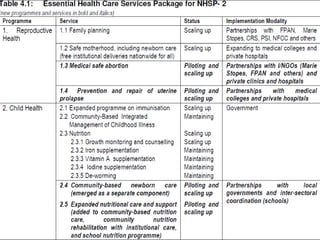
• The subsequent Nepal Health Sector Programme
Implementation Plan ii( 2010–2015) updated and expanded
the EPHS to include new services under the reproductive
health and child health areas,
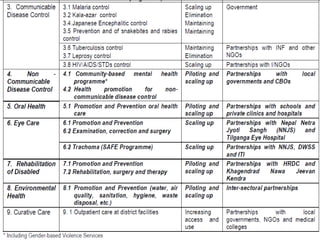
• new programs on mental health, oral health, environmental
health, and community-based newborn care, and a
community-based nutrition care and support program.
• In addition, the update adds a non communicable disease
control component to address changes in demographics and
diseases.
History:
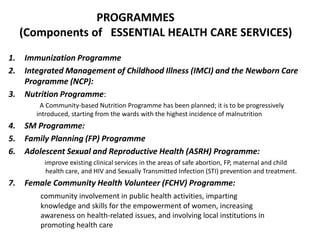
1. Immunization Programme
2. Integrated Management of Childhood Illness (IMCI) and the Newborn Care
Programme (NCP):
3. Nutrition Programme:
A Community-based Nutrition Programme has been planned; it is to be progressively
introduced, starting from the wards with the highest incidence of malnutrition
4. SM Programme:
5. Family Planning (FP) Programme
6. Adolescent Sexual and Reproductive Health (ASRH) Programme:
improve existing clinical services in the areas of safe abortion, FP, maternal and child
health care, and HIV and Sexually Transmitted Infection (STI) prevention and treatment.
7. Female Community Health Volunteer (FCHV) Programme:
community involvement in public health activities, imparting
knowledge and skills for the empowerment of women, increasing
awareness on health-related issues, and involving local institutions in
promoting health care
PROGRAMMES
(Components of ESSENTIAL HEALTH CARE SERVICES)
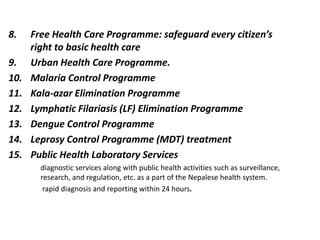
8. Free Health Care Programme: safeguard every citizen’s
right to basic health care
9. Urban Health Care Programme.
10. Malaria Control Programme
11. Kala-azar Elimination Programme
12. Lymphatic Filariasis (LF) Elimination Programme
13. Dengue Control Programme
14. Leprosy Control Programme (MDT) treatment
15. Public Health Laboratory Services
diagnostic services along with public health activities such as surveillance,
research, and regulation, etc. as a part of the Nepalese health system.
rapid diagnosis and reporting within 24 hours.
16. HIV/AIDS and STI Control Programme.
17. National Tuberculosis Programme (NTP).
18. NCD Control Programme.
19. Programme on Mental Health and Neurological Disorders.
20. Oral Health Care Programme.
21. Curative Health Services Programme.
The guideline covers catastrophic spending for five diseases: kidney
disease, cancer, heart disease, Alzheimer’s, and Parkinson’s. This
programme aims to reduce mortality and disability, and will address
the morbidity of the general population.
22. Ayurvedic and Alternative Medicine.
23. Health Education and Communication Programme.
24. Environmental Health and Hygiene (EHH) Programme.
Water-, Sanitation- and Hygiene- (WASH-)
Free Health Care Programme
• Programme created to safeguard every citizen’s right to basic health
care.
• The MoHP declared free health care in 2007, targeting poor,
vulnerable, and marginalized people for
- increasing access to and utilization of health care services.
- mitigating the financial barriers to seeking care.
- improving the health of the population.
• During NHSP-1, free EHCS were initially designed for the poor and
excluded but later EHCS became free of charge for all at district
facilities, except for district hospitals.
• During NHSP-2, EHCS in district hospitals are planned to be made
free to all.
The Evolution of free health care -
• On December 15, 2006, the GoN made emergency and inpatient
services free of charge to ultra-poor, poor, destitute, and elderly
people, people living with disabilities, and FCHVs, at district
hospitals and PHCCs. Outpatient (OP) services were also made free
to the targeted groups in low- Human Development Index (HDI)
districts from FY 2064/65 (2007) onward.
• On October 7, 2007 ,the GoN declared EHCS free of charge to
everyone at all HPs and SHPs. The policy was implemented in mid-
January 2008.
• On November 16, 2008 ,the GoN declared EHCS free of charge to
all at PHCCs.
• On January 15, 2009 ,the GoN declared OP services, inpatient
services and emergency services free of charge to the targeted
groups in hospitals of 25 or fewer beds, as well as listing all
medicines as free. For non-targeted groups, 20 listed drugs were
made available free of charge.
Goals
• To reduce out-of-pocket spending on health care,
particularly of the poor, marginalised and
vulnerable groups
• To reduce the disability rate, and address
morbidity, especially of poor, marginalised and
vulnerable people, by securing the right of
citizens to basic health services.
Objectives
• To ensure the citizens’ constitutional right to
basic health care services.
• To increase access to and utilisation of EHCS,
especially by poor and marginalised groups.
Major Strategies
• Increasing awareness of free care through effective and localised
health communication .
- Airing free-care-related messages from FM radio, TV, print media
- Develop IEC materials (electronic) on free care
- Promote free care through FCHVs, schoolteachers, students,
• Strengthening free care .
- Provide additional care providers on a contract basis
- Orient care providers on free care
- Replenish the registration fees of DHOs, PHCCs, HPs and SHPs
(grants)
• Increasing allocative efficiency
-Revise resource allocation criteria for free care
-Use allocation criteria for funding
Improving the quality of care
- Periodically expand the list of essential drugs for free care
-Ensure the regular presence of service providers in all HFs
throughout the year.
Institutional development
-Ensure year-round drug availability in public health
facilities as per free care drug list.
-Strengthen and make functional monitoring mechanisms
within PHCRD.
Promoting the role of local government in free care.
Orient the members of local government bodies and
stakeholders on free care and their supporting roles.
Major Challenges and Issues
• Increasing awareness of free care (60% of the population is
aware of free care)
• Ensuring the retention of care providers at service centres
• Maintaining the quality of care
• Reducing stock-outs of essential drugs at the facility level
• Expanding the list of free essential drugs
• Monitoring free care
• Classifying poor and non-poor patients in district hospitals
• Moving from case-based to population-based budget
allocations for free care.
THANK YOU !
Reference : NHSP
NHSP II
NHSP IP II

EHC & FHS

  • 1.
    Essential Health CareServices & Free Health Care Programme BY: Ankita Kunwar BPH 3rd year
  • 2.
    • An EssentialHealth Care Services (EHCS) can be defined as the package of services that the government is providing to its citizens in an equitable manner & cost effective way. • EHCS are priority public health measures and are essential clinical and curative services for the appropriate treatment of common diseases.
  • 3.
    Delivering the EPHSto Different Population Groups The government's strategy for implementing the EPHS includes specific activities to improve equity of access for specific populations; these include: – Women, – The indigent, and – Rural populations.
  • 4.
    The three objectivesfocusing on extending and sustaining coverage of EHCS are: • To increase access to and utilization of quality essential health care services. • To reduce cultural and economic barriers to accessing health care services and harmful cultural practices in partnership with non-state actors. • To improve the health system to achieve universal coverage of essential health services.
  • 5.
    History: • The governmentof Nepal first published an EPHS, called the “Essential Health Care Services package,” in 1999 as part of the second Long Term Health Plan(1997-2017), which included 20 broad health areas. • The government’s Health Sector Strategy (2004) acknowledged that the original EPHS was not affordable for the government to provide, given the country’s current resource availability.
  • 6.
    History: • The 2004Health Sector Strategy proposed to focus on delivering four main areas of essential health care across all districts: 1. Family Planning, Safe motherhood and Neonatal health 2. Child health, 3. Control of communicable disease, and 4. Strengthened outpatient care, which the Nepal Health Sector Programme Implementation Plan 2004–2009 sought to do.
  • 7.
    • The subsequentNepal Health Sector Programme Implementation Plan ii( 2010–2015) updated and expanded the EPHS to include new services under the reproductive health and child health areas, • new programs on mental health, oral health, environmental health, and community-based newborn care, and a community-based nutrition care and support program. • In addition, the update adds a non communicable disease control component to address changes in demographics and diseases. History:
  • 10.
    1. Immunization Programme 2.Integrated Management of Childhood Illness (IMCI) and the Newborn Care Programme (NCP): 3. Nutrition Programme: A Community-based Nutrition Programme has been planned; it is to be progressively introduced, starting from the wards with the highest incidence of malnutrition 4. SM Programme: 5. Family Planning (FP) Programme 6. Adolescent Sexual and Reproductive Health (ASRH) Programme: improve existing clinical services in the areas of safe abortion, FP, maternal and child health care, and HIV and Sexually Transmitted Infection (STI) prevention and treatment. 7. Female Community Health Volunteer (FCHV) Programme: community involvement in public health activities, imparting knowledge and skills for the empowerment of women, increasing awareness on health-related issues, and involving local institutions in promoting health care PROGRAMMES (Components of ESSENTIAL HEALTH CARE SERVICES)
  • 11.
    8. Free HealthCare Programme: safeguard every citizen’s right to basic health care 9. Urban Health Care Programme. 10. Malaria Control Programme 11. Kala-azar Elimination Programme 12. Lymphatic Filariasis (LF) Elimination Programme 13. Dengue Control Programme 14. Leprosy Control Programme (MDT) treatment 15. Public Health Laboratory Services diagnostic services along with public health activities such as surveillance, research, and regulation, etc. as a part of the Nepalese health system. rapid diagnosis and reporting within 24 hours.
  • 12.
    16. HIV/AIDS andSTI Control Programme. 17. National Tuberculosis Programme (NTP). 18. NCD Control Programme. 19. Programme on Mental Health and Neurological Disorders. 20. Oral Health Care Programme. 21. Curative Health Services Programme. The guideline covers catastrophic spending for five diseases: kidney disease, cancer, heart disease, Alzheimer’s, and Parkinson’s. This programme aims to reduce mortality and disability, and will address the morbidity of the general population. 22. Ayurvedic and Alternative Medicine. 23. Health Education and Communication Programme. 24. Environmental Health and Hygiene (EHH) Programme. Water-, Sanitation- and Hygiene- (WASH-)
  • 13.
    Free Health CareProgramme • Programme created to safeguard every citizen’s right to basic health care. • The MoHP declared free health care in 2007, targeting poor, vulnerable, and marginalized people for - increasing access to and utilization of health care services. - mitigating the financial barriers to seeking care. - improving the health of the population. • During NHSP-1, free EHCS were initially designed for the poor and excluded but later EHCS became free of charge for all at district facilities, except for district hospitals. • During NHSP-2, EHCS in district hospitals are planned to be made free to all.
  • 14.
    The Evolution offree health care - • On December 15, 2006, the GoN made emergency and inpatient services free of charge to ultra-poor, poor, destitute, and elderly people, people living with disabilities, and FCHVs, at district hospitals and PHCCs. Outpatient (OP) services were also made free to the targeted groups in low- Human Development Index (HDI) districts from FY 2064/65 (2007) onward. • On October 7, 2007 ,the GoN declared EHCS free of charge to everyone at all HPs and SHPs. The policy was implemented in mid- January 2008. • On November 16, 2008 ,the GoN declared EHCS free of charge to all at PHCCs. • On January 15, 2009 ,the GoN declared OP services, inpatient services and emergency services free of charge to the targeted groups in hospitals of 25 or fewer beds, as well as listing all medicines as free. For non-targeted groups, 20 listed drugs were made available free of charge.
  • 15.
    Goals • To reduceout-of-pocket spending on health care, particularly of the poor, marginalised and vulnerable groups • To reduce the disability rate, and address morbidity, especially of poor, marginalised and vulnerable people, by securing the right of citizens to basic health services.
  • 16.
    Objectives • To ensurethe citizens’ constitutional right to basic health care services. • To increase access to and utilisation of EHCS, especially by poor and marginalised groups.
  • 17.
    Major Strategies • Increasingawareness of free care through effective and localised health communication . - Airing free-care-related messages from FM radio, TV, print media - Develop IEC materials (electronic) on free care - Promote free care through FCHVs, schoolteachers, students, • Strengthening free care . - Provide additional care providers on a contract basis - Orient care providers on free care - Replenish the registration fees of DHOs, PHCCs, HPs and SHPs (grants) • Increasing allocative efficiency -Revise resource allocation criteria for free care -Use allocation criteria for funding
  • 18.
    Improving the qualityof care - Periodically expand the list of essential drugs for free care -Ensure the regular presence of service providers in all HFs throughout the year. Institutional development -Ensure year-round drug availability in public health facilities as per free care drug list. -Strengthen and make functional monitoring mechanisms within PHCRD. Promoting the role of local government in free care. Orient the members of local government bodies and stakeholders on free care and their supporting roles.
  • 19.
    Major Challenges andIssues • Increasing awareness of free care (60% of the population is aware of free care) • Ensuring the retention of care providers at service centres • Maintaining the quality of care • Reducing stock-outs of essential drugs at the facility level • Expanding the list of free essential drugs • Monitoring free care • Classifying poor and non-poor patients in district hospitals • Moving from case-based to population-based budget allocations for free care.
  • 20.
    THANK YOU ! Reference: NHSP NHSP II NHSP IP II