Plumbers conference 2012
1
1
UEFI Tutorial
8/29/12
Harry Hsiung
Intel Corp
Plumbers conference 2012
2
2
Agenda
• UEFI Basics
• UEFI security features
• UEFI development platforms
• UEFI Resources
• Opens
• Backup
Plumbers conference 2012
3
3
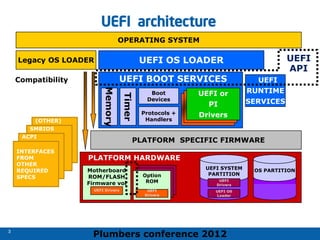
PLATFORM HARDWARE
PLATFORM SPECIFIC FIRMWARE
UEFI BOOT SERVICES UEFI
RUNTIME
SERVICES
UEFI OS LOADER
(OTHER)
SMBIOS
ACPI
INTERFACES
FROM
OTHER
REQUIRED
SPECS
Memory
Timer
Driver
Driver
UEFI or
PI
Drivers
Boot
Devices
Protocols +
Handlers
OPERATING SYSTEM
Legacy OS LOADER
Compatibility
UEFI
API
Motherboard
ROM/FLASH
Firmware vol
Option
ROM
Option
ROM
Option
ROM
UEFI Drivers UEFI
Drivers
UEFI OS
Loader
UEFI SYSTEM
PARTITION
UEFI
Drivers
OS PARTITION
UEFI architecture
Plumbers conference 2012
4
4
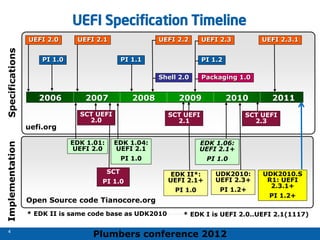
UEFI Specification Timeline
UEFI 2.0
PI 1.0
UEFI 2.1
PI 1.1
UEFI 2.3
UEFI 2.2
EDK 1.01:
UEFI 2.0
Shell 2.0
PI 1.2
Packaging 1.0
EDK 1.04:
UEFI 2.1
PI 1.0
Specifications
Implementation
Open Source code Tianocore.org
EDK 1.06:
UEFI 2.1+
PI 1.0
SCT
PI 1.0
SCT UEFI
2.0
UDK2010:
UEFI 2.3+
PI 1.2+
All products, dates, and programs are based on current expectations and subject to change without notice.
EDK II*:
UEFI 2.1+
PI 1.0
* EDK II is same code base as UDK2010
2006 2007 2008 2009 2010 2011
SCT UEFI
2.1
UEFI 2.3.1
UDK2010.S
R1: UEFI
2.3.1+
PI 1.2+
SCT UEFI
2.3
uefi.org
* EDK I is UEFI 2.0..UEFI 2.1(1117)
Plumbers conference 2012
5
5
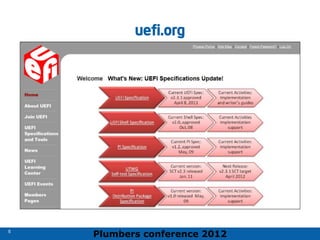
uefi.org
Plumbers conference 2012
6
6
Architecture Execution Flow
6
Pre EFI
Initializati
on (PEI)
Driver
Execution
Environment
(DXE)
Boot
Dev
Select
(BDS)
Transient
System Load
(TSL)
After
Life
(AL)
Power
on
[ . . Platform initialization . . ] [ . . . . OS boot . . . . ] Shutdown
Run Time
(RT)
?
OS-Present
App
Final OS
Environment
Final OS
Boot Loader
OS-Absent
App
Transient OS
Environment
Transient OS
Boot Loader
Boot
Manager
Proces
sor
Init
Chipse
t Init
Board
Init
verif
y
Device,
Bus, or
Service
Driver
UEFI
Interface
Pre
Verifier
EFI Driver
Dispatcher
Intrinsic
Services
Security
(SEC)
Boot Execution Flow
Software and Services Group
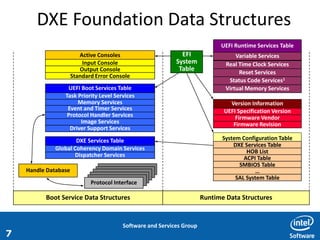
DXE Foundation Data Structures
7
EFI
System
Table
UEFI Runtime Services Table
Variable Services
Real Time Clock Services
Reset Services
Status Code Services1
Virtual Memory Services
UEFI Boot Services Table
Task Priority Level Services
Memory Services
Event and Timer Services
Protocol Handler Services
Image Services
Driver Support Services
Input Console
Active Consoles
Output Console
Standard Error Console
Version Information
UEFI Specification Version
Firmware Vendor
Firmware Revision
Handle Database Protocol Interface
Protocol Interface
Protocol Interface
Protocol Interface
Protocol Interface
Protocol Interface
Boot Service Data Structures Runtime Data Structures
Global Coherency Domain Services
DXE Services Table
Dispatcher Services
System Configuration Table
ACPI Table
SMBIOS Table
…
SAL System Table
DXE Services Table
HOB List
Plumbers conference 2012
8
8
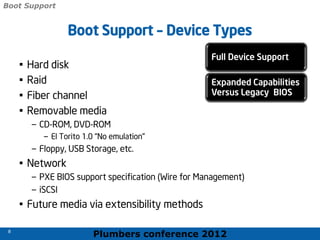
Boot Support – Device Types
• Hard disk
• Raid
• Fiber channel
• Removable media
– CD-ROM, DVD-ROM
– El Torito 1.0 “No emulation”
– Floppy, USB Storage, etc.
• Network
– PXE BIOS support specification (Wire for Management)
– iSCSI
• Future media via extensibility methods
Full Device Support
Expanded Capabilities
Versus Legacy BIOS
Boot Support
Plumbers conference 2012
9
9
Partition
Table
HDR
Partition 1
MBR
Partition
Table
HDR
0 1 n
...
LBA0 LBA1 LBAn
Start partition
End partition
Start partition
Primary Partition
Table
Backup Partition
Table
0 1 n
...
End partition
First useable block
Last useable block
Boot Support
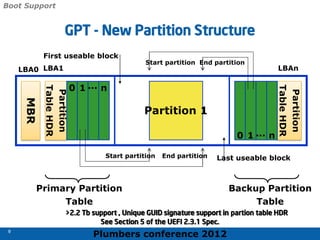
See Section 5 of the UEFI 2.3.1 Spec.
GPT - New Partition Structure
>2.2 Tb support , Unique GUID signature support in partion table HDR
Plumbers conference 2012
10
10
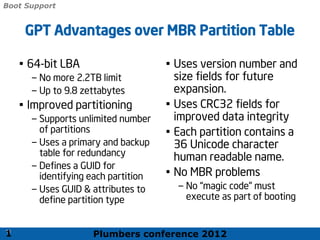
GPT Advantages over MBR Partition Table
• 64-bit LBA
– No more 2.2TB limit
– Up to 9.8 zettabytes
• Improved partitioning
– Supports unlimited number
of partitions
– Uses a primary and backup
table for redundancy
– Defines a GUID for
identifying each partition
– Uses GUID & attributes to
define partition type
• Uses version number and
size fields for future
expansion.
• Uses CRC32 fields for
improved data integrity
• Each partition contains a
36 Unicode character
human readable name.
• No MBR problems
– No “magic code” must
execute as part of booting
1
Boot Support
Plumbers conference 2012
11
11
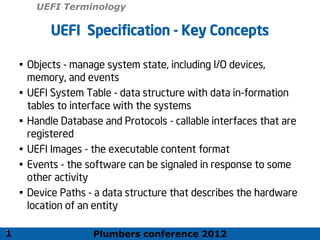
UEFI Specification - Key Concepts
• Objects - manage system state, including I/O devices,
memory, and events
• UEFI System Table - data structure with data in-formation
tables to interface with the systems
• Handle Database and Protocols - callable interfaces that are
registered
• UEFI Images - the executable content format
• Events - the software can be signaled in response to some
other activity
• Device Paths - a data structure that describes the hardware
location of an entity
1
UEFI Terminology
Plumbers conference 2012
12
12
GUID
• Globally Unique Identifier
– 128-bit quantity defined by Wired for Management (WfM) 2.0
specification **
• Used to identify protocols
– 1:1 with interfaces
• Regulate extension mechanism
– Documented in the spec
– Added through drivers
Safe co-existence of 3rd party extensions
** http://www.intel.com/design/archives/wfm/index.htm
UEFI Terminology
Plumbers conference 2012
13
13
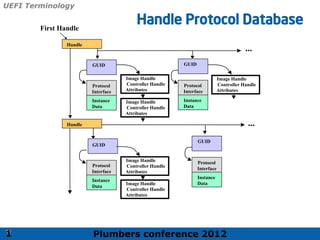
Handles
• All protocols have an associated handle
• Every device and executable image in UEFI has a handle
protocol in the handle database
• Every boot device must have a device path protocol to
describe it
1
UEFI Terminology
Plumbers conference 2012
14
14
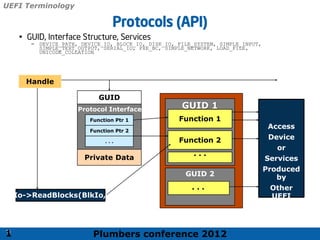
Protocols (API)
• GUID, Interface Structure, Services
– DEVICE_PATH, DEVICE_IO, BLOCK_IO, DISK_IO, FILE_SYSTEM, SIMPLE_INPUT,
SIMPLE_TEXT_OUTPUT, SERIAL_IO, PXE_BC, SIMPLE_NETWORK, LOAD_FILE,
UNICODE_COLLATION
1
Handle
Function Ptr 1
Private Data
GUID
Function Ptr 2
. . .
Protocol Interface GUID 1
GUID 2
Function 1
Function 2
Access
Device
or
Services
Produced
by
Other
UEFI
Drivers
BlkIo->ReadBlocks(BlkIo, …)
. . .
. . .
UEFI Terminology
Plumbers conference 2012
15
15
Handle Protocol Database
1
...
Handle
First Handle
GUID GUID
Protocol
Interface
Instance
Data
Protocol
Interface
Instance
Data
Handle
GUID
Protocol
Interface
Instance
Data
Image Handle
Controller Handle
Attributes
...
Image Handle
Controller Handle
Attributes
Image Handle
Controller Handle
Attributes
Image Handle
Controller Handle
Attributes
Image Handle
Controller Handle
Attributes
...
GUID
Protocol
Interface
Instance
Data
UEFI Terminology
Plumbers conference 2012
16
16
Device Path Protocol
• A data structure description of where a
device is in the platform
• All boot devices, logical devices and images
must be described by a UEFI device path
• The UEFI Specification defines six types of
device paths
UEFI Terminology
Plumbers conference 2012
17
17
Six Types of Device Path Types
• Hardware – where is the device in the system
• ACPI – UID/HID of device in AML
• Messaging – Classifies device as LAN, Fiber Channel, ATAPI,
SCSI, USB, …
• Media – i.e. Hard Drive, Floppy or CD-ROM
• BIOS Boot Specification – used to point to boot legacy
operating systems
• End of hardware – marks end of device path
1
UEFI Terminology
Plumbers conference 2012
18
18
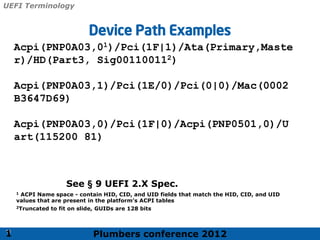
Device Path Examples
Acpi(PNP0A03,01)/Pci(1F|1)/Ata(Primary,Maste
r)/HD(Part3, Sig001100112)
Acpi(PNP0A03,1)/Pci(1E/0)/Pci(0|0)/Mac(0002
B3647D69)
Acpi(PNP0A03,0)/Pci(1F|0)/Acpi(PNP0501,0)/U
art(115200 81)
1
See § 9 UEFI 2.X Spec.
UEFI Terminology
1 ACPI Name space - contain HID, CID, and UID fields that match the HID, CID, and UID
values that are present in the platform’s ACPI tables
2Truncated to fit on slide, GUIDs are 128 bits
Plumbers conference 2012
19
19
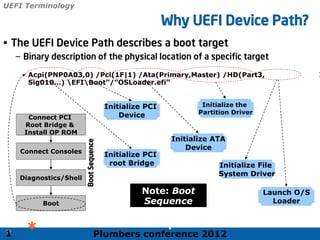
Acpi(PNP0A03,0) /Pci(1F|1) /Ata(Primary,Master) /HD(Part3, Sig010…) EFI
1
Why UEFI Device Path?
• The UEFI Device Path describes a boot target
– Binary description of the physical location of a specific target
Acpi(PNP0A03,0)
Acpi(PNP0A03,0) /Pci(1F|1)
Acpi(PNP0A03,0) /Pci(1F|1) /Ata(Primary,Master)
Acpi(PNP0A03,0) /Pci(1F|1) /Ata(Primary,Master) /HD(Part3, Sig010…)
Acpi(PNP0A03,0) /Pci(1F|1) /Ata(Primary,Master) /HD(Part3,
Sig010…) EFIBoot”/”OSLoader.efi”
Initialize PCI
root Bridge
Initialize PCI
Device
Initialize ATA
Device
Initialize the
Partition Driver
Initialize File
System Driver
Launch O/S
Loader
Connect PCI
Root Bridge &
Install OP ROM
Connect Consoles
Diagnostics/Shell
Boot
*
Boot
Sequence
UEFI Terminology
Note: Boot
Sequence
is part of the
PI Spec.
Plumbers conference 2012
20
20
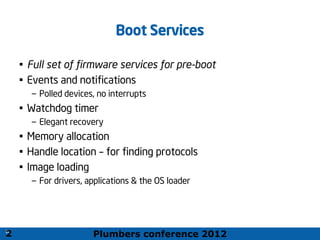
Boot Services
• Full set of firmware services for pre-boot
• Events and notifications
– Polled devices, no interrupts
• Watchdog timer
– Elegant recovery
• Memory allocation
• Handle location – for finding protocols
• Image loading
– For drivers, applications & the OS loader
2
Plumbers conference 2012
21
21
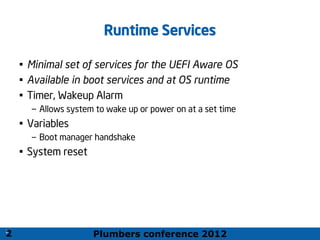
Runtime Services
• Minimal set of services for the UEFI Aware OS
• Available in boot services and at OS runtime
• Timer, Wakeup Alarm
– Allows system to wake up or power on at a set time
• Variables
– Boot manager handshake
• System reset
2
Plumbers conference 2012
22
22
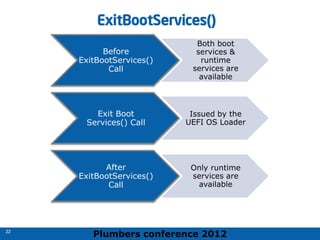
ExitBootServices()
Before
ExitBootServices()
Call
Both boot
services &
runtime
services are
available
Exit Boot
Services() Call
Issued by the
UEFI OS Loader
After
ExitBootServices()
Call
Only runtime
services are
available
Plumbers conference 2012
23
23
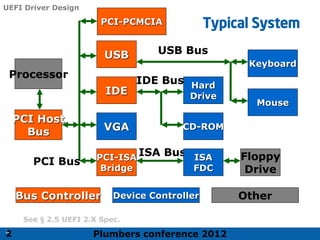
Typical System
2
Processor
PCI Host
Bus
USB
IDE
PCI-ISA
Bridge
VGA
Keyboard
Mouse
Floppy
Drive
Hard
Drive
CD-ROM
PCI Bus
USB Bus
ISA Bus
IDE Bus
Device Controller
Bus Controller Other
ISA
FDC
PCI-PCMCIA
UEFI Driver Design
See § 2.5 UEFI 2.X Spec.
Plumbers conference 2012
24
24
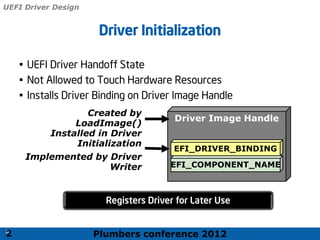
Driver Initialization
• UEFI Driver Handoff State
• Not Allowed to Touch Hardware Resources
• Installs Driver Binding on Driver Image Handle
2
Installed in Driver
Initialization
Implemented by Driver
Writer
Created by
LoadImage()
Driver Image Handle
EFI_DRIVER_BINDING
Registers Driver for Later Use
UEFI Driver Design
EFI_COMPONENT_NAME
Plumbers conference 2012
25
25
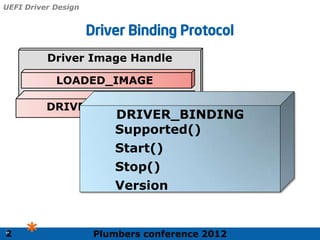
Driver Binding Protocol
2
Driver Image Handle
LOADED_IMAGE
DRIVER_BINDING
DRIVER_BINDING
Supported()
Start()
Stop()
Version
*
UEFI Driver Design
Plumbers conference 2012
26
26
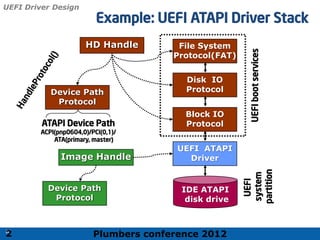
IDE ATAPI
disk drive
Block IO
Protocol
Device Path
Protocol
Disk IO
Protocol
File System
Protocol(FAT)
HD Handle
UEFI ATAPI
Driver
ATAPI Device Path
ACPI(pnp0604,0)/PCI(0,1)/
ATA(primary, master)
UEFI
system
partition
UEFI
boot
services
Image Handle
Device Path
Protocol
Example: UEFI ATAPI Driver Stack
UEFI Driver Design
2
Plumbers conference 2012
27
27
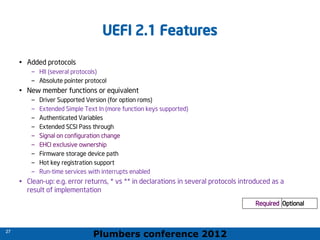
UEFI 2.1 Features
• Added protocols
– HII (several protocols)
– Absolute pointer protocol
• New member functions or equivalent
– Driver Supported Version (for option roms)
– Extended Simple Text In (more function keys supported)
– Authenticated Variables
– Extended SCSI Pass through
– Signal on configuration change
– EHCI exclusive ownership
– Firmware storage device path
– Hot key registration support
– Run-time services with interrupts enabled
• Clean-up: e.g. error returns, * vs ** in declarations in several protocols introduced as a
result of implementation
Required Optional
Plumbers conference 2012
28
28
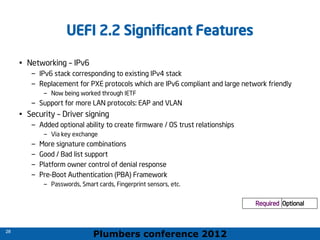
UEFI 2.2 Significant Features
• Networking – IPv6
– IPv6 stack corresponding to existing IPv4 stack
– Replacement for PXE protocols which are IPv6 compliant and large network friendly
– Now being worked through IETF
– Support for more LAN protocols: EAP and VLAN
• Security – Driver signing
– Added optional ability to create firmware / OS trust relationships
– Via key exchange
– More signature combinations
– Good / Bad list support
– Platform owner control of denial response
– Pre-Boot Authentication (PBA) Framework
– Passwords, Smart cards, Fingerprint sensors, etc.
Required Optional
Required Optional
Plumbers conference 2012
29
29
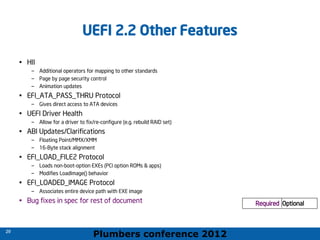
UEFI 2.2 Other Features
• HII
– Additional operators for mapping to other standards
– Page by page security control
– Animation updates
• EFI_ATA_PASS_THRU Protocol
– Gives direct access to ATA devices
• UEFI Driver Health
– Allow for a driver to fix/re-configure (e.g. rebuild RAID set)
• ABI Updates/Clarifications
– Floating Point/MMX/XMM
– 16-Byte stack alignment
• EFI_LOAD_FILE2 Protocol
– Loads non-boot-option EXEs (PCI option ROMs & apps)
– Modifies LoadImage() behavior
• EFI_LOADED_IMAGE Protocol
– Associates entire device path with EXE image
• Bug fixes in spec for rest of document Required Optional
Required Optional
Plumbers conference 2012
30
30
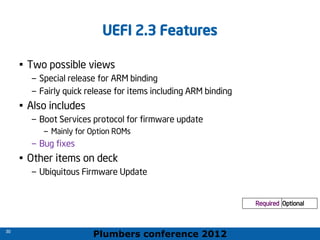
UEFI 2.3 Features
• Two possible views
– Special release for ARM binding
– Fairly quick release for items including ARM binding
• Also includes
– Boot Services protocol for firmware update
– Mainly for Option ROMs
– Bug fixes
• Other items on deck
– Ubiquitous Firmware Update
Required Optional
Required Optional
Plumbers conference 2012
31
31
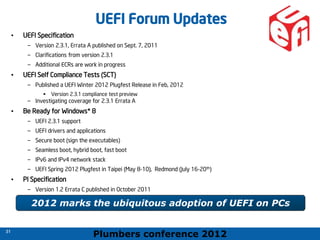
UEFI Forum Updates
• UEFI Specification
– Version 2.3.1, Errata A published on Sept. 7, 2011
– Clarifications from version 2.3.1
– Additional ECRs are work in progress
• UEFI Self Compliance Tests (SCT)
– Published a UEFI Winter 2012 Plugfest Release in Feb, 2012
 Version 2.3.1 compliance test preview
– Investigating coverage for 2.3.1 Errata A
• Be Ready for Windows* 8
– UEFI 2.3.1 support
– UEFI drivers and applications
– Secure boot (sign the executables)
– Seamless boot, hybrid boot, fast boot
– IPv6 and IPv4 network stack
– UEFI Spring 2012 Plugfest in Taipei (May 8-10), Redmond (July 16-20th)
• PI Specification
– Version 1.2 Errata C published in October 2011
2012 marks the ubiquitous adoption of UEFI on PCs
Plumbers conference 2012
32
32
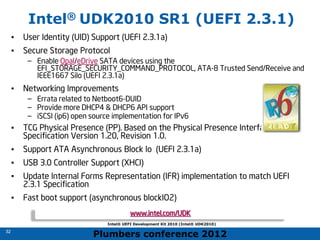
Intel® UDK2010 SR1 (UEFI 2.3.1)
• User Identity (UID) Support (UEFI 2.3.1a)
• Secure Storage Protocol
– Enable Opal/eDrive SATA devices using the
EFI_STORAGE_SECURITY_COMMAND_PROTOCOL, ATA-8 Trusted Send/Receive and
IEEE1667 Silo (UEFI 2.3.1a)
• Networking Improvements
– Errata related to Netboot6-DUID
– Provide more DHCP4 & DHCP6 API support
– iSCSI (ip6) open source implementation for IPv6
• TCG Physical Presence (PP). Based on the Physical Presence Interface
Specification Version 1.20, Revision 1.0.
• Support ATA Asynchronous Block Io (UEFI 2.3.1a)
• USB 3.0 Controller Support (XHCI)
• Update Internal Forms Representation (IFR) implementation to match UEFI
2.3.1 Specification
• Fast boot support (asynchronous blockIO2)
Intel® UEFI Development Kit 2010 (Intel® UDK2010)
www.intel.com/UDK
Plumbers conference 2012
33
33
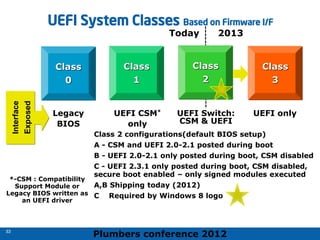
UEFI System Classes Based on Firmware I/F
Class
0
Class
1
Class
2
Class
3
Legacy
BIOS
UEFI CSM*
only
UEFI Switch:
CSM & UEFI
UEFI only
Interface
Exposed
2013
Today
*-CSM : Compatibility
Support Module or
Legacy BIOS written as
an UEFI driver
Class 2 configurations(default BIOS setup)
A - CSM and UEFI 2.0-2.1 posted during boot
B - UEFI 2.0-2.1 only posted during boot, CSM disabled
C - UEFI 2.3.1 only posted during boot, CSM disabled,
secure boot enabled – only signed modules executed
A,B Shipping today (2012)
C Required by Windows 8 logo
Plumbers conference 2012
34
34
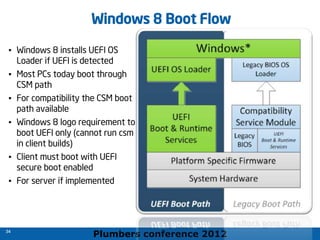
Windows 8 Boot Flow
• Windows 8 installs UEFI OS
Loader if UEFI is detected
• Most PCs today boot through
CSM path
• For compatibility the CSM boot
path available
• Windows 8 logo requirement to
boot UEFI only (cannot run csm
in client builds)
• Client must boot with UEFI
secure boot enabled
• For server if implemented
Plumbers conference 2012
35
35
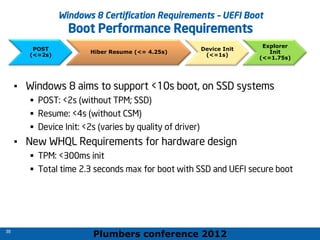
Windows 8 Certification Requirements – UEFI Boot
Boot Performance Requirements
• Windows 8 aims to support <10s boot, on SSD systems
 POST: <2s (without TPM; SSD)
 Resume: <4s (without CSM)
 Device Init: <2s (varies by quality of driver)
• New WHQL Requirements for hardware design
 TPM: <300ms init
 Total time 2.3 seconds max for boot with SSD and UEFI secure boot
POST
(<=2s)
Hiber Resume (<= 4.25s)
Device Init
(<=1s)
Explorer
Init
(<=1.75s)
Plumbers conference 2012
36
36
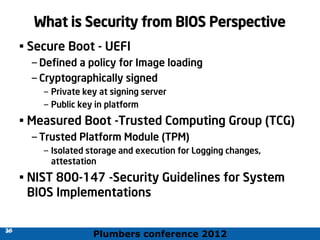
What is Security from BIOS Perspective
• Secure Boot - UEFI
–Defined a policy for Image loading
–Cryptographically signed
– Private key at signing server
– Public key in platform
• Measured Boot -Trusted Computing Group (TCG)
–Trusted Platform Module (TPM)
– Isolated storage and execution for Logging changes,
attestation
• NIST 800-147 -Security Guidelines for System
BIOS Implementations
36
Plumbers conference 2012
37
37
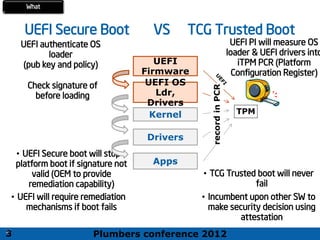
UEFI Secure Boot VS TCG Trusted Boot
UEFI authenticate OS
loader
(pub key and policy)
Check signature of
before loading
• UEFI Secure boot will stop
platform boot if signature not
valid (OEM to provide
remediation capability)
• UEFI will require remediation
mechanisms if boot fails
UEFI PI will measure OS
loader & UEFI drivers into
iTPM PCR (Platform
Configuration Register)
• TCG Trusted boot will never
fail
• Incumbent upon other SW to
make security decision using
attestation
UEFI
Firmware
UEFI OS
Ldr,
Drivers
Kernel
Drivers
Apps
TPM
record
in
PCR
What
3
Plumbers conference 2012
38
38
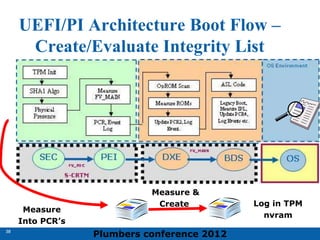
UEFI/PI Architecture Boot Flow –
Create/Evaluate Integrity List
Measure
Into PCR’s
Measure &
Create Log in TPM
nvram
Plumbers conference 2012
39
39
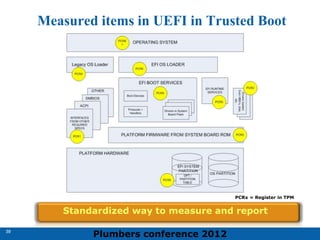
Measured items in UEFI in Trusted Boot
Standardized way to measure and report
PCRx = Register in TPM
Plumbers conference 2012
40
40
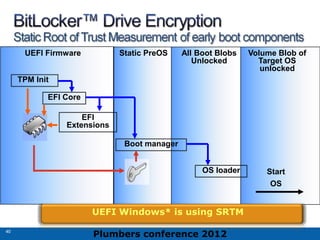
EFI
Extensions
EFI Core
TPM Init
UEFI Firmware Static PreOS
Boot manager
All Boot Blobs
Unlocked
OS loader
Volume Blob of
Target OS
unlocked
Start
OS
UEFI Windows* is using SRTM
Plumbers conference 2012
41
41
UEFI 2.3.1 Secure Boot
41
Plumbers conference 2012
42
42
Intel® UDK2010 SR1 Security Features
• UEFI Secure Boot
– UEFI variable support for UEFI Secure Boot as defined by UEFI 2.3.1a
(EFI_VARIABLE_TIME_BASED_AUTHENTICATED_WRITE_ACCESS attribute with
EFI_VARIABLE_AUTHENTICATION_2 and EFI_VARIABLE_AUTHENTICATION
support)
– DXE Image Verification library to support UEFI Secure Boot (UEFI 2.3.1a)
– PK x509 Certificate Support
– Support EFI_VARIABLE_AUTHENTICATION_2 for PK variable format (UEFI 2.3.1a)
– Add enable/disable mechanism for UEFI Secure Boot
• TCG Trusted Boot
– TCG EFI Platform Specification
Plumbers conference 2012
43
43
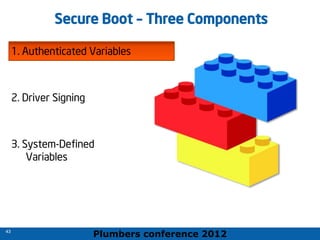
Secure Boot – Three Components
1. Authenticated Variables
2. Driver Signing
3. System-Defined
Variables
Plumbers conference 2012
44
44
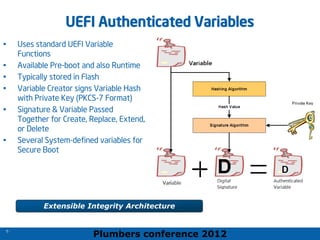
UEFI Authenticated Variables
• Uses standard UEFI Variable
Functions
• Available Pre-boot and also Runtime
• Typically stored in Flash
• Variable Creator signs Variable Hash
with Private Key (PKCS-7 Format)
• Signature & Variable Passed
Together for Create, Replace, Extend,
or Delete
• Several System-defined variables for
Secure Boot
44
Extensible Integrity Architecture
Plumbers conference 2012
45
45
Updating Authenticated Variable
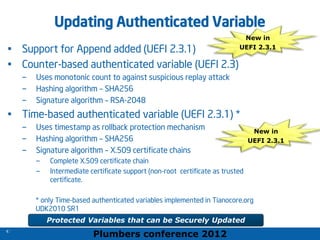
• Support for Append added (UEFI 2.3.1)
• Counter-based authenticated variable (UEFI 2.3)
– Uses monotonic count to against suspicious replay attack
– Hashing algorithm – SHA256
– Signature algorithm – RSA-2048
• Time-based authenticated variable (UEFI 2.3.1) *
– Uses timestamp as rollback protection mechanism
– Hashing algorithm – SHA256
– Signature algorithm – X.509 certificate chains
– Complete X.509 certificate chain
– Intermediate certificate support (non-root certificate as trusted
certificate.
* only Time-based authenticated variables implemented in Tianocore.org
UDK2010 SR1
45
Protected Variables that can be Securely Updated
New in
UEFI 2.3.1
New in
UEFI 2.3.1
Plumbers conference 2012
46
46
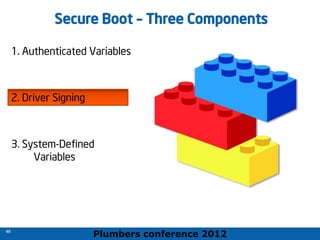
Secure Boot – Three Components
1. Authenticated Variables
2. Driver Signing
3. System-Defined
Variables
Plumbers conference 2012
47
47
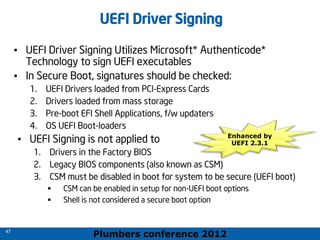
UEFI Driver Signing
• UEFI Driver Signing Utilizes Microsoft* Authenticode*
Technology to sign UEFI executables
• In Secure Boot, signatures should be checked:
1. UEFI Drivers loaded from PCI-Express Cards
2. Drivers loaded from mass storage
3. Pre-boot EFI Shell Applications, f/w updaters
4. OS UEFI Boot-loaders
• UEFI Signing is not applied to
1. Drivers in the Factory BIOS
2. Legacy BIOS components (also known as CSM)
3. CSM must be disabled in boot for system to be secure (UEFI boot)
 CSM can be enabled in setup for non-UEFI boot options
 Shell is not considered a secure boot option
Enhanced by
UEFI 2.3.1
Plumbers conference 2012
48
48
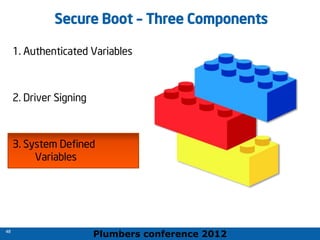
Secure Boot – Three Components
1. Authenticated Variables
2. Driver Signing
3. System Defined
Variables
Plumbers conference 2012
49
49
49
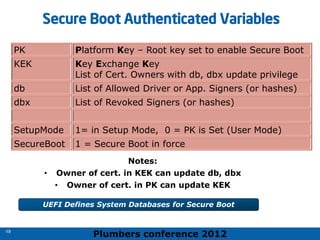
Secure Boot Authenticated Variables
PK Platform Key – Root key set to enable Secure Boot
KEK Key Exchange Key
List of Cert. Owners with db, dbx update privilege
db List of Allowed Driver or App. Signers (or hashes)
dbx List of Revoked Signers (or hashes)
SetupMode 1= in Setup Mode, 0 = PK is Set (User Mode)
SecureBoot 1 = Secure Boot in force
Notes:
• Owner of cert. in KEK can update db, dbx
• Owner of cert. in PK can update KEK
UEFI Defines System Databases for Secure Boot
Plumbers conference 2012
50
50
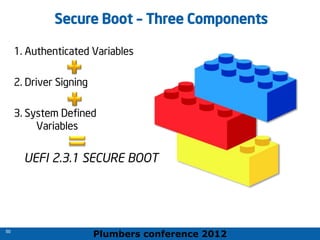
Secure Boot – Three Components
1. Authenticated Variables
2. Driver Signing
3. System Defined
Variables
UEFI 2.3.1 SECURE BOOT
Plumbers conference 2012
51
51
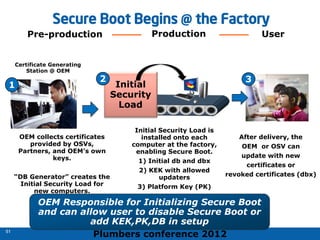
3
User
Secure Boot Begins @ the Factory
Initial
Security
Load
2
Production
Initial Security Load is
installed onto each
computer at the factory,
enabling Secure Boot.
1) Initial db and dbx
2) KEK with allowed
updaters
3) Platform Key (PK)
Pre-production
1
Certificate Generating
Station @ OEM
OEM collects certificates
provided by OSVs,
Partners, and OEM’s own
keys.
“DB Generator” creates the
Initial Security Load for
new computers.
OEM Responsible for Initializing Secure Boot
and can allow user to disable Secure Boot or
add KEK,PK,DB in setup
After delivery, the
OEM or OSV can
update with new
certificates or
revoked certificates (dbx)
Plumbers conference 2012
52
52
52
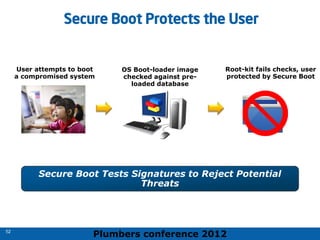
Secure Boot Protects the User
Secure Boot Tests Signatures to Reject Potential
Threats
User attempts to boot
a compromised system
OS Boot-loader image
checked against pre-
loaded database
Root-kit fails checks, user
protected by Secure Boot
Plumbers conference 2012
53
53
For more information - UEFI Secure Boot
Intel Technology Journal, Volume 15, Issue 1, 2011, UEFI
Today: Bootstrapping the Continuum, UEFI Networking and
Pre-OS Security, page 80 at
http://www.intel.com/technology/itj/2011/v15i1/pdfs/Intel-Technology-Journal-Volume-
15-Issue-1-2011.pdf
Rosenbaum, Zimmer, "A Tour Beyond BIOS into UEFI
Secure Boot," Intel Corporation, July 2012
http://sourceforge.net/projects/edk2/files/General%20Documentation/A_To
ur_Beyond_BIOS_into_UEFI_Secure_Boot_White_Paper.pdf/download
UEFI 2.3.1 specification: Sections 7.2 (Variable Services) and
Sections 27.2 through 27.8 (Secure Boot) of the at www.uefi.org
Beyond BIOS: Developing with the Unified Extensible
Firmware Interface, 2nd Edition, Zimmer, et al, ISBN 13 978-
1-934053-29-4, Chapter 10 – Platform Security and Trust,
http://www.intel.com/intelpress
“Hardening the Attack Surfaces,” MSFT 2012 UEFI Plugfest
http://www.uefi.org/learning_center/UEFI_Plugfest_2012Q1_Microsoft_AttackSurface.pdf
“Building hardware-based security with a TPM” MSFT
BUILD http://channel9.msdn.com/Events/BUILD/BUILD2011/HW-462T
Plumbers conference 2012
54
54
Tunnel Mountain Intel DQ57TM UEFI 2.3.1 platform
Intel® UDK 2010 SR1 UP1 Compatible, supports UEFI 2.3.1 (updates match
tianocore.org open source)
Pre-assembled systems available at HDNW, visit
http://www.Tunnelmountain.net based on DQ57TM
tomk@hdnw.com, (425) 943-5515 ext 42234. Use product name “Tunnel
Mountain” when ordering
Visit http://www.UEFIDK.com for the latest collateral on UEFI systems
For UEFI developers
Comes with class 2 CSM and UEFI enabled firmware
Download site has UEFI class2 firmware(csm not on by
default)
Comes with serial port for debug
Can be ordered with optional ITP connector and socketed
SPI flash
*Romley Server UEFI 2.3.1 to be available Sep ’12
*Maho Bay DQ77MK Q4 ’12
* - not available yet in validation test
Plumbers conference 2012
55
55
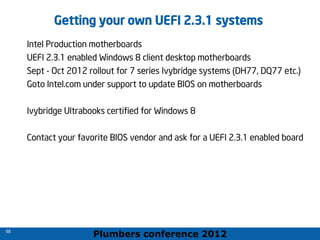
Getting your own UEFI 2.3.1 systems
Intel Production motherboards
UEFI 2.3.1 enabled Windows 8 client desktop motherboards
Sept - Oct 2012 rollout for 7 series Ivybridge systems (DH77, DQ77 etc.)
Goto Intel.com under support to update BIOS on motherboards
Ivybridge Ultrabooks certified for Windows 8
Contact your favorite BIOS vendor and ask for a UEFI 2.3.1 enabled board
Plumbers conference 2012
56
56
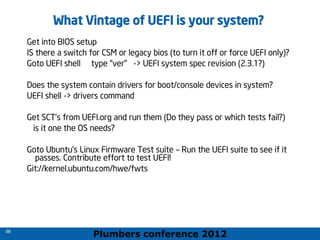
What Vintage of UEFI is your system?
Get into BIOS setup
IS there a switch for CSM or legacy bios (to turn it off or force UEFI only)?
Goto UEFI shell type “ver” -> UEFI system spec revision (2.3.1?)
Does the system contain drivers for boot/console devices in system?
UEFI shell -> drivers command
Get SCT’s from UEFI.org and run them (Do they pass or which tests fail?)
is it one the OS needs?
Goto Ubuntu’s Linux Firmware Test suite – Run the UEFI suite to see if it
passes. Contribute effort to test UEFI!
Git://kernel.ubuntu.com/hwe/fwts
Plumbers conference 2012
57
57
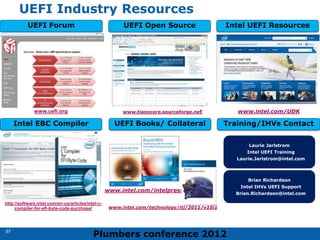
UEFI Industry Resources
www.uefi.org www.tianocore.sourceforge.net
UEFI Open Source
UEFI Forum
www.intel.com/UDK
Intel UEFI Resources
Training/IHVs Contact
http://software.intel.com/en-us/articles/intel-c-
compiler-for-efi-byte-code-purchase/
Intel EBC Compiler
www.intel.com/intelpress
UEFI Books/ Collateral
Laurie Jarlstrom
• Intel UEFI Training
• Laurie.Jarlstrom@intel.com
Brian Richardson
• Intel IHVs UEFI Support
• Brian.Richardson@intel.com
www.intel.com/technology/itj/2011/v15i1
Plumbers conference 2012
58
58
Backup
Plumbers conference 2012
59
59
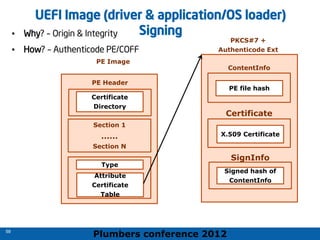
UEFI Image (driver & application/OS loader)
Signing
• Why? – Origin & Integrity
• How? – Authenticode PE/COFF
ContentInfo
Certificate
PE file hash
X.509 Certificate
SignInfo
Signed hash of
ContentInfo
PE Header
Attribute
Certificate
Table
Certificate
Directory
Section 1
……
Section N
Type
PE Image
PKCS#7 +
Authenticode Ext
Plumbers conference 2012
60
60
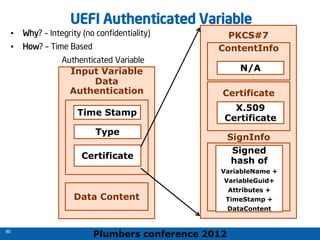
UEFI Authenticated Variable
• Why? – Integrity (no confidentiality)
• How? – Time Based
Authenticated Variable
Input Variable
Data
Authentication
Certificate
Data Content
Time Stamp
Type
PKCS#7
ContentInfo
Certificate
N/A
X.509
Certificate
SignInfo
Signed
hash of
VariableName +
VariableGuid+
Attributes +
TimeStamp +
DataContent
Plumbers conference 2012
61
61
61
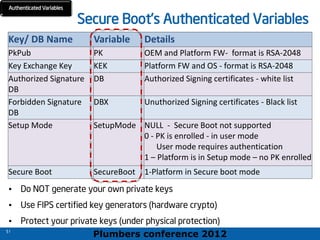
Secure Boot’s Authenticated Variables
Key/ DB Name Variable Details
PkPub PK OEM and Platform FW- format is RSA-2048
Key Exchange Key KEK Platform FW and OS - format is RSA-2048
Authorized Signature
DB
DB Authorized Signing certificates - white list
Forbidden Signature
DB
DBX Unuthorized Signing certificates - Black list
Setup Mode SetupMode NULL - Secure Boot not supported
0 - PK is enrolled - in user mode
User mode requires authentication
1 – Platform is in Setup mode – no PK enrolled
Secure Boot SecureBoot 1-Platform in Secure boot mode
Authenticated Variables
• Do NOT generate your own private keys
• Use FIPS certified key generators (hardware crypto)
• Protect your private keys (under physical protection)
Plumbers conference 2012
62
62
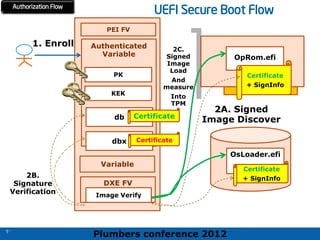
Authenticated
Variable
PEI FV
DXE FV
Variable
Image Verify
UEFI Secure Boot Flow
OsLoader.efi
Certificate
+ SignInfo
Certificate
+ SignInfo
PK
KEK
1. Enroll
2A. Signed
Image Discover
2B.
Signature
Verification
2C.
Signed
Image
Load
And
measure
Into
TPM
db Certificate
dbx Certificate
OpRom.efi
Authorization Flow
62
Plumbers conference 2012
63
63
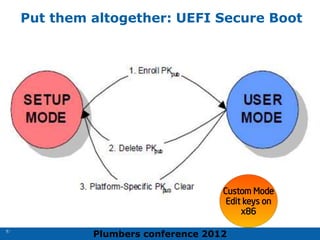
Put them altogether: UEFI Secure Boot
63
Custom Mode
Edit keys on
x86
Plumbers conference 2012
64
64
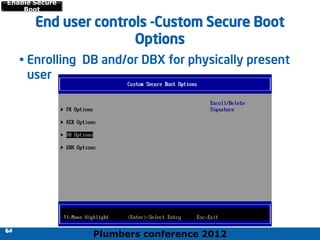
End user controls -Custom Secure Boot
Options
• Enrolling DB and/or DBX for physically present
user
64
Enable Secure
Boot
Plumbers conference 2012
65
65
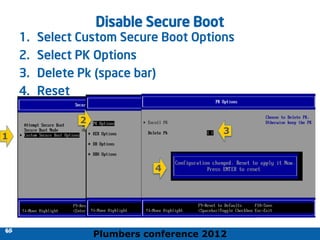
Disable Secure Boot
1. Select Custom Secure Boot Options
2. Select PK Options
3. Delete Pk (space bar)
4. Reset
65
1
2
3
4
Plumbers conference 2012
66
66
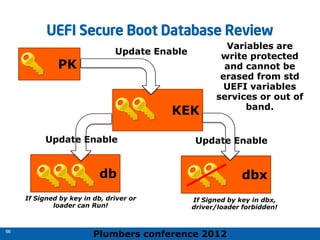
UEFI Secure Boot Database Review
PK
KEK
db dbx
If Signed by key in db, driver or
loader can Run!
If Signed by key in dbx,
driver/loader forbidden!
Update Enable
Update Enable Update Enable
Variables are
write protected
and cannot be
erased from std
UEFI variables
services or out of
band.
Plumbers conference 2012
67
67
Public vs. Private Keys
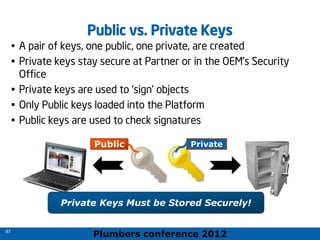
• A pair of keys, one public, one private, are created
• Private keys stay secure at Partner or in the OEM’s Security
Office
• Private keys are used to ‘sign’ objects
• Only Public keys loaded into the Platform
• Public keys are used to check signatures
Private Keys Must be Stored Securely!
Public Private
Plumbers conference 2012
68
68
Who “Owns” The System Security Keys?
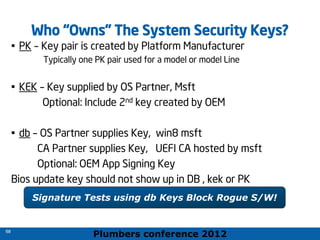
• PK – Key pair is created by Platform Manufacturer
Typically one PK pair used for a model or model Line
• KEK – Key supplied by OS Partner, Msft
Optional: Include 2nd key created by OEM
• db – OS Partner supplies Key, win8 msft
CA Partner supplies Key, UEFI CA hosted by msft
Optional: OEM App Signing Key
Bios update key should not show up in DB , kek or PK
Signature Tests using db Keys Block Rogue S/W!
Plumbers conference 2012
69
69
OEM Administration
• Keys are installed for testing with target OS
• Keys are installed in the factory before shipping
• Preparation Tasks
1. Gather public keys from partners
2. Generate PK for model
3. Make a package of initial key load
4. Occasional maintenance of forbidden list
• Repetitive Tasks
1. Factory will boot and install the initial key load
Careful Preparation Delivers Successful Launch

EFI Architecture tutorial related to UEFI

  • 1.
    Plumbers conference 2012 1 1 UEFITutorial 8/29/12 Harry Hsiung Intel Corp
  • 2.
    Plumbers conference 2012 2 2 Agenda •UEFI Basics • UEFI security features • UEFI development platforms • UEFI Resources • Opens • Backup
  • 3.
    Plumbers conference 2012 3 3 PLATFORMHARDWARE PLATFORM SPECIFIC FIRMWARE UEFI BOOT SERVICES UEFI RUNTIME SERVICES UEFI OS LOADER (OTHER) SMBIOS ACPI INTERFACES FROM OTHER REQUIRED SPECS Memory Timer Driver Driver UEFI or PI Drivers Boot Devices Protocols + Handlers OPERATING SYSTEM Legacy OS LOADER Compatibility UEFI API Motherboard ROM/FLASH Firmware vol Option ROM Option ROM Option ROM UEFI Drivers UEFI Drivers UEFI OS Loader UEFI SYSTEM PARTITION UEFI Drivers OS PARTITION UEFI architecture
  • 4.
    Plumbers conference 2012 4 4 UEFISpecification Timeline UEFI 2.0 PI 1.0 UEFI 2.1 PI 1.1 UEFI 2.3 UEFI 2.2 EDK 1.01: UEFI 2.0 Shell 2.0 PI 1.2 Packaging 1.0 EDK 1.04: UEFI 2.1 PI 1.0 Specifications Implementation Open Source code Tianocore.org EDK 1.06: UEFI 2.1+ PI 1.0 SCT PI 1.0 SCT UEFI 2.0 UDK2010: UEFI 2.3+ PI 1.2+ All products, dates, and programs are based on current expectations and subject to change without notice. EDK II*: UEFI 2.1+ PI 1.0 * EDK II is same code base as UDK2010 2006 2007 2008 2009 2010 2011 SCT UEFI 2.1 UEFI 2.3.1 UDK2010.S R1: UEFI 2.3.1+ PI 1.2+ SCT UEFI 2.3 uefi.org * EDK I is UEFI 2.0..UEFI 2.1(1117)
  • 5.
  • 6.
    Plumbers conference 2012 6 6 ArchitectureExecution Flow 6 Pre EFI Initializati on (PEI) Driver Execution Environment (DXE) Boot Dev Select (BDS) Transient System Load (TSL) After Life (AL) Power on [ . . Platform initialization . . ] [ . . . . OS boot . . . . ] Shutdown Run Time (RT) ? OS-Present App Final OS Environment Final OS Boot Loader OS-Absent App Transient OS Environment Transient OS Boot Loader Boot Manager Proces sor Init Chipse t Init Board Init verif y Device, Bus, or Service Driver UEFI Interface Pre Verifier EFI Driver Dispatcher Intrinsic Services Security (SEC) Boot Execution Flow
  • 7.
    Software and ServicesGroup Software and Services Group Software and Services Group DXE Foundation Data Structures 7 EFI System Table UEFI Runtime Services Table Variable Services Real Time Clock Services Reset Services Status Code Services1 Virtual Memory Services UEFI Boot Services Table Task Priority Level Services Memory Services Event and Timer Services Protocol Handler Services Image Services Driver Support Services Input Console Active Consoles Output Console Standard Error Console Version Information UEFI Specification Version Firmware Vendor Firmware Revision Handle Database Protocol Interface Protocol Interface Protocol Interface Protocol Interface Protocol Interface Protocol Interface Boot Service Data Structures Runtime Data Structures Global Coherency Domain Services DXE Services Table Dispatcher Services System Configuration Table ACPI Table SMBIOS Table … SAL System Table DXE Services Table HOB List
  • 8.
    Plumbers conference 2012 8 8 BootSupport – Device Types • Hard disk • Raid • Fiber channel • Removable media – CD-ROM, DVD-ROM – El Torito 1.0 “No emulation” – Floppy, USB Storage, etc. • Network – PXE BIOS support specification (Wire for Management) – iSCSI • Future media via extensibility methods Full Device Support Expanded Capabilities Versus Legacy BIOS Boot Support
  • 9.
    Plumbers conference 2012 9 9 Partition Table HDR Partition1 MBR Partition Table HDR 0 1 n ... LBA0 LBA1 LBAn Start partition End partition Start partition Primary Partition Table Backup Partition Table 0 1 n ... End partition First useable block Last useable block Boot Support See Section 5 of the UEFI 2.3.1 Spec. GPT - New Partition Structure >2.2 Tb support , Unique GUID signature support in partion table HDR
  • 10.
    Plumbers conference 2012 10 10 GPTAdvantages over MBR Partition Table • 64-bit LBA – No more 2.2TB limit – Up to 9.8 zettabytes • Improved partitioning – Supports unlimited number of partitions – Uses a primary and backup table for redundancy – Defines a GUID for identifying each partition – Uses GUID & attributes to define partition type • Uses version number and size fields for future expansion. • Uses CRC32 fields for improved data integrity • Each partition contains a 36 Unicode character human readable name. • No MBR problems – No “magic code” must execute as part of booting 1 Boot Support
  • 11.
    Plumbers conference 2012 11 11 UEFISpecification - Key Concepts • Objects - manage system state, including I/O devices, memory, and events • UEFI System Table - data structure with data in-formation tables to interface with the systems • Handle Database and Protocols - callable interfaces that are registered • UEFI Images - the executable content format • Events - the software can be signaled in response to some other activity • Device Paths - a data structure that describes the hardware location of an entity 1 UEFI Terminology
  • 12.
    Plumbers conference 2012 12 12 GUID •Globally Unique Identifier – 128-bit quantity defined by Wired for Management (WfM) 2.0 specification ** • Used to identify protocols – 1:1 with interfaces • Regulate extension mechanism – Documented in the spec – Added through drivers Safe co-existence of 3rd party extensions ** http://www.intel.com/design/archives/wfm/index.htm UEFI Terminology
  • 13.
    Plumbers conference 2012 13 13 Handles •All protocols have an associated handle • Every device and executable image in UEFI has a handle protocol in the handle database • Every boot device must have a device path protocol to describe it 1 UEFI Terminology
  • 14.
    Plumbers conference 2012 14 14 Protocols(API) • GUID, Interface Structure, Services – DEVICE_PATH, DEVICE_IO, BLOCK_IO, DISK_IO, FILE_SYSTEM, SIMPLE_INPUT, SIMPLE_TEXT_OUTPUT, SERIAL_IO, PXE_BC, SIMPLE_NETWORK, LOAD_FILE, UNICODE_COLLATION 1 Handle Function Ptr 1 Private Data GUID Function Ptr 2 . . . Protocol Interface GUID 1 GUID 2 Function 1 Function 2 Access Device or Services Produced by Other UEFI Drivers BlkIo->ReadBlocks(BlkIo, …) . . . . . . UEFI Terminology
  • 15.
    Plumbers conference 2012 15 15 HandleProtocol Database 1 ... Handle First Handle GUID GUID Protocol Interface Instance Data Protocol Interface Instance Data Handle GUID Protocol Interface Instance Data Image Handle Controller Handle Attributes ... Image Handle Controller Handle Attributes Image Handle Controller Handle Attributes Image Handle Controller Handle Attributes Image Handle Controller Handle Attributes ... GUID Protocol Interface Instance Data UEFI Terminology
  • 16.
    Plumbers conference 2012 16 16 DevicePath Protocol • A data structure description of where a device is in the platform • All boot devices, logical devices and images must be described by a UEFI device path • The UEFI Specification defines six types of device paths UEFI Terminology
  • 17.
    Plumbers conference 2012 17 17 SixTypes of Device Path Types • Hardware – where is the device in the system • ACPI – UID/HID of device in AML • Messaging – Classifies device as LAN, Fiber Channel, ATAPI, SCSI, USB, … • Media – i.e. Hard Drive, Floppy or CD-ROM • BIOS Boot Specification – used to point to boot legacy operating systems • End of hardware – marks end of device path 1 UEFI Terminology
  • 18.
    Plumbers conference 2012 18 18 DevicePath Examples Acpi(PNP0A03,01)/Pci(1F|1)/Ata(Primary,Maste r)/HD(Part3, Sig001100112) Acpi(PNP0A03,1)/Pci(1E/0)/Pci(0|0)/Mac(0002 B3647D69) Acpi(PNP0A03,0)/Pci(1F|0)/Acpi(PNP0501,0)/U art(115200 81) 1 See § 9 UEFI 2.X Spec. UEFI Terminology 1 ACPI Name space - contain HID, CID, and UID fields that match the HID, CID, and UID values that are present in the platform’s ACPI tables 2Truncated to fit on slide, GUIDs are 128 bits
  • 19.
    Plumbers conference 2012 19 19 Acpi(PNP0A03,0)/Pci(1F|1) /Ata(Primary,Master) /HD(Part3, Sig010…) EFI 1 Why UEFI Device Path? • The UEFI Device Path describes a boot target – Binary description of the physical location of a specific target Acpi(PNP0A03,0) Acpi(PNP0A03,0) /Pci(1F|1) Acpi(PNP0A03,0) /Pci(1F|1) /Ata(Primary,Master) Acpi(PNP0A03,0) /Pci(1F|1) /Ata(Primary,Master) /HD(Part3, Sig010…) Acpi(PNP0A03,0) /Pci(1F|1) /Ata(Primary,Master) /HD(Part3, Sig010…) EFIBoot”/”OSLoader.efi” Initialize PCI root Bridge Initialize PCI Device Initialize ATA Device Initialize the Partition Driver Initialize File System Driver Launch O/S Loader Connect PCI Root Bridge & Install OP ROM Connect Consoles Diagnostics/Shell Boot * Boot Sequence UEFI Terminology Note: Boot Sequence is part of the PI Spec.
  • 20.
    Plumbers conference 2012 20 20 BootServices • Full set of firmware services for pre-boot • Events and notifications – Polled devices, no interrupts • Watchdog timer – Elegant recovery • Memory allocation • Handle location – for finding protocols • Image loading – For drivers, applications & the OS loader 2
  • 21.
    Plumbers conference 2012 21 21 RuntimeServices • Minimal set of services for the UEFI Aware OS • Available in boot services and at OS runtime • Timer, Wakeup Alarm – Allows system to wake up or power on at a set time • Variables – Boot manager handshake • System reset 2
  • 22.
    Plumbers conference 2012 22 22 ExitBootServices() Before ExitBootServices() Call Bothboot services & runtime services are available Exit Boot Services() Call Issued by the UEFI OS Loader After ExitBootServices() Call Only runtime services are available
  • 23.
    Plumbers conference 2012 23 23 TypicalSystem 2 Processor PCI Host Bus USB IDE PCI-ISA Bridge VGA Keyboard Mouse Floppy Drive Hard Drive CD-ROM PCI Bus USB Bus ISA Bus IDE Bus Device Controller Bus Controller Other ISA FDC PCI-PCMCIA UEFI Driver Design See § 2.5 UEFI 2.X Spec.
  • 24.
    Plumbers conference 2012 24 24 DriverInitialization • UEFI Driver Handoff State • Not Allowed to Touch Hardware Resources • Installs Driver Binding on Driver Image Handle 2 Installed in Driver Initialization Implemented by Driver Writer Created by LoadImage() Driver Image Handle EFI_DRIVER_BINDING Registers Driver for Later Use UEFI Driver Design EFI_COMPONENT_NAME
  • 25.
    Plumbers conference 2012 25 25 DriverBinding Protocol 2 Driver Image Handle LOADED_IMAGE DRIVER_BINDING DRIVER_BINDING Supported() Start() Stop() Version * UEFI Driver Design
  • 26.
    Plumbers conference 2012 26 26 IDEATAPI disk drive Block IO Protocol Device Path Protocol Disk IO Protocol File System Protocol(FAT) HD Handle UEFI ATAPI Driver ATAPI Device Path ACPI(pnp0604,0)/PCI(0,1)/ ATA(primary, master) UEFI system partition UEFI boot services Image Handle Device Path Protocol Example: UEFI ATAPI Driver Stack UEFI Driver Design 2
  • 27.
    Plumbers conference 2012 27 27 UEFI2.1 Features • Added protocols – HII (several protocols) – Absolute pointer protocol • New member functions or equivalent – Driver Supported Version (for option roms) – Extended Simple Text In (more function keys supported) – Authenticated Variables – Extended SCSI Pass through – Signal on configuration change – EHCI exclusive ownership – Firmware storage device path – Hot key registration support – Run-time services with interrupts enabled • Clean-up: e.g. error returns, * vs ** in declarations in several protocols introduced as a result of implementation Required Optional
  • 28.
    Plumbers conference 2012 28 28 UEFI2.2 Significant Features • Networking – IPv6 – IPv6 stack corresponding to existing IPv4 stack – Replacement for PXE protocols which are IPv6 compliant and large network friendly – Now being worked through IETF – Support for more LAN protocols: EAP and VLAN • Security – Driver signing – Added optional ability to create firmware / OS trust relationships – Via key exchange – More signature combinations – Good / Bad list support – Platform owner control of denial response – Pre-Boot Authentication (PBA) Framework – Passwords, Smart cards, Fingerprint sensors, etc. Required Optional Required Optional
  • 29.
    Plumbers conference 2012 29 29 UEFI2.2 Other Features • HII – Additional operators for mapping to other standards – Page by page security control – Animation updates • EFI_ATA_PASS_THRU Protocol – Gives direct access to ATA devices • UEFI Driver Health – Allow for a driver to fix/re-configure (e.g. rebuild RAID set) • ABI Updates/Clarifications – Floating Point/MMX/XMM – 16-Byte stack alignment • EFI_LOAD_FILE2 Protocol – Loads non-boot-option EXEs (PCI option ROMs & apps) – Modifies LoadImage() behavior • EFI_LOADED_IMAGE Protocol – Associates entire device path with EXE image • Bug fixes in spec for rest of document Required Optional Required Optional
  • 30.
    Plumbers conference 2012 30 30 UEFI2.3 Features • Two possible views – Special release for ARM binding – Fairly quick release for items including ARM binding • Also includes – Boot Services protocol for firmware update – Mainly for Option ROMs – Bug fixes • Other items on deck – Ubiquitous Firmware Update Required Optional Required Optional
  • 31.
    Plumbers conference 2012 31 31 UEFIForum Updates • UEFI Specification – Version 2.3.1, Errata A published on Sept. 7, 2011 – Clarifications from version 2.3.1 – Additional ECRs are work in progress • UEFI Self Compliance Tests (SCT) – Published a UEFI Winter 2012 Plugfest Release in Feb, 2012  Version 2.3.1 compliance test preview – Investigating coverage for 2.3.1 Errata A • Be Ready for Windows* 8 – UEFI 2.3.1 support – UEFI drivers and applications – Secure boot (sign the executables) – Seamless boot, hybrid boot, fast boot – IPv6 and IPv4 network stack – UEFI Spring 2012 Plugfest in Taipei (May 8-10), Redmond (July 16-20th) • PI Specification – Version 1.2 Errata C published in October 2011 2012 marks the ubiquitous adoption of UEFI on PCs
  • 32.
    Plumbers conference 2012 32 32 Intel®UDK2010 SR1 (UEFI 2.3.1) • User Identity (UID) Support (UEFI 2.3.1a) • Secure Storage Protocol – Enable Opal/eDrive SATA devices using the EFI_STORAGE_SECURITY_COMMAND_PROTOCOL, ATA-8 Trusted Send/Receive and IEEE1667 Silo (UEFI 2.3.1a) • Networking Improvements – Errata related to Netboot6-DUID – Provide more DHCP4 & DHCP6 API support – iSCSI (ip6) open source implementation for IPv6 • TCG Physical Presence (PP). Based on the Physical Presence Interface Specification Version 1.20, Revision 1.0. • Support ATA Asynchronous Block Io (UEFI 2.3.1a) • USB 3.0 Controller Support (XHCI) • Update Internal Forms Representation (IFR) implementation to match UEFI 2.3.1 Specification • Fast boot support (asynchronous blockIO2) Intel® UEFI Development Kit 2010 (Intel® UDK2010) www.intel.com/UDK
  • 33.
    Plumbers conference 2012 33 33 UEFISystem Classes Based on Firmware I/F Class 0 Class 1 Class 2 Class 3 Legacy BIOS UEFI CSM* only UEFI Switch: CSM & UEFI UEFI only Interface Exposed 2013 Today *-CSM : Compatibility Support Module or Legacy BIOS written as an UEFI driver Class 2 configurations(default BIOS setup) A - CSM and UEFI 2.0-2.1 posted during boot B - UEFI 2.0-2.1 only posted during boot, CSM disabled C - UEFI 2.3.1 only posted during boot, CSM disabled, secure boot enabled – only signed modules executed A,B Shipping today (2012) C Required by Windows 8 logo
  • 34.
    Plumbers conference 2012 34 34 Windows8 Boot Flow • Windows 8 installs UEFI OS Loader if UEFI is detected • Most PCs today boot through CSM path • For compatibility the CSM boot path available • Windows 8 logo requirement to boot UEFI only (cannot run csm in client builds) • Client must boot with UEFI secure boot enabled • For server if implemented
  • 35.
    Plumbers conference 2012 35 35 Windows8 Certification Requirements – UEFI Boot Boot Performance Requirements • Windows 8 aims to support <10s boot, on SSD systems  POST: <2s (without TPM; SSD)  Resume: <4s (without CSM)  Device Init: <2s (varies by quality of driver) • New WHQL Requirements for hardware design  TPM: <300ms init  Total time 2.3 seconds max for boot with SSD and UEFI secure boot POST (<=2s) Hiber Resume (<= 4.25s) Device Init (<=1s) Explorer Init (<=1.75s)
  • 36.
    Plumbers conference 2012 36 36 Whatis Security from BIOS Perspective • Secure Boot - UEFI –Defined a policy for Image loading –Cryptographically signed – Private key at signing server – Public key in platform • Measured Boot -Trusted Computing Group (TCG) –Trusted Platform Module (TPM) – Isolated storage and execution for Logging changes, attestation • NIST 800-147 -Security Guidelines for System BIOS Implementations 36
  • 37.
    Plumbers conference 2012 37 37 UEFISecure Boot VS TCG Trusted Boot UEFI authenticate OS loader (pub key and policy) Check signature of before loading • UEFI Secure boot will stop platform boot if signature not valid (OEM to provide remediation capability) • UEFI will require remediation mechanisms if boot fails UEFI PI will measure OS loader & UEFI drivers into iTPM PCR (Platform Configuration Register) • TCG Trusted boot will never fail • Incumbent upon other SW to make security decision using attestation UEFI Firmware UEFI OS Ldr, Drivers Kernel Drivers Apps TPM record in PCR What 3
  • 38.
    Plumbers conference 2012 38 38 UEFI/PIArchitecture Boot Flow – Create/Evaluate Integrity List Measure Into PCR’s Measure & Create Log in TPM nvram
  • 39.
    Plumbers conference 2012 39 39 Measureditems in UEFI in Trusted Boot Standardized way to measure and report PCRx = Register in TPM
  • 40.
    Plumbers conference 2012 40 40 EFI Extensions EFICore TPM Init UEFI Firmware Static PreOS Boot manager All Boot Blobs Unlocked OS loader Volume Blob of Target OS unlocked Start OS UEFI Windows* is using SRTM
  • 41.
  • 42.
    Plumbers conference 2012 42 42 Intel®UDK2010 SR1 Security Features • UEFI Secure Boot – UEFI variable support for UEFI Secure Boot as defined by UEFI 2.3.1a (EFI_VARIABLE_TIME_BASED_AUTHENTICATED_WRITE_ACCESS attribute with EFI_VARIABLE_AUTHENTICATION_2 and EFI_VARIABLE_AUTHENTICATION support) – DXE Image Verification library to support UEFI Secure Boot (UEFI 2.3.1a) – PK x509 Certificate Support – Support EFI_VARIABLE_AUTHENTICATION_2 for PK variable format (UEFI 2.3.1a) – Add enable/disable mechanism for UEFI Secure Boot • TCG Trusted Boot – TCG EFI Platform Specification
  • 43.
    Plumbers conference 2012 43 43 SecureBoot – Three Components 1. Authenticated Variables 2. Driver Signing 3. System-Defined Variables
  • 44.
    Plumbers conference 2012 44 44 UEFIAuthenticated Variables • Uses standard UEFI Variable Functions • Available Pre-boot and also Runtime • Typically stored in Flash • Variable Creator signs Variable Hash with Private Key (PKCS-7 Format) • Signature & Variable Passed Together for Create, Replace, Extend, or Delete • Several System-defined variables for Secure Boot 44 Extensible Integrity Architecture
  • 45.
    Plumbers conference 2012 45 45 UpdatingAuthenticated Variable • Support for Append added (UEFI 2.3.1) • Counter-based authenticated variable (UEFI 2.3) – Uses monotonic count to against suspicious replay attack – Hashing algorithm – SHA256 – Signature algorithm – RSA-2048 • Time-based authenticated variable (UEFI 2.3.1) * – Uses timestamp as rollback protection mechanism – Hashing algorithm – SHA256 – Signature algorithm – X.509 certificate chains – Complete X.509 certificate chain – Intermediate certificate support (non-root certificate as trusted certificate. * only Time-based authenticated variables implemented in Tianocore.org UDK2010 SR1 45 Protected Variables that can be Securely Updated New in UEFI 2.3.1 New in UEFI 2.3.1
  • 46.
    Plumbers conference 2012 46 46 SecureBoot – Three Components 1. Authenticated Variables 2. Driver Signing 3. System-Defined Variables
  • 47.
    Plumbers conference 2012 47 47 UEFIDriver Signing • UEFI Driver Signing Utilizes Microsoft* Authenticode* Technology to sign UEFI executables • In Secure Boot, signatures should be checked: 1. UEFI Drivers loaded from PCI-Express Cards 2. Drivers loaded from mass storage 3. Pre-boot EFI Shell Applications, f/w updaters 4. OS UEFI Boot-loaders • UEFI Signing is not applied to 1. Drivers in the Factory BIOS 2. Legacy BIOS components (also known as CSM) 3. CSM must be disabled in boot for system to be secure (UEFI boot)  CSM can be enabled in setup for non-UEFI boot options  Shell is not considered a secure boot option Enhanced by UEFI 2.3.1
  • 48.
    Plumbers conference 2012 48 48 SecureBoot – Three Components 1. Authenticated Variables 2. Driver Signing 3. System Defined Variables
  • 49.
    Plumbers conference 2012 49 49 49 SecureBoot Authenticated Variables PK Platform Key – Root key set to enable Secure Boot KEK Key Exchange Key List of Cert. Owners with db, dbx update privilege db List of Allowed Driver or App. Signers (or hashes) dbx List of Revoked Signers (or hashes) SetupMode 1= in Setup Mode, 0 = PK is Set (User Mode) SecureBoot 1 = Secure Boot in force Notes: • Owner of cert. in KEK can update db, dbx • Owner of cert. in PK can update KEK UEFI Defines System Databases for Secure Boot
  • 50.
    Plumbers conference 2012 50 50 SecureBoot – Three Components 1. Authenticated Variables 2. Driver Signing 3. System Defined Variables UEFI 2.3.1 SECURE BOOT
  • 51.
    Plumbers conference 2012 51 51 3 User SecureBoot Begins @ the Factory Initial Security Load 2 Production Initial Security Load is installed onto each computer at the factory, enabling Secure Boot. 1) Initial db and dbx 2) KEK with allowed updaters 3) Platform Key (PK) Pre-production 1 Certificate Generating Station @ OEM OEM collects certificates provided by OSVs, Partners, and OEM’s own keys. “DB Generator” creates the Initial Security Load for new computers. OEM Responsible for Initializing Secure Boot and can allow user to disable Secure Boot or add KEK,PK,DB in setup After delivery, the OEM or OSV can update with new certificates or revoked certificates (dbx)
  • 52.
    Plumbers conference 2012 52 52 52 SecureBoot Protects the User Secure Boot Tests Signatures to Reject Potential Threats User attempts to boot a compromised system OS Boot-loader image checked against pre- loaded database Root-kit fails checks, user protected by Secure Boot
  • 53.
    Plumbers conference 2012 53 53 Formore information - UEFI Secure Boot Intel Technology Journal, Volume 15, Issue 1, 2011, UEFI Today: Bootstrapping the Continuum, UEFI Networking and Pre-OS Security, page 80 at http://www.intel.com/technology/itj/2011/v15i1/pdfs/Intel-Technology-Journal-Volume- 15-Issue-1-2011.pdf Rosenbaum, Zimmer, "A Tour Beyond BIOS into UEFI Secure Boot," Intel Corporation, July 2012 http://sourceforge.net/projects/edk2/files/General%20Documentation/A_To ur_Beyond_BIOS_into_UEFI_Secure_Boot_White_Paper.pdf/download UEFI 2.3.1 specification: Sections 7.2 (Variable Services) and Sections 27.2 through 27.8 (Secure Boot) of the at www.uefi.org Beyond BIOS: Developing with the Unified Extensible Firmware Interface, 2nd Edition, Zimmer, et al, ISBN 13 978- 1-934053-29-4, Chapter 10 – Platform Security and Trust, http://www.intel.com/intelpress “Hardening the Attack Surfaces,” MSFT 2012 UEFI Plugfest http://www.uefi.org/learning_center/UEFI_Plugfest_2012Q1_Microsoft_AttackSurface.pdf “Building hardware-based security with a TPM” MSFT BUILD http://channel9.msdn.com/Events/BUILD/BUILD2011/HW-462T
  • 54.
    Plumbers conference 2012 54 54 TunnelMountain Intel DQ57TM UEFI 2.3.1 platform Intel® UDK 2010 SR1 UP1 Compatible, supports UEFI 2.3.1 (updates match tianocore.org open source) Pre-assembled systems available at HDNW, visit http://www.Tunnelmountain.net based on DQ57TM tomk@hdnw.com, (425) 943-5515 ext 42234. Use product name “Tunnel Mountain” when ordering Visit http://www.UEFIDK.com for the latest collateral on UEFI systems For UEFI developers Comes with class 2 CSM and UEFI enabled firmware Download site has UEFI class2 firmware(csm not on by default) Comes with serial port for debug Can be ordered with optional ITP connector and socketed SPI flash *Romley Server UEFI 2.3.1 to be available Sep ’12 *Maho Bay DQ77MK Q4 ’12 * - not available yet in validation test
  • 55.
    Plumbers conference 2012 55 55 Gettingyour own UEFI 2.3.1 systems Intel Production motherboards UEFI 2.3.1 enabled Windows 8 client desktop motherboards Sept - Oct 2012 rollout for 7 series Ivybridge systems (DH77, DQ77 etc.) Goto Intel.com under support to update BIOS on motherboards Ivybridge Ultrabooks certified for Windows 8 Contact your favorite BIOS vendor and ask for a UEFI 2.3.1 enabled board
  • 56.
    Plumbers conference 2012 56 56 WhatVintage of UEFI is your system? Get into BIOS setup IS there a switch for CSM or legacy bios (to turn it off or force UEFI only)? Goto UEFI shell type “ver” -> UEFI system spec revision (2.3.1?) Does the system contain drivers for boot/console devices in system? UEFI shell -> drivers command Get SCT’s from UEFI.org and run them (Do they pass or which tests fail?) is it one the OS needs? Goto Ubuntu’s Linux Firmware Test suite – Run the UEFI suite to see if it passes. Contribute effort to test UEFI! Git://kernel.ubuntu.com/hwe/fwts
  • 57.
    Plumbers conference 2012 57 57 UEFIIndustry Resources www.uefi.org www.tianocore.sourceforge.net UEFI Open Source UEFI Forum www.intel.com/UDK Intel UEFI Resources Training/IHVs Contact http://software.intel.com/en-us/articles/intel-c- compiler-for-efi-byte-code-purchase/ Intel EBC Compiler www.intel.com/intelpress UEFI Books/ Collateral Laurie Jarlstrom • Intel UEFI Training • Laurie.Jarlstrom@intel.com Brian Richardson • Intel IHVs UEFI Support • Brian.Richardson@intel.com www.intel.com/technology/itj/2011/v15i1
  • 58.
  • 59.
    Plumbers conference 2012 59 59 UEFIImage (driver & application/OS loader) Signing • Why? – Origin & Integrity • How? – Authenticode PE/COFF ContentInfo Certificate PE file hash X.509 Certificate SignInfo Signed hash of ContentInfo PE Header Attribute Certificate Table Certificate Directory Section 1 …… Section N Type PE Image PKCS#7 + Authenticode Ext
  • 60.
    Plumbers conference 2012 60 60 UEFIAuthenticated Variable • Why? – Integrity (no confidentiality) • How? – Time Based Authenticated Variable Input Variable Data Authentication Certificate Data Content Time Stamp Type PKCS#7 ContentInfo Certificate N/A X.509 Certificate SignInfo Signed hash of VariableName + VariableGuid+ Attributes + TimeStamp + DataContent
  • 61.
    Plumbers conference 2012 61 61 61 SecureBoot’s Authenticated Variables Key/ DB Name Variable Details PkPub PK OEM and Platform FW- format is RSA-2048 Key Exchange Key KEK Platform FW and OS - format is RSA-2048 Authorized Signature DB DB Authorized Signing certificates - white list Forbidden Signature DB DBX Unuthorized Signing certificates - Black list Setup Mode SetupMode NULL - Secure Boot not supported 0 - PK is enrolled - in user mode User mode requires authentication 1 – Platform is in Setup mode – no PK enrolled Secure Boot SecureBoot 1-Platform in Secure boot mode Authenticated Variables • Do NOT generate your own private keys • Use FIPS certified key generators (hardware crypto) • Protect your private keys (under physical protection)
  • 62.
    Plumbers conference 2012 62 62 Authenticated Variable PEIFV DXE FV Variable Image Verify UEFI Secure Boot Flow OsLoader.efi Certificate + SignInfo Certificate + SignInfo PK KEK 1. Enroll 2A. Signed Image Discover 2B. Signature Verification 2C. Signed Image Load And measure Into TPM db Certificate dbx Certificate OpRom.efi Authorization Flow 62
  • 63.
    Plumbers conference 2012 63 63 Putthem altogether: UEFI Secure Boot 63 Custom Mode Edit keys on x86
  • 64.
    Plumbers conference 2012 64 64 Enduser controls -Custom Secure Boot Options • Enrolling DB and/or DBX for physically present user 64 Enable Secure Boot
  • 65.
    Plumbers conference 2012 65 65 DisableSecure Boot 1. Select Custom Secure Boot Options 2. Select PK Options 3. Delete Pk (space bar) 4. Reset 65 1 2 3 4
  • 66.
    Plumbers conference 2012 66 66 UEFISecure Boot Database Review PK KEK db dbx If Signed by key in db, driver or loader can Run! If Signed by key in dbx, driver/loader forbidden! Update Enable Update Enable Update Enable Variables are write protected and cannot be erased from std UEFI variables services or out of band.
  • 67.
    Plumbers conference 2012 67 67 Publicvs. Private Keys • A pair of keys, one public, one private, are created • Private keys stay secure at Partner or in the OEM’s Security Office • Private keys are used to ‘sign’ objects • Only Public keys loaded into the Platform • Public keys are used to check signatures Private Keys Must be Stored Securely! Public Private
  • 68.
    Plumbers conference 2012 68 68 Who“Owns” The System Security Keys? • PK – Key pair is created by Platform Manufacturer Typically one PK pair used for a model or model Line • KEK – Key supplied by OS Partner, Msft Optional: Include 2nd key created by OEM • db – OS Partner supplies Key, win8 msft CA Partner supplies Key, UEFI CA hosted by msft Optional: OEM App Signing Key Bios update key should not show up in DB , kek or PK Signature Tests using db Keys Block Rogue S/W!
  • 69.
    Plumbers conference 2012 69 69 OEMAdministration • Keys are installed for testing with target OS • Keys are installed in the factory before shipping • Preparation Tasks 1. Gather public keys from partners 2. Generate PK for model 3. Make a package of initial key load 4. Occasional maintenance of forbidden list • Repetitive Tasks 1. Factory will boot and install the initial key load Careful Preparation Delivers Successful Launch