Efficient queue monitoring scheme
based on human behavior
Jae Sohn (arisohn@gmail.com)
Problem definition :
Which scheme is efficient(minimize loss of information) to monitor
every queue with restricted resource when N-person produce
information to own fixed length queue? (restricted resource: the
number of queue monitoring per hour)
N명의 사람이 각자의 큐(고정된 크기)에 정보를 만들때, 제한된 자
원하에서 어떻게 모든 큐를 모니터링 하는것이 효율적(손실되는 정
보양을 최소화)인것인가? (제한된 자원: 시간당 큐를 모니터링 할
수 있는 횟수)
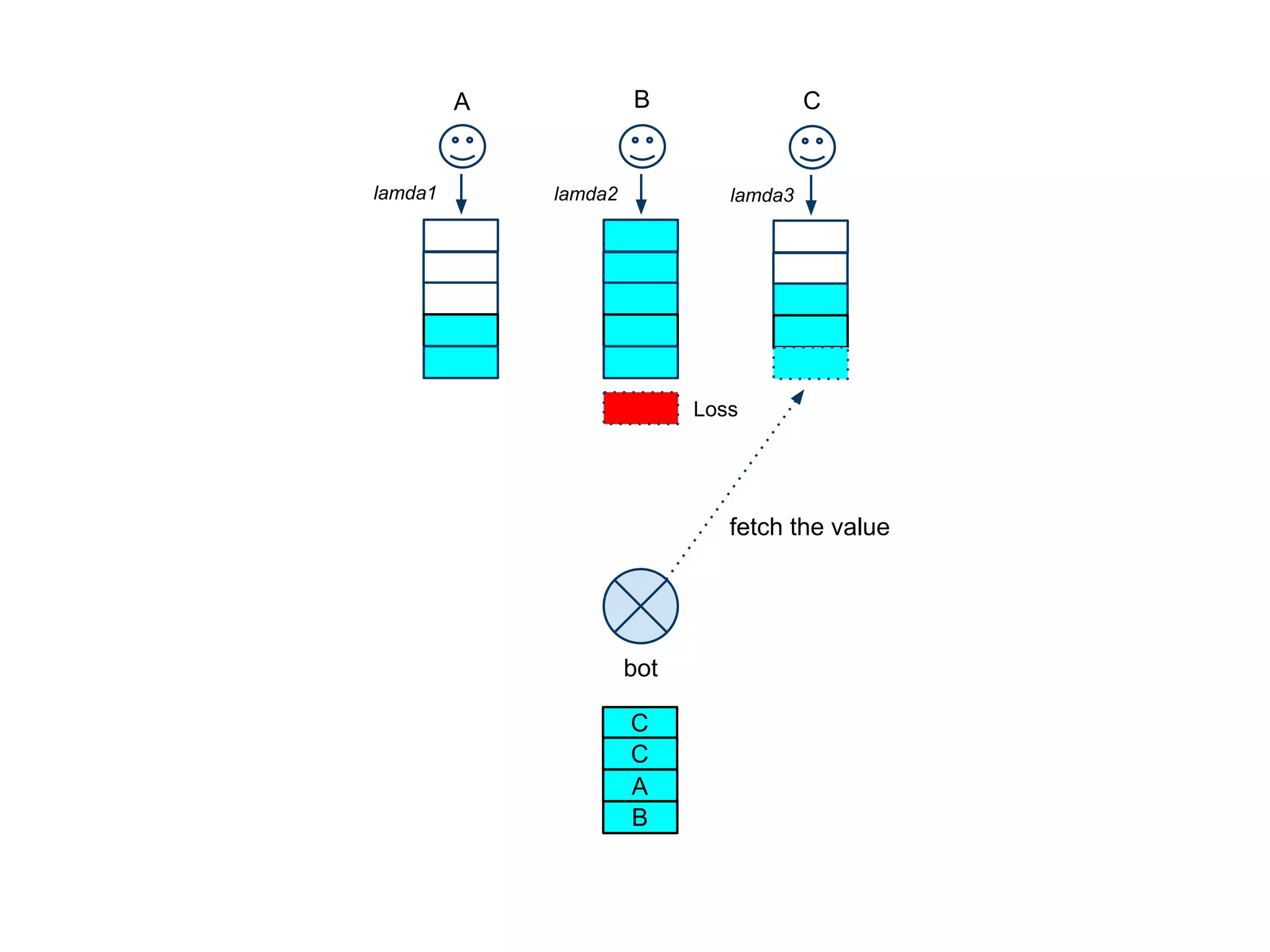
Loss
bot
fetch the value
lamda1 lamda2 lamda3
A B C
C
C
A
B
Job Distribution Strategy
● Limited number of requests.
● Suitable number of requests must be distributed to each one
● Higher active user, more frequent requests are distributed
● Who is an active user?
○ Activity measure ( T. Zhou, H.A.T. Kiet, B.J. Kim, B.-H. Wang, and P. Holme , Role of Activity in Human
Dynamics , EPL 82, 28002 (2008) )
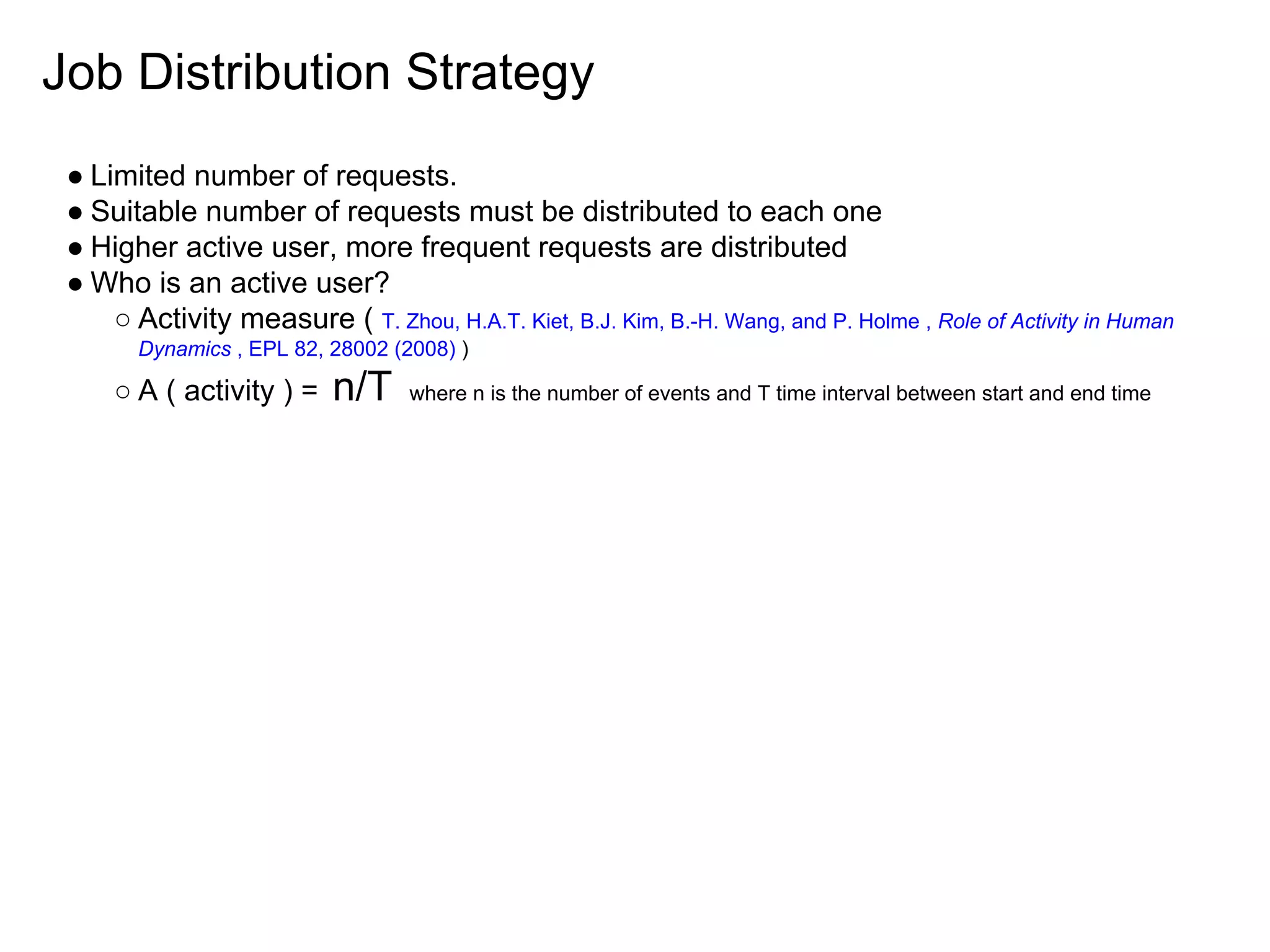
○ A ( activity ) = n/T where n is the number of events and T time interval between start and end time
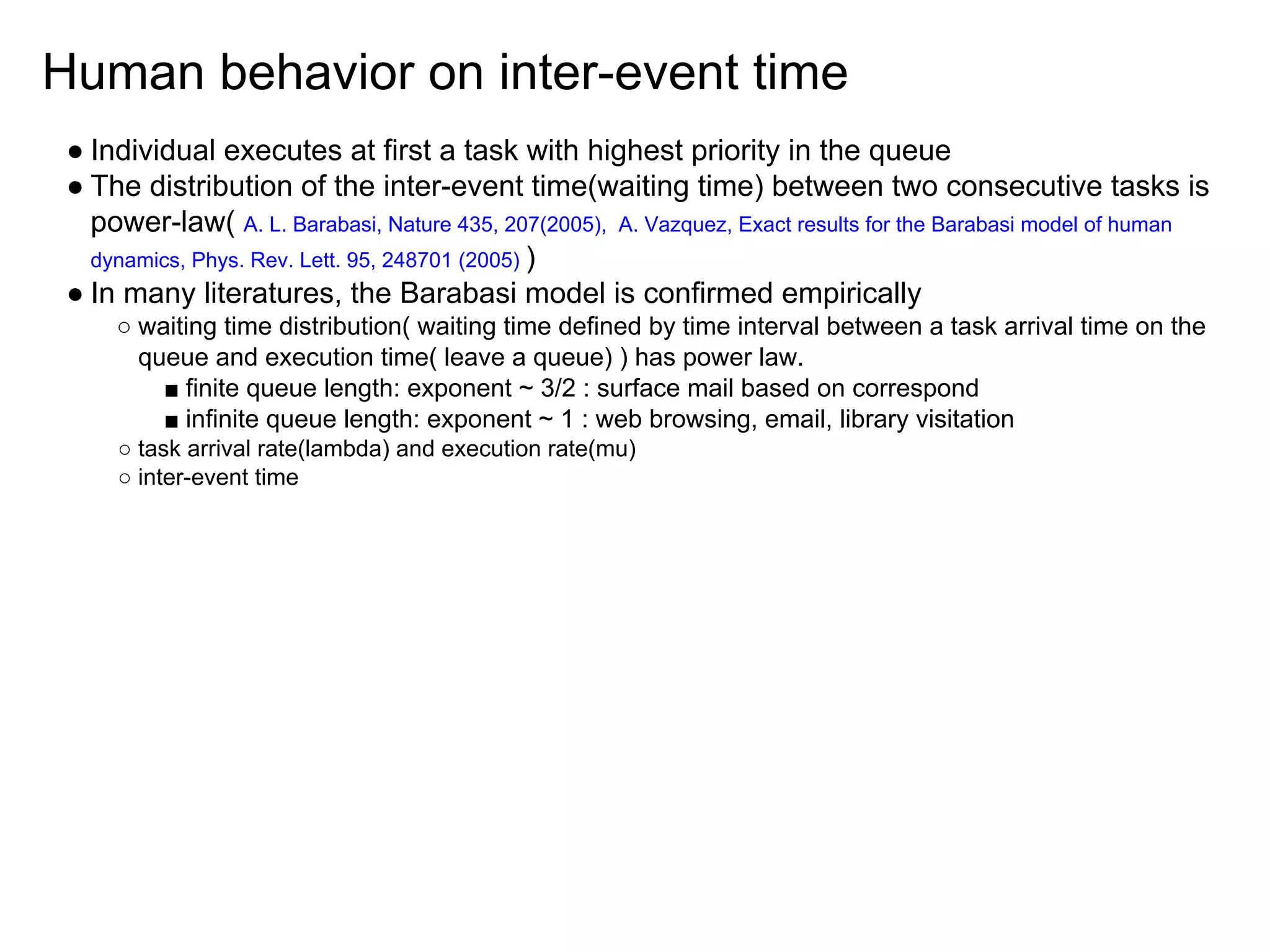
Human behavior on inter-event time
● Individual executes at first a task with highest priority in the queue
● The distribution of the inter-event time(waiting time) between two consecutive tasks is
power-law( A. L. Barabasi, Nature 435, 207(2005), A. Vazquez, Exact results for the Barabasi model of human
dynamics, Phys. Rev. Lett. 95, 248701 (2005) )
● In many literatures, the Barabasi model is confirmed empirically
○ waiting time distribution( waiting time defined by time interval between a task arrival time on the
queue and execution time( leave a queue) ) has power law.
■ finite queue length: exponent ~ 3/2 : surface mail based on correspond
■ infinite queue length: exponent ~ 1 : web browsing, email, library visitation
○ task arrival rate(lambda) and execution rate(mu)
○ inter-event time
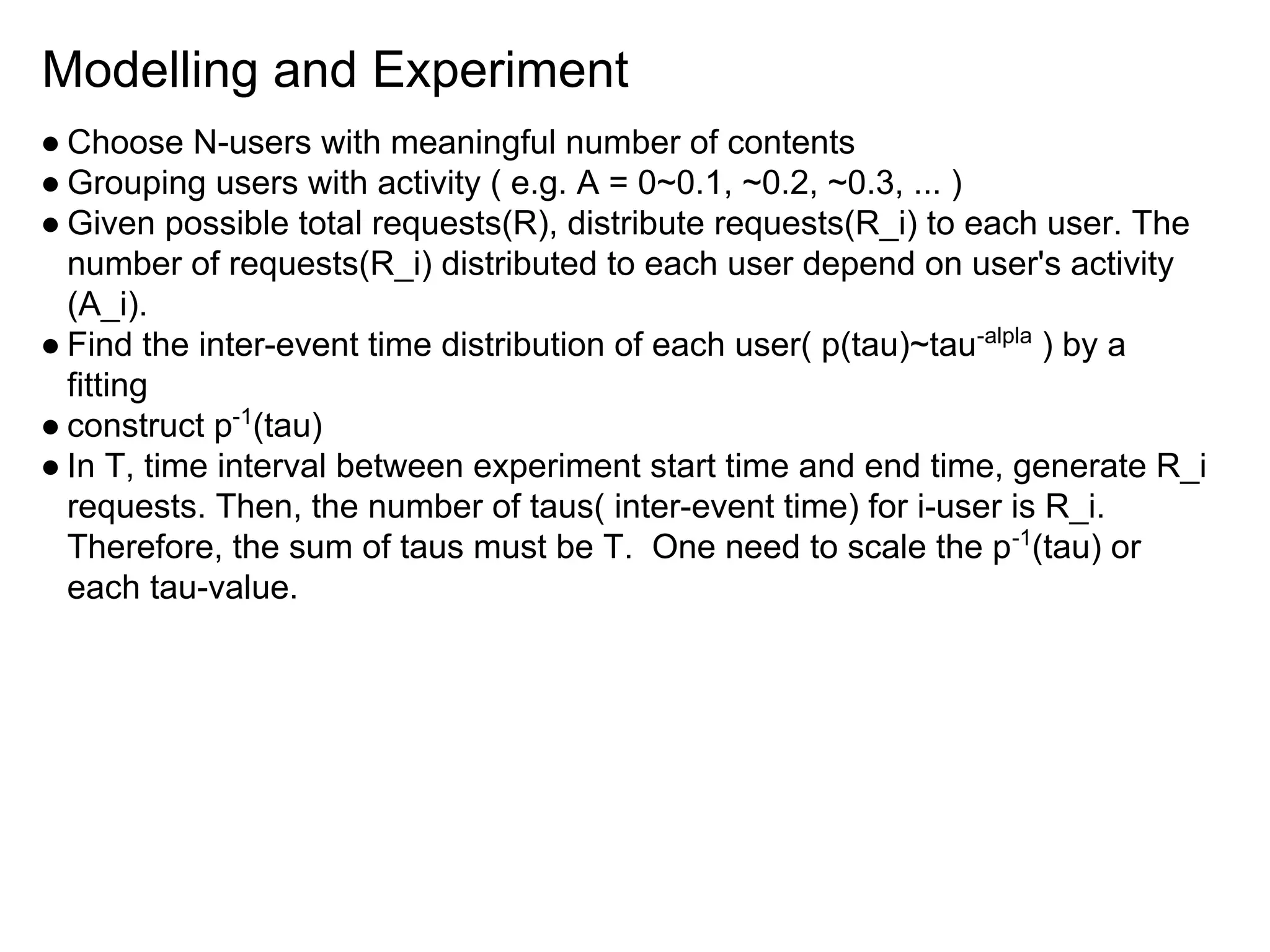
Modelling and Experiment
● Choose N-users with meaningful number of contents
● Grouping users with activity ( e.g. A = 0~0.1, ~0.2, ~0.3, ... )
● Given possible total requests(R), distribute requests(R_i) to each user. The
number of requests(R_i) distributed to each user depend on user's activity
(A_i).
● Find the inter-event time distribution of each user( p(tau)~tau-alpla
) by a
fitting
● construct p-1
(tau)
● In T, time interval between experiment start time and end time, generate R_i
requests. Then, the number of taus( inter-event time) for i-user is R_i.
Therefore, the sum of taus must be T. One need to scale the p-1
(tau) or
each tau-value.
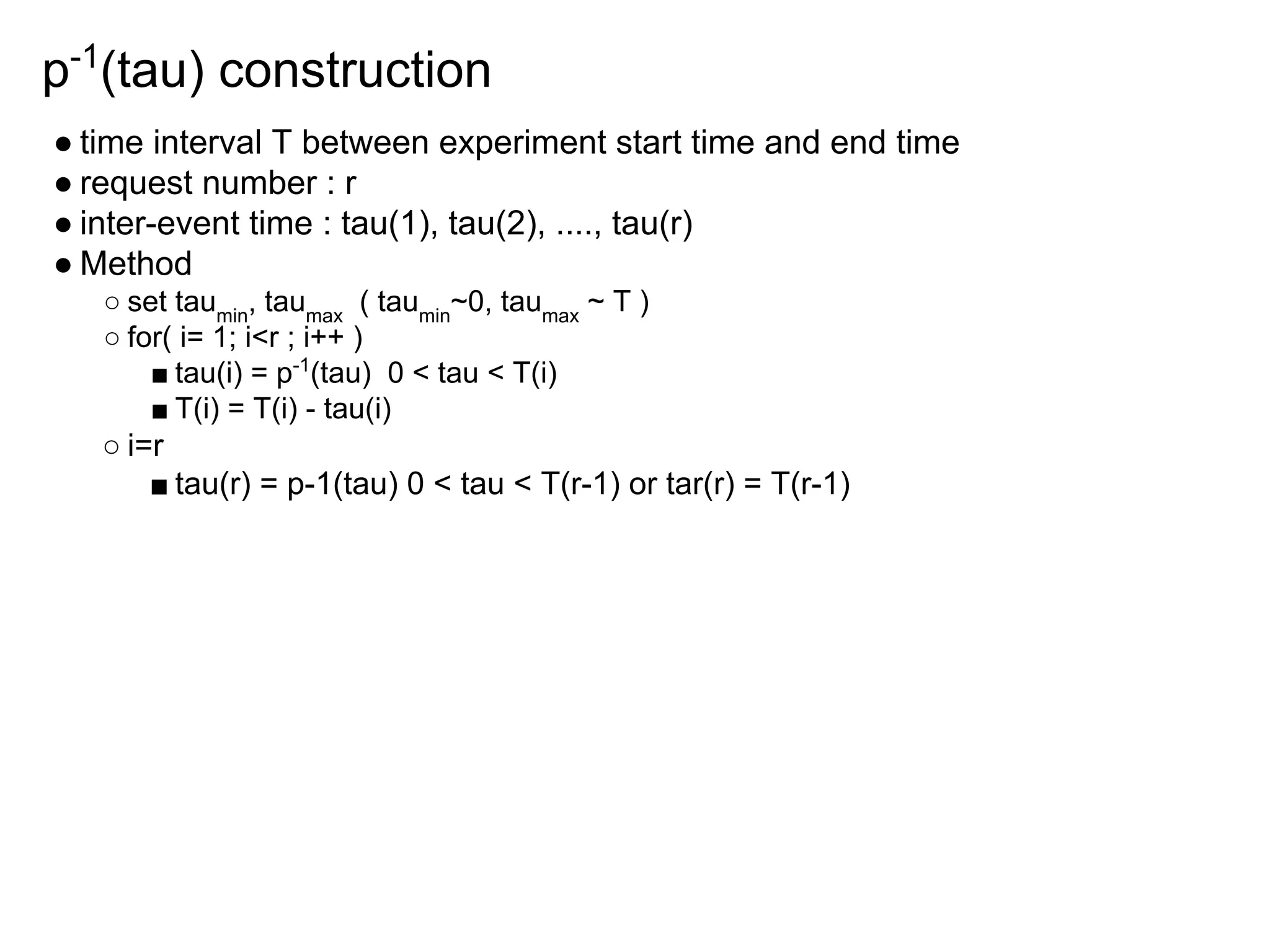
p-1
(tau) construction
● time interval T between experiment start time and end time
● request number : r
● inter-event time : tau(1), tau(2), ...., tau(r)
● Method
○ set taumin
, taumax
( taumin
~0, taumax
~ T )
○ for( i= 1; i<r ; i++ )
■ tau(i) = p-1
(tau) 0 < tau < T(i)
■ T(i) = T(i) - tau(i)
○ i=r
■ tau(r) = p-1(tau) 0 < tau < T(r-1) or tar(r) = T(r-1)

Efficient queue monitoring scheme based on human behavior

  • 1.
    Efficient queue monitoringscheme based on human behavior Jae Sohn (arisohn@gmail.com)
  • 2.
    Problem definition : Whichscheme is efficient(minimize loss of information) to monitor every queue with restricted resource when N-person produce information to own fixed length queue? (restricted resource: the number of queue monitoring per hour) N명의 사람이 각자의 큐(고정된 크기)에 정보를 만들때, 제한된 자 원하에서 어떻게 모든 큐를 모니터링 하는것이 효율적(손실되는 정 보양을 최소화)인것인가? (제한된 자원: 시간당 큐를 모니터링 할 수 있는 횟수)
  • 3.
    Loss bot fetch the value lamda1lamda2 lamda3 A B C C C A B
  • 4.
    Job Distribution Strategy ●Limited number of requests. ● Suitable number of requests must be distributed to each one ● Higher active user, more frequent requests are distributed ● Who is an active user? ○ Activity measure ( T. Zhou, H.A.T. Kiet, B.J. Kim, B.-H. Wang, and P. Holme , Role of Activity in Human Dynamics , EPL 82, 28002 (2008) ) ○ A ( activity ) = n/T where n is the number of events and T time interval between start and end time
  • 5.
    Human behavior oninter-event time ● Individual executes at first a task with highest priority in the queue ● The distribution of the inter-event time(waiting time) between two consecutive tasks is power-law( A. L. Barabasi, Nature 435, 207(2005), A. Vazquez, Exact results for the Barabasi model of human dynamics, Phys. Rev. Lett. 95, 248701 (2005) ) ● In many literatures, the Barabasi model is confirmed empirically ○ waiting time distribution( waiting time defined by time interval between a task arrival time on the queue and execution time( leave a queue) ) has power law. ■ finite queue length: exponent ~ 3/2 : surface mail based on correspond ■ infinite queue length: exponent ~ 1 : web browsing, email, library visitation ○ task arrival rate(lambda) and execution rate(mu) ○ inter-event time
  • 6.
    Modelling and Experiment ●Choose N-users with meaningful number of contents ● Grouping users with activity ( e.g. A = 0~0.1, ~0.2, ~0.3, ... ) ● Given possible total requests(R), distribute requests(R_i) to each user. The number of requests(R_i) distributed to each user depend on user's activity (A_i). ● Find the inter-event time distribution of each user( p(tau)~tau-alpla ) by a fitting ● construct p-1 (tau) ● In T, time interval between experiment start time and end time, generate R_i requests. Then, the number of taus( inter-event time) for i-user is R_i. Therefore, the sum of taus must be T. One need to scale the p-1 (tau) or each tau-value.
  • 7.
    p-1 (tau) construction ● timeinterval T between experiment start time and end time ● request number : r ● inter-event time : tau(1), tau(2), ...., tau(r) ● Method ○ set taumin , taumax ( taumin ~0, taumax ~ T ) ○ for( i= 1; i<r ; i++ ) ■ tau(i) = p-1 (tau) 0 < tau < T(i) ■ T(i) = T(i) - tau(i) ○ i=r ■ tau(r) = p-1(tau) 0 < tau < T(r-1) or tar(r) = T(r-1)