Effective Team Decision-Making Process
Teams are particularly effective in problem solving as they are
comprised of people with
complementary skills. These complementary skills allow team
members to examine issues from
various angles, as well as see the implications of their decisions
from a variety of perspectives.
In this section we will look at a process that can help teams
solve problems and make ‘good’
decisions.
In essence, teams make decisions using problem solving
techniques. Thus, the process largely
rests on the selection of a course of action following the
evaluation of two or more alternatives.
To effectively navigate this path, the following step-by-step
approach1 can be used.
1. Recognize the problem. Teams must see and recognize that a
problem exists and that a
decision needs to be made to move forward. While on its face
this step appears elementary,
many teams do not always recognize that there is an issue that
needs to be addressed due to
issues such as group think.
2. Define the problem. In this stage, teams must map out the
issue at hand. During this step,
teams should:
o State how, when, and where members became aware of the
problem
o Explore different ways of viewing the problem – different
ways of viewing the
problem can lead to an improved understanding of the ‘core’
problem
o Challenge any assumptions that are made about the problem to
ensure that the team
fully sees the ‘real’ issue at hand.
3. Gather information. Once the problem has been defined,
teams need to gather information
relevant to the problem. Why do teams need to perform this
step? Two reasons: (1) to verify
that the problem was defined correctly in step 2; and (2) to
develop alternative solutions to
the problem at hand.
4. Develop Alternative
Solution
s. While it can be easy for teams to ‘jump on’ and accept the
first solution, teams that are effective in problem solving take
the time to explore several
potential solutions to the problem. Some ways to generate
alternatives include:
a. Brainstorming. During this process teams are encouraged to
come up with as
many ways as possible to solve the problem at hand. While
brainstorming can
help generate creative solutions to problems, a few guidelines
are needed to help
it work most effectively.
- sometimes very creative, and viable,
solutions come after
people have made what appear to be ‘silly’ suggestions.
b. Ask Questions. Network with colleagues internal and
external to the
organization to get their ideas and suggestions.
c. Explore. Read journals/books, go to networking functions,
and attend
conferences etc. that cover similar issues. Also be prepared to
go outside of the
healthcare domain. Other industries may have faced similar
issues and their
solutions can provide insights for you.
5. Select the BEST alternative. Once all the alternatives are in,
the team needs to determine
the alternative that best addresses the problem at hand. For this
element to be effective, you
need to consider both rational and human elements.
o Rational Elements. These rational elements stem from the
previous steps of the
team decision making/problem solving model:
1. Analyze the problem (see Steps 1 –2)
2. Determine the desired end state. Here teams need to clearly
define what
success looks like.
3. Evaluate alternatives against the desired state. Here teams
discuss the
merits of each alternative and the extent to which each can
move the team to
the desired state. To help on this step, some teams rate each
alternative on a
scale of 1 to 5 where 1 is low and 5 is high.
4. Discuss potential adverse consequences of each alternative.
Here teams
need to discuss the potential downsides of the options.
o Human Elements. Here the team needs to ensure the
following:
at team members:
• Pay attention to the dialogue and anticipate where the
conversation
is going;
• Objectively weigh out what’s been said;
• Try to understand what the other person is saying; and
• Review and summarize what has been said.
upporting each others’ ideas. Most people tend to focus on
what is wrong
versus right. Being supportive requires that you:
• Assume that others have valid points;
• Point out the useful aspects of what has been said;
• Build on these useful points; and
• Avoid unnecessary criticism.
group think is
a key concern for teams. To effectively present differing views
make sure that
you:
• Clearly state your differing view;
• Focus on the reasons for the differences; and
• Treat differences as a source of ideas rather than a source of
interpersonal conflict.
skills present in a
team, all team members must participate. Sometimes, one or
two people
dominate team decision making processes because of their
interpersonal style
(i.e. extraverted vs. introverted), their need for recognition, or
their presumed
status/position. This can have a negative effect on the team in
terms of its
ability to make effective decisions. When this occurs, the team
needs to
address this issue - especially as they face this problem as a
team.
6. Implement the best alternative. Once the alternative has been
chosen, the team needs to
implement its decision. This requires effective planning as well
as communicating the
decision to all the stakeholders that may be impacted by this
decision.
7. Evaluate the outcome. Remember that teams and team
building is a learning process. It is
critical that the team examine whether the proposed plans of
action were achieved in an
effective way and resulted in positive outcomes.
Shared Leadership
While people often think of team leadership in terms of a
formally appointed leader, it is
important to note that leaders can emerge in teams. In teams
where no formal leader has been
named, emergent leadership occurs when a participant takes
leadership roles (task or
relationship) or when (s)he has subject matter expertise that the
team needs. However, even
when a team leader has been named, effective team leaders
share leadership by encouraging
team members to take on leadership roles or by formally
recognizing team members with special
subject matter expertise.
Membership and leadership roles are inseparable and involve an
emphasis on role functions
rather than on a particular discipline or a set of personality
traits. Although one or more
individuals may have a formal designation as a group leader, all
team members need to share
responsibility for informal and formal leadership. In true
interprofessional teams, the functions
of leadership and membership are viewed as synonymous.
Because all team members have an
investment in seeing the team achieve its goals and objectives,
each member has the
responsibility to help the team progress.
An emerging pattern in many primary health care teams is the
requirement for equal participation
and responsibility from all team members with shifting
leadership determined by the nature of
the problem to be solved.
The functions of leadership are:
1. Helping the group decide on its purposes and goals.
2. Helping the group focus on its own process of work together
so that it may become more
effective rather than becoming trapped by faulty ways of
problem solving and decision
making.
3. Helping the group become aware of its own resources and
how best to use them.
4. Helping the group evaluate its progress and development.
5. Helping the group to be open to new and different ideas
without becoming immobilized
by conflict.
6. Helping the group learn from its failures and frustrations as
well as from its success.
1Adapted from Lafferty, J.T. (1988). Subarctic survival
situation: Leader’s guide. Plymouth,
MI: Human Synergistics.
Effective Team Decision-Making Process
XXXX
701 E Apache Blvd.
Tempe, AZ 85281
[email protected]
Date: October 24, 2018
Subject: To-Go Dining Service “Grab & Gold” Proposal
To: ASU Administration
The Freshmen Fifteen
According to a comprehensive study done by the National
Center for Biotechnology Information, “nearly two-thirds of
students gain weight as freshmen.” This infamous college
weight gain is known as the dreaded “Freshmen 15.” With new
college students adjusting to a different environment and the
many food options at their disposal, a health epidemic arises.
Weight gain is inevitable for some freshman with stress, binge-
eating, not exercising, transportation challenges, and financial
issues. ASU has unfortunately not escaped this phenomenon
with estimated 65% of the 2020 class of freshmen putting on
weight.
Often, students resort to quick and easy foods. Most students
prefer fast food to dining hall because of the convenience,
short-distance from most classes. As students are in between
classes, work, and the countless other activities, they end up
resorting to fast food.
The Memorial Union, the main dining center in the middle of
campus, is where most students go to eat during the day. Fast
food options include: Burger King, Chick-Fil-A, Pei Wei, and
the Pod. Although there are a few healthy items on these
restaurants’ menus, the most popular menu items are burgers,
chicken nuggets, fries, and other unsaturated fatty foods. These
foods lack in the essential nutrients and fail to provide
sustainable energy to students.
Where ASU Dining Falls Short
With sometimes as little as fifteen minutes between classes,
there is often not enough time for students to sit down in a
dining hall. If students are near the Memorial Union, they can
easily buy a quick item from the fast food options or the Pod in
around 15 minutes. Although a dining hall may offer healthy
options, it is a sit-down environment that takes more time by
forcing students to stay within the hall. According to a survey
in the State Press, a student spends on average 41 minutes at a
dining hall. A student may not have that much time to spend in
a dining hall, forcing them to eat less-healthier options. An
ASU junior studying public health states, “fast food on campus
is so easy and fast compared to dining halls. This is leading to
students consuming unhealthy, greasy options.”
There is a large food need for students as ASU that is being
overlooked. Dining halls can decrease over-crowding in the
halls by offering a to-go service. There is a dire need for a to-go
service. With students paying up to $2685 for the unlimited
meal plan, they deserve high-quality food on demand.
Grab & Gold: To-Go Dining Hall Service
To solve this student food issue, we present Grab & Gold, a to-
go food service that can operate in the existing dining halls.
Students will have the option to transport their food outside of
the dining hall. The grab-and-go convenience of the system will
encourage students to choose healthy options over fast food.
A student can use one meal swipe in exchange for a pre-
prepared healthy meal at the dining hall.
The packaged food can stay unrefrigerated for up to three hours
in case students do not consume meals immediately. All to-go
meals will have items from all essential food-groups. Meals will
provide healthy nutrients to students, giving them lasting energy
for their day. The fruits and vegetables are organic and
pesticide-free. All foods are selected by our qualified
nutritionist and dieticians.
Grab & Gold Meal Options
Grab & Gold containers hold the following:
· Vegetable serving
· Fruit serving
· Whole-grain serving
· Protein (turkey or chicken) serving
· Choice of drink
There will be vegetarian and vegan options as well. For a
detailed list of all meal options, visit grab.and.gold.com/menu.
Grab & Gold will encourage students to eat breakfast, a meal
that a large proportion of college students skip. According to a
study done at Blinn College, only 2/3’s of college students eat
breakfast. They additionally showed that eating breakfast
positively affects test scores. Implementing this program would
help increase the number of students that eat breakfast and
retention. With Grab & Gold’s convenience and accessibility,
students can easily quickly get their breakfast, be energized
with nutritious foods, and head off to their day. An example of
a Grab & Gold breakfast contains a yogurt, banana, whole-grain
bagel, and orange juice. Grab & Gold’s breakfast program is
both an investment in student’s health and education.
Lunch is the hour where students are most busy, rushing to
classes. Off-campus students do not have time to go back to
their residence. During the afternoon, there is the most foot
traffic in the Memorial Union. This food program would draw
students from resorting to fast food.
The Grab & Gold service would be optimal for dinner. Students
have club meetings during the evenings. Also, students
returning from campus later in the evening can easily grab and
not have to worry about eating their whole meal before the
dining hall closes. Most dining halls close at 8 or 9 PM at the
latest, depending on the day of the week.
An Investment in Students’ Health
This program will need extra staff members in the kitchen. Each
dining hall will need average 6 more employees on rotation to
run the program. With five dining halls (Barrett, Tooker,
Manzanita, Hassayampa, and Pitchforks), this will total in about
30 employees. They will prepare the meals, order the
appropriate food, and distribute. As Grab & Gold, we will
contract our workers out to the dining halls. Our cooks are well-
trained in food preparation and safety.
As Grab & Gold, we will provide trained employees, high
quality food, and eco-friendly packaging. Below is a cost list of
some of the main items budgeted for 2019.
· 30 employees: $1.1 mil
· Food: $2 mil
· Packaging bags: $10,000
All of this totals to just over 3 million per year.
With the installation of Grab & Gold, students will have more
incentive to purchase dining plans, especially off-campus
students. Our research estimates that there will be a 5% increase
in demand for dining plans. This will offset the costs of this
program, and the cost of meal plans for students will not rise.
Creating an Innovative and Healthy Campus Culture
The ASU charter states that the university assumes the
responsibility of the “overall health of the communities it
serves.” Grab & Gold will directly benefit the health of the
ASU community by providing nutritious, convenient options for
students. Because ASU is the most innovative school, the dining
halls should innovate and accommodate in order to fulfill the
needs of students. With the diversity of ASU, Grab & Gold
caters to all students with various schedules and food needs.
For questions and comments, please reach out to us either at
[email protected]&gold.com or call (480) 555-9030. We would
like to discuss in person and go into further detail on how we
will improve the food options at ASU. We at Grab & Gold look
forward to the potential future partnership with ASU. Thank you
for your time and consideration.
Sources:
-http://www.statepress.com/article/2017/11/spopinon-dining-
hall-food-is-unsatisfactory
-https://www.ncbi.nlm.nih.gov/pmc/articles/PMC4511069/
-https://files.eric.ed.gov/fulltext/EJ876514.pdf
701 East Apache Boulevard
Tempe, Arizona 85281
[email protected]
October 1, 2018
Dr. Mark Jacobs
Vice Provost and Dean, Barrett, the Honors College
751 East Lemon Street
Tempe, Arizona 85281
[email protected]
Dear Dean Jacobs,Purpose
As a Barrett student, thank you for the time and resources that
you put into making Barrett, the Honors College a wonderful
place to study. In this letter, I will propose a way to make
Barrett an even better place to study.
To graduate from Barrett, students must complete The Human
Event, an honors thesis, a 3.25 GPA, and 36 honors credits.
During the season of class registration, the search for honors
credits is on the mind of every Barrett student.
Some classes offer honors sections, which are times that the
class is held only for honors students. Other classes offer
honors contracts, which allow honors students to do
supplementary work to receive honors credit in a non-honors
class.
Many professors have recently begun to limit the offering of
honors contracts to only classes that do not offer honors
sections. For instance, if a marketing class offers an honors
section, professors that teach the non-honors sections of the
course are no longer offering to complete honors contracts with
students.
Problem of Limiting Honors Contracts
Limiting the availability of honors contracts hinders students
from being able to take advantage of the full Barrett experience.
While the Honors College itself is not telling professors in
writing that they cannot offer honors contracts to students
taking the non-honors equivalent of an honors class, professors
are telling students that since there is an honors section
available, that the student should have taken that section to get
honors credit.
Some problems that come with this include:
· Honors sections are offered less often
· Honors sections are offered almost exclusively at the Tempe
campus, and they are not offered online
Honors Sections are Offered Less Often
The fact that honors sections are offered is not an appropriate
excuse to not offer honors contracts. Honors sections are
usually only offered at one time during the week. If that time
conflicts with a student’s other classes, extracurricular
activities, or personal responsibilities, the student has no choice
but to enroll in a non-honors section of the course. The non-
honors sections of courses are offered at many more times than
their honors section counterparts.
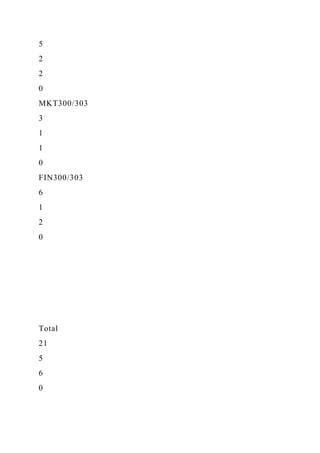
For example, one can look at the number of honors sections
offered in some classes in Spring of 2019 compared to the
number of regular sections offered.
Regular Sections Offered in Person (300)
Regular Sections Offered Online
(300)
Honors Sections Offered in Person
(303)
Honors Sections Offered Online (303)
SCM300/303
7
1
1
0
MGT300/303
5
2
2
0
MKT300/303
3
1
1
0
FIN300/303
6
1
2
0
Total
21
5
6
0
These four core business classes all offer honors sections,
allowing the professors who teach the non-honors sections to
refuse to do honors contracts with their students with the
reasoning that the student should have enrolled in the honors
section if they wanted honors credit. However, as seen above,
scheduling conflicts prevent many students from being able to
enroll in honors sections.
Only six of the 32 total sections of these classes in the Spring
of 2019 are available for honors credit. This means that non-
honors students get to pick from almost 80% more classes than
their Barrett peers. This puts Barrett students at a competitive
disadvantage in creating cohesive class schedules.
Honors Sections are Almost Exclusively Offered at the Tempe
Campus
Not shown in the above table is the location of these classes.
These are classes that are required for business degrees at
multiple ASU campuses. For example, SCM300 is offered at
four different campuses (five if you include online). SCM303,
the honors counterpart to this class, is offered at ASU’s Tempe
campus only.
If a student from another campus wants to receive honors credit
for this class, they have two choice. The student can either
enroll in SCM303 and commute to the Tempe campus once a
week, or they can enroll in an SCM300 class in the hopes that
their professor might allow honors contracts. there is absolutely
no guarantee that the latter will work, though, because
professors are not required to offer honors contracts.
SCM303, the honors section of SCM300, meets only once a
week on Fridays. Other honors sections, such as MGT303,
MKT303, and FIN303 meet twice a week, and are only offered
in Tempe. This means that if a business student at the
Polytechnic or West campuses wants to ensure they can receive
honors credit for a class, they must commute to the Tempe
campus twice a week. The campus shuttles take about an hour to
move between campuses. Therefore, if a student at the
Polytechnic or West campuses wants to take an honors section
of some classes, they must commute around four hours each
week just to attend the class. These four hours come out of time
that could be better spent doing other activities such as
homework or participating in extracurricular activities.
Honors Sections are Not Offered Online
Not offering honors sections of classes online again limits
Barrett students’ ability to get their honors credits done. Further
than not offering honors sections online, Barrett limits the
number of honors credits that a student can earn from honors
contracts in online classes to six credit hours. This discourages
honors students from taking online courses, which many
students prefer because of the schedule flexibility that online
classes offer.

Effective Team Decision-Making Process Teams are particularl.docx

  • 1.
    Effective Team Decision-MakingProcess Teams are particularly effective in problem solving as they are comprised of people with complementary skills. These complementary skills allow team members to examine issues from various angles, as well as see the implications of their decisions from a variety of perspectives. In this section we will look at a process that can help teams solve problems and make ‘good’ decisions. In essence, teams make decisions using problem solving techniques. Thus, the process largely rests on the selection of a course of action following the evaluation of two or more alternatives. To effectively navigate this path, the following step-by-step approach1 can be used. 1. Recognize the problem. Teams must see and recognize that a problem exists and that a decision needs to be made to move forward. While on its face this step appears elementary, many teams do not always recognize that there is an issue that needs to be addressed due to issues such as group think. 2. Define the problem. In this stage, teams must map out the issue at hand. During this step, teams should: o State how, when, and where members became aware of the
  • 2.
    problem o Explore differentways of viewing the problem – different ways of viewing the problem can lead to an improved understanding of the ‘core’ problem o Challenge any assumptions that are made about the problem to ensure that the team fully sees the ‘real’ issue at hand. 3. Gather information. Once the problem has been defined, teams need to gather information relevant to the problem. Why do teams need to perform this step? Two reasons: (1) to verify that the problem was defined correctly in step 2; and (2) to develop alternative solutions to the problem at hand. 4. Develop Alternative Solution s. While it can be easy for teams to ‘jump on’ and accept the first solution, teams that are effective in problem solving take the time to explore several potential solutions to the problem. Some ways to generate alternatives include:
  • 3.
    a. Brainstorming. Duringthis process teams are encouraged to come up with as many ways as possible to solve the problem at hand. While brainstorming can help generate creative solutions to problems, a few guidelines are needed to help it work most effectively. - sometimes very creative, and viable, solutions come after people have made what appear to be ‘silly’ suggestions. b. Ask Questions. Network with colleagues internal and external to the organization to get their ideas and suggestions. c. Explore. Read journals/books, go to networking functions, and attend conferences etc. that cover similar issues. Also be prepared to go outside of the healthcare domain. Other industries may have faced similar issues and their solutions can provide insights for you.
  • 4.
    5. Select theBEST alternative. Once all the alternatives are in, the team needs to determine the alternative that best addresses the problem at hand. For this element to be effective, you need to consider both rational and human elements. o Rational Elements. These rational elements stem from the previous steps of the team decision making/problem solving model: 1. Analyze the problem (see Steps 1 –2) 2. Determine the desired end state. Here teams need to clearly define what success looks like. 3. Evaluate alternatives against the desired state. Here teams discuss the merits of each alternative and the extent to which each can move the team to
  • 5.
    the desired state.To help on this step, some teams rate each alternative on a scale of 1 to 5 where 1 is low and 5 is high. 4. Discuss potential adverse consequences of each alternative. Here teams need to discuss the potential downsides of the options. o Human Elements. Here the team needs to ensure the following: at team members: • Pay attention to the dialogue and anticipate where the conversation is going; • Objectively weigh out what’s been said; • Try to understand what the other person is saying; and • Review and summarize what has been said. upporting each others’ ideas. Most people tend to focus on what is wrong versus right. Being supportive requires that you:
  • 6.
    • Assume thatothers have valid points; • Point out the useful aspects of what has been said; • Build on these useful points; and • Avoid unnecessary criticism. group think is a key concern for teams. To effectively present differing views make sure that you: • Clearly state your differing view; • Focus on the reasons for the differences; and • Treat differences as a source of ideas rather than a source of interpersonal conflict. skills present in a team, all team members must participate. Sometimes, one or two people dominate team decision making processes because of their interpersonal style (i.e. extraverted vs. introverted), their need for recognition, or their presumed
  • 7.
    status/position. This canhave a negative effect on the team in terms of its ability to make effective decisions. When this occurs, the team needs to address this issue - especially as they face this problem as a team. 6. Implement the best alternative. Once the alternative has been chosen, the team needs to implement its decision. This requires effective planning as well as communicating the decision to all the stakeholders that may be impacted by this decision. 7. Evaluate the outcome. Remember that teams and team building is a learning process. It is critical that the team examine whether the proposed plans of action were achieved in an effective way and resulted in positive outcomes.
  • 8.
    Shared Leadership While peopleoften think of team leadership in terms of a formally appointed leader, it is important to note that leaders can emerge in teams. In teams where no formal leader has been named, emergent leadership occurs when a participant takes leadership roles (task or relationship) or when (s)he has subject matter expertise that the team needs. However, even when a team leader has been named, effective team leaders share leadership by encouraging team members to take on leadership roles or by formally recognizing team members with special subject matter expertise. Membership and leadership roles are inseparable and involve an emphasis on role functions rather than on a particular discipline or a set of personality traits. Although one or more individuals may have a formal designation as a group leader, all team members need to share responsibility for informal and formal leadership. In true interprofessional teams, the functions of leadership and membership are viewed as synonymous.
  • 9.
    Because all teammembers have an investment in seeing the team achieve its goals and objectives, each member has the responsibility to help the team progress. An emerging pattern in many primary health care teams is the requirement for equal participation and responsibility from all team members with shifting leadership determined by the nature of the problem to be solved. The functions of leadership are: 1. Helping the group decide on its purposes and goals. 2. Helping the group focus on its own process of work together so that it may become more effective rather than becoming trapped by faulty ways of problem solving and decision making. 3. Helping the group become aware of its own resources and how best to use them. 4. Helping the group evaluate its progress and development. 5. Helping the group to be open to new and different ideas
  • 10.
    without becoming immobilized byconflict. 6. Helping the group learn from its failures and frustrations as well as from its success. 1Adapted from Lafferty, J.T. (1988). Subarctic survival situation: Leader’s guide. Plymouth, MI: Human Synergistics. Effective Team Decision-Making Process XXXX 701 E Apache Blvd. Tempe, AZ 85281 [email protected] Date: October 24, 2018 Subject: To-Go Dining Service “Grab & Gold” Proposal To: ASU Administration
  • 11.
    The Freshmen Fifteen Accordingto a comprehensive study done by the National Center for Biotechnology Information, “nearly two-thirds of students gain weight as freshmen.” This infamous college weight gain is known as the dreaded “Freshmen 15.” With new college students adjusting to a different environment and the many food options at their disposal, a health epidemic arises. Weight gain is inevitable for some freshman with stress, binge- eating, not exercising, transportation challenges, and financial issues. ASU has unfortunately not escaped this phenomenon with estimated 65% of the 2020 class of freshmen putting on weight. Often, students resort to quick and easy foods. Most students prefer fast food to dining hall because of the convenience, short-distance from most classes. As students are in between classes, work, and the countless other activities, they end up resorting to fast food. The Memorial Union, the main dining center in the middle of campus, is where most students go to eat during the day. Fast food options include: Burger King, Chick-Fil-A, Pei Wei, and the Pod. Although there are a few healthy items on these
  • 12.
    restaurants’ menus, themost popular menu items are burgers, chicken nuggets, fries, and other unsaturated fatty foods. These foods lack in the essential nutrients and fail to provide sustainable energy to students. Where ASU Dining Falls Short With sometimes as little as fifteen minutes between classes, there is often not enough time for students to sit down in a dining hall. If students are near the Memorial Union, they can easily buy a quick item from the fast food options or the Pod in around 15 minutes. Although a dining hall may offer healthy options, it is a sit-down environment that takes more time by forcing students to stay within the hall. According to a survey in the State Press, a student spends on average 41 minutes at a dining hall. A student may not have that much time to spend in a dining hall, forcing them to eat less-healthier options. An ASU junior studying public health states, “fast food on campus is so easy and fast compared to dining halls. This is leading to students consuming unhealthy, greasy options.” There is a large food need for students as ASU that is being overlooked. Dining halls can decrease over-crowding in the halls by offering a to-go service. There is a dire need for a to-go service. With students paying up to $2685 for the unlimited
  • 13.
    meal plan, theydeserve high-quality food on demand. Grab & Gold: To-Go Dining Hall Service To solve this student food issue, we present Grab & Gold, a to- go food service that can operate in the existing dining halls. Students will have the option to transport their food outside of the dining hall. The grab-and-go convenience of the system will encourage students to choose healthy options over fast food. A student can use one meal swipe in exchange for a pre- prepared healthy meal at the dining hall. The packaged food can stay unrefrigerated for up to three hours in case students do not consume meals immediately. All to-go meals will have items from all essential food-groups. Meals will provide healthy nutrients to students, giving them lasting energy for their day. The fruits and vegetables are organic and pesticide-free. All foods are selected by our qualified nutritionist and dieticians. Grab & Gold Meal Options Grab & Gold containers hold the following: · Vegetable serving · Fruit serving
  • 14.
    · Whole-grain serving ·Protein (turkey or chicken) serving · Choice of drink There will be vegetarian and vegan options as well. For a detailed list of all meal options, visit grab.and.gold.com/menu. Grab & Gold will encourage students to eat breakfast, a meal that a large proportion of college students skip. According to a study done at Blinn College, only 2/3’s of college students eat breakfast. They additionally showed that eating breakfast positively affects test scores. Implementing this program would help increase the number of students that eat breakfast and retention. With Grab & Gold’s convenience and accessibility, students can easily quickly get their breakfast, be energized with nutritious foods, and head off to their day. An example of a Grab & Gold breakfast contains a yogurt, banana, whole-grain bagel, and orange juice. Grab & Gold’s breakfast program is both an investment in student’s health and education. Lunch is the hour where students are most busy, rushing to classes. Off-campus students do not have time to go back to their residence. During the afternoon, there is the most foot traffic in the Memorial Union. This food program would draw students from resorting to fast food.
  • 15.
    The Grab &Gold service would be optimal for dinner. Students have club meetings during the evenings. Also, students returning from campus later in the evening can easily grab and not have to worry about eating their whole meal before the dining hall closes. Most dining halls close at 8 or 9 PM at the latest, depending on the day of the week. An Investment in Students’ Health This program will need extra staff members in the kitchen. Each dining hall will need average 6 more employees on rotation to run the program. With five dining halls (Barrett, Tooker, Manzanita, Hassayampa, and Pitchforks), this will total in about 30 employees. They will prepare the meals, order the appropriate food, and distribute. As Grab & Gold, we will contract our workers out to the dining halls. Our cooks are well- trained in food preparation and safety. As Grab & Gold, we will provide trained employees, high quality food, and eco-friendly packaging. Below is a cost list of some of the main items budgeted for 2019. · 30 employees: $1.1 mil · Food: $2 mil · Packaging bags: $10,000
  • 16.
    All of thistotals to just over 3 million per year. With the installation of Grab & Gold, students will have more incentive to purchase dining plans, especially off-campus students. Our research estimates that there will be a 5% increase in demand for dining plans. This will offset the costs of this program, and the cost of meal plans for students will not rise. Creating an Innovative and Healthy Campus Culture The ASU charter states that the university assumes the responsibility of the “overall health of the communities it serves.” Grab & Gold will directly benefit the health of the ASU community by providing nutritious, convenient options for students. Because ASU is the most innovative school, the dining halls should innovate and accommodate in order to fulfill the needs of students. With the diversity of ASU, Grab & Gold caters to all students with various schedules and food needs. For questions and comments, please reach out to us either at [email protected]&gold.com or call (480) 555-9030. We would like to discuss in person and go into further detail on how we will improve the food options at ASU. We at Grab & Gold look forward to the potential future partnership with ASU. Thank you for your time and consideration.
  • 17.
  • 18.
    Dr. Mark Jacobs ViceProvost and Dean, Barrett, the Honors College 751 East Lemon Street Tempe, Arizona 85281 [email protected] Dear Dean Jacobs,Purpose As a Barrett student, thank you for the time and resources that you put into making Barrett, the Honors College a wonderful place to study. In this letter, I will propose a way to make Barrett an even better place to study. To graduate from Barrett, students must complete The Human Event, an honors thesis, a 3.25 GPA, and 36 honors credits. During the season of class registration, the search for honors credits is on the mind of every Barrett student. Some classes offer honors sections, which are times that the class is held only for honors students. Other classes offer honors contracts, which allow honors students to do supplementary work to receive honors credit in a non-honors class. Many professors have recently begun to limit the offering of
  • 19.
    honors contracts toonly classes that do not offer honors sections. For instance, if a marketing class offers an honors section, professors that teach the non-honors sections of the course are no longer offering to complete honors contracts with students. Problem of Limiting Honors Contracts Limiting the availability of honors contracts hinders students from being able to take advantage of the full Barrett experience. While the Honors College itself is not telling professors in writing that they cannot offer honors contracts to students taking the non-honors equivalent of an honors class, professors are telling students that since there is an honors section available, that the student should have taken that section to get honors credit. Some problems that come with this include: · Honors sections are offered less often · Honors sections are offered almost exclusively at the Tempe campus, and they are not offered online Honors Sections are Offered Less Often The fact that honors sections are offered is not an appropriate
  • 20.
    excuse to notoffer honors contracts. Honors sections are usually only offered at one time during the week. If that time conflicts with a student’s other classes, extracurricular activities, or personal responsibilities, the student has no choice but to enroll in a non-honors section of the course. The non- honors sections of courses are offered at many more times than their honors section counterparts. For example, one can look at the number of honors sections offered in some classes in Spring of 2019 compared to the number of regular sections offered. Regular Sections Offered in Person (300) Regular Sections Offered Online (300) Honors Sections Offered in Person (303) Honors Sections Offered Online (303) SCM300/303 7 1 1 0 MGT300/303
  • 21.
  • 22.
    These four corebusiness classes all offer honors sections, allowing the professors who teach the non-honors sections to refuse to do honors contracts with their students with the reasoning that the student should have enrolled in the honors section if they wanted honors credit. However, as seen above, scheduling conflicts prevent many students from being able to enroll in honors sections. Only six of the 32 total sections of these classes in the Spring of 2019 are available for honors credit. This means that non- honors students get to pick from almost 80% more classes than their Barrett peers. This puts Barrett students at a competitive disadvantage in creating cohesive class schedules. Honors Sections are Almost Exclusively Offered at the Tempe Campus Not shown in the above table is the location of these classes. These are classes that are required for business degrees at multiple ASU campuses. For example, SCM300 is offered at four different campuses (five if you include online). SCM303, the honors counterpart to this class, is offered at ASU’s Tempe campus only.
  • 23.
    If a studentfrom another campus wants to receive honors credit for this class, they have two choice. The student can either enroll in SCM303 and commute to the Tempe campus once a week, or they can enroll in an SCM300 class in the hopes that their professor might allow honors contracts. there is absolutely no guarantee that the latter will work, though, because professors are not required to offer honors contracts. SCM303, the honors section of SCM300, meets only once a week on Fridays. Other honors sections, such as MGT303, MKT303, and FIN303 meet twice a week, and are only offered in Tempe. This means that if a business student at the Polytechnic or West campuses wants to ensure they can receive honors credit for a class, they must commute to the Tempe campus twice a week. The campus shuttles take about an hour to move between campuses. Therefore, if a student at the Polytechnic or West campuses wants to take an honors section of some classes, they must commute around four hours each week just to attend the class. These four hours come out of time that could be better spent doing other activities such as homework or participating in extracurricular activities. Honors Sections are Not Offered Online
  • 24.
    Not offering honorssections of classes online again limits Barrett students’ ability to get their honors credits done. Further than not offering honors sections online, Barrett limits the number of honors credits that a student can earn from honors contracts in online classes to six credit hours. This discourages honors students from taking online courses, which many students prefer because of the schedule flexibility that online classes offer.