Creating Effective Project-Based Learning Robin Harvey New York University
Why project-based learning? …  a lot of education in the past has been taught In   isolation:  each student learning by himself, t he   teacher not having much contact with the students other than through lecturing,  the teacher not having much contact with other teachers, the school not having much contact with the city it's in, and, most importantly, the students not having much contact with one another. George Lucas, 2007
Know your students Develop social emotional learning E ducate students’  h earts and  m inds Try project-based learning   Daniel Goleman and  George Lucas  on  new demands to teachers (2007)
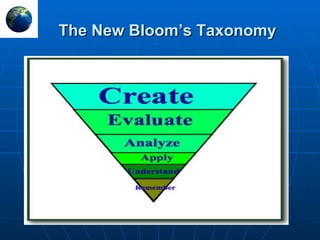
The New  Bloom’s Taxonomy
 
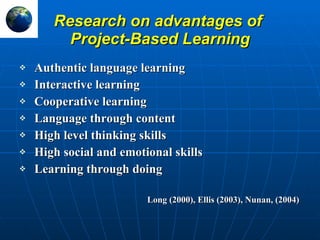
Research on advantages of  Project-Based Learning Authentic language learning Interactive learning Cooperative learning Language through content High level thinking skills High social and emotional skills Learning through doing Long (2000), Ellis (2003), Nunan, (2004)
Students are focused on the project, the meaning, and the interaction with other students and the teacher, and not on language learning.   As in conversation, the  meaning  is what is important.
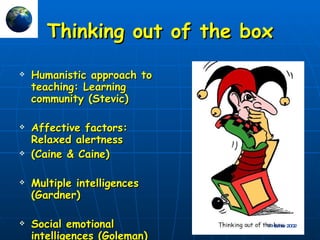
Thinking out of the box Humanistic approach to teaching: Learning community (Stevic) Affective factors: Relaxed alertness (Caine & Caine) Multiple intelligences (Gardner) Social emotional intelligences (Goleman) Horner 2002
Possible Outcome / Products Printed materials, such as greeting cards ** Wall newspaper/display  Audio-video production Power point presentation ** Webpage/blogs Performances (plays, karaoke, songs) Language/culture festivals ** Stories and Poems **
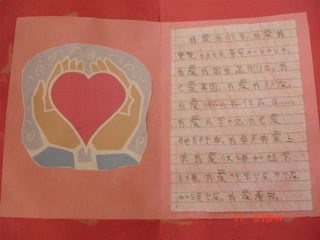
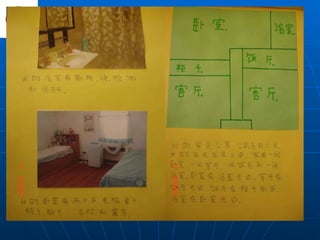
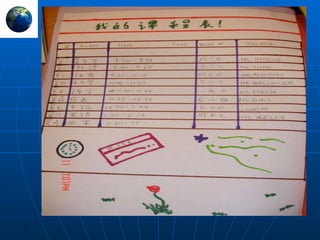
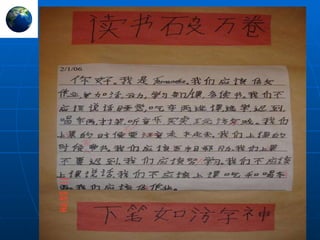
Some Sample Student Projects Valentine’s Day cards My home My school My neighborhood Dos & Don’ts Going to a Chinese Restaurant Poems for the Seasons The Beijing Olympics
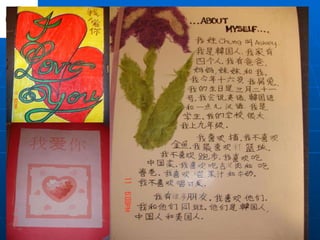
Valentine’s Day 情人节 Incorporate art into projects Illustrations provide cues to meaning Creative use of Language to express meaningful, personal ideas Every-day Language


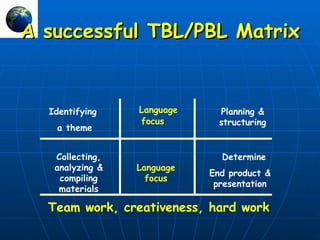
A successful TBL/PBL Matrix Identifying  a theme Collecting, analyzing & compiling materials Language focus   Determine End product & presentation Language focus Planning & structuring Team work, creativeness, hard work
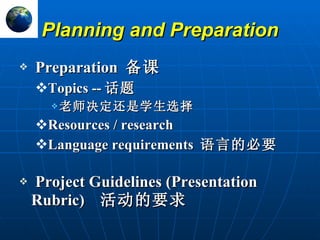
Planning and Preparation Preparation  备课 Topics -- 话题 老师决定还是学生选择 Resources / research Language requirements  语言的必要 Project Guidelines (Presentation Rubric)  活动的要求 R
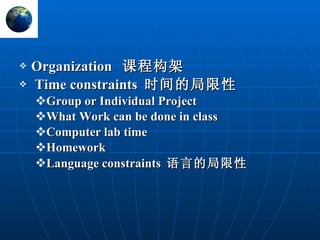
Organization  课程构架 Time constraints  时间的局限性 Group or Individual Project What Work can be done in class Computer lab time Homework  Language constraints  语言的局限性
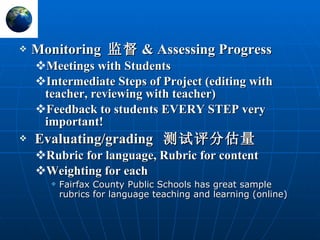
Monitoring  监督 & Assessing Progress Meetings with Students Intermediate Steps of Project (editing with teacher, reviewing with teacher) Feedback to students EVERY STEP very important! Evaluating/grading  测试评分估量 Rubric for language, Rubric for content Weighting for each Fairfax County Public Schools has great sample rubrics for language teaching and learning (online)
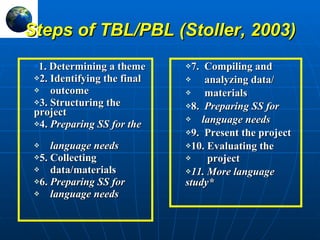
Steps of TBL/PBL (Stoller, 2003) 1. Determining a theme 2. Identifying the final outcome 3. Structuring the project 4.  Preparing SS for the  language needs 5. Collecting  data/materials 6.  Preparing SS for  language needs 7.  Compiling and analyzing data/ materials 8.  Preparing SS for  language needs 9.  Present the project 10. Evaluating the project   11. More language study*
 
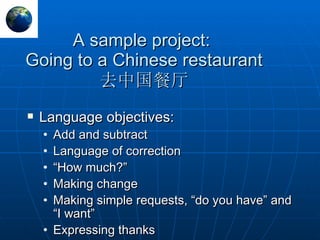
A sample project:  Going to a Chinese restaurant 去中国餐厅 Language objectives: Add and subtract Language of correction “ How much?” Making change Making simple requests, “do you have” and “I want” Expressing thanks
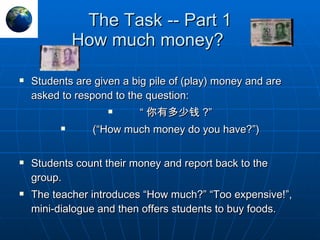
The Task -- Part 1 How much money?  Students are given a big pile of (play) money and are asked to respond to the question:  “ 你有多少钱 ?” (“How much money do you have?”) Students count their money and report back to the group. The teacher introduces “How much?” “Too expensive!”, mini-dialogue and then offers students to buy foods.
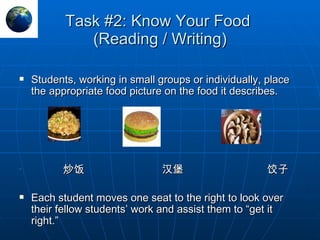
Task #2: Know Your Food  (Reading / Writing) Students, working in small groups or individually, place the appropriate food picture on the food it describes.   炒饭     汉堡   饺子 Each student moves one seat to the right to look over their fellow students’ work and assist them to “get it right.”
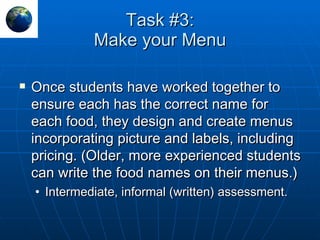
Task #3: Make your Menu Once students have worked together to ensure each has the correct name for each food, they design and create menus incorporating picture and labels, including pricing. (Older, more experienced students can write the food names on their menus.) Intermediate, informal (written) assessment.
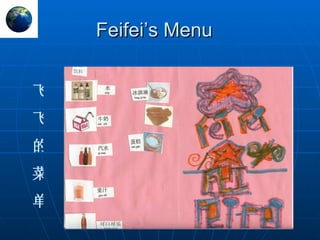
Feifei’s Menu 飞 飞 的 菜 单
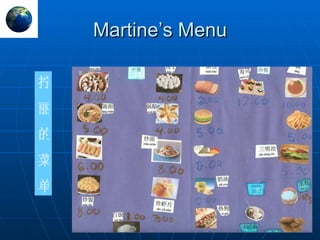
Martine’s Menu 拧 丽 的 菜 单
Task #4 Grand Opening Students set up “booths”; some act as sellers and others as customers while they practice the language learned.  Pair stronger students with weaker Encourage “cheating” Students move from booth to booth, also switch roles Appropriate as an (oral) assessment and/or culminating activity.
Writing Poems 写诗歌 Goals: Vocabulary rich Pattern-based language Creative, engaging, and personal (meaningful) Four (or five) skills engaged
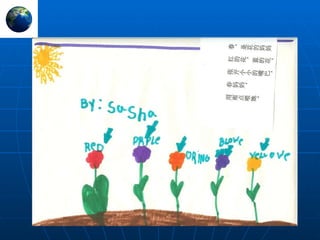
Writing Poetry  写诗歌 Read Poem  读诗 Introduce Vocabulary  词汇介绍 Games & Activities to reinforce/practice Introduce New Structures  语法介绍 Discuss meaning  讨论意思和意义 Illustrate poem  (画画) shows understanding ( 表示学生能够理解)
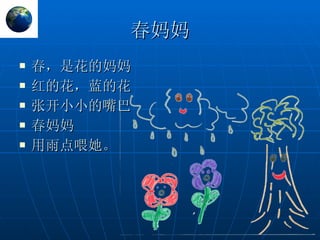
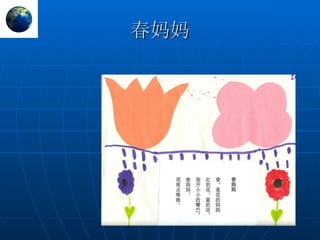
春妈妈 春,是花的妈妈 红的花,蓝的花 张开小小的嘴巴 春妈妈 用雨点喂她。
春妈妈
 
Writing Poetry Write poems based on the original Group or individual task Assessment, shows understanding Practices using new vocabulary Communicative task Final Project
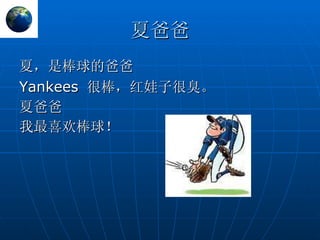
夏爸爸 夏,是棒球的爸爸 Yankees  很棒,红娃子很臭。 夏爸爸 我最喜欢棒球!
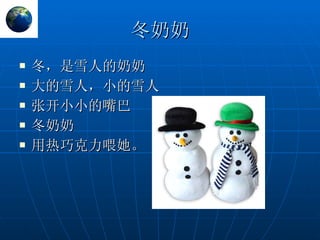
冬奶奶 冬,是雪人的奶奶 大的雪人,小的雪人 张开小小的嘴巴 冬奶奶 用热巧克力喂她。
Beijing Olympics 北京奥运会 Current Events, Culture, Language Establish Rubric for All Projects Provide basic Vocabulary, Sentence Structures, Important Questions Students work individually (essays) and in groups (powerpoint projects and presentations)
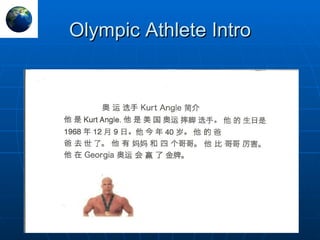
Model Expectations 奧运选手李小鵬简介 李小鵬是中国奧运 体操 选手。他是中国湖南省长沙市人。 他的 生日是   1981 年 7  月 27 日。他今年 26 岁。家有爸爸跟妈妈,沒   有兄弟姊妹。他喜欢吃妈妈做的湘菜。他平常喜欢玩电游、打电话   和   跟朋友逛街。
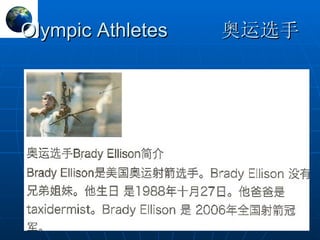
Olympic Athletes  奥运选手
Olympic Athlete Intro
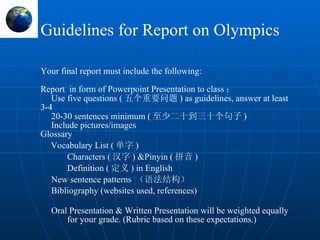
Guidelines for Report on Olympics Your  final report  must include the following: Report  in form of Powerpoint Presentation to class : Use five questions ( 五个重要问题 ) as guidelines, answer at least 3-4 20-30 sentences minimum ( 至少 二十到三十个句子 ) Include pictures/images Glossary  Vocabulary List ( 单字 ) Characters ( 汉字 )  & Pinyin ( 拼音 ) Definition ( 定义 ) in English New sentence patterns   (语法结构) Bibliography (websites used, references) Oral Presentation & Written Presentation will be weighted equally for your grade. (Rubric based on these expectations.)
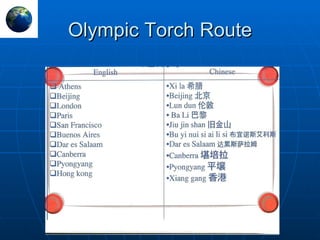
Olympic Torch Route
Olympic Torch
 
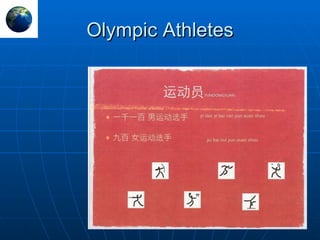
Olympic Athletes
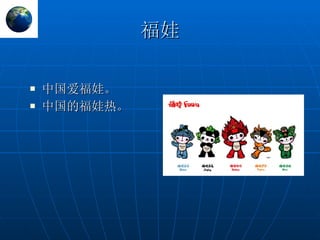
福娃 中国爱福娃。 中国的福娃热。
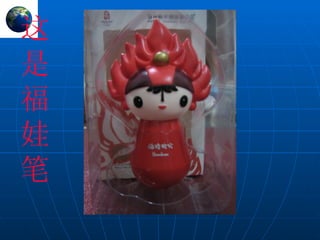
这 是 福 娃 笔
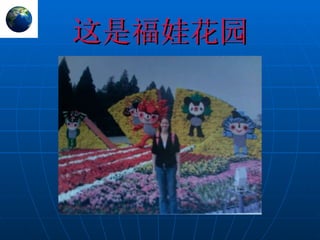
这是福娃花园
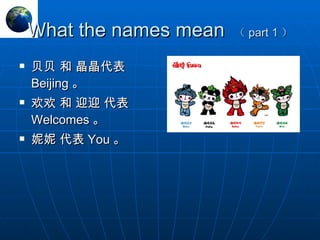
What the names mean  ( part 1 ) 贝贝 和 晶晶代表  Beijing 。 欢欢 和 迎迎 代表  Welcomes 。 妮妮 代表 You 。
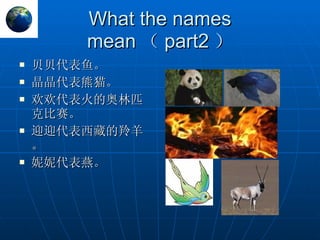
What the names mean ( part2 ) 贝贝代表鱼。 晶晶代表熊猫。 欢欢代表火的奥林匹克比赛。 迎迎代表西藏的羚羊。 妮妮代表燕。
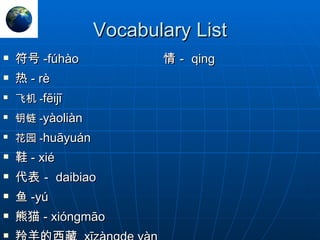
Vocabulary List 符号 - fúhào 情- qing 热 - rè 飞机 - fēijī 钥链 - yàoliàn 花园 - huāyuán 鞋 - xié 代表- daibiao  鱼 -yú 熊猫 - xióngmāo 羚羊的西藏  xīzàngde yàn
My students’ reaction  to these projects Very enthusiastic, motivated Learned and used “Real life” language and communication skills Took responsibility for their own learning Can be tailored to students of many age groups and levels: Younger students, simpler language, less money. Older students can use more complex language, more money (!) and more written language.
Engage the student’s whole brain!  Foster real communication  and learning among your students. TBA/PBA works. Try it. THANK YOU! Robin Harvey Project for Developing Chinese Language Teachers New York University
Project Developing Chinese Language Teachers (DCLT) Project DCLT New York University Frank Lixing Tang, Director [email_address] Robin Harvey, Coordinator [email_address] (212)992-9367

Effective Pbl Election Day Pd

  • 1.
    Creating Effective Project-BasedLearning Robin Harvey New York University
  • 2.
    Why project-based learning?… a lot of education in the past has been taught In isolation: each student learning by himself, t he teacher not having much contact with the students other than through lecturing, the teacher not having much contact with other teachers, the school not having much contact with the city it's in, and, most importantly, the students not having much contact with one another. George Lucas, 2007
  • 3.
    Know your studentsDevelop social emotional learning E ducate students’ h earts and m inds Try project-based learning Daniel Goleman and George Lucas on new demands to teachers (2007)
  • 4.
    The New Bloom’s Taxonomy
  • 5.
  • 6.
    Research on advantagesof Project-Based Learning Authentic language learning Interactive learning Cooperative learning Language through content High level thinking skills High social and emotional skills Learning through doing Long (2000), Ellis (2003), Nunan, (2004)
  • 7.
    Students are focusedon the project, the meaning, and the interaction with other students and the teacher, and not on language learning. As in conversation, the meaning is what is important.
  • 8.
    Thinking out ofthe box Humanistic approach to teaching: Learning community (Stevic) Affective factors: Relaxed alertness (Caine & Caine) Multiple intelligences (Gardner) Social emotional intelligences (Goleman) Horner 2002
  • 9.
    Possible Outcome /Products Printed materials, such as greeting cards ** Wall newspaper/display Audio-video production Power point presentation ** Webpage/blogs Performances (plays, karaoke, songs) Language/culture festivals ** Stories and Poems **
  • 10.
    Some Sample StudentProjects Valentine’s Day cards My home My school My neighborhood Dos & Don’ts Going to a Chinese Restaurant Poems for the Seasons The Beijing Olympics
  • 11.
    Valentine’s Day 情人节Incorporate art into projects Illustrations provide cues to meaning Creative use of Language to express meaningful, personal ideas Every-day Language
  • 12.
  • 13.
  • 14.
  • 15.
  • 16.
  • 17.
    A successful TBL/PBLMatrix Identifying a theme Collecting, analyzing & compiling materials Language focus Determine End product & presentation Language focus Planning & structuring Team work, creativeness, hard work
  • 18.
    Planning and PreparationPreparation 备课 Topics -- 话题 老师决定还是学生选择 Resources / research Language requirements 语言的必要 Project Guidelines (Presentation Rubric) 活动的要求 R
  • 19.
    Organization 课程构架Time constraints 时间的局限性 Group or Individual Project What Work can be done in class Computer lab time Homework Language constraints 语言的局限性
  • 20.
    Monitoring 监督& Assessing Progress Meetings with Students Intermediate Steps of Project (editing with teacher, reviewing with teacher) Feedback to students EVERY STEP very important! Evaluating/grading 测试评分估量 Rubric for language, Rubric for content Weighting for each Fairfax County Public Schools has great sample rubrics for language teaching and learning (online)
  • 21.
    Steps of TBL/PBL(Stoller, 2003) 1. Determining a theme 2. Identifying the final outcome 3. Structuring the project 4. Preparing SS for the language needs 5. Collecting data/materials 6. Preparing SS for language needs 7. Compiling and analyzing data/ materials 8. Preparing SS for language needs 9. Present the project 10. Evaluating the project 11. More language study*
  • 22.
  • 23.
    A sample project: Going to a Chinese restaurant 去中国餐厅 Language objectives: Add and subtract Language of correction “ How much?” Making change Making simple requests, “do you have” and “I want” Expressing thanks
  • 24.
    The Task --Part 1 How much money? Students are given a big pile of (play) money and are asked to respond to the question: “ 你有多少钱 ?” (“How much money do you have?”) Students count their money and report back to the group. The teacher introduces “How much?” “Too expensive!”, mini-dialogue and then offers students to buy foods.
  • 25.
    Task #2: KnowYour Food (Reading / Writing) Students, working in small groups or individually, place the appropriate food picture on the food it describes. 炒饭 汉堡 饺子 Each student moves one seat to the right to look over their fellow students’ work and assist them to “get it right.”
  • 26.
    Task #3: Makeyour Menu Once students have worked together to ensure each has the correct name for each food, they design and create menus incorporating picture and labels, including pricing. (Older, more experienced students can write the food names on their menus.) Intermediate, informal (written) assessment.
  • 27.
    Feifei’s Menu 飞飞 的 菜 单
  • 28.
    Martine’s Menu 拧丽 的 菜 单
  • 29.
    Task #4 GrandOpening Students set up “booths”; some act as sellers and others as customers while they practice the language learned. Pair stronger students with weaker Encourage “cheating” Students move from booth to booth, also switch roles Appropriate as an (oral) assessment and/or culminating activity.
  • 30.
    Writing Poems 写诗歌Goals: Vocabulary rich Pattern-based language Creative, engaging, and personal (meaningful) Four (or five) skills engaged
  • 31.
    Writing Poetry 写诗歌 Read Poem 读诗 Introduce Vocabulary 词汇介绍 Games & Activities to reinforce/practice Introduce New Structures 语法介绍 Discuss meaning 讨论意思和意义 Illustrate poem (画画) shows understanding ( 表示学生能够理解)
  • 32.
    春妈妈 春,是花的妈妈 红的花,蓝的花张开小小的嘴巴 春妈妈 用雨点喂她。
  • 33.
  • 34.
  • 35.
    Writing Poetry Writepoems based on the original Group or individual task Assessment, shows understanding Practices using new vocabulary Communicative task Final Project
  • 36.
    夏爸爸 夏,是棒球的爸爸 Yankees 很棒,红娃子很臭。 夏爸爸 我最喜欢棒球!
  • 37.
    冬奶奶 冬,是雪人的奶奶 大的雪人,小的雪人张开小小的嘴巴 冬奶奶 用热巧克力喂她。
  • 38.
    Beijing Olympics 北京奥运会Current Events, Culture, Language Establish Rubric for All Projects Provide basic Vocabulary, Sentence Structures, Important Questions Students work individually (essays) and in groups (powerpoint projects and presentations)
  • 39.
    Model Expectations 奧运选手李小鵬简介李小鵬是中国奧运 体操 选手。他是中国湖南省长沙市人。 他的 生日是 1981 年 7 月 27 日。他今年 26 岁。家有爸爸跟妈妈,沒 有兄弟姊妹。他喜欢吃妈妈做的湘菜。他平常喜欢玩电游、打电话 和 跟朋友逛街。
  • 40.
    Olympic Athletes 奥运选手
  • 41.
  • 42.
    Guidelines for Reporton Olympics Your final report must include the following: Report in form of Powerpoint Presentation to class : Use five questions ( 五个重要问题 ) as guidelines, answer at least 3-4 20-30 sentences minimum ( 至少 二十到三十个句子 ) Include pictures/images Glossary Vocabulary List ( 单字 ) Characters ( 汉字 ) & Pinyin ( 拼音 ) Definition ( 定义 ) in English New sentence patterns (语法结构) Bibliography (websites used, references) Oral Presentation & Written Presentation will be weighted equally for your grade. (Rubric based on these expectations.)
  • 43.
  • 44.
  • 45.
  • 46.
  • 47.
  • 48.
    这 是 福娃 笔
  • 49.
  • 50.
    What the namesmean ( part 1 ) 贝贝 和 晶晶代表 Beijing 。 欢欢 和 迎迎 代表 Welcomes 。 妮妮 代表 You 。
  • 51.
    What the namesmean ( part2 ) 贝贝代表鱼。 晶晶代表熊猫。 欢欢代表火的奥林匹克比赛。 迎迎代表西藏的羚羊。 妮妮代表燕。
  • 52.
    Vocabulary List 符号- fúhào 情- qing 热 - rè 飞机 - fēijī 钥链 - yàoliàn 花园 - huāyuán 鞋 - xié 代表- daibiao 鱼 -yú 熊猫 - xióngmāo 羚羊的西藏 xīzàngde yàn
  • 53.
    My students’ reaction to these projects Very enthusiastic, motivated Learned and used “Real life” language and communication skills Took responsibility for their own learning Can be tailored to students of many age groups and levels: Younger students, simpler language, less money. Older students can use more complex language, more money (!) and more written language.
  • 54.
    Engage the student’swhole brain! Foster real communication and learning among your students. TBA/PBA works. Try it. THANK YOU! Robin Harvey Project for Developing Chinese Language Teachers New York University
  • 55.
    Project Developing ChineseLanguage Teachers (DCLT) Project DCLT New York University Frank Lixing Tang, Director [email_address] Robin Harvey, Coordinator [email_address] (212)992-9367