Intermolecular forces, differencesbetween
solids, liquids and gases states
• Intermolecular forces (IMFs) are the attractive forces that exist
between molecules, as opposed to the forces that hold atoms together
within a molecule (intramolecular forces like covalent or ionic bonds).
These forces are significantly weaker than intramolecular forces but
plays an important role in determining the physical properties of
substances, including their state of matter (solid, liquid, or gas),
melting points, boiling points, viscosity, and solubility.
3.
Types of intermolecularforces
•London Dispersion Forces (LDFs): Present in all molecules, these are the weakest
IMFs. They arise from temporary, instantaneous dipoles created by the random
movement of electrons around an atom or molecule. The strength of LDFs increases
with increasing molecular weight and surface area.
•Dipole-Dipole Interactions: Occur between polar molecules that have permanent
partial positive and negative charges. The positive end of one polar molecule is
attracted to the negative end of an adjacent polar molecule.
•Hydrogen Bonding: A particularly strong type of dipole-dipole interaction that occurs
when a hydrogen atom is covalently bonded to a highly electronegative atom (like
nitrogen, oxygen, or fluorine) and is attracted to another electronegative atom with a
lone pair of electrons.
4.
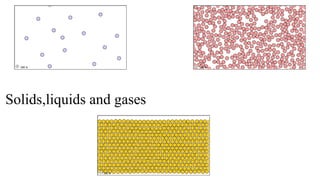
Difference between solids,liquids and gases
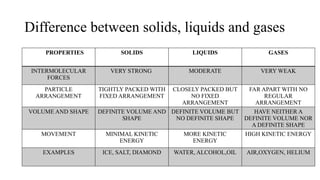
PROPERTIES SOLIDS LIQUIDS GASES
INTERMOLECULAR
FORCES
VERY STRONG MODERATE VERY WEAK
PARTICLE
ARRANGEMENT
TIGHTLY PACKED WITH
FIXED ARRANGEMENT
CLOSELY PACKED BUT
NO FIXED
ARRANGEMENT
FAR APART WITH NO
REGULAR
ARRANGEMENT
VOLUME AND SHAPE DEFINITE VOLUME AND
SHAPE
DEFINITE VOLUME BUT
NO DEFINITE SHAPE
HAVE NEITHER A
DEFINITE VOLUME NOR
A DEFINITE SHAPE
MOVEMENT MINIMAL KINETIC
ENERGY
MORE KINETIC
ENERGY
HIGH KINETIC ENERGY
EXAMPLES ICE, SALT, DIAMOND WATER, ALCOHOL,OIL AIR,OXYGEN, HELIUM
PHYSICAL PROPERTIES OFLIQUID VAPOUR PRESSURE
• Vapour pressure is the pressure formed by the vapour of a liquid (or solid) over the
liquid’s surface. Vapor pressure is a crucial physical property of liquids that
describes their tendency to evaporate. It's the pressure exerted by the vapor of a
liquid when the vapor and liquid are in equilibrium in a closed container at a
specific temperature. This dynamic equilibrium means that the rate at which
molecules escape from the liquid surface into the vapor phase (evaporation) equals
the rate at which vapor molecules return to the liquid phase (condensation).
• The equilibrium Vapour pressure determines the rate of evaporation of a liquid.
When the temperature rises, vapour pressure also increases. A liquid solution is
created by dissolving a solid, liquid, or gas in a specific liquid solvent. The amount
of pressure that the vapours exert on the liquid solvent when they are in
equilibrium and at a particular temperature is called liquid solution pressure. The
Vapour pressure of a liquid varies with its temperature and the nature of the liquid.
7.
Characteristics of VapourPressure
• A pure liquid has a higher vapour pressure than a liquid solution.
• It is inversely proportional to the forces of attraction that exist
between liquid molecules.
• It increases as the temperature rises. This is due to the molecules
gaining kinetic energy and thus rapidly vaporizing.
• The boiling point of a liquid is the temperature at which its vapor
pressure equals the external atmospheric pressure.
• Liquids with high vapor pressures are considered volatile, meaning
they evaporate easily at typical temperatures.
8.
SURFACE TENSION
• Surfacetension is the tendency of fluid surfaces to shrink into the
minimum surface area possible.
• According to the definition of surface tension, it is the phenomenon
that occurs when the surface of a liquid is in contact with another
phase (it can be a liquid as well). Liquids tend to acquire the least
surface area possible. The surface of the liquid behaves like an elastic
sheet.
• Surface tension not only depends upon the forces of attraction between
the particles within the given liquid but also on the forces of attraction
of solid, liquid or gas in contact with it.
9.
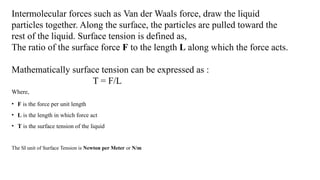
Intermolecular forces suchas Van der Waals force, draw the liquid
particles together. Along the surface, the particles are pulled toward the
rest of the liquid. Surface tension is defined as,
The ratio of the surface force F to the length L along which the force acts.
Mathematically surface tension can be expressed as :
T = F/L
Where,
• F is the force per unit length
• L is the length in which force act
• T is the surface tension of the liquid
The SI unit of Surface Tension is Newton per Meter or N/m
10.
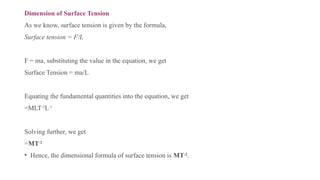
Dimension of SurfaceTension
As we know, surface tension is given by the formula,
Surface tension = F/L
F = ma, substituting the value in the equation, we get
Surface Tension = ma/L
Equating the fundamental quantities into the equation, we get
=MLT-2
L-1
Solving further, we get
=MT-2
• Hence, the dimensional formula of surface tension is MT-2
.
11.
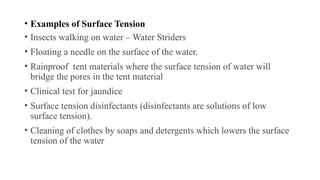
• Examples ofSurface Tension
• Insects walking on water – Water Striders
• Floating a needle on the surface of the water.
• Rainproof tent materials where the surface tension of water will
bridge the pores in the tent material
• Clinical test for jaundice
• Surface tension disinfectants (disinfectants are solutions of low
surface tension).
• Cleaning of clothes by soaps and detergents which lowers the surface
tension of the water
12.
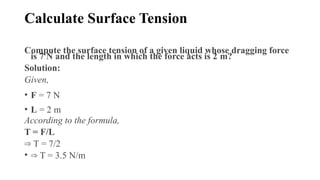
Calculate Surface Tension
Computethe surface tension of a given liquid whose dragging force
is 7 N and the length in which the force acts is 2 m?
Solution:
Given,
• F = 7 N
• L = 2 m
According to the formula,
T = F/L
⇒ T = 7/2
• ⇒ T = 3.5 N/m
13.
Methods of Measurement
Somemethods of measurement of surface tension are given in the points
below:
• Spinning drop method
• Pendant drop method
• Stalagmometric method
• Capillary rise method
• Bubble pressure method
• Resonant oscillations of a spherical and hemispherical liquid drop
• The vibrational frequency of levitated drops
• Sessile drop method
14.
Surface active agents
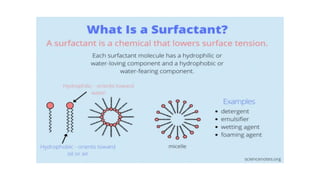
•A molecule that contains a polar and a non polar portion is called
surface active agent.
• It is also known as surfactant, Tensides or amphiphiles.
• A surfactant can interact with both polar and non polar molecules.
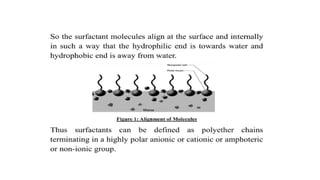
• Surface-active compounds are characterized by having two distinct
regions in their chemical structure, one hydrophilic or water-loving
region (usually depicted with a circle) and the other hydrophobic or
water-hating region (usually depicted with a wiggly chain or a
rectangular box).
19.
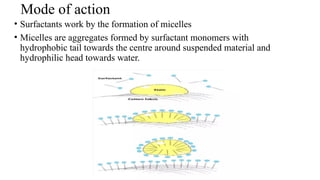
Mode of action
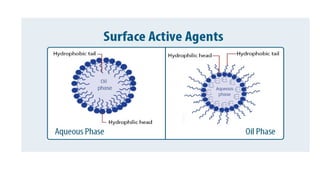
•Surfactants work by the formation of micelles
• Micelles are aggregates formed by surfactant monomers with
hydrophobic tail towards the centre around suspended material and
hydrophilic head towards water.
20.
• The hydrophilicends assosciate with the neighbouring molecules and
form a protective coating around suspended material. This suspension
so formed results in the action of surfactant. The stability of the
suspension formed depends on the particle size and the density of
suspended material.
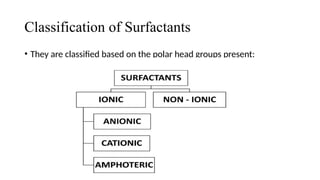
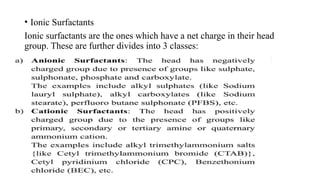
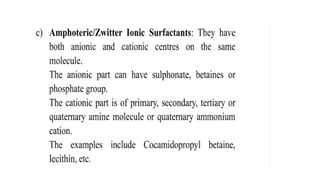
• Ionic Surfactants
Ionicsurfactants are the ones which have a net charge in their head
group. These are further divides into 3 classes:
24.
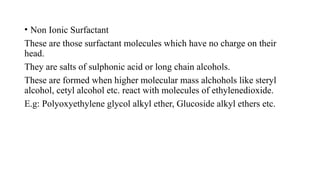
• Non IonicSurfactant
These are those surfactant molecules which have no charge on their
head.
They are salts of sulphonic acid or long chain alcohols.
These are formed when higher molecular mass alchohols like steryl
alcohol, cetyl alcohol etc. react with molecules of ethylenedioxide.
E.g: Polyoxyethylene glycol alkyl ether, Glucoside alkyl ethers etc.
25.
Viscosity
• Viscosity isa measure of a fluid’s resistance to flow.
The SI unit of viscosity is poiseiulle (PI). Its other units are newton-
second per square metre (N s m-2
) or pascal-second (Pa s.) The
dimensional formula of viscosity is [ML-1
T-1
].
• The viscosity of liquids decreases rapidly with an increase in
temperature, and the viscosity of gases increases with an increase in
temperature. Thus, upon heating, liquids flow more easily, whereas
gases flow more slowly. Also, viscosity does not change as the amount
of matter changes, therefore it is an intensive property.
26.
• Viscosity ismeasured in terms of a ratio of shearing stress to the velocity
gradient in a fluid.
Viscosity Types
Viscosity is the measure of fluid’s friction to its flow. There are two ways to
measure the fluid’s viscosity as follows:
• Dynamic Viscosity (Absolute Viscosity)
• Kinematic Viscosity
One way is to measure the fluid’s resistance to flow when an external force is
applied. This is known as Dynamic Viscosity. And the other way is to measure
the resistive flow of a fluid under the weight of gravity. We call this measure
of fluid viscosity kinematic viscosity.
27.
Viscosity Measurement
• Theelementary way of measuring viscosity is to allow a sphere, such
as a metal ball, to drop through a fluid and time the fall of the metal
ball. The slower the sphere falls, the greater the viscosity. But, a more
accurate measure of viscosity is given by the viscometer.
U-tube viscometers are also known as glass capillary viscometers or
Ostwald viscometers.
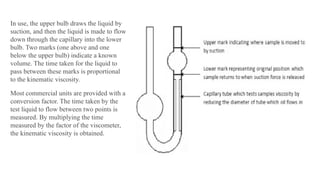
• A viscometer consists of two reservoir bulbs and a capillary tube. In
one arm of the U is the capillary, a vertical section of a precise narrow
bore. Above, which is a bulb, and with it is another bulb lower down
on the other arm
28.
In use, theupper bulb draws the liquid by
suction, and then the liquid is made to flow
down through the capillary into the lower
bulb. Two marks (one above and one
below the upper bulb) indicate a known
volume. The time taken for the liquid to
pass between these marks is proportional
to the kinematic viscosity.
Most commercial units are provided with a
conversion factor. The time taken by the
test liquid to flow between two points is
measured. By multiplying the time
measured by the factor of the viscometer,
the kinematic viscosity is obtained.
29.
Effect of Temperatureon Liquid Viscosity
• For liquids, viscosity generally decreases as temperature increases. This is
because liquids have strong intermolecular forces (cohesive forces) holding
their molecules together. When a liquid is heated, its molecules gain more
kinetic energy, allowing them to overcome these attractive forces more easily
and move past one another with less resistance. This leads to a reduction in
internal friction and, consequently, lower viscosity.
Example is cooking oil: it's quite thick when cold, but becomes much thinner
and flows more freely when heated in a pan.
• Intermolecular Forces: Liquids have relatively strong cohesive forces
(attractive forces between molecules) that resist the movement of one layer of
fluid past another. These forces contribute significantly to a liquid's viscosity
30.
•Kinetic Energy: Whena liquid is heated, its molecules absorb thermal
energy and their kinetic energy increases. This increased energy causes
the molecules to move faster and vibrate more vigorously.
•Overcoming Forces: The greater kinetic energy allows the molecules to
more easily overcome the attractive intermolecular forces binding
them together. As these forces are weakened or disrupted, the molecules
can move past each other with less resistance.
•Reduced Friction: This reduction in internal friction between the layers
of the liquid results in a lower viscosity, meaning the liquid flows more
easily.
31.
Liquid Crystal
• Liquidcrystal refers to a state of matter that exhibits properties
between those of conventional liquids and solid crystals. They can
flow like liquids but have ordered molecular arrangements similar to
crystals.
• It is referred to as the fourth state of matter
• The first recorded observation of LCs was made by Friedrich Reinitzer
in 1888 when he heated Cholesteryl benzoate.
• Cholesteryl benzoate exist in solid state and on heating at 179 degree
Celsius it is converted to liquid but he observed that at 145 degree
celsius a turbid liquid is formed known as liquid crystals.
• The name of this state as liquid crystals is given by “Otto Lehmann”.
32.
Types
• Nematic: Thenematic phase is the simplest form of liquid crystal and is the phase
in which the crystal molecules have no arranged positions and are free to move in
any way they like. The liquid crystal at this stage can be characterised by its
thread-like appearance when viewed under a microscope.
• Smectic: In this step, the molecules line up in layers, keeping the same orientation
and pointing in the same direction as the molecules in nematic liquid crystals.
While these layers move freely, movement within the layers is restricted
• Cholesteric: The cholesteric phase, also known as the chiral nematic phase, is
characterised by molecules being aligned and stacked at a slight angle to each
other within very thin layers – this prevents a substance from being crystalline or
solid. This type of liquid crystal also has the characteristic of changing colour
when exposed to different temperatures.
34.
Liquid Crystal Display
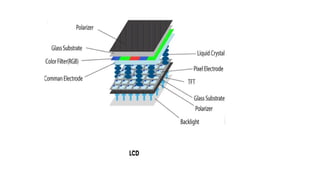
•LCD stands for Liquid Crystal Display and is most widely used screen
and monitor. The display is a combination of two forms: solid and
liquid. LCD displays are much thinner as compared to their counterpart
cathode ray tube or CRT technology. LCDs are completely different
from that of old CRT displays, it uses liquid crystals instead of cathode
ray in their primary form of operation.
• An LCD display consists of millions of pixels made of crystal and
arranged in a rectangular grid. The backlights in the LCD provide light
to each pixel. Each pixel has blue, green, and red sub-pixels. When all
the sub-pixels are turned off then it's black and when they are turned on
100% then it becomes white.
35.
LCD is acombination of solid and liquid. The liquid and the solid part which is crystal together make the image
visible. It consists of two polarized panel electrodes and filters. Rather than emitting the light, the screen
works by blocking the light. LCD has two types of pixel grids:
Active Matrix Grid: It is a newer technology. Smartphones with an LCD display use this technology.
• Passive Matrix Grid: Some older devices used this technology.
Advantages of LCD
• The main advantage of LCD is, it is low cost and energy-efficient and has very little power consumption.
• It is lighter, thinner and flexible.
• LCD provides excellent resolution, brightness, and contrast so the picture quality is crystal clear.
• Radiation of LCD monitors are much less than CRT monitors
• LCDs can be suitable with CMOS integrated circuits so making an LCD is very easy.
• It gives perfect sharpness at the native resolution.
• Generate less heat during operation due to its low power consumption.
• Due to high peak intensity, they produce very bright images as the brightness range of LCDs is high
36.
Seven Segment Cell
•A seven-segment cell commonly, a seven-segment display refers to a
specific display format or arrangement, primarily used for displaying
numerical digits (0-9) and a limited set of letters. It consists of seven
individual segments (usually in the shape of an "8"), plus sometimes an
eighth segment for a decimal point.
• Seven-segment displays are widely used in digital clocks, electronic
meters, basic calculators, and other electronic devices that display
numerical information
37.
Structure and HowIt Works
• A typical seven-segment display consists of seven individual segments
arranged in a figure-eight pattern. Each segment is essentially a light-
emitting element, most commonly a light-emitting diode (LED), though
they can also be implemented using liquid crystal display (LCD)
technology or other methods like vacuum fluorescent displays. An
additional eighth segment for a decimal point (DP) is often included.
To display a specific digit, a microcontroller or a dedicated driver integrated
circuit (IC) selectively illuminates a combination of these segments. For
example:
• To display "0", segments a, b, c, d, e, and f are lit.
• To display "1", only segments b and c are lit.
• To display "8", all seven segments (a through g) are lit.
38.
Types of Seven-SegmentDisplays
Seven-segment displays are typically categorized by their internal wiring:
• Common Anode (CA): In this configuration, all the anodes (positive
terminals) of the LEDs are connected together to a common pin, which
is typically connected to a positive voltage supply (Vcc). To illuminate a
segment, a low (ground) signal is applied to its corresponding cathode.
• Common Cathode (CC): Here, all the cathodes (negative terminals) of
the LEDs are connected together to a common pin, which is typically
connected to ground. To illuminate a segment, a high (positive voltage)
signal is applied to its corresponding anode.
39.
Thermotropic liquid crsytal
•Thermotropic liquid crystals are a type of liquid crystal whose liquid crystalline
phases (known as mesophases) are formed and exist within specific temperature
ranges. Their order parameter, which describes the degree of molecular alignment,
is primarily determined by temperature.
Characteristics of thermotropic liquid crystals:
• Temperature-dependent phase transitions: when certain organic compounds are
heated, they don't directly melt from a solid crystal to an isotropic (ordinary) liquid.
Instead, they pass through one or more intermediate liquid crystalline phases before
becoming an isotropic liquid at higher temperatures. Conversely, upon cooling,
they will transition back through these mesophases before solidifying.
• Crystal phase: at low temperatures, the molecules are highly ordered in a rigid, three-
dimensional crystal lattice.
40.
•Liquid Crystal (Mesophase)Phases: As temperature increases, the molecules gain
enough energy to lose some positional order but retain a degree of orientational order.
There are several types of thermotropic mesophases, each with distinct molecular
arrangements
•Nematic Phase .
•Smectic Phases.
•Cholesteric
• Isotropic Liquid Phase: At high temperatures, the molecules lose all orientational and
positional order, behaving like a conventional liquid.
•Anisotropy: Thermotropic liquid crystals exhibit anisotropic properties, meaning
their physical properties (like refractive index, dielectric constant, viscosity, and
thermal/electrical conductivity) depend on the direction in which they are measured.
This is due to the ordered arrangement of their molecules.
•Molecular Structure: They are typically composed of anisotropic organic molecules,
often rod-like or disc-shaped, with a rigid core and flexible alkyl chains. These shapes
allow them to self-organize into various mesophases.
41.
Disc shaped liquidcrystals
• Disc-shaped liquid crystals, also known as discotic liquid crystals (DLCs), are
a class of liquid crystalline materials composed of molecules that are flat,
typically circular or polygonal, resembling a disc. This distinct molecular shape
sets them apart from the more common rod-shaped (calamitic) liquid crystals.
Structure and Mesophases
• Columnar Phases: This is the most characteristic phase for discotic liquid
crystals. The disc-shaped molecules stack together to form columns, and these
columns then arrange themselves into two-dimensional lattices (e.g., hexagonal,
rectangular, or oblique). Within each column, the discs may be stacked with or
without translational order (i.e., they can be regularly spaced or irregularly
packed). This columnar arrangement allows for excellent charge transport along
the stacking axis.
42.
• Discotic NematicPhase: In this phase, the disc-shaped molecules have orientational order,
meaning their disc normals (the axis perpendicular to the disc face) tend to align in a preferred
direction, but there is no long-range positional order. They can move freely, similar to a
conventional nematic phase, but with a different molecular alignment compared to rod-shaped
nematics.
Applications
• Organic Semiconductors and Conductors: Their high charge-carrier mobility along the
columns makes them excellent candidates for:
• Organic photovoltaics (solar cells): To efficiently transport charges generated by light.
• Organic field-effect transistors (OFETs): For high-performance electronic devices.
• LEDs (Light-Emitting Diodes): In emissive layers.
• Flexible Electronics: Their self-assembling nature and ability to form thin films are valuable
for flexible and transparent electronic devices.
• Gas Sensors: The electrical conductivity of discotic liquid crystal films can be very sensitive to
the absorption of gas molecules, enabling their use as highly sensitive gas sensors.
• Optical Compensator Films: In traditional LCDs, discotic liquid crystals can be used in
compensation films to improve viewing angles and contrast.
• Xerography and Laser Printing: For fast, high-resolution applications requiring efficient
charge transport layers.
43.
Polymer liquid crystals.
Polymerliquid crystals (PLCs), also known as liquid crystal
polymers (LCPs), are a unique class of polymers that exhibit
properties of both conventional polymers and low-molecular-weight
liquid crystals. This means they can flow like liquids but maintain a
degree of molecular order characteristic of crystalline solids.
• They are formed by incorporating mesogens (the rigid, anisotropic
molecular units responsible for liquid crystallinity) into a polymer
chain. This combination results in materials with exceptional
performance characteristics.
44.
Types of PolymerLiquid Crystals
PLCs are broadly classified based on where the mesogenic units are incorporated into the polymer
structure:
• Main-Chain Liquid Crystal Polymers (MCLCPs)
• In MCLCPs, the mesogens are directly incorporated into the main backbone of the polymer
chain, often separated by flexible "spacer" units. This arrangement leads to highly rigid and self-
reinforcing polymers.
• Properties: High mechanical strength and stiffness, excellent thermal stability (high melting points), good
chemical resistance, and low coefficient of thermal expansion. These properties often result from the self-
alignment of the rigid polymer chains during processing.
• Examples: Aromatic polyesters and polyamides. Kevlar, a well-known high-strength fiber, is a lyotropic
main-chain LCP.
• Side-Chain Liquid Crystal Polymers (SCLCPs)
• In SCLCPs, the mesogens are attached as pendant groups (side chains) to a flexible polymer
backbone. These mesogens are typically linked to the backbone via flexible spacers, allowing
them to exhibit liquid crystalline behavior somewhat independently of the main chain.
• Properties: Generally have lower transition temperatures and offer greater flexibility in design compared
to MCLCPs. Their optical properties can be more easily manipulated.
• Examples: Polysiloxanes or polyacrylates with liquid crystalline side groups.
![Viscosity
• Viscosity is a measure of a fluid’s resistance to flow.
The SI unit of viscosity is poiseiulle (PI). Its other units are newton-
second per square metre (N s m-2
) or pascal-second (Pa s.) The
dimensional formula of viscosity is [ML-1
T-1
].
• The viscosity of liquids decreases rapidly with an increase in
temperature, and the viscosity of gases increases with an increase in
temperature. Thus, upon heating, liquids flow more easily, whereas
gases flow more slowly. Also, viscosity does not change as the amount
of matter changes, therefore it is an intensive property.](https://image.slidesharecdn.com/liquidstate-250802061130-1657f66f/85/Liquid-state-liquid-crystals-its-types-and-its-properties-25-320.jpg)