Effective Image Retrieval System Using Dot-
Diffused
Block Truncation Coding Features
Introduction
 Computer system for browsing, searching and
retrieving images from a large database of digital
images
 Two methods
 Text Based Image Retrieval
 Content Based Image Retrieval
 TBIR
 Requires text as input to search for images
 Uses keywords such as image name, date etc
Contd..
 CBIR
 Input as query image
 Search similar images by colour, texture or form as
a comparison
 Requires long processing time due to amount of
images to be analyzed in database
Motivation
 Due to the increase of online users on the Internet,
the amount of collections of digital images have
grown continuously during this period. So, it is
necessary to develop an appropriate system to
manage effectively these collections.
Block Truncation Coding
 Technique for image compression
 Divide image into multiple non-overlapped image
block
 Each block represented by two quantizers
 High & low mean value
 Bitmap image
 Perform thresholding operation using mean value
to generate bitmap image
BTC Image Coding Using Vector
Quantization
 Source encoding the output of a BTC
 Overhead statistical information
 Truncated block
 If vector quantization used on either one of
output- bit rate reduces upto 1.5 bits/pel
 Vector quantization used on both output- bit rate
reduces upto 1.0 bits/pel
Contd..
Advantage
 Achieves compression ratio of 8:1
Disadvantage
 Did not remove inter block redundancy
BTC-VQ-DCT Hybrid Coding of
Digital Images
 Simple computation & edge preservation of BTC
 High fidelity & high compression ratio of adaptive
DCT
 High compression ratio & good subjective
performance of VQ
Advantage
 Remove both inter block and intra block redundancy
 Computational complexity is less than DCT or VQ
 Compression ratio of 10:1
Absolute Moment Block Truncation
Coding
 Digitized image divided into block
 Quantized each block results in same sample mean &
same sample first absolute central moment
 Mean-information about central tendancy
 First absolute central moment- information about
dispersion from mean
Advantage
 Processing time is reduced at transmitter and receiver-
fast BCT
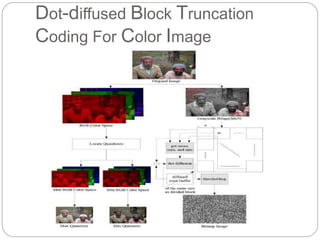
Dot-diffused Block Truncation
Coding For Color Image
Contd..
 Color image of size MxN in RGB divided into
several non-overlapping image blocks
 Each image block processed independently
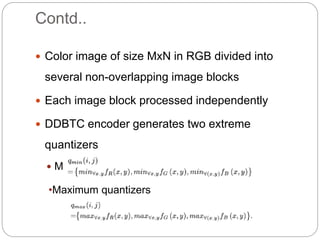
 DDBTC encoder generates two extreme
quantizers
 Minimum quantizers
•Maximum quantizers
Contd..
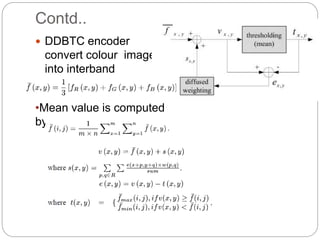
 DDBTC encoder
convert colour image
into interband
average
•Mean value is computed
by
Contd..
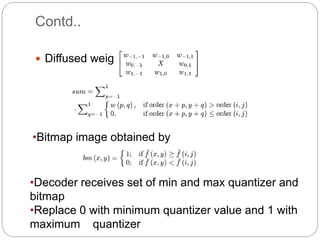
 Diffused weight
•Bitmap image obtained by
•Decoder receives set of min and max quantizer and
bitmap
•Replace 0 with minimum quantizer value and 1 with
maximum quantizer
References
[1] J. Guo, H. Prasetyo, and N. Wang, “Effective Image
Retrieval System Using Dot-Diffused Block Truncation
Coding Features”, IEEE Trans. multimedia, vol. 17, no. 9,
september 2015
[2] V. R. Udpikar and J. P. Raina, “BTC image coding using
vector quantization,” IEEE Trans Commun., vol. COM-35,
no. 3, pp. 352–256, Sep.1987.
[3] Y. Wu and D. Coll, “BTC-VQ-DCT hybrid coding of digital
images,” IEEE Trans. Commun., vol. 39, no. 9, pp. 1283–
1287, Sep. 1991.
[4] M. D. Lema and O. R. Mitchell, “Absolute moment block
truncation coding and its application to color images,” IEEE
Trans. Commun., vol. COM-32, no. 10, pp. 1148–1157,
Oct. 1984.

Effective image retrieval system using dot diffused

  • 1.
    Effective Image RetrievalSystem Using Dot- Diffused Block Truncation Coding Features
  • 2.
    Introduction  Computer systemfor browsing, searching and retrieving images from a large database of digital images  Two methods  Text Based Image Retrieval  Content Based Image Retrieval  TBIR  Requires text as input to search for images  Uses keywords such as image name, date etc
  • 3.
    Contd..  CBIR  Inputas query image  Search similar images by colour, texture or form as a comparison  Requires long processing time due to amount of images to be analyzed in database
  • 4.
    Motivation  Due tothe increase of online users on the Internet, the amount of collections of digital images have grown continuously during this period. So, it is necessary to develop an appropriate system to manage effectively these collections.
  • 5.
    Block Truncation Coding Technique for image compression  Divide image into multiple non-overlapped image block  Each block represented by two quantizers  High & low mean value  Bitmap image  Perform thresholding operation using mean value to generate bitmap image
  • 6.
    BTC Image CodingUsing Vector Quantization  Source encoding the output of a BTC  Overhead statistical information  Truncated block  If vector quantization used on either one of output- bit rate reduces upto 1.5 bits/pel  Vector quantization used on both output- bit rate reduces upto 1.0 bits/pel
  • 7.
    Contd.. Advantage  Achieves compressionratio of 8:1 Disadvantage  Did not remove inter block redundancy
  • 8.
    BTC-VQ-DCT Hybrid Codingof Digital Images  Simple computation & edge preservation of BTC  High fidelity & high compression ratio of adaptive DCT  High compression ratio & good subjective performance of VQ Advantage  Remove both inter block and intra block redundancy  Computational complexity is less than DCT or VQ  Compression ratio of 10:1
  • 9.
    Absolute Moment BlockTruncation Coding  Digitized image divided into block  Quantized each block results in same sample mean & same sample first absolute central moment  Mean-information about central tendancy  First absolute central moment- information about dispersion from mean Advantage  Processing time is reduced at transmitter and receiver- fast BCT
  • 10.
  • 11.
    Contd..  Color imageof size MxN in RGB divided into several non-overlapping image blocks  Each image block processed independently  DDBTC encoder generates two extreme quantizers  Minimum quantizers •Maximum quantizers
  • 12.
    Contd..  DDBTC encoder convertcolour image into interband average •Mean value is computed by
  • 13.
    Contd..  Diffused weight •Bitmapimage obtained by •Decoder receives set of min and max quantizer and bitmap •Replace 0 with minimum quantizer value and 1 with maximum quantizer
  • 14.
    References [1] J. Guo,H. Prasetyo, and N. Wang, “Effective Image Retrieval System Using Dot-Diffused Block Truncation Coding Features”, IEEE Trans. multimedia, vol. 17, no. 9, september 2015 [2] V. R. Udpikar and J. P. Raina, “BTC image coding using vector quantization,” IEEE Trans Commun., vol. COM-35, no. 3, pp. 352–256, Sep.1987. [3] Y. Wu and D. Coll, “BTC-VQ-DCT hybrid coding of digital images,” IEEE Trans. Commun., vol. 39, no. 9, pp. 1283– 1287, Sep. 1991. [4] M. D. Lema and O. R. Mitchell, “Absolute moment block truncation coding and its application to color images,” IEEE Trans. Commun., vol. COM-32, no. 10, pp. 1148–1157, Oct. 1984.