Effective data pre-processing for AutoML
Joseph Giovanelli Besim Bilalli Alberto Abelló
j.giovanelli@unibo.it bbilalli@essi.upc.edu aabello@essi.upc.edu
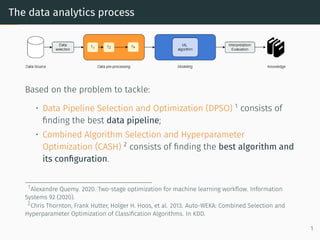
The data analytics process
Based on the problem to tackle:
• Data Pipeline Selection and Optimization (DPSO) 1
consists of
finding the best data pipeline;
• Combined Algorithm Selection and Hyperparameter
Optimization (CASH) 2
consists of finding the best algorithm and
its configuration.
1Alexandre Quemy. 2020. Two-stage optimization for machine learning workflow. Information
Systems 92 (2020).
2Chris Thornton, Frank Hutter, Holger H. Hoos, et al. 2013. Auto-WEKA: Combined Selection and
Hyperparameter Optimization of Classification Algorithms. In KDD.
1
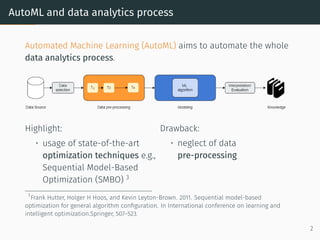
AutoML and data analytics process
Automated Machine Learning (AutoML) aims to automate the whole
data analytics process.
Highlight:
• usage of state-of-the-art
optimization techniques e.g.,
Sequential Model-Based
Optimization (SMBO) 3
Drawback:
• neglect of data
pre-processing
1Frank Hutter, Holger H Hoos, and Kevin Leyton-Brown. 2011. Sequential model-based
optimization for general algorithm configuration. In International conference on learning and
intelligent optimization.Springer, 507–523.
2
Data pre-processing complexity
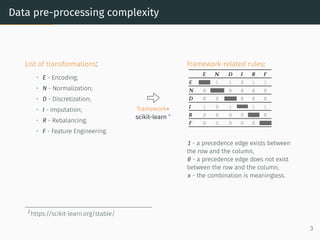
List of transformations:
• E - Encoding;
• N - Normalization;
• D - Discretization;
• I - Imputation;
• R - Rebalancing;
• F - Feature Engineering.
framework=
scikit-learn 4
Framework-related rules:
1 - a precedence edge exists between
the row and the column,
0 - a precedence edge does not exist
between the row and the column,
x - the combination is meaningless.
2https://scikit-learn.org/stable/
3
Data pre-processing complexity
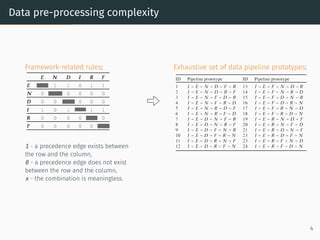
Framework-related rules:
1 - a precedence edge exists between
the row and the column,
0 - a precedence edge does not exist
between the row and the column,
x - the combination is meaningless.
Exhaustive set of data pipeline prototypes:
4
Data pre-processing complexity - Universal pipeline prototype
List of algorithms:
• NB - Naive Bayes;
• KNN - K-Nearest
Neighbor;
• RF - Random
Forest.
Datasets:
• OpenML CC-18
suite 5
3https://www.openml.org/s/99
5
Our approach
Our approach
1. Build effective pipeline prototypes:
2. Optimize them
3. Select the best one
6
Our approach - Building effective pipeline prototypes
Framework-related rules: Heuristic rules: Learnt rules:
E - Encoding N - Normalization D - Discretization I - Imputation R - Rebalancing F - Feature Eng.
1 - a precedence edge exists between the row and the column,
0 - a precedence edge does not exist between the row and the column,
x - the combination is meaningless.
7
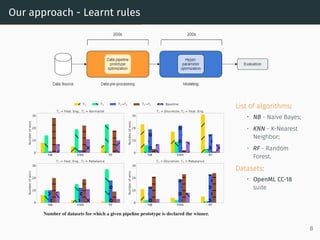
Our approach - Learnt rules
List of algorithms:
• NB - Naive Bayes;
• KNN - K-Nearest
Neighbor;
• RF - Random
Forest.
Datasets:
• OpenML CC-18
suite
8
Our approach - Building effective pipeline prototypes
Framework-related rules: Heuristic rules: Learnt rules:
E - Encoding N - Normalization D - Discretization I - Imputation R - Rebalancing F - Feature Eng.
1 - a precedence edge exists between the row and the column, 0 - a precedence edge does not exist between the row and the column,
x - the combination is meaningless.
Union of rules:
9
Our approach - Building effective pipeline prototypes
Union of rules:
1 - a precedence edge exists between
the row and the column,
0 - a precedence edge does not exist
between the row and the column,
x - the combination is meaningless.
Effective set of data pipeline prototypes:
10
Our approach - Optimization
11
Evaluation
Evaluation - Effective versus exhaustive prototypes optimization
Effective prototypes optimization (our approach):
Exhaustive prototypes optimization :
for each of the possible
data pipeline prototypes:
12
Evaluation - Effective versus exhaustive prototypes optimization
normalized distance =
Acc(deffective, a∗
) − Acc(d, a)
Acc(dexhaustive, a∗) − Acc(d, a)
• Acc(d, a): baseline accuracy (i.e., predictive accuracy of the algorithm a
with default hyper-parameters over the original dataset d);
• Acc(deffective, a∗
): accuracy of the optimized algorithm a∗
over the
dataset deffective transformed using the optimized instantiation of the
effective set of prototypes obtained with our approach;
• Acc(dexhaustive, a∗
): accuracy of the optimized algorithm a∗
over the
dataset dexhaustive transformed using the optimized pipeline
instantiation of the exhaustive set of prototypes.
13
Evaluation - Effective versus exhaustive prototypes optimization
normalized distance =
Acc(deffective, a∗
) − Acc(d, a)
Acc(dexhaustive, a∗) − Acc(d, a)
Normalized distances
between the scores
obtained by
optimizing our
effective prototypes
and the ones
obtained optimizing
the exhaustive set.
14
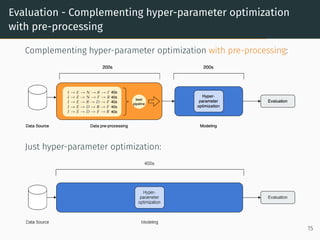
Evaluation - Complementing hyper-parameter optimization
with pre-processing
Complementing hyper-parameter optimization with pre-processing:
Just hyper-parameter optimization:
15
Evaluation - Complementing hyper-parameter optimization
with pre-processing
pp impact =
Acc(deffective, a∗
) − Acc(d, a)
max(Acc(deffective, a∗), Acc(d, a∗)) − Acc(d, a)
hp impact =
Acc(d, a∗
) − Acc(d, a)
max(Acc(deffective, a∗), Acc(d, a∗)) − Acc(d, a)
• Acc(d, a): baseline accuracy (i.e., predictive accuracy of the algorithm a
with default hyper-parameters over the original dataset d);
• Acc(deffective, a∗
): accuracy of the optimized algorithm a∗
over the
dataset deffective transformed using the optimized instantiation of the
effective set of prototypes obtained with our approach;
• Acc(d, a∗
): accuracy of the optimized algorithm a∗
(i.e, using the entire
budget) over the original dataset d.
16
Evaluation - Complementing hyper-parameter optimization
with pre-processing
normalized pp impact =
pp impact
pp impact + hp impact
normalized hp impact =
hp impact
pp impact + hp impact
17
Conclusions and future works
Contributions:
• no universal pre-processing pipeline prototype;
• pre-processing optimization may boost the final result;
• our approach provides results that get 90% of the optimal
predictive accuracy in the median, but with a cost that is 24
times smaller;
Future works:
• study the datasets that do not react well to data-pre-processing;
• extend our approach with a meta-learning module.
18
Thanks for the attention
18

Effective data pre-processing for AutoML

  • 1.
    Effective data pre-processingfor AutoML Joseph Giovanelli Besim Bilalli Alberto Abelló j.giovanelli@unibo.it bbilalli@essi.upc.edu aabello@essi.upc.edu
  • 2.
    The data analyticsprocess Based on the problem to tackle: • Data Pipeline Selection and Optimization (DPSO) 1 consists of finding the best data pipeline; • Combined Algorithm Selection and Hyperparameter Optimization (CASH) 2 consists of finding the best algorithm and its configuration. 1Alexandre Quemy. 2020. Two-stage optimization for machine learning workflow. Information Systems 92 (2020). 2Chris Thornton, Frank Hutter, Holger H. Hoos, et al. 2013. Auto-WEKA: Combined Selection and Hyperparameter Optimization of Classification Algorithms. In KDD. 1
  • 3.
    AutoML and dataanalytics process Automated Machine Learning (AutoML) aims to automate the whole data analytics process. Highlight: • usage of state-of-the-art optimization techniques e.g., Sequential Model-Based Optimization (SMBO) 3 Drawback: • neglect of data pre-processing 1Frank Hutter, Holger H Hoos, and Kevin Leyton-Brown. 2011. Sequential model-based optimization for general algorithm configuration. In International conference on learning and intelligent optimization.Springer, 507–523. 2
  • 4.
    Data pre-processing complexity Listof transformations: • E - Encoding; • N - Normalization; • D - Discretization; • I - Imputation; • R - Rebalancing; • F - Feature Engineering. framework= scikit-learn 4 Framework-related rules: 1 - a precedence edge exists between the row and the column, 0 - a precedence edge does not exist between the row and the column, x - the combination is meaningless. 2https://scikit-learn.org/stable/ 3
  • 5.
    Data pre-processing complexity Framework-relatedrules: 1 - a precedence edge exists between the row and the column, 0 - a precedence edge does not exist between the row and the column, x - the combination is meaningless. Exhaustive set of data pipeline prototypes: 4
  • 6.
    Data pre-processing complexity- Universal pipeline prototype List of algorithms: • NB - Naive Bayes; • KNN - K-Nearest Neighbor; • RF - Random Forest. Datasets: • OpenML CC-18 suite 5 3https://www.openml.org/s/99 5
  • 7.
  • 8.
    Our approach 1. Buildeffective pipeline prototypes: 2. Optimize them 3. Select the best one 6
  • 9.
    Our approach -Building effective pipeline prototypes Framework-related rules: Heuristic rules: Learnt rules: E - Encoding N - Normalization D - Discretization I - Imputation R - Rebalancing F - Feature Eng. 1 - a precedence edge exists between the row and the column, 0 - a precedence edge does not exist between the row and the column, x - the combination is meaningless. 7
  • 10.
    Our approach -Learnt rules List of algorithms: • NB - Naive Bayes; • KNN - K-Nearest Neighbor; • RF - Random Forest. Datasets: • OpenML CC-18 suite 8
  • 11.
    Our approach -Building effective pipeline prototypes Framework-related rules: Heuristic rules: Learnt rules: E - Encoding N - Normalization D - Discretization I - Imputation R - Rebalancing F - Feature Eng. 1 - a precedence edge exists between the row and the column, 0 - a precedence edge does not exist between the row and the column, x - the combination is meaningless. Union of rules: 9
  • 12.
    Our approach -Building effective pipeline prototypes Union of rules: 1 - a precedence edge exists between the row and the column, 0 - a precedence edge does not exist between the row and the column, x - the combination is meaningless. Effective set of data pipeline prototypes: 10
  • 13.
    Our approach -Optimization 11
  • 14.
  • 15.
    Evaluation - Effectiveversus exhaustive prototypes optimization Effective prototypes optimization (our approach): Exhaustive prototypes optimization : for each of the possible data pipeline prototypes: 12
  • 16.
    Evaluation - Effectiveversus exhaustive prototypes optimization normalized distance = Acc(deffective, a∗ ) − Acc(d, a) Acc(dexhaustive, a∗) − Acc(d, a) • Acc(d, a): baseline accuracy (i.e., predictive accuracy of the algorithm a with default hyper-parameters over the original dataset d); • Acc(deffective, a∗ ): accuracy of the optimized algorithm a∗ over the dataset deffective transformed using the optimized instantiation of the effective set of prototypes obtained with our approach; • Acc(dexhaustive, a∗ ): accuracy of the optimized algorithm a∗ over the dataset dexhaustive transformed using the optimized pipeline instantiation of the exhaustive set of prototypes. 13
  • 17.
    Evaluation - Effectiveversus exhaustive prototypes optimization normalized distance = Acc(deffective, a∗ ) − Acc(d, a) Acc(dexhaustive, a∗) − Acc(d, a) Normalized distances between the scores obtained by optimizing our effective prototypes and the ones obtained optimizing the exhaustive set. 14
  • 18.
    Evaluation - Complementinghyper-parameter optimization with pre-processing Complementing hyper-parameter optimization with pre-processing: Just hyper-parameter optimization: 15
  • 19.
    Evaluation - Complementinghyper-parameter optimization with pre-processing pp impact = Acc(deffective, a∗ ) − Acc(d, a) max(Acc(deffective, a∗), Acc(d, a∗)) − Acc(d, a) hp impact = Acc(d, a∗ ) − Acc(d, a) max(Acc(deffective, a∗), Acc(d, a∗)) − Acc(d, a) • Acc(d, a): baseline accuracy (i.e., predictive accuracy of the algorithm a with default hyper-parameters over the original dataset d); • Acc(deffective, a∗ ): accuracy of the optimized algorithm a∗ over the dataset deffective transformed using the optimized instantiation of the effective set of prototypes obtained with our approach; • Acc(d, a∗ ): accuracy of the optimized algorithm a∗ (i.e, using the entire budget) over the original dataset d. 16
  • 20.
    Evaluation - Complementinghyper-parameter optimization with pre-processing normalized pp impact = pp impact pp impact + hp impact normalized hp impact = hp impact pp impact + hp impact 17
  • 21.
    Conclusions and futureworks Contributions: • no universal pre-processing pipeline prototype; • pre-processing optimization may boost the final result; • our approach provides results that get 90% of the optimal predictive accuracy in the median, but with a cost that is 24 times smaller; Future works: • study the datasets that do not react well to data-pre-processing; • extend our approach with a meta-learning module. 18
  • 22.
    Thanks for theattention 18