Effective Content
Strategy Guided by
The SAVE Framework
by Nenad Senic, Zemanta
The SAVE framework
as described in the Harvard
Business Review magazine
is a perfect guideline for your
content and marketing strategy.
The SAVE framework
can be a centerpiece of your
customer-centric strategy.
The SAVE framework
is a shift from the traditional 4
P’s marketing model as it can
better serve B2B marketers.
The SAVE framework
fits like a glove to your
publishing strategy.
To attract your prospects/customers, to retain them, to make your
content valuable and sharable, you should follow the SAVE framework.
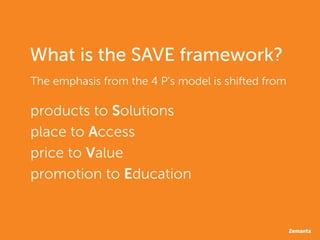
What is the SAVE framework?
The emphasis from the 4 P’s model is shifted from
products to Solutions
place to Access
price to Value
promotion to Education
How the SAVE
can guide your content strategy...
Instead of product, focus on Solution
The SAVE framework says, “Define offerings by the needs
they meet, not by their features, functions, or technological
superiority”.
Therefore, your content strategy must be customer-centric. Ask yourself:
•	Who are your prospects/customers?
•	What are their main pain points?
•	How can you help them live/work better?
Through helpful and relevant content help them learn the benefits of your
products and services.
Instead of product, focus on Solution
The SAVE framework says, “Develop an integrated cross-channel presence that
considers customers’ entire purchasing journey”.
This is about knowing where your prospects/customers hang out and what
exactly they’re doing there. Your brand should be accessible there.
Access is about the integration of all channels and tools available to you that are
relevant to your prospects/customers.
For example, what are you trying to accomplish by your presence on Facebook
or with a blog, etc.? And what kind of content and engagement should you
expect on each and every channel you use?
Instead of price, focus on Value.
The SAVE framework says, “Articulate the benefits relative to price, rather than
stressing how price relates to production costs, profit margins, or competitor’s
prices”.
Your prospects/customers need to sense that your content is valuable to them.
According to Sharon Tanton, valuable content is:
•	Helpful – It makes a difference, it answers a genuine question.
•	Entertaining – Provokes a reaction. Smile, laugh, or think – people respond to
it and want to share it.
•	Authentic – Genuine and original. Written from the heart, it tells a story that
people understand and respond to.
•	Relevant- It is rooted firmly in the client’s world, it makes perfect sense.
•	Timely – it is sent out at the right time, it hits the audience when they are most
receptive.
Instead of promotion, focus on Education.
The SAVE framework says, “Provide information relevant to customers’ specific
needs at each point in the purchase cycle, rather than relying on advertising,
PR…”
According to Marcus Sheridan, content marketing is about educating your
prospects/customers, “We’re just teachers.”
Therefore, do just that. Answer your prospects/customers’ questions. As Marcus
likes to say, if they ask, you answer.
Ask everyone in your company who is in contact with your customers (in the
calling center, the sales department, the lost & found department, etc.) to write
down any questions your prospects/customers may have, no matter how
insignificant they may be.
Brought to you by
Tin Dizdarevic, Publisher Development Director, Zemanta
E: tin@zemanta.com, T: 646.207.4636
Let us know how we can help you

Effective content strategy guided by the SAVE framework

  • 1.
    Effective Content Strategy Guidedby The SAVE Framework by Nenad Senic, Zemanta
  • 2.
    The SAVE framework asdescribed in the Harvard Business Review magazine is a perfect guideline for your content and marketing strategy.
  • 3.
    The SAVE framework canbe a centerpiece of your customer-centric strategy.
  • 4.
    The SAVE framework isa shift from the traditional 4 P’s marketing model as it can better serve B2B marketers.
  • 5.
    The SAVE framework fitslike a glove to your publishing strategy. To attract your prospects/customers, to retain them, to make your content valuable and sharable, you should follow the SAVE framework.
  • 6.
    What is theSAVE framework? The emphasis from the 4 P’s model is shifted from products to Solutions place to Access price to Value promotion to Education
  • 7.
    How the SAVE canguide your content strategy...
  • 8.
    Instead of product,focus on Solution The SAVE framework says, “Define offerings by the needs they meet, not by their features, functions, or technological superiority”. Therefore, your content strategy must be customer-centric. Ask yourself: • Who are your prospects/customers? • What are their main pain points? • How can you help them live/work better? Through helpful and relevant content help them learn the benefits of your products and services.
  • 9.
    Instead of product,focus on Solution The SAVE framework says, “Develop an integrated cross-channel presence that considers customers’ entire purchasing journey”. This is about knowing where your prospects/customers hang out and what exactly they’re doing there. Your brand should be accessible there. Access is about the integration of all channels and tools available to you that are relevant to your prospects/customers. For example, what are you trying to accomplish by your presence on Facebook or with a blog, etc.? And what kind of content and engagement should you expect on each and every channel you use?
  • 10.
    Instead of price,focus on Value. The SAVE framework says, “Articulate the benefits relative to price, rather than stressing how price relates to production costs, profit margins, or competitor’s prices”. Your prospects/customers need to sense that your content is valuable to them. According to Sharon Tanton, valuable content is: • Helpful – It makes a difference, it answers a genuine question. • Entertaining – Provokes a reaction. Smile, laugh, or think – people respond to it and want to share it. • Authentic – Genuine and original. Written from the heart, it tells a story that people understand and respond to. • Relevant- It is rooted firmly in the client’s world, it makes perfect sense. • Timely – it is sent out at the right time, it hits the audience when they are most receptive.
  • 11.
    Instead of promotion,focus on Education. The SAVE framework says, “Provide information relevant to customers’ specific needs at each point in the purchase cycle, rather than relying on advertising, PR…” According to Marcus Sheridan, content marketing is about educating your prospects/customers, “We’re just teachers.” Therefore, do just that. Answer your prospects/customers’ questions. As Marcus likes to say, if they ask, you answer. Ask everyone in your company who is in contact with your customers (in the calling center, the sales department, the lost & found department, etc.) to write down any questions your prospects/customers may have, no matter how insignificant they may be.
  • 12.
    Brought to youby Tin Dizdarevic, Publisher Development Director, Zemanta E: tin@zemanta.com, T: 646.207.4636 Let us know how we can help you