EFFECTIVE COMMUNICATION
OF SUPERVISORS
COMMUNICATION SKILLS OF SUPERVISORS
 The supervisor serves as the link between the management and the
workforce.
 The top management articulates the vision, middle management devises
the strategy, and the supervisor has to ensure that the workforce performs
the work.
 The supervisor must be able to effectively
communicate horizontally and vertically.
 People in organizations spend over 75% of their time
in some form of interpersonal situation (Furst, 2014).
ROLE OF COMMUNICATION IN SUPERVISION
 Communication skills are core competencies expected
in any position within the workplace.
 The ability to communicate with employees at every
level in the organization is important to improve
department operations and the performance and
productivity of the employees.
EMPLOYEE FEEDBACK
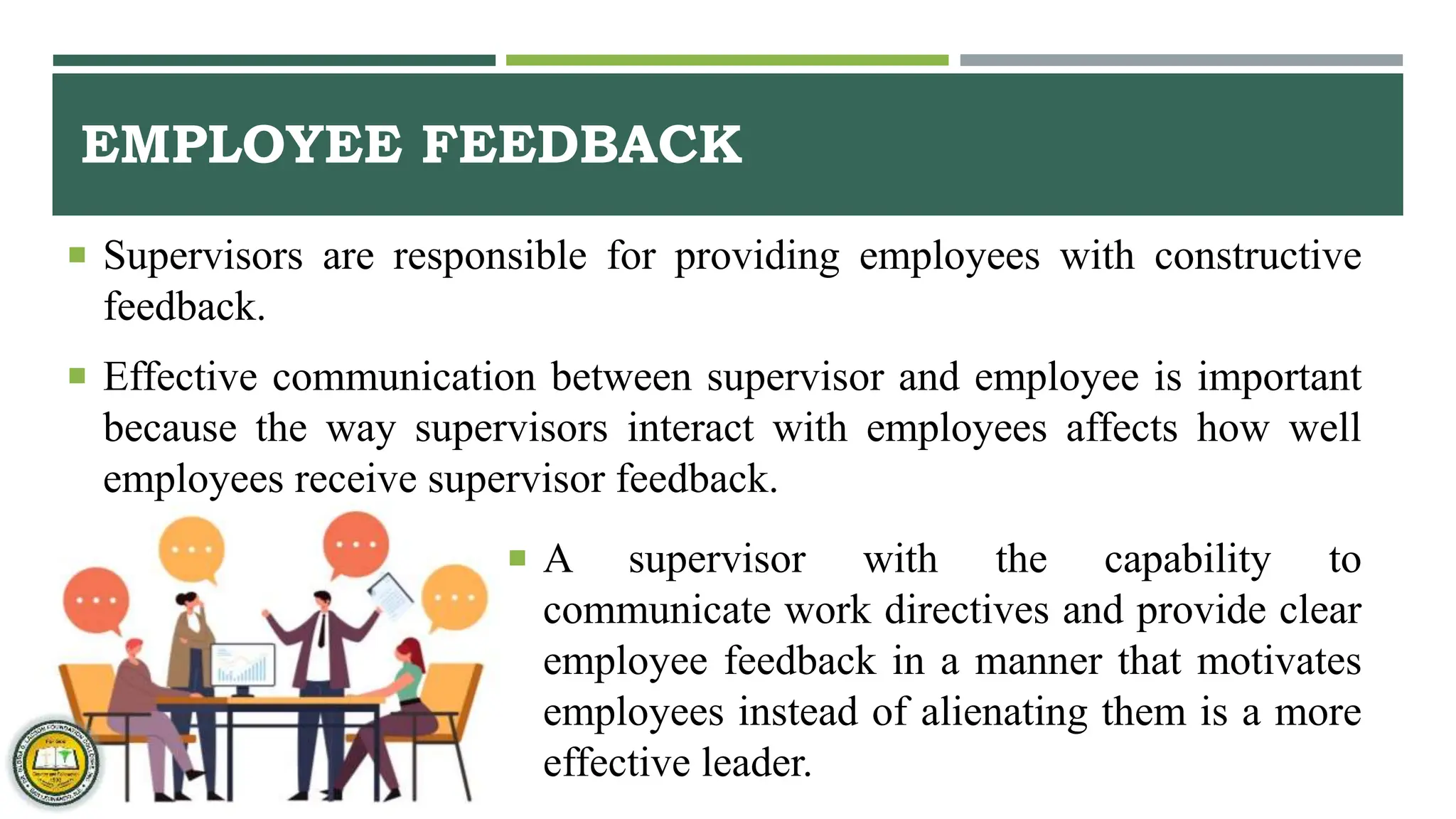
 Supervisors are responsible for providing employees with constructive
feedback.
 Effective communication between supervisor and employee is important
because the way supervisors interact with employees affects how well
employees receive supervisor feedback.
 A supervisor with the capability to
communicate work directives and provide clear
employee feedback in a manner that motivates
employees instead of alienating them is a more
effective leader.
INTERDEPARTMENTAL RELATIONSHIPS
 Communication with colleagues is part of the
supervisor’s daily routine.
 Supervisors exchange information, ideas, and
recommendations with colleagues in creating
interdepartmental alliances.
 Communication when used negatively may ruin
effective supervision.
RESOLVING CONFLICT
 Resolving workplace conflict requires communication
skills, and in particular, the ability to listen.
 Employees who complain to their
supervisors about workplace issues
have the reasonable expectation that
the supervisor will provide support
and guidance.
SUPERVISORS AS ROLE MODELS
 Supervisors model behavior for their employees to
emulate.
 Employees observe their supervisors' communications
with others and learn to use the same techniques in their
professional and personal relationships.
PERFORMANCE MANAGEMENT
 Communication is one of the essential components of an
organization’s performance management system.
 This fosters the necessary two-way dialogue that must
occur during performance appraisals and improves the
ability of employees to meet the organization’s
expectations.
SELF PROMOTION
 Promotions are often more available
to supervisors who have good verbal
and written communication skills and
the ability to develop positive
relationships with others in the
workplace.
 Supervisors’ communication skills are important for
their own careers.
COMMUNICATION TIPS THAT SUPERVISORS
MAY FIND HELPFUL
General Communication
 Be straightforward and direct in all communications
 Listen when you are not speaking.
 Keep your voice volume at a moderate level.
COMMUNICATION TIPS THAT SUPERVISORS
MAY FIND HELPFUL
Assigning Tasks
 Be clear about your expectations
 Consider giving written instructions or expected outcomes
 If you are unsure about your clarity, ask the employee to
summarize what you have said
 Designate who is responsible for tasks and projects
 Make sure deadlines are clear and manageable.
COMMUNICATION TIPS THAT SUPERVISORS
MAY FIND HELPFUL
Communicating Limits & Standards
 Set clear limits and observe them
 Be clear about standards
 Be clear about the consequences
 Keep it simple when correcting an employee
 Give praise and recognition for work well done
ESSENTIAL COMMUNICATION SKILLS
EVERY SUPERVISOR MUST MASTER
 Active Listening
 Conflict Resolution
 Motivation and Influence
 Body Language
 Transparency
 Empathy
 Praise & Recognition
ACTIVE LISTENING
 Active listening involves maintaining eye contact,
listening to understand and asking clarifying questions,
reflecting, summarizing, and remaining attentive while
resisting the urge to be judgmental or to interrupt.
CONFLICT RESOLUTION
 Effective supervisors understand that conflict is a given
and that they play an important role in managing
conflict, and setting a good example through their own
actions.
MOTIVATION AND INFLUENCE
 Motivation is a driving force that propels employees
towards achieving their goals, which in turn contributes
to the organization’s overall success.
 Through their motivation and influence supervisors are
able to guide employees to effective action, even when
employee commitment may be low.
MOTIVATION AND INFLUENCE
BODY LANGUAGE
 The unspoken part of communication
 Reveals our true feelings
 Gives impact on our message
NEGATIVE BODY LANGUAGE
 Arms folded in front of the body
 Minimal or tense facial
expression
 Body turned away from you
 Eyes downcast, maintaining little
contact
NEGATIVE BODY LANGUAGE
 Nail biting
 Locked ankles
 Rapid blinking
NEGATIVE BODY LANGUAGE
 Tapping/drumming fingers
 Fidgeting
BODY LANGUAGE
 Sitting slumped, with
head downcast.
 Gazing at something
else, or into space.
 Fidgeting, picking at
clothes, or fiddling
with pens and
phones.
 Writing or doodling.
SIGNS OF BOREDOM
POSITIVE
BODY LANGUAGE
Have an open posture
Use a firm handshake
Maintain good eye contact
Avoid touching your face
Smile
Figure 1. Figure 2.
Figure 3. Figure 4.
POSITIVE
BODY LANGUAGE
Have a positive posture
Keep your head up
Practice and perfect
your posture
Use open hand gestures
Figure 5. Figure 6.
Figure 7. Figure 8.
TRANSPARENCY
 Transparency reflects the ability to be open and honest in
communications
 Honest about the feedback
 Consistently delivering clear and concise messages
EMPATHY
 Empathy involves understanding.
 Supervisors convey empathy by listening well, asking
clarifying questions, and reflecting on what they have
heard.
 Effective supervisors let employees know that they
understand their needs, concerns, and ambitions.
PRAISE AND RECOGNITION
 Employees need feedback to understand how they’re
doing.
 Acknowledging outstanding performance through
written and verbal praise and recognition
Thank you!
REFERENCES
 Furst, P. (2014). The Role of Communication in Effective Supervision. International Risk Management
Institute, Inc (IRMI). Retrieved from https://www.irmi.com/articles/expert-commentary/the-role-of-
communication-in-effective-supervision
 Chron. (2021). Importance of Communication Skills for Supervisors. Retrieved from
https://smallbusiness.chron.com/importance-communication-skills-supervisors-10255.html

Effective Communication for Supervisors.pptx

  • 1.
  • 2.
    COMMUNICATION SKILLS OFSUPERVISORS  The supervisor serves as the link between the management and the workforce.  The top management articulates the vision, middle management devises the strategy, and the supervisor has to ensure that the workforce performs the work.  The supervisor must be able to effectively communicate horizontally and vertically.  People in organizations spend over 75% of their time in some form of interpersonal situation (Furst, 2014).
  • 3.
    ROLE OF COMMUNICATIONIN SUPERVISION  Communication skills are core competencies expected in any position within the workplace.  The ability to communicate with employees at every level in the organization is important to improve department operations and the performance and productivity of the employees.
  • 4.
    EMPLOYEE FEEDBACK  Supervisorsare responsible for providing employees with constructive feedback.  Effective communication between supervisor and employee is important because the way supervisors interact with employees affects how well employees receive supervisor feedback.  A supervisor with the capability to communicate work directives and provide clear employee feedback in a manner that motivates employees instead of alienating them is a more effective leader.
  • 5.
    INTERDEPARTMENTAL RELATIONSHIPS  Communicationwith colleagues is part of the supervisor’s daily routine.  Supervisors exchange information, ideas, and recommendations with colleagues in creating interdepartmental alliances.  Communication when used negatively may ruin effective supervision.
  • 6.
    RESOLVING CONFLICT  Resolvingworkplace conflict requires communication skills, and in particular, the ability to listen.  Employees who complain to their supervisors about workplace issues have the reasonable expectation that the supervisor will provide support and guidance.
  • 7.
    SUPERVISORS AS ROLEMODELS  Supervisors model behavior for their employees to emulate.  Employees observe their supervisors' communications with others and learn to use the same techniques in their professional and personal relationships.
  • 8.
    PERFORMANCE MANAGEMENT  Communicationis one of the essential components of an organization’s performance management system.  This fosters the necessary two-way dialogue that must occur during performance appraisals and improves the ability of employees to meet the organization’s expectations.
  • 9.
    SELF PROMOTION  Promotionsare often more available to supervisors who have good verbal and written communication skills and the ability to develop positive relationships with others in the workplace.  Supervisors’ communication skills are important for their own careers.
  • 10.
    COMMUNICATION TIPS THATSUPERVISORS MAY FIND HELPFUL General Communication  Be straightforward and direct in all communications  Listen when you are not speaking.  Keep your voice volume at a moderate level.
  • 11.
    COMMUNICATION TIPS THATSUPERVISORS MAY FIND HELPFUL Assigning Tasks  Be clear about your expectations  Consider giving written instructions or expected outcomes  If you are unsure about your clarity, ask the employee to summarize what you have said  Designate who is responsible for tasks and projects  Make sure deadlines are clear and manageable.
  • 12.
    COMMUNICATION TIPS THATSUPERVISORS MAY FIND HELPFUL Communicating Limits & Standards  Set clear limits and observe them  Be clear about standards  Be clear about the consequences  Keep it simple when correcting an employee  Give praise and recognition for work well done
  • 13.
    ESSENTIAL COMMUNICATION SKILLS EVERYSUPERVISOR MUST MASTER  Active Listening  Conflict Resolution  Motivation and Influence  Body Language  Transparency  Empathy  Praise & Recognition
  • 14.
    ACTIVE LISTENING  Activelistening involves maintaining eye contact, listening to understand and asking clarifying questions, reflecting, summarizing, and remaining attentive while resisting the urge to be judgmental or to interrupt.
  • 15.
    CONFLICT RESOLUTION  Effectivesupervisors understand that conflict is a given and that they play an important role in managing conflict, and setting a good example through their own actions.
  • 16.
    MOTIVATION AND INFLUENCE Motivation is a driving force that propels employees towards achieving their goals, which in turn contributes to the organization’s overall success.  Through their motivation and influence supervisors are able to guide employees to effective action, even when employee commitment may be low.
  • 17.
  • 18.
    BODY LANGUAGE  Theunspoken part of communication  Reveals our true feelings  Gives impact on our message
  • 19.
    NEGATIVE BODY LANGUAGE Arms folded in front of the body  Minimal or tense facial expression  Body turned away from you  Eyes downcast, maintaining little contact
  • 20.
    NEGATIVE BODY LANGUAGE Nail biting  Locked ankles  Rapid blinking
  • 21.
    NEGATIVE BODY LANGUAGE Tapping/drumming fingers  Fidgeting
  • 22.
    BODY LANGUAGE  Sittingslumped, with head downcast.  Gazing at something else, or into space.  Fidgeting, picking at clothes, or fiddling with pens and phones.  Writing or doodling. SIGNS OF BOREDOM
  • 23.
    POSITIVE BODY LANGUAGE Have anopen posture Use a firm handshake Maintain good eye contact Avoid touching your face Smile Figure 1. Figure 2. Figure 3. Figure 4.
  • 24.
    POSITIVE BODY LANGUAGE Have apositive posture Keep your head up Practice and perfect your posture Use open hand gestures Figure 5. Figure 6. Figure 7. Figure 8.
  • 25.
    TRANSPARENCY  Transparency reflectsthe ability to be open and honest in communications  Honest about the feedback  Consistently delivering clear and concise messages
  • 26.
    EMPATHY  Empathy involvesunderstanding.  Supervisors convey empathy by listening well, asking clarifying questions, and reflecting on what they have heard.  Effective supervisors let employees know that they understand their needs, concerns, and ambitions.
  • 27.
    PRAISE AND RECOGNITION Employees need feedback to understand how they’re doing.  Acknowledging outstanding performance through written and verbal praise and recognition
  • 28.
  • 29.
    REFERENCES  Furst, P.(2014). The Role of Communication in Effective Supervision. International Risk Management Institute, Inc (IRMI). Retrieved from https://www.irmi.com/articles/expert-commentary/the-role-of- communication-in-effective-supervision  Chron. (2021). Importance of Communication Skills for Supervisors. Retrieved from https://smallbusiness.chron.com/importance-communication-skills-supervisors-10255.html

Editor's Notes

  • #3 Communication skills whether verbal or written – are core competencies expected in any position within the workplace. The ability to communicate with employees at every level in the organization is especially important for supervisors who want to improve department operations and the performance and productivity of the employees under their supervision.
  • #4 Communication skills whether verbal or written – are core competencies expected in any position within the workplace. The ability to communicate with employees at every level in the organization is especially important for supervisors who want to improve department operations and the performance and productivity of the employees under their supervision.
  • #11 Here are some Communication tips that supervisors may find helpful General Communication Be straightforward and direct in all communications, including written and spoken. Avoid using jargons or use words that is easy to understand to avoid miscommunication. That is also observed in making memorandum, dapat malinaw sa mga target audience mo ang content ng inyong communication. Listen when you are not speaking. Paraphrase and reflect back what someone has said to make sure you understood correctly. Keep your voice volume at a moderate level. Avoid using an angry, threatening, or demeaning tone of voice.
  • #12 Assigning Tasks Be clear about your expectations. Specify what you expect an employee to do or accomplish with a task. I have experience here po during our PRIME accreditation, wherein there is a letter from the civil service commission that we need to provide additional documents in order for us to become accredited and those documents must be uploaded in the google drive on or before the deadline. So binigyan po kami ng copy ng letter na yun. Our supervisor gave us different tasks, we retrieve the physical documents that we need, but the problem is, one of my coworker with different task just retrieve the physical documents (dtrs, leave cards, 201 files, wfh arrangements) but she did not scan the documents. Saka lang po talaga sya nagtanong kung ano pang gagawin nung deadline na. Siguro kahit understandable naman na yung dapat gawin for that tasks to be accomplished, the supervisor must be clear about their expectations that we need to retrieve the documents, scan and upload, in order for those situations to be avoided. Ang ending po kasi late po kami ng 1 day na nagsend ng additional documents needed. Pero good parin naman po yung final result since DepEd Nueva Ecija is now PRIME Accredited. Consider also giving written instructions or expected outcomes of a task. Usually po ito sa amin nangyayari during meetings, We record the minutes of meeting and give copies to the personnel concerned, so they will be reminded what are the task that they need to accomplish, the deadline of implementation or submission and the expected outcome from them. If you are unsure about your clarity, ask the employee to summarize what you have said And then Confirm or correct the employee's response. Clearly designate responsibility for tasks and projects, especially when assigning a task or project to a team of employees. Make sure that there is an identified leader or point person para sa kanila ka nalang din po manghihingi ng update regarding the progress of the task of project. Make sure also that the deadlines are clear and manageable. Wag naman po yung log rolling deadlines,
  • #13 Communicating Limits & Standards Set clear limits and observe them. In setting limits the supervisors must Be consistent and must not change the limits or standards subjectively. So hindi dahil this particular employee fix our personal errands, or like nagbabayad ng kuryente natin, or other bills mas maluwag or mas considerate ka na sa kanya. Because if that happens, and that made known to other employees, they will not take your limits seriously. Dyan na po maririnig yung, bakit si ganito, ganito ganyan. So same din po in being clear about the standards of work performance and the consequences of not completing work, being absent or late at work, arguing with clients, acting out aggressively, or being uncooperative with their team members. Dapat hindi rin po tayo pabago bago or may exception. For example, Debt of Gratitude or yung tinatawag nating utang na loob must not hinder us in giving consequences to the habitual absences of our employees without filing the leave form. Considered absent po kasi yun without pay, since wala din naman po syang filed and approved form 6. When correcting an employee, Keep it simple Describe what can be observed, not what you suspect. Give praise and recognition for work well done.
  • #14 7 Essential Communication Skills Every Manager Must Master Of all of the skills and competencies that supervisors must have to be effective, communication skills are the most critical. Communication skills apply to a broad range of supervisor’s responsibilities—from providing direction, to offering feedback, to coaching, counseling, disciplining, resolving conflicts, and more.  In today’s work environment where many supervisors are overseeing people both on-site (within offices) and working remotely (or supervising last mile schools, yung kailangan mo pang tumawid ng budok at ilog bago marating yung school na yun, communication skills are even more critical than ever before.  Whether communicating face-to-face or online, whether providing instructions verbally or via email or text, strong communication skills can boost engagement, employee effectiveness, and productivity. Here we take a look at the communication skills that supervisors must develop to be effective when supervising others. Why Managers Need to Communicate Effectively  The role of managers is to oversee others who are doing the work of the organization. Their goal is to ensure that employees are performing their responsibilities effectively and productively.  That requires a commitment to effective communication to ensure teams are productive, satisfied, motivated, and operating at their full potential. Managers also need to communicate effectively with their own leaders and those above them in the corporate hierarchy, as well as with customers, vendors, and others. Effective communication ensures that everybody is on the same page, understands their goals and objectives, and that conflict is minimized.
  • #15 The Most Important Communication Skills for Managers  There are many skills related to communication that supervisors must hone to be most effective. The ability to achieve success through others requires strong verbal and written communication, including the ability to listen well and understand others’ needs. 1. Active Listening  Listening is easy—active listening requires more effort and focus. It involves maintaining eye contact, listening to understand and asking clarifying questions if something is not clear, reflecting, summarizing, and remaining attentive while resisting the urge to be judgmental or to interrupt.
  • #16 2. Conflict Resolution  Conflict resolution is important, but often avoided aspect of management. Conflict will always exist in any organization. Effective managers understand that conflict is a given and that they play an important role in managing conflict, and setting a good example through their own actions. It is important to allow those involved in the conflict to have an opportunity to share their perspectives, to listen objectively, and to work together to come up with a mutually satisfying resolution to the conflict.
  • #17 3. Motivation and Influence  Through their motivation and influence managers are able to guide employees to effective action, even when employee commitment may be low.  Communication plays a key role here—one wrong message can demotivate staff members.  Effective motivation requires a clear focus on expected outcomes and communicating those desired outcomes to employees objectively.
  • #18  Employee motivation is a crucial aspect of any successful organization. It’s the driving force that propels employees towards achieving their goals, which in turn contributes to the organization’s overall success. What is employee motivation? At the heart of employee performance lies motivation – the level of enthusiasm, energy, commitment, and creativity that an employee brings to their role daily. Motivation is inherently linked to behavior, and to achieve desired goals and results, this behavior must be harnessed and channeled effectively. Motivation is a crucial driver of success in the workplace, and understanding how to cultivate and maintain it is key to achieving optimal performance. Types of employee motivation An organization needs to understand for a fact that not employees are clones. They are individuals with different traits. Thus, effectively motivating your employees will need to acquire a deeper understanding of the different types and ways of motivation. Therefore, you will be able to categorize your employees better and apply the right type of motivation to increase the level of employee engagement and employee job satisfaction. Some employees respond better to intrinsic motivation, while others may respond better to extrinsic motivation. Employee motivation is all about how engaged an employee feels in tandem with the organization’s goals and how empowered he/she feels. Motivation is of two types: Intrinsic motivation Intrinsic motivation means that an individual is motivated from within. He/she has the desire to perform well at the workplace because the results are in accordance with his/her belief system. An individual’s deep-rooted beliefs are usually the strongest motivational factor. Such individuals show common qualities like acceptance, curiosity, honor, and desire to achieve success. Research has shown that praise increases intrinsic motivation, and so does positive employee feedback. So if you are a manager, supervisor, or in a leadership role, please be intentional with your feedback or praise. Make sure it is empowering and that your employees understand your employee expectations. Extrinsic motivation Alternatively, extrinsic motivation means an individual’s motivation is stimulated by external factors- rewards and recognition. Therefore, some people may never be motivated internally, and only external motivation would work with them to get the tasks done. Moreover, research says extrinsic rewards can sometimes promote the willingness of a person to learn a new skill set. Additionally, rewards like bonuses, perks, awards, etc., can motivate people or provide tangible feedback. The importance of employee motivation According to psychologists, self-realization is a very human thing. Moreover, it is our basic nature to nurture something and see it flourish. It is applicable to most things we do in our day-to-day life. Hence, this is true for both social and societal spaces. Undoubtedly, motivation plays a very important factor in a human’s life. Therefore, motivated employees take the initiative, are eager to take up additional responsibilities, and are innovative and go-getters. Motivated employees ensure: There is a positive atmosphere within the organization Co-workers are happy and feel safe at work Make sure clients are happy They always achieve better results than their counterparts Motivation, therefore, plays a very important factor and ensures employees remain active and contribute their best toward their organization. Furthermore, a high level of motivation leads to a lower level of employee turnover.  In the next section, you will learn about the 10 simple ways to motivate your employees. Forbes elaborates that another crucial factor for managers is to understand the difference between employee motivation and engagement. Making an effort to understand the difference will, again, lead to lower levels of turnover rates. Top 10 ways to motivate employees If you are looking for ways to motivate your employees at work, here are the five simple ways of making it work: Employee motivation surveys: Use an online survey software or platform to conduct employee motivation surveys. Employee satisfaction surveys: Employee satisfaction depends on a ton of factors such as work environment, infrastructure, roles, responsibilities, etc. Conducting employee satisfaction surveys will help Managers understand dissatisfaction factors and act on them. Recognization: Recognition helps create a healthy bond between the employer and employees. Focus on intrinsic rewards: Extrinsic rewards fade very quickly. Focus on motivating your employees from within. Autonomy, not bureaucracy: Micromanagement is the worst thing you can do as a manager. If you have hired people with certain skillset let them do their job, be a facilitator, not a dictator. Create an amazing work environment:  Creating a good atmosphere will motivate your staff. Be a visionary: Lead with vision. Employees need to know their efforts are driving something important. They need to know their destination and, more importantly, the path that will take them there. Act on soliciting ideas and suggestions: Now that you have conducted surveys, you have received feedback from your employees. Ensure that the ideas, suggestions, and grievances that they have put forth will look into and addressed in a timely fashion. Career-pathing: Having a career growth plan with clearly mentioned roles and responsibilities is crucial to employees. Therefore, make sure that you sit down with every employee and come up with a career plan that is transparent and communicated clearly. Provide flexibility: Not all employees are alike. Therefore, you should allow some flexibility within reason, and your employees will be happy and motivated. Herzberg’s employee motivation theory Herzberg’s employee motivation theory, or two-factor theory, says there are two factors to which an organization can adjust to influence the levels of motivation at the workplace.
  • #19 4. Body Language  Body language is an important part of communication. It is the unspoken part of communication, the Nonverbal cues such as tone of voice, gestures and posture that we use to reveal our true feelings and to give more impact to our message. We convey our emotions and feelings through our physical responses—from eye contact, to how we sit or stand, to the gestures we make. When we can "read" body language, we can understand the complete message in what someone is telling. We'll be more aware of people's reactions to what we say and do, too. And we'll be able to adjust our body language to appear more positive, engaging and approachable. Supervisors need to be alert to the signals they are sending and to ensure that their body language signals that they are approachable and warm. Body language also extends to how managers carry themselves and how they project confidence.
  • #20 Being aware of body language in others means that you can pick up on unspoken emotions and reactions. It’s a valuable form of feedback, but it can easily be missed if you’re not aware of what to look out for. So let’s explore the most important nonverbal clues – some with negative interpretations, and others that are positive signs. Negative Body Language Examples If someone’s exhibiting one or more of the following, negative behaviors, they'll likely be disengaged, disinterested or unhappy (see figure 1): Arms folded in front of the body. Minimal or tense facial expression. Body turned away from you. Eyes downcast, maintaining little contact. You may encounter these behaviors when you’re dealing with colleagues who are upset, or dissatisfied clients Being aware of what these signals mean can help you to adjust what you say – and how you say it. You can show empathy for someone’s unhappiness, for example, explain yourself more clearly, or work to calm a heated situation Tip: If someone exhibits these signs during a negotiation, focus on engaging their interest and putting them at their ease. Then, if the negative behavior stops, you’ll know that they’re ready to negotiate with you effectively – and more open to persuasion.
  • #21 You can re-engage people by asking them a direct question, or by inviting them to contribute an idea. Additional signs of negative body language include: Nail biting: suggesting insecurity or stress. Locked ankles: also associated with anxious thoughts. Rapid blinking: which may indicate uncertainty or concern. Tapping/drumming fingers: often a mark of impatience or boredom. Fidgeting: more evidence that someone’s disinterested or distracted.
  • #22 Tapping/drumming fingers: often a mark of impatience or boredom. Fidgeting: is an evidence that someone’s disinterested or distracted.
  • #23 Other types of body language can indicate that someone’s bored by what you’re saying. This might be in a presentation, a team meeting, or even a one-on-one chat. Here are some of the most common signs of boredom (illustrated in figures 2–5, below): Sitting slumped, with head downcast. Gazing at something else, or into space. Fidgeting, picking at clothes, or fiddling with pens and phones. Writing or doodling. Tip: You can re-engage people by asking them a direct question, or by inviting them to contribute an idea.
  • #24 Positive Body Language Examples People also use their body language to convey positive feelings, such as trust, interest and happiness. Spotting these signs can reassure you that others are engaged with what you’re saying and at ease with the situation. What’s more, by adopting these behaviors yourself, you can support your points, convey ideas more clearly, and avoid sending mixed messages. Here are three specific ways to use positive body language to your advantage: 1. Body Language for a Good First Impression Your nonverbal signs play a big part in people’s first impression of you. Here are ways to appear trustworthy, engaged, confident, and calm: Have an open posture. Be relaxed, but don't slouch. Sit or stand upright and place your hands by your sides (see figure 6). Avoid standing with your hands on your hips, as this can communicate aggression or a desire to dominate (figure 7). Use a firm handshake. But don't get carried away! You don't want it to become awkward, aggressive, or painful for the other person. Maintain good eye contact. Try to hold the other person's gaze for a few seconds at a time. This will show them that you're sincere and engaged. But avoid turning it into a staring contest! (figure 8). Avoid touching your face. If you do this while answering questions, it can be seen as a sign of dishonesty (figure 9). While this isn't always the case, you should still avoid fiddling with your hair or scratching your nose, so that you convey trustworthiness. Smile! Warm, sincere smiles are attractive, reassuring – and infectious! Tip: It's easy to miss some of the subtleties of body language. So, check out our Body Language Video for more advice on how to interpret and convey signals effectively.
  • #25 2. Body Language for Effective Public Speaking Positive body language can help you to engage people, mask any presentation nerves, and project confidence when you speak in public. Here are a few tips to help you do this: Have a positive posture. Sit or stand upright, with your shoulders back and your arms unfolded by your sides or in front of you (see figure 10). Don't be tempted to put your hands in your pockets, or to slouch, as this will make you look disinterested. Keep your head up. Your head should be upright and level (figure 11). Leaning too far forward or backward can make you look aggressive or arrogant. Practice and perfect your posture. Stand in a relaxed manner, with your weight evenly distributed. Keep one foot slightly in front of the other to keep yourself steady (figure 12). Use open hand gestures. Spread your hands apart, in front of you, with your palms facing slightly toward your audience. This indicates a willingness to communicate and share ideas (figure 13). Keep your upper arms close to your body. Take care to avoid overexpression, or people may focus more on your hands than your ideas. Tip: If you notice your audience's concentration dip, lean slightly forward while you speak. This suggests that you're taking them into your confidence and will help to regain their attention.
  • #26 The 5th Essential Communication Skills Every Supervisor Must Master 5. Transparency  Transparency reflects the ability to be open and honest in communications—openly sharing information with employees. Supervisors need to be comfortable showing their human side, honest about the feedback they provide and consistently delivering clear and concise messages whenever they interact with others.
  • #27 6. Empathy  Empathy involves understanding. Supervisors convey empathy by listening well, asking clarifying questions, and reflecting back on what they have heard.  Through communications and actions, effective managers let employees know that they understand their needs, concerns, and ambitions. Doing so is critical for building relationships, trust, and a strong culture.
  • #28 7. Praise & Recognition  Employees need feedback to understand how they’re doing. That involves both positive and constructive feedback.  Praise and recognition, though, are especially important when managing others. Acknowledging outstanding performance through written and verbal praise and recognition—even something as simple as a “thank you”—can go a long way toward motivating employees to meet their goals.
  • #29 7. Praise & Recognition  Employees need feedback to understand how they’re doing. That involves both positive and constructive feedback.  Praise and recognition, though, are especially important when managing others. Acknowledging outstanding performance through written and verbal praise and recognition—even something as simple as a “thank you”—can go a long way toward motivating employees to meet their goals.