Diversification.
Today we’ll learn how to alleviate some risks associated
with business.
Review.
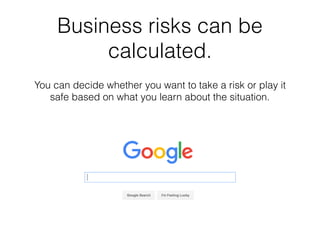
Business risks can be
calculated.
You can decide whether you want to take a risk or play it
safe based on what you learn about the situation.
❶ What is the
competition?
❷ What is the demand?
❸ What are the costs?
❹ What is the ROI?
• What is the ____
• How can I ____
• ___ reviews
• Most popular ____
Research using Google.Google search is usually best in English.
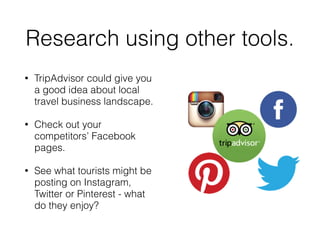
Research using other tools.
• TripAdvisor could give you
a good idea about local
travel business landscape.
• Check out your
competitors’ Facebook
pages.
• See what tourists might be
posting on Instagram,
Twitter or Pinterest - what
do they enjoy?
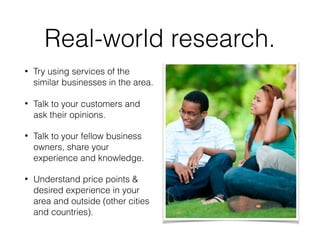
Real-world research.
• Try using services of the
similar businesses in the area.
• Talk to your customers and
ask their opinions.
• Talk to your fellow business
owners, share your
experience and knowledge.
• Understand price points &
desired experience in your
area and outside (other cities
and countries).
ROI
Return On Investment = profit - costs.
What is
diversification?
Diversification means creating multiple streams
of income in order to avoid catastrophic
consequences if one fails.
What are some examples of business

diversification in your community?
The other side of
diversification.
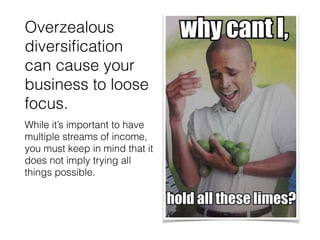
Overzealous
diversification
can cause your
business to loose
focus.
While it’s important to have
multiple streams of income,
you must keep in mind that it
does not imply trying all
things possible.
Your business might appear less
trustworthy.
Customers understand that lacking focus could mean decrease in product or
service quality. They could also become confused by all the choices available.
You will have a hard time keeping up with
unrelated ventures and maintaining your
incongruent customer base.
Are there any examples of such incorrectly
diversified businesses in your community?
So how can you do it
right?
Diversify within your
niche.
Your niche.
• An area or range of activities
that you understand.
• Customers and service or
product that you know well.
• You can create multiple
streams of income by trying
different things, all of which
could be something that you
know very well and know how
to do. And which are related
and complement each other.
Always measure.
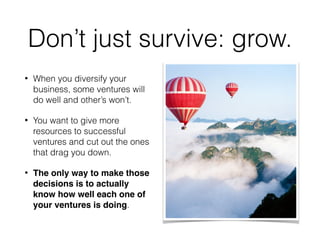
Don’t just survive: grow.
• When you diversify your
business, some ventures will
do well and other’s won’t.
• You want to give more
resources to successful
ventures and cut out the ones
that drag you down.
• The only way to make those
decisions is to actually
know how well each one of
your ventures is doing.
Things you can measure for
each of your ventures:
• Income brought.
• Costs.
• Amount of work required.
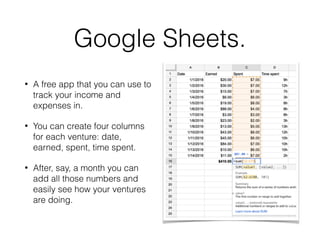
Google Sheets.
• A free app that you can use to
track your income and
expenses in.
• You can create four columns
for each venture: date,
earned, spent, time spent.
• After, say, a month you can
add all those numbers and
easily see how your ventures
are doing.
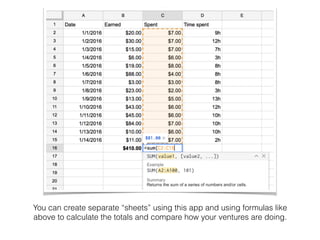
You can create separate “sheets” using this app and using formulas like
above to calculate the totals and compare how your ventures are doing.
• How do I ____ in
Google Sheets.
• ____ doesn’t work in
Google sheets.
You can learn how to use
Google Sheets yourself.
Take a lot of small
risks.
“Experiments.”
Taking risks can
be scary, but if
you don’t try you
loose an
opportunity.
Not following up with a
potentially profitable venture
due to personal fears is a
risk of on it’s own. Those
chances might go away and
never come back.
But:
If you ensure that those risks are small, measured and numerous you
can discover opportunities your competitors would not be able to see.
Instead of building an
entire bakery,
order some pastry from another shop and see if it gives
your business a profit boost.
Instead of building a hot
air balloon business,
recommend your customers to another business for
commission fee and measure the demand.
Instead of opening a
huge bar,
open a minibar service at your existing restaurant and
measure the ROI.
Remember:
• Do your research.
• Measure both your success and failures.
• Create your “diversification experiments” within
your niche.
Assignment.
❶ Pick your main business/niche.
❷ Research at least three
diversification experiments you think
might benefit your main business.
❸ Try to be creative and keep in mind
they must be very different from
most things being done.
❹ Explain how you make sure your
risks are kept small.
❺ Devise a strategy on what you are
going to measure for each and how
you would decide to cut the new
ventures off or add more resources.

Effective Business Practices 101 (2/8): Using Diversification to Alleviate Risks and Measuring Data

  • 1.
    Diversification. Today we’ll learnhow to alleviate some risks associated with business.
  • 2.
  • 3.
    Business risks canbe calculated. You can decide whether you want to take a risk or play it safe based on what you learn about the situation.
  • 4.
    ❶ What isthe competition? ❷ What is the demand? ❸ What are the costs? ❹ What is the ROI?
  • 5.
    • What isthe ____ • How can I ____ • ___ reviews • Most popular ____ Research using Google.Google search is usually best in English.
  • 6.
    Research using othertools. • TripAdvisor could give you a good idea about local travel business landscape. • Check out your competitors’ Facebook pages. • See what tourists might be posting on Instagram, Twitter or Pinterest - what do they enjoy?
  • 7.
    Real-world research. • Tryusing services of the similar businesses in the area. • Talk to your customers and ask their opinions. • Talk to your fellow business owners, share your experience and knowledge. • Understand price points & desired experience in your area and outside (other cities and countries).
  • 8.
    ROI Return On Investment= profit - costs.
  • 9.
  • 10.
    Diversification means creatingmultiple streams of income in order to avoid catastrophic consequences if one fails.
  • 12.
    What are someexamples of business diversification in your community?
  • 13.
    The other sideof diversification.
  • 14.
    Overzealous diversification can cause your businessto loose focus. While it’s important to have multiple streams of income, you must keep in mind that it does not imply trying all things possible.
  • 15.
    Your business mightappear less trustworthy. Customers understand that lacking focus could mean decrease in product or service quality. They could also become confused by all the choices available.
  • 16.
    You will havea hard time keeping up with unrelated ventures and maintaining your incongruent customer base.
  • 17.
    Are there anyexamples of such incorrectly diversified businesses in your community?
  • 18.
    So how canyou do it right?
  • 20.
  • 21.
    Your niche. • Anarea or range of activities that you understand. • Customers and service or product that you know well. • You can create multiple streams of income by trying different things, all of which could be something that you know very well and know how to do. And which are related and complement each other.
  • 24.
  • 25.
    Don’t just survive:grow. • When you diversify your business, some ventures will do well and other’s won’t. • You want to give more resources to successful ventures and cut out the ones that drag you down. • The only way to make those decisions is to actually know how well each one of your ventures is doing.
  • 26.
    Things you canmeasure for each of your ventures: • Income brought. • Costs. • Amount of work required.
  • 27.
    Google Sheets. • Afree app that you can use to track your income and expenses in. • You can create four columns for each venture: date, earned, spent, time spent. • After, say, a month you can add all those numbers and easily see how your ventures are doing.
  • 28.
    You can createseparate “sheets” using this app and using formulas like above to calculate the totals and compare how your ventures are doing.
  • 29.
    • How doI ____ in Google Sheets. • ____ doesn’t work in Google sheets. You can learn how to use Google Sheets yourself.
  • 30.
    Take a lotof small risks. “Experiments.”
  • 31.
    Taking risks can bescary, but if you don’t try you loose an opportunity. Not following up with a potentially profitable venture due to personal fears is a risk of on it’s own. Those chances might go away and never come back.
  • 32.
    But: If you ensurethat those risks are small, measured and numerous you can discover opportunities your competitors would not be able to see.
  • 34.
    Instead of buildingan entire bakery, order some pastry from another shop and see if it gives your business a profit boost.
  • 35.
    Instead of buildinga hot air balloon business, recommend your customers to another business for commission fee and measure the demand.
  • 36.
    Instead of openinga huge bar, open a minibar service at your existing restaurant and measure the ROI.
  • 37.
    Remember: • Do yourresearch. • Measure both your success and failures. • Create your “diversification experiments” within your niche.
  • 38.
    Assignment. ❶ Pick yourmain business/niche. ❷ Research at least three diversification experiments you think might benefit your main business. ❸ Try to be creative and keep in mind they must be very different from most things being done. ❹ Explain how you make sure your risks are kept small. ❺ Devise a strategy on what you are going to measure for each and how you would decide to cut the new ventures off or add more resources.