2
CONTENTS
FOREWORD ................................................... 5
INTRODUCTION .......................................... 14
DIAGNOSIS: WHAT ARE THE
CONDITIONS IN SOUTH AFRICA TODAY? ... 21
THE EFF’S COMMITMENT AND PLAN OF
ACTION ....................................................... 27
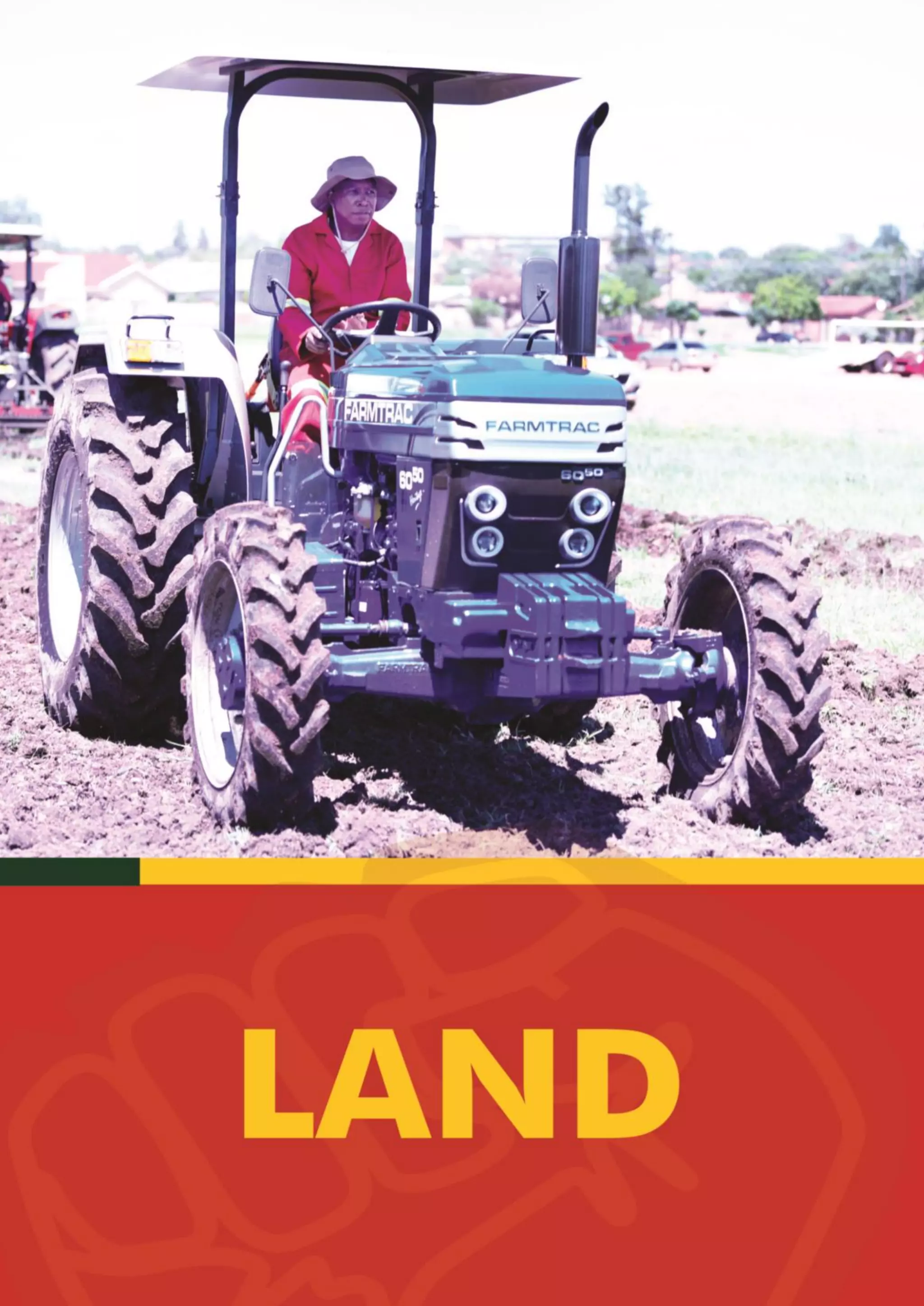
 LAND ...................................................................................28
 CORRUPTION ......................................................................39
 GENDER, WOMEN AND LGBTQI..........................................42
 LGBTQI ................................................................................45
 YOUTH DEVELOPMENT.......................................................47
 CRIME..................................................................................50
 EDUCATION.........................................................................54
 HEALTH................................................................................67
 HUMAN SETTLEMENTS, WATER AND SANITATION............75
 PEOPLE WITH DISABILITIES.................................................81
 TRADITIONAL LEADERS.......................................................83
 ENERGY ...............................................................................86
 MINING ...............................................................................90
 FINANCIAL SECTOR .............................................................94
 SOCIAL DEVELOPMENT.......................................................99
3
 STATE CAPACITY................................................................103
 AGRICULTURE, FISHERIES AND FORESTRY........................109
 ECONOMY.........................................................................117
 JUSTICE SYSTEM AND CORRECTIONAL SERVICES .............121
 ENVIRONMENT AND CLIMATE..........................................127
 FISCAL FRAMEWORK.........................................................130
 SCIENCE AND TECHNOLOGY .............................................135
 SPORTS, ARTS, CULTURE AND RECREATION.....................144
 INFORMATION AND COMMUNICATION TECHNOLOGY ...152
 ROAD INFRASTRUCTURE...................................................156
 NATIONAL INFRASTRUCTURE ...........................................158
 INTERNATIONAL RELATIONS.............................................165
4
5
FOREWORD
The year 2019 marks exactly 25 years since the
attainment of political freedom in South Africa.
As observed in the Founding Manifesto of the
Economic Freedom Fighters (EFF), political
freedom in South Africa has hardly translated
into observable economic emancipation. Black
people remain landless, they remain on the
margins of economic production and outside of
life-enhancing economic participation. The
majority of those that participate in the economy
do so as suppliers of cheap and easily disposable
labour. Landlessness and joblessness among
black South Africans are at crisis levels, posing
the biggest challenges that confront South
African society today.
While focusing on clear, implementable and
decisive programmes for all spheres of
governance, the EFF’s emphasis for the 2019
general elections will be on LAND and JOBS.
Consequently, the EFF’s theme for the 2019
elections is: OUR LAND AND JOBS NOW.
The emphasis on LAND derives from the fact that
25 years since the attainment political
freedom, 80% of the population continues to
occupy less than 10% of South Africa’s land.
The emphasis on JOBS is motivated by the sad
reality that after 25 years of attempts at
6
addressing the matter, more than seven million capable South
Africans who need jobs are unemployed, with no hope that
anything will change unless the current government is
changed.
The emphasis on NOW is informed by the fact that 25 years is
a rather long time for any political party to keep making empty
promises. The emphasis on NOW is also because our people
live in absolute poverty. Similarly, the emphasis on NOW is
because our people are landless. The emphasis on NOW is
because our people are jobless. Yet again the emphasis on
NOW is because the crises of racialised poverty, inequality,
underdevelopment, landlessness and joblessness are being
experienced NOW, and must be resolved NOW!
More fundamentally, the emphasis on NOW is because we
cannot postpone the true liberation of our people from
economic apartheid. We are not part of the 1994 elite pact.
We are a completely new generation, with new demands. And
our demands, unlike those of the 1994 generation, will not be
postponed. We refuse to be silenced with so-called
reconciliation. We want justice now. We want our land now.
We want jobs now. We demand the economy NOW!
It is our considered view that the political change-over in 1994,
did not bring true liberation. It was a bluff which continues to
subject black people to economic and social apartheid. This
economic apartheid must end now. The demand for land and
jobs now is the demand to end apartheid because it is now
evident that apartheid did not end in 1994. We are not part of
the CODESA compromises, which only focused on taking over
political power without the control of the economy. We are a
7
generation that is fighting for true economic emancipation
NOW!
The economy in South Africa continues today to be under the
ownership and control of white minority settlers, whose
ownership and control of land in particular, were gained
through settler colonialism and its corollary - the dispossession
of the black colonised. Other sectors of the economy, such as
the retail chains, industry and the financial sector, are also
owned and controlled by the white minority in South Africa. All
the means of economic survival and existence continue to be
controlled by the white minority. All of this continues to be the
case two decades after the country attained political freedom.
The black majority, and Africans in particular, are the
numerical majority, yet they continue to be the economic
minority, living under difficult conditions and perennially
begging for participation in and benefit from what is a white-
owned economy linked to the global capitalist system. The few
black people who participate in the economy, do so, subject to
white approval through a black economic empowerment
model that is ostensibly designed to benefit a small number of
individuals without ever changing the structural exclusion of the
majority.
The post-1994 governments have dismally failed to transfer
economic power to the black majority and, even worse, to
optimally use government ownership and control of certain
state assets for the benefit of all South Africans. Instead, they
have reproduced and worsened apartheid economic
inequalities, such that a prominent defining characteristic of all
post-1994 governments is their perpetuation of economic
apartheid defined along racial lines. Whilst political apartheid
8
has been abolished, economic and social apartheid remain a
stark reality, evidenced by the fact that poverty is associated
with blackness and wealth with whiteness.
The Economic Freedom Fighters has demonstrated in its five
years of existence, through various interventions and political
leadership in different spheres of influence, that it is the only
political movement that will bring about real economic change
in South Africa. As a movement, we carry collective and
individual capacity that will fundamentally change South
Africa’s economy in a manner that will allow us to reclaim
economic ownership, expand the productive economy, give
black people real ownership, create jobs and drive inclusive
development.
The EFF’s political programme is the only programme that is
embedded in the interests of all South Africans, having been
organically developed to meet people’s demands. The
manifesto we present hereafter for the 2019 general elections
is therefore not a wish list of unattainable goals, but a clear
programme of action of what we will do when elected as
government of South Africa.
The EFF Manifesto 2019 is based on primarily three sources:
a) The numerous submissions the EFF received from
different sectors through public consultations, which
included public meetings, letters to different
organisations, social media inputs and oral
submissions;
b) The Founding Manifesto of the EFF; and
c) The collective experience the EFF gained through its
participation in Parliament, Provincial Legislatures and
Municipal Councils.
9
It is important to highlight that the EFF’s political programme
is underpinned by the desire for ECONOMIC FREEDOM IN
OUR LIFETIME. This is a generational clarion call that we will
never deviate from. The EFF’s manifesto commitments for the
2019 general elections are inspired by as well as based on our
movement’s seven cardinal pillars, which constitute the core of
our approach to genuine revolutionary transformation of
society for the better.
The seven pillars are:
a. Expropriation of South Africa’s land without
compensation, for equal redistribution in use
b. Nationalisation of mines, banks and other
strategic sectors of the economy, without
compensation
c. Building state and government capacity, which
will lead to the abolishment of tenders
d. Free quality education, health care, houses and
sanitation
e. Massive protected industrial development to
create millions of sustainable jobs, including the
introduction of minimum wage(s) in order to
close the wage gap between the rich and the
poor, close the apartheid wage gap and
promote rapid career paths for Africans in the
workplace
f. Massive development of the African economy
and advocating for a move from reconciliation to
justice on the entire continent
g. Open, accountable, corrupt-free government
and society without fear of victimisation by state
agencies.
10
The seven cardinal pillars and all the areas which the manifesto
covers are of crucial importance to us in their totality, while
specific emphasis is being placed on LAND and JOBS. It is our
firm belief that the crisis levels of poverty, inequality and
underdevelopment being experienced in the country can be
ended by the reclamation and equitable redistribution of the
land and the creation of millions of jobs. The current
government has spectacularly demonstrated that it is incapable
both now and in the foreseeable future to economically
empower all South Africans.
The EFF does not promote job creation at any cost. The quality
of jobs and the quality of life in the workplace are also of
utmost importance. The role of trade unions therefore needs to
be specifically guaranteed and protected. The wage gap is also
one of the biggest contributors to inequality. Statistics show that
in South Africa, the wealthiest three billionaires own more
wealth than the poorest 26 million citizens. Globally, it will take
four days for the CEOs of the world’s largest fashion
companies to earn what a clothing worker in those companies
earns in a lifetime. Economic wealth therefore must be
transferred from the hands of the few to the hands of the many.
The EFF’s manifesto takes into consideration various domestic,
regional, global, geo-political, economic and industrial
developments. We particularly take into consideration that we
have the obligation to present a credible JOBS strategy in the
era of the Fourth Industrial Revolution, which could reduce the
number of people employed to produce goods and services for
a wage. The Manifesto will address these developments in a
manner that appreciates reality and yet achieves maximum
benefits.
11
What distinguishes the EFF’s 2019, election manifesto from all
other election manifestos is that it makes specific commitments
with timelines and clearly specifies areas that will receive the
deliverables, illustrating the movement’s readiness and
preparedness to govern on behalf of the people. The era of
meaningless and broad promises is over. The EFF’s
quantitative and qualitative growth has taught us that we
should always stay in contact with the people and understand
their demands and aspirations.
Some of the policy innovations contained in this manifesto
include:
a) Land redistribution policies which will guarantee land
access by all landless people for residential, industrial,
cultural, religious and recreational purposes;
b) Multiple special economic zones to promote inward
industrialisation and manufacturing investments with
export capacity in order to make the ownership and
control of the economy demographically representative,
expand its productive capacity and create millions of
jobs;
c) Doubling of social grants in order to reduce the crisis
levels of poverty and boost domestic economic
demands and expansion;
d) Usage of legislated state procurement as a boost for
localisation and creation of sustainable quality jobs,
prioritising women and the youth;
e) Reconfiguration of the spheres of government into
national and local spheres and eliminating the
provincial sphere in order to redirect resources to
impactful service delivery and investments; and
12
f) Amending the constitution to make the National
Prosecutions Authority (NPA) a Chapter 9, institution
accountable to Parliament in order to stop selective
prosecutions and fight corruption.
Fellow South Africans, Commissars, Fighters, and all Ground
Forces, the EFF hereby presents our commitments, a
programme of action and a clearly articulated plan on what
we will do when elected to govern on behalf of the people.
These are not empty promises. They are clear commitments
that will be realised under the decisive and capable leadership
of the Economic Freedom Fighters. The clarion call is clear:
OUR LAND AND JOBS NOW! VICTORY IS CERTAIN!
Revolutionary regards,
Julius Sello Malema
13
14
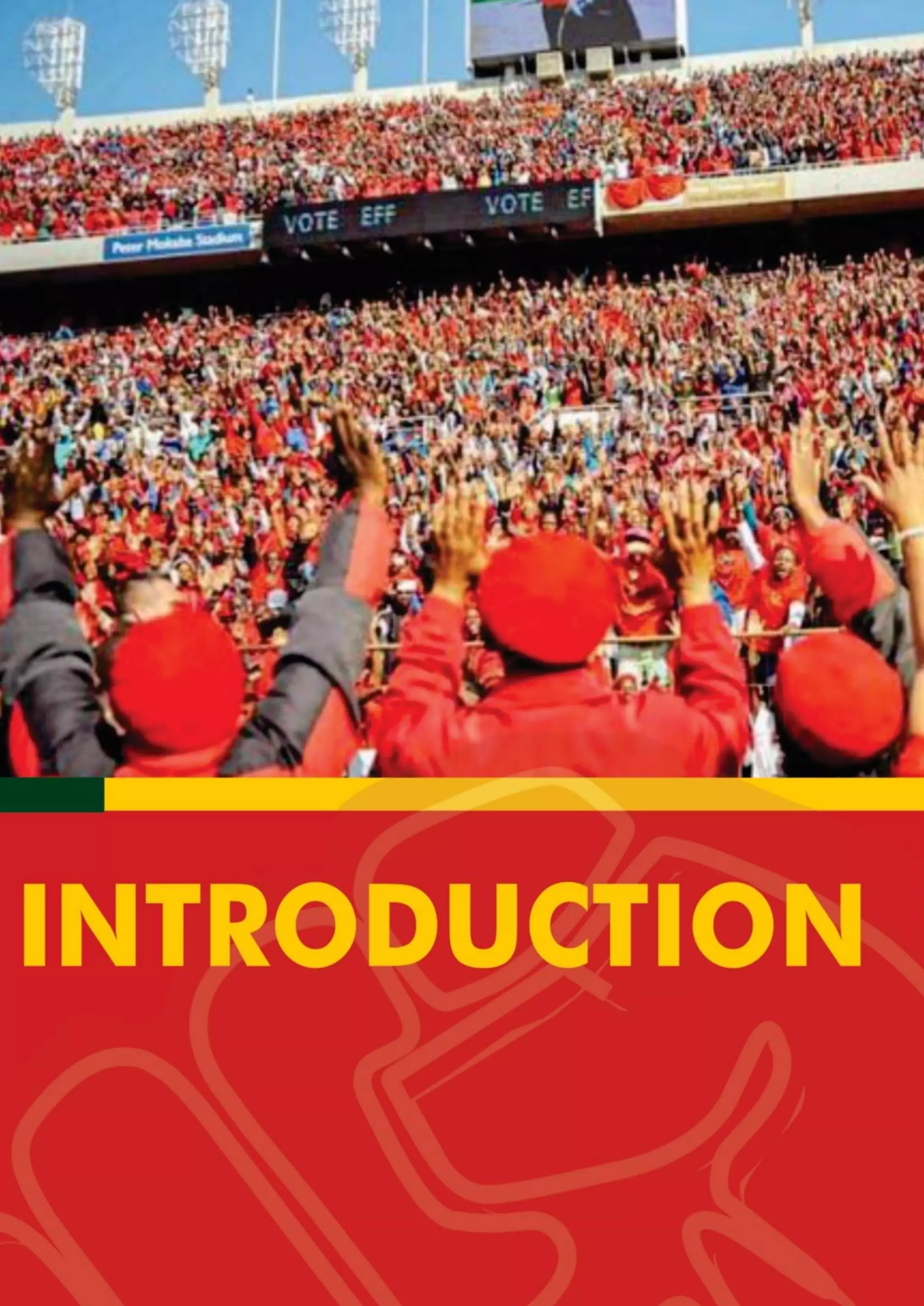
INTRODUCTION
The EFF’s election manifesto will focus on the key
areas set out below. It should be highlighted that
each focus area will have a localised expression and
jobs dividend.
A. WHERE DOES THE ECONOMIC FREEDOM
FIGHTERS MOVEMENT COME FROM AND
WHAT HAVE WE ACHIEVED?
B. DIAGNOSIS: WHAT ARE THE CONDITIONS
IN SOUTH AFRICA TODAY?
C. THE EFF’S COMMITMENTS AND PLAN OF
ACTION ON:
1) LAND
2) JOBS
3) CORRUPTION
4) GENDER, WOMEN AND LGBTQI
5) YOUTH DEVELOPMENT
6) CRIME
7) EDUCATION
8) HEALTH
9) HUMAN SETTLEMENTS, WATER AND
SANITATION
10) PEOPLE WITH DISABILITIES
11) TRADITIONAL LEADERS
12) ENERGY
13) MINING
14) FINANCIAL SECTOR
15) SOCIAL DEVELOPMENT
16) STATE CAPACITY
17) AGRICULTURE, FISHERIES AND FORESTRY
18) ECONOMY
19) JUSTICE SYSTEM AND CORRECTIONAL
15
SERVICES
20) CONSTITUTIONAL STRUCTURE AND
DEMOCRATIC PARTICIPATION
21) ENVIRONMENT AND CLIMATE
22) FISCAL FRAMEWORK
23) SCIENCE AND TECHNOLOGY
24) SPORTS, ARTS, CULTURE AND
RECREATION
25) INFORMATION AND COMMUNICATION
TECHNOLOGY
26) INFRASTRUCTURE
27) ROAD INFRASTRUCTURE
28) INTERNATIONAL RELATIONS
A. WHERE DOES THE ECONOMIC FREEDOM
FIGHTERS MOVEMENT COME FROM AND WHAT
HAVE WE ACHIEVED?
The Economic Freedom Fighters (EFF) is a revolutionary
socialist economic emancipation movement founded in 2013,
in South Africa to fight for economic freedom in our lifetime.
The EFF is a registered political party with 890 public
representatives in the National Assembly, the National Council
of Provinces, Provincial Legislatures and Municipal Councils.
Since its formation, the EFF has, among many others,
registered the following victories:
1) Through various efforts the EFF led the country into
discussing the amendment of the constitution to realise
the expropriation of land without compensation for equal
redistribution.
16
2) The EFF got former President Mr Jacob Zuma to pay back
money spent on non-security-related upgrades at his
homestead in Nkandla.
3) The EFF effectively led a political process that stopped the
Gupta criminal syndicate from running the country’s
government and key state-owned companies.
4) The EFF used its Parliamentary participation to table the
following laws, which will fundamentally change the
economic architecture of South Africa to benefit ordinary
South Africans:
i. The National Health Amendment Bill, which will
ensure that all clinics in South Africa are open 24
hours a day;
ii. The Insourcing of all Government and State Entities
Bill, which will result in the insourcing of all workers
who provide constant services to government and
state companies;
iii. The Illegalisation of Alcohol Advertisement Bill, which
will end the celebration and promotion of alcohol
consumption in South Africa;
iv. The Banks Amendment Bill, which will lead to the
creation of a state-owned bank; and
v. The Nationalisation of the South African Reserve
Bank Bill, which will discontinue private ownership of
the central bank.
5) The EFF used its Parliamentary participation to table
motions which sought to achieve the following:
i. Provision of free-fee education for the poor at higher
education level, which was rejected by the ruling
party;
ii. Increase in mineworkers’ salaries and improvement
of their working conditions;
iii. Repeal of all apartheid legislation and laws that
continue to govern South African society;
17
iv. Nationalisation of banks and changing how state-
owned companies are managed; and
v. Submission on illicit financial flows, tax avoidance
and base erosion in Parliament as well as to SARS
and the Davis Tax Committee.
6) The EFF led and supported land occupation programmes
which resulted in residential land being given to many
landless people in all the provinces.
7) The EFF led a decisive political programme that resulted
in the admission of more than 100 000 students to
institutions of higher learning without their having to pay
any fees.
8) The EFF’s public representatives and leadership have
individually and collectively assisted many communities
with:
i. Implements for agricultural productivity, including
tractors;
ii. School assistance programmes and bursaries that
help hundreds of schoolchildren;
iii. School uniforms and vital learning and teaching
support materials;
iv. Many labour disputes that prevented racism,
dismissals and retrenchments; and
v. Legal representation that prevents evictions.
9) The EFF caucuses at provincial and local levels tabled
insourcing bills and motions for government to disallow
anyone to work for government through a third party to
provide common services such as cleaning, gardening,
security guards etc.
10) The EFF caucuses in Johannesburg, Tshwane and Nelson
Mandela Bay tabled successful motions on the insourcing
of municipality workers, as a result of which thousands of
18
security guards are now full-time employees with proper
salaries at the municipalities.
11) The EFF caucuses in Johannesburg and Tshwane tabled
successful motions to have clinics remain open 24 hours
a day. As a result, clinics in cities are now open 24 hours,
seven days a week.
12) The EFF had Parliament debate the plight of ‘Fees Must
Fall’ activists in support of all activists who were arrested
and remained behind bars or who were involved in court
cases or awaiting trial in prison.
13) The EFF in KwaZulu-Natal tabled a motion for the
discontinuation of all contracts with KPMG by provincial
government. The motion was adopted by the provincial
legislature.
14) The EFF in Rustenburg tabled a motion to reinstate 100
workers whose employment with the Council had been
wrongfully terminated. The motion was adopted by the
Council.
15) The EFF in Bela-Bela tabled a motion for a land
expropriation programme. As a result, the Council
allocated 700 fully serviced stands to deserving
recipients.
16) The EFF in Modimolle tabled a motion for the Municipal
Council to scrap all debt that indigent people owed. The
motion was adopted by the Council.
17) The EFF in Nelson Mandela Bay tabled a motion for the
insourcing of security guards, with a salary increase from
R4 000 to R11 000. The motion was adopted by the
Council.
18) The EFF secured transport for learners who previously
had to walk long distances to school in Buffalo City.
19) The EFF in Matjhabeng in Free State helped 95 workers
who had been employed on contract for more than ten
years to secure full-time positions.
19
20) The EFF protected the independence of the office of the
Public Protector.
21) The EFF has made politics fashionable and worthy.
22) The EFF has made Parliament vibrant.
23) The EFF has helped many people with legal
representation, including artists.
24) The EFF fought for the insourcing of workers at institutions
of higher learning such as Wits University, University of
South Africa (UNISA), University of Kwa Zulu/Natal
(UKZN) and University of Pretoria (UP).
25) The EFF pushed President Zuma out of office through a
motion of no confidence.
26) The EFF introduced secret voting in Parliament.
27) The EFF has gained credibility at institutions of higher
learning by constantly winning SRC elections.
28) Wherever the EFF led the SRC, poor students were
provided with free sanitary towels and one meal a day.
29) The EFF effectively gave land to 50 000 people who were
landless.
30) The EFF helped to remove corrupt government officials at
Nelson Mandela, Tshwane, Johannesburg, Thabazimbi,
Modimolle, Mogale City and Jozini municipal councils.
31) The EFF has built the confidence of black people and
confronted racism everywhere where it encounters it.
32) The EFF is the only party that has a higher gender balance
in Parliament, provincial legislature and municipal
councils.
The EFF has had many collective and individual victories in all
the provinces and numerous municipalities, some which
cannot for reasons of space be included here. In sum it has
brought hope to ordinary South Africans and revived their
confidence in politics.
20
21
DIAGNOSIS: WHAT ARE THE
CONDITIONS IN SOUTH AFRICA
TODAY?
1) The large majority of black South Africans are landless,
and the post-1994 governments have cumulatively
bought less than 7% of the targeted 30% of land meant
for redistribution, over a period of 25 years.
2) Close to 40% of South Africans who need jobs are
unemployed, meaning that more than nine million South
Africans who need jobs and are capable of working
cannot find employment. The present government has
failed dismally in devising a strategy for creating
employment for all, and unemployment has since 1994,
never been below 20%.
3) The South African governments have consistently over the
past 25 years adopted a legislative and policy framework
according to which service delivery is completely
dependent on external service providers and tenders.
Thus, the government itself lacks the capability to perform
basic/core government functions.
4) The food economy in South Africa is dominated by the
white minority at all levels, from land ownership and
agricultural production to the packaging and retailing of
food - nothing has changed since 1994.
1. The South African economy has not fully
developed its productive capacity to provide jobs
for millions of unemployed people and is still
heavily dependent on the importation of finished
goods and products.
22
2. South Africa’s education system is not well
positioned to respond to the Fourth Industrial
Revolution due to a lack of high-technology
infrastructure, and the post-secondary education
and training institutions cannot absorb all learners
from secondary schools.
3. South Africa’s health care system excludes a
substantial number of South Africans, and the
country is sadly, still far from achieving universal
health coverage.
4. Millions of South Africans still reside in unsafe
human settlements and remain trapped in poverty.
5. South Africa has extra-ordinarily high levels of
crime. An average of 20 000 murders are
committed annually, and huge numbers of violent
crimes are not properly resolved.
6. Social development and assistance do not deliver
impactful results in resolving the massive poverty
and inequality challenges.
7. South Africa’s criminal justice system does not
serve justice to poor people, and its correctional
services system is not corrective.
8. South Africa’s energy plan and capacity are not
dependable enough to allow for massive
industrialisation and reliable household usage.
9. South Africa’s environmental management does
not adequately address the protection of the
climate because of the country’s complete
dependence on polluting energy sources.
10. The financial sector in South Africa is owned and
controlled by a financial cartel that excludes and
discriminates against many people on racial
grounds.
23
11. South Africa’s fiscal architecture permanently
incapacitates the state from achieving basic service
delivery demands, and taxes are not maximally
collected from the private sector.
12. South Africa has trivialised science and technology
and is thus not maximising the potential thereof to
improve people’s lives.
13. South Africa’s international relations policies are
not positioned to maximally benefit the country.
14. Women in South Africa are still at the margins of
economic empowerment and are largely excluded
from senior positions in both the private and public
sectors.
15. People with disabilities are not optimally taken
care of.
16. South Africa’s infrastructure back-log is still
massive, particularly in areas where black people
reside.
17. The role of traditional leadership is not clearly
defined, and this leads to abuse of the institution
of traditional leadership.
18. South Africa’s architecture of procurement leads to
massive corruption in both the private and public
sectors.
19. In South Africa, women are violently abused and
killed every day. South Africa is thus considered a
rape capital.
20. In South Africa, there is no free education.
21. In South Africa, 55% of young people are
unemployed and cannot find work.
22. Data is expensive in South Africa.
23. In South Africa, black people live on dumping
sites.
24
24. In South Africa, drug abuse and gangsterism are
prevalent.
25. In South Africa, leadership recipients are paid
poorly and exploited.
26. In South Africa, teenage pregnancy is extremely
high.
27. In South Africa, violence against the LGBTQI
community is prevalent.
28. In South Africa, anti-black racism and xenophobia
against Africans are on the rise.
29. South Africa’s local government is extremely
underfunded.
30. In South Africa, artists are underpaid. Their jobs
are not protected, and many die poor, as a
consequence.
31. In South Africa, women in sports are paid less than
their male counterparts.
32. South Africa has a bloated cabinet with useless
deputy ministers.
33. South Africa still has apartheid murders.
34. South Africa still uses an apartheid national
anthem.
35. In South Africa, streets, buildings, towns and
monuments are still named after apartheid icons.
36. South Africa has one of the highest school dropout
rates.
37. South Africa has insufficient learning spaces and
accommodation at institutions of higher learning.
38. South Africa still has schools where children learn
under trees or in mud structures and/or must use
pit toilets.
39. South Africa still has bucket toilets.
40. South Africa still has bogus initiation schools which
lead to death.
25
41. South Africa still has a huge, widening gap
between poor and rich people.
42. In South Africa, there are still kids who walk
kilometres to school and back.
26
27
THE EFF’S COMMITMENT AND
PLAN OF ACTION
28
 LAND
1. The EFF government will ensure that the amendment of
Section 25 of the 1996 South African Constitution to
allow expropriation of land without compensation for
equal redistribution and use is carried through with
immediate effect.
2. All land will be under the custodianship of the state, for
equal redistribution to all.
3. The EFF government will pass accompanying legislation
such as a Land Redistribution Act and an Agrarian
Reform Act.
4. The EFF government will discontinue ownership of land
by a few and ensure that all South African land is owned
by all South African people through the principle of
progressive state custodianship of land.
5. The EFF government will redistribute land in a manner
that is demographically representative, meaning that
black people will accordingly control the majority of the
land, as they constitute the majority in South Africa.
6. The EFF government will redistribute a minimum of 50%
of the land to be controlled by women and the youth.
7. The EFF government will abolish foreign land
ownership.
8. The EFF government will establish a People’s Land
Council to manage and redistribute land to all those
who need it for residential and productive purposes.
9. The EFF government will establish a land ombudsman
to ensure that people’s rights to the land are protected
and not subjected to arbitrary abuse by state officials
and injudicious mining companies.
10. The EFF government will reconfigure the Land Claims
Court into the People’s Land Court which will be
29
constituted by no less than ten permanent judges in
order to speed up the resolution of all land disputes.
11. The EFF government will once and for all guarantee that
the right to land of people living in communal areas,
such as the people of Xolobeni, is an absolute right, and
that no one has authority to dispossess indigenous
people of their right to land for the benefit of a few
capitalists.
12. The EFF government will develop a new system of land
rights registration to ensure that communal and
customary land rights are recordable and offered the
same protection as other forms of rights over land.
13. The EFF government will abolish rentals of all residential
land.
14. The EFF government will allocate land for residential,
agriculture and industrial usage for free.
15. The EFF government will allocate land for residential
purposes with inheritance rights.
16. The EFF government will not abolish the rights of
traditional leaders in the allocation and redistribution of
land.
17. The EFF government will nationalise all game reserves,
particularly the game reserves in Waterberg region in
Limpopo and uMkhanyakude region of Kwazulu-Natal,
bringing them under the management of South African
National Parks (SANParks).
30
31
 JOBS
As of 2019, South Africa has a workforce of 25.4 million
people with the capacity to work. Only 16.4 million of them
have jobs while the remaining nine million are unemployed,
meaning that 35% of South Africans who are seeking
employment are jobless. To create jobs, the EFF government
will do the following:
1. The EFF government will ensure and lead massive and
protected sustainable industrial development and
diversification to create millions of decent jobs between
2019 and 2024. This will happen through state-led
industrialisation, industrial diversification, the protection
of infant and existing industries, the transfer of
ownership to black people through subsidies, an
increase in tariffs, and state-aided marketing and
promotion of South African products internally, across
the continent and worldwide, with a focus on key,
progressive and most beneficial trading partners.
2. The EFF government will declare multiple special
economic zones in various regions of South Africa,
clearly emphasising that each investor will gain special
economic zone benefits such as tax incentives and
factory building allowances if they each employ and
sustain a minimum of 2 000 jobs.
3. The EFF government will ensure that a minimum of 80%
of the goods and services procured by the state at all
levels and at all state companies are domestically
produced.
4. The EFF government will ensure that a minimum of 50%
of all South Africa’s mineral resources are locally
beneficiated, processed and value added.
32
5. The EFF government will ensure that all food for local
consumption is produced and processed on a massive
scale in South Africa. This will happen through the
intensification of small-scale farming and agriculture
and by giving strategic support to all small-scale
agricultural operations, including providing trade
routes. All food traders in South Africa will be compelled
by law to buy South African food products and to
support operations that produce these food products.
6. The EFF government will build sustainable food
processing zones that will supply food items to other
parts of the world, particularly the rest of Africa, China,
Latin America and India. This will lead to the creation of
millions of jobs across the entire food chain.
7. The EFF government will help communities in the coastal
areas to start agro-fishing corporates and businesses,
which will be their main source of income and
livelihoods.
8. The EFF government will ensure that all products and
goods that contribute to state construction projects are
locally produced, bar exceptional cases where there is
no capacity to produce locally.
9. The EFF government will ensure the development,
protection and localisation of industries which produce
basic and daily used goods through import substitution
mechanisms. These include:
 Glasses, cups, plates, spoons, pots etc.
 Tiles and energy-efficient building materials
 Furniture, energy-efficient light bulbs and
decorating materials
 Solar water geysers, insulation material and
energy-efficient products
 Washing products and soap
 Electronics
33
 Basic energy-efficient electronics
 The textile industry including, clothing and shoes,
and
 Agro-processing of food.
10. The EFF government will ensure that small and medium-
sized enterprises are given strategic support and that
legislation is passed to ensure that key industrial inputs
and services to big corporates and companies are
provided by SMMEs.
11. The EFF government will protect the right of street
hawkers and informal traders to trade in a safe and
clean environment in all the cities of South Africa without
fear of police harassment.
12. The EFF government will prohibit the confiscation of
street traders’ goods as a means of enforcing municipal
by-laws.
13. The EFF government will amend the PFMA and MFMA
to compel national, provincial and state-owned entities
to procure 80% of all goods from local producers and a
minimum of 50% from producers of which 50% is
owned and controlled by women and the youth.
14. The EFF government will build and support state-owned
trading and retail platforms in every municipality.
15. The EFF government will declare the following areas as
special economic zones with zero company taxes and a
building allowance in exchange for each investor
creating 2 000 full-time jobs, paying a minimum wage
and pension contributions:
34
Free State
1. QwaQwa in the Thabomofutsanyana region
2. Thabanchu in the Mangaung region
3. Deneysville in the Fezile Dabie region
Eastern Cape
1. Butterworth in the Amathole region
2. Mount Ayliff and Mbizana in the Alfred Nzo region
3. Cofimvaba in the Chris Hani region
4. Graaff-Reinet in the Cacadu region
5. Mthatha and Port St Johns in the OR Tambo region
6. Sterkspruit in the Joe Gqabi region
7. King Williams Town in the Amathole region
Mpumalanga
1. Bushbuck Ridge and Mjindini in the Enhlanzeni region
2. Marapiane in Dr J.S. Moroka in the Nkangala region
3. Moloto in Tembisile Hani in the Nkangala region
4. Mkhizeville in Mkhondo in the Gert Sibande region
5. Enyibe in Msukalikwa in the Gert Sibande region
Limpopo
1. Groblersdal in the Sekhukhune region
2. Seshego in the Capricorn region
3. Mogalakwena in the Waterberg region
4. Shayandima in the Vhembe region
5. Phalaborwa in the Mopani region
North West
1. Kagisano and Taung in Dr Ruth Segomotsi Mompati
2. Ramotshere and Ratlou in the Ngaka Modiri Molema
region
3. Moses Kotane in the Bojanala region
35
KwaZulu-Natal
1. uMhlabuyalingana in the uMkhanyakude region
2. eDumbe in the Zululand region
3. Utrecht in the Amajuba region
4. Ladysmith in the uThukela region
5. eNquthu in Umzinyathi
6. Umzimkhulu in the Sisonke region
7. Scottsburgh in the Ugu region
8. Maphumulo in the Ilembe region
Northern Cape
1. The whole province must be declared a special
economic zone with industrial assistance for all
companies that create a minimum of 2 000 jobs per
investor per area.
Western Cape
1. Cape Agulhas in the Overberg region
2. Beaufort West in the Central Karoo region
3. Ashton in the Cape Winelands region
4. Oudtshoorn in the South Cape region
5. Citrusdal in the West Coast region.
16. Under the EFF government, township economy equates
to township industrialisation, and special tax-free
economic zones will be created in populous townships.
17. The EFF government will declare township areas as
special tax-free zones in exchange for 2 000 full-time
jobs per investor paying a minimum wage and pension
contribution per company.
18. The EFF government will pass legislation that ensures a
minimum wage of R4 500 across the board for all full-
time workers and will fight that each of the following
36
sectors accordingly receives the stipulated minimum
wage:
 Mineworkers: R12 500 per month
 Farm workers: R5 000 per month
 Manufacturing workers: R6 500 per month
 Retail workers: R5 000 per month
 Builders: R7 000 per month
 Petrol attendants: R6 500 per month
 Cleaners: R4 500 per month
 Domestic workers: R5 000 per month
 Private security guards: R7 500 per month
 Full-time waiters and waitresses: R4 500 per month.
19. The EFF government will use state procurement as an
instrument for driving job creation, meaning that a
minimum of 80% of all goods and services procured by
the state must be locally produced, and majority-owned
and controlled by the people of South Africa.
20. The localisation drive will include all procurement,
inclusive of automobiles, electronics, textiles, food and
professional services.
21. The EFF government will pass a policy that 100% of the
food procured by the state for school feeding schemes,
hospitals, prisons, etc. is locally produced by emerging
historically excluded farmers, and that a minimum of
50% is procured from women and the youth.
22. The EFF government will put measures in place to
ensure that a minimum of 50% of the labour force is
unionised and that collective bargaining is prescribed
and actively promoted.
23. The EFF government will ensure that a minimum of 50%
of all state procurement benefits women and youth-
owned and/or controlled companies.
24. The EFF government will guarantee ‘one degree one
job’ – The EFF government commits to absorb all
37
unemployed graduates and place them into areas
relevant to their qualifications.
25. The EFF government will drive a massive job creation
programme by building studios in every municipality for
artists to record and produce their work locally.
26. The EFF government will create jobs through local
beneficiation.
27. The EFF government will impose a quota of 60% on all
shops to sell locally produced goods and products.
38

39
 CORRUPTION
1. The EFF government will increase, harness and enhance
the efficiency and effectiveness of governance institutions
to pre-empt all forms of corruption.
2. The EFF government will abolish the usage of private
companies to fulfil functions and duties that government
should fulfil.
3. The EFF government will ban the usage of consultants
and project management units as a basis for delivering
government services.
4. The EFF government will build internal capacity to fulfil its
own functions and responsibilities, thereby avoiding
being influenced and having its employees bribed by
private companies and consultants in the fulfilment of
government tasks.
5. The EFF government will establish state administration
courts to promptly respond to incidents of corruption with
the aim of firing and blacklisting corrupt state employees
and private companies and recovering money lost due to
corruption.
6. The EFF government will introduce a minimum sentence
of 20 years for all public representatives and servants
convicted of corruption.
7. The EFF government will protect the independence of the
Public Protector, the Auditor General and all other
corruption monitoring institutions to independently
oversee government programmes.
8. The EFF government will introduce legislation preventing
all public representatives and public servants from doing
any form of business with public institutions.
40
9. The EFF will pass a law that will make all Public
Representatives and Servants to forfeit their pension funds
and savings if they are found guilty of corruption.
10. The EFF government will reduce and eventually ban the
use of consultants and project management units as a
basis for delivering government services.
11. The EFF government will strengthen the current legislation
aimed at the protection of whistle-blowers.
12. The Eff government will introduce new legislation
13. The EFF government will introduce new legislation and
other measures for:
a. compulsory imprisonment plus community service
during and beyond the term of imprisonment to pay
back to society any money gained through corruption
and send a clear message that corruption does not
pay;
b. corrupt offenders employed in the public sector to
forfeit their pensions and other benefits; and
c. Corrupt offenders to receive lifetime bans from
employment in the public sector.
14. The EFF government will act decisively on private sector
corruption.
15. The EFF government will amend the Constitution to make
the National Prosecution Authority (NPA) a constitutional
institution accountable to Parliament to guarantee its
independence in the fight against corruption and crime in
general.
41
42
 GENDER, WOMEN AND LGBTQI
1. Women have suffered most from the neo-liberal reality
of the past 20 years. The vicious circle of triple
oppression, based on race, class and gender, has not
been broken for black women in particular. The EFF
recognises that while patriarchy and sexism are
pervasive in our society, it is black women who suffer
the most from gender-based violence. Up to now,
interventions for dealing with violence against women
have been superficial, half-hearted and based on the
wrong understanding of the root causes for the
vulnerability of women.
2. The EFF government will strive to realise women's
liberation through a variety of interventions, starting
with prioritising women when it comes to the benefits of
economic emancipation. These interventions will
include education against patriarchy and sexism,
complemented by legislation to protect and promote
women’s liberation and the close monitoring of the
implementation thereof in order to realise real women
empowerment in society, within the family and at the
workplace.
3. The EFF believes that gender-based violence and
related antisocial activities are reinforced and even
sustained by the deplorable general conditions of our
people; therefore, a key to female emancipation is the
emancipation of all. The EFF will emphasise
transforming the lives of our people in the ghettos from
one of generalised structural violence as a mechanism
to end all violence, including violence against women.
4. The EFF government will ensure that the following key
interventions are made:
43
 50% women representation in all spheres
representing economic benefit, political
participation, a managerial and leadership
responsibility;
 Compulsory gender education and training for
all (e.g. at school, work, within the family,
church, in the legislative, executive as well as
civil society);
 Education of the police on gender justice and the
establishment of specialised law enforcement
units to deal with women-related crimes;
 Strengthening of education of men on
patriarchy, sexism and misogyny; and
 Engaging custodians of tradition, faith leaders
and other cultural practitioners to collectively
find means to combat the oppression of women.
5. The EFF government will introduce a special
inspectorate in the Department of Labour to monitor,
report on and enforce gender parity and equality in the
workplace. Such measures will range from name-and-
shame, heavy penalties to the withdrawal of trading
licences in the case of repeat offenders.
6. The EFF government will introduce a whistle-blowing
mechanism for reporting all instances of sexual
harassment, jobs-for-sex and gender-based violence in
the workplace.
7. The EFF government will initiate a comprehensive
research project aimed at the recognition of work
performed by women in the household as formal labour
which contributes to the national economy, GDP and the
formal tax system.
44
45
 LGBTQI
1. The EFF government will aggressively engage in public
awareness and communication strategies and training
interventions all aimed at or directed towards positively
changing social norms which declare LGBTQI sexual
preferences as abnormal.
2. The EFF government will amend the Criminal Law
Amendment Act and existing legislation to include
harsher minimum sentences for ‘corrective’ rape
specifically, or crimes committed with hatred as
motivation in general.
3. The EFF government will also amend the Sex Description
4. Act and related legislation to ensure the Home Affairs
Department expedites ID alteration applications for
transgender applicants.
5. The EFF government will invest in a public health care
system that ensures easy access to gender-affirming
treatment.
6. The EFF government will decisively enforce the Equality
Act and related legislation to end unfair discrimination
by government and private organisations in relation to
the employment of women and the LGBTQI community.
7. The EFF government will amend the Facilities
Regulations Act and related regulations to enable the
implementation of gender-neutral toilet facilities in
schools, public facilities and workplaces to benefit
transgender populations and people outside of the
gender binary.
8. The EFF government will amend the Child Care Act and
related legislation to impose penalties for unfair
discrimination against LGBTQI individuals in relation to
adoption processes.
46
47
 YOUTH DEVELOPMENT
1. Youth development cuts across all aspects of the EFF
manifesto, because the jobs the EFF government will
create, the businesses that will be financed, the fee-
free education that will be provided and the social
assistance programme will primarily benefit the youth.
2. The EFF government will mainstream youth
development in all sectors of government and pursue
active programmes to professionalise youth work.
3. The EFF government will develop mechanisms to
monitor the implementation of youth development
initiatives.
4. The EFF government will pass legislation that will
ensure that all government departments and all public
institutions employ a minimum of 40% of people
between the ages of 18 and 35.
5. The EFF government will pass legislation that will
ensure that all government departments and all public
institutions spend 50% of their procurement budget on
youth-owned businesses.
6. The EFF government will ensure that all private
corporations employ a minimum of 35% of people
between the ages of 18 and 35.
7. The EFF government will ensure that all communities
have a Youth Information and Advisory Centre which
will inform, educate and guide young people on
possible career paths and educational opportunities
available in South Africa.
8. The EFF government will ensure that a minimum of
40% of budget allocation to government departments
in all spheres of government is specifically set aside for
youth empowerment and upliftment.
48
9. Under the EFF government, the NYDA will be
autonomous from any direct influence or micro-
management by government in an effective, efficient
and integrated manner, whilst rallying and advocating
support for the implementation of women and youth-
driven development strategies.
10. The EFF government will integrate and institutionalise
youth development at local government level.
11. The EFF government will build NYDA offices in every
municipality.
12. The EFF government will allocate R2 billion to the
NYDA, with a minimum of 50% of that allocated to
companies, programmes and projects controlled by
women.
49
50
 CRIME
1. The EFF government’s approach to fighting crime will
take into consideration that crime is a socio-economic
consequence and should be fundamentally uprooted by
economically developing our communities and
providing criminals with quality jobs and careers.
2. The EFF government will by 2024 establish satellite
police stations that will be open 24 hours in a day and
seven days in a week in every ward of the country where
there currently is no police station.
3. The EFF government will re-open police and satellite
police stations in Marabastad, Zandspruit, Kocksoord,
Azaadville, Morula Sun, Melville, Zithobeni and
Thembelihle in Gauteng by 2022.
4. The EFF government will re-open police and satellite
police stations in Siyathemba, Emjindini, Botleng,
Tjakastad, Kwazamokuhle, Msogwaba, Daanjie,
Hectorspuit, Lebohang, Badfontein, Dundonald, Phola,
Thuthukani, Phungutsha and Kamhlushwa in
Mpumalanga by 2022.
5. The EFF government will ensure that all police stations
are housed in properties owned by the state.
6. The EFF government will ensure that each police station
has officers with specialised skills to deal with cases of
sexual violence against and abuse of women and
children and to support victims.
7. The EFF government will require all police stations to
have DNA kits by the end of 2019.
8. The EFF government will retrain all police officers by
2022 so that they are able to process and investigate
sexual violence and intimate-partner violence crimes, in
a way that takes cognisance of the short-term and long-
term mental and physical health of the victim.
51
9. The EFF government will determine the number of police
officers to be allocated to a station in relation to the
number of people within the station’s catchment area.
10. The EFF government will employ an additional 100 000
police officers by 2023.
11. The EFF government will repair all broken police
vehicles by 2020.
12. The EFF government will purchase an additional 7 000
police vehicles by 2022, on condition that 50% of all
parts are made in South Africa.
13. The EFF government will absorb all police reservists and
security guards.
14. The EFF government will increase police visibility.
15. The EFF government will impose strict rules on gun
ownership and will aggressively recover illegal guns.
16. The EFF government will deploy a special task team to
deal with gangsterism and drugs in places such as the
Cape Flats in Cape Town,
17. The EFF government will improve the capacity of crime
intelligence to include the usage of technology to solve
crimes.
18. The EFF government will train additional detectives.
19. The EFF government will re-capacitate Community
Policing Forums across the country and encourage the
formation of crime watch and street committees in crime
hotspot communities and areas
20. The EFF government will give rewards for citizens who
submit evidence depicting alleged criminal activities,
including drug dealing, social crimes and domestic
violence
21. Racism shall be declared a punishable criminal offence
22. As part of its massive drive for rural development, the
EFF government will introduce a specialised unit to deal
52
with the problem of stock theft in rural and farming
areas
23. Sentences for rhino poaching will be increased
24. The SABC must dedicate one hour per day on all radio
and television stations to educate the public about crime
prevention and community policing
25. All immigrants shall be registered and have their
fingerprints captured by the new Department of Home
Affairs and Internal Security.
53
54
 EDUCATION
1. The EFF government will introduce free decolonised
education for all, advancing topics pertaining to
indigenous knowledge, sovereignty and economic
freedom in the curricula.
2. The EFF government will criminalise all parents who do
not take their children to school.
EARLY CHILDHOOD DEVELOPMENT:
1. The EFF government will make universal provision for
early childhood development (ECD) programmes and will
make it compulsory for children from the ages of three
years and upwards to be enrolled in an ECD for free.
2. The EFF will develop a common ECD curriculum focusing
on nutrition programmes, book reading and storytelling,
and other land-based activities to enhance children’s
understanding of their surrounding environment.
3. Under the EFF government, all ECD practitioners will be
employed on a full-time basis, with full pay and pension
contribution by government.
4. The EFF government will train an additional 40 000 ECD
practitioners by 2021, of whom a minimum of 50% must
be women and the youth.
BASIC EDUCATION:
5. The EFF government will introduce free decolonised
education for all, advancing topics pertaining to
55
indigenous knowledge, sovereignty and economic
freedom in the curricula.
6. The EFF government will increase the use of information
and communication technology for teaching, with the aim
of achieving universal coverage in computer literacy by
2024.
7. Under the EFF, each learner will get a tablet loaded with
all necessary study material, tutorials and educational
videos.
8. The EFF government will prioritise indigenous ways of
teaching, learning and development.
9. ‘One education system, one country’ – Under the EFF
government, all students will fall under one school system
and all matric learners will write the same examinations.
Independent Examination Board (IEB) will be abolished.
10. The EFF will provide scholar transport for all learners who
stay more than 2 kilometres from the school.
11. The EFF government will electrify all schools everywhere
by 2021.
12. The EFF government will provide two nutritious meals a
day to all learners in all schools by 2020.
13. The EFF government will ensure that there is clean water
in every school by January 2021.
14. The EFF government will provide security in all schools.
15. The EFF government will encourage all learners to do
mathematics.
16. Under the EFF government, all schools will have remedial
teachers.
17. The EFF government will ensure that there are safe
flushing toilets in all schools by 2021.
18. The EFF government will build new schools with
technology integration in the classroom, sports facilities
56
and computer labs to reduce the teacher-to-pupil ratio to
1:40 for primary schools and 1:30 for secondary schools.
19. The following areas will be prioritised for the building of
new schools:
Eastern Cape
1. Matatiele ward 8: Belfort
2. Mbizana ward 18: Sigidi
3. Dimbaza ward 36: Mzintshane
4. Mdantsane ward 11: Langelitsha, ward 46:
Cover Ridge Primary, ward 31: Qonce High,
ward 39: Rayi Primary
5. Dzluxolo SS ward 1: Elundini
6. Mhlontlo ward 16: Mthintwa
7. PSJ ward 5: Caguba High School
Free State
1. Jagersfontein
2. Koffiefontein
3. Botshabelo (Extension 1)
4. Reitz
5. Marquard
6. Vrede
Gauteng
1. Ward 17 Sebokeng, Emfuleni in Extension 28
2. Ward 1 Ekurhuleni, Clayville Extension 45
3. Between wards 4 and 5 Mogale West Rand –
Kagiso
4. Between wards 1 and 2 Merafong
Municipality
5. Ward 127 Mathole Roodepoort –
Johannesburg
57
Kwa Zulu-Natal
1. Emladlangegeni (Mange Area)
2. Mtubatuba (KwaMsane Township)
3. Ubuhlebezwee
4. Ray Nkonyane
5. uMsinga
Limpopo
1. Nkomo village (Giyani)
2. Mavalane village (Giyani)
3. Biko village (Lulekane township)
4. Boelane Maseke village (Namakgale)
5. Phalama village (Thulamela))
Mpumalanga
1. Mshadza in Masoyi Mbombela
2. Langeloop and Bosfontein in Nkomazi
3. Allandale in Bushbuck Ridge
4. Mametlake
5. Nokaneng
6. Lefisoane
Northern Cape
1. Duplooysburg and Olierivier primary schools
and secondary school
2. Richmond
3. Gamobedi
4. Gasehubane
5. Garuele Siyanda primary school
6. Ikaganeng
North West
1. Blydeville
58
2. Boskuil
3. Vaal Reefs
4. Marikana
5. Ipelegeng
Western Cape
1. De Doorns
2. Rawsonville
3. Op die Berg
4. Kayamandi
5. Enaknini
20. The EFF government will ensure that all learning and
teaching support materials are delivered in September
the year preceding a new school year and will publish a
report in November of every year on the delivery of
learner-teacher support materials.
21. The EFF government will launch a yearlong
#TeachersMatter campaign, starting in 2020, to look at
both the professional and personal needs of teachers,
including training in soft skills, emotional wellness,
financial literacy, assistance with debt management etc.
22. The EFF will build high-technology teacher training
colleges to equip educators of the future with adequate
technological skills to impart to learners.
23. The EFF government will introduce peer review evaluation
for teachers that focuses on development.
24. The EFF government will launch a #ReturnToSchool
campaign in 2020 for all people who have dropped out
of school, including domestic workers, sex workers and
girls who have left school.
25. The EFF government will employ at least two physical
education trainers in each school by 2022.
59
26. The EFF government will build two grass fields, two
pitches and a swimming pool at every school by 2023.
27. The EFF government will appoint two social workers per
school by the end of 2021.
28. The EFF government will appoint one nurse per school by
2021.
29. The EFF government will appoint one orthodontist per
school by 2023.
30. The EFF government will make it compulsory for every
school to have a vegetable garden by 2020.
31. The EFF government will employ one arts and culture
teacher per grade in each school by 2022.
32. The EFF government will build computer labs, equipped
with internet connectivity, by 2022.
33. The EFF government will build a library in all schools
without libraries by 2022.
34. The EFF government will incorporate in the curriculum
career guidance as a mandatory subject for all high
school learners.
35. The EFF will build new special schools by 2021 with
technology integration in the classroom, sports facilities
and computer labs.
36. The EFF government will introduce modules about
different disabilities and practical lessons on inclusion.
37. The EFF government will provide safe and accessible
transport for children with disabilities.
38. The EFF government will provide mobility, technological
and human aids for all pupils with disabilities.
39. The EFF government will provide sanitary towels to all
learners in public schools immediately.
40. The EFF government will introduce vernacular languages
as the foundation of the education system in all provinces.
60
41. The EFF government will introduce driving schools for all
learners, including a subsidy for booking leaner’s and
driver’s license tests.
42. The EFF government will launch a countrywide literacy
campaign to equip all citizens with the basic skills to read,
write and count so as to enable them to become more
knowledgeable about all aspects of their lives and
increase the literacy rate to 98% by 2024.
43. The EFF government will abolish the 30% pass mark and
increase it to 50% and ensure that all learners who enter
the school system are accounted for by the 12th year of
writing matric.
44. The EFF government will introduce basic sign language
lessons to be taught to all learners.
45. The EFF will introduce comprehensive Adult Education
programmes and guarantee educational access by adults
who could not finish school for one reason or another.
HIGHER EDUCATION:
46. The EFF government will introduce free decolonised
education for all, advancing issues of indigenous
knowledge, sovereignty and economic freedom in
education.
47. The EFF government will increase the use of information
and communication technology for teaching.
48. The EFF will pass a law that will zero-rate all Educational
Apps and content in all gadgets, such as computers,
laptops, tablets, and phones.
49. The EFF government will make it compulsory for all
learners to pursue post-secondary education and training
at universities, universities of technology and TVET
colleges. This will be made possible through state
61
assistance and massive expansion of vocational training
and education.
50. The EFF government will cancel all student debt, re-
integrate all students who were excluded on the basis of
fees and give certificates, diplomas and degrees to all
students who passed and were denied their qualifications
because of outstanding fees.
51. The EFF government will establish a centralised higher
education registration system so that students are not
required to fill in their details and register more than
once.
52. The EFF government will provide free higher education
until a first degree for all and will provide scholarships,
including scholarships to study at overseas universities for
postgraduate qualifications.
53. The EFF government will provide free accommodation for
students at institutions of higher learning and will
quadruple the number of rooms available by 2023.
54. The EFF government will provide two warm meals per day
to each student at institutions of higher learning by 2020.
55. The EFF government will allow all students to travel for
free on public transport, provided they carry their student
card, by 2023.
56. The EFF government will place a price cap on food sold
at all institutions of higher learning by 2019.
57. The EFF government will establish a free 24hours/7days
clinic at each institution of higher learning by 2022.
58. The EFF government will provide free learning materials
at all institutions of higher learning by 2021.
59. The EFF government will require each institution of higher
learning to have a counsellor for every 1 000 students by
2023.
62
60. The EFF government will make all institutions of higher
learning differently-abled friendly by 2020.
61. The EFF government will introduce free driving schools at
all institutions of higher learning by 2020.
62. The EFF government will require each campus to insource
all staff by the end of 2019.
63. The EFF government will require each campus to have
campus security by 2020, with a sexual crimes unit, more
than 70% of employees of which must be female.
64. The EFF government will provide free sanitary towels at
all institutions of higher learning immediately.
65. The EFF government will provide each student residing off
campus with three gigabytes of data per month by 2021.
66. The EFF government will increase the intake at institutions
of higher learning at both universities and TVETs by 20%
annually.
67. The EFF government will synchronise the goals and needs
of the economy with the number of places available at
each institution of higher learning.
68. The EFF government will connect all institutions of higher
learning to high-speed fibre networks by 2023.
69. The EFF government will provide each student with a
laptop by 2024.
70. The EFF government will fast-track the digitalisation of
institutions of higher learning according to annual
targets.
71. The EFF government will re-open all nursing colleges that
have been closed and will open five new nursing colleges
by 2023.
72. The EFF government will re-open all teacher training
colleges that have been closed and will open five new
teacher training colleges by 2023.
73. The EFF government will require all institutions of higher
learning to provide learning materials in the three most
63
spoken languages where the institutions are located by
2024.
74. The EFF government will require all institutions of higher
learning to teach 50% of all courses in a South African
language besides English and Afrikaans by 2024.
75. The EFF government will require 10% of all academic
publications in the country to be written in a South African
language besides English and Afrikaans by 2024.
76. The EFF government will require each university to offer
Swahili Studies as a degree by 2024.
77. The EFF government will establish a digital library which
will buy the rights to every academic publication that has
ever been published so that all students can access them
free of charge.
78. The EFF government will require each university in the
country to offer degrees and courses in coding, computer
hardware development, artificial intelligence, robotics,
the internet and biotechnology by 2022.
79. The EFF government will require each TVET to offer
courses focused on computer hardware and coding by
2022.
80. The EFF government will provide scholarships to students
to study abroad, specifically focusing on degrees and
courses which are not provided in South Africa or that are
of strategic importance or relate to national security.
81. The EFF government will require each medical school in
the country to provide courses in traditional medicine by
2023.
82. The EFF government will establish an agency to place
each final-year student in an internship programme by
2023.
83. The EFF government will establish a satellite campus of
the University of Witwatersrand’s School of Mining
64
Engineering in Rustenburg by 2022 which will focus on
mining and mineral beneficiation.
84. The EFF government will establish a satellite campus of
the University of Limpopo’s School of Physical and
Mineral Sciences in Phalaborwa by 2022 which will focus
on mining and mineral beneficiation.
85. The EFF government will establish a satellite campus of
the University of Pretoria’s Faculty of Natural and
Agricultural Sciences in Ehlanzeni by 2022 which will
focus on agriculture and agro-processing.
86. The EFF government will establish a satellite campus of
the University of Free State’s Faculty of Natural and
Agricultural Sciences in Thabo Mofutsanyana District
Municipality by 2022 which will focus on agriculture and
agro-processing.
87. The EFF government will establish a satellite campus of
the University of the North-West’s School of Agricultural
Sciences in Dr Kenneth Kaunda District Municipality by
2022 which will focus on agriculture and agro-
processing.
88. The EFF government will establish a satellite campus of
the University of Cape Town’s Faculty of Engineering and
the Built Environment in ZF Magcawu District Municipality
by 2022 which will focus on renewable energy.
89. The EFF government will establish a satellite campus of
the University of Johannesburg’s Department of Mining
and Mine Surveying in Sekhukhune District Municipality
which will focus on mining and mineral beneficiation.
90. The EFF government will pay a once-off grant of R1
million to all black graduates pursuing doctoral studies at
accredited institutions, including overseas students, by
2024.
65
91. The EFF government will introduce a scholarship for
people with disabilities to incentivise doctoral studies
among them.
92. The EFF government will build one medical training
school per province.
RESEARCH AND DEVELOPMENT INSTITUTIONS:
93. The EFF government will triple the amount of research
funding available by 2024.
94. The EFF government will improve the remuneration and
working conditions of lecturers and professors and
encourage them to continue with teaching and research
and not take up administrative posts in private or public
institutions.
95. The EFF government will heavily invest in research and
development and will heavily invest in and subsidise
technological and scientific innovations and discoveries.
96. The EFF government will support and subsidise
technological innovation which leads to the development
and manufacturing of a South African automobile (car),
computer, tablet, phone and other world-class
technological innovations.
97. The EFF government will build a specialist technology
university or institute whose primary focus will be
technological innovation.
98. The EFF government will use existing capacity to provide
high-speed and quality broadband to all schools and
institutions of higher learning in South Africa.
99. The EFF government will allocate more funding to
conduct research on HIV/Aids, TB and diabetes.
66
67
 HEALTH
1. The EFF government will focus on primary health with a
commitment to attain universal health coverage, with
the intention of decreasing infant mortality rates and
increase the life expectancy of all people in South Africa.
2. The EFF government will adopt a national health care
system that focuses on primary health care, quality
clinics and disease profiling through public health care
facilities.
3. The EFF government will implement an immunisation
and vaccination programme which will cover 100% of
all South Africans by 2024.
4. The EFF government’s approach to health care will be
based on the pillars of a) prevention, b) promotion and
c) education on health care.
5. The EFF will regularise and fully integrate Community
Healthcare Workers as full employees of the State who
will be responsible for provision of quality healthcare in
each and every community.
6. The EFF government will regularly send doctors and
other health practitioners to schools, communities and
places of work to test for diseases that can be treated at
an early stage, starting in 2020.
7. The EFF government will work with established medical
research institutions in Cuba to develop vaccines for
identified preventable diseases in South Africa.
8. The EFF government will invest in superior medical
research which will explore the usage of cannabis for
pharmaceutical and medical purposes.
9. The EFF government will work with the South African
Broadcasting Corporation (SABC) and maximally use
other forms of mass communication to produce health
68
education content to be aired on all SABC radio and
television stations and disseminated using all relevant
platforms.
10. The EFF government will establish a confidential and
secured digital database of health profiles for all South
Africa citizens by 2021.
11. The EFF government will build 24-hour integrated post-
sexual trauma centres in all district hospitals for urgent
medical, forensic, psychological and social assistance,
directly linked to policing and detective directorates, by
2021.
12. The EFF government will upgrade hospitals such that
each district in South Africa has a regional or tertiary
hospital with a minimum of 450 beds, open 24 hours a
day, with internal medicine, paediatrics, obstetrics,
gynaecology and general surgeons, by 2022.
13. The EFF government will build and upgrade hospitals in
areas such as:
Eastern Cape
1. Mzimvubu
2. Mbizana
3. Ntabankulu
Free State
1. Thaba Nchu
2. Wepener
3. Masilonyana
Gauteng
1. Orange Farm
2. Ivory Park
69
Kwa Zulu-Natal
1. Manguzi
2. eNquthu
3. uMzimkhulu
Limpopo
1. Vhufuli
2. Makhado
3. Modimolle
4. Suswe
5. Botlowka
Mpumalanga
1. Barberton
2. Bethal
3. Witbank
4. Acornhoeck
Northern Cape
1. Kuruman
2. Springbok
3. Kimberley
4. Postmasburg
5. Hartswater
North West
1. Ditsobotla
2. Mogwase
3. Rustenburg
4. Moretele
Western Cape
1. Masiphumelele
70
2. Grabouw
3. Ocean View
4. Gansbaai
14. The EFF government will build specialised hospitals for
the following disease categories: tuberculosis, diabetes
mellitus, cerebrovascular diseases, heart disease,
hypertensive diseases, chronic lower respiratory
diseases and ischaemic heart diseases.
15. The EFF government will pay specific attention to autism
16. and build adequate and high level capacity to treat and
respond to cases of autism.
17. The EFF government will strive to build at least one clinic
18. per ward in all wards of South Africa and will extend
this to one polyclinic per village in wards that are
composed of more than one village.
19. The EFF government will make it compulsory for
workplaces with more than 1 500 employees to have a
properly equipped and staffed in-house health care
facility, such as a clinic or hospital, available for free to
all employees.
20. All clinics under the EFF government will be open 24
hours
21. a day.
22. The EFF government will appoint qualified people,
23. including medical practitioners, with adequate
administrative and managerial experience and
competency at all clinics, community-based health care
facilities, therapy and rehabilitation centres and
hospitals.
24. The EFF government will build consulting rooms for
traditional and indigenous health practitioners,
traditional healers and traditional herbalists to use for
free in all district hospitals by 2021, as a way to
71
incorporate traditional and indigenous health care
practices into the primary health care system.
25. The EFF government will establish a fund to support
indigenous African health knowledge production by
August 2020.
26. The EFF government will massively increase the number
of health care practitioners and ensure that they are
evenly spread across districts and provinces.
27. The EFF government will increase the number of nurses
and doctors in South Africa’s health care system by:
I. Establishing at least one health care training
facility per province and ensuring that there is no
province without a medical school; and
II. Sending recruits to train as nurses in countries
across the world, including in Cuba, namely
5 000 in 2021, 6 000 in 2022 and 7 000 in
2023.
28. The EFF government will allocate community health care
practitioners to all ward-based clinics and polyclinics.
29. The EFF will make sure that all hospitals, clinics,
polyclinics and community health care centres have an
adequate number of ambulances.
30. Ambulances will be locally produced by investing in
ambulance production plants in South Africa.
31. The EFF government’s state-owned health mechanical
service workshops and technicians will prioritise all
machines and equipment in district hospitals, and all
machines and equipment will be in a working condition
by the end of 2020.
32. The EFF government will establish shared services
administration facilities for clinics in a ratio of one
shared services administration facility to 15 clinics, to
manage all administrative services such as record
72
keeping, medication management, facilities
management, human resources and financial
management services.
33. The EFF will replace all machines and equipment older
than ten years in all clinics and hospitals by 2022.
34. The EFF government will develop a policy to guide and
ensure the provision of school-based primary health
care, social work and psychological services.
35. The EFF government will send specialists such as
dentists, optometrists and audiologists to all primary
schools at least twice a year, starting from 2020.
36. The EFF government will send scarce specialists to all
district hospitals on a weekly basis.
37. The EFF government will use ICT in the health care
sector for greater efficiency and improved reaction times
when dealing with health problems and concerns.
38. The EFF government will build a state-owned
pharmaceutical company to ensure the availability of
adequate medicine in all health care facilities by 2021.
39. The EFF government will develop an efficient registration
process for generic medicines to ensure affordable
prices.
40. The EFF government will establish a pharmaceutical
industrial zone for investors with protection of
investment and security of tenure on state land by 2022
on condition that they work with the state-owned
pharmaceutical company and supply medicine and
equipment to clinics, hospitals and community health
care facilities.
41. The EFF government will build a state-owned health care
equipment company to manufacture health care
equipment.
42. EFF government will ensure that the health care system
and health solutions are non-discriminatory towards
73
sexual and gender minorities and those with varying
physical and mental abilities.
43. The EFF government will establish indoor residual
spraying teams on a full-time basis in all malaria-
infested areas.
44. The EFF government will provide health inspectors with
all the basic resources they need to do their job.
45. The EFF government will police, investigate and
prosecute all illegal advertisements of medical
procedures or organ sales, illegal health facilities and
illegal providers of health care.
46. The EFF government will follow the national and
international calendars and will produce health
material, communication programmes and campaigns
that are in line with both priorities and calendars.
47. The EFF government will use evidence-based and
scientific knowledge to educate and inform communities
and individuals on health issues.
48. The EFF government will establish four specialised
health research institutes, namely TB, malaria, HIV/AIDS
and cancer institutes.
49. The EFF government will establish medical missions to
send medical trainees to African countries to share and
learn from each other’s experiences.
50. The EFF government will give all hospitals autonomy to
procure goods and services.
51. The EFF government will appoint additional oncologists,
especially for hospitals in KwaZulu-Natal.
74
75
 HUMAN SETTLEMENTS, WATER AND
SANITATION
` HUMAN SETTLEMENTS:
1. The EFF government will provide quality, spacious
houses to all the people. These houses will be located
within sustainable human settlements with basic
services such as water, electricity, sanitation, schools,
shopping complexes, sports and recreation grounds,
and parks.
2. The EFF government will re-zone all informal
settlements by 2021.
3. The EFF government will put mechanisms in place to
ensure that all public servants have houses.
4. The EFF government will subsidise housing finance for
middle-income earners.
5. The EFF government will legislate for the reduction of
20- to 30-year housing loans to a maximum of ten
years by 2020.
6. The EFF government will make it illegal for banks to
repossess houses from people who have paid off 50%
of their bonds and are unable to continue paying their
bond instalments due to socioeconomic circumstances,
by the end of 2019.
7. The EFF government will make it illegal to use houses
as surety for any loans from financial institutions, by
2019.
8. The EFF government will regulate the cost of rent on
state-owned land.
9. The EFF government will make it illegal for residents to
be evicted from private properties unless a suitable
alternative is found for them.
76
10. The EFF government will ensure that access to a home
is made an inalienable right in the Constitution.
11.
12. The EFF government will do away with apartheid
spatial planning and expropriate land without
compensation closer to inner city centres to build
sustainable housing for all.
13. The EFF government will create a housing access
coordinating unit that involves national, provincial and
local government which will regularly report to the
Presidency on progress with housing provision, the
elimination of slums and the provision of dignified
sanitation.
14. The EFF government will ensure that the state improves
the quality and size of low-cost houses through the
state housing construction company.
15. The EFF government will ensure that the state regulates
housing finance by providing housing finance that
does not exceed a period of ten years.
16. The EFF government will guarantee integrated human
settlements that will in the real sense be definitive of all
settlements led by the state and that will be equipped
with guaranteed bulk services such as water provision,
electricity, sewerage systems, parks and recreation
facilities.
17. The EFF government will ensure that government-built
houses meet the standards required to ensure ease of
access for people with disabilities.
18. The EFF government will convert unused state
buildings into affordable housing for the poor, offering
people long-term, secured leaseholds to these
buildings.
19. The EFF government will, through the state
construction company, build state-owned houses and
77
complexes which will be made available to people on
a lease basis for a period of 99 years.
WATER:
20. The EFF Government will discontinue private
ownership of bulk water infrastructure and will ensure
that each and every household, factory, farm, school,
and public infrastructure has access to clean water.
21. The following areas will be prioritised for the building
of water infrastructure:
Eastern Cape
1. Noxolo
2. Mfuleni wothando
3. Qaqawuli
4. Emahlabathini
Limpopo
1. Giyani
2. Maleboho
3. Sekgakgapeng
4. Lulekanin
North-West
1. Lethabong
2. Thonando
3. Matlosana
4. Boikhutso
5. Tlhakajeng
Gauteng
1. Tjovitjo Orange Farm
2. Langaville Kwathema
78
3. Ikangala Phumekhaya
4. Mooiplas Tshwane
5. Zenzele Westanaria
Mpumalanga
1. Moloto, in Thembisile Hani
2. Nokaneng, New Stand
3. Steenbok, Ward 18, Nkomazi
Free State
1. Thenezen in Masilonyana
2. Qwaqwa wards 10, 11, 18 and 19 in
Maluti a Phofung
3. Matlharantleng in Tswelopele
4. Moipatong in Dihlabeng
5. Baipehing in Metsimaholo
Western Cape
1. Enkanini
2. Marikana
3. Kayamandi
4. Groenheuwel
5. Ashton and Robertson informal
settlements
22. The EFF government will repair all water treatment
centres by 2020.
23. The EFF government will build a new water treatment
facility in each province by 2021.
79
24. The EFF government will employ 10 000 artisans to
repair all leaks in the water infrastructure with the aim
of reducing the amount of water lost by leaks to 10%
of the current rate by 2022.
25. The EFF government will ensure water sustainability for
daily and industrial usage by building dams and large-
scale water projects with the capacity to sustainably
supply South Africa.
26. The EFF government will provide each South African
with in-house hot running water by 2024.
27. The EFF government will build storm water drains in
every street in South Africa by 2022.
SANITATION:
28. The EFF government will eradicate bucket toilets by the
end of 2024.
29. The EFF government will provide each South African
with in-house sanitation by 2024.
30. The EFF government will connect each house to the
sewage system by 2023.
31. The EFF government will ensure that all schools have
a flushing toilet by the end of 2021.
80
81
 PEOPLE WITH DISABILITIES
1. The EFF government will introduce policies in both the
public and private sectors to impose measurable goals
and targets for the recruitment, employment and
retention of people with disabilities to promote their
economic independence and reduce their dependence
on charity and welfare.
2. The EFF government will ensure that each and every
public institution such as hospitals, police stations, home
affairs offices, labour offices, and social development
offices have at least two people who are trained at and
understand sign language to cater for people who
cannot speak.
3. The EFF government will actively and materially support
initiatives to organise and mobilise the disability sector
so that it can constantly and integrally communicate its
concerns and amplify its voice in society guided by the
principle; ‘Nothing about us without us!’
4. Under the EFF government, the President will assume
direct responsibility for the protection of this vulnerable
sector and report on progress annually in his/her State
of the Nation Address, after consultation with the sector.
5. The EFF government will ensure that all government
buildings and facilities such as police stations, hospitals,
clinics, schools and universities are accessible to people
with disabilities.
6. The EFF government will ensure that the public transport
system is accessible to people with disabilities.
7. The EFF government will establish doctoral scholarships
for people with disabilities.
82
83
 TRADITIONAL LEADERS
1. In order to enhance state capacity and in recognition of
the reality that the majority of South Africans subscribe
to and align themselves with the institution of traditional
leadership, the EFF government will give full recognition
to the central role of traditional leaders.
2. The EFF firmly believes that the received western notions
of democracy must necessarily be aligned with and
adapted to the African way of life, culture, traditions,
customs and norms.
3. The EFF government will work hand in glove with
traditional leaders as well as CONTRALESA on diverse
issues that include:
 Rural development initiatives aimed at
discouraging rural-to-urban migration,
 The capacitation of rural-based co-operatives
and similar collectivist schemes such as burial
societies,
 Climate change and the Green Revolution,
 The abolition of all cultural practices which
promote and tolerate gender discrimination and
gender-based violence,
 The custodianship and redistribution of land and
the holding of a land summit,
 Community participation in mining and other
economic activities, especially in the North West
and Limpopo Provinces,
 The elimination of the scourge of deaths at
traditional initiation schools, especially in the
Eastern Cape Province,
84
 The definition of roles and building co-operation
between traditional leaders and democratically
elected councillors,
 Mass participation in sporting and cultural
activities, and
 Conducting a comprehensive legislative review,
amendment or repeal of relevant and
inadequate legislation such as the Traditional
Leadership and Governance Frameworks Act 41
of 2003.
85
86
 ENERGY
1. The EFF government will stabilise energy supply
through maximally pursuing mixed energy sources,
including safe coal, nuclear energy and renewable
energy sources.
2. The EFF government will instruct and assist Eskom to
build a massive renewable energy division which will
make optimal use of solar, wind and hydro-energy
sources while the dependable energy base will remain
safe coal and nuclear energy.
3. The EFF government will expand South Africa’s energy
sources, ensuring that all energy needed for South
Africa, including fuel, is processed in the country.
4. The EFF government will give free electricity up to 200
kWh per household per month to poor households,
and all households will have electricity.
5. The EFF government will cancel all contracts with
independent power producers and will stop the roll-out
of new independent power producers immediately.
6. The EFF government will ensure that all communities
have electricity, starting in Lesedisele, Lekoko,
Marikana, Tshing, Jouberton, Khuma, Ditsobotla,
Kraaipan, Menoto and Tlholakae in North-West;
Matlharantlheng, Baipehing, Vrede Ext 4 and Memel
in the Free State; and Madelakufa, KwaThema,
KwaMkhancwa, Khutsong, Sonderwater, Vuka Setshe,
Jabulani and Siyahlala informal settlements,
Kromdraai ward 39, Mathumbu section ward 23,
Chief Mogale New Section, Prince, Chris Hani, Denver
and Sofaya informal settlements, Lethlabong ward 36,
Sobukweville ward 21, Ndlozi, Slovo, Soutpan
Marikana, Mavuso and Mountain View informal
settlements, Phomolong and Sizanani in Gauteng.
87
7. The EFF government will establish an independent
state electricity economic research institute to prioritise
research on energy security and support more than
100 years of energy infrastructure planning, which will
report to Parliament.
8. The EFF government will scrap all historical electricity
debt, including municipal debt, owed to Eskom.
9. The EFF government will clear all illegal connections
and launch an electricity safety campaign in June
2020.
10. The EFF government will scrap all preferential tariff
deals that give smelting companies owned by BHP
Billiton electricity at below cost by January 2020.
11. The EFF government, through Eskom, will invest
heavily in renewable energy sources, including
windmills, solar water heaters and all forms of
renewable energy, to ensure a good mix of sources of
energy and energy security for the country.
12. The EFF government will cancel all indexed fixed-price
and cost-plus contracts with immediate effect and
furthermore will cancel all mining rights issued to
companies mining coal mines that belong to Eskom.
13. The EFF government will compile a comprehensive
register of all assets that belong to coal mines,
including coal reserves, and it will be published
publicly.
14. A state-owned mining company will take over the
operations of all coal mines owned by Eskom. This
company will prioritise the supply of quality coal at an
affordable price to Eskom to lower the overall price of
electricity. A state-owned mining company will export
surplus coal and will prioritise exports to African
88
countries to support the electrification and
industrialisation of the continent.
15. The EFF government will build rail infrastructure in and
around its power plants and coal mines to facilitate
access to its power plants, coal mines and
infrastructure.
16. The EFF government will work towards enlarging
Eskom’s capacity so that Eskom is able to distribute
electricity to all users in South Africa.
17. The EFF government will utilise Eskom’s capacity to
build a nuclear power station.
18. The EFF government will specifically discontinue
private ownership of Sasol and Mittal Steel and provide
them with concrete developmental mandates to
contribute to the rapid sustainable industrial
development of South Africa.
89
90
 MINING
1. The EFF government will nationalise all mines and
mineral wealth in South Africa by the year 2023.
2. The EFF government will allocate key shares in South
Africa’s mineral and petroleum resources to the
Sovereign Wealth Fund.
3. The EFF government will establish an efficient and
impactful state mining company to reposition the state
as a central player in the development, management
and utilisation of South African wealth for industrial
growth and job creation.
4. The EFF government will, through state management
and control of mineral wealth in the country, lead a
process of rapid beneficiation of South Africa’s mineral
resources, to ensure that the bulk of South Africa’s
minerals are processed and developed into finished
products within the country.
5. The EFF government will establish mining development
and beneficiation schools in Rustenburg in the North
West, Kimberley in the Northern Cape, Phalaborwa in
Limpopo, West Rand in Gauteng, and Witbank in
Mpumalanga. These schools will focus on localised
beneficiation solutions for mineral resources found in
the areas.
6. The EFF government will ensure the rapid development
of South Africa’s productive forces in the mining
industry by actively promoting the development of
black industrial and manufacturing entrepreneurs,
cooperatives and small and medium enterprises.
7. The EFF government will ensure that the local
beneficiation of mineral resources takes place through
a legislative mandate by introducing an amendment to
the Minerals and Petroleum Development Act,
91
ensuring that quotas are introduced on the exportation
of raw mineral resources, that no more than 30% of
raw mineral resources are exported, and that 70% or
more of raw mineral resources are processed into
finished industrial products within South Africa.
8. The EFF government will introduce amendments to the
MPRDA to ensure that the manufacturing and
processing of mineral resources are transformed and
prioritise the participation of black companies in
mineral beneficiation.
9. The EFF government will, through the state mining
company, strategically exploit the country’s coal
resources to ensure affordable and readily available
coal for rapid expansion of Eskom’s ability to generate
and redistribute electricity.
10. The EFF government will ensure that a state-owned
mining company will start operating at all coal mines
owned by Eskom and will export surplus coal to
generate revenue to the fiscus.
11. The EFF government will commission research towards
ensuring a sustainable method of extracting shale gas
to diversify the country’s energy sources and build up
Eskom’s capacity to reduce its dependence on coal.
12. The EFF government will regulate and promote small-
scale mining in Kimberley in the Northern Cape, the
Namaqualand Coast in the Northern Cape, Marikana
in North West, and Emalahleni in Mpumalanga. This
will ensure community and locally driven mining
development.
13. The EFF government will listen to the people of
Xolobeni and take direction from them on any
development that must happen in the area, including
their views on mining development.
92
14. The EFF government will force mining companies that
left denuded mining landscapes to invest in the
rehabilitation of these mining areas. As such, the EFF
government will force Anglo to rehabilitate the entire
Namaqualand Coast and create sustainable jobs from
mining rehabilitation.
15. The EFF government will revitalise abandoned dying
mining towns such as Welkom in the Free State, Okiep
and Poffader in the Northern Cape, and will create
mining-based manufacturing industries.
16. The EFF Government will track all ex-mineworkers or
their close family members and ensure that each and
every one of them gain access to their pension funds.
93
94
 FINANCIAL SECTOR
1. The EFF government will nationalise the South African
Reserve Bank and discontinue its private ownership.
2. The EFF government will finalise the licensing of the
Post Bank.
3. The EFF government will transfer ownership of African
Bank to a restructured state-owned bank.
4. The EFF government will establish national and
provincial state-owned banks in the following sectors
by the year 2021:
 Retail state-owned bank, which will be built
from the banking assets of African Bank,
 Agricultural state-owned bank, which will be
built from the banking assets and capacity of
the Land Bank,
 Housing state-owned bank, which will be a
new bank, and
 Social assistance bank, which will be built from
the assets and capacity of the Post Bank.
5. The EFF government will pass a special appropriation
bill allocating R100 billion to the Sovereign Wealth
Fund in the 2021 budget.
6. The EFF government will pass a special appropriation
bill to write off some debts in state-owned companies
and to convert the Public Investment Corporation (PIC)
debt into equity.
7. The EFF government will work with the PIC for the
state-owned asset manager to offload assets, where it
is overexposed, into the prudent politically insulated
management of the Sovereign Wealth Fund.
8. Under the EFF government, executives and directors
involved in collusion to manipulate currency trading
will face jail sentences.
95
9. The EFF government will lower capital adequacy
requirements for new banks owned by Africans, in
particular, black and women owners.
10. The EFF government will issue a minimum of 50% of
insurance licences to companies controlled and wholly
owned by black people.
11. The EFF government will pass legislation to make it a
requirement for other companies that hold insurance
licenses to include a minimum of 30% black
ownership, 30% women ownership and 50% women
and youth control in management and boards.
12. The EFF government will limit the number of insurance
licences issued to majority foreign-owned insurance
companies.
13. The EFF government will pass legislation for insurance
companies to largely mandate black-owned asset
management companies to manage their funds as a
requirement to keep their license.
14. The EFF government will give banks and asset
management companies 12 months to change their
ownership to mainly black people, particularly African,
with adequate ownership by women and people living
with disabilities.
15. The EFF government will give banks and asset
management companies six months to change their
management to mainly black people, particularly
Africans, so that they form the majority at all levels of
management, with 50% of management being women
and 10% being people living with disability.
16. The EFF government will establish an incubation
programme for black asset managers to increase the
share of industry assets managed by black firms to R2
96
trillion, with 50% women and 10% people living with
disabilities as owners, by the year 2022.
17. The EFF government will increase ownership of shares
in the JSE by black people, Africans in particular, to
30% by the year 2022.
18. The EFF government will establish a state-owned asset
manager to manage municipal pensions of all
municipalities by the year 2021.
19. The EFF government will regulate and cap interest
rates on unsecured lending, home loans, service and
bank charges.
20. The EFF government will pass legislation for banks to
report a racial breakdown of their lending, interest
rates and what the money was borrowed for annually.
21. The EFF government will pass legislation that will
disallow banks to be transaction advisors and lenders
in the same transaction.
22. The EFF government will amend the Pension Funds Act
to increase investment in private equity for
infrastructure development, SME development and
land transformation venture capital to 50%.
23. The EFF government will pass legislation to disallow
the repossession of properties that have been paid off
for more than five years.
24. The EFF government will establish a relief fund for
people who are in financial distress and cannot service
their home loans owing to them losing their jobs.
25. The EFF government will pass legislation to disallow
house mortgage repayment periods to exceed ten
years.
26. Under the EFF government, a minimum of 50% from
development finance institutions will benefit women
and youth-owned and controlled businesses.
97
27. The EFF government will introduce a policy of
aggressive social and green investments by all
government-guaranteed pension funds and mandated
asset managers as well as equally impactful
shareholder activism.
28. The EFF government will introduce a free and user-
friendly search engine to trace the billions of rands
currently locked up in unclaimed insurance benefits,
most of which belong to black people and the poor.
29. The EFF government will close down all illegal money
lenders.
30. The EFF government will regulate and cap interest
rates by money lenders.
98
99
 SOCIAL DEVELOPMENT
1. The EFF government’s philosophical approach to
social development and assistance shall be
underpinned by two pillars: firstly, to primarily
safeguard the economic social wellbeing of children,
the elderly, pensioners and people with disabilities
and, secondly, to constantly strive to reduce the
number of South Africans who are solely dependent on
social grants to a minimum. Reductions in dependency
will be announced annually by the President in his/her
State of the Nation Address.
2. The EFF government’s approach to social development
and assistance will be integrated across all sectors,
with automatic exemption of recipients of social grants
from the many fees that the different spheres of
government charge.
3. The EFF government’s philosophical approach to
social development and assistance is to primarily
safeguard the economic and social wellbeing of
children, the elderly and people with disabilities.
4. The EFF government will substantially increase socials
grants payable to different categories of people as
follows:
 Grant for older persons to increase from
R1 700 to R3 400 per month,
 Disability grant to increase from R1 700 to
R3 400 per month,
 War veterans grant to increase from R1720
to R3 440 per month,
 Care dependency grant to increase from
R1 700 to R3 400 per month,
100
 Child support grant to increase from R410 to
R820 per month, and
 Foster child grant to increase from R960 to
R1 920 per month.
5. The EFF government will provide recipients of social
grants with free water and electricity.
6. The EFF government will make it illegal to lend money
to recipients of social grants.
7. The EFF government will build multi-sectorial post-
domestic and sexual violence facilities, shelters and
social services centres to work with survivors and
victims.
8. The EFF government will provide emergency housing,
clothing and food to victims of fire, floods and
unforeseen disasters.
9. The EFF government will produce sanitary products
and distribute them for free in all clinics, district,
regional, tertiary and central hospitals across the
country by 2020.
10. The EFF government will provide treatment, post-
treatment care and rehabilitation facilities for people
suffering from drug abuse and violence.
11. The EFF government will ensure efficient adoption,
foster care, co-parenting and guardianship services.
12. The EFF government will respect the right of all
religions to exist.
13. The EFF government will work with religious leaders,
churches and all religious institutions to promote the
moral regeneration of society.
14. The EFF government will provide free transport to all
pensioners, people living with disabilities and orphans
to get to and from social grant pay points.
101
15. The EFF government will arrange for people who are
sick and cannot get to social grant pay points to receive
their grants and basic essentials on a monthly basis.
16. The EFF government will appoint a social worker for
every ward by 2020.
17. Under the EFF government, all children living in child-
headed households will be placed into foster care.
18. The EFF government will establish drug rehabilitation
facilities.
102
103
 STATE CAPACITY
1. The EFF government will retain ownership of all state-
owned companies and entities under the control of the
state and ensure that they are all efficiently run and
managed.
2. The EFF government will re-nationalise SASOL and
ISCOR and maximally expand the capacity of the
African Exploration Mining and Finance Corporation
(AEMFC) as a state-owned mining company.
3. The EFF government will establish a State-owned
Assets Supervision and Administration
Commission (SASAC) which will consistently oversee
state-owned companies and intervene when things go
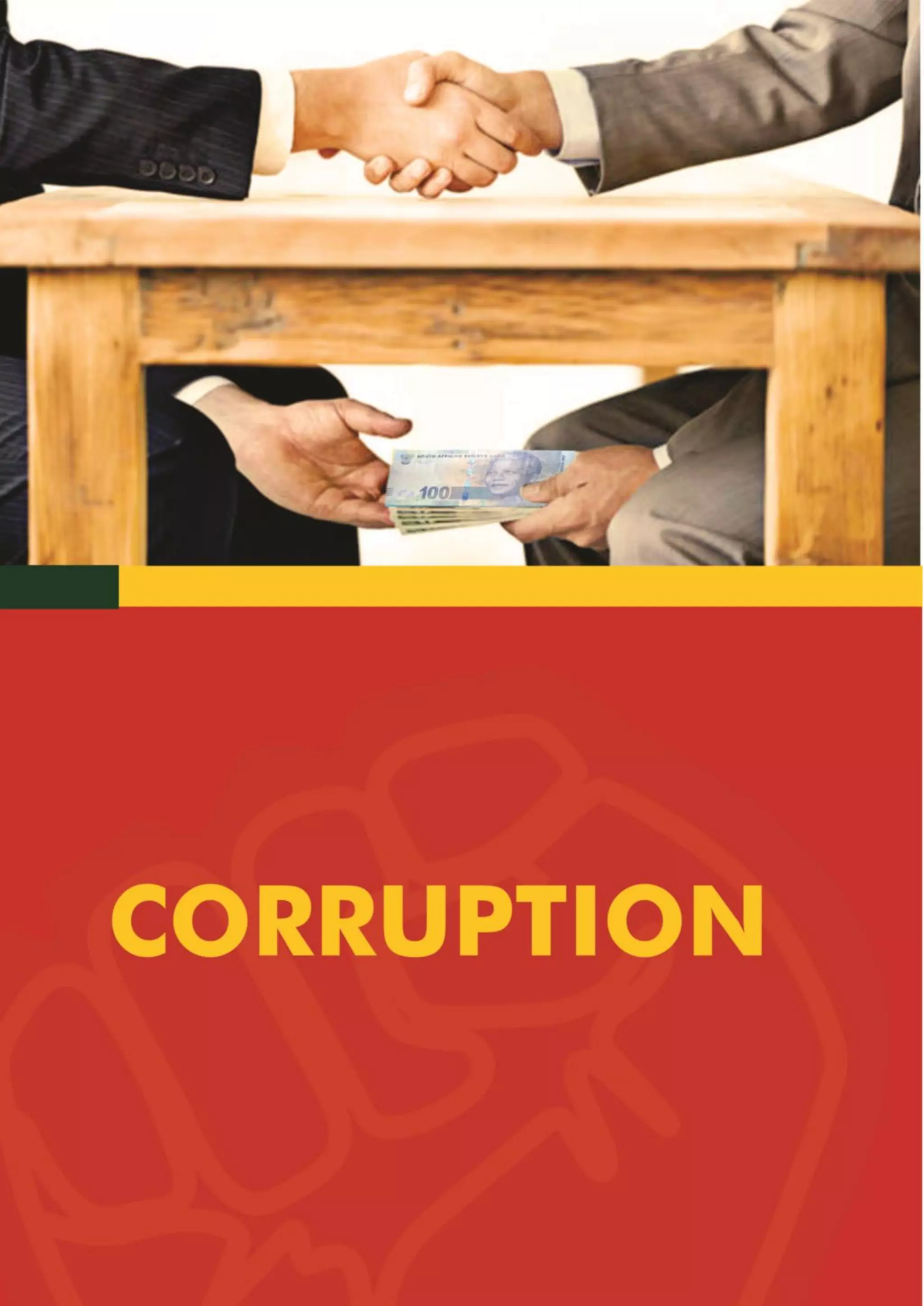
wrong.
4. The EFF government will position the bigger state-
owned companies to start massive infrastructure and
developmental investments in other parts of the world,
particularly on the African continent.
5. The EFF government will create a Sovereign Wealth
Fund that will, among other things, partner with foreign
direct investors with the clear purpose of maximising job
creation and combating illicit financial flows, tax
avoidance and base erosion.
6. The EFF government will amend the Public Finance
Management and Municipal Finance Management Acts
to make it compulsory for all spheres of government to
directly provide services in areas that are inherent
functions of the state.
7. The EFF government will insource all outsourced security
guards, cleaners, drivers, gardeners and general
workers who work at government departments and
104
facilities, hospitals, clinics, police stations, border post
offices, correctional facilities, schools and state-owned
companies, and it will employ an additional 80 000
workers within six months of being elected to
government, with pension and leave benefits.
8. The EFF government will fill all the funded vacant
positions in all government departments, clinics,
schools, hospitals and provincially owned entities by
June 2020.
9. The EFF government will immediately abolish tenders
for:
 Cleaning services,
 Security guard services,
 Gardening, horticulture and landscaping
services,
 Construction and maintenance services,
 Consultants,
 Professional services,
 Banking services,
 Telephone and internet services,
 The procurement of hospital linen and
garments,
 IT services and electronic equipment,
 Provision of catering in all hospitals,
correctional services and other government
facilities, including state-owned companies,
 Rental of buildings,
 Travel services,
 Management, maintenance and repair of
government vehicles,
 Building of schools,
 Building of roads and other infrastructure.
10. The EFF government will establish capacity to collectively
and in bulk procure 80% of locally produced fruits and
105
vegetables, paper, electronics, linen, garments,
uniforms, wooden and plastic materials for construction,
and store the goods to leverage economies of scale.
11. The EFF government will employ all public servants on
a full-time basis, with a clear employment contract and
performance agreement.
12. The EFF government will review and upgrade the
salaries of teachers, nurses, police officials, soldiers,
warders and all general workers to narrow the gap
between the highest and lowest paid government
workers.
13. A minimum of 50% of all senior positions in government
must be occupied by women, with equal pay, by 2022.
14. The EFF government will mandate all government
departments and state-owned entities to deposit
documents into the South African National Archive
Services annually.
15. The EFF government will publish the requirements for
promotion and all public servants who were promoted
on a quarterly basis.
16. The EFF government will disallow the use of bottled
water in all government facilities, including state-owned
entities. In the event that it is impractical to use tap
water, bottled water will be purchased from black-
owned companies, and women and youth-owned
companies will be prioritised.
17. The EFF government will bank and pay all public
servants’ salaries through a state-owned bank.
18. The EFF government will abolish the Expanded Public
Works Programme (EPWP) and employ all people in the
programme on a full-time basis.
106
19. The EFF government will establish the following state-
owned companies and provide them with strategic and
financial support:
 A state-owned housing construction company,
 A state-owned roads construction company,
 A state-owned cement company,
 A state-owned pharmaceutical company,
 A state-owned mining company,
 A state-owned food stocking company (to
regulate the prices of basic foodstuffs and
guarantee food security for all), and
 State-owned banks.
20. The EFF government will compile a detailed list of black
professionals, i.e. teachers, nurses, engineers, quantity
surveyors, project managers, geographers, chemists,
architects, biologists, environmental scientists,
psychologists, social workers, accountants, financial
analysts, audiologists and speech therapists, dentists,
dieticians and nutritionists, pharmacists, applications
programmers, computer network professionals,
database and network professionals, software
developers, system administrators and analysts,
geologists, meteorologists, etc. for placement into
strategic positions. They will undergo a training
programme and mentorship in government
departments and state-owned entities, and will be
responsible for building houses, roads and schools;
developing curricula; managing state-owned
information technology systems, etc.
21. The EFF government will employ graduates from
institutions of higher learning in government entities,
including state-owned entities, immediately after they
have graduated.
107
22. The EFF government will pay a once-off grant of R1
million to all black graduates who enrol for their
doctoral studies.
23. The EFF will pass legislation for the new government to
appoint all directors-general, boards and CEOs of
state-owned entities within six months after the elections.
24. The EFF government will establish a state-owned burial
scheme to bury the poor with dignity at no cost.
25. The EFF government will use professional services
companies that are 100% owned by South Africans and
50% owned by women and youth.
108
109
 AGRICULTURE, FISHERIES AND FORESTRY
AGRICULTURE:
1. The EFF government will strictly procure 100% locally
produced food.
2. The EFF government will build and support fresh
3. produce markets in each municipality for access by
small-scale food producers, with a minimum of 50%
access by women and the youth.
4. The EFF government will lead a massive programme
of food production by ensuring that all arable land in
South Africa is placed under production.
5. The EFF government will immediately put a stop to the
conversion of agricultural land into residential land
and game farms by adopting a strict principle of
‘agricultural land only for agricultural production’.
6. The EFF government will build agricultural colleges to
enhance and harness food production capacity at all
levels.
7. The EFF government will establish and capitalise
agricultural development nodes in each of the nine
provinces to increase the quantity and quality of
agricultural production in these areas and create a
million agricultural jobs.
8. The EFF government will maximise agricultural
productivity and massively invest in agro-processing in
all nine provinces through the following initiatives:
 The EFF government will maximally build and
support the cultivation and agro-processing of citrus
products in the Mopani region; the cultivation and
agro-processing of tomatoes in Mopani and the
cultivation and agro-processing of avocados,
110
bananas and other products in the Vhembe region
of Limpopo Province.
 The EFF government will maximally build and
support cattle farming and the agro-processing of
the resultant products in the Amahlathi region;
cultivation and agro-processing of maize in the Chris
Hani region; tea in the OR Tambo region; cannabis
for industrial and medical processing in the OR
Tambo and Alfred Nzo regions of the Eastern Cape
and aloe products in Amathole and OR Tambo.
 The EFF government will maximally build and
support the cultivation and agro-processing of maize
and cherries in the Thabo Mofutsanyane region in
Free State Province.
 The EFF government will maximally build and
support the cultivation and agro-processing of dry
beans, maize and soybeans in Gauteng Province.
 The EFF government will maximally build and
support the cultivation and agro-processing of
potatoes and tomatoes in the Namaqualand and
Pixley regions and grapes in the Siyanda ZF Macau
region in Northern Cape Province.
 The EFF government will maximally build and
support the cultivation and agro-processing of
sugarcane in the eThekwini, iLembe and Zululand
regions; maize in the uMzinyathi and uThukela
regions; citrus and bananas in the uGu and
uMkhanyakude regions; cattle-farming in the
Amajuba, uThukela and Zululand regions and
timber in the uMkhanyakude and Sisonke regions in
KwaZulu-Natal Province.
 The EFF government will maximally build and
support the cultivation and agro-processing of
oranges, litchis, bananas, naartjies, avocadoes,
111
macadamia nuts and mangoes in the Ehlanzeni
region; mangoes and bananas in the Bohlabela
region; peaches, plums and maize in the Nkangala
region and timber and maize in the Gert Sibande
region in Mpumalanga.
 The EFF government will maximally build and
support the cultivation and agro-processing of
sunflowers and maize in the Ngaka Modiri Molema
region; cattle and poultry farming in the whole of
North-West Province and cattle farming in Taung.
 The EFF government will maximally build and
support the cultivation and agro-processing of
grapes and onions in the Cape Winelands region;
increase the production of wine, cattle and sheep
livestock and grapes in the Central Karoo, West
Coast and Overberg regions in Western Cape
Province. The EFF government will also increase the
production of potatoes, onions and animal products
in the West Coast region and livestock production in
the Overberg region of the Western Cape. This will
also include abalone, especially in Hermanus -
Western Cape.
9. The EFF government will ensure that young and
emerging black farmers in all these agricultural
development nodes are prioritised and receive
technical and financial support, and that a minimum
of 50% of them are women.
10. The EFF government will unbundle the constricted
agricultural sector to reduce the monopoly of big
businesses and ensure a more decentralised and
vibrant agrarian regime.
11. The EFF government will actively promote the
subdivision of agricultural land and will ensure that our
112
new vision for agrarian reform is premised on the
sound and viable principle of promoting smallholder
agriculture.
12. The EFF government will, based on the agro-ecological
conditions of each province, limit the amount of land
that individuals and families have rights over.
13. The EFF government will re-introduce agricultural
product marketing boards to ensure that farmers
derive the most benefits from the sale of agricultural
products while, at the same time, opening up market
opportunities for emerging black farmers.
14. The EFF government will offer tax breaks to companies
that invest in catalysing agricultural production in any
of the identified agricultural development nodes,
provided that such investment is based on strict
principles of empowering local farmers to develop into
independent farmers.
15. The EFF government will outlaw the monopolisation of
the seed industry by a few companies and will allow
the local production of seed for agricultural
development.
16. The EFF government will outlaw the use of genetically
modified seed in South Africa until the health hazards
of these genetically modified seeds are fully
understood.
17. The EFF government will protect and subsidise local
agricultural production and marketing and will ensure
that the country does not import what can be produced
locally.
18. The EFF government will revitalise and rehabilitate the
dying poultry industry by strictly regulating the
importation of cheap and unhealthy poultry products
from the USA and Brazil, which has led to the collapse
of the local poultry industry.
113
19. The EFF government will regulate the importation of
dairy products and ensure that local dairy production
is capitalised, supported and protected.
20. The EFF government will introduce a law that compels
state institutions such as prisons, hospitals and schools
to procure their food needs from small and emerging
farmers.
21. The EFF government will construct and maintain
central abattoirs in every municipality to give access to
the market on a durable and sustainable basis to
producers of chicken, cattle, sheep, pig and sheep
meat products.
22. The EFF government will provide seeds, chemicals,
implements, irrigation and water schemes to
communities.
23. The EFF government will use tariff measures to protect
the forestry industry.
FISHERIES:
24. The EFF government’s approach to the fishing industry
will be guided by the principle that marine resources
are public resources and the exploitation of these
resources should benefit the public as a whole.
25. The EFF government will ensure the widescale
transformation of the fishing industry by allocating
fishing rights and licences to small-scale and emerging
black fishing companies.
26. The EFF government will provide technical and market-
related support and subsidies to fishing communities
to guarantee that they transition from subsistence to
commercial fishing.
27. The EFF government will intensify the development of
black participants in the fishing industry in the
114
following areas; West Coast (Western Cape), North
Coast of KwaZulu-Natal - particularly the area around
Kosi Bay, Margate on the South Coast, Jeffreys Bay
and Bluewater Bay in the Eastern Cape.
28. The EFF government will establish state-supported and
black-run aquaculture plants in each of the nine
provinces to promote the local production of fishery
requirements.
29. The EFF government will ensure the local beneficiation
of marine resources by constructing processing plants
in all the coastal provinces and promoting the creation
of jobs in fishing communities.
30. The EFF government will regulate the management of
protected marine areas such that local communities
are not deprived of their means of livelihood. To this
end, the EFF government will pay specific attention to
areas such as; Dwesa and Cwebe in the Eastern Cape,
to allow for the sustainable exploitation of marine
resources to provide for people’s livelihoods.
31. The EFF government will prioritise the regulation of
deep-sea trawling to minimise the destruction of
marine life by injudicious fishing companies and
ensure the long-term sustainability of our marine
resources.
32. The EFF government will legislate against the
exploitation of endangered fish species and will outlaw
commercial sales of these endangered species.
FORESTRY:
33. The EFF government will recapitalise and reposition
the South African Forestry Company (SAFCOL), a state
company, as the prime forestry company in South
Africa, leading the transformation objectives of the
state in this sector.
115
34. The EFF government will give SAFCOL overall control
of all state forests currently leased out to private
companies, allowing SAFCOL to renegotiate the terms
and conditions of the lease agreements to prioritise the
flow of benefits to communities in and around these
forests.
35. The EFF government will establish forestry
development nodes in the five forestry provinces of the
Eastern Cape, Western Cape, Mpumalanga, Limpopo
and KwaZulu-Natal, which will focus on ensuring
community ownership and control of forests and the
processing and production of community-owned
forestry products by timber-processing plants, furniture
and paper producing factories.
36. The EFF government will ensure that these community
enterprises are developed fully into major industrial
players that employ thousands of people.
37. The EFF government will take over full control of the
Zingcuka forests from the Amathole Forestry Company
and will ensure the socialisation of this forest by the
land claimant communities in and around this forest.
38. The EFF government will guarantee community
ownership of the Langeni Sawmill and Matiwane
Forest in Mthatha and will capitalise this forestry
enterprise to ensure it expands its employment
footprint.
39. The EFF government will ensure that ownership of the
state-owned forests in Hazyview and White River that
are currently leased to MTO Forestry (Pty) Ltd are
restored to the people and that MTO’s continued
operation in the area is premised on maximum
community participation and benefit.
116
117
 ECONOMY
1. The EFF government will strive for South Africa’s
economic sovereignty premised on inward
industrialisation with export capacity, the protection and
promotion of the labour-absorptive manufacturing
sectors and the provision of quality jobs to all people
who need employment.
2. The EFF government will strive for a South African
economic outlook where the state owns strategic sectors
of the economy, and where the ownership and control
of the non-state-owned sectors reflects the
demographics of South Africa.
3. The EFF government will de-commodify basic needs
such as education and health so that such services are
driven by the needs of the people and not by profit
maximisation.
4. The EFF government will amend the legislation that
governs the stock markets to introduce a minimum
number of women, youth and workers as owners and
beneficiaries of all listed companies.
5. The EFF government will introduce laws that compel
huge corporations to directly contribute to the
construction of schools, hospitals and other important
social development projects and programmes.
6. The EFF government will drive for regional and
continental economic integration in a manner that will
qualitatively and quantitatively expand economic
activities and intra-trade in South Africa, the SADC and
the African continent.
7. The EFF government will use state and state entity
procurement to stimulate local productive economic
expansion and development.
118
8. The EFF government will deliberately pursue a strategy
of economic decentralisation by promoting, protecting
and supporting industrial activities, particularly
manufacturing activities, in areas that currently do not
have significant industrial and manufacturing capacity
and activities.
9. Under the EFF government, the economy will grow at
6% in the first two years and 10% in the remaining three
years. To achieve this growth, the EFF government will
take the following key steps:
 Stabilise energy supply, particularly electricity supply,
through the qualitative and quantitative expansion of
Eskom’s capacity to provide environmentally friendly
electricity from coal, nuclear and renewable sources.
 Stabilise water supply through the construction of
dams, water treatment plants and massive
investment in the conversion of seawater into usable
water for industrial and household usage.
 Bring maximum stability to all state-owned
companies.
 Introduce legislation compelling all asset managers
to place a minimum of 30% of their investments in
the productive economy and not speculative
markets.
 Enforce the investment of a minimum of 40% of all
state-guaranteed pension funds, including those of
local municipalities and state-owned entities, in the
productive economy and infrastructure.
 Compel development financial institutions (DFIs) to
finance, incubate and promote a minimum of
30 000 SMMEs with less stringent requirements and
joint accounts. This will be supported through the
increased allocation of funds to DFIs.
119
 Enforce the domestic beneficiation of a minimum of
50% of natural resources extracted in South Africa.
 Pursue gradual import substitution through the
creation and support of domestically owned retail
outlets and spaces.
 Create multiple state-owned banks in various
sectors.
 Declare tax-free zones for industries on condition
that each company employs 2 000 workers on a full-
time basis, pays minimum wages and contributes to
workers’ pensions.
 Protect infant industries.
 Protect and promote informal traders.
 Expand the ocean economy, particularly
transforming marine manufacturing and
transportation, gas and oil exploration, and
aquaculture.
 Build a new railway system to support
industrialisation.
 Expand SOEs to provide services to other African
countries.
120
121
 JUSTICE SYSTEM AND CORRECTIONAL
SERVICES
1. The EFF government will massively expand the capacity
of Chapter 9 institutions that provide assistance to the
people particularly the; Office of the Public Protector of
South Africa, Human Rights Commission and Gender
Commission.
2. The EFF government will provide ordinary people with
access to quality legal representatives to represent
them in civil and criminal cases to ensure that their
rights are protected.
3. The EFF government will ensure that the correctional
services system is corrective rather than punitive. The
levels of re-arrests in South Africa are
disproportionately high because the country’s
correctional services system is not corrective.
4. The correctional services system will be transformed to
include compulsory education and skilling for all
prisoners. This will be followed by the scrapping of the
criminal record statuses of ex-convicts who were
convicted of certain schedules of crime, depending on
the seriousness of the crimes committed.
5. The EFF government will ensure that there is substance
to rehabilitation programmes with the intention to
properly re-integrate ex-offenders as productive, useful
and law-abiding citizens.
6. The EFF government will ensure that no correctional
services facility or programme is run by a private
corporation or company.
7. The EFF government will ensure equality before the
law, regardless of class, gender or race.
122
8. The EFF government will prioritise rehabilitation,
correctional behaviour and counselling programmes
as the fundamental programmes run by correctional
services, complemented by skills development and
academic training.
9. The EFF government will strengthen state capacity and
spearhead the training of all civil servants in matters
pertaining to basic statutory laws.
10. The EFF government will establish economic justice
courts to adjudicate civil matters involving both
individuals and corporations, so as to, achieve
maximum justice for those who have been unlawfully
mistreated and exploited by corporations.
11. The EFF government will criminalise the use of state
agencies to victimise, harass or kill members of the
population, whether privately or publicly.
12. The EFF government will protect the right to strike or
organise marches.
13. The EFF government will incorporate a functional and
effective juvenile and sexual offences arm into the legal
system.
14. The EFF government will abolish the bail system in
cases where the offence is a minor infraction.
15. Under the EFF government, minor offenses will not
attract a criminal record.
16. The EFF government will establish separate budgets for
all Chapter 9 institutions such as the Office of the
Public Protector, South African Human Rights
Commission, Commission for Gender Equality,
Auditor General, Electoral Commission, Public Service
Commission, Financial and Fiscal Commission, Pan
South African Language Board, Independent
Communications Authority of South Africa, and
Commission for the Promotion and Protection of the
123
Rights of Cultural, Religious and Linguistic
Communities to ensure their independence and proper
executive oversight.
17. The EFF government will double the number of sexual
offences courts by 2024.
18. The EFF government will require each law faculty at
institutions of higher learning to introduce a course, by
2020, on how legal professionals should conduct
themselves in court cases in order to protect the short-
and long-term mental and physical health of victims.
19. The EFF government will develop an online database
of all sexual predators, along with their relatives, which
any member of the public would be able to access at
any time, by 2020.
20. The EFF government will legalise the use of marijuana
by the end of 2019.
21. The EFF government will legalise sex work by the end
of 2019.
22. The EFF government will introduce community courts
for minor and petty crimes, excluding any crime that is
of a sexual nature or involves a child, by 2020.
23. The EFF government will appoint additional new
warders at correctional services facilities as follows; 1
000 in the Eastern Cape, 700 in the Free State, 1 500
in Gauteng, 1 200 in KwaZulu-Natal, 500 in Limpopo,
600 in Mpumalanga, 700 in North West, 600 in the
Northern Cape and 1 000 in the Western Cape.
24. The EFF government will increase the capacity of
correctional services facilities to accommodate 43 000
people, so as to reduce over-population by 2021.
25. The EFF government will introduce measures to
strengthen the Judicial Services Commission (JSC) to
ensure the adequate and speedy filling up of judicial
124
vacancies, the training of judges and the qualitative
transformation of the judiciary beyond numbers and
demographics. New measures will include the
retirement regime of judges and the role of retired
judges in the provision of judicial training and
development.
26. The EFF government will introduce legislative
measures to ensure the measurable transformation of
the legal profession by imposing strictly monitored and
enforced targets for briefing patterns of the historically
disadvantaged, women and black practitioners.
27. The EFF government will give legal briefs to legal
practitioners reflective of South Africa’s demographics,
with the emphasis on women and the youth.
28. The EFF government will consistently consult with
progressive voluntary associations in the legal sector.
29. The EFF government will enhance and harness
ordinary people’s access to quality legal
representatives for civil and criminal cases to ensure
that there is universal access to justice and courts.
30. The EFF government will pardon all ‘fees must fall’
students and political prisoners.
CONSTITUTIONAL STRUCTURE AND DEMOCRATIC
PARTICIPATION:
1. The EFF government will table the following
constitutional amendments:
2. Introducing measures to strengthen the power and
independence of the judiciary and the legislature;
 Changing the constitutional structure, including the
abolition of the provincial sphere of government,
accompanied by a mass restructuring and
125
strengthening of local government spheres into a
unitary state,
 Reducing the frequency and cost of elections by
holding national and local government elections at
the same time to enhance political stability and
accountability,
 Introducing provisions specifically aimed at the
protection of vulnerable groups, especially women,
children, people with disabilities and the LGBTQI
community,
 Introducing a progressive reduction of the voting age
to 16 with immediate effect to expand youth
participation in democracy,
 The abolition of registration fees for new political
parties and further regulation of political party
funding to reduce dependency on corporate
manipulation,
 Increasing the alcohol intake age to 21 years and
the further regulation of the liquor industry and
anyone who sells alcohol,
 Introducing measures to enhance democratic and
public participation between elections in the
workplace, academic institutions, sporting and other
voluntary associations and across society in general,
 Clarifying and elaborating on the role of traditional
leaders in respect of rural development and
dispensing indigenous forms of justice, and
 The repeal of all apartheid laws.
126
127
 ENVIRONMENT AND CLIMATE
1. The EFF government will rapidly increase the protected
area network to ensure that all representative
ecosystems unique to South Africa are preserved and
protected.
2. The EFF government will integrate local community
forums in the management of protected areas to
ensure that local people are not excluded from the
management of protected areas in their localities.
3. The EFF government will promote local participation in
initiatives to protect endangered and iconic species
such as rhinos. People living in and around protected
areas will be empowered and employed as the first line
of defence against marauding poachers.
4. The EFF government will streamline environmental
authorisation procedures to ensure that the
Department of Environmental Affairs becomes the only
authority that is able to grant authorisation for mining,
property development and other forms of
development.
5. The EFF government will, through strengthened
legislation, ensure that mining companies that have
abandoned mines are forced to come back and
rehabilitate denuded mining landscapes.
6. The EFF government will improve the monitoring
capacity of the state to ensure that there is zero acid
mine water drainage.
7. The EFF government will officially adopt the civil
society-driven ‘one million climate jobs’ initiative as a
government programme. Through this initiative, the
EFF government will create one million jobs aimed at
128
transitioning South Africa from coal-based energy
sources to renewable energy.
8. The EFF government will build a new recycling plant in
each municipality by 2023.
9. The EFF government will phase out the use of plastic
bags, so that by 2024 they are no longer being
distributed.
10. The EFF government will require all mining companies
to pay for the rehabilitation of mines that they have
abandoned and for the draining of acid water.
11. The EFF government will reduce carbon emissions by
10% by 2024.
12. The EFF government will reduce the levels of pollution
in all South Africa’s rivers by 60% by 2024.
13. The EFF government will require all children to clean
their school and the school grounds once a week.
14. The EFF government will require all citizens to clean up
their community once a month.
15. The EFF government will increase the allocation of
fishing quotas to small-scale fishermen and decrease
the allocation of fishing quotas to multinational
corporations.
16. The EFF government will nationalise all game reserves,
particularly the game reserves in Waterberg and
uMkhanyakude, and bring them under the
management of South African National Parks
(SANParks).
17. The EFF government will collaborate with African
governments to drive the Green Revolution across the
continent, underpinned by agriculture, good
production and environmental protection
18. The EFF government will progressively introduce
carbon taxes as one additional tool in the fight for
sustainable development.
129
130
 FISCAL FRAMEWORK
1. The EFF government will maximally collect taxes with
the aim of a 20% increase in current annual tax
collections.
2. The EFF government will reduce the state debt to under
20% of the GDP.
3. The EFF government will equitably distribute nationally
raised revenue in the ratio of 40% nationally and 60%
locally.
4. Under the EFF government, a minimum of 50% of
funds allocated to local government must be used
solely to deliver services.
5. The EFF government will use a build, operate and
transfer funding mechanism for infrastructure
development.
6. The EFF government will increase capital gains tax and
inheritance tax so as to ease the tax burden of the poor
and transfer it to the rich.
7. The EFF government, including state-owned
companies, will abolish tenders and insource all
security guards, cleaners, gardeners, drivers and
general workers.
8. The EFF government, including all state-owned
companies, will disallow the use of consultants and
directly employ people with capacity.
9. The EFF government will discontinue housing subsidies
for ministers.
10. The EFF government will discontinue the appointment
of deputy ministers.
11. The EFF government will move the Parliament to
Pretoria.
12. The EFF government, including all state-owned
entities, will discontinue the rental of buildings.
131
Instead, it will occupy government-owned buildings
built by a state-owned construction company.
13. The EFF government, including all state-owned
entities, will use Telkom services for all information and
technology related services.
14. The EFF government, including state-owned entities,
will use the services of state-owned banks.
15. The EFF government will remove all presidential and
ministerial spousal support.
16. The EFF government, including all state-owned
companies, will buy all goods directly from
manufacturers at a discounted price to leverage
economies of scale.
17. The EFF government will build government-owned
storage facilities to store non-perishable goods.
18. A state-owned mining company will start operating at
all coal mines owned by Eskom and will export surplus
coal to generate revenue for the fiscus.
19. The EFF government will nationalise all mines and
allocate key shares in South Africa’s mineral and
petroleum resources to the Sovereign Wealth Fund.
20. The EFF government will increase corporate income
tax from 28% to 32%, with a 25% dividend tax, in
2020.
21. The EFF government will increase capital and
inheritance gains tax.
22. The EFF government will introduce education and
training taxes on all private companies at a minimum
of 2% of total revenue for companies with a turnover
of R50 million and more, to be used to fund fee-free
quality education.
23. The EFF government will increase taxes on speculative
capital inflows to 60%.
132
24. The EFF government will raise an additional R100
billion annually through curbing illicit financial flows,
including the expropriation of multinational companies
which participate in tax avoidance and institute a
stronger penalty regime with jail sentences for directors
and executives.
25. The EFF government will pass an Anti-Avoidance of
Tax Act to illegalise all forms of tax avoidance and will
ensure that all those found to be engaged in tax
avoidance and tax base erosion are imprisoned.
26. The EFF will establish a multi-disciplinary cross-agency
task team, independent from the South African
Revenue Services (SARS) and National Treasury, which
will include officials from the National Treasury,
Financial Intelligence Centre (FIC), South African
Reserve Bank (SARB) and SARS, to gather and publish
reliable statistical data on illicit financial flows.
27. The EFF government will launch a Judicial Commission
of Inquiry into illicit financial flows since 1990, headed
by a Constitutional Court Judge, by 2020. The
Commission will include local and international
experts on illicit financial flows and it will make specific
recommendations in respect of past and future
transgressions, prevention, detection and the
imposition of suitable punitive and restorative
measures.
28. The EFF government will adopt a long-term
infrastructure financing model.
29. The EFF government will combine all Municipalities’
Pension Funds into one Municipal Employees Pension
Fund (MEPF), with an investment mandate that focuses
on Municipal Infrastructure Development.
133
30. The EFF government will reduce the cabinet to half of
its current size and proscribe the positions of deputy
ministers.
31. The EFF government will reduce VAT to 14%.
32. The EFF government will highlight employment
targeting as the primary measure of fiscal.
134
135
 SCIENCE AND TECHNOLOGY
1. The EFF government will use science, technology and
innovation not as ends in themselves but to produce
the knowledge, information, skills and talent needed
to support, facilitate and fuel the development and
growth of strategic industries and sectors of the
economy and society which are central to the overall
independence and sovereignty of South African and
African people.
2. In order to do this, the EFF government will focus on:
 Knowledge acquisition and deepening,
 Knowledge creation,
 Knowledge transfer,
 Developing and nurturing a culture of
innovation, and
 Ensuring that research and development
spending accounts for 2.5% of GDP by 2024.
3. The EFF government will connect all schools to high-
speed fibre by 2023.
4. The EFF government will build and upgrade computer
and science labs and provide all necessary equipment
to every school, creating 5 000 jobs, 2 500 of which
will be reserved for women, by 2024.
5. The EFF government will integrate critical thinking and
problem solving into every part of the school
curriculum by 2024.
6. The EFF government will integrate the use of
technology across the curriculum, and into teaching
methods, by 2023.
7. The EFF government will include robotics and coding
into the curricula at all schools by 2023.
136
8. The EFF government will increase the intake at
institutions of higher learning at both universities and
TVETs on an annual basis.
9. The EFF government will synchronise the goals and
needs of the economy with the number of places
available at each institution of higher learning.
10. The EFF government will incentivise the studying of
science, engineering, software development, robotics
and artificial intelligence.
11. The EFF government will connect all institutions of
higher learning to high-speed fibre by 2023.
12. The EFF government will provide each student with a
laptop by 2024.
13. The EFF government will fast-track the digitisation of
institutions of higher learning according to annual
targets.
14. The EFF government will integrate the use of
technology into all fields of study at institutions of
higher learning by 2022.
15. The EFF government will support and protect the
following industries, while incentivising and
encouraging innovation and the use of technology
within these industries, thereby creating jobs:
 Agriculture and animal husbandry
 Health care and pharmaceuticals
 Energy
 Water and sanitation
 Environment
 Transport, aerospace and drones
 Biotechnology
 Mining
 Information and communications technology
 Industrialisation and manufacturing
 Robotics, artificial intelligence and big data
137
 Defence and cybersecurity.
16. The EFF government will build and establish two seed
banks by 2024, creating 3 000 jobs, 1 600 of which
will be reserved for women and the youth.
17. The EFF government will build three agricultural
research and development centres, focused on animal
husbandry, seeds, and soil and irrigation by 2023,
creating 7 000 jobs, 3 600 of which will be reserved
for women and the youth.
18. The EFF government will train 25 000 farm workers by
2022 on how to operate new farming machinery and
computers.
19. The EFF government will establish a digital e-filing
system linking the entire South African health care
system and all records by 2021, creating 4 000 jobs,
2 500 of which will be reserved for women and the
youth.
20. The EFF government will establish a state
pharmaceutical research and development centre
focusing on biotechnology and generic
pharmaceuticals, tailored to the pharmaceutical needs
of South Africa and the continent, by 2022, creating
2 000 jobs, 1 000 of which will be reserved for women
and the youth.
21. The EFF government will establish two new research
and development centres focused on developing cures
and treatments for communicable and non-
communicable diseases, integrating the use of
traditional forms of medicine, by 2023, creating 2 500
new jobs, 1 300 of which will be reserved for women
and the youth.
22. The EFF government will establish a research and
development centre focused on integrating artificial
138
intelligence and robotics into the health system by
2024, creating 1 500 jobs, 800 of which will be
reserved for women and the youth.
23. The EFF government will establish a research and
development centre focused on developing technology
in the renewable energy sector and batteries by 2022,
creating 2 500 new jobs, 1 300 of which will be
reserved for women and the youth.
24. The EFF government will establish a research and
development centre focused on nuclear technology
and the disposal of nuclear waste by 2023, creating
2 500 new jobs, 1 200 of which will be reserved for
women and the youth.
25. The EFF government will establish a research and
development centre focused on oil and gas refining
and the development of clean coal and oil use by
2024, creating 2 000 jobs, 1 000 of which will be
reserved for women and the youth.
26. The EFF government will increase the number of
artisans and engineers employed by Eskom at a 10%
annual rate over the next five years, with 60% of all
new artisans and engineers employed being women
and the youth.
27. The EFF government will establish two research and
development centres focused on sewage, dam
development and irrigation, and desalination by
2022, creating 3 500 jobs, 1 800 of which will be
reserved for women and the youth.
28. The EFF government will increase the number of
artisans and engineers employed by the Department
of Water and Sanitation at a 10% annual rate over the
next five years, with 60% of all new artisans and
engineers employed being women and the youth.
139
29. The EFF government will employ 250 software
developers, 125 of whom will be women, to provide
AI-driven solutions to water management and water
scarcity by 2022.
30. The EFF government will complete the digitisation of
South Africa’s railway network by 2023, creating
2 500 jobs.
31. The EFF government will employ 350 software
developers, 175 of whom will be women, by 2022 to
provide AI-driven traffic solutions for South African
cities and rail networks.
32. The EFF government will expand the mandate and
budget of the South African National Space Agency,
creating 7 500 jobs by 2023.
33. The EFF government will establish a research and
development centre by 2024, which will be
accountable to the Departments of Defence and
Transport and will focus on drone development,
creating 7 500 jobs, 4 000 of which will be reserved
for women.
34. The EFF government will upskill 50 000 miners,
20 000 of whom will be women, by 2024 so that they
have the skills to operate new mining machinery and
computer systems.
35. The EFF government will establish a new research and
development centre by 2022, focusing on new uses for
minerals and mineral beneficiation, new methods of
mining, and safer methods of mining, creating 10 000
jobs, 5 000 of which will be reserved for women and
the youth.
36. The EFF government will employ 20 000 new people
in cybersecurity, 10 000 of whom will be women and
the youth, by 2024.
140
37. The EFF government will employ 300 software
developers, 150 of whom will be women and the
youth, to provide AI-driven solutions to policing and
the allocation of police resources in South Africa by
2022.
38. The EFF government will facilitate, coordinate and
incentivise vertical and horizontal cooperation and
coordination between institutions of higher learning,
research and development centres, state-owned
enterprises, and productive and strategic sectors of the
economy.
39. The EFF government will coordinate and facilitate the
transfer of skills from the education system to the
strategic and productive areas of the economy.
40. The EFF government will encourage and incentivise the
application of research and development findings to
the various production processes of SOEs and private
companies.
41. The EFF government will establish and fund research
and development units at all SOEs by 2023, creating
12 000 jobs, 6 000 of which will be reserved for
women.
42. The EFF government will require SOEs to spend at least
2% of their budget on research and development by
2022.
43. The EFF government will fast-track the digitisation of
all SOEs.
44. The EFF government will encourage the use of artificial
intelligence, robotics and advanced technologies of
the Fourth Industrial Revolution at SOEs.
45. The EFF government will establish artificial intelligence,
robotics and biotechnology SOEs, creating 45 000
jobs by 2024, 23 000 of which will be reserved for
women and the youth.
141
46. The EFF government will protect and subsidise
companies focusing on advanced Fourth Industrial
Revolution technologies.
47. The EFF government will provide tax incentives for
companies in strategic sectors of the economy that
allocate more than 2.5% of their budget to research
and development.
48. The EFF government will both regulate and nationalise
telecommunications companies.
49. The EFF government will significantly reduce the cost
of data.
50. The EFF government will roll out fibre across the
country with the goal of universal internet access by
2024, creating 25 000 jobs, 12 500 of which will be
reserved for women.
51. The EFF government will fast-track the migration from
analogue to digital transmission.
52. The EFF government will subsidise the production of
ICT hardware, ICT software, robots, artificial
intelligence and biotechnologies.
53. The EFF government will use state financial institutions
and SOEs to invest in ICT infrastructure.
54. The EFF government will launch five communication
and GPS satellites belonging to the state or SOEs by
2023.
55. The EFF government will require each department,
SOE and municipality to submit an annual report
detailing how they have innovated and used
technologies, particularly advanced Fourth Industrial
Revolution technologies, to improve service delivery
and meet their mandates.
142
56. Research and development AND 8% on prescribed
developmental goals set by the state as a sole or
majority shareholder.
57. The EFF will roll out free Wi-Fi in all schools, institutions
of higher learning and public parks.
143
144
 SPORTS, ARTS, CULTURE AND RECREATION
1. The EFF government will remove apartheid statues and
take them to a dedicated apartheid museum as a
reminder to future generations under the theme:
‘NEVER AGAIN’.
2. The EFF government will immediately change the
National Anthem to the original Nkosi Sikelela I Afrika.
3. The EFF government, through PANSALB, will ensure
that every child is able to speak, read and write in their
mother tongue before matriculation.
4. The EFF government will establish a statutory body
which will regulate and professionalise the arts and
culture industry.
5. The EFF will facilitate the provision of financial services
specific to the creative industry.
6. The EFF will deal decisively with the culture of artists’
paying bribes to radio DJs to play their music.
7. The EFF government will commission the writing of a
proper history of South Africa.
8. The EFF government will build two multi-purpose
indoor sports facilities in each district municipality and
five in each metropolitan municipality. Each facility will
include gym equipment, an indoor pool, an indoor hall
comprising six separate pitches which can be used for
various sports, and shower facilities, by 2023.
9. The EFF government will build outdoor gyms in each
ward.
10. The EFF government will build a minimum of one park
in each ward.
11. The EFF government will subsidise the broadcasting of
all South Africa’s national sport codes on the SABC.
12. The EFF government will immediately require sponsors
of sporting codes to split the money equally between
145
female and male teams, particularly Banyana
Banyana.
13. The EFF government will immediately increase the
game and training day salaries of all female sports
teams representing the country by 200%.
14. The EFF government will change the names of every
road, natural attraction, building or any other asset
where the name has any direct or indirect link to the
colonial or apartheid period by the end of 2019.
15. The EFF government will commission South African
sculptors to build statues memorialising African and
anti-colonial heroes, with 50% of all statues to be
commissioned to be sculpted by women and the youth.
16. The EFF government will refurbish and revitalise all
relevant museums and memorials in the country by
2022.
17. The EFF government will require radio stations to play
a minimum of 75% African content by 2024.
18. The EFF government will require all TV stations to air
a minimum of 75% African content by 2024.
19. The EFF government will build a small outdoor mini-
theatre in each ward in the country by 2022.
20. The EFF government will build an arts and culture
centre in each ward in the country by 2022.
21. The EFF government will establish a state non-profit
music distribution and production company by 2023,
which local artists can use to produce and distribute
their music, which will also provide legal services to
artists so that they can reclaim ownership of their
material from record companies.
22. The EFF government will only hire local artists for state
events, with prioritisation of up-and-coming artists
over those that are already established.
146
23. The EFF government will loan recording and musical
equipment to artists free of charge by 2021.
24. The EFF government will commission local artists to
paint and beautify government facilities and public
spaces such as schools, hospitals, parks and buildings.
25. The EFF government will require art galleries to exhibit
and sell a minimum of 90% locally produced art.
26. The EFF government will allocate a minimum of 75%
of the Department of Arts and Culture’s budget to the
support and development of local artists.
27. The EFF government will hold monthly festivals in each
district municipality, allowing local unknown artists to
showcase their talents to the public.
28. The EFF will establish a fund to support all African
writers, in particular women, by 2020.
29. The EFF will turn the Pan South African Language
Board into an institution supporting democracy with a
budget to develop all indigenous languages.
30. The EFF government will buy 3 000 copies of every
book published by a South African author to be
distributed to libraries across the country.
31. The EFF government will build a community library in
every ward by 2023.
32. The EFF government will establish a fund to support
the production of local films.
33. The EFF government will establish a central database
on which all artists can publish their portfolios.
34. The EFF government will subsidise the distribution of
local films by 2020.
35. The EFF will require local film producers to only employ
local actors by 2023.
36. The EFF will require any studio or company that wants
to film in South Africa to use 95% local actors by 2023.
147
37. The EFF will require any studio or company that wants
to film in South Africa to engage in some form of co-
production, with skills hand-over.
38. The EFF will introduce seven more channels on the
SABC which will be solely dedicated to the airing of
South African and African TV series and movies by
2022.
39. The EFF will require all advertisers to use 90% local
music.
40. The EFF will require the co-production of Telenovelas
by white and black-owned production companies, with
all projects to be handed over to black-owned
production companies by 2024.
41. The EFF government will release a once-off grant and
partner with the insurance industry to start an
insurance company for the creative industry.
42. The EFF government will make sure that broadcasters
pay artists their royalties on time, including historical
claims.
43. The EFF government will build recording studios for
artists in every municipality.
44. The EFF government will ensure that artists own their
intellectual property.
45. The EFF government will establish a state organ to
replace SAMRO and perform the duties of SAMRO for
artists to get their money on time.
46. The EFF government will transform the advertising
space.
47. EFF government will work with artists to create
programmes for the fashion, photography and design
industries etc. and will use existing school and
community centre infrastructure as places of training
148
to offer various skills to the youth through extramural
activities.
48. The EFF government will create incubator programmes
for artists to offer them training in various aspects of
running a commercially sustainable creative business.
49. The EFF government will arrest anyone who is found
selling pirated material and will also pass legislation
for harsher sentences.
50. The EFF government will develop a central, transparent
and accessible system for artists to apply for funding
and consolidate all government funding into one
funding system to achieve maximum impact.
51. The EFF government will build an additional six
theatres in Limpopo Province (Polokwane), the Eastern
Cape (Mthatha and Port Elizabeth), North-West
(Mafikeng), Mpumalanga (Nelspruit) and the Northern
Cape (Kimberley).
52. The EFF government will establish functional and well-
funded local arts and culture councils in all provinces
for the development of arts and culture at a provincial
level.
53. The EFF government will establish an arts and culture
regulatory body regulated by an act of Parliament for
all creative arts bodies to register with and be
regulated. All of this is with the aim of professionalising
the creative industry.
54. The EFF government, working with the University of the
Witwatersrand, University of Cape Town, University of
KwaZulu-Natal, University of Fort Hare, University of
Limpopo, University of Pretoria and University of the
Free State, will establish a national control body to
acknowledge and recognise prior learning and
practice in the creative industry to empower artists and
give them qualifications.
149
55. The EFF government will take creative arts practitioners
with experience and place them in schools to develop
the curriculum and to teach and peer review each
other.
56. The EFF government will pass legislation for 80% of all
adverts that are aired by public broadcasters to use
local music and African artists, a 50% minimum of
which must be owned by women and the youth.
57. The EFF government will establish a directorate within
the Department of Arts and Culture, and employ
creative industry practitioners, to offer practitioners in
the creative industry on a monthly basis:
 Assistance with contracts management, and
 Assistance with applications for grants, tax
incentives and infrastructure subsidies.
58. The EFF government will establish a creative arts
marketing board to assist all practitioners to market
their work in Africa and the world.
59. The EFF government will abolish tenders for festivals
and will subsidise the hosting of festivals in each
province annually.
60. The EFF government will pass legislation to prosecute
all music compilers at SABC Radio who get paid
by/demand payment from artists for them to play their
music in their radio stations.
61. The EFF government will require sporting codes to split
their budgets equally between female and male teams
by the end of 2019, starting with Banyana Banyana
and Bafana Bafana.
62. The EFF government will release a once-off
capitalisation grant of R10 billion and partner with the
insurance industry and the PIC to design insurance and
other financial services products specifically designed
150
for the arts, culture, entertainment, film and music and
sport sectors
63. The EFF government will outlaw payola, introduce high
penalties and design regulations aimed at giving
equitable airplay for new local music and films. All
radio stations will be compelled to play a minimum of
51% of local music per day
64. The EFF government will pay royalties owed to living
and departed musicians, including processing
historical claims
65. The EFF government will replace SAMRO with a state-
owned entity which will be tasked with looking after the
financial interests of musicians, songwriters and
composers and to protect their intellectual property.
151
152
 INFORMATION AND COMMUNICATION
TECHNOLOGY
1. The EFF government will own 60% of Telkom.
2. The EFF will ensure the diversification of media
ownership and transform the media.
3. A minimum of 50% of government advertisements will
be spent on black-owned companies, in particular
women and youth companies.
4. The EFF government will allocate spectrum in a
manner that seeks to drive transformation of the
communications sector, break the concentration of
control, drive industrialisation, and prioritise state-
owned companies which have the highest
representation of black people, women and the youth.
5. The EFF will assist black and particularly black female-
owned telecommunications companies to enter the
market in partnership with the state.
6. The EFF government will roll out fibre across the
country with the goal of universal internet access by
2024, creating 75 000 jobs, 38 000 of which will be
reserved for women.
7. The EFF government will fast-track the migration from
analogue to digital transmission so that migration
takes place by the end of 2019.
8. The EFF government will provide free Wi-Fi for all
state-owned public transport systems, clinics, hospitals,
government buildings, schools and institutions of
higher learning.
9. The EFF government will establish free Wi-Fi parks in
wards.
10. The EFF government will establish a subsidiary of
Telkom which will specifically focus on the production
of ICT hardware and software by 2023, creating
153
15 000 jobs, 7 500 of which will be reserved for
women.
11. The EFF government will establish an ICT hardware
manufacturing hub in Ekurhuleni focusing on
computers and micro-chip development and
manufacturing by 2024, creating 45 000 jobs, 25 000
of which will be reserved for women.
12. The EFF government will establish an ICT software
development hub in Cape Town by 2024, creating
40 000 jobs, 20 000 of which will be reserved for
women.
13. The EFF government will establish an ICT software
development hub in eThekwini by 2024, creating
40 000 jobs, 20 000 of which will be reserved for
women.
14. The EFF government will require each government
department, SOE and municipality to have an ICT plan
by 2020, detailing how they will digitalise and migrate
to paperless facilities, processes and services.
15. The EFF government will require all government
workers to undergo basic ICT training courses.
16. The EFF government will by the year 2020, establish a
well-resourced state social media unit which will
communicate all government announcements,
programmes and decisions, creating 8 000 jobs,
4 000 of which will be reserved for women.
17. The EFF government will require each municipality to
have a social media team to deal with service delivery
queries, with each team having a minimum of two full-
time employees, by 2021.
18. The EFF government will require Telkom to spend 25%
of its annual profits on ICT infrastructure over the next
five years.
154
19. The EFF government will build a computer lab
attached to every public library in the country.
20. The EFF government will increase the number of staff
members employed by the SABC by 11% annually over
the next five years.
21. The EFF government will subsidise all community radio
and TV stations by 2020.
22. The EFF government will provide interest-free loans to
start-ups in the ICT sector by 2021, with 55% of loans
to be allocated to women and the youth.
23. The EFF government will digitalise the filling in of
government forms so that the public is able to access
them, fill them in and submit them online by 2023.
24. The EFF government will employ an additional 5 000
software engineers by 2022.
25. The EFF government will assist black and particularly
black female-owned entrants into the communications
and media industry, placing a limit on the number of
white-owned entrants.
26. The EFF government will prioritise black and
particularly black female-owned communication and
media companies when it comes to subsidies, market
access and state contracts.
155
156
 ROAD INFRASTRUCTURE
1. The EFF government will see to the labour-absorbing
construction of quality roads for all communities by
employing people in communities to maintain and
ensure the sustainability of the roads.
2. The EFF government will abolish the e-Toll system and
will physically remove all e-Toll structures from our
roads.
3. The EFF government will investigate ways of helping the
taxi industry financially and will find concrete ways of
protecting and promoting it into an efficient public
transport system.
157
158
 NATIONAL INFRASTRUCTURE
1. The EFF government will adopt a long-term funding
framework for infrastructure development and will
explore different build, operate and transfer models as
a means of infrastructure delivery, working with the
private sector to build infrastructure through public-
private partnerships.
2. The EFF government will maximally use infrastructure
development and expansion as a means for massive
labour-absorbing industrialisation for the upstream and
downstream sectors.
3. The EFF government will establish the following state-
owned companies and provide them with strategic and
financial support:
 A state-owned housing construction company.
 A state-owned roads construction company.
 A state-owned cement company.
4. The EFF government will introduce laws that compel
large corporations to directly contribute to the
construction of schools, hospitals and other important
social development projects and programmes.
5. Railway infrastructure:
 The EFF government will expand the railways, buy
new trains, and invest in affordable speed trains
along Moloto Road between the Tshwane and
Nkangala regions in Mpumalanga, between Soweto
and Johannesburg, between Musina and
Johannesburg, between Johannesburg and Cape
Town and, vitally, between Durban and
Johannesburg to transport people and goods that
come from the harbour.
 The EFF government will upgrade and refurbish all
current public transport railway lines by 2021.
159
 The EFF government will increase the number of
carriages on public transport railways by 50%, by
2023.
 The EFF government will increase the number of
carriages on public transport railways by 35%, by
2024.
 The EFF government will build railway infrastructure
in and around its power plants and coal mines to
facilitate easy access thereto by 2022.
 The EFF government will build and upgrade railway
infrastructure around all mines and industrial hubs
by 2022.
6. Water and dam infrastructure:
 The EFF government will repair all water treatment
centres by 2020.
 The EFF government will build a new water treatment
facility in each province by 2021.
 The EFF government will employ 10 000 artisans to
repair all leaks in the water infrastructure with the
aim of reducing the amount of water lost by leaks to
10% of the current rate by 2022.
 The EFF government will build storm water drains in
every street in South Africa by 2022.
 The EFF government will build water infrastructure
so that each household will have in-house hot
running water and sanitation by 2024.
 The EFF government will ensure water sustainability
for daily and industrial usage by building dams and
large-scale water projects with the capacity to
sustainably supply South Africa, increasing current
capacity by 20%, by 2023.
160
7. Sports and recreational infrastructure:
 The EFF government will build two multi-purpose
indoor sports facilities in each district municipality
and five in each metropolitan municipality by 2023.
Each facility will include gym equipment, an indoor
pool, an indoor hall comprising six separate pitches
which can be used for various sports, and shower
facilities.
 The EFF government will build outdoor gyms in each
ward by 2022.
 The EFF government will build a minimum of one
park in each ward by 2022.
 The EFF government will build a small outdoor mini-
theatre in each ward in the country by 2022.
 The EFF government will build an arts and culture
centre in each ward in the country by 2022.
 The EFF government will build a community library
in each ward by 2023.
 The EFF government will build recording studios in
every municipality for artists to record their work by
2022.
8. Harbour infrastructure:
 The EFF government will build three new harbours
along the West Coast and six new harbours along
the East Coast specifically designed for small-scale
fishing vessels to use.
 The EFF government will build industrial-size freezers
at all harbours for use by small-scale fishermen.
 The EFF government will increase the ship and cargo
holding capacity of Cape Town Harbour, Richards
Bay Harbour, East London and Ngqurha (Port
Elizabeth) by 30% by 2022.
161
 The EFF government will re-equip all harbours so
that they are able to handle a variety of products,
including industrial products.
 The EFF government will increase the fuel storage
capacity of all harbours by 30%, by 2024.
 The EFF government will install industrial-size x-ray
machines at all harbours by 2021.
 The EFF government will increase the railway line
capacity of all major harbours by 30%, by 2023.
9. Educational infrastructure:
 The EFF government will electrify all schools by
2021.
 The EFF government will ensure that there is hot
running water and in-house sanitation in every
school by 2021.
 The EFF government will tar all roads around schools
by 2021.
 The EFF government will ensure that no school is
built from inappropriate material by 2020.
 The EFF government will build two grass fields, two
pitches and a swimming pool at every school by
2023.
 The EFF government will build a library in all
schools without libraries by 2022.
 The EFF government will connect all schools to
high-speed fibre by 2023.
 The EFF government will connect all institutions of
higher learning to high-speed fibre by 2023.
 The EFF government will ensure that each institution
of higher learning is connected to a railway line or
has a taxi rank by 2023.
162
10.Health care infrastructure:
 The EFF government will build a taxi rank at every
hospital by 2022.
 The EFF government will tar all roads around public
health care facilities by 2022.
 The EFF government will connect every public health
care facility by 2023.
 The EFF government will upgrade hospitals such
that each district in South Africa has a regional or
tertiary hospital with a minimum of 450 beds, open
24 hours a day, with internal medicine, paediatrics,
obstetrics, gynaecology and general surgeons, by
2022.
 The EFF government will build specialised hospitals
for the following disease categories: tuberculosis,
diabetes mellitus, cerebrovascular diseases, heart
disease, hypertensive diseases, chronic lower
respiratory diseases and ischaemic heart diseases.
 The EFF government will build at least one clinic per
ward in all wards of South Africa and will extend this
to one polyclinic per village in wards that are
composed of more than one village by 2024.
11.Community infrastructure:
 The EFF government will increase the number of
drug rehabilitation facilities in the country by 50%,
by 2024.
 The EFF government will construct and maintain
central abattoirs in every municipality to give access
to the market on a durable and sustainable basis to
producers of chicken, cattle, sheep, pig and sheep
meat products, by 2022.
 The EFF government will build a market place with
stands in each ward by 2022.
163
 The EFF will establish multi-purpose community
centres, which will include free Wi-fi, in every ward
by 2023.
164
165
 INTERNATIONAL RELATIONS
1. The EFF government will work towards ending the
global imperialist dominance of the West. It will build
relations with all progressive nations in Latin America,
Asia and the African continent. The aim will be to
establish a world order that is not dominated by the
West but is conducive to equal political and economic
relations.
2. The EFF government will lead a progressive programme
to build international political, social and economic
solidarity among African states.
3. The EFF government will lead a progressive programme
to reject foreign and in particular Western domination
of African economies.
4. The EFF government will lead a progressive programme
which will end Africa’s being merely an exporter of
natural resources, turning it into an economy that
beneficiates and industrialises its own raw materials.
5. The EFF government will work towards the rejection of
the Africa Command Centre, a military programme of
the United States based in Botswana.
6. The EFF government will work towards the African
isolation of Botswana, which has been home to an
imperialist military base, and fight for progressive
internal reforms within Botswana which should involve
the people of Botswana.
7. The EFF government will work towards building a strong
relationship with Lesotho and will ensure that the
resources that South Africa receives from Lesotho,
particularly water, benefit the people of Lesotho.
8. The EFF government will, within five years, fight for
democratic political reforms in Swaziland, including the
166
political and economic isolation of the Monarchy, until
there are meaningful political changes and tolerance in
the country.
9. The EFF government will protect Zimbabwe from
imperialist threats and sanctions, ensuring that
Zimbabwe is self-sustainable and returns to using its
own independent currency within five years.
10. The EFF government will implement incremental
boycotts, divestment and sanctions against the
apartheid state of Israel as a concrete form of solidarity
with the Palestinians to end the illegal occupation of
Palestinian territories by Israel.
11. The EFF government will build sustainable and balanced
relations with all progressive forces in the world and will
relate with growing economies, particularly China,
Russia, Brazil and India, in a mutually beneficial way.
12. The EFF government will work in solidarity with the
people of Western Sahara to realise real political
independence from colonial domination.
13. The EFF government will radically pursue the
democratisation and radical transformation of
multilateral bodies such as the UN Security Council so
that they are reflective of the countries of the world, as
opposed to reflecting the economic and military strength
of countries.
14. The EFF government will radically pursue regional
economic integration with a view to easing economic
trade within the African continent.
15. The EFF government, with the cooperation of regional
and continental governance structures, will engage in
ethical peacekeeping missions to ensure peaceful
resolutions in conflict-ridden regions.
167
16. The EFF government will advocate for a Pan African
Parliament (PAP) to have legislative powers to hold other
states accountable.
17. The EFF government will advocate for the establishment
and functioning of an African Court and the equipping
thereof with resources.
18. The EFF government will play a leading role in the
promotion of intra-African trade partnerships and
relationships. This means that the EFF government will
direct the South African economy to purchase goods
and services that can be produced within the African
economy, whilst exporting its economic goods and
services to other countries within the African economy.
19. The EFF will build relations with countries that appreciate
that South Africa and Africa as a whole is not merely a
supplier of natural resources and products, but a
country and continent that should develop industrially
and technologically.
20. The EFF government will build relations with countries
and economies that are willing to invest in real and
genuine industrial development and skills transfer to the
South African and African economies.
21. The EFF government will lead a progressive programme
to reject the foreign, particularly Western, domination of
African economies as well as so-called neoliberal
globalisation.
22. The EFF government will radically pursue regional
economic integration with the view to easing economic
trade within the African continent. This will include the
radical transformation of the African Union and the
revision of its Project 2063 into a more comprehensive
Project 2038, by which year the African economy must
resemble the best practices found in, for example, the
168
modern Chinese economy while guaranteeing basic
democratic freedom.
23. The EFF government will champion global co-operation
between progressive political parties and governments
which subscribe to the humanist ideologies of the left
and believe in people before profits as opposed to the
neoliberal philosophy of celebrating greed, selfishness,
exploitation and the concentration of wealth among the
richest 1% of the world’s population.
24. The EFF will fight African leaders who want to stay in
power forever.
25. The EFF government will strengthen the African Union
to intervene in places where there are political
instabilities and social crises.
26. The EFF government will re-evaluate all trade
agreements.
27. The EFF government will fight for the International
Criminal Court (ICC) to prosecute war lords such as
Tony Blair and George Bush.
28. The EFF government will mobilise and fight trade
embargoes against Cuba through increased trade
exchanges.
29. The EFF government will ensure that the International
Criminal Court is restructured and democratised so that
it is enabled to prosecute war criminals across the
board, including western leaders.
30. The EFF government will fight for a borderless Africa
and a single currency in the medium to long-term
31. The EFF government will advocate for the introduction
of Ki-Swahili as a common and compulsory official
language of communication across the African
continent.
169
170

EFF 2019 election manifesto

  • 2.
    2 CONTENTS FOREWORD ................................................... 5 INTRODUCTION.......................................... 14 DIAGNOSIS: WHAT ARE THE CONDITIONS IN SOUTH AFRICA TODAY? ... 21 THE EFF’S COMMITMENT AND PLAN OF ACTION ....................................................... 27  LAND ...................................................................................28  CORRUPTION ......................................................................39  GENDER, WOMEN AND LGBTQI..........................................42  LGBTQI ................................................................................45  YOUTH DEVELOPMENT.......................................................47  CRIME..................................................................................50  EDUCATION.........................................................................54  HEALTH................................................................................67  HUMAN SETTLEMENTS, WATER AND SANITATION............75  PEOPLE WITH DISABILITIES.................................................81  TRADITIONAL LEADERS.......................................................83  ENERGY ...............................................................................86  MINING ...............................................................................90  FINANCIAL SECTOR .............................................................94  SOCIAL DEVELOPMENT.......................................................99
  • 3.
    3  STATE CAPACITY................................................................103 AGRICULTURE, FISHERIES AND FORESTRY........................109  ECONOMY.........................................................................117  JUSTICE SYSTEM AND CORRECTIONAL SERVICES .............121  ENVIRONMENT AND CLIMATE..........................................127  FISCAL FRAMEWORK.........................................................130  SCIENCE AND TECHNOLOGY .............................................135  SPORTS, ARTS, CULTURE AND RECREATION.....................144  INFORMATION AND COMMUNICATION TECHNOLOGY ...152  ROAD INFRASTRUCTURE...................................................156  NATIONAL INFRASTRUCTURE ...........................................158  INTERNATIONAL RELATIONS.............................................165
  • 4.
  • 5.
    5 FOREWORD The year 2019marks exactly 25 years since the attainment of political freedom in South Africa. As observed in the Founding Manifesto of the Economic Freedom Fighters (EFF), political freedom in South Africa has hardly translated into observable economic emancipation. Black people remain landless, they remain on the margins of economic production and outside of life-enhancing economic participation. The majority of those that participate in the economy do so as suppliers of cheap and easily disposable labour. Landlessness and joblessness among black South Africans are at crisis levels, posing the biggest challenges that confront South African society today. While focusing on clear, implementable and decisive programmes for all spheres of governance, the EFF’s emphasis for the 2019 general elections will be on LAND and JOBS. Consequently, the EFF’s theme for the 2019 elections is: OUR LAND AND JOBS NOW. The emphasis on LAND derives from the fact that 25 years since the attainment political freedom, 80% of the population continues to occupy less than 10% of South Africa’s land. The emphasis on JOBS is motivated by the sad reality that after 25 years of attempts at
  • 6.
    6 addressing the matter,more than seven million capable South Africans who need jobs are unemployed, with no hope that anything will change unless the current government is changed. The emphasis on NOW is informed by the fact that 25 years is a rather long time for any political party to keep making empty promises. The emphasis on NOW is also because our people live in absolute poverty. Similarly, the emphasis on NOW is because our people are landless. The emphasis on NOW is because our people are jobless. Yet again the emphasis on NOW is because the crises of racialised poverty, inequality, underdevelopment, landlessness and joblessness are being experienced NOW, and must be resolved NOW! More fundamentally, the emphasis on NOW is because we cannot postpone the true liberation of our people from economic apartheid. We are not part of the 1994 elite pact. We are a completely new generation, with new demands. And our demands, unlike those of the 1994 generation, will not be postponed. We refuse to be silenced with so-called reconciliation. We want justice now. We want our land now. We want jobs now. We demand the economy NOW! It is our considered view that the political change-over in 1994, did not bring true liberation. It was a bluff which continues to subject black people to economic and social apartheid. This economic apartheid must end now. The demand for land and jobs now is the demand to end apartheid because it is now evident that apartheid did not end in 1994. We are not part of the CODESA compromises, which only focused on taking over political power without the control of the economy. We are a
  • 7.
    7 generation that isfighting for true economic emancipation NOW! The economy in South Africa continues today to be under the ownership and control of white minority settlers, whose ownership and control of land in particular, were gained through settler colonialism and its corollary - the dispossession of the black colonised. Other sectors of the economy, such as the retail chains, industry and the financial sector, are also owned and controlled by the white minority in South Africa. All the means of economic survival and existence continue to be controlled by the white minority. All of this continues to be the case two decades after the country attained political freedom. The black majority, and Africans in particular, are the numerical majority, yet they continue to be the economic minority, living under difficult conditions and perennially begging for participation in and benefit from what is a white- owned economy linked to the global capitalist system. The few black people who participate in the economy, do so, subject to white approval through a black economic empowerment model that is ostensibly designed to benefit a small number of individuals without ever changing the structural exclusion of the majority. The post-1994 governments have dismally failed to transfer economic power to the black majority and, even worse, to optimally use government ownership and control of certain state assets for the benefit of all South Africans. Instead, they have reproduced and worsened apartheid economic inequalities, such that a prominent defining characteristic of all post-1994 governments is their perpetuation of economic apartheid defined along racial lines. Whilst political apartheid
  • 8.
    8 has been abolished,economic and social apartheid remain a stark reality, evidenced by the fact that poverty is associated with blackness and wealth with whiteness. The Economic Freedom Fighters has demonstrated in its five years of existence, through various interventions and political leadership in different spheres of influence, that it is the only political movement that will bring about real economic change in South Africa. As a movement, we carry collective and individual capacity that will fundamentally change South Africa’s economy in a manner that will allow us to reclaim economic ownership, expand the productive economy, give black people real ownership, create jobs and drive inclusive development. The EFF’s political programme is the only programme that is embedded in the interests of all South Africans, having been organically developed to meet people’s demands. The manifesto we present hereafter for the 2019 general elections is therefore not a wish list of unattainable goals, but a clear programme of action of what we will do when elected as government of South Africa. The EFF Manifesto 2019 is based on primarily three sources: a) The numerous submissions the EFF received from different sectors through public consultations, which included public meetings, letters to different organisations, social media inputs and oral submissions; b) The Founding Manifesto of the EFF; and c) The collective experience the EFF gained through its participation in Parliament, Provincial Legislatures and Municipal Councils.
  • 9.
    9 It is importantto highlight that the EFF’s political programme is underpinned by the desire for ECONOMIC FREEDOM IN OUR LIFETIME. This is a generational clarion call that we will never deviate from. The EFF’s manifesto commitments for the 2019 general elections are inspired by as well as based on our movement’s seven cardinal pillars, which constitute the core of our approach to genuine revolutionary transformation of society for the better. The seven pillars are: a. Expropriation of South Africa’s land without compensation, for equal redistribution in use b. Nationalisation of mines, banks and other strategic sectors of the economy, without compensation c. Building state and government capacity, which will lead to the abolishment of tenders d. Free quality education, health care, houses and sanitation e. Massive protected industrial development to create millions of sustainable jobs, including the introduction of minimum wage(s) in order to close the wage gap between the rich and the poor, close the apartheid wage gap and promote rapid career paths for Africans in the workplace f. Massive development of the African economy and advocating for a move from reconciliation to justice on the entire continent g. Open, accountable, corrupt-free government and society without fear of victimisation by state agencies.
  • 10.
    10 The seven cardinalpillars and all the areas which the manifesto covers are of crucial importance to us in their totality, while specific emphasis is being placed on LAND and JOBS. It is our firm belief that the crisis levels of poverty, inequality and underdevelopment being experienced in the country can be ended by the reclamation and equitable redistribution of the land and the creation of millions of jobs. The current government has spectacularly demonstrated that it is incapable both now and in the foreseeable future to economically empower all South Africans. The EFF does not promote job creation at any cost. The quality of jobs and the quality of life in the workplace are also of utmost importance. The role of trade unions therefore needs to be specifically guaranteed and protected. The wage gap is also one of the biggest contributors to inequality. Statistics show that in South Africa, the wealthiest three billionaires own more wealth than the poorest 26 million citizens. Globally, it will take four days for the CEOs of the world’s largest fashion companies to earn what a clothing worker in those companies earns in a lifetime. Economic wealth therefore must be transferred from the hands of the few to the hands of the many. The EFF’s manifesto takes into consideration various domestic, regional, global, geo-political, economic and industrial developments. We particularly take into consideration that we have the obligation to present a credible JOBS strategy in the era of the Fourth Industrial Revolution, which could reduce the number of people employed to produce goods and services for a wage. The Manifesto will address these developments in a manner that appreciates reality and yet achieves maximum benefits.
  • 11.
    11 What distinguishes theEFF’s 2019, election manifesto from all other election manifestos is that it makes specific commitments with timelines and clearly specifies areas that will receive the deliverables, illustrating the movement’s readiness and preparedness to govern on behalf of the people. The era of meaningless and broad promises is over. The EFF’s quantitative and qualitative growth has taught us that we should always stay in contact with the people and understand their demands and aspirations. Some of the policy innovations contained in this manifesto include: a) Land redistribution policies which will guarantee land access by all landless people for residential, industrial, cultural, religious and recreational purposes; b) Multiple special economic zones to promote inward industrialisation and manufacturing investments with export capacity in order to make the ownership and control of the economy demographically representative, expand its productive capacity and create millions of jobs; c) Doubling of social grants in order to reduce the crisis levels of poverty and boost domestic economic demands and expansion; d) Usage of legislated state procurement as a boost for localisation and creation of sustainable quality jobs, prioritising women and the youth; e) Reconfiguration of the spheres of government into national and local spheres and eliminating the provincial sphere in order to redirect resources to impactful service delivery and investments; and
  • 12.
    12 f) Amending theconstitution to make the National Prosecutions Authority (NPA) a Chapter 9, institution accountable to Parliament in order to stop selective prosecutions and fight corruption. Fellow South Africans, Commissars, Fighters, and all Ground Forces, the EFF hereby presents our commitments, a programme of action and a clearly articulated plan on what we will do when elected to govern on behalf of the people. These are not empty promises. They are clear commitments that will be realised under the decisive and capable leadership of the Economic Freedom Fighters. The clarion call is clear: OUR LAND AND JOBS NOW! VICTORY IS CERTAIN! Revolutionary regards, Julius Sello Malema
  • 13.
  • 14.
    14 INTRODUCTION The EFF’s electionmanifesto will focus on the key areas set out below. It should be highlighted that each focus area will have a localised expression and jobs dividend. A. WHERE DOES THE ECONOMIC FREEDOM FIGHTERS MOVEMENT COME FROM AND WHAT HAVE WE ACHIEVED? B. DIAGNOSIS: WHAT ARE THE CONDITIONS IN SOUTH AFRICA TODAY? C. THE EFF’S COMMITMENTS AND PLAN OF ACTION ON: 1) LAND 2) JOBS 3) CORRUPTION 4) GENDER, WOMEN AND LGBTQI 5) YOUTH DEVELOPMENT 6) CRIME 7) EDUCATION 8) HEALTH 9) HUMAN SETTLEMENTS, WATER AND SANITATION 10) PEOPLE WITH DISABILITIES 11) TRADITIONAL LEADERS 12) ENERGY 13) MINING 14) FINANCIAL SECTOR 15) SOCIAL DEVELOPMENT 16) STATE CAPACITY 17) AGRICULTURE, FISHERIES AND FORESTRY 18) ECONOMY 19) JUSTICE SYSTEM AND CORRECTIONAL
  • 15.
    15 SERVICES 20) CONSTITUTIONAL STRUCTUREAND DEMOCRATIC PARTICIPATION 21) ENVIRONMENT AND CLIMATE 22) FISCAL FRAMEWORK 23) SCIENCE AND TECHNOLOGY 24) SPORTS, ARTS, CULTURE AND RECREATION 25) INFORMATION AND COMMUNICATION TECHNOLOGY 26) INFRASTRUCTURE 27) ROAD INFRASTRUCTURE 28) INTERNATIONAL RELATIONS A. WHERE DOES THE ECONOMIC FREEDOM FIGHTERS MOVEMENT COME FROM AND WHAT HAVE WE ACHIEVED? The Economic Freedom Fighters (EFF) is a revolutionary socialist economic emancipation movement founded in 2013, in South Africa to fight for economic freedom in our lifetime. The EFF is a registered political party with 890 public representatives in the National Assembly, the National Council of Provinces, Provincial Legislatures and Municipal Councils. Since its formation, the EFF has, among many others, registered the following victories: 1) Through various efforts the EFF led the country into discussing the amendment of the constitution to realise the expropriation of land without compensation for equal redistribution.
  • 16.
    16 2) The EFFgot former President Mr Jacob Zuma to pay back money spent on non-security-related upgrades at his homestead in Nkandla. 3) The EFF effectively led a political process that stopped the Gupta criminal syndicate from running the country’s government and key state-owned companies. 4) The EFF used its Parliamentary participation to table the following laws, which will fundamentally change the economic architecture of South Africa to benefit ordinary South Africans: i. The National Health Amendment Bill, which will ensure that all clinics in South Africa are open 24 hours a day; ii. The Insourcing of all Government and State Entities Bill, which will result in the insourcing of all workers who provide constant services to government and state companies; iii. The Illegalisation of Alcohol Advertisement Bill, which will end the celebration and promotion of alcohol consumption in South Africa; iv. The Banks Amendment Bill, which will lead to the creation of a state-owned bank; and v. The Nationalisation of the South African Reserve Bank Bill, which will discontinue private ownership of the central bank. 5) The EFF used its Parliamentary participation to table motions which sought to achieve the following: i. Provision of free-fee education for the poor at higher education level, which was rejected by the ruling party; ii. Increase in mineworkers’ salaries and improvement of their working conditions; iii. Repeal of all apartheid legislation and laws that continue to govern South African society;
  • 17.
    17 iv. Nationalisation ofbanks and changing how state- owned companies are managed; and v. Submission on illicit financial flows, tax avoidance and base erosion in Parliament as well as to SARS and the Davis Tax Committee. 6) The EFF led and supported land occupation programmes which resulted in residential land being given to many landless people in all the provinces. 7) The EFF led a decisive political programme that resulted in the admission of more than 100 000 students to institutions of higher learning without their having to pay any fees. 8) The EFF’s public representatives and leadership have individually and collectively assisted many communities with: i. Implements for agricultural productivity, including tractors; ii. School assistance programmes and bursaries that help hundreds of schoolchildren; iii. School uniforms and vital learning and teaching support materials; iv. Many labour disputes that prevented racism, dismissals and retrenchments; and v. Legal representation that prevents evictions. 9) The EFF caucuses at provincial and local levels tabled insourcing bills and motions for government to disallow anyone to work for government through a third party to provide common services such as cleaning, gardening, security guards etc. 10) The EFF caucuses in Johannesburg, Tshwane and Nelson Mandela Bay tabled successful motions on the insourcing of municipality workers, as a result of which thousands of
  • 18.
    18 security guards arenow full-time employees with proper salaries at the municipalities. 11) The EFF caucuses in Johannesburg and Tshwane tabled successful motions to have clinics remain open 24 hours a day. As a result, clinics in cities are now open 24 hours, seven days a week. 12) The EFF had Parliament debate the plight of ‘Fees Must Fall’ activists in support of all activists who were arrested and remained behind bars or who were involved in court cases or awaiting trial in prison. 13) The EFF in KwaZulu-Natal tabled a motion for the discontinuation of all contracts with KPMG by provincial government. The motion was adopted by the provincial legislature. 14) The EFF in Rustenburg tabled a motion to reinstate 100 workers whose employment with the Council had been wrongfully terminated. The motion was adopted by the Council. 15) The EFF in Bela-Bela tabled a motion for a land expropriation programme. As a result, the Council allocated 700 fully serviced stands to deserving recipients. 16) The EFF in Modimolle tabled a motion for the Municipal Council to scrap all debt that indigent people owed. The motion was adopted by the Council. 17) The EFF in Nelson Mandela Bay tabled a motion for the insourcing of security guards, with a salary increase from R4 000 to R11 000. The motion was adopted by the Council. 18) The EFF secured transport for learners who previously had to walk long distances to school in Buffalo City. 19) The EFF in Matjhabeng in Free State helped 95 workers who had been employed on contract for more than ten years to secure full-time positions.
  • 19.
    19 20) The EFFprotected the independence of the office of the Public Protector. 21) The EFF has made politics fashionable and worthy. 22) The EFF has made Parliament vibrant. 23) The EFF has helped many people with legal representation, including artists. 24) The EFF fought for the insourcing of workers at institutions of higher learning such as Wits University, University of South Africa (UNISA), University of Kwa Zulu/Natal (UKZN) and University of Pretoria (UP). 25) The EFF pushed President Zuma out of office through a motion of no confidence. 26) The EFF introduced secret voting in Parliament. 27) The EFF has gained credibility at institutions of higher learning by constantly winning SRC elections. 28) Wherever the EFF led the SRC, poor students were provided with free sanitary towels and one meal a day. 29) The EFF effectively gave land to 50 000 people who were landless. 30) The EFF helped to remove corrupt government officials at Nelson Mandela, Tshwane, Johannesburg, Thabazimbi, Modimolle, Mogale City and Jozini municipal councils. 31) The EFF has built the confidence of black people and confronted racism everywhere where it encounters it. 32) The EFF is the only party that has a higher gender balance in Parliament, provincial legislature and municipal councils. The EFF has had many collective and individual victories in all the provinces and numerous municipalities, some which cannot for reasons of space be included here. In sum it has brought hope to ordinary South Africans and revived their confidence in politics.
  • 20.
  • 21.
    21 DIAGNOSIS: WHAT ARETHE CONDITIONS IN SOUTH AFRICA TODAY? 1) The large majority of black South Africans are landless, and the post-1994 governments have cumulatively bought less than 7% of the targeted 30% of land meant for redistribution, over a period of 25 years. 2) Close to 40% of South Africans who need jobs are unemployed, meaning that more than nine million South Africans who need jobs and are capable of working cannot find employment. The present government has failed dismally in devising a strategy for creating employment for all, and unemployment has since 1994, never been below 20%. 3) The South African governments have consistently over the past 25 years adopted a legislative and policy framework according to which service delivery is completely dependent on external service providers and tenders. Thus, the government itself lacks the capability to perform basic/core government functions. 4) The food economy in South Africa is dominated by the white minority at all levels, from land ownership and agricultural production to the packaging and retailing of food - nothing has changed since 1994. 1. The South African economy has not fully developed its productive capacity to provide jobs for millions of unemployed people and is still heavily dependent on the importation of finished goods and products.
  • 22.
    22 2. South Africa’seducation system is not well positioned to respond to the Fourth Industrial Revolution due to a lack of high-technology infrastructure, and the post-secondary education and training institutions cannot absorb all learners from secondary schools. 3. South Africa’s health care system excludes a substantial number of South Africans, and the country is sadly, still far from achieving universal health coverage. 4. Millions of South Africans still reside in unsafe human settlements and remain trapped in poverty. 5. South Africa has extra-ordinarily high levels of crime. An average of 20 000 murders are committed annually, and huge numbers of violent crimes are not properly resolved. 6. Social development and assistance do not deliver impactful results in resolving the massive poverty and inequality challenges. 7. South Africa’s criminal justice system does not serve justice to poor people, and its correctional services system is not corrective. 8. South Africa’s energy plan and capacity are not dependable enough to allow for massive industrialisation and reliable household usage. 9. South Africa’s environmental management does not adequately address the protection of the climate because of the country’s complete dependence on polluting energy sources. 10. The financial sector in South Africa is owned and controlled by a financial cartel that excludes and discriminates against many people on racial grounds.
  • 23.
    23 11. South Africa’sfiscal architecture permanently incapacitates the state from achieving basic service delivery demands, and taxes are not maximally collected from the private sector. 12. South Africa has trivialised science and technology and is thus not maximising the potential thereof to improve people’s lives. 13. South Africa’s international relations policies are not positioned to maximally benefit the country. 14. Women in South Africa are still at the margins of economic empowerment and are largely excluded from senior positions in both the private and public sectors. 15. People with disabilities are not optimally taken care of. 16. South Africa’s infrastructure back-log is still massive, particularly in areas where black people reside. 17. The role of traditional leadership is not clearly defined, and this leads to abuse of the institution of traditional leadership. 18. South Africa’s architecture of procurement leads to massive corruption in both the private and public sectors. 19. In South Africa, women are violently abused and killed every day. South Africa is thus considered a rape capital. 20. In South Africa, there is no free education. 21. In South Africa, 55% of young people are unemployed and cannot find work. 22. Data is expensive in South Africa. 23. In South Africa, black people live on dumping sites.
  • 24.
    24 24. In SouthAfrica, drug abuse and gangsterism are prevalent. 25. In South Africa, leadership recipients are paid poorly and exploited. 26. In South Africa, teenage pregnancy is extremely high. 27. In South Africa, violence against the LGBTQI community is prevalent. 28. In South Africa, anti-black racism and xenophobia against Africans are on the rise. 29. South Africa’s local government is extremely underfunded. 30. In South Africa, artists are underpaid. Their jobs are not protected, and many die poor, as a consequence. 31. In South Africa, women in sports are paid less than their male counterparts. 32. South Africa has a bloated cabinet with useless deputy ministers. 33. South Africa still has apartheid murders. 34. South Africa still uses an apartheid national anthem. 35. In South Africa, streets, buildings, towns and monuments are still named after apartheid icons. 36. South Africa has one of the highest school dropout rates. 37. South Africa has insufficient learning spaces and accommodation at institutions of higher learning. 38. South Africa still has schools where children learn under trees or in mud structures and/or must use pit toilets. 39. South Africa still has bucket toilets. 40. South Africa still has bogus initiation schools which lead to death.
  • 25.
    25 41. South Africastill has a huge, widening gap between poor and rich people. 42. In South Africa, there are still kids who walk kilometres to school and back.
  • 26.
  • 27.
    27 THE EFF’S COMMITMENTAND PLAN OF ACTION
  • 28.
    28  LAND 1. TheEFF government will ensure that the amendment of Section 25 of the 1996 South African Constitution to allow expropriation of land without compensation for equal redistribution and use is carried through with immediate effect. 2. All land will be under the custodianship of the state, for equal redistribution to all. 3. The EFF government will pass accompanying legislation such as a Land Redistribution Act and an Agrarian Reform Act. 4. The EFF government will discontinue ownership of land by a few and ensure that all South African land is owned by all South African people through the principle of progressive state custodianship of land. 5. The EFF government will redistribute land in a manner that is demographically representative, meaning that black people will accordingly control the majority of the land, as they constitute the majority in South Africa. 6. The EFF government will redistribute a minimum of 50% of the land to be controlled by women and the youth. 7. The EFF government will abolish foreign land ownership. 8. The EFF government will establish a People’s Land Council to manage and redistribute land to all those who need it for residential and productive purposes. 9. The EFF government will establish a land ombudsman to ensure that people’s rights to the land are protected and not subjected to arbitrary abuse by state officials and injudicious mining companies. 10. The EFF government will reconfigure the Land Claims Court into the People’s Land Court which will be
  • 29.
    29 constituted by noless than ten permanent judges in order to speed up the resolution of all land disputes. 11. The EFF government will once and for all guarantee that the right to land of people living in communal areas, such as the people of Xolobeni, is an absolute right, and that no one has authority to dispossess indigenous people of their right to land for the benefit of a few capitalists. 12. The EFF government will develop a new system of land rights registration to ensure that communal and customary land rights are recordable and offered the same protection as other forms of rights over land. 13. The EFF government will abolish rentals of all residential land. 14. The EFF government will allocate land for residential, agriculture and industrial usage for free. 15. The EFF government will allocate land for residential purposes with inheritance rights. 16. The EFF government will not abolish the rights of traditional leaders in the allocation and redistribution of land. 17. The EFF government will nationalise all game reserves, particularly the game reserves in Waterberg region in Limpopo and uMkhanyakude region of Kwazulu-Natal, bringing them under the management of South African National Parks (SANParks).
  • 30.
  • 31.
    31  JOBS As of2019, South Africa has a workforce of 25.4 million people with the capacity to work. Only 16.4 million of them have jobs while the remaining nine million are unemployed, meaning that 35% of South Africans who are seeking employment are jobless. To create jobs, the EFF government will do the following: 1. The EFF government will ensure and lead massive and protected sustainable industrial development and diversification to create millions of decent jobs between 2019 and 2024. This will happen through state-led industrialisation, industrial diversification, the protection of infant and existing industries, the transfer of ownership to black people through subsidies, an increase in tariffs, and state-aided marketing and promotion of South African products internally, across the continent and worldwide, with a focus on key, progressive and most beneficial trading partners. 2. The EFF government will declare multiple special economic zones in various regions of South Africa, clearly emphasising that each investor will gain special economic zone benefits such as tax incentives and factory building allowances if they each employ and sustain a minimum of 2 000 jobs. 3. The EFF government will ensure that a minimum of 80% of the goods and services procured by the state at all levels and at all state companies are domestically produced. 4. The EFF government will ensure that a minimum of 50% of all South Africa’s mineral resources are locally beneficiated, processed and value added.
  • 32.
    32 5. The EFFgovernment will ensure that all food for local consumption is produced and processed on a massive scale in South Africa. This will happen through the intensification of small-scale farming and agriculture and by giving strategic support to all small-scale agricultural operations, including providing trade routes. All food traders in South Africa will be compelled by law to buy South African food products and to support operations that produce these food products. 6. The EFF government will build sustainable food processing zones that will supply food items to other parts of the world, particularly the rest of Africa, China, Latin America and India. This will lead to the creation of millions of jobs across the entire food chain. 7. The EFF government will help communities in the coastal areas to start agro-fishing corporates and businesses, which will be their main source of income and livelihoods. 8. The EFF government will ensure that all products and goods that contribute to state construction projects are locally produced, bar exceptional cases where there is no capacity to produce locally. 9. The EFF government will ensure the development, protection and localisation of industries which produce basic and daily used goods through import substitution mechanisms. These include:  Glasses, cups, plates, spoons, pots etc.  Tiles and energy-efficient building materials  Furniture, energy-efficient light bulbs and decorating materials  Solar water geysers, insulation material and energy-efficient products  Washing products and soap  Electronics
  • 33.
    33  Basic energy-efficientelectronics  The textile industry including, clothing and shoes, and  Agro-processing of food. 10. The EFF government will ensure that small and medium- sized enterprises are given strategic support and that legislation is passed to ensure that key industrial inputs and services to big corporates and companies are provided by SMMEs. 11. The EFF government will protect the right of street hawkers and informal traders to trade in a safe and clean environment in all the cities of South Africa without fear of police harassment. 12. The EFF government will prohibit the confiscation of street traders’ goods as a means of enforcing municipal by-laws. 13. The EFF government will amend the PFMA and MFMA to compel national, provincial and state-owned entities to procure 80% of all goods from local producers and a minimum of 50% from producers of which 50% is owned and controlled by women and the youth. 14. The EFF government will build and support state-owned trading and retail platforms in every municipality. 15. The EFF government will declare the following areas as special economic zones with zero company taxes and a building allowance in exchange for each investor creating 2 000 full-time jobs, paying a minimum wage and pension contributions:
  • 34.
    34 Free State 1. QwaQwain the Thabomofutsanyana region 2. Thabanchu in the Mangaung region 3. Deneysville in the Fezile Dabie region Eastern Cape 1. Butterworth in the Amathole region 2. Mount Ayliff and Mbizana in the Alfred Nzo region 3. Cofimvaba in the Chris Hani region 4. Graaff-Reinet in the Cacadu region 5. Mthatha and Port St Johns in the OR Tambo region 6. Sterkspruit in the Joe Gqabi region 7. King Williams Town in the Amathole region Mpumalanga 1. Bushbuck Ridge and Mjindini in the Enhlanzeni region 2. Marapiane in Dr J.S. Moroka in the Nkangala region 3. Moloto in Tembisile Hani in the Nkangala region 4. Mkhizeville in Mkhondo in the Gert Sibande region 5. Enyibe in Msukalikwa in the Gert Sibande region Limpopo 1. Groblersdal in the Sekhukhune region 2. Seshego in the Capricorn region 3. Mogalakwena in the Waterberg region 4. Shayandima in the Vhembe region 5. Phalaborwa in the Mopani region North West 1. Kagisano and Taung in Dr Ruth Segomotsi Mompati 2. Ramotshere and Ratlou in the Ngaka Modiri Molema region 3. Moses Kotane in the Bojanala region
  • 35.
    35 KwaZulu-Natal 1. uMhlabuyalingana inthe uMkhanyakude region 2. eDumbe in the Zululand region 3. Utrecht in the Amajuba region 4. Ladysmith in the uThukela region 5. eNquthu in Umzinyathi 6. Umzimkhulu in the Sisonke region 7. Scottsburgh in the Ugu region 8. Maphumulo in the Ilembe region Northern Cape 1. The whole province must be declared a special economic zone with industrial assistance for all companies that create a minimum of 2 000 jobs per investor per area. Western Cape 1. Cape Agulhas in the Overberg region 2. Beaufort West in the Central Karoo region 3. Ashton in the Cape Winelands region 4. Oudtshoorn in the South Cape region 5. Citrusdal in the West Coast region. 16. Under the EFF government, township economy equates to township industrialisation, and special tax-free economic zones will be created in populous townships. 17. The EFF government will declare township areas as special tax-free zones in exchange for 2 000 full-time jobs per investor paying a minimum wage and pension contribution per company. 18. The EFF government will pass legislation that ensures a minimum wage of R4 500 across the board for all full- time workers and will fight that each of the following
  • 36.
    36 sectors accordingly receivesthe stipulated minimum wage:  Mineworkers: R12 500 per month  Farm workers: R5 000 per month  Manufacturing workers: R6 500 per month  Retail workers: R5 000 per month  Builders: R7 000 per month  Petrol attendants: R6 500 per month  Cleaners: R4 500 per month  Domestic workers: R5 000 per month  Private security guards: R7 500 per month  Full-time waiters and waitresses: R4 500 per month. 19. The EFF government will use state procurement as an instrument for driving job creation, meaning that a minimum of 80% of all goods and services procured by the state must be locally produced, and majority-owned and controlled by the people of South Africa. 20. The localisation drive will include all procurement, inclusive of automobiles, electronics, textiles, food and professional services. 21. The EFF government will pass a policy that 100% of the food procured by the state for school feeding schemes, hospitals, prisons, etc. is locally produced by emerging historically excluded farmers, and that a minimum of 50% is procured from women and the youth. 22. The EFF government will put measures in place to ensure that a minimum of 50% of the labour force is unionised and that collective bargaining is prescribed and actively promoted. 23. The EFF government will ensure that a minimum of 50% of all state procurement benefits women and youth- owned and/or controlled companies. 24. The EFF government will guarantee ‘one degree one job’ – The EFF government commits to absorb all
  • 37.
    37 unemployed graduates andplace them into areas relevant to their qualifications. 25. The EFF government will drive a massive job creation programme by building studios in every municipality for artists to record and produce their work locally. 26. The EFF government will create jobs through local beneficiation. 27. The EFF government will impose a quota of 60% on all shops to sell locally produced goods and products.
  • 38.
  • 39.
    39  CORRUPTION 1. TheEFF government will increase, harness and enhance the efficiency and effectiveness of governance institutions to pre-empt all forms of corruption. 2. The EFF government will abolish the usage of private companies to fulfil functions and duties that government should fulfil. 3. The EFF government will ban the usage of consultants and project management units as a basis for delivering government services. 4. The EFF government will build internal capacity to fulfil its own functions and responsibilities, thereby avoiding being influenced and having its employees bribed by private companies and consultants in the fulfilment of government tasks. 5. The EFF government will establish state administration courts to promptly respond to incidents of corruption with the aim of firing and blacklisting corrupt state employees and private companies and recovering money lost due to corruption. 6. The EFF government will introduce a minimum sentence of 20 years for all public representatives and servants convicted of corruption. 7. The EFF government will protect the independence of the Public Protector, the Auditor General and all other corruption monitoring institutions to independently oversee government programmes. 8. The EFF government will introduce legislation preventing all public representatives and public servants from doing any form of business with public institutions.
  • 40.
    40 9. The EFFwill pass a law that will make all Public Representatives and Servants to forfeit their pension funds and savings if they are found guilty of corruption. 10. The EFF government will reduce and eventually ban the use of consultants and project management units as a basis for delivering government services. 11. The EFF government will strengthen the current legislation aimed at the protection of whistle-blowers. 12. The Eff government will introduce new legislation 13. The EFF government will introduce new legislation and other measures for: a. compulsory imprisonment plus community service during and beyond the term of imprisonment to pay back to society any money gained through corruption and send a clear message that corruption does not pay; b. corrupt offenders employed in the public sector to forfeit their pensions and other benefits; and c. Corrupt offenders to receive lifetime bans from employment in the public sector. 14. The EFF government will act decisively on private sector corruption. 15. The EFF government will amend the Constitution to make the National Prosecution Authority (NPA) a constitutional institution accountable to Parliament to guarantee its independence in the fight against corruption and crime in general.
  • 41.
  • 42.
    42  GENDER, WOMENAND LGBTQI 1. Women have suffered most from the neo-liberal reality of the past 20 years. The vicious circle of triple oppression, based on race, class and gender, has not been broken for black women in particular. The EFF recognises that while patriarchy and sexism are pervasive in our society, it is black women who suffer the most from gender-based violence. Up to now, interventions for dealing with violence against women have been superficial, half-hearted and based on the wrong understanding of the root causes for the vulnerability of women. 2. The EFF government will strive to realise women's liberation through a variety of interventions, starting with prioritising women when it comes to the benefits of economic emancipation. These interventions will include education against patriarchy and sexism, complemented by legislation to protect and promote women’s liberation and the close monitoring of the implementation thereof in order to realise real women empowerment in society, within the family and at the workplace. 3. The EFF believes that gender-based violence and related antisocial activities are reinforced and even sustained by the deplorable general conditions of our people; therefore, a key to female emancipation is the emancipation of all. The EFF will emphasise transforming the lives of our people in the ghettos from one of generalised structural violence as a mechanism to end all violence, including violence against women. 4. The EFF government will ensure that the following key interventions are made:
  • 43.
    43  50% womenrepresentation in all spheres representing economic benefit, political participation, a managerial and leadership responsibility;  Compulsory gender education and training for all (e.g. at school, work, within the family, church, in the legislative, executive as well as civil society);  Education of the police on gender justice and the establishment of specialised law enforcement units to deal with women-related crimes;  Strengthening of education of men on patriarchy, sexism and misogyny; and  Engaging custodians of tradition, faith leaders and other cultural practitioners to collectively find means to combat the oppression of women. 5. The EFF government will introduce a special inspectorate in the Department of Labour to monitor, report on and enforce gender parity and equality in the workplace. Such measures will range from name-and- shame, heavy penalties to the withdrawal of trading licences in the case of repeat offenders. 6. The EFF government will introduce a whistle-blowing mechanism for reporting all instances of sexual harassment, jobs-for-sex and gender-based violence in the workplace. 7. The EFF government will initiate a comprehensive research project aimed at the recognition of work performed by women in the household as formal labour which contributes to the national economy, GDP and the formal tax system.
  • 44.
  • 45.
    45  LGBTQI 1. TheEFF government will aggressively engage in public awareness and communication strategies and training interventions all aimed at or directed towards positively changing social norms which declare LGBTQI sexual preferences as abnormal. 2. The EFF government will amend the Criminal Law Amendment Act and existing legislation to include harsher minimum sentences for ‘corrective’ rape specifically, or crimes committed with hatred as motivation in general. 3. The EFF government will also amend the Sex Description 4. Act and related legislation to ensure the Home Affairs Department expedites ID alteration applications for transgender applicants. 5. The EFF government will invest in a public health care system that ensures easy access to gender-affirming treatment. 6. The EFF government will decisively enforce the Equality Act and related legislation to end unfair discrimination by government and private organisations in relation to the employment of women and the LGBTQI community. 7. The EFF government will amend the Facilities Regulations Act and related regulations to enable the implementation of gender-neutral toilet facilities in schools, public facilities and workplaces to benefit transgender populations and people outside of the gender binary. 8. The EFF government will amend the Child Care Act and related legislation to impose penalties for unfair discrimination against LGBTQI individuals in relation to adoption processes.
  • 46.
  • 47.
    47  YOUTH DEVELOPMENT 1.Youth development cuts across all aspects of the EFF manifesto, because the jobs the EFF government will create, the businesses that will be financed, the fee- free education that will be provided and the social assistance programme will primarily benefit the youth. 2. The EFF government will mainstream youth development in all sectors of government and pursue active programmes to professionalise youth work. 3. The EFF government will develop mechanisms to monitor the implementation of youth development initiatives. 4. The EFF government will pass legislation that will ensure that all government departments and all public institutions employ a minimum of 40% of people between the ages of 18 and 35. 5. The EFF government will pass legislation that will ensure that all government departments and all public institutions spend 50% of their procurement budget on youth-owned businesses. 6. The EFF government will ensure that all private corporations employ a minimum of 35% of people between the ages of 18 and 35. 7. The EFF government will ensure that all communities have a Youth Information and Advisory Centre which will inform, educate and guide young people on possible career paths and educational opportunities available in South Africa. 8. The EFF government will ensure that a minimum of 40% of budget allocation to government departments in all spheres of government is specifically set aside for youth empowerment and upliftment.
  • 48.
    48 9. Under theEFF government, the NYDA will be autonomous from any direct influence or micro- management by government in an effective, efficient and integrated manner, whilst rallying and advocating support for the implementation of women and youth- driven development strategies. 10. The EFF government will integrate and institutionalise youth development at local government level. 11. The EFF government will build NYDA offices in every municipality. 12. The EFF government will allocate R2 billion to the NYDA, with a minimum of 50% of that allocated to companies, programmes and projects controlled by women.
  • 49.
  • 50.
    50  CRIME 1. TheEFF government’s approach to fighting crime will take into consideration that crime is a socio-economic consequence and should be fundamentally uprooted by economically developing our communities and providing criminals with quality jobs and careers. 2. The EFF government will by 2024 establish satellite police stations that will be open 24 hours in a day and seven days in a week in every ward of the country where there currently is no police station. 3. The EFF government will re-open police and satellite police stations in Marabastad, Zandspruit, Kocksoord, Azaadville, Morula Sun, Melville, Zithobeni and Thembelihle in Gauteng by 2022. 4. The EFF government will re-open police and satellite police stations in Siyathemba, Emjindini, Botleng, Tjakastad, Kwazamokuhle, Msogwaba, Daanjie, Hectorspuit, Lebohang, Badfontein, Dundonald, Phola, Thuthukani, Phungutsha and Kamhlushwa in Mpumalanga by 2022. 5. The EFF government will ensure that all police stations are housed in properties owned by the state. 6. The EFF government will ensure that each police station has officers with specialised skills to deal with cases of sexual violence against and abuse of women and children and to support victims. 7. The EFF government will require all police stations to have DNA kits by the end of 2019. 8. The EFF government will retrain all police officers by 2022 so that they are able to process and investigate sexual violence and intimate-partner violence crimes, in a way that takes cognisance of the short-term and long- term mental and physical health of the victim.
  • 51.
    51 9. The EFFgovernment will determine the number of police officers to be allocated to a station in relation to the number of people within the station’s catchment area. 10. The EFF government will employ an additional 100 000 police officers by 2023. 11. The EFF government will repair all broken police vehicles by 2020. 12. The EFF government will purchase an additional 7 000 police vehicles by 2022, on condition that 50% of all parts are made in South Africa. 13. The EFF government will absorb all police reservists and security guards. 14. The EFF government will increase police visibility. 15. The EFF government will impose strict rules on gun ownership and will aggressively recover illegal guns. 16. The EFF government will deploy a special task team to deal with gangsterism and drugs in places such as the Cape Flats in Cape Town, 17. The EFF government will improve the capacity of crime intelligence to include the usage of technology to solve crimes. 18. The EFF government will train additional detectives. 19. The EFF government will re-capacitate Community Policing Forums across the country and encourage the formation of crime watch and street committees in crime hotspot communities and areas 20. The EFF government will give rewards for citizens who submit evidence depicting alleged criminal activities, including drug dealing, social crimes and domestic violence 21. Racism shall be declared a punishable criminal offence 22. As part of its massive drive for rural development, the EFF government will introduce a specialised unit to deal
  • 52.
    52 with the problemof stock theft in rural and farming areas 23. Sentences for rhino poaching will be increased 24. The SABC must dedicate one hour per day on all radio and television stations to educate the public about crime prevention and community policing 25. All immigrants shall be registered and have their fingerprints captured by the new Department of Home Affairs and Internal Security.
  • 53.
  • 54.
    54  EDUCATION 1. TheEFF government will introduce free decolonised education for all, advancing topics pertaining to indigenous knowledge, sovereignty and economic freedom in the curricula. 2. The EFF government will criminalise all parents who do not take their children to school. EARLY CHILDHOOD DEVELOPMENT: 1. The EFF government will make universal provision for early childhood development (ECD) programmes and will make it compulsory for children from the ages of three years and upwards to be enrolled in an ECD for free. 2. The EFF will develop a common ECD curriculum focusing on nutrition programmes, book reading and storytelling, and other land-based activities to enhance children’s understanding of their surrounding environment. 3. Under the EFF government, all ECD practitioners will be employed on a full-time basis, with full pay and pension contribution by government. 4. The EFF government will train an additional 40 000 ECD practitioners by 2021, of whom a minimum of 50% must be women and the youth. BASIC EDUCATION: 5. The EFF government will introduce free decolonised education for all, advancing topics pertaining to
  • 55.
    55 indigenous knowledge, sovereigntyand economic freedom in the curricula. 6. The EFF government will increase the use of information and communication technology for teaching, with the aim of achieving universal coverage in computer literacy by 2024. 7. Under the EFF, each learner will get a tablet loaded with all necessary study material, tutorials and educational videos. 8. The EFF government will prioritise indigenous ways of teaching, learning and development. 9. ‘One education system, one country’ – Under the EFF government, all students will fall under one school system and all matric learners will write the same examinations. Independent Examination Board (IEB) will be abolished. 10. The EFF will provide scholar transport for all learners who stay more than 2 kilometres from the school. 11. The EFF government will electrify all schools everywhere by 2021. 12. The EFF government will provide two nutritious meals a day to all learners in all schools by 2020. 13. The EFF government will ensure that there is clean water in every school by January 2021. 14. The EFF government will provide security in all schools. 15. The EFF government will encourage all learners to do mathematics. 16. Under the EFF government, all schools will have remedial teachers. 17. The EFF government will ensure that there are safe flushing toilets in all schools by 2021. 18. The EFF government will build new schools with technology integration in the classroom, sports facilities
  • 56.
    56 and computer labsto reduce the teacher-to-pupil ratio to 1:40 for primary schools and 1:30 for secondary schools. 19. The following areas will be prioritised for the building of new schools: Eastern Cape 1. Matatiele ward 8: Belfort 2. Mbizana ward 18: Sigidi 3. Dimbaza ward 36: Mzintshane 4. Mdantsane ward 11: Langelitsha, ward 46: Cover Ridge Primary, ward 31: Qonce High, ward 39: Rayi Primary 5. Dzluxolo SS ward 1: Elundini 6. Mhlontlo ward 16: Mthintwa 7. PSJ ward 5: Caguba High School Free State 1. Jagersfontein 2. Koffiefontein 3. Botshabelo (Extension 1) 4. Reitz 5. Marquard 6. Vrede Gauteng 1. Ward 17 Sebokeng, Emfuleni in Extension 28 2. Ward 1 Ekurhuleni, Clayville Extension 45 3. Between wards 4 and 5 Mogale West Rand – Kagiso 4. Between wards 1 and 2 Merafong Municipality 5. Ward 127 Mathole Roodepoort – Johannesburg
  • 57.
    57 Kwa Zulu-Natal 1. Emladlangegeni(Mange Area) 2. Mtubatuba (KwaMsane Township) 3. Ubuhlebezwee 4. Ray Nkonyane 5. uMsinga Limpopo 1. Nkomo village (Giyani) 2. Mavalane village (Giyani) 3. Biko village (Lulekane township) 4. Boelane Maseke village (Namakgale) 5. Phalama village (Thulamela)) Mpumalanga 1. Mshadza in Masoyi Mbombela 2. Langeloop and Bosfontein in Nkomazi 3. Allandale in Bushbuck Ridge 4. Mametlake 5. Nokaneng 6. Lefisoane Northern Cape 1. Duplooysburg and Olierivier primary schools and secondary school 2. Richmond 3. Gamobedi 4. Gasehubane 5. Garuele Siyanda primary school 6. Ikaganeng North West 1. Blydeville
  • 58.
    58 2. Boskuil 3. VaalReefs 4. Marikana 5. Ipelegeng Western Cape 1. De Doorns 2. Rawsonville 3. Op die Berg 4. Kayamandi 5. Enaknini 20. The EFF government will ensure that all learning and teaching support materials are delivered in September the year preceding a new school year and will publish a report in November of every year on the delivery of learner-teacher support materials. 21. The EFF government will launch a yearlong #TeachersMatter campaign, starting in 2020, to look at both the professional and personal needs of teachers, including training in soft skills, emotional wellness, financial literacy, assistance with debt management etc. 22. The EFF will build high-technology teacher training colleges to equip educators of the future with adequate technological skills to impart to learners. 23. The EFF government will introduce peer review evaluation for teachers that focuses on development. 24. The EFF government will launch a #ReturnToSchool campaign in 2020 for all people who have dropped out of school, including domestic workers, sex workers and girls who have left school. 25. The EFF government will employ at least two physical education trainers in each school by 2022.
  • 59.
    59 26. The EFFgovernment will build two grass fields, two pitches and a swimming pool at every school by 2023. 27. The EFF government will appoint two social workers per school by the end of 2021. 28. The EFF government will appoint one nurse per school by 2021. 29. The EFF government will appoint one orthodontist per school by 2023. 30. The EFF government will make it compulsory for every school to have a vegetable garden by 2020. 31. The EFF government will employ one arts and culture teacher per grade in each school by 2022. 32. The EFF government will build computer labs, equipped with internet connectivity, by 2022. 33. The EFF government will build a library in all schools without libraries by 2022. 34. The EFF government will incorporate in the curriculum career guidance as a mandatory subject for all high school learners. 35. The EFF will build new special schools by 2021 with technology integration in the classroom, sports facilities and computer labs. 36. The EFF government will introduce modules about different disabilities and practical lessons on inclusion. 37. The EFF government will provide safe and accessible transport for children with disabilities. 38. The EFF government will provide mobility, technological and human aids for all pupils with disabilities. 39. The EFF government will provide sanitary towels to all learners in public schools immediately. 40. The EFF government will introduce vernacular languages as the foundation of the education system in all provinces.
  • 60.
    60 41. The EFFgovernment will introduce driving schools for all learners, including a subsidy for booking leaner’s and driver’s license tests. 42. The EFF government will launch a countrywide literacy campaign to equip all citizens with the basic skills to read, write and count so as to enable them to become more knowledgeable about all aspects of their lives and increase the literacy rate to 98% by 2024. 43. The EFF government will abolish the 30% pass mark and increase it to 50% and ensure that all learners who enter the school system are accounted for by the 12th year of writing matric. 44. The EFF government will introduce basic sign language lessons to be taught to all learners. 45. The EFF will introduce comprehensive Adult Education programmes and guarantee educational access by adults who could not finish school for one reason or another. HIGHER EDUCATION: 46. The EFF government will introduce free decolonised education for all, advancing issues of indigenous knowledge, sovereignty and economic freedom in education. 47. The EFF government will increase the use of information and communication technology for teaching. 48. The EFF will pass a law that will zero-rate all Educational Apps and content in all gadgets, such as computers, laptops, tablets, and phones. 49. The EFF government will make it compulsory for all learners to pursue post-secondary education and training at universities, universities of technology and TVET colleges. This will be made possible through state
  • 61.
    61 assistance and massiveexpansion of vocational training and education. 50. The EFF government will cancel all student debt, re- integrate all students who were excluded on the basis of fees and give certificates, diplomas and degrees to all students who passed and were denied their qualifications because of outstanding fees. 51. The EFF government will establish a centralised higher education registration system so that students are not required to fill in their details and register more than once. 52. The EFF government will provide free higher education until a first degree for all and will provide scholarships, including scholarships to study at overseas universities for postgraduate qualifications. 53. The EFF government will provide free accommodation for students at institutions of higher learning and will quadruple the number of rooms available by 2023. 54. The EFF government will provide two warm meals per day to each student at institutions of higher learning by 2020. 55. The EFF government will allow all students to travel for free on public transport, provided they carry their student card, by 2023. 56. The EFF government will place a price cap on food sold at all institutions of higher learning by 2019. 57. The EFF government will establish a free 24hours/7days clinic at each institution of higher learning by 2022. 58. The EFF government will provide free learning materials at all institutions of higher learning by 2021. 59. The EFF government will require each institution of higher learning to have a counsellor for every 1 000 students by 2023.
  • 62.
    62 60. The EFFgovernment will make all institutions of higher learning differently-abled friendly by 2020. 61. The EFF government will introduce free driving schools at all institutions of higher learning by 2020. 62. The EFF government will require each campus to insource all staff by the end of 2019. 63. The EFF government will require each campus to have campus security by 2020, with a sexual crimes unit, more than 70% of employees of which must be female. 64. The EFF government will provide free sanitary towels at all institutions of higher learning immediately. 65. The EFF government will provide each student residing off campus with three gigabytes of data per month by 2021. 66. The EFF government will increase the intake at institutions of higher learning at both universities and TVETs by 20% annually. 67. The EFF government will synchronise the goals and needs of the economy with the number of places available at each institution of higher learning. 68. The EFF government will connect all institutions of higher learning to high-speed fibre networks by 2023. 69. The EFF government will provide each student with a laptop by 2024. 70. The EFF government will fast-track the digitalisation of institutions of higher learning according to annual targets. 71. The EFF government will re-open all nursing colleges that have been closed and will open five new nursing colleges by 2023. 72. The EFF government will re-open all teacher training colleges that have been closed and will open five new teacher training colleges by 2023. 73. The EFF government will require all institutions of higher learning to provide learning materials in the three most
  • 63.
    63 spoken languages wherethe institutions are located by 2024. 74. The EFF government will require all institutions of higher learning to teach 50% of all courses in a South African language besides English and Afrikaans by 2024. 75. The EFF government will require 10% of all academic publications in the country to be written in a South African language besides English and Afrikaans by 2024. 76. The EFF government will require each university to offer Swahili Studies as a degree by 2024. 77. The EFF government will establish a digital library which will buy the rights to every academic publication that has ever been published so that all students can access them free of charge. 78. The EFF government will require each university in the country to offer degrees and courses in coding, computer hardware development, artificial intelligence, robotics, the internet and biotechnology by 2022. 79. The EFF government will require each TVET to offer courses focused on computer hardware and coding by 2022. 80. The EFF government will provide scholarships to students to study abroad, specifically focusing on degrees and courses which are not provided in South Africa or that are of strategic importance or relate to national security. 81. The EFF government will require each medical school in the country to provide courses in traditional medicine by 2023. 82. The EFF government will establish an agency to place each final-year student in an internship programme by 2023. 83. The EFF government will establish a satellite campus of the University of Witwatersrand’s School of Mining
  • 64.
    64 Engineering in Rustenburgby 2022 which will focus on mining and mineral beneficiation. 84. The EFF government will establish a satellite campus of the University of Limpopo’s School of Physical and Mineral Sciences in Phalaborwa by 2022 which will focus on mining and mineral beneficiation. 85. The EFF government will establish a satellite campus of the University of Pretoria’s Faculty of Natural and Agricultural Sciences in Ehlanzeni by 2022 which will focus on agriculture and agro-processing. 86. The EFF government will establish a satellite campus of the University of Free State’s Faculty of Natural and Agricultural Sciences in Thabo Mofutsanyana District Municipality by 2022 which will focus on agriculture and agro-processing. 87. The EFF government will establish a satellite campus of the University of the North-West’s School of Agricultural Sciences in Dr Kenneth Kaunda District Municipality by 2022 which will focus on agriculture and agro- processing. 88. The EFF government will establish a satellite campus of the University of Cape Town’s Faculty of Engineering and the Built Environment in ZF Magcawu District Municipality by 2022 which will focus on renewable energy. 89. The EFF government will establish a satellite campus of the University of Johannesburg’s Department of Mining and Mine Surveying in Sekhukhune District Municipality which will focus on mining and mineral beneficiation. 90. The EFF government will pay a once-off grant of R1 million to all black graduates pursuing doctoral studies at accredited institutions, including overseas students, by 2024.
  • 65.
    65 91. The EFFgovernment will introduce a scholarship for people with disabilities to incentivise doctoral studies among them. 92. The EFF government will build one medical training school per province. RESEARCH AND DEVELOPMENT INSTITUTIONS: 93. The EFF government will triple the amount of research funding available by 2024. 94. The EFF government will improve the remuneration and working conditions of lecturers and professors and encourage them to continue with teaching and research and not take up administrative posts in private or public institutions. 95. The EFF government will heavily invest in research and development and will heavily invest in and subsidise technological and scientific innovations and discoveries. 96. The EFF government will support and subsidise technological innovation which leads to the development and manufacturing of a South African automobile (car), computer, tablet, phone and other world-class technological innovations. 97. The EFF government will build a specialist technology university or institute whose primary focus will be technological innovation. 98. The EFF government will use existing capacity to provide high-speed and quality broadband to all schools and institutions of higher learning in South Africa. 99. The EFF government will allocate more funding to conduct research on HIV/Aids, TB and diabetes.
  • 66.
  • 67.
    67  HEALTH 1. TheEFF government will focus on primary health with a commitment to attain universal health coverage, with the intention of decreasing infant mortality rates and increase the life expectancy of all people in South Africa. 2. The EFF government will adopt a national health care system that focuses on primary health care, quality clinics and disease profiling through public health care facilities. 3. The EFF government will implement an immunisation and vaccination programme which will cover 100% of all South Africans by 2024. 4. The EFF government’s approach to health care will be based on the pillars of a) prevention, b) promotion and c) education on health care. 5. The EFF will regularise and fully integrate Community Healthcare Workers as full employees of the State who will be responsible for provision of quality healthcare in each and every community. 6. The EFF government will regularly send doctors and other health practitioners to schools, communities and places of work to test for diseases that can be treated at an early stage, starting in 2020. 7. The EFF government will work with established medical research institutions in Cuba to develop vaccines for identified preventable diseases in South Africa. 8. The EFF government will invest in superior medical research which will explore the usage of cannabis for pharmaceutical and medical purposes. 9. The EFF government will work with the South African Broadcasting Corporation (SABC) and maximally use other forms of mass communication to produce health
  • 68.
    68 education content tobe aired on all SABC radio and television stations and disseminated using all relevant platforms. 10. The EFF government will establish a confidential and secured digital database of health profiles for all South Africa citizens by 2021. 11. The EFF government will build 24-hour integrated post- sexual trauma centres in all district hospitals for urgent medical, forensic, psychological and social assistance, directly linked to policing and detective directorates, by 2021. 12. The EFF government will upgrade hospitals such that each district in South Africa has a regional or tertiary hospital with a minimum of 450 beds, open 24 hours a day, with internal medicine, paediatrics, obstetrics, gynaecology and general surgeons, by 2022. 13. The EFF government will build and upgrade hospitals in areas such as: Eastern Cape 1. Mzimvubu 2. Mbizana 3. Ntabankulu Free State 1. Thaba Nchu 2. Wepener 3. Masilonyana Gauteng 1. Orange Farm 2. Ivory Park
  • 69.
    69 Kwa Zulu-Natal 1. Manguzi 2.eNquthu 3. uMzimkhulu Limpopo 1. Vhufuli 2. Makhado 3. Modimolle 4. Suswe 5. Botlowka Mpumalanga 1. Barberton 2. Bethal 3. Witbank 4. Acornhoeck Northern Cape 1. Kuruman 2. Springbok 3. Kimberley 4. Postmasburg 5. Hartswater North West 1. Ditsobotla 2. Mogwase 3. Rustenburg 4. Moretele Western Cape 1. Masiphumelele
  • 70.
    70 2. Grabouw 3. OceanView 4. Gansbaai 14. The EFF government will build specialised hospitals for the following disease categories: tuberculosis, diabetes mellitus, cerebrovascular diseases, heart disease, hypertensive diseases, chronic lower respiratory diseases and ischaemic heart diseases. 15. The EFF government will pay specific attention to autism 16. and build adequate and high level capacity to treat and respond to cases of autism. 17. The EFF government will strive to build at least one clinic 18. per ward in all wards of South Africa and will extend this to one polyclinic per village in wards that are composed of more than one village. 19. The EFF government will make it compulsory for workplaces with more than 1 500 employees to have a properly equipped and staffed in-house health care facility, such as a clinic or hospital, available for free to all employees. 20. All clinics under the EFF government will be open 24 hours 21. a day. 22. The EFF government will appoint qualified people, 23. including medical practitioners, with adequate administrative and managerial experience and competency at all clinics, community-based health care facilities, therapy and rehabilitation centres and hospitals. 24. The EFF government will build consulting rooms for traditional and indigenous health practitioners, traditional healers and traditional herbalists to use for free in all district hospitals by 2021, as a way to
  • 71.
    71 incorporate traditional andindigenous health care practices into the primary health care system. 25. The EFF government will establish a fund to support indigenous African health knowledge production by August 2020. 26. The EFF government will massively increase the number of health care practitioners and ensure that they are evenly spread across districts and provinces. 27. The EFF government will increase the number of nurses and doctors in South Africa’s health care system by: I. Establishing at least one health care training facility per province and ensuring that there is no province without a medical school; and II. Sending recruits to train as nurses in countries across the world, including in Cuba, namely 5 000 in 2021, 6 000 in 2022 and 7 000 in 2023. 28. The EFF government will allocate community health care practitioners to all ward-based clinics and polyclinics. 29. The EFF will make sure that all hospitals, clinics, polyclinics and community health care centres have an adequate number of ambulances. 30. Ambulances will be locally produced by investing in ambulance production plants in South Africa. 31. The EFF government’s state-owned health mechanical service workshops and technicians will prioritise all machines and equipment in district hospitals, and all machines and equipment will be in a working condition by the end of 2020. 32. The EFF government will establish shared services administration facilities for clinics in a ratio of one shared services administration facility to 15 clinics, to manage all administrative services such as record
  • 72.
    72 keeping, medication management,facilities management, human resources and financial management services. 33. The EFF will replace all machines and equipment older than ten years in all clinics and hospitals by 2022. 34. The EFF government will develop a policy to guide and ensure the provision of school-based primary health care, social work and psychological services. 35. The EFF government will send specialists such as dentists, optometrists and audiologists to all primary schools at least twice a year, starting from 2020. 36. The EFF government will send scarce specialists to all district hospitals on a weekly basis. 37. The EFF government will use ICT in the health care sector for greater efficiency and improved reaction times when dealing with health problems and concerns. 38. The EFF government will build a state-owned pharmaceutical company to ensure the availability of adequate medicine in all health care facilities by 2021. 39. The EFF government will develop an efficient registration process for generic medicines to ensure affordable prices. 40. The EFF government will establish a pharmaceutical industrial zone for investors with protection of investment and security of tenure on state land by 2022 on condition that they work with the state-owned pharmaceutical company and supply medicine and equipment to clinics, hospitals and community health care facilities. 41. The EFF government will build a state-owned health care equipment company to manufacture health care equipment. 42. EFF government will ensure that the health care system and health solutions are non-discriminatory towards
  • 73.
    73 sexual and genderminorities and those with varying physical and mental abilities. 43. The EFF government will establish indoor residual spraying teams on a full-time basis in all malaria- infested areas. 44. The EFF government will provide health inspectors with all the basic resources they need to do their job. 45. The EFF government will police, investigate and prosecute all illegal advertisements of medical procedures or organ sales, illegal health facilities and illegal providers of health care. 46. The EFF government will follow the national and international calendars and will produce health material, communication programmes and campaigns that are in line with both priorities and calendars. 47. The EFF government will use evidence-based and scientific knowledge to educate and inform communities and individuals on health issues. 48. The EFF government will establish four specialised health research institutes, namely TB, malaria, HIV/AIDS and cancer institutes. 49. The EFF government will establish medical missions to send medical trainees to African countries to share and learn from each other’s experiences. 50. The EFF government will give all hospitals autonomy to procure goods and services. 51. The EFF government will appoint additional oncologists, especially for hospitals in KwaZulu-Natal.
  • 74.
  • 75.
    75  HUMAN SETTLEMENTS,WATER AND SANITATION ` HUMAN SETTLEMENTS: 1. The EFF government will provide quality, spacious houses to all the people. These houses will be located within sustainable human settlements with basic services such as water, electricity, sanitation, schools, shopping complexes, sports and recreation grounds, and parks. 2. The EFF government will re-zone all informal settlements by 2021. 3. The EFF government will put mechanisms in place to ensure that all public servants have houses. 4. The EFF government will subsidise housing finance for middle-income earners. 5. The EFF government will legislate for the reduction of 20- to 30-year housing loans to a maximum of ten years by 2020. 6. The EFF government will make it illegal for banks to repossess houses from people who have paid off 50% of their bonds and are unable to continue paying their bond instalments due to socioeconomic circumstances, by the end of 2019. 7. The EFF government will make it illegal to use houses as surety for any loans from financial institutions, by 2019. 8. The EFF government will regulate the cost of rent on state-owned land. 9. The EFF government will make it illegal for residents to be evicted from private properties unless a suitable alternative is found for them.
  • 76.
    76 10. The EFFgovernment will ensure that access to a home is made an inalienable right in the Constitution. 11. 12. The EFF government will do away with apartheid spatial planning and expropriate land without compensation closer to inner city centres to build sustainable housing for all. 13. The EFF government will create a housing access coordinating unit that involves national, provincial and local government which will regularly report to the Presidency on progress with housing provision, the elimination of slums and the provision of dignified sanitation. 14. The EFF government will ensure that the state improves the quality and size of low-cost houses through the state housing construction company. 15. The EFF government will ensure that the state regulates housing finance by providing housing finance that does not exceed a period of ten years. 16. The EFF government will guarantee integrated human settlements that will in the real sense be definitive of all settlements led by the state and that will be equipped with guaranteed bulk services such as water provision, electricity, sewerage systems, parks and recreation facilities. 17. The EFF government will ensure that government-built houses meet the standards required to ensure ease of access for people with disabilities. 18. The EFF government will convert unused state buildings into affordable housing for the poor, offering people long-term, secured leaseholds to these buildings. 19. The EFF government will, through the state construction company, build state-owned houses and
  • 77.
    77 complexes which willbe made available to people on a lease basis for a period of 99 years. WATER: 20. The EFF Government will discontinue private ownership of bulk water infrastructure and will ensure that each and every household, factory, farm, school, and public infrastructure has access to clean water. 21. The following areas will be prioritised for the building of water infrastructure: Eastern Cape 1. Noxolo 2. Mfuleni wothando 3. Qaqawuli 4. Emahlabathini Limpopo 1. Giyani 2. Maleboho 3. Sekgakgapeng 4. Lulekanin North-West 1. Lethabong 2. Thonando 3. Matlosana 4. Boikhutso 5. Tlhakajeng Gauteng 1. Tjovitjo Orange Farm 2. Langaville Kwathema
  • 78.
    78 3. Ikangala Phumekhaya 4.Mooiplas Tshwane 5. Zenzele Westanaria Mpumalanga 1. Moloto, in Thembisile Hani 2. Nokaneng, New Stand 3. Steenbok, Ward 18, Nkomazi Free State 1. Thenezen in Masilonyana 2. Qwaqwa wards 10, 11, 18 and 19 in Maluti a Phofung 3. Matlharantleng in Tswelopele 4. Moipatong in Dihlabeng 5. Baipehing in Metsimaholo Western Cape 1. Enkanini 2. Marikana 3. Kayamandi 4. Groenheuwel 5. Ashton and Robertson informal settlements 22. The EFF government will repair all water treatment centres by 2020. 23. The EFF government will build a new water treatment facility in each province by 2021.
  • 79.
    79 24. The EFFgovernment will employ 10 000 artisans to repair all leaks in the water infrastructure with the aim of reducing the amount of water lost by leaks to 10% of the current rate by 2022. 25. The EFF government will ensure water sustainability for daily and industrial usage by building dams and large- scale water projects with the capacity to sustainably supply South Africa. 26. The EFF government will provide each South African with in-house hot running water by 2024. 27. The EFF government will build storm water drains in every street in South Africa by 2022. SANITATION: 28. The EFF government will eradicate bucket toilets by the end of 2024. 29. The EFF government will provide each South African with in-house sanitation by 2024. 30. The EFF government will connect each house to the sewage system by 2023. 31. The EFF government will ensure that all schools have a flushing toilet by the end of 2021.
  • 80.
  • 81.
    81  PEOPLE WITHDISABILITIES 1. The EFF government will introduce policies in both the public and private sectors to impose measurable goals and targets for the recruitment, employment and retention of people with disabilities to promote their economic independence and reduce their dependence on charity and welfare. 2. The EFF government will ensure that each and every public institution such as hospitals, police stations, home affairs offices, labour offices, and social development offices have at least two people who are trained at and understand sign language to cater for people who cannot speak. 3. The EFF government will actively and materially support initiatives to organise and mobilise the disability sector so that it can constantly and integrally communicate its concerns and amplify its voice in society guided by the principle; ‘Nothing about us without us!’ 4. Under the EFF government, the President will assume direct responsibility for the protection of this vulnerable sector and report on progress annually in his/her State of the Nation Address, after consultation with the sector. 5. The EFF government will ensure that all government buildings and facilities such as police stations, hospitals, clinics, schools and universities are accessible to people with disabilities. 6. The EFF government will ensure that the public transport system is accessible to people with disabilities. 7. The EFF government will establish doctoral scholarships for people with disabilities.
  • 82.
  • 83.
    83  TRADITIONAL LEADERS 1.In order to enhance state capacity and in recognition of the reality that the majority of South Africans subscribe to and align themselves with the institution of traditional leadership, the EFF government will give full recognition to the central role of traditional leaders. 2. The EFF firmly believes that the received western notions of democracy must necessarily be aligned with and adapted to the African way of life, culture, traditions, customs and norms. 3. The EFF government will work hand in glove with traditional leaders as well as CONTRALESA on diverse issues that include:  Rural development initiatives aimed at discouraging rural-to-urban migration,  The capacitation of rural-based co-operatives and similar collectivist schemes such as burial societies,  Climate change and the Green Revolution,  The abolition of all cultural practices which promote and tolerate gender discrimination and gender-based violence,  The custodianship and redistribution of land and the holding of a land summit,  Community participation in mining and other economic activities, especially in the North West and Limpopo Provinces,  The elimination of the scourge of deaths at traditional initiation schools, especially in the Eastern Cape Province,
  • 84.
    84  The definitionof roles and building co-operation between traditional leaders and democratically elected councillors,  Mass participation in sporting and cultural activities, and  Conducting a comprehensive legislative review, amendment or repeal of relevant and inadequate legislation such as the Traditional Leadership and Governance Frameworks Act 41 of 2003.
  • 85.
  • 86.
    86  ENERGY 1. TheEFF government will stabilise energy supply through maximally pursuing mixed energy sources, including safe coal, nuclear energy and renewable energy sources. 2. The EFF government will instruct and assist Eskom to build a massive renewable energy division which will make optimal use of solar, wind and hydro-energy sources while the dependable energy base will remain safe coal and nuclear energy. 3. The EFF government will expand South Africa’s energy sources, ensuring that all energy needed for South Africa, including fuel, is processed in the country. 4. The EFF government will give free electricity up to 200 kWh per household per month to poor households, and all households will have electricity. 5. The EFF government will cancel all contracts with independent power producers and will stop the roll-out of new independent power producers immediately. 6. The EFF government will ensure that all communities have electricity, starting in Lesedisele, Lekoko, Marikana, Tshing, Jouberton, Khuma, Ditsobotla, Kraaipan, Menoto and Tlholakae in North-West; Matlharantlheng, Baipehing, Vrede Ext 4 and Memel in the Free State; and Madelakufa, KwaThema, KwaMkhancwa, Khutsong, Sonderwater, Vuka Setshe, Jabulani and Siyahlala informal settlements, Kromdraai ward 39, Mathumbu section ward 23, Chief Mogale New Section, Prince, Chris Hani, Denver and Sofaya informal settlements, Lethlabong ward 36, Sobukweville ward 21, Ndlozi, Slovo, Soutpan Marikana, Mavuso and Mountain View informal settlements, Phomolong and Sizanani in Gauteng.
  • 87.
    87 7. The EFFgovernment will establish an independent state electricity economic research institute to prioritise research on energy security and support more than 100 years of energy infrastructure planning, which will report to Parliament. 8. The EFF government will scrap all historical electricity debt, including municipal debt, owed to Eskom. 9. The EFF government will clear all illegal connections and launch an electricity safety campaign in June 2020. 10. The EFF government will scrap all preferential tariff deals that give smelting companies owned by BHP Billiton electricity at below cost by January 2020. 11. The EFF government, through Eskom, will invest heavily in renewable energy sources, including windmills, solar water heaters and all forms of renewable energy, to ensure a good mix of sources of energy and energy security for the country. 12. The EFF government will cancel all indexed fixed-price and cost-plus contracts with immediate effect and furthermore will cancel all mining rights issued to companies mining coal mines that belong to Eskom. 13. The EFF government will compile a comprehensive register of all assets that belong to coal mines, including coal reserves, and it will be published publicly. 14. A state-owned mining company will take over the operations of all coal mines owned by Eskom. This company will prioritise the supply of quality coal at an affordable price to Eskom to lower the overall price of electricity. A state-owned mining company will export surplus coal and will prioritise exports to African
  • 88.
    88 countries to supportthe electrification and industrialisation of the continent. 15. The EFF government will build rail infrastructure in and around its power plants and coal mines to facilitate access to its power plants, coal mines and infrastructure. 16. The EFF government will work towards enlarging Eskom’s capacity so that Eskom is able to distribute electricity to all users in South Africa. 17. The EFF government will utilise Eskom’s capacity to build a nuclear power station. 18. The EFF government will specifically discontinue private ownership of Sasol and Mittal Steel and provide them with concrete developmental mandates to contribute to the rapid sustainable industrial development of South Africa.
  • 89.
  • 90.
    90  MINING 1. TheEFF government will nationalise all mines and mineral wealth in South Africa by the year 2023. 2. The EFF government will allocate key shares in South Africa’s mineral and petroleum resources to the Sovereign Wealth Fund. 3. The EFF government will establish an efficient and impactful state mining company to reposition the state as a central player in the development, management and utilisation of South African wealth for industrial growth and job creation. 4. The EFF government will, through state management and control of mineral wealth in the country, lead a process of rapid beneficiation of South Africa’s mineral resources, to ensure that the bulk of South Africa’s minerals are processed and developed into finished products within the country. 5. The EFF government will establish mining development and beneficiation schools in Rustenburg in the North West, Kimberley in the Northern Cape, Phalaborwa in Limpopo, West Rand in Gauteng, and Witbank in Mpumalanga. These schools will focus on localised beneficiation solutions for mineral resources found in the areas. 6. The EFF government will ensure the rapid development of South Africa’s productive forces in the mining industry by actively promoting the development of black industrial and manufacturing entrepreneurs, cooperatives and small and medium enterprises. 7. The EFF government will ensure that the local beneficiation of mineral resources takes place through a legislative mandate by introducing an amendment to the Minerals and Petroleum Development Act,
  • 91.
    91 ensuring that quotasare introduced on the exportation of raw mineral resources, that no more than 30% of raw mineral resources are exported, and that 70% or more of raw mineral resources are processed into finished industrial products within South Africa. 8. The EFF government will introduce amendments to the MPRDA to ensure that the manufacturing and processing of mineral resources are transformed and prioritise the participation of black companies in mineral beneficiation. 9. The EFF government will, through the state mining company, strategically exploit the country’s coal resources to ensure affordable and readily available coal for rapid expansion of Eskom’s ability to generate and redistribute electricity. 10. The EFF government will ensure that a state-owned mining company will start operating at all coal mines owned by Eskom and will export surplus coal to generate revenue to the fiscus. 11. The EFF government will commission research towards ensuring a sustainable method of extracting shale gas to diversify the country’s energy sources and build up Eskom’s capacity to reduce its dependence on coal. 12. The EFF government will regulate and promote small- scale mining in Kimberley in the Northern Cape, the Namaqualand Coast in the Northern Cape, Marikana in North West, and Emalahleni in Mpumalanga. This will ensure community and locally driven mining development. 13. The EFF government will listen to the people of Xolobeni and take direction from them on any development that must happen in the area, including their views on mining development.
  • 92.
    92 14. The EFFgovernment will force mining companies that left denuded mining landscapes to invest in the rehabilitation of these mining areas. As such, the EFF government will force Anglo to rehabilitate the entire Namaqualand Coast and create sustainable jobs from mining rehabilitation. 15. The EFF government will revitalise abandoned dying mining towns such as Welkom in the Free State, Okiep and Poffader in the Northern Cape, and will create mining-based manufacturing industries. 16. The EFF Government will track all ex-mineworkers or their close family members and ensure that each and every one of them gain access to their pension funds.
  • 93.
  • 94.
    94  FINANCIAL SECTOR 1.The EFF government will nationalise the South African Reserve Bank and discontinue its private ownership. 2. The EFF government will finalise the licensing of the Post Bank. 3. The EFF government will transfer ownership of African Bank to a restructured state-owned bank. 4. The EFF government will establish national and provincial state-owned banks in the following sectors by the year 2021:  Retail state-owned bank, which will be built from the banking assets of African Bank,  Agricultural state-owned bank, which will be built from the banking assets and capacity of the Land Bank,  Housing state-owned bank, which will be a new bank, and  Social assistance bank, which will be built from the assets and capacity of the Post Bank. 5. The EFF government will pass a special appropriation bill allocating R100 billion to the Sovereign Wealth Fund in the 2021 budget. 6. The EFF government will pass a special appropriation bill to write off some debts in state-owned companies and to convert the Public Investment Corporation (PIC) debt into equity. 7. The EFF government will work with the PIC for the state-owned asset manager to offload assets, where it is overexposed, into the prudent politically insulated management of the Sovereign Wealth Fund. 8. Under the EFF government, executives and directors involved in collusion to manipulate currency trading will face jail sentences.
  • 95.
    95 9. The EFFgovernment will lower capital adequacy requirements for new banks owned by Africans, in particular, black and women owners. 10. The EFF government will issue a minimum of 50% of insurance licences to companies controlled and wholly owned by black people. 11. The EFF government will pass legislation to make it a requirement for other companies that hold insurance licenses to include a minimum of 30% black ownership, 30% women ownership and 50% women and youth control in management and boards. 12. The EFF government will limit the number of insurance licences issued to majority foreign-owned insurance companies. 13. The EFF government will pass legislation for insurance companies to largely mandate black-owned asset management companies to manage their funds as a requirement to keep their license. 14. The EFF government will give banks and asset management companies 12 months to change their ownership to mainly black people, particularly African, with adequate ownership by women and people living with disabilities. 15. The EFF government will give banks and asset management companies six months to change their management to mainly black people, particularly Africans, so that they form the majority at all levels of management, with 50% of management being women and 10% being people living with disability. 16. The EFF government will establish an incubation programme for black asset managers to increase the share of industry assets managed by black firms to R2
  • 96.
    96 trillion, with 50%women and 10% people living with disabilities as owners, by the year 2022. 17. The EFF government will increase ownership of shares in the JSE by black people, Africans in particular, to 30% by the year 2022. 18. The EFF government will establish a state-owned asset manager to manage municipal pensions of all municipalities by the year 2021. 19. The EFF government will regulate and cap interest rates on unsecured lending, home loans, service and bank charges. 20. The EFF government will pass legislation for banks to report a racial breakdown of their lending, interest rates and what the money was borrowed for annually. 21. The EFF government will pass legislation that will disallow banks to be transaction advisors and lenders in the same transaction. 22. The EFF government will amend the Pension Funds Act to increase investment in private equity for infrastructure development, SME development and land transformation venture capital to 50%. 23. The EFF government will pass legislation to disallow the repossession of properties that have been paid off for more than five years. 24. The EFF government will establish a relief fund for people who are in financial distress and cannot service their home loans owing to them losing their jobs. 25. The EFF government will pass legislation to disallow house mortgage repayment periods to exceed ten years. 26. Under the EFF government, a minimum of 50% from development finance institutions will benefit women and youth-owned and controlled businesses.
  • 97.
    97 27. The EFFgovernment will introduce a policy of aggressive social and green investments by all government-guaranteed pension funds and mandated asset managers as well as equally impactful shareholder activism. 28. The EFF government will introduce a free and user- friendly search engine to trace the billions of rands currently locked up in unclaimed insurance benefits, most of which belong to black people and the poor. 29. The EFF government will close down all illegal money lenders. 30. The EFF government will regulate and cap interest rates by money lenders.
  • 98.
  • 99.
    99  SOCIAL DEVELOPMENT 1.The EFF government’s philosophical approach to social development and assistance shall be underpinned by two pillars: firstly, to primarily safeguard the economic social wellbeing of children, the elderly, pensioners and people with disabilities and, secondly, to constantly strive to reduce the number of South Africans who are solely dependent on social grants to a minimum. Reductions in dependency will be announced annually by the President in his/her State of the Nation Address. 2. The EFF government’s approach to social development and assistance will be integrated across all sectors, with automatic exemption of recipients of social grants from the many fees that the different spheres of government charge. 3. The EFF government’s philosophical approach to social development and assistance is to primarily safeguard the economic and social wellbeing of children, the elderly and people with disabilities. 4. The EFF government will substantially increase socials grants payable to different categories of people as follows:  Grant for older persons to increase from R1 700 to R3 400 per month,  Disability grant to increase from R1 700 to R3 400 per month,  War veterans grant to increase from R1720 to R3 440 per month,  Care dependency grant to increase from R1 700 to R3 400 per month,
  • 100.
    100  Child supportgrant to increase from R410 to R820 per month, and  Foster child grant to increase from R960 to R1 920 per month. 5. The EFF government will provide recipients of social grants with free water and electricity. 6. The EFF government will make it illegal to lend money to recipients of social grants. 7. The EFF government will build multi-sectorial post- domestic and sexual violence facilities, shelters and social services centres to work with survivors and victims. 8. The EFF government will provide emergency housing, clothing and food to victims of fire, floods and unforeseen disasters. 9. The EFF government will produce sanitary products and distribute them for free in all clinics, district, regional, tertiary and central hospitals across the country by 2020. 10. The EFF government will provide treatment, post- treatment care and rehabilitation facilities for people suffering from drug abuse and violence. 11. The EFF government will ensure efficient adoption, foster care, co-parenting and guardianship services. 12. The EFF government will respect the right of all religions to exist. 13. The EFF government will work with religious leaders, churches and all religious institutions to promote the moral regeneration of society. 14. The EFF government will provide free transport to all pensioners, people living with disabilities and orphans to get to and from social grant pay points.
  • 101.
    101 15. The EFFgovernment will arrange for people who are sick and cannot get to social grant pay points to receive their grants and basic essentials on a monthly basis. 16. The EFF government will appoint a social worker for every ward by 2020. 17. Under the EFF government, all children living in child- headed households will be placed into foster care. 18. The EFF government will establish drug rehabilitation facilities.
  • 102.
  • 103.
    103  STATE CAPACITY 1.The EFF government will retain ownership of all state- owned companies and entities under the control of the state and ensure that they are all efficiently run and managed. 2. The EFF government will re-nationalise SASOL and ISCOR and maximally expand the capacity of the African Exploration Mining and Finance Corporation (AEMFC) as a state-owned mining company. 3. The EFF government will establish a State-owned Assets Supervision and Administration Commission (SASAC) which will consistently oversee state-owned companies and intervene when things go wrong. 4. The EFF government will position the bigger state- owned companies to start massive infrastructure and developmental investments in other parts of the world, particularly on the African continent. 5. The EFF government will create a Sovereign Wealth Fund that will, among other things, partner with foreign direct investors with the clear purpose of maximising job creation and combating illicit financial flows, tax avoidance and base erosion. 6. The EFF government will amend the Public Finance Management and Municipal Finance Management Acts to make it compulsory for all spheres of government to directly provide services in areas that are inherent functions of the state. 7. The EFF government will insource all outsourced security guards, cleaners, drivers, gardeners and general workers who work at government departments and
  • 104.
    104 facilities, hospitals, clinics,police stations, border post offices, correctional facilities, schools and state-owned companies, and it will employ an additional 80 000 workers within six months of being elected to government, with pension and leave benefits. 8. The EFF government will fill all the funded vacant positions in all government departments, clinics, schools, hospitals and provincially owned entities by June 2020. 9. The EFF government will immediately abolish tenders for:  Cleaning services,  Security guard services,  Gardening, horticulture and landscaping services,  Construction and maintenance services,  Consultants,  Professional services,  Banking services,  Telephone and internet services,  The procurement of hospital linen and garments,  IT services and electronic equipment,  Provision of catering in all hospitals, correctional services and other government facilities, including state-owned companies,  Rental of buildings,  Travel services,  Management, maintenance and repair of government vehicles,  Building of schools,  Building of roads and other infrastructure. 10. The EFF government will establish capacity to collectively and in bulk procure 80% of locally produced fruits and
  • 105.
    105 vegetables, paper, electronics,linen, garments, uniforms, wooden and plastic materials for construction, and store the goods to leverage economies of scale. 11. The EFF government will employ all public servants on a full-time basis, with a clear employment contract and performance agreement. 12. The EFF government will review and upgrade the salaries of teachers, nurses, police officials, soldiers, warders and all general workers to narrow the gap between the highest and lowest paid government workers. 13. A minimum of 50% of all senior positions in government must be occupied by women, with equal pay, by 2022. 14. The EFF government will mandate all government departments and state-owned entities to deposit documents into the South African National Archive Services annually. 15. The EFF government will publish the requirements for promotion and all public servants who were promoted on a quarterly basis. 16. The EFF government will disallow the use of bottled water in all government facilities, including state-owned entities. In the event that it is impractical to use tap water, bottled water will be purchased from black- owned companies, and women and youth-owned companies will be prioritised. 17. The EFF government will bank and pay all public servants’ salaries through a state-owned bank. 18. The EFF government will abolish the Expanded Public Works Programme (EPWP) and employ all people in the programme on a full-time basis.
  • 106.
    106 19. The EFFgovernment will establish the following state- owned companies and provide them with strategic and financial support:  A state-owned housing construction company,  A state-owned roads construction company,  A state-owned cement company,  A state-owned pharmaceutical company,  A state-owned mining company,  A state-owned food stocking company (to regulate the prices of basic foodstuffs and guarantee food security for all), and  State-owned banks. 20. The EFF government will compile a detailed list of black professionals, i.e. teachers, nurses, engineers, quantity surveyors, project managers, geographers, chemists, architects, biologists, environmental scientists, psychologists, social workers, accountants, financial analysts, audiologists and speech therapists, dentists, dieticians and nutritionists, pharmacists, applications programmers, computer network professionals, database and network professionals, software developers, system administrators and analysts, geologists, meteorologists, etc. for placement into strategic positions. They will undergo a training programme and mentorship in government departments and state-owned entities, and will be responsible for building houses, roads and schools; developing curricula; managing state-owned information technology systems, etc. 21. The EFF government will employ graduates from institutions of higher learning in government entities, including state-owned entities, immediately after they have graduated.
  • 107.
    107 22. The EFFgovernment will pay a once-off grant of R1 million to all black graduates who enrol for their doctoral studies. 23. The EFF will pass legislation for the new government to appoint all directors-general, boards and CEOs of state-owned entities within six months after the elections. 24. The EFF government will establish a state-owned burial scheme to bury the poor with dignity at no cost. 25. The EFF government will use professional services companies that are 100% owned by South Africans and 50% owned by women and youth.
  • 108.
  • 109.
    109  AGRICULTURE, FISHERIESAND FORESTRY AGRICULTURE: 1. The EFF government will strictly procure 100% locally produced food. 2. The EFF government will build and support fresh 3. produce markets in each municipality for access by small-scale food producers, with a minimum of 50% access by women and the youth. 4. The EFF government will lead a massive programme of food production by ensuring that all arable land in South Africa is placed under production. 5. The EFF government will immediately put a stop to the conversion of agricultural land into residential land and game farms by adopting a strict principle of ‘agricultural land only for agricultural production’. 6. The EFF government will build agricultural colleges to enhance and harness food production capacity at all levels. 7. The EFF government will establish and capitalise agricultural development nodes in each of the nine provinces to increase the quantity and quality of agricultural production in these areas and create a million agricultural jobs. 8. The EFF government will maximise agricultural productivity and massively invest in agro-processing in all nine provinces through the following initiatives:  The EFF government will maximally build and support the cultivation and agro-processing of citrus products in the Mopani region; the cultivation and agro-processing of tomatoes in Mopani and the cultivation and agro-processing of avocados,
  • 110.
    110 bananas and otherproducts in the Vhembe region of Limpopo Province.  The EFF government will maximally build and support cattle farming and the agro-processing of the resultant products in the Amahlathi region; cultivation and agro-processing of maize in the Chris Hani region; tea in the OR Tambo region; cannabis for industrial and medical processing in the OR Tambo and Alfred Nzo regions of the Eastern Cape and aloe products in Amathole and OR Tambo.  The EFF government will maximally build and support the cultivation and agro-processing of maize and cherries in the Thabo Mofutsanyane region in Free State Province.  The EFF government will maximally build and support the cultivation and agro-processing of dry beans, maize and soybeans in Gauteng Province.  The EFF government will maximally build and support the cultivation and agro-processing of potatoes and tomatoes in the Namaqualand and Pixley regions and grapes in the Siyanda ZF Macau region in Northern Cape Province.  The EFF government will maximally build and support the cultivation and agro-processing of sugarcane in the eThekwini, iLembe and Zululand regions; maize in the uMzinyathi and uThukela regions; citrus and bananas in the uGu and uMkhanyakude regions; cattle-farming in the Amajuba, uThukela and Zululand regions and timber in the uMkhanyakude and Sisonke regions in KwaZulu-Natal Province.  The EFF government will maximally build and support the cultivation and agro-processing of oranges, litchis, bananas, naartjies, avocadoes,
  • 111.
    111 macadamia nuts andmangoes in the Ehlanzeni region; mangoes and bananas in the Bohlabela region; peaches, plums and maize in the Nkangala region and timber and maize in the Gert Sibande region in Mpumalanga.  The EFF government will maximally build and support the cultivation and agro-processing of sunflowers and maize in the Ngaka Modiri Molema region; cattle and poultry farming in the whole of North-West Province and cattle farming in Taung.  The EFF government will maximally build and support the cultivation and agro-processing of grapes and onions in the Cape Winelands region; increase the production of wine, cattle and sheep livestock and grapes in the Central Karoo, West Coast and Overberg regions in Western Cape Province. The EFF government will also increase the production of potatoes, onions and animal products in the West Coast region and livestock production in the Overberg region of the Western Cape. This will also include abalone, especially in Hermanus - Western Cape. 9. The EFF government will ensure that young and emerging black farmers in all these agricultural development nodes are prioritised and receive technical and financial support, and that a minimum of 50% of them are women. 10. The EFF government will unbundle the constricted agricultural sector to reduce the monopoly of big businesses and ensure a more decentralised and vibrant agrarian regime. 11. The EFF government will actively promote the subdivision of agricultural land and will ensure that our
  • 112.
    112 new vision foragrarian reform is premised on the sound and viable principle of promoting smallholder agriculture. 12. The EFF government will, based on the agro-ecological conditions of each province, limit the amount of land that individuals and families have rights over. 13. The EFF government will re-introduce agricultural product marketing boards to ensure that farmers derive the most benefits from the sale of agricultural products while, at the same time, opening up market opportunities for emerging black farmers. 14. The EFF government will offer tax breaks to companies that invest in catalysing agricultural production in any of the identified agricultural development nodes, provided that such investment is based on strict principles of empowering local farmers to develop into independent farmers. 15. The EFF government will outlaw the monopolisation of the seed industry by a few companies and will allow the local production of seed for agricultural development. 16. The EFF government will outlaw the use of genetically modified seed in South Africa until the health hazards of these genetically modified seeds are fully understood. 17. The EFF government will protect and subsidise local agricultural production and marketing and will ensure that the country does not import what can be produced locally. 18. The EFF government will revitalise and rehabilitate the dying poultry industry by strictly regulating the importation of cheap and unhealthy poultry products from the USA and Brazil, which has led to the collapse of the local poultry industry.
  • 113.
    113 19. The EFFgovernment will regulate the importation of dairy products and ensure that local dairy production is capitalised, supported and protected. 20. The EFF government will introduce a law that compels state institutions such as prisons, hospitals and schools to procure their food needs from small and emerging farmers. 21. The EFF government will construct and maintain central abattoirs in every municipality to give access to the market on a durable and sustainable basis to producers of chicken, cattle, sheep, pig and sheep meat products. 22. The EFF government will provide seeds, chemicals, implements, irrigation and water schemes to communities. 23. The EFF government will use tariff measures to protect the forestry industry. FISHERIES: 24. The EFF government’s approach to the fishing industry will be guided by the principle that marine resources are public resources and the exploitation of these resources should benefit the public as a whole. 25. The EFF government will ensure the widescale transformation of the fishing industry by allocating fishing rights and licences to small-scale and emerging black fishing companies. 26. The EFF government will provide technical and market- related support and subsidies to fishing communities to guarantee that they transition from subsistence to commercial fishing. 27. The EFF government will intensify the development of black participants in the fishing industry in the
  • 114.
    114 following areas; WestCoast (Western Cape), North Coast of KwaZulu-Natal - particularly the area around Kosi Bay, Margate on the South Coast, Jeffreys Bay and Bluewater Bay in the Eastern Cape. 28. The EFF government will establish state-supported and black-run aquaculture plants in each of the nine provinces to promote the local production of fishery requirements. 29. The EFF government will ensure the local beneficiation of marine resources by constructing processing plants in all the coastal provinces and promoting the creation of jobs in fishing communities. 30. The EFF government will regulate the management of protected marine areas such that local communities are not deprived of their means of livelihood. To this end, the EFF government will pay specific attention to areas such as; Dwesa and Cwebe in the Eastern Cape, to allow for the sustainable exploitation of marine resources to provide for people’s livelihoods. 31. The EFF government will prioritise the regulation of deep-sea trawling to minimise the destruction of marine life by injudicious fishing companies and ensure the long-term sustainability of our marine resources. 32. The EFF government will legislate against the exploitation of endangered fish species and will outlaw commercial sales of these endangered species. FORESTRY: 33. The EFF government will recapitalise and reposition the South African Forestry Company (SAFCOL), a state company, as the prime forestry company in South Africa, leading the transformation objectives of the state in this sector.
  • 115.
    115 34. The EFFgovernment will give SAFCOL overall control of all state forests currently leased out to private companies, allowing SAFCOL to renegotiate the terms and conditions of the lease agreements to prioritise the flow of benefits to communities in and around these forests. 35. The EFF government will establish forestry development nodes in the five forestry provinces of the Eastern Cape, Western Cape, Mpumalanga, Limpopo and KwaZulu-Natal, which will focus on ensuring community ownership and control of forests and the processing and production of community-owned forestry products by timber-processing plants, furniture and paper producing factories. 36. The EFF government will ensure that these community enterprises are developed fully into major industrial players that employ thousands of people. 37. The EFF government will take over full control of the Zingcuka forests from the Amathole Forestry Company and will ensure the socialisation of this forest by the land claimant communities in and around this forest. 38. The EFF government will guarantee community ownership of the Langeni Sawmill and Matiwane Forest in Mthatha and will capitalise this forestry enterprise to ensure it expands its employment footprint. 39. The EFF government will ensure that ownership of the state-owned forests in Hazyview and White River that are currently leased to MTO Forestry (Pty) Ltd are restored to the people and that MTO’s continued operation in the area is premised on maximum community participation and benefit.
  • 116.
  • 117.
    117  ECONOMY 1. TheEFF government will strive for South Africa’s economic sovereignty premised on inward industrialisation with export capacity, the protection and promotion of the labour-absorptive manufacturing sectors and the provision of quality jobs to all people who need employment. 2. The EFF government will strive for a South African economic outlook where the state owns strategic sectors of the economy, and where the ownership and control of the non-state-owned sectors reflects the demographics of South Africa. 3. The EFF government will de-commodify basic needs such as education and health so that such services are driven by the needs of the people and not by profit maximisation. 4. The EFF government will amend the legislation that governs the stock markets to introduce a minimum number of women, youth and workers as owners and beneficiaries of all listed companies. 5. The EFF government will introduce laws that compel huge corporations to directly contribute to the construction of schools, hospitals and other important social development projects and programmes. 6. The EFF government will drive for regional and continental economic integration in a manner that will qualitatively and quantitatively expand economic activities and intra-trade in South Africa, the SADC and the African continent. 7. The EFF government will use state and state entity procurement to stimulate local productive economic expansion and development.
  • 118.
    118 8. The EFFgovernment will deliberately pursue a strategy of economic decentralisation by promoting, protecting and supporting industrial activities, particularly manufacturing activities, in areas that currently do not have significant industrial and manufacturing capacity and activities. 9. Under the EFF government, the economy will grow at 6% in the first two years and 10% in the remaining three years. To achieve this growth, the EFF government will take the following key steps:  Stabilise energy supply, particularly electricity supply, through the qualitative and quantitative expansion of Eskom’s capacity to provide environmentally friendly electricity from coal, nuclear and renewable sources.  Stabilise water supply through the construction of dams, water treatment plants and massive investment in the conversion of seawater into usable water for industrial and household usage.  Bring maximum stability to all state-owned companies.  Introduce legislation compelling all asset managers to place a minimum of 30% of their investments in the productive economy and not speculative markets.  Enforce the investment of a minimum of 40% of all state-guaranteed pension funds, including those of local municipalities and state-owned entities, in the productive economy and infrastructure.  Compel development financial institutions (DFIs) to finance, incubate and promote a minimum of 30 000 SMMEs with less stringent requirements and joint accounts. This will be supported through the increased allocation of funds to DFIs.
  • 119.
    119  Enforce thedomestic beneficiation of a minimum of 50% of natural resources extracted in South Africa.  Pursue gradual import substitution through the creation and support of domestically owned retail outlets and spaces.  Create multiple state-owned banks in various sectors.  Declare tax-free zones for industries on condition that each company employs 2 000 workers on a full- time basis, pays minimum wages and contributes to workers’ pensions.  Protect infant industries.  Protect and promote informal traders.  Expand the ocean economy, particularly transforming marine manufacturing and transportation, gas and oil exploration, and aquaculture.  Build a new railway system to support industrialisation.  Expand SOEs to provide services to other African countries.
  • 120.
  • 121.
    121  JUSTICE SYSTEMAND CORRECTIONAL SERVICES 1. The EFF government will massively expand the capacity of Chapter 9 institutions that provide assistance to the people particularly the; Office of the Public Protector of South Africa, Human Rights Commission and Gender Commission. 2. The EFF government will provide ordinary people with access to quality legal representatives to represent them in civil and criminal cases to ensure that their rights are protected. 3. The EFF government will ensure that the correctional services system is corrective rather than punitive. The levels of re-arrests in South Africa are disproportionately high because the country’s correctional services system is not corrective. 4. The correctional services system will be transformed to include compulsory education and skilling for all prisoners. This will be followed by the scrapping of the criminal record statuses of ex-convicts who were convicted of certain schedules of crime, depending on the seriousness of the crimes committed. 5. The EFF government will ensure that there is substance to rehabilitation programmes with the intention to properly re-integrate ex-offenders as productive, useful and law-abiding citizens. 6. The EFF government will ensure that no correctional services facility or programme is run by a private corporation or company. 7. The EFF government will ensure equality before the law, regardless of class, gender or race.
  • 122.
    122 8. The EFFgovernment will prioritise rehabilitation, correctional behaviour and counselling programmes as the fundamental programmes run by correctional services, complemented by skills development and academic training. 9. The EFF government will strengthen state capacity and spearhead the training of all civil servants in matters pertaining to basic statutory laws. 10. The EFF government will establish economic justice courts to adjudicate civil matters involving both individuals and corporations, so as to, achieve maximum justice for those who have been unlawfully mistreated and exploited by corporations. 11. The EFF government will criminalise the use of state agencies to victimise, harass or kill members of the population, whether privately or publicly. 12. The EFF government will protect the right to strike or organise marches. 13. The EFF government will incorporate a functional and effective juvenile and sexual offences arm into the legal system. 14. The EFF government will abolish the bail system in cases where the offence is a minor infraction. 15. Under the EFF government, minor offenses will not attract a criminal record. 16. The EFF government will establish separate budgets for all Chapter 9 institutions such as the Office of the Public Protector, South African Human Rights Commission, Commission for Gender Equality, Auditor General, Electoral Commission, Public Service Commission, Financial and Fiscal Commission, Pan South African Language Board, Independent Communications Authority of South Africa, and Commission for the Promotion and Protection of the
  • 123.
    123 Rights of Cultural,Religious and Linguistic Communities to ensure their independence and proper executive oversight. 17. The EFF government will double the number of sexual offences courts by 2024. 18. The EFF government will require each law faculty at institutions of higher learning to introduce a course, by 2020, on how legal professionals should conduct themselves in court cases in order to protect the short- and long-term mental and physical health of victims. 19. The EFF government will develop an online database of all sexual predators, along with their relatives, which any member of the public would be able to access at any time, by 2020. 20. The EFF government will legalise the use of marijuana by the end of 2019. 21. The EFF government will legalise sex work by the end of 2019. 22. The EFF government will introduce community courts for minor and petty crimes, excluding any crime that is of a sexual nature or involves a child, by 2020. 23. The EFF government will appoint additional new warders at correctional services facilities as follows; 1 000 in the Eastern Cape, 700 in the Free State, 1 500 in Gauteng, 1 200 in KwaZulu-Natal, 500 in Limpopo, 600 in Mpumalanga, 700 in North West, 600 in the Northern Cape and 1 000 in the Western Cape. 24. The EFF government will increase the capacity of correctional services facilities to accommodate 43 000 people, so as to reduce over-population by 2021. 25. The EFF government will introduce measures to strengthen the Judicial Services Commission (JSC) to ensure the adequate and speedy filling up of judicial
  • 124.
    124 vacancies, the trainingof judges and the qualitative transformation of the judiciary beyond numbers and demographics. New measures will include the retirement regime of judges and the role of retired judges in the provision of judicial training and development. 26. The EFF government will introduce legislative measures to ensure the measurable transformation of the legal profession by imposing strictly monitored and enforced targets for briefing patterns of the historically disadvantaged, women and black practitioners. 27. The EFF government will give legal briefs to legal practitioners reflective of South Africa’s demographics, with the emphasis on women and the youth. 28. The EFF government will consistently consult with progressive voluntary associations in the legal sector. 29. The EFF government will enhance and harness ordinary people’s access to quality legal representatives for civil and criminal cases to ensure that there is universal access to justice and courts. 30. The EFF government will pardon all ‘fees must fall’ students and political prisoners. CONSTITUTIONAL STRUCTURE AND DEMOCRATIC PARTICIPATION: 1. The EFF government will table the following constitutional amendments: 2. Introducing measures to strengthen the power and independence of the judiciary and the legislature;  Changing the constitutional structure, including the abolition of the provincial sphere of government, accompanied by a mass restructuring and
  • 125.
    125 strengthening of localgovernment spheres into a unitary state,  Reducing the frequency and cost of elections by holding national and local government elections at the same time to enhance political stability and accountability,  Introducing provisions specifically aimed at the protection of vulnerable groups, especially women, children, people with disabilities and the LGBTQI community,  Introducing a progressive reduction of the voting age to 16 with immediate effect to expand youth participation in democracy,  The abolition of registration fees for new political parties and further regulation of political party funding to reduce dependency on corporate manipulation,  Increasing the alcohol intake age to 21 years and the further regulation of the liquor industry and anyone who sells alcohol,  Introducing measures to enhance democratic and public participation between elections in the workplace, academic institutions, sporting and other voluntary associations and across society in general,  Clarifying and elaborating on the role of traditional leaders in respect of rural development and dispensing indigenous forms of justice, and  The repeal of all apartheid laws.
  • 126.
  • 127.
    127  ENVIRONMENT ANDCLIMATE 1. The EFF government will rapidly increase the protected area network to ensure that all representative ecosystems unique to South Africa are preserved and protected. 2. The EFF government will integrate local community forums in the management of protected areas to ensure that local people are not excluded from the management of protected areas in their localities. 3. The EFF government will promote local participation in initiatives to protect endangered and iconic species such as rhinos. People living in and around protected areas will be empowered and employed as the first line of defence against marauding poachers. 4. The EFF government will streamline environmental authorisation procedures to ensure that the Department of Environmental Affairs becomes the only authority that is able to grant authorisation for mining, property development and other forms of development. 5. The EFF government will, through strengthened legislation, ensure that mining companies that have abandoned mines are forced to come back and rehabilitate denuded mining landscapes. 6. The EFF government will improve the monitoring capacity of the state to ensure that there is zero acid mine water drainage. 7. The EFF government will officially adopt the civil society-driven ‘one million climate jobs’ initiative as a government programme. Through this initiative, the EFF government will create one million jobs aimed at
  • 128.
    128 transitioning South Africafrom coal-based energy sources to renewable energy. 8. The EFF government will build a new recycling plant in each municipality by 2023. 9. The EFF government will phase out the use of plastic bags, so that by 2024 they are no longer being distributed. 10. The EFF government will require all mining companies to pay for the rehabilitation of mines that they have abandoned and for the draining of acid water. 11. The EFF government will reduce carbon emissions by 10% by 2024. 12. The EFF government will reduce the levels of pollution in all South Africa’s rivers by 60% by 2024. 13. The EFF government will require all children to clean their school and the school grounds once a week. 14. The EFF government will require all citizens to clean up their community once a month. 15. The EFF government will increase the allocation of fishing quotas to small-scale fishermen and decrease the allocation of fishing quotas to multinational corporations. 16. The EFF government will nationalise all game reserves, particularly the game reserves in Waterberg and uMkhanyakude, and bring them under the management of South African National Parks (SANParks). 17. The EFF government will collaborate with African governments to drive the Green Revolution across the continent, underpinned by agriculture, good production and environmental protection 18. The EFF government will progressively introduce carbon taxes as one additional tool in the fight for sustainable development.
  • 129.
  • 130.
    130  FISCAL FRAMEWORK 1.The EFF government will maximally collect taxes with the aim of a 20% increase in current annual tax collections. 2. The EFF government will reduce the state debt to under 20% of the GDP. 3. The EFF government will equitably distribute nationally raised revenue in the ratio of 40% nationally and 60% locally. 4. Under the EFF government, a minimum of 50% of funds allocated to local government must be used solely to deliver services. 5. The EFF government will use a build, operate and transfer funding mechanism for infrastructure development. 6. The EFF government will increase capital gains tax and inheritance tax so as to ease the tax burden of the poor and transfer it to the rich. 7. The EFF government, including state-owned companies, will abolish tenders and insource all security guards, cleaners, gardeners, drivers and general workers. 8. The EFF government, including all state-owned companies, will disallow the use of consultants and directly employ people with capacity. 9. The EFF government will discontinue housing subsidies for ministers. 10. The EFF government will discontinue the appointment of deputy ministers. 11. The EFF government will move the Parliament to Pretoria. 12. The EFF government, including all state-owned entities, will discontinue the rental of buildings.
  • 131.
    131 Instead, it willoccupy government-owned buildings built by a state-owned construction company. 13. The EFF government, including all state-owned entities, will use Telkom services for all information and technology related services. 14. The EFF government, including state-owned entities, will use the services of state-owned banks. 15. The EFF government will remove all presidential and ministerial spousal support. 16. The EFF government, including all state-owned companies, will buy all goods directly from manufacturers at a discounted price to leverage economies of scale. 17. The EFF government will build government-owned storage facilities to store non-perishable goods. 18. A state-owned mining company will start operating at all coal mines owned by Eskom and will export surplus coal to generate revenue for the fiscus. 19. The EFF government will nationalise all mines and allocate key shares in South Africa’s mineral and petroleum resources to the Sovereign Wealth Fund. 20. The EFF government will increase corporate income tax from 28% to 32%, with a 25% dividend tax, in 2020. 21. The EFF government will increase capital and inheritance gains tax. 22. The EFF government will introduce education and training taxes on all private companies at a minimum of 2% of total revenue for companies with a turnover of R50 million and more, to be used to fund fee-free quality education. 23. The EFF government will increase taxes on speculative capital inflows to 60%.
  • 132.
    132 24. The EFFgovernment will raise an additional R100 billion annually through curbing illicit financial flows, including the expropriation of multinational companies which participate in tax avoidance and institute a stronger penalty regime with jail sentences for directors and executives. 25. The EFF government will pass an Anti-Avoidance of Tax Act to illegalise all forms of tax avoidance and will ensure that all those found to be engaged in tax avoidance and tax base erosion are imprisoned. 26. The EFF will establish a multi-disciplinary cross-agency task team, independent from the South African Revenue Services (SARS) and National Treasury, which will include officials from the National Treasury, Financial Intelligence Centre (FIC), South African Reserve Bank (SARB) and SARS, to gather and publish reliable statistical data on illicit financial flows. 27. The EFF government will launch a Judicial Commission of Inquiry into illicit financial flows since 1990, headed by a Constitutional Court Judge, by 2020. The Commission will include local and international experts on illicit financial flows and it will make specific recommendations in respect of past and future transgressions, prevention, detection and the imposition of suitable punitive and restorative measures. 28. The EFF government will adopt a long-term infrastructure financing model. 29. The EFF government will combine all Municipalities’ Pension Funds into one Municipal Employees Pension Fund (MEPF), with an investment mandate that focuses on Municipal Infrastructure Development.
  • 133.
    133 30. The EFFgovernment will reduce the cabinet to half of its current size and proscribe the positions of deputy ministers. 31. The EFF government will reduce VAT to 14%. 32. The EFF government will highlight employment targeting as the primary measure of fiscal.
  • 134.
  • 135.
    135  SCIENCE ANDTECHNOLOGY 1. The EFF government will use science, technology and innovation not as ends in themselves but to produce the knowledge, information, skills and talent needed to support, facilitate and fuel the development and growth of strategic industries and sectors of the economy and society which are central to the overall independence and sovereignty of South African and African people. 2. In order to do this, the EFF government will focus on:  Knowledge acquisition and deepening,  Knowledge creation,  Knowledge transfer,  Developing and nurturing a culture of innovation, and  Ensuring that research and development spending accounts for 2.5% of GDP by 2024. 3. The EFF government will connect all schools to high- speed fibre by 2023. 4. The EFF government will build and upgrade computer and science labs and provide all necessary equipment to every school, creating 5 000 jobs, 2 500 of which will be reserved for women, by 2024. 5. The EFF government will integrate critical thinking and problem solving into every part of the school curriculum by 2024. 6. The EFF government will integrate the use of technology across the curriculum, and into teaching methods, by 2023. 7. The EFF government will include robotics and coding into the curricula at all schools by 2023.
  • 136.
    136 8. The EFFgovernment will increase the intake at institutions of higher learning at both universities and TVETs on an annual basis. 9. The EFF government will synchronise the goals and needs of the economy with the number of places available at each institution of higher learning. 10. The EFF government will incentivise the studying of science, engineering, software development, robotics and artificial intelligence. 11. The EFF government will connect all institutions of higher learning to high-speed fibre by 2023. 12. The EFF government will provide each student with a laptop by 2024. 13. The EFF government will fast-track the digitisation of institutions of higher learning according to annual targets. 14. The EFF government will integrate the use of technology into all fields of study at institutions of higher learning by 2022. 15. The EFF government will support and protect the following industries, while incentivising and encouraging innovation and the use of technology within these industries, thereby creating jobs:  Agriculture and animal husbandry  Health care and pharmaceuticals  Energy  Water and sanitation  Environment  Transport, aerospace and drones  Biotechnology  Mining  Information and communications technology  Industrialisation and manufacturing  Robotics, artificial intelligence and big data
  • 137.
    137  Defence andcybersecurity. 16. The EFF government will build and establish two seed banks by 2024, creating 3 000 jobs, 1 600 of which will be reserved for women and the youth. 17. The EFF government will build three agricultural research and development centres, focused on animal husbandry, seeds, and soil and irrigation by 2023, creating 7 000 jobs, 3 600 of which will be reserved for women and the youth. 18. The EFF government will train 25 000 farm workers by 2022 on how to operate new farming machinery and computers. 19. The EFF government will establish a digital e-filing system linking the entire South African health care system and all records by 2021, creating 4 000 jobs, 2 500 of which will be reserved for women and the youth. 20. The EFF government will establish a state pharmaceutical research and development centre focusing on biotechnology and generic pharmaceuticals, tailored to the pharmaceutical needs of South Africa and the continent, by 2022, creating 2 000 jobs, 1 000 of which will be reserved for women and the youth. 21. The EFF government will establish two new research and development centres focused on developing cures and treatments for communicable and non- communicable diseases, integrating the use of traditional forms of medicine, by 2023, creating 2 500 new jobs, 1 300 of which will be reserved for women and the youth. 22. The EFF government will establish a research and development centre focused on integrating artificial
  • 138.
    138 intelligence and roboticsinto the health system by 2024, creating 1 500 jobs, 800 of which will be reserved for women and the youth. 23. The EFF government will establish a research and development centre focused on developing technology in the renewable energy sector and batteries by 2022, creating 2 500 new jobs, 1 300 of which will be reserved for women and the youth. 24. The EFF government will establish a research and development centre focused on nuclear technology and the disposal of nuclear waste by 2023, creating 2 500 new jobs, 1 200 of which will be reserved for women and the youth. 25. The EFF government will establish a research and development centre focused on oil and gas refining and the development of clean coal and oil use by 2024, creating 2 000 jobs, 1 000 of which will be reserved for women and the youth. 26. The EFF government will increase the number of artisans and engineers employed by Eskom at a 10% annual rate over the next five years, with 60% of all new artisans and engineers employed being women and the youth. 27. The EFF government will establish two research and development centres focused on sewage, dam development and irrigation, and desalination by 2022, creating 3 500 jobs, 1 800 of which will be reserved for women and the youth. 28. The EFF government will increase the number of artisans and engineers employed by the Department of Water and Sanitation at a 10% annual rate over the next five years, with 60% of all new artisans and engineers employed being women and the youth.
  • 139.
    139 29. The EFFgovernment will employ 250 software developers, 125 of whom will be women, to provide AI-driven solutions to water management and water scarcity by 2022. 30. The EFF government will complete the digitisation of South Africa’s railway network by 2023, creating 2 500 jobs. 31. The EFF government will employ 350 software developers, 175 of whom will be women, by 2022 to provide AI-driven traffic solutions for South African cities and rail networks. 32. The EFF government will expand the mandate and budget of the South African National Space Agency, creating 7 500 jobs by 2023. 33. The EFF government will establish a research and development centre by 2024, which will be accountable to the Departments of Defence and Transport and will focus on drone development, creating 7 500 jobs, 4 000 of which will be reserved for women. 34. The EFF government will upskill 50 000 miners, 20 000 of whom will be women, by 2024 so that they have the skills to operate new mining machinery and computer systems. 35. The EFF government will establish a new research and development centre by 2022, focusing on new uses for minerals and mineral beneficiation, new methods of mining, and safer methods of mining, creating 10 000 jobs, 5 000 of which will be reserved for women and the youth. 36. The EFF government will employ 20 000 new people in cybersecurity, 10 000 of whom will be women and the youth, by 2024.
  • 140.
    140 37. The EFFgovernment will employ 300 software developers, 150 of whom will be women and the youth, to provide AI-driven solutions to policing and the allocation of police resources in South Africa by 2022. 38. The EFF government will facilitate, coordinate and incentivise vertical and horizontal cooperation and coordination between institutions of higher learning, research and development centres, state-owned enterprises, and productive and strategic sectors of the economy. 39. The EFF government will coordinate and facilitate the transfer of skills from the education system to the strategic and productive areas of the economy. 40. The EFF government will encourage and incentivise the application of research and development findings to the various production processes of SOEs and private companies. 41. The EFF government will establish and fund research and development units at all SOEs by 2023, creating 12 000 jobs, 6 000 of which will be reserved for women. 42. The EFF government will require SOEs to spend at least 2% of their budget on research and development by 2022. 43. The EFF government will fast-track the digitisation of all SOEs. 44. The EFF government will encourage the use of artificial intelligence, robotics and advanced technologies of the Fourth Industrial Revolution at SOEs. 45. The EFF government will establish artificial intelligence, robotics and biotechnology SOEs, creating 45 000 jobs by 2024, 23 000 of which will be reserved for women and the youth.
  • 141.
    141 46. The EFFgovernment will protect and subsidise companies focusing on advanced Fourth Industrial Revolution technologies. 47. The EFF government will provide tax incentives for companies in strategic sectors of the economy that allocate more than 2.5% of their budget to research and development. 48. The EFF government will both regulate and nationalise telecommunications companies. 49. The EFF government will significantly reduce the cost of data. 50. The EFF government will roll out fibre across the country with the goal of universal internet access by 2024, creating 25 000 jobs, 12 500 of which will be reserved for women. 51. The EFF government will fast-track the migration from analogue to digital transmission. 52. The EFF government will subsidise the production of ICT hardware, ICT software, robots, artificial intelligence and biotechnologies. 53. The EFF government will use state financial institutions and SOEs to invest in ICT infrastructure. 54. The EFF government will launch five communication and GPS satellites belonging to the state or SOEs by 2023. 55. The EFF government will require each department, SOE and municipality to submit an annual report detailing how they have innovated and used technologies, particularly advanced Fourth Industrial Revolution technologies, to improve service delivery and meet their mandates.
  • 142.
    142 56. Research anddevelopment AND 8% on prescribed developmental goals set by the state as a sole or majority shareholder. 57. The EFF will roll out free Wi-Fi in all schools, institutions of higher learning and public parks.
  • 143.
  • 144.
    144  SPORTS, ARTS,CULTURE AND RECREATION 1. The EFF government will remove apartheid statues and take them to a dedicated apartheid museum as a reminder to future generations under the theme: ‘NEVER AGAIN’. 2. The EFF government will immediately change the National Anthem to the original Nkosi Sikelela I Afrika. 3. The EFF government, through PANSALB, will ensure that every child is able to speak, read and write in their mother tongue before matriculation. 4. The EFF government will establish a statutory body which will regulate and professionalise the arts and culture industry. 5. The EFF will facilitate the provision of financial services specific to the creative industry. 6. The EFF will deal decisively with the culture of artists’ paying bribes to radio DJs to play their music. 7. The EFF government will commission the writing of a proper history of South Africa. 8. The EFF government will build two multi-purpose indoor sports facilities in each district municipality and five in each metropolitan municipality. Each facility will include gym equipment, an indoor pool, an indoor hall comprising six separate pitches which can be used for various sports, and shower facilities, by 2023. 9. The EFF government will build outdoor gyms in each ward. 10. The EFF government will build a minimum of one park in each ward. 11. The EFF government will subsidise the broadcasting of all South Africa’s national sport codes on the SABC. 12. The EFF government will immediately require sponsors of sporting codes to split the money equally between
  • 145.
    145 female and maleteams, particularly Banyana Banyana. 13. The EFF government will immediately increase the game and training day salaries of all female sports teams representing the country by 200%. 14. The EFF government will change the names of every road, natural attraction, building or any other asset where the name has any direct or indirect link to the colonial or apartheid period by the end of 2019. 15. The EFF government will commission South African sculptors to build statues memorialising African and anti-colonial heroes, with 50% of all statues to be commissioned to be sculpted by women and the youth. 16. The EFF government will refurbish and revitalise all relevant museums and memorials in the country by 2022. 17. The EFF government will require radio stations to play a minimum of 75% African content by 2024. 18. The EFF government will require all TV stations to air a minimum of 75% African content by 2024. 19. The EFF government will build a small outdoor mini- theatre in each ward in the country by 2022. 20. The EFF government will build an arts and culture centre in each ward in the country by 2022. 21. The EFF government will establish a state non-profit music distribution and production company by 2023, which local artists can use to produce and distribute their music, which will also provide legal services to artists so that they can reclaim ownership of their material from record companies. 22. The EFF government will only hire local artists for state events, with prioritisation of up-and-coming artists over those that are already established.
  • 146.
    146 23. The EFFgovernment will loan recording and musical equipment to artists free of charge by 2021. 24. The EFF government will commission local artists to paint and beautify government facilities and public spaces such as schools, hospitals, parks and buildings. 25. The EFF government will require art galleries to exhibit and sell a minimum of 90% locally produced art. 26. The EFF government will allocate a minimum of 75% of the Department of Arts and Culture’s budget to the support and development of local artists. 27. The EFF government will hold monthly festivals in each district municipality, allowing local unknown artists to showcase their talents to the public. 28. The EFF will establish a fund to support all African writers, in particular women, by 2020. 29. The EFF will turn the Pan South African Language Board into an institution supporting democracy with a budget to develop all indigenous languages. 30. The EFF government will buy 3 000 copies of every book published by a South African author to be distributed to libraries across the country. 31. The EFF government will build a community library in every ward by 2023. 32. The EFF government will establish a fund to support the production of local films. 33. The EFF government will establish a central database on which all artists can publish their portfolios. 34. The EFF government will subsidise the distribution of local films by 2020. 35. The EFF will require local film producers to only employ local actors by 2023. 36. The EFF will require any studio or company that wants to film in South Africa to use 95% local actors by 2023.
  • 147.
    147 37. The EFFwill require any studio or company that wants to film in South Africa to engage in some form of co- production, with skills hand-over. 38. The EFF will introduce seven more channels on the SABC which will be solely dedicated to the airing of South African and African TV series and movies by 2022. 39. The EFF will require all advertisers to use 90% local music. 40. The EFF will require the co-production of Telenovelas by white and black-owned production companies, with all projects to be handed over to black-owned production companies by 2024. 41. The EFF government will release a once-off grant and partner with the insurance industry to start an insurance company for the creative industry. 42. The EFF government will make sure that broadcasters pay artists their royalties on time, including historical claims. 43. The EFF government will build recording studios for artists in every municipality. 44. The EFF government will ensure that artists own their intellectual property. 45. The EFF government will establish a state organ to replace SAMRO and perform the duties of SAMRO for artists to get their money on time. 46. The EFF government will transform the advertising space. 47. EFF government will work with artists to create programmes for the fashion, photography and design industries etc. and will use existing school and community centre infrastructure as places of training
  • 148.
    148 to offer variousskills to the youth through extramural activities. 48. The EFF government will create incubator programmes for artists to offer them training in various aspects of running a commercially sustainable creative business. 49. The EFF government will arrest anyone who is found selling pirated material and will also pass legislation for harsher sentences. 50. The EFF government will develop a central, transparent and accessible system for artists to apply for funding and consolidate all government funding into one funding system to achieve maximum impact. 51. The EFF government will build an additional six theatres in Limpopo Province (Polokwane), the Eastern Cape (Mthatha and Port Elizabeth), North-West (Mafikeng), Mpumalanga (Nelspruit) and the Northern Cape (Kimberley). 52. The EFF government will establish functional and well- funded local arts and culture councils in all provinces for the development of arts and culture at a provincial level. 53. The EFF government will establish an arts and culture regulatory body regulated by an act of Parliament for all creative arts bodies to register with and be regulated. All of this is with the aim of professionalising the creative industry. 54. The EFF government, working with the University of the Witwatersrand, University of Cape Town, University of KwaZulu-Natal, University of Fort Hare, University of Limpopo, University of Pretoria and University of the Free State, will establish a national control body to acknowledge and recognise prior learning and practice in the creative industry to empower artists and give them qualifications.
  • 149.
    149 55. The EFFgovernment will take creative arts practitioners with experience and place them in schools to develop the curriculum and to teach and peer review each other. 56. The EFF government will pass legislation for 80% of all adverts that are aired by public broadcasters to use local music and African artists, a 50% minimum of which must be owned by women and the youth. 57. The EFF government will establish a directorate within the Department of Arts and Culture, and employ creative industry practitioners, to offer practitioners in the creative industry on a monthly basis:  Assistance with contracts management, and  Assistance with applications for grants, tax incentives and infrastructure subsidies. 58. The EFF government will establish a creative arts marketing board to assist all practitioners to market their work in Africa and the world. 59. The EFF government will abolish tenders for festivals and will subsidise the hosting of festivals in each province annually. 60. The EFF government will pass legislation to prosecute all music compilers at SABC Radio who get paid by/demand payment from artists for them to play their music in their radio stations. 61. The EFF government will require sporting codes to split their budgets equally between female and male teams by the end of 2019, starting with Banyana Banyana and Bafana Bafana. 62. The EFF government will release a once-off capitalisation grant of R10 billion and partner with the insurance industry and the PIC to design insurance and other financial services products specifically designed
  • 150.
    150 for the arts,culture, entertainment, film and music and sport sectors 63. The EFF government will outlaw payola, introduce high penalties and design regulations aimed at giving equitable airplay for new local music and films. All radio stations will be compelled to play a minimum of 51% of local music per day 64. The EFF government will pay royalties owed to living and departed musicians, including processing historical claims 65. The EFF government will replace SAMRO with a state- owned entity which will be tasked with looking after the financial interests of musicians, songwriters and composers and to protect their intellectual property.
  • 151.
  • 152.
    152  INFORMATION ANDCOMMUNICATION TECHNOLOGY 1. The EFF government will own 60% of Telkom. 2. The EFF will ensure the diversification of media ownership and transform the media. 3. A minimum of 50% of government advertisements will be spent on black-owned companies, in particular women and youth companies. 4. The EFF government will allocate spectrum in a manner that seeks to drive transformation of the communications sector, break the concentration of control, drive industrialisation, and prioritise state- owned companies which have the highest representation of black people, women and the youth. 5. The EFF will assist black and particularly black female- owned telecommunications companies to enter the market in partnership with the state. 6. The EFF government will roll out fibre across the country with the goal of universal internet access by 2024, creating 75 000 jobs, 38 000 of which will be reserved for women. 7. The EFF government will fast-track the migration from analogue to digital transmission so that migration takes place by the end of 2019. 8. The EFF government will provide free Wi-Fi for all state-owned public transport systems, clinics, hospitals, government buildings, schools and institutions of higher learning. 9. The EFF government will establish free Wi-Fi parks in wards. 10. The EFF government will establish a subsidiary of Telkom which will specifically focus on the production of ICT hardware and software by 2023, creating
  • 153.
    153 15 000 jobs,7 500 of which will be reserved for women. 11. The EFF government will establish an ICT hardware manufacturing hub in Ekurhuleni focusing on computers and micro-chip development and manufacturing by 2024, creating 45 000 jobs, 25 000 of which will be reserved for women. 12. The EFF government will establish an ICT software development hub in Cape Town by 2024, creating 40 000 jobs, 20 000 of which will be reserved for women. 13. The EFF government will establish an ICT software development hub in eThekwini by 2024, creating 40 000 jobs, 20 000 of which will be reserved for women. 14. The EFF government will require each government department, SOE and municipality to have an ICT plan by 2020, detailing how they will digitalise and migrate to paperless facilities, processes and services. 15. The EFF government will require all government workers to undergo basic ICT training courses. 16. The EFF government will by the year 2020, establish a well-resourced state social media unit which will communicate all government announcements, programmes and decisions, creating 8 000 jobs, 4 000 of which will be reserved for women. 17. The EFF government will require each municipality to have a social media team to deal with service delivery queries, with each team having a minimum of two full- time employees, by 2021. 18. The EFF government will require Telkom to spend 25% of its annual profits on ICT infrastructure over the next five years.
  • 154.
    154 19. The EFFgovernment will build a computer lab attached to every public library in the country. 20. The EFF government will increase the number of staff members employed by the SABC by 11% annually over the next five years. 21. The EFF government will subsidise all community radio and TV stations by 2020. 22. The EFF government will provide interest-free loans to start-ups in the ICT sector by 2021, with 55% of loans to be allocated to women and the youth. 23. The EFF government will digitalise the filling in of government forms so that the public is able to access them, fill them in and submit them online by 2023. 24. The EFF government will employ an additional 5 000 software engineers by 2022. 25. The EFF government will assist black and particularly black female-owned entrants into the communications and media industry, placing a limit on the number of white-owned entrants. 26. The EFF government will prioritise black and particularly black female-owned communication and media companies when it comes to subsidies, market access and state contracts.
  • 155.
  • 156.
    156  ROAD INFRASTRUCTURE 1.The EFF government will see to the labour-absorbing construction of quality roads for all communities by employing people in communities to maintain and ensure the sustainability of the roads. 2. The EFF government will abolish the e-Toll system and will physically remove all e-Toll structures from our roads. 3. The EFF government will investigate ways of helping the taxi industry financially and will find concrete ways of protecting and promoting it into an efficient public transport system.
  • 157.
  • 158.
    158  NATIONAL INFRASTRUCTURE 1.The EFF government will adopt a long-term funding framework for infrastructure development and will explore different build, operate and transfer models as a means of infrastructure delivery, working with the private sector to build infrastructure through public- private partnerships. 2. The EFF government will maximally use infrastructure development and expansion as a means for massive labour-absorbing industrialisation for the upstream and downstream sectors. 3. The EFF government will establish the following state- owned companies and provide them with strategic and financial support:  A state-owned housing construction company.  A state-owned roads construction company.  A state-owned cement company. 4. The EFF government will introduce laws that compel large corporations to directly contribute to the construction of schools, hospitals and other important social development projects and programmes. 5. Railway infrastructure:  The EFF government will expand the railways, buy new trains, and invest in affordable speed trains along Moloto Road between the Tshwane and Nkangala regions in Mpumalanga, between Soweto and Johannesburg, between Musina and Johannesburg, between Johannesburg and Cape Town and, vitally, between Durban and Johannesburg to transport people and goods that come from the harbour.  The EFF government will upgrade and refurbish all current public transport railway lines by 2021.
  • 159.
    159  The EFFgovernment will increase the number of carriages on public transport railways by 50%, by 2023.  The EFF government will increase the number of carriages on public transport railways by 35%, by 2024.  The EFF government will build railway infrastructure in and around its power plants and coal mines to facilitate easy access thereto by 2022.  The EFF government will build and upgrade railway infrastructure around all mines and industrial hubs by 2022. 6. Water and dam infrastructure:  The EFF government will repair all water treatment centres by 2020.  The EFF government will build a new water treatment facility in each province by 2021.  The EFF government will employ 10 000 artisans to repair all leaks in the water infrastructure with the aim of reducing the amount of water lost by leaks to 10% of the current rate by 2022.  The EFF government will build storm water drains in every street in South Africa by 2022.  The EFF government will build water infrastructure so that each household will have in-house hot running water and sanitation by 2024.  The EFF government will ensure water sustainability for daily and industrial usage by building dams and large-scale water projects with the capacity to sustainably supply South Africa, increasing current capacity by 20%, by 2023.
  • 160.
    160 7. Sports andrecreational infrastructure:  The EFF government will build two multi-purpose indoor sports facilities in each district municipality and five in each metropolitan municipality by 2023. Each facility will include gym equipment, an indoor pool, an indoor hall comprising six separate pitches which can be used for various sports, and shower facilities.  The EFF government will build outdoor gyms in each ward by 2022.  The EFF government will build a minimum of one park in each ward by 2022.  The EFF government will build a small outdoor mini- theatre in each ward in the country by 2022.  The EFF government will build an arts and culture centre in each ward in the country by 2022.  The EFF government will build a community library in each ward by 2023.  The EFF government will build recording studios in every municipality for artists to record their work by 2022. 8. Harbour infrastructure:  The EFF government will build three new harbours along the West Coast and six new harbours along the East Coast specifically designed for small-scale fishing vessels to use.  The EFF government will build industrial-size freezers at all harbours for use by small-scale fishermen.  The EFF government will increase the ship and cargo holding capacity of Cape Town Harbour, Richards Bay Harbour, East London and Ngqurha (Port Elizabeth) by 30% by 2022.
  • 161.
    161  The EFFgovernment will re-equip all harbours so that they are able to handle a variety of products, including industrial products.  The EFF government will increase the fuel storage capacity of all harbours by 30%, by 2024.  The EFF government will install industrial-size x-ray machines at all harbours by 2021.  The EFF government will increase the railway line capacity of all major harbours by 30%, by 2023. 9. Educational infrastructure:  The EFF government will electrify all schools by 2021.  The EFF government will ensure that there is hot running water and in-house sanitation in every school by 2021.  The EFF government will tar all roads around schools by 2021.  The EFF government will ensure that no school is built from inappropriate material by 2020.  The EFF government will build two grass fields, two pitches and a swimming pool at every school by 2023.  The EFF government will build a library in all schools without libraries by 2022.  The EFF government will connect all schools to high-speed fibre by 2023.  The EFF government will connect all institutions of higher learning to high-speed fibre by 2023.  The EFF government will ensure that each institution of higher learning is connected to a railway line or has a taxi rank by 2023.
  • 162.
    162 10.Health care infrastructure: The EFF government will build a taxi rank at every hospital by 2022.  The EFF government will tar all roads around public health care facilities by 2022.  The EFF government will connect every public health care facility by 2023.  The EFF government will upgrade hospitals such that each district in South Africa has a regional or tertiary hospital with a minimum of 450 beds, open 24 hours a day, with internal medicine, paediatrics, obstetrics, gynaecology and general surgeons, by 2022.  The EFF government will build specialised hospitals for the following disease categories: tuberculosis, diabetes mellitus, cerebrovascular diseases, heart disease, hypertensive diseases, chronic lower respiratory diseases and ischaemic heart diseases.  The EFF government will build at least one clinic per ward in all wards of South Africa and will extend this to one polyclinic per village in wards that are composed of more than one village by 2024. 11.Community infrastructure:  The EFF government will increase the number of drug rehabilitation facilities in the country by 50%, by 2024.  The EFF government will construct and maintain central abattoirs in every municipality to give access to the market on a durable and sustainable basis to producers of chicken, cattle, sheep, pig and sheep meat products, by 2022.  The EFF government will build a market place with stands in each ward by 2022.
  • 163.
    163  The EFFwill establish multi-purpose community centres, which will include free Wi-fi, in every ward by 2023.
  • 164.
  • 165.
    165  INTERNATIONAL RELATIONS 1.The EFF government will work towards ending the global imperialist dominance of the West. It will build relations with all progressive nations in Latin America, Asia and the African continent. The aim will be to establish a world order that is not dominated by the West but is conducive to equal political and economic relations. 2. The EFF government will lead a progressive programme to build international political, social and economic solidarity among African states. 3. The EFF government will lead a progressive programme to reject foreign and in particular Western domination of African economies. 4. The EFF government will lead a progressive programme which will end Africa’s being merely an exporter of natural resources, turning it into an economy that beneficiates and industrialises its own raw materials. 5. The EFF government will work towards the rejection of the Africa Command Centre, a military programme of the United States based in Botswana. 6. The EFF government will work towards the African isolation of Botswana, which has been home to an imperialist military base, and fight for progressive internal reforms within Botswana which should involve the people of Botswana. 7. The EFF government will work towards building a strong relationship with Lesotho and will ensure that the resources that South Africa receives from Lesotho, particularly water, benefit the people of Lesotho. 8. The EFF government will, within five years, fight for democratic political reforms in Swaziland, including the
  • 166.
    166 political and economicisolation of the Monarchy, until there are meaningful political changes and tolerance in the country. 9. The EFF government will protect Zimbabwe from imperialist threats and sanctions, ensuring that Zimbabwe is self-sustainable and returns to using its own independent currency within five years. 10. The EFF government will implement incremental boycotts, divestment and sanctions against the apartheid state of Israel as a concrete form of solidarity with the Palestinians to end the illegal occupation of Palestinian territories by Israel. 11. The EFF government will build sustainable and balanced relations with all progressive forces in the world and will relate with growing economies, particularly China, Russia, Brazil and India, in a mutually beneficial way. 12. The EFF government will work in solidarity with the people of Western Sahara to realise real political independence from colonial domination. 13. The EFF government will radically pursue the democratisation and radical transformation of multilateral bodies such as the UN Security Council so that they are reflective of the countries of the world, as opposed to reflecting the economic and military strength of countries. 14. The EFF government will radically pursue regional economic integration with a view to easing economic trade within the African continent. 15. The EFF government, with the cooperation of regional and continental governance structures, will engage in ethical peacekeeping missions to ensure peaceful resolutions in conflict-ridden regions.
  • 167.
    167 16. The EFFgovernment will advocate for a Pan African Parliament (PAP) to have legislative powers to hold other states accountable. 17. The EFF government will advocate for the establishment and functioning of an African Court and the equipping thereof with resources. 18. The EFF government will play a leading role in the promotion of intra-African trade partnerships and relationships. This means that the EFF government will direct the South African economy to purchase goods and services that can be produced within the African economy, whilst exporting its economic goods and services to other countries within the African economy. 19. The EFF will build relations with countries that appreciate that South Africa and Africa as a whole is not merely a supplier of natural resources and products, but a country and continent that should develop industrially and technologically. 20. The EFF government will build relations with countries and economies that are willing to invest in real and genuine industrial development and skills transfer to the South African and African economies. 21. The EFF government will lead a progressive programme to reject the foreign, particularly Western, domination of African economies as well as so-called neoliberal globalisation. 22. The EFF government will radically pursue regional economic integration with the view to easing economic trade within the African continent. This will include the radical transformation of the African Union and the revision of its Project 2063 into a more comprehensive Project 2038, by which year the African economy must resemble the best practices found in, for example, the
  • 168.
    168 modern Chinese economywhile guaranteeing basic democratic freedom. 23. The EFF government will champion global co-operation between progressive political parties and governments which subscribe to the humanist ideologies of the left and believe in people before profits as opposed to the neoliberal philosophy of celebrating greed, selfishness, exploitation and the concentration of wealth among the richest 1% of the world’s population. 24. The EFF will fight African leaders who want to stay in power forever. 25. The EFF government will strengthen the African Union to intervene in places where there are political instabilities and social crises. 26. The EFF government will re-evaluate all trade agreements. 27. The EFF government will fight for the International Criminal Court (ICC) to prosecute war lords such as Tony Blair and George Bush. 28. The EFF government will mobilise and fight trade embargoes against Cuba through increased trade exchanges. 29. The EFF government will ensure that the International Criminal Court is restructured and democratised so that it is enabled to prosecute war criminals across the board, including western leaders. 30. The EFF government will fight for a borderless Africa and a single currency in the medium to long-term 31. The EFF government will advocate for the introduction of Ki-Swahili as a common and compulsory official language of communication across the African continent.
  • 169.
  • 170.