EFAS Table
Using the information gathered from your SWOT analysis
conducted in Unit II, create an external factor analysis (EFAS)
table for the company you researched. Use Microsoft Word, or a
similar program, to create your table. It should have five
columns. The first column heading should be titled External
Factors, the second column should be titled Weight, the third
column
should be titled Rating, the fourth column should be titled
Weighted Score, and the fifth column should be titled
Comments. You may also use the provided template by
clicking here.
Click here to see an example EFAS table.
1. In the External Factors column, list at least six opportunities
you saw in the company you researched. Underneath the
opportunities, list at least six threats you saw in the company
you researched.
2. In the Weight column, assign an importance factor to each of
these issues. It is important to note that whenever working with
weighted averages, the weight column should always total 1.0,
or 100%, regardless of how many factors are included in the
EFAS analysis. It is up to the analyst to decide how much
weight each individual external factor is assigned based on the
probable impact on a particular company’s current strategic
position. The higher the weight, the more important the factor
to the current and future success of the company. An important
factor may have a weight of 0.5 (50%), while a less important
factor may have a weight of .05 (5%). When all is finished,
however, all factor weights should total 1.0, or 100%. You may
not be privy to the exact information for this company, so in
some cases you will need to use your best judgment. (You will
justify your weighting in column five.)
3. In the Rating column, assign a rating factor from 5.0-1.0 (5.0
is outstanding; 1.0 is poor). These ratings are based on the
company’s response to that particular factor. It is your judgment
call on how the company is currently dealing with each specific
factor. Once again, you may need to make an estimate in this
area if you are not privy to all of the information. (You will
justify your weighting in column five.)
4. In the Weighted Score column, multiply the weight from
column 2 by the rating in column 3 to get the factor’s weighted
score.
5. In the Comments column, explain why a particular factor was
selected and how its weight and rating were estimated.
6. At the bottom of column 4, add the weighted scores for the
external factors. Is the company doing better or worse than
others in the same industry? Complete this answer underneath
your table.
Format your assignment using APA Style. Use your own words,
and include citations and references as needed to avoid
plagiarism.
CHES5149: China and Regional Order in Asia
CCSS3500: China in Regional and World Systems
2018-19, Term 2, Tuesdays 14.30-17.15
Venue YIA 403
Lecturer: Dr. Tim Summers ([email protected])
Teaching Assistants: Wu Yiyang ([email protected])
Course summary
This course looks at China’s changing political, economic and
security relationships in Asia and beyond
through frameworks and concepts in the International Relations
(IR) literature. Part I sets out the context,
Part II examines some of the main approaches in IR, while Part
III applies these to questions of
regionalism in East Asia, maritime disputes, and the Belt and
Road Initiative.
Learning outcomes
By the end of the course, students are expected to be able to
discuss China’s international relationships in
Asia with reference to the main frameworks in the IR literature.
Learning activities
Lectures and tutorials will take place every week in three-hour
sessions which mix lectures with class
discussion. Students are expected to complete the readings
before each class, and evidence that they
have done so will contribute to assessment of participation.
The learning activities are shared between CHES5149 and
CCSS3500.
Assessment scheme
Grading will be based on three elements:
1. 30%: An essay of around 1,200 words (for both CHES5149
and CCSS3500) to be completed in
class in week 7 (26 February ). Guidance on preparation will be
given in class during the first part
of the course.
2. 60%: Final paper of at least 3,000 words (CHES5149 ) /
2,500 words (CCSS3500 ), to be submitted
in hard copy, by email and through Veriguide by 6pm on
Tuesday 23 April. Details of topics will
be posted on Blackboard at the start of term.
3. 10%: Class attendance and participation (including brief
group presentations in Week 9)
Grade descriptors for MA and BA students with further
indications of grading criteria will be posted on
Blackboard at the start of term.
Attention is drawn to University policy and regulations on
honesty in academic work, and to the disciplinary
guidelines and procedures applicable to breaches of such policy
and regulations. Details may be found at
http://www.cuhk.edu.hk/policy/academichonesty/. With each
assignment, students will be required to
submit a signed declaration that they are aware of the policies,
regulations and procedures.
1
CHES5149 (2018-19) - revised Dec. 2018
mailto:[email protected]
http://www.cuhk.edu.hk/policy/academichonesty/
Course schedule
Part I: Introduction and context
1. Introduction: Course objectives and key concepts (8 Jan.)
- Evelyn Goh (2016), “Introduction”, in Evelyn Goh (ed.),
Rising China’s Influence in
Developing Asia (Oxford: OUP)
2. China in Asia: Historical overview and The Chinese World
Order (15 Jan.)
- David C. Kang (2012), “Diplomacy: The Tribute System”,
chapter 4 of East Asia Before the
West: Five centuries of trade and tribute , Columbia UP
- Peter Perdue (2015), “The Tenacious Tributary System”,
Journal of Contemporary China ,
24 (96): 1002-1014
- Benjamin I. Schwartz (1968), “The Chinese Perception of
World Order, Past and Present”,
in John K. Fairbank, ed, The Chinese World Order: Traditional
China’s Foreign Relations,
Harvard UP
3. International Relations theory and its limitations (22 Jan.)
- [essential] Zhang Baohui (2014), “Xi Jinping, ‘Pragmatic’
Offensive Realism and China’s
Rise”, Global Asia , 9(2)
- Amitav Acharya (2017), “Theorising the international
relations of Asia: necessity or
indulgence?” The Pacific Review 30 (6): 816-828
- [optional] Qin Yaqing (2010), “Why is there no Chinese
international relations theory?” in
Amitav Acharya and Barry Buzan, eds, Non-Western
International Relations Theory
- [optional] Chapters 1-3 of Wang Jianwei and Song Weiqing
(2016), China, the European
Union, and the International Politics of Global Governance ,
Palgrave Macmillan (see
Blackboard)
- [optional] Lee Jones (2018), “Theorizing Foreign and Security
Policy in an Era of State
Transformation: A New Framework and Case Study of China”,
Journal of Global Security
Studies [on-line first]
4. Chinese foreign and security policy since 1949: ideas,
institutions, and contemporary
debates (29 Jan.)
- Pu Xiaoyu and Wang Chengli (2018), “Rethinking China’s
rise: Chinese scholars debate
strategic overstretch”, International Affairs 94 (5), 1019-1035
- Nien-Chung Chang Liao (2016), “The sources of China’s
assertiveness: the system,
domestic politics or leadership preferences?” International
Affairs, 92 (4), 817-834
- Rosemary Foot (2014), “‘Doing some things’ in the Xi Jinping
era: the United Nations as
China’s venue of choice”, International Affairs, 90 (5), 1085-
1100
- Richard Q. Turcsanyi (2017), “Assessing the Power of China:
Insights from the Conceptual
Thinking about Power” Journal of Chinese Political Science 22:
473-486
- [optional background] Wang Yizhou (2013), “Six Decades of
China’s Diplomacy: Review
and Reflections”, Economic and Political Studies, 1 (1), 120-
135
Note that there will be no class on 5 February (Chinese New
Year holiday)
II. China and Regional Order: contested frameworks
5. Offensive realism: Can China rise peacefully? (12 Feb.)
- John J. Mearsheimer (2014, 2 nd edition), The Tragedy of
Great Power Politics, Norton,
chapter 10, ‘Can China Rise Peacefully?’
- Jonathan Kirshner (2010), “The tragedy of offensive realism:
Classical realism and the rise
of China”, European Journal of International Relations, 18(1),
53-75
- [optional] John Mearsheimer and Stephen Walt (2016), “The
Case for Offshore Balancing: A
Superior U.S. Grand Strategy”, Foreign Affairs, July/August
2
CHES5149 (2018-19) - revised Dec. 2018
6. The Liberal Order thesis and US-led order in East Asia (19
Feb.)
- G. John Ikenberry (2009), “Liberal Internationalism 3.0:
America and the Dilemmas of
Liberal World Order”, Perspectives on Politics 7 (1), 71-87
- G. John Ikenberry and Darren J. Lim (2017), “China’s
emerging institutional statecraft: The
Asian Infrastructure Investment Bank and the prospects for
counter-hegemony”, Brookings
Institution
- Amitav Acharya (2014), “The Myths of Liberal Hegemony”,
Chapter 3 of The End of
American World Order (Polity)
- [optional] Michael Mastanduno (2014), “Order and change in
world politics: the financial
crisis and the breakdown of the US-China grand bargain”,
chapter 6 of John Ikenberry, ed.,
Power, Order and Change in World Politics, Cambridge:
Cambridge University Press
7. Mid-term assessment (26 Feb.)
8. The English School and Regional Order (5 March)
- Ian Clark (2013), “China and the United States: a succession
of hegemonies?” International
Affairs, 87 (1), 13-28
- Evelyn Goh (2013), “Introduction: Order Transition in East
Asia”, chapter 1 of The Struggle
for Order; hegemony, hierarchy and transition in post-Cold War
East Asia , OUP
- Qin Yaqing (2010), “International Society as a Process:
Institutions, Identities, and China’s
Peaceful Rise”, The Chinese Journal of International Politics,
Vol. 3, 129-153
9. Selected Chinese thinking on international order (I) (12
March)
- Yan Xuetong (2011), “Xunzi’s Thoughts on International
Politics and Their Implications”, in
Callahan and Barabansteva, China Orders the World
- Zhao Tingyang (2011), “Rethinking Empire from the Chinese
Concept ‘All-under-Heaven’
(Tianxia, 天下)”, in Callahan and Barabansteva, China Orders
the World
- [optional] William A. Callahan (2011), “Tianxia, Empire, and
the World: Chinese Visions of
World Order for the Twenty-First Century”, in Callahan and
Barabantseva, China Orders the
World
10. Selected Chinese thinking on international order (II) (19
March)
- Yan Xuetong (2018), “Chinese Values vs. Liberalism: What
Ideology WIll Shape the
International Normative Order?” The Chinese Journal of
International Politics 11(1), 1-22
- Qin Yaqing (2016), “A Relational Theory of World Politics”
International Studies Review 18,
33-47
- Qin Yaqing (2013), “Power Shift, Governance Deficit and a
Sustainable Global Order”,
Economic and Political Studies, 1 (1), 89-106
III. Case studies: China and regional order in Asia
11. China and (East) Asian regionalism (26 March)
- Rodolfo Severino (2006), Southeast Asia in Search of an
ASEAN Community, Singapore:
Institute of Southeast Asian Studies, chapter 1
- Sarah Eaton and Richard Stubbs (2006), “Is ASEAN powerful?
Neo-realist versus
constructivist approaches to power in Southeast Asia”, The
Pacific Review , 19 (2), 135-155
- Nick Bisley (2012), “China’s Rise and the Making of East
Asia’s Security Architecture”,
Journal of Contemporary China , 21(73), 19-34
- Zhang Yunling (2016), “China and its neighbourhood:
transformation, challenges and grand
strategy”, International Affairs, 92(4), 835-848
3
CHES5149 (2018-19) - revised Dec. 2018
Note that Week 12 (2 April) is a reading week for
Undergraduate programmes. This lecture will therefore
be required for MA students only. A short recorded version of
the lecture will be posted on Blackboard.
12. Maritime disputes and regional order in East Asia (2 April)
- Katherine Morton (2016), “China’s ambition in the South
China Sea: is a legitimate maritime
order possible?” International Affairs 92 (4), 909-940.
- Carolina G. Hernandez (2014), “The South China Sea issue
and its implications for the
security of East Asia”, in Peter Shearman, ed, Power Transition
and International Order in
Asia , Routledge
- Zhao Hong (2013), “The South China Sea Dispute and China-
ASEAN Relations”, Asian
Affairs, 44 (1), 27-43
- Christian Wirth (2018), “Whose ‘Freedom of Navigation’?
Australia, China, the United States
and the Making of Order in the ‘Indo-Pacific’”, The Pacific
Review [on-line first]
- Center for a New American Security (2014), Tailored
Coercion: Competition and Risk in
Maritime Asia , available at
http://www.cnas.org/sites/default/files/publications-
pdf/CNAS_TailoredCoercion_report.pdf
13. The Belt and Road Initiative and regional/global order (9
Apr.)
- Tim Summers (2018), “Rocking the boat? China’s ‘belt and
road’ and global order”, in
Anoushiravan Ehteshami and Niv Horesh, eds, China’s Presence
in the Middle East: The
implications of the One Belt, One Road Initiative , Routledge
- Wang Yong (2016), “Offensive for defensive: the belt and
road initiative and China’s new
grand strategy” The Pacific Review 29 (3): 455-463
14. Conclusion. Contested frameworks and hegemony: power
transition or the renegotiation of
regional order? (16 Apr.)
- Simon Reich and Richard Ned Lebow (2017), “Influence and
Hegemony: Shifting Patterns
of Material and Social Power in World Politics”, All Azimuth
6(1), 17-47
4
CHES5149 (2018-19) - revised Dec. 2018
http://www.cnas.org/sites/default/files/publications-
pdf/CNAS_TailoredCoercion_report.pdf
External Factor Analysis Summary Table for DigiPhone 7
(Example)
External Factors Weight Rating Weighted
Score
Comments
Opportunities
Expand optional
video
.1 3.5 .35
Many reviews mention the video quality
has been improved over the previous
model, but is still not the same quality
compared to other phones in this price
point (Amazer, 2015).
Expand markets
outside Asia
.15 4 .6 The phones manufactured in China have a
good foothold there, but are only available
outside Asia through online retailers
(Amazer, 2015).
Include Bluetooth
functionality
.05 1 .05 The phone currently lacks Bluetooth
functionality, which has become a
standard feature of phones in this class.
Integrate front
facing camera
.05 1.50 .075 This was a requested feature for the older
versions, and it finally made it to the
DigiPhone 7.
Parental Controls .05 1 .05 Not much is mentioned about built-
in
parental controls for phones, but the
options are starting to emerge for parents
to have direct control over talk time,
texting, and other aspects of the phone
(Minor, 2016).
Use Wi-Fi
802.11ac
.1 2 .2 Wifi N is quickly being replaced by Wifi
802-11ac, which is up to 12x faster
(Lendino, 2015).
Threats
Recognizable
design
.05 1.0 .05 Most complaints were about their color
selection. Only black or gray are
available, and many other manufactures
are coming out with other color options
(Amazer, 2015).
Cost of
DigiPhone
.1 3 .3 The DigiPhone is marketed at the mid-
level phone section, but is missing some
key technologies that keep it from
competing with those phones. It is
competitively priced within this section.
Growth of
competition
.2 5 1 Other companies are innovating; that will
set them apart from the competition
(Crago, 2008).
Unknown
company
.05 2 .1 DigiPhone is not a household name, and
outside of smart phone enthusiasts they
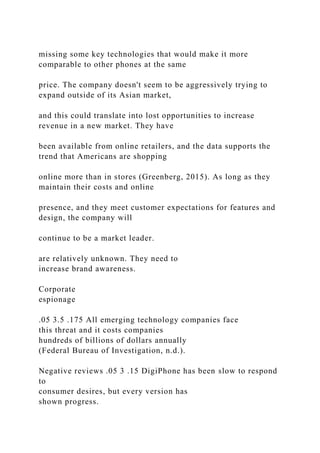
External Factor Analysis Summary Table for DigiPhone 7
(Example)
Overall, Digiphone is doing better than other phones in the
same market share. Their
annual stockholder report has shown shares increasing in value
in the last quarter (Digiphone,
2016). The version 7 of their phone is priced aggressively
within this market segment, but is also
missing some key technologies that would make it more
comparable to other phones at the same
price. The company doesn't seem to be aggressively trying to
expand outside of its Asian market,
and this could translate into lost opportunities to increase
revenue in a new market. They have
been available from online retailers, and the data supports the
trend that Americans are shopping
online more than in stores (Greenberg, 2015). As long as they
maintain their costs and online
presence, and they meet customer expectations for features and
design, the company will
continue to be a market leader.
are relatively unknown. They need to
increase brand awareness.
Corporate
espionage
.05 3.5 .175 All emerging technology companies face
this threat and it costs companies
hundreds of billions of dollars annually
(Federal Bureau of Investigation, n.d.).
Negative reviews .05 3 .15 DigiPhone has been slow to respond
to
consumer desires, but every version has
shown progress.
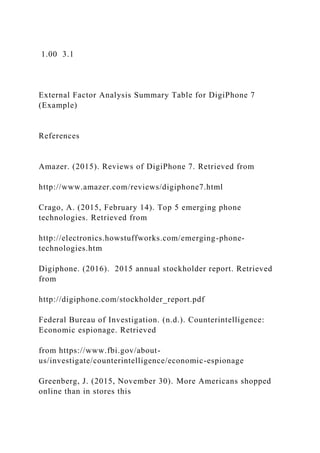
1.00 3.1
External Factor Analysis Summary Table for DigiPhone 7
(Example)
References
Amazer. (2015). Reviews of DigiPhone 7. Retrieved from
http://www.amazer.com/reviews/digiphone7.html
Crago, A. (2015, February 14). Top 5 emerging phone
technologies. Retrieved from
http://electronics.howstuffworks.com/emerging-phone-
technologies.htm
Digiphone. (2016). 2015 annual stockholder report. Retrieved
from
http://digiphone.com/stockholder_report.pdf
Federal Bureau of Investigation. (n.d.). Counterintelligence:
Economic espionage. Retrieved
from https://www.fbi.gov/about-
us/investigate/counterintelligence/economic-espionage
Greenberg, J. (2015, November 30). More Americans shopped
online than in stores this
weekend. Wired Magazine. Retrieved from
http://www.wired.com/2015/11/more-
americans-shopped-online-than-in-stores-this-weekend/
Lendino, J. (2015, April 20). What is 802.11ac Wi-Fi, and how
much faster than 802.11n is it?
Extreme Tech. Retrieved from
http://www.extremetech.com/computing/160837-what-is-
802-11ac-and-how-much-faster-than-802-11n-is-it
Minor, J. (2016, March 10). The best parental control apps for
your phone. PC Magazine.
Retrieved from http://www.pcmag.com/roundup/342731/the-
best-parental-control-apps-
for-your-phone

EFAS TableUsing the information gathered from your SWOT analysis.docx

  • 1.
    EFAS Table Using theinformation gathered from your SWOT analysis conducted in Unit II, create an external factor analysis (EFAS) table for the company you researched. Use Microsoft Word, or a similar program, to create your table. It should have five columns. The first column heading should be titled External Factors, the second column should be titled Weight, the third column should be titled Rating, the fourth column should be titled Weighted Score, and the fifth column should be titled Comments. You may also use the provided template by clicking here. Click here to see an example EFAS table. 1. In the External Factors column, list at least six opportunities you saw in the company you researched. Underneath the opportunities, list at least six threats you saw in the company you researched. 2. In the Weight column, assign an importance factor to each of these issues. It is important to note that whenever working with weighted averages, the weight column should always total 1.0, or 100%, regardless of how many factors are included in the EFAS analysis. It is up to the analyst to decide how much weight each individual external factor is assigned based on the probable impact on a particular company’s current strategic position. The higher the weight, the more important the factor to the current and future success of the company. An important factor may have a weight of 0.5 (50%), while a less important factor may have a weight of .05 (5%). When all is finished, however, all factor weights should total 1.0, or 100%. You may not be privy to the exact information for this company, so in some cases you will need to use your best judgment. (You will justify your weighting in column five.) 3. In the Rating column, assign a rating factor from 5.0-1.0 (5.0
  • 2.
    is outstanding; 1.0is poor). These ratings are based on the company’s response to that particular factor. It is your judgment call on how the company is currently dealing with each specific factor. Once again, you may need to make an estimate in this area if you are not privy to all of the information. (You will justify your weighting in column five.) 4. In the Weighted Score column, multiply the weight from column 2 by the rating in column 3 to get the factor’s weighted score. 5. In the Comments column, explain why a particular factor was selected and how its weight and rating were estimated. 6. At the bottom of column 4, add the weighted scores for the external factors. Is the company doing better or worse than others in the same industry? Complete this answer underneath your table. Format your assignment using APA Style. Use your own words, and include citations and references as needed to avoid plagiarism. CHES5149: China and Regional Order in Asia CCSS3500: China in Regional and World Systems 2018-19, Term 2, Tuesdays 14.30-17.15 Venue YIA 403 Lecturer: Dr. Tim Summers ([email protected]) Teaching Assistants: Wu Yiyang ([email protected]) Course summary
  • 3.
    This course looksat China’s changing political, economic and security relationships in Asia and beyond through frameworks and concepts in the International Relations (IR) literature. Part I sets out the context, Part II examines some of the main approaches in IR, while Part III applies these to questions of regionalism in East Asia, maritime disputes, and the Belt and Road Initiative. Learning outcomes By the end of the course, students are expected to be able to discuss China’s international relationships in Asia with reference to the main frameworks in the IR literature. Learning activities Lectures and tutorials will take place every week in three-hour sessions which mix lectures with class discussion. Students are expected to complete the readings before each class, and evidence that they have done so will contribute to assessment of participation. The learning activities are shared between CHES5149 and CCSS3500. Assessment scheme Grading will be based on three elements: 1. 30%: An essay of around 1,200 words (for both CHES5149 and CCSS3500) to be completed in class in week 7 (26 February ). Guidance on preparation will be given in class during the first part of the course. 2. 60%: Final paper of at least 3,000 words (CHES5149 ) / 2,500 words (CCSS3500 ), to be submitted in hard copy, by email and through Veriguide by 6pm on
  • 4.
    Tuesday 23 April.Details of topics will be posted on Blackboard at the start of term. 3. 10%: Class attendance and participation (including brief group presentations in Week 9) Grade descriptors for MA and BA students with further indications of grading criteria will be posted on Blackboard at the start of term. Attention is drawn to University policy and regulations on honesty in academic work, and to the disciplinary guidelines and procedures applicable to breaches of such policy and regulations. Details may be found at http://www.cuhk.edu.hk/policy/academichonesty/. With each assignment, students will be required to submit a signed declaration that they are aware of the policies, regulations and procedures. 1 CHES5149 (2018-19) - revised Dec. 2018 mailto:[email protected] mailto:[email protected] http://www.cuhk.edu.hk/policy/academichonesty/ Course schedule Part I: Introduction and context 1. Introduction: Course objectives and key concepts (8 Jan.)
  • 5.
    - Evelyn Goh(2016), “Introduction”, in Evelyn Goh (ed.), Rising China’s Influence in Developing Asia (Oxford: OUP) 2. China in Asia: Historical overview and The Chinese World Order (15 Jan.) - David C. Kang (2012), “Diplomacy: The Tribute System”, chapter 4 of East Asia Before the West: Five centuries of trade and tribute , Columbia UP - Peter Perdue (2015), “The Tenacious Tributary System”, Journal of Contemporary China , 24 (96): 1002-1014 - Benjamin I. Schwartz (1968), “The Chinese Perception of World Order, Past and Present”, in John K. Fairbank, ed, The Chinese World Order: Traditional China’s Foreign Relations, Harvard UP 3. International Relations theory and its limitations (22 Jan.) - [essential] Zhang Baohui (2014), “Xi Jinping, ‘Pragmatic’ Offensive Realism and China’s Rise”, Global Asia , 9(2) - Amitav Acharya (2017), “Theorising the international relations of Asia: necessity or indulgence?” The Pacific Review 30 (6): 816-828 - [optional] Qin Yaqing (2010), “Why is there no Chinese international relations theory?” in
  • 6.
    Amitav Acharya andBarry Buzan, eds, Non-Western International Relations Theory - [optional] Chapters 1-3 of Wang Jianwei and Song Weiqing (2016), China, the European Union, and the International Politics of Global Governance , Palgrave Macmillan (see Blackboard) - [optional] Lee Jones (2018), “Theorizing Foreign and Security Policy in an Era of State Transformation: A New Framework and Case Study of China”, Journal of Global Security Studies [on-line first] 4. Chinese foreign and security policy since 1949: ideas, institutions, and contemporary debates (29 Jan.) - Pu Xiaoyu and Wang Chengli (2018), “Rethinking China’s rise: Chinese scholars debate strategic overstretch”, International Affairs 94 (5), 1019-1035 - Nien-Chung Chang Liao (2016), “The sources of China’s assertiveness: the system, domestic politics or leadership preferences?” International Affairs, 92 (4), 817-834 - Rosemary Foot (2014), “‘Doing some things’ in the Xi Jinping era: the United Nations as China’s venue of choice”, International Affairs, 90 (5), 1085- 1100 - Richard Q. Turcsanyi (2017), “Assessing the Power of China: Insights from the Conceptual
  • 7.
    Thinking about Power”Journal of Chinese Political Science 22: 473-486 - [optional background] Wang Yizhou (2013), “Six Decades of China’s Diplomacy: Review and Reflections”, Economic and Political Studies, 1 (1), 120- 135 Note that there will be no class on 5 February (Chinese New Year holiday) II. China and Regional Order: contested frameworks 5. Offensive realism: Can China rise peacefully? (12 Feb.) - John J. Mearsheimer (2014, 2 nd edition), The Tragedy of Great Power Politics, Norton, chapter 10, ‘Can China Rise Peacefully?’ - Jonathan Kirshner (2010), “The tragedy of offensive realism: Classical realism and the rise of China”, European Journal of International Relations, 18(1), 53-75 - [optional] John Mearsheimer and Stephen Walt (2016), “The Case for Offshore Balancing: A Superior U.S. Grand Strategy”, Foreign Affairs, July/August 2 CHES5149 (2018-19) - revised Dec. 2018
  • 8.
    6. The LiberalOrder thesis and US-led order in East Asia (19 Feb.) - G. John Ikenberry (2009), “Liberal Internationalism 3.0: America and the Dilemmas of Liberal World Order”, Perspectives on Politics 7 (1), 71-87 - G. John Ikenberry and Darren J. Lim (2017), “China’s emerging institutional statecraft: The Asian Infrastructure Investment Bank and the prospects for counter-hegemony”, Brookings Institution - Amitav Acharya (2014), “The Myths of Liberal Hegemony”, Chapter 3 of The End of American World Order (Polity) - [optional] Michael Mastanduno (2014), “Order and change in world politics: the financial crisis and the breakdown of the US-China grand bargain”, chapter 6 of John Ikenberry, ed., Power, Order and Change in World Politics, Cambridge: Cambridge University Press 7. Mid-term assessment (26 Feb.) 8. The English School and Regional Order (5 March) - Ian Clark (2013), “China and the United States: a succession of hegemonies?” International Affairs, 87 (1), 13-28 - Evelyn Goh (2013), “Introduction: Order Transition in East
  • 9.
    Asia”, chapter 1of The Struggle for Order; hegemony, hierarchy and transition in post-Cold War East Asia , OUP - Qin Yaqing (2010), “International Society as a Process: Institutions, Identities, and China’s Peaceful Rise”, The Chinese Journal of International Politics, Vol. 3, 129-153 9. Selected Chinese thinking on international order (I) (12 March) - Yan Xuetong (2011), “Xunzi’s Thoughts on International Politics and Their Implications”, in Callahan and Barabansteva, China Orders the World - Zhao Tingyang (2011), “Rethinking Empire from the Chinese Concept ‘All-under-Heaven’ (Tianxia, 天下)”, in Callahan and Barabansteva, China Orders the World - [optional] William A. Callahan (2011), “Tianxia, Empire, and the World: Chinese Visions of World Order for the Twenty-First Century”, in Callahan and Barabantseva, China Orders the World 10. Selected Chinese thinking on international order (II) (19 March) - Yan Xuetong (2018), “Chinese Values vs. Liberalism: What Ideology WIll Shape the International Normative Order?” The Chinese Journal of International Politics 11(1), 1-22
  • 10.
    - Qin Yaqing(2016), “A Relational Theory of World Politics” International Studies Review 18, 33-47 - Qin Yaqing (2013), “Power Shift, Governance Deficit and a Sustainable Global Order”, Economic and Political Studies, 1 (1), 89-106 III. Case studies: China and regional order in Asia 11. China and (East) Asian regionalism (26 March) - Rodolfo Severino (2006), Southeast Asia in Search of an ASEAN Community, Singapore: Institute of Southeast Asian Studies, chapter 1 - Sarah Eaton and Richard Stubbs (2006), “Is ASEAN powerful? Neo-realist versus constructivist approaches to power in Southeast Asia”, The Pacific Review , 19 (2), 135-155 - Nick Bisley (2012), “China’s Rise and the Making of East Asia’s Security Architecture”, Journal of Contemporary China , 21(73), 19-34 - Zhang Yunling (2016), “China and its neighbourhood: transformation, challenges and grand strategy”, International Affairs, 92(4), 835-848 3 CHES5149 (2018-19) - revised Dec. 2018
  • 11.
    Note that Week12 (2 April) is a reading week for Undergraduate programmes. This lecture will therefore be required for MA students only. A short recorded version of the lecture will be posted on Blackboard. 12. Maritime disputes and regional order in East Asia (2 April) - Katherine Morton (2016), “China’s ambition in the South China Sea: is a legitimate maritime order possible?” International Affairs 92 (4), 909-940. - Carolina G. Hernandez (2014), “The South China Sea issue and its implications for the security of East Asia”, in Peter Shearman, ed, Power Transition and International Order in Asia , Routledge - Zhao Hong (2013), “The South China Sea Dispute and China- ASEAN Relations”, Asian Affairs, 44 (1), 27-43 - Christian Wirth (2018), “Whose ‘Freedom of Navigation’? Australia, China, the United States and the Making of Order in the ‘Indo-Pacific’”, The Pacific Review [on-line first] - Center for a New American Security (2014), Tailored Coercion: Competition and Risk in Maritime Asia , available at http://www.cnas.org/sites/default/files/publications- pdf/CNAS_TailoredCoercion_report.pdf
  • 12.
    13. The Beltand Road Initiative and regional/global order (9 Apr.) - Tim Summers (2018), “Rocking the boat? China’s ‘belt and road’ and global order”, in Anoushiravan Ehteshami and Niv Horesh, eds, China’s Presence in the Middle East: The implications of the One Belt, One Road Initiative , Routledge - Wang Yong (2016), “Offensive for defensive: the belt and road initiative and China’s new grand strategy” The Pacific Review 29 (3): 455-463 14. Conclusion. Contested frameworks and hegemony: power transition or the renegotiation of regional order? (16 Apr.) - Simon Reich and Richard Ned Lebow (2017), “Influence and Hegemony: Shifting Patterns of Material and Social Power in World Politics”, All Azimuth 6(1), 17-47 4 CHES5149 (2018-19) - revised Dec. 2018 http://www.cnas.org/sites/default/files/publications- pdf/CNAS_TailoredCoercion_report.pdf
  • 13.
    External Factor AnalysisSummary Table for DigiPhone 7 (Example) External Factors Weight Rating Weighted Score Comments Opportunities Expand optional video .1 3.5 .35 Many reviews mention the video quality has been improved over the previous model, but is still not the same quality compared to other phones in this price point (Amazer, 2015). Expand markets outside Asia .15 4 .6 The phones manufactured in China have a good foothold there, but are only available outside Asia through online retailers (Amazer, 2015). Include Bluetooth functionality .05 1 .05 The phone currently lacks Bluetooth functionality, which has become a
  • 14.
    standard feature ofphones in this class. Integrate front facing camera .05 1.50 .075 This was a requested feature for the older versions, and it finally made it to the DigiPhone 7. Parental Controls .05 1 .05 Not much is mentioned about built- in parental controls for phones, but the options are starting to emerge for parents to have direct control over talk time, texting, and other aspects of the phone (Minor, 2016). Use Wi-Fi 802.11ac .1 2 .2 Wifi N is quickly being replaced by Wifi 802-11ac, which is up to 12x faster (Lendino, 2015). Threats Recognizable design .05 1.0 .05 Most complaints were about their color selection. Only black or gray are available, and many other manufactures are coming out with other color options (Amazer, 2015). Cost of
  • 15.
    DigiPhone .1 3 .3The DigiPhone is marketed at the mid- level phone section, but is missing some key technologies that keep it from competing with those phones. It is competitively priced within this section. Growth of competition .2 5 1 Other companies are innovating; that will set them apart from the competition (Crago, 2008). Unknown company .05 2 .1 DigiPhone is not a household name, and outside of smart phone enthusiasts they External Factor Analysis Summary Table for DigiPhone 7 (Example) Overall, Digiphone is doing better than other phones in the same market share. Their annual stockholder report has shown shares increasing in value in the last quarter (Digiphone, 2016). The version 7 of their phone is priced aggressively within this market segment, but is also
  • 16.
    missing some keytechnologies that would make it more comparable to other phones at the same price. The company doesn't seem to be aggressively trying to expand outside of its Asian market, and this could translate into lost opportunities to increase revenue in a new market. They have been available from online retailers, and the data supports the trend that Americans are shopping online more than in stores (Greenberg, 2015). As long as they maintain their costs and online presence, and they meet customer expectations for features and design, the company will continue to be a market leader. are relatively unknown. They need to increase brand awareness. Corporate espionage .05 3.5 .175 All emerging technology companies face this threat and it costs companies hundreds of billions of dollars annually (Federal Bureau of Investigation, n.d.). Negative reviews .05 3 .15 DigiPhone has been slow to respond to consumer desires, but every version has shown progress.
  • 17.
    1.00 3.1 External FactorAnalysis Summary Table for DigiPhone 7 (Example) References Amazer. (2015). Reviews of DigiPhone 7. Retrieved from http://www.amazer.com/reviews/digiphone7.html Crago, A. (2015, February 14). Top 5 emerging phone technologies. Retrieved from http://electronics.howstuffworks.com/emerging-phone- technologies.htm Digiphone. (2016). 2015 annual stockholder report. Retrieved from http://digiphone.com/stockholder_report.pdf Federal Bureau of Investigation. (n.d.). Counterintelligence: Economic espionage. Retrieved from https://www.fbi.gov/about- us/investigate/counterintelligence/economic-espionage Greenberg, J. (2015, November 30). More Americans shopped online than in stores this
  • 18.
    weekend. Wired Magazine.Retrieved from http://www.wired.com/2015/11/more- americans-shopped-online-than-in-stores-this-weekend/ Lendino, J. (2015, April 20). What is 802.11ac Wi-Fi, and how much faster than 802.11n is it? Extreme Tech. Retrieved from http://www.extremetech.com/computing/160837-what-is- 802-11ac-and-how-much-faster-than-802-11n-is-it Minor, J. (2016, March 10). The best parental control apps for your phone. PC Magazine. Retrieved from http://www.pcmag.com/roundup/342731/the- best-parental-control-apps- for-your-phone