English file Pre-
Intermediate
Unit 9A – Second conditional
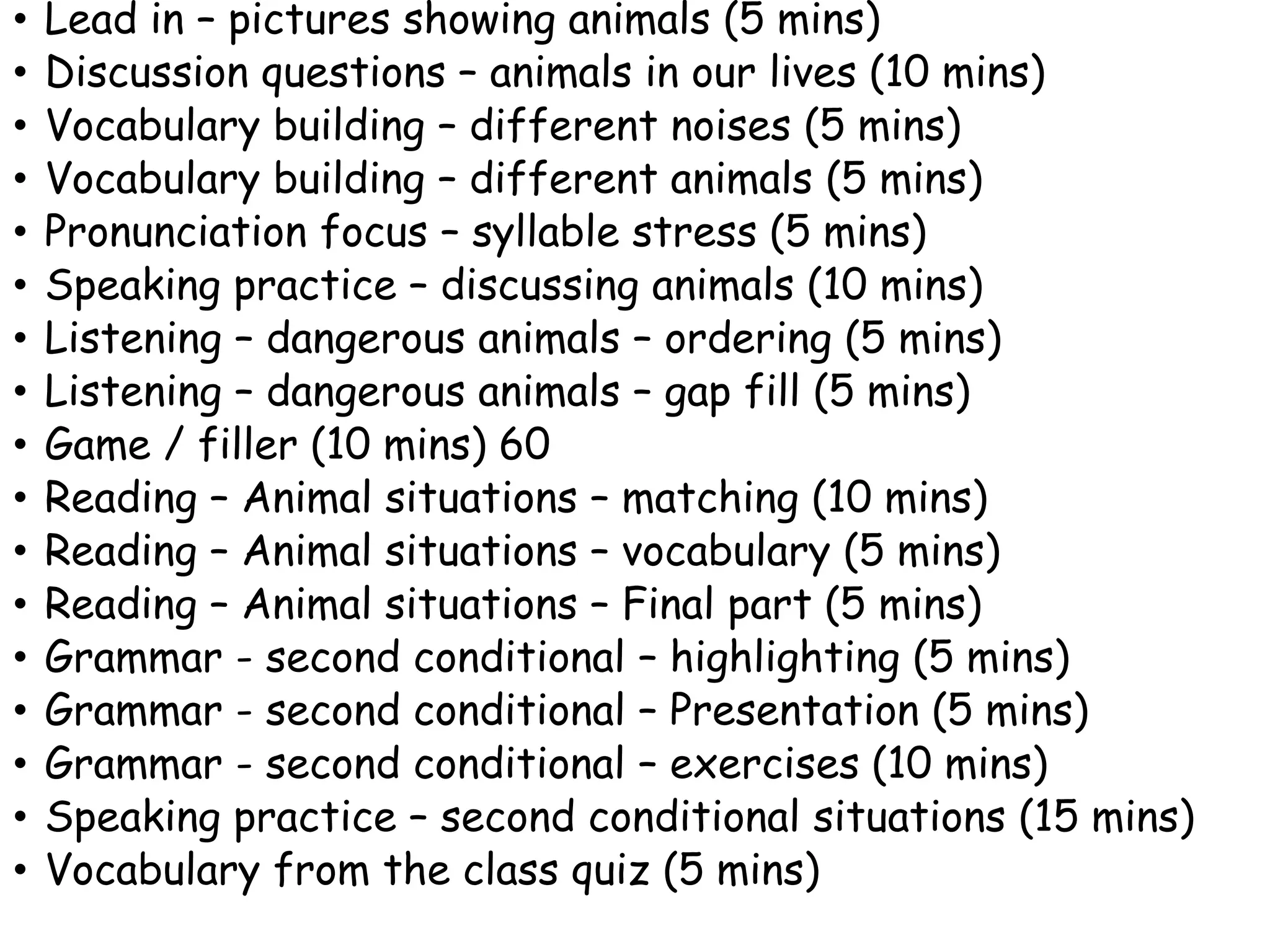
• Lead in – pictures showing animals (5 mins)
• Discussion questions – animals in our lives (10 mins)
• Vocabulary building – different noises (5 mins)
• Vocabulary building – different animals (5 mins)
• Pronunciation focus – syllable stress (5 mins)
• Speaking practice – discussing animals (10 mins)
• Listening – dangerous animals – ordering (5 mins)
• Listening – dangerous animals – gap fill (5 mins)
• Game / filler (10 mins) 60
• Reading – Animal situations – matching (10 mins)
• Reading – Animal situations – vocabulary (5 mins)
• Reading – Animal situations – Final part (5 mins)
• Grammar - second conditional – highlighting (5 mins)
• Grammar - second conditional – Presentation (5 mins)
• Grammar - second conditional – exercises (10 mins)
• Speaking practice – second conditional situations (15 mins)
• Vocabulary from the class quiz (5 mins)
• What animals are common in your country but
not in the UK?
• How important are animals to us? Why?
• Have you ever seen a dangerous animal? Where
and when?
• Which animal would you like as a pet if you could
have any pet?
Insects
1. mosquito
2. butterfly
3. wasp
4. Spider
5. bee
6. fly
Farm animals
7. goat
8. bull
9. sheep
10. chicken
11. pig
12. cow
13. horse
Wild animals
14 camel
15 giraffe
16 bat
17 elephant
18 bear
19 monkey
20 lion
21 bird
22 kangaroo
23 mouse
24 tiger
25 rabbit
26 crocodile
27 rat
28 deer
29 snake
Sea animals
30 jellyfish
31 whale
32 dolphin
33 shark
A snake (the adder)
cows
red deer
dogs
wasps and bees
A snake (the adder)
cows
red deer
one metre
step on
every year
walking dogs
summer
100 kilos
autumn
50,000
dogs
wasps and bees
Very few
their owners
five
Wasps bees
The saltwater crocodile can grow up to 7 metres long and weigh up to
______ KG and holds the record for the strongest bite ever recorded:
3,700 pounds per square inch (psi). That’s comparable to a T. Rex!
A) 250 B) 600 C) 1000
1000
https://www.youtube.com/watch?v=RXn1g0xt
UMk
Hippos weigh up to 3,000 lbs, can run up to 30 km/h over short distances.
They kill approximately _ _ _ people per year in Africa, mostly by
overturning boats and drowning or crushing their victims
A) 250 B) 500 C) 750
500
Poison dart frogs have evolved brightly coloured skin to let predators
know that while they may be small, they can kill up to _ _ adults with their
poisonous toxins, so a mere touch is all it takes to kill.
A) 10 B) 20 C) 30
20
The black mamba’s bite, called the “kiss of death,” contains enough venom
to kill 10 healthy adult humans. If antivenom isn’t administered within the
first _ _ minutes, the bite of the black mamba is almost 100% fatal.
A) 10 B) 20 C) 30
20
The mosquito, through its transmission of diseases and parasites like
malaria, zika, West Nile virus, and Dengue fever, indirectly kills up to a
million people per year; a child dies from malaria every 30 __________.
A) seconds B) minutes C) hours
seconds
Pufferfish contain tetrodotoxin, a poison that is _____ times more lethal
than cyanide! Nonetheless, pufferfish are considered a delicacy, and in
Japan several people die each year from improperly prepared pufferfish.
A) 100 B) 500 C) 1200
1200
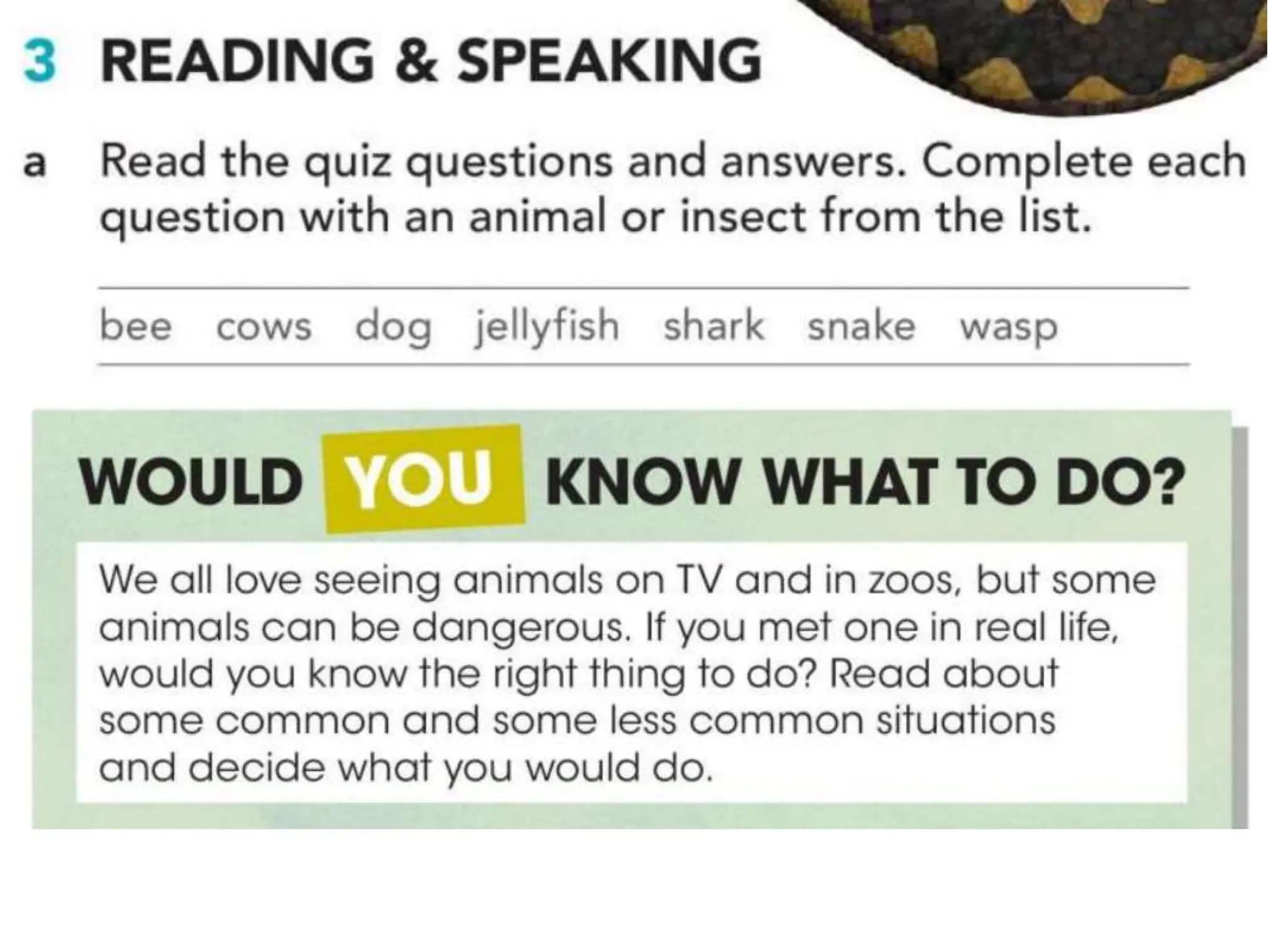
Read through the
examples
We’ll check the vocabulary first
dog
bee
wasp
snake
cows
jellyfish
shark
shout /ʃaʊt/ = to say something in a loud voice
keep still /kiːp stɪl/ = not move
wave /weɪv/ = to move your hand or arm from side to side in
the air, in order to attract attention, etc.
suck /sʌk/ = to take liquid, air, etc. into your mouth with your lips
tie /taɪ/ = to fasten something with string, rope, etc.
rub /rʌb/ = to move your hand backwards and forwards over a
surface while pressing firmly
float /fləʊt/ = to stay on the surface of water
Shout Wave Tie float
Keep still suck rub
They are all about an imagined future situation.
The tense of the verb after if is the past simple.
The other form is would + infinitive.
E
D
C
F
G
B
would get* had
tried ‘d like
wouldn’t buy didn’t like
hired could
‘d see lived
wouldn’t go were
‘d learn did
‘d cycle wasn’t
Would work found
wouldn’t
be
had to
1. chicken (or hen)
2. horse
3. monkey
4. snake
5. cat
6. dog
7. lion
8. bull
EF4PI Unit 9A - UK dangers and Second conditional.pptx

EF4PI Unit 9A - UK dangers and Second conditional.pptx

  • 1.
    English file Pre- Intermediate Unit9A – Second conditional
  • 2.
    • Lead in– pictures showing animals (5 mins) • Discussion questions – animals in our lives (10 mins) • Vocabulary building – different noises (5 mins) • Vocabulary building – different animals (5 mins) • Pronunciation focus – syllable stress (5 mins) • Speaking practice – discussing animals (10 mins) • Listening – dangerous animals – ordering (5 mins) • Listening – dangerous animals – gap fill (5 mins) • Game / filler (10 mins) 60 • Reading – Animal situations – matching (10 mins) • Reading – Animal situations – vocabulary (5 mins) • Reading – Animal situations – Final part (5 mins) • Grammar - second conditional – highlighting (5 mins) • Grammar - second conditional – Presentation (5 mins) • Grammar - second conditional – exercises (10 mins) • Speaking practice – second conditional situations (15 mins) • Vocabulary from the class quiz (5 mins)
  • 4.
    • What animalsare common in your country but not in the UK? • How important are animals to us? Why? • Have you ever seen a dangerous animal? Where and when? • Which animal would you like as a pet if you could have any pet?
  • 5.
    Insects 1. mosquito 2. butterfly 3.wasp 4. Spider 5. bee 6. fly
  • 6.
    Farm animals 7. goat 8.bull 9. sheep 10. chicken 11. pig 12. cow 13. horse
  • 7.
    Wild animals 14 camel 15giraffe 16 bat 17 elephant 18 bear 19 monkey 20 lion 21 bird 22 kangaroo 23 mouse 24 tiger 25 rabbit 26 crocodile 27 rat 28 deer 29 snake
  • 8.
    Sea animals 30 jellyfish 31whale 32 dolphin 33 shark
  • 12.
    A snake (theadder) cows red deer
  • 13.
  • 15.
    A snake (theadder) cows red deer one metre step on every year walking dogs summer 100 kilos autumn 50,000
  • 16.
    dogs wasps and bees Veryfew their owners five Wasps bees
  • 19.
    The saltwater crocodilecan grow up to 7 metres long and weigh up to ______ KG and holds the record for the strongest bite ever recorded: 3,700 pounds per square inch (psi). That’s comparable to a T. Rex! A) 250 B) 600 C) 1000 1000
  • 20.
  • 22.
    Hippos weigh upto 3,000 lbs, can run up to 30 km/h over short distances. They kill approximately _ _ _ people per year in Africa, mostly by overturning boats and drowning or crushing their victims A) 250 B) 500 C) 750 500
  • 23.
    Poison dart frogshave evolved brightly coloured skin to let predators know that while they may be small, they can kill up to _ _ adults with their poisonous toxins, so a mere touch is all it takes to kill. A) 10 B) 20 C) 30 20
  • 24.
    The black mamba’sbite, called the “kiss of death,” contains enough venom to kill 10 healthy adult humans. If antivenom isn’t administered within the first _ _ minutes, the bite of the black mamba is almost 100% fatal. A) 10 B) 20 C) 30 20
  • 25.
    The mosquito, throughits transmission of diseases and parasites like malaria, zika, West Nile virus, and Dengue fever, indirectly kills up to a million people per year; a child dies from malaria every 30 __________. A) seconds B) minutes C) hours seconds
  • 26.
    Pufferfish contain tetrodotoxin,a poison that is _____ times more lethal than cyanide! Nonetheless, pufferfish are considered a delicacy, and in Japan several people die each year from improperly prepared pufferfish. A) 100 B) 500 C) 1200 1200
  • 27.
    Read through the examples We’llcheck the vocabulary first
  • 32.
  • 33.
  • 34.
  • 35.
    shout /ʃaʊt/ =to say something in a loud voice keep still /kiːp stɪl/ = not move wave /weɪv/ = to move your hand or arm from side to side in the air, in order to attract attention, etc. suck /sʌk/ = to take liquid, air, etc. into your mouth with your lips tie /taɪ/ = to fasten something with string, rope, etc. rub /rʌb/ = to move your hand backwards and forwards over a surface while pressing firmly float /fləʊt/ = to stay on the surface of water Shout Wave Tie float Keep still suck rub
  • 43.
    They are allabout an imagined future situation. The tense of the verb after if is the past simple. The other form is would + infinitive.
  • 47.
  • 48.
    would get* had tried‘d like wouldn’t buy didn’t like hired could ‘d see lived wouldn’t go were ‘d learn did ‘d cycle wasn’t Would work found wouldn’t be had to
  • 52.
    1. chicken (orhen) 2. horse 3. monkey 4. snake 5. cat 6. dog 7. lion 8. bull

Editor's Notes

  • #19 https://www.factinate.com/things/39-facts-deadly-animals/